What a scream!
35 years of Home Alone

Tracking the influence of Thomas the Tank Engine author

35 years of Home Alone
Tracking the influence of Thomas the Tank Engine author
The Salvation Army is a Christian church and registered charity seeking to share the good news of Jesus and nurture committed followers of him. We also serve people without discrimination, care for creation and seek justice and reconciliation. We offer practical support and services in more than 700 centres throughout the UK. Go to salvationarmy.org.uk/find-a-church to find your nearest centre.
The Salvation Army first published a newspaper called the War Cry in London in December 1879, and we have continued to appear every week since then. Our name refers to our battle for people’s hearts and souls as we promote the positive impact of the Christian faith and The Salvation Army’s fight for greater social justice.
Editor: Andrew Stone, Major
Managing Editor: Philip Halcrow
Staff Writer: Emily Bright
Staff Writer: Claire Brine
Staff Writer: Ewan Hall
Editorial Assistant: Linda McTurk
Graphic Designer: Mark Knight
Graphic Designer: Natalie Adkins
Email: warcry@salvationarmy.org.uk
The Salvation Army United Kingdom and Ireland Territory 1 Champion Park London SE5 8FJ
Tel: 0845 634 0101
Subscriptions: 01933 445445 (option 1, option 1) or email: subscriptions@satcol.org
Founders: Catherine and William Booth International leaders: General Lyndon Buckingham and Commissioner Bronwyn Buckingham Territorial leaders: Commissioners Jenine and Paul Main
Editor-in-Chief: Major Julian Watchorn
Published weekly by The Salvation Army
© The Salvation Army United Kingdom and Ireland Territory ISSN 0043-0226
The Salvation Army Trust is a registered charity. The charity number in England, Wales and Northern Ireland is 214779, in Scotland SC009359 and in the Republic of Ireland CHY6399.
This year, Thomas the Tank Engine and his friends turned 80. Yet, on Christmas morning, all these years down the line, eager young children will still be unwrapping books and toys based on the franchise –perhaps even as they watch an episode of the TV series.
Why do the stories and characters, originally created by clergyman the Rev Wilbert Awdry, continue to hold such appeal? A clue can be found in an interview in this week’s War Cry with Veronica Chambers, the daughter of the author, who tells us that her father began telling the stories about steam engines to his poorly son.
‘The first story came into being because my brother was ill with measles. This two-and-a-half-year-old little boy was getting better, but he was not very happy about the whole business, so my father was trying to entertain him,’ she says.
‘Father got a piece of scrap paper and drew some engines,’ she explains. ‘On each engine, he made the handle on the smokebox into a nose, and then he added eyes and a mouth with a different expression – one, say, of being surprised and one that looked unhappy.’
From these train characters, created in love by a father for his son, came stories that would enthral not just their original audience of one, but millions of children through the generations.
At this time of year, children and adults alike are finding themselves enthralled by another story. But this story – of a baby born 2,000 years ago – is no fiction.
The appeal of the story of the birth of Jesus is that it tells us how God, in love, sent his Son into the world so that we can know the best way to live and how we can experience his love for ourselves.
If we choose to accept that love and teaching, we’ll be on the right track to a new and better life.
Printed by CKN Print, Northampton, on sustainably sourced paper





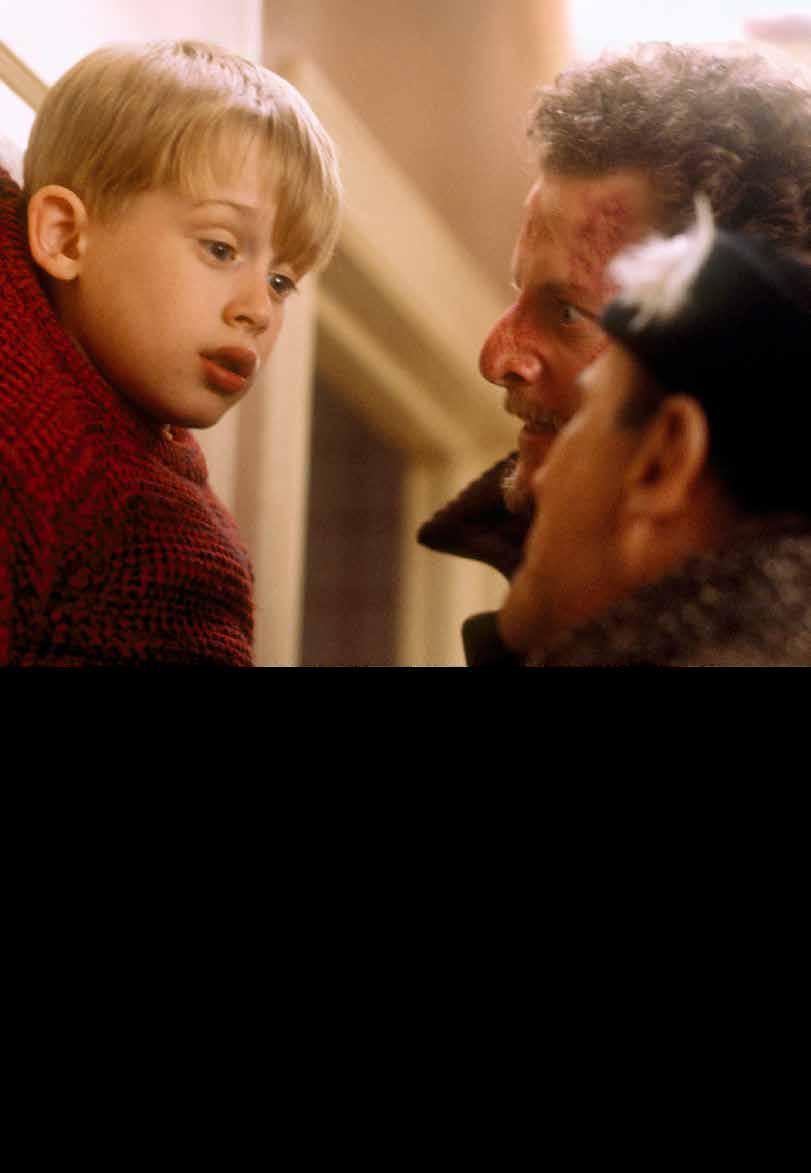
Kevin tries to defend his home from burglars
By Ewan Hall
It’s the most wonderful time of the year for people who enjoy Christmas films – and 35 years after 8-year-old Kevin McCallister defended his family home with paint cans and booby traps, fans and ‘filthy animals’ are once again getting the opportunity to see seasonal favourite Home Alone on the big screen as well as at home on Disney+.
Setting slapstick against a Christmas backdrop, John Hughes’s film centres on Kevin (Macaulay Culkin), who is accidentally left behind when his family goes on a Christmas vacation to Paris –resulting in him being completely home alone.
Overnight, Kevin has to become the ‘man of the house’, adapting to independence through shopping, laundry and a memorable moment with aftershave. And when burglars try to break in, he defends his home through clever tricks and Christmas-themed booby traps.
On its release in 1990, Home Alone was an instant success, catapulting Macaulay Culkin to stardom – and it has remained popular.
Venues across the UK are once again including the film in their seasonal
programming – some with orchestras accompanying the on-screen action – and Odeon has published ‘30 cool facts on its 35th anniversary’. Among the snippets of information which the cinema chain’s website serves up is that Canadian comedian John Candy improvised some of the lines of his cameo and that composer John Williams, who earned the film’s two Oscar nominations, was not even first choice for providing the music.
Meanwhile in the US, Macaulay is on tour, attending screenings in major cities to reveal what happened behind the scenes and share his memories of playing Kevin. He will also be talking about why he thinks the film resonates with so many people today.
Perhaps one of the reasons is that, beneath the laughter, festive chaos and ingenious traps, the story is about connection and togetherness. Kevin’s adventure reminds us that, while the season is often filled with twinkly lights and joy, it can also provoke feelings of isolation. Kevin misses his mum, dad and siblings and has an encounter with an old man across the street who has no contact with his family at all.

Christmas can weigh heavily on the hearts of anyone facing loneliness, grief, worries or the ache of being far from home. Such feelings can exist throughout the year – but they can often be stronger at Christmastime, when people look around and see that everyone else seems happy. However, there is someone who is waiting to share his presence with us –someone who will always be there and never forget us: God.
In the Bible, he reassures people: ‘Don’t fear, because I am with you; don’t be afraid, for I am your God’ (Isaiah 41:10 Common English Bible).
If we choose to turn to God when we feel lost or forgotten, we will find more than comfort. We’ll discover strength, peace and the assurance that we are never truly alone.
’Tis the season to be jolly, so don we now our Christmas jumpers. The charity Save the Children is encouraging people to donate money and wear festive knits to mark Christmas Jumper Day on Thursday (11 December).
Seasonal woolly jumpers have become quite the trend. A few years ago, supermarket Lidl reported that it had sold one every two seconds. Unsurprisingly, others are looking to get in on the action.
The Church Times reports that brothers Matthew and Tom James are reclaiming the story behind the festivities through their crowdfunding knitwear campaign – Incarnate Apparel: ‘Christmas jumpers that point to Christ.’
The brothers wrote on their Kickstarter page: ‘Christmas is a time for fun, family and celebration, but primarily a time to celebrate the light of the gospel shining in the darkness. In a world that desperately seeks truth and genuine meaning, Incarnate Apparel has created Christmas jumpers to remind those around us what this season is really about.’
The jumper promotes the light Jesus brings
Matthew and Tom’s green festive jumper design features the Bible verse John 1:5, which says of Jesus: ‘The light shines in the darkness and the darkness has not overcome it.’
Tom told the Church Times: ‘People really want hope; they want light. This is a verse which says, actually, light has come into the world. The light shines in the darkness. Jesus offers light and life. Hopefully, that really resonates with where people are at.’
The idea has certainly resonated with people. The campaign exceeded its fundraising target of £3,520 to produce 100 jumpers, and the brothers have set up a website to sell more of them.
As a Christian, I can testify to the light that the jumper promotes – the light that Jesus brings. When life has felt at its darkest, his love has brought me hope, comfort and strength. I know that no matter how difficult things get, Jesus will help me through. My relationship with him has been the greatest gift I have received.
The good news is that Jesus can bring light into all our lives, if we let him. His unconditional love is not just woolly thinking – it’s a truth that can transform us. Why not try a relationship with him on for size?
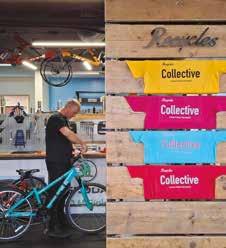
The Recycles shop has a new look
A donation of £20,000 has enabled The Salvation Army’s Recycles bike project at Booth House in Swindon to refurbish its workshop.
The project, which sells, services and repairs bikes, offers skills training to people who have experienced homelessness.
The gift was made by a local family who were originally customers of the shop.
As a result of the donation, the workshop has a bright new layout and a fresh look designed to challenge misconceptions of homelessness and used goods.
The social enterprise has also sparked the creation of a cycle club, a group of cycling enthusiasts who promote the shop and its mission in the community.
Sam Ryder is to play Jesus in the rock opera Jesus Christ Superstar when it opens at the London Palladium next summer.
The singer (pictured), who represented the UK in the 2022 Eurovision Song Contest, will take on the role for a limited 11-week season, opening in June.
Written by Andrew Lloyd Webber and Tim Rice, the musical tells the story of the last week of Jesus’ life and features the songs ‘I Don’t Know How to Love Him’ and ‘Gethsemane’.
Sam said: ‘I’m honoured to take on this responsibility as I follow in the footsteps of rock vocal titans like Ian Gillan and John Farnham. I can’t wait.’



Liz delivers the Salvation Army petition
A mother who lost two sons to drugs travelled to No 10 Downing Street to hand in a Salvation Army petition urging the government to view rising drug deaths as a public health emergency.
Liz Brown supported the petition, which gathered almost 1,700 signatures, to honour the memory of her sons Karl and Lee. Their deaths in 2022 and 2024 were both drug-related.
According to The Salvation Army’s statistical analysis, 18 people in the UK die from drugs every day, a 61 per cent increase from 10 years ago. The church and charity has stated that cuts to addiction services have exacerbated the problem.
Liz said: ‘No mother should experience what I have gone through. That’s why I’m supporting The Salvation Army’s call for urgent action to prevent other people from losing their lives.
‘A lot of people don’t see someone who takes drugs as a person who deserves help, which breaks my heart. What they don’t realise is that people with an addiction are suffering.
‘I know from my experience with my sons that having a go at them for taking drugs or trying to make them feel ashamed sadly doesn’t change anything and it doesn’t stop them dying. What people in this situation need is ongoing professional help.’


AFC Bournemouth have given Boscombe Salvation Army church a £2,000 grant to fund a new support group for women experiencing hardship.
The Women Together group is run as part of the church’s BH1 Project, which helps people experiencing homelessness and financial difficulties.
The weekly drop-in sessions for women offer coffee and cake, clothes and make-up, and professional services, including a hairdresser, a beautician and a qualified masseuse.
A user of the BH1 Project, Rebekah Watts, travelled to the club, where she met Cherries winger Marcus Tavernier and received the donation. Rebekah was formerly street homeless, but with the support of The Salvation Army found accommodation and employment.
Annette Watts, community project manager at Boscombe Salvation Army, said: ‘This generous donation from AFC Bournemouth enables BH1 to offer this time just for women, a place where they can experience the opportunity for selfcare to help them feel relaxed and improve their wellbeing and self-esteem. In a drop-in service that is currently mostly used by men, it is so good to have space for women.’
The man in red reveals the joys of the season and why Christmas is all about giving
Interview by Claire Brine
The legend I’m about to interview wishes to remain anonymous – so let’s call him Ned. Ned has one of the most important jobs in the world. For many years, he has spent his Decembers dressing up in a thick red suit and greeting excitable children as they queue up to tell him what they’d like for Christmas.
‘Being Father Christmas is a great privilege,’ says Ned, who proves to me that he’s the real deal by brandishing his red hat with a white pom-pom. ‘But the whole point of the character is that he’s a mystery.
‘Over the years, I’ve done all the palaver – climbing a ladder to tap on the high-up windows of a school, exciting the children, then surprising them by walking in with a sackful of presents. I’ve listened as they’ve given me lengthy explanations about the toys they want. I’ve had children bursting into tears when they see me, as well as those who want to sit on my knee for a photograph. I enjoy the pleasure that Father Christmas can bring to families. And I like the spontaneity and the challenge of the unknown.’
Though many parents refer to the man in red as a magical figure, Ned is quick to point out that the person of Father Christmas, sometimes known as Santa Claus, has his origins in a real-life bishop of the fourth century.
‘St Nicholas lived in Myra, in Turkey,’ he explains. ‘One legend is that he put gifts down the chimney of a house where a poor family lived. There were three daughters, who, after washing their
stockings, hung them up to dry by the fire, and it’s believed that St Nicholas dropped money into the stockings overnight.
‘At the time, nobody knew who had given the daughters the money. St Nicholas didn’t say that it was him. But the point of the story is about the importance of giving. And, as a Christian, I see God as the great giver.’
We all like to bring joy to others
While the public’s perception of Father Christmas has evolved over the years, his popularity has only increased. For many families, booking a trip to a grotto has become an annual festive tradition.
‘I try to have a private chat with every family that comes to see me,’ explains Ned. ‘You want to make the visit a special moment for each child, so I keep the banter going. I never want families to feel that what I’m saying is formulaic.
‘Sometimes, if all the relatives seem good-humoured, I’ll say to the child: “Do you know, I used to visit your grandma when she was a little girl. But that was such a long time ago!” And when the child looks over at Grandma, who is nodding and playing along, it’s just great.’
As well as being endlessly jolly in conversation, Father Christmas carries the responsibility of handing out toys,
posing for photographs and putting on ‘the voice’ – a feat Ned sustains for hours on end thanks to honey and lemon lozenges and bottles of water. A six-hour shift can be hard work – but Ned enjoys it.
‘I think we all like to bring joy to others,’ he says. ‘Again, it’s about giving. And I try to encourage the children I meet to be givers as well. After we have spoken about the presents they’d like, I might say to them: “And what do you think you’d like to give Mummy or Daddy for Christmas?”
‘The Bible says that it is more blessed to give than receive.’
Though Ned understands that faith is rarely going to come up in conversation when children meet Father Christmas, he explains that his Christian beliefs have an influence on his work and how he approaches it.
‘You never know what kind of year these families have had,’ he says. ‘So if there are ever times when I don’t know what to say to them, I’ll quietly pray to God: “Help!” And that’s when his grace comes in – which the Bible tells us is sufficient. God’s strength is always made perfect in our weakness.’
As much as Father Christmas brings excitement to the festive season, Ned believes that the ultimate joy can be found in the Nativity – the story of Jesus’ birth.
‘The baby in the manger in Bethlehem is the God who created the universe,’ he says.
‘Jesus is the saviour of the world. And he’s not just around at Christmastime. He’s for every day.’






Veronica Chambers
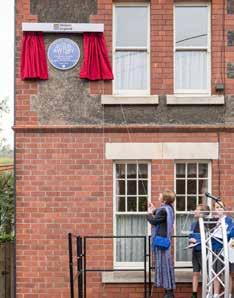
There was a reason that a crowd had gathered outside a house on the outskirts of Stroud, Gloucestershire. They were there to watch Veronica Chambers unveil a blue plaque installed by Historic England in honour of her father. The plaque announces that No 30 Rodborough Avenue was once the home of the Rev Wilbert Awdry – ‘children’s author who created Thomas the Tank Engine’.
‘It was a lovely occasion,’ says Veronica, remembering October’s ceremony. ‘Some of the children from the primary school just up the road came along, and four of them read a piece from the first Railway Series book. There were old friends and new friends and neighbours. And all seven grandchildren who knew the house as the only place where their grandparents lived were able to be there on the day too.’
The Rev Wilbert Awdry and his wife, Margaret, had moved to the house when Wilbert retired from active parish ministry
Eighty years ago, the first title was published in a series of books that would introduce readers to characters such as Thomas the Tank Engine, Annie and Clarabel and the Fat
Controller.
VERONICA CHAMBERS reflects on the influence of their author, her father – the Rev Wilbert Awdry
Interview by Philip Halcrow
as a Church of England priest. They named the house Sodor, after the fictional island which Wilbert had created and populated with characters such as Thomas the Tank Engine, carriages Annie and Clarabel and Sir Topham Hat, the Fat Controller.
‘I lived in the house for a couple of years,’ Veronica says. ‘I went to university at Leeds during that time, and my sister and brother were away working, but we knew the house well.’
Wilbert may have officially retired by the time he moved to Rodborough Avenue, but he continued to take services in churches of various denominations – and, says Veronica, he also took seriously the unofficial ministry that he had developed over decades.
It was only when Veronica was about nine years old, when her father was in his second parish in Emneth in Norfolk, that she became conscious ‘that he would set aside a day a week when he could
Thomas the Tank Engine
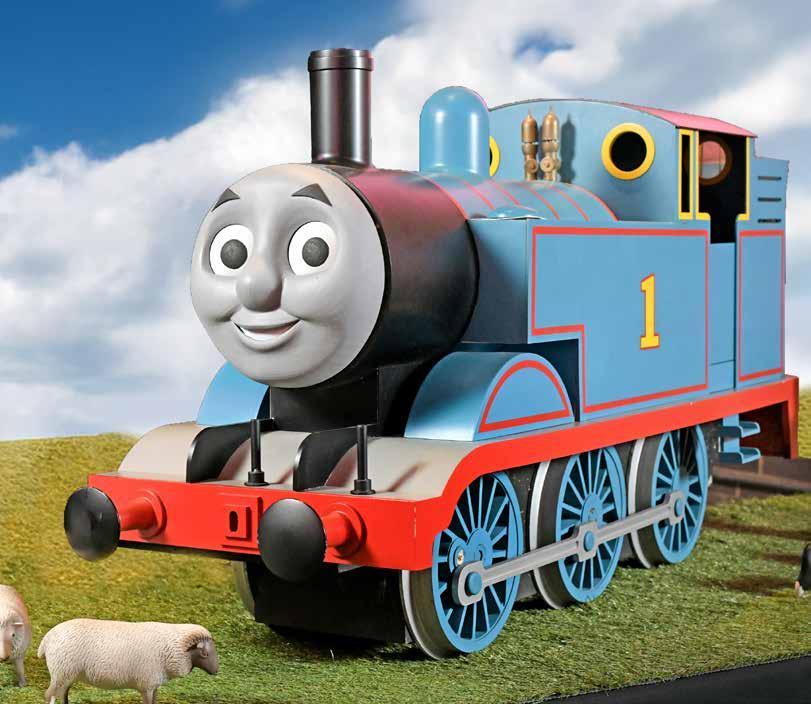
write and that lots of people seemed to know him. He tried to do one book a year, and there was a lot of work involved, but otherwise he was just our father.’
Now celebrating its 80th anniversary, the first title in the Railway Series – The Three Railway Engines – had been published in 1945. Its journey, however, had begun two years earlier.
‘The first story came into being because my brother was ill with measles,’ says Veronica. ‘This two-and-a-half-year-old little boy was getting better, but he was not very happy about the whole business, so my father was trying to entertain him with poems and songs and whatnot.
‘There was one song that Christopher apparently liked very much – the children’s song, which parents still sing, about being down at the station early in the morning and seeing the little engines all in a row. To make it a bit more interesting, Father got a piece of scrap paper and drew some
engines. He drew them from the front because it was reasonably straightforward, whereas drawing a locomotive from the side would be complicated.
Christopher asked:
‘Why is that engine sad?’
‘On each engine, he made the handle on the smokebox into a nose, and then he added eyes and a mouth with a different expression – one, say, of being surprised and one that looked unhappy. And of all the different faces, it was the unhappy one that Christopher seemed to home in on.
‘Christopher asked: “Why is that engine sad?” Father had to think quickly and said: “Because he has not been out for a long time.” Then – of course, as a child would – Christopher asked again: “Why?” Father
said: “Because all the other engines are bigger and stronger, and they get chosen first.”
‘Christopher asked: “What’s his name?” And the first name that came into Father’s head was Edward. So between them, they made up a story about Edward’s day out.’
At first, says Veronica, the story existed only verbally – but to ensure that he got the details straight when he told the emerging stories again to Christopher, Wilbert began to write things down.
‘When you tell a story, children know what you have said before, and they like you to use the same words again. Apparently, Christopher was correcting Father, so Father began to make notes just on scraps of paper.
‘After the first story about Edward, to make things more interesting, he made
Turn to page 10 f
From page 9
up another story that brought in Gordon, a big and bossy engine, and Henry. And in the third story he had Henry, who was very vain, stay in a tunnel because he didn’t want the rain to spoil his paint. So eventually he had these stories with all these notes about them.
‘My mother had gone out looking for children’s books, but had come back saying there was very little choice. She told my father that his stories were as good as anything in the shops. My grandmother felt the same, and she sent them off to a friend who had a few connections and who took them round to various publishers – without success for a long time.’
But then the stories came to the attention of a printer, Edmund Ward.
‘He decided he wanted to produce six quality children’s books with good illustrations. Apparently, he had five titles already and he wanted to make the stories about the engines the sixth – though he asked Father to write one more story which got Henry out of the tunnel where he’d been bricked up.
‘An artist had to be found to illustrate the stories, and then in 1945 they were finally published. Father didn’t think anything
more of it, but then he was asked for another one.’
Wilbert was serving as a curate in Birmingham when he wrote the first two books in the Railway Series, the second of which introduced the character of Thomas the Tank Engine. He had previously served at a church in Odiham – where he had struggled to be accepted because of his membership of a pacifist organisation –and he would later serve as parish priest in Elsworth in Cambridgeshire and then Emneth.
He considered answering the letters to be part of his ministry
His ministry, however, was becoming very different from what he could have envisaged when he felt called to the priesthood. In 1965 he retired from parish work.
‘The reason he was given permission to retire was partly because writing involved an awful lot of research,’ explains Veronica. ‘He needed to be accurate in everything
he did in connection with the railways. He also had the burden of parish work, which he carried out meticulously. Then there was the spin-off from his books, which was that people wrote to him.’
He was engaging in a form of outreach that he did not take lightly, says Veronica.
‘As a result of his career as a children’s author, he began to receive lots of mail. Some of it was simply fan mail, but there were also letters asking for advice.
‘Letters came from people who believed that he understood the workings of the child’s mind and who had the sure knowledge that as a parson he could be trusted with confidences. There were questions from parents who were anxious about problem children or who were asking about the spiritual upbringing of their children.
‘All those letters had to




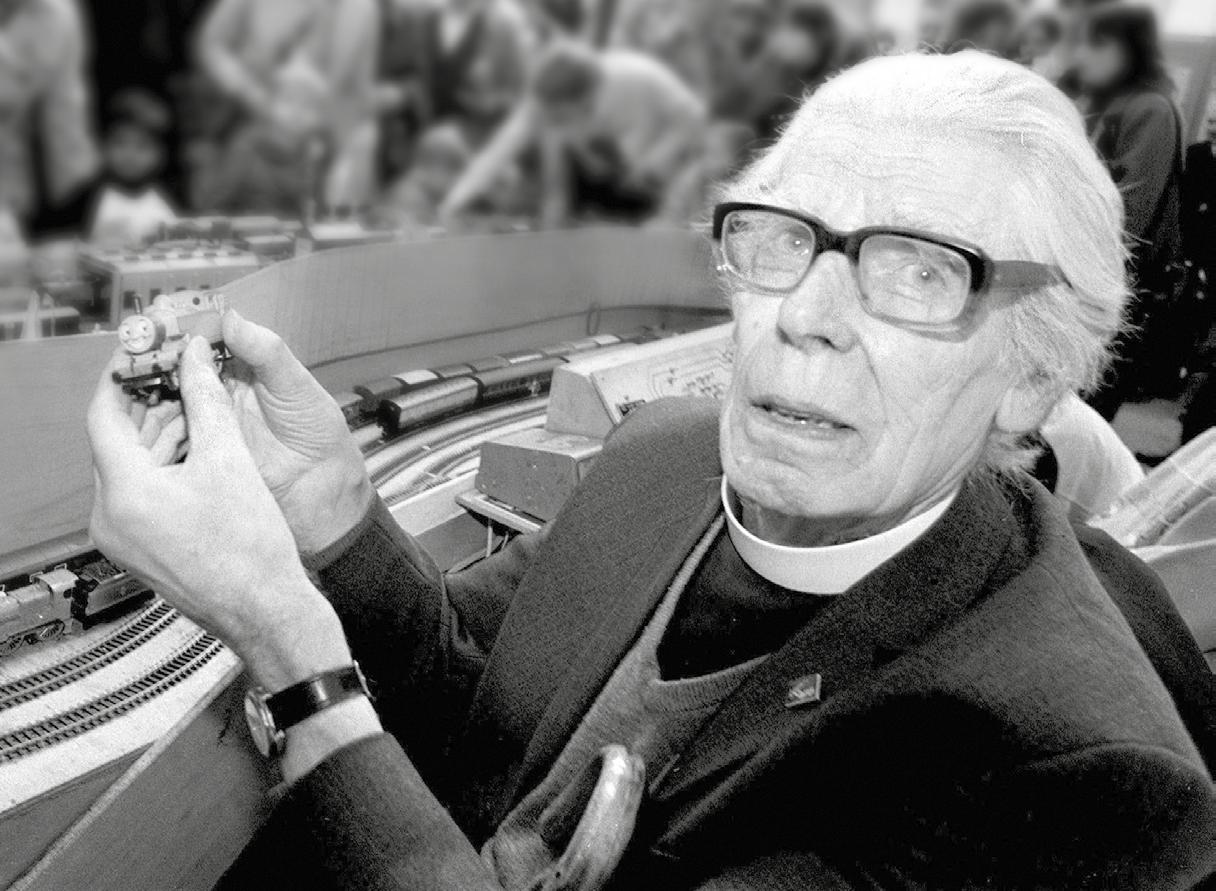

be answered fully and carefully, and he considered this as part of his ministry.
‘It gave him less and less time for parish work, and he felt almost that he was being called in this different direction. So he was still using his ministry, but not in a parish. Or it was as if he had swapped a small parish for a countrywide one.’
Interest in the Railway Series stories began building up another head of steam when, in 1984, ITV broadcast the first series of Thomas the Tank Engine, narrated by Ringo Starr. Over time Wilbert’s son Christopher Awdry added more titles to the list of books.
Veronica notes that a few years before his death in 1997, her father had told his biographer, Brian Sibley, that he would like his epitaph to include the words ‘he made children laugh’. She believes that her father’s stories are still having a positive influence.
She says: ‘Grandparents tell me that their children used to read the books and now their children’s children are reading them and still like the characters. They
make the point that the stories are gentle in many ways. The characters are all like children. They learn by the mistakes that they make – though Father was definite that they weren’t written to be moral books, even though he imagined that something of his beliefs must creep in.’
The effect of the stories is felt not only by people who are still children. Veronica recalls attending a recent church service where there was a guest speaker.
‘We had a lovely lady take our service,’ she remembers. ‘She was delivering her sermon, and I suddenly heard the words “the Fat Controller”. She didn’t know me or my connection with the Railway Series
It was just something she had read and had associated with what she was talking about.’
Veronica has also seen her father’s lasting influence in events such as the Awdry Extravaganza held at the Talyllyn Railway in north Wales, an event which offers steam train rides and exhibits.

‘People come from all over the world, including some who are on the autistic spectrum and find a certain confidence at the event, and everyone is a sheer delight – so respectful and so friendly with each other,’ she says.
‘It’s really moving. Father’s influence is still out there.’
The War Cry invites readers to send in requests for prayer, including the first names of individuals and details of their circumstances, for publication. Send your Prayerlink requests to warcry@salvationarmy.org.uk or to War Cry, 1 Champion Park, London SE5 8FJ. Mark your correspondence ‘Confidential’.
There is no set formula to becoming a Christian, but many people have found saying this prayer to be a helpful first step to a relationship with God
Mark is the shortest of the four Gospels and, dating from about AD65 to 70, was the first to be written. Some 90 per cent of the contents of Mark appears in Matthew, and about 50 per cent appears in Luke. It is thought that the disciple Peter was the writer’s main source.
Untypically for a biography, Mark’s Gospel contains little information on Jesus’ family background and no narrative of his birth. Instead, the book focuses on the things that Jesus did.
Like a journalist meeting a deadline, the writer records events and reports quotes with minimal personal comment. The repeated use of the word ‘immediately’ reflects the pace and excitement of Jesus’ ministry.
After his baptism and a time in the desert when he prepares himself for his ministry, Jesus calls disciples, casts out demons and an unclean spirit, heals sick people, preaches in synagogues and cleanses a leper, all within chapter one.
Lord Jesus Christ,
I know that I have done things in my life that are wrong and I’m sorry.
Thank you that I can ask you for forgiveness because of the sacrifice you made when you died on the cross.

Please forgive me and help me to live a better life in the future as I learn how to love you and follow your way of living.
Thank you, Lord Jesus.

Every chapter, until the account of Jesus’ triumphal entry into Jerusalem in chapter 11, records Jesus performing at least one miracle. Generally Mark describes these acts with the Greek word ‘dunamis’ which means ‘power’.
These ‘power works’ fall into four categories.
Jesus physically heals a paralysed man (2:1–12), a man with a withered hand (3:1–6), a haemorrhaging woman (5:25–34), a deaf-mute man (7:31–37), two blind men (8:22–26; 10:46–52) and many others (1:34; 3:10; 6:56).
He casts out demons from a cave-dwelling man (5:1–20) and from two children (7:24–30; 9:14–29).
He controls nature by stilling a storm (4:35–39) and by twice feeding thousands of people with a picnic lunch (6:30–44; 8:1–9).
And Jesus demonstrates his power over death by raising a dead girl back to life (5:21–43).
Jesus’ own death and resurrection, and the events immediately preceding them, occupy the final third of the Gospel.
Scholars debate the authenticity of the final 12 verses of chapter 16. They are absent from the earliest manuscripts. The casual reader might note that many of the events they describe occur either in the other Gospels or in the Acts of the Apostles.

If you’ve prayed this prayer, scan the QR code or contact us using the coupon on this page




























To receive basic reading about Christianity and information about The Salvation Army, complete this coupon and send it to
War Cry 1 Champion Park London SE5 8FJ















1 2 3 4 5 6
Who presents the TV show Game of Wool: Britain’s Best Knitter?
Which former England football captain was knighted last month?
We Did OK, Kid is the title of a new memoir by which awardwinning actor?
What is the name of the archipelago off the southwestern tip of Cornwall?
The 1970s film The Railway Children is based on a novel by which author?
What is the capital of South Korea?
Feature by Emily Bright
Twinkling lights, fairground rides and wooden stalls brimming with festive products can mean only one thing – Christmas markets are back. And for shoppers who are unsure where to turn, consumer magazine Which? has compiled a list of the best markets to visit in the UK.
Topping its Christmas list is Bath, where stalls are showcasing a vast array of produce from the southwest of England – knitwear, wooden furniture, fragrances, jams and baked goods. Visitors can also enjoy skating on an ice rink in the city’s Royal Victoria Park.
Another of the magazine’s recommendations is Liverpool, which offers 1980s Christmas pop music and artisan craft stalls shaped like gingerbread houses. And it also highlights Belfast, with its speciality food such as ostrich, wild boar and crocodile burgers; and Edinburgh, which has a Ferris wheel offering a panoramic view of the city’s skyline.
Wherever they are located, Christmas markets are an opportunity to embrace the festive spirit. Visitors can amble along while listening to Christmas songs, sample seasonal food and browse stalls for gifts – and Which? even offers tips on how best to pay and whether it is OK to haggle.
Buying presents can be a great way for us to show loved ones that we care. But the good news is that the greatest gift that we can give or receive –the truth of God’s love for us – is totally free.
In the Bible, one writer says: ‘God’s free gift is life that lasts for ever. It is given to us by our Lord Jesus Christ’ (Romans 6:23 New Life Version).
The writer is sharing the timeless message that, because Jesus lived and died, paying the price for all our wrongdoing, we can be reconciled with God.
Having a relationship with God enables us to experience his love for us in this life. But what’s even more amazing is that, because Jesus rose from the dead, we can experience eternal joy and peace in the presence of God after death too.
It’s an extraordinarily generous gift which we can all receive by putting our faith in Jesus – and it’s free.

1. Valuable skill (5) 5. Mushrooms or toadstools (5) 8. Inuit hut (5) 9. Truism (5)
Unbending (5) 11. Nudge (5) 12. Competent (4) 15. Pressed (6)
(5)
(4)
(5)
(5)
1. Flowering shrub (6)
2. Revolve (6)
3. Hourglass (5)
4. Sphere (5)
5. Send on (7)
6. Head (6)

7. Really (6)
13. Snake (3)

14. Thick mist (3)
Writing fluid (3)
Recede (3)
Giggle (7)
Frank (6) 19. Alleviation (6)
Range (6)
Savoured (6)
Essential (5)
Canines (5)
Each solution starts on the coloured cell and reads clockwise round the number


1. Nut of a horse chestnut tree
New York river 3. Used for canoeing
Big cat
Chess piece
6. Small non-speaking part in a film (4-2)
Extent. 22. Tasted. 23. Vital. 24. Teeth. HONEYCOMB 1. Conker. 2. Hudson. 3. Paddle. 4. Jaguar. 5. Knight. 6. Walk-on.
Ink. 16. Ebb. 17. Snigger. 18. Candid. 19. Relief.
Caring. 20. Debt. 25. Guide. 26. Doing. 27. Erect. 28. Enact. 29. Defer. 30. Hated. DOWN: 1. Acacia. 2. Swivel. 3. Timer. 4. Globe. 5. Forward. 6. Noggin. 7. Indeed. 13. Boa. 14. Fog.
Look up, down, forwards, backwards and diagonally on the grid to find these children’s books
BABY GOES TO MARKET
CHARLOTTE’S WEB
CURIOUS GEORGE ELMER
GOODNIGHT MOON
LOOK UP!
LOST AND FOUND MADELINE
MARY POPPINS PADDINGTON
STUART LITTLE THE GRUFFALO THE LITTLE PRINCE
TREASURE ISLAND
WE
WINNIE-THE-POOH

For the cake
375g vegan baking margarine, plus extra for greasing
600ml soya milk
50ml lemon juice
600g self-raising flour
450g caster sugar
2tbsp baking powder
1tbsp ground ginger
1tbsp mixed spice
150g vegan candied peel
2 oranges, zest
For the filling
400ml soya milk
2 oranges, juice
75g cornflour
150g caster sugar
150g icing sugar
60g vegan baking margarine
For the topping
100ml aquafaba
150g caster sugar
75ml water
150g desiccated coconut, to decorate

Preheat the oven to 160C/Gas Mark 3. Grease and line 3 23cm loose-bottom cake tins with parchment paper.




Melt the vegan margarine in a pan over a low heat, then set aside.
Pour the 600ml soya milk in a bowl and add the lemon juice, then stir and set aside.
Place all the remaining cake ingredients except the vegan candied peel in a bowl and mix well. Make a well in the centre and pour in the melted margarine, followed by the soya milk mixture and vegan candied peel. Stir well.
Divide the mixture between the tins and bake in the oven for 25-35 minutes, or until risen and soft. Leave to cool in the tins before removing.
To make the filling, pour the 400ml soya milk into a pan over a medium heat and bring to the boil, then reduce to a simmer.
Meanwhile, mix the orange juice with the cornflour and caster sugar in a bowl to form a smooth paste. Pour the paste into the pan and beat until thick, creamy and smooth, simmering for a couple of minutes.
Leave to cool, then place in a mixer bowl and add the icing sugar and margarine. Whisk until light and fluffy. Sandwich the cakes together using the filling mixture.
Make a meringue for the topping by placing the aquafaba in the mixer bowl and whisking on full speed for 10-15 minutes, until it forms stiff peaks. Meanwhile, place the sugar and water in a pan over a high heat. As soon as the mixture boils, reduce the heat slightly, continuing to simmer for up to 10 minutes, until it reaches a temperature of 120C. Remove from the heat and pour slowly into the whipped aquafaba with the whisk still going on medium. Whisk until cooled, then use the meringue to coat the sides and top of the cake.
Sprinkle over the desiccated coconut, ensuring the cake is evenly covered, to serve