Kopatchinskaja plays Shostakovich
conductor Lahav Shani
violin Patricia Kopatchinskaja
Dimitri Shostakovich (1906-1975)
Violin Concerto No. 1 in A minor, Op. 77 (1947-48)
• Notturno: Moderato
• Scherzo: Allegro
• Passacaglia: Andante – cadenza
• Burlesque: Allegro con brio – Presto intermission
Ludwig van Beethoven (1770-1827)
Symphony No. 3 in E flat major, Op. 73 ‘Eroica’ (1802–04)
• Allegro con brio
• Marcia funebra: Adagio assai
• Scherzo: Allegro vivace
• Finale: Allegro molto
concert ends at around 22.30
Most recent performances by our orchestra:
Shostakovich Violin Concerto No. 1: Jan 2019, violin Sergey Khachatryan, conductor Valery Gergiev
Beethoven Symphony No. 3: Oct 2022, conductor Han-Na Chang
One hour before the start of the concert, Emanuel Overbeeke will give an introduction (in Dutch) to the programme, admission €7,50. Tickets are available at the hall, payment by debit card. The introduction is free for Vrienden.
Cover: Photo Stacey Zinoveva (Unsplash)
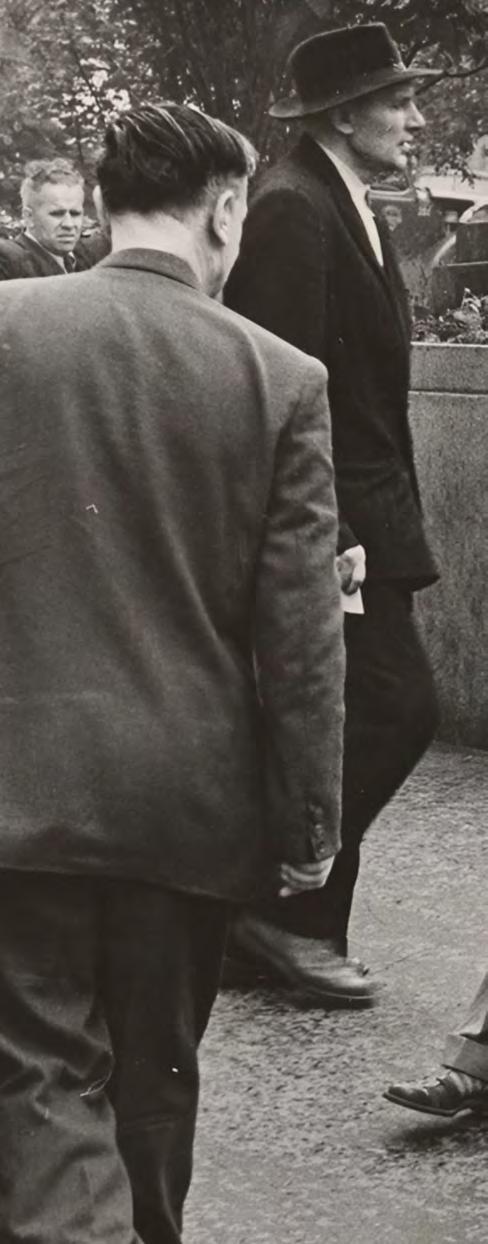
Dimitri Shostakovich and David Oistrach at the Tchaikovsky monument in Moscow. Coll. Russian National Music Museum
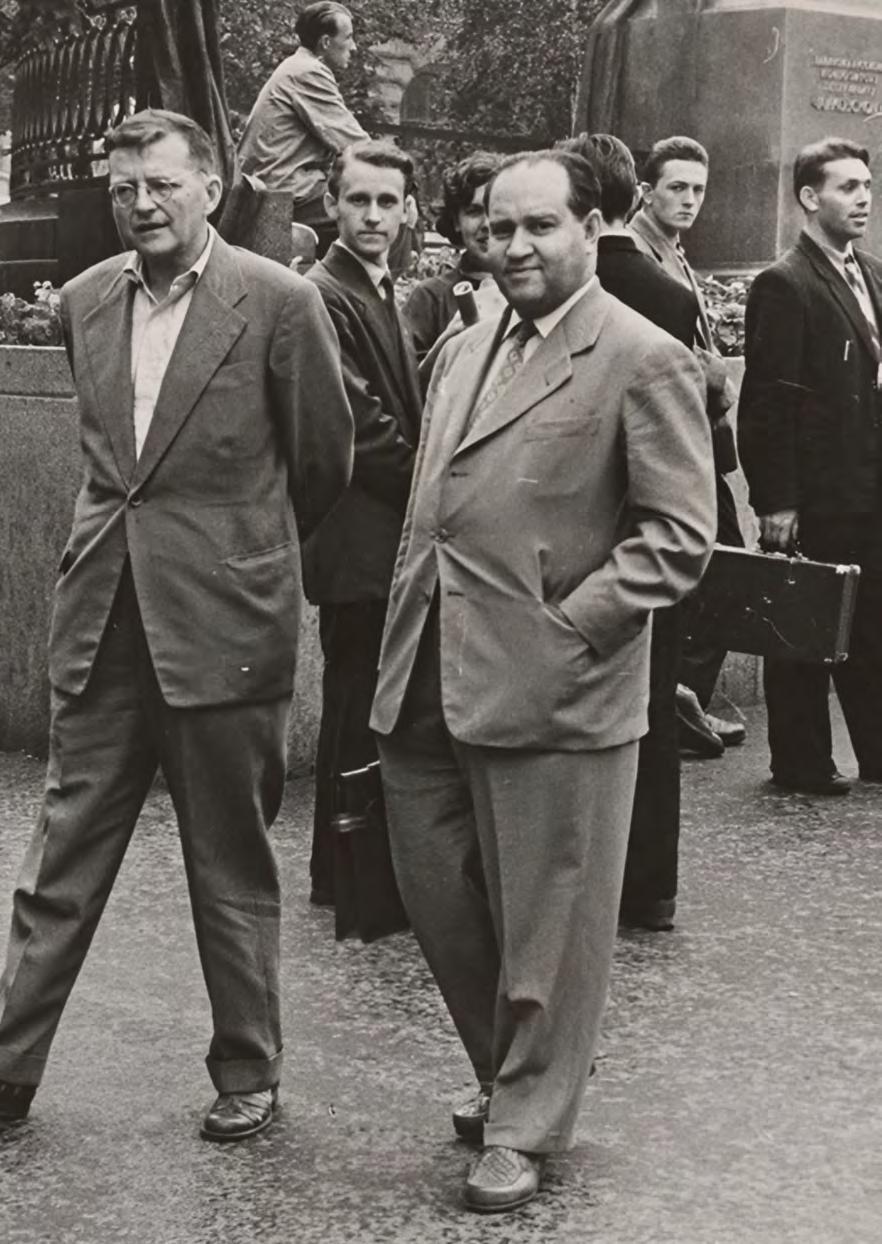
As far back as December 1931 the New York Times published an interview with the 24-year-old Dimitri Shostakovich on the future of Soviet music and how he felt called to spearhead the journey to a new era of Soviet music in line with the ideals of the Russian Revolution.
The young composer explained that he knew of few examples from the past. He regarded only Beethoven as a pioneer of a revolutionary movement, whose Eroica symphony he saw as a work that ‘awakened people to the joy of struggle’. Shostakovich’s belief in a Socialist utopia would not stand the test of time. His 1936 opera Lady Macbeth of Mtsensk would meet with the displeasure of the great leader Stalin, whereafter Shostakovich, together with countless others in the same situation, would continually fear not only for their freedom, but their lives. His music was condemned with the term ‘Formalism’ - an accusation of inaccessibility and complexity that countered the ideal of uplifting Socialist Realism - and he was made to promise to correct his behaviour.
In 1948 Shostakovich was in trouble again when, during the Conference of the Composers Union, he was accused of antidemocratic inclinations. The Violin Concerto he was composing for David Oistrach was almost complete, but any performance was out of the question; the Jewish themes in the scherzo constituted an outright provocation
in this heyday of Soviet anti-Semitism. For this reason alone, one of Shostakovich’s most personal and poignant works was put to the back of a drawer.
The work’s opening movement, a nocturne, sets the tone with an extended, pain-filled monologue. The scherzo contains for the first time the trademark four-note motif - D-E flatC-B – that Shostakovich would often use in his major works. Another recurring element is the use of the passacaglia, a Baroque variation form in which the bass line is repeated throughout. The third movement forms the emotional core of the work in which, following a horn fanfare and a religious chorale from the woodwind section, the soloist builds a huge arc of tension, culminating in an immense cadenza. The burlesque finale provides the necessary release and a good helping of the virtuosity for which Oistrach was ideally suited. He would not premiere the work, following lengthy preparation, until 1955, two years following the death of Stalin. The reception was very positive. The Soviet press initially responded with caution, but the soloist and public immediately took the work to their hearts as
one of the most poignant and personal works of a seasoned composer.
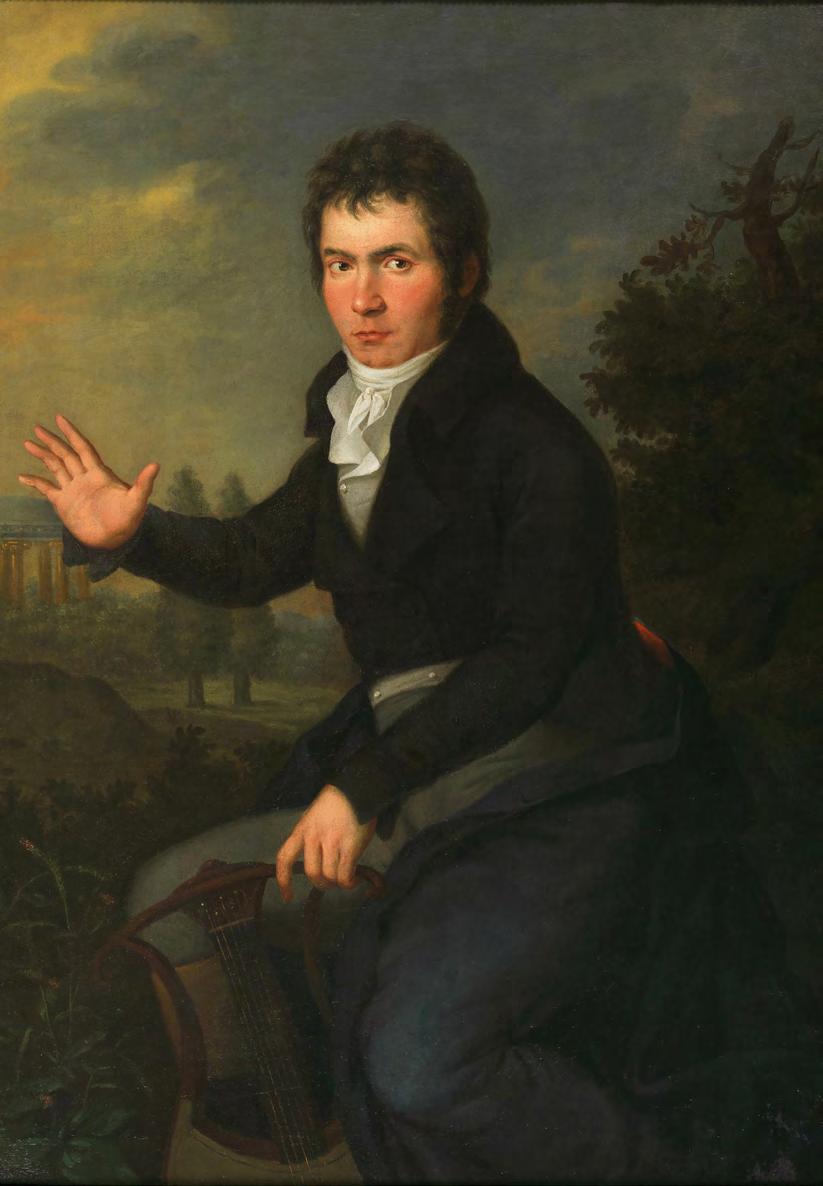
A century and a half back in time the première of Beethoven’s Third Symphony had an even greater impact on the public. The composer presented this great work as part of a benefit concert in Theater an der Wien in Vienna on 7 April 1805. It was preceded by performances of his First Symphony and a symphony by Eberl. Beethoven realised afterwards that his new work had better been performed at the start of the concert, when ears were still fresh, because the audience found the work to be too long, too heavy, and too different. Perhaps they would have found help in the title that the composer printed in the heading of the work upon its first publication: ‘Sinfonia Eroica, composed to honour the memory of a great man’, albeit that ever since there have been questions as the identity of the hero. The name of Napoleon is mentioned most often; being recognised by many contemporaries, both friend and foe, as a great man on the battlefield and a moderniser of society. Beethoven himself certainly hinted at this, but then why in 1806 did he write ‘in memory of’ a French emperor, who was still very much alive and had just conquered Vienna?
The first movement is almost dance-like with the occasional dash of humour, like the horn’s too early entry
The birth of the Eroica can be traced back to 1802, the year in which Beethoven was forced to accept that his increasing deafness was incurable. He wrote an emotional letter to his brothers, which he never sent, about his inner conflict, even suicidal thoughts, and
his decision to dedicate his life as a composer to the service of Art. Ideas would continue to fill his head with a new intensity. His Piano Variations, Opus 35, are the first results of the new path he had forged. For this work he chose a theme from his successful ballet The Creatures of Prometheus. Amongst the sketches for the variations he also jotted down ideas for a new symphony, at any rate the first three movements. This plan to enlarge and extend the variations for an orchestra as the final movement of a symphony is the likely origin of the Eroica.
The epithet ‘heroic’ would appear to be more an expression of the dimensions of the four contrasting movements than the character of the music. The funeral march comes closest to expectations of heroism, with the drum rolls primarily in the string section. The first movement, by contrast, is almost dance-like, with the occasional dash of humour; for example, the horn’s too early entry in the reprise, or the Trio section of a fast and cheerful scherzo which explains Beethoven’s unusual scoring for three horns. The final movement is also not without humour. The simple introductory theme, followed by several variations, turns out to be the bass line of the ‘real’ theme played by the oboe. In its structure and variation, this is one of the most exceptional movements of any of Beethoven’s symphonies. Perhaps this final movement is the key to the identity of the ‘Great Man’ and to Beethoven’s selfidentification as winner of the battle within himself. Not the struggle that Shostakovich envisaged as a young man, or the one that he would have to face to have his voice heard in a dictatorship, but nevertheless an internal struggle that throughout the ages we have all faced at some time or other in our lives.
Eelco Beinema
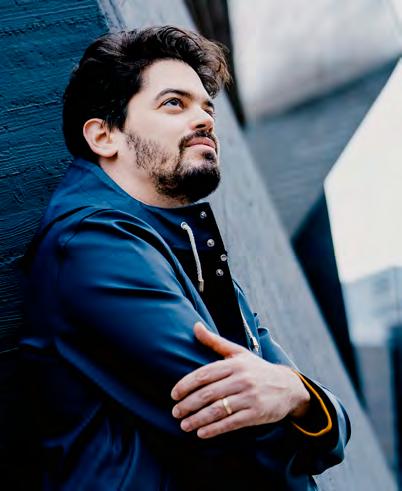
Born: Tel Aviv, Israel
Current position: chief conductor Rotterdam Philharmonic Orchestra; music director Israel Philharmonic Orchestra; chief conductor designate Münchner Philharmoniker (from 2026)
Before: principal guest conductor Vienna Symphony Orchestra
Education: piano at the Buchmann-Mehta School of Music Tel Aviv; conducting and piano at the Academy of Music Hanns Eisler Berlin; mentor: Daniel Barenboim
Breakthrough: 2013, First Prize Gustav Mahler International Conducting Competition in Bamberg
Subsequently: guest appearances Wiener Philharmoniker, Berliner Philharmoniker, Gewandhaus Orchester, Münchner Philharmoniker, Symphonieorchester des Bayerischen Rundfunks, London Symphony Orchestra, Boston Symphony Orchestra, Chicago Symphony Orchestra, Philadelphia Orchestra, Royal Concertgebouworchestra
Debut Rotterdam Philharmonic: 2016
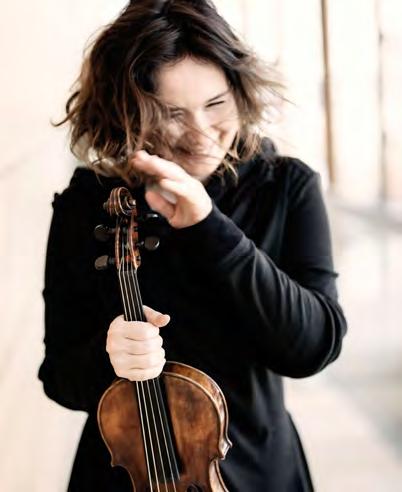
Born: Chișinău, Moldavia
Education: first violin lessons at age six, violin and composition studies in Vienna at the Universität für Musik und darstellende Kunst, and in Bern at the Musikhochschule Awards: Winner International Henryk Szeryng Competition (2000), Royal Philharmonic Society Music Award (2014), Grammy for the album Death and the Maiden (2018)
Guest appearances: Berliner Philharmoniker, Wiener Philharmoniker, New York Philharmonic, Chamber Orchestra of Europe, London Philharmonic Orchestra, Orchestra of the Age of Enlightenment
World premieres: works by Michel Van der Aa, Luca Francesconi, Heinz Holliger, Vanessa Lann, Tigran Mansurian, Mark-Anthony Turnage Instrument: Giovanni Francesco Pressenda from 1834 Debut Rotterdam Philharmonic: 2006
Proms: Nutcracker & Company
Sat 13 December 2025 • 20.30
conductor Aziz Shokhakimov
violin Maria Milstein
Glinka Overture Ruslan and Ludmilla
Tchaikovsky The Nutcracker: Suite
Tchaikovsky Serenade mélancolique
Khachaturian Masquerade: Suite
Music for Breakfast 2
Sun 14 December 2025 • 10.30
RDM Kantine musicians and programme: rpho.nl/en
Fri 19 December 2025 • 20.15
conductor Jan Willem de Vriend
oboe d’amore Karel Schoofs
Bach Sinfonia from Cantata No. 174
Bach Suite for Orchestra No. 3
Bach Concerto for Oboe d’Amore in A Mozart Adagio and Fugue
Mozart Symphony No. 35 ‘Haffner’
Sat 20 December 2025 • 20.15
Sun 21 December 2025 • 14.15
conductor Eduardo Strausser
vocal ensemble King’s Singers Christmas Programme
Thu 8 January 2026 • 20.15
Sun 11 January 2026 • 14.15
conductor Giedrė Šlekytė
cello Truls Mørk
Dvořák Cello Concerto
Schubert Symphony No. 8
‘Unfinished’
Koldály Dances from Galanta
Chief Conductor
Lahav Shani
Honorary Conductor
Yannick Nézet-Séguin
Principal Guest Conductor
Tarmo Peltokoski
First Violin
Marieke Blankestijn, Concert Master
Vlad Stanculeasa, Concert Master
Quirine Scheffers
Hed Yaron Meyerson
Saskia Otto
Arno Bons
Rachel Browne
Maria Dingjan
Marie-José Schrijner
Noëmi Bodden
Petra Visser
Sophia Torrenga
Hadewijch Hofland
Annerien Stuker
Alexandra van Beveren
Marie Duquesnoy
Second Violin
Charlotte Potgieter
Frank de Groot
Laurens van Vliet
Elina Staphorsius
Jun Yi Dou
Bob Bruyn
Eefje Habraken
Maija Reinikainen
Babette van den Berg
Melanie Broers
Tobias Staub
Sarah Decamps
Viola
Anne Huser
Roman Spitzer
Galahad Samson
José Moura Nunes
Kerstin Bonk
Janine Baller
Francis Saunders
Veronika Lénártová
Rosalinde Kluck
León van den Berg
Olfje van der Klein
Jan Navarro
Cello
Emanuele Silvestri
Gustaw Bafeltowski
Joanna Pachucka
Daniel Petrovitsch
Mario Rio
Eelco Beinema
Carla Schrijner
Pepijn Meeuws
Yi-Ting Fang
Killian White
Paul Stavridis
Double Bass
Matthew Midgley
Ying Lai Green
Jonathan Focquaert
Arjen Leendertz
Ricardo Neto
Javier Clemen Martínez
Flute
Juliette Hurel
Joséphine Olech
Manon Gayet
Flute/Piccolo
Beatriz Baião
Oboe
Karel Schoofs
Anja van der Maten
Oboe/Cor Anglais
Ron Tijhuis
Clarinet
Julien Hervé
Bruno Bonansea
Alberto Sánchez García
Clarinet/
Bass Clarinet
Romke-Jan Wijmenga
Bassoon
Pieter Nuytten
Lola Descours
Marianne Prommel
Bassoon/ Contrabassoon
Hans Wisse
Horn
David Fernández Alonso
Felipe Freitas
Wendy Leliveld
Richard Speetjens
Laurens Otto
Pierre Buizer
Trumpet
Alex Elia
Adrián Martínez
Simon Wierenga
Jos Verspagen
Trombone
Pierre Volders
Alexander Verbeek
Remko de Jager
Bass trombone
Rommert Groenhof
Tuba
Martijn van Rijswijk
Timpani/ Percussion
Danny van de Wal
Ronald Ent
Martijn Boom
Harp
Albane Baron