IN THE GARDEN: Which varieties of vegetables are best? F4
ANTIQUES: Valuable vase features rare color shading, F8
GARDEN: The secret to pest-free houseplants, F7
Why homeowners are choosing to expand their homes, rather than move, Page F2
Homeowners just don’t want to move
It’s a big deal for their shrinking backyards
By Julie Z . W eil
The Washington Post
THE SHRINKING
American backyard is getting even smaller, and it partly has to do with mortgage rates.
The bygone rates of the early 2020s — the last time they were below 3% — have had a powerful hold on their owners, who are hesitant to move if it means taking on a new home loan at twice the rate. So, homeowners are increasingly building out their homes by taking the space from their yards.
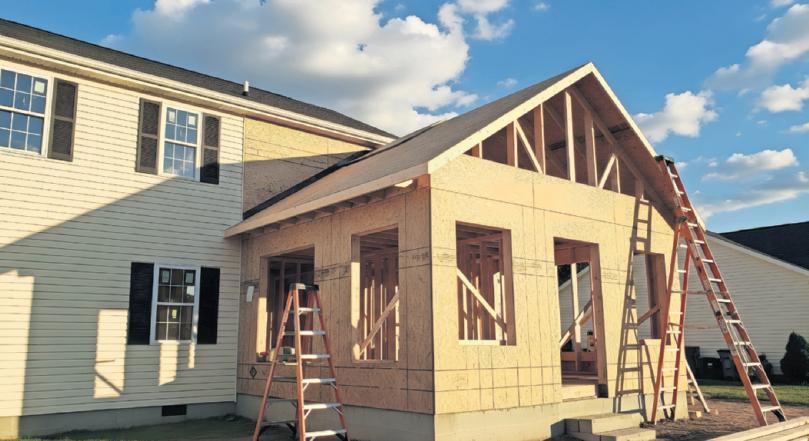
Nicole Goolsby Morrison sees it firsthand at her Raleigh-based home remodeling company. She has been busy with additions that extend the back of a house anywhere from 4 to 15 feet, and has added bathrooms and bedrooms to front yards. When she talks with clients, mortgage rates come up often.
“People are choosing to stay in their homes because of [their low] interest rates, and because new construction and even resells have gotten so expensive,” she said.
Yards have been shrinking in new homes for years. As costs rose, preferences shifted and some cities and states passed laws allowing development on smaller lots. In 2009, lots less than 7,000 square feet represented 25% of new homes. Today it’s 39%, even as the size of houses on them grew larger.
The Atlantic was already charting, and lamenting, the disappearing lawn a decade ago: “It would signal a profound change in suburbia, and not an altogether attractive one, as McMansions squeeze ever tighter together, hulking and lonely.”
Some projects are modest — a few more feet to modernize a cramped, run-down kitchen, or an extra bathroom for the ground floor, Morrison said. Others are gargantuan, sometimes a whole new house basically devouring the much smaller original.
As the founder of Angi, a website that connects homeowners with contractors and service people, Angie Hicks says, “You’re definitely seeing people that are preferring to stay put, especially if they had locked in a 3% mortgage rate.” Some purchased properties expecting to stay a only short time, but now want to stay for good. “The calculus has changed. You might be in your house longer than you expected.”
Hicks said millennials — those roughly 30 to 45 years old — are leading the drive. Overall, her website found that 4% of homeowners who did work on their houses in 2025 were expanding its footprint, twice as many as the year before. And 18% of people with multiple generations living under one roof say they will expand their houses in the future.
Many people who bought their homes before 2022, then saw them skyrocket in value, now have equity that they can tap to finance remodeling projects.
The average cost for a room addition has been quoted at about $50,000, though projects vary widely in scope.
“You may not want to trade your whole mortgage price, but you might be willing to tap your home equity,” Hicks said. “Maybe I’ll go and access some funds because the price of my house has gone way up in the time I’ve owned it. … It’s not going to take my overall borrowing rate from 3% to 6%. It might take it up to three-and-ahalf.”
Rachel Bogardus Drew, who runs the Remodeling
Futures Program at Harvard’s Joint Center for Housing Studies, said that home additions represent one answer to the “huge pent-up demand” among people who want to move out of their houses but have not made a move, in a housing market that’s been characterized by sluggish inventory, high prices and elevated interest rates for the past three years.
The number of homeowners in Federal Reserve surveys who say they want to move within the next two years shot up in 2022, from 8% to 19%, and has stayed high.
But those would-be movers aren’t moving. Instead, they’re building.
“There’s been a slowdown in sales and homeowners are making a decision to do these major building projects rather than moving,” Drew said.
Looking at private data on locally issued building permits across the country, Drew tracked large increases in permits for major home construction projects in 2022, then again in 2023, and another 5% in 2025.
Drew’s center produces a quarterly analysis of remodeling spending. Coming off of a slight decline in spending in 2024, Americans spent more than $500 billion last year to renovate their homes. The Harvard group projects at least a 2% increase in 2026.
Ben Metcalf, managing director of the University of California at Berkeley’s Terner Center for Housing Innovation, said a lot of people would rather have more house than more yard anyway.
“Shifting cultural patterns: People are spending less unstructured time, and valuing the kind of activities they do in a backyard less than the kind of things they do indoors,” he said. In other words: More time online, less time hanging out with neighbors. “With the shrinking amount of independence that sub-preteen kids have, there’s less time throwing a football with friends in the backyard.”
Evin Isaacson, a lawyer, and her husband, a city employee, now have a backyard just large enough for one giant spreading tree. They extended their D.C. rowhouse — which had two full-size bedrooms and one tiny one before the construction — to make it into the
house they’d want to stay in permanently while they raise their daughter, who was born during the lengthy construction process. The addition cut the size of their backyard down to the minimum allowed under D.C. law without a variance. (They asked their contractor to wait to start building until after they used the yard for their backyard wedding.)
The project had more bumps than they bargained for, but they said they persevered in part because of their 2.5% mortgage rate.
“Because our monthly mortgage payment was lower, we were able to save additional money to put into the project,” Isaacson said.
“There was definitely some not-quite-so-short-term pain in terms of getting here.
But we feel really lucky to have been able to invest in this place and take this 1919 house and give it its next generation of updates so we can raise our family in this house.”
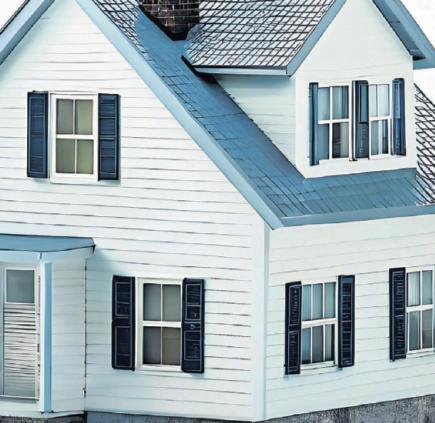
In 2009, lots less than 7,000 square feet represented 25% of new homes. Today it’s 39%, even as the size of houses on them grew larger. (PHOTO / COVER PHOTO ADOBE STOCK IMAGES)
By Julia Fanzeres Bloomberg
PENDING SALES OF
U..S existing homes fell in December by the most since April 2020, an unusually large drop after the housing market appeared to be gaining some momentum.
An index of contract signings decreased 9.3% to 71.8 last month, according to data released Wednesday by the National Association of Realtors. The decline was regionally broad and well below the lowest estimate in a Bloomberg survey of economists.
“The housing sector is not out of the woods yet,” NAR Chief Economist Lawrence Yun said in a statement. “After several months of encouraging signs in pending contracts and closed sales, the December new contract figures have dampened the short-term outlook.”
Housing activity typically slows in winter months and picks up more in the spring selling season. While NAR adjusts the data for these patterns, the drop was still the largest for any December in data back to 2001.
Yun said it’s unclear whether the figure was a one-off or the start of a worsening trend.
Pending-homes sales tend to be a leading indicator for previously owned homes, as houses typically go under contract a month or two before they’re sold.
Activity may pick up soon as mortgage rates have kicked off the new year at some of the lowest levels since 2022, and home prices are growing at a much slower pace than last year. However, much of the outlook also depends on available inventory, which has struggled to recover to pre-pandemic levels.
all four regions, including double-digit slides in three. Yun said interpreting the figures in the winter, particularly December, can be “tricky” given
the holidays, vacation time and winter weather.
Meanwhile, addressing affordability concerns has been a key talking point lately for
President Donald Trump ahead of this year’s midterm elections. He’s already laid out a slate of proposals aimed at the housing market, including an
executive order targeting institutional investors on Tuesday.
With assistance from Chris Middleton.
The recent bout of lower mortgage rates may be shortlived as U.S. Treasury yields, which influence home-financing costs, have climbed to the highest level in months amid a rout in Japanese bonds and geopolitical factors.
Wednesday’s report showed contract signings dropped in
GARDEN NOTES
SPRINGFIELD Springfield Garden Club upcoming programs
The Springfield Garden Club will host a series of four programs for anyone interested gardens and gardening or just escaping the winter for an hour.
Saturday, Jan. 28 at 11 a.m.
Which vegetable varieties are best?
HINTS OF SUMMER already are here, not outside, but in the seed catalogs in my mailbox, on racks of in stores, and from emails from seed companies. Look how many different varieties of each vegetable are offered. Thumbing through one (paper) catalogue, for example, I see 28 varieties of tomato, 17 varieties of peas, and 11 varieties of radishes. Anyone who has gardened for at least a few years has their most and least favorite varieties of vegetables. Here’s a sampling of mine.
Right from the start, I admit that most important to me in choosing a vegetable variety is flavor. I’ll grow a low-yielding variety, even one that’s not particularly resistant to insects or diseases, if it is particularly delectable. Within reason, of course.
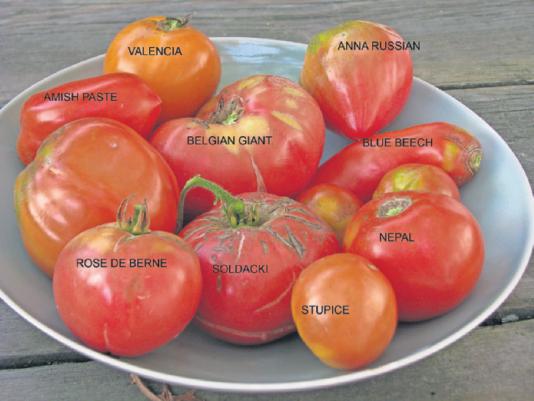
Let’s start with one of the most widely grown backyard vegetables, tomatoes. The best-tasting varieties I have grown are Sungold, Belgian Giant, Amish Paste, Anna Russian, Paul Robeson, and Pink Brandywine). Not that these are the only great-tasting varieties. Lots of the other Brandywine variations are also in this category, as are Carmello, Valencia, and Nepal. What I definitely
stay away from is any determinate variety; these are bushy types with less leaf area and, hence, less flavor per fruit. Years ago, when I planted many more varieties, I realized that I would just walk right on past notably good — or perhaps they’re just heavily promoted — varieties like Beefsteak and Rutgers if any of my favorites also are ripe; so, I no longer grow those “notably good” varieties.
For a canning tomato, San Marzano is a variety that cooks down to a sauce that is rich in flavor and red color, far superior to other canning varieties like Roma or Heinz 2653.
I only eat my peppers red or yellow or whatever their color is when ripe, so need a variety that not only tastes good but also ripens in due time this far north. The usual go-to, recommended variety is Ace, or one of its variations. “Extra-early, highly productive.” True. But great tasting? No. For the best-tasting, productive, earliest ripening pepper, Sweet Italia is the one. Right up there with Sweet Italia is a new variety, Picnic Orange, although not as productive. And not quite as good, but very productive, is Carmen, also worth my growing.
will kick off the series with Jana Milbocker presenting “The Garden Tourist’s New England.”
New England has a rich gardening heritage and Milbocker will present a travelogue to inspire as you spend the winter months dreaming about summer. Author of “The Garden Tourist’s New England,” and a garden designer, she will take you on a fantastic tour of gardens and nurseries in New England
and will provide all the information you need to make the most of your visit.
From the breathtaking flower gardens of Mount Desert Island in Maine, to Colonial revival gardens in Connecticut and New Hampshire, topiary gardens in Rhode Island, and botanical gardens in Vermont and Massachusetts, there is something for every gardener to enjoy in a tour of the region.
Lee Reich | In the Garden
Examples of various heirloom tomatoes.
Dear Neighbor,
Did you know the bathroom is one of the most dangerous rooms in your home? Your bath and shower area is one of the leading locations for household slips and falls.
Why? Because climbing over high tub walls and standing on wet surfaces puts your balance to the test One bad step is all it takes, and as we age, having the right support becomes even more important
This New Year, it is time to take control of your safety now. And we want to help! For a strictly limited time, we are offering a big bundle of savings to make this essential upgrade easy and affordable...
Dear Neighbor,
You’ll get:
A premium product at a fair price!
Did you know the bathroom is one of the most dangerous rooms in your home? Your bath and shower area is one of the leading locations for household slips and falls
A company backed by 4,000+ 5-star reviews!
A lifetime warranty that covers installation and post-install service!
Why? Because climbing over high tub walls and standing on wet surfaces puts your balance to the test One bad step is all it takes, and as we age, having the right support becomes even more important
With NO pressure, and a price locked-in for a FULL year! Don’t wait! These savings disappear – January 31st, 2026
Helping you love your home, Yankee Home
This New Year, it is time to take control of f ty n A d ant t strictly limited time, we are offering a big b av is essential upgrade easy and affordable:
“Being a senior has been a challenge with every shower a fear of unexpected injury but now with the safety bars, dual head well placed shower-head, lower walk-in raise and sturdy seating to name a few A shower is now a safe pleasure again!” –Diane M
“Before I had a tub, it was hard getting into I had hold on with both hands So much easier to shower now with my walk in ” –Elaine M
“I am so happy to know my mother will be safe with the drop down seat and detachable shower head ” –Ken S
“I am very satisfied with the walk-in shower, It has made our lives a lot better and safer Looks great!!” –Linda B
Why your power bill is spiking faster than a nearby data center’s
By Shannon O saka
The Washington Post
OVER THE PAST FEW years, millions of Americans have seen their electricity bills skyrocket. Since February 2020, electricity prices have increased by an average of 40 percent across the country. In some areas, the rate is even faster — in Washington, D.C., electricity costs increased 93% from July 2020 to July 2025.
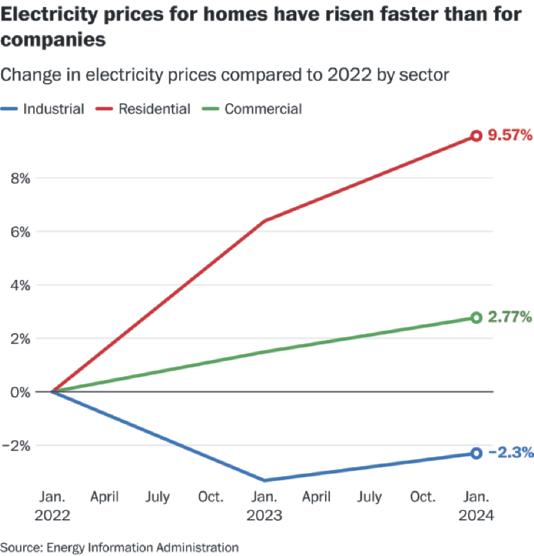
But the rise in costs hasn’t affected each type of user equally. According to recent data from the Energy Information Administration (EIA), residential electricity costs — the average price faced by ordinary home and apartment dwellers in the U.S. — rose by 10% between 2022 and 2024.
Commercial users, spanning everything from small corner stores to giant, energy-sucking data centers, have seen rates increase just 3%. And industrial users saw prices fall by 2% during the same period. The data was recently covered by Yale Climate Connections.
That means that even as huge data centers — some using as much electricity as a small city — have plugged into the grid in recent years, they aren’t seeing the same spikes in prices as residential customers. That may come as a surprise to many electricity users.
“This is a phenomenon that utility regulators have to protect people from,” said Ari Peskoe, director of the Electricity Law Initiative at Harvard Law School.
There are a few good reasons companies may pay less for electricity than people living in homes and apartments. A
huge portion of electricity costs come from the poles, wires, and transformers needed to bring high-voltage electricity into homes scattered across suburban and rural neighborhoods.
Those poles and wires are also the parts of the electricity system that are most vulnerable to extreme weather — and spending on them has skyrocketed in the past few years as utilities contend with an aging grid and rising threats from wildfire and hurricanes.
an amount that aligns with the cost to bring them power — but in practice, different groups can lobby for lower prices.
“This is not a physics problem that has one right answer,” Peskoe said. “Everybody comes in with their own self-interest.”
In general, residential customers have the least lobbying power, compared with large data centers or other companies. “Residential consumers feel like they don’t have a voice in our utility regulatory
According to the EIA, the average electricity price at the end of 2024 was 16 cents per kilowatt-hour for homes and apartments, and just 13 cents for commercial customers.
“California has seen a gigantic increase in distribution costs because of wildfire issues,” said Severin Borenstein, professor of public policy at the University of California at Berkeley. “And California is 7 or 8% of national load — it’s not nothing.”
Big commercial players such as data centers, on the other hand, can often plug directly into high-voltage transmission lines — bypassing the distribution system entirely, and leading to lower prices. According to the EIA, the average electricity price at the end of 2024 was 16 cents per kilowatt-hour for homes and apartments, and just 13 cents for commercial customers.
But there are more complex reasons as well. To set prices for each sector, utilities submit plans to their local regulator, and then face a complex system of political bargaining and negotiation. In theory, each group is supposed to pay
The program will be co-hosted with the Springfield Museums and will be held in the auditorium at the D’Amour Museum, 21 Edwards St.
system,” said Charles Hua, founder and executive director of PowerLines, a group that works to lower costs of electricity for consumers around the country.
In late 2023, for example, the grid operator PJM, which manages transmission from Ohio to Maryland, approved a $5 billion project to update transmission lines, partly because of data centers.
In Virginia and Maryland, most of the costs of that project were borne by residential customers — even though the transmission line was not primarily for the use of people living in homes and apartments.
Then there’s another issue. Historically, utilities have tried to attract commercial facilities — including things like data centers — to an area in an attempt to boost jobs and the local economy.
They have done that by offering preferential rates, trying to
Admission is free to Springfield Garden Club and Springfield Museum members and $10 for the public. Tickets are available via Eventbrite.
The remaining three programs will be held at The Monkey House in Forest Park at 10 AM. Admission is free to all with paid park admission.
draw in facilities that could, in principle, go anywhere around the country.
From a utility perspective, drawing in data centers makes sense: Utilities make their profits off big capital spending, like building new power plants or transmission lines. But if companies offer artificial intelligence data centers a break on costs, to attract their business, that cost could get shifted onto residential consumers.
According to a report from Harvard University earlier this year, utilities often sign special contracts with data center customers that place them outside standard pricing agreements. “I’m not even sure if data centers are paying the ‘commercial’ price,” said Peskoe, one of the authors of the report. “We were finding across states the way data centers were coming online in many states was through these secret contracts.”
For example, the utility El Paso Electric in Texas offered
More information can be found on the club’s website www.springfield gardenclubma.org or on Facebook. Saturday, Feb. 28, 10 a.m., “The Most Beneficial Late Winter Garden Chores” presented by Melissa Pace. Saturday, March 28, 10 a.m., “Vegetable Gardening 101” presented by
Meta a special electric rate to build a $1.5 billion data center — at the time, the utility promised that the rate would not be pushed onto residential consumers. But, according to the Harvard report, the utility also petitioned to keep the proposal hidden from public view. Other utilities in Minnesota, Indiana and Wyoming have taken similar steps. Some states have started to take action to treat data centers as a separate class of customers — with their own prices. Virginia recently established a new class for data centers and other huge users of electricity, with agreements in place to make sure the data centers pay for more of the grid upgrades required. Other states, including Wisconsin, are looking to do the same.
But at the end of the day, experts warn that continued increase in residential prices will anger voters — and contribute to inflation. “Electricity is the new eggs,” Hua said.
Gretel Anspach
Saturday, April 11, 10 a.m., “Planning and Growing a Bountiful Flower Garden” presented by Becky Sadlowski.
Send items for Garden Notes to pmastriano@repub.com two weeks prior to publication.
Change in electricity prices compared to 2022 by sector. (WASHINGTON POST GRAPHIC)
The secret to pest-free plants starts at nursery
By Jessica Damiano Associated Press
IF YOU GROW HOUSEplants, you probably know that sinking feeling you get when you notice the almost imperceivable movement of a dot, fine webbing between a leaf and its stem, or a leaf that just looks off.
You thought (hoped!) the moment would never come, but the pests have moved in, and here we are.
Check out the plant before buying it
Diatomaceous earth, a natural insecticide, is administered to a plant’s soil surface on Long Island, N.Y. on Jan. 12. (JESSICA
Peas get a lot of publicity in the world of gardening these days, especially the new snap-type peas. With succulent, edible pods, snap peas yield more than shelling peas and are easier to eat. I always plant a few feet of snap-peas, but I grow many more feet of shelling peas. Sugar Snap, the original snap pea, is the best in my opinion, even if the vines do soar to unwieldy heights.
Preparing shelling peas for eating or freezing takes time, but it’s worth it. Shelling peas taste best. Lincoln and Green Arrow are two excellent varieties that have been around for a long while and are favorites of mine and many other gardeners.
I did once grow so-called leafless peas, which they truly are, but can’t remember how they tasted. My growing them only once might be telling. Seems to me more leaves would make for sweeter peas. One advantage of these peas is their abundant tendrils, which allow the short vines to hold each other up when planted in a solid block.
My farmden lacks the long, warm growing season enjoyed by lima beans, the best ones, at least. Back when I lived in southern Delaware, I could grow the delectable King of the Garden or Doctor Martin varieties. Bush limas mature sooner than pole limas; I recently grew Fordhook Henderson but decided their mediocre flavor wasn’t worth the space or the effort.
My favorite snap bean varieties are Scarlet Runner, Kentucky Wonder, and Blue Lake. Scarlet Runner beans are thick, hairy, and coarse, but taste good. If necessary, close your
eyes when you eat them. But open your eyes to admire the plants, the clusters of scarlet flowers on display along the vines as they clamber up a pole or other support.
As far as the other two, Kentucky Wonder has a good, old-fashioned green bean taste. Blue Lake beans are the most refined of the lot, velvety smooth in texture and flavor. Sweetness has been the traditional goal sought in sweet corn varieties. (Corn is botanically a grass.) The new “supersweet” hybrids have that in spades, with four times the sugar of regular sweet corn. But sweet corn can be too sweet, and I don’t like my (corn) ears to ripen all at once, which even regular hybrid varieties do. Golden Bantam is a good-tasting, non-super sweet, non-hybrid variety that has been around since the beginning of the last century. It’s sweet enough for me, with a real corny flavor and pleasantly chewy texture.
Choosing a good variety is not the end-all in having a green thumb. With many types of vegetables, climate, soil, and growing conditions, not variety, are important determinants of flavor. That’s why I pick carrot varieties primarily on the basis of shape rather than purported flavor differences.
For some vegetables, it is texture that comes into play. No dramatic flavor differences exist within each category of lettuce, be it Romaine, Boston, iceberg, or loose leaf. All are at their best when grown in a fertile, moist soil to mature during cool days of spring or fall.
Other vegetables that are good when wellgrown, but for which I haven’t found notable flavor differences among varieties, include spinach, turnips (except for the especially delectable Hakurei), summer squash, butternut squashes, and okra.
The old adage about an ounce of prevention being worth a pound of cure also applies to houseplant infestations, and this all could have been avoided if you had taken precautions, starting at the nursery.
Before bringing home a plant, inspect it closely. Look at the soil, stem, leaves and, importantly, under the leaves, where some pests like to make their homes. Use your phone’s camera to zoom in on questionable specks. If all looks good, go ahead and buy the plant, but repot it once it crosses your threshold.
What to do when you bring the plant home
Remove the plant from its container and gently shake, then wipe as much of the soil from the roots as possible. This is important because even in the absence of visible pests, there could be eggs waiting to hatch in the soil.
Repot the plant using fresh, sterile potting mix in a clean container with a drainage hole at the bottom. If reusing the original pot, first wash it and disinfect it with a 90/ 10 waterto-bleach solution.
Plant the roots exactly as deep as they were in the original pot, and tamp the soil down firmly to eliminate air pockets. Then give the plant a moderate drink of water.
When the soil surface dries,
sprinkle it with about ¼ inch of food-grade diatomaceous earth (DE). To ensure even distribution, consider using a powder duster, sometimes called a puffer.
Wear a mask; the dust isn’t toxic to people or pets, but it will irritate your lungs if inhaled. Insects that crawl across the dry powder, which is composed of tiny shard-like particles, become dehydrated and die.
Diatomaceous earth must be kept dry to maintain its effectiveness, so bottom-water plants by placing pots in a shallow container of water. Allow the soil and roots to soak up what they need for about 15 minutes, then discard any remaining water. Bottom watering also helps prevent fungal diseases and root rot, so it’s a good practice regardless of pest concerns.
DE should be reapplied occasionally because soil moisture will degrade it over time, even when watering from below.
Protect your other plants
If you have other houseplants, quarantine your newcomer in a separate room for three to four weeks.
Inspect it every few days as you did at the nursery, as some pests may not show their faces for a while.
When you’re confident all is clear, go ahead and introduce your plants to the rest of the family.
For the best-tasting, productive, earliest ripening pepper, Sweet Italia is the one. (LEE REICH PHOTO)
DAMIANO VIA AP)
Terry & Kim Kovel | Antiques & Collecting
Rare color shading makes vase more valuable
TWO-TONED GLASS
where one color shades into the other was fashionable in the late 19th to early 20th century. It started with amberina, which shades from red to amber and was made by reheating part of a piece of amber glass. Many companies made it, but usually under different names, since amberina was patented for the New England Glass Co.
Other color combinations were made by adding a thin layer of flashed glass to the interior of a piece of transparent colored glass. Bluerina, a blue-shaded glass whose name is influenced by amberina, was made this way. Collectors use the name “bluerina” for several color combinations, including blue shading to clear and blue shading to red. The latter is also called ruby sapphire.
Blue shading to amber is rarer, so when it comes to auction, like this bluerina glass vase that sold for $1,080 at Woody Auction, it sells for high prices. This vase is not marked and its maker is unidentified, but it shows characteristics of the art glass of the late 19th to early 20th century. In addition to its two colors in an unusual combination, it is decorated with acid cut cameo flowers and gold stencils.
Q. Do you know anything about a furniture maker called O.W. Richardson? I have a small carved wood table by this company, but I have not been able to find out much about them.
A.
O.W. Richardson was a company in Chicago that sold home furnishings, like furniture, flooring, and draperies, retail and wholesale. The store offered plain furniture, and customers could choose decorations, like the carvings on your table, to add to the pieces they bought. They were active in the
art glass is always
A
combination,
in your area who sell porcelain, you may be able to contact them to help identify your figurines. If you can take your figurines to the dealer in person, even better. Reproductions are often recognized by features that are not clear from photographs; for example, reproductions of porcelain figurines are often lighter than authentic antiques. There are some visual cues that may help you date your figurines. Certain colors were not used until the nineteenth century, like maroon or yellowish green. Figures made before the 19th century rarely had blue eyes; they were usually brown. Early porcelain has a slightly greenish color, whereas later porcelain is pure white.
TIP: Do not put wirestemmed artificial flowers in a valuable, narrow-neck glass vase. The stems will scratch and damage the vase.
CURRENT PRICES
footed, gilt trim, 7 x 9 inches, $115.
Cut glass, punch set, scalloped bowl, hobstars, sawtooth rim, dome foot, 10 cups, handles, bowl 13 x 14 inches, $160.
Radio, Admiral, Aeroscope, AM, rectangular case, Bakelite, emerald green, top handle, cord, 9 1/2 x 13 inches, $190. Lalique, vase, Ermenonville, frosted body, raised twist panels, leafy trim, clear rim and base, flared lip, round foot, marked, Lalique France, 6 inches, $225.
1920s, but we haven’t found a definite opening or closing date for the company. Many companies in the Midwest made affordable, mass-produced furniture at the time. For example, Grand Rapids, Michigan, was known as “The Furniture Capital of America” because it had nearly 70 active companies. The S. Karpen & Bros. company in Chicago became the world’s largest upholstered furniture manufacturer.
You may be able to find out more information about O.W. Richardson from a library or historical society in the Chicago area. Books on the Midwestern furniture industry in general may be helpful, too.
Q. I am looking for information about a pair of unmarked porcelain figures. They are a man and a woman in Renaissance-style clothing. They both have brown curly hair and the man has long hair, a small
mustache and a goatee. Both have feathers in their hats and painted gold accents on their clothes, and the woman has painted gold jewelry. They are standing on square bases that are painted to look like rocky ground. The bases are hollow and glazed white underneath.
A. Because so many porcelain companies have made figures in historical dress, it is difficult to identify them when they are unmarked. The most famous figurines, which sell for the highest prices, are made in Europe, like Meissen or Dresden in Germany; Jacob Petit in France; Capo-di-Monte in Italy; and Staffordshire in England. These factories have easily recognizable marks, but some are left unmarked. To add to the confusion, many of these makers are still active today, and many figurines have been reproduced. If there are antiques dealers
Current prices are recorded from antiques shows, flea markets, sales and auctions throughout the United States. Prices vary in different locations because of local economic conditions.
Furniture, desk, lap, burlwood, rectangular, lid, mother-of-pearl inlay, red velvet writing surface, pencil tray, storage compartment, 5 x 13 x 9 inches, $85.
Kovels answers readers’ questions sent to the column. Send a letter with one question describing the size, material (glass, pottery) and what you know about the item. Include only two pictures: the object and a close-up of any marks or damage. Be sure your name and return address are included. By sending a question, you give full permission for use in any Kovel product. Names,
Nautical, telegraph, ship’s, engine room, round, brass, porcelain dial, Swedish text, marked, Chadburns, 17 1/2 x 8 inches, $255. Toy, Coaster Boy, figure holding red block, jointed arms and legs, blue wheels, bell, pull string, Fisher-Price, c. 1941, $285. Clock, advertising, Crown Overalls, square, red and yellow crown logo in center, A New Pair Free If They Shrink, Union Made, silver tone frame, blue inner border, electric, art deco, 15 1/2 inches, $600. Majolica, ewer, cover, Palissy ware, mossy ground, green, applied frog finial, brown, applied frogs, reptiles and insects on body, green lizard handle, underplate, signed, M. Mafra, Portugal, 12 inches, pair, $1,060. Silver-sterling, centerpiece, figural, grapevine stem, dangling leaves and bunches, irregular dome foot, cut glass dish, hallmarks, Edward Barnard & Sons, British, Victorian, 10 inches, pair, $1,730.
addresses or email addresses will not be published. We do not guarantee the return of photographs, but if a stamped envelope is included, we will try. Questions that are answered will appear in Kovels Publications. Write to Kovels, The Republican, King Features Syndicate, 300 W. 57th Street, 41st Floor, New York, NY 10019, or email us at collectors gallery@kovels.com.
Multicolor
striking.
rare color
blue and amber, plus cameo-cut flowers and gold highlights make a vase like this a true treasure. (WOODY AUCTION)
Average US long-term mortgage rate edges higher
Rate still remains near its lowest point in more than 3 years
By A lex Veiga Associated Press
The average long-term U.S.
Deeds
AGAWAM
Kathleen L. Reidy to Christopher L. Longo and Christopher M. Longo, 6E Castle Hills Road, $305,000.
Robin R. Richey, Cheryl L. Meskus, Cheryl R. Meskus and Lisa R. Remsen to Katlyn Welling, 1168 River Road, $340,000.
AMHERST
Sherri A. Willey and Ryan S. Willey to Sherri Willey, trustee, Ruan Willey, trustee, Sherri Willey Revocable Trust and Ryan Willey Revocable Trust, 24 Ridgecrest Road, $100.
Shourya Gupta, Meenu Gupta and Arun Kumar to SGME 36 Western LN Amherst MA LLC, 36 Western Lane, $100.
Cynthia L. McHale and Michael A. McHale to Jeffrey Doker and Courtney Doker, 324 Pomeroy Lane, $835,000.
Hilda Greenbaum, trustee, and Revocable Indenture of Trust of Hilda Greenbaum to Krupalu LLC, 622 Main St., $1,300,000.
Deanna F. Pearlstein to Deanna F. Pearlstein, trustee, and Revocable Indenture of Trust of Deanna F. Pearlstein, 81 Stagecoach Road, $100.
Lyn A. Praetz, personal representative of the Estate of Richard D. Cranson, to Danae Marie Olsen, 1531 Williamsburg Road, $152,000.
BELCHERTOWN
Tall Palms Capital LLC, to OA Real Estate Holdings LLC, 81 Old Amherst Road, $677,000.
John F. Ahern, trustee, Linda G. Ahern, trustee, and John F. Ahern
mortgage rate ticked higher this week, but remains near its lowest level in more than three years.
The benchmark 30-year fixed rate mortgage rate rose to 6.09% from 6.06% last week, mortgage buyer Freddie Mac said Thursday. One year ago, the rate averaged 6.96%.
Borrowing costs on 15-year fixed-rate mortgages, popular with homeowners refinancing their home loans, also rose this week.
That average rate inched up to 5.44%, up from 5.38% last week.
A year ago, it was at 6.16%, Freddie Mac said.
Mortgage rates are influ-
2021 Trust to Two Tree Field LLC, 47 Main St., $300,000.
BERNARDSTON
Jennie E. Lake and Daekwon Williams to Mark Giard and Sandra Giard, trustees of the Mountain Top Trust, 59 River St., $225,000.
BRIMFIELD
ee Real Estate Trust 19 Main Street Brimfield Nominee, trustee of, Robert D. Hitchcock, trustee, and Mary Jane Gaumond, trustee, to Paul E. McCarthy and Sheila K. Johnson McCarthy, 19 Main St., $520,000.
CHARLEMONT
John Dunphy to Jake L. Orrall, 165 Main St., $260,000.
CHICOPEE
Daviau & Robert Properties LLC, to 41 Ames Avenue LLC, Rear 41 Ames Ave., $700,000.
Equity Trust Co., custodian, Robert Lareau IRA, and Robert Lareau to Michael Steven Duval and Rebecca Lyn Duval, 91 Norman St., $407,000.
Kelly Salvador-MacAdam and April Salvador-MacAdam to April Salvador-MacAdam, Gail M. Salvador and Ricardo Salvador, 217 Moore St., $71,500.
Polly A. Malsbury and William C. Peters to Abdullah Asem Aydah, 103 Collins St., Unit E10, $190,000. Songo Realty LLC, to County Road & Grattan St. Realty LLC, 451 Grattan St., $600,000.
Theodore J. Beauregard to Prince A. Taylor, 62 Jennings St., $325,000.
Waycon Inc., to Hunter J. Parks and Allyson E. Parks, 32 Stockbridge St., $515,000.
CONWAY
Lora M. Hanas and Peter M. Hanas to Mackenzie W. Coburn and John C. Putala, Pine Hill Road, $87,000.
enced by several factors, from the Federal Reserve’s interest rate policy decisions to bond market investors’ expectations for the economy and inflation. They generally follow the trajectory of the 10-year Treasury yield, which lenders use as a guide to pricing home loans.
The modest increase in rates
this week follows a jump in the 10-year Treasury yield as the bond market reacted to geopolitical tensions over tariff threats by the Trump administration as it pressed for control of Greenland and turbulence in Japan’s bond market.
The 10-year yield was at 4.27% at midday Thursday, up from 4.17% a week ago.
DEERFIELD
Dajun Pang and Chianping Ye to Sidney Chang, 17 Beaver Drive, $399,900.
Jacqueline A. Hanlon and Lynn M. Hanlon to Ryan J. Carmody and Virginia A. Carmody, 122B Sand Gully Road, Unit 1B, Sand Gully Road Condominium, $259,900.
CCP Properties Business Trust, trustee of, and Darrin Smith, trustee, to Vantage East Longmeadow Realty LLC, 32 Chestnut St., $8,186,328.
Keith J. Fitzgerald and Kerisa P. Fitzgerald to E. David Wilson, trustee, and E. David Wilson Trust, trustee of, Hampden Road, Lot F, $289,000.
Michael Belli, trustee, Nicholas Boschetti, trustee, Michael Boschetti, trustee, and Belli Residence Trust-1991, trustee of, to Alamgir Kabir and Nazmun Kabir, 9 Windsor Lane, $650,000.
Susan E. Robertson, Arthur J. Robertson and Alan E. Robertson to Gloria Santana and Judith Delgado Toledo, 19 Westminster St., $310,000.
EASTHAMPTON
Michael K. Lalak to Michael K. Lalak and Lillian S. Mason, 16 Pomeroy Meadow Road, $100.
Ouey Lip-Ross to Jordan Ross, 6-8 Arlington St., $100.
Karen A. Adamski and Stanley E. Adamski to Amy L. Saletnik, 108 Parsons St., $399,000.
James D. Molitoris Jr., Clarissa Molitoris and Clarissa W. Shumway to Joanne Duara, trustee, Matthew Rowen Caplan, trustee, and Duara Caplan Family Trust, 16 Bayberry Drive, $735,000.
Marni M. Giss to David Ferland and Amy Pybus, 59 Campbell Drive,
$550,000.
GRANBY
Dora Reyes and Dora Reyes-Lorange to Jessica E. Pavliska, 58 Granby Heights, $262,000.
Katherine Powers, personal representative, and Edward J. Powers Sr., estate, to Kraig J. Burke, 23 Pine Brook Circle, $310,000.
GREENFIELD
Garrett D. Connelly, trustee of the Connelly Realty Trust, to Benegan2 LLC, 24 Cypress St., $245,400.
OV Properties LLC, to Brett Mallard, 6 Princeton Terrace, Unit 6, Meadowview Manor Condominium, $160,000.
Cynthia A. Milewski to Michael Benoit and Meagan Reilly, 74 Petty Plain Road, $365,000.
HADLEY
Seth Isman, Erika Andrea Hollister, Gabriel Elijah Isman, trustee, Gabriel Elijah Hollister Isman, trustee, Margot Simone Isman, trustee, Margot Simone Hollister Isman, trustee, Georgia Alexandra Hollister Isman, trustee, and Isman & Hollister Irrevocable Trust to Gabriel Elijah Isman, trustee, Gabriel Elijah Hollister Isman, trustee, Margot Simone Isman, trustee, Margot Simone Hollister Isman, trustee, Georgia Alexandra Hollister Isman, trustee, and Isman-Hollister Irrevocable Real Estate Investment Trust, 150 East St., $100.
Gabriel Elijah Isman, trustee, Gabriel Elijah Hollister Isman, trustee, Margot Simone Isman, trustee, Margot Simone Hollister Isman, trustee, Georgia Alexandra Hollister Isman, trustee, and Isman-Hollister Irrevocable Real Estate Investment Trust to Rachael Brooke Goren and Julie Callan, 150 East St., $699,000.
G&B Realty Partners LLC, to Dixie Durrenberger-Schroeder and Nickolas Denehy, 379 River Drive,
$374,900.
HAMPDEN
JoeJoe Properties LLC, to Michael Sierra and Jessica Sierra, 12 Rose Circle, $615,000.
HEATH
Eunice Marcelina to Mark McDonagh, 136 & 137 Taylor Brook Road, Mohawk Estates and Colrain Brook Road, $21,000.
HOLYOKE
Holyoke City to Jose A. Santos Suarez, Cabot Street, $1,000. Matthew Millard Bagg to Valarie Rafus, 37 Laura Lane, $415,000.
LUDLOW
Annamarie D. Gall, trustee, Annamarie Dutra, trustee, and Mary P. Dutra Revocable Indenture of Trust of, trustee of, to William R. Ayers Jr., 112 Paulding Road, $250,000.
Dominic Kirchner II, trustee, and Ushokoledi Realty Trust, trustee of, to Shelby Marie Ponusky and Connor David Owen, 33 Grimard St., $335,000.
Whitetail Wreks LLC, to Hemlock Ridge LLC, Turning Leaf Road, Lot 104, $177,900.
Whitetail Wreks LLC, to Hemlock Ridge LLC, Turning Leaf Road, Lot 105, $177,900.
MONSON
U S A Housing & Urban Development, to Richard Ferguson and Elisa Ferguson, 23 High St., $245,000. Everett L. Walker and Diana J. Walker to Lord Country Club LLC, 90 Palmer Road, $1,100,000.
U S Bank, trustee, and Residential Asset Securities Corp Series 2006-EMX4, trustee of, to SR Homebuyers LLC, 84 Bethany Road, $299,250.
Deeds
MONTAQUE
Amanda Waryasz, “aka” Amanda Parson Waryasz, personal representative of the Estate of Charles H. Waryasz III, to Gary E. Cowan and Lorie J. Cowan, 202 Turnpike Road, $175,000.
Kearin S. Dew and Warren D. Thomas Jr., to Jane Alessandra, Dry Hill Road, $15,000.
MONTGOMERY
Jerald W. Morse, trustee, Jeffrey L. Morse, trustee, and Morse Family Trust, trustee of, to Jeffrey L. Morse, 102 Carrington Road, $200,000.
NEW SALEM
David F. Richards to Jeffrey Burke, Petersham Road, $35,000.
NORTHAMPTON
Debra M. Mikaelian, Debra M. Petcen and Michael J. Mikaelian to Debra Mikaelian, trustee, Michael Mikaelian, trustee, Debra Mikaelian Revocable Trust and Michael Mikaelian Revocable Trust, 597 Ryan Road, $100.
Tsultrem Kunsang to Tsultrem Kunsang and Lobsang Dolma, 47 Brierwood Drive, $100.
Sue A. Frost to Sue A. Frost, trustee, and Sue A. Frost Revocable Trust, 587 Coles Meadow Road, $100.
Lilia R. Olpindo to Abid Assad, 68 Masonic St., $300,000.
William B. Buford and Katen Hueyting Sun to Sam Standing and Hallie Bahn, 76 Vernon St., $610,000.
Lilia R. Olpindo to Abid Assab, 68 Masonic St., $300,000.
Michael G. George and Kristen E. Barry-George to Maye LLC, 187 Locust St., $375,000.
Diane J. Dmytryk, personal representative, Florence V. Dmytryk, estate, and Florence Dmytryk, estate, to William Randolph Herman and Angeline Barretta Herman, 51 East St., $365,000.
Scott C. Cornelius and Sarah E. Briggs to Stone B. Cornelius, trustee, and Cornelius-Briggs 2026 Trust, 506 Fairway Village, $100.
John H. Antil to Seth Barrett and Alexandra Barrett, 93 Laurel Park, $150,000.
ORANGE
Amanda M. May, personal representative of the Estate of Robert
John Zajac, to Anahbel Upham and Lucas Upham, 153 Dana Road, $335,000
SHUTESBURY
Anita Ting MacDonald and Michael S. MacDonald to Natalia Petruski-Ivleva, 36 Merril Drive, $425,000.
SOUTH HADLEY
William T. Whigham and Constance M.F. Whigham to William T. Whigham, trustee, and Revocable Indenture of Trust of William T. Whigham, 153 Lyman St., $100.
SOUTHAMPTON
Elizabeth M. Martin to Cassie
Marie Gaddis and Jordan Michael Gaddis, 100 Fomer Road, $614,250.
Richard Dahdah to Elizabeth M. Martin, 301 Fomer Road, $575,000.
SOUTHWICK
Susan A. Mastroianni, trustee, Christopher D. Mastroianni, trustee, and S. A. Mastroianni Family Trust, trustee of, to Jaydub LLC, 64 Tannery Road, $280,000.
SPRINGFIELD
CCP Springfield Business Trust, trustee of, and Darrin Smith, trustee, to Vantage Springfield Realty LLC, 215 Bicentennial Highway, $7,276,736.
Charles Muthua to 120 Harvard Street LLC, 120 Harvard St., $26,500.
Christine Kimball to Sarah Ann Royston and Suzanne Jacques, 98 Pine Grove St., $350,000.
Diane H. Stone to Richton & Wynne LLC, 744 Bradley Road, $230,000.
Hoa Minh Nguyen to Helen T. Nguyen, 14 Daviston St., $200,000.
Joshua B. Cotto-Colon and Joshua Cotto B. Colon to Springfield College, 255 Norfolk St., $305,000.
Kaitlin A. Dunley, representative, and Shirley A. Theres, estate, to Ruby Dillon and Joshua Nethanel Bruce, 401 Grayson Drive, $451,000.
Laura Zapata and Jovany Andres Mira to Jia Lu, 723-725 Carew St., $430,000.
Louis Bonavita to Tascon Homes LLC, 29 Vinton St., $60,000.
Louise Jones and Derrick Jones to Pah Properties LLC, 20 Conklin St., $147,000.
Lucille M. Woodtke, Laurie A. Gioielli, trustee, and Woodtke Family Trust, trustee of, to Courtney Merkman, 54 Shady Brook Lane, $340,000.
Luis A. Rivera and Michelle Ortega Rivera to Jeannette Rivera and Gloria M Rivera, 1815 Parker St., $327,770.
Lynn A. Thompson, Lynn A. Hasty and Gerald Hasty to Maria Gonzalez and Benjamin Romero Ramos, 193 Roy St., $288,000.
Maria S. Gonzalez and Maria S. Negron to Emtay Inc., 27 Parallel St., $195,000.
Michael H. Sierra and Jessica Sierra to Roberto Cruz, 1680 Parker St., $340,000.
Michael S. Freitas, Iwona M. Freitas and Iwona M. Jedziniak to Mamba Capital LLC, Parker St., Par B, $63,700.
Noreen Finn, Noreen N. NoadBrown and Vernon F. Brown to Fefabo Management LLC, 43 Colonial Ave., $230,000.
Onyx Investments LLC, to Camilo Homes LLC, 482 Chestnut St., $275,000.
Richard Ortiz to Shane Dearborn, 43 Birchland Ave., $350,000.
Sandra R. Shafer to Eliezer A. Claudio Adorno, 331 Newhouse St., $255,000.
Seajay Group LLC, to Tavernier Investments LLC, 137-139 Fountain St., $225,000.
Valentina Lee and Valentina LaPorte to April Arroyo, 35 Juniper Drive, $320,000.
SUNDERLAND
Ellen K. Brower-Gately and Edward J. Gately III, to Matthew McLaughlin, 110 Old Amherst Road, $318,000.
WARE
James E. Taylor to Norma G. Roach, 12 Malboeuf Road, $492,450.
Dana J. Bryant and Elizabeth A. Bryant to Dominic Kirchner II, trustee, and Azusa Realty Trust, 48 Eddy St., $200,000.
Allen C. Edwards to Steven Killmer, 1 Anna St., $305,000.
Country Bank for Savings, Edwin M. Krol, Evelyn E. Krol and Evelyn Krol to Yellowbrick Properties LLC, 7 Dugan Road, $196,350.
Kyle J. Ragno to Hunter McKeen Nicoson and Ryley Newcomb, 82 Monson Turnpike Road, $382,000.
WEST SPRINGFIELD
CCP Properties Business Trust, trustee of, and Darrin Smith, trustee, to Vantage West Springfield Realty LLC, 42 Prospect Ave., $8,186,328.
WESTFIELD
April M. Odell and Timothy A. Souza to Shannon Purdy and Keith Purdy, 99 Woodmont St., $330,000.
Gayle Begley, Alex P. Baginski, Joanne L. Hunter and Thomas M. Baginski to Paul Troy, 0 Holyoke Road, $95,000.
Gennadiy A. Lisitsin, Mariya Lisitsin and Mariya Lisitsina to Denis Mocanu, 28 Union St., $507,500.
Gwilym A. Jones and Kristin Jones to Sabrina Dotson Bergeron and Timothy Nelson Bergeron, 10 Day Lily Lane, $758,000.
Lorraine R. Thibeault to Lorraine R. Thibeault, life estate, Christopher W. Secore and Caitlin D. Secore, 319 City View Boulevard, $100. Seth D. Sullivan, David M. Sullivan and Janet L. Sullivan to Emanuel Irvin Sardinha, 40 Janis Road, $250,000.
Theordore Burrell and Theodore Burrell to Kaitlyn Casale, 1037 Shaker Road, $315,000.
Timothy K. Derrig to Round Two LLC, 7 Sibley Ave., $179,000.
WESTHAMPTON
Vito J. Perrone and Natasha F. Perrone to Brian Michael Chmura, 178 Northwest Road, $475,000.
WHATELY
Jason Brooks, trustee of the Wilma Brooks Family Irrevocable Trust of 2018, to David C. Brooks, trustee of the Freedom Hill Realty Trust #4, 182 Chestnut Plain Road, $670,000.
WILBRAHAM
AC Homebuilding LLC, to Anand Kanjolia, 99 Sandalwood Drive, $797,767.
Lynne A. Kleeberg to Danny Z. Serra and Kevin Hill, 17 Peak Road, $2,045,000.
ANTIQUE ESTATE AUCTION
FRI, JAN. 30 AT 6 PM
Fine art including paintings & prints, Furniture - Early, Victorian, and Modern, sterling silver, 50+ lots gold & silver jewelry, gold coins, Steinway grand piano and 2 more, glass & china, oriental rugs, and more.