Set amidst the stunning Highlands of Pitlochry, Atholl Palace Hotel is the perfect destination for conferences, meetings, incentives, and corporate events. With versatile event spaces for up to 400 delegates, modern technology, and a dedicated events team, every detail is effortlessly taken care of.
Beyond the boardroom, guests can relax in comfortable accommodation, enjoy locally sourced dining, or explore the beautiful surrounding landscapes.
At Atholl Palace, business meets comfort, connection, and inspiration, a place where your team can gather together and feel at home.
Urban lighting revitalises city square and reduces energy consumption by 50%
What if Your Lighting Could do More for Your Community?
Guildhall Square, Southampton
Guildhall Square in Southampton has been transformed with a smart, sustainable lighting upgrade from Urbis Schréder.
Our VALINTA MAXI CURVE luminaires now illuminate the square with improved uniformity, a striking contemporary look, and 50% energy savings.
By designing bespoke bracketry, we reused the existing columns—cutting waste, cost and installation time. The result? A safer, brighter and more inviting public space for residents, students and visitors.
PUT TING PRESSURE ON POOR WORKMANSHIP
Have you bought a new build home?
Far too many new-builds fall shor t of quality benchmarks. Developers often rely on homeowner tolerance to hide flaws. At ProSnag Exper ts, our mission is to elevate new-home standards by delivering detailed snagging surveys that uncover issues others overlook.
Watch Our Explainer Video
Pre -Complet ion
Inspect ion
From £300 + VAT
Aimed for pre-handover We check against NHQB/NHBC standards so developers can fix ahead of completion.
Pre-Handover
General
Snagging Sur vey
From £300 + VAT
Aimed for homes lived in 0-9 months. Covering cosmetic and structural checks against NHBC, Premier & LABC.
0-9 Months
Fundamental Proper ty Sur vey
From £300 + VAT
Moved in 10+ months ago? We focus on critical structural issues before your warrenty period expires.
10+ Months
Expert teams to cut wasteful
The government has announced a suite of reviews designed to root out wasteful
Teams will be brought in from across the public and private sector to give their expertise. The reviews will be launched across bringing healthcare out of hospitals, homelessness, the provision of youth services and the management and maintenance of public sector
For example, out-of-classroom youth provision, which currently costs over £1 billion a year, will be reviewed to make a fragmented system spread across multiple departments and local government for each young person more efficient and effective.
Other teams will investigate how departments take a more preventive approach to tackling homelessness. Currently over three quarters of government expenditure on homelessness is spent on temporary accommodation.
Chief Secretary to the Treasury James Murray said: “These reviews will scrutinise government programmes to ensure they improve people’s lives while rooting out wasteful spend from the public sector. We have a duty to taxpayers to make sure every pound of their money works as hard in government as the people who earn it.”
A trusted name in diagnosing property health with innovative credible solutions aligned to accurate causation, recommendations and cost-effective timely solutions for the long term.
Local Government recruitment campaign launched RECRUITMENT
A new national recruitment campaign has been launched to encourage people to work for their local council.
The ‘Make a Difference, Work for Your Local Council’ campaign promotes careers in local government and highlights how rewarding working in the sector can be.
The launch follows a survey by the Local Government Association which found that most councils are experiencing difficulties recruiting and retaining new staff.
The campaign, funded by UK Government, will highlight some of the benefits of working for local government, including making a positive impact on real people’s lives in your community; growing your career with training and development opportunities and having flexible, inclusive working practices.
This year’s campaign will launch on 5 January 2026, and will run for six weeks until 15 February 2026. A campaign toolkit is available for local councils.
Developed in collaboration with councils, Regional Employer Organisations, and expert creative, media and research partners, the campaign was first piloted in North East of England in 2023-24, before its first national roll-out in 2024-25.
Cllr Jane Scullion, chair of the LGA’s Improvement Committee, said: “Working in local government is truly a career where you get to make a real difference for your community – there are few other jobs like it...
Cyber action plan to strengthen public services
The government has launched a new cyber action plan to make public services more secure and resilient.
The Government Cyber Action Plan is backed by over £210 million and sets out how the government will rise to meet the growing range of online threats.
A new Government Cyber Unit will drive the plan and will rapidly improve cyber defences and digital resilience across government departments and the wider public sector.
The announcement supports government plans to digitise public services.
A new Software Security Ambassador Scheme will now help drive adoption of the Software Security Code of Practice - a voluntary project designed to reduce software supply chain attacks and disruption.
Digital Government Minister Ian Murray said: “Cyber-attacks can take vital public services offline in minutes – disrupting our digital services and our very way of life.
“This plan sets a new bar to bolster the defences of our public sector, putting cybercriminals on warning that we are going further and faster to protect the UK’s businesses and public services alike.
“This is how we keep people safe, services running, and build a government the public can trust in the digital age.”
CYBER SECURITY
SIGNAGE SAFETY EXPERTS
LEADING SIGNAGE SAFETY
PIVOT365 is a UK specialist in signage safety audit and inspection, supporting public and commercial estates with clear, defensible and risk-focused reporting across the UK and ROI
REPORTING ON SIGNAGE RISK & SAFETY
We support estates, risk management and health and safety teams by governing signage in line with legislation, and supporting audit requirements across complex portfolios. Using directly employed, qualified technicians, supported by technology-enabled reporting and tagging, we assess the structural integrity of signage fixings and substrates, illumination faults and deteriorating components. With national coverage across the UK and ROI, our teams respond quickly wherever support is required.
Scottish regions to share £140
Scottish Secretary Douglas Alexander has launched the Local Growth Fund, with five Scottish regions to share £140 million.
The programme will fund regional projects designed to drive economic growth. This could be projects like infrastructure investment, business support, or skills development.
Glasgow City will receive £60.0 million, Edinburgh & South East £37.8 million and Tay Cities £19.5 million. Ayrshire will receive £11.8 million and Forth Valley Region £9.8 million.
Funding has been allocated at regional level, via Regional Economic Partnerships (REPs), to enable strategic decision-making and maximum growth impact. Allocations have been made in proportion to population.
Secretary of State for Scotland Douglas Alexander said: “The UK Government is today backing regional economies across Scotland with £140 million of new investment.
“This new investment will allow local leaders to decide how best to use the funding, which could include projects to improve infrastructure, business support or skills development. The UK Government will now work with local partners to develop investment plans tailored to each region.
“By investing in local areas, reducing child poverty, and bringing down inflation, the UK Government is focused on delivering material change to people across the country – boosting living standards and improving
CUT from the cab using the 600mm planer with depth and tilt control.
CROP a uniform hole profile using the 360° 400mm cropping tool.
CLEAN chippings using the 1200mm sweeper with dust suppression.
JCB POTHOLE PRO
CUT CROP CLEAN WITH ONE MACHINE
The award-winning JCB Pothole Pro is a unique 3-in-1 solution to permanent pothole repairs in just 8 minutes - four times faster and half the cost of traditional methods. Just add the tar.
DISCOVER MORE
Map shows where pothole
funding is being used
The government has published new data showing how well local highway authorities (LHA) are tackling potholes.
The new traffic light rating system grades 154 LHAs as red, amber or green based on current road condition and how effectively they are spending the £7.3 billion funding to fix potholes and invest in long-term measures to maintain roads.
The rating are based on the condition of local roads; how much LHAs are spending on road repairs; and whether they are following best practice in maintaining highways.
Leeds, Sandwell and Manchester have all been rated green. They were able to show they are following best practice, such as investing in more long-term preventative measures rather than just patching up potholes, while also maintaining good road conditions and investing significantly into improving local roads.
LHAs marked Amber showed some of these qualities with room for improvement in individual areas, while those rated ‘red’ are not yet meeting the expected standards in one or several areas measured by the ratings.
Transport Secretary Heidi Alexander said: “For too long, drivers have paid the price because our roads were left to deteriorate. I have heard time and again their frustration on footing the bill because they hit a pothole – money they should never have to spend in the first place...
TOWN OF CULTURE
Applications open for UK Town of Culture
Applications are now open for the first UK Town of Culture competition.
Applications will be open until 31 March.
The competition will be open to small, medium and large towns.
An expert panel will be led by Sir Phil Redmond judging towns on the way they’ll tell their unique story, how they’ll bring everyone in a community together, and how towns will deliver on their vision.
A shortlist will be drawn up with the strongest bids with each town on the shortlist receiving £60,000 to help deliver their full bids for the competition.
One small, one medium and one large town will be chosen to be finalists and the winner will receive a £3 million.
The two runners up will each receive £250,000 to deliver elements of their bid.
Culture Secretary Lisa Nandy said: “There is so much for us to be proud of in the towns we’re from - from the rich, local history to unique festivals and celebrations. They have shaped our national story for decades. Now it’s time they take centre stage and showcase the unique stories they have to tell.
“We have seen the transformative power of culture through the UK City of Culture competition. I want to make sure that towns have the same opportunity to make a real difference to their local community and show the world exactly why their town is so special.”
UK Town of Culture Chair, Sir Phil Redmond said: “I am delighted to have been asked to Chair the new Town of Culture competition, as in the past it has been hard to adequately demonstrate the depth, breadth and diversity of the UK’s cultural landscape through the UK City of Culture’s urban lens...
£1.5 billion for culture and arts
The government has announced a package of £1.5 billion to be invested in cultural organisations over a five-year period.
The money will be invested to save over 1,000 arts venues, museums, libraries and heritage buildings across England from closure.
The funding is intended to fix urgent capital needs and open up access to culture for everyone, everywhere.
It is hoped that the funding will help restore national pride in community assets, bring people together and support no or low-cost options for days out as part of the government’s drive to support families with the cost of living.
The funding includes more than £100 million specifically earmarked for local museums struggling with maintenance backlogs and bills. This is expected to support up to 200 sites across the country.
The £1.5 billion includes £760 million for museums, including £600 million of infrastructure funding which will support national museums and DCMS-sponsored cultural organisations and £160 million for local and regional museums.
A £425 million Creative Foundations Fund will support approximately 300 capital projects in arts venues across the country.
There is £230 million for heritage protecting and preserving heritage buildings, including listed places of worship...
Awaab’s Law to be introduced in Scotland: READ MORE
Government publishes Water White Paper: READ MORE
Councils get new powers to stop pavement parking: READ MORE
Government launches new Road Safety Strategy: READ MORE
£20 million for Scottish towns: READ MORE
Government sets out plans for Northern Powerhouse Rail: READ MORE
CONSTRUCTION
Planning and Infrastructure Bill receives Royal Assent
The Planning and Infrastructure Bill has become law.
Communities and nature across England will benefit from improved environmental outcomes and faster delivery of homes.
The fund will offer an alternative to the current system, which the government says has blocked houses being built, whilst nature still declines.
The government has published an Implementation Plan, which sets out the pathway to rolling out the Nature Restoration Fund, which will result in the delivery of the first Environmental Delivery Plans (EDPs) in 2026.
Under the new approach, Natural England will work with public bodies, environmental organisations, private markets and developers to create an EDP for specific areas, outlining conservation measures that address impacts of development on protected sites and species.
Nature Minister Mary Creagh said: “We are changing the broken planning system to ensure that we can deliver new homes and infrastructure while protecting and restoring nature.
“The Nature Restoration Fund will help restore our most treasured protected habitats and species whilst building the homes Britain needs.”...
Passivhaus policy drivers
2026 is going to be a big year for Passivhaus in the UK.
With major policy shifts landing in 2026, Passivhaus is moving to the centre of UK building standards. Sarah Lewis, co director at the UK Passivhaus Trust, outlines the policy drivers shaping homes, schools and local authority development and why a fabric-first, quality assured approach is gaining momentum for heating. Passivhaus homes and buildings are healthy, comfortable, warm, peaceful and with ultra-low energy bills. Post-monitoring data demonstrates that Passivhaus buildings perform as designed, effectively eliminating the ‘performance gap’. There are eight key Passivhaus principles, which together form an integrated whole that reliably delivers performance, comfort and durability.
The Scottish Government will be unveiling its plans for a Scottish Passivhaus Equivalent standard, with the second consultation on the policy taking place in early 2026. Powerful policy and funding measures, which act as ‘carrots and sticks’, are also encouraging local authorities and social housing providers to build better.
What is Passivhaus?
Passivhaus is an international quality assurance building standard that delivers high levels of air quality and comfort and addresses fuel poverty through radical reductions in the energy used
Scottish Passivhaus Equivalent
The Scottish Government is currently developing a Scottish Passivhaus equivalent policy for all new buildings, with a second consultation on the policy due in the first quarter of 2026. The Passivhaus Trust has been part of a cross-
industry working group with the Scottish Building Standards team, which has developed a consensus position on the standard.
The consultation in early 2026 will reveal the exact proposals for the Scottish Passivhaus Equivalent standard. It is our understanding that the proposed Passivhaus Equivalent standard will likely not require full Passivhaus certification for all buildings, although it is expected to represent a significant policy stepchange. We are optimistic that the standard will draw on the Passivhaus methodology to embed the core principles and metrics that reliably deliver energy efficiency, health, comfort, and performance-in-use. Key elements that we hope to see within the Passivhaus Equivalent Standard include: meaningful, measurable ‘absolute’ target metrics; robust tools, such as PHPP (Passivhaus Planning Package), to predict performance accurately; quality assurance to close the performance gap; and adaption of health and comfort measures, such as adequate ventilation, stable indoor temperatures, good indoor air quality, and protection from summertime overheating.
We are also hopeful that buildings certified to the Passivhaus standard will be deemed to satisfy the new building standards.
If it delivers on its promise, the Scottish Passivhaus Equivalent policy should be an
Councils
have adopted ambitious Passivhaus programmes for social housing and public building projects
important step towards delivering highquality new homes and buildings at scale. The Passivhaus Trust will be running webinars during the consultation period to encourage responses.
Scottish schools
Scottish leadership is also being demonstrated through an innovative funding mechanism for new build schools, developed by the Scottish Futures Trust (SFT). Projects receiving funding from SFT need to meet a very clear energy target and funding may be reduced if the school buildings do not perform as designed in postoccupancy monitoring. Many local authorities have been opting for the Certified Passivhaus route to guarantee good building performance, and therefore de-risking the funding. As a result, 60 per cent of new schools in Scotland are currently targeting the Passivhaus standard.
Wales
In Wales, funding conditions for social housing schemes permit the adoption of a ‘fabric first’ alternative to EPC A, which draws on the Passivhaus methodology. The recently launched ‘Tai ar y Cyd’ Pattern Book, backed by 25 Welsh social housing providers, and supported by the Welsh Government, includes Passivhaus as its suggested ‘enhanced’ standard.
The London Plan
London is fast becoming a Passivhaus hotspot, with 3,600 Passivhaus social homes completed or underway, thanks to the higher specifications of the London Plan. A minimum on-site energy reduction of at least 35 per cent beyond Building Regulations is required for major developments, with an ideal target of 50 per cent.
Local authority adoption
Councils including Exeter, Norwich, Glasgow, Herefordshire, Salford, Edinburgh, York, and Midlothian, have adopted ambitious Passivhaus programmes for social housing and public building projects. E
Passivhaus Trust research shows an approximate cost uplift of only 4-8 per cent
F Local Plans
Local plans developed by local authorities such as Cornwall, Bath & NE Somerset, and Central Lincolnshire, call on developers to go beyond building regulations, often drawing on the Passivhaus methodology. Unfortunately, the Written Ministerial Statement 2023 has created confusion about the ability of local authorities to set sustainability standards above and beyond national regulations. Despite that, there are still a number of other ambitious Local Plans in the pipeline.
Homes England’s Healthy Homes guidance
The health benefits of Passivhaus have recently been publicly acknowledged in the Introduction to Homes England’s Healthy Homes guidance: “Passivhaus is a well-established design and quality assurance system aimed at reducing energy demand, addressing the ‘performance gap’ of new buildings and improving comfort levels for residents. There is significant overlap between a Passivhaus approach and the aims of Healthy Homes.”
While full Passivhaus certification is not a requirement, there are significant similarities between the Healthy Homes ‘good practice enhancements’ and the Passivhaus standard. Homes England now recognises the health advantages of Passivhaus, and Passivhaus dwellings will automatically achieve ‘good practice’ enhanced status on three specific healthy homes measures: building fabric and energy performance; overheating; and ventilation and indoor air quality.
Driving down costs
The costs of building to the Passivhaus standard are frequently presented as an obstacle, and yet Passivhaus Trust research shows an approximate cost uplift of only 4-8 per cent and that it is possible to drive down the cost to little or no additional premium.
Passivhaus has been adopted in the UK for over 15 years now, which has given UK Passivhaus practitioners the opportunity to learn from and improve the process of delivering Passivhaus buildings. A focus on early-stage design, addressing simplicity, form factor and orientation, offers cost-effective ‘easy wins’. Such design refinements are helping to bring down the uplift costs of Passivhaus, enabling mainstream developers to adopt Passivhaus at scale.
In the UK, Barratt has announced a landmark move to adopt Passivhaus at scale, with all Barratt’s London residential schemes to be built to meet the Passivhaus standard. In Ireland, housebuilder Cairn has recently adopted the Passivhaus standard for a 598-apartment project in Dublin.
Future Homes Standard
The Government’s Future Homes Standard (FHS) is also due to be announced early in 2026. Unfortunately, the indications are that it will not live up to its futuristic promise.
The FHS is not expected to include any building fabric improvements, with more emphasis on the use of heat pumps and solar PVs. Although requirements for heat pumps and solar PV panels represent a positive policy
The Government’s Future Homes Standard (FHS) is also due to be announced early in 2026
shift, they do not address indoor air quality and occupant comfort. They also fail to tackle the urgent issue of helping the national grid cope with peak load. The ideal scenario would be Passivhaus levels of fabric energy performance, alongside the heat pumps and solar panels.
A call to action
In a climate emergency and fuel poverty crisis, we should be constructing homes and buildings in the UK that are quality assured to deliver energy efficiency and comfort with excellent indoor air quality.
Passivhaus is a long-established and tried and tested international building standard that delivers excellent occupant comfort and indoor air quality, and radical reductions in operational energy.
As an absolute minimum, Passivhaus certified buildings should be considered ‘deemed to satisfy’ building standards. This is already the case in Australia and Greece, and hopefully soon-to-be Scotland.
There is no need – or time – to reinvent the wheel. L
Jackie Maginnis, chief executive of the Modular and Portable Building Association, outlines how the sector’s new Roadmap to Net Zero is helping public sector clients take a whole-life, sustainability-led approach
Building a sustainable and resilient future for public sector buildings
Across the UK public sector, there is growing pressure to deliver buildings that are costeffective, adaptable and resilient, while also aligning with ambitious climate and carbon reduction targets. From government and council offices to hospitals, healthcare facilities, schools, colleges, community centres and town halls – public bodies are being tasked to modernise estates at pace to meet sustainability goals.
Central government policy, local authority climate action plans and NHS England sustainable strategies all point to the same conclusion – the public estate must play a leading role in meeting the UK’s net zero commitments. Achieving this requires a fundamental rethink of how public sector buildings are designed, constructed and managed. Energy efficiency, low-carbon materials and modern methods of construction (MMC), including modular building, are no longer optional considerations but essential tools in reducing emissions, waste and longterm operational costs.
However, meeting these challenges will require more than incremental improvements. It demands a strategic, whole-system approach – one that considers sustainability from early planning and procurement through to construction, operation, adaptation and eventual reuse.
Recognising the need for clear leadership and a coordinated response, the Modular and Portable Building Association (MPBA) has launched a practical, evidence-based Roadmap to Net Zero, designed to support the modular building sector and its public sector clients in delivering genuinely sustainable outcomes. Chief executive Jackie Maginnis explains the drivers behind the initiative and its relevance across the public estate.
A strategic approach to decarbonisation
Modular and offsite construction already plays a vital role across the public sector, providing high-quality buildings at speed in response to urgent demand. Whether addressing pressure on healthcare capacity, expanding education provision, delivering council offices or supporting community regeneration – modular solutions offer flexibility and predictability that traditional construction often struggles to achieve.
The MPBA’s Roadmap to Net Zero builds on this established role, offering a clear framework to help the sector contribute meaningfully to national and local net zero targets. At its core is a structured three-pillar approach.
Understanding, assessing, implementing In 2024, the MPBA and its members established a dedicated Sustainability Committee to lead the industry’s collective journey towards net zero. The Committee’s work is guided by three interlinked pillars designed to drive lasting, measurable change.
Understanding focuses on identifying the sustainability challenges and opportunities facing the public sector and the modular supply chain. This includes recognising the diverse needs of central government departments, local authorities, healthcare trusts and education estates for example.
Assessing involves measuring current performance across the sector. By encouraging consistent benchmarking and data-led insight, the MPBA aims to establish a clear picture of where modular construction currently stands in relation to carbon reduction and where further progress is required.
Implementing translates strategy into action. This pillar is focused on embedding sustainability across design, manufacture, transport, installation and long-term operation. Together, these pillars provide a robust framework to help public sector clients make informed, confident decisions about low-carbon construction.
Whole life carbon considers the total greenhouse gas emissions associated
Whole life carbon and the public estate
Central to the MPBA’s Roadmap to Net Zero is a strong focus on whole life carbon, an area of growing importance across public sector policy and procurement.
Whole life carbon considers the total greenhouse gas emissions associated with a building over its entire lifespan – from raw material extraction and manufacturing through construction and operation, to end-of-life processes such as deconstruction, reuse or recycling.
Modular construction is particularly well suited to addressing whole life carbon. Factorycontrolled manufacturing allows for precise material use, reduced waste and improved quality control. Buildings can be designed for disassembly, relocation or reconfiguration, supporting circular economy principles and extending asset life.
Evidence of industry commitment
Backing the committee in this mission is a team of leading sustainability experts, including E
F Net Positive Solutions, Green Thinking and Lifecycle Sustainability. Their guidance brings cutting-edge knowledge, practical strategies, and real-world insight into carbon reduction, ensuring the committee’s initiatives are not just ambitious, but achievable and effective.
To inform the development of the Roadmap, the MPBA conducted a sustainability survey among its members. The results demonstrate a sector that is not only aware of its environmental responsibilities but is actively responding to them.
More than 80 per cent of respondents identified sustainability and net zero as major drivers of business strategy. Almost half have already carried out Life Cycle Assessments or embodied carbon assessments, indicating a growing level of technical understanding and maturity within the modular sector.
These findings highlight strong alignment between the MPBA’s objectives and the priorities of public sector clients, many of whom are already working with modular suppliers to deliver low-carbon buildings that meet demanding environmental and performance standards.
Supporting public sector net zero ambitions
Public sector organisations across the UK are setting increasingly ambitious sustainability
More than 80 per cent of respondents identified sustainability and net zero as major drivers of business strategy
targets. From central government commitments and NHS net zero plans to local authority climate strategies, there is widespread recognition that the public estate must lead by example.
The MPBA’s Roadmap to Net Zero has been developed to directly support these ambitions. By aligning modular building practices with government frameworks, procurement requirements and sustainability benchmarks, the Association is helping to ensure modular construction remains compliant, credible and future-ready.
Leadership, collaboration and advocacy
As the trade body representing the modular and portable building sector, the MPBA plays a critical role in driving collaboration, knowledgesharing and continuous improvement.
Through sector-specific guidance, tools and benchmarks, the Association supports greater consistency in how carbon is measured and reduced across the building lifecycle. Training, events and case studies promote practical examples of modular buildings supporting public sector sustainability – from healthcare facilities designed for net zero readiness to community buildings with extended lifespans.
The MPBA also works with policymakers and stakeholders to ensure modular construction is recognised as a key enabler of public sector decarbonisation.
Building on the work of the Sustainability Committee, the MPBA is preparing to launch a Net Zero Charter for its members. The Charter will set out clear commitments, milestones and responsibilities, providing a transparent framework for action.
For public sector clients, the Charter will offer reassurance that modular suppliers are aligned with national sustainability objectives and are actively measuring and reporting progress. Members signing the Charter will be able to demonstrate credibility and accountability, supporting confident procurement decisions.
A sustainable future for public buildings
The MPBA’s Roadmap to Net Zero represents more than an industry initiative – it is a shared vision for a sustainable, resilient and adaptable public estate.
By combining the efficiency of modular construction with a rigorous approach to whole life carbon, the MPBA is empowering public sector organisations to make responsible,
The Charter will offer reassurance that modular suppliers are aligned with national sustainability objectives
future-focused choices. The result is modern public buildings that are better for service users, better for public finances and better for the environment.
Join forces for greater impact
As the construction industry continues its transition towards net zero, collaboration will be essential. The Modular and Portable Building Association provides a platform for organisations to share best practice, drive innovation and deliver meaningful change across the public sector. L
FURTHER INFORMATION
To learn more and download the MPBA’s Roadmap to Net Zero, visit www.mpba.biz
Futurebuild 2026: the year retrofit becomes the housing sector’s defining mission
As retrofit shifts from pilots to mainstream delivery, Futurebuild 2026 puts housing providers and local authorities at the heart of the national decarbonisation drive
As the pressure to decarbonise homes intensifies, 2026 is shaping up to be one of the most important years yet for social landlords and local authorities. Retrofit has moved far beyond the stage of small pilot schemes and select demonstrator projects. It is now a core operational priority that affects long-term asset planning, compliance, maintenance strategies and resident wellbeing.
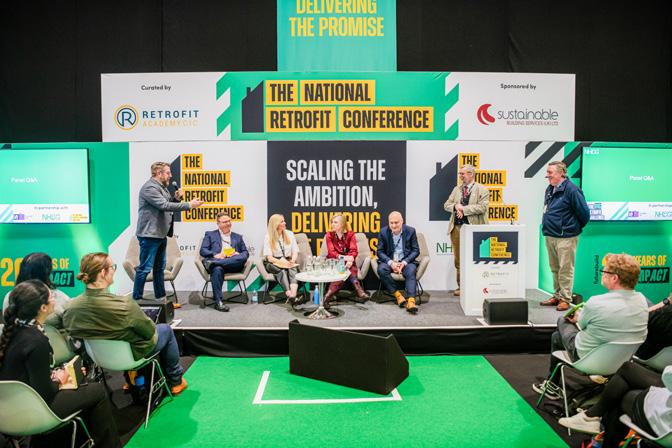
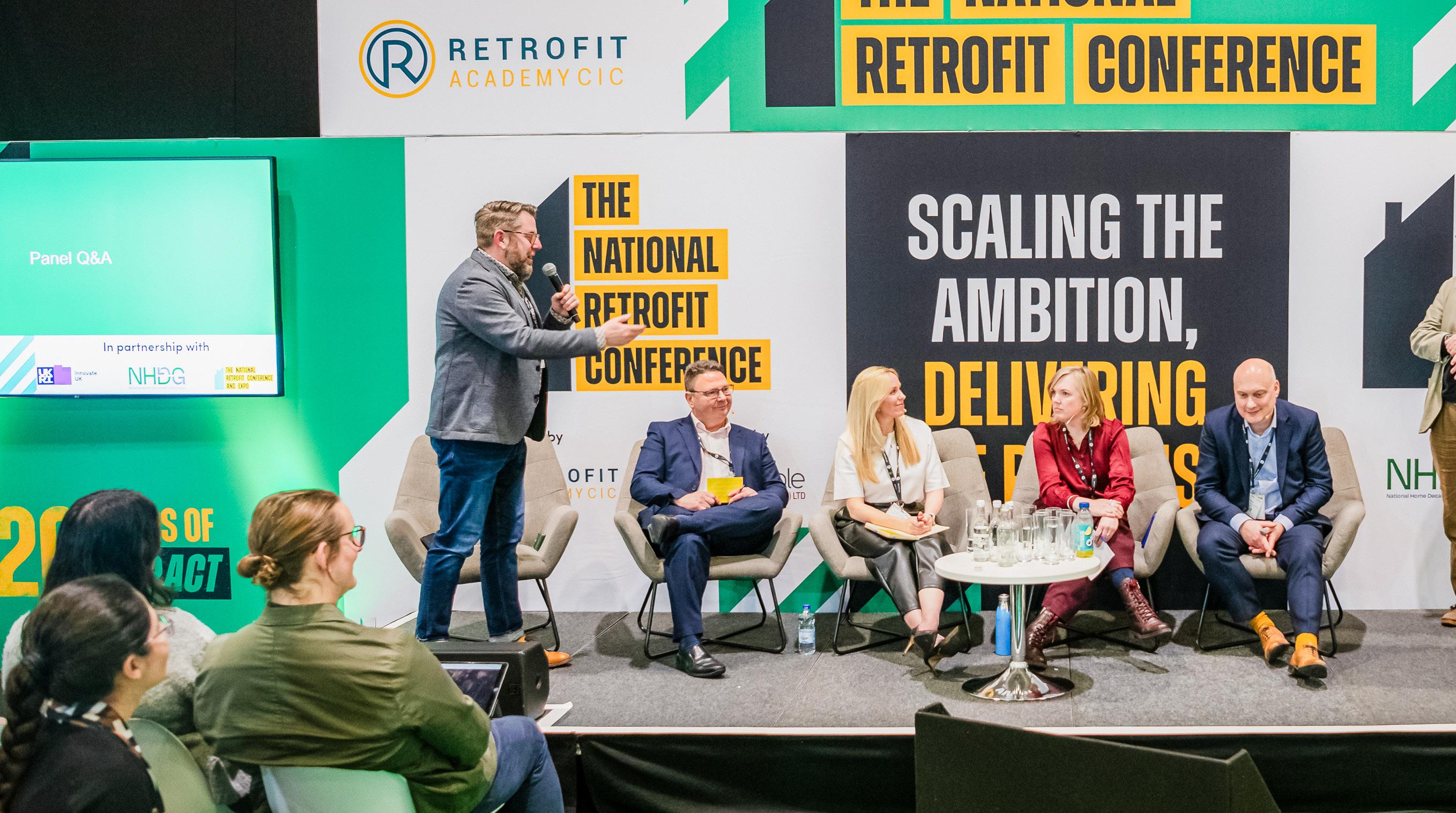
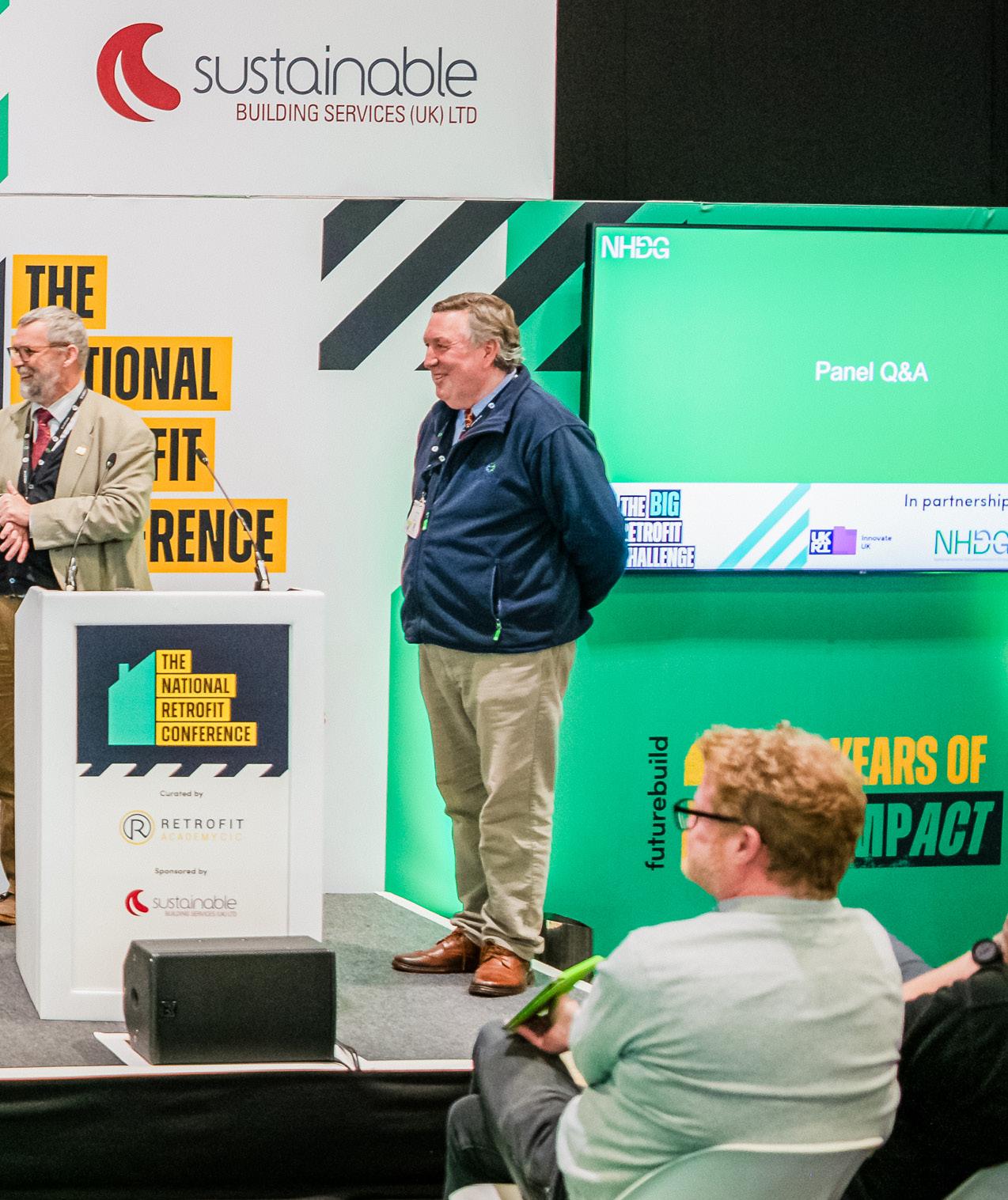
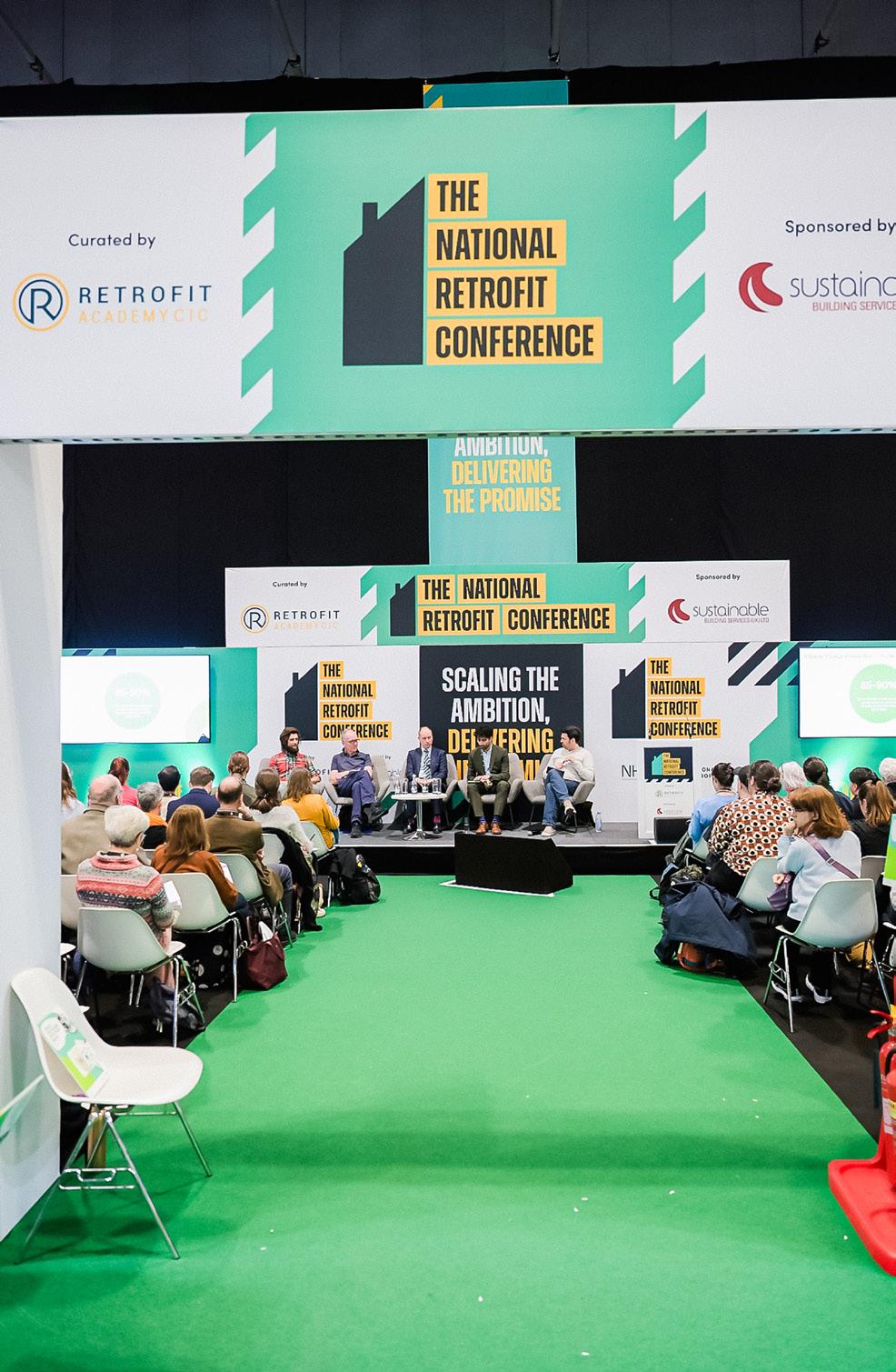
Futurebuild 2026 will place this reality at the centre of the event through the National Retrofit Conference and a programme designed to help professionals move from ambition to delivery.
Retrofit for housing providers
Futurebuild has long been recognised as a platform where ideas, products and practice come together. This year’s event takes this further by making retrofit the defining theme. The National Retrofit Conference, curated by The Retrofit Academy, has been designed to address the practical challenges that housing associations and councils face every day. It brings together technical experts, policy specialists and delivery partners to explore issues such as skills, supply chains, quality assurance and long-term planning.
The programme also benefits from input by the National Retrofit Conference Steering Group, whose members help ensure the content reflects the realities of the sector and the ongoing pressures faced by those responsible for improving homes.
Big Retrofit Challenge returns
A core part of Futurebuild 2026 is the Big Retrofit Challenge which returns with an expanded structure and a stronger focus on turning innovation into real outcomes. Delivered in partnership with the National Home Decarbonisation Group and Innovate UK, the challenge aims to showcase new ideas that can support large-scale retrofit programmes. This year it introduces revised categories, including dedicated spaces for digital and AI solutions.
Finalists will be invited to pitch live at the National Retrofit Conference and will be supported through the NHDG pavilion where they will meet members and take part in content sessions. The changes to the challenge are intended to strengthen the route from innovation to implementation and provide clearer opportunities for collaboration once the event has finished.
Networking with peers
Alongside the challenge, Futurebuild 2026 will host three interconnected retrofit spaces. The NHDG pavilion will act as a hub for discussing supply chains, skills, insulation, accountability and the consistent delivery of compliant retrofit work. The Retrofit Academy Pavilion will provide guidance on training pathways and accreditation for the workforce needed to deliver the scale of upgrade required across the country.
The Local Authority Hub will support councils and social housing providers to share their experiences and explore issues such as procurement, programme design and resident engagement. Together these spaces create an ecosystem within the event that supports learning, collaboration and practical problem solving.
Skills gap solutions
A number of challenges still shape the national retrofit landscape and these will be reflected throughout the Futurebuild programme. One of the sector’s pressing issues is the skills gap. While interest in green construction continues to rise, many people entering the workforce remain unaware of the broad range of roles involved in retrofit.
Success depends not only on installers but also on project managers, assessors, designers and engagement specialists. Without clear entry routes and accessible training, the sector will continue to struggle to meet its delivery aspirations. E
F Supply chains also remain inconsistent. Although there are accredited installers operating across the UK, the routes into new programmes are often unclear. Many contractors delivering large schemes also struggle to secure local supply chains which makes it difficult to embed social value and community benefits into project delivery. Futurebuild will provide space to explore how supply chains can be strengthened and what the next stage of professionalisation might look like.
Another critical issue is the need to avoid a one size fits all approach. Retrofit must start with people, homes and communities. To succeed, projects need early performance monitoring, meaningful resident engagement and technical solutions that match the characteristics of each home. This is increasingly recognised across the sector and is reflected in the themes of the conference.
Improving delivery
There is also a need to learn from inconsistent delivery standards in previous funding rounds. Recent analysis has highlighted a range of issues caused by poor installation and variable compliance across schemes. These lessons must shape how the sector approaches upcoming programmes. Clearer accountability, better data and higher standards at every stage are essential to rebuild confidence and deliver long term performance.
Join other retrofit leaders
Public sector engagement with Futurebuild 2026 is already strong. More than 30 organisations have registered, including Homes England, DESNZ, the Building Safety Regulator, Historic England and local authorities from across the country. This reflects a growing recognition that
retrofit is central to meeting cost, quality and compliance expectations. It also indicates a clear appetite for events that combine strategic insight with practical guidance.
For Government Business readers, the National Retrofit Conference will be a valuable space to understand what lies ahead. Sessions will explore the future of insulation and fabricfirst approaches, the role of digital tools in improving accuracy, the importance of data in planning and monitoring works and the impact of resident engagement on successful delivery. There will also be opportunities to hear directly from innovators, suppliers and housing providers who are trialling new approaches. Futurebuild 2026 is not only a showcase of ideas. It is a space to support the sector to move more confidently and consistently. The National Retrofit Conference provides a curated programme rooted in the needs of housing associations and local authorities. The wider retrofit pavilions support skills development, supply chain improvement and collaboration. The Big Retrofit Challenge brings forward new solutions and sets out a clearer path to adoption.
As 2026 approaches, retrofit will continue to demand attention and investment. Futurebuild is set to be a key moment for the sector to reflect, plan and take forward the next stage of national delivery. L
FURTHER
Reaching new heights with access systems
At AREA Access, we have a long and successful track record of delivering PASMA training courses and specialise in the sale, hire, training and assembly of access towers, edge protection systems, powered access and safety equipment
AREA Access are a team of professional alloy tower assemblers, trainers and mentors advising on aluminium access tower systems. We specialise in training in PASMA tower for users, linked, bridged, cantilever, stair and large deck applications.
When you need a practical hand with training for your standard or advanced application on towers, we are on hand to offer assistance to your teams. With more than 30 years’ experience, our managing director Andrew
Davie has a passion for finding the correct solution for your application.
Bringing a wealth of support via our hire and assembly teams, we can also provide advanced solutions from small jobs to advanced styled structures to maintain access and maintenance solutions for your contracts.
We also offer toolbox talks for operatives on site and training bespoke to your site applications, working on safe systems of work. We are available for a free online consultation to discuss the flexible approach you can achieve using aluminium access systems.
Explore our training programmes at www.areaaccess.co.uk and take the first step toward a deeper, more professional understanding of light access. M
www.areaaccess.co.uk
Change is not someone else’s responsibility
The construction industry’s problems have been clear for years, but change has been elusive. Building Engineering Services Association CEO David Frise explains why the changing focus on specification and procurement could change things for the better this year
We know why our industry suffers from poor quality, low productivity and lack of profitability. We continue to battle against unfair and unethical payment practices, and we have an ageing workforce with skills more suited to an analogue age.
We all struggle with these things, but our instinct is to expect somebody else to do something about them.
The government, main contractors, public and private sector clients are blamed for our collective failings and, of course, they all have some responsibility, but I’ve been in too many
meetings where it always comes down to somebody else “needs to do something”. In truth, we know there are things that only we can control, which is why 2025 was the year we challenged BESA members to take responsibility. Our membership represents the leading MEP contractors in the country and most of them recognise that they should be leading. This means, they can change what they do and, in turn, challenge the rest of the industry to follow – and the Building Safety Act has given us the perfect legal platform and the most powerful ethical background. E
Introducing a revolution in the treatment of limescale in the form of the AquaVantage digital water treatment system.
Non-invasive installation requiring no servicing or maintenance throughout its minimum 20 year lifespan. A true fit and forget solution.
Actively de-scales complete systems, usually in a matter of weeks.
Removes breeding grounds for bacteria, specifically Legionella offering a significant reduction in contamination risk.
Significantly reduces chemical dosing in swimming pools whilst positively improving the look and feel of the water and reducing servicing costs.
Reduces energy consumption of heating appliances and pumps.
Improved water quality offers positive benefits for skin conditions such as psoriasis and eczema.
Can be fitted to fuel lines (gas, oil LPG) to reduce energy consumption.
F Transformational
It is the most transformational piece of legislation in modern construction history and is a once in a lifetime opportunity to finally change things for the better and create a less cyclical and more value driven industry. Change is difficult and it will take time, but the Act provides the legislative levers needed to transform the way ALL buildings (not just highrise residential schemes) are procured.
Historically, when faced with a potentially seismic change like this, you could divide the industry, roughly, into thirds. One third are highly professional, competent and fine about doing what is needed to comply with legislation and best practice. The next third want to reach that standard and will get there under direction. The final third are not interested. They don’t want to change; regulation is not enforced so can be ignored, and they don’t care if their work is compliant or not.
The task is to drag them into the compliant two thirds or drive them out of the industry.
Thankfully, many are already changing. More clients are getting the message that they cannot sub-contract their legal responsibilities. This is prompting them to take a closer interest in the competence of the individuals and companies who work in their supply chains.
As for main contractors, they are now recognising that a pre-qualification process comprising 400 questions but not one that asks: “Can you actually do the job?” is not fit for purpose.
Building engineering services now represent at least 50 per cent of construction cost and a high proportion of the long-term operational cost of the built environment
Building engineering services now represent at least 50 per cent of construction cost and a high proportion of the long-term operational cost of the built environment. They are increasingly complex, integrated systems that deliver an environment and services that make buildings work – and play a vital role in the push for net zero and sustainability.
Also, 90 per cent of us spend 90 per cent of our time in a building, so this is important. The social benefit of buildings that work is enormous, in terms of mental and physical health, wellbeing, productivity – all rely on a good working and living environment.
So, surely “Can you do the job?” is the one thing that matters.
At its annual conference last October, BESA launched a Member Pledge initiative with several prominent members putting their signatures to an agreement that places professional and technical competence at the heart of their operations and means they must require their supply chains to do the same. E
Whole-home
mould control, delivered!
ArcAirTech delivers a proven, whole-home solution to mould.
Using a single unit, available in por table or fixed formats, the system eliminates up to 99.9% of mould spores throughout an entire proper ty ArcAirTech is used and trusted by the UK’s largest housing providers, delivering effective mould control at proper ty level, verifiable outcomes for tenants and measurable improvements in indoor air quality across private and social housing
Tested. Verified. Built for housing at scale.
F Everyone says they already do this but, as Mark Farmer stated recently, “The industry, I fear, will always find a way to ‘game the system’ and ‘demonstrate superficial conformity’.”
Supply chain firms will be invited to apply for BESA membership so they can prove their competence and compliance through its independent technical audit process, which is also aligned with the Build UK Common Assessment Standard.
Incentive
The fact that BESA members are re-audited every three years (sometimes more regularly), creates a powerful incentive for clients to specify them. It meets their duty of care in procurement. The current pass rate i.e. those companies achieving zero non-compliance at audit, is just above 60 per cent which shows the system is robust but that many still have work to do – with our help.
We can get there because as BESA past president and Pledge pioneer Claire Curran said: “Everyone wants a better industry but better doesn’t come by chance; it comes by choice. That’s why my company Linaker signed the BESA Member Pledge.
“For us, it is all about leadership, minimising risk, and setting the benchmark for our industry… and If I’m not willing to specify my supply chain, why should people want to specify me?
“Everyone wants a better industry but better doesn’t come by chance; it comes by choice”
“If I’m expecting someone else to do it, I should be willing to do it myself,” she added. “It’s all about being able to stand with my clients and say, how do you know your subcontractor is quality? Because they’ve been accredited by BESA – that’s really powerful.”
The Association suspended 19 members during 2025 for failing to pass the audit – and will suspend more if it has to. This might seem counterintuitive for a membership body, but membership needs to stand for something and there are now more companies waiting to join –so it is working.
BESA is embracing change to make the industry better. Its members are leading their part of the construction industry, rejecting the race to the bottom and working towards a vision of a better industry, one that is competent, compliant and sustainable.
There will be bumps in the road, but the alternative is to revert to “somebody [else] needs to do something” and that really won’t cut it anymore. L
As the UK accelerates toward a low-carbon economy, solar energy emerges as a critical component of a sustainable future. However, the efficiency of solar panels is often compromised by contaminants such as dirt, bird droppings, algae, and pollution. These factors can significantly diminish output, potentially reducing energy generation by 30% to 75%, depending on the condition of the solar PV units.
The hidden killer, urgent call for awareness
Asbestos remains a widespread and often overlooked threat in older UK buildings, and this article outlines why stronger awareness, training and compliance are urgently needed to protect workers and the public, as set out by UKATA
Despite asbestos being banned in the UK for over 25 years, it is still posing life threatening risks to the public and those in government owned buildings, which have been built or refurbished prior to the ban.
It is estimated that asbestos can be found in over 1.5 million buildings in the UK.
Before asbestos was recognised as a health risk, it was used in over 4,000 products due to its qualities as a strong, insulating, fire-resistant, heat-resistant and sound proofing product.
It is not always easy to identify due to it often being mixed with other materials, such as cement. Whilst considered harmless if undisturbed, the lack of awareness surrounding asbestos and asbestos management means the lives of building users are being put at risk every
time a building undergoes renovations or minor repairs.
Regulation 4 of the Control of Asbestos Regulations (CAR) 2012 specifically requires the duty holder of non-domestic premises to assess whether premises contain asbestos, assess the risk and subsequently take action to manage the risk. A written record of the location and the condition of the asbestos-containing materials (ACMs) is required, which should be kept up to date and reviewed regularly, including monitoring of the ACMs and those products presumed to contain asbestos. This information should be cascaded to any persons liable to disturb the fabric of the building during their work activities, including employees and building or maintenance workers. E
The UK has the highest rate of mesothelioma deaths per capita in the world
F Awareness
In June 2025, HSE published news of a site supervisor being fined after exposing school pupils to asbestos. The worker cut through asbestos insulating board using a circular saw. His actions resulted in asbestos fibres spreading throughout the school hall, which was subsequently used for two days by pupils and staff. An investigation by the HSE found that the individual failed to follow his asbestos awareness training, including clear instructions not to disturb the wall. Following an asbestos survey, the wall was due to be checked by a licensed asbestos contractor prior to removal to clarify if asbestos was present. The defendant pleaded guilty to breaching Section 7(a) of the Health and Safety at Work etc Act 1974. He was fined £1,800 and ordered to pay a £720 victim surcharge and £4,000 in costs at Bristol Magistrates’ Court on 12 June 2025 – a total financial penalty of £6,520.
Along with exposing individuals to asbestos, these acts can destroy trust, reputation and can lead to preventable suffering.
Craig Evans, chief operating officer of UKATA says “With the death toll from asbestos exposure over 5000 per year, UKATA is calling on all employers to ensure asbestos awareness training is conducted as soon as possible. It is never too early to provide asbestos awareness training to your workforce. The earlier in a person’s career they receive the appropriate training, the better protected they are against developing asbestos related diseases in later life. A threehour awareness course could prevent them from contracting a deadly disease and ensure they do not expose others to the dangers of asbestos.”
Health
Health implications of asbestos exposure include mesothelioma, a cancer of the lining that covers the outer surface of some of the body’s organs, most commonly of the lungs or abdomen, for which there is no cure. Up to 60 per cent of patients die in the first year after diagnosis, and just over five in 100 survive their mesothelioma for five years or more.
According to the HSE, Britain’s national regulator for workplace health and safety, the UK has the highest rate of mesothelioma deaths per
capita in the world. The cancer has a long latency period of 15-45 years, with some prolonged cases of 60 years before symptoms show.
Government guidance states the presence of asbestos in the environment does not always lead to exposure as you must come into contact with the fibres. You may be exposed by breathing, eating, drinking the substance or by skin contact. Following exposure to any hazardous chemical, the adverse health effects that you may encounter depend on several factors, including the amount to which you are exposed (dose), the duration of exposure, the way you are exposed, the form of asbestos and if you were exposed to any other chemicals.
All forms of asbestos fibres are hazardous to health and can cause cancer when inhaled. However, the amphibole forms of asbestos (blue and brown asbestos) are more hazardous than chrysotile (white asbestos). This is because amphibole fibres are straighter, sharper and more brittle, meaning they can penetrate deeper into the lungs and remain there for longer. In addition, products containing amphibole asbestos tend to be more friable, meaning they more readily release fibres into the air when disturbed, increasing the likelihood of inhalation exposure.
Breathing in high concentrations of asbestos for a long period of time mainly affects the lungs, causing a disease called asbestosis where breathing becomes difficult and the heart enlarges. Asbestosis may take decades to develop. Asbestosis sufferers are at an increased risk of cancer. Exposure to lower concentrations of asbestos over time may result in a general (diffuse pleural thickening) or localised (pleural plaques) thickening of the lung lining.
Warts and corns may form around asbestos fibres that become embedded in the skin.
Training
Every individual working in an environment that may contain asbestos-containing materials (ACMs) must, by law, receive asbestos awareness training as a minimum, delivered by a competent source before any works commence. This training is designed to provide general information on the history of asbestos, its health risks, the types of products it was used in, typical uses within buildings, and a basic understanding of the legislation and its requirements. Importantly, asbestos awareness training is not sufficient for carrying out any work that will intentionally disturb asbestos fibres – think of it as ‘avoidance training’.
It is aimed at supervisors and trades personnel, including trainees such as but not limited to demolition workers, construction workers, general maintenance staff, electricians, plumbers, gas fitters, painters and decorators, joiners, plasterers, roofers, heating and ventilation engineers, telecommunication engineers, fire and burglar alarm installers, computer installers, building surveyors, shopfitters and other such professionals.
Some learners may require a more developed course which is specific to their area of work such as but not limited to architects and designers, groundworkers, waste and civic amenity site personnel, and marine and offshore workers.
It is also essential to note that a higher level of training is required for anyone undertaking work that involves direct contact with or disturbance of ACMs, to ensure both safety and
A higher level of training is required for anyone undertaking work that involves direct contact with or disturbance of ACMs
compliance with legal regulations. Furthermore, any contractors coming onto site must be able to provide evidence of the relevant asbestos training before beginning any work.
UKATA is dedicated to enhancing the quality and standards of asbestos training with the aim to shield workers and the public from the hazards of asbestos exposure.
The association collaborates closely with its members to guarantee that they have access to the latest information, training resources and industry updates. They provide a suite of support services to assist them in accomplishing their training objectives. Their membership encompasses a diverse array of organisations involved in asbestos training, including training providers, asbestos removal contractors, consultants and equipment suppliers.
UKATA is fervent about promoting safe and responsible working practices, committed to working with members and partners to realise a shared vision of protecting workers and the public from the hazards linked with asbestos exposure. M
To find a UKATA-approved asbestos training provider near you, visit www.ukata.org.uk or for free advice call our team on 01246 824437.
Build competence to meet the Fire Safety Order, Awaab’s Law and Residential PEEPs Regulations with practical, housing-focused training
Access 17+ hours of Institution of Fire Engineers CPD-accredited training focused on evacuation-impaired residents. Our courses help housing providers and local authorities meet the requirements of the Fire Safety Order, Awaab’s Law, and the Residential PEEPs Regulations, supporting confident, compliant, and inclusive fire safety in residential buildings.
Explore our training courses
FM in fire emergencies
Simon Brand from the FPA looks at the importance of facilities management before, during, and after a fire emergency
When it comes to emergencies in buildings, it is facilities managers (FMs) who find themselves at the coalface, particularly when it comes to fire incidents. The majority of work required from an FM comes in emergency preparedness planning – trying to prevent a fire from happening, having systems in place to mitigate one should it occur, and how to ensure the safety of the people on site.
The FM must be aware of the fire safety regulations that apply to their building and must work to ensure it meets them, as it is through creating a safe and legally compliant environment that people and property can be protected in the event of a fire breaking out.
Protecting people
Key to the safety of staff and other users of a building is ensuring that those on site know what to do in the event of a fire emergency. A FM’s role here can be split into two requirements: firstly, by bringing their knowledge and expertise of the building
in question into the development and implementation of adequate emergency evacuation plans, and secondly, by ensuring that occupants are suitably trained and aware of what to do in the event of a fire.
Having an appropriate emergency plan in place means there is a greater likelihood of a successful and coordinated response to a fire emergency. FMs facilitate the creation of the emergency plan by highlighting potential hazards, vulnerabilities, and weaknesses in the building fabric or systems that have been identified through fire risk assessments. They will then be in a position to suggest where changes to the plan might need to be made and help develop any required mitigation strategies. Emergency planning must also consider various scenarios that might crop up during a fire, and again, the FM’s knowledge of the building and its systems is a vital tool to enable effective contingency plans to be created. This can include proper maintenance of the systems and infrastructure that allow for evacuation E
Fire
Fire
Condition
Measured
Drone-assisted
F or sheltering in place, and that the correct procedures for both the building type and for the different types of users of the building are in place. FMs can also highlight those systems and infrastructure which are critical and should be prioritised in a fire emergency (such as emergency lighting and evacuation shelters and lifts).
The second part of the FM’s role in keeping people on site safe when a fire occurs relates to communication and training. Having a fully rounded evacuation plan that covers many eventualities and ensures fire safety systems are in place and work properly will be rendered much more ineffective if staff do not know what the plan is or what to do if and when a fire breaks out.
Making the requisite information available for people to be aware of is a key role of an FM so that those needing to evacuate a building are aware of details such as exit routes, assembly points, and necessary actions to take to ensure their own safety and that of others. FMs can achieve this through clear and consistent communication with the building users and the running of regular fire evacuation drills. Communication is vital during a fire emergency, and the FM must ensure that the correct information can be passed on to those who need it, when they need it.
Keeping effective communication channels open with those who use their building also means that FMs can identify any individuals who may have additional needs that must be taken into account during an evacuation. This
Providing training to building occupants on fire safety protocols is the primary way to ensure they know how to respond to a fire emergency
could include impairments or disabilities that would impact the ability of an individual to safely leave the building in the time needed. Such additional needs may need to be captured in a person-centred fire risk assessment (PCFRA) or even a residential personal emergency evacuation plan (RPEEP), depending on the building in question. One other aspect of proper communications that FMs must be involved with is the keeping of emergency contact information and ensuring it is up to date.
Providing training to building occupants on fire safety protocols is the primary way to ensure they know how to respond to a fire emergency, and FMs must be involved in disseminating this vital information. It is also important that this training is not just a one-off box-ticking exercise, and that regular, ongoing education on fire safety and building evacuation is provided. FMs should be aware that updating and rerunning fire safety training is particularly important should there be any material changes made to the building, such as the installation of new systems or changes in the way the building is used.
Training and education must not be limited to passing information on to the users of the building, as FMs must keep their own knowledge of fire safety regulations and best practice up to date.
Systems and property
An FM having a good understanding of the fire safety needs of their building, its occupants, and the regulations that apply is, however, not enough. To provide the necessary level of fire safety to their building, an FM must also collaborate on the selection and installation of suitable fire safety systems. They must be aware of their own level of knowledge and competence in this area, and consult appropriate experts to ensure that they meet the building’s requirements.
Systems and products that are vital to the emergency response plan are wide-ranging and will include fire detection, alarms, sprinklers, E
F extinguishers, emergency lighting and signage, and fire doors. Even an experienced FM will struggle to be an expert in all these areas, and therefore, establishing relationships with fire protection specialists and installers is essential. By collaborating with these experts, FMs can not only ensure that the proper fire safety systems have been designed, installed, and maintained, but will be able to evidence this through good documentation. An FM may well be recognised as a dutyholder for fire safety, and as such, it is their responsibility to show all due diligence in ensuring that the works commissioned and completed are done so by a competent person.
Government guidance on the issue of competence should be borne in mind by all FMs when considering their building’s fire safety: “one indicator of a person’s competence is a recognition of limitations of their own abilities and demonstration of a willingness to supplement their own knowledge with external advice.”
Depending on the activities taking place in a building, the FM may well need to plan for the shutdown of any processes that may exacerbate a fire, leading to greater property damage and further risk of injury to the building occupants. These could include automated industrial or logistic processes, and a suitable emergency shutdown procedure in place will enable operations to be stopped quickly, protecting any critical systems. An emergency shutdown should shut off any fuel supply, isolate electrical circuits, and stop production lines, all vital actions to prevent the spread of fire.
Notwithstanding the need to comply with any regulatory requirements, the presence of a shutdown protocol, where necessary, will also make other emergency response efforts more effective, as the focus can then be on building evacuation and firefighting, rather than dealing with operational concerns. By creating and implementing an appropriate emergency shutdown procedure, the FM is providing a vital foundation for the management of a fire emergency and will improve the chances of any fire being controlled.
The work of the FM in keeping critical systems and infrastructure properly maintained is also a key part of fire emergency planning, as it prevents the continued operation of essential fire safety services from being disrupted. By undertaking regular inspections of the building and its systems, the FM will be able to identify and address any new or changing fire risks before an emergency situation occurs.
Government guidance on the issue of competence should be borne in mind by all FMs when considering their building’s fire safety
Where fire safety systems are installed, it is vital for FMs to keep well-maintained and updated documentation. This record-keeping, particularly when kept digitally, will allow for ease of access to key information about the building and its systems that an FM can share with first responders and firefighters. FMs can also look at new technology and innovation to improve the quality, reliability, and ease of data sharing to enhance emergency response. Digital systems can provide quick, reliable, and trackable storage of information to the emergency services relating to the building, its occupants, potential hazards, and the various fire safety systems in place.
During and after
Whilst most of the work of the FM will take place before any fire might happen – whether that be to prevent fires from happening, mitigating one should an incident occur, and planning for the safety of those in their building – there are some aspects to the FM role that will happen during and after a fire taking place.
One of the key responsibilities for an FM during a fire is coordinating with the fire and rescue services. By having established protocols for dealing with the emergency services, the FM will be able to provide firefighters with accurate
An FM’s involvement with a fire emergency does not end once the fire has been put out
information about the building and the systems and potential hazards in situ.
And of course, an FM’s involvement with a fire emergency does not end once the fire has been put out. They have a critical role in assisting with any investigations into the cause of the fire and in subsequently repairing any damage caused. An FM then has the opportunity to see how effective the emergency response plans actually were when put into action. By reexamining the fire safety of the building, from alarms, training, and evacuation protocols, to suppression systems, fire doors, and emergency responder communication, an FM can assess the success, or otherwise, of each part.
Any learnings from this post-incident assessment can then be used to implement improvements to the building’s fire safety, with a view to preventing or mitigating similar incidents in the future and further protecting the building and its occupants. M FURTHER INFORMATION
www.thefpa.co.uk
How the public sector is powering up energy storage
Battery storage is rapidly becoming one of the public sector’s most powerful tools for cutting costs, strengthening energy security and supporting the shift to clean power, as Gareth Simkins, senior communications adviser at Solar Energy UK, explains
Storing electricity is critical for the energy transition, enabling power to be stockpiled when renewable supplies are plentiful and discharged when demand is greatest.
Falling costs are transforming the economics of storage
From Whitehall’s huge investments into gigawatt-scale systems, to more modest ones saving schools thousands of pounds a year, the public sector is benefitting from battery energy storage systems (BESS) technology at all scales. That is because the economics have never been better.
In early 2025, BloombergNEF found that global average turnkey system prices had fallen by
40 per cent in one year, the biggest drop since its surveys began in 2017. International Energy Agency data says that between 2010 and 2024, the dominant lithium-ion battery technology became 90 per cent cheaper, offering longer service lifetimes and higher energy densities, too – driving a revolution on the roads and on the grid. The technology delivers greater energy densities and longer lifetimes, too.
How storage supports a smarter, more flexible grid
BESS offers a way of cutting the costs of managing the grid. By providing flexible loads, they can reduce curtailment – that is, when renewable energy generators are paid not to E
The NWF invested £200m into a Fidra Energy, which is behind a 500-megawatt, 100-megawatt-hour BESS at West Burton, Nottinghamshire
F generate as the grid cannot accept the power. They can also avoid the need for new electricity transmission and distribution links.
By providing a flexible load on the grid, storage systems reduce curtailment costs – that is, payments to renewable energy generators prevented from generating when the grid is unable to take the power produced. In parallel, co-locating BESS and solar panels allows limits on power export, put in place where the grid is weak, to be overcome, permitting larger systems to be installed.
National Wealth Fund backing accelerates large‑scale projects
Sensing an excellent opportunity, the National Wealth Fund (NWF) has been particularly active in stimulating the sector’s growth when portfolio-level debt for it was still emerging. The fund’s first investment in battery storage was a £62.5m loan to developer Pulse Clean Energy –a time when portfolio level debt for the sector was still rare. Agreed in 2023, it was paid off two years later thanks to a lower-interest loan from a consortium of six banks.
“This wasn’t only a major milestone for Pulse Clean Energy, but also for the NWF. We step away with the confidence that our involvement has successfully mobilised private debt finance into the sector, opening up new pools of capital for battery storage
developers and operators,” said a statement from the body.
In September, the NWF invested £200m into a Fidra Energy, which is behind a 500-megawatt, 100-megawatt-hour battery energy storage system (BESS) at West Burton, Nottinghamshire – using the grid connection of the decommissioned coal-fired power station there. The project will be able to store 3,100 megawatts-hours – more than any other UK project and enough to make 443bn cups of tea. It will discharge at a rate of up to 1,400 megawatts, slightly more than one of the UK’s nuclear power stations.
“It’s fantastic to see the National Wealth Fund breathing new life into a former coal site — turning it into a cutting-edge battery hub that will power thousands of British homes and businesses with clean energy from wind and solar. Every battery we build boosts Britain’s energy security, reduces our exposure to fossil fuel price shocks and drives us towards clean power by 2030 - all part of our Plan for Change,” said energy secretary Ed Miliband.
NWF’s further investments in energy storage, as shares and debt, include: highview Enterprises, behind CryoBattery One, the world’s first commercial-scale liquefied air energy storage system. It aims to provide a more flexible and scalable alternative to
A typical domestic battery system stores around 10-15 kilowatt-hours in a unit about half the volume of a household fridge
pumped hydropower storage, while able to provide grid services such as frequency and voltage support, inertia and black start capability.
NWF is contributing £200m towards the £500m partnership behind UK BESS developer Eelpower Energy.
NWF has invested in Invinity Energy Systems, a UK-based manufacturer of vanadium flow batteries, which have a number of technical advantages over lithium-ion systems and have a lower levelised cost, though at the cost of greater weight.
NWF has also invested in Cornish Lithium, which is working on the commercial-scale extraction of the metal from rock and geothermal waters, providing an important domestic supply for battery manufacturers. The £24m equity investment will advance a geothermal extraction project to commercial drilling and a hard rock mine towards a construction decision.
The former Department of Business, Energy and Industrial Strategy also provided many millions of pounds towards innovation, pilotscale and demonstrator projects in BESS technology.
The scale of the challenge ahead
As things stand, the UK can supply almost 6 gigawatts from grid-scale BESS. The figure needs to rise quickly to 23-27GW to meet the Government’s Clean Power 2030 Action Plan, which calls for an additional 4-6GW from long-duration storage systems, plus 10-12GW from so-called ‘consumer-led flexibility’, such as turning heat pumps and electric vehicle charging off or on temporarily.
Another aspect of BESS is ‘behind the meter’ systems – far smaller than grid-scale systems, which are generally packed into shipping containers. A typical domestic battery system stores around 10-15 kilowatt-hours in a unit about half the volume of a household fridge. These are now installed alongside the vast majority of home solar systems, maximising their economic return. E
One of the greatest advantages of behind-themeter battery storage is making electricity cheaper in the dark days of winter
F When the days are longer and brighter, they collect excess power that would otherwise be exported to the grid at the time of generation. However, combining a time-of-use tariff with a battery allows power to be exported when it’s most in demand – the early evening – which can attract a greater payment and thus a better return on investment.
But one of the greatest advantages of behindthe-meter battery storage is making electricity cheaper in the dark days of winter. When solar power is insufficient to charge them fully over the course of a day, they can be charged from the grid in the small hours when the price is lowest, supplying cheap power all day and exporting some in the evening.
Why public buildings are embracing battery storage
An increasing number of public buildings are getting on board with energy storage –with payback for 100-kilowatt scale systems expected within three to four years, according to one developer. The business case is clear: a 100kW BESS in a leisure centre is expected to cut its electricity bill by hefty 27 per cent, with one in a primary school projected to generate a 23 per cent saving, according to VEST Energy.
Rooftop solar developer Emtec supported Sunderland City Council’s aspiration to become carbon neutral by 2040 by installing over a thousand solar panels on its Parson’s Depot EV fleet hub. The 410kW array was complemented by a BESS able to supply 500kW and store 2,052kWh. When installed in 2022, it was assumed that the solar-only payback would be a mere three years, plus four for the battery. But it transpired that the battery’s payback was faster than the solar array.
Local authorities leading by example
Local authorities are also using their land for grid-scale energy storage, such as at a disused landfill owned by West Sussex County Council. Seeing no alternative use due to the presence of methane gas, the site was first converted into a
7.4MW solar farm – the first to be built after the end of the feed-in tariff regime. Working with public sector energy consultancy LASER Energy, they then added a 4MW/4MWh battery system from TESVOLT, becoming the first publiclyowned solar farm to be co-located with BESS.
Not only did it respond within two seconds of the sudden loss of nearly 1,700MW of generation on 9 August 2019, linked to a lightning strike on an electricity transmission line, it was also one of the first batteries to participate in the National Grid’s ‘Firm Frequency Response’ auction to provide stability services to the power network, at the beginning of 2020. Further sources of income include the Capacity Market, price arbitrage and sale of power via a purchase agreement.
“As one of the first solar farms to be built with battery storage and free from government subsidy, we are blazing a trail among local authorities and demonstrating that councils have a role to play as local leaders on energy,” said Louise Goldsmith, former Leader of West Sussex County Council.
It is now working on a four times larger BESS on another decommissioned landfill, expected to come online in 2026. M
FURTHER INFORMATION solarenergyuk.org
Unleashing the power of BICSc membership
BICSc membership offers a clear route to professional recognition in the cleaning industry, giving individuals and organisations access to trusted standards, expert support and a wide range of benefits that strengthen skills, credibility and business growth
Professional recognition in today’s world is vital. It backs you up as an individual and as a business. It’s something that many of us strive for, and by achieving it, we often reap the reward of better opportunities. Having that credibility allows you to stand out in a crowded market.
In the cleaning industry, there are many ways you might achieve professional recognition. You may win an award, showcasing you or your business, and the success it has found. You may hit major milestones, such as reaching certain figures or being in business for a long period of time. Another way you may find this is by becoming part of a membership organisation that, by being part of, aligns you with an important mission or message.
The British Institute of Cleaning Science (BICSc) are exactly that membership organisation. We promote a mission to make the cleaning industry a safe and professional environment for individuals and companies to work within.
BICSc’s key objective is to promote the value and professionalism of the cleaning industry, providing training in the key skills required to enhance a cleaning operative’s core role whilst keeping them safe and encouraging them to work in a more effective and efficient manner.
If you are looking to increase your professional recognition, look no further. BICSc membership is the pathway to this.
Once you join BICSc, your professional status is instantly recognised, your business is empowered with exclusive resources, and E
Members benefit from reduced rates on certain training courses
F you’re part of a vibrant community driving the cleaning industry forward. That’s the potential of the BICSc membership in 2025. If that’s spiked your interest, carry on reading. As a member of BICSc, you’ll unlock the ability to display the prestigious BICSc member logo on your company’s printed materials and vehicles. This isn’t just a badge, it’s a mark of quality, trust, and professionalism that sets you apart from the competition. For Corporate and Accredited Training Members, the “Click to Verify” logo for your website adds digital credibility, reassuring clients and partners that you’re part of a respected, standards-driven organisation
Individual members aren’t left out: you can use post-nominal letters after your name, instantly signalling your expertise and commitment to best practice in the cleaning sector.
Further your industry knowledge
Our membership has some incredible benefits, but one that Corporate and Accredited Training Members will be sure to see a great impact with is free electronic access to the BICSc Standards & Best Practice guide – a goldmine of industry knowledge and wisdom.
Members can enjoy exclusive rates in the online shop, which also offers advisory posters, training cloths, and more, all designed to help your cleaning operatives excel.
Training, upskilling & directory exposure
Continuous improvement is at the heart of BICSc. Members benefit from reduced rates on certain training courses, making it easier and more affordable to upskill yourself or your team. Whether you’re seeking technical expertise or leadership development, there’s a course for you.
Your company also appears in the BICSc Membership Directory, boosting your visibility and connecting you with potential clients and collaborators across the industry. This benefit gives you the added comfort of proving you are a respectable, well-run organisation, should you need to show this when tendering.
Expert support & dedicated assistance
Got a technical question regarding a cleaning challenge? The BICSc Technical Helpdesk is your lifeline, offering direct access to seasoned experts who can provide practical advice and solutions. Plus, every member is supported by a dedicated Membership Specialist at BICSc Headquarters, ensuring you get the most out of your membership.
Keeping you in the loop!
Stay ahead of the curve with quarterly editions of “The Standard”, our members’ magazine, which is packed with industry news, insightful articles, and exclusive updates from BICSc.
Members receive regular emails with the latest news and invitations to webinars on hot topics, ensuring you are always in the know.
You’ll be given priority access to BICSc events, including the prestigious BICSc Awards, which means you’ll never miss an opportunity to network, celebrate achievements, and learn from the best in the business.
BICSc membership also opens doors to a suite of commercial benefits, with some great discounted products and services. Below is a selection of the type of offers you can expect.
Citation: preferential rates on compliance services, covering health & safety, HR, ISO
certification, and more. Citation’s expertise helps you stay compliant and focus on growth.
Rubbermaid Commercial Products: renowned for durability and innovation, RCP offers members free consultations and proven solutions to reduce waste management costs.
Darwin Clayton: with over 70 years’ experience, Darwin Clayton offers tailored insurance solutions for cleaning and FM companies, with reduced premiums and enhanced cover for members.
SC Johnson Professional: discounts on cleaning and hygiene products, free dispenser fittings, audits, and training.
Reel Tech UK: 10 per cent off high-quality LED lighting and CCTV products for your business or home.
Health and wellbeing
Your wellbeing matters. HMCA offers special deals on private medical plans, including a £50 gift card or £100 off your first-year subscription. Whether you’re seeking individual, family, or company cover, HMCA’s flexible plans are designed for BICSc members and not available to the general public.
Digital tools & business growth
Modern cleaning businesses need smart solutions. CleanManager’s platform lets you manage scheduling, staff, documentation, audits and integrates with accounting software for seamless invoicing and payroll. It’s userfriendly and designed to save you time.
YBA (Your Business Angels) brings awardwinning Google Ads campaigns tailored for the cleaning industry, helping you attract high-quality leads and grow your business. Free webinars and educational resources are included, ensuring you stay ahead in digital marketing.
The journey to net zero is urgent, and BICSc members have access to expert guidance from Neutral Carbon Zone
Our benefits list does not stop there either. As part of our push to improve sustainability and lessen our environmental impact, we have begun to be more environmentally conscious. As part of this, we now work with various organisations that can help our members achieve their ‘green goals’.
The journey to net zero is urgent, and BICSc members have access to expert guidance from Neutral Carbon Zone (NCZ). NCZ helps you measure, manage, and reduce your carbon footprint, develop tailored sustainability strategies, and lead the industry in environmental action. The brochure urges members to seize this moment and reaffirm their commitment to excellence, not just in cleaning standards, but in environmental stewardship.
Industry News
Stay informed with the cleaning industry through publications such as Cleaning Matters and Tomorrow’s Cleaning.
These magazines cover the latest news, products, and developments in the cleaning sector. If you’re passionate about sharing your expertise, editorial and advertising opportunities are available.
In summary
BICSc membership gives you the confidence of knowing you’re backed by a respected institution, the thrill of learning new skills, the satisfaction of saving money, and the pride of contributing to a greener, more resilient industry.
Whether you’re an individual professional, a corporate leader, or a supplier, BICSc membership is your gateway to excellence. The benefits are real, the support is thorough, and the possibilities are endless. Ready to make the most of BICSc membership? Dive in, connect, and let BICSc help you achieve more than you ever thought possible. M
FURTHER INFORMATION
Start with us today: https://ow.ly/JiwR50XKm42
Protecting people, property and public environments through accredited signage inspections & PPM. Public-facing estates carry a duty of care. Failing or poorly maintained signage in hospitals, schools, defence facilities, government buildings, transport hubs or infrastructure sites creates risks to staff, patients, students, visitors and contractors.
Why Signage Safety Matters
Your Legal Obligation
Sign owners are legally responsible for ongoing inspection, maintenance and repair of their signage and supporting structures. Requirements span three key statutory regulations:
Preventing Signage Failures
Across the UK, several signage collapses in public spaces have been reported —most caused by structural degradation, corrosion, exceeded design life or lack of inspections. Almost all were preventable through routine safety checks.
BSGA
Recommended
Safety Inspection Standards
• 1× Annual Integrity Inspection
• 1× Intrusive Inspection Every 3 Years
• Conducted by accredited, competent signage professionals.
Here to support healthcare estates, education campuses, government departments, defence environments, utilities and local authorities with accredited inspections, PPM schedules and reactive repairs. Trusted Nationwide 1 2 3
The Health & Safety at Work and without risks to health” Building regulations provided” Planning used must be maintained in a safe condition”
Benefits of PPM & Safety Inspections
• Safer public environments
• Compliance with statutory obligations
• Evidence for audits & investigations
• Extended asset life
• Reduced emergency repairs
• Asset tagging & estate visibility
• Early detection of risks
Why good wayfinding is the backbone of public service
Craig Brown, chairman of the British Sign and Graphics Association, explains why thoughtful signage, accessibility and long-term design are essential to building trust, safety and confidence in public services
Finding your way around a public building should not feel like a test of endurance. Yet many of us have walked into a hospital, council office or transport hub and felt a moment of uncertainty about where to turn next. Wayfinding is one of those public services that is barely noticed when it works well and keenly felt the moment it does not. It shapes how people move, how they feel in a space and, importantly, how they judge the competence of the organisations that serve them.
After more than four decades in the sign industry, I have seen public wayfinding evolve from bold and highly visible signage to systems that try to blend into architectural design. There is nothing wrong with wanting signage that complements its surroundings, but aesthetics can sometimes take precedence over function. When that happens, visitors are left scanning walls or corridors for information that is too subtle, too small or simply missing. We should
never forget that wayfinding exists for the newcomer rather than the regular occupant. A building manager who has worked in a place for five years does not see the environment in the same way that a first-time visitor does.
The value of starting with the basics
Most of the problems we see start at the very beginning of a project. A clear brief should specify the typefaces, colours, materials, mounting heights and the logic behind the directional flow. Too often that detail is not captured or, if it is, it is not passed on to future contractors. Public buildings rarely remain static. Departments shift, rooms are repurposed and functions change. When this happens, new suppliers come in, often using different materials and making their own interpretations of the system. Over time, fonts change, colours drift and signs are placed at inconsistent heights. E
Readability is another area where a small adjustment can make a considerable difference
F All of this erodes clarity and trust. A visitor will not consciously analyse typography, but they will recognise when the environment feels muddled or inconsistent. A well-planned system prevents this. Procurers should insist on a detailed design manual and should be prepared to invest in it. This is not an optional extra. It is the foundation that keeps a wayfinding scheme coherent over its lifespan and makes it possible for different contractors to produce signage that looks and feels like part of a single system.
Common mistakes and how to avoid them
One of the most frequent errors is designing a system through the eyes of people who already know the building. They are tempted to minimise signage because they believe the route is obvious. A visitor does not enjoy that advantage. They need clear confirmations at decision points such as stairwells, lifts and corridor intersections. They need signs placed at a height that is easily readable whether they are standing, seated or using a wheelchair. And they need simplicity. Overcomplication is the enemy of good wayfinding.
Hospitals offer an instructive example. Many now use coloured zones supported by simple alphanumeric identifiers. This dual approach helps people who respond better to visual cues while also supporting those with colour vision deficiencies. Combining colour with a zone such as Red A or Blue C on a contrasting background helps avoid confusion and gives people more than one cognitive anchor as they make decisions about where to go.
Readability is another area where a small adjustment can make a considerable difference. Signs set in uppercase may look tidy, but mixed upper and lower case is easier to read at distance and helps users identify word shapes more quickly. These small design choices matter because they allow people to make decisions before they arrive at the sign itself.
Designing for everyone
Inclusivity has rightly become a central consideration. Public spaces must serve people with limited vision, reduced mobility, learning differences and language barriers. Technology is giving us new tools to do this well. I recently saw a system that included a discreet button with an embedded processor. When pressed, it gave spoken instructions about the user’s location and how to reach nearby destinations. It could also be updated remotely if departments moved or information changed. It demonstrated how thoughtful technology can support people who cannot rely solely on visual cues.
This is not about replacing traditional signage. It is about enhancing it. Raised text can help those who cannot read braille, and braille itself still has an important role to play. Only a minority of blind people read braille, but those who do rely on it, and tactile lettering benefits a much wider group. The real question is about proportion. There is no point adding tactile surfaces to hanging signs that sit three metres above head height, because no one will ever be able to touch them. The investment should go into the places where people can reach and use it.
Sustainability and longevity
Sustainability is more than a matter of recycled content. In many respects, the most sustainable sign is the one that lasts longest. Materials such as aluminium, particularly when sourced through established recycling streams, have a long life and can be refurbished or adapted when a building changes function. Some tactile materials, by contrast, degrade more quickly
The familiar running figure can be placed at either end of a sign to indicate the direction of travel
due to constant hand contact and exposure to oils from the skin.
Public authorities should consider whether components can be reused elsewhere in the building and whether standardised profiles will make future adjustments easier and cheaper. The objective is to avoid a system becoming obsolete within a few years. If a sign can be dismantled, cleaned, refinished and redeployed, that extends its life and reduces environmental impact.
The growing role of digital technology
Digital and interactive signage is becoming more common in transport hubs and city centres. Screens offer flexibility because information can be updated instantly. They are, however, expensive to maintain. When a screen fails, it usually has to be removed and replaced rather than repaired in situ. This raises a critical procurement question. Should local authorities hold spare units or should suppliers guarantee replacement within a fixed time frame It is better to agree this at the start rather than deal with expensive surprises later on. Technology will continue to evolve. Viewing angles have improved significantly in recent years and further progress is likely. Touchscreens remain problematic in certain settings, particularly in healthcare environments where hygiene is a concern. Voice-enabled interfaces may offer a safer and more intuitive solution in the long term, although they raise privacy issues in places such as GP surgeries.
Safety, compliance and the importance of clarity
Wayfinding is not only about convenience. It is a safety issue. During an evacuation, people need unambiguous guidance to reach an exit. These signs are governed by strict health and safety standards and are designed as pictograms to avoid language barriers. The familiar running figure can be placed at either end of a sign to indicate the direction of travel, although many people are unaware of this. Compliance with these standards is vital, especially following national tragedies that
have prompted greater scrutiny of building materials and fire safety.
A building that communicates clearly in an emergency builds confidence in everyday situations too. People feel more relaxed when the environment is well marked, logically organised and visually consistent. Even small touches, such as using colour thoughtfully or integrating artwork and patterns, can lift the atmosphere and make civic spaces feel more welcoming.
Why good signage builds public trust
Public trust is not built solely on policy or service delivery. It is also shaped by the physical experiences people have when they walk into a government building. A well-designed wayfinding system signals competence, care and respect for the public. A disjointed system suggests the opposite. Clarity, consistency and accessibility are not technical concerns. They are markers of how well institutions understand and support the people they serve.
When wayfinding is done well, it fades into the background and allows people to focus on their purpose for being in the building. When it is done poorly, it becomes the story. The public sector has an opportunity to treat signage not as an afterthought but as an essential part of the civic experience. Good wayfinding helps people feel confident, safe and welcome. That is a goal worth investing in. M
How Met Office weather and climate intelligence powers government and industry when it really matters
Steve Calder is the chief customer officer at the Met Office, working to ensure weather and climate intelligence can power future plans for local and national government, as well as support key UK industries to grow. Here, he discusses how innovative science and partnerships will prove crucial to the future success of government and industry
Hanging the washing out? Check the Met Office. Landing planes or managing the country’s electricity network? Check the Met Office. Wedding day plans? Probably still the Met Office. When it really matters, it’s always the Met Office.
Weather and climate science has never been more important. Climate change is already bringing increasingly frequent weather extremes to the UK. Severe weather and named storms are also never too far away from people’s thoughts, but how can such complex
challenges be properly addressed by both government and business? It’s here where the Met Office has quite a unique position.
Over our 170-year history we’ve got a wellhoned reputation of being the UK’s national forecaster. Trusted by the public when it matters, whether it’s stormy skies or clear ones, the Met Office is where people turn for the weather. But we also underpin countless industries, keeping the wheels of business in motion and enabling UK innovation and growth from Camborne to Lerwick. E
We combine cutting-edge data science with proven meteorology
F Government, industry and innovation
At the apex between government and industry, innovation and a focus on customer needs is how the Met Office ensures a cohesive and fruitful relationship that benefits all. But what does that really mean?
Weather and climate intelligence is big business. Met Office expertise has long been behind safe aviation, defence operations, energy decision making and transport infrastructure. But the market is changing, so we change with it.
Government partners, like the MOD, rely on our expertise for high stakes operations. Increasingly, industry partners expect tailored, outcome-focused insights. Simply knowing the forecast isn’t enough. Knowing the impacts from it is the key.
Forecasting is changing fast. Competitors are using AI to move quickly, and we welcome that challenge; it keeps us sharp. But speed alone isn’t enough. Trust and verification are nonnegotiable. That’s why we combine cutting-edge data science with proven meteorology, working with partners like the Alan Turing Institute to deliver innovation that stands up under pressure.
Fortunately, our historical reputation and demonstrated ability to adapt to new technology means we’re well-placed to advance and pivot to AI approaches to weather forecasting. The coming influence of AI on weather and climate forecasting could be transformational. But improvements have to be underpinned by credible science.
We know that existing physics-based approaches to forecasting have earned trust over time, so the same must be true of future AI approaches. This is why we work closely with the Alan Turning Institute to combine our meteorological expertise with their data science knowledge. A coherent and science-backed approach to innovative improvements that can really make a difference to the next generation of weather forecasts.
Customer‑led
weather and climate intelligence
We’re pivoting to a service-led model, one that is customer driven - because decisions, not data, drive value. That means listening hard and moving fast. We’re turning on the head of a pin to deliver what matters, when it matters. Agility isn’t a buzzword for us; it’s how we stay relevant in a world where expectations change overnight.
Working in partnership is one way to deliver this. Earlier this year, we signed a Memorandum of Understanding (MOU) with Network Rail to
help push forward research into severe weather and railway infrastructure. Where previous links may have focused on transactional relationships, a collaborative approach enables fast-paced research which could make a real difference to how disruptions are avoided and managed on railways, not just now, but long into the future.
We’ve signed a similarly ambitious agreement with the National Energy System Operator (NESO), reaffirming a shared commitment towards the transition towards a future clean, resilient and affordable energy system. This MOU encompasses both the short and long-term influence of the weather on the energy system, with a need for resilience against increasingly severe weather events and also knowledge around how to effectively use weather as a fuel for an efficient energy system.
While much of that work continues at pace behind the scenes, the partnership between Met Office and the BBC is very much public facing. By combining Met Office expertise on weather and climate with the BBC’s journalism and broadcasting expertise, we hope to deliver the most trusted information when it comes to not only weather forecasting, but also climate science.
In an age of rampant misinformation, trusted and consistent information between Met Office and the BBC can ensure the public gets
What’s important for us as an organisation is that we’re as fast paced and innovative as people need us to be
what they want; timely, clear information with understandable guidance.
What’s important for us as an organisation is that we’re as fast paced and innovative as people need us to be. We’re going through a huge transformation ourselves, pivoting to agile delivery of services and we’re all embracing that. That is the best way for us as an organisation to ensure we continue to be one of the most trusted providers of weather and climate information in the UK and internationally.
The challenges discussed here aren’t unique to the Met Office. We can see across government and industry that need for agility, innovation and purpose. By adapting, like we have done throughout our history, we help make sure that the next generation also checks the Met Office when it really matters. M
FURTHER INFORMATION
www.metoffice.gov.uk
Steve Calder, chief customer officer, Met Office
The rise of insourcing in local waste and recycling
Across the UK, councils are increasingly choosing to insource waste and recycling services, gaining greater flexibility, stronger accountability and improved conditions for frontline staff as they align operations more closely with local priorities and long-term sustainability goals
Across the UK, more councils are choosing to bring waste and recycling services back in house. The shift reflects growing frustration with the limits of long-term outsourcing contracts, which can leave authorities locked into rigid service models and slow to respond to new national recycling targets or local priorities. By insourcing, councils regain direct control over frontline operations, ensuring that services can adapt quickly to policy changes and community needs.
At the same time, insourcing is about people as much as policy. Staff can transfer under Transfer of Undertakings (Protection of Employment) Regulations (TUPE), which means they can move from the private provider onto the council’s books.
TUPE transfers often mean staff move onto better pay, conditions, and pension schemes, strengthening morale and retention. Councils also see reputational value in taking responsibility for services that are highly visible to residents: bins collected on time, streets kept clean, and recycling targets met. In-house delivery aligns waste management with wider sustainability and climate ambitions, while cutting out contractor profit margins to reinvest savings directly into local services.
Financial restraints
In June, Havant Borough Council (Hampshire) agreed to bring waste services in house. Currently, waste collection, recycling, street cleaning, and grounds maintenance are E
Waste collection is one of the most visible services councils provide
F provided by Norse South East (Norse SE), a joint venture company between Havant Borough Council and Norse Commercial Services Ltd, a subsidiary of Norse Group.
A transition to an in-house service model was agreed to enable the services to be delivered differently and more cost-effectively.
The transition will take place from 31 March 2026, when the current service agreement with Norse SE is due to end.
Councillor Netty Shepherd, Cabinet lead for Commercial, said “The decision to bring services provided by Norse SE in-house has been made after extensive analysis. Havant, like all local authorities nationwide, is facing enormous financial challenges, and with the initial ten-year joint venture agreement drawing to an end, now is the right time for the service to begin the transition back to the council.
“An in-house service model will provide the council with direct control over the delivery of services that will enable us to flex the service and be responsive to our residents’ needs. It will also enable better alignment of the services with the council’s corporate priorities, including the Biodiversity and Climate Change strategies.
“We have taken into consideration the recommendations brought to this Cabinet by the Overview and Scrutiny panel, and I’d like to thank my Councillor colleagues for their diligence and extensive questions in taking their time to consider this important change.
“Norse SE is the largest contract this council has, and the implications of this change are not insignificant. Extending the current service with them for a defined period will allow us to ensure the transition to an in-house service model is performed as effectively and efficiently as possible.”
Why do councils make the switch?
Outsourced contracts can tie councils into rigid service models that don’t easily adapt to changing priorities. By bringing waste services in house, councils gain the freedom to respond quickly to new recycling targets, environmental regulations, or local community needs without waiting for contract renegotiations.
Contractors build profit margins into their fees, which can drive up costs over time. Insourcing allows councils to cut out those margins, achieve greater transparency over spending, and reinvest savings directly into frontline services that residents see and value.
When staff transfer into council employment, they often benefit from better pay, pensions, and job security. This boost in morale and retention translates into more reliable services, with crews who feel valued and motivated to deliver for their communities.
Waste collection is one of the most visible services councils provide. Insourcing means councils take direct responsibility for performance, strengthening public trust and reducing reputational risk if services fall short. Residents know exactly who to hold accountable. In-house teams can be directed to support wider sustainability and climate goals, from boosting recycling rates to reducing landfill. Councils can align waste management with their broader environmental strategies, ensuring services contribute to long term community resilience.
Insourcing rebuilds internal expertise and reduces reliance on external markets that can fail or withdraw. Councils strengthen their own capacity to manage services, making waste
collection more resilient during crises, supply chain disruptions, or contractor collapse.
Changing policy
In 2022, South Ribble Council (Lancashire) insourced their waste contract. This decision was made to respond quickly to changes in national policy or waste and recycling without the imposition of contract terms; improve terms and conditions for employees; and manage reputational risk which ultimately falls upon the council irrespective of how the service is sourced.
44 staff moved across to the council and these staff now receive South Ribble Council terms on the Shared Service pay scales, resulting in better rates of pay. They are now eligible for a more beneficial pension through the Local Government Pension Scheme which provides a 16.5 per cent contribution compared to a 3-8 per cent contribution for most staff under FCC terms. These staff now also receive sick pay and additional annual leave.
Making the change means that the money that was previously spent on a contract is retained within in the borough, with a greater amount directed toward staff, residents and the local area.
Furthermore, the council can now more readily incorporate and adapt to local needs
Making the change means that the money that was previously spent on a contract is retained within in the borough
without undertaking complex contract negotiation.
Recent examples such as Havant Borough Council and South Ribble Council illustrate a wider trend of local authorities reassessing how waste services are delivered. Insourcing is being adopted as a way to increase flexibility, reduce reliance on external contractors, and ensure services can be aligned more closely with council priorities.
For staff, TUPE transfers into council employment often bring changes in pay, pensions, and conditions. For councils, the move can provide greater transparency over costs, direct accountability for service performance, and the ability to adapt operations without renegotiating contracts. In practice, insourcing has allowed authorities to retain more resources locally, strengthen resilience, and respond more effectively to policy changes and resident expectations. L
The Sunborn London with its teak wood panelling, spirals staircases, luxury food and beverage outlets to it grand opulent exterior it is truly on for the Uk’s Unique venues being the UK first only super yacht hotel with spacious bedrooms including x suites. It has 5 amazing event spaces which breathtaking views over the Excel London or Canary wharf. We have 2 x bar the Sky lounge located on the 5th floor which has panoramic views over Canary wharf and the Sundown bar that can accommodate up to 200 people in a standing reception for a Birthday or Wedding reception. Both options include an outside deck area to relax with one of the Sunborn signature cocktails. For a more intimate event we have the East India Dock or west India Dock that both have inbuilt AV so you can incorporate a presentation into your meeting or corporate networking event. We would love to hear for you with regards to any inquiries you have for all day meeting , private dining, networking events, Birthdays or Anniversary and Wedding Ceremony and Reception.
SKY LOUNGE DECK
EAST INDIA DOCK
SKY LOUNGE WEST INDIA DOCK BANQUET
Hull: the smart choice for conferences to remember
When planning a conference, every detail matters, from accessibility and cost to the overall experience for your delegates. Choosing the right destination can elevate your event from functional to unforgettable. Hull, a city with a proud heritage and a vibrant future, offers everything you need to host a successful conference. Here’s why Hull should be at the top of your list
Why choose Hull?
It is highly accessible, with easy connections by rail, road, and air. It offers exceptional affordability, providing outstanding value compared with other destinations. The city delivers real flexibility, with venues and accommodation to suit every size and budget. Its rich culture and heritage make it a place that inspires and engages. Hull also supports sustainability, offering eco conscious options for responsible event planning. The VHEY Conference Team provides expert support to ensure a seamless experience.
A city that inspires Hull is more than a meeting point; it’s a destination that sparks ideas and fosters collaboration. Named UK City of Culture in 2017, Hull has transformed into a hub of creativity and innovation. Its rich maritime history provides a fascinating backdrop, while its cultural renaissance offers endless opportunities for memorable experiences.
Imagine hosting a gala dinner beneath the soaring arches of Hull Minster, one of the city’s most iconic landmarks. Or picture delegates networking among masterpieces at the E
F Ferens Art Gallery, a venue that combines elegance with inspiration. These unique settings ensure your event stands out and leaves a lasting impression.
Accessibility without the hassle
Convenience is key for busy professionals, and Hull delivers on every front. The city is well-connected by rail, with direct services from London in just two-and-a-half hours and Manchester in around two hours; it is served by nearby airports offering domestic and international flights, all within a short drive; and it’s designed for ease of movement, thanks to a compact city centre where venues, hotels, and attractions are within walking distance.
This accessibility simplifies logistics, reduces travel stress, and ensures delegates can focus on what matters most: the conference itself.
Venues that fit your vision
Hull offers a diverse range of venues to suit every type of event, from intimate meetings to large-scale conferences. DoubleTree by Hilton features an 865 sqm ballroom, this venue can accommodate up to 1,000 delegates, perfect for conferences, award ceremonies, or gala dinners. Connexin Live is perfect for major events, holding up to 12,000 delegates, making it ideal for large-scale gatherings. The Deep is one of the UK’s most spectacular aquariums, offering a truly unique setting for networking events. MKM Stadium is home to Hull City, this venue combines sporting prestige with versatile
Whether you’re planning a small workshop or a major conference, Hull has the flexibility and facilities to make it happen
event spaces. The University of Hull is a leading academic institution with modern conference facilities, lecture theatres, and breakout spaces. It is ideal for events that value innovation and knowledge-sharing.
Whether you’re planning a small workshop or a major conference, Hull has the flexibility and facilities to make it happen.
Accommodation for every budget
Hull understands that conferences attract a diverse range of attendees, each with different needs and budgets. That’s why the city offers luxury hotels for VIPs and senior delegates, budget-friendly options for larger groups and boutique stays like the Hideout Hotel, perfect for smaller delegations seeking a more personal touch.
With so many choices, you can ensure every delegate enjoys comfort and convenience without compromising on quality.
Sustainability at the heart
Local authorities are increasingly prioritising sustainability and Hull is ready to support E
Host your next meeting in one of our four contemporary, fully equipped spaces and enjoy effortless 4-star service From tailored catering, bespoke Day Delegate offerings to cutting-edge technology, we provide everything you need for a seamless and successful event. We host meetings as small as 2 up to 130 delegates, with a dedicated events co-ordinator to assist f rom start to f inish
Need accommodation for your delegates? Take advantage of our exclusive group rates for 8 or more rooms and let us make your stay easy and memorable
Transforming venues
In a crowded marketplace where attention is fleeting and experiences matter more than ever, Aura Works creates environments that bring people together. Specialising in bespoke scenic solutions, we deliver brand activations, immersive experiences and private events that leave a lasting impression long after the derig is complete.
At our core is a belief that great experiences are built by considerate people.
Every project starts with a conversation and a blank page. We transform marquees and venues into immersive worlds, designing and building every element with purpose, precision and personality. No off-the-shelf thinking, no shortcuts.
Brands and agencies work with Aura Works because we understand how space, storytelling and detail combine to create impact. From initial creative concepts and technical drawings through to fabrication, logistics and on-site delivery, we offer true end-to-end scenic project management. This integrated approach ensures ideas translate
seamlessly from concept to reality, on time and on budget.
What truly defines Aura Works is not just what we build, but how we deliver it.
Clients work with a dedicated, approachable team that listens, adapts and takes ownership. We thrive in high-pressure environments, tight timelines and complex installs, bringing calm, clarity and craftsmanship to every project.
Whether you’re exploring new ideas or sense-checking an existing brief, we’re always happy to chat. M
F those goals. The city boasts numerous parks and green spaces that provide eco-friendly options for outdoor events. Many venues have adopted sustainable practices, from reducing waste to sourcing local produce, helping you plan an event that aligns with your environmental commitments.
Exceptional value for money
Budget considerations are always a priority, and Hull offers outstanding value compared to other major conference destinations. Competitive accommodation rates, affordable dining options, and a wealth of free attractions mean you can deliver a premium experience without overspending. This cost-effectiveness makes Hull an attractive choice for local authorities looking to maximise impact while managing budgets responsibly.
Beyond the conference: experiences delegates will love
A successful conference isn’t just about the sessions, it’s about the overall experience. Hull offers plenty to keep delegates entertained and engaged outside the meeting room. This includes a thriving food scene, from traditional pubs serving hearty Yorkshire fare to modern restaurants showcasing innovative cuisine and cultural attractions, including museums, galleries, and historic landmarks. There are also unique activities, such as axe throwing, escape rooms, and immersive experiences at The Deep. For those who prefer a more relaxed pace, Hull’s waterfront and marina provide the perfect setting for a scenic stroll, while nearby East Yorkshire offers stunning countryside and coastal views.
Nearby
East Yorkshire offers stunning countryside and coastal views
Expert support from VHEY Conference Team
Planning a conference can be complex, but you don’t have to do it alone. The VHEY Conference Team is your dedicated partner, offering: free venue finding and accommodation booking to save you time and effort; familiarisation trips so you can experience Hull’s offerings firsthand; delegate welcome services to ensure a smooth arrival and positive first impression; and tailored social programmes that showcase the best of Hull and East Yorkshire.
Our team’s deep local knowledge and event expertise mean you can trust us to handle the details, leaving you free to focus on delivering a successful conference.
Ready to plan your next conference?
Hull offers everything you need for a successful conference: world-class venues, excellent transport links, affordable accommodation, and a wealth of cultural and leisure activities. Combine that with expert support from the VHEY Conference Team, and you have a destination that guarantees impact and value. M
FURTHER INFORMATION
Contact us at conference.bureau@vhey.co.uk to find out how we can help you create an event that delegates will remember for all the right reasons.
International Confex 2026: where public sector planners shape the future of events
International Confex returns for its 43rd edition, and it’s more than just another boring trade show, it’s the soul of the UK’s events industry. For two days, Excel London halls transform into the meeting place for those who shape experiences, meetings, and communities through events
Whether you’re part of a local council planning civic celebrations, a university delivering academic conferences, or a government body hosting stakeholder meetings, Confex is where your challenges find answers, and your next event takes shape.
This is where you can meet the event suppliers, spaces, strategies and stories that will define the year ahead.
Planning in the public sector means juggling tight budgets, diverse audiences, accessibility requirements and strict procurement processes.
We understand that, and we’re here to help. With over 300 exhibitors and nine tailored content theatres, including a dedicated Association & Workshop Theatre, that brings together the full association and not-for-profit community, to share strategies for engagement, advocacy, and impactful event delivery. From sustainability frameworks to accessible venues, digital engagement tools to stakeholder management strategies, the content is grounded in real-world need.
And this year, everything is bigger, bolder, and built to save you two weeks of work all in two days!
What’s new in 2026?
Let’s start with the theatres. The Confex 2026 content programme is stacked, literally. With nine fully programmed stages, it delivers insight across every function of modern event planning. While those that organise fairs and exhibit at shows may head to the expanded Exhibition HQ Theatre; government and association professionals will find sector-specific insight in the Association & Workshop Theatre, including sessions on funding, inclusive practice, hybrid engagement, and data-led reporting.
Highlights from the wider programme
10:00–10:45 What Keeps Event Leaders Awake at Night (And How the Industry Responds)
A no-fluff panel on resilience, responsibility, and leadership in high-stakes environments. Public sector planners navigating scrutiny, budget
limits and stakeholder expectations will find relatable insights here.
12:00–12:4 5 Why Good Employer Branding and Culture is Your Company’s Secret Weapon While framed for organisers, this session’s lessons on value-driven recruitment and culture-building are gold for public institutions managing internal events or growing engagement. E
F 14:00–14:45 Copyright or Wrong? Should Stand Builders Charge for Intellectual Property?
A fiery debate exploring IP, contracts, and ownership in creative service delivery, highly relevant for procurement professionals managing external suppliers.
And of course, don’t miss Events Unplugged –our keynote theatre, the return of sessions from The Power of Events, and our Keynote Speaker –Stephanie Sword-Williams, author of F*ck Being Humble.
A show floor that works as hard as you do
Beyond the stages, the Confex showfloor is where the magic happens. 330+ exhibitors include venues, AV providers, accessibility specialists, event tech innovators, and even a supplier in edible experiences , all ready to support you with your event needs.
Many of these suppliers offer public procurement-ready frameworks, social value
commitments, and case studies of success with councils, government departments, NHS Trusts and academic institutions.
In 2026, government attendees included event teams from the Conservatives, Liberal Democrats, HS2, NHS England, Islington Council, Royal Borough of Windsor & Maidenhead, Greater Birmingham Chamber of Commerce, and the Department for Business and Trade.
Make it count with Speed
Networking & Braindate
New for 2026, Confex is doubling down on peer-to-peer learning and meaningful lead generation.
Our popular speed networking programme is back, more curated, more resource-focused, and designed to connect you with vetted suppliers and venues who align with your procurement needs.
And we’re introducing Braindate: a new tool for one-to-one and small-group peer learning.
Whether you want to discuss sustainable budgeting for local events or compare digital tools for hybrid councils, you’ll find the right person to talk to.
You’ll also have full access to event app, allowing you to book meetings in advance and maximise your time on site.
Why you should come to International Confex
Let’s be honest: getting out of the office is hard. Time is tight, teams are small, and every minute needs to be justified. That’s why Confex is built around outcomes. From the moment you walk in, your visit will deliver value.
You’ll leave with: A list of supplier leads ready to support your 2026 events; knowledge from experts who get your event challenges; templates, tools and case studies to bring back to your team; and new connections who share your pressures, and your goals.
As one past attendee from the public sector shared: “It was a game-changer. The insights were practical, the suppliers were relevant, and I walked away with real next steps, not just ideas.”
Designed
for the people who plan for the public
The public sector has always had a unique role in the events ecosystem. It’s not about profit, it’s about purpose. And purpose needs support.
Your International Confex badge also gives you access to The PA Show and the Event Production Show, which run alongside Confex, just down the hall. Each show complements the others, offering expanded networking, learning, and sourcing opportunities, all under one roof.
Walk freely between all three events (just follow the carpet colour change!) and explore new corners of the industry in a single day.Onsite signage will guide you to theatres, stands, and networking spaces.
This is where it all connects.
Take one or two days. And take back more than you came with. Confex isn’t just about what’s happening in February. It’s about levelling up your entire year. It’s the place where strategies get sharper, partnerships get started, and ideas find a launchpad.
And for you, it’s one of the only spaces where suppliers, peers and event-aligned content come together under one roof, with no pressure to meet or buy, and every opportunity to learn.
So take a day. Or two. Get out of the inbox, off Teams, and into the room where the future of events is being shaped.
Final Details
Dates: 25-26 February 2026
Venue: Excel London
Entry: Free for public sector professionals Register now: https://eu1.hubs.ly/H0qTf_50
#SeeYouAtConfex M
FURTHER INFORMATION
www.international-confex.com
Spending decisions must be evidence-based
With public finances under pressure and expectations rising, the public sector cannot afford decisions based on assumption. Jane Frost CBE, CEO of Market Research Society sets out why robust insight is critical to delivering effective, efficient services in a challenging fiscal landscape
With the dust now firmly settled on the Autumn Budget, government departments and public sector organisations are confronting the economic reality they now face as they head into a new year.
A combined £26bn in tax rises over the remainder of the parliament means the public is now being asked to contribute more than it has since the Second World War. At the same time, fiscal headroom remains tight, and budgets across the board are limited. The result? Every penny of public money spent will undoubtedly continue to face intense public and media scrutiny throughout the course of 2026.
In this context, it’s critical that decision makers can be certain that their resources are being directed as effectively and efficiently as possible. Having the necessary confidence will only be achieved if decisions are supported by robust evidence and insight.
Insights to save
When finances are tight, there can be an irresistible temptation to scale back spending entirely to help balance the books.
The first things to go are often those deemed to be luxuries. For some, research and insights budgets can fall into this bracket. Both internal and external insights teams can be viewed as simply a ‘nice to have’ or even a distraction when so much focus is being placed on achieving efficiency within day-to-day spending.
However, cutting research budgets to save money in the short term is counterintuitive and can end up costing you down the line.
It means you lose sight of how your audiences think and feel, leading to decisions based on speculation rather than solid understanding. At the very least, this can result in increased
calls to helplines and the creation of content and services that fail to resonate. More seriously, making assumptions about factors such as literacy and numeracy levels can cause confusion and anxiety – which can be particularly concerning when dealing with matters of public health or finance.
I found this during my time at HMRC, where my team undertook a piece of research to uncover why people were making so many errors when filling out seemingly simple tax forms.
We found that these mistakes were the result of an overload of guidance being offered by the department, which was actually causing people confusion rather than clarity. To aid understanding, we needed to scale things back – sometimes less is more. By streamlining the guidance and simplifying the language based on the findings, not only did we reduce errors, saving unnecessary admin and processing time within the team, but we were also able to save significant sums on printing extensive – but largely unhelpful –advice packs.
This is just one in a long list of examples from across the public sector, where an up-front investment in research paid dividends in terms of achieving cost savings in the long run.
Delivering true value for money
Across almost all government departments and organisations, the current focus isn’t solely on managing budgets but also on delivering truly transformative projects and services. Since the election, the government has consistently committed to delivering an ambitious policy agenda across a range of different areas. Heading into 2026, the pressure will be on the public sector to deliver. E
We found that these mistakes were the result of an overload of guidance, which was actually causing people confusion rather than clarity
The rapid developments in AI and related technologies have left organisations like Ofcom with a significant battle to keep people safe online
F Achieving this at a time when finances are tight has its obvious challenges. There simply isn’t spare budget to be wasted on policy programmes that fail to get off the ground. Besides the day-to-day, additional spending needs to be focused on initiatives that will be certain to deliver value for money.
In its quest to make generational progress on health policy, it was pleasing to see the NHS place surveying stakeholders at the centre of its ambitious 10 Year Health Plan.
Working with a consortium of leading research and insights agencies, led by Thinks Insight & Strategy, it engaged extensively with both the public and its own staff to help inform its strategy. This involved surveying a total of 250,000 people, including those from groups often hard to reach and whose views may not often be heard in the shaping of national policy decisions.
Consulting to this extent has helped deliver a well-informed and comprehensive strategy which the NHS and Department of Health and Social Care are now using to shape public health decisions for the next ten years. Not only this, but it has created a blueprint for regional organisations to follow at the relevant scale, ensuring that local health services deliver for their communities.
From healthcare to digital safety – the rapid developments in AI and related technologies
have left organisations like Ofcom with a significant battle on their hands to keep people safe online.
Faced with a rapidly evolving landscape of video-sharing platforms and the need to implement effective safety regulations, Ofcom partnered with research consultancy Verian to understand user behaviour and test safety interventions.
This led to the development of the “Behaviour Change Lab” – a fully functional, albeit simulated, video-sharing platform. This unique approach allowed researchers to conduct a series of randomised controlled trials, essentially running safe experiments to see how users interacted with different safety features without exposing them to real risks. The research identified crucial design elements that could effectively promote safer user choices, such as placing reporting tools on the main control bar to dramatically increase their use and prompting users to flag negative content.
These findings are now directly informing Ofcom’s regulatory framework for online safety, demonstrating how targeted, intelligent The
research can deliver significant public value and shape the future of a safer digital world.
Data and insight are crucial for navigating change
As the government looks to deliver its ambitious policy agenda under increasing pressure, the public sector must harness the insights of the research sector.
Not only can research help to identify where efficiencies in spending can be made, but it also plays a leading role in helping to shape effective policy initiatives that deliver value for money in the best interests of the country.
Only by doing so can it tackle the challenges we collectively face with confidence and ensure it delivers effective policy in the best interests of the country. M
FURTHER INFORMATION
www.mrs.org.uk
BrandLaunchX (BLX) is an AI-powered launch orchestration platform that replaces fragmentation with a predictive, unified operating system. Our mission is to turn breakthrough science into predictable launch outcomes, ensuring patients receive therapies sooner and value realized.
Market research, Competitive intelligence, Forecast and Data Analytics
AI Launch Platform to De-risk and Accelerate Biotech Launches
Local Government Reorganisation: navigating change through strategic procurement
As councils move through reorganisation and devolution, Procurement Services outlines how strategic procurement and robust contract management can support service continuity, deliver efficiencies and strengthen resilience during a period of major structural change
Current status of Local Government Reorganisation and Devolution
Local government reorganisation is the process of changing how councils are structured and what services they deliver. In February 2025, the government invited all councils in twotier areas and small neighbouring unitary authorities to formally submit proposals for reorganisation into new unitary authorities that are responsible for all local services. The English Devolution and Community Empowerment Bill, currently under debate in the House of Lords, seeks to simplify the reorganisation process. Ultimately, consolidation aims to streamline governance, reduce duplication, and unlock efficiencies within local government.
All councils undergoing reorganisation have now submitted their final proposals, yet the
pace of implementation varies, as councils in Surrey and areas on the Devolution Priority Programme (DPP) will move at greater speed. Alongside local government reorganisation, the English Devolution and Community Empowerment Bill will advance a distinct yet aligned agenda, focused on transferring powers and funding to Mayoral and Strategic Authorities through a standardised devolution framework. The framework will enable Mayoral and Strategic Authorities to take greater control over key areas such as transport, housing, skills, and economic development, ensuring decisions are made closer to the communities they affect.
Several Mayoral Combined Authorities, such as Greater Manchester Combined Authority and the West Midlands Combined Authority, already operate under established devolution deals. E
Simplify School Management with Compass MIS
The all-in-one people-first MIS platform, with over 40+ modules designed for busy UK schools.
Primary Secondary SEND Independent
Modular & Future-Proof
Scalable to fit every school type, primary, secondary, MAT, AP or independent, without costly third-party add-ons.
Seamless Integrations
Connect finance, HR, comms, and timetabling tools, everything works together, all in one place.
Real-Time Dashboards
Instant analytics and custom reports for compliance, funding, and performance –no more spreadsheet chaos
Bank-Level Security
GDPR-compliant, 99.98% uptime, and secure cloud access for total peace of mind.
Guided Onboarding & Support
Personalised migration plan, free training, and UK-based immediate support, so you ’ re never left on your own
Effortless Data Management
Complete census, attendance, and safeguarding records with ease. Cut errors and free your team from repetitive admin.
F Meanwhile, the government’s Devolution Priority Programme (DPP) will accelerate the next wave of agreements, aiming to bring around 77 per cent of England’s population under enhanced devolution.
Both local government reorganisation and devolution present opportunity to take a strategic approach, maximising value for money, bolstering resilience and enhancing social value through a place-based approach. Councils that proactively plan procurement and contract management early and leverage their supplier data will be best placed to maintain service continuity, unlock efficiencies, and deliver on local priorities during this period of unprecedented change.
Urgency for local authorities
and the challenges they face Councils will need fast, affordable solutions to address the challenges of reorganisation, creating opportunities for smaller suppliers who can move quickly – hence the urgency to start contracts before the funding is re-structured.
Added to this is the complexity and cost of local government reorganisation. Moving from two -tier systems to single -tier unitary councils requires merging functions, aligning systems, onboarding shared policies, reforming governance, and integrating IT and estates, an undertaking that UNISON reports could cost up to £100 million in some areas. With many councils already financially stretched, these
Councils will need fast, affordable solutions to address the challenges of reorganisation
upfront restructuring costs risk undermining efforts to stabilise essential local services.
Alongside financial and structural challenges, operational pressures persist. Councils must plan for new infrastructure, ensure compliance with environmental regulations, and manage planning obligations – all while addressing community needs such as housing, transport, and health.
Our solutions
Contract Management
With councils facing reduced capacity and the added complexity of reorganisation, the need for end-to-end contract management has never been greater.
This is where we can provide direct, demonstrable value. Our contract management solution gives councils a complete wraparound service that oversees contracts from procurement through to renewal, performance, compliance, and supplier management. It offers: contract management; supplier relationship management; performance and KPI monitoring; further competition support; E
These frameworks are fully compliant with PCR2015 and Procurement Act 23
F and full lifecycle oversight through our optimise technology platform.
OPTIMiSe centralises critical contract data, provides transparent oversight, and ensures every high value contract delivers ongoing value. Its collaborative tools allow authorities to choose which aspects of contract management to outsource, from light-touch support to full lifecycle oversight.
Additionally, our Procurement Services
Lifecycle team specialises in proactive contract management, preventing value erosion after contract award, which is a common issue highlighted in industry analysis.
By combining commercial expertise with a powerful digital platform, we provide councils with the capacity, control, and visibility needed to manage contracts confidently and compliantly. Click here to learn more.
Compliant Frameworks
During local government reorganisation, there will be enormous pressure on procurement teams who must ensure compliance, continuity, and value, often with reduced capacity. We have a variety of frameworks that can directly address these challenges. We currently
offer: 54+ active national frameworks 470+ approved suppliers covering every major spend category a council may need.
These frameworks are fully compliant with PCR2015 and Procurement Act 23, simple to access and fast to mobilise.
What this means for councils during reorganisation
Continuity of service
Councils can seamlessly procure replacements or expansions for essential contracts without running full tenders.
Reduced workload during staff or governance changes
Frameworks remove the burden of supplier vetting, competition design, commercial negotiation, and compliance checks.
Guaranteed compliance
Our frameworks undergo robust competition and supplier evaluation, ensuring full PCR 2015 and Procurement Act 23 compliance and reducing audit and legal risks at a time when governance is under increased scrutiny.
Access to local and specialised suppliers
Our frameworks bring together global, national, and local suppliers, supporting local economic development while maintaining choice and flexibility.
Our frameworks bring together global, national, and local suppliers
Integration with Procurement Services for full contract coverage
Once a council calls off from one of our frameworks, Procurement Services Lifecycle
can manage the entire contract, ensuring performance, renewals, KPI delivery, and supplier accountability through OPTIMiSe. Ultimately, Procurement Services provide councils and the wider public sector with stability, speed, and compliance – we make procurement simple. Read more M
About Procurement Services
Procurement Services is a market-leading provider of procurement solutions and contract management, and our focus is on providing compliant routes for the UK public sector to procure products and services from local, national, and global suppliers.
We are a trading function of Commercial Services Group, which is wholly owned by Kent County Council. Since its inception over 90 years ago as the supplies division of Kent County Council, it has grown organically to become one of the leading suppliers of products and services to the education and public sector, serving over 22,000 customers in 90+ countries.
FURTHER INFORMATION
To find out how our strategic procurement solutions can support your local authority through these changes, contact: procurementservices@csltd.org.uk . Our team is ready to help you find value and navigate change with confidence.
Modernising public transport through smarter, integrated technology
As demands on the UK’s transport network grow, the Crown Commercial Service Transport Technology Framework gives public sector organisations a straightforward way to access the tools, expertise and suppliers they need to modernise services, integrate systems and deliver cleaner, smarter and more resilient transport for their communities
Transport technology has become essential for the public sector as the demands on the UK’s transport network are evolving at speed. Public bodies are expected to deliver cleaner, smarter and more reliable travel while managing rising congestion, shifting energy systems and growing expectations for digital services. Modern transport technology gives authorities the tools to integrate complex systems, improve accessibility, cut emissions and provide better value for money. It is now a core part of building a resilient and future ready transport network that supports citizens and communities.
The Transport Technology Framework from Crown Commercial Service provides products, services and software for public sector transport authorities. It helps public sector organisations find transport solutions across urban, rural and intercity and can be used by any public sector organisation.
It also supports the UK’s transport policy initiatives such as transition to clean energy, by granting access to technologies like electric vehicle (EV) charging infrastructure; smart ticketing systems; ai-powered traffic management tools; transport system E
Trusted Charge Management and Transition Planning Software for Public Sector Fleets
As a named supplier on CCS’s RM6347 Transport Technology framework, BetterFleet empowers public sector fleets with an AI-enabled planning and charge management platform.
DESIGNED FOR PUBLIC SERVICE PERFORMANCE:
Maximise uptime and readiness
Improve operational confidence
Avoid costly overbuilding with our digital twin technology
Get the most of your existing power connections
Manage legacy and next-gen chargers in one platform
Maximise budgets to make the transition a reality
Optimise vehicle and charger selection for your fleet
F integration; parking management solutions; environmental monitoring; and transport enforcement and compliance solutions.
The framework gives public sector buyers a straightforward way to access a wide range of transport products, software and services from high-quality suppliers with proven expertise in their markets. The framework removes maximum call off terms and other limits, offers flexible routes to buy and introduces updated contract terms that can support different commercial needs. Buyers also benefit from clear guidance documents and ready-to-use templates that make procurement faster and more consistent. Every supplier has committed to the requirements of Procurement Policy Note 006 on carbon reduction, and where a carbon reduction plan is required it is available on the supplier’s individual details page.
Lots and suppliers
There are 183 suppliers on this agreement, covering a broad mix of transport technologies, services and infrastructure.
Lot 1 focuses on professional services that support planning and design, including technical authority, engineering design and structural expertise. It includes 78 suppliers.
Lot 2 covers data services such as network occupancy, scheduling, passenger and freight movement, public transit timetables, passenger counting, infrastructure utilisation and rail
There are 183 suppliers on this agreement, covering a broad mix of transport technologies, services and infrastructure
simulation. It also runs until 22 October 2027 and has 96 suppliers.
Lot 3 provides parking management capabilities for both on-street and off-street requirements, offering products, software and outsourced services. It includes 34 suppliers.
Lot 4 supports environmental monitoring and climate resilience through outdoor systems that collect environmental and climate data, along with related products, software and services. It has 46 suppliers.
Lot 5 focuses on enforcement, compliance and security, offering technologies that prevent trespassing, property damage, theft and antisocial behaviour, as well as tools for incident safety and emergency response. It includes 39 suppliers.
Lot 6 covers electric vehicle infrastructure, including professional services, charging points, and energy generation and storage. It has 46 suppliers.
Lot 7a supports systems integration by combining hardware, software and other E
F components into unified transport systems, with services such as project management, configuration, maintenance, support and compliance. It includes 46 suppliers. Lot 7b focuses on smart ticketing and integrated travel, offering goods and services for ticketing, payment systems, customer services, back office tools and ticketing solutions. It has 29 suppliers. Lot 7c provides services for licensing, deploying and configuring platforms that support transport network management, with 50 suppliers.
Lot 8a covers network devices for transport lighting technologies and lighting infrastructure, with 24 suppliers. Lot 8b provides cabinets, furniture, storage and ancillary infrastructure that support the wider transport network, with 25 suppliers. Lot 8c focuses on lighting and electrical technologies for transport lighting infrastructure and includes 22 suppliers. Lot 8d offers permanent and temporary traffic management technologies and services for managing the network, with 21 suppliers. Lot 8e covers detectors, informing systems and communication technologies that support
Transport technology is now central to how the public sector delivers safe, efficient and future focused transport services
operational transport functions, with 42 suppliers.
All lots expire on 22 October 2027.
How to buy
There are three ways to buy through this agreement: competitive selection, digital platform competitive selection and award without competition. New users will need to register on the purchasing platform before they can sign in and begin buying.
The Buyer Guide linked here sets out each route in more detail and helps you choose the most suitable option. Buyers should contact CCS directly to request pricing for this agreement.
Transport technology is now central to how the public sector delivers safe, efficient and futurefocused transport services, and this framework brings that ambition within easy reach. With access to hundreds of specialist suppliers and a comprehensive mix of products, software and services, organisations can modernise their networks with confidence and at a pace that matches rising public expectations. The framework’s structure makes it simple to explore emerging technologies, strengthen existing systems and adopt cleaner, more sustainable solutions that support national policy goals. Its flexible commercial terms, clear buying routes and practical guidance remove many of the barriers that traditionally slow down procurement, giving buyers the freedom to choose the right approach for their needs. The commitment to carbon reduction across all suppliers also ensures that every purchase contributes to wider environmental objectives. Whether authorities are upgrading infrastructure, improving passenger experience or preparing for long term shifts in mobility, the Transport Technology Framework provides a reliable and future ready route to innovation. It gives public sector organisations the tools, expertise and choice they need to build transport systems that are resilient, integrated and capable of supporting communities for years to come. M
FURTHER INFORMATION
Transport Technology
Stop uncertainty from causing decision paralysis in your procurement strategy in 2026
This March, the De Vere Grand Connaught Rooms in London will once again host the Procurement Strategies & Innovation (PSI 2026) conference that will help professionals navigate the evolution of the industry
The past 12 months have brought with them much uncertainty for anyone working in procurement. In April, the headlines were full of stories about the U.S. introducing and hiking reciprocal tariffs, throughout the year there has been much debate over AI replacing humans in the workplace, and now, after 2025 has drawn to a close, the talk is around the ‘black hole’ in the UK budget, inflation, taxation, and stagnant growth in the UK economy.
In uncertain times, there can be a tendency to draw out, delay, or shelve purchasing
decisions. However, if we have learnt anything in recent years (and especially since the pandemic), it is that we need to accept that uncertainty will always exist and we must all learn to adapt or at least break free from ‘decision paralysis’ to thrive in our ever-changing environment. In fact, as the award-winning entrepreneur, social scientist and author of Uncertainty Experts, Sam Conniff explains: “Uncertainty is not inherently negative, it contains the capacity for both threat and possibility.”
This year the theme of the event will be ‘Procurement Unlocked: Agile. Intelligent. Human’ and will look at how innovations in technology (including AI) can be harnessed, whilst at the same time strengthening the human skills – empathy, collaboration, and leadership that are critical to success and never more important in uncertain times.
Insights from the Uncertainty Experts
Sam Conniff will be joining procurement professionals at PSI 2026 to share insight into the scientifically validated Uncertainty Experts behavioural change programme, which transforms how individuals and organisations respond to uncertainty. As part of Mediazoo, the programme combines cutting-edge neuroscience with compelling storytelling to help people think sharper, act braver, and lead better.
During a keynote address entitled ‘Leading Through Uncertainty: Turning the Unknown into an Innovation Advantage’, Sam will explain how embracing uncertainty can unlock innovation, build resilience, and empower teams to lead with confidence amid complexity. In his keynote, he will explain how in moments of uncertainty, the winners aren’t the bravest but those who are most aware and adaptive. He will
share how, by befriending uncertainty, your risk perception becomes more accurate, judgement improves and forward momentum returns. Consequently, every wobble isn’t treated as a catastrophe, you learn to act before you’re fully comfortable, not recklessly but responsively, and you will feel confident in making informed decisions, even when the path ahead isn’t fully clear.
Commenting on the world in which procurement professionals operate, Sam observes how: “You’re operating in a system of interconnected variables where every detail must be definitive, but every decision must remain open to change.” He adds: “Uncertainty isn’t always something to mitigate but sometimes it needs to be liberated. It’s a generative space — the birthplace of new suppliers, new routes, new products and new efficiencies.”
Sam is quick to stress how procurement professionals are experts when it comes to understanding risk, but this is not the same as uncertainty. “Risk is about variables and percentages, whereas uncertainty is about the genuinely unknown.” He continues: “If you try to approach uncertainty with risk models alone, you’ll miss opportunity, because the unpredictable is often where innovation lives.”
F Practical tips for procurement professionals – how to worry less and do more
Ahead of Sam’s appearance at PSI 2026, his book ‘The Uncertainty Toolkit: How to Worry Less and Do More’ will be published in January. It includes the world’s largest study into how uncertainty affects people and distils these findings into practical tools designed to help individuals and organisations thrive in uncertain times. He will be sharing some of these insights that will resonate loudly with the vast majority of procurement professionals, along with sharing some invaluable yet practical tips, such as…
1. Ask: Is this uncertainty negative — or could it be positive? Don’t assume all unknowns are threats.
2. Separate risk from uncertainty. Use risk models where they work. But allow uncertainty to remain an exploratory space, not a calculation error.
3. Use micro-experiments. Procurement often carries enormous pressure because decisions carry an enormous impact. This can lead to over-analysis and delay. Alongside your major bets, run small, controlled tests: a new route, a niche supplier, an adjusted specification. You minimise downside while maximising learning, tuning intuition and judgement. Micro-experiments often become macro-solutions.
Specifically addressing business, department and team leaders directly, Sam has the following advice, “Leaders almost always have higher uncertainty tolerance than their teams and the person with the highest tolerance will assume everyone feels like they do.” He continues: “The most effective leaders understand their own tolerance level and consciously tune to their team’s. When organisations build uncertainty tolerance, paralysis becomes intelligence, and judgement becomes a competitive advantage.”
Make PSI 2026 a certainty in your calendar Sam’s address at PSI 2026 will be one of over 20 keynotes, expert panels and interactive learning workshops that will include presentations and real-world case studies from organisations including AgentIQ Procurement, BP Digital Garage, Deliveroo, and Reach PLC.
The curated content programme for this CPDaccredited event will run across five educational streams, enabling delegates to create their own schedule. So, whether the objective is to seek out the latest digital innovations and AI
applications, or insights into transformation, compliance, future trends and capability building, there will be a wealth of opportunities to learn and network.
The five curated content streams are: Procurement at the Centre of Change; Strategy, Value & Compliance; 3. Smarter Procurement Tech in Action; 4. Innovation, AI & What’s Next; and 5. Empowering People & Procurement Teams. Running alongside the conference will be an exhibition showcasing leading procurement and supply chain solutions from organisations including Proactis, Mercato, FISCAL Technologies, Amazon Business, Ivalua and Anvil Analytical. New for 2026 is the
opportunity to pre-book one-to-one sessions with exhibitors, to discuss specific requirements and upcoming projects. If you are a solution provider looking to share and showcase your innovations and services, there are still a limited number of exhibiting opportunities remaining. If you are interested in exhibiting, please email Emily at Revolution Events: emily@revolution-events.com.
“In procurement, change is the only constant, but how we handle it is up to us,” says Sam Conniff.
Since its inception, more than 10,000 procurement professionals have attended the Procurement Strategies & Innovation
conference and exhibition. With 2026 promising more uncertainty, make your attendance on Tuesday 3rd March a certainty. Register below for your free delegate place today. M
FURTHER INFORMATION
https://procurement.events
Sam Conniff, entrepreneur, author, speaker, and mentor, Uncertainty Experts
Turning the tide on financial misinformation
As financial misinformation becomes a growing source of consumer harm, Daniel Spenceley of the Credit Services Association sets out the reforms and cross-sector collaboration needed to counter bad advice and strengthen protections
Financial misinformation is no longer a fringe annoyance; it is a mainstream risk that increasingly shapes the choices of people already under pressure from debt, the cost of living, and economic uncertainty. Nor is its impact limited to financial services, either; the energy sector, local authorities and central government are routinely impacted by false information circulating online.
Our recent paper, “Misinformation: Addressing and preventing consumer harm”, sets out a number of interventions that would curb the impact of harmful online advice and steer people towards legitimate and effective routes to resolving their financial situation. The CSA has called on Ministers, regulators, and industry to take action now to address the harms caused by misinformation.
At its core, the challenge is simple to describe and hard to tackle. A growing minority of
consumers are misled into adopting tactics that promise easy escape from debt but, in reality, worsen their situation. The tactics themselves often vary, ranging from sending a particular sequence of letters, disengaging entirely, or aggressively pursuing legal and regulatory routes. What they tend to have in common is that they do little to improve the consumer’s circumstances.
It is worth noting that, although the CSA paper talks of ‘misinformation’, its focus is actually broader, encompassing both misinformation and disinformation.
Misinformation : While misinformation is incorrect information, it tends to be shared relatively innocently by others who have fallen for it.
Disinformation: Disinformation, however, is false information that is intentionally created
While misinformation is incorrect information, it tends to be shared relatively innocently by others who have fallen for it
and/or distributed by bad actors with the specific goal to mislead and deceive.
As we have done in the paper, I’ll use ‘misinformation’ as a catch-all term for both misinformation and disinformation.
Regardless of whether it is misinformation or disinformation, the ultimate harm to the consumer remains the same, so it is critical that steps are taken to address both. As we discuss in the paper, that means: cooperation and collaboration across industry, consumer bodies, Government and regulators to improve the quality of information available to consumers, to better share intelligence about emerging misinformation, and to better educate the general public on the myths of misinformation; more effective accountability for the platforms that allow the spread of misinformation and for those that intentionally create and spread misinformation; and statutory and regulatory intervention to close off loopholes and gaps that are open to exploitation.
Better informed consumers
When it comes to consumer information, we need to make sure that consumers can a) access
clear and accurate information from legitimate and trusted sources, and b) that those trusted sources are equipped to debunk the most common misinformation.
The actual content of the misinformation that consumers encounter can differ considerably, ranging from plausible distortions of genuine legal and regulatory requirements through to outright conspiracy theories. When consumers turn to strategies advocated by misinformation, it can be difficult to steer them back toward engaging with their financial situation. Having consumer-trusted sources that can debunk some of the most common myths is a key strand in helping consumers to understand that there is support available, that the information they are relying on is not legitimate, and that its most likely outcome is further harm.
Unfortunately, it is not as simple as telling the consumer that what they have been told is wrong, even if the customer views you as a trustworthy source. In many cases, the misinformation is something they want to hear, reinforcing a narrative that they do not owe the debt or that there is a simple way out of their circumstances. Most sectors, whether they are financial services, energy, government, or something else, will come with a complex regulatory and statutory framework within which the regulated population has to operate. That complexity can make it easier for misinformation to take hold, allowing for credible-sounding arguments to be made, even though they have no merit. E
F All of which makes it incredibly challenging to produce a simple and effective explainer for consumers. This is why cross-sector collaboration is a must. For example, financial services firms are doing extensive work on consumer understanding of late, as they improve their compliance with the Consumer Duty. The research and testing being carried out by these firms could be crucial in identifying the most effective ways to debunk myths. At the same time, emerging misinformation may be cropping up in other sectors or in conversations with consumer bodies, so intelligence-sharing is key to being able to swiftly provide accurate and clear information to consumers.
Getting accountability right
The increasing level of misinformation we now see is inextricably linked with the growth in social media use, where inaccuracies, falsehoods and misinterpretations can spread globally in minutes long before they are debunked. Recent research by Lowell and Money Wellness found that almost two-thirds of debt advice on social media is misleading and 98 per cent of it unreliable. And yet, it appears to frequently spread unimpeded.
The Financial Conduct Authority (FCA) has stepped up its work to tackle online misinformation, taking action in the last 12 months against several ‘finfluencers’. But it has also stated publicly that, even though it has a
Recent research found that almost two-thirds of debt advice on social media is misleading
reasonable suite of powers, it remains limited in what it can do to have information taken down from platforms.
There appears to be little appetite among the social media platforms to improve their approach to misinformation and to address the consumer harm that comes from it. The proposals in our paper are explicitly proportionate and targeted at demonstrable harm; they focus on content that advocates tactics known to produce worse legal and financial outcomes for consumers, or that relies on factual or legal assertions that are plainly incorrect. Where platforms adopt transparent criteria, independent oversight, and right- of- appeal mechanisms, enforcement can be fair and consistent.
But until the providers are accountable for the spread of misinformation across their platform and required to take more effective action, the problem is likely to persist.
Closing the gaps
The UK has a number of increasingly complex regulatory systems, whether you are operating in financial services, energy, government or any other sector. Underpinning those regulatory systems will be a range of legislation, building out the complexity further. The majority of
those laws and regulations will be critical in ensuring sectors function effectively and firms behave appropriately. But, in every sector, there are also some that were well-intentioned when they were introduced but have perhaps been drafted poorly or no longer serve their original purpose, and as a result, they have unintended consequences for firms.
These kinds of laws and regulations often create opportunities for misinformation strategies to thrive. In our paper, we’ve highlighted a few of the gaps that would benefit from reform. For example, the right of access under data protection law is eminently sensible – individuals should be able to know what information an organisation holds about them and what they are doing with it. But with few meaningful safeguards on how and when an individual can exercise that right, and how an organisation can respond, it has increasingly become a tool to delay and frustrate organisations. With several sources of misinformation telling individuals to pursue claims or complaints about meritless allegations of non-compliance, this has a knock-on effect for firms, the courts and the ICO, as they are forced to waste time and resource on dealing with them, with the legislation leaving no room for manoeuvre.
The Government should look at proportionate reform that retains the right of access but affords the necessary safeguards to prevent it being misused in the ways it currently is.
Financial misinformation thrives in the gapsbetween laws and guidance; between platforms and regulators; and between a consumer’s
Financial misinformation thrives in the gaps
urgent need and the pages they first find online. Closing those gaps is something we must work on together.
If stakeholders act on the recommendations we have set out, we can reduce harm, improve outcomes, and turn the tables on bad actors who profit from misinformation. M
About the author
Daniel Spenceley is head of policy at the Credit Services Association, the UK’s national trade body for the collections and debt purchase sector. The CSA represents over 250 member companies serving major financial institutions, utilities, and government departments, and advocates for fair, clear, and effective collections that support consumer outcomes.
FURTHER INFORMATION
Read the full CSA paper: Misinformation: Addressing and preventing consumer harm
Review the summary page and actions for policymakers and platforms.
Watch our short video explainer to see how misinformation spreads and what a coordinated response can achieve
See our press announcement for the call to action and headline recommendations.
Fleet tough 4WD system. Powerful 66.9 kWh battery. Two premium trim levels. Zero emissions. The all-new Isuzu D-Max EV is arriving soon.