An estimated one thousand Palo Alto students walked out of class at noon on Jan. 30, joining a nationwide protest against actions taken by the U.S. Immigration and Customs Enforcement in Minnesota.
e protest consisted of students from Palo Alto HIgh School, Gunn High School and Castilleja School, along with local teachers, parents and community members. It started at the intersection of El Camino Real and Embarcadero Road.
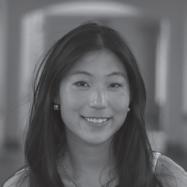
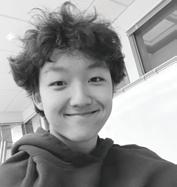
Brian J. Miller, a junior who helped organize the walkout, said he felt a sense of urgency to act.
“I realized it's time to go,” Miller said. “It's time to do something, and we did something. I got together a group of people that were there ready to support me. We made graphics, we made emails and we got this going.” From an administrative standpoint, Principal Brent Kline said student participation often involves complicated social dynamics.
“I think most students are here for a purpose, then some others will just follow, right?” Kline said. “It's what kids do. It's a thing that I think is important for you to to not only be in but to understand why you're in, so I hope that most of our kids understand what it is.” Students were able to excuse their absence through California Senate Bill 955, which permits an excusal once per school year to engage in a civic or political event with parent approval.
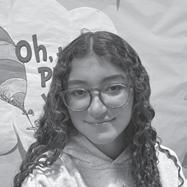
For senior Camila Martinez, the protest felt personal.
“My mom is an immigrant, my dad is an immigrant, they came here to work hard for a better future for me and my sister,” Martinez said. “I'm #rst gen. I'm Chicana. I'm here to represent my people, my country.”
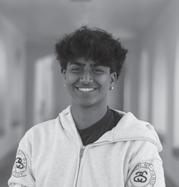
Freshman Pine Paldi Bracho said the protest was meant to show support for communities across the country.
is protest is a solidarity movement with the people of Minneapolis, the people of Chicago and the people of Los Angeles who are, in their cities, experiencing fear,” Paldi Bracho said. “People are afraid to leave their homes, so we’re saying ‘we see you, we support you, we agree that ICE has to get out.’”
Junior Maya Angela Cheng said this fear stems from ICE’s excessive authority.
“ e amount of power ICE has been given is much more than is needed for the task that they've been assigned with,” Cheng said. “And quite frankly, they are de#nitely abusing it, so we want to defund them and also raise awareness about how these acts have been completely inhumane.” Visit thecampanile.org to continue reading the full story online.
STUDENTS STAGE WALKOUT
A group of students from Castilleja School yell in protest while holding signs. Students from all over Palo Alto, including Palo Alto High School, Castilleja School and Gunn High School joined the protest. “ICE is truly a terrible (organization), they have murdered people,” Castilleja freshman Nancy Jimenez said. “Immigrants are everywhere, and they helped build America in every single way."
Freshman Joseph Escobar stands on an electrical box, waving an American ag. "I went on top, and somebody gave me a ag and I just started waving it," Escobar said. "It felt awesome, seeing everyone chanting, it felt like I was famous or something."
Dashel Chun & Cindy Liang Sta Writer & Print Managing Editor
Palo Alto High School sophomore Jorge Pinto Saldana raises his "st while sitting in the bed of a truck with friends who wave a Mexican ag. Dozens of students holding ags and signs drove by protestors on the sidewalk rallying the crowd. “( e protest) was important to me because as a Latino person, it shows how people support us,” Pinto Saldana said. “ at people are standing up for us, that meant a lot to me.”
Junior and event organizer Brian Miller raises a sign as he leads protesters in a chant, where an estimated one thousand students turned out. “ ere's nothing more beautiful than the power of community,” Miller said. “Nothing more beautiful than the power of togetherness, and that's what we're seeing here today.”
A student holds a sign at the walkout. Dozens of students drove by in cars, leaning out of windows and holding signs. “I think personally this signi"es unity,” Gunn senior Milcah Morrison said. “Seeing all of these schools come together honestly just made me want to cry.”
DASHEL CHUN/THE CAMPANILE
DASHEL CHUN/THE CAMPANILE
LUCA VOSTREJS/THE CAMPANILE
LUCA VOSTREJS/THE CAMPANILE
DASHEL CHUN/THE CAMPANILE
Following 22 years of work at Palo Alto High School, reproduction technician Veronica Rodriguez — who is responsible for printing and distributing paper for assignments and tests — has been noti ed that her position will be terminated following the 2025-2026 school year due to district budget cuts.
Her proposed layo has upset the Paly sta Math teacher and Palo Alto Educator’s Association representative Daniel Nguyen said PAEA Paly representatives have created a petition calling for the reversal of Rodriguez’s layo
Nguyen said over 100 teachers have signed the petition, including the entirety of the math department. Additionally, he said many teachers plan to attend the Feb. 10 board meeting to tell board members and administrators about Rodriguez’s impact on students.
According to the petition, Rodriguez saves teachers around 2000 collective hours per year, or about 80 minutes per teacher per week. Nguyen said Rodriguez’s e ciency allows teachers to devote more time to their students.
“She’s absolutely reliable,” Nguyen said. “She’s skilled at her job, and the main thing that matters for students is that she frees up time for teachers to go do other things.”
Rodriguez said she feels the district’s decision to eliminate her position is a mistake.
“My position is always busy,” Rodriguez said. “I’m always helping teachers and making their teaching easier and less stressful.”
She said although she relies on her job for her livelihood, she also loves her work.
“It’s not right, what they’re doing,” Rodriguez said. “I depend on my job. I’m working because I need the job and because I like what I’m doing, and that’s what I want to do. I’m happy here, and I don’t want to go anywhere else.”
Many teachers at Paly say they appreciate the kindness and energy that Rodriguez brings to campus.
Physics teacher and PAEA member Michael Lupoli said Rodriguez immediately welcomed him when he joined the Paly teaching community.
“When I rst started teaching at Paly 10 years ago, Veronica was one of the very rst people on campus that I connected with,” Lupoli said. “She was so kind, forgiving and helpful.”
Lupoli said Rodriguez is essential in making Paly feel like a community — a factor he considers crucial to making teaching meaningful.
“New teachers are often struggling to keep up with the pace, and having a copy technician who not only was willing to help me during extremely busy mornings but also (willing to) provide emotional support and a smile when I needed it most was one of the most inviting and welcoming experiences in my life,” Lupoli said. “She makes Paly feel like my family.” Rodriguez said she values creating this sense of belonging.
“I feel welcome (at) Paly, and I like making other people feel welcome, because I feel like this is my second family,” Rodriguez said.
Nguyen also said Rodriguez is an integral part of the sta because of both her personality and the work she does for the school. He said her proposed layo had a profound e ect on him when he heard about it.
“I was devastated,” Nguyen said. “She’s one of the core members of the Paly sta . She’s adored by everybody. But in addition to that, beyond just who she is as a person, her job is crucial and vital to the work that we teachers do.” Lupoli said he was similarly crushed when he heard about the decision.
“Honestly, having someone on campus that feels like family has made this place far more welcoming to work at, which is far more important to me,” Lupoli said. “Unfortunately, especially with the loss of Veronica, this place doesn’t feel much like family anymore.”
Many teachers, including Lupoli, have also expressed the sentiment that cutting Rodriguez’s position will create extra work for teachers, which takes away from time that could potentially be used to help students.
“ is hurts students,” Lupoli said. “I have a 3-year-old son and an 8-months pregnant wife at home,” Lupoli said. “I simply don’t have another hour to give … this hurts students.” Ultimately, Rodriguez said she does her job the way she does because of her passion for students and teachers.
“I do this because I love kids and I love teachers,” Rodriguez said. “Here I feel very welcome, and I want to make (kids and teachers) also feel very welcome, and I don’t want my position to be taken away. I want to stay here, and I’ll be so happy if I stay here for many more years.”
Principal Brent Kline did not respond to a request for comment.
Lucas Lai Sports Editor
Pushing the lim-it
Palo Alto and Gunn High School education councils have decided to not o er Multivariable Calculus as a PAUSD high school course next year. Instead, both groups supported o ering a new math elective –– Introduction to Proofs Honors, a decision that has spurred new controversy in the district.
In December 2025, the Palo Alto Board of Education unanimously approved two new advanced math courses: Multivariable Calculus and Introduction to Proofs Honors. e courses were designed to be part of the district’s most advanced math lane, which includes students who pass a math placement test to skip over some math classes.
According to the district’s course adoption process, teachers may propose new courses, which are reviewed by teacher committees, department teams and district sta before being sent to the Board of Education for approval.
Once approved, courses become eligible for site consideration. However, nal inclusion in school course catalogs is determined by the site principal in collaboration with teachers and guidance sta . Since MVC is not a graduation requirement, individual schools ultimately decide whether to o er the course.
Senior Xander Yap, who currently takes MVC outside of school at De Anza College, said the decision to not o er MVC at Paly contradicts the purpose of education.
“Learning is important, and when you don’t o er a class because you’re worried about something tangential to school, I feel like it defeats the point of school because you’re taking away opportunities for kids to learn,” Yap said.
“Isn’t that the point of school?”
A Paly parent, who agreed to be interviewed only if her name wasn’t included due to potential backlash, said she felt frustrated at the decision to not o er MVC as a high school course.
“I think it is the wrong decision, as there are apparently kids who want to study it and will study it using other methods,” the parent said.
“Paly has the teacher and the resources to o er it. Why do they make it so hard for students to learn? It’s just against all the principles about advocating for students’ learning.”
Currently, Paly students may take MVC at Foothill College or De Anza College. However, students who are dual-enrolled said the online and afterschool experience is often inconvenient.
“Almost everyone arrives late because it takes longer to get home than the time we have (after) the end of our school,”
Yap said. “ e timing is also really awkward because it interferes with all of the things that I’d want to do after school.” Yap said he also felt underwhelmed by his o -campus experience compared to his honors math classes at Paly.
“While the honors track at Paly is very di cult, I enjoyed it because I enjoy math, like most of the people in the honors track,” Yap said. “And when I went from the honors track – where we learned a lot of math very quickly and you had to put e ort into it – into this online class that’s slow, incredibly inconvenient and online, I just feel like I’ve learned so much less this year. And not only do I feel unprepared for college, but I also just feel a little bit sad about not being able to experience the sort of learning I wanted to.”
e parent said pursuing advanced math in high school is crucial for the development of the next generation of students interested in STEM. ink about the excellence of the U.S. youth to be competitive in the future,” the parent said. “Math is going to be so important in this high-tech era. And if students are interested in STEM, we should encourage them and provide the classes for them to learn, so they can go for more advanced math in college or can save their time to learn something they’re interested in in college.”
But Geometry and Analysis Honors teacher Alexander Dade, who is collaborating with Gunn to create the curriculum for the Introduction to Proofs Honors course, said the new class is intended to address the growing demand for advanced math o erings.
e Intro to Proofs course is meant not as a catchall solution, but as a solution of sorts to the demand for higher level math courses without creating more pressure on students to accelerate further and further than they necessarily need to,” Dade said.
Senior Kishor Rajmohan thinks the Introduction to Proofs course is the right way to go.
“ e way I think about classes at a high school is they should either be to explore and discover or they should be some kind of practical, pragmatic kind of content-based class,” Rajmohan said. “(Introduction to Proofs) is very bene cial and better than MVC.
From my experiences, (in MVC), you’re just learning theorems, doing problems and going through the process. But in Intro to Proofs, if it’s done right, it can really teach you how to think di erently about math — and about the world — and about coming up with questions and trying to nd the answers to them in a rigorous way.”
Although the education councils declined to o er MVC as an o cial high school course — meaning it will not appear in course catalogs or count for PAUSD credit — Dade said Paly is still considering hosting MVC on campus through Foothill College.
“Currently, what we’re looking at is something where Foothill would have a professor on our campus, potentially during school hours,” Dade said. “It would still be a Foothill course that would not formally be a Paly course, but it would be MVC o ered on campus.”
Dade said this option is a solid middle ground.
“Having MVC available on campus through Foothill is a good compromise,” Dade said. “ ere are always going to be students that want to do more, but I think a lot of that is also just pressure from the culture of the school and the idea of wanting to do as much as possible to look the best that you can on college apps.”
According to a Palo Alto Online article, the education councils voted against o ering MVC as a PAUSD high school course due to the fact that “changing the core math sequence could disadvantage many Palo Alto students during the admissions process.”
However, the parent said she believes this argument is awed and that taking MVC would not serve as the most important factor for college admissions.
“In my view, having this class or not will have a very negligible e ect on college admissions,” the parent said. “If someone is very good at something, it will also disadvantage other people. We can’t just stop them from developing excellence in order to make everybody feel they are the same. I don’t think that’s fair.
Although not fully opposed to MVC, Dade did have concerns about o ering it as a PAUSD course.
“While I do appreciate and understand and want to accommodate students that want to push forward, I don’t think it’s something that is based in genuine love of math as much as wanting more credit,” Dade said. “It is a course that gets you credit, and that is up next after BC, and that’s kind of it. It’s not particularly interesting; it’s not very novel; it’s not that practical in most elds, and even in higher level math classes in college, it never really came up.”
And Rajmohan, a student who has nished MVC, said students passionate about math have other ways to demonstrate interest.
“If you want to show your passion about math, I think taking it online and
getting that community college credit is su cient,” Rajmohan said. And if you’re really passionate about math, there are a lot of things other than getting course credit to show that you actually care about exploring and learning the subject and how you can become a better mathematician.”
Some students, however, have expressed concern that o ering MVC on campus would intensify academic pressure. A sophomore in advanced math who agreed to be interviewed only if their name wasn’t included due to privacy concerns, said she would feel compelled to enroll.
“(If they o er MVC at Paly), I’ll have to take it because everyone else will take it,” the sophomore said. “And that won’t be fun because it’s really hard.” e sophomore said she feels parental expectations would play a signi cant role.
“If MVC exists, my parents will pressure me into taking it because I can’t be less than everyone else,” the sophomore said.
“And if I take MVC, I’m going to get a B. And a B is bad.”
Dade said Introduction to Proofs is designed to avoid this type of pressure while still serving students deeply interested in math.
“ is is an opportunity that very few districts have, that are in my opinion, far more interesting than multivariable calculus,” Dade said. “ e proofs course is designed to help students build skills that are actually very useful in higher level math, speci cally kids who want to major in math, without creating arti cial pressure for students to accelerate any more than they want to.”
Because of this, Rajmohan said he welcomes the new course.
“ is is an amazing auxiliary course to take that will help you with pretty much any eld and any endeavor,” Rajmohan said. “It gives you that kind of intuition I was talking about, and it’s a very practical course. Learning the process of proofs is a great thing to know, and to be able to think that way is very useful. I think it’s a great addition to the curriculum.”
Ultimately, Dade said he encourages students to keep an open mind.
“I truly do believe it’s a really cool opportunity,” Dade said. “Paly is as special as it is because of the cool opportunities it has. And I think this is one that’s truly unique. I think a lot of people should give it a chance.”
Dashel Chun Sta Writer
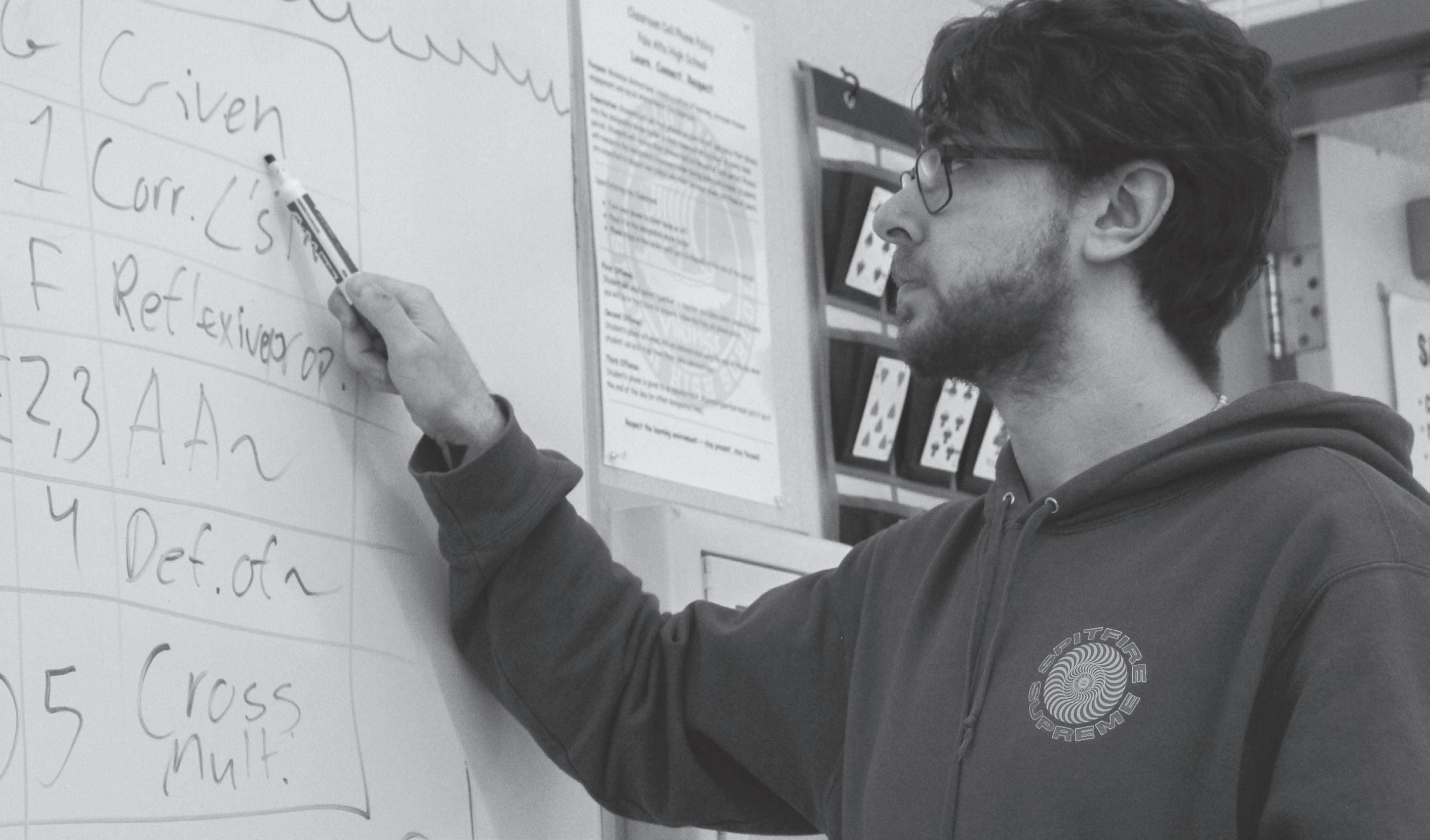
Analysis Honors and Geometry teacher Alexander Dade demonstrates solving a geometry proof on the whiteboard. “ e proofs course is designed to help students build skills that are actually very useful in higher level math, speci cally kids who want to major in math, without creating arti cal pressure for students to accelerate any more than they want to,” Dade said.
DASHEL CHUN/THE CAMPANILE
Sta defeat seniors at Winter Rally game
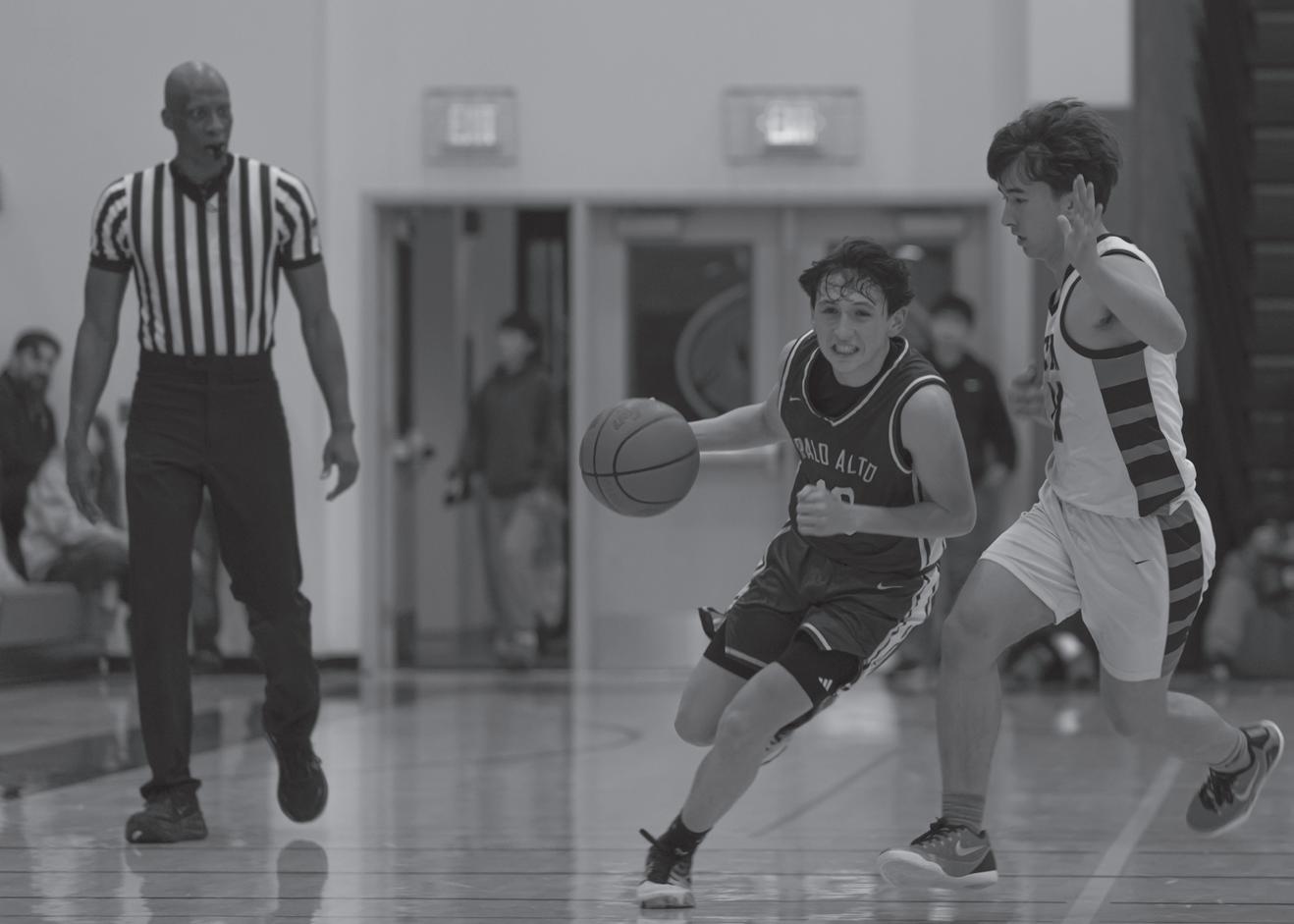
Sta beat the seniors 25-11 in the annual Winter Rally basketball game during lunch on Wednesday.
During the rally, ASB also revealed this year’s Prom venue: the San Francisco Design Center Galleria.
Senior Nate Robinson said he enjoyed playing in the game despite the loss.
“I feel pretty good,” Robinson said. “I made a three and free throws, but some of the shots just weren’t falling since it’s a lot of pressure. !e referees were very biased towards the teachers, so that made it very di cult to win. But it was very fun, and I really enjoyed it.”
ShQuil Green, a student assistant, said the rally offered an opportunity for the Paly community to connect with one another.
“It brought us all together as a school, so I love it,” Green said. “We all came together as a team from di erent departments and it was an amazing time.”
Senior Tsion Amanuel said playing in this game reminded her of her past experiences and cherished, nostalgic memories playing basketball with her school teammates.
“Since we weren’t cooperating during warm-ups, we were a mess,” Amanuel said. “It was obviously harder be-
cause we were playing against mostly men, and they were big. But it brought back memories of playing basketball.”
Campus Supervisor Mayerly Short said she wasn’t surprised the sta won this year, and plans to participate again in the future.
“We had a very tall team this year, so we could pass, and I think all of us were more energetic than we usually are,” Short said. “It’s a fun way to do things with the students where we can be a little bit more aggressive in a sporty way and still have fun.”
Senior Kishor Rajmohan said playing during the rally as a senior felt special and di erent from watching the game in previous years.
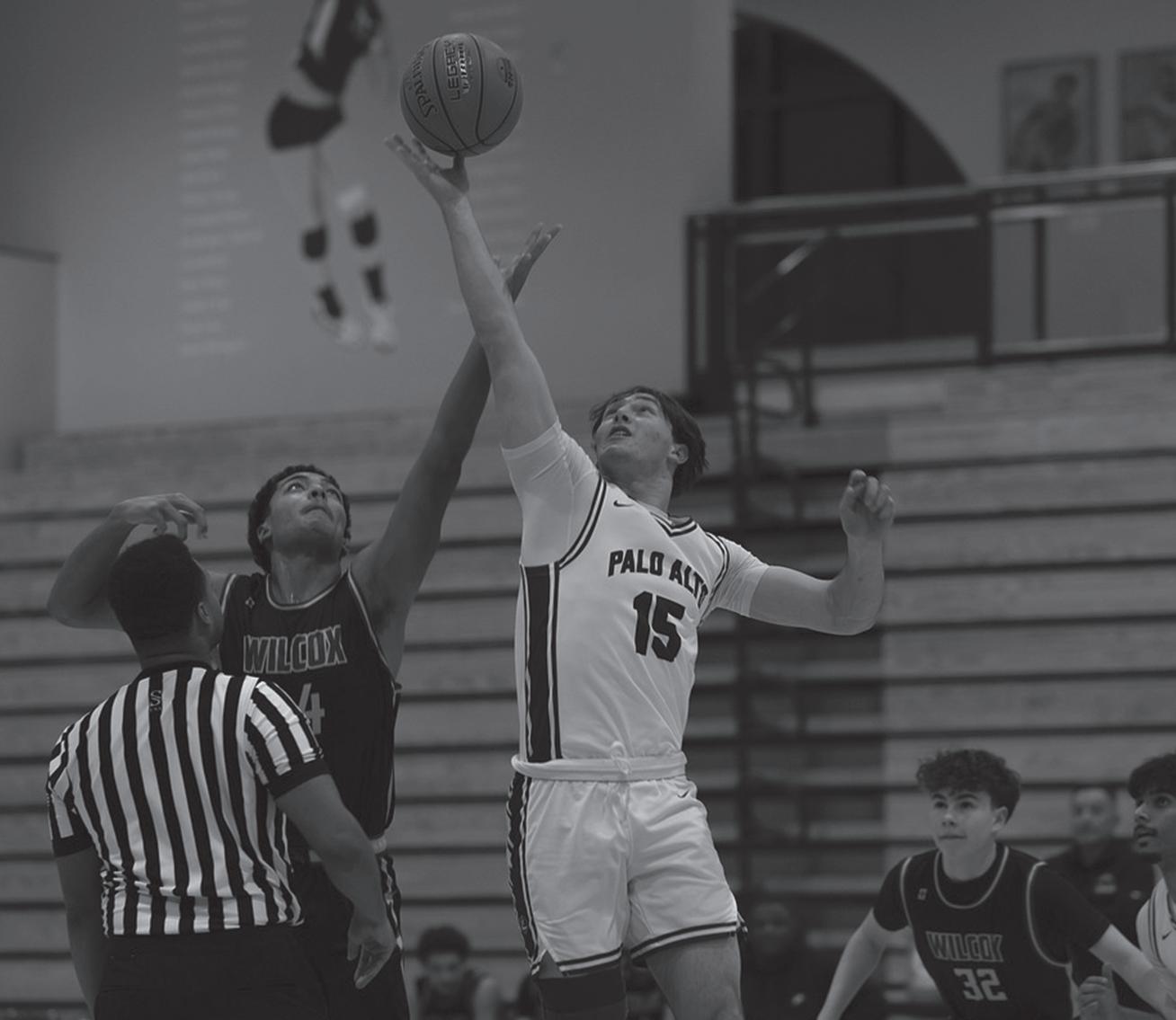
“I thought it was really fun to play, especially after watching the games as an underclassman,” Rajmohan said. “It was somewhat nerve-racking, but after we kind of internalized it, it became all fun and games and way less stressful. I would say the most memorable moment is between Ms. Short falling and the refs having to call a jump ball.”
Rajmohan also said the inability to handle challenges in the game and a lack of overall strategy led to the seniors’ demise.
“Actually scoring points was more challenging than expected,” Rajmohan said. “We completely lacked organization, didn’t have any game plan or strategy and I think we fumbled the game because of it. I think our players were good enough to win, but our lack of strategy really messed us up.”
Senior and student team coach Kacey Washington said coaching the team was a truly unique and memorable experience that he enjoyed, giving him a chance to take part in the fun and excitement of the game from a new perspective.
“When it comes to the team, we can’t select the team, so we’ve got to talk to a lot of people that you may not talk with, may not interact with, or may not have classes with,” Washington said. “If you look at that from that perspective, it’s really fun. And you also got to coach people that you’re friends with and to have this experience that is quite unique with all your friends and seniors in the stands. It makes it a really fun experience.”
Annika Chu & Grace Kim Print Managing Editor & Sta Writer
New psychiatric hospital to open in spring
After more than 15 years of advocacy and background work from community members and county leaders, Santa Clara’s rst inpatient psychiatric facility for youth is set to open this spring at the Santa Clara Valley Medical Center in San Jose. !e new building will consolidate existing mental health and emergency psychiatric services around the campus and has 77 beds, 35 of which are dedicated to children and adolescents.
!e idea was established in 2010 at a regular meeting of Santa Clara County’s Adolescent Counseling Services Advisory Board.
Sigrid Pinsky, a previous board member and Palo Alto resident, was listening to the routine sta report on youth mental health when she paused and raised her hand: “Wait, are you telling me that we have to send our kids in crisis outside of the county?”
!e sta member said yes, because the county did not have enough beds for psy-
chiatric patients, and none even existed for youth. In 2017, the year the project was approved, 689 youth were admitted to outof-county psychiatric hospitals and stayed for an average of six days, according to Santa Clara County’s o cial website.
“To have families have to go out of the county, all the way up to Marin or all the way over to Fremont when they’re already in such a di cult situation just seemed unbearable to me,” Pinsky said.
Pinsky said she called former County Supervisor Joe Simitian the morning after the meeting to express her concern regarding the lack of psychiatric aid for youth in Santa Clara.
“I give him so much credit,” Pinsky said. “He just never let go of this. He thought it was super important to get this facility built.”
Simitian rst proposed the project in 2015, and a revised, more detailed plan was approved in 2021. Although construction began in 2023, the project faced construction delays due to labor shortages and exceeded its 222 million budget by nearly two times its original.
Pinsky said the new facility will have an immediate impact on youth, but is just the rst step in solving the county’s youth mental health care problem.
“We’re not done,” Pinsky said. “ !is doesn’t cover all the needs in the county, but it’s an enormous good start.” !e facility has separate oors for youth and adults. It provides medical care, psychiatric assessment and emergency crisis services. Andie Barker, a therapist at the Paly Wellness Center, said having dedicated facilities for youth is necessary to provide e ective care.
“Di erent programs are initiated for di erent developmental stages of life,” Barker said. “Depending on what the adults might be going through, that would be very di erent than what a teenager would be going through. !e needs would be so varied. !ere would have to be completely di erent programming.”
Junior Selena Luo, co-president of the Clinical Psychology Club, said having more support options available for teens is increasingly important.
CSU to o er direct admission
California State University will begin o ering the Direct Admission Program this year, guaranteeing qualifying California applicants admission to one of 16 participating campuses. !e pathway began as a pilot program in Riverside County, and the passage of Senate Bill 640 in October has expanded it to school districts across California, beginning with the class of 2027.
In an email to the Campanile, Paly college advisor Janet Cochrane said CSU introduced this program to “make it easier for quali ed students to go to a four-year college who might not otherwise realize they are quali ed.”
Palo Alto-based college advisor John Raftrey pointed towards CSU’s decreasing enrollment trends across di erent campuses as another reason for this new guaranteed admission program. !e campuses covered by this (program), their attendance dropped around COVID and never recovered,” Raftrey said. !e schools that are not covered, the more competitive schools, have recovered, and so this is a way to try to get more kids to apply to those that didn’t recover.”
According to Cochrane, the Direct Admissions Pathway may not have a large impact for Paly students applying to college because of lack of interest.
“More students apply to and prefer the UCs over the CSUs with the exception of Cal Poly San Luis Obispo,” Cochrane wrote.
Junior Rasia Yu agreed that students aiming for more selective schools might overlook CSUs, yet it serves as a good backup for those applying to more competitive schools.
“ !at sounds like a great option for some,” Yu said. “Honestly, I might not apply just because I would want to rst try for my dream schools, because I feel like I would consider a CSU as my secondary option.”
However, Wendling said guaranteed admission pathways to UCs and CSUs are bene cial for applicants applying for competitive majors with lower grades in high school.
“I do really like that safety net, especially because I know that some of my friends have passions for the future, but don’t really have the grades to support it,” Wendling said. “So having the safety net of being guaranteed to be able to get into a UC is really good.”
Yu said since these direct admission programs are only available to California students, they may put out-of-state applicants at more of a disadvantage.
“I have a friend from Arizona, and for them, UCs are already really hard to get into,” Yu said. “Getting into Berkeley or getting into UCLA is a super high achievement, almost up there with the Ivy Leagues. I think it would make it a lot more challenging if we have spots reserved for in-state students, especially for a state like California with amazing schools.”
However, Wendling said other states also have similar pathways for their regional high school students.
!ere are a decent amount of alternatives in di erent states,” Wendling said. “I do nd it a little unfair that people who are out of state don’t have access to this opportunity, because I think it’s a really good one, but also I feel like it makes sense for it to only be for California students as well.”
As the college admissions journey approaches for the class of 2027, Yu said she feels nervous when she sees pro les of other students online.
“Many teenagers have anxiety, depression and academic pressure,” Luo said. “ !e increasing crisis of those pressures is de nitely a big problem.”
Barker also said having a hospital in close proximity bene ts patients’ families.
“If you do require that level of care, obviously you want to receive that care close to home, so it’s accessible for your family and your support system to be involved in the care,” Barker said. “It’s not usually just the patient that’s being treated. It’s the whole family system.”
Barker also said the facility’s location is important because treatment usually continues even after patients return home.
“When you do receive care within your community, that support is also then typically available after discharge, so to receive support and treatment within the place that you live is ideal,” Barker said.
Barker said she’s hopeful for the new facility.
“I’m always excited as a social worker to hear about additional care options in our community,” Barker said. “It’s always a win when there’s additional treatment available and avenues for people to receive that treatment.”
Chan Lifestyle
Yu said some students believe completing certain milestones will increase their chances of admission to a prestigious college, which can make the culture around college admissions extreme and unhealthy.
“I feel like I’m in uenced a bit by that mindset,” Yu said. “But then they’re always talking about these super prestigious things that you need to do, and that’s not really realistic for almost anyone. !ey’re like, ‘Oh, well, if I have to be an Olympiad winner, and I don’t do that, I’m not going to be able to get into Stanford.’” Yu said guaranteed admission pathways can help lessen the pressure, especially for students not aiming for prestigious schools.
“If you weren’t even planning on going to college, you don’t want to be doing all these super competitive, hardcore things that you don’t even care about just to get into college,” Yu said. “So I feel this is denitely a good opportunity, and brings down the intimidation factor.”
Ultimately, Cochrane said, Paly students have a variety of di erent pathways available to them while applying to college, including community college and transfer programs.
“ !ere are a lot of options,” Cochrane said. “Do your research and meet with your college advisor!”
Isabella Li Sta Writer
Ethan
& Sci/Tech Editor
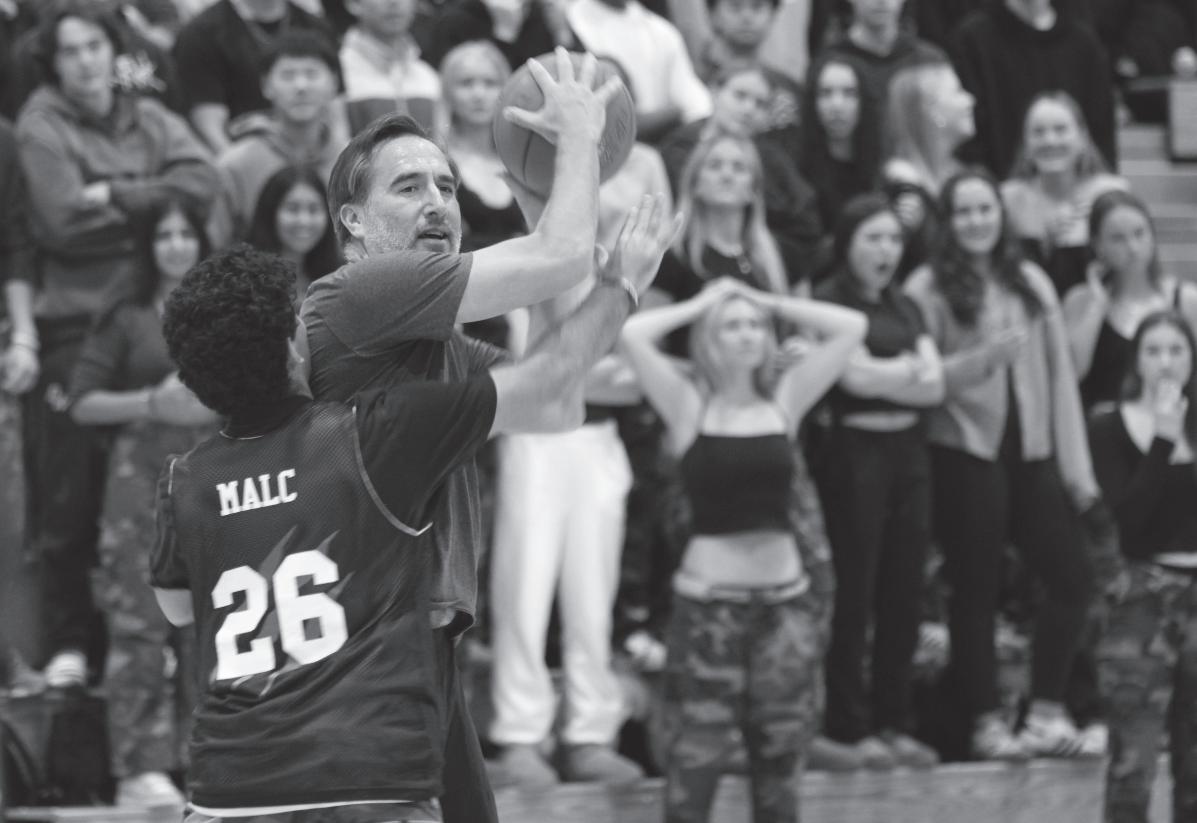
Choir teacher Michael Najar scans the eld, getting ready to pass and advance the play under signi cant defensive pressure. “It’s a fun way to do things with the students where we can be a little bit more aggressive in a sporty way and still have fun,” Campus Supervisor Mayerly Short said.
GRACE KIM/THE CAMPANILE
Not your average levee: when Palo Alto’s ood defense grows back
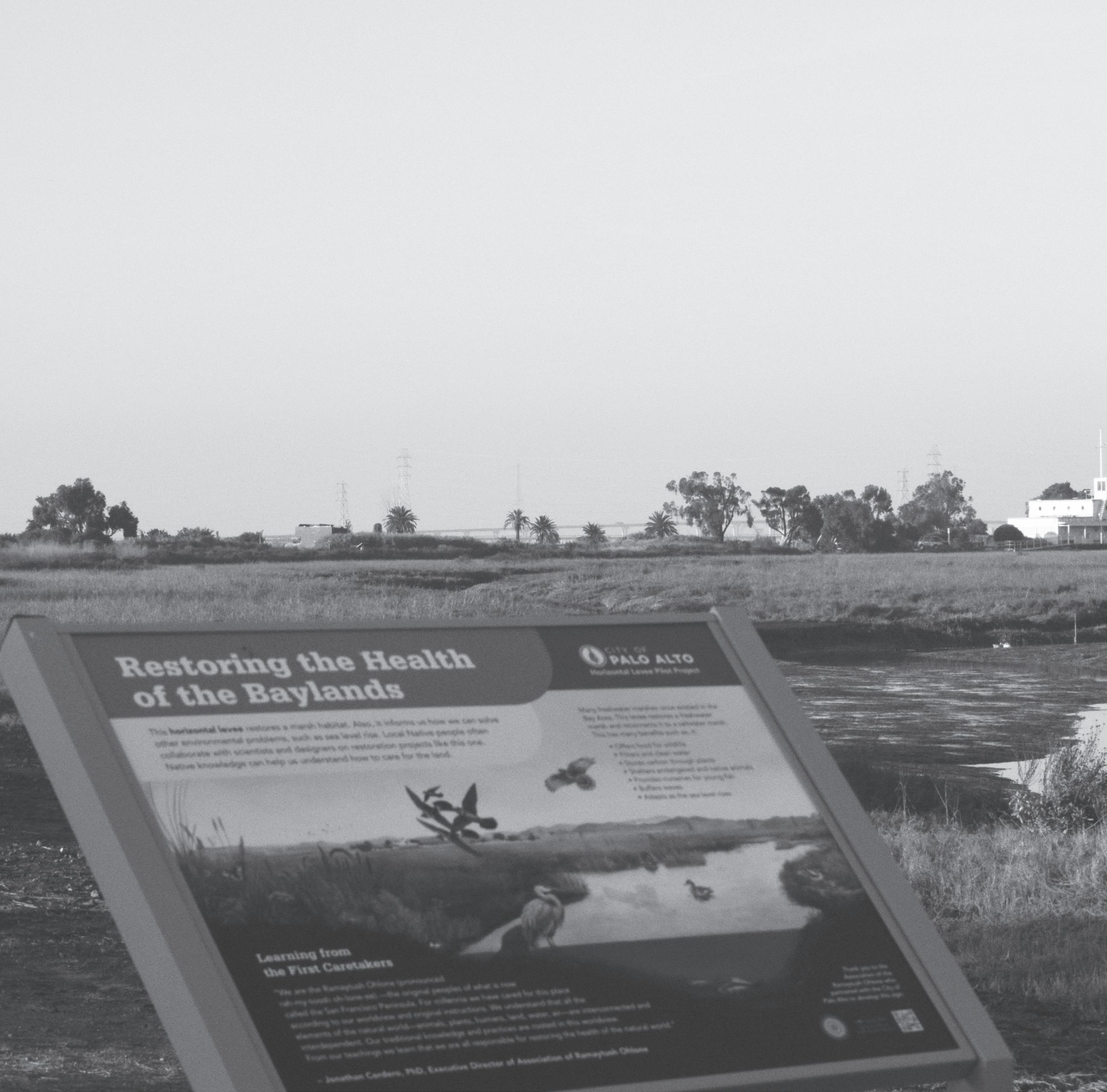
Grass. Soil. e kind of ground you’d expect in a garden, a playground, or the Quad — not the thin line protecting a city from ooding. But at the Baylands Natural Preserve, that’s exactly what it is. Along the marsh’s edge, east of Byxbee Park and across from the Palo Alto Regional Water Quality Control Plant, the City of Palo Alto is building a horizontal levee made of grass and soil.
“A horizontal levee is a gradually sloped vegetated berm that uses native vegetation to slow water,” said Samantha Engelage, Project Manager and Senior Manager for the City of Palo Alto.. “It builds up sediment over time and protects infrastructure behind the levee from ooding.”
Heidi Nutters, Principal Program Manager at the San Francisco Estuary Partnership and a partner on the horizontal levee project, said the city at rst regarded the project as a novel approach to shoreline protection. is project came out of an experimental design in the East Bay at the Oro Loma Sanitary District,” Nutters said. “We were looking at how we could address sea level rise and water quality improvement in the same project.”
One of the driving factors for Palo Alto to launch its own horizontal levee as a pilot project was the experimental success at Oro Loma.
“We’ve been monitoring it for about 10 years and found that the microbial activity in the soil removes nutrients and contaminants of emerging concern from the wastewater,” Nutters said. “ e project uses a wetland system where treated wastewater is pumped through soil and native plants, allowing microbial activity below ground to remove nutrients before the water is returned to the treatment plant.”
Additionally, Engelage said the horizontal levee may be a better option than traditional levees.
“It uses treated wastewater to irrigate the vegetation,” Engelage said. “Not only does this type of system protect from ooding, but it also provides diverse habitats and additional treatment of treated wastewater.”
However, Nutters said the nature of the project as a pilot program made it di cult to implement.
“It’s the rst of its kind, so there wasn’t a paved path for how we were going to do a lot of this,” Nutters said.
Additionally, Nutters said funding and acquiring permission for the project brought its own set of challenges.
“We had to be really creative with where we got funding for the project, and we had to be really scrappy, honestly, with how we put di erent funding sources together,” Nutters said. “It was also pretty challenging to get permits for a project like this.”
Nonetheless, despite the possible challenges of the project, the city is optimistic the living levee can deliver multiple bene ts.
“If water goes over a seawall, your asset is ooded,” Nutters said. “A wetland has more of a bu ering capacity that meets the water as it moves across the landscape.”
In order to ensure the project would e ectively aid surrounding cities, Engelage said Bay Area communities were represented in decision-making and were able to voice their feedback.
“We’ve tried to engage the community throughout the project,” Engelage said. “During design, we had di erent workshops with stakeholders to get feedback on what the community wants to see out there and hear concerns they may have.”
Engelage said indigenous communities and volunteers were also involved.
“ e Association of Ramaytush Ohlone helped us develop interpretive and educational signage at the project,” Engelage said. “We engaged Save the Bay to bring the community to the project site to actually install the 2,000-plus plants needed to vegetate the levee.”
Volunteers from organizations such as Save the Bay also played a crucial role in the e ort by installing native plants to vegetate the levee.
“ e way we do this kind of replanting involves a lot of volunteers, and that gives people who live in the area the opportunity to be a part of restoring the Bay in a hands-on way,” said David Lewis, Save the Bay’s Executive Director. “People feel more ownership and responsibility for it, and they understand how nature works much better than if they were just reading about it in a book.”
Because of the large volunteer support for the project, Lewis said the work is carried out e ciently and at a signi cantly reduced cost.
“It would be very expensive to hire professional contractors to do the kind of work that we do for a fraction of the cost,” Lewis said. “More work gets done for a lower cost.”
In addition, Nutters said the project can support communities that are often most impacted by poor water quality.
“We’re learning how to be proactive and adapt so ooding doesn’t disproportionately impact marginalized communities,” Nutters said.
e Palo Alto “living levee” project aims to enhance ood protection and improve water quality. “Success over the next few years for the project would look like the habitat getting established (and) people accessing the site and enjoying the site and engaging with it,” Program Manager of the San Francisco Estuary Partnership Heidi Nutters said.
For local residents such as Palo Alto High School sophomore Jacob Guhr, the project brings stability to a place with personal meaning.
“ e Baylands is my beauty and relaxation place,” Guhr said. “Everywhere you go, it’s colors everywhere. I’d hate to see it get ooded.”
For the city, Nutters said the project’s success is measured in how people engage with the Baylands and how it can potentially in uence ecosystem services in the future.
“Success over the next few years for the project would look like the habitat getting established, people accessing the site and enjoying the site and engaging with it,” Nutters said.
If the horizontal levee project in the Baylands proves successful, the city may expand it to a larger scale.
“( e project is) testing whether all these bene ts can actually come together in one project,” Lewis said. “Most places around the Bay Area where
there are sewage treatment plants are where this kind of living levee could be possible.”
For residents interested in the levee, there will be ongoing opportunities to participate and help sustain the shorelines at the Baylands.
Engelage said, “Once the project is completely nished, there will be several opportunities for the community to get involved through community science events, volunteer activities and outreach coordinated through the city and our partners.”
Jonathan Gu Sta Writer
Community reacts to US removal of Maduro from Venezuela
President Donald Trump announced the successful capture of Venezuelan dictator Nicolas Maduro and his wife, Cilia Flores de Maduro, from the Venezuelan capital Caracas on Jan. 3
According to Trump, Operation Absolute Resolve, the name given to Maduro’s capture, was based on charges of narcoterrorism and drug tra cking.
Foreign Policy teacher Adam Yonkers said the United States’ decision to remove Maduro is problematic due to the United States’ explicit values of supporting the sovereignty of other nations.
“If we’re exercising the defense of sovereignty elsewhere – places like Taiwan— and you go in and seize those assets and remove the leader, that can be seen as setting a precedent,” Yonkers said.
Venezuela has some of the biggest oil reserves in the world. According to Trump, the United States plans to extract the oil from Venezuela to be re ned and sold in the United States.
“Venezuela has also agreed that the United States will immediately begin re ning and selling up to 50 million barrels of Venezuela crude oil, which will continue inde nitely,” Trump said in a press conference. “We’re all set to do it.” Yonkers said he thinks oil reserves were the main reason for Maduro’s capture, rather than Trump being focused on Venezuelan citizens.
“Quickly following up with meeting with oil executives (after the capture of Maduro) has shown that they’re very interested in the oil,” Yonkers said.
Junior Maria Uribe said she thought it was good that the United States removed Maduro from power, due to his policies a ecting the well-being and quality of life for many Venezuelan citizens.
“Maduro was an authoritarian leader,” Uribe said. “He stole the elections and kept Venezuelans impoverished and politically oppressed. Trump has been one of the few leaders willing to take action against his repressive regime. Whatever you think of his broader agenda, at the end of the day, he’s given Venezuelans hope that change is possible, something they haven’t had for a long time“
But junior Neel Satyavolu said he sees little progress made through the removal of Maduro because many of his cabinet members still have power and in uence in the Venezuelan government.
“I think removing him as an isolated goal was good, but I think that we never should have done it in the rst place, because it’s not really going to change much,” Satyavolu said In 2024, despite overwhelming evidence to the contrary, Maduro did not acknowledge his loss of Venezuela’s democratic election, causing the opposing leader, Maria Corina Machado, to go into hiding for 11 months, before emerging – following a daring US backed extraction– in December to receive a Nobel Peace Prize in Oslo.
After the removal of Maduro, Machado presented her Nobel prize to Trump as a recognition of the United States’ removal of Maduro.
Uribe said she hopes Maduro’s opposing leader and true winner of Venezuela’s 2024 election Maria Corina Machado would return to Venezeuela to re-unify the nation and bring back peace for the people.
“I hope Machado returns to Venezuela soon,” Uribe said. “After having to hide for so long she can lead Venezuela to a better future.”
Leilani Chen Business Manager
JOHNNY GU/THE CAMPANILE
Lifestyle
Prep debate: do they work?
While most students wake up and get to class
breakfast and a trip to the gym. Afterward, she takes a quick shower and before getting ready to head to school — just as her classmates are beginning their lunch period.
Stell is one of many students who had at least one prep pe riod during Despite the extra free time she has because of this, Stell has since her preps with another class.
“Now I have to get up quite a bit earlier, which is frustrating,” Stell said. “But on the bright side, it is second semester se nior year, so it’s much easier. I have less to worry about.”
Junior Kavita Fulton, who also had two preps during last semester, picked up her second prep di erently. By dropping her Spanish class early in the year, she gained a third period prep in addition to her seventh one, which gave her di erent circumstances compared to Stell.
“It gave me a little break,” Fulton said. “I had a lot of di erent things to do for my AP lang class, which is fourth period, so it was really helpful to just have that time in the beginning to just nish up reading or anything.”
In addition to her increased productivity, Fulton said she saw a reduction in her anxiety with extra preps.
“I de nitely noticed that it helped me just have more time and feel less stressed,” Fulton said. “And for my AP classes, I had a lot more time to just nish stu .”
Despite the positive results of an additional prep, Fulton said she regrets not taking more classes.
“It was a fun thing to have,” Fulton said. “I just wish I didn’t have it because I should have taken six classes.”
Unlike upperclassmen, many underclassmen typically take seven classes, including a PE period. Sophomore Alex Lungren, a rower for Norcal Crew, chooses one of the exceptions to the seven class norm: independent study, where she gets credit for PE by playing a sport not o ered at Paly.
Since switching from PE to Independent Study, Lungren said she has found the prep period helpful in nishing work or relaxing.
“I can get home two hours early, get some work done before practice and then still make it in time,” Lungren said. “My practice starts at 4:30, so I can’t leave at 4:10. I think it’s very helpful for that.”
Sophomore Narnia Lo takes ballet to ful ll her requirements for independent study. Lo, who also has a fourth period prep, said she found there are many positives to her prep aside from making it to practice on time and getting out of PE.
“If there is a test the next day, it’s nice to just have that time to be able to prepare,” Lo said. “Or if you have friends with the same prep, you could just go to town and country and hang out for a bit.”
Despite the popularity of prep periods, some upperclassmen choose to ll their schedules with seven or, in rare cases, eight courses.
Junior Mayu Altekar-Okazaki has a full set of extracurricular activities outside of her rigorous classes. Aside from being an editor for the Paly Voice, Altekar-
A
Okazaki also peer tutors, plays the piano, works at an internship and leads community outreach in Youth and
Despite the multitude of time commitments, Altekar-Okazaki said her interests led her to ll her schedule to pair with her extracurriculars.
“Honestly, there’s a large diversity of classes at Paly, and I wanted to have the opportunity to take as many classes as I could because I’m interested in so many di erent things,” Altekar-Okazaki said.
In addition to satisfying her interests, Altekar-Okazaki has found that some of these classes have helped her understand concepts in related subjects.
“It’s also been really interesting to learn all these other things,” Altekar-Okazaki said. “Or to see the overlap between my courses and see how this one thing from math has helped me with this thing in stats or this thing from physics.”
Similarly, junior Ishaan Juyal, not only lled all seven periods in his schedule, but added an eighth period for after school choir. Juyal said, similarly to Altekar-Okazaki, he wanted to ll his schedule with his interests before the stress of senior year.
“I wanted to cover as much as I possibly could, especially since I know that senior year is going to be a bit of a nightmare,” Juyal said. “I wanted to have physics as something that I knew roughly about in case it came up, so my decision was, instead of a prep, I would just take regular Physics instead of Physics H to make sure that my schedule wasn’t completely a nightmare.”
Juyal said one of his strategies is to tackle his assignments as quickly as possible.
“So long as you do it immediately and don’t procrastinate that homework, it’s really easy to manage,” Juyal said. “ en it’s just about knowing which classes give you what types of homework, and how fast you need to do them to make sure that your work doesn’t pile up.”
Junior Meghana Konduri also takes seven classes at Paly, along with a Multivariable Calculus course at De Anza community college. Despite the increased workload, she said she’s glad she took them because they provide her with a fun learning experience.
“I feel like I take all these classes because school is fun and I like learning, so I’m OK with having a lot of time in class,” Konduri said.
Although she said she nds joy in learning, Konduri also said her community college course creates time con icts where she ends up staying up later to nish other school work.
“Sometimes I have to cancel robotics for it,” Konduri said. “Because it’s so late when I get home, I (stay up) later to do homework and stu . I’ve really tried to nish a lot of my work at school itself so that I’m not pushing back to sleep because of the time commitments I’ve already made.” With the variety of prep options available at Paly, there are many opinions on how many one should have. Guidance counselor Jillian Bischo said having a prep is helpful to improve students’ health and the ability to stay prepared.
“For many students with a heavy course load, it can help them keep up and do higher-quality work instead of feeling constantly behind,” Bischo said. “In some cases, it also means getting to bed at a reasonable hour instead of staying up late every night.”
On one hand, students like Lungren say preps help with time management, especially surrounding sports.
“Because I also had a prep freshman year for doing sports, that’s always been really helpful, just so that I’m able to work and lock in on classes that I need extra help in,” Lungren said. “And just having extra time to relax because it’s a lot to have a sport full time, have a job and do school all at once, so the time that I have to rest is the best.”
Similarly, as a junior looking to apply to colleges in the fall, Fulton said a prep will help free up time to work on college applications.
“I de nitely think that next year, with all the college apps and everything, two preps would be helpful,” Fulton said. “But also it’s important to take classes that you know or think you’ll do well in, so you don’t have to take another prep.”
Still, other students like Stell say preps don’t make as much of a di erence in productivity as many think.
“I didn’t actually nd that dramatic of a di erence with a prep,” Stell said. “For some people, preps are really productive. I’m not always super productive with my prep. I use them for meetings or doctor’s appointments, but it’s sometimes hard for me to work during my prep.” And others are willing to go without them.
“I’d rather have to manage my time than not take one of these classes and miss out,” Konduri said.
Ultimately, Altekar-Okazaki said she thinks having a prep is dependent on everyone’s individual interests and responsibilities.
“Taking a prep or not depends on your personal needs and your own life,” Altekar-Okazaki said. “Everyone’s life is di erent.”
Kira Tzeng Sta Writer
new brunch spot at Town and Country just hatched
Hatched, a new breakfast and brunch restaurant, opened in Town & Country Village on Jan. 6. Owned by three brothers — Craighton Poon, Clifton Poon, and Brandon Poon — Hatched is one of the three restaurants, including Town and Country’s Roost and Roast, operated by the family. Hatched o ers a menu centered on breakfast and brunch items, including Green Dream burger, avocado toast and specialty drinks.
“Our goal was to create a dedicated breakfast and brunch destination that specializes in high-quality sandwiches paired with craft espresso and matcha beverages,” Craighton said. “ e name is a play on words, re ecting how we hatched the concept for the restaurant much like a hen hatches an egg.” Junior Mayu Altekar-Okazaki said she was pleased when she heard about the restaurant’s opening because of its proximity to campus.
“When I rst heard that Hatched was opening near our school, I was excited for a new lunch place with a di erent type of food,” Altekar-Okazaki said. Ruth Carias, an economic development specialist with the city of Palo Alto, said new restaurants like Hatched contribute positively to the local community.
“Beyond their economic impact, small restaurants contribute to the city’s vibrancy by serving as community gathering spaces that bring people together. From the City’s perspective, they help foster a strong sense of place and neighborhood identity,” Carias said. Craighton said Hatched distinguishes itself through its focus on both food and beverages.
“Hatched stands out by being a food- and beverage-focused brunch spot,” Craighton said. “We o er elevated egg and chicken sandwiches alongside craft matcha and espresso drinks that feature our house-made syrups and cream tops.”
Freshman Ciel Yoo also said her experience at Hatched was mixed.
“ e good thing was that they take online orders and even let you change a lot of settings such as the sweetness of drinks,” Yoo said. “( ey also) have many drink options. However, they don’t have too much food diversity, and it’s specialized in sandwiches.”
Altekar-Okazaki agrees.
“ e location is accessible, and while the prices are pretty normal for Town and Country, the food is still expensive,” Altekar-Okazaki said.
Despite concerns about food variety Yoo said the restaurant’s drink menu makes it appealing.
“I think I’ll visit often,” Yoo said. “If not for the food, then try the di erent types of matcha.”
But Altekar-Okazaki said she is less likely to return regularly.
“I got the Green Dream, which was pretty good, but the drinks were separated into layers after around half an hour,” Altekar-Okazaki said. “I don’t think I’ll visit too often because it was a little too lling for a normal lunch for me.”
Carias said students’ support of local restaurants like Hatched helps strengthen the broader community.
“Local restaurants serve as gathering spaces that encourage social interaction, cultural exchange, and a strong sense of belonging,” Carias said. “Students supporting small, locally owned establishments help them thrive while fostering a vibrant community. Together, this relationship contributes to a dynamic local economy and a community that feels connected, inclusive and forward-looking.
Craighton said he hopes Hatched becomes a regular destination for the community in the future.
“We want to provide a delicious, casual brunch spot where the community can get their ca eine and breakfast x,” Craighton said. “For Paly students, we strive to o er a welcoming place to start their day right with great food and drinks.”
ART BY HUDSON PRESS
GRACE KIM/THE CAMPANILE
Hatched, a new breakfast and brunch restaurant, opened in Town & Country Village on Jan. 6. e owner Craighton Poon said, “Our goal was to create a dedicated breakfast and brunch destination that specializes in high-quality sandwiches paired with craft espresso and matcha beverages.”
Grace Kim Sta Writer
Lifestyle
A ‘Stranger ings’ farewell
Spoiler alert: is article contains major plot points from the final season of “Stranger ings.”
Junior Ayelet Raffalin and her mother were cozied up on their couch at exactly 5 p.m. PT on New Year’s Eve, when the final episode of “Stranger ings” dropped. At the same time, AP Psychology teacher Melinda Mattes was geared up for the finale –– rewatching every season with her kids in preparation for Season 5.
“Stranger ings”, by Matt and Ross Duffer, is a science fiction-horror show set in the 1980s. Nearly 10 years after its debut in 2016, the show concluded with its fifth season, released in parts on anksgiving, Christmas and New Year’s Eve. Despite anticipation built over the three-and-ahalf-year gap between Seasons 4 and 5, freshman Mattias Uribe-Estrada said the final season fell short of expectations.
“I feel like they wrote it as it went along, and it wasn’t very well planned,” Uribe-Estrada said. “ ere were a lot of plot holes. I was looking (for) at least one or two deaths that actually mattered, because not one of the main characters actually died.”
Senior Marcello Attardi said he was also frustrated by plot holes in the final season, but enjoyed the theater experience of watching the finale on the big screen.
“I thought the theater felt more immediate,” Attardi said. “ ere were points in the last episode where I felt scared, like the point where we thought Hopper shot Eleven and the point where Steve was going to fall off that tower. ose were great to see in theaters because it’s like you’re really in the moment, like a big sound and screen.”
Film composition and English teacher Alanna Williamson said she did not view the season as having plot holes and enjoyed the story but thought the writing lacked consistency compared with previous seasons.
“I think there’s something to be said about working in a continuum and moving forward immediately and still having the same tone,” Williamson said. “To me, it felt like this season’s writing was, at times, really great, and at times, it felt like it was trying a little too hard to be funny in ways that the previous seasons didn’t really have to try.” Williamson also said the editing this season felt different.
“ e way that you piece things together really makes a difference in how we feel as the viewers, whether we feel like the pacing is too slow or it’s choppy or we’re left hanging,” Williamson said. “ e pacing of this particular season just felt a little bit off e moments that they chose to use cross cutting didn’t feel like they were timed well. I think that that’s why it felt off for a lot of us as viewers who really grew up loving the show.”
Despite the criticism, Mattes said she is sad to see “Stranger ings” come to an end after a decade and attributed its widespread success to its relatability across diverse audiences.
“I think it hits a lot of folks in really interesting places,” Mattes said. “You’ve got the ‘80s, which is really nostalgic for a lot of people, and there are aspects of the ‘80s that they capture really well. ere’s the whole Dungeons and Dragons crew, and it is my understanding that the popularity of Dungeons and Dragons has actually gone up because of the show. ere’s the underdog idea, where the dorks who are written off actually are the heroes. at appeals to a lot of people because all of us feel inadequate in some way, and to watch people that identify as being inadequate actually be the heroes is what we all want.”
And Attardi said the show resonates with multiple age groups while combining aspects of a good show. “ e characters are very vivid, and they’re relatable,” Attardi said. “ e fact that it has younger kids, older kids and adults. It’s got intrigue. It’s got action, and it draws inspiration from a lot of hit movies.”
Raffalin said she feels personally connected to “Stranger ings” because she grew up with the characters.
“I’ve seen the kids really grow up, and a lot of times, they were my age,” Raffalin said. “Like in season four they were 14, which was how old I was. And then in season five, I think they’re supposed to be 16 or 17, which is my age now.”
Because of this shared experience, Mattes said “Stranger ings” has left a lasting impression on Gen Z viewers.
“I think it’s a big piece of culture for the last decade,” Mattes said. “It is this shared cultural experience, especially for a particular demographic or a particular age group. High schoolers will have many different shared cultural experiences, that when you get to be my age, you’ll look back and think ‘Oh my gosh, remember that thing from the 2020s right? And this may be one of those things.”
After the finale aired, many fans were left in disbelief –– conspiring about an additional hidden episode known as “ e Conformity Gate.” But Raffalin said it is time for viewers to move on.
Molly Tea is not recognizable by a certain logo or store name. It’s more easily found by following the line snaking out the door. e crowd, from students to influencers, spills out onto the sidewalk. e line out the door and the shop’s packed interior makes first-timers beg the question: Is this really just for tea?
Hailing from Shenzhen, China, Molly Tea has found great success all over the U.S.A. with its contemporary Eastern Modern aesthetic scented teas.
Ever since (opening date) downtown Palo Alto’s Molly Tea has been packed. It’s common to see a lengthy queue and a hefty crowd inside waiting for their drinks. During peak weekend hours, expect to wait 30 to 40 minutes. However, the wait is often only 10 to 20 minutes long in the evening and on weekdays. Despite the lines, ordering is fast and efficient with a modern kiosk system and tap card readers. However, the self-service ordering is not cash-friendly, requiring staff assistance, which can slow down the ordering process.
e store’s cramped room and limited seating can take away from the experience, and due to its popularity, the busy atmosphere can be overwhelming. However, this claustrophobic feel is outweighed by the modern, minimalistic interior of the store and the pops of pink from the signature cups and bags.
e staff are shockingly fast at making drinks, pumping out the pink cups in droves. e cups are high quality and accentuate the modern decor — their innovative lids have a dual system for sipping and using a boba straw. Molly Tea’s attention to detail is felt down to the plastic film atop the cups for easy transport.
e in-store menu is full of limited-time offers, with creative flavors matching the season. e menu only serves teas, but offers a diverse range of unique flavors and variations. While the menu could benefit from items like food or more variety of toppings, it does well in supporting the franchise’s gourmet theme. Molly Tea’s bestseller — Premium Jasmine Milk Tea ($7.99) — is light and fresh in tandem with creaminess from the milk. Its smooth floral flavor reflects their menu’s theme of delicately balanced flavors. While delicious, it is the most plain drink on the menu, and its one note flavor can cause palate fatigue. In general, it’s a safe bet, but it doesn’t reflect all they have to offer. (4.7/5) Its Premium Peach Oolong Milk Tea ($7.59), on the other hand, is nutty yet fresh. It utilizes the peach flavor in a warmer, com forting way, an uncommon trait for peach drinks. It’s perfectly balanced between a warm, roasted flavor and the refreshing and delicately-sweet peach. It was the most enjoyable of the traditional milk teas and defi nitely a solid option overall. (5/5) e Premium Jasmine Matcha Milk Tea ($7.99) is one of the best in Palo Alto. With no bitter ness or grassy flavor, the drink lets customers enjoy the floral, creamy and unique flavor of high quality matcha. eir “micro foam” cap — a creamy foam formed on top of the drink from high caliber matcha and brewing process — gives a luxurious quality to the drink. e milk to matcha ratio is high, reducing flavor fatigue, however it can be less palatable to those who like a more robust flavor. (4.8/5) Molly Tea’s biggest problem is toppings.
Williamson said fans should consider rewatching the season without having expectations about how they think it should have ended.
“It’s so beautiful the way that the show wraps up,” Williamson said. “ e epilogue is completely what the show is about. It’s all about friendship. It’s all about connection. It’s always been about childhood and growing up and saying goodbye to childhood. Let it touch you. Let it impact you, and set aside your desire for blood and violence.”
“I think a lot of people just got attached to certain theories or relationships between characters, and they took it out on a new episode, but it is not happening,” Raffalin said. “ ey were just so addicted to “Stranger ings”. But if you just enjoy the show for what it was, I was happy without having a secret conformity episode.”
Zoya Prabhakar Digital Managing Editor
EDEN YOO/THE CAMPANILE
New Year, New Me?
Before rushing out the door to celebrate the New Year with his family, sophomore Amaan Ali sits at his desk to relax. He needs to focus. Opening a deep brown leather-bound notebook, he begins to write a bulleted list of resolutions for the year ahead.
Ali said his list started with three priorities: health, family and school.
“My resolutions are to work out at least four times a week, cook new recipes and use my Google Calendar,” Ali said.
Like many students, Ali is one of millions of Americans who make New Year’s resolutions each January — and one of many who may struggle to keep them. While resolutions are often framed as opportunities for self-improvement, studies show most people abandon them within weeks.
According to an Ohio State University study on New Year’s resolutions, only about 9% of Americans successfully complete the goals they set. Approximately 23% quit within the rst week, and by the end of January, 43% have already given up on their resolutions. e study suggests that goals are more likely to succeed when people are ready for change, rather than because of tradition.
Psychology teacher Christopher Farina said the New Year serves as a reminder that people want to make changes to their lives, regardless of whether or not they are ready to commit to it.
“You’ve got all these cues from other people that they’re going to be trying to do something,” Farina said. “I think there’s also a reminder that this
“I’ve done them in the past ... It’s just that the idea that I have to change something about myself in order to be acceptable for the new year, that’s what I’m trying to try to push against is that kind of thing … because otherwise, it’s starting the New Year’s like, you’re not good enough.”
-Steve Foug, Sta
is a good time to try something new.”
But Farina said resolutions often fail because people do not plan.
“Not being able to anticipate future problems is one of the things that will often end up derailing any kind of goal,” Farina said.
Time is one of the most common obstacles, Farina said. He said people often assume they will have more time in the future without considering their existing responsibilities.
“It is easy to visualize yourself doing the thing that you want to be doing, or more problematically, achieving the outcome that you want to achieve,” Farina said.
Many resolutions focus on health — returning to the gym, exercising more or improving diet — goals that can be di cult to sustain over time. Sophomore Lara Prado said her resolutions focus on working out consistently.
“I just want to go back to the gym,” Prado said.
“Last year, I stopped going to the gym, but I think it is important.”
Junior Olivia Carlstrom said her resolutions have remained consistent and focus on daily habits like drinking more water and getting enough sleep.
“I feel like towards the beginning of the year, for the rst six months I was (able to keep up with them),” Carlstrom said.
Some students and teachers have moved away from New Year’s resolutions entirely. History teacher Steve Foug quit resolutions years ago.
“I want to be consistently going to the gym more often this year.”
-Roy Jiang (‘28)
“My New Year’s resolution is to study more to get better grades (and) to invest more in my hobbies and to join a new club.”
-Beatriz Suriani (‘28)
“If it is health-related or changing lifestyle, those never last; it’s not the right angle of doing,” Foug said. “New Year’s resolutions put me in a bad mood.”
Foug said he dislikes the social pressure surrounding resolutions.
“People like to start comparing them to get all status-y about them,” Foug said. “( ey) ask as if everyone has done them.”
Others focus on breaking habits rather than setting goals. Sophomore Victoria Mathews said she plans to stop using ChatGPT in the new year by blocking the website on her computer. However, Mathews said she has struggled to follow through on resolutions in the past.
“Last year, I did make a couple of New Year’s resolutions, but I didn’t follow through with them,” Mathews said. “ ey only lasted a month or two.” Mathews said school responsibilities made it di cult to stay motivated.
“I honestly think I just got kind of lazy and forgot to do it,” Mathews said. “I was so caught up with school and everything.”
Prado said the success of a resolution depends on the individual’s discipline.
“If you really want the (goal), I think it is going to work,” Prado said. Foug, however, said he rejects New Year’s resolution culture altogether. “ e idea that I have to change something about myself in order to be acceptable for the new year — that’s what I’m trying to push against,” Foug said. “Because otherwise, it’s like starting the New Year’s like you’re not good enough.”
Brooke Bressler Sta Writer
“I just wanted to, like, go back to the gym because I (stopped) going to the gym (last year).”
-Lara Prado (‘28)
“My main (goal) is to take better care of my health, to drink water and sleep more. Also, just sort of working on being more on time (with) my timeliness and time management.”
-Olivia Carlstrom (‘27)
To make the trip to a friend’s house, juniors Tess Kim and Juni urston hail a taxi. e only caveat? When the silent, boxy, white vehicle arrives, there’s no driver.
Kim and urston are just two of many students who have ridden in one of Palo Alto’s dozens of Waymos, vehicles that drive fully autonomously around the city.
“So I get into the Waymo,” urston said. “It’s all very nice. I connect my music. e temperature is all good. But as the drive goes on and on, it just feels like I’m a rocking ship. All the turns are just way too smooth. at sounds crazy, but I feel like, in a lot of ways, it kind of made me more carsick than a human driver.”
In 2009, Google began a project that seemed far-off and unimaginable: the self-driving car. It marked the birth of what would eventually be known as Waymo, the first fully autonomous cars available to the general public. After six years and after being spun off to a distinct subsidiary of Alphabet Inc., Google’s parent, Waymo now operates these self-driving cars in the Phoenix metropolitan area, the San Francisco Bay Area, and Los Angeles.
In the rideshare industry, the safety of drivers and passengers within the US has always been an issue. Every year, 1.4 million lives are lost to traffic crashes around the world. In 2023, there were approximately 41,000 trafficrelated deaths in the United States. Waymo has said they want to combat this by providing an experience where people don’t need to worry about human error.
Inside Waymos, the company says, complex systems and surveillance are used to ensure the safety of all passengers. Before a Waymo car operates in an area, it creates an in-depth map of the territory. Instead of relying exclusively on external resources such as GPS, Waymos uses detailed maps, real-time sensor data and artificial intelligence. And the company says Waymo’s vehicles have around 90% fewer insurance claims involving injuries and property damage, compared to transportation services such as Uber or Lyft.
e company also says Waymos can respond to traffic signals, stop signs and traffic light colors using advanced Light Detection and Ranging, or Lidar, which creates a 3D picture of the car’s surroundings and lets the system know how close or far something is from the car.
Palo Alto’s Chief Transportation Official Ria Hutabarat Lo said while crash rates are lower with Waymos, malfunctions can be more costly.
“When we say that we want to prioritize safety, we’re not privileging those who are in motor vehicles,” Hutabarat Lo said. “We want safety for all people on streets. ey have sensors, they have Lidars, and I hope that those work. ey’re also heavier than a fossil fuel vehicle, and a heavier vehicle is one that’s more deadly if it’s driven at the same speed.”
And Grace Gao, Associate Professor at Stanford University and Director of the Navigation and Autonomous Vehicles Laboratory, said there are many challenges that come with creating safe autonomous vehicles.
“ e challenges will be the unseen scenarios,” Gao said. “For example, recently, you probably heard in the news that there was a big power outage in the city of San Francisco. Almost all the traffic lights in the city stopped working. And then, you know, this is some situation that autonomous driving cars have never seen before, so it caused some issues for the autonomous driving cars.”
Beyond storms or outages, former Director of San Francisco Municipal Transportation Agency Jeff rey Tumlin said there are additional climaterelated risks related to driverless vehicles.
“Waymo is wildly unprepared for dealing with a fire or earthquake in California,” Tumlin said. “ at becomes a deadly obstacle for evacuation or for getting emergency services to where emergency services need to go.”
Yet Jon Foster, the former CFO of Zoox — another self-driving car company — said despite mixed public perceptions, statistics show autonomous vehicles are much safer than those with human drivers.
“I think when Waymos were first released on the streets, people’s perception was, ‘ at is not safe,’” Foster said. “ ere’s nobody driving that car. In reality, it’s actually much safer because you and I don’t have eyes in the back of our head, but Waymo and Zoox do. In fact, we have two eyes. Waymo and Zoox have like 20 eyes in all directions.”
Beyond safety, some Waymo users say they do so because of concerns surrounding sexual assault when using services like Uber or Lyft. According to a New York Times story, between 2017 and 2022 Uber received a report of misconduct or assault every eight minutes, on average. In August of 2022, 550 plaintiffs filed sexual harassment and assault cases against Uber in San Francisco.
e Campanile’s survey of students and Palo Alto residents showed a majority of all respondents, no matter their age, felt safer both physically and personally in Waymos compared to Ubers and Lyfts. Uber’s response to the backlash regarding passenger safety has been fairly mixed. ey said they are one of the safest ways to travel, given that 99.9% of rides occur without any incidents. However, when issues do arise, Uber is quick to claim that they are not responsible for the actions of their drivers, given that they are considered independent contractors and not employees.
Lyft responded to lawsuits by stating that 99% of rides involve no safety reports or claims of violence. e company additionally said that it requires yearly background checks for drivers, and all drivers are required to take a community safety training course before driving.
“
ere’s a lot of interesting social benefits,” Tumlin said. “My friends who are transgender, or women, or non-gender conforming, or children, really appreciate Waymos in that they feel much more safe and secure.
ere’s a personal security benefit that is very large, particularly given the staggeringly high rate of sexual assault and sexual harassment on Uber, that Uber continues to not be accountable for.”
Not only does Tumlin understand the benefits of safety inside the vehicle, but he also feels safer as a pedestrian or cyclist.
“If you’re biking in front of one or alongside one, Waymos do not get mad at you or behave aggressively,” Tumlin said. ey just keep going along until there’s a safe opportunity to pass. So from the standpoint of somebody who oftentimes walks, bikes around the city, I would certainly rather interact with a Waymo than with a short-tempered human driver.”
Junior Tess Kim also said that Waymos feel safer, especially for teen girls.
e rider and driver dynamic – I think that that’s also a lot safer, especially for people our age — specifically, girls our age,” Kim said. “A lot of times, Ubers and Lyfts can be a stressful experience just because usually, it’s a man. You don’t know who they are, and sometimes that can lead to uncomfortable situations. So I think that’s a beneficial part of Waymo, that is better than Uber or Lyft in terms of rider safety.”
In a world where AI technology constantly advances, the rise of powerful tools comes with inevitable scrutiny and concerns about power dynamics. Tumlin said this pattern is particularly visible in the Bay Area.
“Certainly, more than half of new mobility technology globally does its beta testing in the very small city of San Francisco,” Tumlin said.
But with this concentration of tech, Tumlin said the region has sometimes struggled.
“We are no strangers to marketing heights, overpromising and unintended negative consequences,” Tumlin said. “My goal was to help the Autonomous Vehicle industry advance as quickly as it could, to uphold its positive promise, while also managing around the unintended negative consequences. And as it turned out, the unintended negative consequences were rather dire.”
As the person in charge of integration of autonomous vehicles in San Francisco, Tumlin said he worked closely with both Cruise and Waymo.
“I worked very hard to try to partner with them effectively, to welcome them to San Francisco because of the potential promise that they had for advancing safety and other goals,” Tumlin said.
However, in California, cities can’t regulate autonomous vehicles based on state law. Tumlin said while cities have the authority to regulate taxis, shared scooters, insured bikes and other modes of transportation, they receive zero data about or control over autonomous vehicles.
e city is left on its own,” Tumlin said. “Waymo provides no information to the city, and so oftentimes, particularly our colleagues and our counterparts in Austin, simply send tow trucks out to move those out of the way. Because there’s a — I would argue — lack of basic accountability or collaboration between the autonomous vehicle companies and cities.”
Beyond questions of governance and oversight, the rapid rise of Waymo as an autonomous vehicle has led to questions about how this technology will impact the workforce, especially because AVs might decrease the demand for drivers in other transportation services like Uber and Lyft.
Daniel Russell is a teacher and lifelong educator who left the classroom when his daughter was young to drive Uber and Lyft for over three years. He said the rise of Waymo has impacted the rideshare market (and job opportunity?) significantly.
“(Waymo takes) the markets that they have taken control of on the backs of human labor and operate(s) within them with significantly decreased cost, turning massive amounts of profit,” Russell said. “You used to be able to drive a cab in this country and make a decent living. Now, you have to take on three or four other jobs delivering food and packages just to survive.”
is market, also called the gig economy, connects independent contractors with customers in such services as Uber, Lyft, DoorDash and Airbnb. It is expected to be worth 674.13 billion dollars in 2026.
Because gig work often has fewer barriers to entry than traditional employment and offers flexible hours, it has become a starting point for many immigrants and others seeking immediate work. In fact, a study by the National Employment Project revealed that 56% of gig workers are immigrants, with that number likely to increase.
For Russell, the flexibility of rideshare is what initially drew him to the job.
“It allowed me to work at night and on weekends and be a stay-at-home parent with my daughter during her formative years, so it meant the world to me personally,” Russell said.
Others say while some jobs may disappear, new ones will emerge. Gao said, for example, autonomous driving has created demand for specialized labor behind the scenes.
“Autonomous driving creates all these job opportunities for engineers or for testing people to advance this technology,” Gao said. “But on the other hand, (with) any new technology, when they create new opportunities, there are some other opportunities that will no longer exist.”
Additionally, despite being fully autonomous, Waymo vehicles still rely on human oversight. When cars encounter technical issues or unexpected situations, they are assisted remotely by teleoperators, or “Fleet Response Specialists,” who provide guidance or take control when necessary.
However, Tumlin said autonomous vehicle companies rarely disclose detailed information about these teleoperations.
“We know Waymo has admitted that it has teleoperators as far away as the Philippines,” Tumlin said. “We believe most of them are probably local, but we don’t know how many of them there are. We don’t know what percentage of the time teleoperators are the ones actually operating the vehicles.”
Even though the debate continues on whether companies like Waymo have created or destroyed jobs, Kim says the morality of consumer spending still matters.
“Personally, I feel that if I had to choose between paying a person or paying a machine to take me somewhere, although Waymo is like a much safer alternative, from that moral perspective, I would much rather pay a person to drive me and tip and pay those two extra dollars than give my money to this big company,” Kim said.
Sussman said it’s important to look at the broader implications of Waymo. ere are hurdles and pros and cons to any new innovation, but at the end of the day, driverless cars are absolutely a win for our population in general just because of the safety factors,” Sussman said. “Personal driving is a job, so I think that the loss of everything is going to eventually be similar. We just have to go through these growing pains. It’s going to take a little bit.”
On the other hand, Russell said Waymo will have a more detrimental effect on our economy.
“In the end, (Waymo) will just bring in more money, and the wealth gap will continue to increase,” Russell said. “More money at the top while those at the bottom take on more jobs to survive, hand-delivering food and items to those above them. We are becoming an increasingly feudal society once again thanks to technology. More money is being taken from workers and centralized in the hands of a select few than ever before in history.”
As Waymo has gradually introduced its autonomous vehicles throughout the Bay Area, Palo Alto residents have increasingly begun to see these robotic, modern cars driving down city streets.
As a part of their rollout, Waymo has attempted to connect with the community by commissioning artists to create art on the side of the their cars as a way to provide awareness for smaller artists, rather than opting with the traditional — and possibly more financially beneficial — strategy of covering their cars in advertisements.
Muralist Tommii Lim, who was commissioned by Waymo, said he thinks this strategy is smart and benefits both the artists and the company.
“Putting these independent artists’ work on their cars humanizes these robotic vehicles,” Lim said. “I’d rather see a piece of artwork on these kinds of cars than advertisements. I respect that they’re doing that, instead of using that space for ads.”
Lim said he hopes Waymo will continue with this model to incorporate humanity and creativity as our societies become more tech-focused.
WAY
WAY MORE WAYMOS
Hutabarat
STORY BY ALANA CHUN, MIRAI MATSUZAWA & DALIA SAAL
ART BY SOFIA SINGER
Safdie’s ‘Marty Supreme’ is really supreme
Spoiler alert: is review reveals plot points from the lm “Marty Supreme.”
The sports biopic genre often follows a single cliché: the underdog rising to the championship. Josh Safdie’s “Marty Supreme” about a New York table tennis player named Marty Mauser (Timothée Chalamet), diverges from this formula while maintaining the same action-packed energy.
e movie is loosely based on the true story of Marty Reisman, an American table tennis legend, and it explores what it means to achieve competitive greatness. In doing so, the lm reveals the consequences of greatness and forces the audience to question its worth. As a lm that describes a protagonist teetering on the edge between greatness and madness, it is packed with continuous energy and action. We recommend this movie for everyone because the way the main character teetered on the edge of madness and greatness kept us engaged from the very rst minute.
“Marty Supreme” is action-packed and engaging from minute one. In the rst scene, the camera drops into a table tennis court, and we instantly understand that the British Open is rapidly approaching. Knowing the movie is based on a true story, we expected a slow start with lots of background information; however, we were pleasantly surprised.
Soon after, we witness Mauser’s intense rst British Open and the aws and struggles he faces: ego, money and a desire to win that trumps all else. Because of the movie’s quick-paced introduction, we were on the edge of our seats throughout the entire lm — especially at the beginning. In addition to the constant excitement, we also appreciated the diverse range of characters, which set up many moving parts. e three characters that stood out to us were Rachel Mizler (Odessa A’zion), Milton Rockwell (Kevin O’Leary) and Wally (Tyler the Creator). Rachel fascinated us because of her complex relationship with Marty, which constantly left us guessing about the motivations and intentions behind each character. Initially, we got the sense that she is an honest woman whom Marty antagonizes because of his desire to win. However, her fraudulent black eye soon shows us that she is more complicated than she rst appears. Still, her love for Marty shines through when she puts herself in harm’s way to raise money for his trip, even after Marty tells Rachel her life is meaningless.
Rockwell’s relationship with Marty also intrigued us because of the clash between their arrogant personalities. For instance, when Marty rejects Rockwell’s o er to play in an exhibition match where he would intentionally lose to Endo (Koto Kawaguchi), he even makes a jab at Rockwell’s deceased son, making the relationship seem dead and buried. Later, however, Marty has to return to grovel in order to play in the match, an unexpected turn that highlights the volatility of their dynamic and shows a lifelike clash of egos.
Lastly, Wally’s relationship with Marty stands out because of the activities they share. While the two are clearly close friends, their shared practice of hustling strangers at table tennis for money is fun to watch. However, what truly perplexes us is their nal interaction in the lm. When Marty is blackmailed into helping a man nd his dog, he ignores Wally’s greeting, leaving Wally disappointed. is moment leaves their relationship openended, and makes us wonder how — and if — their friendship continues. No movie, however, is without its aws. “Marty Supreme” leaves Marty’s family largely in the shadows. While they appear in a few scenes that show Marty’s arrogance, much of their perspective remains unexplored. In thenale, we see Marty’s realization about the importance of human connection; however, without his own family’s inclusion, this realization feels somewhat sudden in the nal act.
Ultimately, “Marty Supreme” is a creative take on the pursuit of greatness that uses action-packed scenes, diverse characters and thought-provoking messages about the cost of ambition and whether it is worth it. Despite the limited role of Marty’s family, we recommend this lm, as it kept us on the edge of our seats throughout.
The Funpanile
New coach Edward Tonga emphasizes unity
Athletic Director Scott Davis announced on Jan. 16 that Edward Tonga would ll the role of head coach for the Paly varsity football team.
Tonga was the team’s defensive coordinator this past season and has led o -season training clinics. He also serves on campus as a Student and Family Engagement specialist.
Abel Velazquez, a fellow Student and Family Engagement specialist at Paly, said Tonga builds relationships fast with students and consistently keeps a positive mindset.
“Anytime he starts laughing, I hear the other students laughing,” Velazquez said. “ ey love him a lot. ey know that he will go in and act for them. He supports them, and he just wants the best for them, and I can tell that he’s passionate about his position and passionate about helping students.”
Junior Mack Reller, a varsity football player, said he is excited about Tonga stepping into the head coaching role.
“I think he just brings a lot of energy,” Reller said. “I remember being a freshman, and he was one of the loudest voices leading us through warm ups and always telling us, ‘Every day is going to be a great day.’”
Tonga said one of his primary goals as coach is to build stronger team chemistry within the football program — between players, leaders and coaches — as well as foster greater collaboration with other Paly programs.
“I’d like to see the marching band, the tennis team, the football team and everyone under the athletic umbrella together,” Tonga said. “I feel that right now, we’re kind of separate in a way, and I want us to do more together.”
Reller said stronger chemistry will improve both team bonding and on- eld performance.
“Football is really all about playing for your teammates,” Reller said. “I think the stronger the team is, the better we’ll play together.”
Junior Wyatt Saxon said building team chemistry as early as possible is especially important for players entering the season late.
“I started the season a little bit late, and it seemed like that a ected my ability to play a lot,” Saxon said. “Starting as early as we can to get as much meshing as possible is going to be good for us.”
Velazquez, who has been at Paly since the football team’s 2010 state championship, said the team’s culture will change for the better under its new coach.
“I think Coach Tonga will bring this fraternity of them together as a family,” Velazquez said. “He’s very open about making this a place where you’ll feel like you’re brothers in arms, and he fosters the energy of brotherhood and of connecting each other to a higher purpose.”
During the summer, Tonga runs a faith-based o season football clinic called Journey for athletes ranging from middle school to college. He said the program allows him to connect with the broader Palo Alto community.
“I get to work with kids from Greene. I get to work with kids from San Jose State and Gunn,” Tonga said. “It helps the community understand that there is a football program that’s going on in Palo Alto.”
Tonga said his Christian faith guides his coaching style, both through Journey and the Paly football program. rough his faith, he said he emphasizes coaching the whole player, not just athletic performance.
“I know there’s things that they could maybe fall short of, like being able to be understood … or their con dence is kind of low,” Tonga said. “My faith can help me in those areas. It’s not in what I coach but how I coach. I think it just makes better players altogether.”
For students interested in joining the football program, Tonga said he aims to be a transparent coach.
“I will tell them exactly what will work for them, what will not work for them, and I’ll let them have the choice,” Tonga said. “Football is a way out, an outlet to play a di erent sport, but at the same time, it’s also good for just training.”
Tonga said he encourages students to get involved in the program through morning workouts or summer training, even if they do not play football.
“You’re more than welcome to come out to zero period and train with the football players and not even see the eld,” Tonga said. “I think it helps out with a lot of other areas, and I call that a superpower, because you never know if you know how to run and catch until you try.”
With the leadership change, Reller said he is optimistic about the future of Palo Alto football.
“I’m just ready to see where he takes it, even after I graduate,” Reller said. “Tonga’s a really good head coach and a good leader for the young men in the community.”
Leilani Chen Buisness Manager
After a rough start, girls varsity soccer fought back and tied with Los Gatos High School 2-2 on ursday, Jan. 15. Junior and team captain Mabel McCarter said the team played well defensively throughout the game.
“I think it was a really strong performance, and we learned a lot from that game,” McCarter said. “We knew (Los) Gatos was going to be one of the best teams in the league, so I’m happy with how we played.”
Los Gatos led the rst half of the game 2-0, but Paly scored a goal at the end of the rst half, and a second during the second half. Head Coach Jeremy Romero said as the game progressed, the team continued to push harder and demand more from themselves, ultimately leading to the tie.
“I thought they played great,” Romero said. “ e moment we got our rst goal, you would see it just fed energy to everyone. Everyone just started doing what they needed to do and focusing on their job, and we ended up scoring another goal.” Freshman Paulina Dubey said the team rose to the occasion, knowing Los Gatos
was one of the stronger teams in their league.
“We knew that if we played to our full potential, we could beat them,” Dubey said. “I’m ne with the tie for now, knowing the strength of (Los Gatos’s) team.”
Junior Ellie Knott said she is looking forward to the rest of the season and is excited to see where it will take the team.
“I’m really hoping we make it into CCS, and can show that we can play stronger teams,” Knott said. “If we work hard the rest of the season, it’s de nitely possible.” Girls soccer will face o against Mountain View away on Jan 20.
In an intense cross-town rivalry, boys’ basketball beat Gunn High School 54 - 52 on Jan 10.
Gunn kicked the game o with intensity, ending the rst quarter 16-10. However, by the end of the half, Palo Alto managed to turn the de cit around and nish the rst half at 27-28. Head coach Je LaMere said that they managed to crawl back after the players hit more shots.
“I think we ended up hitting the shot,” LaMere said. “We started understanding how quick they were, how strong they were, and how we needed to play.” LaMere also said the team needed to be able to adapt to
as LA which are the two best teams in the league and earlier that week we had an unfortunate loss against Los Altos and we all wanted to bounce back from that loss and we did.”
Gunn’s aggressive style of play as the game progressed.
“Guards have to be ready to get trapped, and (Gunn) were just more aggressive, more physical,” LaMere said. “ en on the offensive end, they were taking the ball to the basket, and we weren’t providing resistance. And so we called a time out, and we talked about how we got to get tougher. We got to play stronger.”
Junior point guard Rocco Smith said the game exposed some weaknesses in the team’s style.
“I thought it was a bit sloppy,” Smith said. “But overall we did a good job of ghting at the end and holding on our lead and playing
together and playing hard. It’s (been) our identity all year.” Smith also said the team’s rst quarter performance was brought down by Gunn’s strong crowd.
“I think that it was kind of the environment that bothered us a lot,” Smith said. “I think after the rst quarter, we really brought more energy and kept it going more.” e Vikings made only a quarter of their free throw shots, andSmith said it was something that the team de nitely needs to work on.
“Our coach talked about that in the locker room,” Smith said. “We need to work on our free
throw shooting, which is our worst (thing) all season. We’re going to get into the gym and we’ll x it.” LaMere said he was happy with the atmosphere and that more high school matches should have the same energy.
“It was a heck of a game, what a great crowd,” LaMere said. “ is is what high school basketball should be. I really appreciate (students who attend), and I hope they come to see more games because it can be an exciting atmosphere.”
Leilani Chen
Buisness Manager
Junior Rocco Smith dribbles against Gunn. Smith said exhaustion a ected how they played. “I thought it was a bit sloppy, but overall we did a good job,” Smith said.
Philip Shen Sta Writer
LUCA VOSTREJS/THE CAMPANILE
PHILIP SHEN/THE CAMPANILE
Edward Tonga will take over as head coach for the boys’ varsity football team in the upcoming school year. Tonga said he wants to build more connection and chemistry within the team and coaching sta . “I believe that whatever students see examples of is what they believe in,” Tonga said. “I want to remember that as I coach, knowing I’m building the whole player.”
LEILANI CHEN/THE CAMPANILE
Junior Zoe Quinlan goes for the ball in a heated match against Los Gatos. e girls varsity soccer team tied the game 2-2. “I thought we played the best we have this season,” Quinlan said. “We played Los Gatos the same week
Basketball defeats Wilcox 74-38
Shen Staff Writer
Boys varsity basketball cruised to a 7438 win over Wilcox High School on Jan. 24, improving its record to 11-7.
Paly jumped out to a commanding 49-20 lead by halftime and carried that momentum into the second half. With Wilcox unable to regain its footing, Paly controlled the remainder of the game and secured a decisive victory.
Head coach Jeff LaMere said the team’s intensive preparation played a large role in their success against Wilcox.
“We had a full week of practice to really be able to work on our execution, work on our defense, and work on our offense, and that helped us out quite a bit,” LaMere said. LaMere also said the team’s execution was important to the win.
“( e players) had quick hands, they rotated to the passing lanes, and we did a really good job of creating turnovers and then finishing plays,” LaMere said.
Junior Anton Gerdemann said the team brought a lot of effort into the game, particularly after losses to Milpitas and Los Gatos.
“I thought our team had great hustle this game, and we won the game through the hustle,” Gerdemann said. “We had a problem with guys sprinting back on defense. I feel like we improved this a lot today.” LaMere said Gerdemann’s hustle and effort stood out.
“He played his butt off,” LaMere said. “He had that one play where he dove Superman full-out on the baseline, trying to save the ball. ose are the types of hustle plays that we need to enhance.”
Junior Ben Laris said the team’s chemistry contributed to their performance.
“We played really well,” Laris said. “We played together, we rebounded the ball, we got back in transition, and when you play good like that, you’re just going to see the results that we did.” Gerdemann said he looks to make a run in the playoffs in the future.
“I just want to enjoy my time with this team and hope we make a deep run in the playoffs,” Gerdemann said.
Ultimately, LaMere said the team will continue to focus on defensive rotations in the future.
“We should keep practicing it (defensive rotations),” LaMere said. “As we keep practicing, we’ll be able to run them against better teams.”
Hardwork or natural ability?
Amaya Bharadwaj DEI Manager
e first time senior Keerthi Raj carried the lacrosse ball after coming back from her concussion in sophomore year, it wasn’t her body that slowed her down; it was her fear.
Each step she took came with a torrent of thoughts: bracing for contact, protecting her head, not dropping the ball. e injury forced her to relearn the basics of her sport, requiring both mental and physical dedication.
Now, two years later, when Raj gets the backhanded compliment of others praising her “talent”, she feels it overlooks the hard work it took to rebuild herself.
“During my sophomore year season, I got a really bad concussion and was out for most of the season because I got knocked out,” Raj said. “I had to refocus on keeping the ball safe and trusting myself again.” Labeling athletes as “talented” can be misleading and even hurtful. While the word is often meant as praise, it can undermine the discipline, consistency and mental strength required to be successful.
Senior and track athlete Lilia Kuzmicheva said she also faced an injury that forced her to work hard to come back.
“Over the summer, I got injured,” Kuzmicheva said. “I injured my IT band (tissue that stabilizes the knee) and I had to stop running for months. After that, I had to build it back up, which forced me to rely more on discipline and consistency rather than ability.”
Raj said due to challenges returning from injuries, labeling an athlete based on assumptions can be hurtful.
“I definitely think labels affect how athletes are perceived,” Raj said. “When you step out with good skills, people are quick to say, ‘Oh, she’s very talented,’ and they don’t always think about the work behind it.” Raj also said that lacrosse requires consistency and is much less about the natural aptitude of athletes.
“You’re constantly going through a mental checklist (and) it doesn’t ever get easier, because you always have to stay on top of all these details,” Raj said. “ at’s
ART BY ANGELIKA
Losses can be lessons
As junior Jaslynn Lee unhappily walks
off the court after a tough singles match, the weight of her loss feels just as heavy as the bag on her back. Although the match is over, she constantly replays the final rally in her head and cannot stop thinking of what she could have done better.
Many athletes like Lee process their emotions after losing differently. Whether it’s moving on immediately or taking time to reflect on what happened, the moments after an event often show significant emotional and analytical aspects that can shape future growth.
Lee said she allows herself space to process a loss.
“To shake off a loss, I try to give myself time to reset,” Lee said. “I usually go somewhere quiet and reflect on my gameplay. Also, because tennis is quite an individual sport, you have to have a really good mindset, so it’s important to reflect rather than put yourself down. is is so when I go into my next match. I can put the loss aside and shift all my focus to the present.” Lee said she also focuses on encouraging her teammates after a tough loss.
“I tend to stay positive and present,” Lee said. “I like to remind my teammates that one match doesn’t define them. I like to make sure they don’t reach a point of total frustration because it’s really hard to come back from that. I also just enjoy keeping the energy up and encouraging them.”
While Lee focuses on picking up the spirits of the team, senior lacrosse player Malcolm Phillips said self-reflection after a loss is important.
“Right after a loss, I feel pretty bad, but I start to think about what went wrong and how I can improve,” Phillips said. “After a tough game, you can only really flush what happened and start looking for the next opportunity to fix the mistakes you made.”
Paly field hockey coach Quinn Basewitz has a similar approach for what she looks for in her athletes following a loss.
“I look for positive reflections on what went well and I don’t want them getting frustrated about what went wrong,” Basewitz said. And Phillips said he learns from every loss, using each setback being an opportunity for growth.
“During my past lacrosse season, our team finished second in the Division Two CCS championship for the second year in a row, and the loss taught me a lot about how important it is to have depth in multiple positions and have a conditioned team that’s motivated to come out the gate playing at their best ability,” Phillips said.
Junior basketball player Anton Gerdemann said he seeks immediate feedback after a loss.
e first thing I do after losing is talking to my coaches and asking them what I could have done better,” Gerdemann said. “And then, depending on the responses they give me, I try to work on those in practice to improve and prevent similar mistakes from happening again.”
Aside from physical practice, Gerdemann also uses mental exercises to help him improve.
“Sometimes, I go home and meditate and watch some film to try and visualize myself doing better than what I did in game,” Gerdemann said.
Ultimately, experiences like these show that losses are more than final scores on a board. ey can also be seen as opportunities to learn, reflect and come back stronger for the next match, both physically and mentally.
Lee said losses help her, and other athletes, grow. “I’ve learned that I’m a lot more resilient than I thought,” Lee said. “When things don’t go the way I hope, I can stay composed and use that experience as motivation to improve.”
Moving from JV to Varsity requires adjustment
When junior Laila Joshi stepped onto a varsity field for the first time, the difference was immediate: the pace was quicker, the competition sharper, and the margin for error smaller than ever before.
“Everybody was kind of, like I said, more, just passionate about it,” Joshi said. “ ere’s a lot of people who are looking to commit to college because of their sport or go D1.”
Moving from junior varsity to varsity can represent a significant change for high school athletes as the expectations, intensity and flow change. For many players, like Joshi, the transition requires adjustments in training, mindset and team roles.
“When I moved from JV to varsity, I noticed the intensity of the game kind of increased,” Joshi said. “People’s passion for the game definitely increased as well. People were a lot more intense and more competitive about it on the varsity team.”
Joshi also said with this increased competitiveness, expectations for players were higher on varsity.
“On varsity, they looked more all around at you as a player,” she said. “You really needed the skills to be able to keep up with the team.”
However, decisions about which athletes move up to varsity are made by coaches and are based on more than solely game performance. Brandon Byer, the head JV basketball coach, said coaches often focus on how players handle challenges.
“I think what you look for is maturity in terms of how they handle adversity,” Byer said.
In addition to those intangibles, Byer said coaches evaluate specific skills.
“Can they handle the ball? Can they shoot the ball at a certain proficiency level? Do they defend at a certain level?” Byer said.
Despite these evaluations, Joshi said being on JV is often more welcoming and development focused.
“Everybody who comes in is usually new to it, so everybody was kind of just having fun,” Joshi said. “Everybody just knew each other was not necessarily going to be super good at it yet, so we kind of all were learning together at the same time.”
Yet even with the difference in skill levels, Byer said a JV program is designed to act like a varsity team to prepare athletes for varsity expectations.
“I really coach our JV team like I would coach a varsity team,” Byer said “I demand all the same things that our varsity staff does.”
According to Byer, using similar concepts and schemes helps make the transition smoother when players move up.
“Communication between JV and varsity coaches is frequent,” Byer said. “If not on a daily basis, we’re at least talking weekly,”
Byer said this communication between varsity and junior varsity coaches often has to do with player development and readiness.
According to Joshi, varsity field hockey had additional commitments.
“Varsity had more morning practices, and we also had to do a weight room in the morning,” Joshi said. “Junior varsity players didn’t really have those requirements.”
Byer said commitment is a key factor in coaches’ decisions when moving players up to the varsity level, especially given the added time and physical demands.
“You have to be fully committed to making a 100% investment in the process,” Byer said. “If you’re lukewarm or not totally sure, you’re not setting yourself up for success, and the program is not as successful as it could be.”
While many athletes progress from JV to varsity over time, some underclassmen are placed on varsity earlier. Sophomore Michael Wu, who played varsity baseball during his freshman year, said the transition mainly involved a significantly higher level of competition.
“I started on JV, and one of our games got canceled, so we played a scrimmage against varsity,” Wu said. “I was able to perform, and the coaches decided it was a good idea to pull me up … the competition was better, and the standards at practice were higher.”
Despite the increase in expectations, Wu said the transition was manageable.
“ e jump wasn’t too bad for me, personally,” Wu said. “Most of the adjustments were mental.” However, Wu said he found challenges in navigating expectations early on, because he was younger than many of his teammates.
“At first, there was some pressure because I didn’t want to get sent back down,” Wu said. “Our team was like a family, so everybody was welcomed.”
Ultimately, both Joshi and Wu said the transition to varsity requires athletes to adapt to higher standards and expectations.
In this process, Joshi said she was grateful for the effort put in to transition up to varsity and for the support she received along the way.
“It’s important to just kind of keep working hard,” Joshi said. In the end, building connections with teammates helped her adjust to playing at a new level. Joshi said, “You want to foster the same community that you have on JV and bring it to varsity.”
Sophomore Michael Wu hits for the varsity baseball team. Wu played varsity baseball as a freshman. “At first there was some pressure because I didn’t want to get sent back down,” Wu said.
CHRISTOPHER LEE/THE CAMPANILE
Christopher Lee Staff Writer
Kane Do Staff Writer
KANE DO/THE CAMPANILE
Junior Richard Zhang walks off the field after a loss. Many Paly athletes said they take time after games to reflect on what went wrong and focus on how they could improve for future matches. “After a tough game, you can only really flush what happened and start looking for the next opportunity to fix the mistakes you made,” senior Malcom Phillips said.
Between fact and faith
As her AP Biology teacher explains evolution, senior Anna Kim, Christian, dutifully takes notes with her peers. But years of church and learning about biblical creation stories have taught her differently.
“When we learned about evolution, I felt that it contradicted my beliefs,” Kim said. “I was taught that God created Adam and Eve at the beginning of time, and that they were the first humans. However, in AP Biology class, I learned that humans evolved from apes to their current form.” is tension appears in other courses as well.
In Escape Literature, human evolution is a central idea in an assigned movie, “Space Odyssey.” Rather than openly challenging the material, Kim said she separates academics from personal beliefs.
“Since it’s related to grades, I approach it as studying a theory that isn’t necessarily factual,” Kim said. “Because it’s part of the class, I can’t ignore it.” Biology teacher Elizabeth Brimhall said she understands this tension, but thinks conflict is avoidable. Brimhall, who is a member of the Church of Jesus Christ of Latter-day Saints, said much of the intellectual-spiritual divide depends on the way religious texts are interpreted.
“I understand the narratives I find in the Bible as symbolic,” Brimhall said. “Often, folks who have trouble with evolution because of their religion are looking at a more literal interpretation of Scripture. From my perspective, Scripture was often written with specific narratives and symbols in mind, for a purpose and an audience. It’s a different type of writing than a scientific paper.”
Senior Pastor of the First Congregational Church of Palo Alto David Howell said the story of Adam and Eve, for example, was not meant to function as a historical or scientific document.
“It’s written to be an expression of what it means to be human and how we relate to the presence of God in the world, and I think it actually diminishes the story to try to say it has something to do with science,” Howell said. “It answers the question, ‘If God is perfect, why isn’t the world perfect?’ And the answer that the story gives is that we would rather have a choice and choose to eat that fruit every time. Because we’d rather know and be challenged and have the opportunity to grow and struggle than we would like to live in a perfect world and have everything taken care of for us.”
For students like senior Kishor Rajmohan, who identifies as agnostic, grappling with science hasn’t so much challenged his faith as reframed beliefs.
“We used to fill in a lack of understanding with the power of a god,” Rajmohan said. “Many people make arguments for God as a necessity for the creation of the universe. More rigorous philosophy, which has been informed by science, has definitely changed religious thought relating to non-scientific things like the nature of existence, purpose and free will.”
While Rajmohan sees science reshaping religion’s explanatory role, Howell said faith addresses what remains beyond scientific explanation.
“Science is about understanding our universe, and faith is about embracing the mystery that is left,” Howell said. “If somebody believes that all life is connected, I think the next question is, ‘What do you call that which connects all of it? And I call that which connects all life, God. at is what I understand to be God in a religious context.”
For Brimhall, science and faith are diff ent but coexisting perspectives on the world.
“Science often answers the question of ‘how’ — looking at mechanisms like evolu tion by natural selection,” Brimhall said. “But faith systems are often looking at the ‘whys’ — why are we here? Do people have souls? ose are questions that wouldn’t necessarily be answered by science.”
She said that the two perspectives rein force rather than contradict each other in her view.
“As a biologist, I can see the world is beautiful, and part of that is understanding the mechanisms of how something like photosynthesis works in a leaf,” Brimhall said. “As a person of faith, I can also see na ture as beautiful and the earth as a creation of a supreme being. ey can go hand in hand.”
Still, Kim said the cultural context of Palo Alto, where many residents identify as nonreligious, makes expressing her faith difficult.
“It seemed like students avoided bring ing up religious topics, so I also felt that I shouldn’t reveal my own religious beliefs,” Kim said. “When studying evolutionary theory, everyone seems to take it as fact, so sometimes I wanted to express my own thoughts and have them respected. It doesn’t seem like the students in the class respect those with different beliefs.”
Rajmohan said pressure to choose between being “scientific” and religious still exists, though, as illustrated by the debate over vaccines.
“Vaccines surely involve ethics and values, mainly relating to autonomy and belief in science,” Rajmohan said. “ ere is a question of autonomy when vaccines are go ing to be forced upon people and mandated to be taken. ough science shows that vaccines can help people, does that mean we can force everyone to take them?”
And Associate Pastor at First Congrega tional Church of Palo Alto Eileen Altman said vaccines can also be misused or politi cized, raising concerns beyond religious or ethical guidance.
“I think vaccines serve a political agenda of some people,” Altman said. “ ere has been a concerted effort over the last couple of decades to make people afraid of vaccines. I don’t feel like people should be
ARTBYSOFIASINGER
Stanford’s Symbolic Systems program rises in popularity amid AI surge
A student sleeping in class would usually be cause for concern. For Stanford senior Hoang D. Nguyen, it’s part of his undergraduate coursework.
“Once, our professor had a student sleep in front of the entire class, and we had to study their brainwaves,” Nguyen said.
e course is part of Symbolic Systems, the program Nguyen is majoring in. Known among students and staff as SymSys, the program studies the human mind through various interdisciplinary humanities and STEM-based lenses, particularly its intersection with technology.
Michael Frank, director of the program, said its academic core is cognitive science.
“Symbolic Systems is what some universities call cognitive science, but it’s our unique Stanford blend of cognitive science that emphasizes a bunch of different elements that aren’t as present in all CogSci programs,” Frank said.
Specifically, Frank said the program grapples with both human and computer intelligence.
“SymSys deals with what we call minds and machines,” Frank said. “It’s got both a formal element and an empirical element, as well as philosophical and computational pieces. You can use SymSys to ask questions about how minds work, like neuroscience or cognitive science with empirical studies of humans or animals, or you could look at artificial minds like artificial intelligence.”
In recent years, SymSys has focused more on AI. According to Frank, the program not only highlights how to build artificial intelligence but also how to understand it and what its relationship with people is.
“SymSys provides a really good foundation and starting point for people who are interested in all aspects of AI, not just how to construct intelligent agents but also how to study them, how to understand them, how they compare to humans and their impact on society,” Frank said. “We have concentrations that deal with AI, including a standard artificial intelligence concentration that focuses on technical aspects, and a human centered artificial intelligence concentration that emphasizes interaction with humans and the ways AI can shape society.” And as AI becomes more intertwined with everyday life, SymSys has become more popular with the Stanford student body.
“We are now in the top five majors at Stanford,” Frank said. “We’ve experienced tremendous growth over the past ten years.” Nguyen is one student who’s part of that boom.
Currently an advising fellow in the program, Nguyen said he found the major while browsing through college programs and thought it matched his processes.
“I found SymSys through general college research,” Nguyen said. “I was interested in computer science, and Stanford is a fantastic school, so I stumbled onto the SymSys website. It felt more oriented toward the humanities than I expected, but it was so interdisciplinary that it could still be technical.”
Nguyen said the major’s structure makes it easy for students to lean in different directions.
“SymSys is very choose your own path,” Nguyen said. “I value being technical a lot, so my plan has the CS core, but it intersects with philosophy and linguistics. You can take the SymSys core as technical or as theoretical as you want.”
But despite the variability Nguyen said the classes are often predictably structured.
“Many quarters are formulaic,” Nguyen said. “It’s one CS class, one math class, one philosophy class and one linguistics class, and then maybe a class for fun.”
Nguyen says the coursework within his classes is also diverse, reflecting the interdisciplinary nature of SymSys.
“A CS class is usually a weekly problem set with programming and a write up,” Nguyen said. “Math is a problem set. Philosophy is a paper, and sometimes your midterm is a longer paper. Linguistics depends; some give problem sets and some assign papers. It sits in between.”
at diversity extends to the student body, which Nguyen describes as a community of students who might have gone to different academic institutions if not for SymSys.
“A lot of people in SymSys are people from CS who find themselves more interested in the theoretical and philosophical side,” Nguyen said. “And there are people from cognitive science and psychology who want to get more technical. at mix is one of the main reasons I chose it.”
However, Nguyen said the major can feel less socially cohesive due to the wide range of pathways, especially compared to other departments where everyone takes the same sequence of courses together and forms tighter class-based communities.
“One of our bigger weaknesses is a strong sense of community because it’s so interdisciplinary,” Nguyen said. “You take classes in other departments like Computer Science or Philosophy, so it takes a while to figure out who’s actually SymSys. It’s not always like, ‘I’m a SymSys student and I know everybody else.’”
Still, something that Nguyen said is universal among the students despite their different tracks is learning about AI.
“AI is a huge focus of SymSys,” Nguyen said. “Not only just the technical aspect of it, but there tends to be a lot of the philosophy classes with conversation on
tremendous
whether or not large language models have consciousness, and do they have the same moral implications.”
Frank said the program’s interdisciplinary approach towards AI helps equip students with the skillset to understand the implications of modern AI tools.
“I think the discussion of modern AI systems illustrate that a lot of people are trying to understand, what is an artificial agent?” Frank said. “What does that even mean? How do they connect to humans? You get these extreme positions and lack of clarity on how they relate to the ways we’ve conceptualized intelligence and meaning and language and so forth. And so that history of cognitive science and philosophy, as well as precursors to modern AI, help us understand these topics and parse those discussions and come up with sensible responses.”
Frank said that SymSys students can leverage their skills across a wide variety of careers in the professional world.
“We have a lot of folks going to tech, both going to establish companies and working as founders of startups. And we also have a lot of folks who go into academia, but one of the fun things about having such a diverse group of students is that we also have folks doing public service. We have attorneys, we have science fiction authors, artists, just a really remarkable group. So
there’s certainly concentration in tech and academia, but many other areas as well,” Frank said. Nguyen said that the interdisciplinary skills SymSys teaches is why alumni can have such different jobs.
“At Stanford, a lot of people like going for the computer science track and then go into similar things a CS person would go to like software engineering or AI, but a lot of academia-oriented people use SymSys as a springboard into research,” Nguyen said. “Some people use it to go into consulting or product management. You’re taught the skills to do any of that.”
But Frank also attributed the mindset of students within the program as a reason.
“ e kind of student who usually chooses SymSys is somebody who’s interested in a lot of things and is excited about making connections between them,” Frank said. “What’s challenging is you have to do hard stuff in a lot of different domains. Writing a rigorous philosophy paper is challenging in a different way than doing a coding problem set or a proof in formal logic, because it stretches your mind in many directions.”
Yihan Zhao Staff Writer
Annika Chu Print Managing Editor
Stanford students walk past Margaret Jacks Hall, the administrative hub of Symbolic Systems on Stanford’s campus. e program is scheduled to move its headquarters to the new Computing and Data Science Building. “We are now in the top five majors at Stanford,” Program Director Michael Frank said. “We’ve experienced
growth over the past 10 years.”
YIHAN ZHAO/THE CAMPANILE
Classes need more projects
If you’ve ever stared at the board in math class and wondered when you’d ever need to use the quadratic formula in your future career, or struggled to understand the di erence between meiosis and mitosis in your biology classes and felt you were wasting your time, we’ve all been there. Many of our core classes, speci cally math and science, sometimes feel repetitive — you memorize concepts, crank out the problems and cram everything just for the test. en you proceed to forget 80% of it the instant you turn the test in to make room for the next cycle and repeat.
Why can’t math and science classes be more projectbased, like electives and the humanities? Why are our math grades mostly a re$ection of test performance, only proving our ability to regurgitate information under arti cially timed situations? If schools want students to retain what they learn in math and science, projects need to play a bigger role than they currently do. With engaging group projects and career-oriented assignments, project-based classes, like current electives and humanities classes, feel applicable to life and are taught in a fun and interactive way.
Projects provide the best of both worlds to the teachers and students: they allow for more student agency, reveal the applications of concepts, teach students how to work in a group setting and reduce stress.
Speci cally, projects connect abstract concepts to real-world problem-solving. While many students study concepts intensely, they often gloss over the application and how these concepts can be applied outside the classroom. By connecting concepts to life, students can learn to problem-solve using school knowledge. is important connection to real life is one that must be emphasized more in math and science classrooms, and projects provide the perfect platform to do so. Additionally, very few careers involve handing you a pencil and saying, “You have 90 minutes to show me everything you know.” Work in a signi cant number of careers more closely resemble group projects with long deadlines. Giving students the chance to work in groups to create projects prepares them better for future endeavors. Every adult must know how to have a mature, clear conversation, and high school projects provide a pathway to reaching that point.
Lastly, the stress is di erent. Regardless of the math or science lane, with the amount of stress on students to score high and achieve, additional stress from frequent tests is unnecessary. A test is almost like a sprint, whereas a project is like a hike. You can slow down, trip, ask for directions and keep moving toward your end goal. Yes, there’s still a deadline, but you’re not sweating buckets and getting anxiety attacks because you forgot the volume of a sphere.
Currently, most honors math lanes have around one project per year, including Analysis Honors’s nance project and AP Calculus BC’s volume project, and science classes regularly have labs for students to conduct. is is a great start and is the basis for showing students how the concepts they learn can be helpful in the future, but students should have even more opportunities to learn about the real-world applications of their learning in a cooperative and fun way. Already, many English and History courses, primarily classes in the Social Justice Pathway, successfully incorporate a variety of projects throughout the year to aid students’ learning, and math and science classes should do the same.
Some may say that projects are subjective and messy. But so is life. Grading a test is easier because it’s just checking boxes, but assigning projects is about seeing what students can do with their creativity, giving them space to think outside of the box and apply key concepts.
Another major issue with projects is the work distribution. We’ve all been in that situation where one kid does no work while the rest of the group completes the project. Even the undeserving group members get all of the credit in the form of a grade — which some think is equally as important as the work. One way to address this is to ensure the work is evenly distributed among the group members by having an individual element in group projects — maybe a re$ection, a log where teachers can track the work each student personally completes or a teamwork survey at the end.
While it may seem like more e ort and time for teachers to build projects and provide time for students to complete them, the bene ts of a signi cantly increased comprehension of the material through projects are worth spending extra time on. In addition, while it is di%cult to nd a balance between giving students freedom in projects while not being too strict in the rubric, these challenges in maneuvering agency and freedom are helpful in teaching students how to work in real-world situations — but with the guidance and support of their teachers.
We propose a more equal balance between tests and projects as an evaluation of content comprehension throughout the semester in STEM classes. Tests can allow teachers to check foundational skills, while projects can show how well students apply the content to real life. is will provide for a more well-rounded assessment of each individual student while reducing the pressure of time-related stress. Meanwhile, projects also make learning the concepts that much more fun. Overall, STEM departments and teachers should reevaluate their assessment formats to provide space for both tests and projects throughout the year — if schools are meant to prepare us for the real world, our learning should re$ect this by providing opportunities to nd applications for the material we learn.
Cindy Liang Print Managing Editor
Dalia
Saal News & Opinion Editor
The price of joy
e editor of a lm featuring Cindy Liang. is was a lm that was intended to help the director experiment with color
and bullet journaling, just to name a few.
Before high school, I had a lot of hobbies — one day I’d be on stage singing as Captain Hook, another day I’d be dancing as a gingerbread man in “ e Nutcracker” and another I’d be designing a page full of pretty drawings and photos of my favorite memories.
Musical theater, ballet and bullet journaling are a few of my proud hobbies, but I never did any of them with the intention of winning awards or pursuing a career –– instead they just made me feel calm and happy.
When freshman year came around, I was constantly asking myself whether or not each of these hobbies would increase my chances of getting into a respectable college. If the answer to that question was no, I replaced that hobby with something more career-oriented, and slowly, all those hobbies didn’t seem as important to me anymore. If I couldn’t physically see results from a hobby quickly, it had to go.
Signing up for the highest-level classes, applying for top summer programs and looking for the next prestigious award to win are but a few of the increasing resume builders that I’ve done. But I’ve noticed something slipping away in the process: the hobbies that bring me pure joy and relaxation, the ones that I do just for fun, the ones that’ll never end up on my college applications.
e hobbies that teach me unique and important life lessons, reminding me there’s life outside of our resumes. is is what the pressure in the Bay Area does to us. Not only does it pack our calendars full, but it also reshapes our priorities. Like a startup, we want
to maximize gain in minimal time — but we’re forgetting how to do things that make us happy.
I’m not saying the academic grind is bad. Productive work with results is often exciting, and I’ve found elds I’m genuinely interested in through the programs I’ve done, but there’s a di erence. ese activities — the programs and internships — are about building my future, while these “useless hobbies” are about living in the moment. If we’re constantly outputting awards, good grades and visible results to add to our resumes, we start to feel shallow and empty because we have nothing to ll us up in the present. More than that, those “useless hobbies” were never useless to begin with. In 8th grade, when the stress of the AMC8 math competition was getting to me, I turned to tennis and bullet journaling to clear my mind. ese activities not only relaxed me and gave me something fun to do but their bene ts also helped lead to my optimal performance in my academic pursuits, too. Hobbies weren’t a distraction: they contributed to my success. Beyond the delight of hobbies and their performance bene ts, many hobbies teach kids valuable lessons that apply to other situations. rough musical theater, I learned how to work under pressure, listen to others and project my voice. rough ballet, I learned how to be a good sport and teammate. rough bullet journaling, I learned how to appreciate the little things in life. is isn’t just my experience, though. Even Steve Jobs credited random passions (for him, a calligraphy class), to inspiring Apple’s product designs, showing how hobbies can cross-pollinate to the rest of our lives.
I
Despite trying to stay on a strictly productive path in sophomore year, I always turned to singing in the backyard shed where I made a makeshift recording studio for myself. One day, I even decided to journal for a whole afternoon, and it reminded me of the feeling of being empowered and unstoppable through these hobbies rather than just accomplished in my academics. Since then, I have gradually let my hobbies back into my life, starting with singing. I replaced math competition preparation time with voice lessons — and even recording with my little sister — helping me create some sort of balance. Next time you feel overwhelmed or like you have too much on your plate, your hobby shouldn’t be the rst thing to cut — it should be the exact opposite. You should treat your hobbies with the same value as an important meeting you’re obligated to go to. And for the adults and teachers around us: don’t just tolerate students’ hobbies, encourage them. Recognize that doing something for fun isn’t wasting time. It’s building resilience, creativity, a sense of self and so much more that exists beyond a resume. Yes, my academic achievements will be a line on my resume, but they won’t be what I remember in 10 years. I’ll remember how I felt on stage singing lead roles, and the small moments backstage with my teammates before the curtain opened for “ e Nutcracker.” Because in the end, a life well-lived isn’t measured in bullet points but in the moments that make you feel alive.
Philip’s nds at Town and Country
e lunch bell blares throughout the campus as students rush across the street to Town & Country Village. During breaks, many students use our open campus policy to go to Town & County for lunch and snacks. Of course, someone on a high schooler’s budget probably cannot a ord to eat at Teleri c every day, so today, I will be going over the top ve shop deals for student meals at Town & Country.
Trader Joe’s is a good deal in this economy
Trader Joe’s is a grocery chain with a location at Town & Country – the closest shop location to Paly. e store is easily accessible from both the crosswalk on Embarcadero and the bridge over Embarcadero, making it an excellent option for people in a rush to get back to class. Many students frequent Trader Joe’s every lunch period for a good reason: people can get a ve-ounce bag of any chip for around $2.50, and a 7-ounce bag only costs around $3 to $3.50. at many chips alone could be lunch — or you could share it with friends. ey also have a diversity of pre-made meal options: frozen microwave food all costs around $5 and the ready-to-eat wraps and bowls are all around $4. In addition, frozen treats cost under ve bucks, so you can get a meal and some dessert for only $10 — a pretty good deal in this economy.
Boichik Bagels sells New York Times-approved fare
Boichik Bagels is next to CVS. ey sell delicious, lling, traditional New York-style bagels. For what you get, the prices are OK: A bagel starts at $3.50, and you can pick from 10+ di erent bagel options. en, you can pick a spread that costs around $2, and you can also pick from 10+ spreads. If you wish to have salad or sh on the bagel, you can order that for an average of $6 extra. Finally, you can pick greens which cost under a dollar. On average, your meal will cost around $10. If the New York Times approves of the bagel shop then so can you.
Roost and Roast’s student deal is worth checking out
Roost and Roast is a ai-inspired chicken shop that sells 6 chicken-and-rice combos. At rst glance, the menu prices may seem expensive, with everything costing $16+. However, student deals will get you a rice plate for $13. In addition the popcorn chicken, ($12.95), can feed an entire friend group and still be lling, providing great value for some tasty chicken.
LuLu’s portions make it worth the trip
LuLu’s is a Mexican restaurant located in Town & Country. e restaurant o ers an enticing deal: a Paly lunch special that costs only $12 for a regular burrito without vegetables and a drink of the student’s choice. e burrito is also customizable; you can pick your beans and what type of protein you want in the burrito. e burrito is also lling and the same size as a normal burrito which costs $14. If you are not particularly hungry, they also have a mini burrito, costing $8.50. e burritos there are so large that you could probably skip dinner if you wanted to. Or run a 10k.
Poke House o ers fresh options and quality seafood
Poke House is a Hawaiian poke shop located in the back of Town & Country. It’s pretty expensive with bowls costing $17 to $18. However, they o er a Paly student deal, which consists of a free crab salad and a standard small bowl for $15 and includes high quality seafood and is extremely lling, not requiring any additional snacks or sides.
Philip Shen Sta Writer
Cindy Liang Print Managing Editor
grading.
have a lot of hobbies: musical theater, ballet,
CINDY LIANG/THE CAMPANILE
No one should have to live in fear of ICE
An Immigration and Customs Enforcement agent fatally shot Renee Nicole Good in Minneapolis on Jan. 7. Secretary of Homeland Security Kristi Noem falsely claimed the ICE agent acted in self-defense after Good allegedly attempted to use her car as a weapon to run over immigration o cers.
However, local and state o cials have strongly disputed these claims. Video analysis suggests that Good’s car was turning away from ICE agents before the o cer opened re. According to e New York Times, Good had just dropped her 6-yearold o at school when she encountered ICE agents.
Less than two weeks later, on Jan. 24, ICE agents in Minneapolis shot ICU Veterans A airs nurse Alex Pretti in the back 10 times while attempting to detain him. His last act was to ask a woman struggling on the ground next to him, ‘Are you OK?”
Once again, the Trump administration resorted to blame, excuses and blatant lies in explaining Pretti’s killing. Mere hours after his death, Noem said he had committed an act of domestic terrorism, despite footage showing he was holding nothing but his phone and was legally licensed to carry a concealed weapon. Separate analyses by e New York Times, e Wall Street Journal, e Associated Press, CBS News among other organizations found the Trump administration’s descriptions of the incident contradicted available footage and misled the public about what actually happened.
And there are too many others who have died in ICE custody in 2026 alone, whose names you probably don’t know. Luis Gustavo Núñez Cáceres. Geraldo Lunas Campos. Víctor Manuel Díaz. Parady La. Luis Beltrán Yáñez–Cruz. Heber Sánchez Domínguez. e Campanile strongly condemns ICE’s abhorrent, reckless violence and its inhumane means of enforcement. It has become increasingly clear over the past few months that nobody is safe from ICE’s use of force. e Trump administration claims its only objective is to deport violent criminals, yet its actions repeatedly demonstrate otherwise. Statistics show that 73.6% of ICE detainees have no criminal record, and undocumented immigrants commit crimes at less than half the rate of U.S.-born citizens. Beyond the deportation of undocumented immigrants, ICE has also targeted — and in some cases killed — US citizens. Just last week, a 5-year-old child was taken into ICE custody. ese actions re%ect a pattern of aggressive enforcement that extends far beyond ICE’s duty of immigration enforcement.
Equally as concerning is the administration’s refusal to hold ICE agents accountable, and its willingness to enable atrocities and violence committed by federal o cers. After each tragedy, government o cials de%ect responsibility by blaming the victims, despite overwhelming video evidence of o cer misconduct.
Pretti was labeled as an “agitator”, while Good was called a “domestic terrorist” — both lies. e
administration’s refusal to acknowledge or condemn wrongdoing is a rejection of administrative oversight, another step towards an authoritarian government and a deliberate erasure of Good and Pretti’s humanity.
e Campanile also condemns the Supreme Court’s recent Noem v. Vasquez Perdomo ruling that allows ICE o cers to target, stop, question and detain people solely on the basis of their race, occupation or the language they are speaking. e move — which sanctions racial pro ling — is an infringement on due process and 4th Amendment search and seizure rights. We applaud Alameda County for striving to create ICE free zones, and we urge Santa Clara County to follow suit. In moments like these, it can be tempting to try to disconnect from the news, but e Campanile thinks it is necessary that students exercise our constitutional rights to disrupt ICE and stand with our immigrant communities. We refuse to normalize the state-sanctioned murders of our neighbors and citizens, the separation of children from their parents and the detainment and deportations of people who have come to this country and done nothing wrong.
e Campanile stands in support of the hundreds of students who walked out of school in protest of ICE. eir actions were deeply inspiring and invaluable in building community, resistance and solidarity against the Trump administration and ICE. Ultimately, what ICE wants is to inspire fear, and that is precisely why we must continue to push back. Continue to participate in protests. Keep speaking out. Stay informed. Volunteer with Rapid Response Networks. Watch and document ICE activity. Know your rights and look out for one another.
To our immigrant neighbors in the Bay Area and beyond: we value you, we care about you and we stand with you.
Introduction to Proofs is the right step forward
Palo Alto High School and Gunn High School education councils both decided in December to not o er Multivariable Calculus as a high math school course for the 2026-2027 school year. Instead, they approved a new Introduction to Proofs Honors elective.
At a December meeting the Board of Education unanimously approved two new advanced math courses: Multivariable Calculus and Introduction to Proofs Honors. ey gave individual schools the ability to decide whether or not to o er Multivariable Calculus on campus as a nonPaly course. e Board left this determination up to the site principal after that person has gathered input from teachers and guidance sta on campus. e Campanile commends the ed councils for approving Introduction to Proofs Honors. is course emphasizes abstract thinking and foundational topics — including number theory, inductions and logic — helping students transition from solving problems to constructing rigorous arguments. e nal units incorporate Multivariable Calculus topics, and the course is designed to be taken concurrently with AP Calculus, rather
than as a capstone, giving students early exposure to advanced concepts. We also support the council’s decision not to o er Multivariable Calculus as a PAUSD course. Introducing it as a campus course could create undue pressure on students, as it would replace AP Calculus BC as the highest-level math course and push students to take it simply to maintain the most demanding course load, even if the class doesn’t align with their interests. Last January, approximately 70 PAUSD students were eligible to take Multivariable Calculus. Meanwhile, other students who are not eligible could have seemed less competitive in the eyes of colleges if Multivariable Calculus had become the highest-level math class o ered in the district. In a district already grappling with academic stress, e Campanile thinks this change would have put greater pressure on students in advanced math for college admissions, negatively a ecting health.
Currently, students can take Multivariable Calculus through Foothill College, providing access to the course without adding pressure on the broader student body. However, the course is
only o ered after school, which can con%ict with extracurriculars and sports. To balance accessibility with student well-being, e Campanile thinks Paly should o er Multivariable Calculus on campus during the regular school day, while still partnering with Foothill. And, while we celebrate the new math course, e Campanile urges the district to extend similar academic freedom to the humanities. Collegelevel humanities o erings remain limited at Paly. Courses like AP Government, AP World History and AP European History could provide meaningful opportunities for students interested in social sciences, and expanding advanced humanities electives would give students more autonomy over their own education. While course progression in math is linear, adding more advanced humanities courses would create more academic choice without elevating one path over another.
In a district that prides itself on academic excellence, we should recognize not all expansions have the same impact. It’s important to give students the space to grow without leaving others behind.
Editors-in-Chief Elise Andrade • Isabella
Adviser
Rodney Satterthwaite
Letters to the Editors: Email all letters to editors to palycampanile@gmail.com. e Campanile prints letters on a space-available basis. We reserve the right to edit submissions. e Campanile only prints signed letters. Advertisements: Advertisements with e Campanile are printed with signed contracts. For more information regarding advertisements or sponsors in e Campanile and their size options and prices, please contact e Campanile Business Manager by email at lc37118@pausd.us.
Note: It is the policy of e Campanile to refrain from printing articles that misrepresent or alienate speci c individuals within the Palo Alto community. e Campanile would like to thank the PTSA for supporting the mailing of our newspaper. Artists