BALLOT BOUND

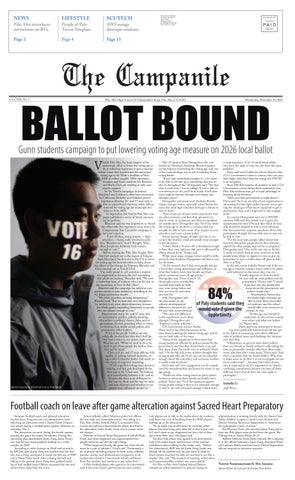
Vote16 Palo Alto, the local chapter of the nationwide e ort to lower the voting age to 16, is collecting signatures to put a measure before voters that would lower the municipal voting age to 16. With a deadline of May 2026 to collect roughly 3,000 signatures, founders and Gunn students Iris Blanchet and Rayla Chen are working to rally community support.
So far, Vote16 campaigns in several Maryland and California cities have succeeded. In California, Berkeley and Oakland passed legislation allowing 16- and 17-year-olds to vote in school board elections, while Albany lowered the voting age for municipal elections to 16 in 2024.
In September, the Vote16 Palo Alto campaign published a notice of intent announcing its petition.
Blanchet said she was inspired to co-found this e ort after her experience as an intern for Congressman Sam Liccardo’s campaign in last year’s election.
“I saw all these young interns — high schoolers — being really involved in politics,” Blanchet said. “And I thought, ‘Yeah, these people are de#nitely truly mature enough to vote.’”
Before starting the Palo Alto chapter, Blanchet #rst reached out to the mayor of Takoma Park, Maryland, the #rst city in the U.S. to lower the voting age for local elections, to learn about the e ects of the change. In February, Blanchet and Chen reached out to Vote16 USA.
“I'm really proud to call ourselves a studentrun organization, because this isn’t something that adults are leading,” Blanchet said. “We have a leadership team of students who run the day-today operations of Vote 16 Palo Alto.”
Blanchet said the campaign has tabled at community events to raise awareness, including at the No Kings protest last month.
“We pride ourselves on being nonpartisan,” Blanchet said. “But we were also very thankful to be invited to an event about democracy, because our whole goal is expanding democracy to people who are mature enough to vote.”
Blanchet said many 16- and 17-year-olds are interested in politics, actively involving themselves in political classes, clubs, and organizations, but feel powerless when it comes to elections that decide actual policies and government o ce holders.
“A lot of the people I talk to are very politically involved, but they don't feel like they have a voice in our system right now,” Blanchet said. “What we need to do is we need to give these people the tools so that they can be heard.”
Chen said 16- and 17-year olds are fully capable of making rational decisions, citing a 2021 Columbia Justice Lab study on two types of cognitive reasoning.
Paly ‘25 alumna Briar Dorogusker, who conducted an Advanced Authentic Research project on the impacts of lowering the voting age, said one of her main #ndings was its aid in building better voting habits.
“If you start something younger, it's a lot easier to be able to set that up as something that you really do throughout life,” Dorogusker said. “ e #rst time I could vote, I was in college. If you're able to vote when you're 16, you'll be at home. You'll have more support systems through your family and through school.”
Dorogusker said many local elections directly impact younger voters, especially school board elections, but most high schoolers don’t get a chance to vote in them.
“Even if you are 18 your senior year, by the time you elect someone, and then they get sworn in, they're sworn in in January, and then you graduate six months later,” Dorogusker said. “So if you lower the voting age to 16, there is a chance that you actually are able to have more of an impact on your education and more current policy.”
Senior Jazmyn Seeger, though, said she is concerned that families could potentially sway younger voters’ decisions.
“I don't think a 16-year-old is developed enough to have their own opinions that aren't in%uenced by others around them,” Seeger said.
While some argue younger voters could be in%uenced by their families, Dorogusker said that is true for all voters.
“In the research that I did, most people did get a lot of their voting information and in%uence on what they believe from their family, and that's pretty consistent across all age groups,” Dorogusker said. “Even if you're 30, the people you're surrounding yourself with really do in%uence your voting habits and who you vote for and what you vote for.”
Still, Dorogusker said she discovered no signi#cant developmental di erences between 16- and 18-year-olds in her research.
“ e only real di erence is the experiences you've been through,” Dorogusker said. “Eighteen is quite arbitrary.”

“Cold cognition is long-term decision making, and that gets developed by the time you're 15,” Chen said. “So looking at it scienti#cally, between a 16- and an 18-year-old, there is no di erence in the way we think and the way we make our own decisions and whether or not people have in%uences around us.”
Assistant football coach and physical education teacher Jason Fung was put on administrative leave following an altercation with a Sacred Heart Preparatory player during a football game against Atherton on Saturday, Nov. 1. e altercation occurred during the fourth quarter, pausing the game for nearly 10 minutes. During the preceding play, quarterback Justin Fung, Jason Fung’s son, had his face mask grabbed, leading to a costly penalty on SHP.
According to video footage on Hudl and an article by SFGate, after Justin Fung was tackled near the sideline, Jason Fung attempted to swipe the ball out of SHP junior David Sala’s hand. After missing the ball and falling to the ground, Jason Fung then grabbed Sala’s leg as Sala walked away. O cers separated the two and moved them away from the scene.
School o cials called Atherton police but o cers did not make any immediate arrests. According to a Palo Alto Online Article, Police Commander Dan Larsen said o cers interviewed the player involved in the altercation. Sala’s family chose not to pursue criminal charges.
Director of Sacred Heart Preparatory Football Mark Grieb said what happened was unprecedented but people stood up and did the right thing.
“What happened during the game last week should never be a part of athletics,” Grieb said. “Fortunately, a lot of people, including players on both teams, o cials, parents, coaches and administrators stepped in to deescalate the situation. I know both schools will learn from this incident and continue to put safety #rst.”
A Paly football player, who agreed to be interviewed only if his name wasn’t used because he said coaches
a weak argument. A lot of uninformed adults who have the right to vote can also have the same problem.”
Davis said most California school districts o er a U.S. Government course to seniors, who can soon after apply what they learn by voting, but PAUSD is an exception.
Since PAUSD requires all students to take a U.S. Government course during their sophomore year, Palo Alto students may get an early advantage in learning about elections.
“Here, you take government as sophomores,” Davis said. “So I can see why a local organization is advocating for this right earlier, because you're getting the training to what you're supposed to get in government class, and a large part is civic engagement.”
In a survey Dorogusker sent out to PAUSD students, 84% said they would vote if given the opportunity, but only 57% said they think 16-yearolds should be allowed to vote in local elections. She also posed free-response questions about why participants thought 16-year-olds may or may not be able to vote.
“For the most part, people talked about how they felt themselves prepared, but they acknowledged that other people may not be as prepared,” Dorogusker said. “One really easy way to #x this is easily in school: having more resources to help people know where to register to vote or give opportunities to have a ballot drop-o place in Palo Alto or at Paly.”

U.S. Government teacher Austin Davis said he has held discussions in his class about lowering the federal voting age, and he can see both sides of the issue.
“Some of the arguments in favor were that young people are a ected by policies passed by the government, and that they should have a say, and that many times the youth voice is unheard,” Davis said. “On the %ip side, some students thought that young people who are 16 are just not yet educated enough about life and policy and economic realities to really make decisions.”
Davis also said civic engagement can be complicated by misinformation and biases for voters in any age group.
“Adults are often voting based on party identi#cation or whoever their friends and family have picked,” Davis said. “So if the argument against young people voting is they're not educated enough, or they're not well informed enough, I think that's
told players not to talk to the media about the incident, said there was a lot of heckling from the SHP players leading up to the altercation.
“As an adult, you should never be touching other players, but that being said, what led to that is just a lot of I don't want to say chippiness but just a lot of disrespect from their side,” the player said.
Another Paly player who agreed to be interviewed only if his name wasn’t used because of the coaches’ prohibition about talking to the media, said, . “Before the (altercation), SHP late hit Justin Fung. Justin was already o the sideline and the guy came in head-tohead contact, knocked the ball out and held it out like a trophy,” they said. “ e amount of taunting, verbal abuse and unsportsmanlike conduct was unacceptable.”
On Nov. 4, Palo Alto Uni#ed School District released an online statement on paly.net saying its
In the end, senior Isabella Nunez said if the voting age is lowered, younger voters need to be politically informed on the issues they vote on. “It really depends on how involved 16-year-olds are with politics and the government,” Nunez said. “I would hope that only the people that knew about the government and politics would vote.” Nevertheless, Nunez said she thinks high schoolers are able to form their own political opinions, and the school should o er more resources to prepare to vote.
“At this age, you should already have an idea of your morals, your values and what you believe in,” Nunez said.
Davis said teens interested in becoming more politically informed should also get in the habit of consuming news about di erent sides of political issues and challenge the information they hear.
“Oftentimes, we get our ideas about politics from our friends or family without really taking the time to personally consider why these ideas make sense, why they don't make sense,” Davis said. “And that’s a question that we should follow: ‘Why does it make sense to do that? Let me investigate, let me try to understand’ … because that’s what democracy is supposed to do. It's supposed to be chaotic, confusing, complicated, because you have all these di erent voices that all have the same right to participate.”
Isabella Li Sta Writer
administration is working closely with the Santa Clara Valley Athletic League, Central Coast Section and District Human Resources department to “determine the appropriate course of action.” e Mercury News also reported Jason Fung and at least one Paly player were ejected from the game. e Vikings lost to Sacred Heart 28-21. Athletic Director Scott Davis referred e Campanile to the o cial statement. Jason Fung, Assistant Principal Ladonna Butler and head coach David Degeronimo did not respond to interview requests.
Naveen Narayanaswami & Alex Isayama Sports Editor & Lifestyle & Science/Tech Editor
PHOTO ILLUSTRATION BY LUCA VOSTREJS
City cracks down on RVs
The Palo Alto City Council unanimously voted at its Oct. 20 meeting to approve a phased plan to address oversized vehicles, including recreational vehicles parked on city streets that people live in.
e first part of the phased plan increases regulatory measures around the city, including the prohibition of parking inoperable vehicles on public streets, a ban on “vanlording,” increased street sweeping and increased regulatory signage.
e plan directs the city to work with groups such as LifeMoves, faith-based organizations and private businesses to provide permanent or temporary parking spaces for residents living in RVs.
e second phase of the plan aims to aid people living in vehicles through small-scale services such as mobile pump-outs, community outreach and garbage collection.
City Council member Greer Stone said these restrictions on RVs in Palo Alto started because the Council received many complaints regarding waste and sewage on streets near RVs.
“Palo Alto has a far greater percentage of our unhoused being sheltered in oversized vehicles than elsewhere in the county,” Stone said. “It has become clear to the city and the Council for a while that this was a growing issue and a concern that required a more nuanced policy discussion in order to be able to address.”
Many RVs in Palo Alto are parked in front of businesses. During the meeting, Victor Sloan, president of Victor Aviation Services Inc., located on Embarcadero Way, said a lack of regulations have significantly impacted his business.
He said nearby RV communities on Geng Road and Faber Place have caused blockages and delays for large deliveries because trucks cannot enter parking lots or make necessary turns.
“As a result, this is causing an additional cost for our company and delays for critical mission customers who are waiting for their products to be delivered or serviced,” Sloan said at the meeting.
Another major concern of Palo Alto residents living and working on streets where RVs are parked is waste and sewage. Keyler Escobar, a 10 year old living in an RV in Palo Alto, said it is often dirty around the RV encampments where he lives.
“Garbage, trash, bags and food,” Escobar said. “It’s hard to get rid of our garbage around here.”
Because of this, Escobar agreed that
systems like a garbage pick up service would be helpful for RV residents to help keep the streets clean.
Justin Harper, a Palo Alto RV resident who spoke at the City Council meeting on behalf of an RV community, said many residents pay $15 for a pump-out service that helps to remove waste from RVs.
“We know sewage can be an issue,” Harper said. “Some people just drive by, open their tanks, and drive off.”
Palo Alto resident Barry Katz, speaking at the Council meeting on behalf of the Ventura Neighborhood Association, said the phased approach suggested by the City will not deter RV residents but will entice more RVs to park in Palo Alto.
“My greatest fear is that the report is equivalent to putting up billboards up and down Highway 101 inviting people to move to Palo Alto where they will receive enhanced services: street cleaning, sanitation, hygiene, police and fire protection,” Katz said. “Best of all, at no cost.” e plan comes amid rising levels of homelessness in the Bay Area. According to Santa Clara County’s 2025 Point-in-Time Count Community Report, homelessness in Palo Alto has doubled over the past two years. e report also found that of the 399 unhoused individuals in Palo Alto, 76% are living in vehicles.
Mary Wisnewski, president of Heart and Home Collaborative, a nonprofit shelter for unhoused women in Palo Alto, said in the past 10 years, she has noticed an increase in the average age of people coming to the shelter as well as an increase in firsttime homelessness.
“For these people, an RV is a navigable home,” Wisnewski said at the Council meeting. “Many people see an RV as a viable option for their continued health and safety.”
However, according to Teresa Sanchez, who lives in an RV in Palo Alto, safety is not something that comes with her living situation.
Sanchez said she had to move into an RV three years ago, after getting into an accident working at a restaurant which left her with a broken hand. is injury left her with a $100,000 bill, which made housing unaffordable.
She said living in an RV has created dangerous situations including break-ins, since her vehicle does not have the same security as a regulated RV park, home or apartment.
“(Somebody) broke my door, and tried to rape me,” Sanchez said. “I have a video. ( ey) tried to take control and kill me. It
was a really terrible experience. I took a video, and I called the police, but the detective doesn’t call me anymore.”
In situations like this, Jose Mencidei Da Santos, an RV resident living in Palo Alto said the aid that would help RV residents the most would be safe parking so residents don’t need to be worried about constantly needing to move their vehicles.
“Even in the places where parking an RV is allowed, they ask for a lot of documents, and we don’t have them,” Mencidei Da Santos said. “We are searching for a place to go, but we are not finding anything.”
Mencidei Da Santos speaks primarily in Portuguese, so his interview was conducted using an interpreter app.
One clause of the RV restriction plan would include a ban on “vanlording.” Vanlording is a practice where people rent RVs parked on public streets at a reduced rate, offering a cheaper alternative to buying an RV or renting an apartment.
City Council member George Lu said vanloding is exploitative.
“Prices can be surprisingly high, and there are no guarantees about sanitation, waste disposal, and more,” Lu said in an email. “I recognize that some people depend on renting RVs to avoid street homelessness. We’re working on ordinances, and we’ll be thoughtful about how to proceed.”
While outlawing vanlording, the City Council has plans to work with faithbased organizations and private businesses through the Move Mountain View Safe parking program. is program works with
faith organizations and businesses to provide consistent, temporary parking spaces to people in Santa Clara County living out of their vehicles.
City Council member Julie LythocottHaims said the city hopes for a similar program in Palo Alto.
“If the city could lease those lots for the near term, that could bridge us until more permanent support and resources become available,” Lythcott-Haims said in an email.
One such organization is First Congregational Church of Palo Alto, also known as First Congo, at 1985 Louis Road. First Congo has been a member of the SAFE parking program since 2022. However, parking spaces are only provided to passenger vehicles and not RVs.
Associate Pastor Reverend Dr. Eileen Altman said faith communities hosting RVs is not a viable solution because RVs will not be able to move off-site during the day, while passenger vehicles can.
“Most faith communities in town operate a variety of programs during the day, like preschools or other programs in the congregation,” Altman said. “To have people living permanently on site would cause a variety of complications.”
Alongside First Congregational Church, Unitarian Universalist Church of Palo Alto and Etz Chaiym have all provided parking spaces for community members living in RVs.
With increased costs of living and the reduction of safety net systems for low income residents such as the Supplemental
Nutrition Assistance Program, Altman said more hunger and homelessness is coming.
“We all need to be aware that there are a lot of folks out there who are really struggling because of the rising costs of everything: groceries, housing, healthcare,” Altman said. “ e safety net systems that our nation has relied on for the last 60 years are rapidly fraying. I just think we all collectively are going to need to find better ways to support our most vulnerable neighbors.” Regardless of how the situation unfolds, Lu said the new RV and oversize vehicle restrictions will be a complicated path for the City.
“We need to do more, and we’re not imposing any outright ban,” Lu said in an email. “We recognize the humanity of everyone living in an RV.”
Other cities including Menlo Park and Mountain View have also passed regulations on the presence of RVs and oversized vehicles in their community, shrinking the number of places where vehicle dwellers can legally stay and intensifying fears of displacement. And this has RV residents concerned about their future in Palo Alto.
“Where are we going to go?” Harper said. “Menlo Park already doesn’t allow any of us. I’m not allowed back in Mountain View. I was told I’d be arrested on the spot if they saw my RV, so I’m stuck here. I can’t go north. I can’t go south.”
Leilani Chen Business Manager


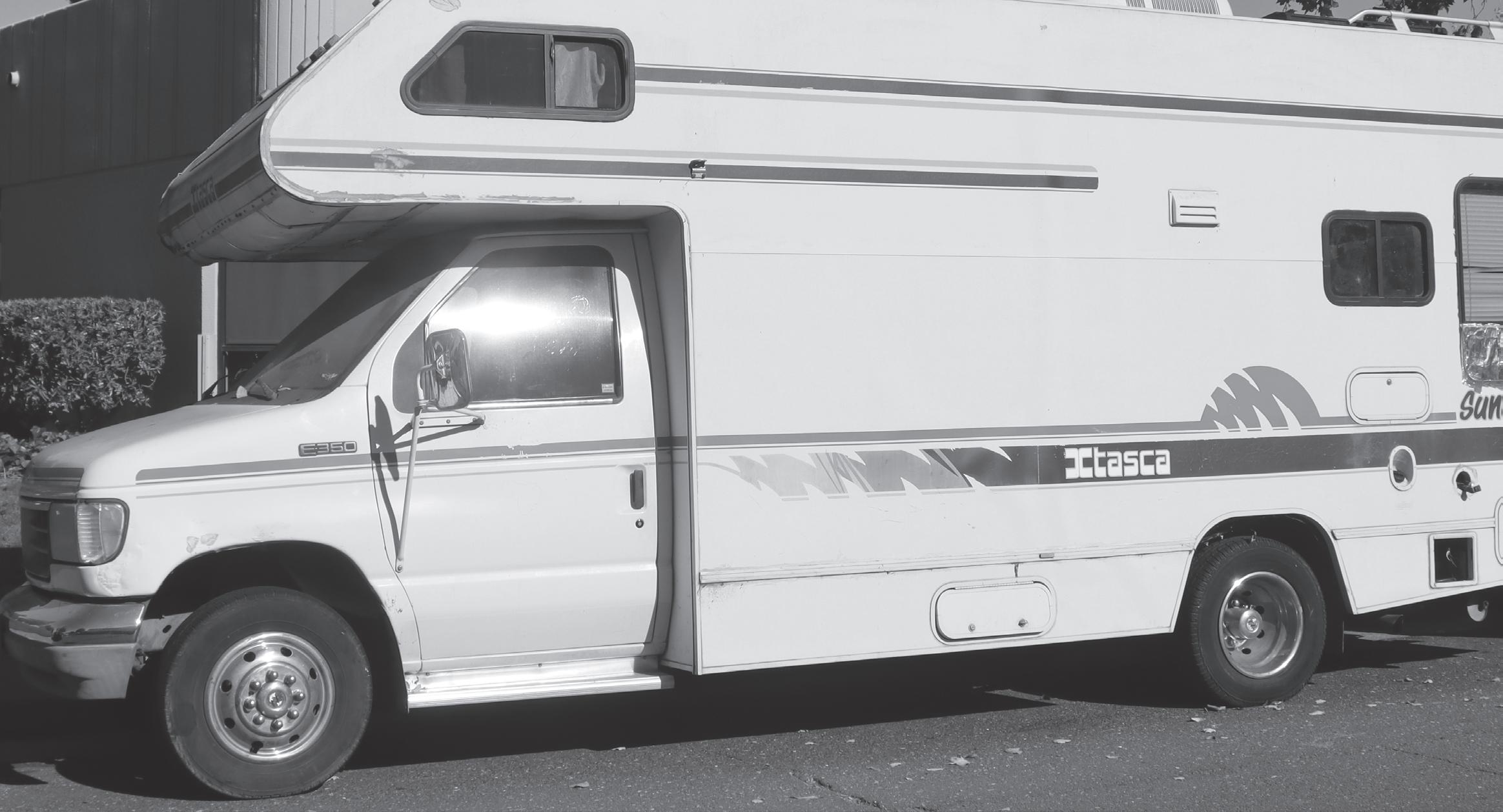
An RV sits parked along Faber Place in Palo Alto, where some residents have turned to vehicle living as a solution to high housing prices. “We want the residents of these RVs to search out work with us and other agencies to search for more permanent housing,” Palo Alto mayor Ed Lauing said.
LEILANI CHEN/THE CAMPANILE
California lights up
Gov. Gavin Newsom signed Assembly Bill 268 into law on Oct. 6, recognizing Diwali as an official California state holiday. e bill allows those who celebrate the festival to take an excused day off work or school.
Also known as “ e Festival of Lights,” Diwali celebrations can be both religious and celebrational. Typically, Diwali is celebrated over many days, which include time for prayer and large parties with friends and family. Diwali events encompass traditions such as rangoli, henna and sparklers.
Junior Laila Joshi said she was pleasantly surprised when she learned about the new law.
“I was definitely surprised when I heard the news, but in a good way,” Joshi said. “I am super excited about Diwali being recognized as a state holiday. It’s such a meaningful celebration and it feels nice knowing it will be acknowledged on a state level.”
Junior Rohan Bhatt said he hopes the designation will bring more visibility to Indian culture.
“Diwali being recognized as a state holiday for 2026 is a great step in the right direction for being able to put Indian culture in the spotlight in American society,” Bhatt said. “As a country, Indian culture is not highlighted and often is overlooked by many, but allowing the holiday to rise to the state level should create more awareness for Diwali and Indian culture as a whole.”
RuthAnn Garcia, an organizer for Mitchell Park’s “Festival of Lights: A Diwali Celebration,” said the recognition reflects California’s growing Indian population.
“Here in the Bay Area, certainly in the state and around the country, the Indian population is growing and contributes greatly to our communities and our culture,” Garcia said. “So I think it’s fantastic that a holiday like this, that is so meaningful to many people, could be recognized.”
Chemistry teacher Ashwini Avadhani, who has lived in the Bay Area for 30 years, said she has noticed an increase in Diwali recognition from non-Indian groups.
“Previously, there was no awareness because the Indian population was small,” Avadhani said. “But now … we invited all our neighbors for the Diwali party. ey came dressed in Indian clothes. So it’s become very inclusive — that is what I really like about it.”
Junior Maggie Crady, who is not Indian but celebrated Diwali with her friends of Indian origin, said she loved all the festivities.
“My experience at Diwali was so much fun,” Crady said. “I love experiencing a different culture than my own. My favorite part was getting henna done, which was so beautiful, and I got to show it off for the rest of the week. And I also really loved learning the importance of Diwali and the celebration of light.”
Bhatt said his family celebrates Diwali through both prayer and social gatherings.
“In order to celebrate, my family will conduct a puja, which is an Indian prayer ceremony, as well as attend many various Diwali parties, including one that we host each year,” Bhatt said. “Each party is filled with delicious food, dancing, music, and the atmosphere around Diwali overall make it one of the most enjoyable times of the year.”
Garcia said the annual Mitchell Park Diwali celebration event attracts up to 500 people of all ages, offering performances and interactive activities for the community.
Avadhani said she appreciates seeing more students engage with Diwali.
“I had a couple of students who came up to me and showed me their pictures that they attended some Diwali parties in their own kurtas and lengas,” Avadhani said. “Certainly there’s awareness.”
“People really have enjoyed seeing the kids dance, and I’m certain people will be willing to learn some of these moves and try them out themselves,” Garcia said. “In addition to the performances, we’ll be making some paper lanterns and some dias. ose are always really fun and popular, and the kids have a really good time making those.”
Federal budget cuts to affect youth mental health center
Isabella Li Staff Writer
Project Safety Net, a suicide prevention nonprofit, hosted a community meeting to discuss impending budget cuts to Santa Clara’s Behavioral Services Department at the Palo Alto Art Center on Tuesday. e meeting was led by County Supervisor Margaret Abe-Koga.
In July, President Donald Trump signed H.R. 1 into law. Also known as the One Big Beautiful Bill Act, H.R. 1 cut roughly $1 trillion from Medicaid. BHS Deputy Director Megan Wheelehan said these cuts will likely affect the Palo Alto mental health center allcove, which was founded by Stanford Medicine in 2021 to serve youth aged 12 to 25.
“Medi-Cal is our largest funding source, and so the changes under H.R. 1 are going to limit our ability to expand services, and also require us to reduce services in many areas,” Wheelehan said during the meeting. “Pretty much every evaluator found that some local funds will be required to operate allcove, even in a best-case scenario around medical billing and commercial insurance billing.”
According to BHS Division Director Jennifer Pham, approximately 1,400 youth have come to allcove for mental health services since its creation.
“What we’re focusing on is this integrated model,” Pham said. “Mental health services, substance use prevention services, physical health services, supported education, employment services, peer support and just a community space where educational workshops and social events can occur.”
After sharing personal experiences with allcove, community members, including current and former PAUSD students, urged community leaders to preserve it.
Stanford Professor of Psychiatry Shashank Joshi said over 70% of youth who visit allcove say
they wouldn’t have sought help elsewhere, underscoring its importance. is is not just a mental health clinic; it’s a lifeline,” Joshi said. “Every dollar invested in allcove saves exponentially more in crisis care, in ER visits, in hospitalizations.” Paly alumni Tess Manjarrez, who benefited from allcove’s services in college, said the services are worth the costs.
“I understand, as I think every native Palo Altan does, that money is the most important factor here,” Manjarrez said. “But please do consider the incredible value of what having a real, accessible, free third space does for children who may not feel like they can access safe care anywhere else.”
Gunn sophomore and allcove Youth Advisory Board member Alina Fleischmann said allcove’s youth-centered system and accessibility make it vital for the community.
“Yes, there are psychiatrists. Yes, there are therapists, but those are hard to find and even harder to access without parent permission,” Fleischmann said. “And the amazing thing about allcove is that it supports youth; by youth, for youth.”
At the end of the meeting, Abe-Koga called on the community to share ideas on how to continue funding allcove’s services.
“I don’t want to get rid of allcove,” Abe-Koga said. “But as we’ve shared, in terms of our budget situation, everything is on the table right now, and so I need your help to figure out … how do we maintain our services, but be able to do it at a lower cost?”
Ultimately, Manjarrez said, these budget cuts are a symptom of a larger nation-wide problem around youth mental health.
“Federally, this is going to keep happening until we can change the trajectory of funding,” Manjarrez said. “We are seeing a culture and leadership that are devaluing mental health, that are devaluing the arts, that are devaluing funding and devaluing protecting youth.”
Ultimately, Crady said she hopes Paly will do more to recognize the holiday on campus. “I don’t think the school does enough to recognize Diwali,” Crady said. “It’s a really important celebration for a lot of people, and when it becomes a state holiday, I’ll be really excited to see how it expands in the eyes of people who don’t celebrate it.”

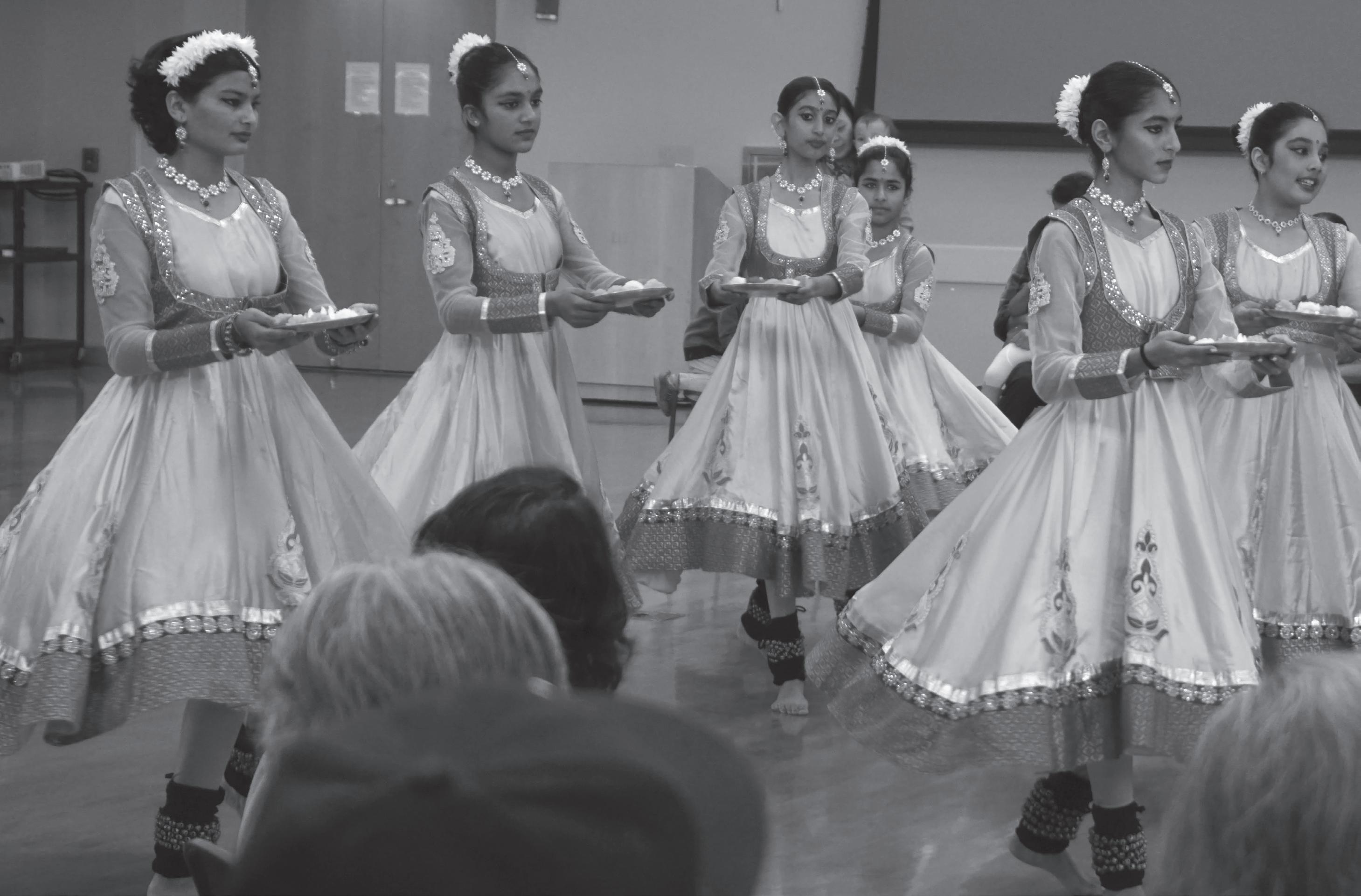
Local teen dancers perform cultural dances at Mitchell Park as part of the Celebrating Cultures initiative in 2024. Program organizer RuthAnn Garcia said these events incorporate many holidays and observances celebrated in Palo Alto. “It’s a really diverse crowd: not just people who celebrate it, but people who want to learn about it and join in celebration, too,” Garcia said. “It’s great for these communities to feel seen and heard, but it’s also great for other groups to learn about these cultures and celebrations.”
DORIS CHEN/USED WITH PERMISSION
Zoya Prabhakar Digital Managing Editor
Kira Tzeng Staff Writer
e San Francisquito Creek Joint Powers Authority held an informative and participatory Zoom meeting on May 28 to discuss flood prevention measures in response to resident concerns surrounding neighborhood flood risks. e meeting was open to all Palo Alto community members.
In recent years, flood risks have been an issue, especially in the Crescent Park district.
One incident in 1998 resulted in a record flooding of 7200 cubic feet of water per second, damaging over 1000 homes in that area. Palo Alto resident omas Rindfleisch said he and his neighbors were personally affected by that flood, including loss of furniture and equipment used to operate homes.
“We had a foot and a half of water in our yard,” Rindfleisch said. “ e streets were lined with ruined furniture and carpeting and all sorts of contents of houses that had to be destroyed and replaced in order to make them livable.”
e JPA, formed following that flood, consists of five representatives from Santa Clara Valley Water District: East Palo Alto, Menlo Park, the San Mateo County Flood and Sea Level Rise Resiliency District and the City of Palo Alto.
Margaret Bruce, the Executive Director of the JPA, said her organization coordinates money from grants, other kinds of funding and financing, and consultants and technical experts who advise us on ways to approach these kinds of complex projects.
“We’ve known about this problem forever,” Bruce said. “Two counties and three cities have a really hard time agreeing amongst themselves, so the JPA was formed as a place to be one table where five musketeers could come together and hash out their conundrums, their problems, their conflicts, their ideas, put money into a pot together to run the organization.” According to Bruce, flood zones can be ranked into several categories including 1 in 100 floods, 1 in 75 floods and 1 in 50 floods, with the numbers representing the frequency in a certain number of years, among others.
“It’s a kind of calculation that is bigger than a bread box, smaller than an elephant,” Bruce said. “Every flood, every storm, is different, because the channel has many chaotic variables.”
According to the Federal Emergency Management Agency, Crescent Park is categorized as an AH zone, which is an area likley to get fairly shallow flooding of less than three feet depth. e flooding source of the AH Zones in Palo Alto is overflow from the San Francisquito Creek. In response to this, former mayor Greer Stone, now the Palo Alto representative to the JPA said the JPA board unanimously approved a flood mitigation goal of achieving a creek capacity that would prevent accidents similar to the one in 1998.
“In order to achieve that goal, we will need to use a variety of strategies,” Stone said. “Our own consultant has confirmed that no one strategy will achieve the 7,200 cubic feet per second goal, so it is likely that some version of flood walls will be necessary in certain locations along the creek, but the size and extent of those flood walls are still to be determined.”
One proposed solution was to build flood walls in Menlo Park in order to resolve the danger at the stem of the problem. However, Stone said this plan may be harmful to the citizens living there.
“While structural measures like flood walls can provide protection, they also raise valid questions about environmental impacts, aesthetics and equity between communities,” Stone said.
Similarly, Bruce said the construction of the walls in Menlo Park would negatively impact the people with properties along the creek in Menlo Park by invading the space with disturbances, such as dust, noise, vibration and traffic.
e people who are benefiting from the project do not have the impacts of construction,” Bruce said. “All of the people along Woodland Avenue and Palo Alto Avenue will have impacts of construction, and they don’t benefit from the project. It’s a tragedy of the commons problem.”
As a result of these detriments, community members have looked for more viable solutions, one of which is Rindfleisch’s proposal to repair the Pope-Chaucer Bridge, which he said has become similar to a dam with a big hole in it.
“It isn’t a question of putting some band-aids in the creek,” Rindfleisch said. “It has to be a systematic project that takes everything from Highway 101 up to replacing the Pope-Chaucer Bridge in order to really upgrade the creek so that it could handle the 1998 flood.” Without a definite solution, Bruce encourages community members to remain vigilant and take precautionary measures, such as helping neighbors, ensuring storm drains aren’t clogged and making sure people have basic emergency preparedness against future catastrophes.
“Until this is finished, everybody needs to be aware of the risks and protect themselves,” Bruce said. “ e chances of there being a life-threatening flood are very, very small. e chances of there being a property damaging flood are more significant. But it doesn’t mean there’s no impact at all. So be prepared.”
People of Paly: Trevor Vaughan
Sophomore Trevor Vaughan props up his phone, takes a quick breath and hits record. Music swells through his room as he begins to sing — not for a crowd, but for a camera. Within days, thousands of listeners will hear Vaughan’s voice online, and millions more might scroll past the same clip that made him go viral last summer.
Vaughan, who goes by the artist name Trevor V, went viral last summer after a video of him singing ‘ e Hills’ by e Weeknd amassed more than 9.5 million views on Instagram. Vaughan produces music covers and original music content online, which reaches tens of thousands to millions of people.
Vaughan said this recent attention meant a lot to him.
“Now I’m kind of used to it, (but) I wish I wasn’t, because I’m kind of taking it for granted now,” Vaughan said. “At first it started at a million, and it got a million every day, and then it slowed down. But when I first got that million, I was going crazy.”
Vaughan said the online recognition connected him to people across the school.
“A lot of people at school know me for my music … I usually think they don’t actually like me. ey’re just doing it because I’m a name that people know,” Vaughan said. “But knowing that a lot of random people saw my video was kind of crazy and exciting to me because they don’t know who I am. ey just stumbled upon my music, and now they know who I am, so I can show them what I’m worth, show them what I like and who I am.”
Additionally, Vaughan said his recent online fame has also led to recognition from professional music artists.
“A little later, Halsey liked that post, and that was even crazier for me because I like her music, and that’s an actual professional artist who makes a living off of it,” Vaughan said. “She liked my post and saw it. at was just crazy.”
While the fame brings support, it also comes with criticism, which Vaughan said he tries to tune out.
“A lot of the comments on Instagram are 40% negative, 40% positive and 20% just weird,” Vaughan said. “ e negative ones I kind of just ignore. I do look at them sometimes and get a little disappointed, and think I’m not good enough, that I should be better, or that I need to work harder. But a lot of the time, I ignore (them). Especially when I look at the comments that are positive … I completely forget about the negative, because I love music so much that I don’t really care about what people think.” is love for music has been a constant part of Vaughan’s life for as long as he can remember.
“I’ve always loved music and singing,” Vaughan said. “ e first songs I remember hearing and loving were ‘Whatcha Say’ by Jason Derulo and ‘What’s My Name?’ by Rihanna.”
Vaughan said he’s drawn to music because it comes naturally and brings him happiness.
“I like how my body can kind of take over, and I can kind of just jam to it,” Vaughan said. “It gives me so much joy. at’s the main reason, and the only reason I love music. It makes me happy.”
Vaughan said he credits pop artist Olivia Rodrigo for inspiring him to expand his love for music by introducing him to the process of songwriting in sixth grade.
“I watched her YouTube videos. How she made songs — her inspiration. So then I started writing music. It started out more like ideas, but I then fleshed them out into real songs and started learning how to produce music.”
But Vaughan said what impressed him most was the intricate and deliberate nature of songwriting.
“What really made me inspired by Olivia Rodrigo was how she wrote the lyrics, the rhyming she did, the metaphors, stuff like that,” Vaughan said. “I just thought it was really interesting how she made each individual part of the music. Not just the song as a whole, but how each little detail made the song so magical.”
Vaughan said he also draws inspiration from other music while infusing his own style.
“When I make music, it’s mostly about what I think of the song, the feeling of the song and the groove of the song,” Vaughan said. “A lot of the time, I’ll listen to a song, and then I’ll love it so much that I’ll try to make a song with a similar feel to it. So I kind of take inspiration from other people’s music and songs I like, and then try to make that my own.”
ough his first early songs were rough, Vaughan said enjoying the process mattered most.
“When I first started making music, I made three songs in a month and put them out,” Vaughan said. “ ey were horrible, but I’m still proud of them, because I loved them and had fun with them. And so if you love what you do, it doesn’t really matter what people think of it, or how many views it gets, or whatever.”
Vaughan said the key to success depends on passion, practice and determination.
“I would say it’s mainly just loving it enough to where you just want to do it 24/7,” Vaughan said. “Because the more you play your instrument, or whatever you’re trying to do, you’re going to get better at it no matter what if you keep doing it. Just do it all the time, and then don’t be scared to learn new things.”
Even so, Vaughan said encouragement from friends and family has helped him continue pursuing his passion.
“It just motivates me to make something that they’ll like — make something that I like too,” Vaughan said. “I want other people to be proud, or think I’m at least good enough to start doing it. I don’t want people to look at me and then think I’m a joke, which I tell myself people do for some reason. For some reason, whenever people say they like my music or talk about my music, I always tell myself that they are mocking me or don’t like my music when some of them are genuine.” Recently Vaughan performed live for the first time.
“I did my first performance, a month or so ago,” Vaughan said. “And I love performing. I love giving people a good show. I love showing people what I love … I just want to give them my passion for music.”
ough he dreams of a professional music career, Vaughan said he tries to stay realistic.
“In the future, I wish to, obviously, make a living off of it,” Vaughan said. “I want to perform my songs more and I want to have a larger fan base. But realistically, it’ll probably be more like a hobby, because music’s not easy to make money off of, especially if you’re not very, very good … so I’ll have to work really hard, or I can just accept that I won’t do anything with it.”
Nevertheless, Vaughan said he continues to stay focused on improving and creating music more consistently.
“I’ve been having more fun with music and practicing my instruments, getting better,” Vaughan said. “Eventually, I want to be able to make songs quickly and release them so my fans can actually have a consistent stream of new music.”
And sophomore Rayhan Brinck, a friend of Vaughan’s, said what sets Vaughan apart is his relentless passion for music.
“He has a lot of perseverance in him,” Brinck said. “He’s one of the few people I know who has a creative hobby and just keeps working and working and working. He’s been working on it for years — before I even knew him … he just hasn’t given up on it, no matter how bad he thinks it is, or other people think it is. He spends all his time doing music, and that’s really admirable. I don’t know anyone else like that.”
In the end, Vaughan’s love for music — whether it be through practicing, producing or performing — drives everything he does.
“I just love making music so much that I just kind of do it whenever I can,” Vaughan said. “When I get home, I’m waiting to make music, I’m just anticipating that. at’s what I want to do any time of the day in my free time. I think about music all the time.”

Dashel Chun Staff Writer
PHOTO ILLUSTRATION BY EDEN YOO JUSTIN CHEN/USED WITH PERMISSION
Lifestyle
Promises of Empowerment

urled up on her couch with her laptop glowing in front of her, senior Sophia Zhang watches this year’s Victoria’s Secret Fashion Show live. e show, with the theme Reawakening, kept the brand’s signature wings and glittering heels yet promised a new era of empowerment.
As models appeared on her screen, Zhang said she noticed a wider range of skin tones and body shapes than in years past. But instead of feeling inspired, she found herself questioning whether the brand’s sudden inclusivity was genuine or just a
ey used to be very white-centric, with mostly white models, and now it seems like they’re moving towards a more inclusive approach,” Zhang said.
“But I’m not sure if it’s because they truly want to or because they realized that other industries — like makeup and clothing — are becoming more diverse and doing better because of it. If they wanted to keep making money, they knew they had to be more inclusive.”
For senior and former model Cailey Quita, the brand’s message erently. Having grown up in modeling, she said Victoria’s Secret’s shift toward inclusion felt e fact that they’re stepping out and showing it shows how much they want to commit to that mission,” Quita said. “Seeing an Asian represented, like Suni Lee, who’s such a role model for me because she’s Asian and strong as an athlete — it’s almost like seeing myself as an Asian athlete. She was modeling, and I used to do runway, so it was one of those ‘I see Junior Kate Lindstrom, though, said the rebrand felt less like progress and more like performance. To her, the company’s e orts at diversity hide deeper issues that still exclude many women.
“It is 100% a marketing tactic,” Lindstrom said. “ ere is no real change that we are seeing. Just because you have one Black model does not mean you are actively representing di erent groups — not just race, but also disabled or LGBTQ+ models. It’s just talk. ere’s no action behind the words.”
e show also featured Olympic athletes — a move that sparked debate online. Some critics argued their bodies didn’t t the traditional model look. But Quita said expecting women to match a single standard defeats the point of empowerment.
“I don’t think there’s a speci c model look,” Quita said. “Looks are subjective, and you shouldn’t say, ‘Oh, this girl has a model look, and this girl doesn’t.’ For example, Suni Lee has a gymnast body — it’s unique to her. at shouldn’t limit her. ere shouldn’t be a stereotype that models have a c look.”
Zhang said the criticism toward athlete models reveals how much beauty standards still shape ideas surrounding femininity.
“People liked Victoria’s Secret because it sold this image of perfection — a perfect body, a perfect face,” she at’s what the brand was built
on, so people aren’t used to seeing it change. But I think having Olympians there is great — they’re literally some of the people in the world. We shouldn’t be criticizing their bodies. If anything, that’s what healthy and strong looks like.”
However, Lindstrom said the show’s version of empowerment still leaves out many women, like those with wider rib cages, and only celebrates certain body types.
“In the fashion show, we are only letting who we want to be empowered be empowered,” Lindstrom said. “ certain body types that are being promoted … and we’re showing the same people, so it’s not true empowerment.”
While Lindstrom appreciated the runway variety this year, it still came with limits. Both Olympians and traditional models, she said, represent an unattainable level of perfection.
“Anyone performing in this fashion show is going to be the most extreme version of this idyllic perfection that real people aren’t gonna be able to recreate,” Lindstrom said. “ worked really hard on their bodies — for the Olympians, to make sure that they can perform and play their sport; and for the models, to make sure that they are this level of perfection. But either way, that’s not the average American.”
Lindstrom said the lack of broader representation stems from deeper industry incentives that prioritize what sells.
“ ere are di erent body types that could be represented, but at the end of the day, a fashion show isn’t gonna hire somebody that people aren’t going to want to watch,” Lindstrom said. “A lot of these fashion shows, the imagery, the personi — they’re adhering to the male gaze.”
She also warned that token gestures, like adding one plus-size or nonwhite model, can create the illusion of progress.
“ ere has been an increase in representation in major corporate fashion shows like the Victoria’s Secret one, but that’s one model in a show of however many it is,” Lindstrom said. “ ey’re doing the bare minimum and getting all this praise for it.”
Still, Zhang said seeing more variety, even if it’s not perfect, reminds her that there is no one de of beauty.
“It helps me feel more seen,” Zhang said. “Obviously, there’s a wide range of body types, and most people don’t look like the models on the runway. But seeing that kind of diversity reminds me that beauty doesn’t only look one way.”
Annika Chu Print Managing Editor

Captured in time: memories digitized
Photos
help to transport people back to a moment in time, impacting memory and the past
As junior Ellie Knott sits on the plane to her next destination, she opens one of the only apps that can work without Wi-Fi or cellphone service — Photos. As she scrolls through her extensive camera roll, she aims to delete photos in order to free up storage on her phone. Yet in the process, a photo catches her eye, one that brings her back to the exact moment it was taken. With over 5.4 billion photos taken around the world every day, Knott’s experience is common. Using camera rolls to capture special events has become ubiquitous. While photos serve as a snapshot of people’s lives, they can also transport someone back in time.
Kija Lucas is a Bay Area artist who uses photography to explore ideas of home, heritage and inheritance. She said she values photos for their ability to bring back memories, citing a particular example of a Polaroid picture uncovered during the holidays. is particular photo depicts Lucas’ younger brother looking upset after discovering an unfortunate fact.
“My older brother and I had decided that it was time for our younger brother to learn some di cult truths about Christmas — it was far too early for him, and not the place of his siblings who were just 2 and 4 years older to share this information with him,” Lucas said. “I still feel a pang of guilt when I see this image.”
Although people do take photos to remember the moments they are living in, the act of taking a photo can have its own a ect on memory. A 2021 study by Binghamton University found participants who photographed art remembered it more poorly than those who just viewed it. e participants who took photos of the art had impaired memory when it came to visual details of the artwork and the meaning of the piece.
As far as memory recall goes, however, photographs do trigger memories. According to Joshua Sariñana, a neuroscientist with his Ph.D. from MIT, photographs can serve as memory storage and, when viewed, can activate memory recall.
Still, a study by Iris Blandón-Gitlin and David Gerkens warned using photographs as memory retrieval aids can signi cantly increase the likelihood of false memories.
Lucas said she can see how this would be true.
“A photograph might trick our brains into thinking we are looking at the thing in the image,” Lucas said. “ at is also something I think about a lot in my work — I often say that a photograph is a great place to lie, because it is always assumed to be the truth.”
Regardless of research, though, many people still use their camera roll as personal memory archives. Knott said she usually takes photos of big events or places that she wants to remember.
“I don’t take photos to remember the place, but more the happiness I felt when I was there,” Knott said.
Similarly, freshman Kishan Chokshi said he uses his camera roll as a way to connect with others.
“I often look back on my camera roll to show other people the funny things I’ve captured,” Chokshi said. “I only actually take photos of things that might be of interest to not only me, but others as well.”
More than a photo archive, Lucas describes her camera roll as a snapshot into her brain.
“(It’s) a scattered mess of screenshots and interesting or funny things I saw and will probably never look at again, except when I am looking for something else,” Lucas said. “A lot of images of beautiful light, memories from trips or times with friends, a lot of images of my art I texted myself from my computer to post on Instagram and old family photos that I scanned a long time ago.”
For Chokshi, his photos serve as a digital collection of memories that can be shared with others.
“Personally, I often sort of groom my camera roll in a way so that when I show it to other people, like my friends, it appears silly,” Chokshi said. “I think it shows that I care about social opinion.”
While photos can hold lighthearted memories, they can also hold more complex ones as well.
Lucas said it is because of photographs she knows what her great-grandparents, who passed away years before she was born, looked like.
“Family photography can keep us connected from far away as we move further from one another,” Lucas said. “Photos can help us to see and understand ourselves and how we have grown through our lives, to understand that our parents were people before we existed.”
Not only can photos help bridge gaps between families, they can also help connect strangers.
“ ey look into the eyes of a stranger from across the world,” Lucas said. “Sometimes that stranger is related to us. We might understand how our people from another time or place dressed or lived. We might see how their homes were kept. How a neighborhood was before it changed.”
Inspired by the idea that tangible things can hold memories, Lucas created Objects To Remember You By,
an art exhibit where Lucas would photograph volunteers with objects they wanted to be remembered by.
“I started to wonder what it is that people hold on to, why it is we carry these things through our lives — these things are sometimes beautiful and sometimes burdensome and sometimes a mix of both,” Lucas said. “I show this work as ‘ e Museum of Sentimental Taxonomy’ and in doing so, bring into question whose stories get told and what objects and stories are considered valuable and worth holding on to.”
rough her lifetime experiences with photos, Lucas said photos hold an unexplainable signi cance in our everyday lives.
“Perhaps that is where the power comes from,” Lucas said. “A photograph can bring us back to a time and place, and I think it is important to have them in order to remember times, places and people —including versions of ourselves.”
Mirai Matsuzawa News and Opinion Editor

ARTBY SOFIA SINGER
ART BY REINA LIM
Lifestyle
Lights, Camera, Action!
Students build careers in entertainment while balancing school
While Palo Alto High School is known for its focus on academics, some students are navigating the world of auditions, lm sets and photo studios — building careers in the entertainment industry long before they receive their high school diplomas.
Brendan: Beyond the Roles
Senior Brendan Giang’s artistic journey began unexpectedly. e summer after seventh grade, I got an email from the Palo Alto Children’s eatre asking for auditions for their Berenstain Bears production,” he said. “I had never done anything theater-related before … I just went in and I retold a fable. I was in there for ve minutes, and the director just patiently waited for me to nish.”
Despite his lack of experience, Giang said the opportunity introduced him to a welcoming theater community.
“I was cast as Too Tall,” Giang said. “It wasn’t a lead role, but I had a blast doing it, and that started my theater journey.”
After performing in more shows with the Palo Alto Children’s eatre in middle school and participating in several Paly eater productions, Giang said he also discovered a passion for lmmaking.
“As an actor, you’re at the mercy of the opportunities that are o ered to you,” Giang said. “I wanted to tell my own stories. I wanted to have more creative agency.”
Since then, his projects have gained national recognition. His rst documentary, “ reads of Change”, won the national C-SPAN competition. His momentum continued with a short lm titled “Cake with the Cream.”
“We crowd-funded almost $4,500 for the project,” Giang said. “It was later chosen for the 2025 All American High School Film Festival, and screened in Times Square, which was really exciting.”
Balancing these demanding activities with Paly’s academic workload, Giang said it requires strong organization and sacri ce.
“Google Calendar is the short answer,” Giang said. “I plan everything. Everytime that I sit down and do 10% of planning, it makes the leftover 90% of the time more productive.”
Giang said he has also experienced the entertainment industry’s limitations regarding race.
“I have been fortunate enough to be represented by an agent and do commercials and photoshoots, but yeah, in general, the lm industry is racist like that,” Giang said. “ e types of roles that I was eligible for as an Asian male teenage guy are the school bow nerd or the techy guy.”
In response, Giang said he focuses on creating his own opportunities through lm.
“I truly believe that if we want to see more Asian representation … it’s on us to create opportunities for ourselves,” Giang said.
Ultimately, Giang said he hopes to merge his background in STEM with his passion for the arts and storytelling.
“I would just like to encourage everyone to explore some way to express yourself creatively,” Giang said. “It doesn’t have to be theater or lm ... I think there’s something invaluable in that.”
Ana: A 70-Year Span
From her start on the Paly stage as a freshman to performing in local professional theaters, senior Ana Christina Ramirez has bridged the gap between student theater and the professional world.
“I found my love for musical theater when I did Mamma Mia,” Ramirez said. “I actually ended up understudying Sophie, the lead role, and then performing it for one show. at’s when I realized I was kind of good at it.” Since then, Ramirez has moved beyond Paly eater into professional acting.
“I worked with two adult professional companies,” Ramirez said. “I’ve worked with great casts where it feels like a family more than anything else, even though there’s people who are over 70 years old and there are four year olds as well.” rough these experiences, Ramirez said she learned how demanding professional acting can be.
“It’s insane,” Ramirez said. “During tech week, we rehearse for up to 14 hours a day. I’m so tired. I’m so overwhelmed all the time, but I mean, it’s fun. I think it’s worth it.”
Ramirez said she has also encountered challenges in professional environments.
“I worked with two adult professional companies: Palo Alto Players and Sunnyvale Community Players,” Ramirez said. “ e Sunnyvale one is less funded. ere were a lot of con$icts between the director and the cast, (because) how much they were taking the actors’ needs and wellbeing into account was really i y.”
But Ramirez said she still plans to continue her artistic career while studying.
“I want to major in psychology and also in vocal performance,” Ramirez said. “I will probably start to get into more of the bigger stu including TV, if I can.”
Although she loves performing, Ramirez said pursuing an unconventional career path at Paly can be discouraging.
“Paly also has this feeling of like, you’re either the best or you’re nothing,” Ramirez said. “It discouraged me a lot ... but if you’re just doing it because you love it, you really shouldn’t pay attention, even though it’s hard.” Ramirez said she encourages students interested in entertainment to look for opportunities outside of school.
“If you really want to take it seriously, you should de nitely try to get involved with it outside of school,” she said. “ e Paly eater program and choir teachers are great, but there’s only so much they can do since they’re school programs.”
Cailey: A Full Circle Moment
While Ramirez found her community on the stage, senior Cailey Lilly Quita’s journey began at age six in commercial modeling.
A single Christmas ad for Carter’s evolved into a career of print modeling and advertisements for brands like Target, Athleta, Pottery Barn Kids, Del Monte and Disney Store.
“I was in a chair getting my makeup and hair done, getting tted for wardrobe and being in front of a camera, which isn’t something typical kindergarteners do professionally,” Quita said. “I thought it was really interesting that I got to have that kind of experience.”
rough trying to balance school and work, Quita said she has learned to prioritize.
“I’m still with my agency MDT,” Quita said. “It’s just harder to keep up with modeling in high school, especially with academics. ey’ve called me in for commercials and shoots and I just can’t make it because of nals or big tests. I’m also in Paly Cheer, journalism and track … so it’s pretty hard to keep the balance.”
Quita said she has noticed a positive shift toward inclusivity in commer cial modeling, often being cast in diverse, multi-ethnic families.
“In the Disney Store ad, I’m Filipino and my dad would be Chinese and Irish,” Quita said. “My mom would be Vietnamese and my brother would be Caucasian and we’d all be one big family of Asians.”
Quita said her early exposure to the world of advertising has in$uenced her future career goals.
“I’m actually planning on majoring in something around PR, marketing, advertising and journalism,” Quita said. “It’s interesting to look back and be like, ‘I might be going into advertising, but I was in advertisements myself.’ It’s like a full circle moment.”
Alana: The Triple Threat
Freshman Alana Gordon entered high school already immersed in the entertainment industry.
“I just fell in love with dance when my mom put me in when I was two,” Gordon said. “As I went to dance conventions, people there inspired me and helped me get into the industry.”
rough professional work like modeling for Gap and Athleta and dancing for Chris Brown’s daughter’s birthday party, Gordon said she has learned more about herself.
“I’m more of a shy person, so dancing and acting — especially with talking on camera — has de nitely brought out a di erent side of me,” she said.
Gordon said perseverance and not taking rejection personally is key.
“It’s not fully based on your talent,” Gordon said. “It’s mostly the full vision they’re looking for ... if it’s meant to be, then it is. I don’t take anything too seriously.”
Although still a freshman, Gordon said she hopes to continue her work in college.
“I would want to go to college in LA, so it’s more convenient with all my industry work,” Gordon said. “I was thinking of doing a business major and something related to dance.”
And Gordon said her passion for is what helps keep her motivated.
“If you really love what you do, what people around you are doing (doesn’t) really matter,” Gordon said.
Cindy Liang Print Managing Editor



MARSHA QUITA/USED WITH PERMISSION
Rage-baiting 101
Sitting down at our lunch table, our friend Dave goes on his millionth rant about why “Grey’s Anatomy” is the best piece of media ever created. As always, we were just there, slowly dissolving into the bench, contemplating our life choices.
We’ve all got a Dave in our lives. And the key to turning that pain in the butt into a mischievous masterclass is the art of rage-baiting. It’s not about starting a real ght; it’s about the performance you put on. So, this is your ultimate step-by-step guide to getting the job done: Rage-baiting 101.
1. Pick your player ... or your Dave is is the easy part. ink of it like playing Mario Kart: you wouldn’t randomly pick any character. Just like you wouldn’t bring Bowser, a heavyweight bruiser, to debate the emotional subtext of “ e Summer I Turned Pretty.” at’s a job for the small and nimble Toad. Choosing your character and power-ups set the stage for your whole game. Whether it’s your strict mom or your classmate, the ultimate strategy

is nding someone you know well enough to rage bait. You know who they are. Maybe it’s your aunt who has a slide deck on why cilantro is a weapon for healing or your friend who thinks TikTok videos are a valid primary source. Find that person.
2. Pick a topic they care about — with an obvious answer Next, you need a subject your target obsesses over. You know, the thing they talk about constantly and bore everyone to death with. at’s your bait. In our quest to ragebait Dave, we chose to go with the best TV show. You know how you get to pick your power-ups in Mario Kart? Pick that topic they would jump at the chance to discuss, like a shark to the scent of a drop of blood in the water.
3. Open with a silly claim they don’t know much about Don’t go in guns blazing. Be smooth. Start with a quiet, almost casual, comment. Remember, you’re not exactly declaring war; you’re just planting a seed, hoping to spark a ame. In our ragebait journey, we confronted Dave about the lm masterpiece “Cocomelon.” en, focus on how they react: Are they going for it? Not interested? Keep going with these comments until they seem interested and ready to start a conversation. Like any good irt, start with the small talk, build up trust and then grow from there.
4. Present a con dent opposing opinion is is your hot-take-moment. Your outrageous statement. Your abominable appeal. But be casual about it — nonchalant, if you will. You have to say the sky’s green with the con dence you’d have telling them the sky’s blue. Nothing too crazy though. en, pause for a moment and let them respond. In our case, we heard Dave’s outrageous response critiquing “Cocomelon.” en, we looked him dead in the eye and said “I mean, let’s be real, there’s way more depth and drama in ‘Cocomelon’ than in ‘Grey’s Anatomy.’” e key here is your tone. You have to sound like you’re simply revealing a fundamental truth. Tell yourself this isn’t an opinion –– it’s a fact.
The Funpanile


5. Refute responses with wit; the more absurd, the better is is the main quest, and the key is con dence. Now is when you lean in hard. Imagine you’re in the “Simpson” family: you know, when your average crazy is never crazy enough. No matter what comment you pull out, it’ll always seem normal. e more con dence, the better. And for every rebuttal, refute with absolutes: “I’ve never showered in my life.” “One plus one is obviously three.” “‘Cocomelon’ has always shown more dramatic relationships than ‘Grey’s Anatomy.’” Logic isn’t your friend here; commitment is.
6. Leave the conversation without a conclusion
So when does it end? ere’s one and only one moment: When they start to respond to rebuttals. at’s your cue. End the conversation. Remember, this is not a win or lose situation. e power move is to simply end the conversation, leaving them ready to defend themselves. You’re not going to wait for a concession; that’s for amateurs. Come on now. Just shrug and say, as we said to Dave, “I guess we’ll have to agree to disagree.”
So …
e next time you’re in need of a master rage-bait guide, you’ve got the blueprint right here. No need for ChatGPT or a Ph.D. in dumb arguments. is is the bomb.com. Now you’re armed and ready. Go and be con dently, spectacularly wrong. Sit back and watch the chaos happen.


Dalia Saal News & Opinion Editor
Cindy Liang Print Managing Editor


WILL COLLEGE REALLY


REALLY CHANGE YOUR

Intense sports lead to period loss
Nearly 1 in 4 high school athletes experience menstrual irregularities or period loss, known as amenorrhea, due to factors such as overtraining, underfueling and stress, according to recent research. For many, the act of balancing early morning practices, challenging workouts and rigorous workloads means warning signs go unnoticed until stress fractures and energy de ciency set in.
According to the National Institute of Health, 28% of high school female athletes meet the criteria for menstrual dysfunction. While often ignored, period loss for athletes signals a hormonal imbalance caused by insu cient energy available for the body to use, most likely from not consuming an adequate number of calories.
P.E. teacher and athlete Sheri Mulroe said period loss has been rede ned in recent years based on new discoveries.
“It’s rampant in the running world, not just women, but people who get their period,” Mulroe said. “It’s called Relative Energy De ciency in Sport. changed it because it used to be called the Female Athlete Triad Syndrome, but they were seeing a lot of men who were under-fueling themselves and having a whole host of issues with injuries and all kinds of metabolic problems.”
A senior track athlete, who requested anonymity due to the sensitivity of the subject, said she has experienced period loss during intense parts of the season, but didn’t know who to talk to about it.
“I had my cycle before the season, but then as soon as the season started, I just lost it for the entirety of the season until the summer,” she said.
e anonymous senior said myths in the media can lead athletes to underfuel their bodies.
“A lot of girls have misconceptions that eating less is going to make you faster, because you're lighter, so I think a lot of girls try to restrict their diet during the season or follow speci c diet plans,” she said.
Mulroe said attitudes toward female athletes and athlete health have changed immensely.
“It is happening right now,” Mulroe said. “It’s mind-blowing how it’s just been in the last few years, and they’re looking at women’s health in general from the beginning when you’re a young teen and you get your period, but they’re also looking at the tail end, like when women are going toward menopause and losing their period forever, and what the repercussions on the human body are.”
Senior and former track and cheer athlete Talia Boneh said she has struggled to balance sports with other time-consuming activities, often resulting in negative impacts on her health.
“When you’re in a really high time-limit environment, the sacri ce is your personal health and things that you feel aren’t important,
but in reality, they really are,” Boneh said. “When I was in season, I would de nitely nd myself sacri cing my sleep or sacri cing my lunches to go study in the library.”
Boneh said she could feel the e ects of not taking care of herself through changes in her mood and energy levels.
“When you’re not fueling yourself properly, and you’re not listening to yourself, then you de nitely feel that in your mood and your academic and athletic performance,” Boneh said. “It's not as fun when you feel yourself losing the balance and inner harmony that you need.”
e anonymous senior also said she felt the e ects on her body when losing her period.
“I would get injured a lot,” she said. “Before races, I wouldn’t eat because I was so stressed, and I think I
signi cant changes in her lifestyle to reduce negative e ects on her overall mental and physical health.
“It would have been really helpful to understand how important (sleep is), because the rst thing a lot of people and student-athletes sacri ce to reach a goal is their sleep,” Boneh said. “I wish I didn’t sacri ce so much sleep, because I think that causes a lot more long-term issues than people actually think.”
Boneh said she advises those struggling with menstrual irregularities to prioritize their self-care routines.
“Set non-negotiable hours of the week where you know you’re going to get enough sleep or eat a really nice meal with your friends,” Boneh said. “Having pre-set non-negotiable times really helps, because you remember that you

surrounding her in her sport helped her take better
“Back in cheer, it was always very important for everyone on the team to be fueling themselves, and everyone there was really nice because there was a good culture of making sure everyone was taking care of themselves in such highly physically demanding
de-stigmatizing it,” Mulroe said. “Everyone knows someone who gets a period. It’s not like it’s a once-in-
ey should be taught more about what actually goes on in your body and In the future, Mulroe said coaches should regularly check in on their
“I think it should be baked into the coaching curriculum for everybody, you?’, and phrasing it in a way that’s not like, ‘I’m checking on you in
Amaya Bharadwaj DEI Manager
How involved should sports parents be?
Beads of sweat slowly drip o freshman Akina Ogawa’s face as she slams a cross court forehand over the net, her mother cheering her on. Ogawa can’t help but glance across to her friend next to her, also in a heated match; her parents are nowhere to be found. Ogawa, who plays tennis and attends tournaments around the country. Her mother, who played tennis in college, is a crucial part of her game.
“My mom played Division 1 tennis for Brown, and she actually got me into it,” Ogawa said. “She is on the court with me every single day, helping me out. ” Ogawa is one of many Paly students with supportive parents, but many don’t have the same parental support.
“I have this one friend who loves tennis, but her parents are divorced,” Owaga said. “Her mom doesn't really care about her tennis game, doesn't take her to any tournaments, doesn't come to any of her practices, either. And basically, she has become very independent and just tries to do everything herself.”
Athletic Director Scott Davis, a parent who also coached at the collegiate level, said he thinks parents should support student athletes without being extremely overbearing.
“ e parents are there to support the student athlete, not to coach them, not to interject thoughts during a match or during a game,” Davis said. “When they get home, the only thing that really matters is the relationship you have with your child and your parents. And if you can keep that consistent love and keep the success or the coaching aspect out of it, I think the relationship will be stronger.”
Many parents agree with Davis, doing as much as they can to support their child but not getting overly involved. Boys varsity football parent Keva Dine said her role as a parent of an athlete is to support her son and the rest of his team.
“I am involved as much as I can be involved to show him and the rest of the players that we have their back and we support them,” Dine said. “I go to all the games.
I haven't missed a game away or home. I always try to go to team dinners. I've always lent a hand to clean up or set up.”
For Ogawa, though, parental support is not a panacea.
“ ey know what's best for their child,” Owaga said. ey should support their child nancially but also support their ideas and what they want to do. If (the child) feels like they're having too much pressure, with the relationship with their parents too, should be very open about that also. (Parents) have that wisdom, but sometimes overpushing would be bad.”
Tennis coach John Paul Fruttero agreed. He said parents should be there to support and teach .
“I think the key is trying to teach life skills through sports,” Fruttero said. “And I think that the main role for the parents is to make sure that whatever the kid is involved with this sport, that overall, that's helping them become a better person.”
However the relationship of parents and children with sports is a two way street, Fruterro also said students should be more involved with coach and parent communication.
“I think the kid has to take more responsibility,” Fruttero said. “ e kid should be the liaison between the coach and the parents. I don't think it should just be the parents doing all the communication.”
Finally, Fruttero said during private lessons, parents should let the coach do their job.
“I think when the parents get too involved in their lessons, when they're on the court, when they're talking with kids, you can tell the kids are getting negatively a ected because of it,” Fruttero said. “I think when the parents can support, and they're there, and they help when they need to be helping, and allow the coaches to coach. at's the most healthy.” Ogawa agrees.
“I have an actual coach, and when my mom watches me on the court — when he's teaching me — it's not a

bad thing, but she's always stepping in saying we should actually work on forehands or backhands,” Ogawa said.
my coach is then like, no, we're gonna work on this and then we'll work on that.” Ultimately, Davis says
“I think if you can put the student athletes' experience rst, you can create a better environment for them, the coaches and yourself,” Davis said. Philip Shen Sta Writer
Football parents volunteering to serve the varsity
PHILIP SHEN / THE CAMPANILE
ART BY SOFIA SINGER
Does better gear help athletes?
Christopher Lee
Staff Writer
From the latest lacrosse sticks to track spikes designed for maximum traction, many athletes rely on advanced gear to boost their performance. As technology in sports equipment continues to evolve, people often wonder: Does better gear make athletes that much better?
For sports like lacrosse, equipment has transformed dramatically in recent years. Head coach Edward Hattler said technological advancements have reshaped the way the game is played.
“Newer sticks change the game,” Hattler said. “ ey allow people to shoot a lot harder, and that technology has continued to evolve.” Hattler also said improvements in stick design are only one part of the transformation. Protective gear has also evolved.
“It’s definitely changed the game to make it faster, and the quality of the helmets, gloves and all the protective equipment has also really improved.”
Because of this, he said the sport has become more dynamic and safer.
And while these improvements may make some skills easier, they don’t replace the fundamentals, he said.
“Skill triumphs,” Hattler said. “Learning to dodge, your hands free and moving without the ball – all those skill things are way more important than the equipment.” Junior track athlete Satchel Bills has noticed similar trends in his sport. Bills, who owns multiple pairs of spikes, said each one is designed to improve a specific aspect of performance.
“ e different types of spikes have different spike locations,” he said. “ at affects the way you push off the ground.”
Bills said spikes can make a noticeable performance difference under some conditions, such as in wet environments where runners need more traction. However, even with the right gear, Bills said technique and training are more important than the shoes.
“Spikes don’t make a big enough difference to outperform actual work,” Bills said. “If two runners train the same but have different spikes, it might make a difference of just fractions of a second.”
While better spikes may not make a huge difference, Bills said the confidence that comes with wearing them plays a role in his performance.
“Certain spikes definitely make me feel more confident before a race,” Bills said. “It’s very important to use shoes that make you feel comfortable or at least support your feet in a better way.”
Beyond performance, Hattler said the lacrosse team recently upgraded to higher-quality helmets for better protection against concussions. e helmets are more protective,” Hattler said. “All the protective equipment has gotten better in terms of durability and functionality.”
Even with better gear available, not every athlete has access to top-tier equipment. Hattler said more experienced athletes often invest in their own high-quality equipment as they take the sport more seriously.
“ e more experienced players are trying to play at the next level,” he said. “ ey’re more committed to the game, and they have better, higher-level equipment.”
at difference in access can also come down to expenses. High-end lacrosse sticks can cost hundreds of dollars, and even a single pair of track spikes can be over $100. For younger athletes or those just starting out, the price of new technology can be a barrier.
At Paly, Hattler said the program provides basic protective gear and helmets to players who need them, especially newer athletes who haven’t bought their own. But as athletes advance, many choose to purchase personal sticks, gloves and pads that fit their playing style.
Despite the higher costs of advanced gear, athletes across different sports still find ways to use equipment to their advantage, whether through schoolprovided items or personal purchases.
Sophomore volleyball player Zoe Mummah-Su said she’s also seen how equipment, from shoes to knee pads, affects her performance and confidence on the court.
“Gear really affects how you play, especially shoes and traction,” Mummah-su said. “Knee pads help reduce injury, and some would say arm sleeves do the same.”
She said recent technology in volleyball gear, especially footwear, has made a difference in how players jump and move.
“New technology with shoes has definitely helped with performance,” Mummah-Su said. “At the professional level, it matters more. Especially with insoles that have carbon fiber, which people say can really affect your vertical.”
While high-tech shoes can help players, MummahSu said that in many cases, price doesn’t always determine performance. “ e higher the level you get, you do see betterperforming gear,” Mummah-Su said. “But if you’re really dedicated and good enough, I don’t think the cost of gear affects how you play that much. It might help a little, like giving you one or two inches on your vertical, but not enough to replace skill.”
Like Bills, she did say gear can help athletes feel more confident, even if the actual performance difference is small.
“Having good gear definitely makes you feel good,” Mummah-Su said. “New shoes are always better than bad ones. Especially if they’re more comfortable or help you jump more. Even knowing you have carbon insoles might make you think you can jump better, and maybe you can.”
Still, Hattler said athletes’ motivation will always be as important as the equipment.
“Paly has excellent facilities for training,” he said. “ e weight room is really good, and guys need to work on their explosiveness, but it’s a matter of players putting in the time to improve their game.”
As sports technology continues to improve, athletes will likely keep looking for the next edge: lighter sticks, faster spikes, or better protective gear. But for now, coaches and athletes alike agree no piece of equipment can replace commitment, discipline and skill. e gear is important,” Hattler said. “But skills are way more important than the advances in the new equipment.”




Lunging forward, senior Jake Wang sprints toward the football. “Paly has excellent facilities for training,” Hattler said. “ e weight room is really good, and guys need to work on their explosiveness, but it’s a matter of players putting in the time to improve their game.”
PHILIP SHEN/THE CAMPANILE
Flipping the Fumble
Anticipation builds as senior offensive captain Kailia Leming catches the ball and sprints towards MacDonald’s endzone during their seventh home game of the season. After many twists and turns to evade the defense, Leming eventually breaks free, scoring her third touchdown of the afternoon and eliciting many cheers from her teammates and the stands.
“If we just need to make as many yards as possible, (our quarterback will) look far out and try to drop a bomb, so we get those yards that we need,” Leming said. is year, flag football finished 14-4 in the De Anza League with a 13game win streak until a loss against Wilcox on Oct. 21.
e team later went 16-2 but was forced to forfeit two games at the end of the season due to the opposing team having an insufficient amount of players, dropping their record to 14-4.
According to head coach Bradford Exantus, this successful season didn’t come without struggle. In their first season, Exantus said the team lost all its league games and ended 0-10.
“Last year was basically the beginning, just getting people out and interested,” Exantus said. “ e (first) season obviously didn’t go as planned, but the buzz got around. e whole purpose of this season was to get a rhythm and win some games, and the fact that we won the league, which is a huge accomplishment, from last year being at the bottom to this year being at the top, is a huge difference.”
Because flag football was only introduced last year, senior wide receiver Danica Chew said the team’s priority was attracting future players. Chew also said part of the team’s positivity can be attributed to sophomore offensive captain and quarterback Eleanor Wells, who created a supportive dynamic between teammates this season.
“All of the past team members really saw that she (had) a very positive attitude,” Chew said. “You almost never see her flustered or crumbling under any pressure. We have had a lot of trust in her this year to be able to lead our team and also be a really positive member during practice. We knew that she was going to help new team members feel like they were included and that they’re doing a good job.”
Leming said she has also worked to make improvements regarding team chemistry.
“As a captain this year, I have been trying to make sure that the team dynamic stays positive because last year there was a little bit of beef, and some people didn’t fully like each other,” Leming said. “I think that really cost the team, so this year I’ve been making a point to make sure that everybody’s good with each other, everything stays positive and to just make sure that there’s no problems.”
Going into the second season, Wells said returning members helped shake initial nerves and unite the team.
“Because we had the experience from last year, and we already had those bonds, I think we really could relate to each other in saying that we did not want to lose again, and we wanted to win,” Wells said.
In addition to gaining new players for the second season, the team also gained a new defensive coach, Nancy Nguyen.
“We have Coach Nancy (who) actually plays on the national team, so her expertise and her knowledge of the game currently playing right now is great,” Exantus said.
And Chew said Nguyen’s professional experience has not hindered her ability to make coaching digestible for newcomers.
“She understands that not everyone has the skill level (of someone who has played) football for a long time, so it’s a lot of learning curves that have to happen,” Chew said. “Having her is really great, because she knows how to communicate with people who are less experienced.”
e team has also had to adapt to new rules, including those dealing with spinning, punting, blocking and a one-yard rush.
Spinning and punting, which weren’t allowed last year, have now been
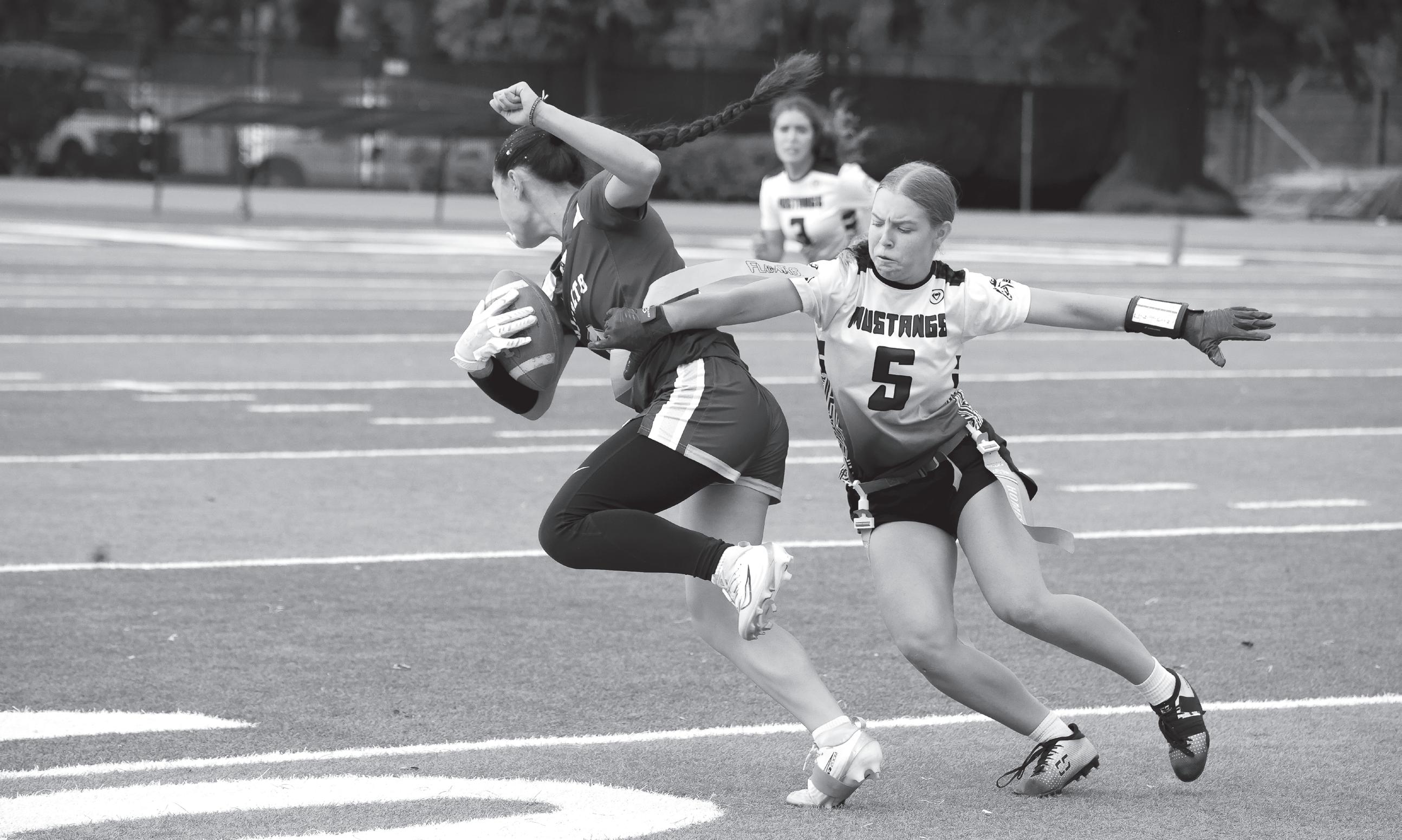
implemented. In addition, blocking has emerged due to the decreased rush from seven yards to one.
“Because we have a one yard rush now, we had to incorporate a blocker all the time, and then actually create plays so that person can still be engaged on the offense where they would leak out and catch a pass and actually do something, contributing in that way,” Exantus said. “ at was the biggest adjustment we had to make a plan for.”
Despite these challenges, junior defensive captain Zoe Quintana said rushing makes it easier to challenge the opposing quarterback’s throws. ere’s (been) a lot of successful sacks because we can also rush two or three people,” Quintana said. “It’s definitely made it a lot better because there’s not much one or two blockers can do to two or three rushers.”
One change Exantus helped implement was the elimination of back-toback games, which sometimes occurred last season.
“It was my first suggestion at the end of season meeting,” Exantus said. “I said, ‘No more two games a day. is is ridiculous. ese girls got school. ey got homework. One game a day. at’s it.’ And it was a unanimous decision. You have four games in a week, you’re going to get hurt. You have (to have) time to rest and stretch.”
Sophomore defensive captain Yaby Ketama said although she enjoyed playing back-to-back games in the dark, she agrees having breaks is helpful to recuperate.
“It feels like the stress is really high when you have two back-to-back games, but then having that little break day really helps out,” Ketama said.

Another change implemented this year was participating in tournaments, including a single-day tournament at Wilcox on Sept. 27, giving players more chances to face new opponents and test their skills. Wells said tournaments like this are essential for team growth.
“Having those tournaments will not only increase our skill level, but also our community and the bonding of our team,” Wells said. “ ey help bring awareness to the sport and also our Paly team, because we were the only team that was undefeated in the state.”
In addition to the Wilcox tournament, the team traveled to Los Angeles for a tournament on Nov. 1. Before the tournament, Leming said she felt both excited and nervous, especially with nationwide viewership of the competition.
“It’s intimidating going to a whole different city on the other side of the state to play a tournament,” Leming said. “ at’s pretty big.”
Because the team finished first in the De Anza League, it got a playoff berth but was eliminated by Branham High School in the first round.
Regardless, Leming is gratified with the team’s growth.
“I’m very proud of our team this year,” Leming said. “No matter how far we (got) into playoffs, I’m proud of our team this year.”
Football loses senior night to Menlo Atherton
Varsity football lost 41-14 to MenloAtherton on senior night, Oct. 24.
Menlo-Atherton gained a 14-0 lead in the beginning of the game. Paly scored a touchdown in the fourth quarter in an attempt to claw their way back into the game, but ultimately fell.
Head coach David DeGeronimo said the team had some positive moments, but they were overshadowed by the bad plays. ere were a lot of things that we fixed and did well, and then it was surrounded by a lot of slop, a lot of mistakes, a lot of big plays that didn’t go our way,” DeGeronimo said. “ e snap over the punter’s head, the muffed punt after three and out, the penalty after a 15 yard run, stuff like that was happening all night, and you can’t win ball games like that”.
Junior quarterback Justin Fung said the team is improving but needs to tighten up.
“We’re doing well in some spots and I think we just need to pick each other up and stop shooting ourselves in the foot,” Fung said. “But I still think we’re improving each and every week.” DeGeronimo said the defense is improving, but needs to execute.
“Defensively, we’re getting better every
single week, but there’s (been plays where we) get them in third and 14, and somehow they convert,” DeGeronimo said. “ at’s been the story of the year, and we can’t get off the field on third down.”
Fung also said while senior night is important, the team needs to exhibit the same effort at every game.
“It’s good we play for our seniors, but I think every game’s gotta be like that, and we’ve got to play hard every game, no matter what night it is,” Fung said.
Senior kicker Abers
Boyarsky said senior night carried extra meaning for him because he’s spent years watching his older teammates reach this point.
“To me, it means filling in footsteps,” Boyarsky said. “All four years I can remember seeing my friends graduating and finishing their seasons, so it just means a lot to be able to fill those footsteps and try to play my best football.”
Leilani Chen & Lucas Lai
Business Manager & Sports Editor
On the Palo Alto High School football field, Justin Fung ‘27 and the Palo Alto High School varsity football team play against Menlo-Atherton on October 24th. “I still think we’re improving each and every week,” Fung said.
Senior and flag footcaptain Kailia Leming jukes past her opponent with ease, showcasing the skill that has helped her team make significant strides in their league this season. “It’s intimidating going to a whole different city across the state for a tournament,” Leming said. “ at’s a pretty big deal.”
AWS outage disrupts essential services
On Tuesday morning, senior Anna Kim, who is taking the computer science capstone class, tries to log into her school account.
Kim said she didn’t expect such an outage would affect her classes.
“In the morning, I opened the app to check my Schoology, but I was shocked when it wouldn’t connect,” Kim said. “At first, I thought it was a problem with my home Wi-Fi, but it wasn’t until I got to my first period CS Capstone class that I realized it was an AWS issue. After hearing that apps like Schoology and Infinite Campus were also experiencing issues, I was especially worried about assignments due tomorrow or the day after, especially those that required Schoology.”
Amazon Web Services, the world’s largest cloud computing platform, had a worldwide outage on Oct. 21. AWS is widely used by businesses, schools and government agencies to store data and run applications. According to market research firm Gartner, AWS accounts for 37% of the global cloud market. e outage temporarily disrupted major websites and applications such as Schoology, Infinite Campus, Venmo and Snapchat. According to Downdetector, a website that aggregates user-submitted reports of disruptions to online services, there were more than 17 million outage reports.
AWS said the outage was caused by a DNS error, the internal domain name system, which prevents applications from finding the exact address of the cloud database used to store users’ data. e error began in a data center in Virginia, USA.
Kim also said the AWS outage revealed the vital role of cloud systems in education.
“I knew about AWS’s scale and role through my CS Capstone course, but this experience was the first time I realized how many apps and websites in our daily lives are cloudbased,” Kim said.
Computer science teacher Christopher Bell said AWS has a huge influence on schools.
“Schools rely heavily on cloud-based services,” Bell said. “Lesson plans, assignments, gradebooks and more are used daily, so it is challenging when these services are unavailable. Luckily, most teachers and students were logged in to their Google accounts when AWS services went down, so daily lessons were not overly affected.” Bell also said the outage reveals how dangerous monopolistic global power can be to society as a whole.
“While the AWS outage only had an impact for one day, for some small businesses, that lost day of work and revenue is meaningful,” Bell said. Similarly, Economics teacher Eric Bloom said outages like the AWS one have a large impact on small businesses. ere are two primary problems, Bloom said. “First, when services fail, there are immediate and real losses: businesses can’t do transactions, open stores, contact customers and each other. Secondly, there is loss of faith that AWS can deliver
what they are charging for and stop looking for other solutions.”
In a Reuters article, Jake Moore, the global cybersecurity advisor at European cybersecurity firm ESET, said the AWS event reveals weak infrastructure.
“ is outage once again highlights the dependency we have on relatively fragile infrastructures,” Moore wrote.
Additionally, Kim said she hopes to take this example as an opportunity to learn and improve.
“Witnessing firsthand the vulnerabilities of AWS, which I’d assumed I trusted because it was Amazon, made me realize that there’s still much research to be done in computer science, espe-
cially in the cloud,” Kim said. “ is incident demonstrated that it goes beyond a simple service disruption and impacts countless people’s daily lives and learning.”
With this in mind, Bell said students should view technology and the cloud with both appreciation and awareness of its imperfections.
“I think students should appreciate the engineering marvel that works 99.9% of the time, but understand that the Cloud is a complex, physical system,” Bell said. “ is
system relies on hardware, software and human input, making absolute perfection impossible. Outages will happen, but hopefully we will continue to learn from outages and make continual improvements resulting in a more resilient system.”
To him, Bloom said this incident is a reminder that any oligopolistic market can be efficient and potentially dangerous. “ at means we have fewer choices,” Bloom said. “And because it was so disruptive, it created opportunities for rival firms to steal market share. When a market is like web services, with huge start up and operating costs, there may not be many firms who are willing and able to enter and compete. ink of airlines. A few big firms with lots of smaller ones – it’s really competitive and fares always rise in the summer.
(Cloud-based services) probably need some oversight to maintain competition and redundancy to prevent a similar breakdown in the future.”
Moving forward, Bell said he’s curious to see how the industry continues to evolve.
“Most services have migrated to the cloud, and we will see even more migrate in the future,” Bell said. “What will be interesting to see is if this latest outage will result in a change in cloud strategies. With over $2 trillion being invested in AI and new data centers over the next couple of years, we might see some changes in how the cloud is structured and the global power it holds.”
Grace Kim Staff Writer

In response to this November’s “Vote and be Heard Week,” held by Student Nutrition Services to allow students to vote for their favorite lunch entrees, Palo Alto Unified School District purchased multiple sushi machines using Kitchen Infrastructure Grant Funds.
Student nutrition manager Alva Spence said students support the change.
“With the different grade levels having an opportunity to share their favorite entrees and ones that they would like to see offered, sushi is always in the top five,” Spence said. “We have made sushi for different secondary sites in the past, but it is extremely labor intensive. We had been searching for ways to provide sushi that was less labor intensive and faster. ese machines have been the answer for us.”
Spence said the sushi machines purchased are highly efficient and safe.
“I have absolutely no worries regarding the nutrition of the sushi provided from the machines,” Spence said. “Sushi is extremely healthy and nutritious. My only concern with the machines is the moving of them from school site to school site so that all sites (and) grade levels can enjoy the offerings. Moving equipment always has inherent issues with loading on and off of the trucks.”
e commercial grade sushi machines are from XTops and speed up the rolling process. Staff cook or steam rice separately, before placing it in a “hopper”. e machine makes a sushi rice sheet where staff place nori (seaweed) and toppings. After, they are cut and boxed for students to enjoy.
e machines were piloted at Gunn High School on Sept. 11 and at Jane Lanthrop Stanford Middle School over the month of October.
As a result, Spence said Gunn students were eager to try the new menu option, with the cafeteria running out of sushi by the end of lunch.
“In our first use at Gunn High, we produced 300 sushi rolls in less than two hours,” Spence said. “We did not want to waste the product and overproduce, so we made a guess
at 300 boxes. We sold out and could have provided more had we made them.”
In response, students’ opinions varied, and Gunn Sophomore Elijah Chheng-Leam said he wouldn’t choose the sushi again.
“It tasted really artificial and the texture is really bad,” Chheng-Leam said.
Chheng-Leam also said the distribution process could use fine tuning. “It was really chaotic,” Chheng-Leam said. “ I saw people touch my sushi, and I touched other people’s sushi (due to the line being chaotic).” Looking forward, Spence said students will have a variety of options to choose from.
“Sushi, CA rolls and cucumber rolls will be added to school sites menus on a rotating basis,” Spence said. “Rolls will be prepared, cut, and boxed at the school site for lunch. Each box will have edamame, pickled ginger, soy sauce, and wasabi inside. e boxes of sushi are offered as a lunch entree.
Eden
Yoo Staff Writer

It’s okay not to know who you are
As a senior going through the college application process, I get asked who I want to be, or some variation of that question, every day. It’s OK not to know the answer.
High school and college are places to help you figure out who you are, what you love, and who you want to spend your time with. Your identity is fluid: it shifts and grows as you do. Over time, it takes on bits and pieces of your experiences from each stage of your life, and even people who say they know what they want to do with their lives will likely change their plans.
Your identity cannot be confined to a sentence or any conversation you might have with someone. Your hobbies and passions will change, and you change with them, because your identity is made of everything you are and everything you’ve been. Don’t fall into Paly’s trap. We face pressure from parents, teachers, peers and the looming idea of college to have an understanding of what we want to pursue when we graduate, even though we are still growing, learning about ourselves and developing our interests and passions. Our school offers us many opportunities that let us grow our sense of identity, and we should take advantage of these things. at said, do not overload yourself with as many APs as you can fit into your schedule. Colleges want well-rounded students who have participated in different activities, held leadership and proven that they are willing to put in the time and effort. ey want to see that you have taken hard classes and proven your academic abilities. Taking 10 APs throughout your high school experience is not going to allow you to do that. You most likely won’t have enough time to be part of enriching activities, let alone enough time to get good grades in the classes you’re taking. Join clubs that interest you, sports, or any extracurricular. You might be surprised to find what activities you find to be fulfilling and meaningful to you. Also, avoid trying to fit in. It sounds cliché, but it is essential. Being self-aware and reflecting on who you are or what you enjoy is the first step towards discovering your identity. You won’t achieve that without finding a way to separate yourself from the expectations of those around you.
Finally, embrace uncertainty. Uncertainty means opportunity, and it gives you the freedom to explore. Growth is non-linear, gradual and everyone has different paths. It’s OK to not know who you are yet. at’s only natural. Now is the time to experiment, to take risks and try to find what you love doing. In the long run, that is what will help you discover yourself. Take advantage of the opportunities that arise in your life. You’ll learn about yourself the most by being curious, taking risks and most importantly, embracing change.

Teachers should return grades to students faster for self-reflection
As I looked through my English essay last year, sprinkled with red marker corrections, I went over my mistakes and missed learning targets of the unit. Having completed the essay over two weeks before, I had long forgotten what my thesis had been, let alone my purpose and evidence. Looking back, I couldn’t remember my thought process while writing the essay and was unable to analyze how my test-taking strategies had worked out.
Receiving feedback on essays and exams from teachers is the key to improvement in any course: their explanations and corrections help students notice what they need to improve and create a technique to do so.
Given this, receiving feedback in a timely manner is essential to student improvement and understanding of the material.
ese struggles I experienced reviewing my essay can also be applied to other classes I have taken, dating back to freshman year. Whether it’s forgetting what questions I had blanked on during the history quiz, what problems I had struggled with on the math test or what explanation stumped me on the science lab, I have faced numerous situations like this, and I know many of my peers have encountered this as well.
In addition, according to the University of South Carolina’s Center for Teaching Excellence, timely feedback is necessary to ensure students respond and remember the experience about what is being learned more positively. “If we wait too long to give
feedback, the student might not connect the feedback with the learning moment,” the study said.
Just like when you are interrupted and lose your train of thought, students need to receive feedback to continue their momentum and not constantly have to reflect weeks and weeks back to previous exams after they have long moved on.
Beyond students having difficulty analyzing their test performance afterwards, when teachers return tests after the next unit’s assessments, it is even more difficult for students to progress in cumulative classes when they haven’t fully understood or improved on the previous topics.
Especially when finals come around, understanding each individual unit in cumulative courses is the key to a successful understanding and presentation of the material at the end of the semester or year.
When it comes to exams, there’s no doubt teachers get backlogged with dozens of tests from each period and course. From
the time it takes to grade consistently and schedule makeups, teachers have a lot on their plates. But timely feedback is what allows students to improve, because students can only adjust their approach once they actually know what went wrong.
Just like we have deadlines for assignments and tests, teachers should similarly schedule and communicate achievable and efficient deadlines.
According to Indiana University Bloomington’s Center for Innovative Teaching & Learning, “Feedback needs to be both ongoing and timely. For example, students should have specific feedback about their performance on a rough draft of a paper well before the final draft is due.” Furthermore, many core classes at Paly have two main types of teacher feedback: formative and summative. Formative feedback includes all comments provided during the learning process, including homework, checks of understanding, and assignments, while summative feedback includes all final evaluations such as essays, tests and exams.
Although receiving formative feedback is important to continue advancing beyond learning errors, many times, formative feedback tends to provide limited and broader comments. erefore, summative feedback becomes the major way to receive extensive and individualized corrections from teachers in order to progress.
While many teachers release grades on Schoology quickly, the feedback attached to that grade is just as, if not more, important. While a grade is a good indicator of one’s overall progression in a class, grades don’t help with improvement or growth; the individual feedback and comments do. Even worse, for courses that don’t release scores or feedback quickly, students are unaware of their standing in the class.
I strongly encourage teachers to provide feedback to students in a timely manner with communicated, achievable deadlines within two weeks. Teachers can attain this even with hundreds of students by utilizing standardized grading rubrics and preparing grading guidelines with points which are each specialized to certain criteria. ese quick grades and individualized comments will allow students to learn from their mistakes and missed targets in order to accelerate overall student improvement.


It’s Tuesday, and I’m stressing out about my Physics test on ursday. I desperately need help from my teacher the next day, and as I’m frantically going through the slides posted on Schoology, it occurs to me that I can just go to PRIME the next day to ask for help. But when I enter Infinite Campus to sign up for PRIME, I notice registration has closed. en I remember: tomorrow is a late start. ere is no PRIME this week. In the 2025-2026 school year, Paly implemented a late-start Wednesday schedule, occurring once a month, to replace the previous school year’s late-start Monday schedule. is new timeline starts the school day at 10:05 a.m. and ends at 3:30 p.m., as usual, by removing PRIME. is has a huge impact on students and their ability to learn, make up tests and prepare for assessments, causing many to think the removal of late-start Wednesdays is a necessary action, and returning to late-start Mondays would be the best solution.
I’ll admit I’ve complained about PRIME my fair share of times, and I’ve definitely spent a good percentage of it chatting with friends or doing other unproductive activities like scrolling on my phone or playing New York Times games. But PRIME is one of the only times during the week when students have a chance to talk to their teachers outside of class and get the help they need, free from class distractions.
Many students also use PRIME to make up tests, quizzes or labs they missed when they were absent, at college visits or need extended time. is is especially important for students with busy schedules and no prep periods.
And this is especially true in a city like Palo Alto where students are high achieving and often have multiple after school activities such as sports, clubs or other programs which means they cannot meet with teachers after school, making it even harder for these students to catch up without PRIME.
Another detriment to late start Wednesdays is having a late start in the middle of the week often disrupts learning momentum by shifting the usual schedule, making the week feel less cohesive. In contrast, late-start Mondays provide students with more of an extension of the weekend, allowing them to sleep in, finish homework or study for assessments.
Although late-start Wednesdays only occur once a month, returning to the late-start Monday schedule would avoid all these issues. e late-start Monday schedule results in 35-minute class periods and starts at 10:15 a.m. With no influence on PRIME, it allowed students a chance to ease into the week and start the process of waking up at an earlier, more “normal” time.
Most of the teacher criticism of late start Mondays stems from teachers feeling like they couldn’t get enough done in 35-minute class periods. While I understand that late-start Mondays have a cramped timeline, the extra 10 minutes – classes are normally 45 minutes on Mondays – don’t make as significant a difference as the opportunity to go to PRIME.
Ultimately, late-start Wednesdays are not the solution to complaints about late-start Mondays. By removing PRIME, the school limits students’ access to teacher help for their classes, putting students without a prep period at a disadvantage and disrupting the school week.
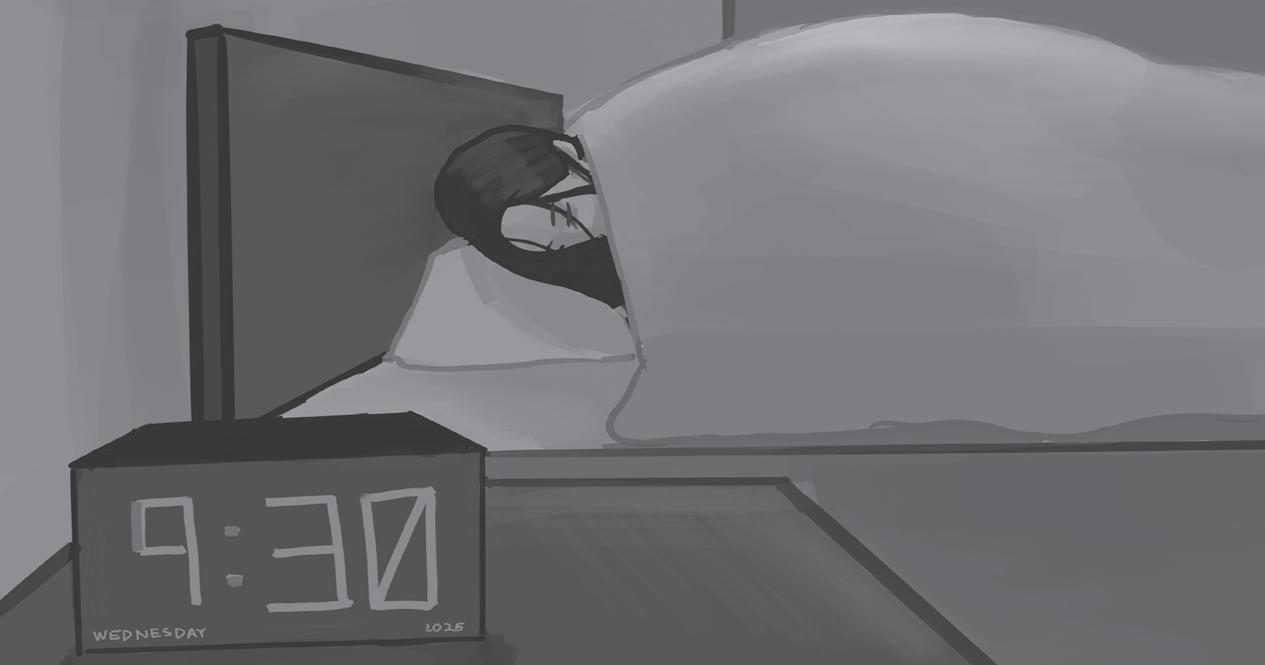

I encourage the district to reconsider its decision to implement late-start Wednesdays and return to late-start Mondays to improve students’ success in school, mental health and increase fairness for those without prep periods.
Dalia Saal News & Opinion Editor
Sofia Singer Art Director
Alana Chun Staff Writer
ART
Schools should place less emphasis on testing scores
“He got a 1550,” one student yells. “She got a 1600.” “ ey got a 35 on the ACT.” When I walked into APUSH class on the morning of a SAT test-return day, the room was a mix of excitement and sadness. But to those who didn’t get the 99th percentile with a 1500, which Paly’s culture seems to treat as the“bare minimum”, it felt as if four years of hard work were going down the drain. In today’s college admissions environment, the SAT and ACT have become overweighted, and colleges should lower the importance of them in deciding who to admit. According to PBS, the SAT was created in the early 1920s by the creator of the Army IQ test, Carl Brigham, with the belief the intelligence level in America was declining. In 1926, the test was introduced to high school students, and beginning in the 1930s, Harvard started to use the SAT to determine which students from public schools received scholarships. e 1920s were a wildly different time, and society functioned in a
different manner. In the last century, there have been countless changes to the world and to the college admissions process. If many aspects of college admissions and youth education have drastically changed, why should a test designed in the 1920s to measure average intelligence still be so heavily weighted in today’s college admissions? e short answer is it shouldn’t. ese standardized tests only measure how good of a test taker a student is, not their readiness for college. e SAT and ACT have harsh time limits for each of the sections, forcing students to move in a timely manner –– sometimes not even finishing the questions. Whether or not a test-taker actually knows the material or possesses the knowledge to answer the questions may not end up mattering. Instead, the test measures how well someone can answer questions in a timeconstrained, stressful environment, which is something that is often not measured in the real world. In fact, according to UChicago News, there is no correlation between whether a student graduates from college and their ACT score. Like a lot of components of today’s
college application, the SAT also has a large equity gap. SAT takers often use tutors, and personal tutors are expensive. Some students spend months working with test tutors to learn how to “play” the test.
Additionally, according to the Harvard Gazette, children in the wealthiest 1% of the U.S. have a 13 times greater chance of earning a 1300 or higher on the SAT than a child of a low income family. A test that is so skewed to the upper class is not only outdated but also unfair.
Despite these points, standardized testing should not be dropped completely from the college admissions process. While these tests do tend to favor upper class students, according to the New York Times, fully removing the test metric will not increase equity because many of the statistics are also biased and potentially more biased than standardized tests. So standardized testing should still be considered in the college admissions process, but it should not be weighted so highly. e inability to get the 99th percentile on one SAT should not be the reason a student does not get accepted into their dream college or feels disappointed when they open their scores.

Naveen Narayanaswami Sports Editor

Social media misrepresents, glorifies mental health issues
At first glance, posts online about poor mental health on social media look like everyday teenage confessions. Videos of people crying, venting or sharing their struggles might seem like fleeting moments of vulnerability — but behind them lies a darker trend: the romanticization and glorification of poor mental health. On platforms like TikTok and Instagram, a growing number of young users are participating in what some call a “sad aesthetic” — content that glorifies depression and self-destructive behaviors. Experts warn this phenomenon not only normalizes these struggles but also makes mental illness seem aspirational. And as youth suicide rates and mental health crises in teens increase, it’s worth asking whether this glorification is fueling the problem.
Social media algorithms are built to maximize engagement. e more time a user spends interacting with depressive or disordered content, the more of that content they’re shown. Before long, an impressionable teen can find themselves in a digital echo chamber of harmful videos. According to a report done by the Associated Clinic of Psychology in 2025, social media takes advantage of strong emotions for traction.
“Algorithms boost emotionally charged posts — especially negative or sensational ones,” the article said. “ is encourages doomscrolling: compulsive scrolling through bad news, which worsens anxiety and depression.”
In another study by the Center for Countering Digital Hate, researchers created TikTok accounts to test how quickly harmful content appeared. ey made “standard” accounts with neutral usernames and “vulnerable” accounts with usernames referencing mental health. All were set to the minimum age of 13.
“Once the social media app’s algorithm kicked in, content about suicide surfaced on the ‘standard accounts’ feed as early as 2.6 minutes in, and content about eating disorders popped up within eight minutes,” according to an ABC News article. “Vulnerable’ accounts, meanwhile, were recommended three times as many harmful videos and 12 times as many self-harm videos as the ‘standard’ accounts.”
Self-expression has always been a healthy part of coping with mental illness. In the best cases, it helps people find solidarity and support. But on social media, the line between sharing and showing off can blur.
As posts romanticizing mental illness gain likes and comments, a growing number of teens are starting to see being mentally unwell as cool.
Physicist Marc D. Feldman from the University of Alabama labels this as Munchausen, a type of factitious disorder where people fake or exag-
gerate illness online to attract attention. Since he
first coined the term in 2000, Feldman said he has noticed an increase in Munchausen as more videos and photos are posted on social media.
“In 2000, posts to social media were largely through words, with videos being particularly unusual,” Feldman said. “ is change opens the door to very dramatic presentations that are even more engaging than those posted with words only.”
Platforms like TikTok and Instagram have made some effort to flag and remove harmful content, but critics say it’s not enough, especially given how quickly new posts spread.
In the absence of stronger regulation or more consistent enforcement, media literacy becomes essential. Teaching younger generations how to understand and question the content they consume can help them recognize when vulnerability crosses into glorification.
Open, honest conversations about mental health can be key tools in helping young people navigate the complex and often overwhelming landscape of social media.
Creators also have a role to play. Influencers can help shift the culture by promoting recovery, showing therapy as normal and speaking honestly about the hard work of healing without glamorizing the illness itself.
Ultimately, mental health deserves to be talked about, openly and often. But there’s a fine line between destigmatization and glorification. Real mental illness isn’t pretty. It’s messy and complex. And it can’t be captured in a 15-second video.
Please contact the following resources if you have safety concerns or need immediate help:
Call 911 and request a C.I.T. (crisis intervention team) trained officer to assist you
Crisis Text Line: text “home” to 741-741
National Suicide Prevention Hotline: 1-800-2738255
Bill Wilson Youth Hotline (24-hour Suicide & Crisis Line): 408-850-6125
Trevor Lifeline LGBTQQ+ Crisis Support: 1-866-488-7386
Andi Barker, Mental Health Specialist: abarker@ pausd.org

Maia Wadhwani Guest Writer
Palo Alto should lower its voting age to 16
Younger voting age would empower youth voices, strengthen civic engagement
Gunn students Iris Blanchet and Rayla Chen started Vote16 Palo Alto, a campaign to lower Palo Alto’s voting age in municipal elections to 16, earlier this year. If successful, the initiative would enable 16-year-olds to vote in city council elections and propositions. ey need 3,000 signatures from Palo Alto residents by November 2026 to get this issue onto the ballot.
e proposition, however, does not entirely allow 16-year-olds to vote in Palo Alto Uni ed School District school board elections, as the district’s border extends beyond Palo Alto.
e Campanile supports Vote16 Palo Alto and thinks 16-year-olds should be able to vote city-wide. e Campanile also encourages Vote16 Palo Alto to ultimately extend its initiative to PAUSD board elections.
is change would build better voting habits for Palo Alto students and create a supportive environment for rst-time voters.
In a democratic country where people’s voices need to be heard, it’s important that voters express their voice at young ages. According to a 2014 study by Eva Zeglovits that analyzed voter turnout after lowering the voting age in Austria, lowering the voting age signi cantly increased voter turnout for years into the future, facilitating a more representative democratic process.
However, with a younger voting age, 16-year-olds may be easily swayed by their peers and parents. According to a 2017 study by Lisa Knoll et al., children and young adolescents show a higher susceptibility to social in uence than adults. However, external in uence from friends and family stays persistent throughout all ages.
In fact, according to a study by Markus Wagner et al. conducted in Austria, where 16-year-olds are allowed to vote, teenagers are just as likely to be politically motivated as adults. ey are also equally as likely to be independent voters, making high quality decisions and choosing candidates that match their beliefs. Finally, voting in a more controlled environment like high school can provide students with an opportunity to continue developing

even more independence. PAUSD’s strong teachers can help students be more aware of their biases and beliefs, setting them up to be less susceptible to pressure in the future. Additionally, the Campanile recognizes that uninformed voters are problematic. However, lowering the voting age in Palo Alto will alleviate, instead of aggravate, this problem. PAUSD students are uniquely positioned to become informed voters at a young age. Our district requires students to take US Government in 10th grade at the age of
Palo Alto City Council unanimously voted to approve a phased plan to restrict recreational vehicles (RVs) in the city on Monday, Oct. 20. e plan will increase additional regulatory measures around Palo Alto by prohibiting the parking of inoperable vehicles on public streets, while also partnering with LifeMoves to eventually o er critical services to unhoused residents. While we support the plan’s intentions to support RV residents with LifeMoves, e Campanile thinks the city council should not have approved the plan. Restricting RVs in our city doesn’t address the root causes of homelessness: high costs of living, mental health issues, unemployment and more. e plan will displace unhoused residents without o ering meaningful real solutions to support their long-term economic stability or prevent others from becoming unhoused. Palo Alto and surrounding communities have seen rising rates of homelessness in past 2 years, with Palo Alto’s rate of homelessness doubling since 2022. With 58% of Santa Clara County’s unhoused population homeless for the rst time, it is clear that the city is not doing enough to sup-
15-16, while most districts require it in 12th. is allows students to learn the way in which governments work, and more crucial importantly, teaches them the importance of voting even earlier.
In addition to city elections, students who live within the borders of PAUSD should be able to vote on school board policies, regardless of if they live in Palo Alto or not.
Students are far more impacted by school board decisions than most parents in the district. As a newspaper that supports the power of
port people at risk of becoming unhoused. Furthermore, the plan assumes that RV residents have other living options if they can’t park in Palo Alto, which is unrealistic: surrounding communities, including Menlo Park and Mountain View, already ban overnight RV parking. With no local areas to go, many RV residents will be further displaced. Most people aren’t homeless by choice, and given the option, most would not live in RVs. Residents living in vehicles are often forced into these situations due to external circumstances. According to data collected by Santa Clara County, 73% of homeless residents report at least one “disabling condition,” 18% of unhoused residents have a history of being in the foster care system, and 16% are eeing domestic violence. To ne people purely for existing in our community is both entitled and deeply resemblant of the “not in my backyard” sentiment that has existed here for generations.
We applaud the e orts some churches have made to provide safe parking spots for RV residents at night; however, we believe those e orts should come from the city. Multiple RV residents have concerns about safety, and more options for
youth voices, e Campanile believes student voters will more accurately re ect the voice of the student body while also providing newer perspectives that are currently missing from board elections. As the people most directly impacted by these decisions, students should have a vote in school board elections. Ultimately, e Campanile believes passing and expanding this measure will help students become informed and engaged democratic citizens while providing valuable perspectives.
The Campanile
safe parking would give the city more control over RVs, while creating safer conditions for RV residents. It would also address residents’ concerns about waste, and alleviate parking issues by pulling RVs out of residential streets.
Housed residents should recognize their relative privilege in society enough to have compassion for our unhoused neighbors. Just because your circumstances allow you to live in Palo Alto –– whether that’s generational wealth, hard work or enough luck in a system that is so unfair in the rst place, does not mean you should turn your back on those struggling around you. Because ultimately, unhoused residents are simply people at a di%cult point in their lives. Some have had histories in the foster care system. Others are eeing domestic violence. Many are burdened with health issues. Some look for work, and others can’t.
In the end, they’re the same as anyone else. ey have hopes and dreams, and they are trying their best to nd dignity in their lives. What does it say about the Palo Alto community if we’re willing to reject the most vulnerable in our city because we feel a little uncomfortable?
Instead of pushing our RV neighbors out, the city should invest in safe parking and address causes of homelessness in the Bay Area: lack of a ordable housing, wage gaps, and structural inequities. As levels of homelessness in our
nity
Rodney Satterthwaite Letters to the Editors: Email all letters to editors to palycampanile@gmail.com. e Campanile prints letters on a space-available basis. We reserve the right to edit submissions. e Campanile only prints signed letters. Advertisements: Advertisements with e Campanile are printed with signed contracts.
ART BY REINA LIM LIST BY THE EDITORS
ART BY REINA LIM