Profit E-Magazine Issue 378

Page 1


11 After P&G’s exit, the aftermath becomes clearer for Gillette Pakistan

The many market prices of Pioneer Cement 16 Inside Pakistan’s most persistent industrial ghost 22 KAPCO and Fauji complete acquisition of Attock Cement 24 Zarea issues Rs1 billion sukuk to finance expansion 26 What the lowering of the CRR requirement on the banks says about the state of the economy

LSE Ventures wades into distressed debt investing

The SBP holds policy rate at 10.5% but loosens liquidity through CRR

Inside ISGS; where public balance sheet keeps absorbing the burn of stalled projects

Publishing Editor: Babar Nizami - Editor Multimedia: Umar Aziz Khan - Senior Editor: Abdullah Niazi

Editorial Consultant: Ahtasam Ahmad - Business Reporters: Taimoor Hassan | Usama Liaqat Shahab Omer | Zain Naeem | Nisma Riaz | Shahnawaz Ali | Ghulam Abbass

Ahmad Ahmadani | Aziz Buneri - Sub-Editor: Saddam Hussain - Video Producer: Talha Farooqi Director Marketing : Muddasir Alam - Regional Heads of Marketing: Agha Anwer (Khi) Kamal Rizvi (Lhe) | Malik Israr (Isb) GM Special Projects Zulfiqar Butt - Manager Subscriptions: Irfan Farooq

Pakistan’s #1 business magazine - your go-to source for business, economic and financial news. Contact us: profit@pakistantoday.com.pk

After P&G’s exit, the aftermath becomes clearer for Gillette Pakistan

As P&G shuts shop, the shaving company is going back to the formula that works for it

Many of today’s millennials have grown up knowing the name Gillette Pakistan. Whether it was the advertising campaign of “Pehla blade karta hai chun, doosra chunn, teesra cha cha cha chein” or the Top Gun inspired ad of fighter jets flying around the air as it was the best a man could get.

Even seeing the blue handled razor seems to invoke a tinge of nostalgia in a generation that learned to shave with the P&G manufactured product. A brand that has existed since 1986 has gone through some highs and lows throughout its history in Pakistan. With Procter & Gamble deciding to leave the coun-

try, it is looking to wind up its operations. One casualty from this decision would be Gillette closing out its manufacturing plant for the second time.

This story is about how Gillette came into existence, how it has performed in the recent past, its decision to manufacture locally failing twice and the formality of its buyback being carried out.

The history of Gillette

The story of Gillette Pakistan dates back to December 1986 when the company was incorporated as a public listed company. It was

involved in marketing and trading razors, blades and personal care products. The entity was used to import these products and then sell them at a local level through its locally registered entity. The local company was linked to the International Gillette brand which was operating on a global scale.

As soon as the company came into existence in 1986, the company was listed on the stock exchange by 1988 in order to raise the necessary funds. The goal of the initial Public Offer was to allow the company to establish its own manufacturing plant in the country. This was the first foray for the company to do so. It was looking to establish the brand of Gillette Pakistan through advertising while

creating a foothold to carry out operations locally.

In 2005, Procter & Gamble (P&G) acquired the Gillette brand for $50 billion on a global scale. As the parent of Gillette Pakistan changed, it came under the umbrella of P&G as well. The shares of Gillette were transferred to Series Acquisition B.V. which was a P&G controlled holding company based out of the Netherlands.

Gillette was being operated as a subsidiary of P&G, however, it had been listed on the Karachi Stock Exchange as far back as 1988. This meant that the company retained its listing status even after the acquisition had been carried out.

As a separate entity, P&G Pakistan had been established since 1991 and marketed detergents, baby care, hair care and oral care products by themselves. P&G itself had a bigger footprint in Pakistan as it set up its manufacturing plants at Port Qasim, Karachi and Hub, Balouchistan. Over a period of time, brands like Pampers, Ariel, Head & Shoulders became household names across the country.

In recent years P&G Pakistan has faced stiff challenges. Ever since the pandemic struck, there has been currency volatility, rising energy prices and difficulty in repatriation of profits back to the home country. Coinciding with this was the belt tightening initiative being carried out by P&G International. With shrinking profits and logistical issues being faced in Pakistan, P&G went through a restructuring drive in order to cut costs and make their operations leaner. Jobs were going to be cut and volatile markets were going to be sacrificed for better profitability.

A decision was taken to wind down local manufacturing and commercial operations in Pakistan. This came in the form of an announcement in October 2025 where P&G stated that they were going to transition to a third party distributor model. This would mean that independent importers and distributors would be used to bring the products into the country rather than manufacturing them locally.

The decision to go to a third party distributor model might seem like a huge shift for P&G, however, this was the model that had been used successfully in the past at Gillette Pakistan already. The business model of Gillette Pakistan had always been to import the bulk of its products into the country and then try to sell it locally.

Gillette had tried to carry out its own manufacturing in Pakistan twice, however, both times the company faced stiff competition and reduced profits leading to the manufacturing initiative being scrapped.

Attempts at local manufacturing

The first attempt to manufacture came back in the 1980s when the company had just established itself in the new market. Seeing a reduced level of success, the plant was shut down in the early part of the 2000s. The latest announcement to start manufacturing again was announced as recently as 2020 when the company announced that it was looking to start local manufacturing yet again.

The first attempt at manufacturing seemed to have failed as there was a lack of investment that was being made. The company was seen in its early stages and the first goal was to establish the brand name in the local market. Trying to chase down dual goals of creating a brand and a manufacturing plant seemed to be too ambitious at such an early stage. Due to a lack of sales and interest, the plant was shut down in favour of brand building and creation.

The failure could be attributed to the fact that the local market was inundated by local razors and blades which were being manufactured by the likes of Treet. There was also a dearth of smuggled blades which were flooding the market. Essentially, the local consumer market was made up of barbers who used to choose the cheaper blades for their own use. Selling a premium brand seemed to be too hard of a task.

The formal decision to close down operations came in 1999 when Gillette International decided to consolidate its manufacturing worldwide which led to the manufacturing being shut down.

The second attempt at establishing a manufacturing plant was considered to be better as it was backed by P&G Pakistan itself. Being under the umbrella of a large consumer conglomerate, Gillette would be backed by the resources and funds of its parent which would allow it to absorb some of the losses over time. In addition to that, Gillette faced tough competition from local brands back in the 90s and there was a burgeoning trend in smuggled razors being sold in the market. Over time, these factors fell by the wayside which meant Gillette would not face the same challenges yet again.

The manufacturing unit came online again in 2023 and from the beginning, the sales were lackluster. In 2023, revenues from manufacturing came in around Rs 15 crores from which operating profit was only worth Rs 94,000. By the end of 2025, sales from manufacturing were worth Rs 23 crores while operating profits had turned into losses of Rs 12 crores. For every Rs 1 of sale made, the operating loss was more than Rs 0.5. The second

attempt to manufacture blades had turned sour pretty soon and manufacturing was not viable yet again.

This would mean that Gillette would go back to the third party trading model that it had followed since 2000 which had been more profitable for the company.

Taking a deeper look at the financials of the company from 2009 to 2025, it can be seen the profitability of the company has been volatile to say the least.

Financial Performance of Gillette Pakistan

In 2009, the sales for the company were valued at just Rs 73 crores. Over time, these sales increased crossing the Rs 3 billion mark before falling to Rs 1.7 billion in 2025. The business model of the company throughout this period was to import the finished goods from its International arm and then sell them locally. Due to the price point of the product, it was primarily consumed by the upper middle class of the country who could afford these products in the first place. The brand was identified as the brand used by the affluent portion of the country. This meant that any increase in cost could be passed on to the consumers as it was seen as being price inelastic.

Even though sales were increasing, there was high volatility in the earning per share of the company which began at Rs 5.7 per share in 2009 and then falling to Rs -1.28 per share in 2011. Once the profits rebounded, they reached a high of Rs 13.01 in 2013 before reaching a loss of Rs -10 per share in 2017. The highest recent profit was seen of Rs 11.57 per share in 2020 while 2025 closed out with a loss of Rs -0.8 per share.

The high volatility in the profits can be attributed to the business model that the company is following. As the company is importing most of its products, there are huge swings taking place in the inventory that the company has at the end of one year to the next. In the years the closing inventory is higher than the last years inventory, the company records a profit while in years where closing inventory is lower, losses are booked. This shows that inventory alone was the cause of the gross margins fluctuating to such an extent.

Moving down the income statement, the importing of materials was also having an impact on the net profits of the company. In years where the rupee depreciated significantly, the company booked exchange losses as the rupee had fallen in value. This can be seen in other operating expenses which increased to 28% of sales in 2023 which was the year

the rupee went from Rs 177 to Rs 248 within a year.

In terms of the challenges that Gillette has faced, it has seen import cost volatility and rupee depreciation which is the fundamental part of its trading business. In addition to that, the government also imposed a super tax on corporations which meant that they had to bear an additional burden of tax on its profits which further reduced its net margins.

Even with fluctuating profits, the company did have a hefty amount of unappropriated profits which shows that the business was viable and thriving in the long term. To give some context of the success of the trading business, the company started declaring its trading and manufacturing segments separately from 2022. In 2022, trading business totalled sales of Rs 2.5 billion with gross profit of Rs 62 crores and operating profit of Rs 24 crores. From 2022 to 2023, these sales grew to Rs 2.9 billion and operating profit increased to Rs 1.1 billion from just the trading business. In comparison to this, manufacturing segment made sales of Rs 15 crores while making an operating profit of only Rs 94,000.

In 2024 and 2025, trading business saw lower sales falling to Rs 1.5 billion by the end of 2025 and operating profit of Rs 24 crores. The manufacturing business saw better sales reaching Rs 23 crores by the end of 2025, however, its operating losses reached Rs -12 crores for the year.

Based on this analysis alone, it is no wonder that the manufacturing business is seen as being non viable and being shut down.

The aftermath of closing down

In the face of increasing challenges, P&G decided to leave the country and similarly, Gillette Pakistan was going to be wrapped up as well. It is easy for P&G Pakistan to just leave as it pleases after it sells its assets. The process is a little more

complicated for Gillette as it has to be delisted from the stock exchange. In order to facilitate that, a board meeting was held on the 2nd of October 2025 which approved the voluntary delisting to be carried out. Series Acquisition B.V. was the major sponsor of Gillette Pakistan which held 91.72% shares of the company already.

In order to carry out the delisting, a formal application was going to be made to the stock exchange and then an annual general meeting was going to be held to approve the purchase price for the delisting. The delisting would mean that the minority shareholding holding 8.28% of the remaining shares totalling around 2.64 million shares would be bought back. On 14th of November 2025, the rate decided for the buyback was set at Rs 216.49 per share.

The price that is suggested by the sponsors themselves is not the end but the start of the process. The company is allowed to set a price for the buyback that they deem to be suitable. In response to this, Pakistan Stock Exchange carries out its own due diligence. Based on their own analysis in conjunction with the comments from the company and other stakeholders, the exchange has the right to determine the price for the buyback as they deem fit.

On the 26th of January, the PSX finally gave its own verdict behind the share price at which the buyback would be carried out. The price given was Rs 700 per share. Not given any calculation behind this number, it is confusing how such a large number could be given.

Based on the latest annual accounts for June 2025, the total assets of the company were worth Rs 1.6 billion while the liabilities are worth Rs 502 million. With an equity of Rs 1.1 billion, the book value per share for the company comes out to be Rs 34.4 per share. When buybacks are announced, the PSX itself has devised different values at which the buyback can be carried out.

According to Section 5.14 of the PSX

Rulebook, the buyback price criteria can be based on five different metrics. Section 5.14.2 states that the weighted average closing price of the last five days before the board meeting, 3 year weighted average price, intrinsic value carried out by auditors, P/E multiple or the maximum price given by the sponsors to purchase the share. Based on the historical prices, the five day average closing before the announcement was around Rs 215 per share. The 3 year average was around Rs 160. Price multiple cannot be applied as Gillette recorded a loss in 2025. With sponsors not buying any shares, the best estimate was the one given by the company of Rs 216.49.

So why is there such a huge gap between what the company is willing to pay and the valuation that PSX is giving the company seems to be too high to be justified. The only factor that can be at play here is that Gillette has not carried out any revaluation of its land and buildings. Once these assets are revalued, their value can be expected to rise drastically from the cost at which they are being recorded. Other than that, there is little in the way of rationale for this price difference.

PSX can point towards the fact that as soon as the buyback was announced, the share price for the company jumped from Rs 225 to Rs 600 before coming back down again. Investors who have invested and bought the shares at such a high value did so expecting a considerable price and they need to be compensated for the buying they carried out. However, the most interesting part of this buyback is that Series Acquisitions B.V. does not even have to buy a single share to become successful.

The PSX Rulebook states that as soon as the 90% threshold of ownership is crossed by the sponsor, they do not have to buy a single additional share. With an ownership of 91.72%, Series Acquisition does not have to actually follow through with the buyback in order to delist from the exchange. With a price of Rs 700 being set by the stock exchange, it seems highly likely that no additional shares will be bought. n

The many market prices of Pioneer Cement

The stock market is quoting three different prices for the company based on the instrument being considered

On November 14th 2025, a notification was sent to the stock exchange by Maple Leaf Cement expressing their intent to acquire a controlling stake in Pioneer Cement. Maple Leaf had carried out negotiations with the primary shareholders of Pioneer and had decided that they would be buying 58.03% of Pioneer Cement from associated companies of Pioneer which collectively held 54.52% of the shares. The remaining 3.5% was going to be sourced from other sources through negotiations.

Maple Leaf already held 18.5% shares of Pioneer through its associated companies. Acquiring the additional 58% would mean that they would have collective shareholding of 76.5% of the shares. Section 111 of the Securities Act 2015 states that whenever a shareholder is passing the 30% threshold of shareholding, they have to make a public offer to acquire half of the remaining shares that will be left after their acquisition. This would have meant that 11.7% of the remaining shares had to be given an offer price as well.

The law has been designed in order to

allow shareholders to sell their position as the company is going through a change in the control transferring to a new substantial shareholder. If the shareholders want, they can avail this public offer and exit their investment by selling to the new buyer. Earlier, the quantum of shares had been disclosed and on the 22nd of December, the buying rate was disclosed as well. Maple Leaf was going to pay Rs 478.43 per share.

In response to the acquisition being announced, the market started to respond positively to this development. On 12th of November, the share price of Pioneer closed at Rs 221.98. From then till the actual market price of acquiring was declared, the run up in the share price was astonishing. In a space of 24 trading sessions, the market price went from Rs 221.98 to Rs 421.37. An increase of 89% with the market price for the share almost doubling. At the heart of this price increase was the fact that Pioneer was being valued.

The per share price of Rs 478 had no basis set in the market trading that had been carried out in the past which is usually the convention. The rate had been determined based on the negotiations carried out between the substantial shareholders at Pioneer and Maple Leaf. The ne-

gotiated price to acquire their 58% shareholding was set to be Rs 478 which was also used as the offer that was being made to the market as well. This should have been a smooth affair with the shareholders selling the shares to the company based on the offer and the market should have functioned from one day to the next.

However, this did not actually take place. The primary reason for the disruption was the futures market and the book closure that was announced by the company.

It has only been a recent development that the future contracts being traded in Pakistan have expanded from 1 month to 3 months. What this means is that the future contract for February would have started trading as far back as last week of November. When those contracts were listed, the public offer being made had barely passed the board of Maple Leaf and no one had any inkling of what price the acquisition would be carried out. Once the public price was announced, the future contract would have moved accordingly.

The second aspect of this distortion is the book closure. The book closure is the arbitrary date that the company announces around which the shareholder register is compiled and used.

Book closures are used when dividends are announced which means that the registrar has to update his records in regards to who owns the shares and who does not. Once the shareholder register has been updated, the shareholder has to send the dividend to the rightful owners.

In the case of Pioneer, the book closure was carried out to determine which shareholders owned the shares of Pioneer and to send out offer letters to these people accordingly. This book closure was announced on the 13th of January of 2026 and the register was going to start from the 27th of January and go till 2nd of February 2026.

The complexity of the situation arises here. The future contracts for January and February were already trading for Pioneer. The January contract was expected to end on the 30th of January under normal circumstances. Once the book closure was announced, all three of the future contracts were going to get settled. Why is this? Well this is due to the fact that before the book closure and after it, a huge aspect of the share will be taken away. The people who held the future contracts were going to see all the future contracts expire collectively on the 21st of January 2026.

In normal circumstances, something similar takes place in the case of dividend as well. Suppose that the January contract was going to settle at the 30th of January 2026, however, a dividend of Rs 10 was announced which had a book closure at 22nd of January 2026. In this case, the people who held the January contract would see their future contract settled earlier and then they would qualify to get the dividend. In case a person feels that they do not want the dividend, they can look to sell their share before the contract is settled and then buy the newly opened contract which would be January-B. The shareholders of January-B would not be entitled to the dividend, however, they would be paying a much lower price compared to the one that the shareholders of January-A would be paying.

The stock market will also reflect this as the January-A and B contracts would be trading at a difference of price between each other. As the contracts have now grown to three, this logic will be applied to all January, February and March contracts. All these three contracts were going to be settled on 21st of January 2026. Either investors could settle all these shares at the date and then be entitled to sell the shares to Maple Leaf or look to square these positions and then buy the B future contracts as they wished.

This is why the market was quoting three different prices for the Pioneer contracts based on which instrument the shareholder was looking to buy. The new contracts were going to start on the 19th of January 2026 while the older contracts would close trading on the 21st of January 2026. There were 3 days where investors had the opportunity to either roll their position

over to new contracts or settle their older ones.

This led to an interesting situation taking place on the 20th of January. When the market opened, Pioneer shares were trading at Rs 400 as this was the price at which the market was pricing the company. The investors who were buying at this rate had the opportunity to buy the shares and then try to sell these shares to the company at Rs 478. In perfect markets and a perfect world, this was a great arbitrage opportunity. Buy the shares at Rs 400 and then wait and sell them to the company at Rs 478. In case of such easy money, there has to be a catch.

Maple Leaf’s offer to get it as well.

The catch in this situation was that the Maple Leaf was going to have 76.5% of the shares with 23.5% left in the market. They were obliged to buy only half of this which came to around 11.72%. The 23.5% of shares left were held by banking institutions, mutual funds and modarabas, foreigners and local public. At this point in time, most of these investors will look to sell their shares to the company which means that the company will have to ballot the public offer between all these investors. The tender offer does specify that at least 50% of shares will be bought from everyone. Still, trying to recover the full investment amount becomes a luck of the draw as there would be investors who would be left holding these shares in hand. How is that a bad thing?

Well, it becomes a bad thing when it is considered that the February B future of the share was trading at Rs 337 throughout the day. This meant that investors who were willing to buy these shares afresh without the public offer were willing to pay Rs 60 less than what they had to pay in the regular market. As the public offer element was taken away, the price of the share actually fell to Rs 340 where the futures were trading. Any person who buys the share in the regular market and misses out on the public offer will be paying Rs 60 less if they want to guarantee to lose the chance for the public offer.

On Tuesday, the market was seeing the same share trading at three distinct prices for three distinct shareholders. For Maple Leaf, the company had a strategic value and based on that they were prepared to buy the shares at Rs 478. As they were negotiating a large buy of shares and gaining control, they were prepared to pay a premium for these shares. The benefit to the existing shareholders was that they could also sell their shares at a much higher price based on the negotiated price and they had to accept

The second price was Rs 400 which was being quoted by the shareholders trading in the market. At one end were sellers who wanted to book this price as they saw that it was high enough for them to reap their profits. Shareholders who held these shares as far back as November were seeing a return of more than 80% and they were prepared to book that profit rather than look to offer these shares to Maple Leaf. On the other side were buyers who took the chance that they would buy the shares in the market and then sell them in the public offer. The sellers were applying a discount of Rs 78 in order to lock in a good price for themselves for a guaranteed return while foregoing the chance to sell. The buyers were ready to pay higher for the chance to sell the shares to the company and were pricing in a premium based on that.

The last price being quoted was by the shareholders who did not want to have anything to do with the public offer. They did not want to pay extra for the chance to sell their shares and due to that they were getting a discounted price for the same shares which they would get when the February future is settled.

There are different risks that are being taken by the different investors and the market has a perfect mechanism in order to compensate them for it. The shareholders buying the shares right now, they are buying the shares at Rs 400. The risk they have is that the company might not buy the shares in the public offer and the shares will lose value once the public offer is completed. The reward in this scenario is that the company does buy back the shares and the investor ends up earning Rs 78 on this investment. A simple return of 20%.

Similarly, investors who do not have the appetite for this risky investment are being given the opportunity to buy the shares at a much lower price but in return they are also not being guaranteed a return of 20% which shows that low risk will lead to a lower return as well.

It is rare that a textbook example of low risk, low return and high risk, high return are seen in practical terms but this example showcases this adage perfectly. n

Once a symbol of national pride, Pakistan Steel Mills has fallen prey to decay and disuse. A new plan for the steel mill may put it out of its misery

On the 10th of June 2015 life in the Karachi Steel Mill Township came to an abrupt standstill. Spread over 19,000 acres on the far-east side of Karachi’s coast, Pakistan Steel Mills is a haunting relic that represents the thwarted ambitions of Pakistan that came into existence in 1947.

By all accounts the township was once an impressive bit of this country’s history. Built with Soviet help from 1973-1985, Pakistan Steel Mills is a completely integrated steel mill with different plants, including a thermal power station, forklifts, warehouses, conveyor belts, railway tracks, and stockyards.

Dozens of industries — from vehicle manufacturing units to downstream steel processors — sit on parcels of land in this area. These industries were meant to orbit the Pakistan Steel Mills, to gain their raw materials from there and set Pakistan on the path to industrialisation.

In the surrounding areas is Steel Town, an 8,126-acre suburb built to house the workforce of Pakistan Steel Mills. Permanent officers and workers were allotted homes here on subsidised rents, anchoring an entire residential community to the fortunes of the complex it served. The settlement stretches along the N-5 National Highway, running eastward from Karachi toward Thatta. Administratively part of Gadap Town in the Bin Qasim tehsil of Malir District, Steel Town sits about 21 kilometres from Karachi’s airport and roughly 40 kilometres from the port — close enough to the city’s arteries to feed an industrial giant, yet distant enough to feel its silence when that giant fell quiet.

The shut down came as a blow to the national consciousness but it did not come as a surprise. Sui Southern Gas Company, the utility that supplied natural gas to the Mills, had for years pressed for the settlement of unpaid bills approaching Rs 35 billion. Eventually they shut off the gas supply — abruptly forcing Pakistan’s largest steel producer into complete stoppage.

For the past decade, the entire township has been a ghost town. Nothing moves. No machines whirr, no plants hum, no heat escapes the blast furnaces. All 20 processing plants at the Mills stand silent. Thousands of tonnes of steel, machinery, and industrial units sit idle. Behind the scenes, the government has failed to

find a solution.

They have gone back and forth on the issue of privatisation, listing and delisting it from the privatization list multiple times since 1999. There was even a successful attempt during the Musharaff administration, only for the deal to be struck down by Chief Justice Iftikhar Chauhdhry’s Supreme Court in one of the most shocking and misguided instances in Pakistan’s rich history of shocking and misguided judicial activism. The mill, it seems, is such a head scratcher that it is easier to ignore.

That is until recently. Over the past six months, the federal government has signed two different agreements with Russia to help them revive and expand Pakistan Steel Mills. There has been no clarity over the exact nature of the agreements, whether the Russians will provide technical assistance or actually take part in the privatization process of the mills. However, the government claims its only role is to “fully facilitate local and international steel companies to purchase the mills.” The official stance (for now) is that the government has “firmly decided to privatize the PSM as it has no intention to run the affairs of the PSM.”

The plan proposed by the Russians is ambitious. It involves almost starting from scratch, and could cost anywhere between $1.05 billion to $1.95 billion. With research drafts underway and a target start date of 2027, the plan is the most solid answer to the PSM problem that has sort of taken shape since its original privatization attempt in the Musharraf era. The only question is, will the government be able to keep its promise of staying away?

Men of Steel

There is little that Jawaharlal Nehru and Liaquat Ali Khan had in common. Pandit Nehru was the son of an anglicized lawyer. Nawabzada Liaqat was the scion of the Nawabs of Karnal. Nehru was raised religiously agnostic and politically secular. Liaqat Ali Khan was among the first products of the Aligarh movement and a lifelong Muslim nationalist. Nehru was a Fabian socialist who believed in nationalisation, five year plans, and self-sufficiency. Liaqat Ali Khan was a pro-market land-owning aristocrat. When Liaqat Ali Khan briefly served as Nehru’s finance minister in the interim united government of India from September 1946 to August 1947, he caused a stir by refusing to allow land redistribution.

By the time the two prime ministers emerged from the flames of Britain’s exit from the Indian subcontinent it was clear they would take their countries on two very different paths. Liaquat Ali Khan leaned towards the United States and was quickly dubbed a friend of America. Nehru postured as a leader of the third world, marshalling other emerging countries towards the non-aligned movement. Despite the world of difference between them both men had one ambition in common: steel.

It was characteristic of newly independent countries after the second world war to have a homegrown steel industry as one of their core priorities. The ability to smelt, refine, and process iron ore into hardened and reinforced steel was a massive edge in the industrialization age. Steel was the backbone of industrialisation. Railways, bridges, dams, power plants, machinery, factories, ships — essentially all of the things you needed to build a new country —needed steel. Domestic steel production meant industrialisation was not dependent on imports and the global market. It was also a matter of pride. If a country could build a major steel plant it was a sign that it belonged in the big leagues. And for India and Pakistan, there was a strong national security element as well. The Second World War had shown that industrial capacity determined military strength. Steel was essential for weapons, vehicles, infrastructure, and logistics. As newly independent states, facing hostile borders and uncertain alliances, steel was part of defence preparedness, not just economics.

Which is why it is no surprise that both Nehru and Liaquat Ali Khan had domestic steel as one of their core ambitions. What followed, however, was an unusual and, for Pakistan, unfortunate flipping of roles between the two countries. In the 1950s, the Soviet Union was using its expertise in steel production to win allies across the world. To counter the soviet strategy, the Western bloc was offering development aid and assistance in industrialisation to emerging countries. With its massive steel corporations, West Germany was at the forefront of the struggle.

In the early 1950s, West German companies wooed both India and Pakistan. At the time the feeling was that Nehru needed to be convinced because of his socialist rhetoric, connections in the USSR, and India’s strategic importance as a neighbour to communist China. Pakistan was supposed to be a very natural

ally. Liaqat Ali Khan had already commissioned research on the development of steel mills in Pakistan and had sought western advice and technical support on the matter.

Then came a cruel twist of fate. Liaqat Ali Khan was gunned down at a rally in 1951. While his successors scrambled to control a nation thrown into the deep end of uncertainty, the Indian government approached and negotiated with German companies such as the Krupp and Demag for the construction of a steel plant. Even Nehru with his distrust of the West recognised foreign investment and technology was important for industrialization. The result was the foundation of Rourkela Steel Plant in Orissa, under the public sector company Hindustan Steel Limited. Initiated in 1954, 19,000 acres of land were acquired and the project had been established by 1959. Today it is one of five government owned steel mills operated by the Steel Authority of India which had an annual revenue of $12 billion in 2025 and assets worth over $17 billion.

The Krupp company made a similar offer to Pakistan as well. They presented a plan in 1956 to set up a steel mill based on Kalabagh iron ore, coal and most other minerals available within about 18 kilometres. But the political will needed for such a project seems to have died with Liaqat Ali Khan. That same year Soviet premier Nikolai Bulganin offered technical and scientific assistance to Prime Minister Suhrawardy in establishing the country’s first steel mills. Both proposals languished between the energy and commerce ministries. Three prime ministers came and went in less than two years (Suhrawardy, Chundrigar, and Noon) before Iskander Mirza established Martial Law in 1958. That is when the two proposals went to the desk of a young, dynamic, and new member of cabinet.

Aged only 30 years, Zulfiqar Ali Bhutto rejected Krupp’s Kalabagh plan. He accepted the Soviet studies which favored the idea to establish one single enormous steel mill based 100% on imported steel and iron ore instead of a more disjointed operation based on local ore in Kalabagh District. The Soviets went to their drawing boards. In the meantime, West German companies continued to try and seize the moment in Pakistan. In 1966, another West German steel firm, the Salzgitter AG, produced 5,000 tonnes of quality steel from 15,000 tonnes of Kalabagh iron ore in the presence of some international experts, and sold it to Volkswagen. The company offered in August 1967 to set up Kalabagh Steel Mill of over 0.8 million tonnes per year capacity based on Kalabagh iron ore and imported coal at an estimated cost of Rs. 1.55 billion, including a foreign exchange cost of Rs. 878 million. European banks offered loans for this project, which confirmed the technical and financial viability of the project.

Jawaharlal Nehru and Liaquat Ali Khan were poles apart politically and ideologically, but they shared an ambition to build domestic steel industries. Their contrasting political fortunes led India and Pakistan to sharply different outcomes.

But all attempts were dismissed after projects were politicized in the civil bureaucracy. In January 1971 Pakistan and the USSR signed an agreement for techno-financial assistance for the construction of a coastal based integrated steel mill at Karachi. The foundation stone for this gigantic project was laid on the 30th of December, 1973 by Zulfiqar Ali Bhutto who had become PM by then.

It was a mammoth project the scale of which is mind boggling to this day. An entire township was carved out of Karachi to house machinery, workers, and transportation needed to produce up to 3 million tons of steel a year. The project was completed in 1985. Pakistan joined the list of around 30 countries in the entire world that produced iron and steel.

To privatise or not to privatise?

The four decades since, however, have been far from kind for Pakistan Steel Mills. It is a story of four words: more woe, less joy.

In this time Pakistan Steel Mills has existed in a strange state of suspension — neither fully alive nor formally laid to rest. Its story since the early 2000s is one of repeated starts and abrupt stops, where every attempt to resolve its fate seems to circle back to the same unresolved questions of control, value, and political will.

By the turn of the millennium, the Mills were already in trouble. Once envisioned as the backbone of Pakistan’s industrialisation, the state-owned giant had begun to buckle under the weight of chronic mismanagement. Political appointments replaced technical expertise. Procurement became opaque. Maintenance was deferred. Capacity utilisation fell sharply, even as payrolls swelled. Losses mounted year after year, not because steel had ceased to be needed,

but because the institution producing it had been hollowed out from within. The Herald, in a brilliant feature article back in 2018, described the Mills as a textbook case of how bureaucratic control, coupled with political interference, can turn a strategic industrial asset into a fiscal liability.

With its capacity to produce 1.1 million tonnes of steel per year, the PSM was a behemoth. Yet, it barely achieved full capacity through its years of operations, and remained overall an enterprise of loss for the first decade and a half. By 2000, it had incurred around Rs 9.3 billion in losses.

As the losses deepened in the early 2000s, privatisation began to appear less like an ideological choice and more like a financial inevitability. The government of Prime Minister Shaukat Aziz folded Pakistan Steel Mills into its broader Privatisation Programme, presenting the move as a way to modernise production, reduce fiscal drain, and bring in private-sector discipline. On paper, the logic was simple: the Mills needed capital, technology, and management that the state no longer seemed capable of providing. The government made a strong push to reform and sell PSM. By 2005, for instance, all the losses were gone; instead, the enterprise had turned in an accumulated profit of Rs 4.86 billion. Grasping this opportunity, active efforts to privatise this entity started to be made. It was thought to be the best time, where the PSM would fetch a good price.

What followed, however, was anything but simple.

In 2006, the government moved ahead with the privatisation of Pakistan Steel Mills, triggering one of the most contentious economic debates of the decade. When news of the sale broke, protests erupted across the country. Labour unions warned of mass layoffs. Opposition parties accused the government of selling national assets at throwaway prices. Parliament

became a battleground, with walkouts and acrimonious speeches reflecting a deeper anxiety about who industrial Pakistan was being handed over to — and on what terms.

Despite the uproar, the process advanced. At an open auction in Islamabad, a consortium led by Saudi Arabia’s Al Tuwairqi Group emerged as the winning bidder, offering $362 million for a 75 percent stake in the Mills. The group was joined by Russia’s Magnitogorsk Iron and Steel Works and Pakistan’s Arif Habib Securities. The bid translated into Rs. 21.6 billion, or Rs. 16.8 per share, and for a brief moment, it appeared that Pakistan Steel Mills might finally be pulled out of its downward spiral. The optimism was not entirely unfounded. Al Tuwairqi was already committing serious money to steel in Pakistan, announcing a separate $300 million investment for a modern steel plant at Bin Qasim and later planning Tuwairqi Steel Mills in Gwadar. The idea was not merely to acquire a decaying asset, but to integrate it into a broader, modern steel ecosystem. For the first time in years, there was a credible private actor with both capital and industry experience at the table.

That moment did not last.

The privatisation was challenged almost immediately. Watan Party filed a petition in the Supreme Court under Article 184(3), alleging irregularities in the sale process. The case landed before Chief Justice Iftikhar Muhammad Chaudhry, and with it, the fate of the Mills shifted once again — this time from auction halls to courtrooms.

In August 2006, the Supreme Court struck down the transaction in a sweeping judgement. The court held that the disinvestment process had been rushed, procedurally flawed, and dismissive of the Mills’ underlying asset value and long-term profitability. The Privatisation Commission, the judgement noted, had failed to follow mandatory timelines, processing critical reports and approvals on the same day where weeks were required. The $362 million deal was declared null and void, and the government was directed to refer the matter to the Council of Common Interests.

The ruling did more than cancel a sale. It froze the Mills in a legal and political limbo from which they never fully escaped.

In the years that followed, successive governments returned to the question of Pakistan Steel Mills with familiar regularity — and familiar hesitation. Committees were formed. Revival plans were announced. Expressions of interest were floated and quietly shelved. At times, the Mills were framed as too strategic to sell. At others, as too broken to save. Each administration promised a solution, and each left behind a thicker file of unfinished plans.

Meanwhile, the underlying problems worsened. Production remained sporadic.

Losses ballooned. Debt piled up, including unpaid utility bills that would eventually lead to gas cut-offs and complete shutdowns. What had once been a flagship of state-led industrial ambition became a symbol of policy paralysis — an enterprise trapped between ideological resistance to privatisation and an unwillingness to reform state control.

In recent years, PSM has sort of occupied the imagination of different governments again. After years of inactivity and ballooning losses (and the shut down in 2015) the government once again placed the Mills on the privatisation list in 2019, hoping that private capital could succeed where the state had failed. Financial advisers were hired, transaction structures debated, and by 2021 the process appeared to gain real traction. Expressions of interest were invited, and bidders from China, Russia and Iran stepped forward. Four were pre-qualified, some even conducting on-site due diligence — a rare moment when revival seemed more than rhetorical.

But momentum proved fragile. Macroeconomic instability, currency risk and procedural delays thinned the field. By late 2023, only one potential bidder remained, raising concerns about transparency and valuation. Rather than proceed with a non-competitive sale, the caretaker government quietly pulled the plug. Pakistan Steel Mills was declared a “dead asset” for privatisation purposes and returned to the Ministry of Industries for yet another attempt at state-led revival. In 2024, the government did not put Pakistan Steel Mills on its privatisation agenda at a time when privatisation was a serious consideration because of the IMF.

And that brings us to this moment. The government’s engagement with Russia has been the closest we have come to a clear path on

reviving the PSM. Recently, it was reported that Pakistan and Russia have set 2027 as the year for the commencement of the Pakistan Steel Mills (PSM) revival project. The Federal Secretary for Industries and Production, Saif Anjum, relayed this before a meeting of a subcommittee of the Public Accounts Committee. He also mentioned that the work on the Steel Mills’ revival would start once an Engineering, Procurement, and Construction (EPC) project has been signed with the Russians. This contract is currently being drafted and finalised.

This announcement comes after a protocol had been signed in November 2025 by the Pakistan-Russia Inter-Government Commission to breathe new life into the PSM. The Secretary also briefed that, as part of this move, Industrial Engineering LLC, a Russian firm, had recently visited Pakistan and conducted a technical audit of the steel mills. The firm also requested an asset valuation of the facility, which is currently valued at around $ 139 million.

There are two plans under consideration right now, both suggested by Russia. One follows the old path: restoring the complex around a blast furnace, at an estimated one-time cost of $1.91 billion. The other looks forward, proposing a new mill built on electric arc furnace (EAF) technology, costing roughly $1.05 billion.

The proposals took shape during Special Assistant to the Prime Minister for Industries and Production Haroon Akhtar Khan’s visit to Moscow in July, when Pakistan and Russia signed an agreement to revive and expand the Karachi-based steel complex — first built in 1973 with Soviet assistance. Since then, Russian authorities have formally conveyed both options to the Ministry of Industries and Production.

On paper, the EAF model is cheaper and quicker. It relies on imported scrap and comes

Vadim Velichko, general director of Industrial Engineering LLC, and Saif Anjum, secretary of industries and production, sign a protocol to restore and modernise Pakistan Steel Mills.

in at nearly half the upfront cost of rehabilitating the blast furnace route. But officials say the arithmetic shifts over time. A blast furnace revival would allow Pakistan to tap locally available iron ore, while the EAF model remains fully dependent on imported scrap, exposing the industry to external price shocks and foreign exchange pressure.

That dependence already defines the present. Despite holding an estimated 1.887 billion tonnes of iron ore reserves, Pakistan imports around $6 billion worth of iron, steel, and scrap each year. Domestic production consistently falls short of demand; last year alone, the gap stood at roughly 3.1 million tonnes. The choice before policymakers, officials suggest, is not just about cost — but about whether Pakistan Steel Mills is revived as a stopgap or reimagined as a long-term industrial anchor.

One follows the old path: restoring the complex around a blast furnace, at an estimated one-time cost of $1.91 billion. The other looks forward, proposing a new mill built on electric arc furnace (EAF) technology, costing roughly $1.05 billion.

The proposals took shape during Special Assistant to the Prime Minister for Industries and Production Haroon Akhtar Khan’s visit to Moscow in July, when Pakistan and Russia signed an agreement to revive and expand the Karachi-based steel complex — first built in 1973 with Soviet assistance. Since then, Russian authorities have formally conveyed both options to the Ministry of Industries and Production.

On paper, the EAF model is cheaper and quicker. It relies on imported scrap and comes in at nearly half the upfront cost of rehabilitating the blast furnace route. But officials say the arithmetic shifts over time. A blast furnace revival would allow Pakistan to tap locally available iron ore, while the EAF model remains fully dependent on imported scrap, exposing the industry to external price shocks and foreign exchange pressure.

That dependence already defines the present. Despite holding an estimated 1.887 billion tonnes of iron ore reserves, Pakistan imports around $6 billion worth of iron, steel, and scrap each year. Domestic production consistently falls short of demand; last year alone, the gap stood at roughly 3.1 million tonnes. The choice before policymakers, officials suggest, is not just about cost — but about whether Pakistan Steel Mills is revived as a stopgap or reimagined as a long-term industrial anchor.

What if something comes of it?

This reversal echoed an all-too-familiar pattern. Committees replace auctions. Revival plans supplant privatisation roadmaps. Each reset

promises clarity but delivers delay. As Profit observed in a previous story, the tragedy is not just that Pakistan Steel Mills remains idle, but that credible interest has repeatedly surfaced — only to be discouraged by indecision at the state level.

The result is a loop that feels almost surreal. Pakistan Steel Mills is repeatedly declared too important to abandon, yet never granted the autonomy, investment, or governance reforms required to function. But let us for a moment ignore that Pakistan is an “Abandon all hope ye who enter here” kind of country and imagine for a second that the government manages to pull this off.

Pakistan Steel Mills has long been a factory of controversy, marred by bureaucratic interference, financial mismanagement resulting in massive losses, and an unfavourable economic outlook. The result has been that what was once viewed as an emblem of Pakistan’s quest for self-reliance fell out of all: profit, favour, and operation. And now, this joint Pakistan-Russia campaign to lift the steel mills out from the rubble, appears as a golden swallow that might signal a summer for the future of industry in Pakistan.

At the same time, the Pakistan government has also been busy turning the final leaves of the old PSM book. It has terminated the contracts of thousands of employees and announced that the remaining liabilities amounting to Rs 345 billion would be settled by liquidating key PSM assets.

It appears that the interminable loop of moving to privatise and then backing off and the moving to privatise and then backing off and so on, has finally been broken. With this recent announcement that the construction work is expected to start in 2027, the government appears to have committed itself to finally giving the operations of this industrial giant over to private hands.

On the whole, it does appear to be a good thing. Since its shutting down in 2015, Pakistan has lost over $18 billion by importing metal that was once being produced by the PSM. And, currently, Pakistan imports around $6 billion worth of steel every year, and the demand is expected to grow by almost 6% every year through to 2035. Given the current deficit between demand and local production of iron and metal products – estimated at 3.1 million tonnes – Pakistan is reliant on imports to help satisfy the country’s metal needs. Local production would certainly help not only to reduce this deficit, but also generate thousands of employment opportunities.

At the same time, it appears that finally privatising the PSM would also relieve the burden on the national exchequer, which had to suffer massive losses through the operations of the PSM. There are also hopes

that with Russian help, the PSM would be exposed to modern technologies which would help increase the efficiency of the production, and might also make Pakistani steel competitive in the local markets, if it ever comes to that.

Although more details would be disclosed once the EPC contract has been finalised, the prospect of a renewed steel mill – especially if the blast furnace model is adopted – might also become a more optimal operation if the shipbreaking industry’s potential for scrap is also fully realised.

Recently, in fact, the government announced that Pakistan had opened its first Hong Kong Convention certified shipbreaking yard, and aims to eventually align all shipbreaking operations with international environmental and safety standards. Such measures – as part of a broader policy effort – are likely to help make the shipbreaking industry more competitive. And this would result in greater amounts of scrap for the PSM – once it becomes operational, which could take years – and reduce reliance on imports for steel and iron products.

But, of course, this is in the future. And, it remains to be seen whether the Pakistan government, given its history of interference in the PSM’s fate, is able to keep its hand off for that long a time.

At the same time, geopolitical tensions might complicate the construction of the PSM. Given that Pakistan is growing closer to the United States, and the latter is firmly opposed to the expansion of Russian influence, it would take a diplomatic tightrope masterclass to alienate neither. The path is dangerous, as can be seen in the case with India, which had started buying Russian oil after the Russian invasion of Ukraine, but with the economic and trade pressure from the United States, is now on its way to reduce the extent of its partnership with Russia over the commodity.

Of course, all of this depends on how serious the state is about making something of this long neglected national enterprise. Every few years, the debate resets: revive, privatise, restructure, lease, partner. And every time, it ends where it began — with furnaces cold, balance sheets bleeding, and the promise of industrial revival deferred once again.

In that sense, the question is no longer whether Pakistan Steel Mills should have been privatised in 2006, or whether the court was right to intervene. It is whether, two decades on, the country has found any other credible way to resolve the contradiction at the heart of the Mills: a strategic asset treated neither as a commercial enterprise nor as a public service, but as something permanently in between. n

KAPCO and Fauji complete acquisition of Attock Cement

KThe two bidders won a highly competitive process for the cement manufacturer, allowing Pharaon to focus on its energy business

ot Addu Power Company Ltd (KAPCO) and Fauji Cement Company Ltd (FCCL) have signed a Share Purchase Agreement (SPA) to jointly acquire 84.06% of Attock Cement Pakistan Ltd (ACPL), clinching control of one of the country’s most strategically located cement producers after a months-long, multi-bidder contest. The seller is Pharaon Investment Group Ltd (Holding) s.a.l., the long-time controlling shareholder of Attock Cement.

The deal is, in practical terms, a change of hands at the top – but it is not (yet) a clean sweep of the share register. The filings describe the transaction as the sale of a controlling stake and “joint control” for the two acquirers, rather than a full buyout. Completion is tied to the issuance of a public offer under Pakistan’s takeover framework, along with corporate and regulatory clearances, including Competition Commission of Pakistan (CCP) approval. KAPCO’s filing also flags shareholder approval among the required steps, underscoring that the ink on the SPA is the start of the endgame, not the closing bell.

For now, that structure points to a

familiar outcome in Pakistani capital markets: a listed operating company remaining listed, even after control passes to new sponsors. Under the Listed Companies (Substantial Acquisition of Voting Shares and Takeovers) Regulations, an acquirer of control must extend an offer to remaining shareholders – but that does not automatically translate into delisting. In fact, the paperwork and the language of “joint control” suggest KAPCO and FCCL are positioning themselves to run Attock Cement with the discipline of a strategic owner, while keeping public shareholders in the passenger seat for the next leg of the journey.

The SPA brings to a close a sale process that has been unusually public by Pakistani standards – and unusually competitive. In mid-2025, Business Recorder reported that Pharaon Investment Group had formally signalled its intent to divest, appointing Standard Chartered Bank as the sell-side investment bank and drawing interest from multiple industrial and financial parties. That early field reportedly included Bestway Cement, Cherat Cement, and KAPCO itself, with Bestway said to have submitted a non-binding offer but not progressed to the next phase.

At least one would-be buyer made it far enough to trigger takeover mechanics.

Alpha Cement Company Ltd filed a Public Announcement of Intention (PAI) in June 2025 – the regulatory equivalent of putting chips on the table – but later exited. By October 2025, Alpha Cement notified the market that it was no longer interested and would not proceed with a public offer, an early reminder that in Pakistan’s high-rate, tight-liquidity environment, ambition alone does not finance acquisitions.

Another consortium stepped in: Cherat Cement and Shirazi Investments announced plans to jointly acquire a controlling stake, keeping the process alive and raising the prospect of a classic cement-on-cement consolidation play. Yet that, too, ultimately fizzled. By early November 2025, Cherat and Shirazi disclosed they were withdrawing their intention to acquire shares and would not make a public offer.

Against that backdrop, KAPCO and FCCL’s victory looks less like a casual diversification punt and more like winning a proper auction. In August 2025, Attock Cement told investors that the seller had received binding offers from more than one investor and that the

divestment process was progressing – the kind of phrasing companies use when they want bidders to know they are not alone in the room.

Attock Cement may be “Attock” in name, but its industrial reality is southern: its manufacturing facility is located in District Lasbela, Balochistan, and it has historically competed from a geography that lends itself to exports and coastal logistics. The company was established in 1981 and began commercial production in 1988, building a reputation over decades as a steady operator rather than a headline-chasing expansion machine. It has an annual production capacity of over 3 million tonnes, and a multi-line set-up that has been expanded over time.

That southern footprint matters because Pakistan’s cement industry is effectively two markets stitched together: a large northern belt anchored by Punjab and KP demand, and a smaller southern zone whose economics are heavily influenced by port access, energy costs, and export optionality. Independent research in ZKG International estimates Pakistan’s total cement capacity at 86.7 metric tons per year, split between 66.4 Mt/yr in the North and 20.3 Mt/yr in the South.

In that context, Attock Cement is not merely another bagging line; it is a scarce southern asset at scale. It sits in a zone where exports can be the difference between running and idling when domestic demand cools, and where a well-run plant can punch above its weight during regional price wars.

Attock Cement has long been a subsidiary of Pharaon Investment Group Ltd (Holding) s.a.l. – a name that carries weight in Pakistan’s corporate landscape because it sits within the broader Attock Group orbit.

That wider group is, at its core, an energy machine. The Attock Group describes itself as Pakistan’s only fully integrated oil-and-gas group, spanning exploration, production, refining, and marketing, while also listing cement and power among its diversified activities. And third-party credit research reinforces the point: a late-2025 PACRA report on Attock Petroleum Ltd states that the Attock Group holds a majority stake and that Pharaon Investment Group is one of the key vehicles through which that control is exercised – with the group’s vertical integration explicitly mapped across Pakistan Oilfields (upstream), Attock Refinery and National Refinery (midstream), and Attock Petroleum (downstream).

So why sell cement now? The simplest explanation is focus and capital allocation. Public reporting around the process framed the divestment as strategic – a deliberate decision to exit a non-core line. And when you look at the Attock/Pharaon portfolio through an investor’s lens, Attock Cement stands out as the big industrial outlier: a mature, cyclical

building-materials business sitting alongside cash-generative, strategically important energy assets.

There is also a timing logic. Cement has been battling a bruising mix of slow domestic construction activity, high financing costs, and input-price volatility; even in industry-level analyses, capacity utilisation in recent years has been low – ZKG cites 50.7% utilisation in 2024, with only a modest recovery expected thereafter. For a group whose comparative advantage is energy, selling a cement asset into competitive bidding – and redeploying that capital and management bandwidth into the core oil-and-gas stack – is a very on-brand move. (That “focus on energy” conclusion is an inference, but it is consistent with the group’s stated positioning and its ownership footprint across the petroleum value chain.)

KAPCO’s presence is the twist that makes this transaction more than a routine cement consolidation story. A power producer buying into a cement manufacturer is not unprecedented globally – conglomerates do stranger things – but it is still unusual in Pakistan’s listed space.

The answer likely lies in cash, constraints, and a search for the next growth engine. KAPCO describes itself as Pakistan’s largest independent power producer with a 1,600MW multi-fuel plant, and in its own investor material it openly talks about diversification: retaining roughly Rs47 billion in investments for greenfield/brownfield opportunities, bidding for renewable projects, and leveraging its balance sheet “to make a big ticket investment”. In other words, KAPCO has been telling the market it wants a second act; Attock Cement gives it one, alongside a seasoned industrial partner.

The governance optics also matter. KAPCO’s corporate briefing highlights a shareholder base anchored by institutional and public owners (including WAPDA as a major shareholder), and a track record that leans heavily on dividends and financial discipline. A joint-control structure with FCCL allows KAPCO to deploy capital without having to pretend it is suddenly a cement operator; it can be the financial and governance muscle while FCCL supplies sector know-how.

For FCCL, the strategic rationale is more straightforward: scale and footprint. Fauji Cement has already been through one transformative consolidation – the merger of Askari Cement into FCCL took its annual capacity to 6.36 million tonnes (from 3.559 million tonnes previously). Adding Attock Cement’s 3+ million tonne platform would, on a simple arithmetic basis, create a combined manufacturing base approaching the top tier of domestic producers – and, crucially, would deepen FCCL’s exposure to the southern zone,

where export optionality is structurally higher.

The market has already absorbed the key mechanical detail: FCCL and KAPCO are expected to split the acquired block evenly. The SPA indicates each buyer will acquire 57.76 million shares, equivalent to 42.03% apiece, for the combined 84.06% controlling stake.

Zoom out, and this deal lands in an industry that has been quietly but steadily moving towards consolidation – not necessarily through mega-mergers every quarter, but through a gradual sorting of winners and strugglers as capital costs rise and pricing power remains patchy.

Pakistan’s cement industry is large, fragmented, and overbuilt for the demand cycle it has faced in recent years. There are 16 companies operating 27 plants, with the top producers holding the overwhelming majority of capacity. In that kind of market, scale is not a vanity metric; it is bargaining power – with coal suppliers, with shippers, with dealers, and even with banks.

We have seen earlier moves that rhyme with this one. The Askari–Fauji combination itself is a consolidation milestone. And historically, Pakistan has seen assets change hands when balance sheets break: Bestway’s move to acquire Dewan Cement’s north plant, for example, was part of that longer arc of strong players picking up stressed capacity and knitting together larger operating platforms.

The KAPCO–FCCL acquisition of Attock Cement adds a new flavour to that trend: cross-sector capital entering cement alongside a strategic operator. If the public offer proceeds smoothly and the new owners choose to keep Attock listed (a plausible outcome given the structure), ACPL could become a template for how Pakistani industrial consolidation happens in a high-cost-of-capital era – not through outright take-private deals, but through control shifts that preserve listings while reshaping sponsorship.

For investors and competitors, the immediate watchpoints are clear. First, the public offer will set the market’s benchmark for what “control” is worth in a southern cement asset at this point in the cycle. Second, operationally, the question is whether FCCL can extract synergies without dulling the edge of a plant that has historically competed on logistics and exports. Third, strategically, KAPCO’s role will be scrutinised: is it a passive financial partner, or does it want to build a broader industrial portfolio beyond electrons?

One way or another, Attock Cement has changed lanes – from being the cement outlier in an energy-heavy empire, to becoming the southern anchor in a new, jointly controlled industrial partnership. And in a sector where scale increasingly decides who gets to set the pace, that is not a small turn of the wheel. n

Zarea issues Rs1 billion sukuk to finance expansion

The B2B marketplace is amassing a war chest significantly larger than its current business in anticipation of continued rapid growth

When a newly listed technology company taps Pakistan’s Islamic debt market, it is usually for one of two reasons: either it has run out of equity patience, or it has discovered that leverage – used carefully – can be an accelerant rather than an anchor. Zarea Ltd’s latest move looks a lot like the second.

In a filing to the Pakistan Stock Exchange, the company said it has successfully issued and disbursed a rated, unsecured and privately placed short-term sukuk certificate of Rs1 billion, fully subscribed by institutional investors. It is a striking milestone for a company that raised roughly the same amount in equity less than a year ago, and it underscores an ambition that is running ahead of the current scale of its income statement: build the balance sheet today, so it can buy speed tomorrow.

Zarea’s announcement is deliberately spare. It confirms the essential headlines – the Rs1 billion size, the fact that it is privately placed (meaning not offered to the public), unsecured, and short-term, and that it has been fully taken up by institutions. It also notes that the company believes the transaction strengthens liquidity and is expected to contribute positively to profitability and overall performance, language that reads like the corporate equivalent of “feeling good, might grow later”.

The filing does, however, attach two important signals.

First, the issue carries a short-term rating

of A-1 from Pakistan Credit Rating Agency, a label that matters in a market where institutional investors are conservative and where credit spreads can widen quickly when confidence wobbles. Second, it reinforces that the sukuk is part of a broader attempt to diversify funding sources through Shariah-compliant instruments – a nod both to investor appetite and to the growing acceptance of sukuk as mainstream corporate funding rather than a niche product.

For readers who want the fine print, the public filing is less generous: it does not disclose the tenor, pricing, or use of proceeds, a gap also noted by local market coverage. That said, a Pakistan Credit Rating Agency rating report from August 2025 – prepared for the “proposed” instrument – describes a six-month, privately placed, unsecured short-term sukuk structured under Musharakah (Shirkat-ul-Aqd), priced at six-month KIBOR plus 125 basis points, with profit and principal paid in a single settlement at maturity.

The same report details a built-in repayment discipline: a dedicated Sukuk Payment Account that requires staged pre-funding of principal in four weekly tranches in the final month before maturity, effectively forcing the company to “pay itself first” before the due date arrives. The report also says Zarea undertook not to incur additional debt during the tenor – a covenant that can be comforting to sukuk holders and a useful constraint for a fast-growing company tempted by the easy dopamine of more leverage.

Whether the final issued instrument

matches the earlier proposed structure is not explicitly confirmed in the January 2026 filing. But even with that caveat, the direction is clear: Zarea is not just borrowing; it is signalling it wants to be seen as “rateable” – a company that can keep returning to the capital markets on both the equity and debt sides.

Zarea’s sukuk comes in the wake of a heavily marketed public debut. In February 2025 – the first IPO of that year on the exchange – the company sold 62.5 million shares through a book-building process, setting a strike price of Rs16.5 per share and raising about Rs1.03 billion (slightly above its Rs1 billion target due to the higher strike). The IPO was oversubscribed, with reported demand reaching roughly Rs2 billion during the bidding process – a healthy show of appetite for a high-growth, tech-adjacent story in a market where new listings are still too rare.

The prospectus for that IPO made the use of proceeds straightforward: working capital and capex aimed at building logistics, technology, marketing capacity, and related infrastructure – with a material focus on scaling activity in agri-related commodities and biomass. It even mapped out a budgeting split (for the Rs1 billion base case), including Rs450 million for working capital, Rs240 million for logistics, and Rs125 million for technology.

So why come back for another Rs1 billion via sukuk less than a year later?

One answer is simply timing. Equity capital raised in an IPO is permanent, but also expensive: it dilutes founders and comes with

the glare of public scrutiny. Debt is cheaper –especially short-term debt matched to working-capital cycles – and for a company whose financial statements show strong profitability, it can be a rational way to finance growth without giving away more of the company.

But the more interesting answer is strategic: Zarea appears to be building a “war chest” that is large relative to where the business stands today, suggesting management is positioning for rapid expansion rather than merely funding the next quarter’s operating needs.

Zarea portrays itself as a tech-enabled B2B platform digitising Pakistan’s fragmented supply chains, particularly in agriculture and industrial commodities – a sector where opaque pricing, inconsistent quality, and slow fulfilment are not bugs but features of the legacy model. The platform has executed more than 17,000 transactions across 50+ cities, backed by proprietary commodity data and real-time tracking. The company began operations in 2020 under a different name, rebranded in 2022, and converted into a public limited company in 2024. Beyond being a “marketplace”, the company has leaned into commodity trading and, notably, the agri-biomass segment – materials such as rice husk and corn cob that feed into industrial energy use and alternative fuel supply chains. The IPO document described planned working-capital allocations for specific agri and biomass commodities and a logistics build-out designed to reduce reliance on third parties.

In other words, Zarea is not a pure “asset-light” marketplace in the Silicon Valley sense. It is part platform, part logistics coordinator, and increasingly part commodity operator – a hybrid that can generate outsized margins when executed well, but can also swallow cash when growth outruns process.

Here is where the sukuk becomes more than a funding footnote.

Zarea’s financial results for the year ended June 30, 2025 show revenue of Rs1.343 billion, up sharply year-on-year, and net profit after tax of roughly Rs671 million. Those are strong numbers for a recently listed company – and they also provide the baseline for understanding the scale of what Zarea is raising.

Add in the recently raised capital, of which there is the IPO proceeds of about Rs1.03 billion (gross), and the sukuk proceeds of Rs1.0 billion.

Together, that is about Rs2.03 billion in fresh capital raised within roughly a year –around 1.5 times the company’s FY2025 revenue (Rs1.343 billion). The punchline is simple: Zarea is raising money at a pace that implies it expects the business to be materially larger very quickly.

The balance sheet helps explain why management can even attempt this. As of June 30, 2025, Zarea reported cash and bank balances of about Rs323 million and short-term invest-

ments of about Rs792 million – more than Rs1.1 billion in liquid assets before the sukuk proceeds are even considered. For a company with Rs1.343 billion in annual revenue, that is already a hefty liquidity buffer.

This also reframes the sukuk. It is not a rescue financing. It is an “option purchase” –buying the ability to move fast when inventory cycles spike, when procurement opportunities emerge, or when the company decides to subsidise growth in new segments.

There is another layer: Zarea’s IPO prospectus explicitly noted that, at least at that time, the company had not extended any credit finance/lending services to suppliers or end users. A company that has not historically acted as a lender, but is now building a balance sheet large enough to support lending, is a company that may be preparing for a strategic shift: from matching buyers and sellers, to also financing the transactions that keep them loyal.

The cleanest use of proceeds is also the least glamorous: working capital. Commodity-linked businesses – especially those that procure agricultural inputs – are seasonal and cash-hungry. You often have to pay quickly to secure supply, while sale proceeds and receivables arrive later. Zarea’s IPO prospectus described working capital being used for advance payments and deposits to suppliers, intended to stabilise supply and improve fulfilment reliability.

The sukuk proceeds are contractually earmarked for working-capital deployment in agri-biomass procurement across multiple procurement hubs – including materials such as rice husk and corn cob – with the idea that the working capital would be self-liquidating through multiple buy-sell cycles during the instrument’s life. Even if the final issued sukuk’s use-of-proceeds differs, the logic remains: shortterm sukuk matches short-term cycles.

But the more interesting possibility is what comes next.

Many platforms eventually discover that the highest-margin product is not the listing fee or the commission – it is the credit that keeps participants transacting inside the ecosystem. Zarea’s own documents hint at “transaction facilitation” and funding working capital to support customers and suppliers as volumes grow. With a larger liquidity pool (IPO cash plus sukuk proceeds), Zarea could experiment with Shariah-compliant financing structures that help participants buy more, sell more, and do it faster – all while the platform captures more data and more repeat business.

In Pakistan’s context, that could mean supplier advances that secure inventory supply in tight seasons, buyer-side payment terms that help industrial customers manage procurement without breaking their cash flows, invoice-style structures for repeat counterparties, and

partnerships with Islamic banks where Zarea provides data and origination while the bank provides the bulk of capital.

The company does not need to become a bank to behave like one. It just needs enough data to underwrite risk and enough liquidity (or partners) to fund it.

Zarea would not be inventing a new playbook. It would be importing one.

Consider Amazon, which runs an “Amazon Lending” programme offering financing options to eligible sellers, using platform data and merchant performance signals to target credit to businesses already operating inside its ecosystem. Or Shopify, whose “Shopify Capital” offers merchant cash advances and loans to eligible merchants, explicitly positioning the product as a way to fund inventory, marketing, hiring, and growth initiatives tied to commerce operations. In Latin America, MercadoLibre has built a substantial credit operation through Mercado Crédito, using marketplace and payments rails to extend loans – an example of how commerce, payments and credit can compound one another when executed at scale.

The B2B world offers even closer analogies. India’s Udaan has publicly discussed offering credit lines to buyers and sellers on its platform, tackling a core constraint of small businesses: working capital. And Alibaba.com has partnered with external providers to offer “pay later” style options at checkout for business buyers – a reminder that even global giants outsource the balance sheet when it makes sense, focusing instead on distribution and data.

The common thread is not charity. It is retention. Credit products, when responsibly underwritten, make participants transact more often and tie them more tightly to the platform that can fund their growth.

Zarea’s Rs1 billion sukuk is, on its surface, a straightforward corporate treasury move: diversify funding, strengthen liquidity, and match short-term capital to short-term needs. But in context – coming soon after a Rs1 billion-plus IPO, and with a balance sheet already heavy with liquid assets – it reads like something else: a company preparing for a step-change in scale.

The near-term story will be about execution: can Zarea deploy capital into working capital, logistics capability, and technology upgrades without losing discipline or bleeding margins? The medium-term story will be about business model evolution: does it stay a platform-plus-operator, or does it graduate into embedded finance – providing the credit rails that turn a marketplace into an ecosystem?

Either way, the message to the market is clear. Zarea is not raising Rs1 billion because it needs to survive. It is raising Rs1 billion because it wants the freedom to sprint – and it would rather arrive early with cash in hand than show up late with excuses. n

What the lowering of the CRR requirement on the banks says about the state of the economy

Ostensibly a regulatory change affecting banks, the latest move is a clear sign that the federal government is running out of places it can continue borrowing without simply printing money

In a circular issued this week, State Bank of Pakistan lowered the Cash Reserve Requirement (CRR) for banks by 100 basis points, taking the average requirement to 5% with a daily minimum of 3%, effective January 30, 2026.

On paper, it is the kind of technical tweak that tends to be filed under “banking regulation” and forgotten by lunchtime. In practice, it is a modest monetary easing – and a revealing one.

A CRR is the portion of a bank’s deposit base (more precisely, its eligible demand and time liabilities) that must be held as cash with the central bank, rather than being deployed into earning assets. That cash is typically unremunerated in Pakistan – meaning banks earn nothing on it – so the CRR operates like a small, quiet tax on intermediation: it reduces what banks can lend and invest, and it compresses spreads at the margin. A lower CRR reverses that: banks get more deployable funds without needing to win a single new deposit.

The SBP’s stated logic is orthodox: with a “better macro environment”, lowering the CRR increases liquidity and should, in theory,

strengthen banks’ capacity to extend credit to businesses and households. But the timing matters. This cut arrives just days after the SBP held its policy rate at 10.5%, and at a moment when the economy is simultaneously benefitting from disinflation and grappling with a re-widening external deficit.

It is also a partial reversal of an earlier tightening. The SBP raised the average CRR to 6% (with a 4% daily minimum) in November 2021, explicitly to absorb excess liquidity in an inflationary environment. Rolling it back now is the central bank’s way of saying that, at least on inflation, it feels it can afford to loosen.

A research note by Topline Securities argues the banking system could see roughly Rs300–315 billion of additional liquidity released by the CRR change. Assuming that liquidity is deployed into assets yielding about 10%, Topline estimates the sector-wide bottom-line lift could be around 2% on an annualised basis.

The arithmetic is intuitive. The released liquidity is not “new money”; it is money that previously sat idle as required reserves. Because the SBP does not normally offer

interest rates on CRR balances, shifting those funds into even relatively plain-vanilla assets improves margins. In a banking system whose profitability has been heavily driven by the spread between deposit costs and returns on risk-free assets, even small balance-sheet moves like this can be meaningful.

But here is the crucial nuance: the SBP can hope banks will lend more to the private sector. Banks, however, will do what they have been doing for years when presented with surplus liquidity: buy government paper.

This is not speculation so much as habit backed by data. In its mid-year review of the banking sector, the SBP noted that banks’ investments surged in the first half of 2025 and that almost the entire increase came from investments in government securities, reflecting higher budgetary borrowing. In the SBP’s Quarterly Compendium (September 2025), government securities made up over 94% of total investments for the industry.

So, while the central bank frames the CRR cut as a pro-credit measure, it will almost certainly also function as a pro-borrowing measure for the sovereign. If banks recycle even

a large chunk of that Rs300-plus billion into Treasury bills, PIBs or Sukuk at auction, the government gets easier domestic financing –without the SBP violating the letter of the law by lending directly to the state.

That is the tell.

Reserve requirements exist in most monetary systems, but in mature economies they are typically not the front-line instrument of macro management.

In the United States, for example, Federal Reserve set reserve requirement ratios to zero in March 2020 – effectively eliminating reserve requirements as an active policy tool. The Fed now manages monetary conditions primarily through administered rates (interest on reserves) and open market operations, not by frequently changing how much cash banks must hold.

In the euro area, European Central Bank still requires banks to hold minimum reserves – but at a low level of 1% of certain liabilities, and the framework is designed as part of the liquidity management architecture rather than a switch flipped in response to every macro wobble.

When reserve requirements do change in advanced jurisdictions, it is often because the central bank is dealing with its own balance-sheet mechanics rather than trying to steer everyday credit conditions. A useful example is Swiss National Bank, which increased minimum reserve requirements in 2024 partly to reduce the central bank’s interest expenses on bank reserves, while stressing the move would not alter the stance of monetary policy.

In other words: in mature systems, reserve requirements are either dormant (zero), structural (small and stable), or adjusted for balance-sheet plumbing. They are rarely the instrument you reach for if you are simply trying to fine-tune growth.

Pakistan is not a mature-economy monetary system, and the SBP still uses reserve requirements more actively. But the comparison is illuminating because it highlights what reserve-requirement moves tend to signal: not just a tweak to banking profitability, but a shift in how the state is managing liquidity constraints.

The SBP is easing at the margin in a macro moment that looks deceptively comfortable.

Headline inflation has slowed sharply from the crisis highs of 2023, and the SBP’s Monetary Policy Committee recorded 5.6% y/y inflation in December 2025, broadly in line with its expectations, though core inflation remains higher. The policy rate has also come down from its peak; the SBP surprised markets with a cut in December 2025 and then held at 10.5% in January 2026.

Normally, that combination – lower inflation, a downward rate cycle, and some re-

covery in domestic activity – is when a central bank looks to encourage private credit and investment. So far, so standard.

Except Pakistan’s binding constraint is rarely domestic; it is external.

The current account has swung back into deficit: Pakistan recorded a $1.174 billion current account deficit in July–December FY26, reversing a surplus in the same period a year earlier. That deterioration has been driven by a widening trade gap, with exports struggling to keep pace as imports revive alongside domestic activity.

This is where the CRR move starts to read differently. Releasing liquidity into a banking system does not only encourage lending; it can also encourage more domestic demand, which typically means more imports, which typically means more pressure on the exchange rate – unless exports and inflows rise in tandem. The SBP itself has cautioned in the past that a turning current account can translate quickly into exchange-rate pressure.

So why loosen now, even modestly, when the external account is already slipping?

One answer is that the SBP is trying to balance two competing risks. The first risk is that the economy remains credit-starved and investment is sluggish; without more liquidity and lower borrowing costs, growth undershoots and fiscal consolidation becomes politically harder. The second is that too much loosening too quickly rekindles import demand, drains the external account, and forces the SBP back into defensive tightening – the familiar stop-go cycle.

The CRR cut is small enough to be plausibly described as “fine-tuning”. But it is also targeted: it releases liquidity directly to banks’ treasuries, where it can be deployed quickly into either lending or sovereign securities. And in Pakistan’s financial system, those two choices are not equally attractive.

To understand why this CRR cut is really about the state of the economy, you have to understand the structure of Pakistan’s financial system: the government is the market’s dominant borrower, and banks are the government’s most reliable lender.

The SBP’s own Governor’s Annual Report notes that banks’ exposure to the public sector – advances plus investments in government securities – rose to 65% of their asset base by end-June 2025. That is not a marginal tilt; it is a system shape.

And the direction of travel is consistent. The SBP’s mid-year banking review explicitly links investment growth to higher budgetary borrowing. External analysts describe the same phenomenon more bluntly: Pakistan’s banks heavily invest in government securities, a pattern expected to persist.

This matters because Pakistan has, at

least on paper, shut one door that historically helped governments fund themselves: direct central bank financing.

Amendments to the SBP Act prohibit the central bank from extending direct credit to the government – a reform intended to strengthen independence and avoid fiscal dominance. IMF work has described this prohibition as having become legally binding through SBP Act amendments.

Yet governments still need to borrow. If the SBP cannot lend directly, the borrowing shifts onto the banking system via auctions and instruments – which means the state ends up funding itself through banks, and banks end up funding themselves through deposits that are increasingly intermediated into sovereign paper. The sovereign-bank nexus does not disappear; it changes form.

If the government’s appetite for domestic borrowing remains large, and if private credit demand remains patchy (or riskier), then “creating liquidity” for banks has an obvious second-order benefit: it makes it easier for banks to absorb more government issuance without the state resorting to overt monetary financing.

This is also why the SBP’s policy posture is so tightly coupled with Pakistan’s IMF programme. Under the current Extended Fund Facility, the IMF has continued to stress prudent macro policies and structural reforms; each review is effectively a check on whether Pakistan is keeping fiscal and monetary discipline aligned.

From the SBP’s perspective, a CRR cut can be sold as a regulatory, pro-credit measure consistent with improving inflation dynamics. From the government’s perspective, it also quietly expands the pool of deployable bank liquidity – useful in an economy where large financing needs regularly collide with limited non-bank demand for government debt.

And from the market’s perspective, it is a reminder of the underlying reality: Pakistan’s macro stabilisation has improved, but it remains fragile – and the state’s financing needs still exert gravity on how policy is made.

If this were only about spurring private lending, the SBP could have leaned on other levers: targeted refinance, regulatory capital incentives, or even signalling through forward guidance. A CRR cut is cruder. It releases liquidity system-wide, improves bank spreads, and – in a system where government securities dominate investment portfolios – makes sovereign funding a little easier.

That does not mean the SBP is “printing money” through the back door. But it does suggest that, even in a disinflationary moment, policy is being calibrated with one eye on a constraint that never quite goes away: how the government keeps borrowing without crossing the bright line of direct monetisation. n

Cereals and pasta help Fauji Foods nearly double profits

The rebrand of Nurpur and the push into B2B sales appears to be paying off for the food company as it scales its operations and product portfolio

Fauji Foods’ latest annual results read like a company finally getting the benefit of a strategy it has been patient enough to build. For the year ended December 31, 2025, the listed food manufacturer reported consolidated revenue of about Rs28.9 billion, up 23.4% year-on-year, while profit after tax rose to Rs1.15 billion – an increase of 76% that comes close to the “nearly doubled” description investors tend to reserve for a genuine step-change in momentum.

There are a few ways to tell whether a result is merely “better” or structurally “different”. Fauji Foods’ own commentary leans heavily toward the latter: it points to a transformation into a “multi-category consumer food powerhouse”, explicitly tying the year’s performance to an expanding portfolio that now includes cereals and pasta alongside the company’s legacy dairy and allied products.

The detailed financial statements back up that sense of operating progress. Gross profit increased to roughly Rs5.0 billion, while profit from operations rose to about Rs1.45 billion. In other words, this is not just a story of selling more at any cost; it is also a story of the business throwing off more operating surplus as it scales.

The board also recommended no cash dividend for the year – an unsurprising decision for a company that has been reinvesting in distribution, brand-building, and new categories, and which still has plenty of runway to fund. This is the kind of choice that tends to disappoint income-focused investors, but it often appeals to shareholders who would rather see a consumer company compound

than pay out prematurely – particularly in a market where building brands is expensive, and building distribution is even more so.

The most important takeaway, however, is not the arithmetic of a single year. It is the emerging logic of the model. Fauji Foods is increasingly presenting itself less as “a dairy company with ambitions” and more as a consumer food platform – one that wants to be present across everyday eating occasions, from breakfast staples to the quick carbohydrate fixes that power Pakistani households through inflationary times.

To understand why these numbers matter, it helps to remember what Fauji Foods used to be – and, in many investors’ minds, what it was feared it might remain.

Fauji Foods was created in 2015 after the acquisition of the then Noon Pakistan Ltd, a legacy dairy business established in 1966. The company’s own corporate history frames this period as the coming together of a long-running dairy franchise with the backing of the Fauji Group, with a relaunch of the “House of Nurpur” in 2016.

For years, the popular investor shorthand for Fauji Foods was blunt: a brand with potential, a balance sheet with burdens, and a turnaround that kept being promised but rarely arrived in a clean, investable form. That is precisely why the recent run of profitable quarters – and now a much stronger full-year result – has begun to change how the market talks about the company.

Even in older profiles, the narrative is clear: the acquisition brought new packaging, heavier marketing, and attempts at capacity expansion, but profitability was stubborn

and the cost base high. Put differently: this was not a business that could win simply by existing inside the Fauji orbit. It would have to learn how to compete, how to price, and how to manage costs like a modern consumer company.

Today’s Fauji Foods story is that it has begun doing exactly that – by widening the portfolio, upgrading route-to-market, and repositioning the core dairy brand so it can command (and defend) a higher-value space.

One detail that matters here is governance and market visibility: Fauji Foods is publicly listed on the Pakistan Stock Exchange, which forces a cadence of disclosure that many private-sector FMCG businesses in Pakistan never provide. That transparency has made the turnaround easier to track – and, for sceptics, harder to dismiss.

If you want a single phrase that captures what Fauji Foods has tried to do over the past couple of years, it is this: move from being a low-margin, commoditised player into being a branded, value-led one.

A detailed feature in Profit by Pakistan Today describes how the company executed a “portfolio pivot” and a rethink of its distribution approach – concentrating on key cities, digitising sales and distribution for more control, and changing the competitive set it chose to fight against. In the same piece, management ties the performance uplift to Nurpur’s repositioning, noting that the rebrand was grounded in consumer research and designed to credibly “own” a distinct space rather than compete only on price.

The significance of the Nurpur rebrand is not cosmetic. In Pakistan’s dairy market,

where shelf competition is intense and consumer trust is fragile, brand identity is often the difference between being able to pass on inflation and being forced to absorb it. Fauji Foods’ management argument is essentially that it has moved closer to parity pricing with higher-value competitors by becoming more brand-led, not less.

Then there is the product portfolio. Fauji Foods’ “Who We Are” page makes it clear that the company now positions itself as a house of brands – spanning dairy under Nurpur, as well as pasta, cereals, and a dedicated “food services” offering aimed at institutional buyers. The inclusion of “food services” is not incidental. It is a public signal that the company sees B2B not as a leftover channel, but as a growth engine.

That matters because B2B, when done well, can stabilise demand, improve plant utilisation, and de-risk consumer volatility. When households are squeezed, restaurants, manufacturers, and institutional customers do not necessarily stop buying; they may trade down, renegotiate, or shift volumes – but they remain in the market. And in Pakistan’s food economy, where everything from tea shops to bakeries forms a vast informal network, the supplier that can embed itself into those routines is often the supplier that sustains growth when consumer sentiment turns.

Fauji Foods has explicitly talked about this channel in prior disclosures, including highlighting “institutional sales” as part of how it broadens its footprint beyond the supermarket shelf. (Fauji Foods) That B2B push also neatly complements the brand strategy: consumer advertising builds the top of the funnel (familiarity and trust), while food-service distribution turns that trust into volume and repeat orders.

The result in 2025 is therefore better understood as the compounding effect of several moving parts: a premiumising core dairy brand, a sharper distribution strategy, and more “reasons to buy” across categories – so the same household (or wholesaler) can pick up more than one Fauji Foods product in a single shopping mission.

Cereals and pasta are the headline additions, but they are also more than just incremental SKUs. They represent a deliberate attempt to make Fauji Foods relevant at the most repeatable eating occasion in Pakistan: breakfast.

In early 2024, the company completed the acquisition of the cereals business and the equity stake in Fauji Infraavest Foods Ltd from Fauji Foundation, a move widely described as the creation of a consumer-food vertical within the broader Fauji group. The same reporting explicitly links the deal rationale to a strategy to “own the breakfast table” through dairy and cereals, while adding a state-of-the-art

pasta plant to extend the company into more “culinary occasions”.

The operational logic is straightforward: cereals can be a higher-margin category, and pasta is shelf-stable, scalable, and less exposed to raw milk economics. What is more interesting is how these categories fit together as a platform.

The company’s 2024 quarterly reporting provides unusually granular detail on how the cereal business was folded in. It notes that the cereal project began operations in collaboration with Quaker Oats (England) in 1954 and is based in Rawalpindi, and it describes the accounting treatment as a common-control transaction – essentially an internal group restructuring that brings assets under Fauji Foods as the listed vehicle.

That same reporting also signals why cereals are strategically prized: it credits the “consolidation of high margin cereals business” as a key driver behind improved gross margins during 2024. This is important because it suggests that cereals are not simply a story of adding revenue; they are a story of changing the economics of the whole company.

By 2025, Fauji Foods had the benefit of a longer run-rate with these additions – and it is exactly in such a year that you would expect the portfolio strategy to show up in the income statement. Which it did: the company’s own annual commentary frames 2025 as a year of scaling a broader offering, and the numbers show profitability rising faster than revenue.

For Pakistani consumer companies, this is the holy grail: build breadth without losing focus; increase volume while improving unit economics; invest in brand while still lifting margins. That is hard in any market. It is particularly hard in a market where electricity is volatile, import inputs swing with the rupee, and consumer confidence is routinely shaken by policy shocks.

The “breakfast table” framing also has an underrated advantage: it gives the salesforce a narrative that retailers understand instantly. Breakfast is not a category; it is a shelf mission. And the company that can claim that mission can negotiate shelf placement, trade promotions, and bundle deals more effectively than a company selling only a single item.

In that sense, cereals and pasta are not merely new lines. They are bargaining chips in the distribution game – and Pakistan is, ultimately, a distribution country.

All of this would be less credible if the brand work was stale. But Nurpur, at least, has been visibly active – and increasingly modern in its advertising language.

A campaign review in Aurora references Nurpur’s “Breakfast Badlo” campaign, produced by Grey Pakistan, praising the creative idea for capturing the chaos of mornings in a

dramatic, exaggerated way that food brands sometimes avoid. The reviewer also notes a shift away from nostalgic Nurpur “food films” toward “a new era” for the brand – a telling observation, because it suggests the company is consciously updating its brand voice rather than living off heritage alone.

The obvious question is whether these campaigns move the needle – or merely win approving nods in marketing circles.

In consumer markets, advertising effectiveness is notoriously hard to prove in isolation. But in Fauji Foods’ case, there are at least three reasons to think the brand spend is being made more productive than it once was.

First, the rebrand has been paired with changes in route-to-market and distribution discipline, including digitisation of sales and a concentration on priority cities – steps that make it more likely that “demand creation” is met with “product availability”. Advertising without availability is a bonfire of cash. Advertising with availability is a multiplier.

Second, the company’s strategy increasingly relies on repeat purchase categories. Breakfast habits are sticky; once a household adopts a cereal or a butter as its default, it tends to stay – unless pricing forces a switch. Building top-of-mind awareness through digital and TV can therefore have a longer tail than it might for impulse categories.

Third, the portfolio now gives Fauji Foods more shots on goal. A consumer who sees a Nurpur breakfast campaign might not only buy milk; they might also buy cereal, butter, or a related breakfast product. The cross-category effect is precisely why FMCG companies obsess over “house of brands” strategies: every marketing impression can potentially translate into multiple baskets.

This is where the B2B push also becomes relevant to advertising. In Pakistan, retail and wholesale are porous: what is “consumer branding” often flows back into what shopkeepers prefer to stock, what wholesalers feel confident holding, and what institutions feel comfortable serving. A stronger consumer brand can reduce friction throughout the chain.

None of this guarantees perpetual growth. Fauji Foods will still face the classic Pakistani FMCG challenges: cost inflation, tax unpredictability (including category-specific levies), and a consumer base that can be remarkably quick to downgrade. But 2025 suggests the company has built a sturdier machine: broader categories, a more deliberate brand posture, and an operating model that is beginning to convert scale into profit.

For a company that once struggled to persuade investors that it could ever become consistently profitable, that may be the most important result of all. n

LSE Ventures wades into distressed debt investing

The Lahore-based financial services company wants to create value out of the zombie debts piled up on the banks’ balance sheets from crises past

For years, Pakistan’s market for bad loans has been a paradox hiding in plain sight: everyone knows it is big, everyone knows it clogs the system, and yet very little of it actually trades in a way that creates transparent prices – and, crucially, incentives to fix broken companies rather than simply warehouse their debt.

Now a small listed player is trying to make that market a little more real.

LSE Ventures has announced it is launching a “distressed debt investing” segment after receiving the requisite approval from the Securities and Exchange Commission of Pakistan, describing the initiative as a step that could become “a major contributor” to the company’s bottom line over time. The company said it has already begun discussions with financial institutions and other banking entities for the acquisition of distressed assets and the restructuring of their portfolios – language that, translated from stock-exchange filing into everyday English, means it wants to buy problem exposures at a discount and then try to get paid by doing the hard work banks would rather avoid.

The regulatory plumbing for this matters. LSE Ventures’ move sits inside Pakistan’s purpose-built framework for corporate restructuring companies (CRCs), a regime created specifically to allow licensed entities to acquire, manage and resolve non-performing assets (NPAs) from financial institutions, and to restructure or liquidate distressed companies. The governing law – the Corporate Restructuring Companies Act, 2016 – defines a CRC as a public limited company licensed to do two things: (1) handle the non-performing assets of financial institutions, and (2) restructure, reorganise, revive or liquidate distressed companies and their businesses.

In other words, this is not merely a fund manager deciding to “have a go” at bargain-hunting. It is a regulated activity that comes with a specific mandate – and, if executed well, a built-in pipeline: banks that are tired of rolling over exposures, sponsors that have run out of road, and assets that are still economically viable but financially suffocated.

The regime also sets out what a CRC is empowered to do. Under the Act, a licensed CRC may acquire and dispose of non-perform-

ing assets; take over or deal with collateral; acquire, merge, reorganise or liquidate distressed companies; and even “raise finances” to support rehabilitation or liquidation efforts. That breadth is the point: distressed investing is not a single trade, it is a multi-step process that often requires new money, new governance, and – sometimes – an exit strategy that looks more like operational turnaround than finance.

The bar to entry is not trivial. Guidance on the CRC Rules (notified in 2019) highlights, among other requirements, a minimum paid-up capital of Rs500 million, fit-and-proper tests for promoters and key personnel, and licensing conditions around due diligence and governance. That minimum capital threshold is effectively a message from regulators: if you are going to play in this sandbox, you need enough balance-sheet muscle to handle long timelines, legal costs, and the occasional restructuring that goes sideways.

And the framework is evolving. In March 2024, the regulator notified amendments to the CRC Rules that were explicitly aimed at creating a more conducive environment – introducing, among other things, mechanisms around trusts and processes meant to improve how CRCs acquire NPAs and fund those acquisitions, plus reforms linked to approving schemes for distressed-entity rehabilitation. The subtext: policymakers want market-led clean-up tools that reduce stressed assets and take pressure off banks’ balance sheets, without turning every problem loan into a political football.

Which brings us to why LSE Ventures is making this move now.

LSE Ventures is not a household name, but its corporate lineage is unusual – and, in some ways, tailor-made for this kind of pivot.

The broader group traces its roots to the old Lahore Stock Exchange, established in 1971, which later became a non-banking finance company after the stock exchange business was merged into the national exchange structure in 2016. What survived was an investment and financial-services platform with stakes, relationships and a capital-markets identity – even if the original trading floor moved on.

According to the group’s own account, control of LSE Financial Services was acquired in 2022 by a group of value investors led by Aftab Ahmad Chaudhry, and the business was subsequently demerged into multiple compa-

nies during 2023. That demerger resulted in the reverse listing of LSE Ventures on the Pakistan Stock Exchange in mid-2023 – positioning it, at least in ambition, as a platform for investments (including pre-IPO stakes) and periodic exits.

This history matters because distressed debt investing is not just about having money. It is about having networks: with banks, regulators, lawyers, valuers, corporate sponsors, and potential strategic buyers. A capital-markets-rooted group based in Lahore has at least a plausible claim to those relationships, especially when the restructuring regime itself requires regulatory comfort on competence and governance.

Financially, LSE Ventures today looks like a classic listed investment holding company – one that earns much of its income from investments and associates rather than from a high-volume operating business. In its annual report for the year ended 30 June 2025, the company reported total income of Rs466.3 million and profit after tax of Rs208.6 million, with earnings per share of Rs0.87; it also reported total assets of Rs11.61 billion. These are not the numbers of a large operating franchise. They are the numbers of a vehicle that, at least so far, has lived by portfolio returns and financial income.

A distressed-debt arm, then, is a strategic attempt to add something different: a line of business where returns can be created, not merely captured; where outcomes depend on control, process, and negotiation; and where the payoff profile can be lumpy – but meaningful.

That lumpy payoff is also why this is not a casual add-on. The company’s filing explicitly frames the segment as a potential major earnings contributor and signals active conversations with banks and other institutions. In distressed investing, deal flow is everything. If you do not have it, you are just a hopeful buyer with no inventory. The story of LSE Ventures’ reinvention is difficult to tell without discussing Aftab Ahmad Chaudhry.

Group materials describe him as the former MD/CEO of the exchange and the leader of the investor group that acquired control in 2022 and then orchestrated the 2023 demerger intended to “unlock” enterprise value and reposition the group companies as distinct operating platforms. The same materials note he served as MD/CEO of both the Lahore and Islamabad

stock exchanges over time – credentials that, in Pakistan’s relationship-driven financial ecosystem, translate into an address book that actually matters.

His strategic through-line appears to be repositioning: take a legacy platform that survived structural change (the post-merger residue of an exchange), separate the assets, list the pieces, and then add business lines that give the listed vehicles a clearer earnings identity. In that light, distressed debt is not random. It is a bid to plant a flag in a space where Pakistan has a clear macro problem (stressed assets), a developing regulatory framework (the CRC regime), and a shortage of specialist players.

It is also, frankly, a bet on time arbitrage. Most investors in listed markets want clean quarterly narratives. Distressed investing almost never offers that. It offers multi-year processes, uncertain timelines, and outcomes that depend on legal enforcement and stakeholder alignment. The upside is that those very frictions can create mispricing – if you have the patience, expertise and governance to exploit it.

At its core, distressed debt investing is about buying claims on a troubled borrower –often at a steep discount – and using the rights embedded in those claims to drive an outcome: repayment, restructuring, collateral enforcement, conversion into equity, or control of the underlying asset.

The CRC framework in Pakistan essentially formalises that playbook. The enabling law explicitly contemplates the acquisition and resolution of non-performing assets, and the restructuring or liquidation of distressed companies. The 2019 rules framework, as summarised in professional guidance, is built around licensing, governance and due diligence – because, done badly, “restructuring” can become a polite label for value diversion.

Done well, however, it can be one of the few ways to turn dead capital back into productive capital. In mature markets – especially the United States – the basic mechanics are clearer because the legal infrastructure is more predictable. A distressed investor might buy debt cheaply, join creditor negotiations, provide rescue financing, and ultimately emerge with equity or control as part of a court-supervised process. The returns come from buying at a discount and then improving the enterprise value or the recovery value.

A canonical example is the bankruptcy-era recapitalisation of General Growth Properties, a major mall owner during the global financial crisis. Public filings show Pershing Square Capital Management discussing, as early as 2009–2010, its investment theses around the company – highlighting valuation dislocation during distress and the path to recovery through recapitalisation. Contemporary reporting also described how the investor amassed a significant position around the bankruptcy period and

framed the opportunity as a classic distressed play: a real asset base with a capital structure that needed surgery. Years later, the assets were valuable enough that Brookfield Property Partners ultimately completed the acquisition of GGP – an endpoint that underscores the core distressed proposition: fix the capital structure, stabilise the business, and the market (or a strategic buyer) will again pay for quality.

Another example comes from industrial distress rather than real estate. Wilbur Ross built International Steel Group by acquiring assets of bankrupt steel companies, combining them into a new operating platform – a blunt illustration of distressed investing as industrial consolidation plus financial restructuring. The company was later acquired by Mittal Steel in a deal widely reported at the time.

These examples differ in industry, but the logic rhymes. Buy claims cheaply when fear is high and sellers want out. Use legal and contractual rights to influence outcomes. Change incentives and governance so the business can function again. Exit once the value is recognised – through sale, refinancing, or public markets.

Pakistan’s CRC regime is, in theory, meant to enable similar outcomes: banks transfer or assign NPAs; a specialist entity applies restructuring expertise; value is recovered; and the broader credit system becomes healthier.

The key phrase is “in theory” – because Pakistan’s friction points are not small.

The biggest constraint on distressed investing in Pakistan is not the lack of distressed assets. It is the machinery required to resolve them.

Start with the size of the problem. According to central bank data, gross non-performing loans of scheduled banks stood at Rs947.8 billion as of September 2025. That figure is not merely a statistic; it is a map of trapped capital and distracted management time. Some of these exposures are recoverable with discipline; others are economic write-offs that remain financially undead because no one wants to take the hit, litigate, or force liquidation.

Now consider the process. A legal overview published in the context of Pakistan’s restructuring framework describes winding-up proceedings as court-supervised (with the High Courts playing a central role), with restructuring often pursued through “schemes of arrangement” that require court sanction and creditor/ shareholder approvals – procedurally possible, but rarely quick. The same overview notes that attempts to introduce a more Chapter 11-style corporate rehabilitation regime have historically faced delays and uncertainty – precisely the gap that the CRC framework aims to narrow.

The World Bank’s “resolving insolvency” indicators for Pakistan have long reflected these constraints – measuring multi-year timelines and material costs that erode recoveries. Even if

you take such indices with a pinch of salt, they align with what market participants already know: litigation drags, enforcement can be inconsistent, and liquidation often destroys value rather than preserving it.

So why bother?

Because the upside is enormous if even a small portion of “zombie debt” can be converted into functioning balance sheets and saleable assets. The CRC Act gives licensed entities broad powers, including dealing with collateral and distressed companies directly, and the regime’s ongoing amendments suggest regulators want CRCs to become a practical tool rather than a decorative statute. The March 2024 amendments, for example, explicitly frame CRCs as specialists that can minimise stressed assets through market-led solutions, easing balance-sheet burdens and supporting economic stability; they also highlight mechanisms like trusts that can help fund NPA acquisitions while allocating risk and reward to investors.

That is the larger story LSE Ventures is inserting itself into: Pakistan may finally be trying to build a functioning secondary market for distress.

If LSE Ventures can become an early mover with credible governance, it could occupy a niche that is currently under-served: a local, regulated buyer and restructurer of distressed exposures that can sit across from banks, negotiate workouts, and, where necessary, take control and rebuild. It is not hard to imagine why banks might co-operate. Selling or assigning NPAs – at the right price and structure – can free up capital, management time, and regulatory headroom. And for a CRC, the ability to buy at a discount can create a margin of safety, especially when recoveries are secured by collateral.

But there is no free lunch. In Pakistan, the hardest part of the distressed trade is not identifying a troubled exposure – it is enforcing outcomes. Legal delays, valuation disputes, documentation weaknesses, and political economy considerations can all turn a “cheap” asset into a money pit. For shareholders, the question is whether LSE Ventures has the patience and competence to run a multi-year play, and whether the regulator will continue refining the rules in a way that makes recoveries more predictable.

Still, the intent is clear. LSE Ventures is betting that the country’s growing stock of distressed assets – paired with a maturing legal/ regulatory framework – has created a window where specialist capital can do more than just clip coupons. It can take messy situations, impose discipline, and eventually sell clean stories back to the market.

If that sounds like a tall order, it is. But in a market where nearly a trillion rupees of problem loans sit on bank books, tall orders are often the only ones worth placing. n

The SBP holds policy rate at 10.5% but loosens liquidity through CRR

With headline CPI back in target range but core stuck near 7.4%, the central bank has chosen restraint, and signaled that macro-stability now hinges on exports, and fiscal consolidation

Profit Report

Pakistan’s Monetary Policy Committee (MPC) on Monday kept the policy rate unchanged at 10.5%, defying market expectations that a further cut would take borrowing costs closer to single digits.

The decision lands in an economy that looks calmer and firmer compared to the previous quarters. Moreover, the external account has seen more diversification in the last 2 months.

Headline inflation has eased to 5.6% year-on-year in December 2025, inside SBP’s medium-term target band of 5–7%, but core inflation has steadied around a higher 7.4% in recent months. At the same time, SBP says domestic-oriented sectors are driving a faster-than-expected pickup in momentum, even as import volumes rise and exports weaken, widening the trade deficit.

For markets, the surprise is not that SBP sees risks; it is that the central bank has chosen to pause just one month after a surprise 50 basis-point cut in December, at a time when many participants were leaning toward continued easing.

Earlier, reuters reported a poll expectation of a 50 basis-point cut ahead of the meeting, and noted cumulative easing of 1,150 basis points since mid-2024, making Monday’s hold a clear signal that the MPC wants more

evidence before it risks reigniting inflation expectations.

Why hold when headline inflation is back in range?

SBP’s core argument is that the inflation and external outlooks are broadly unchanged from the last assessment, but the growth outlook has improved enough to justify caution.

In its statement, the MPC frames the real policy rate as “adequately positive” for stabilising inflation within the 5–7% band over the medium term, and explicitly points to the need for a coordinated monetary-fiscal mix and productivity-enhancing reforms to lift exports and sustain growth.

This means that the MPC wants to make sure that the current bout of reduced inflation is here to stay and is hopeful that any government expenditures or policies, that can directly impact the inflation levels, is made while keeping that in mind.

This combination matters because a positive real rate gives the MPC room to avoid chasing short-term moves in headline CPI, particularly when it expects near-term volatility. The SBP projects inflation to stabilise within target in FY26 and FY27.

An important thing that the SBP notes is that inflation may temporarily exceed the

upper bound for a few months during the current calendar year, with risks tied to global commodity prices, domestic wheat prices, administrative energy adjustments, and stronger-than-assumed demand.

SBP is not just looking at the “headline” number. It is watching core inflation, and because that remains stuck around 7%, it is holding back from cutting rates.

In practice, that upgrade is more complicated, when looked at with the pretext of near-term easing. A central bank cutting into an accelerating cycle takes on the burden of proving that demand expansion will not translate into renewed inflation, particularly when imports are already rising. This brings us to the external account position of Pakistan.

External account; widening trade gap and contained deficits

SBP’s external-sector narrative is also a balancing act. The current account posted a $244 million deficit in December 2025, taking the H1-FY26 cumulative deficit to $1.2 billion. The driver is the trade account.

SBP attributes the widening trade deficit to substantial import growth and export decline, with weakness concentrated in food exports, particularly rice, while high value-added

textile exports remain resilient.

Containment comes from remittances and services. SBP points to sustained workers’ remittances and ICT services exports as offsets that have helped keep the current account deficit contained and allowed SBP to build reserves through interbank market purchases. SBP’s FX reserves reached $16.1 billion as of January 16, and the bank expects reserves to surpass $18.0 billion by June 2026, conditional on planned official inflows.

Growth is accelerating faster than SBP expected; Is that good?

The statement’s real-sector section is a more detailed justification for the patience. As previously reported, provisional real GDP growth is reported at 3.7% year-on-year in Q1-FY26, up from 1.6% in the same period last year, led mainly by industry and agriculture.

SBP argues that the momentum continues into Q2 on the basis of multiple high-frequency indicators, including auto sales, cement dispatches, POL sales excluding furnace oil, fertiliser offtake, and machinery and intermediate goods imports. This does not necessarily indicate improvement but rather a momentary spike due to various factors like calendar year end or production cycles.

Large-scale manufacturing is the centrepiece, and the SBP cites LSM growth of 8.0% in October and 10.4% in November, lifting cumulative LSM growth to 6.0% during July–November FY26.

On that basis, the central bank upgrades FY26 growth projections to a 3.75–4.75% range, and signals that momentum may strengthen further in FY27 as earlier rate cuts continue to transmit through the economy.

The vulnerability is that this is not an export-led external improvement. It is a stability story that depends on remittances staying strong, commodity prices remaining supportive, and planned inflows materialising on time, while import demand expands with domestic activity. SBP itself flags major risks from global trade fragmentation and geopolitical uncertainty.

Fiscal constraints: revenue shortfall, consolidation pressures

Akey reason the SBP is reluctant to move too quickly is that macro stability is not just a monetary story. In its fiscal-sector section, SBP

reports that FBR tax revenues grew 9.5% in H1-FY26 versus 26% in the same period last year, undershooting targets by Rs329 billion.

While estimates from the financing side suggest improvement in the fiscal balance, SBP highlights that achieving the annual primary surplus target appears challenging, and it again emphasises structural reforms: broadening the tax base and privatising loss-making SOEs.

For the MPC, that translates into a practical constraint: if fiscal consolidation weakens, monetary easing becomes harder to sustain without pressuring the exchange rate and inflation expectations. The statement’s insistence on policy coordination is not rhetorical; it is a prerequisite for any durable easing cycle.

The liquidity offset: CRR cut without a policy-rate cut

The most market-relevant twist in the announcement is that SBP paired the rate hold with an easing of liquidity constraints. It has reduced the average Cash Reserve Requirement (CRR) for banks from 6.0% to 5.0%, a move SBP says is expected to increase private sector credit.

The cash reserve requirement (CRR) is the minimum share of a bank’s customer deposits that it must keep parked as cash balances with the State Bank of Pakistan, rather than lending out or investing.

Because these reserves are typically not available for earning returns, CRR directly affects how much liquidity banks have for credit growth and how costly it is for them to intermediate deposits into loans. When SBP lowers the CRR, it releases part of those locked-up funds back into the system, giving banks more room to expand lending and, in some cases, marginally improve profitability because a smaller portion of deposits sits idle.

Various equity research houses have focused on what this means for banks and credit transmission. Topline Pakistan highlighted that CRR balances are not remunerated and estimated the CRR reduction could release roughly Rs300 billion in additional lendable funds, with a potential uplift to banking sector profitability of under 2%, while also supporting economic activity through incremental credit. Reuters also framed the CRR move as a step to encourage private sector credit, even as the MPC keeps the headline rate unchanged.

SBP’s own money-and-credit data suggests this transmission channel is already reopening. Broad money (M2) growth accelerated to 16.3% by January 9, driven by higher

private sector credit and government borrowing, with private sector credit expanding by Rs578 billion during FY26 (to January 9). SBP lists textiles, wholesale and retail trade, and chemicals among the major borrowers, and notes that consumer financing continues to rise.

This combination is deliberate: keep the policy signal restrictive enough to anchor expectations, but loosen a specific operational constraint that can amplify credit growth, particularly in the banking sector. It is, in effect, a targeted liquidity easing in place of a headline rate cut.

IMS also flagged that inflation could move above 7% later in the third and fourth quarters due to base effects, and concluded that further rate cuts may be off the table for the remainder of FY26 as inflation risks rise beyond February 2026.

A similar read from AKD’s investment analysts, noted the view that SBP is likely to remain on pause to assess inflation trends, with an expectation that the policy rate could stay at 10.5% for the rest of the fiscal year.

Taken together, the research view converges on a single idea: SBP is trying to avoid an easing cycle that outruns the disinflation process, especially when demand and imports are already rising and core inflation is not falling further.

SBP has given a clear framework for the next move, even without explicit forward guidance. If core inflation begins a sustained downshift, wheat prices stabilise, energy tariff adjustments do not surprise, and the external account remains contained as imports rise, the case for further easing could reopen. Conversely, if demand accelerates faster than SBP’s assumptions and translates into renewed price pressures, or if commodity prices and geopolitics push imported inflation higher, the MPC’s bar for cuts rises further.

For now, the message is that the easing cycle is no longer automatic. SBP is holding the headline rate, loosening liquidity through CRR, and placing the burden of “sustainable growth” on exports, fiscal execution, and structural reform delivery, not on faster monetary easing.

What analysts say SBP is really doing

IMS Research described the decision as another surprise, pointing to sticky core inflation above 7%, elevated import prints and weak exports as factors behind the prudence, while acknowledging that high-frequency indicators show acceleration across several sectors and that SBP raised its FY26 growth range to 3.75–4.75%. n

Inside ISGS; where public balance sheet keeps absorbing the burn of stalled projects

A story of how “strategic” became “indefinite”, As ISGS fires 20 employees, questions arise over its governance costs while flagship pipelines stay hostage to geopolitics

Inter State Gas Systems (Private) Limited sits at an awkward place. It is an intersection of Pakistan’s energy ambition and our woefully gloomy fiscal reality.

On paper, it is the state’s nominated vehicle for projects that, if delivered, would reshape the country’s gas supply map, with projects like the Iran–Pakistan (IP) pipeline, the Turkmenistan–Afghanistan–Paki-

stan–India (TAPI) pipeline, and other associated strategic gas infrastructure etc.

In practice, however, the company has become a case study in how “strategic” can turn into “indefinite”. A project-centric entity with years of development costs, recurring overhead, and repeated governance controversies, all while the core projects remain exposed to sanctions risk, geopolitics, and policy drift.

Recently this company is facing serious internal upheaval amid allegations

of arbitrary decision-making by its Board of Directors, particularly its Chairman. With 20 employees terminated and unprecedented downsizing, which was previously unheard of in a company like ISGS, the company is in deep waters.

These latest claims of board-level arbitrariness, and terminations in leadership churn go directly to the question of what Pakistani taxpayers keep paying for, often indirectly. The question is what exactly is it that the state is buying when it keeps funding an entity that

has no operating revenue but continues to incur costs?

What ISGS is supposed to be, and why its structure matters

First and foremost, what is ISGS? Incorporated as a private limited company under Pakistan’s companies law framework, and mandated to oversee

the import of transnational gas pipelines and related strategic gas infrastructure, ISGS promises quite a transformation.

But to understand what ISGS is, it is important to understand what it is not. ISGS is not a private-sector venture, it is not a direct government project, and it is most definitely not a public limited company.

It is effectively a state vehicle, incorporated as a private limited company. It is wholly owned by Government Holdings (Private) Limited (GHPL) and has an authorised share capital of Rs20 billion. GHPL itself is a stateowned entity that manages major upstream oil and gas holdings for the government. It is governed by a 9-member Board of Directors and managed by a Managing Director, under the administrative oversight of the Petroleum Division of the Energy Ministry.

And to be clear, this legal form is not cosmetic in nature. ISGS is a company because a private company can be run with a tighter governance perimeter than a line ministry directorate, or a sub-division. It can hire market-facing specialists, and can negotiate with foreign counterparties and lenders with a more familiar corporate wrapper, and therefore justifying its corporate structure.

This ownership chain matters because it determines who bears risk when projects stall. GHPL is part of the state’s wider SOE footprint; when entities in that footprint accumulate losses or require fiscal support, the cost ultimately lands on the public balance sheet, through the federal budget, resulting in surcharges and levies on consumers, or deferred liabilities that become tomorrow’s fiscal problem.

A World Bank assessment of Pakistan’s federal SOE footprint has also listed ISGS within the government’s ownership ecosystem, reflecting the state’s controlling shareholding and the way ISGS is treated in public-sector performance mapping.

The pipeline promise: what ISGS manages, in concrete terms

The scale of ISGS’s mandate is easiest to see through the headline specifications of the projects it is tasked to advance.

TAPI, for example, is designed to bring gas from Turkmenistan’s Galkynysh field through Afghanistan into Pakistan and onwards to India, with ISGS describing transport capacity of up to 33 billion cubic metres per year (about 3.2 billion cubic feet per day) over a 30-year supply period.

On the Pakistan Stream Gas Pipeline (previously framed in many discussions as a North–South gas pipeline concept),

ISGS’s role is similarly foundational: it is the Pakistani nominated entity in the project’s implementation structure. A London Stock Exchange document describing the Pakistan Global Sukuk Programme referred to a special purpose structure where the Russian nominated entity would hold not less than 26%. That project however, remains stalled primarily due to critical security risks in Afghanistan, significant financing gaps, and, to a lesser extent, regional geopolitical tensions between Pakistan and India, both party to the agreement.

And on the Iran–Pakistan pipeline, the state has periodically signalled urgency driven by legal and geopolitical constraints. In early 2024, Pakistan’s petroleum authorities announced approval for work on an 80-kilometre segment of the pipeline on the Pakistani side, explicitly stating the project would be executed by ISGS and funded through the Gas Infrastructure Development Cess (GIDC). However, global politics and legal issues did not see that plan bear fruit.

That one line, “funding through GIDC”, captures why ISGS governance is not an abstract boardroom issue. GIDC is, in effect, a levy mechanism tied to the energy system. When it is used to finance pipeline work, consumers and the broader fiscal apparatus are underwriting an asset that may or may not reach commercial operations. An opportunity cost that the entire country bears.

And since the major projects under ISGS’ purview can not see much progress, that fund remains to be distributed in other various ways.

Company financials

Before diving deeper into the corporate structure of ISGS and its vulnerabilities, it is important to look at how the company is doing financially.

Though difficult to acquire, the company’s financials tell a story of rot and executional limbo. The Inter State Gas Systems (Private) Limited (ISGS) continues to reflect a project-centric balance sheet with no operational revenue, underscoring the stalled status of its core undertakings, particularly the Iran–Pakistan (IP) Gas Pipeline Project.

The capital work in progress related to the IP project has remained unchanged at Rs 2.232 billion in both 2024 and 2025, indicating no material progress during this year. As a matter of fact, the same figures were quoted in ISGS’ financials from over 5 years ago.

Meanwhile a significant portion of accumulated costs relates to engineering, project management, and preparatory activities, while impairment losses remained substantial.

The IP Gas Pipeline Project impairment stands at Rs 278.7 million, and the impairment loss linked to the Gwadar–Nawabshah LNG project is Rs 553.9 million, collectively highlighting persistent uncertainty over the recoverability of these long-term investments, said sources, adding,” The absence of movement in these figures suggests that strategic, geopolitical, and financing constraints continue to weigh heavily on project execution”.

Sources further said that ISGS recorded a net loss of Rs 933.4 million for the year ended June 30, 2025, sharply higher than the Rs 353.5 million loss reported in the previous year. They said the widening loss is primarily driven by administrative and project development expenses, which surged to over Rs 1.0 billion, reflecting ongoing overheads despite the lack of revenue-generating activity.

And although other income showed a marginal increase, it was insufficient to offset rising costs and the company’s share of losses from joint ventures. The results point to a structurally weak financial position where recurring expenses, finance costs, and project impairments continue to erode equity, reinforcing concerns over the sustainability of ISGS operations in the absence of policy clarity and tangible progress on its flagship gas infrastructure projects.

The boardroom struggles, and the overheads

What its unique corporate structure affords ISGS is, discretion. Discretion in decision making and discretion in how it utilises its funds that are pretty much public property. Transparency is neither a requirement nor a tradition at the ISGS.

For two months, the company website, which even has a “financials” section, has been consistently down, limiting access to financial data for everyone. The company has also had leadership struggles, political involvement and policy discontinuity.

For example, Dr. Hassan, a Lahore-based chartered accountant, was first appointed to the ISGS Board of Directors in October 2019 for a three-year term during the Pakistan Tehreek-e-Insaf (PTI) government. Following the change in government, he not only retained his position but also secured another three-year term, reportedly due to close personal relations with the then federal petroleum minister, Mussadik Malik. He is now serving his sixth year as Chairman, Board of Directors, making him the longest-serving chairman in the company’s history and one of many BOD’s at the Petroleum Division.

And he is not the only one. As per the

sources, the ISGS Board allegedly remained largely inactive for nearly five years, during which period board members continued to draw fees. It is important to note here that the Chairman and other members of the ISGS Board of Directors receive Rs 100,000 per board meeting or sub-committee meeting. In fact, the ISGS Board and its sub-committees alone cost the national exchequer approximately Rs 26 million during the last fiscal year, just to meet.

The board comprises nine members, while the company itself employs around 20 personnel. This raises questions about proportionality, efficiency, and governance oversight as per sources from inside the ministry. It was revealed that board members have been rating each other “excellent” over the past six years, despite growing criticism regarding the board’s overall performance and strategic direction or a lack thereof.

And this inefficiency reflects on the company’s ability to perform its basic tasks. It was learnt from sources that the BOD has allegedly failed to give any professional feedback or expertise on the Underground Gas Storage project which had seen considerable work undertaken, after approvals of the said BOD, only to be halted later. The BOD also did not offer any direction on the multi billion TAPI and IP gas pipeline projects and has remained in a status quo position, increasing risk factors, noted the sources.

Industry sources also described the current ISGS Board as having failed to provide meaningful professional direction to the company during its nearly six-year tenure. However, in the face of financial loss and to answer growing concerns, the ISGS board recently decided to terminate several employees in the name of “rationalisation”.

As a result, 20 employees were terminated, while two others resigned pre-emptively in anticipation of the process to secure alternative employment. The former Managing Director and CEO, Nadeem Javed Bajwa, also quit, a matter that has since escalated into a legal dispute. Mr. Nadeem Javed Bajwa, too, failed to initiate or launch any meaningful projects during his tenure as MD. He was selected for the position due to his private sector background, but his performance remained sub par. Sources indicate him disinterested in his job, working on his private business and remaining out station while continuing to draw a hefty salary package from national exchequer.

In several legal disputes, the employees argued that, if downsizing was unavoidable, they should have been adjusted in other stateowned enterprises (SOEs) under the Petroleum Division, which oversees nearly 15 such entities. Many of the affected employees had left secure jobs elsewhere to join ISGS with

the expectation of a long-term public-sector career.

And that reveals the extent to which ISGS is a private company. An inane public sector rationale plagues Pakistan’s energy economics and that very mindset, no matter how corporate, is leaching off of GIDC, a fund that was meant to initially turn their high gas bills into long-term energy security.

Under the Gas Infrastructure Development Cess Act, 2015, the cess is levied on gas consumers other than domestic sector consumers at rates set out in the Second Schedule; gas companies bill, collect, and remit it to the Federal Government. The same Finance Division summary of Section 4 states the cess is to be utilised by the Federal Government for or in connection with infrastructure development of the Iran Pakistan Pipeline Project, the TAPI Pipeline Project, and LNG or other ancillary projects.

Who is the real culprit

One look at the company financials makes it almost paramount to argue the rationality of the entire operation, but what is more striking is that the board members, unlike other private enterprises, are immune to getting the axe, which is perhaps the reason why none of the comments on them were positive.

And these members are not (all) average bureaucrats. The ISGS Board includes prominent members such as Dr. Akbar Zaidi, Executive Director at IBA Karachi, Aamir Yousafzai from Balochistan, Shehryar Akbar, Masood Nabi, Arifullah Khan, Deputy Secretary, Petroleum Division, and A. Rasheed Jokhio, Director General (Gas), Petroleum Division.

The financial reports and Profit’s sources indicate that the learned BOD has never raised any concern or expressed apprehension over continuing to sanction money from the public exchequer in lieu of ISGS project expenses running into billions of rupees.

It is indicative of a pattern where the BOD has sought to justify its long tenure and performance by sacking employees, whereas it continued to approve capex and opex expenses to the tune of billions of rupees. Statements of members indicate that over Rs. 2 billion were sanctioned by the BOD for expenses related to IP pipeline, alone. Whereas Rs. 16 million have been spent so far on BOD fees thus far in this year.

It is clear that there lies a discontentment between the members of the staff and board members of the company, as was revealed by our source. But who does one blame? The staff that comes with an intrinsic expectation of stability to a private company, despite not doing any work? Or a board of directors that enjoys government job perks and thrives

off of rating each other perfectly despite none of them having done an honest day’s work in six years?

The answer to that question is difficult, because the one thing that our sources in, or close to this company fail to expound is the fact that the company has failed to comply with any actionable indicator of what work it has done in the last 5 years, and thereby justify the employability of any single one of its people.

And that is the crux of our problem. The company, in a complex corporate and ownership structure, is incurring losses over projects that either cannot be done due to geopolitical or legal reasons. This means that any staff member, at the moment, apart from, perhaps the legal team (which itself is outsourced for Rs 350 million) in its Iran-Pakistan arbitration, is as redundant as the next one. Then why does it still need to be run as a separate enterprise after all this time?

Who “the real culprit is”, fails to matter after a point where the company’s sentience and a corporate existence start becoming a burden. The fact is that this company can be run as a different entity in a much leaner fashion and still achieve all that it has been able to achieve in the past 5 years, (which is nothing of note).

One important example here is that employees express their discontentment with Dr. Ibne Hassan, the current chairman, and said that he had earlier served on the Board of Directors of Pakistan Petroleum Limited (PPL). Individuals familiar with his tenure at one of the country’s largest exploration and production companies went as far as alleging that decisions taken during the closing months of his term resulted in large-scale termination of skilled manpower, leaving what they describe as a “lasting damaging impact” on the organisation. And a similar pattern has now emerged at ISGS, they added.

But what the sources fail to answer is, how will the loss of any manpower impact ISGS? PPL still generates money; what does ISGS generate? For taxpayers, the relevant metric is not merely whether headcount was trimmed, but whether the organisation has converted years of expenditure into bankable project milestones, credible financing paths, and enforceable delivery schedules.

Against this backdrop, a detailed questionnaire was also sent on December 16 to the Federal Minister for Petroleum and the Chairman of the ISGS Board of Directors, seeking clarity on board tenure, performance evaluation mechanisms, governance standards, the treatment of terminated employees, board size and associated costs, and the government’s broader policy direction for ISGS, an entity declared strategic and highlighted in SIFC and

Uraan Pakistan documents. Despite repeated reminders, no response had been received at the time of filing this report.

Who wins and who bears this cost?

The most visible taxpayer exposure is the company’s own overhead and development spend. But the more consequential exposure sits outside ISGS’s accounts, in how Pakistan’s broader energy-sector fiscal stress compounds the cost of stalled infrastructure.

Pakistan’s Finance Division has reported large and rising fiscal support to SOEs, figures in the trillions of rupees in recent fiscal years, driven heavily by energy-sector liabilities and circular debt management. Even if ISGS is not among the largest SOE loss-makers, it operates inside the same fiscal ecosystem. One where the government repeatedly absorbs costs because structural problems prevent financially sustainable operations.

Pakistan’s own Fiscal Risk Statement has described the combined circular debt of the power and gas sectors running into trillions of rupees (Rs4.7 trillion as of December 2024), framing it as a macro-fiscal risk with implications for debt dynamics. When the energy system is already carrying that level of debt overhang, continued spending on stalled pipeline entities becomes harder to justify. Because every rupee tied up in non-performing projects is a rupee not reducing the system’s broader liabilities.

Moreover, the state has had to pursue large-scale financing arrangements to manage energy-sector debt stress, including multibank facilities aimed at easing circular debt pressures.

This matters in the context of ISGS because it highlights a fiscal environment in which “strategic projects” compete with immediate debt servicing, subsidies, and liquidity crises. The opportunity cost of the governance failure in one node of the energy system does not remain isolated; it worsens system-wide fragility.

This long-run deterioration is not only about individual decisions. It is also about the widening gap between what Pakistan’s governance framework now expects and what many SOE-linked entities appear able to deliver.

Pakistan enacted the State-Owned Enterprises (Governance and Operations) Act, 2023, which places explicit responsibilities on boards, business planning, published statements of corporate intent, and clearer performance and accountability mechanisms. The Finance Division’s SOE Ownership and Management Policy also sets out governance expectations around board composition, internal controls, and performance orientation.

In parallel, the SECP’s public sector corporate governance rules establish frameworks for board oversight, internal controls, audit committees, and governance compliance expectations across public sector companies.

Against that direction of travel, toward measurable performance and transparent accountability, ISGS’s core problem looks more acute. The company’s deliverables are constrained by geopolitics (sanctions risk on Iran, security risk on Afghanistan transit routes), yet its governance costs and overhead are domestic and recurring.

When projects like this stall for reasons outside management’s control, the board’s job becomes even more critical: to minimise wasted spend, preserve institutional capability, and maintain a credible “go / no-go” policy framework that prevents perpetual limbo. And with a board that is largely inactive on strategy while pursuing terminations late in tenure, it becomes a hazard.

Whether or not every allegation by Profit’s sources withstands scrutiny, this is the pattern. A cycle where entities with no revenue continue to consume public resources while key decisions are deferred, and then politically framed “reforms” arrive in the form of rightsizing rather than the delivery of actual service.

Beneficiaries in such structures are rarely straightforward “winners,” but there are predictable beneficiaries, showing that it’s an incentive structure that does not inspire efficacy. First and foremost, the boards and senior governance actors benefit from continuation because continuity preserves fees, influence, and the ability to control financial spend. Similarly, external advisers and consultants can benefit in prolonged pre-execution phases, where legal, technical, and transactional work continues without reaching construction completion. And of course the ministries themselves can benefit politically from keeping projects alive on paper, because formally cancelling strategic projects can trigger diplomatic, legal, and reputational costs.

The losers, on the other hand, are not as easy to map. There are far too many of those and on far too many levels. People like the skilled staff are exposed to instability and at risk for losing their jobs, the energy system itself which loses optionality, in some ways the reigning government. But the biggest loser of all is the taxpayer and energy consumer. The person who bears the costs through fiscal support mechanisms and levies that finance infrastructure work, even when projects do not reach service delivery.

The petroleum ministry’s statement that Iran-Pakistan gas pipeline work would be funded through GIDC is a direct example of how costs can be socialised, but benefits remain privatised. n

Arbitration court rules Lahore Qalandars ownership to be decided via Super Over

By Profit

An arbitration court has ruled that the ownership dispute between the Rana brothers over the Lahore Qalandars franchise will be resolved through what officials described as a Super Over, after regular proceedings failed to produce a decisive result.

The neutral umpire in the matter, Justice (r) Ramiz Raja — appointed by the Supreme Court of Pakistan — has given the parties 45 days to complete the Super Over or concede it, failing which the matter may be referred upstairs.

Under the ruling, the current management must either restore majority control of the franchise to Qatar Lubricants Company (QALCO) or forfeit the Super Over by paying Rs 2.3 billion plus markup.

Sources familiar with the matter say both sides have begun preparations. One brother is understood to be working on his power-hitting, while the other has reportedly focused on death-over bowling and field placements, particularly around undisclosed third parties.

The ruling also directs the management to account for the role of an unnamed substitute — referred to only as “Mr Niazi”

— who appeared during the match without prior declaration and may have materially affected the outcome.

Legal advisers say the Super Over will be conducted under strict playing conditions, though either side may still request a review, subject to the availability of clear footage.

In the meantime, counsel for QALCO has written to the Pakistan Cricket Board requesting that no changes to team management or strategy be recognised until the Super Over is completed or abandoned due to poor light.

Play is expected to resume shortly.

Turn static files into dynamic content formats.
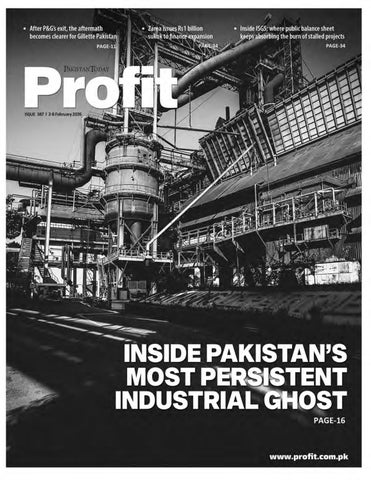
Create a flipbook
Issuu converts static files into: digital portfolios, online yearbooks, online catalogs, digital photo albums and more. Sign up and create your flipbook.
Profit E-Magazine Issue 378 by Pakistan Today - Issuu