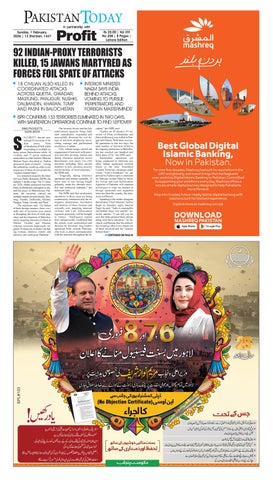

92 INDIAN-PROXY TERRORISTS KILLED, 15 JAWANS MART YRED AS FORCES FOIL SPATE OF ATTACKS
g 18 CIVILIAN ALSO KILLED IN COORDINATED ATTACKS ACROSS QUETTA, GWADAR, MA STUNG, PANJGUR, NUSHKI, DALBANDIN, KHARAN, TUMP AND PA SNI IN BALOCHISTAN
g INTERIOR MINISTER NAQVI SAYS INDIA BEHIND ATTACKS, VOWING TO PURSUE ‘PERPETRATORS AND FOREIGN MASTERMINDS’
g ISPR CONFIRMS 133 TERRORISTS ELIMINATED IN TWO DAYS, WITH SANITIZATION OPERATIONS CONTINUE TO FIND ‘LEFTOVER’
RAWALPINDI/QUETTA
SE C U R I T Y forced neutralized 92 terrorists of Indian proxy Finta al-Hindustan (FAH) while responding to multiple attacks across Balochistan while 18 civilians and 15 jawan embraced martyrdom in what Interior Minister Mohsin Naqvi described as Indian sponsored spate of attacks , vowing the authorities would go after every single one of those involved and the “masters behind them”
In a statement issued by the InterServices Public Relations (ISPR) the military s media wing, On 31 January 2026, #India sponsored terrorists Fitna al-Hindustan attempted to disturb the peace in #Balochistan, Pakistan the terrorists carried out multiple attacks around Quetta Mastung Nushki Dalbandin Kharan Panjgur, Tump, Gwadar and Pasni
The statement said, On behest of their foreign masters, these cowardly acts of terrorism were aimed at disrupting the lives of local populace and development of Balochistan by targeting innocent civilians in District Gwadar and Kharan, wherein, terrorists maliciously targeted 18 innocent civilians (including women, children, elderly and labours) who embraced Shahadat ”
The security forces and the law enforcement agencies being fully alert immediately responded and successfully thwarted the evil design of terrorists displaying unwavering courage and professional excellence, it added
Our valiant troops carried out engagement of terrorists with precision and after prolong, intense and daring clearance operation across Balochistan sent ninety two (92) terrorists including three suicide bombers to hell, ensuring security and protection of local populace, the ISPR said
“Tragically, during clearance operations and intense standoffs 15 brave sons of soil having fought gallantly made the ultimate sacrifice and embraced shahadat, the statement said
The ISPR said that sanitization operations in these areas are being continuously conducted and the instigators perpetrators facilitators and abettors of these heinous and cowardly acts targeting innocent civilians and Law Enforcement Agencies personals, will be brought to Justice “Intelligence reports have unequivocally confirmed that the attacks were orchestrated and directed by terrorists ring leaders operating from outside Pakistan who were in direct communication with the terrorists throughout the in-
cident, the ISPR said “Earlier on 30 January, 41 terrorists of Fitna al-Hindustan and Fitna al-Khwarij were killed in Panjgur and Harnai With these successful operations in last two days the total number of terrorists killed in the ongoing operations in Balochistan has reached one hundred and thirty three (I33),” the ISPR said Sanitisation operations are being conducted to eliminate any other Indian sponsored terrorist found in the area Relentless Counter Terrorism campaign under vision “Azm-e-Istehkam” (as approved by Federal Apex Committee on National Action Plan) by Security Forces and Law Enforcement Agencies of Pakistan will continue at full pace to wipe out menace of foreign sponsored and supported terrorism from the country, the statement reaffirmed Speaking to the media alongside Balochistan Chief Minister Sarfraz Bugti on Saturday night Interior Naqvi he said India is responsible and behind these not normal terrorists attacks “I can tell you for sure that India planned these attacks along with these terrorists ” he declared reaffirming that the authorities would go after every single one of those involved and the masters behind them


Ttory
of
lines
(Nepra) within
gazette
ISMO has already
auction process and held multiple consultative meetings with Nepra in December 2025 After incorporating feedback and written comments from the regulator, the draft process was finalised and placed before the Market Monitoring Committee in January 2026 which recommended its submission to Nepra for approval
According to the approved plan, the auction schedule will be spread evenly after the first year The proposed quantum includes 200MW in 2026 followed by 150MW each year in 2027 2028 2029 and 2030 bringing the total to 800MW The draft auction process out-
lines key elements including an annual auction calendar bidding procedures, eligibility requirements, bid bonds and performance guarantees, allocation mechanisms in case of over- or under-subscription postaward obligations and monitoring arrangements
Officials said the 200MW allocation for the first auction is intended to meet the expected demand from entities that have already submitted competitive supplier applications to Nepra
The remaining 600MW has been distributed evenly across subsequent years
However, the approved figures represent a minimum threshold
Under the auction framework, ISMO may seek prior approval from the Power Division to increase the auctioned quantum in any year depending on market demand

Company
92 Indian-prox y terrorists killed, 15 jawans mar tyred as forces foil spate of attacks
CONTINUED FROM PAGE 01
“We will expose them in the world the face with which they meet the world and the face with which they support terrorists he said Naqvi said India was the main country behind terrorism saying that it was not only providing financial support to the terrorists but was also aiding them in planning and strategising CM Bugti expressed gratitude to Naqvi for rushing to Quetta and chairing a high-level security meeting while visiting the injured at the Combined Military Hospital He condemned the killing of women and children from a Baloch family in Gwadar and praised law enforcement and security personnel for their timely response The terrorists morale may have prompted the attack but their lethality was low due to the superb rebuttal by our forces, he said Earlier reports indicated that at least 67 terrorists were killed during coordinated operations targeting 12 locations across Balochistan foiling FAH s plans Ten police and security personnel embraced martyrdom while defending the public State has designated the Balochistan-based terrorist groups as Fitna al-Hindustan, emphasizing India’s alleged role in destabilizing
Pakistan
Information Minister Attaullah
Tarar called the attacks a “desperate move as security forces were closing in on FAH and Fitna al-Khwarij militants Our forces were alert prepared, and fought bravely at all sites, he said Tarar condemned the killing of a Baloch family and reaffirmed that the Prime Minister is in full contact condemning the attacks and underscoring Pakistan s resolve to eliminate terrorism

to justice Operations and security measures CM Bugti visited the Quetta blast site and was briefed by IG Balochistan Muhammad Tahir commending the timely response of police and CTD Anti-state elements will not be forgiven; there will be no compromise on peace in Balochistan, Bugti asserted Interior Minister Naqvi also visited Quetta for high-level discussions on
law and order while both leaders attended funeral prayers for martyrs and met their families Naqvi praised the bravery of Balochistan s people and security forces, adding: “The sacrifices of martyrs cannot be forgotten, and the nation salutes them ” Bugti echoed the sentiment affirming that the state remains committed to protecting the oppressed Provincial official Shahid Rind noted that police and FC successfully foiled attempted attacks at several locations, following the neutralization of over 70 terrorists in the past two days Naqvi also visited Corps Headquarters in Quetta for a security briefing and appreciated the professional response of security personnel Emergency measures were implemented in all government hospitals across Balochistan under Health Minister Bakht Muhammad Kakar and Health Secretary Mujeebur Rehman Quetta Trauma Centre and Civil Hospital operating theatres were put on alert, with additional doctors deployed to treat the injured Separately, police discovered and neutralized an anti-tank mine and explosive materials on railway tracks in Nasirabad handed over to the CTD for investigation Railway tracks have been frequent terrorist targets, with incidents affecting the Quetta-bound Jaffar Express in recent months


Areduction of Rs 4 04 per unit was the main measure announced by Prime Minister Shehbaz Sharif, along with a cut in wheeling charges for industry, as well as a cut in the export refinance scheme rate from 7 5 percent to 4 5 percent He also announced that leading exporters would get blue passports for two years a measure designed to stroke their egos after the measures designed to help their pocketbooks He announced the package at the award ceremony for the top exporters of 2024-25 an occasion he also used to proclaim his government’s achievements in the economic field
It was not solely a matter of political boasting but he also showed a macroeconomic vision which enables his government to make policy that might work True, the government has farmed out economic policy to the IMF, by his own admission, but still, some of the things the IMF has recommended seems to have had an effect, as he himself has mentioned Inflation is down in single digits, the policy rate is now down to 10 5 percent, and forex reserves have doubled over three years Yet one could sense his frustration when he said that exports had been something of a letdown, and that all of the positives did not mean much without growth This is the divergence between him and the IMF, because while growth is essential to his political survival the IMF simply doesn’t care As the PM said the purpose is not to achieve short-term stability to be followed by a bust and another foreign exchange crisis but to achieve long-term growth
The economics is simple The country is in a foreign debt trap and cannot escape until it exports much much more The PM spoke of the need to grow software exports from $3 billion to $30 billion in five years, an indication that he might be counting his chickens before they are hatc hed, The EU-India trade deal might deprive Pakistan of a traditional market for exports, as India gets advantages Pakistan is already talking to the EU, though the time was probably earlier Also, it should be noted that the deal is not only about trade, but geopolitics too One reason the EU made the deal is because it is searching for trade alignments other than the USA Considering the recent attempts to curry favour with the USA Pakistan has its work cut out

Dedicated to the legac y of late Hameed Nizami Arif Nizami (Late) Founding Editor
M A Niazi Editor Pakistan Today Babar Nizami Editor Profit


IN Pakistan s immigration discourse speed is increasingly mistaken for reform On January 13, Interior Minister Mohsin Naqvi and a high-level UAE delegation led by Ahmed bin Lahij Al Falasi reached an understanding on a proposed Pre-Immigration Clearance system Initially launching as a pilot project in Karachi the arrangement promises that travellers will soon complete UAE immigration formalities on Pakistani soil, enabling them to land in Dubai or Abu Dhabi as domestic passengers,” bypassing the notorious arrival queues On paper this is a technical triumph presented as a timely response to administrative inefficiencies in cross-border movement For a country where overseas employment remains a primary economic lifeline, such facilitation appears both logical and overdue According to the Bureau of Emigration and Overseas Employment about 762 000 Pakistanis proceeded abroad for work in 2025 alone underscoring the scale of mobility at stake Yet for the ordinary Pakistani this announcement evokes less reassurance than irony: a promise of faster immigration queues attached to a system where the visa door itself is steadily closing Beneath the procedural polish lies a deeper systemic contradiction we are accelerating departure for a population that is being quietly but firmly denied access at the very first point of entry


PAKISTAN’S development story has long been marked by a quiet but persistent imbalance where opportunity is shaped less by merit than by geography and where entire regions remain excluded from the promise of national progress When Prime Minister Shehbaz Sharif speaks about national progress, he almost invariably returns to a familiar promise that Pakistan can only move forward if equal opportunities and uplift are ensured across all regions Few Pakistanis would disagree with the sentiment Fewer still would argue that this vision has ever been pursued with the seriousness it requires Behind the polished speeches and symbolic gestures lies a harsher reality In Pakistan, opportunity is largely determined by geography where birth rather than talent or ambition often decides access to education healthcare employment and even personal security These regional inequalities are neither accidental nor merely economic failures They are the cumulative result of political choices that have, over time, hollowed out national cohesion and deepened exclusion across vast parts of the country From Balochistan to the former tribal districts from southern Punjab to interior Sindh entire regions remain locked out of development Public services are scarce infrastructure is crumbling and economic opportunities are limited In contrast, a handful of urban centres like Lahore, Islamabad, Karachi continue to absorb a disproportionate share of public in-
vestment This stark imbalance has effectively created two Pakistans one plugged into global markets and opportunities and another trapped in persistent cycles of deprivation The consequences of this divide are no longer theoretical In neglected regions, disillusionment among young people has, in some cases, hardened into anger and even violence against the state Research by the Population Council underscores a stark truth: Pakistan’s regional disparities are not accidents but the cumulative result of decades of skewed development policies and misplaced political priorities When millions are systematically excluded from the nation s growth, instability ceases to be an exception and becomes an inevitable outcome In response, the government often highlights initiatives like laptop distributions or scholarships for study abroad as evidence of its commitment to youth and opportunity For the fortunate few who benefit these programmes can indeed be life-changing But as tools to address structural inequality, they fall far short A laptop cannot compensate for a school without teachers or electricity, nor can a foreign scholarship fix the absence of local universities vocational centres or industries capable of absorbing graduates These initiatives treat symptoms rather than causes offering selective opportunity while leaving the vast majority of marginalized youth trapped in the same cycles of deprivation Politicians have long described Pakistan’s youth as the country’s greatest asset, and Prime Minister Sharif is no exception The phrase has become a familiar refrain repeated so often that it risks losing meaning The real challenge

This is more than a statistic It is a barrier between aspiration and opportunity for millions of Pakistanis who have been told they are the country’s greatest asset while being left on the margins of its economy Without the centre ensuring equitable investment and oversight across all regions, mismanaged provinces will leave youth without jobs or opportunity, and Pakistan’s potential will remain unfulfilled
The core critique of this agreement is disarmingly simple Pre-immigration clearance improves convenience only for those who already possess visas It offers nothing to the thousands whose aspirations are being eroded by an opaque and increasingly restrictive visa regime While official statements continue to deny the existence of a blanket ban empirical trends suggest otherwise In 2024 the UAE welcomed approximately 64,130 Pakistani workers By contrast, data from the first half of 2025 shows a sharp contraction: only about 13,865 employment visas were processed in the first seven months reflecting nearly a 50 percent decline in monthly averages For the marketing professional in Lahore or the labourer in Multan a faster queue in Karachi is an irrelevant luxury when their visa application has been rejected often repeatedly without explanation Streamlining exit procedures is a hollow victory if the digital gate into the UAE remains largely inaccessible Administrative speed in this context risks becoming a veneer masking structural denial This imbalance becomes even more troubling when viewed against the economic realities binding the two countries Pakistanis are not peripheral participants in the UAE’s growth story; they are among its principal architects From construction and logistics to retail healthcare and domestic services Pakistani labour has helped build both the skyline and the service economy of the Emirates Despite mounting hurdles, the UAE remains one of the top three destinations for Pakistan’s workforce The remittances sent home running into billions of dollars annually do not merely support families; they provide critical liquidity that stabilises Pakistan s fragile economy Yet the discourse has shifted subtly but decisively from partnership to policing References to criminal activities and begging have justified tighter scrutiny, culminating in instruments such as the PakSkills portal and mandatory behavioural vetting
By internalising these host-country anxieties
Pakistanis are not merely travellers to be processed or risks to be filtered; they are long-standing contributors to a shared economic ecosystem that has benefited both countries for decades. Any immigration framework that prioritises control over confidence, or suspicion over facilitation, weakens not only human mobility but the very foundations of a strategic partnership Immigration without access may move queues faster, but it ultimately moves relationships backward
the Pakistani state has effectively begun performing the UAE s gatekeeping on its own soil The ordinary worker now bears a double burden: proving employability to an employer and acceptability to two governments Certifications and registrations multiply, yet none offer a predictable or enforceable guarantee of a visa Facilitation in effect has been replaced by filtration
Perhaps the most unsettling development is the emerging stratification of the Pakistani passport itself As visa issuance became unofficially restrictive, a visible hierarchy took shape Holders of diplomatic and “blue” (service) passports navigate these evolving systems with relative ease while the green passport carried by the very people who sustain the UAE s labour-intensive sectors is subjected to heightened scrutiny and discretionary rejection
If pre-immigration clearance matures into a privileged corridor for a narrow class of professionals and officials, it risks further alienating the working-class migrant who anchors bilateral ties Migration governance loses its moral centre when it institutionalises inequality under the banner of efficiency
Beyond access and equity lies another unresolved concern: data sovereignty Implementing UAE-standard immigration clearance on Pakistani soil requires deep system-to-system integration including biometric verification and real-time data exchange In an era where data is a strategic asset this raises unavoidable questions
What safeguards govern this unprecedented level of access? Are citizens biometric identities being traded for marginal gains in airport efficiency? The absence of meaningful public debate or parliamentary oversight on the scope and limits of this data sharing is striking Efficiency achieved through opacity is not reform; it is risk deferred
The Karachi pilot project, therefore, must be understood not as a diplomatic endpoint but as a test of intent A genuinely commendable immigration agreement cannot remain confined to technical facilitation alone; it must be accompanied by a transparent restoration of visa access and a fair merit-based screening regime that does not collectively penalise an entire nationality for the actions of a few Immigration efficiency, divorced from access, is not reform it is merely refinement of exclusion
True success will not be measured by reduced congestion at Terminal 3 nor by how swiftly passengers clear biometric gates after landing It will be measured by whether an ordinary, middle-class Pakistani can apply for a UAE visa with predictability, dignity, and confidence comparable to regional peers Until the point of access is repaired the point of arrival will remain a carefully managed illusion
Pakistanis are not merely travellers to be processed or risks to be filtered; they are longstanding contributors to a shared economic ecosystem that has benefited both countries for decades Any immigration framework that prioritises control over confidence or suspicion over facilitation weakens not only human mobility but the very foundations of a strategic partnership Immigration without access may move queues faster, but it ultimately moves relationships backward
The writer is a freelance columnist
Why organs go unused
revisiting consent mechanisms, strengthening hospital-based donation systems and launching sustained public and religious awareness initiatives could significantly expand the donor pool Such reforms would honour both ethical principles and the urgent needs of patients whose lives depend on timely transplants
Kites and consequences
MajiD nabi burfat
Dr Zafar Khan SafDar

perience went on to develop a parallel narrative weapon systems industrial philosophy and industrial processes to name a few The
AFTER weeks of attrition the ultimate clash between the Republican-led Neo-Cons encapsulated in the POTUS, and the system of government of its own kind, the Wilayat Faqeeh rule in Iran, might have taken place; or there is a possibility that the drumbeating of the war gets louder and louder with the passage of time As the strike packages assemble at the legendary Muaffaaq Air base in Jordan housing F-15s, KC-135 tankers and other planes, at Crete and Diego Garcia; not to ignore the ‘Armada’ carrying FA-18 Hornets and A-6 EW enabled jets; the arrangement of assets for the attack is almost completely over There are plans in hand to create a conflict through an economic naval blockade of the Iranian coastline, pressuring it to go for conflict with the US ships; once a triggering situation is created, an all-encompassing assault can be commissioned or might have been already communicated to the formations as and when they decide to hit In such a scenario a repeat of the June 12-day war between Iran and Israel can be contemplated, where after the initial and partial decimation of the IRGC leadership, the next in line leadership had a free hand to counter and engage the IDF whether in the Iranian air space or through hitting precise targets in the Israeli mainland itself or in the developing scenario US assets across
the region Then in June 2025 the swift action by the Baseej neutralized the local sleeper cells to an extent that another wholesale massacre of the IRGC could be avoided The missile units were able to create a stalemate where even if the Iranians had no clear victory they were able to force a stop into the IDF plans; on the basis that the cost benefit analysis of IDF hitting Iranian targets and then being hit by the Iranian warheads the next midnight made it clear to the IDF that the costs of reconstruction of infrastructures hit by the IRGC were going into millions; especially places like the Weizman scientific research institute as well as other such sensitive places in Tel Aviv as well as Haifa Similarly the signature USAF strikes in the end also claimed to hit the key nuclear sites in central Iran However, the war cry of POTUS and a very aggressive war cry at hand, also puts into doubt the claims made by the Americans at that point of time Moving forward if the Iranian missile batteries are saved from the
cells; an apprehension aired by many
political observers that the missile sites identified during the June conflict were the areas of prime unrest; then the conversion of the amount of ordnance in the missile cities if fired can repeat similar destruction to the IDF assets; simply on the plea that the Israeli PM has been the prime instigator for an otherwise reluctant USA to jump into

g t h e A f g h a n i s t a n a n d I r a q c a m p a i g n s c a n
r e v i s i t t h e U S e c o n o m y i n t h e f o r m o f t r i l l i o n s o f d o l l a r s o f d e f i c i t f i n a n c i n g
T h e c a s c a d i n g i m p a c t o n s o c i e t y a n d p o l i t i c s c a n n o t b e o v e r l o o k e d T h e
c o n f l i c t i n t h e M i d d l e E a s t m i g h t b e k i c k e d o f f e
, b u t t
i n i t i n i t i a l l y i n t h e f o r m o f q u i c k r e s u
fighter jet Here it would not be out of context to say that in the May 2025 limited conflict with India the deployment of the JF-17 was more pronounced than the American cousin, the Block 52 F-16s
The overt reason for justifying the strikes on Iran just to appease the Zionist lobby does not sell well The lobby has over the years learnt to live with many adversaries and ideologies The Iranian system might be just a new addition; given the fact that the systems professing the same thought process as Iranians, the Iraqis, were not treated as threat by the West, POTUS or the IDF
The question invariably settles down at the war of narratives The unipolar world coming out of World War I was rocked by the 1917 Russian revolution The Soviet ex-


live commentary
Warships do not drift into position by accident Their movement signals intent Similarly intelligence dossiers are typically not compiled to uncover truth but concocted to manufacture consent for military actionthe scaffolding of an intervention already set in motion
It is in this context that Israel has handed US President Donald Trump what it calls decisive evidence that Iranian authorities executed hundreds of detained protesters during the recent nationwide crackdown That Tel Aviv should now present itself as the authoritative provider of evidence against Iran would be comical, were the stakes not so grave The state that has lobbied relentlessly for war with Tehran that openly declares regime change in Iran to be a strategic objective and that stands to gain more than any other actor from Iranian collapse is suddenly cast as a neutral humanitarian witness Tel Aviv has thus been elevated to chief prosecutor; its claims treated not as advocacy, but as fact
This does not mean Iran is not in crisis
It is Large numbers of Iranians have been driven into the streets by genuine exhaustion after decades of economic strangulation Their grievances are real, their rage undeniable But such moments are also those in which popular movements are most vulnerable, not only to repression, but to capture External powers need not invent domestic
When movements threaten entrenched western interests, sanc tions follow Economic crises are engineered Internal divisions are inflamed Media campaigns multiply Counter-revolutions are funded If these measures fail, coups are organised, occupations launched, or wars justified in the language of salvation
Israeli media figures have spoken openly of what would follow regime collapse, declaring that once Iran falls, it will be bombarded across its territor y in the same manner as Syria was systematically stripped of militar y capacity after the ousting of President Bashar al-Assad
discontent; they need only steer it FAMILIAR STRUCTURE
The pattern is well established There was the 1964 coup in Brazil against leader Joao Goulart; the 1973 coup in Chile against Salvador Allende; and before those the Congo coup in 1961 where Patrice Lumumba was removed and killed Then there s the long, murky story of counter-revolutionary reversals following the Arab Spring These cases are not identical, but the structure is familiar enough to serve as a warning
Since the Second World War when movements threaten entrenched western interests, sanctions follow Economic crises are engineered Internal divisions are inflamed Media campaigns multiply Counterrevolutions are funded If these measures fail coups are organised occupations launched or wars justified in the language of salvation Iran knows this pattern not as theory but as lived trauma In 1953, Mohammad Mosaddegh, a democratically elected prime minister, was overthrown in a US-British coup not because he ruled brutally but because he nationalised Iran s oil At the time the Anglo-Iranian Oil Company which later became known as BP offered Iran only 16 percent of net profits from its own resources Britain responded with a blockade, shutting down the Abadan refinery, pressuring foreign buyers to refuse Iranian oil and deliberately plunging the economy into crisis When economic warfare proved insufficient London persuaded Washington to intervene by invoking Cold War fears The CIA s Operation Ajax flooded Iran with disinformation, bribed politicians, harassed religious figures, and orchestrated unrest Mosaddegh was removed The shah was restored Even the CIA now officially acknowledges the coup as undemocratic That episode did not merely alter Iran s
Today, China is the primary buyer of Iranian crude. Weakening Iran therefore weakens a critical energy artery for Beijing: Iran accounted for roughly 13 percent of China’s seaborne oil imports in 2025, with around 1 38 million barrels per day heading to Chinese buyers
political trajectory; it defined the playbook
The same tools are visible today Reports of attacks on dozens of mosques across Iran raise unavoidable questions about external efforts to stir division and internal infighting through precisely the same fault lines exploited seven decades ago
Nor is this merely a matter of covert destabilisation Israeli media figures have spoken openly of what would follow regime collapse, declaring that once Iran falls, it will be bombarded across its territory in the same manner as Syria was systematically stripped of military capacity after the ousting of President Bashar al-Assad The message is unambiguous: regime change is not the end goal, but the precondition for comprehensive dismantling SLOW SIEGE
Since 1979 Iran has endured one of the longest and most comprehensive sanctions regimes in modern history What began with asset freezes and oil bans evolved into a system targeting finance, energy, trade, technology and daily life Sanctions intensified through the 1990s, expanded multilaterally after 2006 were partially lifted under the 2015 nuclear agreement and then were fully reimposed under Trump s maximum pressure campaign in 2018
Last year, European powers triggered the snapback mechanism, automatically restoring UN sanctions under the banner of noncompliance and human rights
Sanctions are often described as a peaceful alternative to war In reality they function as a slow siege They collapse currencies hollow out societies radicalise politics and ensure that ordinary people pay the price for geopolitical confrontation Britain used this method against Iran in 1951 The US has refined it ever since It is no coincidence that calls for regime change so often accompany demands for harsher sanctions; those advocating them understand exactly who absorbs the pain Washington s interest in Iran is rooted in hegemony Iran s oil is not merely an economic asset; it is a strategic lever in the global contest with China
Today China is the primary buyer of Iranian crude Weakening Iran therefore weakens a critical energy artery for Beijing: Iran accounted for roughly 13 percent of China’s seaborne oil imports in 2025, with around 1 38 million barrels per day heading to Chinese buyers Israel s agenda goes further Over the
past two years, Prime Minister Benjamin Netanyahu has repeatedly addressed the Iranian people directly, urging them to take to the streets, framing Israeli military actions as clearing the path to freedom and promising assistance once the regime falls Former Defence Minister Yoav Gallant was even more explicit speaking of steering events with an invisible hand - stressing the centrality of mass action while remaining formally in the background 'WE ARE WITH YOU' This rhetoric has increasingly been matched by media signalling Israeli outlets have openly suggested that foreign actors are arming protesters, a claim voiced most bluntly by a diplomatic correspondent on Channel 14 - the television network closest to Netanyahu - who gloated that protesters were being supplied with live firearms which is the reason for the hundreds of regime personnel killed Everyone is free to guess who is behind it he added Such remarks are not marginal slips, but part of a broader Israeli media ecosystem that has begun to say aloud what was previously left implicit These media cues sit uneasily alongside official intelligence messaging Following the war last June Mossad director David Barnea issued a rare and striking declaration, assuring both his agency and the public that Israel would continue to “be there, like we have been there” - language widely read as foreshadowing sustained covert activity inside Iran And last month a Persian-language X (formerly Twitter) account that has been linked to the Mossad urged Iranians to take part in protests, declaring: Go out together into the streets The time has come We are with you Not only from a distance and verbally We are with you in the field ” While Israeli officials have formally denied any connection to the account intelligence agencies have long relied on deniable fronts precisely for such purposes Nor is this limited to covert signalling Israeli flags have become a conspicuous feature of anti-regime demonstrations outside Iran accompanied by a coordinated social-media campaign amplifying specific narratives and preferred political outcomes An Al Jazeera data analysis showed how Israel-linked accounts worked systematically to shape global perceptions of the protests, promoting Reza Pahlavi, the son of Iran’s last shah as the singular political alternative Pahlavi himself engaged with the campaign
a move that was swiftly magnified by Israeli accounts portraying him as the “face of the alternative Iran”
These interventions are not isolated They align with a broader strategic vision increasingly articulated in Israeli political and intellectual circles: the weakening and eventual fragmentation of Iran Israeli editorials and policy papers

IRAN ARMY CHIEF WARNS US, ISRAEL AGAINST ATTACK; SAYS FORCES ON HIGH ALERT
forces
be eliminated’
The US carried out strikes on key Iranian nuclear sites in June when it briefly joined Israel’s 12-day war against its regional foe Israeli attacks also hit military sites across the country and killed senior officers and top nuclear scientists
US
If

But Hatami on Saturday insisted that Iran s nuclear technology cannot be eliminated, even if scientists and sons of this nation are martyred On Friday, US Central Command (Centcom) said Iran’s Islamic Revolutionary Guard Corps (IRGC) would conduct “a two-day live-fire naval exercise” in the Strait of Hormuz a key transit hub for global energy supplies
In a statement Centcom warned the IRGC against any unsafe and unprofessional behaviour near US forces The United States designated the IRGC a terrorist organisation in 2019, a move the European Union followed on Thursday
The EU decision drew angry reactions from Tehran which vowed to reciprocate Protests
Nationwide protests against the rising cost of living erupted in Iran on December 28, before turning into a broader anti-government movement that peaked on January 8 and 9 Iranian authorities have said the protests began peacefully before turning into “riots” involving killings and vandalism blaming the United States and Israel for fomenting the unrest in a terrorist operation
The official death toll from the authorities stands at 3,117 The protests have since subsided On Saturday, Iran s President Masoud Pezeshkian urged his government to heed public grievances after the demonstrations


FBR revenue collec tion picks up momentum in Januar y 2026
from income tax has shown significant improvement and has reached ₨ 483 billion against collection of ₨ 381 billion representing a 26% impressive growth over previous year This improved revenue collection performance is not incidental but reflects the structural impact of the FBR s reforms especially its enhanced enforcement measures and coordinated effort to realize

and
flective
(LSM) growth which is a very positive and encouraging development January's results validate FBR’s reform-driven transformation plan By leveraging digital infrastructure and the collection through enforcement measures FBR is improving compliance expanding and deepening the tax net, and fostering taxpayer trust

SADAF NOREEN AWAN
“When women rise to lead nations rise with them A courageous daughter does not merely inherit a legacy she reshapes it, safeguards it, and carries it forward with resolve ” These words find tangible expression in the leadership of Maryam Nawaz Sharif Pakistan s first female Chief Minister of Punjab Her ascent is not merely a historic first; it represents a substantive shift in governance culture, administrative discipline, and political vision Combining authority with composure resolve with restraint she has emerged as a leader whose presence commands respect while her performance invites scrutiny and increasingly, approval Maryam Nawaz has quickly positioned herself as a results-oriented administrator, blending compassion with control and ambition with accountability In doing so she has begun to redefine what effective leadership can look like in Pakistan Women in Leadership: Beyond Symbolism In a political environment long dominated by men Maryam Nawaz’s leadership marks a decisive break from convention Her rise demonstrates that authority is shaped not by gender but by capacity, commitment, and character For many women across Pakistan, her presence at the helm of the country’s largest province
is a source of inspiration Yet her impact extends beyond symbolism She governs with transparency and purpose engaging directly with citizens monitoring institutions and ensuring delivery This is a leadership model that prioritizes outcomes over optics and performance over rhetoric, signaling the emergence of a more professional and accountable political culture From Political Heir to Party Leader Maryam Nawaz’s political journey has been forged under pressure While she entered public life as the daughter of Nawaz Sharif she has earned her standing through persistence and resilience During periods of political upheaval, she remained active on the ground addressing rallies mobilizing party workers and defending democratic norms Her role during challenging phases of Pakistan Muslim League–Nawaz was instrumental in sustaining party morale and reconnecting leadership with grassroots supporters Today, she is often described as the party’s “Iron Lady not because of lineage but due to her discipline political maturity and refusal to retreat in adversity A Broad-Based Development Agenda Since assuming office, Maryam Nawaz has launched a wide-ranging development agenda spanning infrastructure sanitation employment agriculture healthcare education and governance reform Across Punjab, road rehabilitation,
drainage upgrades and urban renewal projects are visibly underway, extending beyond major cities into smaller districts
As someone with roots in District Khushab I can attest that the change on the ground is unmistakable Cleaner markets improved traffic discipline, maintained streets, and a visible state presence reflect a level of administrative engagement previously unseen Governance is no longer abstract; it is increasingly experienced at the local level Suthra Punjab: Cleanliness as Public Policy
One of the most consequential initiatives of her administration is Suthra Punjab, a province-wide sanitation and waste management campaign Drawing on both civic responsibility and institutional coordination the program has improved waste collection street cleaning, and disposal mechanisms across urban and rural areas
Public spaces appear healthier, neighborhoods more organized, and citizens more invested in their surroundings For districts long neglected in municipal planning Suthra Punjab represents a structural shift rather than a cosmetic exercise embedding cleanliness into governance priorities Youth, Skills, and Economic Inclusion
Recognizing Punjab’s youth as its greatest asset Maryam Nawaz has placed employment generation and skill development at the center of her policy framework


PM HAILS PAFDA INAUGURATION AS L ANDMARK STEP FOR NATIONAL FOOD SAFET Y

A JK President Barrister Sultan Mehmood Ch passes away at 7 1
PIMS says Imran Khan’s eye procedure successful amid political row over ‘secret’ hospital transfer
His funeral prayers will be offered on Sunday (tomorrow) at 3pm in his native village of Chechian, Mirpur His demise comes just days before Kashmir Solidarity Day observed on February 5 each year to reaffirm Pakistan s unwavering support for the just struggle of the Kashmiri people a cause he

The Pakistan Institute of Medical Sciences (PIMS) on Saturday confirmed that an eye procedure performed on incarcerated former prime minister Imran Khan was completed “smoothly” and that he remained “vitally stable” throughout the intervention In a video statement PIMS
was widely known for forcefully raising the Kashmir issue at international forums He presented the Kashmiri case at the United Nations the European Union and various institutions in the United States and led large-scale Kashmir marches in London, New York, Brussels, Dublin and Berlin Alliance with PML-N formed in state interest:
Executive Director Prof Dr Rana Imran Sikander said the 74-yearold former premier underwent a 20-minute medical procedure for an eye ailment late on January 24 and was discharged with routine post-procedure care instructions and follow-up advice Dr Sikander said Imran Khan had complained of reduced vision in his right eye, prompting a comprehensive examination by a qualified ophthalmologist from PIMS at Adyala Jail The assessment included laboratory investigations ocular endoscopy intraocular
NDC raises alarm over Imran Khan’s health, demands access to personal physician
s ta f f r e p o r t
The National Dialogue Committee (NDC) on Saturday voiced serious concern over the health of incarcerated PTI founder and former prime minister Imran Khan, demanding that he be immediately allowed to meet his personal physician The demand comes two days after the government confirmed that Imran underwent a medical procedure for an eye ailment at a hospital in Islamabad last week a development that triggered strong
pressure measurement, and Optical Coherence Tomography (OCT) of the retina
Based on the assessment a diagnosis of right central retinal vein occlusion was made and hospitalbased treatment was advised, he said, adding that Imran was subsequently shifted to PIMS late Saturday night for the procedure
The hospital chief said the treatment plan was explained in detail to the patient upon arrival and informed consent was obtained prior to the intervention The procedure was carried out in
Punjab Chief Minister Maryam Nawaz said the newly inaugurated Punjab Agriculture, Food and Drug Authority (PAFDA) is not merely a structure of steel and cement but a “game changer” poised to benefit not only Punjab but the entire country
Addressing the inaugural ceremony the Chief Minister said the vision for PAFDA was first conceived by Prime Minister Muhammad Shehbaz Sharif during his tenure as Punjab Chief Minister, and “today that vision has taken
and
criticism from the PTI which said neither the party nor Imran s family had been informed The NDC, formed by former PTI leaders including Fawad Chaudhry, Dr Shahzad Waseem and ex-Sindh governor Imran Ismail met in Islamabad on Saturday Participants included Chaudhry Ismail former Karachi mayor Waseem Akhtar and senior politician Munir Ahmad Khan In a statement issued after the meeting the committee expressed “grave concern over Imran s health and the circumstances surrounding his medical treatment
the operation theatre under standard sterile protocols and medical monitoring
The statement came amid political controversy after the Pakistan Tehreek-i-Insaf (PTI) approached the Supreme Court on Friday, seeking assistance in arranging a meeting between Imran Khan and his personal physicians
The party had raised concerns over his health and alleged that jail authorities initially wanted the treatment conducted inside the prison despite medical advice recommending hospital care


ISLAMABAD