Epaper_26-01-31 ISB

Page 1


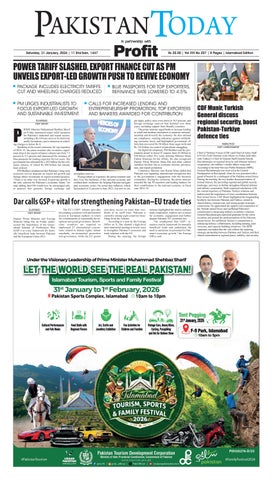
NA PANEL SEEKS PM’S INTERVENTION AS POTATO PRICES CRASH, FARMERS FACE LOSSES

Pakistan, China plan to extend CPEC to Afghanistan,

revive trilateral framework

Pakistan urges AD Por ts Group to review cargo charges at Karachi Por t terminals

FBR ISSUES SUPER TA X RECOVERY NOTICES, TARGETS RS327 BILLION FROM L ARGE FIRMS

4 and mock auctions on March 5 After the allocation stage the assignment stage will begin upon closure of the auction Provisional results will be announced following completion of assignments, after which winning bidders will be required to submit performance bank guarantees within 15 business days before licenses are issued

early during the first seven months of FY2026 which he said was 44% higher than the total early repayments made in FY2025 According to the adviser around 44% of SBP-held debt has been retired ahead of maturity, reducing the central bank’s domestic debt stock from about Rs5 500 billion to nearly Rs3 000 billion including liabilities that were originally scheduled to mature in 2029

He said 65% of the early repayments related to SBP debt, 30% to treasury bills and 5% to Pakistan Investment Bonds, contributing to a longer and more balanced maturity profile Schehzad said the impact was also visible in overall public debt which declined from over Rs80 5 trillion in June 2025 to around Rs80 trillion by November 2025 He added that the debtto-GDP ratio had fallen from about 74% in FY2022 to close to 70%, along-

side improvements in fiscal indicators

Addressing per-capita debt figures he said such metrics do not fully reflect a country s debt position and noted that assessment should focus on debt-to-GDP ratios, revenue capacity, interest costs, maturity profiles and rollover risks He said recent debt management measures had reduced refinancing pressures lowered borrowing costs by shifting from higher-cost instruments and created fiscal space for development and social spending Average domestic debt maturity, he added, improved from 2 7 years in FY2024 to over 4 0 years representing the largest single-year increase on record Schehzad said the measures resulted in savings of over Rs850 billion in FY2025, with a further Rs800 billion expected in FY2026 through debt switches, stable interest rates and continued fiscal discipline Pa k i s t a n r e t i r e s R s 3 . 6 5 t r i l l i o n i n d o m e s t i c d e b t a h e a d o f m a t u r

FBR ISSUES SUPER TAX RECOVERY NOTICES, TARGETS RS327 BILLION FROM LARGE FIRMS

TGovt sets 5.1% GDP g rowth target, inflation below 6.5% with focus on climate spending

The federal government

climate

while

green development and disaster management at the centre of fiscal planning. According to an official circular, the Ministry of Finance has approved the budget preparation schedule for the next financial year, with the interim macroeconomic framework due to be finalised within the current month. The ministry said the Mid-Year Review report will be presented to the National Assembly in February. All ministries have been directed to submit key budget documents, revised revenue and expenditure estimates, and detailed development project proposals by February 20. Inflation for FY27 is projected to remain contained at 6.5%, with greater emphasis on green taxation, non-tax revenues and climate-related subsidies. Ministries have been instructed to identify and separately tag environmental and climate-related expenditures, making climate budgeting a mandatory component of the process. The finance ministry said a strengthened disaster budgeting framework is also being developed, with separate monitoring of disaster-related spending to mitigate the impact of natural calamities. Natural resource categories and subsidies will be classified under climate action measures. Under the proposed framework, agricultural insurance and climate-resilient infrastructure will be categorised as climate adaptation, while clean energy initiatives and electric vehicle incentives will fall under climate mitigation spending. The ministry said non-tax revenues will be assessed for environmental impact, with levies on pollution-linked activities aligned with climate targets. Priority areas under the green revenue agenda include energy, transport and pollution management. The budget calendar outlines that meetings of the Budget Review Committee will be held from March 30 to April 12, while exchange rate assumptions will be shared on April 15. Approval of the Budget Strategy Paper is expected by April 20, followed by the issuance of budget ceilings for current and development expenditures between April 21 and 25. Meetings of the Annual Plan Coordination Committee are scheduled for the first week of May, followed by a

Pakistan’s 5G spectrum auction date

DESK

Pakistan’s auction of next-generation mobile services (NGMS/5G) spectrum will be held on March 10, with an estimated minimum non-tax revenue of $630.4 million, after approval by the Spectrum Advisory Committee, Business Recorder reported, citing senior government officials.

The decision was taken after the Spectrum Advisory Committee met with Federal Minister for Finance and Revenue Muhammad Aurangzeb on Thursday. The auction was earlier planned for late February.

Following the committee’s decision, the Pakistan Telecommunication Authority (PTA) issued revised auction timelines, pushing the allocation stage to March 10, 2026, and extending preauction processes by several weeks. Under the updated schedule, consultations on the Information Memorandum will conclude on February 6,

with the final document to be published on February 13. An information session for prospective bidders is scheduled for February 16.

Applications, along with pre-bid deposits, must be submitted by February 27, the same day the PTA will announce the list of applicants. Qualified bidders will be announced on March 3, followed by a bidder seminar on March 4 and mock auctions on March 5.

After the allocation stage, the assignment stage will begin upon closure of the auction. Provisional results will be announced following completion of assignments, after which winning bidders will be required to submit performance bank guarantees within 15 business days before licenses are issued.

Under directives from the Ministry of Information Technology and Telecommunication, the PTA will auction spectrum in the 700, 1800, 2100, 2300, 2600 and 3500 MHz bands, marking the largest spectrum release to date.

Pakistan retires Rs3.65

The auction will offer 15 MHz paired spectrum in the 700 MHz band, 3.6 MHz in 1800 MHz, 20 MHz in 2100 MHz, 50 MHz in 2300 MHz, 190 MHz in 2600 MHz, and 280 MHz unpaired spectrum in the 3500 MHz band. Base prices have been set in US dollars, with the 700 MHz band priced at $6.5 million per MHz, the 1800 MHz and 2100 MHz bands at $14 million per MHz each, the 2300 MHz band at $1 million per MHz,

Payments will be made in Pakistani rupees at the prevailing exchange rate of the State Bank of Pakistan.

Operators will have the option to pay the full license fee by the first anniversary of license issuance or opt for deferred payments, with at least 50% payable by the first anniversary and the remainder in five equal annual instalments starting from the second year, carrying an additional charge of KIBOR plus 3%.

trillion in domestic debt ahead of maturity, says finance adviser

Pakistan has retired Rs3,654 billion in domestic debt ahead of schedule since late 2024, marking a shift toward early repayments and reduced refinancing risks, according to Khurram Schehzad, Adviser to the Finance Minister. In a post on X, the adviser said the early retirements were made by the Ministry of Finance to both the market and the State Bank of Pakistan over a 14-month period. The latest repayment of Rs300 billion was made to the SBP on Thursday. He said the repayments included Rs1,000 billion in December 2024, Rs500 billion in June 2025, Rs1,160 billion in August 2025, Rs200 billion in October 2025, Rs494 billion in December 2025 and Rs300 billion in January 2026. As a result, more than Rs2,150

billion was retired early during the first seven months of FY2026, which he said was 44% higher than the total early repayments made in FY2025.

According to the adviser, around 44% of SBP-held debt has been retired ahead of maturity, reducing the central bank’s domestic debt stock from about Rs5,500 billion to nearly Rs3,000 billion, including liabilities that were originally scheduled to mature in 2029.

He said 65% of the early repayments related to SBP debt, 30% to treasury bills and 5% to Pakistan Investment Bonds, contributing to a longer and more balanced maturity profile.

Schehzad said the impact was also visible in overall public debt, which declined from over Rs80.5 trillion in June 2025 to around Rs80 trillion by November 2025. He added that the debtto-GDP ratio had fallen from about 74% in FY2022 to close to 70%, along-

Pak Suzuki calls for new auto policy to support localisation

PROFIT MONITORING DESK

Pak Suzuki Motor Company Limited has called for a new auto policy that supports greater localisation of parts, saying stronger local vendor development is essential for building Pakistan’s industrial capacity.

Speaking to media at the SME Cluster Expo in Lahore, Hiroshi Kawamura, Managing Director and Chief Executive Officer (CEO) of Pak Suzuki Motor Company Limited, said the company continues to support Pakistani vendors to help them meet global standards. He said foreign investment remains critical for Pakistan, not only for inflows of capital but also for technology transfer and long-term industrial capability.

side improvements in fiscal indicators.

Addressing per-capita debt figures, he said such metrics do not fully reflect a country’s debt position and noted that assessment should focus on debt-to-GDP ratios, revenue capacity, interest costs, maturity profiles and rollover risks.

He said recent debt management measures had reduced refinancing pressures, lowered borrowing costs by shifting from higher-cost instruments and created fiscal space for development and social spending. Average domestic debt maturity, he added, improved from 2.7 years in FY2024 to over 4.0 years, representing the largest single-year increase on record.

Schehzad said the measures resulted in savings of over Rs850 billion in FY2025, with a further Rs800 billion expected in FY2026 through debt switches, stable interest rates and continued fiscal discipline.

Kawamura said Pakistan needs both strong small and medium enterprises and sustained engagement from foreign partners. He said platforms such as the SME Cluster Expo play a role in linking SMEs with large industries and expanding opportunities within the industrial ecosystem. He also acknowledged the role of Small and Medium Enterprise Development Authority (SMEDA) in supporting SMEs across the country.

The SME Cluster Expo was organised by SMEDA in collaboration with the Ministry of Industries, bringing together more than 174 micro, small and medium enterprises to showcase products and explore business opportunities.

Mashood Khan, Director at SMEDA, said SMEs are a key component of the national economy, employing nearly 25 million people and contributing around Rs2.8 billion in exports. He said SMEs play a central role in employment generation and export growth, but require timely and practical policy support to unlock their full potential.

Khan said SMEs demonstrated resilience during the Covid-19 period by localising production and maintaining supply chains despite limited resources. He added that the expo attracted strong interest from local companies and consumers, with several MSMEs securing orders and sales, and is expected to support future collaborations and growth across the SME sector.

h

TTh e era when global trade was commanded by a narrow axis of industrial powers and relying on Western markets is collapsing On January 27 the european Union and India sealed a Free Trade Agreement, quickly called the mother of all trade deals , that doesn’t merely liberalize tariffs but recalibrates the geopolitical arithmetic of global commerce This is not incremental diplomacy: it’s a decades-in-themaking strategic pivot that positions two of the world s largest democratic economies representing nearly a quarter of humanity and an ever-growing share of global GDP, to challenge the old order dominated by US–China duopolies Trade deals are not neutral scripts of economics They are power plays and the India-eU agreement rewrites what counts as trade leverage in the 21st century economic nationalism isn t just alive; it is weaponized by major powers The USA for example slapped tariffs of up to 50 percent on Indian imports and accused New Delhi of unjustified and unreasonable” trade barriers, accusing it of double standards Such protectionism isn’t a hiccup: it is a strategic tool aimed at preserving US industrial primacy In that context India s decision to align with the eU not simply for access but for mutual market opening on unprecedented terms is a rebuke to protectionist dogma and an embrace of a new competitive logic This deal will eliminate or radically reduce tariffs on 96 6 percent of trade in goods by value, cutting if not abolishing duties across critical sectors such as machinery pharmaceuticals chemicals and automobiles european cars entering India once taxed at up to 110 percent will eventually see tariffs cut to 10 percent under strict quotas Indian manufacturers, from textiles and gems to IT services and chemicals, will face dramatically improved access to a consumer base of over 450 million affluent european buyers The eU for its part will save an estimated €4 billion annually in tariffs and is forecast to potentially double its exports to India

HThis deal sends a message to Washington Beijing and global investors alike: the trade architecture will no longer orbit Washington or Beijing by default With India growing at over 6 percent annually, making it one of the fastest-expanding large economies on earth and the eU collectively representing the world s largest single market this alliance isn t about proximity; it s about mutual strategic interest

Detractors will say India s market still carries protectionist residues, high tariffs in agriculture, bureaucratic red tape, and regulatory barriers, and they’re right But the negotiation itself, over two decades in gestation reflects a hard-won compromise that acknowledges Indian sovereignty while enforcing european standards The eU conversely avoids overdependence on any single global partner by tying itself closer to a rising economic superpower Some dismiss the deal as symbolic, but that criticism collapses under the weight of evidence Jobs in both regions stand to be reshaped as capital flows into sectors that are globally competitive According

institutionalize diversification at the expense of mono-polar trade dependencies It offers a viable alternative pathway for markets otherwise caught between US tariff wars and China s predatory investment playbook The deal creates a mutually reinforcing corridor of growth that neither side has ever enjoyed before India gains deeper integration into high-value european supply chains inclining tech standards regulatory frameworks and investment flows to align with Western norms while europe secures preferential access to one of the fastest-growing markets globally

Yet when law enforcement intervenes, the same politicians claim victimhood, accusing the state of ‘false flag’ operations This cycle of provocation failure and grievance politics has become predictable over 13 years of continuous rule In Tirah Valley this governance failure is

civilians are displaced and exposed to harsh winters Local jirgas continue to act as intermediaries because the state has failed to build t

the name of districts, yet the provincial government lacks capacity to act effectively The failure to restore robust governance in these areas calls for revisiting federal support and oversight to ensure that budgets and authority translate into real protection and development for citizens Tirah is a mirror reflecting both the promise and limitations of the state It is a place of extraordinary natural beauty and equally extraordinary human resilience Yet, it is also a cautionary landscape where governance gaps

narratives spun in political offices do not obscure the lived realities of citizens who navigate snow, militancy, and neglect every day Until state capacity in Tirah matches the complexity of its challenges every notification jirga or media statement will remain only part of the story a story of missed opportunity and persistent vulnerability Tirah Valley deserves better Its people deserve leaders who prioritize human life over optics, who accept responsibility instead of shifting blame and who recognize that governance

Lessons in smoke

zafarkhansafdar@yahoo com and tweets

farkhansafdar

A perilous presidency

HA S the USA crossed an invisible threshold moving from the imperfect discipline of democracy toward the raw logic of imperial power? This question now dominates global debate as policies under Donald Trump continue to unsettle alliances, fracture long-standing norms, and force even the USA’s closest partners to rethink assumptions that once seemed immutable What is unfolding is not a series of isolated decisions but a coherent shift in worldview one that increasingly privileges domination over consent and coercion over cooperation

At the heart of this transformation lies a philosophy that treats democratic restraint as weakness Trump’s oft-reported admiration for leaders who rule without resistance where courts parliaments media and civil institutions do not question authority but obey it signals impatience with democratic friction In this vision, speed replaces deliberation, command replaces consensus, and power is measured not by legitimacy but by the capacity to impose outcomes Democracy becomes inefficient; obedience becomes desirable This shift has coincided with a sobering realization in Washington that US dominance is no longer uncontested Economically, China has narrowed the gap Diplomatically, the Global South increasingly resists Western pressure Even allies now challenge US preferences in international forums Faced with this erosion of influence the Trump administration has pivoted away from persuasion toward compulsion The result is a growing perception that the USA is drifting from democratic leadership toward imperial behavioUr intoxicated by the belief that kinetic and financial power ultimately outweigh economic interdependence moral authority or international law Classical political theory defines imperialism not simply as conquest but as a system of expansion through military force, economic extraction political subordination and institutional domination Empires do not merely invade territories; they restructure economies redirect wealth flows and hollow out sovereignty They justify these actions through security narratives or promises of prosperity while concentrating decisionmaking in a distant centre of power By this

He is taking the USA down a road that ultimmately does not work

definition imperialism can be territorial financial or kinetic and often all three simultaneously For decades the USA claimed to be an exception It presented itself as the architect and steward of a rules-based order anchored in institutions like the United Nations and NATO, where formal equality constrained raw power Under Trump these constraints have been recast as liabilities Institutions that limit US freedom of action are dismissed as hostile or irrelevant Funding is withdrawn, commitments abandoned, and multilateralism treated as an obstacle rather than a principle

This imperial turn has manifested first through kinetic pressure Military strikes in Syria operations in Somalia actions in Nigeria and open threats against South Africa including rhetoric about sanctions and even force under the pretext of protecting white-owned businesses signal a willingness to punish states that defy US narratives or strategic preferences These actions reinforce a message long associated with empire: compliance brings tolerance resistance brings punishment Yet imperialism today does not rely on military force alone Equally powerful is what might be called financial imperialism, and it has become a defining feature of Trump s second term Soon after returning to office the administration imposed sweeping tariffs on countries across the globe friends and foes alike Trade agreements, alliances, and shared security commitments offered no exemption The logic was blunt: access to the vast consumer market of the USA would be weaponized as leverage These tariffs function as a form of economic strangulation Countries dependent on US consumers are forced to renegotiate trade on American terms, align politically with Washington’s preferences, or face severe economic pain Unlike traditional sanctions,

which are often justified through international mechanisms these measures are unilateral and indiscriminate They transform consumer demand into a geopolitical weapon, compelling submission not through tanks but through markets This is economic imperialism in its modern form control exercised through trade dependency rather than formal occupation

The effect is cumulative Kinetic pressure establishes fear while financial pressure ensures compliance Together they recreate the imperial model in a contemporary guise This pattern is evident in Eastern Europe During the previous administration, vast sums were transferred to Ukraine under the banner of defending sovereignty Under Trump that relationship has been reframed Assistance has become transactional aid transformed into debt Ukraine is now pressed to repay support through access to rare-earth minerals, effectively exchanging natural wealth for protection This is not alliance; it is tribute enforced by dependency

Nowhere is this logic clearer than in Venezuela American oil companies have operated there since the 1940s extracting enormous wealth while the population remained impoverished When Venezuela reasserted control over its resources, those companies were expelled Under Trump they are invited back Closed-door meetings with energy executives have reportedly encouraged the repossession of assets renewed extraction, and export of profits once again enriching corporations and the imperial centre while leaving Venezuelan society poorer The state loses control; the empire gains wealth This is classical imperial extraction dressed in modern corporate language

Territorial ambition has also resurfaced openly Trump s statements regarding Greenland, suggesting it would be taken with or without consent, shattered a taboo long thought buried The

The world before January 2025 and the world after January 2026 no longer feel the same The USA, once a flawed champion of democratic norms, increasingly resembles an empire rediscovering old instincts. History offers a warning that should not be ignored. Imperialism does not stabilize the international system; it militarizes it. It replaces cooperation with fear, law with force, and legitimacy with coercion. And in the end, it corrodes democracy at its core, leaving behind power without consent and authority without trust.

Engineering Iran’s unrest

M a r

not so different as one might think Economic collapse produces shortages of food medicine and fuel while also destroying savings pensions wages and public services Deliberate economic collapse drives people into poverty malnutrition and premature death just as outright war does This pattern of suffering as the result of U S sanctions is well documented A landmark study in The Lancet by Francisco Rodríguez and colleagues shows that sanctions are significantly associated with sharp increases in mortality with the strongest effects found for unilateral economic and U S sanctions and an overall death toll comparable to that of armed conflict Economic warfare of this kind violates the foundational principles of international law and the U N Charter Unilateral sanctions imposed outside the authority of the U N Security Council, especially when designed to cause civilian hardship are illegal Hybrid warfare does not evade international law by avoiding bombing (though the U S and Israel have also illegally bombed Iran of course ) The illegality of U S economic statecraft applies not only to Iran and Venezuela, but to dozens more countries being harmed by U S sanctions Europe has perhaps begun to learn that being complicit in America’s economic crimes is no salvation since Trump s government is now turning on Europe in the same way albeit with tariffs rather than sanctions

Trump has threatened Europe with tariffs for not turning over Greenland to the U S , though he rescinded that threat at least temporarily When Trump invited France to join Trump’s Board of Peace, he threatened to impose a 200 percent tariff on French wine if France declined the invitation And on and on The United States can wage this kind of comprehensive economic warfare because the dollar is the key currency in the global financial system

If third countries don t comply with U S sanctions on Iran and Venezuela, the U S threatens to impose sanctions on the banks of those third countries, specifically to cut them out of dollar-based settlements (known as the SWIFT system) In this way the U S enforces its sanctions on countries that otherwise would be happy to continue trading with the countries that the U S is trying to drive to economic collapse While the U S sanctions work in the short run to create misery, their incessant use is rapidly encouraging other economies to decouple from the U S financial stranglehold The BRICS nations and many others are expanding the conduct of international trade in their own currencies thereby building alternatives to the use of the U S dollar and thus avoiding these sanctions The U S

Tully,’ Runcie told him, ‘You appeared to be more suited to the public house (pub) than to the pulpit’

shades of people, intellectually lively in most cases, to his salon, first in Jorbagh, facing Safdarjung Tomb and later Number 1 Nizamuddin East The character of his salon changed over the years His wife Margaret from whom he had two sons and two daughters was a lively Victorian lady of the style his father would have approved of The senior Tully whom Mark always referred to as Burra Saheb’ of Gillanders Arbuthnot, headquartered in Calcutta, which is where Mark was born Quite predictably he attended St Paul School in Darjeeling as a boy before he was transferred to Marlborough College which experience he was more proud of than the next station Trinity Hall Cambridge where he studied theology His career as priest was grounded partly by himself and more by his tutor at trinity hall, Robert Runcie, who later became Archbishop of Canterbury ‘Master Tully ’ Runcie told him ‘You appeared to be more suited to the public house (pub) than to the pulpit Although this was said in ample good humour Mark spotted in Runcie s observation a grain of truth Yes, Mark did enjoy

qamar baShir
‘Master

tions had “systematically undermined the trust and protocols essential for bilateral relations”

after an Israeli delegation visited

gross abuse of diplomatic privilege and a fundamental breach of the Vienna Convention adding that the ac-

Punjab government launches integrated CFMS -PMIS for improving justice system

The Punjab government has launched the integrated CFMSPMIS for improving the justice system The Punjab government has officially inaugurated the mutual integration of Case Flow Management System (CFMS) and Prison Management Information System (PMIS) An inaugural ceremony was organized at Punjab Home Department Provincial Minister for Health and Chairman Cabinet Committee on Law and Order Khawaja Salman Rafique was representing Punjab Chief Minister Maryam Nawaz Sharif on this occasion US Consul General Stetson Sanders and UNODC Country Head Trolls Wester and other officials were also present on the occasion Punjab Prosecutor General Farhad Ali Shah Secretary Prosecution Salman Ghani, Chairman PITB, DIG Prisons and officers of the Interior Department attended the ceremony This project has been completed with the cooperation of the US Embassy’s Office of International Narcotics and Law Enforcement (INL) and technical assistance from the United Nations Office on Drugs and Crime (UNODC) This initiative is an important milestone towards making the criminal justice system of the province effective transparent and fast through modern technology Provincial Health Minister and Chairman Cabinet Committee on Law and Order Khawaja Salman Rafique, while addressing the attendees of the inaugural ceremony said that we welcome the US Consul General and other friends to the Home Department Punjab Chief Minister Maryam Nawaz Sharif extends her best wishes to the delegation Today is an important day for the justice system of Pun-

jab We are inaugurating the Integrated Case Flow Management System (CFMS) and Prison Management Information System (PMIS) This system will help make justice faster fairer and more transparent for the people of Punjab The project is funded by the United Nations Office on Drugs and Crime (UNODC) in close partnership with the Punjab Government The Case Flow Management System (CFMS) and Prison Management Information System (PMIS) project costing US$1 31 million has strengthened digital case management Linking prosecution and prison records is crucial This system will enable real-time tracking of cases and prisoners which will improve coordination between departments These reforms are not just about technology but about people Through the public access module, families can now securely check cases and detention status online

LAHORE Staff report

Renowned writer and researcher Mudassar Bashir a two-time winner of the prestigious International Dhahan Award (British Columbia, Canada), has achieved another significant literary milestone by securing First Position in the Prose (نثر)

AFTER SIT-INS, PTI SAYS IMRAN KHAN’S MEDICAL REPORT TO BE SHARED WITH FAMILY

No full-scale operation in Tirah, only IBOs

Diagnosed with retinal condition, Imran Khan underwent eye procedure: PIMS report

Former prime minister Imran Ahmed Khan Niazi has undergone a medical procedure for an eye condition after reporting reduced vision in his right eye while in custody at Adyala Jail, according to a medical update issued by the Pakistan Institute of Medical Sciences (PIMS) The update was issued by the PIMS administration The 74-year-old was examined by a senior ophthalmologist from PIMS who conducted a comprehensive eye assessment at

the jail The examination included slit-lamp evaluation fundoscopy measurement of intraocular pressure, relevant laboratory tests, and an Optical Coherence Tomography (OCT) scan of the retina,” said the report It added that the doctors diagnosed Mr Niazi with right central retinal vein occlusion and advised hospital-based follow-up treatment Acting on the recommendation, he was shifted to PIMS late Saturday night for the required procedure it said “Hospital officials said the treatment plan involving the

administration of an anti-VEGF intra-vitreal injection was explained in detail to the patient and informed consent was obtained prior to the procedure, the report said “The injection was administered in the operation theatre under standard sterile conditions and medical monitoring The procedure lasted around 20 minutes and was completed without complications Mr Niazi remained vitally stable throughout and was discharged with post-procedure care instructions and follow-up advice the report concluded

Turn static files into dynamic content formats.

Create a flipbook
Issuu converts static files into: digital portfolios, online yearbooks, online catalogs, digital photo albums and more. Sign up and create your flipbook.