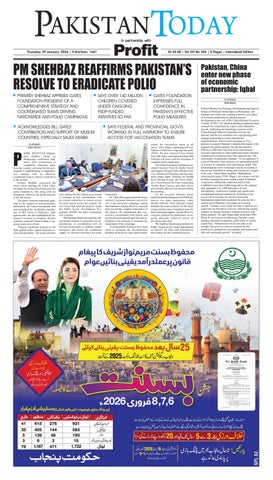

PM SHEHBA Z REAFFIRMS PAKISTAN’S RESOLVE TO ERADICATE POLIO
g PREMIER SHEHBAZ APPRISES GATES FOUNDATION PRESIDENT OF A COMPREHENSIVE STRATEGY AND COORDINATED TEAMS DRIVING NATIONWIDE ANTI-POLIO CAMPAIGNS
g ACKNOWLEDGES BILL GATES ’ CONTRIBUTION AND SUPPORT OF MUSLIM COUNTRIES, ESPECIALLY SAUDI ARABIA
g SAYS OVER 140 MILLION CHILDREN COVERED UNDER ONGOING PSDP-FUNDED INITIATIVES SO FAR
g GATES FOUNDATION EXPRESSES FULL CONFIDENCE IN PAKISTAN ’S EFFECTIVE POLIO MEA SURES
g SAYS FEDERAL AND PROVINCIAL GOVTS WORKING IN FULL HARMONY TO ENSURE ACCESS FOR VACCINATION TEAMS

“Despite significant progress in the fight against polio urgent measures remain indispensable the prime minister said, adding that the federal government is working in full coordination with provincial authorities to ensure access for polio teams across the country He also noted that relevant projects under the Public Sector Development Programme (PSDP) for polio eradication will continue PM Shehbaz Sharif directed the federal health ministry to formulate recommendations in coordination with all relevant institutions to enhance public awareness and ensure the continuous supply of vaccines necessary for polio
The
eradication Dr Chris Elias appreciated the prime minister s personal attention and active role in the anti-polio campaign noting that Pakistan is taking effective, concrete steps toward the complete elimination of the disease He emphasized that constructive consultations with federal and provincial governments and relevant institutions will continue to maintain the momentum of the campaign
Commendable measures have been taken to eliminate the environmental presence of the polio virus and to ensure
access for vaccination teams in all areas,” Elias added, expressing full confidence in Pakistan’s ongoing anti-polio efforts He also conveyed best wishes from Bill Gates and expressed hope that Pakistan will soon reach the milestone of complete polio eradication The Gates Foundation delegation included Director Polio Dr Kathy Neuzil and Deputy Director Polio Michael Galway Minister for Planning and Development Ahsan Iqbal Minister for Health Syed Mustafa Kamal the Prime Minister s Focal Person for Polio Eradication Ayesha Raza Farooq, and other senior government officials were present during the meeting On the occasion Minister Ahsan Iqbal briefed the delegation on PSDP initiatives for polio eradication while Health Minister Syed Mustafa Kamal thanked the prime minister for his leadership and the Gates Foundation team for their continued support Ayesha Raza


Pakistan, Australia explore long-term mining cooperation framework
Pakistan and Australia on Tuesday discussed the possibility of entering into an Intergovernmental Agreement to establish structured and long-term cooperation in Pakistan s mining and mineral sector, according to an official statement
The proposal was raised by the federal minister for petroleum during a meeting with Timothy Kane, Australia’s newly appointed high commissioner to Pakistan The discussions focused on expanding bilateral collaboration in mining minerals and gemstones including investment skills development and technical cooperation The proposed agreement builds on an Australian initiative presented in July 2025 that envisaged partnerships between Australian universities, mining companies and Pakistani institutions to deliver specialised training in modern mining techniques and services aimed at strengthening local capacity During the meeting the petroleum minister high-
lighted Pakistan s mineral potential particularly in the Tethyan Belt, and welcomed continued interest from Australian firms He proposed that a formal agreement could provide a framework for sustained cooperation and investment in the sector
The Australian high commissioner noted that Australian companies are already engaged in Pakistan s mining industry and have played a role in exploration activities across Balochistan, Gilgit-Baltistan, and Azad Kashmir He said additional Australian firms have shown interest in participating in major projects, including the Reko Diq copper-gold project, and would be encouraged to attend the Pakistan Minerals Investment Forum
Both sides also discussed cooperation in the gemstones sector with emphasis on knowledge sharing training and technical assistance to support value addition and exports The meeting reviewed the petroleum minister s recent participation in the International Mining and Resources Conference in Australia, where engagement with Australian mining companies explored further investment opportunities


SECP ISSUES COMPLIANCE NOTICES TO SEVEN POWER SECTOR ENTITIES

FBR eyes Rs150–200b from Super Tax after cour t verdict
quarter Super Tax is levied on high-profit entities at progressive rates ranging from 1% to 10%, depending on annual earnings Companies with profits between Rs150 million and Rs200 million are taxed at 1%, rising incrementally to 10% for profits above Rs500 million The tax primarily applies to large

Federal Minister for Petroleum Ali Pervaiz Malik on Wednesday invited Chinese companies to participate in the Pakistan Minerals Investment Forum (PMIF) 2026 scheduled to take place on April 8 and 9 as part of efforts to expand cooperation in the mining and minerals sector Addressing the Pakistan-China Minerals Cooperation Forum, the minister formally called on Chinese companies and delegates to attend the forum, encouraging participation through a dedicated country pavilion to showcase mining technologies equipment and capabilities He said the event would provide a structured platform for engagement with policymakers regulators and project sponsors The minister acknowledged the role of Chinese institutions, including the Chinese Chamber and Metallurgical Corporation of China Ltd (MCC), in supporting bilateral engagement and contributing to the success of the forum Referring to long-standing Pakistan-China cooperation he said Chinese investment under the China-Pakistan Economic Corridor had played a significant role in expanding Pakistan s power generation capacity through multiple energy projects He added that collaboration had also extended to mass transit systems road infrastructure and electric mobility initiatives Malik noted that China had emerged as a leading global player in rare earth elements and key metals including antimony while maintaining a strong position in copper smelting and refining He


TH AT exports to the USA were flat in December may well show that the Tariffs imposed across the board have not favoured Pakistan as much as it was thought they would though it is also possible that if the advantage had not existed there would have been an even more precipitate fall It should be remembered that the USA is one of those comparatively few countries with which Pakistan runs a surplus, but that is going to be reduced not just by the fall in exports, but the increase in imports because of the purchase of US crude oil The problem seems to be depressed demand in the USA
Pakistan s exports to the USA were $447 million in December, which is marginally lower than $449 million the year before This is not just the USA, but to the UK European Union countries and China which reflects a global downturn If demand had been strong even if market share went down exports would have increased but with declining demand even an increase in market share would not guarantee higher exports As seems apparent from other markets as well demand must be soft; because only the USA has fiddled with tariffs The USA is undergoing a trade readjustment, for the dollar is declining against major currencies Pakistan needs to review whether it may not end up with a deficit it cannot afford economically, especially after Pakistani firm Cnergyico has agreed to import three million more tons of crude from the USA till March, after having already imported a million tons, in a $430 million deal True, that means a diversification of energy resources Most oil so far has come from the Persian Gulf through the Straits of Hormuz an increasingly volatile area However a fallback position should not require the country to go into deficit
The problem with the USA seems to be that the surplus will simply not go away One shipment of rareearth ores has already been dispatched The Australian government has also expressed an interest in getting involved in the sector Whoever is involved, the bottom line will be exports from Pakistan, with the USA running up a larger deficit The news is not good from other markets, for the EU-India deal should not impinge on Pakistan, but India will make sure it does The past shows that India has tried to do down Pakistan and it will use its new clout with the EU to harm Pakistan somehow

Dedicated to the legac y of late Hameed Nizami Arif Nizami (Late) Founding Editor
M
A Niazi
Editor Pakistan Today Babar Nizami Editor Profit


FTO R decades the relationship between the USA and Canada belonged to the category of geopolitical facts so stable they barely required analysis A shared border without fortifications Deeply integrated supply chains Energy interdependence so extensive it blurred the distinction between domestic and foreign trade If alliances were marriages this one looked less like a romance than a long, practical partnership occasionally dull, rarely dramatic, and almost never existential
That assumption has now been punctured Loudly Donald Trump s threat to impose a 100 percent tariff on Canadian goods is not merely another episode in his familiar trade brinkmanship It marks a deeper shift: the weaponization of economic power against a close ally for exercising sovereign choice Not over war Not over security But over trade policy specifically Canada’s decision to strike a limited pragmatic arrangement with China The question raised is not whether tariffs work in some abstract economic sense History has already delivered its verdict on that front The more unsettling question is political: Can the USA, under Trump’s vision, tolerate even mild strategic autonomy among its allies? Or does loyalty now require submission? Trump s argument stripped of its rhetoric is straightforward If Canada becomes a conduit for Chinese goods entering the US market punishment will follow The premise rests on the idea that Canada s trade decisions are legitimate only insofar as they align with Washington’s preferences Sovereignty in this view is conditional That logic would have been foreign to earlier US statecraft During the Cold War the USA tolerated sometimes grudgingly independent economic relations among allies, from West Germany s trade with the Soviet bloc to Japan s mercantilist policies that hollowed out US0 manufacturing towns Washington complained It pressured But it rarely threatened eco-
nomic annihilation of its closest partners Trump has crossed that line repeatedly Canada is not an outlier; it is a test case Ottawa s recent deal with Beijing was narrow by design Reduced tariffs on Chinese electric vehicles in exchange for lower Chinese import taxes on Canadian agricultural products No sweeping free trade agreement No alliance shift No ideological embrace of China s political system Canada s own trade minister emphasized the limits of the arrangement Initially, Trump himself seemed to agree He publicly praised the deal, saying Canada should pursue such opportunities if available
more closely to real jobs Students should get career guidance early so they pick subjects that
TrumpÊs economic war with Canada reveals less about Canadian disloyalty than about American anxiety. The world is adjusting accordingly. Whether Washington notices in time is another matter.
can also work with local businesses to give students practical experience Germany s dual-training system shows how schools and companies can team up to prepare students for real work Technical and vocational education should be improved too so students learn skills needed in fast-growing areas like AI fintech renewable energy and healthcare In China many technical programmes now teach coding, robotics, and automation, which companies really need A major problem in South Asia is that governments don’t spend enough on improving education quality Most policies focus on getting more students into schools not on what they actually learn As a result many students finish school without the skills needed for good jobs Governments should focus on access plus learning” by updating curricula, training teachers properly, improving digital tools, and regularly checking what students are learning Governments should make sure all students have access to modern learning tools like good internet computer labs and trained teachers in both cities and rural areas They can also create small, low-cost innovation and skill centers in colleges so students get hands-on experience in technology and modern trades At the same time cultural pressures that push students toward only respectable careers like medicine engineering or government jobs should be tackled through awareness programmes and early career guidance, helping students explore more options that fit their interests and the job market
By working on these measures South Asian countries can equip young people with the right skills reduce unemployment and boost both economic and digital growth
The writer is a freelance columnist

Flying for all
From Science Transfer to Prosperit y
IN a world marked by disparities and discrimination Prof Abdus Salam created his masterpiece: the International Centre for Theoretical Physics (ICTP) in Trieste, Italy It was built to bring scientists from across the globe together and to help developing countries share
2
help developing countries bridge the gap in science;
4 To achieve science transfer countries need education in science a critical mass of trained scientists integration of theoretical scientists into applied work a research agenda, and a culture of scientific research
It is worth examining Prof Salam’s insights in the light of modern economic understanding
Y: Between the 1980s and the mid-1990s, a group of Southeast Asian countries the so-called Southeast Asian Tigers, namely Indonesia, Malaysia the Philippines Thailand and Vietnam experienced significant growth It was widely regarded as an economic miracle Many in the policy world believed these countries were on a trajectory to converge to the living standards of developed nations And then, just as the miracle came, it fizzled out Why? The Southeast Asian Tigers forgot
to read the memo that Prof Salam delivered to the AAAS In many ways, in his address Dr Salam was speaking about enabling productivity growth Over the past several decades, economists have been repeatedly reminded of the importance of productivity growth Productivity growth fostered by innovation human capital R&D and the exchange of ideas explains most of the variation in economic growth across countries In short, if you want long-term economic growth, you need to invest in R&D, science, technology and education The Southeast Asian Tigers growth was largely built on capital investment factories machines cranes and without sustained technological advancement, that growth fizzled out, leaving them caught in the middle-income trap Without scientific foundations, technology transfer lacks lasting impact In our paper (co-authored with Prof Robert Breunig) titled Determinants of innovation novelty: evidence from Australian administrative data we showed how important absorptive capacity the ability to learn from other countries and firms is for firms not only when undertaking innovation in general but especially for undertaking more novel innovations such as new-to-world and new-to-country innovations Education and management capabilities are essential inputs into absorptive capacity These findings also apply at the national level: absorptive capacity links economies to the global technological frontier When Prof Salam spoke about science transfer he was in essence talking about upgrading the absorptive capacity of developing countries Even most developed countries lag behind the technological frontier, led by the USA, the UK, Germany, Japan, and China However, their strong absorptive capacity helps them catch up For developing nations to advance they must invest in and support their scientific communities and education sys-
crucial piece is missing from Dr Salam s original blueprint: institutions Prominent scholars such as Douglas North and Daron Acemoglu have highlighted how strong institutions with effective governance protection against corruption intellectual property (IP) rights and robust legal frameworks form the foundation of economic development, including the ability to generate innovation and productivity growth Institutions are critical for fostering productivity growth First they protect innovation and R&D investments through patent rights Without these protections innovations developed by firms or individuals can be easily appropriated by competitors, discouraging further investment in R&D
Second in the absence of robust institutions public and private R&D investments become vulnerable to corruption-driven expropriation This generates resource leakage as innovation spending is diverted or wasted and credit is misappropriated, undermining the effectiveness of such investments
Policy evaluation is a key tool in the West ensuring accountability and continuous learning Independent objective assessments improve research policy and decision-making To drive progress strong institutions, rigorous evaluation, and scientific investment must go hand in hand
: Based on Prof Salam s address and the discussion above a detailed blueprint for how scientific critical mass can be effectively constructed includes:
a Building scientific literacy and teaching, including inspiring teachers with firsthand research experience who understand its role;
b Funding well-equipped laboratories and research institutes with sustained support and ambitious research agendas;
c Incorporating local scientific expertise into priority technology choices;
d Encouraging scientists to support national development through applied work;
e Investing in basic research, which often underpins major breakthroughs (e g Faraday Maxwell and Hertz laid foundations for radio and modern communications);
f Investing in quality education at all levels, from primary schools to universities; g) Regular evaluation and monitoring by an independent economic and science think tank to ensure effective corruption-free research institutions aligned with national priorities Throughout his life, Prof Salam emphasized the importance of research institutes He highlighted how the Indian Institutes of Technology (IITs) were established through international collaboration and linkages with universities in the United States the United Kingdom Germany and the former USSR Other nations could follow this proven IIT model He also emphasized scientific exchanges, secondments, and collaborations between developing and developed nations all of which should be merit-based Prof Salam s ICTP is a leading example of such exchanges of information Developing countries should prioritize merit-based scholarships that send top talent to leading universities, strengthening human capital, while also resourcing domestic universities to produce high-quality research Progress can be benchmarked by publications in top international journals Diplomacy and international engagement can play a role as well Countries such as India, Singapore, Taiwan, and South Korea have used diplomacy and strategic negotiation to coordinate both technology and science transfers from Western countries thereby building both human capital and the tacit knowledge that comes from experience and participation in joint, complex projects R E S E A R C H D I S PA R I T I E S: Prof Salam highlighted the growing gap between developed and developing countries in R&D investment Decades later this disparity persists as shown in Figure 1 However countries such as Türkiye and India are now prioritizing research, recognizing its role in global competitiveness, economic growth, and trade Other developing countries could benefit from adopting a similar strategy WHERE DO WE GO FROM HERE? In


Developing


protests against the government by branding them as a threat to Israeli security Nevertheless, electoral desperation has a double edge A failed operation may spell the end of Netanyahu On the other hand a successful operation that weakens Iran without inviting catastrophic reprisal may save Netanyahu from political oblivion Experts believe this scenario makes war more probable, particularly since Netanyahu is under pressure from intelligence failures on October 7 and corruption charges
IRAN S CAPABILITY FOR RETALIA-
TION: Despite sustaining heavy losses from continuous US and Israeli bombardment Iran s ability to strike back remains potent Its arsenal still holds roughly 2,000 heavy ballistic missiles, a critical factor in the region’s altered security landscape Mora Deitch an expert from Israel’s Institute for National Security Studies states that Iran is increasingly using advanced ballistic missiles equipped with several warheads or decoys, which can saturate Israel s air defense systems Sina Toossi, an expert from the Center for International Policy, states, “Iran has to make it so expensive for Israel so it becomes a deterrent or else it will be attacked every six months The June war for example has cost Israel an estimated six billion dollars Iran plans to make it even more costly the next time Raphael Cohen, an expert from the RAND Corporation, states, “Any potential new round of conflict will be largely air-based but more intense than June and Israel will be trying to set back Iran s programs even further
against Iranian missiles were partially effective, saturation attacks pose a genuine threat David Roule of the Center for Strategic and International Studies states, “Iran’s objective may be to develop a missile arsenal so large and diffuse in nature that neither Israel nor the U S can destroy the Iranian missile threat before Iran retaliates with devastating effect In the next round Iran will not fight alone Hizballah Secretary General Naim Qasim’s recent declaration of an upcoming “war for us all” will likely be read in Tel Aviv as a signal of total mobilization For Hizballah this engagement is viewed as a final opportunity for retribution and a chance to redeem its standing after previous military miscalculations Beyond Iran and Hizballah, a persistent uncertainty remains: the extent to which the Houthis of Yemen will seize this moment to integrate themselves into the broader confrontation
THE RUSSIA-CHINA FACTOR: Neither China nor Russia is likely to come to Iran s rescue China has called for restraint and continues to rely on Iranian oil supplies However, the Chinese leadership is unlikely to commit military resources to a crisis as is their general practice Russia is preoccupied with the Ukraine crisis and is in no position to commit military resources to Iran even if it wanted to However, both powers are against US hegemony in the Middle East They will give Iran diplomatic support at the UN, cyber and intelligence support enough to make US operations difficult without going into a fullscale conflict
HR E S the thing: the world many of us grew up in has vanished, and not because of geopolitics Because of sex No, this is not a personal confession It is an observation about culture Sex once treated as central to modern life is quietly retreating And the shift is so broad that it tells us something uncomfortable about where society has gone I came of age in the 1990s, when sex was everywhere Not just in private life, but in public space Advertising ran on the formula that sex sells Some products logically lent themselves to erotic imagery; others did not Yet a sexualized female body could be used to sell almost anything including a glass of water Newspapers, car magazines, even publications about the paranormal carried nude photo shoots Television, long before late-night hours, included bedroom scenes as routine Youth series revolved around the first sexual experience Schools distributed brochures about contraception Words once whispered were now spoken on air: orgasm, masturbation, intercourse The message was clear Sex was not only normal It was valuable, exciting, a permanent feature of modern life Thirty years later we are told almost casually that sex is overrated This is not anecdotal Surveys reflect a real shift Research by the NAFI analytical center shows that 22% of people aged 18 to 25 are not sexually active More than half of respondents report problems in their intimate lives Forty percent cannot discuss sexual issues with their partner Large numbers report dissatisfaction lack of desire or pain Among women the
s nuclear progress is the primary flashpoint; specifically, building a considerable number of advanced centrifuges and weapons-grade enrichment are the most probable triggers for future conflict
NETANYAHU S ELECTORAL CALCULUS: The Israeli election on 27 October 2026 is looming,
STRATEGIC OBJECTIVES: DEGRADATION OR DECAPITATION?: Military experts view regime change as a high-risk objective rather than a feasible goal Israel’s strategic objectives on the other hand are to degrade IRGC external operations destroy rebuilt nuclear facilities and intensify internal elite perceptions of the regime s viability However, uncertainty also means risk Avi Melamed, a former Israeli intelligence official warns that this situation increases the risk of miscalculation as Iran believes it can survive the unprecedented pressure and move forward after the June war Iran s resilience may actually make it more likely to take risks in 2026
ISRAEL’S DEFENSIVE VULNERABILITIES: The June war highlighted several vulnerabilities for
launched over
THE INCONCLUSIVE WAR SCENARIO: Perhaps the most significant threat is that of an inconclusive war What if the strikes only damage but don’t destroy Iran’s nuclear capabilities? Decision-makers must consider the consequences of an intelligence gap: what happens if the actual impact of an Iranian strike eclipses established expectations? Alan Eyre of the Middle East Institute says that very little is certain in the Middle East, and the current instability in the region in the wake of fragile ceasefires in Gaza and Israeli attacks against Lebanon and Syria makes the outcome very unpredictable An inconclusive war scenario could lead to the worst of all possible worlds: Iran accelerating its nuclear development in greater secrecy than ever, instability in the region getting worse, and both sides preparing for round three We may not be witnessing

Riyadh will not permit attacks on Iran from Saudi territory: Crown prince

Pezeshkian told MBS that the “unity and cohesion” of Islamic countries can guarantee “lasting security stability and peace in the region The Iranian president said that Tehran always welcomed any process, within the framework of international law, that prevents war, Iranian media reported The telephonic conversation came as the US announced a major multi-day Air Force exercise in the Middle East

The exercise will “demonstrate the ability to deploy disperse and sustain combat airpower across” the Middle East the US Air Force component of Central Command which is responsible for American forces in the region, said in a statement No date or exact location for the exercise were released Saudi Arabia has become the second major Gulf state after the United Arab Emirates (UAE) to publicly say it would not allow attacks on Iran to be launched from its territory or airspace On January 26, the UAE foreign ministry said in a statement it has reaffirmed the United Arab Emirates’ commitment to not allowing its airspace territory or waters to be used in any hostile military actions against Iran The UAE hosts thousands of US personnel at Al Dhafra airbase near the capital Abu
Kashmir Liberation Front (JKLF) Chairman Muhammad Yasin Malik who is currently serving a life sentence in a politically motivated case A division bench of Justice Navin Chawla and Justice Ravinder Dudeja allowed the request made on behalf of the NIA, observing that the appellant’s counsel required more time to respond The court has now listed the matter for further hearing on April 22
During the proceedings, Special Public Prosecutor Akshai Malik, appearing for the NIA, sought additional time to file a reply to Yasin Malik’s detailed reply opposing the plea for enhancement of sentence
The NIA has challenged the May 2022 trial court judgment that sentenced Yasin Malik to life imprisonment under the draconian Unlawful Activities (Prevention) Act (UAPA) in the fake case The trial court had ruled that the case

did not fall within the rarest of rare” category warranting capital punishment Muhammad Yasin Malik a symbol of Kashmir s political resistance has been held in solitary confinement in Delhi s Tihar Jail for years during which his health has reportedly deteriorated He has consistently described the case against him as politically motivated
At the previous hearing in November 2025 the NIA had sought in-camera proceedings for the appeal Yasin Malik, who appeared through video conferencing from Tihar Jail had then complained of psychological distress due to a pro-
longed delay of nearly three years in adjudication of the appeal Earlier, in September, Malik filed an affidavit before the High Court asserting that he was not a terrorist and he had been engaged by successive Indian governments from the tenure of VP Singh to that of Manmohan Singh in peace initiatives concerning Kashmir He further said that he met leaders across the


Directions
Punjab Minister for Information and Culture Azma
Bokhari visited the Lahore Press Club and congratulated the newly elected body on its success On the occasion, she extended special congratulations to the newly elected President, Arshad Ansari, on securing a decisive victory by a large margin Azma Bokhari stated
Club elections every
on schedule is
and commendable democratic tradition that strengthens journalistic values
added
and


journalists of the
for conducting
elections She further said that journalists of Lahore have once again expressed their confidence in the leadership of Arshad Ansari which reflects recognition of his professional capabilities and services to the journalistic community The Punjab Minister reaffirmed the government s commitment to resolving journalists issues and ensuring the provision of better facilities through serious and practical measures During the visit in a pleasant and informal atmosphere
DIB C hampions Youth S pirit at 18th International Inter S chool Rowing Regatta


PAKISTAN TIGHTENS BORDER HEALTH SCREENING AFTER NIPAH VIRUS CASES REPORTED IN INDIA

land crossings No individual is allowed entry into Pakistan without health clearance by
Health Services–Pakistan,”
stated Under
directives, 100 per cent screening will be conducted for
passengers transit travellers crew members drivers helpers and support staff Mandatory verification of country of origin and complete travel history for the previous 21 days will be carried out for all travellers, regardless of nationality Special focus will be placed on individuals arriving from or transiting through Nipah-affected or high-risk areas, with any false declarations to be documented and reported immediately “All travellers will undergo thermal screening and clinical assessment at the point of entry the advisory said adding that screening staff had been instructed to watch for symptoms such as fever, headache, respiratory complaints and neu-

rological signs including confusion or drowsiness Suspected cases will be isolated and managed in accordance with infection prevention and control (IPC) protocols and referred to designated isolation facilities or tertiary care hospitals Affected conveyances and surrounding areas will be disinfected as per approved standard operating procedures The ministry stressed strict compliance with IPC measures including the use of personal protective equipment (PPE) hand hygiene and environmental sanitation warning that any lapse would be treated as serious negligence Daily reports from all points of entry will be recorded in the BHS-P system and shared with the National Command and Operation Centre (NCOC) and the National IHR Focal Point These measures will remain in force until further notice the advisory said Meanwhile, authorities in several Asian countries, including Singapore, Hong Kong, Thailand and Malaysia, have also stepped up screening measures introducing airport temperature checks and enhanced surveillance to prevent the virus from spreading beyond India

The Khyber Pakhtunkhwa government is accelerating its energy agenda using provincial resources with multiple hydropower projects boosting electricity production and generating substantial revenue for the province At present, 10 completed energy projects with a combined capacity of 224 MW are generating an annual income of Rs13 billion
Looking ahead the completion of seven ongoing energy projects over the next five years is expected to raise the province s electricity generation capacity to 1,000 MW, which will provide cheap electricity and generate an annual income of Rs55 billion Secretary Energy and Power Nisar Ahmed shared these details while chairing a review meeting on the progress of seven key hydropower projects attended by Additional Secretary Energy Anwar Khan Sherani, Chief Executive Engineer Anwarul Haq, Senior Chief Planning Officer Syed Zahar Shah, and other senior officials On the occasion Chief Executive Engineer Anwarul Haq briefed the meeting highlighting the completion last year of three major projects: 40 8 MW Koto Dir, 11 8 MW Karora Shangla, and 10 2 MW Jabori

Mansehra which brought PEDO’s total generation capacity to 224 MW Work is ongoing on seven additional projects including: 300 MW Balakot Mansehra; 215 MW Madin, Swat; 88 MW Gabral, Kalam; 84 MW Matiltan, Swat; 69 MW Lawi, Chitral; 13 5 MW Chapri Charkhel Kurram and 6 9 MW Mujahideen Power Project Torghar
Secretary Nisar Ahmed underscored the critical importance of the 40-kilometer, 132/220 KV transmission line from Matiltan to Madin, stressing that it must be completed within this year to enable the supply of cheap electricity to the industrial sector He also instructed the project director to expedite work on the province s largest project the 300 MW
Punjab Wildlife Act 1974 under the Punjab Wildlife (Amendment) Act 2026 According to the text of the proposed legislation, valuable mineral resources located in forest areas could not be utilized due to legal restrictions, while unclear laws had caused delays and suspension of mining projects
The bills propose granting special permissions for mining activities in protected and forest areas for development and mineral projects of national importance
A legal framework would also be developed to allow the use of forest
Balakot hydropower plant Furthermore the secretary directed PEDO authorities to ensure that all ongoing energy projects are integrated into the national grid upon completion If national grid inclusion is not feasible, distribution licenses should be obtained immediately under a direct supply model to deliver electricity to the industrial sector at low rates He issued a strict warning to project directors to review the gap analysis of their projects, remove operational obstacles, finalize terms of reference, adhere to timelines, and complete all projects within the stipulated schedule cautioning that any delay would be intolerable
land for mining purposes The government maintains that the utilization of mineral resources is essential to align with the National Minerals Policy and to boost the economy, create employment opportunities, and increase revenue
It also stated that introducing a regulated system was necessary to curb illegal mining The Punjab Assembly has referred all three draft bills to the relevant standing committee for a period of two months
After committee approval, the bills will be presented again in the assembly for passage followed by final approval from the Governor of Punjab PESHAWAR
Main University Road BRT corridor set for March completion, says Sharjeel
KARACHI M o n i to r n g r e p o r t
Sindh Senior Minister Sharjeel Inam Memon on Wednesday said the provincial government expects to complete construction of the main corridor of the Red Line Bus Rapid Transit (BRT) project on Karachi s University Road by March, describing it as the most critical section due
