


BY KATE BARNES & KHIVI SINGH
Once a month, instead of using our “flex” period to prepare for class, assist students who have questions or just relax with them, Sacramento Country Day high school teachers rearrange their classrooms to create circles of chairs that their advisees are required to sit in for the next half hour.
During this time, the students assigned to these advisories can choose to share their responses to various questions provided by faculty with one another.
This is all done to implement the theme of the year: “The Circumference of Abundance.”
According to Head of High School Brooke Wells, “the circumference of abundance” is
“the idea that we have an awful lot of opportunity here and that we should focus on having an abundance of opportunity, rather than a scarcity of it.”
The phrase “circumference of abundance” was coined by Wells to represent a shared theme between the various summer reading books read by students and teachers, including “Restart” by Gordon Korman and “Never Enough” by Jennifer Breheny
Wallace.
These advisory circles have taken place on Oct. 24, Dec. 5 and Jan. 7, and are expected to take place every month for the rest of the school year.
During circle times, questions written by Wells and Director of Equity and Belonging Charity Frempomaa with some guidance ADVISORY CIRCLES page 3>>
BY SID SHUKLA
Disclaimer: This story contains graphic information regarding a school shooting.
Garrett Xu ‘25, a current freshman at Brown University, said he barely slept the week after the shooting at Brown University on Dec. 13.
“Some nights were better than others. Two, three, five,” Xu said, describing how many hours he slept each night afterward. “But never above six.”
When he did sleep, he kept having the
In honor of Dr. Martin Luther King Jr., there is no school on Jan. 19. High school final exams will be held from Jan. 20-22. All finals are taken in the gym unless other arrangements are made. The library will still be available to students, and there will be no normal classes during the exam week.
same dream — being shot in his body, each night in a different place: arm, stomach, neck and ankle, Xu said.
“It’s quite odd how dreams work. I was never there, never directly impacted, but my mind somehow shows it to me like if I was reliving it. It’s just a dream to me, but for others it’s reality. That’s terrifying,” he said.
Xu was not in the room where the shooting happened, but he said the aftermath followed him anyway — into his phone, into group chats and into the questions he carried home to Sacramento about the kind of school he once loved most: one
WINTER BALL
On Jan. 31, Sacramento Country Day is hosting the annual winter ball for high school. The dance will be held at Sutter Lawn Tennis Club from 7-10 p.m. Snacks and drinks will be provided.
built around open air, movement and trust.
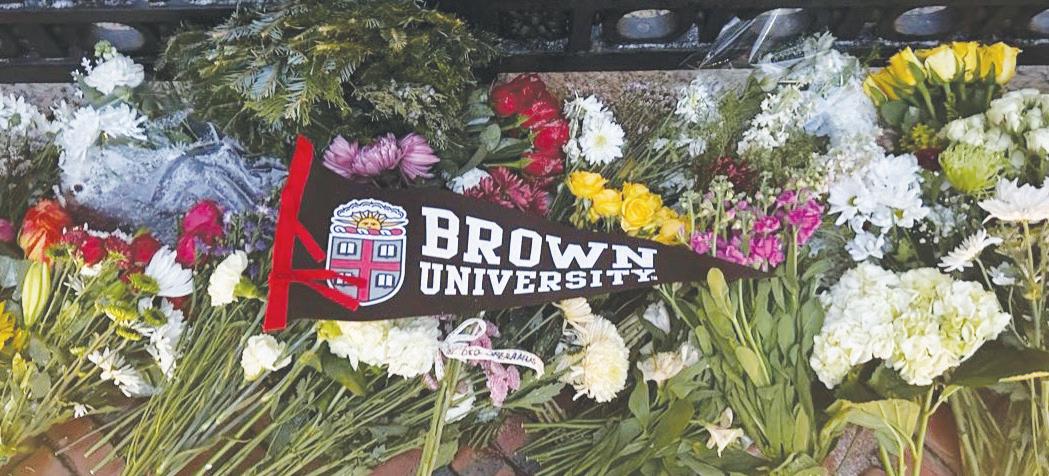
On Dec. 13, a former Brown University student, Claudio Neves Valente, entered the Barus & Holley engineering and physics building during a study session and opened fire, killing two students — Ella Cook, 19, and MukhammadAziz Umurzokov, 18 — and injuring nine others, officials said.
Two days later, authorities said, Valente killed Massachusetts Institute of Technology professor Nuno F.G. Loureiro at the professor’s home in Brookline, Mass., before committing suicide in New Hampshire as police closed in.
Federal prosecutors recovered videos they described as confessions and said Valente had planned the attacks for years, although his recorded statements did not clearly explain a motive.
In a Dec. 23 email to the Brown community, Brown President Christina H. Paxson outlined steps the university planned to take, including an accelerated effort to expand card access, camera coverage and panic alarms.
But for Xu, one of the first notices came before any official email arrived.
“Sidechat was about 30 minutes earlier than the official notification from Brown BROWN SHOOTING page 3 >>
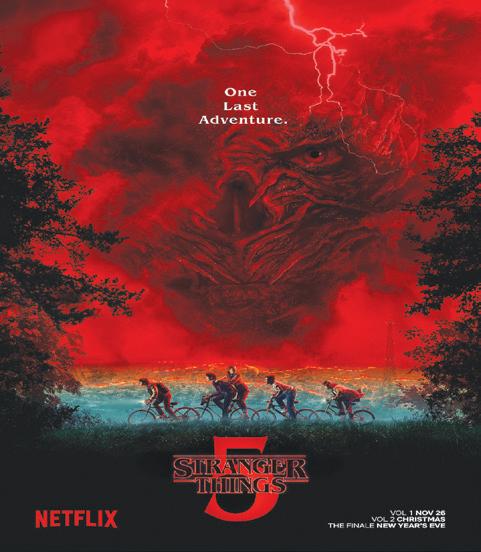
Read a review on the final season of “Stranger Things.” (PAGE 11)
EDITORS-IN-CHIEF
Rehan Afzal
Eesha Dhawan
Anisha Mondal
Zema Nasirov
COPY EDITORS
Eesha Dhawan
Maddy Schank
Ryan Xu
NEWS EDITOR
Kate Barnes
FEATURE EDITOR
Jacob Rabe
SPORTS EDITOR
Parsiny Nijher
A&E/OPINION EDITOR
Anika Nadgauda
PHOTO EDITOR
Rehan Afzal
TECHNOLOGY STAFF
Ryan Xu, manager
Sid Shukla, assistant
PAGE EDITORS
Rehan Afzal
Noor Alameri
Lukas Chung
Jesse Dizon
Vivian Li
Anisha Mondal
Anika Nadgauda
Zema Nasirov
Jacob Rabe
Sid Shukla
Zachary Vando-Milberger
BUSINESS STAFF
Sid Shukla, manager
SOCIAL MEDIA STAFF
Anika Nadgauda, editor
REPORTERS
Lukas Chung
Chloey Fang
Harlan Foster
Trisha Gandhi
Lucas Holz
Ammar Hussain
Vivian Li
Ethan Minton
Parsiny Nijher
Maggie Nuñez-Aguilera
Parsa Salari
Maddy Schank
Sid Shukla
Khivi Singh
Zachary Vando-Milberger
Susie Wang
Ryan Xu
Brenden Yu
PHOTOGRAPHERS
Rehan Afzal, editor
Anika Nadgauda
Zema Nasirov
MULTIMEDIA STAFF
Ryan Xu, editor
Rehan Afzal
GRAPHIC ARTISTS
Claire Gemmell
Zema Nasirov
Gavin Wang
ADVISER
Andrea Todd
The Octagon is the student-run newspaper of Sacramento Country Day high school. The print edition is published eight times a year, and the website is updated regularly. The Octagon is committed to unbiased and comprehensive reporting, serving as a source of reliable information for SCDS students and the school community. The Octagon will publish all timely and relevant news deemed appropriate by the editors-in-chief and adviser. We seek to highlight high-school-related events and spotlight the voices of those with a story to share. Further policies can be found on our website or by scanning the QR code below.

BY ETHAN MINTON
After being eliminated from the NBA Cup, the Sacramento Kings played a consolation game against the Denver Nuggets on Dec. 11. Towards the end of the game, the Golden One Center home crowd began chanting “sell the team.”
The Kings were down by over 30 points at the time, and the chanting fans had seen enough.
“It[’s] the first time I’ve heard the chant this season,” said Fox Sports Radio Sacramento’s Ryan Bohamera in a post on X.
In May 2013, billionaire Vivek Ranadivé bought the Sacramento Kings for $534 million and prevented the team from being relocated to Seattle. Former NBA commissioner David Stern believed Vivek, a tech mogul, represented the future of the NBA.
Ever since his acquisition of the organization, however, Vivek has, according to multiple sources, overstepped and the team has amounted to little success: Vivek’s combination of nepotism and overinvolvement in team affairs led to him being rated the “worst owner” in the NBA by a 2020 poll of league insiders conducted by The Athletic.
Most trades or signings in the NBA are negotiated by a team’s general manager — a person hired based on their expansive knowledge of the NBA. But for the Kings, the same cannot be said, according to staff interviewed by the Sacramento Bee. Everything must be approved, or in some cases presented by Vivek.
“It’s one thing to be a fan and want to be involved from afar, but I think when you are meddling in decisions, I think the problem is you have an owner who’s too involved,” said an anonymous former member of the Kings’ basketball operations staff in a 2022 interview with the Sacramento Bee.
One such example of his nepotism is who he’s given leadership roles to within the Kings organization.
On May 17, 2022, Anjali Ranadivé — Vivek’s daughter — was named assistant general manager of the Kings’ G-League affiliate in Stockton. Prior to receiving this job, she’d had no experience in the sports world per Vocal Media. Despite this, her father gave her a voice within his professional basketball team.
Then, in June 2023, she was promoted to the role of general manager. Less than six months after this promotion, the team found themselves mired in a major controversy.
In December 2023, the minor league Stockton Kings center Chance Comanche was arrested for the kidnapping and murder of 23-year-old Marayna Rodgers, last seen after meeting with her friend Sakari Harnden and her boyfriend, Comanche, for a “double date.”
Less than two years later, on Sept. 19, 2025, the New York Times reported that Anjali had romantic relations with Comanche.
“Codi Simmons, an athletic trainer with Stockton, said that Anjali and Comanche had been romantically involved. Three other people with direct knowledge of the situation confirmed their relationship. ‘They were the closest two people of anybody in that organization,’ Simmons said. ‘I believe that she liked him more than he liked her. She was with him out of love. I’m not sure what it was on his side,’” wrote New York Times reporter David Gardner in a September article.
Anjali stepped down from the team one month after the arrest.
The hiring of Anjali is one example of a heavily scrutinized basketball-re-
lated decision made by Vivek.
In the 2024-25, the Kings general manager Monte McNair received criticism for a number of moves the team made.
On Dec. 27, 2024, the Kings fired their head coach Mike Brown. They let him know as he was driving to the airport to fly with the team to Los Angeles to take on the Lakers. The move itself was controversial, but how the organization went about parting ways with Brown caused fans to question the competency of the front office.
On Feb. 2, 2025, the Kings traded away All-Star point guard De’Aaron Fox to the San Antonio Spurs in exchange for Zach LaVine, Sidy Cissoko and six future draft picks. LaVine and current Kings forward DeMar DeRozan had played together for a number of years in Chicago, though amounted to little success, reported USA Today’s Bryan Kalbrosky, who gave the trade a grade of “D+.”
“Still can’t believe the Kings watched LaVine and DeRozan with Chicago and thought ‘hey, let’s try this too,’” read one viral tweet by @BullsNationOZ on X.
However, Sam Amick of The Athletic believes McNair did not spearhead these deals, rather that Vivek took the reins.
“McNair did not want to fire Mike Brown, and there are ‘internal issues’ about whether he really wanted to sign DeRozan and trade for Zach LaVine,” he said on Sactown Sports 1140 KHTK immediately following McNair’s firing in April 2025.
In a 2022 article, the Sacramento Bee’s Jason Anderson claimed Vivek has created a “culture of chaos” within the Kings organization, often undermining the authority of high-profile roles within the front office. Previously, if the general manager didn’t agree with Vivek’s views, he’d give more power to the assistant general manager. Power continuously shifted between those who agreed with Vivek and those who didn’t.
Between 2014-2018 the Kings tried to rebuild, but only one of their first round picks during that period proved to be successful, that being Fox. Most notably, in 2018, the Kings drafted Marvin Bagley III as a second overall pick.
One pick later, Luka Doncic was drafted by the Hawks. Doncic is a fivetime NBA All-Star and perennial MVP candidate, while Bagley, who’s been battered by injuries since, receives under 20 minutes per game riding the bench on the Washington Wizards, his fourth different team of his career.
This mishap is considered one of the biggest mistakes on draft night not just in Sacramento Kings history, but in NBA history as well, called a “franchise-altering mistake” by Yahoo Sports.
The Kings also selected a number of other “busts” like Willie Cauley-Stein and Nik Stauskas. Stauskas in particular was Vivek’s choice. In a two-part exclusive documentary, ESPN’s Grantland gave a behind the scenes look at the Kings Draft Room when Stauskas was drafted in 2014.
Vivek’s control is evident: when presented with the task of choosing who to pick at eighth overall, Vivek was the one who famously said “Stauskas,” urging his front office to draft him over Elfrid Payton. And so it was.
“The sad reality is the Kings might always be held back if [Vivek] doesn’t get out of his own way,” Sacramento King’s fanbase website A Royal Pain posted in January. “The Kings are almost too terrible to be real.”
In April 2025, following McNair’s firing, the Kings hired Scott Perry as the
team’s new general manager. Perry had previously spent half a season in the same role with the Kings before joining the New York Knicks front office. In a recent interview with The Athletic, Perry claimed he has full autonomy, which is defined as “the ability to make independent decisions.”
Perry has also stated on numerous occasions that the Kings are in phase one of rebuilding the team from the ground up, a process that may take years.
In past ‘rebuilds,’ a combination of poor draft selections and ownership insisting on finding shortcuts have made it difficult for the team to amount to any sort of long-term success, and fans are used to it, said A Royal Pain’s Ian Goodwillie on Jan. 10. Writing about the team’s collapse to the Golden State Warriors, he said, “If it were any other team than the Kings, there may have been actual shock among the fanbase.”
Only one of the Kings’ first draft picks during the rebuild period of 2014-18 proved to be successful, that being Fox.
Goodwillie goes on to speculate that many believe the Kings may be tanking on purpose, to get a better lottery pick in 2026.
“The method they appear to be using is letting veterans who don’t defend and take bad shots play for 25 to 35 minutes per game,” he wrote. “If it’s an actual attempt to win, stop it. Now.” (A month ago, Sacramento’s “Locked on Kings” podcast compared this to a “fire sale.”)
Two months ago, in their podcast chyroned “Kings are going nowhere,” Sports Illustrated’s Open Floor hosts Evan Turner and Chris Mannix called the Sacramento Kings “the most irrelevant team in the league.”
It’s unlikely that Vivek will ever “sell the team.” The Kings are now worth over $4.45 billion and that number is bound to go up as time goes by. In order for the Kings to be successful, most analysts and fans alike appear to agree that Vivek must take a step back and allow basketball experts to make the decisions they were hired to carry out.

(continued from page 1)
from Middle and High School Counselor Kelly Clancey are posed to advisees. These prompts range from asking students “If your stress were weather, what’s the forecast today?” to request “One classroom routine that helps you feel safe to try.” Examples of other questions or requests from past circle times include: “A song that lifts your mood and why”; “One small change that would make our days feel more sustainable is…”; “A time at school you felt seen; what made it happen?” and “One way we can make advisory kinder this week.”
Clancey, who is new at Country Day, previously worked as a school counselor at Natomas Pacific Pathways Prep and has experience with the practice. Although the questions might feel “cringey,” she says, circle time is ultimately “a way for us educators to balance everyone having space to have a voice and participation in education.”
Students responded to an anonymous poll first sent out by The Octagon on Dec. 16 asking for feedback on the new advisory sessions. The results were lopsided. 42% of the 59 students who responded said they did not enjoy advisory circles, while 19% said they did. The rest of the students who responded said that they sometimes enjoyed circle time, while other times they did not.
One high school teacher who chose to remain anonymous said that they feel the concept of these advisory circles is “misguided.”
“The purpose of advisory is to create a sense of belonging and a relationship with a point person on campus where, if a student is having a hard time, this is the adult that they know that they can go to for help,” they said. “And while that is also true of a therapist, I do not have a degree in psychology or counseling.”
Teachers, like therapists, are mandated re-
porters, meaning that they are required by state and federal law to report “any known or suspected instances of child abuse or neglect” to local authorities, according to the American Civil Liberties Union.
However, the anonymous teacher argues that “making teachers into therapists when they are not is inappropriate.”
Sophomore Marcelo Zlotlow agrees.
“You’re talking with a teacher and a bunch of random students. So if there was anything that was really important to share, they’re not the right people to talk to. They’re not professionals,” Zlotlow said, adding that the people students should talk to include counselors, parents and close friends.
High School English teacher and Department Chair Jason Hinojosa conceded that students have varying levels of comfort when it comes to sharing in a group setting. However, he likes the structure of advisory circles, viewing the personal questions as beneficial.
“The questions start out sort of casual, and then they get a little bit more in-depth,” Hinojosa said.
“I think these questions sort of give students permission to open up at a deeper level than they would, say, during an advisory period of just highs and lows,” Hinojosa said.
Freshman Nichelle Lindgren also enjoys these advisory circles.
“I like circle time because we all get to talk about our weeks, things we like to do, our experiences and more. I think as long as no one feels pressured to answer then it should continue to go well,” she said.
The anonymous teacher also cited a lack of individuality in structured advisory time as a reason to dislike it. While advisories traditionally differ depending on the advisor, “advisory circles remove that by saying ‘no, all advisories must do the exact same thing.’ And that thing is this circle,” they said.
Head of School Lee Thomsen — who has faced similar issues with disagreements about advisory at schools he’s taught at in the past — said that it is inevitable that some teachers dislike structured advisory time.
“High school teachers, especially, are hired generally as subject area experts. So you have a range of people who are probably gifted in the skill set of advisory, and others who aren’t,” he said.
However, discourse over whether or not circle time’s implementation in the high school should continue has highlighted greater tensions between teachers and administrators.
According to the anonymous teacher, “there has been a lot of voicing of concerns to admin, and unfortunately, we have been told very firmly that we need to deal with it,” despite Wells’ insistence that “if it doesn’t work, we’re not going to keep forcing it.”
Discussion of circle time is one example of this disconnect; the anonymous teacher adds that their own and their colleagues’ achievements and contributions to the school’s community are underappreciated by the administration.
An example of this occurred in October, when Country Day received multiple awards by Niche.com — a well-known and widely-used website that ranks and reviews schools and colleges.
One of the four awards presented to Sacramento Country Day School was presented to the high school’s STEM department. Niche ranked Country Day as No. 1 for “2026 Best Schools for STEM in Sacramento County.”
The teachers’ main form of acknowledgement was given via an Instagram post. This post was put up on the “saccds” Instagram account in mid-November, a little over a month after the awards were received.
The post’s caption read in part: “Our commitment to excellence, education, and an in-
clusive and supportive community ensure our students achieve their individual potential.”
No teachers were mentioned by name. According to the anonymous teacher, while the post was appreciated, “it was too little.”
“My opinion of how management would work in general is that when the administration sees something good happen, they should call it out directly, the same way that teachers do. If we see one specific person in the class doing something awesome, we’re going to say, ‘Wow, great job!’” they said.
While High School Dean of Student Life and Mathematics Chair Patricia Jacobsen does not think it was necessary for the administration to make a “big deal” of the award, she wrote in an email that “some sort of personal, simple, and sincere acknowledgement for the work we do would have been appreciated and gone a long way in terms of boosting morale.”
Hinojosa added that teachers’ lack of recognition is something that all schools, not just Country Day, struggle with.
“I don’t think any teachers get enough recognition for what they do, period. I don’t see that as an administration phenomenon. I see that as a systemic phenomenon, a social phenomenon,” he said.
The administration does take into account teacher concerns and ideas, according to Wells, although “that doesn’t mean everyone always agrees,” he said.
When it comes to teacher recognition, Thomsen thinks the school is making an effort.
“I think we try to. Are we 100% successful in that? No. And inevitably, when you are in a position of leadership, you make choices that you know will make some people happy and some people not happy, so there’s always going to be tension,” he said.
(continued from page 1)
that there was an active shooting,” Xu said, referring to a campus messaging app where students post updates.
The Boston Globe reported that Sidechat became a hub for eyewitness updates, instructions and mutual-aid posts as the campus locked down.
That gap — between the information students learned from one another and what they heard from institutions — shaped Xu’s night.
After friends confirmed by text that it was an active shooting, he informed his family he was safe, silenced his phone and kept checking Sidechat for updates.
“Initially, the idea of school shooting didn’t even cross my mind,” Xu said. “I mean, it’s Brown. We’re in Rhode Island.”
Even before authorities had publicly named the suspect, Rhode Island’s attorney general said investigators were working with incomplete visuals and asking the public for help locating clearer footage, noting that while Brown had extensive camera infrastructure, the shooting occurred in an older part of the building with fewer, if any, cameras.
Two Brown students experienced their second school shooting. Junior Mia Tretta previously survived the 2019 shooting at Saugus High School in Santa Clarita, California. Tretta was shot in the stomach. Zoey Weissman, who locked herself in her Brown dorm room immediately upon hearing the alert, was 12 when she survived the Parkland, Florida shooting.
According to a March study released by Journal of the American Medical Association (JAMA), Gen Z and millennial individuals are more than twice as likely to have witnessed a mass shooting (12% and 10% respectively) than Gen X individuals (4%).
The weeks after the attack, Xu said the experience changed how he thinks about campus security, not in mottos or taglines, but in the specific questions that rise the second a place stops being regulated.
“Open campuses is what I know and love,” Xu said. “That’s what it’s supposed to be. To have lunch outside, to join together for Mr. Wells poems every Friday — that’s what makes Country Day’s campus alive. That was the same way for Brown. Brown was alive.”
Xu’s questions landed back in Sacramento like a checklist: “Should Country Day remain an open campus?” he asked. “Does Country Day
have the proper preparations in situations of danger? Where would students hide?”
He pointed to the high school quad and to classrooms with large glass windows.
“Classrooms, at least in the high school quad I’m familiar with, are shielded by glass windows,” he said. “What’s next for students? To run, hide, fight? Are Country Day students trained to know what to do? I wasn’t from what I remember.”
Xu said he did not want his experience used to force a political statement. “But I will say my stance on the Second Amendment has not changed.”
“These are uncomfortable questions and memories I don’t want to relive,” Xu said. “But that’s what makes it vital to have these discussions. I don’t know the answers, but I hope my new and old home will at least consider them.”
“Open campus” often means students can leave campus during the school day for lunch or breaks; “closed campus” means they cannot.
At Country Day, Head of School Lee Thomsen said the phrase is sometimes mistaken for “uncontrolled campus,” and he described a visitor system designed to funnel entry through check-in points.
“Our goal is to funnel all traffic to one of two entrance points,” he said. The main office and the Lower School entrance used by many Lower School families.
Visitors who check in receive a yellow sticker staff can recognize, Thomsem said.
“They sign in, they get a visitor sticker. Folks who are not employees are easily identified as being a visitor on campus.”
He said adults are expected to approach unfamiliar people and to raise concerns to administrators when needed, Thomsen said.
“One of the reasons we like having an ‘open campus’ is because we don’t want to feel like a fortress,” he said. “We don’t want to feel like a militarized kind of a place.”
He also argued that visible security infrastructure does not guarantee prevention, pointing to past shootings at campuses with gates and controlled entry.
“The biggest deterrent is a locked door,” he said, describing what security experts emphasize: an attacker seeking to cause harm may quickly move on if classrooms are locked.
Thomsen said he has not been persuaded that armed guards prevent shootings.
Asked about armed guards, Thomsen said research he has seen does not show an armed
guard provides a significant deterrent. He framed the idea as a budget tradeoff:
“If we’re allocating limited resources, do we want to spend $80,000 to $100,000 on an armed guard, or would that money be better spent on a teacher?” he said.
According to Thomsen, Country Day periodically brings in outside experts, including law enforcement or security consultants, to review campus safety and train staff.
Lee said the school does not train students in the same way it trains adults — particularly because Country Day serves students from pre-K through 12th grade — and because detailed public discussion of response protocols can create additional risk.
Thomsen said the school also relies on the visibility created by its layout.
“A school where virtually every door, every classroom opens to the outside,” he said, means that “lots of adults are moving around outside,” and more eyes on campus makes it easier to notice someone they don’t recognize.
For rapid communication, the school uses a system that can send text messages, calls and emails to selected groups, Thomsen said.
Although Country Day’s visitor process is designed to catch unfamiliar faces, the Brown case raised a different kind of fear — one that does not fit neatly inside a visitor sticker.
The suspect was a former Brown student, not someone who was unfamiliar. This is a detail that complicates the usual “spot the stranger” approach to campus security. Asked what happens when a former Country Day student returns with intent to harm, Thomsen said
schools can’t predict change years after graduation: “We obviously can’t know people ten years after they graduate.”
According to Thomsen, schools can reduce risks, but they can’t erase them.
“If somebody really wants to come into this campus or any other campus, they’re likely going to find their way in,” Thomsen said.
Thomsen said the school has periodically discussed extending the exterior wall, part of the campus perimeter, but he questioned whether the cost would meaningfully reduce risk.
“It might cost us somewhere between halfa-million and a million dollars,” he said of extending the wall, adding that he would rather invest significant money in academic upgrades than in an exterior barrier he believes would not meaningfully change security outcomes. He framed the presence of windows the same way: a choice between visibility and a campus that feels, as he put it, like “a shelter.”
“There’s always a tradeoff,” Thomsen said. Xu said Brown showed him that these security conversations often fail when they remain broad, and they become focused when talking about physical scenarios that students imagine: glass walls, open quads and the moment a phone buzzes with an unverified post before any official alert arrives.
As Brown moves forward with external reviews, Xu said he hopes the conversation at Country Day stays grounded in specifics and includes the uncomfortable possibility that danger can come from someone who knows a campus, not just someone who wanders onto it.

BY MAGGIE NUÑEZ-AGUILERA
Cecilia DeBerry, ‘25, attends Columbia University. She is undecided in her major.
Q: Why did you want to go to New York?
A: The first person that introduced me to Columbia was my mom because she went there. I first heard about it from her growing up. I asked her about it because I wanted to be in New York. It seemed like a place she thought would be better for me than it was for her.
I wanted to go to New York City because I wanted a walkable city. I wanted a place where I could see art and music and always have something to do.
I also wanted a place where there’d be a lot of opportunities to meet different people, and there’d be a decent alumni network. I’ve always just wanted to move to New York because everyone says it’s the best city in the world.
Q: What is New York City like?
A: It’s a very different vibe than California. There’s a lot of stuff to do and it can be really expensive to go out, but if you look, there are also affordable things you can do in the city.
I’ve been to museums, shopping places, Central Park, Morningside Park and Prospect Park. I’ve been doing a little bit of everything. I get to go out and eat dinner with my friends and walk around and try to discover different parts of New York. I like hopping around. I’ve been trying to try different things each time I go out.
Q: What’s your major?
A: I’m undecided. I applied as an
American Studies major, but now I’m leaning towards political science. At Country Day I always preferred my humanities classes to my STEM ones.
If you’re in Columbia you have to complete the core requirements which are almost entirely humanities. Even if you are a physics major, you have to take it.
There’s a sense of academic community because everyone’s taking similar classes because of the standardized curriculum.
Q: Which class are you learning the most from?
A: I’m probably learning the most from the University Writing course [ENGL CC1010 University Writing].
It has significantly helped improve my writing. I feel like I’ve always been a strong writer, but I think that it has challenged me to improve and make my writing more reader-based, because a lot of the time with writing, you’ll write something that you understand, but there will be gaps for the reader.
In general, it’s just a good course in preparing people for writing at a higher academic level. That’s helpful to do upfront, because now I don’t have to worry about how my writing isn’t college level.
Q: Are you participating in any extracurriculars?
A: When [admissions officers] read everyone’s application, they designate people to the Columbia University Scholars Program. It’s like a semi-extracurricular, semi-academic honors program.
For that, I have to go to these events, expeditions, and attend these ‘no credit, no grade’ classes where we talk about stuff on campus and things that are going on in New York that I have to write reflections on.
For the expeditions, we will go to different places like the 9/11 memorials and Seneca Village in Central Park. If I participate enough at the end of the year they give me money for internships or my own independent research.
Q: What is your rooming situation like?
A: I have a single. I like having my own space, and I felt like I trusted myself enough to make friends outside of a roommate.
I also felt like after the first month of having a roommate it would go from being a net positive to a net negative because I would want them out of my room. So I decided to apply for a single because I knew I didn’t want to have to deal with someone else in my room or compromising about stuff. I love my single. I’m so glad I chose it.
Q: How did you end up choosing Columbia?
A: When I was deciding between colleges, it came down to Northwestern, Columbia and USC, but I ended up choosing Columbia because I had wanted to go to Columbia from the beginning.
I’m from Oak Park, Illinois, which is right near Evanston, where Northwestern is. I’ve taken classes at Northwestern as a kid, and I kind of just wanted a change of pace.
I love Chicago, but it’s too cold for too long, and it’s a little bit harder to navigate on foot. I also don’t like the quarter system. When I visited Columbia, I loved the campus.
It’s very humanities-focused. So that was kind of what pulled me to Columbia. I visited New York multiple times, I loved it. I was like, okay, I’ve done Chicago; I want something new.
Q: Was moving across the country hard?
A: Not really; honestly if you just get the vacuum seal bags, you can fit a lot of stuff and take more with you. I would prioritize bringing clothes and then maybe some school supplies. I tried not to bring a lot of clutter because it just messes up your room. It’s better to keep your room minimal.
Q: How is the food at Columbia?
A: It’s all right. It’s not bad by any means. We have a decent amount of options. I’m pescatarian, so it’s kind of hard to get protein because a lot of dining halls aren’t going to have fish all the time, but when they do have fish, it’s good in general. I just feel like it can get a little bit repetitive. I wouldn’t say it’s Michelin Star, but it’s not bad. I’m not struggling to eat here.
Q: What was it like to leave Country Day?
A: I wouldn’t say I was sad to leave Country Day by any means. I was more excited. But I will say there are things about Columbia that are hard to adjust to since it is a bit harder academically.
Q: What advice would you give to the class of ’26?
A: My biggest advice would be to choose a school that is solely what you want.
You have to really narrow down the list of schools you apply to based on what you actually want, and not what other people find impressive. You really have to prioritize yourself in the process because if you go to a school that isn’t really for you but is prestigious on paper, you are less likely to be successful.


FIVE STAR OR SUBPAR?
Quality of classes: Food: Social Scene:
School Spirit:
Location:
Student-Teacher
Interactions:
While some may see just another winter morning or the bustling of a hall way, senior Ella Harbart sees so much more. For Harbart, these everyday sights are a canvas, waiting to be transformed through the magic of the camera and into the world of film.
“I think you can change your perspec tive, really get a grasp of certain things and also a look into someone’s mind that maybe you don’t know, or a group of people that you’re not a part of. It’s a great learning tool,” Harbart said.
With a click of a button, memories are memorialized forever — precious keep sakes. To her, this is what film has al ways been about: having a big chunk of time pass while still being able to look back on it.
“I kind of threw away my memories of Country Day. I don’t really remember a lot from lower school, and I kind of wish I did,” Harbart said.
Harbart’s love for film started with her dad around age 8.
“When I was younger, my dad would make me watch a lot of random films and random shows,” she said.
Harbart said that it was the movie theater that truly sparked her love for film. What caught her eye early on was the show “Freaks and Geeks” (1999). Set in the 80s and known for its realism on teen life, the show gave her a first sense of what film was, along with the “Star Wars” saga later introduced by her dad.
Since this time, film was Harbart’s main aspiration — though it did come with one drawback.
“At first, it was kind of like this wouldn’t be a good job, because you al ways hear that [careers in the] human ities or the arts means you’re not go ing to do well, but once I got into sixth grade, I knew that this is definitely what I wanted to do,” she said.
Harbart has taken introductory film classes at Folsom Lake community col lege, and she now aspires to attend col lege abroad, majoring in film.
One place that caught her eye in film was Ireland, where she has applied for college.

“The Irish film community is growing, and almost every Irish film I’ve seen has been amazing! I remember being quite little [when] watching some Irish films and I think that their films are very out there and experimental which I really like,” Harbart said.
“I think it would be cool to be in that industry. There’s so many job opportunities you can do. You’re not just a cinematographer, you’re not just a director, you’re not just an actor. You can do so much in [film], and there is so much that I don’t know yet, which is really exciting for the future,” Harbart said.
In the search for cinematography at Sacramento Country Day, Harbart realized the need for more arts classes and electives. That’s when the idea for a high school film elective dawned on her.
“I knew that I’m probably not the only one who likes film or wants to go into film [at Country Day], and I definitely wanted that for students now and students after I graduate to have a class like that,” Harbart said.
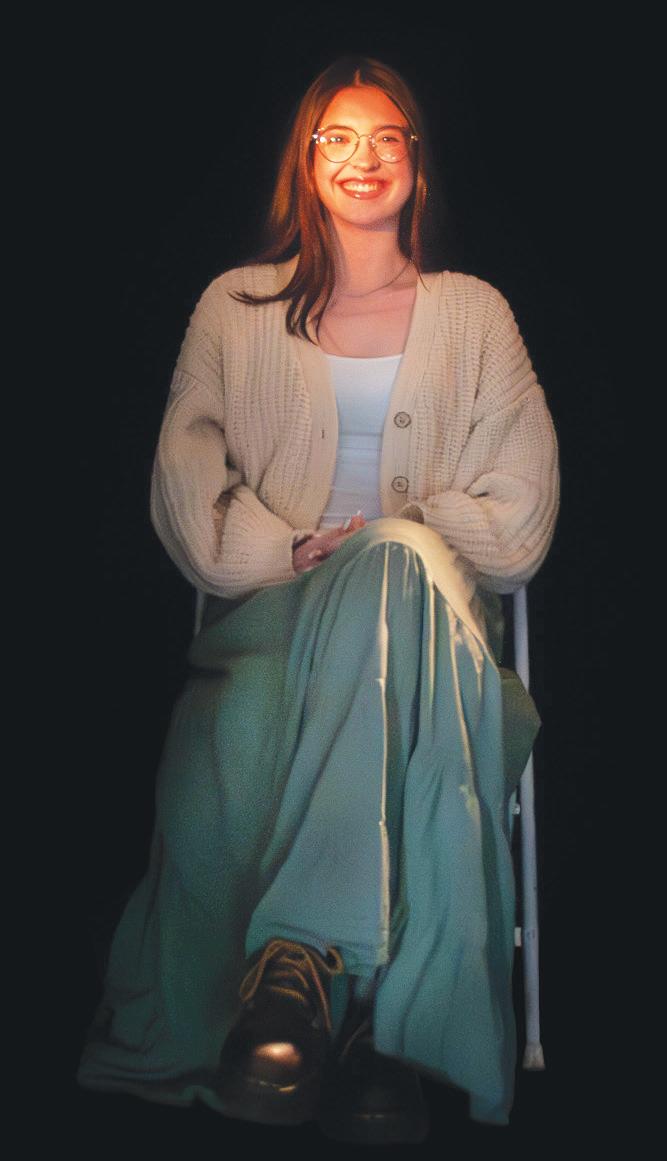
and it feels so different when you go in there now,” Levermore said.
She sees Harbart’s film as “three different people who decided to do different things on the Country Day campus, but all are flourishing in their own ways.”
After it was all done and dusted, Harbart started to reflect on her piece and how Country Day has changed since her beginnings at the school.
Harbart said that film is a great way to change one’s perspective, her perspective included.
“Being more grown, [my perspective] did change. I’ve been here for so long. You can really see the differences in lower school, middle school and high school,” Harbart said.
Recently, Harbart has enjoyed how members are choosing their own films. For her, the best part is how someone’s film selection uncovers their personality.
“It’s pretty cool to see what people like, their range of what they watch and
It started with her sporadic conversations about film with former History Department Chair Christopher Arns, who reached out to school administrascenes, and make our own,” Wells said.
Harbart’s own project was the short film titled “Growing Up With Country Day,” featuring seniors Claire Gemmell and Ava Levermore.
Her film was centered on the unique Country Day experience of being a ‘lifer,’ or a student who has been at the school since pre-K all the way until they
For anyone who is curious about using film as a learning tool or to create change, Harbart has this advice: “Just use your voice. [Film] is a great way to use your voice that can come across multiple people on multiple platforms. In everything [from] literature [to the] songs, you are using your voice to get a message across. You can tell an amazing story with media like film. I find that really pretty.”
Introduction
Sacramento Country Day’s research program, launched in 2017 by science department head Kellie Whited, hosts five California State University, Sacramento (CSUS) internships each year.
Stemming from the interest of one student in 2017, Kellie contacted one of her colleagues, Associate Professor Robin Altman, to see if the student could do volunteer research at her lab at CSUS.
The internships all involve going in person to CSUS and focus on the following topics: correlations between aggression and lifespan in fruit flies, Alzheimer’s disease, the human nervous system and behavior, botany in the greenhouse and animal care in the vivarium.
Out of the thirteen students in the senior class of ‘26 who applied, seven of them — Jake Genetos, Annabelle Do, Zema Nasirov, Aric Reuben, Andrew Logan, Claire Gemmell and Jackson Whited were selected last year to intern in laboratories for CSUS professors.

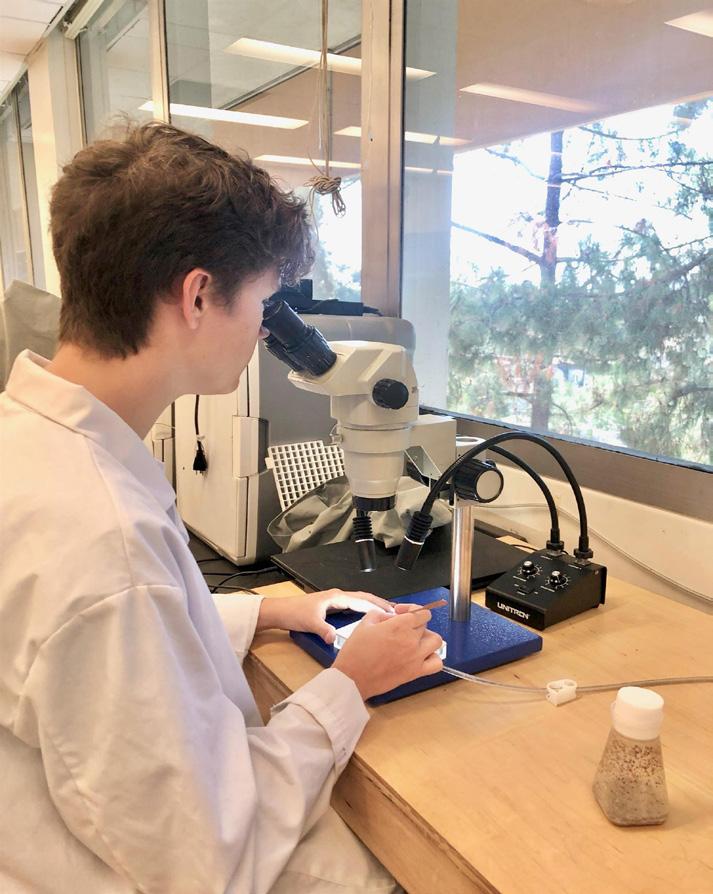

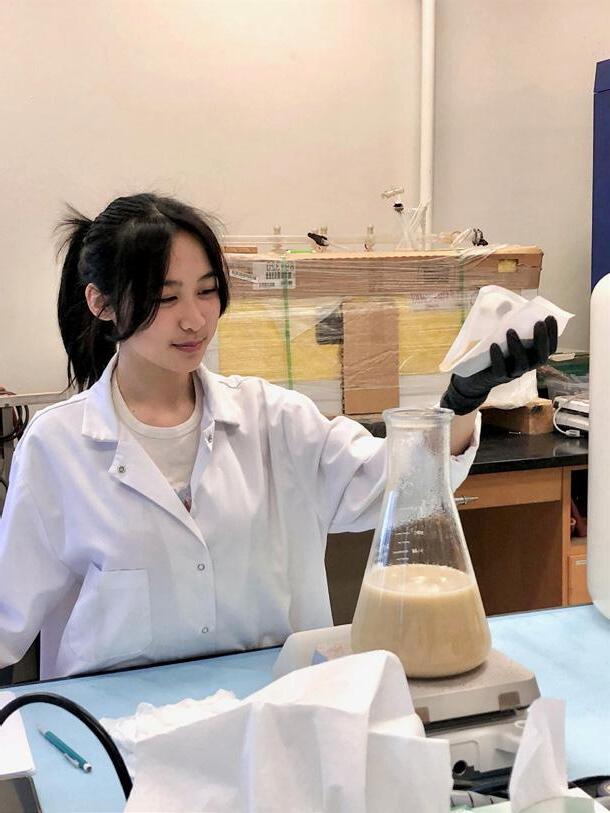

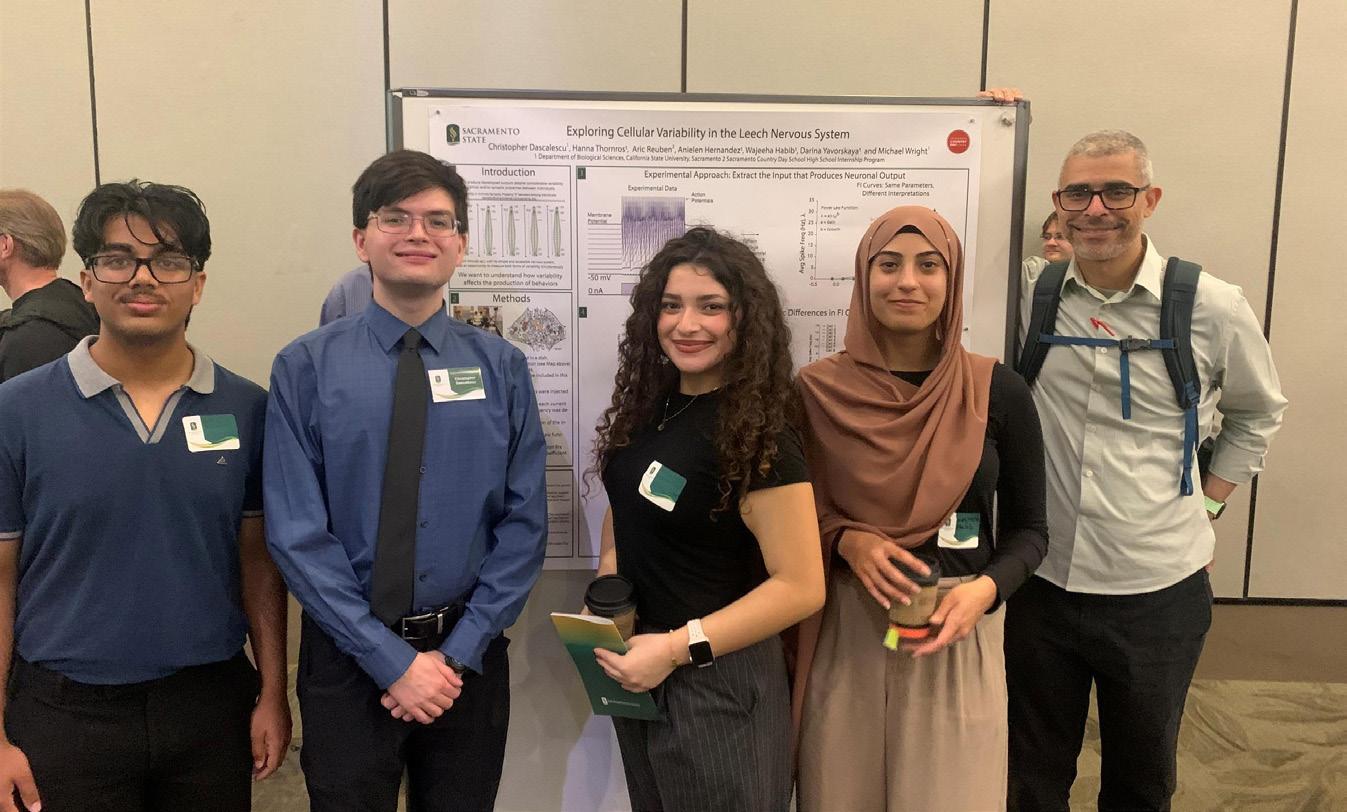
These internships begin the summer before a student’s senior year and typically last throughout the entire school year. Currently, five mentors at the university oversee the internships — Associate Professor Altman, Associate Professor Michael Wright, Assistant Professor Johannes Bauer, Greenhouse Instructional Support Technician II Daniel Pfarr and Vivarium Instructional Support Technician II Samuel Curtis.
“The process was pretty simple, but required a lot of thinking and diligence,” Jackson said. “I would advise students wanting to be an intern to take it seriously and not take it for granted. It’s an amazing opportunity and is only possible because the people at Sac State are volunteering their time to us.”
Interns are also required to bike to and from CSUS, often during their free period. They are required to complete five hours at their internship per week, equating to around two or three CSUS visits every week.
Fruit flies are the main focus in Bauer’s lab, with aggressiveness and lifespan of fruit flies highlighted to answer Dr. Bauer’s hypothesis: Does more aggression mean faster aging, and does less aggression mean slower aging?
Do and Genetos help with lab maintenance, keeping the flies alive and helping undergrad students with their own research.
“What we have to do is pick up these dead flies that are genetically modified, and we observe the differences in the number of dead flies in terms of genetic decline,” Do said.
These genetically modified flies can have a wide range of mutations that affect them.
“They have different eye colors because of mutations. They can have hairs that are in different shapes — some of them have curly hairs, some of them have straight hairs. They’ll have different messed-up legs,” Genetos said.
Aggressiveness in flies is measured by the frequency of four distinct behaviors: Wing threat, fencing, boxing and chasing.
“Wing threat is [the flies], like, poking their wings out to threaten each other. Fencing is them slapping the sh*t out of each other with their front legs. And then boxing is like standing on their hind legs — they don’t really do that one. Then there’s chasing, where they just chase each other,” Genetos said.
To actually measure aggressiveness, Do and Genetos do assays — scientific tests — in which two flies are placed in a petri dish and observed as they fight over food, according to Genetos.
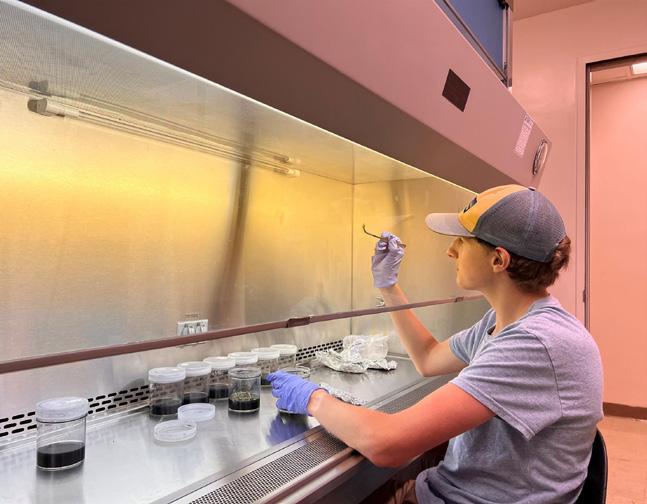
Subduing the flies is an important component of doing an assay, said Genetos. Do and Genetos do this through the use of carbon dioxide.
“The flies come in these little bottles, and then you get the carbon dioxide pads, and they just shoot out carbon dioxide. They don’t get oxygen on the pad, so they just pass out. But if you leave them on there for too long, they’ll get brain damage,” Genetos said.
After the aggressiveness is measured, the flies are observed by their number of deaths.
“One or two die every day up until, like, two months into it, and then you’re getting like five or 10 a day. We’re just seeing how long on average they live for,” Genetos said. He notes that the average lifespan is about two to three and a half months.
Genetos’ main reason for taking part in this internship is to gain more exposure to the scientific process and see if this is what he wants to pursue.
“My parents do research, and that’s what I’m interested in doing postgraduate, so this lined up with my career interests,” Genetos said.
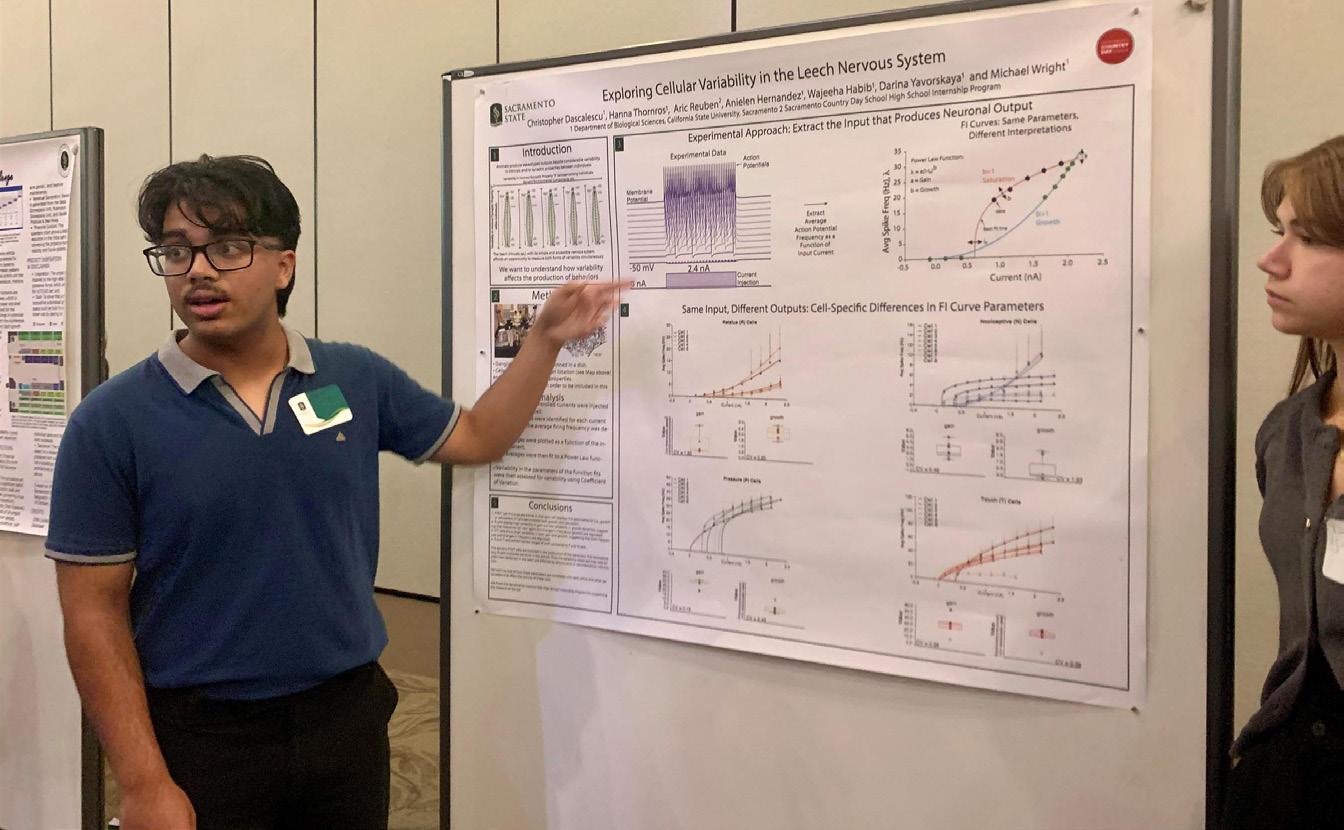
“We took leeches, put them in ice, which anesthetized them, and then we would cut them open and pin them out.”
Reuben describes his experience working in Wright’s lab. Neurophysiology is the main focus in the lab, and this is explored with the Hirudo medicinalis, the medicinal leech.
Reuben’s goal is to find out how different cells react when injected with electrical currents. This is done through the leech ganglia, parts of the leech that are in charge of controlling body segments.
The internship began with a briefing on lab safety procedures, followed quickly by leech physiology, Reuben said.
“We got to take care of the leeches, like changing their water and checking every day if they were dead or alive,” Reuben said.
One of the main experiments done in this internship was called the “F-I Curve Experiment,” which measures the firing rate of neurons in response to the injection of current, Reuben said.
“We found that for certain cells, as you increase the amount of current you put into the leech, the frequency of action potentials increases. Basically, the frequency of nerves firing would increase,” he said.
According to Reuben, collecting data isn’t always a smooth process; if there are any errors in the readings in the experiments, the data can’t be used.
“There are a bunch of different factors: maybe the electrode was faulty, like there’s something clogging the electrode, which could give us a faulty voltage rating, or the electrode may have drifted out, which also gives bad
data,” Reuben said.
The process can also be tedious.
“I was doing the processing, and I was getting frustrated because we were doing the same thing over and over!” said Reuben.
Realizing that the data collection process was inefficient, Reuben used equations on Google Sheets, completely optimizing the process.
“My mom works as a data analyst, so she’s very comfortable with Excel. She told me about this, a way to move data points from cell to cell in Excel, which is also transferred to Google Sheets. That’s where I first got the idea,” Reuben said.
Reuben used this idea to make the cells automatically grab the data and put it in its specific sheet, as opposed to manually inputting all of the data, saving a lot of tedious work.
Reuben advises other students to ask questions the way he did.
“The internship program can be anything that you make of it. You have to see how you can help, what value you can bring to the lab, instead of just going through the motions,” he said.
Reuben decided to do this internship to explore the career direction he wanted to pursue.
“I wanted to know if I would go into research or focus more on the application aspect of my major,” Reuben said. “I plan to major in Biomedical Engineering. I don’t think this internship is really specifically catered to Biomedical Engineering, but I think having an understanding of how the nervous system works is a valuable skill. So in that way, this helps me.”
The Application Process
In February, Country Day juniors are invited to attend a meeting introducing the available internship opportunities. Kellie and Altman host an informational meeting during Country Day’s flex period in the Matthews Library. Interested students then complete a Google form. Applicants can apply for up to two of the five internships available: Directed Study in Aging Research with Bauer, Research and Directed Study in Cell Biology with Wright, Directed Study in Botany and Greenhouse Management with Pfarr, Research and Directed Study in Cellular Neurobiology with Altman or Directed Study in Vivarium and Animal Care with Curtis.
It is important for each student to consider the classes they will take the following school year to be able to create enough space in their schedule for the internship.
Directed Study in Botany and Greenhouse Management
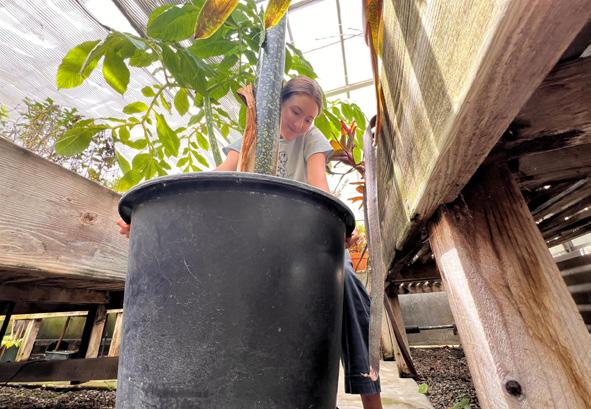
Logan and Gemmell both chose this internship for their interest and love for plants.
“I’m just really fascinated by plants and their structures, and I started noticing them through art. I’ve always been drawn to drawing plants, and so I’ve just been really interested in learning more about them,” Gemmell said.
As greenhouse interns, the two students propagate (breed) plants, repot them and provide general maintenance — watering, feeding, caring for plants — as well as do laboratory work.
“We did a lot of lab work and a lot of work in the biosafety cabinet doing orchid propagation. I’ve spent many hours in that room, and a lot of transferring orchids from the flask into the greenhouse — just a lot of experimenting with orchid propagation,” Logan said.
Hybrids are the offspring of two distinct but similar species. Through breeding plants together, Logan and Gemmell will name the new
hybrids they have created.
The first round in the selection process is a 15-minute interview with Altman, who comes directly to the school. Along with this, students need to submit a resume and a copy of their transcript. Altman then decides if the applicant is a good fit for the internship.
The internship program is a truly unique experience made possible through Kellie and Altman’s passion to help raise the next generation of research scientists.
“This opportunity is something we both would have loved to have when we were in high school and we are so blessed to be able to provide this for our students. I encourage everyone who is interested to apply. We’d love to talk to anyone and everyone who is interested in seeing science in the real world and see if this program is a good fit for them,” said Kellie.
During March, Altman notifies the interviewees of her decision.
“As for what I’m going to name it, I have no clue,” Logan said.
Apart from creating new hybrids, Gemmell is also creating art for the visitors of the greenhouse.
“Right now I’m working on a project for ant plants — myrmecophytes. I’m creating an infographic sign and doing botanical illustrations,” Gemmell said.
This sign will be put up so that visitors can learn about the myrmecophyte, a bulbous plant.
Logan advises students interested in this internship to utilize the knowledge of the people present at the greenhouse.
“Ask questions. I think that’s really important, because the mentor, Daniel, he’s really knowledgeable, and so I think it’s really important that you really take advantage of that resource,” Logan said.
Research and Directed Study in Cellular Neurobiology
Focusing on endothelial cells, Nasirov studies their relationship with Alzheimer’s disease.
Alzheimer’s disease is a process where the patient has amyloid plaques; clumps of protein built up in the brain, damaging cells and disrupting communication. Usually, symptoms include memory loss and cognitive decline.
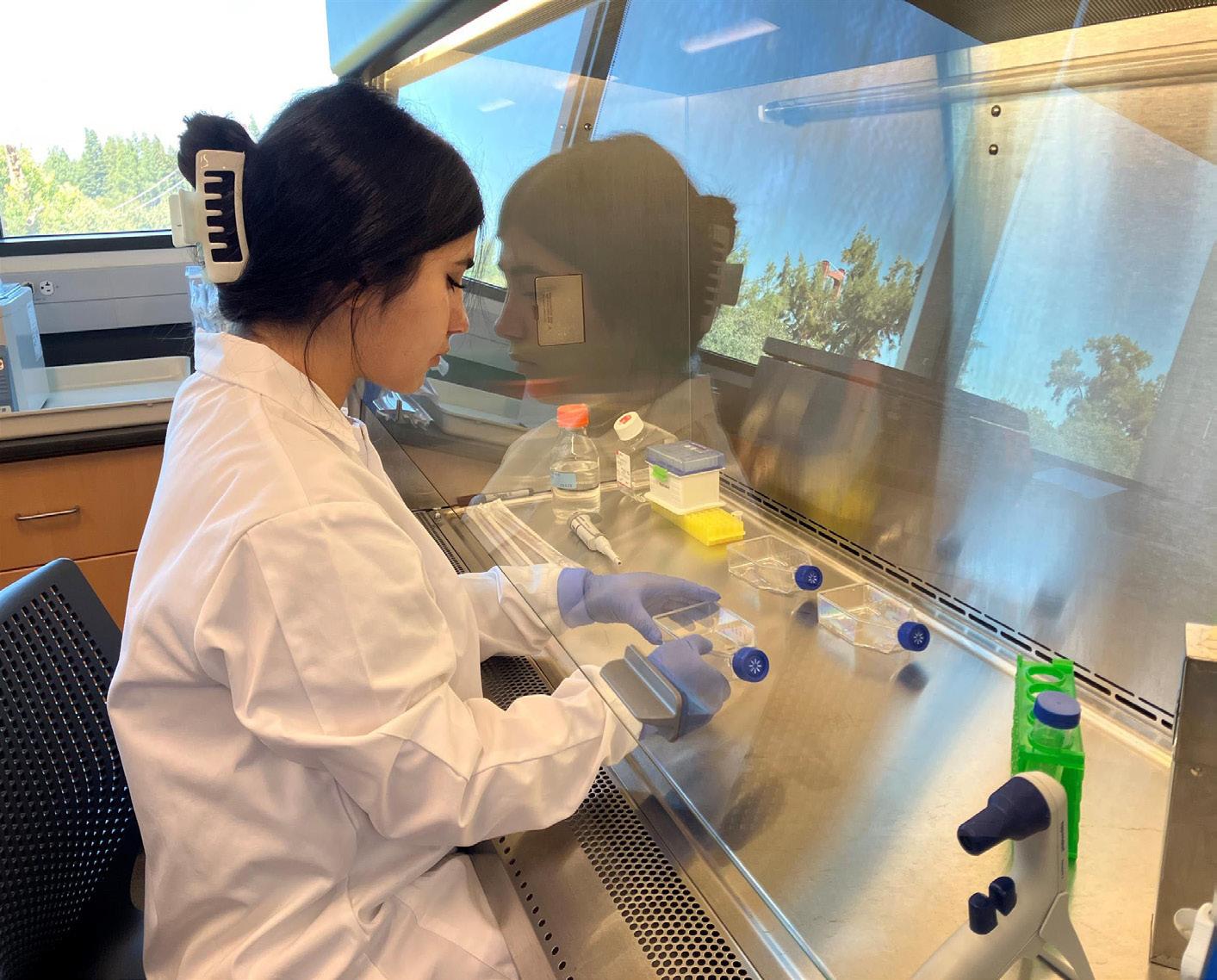
Endothelial cells are crucial for blood fluidity, and can be a major factor in Alzheimer’s disease when functioning improperly. Nasirov works on culturing cells from the blood-brain barrier hCMEC/D3 cell line and experiments on them.
“We’re always checking for confluency, which is how crowded the cells are, and we separate them into different subgroups,” Nasirov said.
Unlike the other interns, Nasirov didn’t begin on campus right away.
“I started off doing zoom meetings with my mentor in the summer, as [Dr. Altman] was still on sabbatical at the time. I got familiar with the cell line that we use, and I read a lot of papers about cell culture,” Nasirov said.
Nasirov first arrived in the laboratory in August to begin in lab training.
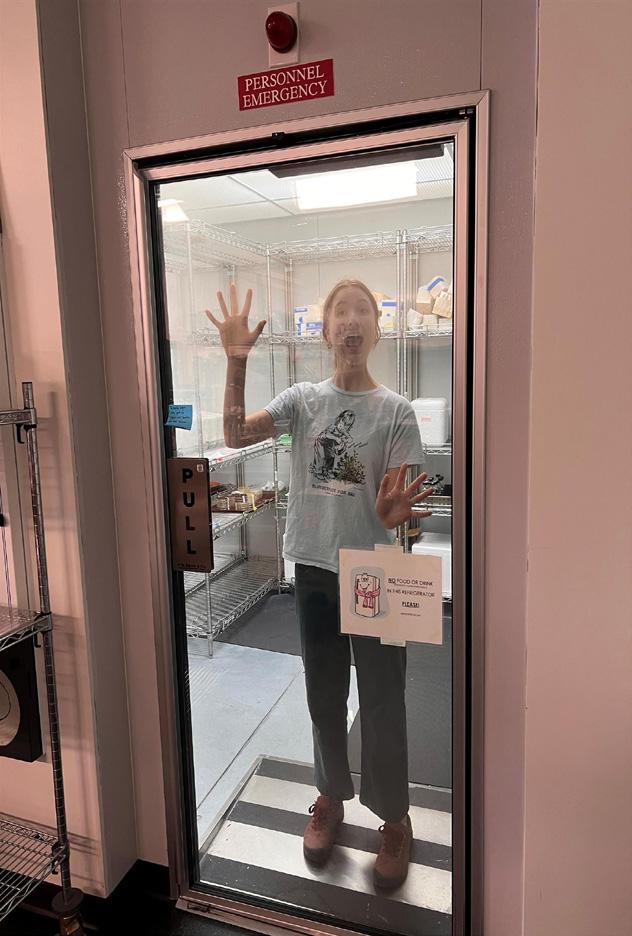
“It’s not difficult to get used to, but you have to pay very detailed attention to not contaminating anything with aseptic technique,” Nasirov said.
No one had been in the lab for a year — requiring much work to get it back up and running.
However, Nasirov explained that it was all worth it — expressing gratitude and enjoyment with the internship.
“I’ve gotten to do a lot of protocols I wouldn’t have gotten the chance to do otherwise, and they were all very fun. Right now, for example, we’re studying the RNA from our cells and seeing how they react to different treatments.”
Nasirov was interested in the internship for the opportunities it had to offer, not just currently, but potentially in the future as well.
“The internship really allows students the chance to experience hands-on research,” Nasirov said, who then explained that it can be helpful in her search for internships in the future. “Above all, I think it’s fun and really cool to have a course that isn’t on campus where you get a different experience.”
Directed Study in Vivarium Management and Animal Care
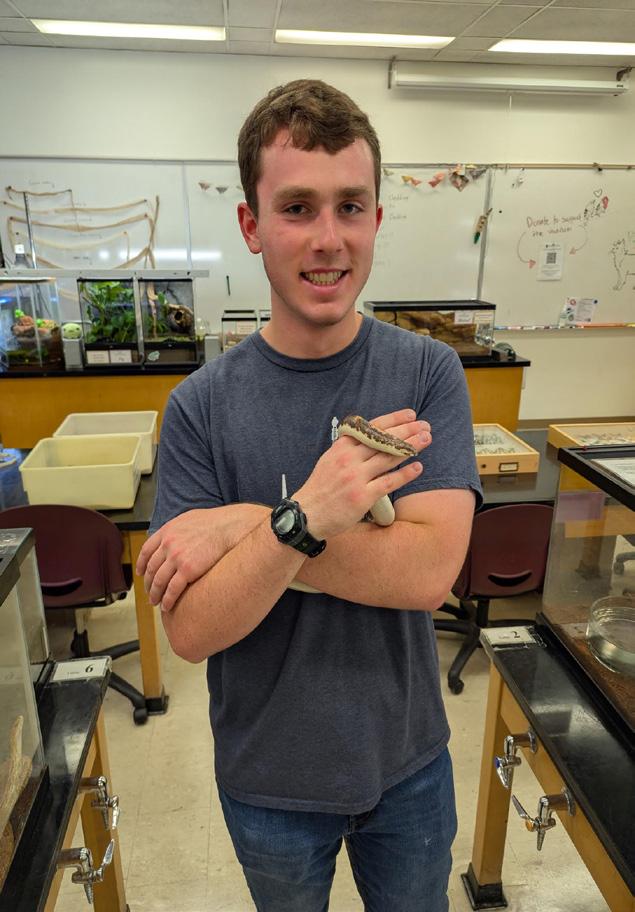
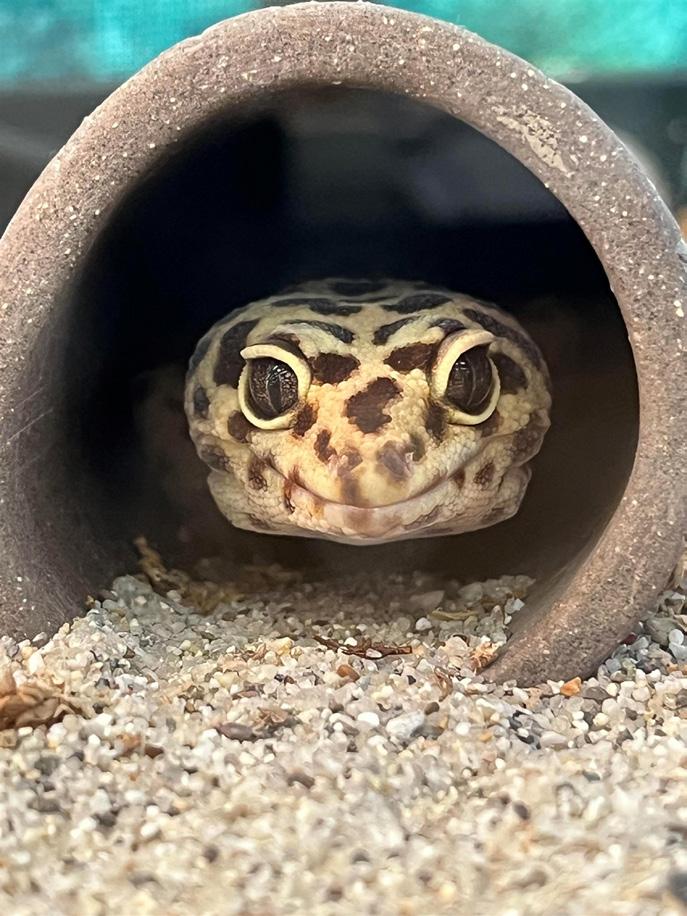
Jackson is an intern working at the Vivarium of CSUS. He currently works with Samuel Curtis, who is the head of the Museum of Animals and the vivarium. Jackson is studying how to take care of animals and manage a vivarium, a structure for keeping animals for observation or study.
Jackson usually performs daily care for all of the animals — cleaning their bowls, getting rid of old food, moisturizing the enclosure environments and cleaning out dead specimens in the insect enclosures. After that, it depends on what Curtis needs him to do.
Some other activities that Jackson regularly does are feeding bugs to larger lizards, answering questions for visitors and picking new plants for the Stick Bug enclosures.
“I absolutely love this internship. It’s always one of the best parts of my day. There are many times where I wish I could spend my whole school day in the vivarium. I love getting to interact with the animals, learning more about them and showing them to curious visitors.
Honestly, I love everything about it,” he said.
Jackson plans to major in biology — though his ultimate goal is to be a veterinarian.
“Working in the vivarium has given me lots of experience handling and caring for animals, which is experience I will need in preparation for my career,” Jackson said.
A piece of advice Jackson would like to offer to interested fellow students is to avoid overloading their schedules, as it can be hard to coordinate time with mentors.
Due to the busy schedules of the mentors and the rotating schedule at Country Day, it can be rather difficult to coordinate times if an intern also has a packed academic schedule.
In order to avoid any scheduling problems, Kellie meets with the selected student interns the spring before senior year to choose a fitting course load for the next school year. By planning ahead of time, students can avoid the internship having a negative impact on their grades.
BY EDITORIAL STAFF
You are sitting in front of your laptop, hand shaking over the trackpad. Email open. Subject line: “Your admission decision is ready.”
Your parents are in the next room pretending not to pace. Your heart rate is loud enough to hear. You click.
For a split second the screen is blank, and everything you have ever done in school — every late night, every test, every time you said no to something fun because you said yes to studying — feels like it is balanced on that loading icon.
Now picture someone else opening the same portal. Same time, same school, same “holistic” process. The second student is what colleges call a legacy applicant. If you had to put money on one of them, you know where you’d place your bet.
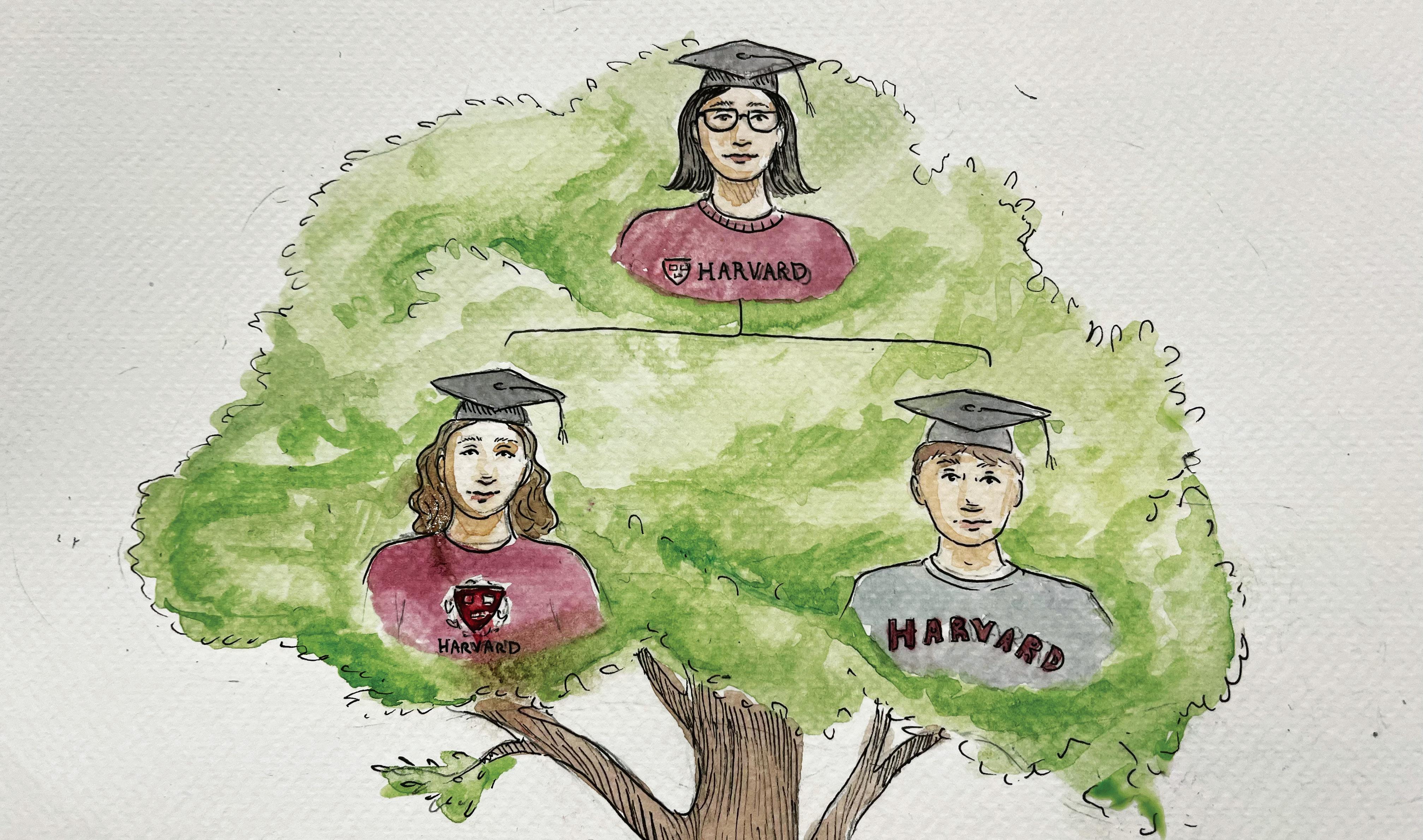
Different universities define legacy applicants differently. At some, like Harvard University and Columbia University, “legacy” means at least one parent earned an undergraduate degree there, according to the schools’ admissions websites and Common Data Set reports.
At others, including the University of Pennsylvania, Duke University and Cornell University, the definition is broader: Penn says it considers applicants with a parent or grandparent who graduated from the university as legacies, Duke says it gives “special consideration” to children and grandchildren of alumni and notes siblings, and Cornell’s admissions guidance notes that children and more extended descendants of alumni may receive legacy consideration, according to their published admissions materials.
Not every legacy student is wealthy, and not every wealthy student is a legacy. Some come from middle-class families where a parent scraped their way into that college years ago. Others fit a different informal category: families whose major donations or connections put them on socalled “development” or “special interest” lists, even if the parents never attended the school — a dynamic described by admissions officers and documented in reporting on the Harvard admissions lawsuit and other highly selective colleges.
What they share is not a guarantee, but an advantage: when applications are sorted, their family’s connection to the school is treated as a positive in a process that is life-changing for everyone in the pile.
So when their screens load, both students may be “qualified.” Only one of them has a line on their file that says, in effect, this family is already part of us. That line doesn’t make them better. It just makes the odds bend in their favor. This is not some exaggeration. Across the Ivy League, roughly 10% to 15% of undergraduates are the children of alumni, according to analyses by the Brookings Institution. Same school. Same year. One group is more than six times more likely to get accepted, simply because of who
their family is.
At Harvard, internal data released in the Students for Fair Admissions v. Harvard lawsuit showed that between 2014 and 2019, legacy applicants were admitted at about a 33% rate, compared with about 5% to 6% for everyone else, as NPR and other news outlets reported when the records became public.
Harvard is not alone. At Princeton, an analysis of 2009 admissions data found that about 41.7% of legacy applicants were admitted, compared with 9.2% of non-legacies; at Brown, a 2006 admissions snapshot showed that about 33.5% of alumni children were admitted, versus the 13.8% overall admissions. If you are that non-legacy kid refreshing the portal, this is what you are up against: a thumb on the scale you were never told about.
Legacy admissions did not appear out of nowhere as a way to keep alumni engaged. In the 1920s, as children of Jewish, Catholic and immigrant families began scoring high on entrance exams, elite colleges started looking for ways to keep their old social order intact. Legacy preferences were one of those tools — a way to reserve seats for the sons of ‘old stock’ families without putting quotas into law.
The language they used back then — “character,” “fit,” “tradition” — is not so different from the language we hear now. Legacy admissions originated at Ivy League colleges in the early 20th century as part of an effort to limit Jewish and immigrant enrollment and preserve overwhelmingly white, wealthy student bodies.
When we call legacy admissions a “tradition,” we are sanitizing that past. We are saying that a mechanism built to keep certain people inside and others outside deserves respect because it is old.
There is a word for a system that guards inherited privilege behind polite language. It is not “meritocracy.” It is aristocracy.
On June 29, 2023, the Supreme Court effectively ended race-conscious affirmative action in Students for Fair Admissions v. Harvard and Students for Fair Admissions v. University of North Carolina.
Notice what almost never came up.
Only after civil rights groups filed a complaint did the United States Department of Education open a federal investigation into whether Harvard’s legacy and donor preferences discriminate against students of color under Title VI.
Ask yourself: if this was truly about purging unfair boosts from admissions, how did the most obvious unfair boost of all survive the purge?
In 2019, the “Varsity Blues” scandal exploded. Wealthy parents paid a fixer to bribe coaches, fake test scores and photoshop their kids into being “recruits.” It was ugly and shameless, and people went to prison. We looked at that and said, “this is disgusting. This is not what college should be.”
Now put Varsity Blues next to legacy admissions.
In one, checks were slid under the table. In the other, the
money is written on donor walls and stadium scoreboards. The underlying message is the same: if you have enough connections or money, the rules will bend for you.
People who defend legacy love to say, “But these students are qualified too.” Often, that is true. The point is not that legacy kids are universally unprepared. The point is that admissions is a zero-sum game all together. If a college can take 1 out of every 20 applicants, every legacy spot granted with a preference is a spot not available to someone else.
Who is that “someone else?”
Look at what happened when universities dropped legacy. Johns Hopkins University quietly phased out legacy preferences and then made it public in 2020. The university reported that ending the policy increased the share of students from low-income and first-generation backgrounds, and that alumni giving did not collapse.
When legacy disappears, space opens up for students who did have lineage on their side. That means, right now, there are real human beings — often first-generation, low-income or from underrepresented communities — who are being pushed to the waitlist or the rejection pile because a legacy applicant got a lift.
It is the student refreshing the portal in a crowded apartment, with siblings leaning over their shoulder. It is the kid whose parents never went to college, who trusted the apparent promise that if you do everything right, you have a shot.
The public is not fooled by the branding. A 2022 Pew Research Center survey on public views of college admissions found that about 75% of Americans say having a relative who attended a college should not be a factor in admissions decisions at all. Some lawmakers have actually listened.
Colorado banned legacy preferences at its public colleges in 2021. Virginia followed with a bipartisan law that bars its public universities from giving legacy boosts. Illinois and Maryland joined in 2024. California went further, banning legacy and donor preferences at private nonprofit universities that benefit from state aid.
If we believe talent is scattered everywhere but opportunity is not, legacy admissions are indefensible.
If we believe the point of higher education is to open doors, not guard family gates, legacy admissions are indefensible.
If we believe the word “merit” should mean something real, legacy admissions are indefensible.
There is a simple, concrete fix, and it does not require a Supreme Court case or a decade of debate. Stop letting ancestry tilt the scale. Stop honoring “tradition” when tradition means hereditary privilege. Stop pretending a system that has a head start built in for the already powerful is neutral.
Admissions should measure what a student has done, not what their parents once did. Everything else is a lie that loads the portal, looks you in the eye and tells you this was fair.
BY NOOR ALAMERI
Afew years ago I was having lunch with my older sister and some of her friends. Someone brought up some problematic tweets from a celebrity I had never heard of, and suddenly everyone had thoughts. It became a loud, animated conversation that I felt left out of.
Despite not knowing who this celeb was, I claimed they did it for attention. When my sister asked me to elaborate, I just sat there, stunned. I had nothing to elaborate on because I had no idea what I was even talking about.
Since when has “I don’t know” become an unreasonable response?
I think the reason we feel so much pressure to form an opinion is because not stating an opinion feels like failing some unspoken social test.
When someone asks you about the most recent geopolitical news, it doesn’t feel good to say that you haven’t heard about it.
It means you’re out of the loop, or worse: that you don’t care.
My example was lighthearted. The ramifications of me saying something stupid about the celebrity Twitter spat of the week aren’t huge.
But that pressure I felt to form an opinion on a topic I was uneducated on? It shows up in conversations that actually matter too.
Scroll through any social media platform and you will instantly be bombarded with a constant barrage of other people’s (usually unqualified) opinions.
New legislation; scientific studies; new technologies; celebrity drama; that thing your cousin’s roommate said.
Any time a new major event occurs, the timeline is always the same: within minutes, hundreds of people have takes, not questions. I don’t even think a lot of these people read past the headline — instant opinions delivered with the con-
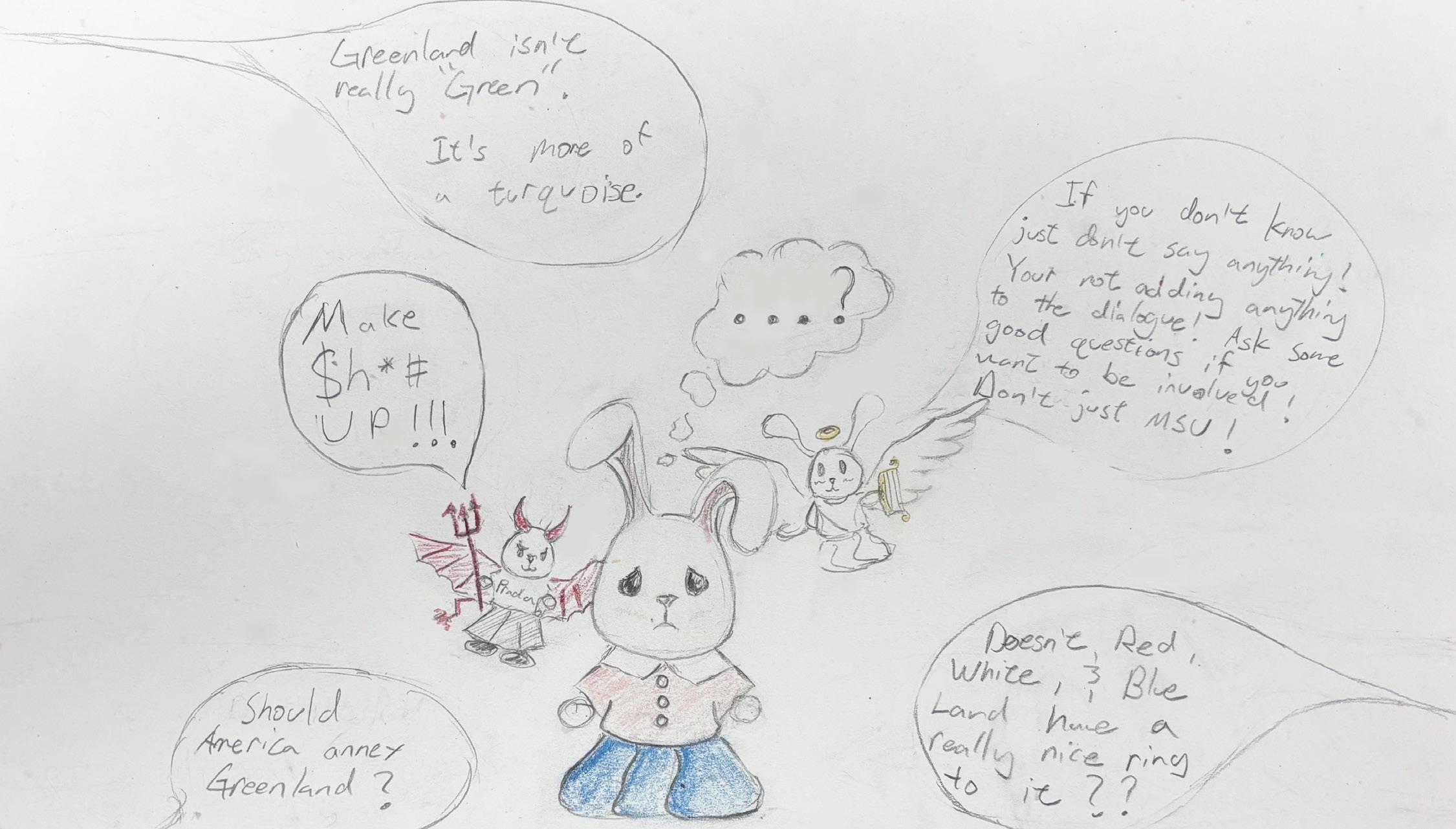
fidence of someone who actually knows what is going on from someone who doesn’t know what’s going on.
I’ve done it too. I think we all have. It’s natural to want to jump from “what the hell is going on” to “I am now an expert” in seconds, because it feels right (and safer) to have an opinion.
But it doesn’t make you seem smarter to have an opinion on something you know nothing about (or about someone you’ve never heard of), it just makes you seem pretentious — and usually you end up being flat-out wrong. Instead of worrying about looking uninformed, you should be more worried about being uninformed.
There’s another trap that may be easy to fall into when you aren’t informed about a topic: the contrarian.
Let me be clear: this is not the same as having an unpopular opinion that you

genuinely believe. I am talking about when someone feels the need to play the devil’s advocate to appear smarter or less, as they often like to say pointedly, “narrow-minded.”
By forming an instant, uneducated opinion, you are disregarding the complexity of the subject you are trying to talk about. You cannot possibly fit nuance into a 280-character tweet or a one sentence headline.
Most of the time, when you say “I don’t know” or “I’m not informed enough on that to form an opinion,” nothing dramatic happens.
Sometimes someone will fill you in on the topic; sometimes the conversation will just move on.
If it’s something you want to know more about, just ask.
At the end of the day, no one cares that you have not formed an instant opinion.
They won’t think you’re dumb or apathetic, just uninformed and willing to admit it.
Next time someone shares an opinion with you, instead of scrambling to form your own opinion, actually listen. Ask them questions, not to tear them down, but to understand.
Here’s the truth: you don’t need opinions on everything. What you need is to ask questions, and to stop pretending like you already know the answers. I’ve started to prioritize what matters most to me. What affects my community? What am I willing to put time into understanding deeply?
Everything else? “I don’t know” is a perfectly fine answer.
That’s not apathy, that’s being strategic, so that when you do engage with a subject, it is a meaningful, productive discussion.
Alast year, Sacramento Country Day’s varsity boys basketball team enters the 2026 winter season with hopes to clinch the playoffs.
The team spent the offseason training. Conditioning, aggressiveness and team chemistry were some of the things that the team highlighted. Senior and captain Riley Ruttan said that the extra work has already begun to show.
“We have a lot of potential this season,” Ruttan said. “This is my final year, so I’m excited to create good memories with my teammates and have a great experience together.”
The team has grown both physically and mentally, said Ruttan.
“We’re pushing the ball more and fighting down low. I’ve seen a lot of improvement within our players.
Ryan [Scripps] and Aiden [Anguiano] are tough guys to post up because they provide a lot of resistance when you try and go into them,” he said.
Beyond pace and intensity, the team’s chemistry has become a defining strength in the group, according to Ruttan, and the team’s bond outside of the court has improved their game.
“We’re all friends outside of basketball,” he said. “That helps a lot when trying to work together towards the same goal.”
As captain, Ruttan has encouraged leadership as well.
“It’s making me step up,” he said. “But I don’t feel like I’m the only leader. We are all expected to lead and lift each other up.”
Head Coach David Ancrum emphasized that the team’s main goal mirrors last season’s narrow miss of the postseason.
“Every day we are trying to get as many victories as we can, and most importantly, to get to the playoffs. We missed it by one game last year."
According to Ancrum, the consistent off-season work has separated this year’s team from previous seasons.
“They have been in the Lab all summer. They’ve been playing all summer against good competition, and that makes all the difference," he said.
Winning remains a focus, but Ancrum notes improvement is his main measure of success.
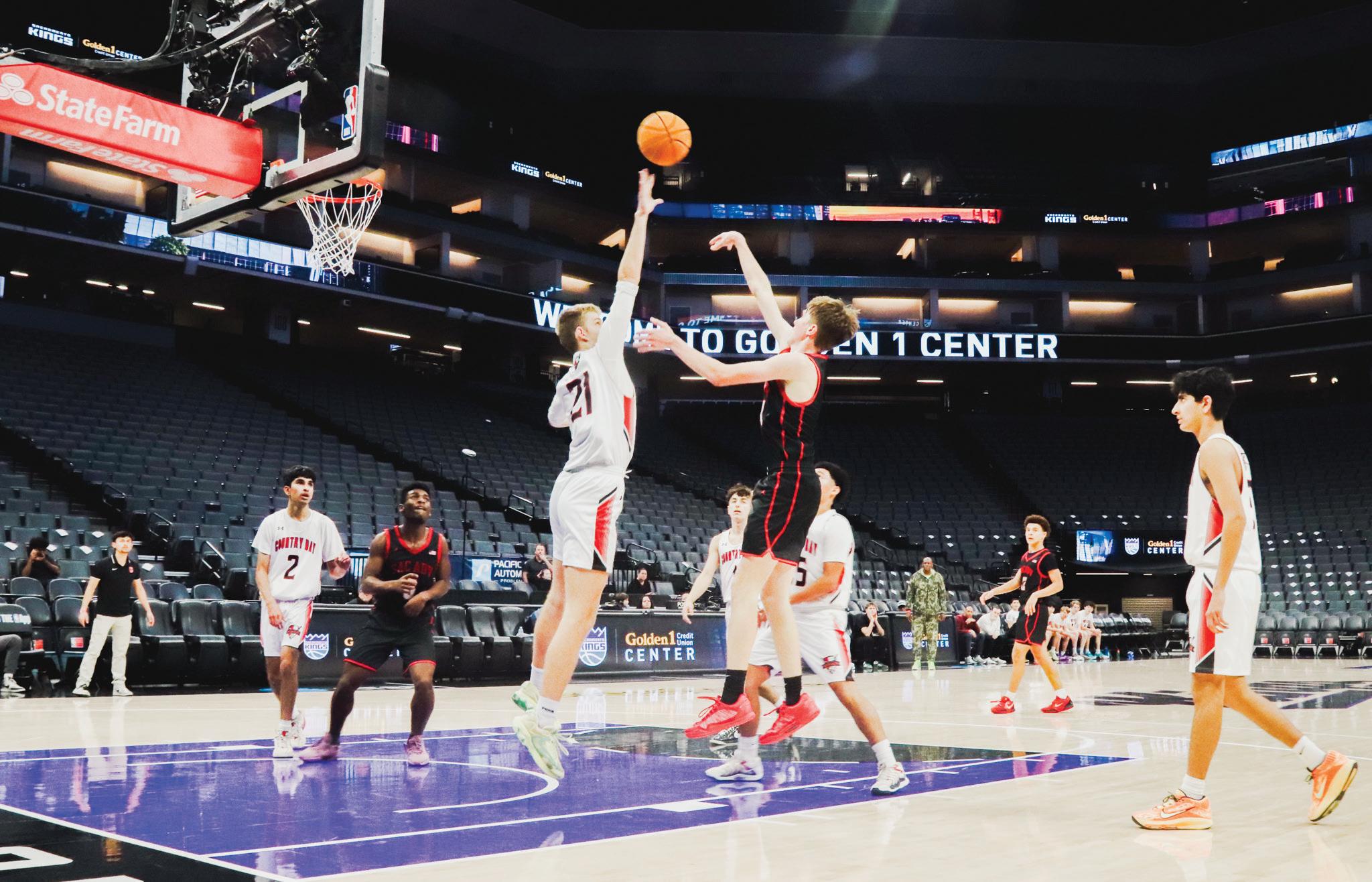
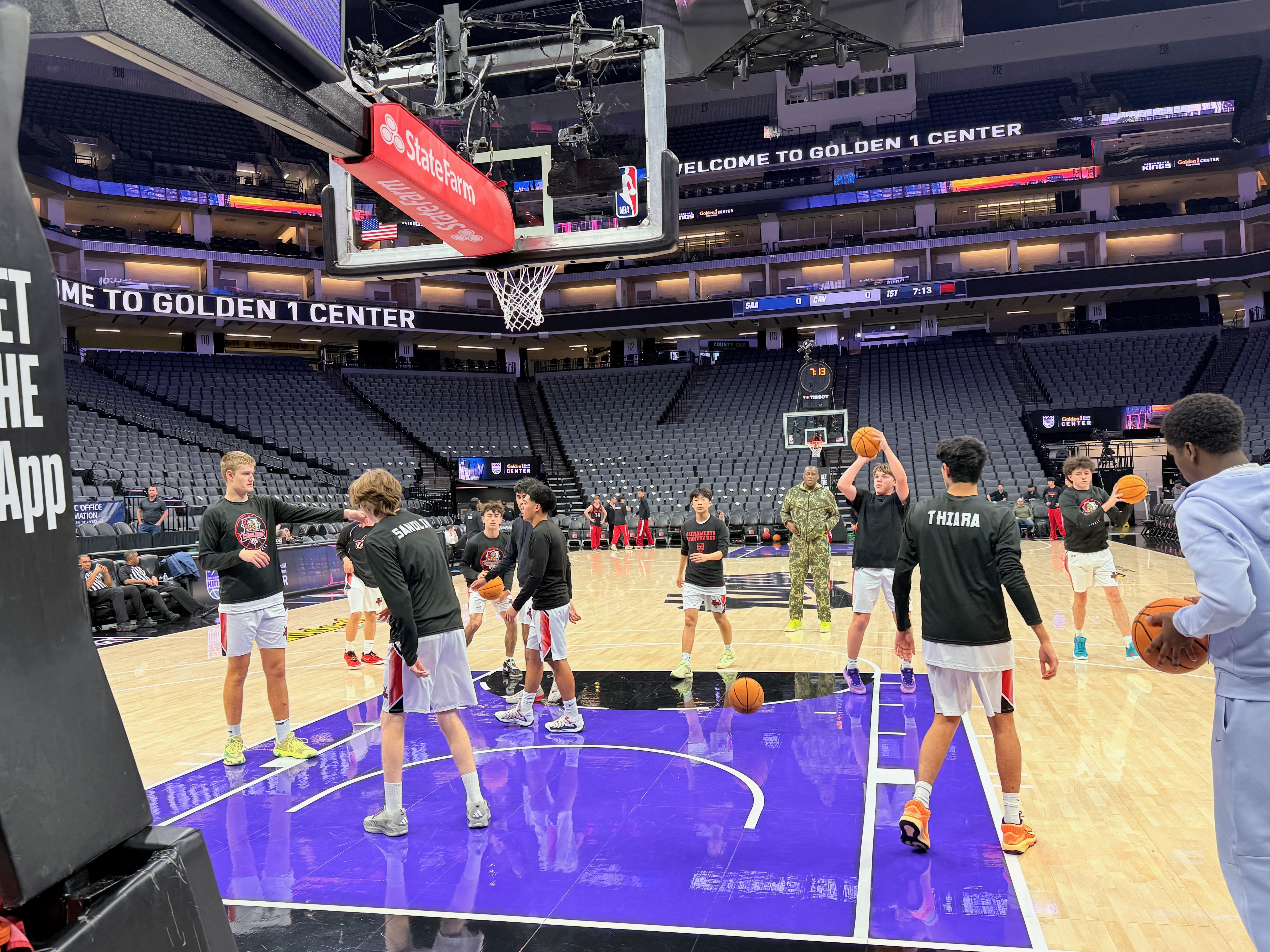
The team’s first game of the year was at Golden One Center on Jan. 5 against Sacramento Adventist Academy. The Cavaliers lost 48-52.
Playing on the Sacramento Kings’ home court was exciting, but Ancrum said the fundamentals remain the same. “The baskets are still 10 feet,” he said. “It’s just a few more seats and the court is a few feet longer.”
New players have also felt welcomed into the program this season. Freshman Matthew Kang said the team made a strong effort to help younger and newer players adjust to the new team.
“They put in a lot of effort to help new players feel comfortable. The first practice was a little overwhelming, but everything was explained really well,” he said.
Kang acknowledged that stepping onto the varsity team as a freshman came with challenges, particularly in adjusting to skill level. Despite limited playing time, he said younger players continue to contribute through practice.
“We don’t get a lot of playing time, but at practice, we do our jobs. We play hard and help the team however we can,” he said.
With the season nearly halfway complete, the girls varsity basketball team has already surpassed last year’s win total, winning five games after finishing the previous season with just one win.
“We’ve definitely won more games this year,” Se nior and team captain Ella Martinelli said. “I’d say that we’re more skilled and we’re just improving more as the season continues.”
Head Coach Latonia Pitts agrees with Martinelli. “I think that we have a really good foundation,” Pitts said. “So far, we’ve had some tight games under our belts, some good wins and some hard losses, but I think that we have a good chance of



that went overtime against Buckingham Charter.
“This was my first overtime win ever in my career,” senior Jesse Dizon said, who plays guard. “I was really nervous during the last
er leaders are beginning to see and understand that transition as they leave us what’s to come and what we still have. I am excited to see what we still have.”
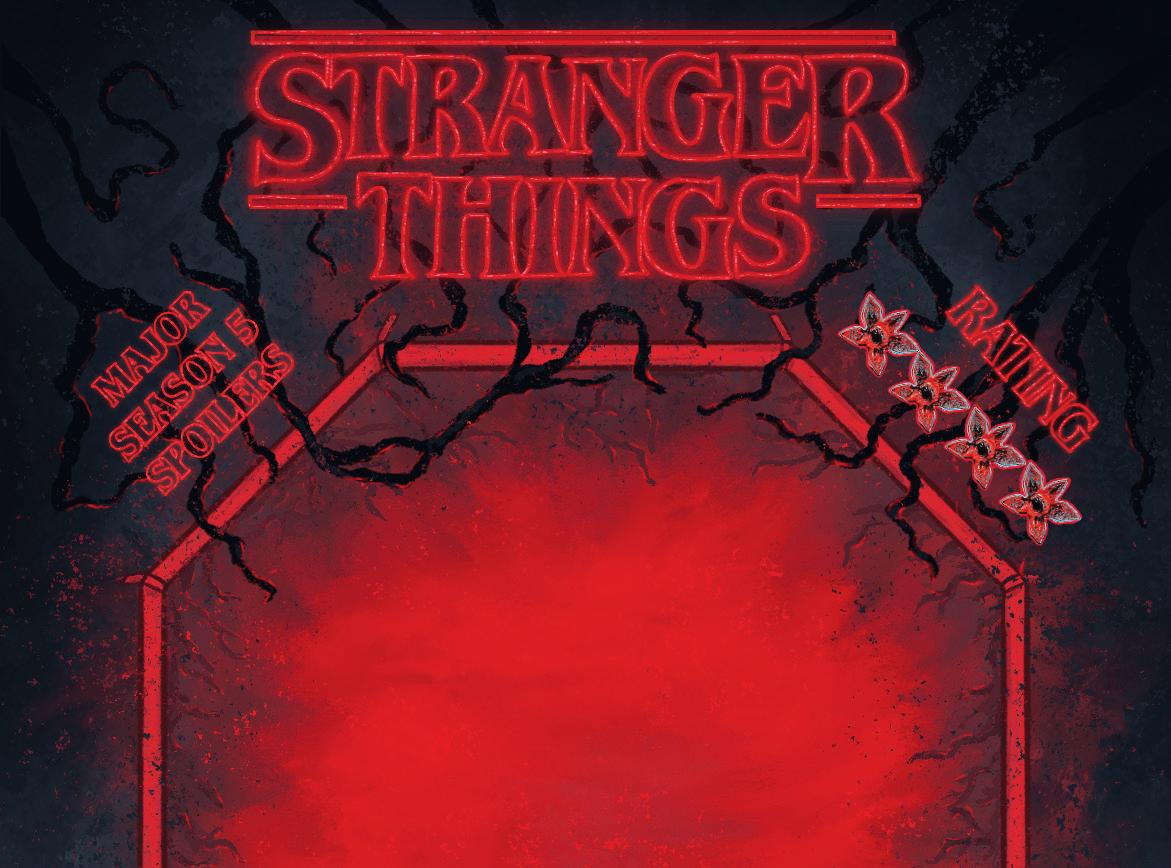

The fifth and final season of Netflix’s groundbreaking series “Stranger Things” is almost a masterpiece.
Since 2019, I have been a massive fan of the series. From fan experiences to marathon binge-watching the show, I have seen it all.
Needless to say, I was extremely anxious about how the series was going to end.
“Stranger Things” was created in 2016 by twin brothers Matt and Ross Duffer. They took inspiration from Dungeons and Dragons (D&D), Stephen King’s “Stand By Me” (1986) and Stephen Spielberg’s “E.T. the Extra-Terrestrial” (1982).
The series has been named as one of the greatest television series of all time on several lists by multiple media critics, who cite its innovative blending of deep coming-of-age themes, Cold War conspiracy theories, eighties nostalgia, science fiction and fantasy. It is officially Netflix’s most watched series ever — with more than 1.2 billion viewers at series end, according to Variety.
The first season of Stranger Things is set in Hawkins, Indiana which is home to the Hawkins National Laboratory, where, the audience learns, post Cold War era experiments are conducted.
It starts in 1983 with “the party,” a group of four friends consisting of Mike Wheeler (Finn Wolfhard), Dustin Henderson (Gaten Matarazzo), Lucas Sinclar (Caleb McLaughlin) and Will Byers (Noah Schapp). As the nerdy group of thirteen-year olds plays an intense game of D&D, Will is kidnapped by a Demogorgon (a tall, grey monster with rows of teeth) and held captive in an alternate universe known as “The Upside Down.” As Will’s friends, mother, and the town sheriff try to find him, it’s assumed that he has been kidnapped in an earthly way. An escapee from the lab appears to help everyone out. Lab experiment 011, or Eleven for short (Millie Bobbie Brown), is a psychokinetic child and uses her powers to help find and save Will.
With 8-9 episodes per season, new villains, “party members” and obstacles are rapidly introduced. In Season 2 we meet Max Mayfield (Sadie Sink) and the ‘Mind Flayer,’ the parasitic entity serves as the hive mind for “The Upside Down.” The third season brings us to the local mall and the secret Russian base underneath it. And the fourth season takes place in multiple locations including Russia, Hawkins and the West Coast.
The final season of “Stranger Things” is split into three “Volumes,” and takes place in 1987. “The party” has now grown, and everyone has returned to Hawkins in preparation to finally put an end to the “ultimate villain,” Vecna (Jamie Campbell Bower). Eleven is training with her father figure, former police chief Jim Hopper (David Harbour) and Will’s mother, Joyce Byers (Winona Ryder) to improve her powers. She eventually goes into a parallel universe called The Upside Down to look for Mike’s sister, Holly Wheeler (Nell Fischer) who was kidnapped.
Will, the first child kidnapped, is eventually pushed beyond his limits and uses his newfound abilities he acquired while he was trapped in The Upside Down to save his friends.

Episode 4 does not disappoint; the interactions between characters and how those interactions and exchanges foreshadow future events is what makes this show so powerful. An example of this is the conversation Robin Buckley (Maya Hawke) and Will have about sexuality.
For context, Robin has a girlfriend and Will has been struggling with coming out as gay. These feelings have been the reason he acts like an outsider even among his group of outsiders.
When he talks to Robin about this, she makes it clear that it doesn’t matter whether or not the people around him look at him differently. All she needed to know, she tells him, is that “I had all the answers.”
This directly affects the end of the episode when Will thinks back on these words and uses his powers to kill three demogorgons at once.
It is this fantastic ending to Vol. 1 of the season that makes Vol. 2 — the next three episodes — hurt so much more.
Episode 5 picks up directly where the previous one ends. Hopper and Eleven discover her half sister, lab experiment number Eight (Linnea Brethelstein), who was found at a military base in The Upside Down. After she is freed, it is revealed that Eight has undergone experiments to create more superhuman beings such as herself and Eleven. At the radio station, another group known as the “Frankensteins” (who use electrical shocks to revive) a Demogorgon back to life to help Will use his newfound abilities. Through this they learn that their old friend Max (who was previously believed to be in a coma after nearly being killed by Vecna) is alive but trapped in Vecna’s mind. Lucas protects her body until she returns to it.
In the meantime, the Hawkins Lab team (Dustin, Steve Harrington (Joe Keery), Nancy and Jonathan) discovers that The Upside Down is made of exotic matter and is a wormhole leading to “the Abyss” (another world that connects to The Upside Down).
When it is damaged, The Upside Down collapses and merges with the city of Hawkins. Long time fan favorite Steve proposes an idea to enter the Abyss and save the missing kids, who were taken to try and merge the two worlds together.
At this point, I had my doubts about what the end was shaping up to be. First of all, bringing back Eight feels very unnecessary. She has done basically nothing except convince Eleven that she needs to die so that no one tries to make more experiments like her.
Additionally, we haven’t seen Eight since season two (and the only episode she was in is the lowest-rated episode pre-season five). I understand the need to tie up the arcs of all of these stories, but if Eight returns, she should have a real purpose.
Secondly, The Upside Down is just a worm hole? Seriously? You mean to tell me that this entire time it’s been nothing but a tunnel to somewhere else? Total buzzkill that kills any significance this other world has had for viewers since the season began.
The Upside Down has always been this horrific subject.
From Will being taken there to Eddie Munson’s (Joseph Quinn) death in season four, the audience has compared it to Hell on Earth. Dismissing it as “just a tunnel” to this supposedly worse place downplays its significance a lot.
Additionally, the writing in these episodes is subpar. In one scene, Nancy and Jonathan (Charlie Heaton) find themselves in a life threatening situation, and although Jonathan has been planning to propose, the couple breaks up in what is the most confusing way I’ve ever seen. Jonathan asks Nancy “Will you not marry me?” after they admit that their relationship is ready to go to the next level. In the end, the proposal left fans questioning what they had just watched. The proposal was misinterpreted to the point that the creators of the show had to clarify that Nancy and Jonathan had broken up. Additionally, this scene also doesn’t really add much to Nancy’s character. I feel like there is a lot more to her than just a “badass older sister.” I wish we got to see more of who she is beyond that. Fortunately, the finale is so good that I am willing to look past these three episodes.
Ultimately the party finishes off both Vecna and the Mind Flayer, and the children are saved. Eleven sacrifices herself to prevent more experiments from happening, and as the gateway collapses, a bomb destroys The Upside Down with her inside.
The 40-minute epilogue takes place 18 months after Eleven’s sacrifice. Mike shares his own theory about Eleven’s fate while Will, Dustin, Max, Lucas listen as they all reminisce in the basement playing D&D where the series began. First things first, I have to say that this episode was like a love letter to the fans. From the second the episode started, I was hooked.
The best part was by far the acting. While watching, you can see how genuine everyone was. Mostly because everyone knew this was the end, but also because you can tell they are passionate about the show. However, one actor really stands out the most. Jamie Campbell Bower’s performance as Henry Creel (aka Vecna) was nothing short of spectacular.
In a scene where Holly is trying to help all of the kids escape, Creel is chasing them and has to reexperience a traumatic childhood memory. The look on his face was that of genuine terror and fear, showing Vecna is also human to an extent.
Another thing that I loved about not just the finale, but the entire season, was the song choices.
From “Upside Down” by Diana Ross to “Purple Rain” by Prince and The Revolution, every song goes so well with the scene and I love it. My favorite song was definitely the end credits. The mix of the illustrations of iconic moments from the show and “Heroes” by David Bowie playing in the background was so well done that I can’t stop thinking about it.
Stranger Things season five would be flawless if it weren’t for a few stains on an otherwise perfect track record. The Duffer Brothers have landed every plane and tied up every character arc so well that I couldn’t have wished for a better ending.


A Country Day student releases animals from Sac State Vivarium, and the animals follow them back to campus
Bike stolen from Country Day returned with a nasty note because the thief was not satisfied
Matcha has a downfall and becomes an unpopular choice among Gen Z
Country Day vending machines become voice operated
Country Day puts in an Olympic-sized pool and hot tub
Senior Riley Ruttan gets his own Food Network show titled “Playa in the Kitchen”
Octagon sports editor Parsiny Nijher reports on Sacramento Kings winning the NBA title then wakes up from a dream
The Supreme Court rules in favor of AI lawyers
Ancil Hoffman scandal breaks out. The 2024 game was rigged
Football star Travis Kelce announces retirement and takes Swift’s last name
Fritz and Lucy tie for Best in Show at Westminster, to be settled with a “Howl-off”
Baxter the Owl is declared as an endangered species
New high school restrooms feature heated hand towels, Bath & Body soap and lotion, and four stalls each
Brooke Wells leaves for a music critic job at Rolling Stone Magazine
Donald Trump and Elon Musk make up...for good this time
ChatGPT gains human-like consiousness
Colin Hanks visits Country Day and brings his dad for a change
Actor Timothee Chalamet leaves Kylie Jenner for Kim Kardashian
Senior Ella Harbart’s “Growing up Country Day” is auctioned for film rights starring Zendaya
Wicked 12: “Witches Go Golden Girls” is released
“Stranger Things” “Conformity Gate” episode airs
Jane Bauman writes a book on the brainrot language she’s learned Trisha Paytas gets pregnant again and names her child “Elmo”
Starbucks rereleases the popular Unicorn Frappucino drink
NEED BINGO CHIPS? Cut out some red bingo chips below.