THE
OCTAGON
Non-Profit Organization U.S. POSTAGE PAID Sacramento, CA Permit No. 1668 @scdsoctagon
VOL.49 NO.1 • Sacramento Country Day School • 2636 Latham Drive, Sacramento, CA • saccdsoctagon.org • October 1, 2025
HONORING ERICA At the Sept. 26 pep rally, students and staff commemorated administrative coordinator Erica Wilson by wearing her favorite color, pink. A tribute to Wilson will appear in the next issue (VOL. 49 NO.2). PHOTO BY REHAN AFZAL
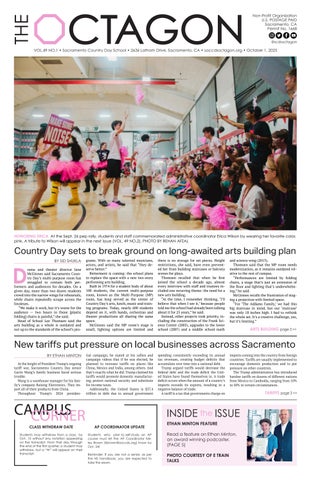
Country Day sets to break ground on long-awaited arts building plan
D
BY SID SHUKLA
rama and theater director Jane McGinnes said Sacramento Country Day’s multi-purpose room has struggled to contain both performers and audiences for decades. On a given day, more than two dozen students crowd into the narrow wings for rehearsals, while chairs repeatedly scrape across the linoleum. “We make it work, but it’s worse for the audience — two hours in those [plastic folding] chairs is painful,” she said. Head of School Lee Thomsen said the arts building as a whole is outdated and not up to the standards of the school’s pro-
grams. With so many talented musicians, actors, and artists, he said that “they deserve better.” Betterment is coming: the school plans to replace the space with a new two-story performing arts building. Built in 1974 for a student body of about 100 students, the current multi-purpose room, known as the Multi-Purpose (MP) room, has long served as the center of Country Day’s arts, lunch, music and training programs. Today, nearly 600 students depend on it, with bands, orchestras and theater productions all sharing the same space. McGinnes said the MP room’s stage is small, lighting options are limited and
there is no storage for set pieces. Height restrictions, she said, have even prevented her from building staircases or balcony scenes for plays. Thomsen recalled that when he first joined the school a decade ago, almost every interview with staff and trustees included one recurring theme: the need for a new arts building. “At the time, I remember thinking, ‘I’ll believe that when I see it,’ because people told me the school had already been talking about it for 25 years,” he said. Instead, other projects took priority, including the construction of the Frank Science Center (2005), upgrades to the lower school (2007) and a middle school math
and science wing (2013). Thomsen said that the MP room needs modernization, as it remains outdated relative to the rest of campus. “Performances are limited by folding chairs, a stage that’s just an extension of the floor and lighting that’s underwhelming,” he said. McGinnes recalls the frustration of staging a projection with limited space. “For ‘The Addams Family,’ we had this big staircase in mind, but our ‘staircase’ was only 18 inches high. I had to rethink the whole set. It’s a creative challenge, yes, but it’s limiting.”
ARTS BUILDING page 3 >>
New tariffs put pressure on local businesses across Sacramento BY ETHAN MINTON
At the height of President Trump’s ongoing tariff war, Sacramento Country Day senior Gavin Wang’s family business faced serious trouble. Wang is a warehouse manager for his family’s company Raising Electronics. They import all of their products from China. Throughout Trump’s 2024 presiden-
CAMPUS CORNER
tial campaign, he stated at his rallies and campaign videos that if he was elected, he planned to increase tariffs on places like China, Mexico and India, among others. And that’s exactly what he did. Trump claimed his tariffs would promote domestic manufacturing, protect national security and substitute for income taxes. Additionally, the United States is $37.4 trillion in debt due to annual government
spending consistently exceeding its annual tax revenues, creating budget deficits that accumulate over time into a national debt. Trump argued tariffs would decrease the federal debt and the trade deficit the United States have found themselves in. A trade deficit occurs when the amount of a country’s imports exceeds its exports, resulting in a negative balance of trade. A tariff is a tax that governments charge on
imports coming into the country from foreign countries. Tariffs are usually implemented to encourage domestic production and to put pressure on other countries. The Trump administration has introduced harsher tariffs on dozens of different nations from Mexico to Cambodia, ranging from 10% to 50% in certain circumstances.
INSIDE the ISSUE ETHAN MINTON FEATURE
CLASS WITHDRAW DATE
AP COORDINATOR UPDATE
Students may withdraw from a class by Oct. 15 without any notation appearing on the transcript. From that day through the end of the first quarter, a student may withdraw, but a “W” will appear on their transcript.
Students who plan to self-study an AP course must let the AP Coordinator Kelley Brown (kbrown@saccds.org) know by Oct. 24!
Read a feature on Ethan Minton, an award winning podcaster. (PAGE 5)
Reminder: If you are not a senior, as per the HS handbook, you are expected to take the exam.
PHOTO COURTESY OF E TRAIN TALKS
TARIFFS page 3 >>
02 NEWS STAFF EDITORS-IN-CHIEF Rehan Afzal Eesha Dhawan Anisha Mondal Zema Nasirov COPY EDITOR Maddy Schank Ryan Xu NEWS EDITOR Kate Barnes FEATURE EDITOR Jacob Rabe SPORTS EDITOR Parsiny Nijher A&E/OPINION EDITOR Anika Nadgauda PHOTO EDITOR Rehan Afzal TECHNOLOGY STAFF Ryan Xu, manager Sid Shukla, assistant PAGE EDITORS Rehan Afzal Lukas Chung Jesse Dizon Vivian Li Anisha Mondal Anika Nadgauda Zema Nasirov Jacob Rabe Sid Shukla Zachary Vando-Milberger Andrea Yue BUSINESS STAFF Sid Shukla, manager SOCIAL MEDIA STAFF Anika Nadgauda, editor REPORTERS Noor Alameri Lukas Chung Chloey Fang Trisha Gandhi Lucas Holz Ammar Hussain Vivian Li Ethan Minton Parsiny Nijher Maggie Nuñez-Aguilera Parsa Salari Maddy Schank Sid Shukla Khivi Singh Zachary Vando-Milberger Susie Wang Ryan Xu Brenden Yu Andrea Yue PHOTOGRAPHERS Rehan Afzal, editor Zema Nasirov MULTIMEDIA STAFF Ryan Xu, editor Rehan Afzal GRAPHIC ARTISTS Claire Gemmell Zema Nasirov Gavin Wang ADVISER Andrea Todd The Octagon is the student-run newspaper of Sacramento Country Day high school. The print edition is published eight times a year, and the website is updated regularly. The Octagon is committed to unbiased and comprehensive reporting, serving as a source of reliable information for SCDS students and the school community. The Octagon will publish all timely and relevant news deemed appropriate by the editors-in-chief and adviser. We seek to highlight high-school-related events and spotlight the voices of those with a story to share. Further policies can be found on our website or by scanning the QR code below.
OCTOBER 1, 2025 • THE OCTAGON
Teens put driver’s license in the rearview mirrors
T
BY BRENDEN YU
he United States is seeing a decrease in student drivers. A 2022 study released from the Department of Transportation’s Federal Highway Association reported that only one in 25 licensed drivers in the U.S. is 19 or younger. A May 2024 USA Today article, “Gen Z is less likely to have a driver’s license,” cited the convenience of technology as a leading factor in why this generation of drivers are obtaining their driver’s license later than others. “Teenagers find community online and can connect with friends any time they please,” USA Today reported — thus making a driver’s license no longer a requirement for social contact. The article also noted that rising road hostility and worsening conditions make driving for the younger generation more stressful than exciting, turning a traditional rite of passage into an anxiety-ridden experience. Senior Rebecca Lin says the poor quality of the roads in the Sacramento Valley region makes driving complicated. “Sometimes, the paint on the road is not obvious, so you always have to be very, very careful about whether there’s one, two or more lanes on the road,” Lin said. She also mentioned the prolonged U.S. Highway 50 Multimodal Corridor Enhancement and Rehabilitation Project south of downtown Sacramento, which has caused heavy construction, congestion and driving confusion to one of the city’s vital connecting highways. According to Fix50.com, the original project website, construction began in November 2020 and is now projected by the California Department of Transportation project website to end by July 2026. Lin describes the prolonged construction as “annoying.” “Having walls instead of dotted lines for lanes makes it a lot more complicated because a little error has larger consequences than there being just a line and not actual physical barriers,” she said. For 15-year-old sophomore Sorelle Berger, school-related factors are also off-putting to drivers, such as enforced parking rules that dictate where students may park in the area surrounding the school. Berger plans on becoming a driver as soon as she turns 15½, meaning she can soon run on her own schedule. However, she is not inclined to drive to school due to Sacramento Country Day’s “Traffic & Parking Rules,” which are posted on the SCDS website and state that there is to be “no drop off, no pick-up and no parking, short-term or long-term, on Latham Drive or on any surrounding neighborhood street.” “There’s not enough room. People have to park really far away, and I’d rather just ride my bike if I’m going to have to park as far as my house is,” Berger said. The school’s parking policies were created to reduce congestion in the neighborhood, which was built after the school was established. When the neighborhood was constructed, traffic issues became complicated. According to High School Dean of Student Life Patricia Jacobsen, after homes were built around the preexisting Country Day campus, many well-attended school events would clog up neighborhood streets and even lead to some guests illegally blocking driveways with their cars. This meant that residents of the neighborhood could not attend work or go about their day. To prevent this, the traffic and parking rules became a condition for the school’s conditional use permit with the City of Sacramento. “Even if you work at the school, you’re not allowed to park in front of your house — you have to park in your driveway,” Ja-
LACK OF DRIVE Students prefer the passenger seat, finding the hassle of obtaining a driver’s license unnecessary. PHOTO BY REHAN AFZAL
cobsen said. “In order for us to maintain our ‘schoolness’ — Country Day’s ability to operate as a school — we have to follow those rules.” Jacobsen detailed how every staff member has a parking buddy with whom they share one parking spot and must coordinate a schedule with. She also said that the reason students are prohibited from building permanent parking in the open back fields of campus is due to the City of Sacramento’s regulations on building permanent parking underneath power lines, which run across the Country Day campus. Responding to a high school student poll, 71% of student respondents said they would drive to school if they had a license, and 43% of student drivers said they didn’t drive to school at all. In the same poll, 80% of students without a license said they rely on a family member driving to get somewhere. With a significant reliance on family members driving, other solutions come to mind for senior Ryan Xu, who sometimes uses the Sacramento Regional Transit (SacRT) public transportation system to get around. “The light rail is actually quite good. It runs on time, and the public transit system here is actually quite well run,” Xu said. For Xu, the only issue is that SacRT’s three light rail lines do not stretch out into core areas of the city and its surroundings, leaving certain neighborhoods without transit options at all. One of these neighborhoods is the Sierra Oaks neighborhood where Sacramento Country Day is located. Despite this, Xu described the system as “pretty good for what we have.” Students in the SacRT service area can obtain a RydeFreeRT pass free of charge at SacRT’s Customer Service and Sales Center or any Sacramento County Public Library. This gives countless students access to free transportation in Sacramento. For getting to places both now and previously, he relied on the light rail system. Xu is currently in the process of obtaining a driver’s license for convenience reasons. “I do not believe I would have had the maturity to safely drive under the age of 17,” Xu said. As for riding in a car with other students, Xu has varied opinions. “If I’m riding in the car with some students here, I might be praying a little bit and be a bit scared, but it really just depends on the driver.” Teen driver deaths began decreasing sharply in 1989 and again sharply in 2007, with Mothers Against Drunk Driving (MADD) awareness and the introduction of “Graduated Driving Laws,” respectively. However, alcohol use and
distracted driving remain significant causes of accidents and deaths in teen driving, according to National Safety Council annual statistics. In June 2025 a third of young drivers ages 14-20 reported using a smartphone while driving “despite knowing the risks,” NSC reported, and in 2023 26% of young drivers killed in car crashes were impaired. According to Xu, poor levels of teen driver safety is linked to how easy the permit test is. Xu said many students in the process of obtaining a driver’s license overestimate how difficult the permit test is, and that what is asked on the permit test does not change how safely one drives. “There’s some stuff in there that is very odd and pedantic, which really doesn’t help you drive better,” he said. “I feel like the thing with the permit test is that it’s just too easy. I’m concerned that people don’t really know the traffic laws.” Despite this, Xu recommended getting a license sooner rather than later and states that the time required for obtaining a license is significant. “If you have the resources available to you to get your permit, get your license and have a vehicle accessible to you, I would recommend getting your license.” Xu said. “It saves you a lot of time and it gives you a lot more freedom.”
NEWS 03
OCTOBER 1, 2025 • THE OCTAGON
Arts Building: Country Day plans $9.5 million arts center upgrade (continued from page 1)
Junior Matthew Inman, a member of the drama program who uses the MP room daily, said the issues are easy to spot: a cramped green room, an aging stage and even an unused kitchen. He said the whole building “just needs fixing.” “When we were preparing our spring play ‘Armageddon,’ a door frame fell on one of the actors because it was so hard to move things around the curtains. There were times when the green room was completely blocked off, and the boys couldn’t even get inside to change costumes,” Inman said. Between band, drama and music classes, rehearsal times are scarce. “We cannot use it more before concerts because there’s just too much going on,” Orchestra Director Maria Hoyos said. According to Hoyos, rehearsal time is scarce because the MP room is shared by multiple programs. She compared Country Day’s facilities to those at Rio Americano and El Camino high schools, which, unlike Country Day, have dedicated performance spaces. Thomsen agreed, adding that the project aims to address those limitations. “Our hope is to give the music programs their own space and to elevate every aspect of performance here: lighting, sound, seating, everything,” he said. The designers for the new building — Studio Bondy Architecture — are, according to Thomsen, aiming to create flexible spaces that meet the student body’s current educational and performance needs, as well as being able to adapt to future needs. “One room might host a jazz band rehearsal today, a drama rehearsal tomorrow and a full concert next week. The building must accommodate all of it, not just now, but fifty years from now, future-proofed to handle needs we can’t yet predict,” Thomsen said. McGinnes — who has participated in plan-
ning meetings and has provided input on features such as stage height and lighting needs — described the creative possibilities. “Having height will allow us to build staircases and levels for plays like ‘Romeo and Juliet.’ More lights, more options — you can have a little spot here, a little spot there,” she said. She added that the project is not just about set pieces. “We’re thinking about experiences for both performers and audiences,” she said. The new building will feature a flat stage with raised audience seating, multiple-level set capabilities and LED lighting with flexible placement. Studio Bondy Architecture is planning to increase wing and storage space for large set pieces and acoustically optimized areas for band and orchestra. Additionally, one room is reserved to serve as a flexible innovation or “maker space” intended to adapt to changing educational needs, according to Thomsen. Hoyos recalls taking students to the California State Capitol for a performance at the rotunda last year. “The kids were amazed at how good they could sound in that space. My dream is that the new two-story arts building will give them that same feeling every day, right here at school,” she said. The project carries a $9.5 million fundraising goal. “We’re in year two of the quiet phase of a capital campaign, meeting with donors who can make six-figure or seven-figure gifts. The lion’s share must be raised before we go public with the campaign,” Thomsen said. Thomsen said the project includes two naming opportunities: one for the STEAM Center and one for the Performing Arts Center. Each space could be named for a major donor. Dean of High School Patricia Jacobsen said the school’s funding model keeps tuition and student activities unaffected by the project. “Student council and student activities have a dedicated budget. The capital cam-
ON THE DRAWING BOARD Prelimary blueprint of Sacramento Country Day’s new arts building. PHOTO COURTESY OF LEE THOMSEN paign for the MP building does not take from tuition or from student programs,” she said. “There’s wiggle room for new initiatives, like the solar regatta team, without impacting students.” The construction of the performing arts center is not scheduled to finish until 2028. The timing, Inman admits, is frustrating. “I’m excited for the sophomores and freshmen, because they’ll get to use it. But for me, it sucks. I’ll already be an alum by then,” Inman said. McGinnes also anticipates a mix of admiration and envy from alumni. “They’ll be thrilled for the future students, even if they didn’t get to experience it themselves. It’s about the kids who are coming next.” Construction is slated to begin in the sum-
mer of 2027, with the completion of the project expected to close in August 2028. Until then, students, faculty and the wider school community will continue rehearsing and performing in the current MP room. Thomsen ultimately hopes that, beyond campus life, the new building will transform the school’s engagement with the local community. “We rent our facilities infrequently now, but with a welcoming, state-of-the-art space, more outside groups will want to use our campus,” he said. “It’s about sharing our school with the community, and it will be a place for everyone to develop their artistic side,” Hoyos said. “Live with the discipline of the arts, enjoy the beauty of music — it makes a whole human being.”
Tariffs: Local businesses, economy hit hard by the new tariffs (continued from page 1)
On February 1, 2025 — just 12 days after being sworn into office — Trump signed an executive order imposing tariffs on Mexico, Canada and China. 25% tariffs were implemented on imports from Mexico and Canada, whereas an additional 10% tariff hit China. What started as just three countries ballooned into 30 countries across six continents. Trump signed what he called his “Liberation Day tariffs” on April 2 — an announcement that led to a global market crash which forced Trump to delay them. This led to the Wall Street moniker “TACO tariff policy” or “Trump Always Chickens Out.” Tariffs were announced; stocks would drop; investors would buy on the cheap and the market would recover when the tariffs were inevitably called off. The latest tariffs were announced on Aug. 7, with tariffs expected to rise later this year. On that day, Nobel prize-winning economist Paul Krugman told National Public Radio tariffs are a “selective sales tax” affecting the “bottom 40% of the population” significantly, at first. “Lower-income consumers, in general, are going to be hurting more, and we’re already starting to see that. I’m surprised we’re seeing it so soon, but here it comes,” Krugman said. Krugman has also called TACO tariff policy ‘chaotic’ and even illegal, writing in his June 4 Substack (“Is There A Tariff Endgame?”) that “the legal wrangles over what Trump can and can’t do will only add to the uncertainty and the sense of chaos that is strangling business investment.” Following the implementation of his first tariffs, the stock market experienced a historic crash, the largest since 2020 (largely a result of the pandemic). Per FactCheck.org, The Standard and Poor’s 500 (S&P 500), a stock market index tracking the stock performance of 500 leading companies in the United States, stood at $6,049.24 one day into his presidency. In the weeks following his tariffs though, it fell to $4,982.77. It has since corrected somewhat after the Trump administration backed out of many of his tariffs. Trump’s policies have been harsh on China specifically. They’ve placed a 10% International Emergency Economic Powers Act (IEEPA) reciprocal tariff (down from 125%), a 20% IEEPA fentanyl tariff and various Section 301 tariffs first implemented in 2018 (7.5% to 100%). Since the tariffs are stackable, total tariffs for select prod-
ucts can reach 130%. Companies like those run by the Wang family have to pay more when importing items such as precious metals, textiles and other resources from outside the U.S. “If the tariffs stayed at their peak of 145% [for electronics], it would have been completely unprofitable [for us] to sell to the U.S,” Wang said. “There was a moment in time where we were considering [selling] all our supplies to Canada and not selling to the States entirely.” The price of the tariff is often passed onto the consumers, as companies need to meet their bottom line. According to Wang, “Raising Electronics” still plans to sell to the U.S. until further notice after Trump called off the extreme tariffs on China.
Spending is up Consumers are now seeing the first signs of price hikes as companies like Nike are taking the steps to maximize profits. Nike specifically was forced to pay $1 billion in additional costs due to Trump’s tariffs. Tariffs are also affecting Country Day students and faculty directly — not just Wang. Parents went back-to-school shopping this year expecting to pay on average $200 more than last year, according to NerdWallet’s 2025 annual report, published July 2025. The number one reason cited? Tariffs. Students may have noticed that their favorite clothing, jewelry and electronics cost a lot more than usual. What’s causing this sudden uptick in prices? Tariffs, which affect supply chains and drive up inflation — something nearly every economist said throughout the 2024 election, including Dean Baker, senior economist for the Center for Economic and Policy Research (CEPR) and former World Bank consultant. He wrote in his blog dated August 15, 2025, inflation was correctly predicted to be “back at the 2% level.” It’s now at 3%, Baker wrote, and wages will be affected as well. Country Day High School Teacher Jo French taught AP Microeconomics at Country Day for three years. He added context as to why governments install tariffs. French shared that the stated purpose of tariffs is to encourage domestic production by giving domestic manufacturers a chance to provide goods at a reasonable cost, so that both the consumer and producer are happy. “In actuality, there are tariffs on raw goods
that our U.S. producers have to buy at a higher price now. This means that they have to sell their products at an even higher price,” French said. As to how tariffs are impacting Country Day, the school’s CFO Bill Petchaur shared that it is expected that tariffs will have impacts in the near future, but up until now the school has not experienced any noticeable price increases. “We are anticipating that the first place we may see it is the information technology area (i.e. laptops) but this has not occurred,” he said. Country Day students who have attended the school for a while may be aware that the prices of items in its vending machines are increasing. This trend is set to continue at a more extreme rate in the coming months. It is important to note, however, that tariffs do not traditionally have a tremendous impact on the cost of vending machine goods. Tom Kilcollins, the owner of Sacramento Vending — the company that stocks Country Day’s vending machine — said tariffs may partly be to blame, but not the main culprit. “The prices of vending machine items always go up, up, up,” Kilcollins said. But according to Garrett Nelson, a vice president and senior equity analyst at the Center for Financial Research and Analysis (CFRA), soda prices can increase because of brand loyalty. They have a high degree of “demand inelasticity.” “It’s similar to cigarettes, tobacco is a good example. People are addicted, so tobacco companies can raise prices very easily,” Nelson said in a Vox article in November 2023 titled “Why Diet Coke got so expensive.” Sacramento Country Day vending machines do not stock soda, but they do stock Gatorade— owned by PepsiCo and manufactured primarily in Ireland (facing 10% tariffs). Pepsico recently announced that their prices will rise 10% on top of their yearly price increases. Kilcollins and his company are bracing for a price increase on Pepsi, and other goods too. According to Vending Machine Market Watch, an informational resource for convenience store providers, a 245% tax be imposed on foreign-made vending machines. Tariffs on aluminum, artificial sweeteners, steel and foreign-made parts will also affect vending machine prices, as well as tariffs on food, coffee and other items. One example of the damage tariffs can do was
the Smoot-Hawley Tariff from Herbert Hoover’s administration in the 1930s. The tariff sharply increased duties on hundreds of agricultural and industrial goods. The resulting retaliation from other countries significantly reduced global trade and is widely believed to have exacerbated the Great Depression. Currently, tariffs are making an impact on California. On May 14, 2025, news outlet CalMatters shared that Governor Gavin Newsom blamed California’s worsening state budget outlook on Trump’s tariffs, as the tariffs caused the state’s deficit to increase by $12 billion in a matter of three months. In an Aug. 29 statement, Newsom’s office shared that Trump’s tariffs are projected to cost California households $25 billion and lead to a loss of over 64,000 jobs. Dave Giersch is the Chief Executive Officer of Muniquip, a Roseville-based business that specializes in municipal water and wastewater equipment for cities. Muniquip buys all of their equipment from manufacturers in Europe; however, much of the equipment itself is made in China, a country on the receiving end of the majority of Trump’s tariffs. “In the beginning, it wasn’t a big deal because there was a lot of backstock that most manufacturers had. Now that we’ve worked through the backstock, the tariffs are starting to impact us,” Giersch said. Backstock refers to equipment that has yet to be imported. Giersch said that a 30% price hike has also forced Muniquip to increase their own prices. They bid off their equipment, but due to tariffs, they now have to add extra “tariff adders” to break even. “Let’s say our bid price was $100,000. Well, now it’s $130,000 and somebody has to eat that money. We’ve tried to work with our customers, contractors and manufacturers to minimize the price increases as much as possible. But we are seeing impacts from tariffs,” Giersch added. Wang’s family’s situation, while improved, remains uncertain. “For now many businesses are operating off the assumption that Chinese tariffs will remain somewhat stable,” he said, “but if tariffs were to go back to the all time high, our family has essentially two options for the business: sell off all our inventory then divest from the U.S., or eat whatever costs and stay at the mercy of President Trump’s mood.”
04 OPINION
OCTOBER 1, 2025 • THE OCTAGON
SACRAMENTO CONFRONTS DEPORTATION CHALLENGES
T
his summer I worked as a Sacramento City Hall intern for District 6 councilmember and Pro Tem Mayor Eric Guerra. On Aug. 8, while staffing a booth for District 6 at a College Glen community event, I was approached by an older white male who asked me what work I focused on as part of my internship. I told him that most of my time was devoted to creating sister cities between Sacramento and cities in foreign states. Before I could tell him what country I dedicated my work to, he jokingly added, “We really need one of those with Mexico so we have a place to send our illegals to.” Comments like these are one of the many reasons I decided to do the work I did this summer. At City Hall, as I told the man who asked, I worked on topics regarding establishing official relations between Sacramento and the Mexican city Morelia. Sister Cities International (SCI) defines this relationship as a “long-term partnership between two communities in two countries.” Sacramento (“The City of Trees”) and Morelia (“City of Mulberry Trees”) share status as capitals in their respective states and deep communal ties with family members commonly living in both cities. In working to establish this sister city resolution, I witnessed firsthand the protocols and preparation that Sacramento is taking as a sanctuary city to protect immigrants, documented and undocumented. My boss, Eric Guerra, is an immigrant from Michoacán, Mexico, and he came here with his mother and brother when the Mexican economy was crashing in 1994. On July 17, Sacramento resident and United States citizen Jose Castillo was detained and arrested by at least a dozen Immigration and Customs Enforcement (ICE) agents in front of the Home Depot located on Florin Road in Sacramento. Later, he was charged with damaging a government vehicle, a felony in the state of California. Castillo and at least eight others in Sacramento were detained by ICE as a result of Donald Trump’s mass deportations efforts. This was the topic of an emergency citywide meeting I attended as part of my job. The meeting, held at Sacramento City H a l l , w a s
STORY BY MAGGIE NUÑEZ-AGUILERA; GRAPHICS BY ANIKA NADGAUDA
made up of different representatives for dozens of California-based nonprofit organizations and local elected officials all with the same goal in mind: to protect our immigrant community. Organizations including Family Unity, Education and Legal Network (FUEL) discussed how to allocate the resources they provide — and how to deal with ICE agents if and when they come to Sacramento. FUEL includes ‘NorCal Resist,’ the organization that Castillo was volunteering for when he was detained. Two days after Castillo was arrested, I attended the statewide leadership conference for Chicano Latino Youth Leadership Project (CLYLP) held annually at California State University, Sacramento. I applied the spring before and was honored to be selected. Students who attend this conference are commonly first-generation college students (first in their families to go to college) and immigrants. Both groups experience and know the consequences of these mass deportations all too well. I became close with one of these students, a first-generation citizen. I asked what he wanted to be and he said he wanted to be an immigration attorney. He told me the reason why. When he was six years old and living in Oregon, he was grocery shopping with his mom. As his mom carried him down the aisles, ICE busted in. Before he and his undocumented mom could run away, ICE grabbed him out of his mom’s arms and took her away as he cried for her. Eventually his family got her back and they moved to California. I don’t know much other than that. Mass deportations aren’t just affecting immigrants and families and friends of immigrants. Now they are affecting those who challenge these injustices. And this isn’t limited to just everyday civilians — this also includes well-known political figures who are not only here legally but have been elected by American voters to represent them. On June 12, Senator Alex Padilla, California’s first Latino Senator experienced this injustice himself. Padilla was forced to the ground, handcuffed and detained by federal agents for attempting to publicly question Secretary of Homeland Security Kristi Noem about the excessive presence of ICE agents deployed throughout Los Angeles at the time. In a statement released shortly after his arrest and release, Padilla said, “If this is how the Department of Homeland Security responds to a senator with a question, you can only imagine what they’re doing to farmers, to cooks, to day-laborers throughout the Los Angeles community and throughout California and throughout the country.” Just as Padilla fears, the way that ICE is treating detained individuals is much, much worse: In a Aug. 18 letter sent by Guerra and District 8 councilmember Mai Vang together the two
condemned an inhumane holding of people by Sacramento’s undesignated ICE detention center, located in the John Moss Federal Building downtown. They wrote: “[We are receiving reports that detained individuals are reporting abhorrent conditions. These conditions include, but are not limited to, sleeping on the bare floor, receiving limited water and little to no food, lack of access to restrooms, and a lack of air conditioning and adequate ventilation. [...] We request transparency around the conditions detained individuals are being held under as well as access to tour the facilities to ensure the humane conditions and treatment of these individuals.” For Guerra, advocating against ICE and keeping our community safe from them isn’t just a matter of business as a political figure. It’s also personal. “My work [as an elected official] connects to that because I see myself in the folks that are struggling because it was a component of my life,” Guerra said. His words resonate with me. I come from a place of immense privilege from having a family history of working in various sectors of government, being middle class, going to a private school and having lighter skin. These are just some of the factors that have allowed me to hold a position in which I can help others who weren’t born into the privilege I was On Sept. 16, the Sacramento City Council approved the resolution adding Morelia to the list of international Sacramento “sister cities,” a list that includes Manila, Hamilton, Jinan and others. The relationship is both legal and symbolic, set to “encourage cross-cultural learning” and “promote social, cultural and professional ties” between Sacramento and Morelia, according to the Sacramento Bee. At the ceremony announcing the success of the resolution, I was recognized by my boss for the work I did this summer to make this happen. It is my duty to speak out for those who are under attack for simply fleeing from the conditions that they were born into as well as those who fight for them. Those are the people I see in my work, people like Jose Castillo, people like Eric Guerra, people like all the people I have come to know doing this work.
FEATURE 05
OCTOBER 1, 2025 • THE OCTAGON
THE VOICE BEHIND THE MIC: ETHAN MINTON
W
hen the COVID-19 pandemic cut students off from the outside world, 11-year-old Ethan Minton, ‘29, chose to reconnect with others by trying something new: podcasting. Inspired by his love of reading, sixth grader Minton created “E Train Talks” — a podcast he describes as an educational literary podcast — in 2022. Near the end of the pandemic, Minton was homeschooled; previously, he attended Sacramento’s Shalom School. He said the home schooling was to familiarize himself with the different curriculum that his new school — Winston Churchill Middle — would require. During this period of isolation, Minton, who was an avid reader, turned to books as an “escape” during “such a trying time.” To Minton, podcasting seemed like a good way to share his interest in reading with others and to find an online community. So, he took an online podcasting class and struck out with “E Train Talks,” which is now in its third year of production. Minton started off reviewing middle grade books and eventually branched out to interviewing authors. In 2023, Minton also founded E Train Talks Incorporated, a nonprofit dedicated to improving early literacy. In August, it was named a 2025 Nonprofit of Distinction by Sacramento’s Mayor Kevin McCarty, one of 27 “standouts” from the nearly 15,000 nonprofits in Sacramento, according to an Instagram post on McCarty’s official account from Aug. 28. Minton never imagined that his fun COVID side-project would become what it is today. “I was just talking into a microphone. I didn’t expect anybody to listen to my reviews. I didn’t expect anybody to want to be interviewed by me because, in my eyes, I was a nobody,” Minton said. “I always wondered, would authors not take me seriously? Would listeners not take me seriously, purely based on the fact that I’m a kid?” Minton identifies the “turning point” of his project as occurring in 2022, when he posted on X (Twitter at the time) to ask if any middle grade authors were willing to be interviewed for “E Train Talks.” Overnight, 76 authors responded to his post, enough for him to be booked for the whole year. This “surreal experience” was “a one-off,” but it helped get the ball rolling, Minton said. His account, @ETrainsWorld, had 18 followers at the time; over the years, that number has ballooned into over 5,000. Currently, his book review epi-
sodes come out once a week, while episodes with author interviews come out once every two weeks. For each interview, Minton creates personalized questions so readers can get to know their favorite writers, including questions about their books and personal lives. For example, in an interview with Newbery Medal-winning author Kate DiCamillo, he asked how the story of “Because of Winn-Dixie” — a novel she published in 2000 — changed her life and what its 25th anniversary meant to her, to which she responded how meaningful it was to have her book read by students throughout many American schools. After three years of interviewing authors, Minton has learned valuable lessons about the writers he admired. One such lesson is that writers are just as human as their readers. “When you’re a kid reading books, you don’t necessarily picture them like they’re really human. They kind of feel like they’re in a whole other league, like they’re these masterminds,” he said. One of these “masterminds” Minton spoke to was author Stuart Gibbs, who wrote the New York Times bestselling series “Spy School.” Gibbs’ interview in 2023 stood out to Minton as an instance where he got to meet one of his favorite writers face-to-face. “I have been reading these books for years, so it was kind of a full circle moment for me,” Minton said. While Gibbs was visiting Sacramento to feature on “E Train Talks,” Minton organized an assembly at Title I school Dyer-Kelly Elementary. Gibbs talked to students about the “Spy School” series and gave out free copies afterwards. “Ethan has been a force from a very young age, who also spearheaded this project to get books in schools,” Gibbs said in a Sept. 8 phone interview. “He’s just mature beyond his years, you know? A real go-getter.” In February of 2023, 12-year-old Minton ran a book drive for his school, Winston Churchill Middle, where he was enrolled in the International Baccalaureate program. In the process, he said, he realized that having a nonprofit organization would make it easier to “get more books into the hands of kids who need them.” Donors would be incentivized by the tax write-off, and the nonprofit status
would ensure that people knew Minton’s cause was legitimate. Now, between several larger donations, grants and frequent smaller donations throughout the year, E Train Talks Inc. raises an estimated $1,500 per year, all of it going towards books for kids. That same year, Minton, then a sixth grader, was recognized for his efforts at Teen Author Boot Camp, a yearly national convention for teenage writers in Salt Lake City. There — with prominent writers looking on including Nick Brooks (Promise Boys), Jennifer Nielsen (Ascendance Series) and Shannon Hale (Princess Black Series, Dream On) — Minton received the Utah Book Hero Award for improving children’s literacy in the United States — the award that remains closest to his heart. “It was a dream come true,” he said. “It was also the first time I was recognized in that aspect, in a room full of my heroes. It was just such an incredible experience.” Minton has received other accolades. Sacramento’s Directors of Volunteers in Agencies nominated him for Youth Volunteer of the Year in 2025, and in 2024, he was named a “Spirit of San Juan” honoree by the San Juan school district for his volunteer work reading to kindergartners and “providing an inclusive environment for all,” according to the district’s website. Minton was in middle school when he started “E Train Talks,” but now, as a high school student, he said he can no longer read the middle grade books he’s been reviewing since 2022 the same way. “As I get older, I want to start reading books for my age range, and it can be hard to make that transition,” he said. Minton is still reviewing middle grade books as of now, but has begun hinting to those who reach out for author interviews that he wants to read more young adult books. As far as his future plans for “E Train Talks,” Minton said he’ll likely continue reviewing and interviewing throughout high school, but also wants to pursue journalism outside the umbrella of his podcast. He plans to study journalism in college, and his dream of becoming a journalist inspired him to join The Octagon staff this year as a reporter. “E Train Talks” began as a COVID passion project, but through it, Minton has learned that anything is possible as long as you care enough. “It sounds pretty cliché, but if you believe in the work that you’re doing and believe that it has value, then you can really accomplish whatever you set your mind to,” he said.
STORY BY KATE BARNES; GRAPHICS BY JESSE DIZON; PHOTO BY REHAN AFZAL
06 OCTOBER 1, 2025
CENTERPOINT
THE OCTAGON
NEW ADDITIONS TO COUNTRY DAY
MS. BOGETICH
I
magine having a physics teacher who is a cross between Andrea Shaw (World’s Best Female Bodybuilder 2025), Bill Nye (the Science Guy) , and Jon Batiste (of Colbert fame and all-around jazz fusion genius). Meet Sacramento Country Day’s new math and physics teacher, Allison Bogetich ‘21. Bogetich — a Country Day “lifer” graduated from Stanford in 2025 with a bachelor of science in mathematics and a minor in music. One of Bogetich’s favorite teachers was Glenn Mangold, her former high school physics teacher at Country Day. “In my head, my dream job was to come back to Country Day. I wanted to be someone’s Mr. Mangold. Now I get to be
High school students are discovering a new approach to history this year–a textbook approach, if you will–as we welcome a new teacher, Ellen Willow. Mrs. Willow, as she is better-known, will be teaching world history and AP United States History. She looks forward to providing guidance and acceptance to her students. “I want all my students to be curious and motivated to learn,” Willow said. “I love the subject, but also being a mentor to high school students. It was something that just felt like a calling to me.” Though she hadn’t always wanted to be a teacher, the interest grew as Willow continued her education. She’s especially excited to be teaching at Sacramento Country Day. “The idea of teaching in a high school where I get to interact with students on a daily basis, and being a part of a little community was something that I could marry,” Willow said. Willow is originally from the Sacramento area. After graduating from St. Francis High School she studied history at UC Davis — graduating with a B.A. in history in 1993. Willow knew she wanted to continue her education, but took time off between continuing her studies. She worked at a cafe and for the University of Michigan Business School. During this time, she also explored her love for 20th century literature and Frankfort School philosophers, including Franz Kafka. For two years, while Willow’s husband was doing research in Germany, Willow improved her German in language school, taught English to students and spent a lot of time exploring the city of Berlin. “The capital of Germany was moving to Berlin and the wall had just fallen a few years before. It was an exciting time to live in such a vibrant, dynamic and transforming city,” she said.
the physics teacher at Country Day and it’s amazing,” Bogetich said. “Physics helps me teach math in a hands-on way. I love turning lessons into opportunities for discussion… I’m really thinking about moments where abstract math concepts get grounded in something students can touch, see, or do. For example — what 17-year-old wants to sit through a lecture on trigonometry identities? (Okay, admittedly I did, but that’s why my alma mater is affectionately called “nerd nation.”) For most students, though, it’s way more engaging to come into class one day and be tasked with using trigonometry to predict where darts will land, and then actually test those calculations by firing Nerf guns across the room. Suddenly trig feels a lot less abstract and a lot more excit-
While there, Willow also explored Poland, the Czech Republic, Hungary, Turkey and France. She applied and was accepted to Emory University in Atlanta, Ga., receiving her master’s degree in American Studies. “American Studies allowed me to integrate history, sociology, and cultural studies in my graduate work,” she said. Concurrently, Willow earned her teaching credential in Social Science from California State University, Sacramento. She and her husband then spent seven years teaching high school in New Orleans. “New Orleans is a remarkable city and I met some of the most amazing people I’ve known,” Willow said. Willow and her husband were in the city when Hurricane Katrina hit. “Although a devastating event, the community really pulled together after the storm and tried to rebuild the city. New Orleans will always have a special place in my heart,” said Willow. Willow has taught in many different area schools, including El Camino High School in Carmichael, at Christian Brothers High School and at her alma mater, St. Francis High School. She has two children, a son in college and a daughter in eighth grade. She enjoys gardening, cooking and hiking with her family in her free time. Choosing to teach at Sacramento Country Day was a relatively easy decision for Willow. “I know this is an amazing school. I really liked the idea of a tight knit community here, and I wanted the opportunity to interact with such amazing students and faculty, which is something I was very excited about going into this school year,” she said. In addition to teaching, Willow is leading an advisory group of juniors. “I feel a bit of affinity with the freshmen
ing. That’s the kind of math-through-physics connection I love to build into my teaching”. When Bogetich is not teaching, you can find her powerlifting, running and cycling. “Most of my hobbies revolve around fitness,” said Bogetich. Bogetich is an iron sport athlete, which is a sport that involves weights. This includes bench press, dead lift and squat. Though she doesn’t compete in weight-lifting competitions, “I have gained grit and dedication from the sport,” Bogetich said. She enjoys not having to rely on a coach to push her, because she has herself to push her. Powerlifting has taught her that “growth won’t come immediately; you have to trust the process sometimes,” Bogetich hopes to bring that mentality to the classroom. Some of her passions outside of fitness include listening too and performing music. This summer, she traveled to Italy to perform as a percussionist with the Stanford Wind Ensemble playing percussion and the drums. The Stanford Wind Ensemble is a musical performance group sponsored by Stanford’s Department of Music. The auditions call for “music and engineering majors alike,” according to the Stanford Wind Symphony website. The group of 55-60 features wind, brass, and percussion instruments and tours internationally. The Stanford Wind Ensemble toured for two weeks, giving Bogetich time to exchange social culture with Italian musicians who already shared musical culture. “What I loved most was how music brought us together. I don’t speak Italian and some of the musicians didn’t speak English. But we spoke the same language through our music,” Bogetich said. Bogetich started studying music in fifth grade at Country Day. She was in a Latin jazz band, wind ensemble and a jazz combo. “My music range is everywhere from country to death metal and everything in between, jazz, bluegrass, dad rock, pretty much everything,” Bogetich said. “Listening to music, playing music, going to concerts, producing and consuming music is mostly what I do.” Bogetich wants students to know that her room is always open to talk about math, physics, music, animals and college. “I’m all ears, Literally!” she said.
because I am new to the school just like so many of the freshmen are new too,” she said. Malena Lindenau ‘27 described Willow’s AP U.S. History class as “interesting and challenging.” “When it comes to quizzes, correction opportunities are available and “instead of figuring it out on your own, [Mrs. Willow] actually sits down with you and explains the answers, which is really helpful,” Lindenau said. Phoebe Rogers ‘29, who is in Willow’s World History class, says that the course is hard, but there are fun moments as well. At the very start of the school year, the ninth graders participated in a map activity involving coloring and locating relevant landmarks, which Rogers said was “fun” and “enjoyable”.
Responding to high school students’ interests in understanding the human mind and how it behaves, Sacramento Country Day School has introduced a new course: Advanced Topics (AT) in Human Behavior, after five years of requests. Currently, the course consists of purely seniors, with 20 students total. “The curriculum of an advanced placement (AP) course is determined by the college board advanced placement company… [with] advanced topics (AT) in human behavior the curriculum is designed by us, and submitted to the University of California for approval” says head of high school, Brooke Wells. High school math teacher Jo French, the teacher in charge of this course, majored in industrial engineering and completed a Master of Sociology at Stanford University. This prior knowledge gave him the mindset of looking at how things work and seeing if you can make them perform better. “[It] was a look at problems both physical and sociological, because you look at the people in the workplace to see if you can make them more productive,” French said. “That’s just kind of led me to take that problem-solving perspective and make it as broad as possible.” AT Human Behavior is organized into units in psychology, sociology, behavioral economics, and critical thinking, with topics such as neurons, perception, sensation and other aspects of how the human brain works, according to French. French said that students should take this course because it is a great way for them to learn to read people and social situations better. “It’s all about who we are and why we do the things we do, and [it] gives us an opportunity to recognize when we are either misinterpreting someone’s actions or give us a better understanding of their actions,” French said.
As such, the class will include real world examples. For example, in behavioral economics, students might explore questions like why items are priced at $1.99 instead of $2.01 — and how that could affect our behavior, French said. The beginning of a unit will usually start with a gateway activity into the topic. One example is “Hues and Cues,” a board game that focuses on perceiving color, which helps start the sensation and perception unit. After that, students will get a general idea of what the topic is and what to expect from a day or two of in-class lessons, French said. Classes are then split up so that there is time for a personal application of the topic in class and a group discussion or project. According to senior Liam Donohue, French’s style of teaching consists of splitting the class into groups so that students can learn to work with different people. “If you are partnered with a friend of yours, then you’ll both probably be messing around the entire time. As a result, you won’t exactly be learning as well,” Donohue said. The biggest struggle for this course, French said, could be that students will be so focused and interested in certain topics that they will struggle to move on. One of the main challenges students have said to have faced is also common in any other course one takes. “There is a lot of really cool information, and it’s easy to get locked into one piece of interesting information and want to spend more time on it,” he said. As a result, French is currently trying to figure out a way for students to pursue a certain topic that they enjoy while staying on course with the class. Senior Ella Martinelli has said that she enrolled in the course to deepen her understanding of the human mind. Her biggest challenge in the course so far is the com-
plexity of the human mind and its many pieces. “The brain is just a big, complicated thing; there’s simply a lot of things that you can’t go over because it’s only a high school level class,” says Martinelli. Donohue said that as a result of the class of ‘25’s requests for a course similar to AP Psychology, the class is not available for other grade levels at this time. However, if next year has less demand, the class could possibly be open to more grade levels. Senior Kamron Khodjakhonov says that when he initially joined the course, he expected to be going through online data and articles. “I thought we would be doing a lot more, studying articles and going online,” Khodjakhonov said. “Like researching about people’s theories about humans and their behavior. I would have thought it was all reading, but it’s not what I expected,” Khodjakhonov said. At first glance, Khodjakhonov expected 25 percent of the class to be centered around articles, research and such. However, once he learned that the class would eventually end with a large group project, his excitement was clear. “Most colleges don’t really care about AP Psychology, in terms of taking it for the more advanced colleges, so human behavior is a more interesting class. It also accomplishes more depth than psychology,” Donohue said. AT Human Behavior and AP Psychology has lots of overlap in terms of the content being taught. Donohue has also said that at the end of the second semester, students will be tasked with the job of creating an escape room as their final project. An unconventional, yet exciting way to test your knowledge at the end of the year. With the addition of AT Human Behavior, students will study the inner workings of the human mind and how it operates.
HUMAN BEHAVIOR
One thing regarding Willow’s class that’s new this year is the reading level. Unlike standard 9th grade history classes, Willow has her 9th graders use an AP level textbook. Willow’s reasoning for this is that the textbooks that [she’s] used before have all had a relatively low reading level — about 7th grade. “This text is elevated, but the kinds of activities that [the students] will do in class will be very different from AP curriculums.” Willow is clear about her goals for her students: “Motivation and curiosity; a broadening historical knowledge of world history and a sensitive and nuanced view of our global society,” she says. “I want my students to further develop their critical, analytical and historical thinking, and lastly? I want them to hone their writing, reading, speaking, listening and creative skills.”
MRS. WILLOW
STORIES BY AMMAR HUSSAIN, SUSIE WANG & PASRA SALARI; GRAPHICS BY REHAN AFZAL & LUKAS CHUNG
07
06 OCTOBER 1, 2025
CENTERPOINT
THE OCTAGON
NEW ADDITIONS TO COUNTRY DAY
MS. BOGETICH
I
magine having a physics teacher who is a cross between Andrea Shaw (World’s Best Female Bodybuilder 2025), Bill Nye (the Science Guy) , and Jon Batiste (of Colbert fame and all-around jazz fusion genius). Meet Sacramento Country Day’s new math and physics teacher, Allison Bogetich ‘21. Bogetich — a Country Day “lifer” graduated from Stanford in 2025 with a bachelor of science in mathematics and a minor in music. One of Bogetich’s favorite teachers was Glenn Mangold, her former high school physics teacher at Country Day. “In my head, my dream job was to come back to Country Day. I wanted to be someone’s Mr. Mangold. Now I get to be
High school students are discovering a new approach to history this year–a textbook approach, if you will–as we welcome a new teacher, Ellen Willow. Mrs. Willow, as she is better-known, will be teaching world history and AP United States History. She looks forward to providing guidance and acceptance to her students. “I want all my students to be curious and motivated to learn,” Willow said. “I love the subject, but also being a mentor to high school students. It was something that just felt like a calling to me.” Though she hadn’t always wanted to be a teacher, the interest grew as Willow continued her education. She’s especially excited to be teaching at Sacramento Country Day. “The idea of teaching in a high school where I get to interact with students on a daily basis, and being a part of a little community was something that I could marry,” Willow said. Willow is originally from the Sacramento area. After graduating from St. Francis High School she studied history at UC Davis — graduating with a B.A. in history in 1993. Willow knew she wanted to continue her education, but took time off between continuing her studies. She worked at a cafe and for the University of Michigan Business School. During this time, she also explored her love for 20th century literature and Frankfort School philosophers, including Franz Kafka. For two years, while Willow’s husband was doing research in Germany, Willow improved her German in language school, taught English to students and spent a lot of time exploring the city of Berlin. “The capital of Germany was moving to Berlin and the wall had just fallen a few years before. It was an exciting time to live in such a vibrant, dynamic and transforming city,” she said.
the physics teacher at Country Day and it’s amazing,” Bogetich said. “Physics helps me teach math in a hands-on way. I love turning lessons into opportunities for discussion… I’m really thinking about moments where abstract math concepts get grounded in something students can touch, see, or do. For example — what 17-year-old wants to sit through a lecture on trigonometry identities? (Okay, admittedly I did, but that’s why my alma mater is affectionately called “nerd nation.”) For most students, though, it’s way more engaging to come into class one day and be tasked with using trigonometry to predict where darts will land, and then actually test those calculations by firing Nerf guns across the room. Suddenly trig feels a lot less abstract and a lot more excit-
While there, Willow also explored Poland, the Czech Republic, Hungary, Turkey and France. She applied and was accepted to Emory University in Atlanta, Ga., receiving her master’s degree in American Studies. “American Studies allowed me to integrate history, sociology, and cultural studies in my graduate work,” she said. Concurrently, Willow earned her teaching credential in Social Science from California State University, Sacramento. She and her husband then spent seven years teaching high school in New Orleans. “New Orleans is a remarkable city and I met some of the most amazing people I’ve known,” Willow said. Willow and her husband were in the city when Hurricane Katrina hit. “Although a devastating event, the community really pulled together after the storm and tried to rebuild the city. New Orleans will always have a special place in my heart,” said Willow. Willow has taught in many different area schools, including El Camino High School in Carmichael, at Christian Brothers High School and at her alma mater, St. Francis High School. She has two children, a son in college and a daughter in eighth grade. She enjoys gardening, cooking and hiking with her family in her free time. Choosing to teach at Sacramento Country Day was a relatively easy decision for Willow. “I know this is an amazing school. I really liked the idea of a tight knit community here, and I wanted the opportunity to interact with such amazing students and faculty, which is something I was very excited about going into this school year,” she said. In addition to teaching, Willow is leading an advisory group of juniors. “I feel a bit of affinity with the freshmen
ing. That’s the kind of math-through-physics connection I love to build into my teaching”. When Bogetich is not teaching, you can find her powerlifting, running and cycling. “Most of my hobbies revolve around fitness,” said Bogetich. Bogetich is an iron sport athlete, which is a sport that involves weights. This includes bench press, dead lift and squat. Though she doesn’t compete in weight-lifting competitions, “I have gained grit and dedication from the sport,” Bogetich said. She enjoys not having to rely on a coach to push her, because she has herself to push her. Powerlifting has taught her that “growth won’t come immediately; you have to trust the process sometimes,” Bogetich hopes to bring that mentality to the classroom. Some of her passions outside of fitness include listening too and performing music. This summer, she traveled to Italy to perform as a percussionist with the Stanford Wind Ensemble playing percussion and the drums. The Stanford Wind Ensemble is a musical performance group sponsored by Stanford’s Department of Music. The auditions call for “music and engineering majors alike,” according to the Stanford Wind Symphony website. The group of 55-60 features wind, brass, and percussion instruments and tours internationally. The Stanford Wind Ensemble toured for two weeks, giving Bogetich time to exchange social culture with Italian musicians who already shared musical culture. “What I loved most was how music brought us together. I don’t speak Italian and some of the musicians didn’t speak English. But we spoke the same language through our music,” Bogetich said. Bogetich started studying music in fifth grade at Country Day. She was in a Latin jazz band, wind ensemble and a jazz combo. “My music range is everywhere from country to death metal and everything in between, jazz, bluegrass, dad rock, pretty much everything,” Bogetich said. “Listening to music, playing music, going to concerts, producing and consuming music is mostly what I do.” Bogetich wants students to know that her room is always open to talk about math, physics, music, animals and college. “I’m all ears, Literally!” she said.
because I am new to the school just like so many of the freshmen are new too,” she said. Malena Lindenau ‘27 described Willow’s AP U.S. History class as “interesting and challenging.” “When it comes to quizzes, correction opportunities are available and “instead of figuring it out on your own, [Mrs. Willow] actually sits down with you and explains the answers, which is really helpful,” Lindenau said. Phoebe Rogers ‘29, who is in Willow’s World History class, says that the course is hard, but there are fun moments as well. At the very start of the school year, the ninth graders participated in a map activity involving coloring and locating relevant landmarks, which Rogers said was “fun” and “enjoyable”.
Responding to high school students’ interests in understanding the human mind and how it behaves, Sacramento Country Day School has introduced a new course: Advanced Topics (AT) in Human Behavior, after five years of requests. Currently, the course consists of purely seniors, with 20 students total. “The curriculum of an advanced placement (AP) course is determined by the college board advanced placement company… [with] advanced topics (AT) in human behavior the curriculum is designed by us, and submitted to the University of California for approval” says head of high school, Brooke Wells. High school math teacher Jo French, the teacher in charge of this course, majored in industrial engineering and completed a Master of Sociology at Stanford University. This prior knowledge gave him the mindset of looking at how things work and seeing if you can make them perform better. “[It] was a look at problems both physical and sociological, because you look at the people in the workplace to see if you can make them more productive,” French said. “That’s just kind of led me to take that problem-solving perspective and make it as broad as possible.” AT Human Behavior is organized into units in psychology, sociology, behavioral economics, and critical thinking, with topics such as neurons, perception, sensation and other aspects of how the human brain works, according to French. French said that students should take this course because it is a great way for them to learn to read people and social situations better. “It’s all about who we are and why we do the things we do, and [it] gives us an opportunity to recognize when we are either misinterpreting someone’s actions or give us a better understanding of their actions,” French said.
As such, the class will include real world examples. For example, in behavioral economics, students might explore questions like why items are priced at $1.99 instead of $2.01 — and how that could affect our behavior, French said. The beginning of a unit will usually start with a gateway activity into the topic. One example is “Hues and Cues,” a board game that focuses on perceiving color, which helps start the sensation and perception unit. After that, students will get a general idea of what the topic is and what to expect from a day or two of in-class lessons, French said. Classes are then split up so that there is time for a personal application of the topic in class and a group discussion or project. According to senior Liam Donohue, French’s style of teaching consists of splitting the class into groups so that students can learn to work with different people. “If you are partnered with a friend of yours, then you’ll both probably be messing around the entire time. As a result, you won’t exactly be learning as well,” Donohue said. The biggest struggle for this course, French said, could be that students will be so focused and interested in certain topics that they will struggle to move on. One of the main challenges students have said to have faced is also common in any other course one takes. “There is a lot of really cool information, and it’s easy to get locked into one piece of interesting information and want to spend more time on it,” he said. As a result, French is currently trying to figure out a way for students to pursue a certain topic that they enjoy while staying on course with the class. Senior Ella Martinelli has said that she enrolled in the course to deepen her understanding of the human mind. Her biggest challenge in the course so far is the com-
plexity of the human mind and its many pieces. “The brain is just a big, complicated thing; there’s simply a lot of things that you can’t go over because it’s only a high school level class,” says Martinelli. Donohue said that as a result of the class of ‘25’s requests for a course similar to AP Psychology, the class is not available for other grade levels at this time. However, if next year has less demand, the class could possibly be open to more grade levels. Senior Kamron Khodjakhonov says that when he initially joined the course, he expected to be going through online data and articles. “I thought we would be doing a lot more, studying articles and going online,” Khodjakhonov said. “Like researching about people’s theories about humans and their behavior. I would have thought it was all reading, but it’s not what I expected,” Khodjakhonov said. At first glance, Khodjakhonov expected 25 percent of the class to be centered around articles, research and such. However, once he learned that the class would eventually end with a large group project, his excitement was clear. “Most colleges don’t really care about AP Psychology, in terms of taking it for the more advanced colleges, so human behavior is a more interesting class. It also accomplishes more depth than psychology,” Donohue said. AT Human Behavior and AP Psychology has lots of overlap in terms of the content being taught. Donohue has also said that at the end of the second semester, students will be tasked with the job of creating an escape room as their final project. An unconventional, yet exciting way to test your knowledge at the end of the year. With the addition of AT Human Behavior, students will study the inner workings of the human mind and how it operates.
HUMAN BEHAVIOR
One thing regarding Willow’s class that’s new this year is the reading level. Unlike standard 9th grade history classes, Willow has her 9th graders use an AP level textbook. Willow’s reasoning for this is that the textbooks that [she’s] used before have all had a relatively low reading level — about 7th grade. “This text is elevated, but the kinds of activities that [the students] will do in class will be very different from AP curriculums.” Willow is clear about her goals for her students: “Motivation and curiosity; a broadening historical knowledge of world history and a sensitive and nuanced view of our global society,” she says. “I want my students to further develop their critical, analytical and historical thinking, and lastly? I want them to hone their writing, reading, speaking, listening and creative skills.”
MRS. WILLOW
STORIES BY AMMAR HUSSAIN, SUSIE WANG & PASRA SALARI; GRAPHICS BY REHAN AFZAL & LUKAS CHUNG
07
08 OPINION
OCTOBER 1, 2025 • THE OCTAGON
“Buried in Waste” by Claire Gemmell
EDITORIAL: The cost of overconsumption in the age of micro-trends
H
BY EDITORIAL STAFF
ow many unnecessary things do you own? Probably more than you’d like to admit. Sure, maybe you’ve outgrown some of your older clothes, but really, how much of your stuff do you actually use on a daily, weekly or even monthly basis? For many of us, the honest truth is that we really, truly, own too many things. Let’s face it. Most students at Country Day come from privileged backgrounds and have the capabilities to make frequent purchases. However, for some of us, this has translated into frivolous buys, such as a new outfit for prom, which will never see the light of day after that evening. Being mindful of our choices is the first step in recognizing the problem. Thanks to the prevalence and pervasiveness of social media, the trend cycle now is the shortest it’s ever been. Perhaps your Stanley Quencher, which you bought for $45 back in 2024, now sits unused and forgotten, whilst an Owala ($40) takes its place in your daily ensemble. When the next vacuum-insulated stainless steel water bottle trend emerges, you’ll head over to Amazon or the nearest Target to buy one. All of a sudden, you’re met with the realization that you’ve blown over $120 on reusable water bottles, which now collect dust in some forgotten corner of your kitchen, whilst your $10 Nalgene from sixth grade would have worked just fine. Perhaps you justified your series of impulsive purchases to yourself as an investment. We tell ourselves stories all the time: “It’s so I can drink more water!” or “This will last me a lifetime!” Sure, maybe that high-quality stainless bottle you bought will truly last you a lifetime, but this is where the logic of consumption breaks down. What’s the
point in buying a product which will last you a lifetime in five different colorways? Behold the insidious nature of overconsumption. Instead of buying products, we now hoard entire identities. Social media has sold us the idea that certain objects must be owned to fit into a group or collective. Each new product represents a new version of yourself. Every Labubu blind box ($28) isn’t an investment, but rather an attempt to garner social capital by pulling a “rare” or “limited edition” version, which signifies your membership in a shortlived exclusive club. You are not buying something with true value, but rather the feeling of exclusivity. We can justify these microtrends as much as we want, but no matter how hard we try, your treasured keychain plush will be viewed as our generation’s equivalent of the ’90s Beanie Baby obsession. We are sold a lie that identity and belonging are goods to be bought and sold. This mentality is not only bad for your wallet, but also injurious to your personal development. A 2024 study published in Telematics and Informatics Reports, Materialism found that materialism is positively associated with social media use, and was negatively associated with overall life satisfaction. Not just products, but personas, are constantly marketed towards us, yet you don’t need a matcha latte and wired headphones to be a “performative male” or copy whatever outfit you see online. This ultimately removes all of our own uniqueness, degrading who we are at the core — individual people. The cost of all these purchases quickly adds up. True value is found beyond material goods, but rather in experiences. The money you spent on a new pair of shoes you’ll wear once this year
could have been spent on an outing with friends or saved for a rainy day. Overconsumption is also slowly killing the planet. Buying multiple reusable items defeats the point of reuse, as the environmental impacts of producing such reusables are mostly in the initial production phase. The resource-extraction process, water usage and carbon footprint of manufacturing cannot be overlooked simply because you can use an item more than once. By purchasing multiples of a product meant for a lifetime of use, you are increasing the environmental damage of that item fivefold. According to a 2023 article from Earth.org, the average garment of clothing is worn seven to ten times before it’s tossed. Additionally, nearly 10% of ocean microplastics come from textile manufacturing. This is just the textile industry alone. Increasing demand and purchasing more unnecessary items only adds fuel to the fire of the current climate crisis. Perhaps your set of Labubus will give
you joy immediately after you buy them, but what’s next? After a few months or years, once the trend has died out, you’re left with a legion of plastic dolls, destined for the landfill where they will outlive you by hundreds of years. Although some may justify their purchases by buying second-hand, which does reduce the environmental impacts of consumer goods, the nexus of the issue doesn’t change: the amount of stuff we acquire. Maybe you’ve saved a nice Y2K shirt from the landfill or found a nice dress on Depop for a great deal, but owning seven thrifted shirts you’ll rarely wear or wearing that nice dress for one event just relocates the clutter from the landfill into your closet. Ultimately, you are not defined by what you own. As a person, you are more than an iPhone with a blue text bubble, a luxury brand name or some limited edition item. The items you own are ways for you to express yourself, not for other nagging voices to tell you how to do so.
OPINION 09
OCTOBER 1, 2025 • THE OCTAGON
MY ANGLE: The reality of self-studying for AP exams
T
BY NOOR ALAMERI
hink back to May. Summer is around the corner, the weather is gorgeous and you are completely stressed out. Finals week is approaching, you have a test in a week and to top it all off, you have to take three hours out of your day to take an exam that you haven’t studied for. You signed up for the AP Human Geography exam in the fall convincing yourself that you would “study an hour every day.” Then you forgot a day. Then another, and another until you get an email telling you to report to the library at 8 a.m. on May 5, 2025. First, you panic. You’ve given up on getting a good score. Do you have to submit these scores to colleges? What happens if (when) you fail? Even after a quick Google search confirms most colleges don’t require you to submit them, what will colleges assume if you don’t? With all these questions in mind and subsequent pressure mounting, you just … give up. You shrug — you’ve already paid the money, maybe you’ll take the test or, more likely, skip it altogether. This exact situation happened to me. I signed up for the AP Human Geography exam as a self-study course in September 2024. I got the code for the AP classroom, and that was about the extent of the preparation I did for most of the year. I know I am not alone, at least here at Sacramento Country Day. The most important goal of taking advanced placement (AP) classes (self-study or not), besides glowing-up your transcript for college admissions, is to satisfy college requirements and get some units under your belt early. Units are earned through an end-ofyear AP national exam (not your cumulative grade in the AP class). The AP exam is scored based on a fivepoint scale. A score of one or two is a failing grade; a three or above is a passing score. The minimum score a school will accept is largely dependent on the exam taken and the university itself. Self-studying an AP course means that you sign up for the national exam at the end of the year without taking the course. The expectation is that you study inde-
1
pendently the same amount of time you would take the course in a classroom, though that is rarely the reality. In a poll emailed to students on Sept. 8, four of seven respondents who have self studied an AP in the past started studying less than one week before the exam. Most students don’t have the time to spend an hour or more per day studying in addition to their academic and extracurricular commitments. Even those that do have the time will most likely not have the discipline to study when no one is forcing them to and there are no immediate repercussions. I have observed there are generally three types of people who choose to selfstudy an AP exam. The first is a group that I like to call the “college-maxxers.” We all know this kind of person — the one whose whole life seems to revolve around getting into a top university. Often, their main motivation for self-studying an AP is to have more things to put on their college applications. But here’s the reality: the reason APs look good on your resume is because taking a rigorous course shows consistent effort and that you can handle the workload. Self-studying an AP? If you pass, it shows that you can cram really well. If you fail, you probably won’t submit the score anyway, so you wasted your time. The second kind of person is what I call the college-minded misers. These are the students who just thought it sounded like a good idea, or maybe even wanted to get some college units and save some money on college tuition. I suspect lots of parents had a hand with these students. The third student who is self-studying an AP course is the college-curious kind. This student is genuinely interested in the subject, and wants to study it for sheer curiosity’s sake — maybe as a future college major or post college career. Neither the score nor the grade are the reason for studying it. The motivation should be the subject itself. We’ll get to that rare species of student in a moment. About the units: it’s true that AP courses are intended to be accepted in place of college units, the ones that are most commonly self-studied are not often accepted or are in place of courses that are not graduation requirements. It depends
ted to learning about a subject that they are truly interested in. But I would argue self-studying an AP course is not ideal. You will not get the same depth and interactivity that you would in a classroom setting. Additionally, the College Board’s curriculum is often not designed to explore or to nurture genuine interest in students — it is meant to teach towards one exam at the end of the year that every student takes. You can get access to online college courses for free on Coursera. For example: Yale’s Introduction to Psychology. If your goal is earning college credit, you can make use of local community college dual enrollment programs, or pay for online courses that offer credit. And an extra bonus with that route? You just might get a recommendation from an actual college professor for your college application. If you really want to learn about a subject, use other resources, and don’t stress yourself out with an end of year exam you are likely destined to barely pass (or blow $100 on).
Across
4
8
on the college. For example, AP Psychology is most often the equivalent of an introductory psychology course. The only time this would be useful is in some universities that have a social studies or elective requirement that can be satisfied with psychology. The courses that are most widely accepted and would be the most useful for college students would be core classes: English, math, history, science. The issue is in the fact that those classes are too difficult to self-study. It is very difficult to understand complex topics using only the resources available through College Board — videos and multiple choice progress checks. What is also true is that the credits awarded depend on wildly different criteria. Some schools accept no AP credits (college-maxxers and college-minded misers are out of luck). Some only accept scores of 5. College-maxxers risk risking the AP courses they need to make top grades in (the ones on their transcripts). Only the college-curious get anything out of self-study, because the study itself is the motivation. I commend anyone who is commit-
OCTO-BLOCK
2
3
5
“Time Flies” by Zema Nasirov
1. “These go to eleven.” (This Is Spinal Tap) 5. “Leave the gun, take the _______.” 6. Movie about Emily Dickinson starring Cynthia Nixon, “A Quiet _______.” 7. Famous phrase uttered by the King of Siam in “The King and I,” abbreviated.
9
6
Down 2. TV Series based on a science fiction mystery comic book by Zack Kaplan. 3. Cinema _______. 4. The “G” in “BFG.” 8. Subject of the documentary “Time is Illmatic.” 9. From “Inside Out 2,” Ennui’s nickname (repeated).
7
Down: 2. Mindset 3. Scope 4. Giant 8. NAS 9. Oui
Across: 1. Amp 5. Cannoli 6. Passion 7. Etc
A BIG THANK YOU TO OUR SPONSORS! Afzal Family, Dhawan Family, Intel Foundation, Monasa Family, Mondal Family and Nasirov Family
10 A&E
OCTOBER 1, 2025 • THE OCTAGON
THE SUMMER I TURNED PRETTY SPOILER ALERT: this review contains major plot details from the show “The Summer I Turned Pretty.” Read at your own risk!
O
ne of my favorite shows of all time has become unbearably infuriating: “The Summer I Turned Pretty,” or, in my opinion, “The Summer Everyone Lost Their Personality.” What started out as a compelling show adaptation of a trilogy about a love triangle has become a tangled mess of toxic relationships, confusing side plots, zero chemistry and insufferable characters. At the end of season two, I was eager for season three. But now, I’m regretting the 687 minutes I’ll never get back from watching it. The show is based on Jenny Han’s New York Times’ best-selling book trilogy “The Summer I Turned Pretty.” Season one, released in June 2022, begins with main character Isabel Conklin, or ‘Belly,’ portrayed by newcomer Lola Tung. All her life, 15-year-old Belly has spent her summers at the Fisher family beach house with her mother, Laurel Conklin (Jackie Chung), and brother, Steven Conklin (Sean Kaufman). The Fisher beach house is owned by Laurel’s best friend from college, Susannah Fisher (Rachel Blanchard). Susannah’s two sons are Jeremiah Fisher (Gavin Casalegno) and Conrad Fisher (Christopher Briney). Belly’s popular and pretty best friend, Taylor Jewel (Rain Spencer) arrives this summer as well — and unbeknownst to Belly, has had a longtime crush on Steven. Belly not-so-secretly has had a crush on Conrad since she was 12. In season one, we see that summer is different from before because Belly is finally noticed by both brothers in a more romantic light after she loses her glasses and braces. Season two, which premiered July 2023, is based on the second book of the trilogy (“It’s Not Summer Without You”) and takes place a year later. Susannah has died from cancer and Belly and Conrad have gotten together and broken up. Belly is forced to choose between the brothers. She chooses Jeremiah, while Steven and Taylor become a couple. The third season, which premiered in August 2025 and is based on the third book of the trilogy (“We’ll Always Have Summer”), is set four years later. Belly and Jeremiah are in college together. After tension from Jeremiah’s cheating while on a spring break trip — and a car accident that leaves Steven in a coma — Jeremiah proposes to Belly, who says yes. Conrad confesses his love for Belly two nights before the ceremony. Jeremiah calls off the wedding after finding out that Belly still loves Conrad and Belly decides to study abroad in Paris alone. While Belly is in Paris, Conrad decides to fly out to see her before a work conference. They sort out their feelings and realize they were meant for each other all
along, while Jeremiah accepts the fact that he lost Belly and starts a new relationship. Meanwhile, Steven and Taylor get back together and sort out their issues. After watching season three, I noticed a pattern: betrayal, poor communication and unhealthy dynamics passed off as love — and on top of that, the characters were annoying, selfish or completely unrelatable, making it hard to care about the story. For example, let’s look at the ‘sidekick romance’ between Steven and Taylor. The two hook up and behave like a couple when they had their own partners, but when it comes to communication, they argue and treat each other with toxicity instead of confronting their issues in a healthy way. Additionally, instead of focusing on Belly’s love triangle — the main point of the series — season three is full of random “side quests” — random plots that aren’t actually important to the main story. By the time the story circles back to Belly, Jeremiah and Conrad, all interest is lost. Aside from the chaotic plot development, what drags this show down is the acting itself. To be fair, most of the actors are newbies, the exception being those who play the adults. As a result, many moments that should have been emotional or romantic instead come across as forced and overdone. Belly and Jeremiah never manage to look like a believable couple — their lack of chemistry is impossible to ignore. All they do is make out and have repetitive, useless conversations that don’t contribute to character development or the plot. In contrast, Steven and Taylor — despite their constant bickering — have a natural spark and believable chemistry that overshadows Belly and Jeremiah completely. The contrast is so clear that viewers end up more invested in Steven and Taylor. The writing itself makes it painfully obvious that Belly ends up with Conrad by tearing down Jeremiah’s character in season three and using him as a plot device. Instead of giving him moments that made him feel more relatable, the writers took away any positive characteristics he once had. For example, a scene where Jeremiah cheats on Belly during spring break and then actually reflects on his choices could have added complexity and made him seem more human. Instead, we get a measly confession where he said he reflected on his actions in the shower — thrilling character development, truly Oscar-worthy (not). Jeremiah doesn’t just get sidelined — he becomes a classic manchild with no redeeming qualities. He constantly puts his feelings above everyone else’s, whining or manipulating others whenever things don’t go his way. Jeremiah throws a tantrum when they couldn’t afford his two-tier dark chocolate wedding cake with a raspberry coulis filling and mirror glaze, not to mention he opened a credit card just to open a sports ticket, both of which perfectly sums up how childish and entitled he could be. As someone originally on Team Jeremiah who is now fully on Team Conrad, I have to admit that Conrad has his problems as well. While he’s meant to be the brooding, mysterious, ro-
mantic choice, season three doesn’t do him any favors. The way the show handles his breakup with Belly is frustrating; he claims he’s ending things to “protect” her, but it’s clearly just an excuse. Conrad has the potential to be compelling; the show doesn’t give him the depth he needs to justify why Belly would ultimately end up with him. Meanwhile, Belly becomes one of the most hated characters of all time. The entire plot of the show revolves around her hopping between two brothers, which already makes her infuriating, but this last season takes it to a whole new level. No one cares who Belly winds up with anymore; we kind of hope she winds up alone. She continues to make decisions that are selfish, frustrating or completely illogical. For example, when she had dinner with Steven, she told him she didn’t want to go to Paris because she didn’t want to “abandon” Jeremiah — claiming she promised Susannah she would look after him. The problem? That’s not what Susannah asked her to do at all. Before Susannah died, she explicitly asked Belly to look after Conrad, and Belly just rewrote it in her head to mean Jeremiah instead. Belly also uses the line “Susannah would have wanted this” or “Susannah wouldn’t have wanted this” whenever she doesn’t get her way. To add on, Belly lashes out at Taylor for not immediately supporting her wedding and argues with her mother, Laurel, over marrying at 21 with no job, money or goals — alongside a fiancé in the same situation. With behavior like this, it’s no wonder Belly has become my least favorite character in the show — I wanted to throw my TV out the window every time she appeared. The third season of “The Summer I Turned Pretty” just doesn’t hit the way it should. What was once a show full of tension and believable relationships now feels messy, forced and predictable. Fans of the series should note that a movie wrapping up the series is coming up soon, though it’s really unlikely that there will be any meaningful plot. Belly and Conrad are already together — what more is there to watch? I wasn’t satisfied with the ending at all because it was sappy and reductive, but making a whole movie to end the series is too much. Taking out all of the unnecessary filler scenes and replacing them with Belly’s thoughts and experiences in Paris combined with Conrad’s determination to win Belly back and Jeremiah’s path to recovery from his breakup would be much more fulfilling for the audience. Season three should have been the most dramatic and tense season, with audiences on the edge of their seats wondering who Belly would end up with. Ultimately, what makes this the most disappointing is the loss of potential. A story that could have taught audiences about young love and growth is buried under clutter, leaving you wishing — perhaps as with any intense relationship — that it could all go back to the thrill it had in the beginning.
STORY BY CHLOEY FANG; GRAPHICS BY ZEMA NASIROV; PHOTOS COURTESY OF AMAZON MGM STUDIOS & WIIP
A&E 11
OCTOBER 1, 2025 • THE OCTAGON
Man’s True Best Friend: On Four Legs or Two?
S
abrina Carpenter is an American singer, songwriter and actress whose career has been shaped by her mesmerizing talent and charm. Her seventh studio album, “Man’s Best Friend,” produced a mega-hit before it was even released. While Billboard praised it as a “continuation” of her style and skills, many fans had a less positive reaction to it. I am one of them. Carpenter, who is now 26 years old, first started singing when she was 10. Her first big show-biz break was playing Maya Hart on Disney’s “Girl Meets World” in 2014. She released her first full album, “Eyes Wide Open,” in 2015, but her career as a musician really kicked off nearly a decade later with the release of her single
NOBODY’S SON From its first pulsating beats, “Nobody’s Son” grabbed my attention. Carpenter complains (yet again) that all men are the same and sings matter-of-factly that “There’s nobody’s son ... left for [her] to believe in.”
The song opens with a snippet from a conversation with Carpenter’s ex-boyfriend. He says, “Hi / I hope you’re great / I think it’s time we took a break / So I can grow emotionally.” Carpenter doesn’t buy this explanation. She feels worthless and unwanted. She sings: “All my friends in love / and I’m the one they call for a third wheeling” to demonstrate her being left out. Upon initial impression, “Nobody’s Son” is the ideal pop song, with an upbeat intro and infectious verse. However, the song is focused on the cliche of “hating” men, and it doesn’t provoke thought or highlight a deeper meaning. Most of the songs from this album are very detached and aloof; Carpenter rarely shows sadness in her songs. However, she has no problem doing just that in this song. She sings “Here we go again / Crying in bed / What a familiar feeling.” This lyric is just inconsistent and does not match with neither the vibe of the song nor vibe of the album. It seems very hollow and out of the blue. On the same note, the song’s stand out aspect (raw emotion) is pathetic and incredibly insincere. “Nobody’s Son” is sassy and snappy, but it lacks wit, reflection and — most of all — originality.
“Espresso” in 2024. I have been a fan of Carpenter’s music since listening to 2024’s “Short n’ Sweet” album. What I love most about her music is how her playful personality radiates through her compelling lyrics. This combination is perfect, unlike Carpenter’s relationship with her ex-boyfriend. Central recurring themes in “Man’s Best Friend” include the hatred of men, manipulation of power and the feeling of unwantedness. While I was underwhelmed by “Man’s Best Friend” overall, three types of songs stood out to me: the mega-hit, the man-basher and the mama’s boy-sad song.
MANCHILD Released on June 5, 2025, prior to the full album drop in August, “Manchild” generated over eight million streams on Spotify globally on its first day out. It set the record for the largest debut of the year by a female artist. In this sense, it was official: “Manchild” had won the ears of millions of fans worldwide. Many different segments of the song circulated in social media trends, including dances to the chorus and lipsyncs to the song’s lyrics. “Manchild” was even crowned by various publications including ELLE, The Independent, Billboard and NPR as “the song of the summer.” In this song, Carpenter expresses the frustration she feels in her romantic relationships. She feels as if every man she dates acts emotionally unavailable and immature, hence the name “Manchild.” Carpenter says, “Oh, I like my boys playing hard to get / And I like my men all incompetent / And I swear they choose me, I’m not choosing them.” This lyric just goes to show how Carpenter is obsessed with the irritation the men in her life cause her. Her men think that they are special; they think that they matter to her. Carpenter loves mocking these men because she knows that she is the one who is actually in control. Though I appreciate the upbeat and spirited vibe that this song offers,
“Manchild” lacks the classic lyrical genius and subtle provocation that Carpenter is loved for. It’s an average pop song that leans on a cliché, predictable and boring compared to Carpenter’s previous hits. Similarly, in this song, Carpenter is trying too hard to exemplify her cheeky personality, which makes her lyrics come off as insincere and counterfeit. “Stupid / Or is it slow? / Maybe it’s useless / But there’s a cuter word for it, I know! / Manchild!” These lyrics are simply distasteful. Carpenter is overdoing, and ultimately faking the personal element. It’s like she and her co-writers weren’t writing these lyrics to express feelings, but rather to create a narrative for people to eat up on the internet. “Manchild” may be a chart-topper and global hit, but it lacks the raw feeling, openness and sarcasm that Carpenter’s previous songs, such as “Espresso” and “Please Please Please,” possess.
rating:
rating:
DON’T WORRY I’LL MAKE YOU WORRY “Don’t Worry I’ll Make You Worry” is the perfect glimpse into the inner workings of Carpenter’s mind. In this mellow yet witty R&B song, Carpenter explores being in control of her relationships. She knows she has this control and she uses the power she has to control and confuse her partner. Carpenter expresses her emotions inconsistently to keep her boyfriend guessing, and so she can maintain the upper hand in her relationship. She sings, “You’re internalizing my jokes / And even your mother agrees / That the emotional lottery is all you’ll ever get with me / So don’t worry / I’ll make you worry like no other girl can,” revealing how deeply involved she keeps her boyfriend in their relationship — to the point where he tells his mom all about the relationship. According to Carpenter, this is significant proof
this man feels she is “the one” by involving mama. But rather than finding this touching, this makes Carpenter laugh — as she just sees him as any other man. (Ouch.) When I first heard this song, I knew “Don’t Worry I’ll Make You Worry” would be my favorite song on the album. The depth, honesty, sarcasm and playfulness of this song had me hooked. The complexity and contradiction was real. The juxtaposition of the relaxed tone while expressing deep emotions and the mess of long term relationships is soul-capturing. “Don’t Worry I’ll Make You Worry” has all of what I love about Carpenter: her classic appeal, understated elegance and the hidden mischief that she composes and performs with.
rating: The album is titled “Man’s Best Friend,” which is usually associated with dogs — not smart, successful women. Do men understand how much we have figured out about them? Do we have to have dog-like (or mama-like) adoration to keep your interest, boys? Maybe it’s our interest that needs to be kept. We are not mama and we are not dogs.
Carpenter’s album is certainly a provocative and mischievous album with an eclectic mix of songs. A message is definitely in there somewhere. I didn’t hear it, though. Her strengths in lyricism, humor and charm just did not come through. Sadly, this album is not my best friend.
STORY BY KHIVI SINGH; GRAPHICS BY ANISHA MONDAL; PHOTOS COURTESY OF SABRINA CARPENTER
12 ENDPOINT
OCTOBER 1, 2025 • THE OCTAGON
CLASSIC CRASHOUTS ms. leavy
“I
don’t regret this at all,” High School History Teacher Liz Leavy said while recounting her biggest crashout moment. During her second year of teaching art history at Sacramento Country Day, Leavy marched all of her students out of her class. It was near the end of the school year,
during the final period of the day. While Leavy was trying to give a lecture, students repeatedly interrupted. She continually told them to be quiet, but her students only chatted louder than before. Leavy’s annoyance grew more and more as she tried to teach her lesson, but every student completely ignored her.
As it was the last class of the day and near the end of the year, Leavy’s frustration boiled over. She stood near the TV in her classroom, pushed her podium aside, and yelled, “EVERYBODY GET OUT!” It was the first time Leavy yelled at her class, for the students immediately filed out of the classroom with sheepish expressions.
liam donohue According to senior Ava Dunham, senior Liam Donohue is known as usually one of the calmest students on campus, but during his sophomore year, his crashout turned the heads of everyone in a food court in Florence, Rome. It was during a class trip, and the Latin class was looking for food through a street market. At the time, junior Wyatt Hall, eighth grader Elizabeth Lewis and sophomores Jake Genetos, Donohue and Dunham browsed the food options. The boys in the group eventually split off to go find a place for lunch. After around 15 minutes, Dunham texted Donohue to meet back up to go eat, but they soon started texting back and forth to find each other. Eventually, they called each other for directions.
To make matters worse, the reception was spotty. Donohue’s annoyance built up as he explained the directions over and over to her, but Dunham still couldn’t find him. Dunham eventually walked in between a food stall and spotted Donohue. As soon as they met up, though, Dunham decided to ragebait him. “That was totally your fault! The directions were terrible.” Throughout the rest of the day, Dunham continued to bring up Donohue’s bad directions. While they were at a food court, Donohue tried to eat his food, but all he heard was Dunham’s teasing. Donohue soon reached his breaking point. Everyone at the food court turned their heads as Donohue stood up and
slammed his hands on the table. “SHUT UP! YOU HAVE NO CLUE WHAT YOU’RE TALKING ABOUT!” During Donohue’s crashout, Dunham tried to keep a straight face and act serious, but Hall and Genetos started laughing in the corner of her eye. Dunham tried to hold it back, but she started laughing as well. Donohue yelled even louder and shoved his tray of food. He stormed off and left the food court. Later in the day, Donohue and Dunham went on a walk together, and they made it up to each other and apologized. DISCLAIMER: Donohue would like to make it clear that it was 100% Dunham’s fault.
ms. jacobsen High School Mathematics Chair Patricia Jacobsen was explaining a difficult proof involving geometry, trigonometry and calculus when a maintenance worker asked that tables used for Ancil Hoffman week be cleared by 3:30 p.m. for a lower school back-to-school night. It was already 3 p.m. After hurrying to clean paint-covered tables with no help from student council, Jacobsen returned to class to find two students making distractive hand ges-
tures and talking. When a warning didn’t work, she told the 10-student class that anyone unwilling to focus could leave. No one left, and she continued the lesson. The tension returned when some students studied AP Physics during class, even after Jacobsen promised a short lecture so they could review later. Feeling disrespected, she sent an email to the entire class. “Several of you were extremely disre-
spectful last Thursday,” the email said. “If studying for AP Physics is going to take such priority over our class that you continue to study while I’m teaching, then perhaps you should drop AT Calc and find another teacher to write your letter of recommendation.” Jacobsen said she hoped the email would remind students to stay respectful and focused. “You are seniors and you know better,” she wrote.
Story by Lucas Holz & Lukas Chung; Graphics by Jacob Rabe