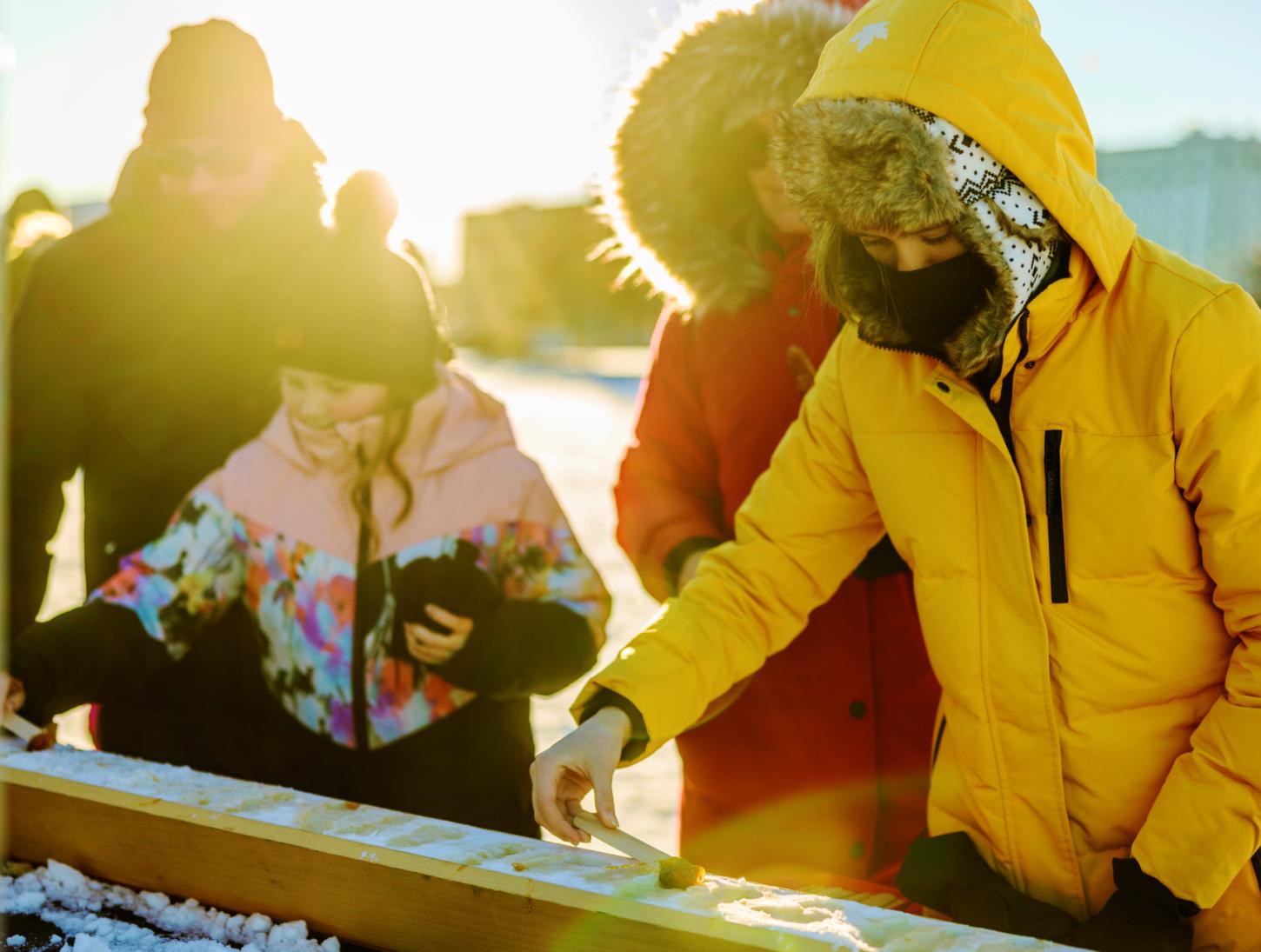
Cold weather. Heavy snow. Hidden risks. Every winter, thousands of people experience heart related emergencies while shoveling snow. The combination of cold temperatures and sudden physical exertion can put strain on the heart, especially for those with high blood pressure & heart disease.
North Shore Health wants to help you protect what matters most this February by following these heart health tips from the American Heart Association:
Knowing your risk. Check your blood pressure and cholesterol. Regular check ups help you understand your health and manage it best.
Eat a healthy diet. Start making healthy choices that include daily vegetables and less processed foods.
Be physically active. Move more – it’s one of the best ways to stay healthy, prevent disease, and age well.
Watch your weight. Stay at a healthy weight for you.
NSH offers cardiac rehab, lab and diagnostic services, EKGs, Holter and event monitoring, Ultrasound, and more to help you stay heart healthy.
Join us in Resolving to get Heart Healthy in the New Year!
Do you have a question for one of our writers? Or an interesting photo, recipe, or story you’d like to share with Northern Wilds? Please send it to storyideas@ northernwilds.com.
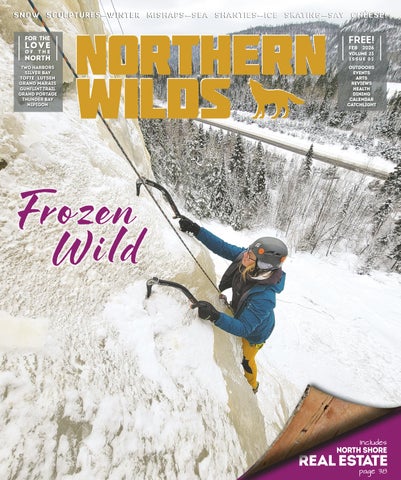
Frozen Wild
By February, winter has usually taken hold, sealing rivers and lakes beneath a thick layer of ice. While every winter issue reflects the season in one way or another, we don’t always pause to explore the ice itself—its beauty, its risks, and the experiences it creates. Until now.
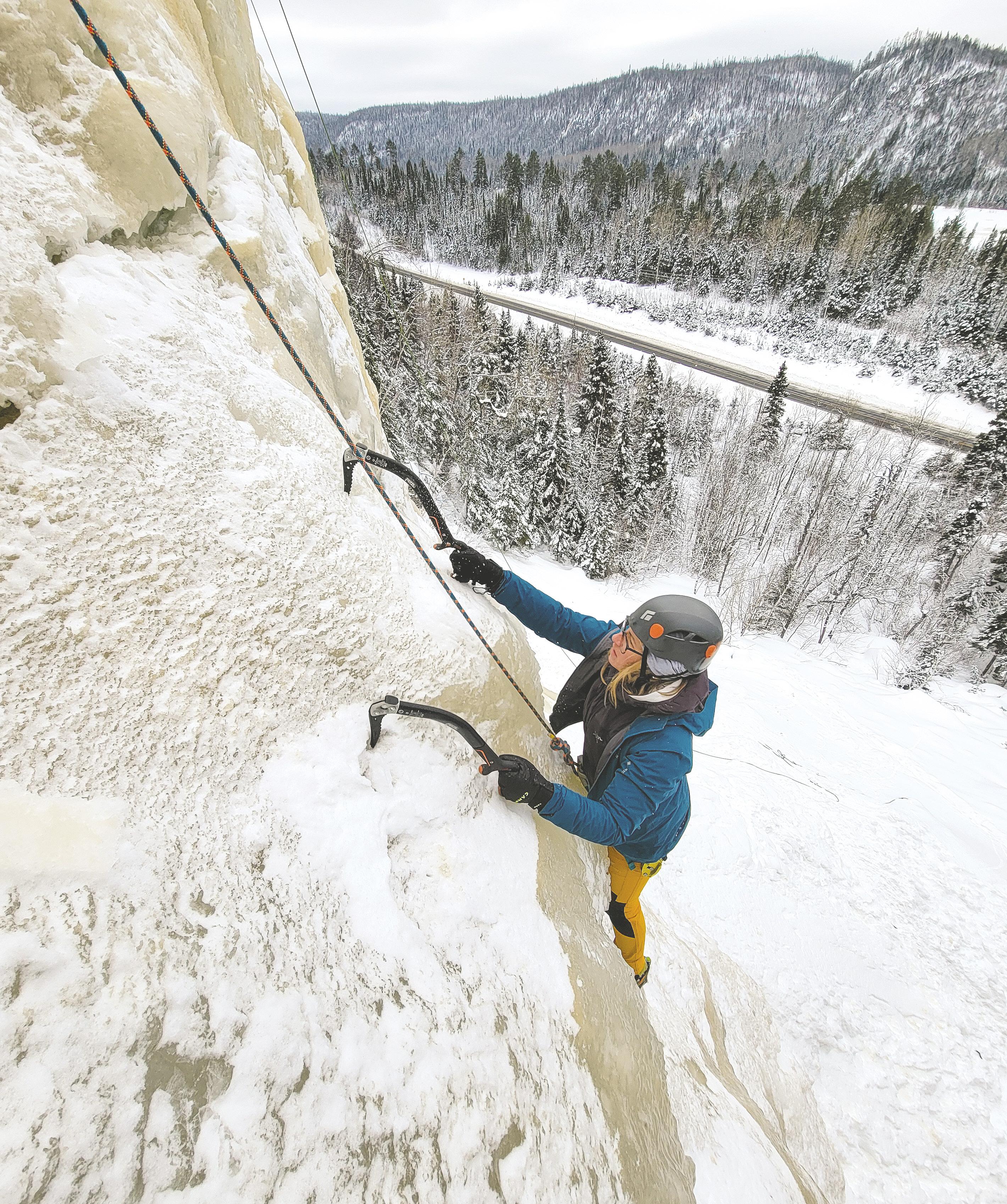
Let’s start with our feature story, in which Chris Pascone takes readers onto frozen flows to learn the art of ice climbing. “If becoming ice Spider-Man sounds attractive, there are two fantastic climbing opportunities awaiting you this winter in the Northern Wilds,” Pascone says. The Duluth Ice and Mixed Fest will take place Feb. 6-7, followed by the Nipigon Ice Fest, held March 6-8. Both events offer climbing clinics for beginners.
In Along the Shore, Naomi Yaeger highlights outdoor skating rink options, from Duluth to Thunder Bay and the Iron Range. Tom Watson focuses on ice safety, walking readers through self-rescue techniques should the ice give way. He also reminds us that ice is never 100 percent safe, and that its strength and quality can change within just a few feet.
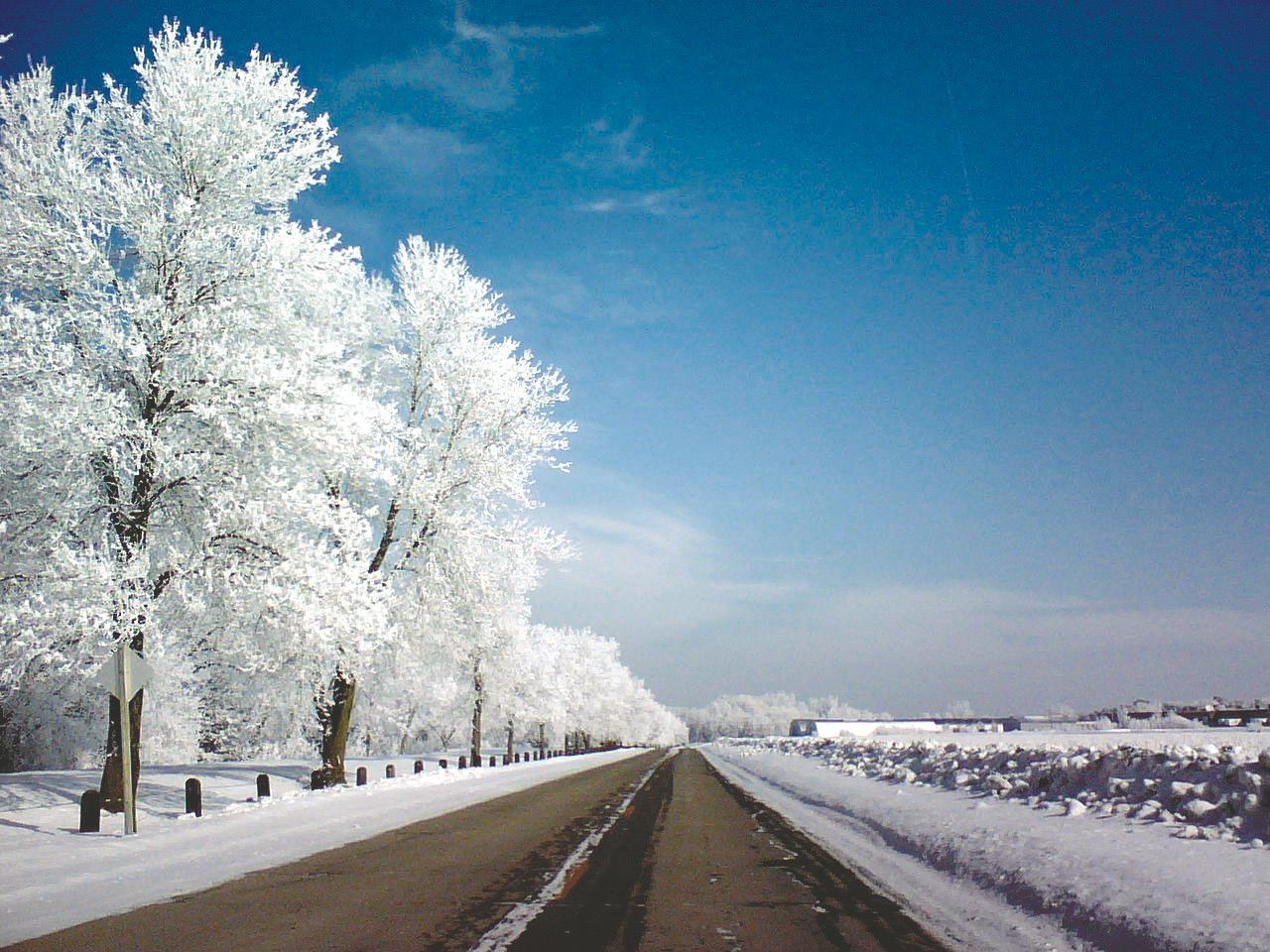
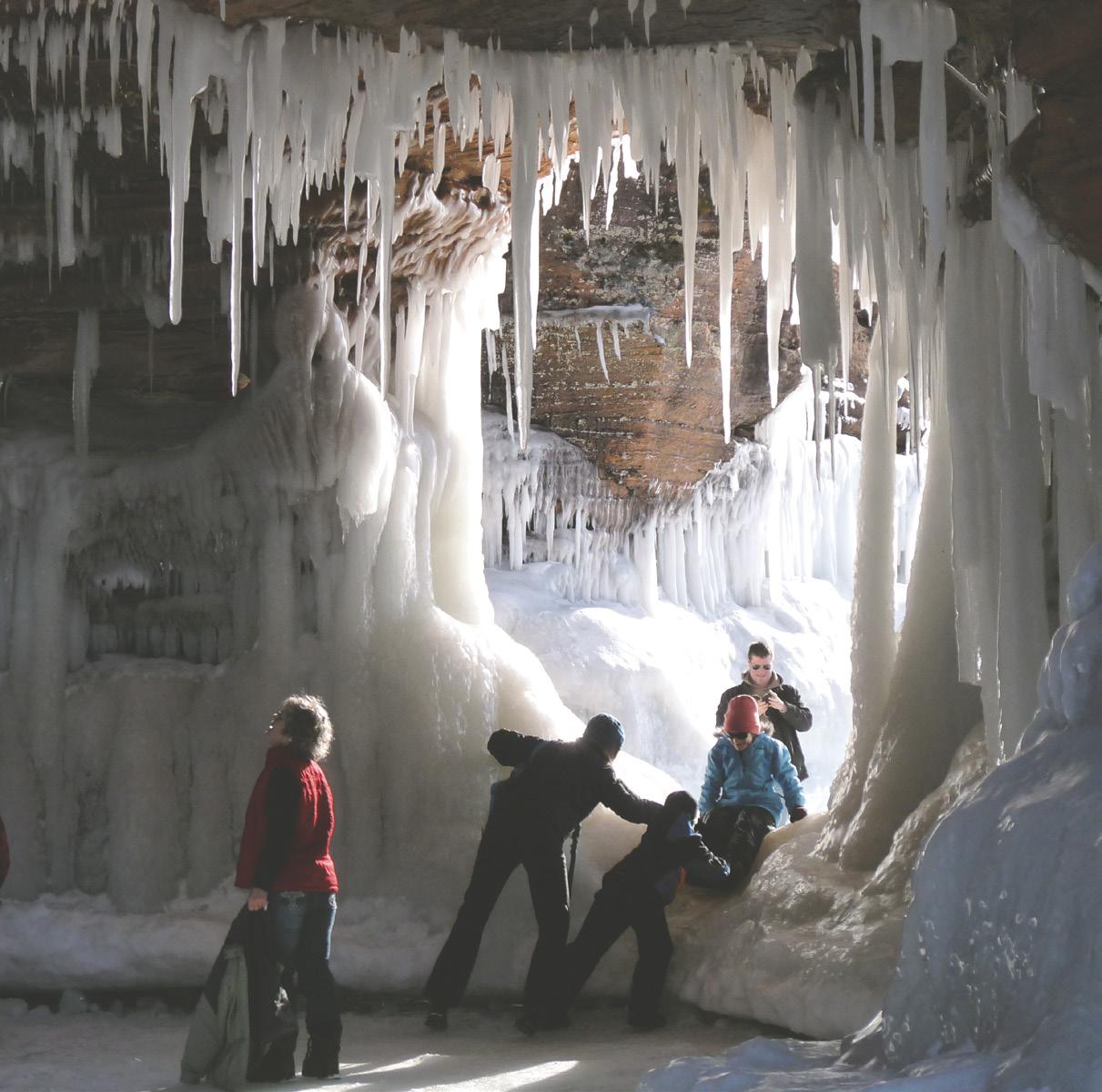
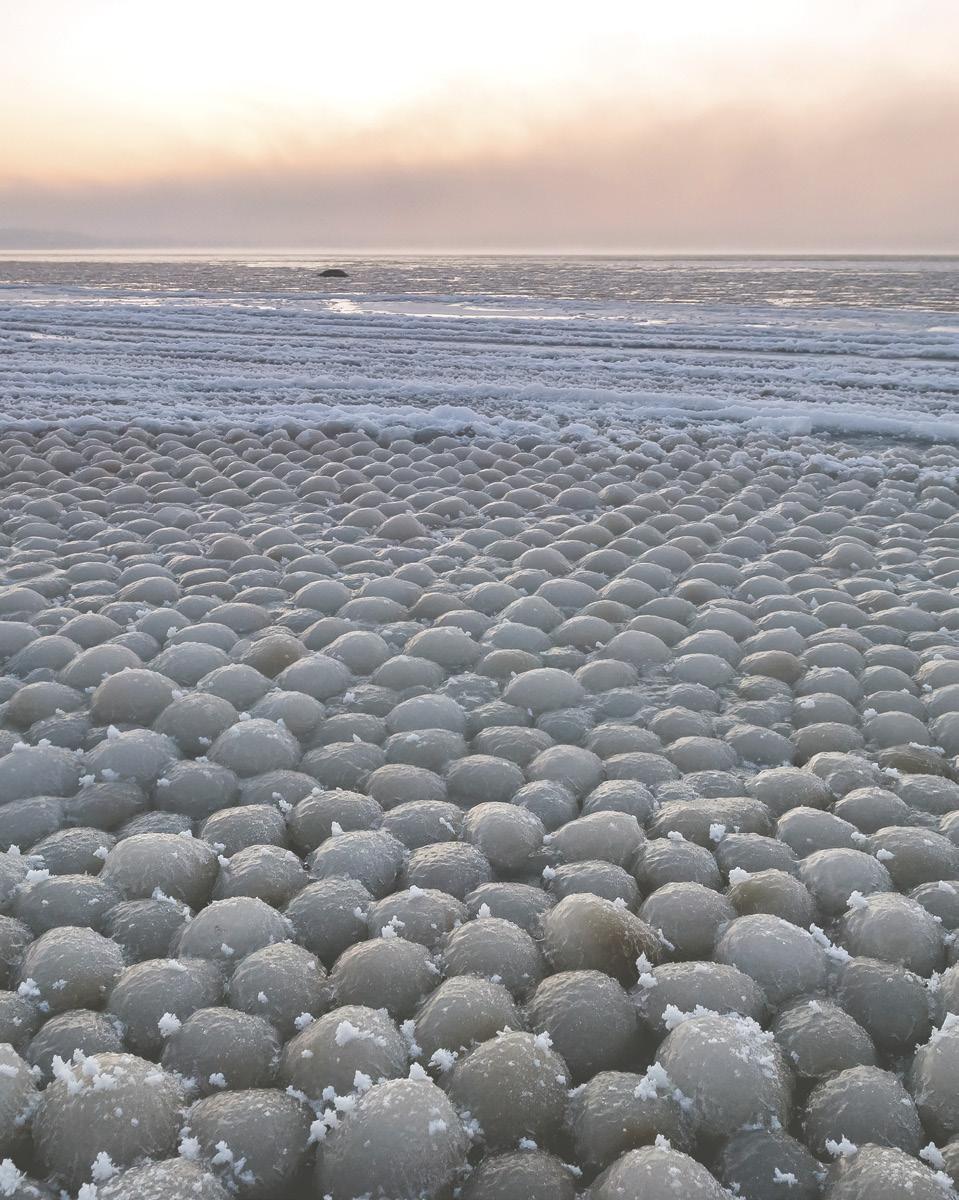
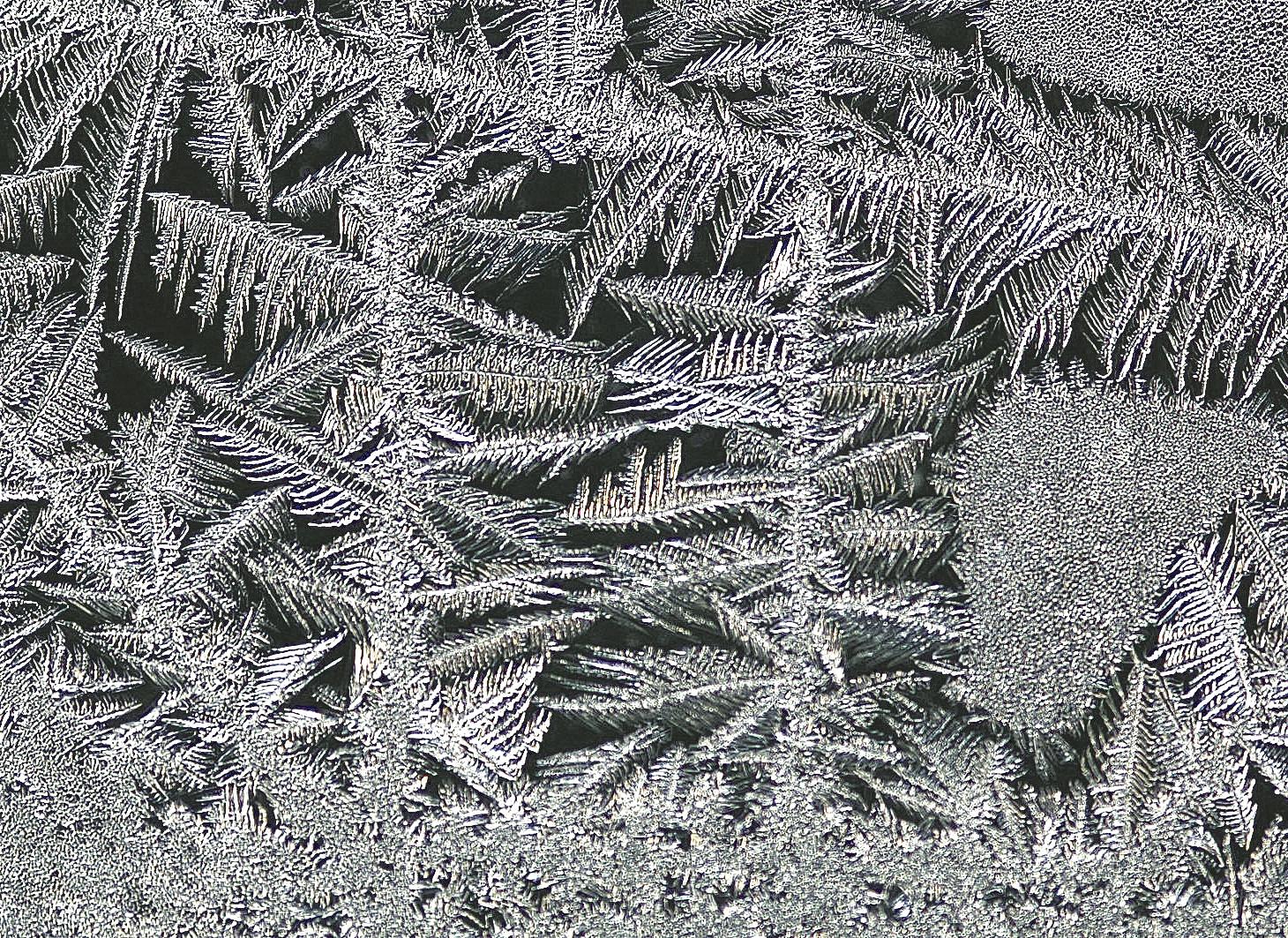
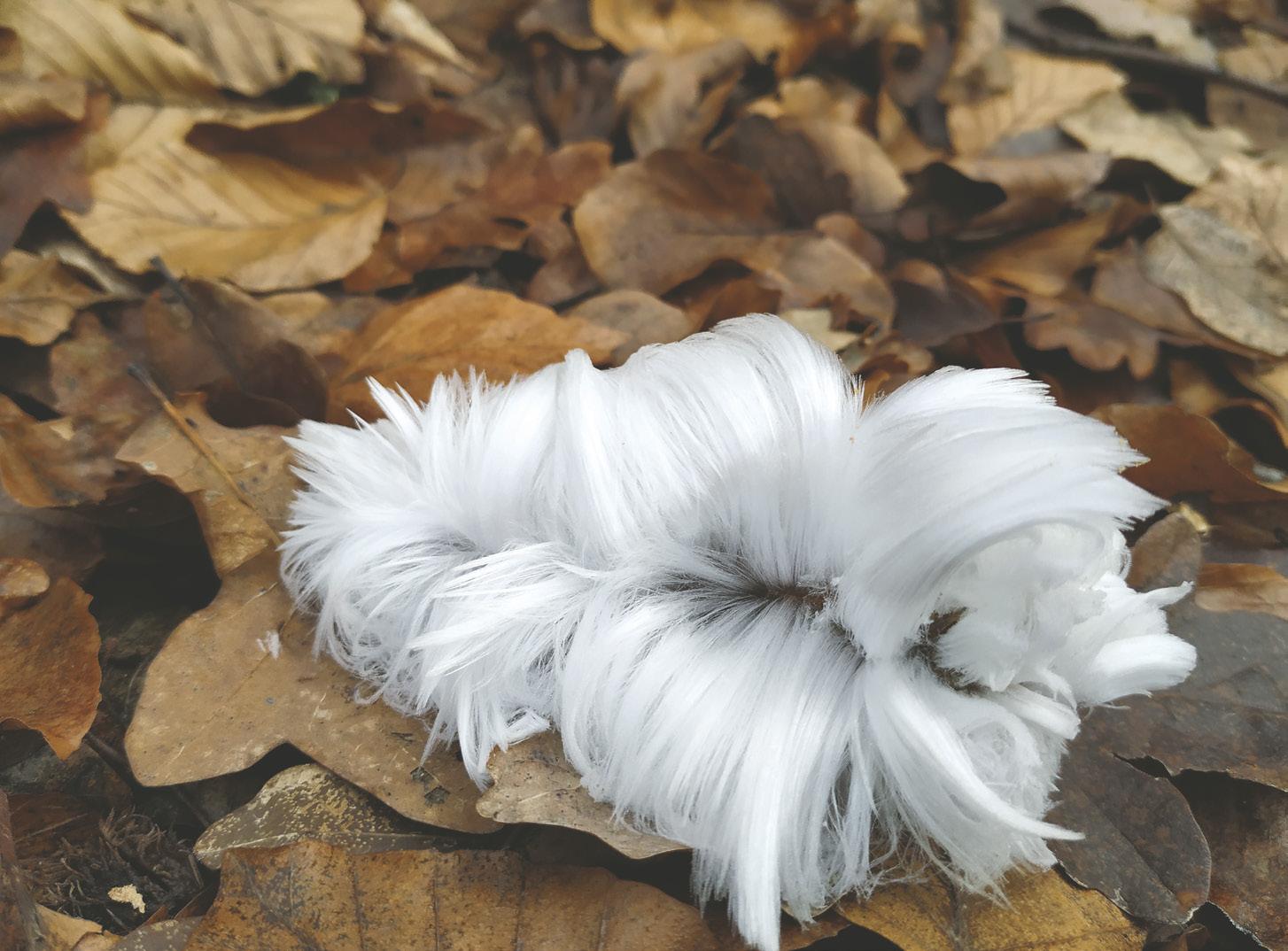
Strange Tales columnist Elle Andra-Warner explores nature’s winter ice art gallery, from hoarfrost and pancake ice to ice caves, hair ice, and window frost art. Meanwhile, Health columnist Hartley Newell-Acero offers a warmer perspective, sharing tips on how to break the ice and spark meaningful conversation.
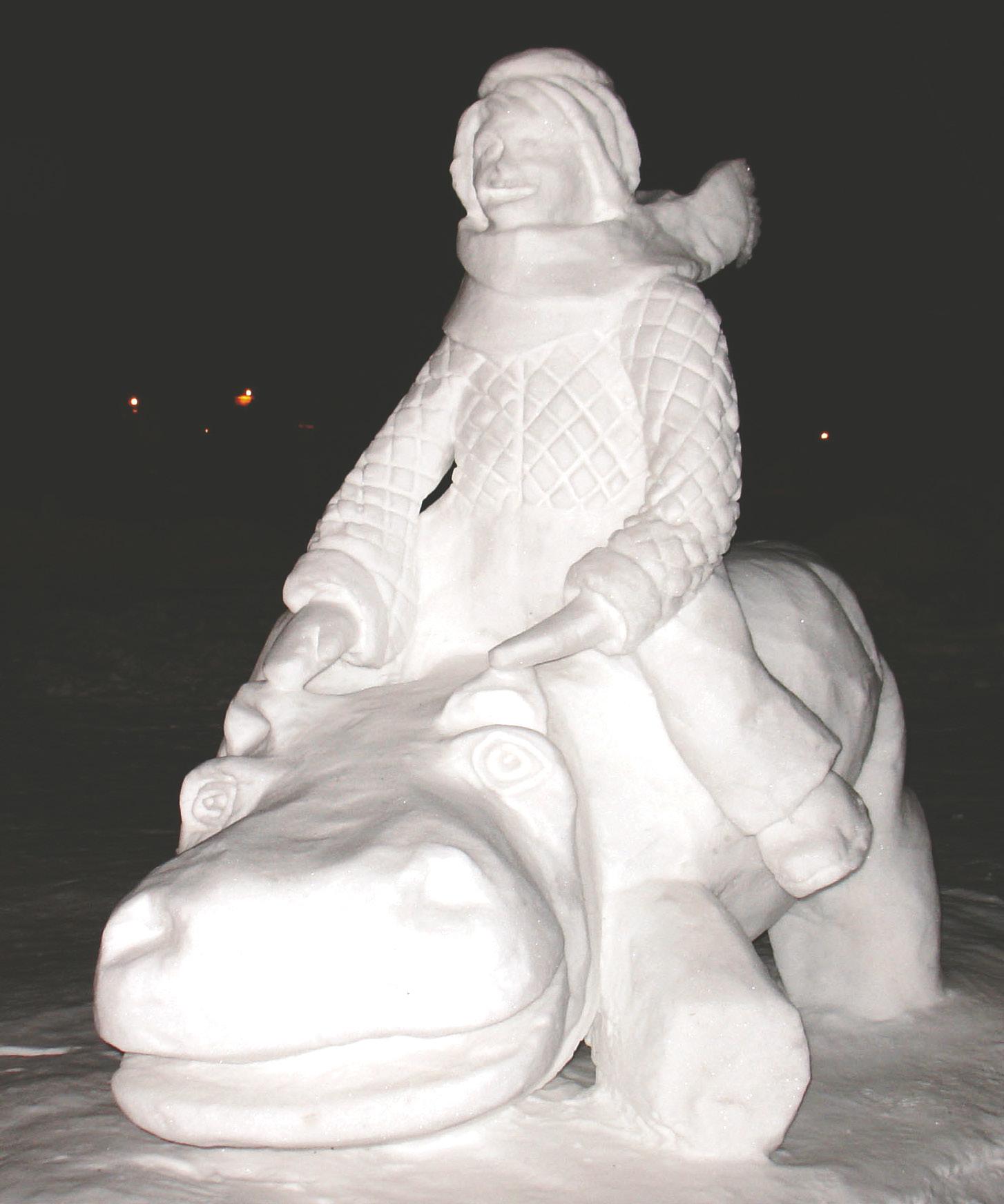
Shifting from ice to snow, Creative Space author Rae Wojcik talks with Ely snow sculptor and artist Nancy Scheibe, who will once again take part in the Ely Art Festival Snow Sculpting Symposium this year. Scheibe’s
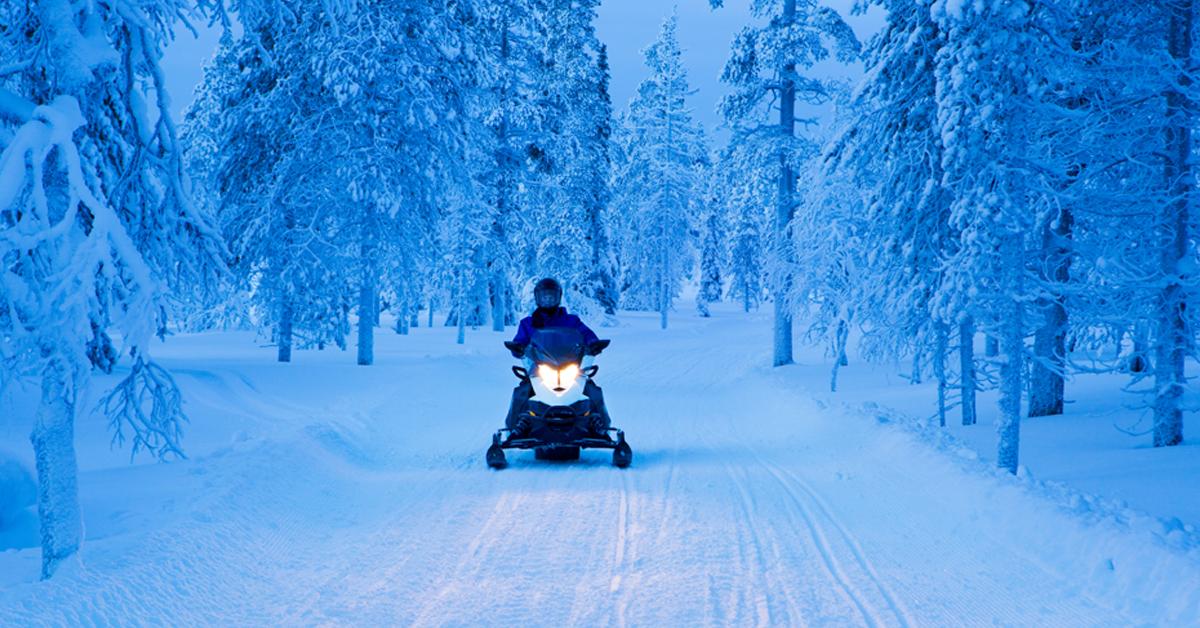
current plan is to carve a tribute to Jane Goodall. Dana Johnson covers the Black Woods Blizzard Tour, a snowmobile fundraiser for ALS, while Anne Graybeal writes about the Northwoods Fiber Guild and their upcoming exhibit at the Johnson Heritage Post Art Gallery in Grand Marais.
For our second feature story, I asked our writers to share their winter mishap stories, and they delivered. In fact, we received more tales than we had room for in this issue—so a Part Two may be in the works next year.
This month, we’re bringing back an old favorite, the Restaurant Awards. We want to know which restaurant has your favorite view, burger, pizza, appetizer, and more. Turn to page 28 for details, including a QR code to vote online. Voting is open until March 31.
As I write this, it’s currently -15 degrees outside without the wind chill, yet just last week temperatures were in the 30s. Winter weather in the Northern Wilds can change from day to day, so you never quite know what to expect. Stay safe, stay warm, and enjoy the snow.
Breana Johnson Editor editor@northernwilds.com
HOLIDAY SWEEPSTAKES WINNERS
$55 Dining Certificate
Borderland Lodge
Nick B. Schroeder, MN
$100 Gift Card
Cook County Co-op
Karen R. Thunder Bay, ONT
Stay and Play Package
Grand Portage
Lena S. Grand Portage, MN
$50 Gift Certificate
Northwest Outlet
Gary T. Alvarado, MN
$75 Gift Certificate
Lake Superior Trading Post
Amy D. Maplewood, MN
$100 Gift Card
North Shore Winery
David H. Grand Marais, MN
$100 Visa Gift Card
North Shore Federal
Credit Union
Thomas J. Plover, WI
1-Day Snowmobile Rental
Hungry Jack
Connie K. Grand Marais, MN
$75 CAD Gift Certificate
Thunder Bay Country Market
Kelley R. Brookpark, MN
$75 Gift Card
Miller Hill Mall
Amy G. Superior, WI
REAL ESTATE
PUBLISHER/CEO
Barb Krause bak@ntmediagroup.com
EDITOR
Breana Johnson editor@northernwilds.com
ADVERTISING Sue O’Quinn sue@northernwilds.com
ART DIRECTOR
Lauren Harrigan lharrigan@ntmediagroup.com
GRAPHIC DESIGN
Jessica Jacobsen Smith production@northernwilds.com
DIGITAL DIRECTOR
Kristen Rouse krouse@ntmediagroup.com
OFFICE
Barbara Fisher office@northernwilds.com
Nadine Seitz accounting@ntmediagroup.com
CONTRIBUTORS
Erin Altemus, Elle Andra-Warner, Gord Ellis, Virginia George, Anne Graybeal, Kalli Hawkins, Dana Johnson, Shelby Lonne-Rogentine, Michelle Miller, Deane Morrison, Hartley Newell-Acero, Chris Pascone, Joe Shead, Victoria Lynn Smith, Tom Watson, Rae Wojcik, Naomi Yaeger, Sam Zimmerman
Ski North Ultra Returns for Its Second Year, Showcasing Cook County’s Winter Trails
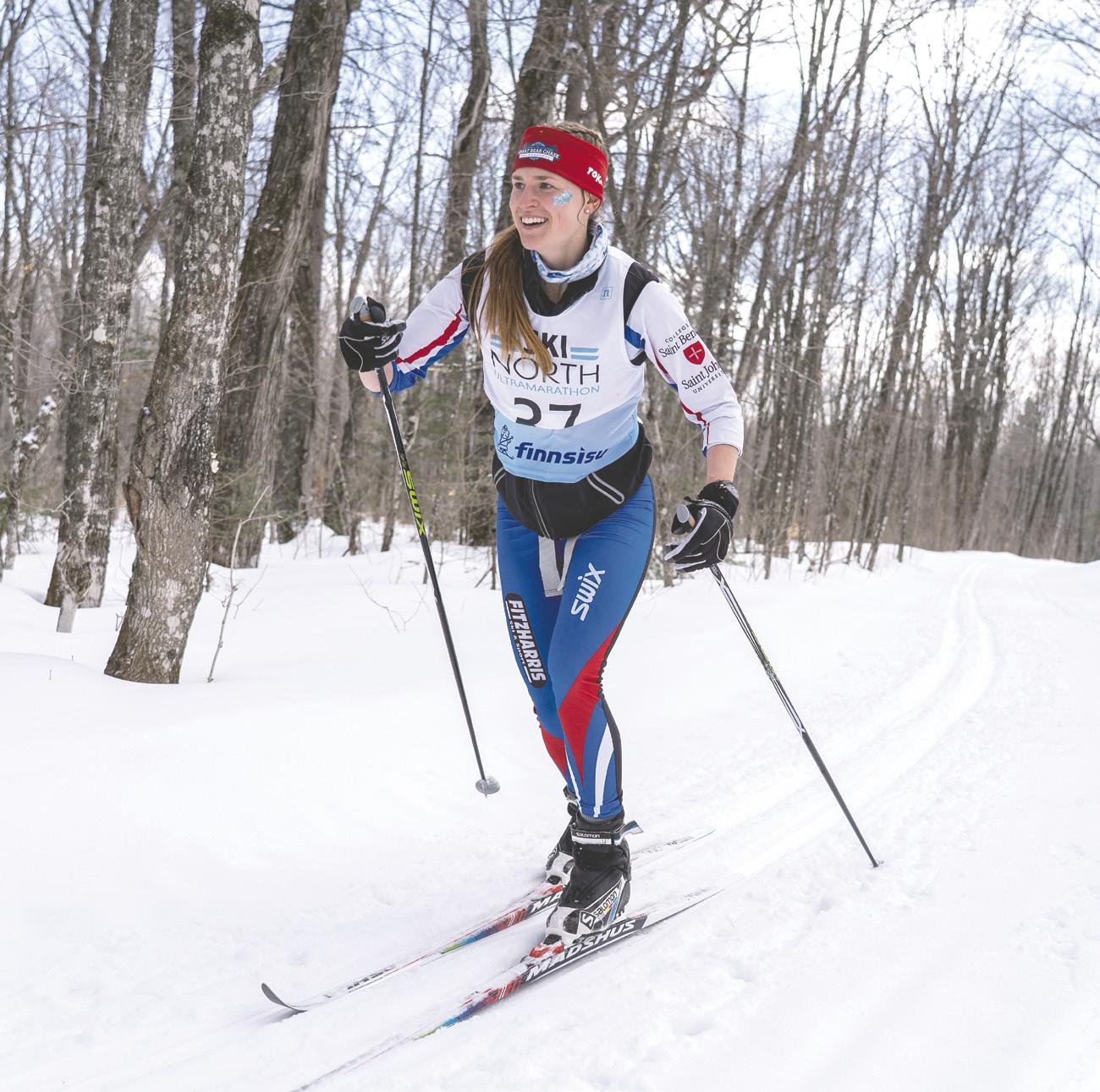
COOK COUNTY—Last winter, the Ski North Ultra Marathon introduced a new way to experience Cook County’s ski trails. The race weaves together miles of North Shore terrain, creating an endurance event that values exploration as much as competition.
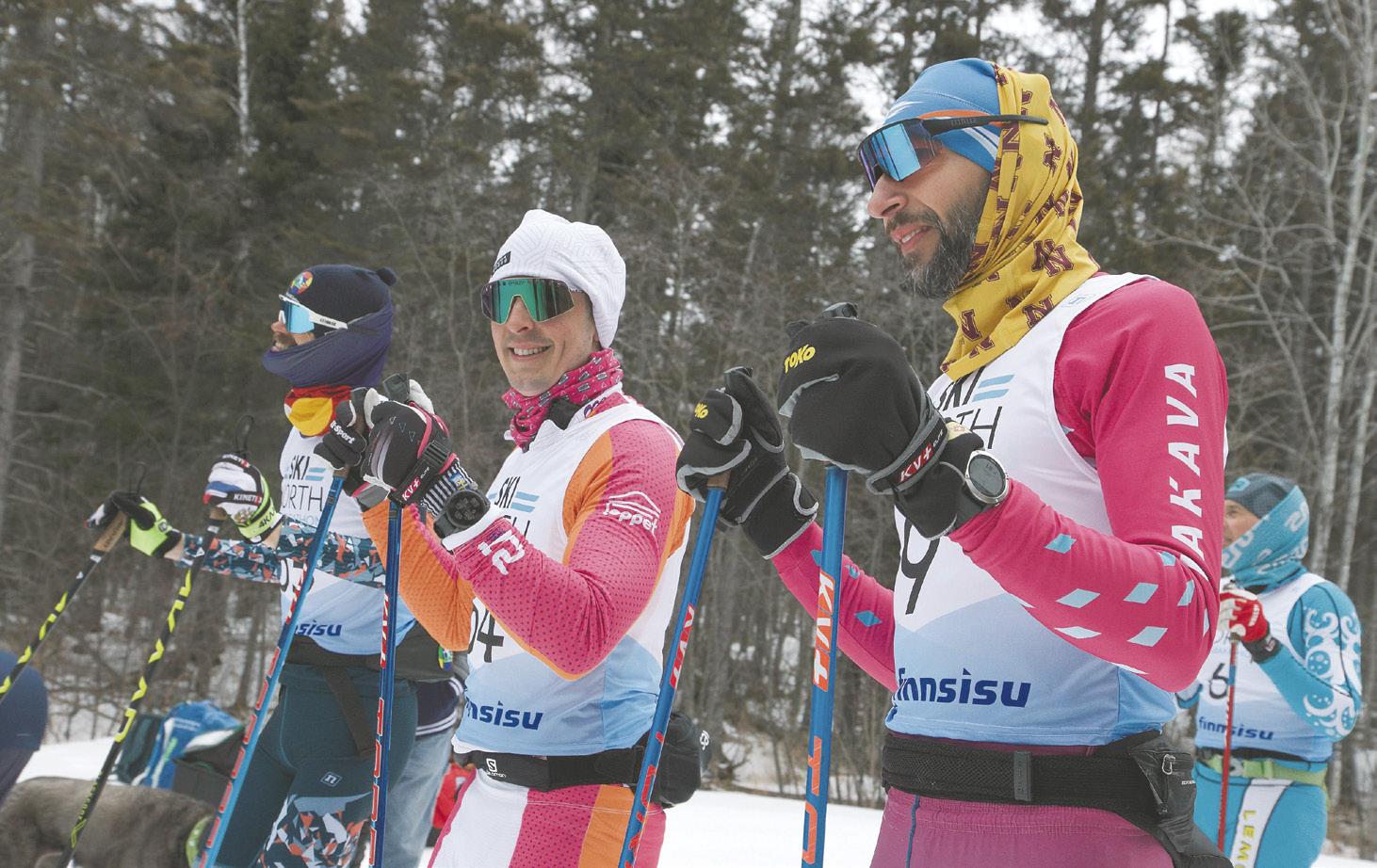
Now, the race returns for its second year on March 7, bringing skiers back to Cook County for what founder Allie Rykken describes as a celebration of endurance and a “unique opportunity on the North Shore.”
The idea for the Ski North Ultra Marathon took shape several years ago during a visit to the North Shore. Rykken and her husband, both avid cross-country skiers from the Twin Cities area, were struck by how extensive the area’s ski trail network was.
“We were really delighted that there were all these trail systems that had these connections. It felt like little secret passageways from one to the next,” Rykken said.
After returning home from their trip, they spent hours scouring over maps of the area and of various state park ski trails.
“We started asking ourselves how many kilometers of trail there were, and what it would look like to ski all of them,” Rykken said.
That curiosity, paired with Rykken’s background working for a foundation and man-
aging outdoor recreation programs, planted the seed for the Ski North Ultra. While other endurance sports, such as mountain biking or trail running, have embraced long-distance race formats,
cross-country ski races often top out around 50 kilometers. Rykken said that, given the extensive, connected ski trail system, she saw an opportunity to create something distinct on the North Shore.
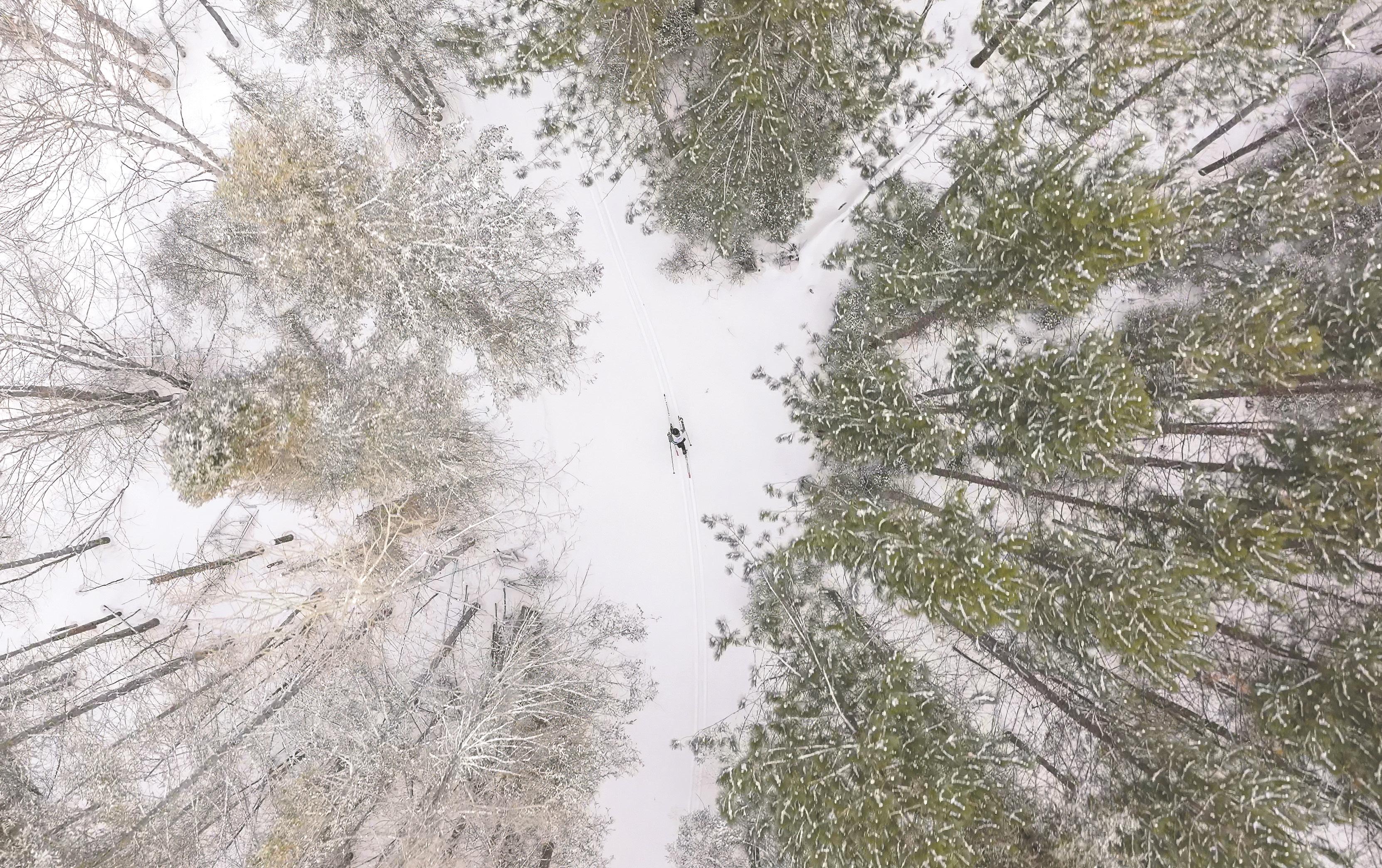
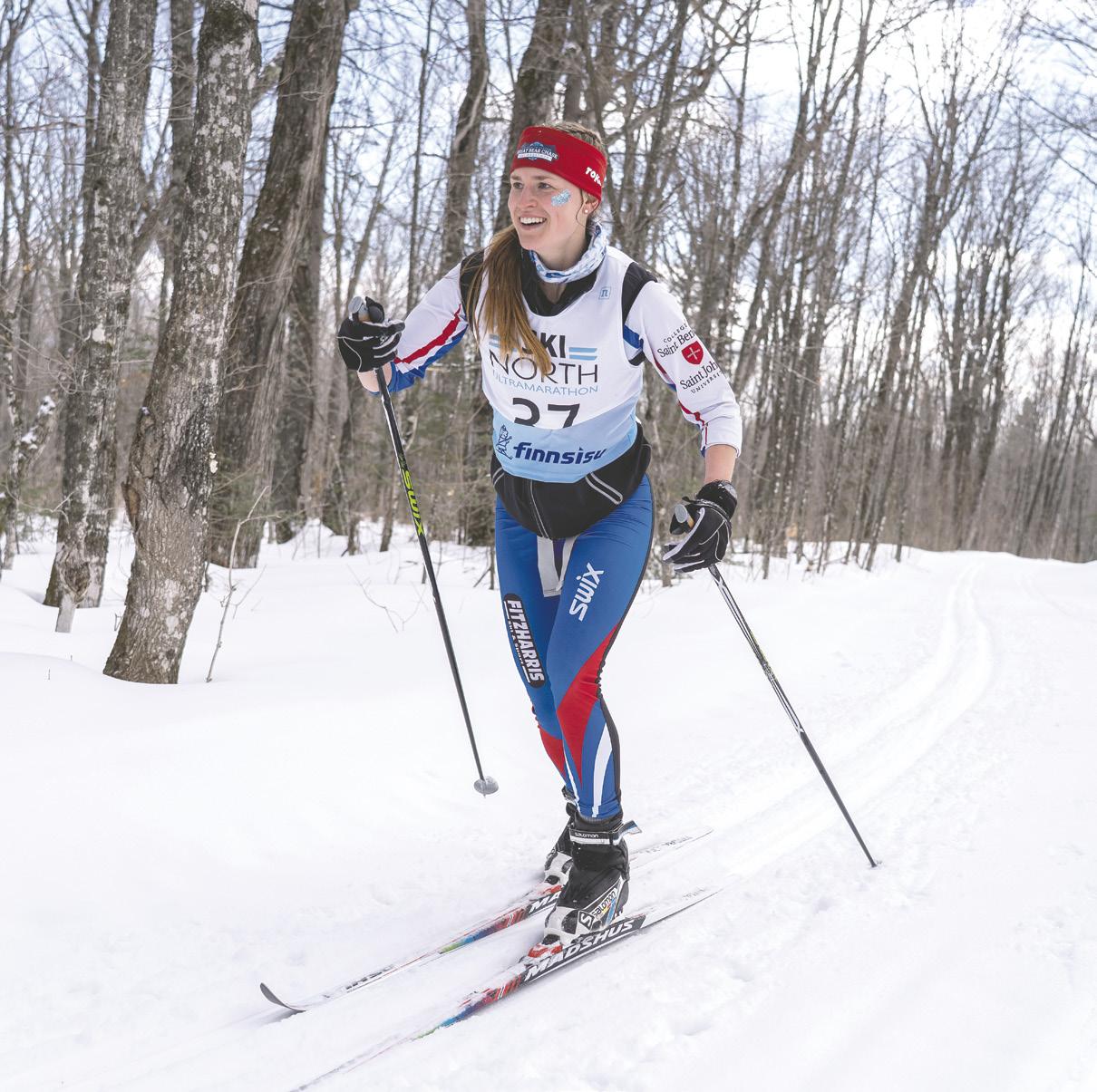
The inaugural Ski North Ultra took place in March 2025 and featured multiple distances, including a 100-kilometer main event. About 120 participants registered across all distances, with roughly 70 attempting the 100K. Approximately 50 finished the full course, navigating everything from thin, icy trail conditions to fresh snowfall and warming temperatures on race day.
“It went through a wild number of conditions that day. I was fully expecting people to come back exhausted and miserable. But I was pleasantly surprised that the vast majority were excited to be a part of it,” Rykken said.
Despite the unfavorable trail conditions that day, Rykken said it was “pretty incredible” to see the race come to fruition.
For 2026, the Ski North Ultra returns with some minor adjustments.
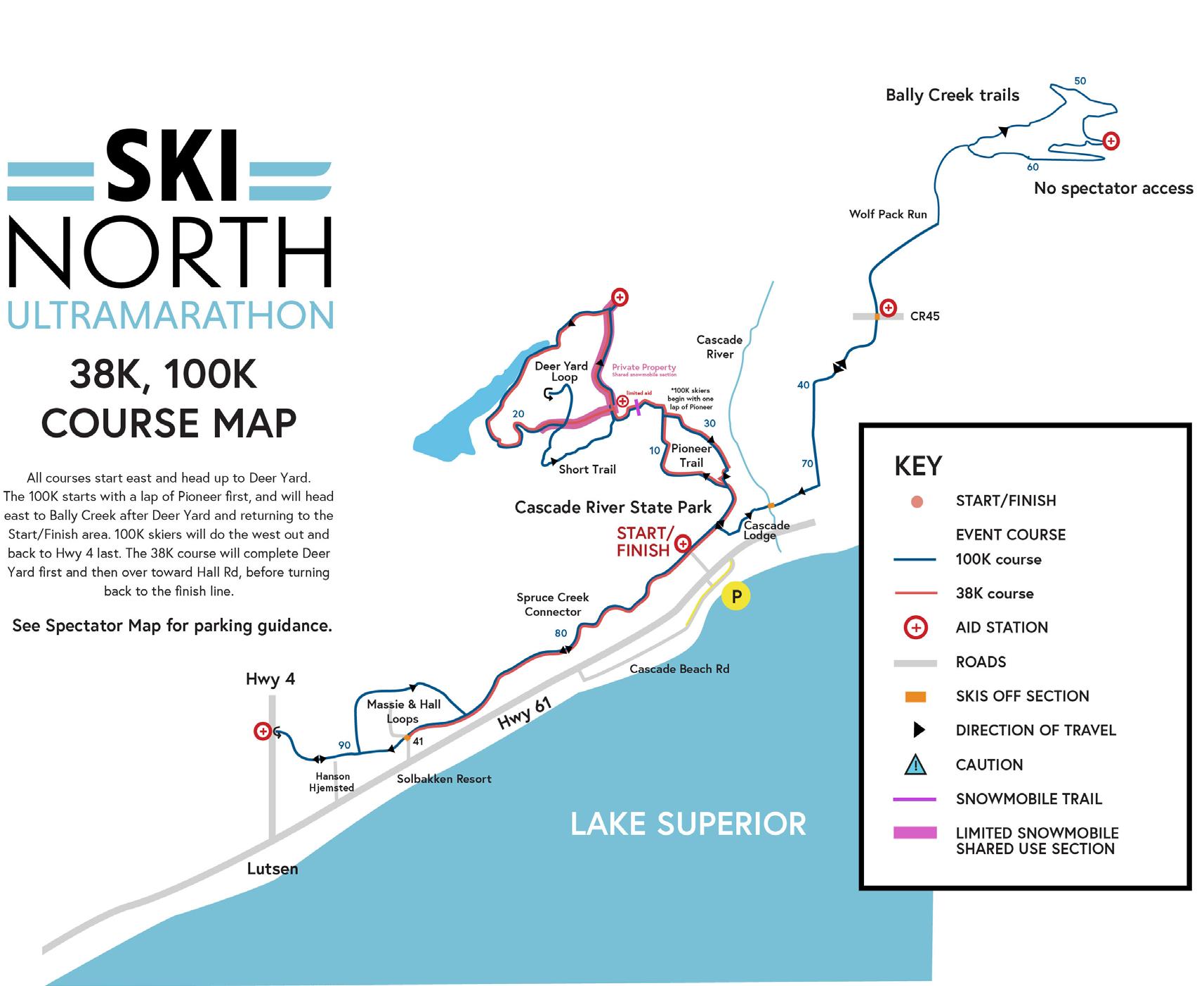
The race is capped at 150 participants pursuant to the Minnesota Department of Natural Resources (DNR) permit, allowing modest growth while maintaining a manageable scale. This year’s event will feature the 100K race along with a shorter 38-kilometer option designed as a stepping stone for skiers curious about ultra-distance events.
The course layout has also been modified. The start and finish will now be based at a
An aerial shot of a skier in last year’s inaugural Ski North Ultra Marathon race. | JOHN THAIN
Ski North Ultra will take place on March 7. | JOHN THAIN
This year’s course layout has been modified. The start and finish will now be based at a snowmobile parking area near Cascade River State Park. The 100K race will navigate through Pioneer Trail, Bally Creek trails, and the Deer Yard loop. | SUBMITTED
snowmobile parking area near Cascade River State Park. The 100K race will navigate through Pioneer Trail, Bally Creek trails, and the Deer Yard loop.
“It’s a pretty challenging course,” Rykken said. “Both technically and physically.”
Given the challenging terrain and the 100K course’s distance, Rykken said the race is best suited for advanced skiers.
The shorter 38K race, however, sticks to less demanding terrain and is more approachable for beginner or intermediate skiers.
“If you’re not quite looking for that big of a challenge, the shorter race would be really fun,” Rykken said.
Community and volunteer support have been central to the event’s success so far. Volunteers, from local skiers to or-
Given the challenging terrain and the 100K course’s distance, the race is best suited for advanced skiers. However, the shorter 38K race sticks to less demanding terrain and is more approachable for beginner or intermediate skiers.
| TODD BAUER
ganized groups like the Cook County Nordic Team, help staff aid stations and assist with logistics. This year, Ski Hut from Duluth will also run an aid station during the race event.
Since its launch last year, the Ski North Ultra has received support from Visit Cook County and the North Branch Trail Association, helping with marketing efforts and refining race logistics.
Looking ahead, Rykken’s goal is to continue hosting the race and, each year, incorporate additional elements to improve the overall experience.
“As wonderful as last year was, I feel like we learned a ton, just with some logistics,” Rykken said.
She said that, based on what they’ve learned from last year, future races will have better signage and course mar-
shals at intersections to direct skiers. “We’ve got some really great ingredients, and so I just want to keep refining what we can do better, and hopefully make it a really positive experience for everyone.”
With a maximum of 150 participants allowed per the DNR permit, Rykken said she envisions the Ski North Ultra remaining a relatively small event—one that draws skiers from across the Midwest while also becoming something Cook County can proudly call its own.
More information about the race, registration, and volunteer opportunities can be found at: skinorthultra.com.
Kalli Hawkins
Gunflint Pines
The All Hands Sea Shanty Crew Bringing Back History Through Song
DULUTH—Boating and the maritime lifestyle have been a major industry on the North Shore for centuries, actively playing a large role in the area’s economy, and they continue to be so today. In Duluth, a musical group gathers each month to celebrate that history in a unique way. They do this through the songs of the seafaring people who worked on those boats. The All Hands Sea Shanty Crew is a group of singers who explore the stories behind the music and come together to share them with others.
The group’s leader and one of the co-founders, Paul Webster, says this has been in the works for several years. “We realized there are not enough places around Duluth where adults can go and make music together in a casual, informal way,” Webster said. He explained there have been a couple of different approaches to try to make this happen over the past few years. The crew has now partnered with the Duluth Folk School, which seems like the perfect fit.
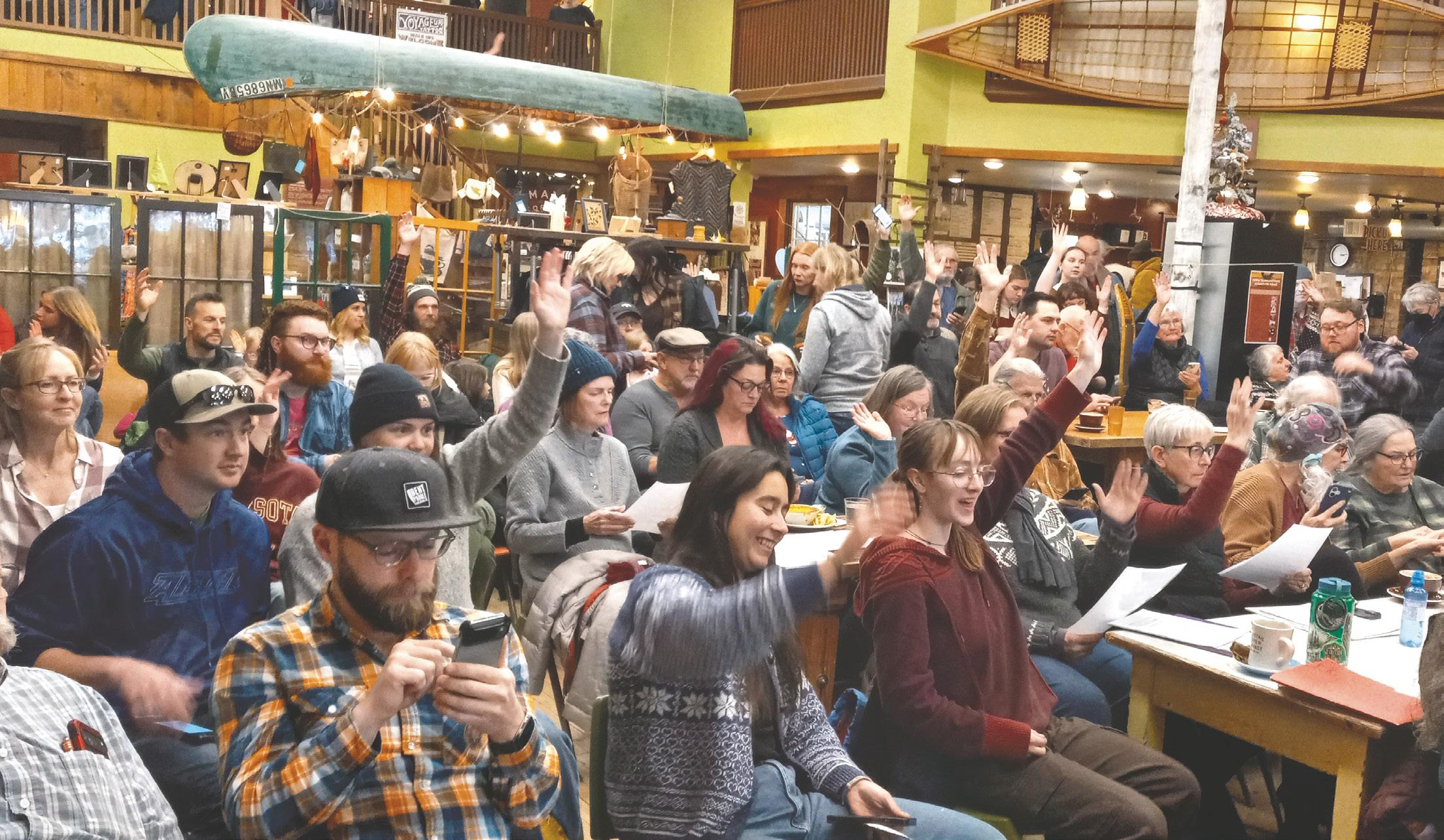
During the winter season, which runs through March, the crew gets together on the first and third Sunday of each month. All are welcome; there is no cost to participate, and no pre-registration is required. The first session, held last fall, drew a crowd of nearly 100 people and continues to grow each month. Singing along is optional; however, Webster said, “Nearly everyone eventually joins in, even if they weren’t planning to.”
Sea shanties (American) or chanties (British) are a genre of traditional folk songs that aided in the timing of various tasks on seafaring vessels. Workers used the songs to accompany rhythmical labor aboard large merchant sailing vessels, while working the pumps or hauling, for example. Shanty songs functioned to synchronize and thereby optimize labor in what had become
larger vessels with smaller crews and stricter schedules. The lyrics might reference the task at hand or depict life at sea, including missing loved ones or the dangers of the job.
The All Hands Sea Shanty Crew provides lyric sheets for each session, and participants can choose to watch, sing the chorus, or be part of the quiet harmony. Webster also encourages those interested to bring their favorite songs and lead the group. The sessions last just an hour, with a loose program, the goal being an opportunity for the community to come together and make music. Webster said the partnership with the Duluth Folk School is “just perfect. We finally found the ideal venue, and their assistance with outreach and marketing has made it possible to make this a success without limits.”
The Duluth Folk School was created in 2015 to fill a need in the Duluth community to help people learn how to make things. It
was also created to be a “third place” where community could actually happen—where folks could gather to learn, network, and enjoy. The school became a nonprofit in 2021 with a mission that builds community through joyful experiences of handcrafting, art, and gatherings. Its focus on providing opportunities with instructors from the Twin Ports and surrounding communities also supports this mission. Having local instructors gives students the chance to meet and support local craftspeople. This keeps more money in the area, in addition to supporting the hard work and creativity of local artisans. The Duluth Folk School provides people with the opportunity to use their heads, hearts, and hands to improve their lives, blending traditional skills and tools with modern-day techniques to deliver fun, engaging classes. It’s all about helping individuals discover their creative abilities and develop skills.
In addition to hosting the sea shanty singing sessions, the Duluth Folk School offers fiber art classes, printmaking, writers’ open-mic events, and game nights. Youth programs are also available, and regular music performances are offered, including the popular Old Time Jam. Most events and classes are free with a purchase at the Dovetail Café, located in the facility. The full calendar of events and classes can be found on the school’s website: duluthfolkschool.com.
The All Hands Sea Shanty Crew meets from 3-4 p.m. the first and third Sunday of each month. Duluth Folk School is located at 1917 W. Superior Street in Duluth. The café is open Wednesday through Sunday, 8 a.m. to 8 p.m.; Monday and Tuesday, 8 a.m. to 3 p.m.— Michelle Miller
During the winter season, the All Hands Sea Shanty Crew gets together on the first and third Sunday of each month at the Duluth Folk School. | MICHELLE MILLER
Howl at the Moon: A Sober Bar for All
THUNDER BAY—In March 2023, a new type of business and gathering spot emerged on the nightlife scene in Thunder Bay, and it is still hopping today. This hot spot gained attention not just for the good vibes and coffee and snacks, but also for its mission and patrons. The business started with the name Howl at the Moon: The Dry Saloon. The late-night coffee shop quickly shortened its name to Howl at the Moon and has become a safe space for people living sober lifestyles to socialize.
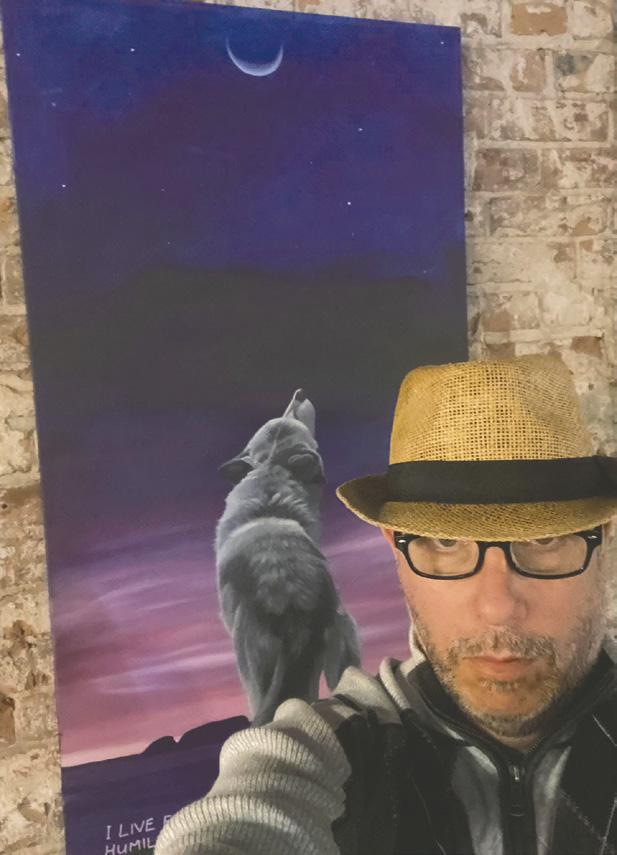
“I decided that I wanted to create a space where people could come together in recovery and celebrate that recovery,” said Jody Loos, founder of Howl at the Moon. “[Having a place like this] helps people to really have a better chance at succeeding.”
Thriving in sobriety is a wonderful achievement, but Loos knows, as someone who worked in the bar scene in Thunder Bay for years, that it can also be lonely.
After quietly becoming sober himself, Loos continued bartending as a profession and helped community members who came to him for support. “For the first time in my life, I was now sober, but I was still bartending,” said Loos. “I was really tired of losing my friends. It was like I was doing harm reduction from behind the bar. People came to me who didn’t have the resources to get sober. They didn’t know where to start, and they didn’t know anyone who was sober.”
Loos continued to do this for six more years, but he also continued to see friends relapse. After noticing several people falling off the wagon because they missed the camaraderie of local bars, Loos got the idea to create a space where sober individuals could be around others and participate in fun activities, but without the temptation of alcohol. In January 2023, a space became available for rent, and the rest is history.
Howl at the Moon, or just “Howl” for the regulars, is a passion project for Loos and the others who keep it going.
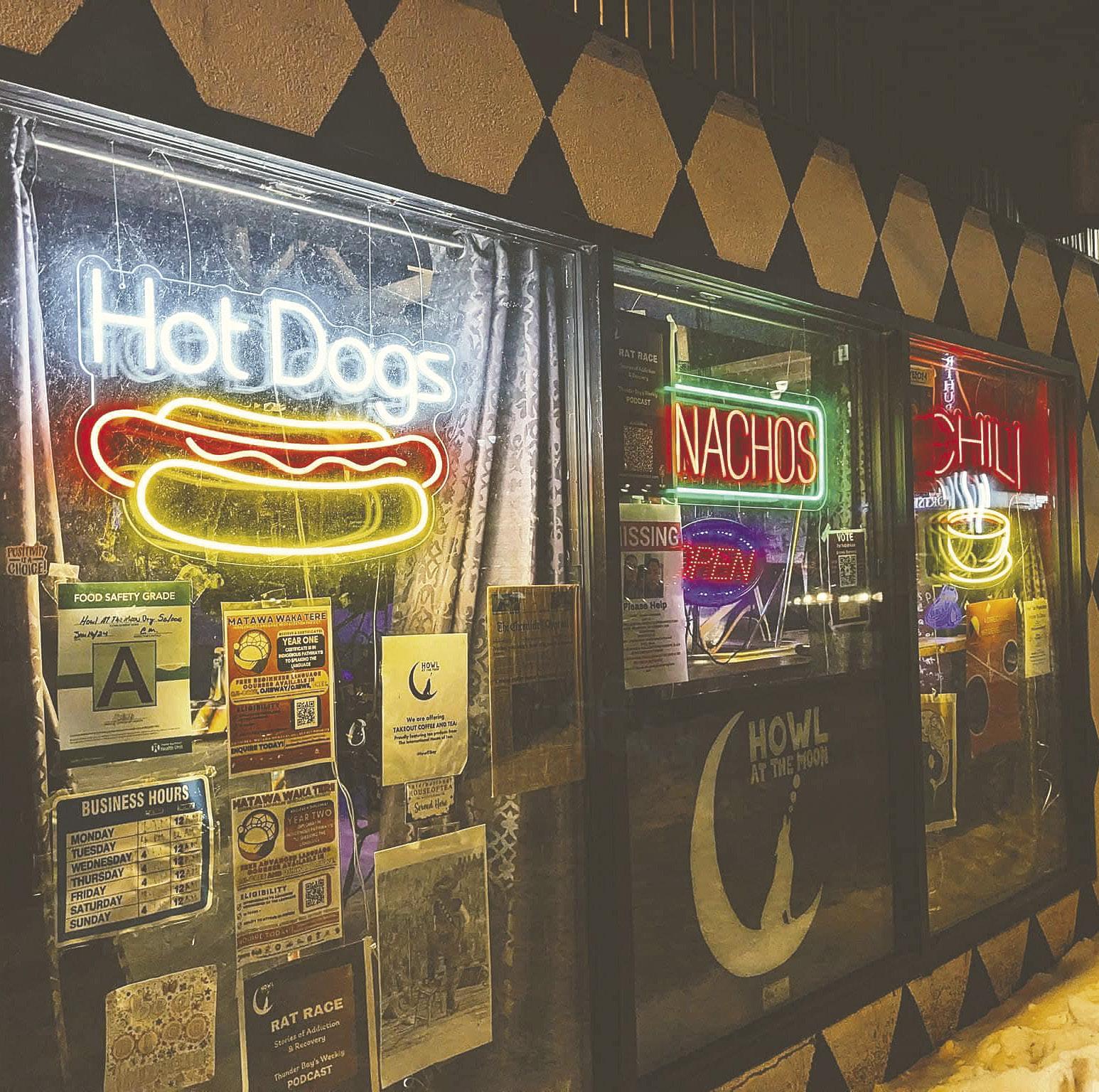
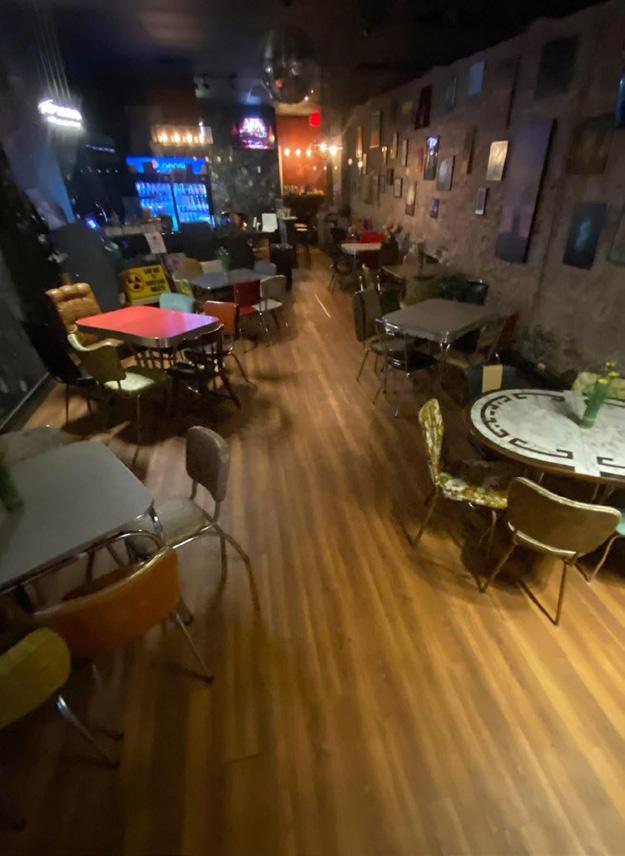
Howl at the Moon sells fresh coffee, local tea, soft drinks, and bar snacks such as hot dogs, onion rings, chips, and chocolate bars. The decor includes a disco ball, big-screen TVs, and original artwork in a makeshift gallery for artists in recovery. The space has a capacity of 75 to 80 people, and it can sometimes get that full.
There are often events that draw in not only people in recovery, but also those who are sober-curious. Karaoke, comedy shows, live bands, drag shows,
game nights, sharing circles, movie nights, trivia nights, and video game nights are just some of the options available. Howl at the Moon’s Facebook page often has updates about new activities and events. “It feeds my spirit to see that transition for people. It’s teaching people how to party sober,” said Loos.
Howl at the Moon, or just “Howl” for the regulars, is a passion project for Loos and the others who keep it going. “Dedicated volunteers help make this work,” said Loos. Looking ahead, Loos is providing remote Howl at the Moon events in rural communities. He also does consulting work for cities and businesses outside Thunder Bay.
“Some words to describe Howl at the Moon are compassion, healing, community, sobriety, wellness, and
and trivia
and
growth. They all go hand in hand with what we’re trying to do here,” said Loos. “The most rewarding part of this is to see people thrive in their recoveries and showing them what they can do sober. I’m sick of going to funerals and losing people to addiction.”
Howl at the Moon is located at 8 Cumberland Street South in Thunder Bay. Loos also records a podcast related to wellbriety and sobriety that can be found at ratracepodcast.com.
Jody Loos can be contacted about Howl at the Moon event ideas, or even just to talk sobriety, at thehowltbay@ gmail.com.—Shelby Lonne-Rogentine
Howl at the Moon founder and owner Jody Loos. | SUBMITTED
Howl at the Moon in Thunder Bay sells bar snacks, as well as coffee, tea, and soft drinks. | SUBMITTED
Howl at the Moon offers karaoke, comedy shows, live bands, drag shows, game
nights, sharing circles,
more. | SUBMITTED
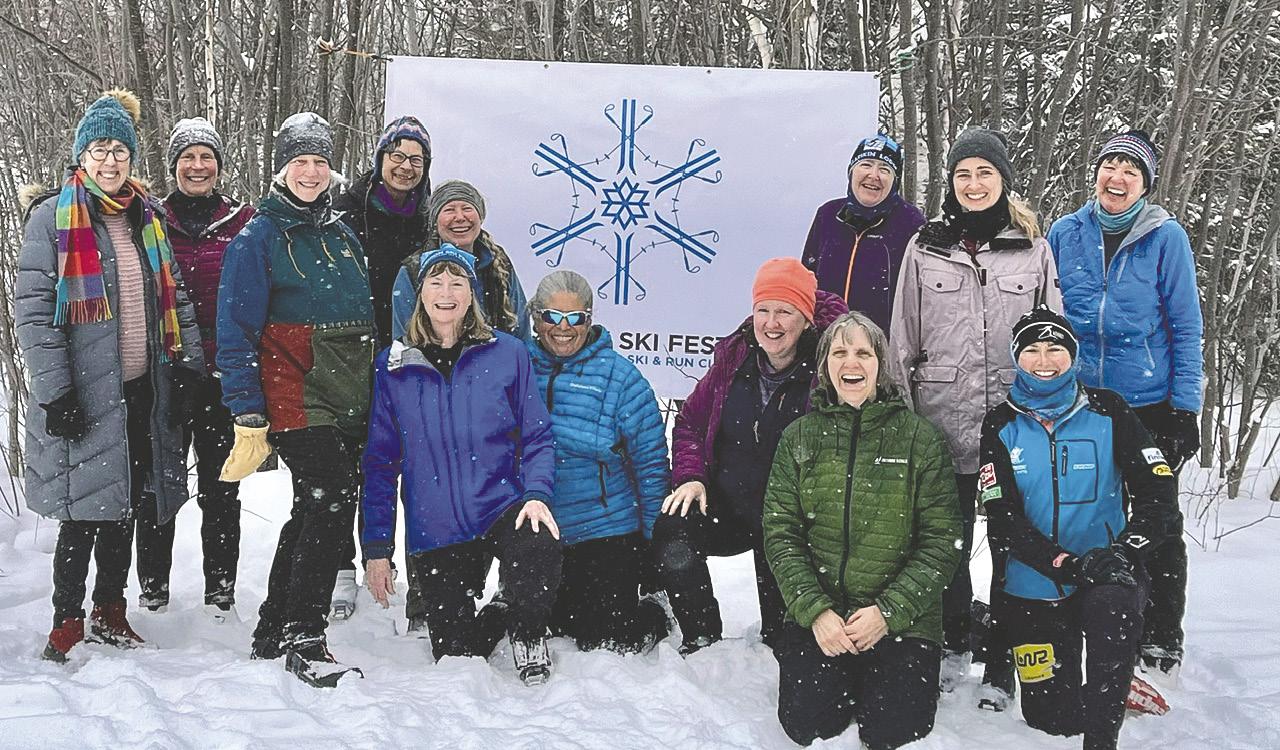
Pincushion Winter Ski Festival
Feb 14-16, 2026 | Grand Marais, MN
Saturday, Feb 14
10am Social Ski
12-1pm Luncheon
1pm Olympic Watch Party!
Sunday, Feb 15
10am Skate Ski Clinic
1:30pm Ski Sparks Races & Events
Monday, Feb 16
1:30pm Women’s Social Ski
Events are FREE and open to all!
*Registration fee for Skate Ski Clinic
For more details: pincushionskiandrun.org/upcoming-events/ Hosted by the Pincushion Ski and Run Club
THANKS TO OUR GOLD SPONSORS
Grand Marais Lions Club, Visit Cook County, Pincushion Mountain Haus, Chris Hegg Family, Fika Coffee, Best Western Plus Superior Inn, Chris O’Brien & Jane Alexander, BellBank, Sakstrup Family, Thrivent Financial, Cook County Whole Foods Coop, Allen & Kathy Lenzmeier, Dave & Sally Smith, William Patterson, Cascade Lodge
Hungry Jack Lake
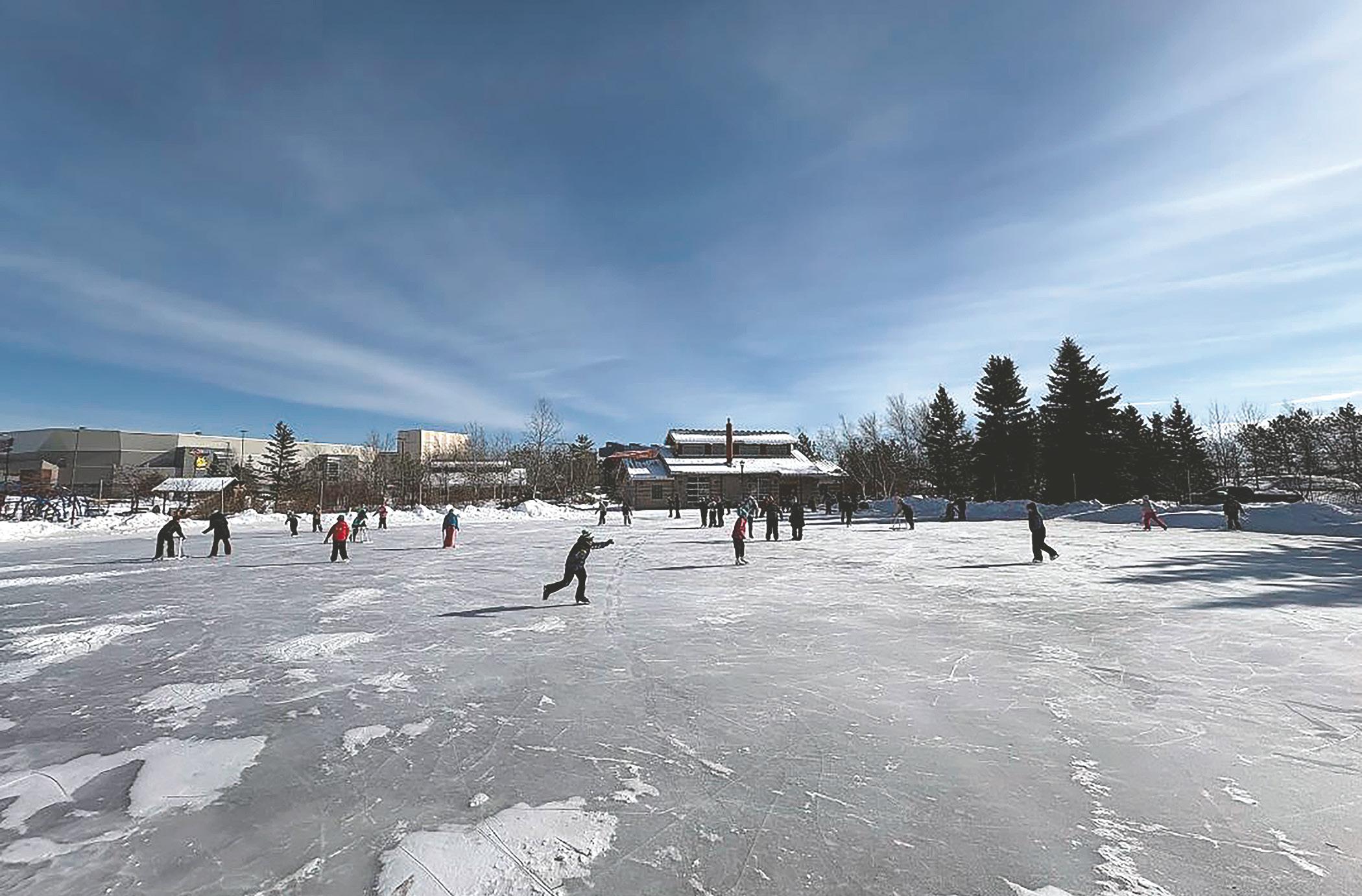
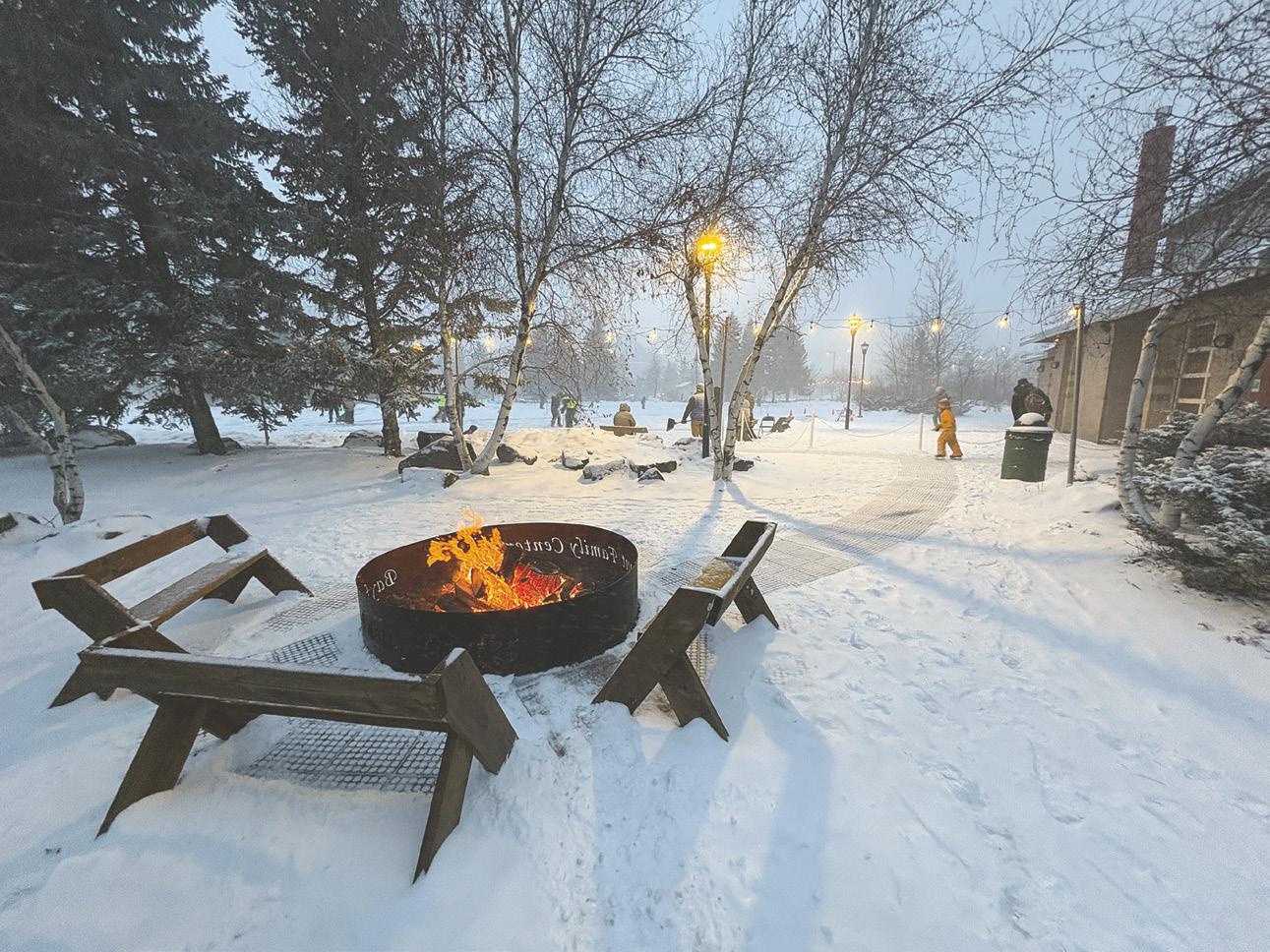
Skaters spread out across the outdoor rink at Bayfront Park in Duluth, with the warming house visible in the background on a clear winter day. | SUBMITTED
Skating the Northland: Outdoor Rinks as Winter Gathering Places
NORTH SHORE
—Across northeastern Minnesota and northwestern Ontario, outdoor ice rinks open as weather allows, operating with varying levels of staffing, programming, and maintenance. Some are designed primarily for hockey, while others emphasize general recreation. Most balance scheduled activities with open skating, adjusting day by day to demand and ice conditions shaped by weather and daylight.
An outdoor fire ring provides warmth at Bayfront. S’mores are offered on Friday nights. | SUBMITTED D rag r aces
scan to register Races start at 10 am 17 Classes: Stock, Improved, Mod, Open & Kids Races!
In some communities, that flexibility leads to unexpected uses. In Ely, for example, rink calendars occasionally include birthday parties, underscoring the role these outdoor spaces play not only as athletic facilities but also as informal gathering places during the long winter months.
DULUTH
In Duluth, outdoor ice rinks operate across the city, from the Lake Superior shoreline to neighborhoods such as Woodland, Piedmont, and Morgan Park. They are supported by a mix of city staff and volunteer hockey associations, including the Duluth Area Hockey Association, creating a network of neighborhood-based skating opportunities.
Duluth Parks and Recreation specialist Adam Fornear said the appeal of skating is rooted in its simplicity.
“For me, it’s that free movement— one push and then you glide,” Fornear said. “It’s that same joy you get when you crank down on a bike pedal and the bike just keeps rolling. It’s efficient, it’s freeing, it’s fun. It feels childlike.”
Some Duluth rinks are designed primarily for hockey, while others em-
phasize open skating, depending on location, staffing, and demand. One of the city’s most visible outdoor skating destinations is the Bayfront rink, which opens seasonally as weather allows.
The Bayfront rink is the city’s only outdoor rink maintained and staffed by the City of Duluth. It includes a warming house open during skating hours and offers a limited number of skates at no cost, helping lower barriers for families and first-time skaters.
Friday nights are designated as S’mores Nights, and all activities at Bayfront are free and open to all ages.
Inside the warming house, families can warm up around tables stocked with board games and basic craft supplies. “It’s a spot for anybody in the community to come and enjoy,” Fornear said. “One parent can stay inside with the little ones and warm up while others skate.”
For more information, visit: bit.ly/ duluthskatingrinks.
TWO HARBORS AND SILVER BAY Farther up the North Shore, recreational skating in Two Harbors is offered at
the Sonju Arena, also known as the Lake County Arena, with ice generally available during late afternoons and evenings.
In nearby Silver Bay, the Rukavina Arena hosts hockey games, tournaments, leagues, and camps throughout the year.
GRAND MARAIS
In Grand Marais, the Cook County Community Center maintains two outdoor ice rinks: a smaller multipurpose rink and a full-size hockey rink. Both may be reserved for programs or events, though staff keep at least one rink available for open skating whenever conditions permit.
Weekly public activities include all-ages pickup broomball and open pickup hockey.
A warming house adjacent to the rinks offers skate rentals, sharpening services, and concessions. The facility closes during periods of extreme cold or active snowstorms. Use of the rinks typically increases after school and on weekends.
Anna Klobuchar, assistant community center manager for Cook County, said the rinks see steady activity throughout the day.
“In the mornings, even before the warming house opens, there are parents with young, preschool children skating, or a couple of advanced skaters warming up their hockey moves or enjoying the ice to themselves,” Klobuchar said.
During the school week, she said, students use the rink during physical education classes, with families and after-school skaters arriving later in the day.
Over the holiday break, Klobuchar said, the rinks draw local residents along with visiting family members and tourists.
To learn more, visit: bit.ly/grandmaraisicerinks.
THUNDER BAY
Thunder Bay has many arena and outdoor skating rinks sprinkled throughout the area, with a robust website. Each listing identifies the address, hours of operation, number of rinks on the site, and if the site is supervised, as well as if the site has outside lighting, washrooms, change facilities, outdoor trash bins, and adjacent parking. For more information, visit: bit.ly/thunderbayskating.
CAJUN SHRIMP REUBEN
CAJUN STYLED GRILLED SHRIMP WITH SAUERKRAUT, 1000 ISLAND, SWISS CHEESE ON TOASTED RYE BREAD CHEESE QUESADILLA W/ CHIPS & PICO
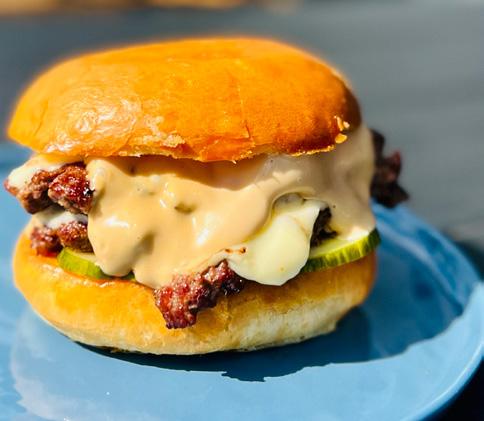
KALEBS SMASH BURGER
THIN CRISPY EDGE HAMBURGER TOPPED W/ CHEDDAR CHEESE, CARAMELIZED ONION, TOMATO, LETTUCE, MAYO, ON A BRIOCHE BUN OVEN-BAKED MAC & CHEESE W/ KIELBASA
JERRY FRESH SANDWICH
HOUSE-MADE HUMMUS, CHIPOTLE MAYO, LETTUCE, TOMATO, OLIVES, CUCUMBER, RED ONION, PICKLES, & SHREDDED CARROTS ON TOASTED RYE BREAD FRENCH ONION GRUYERE GRILLED CHEESE GRUYERE, MOZZERELLA & CARAMELIZED ONION GRILLED CHEESE ON RYE BREAD W/ FRENCH ONION SAVORY BROTH TO DIP
BRUSCHETTA
TOASTED SOURDOUGH TOPPED W/ TOMATO, MOZZARELLA, GOAT CHEESE, FRESH BASIL, OLIVE OIL, & BALSAMIC GLAZE BOWL OF ANY SOUP & CHOICE OF SALAD
DRINK
$2 OFF TAP BEER
$2 OFF BLOODY MARYS
$2 OFF RAIL DRINKS
*WITH PURCHASE OF MEAL
*LOCAL DISCOUNTS DO NOT APPLY
Tbaytel, formerly the Thunder Bay Telephone Company, has partnered with Fort William First Nation, the Municipality of Oliver Paipoonge, and the City of Thunder Bay to provide the community with a service that allows fans to watch their favorite athletes on the ice from virtually anywhere, on any device. A live camera feed can be found online.
IRON RANGE
On the Iron Range, communities such as Virginia, Hibbing, and Chisholm maintain multiple outdoor rinks each winter.
Across the Northland, outdoor ice rinks continue to offer a simple way to stay active and connected during the long winter months.— Naomi Yaeger
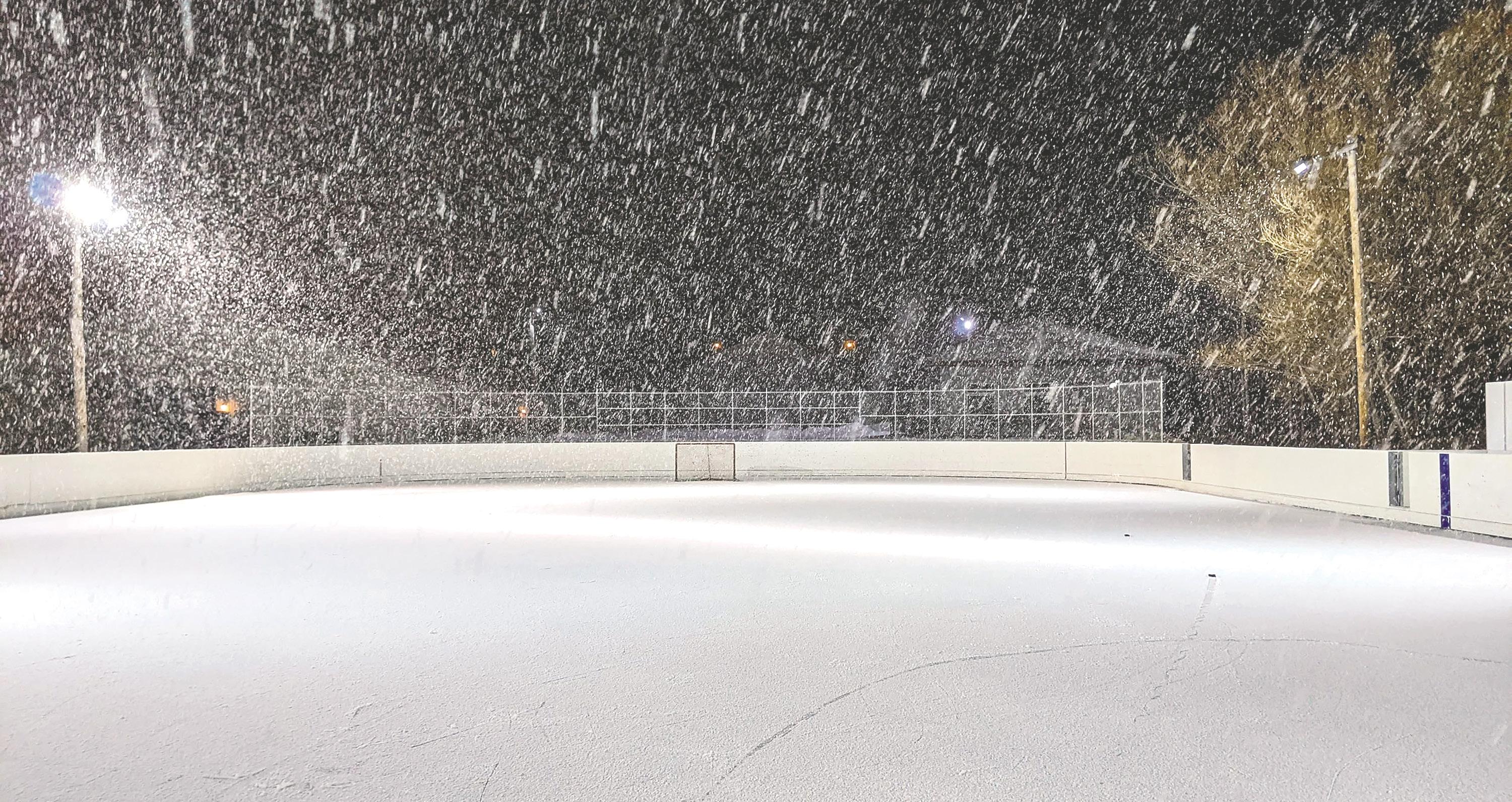
Snow falls on a lighted outdoor hockey rink during nighttime skating in Cook County. | SUBMITTED
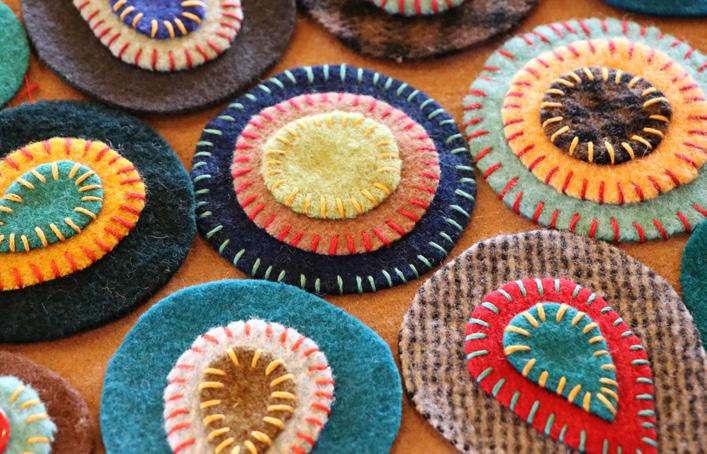
Woven Together: The Northwoods Fiber Guild and the Human Need to Create
GRAND MARAIS—“Fiber is necessary,” said Marlys Johnson, past president of the Northwoods Fiber Guild. “The practice of working with fiber is so old. It was necessary to live. It was necessary to clothe yourself. It was necessary to stay warm. It may not be technically necessary anymore, but the drive to create something with your hands is still there.”
That belief, that fiber meets a deep human need, has guided the guild since its founding in 1988. For nearly four decades, the guild has brought together people working in weaving, felting, spinning, stitching, papermaking, dyeing, and related forms. What unites those practices is not a single technique, but a shared understanding that making by hand creates connection, reflection, and community.
“Fiber brings people together,” Johnson said.
That focus will be on display in the guild’s upcoming exhibition at the Johnson Heritage Post Art Gallery in Grand Marais. Opening January 30, the exhibit highlights the range of fiber work being done across Cook County, with a particular focus on a collective project called the Hope Chair. The guild will also host a show and share at North House Folk School on Saturday, February 15 at 7 p.m., an opportunity for participants and instructors from NHFS Fiber Week to showcase past and current projects.
The Northwoods Fiber Guild currently has between 40 and 50 members, including a few from Thunder Bay. Members meet bimonthly at The Hub, which also houses the guild’s library and historical records. Study groups meet regularly, sometimes once a month and sometimes twice, focusing on felting, weaving, spinning, papermaking, and needlework.
“There’s a really wide range of techniques that are pursued,” Johnson said. “You can’t just say someone is a weaver. It’s always, ‘What kind of weaving are you doing?’”
The guild’s work often extends beyond meetings and study groups into partnerships with other community organizations. A long-standing relationship with North House Folk School includes hands-on family activities during the Wooden Boat Show, open houses during Fiber Week, and volunteer support for classes. Several guild members teach at North House, while others assist with children’s programs.
“People love to share their interests and their skills,” Johnson said. “That’s a real core part of the guild.”
That generosity also shows up in public art and service projects. When North House renovated its Yellow Building, the school asked the guild to help soften the visual impact of construction fencing. Guild members responded by weaving directly onto the fences throughout the summer.
“I was down there weaving several evenings,” Johnson said. “It was fun to have people walking by who just wanted to chat. Everybody had their favorite parts.”
The guild has also made reusable fiber bags for the Cook County Public Library, providing an alternative to plastic or paper. “The library lets us know when they’re getting short, and then we make more,” Johnson said. “That’s been going on for many years.”
One of the guild’s most memorable projects was the Felted Forest, an outdoor installation of felted animals and plants placed in the small forest to the south of Sawtooth Elementary School. Created by the guild’s felting group, the project evolved over time and became a favorite for families and school groups.
guild currently has between 40 and 50 members. | SUBMITTED
“We started with a few creations and kept adding,” Johnson said. “Kids loved discovering things.” The work even interacted with wildlife. “Someone actually saw a fox with a felted animal in its mouth,” she said.
The Hope Chair, which will be a centerpiece of the guild’s upcoming JHP show, grew from that same spirit of shared making. The idea emerged after guild member Cheryl Larsen presented a program about the Dream Chair, a South African project that invited people living with AIDS to bead their hopes for the future onto a chair as part of a collective artwork.
“I was in the audience listening and thought, ‘Wouldn’t that be fun to do something like that here?’” Johnson said. “It was February 2025. We were just entering a really chaotic period, and it was hard to stay focused or hopeful.”
The guild invited members and community participants to contribute fiber pieces reflecting hope, with minimal restrictions. “We didn’t want to limit it to squares or to one kind of fiber,” Johnson said. “We wanted it to include all fiber arts.”
At first, submissions were slow. To make the idea tangible, Johnson purchased a chair from Oddz & Endz for the guild’s December open house at Studio 21. “Once people could see it, it clicked,” she said. As of now, 24 people have contributed pieces that will come together as the chair’s upholstery.
traditional craft on the shores of Lake Superior
“It’s interesting to see how many different kinds of pieces come together,” Johnson said. “It reflects how we can work together if we’re paying attention and listening. There’s patience involved, and persistence.”
Each contributor is also asked to submit a journal entry describing what they were thinking while working. The journal will accompany the chair during the exhibition, and the long-term goal is for the chair to travel throughout the community and the county. “People could sit in it for a while and maybe write something themselves,” Johnson said.
The guild operates with a small budget and a strong volunteer ethic. Membership is $25 per year, with options for those who need assistance. The only fundraiser is the December open house and sale, and the guild also offers scholarships for classes, asking recipients to give back simply by sharing what they learned.
For many members, fiber remains both practical and deeply personal. “As you’re creating, you’re also thinking,” Johnson said. “It’s a meditative experience. It’s regulating. It requires discipline and organization.”
That quality, she added, helps explain why fiber has endured for thousands of years. “Now it’s necessary in a different way. Making something with your hands, putting yourself into it, and then using it or giving it away, that’s what makes it special.”
Anne Graybeal
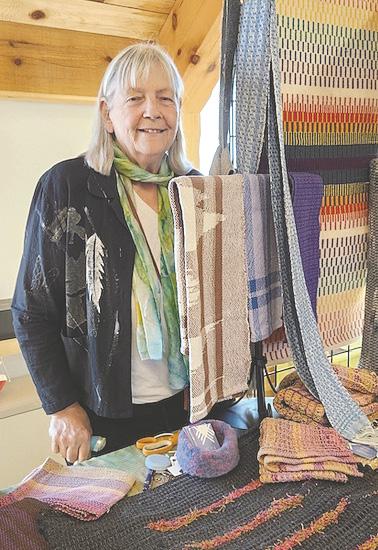
Northwoods Fiber Guild member Julie Arthur. | SUBMITTED
The
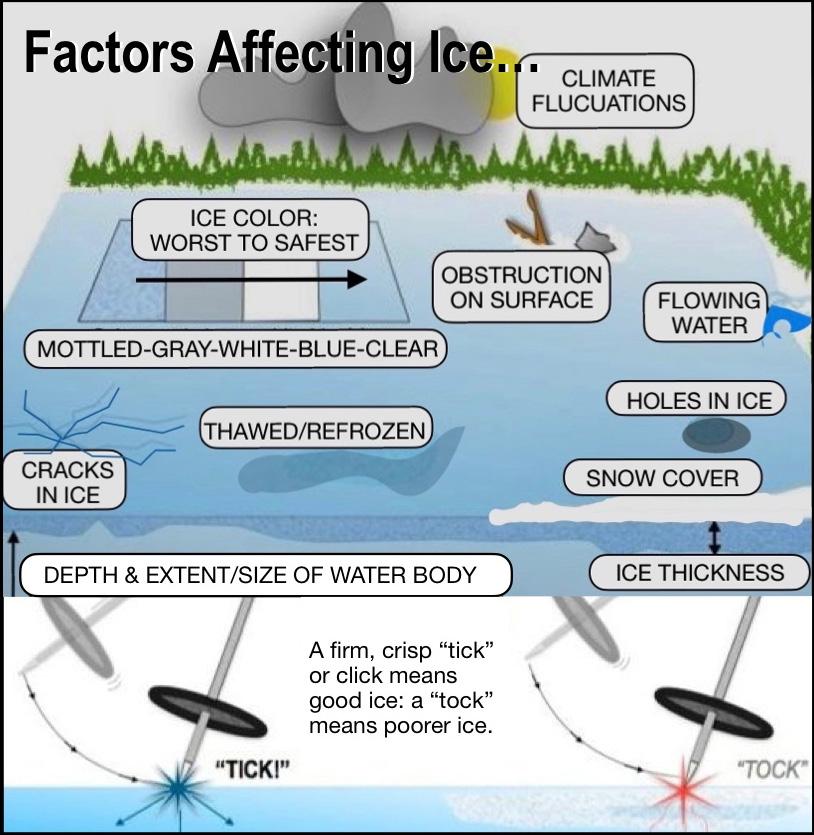
Remember, ice is never 100 percent safe, and the qualities of ice can vary within just a few feet. | TOM WATSON
Self-Rescue: What To Do If You Fall Through Ice
NORTH SHORE—The cardinal rule for any and all activity on frozen lakes or streams is: “Ice is never 100 percent safe.” The qualities of ice can vary within just a few feet. The sudden collapse of what may seem like a good, solid surface can happen in an instant. Quick thinking and a sequence of self-rescue maneuvers can help minimize the physical and mental shock of plunging into freezing water.
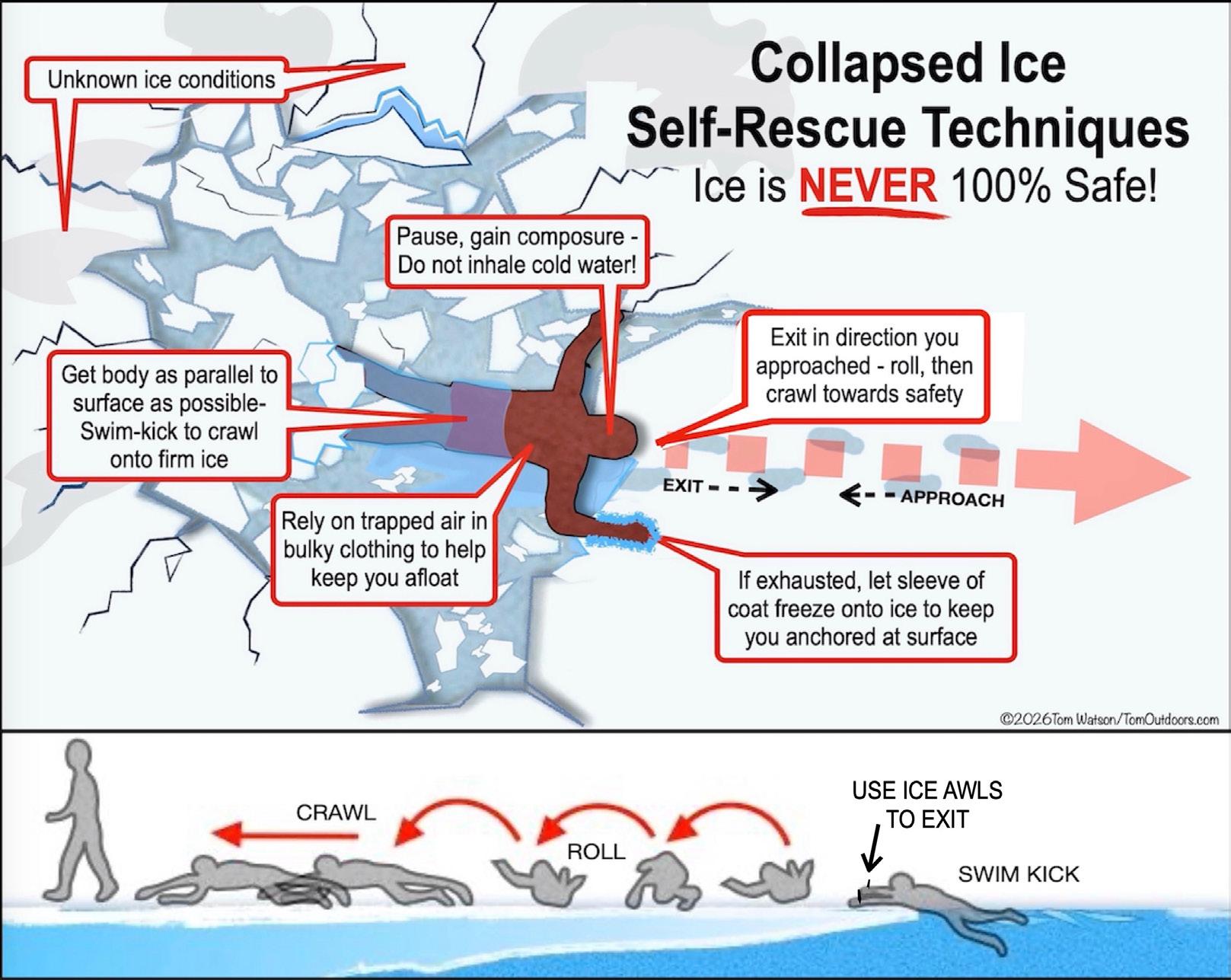
There are three critical stages of self-rescue after falling through ice. Designated as the 1-10-1 Rule, the first stage is perhaps the most critical. It’s the initial chilling, body-shocking response to being submerged in ice-cold water. A victim has a tendency to frantically tread water while gasping for air or inadvertently swallowing ice-cold water. As hard as it may seem, it’s best to use the first minute (the first “1” in the rule) to concentrate on staying calm, pausing, and collecting your thoughts. The human body can function for about 10 minutes (the second stage, “10” in the rule) before
muscles succumb to the cold. It’s during this stage that quick, focused action can enable you to initiate a self-rescue by regaining your composure.
Hypothermia doesn’t set in immediately. The last “1” in the rule indicates the number of hours a person can survive before becoming hypothermic.
STEPS FOR SELF-RESCUE AFTER FALLING THROUGH ICE
1. Once calm, face the direction from which you were coming when the ice gave way. You know that route is safe having just traversed it. You have no way of knowing how good or bad the ice is beyond the spot where you fell in.
2. Leave heavier clothing on, as any trapped air will provide some buoyancy. Avoid carrying any protruding accessories or small fanny packs on your front side, as they can catch on the ice edge and prevent you from sliding back up onto the surface.
3. Position your body as parallel to the
surface as possible, rather than hanging vertically as if trying to do a pull-up to get out of the hole.
4. Kick with your feet and legs like you are swimming, thrusting yourself upward and forward to get back onto solid ice.
5. Carry ice awls or picks and use them to help grab the ice and pull yourself forward as you kick.
6. Always try to keep your arms and sleeves out and up on the ice at all times. In a worst-case scenario or failed self-rescue due to fatigue, your coat or sleeve can freeze to the ice, helping hold you partway out of the frigid water, should you become unconscious or physically incapacitated. This also aids rescuers in locating you if you slip below the surface.
7. Once your body is fully on the ice, start rolling slowly but steadily along the surface away from the hole.
8. After a few yards, if the ice appears solid, carefully rise to a crawling position and continue on your hands and knees in
a safe direction—back from where you first came—toward safety.
9. Gradually rise to your feet and seek warmth and shelter immediately.
10. If you are aiding in a rescue of a victim, approach carefully by crawling close enough to extend a branch, pole, rope, or other object they can grab. In some cases, offering a looped rope (often tied using a bowline knot) can be fitted over the victim’s shoulders or upper torso to secure or retrieve them back onto the ice and away from further dangers. Avoid making direct contact, as a panicked victim may unintentionally pull you in while attempting to climb on top of you.
Whether you’re cross-country skiing, snowshoeing, skating, or simply enjoying the quiet solitude of a walk along a frozen pond, always consider and respect the multiple characteristics of ice. Be prepared, remember the 1-10-1 Rule, and be aware of its sometimes deceiving Jekyll-and-Hyde personality.—Tom Watson
Explore the Forests of the North Shore
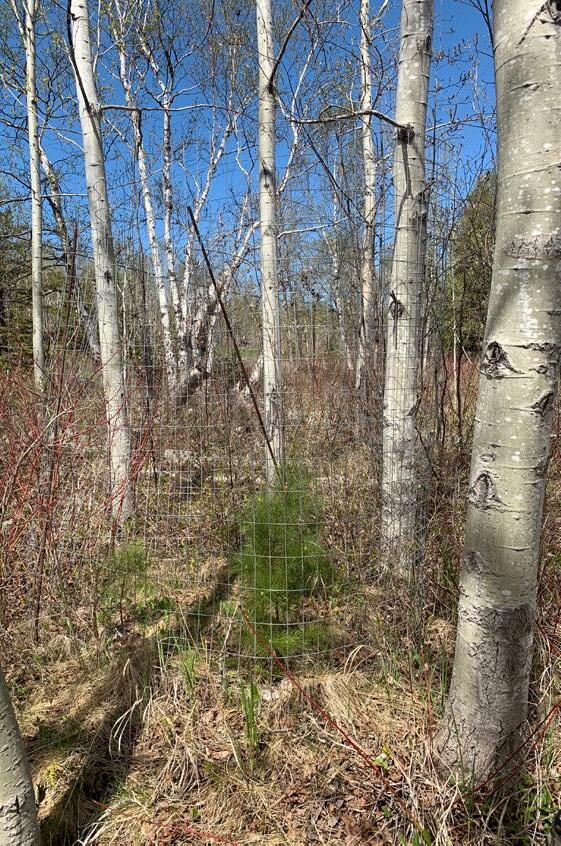
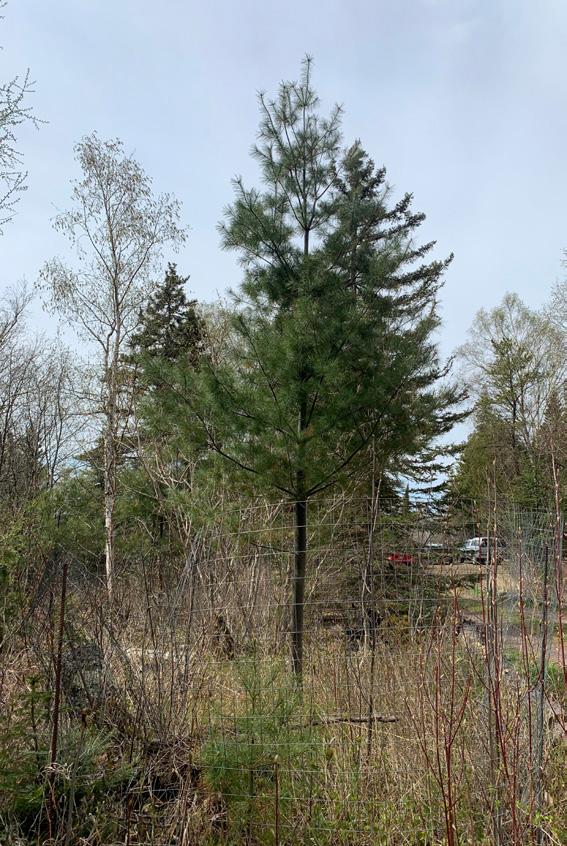
The North Shore Forest Collaborative’s annual Discounted Fencing Program, funded through the Weekes Family Foundation, helps landowners protect young trees from deer browse and support healthy forest regeneration. Reduced-cost fencing is available for qualifying properties within 3-5 miles of Lake Superior, beginning in mid-February.
Learn more and apply at northshoreforest.org. Join the NSFC mailing list to be notified immediately when the sale begins.
The North Shore Forest Collaborative developed
Discover our new educational materials highlighting the coastal forest communities of the North Shore and the tree species that define them. Designed for landowners, educators, and forest enthusiasts, these resources deepen understanding of how trees, shrubs, and groundcover species create the ecosystems that support wildlife and water quality across the North Shore.
Available at northshoreforest.org
Snow and Solidarity The Black Woods Blizzard Tour Rides for ALS
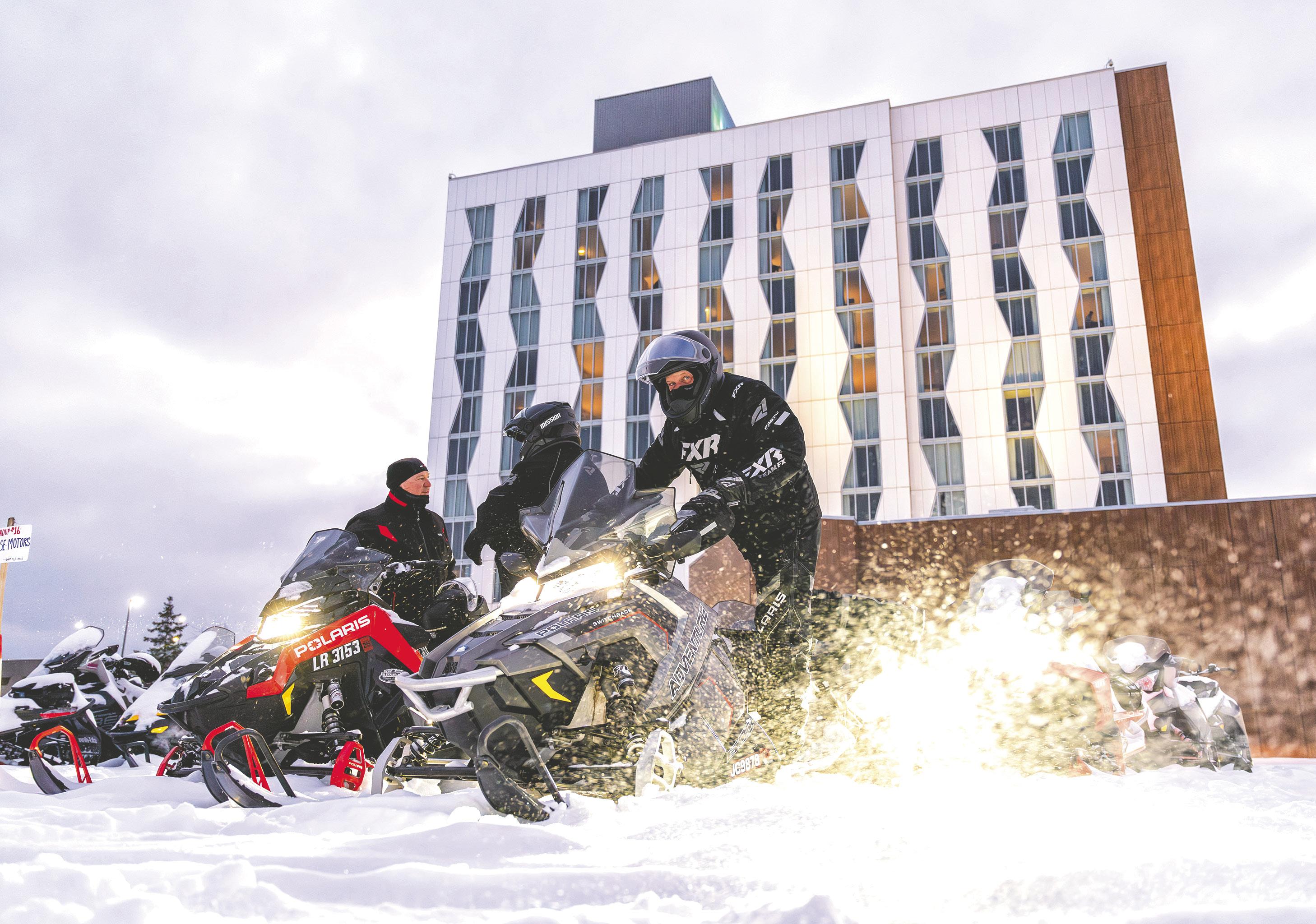
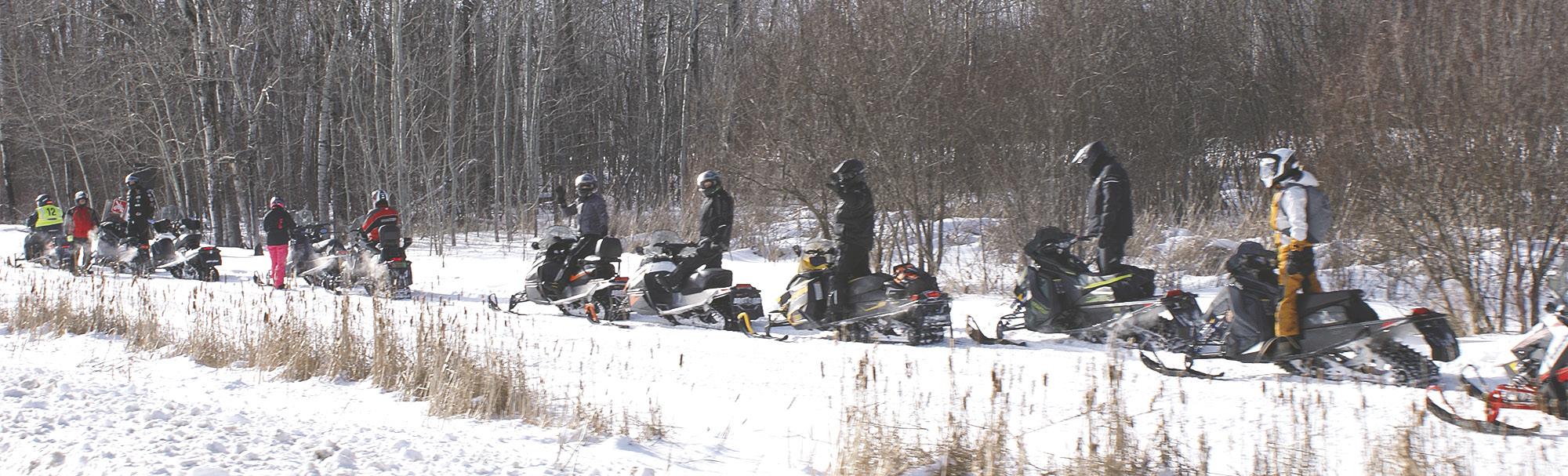
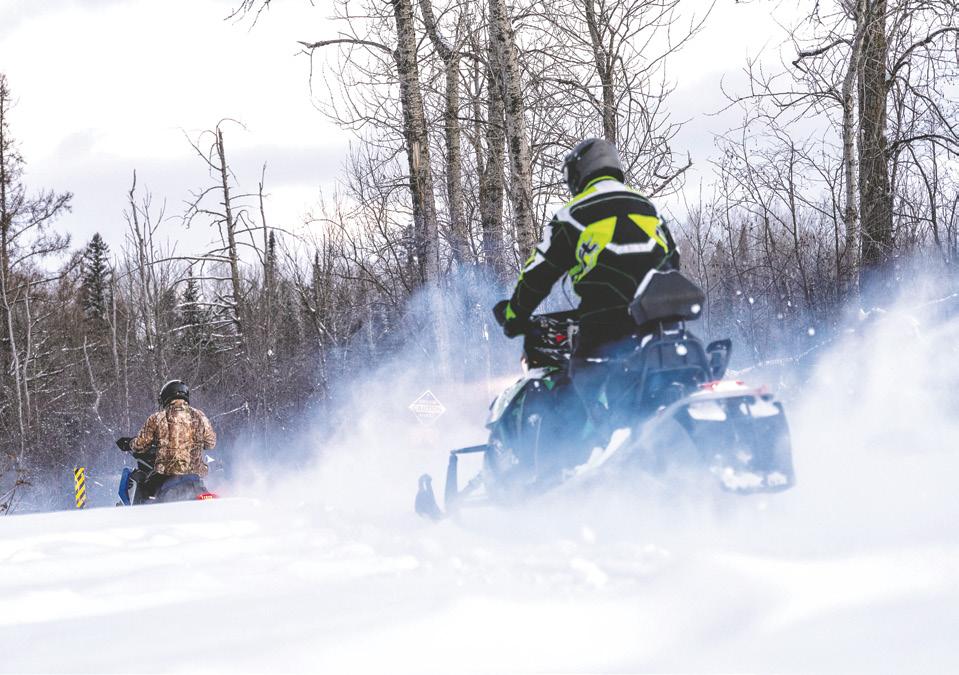
NORTH SHORE—The rip and buzz of snowmobiles reverberates across the Northland’s frozen lakes and wooded trails every winter as people traverse the snowy countryside. Each February, that sound signals more than an epic ride—it represents a compassionate, united community. The annual Black Woods Blizzard Tour invites riders to come together to fight a disease affecting families locally and around the world.
The Blizzard Tour is the signature winter fundraising event of Never Surrender Inc., a Minnesota-based nonprofit that has been supporting people living with Amyotrophic Lateral Sclerosis (ALS) for more than three decades. ALS, formerly known as Lou Gehrig’s disease, is a progressive neurodegenerative condition that affects nerve cells in the brain and spinal cord, eventually robbing people of their ability to move, speak, and breathe. There is currently no cure, and fundraising is essential to support patient services, research, and advocacy.
A fishing tournament in 1994 (now known as the Kolar Toyota ALS Fishing Tournament) was the first fundraiser started by Never Surrender Inc., and the snowmobile tour followed a few years later.
“The Black Woods Blizzard Tour started after four avid sledders rode their snowmobiles around Lake Superior in 1999 and raised awareness for local friends who had recently been diagnosed with ALS,” says Lisa Erikson, executive director of Never Surrender Inc. Randy Bannor, Larry Bannor, Greg Sorenson, and Dennis Nelson received $15,000 in monetary contributions toward the cause. Before the following winter, local businessmen collaborated and created the Black Woods Blizzard Tour, where 38 riders raised $46,000 their first year.
“Our participants are local snowmobile enthusiasts as well as riders from across the state who simply enjoy riding and raising funds for a really great cause,” Erikson says. This year is the 27th anniversary of the Blizzard Tour, and riders have raised more than $1
million annually to support the fight against ALS since 2020. What started as a grassroots ride has grown into the single largest snowmobile fundraising event in the world.
“Riders are equipped with fundraising tools to help them raise the money to participate, by selling raffles, collecting cash donations, and holding events,” Erikson explains.
“We have a lot of riders who host events in their hometowns which raises awareness and funds at the same time.”
Behind the scenes, the Blizzard Tour is a collaborative effort even in the off-season.
“A lot of dedicated volunteers and a few staff members working year-round plan this event,” Erikson says. A volunteer board spanning from Duluth to the Twin Cities meets monthly under the direction of board president David Kolquist. “We are lucky to have a returning crew of volunteers year after year that become a part of the Black Woods Blizzard Tour family.”
Financial support is also essential. “Never Surrender Inc. accepts monetary dona-
tions in addition to in-kind donations, which offset event expenses or add cash through our silent and live auctions,” Erikson says.
“None of this would be possible without the kind financial donations from businesses and donors across the state and region.”
For riders, the experience is choreographed and memorable. “We have red carpet service from check-in to departure,” Erikson proclaims. The structured itinerary begins with check-in on Wednesday night, Feb. 11, and concludes with a celebration dinner and final fundraising presentation on Saturday, Feb. 14.
Riders depart Thursday morning from Black Bear Casino Resort in Carlton, head-
The Black Woods Blizzard Tour is a snowmobile ride and fundraiser, supporting people living with ALS. | SUBMITTED
ing north to Fortune Bay Resort Casino in Tower for an evening program and dinner. Friday’s ride leads participants to Superior Shores Resort on Lake Superior. “This is a fan favorite where they enjoy a great night of camaraderie and food at the Black Woods Bar and Grill location in Two Harbors,” Erikson mentions. On Saturday, riders return to Black Bear Casino Resort for a final meal and program to cap the unforgettable weekend.
“We want to give a final shout-out to all the trail clubs and groomers who work tirelessly to keep the trails safe and groomed,” Erikson says. “Without their support, this event would not be possible.”
The Black Woods Blizzard Tour represents a community united by hope and determination during some of the harshest conditions. As the tour’s motto, the message is clear ’never surrender.’
You don’t need a snowmobile to get involved supporters can donate, volunteer, become sponsors, buy raffle tickets, or simply cheer riders on. To learn more about the Black Woods Blizzard Tour and other Never Surrender Inc. events, including how to donate, visit www.neversurrenderinc.org or email info@ neversurrenderink.org.— Dana Johnson
Get Included in the 2026 Cook County Map and
Help Visitors Find You!
Unrivaled Distribution
20,000+ maps are distributed along the North Shore from Duluth to the Canadian Border.
Full Color, Detailed County Map
Includes all roads and major lakes in Cook County, including the Gunflint Trail and the Boundary Waters.
Grand Marais Street Map
The reverse side has a map of Grand Marais showing attractions and advertising businesses.
Business and Service Directory
Our directory lists your address, phone number and website or email, and denotes the location of your ad and business on the map.
Prepay Deadline: Feb 16th
This year is the 27th anniversary of the Blizzard Tour, and riders have raised more than $1 million annually to support the fight against ALS since 2020. | SUBMITTED
This year’s Black Woods Blizzard Tour will take place Feb. 11-14, and include a stop in Two Harbors. | SUBMITTED
Life on Ice Learning to Climb Frozen Flows
By Chris Pascone
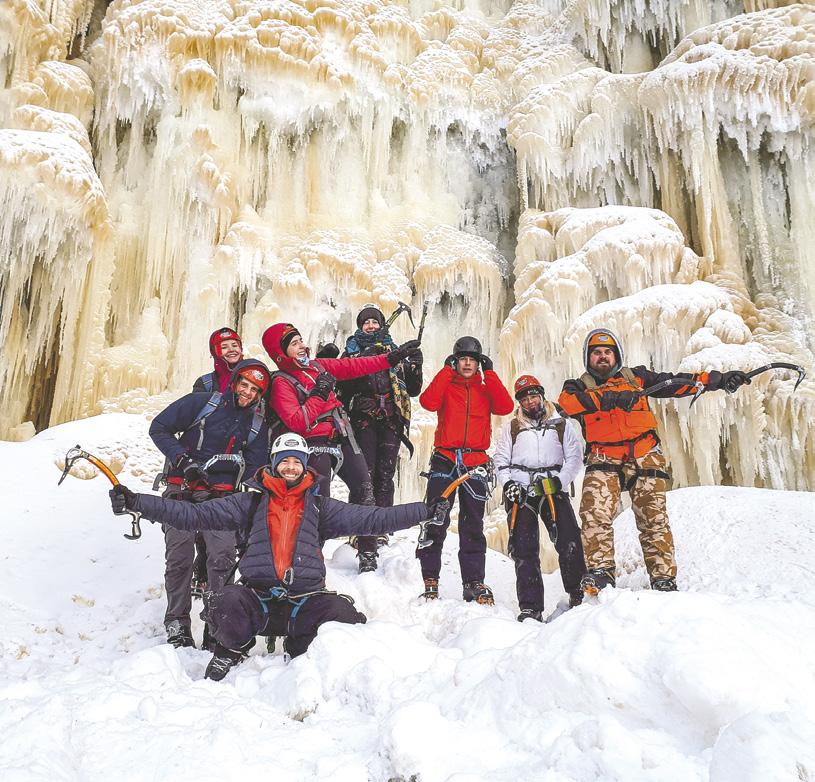
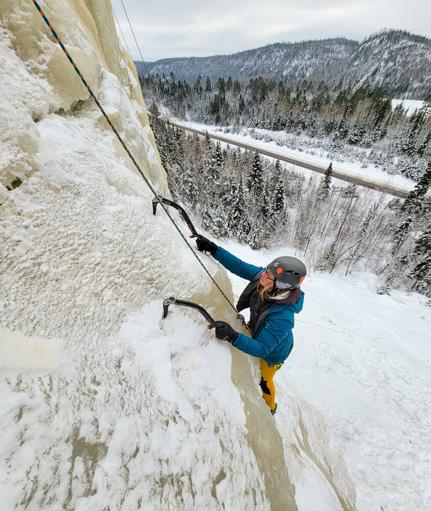
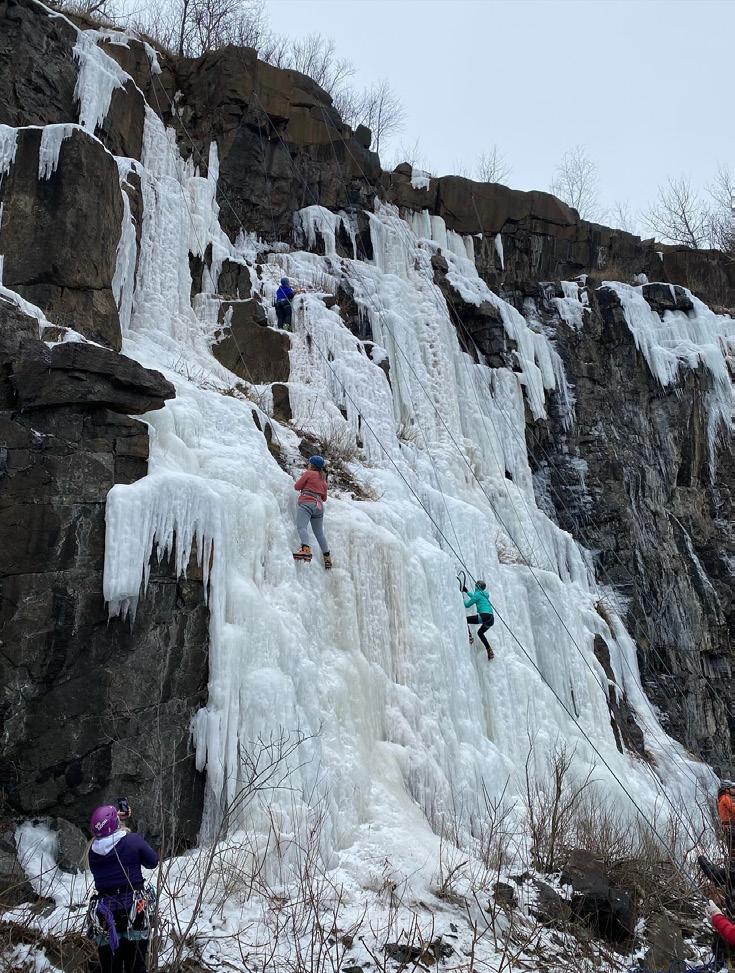
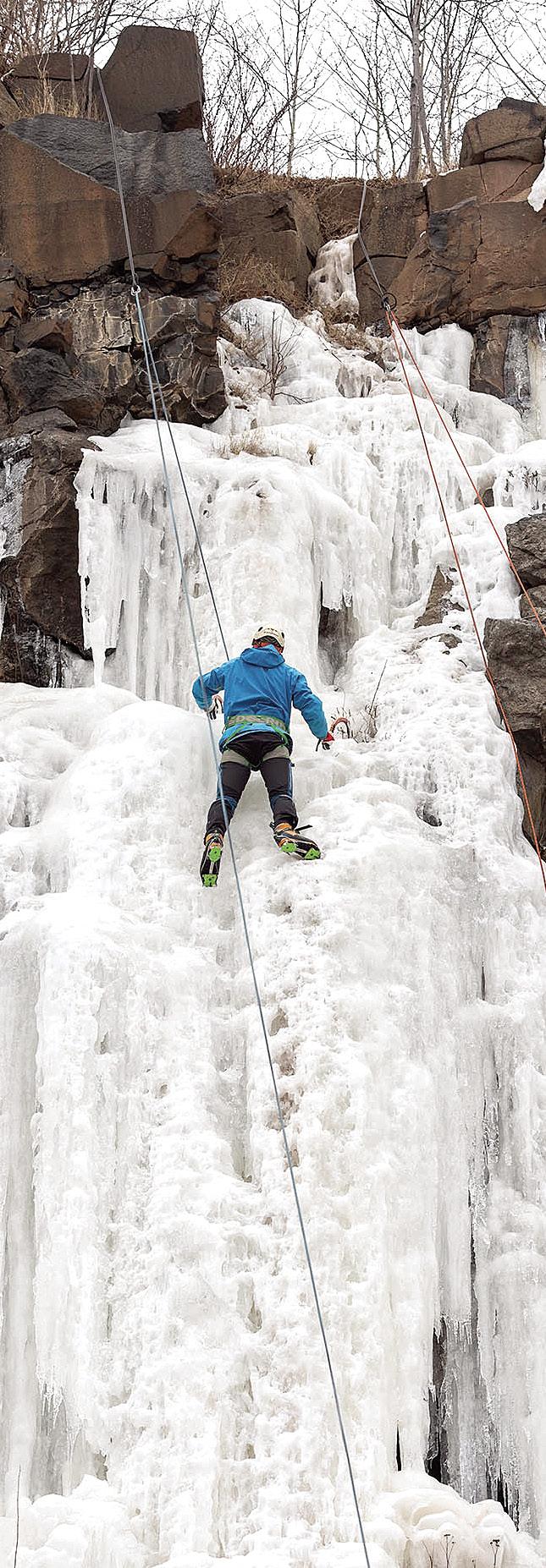
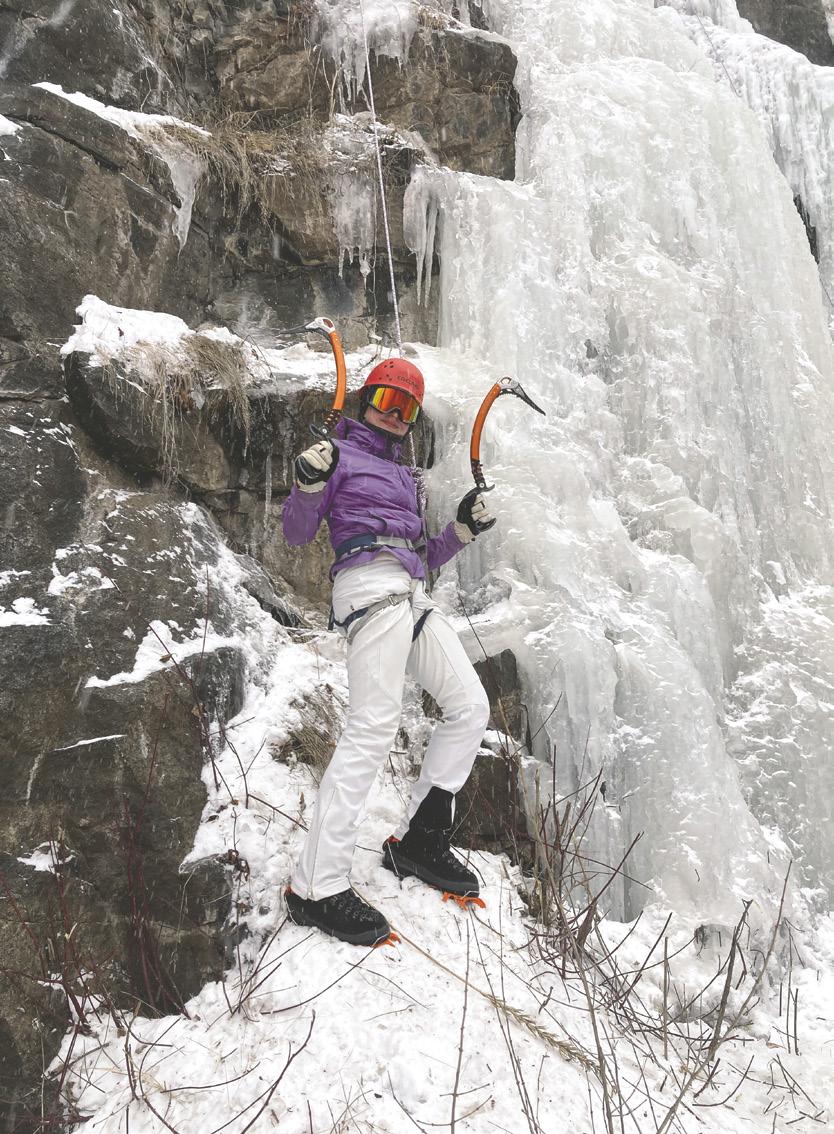
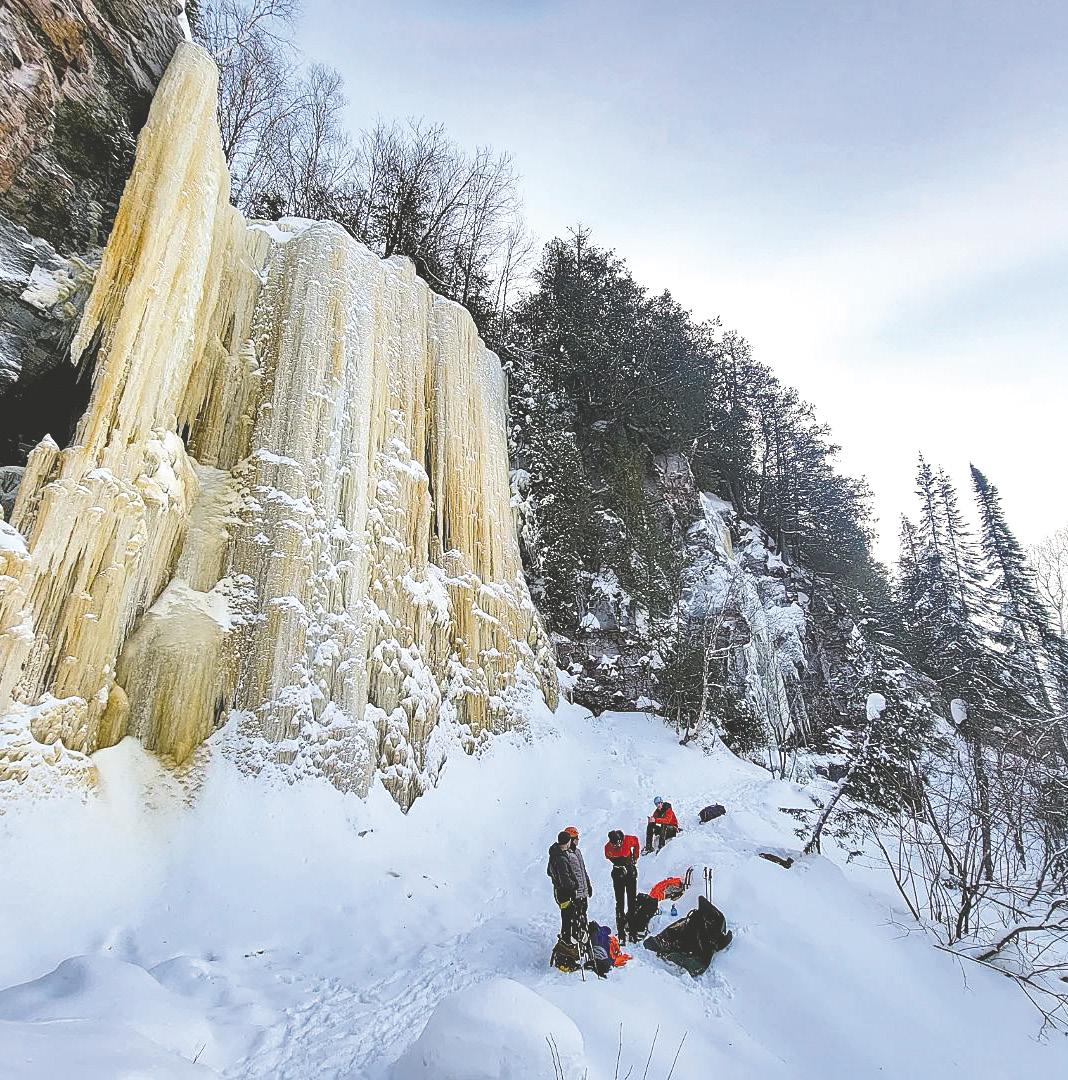
Chip-chip, tap-tap, whack-whack. These are the sounds of ice climbers using crampons and ice axes to probe their way up frozen flows. These ice tools hold a climber’s feet and arms on precarious pillars of ice by digging in and catching an edge for climbers to leverage. If becoming ice Spider-Man sounds attractive, there are two fantastic climbing opportunities awaiting you this winter in the Northern Wilds. First up, Duluth Ice and Mixed Fest is being held February 6-7 in Duluth’s Quarry Park. Secondly, Nipigon Ice Fest is taking place March 6-8 on the Orient Bay and Kama Bay cliffs of Ontario’s Lake Nipigon region. Here’s how and why to tap into these two events, whether you just want to watch this extreme pursuit up close, or your inner snow leopard is telling you to go scale that icy cliff yourself.
Duluth Farms Ice
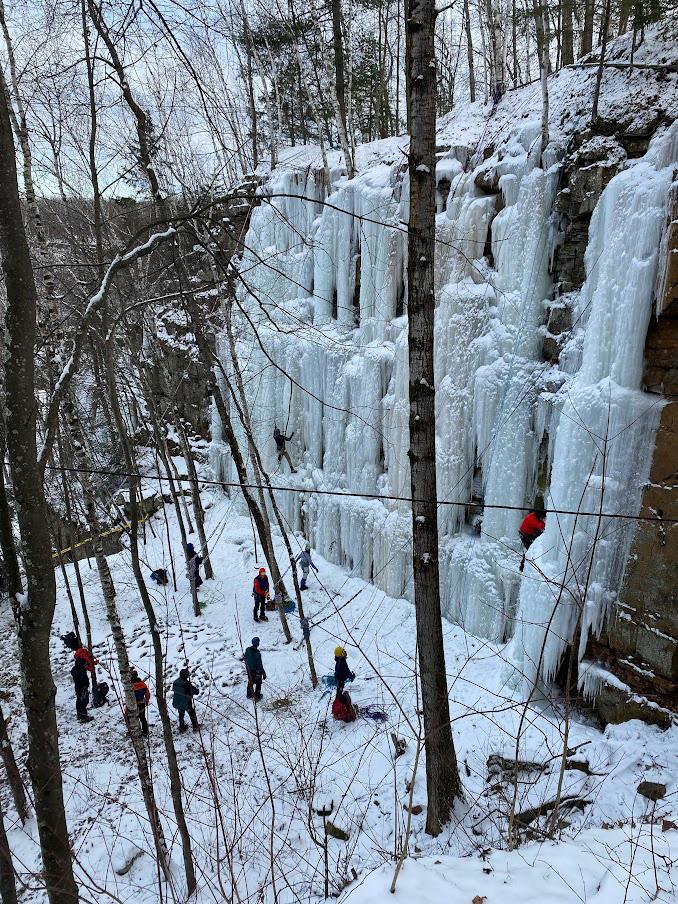
Duluth Ice and Mixed Fest is celebrating its 10 th anniversary in 2026. The Duluth Climbers Coalition (DCC) hosts the event, and its aim is to get newcomers into ice climbing, while also providing peak ice conditions for climbers of all levels, thereby creating a community space for climbers to share techniques and learn from each other.
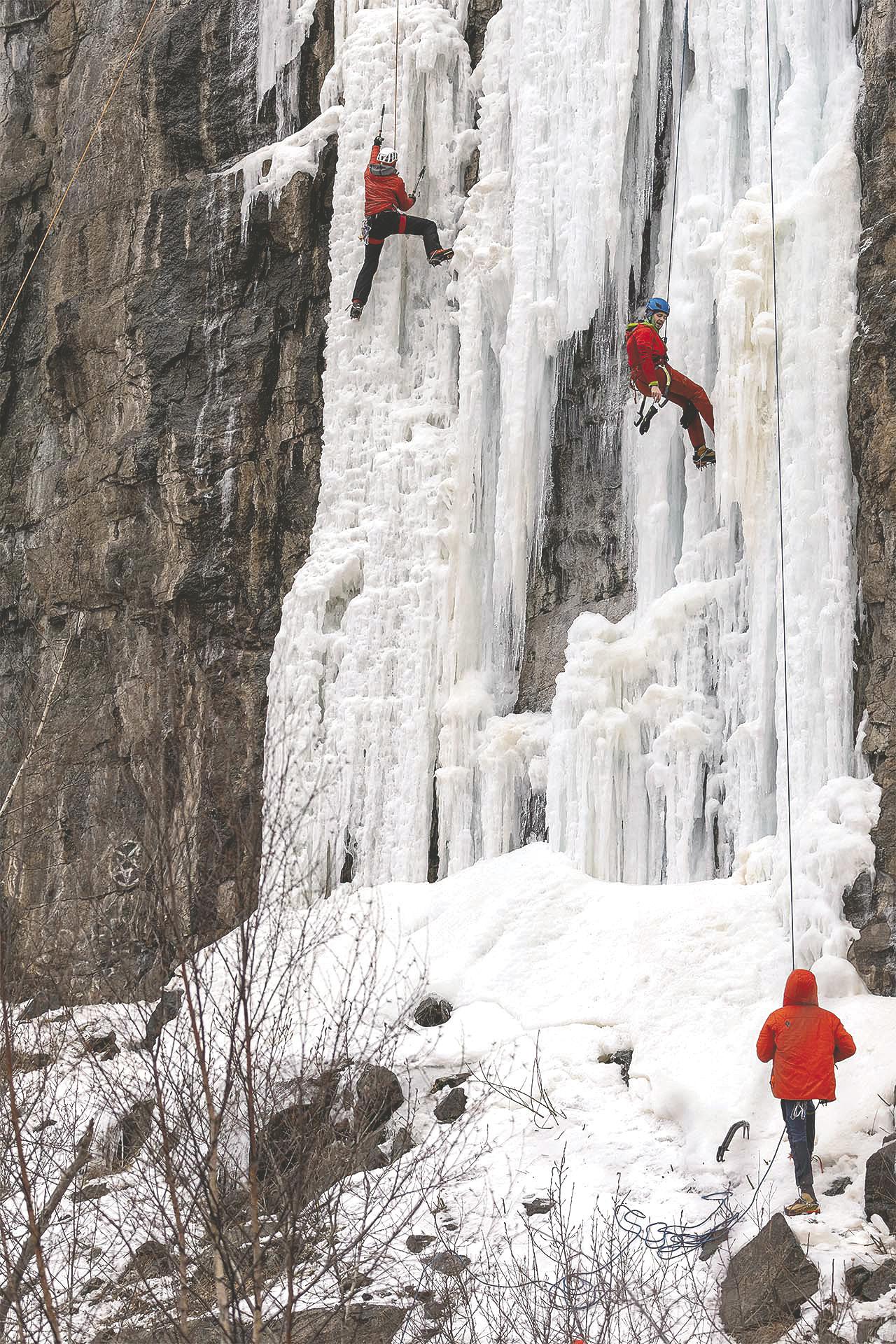
Duluth Ice and Mixed Fest features climbing clinics for people who want to try ascending ice but don’t own their own harnesses, crampons, ice axes, or ropes. Clinic attendees pay $85 for a three-hour session, with all necessary equipment included, and learn to climb with professional guides. DCC partners with Midwest Mountain Guides to conduct the clinics, thereby insuring top-level instruction and organized climbing processes for newbies. Beginners get a how-to lesson on using ice tools to start, then learn climbing motions, and finally try climbing real ice while being belayed by an instructor. The “mixed” part of the event name refers to climbing a combination of both frozen water and hard rock, all on the same climb.
DCC doesn’t only prioritize newcomers. Quarry Park is DCC’s pride and joy, and experienced climbers from around the region come to climb the quarry’s unique ice flows. “We have a few less clinics this
Duluth Ice and Mixed Fest features climbing clinics for people who want to try ascending ice but don’t own their own gear. | CHRIS PASCONE
year,” explains DCC board member Adam Fornear, “because we want there to be ice available for climbers who aren’t taking clinics too. We want to give people a taste of climbing, but we also don’t want to monopolize all the good climbs and ice for the clinics only. We want the whole ice climbing community to come together for a great day in Quarry Park.” Open climbing is available throughout the event alongside structured clinics with guides.
Quarry Park is not your average city park; the DCC has installed an ice-farming system here. Ice farming means pumping water to the top of the quarry, then dripping it back down during periods
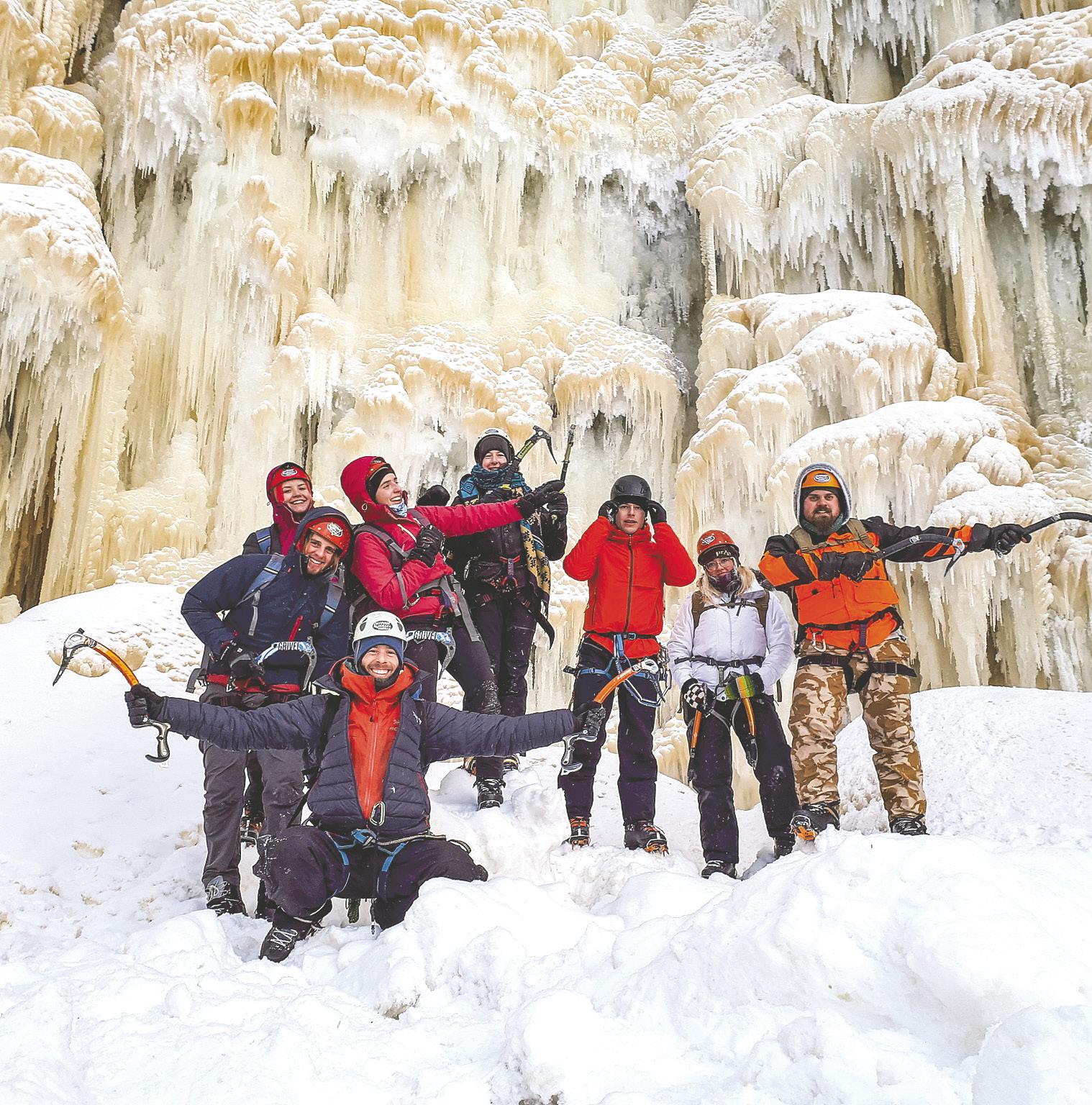
Held March 6-8, the Nipigon Ice Fest is a fantastic way for people to come together as a climbing community.
| ARIC FISHMAN: OUTDOOR SKILLS AND THRILLS
of freezing temperatures to create dramatic ice flows. This “farmed” ice can compensate for a lack of natural water seepage coming through the quarry walls in dry winters. Natural ice occurs at the quarry when excess water builds up within the rock, then seeps out. When dry falls precede winter, such as in the last two seasons, groundwater doesn’t saturate the rock enough for excess water to be released. In this instance, DCC can give Mother Nature a boost by dripping water down the best climbing locations with its pump system.
Spectators are also encouraged to come join the fun at Quarry Park. Acrobatic climbers scaling turquoise towers make for quite a show, and for good photography. Fornear recommends coming out even if you’re not going to climb. “For one, it’s a beautiful setting. We’re in an urban park, but you feel like you’re somewhere remote. You’re surrounded by frozen waterfalls and black rock, with white snow for contrast. We’ll have a campfire going, hot coffee donated by Duluth Coffee Company, crispy bacon, and other hot treats. You can walk a loop through the park and see all the climbing action up close, or hang out by the fire,” Fornear explains. Quarry Park is located in West Duluth at 1325 N. 59th Ave. W.
Finally, after the climbing is done on Saturday the 7th, there will be an afterparty at the American Legion at 5814 Grand Ave. from 6-9 p.m., with social time, speakers, pizza, and drinks. Tickets are $20, and come with a raffle ticket for gear prizes. You can also buy an “arm’s length” of raffle tickets, which Fornear promises will be measured off “by climbers 6 feet or taller.” The afterparty is a fundraiser for DCC, which uses the proceeds to help offset its hefty water bills from ice farming. For more information, check out the Duluth Climbers Coalition website at: duluthclimbers.org.
Dramatic Climbs
North of Nipigon
Nipigon Ice Fest is Canada’s longest-running ice climbing festival. Going on its 40 th year in 2026, the Ice Fest takes place at Orient Bay—a long stretch of cliffs north of Nipigon. While the “bay” is technically part of Lake Nipigon, it’s the climbing that steals the show here. “There are big hills and cliffs along this stretch of Highway 11,” explains Aric
Duluth Ice and Mixed Fest is celebrating its 10th anniversary this year, held February 6-7.
| KATHLEEN WOLLEAT
Fishman, director of Nipigon Ice Fest. The cliffs overlook a number of lakes and rivers between Lake Nipigon and Lake Superior. “It’s super gorgeous,” says Fishman. The Orient Bay cliffs are designated as a conservation reserve. Climbing is permitted as one of the activities on the reserve. Another climbing location for the festival is Kama
Bay, also in its own conservation reserve 20 minutes east of Nipigon.
Aric Fishman owns Outdoor Skills And Thrills guiding company (based out of Thunder Bay), which is both a sponsor of Nipigon Ice Fest and the event host. All of the climbing clinics at the festival are run by Fishman and his team on a volunteer basis. “We have a bunch of instructors and experienced climbers within the community who help. All of the climbing clinics are run through Outdoor Skills And Thrills,” says Fishman.
Nipigon Ice Fest is a fantastic way for people to come together as a climbing community. People of all skill levels can find ice climbs they can enjoy at Ice Fest. Clinics range from beginner to intermediate to expert. If you’ve never ice climbed, and want to see what it’s all about, this is your chance. “It’s all about everyone playing outside together,” says Fishman. “It’s kind of a reunion spot where people come from all over every year to climb together.”
Like in Duluth, there’s also an afterparty in the evening in Nipigon with presentations and games where people can win prizes and have a good time together. The afterparty takes place in the big hall at the Royal Canadian Legion in Nipigon Township.
Some of the climbs at Orient Bay are all-out waterfalls in the summer. These falls turn to ice in arctic temperatures. Fishman has been organizing Nipigon Ice Fest for 15 years now, and takes pride in the exquisite climbs and adventures that Nipigon Ice Fest presents. “It’s absolutely world-class ice,” says Fishman. “It’s a top destination in the world for ice climbing. It’s an amazing place to come and have fun.”
To attend a Nipigon Ice Fest climbing clinic, register beforehand at: outdoorskillsandthrills.com/nipigonicefest. Registration is limited and opens February 1 at 9 a.m. Clinic registration costs $50 CAD, and equipment rentals are provided for an additional $50 per person from Outdoor Skills And Thrills and The Wilderness Supply in Thunder Bay.
Some sports are so extreme, it’s not worth owning all your own equipment just to go once a year. “To go heli-skiing, you don’t own your own helicopter,” laughs Fornear. Ice climbing, likewise, is a gear-heavy sport. But thanks to these two climbing festivals in Duluth and Nipigon, you can get your feet wet on hard ice, even without your own personal ice axes and crampons. Take advantage of these two events to add ice climbing to your winter repertoire.
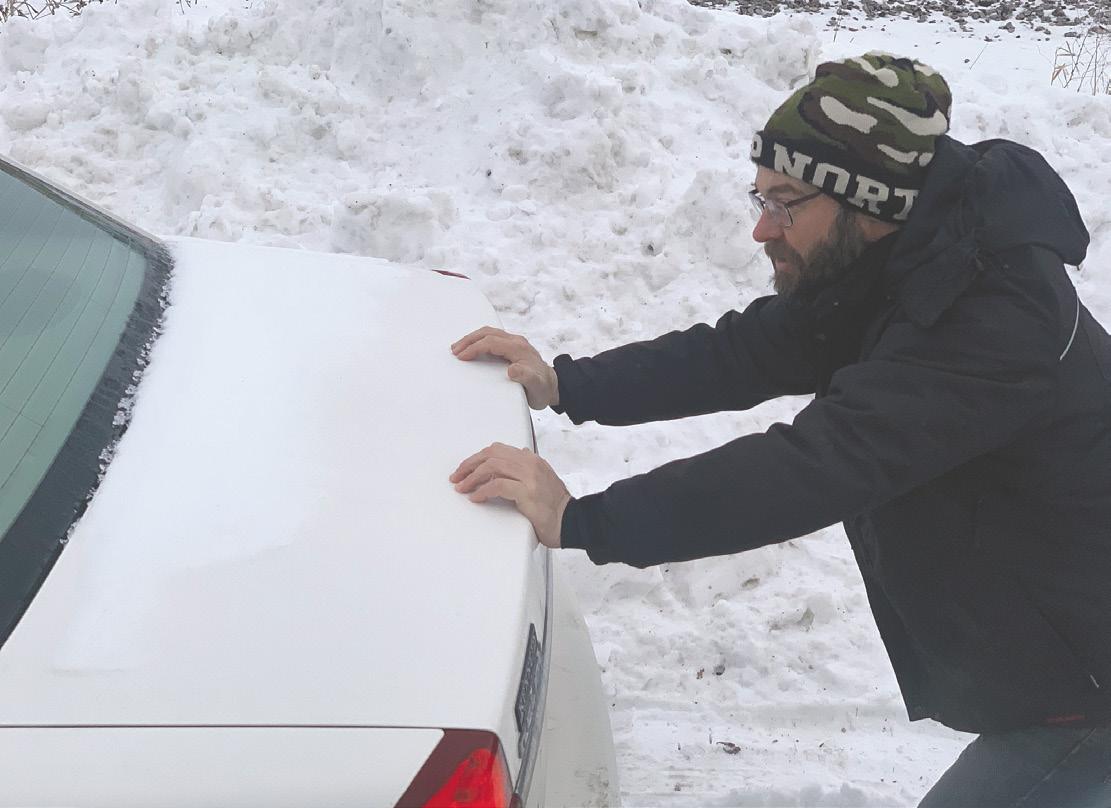
[ABOVE] If you ever try to push a stuck vehicle, push on the trunk or something solid. Never push on the spoiler or you may do more harm than good. |
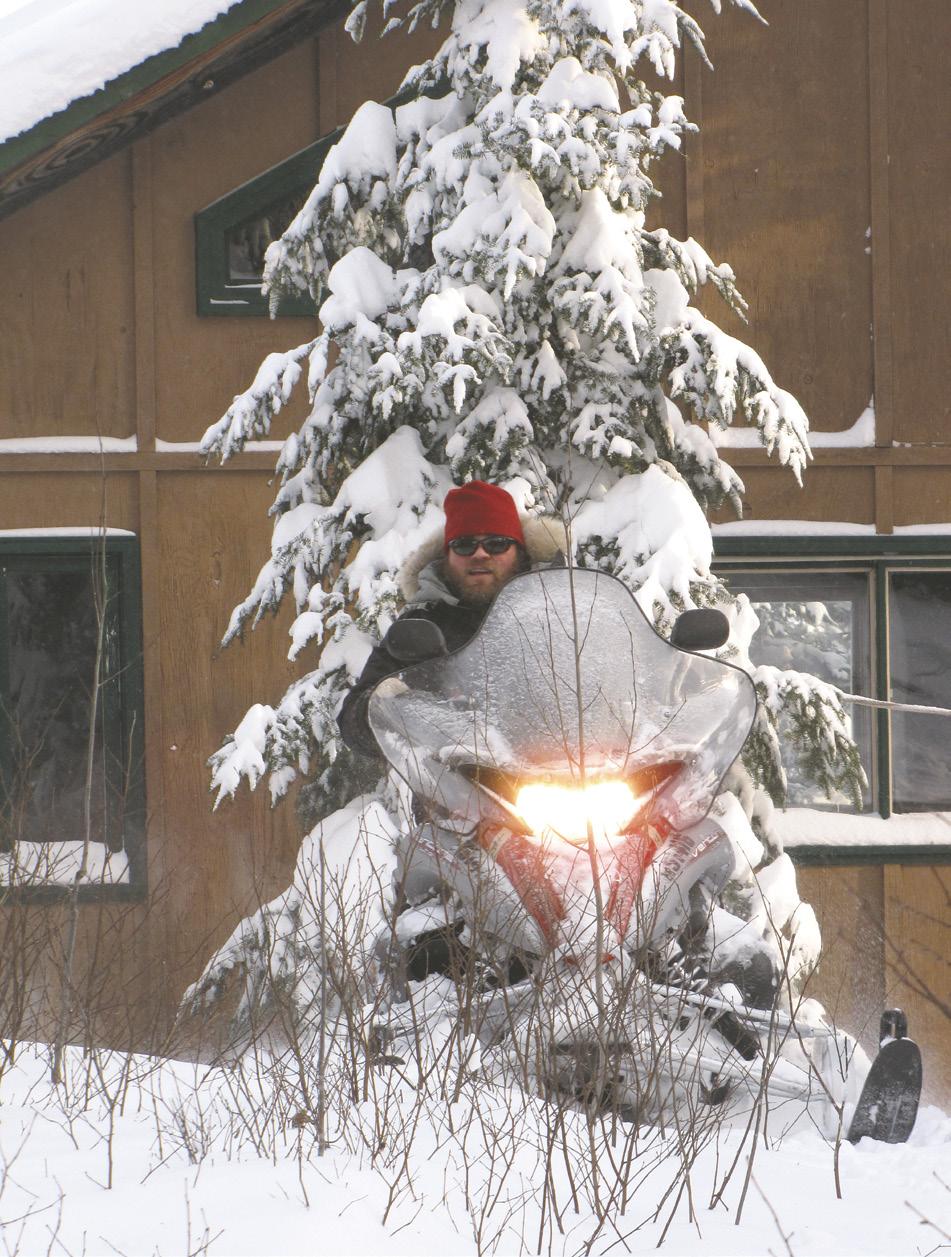
[LEFT] Our four-stroke snowmobile was neither reliable or good in deep snow, but it was all we had to get us in and out of our cabin. | ERIN ALTEMUS
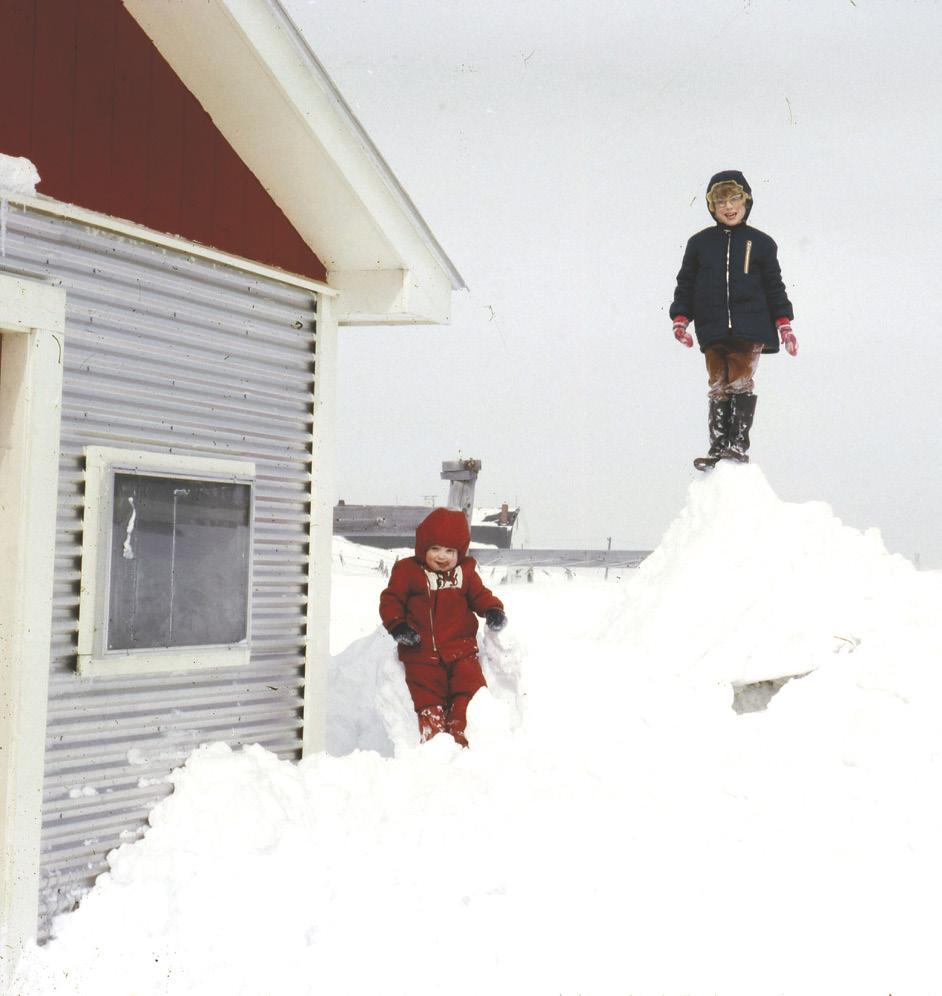
I don’t have a photo of my friend and me in the snow. In this one, however, I’m wearing the plastic-and-fake-fur boots mentioned in the story. Beside me is my younger brother. | NAOMI YAEGER
Winter Mishaps
Gichigami and the Polar Vortex
By Erin Altemus
When your life is a combination of living off grid, running sled dogs, and using various machines to “survive” off grid and back in the woods, it sometimes feels like winter is one long mishap.
From 2013 to 2021, we owned a property off the Gunflint Trail on Mush Lake. Forty-three acres tucked between Pine Mountain and the Brule River, the lone cabin on a small lake that was 3 miles from the plowed road. For the first several years we owned the place, we couldn’t drive all the way to the cabin, and for the first two winters, we couldn’t even plow part way in, so my daily commute involved snowmobiling 3 miles to the Gunflint where we parked our vehicles. The winter of 2013-14, our first winter at Mush Lake, was the year of the polar vortex. At night, the temperature remained below zero for over three months. There was plenty of snow (maybe too much) and the cold was relentless. My husband Matt signed up to run a race the first weekend of January called the Gichigami Express, a short-lived race that involved three stages—one stage each day for three days, each stage about 60 miles. That weekend the cold was so severe, the governor cancelled school for the following Monday. Businesses closed and activities were cancelled. But dog racers are a hardy bunch, so the race went on despite wind chill temperatures in the -50 F to -60 range. By the second day of the race, several mushers had already scratched due to frostbite problems and also to truck problems. Our diesel sprinter van was no exception. Before the third stage of the race, from Devil Track back to Grand Portage, our diesel van had stalled out. Matt was dead set on finishing the race, however, so we put out a call to anyone available who could haul us and dogs from the hotel we stayed at to the race start. Nancy Lang helped us out and we made it just in time to get the dogs hooked up and Matt on the trail. He finished the race in 9th place, also last, but still in the purse money. After the race, with temperatures now 20 below zero and windchills of -60, we had to find a
way home. Another musher, Matt Groth, provided a trailer. I can’t remember whose truck we were in. Upon arriving back at our parking spot, we found our house sitters hadn’t made it out of our cabin. Matt started walking. He walked the 3 miles in, and the snowmobile wouldn’t start, so Matt and the house sitters walked the 3 miles back out. For a guy who had just endured a brutal three-day race, this was a lot. Finally, we hooked up the dogs and ran them back into the cabin. Needless to say, we started looking for a new dog truck shortly thereafter.
Spoiler Alert: This One Ends Badly
By Joe Shead
It was one of those rare days when the fishing was so good, you hated to quit. Crappie after crappie came up my ice hole. In fact, the bite was getting even better as afternoon wore on and nightfall approached. But I had to quit early because a snowstorm was approaching, and even on bare roads I was at least an hour and a half from home.
I’d covered half the distance before the snow started in earnest. Within a half hour, the location of the road’s center line and shoulders was a guessing game. I was going 35 mph tops, aiming for what I thought was the middle of the road, but Highway 2 north of Two Harbors doesn’t get a lot of traffic when it’s snowing 4 inches an hour. I only met three or four vehicles and when we approached, we had to do a little dance and figure out where we could drive without hitting the other person or putting our vehicles in the ditch.
About 15 miles from home, I saw a car at an intersection. It looked to be stuck, so I stopped and turned around. Sure enough, the couple in the vehicle had pulled over at the intersection to clean the car’s wiper blades and got stuck.
I figured between myself and the man we could push the car back to the road. Unfortunately, they had spun their tires so much that the road under the tires had turned to glare ice. We could rock the car, but that’s it.
After a few minutes, they were ready to give up. “Can you call a tow truck?” they asked. Nope. No reception. And besides, I just knew we could get their car out. I had an idea. I began breaking branches off nearby balsams. I figured with something under those tires instead of glare ice, we could get some traction.
It worked! We got the car moving and halfway back to the intersection. The man and I had to run after the car as the woman got a head of steam and spun toward the road. We caught up and pushed again. The tires clawed for traction, and slowly the car gained momentum up a slight incline. The car stalled again as the man and I raced forward to give it one more shove. We just needed about 10 more feet, and the car would be back on level ground and on the main highway. I lunged forward, and this time I snatched defeat from the jaws of victory: Instead of pushing on the trunk as I had been, for some dumb reason, I pushed on the spoiler mounted atop the trunk. Oh, we got the car back on the highway all right. But unfortunately, in the process, I popped the spoiler off the trunk. The couple was satisfied to be back on the road, but I sheepishly walked up to the woman and handed her the spoiler from the rear of her car. It’s true: No good deed goes unpunished. I guess we’ll call that one a draw.
Lessons Learned the Hard Way in Winter
By Naomi Yaeger
When I was a little girl, we lived in Maine. I was either in kindergarten or first grade when I went to a friend’s house to play. She lived in a trailer out in the country.
We were outside when we decided to walk to a barn we could see in the distance. We set off across snow-packed fields. I was wearing brand-new boots my parents had just bought for me. They were fashionable by late-1960s standards: yellow fake fur inside, with a fake-leather—some kind of plastic—exterior. At the time, most people didn’t know much about plastic, especially plastic winter boots. Go-go boots were popular then.
JOE SHEAD
Partway there, I told my friend my foot was cold and that I wanted to turn back. She insisted the barn was close and that we should keep going. I complained again, and then something changed. I told her my foot didn’t hurt anymore.
At home, I told my parents my foot didn’t feel right. They didn’t pay much attention at first. They had affectionately nicknamed me “Hippity Hop,” so when I began hopping around the house, they assumed I was being playful. It took a while before they realized I wasn’t teasing.
At the emergency room, after my foot warmed up, the doctor told me he needed to drain the blood. The room was clean and sterile, bright in a way that made everything feel more serious. He was a family friend we called Doc Allison, recognizable by his long dark hair, back when most men still wore buzz cuts. He looked at me and said, “We need to draw the blood out.” He used a long needle and inserted it into my toe. I remember thinking how long the needle was. After that, my parents always bought boots for warmth, not fashion. Most winters, the boots were oversized, meant to be worn over my shoes.
Into adulthood, even in lean years, I’ve always made sure I had warm boots. In the North, that’s not a luxury—it’s part of living here.
Sometimes You Need to Trust a Stranger
By Victoria Lynn Smith
At the last moment, as I drove down a slick, snow-packed, narrow country road, I saw a chunk of snow, about half the size of a football. I decided to drive over it instead of swerving around it.
My two-and-a-half-year-old son and I had just come from visiting my grandmother Olive, who lived at the Middle River Nursing Home in rural South Range, Wisconsin. It was after Thanksgiving. We’d recently had a large snowfall, and subzero temperatures had settled in. The sky was a bright icy blue.
I figured I would hit a soft lump of snow, but instead a thud rattled the front end. Air whooshed from the front driver’s-side tire, causing the car to list. I pulled over, carefully avoiding the ditch.
It was 1988. There were no cell phones. It was bitter cold, and I couldn’t see any houses nearby. If I walked for help, I risked heading in the wrong direction, taking even longer to find a house, then perhaps finding no one at home. My small son couldn’t walk far, and I couldn’t carry him for long. I frowned at the flat tire and wondered if I could change it, something I’d never done. I didn’t have long to think about it. A man in a pickup truck passed by, stopped, backed up, then parked in front of me. He’d noticed the flat. Dressed in an insulated work jacket, a baseball cap, and winter gloves, he looked old enough to be my father. After some small talk, which included words about the recent snowfall and the current cold snap, he went to work,
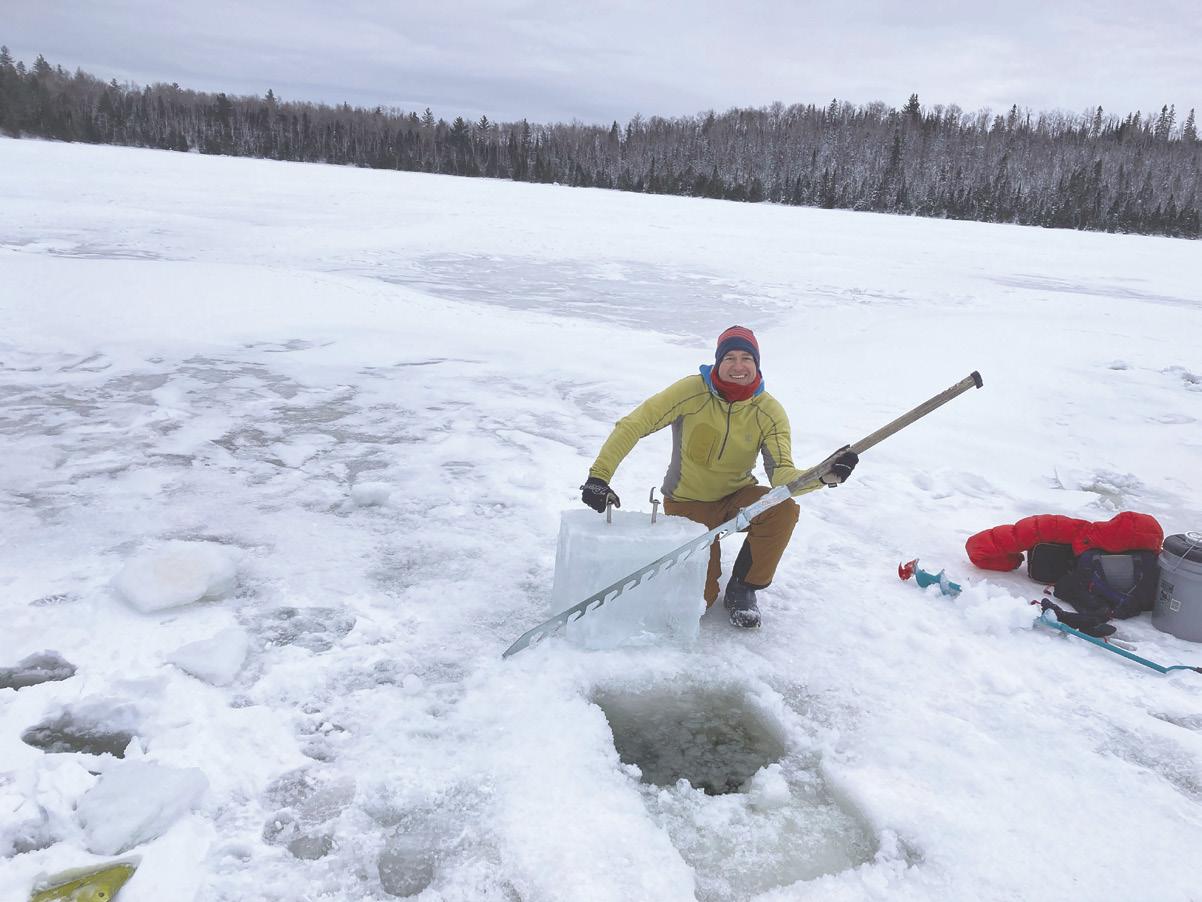
I don't always get the ice block out of the hole, but it feels like trophy art when I do. |
as if stopping to change a stranger’s flat tire was part of his daily routine. He discovered my spare was flat and offered to take it to his garage where he had an air compressor. My son and I were welcome to ride with him.
Serial-killer thoughts raced through my head. For a few frantic moments, I pondered telling the man we’d stay with the car while he drove home to inflate the spare. It was so cold though. I could’ve let the engine run, but I worried about carbon monoxide poisoning. And, I worried if my son and I waited in the car, we might be rear-ended by a vehicle on the narrow road. I decided to trust the stranger.
The man’s garage was clean, organized, and well-lit. Off to the side, hanging from a rafter was a gutted deer carcass; it was deer season in Wisconsin. Well, I thought, it’s not a person. We chatted while he filled the spare tire with air, then tested it to make sure it didn’t leak. We returned to my car. He changed the tire, and I thanked him. We waved to one another as he drove away.
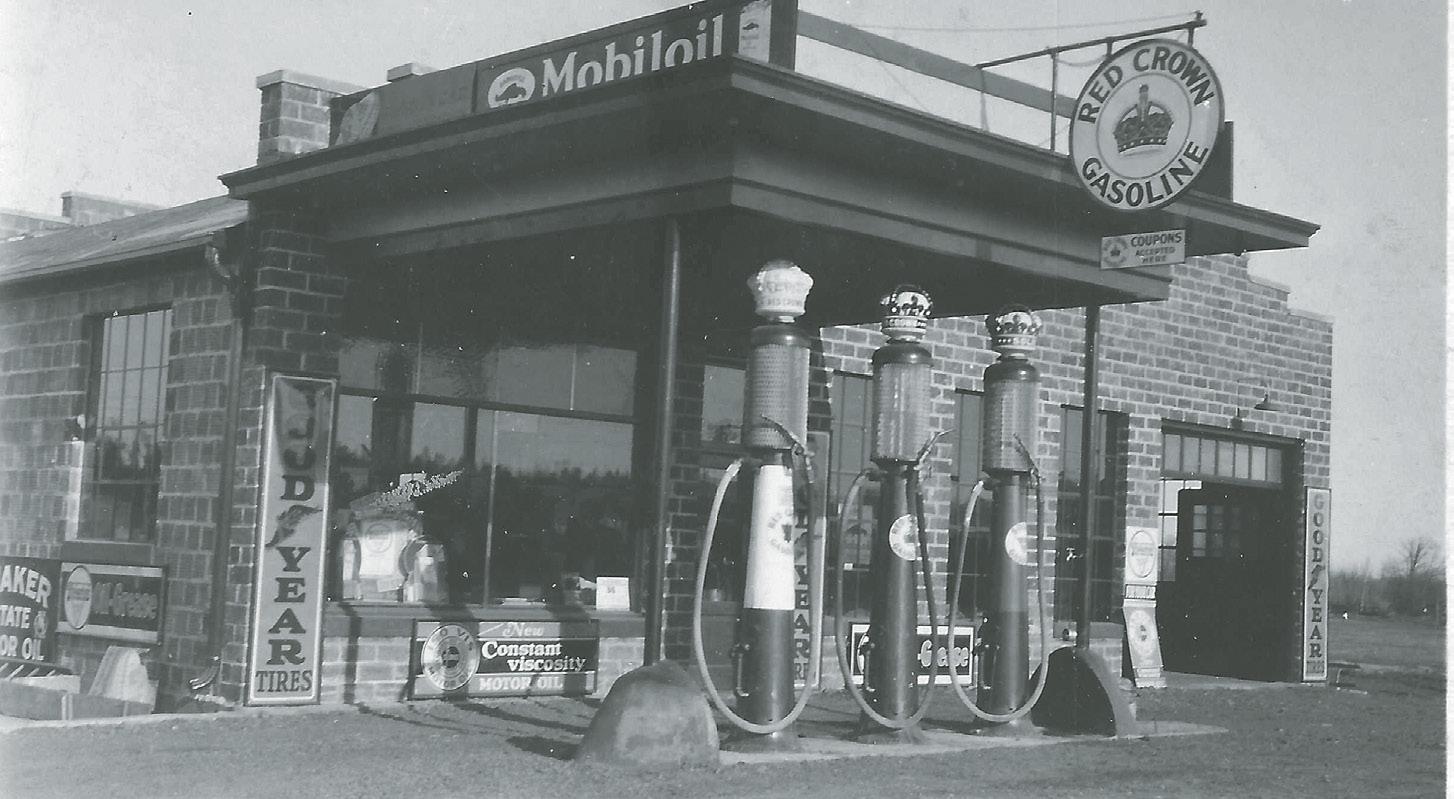
Nearly four decades have passed since the stranger’s kindness. Now, when I think about him, I think about my grandpa George who owned service station in Gordon, Wisconsin. My aunt Coralee told me that in the 1930s, 40s, and 50s, he sometimes went out at night on service calls in harsh winter weather to rescue stranded motorists. If it was unsafe for people to continue their travels or their cars weren’t drivable, he brought them home to spend the night, an invitation always followed by a hot breakfast. Grandma Olive fretted about him going out at night in bad weather. “Why do you have to go?” she’d ask. And she feared having strangers in her house, but Gordon didn’t have hotels, just a campground, which was closed in winter.
Grandpa George would remind Grandma Olive he went out because if his family became stranded in bad weather, he hoped someone would help them. Grandpa was a pay-it-forward guy. He would’ve felt a kinship with the man who stopped to help his stranded granddaughter and great-grandson on a cold winter’s day.
Sawing Off More Ice Than I Can Chew
By Chris Pascone
One of my winter camping thrills is sawing a sight hole in the ice. To do so, use your auger to drill four corner holes, then connect the four corners with your ice saw. Once disconnected from the surrounding ice, the massive resulting chunk becomes buoyant, and can either be forced under the surrounding ice, or (potentially) lifted out of the hole, to be seen and admired.
Sometimes, if you want to extract the ice chunk, you need to drill a fifth, center hole, too, and do four extra cuts to turn the big rectangular ice chunk into four smaller triangles. Why? The ice chunk can weigh hundreds of pounds in a deep ice year. How else will you get that out?
Of course, human greed can easily get in the way. Take me, for example…
I joined my friends Jeff and Ruurd for our annual ice camp in January 2022. It was a real winter. We made the trek into Kemo Lake, about 25 miles northwest of Grand Marais, and I set up my tent right on the frozen lake in preparation for some bountiful days of ice fishing. We had been here before and knew the native lake trout were cooperative. I was aiming to sight fish for them in shallow water, so I could observe the fish bite my lure, even though we had caught them in deeper water previously. Blunder #1.
The next morning, I started drilling my four corner holes. I was rather shocked when the ice turned out to be over 2 feet thick. So shocked, that I never bothered checking the water depth below the ice sheet. I was just estimating that it should be about 8 feet deep where I was cutting—about equal to the water clarity for Kemo in general, and good for sight fishing to bottom.
I spent a good hour just drilling the four deep corner holes with my rather dull auger. Then it was sawing time. Let me tell you, sawing through 2 feet of ice is a hellish chore. Still, the fabulous fishing I was anticipating below kept me going. It took at least another hour to connect the four corners with the saw. Now two hours in, I had yet to put a fishing line in the water.
Finally, I got the ice chunk to float up. Of course, I really wanted to admire the results of my labor up on the frozen lake surface, but I knew it would be smarter to just push it under. I tried pushing. Couldn’t get it under. My friends joined me to help. It still wasn’t going under. Was it too big? Too heavy? We used more force. Finally, blunder #2 dawned on me: I had cut the hole in a spot so shallow, there wasn’t enough space before bottom to squeeze the chunk under the surrounding ice. We were jamming the chunk against bottom with every push.
I had no choice but to face up to my stupid mistake. Even if I got the chunk out, I was going to be fishing in an incredibly shallow spot where no lake trout would go. It was only five feet deep here, and half of that was ice.
Still, I had to complete the job, to satisfy my own lunacy. The only choice was to pull the ice chunk out. I screwed my ice screws into the chunk, hoping to pull it up and out with brute force. Nope. Another half hour of hemming and hawing got me nowhere. Meanwhile, my buddies were catching trout after trout and throwing uneasy glances in my direction.
About this time another person we knew, with a cabin on a neighboring lake, swung by on his snowmobile to check on us. Oh perfect, I thought. I’ll tie the ice screws with rope to the snowmobile, and he can haul the ice chunk out with his sled. Blunder #3.
The “rope” (actually just paracord) immediately snapped right at the ice screw. Thank God the paracord broke instead of my $70 ice climbing screws.
In the end my obsession with extracting the ice chunk became a complete failure. I gave up, and went to start all over again, sawing a new hole from scratch in deeper water. A note to self—don’t saw off more ice than you can chew.
Grandpa George's service station, circa 1930s. | VICTORIA LYNN SMITH
CHRIS PASCONE
By Breana Johnson
The Magic of Winter
Winter isn’t my favorite time of year, but it’s hard to ignore its quiet charm. Fresh snow transforms the world, and the cold air brings a clean, still calm. These photos from our photo contest capture a bit of that wintry magic.
| MICHAEL WEINER
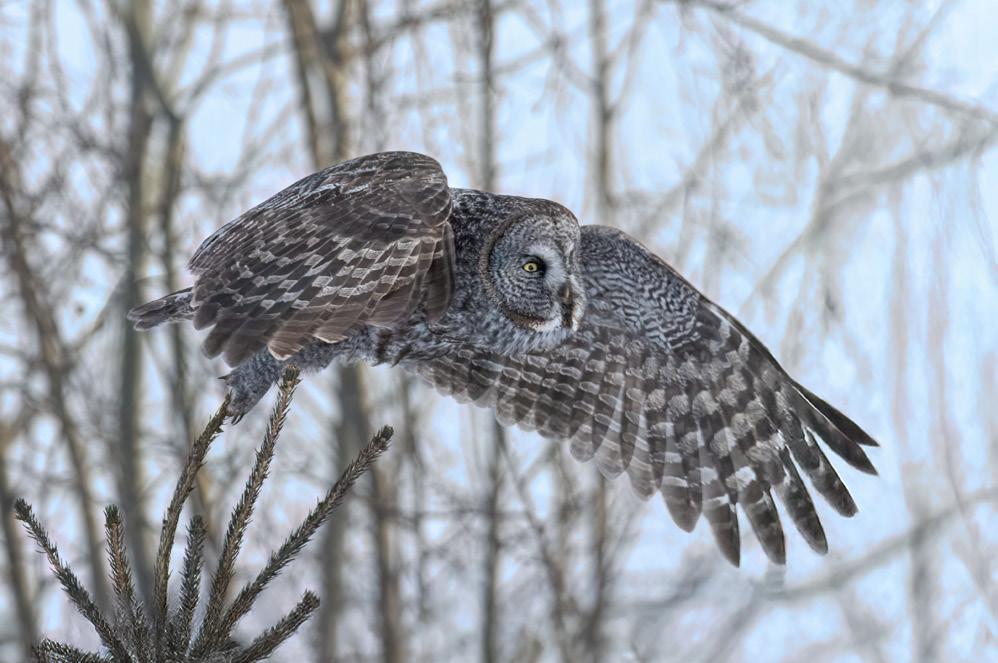
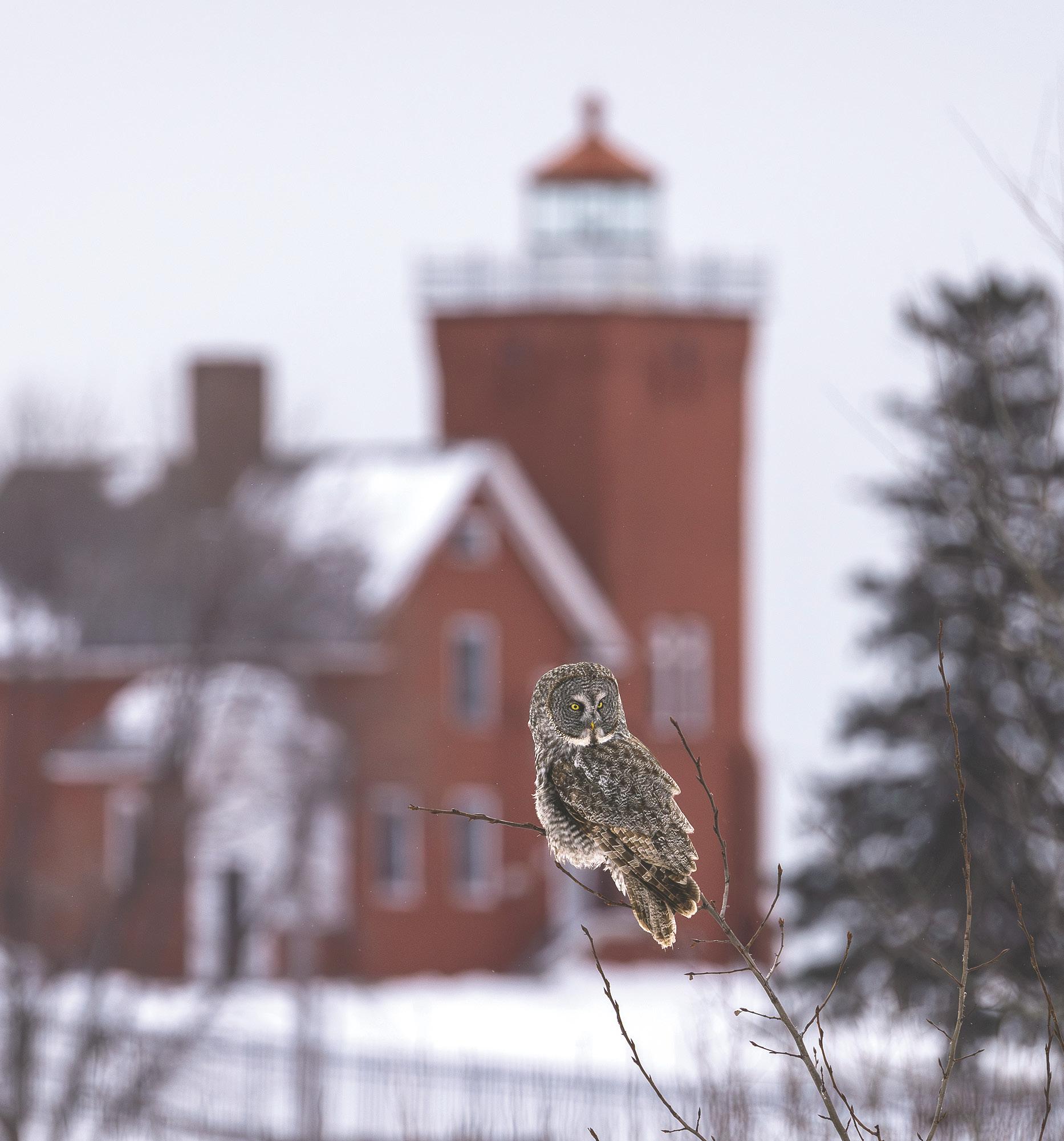
Great grey owl taking off from the top of a pine tree. | BOB BERLUTE
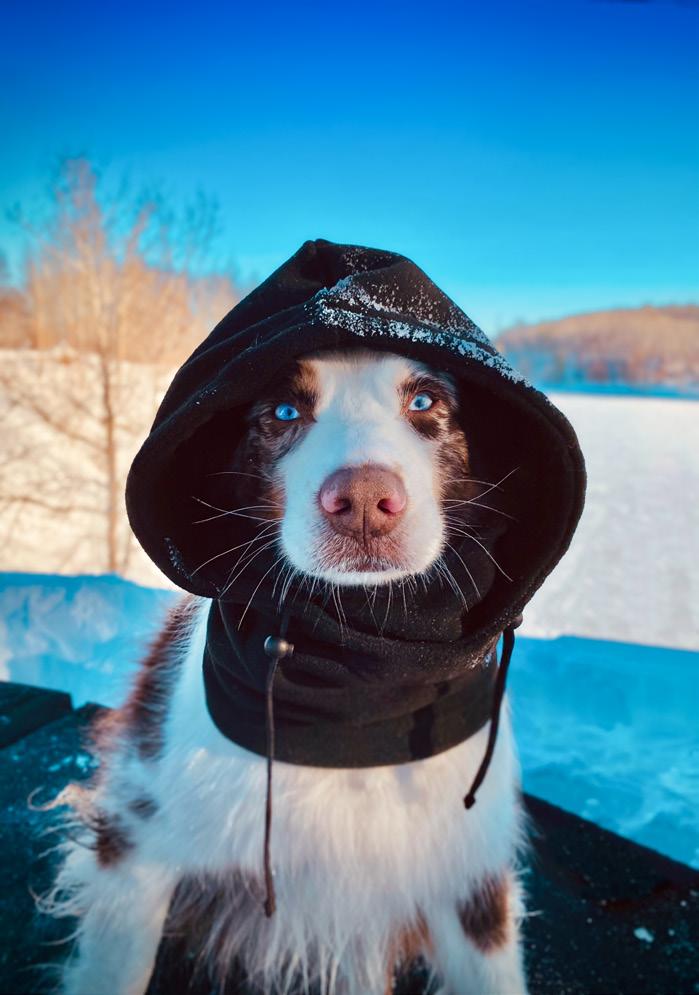
Bonzer in a moment of serene intensity, set against the frozen expanse and biting cold of northern Minnesota. | FLO SAPATTA
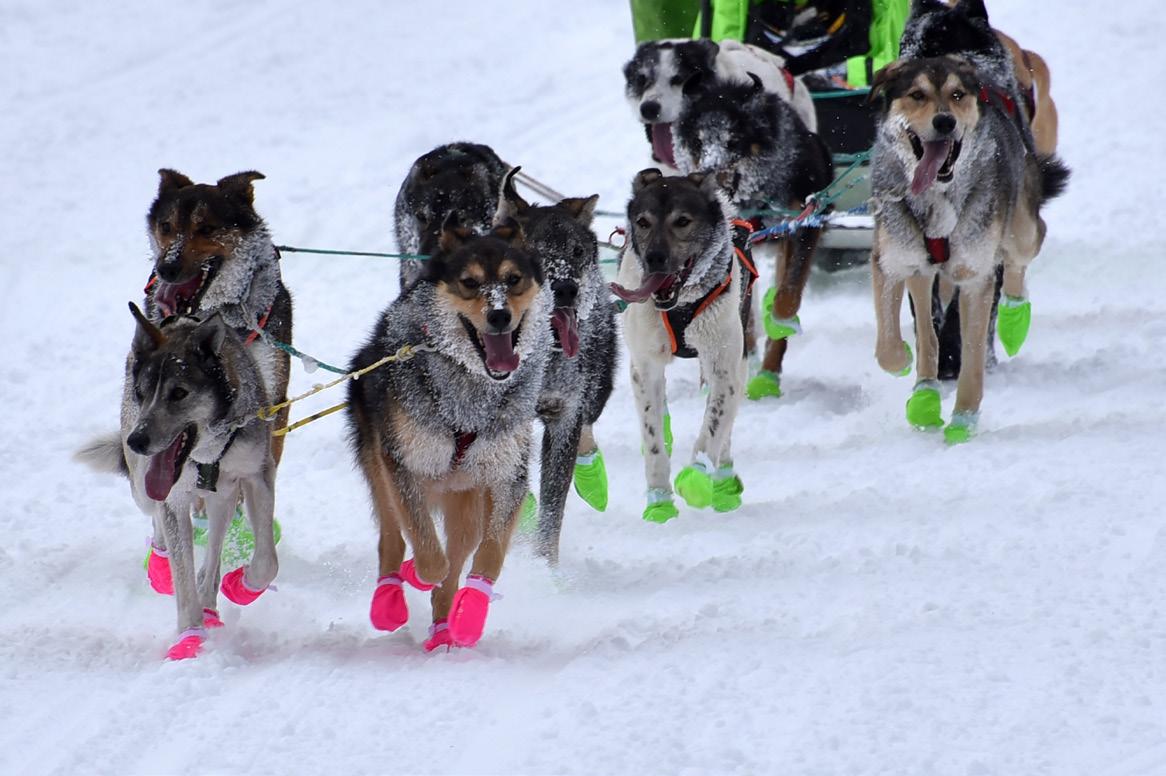
John Beargrease sled dogs racing as fast as they can.
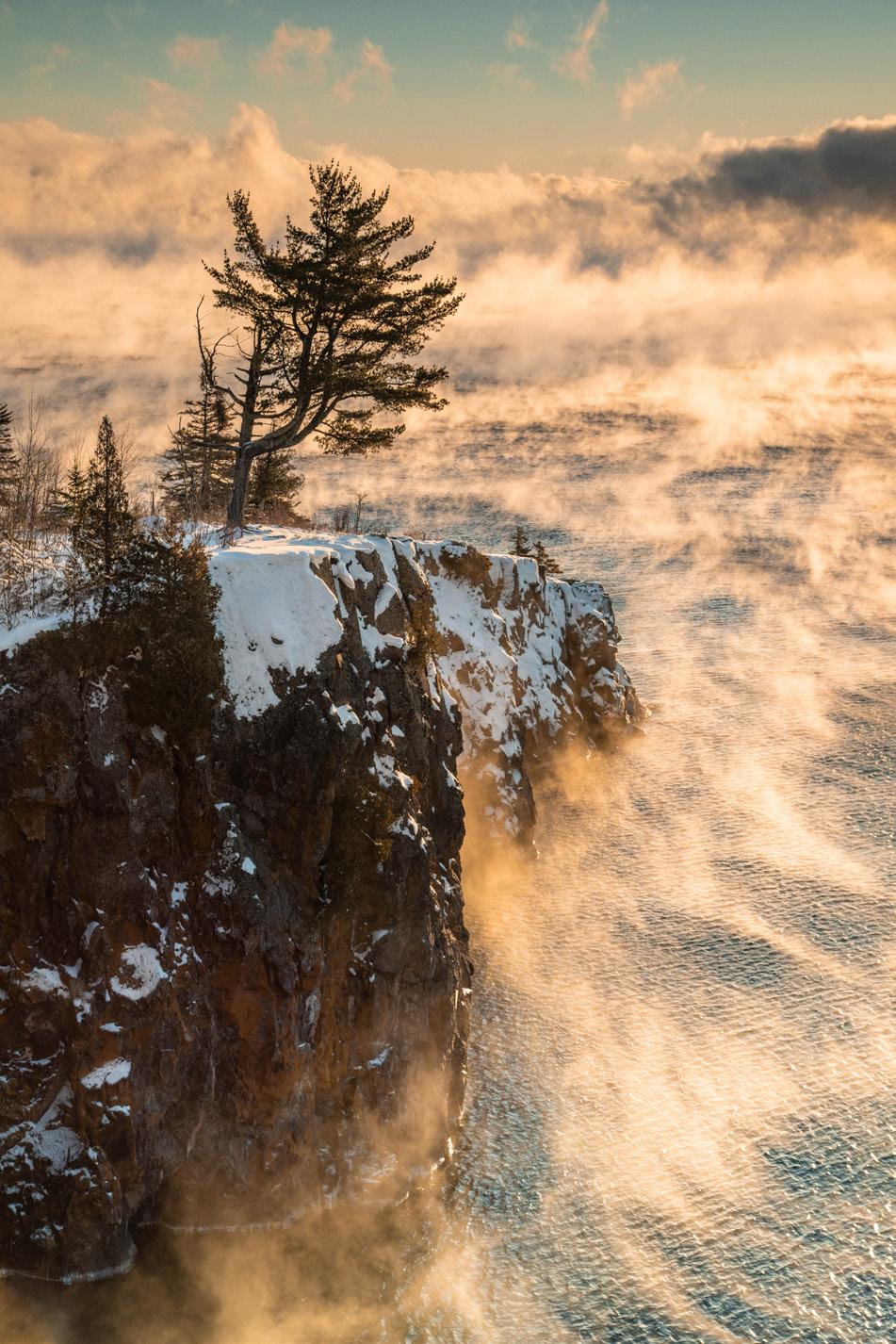
Sea smoke swirling around a pine-topped cliff on the North Shore of Lake Superior. | KEN HARMON
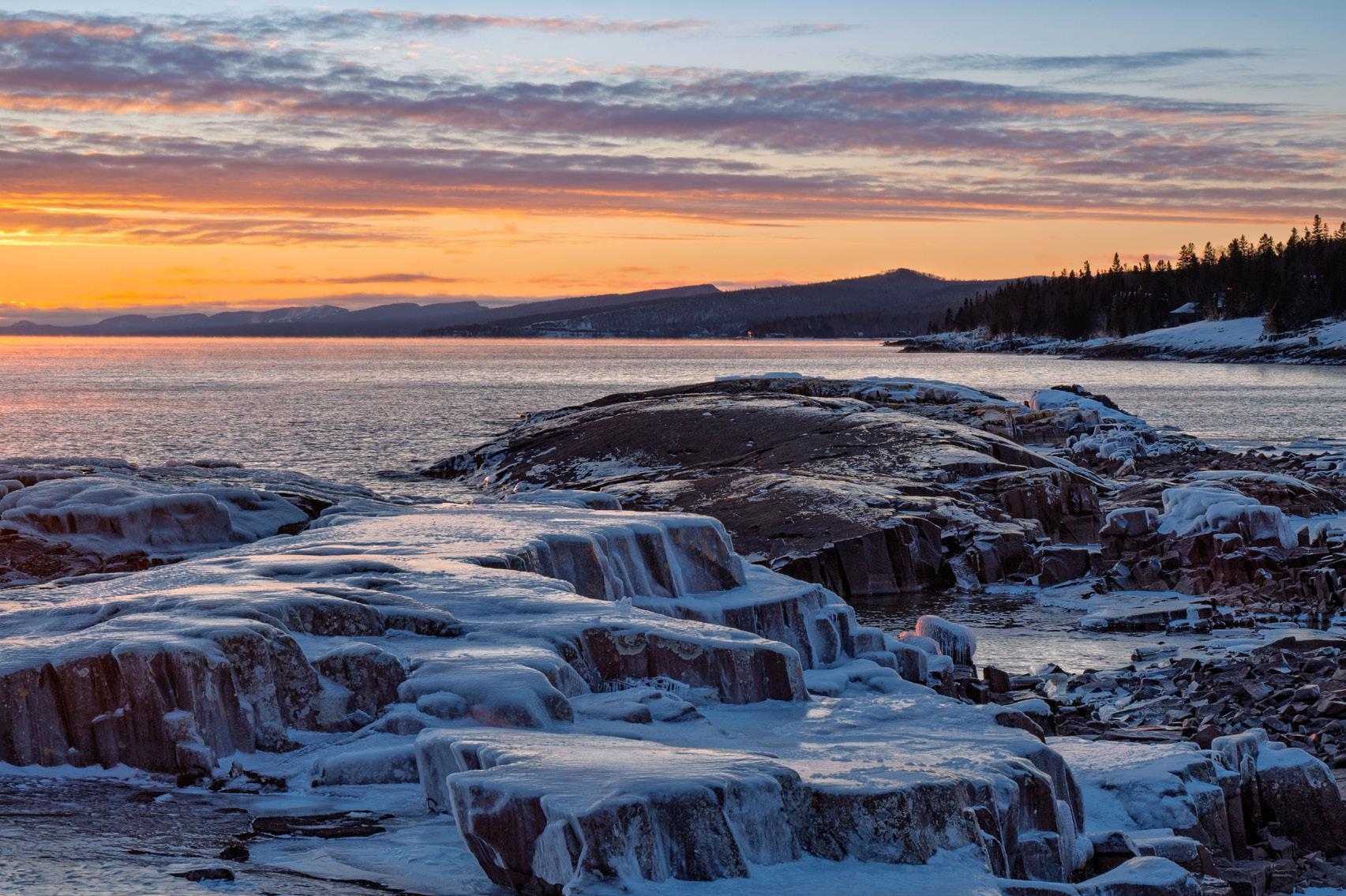
A beautiful sunset over the Sawtooth Mountains from Grand Marais. | LARRY PAULSON
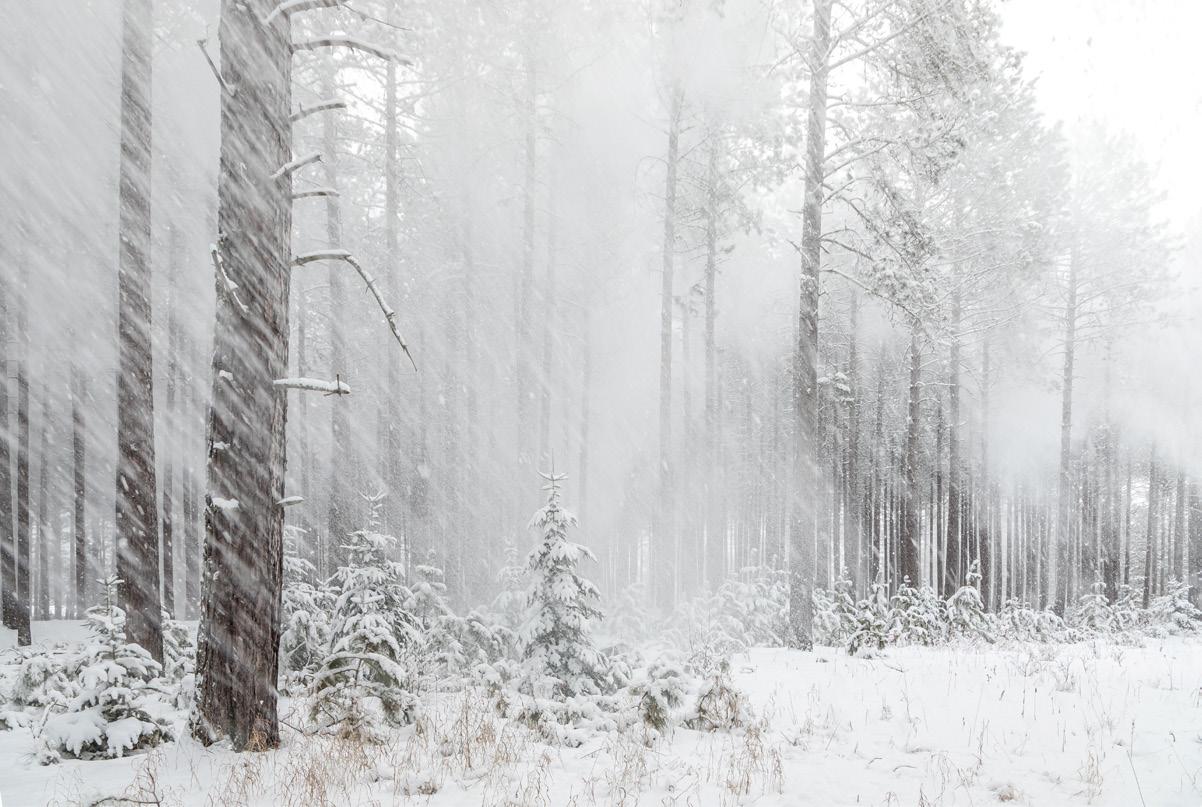
Blowing snow at the Hogarth Tree Plantation in Thunder Bay. | KAREN RAMSDALE
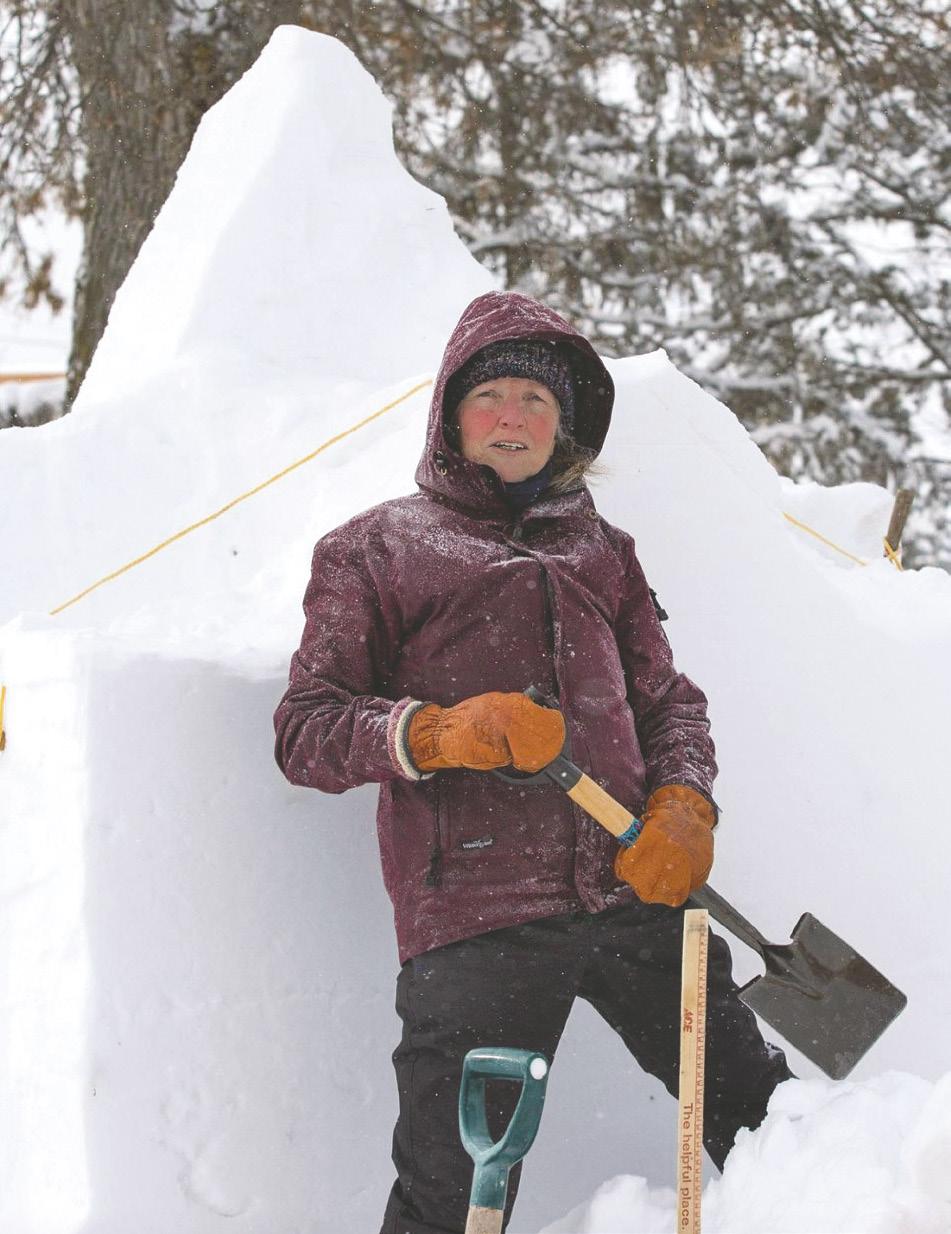
Ely artist Nancy Scheibe, far right, has worked in various mediums, including sculpture, mural paintings, scratchboard, stained glass, and more. | SUBMITTED
Snow Carving with Nancy Scheibe
Creative Space: By Rae Wojcik
February is the deep heart of winter in the North. At this point in the year, spring is months away and snow is usually in ample supply. As many a seasoned resident has noted, the secret to making a life in this region lies in the art of loving winter. But what about making art out of winter?
Each year, a group of snow sculptors from around the globe come to Ely to do just that. At the Snow Sculpting Symposium, a highlight of the Ely Winter Festival, held Feb. 5-15, dozens of artists carve breathtaking sculptures from the season’s most abundant material. One of these sculptors is Ely’s own Nancy Scheibe, an artist whose lifetime of work has spanned mediums including sculpture, mural painting, scratchboard, stained glass, and more.
“I’ve always been fascinated by the many ways that snow presents itself. It’s a fascinating thing to me,” Scheibe said.
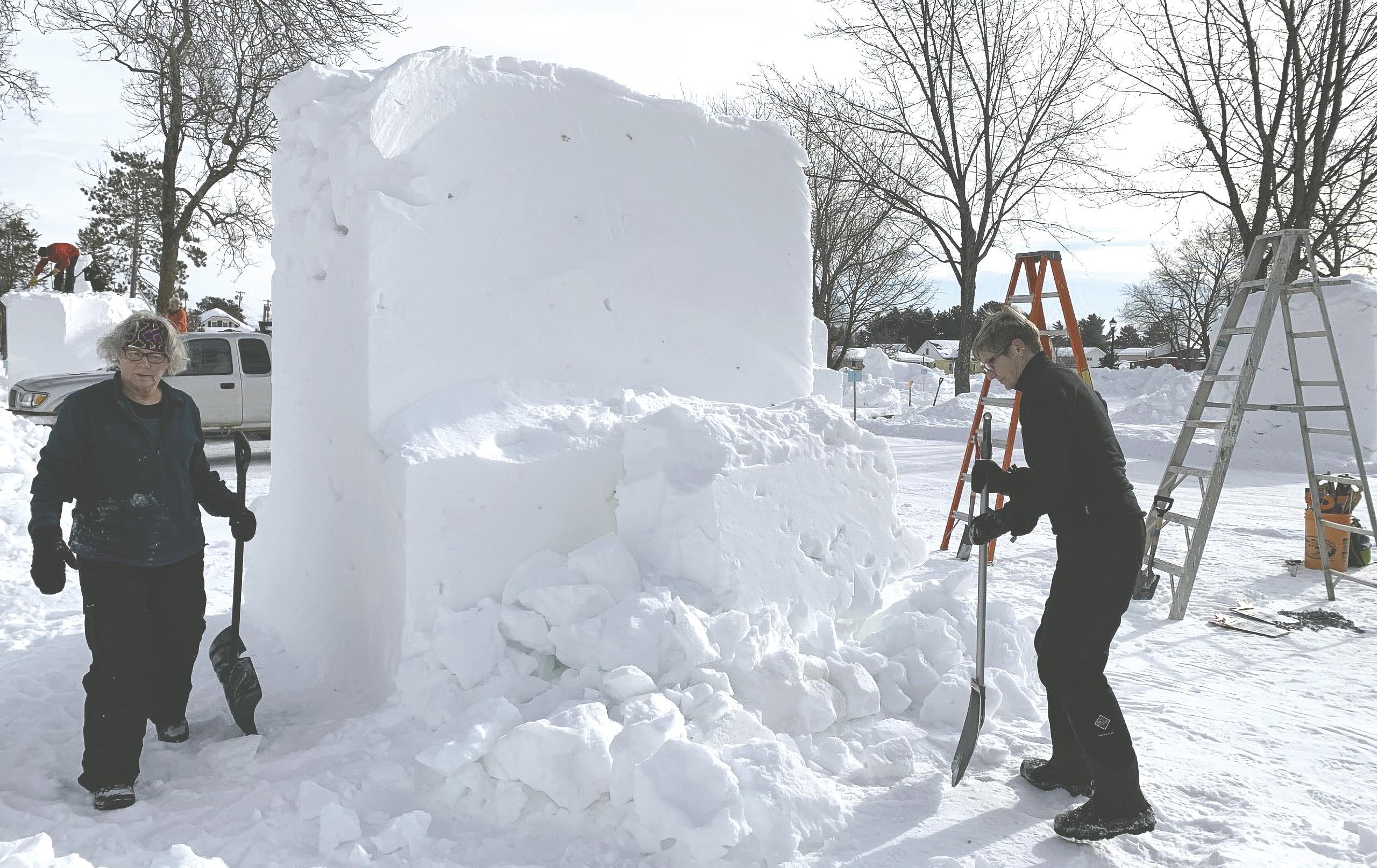
The snow sculpting process includes two interesting ingredients: planning, and unpredictability. Each carver begins with an 8-by-8-foot or 12-by-12-foot block of snow, which are all set up in Whiteside Park. Using tools like shovels, tin cans, garden tools, and curry combs, Scheibe and her team of friends have three days to bring her vision to life.
“The design is entirely up to us,” Scheibe said. “I generally make a small clay sculpture of what I want to carve and take photos from each direction. Then I put a one-foot grid on it so I can show my team, and we can figure out where we’re going.”
This year, Scheibe is carving a tribute to Jane Goodall. While her plan is in place, the actual carving process is where the unpredictability comes in. The elements play a crucial role in the creation of a snow carving, something no amount of planning can account for. In a good year, the snow blocks might be pristine; in other years,
they might be filled with flecks of dirt or chunks of ice which, if the sunlight strikes them, can act like a prism and sear a hole in the piece. Temperature is a big factor in the carving process too. Snow becomes harder when it’s cold; subzero temperatures mean Scheibe can take more risks, as the snow is nice and crisp for carving. Meanwhile, warm temperatures are destabilizing and can send whole sides of a sculpture sliding to the ground. With snow carving, repairing a mistake is anywhere from tricky to impossible, but it’s this element that not only adds a bit of adventure, but brings the carvers together.
“One year I decided to do a delicate piece, and as soon as I started carving I realized there was a huge crack down the middle, which rendered what I’d wanted to do impossible,” Scheibe said. “But a couple other carvers came over, and between us we came up with an alteration that stayed in line with my intent but would hold up.”
As the days progress, some of the most incredible shapes begin to emerge from the snow blocks. Visitors go from guessing what the blocks might become to admiring the detailed works emerging before their eyes. Finally, after much work, the moment comes for Scheibe to lay down her tools and take it all in.
“When we finish a carving, I step back in amazement about what has been created. It never gets less magical,” Scheibe said.
In early February, nobody knows how long the winter will last, and the same is true for the snow sculptures. Unless there’s a risk of collapse, they’re usually left to melt with the rest of the winter’s snow. Not knowing their lifespan is part of the whimsy of these sculptures, and perhaps their impermanence is a reminder to embrace winter while it’s here, even—and especially—before the signs of the next season arrive.
Scheibe will take part in the Ely Winter Festival Snow Sculpting Symposium, held Feb. 5-15. | SUBMITTED
Solbakken Resort
Imagine the Possibilities. Discover the Endless Potential.
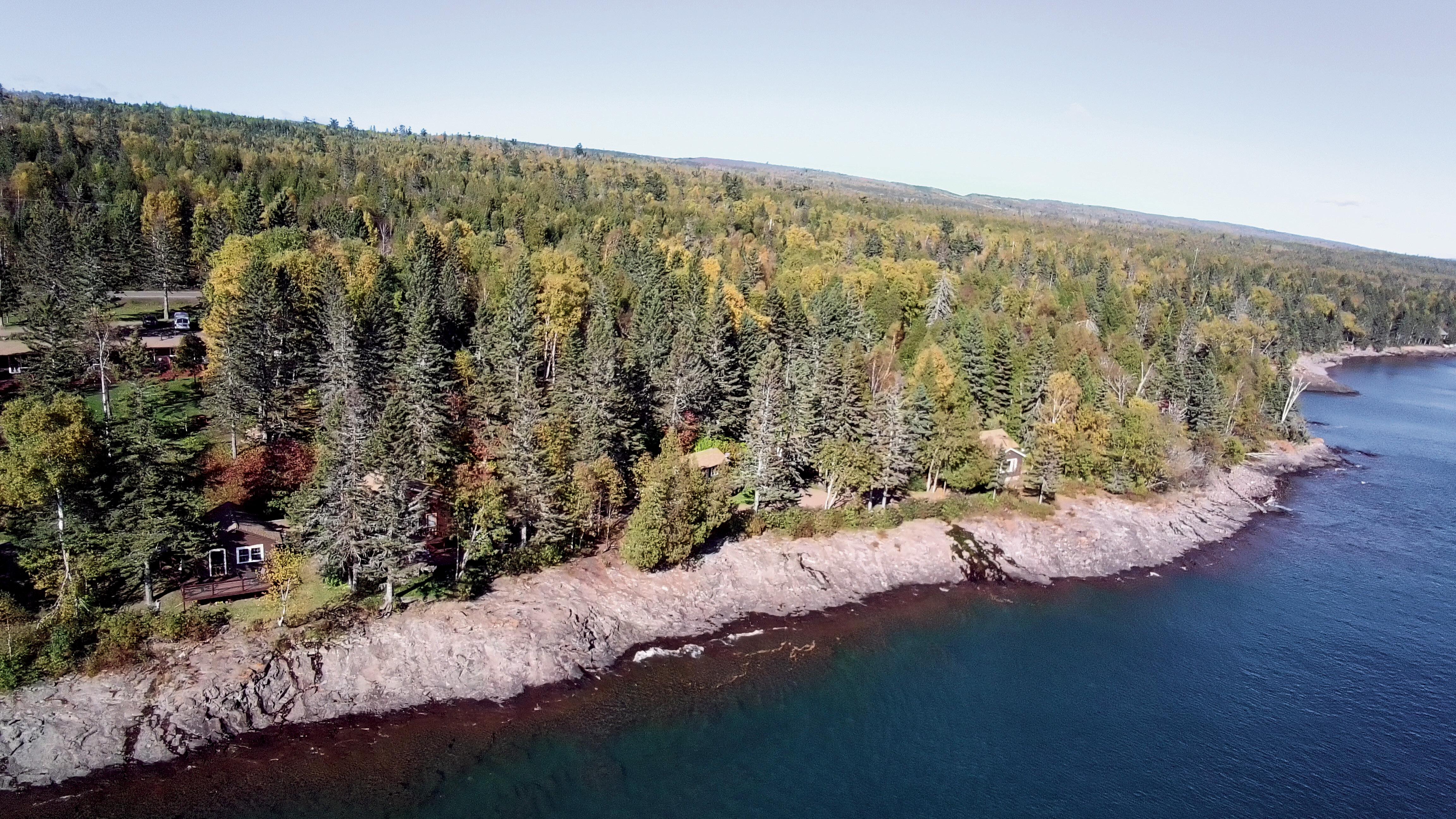
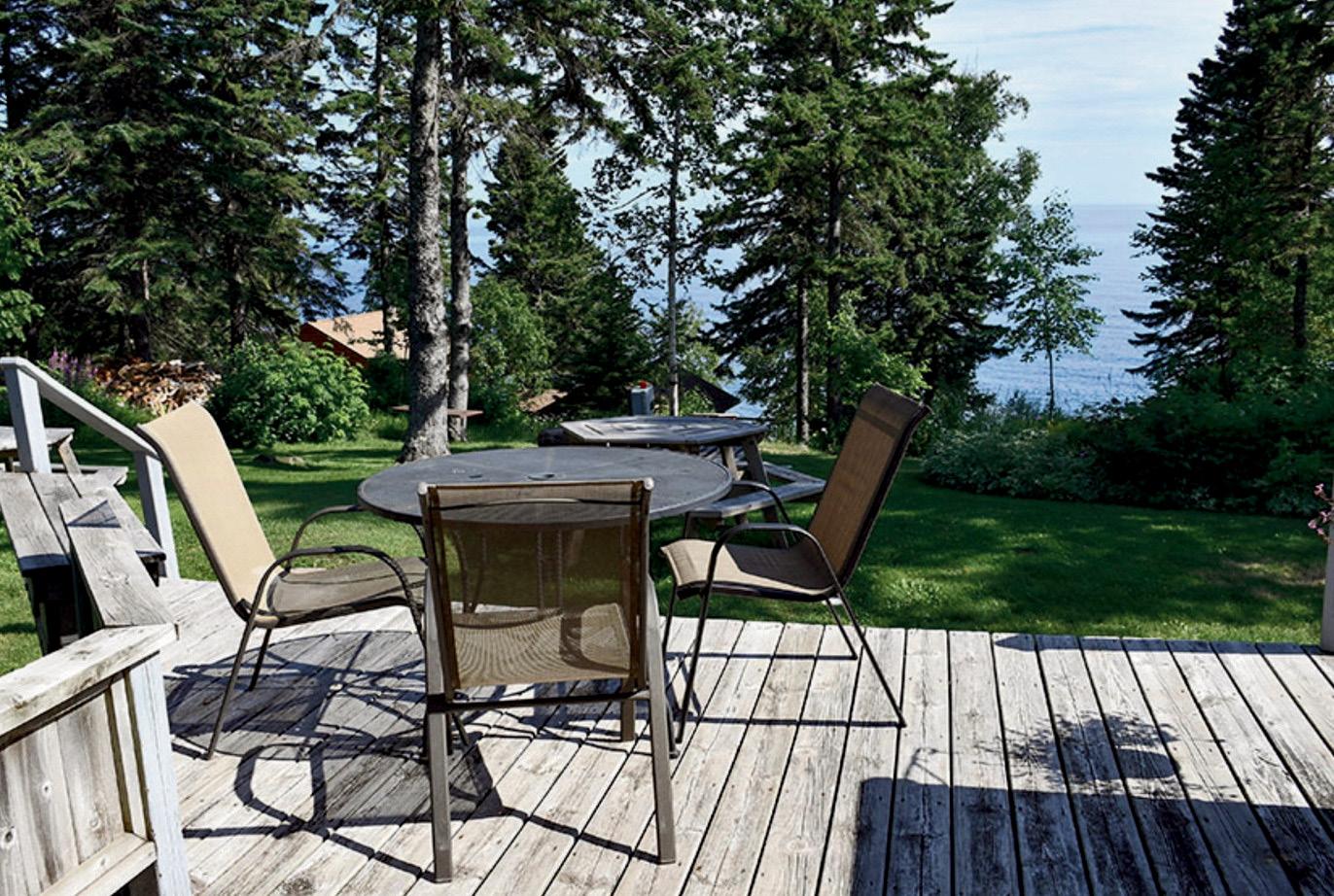
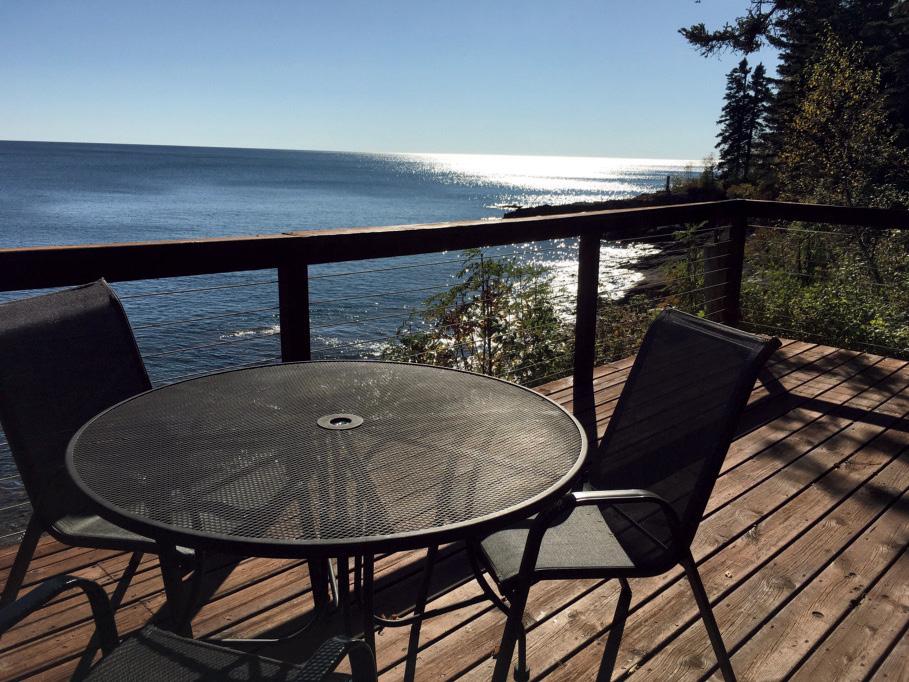
A once-in-a-generation opportunity on Minnesota’s North Shore, Solbakken truly has that rare legacy property energy!
Where the Boreal forest meets the greatest of the Great Lakes, a rare and historical resort property awaits its next visionary steward.
Why Solbakken?
• 600+ feet of Lake Superior shoreline
• Irreplaceable location in Lutsen, MN
• Direct access to one of the most awe-inspiring shorelines in North America
• Rare scale for events and destination hospitality
• Unlimited upside for the right visionary buyer
• Established resort footprint
Properties like this do not come on market often!
ELY WINTER FESTIVAL
Feb. 5-15
The annual Ely Winter Festival features dozens of family-friendly activities, such as a snow sculpting symposium, snowshoe hikes, live music, a Winter Adventure Showcase, Dorothy Molter Museum tours and a fundraising dinner, a kubb tournament, a community spaghetti dinner, various art on display, a variety of classes at the Ely Folk School, and more. A full schedule of events can be found online. elywinterfestival.com
TWO HARBORS
WINTER FROLIC
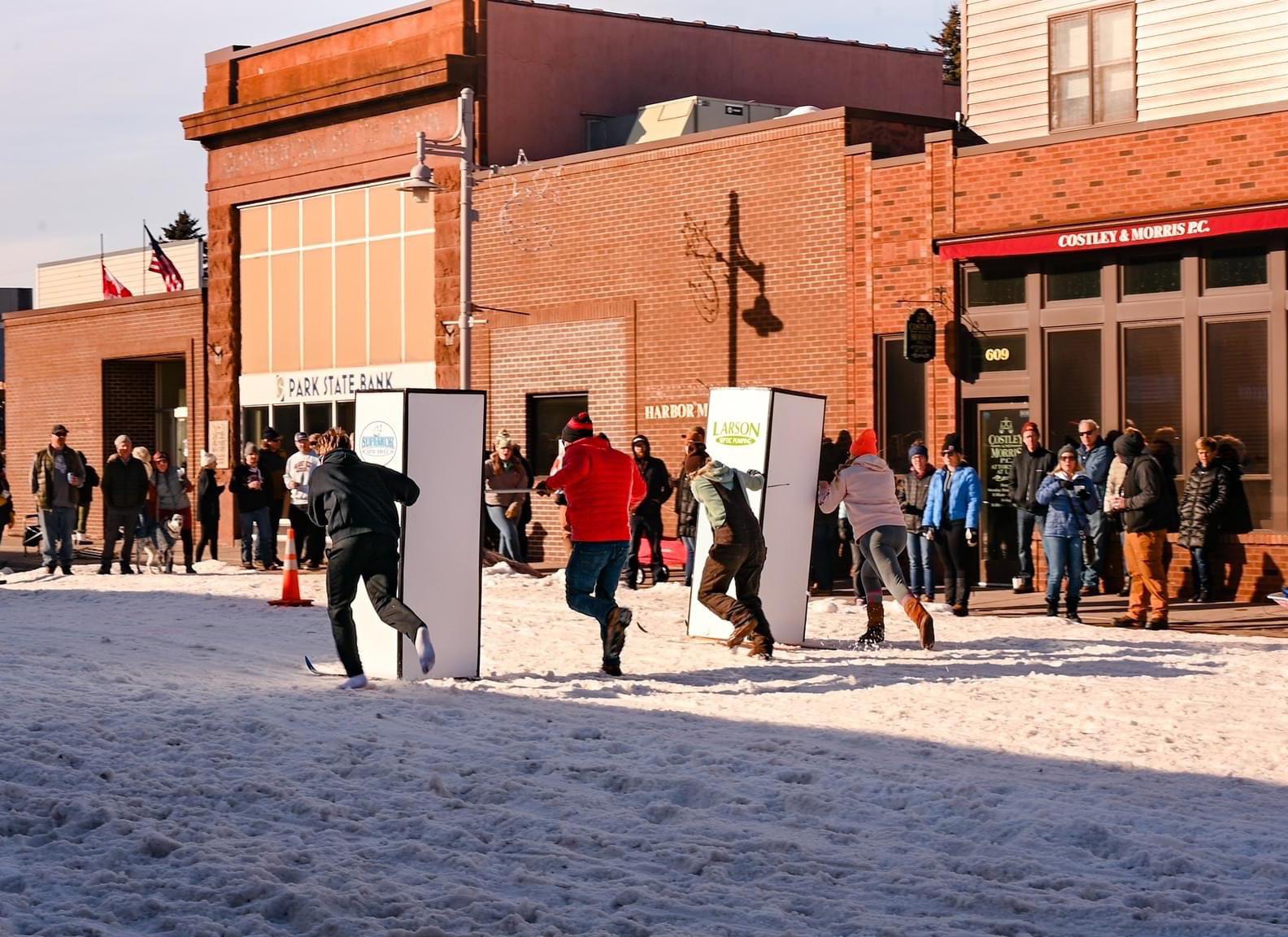
Feb. 6-7 The annual Two Harbors Winter Frolic includes events the whole family will enjoy, such as a medallion hunt, a sliding hill, a coloring contest, food trailers, and more. Friday events include the community curling challenge, a 100-piece puzzle contest, a chili cook off, live music, a bigfoot trail bonfire and snowshoe, a frozen t-shirt contest, and bingo. Saturday is also jampacked with events, starting with a pancake breakfast and vendor fair. There will also be free top hat carriage rides, a bean bag tournament, family karaoke, kids bingo, a bonfire with free s’mores, a fur party, live music, free admission to the Depot, and more. Races and games include fireman kids races, a frozen fish toss, keg relay, dash for cash, and outhouse races. Don’t miss the fireworks display at 7 p.m. below the Depot, as well as free hot chocolate and cookies. twoharborswinterfrolic.com
HYGGE FESTIVAL
Feb. 6-16 The Danish concept of “hygge” (pronounced hoo-gah) refers to the ritual of embracing life’s simple pleasures. Feeling relaxed, cozy, and surrounded by the warmth of family, friends, community, and fire all encompass the idea of hygge. This year’s
Hygge Festival in Cook County includes the fireplace tour at various businesses, live music at various locations, a Galentine’s Day Market at North Shore Winery, a candlelit ski
and snowshoe in Lutsen, a hot chocolate bar at Johnson Heritage Post Art Gallery, free drop-in crafts at North House Folk School, and more. visitcookcounty.com/events
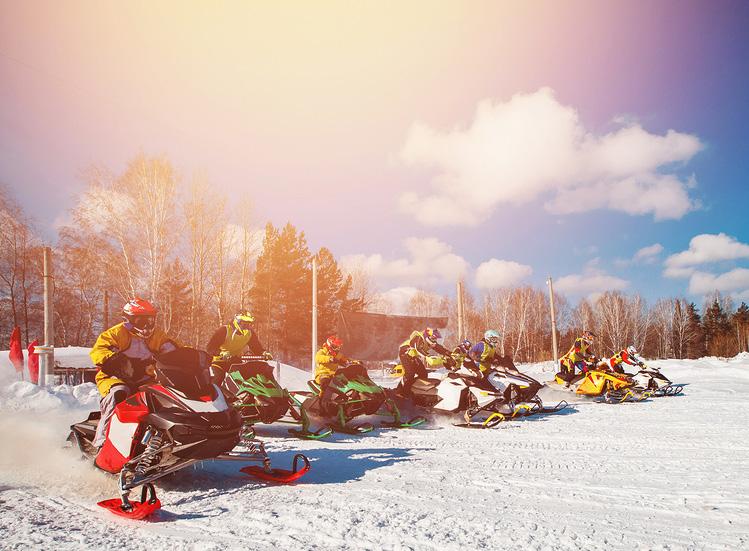
The Cook County Ridge Riders snowmobile drag races at Hungry Jack Lake will take place Saturday, February 14. | SUBMITTED
Compete in various races at the Two Harbors Winter Frolic. | SUBMITTED
4214 Airpark Blvd - Duluth, MN
www.ohdnorthernmn.com 218-722-2884
Betsy
Bowen
Studio & Gallery
301 First Avenue West, Grand Marais, MN 218-387-1992
Original woodcuts, books, cards, local pottery and more.
Two blocks uphill from Buck’s.
Open 11-5
Thurs. - Sat. woodcut.com
Stay in touch
GUNFLINT MAIL RUN
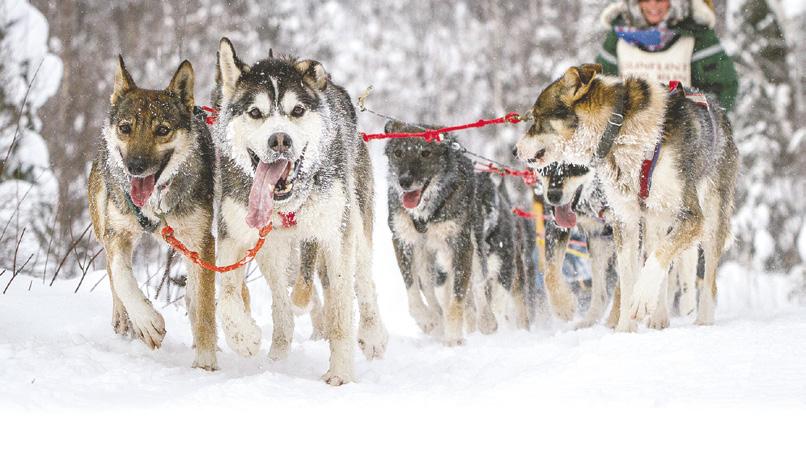
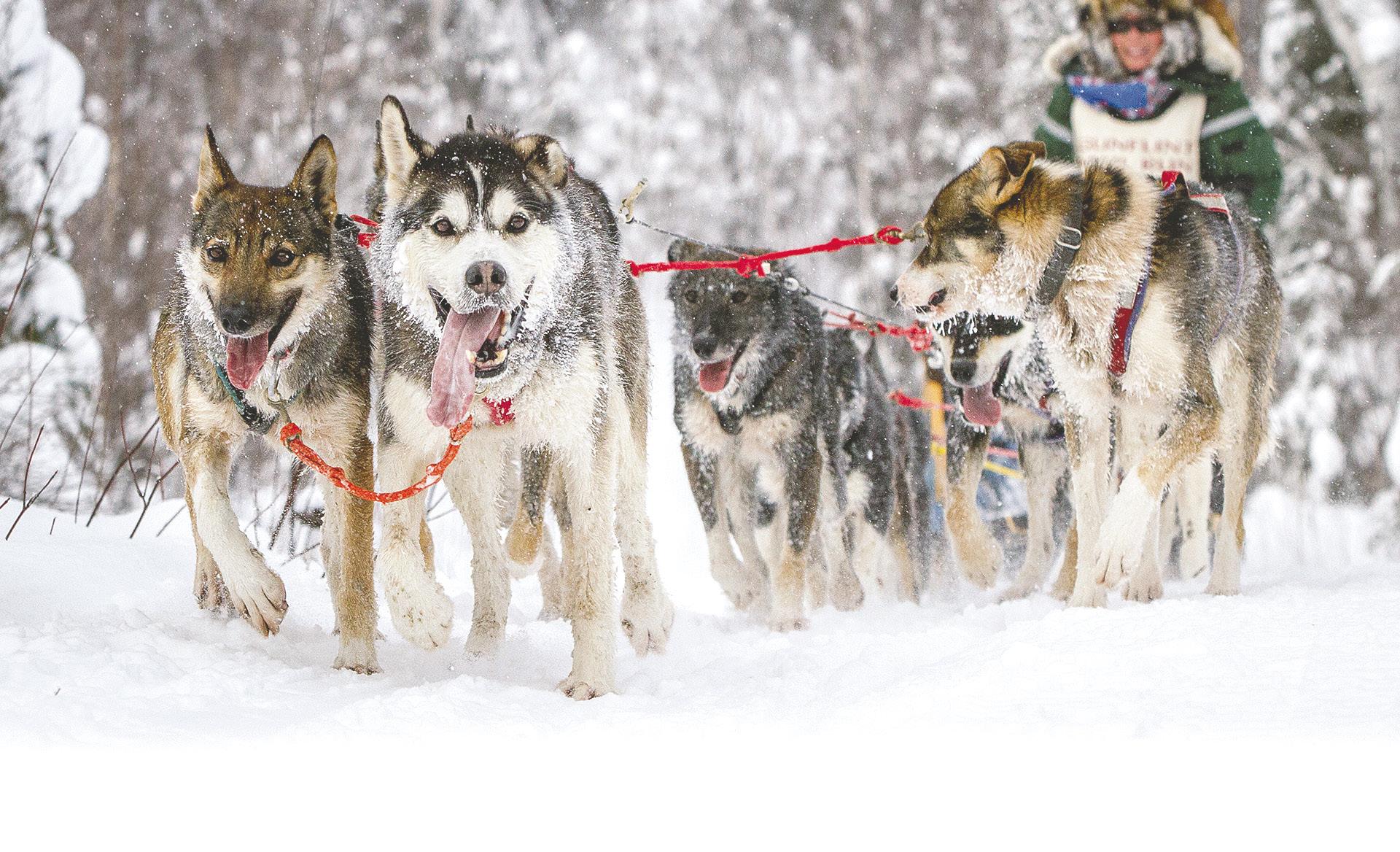
Feb. 7, Saturday The Gunflint Mail Run Sled Dog Race is a continuous race consisting of two legs of equal distance, separated by a mandatory layover. This year’s race will be a 65-mile 10-dog race, with 32.5-mile legs. The race will start at 8 a.m. at Trail Center Lodge, located on the Gunflint Trail. Spectators can find great viewing spots at Trail Center Lodge, White Pine Lodge, and Rockwood Lodge. Remember to leave your own dogs at home. gunflintmailrun.com
VINTAGE SNOWMOBILE RIDE
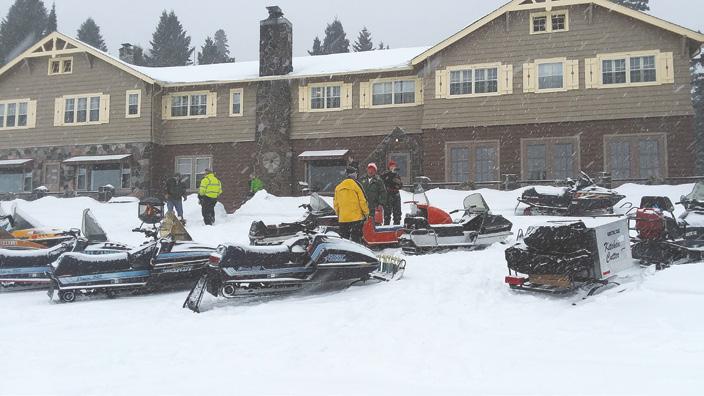
Feb. 7, Saturday The Lutsen Trail Breakers Snowmobile Club invites you to a day of fun at the 11th annual Blast from the Past Vintage Snowmobile Ride. Registration will begin at 10 a.m. inside Cascade Lodge, and the ride will start at noon. The ride takes about two hours and covers approximately 20 miles, finishing back at Cascade Lodge. Awards and eats will take place at the Cascade Restaurant & Pub after the ride. Also, mark your calendars for the first annual Lutsen Trail Breakers Caribou Classic Fishing Tournament, held Feb. 21 from 9 a.m. to 2 p.m. on Caribou Lake. Categories include walleye, northern, bass, and panfish, and registration will take place onsite at 8 a.m. Prizes will be awarded at 2:15 p.m. and lunch is provided. bit.ly/lutsensnowmobile
COLD FRONT
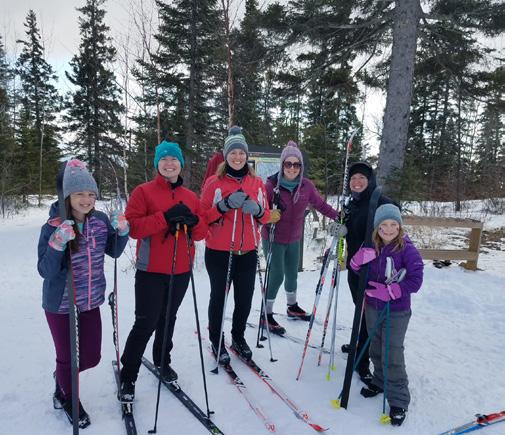
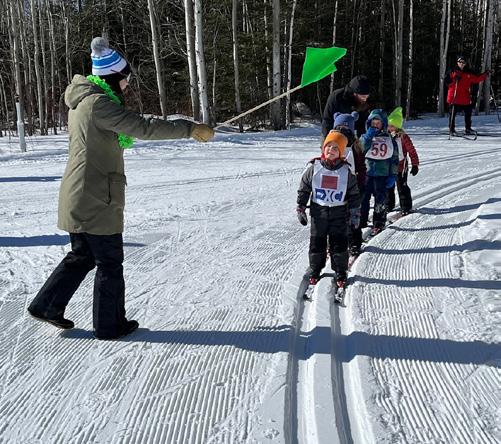
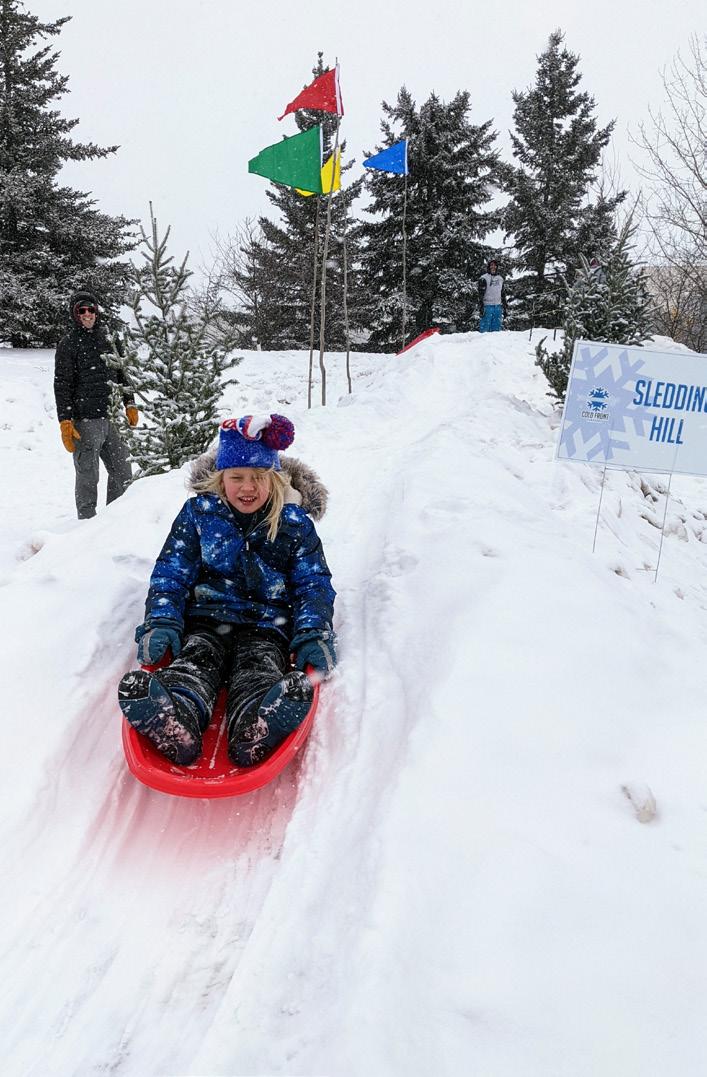
Feb. 7, Saturday Celebrate the best of winter with the annual Cold Front festival at Bayfront Festival Park in Duluth. Held from noon to 7 p.m., this free family-friendly event includes ice skating, a luge sledding hill, a snow play area, a groomed cross-country ski loop, craft and activity stations, fat bike demos and a pump track, a sensory tent area, bonfires and s’mores, food for purchase from Johnny B’s Food Truck, an adult snow volleyball tournament, giant ski races, hot chocolate, and more. There will also be
youth dog sled rides (ages 12 and under) from noon to 3 p.m., and hay rides from 1-4 p.m. coldfrontduluth.com
SNOWARAMA FOR EASTER SEALS KIDS
Feb. 7, Saturday Once again, the Thunder Bay Snowarama for Easter Seals Kids will head south of the border to Grand Portage Lodge and Casino, attracting snowmobilers from all over to enjoy some of the finest groomed trails in northern Minnesota. Over the past 20 years, the Grand Portage Snowarama has raised over $650,000 for children and youth with physical disabilities. This year, all Snowarama participants will enjoy a complimentary dinner and live music, as well as a bonfire on the trail and prizes throughout the weekend. A minimum of $100 is required to participate. Registration required. snowarama.org
ERIK KOSKINEN & FRIENDS
Feb. 7-8 The North Shore Music Association in Grand Marais presents a two-night live music weekend featuring Erik Koskinen, Martha Scanlan, and Jon Neufeld—three deeply respected musicians sharing two distinct performances in two very different rooms. The weekend begins Saturday, Feb. 7 at 8 p.m. with a swinging full-band show at Up Yon-
der. Led by Koskinen and joined by friends, the night draws on the classic honky-tonk tradition, offering a chance to get moving and shake off the winter chill. On Feb. 8 at 6 p.m., the focus shifts to an intimate, seated performance at the 4-H Log Cabin at the Cook County Community Center. Scanlan, Neufeld, and Koskinen come together for a stripped-down listening-room concert centered on songwriting, storytelling, and close attention. Tickets can be purchased online. northshoremusicassociation.com
FIBER WEEK
Feb. 10-16 Fiber Week, held at North House Folk School in Grand Marais, is a week-long event celebrating the wondrous world of fiber arts with coursework, community gatherings, speakers, and more. Fiber Friday on Feb. 13 brings a full day of free events and demonstrations. This year’s featured speaker is artist Maggie Thompson, founder and owner of Makwa Studio in Minneapolis. Thompson will give a presentation, titled “Building Community Through Art and Design,” at 7 p.m. on Friday. Other activities include a Show and Share night, a Fiber Fun Fair, a private shop tour and fiber circle at Dappled Fern Fibers, and more. northhouse.org
COOK COUNTY RIDGE RIDERS DRAG RACES
Feb. 14, Saturday Got a need for speed? Take part in the Cook County Ridge Riders (CCRR) snowmobile drag races at Hungry Jack Lake up the Gunflint Trail. Registration starts at 10 a.m. and racing begins at 11 a.m. Compete in a variety of classes offered in double elimination style racing down a 500-foot snow groomed track. There will be 17 classes including stock, improved, mod, open, and kids races. There will also be food and drink specials at Hungry Jack Lodge. Cost to race is $25 per class for CCRR members and $35 for non-members. facebook.com/cookcountyridgeriders
Cheer on the racers at the Gunflint Mail Run. | NACE HAGEMANN
VOYAGEUR
WINTER CARNIVAL
Feb. 14-15 Celebrate the world of winter sports and games with a magical blend of traditional carnival fun at Fort William Historical Park in Thunder Bay. Held from 11 a.m. to 5 p.m., enjoy two days of indoor and outdoor activities, a kid’s sliding hill, winter games and contests, live music, artisan demonstrations, farm animals, delicious food, and more. Admission required. fwhp.ca
PINCUSHION
WINTER SKI FESTIVAL
Feb. 14-16 The Pincushion Ski and Run Club in Grand Marais is hosting a fun-filled winter ski festival, open to participants of all ages and abilities. On Saturday, Feb. 14, there will be a social ski at 10 a.m., featuring several routes for skiers to choose from. Afterwards, there will be bonfires, and a soup and bread lunch will be provided in the chalet. There will also be an Olympics Nordic ski watch party. Sunday’s activities include a skate ski clinic for all levels, and kids races for those involved in ski lessons this year, and a women’s ski event will be held on Monday. Outside of the skate ski clinic, registration is not required and all the events are free. pincushionskiandrun.org
SNOWDAY ON THE WATERFRONT
Feb. 16, Monday Bundle up the whole family for a free winter wonderland at this year’s SnowDay on the Waterfront, located
at Marina Park in Thunder Bay. Held from 11 a.m. to 4 p.m., there will be ice fishing, snowshoeing, horse-drawn wagon rides, art activities, outdoor games, a campfire with hot chocolate, an indoor warming station with crafts and games, snow sculptures, and more. thunderbay.ca/snowday
DULUTH SPORT SHOW
Feb. 19-22 Held at the DECC, the Duluth Sport Show features the best of hunting, fishing, camping, and travel. There will be exhibitors with the newest products and technology, informative seminars, prize giveaways, food and drinks, fishing in a live trout pond, free measuring and scoring of mounts, a boating skills virtual trainer, and more. Bring the kids for free face painting and balloon animals, a kids fishing clinic, and a stunt show from world record holder James Johnson, also known as “the balloon guy.” Otto Kilcher, the mechanic, cattleman, and “MacGyver of the homestead” from the hit
Discovery Channel series Alaska: The Last Frontier, will be in attendance, as well as “grillologists” Mad Dog and Merrill. Tickets to the Duluth Sport Show can be purchased online or at the door. duluthsportshow.com
WOLFTRACK CLASSIC SLED DOG RACE
Feb. 20-22 Enjoy a weekend of dog sledding fun with the 18th annual WolfTrack Classic Sled Dog Race in Ely, featuring a 50-mile, eight-dog race, and a 30-mile, six-
dog race. Weekend events include the third annual WolfTrack Prance on Friday, Feb. 20, and a meet-and-greet with the mushers and their teams on Feb. 21, followed by a spaghetti dinner at Vermilion Campus. Race day is Sunday, Feb. 22 at 9 a.m. The public can view the teams from 8-8:45 a.m. wolftrackclassic.com
DULUTH WOMEN’S EXPO
Feb. 28, Saturday Grab your girlfriends and head to the Duluth DECC for the annual Women’s Expo, featuring live entertainment, seminars and speakers, health and wellness resources, a fashion show, free samples and screenings, pampering, shopping, a floral bar, and more. Enjoy locally made crafts from over 40 vendors at the Pioneer Market, visit the photobooth with puppies at Pioneer Hall, and shop from over 100 exhibitors. Northern Wilds will also be at the expo, so stop by and say hi. The expo will be held from 9:30 a.m. to 3 p.m. Ticket information can be found online. duluthwomensexpo.com
COOK COUNTY CURLING CLUB
J FUTTERER
BONSPIEL
27 - MARCH 1, 2026
Included in entry fee:
● Friday Night - Appetizers, Saturday Night - Dinner
● Saturday & Sunday Morning Continental Breakfast
● A fun bonspiel for all ages and skill levels
● Cash payout to top 2 teams in each event
● Gnome games/raffle/calcutta
● Three game guarantee
Entry
The Pincushion Winter Ski Festival will offer a women’s ski event on Feb. 16. | SUBMITTED
James Johnson, “the balloon guy,” will be at the Duluth Sport Show. | SUBMITTED
February
NORTHERN WILDS CALENDAR OF EVENTS
Thru Feb. 27
Faculty Biennial Tweed Museum of Art, Duluth, tweed.d.umn.edu
Thru March 1
Copper Thunderbird Survives with the Help of Water Spirits Thunder Bay Art Gallery, theag.ca
En Plein Air: Silver Islet Village & Mine Thunder Bay Museum, thunderbaymuseum.com
Thru March 8
Evening Escapades Exhibition Thunder Bay Art Gallery, theag.ca
Thru March 15
Patricia Deadman: The Red Feather Thunder Bay Art Gallery, theag.ca Images of Beargrease Great Lakes Aquarium, Duluth, glaquarium.org
Thru March 29
Jannick Deslauriers & Angus Trudeau: Night Ship, Navire de Nuit Thunder Bay Art Gallery, theag.ca
Thru March 30
James Ellis Exhibit: Northwood Shores: From Birch Grove to Great Lake Karpeles Manuscript Library Museum, Duluth, jamesellisfineart.com
Thru April 3
Wendy Savage Exhibit: Ojibwe Adornment in Ribbons, Cloth, Beads, & Fur Duluth Art Institute, duluthart.org
Carl Gawboy Exhibition: Fur Trade Nation: An Ojibwe’s Graphic History Duluth Art Institute, duluthart.org
Jan. 30-Feb. 8
Dial M for Murder 7:30 p.m. (2 p.m. Sun.) Duluth Playhouse, duluthplayhouse.org
Jan. 30-Feb. 22
Northwoods Fiber Guild Exhibition (Reception Jan. 30 at 5 p.m.) Johnson Heritage Post, Grand Marais, cookcountyhistory.org
Jan. 31-Feb. 1
Two-Person Champagne Open Bonspiel Cook County Community Center, Grand Marais, cookcountycurlingclub.com
Feb. 1, Sunday
World of Woodpeckers 11 a.m. Gooseberry Falls State Park, Two Harbors, mndnr.gov/gooseberryfalls
Family Art Days 1 p.m. Thunder Bay Art Gallery, theag.ca
Every Child Ready Duluth Family Fest 10 a.m. The Depot, Duluth, facebook.com/stlouiscountydepot
Children’s Book Launch with Deborah Marcero: The Great Escape! 11:30 a.m. Zenith Bookstore, Duluth, zenithbookstore.com
Snow Day in the Bay Noon, Silver Bay Municipal Liquor Store & Lounge, lovinlakecounty.com
Feast On: A Taste of Thunder Bay 6 p.m. Goods & Co. Market, Thunder Bay, ontarioculinary.com
DSSO: Masterworks 4: French Voyage 7 p.m. Decc, Duluth, dsso.com
TBSO: Noondaagotoon 7:30 p.m. Thunder Bay, tbso.ca
WEEKLY EVENTS
Tuesdays
Community Mindfulness Night 6 p.m.
Two Birds Healing Arts Center, Grand Marais, twobirdart.com
The Trews: The Bloody Light Tour 7:30 p.m. Thunder Bay Community Auditorium, tbca.com
Feb. 24, Tuesday
Portage Land Storytelling 4:30 p.m. Vermilion Fine Arts Theater, Ely, northernlakesarts.org
Blippi: Be Like Blippi Tour 6 p.m. Decc, Duluth, decc.org
Free Public Lectures 7:30 p.m. Thunder Bay Museum, thunderbaymuseum.com
Feb. 25, Wednesday
NOSFA: My Father’s Shadow 6:30 p.m. SilverCity, Thunder Bay, visitthunderbay.com
Feb. 26, Thursday
Book Launch Party: Floyd’s Baller 4 p.m. Marshall School Auditorium, Duluth, ywcaduluth.org
Indigenous Night Sky Storytelling 7 p.m. Fort William Historical Park, Thunder Bay, fwhp.ca
Author Talk with David Hakensen: Her Place in the Woods 7 p.m. Zenith Bookstore, Duluth, zenithbookstore.com
Anthrax with Exodus 7:30 p.m. Thunder Bay Community Auditorium, tbca.com
Feb. 26-March 7
The Wolves 7:30 p.m. (2 p.m. Sun.) Cambrian Players, Thunder Bay, facebook.com/cambrianplayers
Locals Night with Live Music 4:30 p.m. North Shore Winery, Lutsen, northshorewinery.us
Wednesdays
Game Day 1 p.m.
Two Harbors Public Library, facebook.com/communitypartnersth
Thunder Bay Country Market 3:30 p.m. CLE Dove Building, Thunder Bay, tbcm.ca
Thursdays
Date Night with Live Music 6 p.m. North Shore Winery, Lutsen, northshorewinery.us
Fridays
Victory Chorus 10 a.m. Minnehaha Elementary Cafeteria, Two Harbors, facebook.com/communitypartnersth
Renegade Late Night Improv 10 p.m. Zeitgeist Arts, Duluth, zeitgeistarts.com
Saturdays
Thunder Bay Country Market 8 a.m. CLE Dove Building, Thunder Bay, tbcm.ca
Blues Society Saturdays 12:30 p.m. Thunder Bay Blues Society, thunderbaybluessociety.ca
Live Music 3:30 p.m. North Shore Winery, Lutsen, northshorewinery.us
What’s for Dinner? 7 p.m. International Wolf Center, Ely, wolf.org
Sundays
Winter FunDays 2 p.m. Marina Park & Baggage Building Arts Centre, Thunder Bay, thunderbay.ca/winterfundays
Favorite Restaurants
Do you have a favorite place to get a coffee, to eat breakfast or take the kids for dinner?
The restaurants you vote for must be located in the Northern Wilds coverage area, which includes the North Shore communities from Duluth to Terrace Bay and over to Ely.
Limit 3 entries per restaurant
Only one ballot per person. Do not choose the same restaurant in more than three categories or your entire ballot will be disqualified. Vote online at northernwilds.com.
Voting starts February 1 and ends March 31, 2026. Look for the results in the 2026 June issue of Northern Wilds.
Locally Sourced
Ethnic Fare
Northwoods Character
View
“Worth the drive”
Kid-Friendly Menu
Vegetarian/Vegan-Friendly
Gluten-Free/Allergy-Friendly
Speedy Service
Take-out
Dog Friendly
Food Truck
Outdoor Dining
The North Shore Dish Say Cheese!
By Virginia George
Cheese is a curiosity. At its most basic level, cheese is a science experiment gone right. It was likely first discovered by storing milk in animal stomachs, which provided the rennet necessary to separate the solid proteins in milk from the liquid whey. These milk solids then cling to one another, creating curds that can be compressed and the liquid whey removed. Over thousands of years of documented cheesemaking, the process has been refined, and today there are hundreds of different cheeses to choose from.
Cheese production relies on microbial cultures introduced to milk that control flavor profiles by raising the acidity and absorbing lactose, which helps the milk divide into solid and liquid parts. At one time, these strains were perpetuated by using the whey, or liquid portion, of one batch of cheese and adding it to the next. This, of course, leaves room for contamination, but also the development of individual flavor profiles depending on the strain and conditions of any given production.
In fact, some cheese experts are concerned that camembert and brie, two soft cheeses from France, could eventually be at risk. As food scientists worked to create the “perfect” block of cheese, it seems some of the biodiversity has been lost, and the strains that produce the distinctive flavors of camembert and brie are struggling. Originally, the fungus that gives camembert its soft, white rind was present simply in the air of the caves where this cheese was aged. But as consumers became more concerned with a pristine white rind instead of a grey or blue or red hue, cheese was created in a lab, the particular strain duplicated, and instead sprayed on to the outside of the cheese. Unfortunately, as with any organism that is controlled and duplicated on a large scale, these cultures have lost some of their ability to self-replicate and are more susceptible to a disruption or a pathogen that would wipe out the entire strain—and thus the existence of these cheeses.
Thankfully, cheesemakers are working once again to diversify the cultures used in production. Consumers may also need to adjust their expectations, accepting variation instead of uniformity. This, of course, opens the doors once again to subtle differences in taste, color, and texture of these beloved cheeses that gives each its own sort of cheesy personality. This, I think, can only be a good thing.
They say that variety is the spice of life, and in terms of cheese, I think this is probably true. Variety comes in the form of various source materials, cultures, and inclu-
The Cheese Encounter is an independently owned artisanal cheese shop located in Thunder Bay’s Bay and Algoma neighborhood. The shop proudly offers local Canadian artisanal cheeses, as well as the finest of imported accoutrements.
| THE CHEESE ENCOUNTER
sions within the cheese to create unique flavor profiles, each with its own purpose. Burnett Dairy Cooperative and The Cheese Encounter are two shops where you can browse a wide variety of different cheeses, from the most basic to the most diverse.
Burnett Dairy Cooperative, Duluth
You might recognize Burnett Dairy Cooperative from the dairy aisle at your local grocery store. Burnett Dairy is a farmer-owned cooperative located in the Grantsburg area of Wisconsin. Founded more than 100 years ago, it remains one of the few full-service cooperatives still operating today. You can find many of their cheeses available at your local retailer.
In addition to being in grocery stores throughout the United States, Burnett operates several standalone shops, including the Burnett Dairy Cheese Store and Bistro in Duluth. Inside, you will find a retail space stocked with a wide range of goods, from maple syrup, jams, and jellies to meat sticks, summer sausage, and, of course, cheese. The store carries both Burnett cheeses and other artisanal varieties, offering staples such as cheddar, Swiss, and Muenster alongside many specialty options. If spicy is your thing, you might try the scorpion cheddar or the habanero ghost cheese. Other specialties include cran cheddar cheese and colby salami cheese, which make for great snacking and charcuterie boards.
The Burnett Dairy Bistro is a great place to grab a brickfired pizza or ice cream. Their ice cream cases are bursting with 30 flavors of Cedar Crest ice cream, each flavor sounding more delicious than the last. The brick-fired oven produces artisan pizzas like What’s the Big Dill, topped with Patria mozzarella, red sauce, dill pickles, bacon, and ground beef. The bistro also serves fried cheese curds in three flavors and other “Farmer Favs,” like the Big Fat German Pretzel, fried avocado slices, and smoked gouda cheese bites. If you’re on the go, pick up a take-and-bake pizza and a bottle of wine from the Wine and Spirits shop.
The Cheese Encounter, Thunder Bay
The Cheese Encounter is an independently owned artisanal cheese shop located in Thunder Bay’s Bay and Algoma neighborhood. The shop proudly offers local Canadian artisanal cheeses, as well as the finest of imported accoutrements. The Cheese Encounter strives to offer not only a wide variety of the finest food items, but also to provide a welcoming and educational environment for food lovers. A comprehensive list of the choices at The Cheese Encounter would be far beyond the scope of this piece, but you’re almost assured to find what you are looking for. Refrigerator cases line the walls and they burst with various
offerings with cow, sheep, and goat origins from around the world. Grey Owl, a soft, pasteurized goat’s milk cheese coated in vegetable ash, is produced in Quebec. Piacere, another Canadian cheese, is a creamy water buffalo milk cheese coated in rosemary, summer savory, and chili flakes. Along with these wildly unique cheeses, the shop also carries staples like Keen’s Cheddar, a raw milk cheese made from the Keen cattle in Somerset, England, and mozzarella produced in Woodbridge, Ontario, from fresh cow’s milk or buffalo milk. Truly, The Cheese Encounter has something for any dairy aficionado.
While The Cheese Encounter is clearly a dairy haven, they sell more than just cheese. You can find a host of cured meats like Sarment Droit French Saucisson, a dry pork sausage made in Savoie, France. They also carry Italian Guanciale, an alternative to pancetta, that is sure to enhance the flavor of even the best carbonara. Olives and olive oils, crackers, chocolate, and a variety of other condiments and delicious accoutrements line the shelves at The Cheese Encounter. Both Burnett Dairy Cooperative in Duluth and The Cheese Encounter in Thunder Bay are dedicated to providing high-quality products that meet the needs of their customers. Whether you’re sourcing ingredients for the finest dinner, or creating the best charcuterie board your friends have ever seen, or you just need a little more dairy in your life, the Burnett Dairy Cheese Store and Bistro and The Cheese Encounter are your tickets to success.
Burnett Dairy Cooperative cheeses are available at local retailers. | VIRGINIA GEORGE
Licorice ice cream from the Burnett Dairy Cheese Store and Bistro in Duluth. | VIRGINIA GEORGE
Break the Ice for a Warm Conversation
By Hartley Newell-Acero
Whether deep and detailed or lighthearted and limited, conversations are how we create connections with other people. These bonds not only warm our hearts, they can also expand our perspectives in compelling ways. Sometimes though, the idea of trying to start and maintain a conversation can feel intimidating. Keep in mind, comfortably connecting to other people through discussion is a skill that can be learned and improved.
1. Practice noticing both the verbal, and nonverbal, ways that people communicate. When you’re somewhere that you can comfortably be in “observer” mode (coffee shop, airport, etc.), unobtrusively take note of how people interact with each other. How do they signal interest in having a conversation? How do they indicate that they’re done? What do you notice about how much (or how little) eye contact people are comfortable with? What about other body language? Tone of voice? How do these communication details show up in your conversations?
2. If you know you’re going to be talking with someone you’ve previously met, remember what you learned through those conversations. What are their interests, challenges, etc.? Develop a couple of questions around those.
If you’re talking with someone you haven’t met before, start with something pleasant and low-stakes. Maybe offer a compliment plus a question: “Your jacket looks perfect for this weather. Where did you get it?” or “This is such a great coffee shop. Do you have a favorite item?” A shared observation is also a good place to begin: “The turnout for this event is wonderful! Have you come before?” or “The weather is glorious! What do you enjoy doing on a day like today?”
3. “Yes or no” questions can block conversation, while open-ended questions help keep it flowing. Starting a question like a journalist—who, what, when, where, or how—invites your conversational partner to fill the blanks.
4. It’s been said that for good conversations, it’s more important to be interested than interesting. This means slowing down and really listening, not so that you can prepare a sparkling response, but because you’re offering the gift of your attention.
Author Maya Angelou believed that in every interaction, we all are looking for answers to four unspoken questions:
• Do you even notice I’m here?
• If you do notice that I’m here, do you care…or not?
• Am I enough as I am, or will I have to change in order for you to care about me?
• Can I tell that I’m special to you, just by the way you look at me?
Real listening is part of how we answer these questions with care and consideration.
5. What about when you want or need to end a conversation? One way is to signal the upcoming transition. This can sound like, “I’ve got to leave in a second, but could you tell me a little about___?” or “I need to go, but before I do, could you quickly update me on___?” This allows you and your conversational partner a chance to close out the
conversation together instead of abruptly cutting it off. A simple, “Nice chatting with you. Take care!” is also a straightforward and respectful way to wrap things up. If someone indicates that they’re leaving the conversation, honor their need to move on. Don’t keep talking or asking questions.
6. It’s possible that when you try to start chatting with someone, the other person may not be interested. This doesn’t mean that you’re not worth talking to or that you should avoid initiating conversations. It means that this specific person at this specific time wanted something else. Congratulate yourself on recognizing and respecting their cues and know that your social awareness will serve you well in future conversations. But once you’re visiting, how can you get past “What do you do?” Novel questions can help develop the dialogue:
• Who’s your biggest role model?
• What’s your favorite thing that you’ve read or watched lately?
• What’s some solid advice you’ve learned? How did you apply it?
• What are your go-to comfort foods?
• Where’s your dream travel destination?
• When do you feel most “yourself?”
• Do you have a favorite quote or motto that you live by?
• If you could instantly become an expert in something, what would it be? Why?
• If you could have dinner with anyone, alive or dead, who would you pick? What would you want to discuss? So, take a chance and break the ice. There could be warm conversations on the other side.
TWO HARBORS
AmericInn
Betty’s Pies
Castle Danger Brewery
Cedar Coffee Company
Gooseberry Falls State
Park
Larsmont Cottages
R.J. Houle Info Center
Rustic Inn
Superior Shores
Super One
SILVER BAY/ BEAVER BAY/ FINLAND
Black Beach
Bri Esa’s
Cove Point
Four Seasons
Finland Co-op
Grand Superior Lodge
Northwoods Cafe
Split Rock Lighthouse
Tettegouche State Park
Timber Coffee
SCHROEDER
Cross River
Heritage Center
Temperance Traders
TOFTE
AmericInn
Bluefin Bay
Circle K
Coho Cafe
Surfside Spa
LUTSEN
Caribou Highlands
Cascade Restaurant
Cascade Vacation Rentals
Clearview Store
Lockport Store
Lutsen Liquor
Mountain Inn
North Shore Winery
Timber Wolff Realty
GRAND MARAIS
Aspen Lodge
Blue Water Cafe
Buck’s Hardware
Circle K
Cook County Co-op
Cook County
Historical Society
Coldwell Banker North Shore
East Bay Suites
Gene’s IGA
G.M. Rec Park
Gunflint Tavern
Hungry Hippie Tacos
Java Moose
Johnson’s Foods
Lake Superior Trading Post
Marathon
My Sister’s Place
N.S. Care Center
Red Pine Realty
Subway
Visit Cook County
Voyageur Brewery
GRAND PORTAGE
Grand Portage Trading Post
Grand Portage
State Park
Ryden’s Gas Station
Ryden’s Border Store
Northern Trails Spinner Techniques for Bass
By Gord Ellis
It was one of those mornings you dream of in the depths of February. The water was smooth, the air was warm, and there was nothing on the agenda except fishing. Bass had been exploding on the surface, and minnows were shooting out of the water. As I normally do in this situation, I tossed a topwater lure to the fish, but it was ignored. Anxious to cash in on the action, I cracked open a Plano container and saw a selection of Mepps Aglia spinners. The silver-bladed #4 looked to be about the right size and would make some flash. The spinner was cast out towards where the bass were making mayhem and then slowly reeled, causing the blade to spin and shine. The first retrieve was met with a hard strike, which was followed by a cartwheeling bass that immediately threw the hook. The second cast made it a little further before another smallmouth inhaled it. This fish stayed deep, and after a good tussle, I managed to bring the 3-pound bass to my hand. For the next hour, I hooked a variety of bass, all of them crushing that spinner with reckless abandon. The classic in-line spinner had saved the day again.
Historically, not much is said or written about in-line spinners for smallmouth bass. This is unfortunate, as when it comes to covering water and triggering strikes, the spinner is right up there with the best lures. Spinners are a lure that tournament anglers quietly throw when everyone else is fishing crankbaits or plastic. In lakes where minnows are a primary forage, spinners may be one of the very best choices.
Why a Spinner?
There are very few situations you will encounter where a spinner won’t produce. For instance, when bass are shallow or on the prowl, the spinner covers water and attracts fish with equal power. The vibration and pulse of a spinner blade can be felt by bass from a long way off. The movement of the blade spinning around the shaft of the spinner sends out vibrations that bass feel through their lateral line. This vibration can be even more intense if it’s emitted from a more concave spinner blade, such as those found on the Panther Martin. That sonic signal is a dinner bell for bass. A double-bladed spinner, like those on some EGB spinners, is another way to draw extra attention. When bass are holding in deeper water, a spinner worked more slowly and deliberately can draw fish up. Bass in currents are also very susceptible to spinners, as the flash and buzz of the blade as it washes by will often trigger a strike.
While the French blade and Sonic blades are perhaps the most familiar, there are also a wide variety of other spinner blade styles to choose from. The Indiana blade is a longer, narrower blade and has a tighter spin than a French blade. Indiana-blade spinners can be fished deeper and are also great when trolled, as they can spin at a higher rate of speed and stay deep. The Colorado spinner is rounder and will stay higher in the water column, even on a slow retrieve. Having a variety of spinners in several shapes, sizes, and colours will serve bass anglers well.
Spinner Bodies and Dressings
Typically, an in-line spinner has a treble hook on the business end. However, some spinners have fur dressings that add another layer of attraction. On spinners with silver blades, I like a dark dressing when bass fishing. Black and silver look like all kinds of minnows that bass eat, including smelt, shiners, or herring. On spinners with brass blades, brown and red dressings give off a crayfish vibe. Smallmouth have a hard time resisting a fleeing crayfish. There are a few other interesting options, including spinners with silver or gold mylar dressings. This really adds a ton of flash and movement.
Another of my favourites is the classic Mepps Mino. The Mepps Mino is a rubber minnow with a few extra hooks and a fishy profile that has proven itself through the decades. The Mino can be used behind
a Mepps Aglia, Comet, or Long Blade for a little extra fish appeal. Another addition you can make to a spinner is replacing the back treble with a single, long-shanked hook. Some spinners can be purchased with this option, or you can switch it out yourself. Add a rubber twister, grub, or tube to the single hook as a dressing. A single 3- or 4-inch twister
is especially deadly on smallmouth when fished behind a spinner. You can change the colour of the twister for even more options, although I find white or black hard to beat. For the ultimate in enticement, a double twister can replace the single twister. There will be a whole lot of movement happening when that spinner works its way through the water column.
Where to Use a Spinner for Bass
Perhaps the most exciting thing a bass angler can see is bass busting minnows. You will see the minnows scattering, oils and bass tails coming out of the water. When fish are scattering baitfish, an in-line spinner run just below the surface will trigger bass like few other presentations. Another place to try spinners is on reefs and shallow rock where bass are digging around for crayfish. A brass, fire-tiger, or orange spinner matches the colour of a craw, as does a similarly coloured dressing. Spinners also work very well over weeds and timber. The physics of the turning blade allows the spinner to ride high and over the top of weeds and structure. It also produces a lot of vibration, which draws fish to the lure. In-line spinners are an ultra-effective presentation for smallmouth and deserve a place in every bass angler’s tackle box. Try them out this year and be prepared for some arm-jolting strikes.
Gord Ellis with a big water bass that hit a spinner. | GORD ELLIS
Nice smallmouth bass caught on a Vortex spinner. | GORD ELLIS
NORTHERN SKY
FEBRUARY 2026
By Deane Morrison, MN STARWATCH
February opens with the rising of a full moon close to sunset on the 1st. This won’t be a supermoon, but it will be on the large side and almost perfectly round as it clears the eastern horizon.
As the moon wanes, it leaves more of the evening hours to the array of bright winter constellations and Jupiter, which outshines every star. All these objects will be up in the southeast at nightfall, including Sirius—the brightest of stars and the latest-rising member of the assembly.
Highest in the group is brilliant Capella, the beacon in the pentagon of stars that form the constellation Auriga, the charioteer. Through powerful telescopes, Capella resolves into four stars—two classified as yellow giant stars and two as red dwarfs. Next to Capella is a narrow isosceles triangle of stars. The two smaller ones, called the Kids, represent young goats held by the charioteer.
From anywhere above latitude 44 degrees north, Capella is high enough in the sky to be a circumpolar star, like Polaris and the stars of the Big and Little Dippers. That is, it never sets, but continually circles the point in the sky directly over the North Pole. Seen from Minnesota, it’s sort of a borderline case, as the lower part of its path “scrapes the horizon.”
West of Auriga, look for the Pleiades star cluster, which marks the shoulder of Taurus, the bull. Below the Pleiades is the V-shaped Hyades cluster, which outlines the face of Taurus. The bull’s eye is Aldebaran, a giant star unrelated to the Hyades. Aldebaran’s name comes from the Arabic for “the follower,” because it appears to follow the Pleiades across the night sky.
This year, February is what’s sometimes called a perfect month: one that starts on a Sunday and ends on a Saturday. Of course, February is the only month that can perform this feat.
The University of Minnesota offers public viewings of the night sky at its Duluth and Twin Cities campuses. For more information on Duluth, visit: d.umn.edu/planet.
BY JOE SHEAD
WHY GO: Stewart Lake is one of the closer lakes to Two Harbors and has a good boat ramp. It’s a great multi-species lake, producing good catches of both panfish and gamefish.
ACCESS: Stewart Lake is located about 15 miles north of Two Harbors. The roads are good, although about half the drive is on gravel roads that are usually allowed to ice over in winter. From the east end of town, travel north on Lake County Highway 2 for 3.3 miles. Turn left onto Lake County Highway 12 and proceed for 3 miles. Turn right onto Moen Road and head north about a mile. Veer left as Moen Road changes into the Drummond Grade. Travel about 6.5 miles down the Drummond Grade and then turn right onto Stewart Lake Road. Follow Stewart Lake Road about 1.5 miles until the road ends at the lake. There’s a concrete slab ramp and a dock. There’s parking for about eight trucks and trailers.
VITALS: Stewart Lake is 237 acres with a maximum depth of 20 feet. Average water clarity is 7.7 feet, and weeds grow to about 11 feet. The lake is lightly developed and has a mix of weedy areas with some rocky shoals, mostly around the islands.
GAME SPECIES PRESENT: Bluegill, black crappie, pumpkinseed sunfish, yellow perch, walleye, and northern pike.
BLUEGILL AND PUMPKINSEED:
gills are more abundant in Stewart than simi lar lakes, and you’ll also find a mix of colorful pumpkinseed sunfish in with them. Bluegills averaged 6.5 inches in the last DNR sur vey, but if you target them, you can find decent numbers of 8-inchers with some reaching 9 inches. It’s a pretty good bluegill lake with good numbers of keepers. The downfall is a lot of these fish are infected with neascus (black spot)—a parasite that looks like the fish was sprinkled with black pepper. Although unsightly, if cooked properly, infected fish are safe to eat.
BLACK CRAPPIE: are found in average numbers in Stewart Lake. They are usually of quality size, with an average length of just under 10 inches in the last DNR survey, and the largest topping out at about a foot. Ice anglers frequently target them in the lake’s deepest hole, although you will also catch them mixed in with bluegills in shallow, weedy areas.
STEWART LAKE
YELLOW PERCH: Yellow perch are the predominant panfish in Stewart Lake, and their numbers in the latest DNR survey were well
have a high perch population, there are a lot of small fish. However, perch do grow large in Stewart, with fish in the 9- to 10-inch range a real possibility. Probably the best perch fishing of the year is during the late-ice period, just a few weeks before perch spawn.
WALLEYE: Walleyes were stocked in Stewart Lake up until 2002. Since then, the lake
has relied on natural reproduction to support the walleye fishery. Walleye numbers are about average for the lake class. They aren’t super abundant like some lakes further toward Finland. Although you probably won’t catch a lot of walleyes, when you do find them, they tend to be nice. During the last DNR survey, the average walleye measured 17 inches.
NORTHERN PIKE: Stewart is a pretty good pike lake. Much of the lake is shallow and weedy, which is ideal habitat to catch lots of run-of-themill pike. However, the lake has the ability to produce some really nice fish in the 35- to 40-inch range. The lake is somewhat popular among spearers, although water clarity isn’t great. But somehow some large specimens manage to escape spearers and anglers. Don’t expect to catch a lunker every time out, but if you put in your time, eventually you might tangle with a really memorable fish.
SAWTOOTH RACING DOG BLOG
Race Season
BY ERIN ALTEMUS
In the starting chute at the Tahquemenon Sled Dog Race, I waited two minutes for my exact start time to arrive. The dogs were barking and lunging, 10 of them, waiting for the brake to release so they could surge ahead.
The timer leaned over and said, “It’s a mess out there. There are teams without drivers and drivers without teams”—not exactly what I wanted to hear as I was about to go.
Two days prior a steady rain had fallen which then froze, and even though the area had several feet of snow, the rain had firmed up the trail, crystallizing the snow and making it somewhat icy.
We shot out of the chute, and the strength of these dogs took my breath. Within a quarter mile we hit our first big turn, 90 degrees to the right.
One thing about this race course is that there are many intersections and turns in the trail, and for whatever reason, this gets the dogs very excited. They sped toward the turn as I braked, but finally, at the last second, I let the brake go as we veered around the corner, and the runners of my sled slid sideways like a racecar skidding on a track. I leaned into it just right, though, and we kept going. It turns out a few teams lost their musher right there, a quarter mile out of the chute.
There were many turns after this, and my dogs sped up at each one. Some teams had been successful at dumping their musher on each of these turns. I learned later that Kendra, our handler, who was running a team in the race, had approached a turn, slowed down, and then thought she needed to speed up, so she did and ended up falling into the center splits. She lost her team, the sled stayed upright, and off they ran without her.
A race organizer picked her up on a snowmobile, and they sped off toward the team. The trail was narrow, and they couldn’t get alongside the team. Finally, they got close enough, and Laura, also a musher, jumped from the snowmobile toward the sled, knocking it over and thus stopping the team.
It was a fast run for both of us, though Kendra’s team was faster than mine. Over-
night it snowed, and we did it again the following day, but the corners weren’t quite so harrowing with the fresh snow. Kendra placed seventh, and I placed 10th.
My daughter Sylvia ran her first race as well, placing fourth out of seven kids. She managed to pull off a “pass” and said she fell over twice but was able to hang on to the sled. I think she’s hooked.
Though I stayed upright during the race, I’ve had my share of mushing excitement in training. A few weeks ago, we did a run, camped for a few hours with the dogs, and then prepared to do another run. We were set up behind my husband Matt, who was going to groom a trail around a small lake for us to do a turnaround. Kendra was behind me with her team. We were all ready to go, and Matt fired up the snowmachine. I released my rope just a touch too early, and with a jolt, we were going, except Matt hadn’t quite left, and maybe we hit a small tree, too.
I’m not exactly sure of the events, but what I do know is that I quickly overturned my sled, and as we crunched against a tree, I let go of the handlebar and was about to lose the team when suddenly I felt something grip my foot, and then I was flat on my back. We burst onto the lake, and I was being dragged by my foot, which was caught in the brake of my sled.
I wasn’t in any terrible pain. I took note of that. Somehow I hadn’t broken anything. Even so, I was bouncing along on my hip and side, and it didn’t feel great. My knee rotated in a way it wasn’t supposed to, and snow was making its way into every crevice of my clothes.
I screamed for Matt on the snowmobile, but he was unaware of my predicament. The more I screamed, the faster my dogs ran,
and I was helpless to do anything. Finally, Sylvia, who was on the snowmachine with Matt, got him to stop and come to my rescue. I had lost a glove on my way down to the lake, and as we hit the trail again, a mitten bounced out of my sled, too. I did the second run with a liner glove and one mitt. Luckily, it wasn’t that cold.
I’d like to believe I have made all the mistakes before the big race. As I write this, the John Beargrease Sled Dog Marathon is 12 days away. There are 22 teams in the marathon, which is slated to start from Billy’s Bar in Duluth and end in Grand Portage. Trail marking has begun, and despite marginal conditions near Duluth, the race is slated to go on. What this year’s event brings will soon unfold.
Sylvia and one of our favorite race vets, Jerry Vanek. | MATT SCHMIDT
Erin and Kendra at the Tahquemenon Sled Dog Race start. | MATT SCHMIDT
Following the Ancestor’s Steps
Twilight Run
By Zhaawanoogiizhik / Sam Zimmerman
This piece was inspired to capture the manidoo (spirit) of the run under the evening skies of the North Shore along Gitchi-Gami (Lake Superior). It was completed on bibooni-giizis (December) 21, the biboon (winter) solstice—the 355th giizhig (day) of the calendar year. There are 355 anangoog (stars) ishpiming (in the sky) to honor the biboon (winter) solstice and the giizhig (day) this piece was completed.
In addition, the background features niizhwaaswi (seven) zhingobiiwaatigoog (pine trees) to represent the niizhwaaswi (seven) Grandfather Teachings of the Ojibwe: nibwaakaawin (wisdom), minwaadendamowin (respect), gwayakwaadiziwin (honesty), aakodewewin (bravery), zaagidiwin (love), dibaadendiziwin (humility), and debwewin (truth). All of these teachings guide us as we travel on our own journeys.
Follow my studio on Facebook and Instagram @CraneSuperior or if you have ideas for a North Shore painting, you can email me at: cranesuperiorstudio@gmail.com.
Strange Tales Nature’s Winter Ice Art Gallery
By Elle AndraWarner
That well-worn summer phrase, “Take time to smell the roses,” could be replaced during winter with, “Take time to visit nature’s ice art gallery.”
After a cold winter night, when you open the curtains or pull up the blinds, it’s a bonus to see delicate artwork of window frost ice. The images look like an artist with a fine brush has drawn feathering lines of trees, leaves, flowers, or even fern forests.
And when one takes time to further explore the winter environment, there’s an eclectic array of ice formation art outside. Mostly, it’s all free. Here’s a glimpse of some formations in nature’s winter ice gallery.
For starters, the window frost ice art happens when the outside pane of glass is exposed to very cold air while there is warmer, moist air on the inside. The result is creations of elaborate patterns of ice crystals that grow and branch out along the window glass, affected somewhat by slight imperfections on the window’s surface, such as dust.
Among the most dramatic ice formations are shimmering “ice caves.” These magical spectacles usually form on mainland cliff faces, where a combination of wind, temperature, and crashing waves of cold waters splash and freeze in layers, creating intricate ice formations that look like caves. What’s inside the ice caves? There’s a fairytale scene of ice columns, arches, icicles, and chambers. Nature’s colours of blue, green, and white glimmer through layers of clear ice, the cave walls, and columns. There may even be a frozen waterfall to admire.
Among the most famous sites on Lake Superior are along the lake’s north shore near Nipigon, Red Rock, and parts of the Lake Superior National Marine Conservation Area, as well as Wisconsin’s Apostle Islands. In 2019, The New York Times included Superior’s ice caves as one of “52 Places to Go.”
Spikey ice crystal formations called “ice flowers” can appear suddenly when freezing mist (water vapor) escapes through cracks in the thin layer of surface ice on rivers, lakes, and wetlands. A natural phenomenon in places such as Alaska, Canada, Norway, and the Antarctic, the delicate ice crystals are so fragile that even a slight breath of wind can damage them.
Fairly common in winter on Lake Superior and the other Great Lakes is “pancake ice,” circular ice discs with raised edges floating in the water. When temperatures drop to freezing, layers of slushy ice and tiny ice crystals (frazil) begin to form on the water’s surface. They get tossed around by waves and winds, forming them into flat, round circles resembling icy lily pads.
Hoarfrost gives trees a magical look. | JIM HAMMER: WIKIMEDIA
Ice balls can be found on the Great Lakes. | ALEKSANDR ABROSIMOV: WIKIMEDIA
Ice sea cave formed by Lake Superior waves on the Apostle Islands. | JEFF THE QUIET: WIKIMEDIA
As the pancake ice thickens, the discs collide, rotate, and bump into each other, and the edges get splashed with freezing water, creating raised rims. If you listen closely, you might hear the faint sounds of nature’s symphony as the ice circles tap against each other, making a unique rhythmic sound. Pancake ice can range in size from about a foot (30 cm) to 10 feet (3 metres) and can appear throughout winter.
Did you know there’s also a type of ice that combines with a fungus to produce “hair ice?” Looking like white candy floss
and shaped like fine, silky hairs, hair ice grows on decayed, broken wood branches when temperatures are only slightly below 32°F (0°C).
One of the most surreal winter scenes on the shores of the Great Lakes is a beach full of “ice balls” (also known as “ice eggs”), sometimes numbering in the hundreds. They start out on the surface of freezing water as slushy ice or tiny ice crystals that get tumbled and rolled back and forth by the motion of waves and steady but gentle wind. As they are rolled, water freezes over
3+ bdrm., 3 ba., 2 car attached garage and a jaw-dropper of a garage/woodshop. Beautiful custom-built one level home w/ a walkout lower level. Dreamy kitchen, wood fireplace, hardwood floors, main level lifestyle! Flexible space in lower level could be another bedroom, office/den, etc. 5 acres included. Jonvick Creek babbling along, a wood-fired sauna, massive wood shop/garage w/ living space attached (kitchen + 3/4 bath), a greenhouse, wood shed, storage shed, a wood-fired pizza oven and magical trails meandering through the woods!
An incredible business opportunity in the heart of the renowned and charming city of Grand Marais! Bring your own ideas or continue on with the prior nursery/ greenhouse/gift shop and the rental cabins. The largest cabin was formerly used as the owner’s summer home and has undergone some beautiful updates/ improvements! A beautiful property with mature trees, calming woods and a sweet creek on the east side of the property. Blue Moose! Multi-Use/Multi-Zoned. Opportunity awaits w/ this investment property. Bring your ideas! MLS 6119218
the balls layer by layer, gradually shaping them into smooth, round, stone-like ice balls. They can also be found at the base of waterfalls. Ice balls can range from the size of a marble to football size, or even larger. For example, in 2016, giant ice balls reached 3 feet (1 metre) in size in Siberia.
One of the most beautiful displays of nature’s delicate ice art is “hoarfrost.” To form, it needs a calm, clear, and cold night with moisture in the air. That water vapor then freezes into light, feathery ice crystals directly onto surfaces such as trees and veg-
etation, creating a stunning winter scene with a white-hair kind of look. Rime ice is similar to hoarfrost but forms under foggy or cloudy conditions and is heavier and denser than hoarfrost.
And there are plenty more forms of ice masterpieces to find in nature’s winter gallery, such as carrot-like ice daggers, ice pellets, trumpet icicles, sand hoodoos, ice bubbles, frost flowers, rabbit ice, ice ridges, ice volcanoes, ice rosettes, and more.
Northern Wilds Real Estate
Covering the communities in the North Shore area from Duluth, MN past Thunder Bay, Ont. Check in with any of our advertising Real Estate Agents for information on how to buy or sell your property.
Subscribe to our free online magazine with listings: northernwilds.com
Hair ice growing on wood on a forest floor. | VIELFALT: WIKIMEDIA
Delicate ice art formations on a windowpane. | JOHANN JARITZ: WIKIMEDIA
1480 Devil Track Rd
Lake living shines at this four-bedroom, three-bath Devil Track Lake home on the desirable north shore. Northwoods charm meets modern comfort with sweeping lake views, fireplace, three-season porch, walkout lower level, hot tub, updated systems and new dock.
MLS 6117794 • $748,500
1541 Camp 20 Road
Off-grid 1BR cabin on 37 wooded acres with Lake Superior views and adjoining state land. Features covered deck, wood stove, storage buildings, trails, and nearby trout fishing—an ideal private North Shore wilderness escape.
MLS 6122481 • $139,900
2895 Hwy 61 E
Charming 2BR home on 3 private acres near Grand Marais with Lake Superior views, vaulted living room, fireplaces, spacious kitchen, and direct shoreline access. Includes two-car garage and borders Federal land for added seclusion.
6122369 • $479,900
1XX W 13th Ave
Nicely wooded and surveyed Grand Marais city lot. Road and utilities not brought in yet.
MLS 6118743 • $59,900
Large, beautifully landscaped 10,000sqft lot in Grand Marais awaits your perfectly designed home. Could be split into two lots.
MLS 6122924 • $147,900
7xx County Road 6
Charming bunkhouse with cozy sleeping loft, nestled on 6.9A with the Little Devil Track River as the northern boundary line. Electric & broadband available.
skye ridge mls 6120074 • $154,900
Serene Tom Lake lot with over 150’ of easily accessible shoreline, year-round access and completed driveway.
6123264 • $159,900
107 acres near Grand Marais with creek frontage, federal land access, and endless potential for building, recreation, or development.
MLS 6122995 • $399,900
Red Pine Realty
Locally owned and operated since 1996 14 S. Broadway, Grand Marais, MN | 218-387-9599
REALTORS®: Sue Nichols, Broker • Jake Patten, Assoc. Broker • Jess Smith • Melissa Gregg • Mike Raymond Rebecca McAllister • Casey O’Brien • Alice McFarlane, Admin.
LUTSEN COMMERCIAL SITE
Wooded 3.3 acres with 389 ft of Highway 61 frontage in Lutsen’s downtown area. Zoned LTGC this site offers flexibility for a variety of business uses, whether you're envisioning a retail space, restaurant, art gallery, or other commercial project. Its excellent visibility along Highway 61 promotes strong exposure to the steady flow of travelers along this well-loved route. Minutes from Lutsen Mountains, golf, and year-round recreation.
MLS#6121839 $179,900
GRAND MARAIS HOME END OF THE ROAD PRIVACY
A 3 bedroom, 2 bath home in the heart of Grand Marais with a very private and wooded feel. Bonus roomhas natural light from windows on three sides and a gas fireplace. Add’l features: gas fireplace in the living room, geothermal in-floor heat, AC, maintenance free siding, fenced in back yard and adjoining wooded lot. Easy trail access connecting to Pincushion Mountain trails.
MLS#6123245 $565,000
TAIT LAKE PINES BUILDABLE LOT
Welcome to Tait Lake Pines! Build your dream cabin in the woods! Peaceful setting on 2.37 acres. Complete with its own hiking trails, outstanding views, maintained roads, year-round accessibility and access to power and broadband! As a member of the association, you'll enjoy 2 private boat launch areas.
MLS#6123050 $58,000
NEW! ONE-LEVEL LIVING IN GRAND MARAIS
Solar-powered, single-story home set on 1.24 rolling acres with seasonal views of Lake Superior. Features include grid-tied solar, three bedrooms, hardwood floors, a walk-out basement with a wood stove, and a pole barn. Conveniently located on two platted lots in Grand Marais, near the Superior National Forest. $450,000
HOMES AND CABINS
SALE PENDING
LAKE SUPERIOR VIEWS
Brand new build ready for your final touches, featuring Lake Superior views! Majority of the hard work is done with a brand new well, septic system, power and broadband in place. In floor heat ready to be connected and a Grundfos constant pressure water system ready to be turned on. Open concept with a wall of unique windows.
MLS#6123088 $385,000
TAIT LAKE PINES LOT
A private and peaceful location flecked with old growth white pine in Lutsen, MN. Complete with its own hiking trails, outstanding views, finely maintained roads, year-round accessibility and access to power and broadband! This 2.15 acre lot comes with deeded access to Tait Lake! Eagle Mountain is nearby, along with access points into the Boundary Waters!
MLS#6120357 $55,000
LAKE SUPERIOR LOT
Imagine waking each morning to the sound of Lake Superior waves rolling onto your rugged shoreline, with 224ft of boulder beach and ledge rock. Set on 4.92 acres in a quiet neighborhood, property is ready for your vision. Gravel driveway leads to a partial build pad. Electricity in place with standard 30-amp & 50-amp service. Septic system installed. Internet available nearby.
MLS#6121329 $435,000
TEMPERANCE LANDING LOT
Temperance Landing, part of the award-winning Bluefin Bay Family of Resorts, nestled on 1500' of stunning Lake Superior Shoreline. This is the last lot available in the association! Build your log home to match the rest and design the interior to your liking. If you opt into the Bluefin Bay Rental pool your property will be cared for to the highest standards while generating income.
MLS# 6117698 $155,000
LAKE SUPERIOR PROPERTIES
Home in Hovland! Located on Stonegate Rd, this 3-bedroom home sits on 11+ acres with 345’ of frontage on Lake Superior! Plenty of elbow room for your wander and explore the wonder of the Big Lake. Inside you have tons of space for everyone to enjoy, from the Family room with its Prow of windows overlooking the endless waters and stone fireplace to add to the ambiance, to the Rec room downstairs that walks out to the gorgeous realm of pavers, landscaping, raised beds, boreal florals of every kind. Not to mention the spacious Kitchen with its granite countertops, giving you space to cook all your favorite meals. Then end your days in your primary bedroom, soaking in the tub or listening to the waves from your private balcony. Visit today and make your Up North Dream a
CAMPN’, HUNTN’, FUN GETAWAY LAND, INVEST IN YOUR FUTURE!
SCHROEDER AREA
SNOWMOBILERS DREAM LAND! You’ve driven by this nice parcel during a Fall leaf color tour on the Cramer Rd, a beautiful area for your getaway cabin! Year round County Rd access, electric and fiber at the road. Level build site, boreal forest for great wildlife viewing! Lots of recreational opportunities just minutes away including fishing, hiking and biking the old railroad grade, or toe dipping in Lake Superior! MLS#6118380 $74,000 PRICE REDUCED!
40 ACRES! VIEW OF SUPERIOR! Just south of Sugarloaf Cove in Schroeder, and overlooking Lake Superior, are 40 acres of elbow room awaiting a new lover of the North Shore! Hard to find a large acreage parcel, easily accessible, and pitched just so to provide evocative, energizing views of the The Big Lake. Current owners have provided a good start: put the driveway in, cleared a building-site, set up the firepit, heck they even planted a few apple trees. Now it’s your turn to start creating YOUR DREAM! Begin with a little getaway place, put your own touches on the land. Or make it the homestead. Come have a look, stand in the middle of your own 40, deep and away from the cares and worries of modern life.
MLS# 6119000 $349,000 PRICE REDUCED!
TOFTE AREA
WELCOME TO YOUR FUTURE GETAWAY ON THE NORTH SHORE IN TOFTE! You have plenty of space to build your dream cabin or yearround home on this 2+ acre lot. Views of Lake Superior. Located right in the middle of Tofte, you have access to bike trails and snowmobile trails and tons of inland lakes! Visit today and start your next adventure! MLS# 6121512 $129,000 PRICE REDUCED!
LUTSEN AREA
BOREAL FOREST IN LUTSEN WITH ACCESS TO TAIT LAKE! Gorgeous trees and high ground are just a couple features this land offers! Fiber and Electric at Road, this land is build ready. As part of the Tait Lake Assoc. enjoy folks that are environmentally aware and at peace with the Great Northwoods! Shared canoe launch is just a few minutes’ walk from the land for when you want to paddle around the lake, or enjoy the hiking trails meandering through the Tait Lake area. Perfect Retreat Spot to build your getaway cabin!
MLS#6120556 $55,000
LUTSEN DEVELOPMENT LAND! Located on the corner of the Caribou and South Caribou, this land is high ground and magnificent in the Fall with the mature maple forest. A Syruper’s DREAM property, make this your own homestead or develop it utilizing the new County zoning ordinance for denser development surrounded by Green Space! Year round access via County roads, and electric and fiber at road.
MLS#6120783 $499,000
40 ACRES A STONES THROW TO THE BRULE LAKE BWCAW IN LUTSEN! Sweet views of surrounding lakes from the highest point of this 40 in an excellent location along the Grade Rd. Year round access, and electric and fiber are along one side of the Grade Road. Great location for a Fishing Camp and eventual home or development! Minute’s to the Caribou Trail in Lutsen, or keep on going to the Ball Club Road to Devil Track Rd to Grand Marais! Mature forest, great spot. 40 acres too much? Seller’s will sell the East 20 for $169,000!
MLS#6120782 $299,900
GRAND MARAIS AREA
RARE OPPORTUNITY TO BUILD YOUR DREAM HOME ON 120 ACRES OF MANICURED FOREST LANDS AND EXPANSIVE LAKE SUPERIOR VIEWS! There’s a rough road accessing the property from Bally Creek Rd, just ten minutes west of downtown Grand Marais! Views from the TOP of Murphy Mountain are astounding, not only overlooking Lake Superior, but looking toward the North as well! Gate on property, shown by appointment only. MLS#6122477 $1,200,000
CATCHLIGHT CATCHLIGHT
MOOSE
It was a cold New Year's morning. I went for my regular drive looking for wildlife and came across many tracks where moose had been browsing along the road. I rounded a corner and saw two bulls enjoying themselves. The larger one is a bull I have photographed a few times in the spring and fall. What a way to start the new year. David Johnson