The Marquette Tribune
RISING FROM THE WRECKAGE
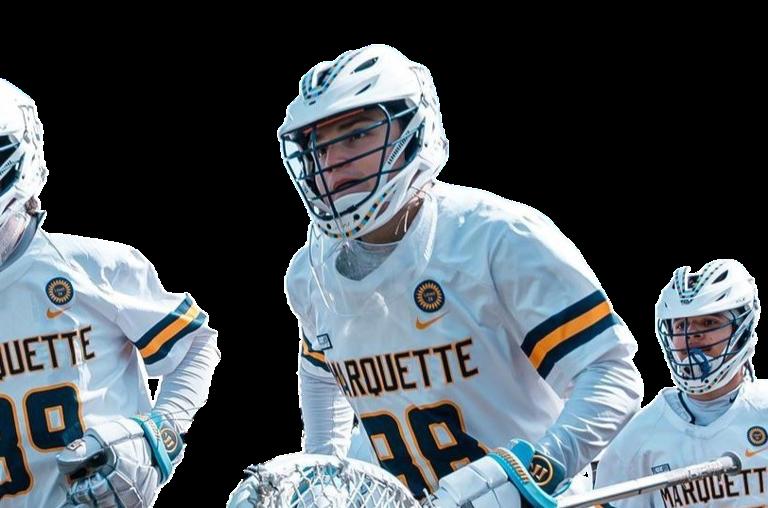

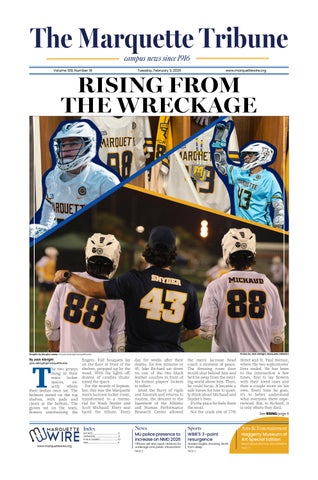
By Jack Albright jack.albright@marquette.edu
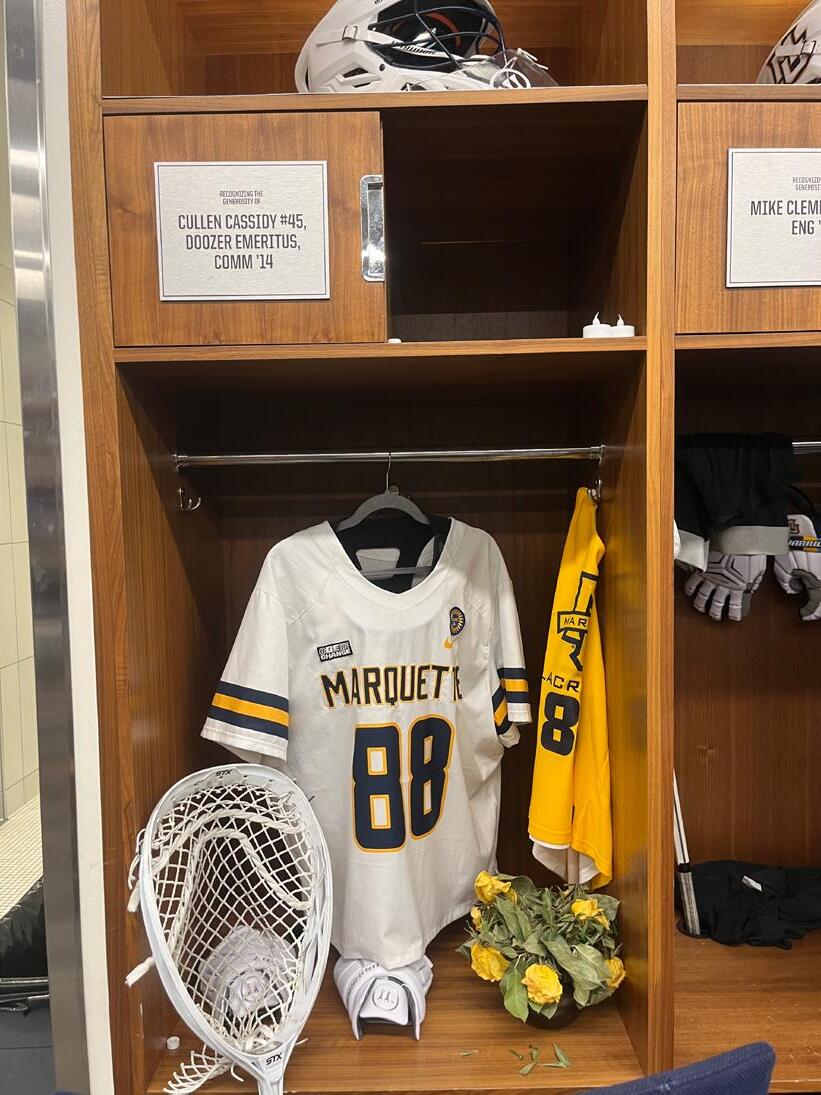
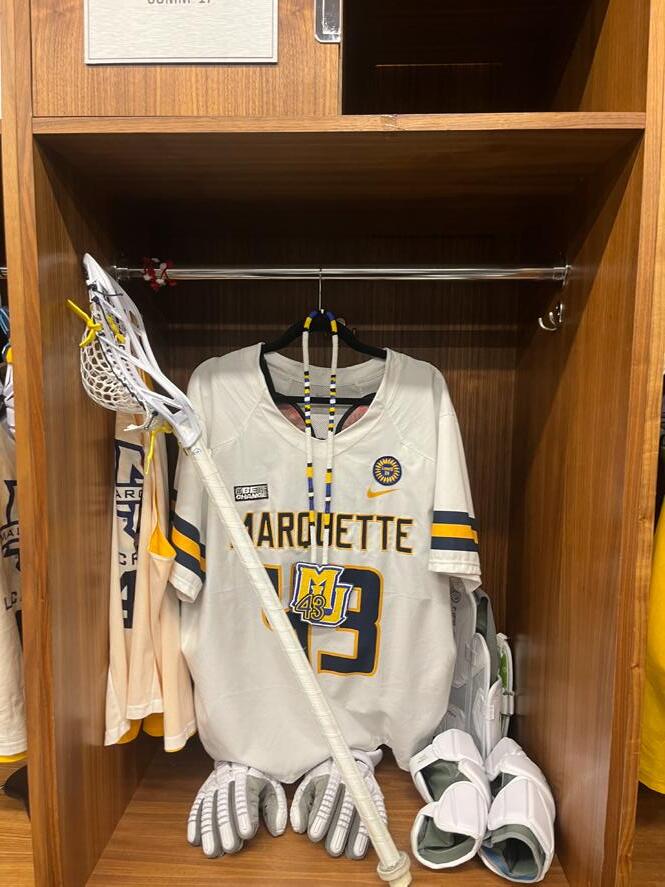
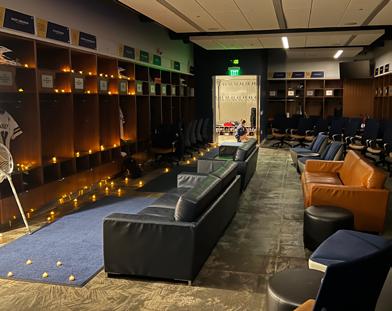
The two jerseys hung in their main locker spaces, exactly where their bodies once sat. The helmets rested on the top shelves, with pads and cleats at the bottom. The gloves sat on the seats, flowers intertwining the

fingers. Full bouquets lay on the floor in front of the shelves, propped up by the wood. With the lights off, dozens of candles illuminated the space.
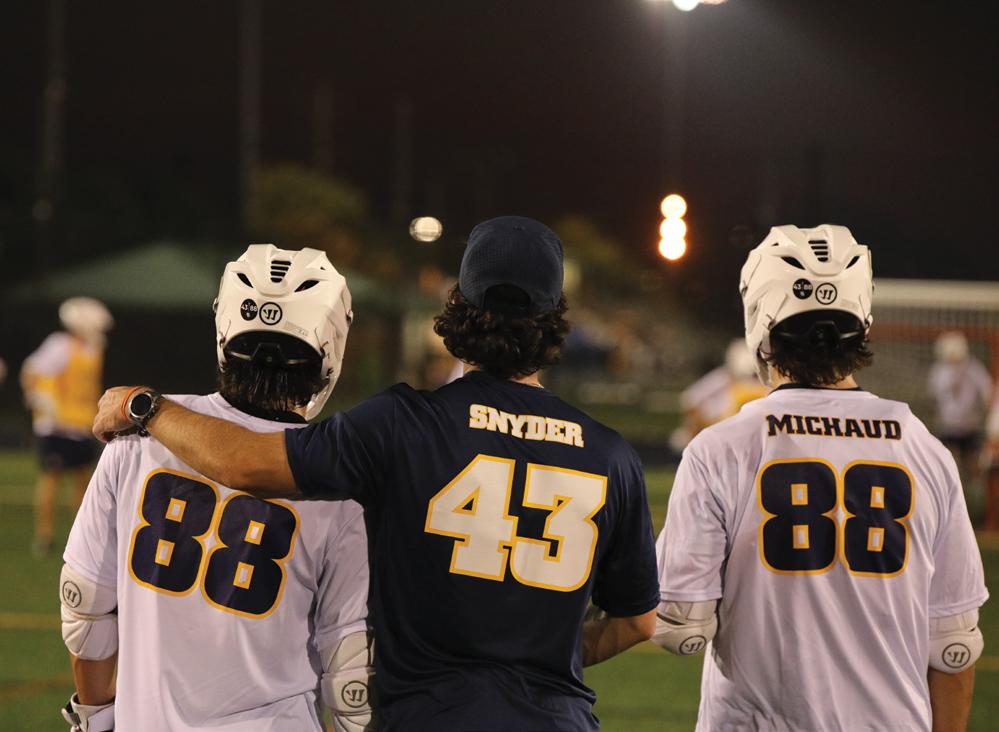
For the month of September, this was the Marquette men’s lacrosse locker room, transformed to a memorial for Noah Snyder and Scott Michaud. Every seat faced the tribute. Every
day for weeks after their deaths, for five minutes or 45, Jake Richard sat down on one of the two black leather couches in front of his former players’ lockers to reflect.
Amid the flurry of vigils and funerals and returns to routine, the descent to the basement of the Athletic and Human Performance Research Center allowed
the men’s lacrosse head coach a moment of peace. The dressing room door would shut behind him and he’d be away from the swirling world above him. Then, he could focus. It became a safe haven for him to quietly think about Michaud and Snyder’s lives. It’s the place he feels them the most.
Not the crash site of 27th
Street and St. Paul Avenue, where the two sophomores’ lives ended. He has been to the intersection a few times, first to lay flowers with their loved ones and then a couple more on his own. Every time he goes, it’s to better understand what everyone there experienced. But, to Richard, it is only where they died.
Graphic by Murphy Lealos murphy.lealos@marquette.edu
Photos by Jack Albright, Marquette Athletics
Tuesday, February 3, 2026
University to increase NMD police presence
Recent changes follow destructive events of 2025
By Mia Thurow mia.thurow@marquette.edu
Twenty-nine alcohol-related calls to the Marquette University Police Department. Out of those, 14 hospitalized students. 47 confiscated BORGs. One totaled car. And to cap the day off, a 69-77 men’s basketball loss to the University of Connecticut.
National Marquette Day 2025 left quite a heavy wake.
“I don’t think I saw a garbage can between campus and the Fiserv Forum that didn’t have somebody hunched over it,” Kaleb Rondorf, a senior in the College of Business Administration, said.
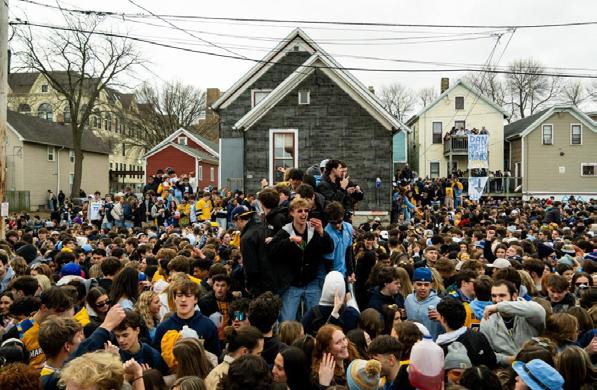
Unlike the afternoon games of years prior, Marquette men’s basketball played at 7 p.m. on NMD 2025, giving students the entire day to consume alcohol before tipoff. With the extra time, students flocked to an annual party in the alley at the 800 block of 17th Street.
University leaders estimated there were 1,000 students in attendance — roughly nine percent of the student body.
William Lake, a senior in the College of Arts & Sciences, was one of those students at the alley last year.
“It was loud, it was fun, people were definitely drinking,” he said.
But he remembers the party breaking up earlier than previous years because of “outrageous activity,” including vandalism and the destruction of a student’s car.
Erin Gannon, dean of students, said last year’s NMD was a “confluence of a lot of things happening at the very same time.” It became clear to the university that the party needed to be broken up by campus police because unsafe activity was taking place. But while the party was breaking up, she said, students were already at “really extreme and really dangerous” levels of intoxication.
“That resulted in hundreds of students going back to their residences extremely intoxicated, carrying their BORGs (black out rage gallons) with them back into the halls,” Gannon said. “It created this emergency situation where all of the things that needed to be attended to at one time were overwhelming to the systems.”
Campus police bringing in additional officers
This year, MUPD Assistant Chief of Police Jeff Kranz said, the department will bring in additional uniformed and non-uniformed officers to ensure “everyone
can enjoy the day safely.” He said campus police have been working both internally and with the university to prepare for NMD.
On Jan. 15, a screenshot posted from a dorm floor group chat on Yik Yak — an anonymous social media app — claimed Marquette police officers would be working in plain clothes and ticketing every student they found in possession of alcohol. However, the university responded by deeming the post inaccurate. In addition to non-uniformed officers, citations will be issued for underage drinking and public drinking — the possession of an open intoxicant on a public street, sidewalk or alleyway — according to a document university spokesperson
Kevin Conway sent the Marquette Wire. University staff have also met with off-campus housing partners to discuss potential consequences of hosting large parties without proper safety measures, Conway told the Wire.
Out of all the alcohol-related calls the Marquette University Police Department received on NMD 2025, 14 students – not including those who took themselves to the emergency room –were taken to the hospital from Fiserv Forum or other off-campus locations.
Campus police were overwhelmed by calls and, at one point, there was an hour wait for an ambulance. Marquette staff also had to triage students in the lobbies of dorm halls.
Kranz said the alcohol-related calls were the most challenging part of the day because there was such a high volume of calls made in a short period of time.
Duties became very labor-intensive, he said, because instead of one officer handling a group of people like usual, officers had to individually handle each person in medical distress due to overconsumption.
And, Kranz added, it didn’t help that the men’s basketball game took place at night.
“You had more time to drink, and the alcohol calls started coming in for concerns of the health of students,” he said.
After an initial flood of calls, Kranz said, MUPD was able to bring in extra help and create a game plan. He said it took about two hours for the police to get the calls under control, and after that point, things began to slow down drastically.
Though NMD is an outlier when it comes to campus-wide partying, Kranz said, MUPD’s main goal is to keep students safe on such days. However, he said, the police also need help from students on NMD.
“If you see your friend is hitting that level of excess where they’re no longer able to take care of themselves, you need to step in and intervene and take care of them,” he said.
Kranz said he still wants everyone to have fun celebrating the university holiday first and foremost, but his biggest message for students is to stay safe and keep an eye on one another’s wellbeing.
Afternoon tipoff set after previous evening games
The men’s basketball tipoff for NMD has gradually gotten later over the past several years. In 2022, the game started at noon; 1 p.m. in 2023; 5 p.m. in 2024. In 2025, Rondorf said, the later-than-normal 7 p.m. start time contributed to many of the alcohol-related issues.
“People like to start early, and nobody wants to be the person that stops drinking before the game,” he said.
Rondorf, who chooses not to drink, said most students tend to ease off drinking after the game, but a later game pushes that timeframe hours back.
Marquette Athletics communicated with scheduling networks that its goal for 2026 was to have an afternoon NMD game, Gannon said. While much of the NCAA men’s basketball schedule has to do with TV time and Fiserv Forum availability, she said, the university still has some influence over the times games are played.
This year’s NMD men’s basketball game has a 1 p.m. tipoff time, significantly earlier than that of the year prior.
Per Fiserv Forum’s code of conduct, fans at the arena should expect an environment where “guests will consume alcoholic beverages in a responsible manner.” Intervention will be handled promptly and safely with implied, intoxicated or underage fans, the
code states.
University encourages students to “have a plan”
With a 7 p.m. start time like in 2025, Gannon said, students have much more time to consume alcohol before the tipoff. Many students have the goal of consuming an entire BORG before the start of the men’s basketball game.
Gannon said it’s important for students to have a plan for personal behavior monitoring and harm reduction.
“When people have strategies in mind for monitoring their consumption or keeping their consumption at a risk level that they’re comfortable with, they’re more likely to follow their plan,” she said.
In regard to high-risk alcohol use, Gannon added, the consequences increase the more one consumes. There eventually becomes a risk to safety and personal health, as well as the health and safety of others.
“This is part of adulting, that we have all kinds of rules and laws,” she said. “If you choose not to follow them, there may be risk there.”
Campus
leadership encourages respectful behavior
Not only is Marquette concerned about the safety of its students, Gannon said, but also the affect their actions have on peers who chose not to participate in high-risk behaviors. In 2025, for example, partiers stood on and crushed the roof of a student’s car that was parked behind his apartment building in the alley where the party was taking place.
“We also want to make sure that for students who choose not to consume alcohol or choose not to go to parties, that they have events and opportunities to celebrate their Marquette experience separate from what has traditionally been the pervasive narrative,”
she said.
Gannon said the holiday can be a fun day for different people to come together and celebrate being part of the Marquette community, and that celebration is visible nationwide.
That’s why, when events such as those of NMD 2025 take place, Gannon said it’s important for students to consider how they’re publicly representing themselves and Marquette.
“We want to make sure that students can study and be successful and do the things that they came here to do, and not have their behaviors or the things they choose to do interfere with other people’s ability to do the same,” she said.
Rondorf said his friends are supportive of his choice to not drink, but others feel social pressure to drink to fit in, especially on NMD. He encourages students who limit their alcohol consumption or choose not to drink to have a conversation with their friends.
Most of the time, he said, people are surprisingly understanding.
“Having that added pressure, and then people constantly offering you drinks and your friends asking you to drink with them obviously it doesn’t make it any easier,” Rondorf said. “It makes it a lot more likely for people to give in to that kind of peer pressure on a day like that.”
With the university’s biggest holiday less than a week away, both students and the university are in the midst of preparing for NMD 2026 — each in their own ways.
After conducting initial interviews with university officials and campus police in November, the Marquette Wire reached out again in January seeking updated information regarding National Marquette Day 2026. Neither MUPD nor Marquette were able to provide the Wire a detailed university action plan for the holiday.
Photo by Owen Weis owen.weis@marquette.edu
During NMD 2025, roughly 1,000 students flocked to an annual party at the 800 block of 17th Street.
The MarqueTTe Tribune
Managing Editor of The Marquette Tribune Sophia Tiedge
NEWS
Executive News Editor Mia Thurow
Assistant Editors Lance Schulteis, Lilly Peacock
Reporters Sahil Gupta, Elena Metinidis, Mina Marsolek-Bonnet, Lillie Martin
ARTS & ENTERTAINMENT
Executive Arts & Entertainment Editor
MaryKate Stepchuk
Assistant Editor Joseph Schamber
Reporters Elise Emery, Allison Scherquist, Annie Goode
OPINIONS
Executive Opinions Editor Rachel Lopera
Columnists Isabella Gruber, Amelia Lerret
SPORTS Executive Sports Editor Jack Albright
Assistant Editors Matthew Baltz, Raquel Ruiz
Reporters Benjamin Hanson, Mikey Severson, Ben Ward, Eamon Bevan, Conor McPherson
COPY
Copy Chief Emma Fishback
Copy Editors Elizabeth Belmont, Shea Lancaster
VISUAL CONTENT
Design Chief Murphy Lealos
A&E Designer Evelyn Riordan
Sports Designer Amery Thompson
Opinions Designer Allegra Delli Carpini
Photo Chief Clay Ellis-Escobar
Photographers Lily Wooten, Owen Weis, Leo Stallings
HAVE A TIP FOR US?
Have you seen something that you think should be a story? Do you have a tip about something we should be looking into? Do you have documents or other materials that we should see? We want to hear from you.
If you have documents you'd like to send us, you can send anything to wiretips@marquette.edu.

Recovery hosting alcohol-free party
NMD tailgate will take place in the Deer District
By Lance Schulteis lance.schulteis@marquette.edu
As students head to Fiserv Forum on Feb. 7 for the National Marquette Day men’s basketball game, they’re invited to stop at a different type of tailgate along the way.
Recovery at Marquette — a program supporting students in recovery from substance abuse — is introducing an alternative option to the NMD party scene, serving brunch to the first 300 students that arrive from 11 a.m. to 1 p.m.
The sober tailgate comes a year after the Marquette University Police Department received 29 alcohol-related calls on NMD 2025. Staff in residence halls confiscated alcohol and triaged students in the lobbies of dorms.
At the 800 block of 17th Street — known as the “Alley” — a car was totaled during a gathering of over 1,000 students.
Recovery at Marquette’s sober tailgate is open to all students, regardless of their sobriety or involvement with the recovery program. While the organization builds what it hopes to be a safe and controlled NMD get-together, it also promises to make the tailgate just as fun as any other party.
“There’s this misconception that if you enter recovery and pursue sobriety, the party stops,” Timothy Rabolt, director of
Recovery at Marquette, said. “This is our response to that — the party’s not over.”
The tailgate will be a marriage of two previous Recovery at Marquette events. On NMD 2025, the program hosted a small get-together in its space on the third floor of Wellness + Helfaer Recreation away from the bitter cold and chaos of the alley.
In November 2025, the program held a sober tailgate before the Milwaukee Admirals’ “Recovery Night.” The tailgate, held
at GATHER, an event space in Fiserv Forum’s Deer District, included food and games for students before a night of hockey.
For NMD 2026, Recovery at Marquette will create a scaled-up combination of the two gatherings, entertaining and providing food for the first 300 students at GATHER — the venue’s maximum capacity.
“It’s good to give people options and to not pressure them to feel like they have to live up to a certain stereotype of what it means to celebrate National Marquette Day,” Helenka Kiss, a program assistant, said.
In addition to providing an outlet for students, Rabolt said the sober tailgate will help answer a longstanding question of his: Do students want to drink in excess, or do they just want a party?
“Let’s throw a huge party with a lot of fun options that doesn’t involve drinking and see how people respond,” Rabolt said.
That party will include an array of catered food, such as breakfast sandwiches, burritos, wraps, sliders and vegetarian options. The spread will also have a popcorn station, dessert bar, hot cocoa and mocktails.
“Our tailgates are always fun,” Hilda Valencia, a graduate student and program assistant, said. “And we have the best food.”
Away from the brunch buffet, the tailgate will include a crafting table where students can design posters and decorate
custom bracelets and trucker caps. Partygoers will also have access to a photo booth, face painting and glitter tattoos. Everything will be set to music, with Milwaukee Bucks entertainer DJ Style at the turntable.
Rabolt said since the initial announcement, the tailgate has received widespread support, with the Counseling and Wellness Centers co-sponsoring the event. On social media, students have been actively liking, sharing and reposting promotional messages for the tailgate.
“It’s hitting on a desire to party, but maybe not in an alley,” Rabolt said.
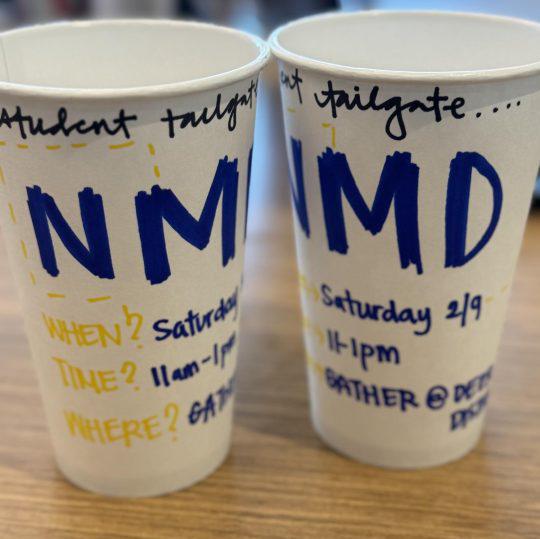
Despite the fanfare, the Recovery at Marquette team isn’t just drumming up the word online. On Jan. 30 at Wellness + Helfaer Recreation, the program hosted a pop-up hot cocoa and coffee bar. While the drinks were free, they came with an invitation to the NMD tailgate, including flyers and handwritten messages on cups.
Though students will celebrate NMD with their own traditions, including get-togethers, late nights and inevitable trips to the alley, Recovery at Marquette hopes to add another party for students to look forward to.
“Go, do whatever you want to do,” Rabolt said. “But here’s our sober alternative that we think is going to be a pretty great experience.”
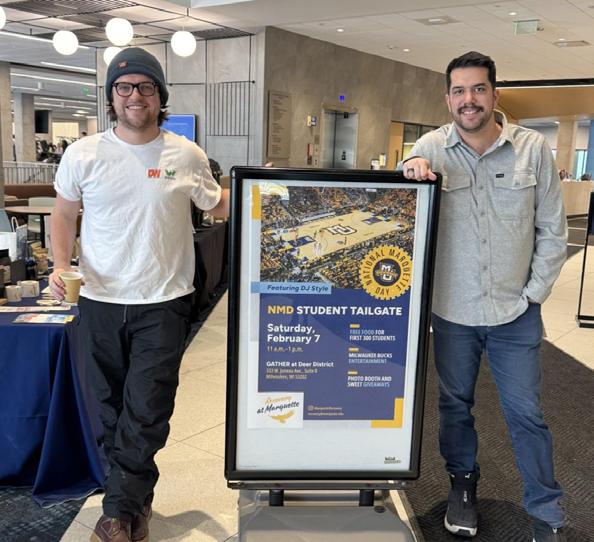
Program director Tim Rabolt (right) wants to prove that partying can still be fun without alcohol.
Photo by Lance Schulteis lance.schulteis@marquette.edu
Photo by Lance Schulteis lance.schulteis@marquette.edu
Recovery at Marquette's NMD sober tailgate is open to all students from 11 a.m. to 1 p.m. on Feb. 7.
February
Meet the loudest fans in the student section
MU pep bands bring energy at sporting events
By Mina Marsolek-Bonnet wilhelmina.marsolek-bonnet@
marquette.edu
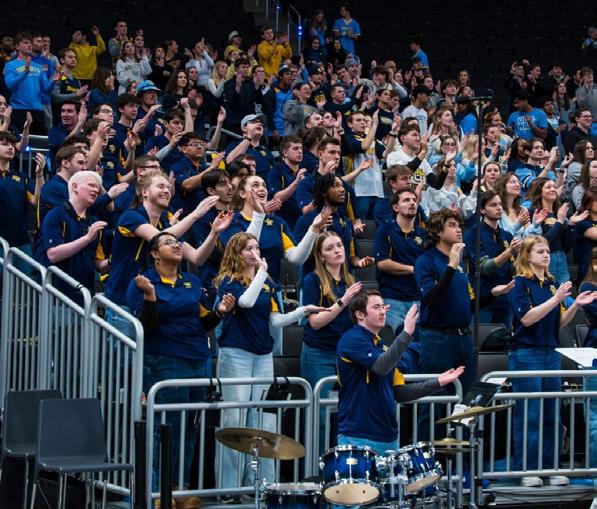
Between the players, the screaming fans and the sea of blue and gold, there is little more iconic to Marquette University than basketball. School spirit swells throughout Fiserv Forum and the Al McGuire Center as the university’s pep band plays the fight song and "Hail Alma Mater."
Even when the team on the court leaves fans wanting more, or when the student section isn’t as full as normal, the Marquette pep bands always bring the energy.
“Sometimes when the team is getting really hot, you can hear the band playing with some more energy,” Charlie Chouinard, a senior in the College of Health Sciences and trumpet player, said. “And then sometimes, when the team is in a slump, we keep putting out energy and hopefully that’ll get something to the team.”
Chouinard attributes the atmosphere’s energy to the magic and passion of live music.
Marquette’s pep bands are led by Music Directors Erik Janners and Joel Flunker and are made up of players from the symphonic band and wind ensemble. Both groups rehearse three times a week, have various concerts throughout the year and require an audition for placement.
The pep bands play at both the men’s and women’s basketball games, as well as the women’s volleyball matches.
Marquette has two pep bands, “blue” and “gold.” Men’s and women’s home games are divided between the two. Despite only needing to attend about half of the nearly 50 games in a season, band players show up to nearly every game.
Band members, standing between the fans and the players on the court, help round out Marquette’s student spirit.
“The pep band really is an extension of the student section,” Chouinard said.
“We get pretty into it; it’s a good time.”
Alyssa Maves, a junior in the College of Arts & Sciences and clarinet player, credits her time in the pep band for growing her love of sports, particularly basketball.
“Before my time in the pep band, I never truly

understood the excitement that can come from cheering for your favorite sports team with a community around you that is as equally passionate as you are,” Maves said.
Preparation for a game starts long before tipoff, with the pep band arriving an hour before the game starts. As the pep band settles into their seats next to the student section, each musician gets their playlists organized. The team has a folder of over 100 tunes, divided between four playlists.
Even though the band’s homes are the Al McGuire Center and Fiserv Forum, the groups travel to some of college basketball’s biggest stages — the Big East and NCAA tournaments.
As a member of the blue band, Maves will be traveling to the Women’s Big East Basketball Tournament in
Connecticut this year. The gold band will be going to New York City with the men’s basketball team. These trips often make it to the top of band members’ list of favorite moments, whether it be sitting front row at March Madness or being in person to witness sold out, widely televised games.
Chouinard can still imagine the moment the team won the Big East Tournament in 2023.
“That was cool, seeing [Tyler] Kolek and all those guys cut down the net,” he said.
Maves fondly recalls traveling to the Big East Tournament at Madison Square Garden in March 2024 — her first year of college — and watching a Marquette-Villanova matchup go into overtime. Sneakers squeaked as the clock ticked down to Marquette’s
eventual victory.
“The game was super intense, and I remember locking arms with the other band members near me in support for the team as the clock was running out,” she said. “We ended up winning the game and even went to the Big East [Tournament] finals that year.”
The majority of students are unable to travel during the school year to see the basketball teams play in away games, but members of the Marquette pep bands are always there to cheer their Golden Eagles on — even at home, in front of a TV.
“We bring the same energy and excitement with us, just to a different place,” Maddie Meyer, a sophomore in the College of Communication and trombone player, said.
Johnston Hall left flooded
Building will be uninhabitable for at least a week
By Sophia Tiedge sophia.tiedge@marquette.edu
Johnston Hall — home to Marquette University’s College of Communication — will be closed for at least a week due to water damage discovered over the weekend.
According to a university statement, all classes located in Johnston Hall will be taught virtually for the week, if not longer. College of Communication faculty and staff have been asked to work from home the week of Feb. 2, and an
official date for reopening has not yet been established.
Facilities Planning and Management has been working with external personnel to repair the damages, and the university has not disclosed the source of the flooding.
Any faculty or staff member who needs to enter the building must reach out to Acting Dean of the College of Communication Kati Berg, who will coordinate the request.
The university will continue to publish updates in Marquette Today.
This story is developing and will be updated as more information becomes available.

Marquette has two pep bands, "blue" and "gold," which divide time playing at home basketball games.
Photo by Clay Ellis-Escobar clay.ellis-escobar@marquette.edu
Tentatively, class will be virtual.
Photo by Sahil Gupta sahil.gupta@marquette.edu
Inside MU's 3-point resurgence
The Golden Eagles are shooting 38.4 percent from deep
By Mikey Severson michael.severson@marquette.edu
Marquette women’s basketball let their perimeter shots fly in one of their biggest wins of the season when hosting the Villanova Wildcats on Jan. 4. Both of MU’s talented post players, Halle Vice and Skylar Forbes, went 9-of-12 from downtown, including two 3-pointers in the fourth quarter from Forbes to seal the game.
In MU’s Coconut Hoops trip against Iowa State, Jaidynn Mason drilled three 3-pointers, and the Marquette bench even went 4-for-6 from beyond the arc — including two from first-year Kam Herring. Although it came in a losing effort to the Cyclones, it served as a silver lining of sorts.
Ringing in the new year in Cincinnati, Vice and Lee Volker combined for 5-of6 from deep, including a corner triple from Volker that ended the first half, sealing a double-digit lead the Golden Eagles wouldn’t relinquish the rest of the way.
In its Jan. 25 rematch against the Butler Bulldogs at Hinkle, an early barrage of six 3-pointers in the opening 20 minutes helped Marquette grit out that road win, coming without
Forbes in its lineup.
All these 3-pointers — like all 167 of them this year finding nothing but net— were something that the Golden Eagles were intentional about in their offseason mentality, building up to moments like these. Last year, opponents congested the paint, taking them away from their bread-and-butter of paint touches, and daring them to shoot from downtown.
“We all took that personal, knowing that a lot of people packed the paint to force us to take those threes,” senior guard Olivia Porter said. “We knew we had to get in the gym, shoot 100-200 shots a day, then 100 free throws to get that repetition and to just be better from it.”
Making threes became the thing Marquette worked on this offseason.
But, with only four hours of practice time per week in the summer, it was something the players needed to do on their own time.
“So, it was just getting our confidence up in the summer and it translated to the season,” Porter said. Marquette is reaping the benefits from its offseason confidence boost.
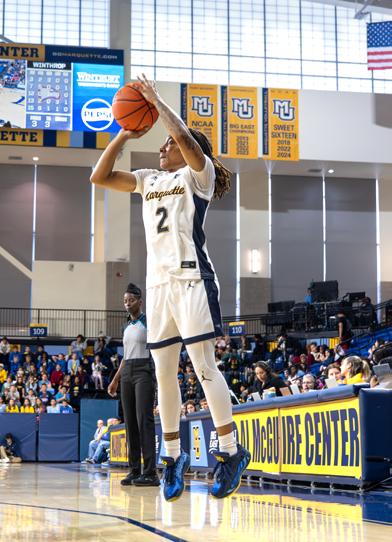
The Golden Eagles made 165 3-pointers all last season, a number they already beat with eight games remaining in this season, including the first game of the Big East Tournament. Their 30% success rate in 2024-25 has increased to 38.4% in 2025-26, and their hit threes per game
by Leo Stallings leo.stallings@marquette.edu

average increased by more than two. Forbes leads Marquette in threes attempted, with Volker in a close second, as both crossed the century mark.
"We knew we had to get in the gym, shoot 100-200 shots a day..."
Olivia Porter Marquette women's basketball senior guard
MU’s difference in 3-point conversion and giving them up on the other end is 10 percent in favor of their offense, markedly improving on a 0.6 percent differential in the same category last year.
“I think we had to get better, I thought our players put the time in, and that’s really been showing,” Consuegra said.
Part of the heightened success rate has been the types of shots Marquette is taking. The Golden Eagles run an inside-out offense, penetrating down low and kicking out to shooters on the perimeter.
“Another good thing that we do a pretty good job of is hunting good shots,” assistant coach Sam Logic said. “If you’re taking bad shots, if that goes in, you might feel good, but I think if you keep hunting good shots and we reinforce taking them, then we have confidence.”
But, unlike last year, the Golden Eagles are hitting the open shots. And when they don’t go in, Logic said it is important to not
Photo by Clay Ellis-Escobar clay.ellis-escobar@marquette.edu
think about those unlucky bounces or rim-outs.
“Even the best shooters don’t shoot 50% from three,” Logic said. “You’ve got to focus on the next shot, don’t dwell on the last one, so I think that’s important.”
The players seem to have heeded that advice.
Volker has taken 100 shots from downtown, six less than she attempted throughout the entirety of her first season in Consuegra’s system. She’s retained her precision, shooting 44% from beyond the arc in 2025-26 so far.
Vice has made four more attempts from beyond the arc compared to 14 in all of the 2024-25 season — but on 12 fewer shots so far.
Jordan Meulemans is next with 65 3-pointers taken and has shot 35.4% from deep. Jaidynn Mason’s specialty has been getting to the rack with her speed,
but she’s already eclipsed the amount of perimeter shots she took last year by five and has made more of those attempts.
Consuegra ultimately chalked up her team’s improved 3-point shooting down to execution. With maintaining similar spacing and giving more options out of motion to lessen predictability, she said that even though they didn’t convert as much on their threes last season, the ones they attempted were worth the chance, setting the table for their second act.
“That’s a big reason why our [shooting] percentage is high, certainly the work that our kids have put in and for the most part we take good shots, and when you take those good shots, you should make them,”
Consuegra said.
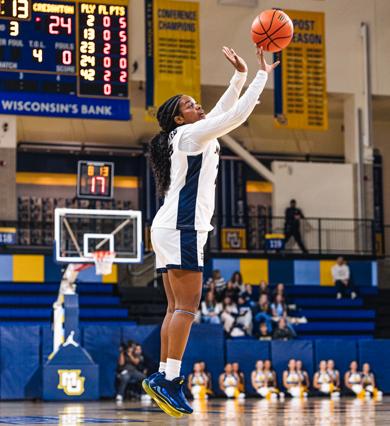
Guard Lee Volker has already taken 100 shots from downtown, six less than she did all last season.
Photo
Mason shoots a 3-pointer in the Golden Eagles' season-opener.
Photo courtesy of Marquette Athletics
RISING: A team learns to heal together
Continued from page 1
The field is where they were most alive.
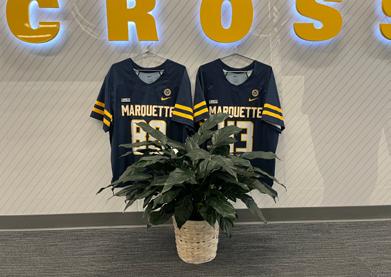
Whenever Richard sees Snyder and Michaud's No. 43 and 88 uniforms draped, he thinks of them playing. Michaud trying to stop an attacking Snyder's shots, and Snyder hoping to slot one past his goalkeeper. He's reminded the jerseys will forever hang on those hooks. Noah and Scott will never wear them again.
"Um... yeah," Richard says about the locker memorials, struggling to find the words. "That one hit me a little bit."
These feelings of loss quickly turn to motivation. He sees it as his duty as their coach to not let them be forgotten. They won't become another statistic in a database or headline in an article, not if Richard has a say. He cares much more about the lives they lived than the car crash that killed them.
The names Noah and Scott come out of his mouth almost every day. Whether it be with his wife, Nicki, the Snyder and Michaud families or the rest of the men's lacrosse squad. He talks about them constantly.
"It's not just a story," Richard says. "It's these guys' lives and personalities and their hearts that are being spoken about and told."
picture-perfect beginning, before the night instantly flipped on its head.
Not long after arriving, Richard felt his phone buzz. Looking down, he saw his players' names pop up. The festivities ended with the click of the green answer button.
He received the news only minutes after the athletes' silver Jeep Grand Cherokee collided with a white Ford Ranger being driven by a drunk 41-year-old woman named Amandria Brunner.
According to the criminal complaint, her blood alcohol level at the time of the crash was 0.133, nearly double the legal limit.
In analyzing data from the Ford, an officer at the scene determined Brunner turned left into the intersection while the light was yellow. Data revealed the Jeep was driving 53 mph — 20 mph above the posted speed limit — with the accelerator 100% depressed at the start of the crash.
In a split second, a community splintered.
A small group of other men's lacrosse players arrived at the intersection first and started spreading word of a crash. That's how captain Peter Detwiler found out, when he answered Jacob Nottoli's call from the scene. Detwiler knew from the tone of his fellow senior's voice it was something serious.
"The news hit pretty hard, pretty quickly," he says.
Sept. 5, 2025, was supposed to be a day of celebration for the Marquette men's lacrosse community.
A former Golden Eagle and one of Richard's classmates, Conor Gately, was getting married in the Hamptons. Eight of the 10 groomsmen — including Richard — played lacrosse at MU. The Friday evening welcome party had just started. The bright sunset turned the sky a beautiful hue as the temperature hovered around 70 degrees. Cold cocktails flowed. A
It was early enough in the night that not much was clear beyond an accident involving six men's lacrosse athletes.
Players and coaches knew everyone in the car, but not if anyone had died, or how severe injuries were. Michaud and Snyder, two of the four in the back row, were not pronounced dead until the Milwaukee Fire Department arrived on the scene.
Separated by nearly one thousand miles, Richard stayed connected the only way possible. He started
dialing numbers of athletic administrators and assistant coaches. Since he couldn't get to campus, they needed to. One of those calls was to Detwiler, instilling confidence he could lead in a time like this.
Detwiler sprang into action as best he could, offering his house as the team's place of refuge. Players swarmed his address, all in shock, not knowing what to say, stuck in their own heads. What words are right in a time like this? A question that would always ring true, but especially when the safety of four others remained in the air.
It was known by that point Michaud and Snyder died. The remaining four players in the crash had been transported to the hospital. Brunner was arrested at the scene after failing three sobriety tests.
The house stayed silent, except for the pattering of people coming and going along with the occasional health update of the other players in the Jeep. Back in New York, almost two hours away from an airport and unable to get to Milwaukee until the morning, all Richard could do was dial numbers and think about the first time he would see the team.
■ ■ ■ ■
Shortly before a customary shopping trip turned into his last, Noah walked into Richard's office with good news.
He had just found out he was invited to the World Lacrosse Sixes event — the sport's Olympics — with the Haudenosaunee Nationals, his Native American tribe. Noah talked about how excited he was. Who he couldn't wait to play with, against. Richard, knowing this was a lifelong goal, kept telling him how positive a sign it was and how great he would do. They would be his last words to the 20-year-old attacker.
At the start of the semester, Scott walked into Richard's office with a fire in him. He told his head coach all he wanted to accomplish as a sophomore. How much of an impact he hoped to make. Normally zinging one-liners and chirps, it was a bold side Richard had not seen from his goalkeeper.
■ ■ ■ ■
Richard never made it to the wedding ceremony on Saturday. He landed in Chicago that morning and drove up to Milwaukee, arriving on campus around 11 a.m., one hour before the talk he could not get out of his
head the previous night. He walked into the film room on the AHPRC’s second floor, greeted by the 52 bleary and bloodshot-eyed guys on the roster. Still grappling with two premature deaths, he preached exactly what he’d thought since hearing the news not even 24 hours prior.
“We are crushed and our lives will never be the same.”
“We love those guys so much and they were amazing and we’re so fortunate to have known them.”
“The next couple weeks, the next couple months, the next couple years are going to be really challenging and I want you guys all to know that you are going to be OK.”
“You are prepared for this challenge and I want you to face it head-on together.”
“Sometimes you’re going to be sad and sometimes you can be strong, and sometimes you have to show your strength by being vulnerable with the people around you.”
This was as much for Richard as it was his players. Talking publicly helps him grieve, and he grieves every day. Each conversation helps him heal, like the ones he had with fellow Marquette alums at the wedding welcome party; whenever he talks with the families; and every other time he utters their names, even to a reporter.
Tragedies like these often expose people’s truest selves. Dangerous thoughts grow like germs behind sealed lips. The veneers created out of routine and habit shatter, left in scraps in the wake of disaster. What remains are core characters, strengths and vulnerabilities. There are healthy ways to manage these naked feelings. Nights spent silent and alone do more harm than good. Isolation is not the answer.
“That’s not a time you want to be alone. That’s when some feelings can creep in,” Detwiler says. “The initiative was to just
spend that time together, so we could be there for each other in case anyone needed anything.”
It took time for the deaths to feel real. Denial is the first stage of grief. The same weekend as the crash came the vigil, where everyone laid flowers at the intersection. The families spent almost that entire week on campus, and the team regaled each other with tales only the truest of friends would know. Seven days after the accident, they left campus for the services. Less than two weeks removed, they got back on the field. Reality set further in with each event.
"It's these guys' lives and personalities and their hearts that are being spoken about and told."
Jake Richard Marquette men's lacrosse head coach
“The more and more you’re around it, the more it’s undeniable how real it is,” Richard says. “That you’ll never get to see their smiles and hear their laughs and give them a hug. And they’re not going to turn the corner. And you’re not going to walk in the room to address the team and see them there.”
What were usually normal activities, something as simple as making a bed, or as innately human as eating a meal, took on a bigger meaning. When something more involved happened, like the team’s stair run on Sept. 11 in honor of first responders who climbed the World Trade Center, or the first time they took
Continues on page 7
Photo courtesy of Jake Richard
The men's lacrosse team turned its locker room into a tribute.
Photo by Jack Albright
Scott and Noah's jerseys hang outside the MLAX team offices.
the field, the importance was tenfold.
After the funerals, the team took a couple rest days. But, because staying locked in a dorm or house doesn’t solve anything, they quickly put on pads and rolled out balls. Playing wasn’t required, but everyone needed to go. Practices continued intensifying. Very soon, mandatory participation. By October, the full locker room memorial was gone, the space converted back to its intended use. Getting back to lacrosse was its own kind of tribute.
The players signed up for everything. One of the first conversations was whether the fall season would happen as scheduled. Marquette had two scrimmages on the books, in Jacksonville and at Valley Fields against Lewis. They played both. It boiled down to what Michaud and Snyder would do if they were still here.
The same Michaud who would drive one hour and 15 minutes — if there was no traffic — about three times a week to and from high school practice. Whose coach at the time, Matt Lee, likes to say he embodied his team’s name: Resolute.
And Snyder, who knew he wanted to play Division I lacrosse at 10 years old, dreamed of playing professionally for his hometown Buffalo Bandits. Who hoped to start his own lacrosse business and saw himself one day coaching the sport to which he dedicated his life.
“That’s what makes it easy to show up every day and to stay focused,” Richard says. “Because to do anything else would let them down. That would be not doing them justice.”
The tribe gathered one week after the crash to say goodbye twice. Thanks to donations from the Marquette Lacrosse Excellence Fund, everyone on the roster went to both services. Former players still living in the area joined. Richard estimates the traveling
The MarqueTTe Tribune
party totaled 70 people. Scott's was first, on Friday. Hundreds of people packed into Fairhaven Church in Springboro, Ohio. Two players, Nottoli and Ethan Salvia, spoke about the friend they loved. A slideshow showed pictures of Scott throughout his life. After, the team went back to the Michaud family's house for a barbecue. Players told stories of Scott the lacrosse player, relatives told stories of Scott the goofball.
Saturday morning, the team bused six hours to Buffalo for Noah. The drive was the first moment everyone on the team could breathe after a rollercoaster seven days. Now, truly away from the intersection and campus, life slowed down. Some had conversations — both serious and goofy — while others watched movies or caught up on sleep. Detwiler says it felt like a normal bus ride, almost like one the team would have between games, not funerals.
Noah's wake was Saturday night, followed by his celebration of life at his high school the next morning. The sun shined bright as everyone gathered on St. Joseph’s Collegiate Institute's field. Blue and gold flower wreaths covered the turf, his No. 43 flanked by MU and Haudenosaunee logos. This time, Richard took the podium, talking about the lacrosse player with big dreams and high hopes for himself.
Since Snyder and Michaud will not be seen on campus, the team is making sure they are thought about.
Players have black stickers with their numbers on the backs of their phones. They wear black beanies with their numbers and quarter zips branded with 88 on the left sleeve, 43 on the right. The sophomores' navy blue jerseys hang from the team sign in the hallway outside the program offices. This year's alumni weekend game — attended by almost 1/3 of the team's alumni base — was Team Snyder vs. Team Michaud.
Detwiler's lock screen
Tuesday, February 3, 2026

is a picture of Snyder and Michaud from their 2024 Thanksgiving football game. Richard's entire office is one tribute after another.
On his desk rests a pair of black shoes painted by track & field athlete Tessa Hollander with the two players' names and outlines. He wears a bracelet with their initials. A flag with their numbers from the golf team's Erin Hills tournament, another from Snyder's celebration of life, the gloves both players were supposed to wear this season and a bag of extra memorial shirts sit on the counter behind his chair.
"We certainly feel incomplete."
Jake Richard Marquette men's lacrosse head coach
He has jersey patches and helmet straps, a box of handwritten notes of support, copies of Marquette Tribunes from the two weeks after the crash and a candle with pictures of the players' uniforms on the front.
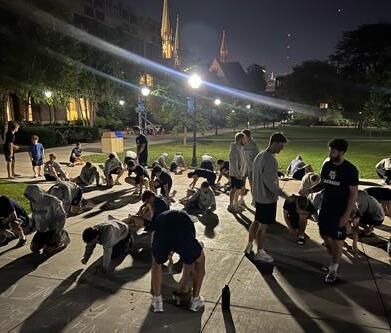
One morning at the end of September, at 5:50 a.m. before the sun began peeking over the horizon, the entire team met at the Central Mall on campus to re-chalk the sidewalk with tributes after nature faded the first drawings.
Marquette jerseys will have patches with their initials and numbers, and straps with numbers and angel wings will wrap around helmet cages. The team will bring Michaud and Snyder's jerseys everywhere. Richard is working to hang the golf tournament flag in the Valley Fields dome.
"We have a roster of 52 guys and you're like, 'That's massive.' And, you pull a couple guys out and you switch a couple guys in and, who would know the difference?" Richard says.
"When you take two people out of the team, it changes everything. There is a hole and it can't be filled. We certainly
against Michigan.
The team's two preseason exhibitions, against Navy and Virginia, have come and gone. Assistant coaches are busy dissecting film. There is a steady stream of feet shuffling in and out of the men's lacrosse wing in the AHPRC. Even with Richard's office door closed, noise from neighboring rooms seeps through the wood.
feel incomplete."
Four months after the crash, the team arrived at Camp Whitcomb in Hartland, Wisconsin for their preseason camp. The annual retreat provides an opportunity for everyone on the team to bond. It turns teammates into brothers, coaches into family. That's what last year's did for Noah and Scott, who at that time had only been on campus for one semester. This year, after being bound by heartbreak, it meant more.
The first night of the retreat, sitting around fires, the stories flowed.
Everyone remembered Noah at the 2025 retreat.
Up until that point, he was primarily known as a first-year attacker with a nasty shot and gravitating personality. He loved practical jokes and doing impressions. He had a bevy of nicknames, including, but not limited to: Snydes, The Amazing Snyderman, Supa NES, Snyper, Bullseyeski and Noahnator.
At camp, he revealed another side. He let down his walls, showing people his vulnerability and big heart.
The stories of Scott were a little different. The team already knew what kind of a guy he was. Quirky. Sly. A bit of a smart ass, in the funniest way. The person who made a favorite acronym, BTS — "Better Than Sebastian" — about hours of competitive backyard one-on-ones with his brother. And who loved saying people had been "absolutely hornswoggled."
But one person got a better look than most. Nottoli, who spoke at Scott's funeral, visited his goalkeeper's home while returning to campus before the team's retreat. Getting an intimate look at Scott's bedroom, seeing his photos of family and friends, proved he really was as down to earth as he seemed. A guy fiercely loyal to the few things he cared most about.
Richard sits at his desk 10 days before Marquette's season-opener
Practice ended hours ago, and now he is scrolling his camera roll, searching for photos of different ways the team honored their late brethren — and the brethren themselves — while talking about the NFL. He has a lot of pictures to go through.
"Anytime I see anything of those guys, I save it," he says. "Screenshot it."
Richard just returned from his latest trip to the locker room, where he talked with a few players lounging around before their 2 p.m. class. While the space has served its designed purpose for months, visitors cannot go without thinking of Michaud and Snyder. There are signs everywhere. Two are literal posters, right at the entrance, making sure everyone who walks through the door remembers the people they will no longer find physically. One is for the 20th birthday taken from Michaud, another from the LOVELLSTRONG Legacy Run/Walk on Sept. 27. Both players' lockers remain a memorial of sorts. The jerseys still hang, as the helmets rest on the top shelf with the pads under the uniforms. Both players' sticks sit prominently.
But it's not enough. These makeshift tributes of shirts, flags, stickers, jersey patches and helmet straps are too easy, too obvious.
Low-hanging fruit, Richard calls them. He has grander, longer-lasting visions.
One idea is two permanent lockers in the corners under the TVs, fitted with framed jerseys and pictures of them playing. Maybe some words of remembrance. The basement hallway outside, currently bare white, provides a bevy of opportunities.
"There's going to be a ton of things we can do," Richard says as he looks at the blank walls rife with possibility.
For now, it will have to wait, though. It's a good offseason project, but the year ahead beckons.
"We gotta make them proud," Richard says, cradling a ball in the pocket of his lacrosse stick.
Then, he joined his assistants, continuing to prepare for the upcoming season.
Photo by Jack Albright
Richard has two shoes painted by a track athlete on his desk.
Photo courtesy of Jake Richard The team re-chalking the campus sidewalk with more tributes.
Marquette bests Chicago in preseason game
Thirteen Golden Eagles scored in 24-5 victory
By Eamon Bevan eamon.bevan@marquette.edu
After a nine month hiatus, Marquette women’s lacrosse began its 2026 preseason Saturday afternoon with a resounding 24-5 exhibition victory over the University of Chicago.
This win mirrored last year’s 19-7 scrimmage result over the Maroons and offered an early look at the Golden Eagles’ youth, depth and overall philosophy.
Finishing 10-6 overall and 3-3 in Big East play last season, Marquette placed fifth in the conference, the same position it was slated to end up come this April.
Led by head coach Meredith Black in her 14th season at the helm, as well as four preseason all-Big East team selections, the Golden Eagles are looking to go above and beyond those outside expectations.
“We had as many selections as some of the top programs in the conference, which says a lot,” said senior defender Sofia Santana. “A lot of players just haven’t gotten recognition yet and are just as capable. It gives us confidence going into the season.”
On-Field
Impressions
Entering the 2026 campaign, one of the largest question marks surrounding the Golden Eagles’ program surrounds filling the hole left by 2025 graduate Meg Bireley. The attacker is Marquette’s all-time points leader and tallied 63 goals as well as 16 assists in the 2025 season.
It’s a loss the Golden Eagles seem to filling by committee, as 13 different scorers contributed to the 24-goal output.
Marquette scored 13 goals in the first quarter
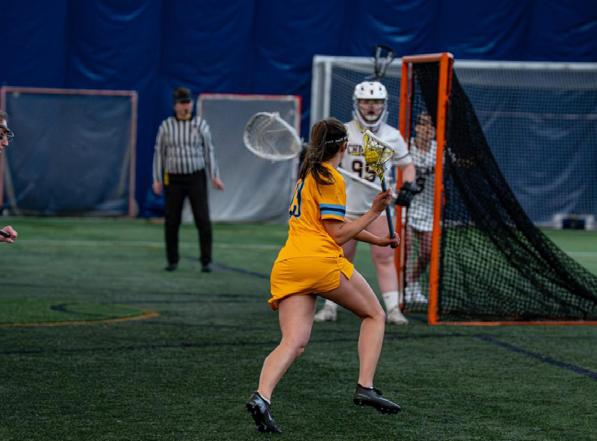
alone, quickly separating themselves and allowing the coaching staff to rotate heavily throughout the lineup.
Senior attacker Tess Osburn led the scoring effort, finding the net four times and continuing the form that has made her one of the most prolific scorers in program history. Osburn ended the 2025 season with a 6-goal performance against Eastern Michigan, and enters her senior season seventh on Marquette’s all-time goals list, showing no signs of slowing down.
Hanna Bodner impacted the game on both ends, tallying a goal and assist while helping Marquette dominate possession. The reigning Big East midfielder of the year was instrumental in sustaining offensive pressure during extended possessions.
“Right now, we’re really focused on our crease play and feeding,” Bodner said. “Driving hard and creating more assists has been a big point of emphasis.”
The Golden Eagles have averaged the most shots on goal as well as total
shots for the last three Big East regular seasons, with lot of work being put into converting those into made chances.
“Leading in any stat is great, but if it doesn’t turn into wins, it doesn’t matter as much,” Black said. “Our focus is on winning moments.”
"We had as many selections as some of the top programs in the conference..."
Sofia Santana
Marquette
women's lacrosse senior defender
On the other end, the Marquette starters and initial subs held U. Chicago to a single goal by the halftime interval, forcing five turnovers and only needing one save.
“Defensively, it’s about continuing to build connections within our unit,” said Santana. “It’s not a huge overhaul; just strengthening what we already do well.”
Youth and Veterans Stepping Up
By the end of the match, every available player had taken the field for Marquette, and the level of play from both first-years as well as team veterans had smiles on the faces of fans in attendance.
One of the biggest storylines for the 2026 Golden Eagles is the role of those first-year players, with Coach Black highlighting the unprecedented level of youth expected to contribute this season.
“Seven or eight freshmen are going to be playing high minutes this year,” Black said. “Aside from maybe our first couple years as a program, we haven’t really had that level of youth making up the majority of the players on the field.”
Despite their inexperience, the 12 total first years have made a noticeable
impact among their peers.
“Whatever you ask of them, they’ll do it,” Black said. “Run hard? They’ll run hard. Score goals? They’ll go score goals.”
And score they did, with three separate first-years hitting the back of the net against the Maroons. Gabby Windesheim started with immediate success in face-offs, while goalkeeper Jillian Howell had her fair share of minutes, a trend which Black says has a chance to continue as the season moves forward.
“Mikayla [Yang, junior] has the edge in experience, but they’re both outstanding,” Black said. “I think it’ll be a battle early on, and we’ll see how it plays out.”
While youth provided energy, Marquette’s upperclassmen anchored the team with leadership and experience. The senior players have taken an active role in mentoring first-years and maintaining team cohesion.
“They’re completely bought in,” Black said. “Our seniors have been unbelievable leaders.”
Despite the impact that the senior class is projected to have, establishing leadership and inspiring this promising class of first-years has become an overall effort from players and coaches alike. Among those involved are juniors Lauren Grady and Mary Velner, who were breakout players last season, both named to the preseason all-Big East team.
“We’ve told them [Grady and Velner] multiple times to reward the freshmen — keep telling them how well they’re doing,” Black said.
What’s Next
With their first on field competition of 2026 behind them, the Golden Eagles start their regular season campaign this Friday against Eastern Michigan.


Omaha, Neb.
Marquette women's lacrosse beat Univ. of Chicago 24-5 in Saturday's preseason scrimmage.
Photo by Clay Ellis-Escobar clay.ellis-escobar@marquette.edu
Opinions
Embrace Super Bowl halftime show artists
By Amelia Lerret amelia.lerret@marquette.edu
Regardless of the criticism they may receive, Super Bowl halftime show performers are consistently well-qualified artists, so viewers should put their personal critiques aside to enjoy the nationwide spectacle.
The beginning of the Super Bowl halftime show tradition dates back to 1967, first performed by the University of Arizona and Grambling State University marching bands. Since then, many music icons, including The Rolling Stones, Katy Perry and Beyoncé, have taken on this prestigious performance, captivating viewers nationwide.
This year, Bad Bunny is set to carry on the tradition alongside the rock band Green Day, who will be the opening act.
Bad Bunny is an accomplished Puerto Rican rapper who has been Spotify’s top global artist four times. He also recently won Album of the Year at the 2026 Grammy Awards. However, his qualifications to entertain a large audience are being
overlooked because of his political views.
He supported former vice president Kamala Harris in the 2024 presidential election and has spoken out against Immigration and Customs Enforcement (ICE) and the Trump Administration. He also chose not to schedule any stops in America for his 2026 tour in fear of the shows being targeted by ICE.
His personal views are resulting in criticism of his upcoming performance, even though the show is not inherently about politics.
In the past, Kendrick Lamar and Maroon 5 received similar judgement for their performances, demonstrating how people will always find something to criticize. However, they were chosen because they are well-qualified, as Maroon 5 has won 3 Grammys with 13 nominations and Lamar has won 22 with 66 nominations.
For example, Lamar’s 2025 Super Bowl LIX halftime show received 125 formal
complaints to the Federal Communications Commission. Some claimed it was inappropriate for children, it was racist for not displaying any white performers and that Serena Williams Crip-walking encouraged gang affiliation.
Despite the criticism, Lamar’s halftime show became the most-watched Super Bowl halftime show in history.
Similarly, the 2019 Super Bowl halftime show happened amid a controversy kickstarted by Colin Kaepernick, who knelt for the national anthem to show his support for victims of police brutality. Some artists declined the offer to perform at halftime, like Rihanna and Pink, as they disagreed with the NFL’s requirement for players to stand up for the anthem.
So, when the pop-rock band Maroon 5 agreed to perform at the 2019 Super Bowl halftime show, they received backlash for it, as it was seen as compliance to the police brutality. This sparked immense negative

reactions from fans with different opinions.
This year, criticisms about Bad Bunny arose immediately after he was announced as the halftime performer. Two popular oppositions are that he is not American, so he should not represent American football and that his music does not appeal to a large audience. This fails to acknowledge that Puerto Rico is part of the U.S. and that Spanish is the second most popular language spoken in the country. Furthermore, those against his upcoming performance went so far as to sign a petition created by Turning Point USA, a conservative political group, urging George Strait as a replacement. This
level of division is not the show’s purpose; it is meant to entertain.
Even though halftime performers consistently face backlash, that does not make them any less qualified to entertain large audiences because criticism is inevitable.om to take on this prestigious national event.
Amid the constant criticism of performers, viewers must recognize that the objective of the Super Bowl halftime show is to entertain. So, place personal critiques to the side to embrace the talent of this event.
Melania Trump's failed legacy as first lady
By Bella Gruber isabella.gruber@marquette.edu
For over 150 years, the first lady of the United States has traditionally acted as a vessel of support for the president’s agenda. Current first lady Melania Trump has been absent from her role by avoiding the public eye and failing to create a legacy in her initiatives "Be Best" and "Fostering the Future" due to President Donald Trump's contradictory policies.
Melania Trump, 45th and 47th first lady of the United States, is an immigrant from Slovenia (born to Yugoslavia). After pursuing a career in modeling throughout the 1990s, she became a U.S. citizen in 2006 after marrying Trump in 2005.
In the past century, first ladies’ involvement in executing strategy on the campaign trail has resulted in higher candidate favorability among Americans. This was not the case during President Donald Trump’s presidential campaigns. In 2016, Melania did not travel with Trump on the campaign trail, but she appeared more frequently with him to strategically regain female voters' trust after sexual harassment accusations from multiple women surfaced against Trump.
During both of Melania’s terms as first lady, she opposed tradition in several instances: she was reluctant to
live in the White House, declined Jill Biden’s invitation to the White House to ensure a smooth transition of power and only attended the final day of the Republican National Convention without giving a speech, a tradition of every presidential cycle since 1984.
Historically, first ladies create initiatives directed towards a realistic issue the nation faces, and much of their work still resonates in American society today. Nancy Reagan’s “Just Say No” anti-drug movement reduced a third of high school cocaine use, Claudia “Lady Bird” Johnson’s environmental conservation advocacy beautified highways and national parks and Michelle Obama’s “Let’s Move!” campaign improved nutrition in school meals to prevent childhood obesity.
Melania launched her “Be Best” initiative during Trump's first presidential term, aiming to increase awareness about cyberbullying and opioid abuse. “Fostering the Future,” a branch of “Be Best,” launched in November 2025 and prioritizes transitioning youth out of foster care. Both initiatives address critical issues for young Americans, but President Trump’s policies created against immigrant and low-income children hinder the image and success of Melania’s goals.
Besides spreading awareness of cyber safety, the direct outcomes of her initiatives are unclear. The Cyberbullying Research Center found that the number of students who have been cyberbullied within the past 30 days increased from 16.7% in 2016 to 26.5% in 2023. Although it is difficult to attribute "Be Best"'s failure to these statistics, there have not been any published results of the program reducing cyberbullying rates.
Melania claimed that “Be Best” fell short in her first term due to a lack of public support. "I just feel that people didn't accept me,” she told Fox & Friends in January 2025. Coupled with a lack of support, critics accused Melania of plagiarizing a digital cyber-safety pamphlet made by Michelle Obama and the Federal Trade Commission.
Melania's “Fostering the Future” initiative in President Trump's second term has had limited success due to Trump's contradictory policies. His administration and direction of Immigration and Customs Enforcement have detained over 3,800 children between January and October 2025. These detention centers pose health risks to families — contaminated food, unsanitary sleeping and bathing areas and insufficient access to medical care.
“We have a lot to do,” Melania said regarding her child welfare initiatives when stepping into her second term as first lady. In her first term, "Be Best" worked in spreading awareness of all levels of child well-being by supporting programs like Buddy Benches and the Viking Huddle in schools across the U.S. Now, Melania is partnering with Zoom Communications to inspire children to use AI to reach their ambitions.
Yet, Trump’s immigration and economic policies endanger children, making Melania’s goals difficult to achieve.
Her lack of action makes her recent documentary release extremely inopportune. "Melania" hit theaters and Amazon Prime Video on Jan. 30, depicting Melania’s preparation leading up to Trump’s 2025 presidential inauguration.
Political figures are subject to being harshly criticized under the public spotlight, but the first lady serves a purpose that is greater than her public image: to act as a reinforcement of the president's agenda. Melania Trump’s inaction during Trump’s presidency leaves her a disappointing legacy as first lady.
Statement of Opinion Policy
The opinions expressed on the Opinions page reflect the opinions of the Opinions staff. The editorials do not represent the opinions of Marquette University nor its administrators, but those of the editorial board.
The Marquette Tribune prints guest submissions at its discretion. The Tribune strives to give all sides of an issue an equal voice over the course of a reasonable time period. An author’s contribution will not be published more than once in a fourweek period. Submissions with obvious relevance to the Marquette community will be given priority consideration.
Full Opinions submissions should be limited to 600 words. Letters to the editor should be between 150 to 300 words. The Tribune reserves the right to edit submissions for length and content.
Please e-mail submissions to: rachel.lopera@marquette. edu. If you are a current student, include the college in which you are enrolled and your year in school. If not, please note any affliations to Marquette or your current city of residence.
Bella Gruber is an opinions columnist. She is a sophomore studying public relations.
Photo by REUTERS
Bad Bunny performs during a concert in Mexico on Dec. 10, 2025.
Amelia Lerret is an opinions columnist. She is a first-year studying journalism.
Fun & Games
Super Bowl LX

Football 101

8. Nickname for the all-star Seahawks wide receiver.
9. The start of a play.
11. Punk-Rock band opening at halftime.
12. Decides which team gets first possession of the ball.
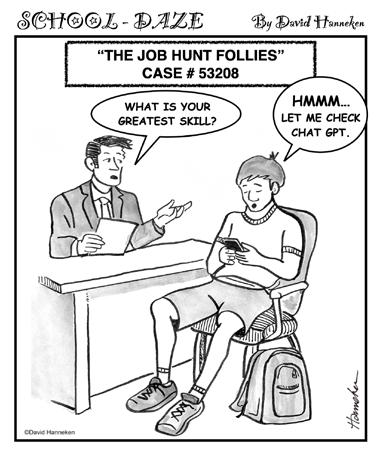
Comic by David Henneken david.hanneken@marquette.edu
Arts & Entertainment
- Haggerty Museum of Art Special Edition -
The Haggerty Museum of Art welcomes four new exhibits to its collection
'Declaration of ___,' a modern exhibit on justice and freedom
By MaryKate Stepchuk marykate.stepchuk@marquette.edu
As celebrations of the United States’ 250th anniversary begin, Marquette University students can participate by visiting the Haggerty Art Museum for multiple new exhibits, including “Declaration of ____.”
The Haggerty aims to highlight the different ideas of democracy, liberty, happiness and how they have been denied to marginalized communities in U.S. history in various art forms.
Patrick Mullins, Associate Professor of History and Public History and curator of “Defying Empire: Revolutionary Prints from Britain and America,” and Rose Camara, the “Declaration of ____” guest curator, purposefully contrasted the time periods of the two exhibits.
The modern “Declaration of ____” exhibit is contrast-
'Let the Real World In': A video following MKE's youth
By Elise Emery elise.emery@marquette.edu
Portrayed through an array of video footage on various monitors as you walk into the Haggerty Museum of Art, “Let the Real World In” is an accumulation of 10 years of observing how young people in Milwaukee feel about social and political issues.
The project began with a summer camp program that artist Kirsten Leenaars held in collaboration with the Haggerty Museum
ed by the historical “Defying Empire: Revolutionary Prints from Britain and America” exhibit, but they both emphasize the use of print in political movements from the American Revolution to present.
When walking onto the Haggerty second floor, viewers will see an array of various art forms, including prints, quilts, postcards and picket signs on the wall.
In the middle of the room, a table stands filled with zines — small, handmade booklets often covering art, politics or personal stories — supplied by the collectives and artists, encouraging viewers to sit and flip through them.
“Declaration of ____,” offers a contemporary outlook on the history of the United States. From emphasizing freedom, democracy and the right to protest, the exhibit explores themes of motherhood, race and workers’ rights. Camara considered several underlying themes along with the main focus of highlighting the country’s 250th anniversary celebration.
“I wanted to jam this gal-
from 2016-2020. Through this summer camp, middle school children at various Milwaukee schools took part in activities in which they expressed their personal experiences and beliefs while growing up alongside political unrest.
“Let the Real World In” incorporates footage from these summer camps with a recently recorded documentary-style film that follows four of the original participants, now 21 years old, as they discover the value in social advocacy and face the 2024 election.
As these individuals see Donald Trump take office again in 2024, like what they experienced in 2016, while continuing to raise awareness for social causes,
lery with as many people and perspectives as I possibly could,” Camara said.
For “Declaration of ____,” Camara said they sought out art collectives — a group of artists who share ideas to create collaborative art pieces and projects — from the upper Midwest to maximize voices and perspectives apart from more visible collectives from the east and west coast.
These zines grapple with social issues, from the Flint water crisis to queer love, showing how historically, print is often used to spread awareness of social topics across the country. Viewers are reminded that democracy and freedom are things to be engaged with, rather than left alone.
One of these zines is supplied by Motherhood: Revisited, which is an art collective of mothers based in Chicago.
The zine, titled “On the Line: Messages of Care,” is filled with multiple QR codes. They direct users to an app called Hoverlay, where Motherhood: Revisited created augmented reality with art messages
the parallels between this group’s childhood and adult experiences make their current political scene feel surprisingly familiar.
Lynne Shumow, Haggerty Museum of Art Curator for Academic Engagement, said that this piece correlated with some of the other exhibits in the Haggerty this semester, such as “Declaration of ___” and “Defying Empire,” as it highlights what the American Revolution represented.
“The kids in the film are asking those sort of questions, you know, ‘What is freedom? What is democracy?'” Shumow said.
Some of the political events tackled in the exhibit include the Israel and Palestine conflict, the 2024 Re-

revolving around care and kindness, including “Without care, there is decay.”
Motherhood: Revisited also features a collection of print postcards titled “The Postcard Project,”
inspired by Timothy Snyder’s book “On Tyranny: Twenty Lessons from the Twentieth Century.”
Read the rest of this story on marquettewire.org.

publican National Convention in Milwaukee and the 2024 election.
While experiencing “Let the Real World In,” viewers might become overwhelmed in trying to piece together the story, as audio from various videos layer on top of one another and screens are constantly changing. However, this disruption in focus was exactly the goal.
When formatting this project, Leenaars wanted to emulate the lack of predictability that exists in our everyday world. She compared her inclusion of these disruptions to how breaking news can impede and interrupt daily activity.
“It was meant to be kind of a short burst of sound to draw your attention away in the way that, in real life, things are constantly pulling you away from the thing that you’re maybe trying to focus on,” Leenaars said.
Much like the multifaceted nature of the piece, the title is also derived from multiple different inspirations.
One of these inspirations is a mantra that Leenaars took from French filmmaker Jean-Luc Godard, which embodies the idea that artists should not seclude themselves from reality.
“He thought that it was really important that filmmakers let the real world into their work and responded to the moment,” Leenaars said. “He thought that it was kind of an ethical obligation of artists and filmmakers to not pretend they live outside of what’s happening in real life.”
Additionally, Leenaars’ collaboration with the four subjects of her piece, Kam Pickett, Hannah Plevin, Alanis Salgado and Iman Fatmi, taught her that this project was bigger than just her.
“I think when you collaborate, I see that as a form of letting the real world in, in the sense that you’re letting other voices come in and other perspectives that might not be what you had in mind,” Leenaars said.
While a great portion of this project focuses on this group’s passion for social justice, audiences also see their everyday activities. Whether it’s balancing school and work, hanging out with friends or making dinner, these average experiences prove that it doesn’t take a special kind of person to harness progress.
Read the rest of this story on marquettewire.org.
The screen-printed images above tackle democratic protests.
Photo courtesy of Aaron Hughes
Photo courtesy of Kirsten Leenaars
The video exhibit hears four young adults' opinions on the 2024 presidential election and beyond.
- Haggerty Museum of Art Special Edition -
'This
Side of the Stars': Exhibits on technology
By Annie Goode annie.goode@marquette.edu
The Haggerty Museum of Art happens to hold a dozen prints from Robert Rauschenberg’s “Stoned Moon” series, which mainly looks at the Apollo 11 lunar mission.
In the fall of 2025, the Robert Rauschenberg Foundation began contacting museums around the country that hold significant amounts of Rauschenberg’s work, hoping to honor the 20th-century American artist in the 100th year since his birth.
That’s when Kirk Nickel, the Haggerty Museum’s Curator of European Art, and Jennifer Johung, a professor of Contemporary Art and Architecture and the director of the Center for 21st-Century Studies at University of Wisconsin–Milwaukee, began curating an exhibition that would both honor and revitalize Rauschenberg’s work.
The Haggerty is one of over 30 museums across the world to honor Rauschenberg’s life with an exhibition.
“We wanted to ask, ‘What questions are artists asking today around technology, the environment, human possibility and how technology is changing?’” Nickel said.
'Defying Empire' sheds a light on Revolutionary War history
By Allison Scherquist
allison.scherquist@marquette.edu
Printed images began the American Revolution by spreading the concept of democracy and freedom to large audiences across the country. Now, the Haggerty Museum of Art pays tribute to those printed images with its new exhibition “Defying Empire: Revolutionary Prints from Britain and America.”
The exhibit opened on Jan. 23 on the second floor of the Haggerty, serving as a tribute to the 250th anniversary of the United States. It offers a fresh perspective on the methods of protest that led to the American Revolution.
The gallery was curated by Associate Professor of History and Public History, Patrick Mullins, and coordi-
Nickel and Johung decided on showcasing “Stoned Moon” next to three current artists: Kite, Trevor Paglen and Jason S. Yi. The show would be called “This Side of the Stars: Rauschenberg’s ‘Stoned Moon’ in the Company of Kite, Paglen and Yi,” and went up Jan. 23.
“The three artists’ work looks different from each other and different from Rauschenberg, but we really felt that there were a number of conversations happening around topics of how we come to know the world around us,”
Nickel said.
Yi, a Milwaukee-based multimedia artist and professor at Milwaukee Institute of Art and Design, wanted to continue his track record of using materials, such as spray insulation foam or starch packing peanuts, in his art that surprises people in this exhibition.
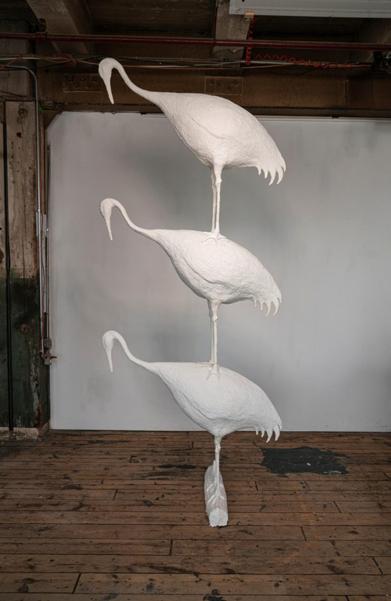
When approaching his section of the gallery, eight life-size birds made of mulberry paper are stacked one on top of the other, towering over 20 feet in the air.
“These red-crowned cranes hold a super strong symbolic value within the tradition of East Asian countries,” Yi said. “They represent fortune, hope and longevity.”
These birds have become even more symbolic after finding a safe haven in the demilitarized zone between North and South
nated by Postdoctoral Curatorial and Teaching Fellow Jessica A. Cooley, in collaboration with the Chipstone Foundation — a nonprofit organization that owns and studies a collection of historic decorative art objects.
The exhibition showcases a variety of prints from 18th-century America, aiming to re-examine how printed images shaped political thought and public opinion during the Revolutionary era on both sides of the Atlantic.
Lynne Shumow, Haggerty Museum Curator for Academic Engagement, commented on the role that these prints play in shaping collective viewpoints.
“At the heart of [this exhibition] is the idea that printmaking allowed for reaching a wide audience,” Shumow said. “Printed materials can be used to significantly sway public opinion.”
Today, Americans understand the revolution through the national narrative of liberty and justice. However, “Defining Em-
Korea when they were previously endangered, according to Yi.
“Born out of that tumultuous, tragic, symbolic area is this beautiful paradise for the animals and plant matter,” Yi said. “So, I thought that was super ironic, and interesting and also very indicative of things that are unfolding around us in our environment.”
Rauschenberg’s colorful, sometimes puzzling prints containing images of the Apollo 11 contrast with Paglen’s calm, wide shot landscape images of space and skies. Both ask questions about the purpose of technology and the vastness of the cosmos.
“Artists are part of a long thread,” Nickel said. “If looking back across the history of art tells us anything, it’s that artists are in an ongoing conversation with each other and with their predecessors.”
Originally from Texas, Rauschenberg worked with a variety of mediums including photography, painting, printmaking and sculpture over the course of his career. Some of his most famous works even mix these media. In “Bed” (1955), Rauschenberg combines wooden frames, fabric and paint all on one canvas to recreate a bed.
“Robert Rauschenberg was, to me, a trailblazer in many ways,” Yi said. “He may not be a household name for most Americans…like somebody like
[#h#\
pire” offers the Marquette Community a new lens.
By examining popular political imagery and printed works from the time period, a more complex portrait of the Revolution is revealed, one that not all Americans supported, and not all Britons denounced. Through observing the paintings, prints and ceramics of the time, a deeper world of debate, one that is less nationalistic and more passionate, is opened up.
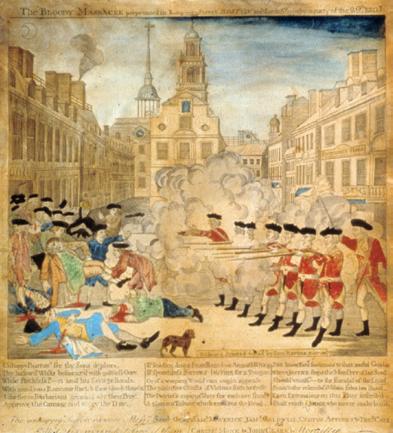
The exhibition displays a plethora of different forms of the print medium. Paintings and etchings—art made by scratching a metal plate and using acid to create a print— hang on the wall of one room, while ornate ceramics with printed images engrained in them are positioned just below it.
In the exhibit’s first room hang engravings and etchings from colonial America. John Brooks’ “A View of the Landing the New England Forces in Ye Expedition against Cape Breton” hangs above John Carwitham’s “A
Andy Warhol…but I always felt that Robert Rauschenberg belonged in a similar group.”
Kite’s section displays dyed animal hides geometrically embroidered with crystals and glass beads. Rocks found on Milwaukee’s lakefront are spread across the floor in the center of the gallery, also in a
South East View of the Great Town of Boston in New England in America.”
The former depicts the 1745 siege on the French fortress at Louisbourg, and portrays a rare moment of alliance between colo-
geometric fashion. As an Oglála Lakóta artist, the exhibition holds respect for non-human beings, such as plant life, animal life, stone and minerals.
Read the rest of this story on marquettewire.org.
nial forces and the British royal navy — whose ships can be seen still on the shores of the etching’s seaside background.
Read the rest of this story on marquettewire.org.
The red-crowned cranes offer a symbol of longevity and hope.
Photo courtesy of Jason S. Yi
"Bloody Massacre": The historic American Revolution battle.
Photo courtesy of Gavin Ashworth