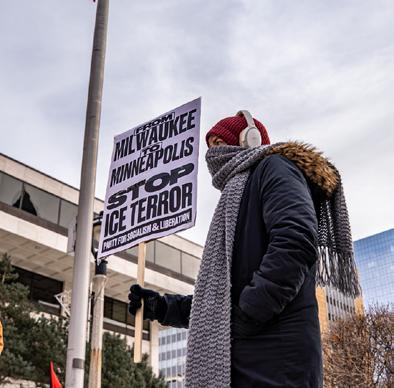
A crowd of over 200 Milwaukeeans braved subzero temperatures Jan. 24, joining a nationwide protest against recent U.S. Immigration and Customs Enforcement actions. The protest specifically followed the death of a civilian protester identified as Alex Pretti, a 37-year-old ICU nurse from Green Bay, Wisconsin, who was killed in Minneapolis by an ICE officer that morning. Protesters marched from Red Arrow Park to Water Street carrying signs reading “F*** ICE,” and “No ICE, No KKK, No Fascist USA.”
Organizers from the Milwaukee branch of the Party for Socialism and Liberation and Comité Sin Fronteras, a committee providing support for undocumented immigrants, chanted “It’s our duty, it’s our right! Fight, fight fight!” from the back of a blue pickup truck while they guided the march.
The march ended at 310 E Knapp St. — a building leased by the Department of Homeland Security on the Milwaukee School of Engineering’s campus. Streets were not shut down for the march, and protesters waited at stop lights before proceeding towards the DHS building.
Milwaukee Police Department vehicles followed the procession down Water Street. In a comment to the
Marquette Wire, MPD said when they are aware of a demonstration its policy is to safeguard the expression of individuals’ First Amendments rights while prioritizing the safety of the surrounding community.
“I think we’re making our voices heard. We’re letting Minneapolis know that they’re not alone, and that people are here standing with them,” Sabrina Bukvich, a 30-year-old rally attendee from West Allis, said.
The rally, which activists called an “emergency march,” was announced on Instagram shortly after Pretti was fatally shot by ICE officers. Just three hours later, protesters gathered at Red Arrow Park.
“The fact that something happened so last-minute is
In 2002, United States Immigration and Customs Enforcement was created out of concern for national security following the attacks on the World Trade Center a year prior.
24 years later, the agency has become a source of nationwide political division.
At Marquette University, students hold different views on ICE’s role, practices and its future under President Donald Trump’s administration.
“ICE should be abolished,” Kenny MacAskill, a junior in the College of Arts &
Sciences and president of Marquette’s Young Democratic Socialists of America chapter, said.
He feels the organization is being used as a paramilitary force by this administration.
Elliot Sgrignuoli, a senior in the College of Arts & Sciences and president of the Marquette College Republicans, views the agency differently.
“The job itself is important,” he said. “People overlook the safety of the country as a whole, not thinking of people who come into the country to do harm.”
Reactions to recent ICE practices
Since the beginning of Trump’s second term, ICE has detained 68,990 migrants. 25.7% of those
Hundreds of Milwaukeeans braved freezing temperatures on Jan. 24 to join a nationwide protest against U.S. Immigration and Customs Enforcement's latest actions.
Photos by Clay Ellis-Escobar clay.ellis-escobar@marquette.edu
The MarqueTTe Tribune
The MarqueTTe Tribune
Managing Editor of The Marquette Tribune
Sophia Tiedge
NEWS
Executive News Editor Mia Thurow
Assistant Editors Lance Schulteis, Lilly Peacock
Reporters Sahil Gupta, Elena Metinidis, Mina Marsolek-Bonnet
Reporters Benjamin Hanson, Mikey Severson, Ben Ward, Eamon Bevan, Conor McPherson
COPY
Copy Chief Emma Fishback
Copy Editors Elizabeth Belmont, Shea Lancaster
VISUAL CONTENT
Design Chief Murphy Lealos
A&E Designer Evelyn Riordan
Sports Designer Amery Thompson
Opinions Designer Allegra Delli Carpini
Photo Chief Clay Ellis-Escobar
Photographers Lily Wooten, Owen Weis, Leo Stallings
HAVE A TIP FOR US?
Have you seen something that you think should be a story? Do you have a tip about something we should be looking into? Do you have documents or other materials that we should see? We want to hear from you.
If you have documents you'd like to send us, you can send anything to wiretips@marquette.edu.
Tuesday, January 27, 2026
PROTEST: State leaders speak out
Continued from page 1
honestly not unexpected, considering what ICE has been doing,” a 24-year-old attendee from Milwaukee who asked to be identified as Amanda P. said.
Organizers at the rally condemned violent ICE responses toward protesters in Minneapolis. Pretti was the third individual shot by immigration enforcement this month in Minneapolis.
“[The murder] this morning is a continuation of this terrorism from these federal forces,” Joshua Taylor, a Milwaukee PSL organizer, said.
In addition to denouncing immigration enforcement, the crowd of protesters also expressed frustration toward politicians, including House Democrats who voted in support of a bill that would increase funding to the Department of Homeland Security.
“The Democratic Party has to be stronger and find their spine and speak up, we just had seven Democrats who voted to continue funding ICE,” Ann, a 65-yearold attendee from Brown Deer, said.
Ann attended the rally with her brother, Bud, a 69-year-old from Milwaukee, whose daughter lives in Minneapolis.
“I want to show solidarity for the Twin Cities. I want to show protest against ICE and its tactics,” Bud said.
“It’s been brutal.”
The event emcee, another member of Milwaukee PSL who identified himself as Raul, spoke to the crowd and repeated the sentiment, calling the actions of ICE officers a “murderous, racist, ethnic cleansing campaign.”
As protesters approached the DHS building, they formed an active picket line while two more speakers led chants to criticize ICE and President Donald Trump’s administration.
After 15 minutes, organizers led a march back to Red Arrow Park.
ICE violence in Minneapolis led to nationwide protests In the past month, three individuals have been shot by ICE amid protests in Minneapolis.
Pretti, the Green Bay man who was shot and killed on Jan. 24, approached ICE officers with a 9 mm semi-automatic handgun, DHS said in a statement following the shooting. According to Homeland Security, officers attempted to disarm Pretti, but he resisted, and an officer — who has not been identified — fired five shots, killing Pretti.
Video footage contradicts DHS’s statement, showing Pretti only holding a phone recording ICE officers. Then, officers appear to retrieve the handgun from Pretti’s waist before fatally
shooting Pretti. Minneapolis Police Chief Brian O’Hara said Jan. 24 that Pretti was a legal gun owner with a permit to carry a firearm.
Also in Minneapolis, 37-year-old mother Renee Nicole Good was fatally shot on Jan. 7 by ICE officer Jonathan Ross, who opened fire into her SUV after she partially blocked a road.
One week later, Julio Cesar Sosa-Celia, a Venezuelan national, was shot in the leg during an altercation with ICE.
Shortly after Pretti was killed, Wisconsin Senator Tammy Baldwin said, “Another totally unnecessary tragedy. These masked, armed, and untrained ICE agents are totally out of control and making Minneapolis less safe. This has all gone too far, and the President needs to put an end to this. Get ICE out of
Minneapolis,” in a post on X. Wisconsin Governor Tony Evers also took to X to say, “Wisconsin stands with Minnesota.”
Evers said in an interview with The Cap Times that he is “absolutely” preparing for ICE presence in Wisconsin. This comes as reports of ICE officers in Milwaukee neighborhoods have been circulating on social media from immigrant rights organizations, highlighting growing fears about ICE activity on Milwaukee streets.
The Milwaukee PSL is organizing a second emergency protest of the Pretti shooting. It’s planned for Jan. 28 outside the Knapp Street DHS building
“Let’s come together as Milwaukee on Wednesday to stand with the people of Minneapolis and immigrant communities,” the Milwaukee PSL said in an Instagram post announcing the event.
Pi Beta Phi to close due to low membership
The future of the sorority's house remains unclear
By Sophia Tiedge sophia.tiedge@marquette.edu
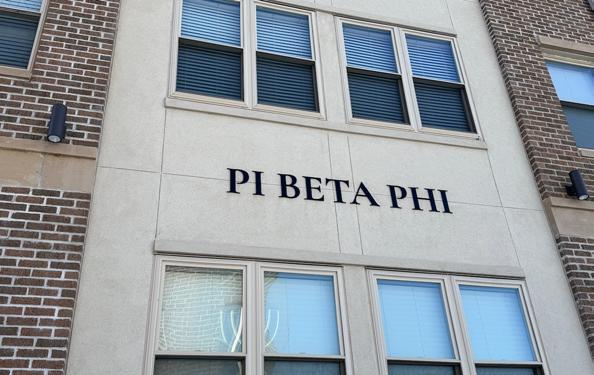
Pi Beta Phi’s chapter at Marquette University will close May 24, according to a press release from the national chapter.
The sorority, which was established on campus in 1990, has recently declined in membership size and in turn can “no longer sustain its operational obligations.” The press release said the national chapter has provided guidance to Marquette’s sorority since August 2022.
The future of Pi Beta Phi’s house at 1601 W Kilbourn Ave. remains uncertain.
“While this outcome is deeply difficult, we are confident Pi Beta Phi’s strong relationship with the campus community will continue, as will the cherished friendships built across generations of the chapter’s history,” Grand President Jenn Plagman-Galvin said in the press release.
This brings the number of sororities that participate in formal recruitment at Marquette from six to five.
The Marquette Wire reached out to Pi Beta Phi’s current president, but has not received a response.
Photo courtesy of Mimi Attard
Marquette's Pi Beta Phi chapter, set to close in May, has a house located at 1601 W Kilbourn Ave.
Photo by Clay Ellis-Escobar clay.ellis-escobar@marquette.edu
The Jan. 24 protest began at Red Arrow Park and concluded at the Knapp Street DHS building.
REACT: University developing action plan
Continued from page 1
detainees have criminal convictions, 25.9% are awaiting charges and 48.4% are listed as “other immigration violators.”
But more than just the numbers are garnering national attention — social media videos of people being taken off the street by masked agents are posted nearly every day.
Natalie Gazzana, a junior in the College of Arts & Sciences and president of the Marquette College Democrats, believes these current ICE actions should lead to eventual legal prosecution of the agents. She also thinks government officials should work toward abolishing the agency.
MacAskill called ICE’s actions the “shocking revelation of what some people in this country can be willing to do with the right amount of propaganda and hate.”
supposed to.
Contrastingly, Evalicia Reyes, a sophomore in the College of Education, College of Arts & Sciences and a member of Marquette DREAMers — a campus organization dedicated to providing a safe space for students with different documentation statuses — is disturbed by the reported detention of legal citizens.
“They are supposed to be taking away criminals,” Reyes said in an email. Deaths in nearby Minneapolis
Renee Nicole Good was fatally shot in the head by an ICE agent in Minneapolis on Jan. 7. Her death was officially ruled a homicide on Jan. 23 by the Hennepin County Medical Examiner’s Office.
On the morning of Jan. 24, a civilian protestor identified as Alex Pretti was also shot and killed by an ICE
people who cross paths with them. It shows a complete disregard for compassion and human life, she said.
But Sgrignuoli said the government isn’t aiming for death; rather, ICE is a federal bureau whose job it is to follow orders.
“It’s not the role of people to go and interfere with the law when they don’t know what’s going on,” Sgrignuoli said. “They don’t have the facts that the agents have on the ground.”
Campus organization efforts
In light of cases like Good’s and Pretti’s, local activists including Marquette YDSA are pursuing ways to ensure protection for both the Marquette and Milwaukee immigrant communities.
MacAskill and his organization are working with YDSA at both the Milwaukee School of Engineering and the University of
He further described it as neighbors turning against their neighbors in an un-American manner.
“This has never been about legality. This is, I think, solely about control,” Alannah Gallagher, a sophomore in the College of Arts & Sciences and co-leader of YDSA, said.
In September 2025, the Supreme Court temporarily ruled that agents in Los Angeles were allowed to profile based on race when conducting sweeps for illegal immigrants. According to an investigation conducted by ProPublica, a reported 170 legal American citizens have been detained by ICE to date, some left for more than a day without access to a phone.
When asked about the reported detention and deportation of legal Americans, Sgrignuoli referred to these as mistakes, stating that some people get wrongfully taken and the legal process will play out as it’s
agent in Minneapolis. Pretti was a 37-year-old nurse from Green Bay, Wisconsin.
Gazzana said this violence, especially in the case of Renee Good, has been influenced and overlooked by the president.
Reyes pointed out a disparity in coverage for those who have died in ICE-related incidents. For examples, she said, the death of Keith Porter Jr. — a Black man from Los Angeles who was celebrating the New Year when an off-duty ICE agent shot him — did not receive the same attention as Good’s death.
“This administration has proven time and time again that they are racist and that if you do not agree with their standpoints, they will push you into the shadows,” Reyes said in an email.
Similarly, Gallagher pointed out a lack of accountability from both agents and the administration when it comes to the deaths of
Trump administration. She also hopes students will find ways to empathize with others who are affected by the circumstances.
“Solidarity is one of the most prominent guiding principles of our organization, with whatever work we’re engaging in,” MacAskill said.
Marquette’s policy regarding outside law enforcement is for students to direct immigration officers to the Marquette University Police Department to verify there is a lawful request, where MUPD will then respond as required by law.
Areas which once received protection from border enforcement actions, such as schools, churches and hospitals, are no longer protected under the 2021 Guidelines for Enforcement Actions in or Near Protected Areas Memo, which the Trump administration rescinded in 2025.
gather this week to work through different scenarios regarding a potential ICE presence on campus, General Counsel Ralph Weber said at a Jan. 26 University Academic Senate meeting.
“We’re a Catholic, Jesuit university, and so we’re going to protect it and advance that mission,” he said. “And we need to comply with the law, so we need to find the right path to achieve both of those objectives.”
On Jan. 28, the university will host an Ignatian Examen — a prayerful reflection — from 4 p.m. to 5:30 p.m. in the Alumni Memorial Union Lunda Room for campus body to converse, reflect on faith and respond to recent ICE actions. The Examen will be directly followed by a communal peace Rosary in the Chapel of the Holy Family.
Wisconsin-Milwaukee to hold campaigns to have their universities designated as sanctuary campuses. They would operate like sanctuary cities, which limit cooperation with immigration authorities by placing restrictions on local law enforcement. Restrictions include reduced cooperation with inquiries about immigration status and limited sharing of information about those at risk of deportation.
Sgrignuoli said there isn’t much the College Republicans can do — or are obligated to do — regarding current ICE actions. Instead, he’s putting his attention toward state elections in 2026, which he expects to have significant political implications.
For the College Democrats, Gazzana said her main priority is to provide refuge for students to share their thoughts and feelings about immigration and the
“Many communities are living in fear because of the actions that ICE agents are taking,” Reyes said in an email. “Nobody should live in fear of being taken away from their families, whether that is in death or deportation.”
University to develop plan
In light of the recent incidents in Minneapolis, Marquette leadership will
“As a university, we teach, we think about knowledge, but as a Catholic, Jesuit university, we think about all the people in our community and humanity,” Acting Provost Sarah Feldner said at the Jan. 26 meeting. “The Examen feels like a right place to start.”
More resources for the Marquette community in the wake of ICE-related violence are available in a Jan. 26 release from the university.
Some local college students are finding ways to protect those affected by recent ICE actions.
Photo by Clay Ellis-Escobar clay.ellis-escobar@marquette.edu
Photo by Clay Ellis-Escobar clay.ellis-escobar@marquette.edu
Local activists are pursuing ways to protect immigrants in MKE.
Photo by Clay Ellis-Escobar clay.ellis-escobar@marquette.edu
Hundreds of protesters took to downtown Milwaukee on Jan. 24.
Local experts talk data centers in Wisconsin
Enviromental factors, ideas for future discussed
By Sahil Gupta sahil.gupta@marquette.edu
From education to art, medicine to surveillance, the global debate over artificial intelligence continues to dominate various facets of life. The latest topic of conversation among experts and users alike — data centers.
The existence of data centers is not new, but it has sparked conversation and controversy in several Wisconsin communities in the last year. Residents of Port Washington, Wisconsin, have even launched an attempt to recall their mayor over his support of a data center currently being constructed by Vantage, although it remains to be seen whether they will get enough signatures to put the motion on the ballot.
This latest discourse was the topic of conversation at an event hosted by the Marquette University Law School’s Lubar Center for Public Policy Research and Civic Education on Jan. 21.
Director Derek Mosley moderated a discussion with three community experts about the history, uses and implications of data centers.
What are data centers?
The website datacentermap.com shows that there are currently 3,881 data centers in the United States, with 47 currently operational in Wisconsin. They consist of large buildings, oftentimes the size of major superstores such as Walmart or Target. Inside the buildings are racks of anywhere from 100 to 1000 computer servers (sometimes many more) stacked 10-15 feet high.
“Imagine racks of
computers [without screens], miles of cabling and then a very powerful air conditioning system to try to keep things cool and keep things processing,” Michael Zimmer, professor of computer science, said during the panel.
Data centers have existed in a smaller form for several decades as the internet has evolved. These servers store all of the information that people access via the internet, commonly known as “the cloud.” Recent conversations, however, revolve around larger data centers that manage the high quantity of data that is consumed by AI tools, such as large language models. Where will Wisconsin data centers be?
Several major tech companies have invested billions of dollars into the construction of large AI data centers around Wisconsin.
Microsoft is in the process of constructing two data center sites in Mount Pleasant, with aproposal to add another 15 recently approved by the Mount Pleasant Village Board. Meta has invested $1 billion to build a 700,000 square foot facility in Beaver Dam, and Vantage is currently constructing a $15 billion site in Port Washington.
Experts cite several reasons that make Wisconsin an ideal location for data centers, including favorable tax laws, access to manufacturing resources and a temperate climate, something that panelist Rebecca Gries, executive director of business recruitment firm Milwaukee 7, cited during the panel.
“[Tech companies] want to go to climates that are naturally cooler to help the cost and energy needed to cool those systems,” Gries said.
Water consumption a concern
A study conducted by the Environmental and Energy Study Institute found that large data centers consume upwards of 5 million gallons of water a day, equivalent to the electricity usage of a town of 10,000 to 50,000 people.
Gries argued during the panel that new “closed loop technology” significantly reduces the amount of water that data centers consume by allowing the water to be mixed with coolants and circulated throughout the center for extended periods of time.
“Once the coolants are put into the system, it runs for about six years,” Gries said. “It doesn’t leave, it stays there, and they don’t need more water throughout the process.”
The tech companies have said that the new data centers being built in Wisconsin will operate under closed loop systems, however opponents remain skeptical that it will actually reduce the water that they will use.
Electricity costs raise political stakes
Rising electricity costs are another significant concern associated with the expansion of data centers
in Wisconsin. This comes amidst controversies in other parts of the U.S., where ratepayers are currently facing increased electricity bills amidst the expansion of high energy consuming data centers.
Customers in the electrical grid region managed by maintenance company PJM reported their electricity bills went up as much as five percent from 2023-2025.
The region, which includes several Midwestern and Mid-Atlantic states such as Pennsylvania, Virginia and Ohio, is home to the world’s largest concentration of data centers.
While Wisconsin’s grid is not managed by PJM, state officials on both sides of the aisle agree that Wisconsin residents shouldn’t bear the costs associated with the expanding presence of data centers in the state.
“Existing ratepayers and commercial users should not have their rates go up as a result of someone that’s coming in and using massive amounts of electricity,” Republican Representative Tom Tiffany told Washington D.C. based publication NOTUS earlier in January.
Tiffany’s concerns were
echoed by Democratic Senator Tammy Baldwin, who talked about the importance of transparency from those who intend to manage data centers in Wisconsin.
“The developers of [data centers] need to have commitments to the local community that they won’t have to shoulder the cost of energy use and water use by these data centers,” Baldwin said to NOTUS.
Sustainable options for the future There are different options that are currently being explored for how to use data centers in the most sustainable way.
Zimmer said it is still too early to know all of the possibilities but continues to stay optimistic about research and inventions that could discover new ways to operate data centers down the line.
“I don’t think we’ve had enough experience to get a sense of how things will play out,” Zimmer said during the panel discussion.
“There’s creative things that people are experimenting with to try and help with these issues.”
Marquette to raise tuition 3.5% for 2026-27
Uptick follows a 4% increase for the 2025-26 year
By Mina Marsolek-Bonnet
wilhelmina.marsolek-bonnet@ marquette.edu
The Marquette University Board of Trustees approved an undergraduate tuition increase of 3.5%, according to a Jan. 23 statement from the university. This brings undergraduate tuition up to $53,890 for the 2026-27 academic year, although no change will be made to student fees.
There will also be a 3% increase for housing and food rates for the 2026-27 academic year, which is attributed to “improvement to and rising costs for
residents and dining facilities” according to the university statement.
This follows the 4% undergraduate increase for the 2025-26 academic year and the 5% undergraduate increase for the 2024-25 academic year. Collectively, Marquette tuition has increased 12.5% in the past three years.
The Board of Trustees also approved the following tuition increases to graduate and professional programs:
Graduate programs
A per-credit $35 increase for Education Graduate School programs
A per-credit $50 increase for the Graduate School and Graduate School Management programs
A per-credit $125 increase
for Graduate School Humanities programs in English, Theology, Philosophy and History
Professional programs
2% increase for in-state and out-of-state in the School of Dentistry
2% increase for full-time in the College of Health Sciences’ professional programs
2% increase for Marquette University Law School students
Master of Science in Nursing — Second-Degree Direct Entry for Non-Nurses
No changes will be made to annual tuition for current cohorts. The annual rate for students starting in summer or fall 2026 or spring 2027 will be $69,000. “Affordability remains
a top priority for us,” the university statement said. “We continue to seek new and thoughtful ways to identify cost savings and revenue-generating opportunities.”
At a November 2024 University Academic Senate meeting, President Kimo Ah Yun said he did not want to raise tuition; however, tuition has increased twice since this statement.
In July, Republican lawmakers attempted to limit tuition increases at Wisconsin’s public universities.
This came after the University of Wisconsin’s Board of Regents approved a 5% increase at most UW campuses. The bill would impede the Board of Regents from raising tuition by more
than the consumer price index increase each year, meaning tuition could not be raised by more than the rate of inflation.
However, as Marquette is a private institution, this bill or any state action would have no effect on tuition increases for Golden Eagles. It is unclear if the university plans to increase undergraduate financial aid in consideration to the increased tuition, as have other private universities with similar increases.
For instance, Northwestern University had a 3.3% undergraduate tuition increase for the 2025-26 academic year with a planned $306 million for undergraduate financial aid.
Pictured (from left): Derek Mosley, panelists Claudia Levens, Rebecca Gries and Michael Zimmer.
Photo by Clay Ellis-Escobar clay.ellis-escobar@marquette.edu
Ex-athlete pleads not guilty to child sex crimes
21-year-old is bound for trial on 12 counts
By Sophia Tiedge sophia.tiedge@marquette.edu
William Waterstradt, an ex-Marquette University student athlete, has plead not guilty to 12 felony counts of child sex crimes.
The 21-year-old waived his right to a preliminary hearing and has a pretrial conference set for March 23, according to online court records.
Waterstradt is bound over for trial on the same 12 counts he was charged with, his lawyer, Jonathan LaVoy, told the Marquette Wire in a statement. The defense entered a request for a bond reduction on Jan. 16, but Waterstradt’s
cash bond is still listed at $500,000.
On Jan. 13 he was charged with:
- Three counts of second-degree sexual assault of a child
- Three counts of using a computer to facilitate a child sex crime
- Three counts of exposing genitals to a child
- Two counts of child enticement
- One count of child sexual exploitation
Each of the three counts of sexual assault of a child alone holds a prison sentence of up to 40 years and/ or a $100,000 fine.
Waterstradt is being held in Langlade County Jail in northern Wisconsin. The former senior in the College of Communication has since left the university.
Indigenous newsroom to enter Johnston Hall
National outlet, ICT, expanding footprint to WI
By Lance Schulteis lance.schulteis@marquette.edu
On the fourth floor of Marquette University’s Johnston Hall resides Milwaukee Neighborhood News Service, a media organization that runs its award-winning newsroom right out of a college campus.
But now, it’s not the only decorated publication that calls Johnston Hall home.
Around the corner and tucked away on the fourth floor lies a small office with a city view that will service a new regional bureau for ICT, formerly known as Indian Country Today.
ICT is an Indigenous news outlet, owned by IndiJ Public Media. With a focus on telling stories about Indigenous communities and people, the national organization will now expand its footprint to Wisconsin, a state home to 11 federally-recognized Native American tribes.
“We have strong Indigenous values,” Katie Oyan, president and CEO of IndiJ Public Media, said. “We adhere to things like respect and courage and truth-telling. We really strive to report on stories that you’re not going to see anywhere else — and report not just on Native communities, but from Native communities.”
Reporting from those locales will be Amelia Schafer, ICT’s new North Central Bureau correspondent. She unofficially cut the ribbon on her new Johnston Hall office in mid-January but will work in a largely remote capacity until her permanent relocation in May.
“I’ve never actually had my own office before, so I’m super excited,” Schafer said. “In my previous roles in-person, it was a ‘hot desk’ situation, so you couldn’t put anything on the desk full-time. I feel like this is going to be a really cool thing.”
Schafer and a student intern will be the lone correspondents working out of the campus newsroom, and her beats will include
missing and murdered Indigenous women, business and gaming.
Though originally from Iowa and a transplant from South Dakota, Schafer has existing ties to Wisconsin with her heritage to Fond du Lac’s Brothertown Indian Nation.
In addition to Wisconsin, Schafer’s North Central bureau covers Iowa, Michigan and Minnesota. Much of her early work in the role has focused on the implications of Immigration and Customs Enforcement’s presence in Minnesota on local Indigenous communities.
Within the Badger State, ICT has another partnership in Madison with PBS Wisconsin Watch, which has an existing affiliation with NNS. Under the partnership, Schafer will have access to its Madison office while PBS Wisconsin correspondent Erica Ayisi will also work as an ICT reporter.
“I’m really excited to meet Erica and for us to get to do some great things together,” Schafer said.
The Madison-to-Milwau-
kee connection runs right through Marquette, sparked by IndiJ Public Media’s former president, Karen Lincoln Michel. Michel, a Marquette graduate, received an honorary doctorate from the university in 2023, just over a year before her departure from IndiJ Public Media and ICT.
But before she left, she set in motion a direct partnership that finally came to fruition in 2026. IndiJ Public Media and Marquette first began talks in late 2024, which intensified over the following spring. In July 2025, the leadership team made a trip to tour campus. On Oct. 28, 2025, the university made the official announcement: ICT was on its way.
“This collaboration is deeply rooted in our shared commitment to social justice and community engagement, values that have guided our journalism program for generations,” Kati Berg, acting dean of the College of Communication, said in a statement.
Patrick Johnson, an assistant professor in the
College of Communication, worked with Berg to evolve the first contact with ICT into a lasting partnership. In the stretch of nearly a year, Johnson and Berg talked with faculty and NNS staff about how to make the newsroom a possibility.
“The journalism department is tiny, but mighty,” Johnson said. “It happened to be a really unique opportunity to have this partnership in place.”
The new relationship not only lets ICT work out of Johnston Hall, but it pulls it right into the fold at Marquette. Schafer will be able to attend faculty meetings, work in the NNS newsroom, communicate with journalism students and work alongside a student intern.
And it will all start in a small office, tucked into an alcove on the fourth floor of Johnston Hall. With a window overlooking Wisconsin Avenue, the office — including Schafer’s desk — will transform into a newsroom, becoming a headquarters for Indigenous news for years to come.
Photo courtesy of Marquette Wire
Ex-student athlete William Waterstradt has plead not guilty to 12 felony counts of child sex crimes.
Amelia Schafer will be the bureau's reporting correspondent.
Photo courtesy of Amelia Schafer
Photo courtesy of Katie Oyan ICT is a news outlet with a focus on telling stories about Indigenous communities and people.
BRAY'S UNFORESEEN RISE
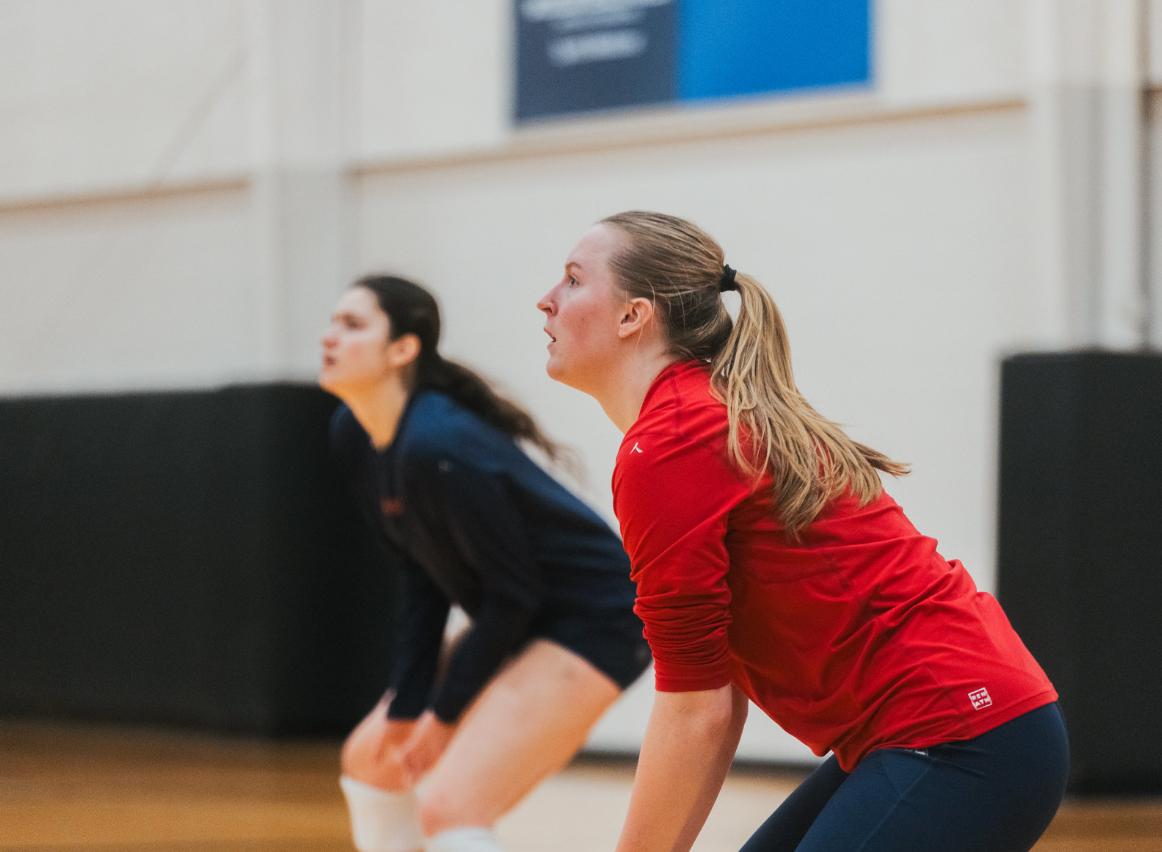
Middle blocker first Golden Eagle drafted to Major League Volleyball, reunites with old
By Raquel Ruiz raquel.ruiz@marquette.edu
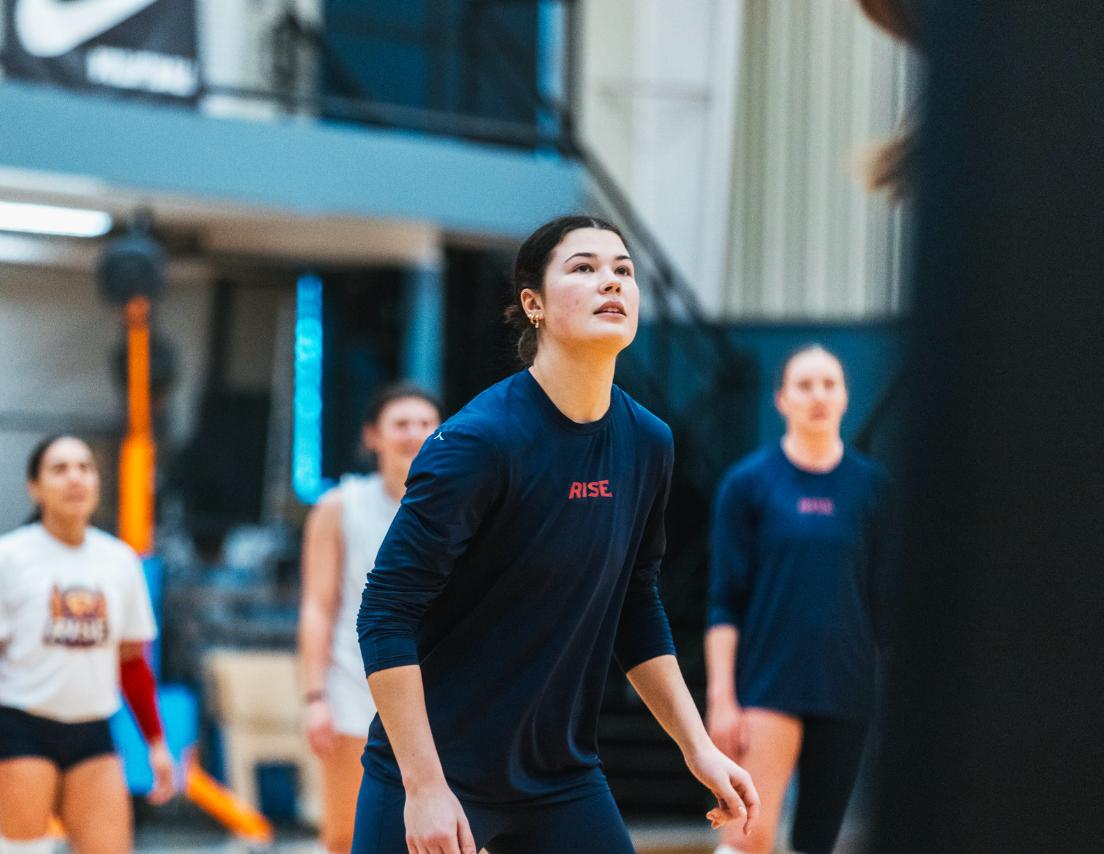
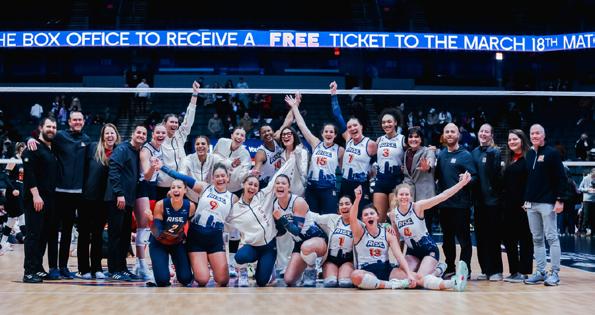
Trying to calm her nerves, Hattie Bray stood behind the endline reminding herself that serving is something she’s done a million times before. Next thing she knows, it’s an ace. She was no longer wearing blue and gold. Instead, she’s now representing the Grand Rapids Rise. It was back in November when graduate student middle blocker Hattie Bray made Marquette volleyball history.
The Hancock, Wis. native became the first Golden Eagle to get drafted into Major League Volleyball. Bray was selected No. 25 overall by the Rise in the fourth round of the 2025 draft.
“I feel honored to have the opportunity,” Bray said.
MEN'S BASKETBALL
“This is unreal.”
But playing in the Majors wasn’t always her dream. In fact, it was in the fall of 2024 when the idea sparked.
roommate
While practicing before a match at Creighton, a friend of former head coach Ryan Theis, who was on the staff for the Omaha Supernovas, was in the arena watching Marquette. Or, rather, watching Bray. “She was talking to Ryan and was like, ‘When does Hattie graduate?'” Bray said. “He was chatting with her about my opportunity
MU looking for redemption vs. Creighton
Golden Eagles bested by Bluejays in first matchup
By Mikey Severson michael.severson@marquette.edu
After a loss to Butler last Friday night that could have been closer than the 87-76 final score indicated, Marquette men’s basketball (7-14, 2-8 Big East) returns to Fiserv Forum to face the Creighton Bluejays (12-8, 6-3) at 8:30 p.m. Tuesday night.
The last time Marquette faced off at Creighton, the Golden Eagles got out to a promising start, but the Bluejays used a 25-2 run to defend their home floor and win 84-63.
Marquette has not won a game outside of Fiserv Forum this season, and both of its Big East wins have been by one point. It’s been a year of tight, mystifying
losses in which a few bad minutes spoil any hope of victory.
Marquette having rough stretch, but young core gives promising future foundation
It’s been an awful year for the Golden Eagles, who sit No. 142 in the NET rankings and will miss the NCAA tournament for the first time under Shaka Smart (barring a miracle Big East tournament win). But the underclassmen have provided glimpses of hope for future years.
First-year Nigel James Jr. has run the offense like a seasoned veteran, making desperately needed clutch plays with improved efficiency and decision-making. His last two games at Fiserv Forum ended with career-highs. Against Villanova, he dropped 31 points on 7-of-9 deep shooting, before setting a new personal best 38 points — including
clutch free throws to force overtime — in a 105-104 thriller versus Providence.
Sophomore forward Royce Parham and firstyear guard Adrien Stevens are showing improvement as they stepped into the starting lineup midseason. Parham has scored double figures in seven of Marquette’s 10 Big East games, while Stevens has provided a spark with his 3-point shooting.
Sophomore Damarius Owens has been a key piece off the bench for Marquette, playing 20-plus minutes and scoring double figures in three of his last four games.
Creighton seeking seventh Big East win of the season
On the other side of the ledger, the Bluejays have been no stranger to close finishes since their first meeting in Omaha with the Golden Eagles.
Two home nailbiters against Georgetown and Xavier have solidified their penchant for finishing close games. Although Creighton blew out Xavier by 41 points in Cincinnati on Dec. 17– Xavier’s worst home loss ever, and in the rematch with the Musketeers, they contrastingly squeaked by with a onepoint victory in Omaha. Marquette earned its first Big East win against the Musketeers, also by a single point Jan. 7 at home.
Austin Swartz (11.6 points per game), senior guard Josh Dix (12.8 points per game) and junior forward Jasen Green (10.8 points per game) all average in double figures for the Bluejays, while junior forward Owen Freeman tallied 17 blocks this season while making eight starts and appearing in 18 contests. Dix received Big East Player of the Week honors to close out 2025.
Since the last time Creighton faced Marquette, they are 5-3 with tight road losses to Seton Hall and Providence, as well as wins over Villanova and Georgetown — squads Marquette has come up short against this season.
In-Game Special Events
All spectators are encouraged to wear gold (or yellow) as part of the ‘gold out’ theme. The first 5,000 fans in attendance will receive a complimentary retro gold replica jersey.
During halftime of the contest, former Marquette guard Stevie Mitchell, who now plays in the NBA G League for the Rio Grande Valley Vipers (affiliate of the Houston Rockets), will be honored with the McCahill Award, an annual accolade which highlights achievement, scholarship and service to MU.
Photos by Nicolas Carrillo / Grand Rapids Rise
RISE: Reitsma 'couldn't hold my grin'
Continued from page 6
to possibly play pro and then after she took notice I was like, ‘Oh, that’s actually like a really cool job to have.'”
And so the spark was lit and her professional career began.
Bray said that most professional volleyball is popular overseas — something she could not envision herself doing. Rather, she wanted to continue to play the game that she loves.
An opportunity she said most athletes don’t have after their collegiate careers are over.
“[I’m going to] play as long as I can,” Bray said. “See if my shoulders and my knees can feel good for a couple more years.”
By the end of her final season as a Golden Eagle, she led the Big East with
1.22 blocks per set and ranked fourth in hitting percentage at .373. She was also the third player in Marquette history to earn four-straight All-Big East selections.
Bray joins former Marquette outside hitter
Jenna Reitsma out in Grand Rapids, where she was newly appointed as the team’s director of volleyball operations.
Majoring in corporate communications, a job in sports was always something Reitsma wanted to pursue, but she had pushed that dream to the side. When the opportunity arose for a job almost 20 minutes away from her hometown of Lowell, Mich., she took it.
“It was like a secret little dream I sort of had, working in sports,” Reitsma said. “So, I got all excited
and jumped on board.”
Aside from working with the logistical side of the Rise, she gets to fill in during practice whether it’s serving or passing in the libero position as well as gain experience coaching and learning from the staff. In her time as a Golden Eagle, Reitsma was consistently ranked among the league’s leaders in service aces, while totaling 864 kills, 145 service aces and 130 blocks in her four-year span.
Together, Bray and Reitsma were a part of a team that got to see three Big East championships and multiple Sweet 16 appearances.
“We came here to do our job, to be in the record book,” Bray said reflecting on her time at Marquette.
“To look up at the banners in the Al and say, ‘Yeah,
WOMEN'S BASKETBALL
we were here for that, we helped earn those awards, we have rings back home that we can come show you for that,’ I think that’s so cool.”
"...when they said, 'Yep, our pick is going to be Hattie Bray,' I was super excited."
Jenna
Reitsma Former Marquette volleyball outside hitter
The possibility of working and playing at the same organization in Grand Rapids was hard for Reitsma to keep quiet. Bray’s name came up in conversation at the Rise when preparing for the draft.
“I had to keep my mouth shut and see what was going to happen, but on draft day, when they said, ‘Yep, our pick is going to be Hattie Bray,’ I was super excited,” Reitsma said. “I couldn’t hold in my grin.”
Both Bray and Reitsma said that players on the Rise think that one girl is older than the other, and that they only played together for a year. When the reality was four. Reitsma now gets to play ‘tour guide,’ showing Bray around her hometown.
Two Golden Eagles in the same city, under the same MLV team, but their relationship goes back to their first and second years, when they were roommates in Humphrey Hall. They said that random college stories will come out during practice, like the time Bray cut Reitsma’s hair in their living room one night.
“I‘m like [to our teammates], ‘Guys, you don’t even know,'” Reitsma said. “We know each other so well. It’s awesome.”
Not expecting to enter the Rise’s match against the Orlando Valkyries on Jan. 9, Bray got the ‘get warm to serve’ point of a finger by one of their coaches.
“Part of my job is to pay attention to when we make service subs,” Reitsma said. “So I knew a little bit beforehand that she was going in.”
Now, with the Rise’s season just beginning, the former roommates and teammates are taking the Marquette volleyball name across the country as they take it on the road.
Although Reitsma departed from the Marquette program at the end of the 2024-25 season, she said she continued to watch her former teammate grow. Both in practice when they would play together at Marquette and during Bray’s recent season with the Rise.
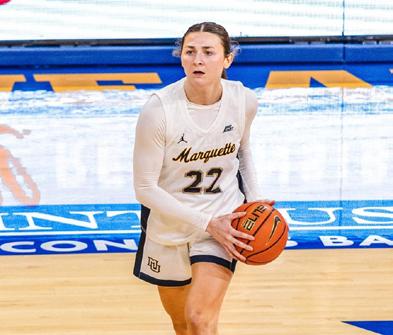
Vice's 23 points push shorthanded MU to win
By Eamon Bevan eamon.bevan@marquette.edu
Coming off of a nail-biting win at St. John’s on Wednesday and having lost the two games prior, Marquette women’s basketball sought to close out their Big East road trip comfortably as they faced Butler at a snowed-in Hinkle Fieldhouse Sunday afternoon.
Despite the absence of leading scorer senior forward Skylar Forbes (she did not travel due to personal reasons), the Golden Eagles picked up a 64-60 win over the Bulldogs behind a 23-point performance from senior guard Halle Vice, her fourth time this season hitting the mark.
“My teammates and my coach had a ton of confidence in me,” said Vice, who shot an efficient 10of-15 and 2-of-3 from deep. “I just promised myself to stay aggressive. I saw
openings and took them.”
While the Golden Eagles got off to a slower start than they would have liked, shooting 28% from the field in the first 15 minutes, the rest of the first half was like day-and-night.
Behind 12 points from Vice and forcing Butler into 7 turnovers all over a five minute stretch, the Golden Eagles went on a 19-0 run to close the half, leading 32-19 on their way into the locker room.
“Our offense works when we get paint touches — not always to score, but to kick it out and knock shots down,” said head coach Cara Consuegra in a postgame interview. “I thought our kids really refocused on that, and that’s how they took over.”
The Bulldogs came out swinging in the second half as they had a sumptuous deficit to climb. But Vice and Jaidynn Mason led a Golden Eagles run to close yet another quarter, giving Marquette their biggest lead of the night,
14, points going into the fourth quarter.
Butler really started to get hot in the fourth quarter though, outscoring the Golden Eagles 27-17 and cutting the lead to as close as three as time whittled down.
With 23 seconds left, the Golden Eagles faced a close call and nearly lost their advantage after turning the ball over on an inbound pass, picking up a five-second violation. However, Butler’s McKenna Johnson missed the game tying three, and free throws from Lee Volker and Jaidynn Mason sealed the game. Helping Marquette overcome the groggy start — and stay in front at the finish — was its 3-point shooting. The Golden Eagles went 6-for-12 from beyond the arc, every make coming in the first half.
With their behind-thearc offense drying up in the latter end of the game, Mason led the Marquette defensive efforts with two steals and 14 second half
points (she had 16 total), also sealing the game with a deflection underneath her own basket to force a Butler turnover.
“We defend. That’s our mantra,” said Vice. “We find ourselves in our defense, and it took over like it always does.”
Where Forbes usually resides in the post was a spot filled by Charia Smith, who
hit clutch shots down the stretch and enabled ample spacing for Vice to get their 2nd and 3rd quarter runs up and going.
Marquette’s next game will come at home this Wednesday, as they host DePaul and seek a 3-game winning streak for the third time this season.
Photo courtesy of Marquette Athletics
Halle Vice scored a game-high 23 points for MU aginst Butler.
Hattie Bray (middle bottom) has two kills, one assist and four aces in 14 sets for Grand Rapids.
MARQUETTE vs Butler
Photo by Nicolas Carrillo / Grand Rapids Rise
CLUB SPORTS
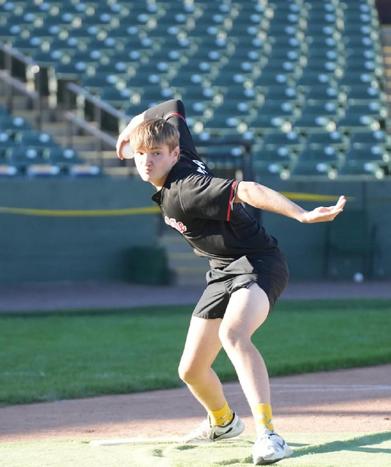
Pro wiffle baller adds spark to baseball club
Liam Porter brings pitching ability in league
By Ben Ward benjamin.ward@marquette.edu
Before the school year started, Giacomo Colella was on a mission to create community on campus. The junior in the College of Arts & Sciences wanted to develop something that would bring people together consistently.
Stepping into the Wellness + Helfaer Recreation Center with a mission on his mind, he noticed the basketball court layout in the building. Colella walked up and down the stairs, scoping them out. The idea struck him that they could be used for a unique purpose. Wiffle ball.
“That moment sparked the idea that this could be both fun and legitimate,” Colella said.
From there, he became focused on developing the structure of the league and its intention, adding a draft, teams, rules and an overall identity. As word of the club grew in
popularity across campus, Colella saw more and more people wanting to sign up and join.
Including a professional wiffle ball player.
First-year student Liam Porter’s love for baseball started at 3 years old and carried on throughout the end of middle school.
Porter decided not to continue the baseball journey however, as other interests took over.
Across the lake in Northville, Mich., Porter and his little brother Evan fell in love with playing wiffle ball in their backyard. This love blossomed into the two siblings starting their own league for locals.
Porter ran the league for three years, scheduling and streaming games on YouTube.
“Running the league for three years was a lot of fun,” Porter said. “It was tough scheduling all the games and getting players out to the field to play, but it was so rewarding and it was so much fun.”
Porter has taken a break from playing in the league since being at Marquette, but he finds himself practicing pitching at the Straz Gym in hopes to be
drafted to Major League Wiffle Ball (MLW). Created in 2010 by Kyle Schultz, MLW went from five little kids playing in the backyard to now 500,000 plus YouTube subscribers and hundreds of thousands of TikTok followers, the league has grown substantially.
It consists of eight teams with five to eight players, playing games out of Brighton, Mich.
MLW hosted a tournament at Globe Life Field, home of the Texas Rangers, where Porter’s little brother Evan played in the tournament with a team called the “Pacific Predators,”
Evan was drafted 7th overall and Liam says it’s funny to see him go out and play.
“Everybody’s like ‘Oh, why are the Predators taking some little shrimp at seven overall?’ And then Evan goes out there and dominates,” Porter said. “Everyone loves him. He’s super good and he’s actually my training partner.”
Porter explained that getting drafted to the MLW is an informal process where players can message managers when they want to see if they’re interested in signing them.
“There’s no recruiting process,” Porter said. “It’s like if someone sees you playing well and says, ‘I want to pick you up,’ then you can sign with
the team.”
Porter is friends with a manager of the “Metro Magic” and hopes that he signs him at some point to play. Even though they play with a different ball, he sees the similarities between Marquette indoor baseball and wiffle ball.
The indoor baseball league uses a pickle ball instead of a wiffle ball and play games on a basketball court.
“I actually find it’s harder to hit in the indoor baseball league than it is in a wiffle ball league,” Porter said.
"...I've enjoyed playing in the Marquette league more..."
Porter Marquette professional wiffle ball player
The indoor baseball league started as something fun to do at Marquette, but it’s exceeded Porter’s expectations.
“I actually found as of late that I’ve enjoyed playing in the Marquette league more than I have playing wiffle ball,” Porter said.
Porter has also noticed the indoor baseball league at Marquette has built a significant community. There are four teams consisting of 10 or more
players, and games are held every Friday afternoon in the rec center.
“It’s changing the vibes at Marquette,” Porter said.
“It’s a good time on Friday afternoons to just go out and play with your friends.
I’ve met a couple of good friends.”
Colella believes that having Porter join the league has been incredible and validating.
“Liam Porter was instrumental in helping get the league off the ground,” Colella said. “His presence raised both the level of competition and the ambition of the league.”
The “Liam Porter Award” was named after Porter and is given to the best pitcher of the season. In which case, Porter won the award, of course.
Colella hopes the club becomes something that lasts beyond his time at Marquette.
“I’d love to see games broadcast through video and radio, and for the league to collaborate with media and analytics students,” Colella said.
On Friday afternoons, when games are in full swing, Colella often looks up and sees people on a workout break hanging over the railing, cheering on the teams below.
“I think overall the league has added something distinctive and engaging to campus life,” Colella said.
Home matches canceled amid winter storm
Weather forces university to push back two games
By Mikey Severson michael.severson@marquette.edu
Just how cold was Milwaukee on Friday?
The temperatures were so frigid that even indoor sporting events were rescheduled. Marquette
men’s tennis rescheduled both of their home matches this weekend.
On Thursday, the Golden Eagles announced their Big East opener against Xavier would move to Friday March 6, with first serve to be announced at a later time.
Marquette athletic communication assistant Asia Horton said in an email to the Marquette Wire
that a Xavier administrator did not want the team to travel given the freezing conditions.
On Sunday, only hours before first serve was scheduled, Marquette announced its match against University of Illinois-Chicago would be canceled. A new date will be announced at a later time.
Temperatures on Friday reached minus 10 to
minus 15 degrees, with wind chills as low as minus 38 across Milwaukee County.
“Once you get down to 30 below zero wind chill and colder, it would only take 10 minutes [to get frostbite],” Milwaukee-Sullivan National Weather Service meteorologist Mark Gehring said.
Just after 5 p.m. CST Thursday, Marquette
announced it canceled all Friday classes. The University of Wisconsin-Milwaukee and other Milwaukee-area schools also all called off school.
Marquette’s last cold weather cancelation happened on Jan. 21, 2025, which was the last time Milwaukee had minus 30-degree wind chills, according to Gehring.
Liam
Photos courtesy of Liam Porter
Liam Porter joined the Marquette indoor baseball league.
MEN'S TENNIS
Liam Porter (right) and his friends started a wiffle ball league in their hometown of Northville, Mich.
Parham, Owens give glimpse into future
Forwards scoring career-highs in sophomore season
By Matthew Baltz matthew.baltz@marquette.edu
Marquette men’s basketball has been celebrating road victories with milkshakes since Shaka Smart took the helm.
Over his first four seasons as head coach, the Golden Eagles earned 41 of them. This season, however, they still haven’t tasted sweet victory away from Fiserv Forum.
The blue & gold fell to 0-7 on the road after losing at Butler, 87-76, on Friday.
Marquette trailed 75-72 with just under four minutes to play, but found itself floundering on offense once again in a late-game situation, finishing 2-for8 from the field with two turnovers in the final 3:58.
The Golden Eagles shot a season low 18.5% from deep, making just 5 of their 27 3-point attempts.
Here are some thoughts from MU’s 0-1 week:
After a slow start, the sophomores are trending upwards
Coming into this season, sophomore forwards Royce Parham and Damarius Owens were expected to take leaps forward offensively with the departure of
Marquette’s top three scorers last season (Kam Jones, David Joplin and Stevie Mitchell). For the first 11 games of the season, both players were coming off the bench. Parham was oftentimes the sixth man, averaging 22 minutes per game. Owens, on the other hand, only played in nine of MU’s first 11 contests, for an average of eight minutes. Neither were overly impactful on the offensive end, with Parham scoring 9.1 points per game and Owens chipping in 2.6.
However, a switch flipped once conference play started. Parham has started MU’s last 10 games and is averaging 12.4 points per appearance at that time. He’s reached double figures in seven of those 10 games as well.
“His first 10 or 12 games, there was some inconsistency there,” Smart said about Royce Parham after his 18-point performance in MU’s win over Providence. “He’s a talented young guy, and we’ve always known that he can score the basketball. We just got to keep putting him in positions where he can.”
Leading up to Marquette’s Big East lid lifter against Georgetown on Dec. 17, Owens hadn’t played more than 14 minutes in a game. He played 27 against the Hoyas, posting a career-high 15 points and a team-high seven rebounds in the eventual 7869 loss.
With the departure of Zaide Lowery on Dec. 28 and the foot injury Sean Jones suffered before Marquette’s game at UConn on
Jan. 4, minutes have been up for grabs — and Owens has taken full advantage. He has played 17 minutes or more in Marquette’s last three games, while also posting double figures in three of the last four contests.
“A lot,” Owens said in response to a question about how much his confidence has grown this season. “It comes with opportunity. Whenever my name is called, I feel like I’m ready. It’ll be the same in the future, so, whatever I’m given, I’m taking advantage of it.”
Free throw struggles persist
The Golden Eagles have not been good at the free throw line this season.
They are shooting 67.8% from the charity stripe (the lone Big East team under 70%), lower than the previous worst mark from the line under Smart, which was 70.3% in 2023-24.
Their best free throw shooter — and the only one above 75% — is someone who left the team almost one month ago in Lowery
(83.3%). Behind him is Owens (73.5%), followed by Chase Ross (73.1%), Adrien Stevens (72.7%) and James Jr. (69.5%).
After Marquette’s 96-76 loss to Wisconsin on Dec. 6, Smart talked about how missed free throws were the difference between a double-digit and double possession lead.
“It was at one point in the second half, I think [Wisconsin] got the lead to maybe 11,” Smart said. “I looked at the stat sheet and I’m like, ‘Man, if we make our free throws, it’d be more like four or five.’”
Missed free throws have several ‘what could’ve been’ type of results for Marquette this season. Recently, the Golden Eagles missed eight free throws in an eventual five-point loss at DePaul, another eight in a six-point loss to Seton Hall, and three in a threepoint loss to Villanova.
Even in its most recent win over Providence, a 19-of-30 clip from the free throw line almost spoiled one of Marquette’s best offensive performances of the season.
“That’s one of the toughest things to prepare players for, because anything you do outside of the game is pretty poor simulation of the pressure you’re going to feel in the game, in the moment,” Smart said about free throws in clutch moments. “We shoot pressure free throws. Guys work a lot on their free throws on their own, but, honestly, it comes down to poise and guts.”
What’s on tap?
Marquette welcomes the Creighton Bluejays to Fiserv Forum on Tuesday. Tip-off is set for 8:30 p.m. CST.
Then, the Golden Eagles are off to South Orange, New Jersey for a date with the Seton Hall Pirates on Saturday. Tip-off is scheduled for 11 a.m. CST.
Chase Ross is shooting 73.1% from the charity stripe this season.
MEN'S BASKETBALL
Damarius Owens (left) and Royce Parham (right) celebrate during MU's 105-104 overtime win.
Photos courtesy of Marquette Athletics
Opinions
U.S. leaves WHO: a serious global mistake
By Rachel Lopera rachel.lopera@marquette.edu
The U.S. officially completed its withdrawal from the World Health Organization on Jan. 22. Leaving a worldwide organization that serves the people and responds to health crises is a mistake, risking the lives of countless people around the world.
The WHO is the United Nations agency that connects countries, promotes international health and coordinates responses to global health issues. Founded in 1948, it is an essential organization for disease control and medicinal research programs.
When President Donald Trump was inaugurated for his second term on Jan. 20, 2025, he signed an executive order to begin the process of withdrawing the U.S. from the WHO due to the agency’s handling of the COVID-19 pandemic. Almost exactly one year later, the withdrawal is complete.
Trump’s decision raises several concerns as it could disastrously jeopardize the health of Americans and global citizens.
Experts are worried that the withdrawal will hinder America’s ability to develop vaccines, medicines
and treatments against new threats and outbreaks. The WHO has accomplished life-changing achievements such as the eradication of smallpox, establishment of the International Health Regulations and founding of the Expanded Programme on Immunization.
“In my opinion, it’s the most ruinous presidential decision in my lifetime,”
Lawrence Gostin, a public health law expert at Georgetown University, said to AP News.
In the order, Trump said the reason for withdrawal was due to the WHO’s “mishandling of the COVID-19 pandemic” and “its failure to adopt urgently needed reforms.” While the pandemic was a fearful and time-sensitive global crisis, it was also new. To completely withdraw from the WHO based on a worldwide event with severe extenuating circumstances is not a sound decision.
The WHO and other public health organizations were inevitably bound to make mistakes as they tried to combat an unknown virus that was causing widespread health issues.
“The U.S. withdrawal from the World Health Organization is a shortsighted and misguided
abandonment of our global health commitments,” Ronald Nahass, president of the Infectious Diseases Society of America, said. “Global cooperation and communication are critical to keep our own citizens protected because germs do not respect borders.”
Several international WHO initiatives could be at risk, such as the work to eradicate polio and promoting maternal and child health programs, because the U.S. contributes funding to them and participates in crucial decision-making.
The U.S. will no longer participate in WHO-sponsored committees, possibly indicating that it will not take part in global flu information-sharing which influences vaccine decisions.
The U.S. Department of Health and Human Services said government funding to the WHO has been terminated, which is a devastating loss considering that the U.S. has historically been the agency’s largest donor. From 2022-2023, the U.S. contributed $1.284 billion, which is about 15% of the WHO’s budget.
The cease to funding is even more concerning, knowing the U.S. still owes the WHO more than $270 million. In order for a
country to leave the WHO, it must give one year’s notice — which the U.S. did — and pay all outstanding dues — which it has not, and experts do not expect that it will.
The HHS said the U.S. will continue to be a global health leader despite the withdrawal, claiming it already has over 2,000 staff members in 63 countries and bilateral agreements with hundreds of nations. The HHS added that there are plans to work with other organizations, but no details have been released yet.
Even if this strategy succeeds, one might question whether it will have the same global impact that the WHO has had since its founding nearly 80
years ago.
If a country were to rejoin, it would have to accept the WHO Constitution and get approved by a simple majority vote of the World Health Assembly, but the HHS said the U.S. has no plans to return.
Some, like Gostin, believe Trump overstepped his authority by leaving the WHO. Since the U.S. joined by way of Congress, it should take an act of Congress to withdraw.
The U.S. leaving the WHO is a dangerous decision because healthcare is not a luxury; it is a necessity.
Stop romanticizing 2026 as the new 2016
By Amelia Lerret amelia.lerret@marquette.edu
The romanticization of the past is problematic when it excludes the acknowledgement of important events, hindering society from moving forward.
A recent phrase taking over social media platforms is “2026 is the new 2016.” From celebrities and influencers to everyday users, everyone is posting content that was popular ten years ago, reminiscing on the lifestyle from that period.
The aesthetic of 2016 is hard to miss, with the abundance of cooltoned filters, chokers and
grainy pictures.
On TikTok, a common act for this trend is posting a picture or collection of pictures with a 2016 filter, accompanied by a song from the era. Commonly used songs are from artists like Zara Larsson, whose music was very popular ten years ago. Similarly, Instagram users participate by assembling a slide deck of decade-old photos with a witty caption and fitting song. While this is a fun way to remember the past, it does not account for the important events of 2016 that have ramifications present today. The year is being remembered as completely carefree and light-hearted when that was not the case — there was more to it than just filters and music. For example, a polarized political climate surged in 2016, alongside a highly contentious presidential election. According to a Pew Research Center study, 58% of politically engaged Republicans reported feeling angry and frustrated with the Democratic Party in 2016, and these feelings were reciprocated from highly engaged Democrats
as well.
Further, the study showed how the rise of political polarization stemmed from dislike of the opposing party’s candidate in the 2016 presidential election. On a scale from 0-100 on a coldest-to-warmest “feeling thermometer,” Democrats rated Donald Trump an 11 on average, with 68% rating him at zero.
These feelings were prevalent in 2016, but social media is currently leaving them out of its ten-year reminiscence. And that polarization is just as prevalent today.
According to another Pew Research Center study conducted in 2025, 85% of Americans feel that political violence is increasing, and one participant said division between parties is higher than ever.
Another forgotten event that shaped 2016 was the Pulse nightclub massacre. With 102 total victims and 49 deaths, the tragedy was the deadliest mass shooting at the time and is now second to the Las Vegas Strip massacre in 2017. While this tragedy is difficult to remember and reflect on, it is vital that
we do so society does not repeat the mistakes of the past.
Choosing to only remember positive things can be a sign of suppression, a common defense mechanism used when people consciously choose not to recall hurtful memories. The “2026 is the new 2016” trend displays this as people focus solely on the carefree nature of 2016 and ignore the serious events that have been influential in history.
This positive recollection of the past could be a desire for escapism. When people participate in this trend, they forget about the world’s issues, but that will not create a better future.
If we cannot acknowledge areas for improvement in society, then we will not grow. So, as we reminisce about the fun memories of the past, it is crucial to also remember the events that continue to change our world today.
Statement of Opinion Policy
The opinions expressed on the Opinions page reflect the opinions of the Opinions staff. The editorials do not represent the opinions of Marquette University nor its administrators, but those of the editorial board.
The Marquette Tribune prints guest submissions at its discretion. The Tribune strives to give all sides of an issue an equal voice over the course of a reasonable time period. An author’s contribution will not be published more than once in a fourweek period. Submissions with obvious relevance to the Marquette community will be given priority consideration.
Full Opinions submissions should be limited to 600 words. Letters to the editor should be between 150 to 300 words. The Tribune reserves the right to edit submissions for length and content.
Please e-mail submissions to: rachel.lopera@marquette. edu. If you are a current student, include the college in which you are enrolled and your year in school. If not, please note any affliations to Marquette or your current city of residence.
Photo courtesy of Rachel Lopera
Rachel Lopera is the executive opinions editor. She is a sophomore studying journalism.
Photo by REUTERS
WHO logo and U.S. flag are in this illustration taken in April 2025.
Amelia Lerret is an opinions columnist. She is a first-year studying journalism.
Fun & Games
Grammy Song Nominations
Grammy Artist Nominations
5. Creates music with her brother, Finneas.
6. Released her album "Alligator Bites Never Heal."
7. Attended the same school as RAYE.
8. Dubbed the "Midwest Princess."
10. Has a feud with rapper Drake.
11. This year's Super Bowl halftime show performer.
1. TikToker turned singer.
9. Her real name is Stefani Germanotta. Across
2. Performed at The Rave/Eagles Club in September 2025.
3. Released his first studio album "Goblin" in 2011.
4. Former Disney Channel star with seven studio albums.
12. Played Andre Harris on the show "Victorious."
Submit finished puzzles to sophia.tiedge@marquette.edu by December 15. Most accurate crossword submissions wins a grand prize.
Gabriela
Arts & Entertainment
The MU Naturals to compete at ICCA
By Allison Scherquist allison.scherquist@marquette.edu
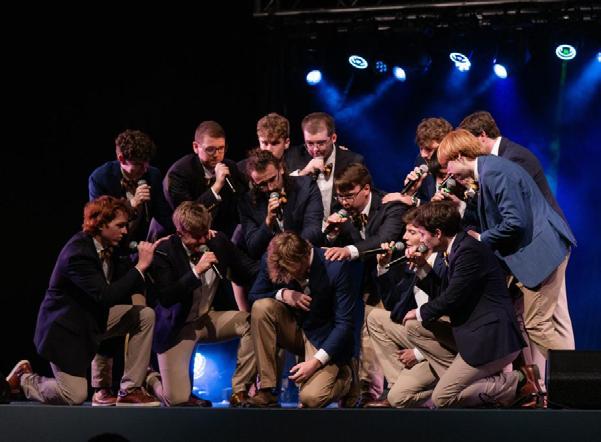
The Marquette Naturals are deep in their preparations for the International Championship of Collegiate A Cappella (ICCA)— the largest international a cappella tournament for universities, made famous in “Pitch Perfect.” The quarterfinals will be held in Madison, Wisconsin.
Groups apply to compete in quarterfinals, and then six to ten groups are chosen to compete at a quarterfinal in their respective region (three to five quarterfinals occur in every region). The top two groups advance to the semifinals.
One semifinal competition occurs in each region, and the winner from each semifinal advances to the finals in New York City.
The Marquette Naturals compete under the Great Lakes Division.
The Naturals, Marquette’s all-male a cappella group, will have their quarterfinal competition on Valentine’s Day and will be singing an arrangement of three songs, all centered on the set theme of fatherhood.
Last year, the Naturals were the only a cappella group from Marquette to attend ICCA due to the competition being held on National Marquette Day. Naturals President Timothy Gustafson, a junior in the College of Arts & Sciences, is excited for the chance to per-
form without the timing challenges of last year.
“Last year was a difficult decision,” Gustafson said.
“Not only for us, but for all the Marquette [a cappella] groups, because we were put in a situation where we all had to choose, and we chose to compete, but we also missed out on National Marquette Day. So, it’s actually cool to be back to normal this year.”
The troop will be singing ‘Hard Run’ by the Zac Brown Band, ‘Over My Head (Cable Car)’ by the Fray and an Icelandic electronic song that emphasizes backing vocals. The Naturals typically pick a baseline song that inspires the theme and then select two additional songs that fit to form a cohesive three-song narrative. Group members submit song suggestions via Instagram stories and the executive board then discusses options and ultimately decides the theme. The theme selection takes about a week and a half within the months-long ICCA preparation process.
“We like to try and tell a story because not everybody does that,” Gustafson said. “Some groups just do three songs which can be very cool. But we’re trying to tell a story [and] communicate different perspectives on different angles of fatherhood.”
The Naturals typically rehearse three times a week, but with ICCA right around
the corner they have been adding additional Tuesday rehearsals to run through their set. Junior in the College of Arts & Sciences and Naturals Communications Director Solomon O’Bert said he enjoys spending time with the group and watching their skills grow.
“I’m always excited to go through this process and see the songs getting better,” O’Bert said.
While the entire Naturals team will be performing at ICCA, O’Bert and Naturals Vice President and junior in the College of Health Sciences Nick Flynn will each
have solo performances in the three-song set.
“Both of us have solos, so I think there’s a lot more riding on us,” Flynn said. “[When using] a solo mic, you are very loud compared to the ensemble.”
Despite the nerves, both students are excited at the opportunity to improve their a cappella skills. They hope to get some positive feedback from the judges but at the end of the day, they are grateful to be able to bond with their group.
“It’s exciting, you know,” O’Bert said. “I think what sets us apart is that we’re
all so close, truly.”
Compared to previous ICCA performances, Gustafson said this year’s set will be less focused on character and more on theme. As far as audience expectations go, Gustafson said to be prepared for something new.
“Definitely expect good dynamics, because that’s what we’re working,” Gustafson said. “And definitely expect a story.”
For more information on the Marquette Naturals and ICCA, visit The Naturals’ Instagram account.
Looking ahead at Marquette A&E events
By Annie Goode annie.goode@marquette.edu
There’s no shortage of the arts on Marquette’s campus, so don’t miss out on seeing these events this semester. Whether it’s dance, theater or visual art, supporting fellow students is an affordable and convenient way to establish community around campus.
1. “Noises Off” presented by MU Theatre Marquette Theatre’s spring play, “Noises Off,” is a 1982 comedy originally written by Michael Frayn. The show is a play about a play, following the chaos and hijinks that happen on and off stage. Whether it’s missed cues or malfunctioned props, the show is often called “the funniest farce ever written.”
The Marquette production will be directed by Jamie Cheatham, the Head of Acting at Marquette, and take place Apr. 17-19 and 23-26 at 7:30 p.m. in Helfaer Theatre.
2. Haggerty Exhibitions
The Haggerty Museum of Art is showing four new exhibitions as of Jan. 23. Each of these explore different topics, ranging from art’s relationship to technology and the environment to the American Revolution.
“This Side of the Stars: Rauschenberg’s ‘Stoned Moon’ in the Company of Kite, Paglen and Yi” features the late Robert Rauschenberg’s prints from his Stoned Moon collection, alongside three current artists: Kite, Trevor Paglen and Jason S. Yi.
“Let the Real World In” by Kirsten Leenaars is the latest installment of Leenaars’ decade-long project featuring Milwaukee youth, this time showing them entering their adulthood in today’s political climate.
“Defying Empire: Revolutionary Prints from Britain and America,” curated by J. Patrick Mullins, an Associate Professor of History and Public History Direc-
tor at Marquette University, features prints from the American Revolution. The piece depicts how these prints shaped the war and challenges how most people think of it.
“Declaration of ____,” curated by Rose Camara, showcases prints and zines done by small artists and compares them to the Declaration of Independence.
Three of the exhibitions will be available until May 16, while “Defying Empire: Revolutionary Prints from Britain and America” will be available until Aug. 1.
3. Marquette Dance Group shows Look out for Marquette’s three dance groups’ performances this semester. Pure Dance will be having its spring semester show on Mar. 27 at 7:30 p.m. in Weasler Auditorium and Hype,Marquette’s hip-hop dance group, will have its show on Apr. 25 in Varsity Theatre at 7 p.m. Dance
Inc. will host two different shows for the first time, the first on March 1 at 8 p.m. in Straz Theatre and the second May 2 and May 3 in the Helfaer Theatre. The first show’s theme will be “Midnight Silhouettes” and the second will be “Dance Inc. in Bloom.”
4. Lemonis Student Art Exhibition
The Lemonis Center’s Annual Student Art Exhibition will be on Apr. 23 from 2-4 p.m. in the building’s multi-purpose room. The exhibition will feature artwork from up to 10 students that speak to one of four themes – culture and career, belonging at Marquette, defining success or expanding horizons. The exhibition is still accepting applications until Feb. 20.
5. Studio 013 Refugees Monthly Shows
Marquette’s comedy improv group, Studio 013 Refugees, does monthly shows in Marquette Hall 100. Each
show has a different theme. The group performs improv games on stage that correspond to that theme with help from the audience. The group is also holding spring auditions on Feb. 15. Their next show will be on Jan. 30 and you can check their Instagram for more information.
6. Campus Activities Board’s Movies, Bingo and more Marquette’s Campus Activities Board offers a variety of events every week. Whether it’s movies like “How to Lose a Guy in 10 Days,” which they showed last week, in the Varsity Theatre, trivia and bingo, with themes like Harry Potter or Stranger Things, in the Annex or even a silent disco in the AMU Ballrooms, something is bound to pique your interest. CAB regularly posts on its Instagram with upcoming events.
The Marquette Naturals will be performing at the ICCA Quarterfinals on Feb. 14 in Madison, Wis.