MU hurdler charged with child sex crimes
Track & field athlete no longer at the university
By Jack Albright & Sophia Tiedge jack.albright@marquette.edu sophia.tiedge@marquette.edu
AMarquette track & field athlete has been charged with 12 felony counts of child sex crimes in Langlade
County, Wisconsin.
Prosecutors on Jan. 13 charged 21-year-old William Waterstradt, a senior in the College of Communication from Green Bay, with:
- Three counts of second-degree sexual assault of a child
- Three counts of using a computer to facilitate a child sex crime
- Three counts of exposing genitals to a child
- Two counts of child enticement
- One count of child sexual exploitation
Each of the three counts of sexual assault of a child alone hold a prison sentence of up to 40 years and/ or a $100,000 fine.
Waterstradt, who identified himself as a 17-yearold “Connor O’Neill,” was communicating with the 13-year-old victim through
Snapchat, according to the criminal complaint. He has been accused of going to Langlade on three occasions between July and October of 2025.
The victim told prosecutors that once she told “Connor” her age she “expected that he would limit or cut off contact, but that he continued with no issues,” the complaint said. Detectives reviewed messages between Waterstradt and the victim in which he acknowledged the victim was 13 years old and described having had sexual intercourse with them.
Officers also found that Waterstradt was using his fake identity on eight different Snapchat accounts where he claimed to be 1617 years old.
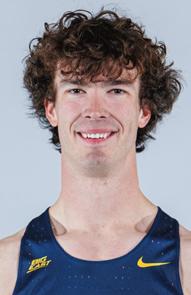
As of Jan. 17, Waterstradt is not listed on the Marquette track & field team’s 2025-26 roster. His 2024-25 profile said he ran unattached at Northern Michigan prior to joining the Golden Eagles as a hurdler. He attended De Pere High School in Green Bay.
When asked to comment, Marquette athletics spokesperson Scott Kuykendall directed the Marquette Wire to the university’s office of marketing and communication. University spokesperson Kevin Conway wrote in a statement that Marquette “does not comment on
ongoing legal matters,” noting Waterstradt is no longer enrolled at the university.
Waterstradt attended his Jan. 14 initial hearing virtually from Langlade County Jail, according to online court records. The cash bond was set at $500,000. His preliminary hearing is scheduled for Jan. 21.
Waterstradt is being represented by Jonathan LaVoy, who graduated from Marquette Law School in 1999. His profile says he has been a guest lecturer on the subject of trial advocacy at the university’s law school.
“William and his family are taking these allegations seriously and I am in the process of obtaining police reports and other evidence,” LaVoy said in a statement to the Wire.
Message made claims about 2026 policies
By Sophia Tiedge sophia.tiedge@marquette.edu
A post made Jan. 15 about National Marquette Day on the anonymous social media app, Yik Yak, was inaccurate, according to the university.
The post from an alleged dorm floor group chat claimed Marquette University police officers would be working in plain clothes and ticketing every student they found in possession of alcohol. The post currently has 1,200 upvotes

and 25 comments of people asking questions like, “Is this legit?” or “Where is this screenshot from?” The screenshot was also posted on the Instagram account @barstoolmarquette.
“The post is not the result of anything sent out by MUPD,” University Spokesperson Kevin Conway said in a statement Jan. 16. “Officers will have a larger presence in the neighborhoods and, like always, will enforce the laws to keep people safe.”
MUPD Assistant Police Chief Jeff Kranz said this post was just one person’s interpretation of MUPD’s plan. “Without going into
specific measures, there will be an increased police presence and officers will address illegal behavior they observe,” Kranz said in a statement.
The Wire has asked Kranz if the claims are entirely false and is waiting on a response.
There has been speculation about MUPD’s plan after it received 29 alcohol-related calls on NMD in 2025. Students were waiting for ambulances for up to an hour and Marquette staff were triaging students in the lobbies of dorms.
The influx in emergency calls has been widely attributed to Marquette Men’s Basketball’s 7 p.m. tipoff,

owen.weis@marquette.edu
Campus police received 29 alcohol-related calls on NMD 2025.
giving students all day to drink on NMD 2025. This year, the Feb. 7 NMD game is scheduled for 1 p.m. University officials discussed the issues at a February 2025 University Academic Senate meet-
Sports Skate then study Marquette students competed in U.S. Olympic speed skating trials. PAGE 5 www.marquettewire.org
ing and said the approach to NMD 2026 would be an ongoing conversation at the administrative level. However, an official plan or list of policies has not been released. News
MKE Roots receives new federal grant funding The project, led by an MU professor, focuses on developing education. PAGE
& Entertainment 'Mels After Dark' returns in 2026 The all-female a cappella group's performance is open to the public.
21-year-old William Waterstradt is not listed on the Marquette track & field team's 2025-26 roster.
Photos by Clay Ellis-Escobar clay.ellis-escobar@marquette.edu
William Waterstradt (above)
Photo courtesy of Marquette Athletics
Photo by Owen Weis
The MarqueTTe Tribune
Managing Editor of The Marquette
Tribune Sophia Tiedge
NEWS Executive News Editor Mia Thurow
Assistant Editors Lance Schulteis, Lilly Peacock
Reporters Sahil Gupta, Elena Metinidis, Mina Marsolek-Bonnet, Jaylen Hill, Daria Stepanich
ARTS & ENTERTAINMENT
Executive Arts & Entertainment Editor MaryKate Stepchuk
Assistant Editor Joseph Schamber
Reporters Elise Emery, Allison Scherquist, Annie Goode
OPINIONS
Executive Opinions Editor Rachel Lopera
Columnists Isabella Gruber, Amelia Lerret, Lexi Childers
SPORTS
Executive Sports Editor Jack Albright
Assistant Editors Matthew Baltz, Raquel Ruiz
Reporters Benjamin Hanson, Mikey Severson, Ben Ward, Eamon Bevan, Conor McPherson
COPY
Copy Chief Emma Fishback
Copy Editors Elizabeth Belmont, Shea Lancaster
VISUAL CONTENT
Design Chief Murphy Lealos
A&E Designer Evelyn Riordan
Sports Designer Amery Thompson
Opinions Designer Allegra Delli Carpini
Photo Chief Clay Ellis-Escobar
Photographers Lily Wooten, Owen Weis, Leo Stallings
HAVE A TIP FOR US?
Have you seen something that you think should be a story? Do you have a tip about something we should be looking into? Do you have documents or other materials that we should see? We want to hear from you.
If you have documents you'd like to send us, you can send anything to wiretips@marquette.edu.

MU offers bilingual philosophy class
Pilot is set to last through the spring semester
By Mia Thurow mia.thurow@marquette.edu
About 16% of Marquette University’s undergraduate student population identifies as Hispanic/Latino. Results of the university’s 2025 Campus Climate Study show these students reported academic performance levels 10-12 points lower than their non-Hispanic peers.
But the university recently implemented one philosophy class section with the hope of creating an environment where Marquette’s Spanish-speaking students could comfortably thrive in the classroom.
In fall 2025, PHIL 1001 — specifically, associate philosophy professor Stephanie Rivera Berruz’s section — was taught in a bilingual format so students could explore global humanity, values and society in the language that best suits them. The section is also being offered this semester.
Rivera Berruz tries to be as inclusive as possible with how she incorporates language into her class. She goes over all readings in English and Spanish, and students have complete linguistic freedom for assignments and discussions in case they understand the material better in a certain language.
Though it is her native language, Rivera Berruz never imagined she would be teaching in Spanish and said she was fascinated by the idea of a bilingual class section. Yoon Choi, associate philosophy chair and director of undergraduate studies, came up with the concept while pondering how to “do more with less” at the university.
“The bulletin description
Two students reported minor injuries on scene
By Mia Thurow mia.thurow@marquette.edu
An EagleExpress van containing two Marquette University students was struck by a stolen vehicle around 2:30 a.m. on Wednesday. The Milwaukee Police Department was in pursuit of the vehicle on Wisconsin Avenue, university spokesperson Kevin Conway told the Marquette Wire. Suspects operating the vehicle were “driving erratically” before striking the
is about exploring your deepest values and commitments and stuff, but if you have to do that in a language that doesn’t have the right translations for your values, that’s something of an extra challenge,” Choi said.
Choi read about bilingual sections at other schools and learned how important core classes like philosophy — which every Marquette student is required to take — are to establishing a student’s college experience. She then texted her idea to Rivera Berruz, who took it and ran with it.
Rivera Berruz received approval during the spring 2025 semester to pilot the course and spent the entire summer building it from scratch. With the help and support of a number of university members, Marquette’s first bilingual philosophy section was officially in full swing as of August.
“I really never thought that we could get something like this off the ground so quickly,” Rivera Berruz said.
Before the class commenced, Rivera Berruz began thinking about how she could create an inclusive learning environment for students with different academic skillsets. She spoke with friends and colleagues working in bilingual
van near 17th Street. The two individuals in the car fled the vehicle on foot and were apprehended by Milwaukee Police.
The two students in the EagleExpress van — one who was driving — reported minor injuries and refused medical attention at the scene. EagleExpress is Marquette’s on-campus free door-to-door rideshare service. Eight vans run from 5 p.m. to 3 a.m. daily. This story was updated with new information. If you have any additional information regarding the crash, please contact Executive News Editor Mia Thurow at mia.thurow@marquette.edu.
education and sought inspiration from schools, such as the University of Texas Rio Grande Valley, already offering classes like the one she’d be teaching.
Some of Rivera Berruz’s students grew up in a bilingual school model, while others solely spoke Spanish at home. Trying to bridge academics and language presented a unique challenge, she said, but only having 16 students in the class allowed her to quickly understand each student’s language background.
Upon visiting Rivera Berruz’s bilingual philosophy section, Choi saw all the students were participating in a way she’d never seen before. She said they were “distinctly excited” in a way some college students aren’t.
Overall, the semester has been a positive experience, Rivera Berruz said. Her class recently presented their final projects — short films with topics ranging from Aztec metaphysics to the concepts of death. She said she tried to be creative with homework assignments and thought a digital storytelling final tied students’ experiences to the class material.
“A good amount of them have chosen to talk about their experiences being bilingual and how that’s
related to them coming to Marquette,” Rivera Berruz said.
As much as the section focuses on creating a more comfortable learning environment for Marquette’s Spanish-speaking students, its future is not set in stone.
The pilot, set to last through the 2025-26 academic year, is heavily contingent on how the class goes and what students report.
A bilingual philosophy section at Marquette is resource intensive and not the most financially effective, Choi said, so she anticipates the department will have to continually make a case for keeping it in existence.
“A lot of it will depend on what the university’s priorities really are,” Choi said.
Following the conclusion of a successful first semester, Rivera Berruz said, her priority is maintaining the new academic resource for Spanish-speaking students at Marquette.
“It’s mostly just trying to get the word out that we’re running this big experiment and trying to keep it alive,” Rivera Berruz said.
The Marquette Wire reached out to several students in the fall 2025 bilingual philosophy section via email and did not receive a response.

Photo courtesy of Yik Yak
The Milwaukee Police Department was in pursuit of the stolen vehicle on Wisconsin Avenue Jan. 14.
Photo courtesy of Yoon Choi
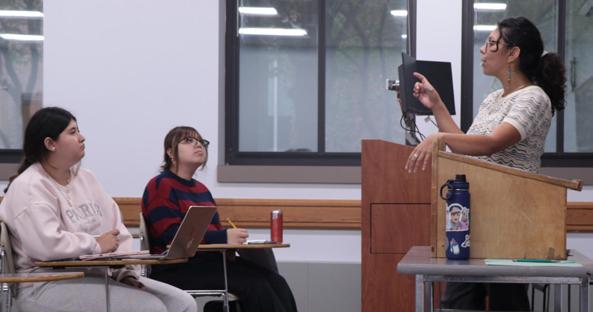
Associate philosophy professor Stephanie Rivera Berruz strives for inclusivity in her class section.
MKE Roots receives federal funding renewal
New grant will last through September 2028
By Lance Schulteis lance.schulteis@marquette.edu
After a funding scare in summer 2025, MKE Roots — a Marquette University professor’s project focused on developing local education — is officially back.
In 2025, the U.S. Department of Education terminated funding for the program, which promotes local history and civics education in Milwaukee area schools.
Though the initial grant serving MKE Roots was supposed to last through September 2026, Melissa Gibson, program director and professor in the College of Education, was informed June 2025 that the funding would stop on September 30, 2025.
On Sept. 29, just a day before the expiration, program staff received word that funding was renewed under a new application. The new $1.5 million grant extended the life of MKE Roots by three years, closing the book on a process that the program had spent months preparing for.
From the 2024 presidential election to the initial funding cut, Gibson and other program staff were on high alert because most of the students served through MKE Roots come from minority backgrounds.
“We knew that our specific grant application was not
100% aligned with the new, current administration,”
Lauren Instenes, MKE Roots program manager, said.
After receiving news of the cut, Gibson got to work writing a new grant application for MKE Roots. Under previous administrations, the program’s work with students of color and low-income students was a focus. This time, the application was reworked and rewritten, keeping the program’s mission while emphasizing the priorities of the federal government.
The new grant proposal had to meet two federal requirements, Gibson said. First, it had to include programming to commemorate the United States’ 250th anniversary celebration in 2026. Second, it had to include seminar-style instruction. There is an additional preference given to universities with independent civic institutes, like Marquette’s Lubar Center, which MKE Roots hopes to work alongside in the future.
“Dr. Gibson and the staff at MKE Roots looked at those new standards and found a way that we could fit into them while still maintaining what we’re trying to do,” Sergio González, program faculty affiliate and associate professor of history, said.
“And at the heart, what MKE Roots is trying to do is create civically-minded students.”
Those combined standards resulted in a new grant, giving MKE Roots $1.5 million over three years. While it was an increase from the initial $1.27
million grant, it was also an extension of the program itself, which was set for an uncertain future without federal funding.
“That was scary,” Raylee Nelson, a program intern and graduate student in the College of Arts & Sciences, said. “Not only for financial security of myself, the other interns, the permanent workers there, but also we were losing something that we were very passionate about.”
Nelson wasn’t the only one feeling the pressure of the funding pause. As program manager, Instenes’ job at Marquette is fully funded by grant money. With that funding up in the air, she began to search for a new job, accepting another position before receiving word that MKE Roots was back under a new grant.
“I didn’t want to leave,” Instenes said. “I love this position.”
In addition to returning Instenes, the new grant also allows for a larger team at MKE Roots, which is currently working with eight interns — its largest group to date. Additionally, the program is hiring another full-time position and is working with more local teachers, increasing that number from 25 to 35.
Curriculum-wise, the program is also expanding, continuing its original mission while maintaining the overarching goals of the federal government. With a heightened focus on civics, Gibson said MKE Roots is in the process of
designing a partnership with the Lubar Center, with the goal of teaming up for programming to commemorate the 250th anniversary celebration.
“The big question driving MKE Roots always is, ‘How should we tell the story of our Milwaukee?’” Gibson said. “So we’ve added a second question to that, which is, ‘How can everyday citizens bring democracy to life in Milwaukee and beyond?’”
However, while the program is largely dependent on federal grants, Gibson learned over the summer that there may be a future where that isn’t the case.
During the time of the funding scare, she said,
partners in the community and city contacted her to ask about contributing to the program. While the federal grant is now renewed, she said local partnership may be an option for sustainable funding.
But above the funding and paperwork is a desire to serve students in Milwaukee, which drives MKE Roots further than any sum of money.
“Governments change, politics change, funding streams change,” Gibson said. “But we are all committed to doing this work and we’ll continue doing it, regardless of if someone’s paying us to do it or not.”

With renewed funding, MKE Roots is expanding to continue its mission of developing local education whle maintaining the overarching goals of the federal government.
Photo courtesy of Lauren Instenes
Photo courtesy of Melissa Gibson
Melissa Gibson is MKE Roots' director and a Marquette professor.
Pribek assumes mission and ministry VP role

John Thiede is transitioning out of the position
By Elena Metinidis elena.metinidis@marquette.edu
Marquette University’s Office of Mission and Ministry is under new leadership for the time being.
Rev. James Pribek, S.J., stepped into the role of acting vice president for mission and ministry on Jan. 2. while Rev. John Thiede, S.J., transitions out of the role to serve as a “special advisor” to University President Kimo Ah Yun during the 2026 spring semester.
A Wisconsin native, Pribek earned his undergraduate degree from the University of Wisconsin-Madison. He earned a master’s degree in English from Gonzaga University and two MAs from the Weston Jesuit School of Theology, along with a master’s and a doctorate in Anglo-Irish Literature and Drama from University College Dublin after being ordained.
He taught at Canisius College in Buffalo for 14 years and at Creighton University for three years before joining Marquette in 2021. There, he serves as the assistant vice president for mission and ministry, which he is juggling with the transition into his new, temporary role.
Along with his previous duties, he will report directly to Ah Yun, serve on
the President’s Cabinet and University Leadership Council and further the efforts of the mission and ministry office.
The search for the permanent VP for mission and ministry will commence later in the semester, but Ah Yun is confident in the thoughtful, mission-oriented, Ignatian-led Pribek to further the office’s efforts.
As he continues serving in the office, Pribek is hoping to strengthen relationships, collaboration and grace across Marquette’s campus.
Campus collaboration
Marquette’s Office of Mission and Ministry, inspired by St. Ignatius, values working together for the glory of God.
In the early 16th century, St. Ignatius sought fellow followers of God to help reform the church. He and his companions shared their experiences of God’s love and mercy, working through friendship and cooperation to serve God.
Similarly, Pribek said the office finds strength in working together in all of their efforts.
Mission and ministry offices at Jesuit institutions are central places to help everyone, Pribek said. It allows service to students, faculty, alumni and the world to intersect with each other.
Rather than individual Jesuits spreading their mission, a custom Pribek said was common 50-100 years ago, offices promote
strength in unity and intentional service.
Formerly, Jesuits independently preached the gospel in their desired setting (education, missionary, etc.). The formation of mission and ministry offices was seen as a more proactive, collaborative way to integrate Catholic, Jesuit values across universities and groups.
“We try to break down silos,” Pribek said. “What we try to do in mission and ministry is to cross divisions and get people to work together.”
Pribek said collaboration within the Office of Mission and Ministry is the only way many projects and missions have come to fruition. He also said his goal is to have more cross-collaboration between different Marquette offices to continue building up and connecting Marquette’s students, faculty and alumni.
“Collaboration has been a great gift the last five years,” he said. “It’s utterly wonderful, and I think you see it all over Marquette.”
Meaningful conversation
Pribek said a significant value in Jesuit higher education is the “multiplier effect,” which is the empowerment of individuals like teachers and priests that then empower others through teaching, leadership and ministry, spreading Jesuit values.
This strategy, he said, promotes a “horizontal structure,” rather than a
hierarchy. It involves forming relationships through meaningful conversation.
Marquette friendships tend to endure for a lifetime in a special way, he said, and celebrating friendship is an important part of serving the Marquette community.
“There’s nothing isolating about going to Marquette. It’s going to show you humanity,” Pribek said.
The Office of Mission and Ministry’s annual Ignatian theme is “I have called you friends,” meant to inspire connection and loving boldly.
Inspired by the verse John 15:15 (“No longer do I call you servants, for the servant does not know what the master is doing; but I have called you friends, for all that I have heard from my Father I have made known to you”), the theme leans into knowing God’s love and feeling that in connections with others.
Ignatian spirituality preaches belonging over isolation, finding goodness in others, connecting through service and sharing love, ultimately connecting people, both new and familiar.
“It’s just in the nature [of Christianity]; we do it together,” Pribek said.
Mission Week 2026
Upon entering the Office of Mission and Ministry, boxes of supplies, a filled calendar on Pribek’s desk and large light-up letters spelling “grace” were
evidence of the labor associated with preparation for Mission Week, which will take place from Feb. 1-6.
Mission Week, an annual campus-wide celebration of the university’s Catholic, Jesuit mission, is a time of reflection and inspiration to be “men and women for others.” There are several events throughout the week, including daily Mass, keynote speakers, luncheons, camino walks, prayer services and more. All events are free of charge and open to anyone.
The theme of Marquette’s upcoming Mission Week is “Act with Grace.” Pribek said the office always works hard to find a theme that fits the current needs of the world.
“We all just need to be a little more generous and give a little bit more mercy and more grace,” he said. “Mission Week can be good medicine for a culture that is very much in need of what we have here [at Marquette].”
Mission Week is an “injection of spiritual energy” during a quiet, trying time of year, he said, and it brings new ideas, great role models and a way to see Marquette’s mission as something that affects the world.
Pribek is not only looking forward to Mission Week but also continuing to serve through the Office of Mission and Ministry while leaning into Ignatian values.
Rev. James Pribek, S.J., will serve as acting vice president in the Office of Mission and Ministry while Rev. John Thiede, S.J., becomes "special advisor" to President Kimo Ah Yun.
Photos by Clay Ellis-Escobar clay.ellis-escobar@marquette.edu

Blair
SKATE THEN STUDY
Marquette students participated in U.S. Olympic Speed Skating Trials
By Ben Hanson benjamin.hanson@marquette.edu
Blair Cruikshank puts her admiration and professional pursuit of speed skating in the simplest form possible: “I love going fast.”
When the three-time Junior World Cup skater pumps her exhausted legs down the final straight of a race and her blades cut through the ice propelling her up to 35 miles per
hour, no other explanation will suffice.
“There’s really no feeling like it.”
Cruikshank and Leo Thompson, both Marquette students, went as fast as they could when they competed at the United States Olympic Speed Skating Trials in Milwaukee earlier this month. Thousands of fans watched at the Pettit National Ice Center near the Wisconsin State Fair
grounds. An attendance that large is extremely rare in the sport.
“Every time we’d come around from the start of the straightaway to the end, (the crowds filled the stands),” Leo Thompson, a participant at the Olympic Trials and sophomore in the College of Business Administration said. “(I’m thinking) 'Damn, this is pretty cool.'”
At the trials, Cruikshank
MEN'S BASKETBALL
and Thompson competed in the 500 and 1000-meter events. Both races are sprints, of which they specialize in. They’re only racing for around 36 seconds in the 500-meter and a little over a minute in the 1500-meter.
To prepare for these events, they train for 20+ hours a week, spending a lot of time on the 400-meter ring at the Pettit.
Despite the building tak-
ing up the space of almost four football fields, the ice ring still feels cramped. Along the outside circumference of the loop, there’s a running track with stomping feet and the cheers of people encouraging others to finish their sprints hard. Inside the ring, there are two hockey rinks. One filled with shouts for the puck and
Nigel James Jr. scores career-best in OT win
By Jack Albright jack.albright@marquette.edu
Marquette men’s basketball had been there before. In the driver’s seat. With a hand on the wheel of winning.
Monday against Providence was the second time in two games that the Golden Eagles lived large with a halftime lead after 20 opening minutes of dominance. They walked — nay, skipped — into the locker room after a big swing in the final 60 seconds, capped off by Damarius Owens’ last second 3-pointer, prompted Shaka
Smart to run onto the court and pump his fist. Like the Marquette head coach hit the shot.
Owens’ make gave the Golden Eagles a 10-point halftime lead, 54-44, and was the cherry on top of a lights out first half in which the blue & gold made 20 of their 33 shots, or 60.6%. It was a near identical reality to last Friday against DePaul, a game that ended in defeat after a sordid second half.
Fast-forward three days to Martin Luther King Jr. Day, go north from Wintrust Arena to Fiserv Forum and swap out the Blue Demons for the Friars. Do all that, make all those changes. Still, at the end, Marquette got the same
result, winning 105-104 in overtime.
“Our guys, they never stopped believing,” Smart said. “Our guys hung in there. The timeouts were really good, what they were saying to each other. We had some unfortunate plays. We had a couple guys foul out. Some free throws that we missed.”
Not that the Golden Eagles did not make everyone in the building and watching on television think otherwise.
The Friars scored the first seven points of the second half and trailed by one possession after under a minute and a half. Déjà vu seemed inevitable.
After a hefty amount of back-and-forth, Prov-
idence took its biggest lead of the night with 4:24 remaining, 84-79, and forced Smart to call his second timeout.
The Golden Eagles walked out of the huddle and blitzed a 7-0 run in 1:18, keeping heart-rates high and putting themselves back in the lead. That would be their final points until 56 seconds remained, a timespan in which they missed multiple free throws and Providence scored six in a row.
But, when it mattered most, Nigel James Jr. once again answered the Bat Signal and sent the game to overtime with three free throws in the final seconds.
"NJ showed a lot of toughness and guts," Smart said.
"It's hard to make three free throws in a row."
In the extra period of play, hope appeared lost until Ben Gold went to the line with four seconds to go and made his first of two, securing Marquette’s one-point overtime victory.
James Jr. led the Golden Eagles with a career best 38 points, shooting 13-of20 and 4-of-6 from beyond the arc. Four others scored double-digits: Chase Ross (16), Royce Parham (18), Gold (14) and Owens (12).
Jaylin Sellers led the Friars with 27 points, and he was trailed by Vaaks (26) and Jamier Jones (17).
The Golden Eagles head back on the road to face the Butler Bulldogs Friday at 7 p.m. CST.
Marquette students Leo Thompson and
Cruikshank participated in the U.S. Olympic Speed Skating Trials at Pettit National Ice Center in Milwaukee in January.
Photos by Noel Stave
Graphic by Benjamin Hanson benjamin.hanson@marquette.edu
Friars
MARQUETTE vs Providence
GOLDEN EAGLES 104 105
TRACK & FIELD
MKE natives compete in hometown meet
Golden
Eagles
participated in front of family
By Lukas Schulze lukas.schulze@marquette.edu
The John Tierney Invitational was more than a normal track & field meet for Paige Haglund and Amerie Mitjans-Shapiro. It also marked the first hometown event of the two Milwaukee natives’ collegiate careers.
Although the meet did not take place on Marquette’s campus, the Golden Eagles only had to travel 3.7 miles before they arrived at the Klotsche Center on the campus of the University of Wisconsin-Milwaukee. As 70 Marquette student-athletes made their way into the arena and prepared to compete in a wide-array of events, Haglund and Mitjans-Shapiro were among the six Golden Eagles to experience a more special feeling.
One that comes with having a bevy of loved ones there to cheer and support.
“This will definitely be the meet a lot of my family comes to see,” Haglund said.
For both student-athletes,
Marquette was not their first taste of what Milwaukee had to offer. Haglund, a graduate from Whitefish Bay High School, has always found herself around Marquette’s campus. Not only was Marquette just a 12-minute drive from her hometown, but her university alumni relatives made it feel like home long before she stepped foot on campus as a student-athlete.
"This will definitely be the meet a lot of my family comes to see."
the school she grew up rooting for happened after she finished high school as a sectional champion three times in a row from 202224, while also making three state appearances in high school. She also benefited from a background in figure skating, even traveling to Europe for Team USA in both 2024 and 2025.
“I started figure skating when I was four,” Haglund recalled. “My goal was always Team USA.”
While passionate about figure skating, she believed she still had more to give in track & field. But she did credit her figure skating experience to her improvement as an overall athlete.
“Figure skating takes severe muscular endurance and cardiovascular endurance, which translated into running, pretty well,” Haglund said. “It made me a better athlete in general.”

ested in healthcare.” Mitjans-Shapiro said. “Just giving back to people, I really want to be a dentist, that’s my main goal.”
Both athletes are now able to compete in their backyard with their family and friends in attendance.
though, they will know her as the one who made the finals qualifier in the 60m hurdles in her first meet in Milwaukee.
“My mom has a degree from Marquette, and two of my cousins also went to Marquette,” Haglund said. “Marquette has always felt like a home to me. I would always come to the basketball and volleyball games when I was younger.” Haglund competing in Division I athletics with
For the other Milwaukee native, Mitjans-Shapiro, it was slightly different. She chose Marquette not only because of the location but also because it aligned with her career goals, by having a biomedical sciences program, hoping that one day she could become a dentist.
“I have always been inter-
TRACK & FIELD
“I’m looking forward to my mom being there,” Mitjans-Shapiro said.
Mitjans-Shapiro’s old coaches and teammates were also there. The ones who knew her as the Rufus King International High School 100m hurdles record holder, a feat that shows why she won hurdler of the year both her junior and senior seasons. After Sunday,
“For Marquette specifically, I feel like it put me in a place where I can be seen,” Mitjans-Shapiro said. “I feel like I can be a point scorer for our team as well.”
After Sunday, Marquette track & field will not be back in Milwaukee until the final meet of the indoor season Feb. 21, the Panther Tune-Up. Then, Mitjans-Shapiro and Haglund can show out in front of their hometown crowd again.
Indoor season in full-swing after John Tierney
Multiple Golden Eagles posted new personal bests
By Lukas Schulze lukas.schulze@marquette.edu
The chilling temperatures in Milwaukee didn’t affect the student-athletes inside of the Klotsche Center as they prepared for their first Milwaukee meet of the 2025-26 indoor season. Marquette competed against the University of Wisconsin-Milwaukee and the UW Track Club.
“It’s nice we can do it
here in Milwaukee so a lot of family, friends, classmates, and teachers can come out,” Golden Eagles head coach Bert Rogers said.
The John Tierney Invitational kicked off with the field events. Milwaukee’s Anna Szepieniec stole the show early. She didn’t just win the women’s long jump; she earned the No. 17 spot in the NCAA with a jump of 6.30m, while Milwaukee claimed the top three spots in the event. Things turned around for Marquette in the women’s weight throw. Second
year thrower Ally Broaddus recorded a PR while winning the event by over a meter with a throw of 17.57m, over a 2nd place finish from her teammate Megan White.
“Lot of personal best there today,” Rogers said. “Some good throws. There was a lot of good energy over there today.”
Women’s weight throw was the only women’s field event where Marquette had an athlete in the top three. Milwaukee took advantage of strength in numbers by having more athletes than Marquette in all six
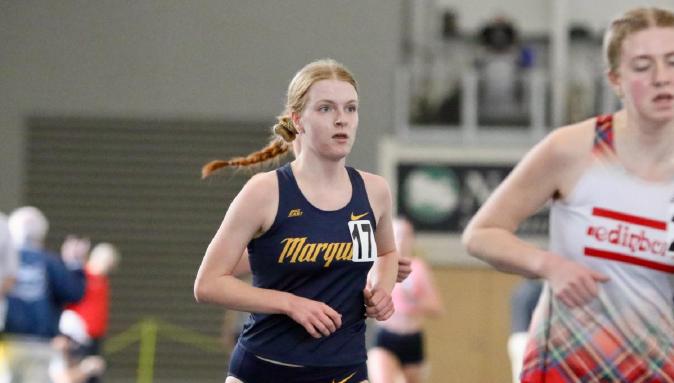
field events.
On the men’s side of things, the Golden Eagles found more success. Senior jumper John Pitta highlighted the field events for the men by placing 2nd in the men’s triple jump with a jump of 14.15 which is a new PR. Marquette took control in the men’s throwing events.
The Golden Eagles saw two of their names in the top three of men’s shot put with Charlie Smith and Josh Pirogovsky finishing 2nd and 3rd respectively. Smith recorded a PR with a throw of 14.63m while Pirogovsky recorded a season best of 14.09m. Marquette saw similar success in the men’s weight throw with Sam Crane and Sebastian Kubas both recording PRs and placing in the top three.
The running events began with the 60m hurdles prelims, an event dominated again by Milwaukee’s Szepieniec. By the end of the 60m hurdles finals, the Panthers controlled all three top spots with Szepieniec finishing second overall to teammate Tori Spagnola.
Marquette dominated the one mile run on both the men’s and women’s
side. The Golden Eagles claimed the top six spots in the men’s mile with first-year distance runner Patrick Clune taking the crown with a time of 4:17. The dominance echoed on the women’s side when Marquette’s Sadie Kibelstis overtook Milwaukee’s Ally Schmitz on the final lap on her way to victory with a time of 5:16.
“A lot of that was just guts,” Rogers said. “Them working hard and seeing today as a step in the process of getting better as the season goes along.”
Milwaukee, however, did most of the damage in the running events as they went on to win 12 out of the 16 running events, four of which they controlled the podium. The story wasn’t all about the Panthers, though. Marquette’s firstyear distance runner Taya Gummerson was victorious in the women’s 3000m by a 10-second gap, finishing with a time of 11:04.
“This is like the true start to the indoor season,” Rogers said. “Now we’re competing every week.”
Marquette track & field is back in action this Friday at the Bill Clinger Invitational in Allendale, Mich.
Paige Haglund Marquette track & field distance runner
Photo courtesy of Marquette Athletics Haglund's mom and two of her cousins went to Marquette.
Photo courtesy of Marquette Athletics
Sadie Kibelstis overtook Milwaukee's Ally Schmitz on the final lap of the women's mile to win in 5:16.
SKATE: Qualifiers race at Pettit Ice Center
Continued from page 5
yells to remind teammates to get back on defense. The other filled with a dozen figure skaters, each with a coach critiquing their axel from nearby. It’s never quiet in there.
Yet, when Thompson steps on the ice, his footand-a-half-long, flat blades make a distinct noise that deafen any other. Not because of its volume, but because of its uniqueness — like an ultra-sharp knife slicing through ice cubes.
When he practices his starts, he breaks into a full sprint, pumping his arms while in a deep bow. The noise of each blade being pushed to the side and into the ice to propel him forward echo throughout the building. At full speed on the track, he appears around one corner, entering the straight and before he can take four breaths, he has travelled 100 meters and is diving into the next.
Thompson is surrounded by others packed into the Pettit, but at the same time, he’s solitary. Only accompanied by his thoughts, deep breaths, ice-carving blades and a generous amount of sweat.
Besides being on the track, practice often includes weightlifting and high-intensity hill climbs and bike rides.
Cruikshank and Thompson are training so often because they travel the world competing in skating events.
Cruikshank travels up to 10 times a season (which runs from October to March) with D.A.S.H: a
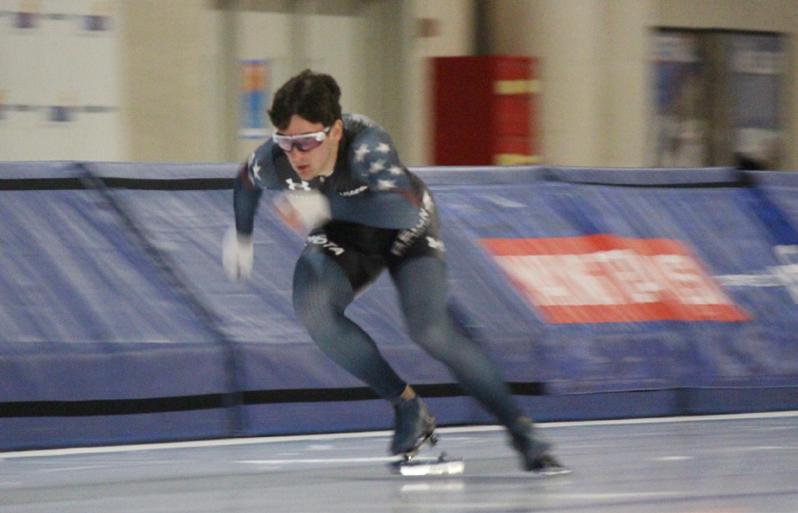
development team for high-performance speed skaters. Thompson, who was on the Junior World Team for the 2025 season, was in Italy with the group for two weeks and travels three or more times throughout a given year. He’s currently working with the Junior National Development team. All of this while both are students at Marquette.
“I really don’t know how I did it last year,” Thompson, a full-time economics major who got all As and Bs last semester, said while struggling to find words to describe his schedule. “I just kind of did it.”

Cruikshank has been a part-time student since 2019. Right now, she’s taking one class every eight weeks fully online, so she has time to prioritize her skating. She’s able to do this because of how much her parents support her dreams. At one point, they had the same ones.
Her father, David Cruikshank, is a four-time Olympic speed skater, National Speed Skating Hall of Fame inductee and Cruikshank’s coach. Her mother, Bonnie Blair, is the most successful female US Winter Olympian of all time. She’s a five-time Olympic gold medalist and inductee in both the National Speed Skating Hall of Fame and US Olympic Hall of Fame.
The two put Cruikshank in skates at the same time she was learning to walk. She didn’t enjoy the sport at that time, but after stints in tennis, diving, gymnastics and soccer, she came back around when she was 14 years old.
It didn’t take as long for Thompson. He began speed skating in fourth grade and never looked back.
Despite the hundreds of races Cruikshank and Thompson have competed in, the Olympic trials were different. A sold-out venue brought a unique energy to their sport.
“I wish it could be like that every weekend because it’s so awesome,” Cruikshank said. “The crowd, it helps get your adrenaline going. It just helps you race.”
The team sports that Cruikshank participated in when she was younger were full of hype music and chants, which
couldn’t be further from how she prepares for competition now.
Before the Olympic trials, she focused on being present, being grateful for the opportunity of racing and looking in the stands to take it all in. At the two-minute call before her event, she puts her race glasses on and thinks about her goals for the race. She doesn’t talk to or look at anyone, and no one talks to her. It’s a way of focusing that she has learned from military personnel and athletes.
"You think you know what it's going to feel like, but there's nothing like walking into the rink..."
Blair
Cruikshank Senior in the College of Communication
This strategy has also been extremely helpful for Thompson, who goes through a similar preparation for his races. He wants to acclimate himself to how he’s going to feel on the ice: alone.
As Cruikshank is sitting on the line, waiting for the gun, everything starts to fade from her view. In shorter events like hers, there are only two racers on the ice at a time, which helps with blocking everything out. So much so, sometimes she’ll even forget what happened during
the race.
“It’s super weird,” Cruikshank said. “You kind of put the blinders on.”
At the trials, Cruikshank placed sixth in the 500 and twelfth in the 1000. Thompson flaunted a pair of personal bests in the 500 and 1000, grabbing tenth and eleventh respectively. He also placed ninth in the 1500-meter and eighth in a “Mass Start” race.
“You think you know what it’s going to feel like, but there’s nothing like walking into the rink and the lights are on and the crowd is there and there are cameras. It’s just a super weird feeling,” Cruikshank said.
“I’m grateful to have that opportunity because now I know what it feels like.”
Thompson is still riding the high.
“I feel a little bit more motivated than normal to keep going,” he said with the 2030 Winter Olympics in mind.
Even though neither of them qualified for the 2026 Winter Olympics, their devotion to speed skating has strengthened.
Cruikshank is reminded of one reason she continues speed skating every time she gets on the ice. Her lungs are on fire and every inch of her body is in pain when she finishes a race or a workout.
Though, the hurt is made easier by a strong sense of pride in what she’s doing. The weak legs and constant breath-catching on the cool down lap are temporary. The feeling of flying down the straight is permanent. And that’s something to love.
Leo Thompson posted a pair of personal bests in the 500 and 1000-meters, placing 10th and 11th. He also finished ninth in the 1500.
Photo by Benjamin Hanson benjamin.hanson@marquette.edu
Photo by Noel Stave
Cruikshank placed sixth in the 500-meter and 12th in the 1000.
A career year for Marquette's 'unicorn'
Halle Vice posted a double-double four straight times
By Mikey Severson michael.severson@marquette.edu
Since stepping into the Marquette women’s basketball starting lineup — and Cara Consuegra’s system as a sophomore — Halle Vice has powered herself to new heights in her junior season with her intense motor.
With the calendar not even flipped to February, Vice has tallied seven double-doubles since the start of the season, four of which came during conference play, catapulting her to Big East Player of the Week honors in the first week of January.
She helped celebrate the holidays with four straight double-doubles in the Yuletide season, against Truman State, St. John’s, Xavier and Villanova. She racked up a career-high 32 points in that Villanova game, also ringing in the new year with a career-high 19 rebounds and matching
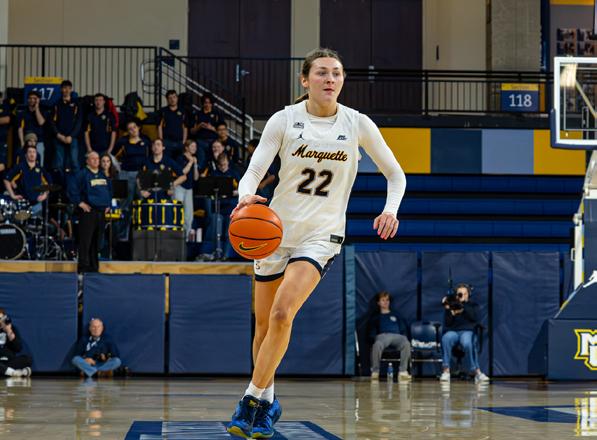
another career high with five assists, against Xavier — even without Skylar Forbes playing alongside her on that day. From Marquette’s first conference game against DePaul on Dec. 4, she’s been averaging 15.6 points and 9.8 rebounds per contest.
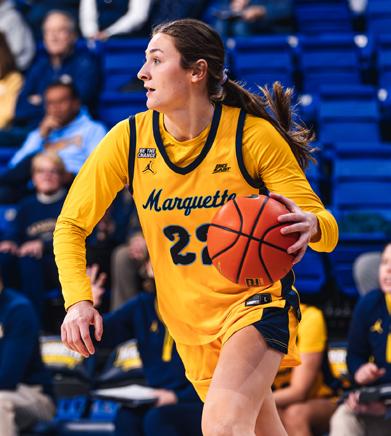
Vice said that her biggest strength to her game, and leading up to her big season, was bringing her intense motor to games with rebounding, deflections and defense. Consuegra saw eye to eye with Vice on this aspect of her craft and praised it as her calling card.
“Her work ethic and motor are off the charts; she’s one of the highest motor kids that I’ve ever coached,” Consuegra said.
Vice said that her mentality this season has been affecting the game regardless of how it shows up on the stat sheet.
“I approach every game wanting to impact things in any way I can, with toughness, grit, just going out there and playing freely,” Vice said.
Factor in two Big East Weekly Honor Rolls since the start of the 2025-26 season, marking Vice’s continued ascension with the Golden Eagles since her first season in the blue and gold, where she sat behind the likes of Jordan King, Liza Karlen and Frannie Hottinger — who are play-
ing professional basketball overseas after graduating from Marquette.
Since Consuegra’s arrival at Marquette in April 2024, she said that Vice’s dedication and improved confidence in her abilities has paid dividends in her game.
“She has worked tremendously to create some mental toughness for when she makes mistakes, or when she has breakdowns, to get to the next play faster,” Consuegra said. “I think that comes when you put the work in, and you see the work pay off.”
Vice said that her mental growth and lessons learned from going through college, plus the change in coaching staff have all formed a cornucopia of learning, which helped pave the way for her shining moments.
“Freshman year’s always a little bit hard, as you get older and go through more adverse experiences, you’ve grown in a lot of ways on and off the court, and as a person,” Vice said.
“I think all those lessons that I learned over the
years have helped me become a better basketball player mentally, and confidence helps.”
Graduate student guard Lee Volker said that Vice’s intensity gives flexibility for the rest of Marquette’s lineup, which was the only team in NCAA Division I to retain its entire 2024-25 roster.
“I think it helps, playing with people who are your friends, and we both (Volker and Vice) want to see each other succeed, and it’s really helpful when she sets great screens, posts really hard, and plays hard all the time,” Volker said. “It opens up stuff for everybody.”
Naismith-watchlist junior forward Skylar Forbes and Vice have been roommates for all of their three years at Marquette, and have been the anchors for the Golden Eagles in the paint. Vice is listed on Marquette’s roster as a guard but has been in a category of her own when it comes to rebounding, racking up 150-plus rebounds, while no one else has crossed the century mark. Consuegra said that Forbes and Vice are Marquette’s ‘unicorns’ due to their ability to play inside and outside of the post.
“They have the ability to play multiple spots, they have the skillset of multiple players, that makes them special, and I think that makes (Vice) a matchup nightmare,” Consuegra said.
With having played a big role in Marquette’s conference slate as the winter rolls on, Vice said that taking the next step is through self-belief and trusting her process.
“Trusting in the work that I’ve put in, over the summer, throughout the season, and just believing in yourself,” Vice said. “That will really take you far.”


Guard Halle Vice is averaging 15.6 points and 9.8 rebounds per game since MU's Big East opener.
Vice posted four-straight double-doubles early in Big East play.
Photo by Clay Ellis-Escobar clay.ellis-escobar@marquette.edu
Photo courtesy of Marquette Athletics
Opinions
Honor MLK Day, it is not ancient history

By Rachel Lopera rachel.lopera@marquette.edu
Martin Luther King Jr. Day does not just honor its namesake; it serves as a reminder that the movement for equality and justice was more recent than society perceives.
The day commemorates King’s achievements towards human rights using nonviolent protest and civil disobedience. Turning King’s birthday into a federal holiday was a struggle as its bill did not obtain the two-thirds majority vote
it needed to pass in the House of Representatives in 1979 — 11 years after King’s assassination.
President Ronald Reagan signed the federal holiday into law in 1983, and it has been nationally observed since.
King was one of the most prominent leaders of the Civil Rights Movement, along with Rosa Parks and John Lewis. His work set an imperative foundation for racial equality and justice, especially for African Americans. He organized
the March on Washington protest and is most famously known for his “I Have a Dream” speech.
One would think the U.S. would have progressed more since King’s work, but the reality is that the Civil Rights Movement was only about 58 years ago.
King’s life and legacy fully deserve to be remembered and celebrated because the causes he fought for existed not too long ago, and they still apply to today’s world. We are still fighting for equal treatment and opportunity for people across all races and backgrounds. The human rights issues he fought for relate to current problems our country disputes over, including immigration, healthcare, abortion and more.
In 2020, a social media post gained significant attention, claiming that the photos from the civil rights era were taken in color but intentionally changed to black-and-white to make them look older. While the claim attained a decent amount of traction, context
is necessary in understanding the truth behind the black-and-white photos.
Color photographs of the Civil Rights Movement are rare, but some have surfaced. The lack of color photography from the period is due to monetary restraints, as color film was more expensive than black-andwhite film. Printing in color was also more costly.
Other factors also contributed to the monochrome images such as artistic preferences and technology limitations. This information falsifies the social media post that circulated. While the claim was debunked, it demonstrates society’s wide misconception of when the Civil Rights Movement and King’s work truly happened. People’s perception of when the movement occurred is distorted because of blackand-white photos, questioning our understanding of our country’s history. For those a part of Generation Z, many of our grandparents were alive during the movement, further
illustrating its recency.
The misinterpretation indicates how easily Americans distance themselves from the movement, treating it as ancient history rather than a not long past real-life experience.
It is important to recognize when this crucial event took place because it serves as a point of measurement. It emphasizes how long it took us to recognize the value of simple human rights and also highlights the unbelievable amount of resistance it faced.
Our country is in a place of division over issues that will continue to harm others if they continue to go unresolved. The battle that King perpetuated is still ongoing. People deserve rights, justice and dignity.
Martin Luther King Jr. Day is not just another date on the calendar. It is a person, a celebration and a reminder that the fight for justice did not start all that long ago.
Don't stress about New Year's resolutions
By Amelia Lerret amelia.lerret@marquette.edu
New Year’s resolutions should not be treated as the big ordeal they are made out to be. The idea of making year-long goals can cause immense pressure, unattainable expectations and place unnecessary rush in January.
As the start of the new year continues, many people create resolutions attempting to enhance their health, well-being and lives. While these goals can be beneficial, problems arise when they are impractical or not created with genuine intention.
The phrase “new year, new me” implies that a new calendar year automatically creates a refined version of oneself, which is false. This lie allows people to believe that extravagant changes in their lives are attainable in a short period of time. This is unrealistic because true change takes time, effort and discipline.
This overestimation of abilities leads people to abandon their goals early in the year. In fact, the second Friday of January is known as “Quitter’s Day” as many resolutions are abandoned. Even if the goals are not strenuous, they can be harder to fulfill when people create many of them, and the abundance makes their achievability difficult.
While the intent behind some resolutions may be authentic, many are created from pressure to keep up with society and social media. Resolutions are not something that should be forced onto people, given that many are drastic changes in a person’s life.
Social media feeds flood with posts with examples of extreme goals, providing ideas for viewers. This content can be inspiring, but it can also be harmful by encouraging people to fulfill unrealistic objectives.
For example, a resolution to complete one hour of intense cardio every day may be problematic for someone who is not used to exercising at all. Not only is this straining on the body, but that goal is likely to be dropped early in January.
A more reasonable solution would be to break it up into smaller steps that are easier to accomplish one by one, like exercising for 30 minutes three to four times a week. Building up stamina is a great goal that looks different for everyone, highlighting the importance that resolutions are made for the individual.
It is common for people to give up after missing one day of exercise instead of persisting. Real improvements take time and consistency, so it is imperative to strive for progress

over perfection. Additionally, pressure from society and social media can lead people to believe they must only have certain resolutions, but that is not the case. It can be healthy for some people to focus on areas concerning well-being, like rest and relationships.
According to the American Institute of Stress, 69% of adults reported needing more emotional support in 2025. Many of them outlined how loneliness was a large contributor to those feelings. While it is not a common resolution, like losing weight or growing academically or professionally, it is still beneficial. For many, slowing down and reducing stress by building stronger connections is a reasonable and advantageous goal. This
may be completed by seeing friends more often or even sending texts to catch up. There are also no time restrictions on when improvements can be made in a person’s life. People can set goals whenever it works best in their lives, allowing them to make healthy decisions without external influence.
New Year’s resolutions do not have to be strenuous or even made at all, and with so many dropped by “Quitter’s Day,” it will help prevent disappointment and guilt. Instead, creating smaller goals to make aspirations more achievable encourages consistency and perseverance throughout the year.
Statement of Opinion Policy
The opinions expressed on the Opinions page reflect the opinions of the Opinions staff. The editorials do not represent the opinions of Marquette University nor its administrators, but those of the editorial board.
The Marquette Tribune prints guest submissions at its discretion. The Tribune strives to give all sides of an issue an equal voice over the course of a reasonable time period. An author’s contribution will not be published more than once in a fourweek period. Submissions with obvious relevance to the Marquette community will be given priority consideration.
Full Opinions submissions should be limited to 600 words. Letters to the editor should be between 150 to 300 words. The Tribune reserves the right to edit submissions for length and content.
Please e-mail submissions to: rachel.lopera@marquette. edu. If you are a current student, include the college in which you are enrolled and your year in school. If not, please note any affliations to Marquette or your current city of residence.
Rachel Lopera is the executive opinions editor. She is a sophomore studying journalism.
Amelia Lerret is an opinions columnist. She is a freshman studying journalism.
Photo courtesy of Wikimedia Commons
Martin Luther King Jr. was a leader of the Civil Rights Movement.
Photo by REUTERS
Fireworks explode over the Washington Monument on Jan. 1.
Fun & Games
Arctic Animals

Snowstorm
Snowstorm
Arts & Entertainment
"Mels After Dark": A show with personality
By MaryKate Stepchuk marykate.stepchuk@marquette.edu
“Mels After Dark,” hosted by the Meladies, returns on the last weekend of February with a high-energy show that isn’t meant for parents.
After the Meladies — Marquette’s all-female a cappella group, known as the Mels — and the Gold ‘N Blues, Marquette’s co-ed a cappella group, decided not to compete in the International Championship of Collegiate A Cappella last year due to scheduling conflicts with National Marquette Day. Instead, the Mels created “Mels After Dark” as a new performance open to the public.
Although they had always considered doing a less family-friendly show for fundraising efforts, “Mels After Dark” was held for the first time in March 2025. The Mels decided to hold the show again after they did not qualify for the audition-based ICCAs.
“Mels After Dark” features more of a raunchy show for the Mels. In their normal, more professional concerts, they are not allowed to swear or do anything considered risqué, but this show allows them to let loose.
The Mels enjoy adding a comedic element to the show, influenced by the wheel that chose their performances last year. By spinning the wheel, a Mel had to complete a secret talent, special trick, musical theater duet or solo, depending on what it landed
on. It allowed each member, even underclassmen, to have a special moment to shine onstage and reflect their personality.
Sophia Rynes, president of the Meladies and a junior in the College of Arts & Sciences, said the group wanted a show that represented their personalities onstage.
“We had alumni come last year, and they said, ‘This concert was so fun because it gave everyone insight on what it is like to be a Mel,’” Rynes said. “It felt very reflective of who we are, our personalities and our friendship with each other.”
This year, slight changes will be made to the show. Rynes said the goal is to ensure that the show always reflects who is in the group while keeping the audience on the edge of their seats with the element of surprise.
Last year, these elements of surprise came in many forms with a riff-off with The Naturals — Marquette’s all-male a cappella group — and a sing-along with the audience, where song lyrics were located under audience members’ seats.
The audience engagement during the show is expected to return this year in different forms, Rynes said.
The show has a great collaborative effort internally, as most other roles of the Mels — the responsibilities of the president, vice president, musical director, etc. — have been set in stone
for years by the previous members. The more casual nature of “Mels After Dark” allows for younger members of the group to have a stronger voice in the creation process than they do in other shows.
Maggie Furey, musical director of the Meladies and a sophomore in the College of Nursing, enjoyed the informality of the show last year and the group’s ability to sing songs they enjoy.
“Last year, it was kind of presented as a low-stakes concert for trying new
things,” she said. “We sang songs that were a little bit out of our comfort zone, had new soloists, new vocal percussionists and new arrangers.”
Furey personally soloed and beatboxed for the first time last year, but this year, since the show will be scripted, she is intrigued to see the script executed.
Reese Cross, a first-year in the College of Nursing, said the show’s storyline excites her, but the audience should be excited too.
“I think it’s going to be
exciting to see how it all comes together, tells the story, and how it is funny and light-hearted,” Cross said.
“Mels After Dark” will be held at the Straz Theatre on Feb. 27 and 28. The exact times have yet to be announced. For more information, follow the Meladies Instagram account.
*Last year, the show’s demand led it to be standing room only. If you would like to secure a seat, arrive early.
MU's improv group: Studio 013 Refugees
By Annie Goode annie.goode@marquette.edu
Marquette’s only improv group previously met twice a week to practice in Helfaer Theatre’s Studio 013. After getting kicked out of this space several years ago, they had to move to Humphrey Hall’s auditorium for practice, and coined the name Studio 013 Refugees, or the “Fugees.”
Josh Pirogovsky, a senior in the College of Arts & Sciences, and Leah Gerut, a senior in the College of Communication, arrived at Marquette as seasoned improvisers from their experience in high school.
At Marquette, they hoped to continue their improvisation career. After going through the audition process for the Fugees as first-years, they were lucky enough to make the team. Three years later, they are serving as the group’s presidents.
Improv is a form of live performance which relies on performers ability to make up a scene on the spot.
Typical improv shows consist of performers playing games that help them come up with funny scenes or dialogue, and often asking the audience for people, places or things to set the scene for their games.
The group, which typically performs short-form, improv comedy, has 12 members. Each member tries out at the beginning of the year after attending three workshops and then auditions in front of Pirogovsky and Gerut.
“We start every workshop by telling them the most common rules of improv…”
Pirogovsky said. ‘We tell them not to punch down, which is to not make any certain person or demographic feel bad.”
The group has monthly performances, each with a different theme, corresponding to the improv games they play. Their winter show, titled “Under the Missing Toe,” took place on Dec. 5 and consisted of different holidaythemed games.
“We played a game called Director, which is where we get a suggestion [from the audience] and the players will do the scene, then there’s somebody in the scene that’s the director, and they’ll give us something like, ‘This is supposed to be a musical!’ and then they’ll repeat the same scene with the director’s critiques,” Gerut said.
Pirogovsky and Gerut agreed on their excitement and love for the Fugees this year.
“It’s a judgment-free zone, and it’s fun to do [improv]
with people who also like it and who are open-minded,”
Gerut said.
Gerut said they are working on putting together a workshop with Logan Square Improv, which is an improv theatre based in Chicago. It is focused on learning long-form games, which the group has never done before. They are also planning an Alumni Workshop with past members of the Fugees.
Gerut and Pirogovsky also agreed on the benefits of improv as a skill.
“Anytime I’m talking to someone, I’m doing improv, so I just get to practice doing it with professionals, it makes you a really good communicator…” Pirogovsky said. “I’m pretty good at public speaking; it also makes you quick on your feet.”
Prospective members do
not need to have previous experience in improv, and the group is also diverse major-wise, with several theatre majors, but also engineering, computer science and digital media.
“With improv, you can really put your own creativity and your own ideas into everything,” Gerut said. “It’s a space to be silly and a space where you don’t have to think so hard. You can just be yourself, as cheesy as that sounds.”
The Fugees’ next show, whose theme and name are yet to be revealed, is on Jan. 30, in Marquette Hall 100. They are also holding spring auditions, with workshops on Feb. 10 and Feb. 12, and then auditions on Feb. 15. Look out for more information and events related to Studio 013 Refugees on their Instagram.
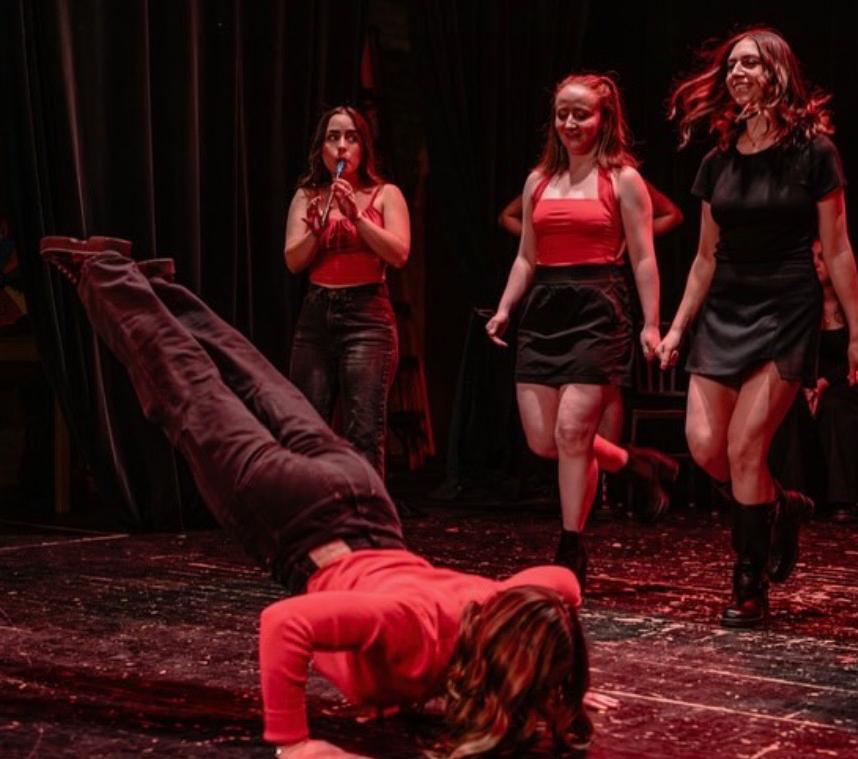
Emily Fricker performs the worm at "Mels After Dark" in March 2025 as her special talent.
Photo courtesy of Sophia Rynes
January
REVIEW: Teriyaki Madness in the AMU
By Elise Emery elise.emery@marquette.edu
Last week, students were welcomed back to the Alumni Memorial Union’s Marquette Place for the 2026 spring semester with the return of a familiar dining option: Teriyaki Madness.
Previously serving Milwok-ee, Forage Kitchen and Junior’s Smoked BBQ, Marquette Place’s back corner stall is now home to Teriyaki Madness, a previous resident of the dining facility, originally opening in 2023.
Teriyaki Madness, like its predecessor restaurant Mil-wok-ee, is an Asian cuisine restaurant that offers a wide variety of ready-to-eat bowls with proteins such as chicken and tofu, and a student’s choice of white, brown or fried rice to accompany it. The bowl options available are Chicken Teriyaki, Spicy Chicken Teriyaki, Orange Chicken and Spicy
Tofu Teriyaki.
After the departure of Forage Kitchen in early November, students were disappointed with the loss of one of Marquette’s healthier food options. Nevertheless, I think that Teriyaki Madness might be the place to both satisfy those cravings while remaining mindful of nutrition.
Teriyaki Madness is a widely recognized casual Asian fast-food chain with over 195+ restaurants across 42 states, and much of this success came from the franchise’s desire to prioritize fresh ingredients while also creating tasty meals.
The franchise calls this its “commandments of Madness,” where it states, “We are delicious food that’s healthy. Not healthy food that’s delicious.” Between the restaurant’s original house-made sauces and freshly prepared and marinated proteins, Teriyaki Madness ensures
that its customers are fueling their bodies with not just delicious food, but nourishing food.
Upon my visit to Marquette Place’s Teriyaki Madness location on Jan. 14, I was immediately stunned by the impressive turnout it had already received. The line extended across the dining hall, blocking the lines of neighboring restaurants, which had to strategically reshape their own lines to combat the heavy traffic approaching the stall.
It was a little wild, considering I had never seen this amount of traffic for any of the pop-ups that had been there previously, including Mil-wok-ee, which virtually served food of the same variety.
I wanted to try the Orange Chicken, but due to high demand, they had already sold out by noon. Mildly disappointed, but not surprised in the slightest, I tried the Chick-
en Teriyaki with brown rice instead.
The perfectly moist chicken was doused in a tangy yet sweet teriyaki sauce. The tenderness of the chicken was a pleasant surprise, as I was slightly worried that it might have a gristly texture like I’ve experienced before at similar restaurants. Each bite of chicken was packed with flavor, as the smokiness from the grill and the sweetness from the marinade combined into a perfectly medley of sweet and savory, with salty soy sauce and ginger flavors peeking through.
As for the rice, it was the perfect complement to the flavor of the chicken. Despite being relatively neutral, it provided a variety in texture and enhanced the existing flavors in the bowl, which I greatly appreciated. The brown rice’s starchy flavor evened out the meal, allowing me to really enjoy the flavors
coming through from the chicken and the sauce without overwhelming my taste buds.
While I was eating my meal, my friends continued to gawk and admire how good everything looked, and within the first couple of minutes of me sitting down, half of the table had left to get in line for Teriyaki Madness.
Looking at the meal, the ingredients are rather simple. Chicken, rice, sauce. It’s not groundbreaking, but it doesn’t need to be groundbreaking or the most experimental meal to be amazing. In simple terms, Teriyaki Madness won’t be winning awards for its presentation, but it made something simple into a flavor experience. From my meal at Teriyaki Madness, I realized that food doesn’t always have to look exciting; it just has to be good.
Authentic BBQ spot opening on East Side

By Joseph Schamber joseph.schamber@marquette.edu
Smokin’ Jack’s BBQ is a little slice of authentic Southern barbecue that has been operating in the Milwaukee area out of food trucks and the 3rd Street Market Hall for the past three years.
Before that, chef and owner Jack Holt was serving his barbecue out of a ghost kitchen in 2020, but he has now opened the doors to his first brickand-mortar.
The restaurant softopened in the former Izzy Hops space at 2311 N. Murray Ave on Dec. 22. They have been serving an abbreviated menu, including a few of their most popular menu items.
Holt studied the art of barbecuing in Texas, and the time and commitment he has put into his craft are evident in the food he
serves at Smokin’ Jack’s. When I went on Jan. 14, they were serving rib tips, pork shoulder, brisket, smoked wings and spare ribs. They also offered several sides, including potato salad, hand-cut fries, nachos, baked beans and their smoked Gouda mac n’ cheese.
My guest and I opted for the three meat combo ($28) with rib tips, brisket and spare ribs. All combos come with Texas toast and a choice of two sides. We chose the baked beans and smoked Gouda mac n’ cheese, which comes with a $3 upcharge. Despite our large appetites that evening, the two of us felt the three meat combo was the perfect amount of food and came out to a very reasonable price.
The brisket was packed with flavor. It was salty
and peppery with a beautifully unctuous fat cap on several pieces. Fans of lean and fatty brisket alike will appreciate that they serve a healthy mix of both with every portion.
The rib tips were tender and flavorful, as were the spare ribs. They were smoky, packed with intense meaty flavor and notably did not fall off the bone.
While fall-off-the-bone meat might impress a lot of diners, a good pit master knows it a sign the ribs have been overcooked. These spare ribs were tender without turning to mush.
None of the meats were too salty, a typical flaw of less-than-high-quality barbecue. I did find that both the brisket and rib-tips were significantly cooler than the spare ribs, though. I suspect this is because of the spare ribs’ longer cooking time, but better timing to ensure all the meat comes out piping hot would definitely improve the dining experience.
While good Texas-style barbecue should not need sauce, I am not in Texas, and no matter how tasty
Smokin’ Jack’s meats were on their own, I still wanted to dip them in each of their tasty housemade sauces.
The “Competition Glaze” was my favorite. It is similar to a sweet Kansas City sauce but includes more flavor from spices like cumin and coriander. Diners who prefer their
sauce a little less sweet will gravitate to their Texas-style sauce, which is more smoky, savory and tangy.
Their Alabama white sauce, which is made with ingredients like mayo, vinegar and black pepper, is best suited for their smoked wings and also makes a great dip for their fries.
I tend to have low expectations for restaurant mac n’ cheese. It is often too dry, too runny or just too bland, but a good barbecue restaurant should be able to nail mac n’ cheese.
Smokin’ Jack’s mac n’ cheese tasted very good, though I would have liked a stronger smoked Gouda and the texture was a little lackluster.
With a slightly tighter, less runny sauce, I think this could be a stellar side. The baked beans,
on the other hand, were great. Perfectly tender and well-seasoned, these are a side I will order again. There is a lot to be excited about at Smokin’ Jack’s BBQ’s first brick-and-mortar kitchen. Once officially opened, diners can expect the full array of favorites from the menu at 3rd Street and their Brown Deer and Wauwatosa food trucks, including burnt ends, pulled pork and brisket sandwiches and more tasty sides.
Holt also owns the location next door that previously housed L’Incontro. It shares a kitchen with Smokin’ Jack’s, and he plans to turn it into a restaurant serving regional Mexican cuisine.
Smokin’ Jack’s new East Side restaurant will officially open, with its entire menu, on Jan. 24.

Photo by Joseph Schamber
Smokin' Jack's BBQ was formally at the 3rd Street Market Hall.
Jack Holt, the owner, plans on opening a Mexican spot next door.
Photo by Joseph Schamber