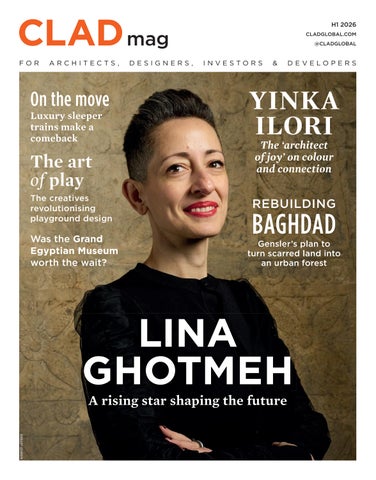
FOR ARCHITECTS, DESIGNERS, INVESTORS & DEVELOPERS

On the move
Luxury sleeper trains make a comeback
The art of play
The creatives revolutionising playground design
Was the Grand Egyptian Museum worth the wait?
![]()

Luxury sleeper trains make a comeback
The creatives revolutionising playground design
Was the Grand Egyptian Museum worth the wait?
The ‘architect of joy’ on colour and connection
Gensler’s plan to turn scarred land into an urban forest


A podcast about the legendary people, ideas and strategies that have redefined how we think about storytelling across every medium: from books to the board room, film to physical spaces.


EDITOR’S LETTER

From climate resilience to social connection, a new generation of playgrounds reveals the serious power of play
n this issue, we celebrate the importance of play, with a round up of gorgeous, imaginative, innovative playgrounds from around the world. The creative thinkers behind these projects are designing safe places to play while exploring solutions to critical issues, from the play pavilion that uses algae to filter polluted air to the imaginative new park created in consultation with Toronto’s Indigenous community that’s part of a wider initiative aimed at protecting the city from flooding.
There’s a growing movement to reclassify playgrounds as critical civic infrastructure, and rightly so. Research shows that access to high-quality play boosts children’s activity, academic success, and mental health, while lack of it correlates with obesity and inequality. Parks play a critical role in nature recovery and climate resiliency. And in an increasingly polarised world, these spaces bring people together across social and cultural divides.
Think tank 21st Europe and design and architecture studio Spacon recently launched a blueprint entitled Continent of Play, arguing that parks and playgrounds shouldn’t be seen as amenities, but rather as infrastructure for health and resilience – cooling cities, absorbing rainwater and offering shelter during extreme weather.
The blueprint calls for significant investment in playgrounds across Europe, and sets out a practical framework to ensure as many children as possible have access to safe play within a decade.
“Playgrounds are among the few public spaces where design directly shapes childhood, community and culture,” says Spacon partner Nikoline Dyrup Carlsen. “If we treat them with the same ambition as museums or stations, they could become defining civic landmarks for the century ahead.”
British-Nigerian designer Yinka Ilori – who we interview on page 56 – is a huge believer in the transformative power of play. From his flamingo-inspired playpark in east London

to his colourful basketball courts and skateparks, Ilori is on a mission to bring joy to ordinary urban spaces and encourage a sense of playfulness in both adults and children.
Last autumn, he launched the Yinka Ilori Foundation, a non profit organisation aiming to bring play to communities around the world, starting with a playscape in Nigeria, which will be co-designed with the community.
Ilori also uses playful spaces to explore serious issues, such as racism and inequality. In his Transparent Happiness pavilion outside the Amox Rex museum in Helsinki, Ilori highlighted the disparity between Finland’s ranking as the world’s happiest country and the less-visible experiences of racism within it.
“Through play, we created a setting for dialogue and connection across cultures,” Ilori says.
Investing in places for play is an investment in the shared public life that binds us together.
The playground, it turns out, may be one of the most serious spaces we can design.
Magali Robathan, managing editor, CLAD


5 Editor's letter
Play is more important than ever, and it shouldn’t just be for kids, says Magali Robathan
10 CLAD people
Diébédo Francis Kéré unveils plans for his first European museum, Lina Ghotmeh is celebrated, and Jean Nouvel sees his unusual vision for Fondation Cartier’s new gallery home come to fruition
22 CLAD products
Hot new design products from TouchWood Play; Studiomat and Ariana De Luca; Lucas Zito; and Maurizio Marconato


26 CLAD news
SANAA’s largest project yet opens in Taiwan, Frank Gehry’s legacy is celebrated, Dorte Mandrup completes her latest Wadden Sea Centre and a new residential quarter from BIG
32 Alfred Waugh
The Vancouver Art Gallery architect tells us about his mission to bring together Western knowledge and Indigenous ways of knowing
40 Róisín Heneghan
As the Grand Egyptian Museum opens at last, we speak to its architect about the career-defining project
48 Space to grow
With landscaping by Piet Oudolf and buildings by Jacques Herzog, Philadelphia’s Calder Gardens offers a new kind of art space
56 Yinka Ilori
As he launches his new foundation, the ‘architect of joy’ talks colour, community and creativity, and explains why play is serious business
66 The power of play
From giant owls to playgrounds that filter polluted air, the design of play spaces has never been more creative. We check out some amazing projects


74 Dream spaces
A new generation of luxury sleeper trains are redefining travel, but what are the challenges of designing these unusual spaces? We find out
82 Space to connect
Social saunas are a growing trend, as guests look for opportunities to connect as well as relax. Designer Helena Toresson shares the details of a unique Swedish social spa
90 A city reborn
Detroit is booming again, with some exciting design and art-led projects leading the way. We find out more


100 Green shoots
Designed to restore neglected land and renew the identity of Iraq’s capital city, Baghdad Sustainable Forests promises a new way of living surrounded by nature. Gensler’s Ian Mulcahay tells us why he thinks the project could become a model for the repair and enhancement of urban centres
106 Neil Randall Gymbox gyms are known for their design, which bring together an industrial aesthetic, innovative equipment and a nightclub atmosphere. Urban Gym Group’s CEO shares the vision


CLAD unites people who contribute to the success of both the natural and built environment, enabling them to do business. CLADglobal, the organisation behind CLAD, is a media business creating magazines, books, websites and digital feeds to enable professionals to share news, opinions and best practice. Find out more about the portfolio at CLADglobal.com
CLAD covers a wide range of sectors, including residential, retail, arts and culture, museums and heritage, regeneration, hotels and hospitality, bars and restaurants, sport and recreation, spa and wellness, health and fitness, attractions, theme parks and entertainment, greenspace and landscape architecture.
Contact us for marketing, advertising, editorial and partnership proposals at theteam@CLADglobal.com
CLADmag is published twice a year by The Leisure Media Company Ltd (T/A Leisure Media), PO Box 424, Hitchin, Herts SG5 9GF, UK. The views expressed in this publication are those of the author and do not necessarily represent those of the publisher, Leisure Media. All rights reserved. No part of this publication may be reproduced, stored in a retrieval system or transmitted in any form or by any means, electronic, mechanical, photocopying, recorded or otherwise, without the prior permission of the copyright holder, Cybertrek Ltd. Printed by The Manson Group Limited. Distributed by Total Mail Ltd globally and Royal Mail Group Ltd and Whistl Ltd in the UK. ©Cybertrek Ltd 2025. ISSN (print edition) 2058-3338, (digital edition) 2058-3346. To subscribe, visit www.leisuresubs.com, email: subs@leisuremedia.com or call +44 1462 431835. Annual print subscription, £100. Sign up free on digital at www.CLADmag.com/signup

EDITOR
Liz Terry
+44 (0)1462 431385
lizterry@CLADglobal.com

PUBLISHER
Jan Williams
+44 (0)1462 471909
SUBSCRIPTIONS
+44 (0)1462 471932
www.leisuresubs.com
CIRCULATION
Michael Emmerson
+44 (0)1462 471932
NEWSDESK
Helen Andrews
+44 (0)1462 471900
Kath Hudson
+44 (0)7919 054399
FINANCE
+44 (0)1462 471932

MANAGING EDITOR
Magali Robathan
+44 (0)7779 785543
magalirobathan@CLADglobal.com

PUBLISHER
Astrid Ros
+44 (0)1462 471911
ADVERTISING SALES
Jan Williams
+44 (0)1462 471909
Astrid Ros
+44 (0)1462 471911
CONTRIBUTORS
Kim Megson
Kathryn Hudson
Christopher DeWolf
Katie Barnes
CREDIT CONTROL
+44 (0)1462 733477
For email, use contact’s fullname@CLADglobal.com
CLADmag is available in print on subscription. Sign up at leisuresubs.com PRINT
DIGITAL
CLADmag is available in print on subscription. Sign up at leisuresubs.com
CLADmag is the
CLADmag is the
Read CLADmag on Digital Turning Pages and enjoy extra links and searchability
Read CLADmag on Digital Turning Pages and enjoy extra links and searchability DIGITAL
The magazine is also available as a PDF edition for readers who want to read offline or on tablet PDF
and to the catalogue in subscription. Sign up leisuresubs.com The PDF want read offline on
DIGITAL
Read CLADmag on Digital Turning Pages and enjoy extra links and searchability
The magazine is also available as a PDF edition for readers who want to read offline or on tablet PDF
Read CLADmag online at CLADglobal.com and get access to the entire back catalogue ONLINE
The magazine is also available as a PDF edition for readers who want to read offline or on tablet PDF
Read CLADmag online at CLADglobal.com and get access to the entire back catalogue ONLINE
CLADmag the magazine people leisure and design, investment development.


CLAD mag
CLADmag is the glossy magazine which talks to the people making things happen in leisure architecture and design, investment and development. CLADmag uses storytelling and photography to bring the content alive. It’s available on subscription in print and free of charge on Digital Turning Pages and PDF.
magazine in The magazine latest news create weekly of headlines. is Turning The CLADzine digital news latest news their ezine the breaking industry
CLADweek is the news magazine for architects, designers, investors and developers working in the CLAD community. The magazine contains the latest news from CLAD with bonus photography to create a weekly review of the headlines. CLADweek is available on ezine, Digital Turning Pages, Flipboard and PDF.
CLAD zine
The CLADzine digital news bulletin is available twice weekly for readers who enjoy getting the latest news delivered to their inbox in easy-to-read ezine format. From the latest developments to breaking news about deals and awards, the CLAD team tracks the industry globally and across all sectors to keep you up to date.


The annual CLADbook celebrates the best of CLAD. Contents include the CLAD Foresight™ trends report, Development Pipeline, Movers & Shakers, research and analysis. CLADbook is available in print, on Digital Turning Pages and as a PDF and is distributed to all CLADmag subscribers.
CLAD global.com
CLADglobal.com is updated around the clock with the latest news. From here you can access all CLAD’s print and digital publications and news feeds free of charge and subscribe to print editions. Go to the profile section to set up personal and company profiles to showcase your work.
CLADglobal.com around latest can print and digital news feeds subscribe section set profiles work.
CLADglobal.com is updated around the clock with the latest news. From here you can access all CLAD’s print and digital publications and news feeds free of charge and subscribe to print editions. Go to the profile section to set up personal and company profiles to showcase your work.
CLAD- kit.net
The CLADzine digital news bulletin is available twice weekly for readers who enjoy getting the latest news delivered to their inbox in easy-to-read ezine format. From the latest developments to breaking news about deals and awards, the CLAD team tracks the industry globally and across all sectors to keep you up to date.


CLAD-kit.net is CLAD’s search engine for products. It gives access to the latest product launches, well as contact details for suppliers. If you’re a supplier, your new product details are welcome – contact CLAD’s Product Editor, Jason Holland, jasonholland@CLADglobal.com
CLADmag storytelling and photography alive. on in free on Digital Turning CLADweek is for and developers CLAD The magazine contains the CLAD to create of the headlines. available Digital Pages, The CLADzine digital news bulletin for who enjoy the latest inbox in ezine developments to breaking and awards, the industry all keep date. with the all feeds up work. search for access to launches, as contact details for suppliers. supplier, product of report, Development Movers is distributed to
CLAD-kit.net search for It gives the product contact details for suppliers. new details welcome Product Holland, jasonholland@CLADglobal.com The annual the best include trends Pipeline, research CLADbook available on as distributed to all
CLAD-kit.net is CLAD’s search engine for products. It gives access to the latest product launches, as well as contact details for suppliers. If you’re a supplier, your new product details are welcome – contact CLAD’s Product Editor, Jason Holland, jasonholland@CLADglobal.com
CLAD-kit.net is CLAD’s search engine for products. It gives access to the latest product launches, as well as contact details for suppliers. If you’re a supplier, your new product details are welcome – contact CLAD’s Product Editor, Magali Robathan, magalirobathan@CLADglobal.com


It’s not because you are rich that you should waste material. It’s not because you are poor that you should not try to create quality
Diébédo Francis Kéré has unveiled plans for the Museum Ehrhardt, a 14,000-square-foot institution dedicated to photography and contemporary art in Plüschow, northern Germany. The project marks Kéré’s first cultural project in Germany and first museum building in Europe.
The building has been designed to integrate with its surroundings, featuring a green roof and the use of natural materials including wood and clay. It features an 80m-long rammed earth wall running along the centre axis of the building, which will naturally regulate the humidity and temperature inside the museum, as well as defining the exhibition spaces. Above it, the building’s timber structure has been designed for future dismantling and reuse.
Founded by Francis Kéré in 2005, Kéré Architecture is known for its innovative use of sustainable, local materials and local knowledge. Museum Ehrhardt employs regional techniques with wood and clay construction; Kéré Architecture has also worked closely with Austrian firm HK Architekten on the timber design.


The lightweight timber structure has been designed to be easily dismantled so that it can be reused in the future

Being an architect is about creating space. It’s about dreaming; about inspiring people.
“I’m excited that our very first museum building in Europe will soon be a reality,” said Kéré. “In Plüschow there are few places for people to come together. I hope the Museum Ehrhardt will have a positive influence on the region and bring inspiration and connection to the lives of people in this small community.”
The announcement follows the recent unveiling of the UNESCO Virtual Museum of Stolen Cultural Objects, designed by Francis Kéré. Harnessing 3D modelling and virtual reality, the UNESCO Virtual Museum brings together cultural objects stolen from around the world, digitally reconstituted and presented with their stories. The platform combines educational narratives, community testimonies, and case studies of successful restitutions, highlighting the importance of cultural identity, good practice, and international cooperation.


Speaking to TV5 Monde Afrique about the crossover between designing in the real and virtual world, Francis Kéré said: “Being an architect is about creating space. It’s about dreaming; about inspiring people.”
Born in Gando, Burkino Faso and based in Berlin, Germany, Francis Kéré is an educator and social activist as well as an architect. High profile projects include the 2017 Serpentine Pavilion, in London, UK; the National Park of Mali, Mali; and the Public Library of Gando, Burkino Faso.
In 2022, when he was awarded the Pritzker Architecture Prize, Francis Kéré said: “I am hoping to change the paradigm, push people to dream and undergo risk.
“It is not because you are rich that you should waste material. It is not because you are poor that you should not try to create quality.
“Everyone deserves quality, everyone deserves luxury and everyone deserves comfort. We are interlinked and concerns in climate, democracy and scarcity are concerns for us all.” l


Fondation Cartier’s new home has opened alongside the Musée du Louvre in central Paris, with a flexible design by Jean Nouvel featuring five moveable floors.
Nouvel overhauled the former fivestorey Haussman-era department store to create the new contemporary art museum, featuring 8,300sq m of public spaces, of which 6,500sq m are dedicated exhibition space.
The design for the museum was inspired by Nouvel’s vision of a giant, internal ‘machine’ with vast platforms that could rise and fall beneath the glass ceilings covering the mezzanine.
In order to create the new Fondation Cartier pour L’Art Contemporain, Nouvel stripped out much of the building’s interiors and added five giant lifts that support the large moveable steel platforms that make up the gallery spaces. Each platform can be placed at different heights, meaning that the galleries can be reconfigured according to the needs of each exhibition. Placing all the floors on one level creates a 1,200-metre gallery space.
Overhead, three glass skylights offer views of trees that have been planted on the rooftop. These skylights can be shuttered to create a dark interior, or left open to allow sunlight to filter through the trees and create shadows on the gallery walls.

The skylights can be shuttered or left open


“Moving into such an impressive site, in terms of location and history, entails a form of invention,” said Nouvel. “A site such as this one calls for boldness, courage that artists might not necessarily demonstrate in other institutional spaces. The Fondation Cartier will likely be the institution offering the greatest differentiation of its spaces, the most diverse exhibition forms and viewpoints. Here, it is possible to do what cannot be done elsewhere, by shifting the system of the act of showing.”
In an interview with Francesca Pietropaolo for The Brooklyn Rail, Nouvel described the new institution as “A living museum [that] adjusts itself to the artworks, the events and audiences… the exhibition space is never the same twice. It can be compact or open, layered or traversing, linear or labyrinthine; this radical variability corresponds to what I call the ‘plasticity’ of the contemporary museum space.
“It affirms that the cultural function of the museum today is not to passively preserve, but to activate, provoke, and confront. The museum is a critical tool; a space for transformation.”
On view until the end of August 2026, Exposition Générale will showcase both the Fondation Cartier’s artistic identity and its legacy, through nearly 600 works by more than 100 artists who have participated in its programming since 1984 to the present day. l

A site such as this one calls for boldness; courage that artists might not necessarily demonstrate in other institutional spaces


We’re always looking to push the boundaries
LINA GHOTMEH Founder, Lina Ghotmeh Architecture


Ghotmeh is redesigning the British Museum’s Western Range galleries
Lebanese architect Lina Ghotmeh has been named as one of the world’s most influential rising stars on the Time100 Next list. The founder of Lina Ghotmeh Architecture (LG-A), based in Paris, France, Ghotmeh was born and raised in Beirut, Lebanon and is known for projects that bring together sustainability, heritage and craftsmanship as part of a philosophy she calls ‘archaeology of the future’.

Ghotmeh’s Western Range redesign aims to create a more visitor-centric space
Ghotmeh is currently working on the renovation of the British Museum’s Western Range galleries in London. This is part of a decade-long masterplan to transform the museum, with the aim of creating a modern, visitor-centric space that unifies the collection while also making room for new collection stores and research facilities. Initial designs are expected to be released by mid 2026.


These moments remind me that hope and faith in the future of humanity are very much alive
“I am honoured to be selected for TIME100 Next and to walk the red carpet in New York alongside some of the most incredible changemakers of our time,” said Ghotmeh. “These moments remind me that hope and faith in the future of humanity are very much alive.”
Other ongoing projects include the AlUla Contemporary Art Museum in Saudi Arabia and the permanent Qatar National Pavilion at the Giardini of La Biennale di Venezia in Venice, Italy – the first new national pavilion added to the historic site since 1995.
Recent projects include the Bahrain Pavilion for Expo 2025 Osaka, which was built from 3,000 pieces of un-engineered wood and designed to be ventilated naturally.
Ghotmeh is known for her materiality and love of craftsmanship. Her Stone Garden mixed use residential tower in her home city of Beirut, designed as part of the postLebanese Civil War reconstruction, features a meticulously hand-crafted striated façade. Ghotmeh was inspired by the layered limestone strata of Beirut’s Rawché Rocks.

Ghotmeh’s first major project was the Estonian National Museum, which opened in 2016

The design was born from a desire to try to create a building that appeared to have risen from the earth, according to Ghotmeh, with the façade inspired by the process of gouging lines into a piece of clay with a fork. “From there the idea emerged,” she said, speaking to the BBC. “What if we actually started to comb the whole elevation? Really creating those striations, almost as though this is chiselled ground that is waiting to be seeded.”
“We’re always looking to push the boundaries,” said Ghotmeh, speaking about her work more generally.
“Today, responding to climate change and the issue of resources, one always has to think about buildings as banks of materials that can at any point be disassembled and reused.”
In her TIME profile, written by Danish architect Bjarke Ingels, Ghotmeh is praised for her ability to blend historical awareness with forward-looking design.
“When I look at her work, I see simplicity combined with a strong-willed boldness, and a respect for tradition with a contemporary twist,” said Ingels. “She has a knack for embracing history in her designs. I’m looking forward to seeing her reimagine the labyrinthine galleries of an institution as historical as the British Museum.” l
A look at the news from the world of product design, from tiles that double up as lighting to high end 3D printed lamps
New Balera collection embeds lighting in tiled feature walls
The new Balera Collection sees design studio Studiotamat team up with ceramic artist Arianna De Luca and lighting designer Ninefifty to create a modular collection of glazed handmade terracotta tile walls with lighting integrated into them. The collection combines artisanal craftsmanship and playful geometry to create unique illumination features. Each 20×20 cm tile becomes part of a grid, with De Luca’s wall lamps sitting within the tiling, their soft glow accentuating the brushstrokes of the ceramic surface. Inspired by the retro imagery of 1960s Italian balere (dancehalls) – particularly Dante Bini’s iconic discotheques – the collection is available in four colourways and a variety of layout configurations.

● The Studiomat founders
“Balera is a collection of terracotta tiles and ceramic lamps that blends bold geometry, saturated colours and graphic patterns, exploring the fine line between nostalgia and the contemporary,” said Arianna De Luca. ”Thank you to Studiotamat for involving me in this beautiful project. It was such a pleasure to create something meaningful together.”
TouchWood Play designs new kids’ club for Dubai’s Zuhha Island
Bespoke play environment design and manufacturer TouchWood Play has announced that it is responsible for the creation of a new Kids’ Club on Zuhha Island, Dubai. According to the designers, the new immersive play space “redefines children’s experiences by combining imaginative design with the natural beauty and luxury ethos of Zuhha Island.”
The new Kids’ Club has been designed to harmonise with the island’s pristine environment, offering a 1,700sq m outdoor playspace and a multi-tiered indoor space spread over 1,300sqm that invites children to explore, create and connect with nature.
“We’re thrilled to bring our vision of child-centered, nature-inspired play to life on Zuhha Island,” said Joe Cooper, founder of TouchWood Play. “This project exemplifies our commitment to designing environments that not only entertain but also nurture social interaction, physical development and imaginative play.
“We believe the Zuhha Island Kids’ Club will become a focal point for building community and socialising within and between families seeking both luxury and adventure.”
The Zuhha Island project is being created by high-end boutique real estate resort developer Zaya. The Kids’ Club is set to open in 2026.

For full company and contact details of any of the products and services featured here, please visit www.CLAD-kit.net

It was such a pleasure to create something meaningful together
More on CLAD-kit.net
Keyword: Balera

We’re thrilled to bring our vision of child-centered, nature-inspired play to life on Zuhha Island
More on CLAD-kit.net
Keyword: TouchWood

●

The


Lucas Zito aims to show 3D printed lamps can be timeless
A collection of lighting from Paris-based designer Lucas Zito aims to reframe the idea of 3D printed objects as cheap and disposable. The Buoy Collection is a series of high end, customisable lamps, designed and hand-assembled in Paris, France.
The production of the lamps moves primarily from digital drawing to physical output through the use of 3D printing. Each part is individually printed and then assembled by hand, allowing Zito to control every step of the production and only use the necessary material.
All the lightings are made from PLA, a bioplastic made from cornstarch.
“When it comes to visual effects and transparency, the geometries and forms enabled by 3D printing are difficult to achieve with other transparent materials,” said Zito.
“Plastic will never be marble, oak, metal or glass, but it allows us to explore everything that lies beyond those categories.”
Thanks to the technology used, the lamps are customisable in terms of the sequence of modules and length, meaning that any desired length can be achieved, with a range variable from 40cm to 700cm

tall and from 30cm to 100cm in diameter. The lamps are mainly conceived to be integrated into architectural projects across various contexts like residential or hotels, offices, and scenographic compositions. Inspired by the idea of buoyancy, the lamps explore the idea of extreme lightness with the creation of large lamps using very little material. The largest lamp is 320cm tall and uses just 3,483 grammes of plastic.
Zito’s practice focuses on an in-depth study of recyclable materials combined with new technologies, and he specialises in the design of lights through 3D printing with reclaimed or bio-sourced plastics.
More on CLAD-kit.net
Keyword: Zito
Maurizio Marconato and Terry Zappa have created the Enook Brillo coffee table for Italian design studio Porada –a retro-inspired design in shiny lacquered wood, featuring a rounded-edged square top set into a frame edge.
An evolution of the Eckig coffee tables by the same designers, the Enook Brillo features a cylindrical base, giving the product a softer and more fluid volume.
The Enook brillo coffee tables can be customised in the new ‘Brillo’ lacquers (rouge brun, greige, and deep brown). The lacquered finish can be applied to the entire coffee table –base and top – or just to the base and the frame of the top, which can be
customised with the marbles featured in the collection. This combination of materials and finishes allows the Enook Brillo coffee tables to be adapted to various environments and styles, making the product extremely versatile.
Maurizio Marconato and Terry Zappa founded the Marconato & Zappa Architetti Associati studio in Cantù, Italy, in 1991. They design furnishings for homes, hotels, exhibition spaces and shops, and also work as freelance architects, specialising in the planning, recovery and renovation of building heritage. ●
More on CLAD-kit.net
Keyword: Porada


TechnoAlpin Indoor brings the magic of snow into architecture, turning spaces into immersive, multisensory experiences that promote wellbeing and leave a lasting impression

Snow


Today’s spaces are expected to do more than serve a function – they should move people, spark curiosity, and create moments that stay in the mind. At TechnoAlpin Indoor, we bring this idea to life by transforming snow into a design element that connects architecture with emotion. The way snow is used in a space shapes the story it tells, defining how people experience it and what memories they take away.
Introducing natural elements like snow into interiors creates an instant link to the surrounding environment. It makes nature tangible – something to see, touch, and feel. Whether as part of a spa or a hotel lounge, snow adds a sensory dimension to a space.
Snow can play many different roles. It can provide a refreshing cool-down after a sauna, become a meditative retreat, or serve as a striking visual feature in a lobby or lounge. Each application changes how guests interact with the space – and how they remember it. The same architectural framework can tell completely different stories depending on how snow is integrated: calm and reflective, playful and invigorating, or simply awe-inspiring.
“The future of wellness lies not in the products, but in the experiences they enable,” says Sara Brenniger, Executive Manager at TechnoAlpin Indoor. “Our aim is to create spaces that don’t just impress visually, but allow people to be fully present in the moment.”
Whether it’s TechnoAlpin’s Snowroom – a room with -10°C cold air and fresh snow which can be used as part of a sauna circuit – or the Snowsky that produces real fresh snowflakes in a room temperature environment, these offerings transform an ordinary

Our aim is to create spaces that don’t just impress visually, but allow people to be fully present in the moment
visit into an unforgettable sensory experience. At TechnoAlpin Indoor, our snow concepts give architects and operators the tools to design spaces that combine aesthetics, wellbeing, and emotion in equal measure.
Storytelling is at the heart of this approach. When a space tells a story, it invites people to connect with it on a deeper level. That emotional engagement creates curiosity and drives loyalty – guests stay longer, come back more often, and share their experiences with others. For operators, this is where design meets return on investment: unique, storydriven environments stand out in the market, generate word of mouth, and offer a powerful wow factor that can be beautifully woven into marketing and communication. With indoor snow, every space becomes more than a room – it becomes a story to experience, remember, and share. ● www.technoalpin.com


Amajor new cultural facility has opened in Taichung, Taiwan, uniting a metropolitan art museum and public library in a bid to “bring together art, knowledge and nature.”
Known as the Taichung Green Museumbrary, the facility has been designed by the Pritzker prize-winning Japanese architecture practice SANAA.
The building – which is SANAA’s largest project to date – is home to the new Taichung Art Museum and the Taichung Public Library, and was designed in collaboration with Taiwan’s Ricky Liu & Associates Architects + Planners. It is located in Taichung’s 67-hectare Central Park, within a decommissioned military airport.
The Taichung Green Museumbrary consists of eight interconnected structures spanning 58,016-square-metres: four for the Taichung Public Library, three housing the Taichung Art Museum and one to be used as o ces. The eight structures of varying sizes are clad in high-performance low-emissivity glass or metal cladding, and then enveloped in an aluminium expanded metal mesh curtain façade, which was designed to give the building a sense of lightness and transparency.
The library holds 460,000 physical books, with around 40,000 art books on the fi h floor of the library, which is connected to the museum via the ‘culture forest’ roof.
“This integrated design reflects the museum and library’s vision of learning

as a shared, living practice,” said Yi-Hsin Lai, director of Taichung Art Museum.
“The integration of Taichung Art Museum with Taichung Public Library and the park has activated our thinking about the environment, culture, people and the city.
With the inaugural exhibition and the special commissions, we not only combine artistic dialogues across generations and cultures, but also strive to fulfil the potential of an art museum to enter the everyday life of the city and its residents, as well as to inspire creativity and imagination.”
“We have always hoped to create an open building that many people can easily participate in,” said Kazuyo Sejima and Ryue Nishizawa, partners at SANAA. “Whether it is the museum providing visual learning through art or the library o ering education through literature, combining the two to create a new multifaceted learning space is what we believe to be one of the main characteristics of this building. We have carefully considered how to gently link the two entities together to create a place that connects learning and communication for people.”

tributes praise his “extraordinary mind” and “endless imagination”

Tributes to Frank Gehry from across the design world and beyond flooded in following his death on 5 December 2025. Gehry died aged 96 at his home in Los Angeles following a brief respiratory illness.
One of the world’s most well-known architects, Gehry redefined architecture during his almost eight-decades-long career, challenging convention with his unrestrained creativity, resulting in truly original buildings including the Guggenheim Bilbao and Walt Disney Concert Hall.
Israeli-Canadian architect Moshe Safdie said, “He was my friend for over 50 years. We shared di cult times and good times. He was a courageous architect.
"I knew him in the early days when his work was doubted, when he was ridiculed, well before he was celebrated for the genius that he was. He never stopped exploring, his quest was constant, forever reinventing. I loved him dearly.”
“Frank Gehry should be celebrated for his extraordinary originality,” said PolishAmerican architect Daniel Libeskind. “An architect who certainly changed the course of architecture, by underlying that it was first an art, and only secondarily a service.
“He was a friend whose works were always challenging, surprising and provocative.”
Lebanese architect Lina Ghotmeh said: “I had the honour of meeting Frank in 2023 when we were competing against one another for the Abu Dhabi Performance Hall. He was full of joy, humour, and an unshakable passion for architecture.
“His legacy, brilliance, and warmth will continue to inspire far beyond our time.”


repurposing every material available from titanium to paper towel tubes.
"Frank's work teaches us that while buildings may be sturdy and fixed to the ground, like all great art they can li our spirits – they can soar and broaden our horizons."
Architectural photographer Iwan Baan said: “RIP Frank Gehry. An extraordinary mind and a restless maker. Grateful for the years of collaboration and everything he taught us.
"It’s been a privilege to work with him and to exhibit in two of his museums over the years. He will be missed.”
In 2016, Gehry received the US Presidential Medal of Freedom, America's highest civilian honour, from former US President Barack Obama for redefining modern architecture. In his citation, Obama said that Gehry "spent his life rethinking shapes and mediums; seemingly the force of gravity itself.
"The idea of what architecture could be, he decided to upend, constantly
Born in Canada and relocating to the United States in the late 1940s, Gehry studied architecture at the University of Southern California. His first major breakthrough came in the 1970s when he redesigned his Santa Monica house, featuring unconventional, layered forms cra ed from materials like corrugated metal and chain link fencing.
In 1989, Gehry received the Pritzker Architecture Prize – one of many accolades he was awarded during his career, including the AIA Gold Medal and the Presidential Medal of Freedom.
Gehry was catapulted to worldwide fame with the design of the titanium-clad Guggenheim Bilbao, which helped to transform the fortunes of the Spanish city.
Guggenheim Abu Dhabi – built as part of the Saadiyat Island cultural development –will be Gehry's last major cultural building.
The Dorte Mandrup-designed Wadden Sea World Heritage Centre has opened in Lauwersoog, Netherlands – the second of three projects designed by Mandrup for the UNESCO-protected Wadden Sea area.
The visitor centre and working science hub aims to foster a deep connection to the Wadden Sea area, which stretches across Denmark, the Netherlands and Germany. The first Wadden Sea Centre opened in Ribe, Denmark, in 2017, and the third – the Trilateral Wadden Sea World Heritage Partnership Centre – will be located on the German coast.
Formed 12,000 years ago, the Wadden Sea is the largest coherent intertidal sand and mudflat system in the world, and is home to more than 10,000 species of plants and animals.
Inspired by the movement of the tide and subtly referencing the historic maritime surroundings, the building has been designed to appear as though it is spiralling upwards, o ering visitors


360-degree views of the harbour and landscape. It features a wooden façade, which will weather naturally, gaining a silver-grey patina similar to the harbour’s worn wooden structures. The exterior solar screen consists of upcycled Basralocus hardwood sourced from a former military harbour in Kiel, Germany – 203 mooring posts have been pulled, cleaned, processed, and mounted to form the building’s unique canopy. These reclaimed elements provide both solar shading and filtered views of the activities inside.
“Lauwersoog is in many ways a place of transition. Between the fresh water of the Lauwersmeer and the wide expanses of the Wadden Sea. Between the human activity of the harbour and the natural environment surrounding it,” said Kasper Pilemand, partner & head of projects at Dorte Mandrup.
“This inspired the idea of creating a 360-degree experience, highlighting the meeting between these elements.
“At the same time, the building can be regarded as a homage to its maritime context with abstract references to the elements of the harbour: the pier, the boardwalk, and the rhythm of the mooring poles.”
Unlike a conventional museum or exhibition space, the Wadden Sea World Heritage Centre is envisioned as a dynamic hub, where researchers can study the Wadden Sea’s marine life, students and visitors can learn about its eco-system, and rescued seals can receive treatment before being released back into the water.
“The architecture creates a physical and curatorial journey,” said Mandrup, speaking to Wallpaper. “Visitors move past laboratories and recovery areas, seeing the seals as they progress from treatment to being released back into the wild. You can witness research and care as it happens. It makes the experience of the Wadden Sea more tangible. It’s about understanding that we are part of the same system.”

design for the building was inspired by its maritime surroundings, said Mandrup

Real estate developer Red Sea Global will hand over the first set of hotels to operators at Saudi Arabian ultra-luxury giga-project Amaala in Q1 of 2026, according to Lindsay Madden-Nadeau, senior director of wellness strategy at the firm. Madden-Nadeau made the announcement when she spoke at the Global Wellness Summit in Dubai in November 2025.
Spanning 4,155sq m of the Saudi Arabian coastline, Amaala will be spread across three locations (Triple Bay, The Island and The Coastal Development).
Madden-Nadeau said: “Amaala will be the most comprehensive wellness destination in the world.
"The masterplanning is complete and we had to really unpack how we would deliver on that ambitious mandate.
"Amaala has equestrian experiences, community areas, residential components, a 5km park for walking and hiking, contemplation spaces, fitness o erings,

lavender fields and much more – making the most of nature as an asset.
“Typically you build a spa from 1,0001,200sq m in a normal luxury hotel if you're lucky – we’ve doubled that. The spaces dedicated to wellness that we've built, some are 8,000sq m and 10,000sq m.”
Triple Bay is where the first six resorts will open, in addition to a yacht club, a marine life institute called Corallium, a marina and Marina Village. A 5km linear park connecting the resorts and experiences, called the Wellness Route, will also open during this initial handover.
Red Sea Global is collaborating with a range of architects on the project, including Foster + Partners, HKS Architects, Kengo Kuma and Associates, and Killa Design. Foster + Partners’ involvement includes masterplanning for areas including the Marina Village and the Corallium Marine Life Institute.
Red Sea Global has invested SAR51.04 billion (US$13.6 billion €12.5 billion, £10.4 billion) in the first phase of the


Amaala project. Upon completion, the destination will feature nine resorts, comprising more than 1,600 keys – including branded and unbranded residences.
The first six resorts to open will be Equinox Resort and Residences, Amaala; Four Seasons Resort and Residences, Amaala at Triple Bay; Nammos Resort and Residences, Amaala; Rosewood Resort, Amaala; Six Senses, Amaala.
The three remaining resorts due to open shortly a er the first six as part of phase one of the development include Clinique La Prairie Health Resort, Jayasom Wellness Resort and The Ritz-Carlton Resort.
Amaala is being developed in response to the Kingdom of Saudi Arabia’s ambitious masterplan, called Vision 2030, to reduce the country’s traditional dependence on oil and diversify its economy.

Therme Group is expanding into Asia in collaboration with the South Korean Incheon Free Economic Zone (IFEZ) Authority to develop Therme Korea-Incheon – a wellbeing resort in the city of Incheon. The landmark destination will be developed in the Songdo Golden Harbour: a commercial district in Songdo International Business District.
The resort will feature extensive botanical gardens

The development of the site follows the signing of an initial Memorandum of Understanding in 2022 by Therme Group, IFEZ and the City of Incheon. IFEZ then acquired two land plots from the Incheon Port Authority. The land lease contract will undergo a final review by Incheon City’s Public Property Review Commi ee before construction can begin.
The site is a strategic location for Therme Group due to both its facilities and transport links. It has been designed as a comprehensive tourism and leisure complex with hotels, condominiums and retail and also has access for cruise ships and car ferries.
The project will measure 99,041 sq m across two commercial land parcels. The resort will feature Therme’s nature-integrated design, dome glass structures and year-round indoor facilities, including a spa, waterpark and wellness experiences.

Therme Korea-Incheon will have extensive botanical gardens, including more than 1,700 palm trees and 800,000 plants. There will be an advanced water purification system on site, using ozone water treatment technology and air filtration. Korean traditions of public social jjimjilbang baths and healthy food are expected to be on o er at the resort.
Kim Insook, COO of Therme Group Korea, said: “This agreement is the cornerstone of the wellbeing future in the Republic of Korea – anchored in trust, guided by vision, and dedicated to building a healthier future for all. Together, let us walk this path and create something unique for Incheon and Korea.”
Yoon Won-Seok, commissioner of IFEZ, said: “This business agreement elevates IFEZ’s value as a global complex city. Therme will go beyond being a tourism facility and become a landmark representing Songdo, injecting new vitality into the regional economy. We will provide full administrative support to ensure the project’s success.”
The design incorporates domed structures, housing a spa, waterpark and wellness offers


The Bjarke Ingels-designed residential quarter the Row Saadiyat has been unveiled by Aldar Properties. Designed for Aldar Properties and located in Abu Dhabi’s Saadiyat Cultural District, the development is comprised of seven nine-storey buildings arranged around a central linear spine. This spine creates a spatial connection between the Norman Foster-designed Zayed National Museum at one end, and a mosque – also designed by Bjarke Ingels Group – at the other. Saadiyat Row is also within walking distance of the Louvre Abu Dhabi and soon to be opened Guggenheim Abu Dhabi and Natural History Museum.
The curved buildings feature deep balconies with fine metal fins that filter sunlight and frame the views of the Zayed National Museum. The apartment interiors have been


designed by Ke le Collective and feature deep wood flooring, a muted colour scheme, pale stone surfaces and floor-to-ceiling windows. The ground floors are home to cafes, wellness studios and community facilities, with the apartments on the higher floors. Other communal facilities include a wellbeing club, co-working lounge, children’s facilities, a pet spa and The Other Space, a communal hub for ‘creative gatherings’.
The residential development is linked to Mamsha Bridge and Saadiyat Grove’s retail precinct by shaded walkways and air conditioned bridges.
The Row Saadiyat development targets a 3-Pearl Estidama rating and 2-star Fitwel certification, integrating passive strategies such as orientation, shading, and daylight optimisation. Smart systems manage energy use and climate comfort.


In Indigenous culture, it’s more important to understand where you come from than what you do for a living


Raised in the Canadian wilderness by a British father and a mother of First Nations descent, the founder of Formline Architecture + Urbanism has made it his mission to bring together Indigenous wisdom with Western knowledge. He tells Magali Robathan about his biggest project yet
In Indigenous culture, it’s more important to understand where you come from than what you do for a living,” Alfred Waugh tells me, speaking from his o ce in Vancouver, Canada.
“When I sit down with an Indigenous Elder, they want to know – who are you? Not how many le ers do you have a er your name?”
For Waugh, who he is and where he comes from is inextricably bound up with his work and philosophy. Growing up in the wilderness just outside Yellowknife, in Canada’s Northwest Territories, Waugh developed a profound connection to the land. His mother was Indigenous, part of the Fond du Lac First Nation Community, while his father was a British prospector who had come to the area in search of gold. Waugh grew up in a house with no running water, hunting and fishing for food. From his father, he inherited a passion for understanding the mechanics of how things work – his father taught him how to weld as a young child, and they built

Vancouver Art Gallery is currently housed in a former provincial courthouse


Working on this building is an honour and also a responsibility, because I don’t want it just to be a token reconciliation project
Waugh’s first car together – while his mother taught him the importance of being connected to his roots. Both parents showed him how to be resilient and inventive, and instilled in him a deep respect for the land that he has carried through to his work.
“I’m driven by a desire to bring Indigenous wisdom together with Western knowledge,” he says. “In western civilization, we’re very good at analysing things and understanding the mechanics of how nature works so that we can manipulate it for our own means. However, we forget we’re connected to nature and we’re very dependent on it. Indigenous ways of knowing place nature at the centre and embrace our profound interconnectedness with the world around us. I think there’s this reconciliation we can have by bringing those two worlds together.”
This philosophy has led to a varied portfolio of projects that includes the Squamish Lil’Wat Cultural Centre in Whistler, British Columbia; the First People’s House at the University of Victoria, British Columbia; Saskatoon Library in Saskatchewan; and the o -grid Liard River Hot Springs spa in the Boreal Forest in British Columbia. The practice specialises in culturally and environmentally sensitive projects – both Indigenous and non Indigenous – and is known for its deep listening and its collaborative approach.
Now Waugh is working on perhaps his most high-profile project yet – the creation of a new home for Vancouver Art Gallery.
Vancouver Art Gallery (VAG) is currently housed in a former provincial courthouse, which was re-purposed for museum use in the early 1980s. In 2013, the board of trustees announced that they planned to build a new home for the museum in downtown Vancouver, and in 2014 Herzog & de Meuron were appointed to design the building. However, as a result of delays and spiralling costs – the budget soared from C$400m ($296.4m) to $600m ($444.6m) – board members announced in December 2024 that they had ended their relationship with the Swiss firm and had invited 14 Canadian architects to submit proposals for a smaller, more practical building. In September 2025, the VAG appointed Formline Architecture + Urbanism alongside Toronto-based practice KPMB, led by Bruce Kuwabara. At approximately 200,000sq , KPMB and Formline’s building will be around half of the size of Herzog & de Meuron’s. The aim is to create a welcoming cultural and community hub that reflects the diversity of Vancouver’s communities. As well as hosting exhibitions, it will host a wide range of art-based events and activities aimed at improving wellbeing and encouraging connection. Vancouver has a diverse population which includes many Indigenous people, and is the traditional territory of three nations: Musqueam, Squamish and Tsleil-Waututh.


Saskatoon, SK
Due for completion: 2027


The new central library is a flagship of Canadian public library reconciliation in action. The design of the building will honour the Indigenous, Métis and the people and culture of Saskatoon. The building will serve as a living room, a safe place to learn, be inspired, and share ideas. During the design concept process, a mass timber structure was chosen to express the importance of wood to both the Indigenous and Métis people, rooted in the log poles of the tipi and the log cabin. Wood is also the first choice as a sustainable material for its low embodied energy and carbon sequestering qualities.


The shape of the building is inspired by the tipi with its gently sloping façade and conical prow facing south to greet visitors. The façade is composed of triple glazed windows with white ceramic frit and white insulated metal panels. The colour white is evocative of the canvas tipi and in combination with the wood interior will have a warm glow at night, similar to the translucent quality of the tent. The second to fourth levels feature a shingled glass and wall system that allows natural ventilation at each overlap. The expression of the façade is carried into the interiors with sloped unlaminated columns supporting the exterior window wall at approximately 3050mm (10ft) on center. The ground floor level and the rear alley portion of the building is clad in beige tyndall stone relating to the brick context of Saskatoon.


One day my mom said, you’re too smart to waste your life working on an oil rig. You need to do something meaningful for your people
“Working on this building is an honour and also a responsibility, because I don’t want it just to be a token reconciliation project,” says Waugh. “I want to design a building that is meaningful, and that creates a safe and inclusive cultural hub within the city.
“I want to somehow build a partnership between the Vancouver Art Gallery and the Nations.”
It was important to finalise the gallery’s programming before entering the design phase proper, says Waugh. “I’m not just interested in designing a pre y building and a great experience, I’m interested in how this building is going to operate. I want to create a fantastic piece of architecture, but I also have a responsibility as a designer and community member to be thoughtful about what we’re doing and make sure there’s a business case for it.”
While it’s too early in the process to share design details, Waugh has some general ideas. “I want to develop a design that’s reflective of the region, and somehow bring mass and wood timber into the building,” he says. “I really like inventive details, and I plan to work with some innovative sub trades in the local area on the glazing, steelwork and wood details.

“I thought that the woven copper façade that Herzog and de Meuron developed together with Squamish Chief Janice George was quite beautiful. The woven fabric is a symbol of protection, and it’s also symbolic of transformation – I love that narrative, and I think we’ll try and keep it in some form. I want to build on some of the thoughts and hard work that went into the previous design.”
What did Waugh think of Herzog & de Meuron’s design for the new Vancouver Art Gallery overall, I ask.
“I don’t like to criticise other architects, and their building certainly had an iconic presence,” he says. “I wasn’t too sure about creating a wall around the gallery to encapsulate the courtyard, though – it’s not a very inviting design. And because the building was made up of vertical galleries stacked on top of one another, with all these escalators, it was very expensive, and meant that when you had a changeover of an art installation, you’d have to block o a floor. There were a number of programmatic and pragmatic things that could have been be er.
“Also, the team didn’t really understand the importance of Indigenous influence and reconciliation, and they brought in the Indigenous input late in the process. I o en find that the application of culture to buildings can be quite superficial.”
This time around, communities are being consulted from the very beginning. As with all of Formline’s projects, this starts with a process of deep listening; of a uning to the clients’ voices in order to really understand their priorities.


design


Squamish Lil’wat Cultural Centre Whistler, BC
Completed 2008
The Squamish Lil’wat Cultural Centre is a celebration of two Nations; a symbol of the Squamish and Lil’wat Nations working together to share their overlapping territories in the Pristine Valley.
Providing authentic experiences for visitors, the cultural centre contributes to the preservation of each Nation’s

culture as well as educating visitors about Aboriginal culture in general.
The Cultural Centre has been built to respect the landscape and act as the doorway to the forest.

Through green planning and design practice, this project significantly contributes to Whistler’s reputation as an innovative community, emphasising its efforts to prevent as well as reduce negative environmental impacts. The building is Leed® Certified.


“We try to listen to as many people as we can and figure out a common thread through all the di erent groups, in order to try to build a vision of that project that people can buy into,” he says. “What you’re trying to do is to set some foundations of what the building means to the people in the community, so that you can create designs that reflect the soul of their culture. If you’re successful through the execution of the building, there should be a spirit in that building.”
Is there anything unique about collaborating with Indigenous communities, I ask. “Yeah, there definitely is. Because when you’ve taken a culture and you’ve stripped them of their cultural identity for 200 years, and a lot of the Elders have gone, there’s a bit of a struggle to define what represents you as a culture. A lot of architects abuse that with Indigenous projects.”


For Waugh, the Vancouver Art Gallery project is deeply personal and ties back to a conversation with his late mother, which led him to a career in architecture in the first place.
“I guess I didn’t follow the typical route into architecture,” he says. “I spent much of my youth out on the land, and then I moved away from Yellowknife once I finished high school. I worked various jobs: in the bush, on gold mines and then on oil rigs.
“I was making good money, but one day my mom said to me, you’re too smart to waste your life working on an oil rig. You need to go to university, and then you need to do something meaningful for your people.”
Waugh enrolled on a pre-engineering programme at the University of Lethbridge, Alberta, where one of the professors noticed his talent for design and suggested a career in architecture. In 1993, Waugh graduated from the University of British Columbia’s school of Architecture with honours, becoming the first Indigenous student to complete the programme. He began his career at Busby, Perkins & Will, before founding Formline Architecture + Urbanism in 2005. Today, the practice employs [how many?] people, working out of its Vancouver o ce.
“This commission to design the new Vancouver Art Gallery brings my personal journey full circle in a profound way,” says Waugh. “My mother’s request sparked my journey into architecture – now Formline and KPMB have been privileged with this opportunity to celebrate Vancouver’s vibrant culture while honouring the Indigenous peoples who have stewarded this land for generations, and paying tribute to the beautiful mountains and lush rainforests that define our region.” ●


PROJECT HIGHLIGHT

Liard River Hot Springs Replacement Facility
Liard River, BC
Completed: 2012
The Liard River Hot Springs project replaced the existing timber deck and changing room facility that was eroding due to environmental exposure.
The hot springs facility is completely off grid, meaning that Formline Architecture + Urbanism had to design to maximise natural light in the changing rooms.
One of the most unusual design features is the addition of bear peep-holes in the changing room doors, allowing bathers to check for grizzly bears before emerging.
In order to ensure that the new facilities tied in well with the natural surroundings, Formline chose to clad the pavilion in western red cedar. The wood was also chosen for its thermal properties and resistance to weathering, mold, fungus and insects.


WE WERE JUST TWO PEOPLE WHEN WE ENTERED THIS COMPETITION. IT’S BEEN A WHIRLWIND


In 2003, a tiny Irish architectural practice beat off competition to build one of the world’s biggest museums. Following the long-awaited opening of the Grand Egyptian Museum, Magali Robathan speaks to its architect about the highly anticipated project

ore than two decades ago, Róisín Heneghan got a call that would change her life. When she was told that Heneghan Peng Architects had won the largest architectural competition in history, she initially thought someone was playing a prank.
Once she confirmed that the small three-person architectural practice she ran with her architect husband Shi Fu Peng really had won the competition to design the Grand Egyptian Museum, the celebrations began.
Now, a er 22 years and a host of setbacks that have included the 2011 Arab Spring, the COVID-19 pandemic, and a series of financial crises and regional wars, the US$1bn Grand Egyptian Museum is finally complete.
A public holiday was declared in honour of its opening on 1 November 2025, and o cials and royals from around the world flew in to a end a lavish opening ceremony.

Designed by Heneghan Peng with engineering by Arup and Buro Happold, the museum is set across a 500,000sq m site, and houses more than 100,000 pharaonic antiquities. It covers 5,000 years of Egyptian history, from pre-dynastic times to the Greco-Roman era.
The huge museum features two galleries dedicated to King Tutankhamun, with more than 5,000 objects from the young king’s tomb together for the first time since its discovery in 1922. Other highlights include a colossal 3,200-year-old statue of Ramesses II, the 16m-tall Hanging Obelisk of Ramesses II and the 4,600-year-old Khufu funerary boat.
A grand, six storey staircase leads visitors to the various galleries, with the permanent exhibitions at the top of the building. The building has been designed to provide a dramatic, framed view of the Giza pyramids from the large windows at the top of the staircase.
The museum was designed to be aligned with the Giza pyramids through a visual axis, fan-shaped walls, and triangular elements that create a dialogue between the ancient and modern structures.


Here Róisín Heneghan talks us through the design, and what the project has meant to her:
What does the Grand Egyptian Museum project mean to you?
This will always be a really special project to us. We were just two people when we entered this competition, Shih-Fu and I. To go from being a three-person operation to winning the largest architectural competition for a built project in the world was a whirlwind – it elevated us to a global level, so it will always be such an important part of our history as a firm. It was also a unique project, a museum of this scale in close proximity to such a significant historic site. It was a once-in-a-lifetime project and we feel incredibly lucky to have helped bring it to life.
How would you sum up the design?
Our design works in dialogue with the scale and mathematical precision of the pyramids, creating a connection that aims to complement rather than compete with their stature. It’s incredibly special for so many artefacts to be shown together for the first time, and even more special that they’re being shown in the exact region that they were created in centuries ago. We wanted to strengthen that connection to place, so we developed a design that works in direct relation to the positioning of the pyramids to create an experience that you could never find elsewhere.
Architect: Heneghan Peng Architects
/ Raafat Miller Consulting (Cairo)
Structural / Civil / Traffic: Arup / ACE (Cairo)
Building Services: Buro Happold
/ Shaker Engineering (Cairo)
Landscape: West 8 / Sites
International Egypt (Cairo)
Facade Engineering: Arup
Specialist Lighting:
Bartenbach Lichlabor
Exhibition masterplanning: Metaphor
Museology: Cultural Innovations

Do you have a personal favourite part of the museum?
The standout feature of the design, for me, is the view of the pyramids from the top of the staircase.
It’s only once visitors have ascended the staircase that they’re able to see the view, so the idea is that they get an overview of the history of Pharaonic Egypt as they climb the stairs, which culminates in the incredible view of the pyramids.
This provides a moment for reflection and contemplation, giving visitors space to process the incredible breadth of ancient Egypt’s history, and also making the pyramids feel as though they’re actually a part of the museum. Visitors can then explore the various galleries having had this historical overview.
The museum took a very long time to be completed. Was this a frustrating experience?
The project was passed over to local teams after we delivered the design (which is standard practice in the region), so our involvement was mainly in the initial design phase rather than over the entire life cycle of the project. We’re thrilled that it’s finally complete.


THE STANDOUT FEATURE OF THE DESIGN IS THE VIEW OF THE PYRAMIDS FROM THE TOP OF THE STAIRCASE


Would you have done anything differently if you were to design the museum now?
We’re proud of the design we delivered. Although some of that was changed during the later phases of the project as other teams became involved, our concept and vision centered around the connection to place has remained intact.
Why was that particular site chosen, and why was it so important to consider the location and orientation of the museum?
The site was a part of the original competition brief, and its proximity to the pyramids was entirely responsible for the direction of our design. Aside from the more conceptual connection to place, the actual geometry of the space was decided by the positioning of the pyramids as well. The walls themselves radiate outward to meet each of the three pyramids, and the roof also slopes upwards at an angle to meet the highest point of the pyramids.
What can you share about the use of light in the museum?
Most museums need a very controlled lighting setup due to the fragility of the historical artefacts, but the fact that many pieces in this collection are stone opened up the possibility to introduce natural light in a really compelling way. It was yet another thing that made the project feel so unique and exciting to work on.
Rare antiquities include a statue of famous female pharaoh Hatshepsut
What were the biggest challenges of this project?
The scale of the museum was one of the most exciting parts of the project, but it was also a challenge to think about how to design for such a massive collection, while allowing visitors the space to process the incredible breadth of Egyptian history. This ties back to our thought process around how visitors should move through the museum, and the idea of using the view at the top of the staircase as a place for reflection.
And what excited you the most about it?
Again, the fact that this museum was just so one-of-a-kind – it’s the largest museum dedicated to a single civilization, so it was an honour to be the ones bringing that to life.

What are you working on now?
We are working on the Kaiser Wilhelm Memorial Church in Berlin, Germany. It’s a hugely significant building that stands as a symbol of Berlin’s complex history and a site of reconciliation. We’re also working on a children’s museum in Waterford, Ireland, and have just completed work at Storm King Art Center in upstate New York – our first American project. ●


IT’S THE LARGEST MUSEUM DEDICATED TO A SINGLE CIVILISATION, SO IT WAS AN HONOUR TO BE THE ONES BRINGING THAT TO LIFE


The space was conceived as a new type of place for ‘being with art’


Designed by Jacques Herzog with gardens by Piet Oudolf, Calder Gardens is an unconventional, ever-changing space celebrating the boundary-pushing art of Alexander Calder... just don’t call it a museum. Magali Robathan digs deep


The project transforms an awkward patch of land

have never worked on anything like this before,” says Jacques Herzog, the architect responsible for the new Calder Gardens in Philadelphia, US. “There was literally no brief. I felt like an artist, waking up every morning without someone telling me what to do. Architecture is never this free.”
Calder Gardens celebrates the work of 20th century boundary-pushing sculptor Alexander ‘Sandy’ Calder, best known for his kinetic, abstract ‘mobiles’, and monumental public installations. Opened in October 2025, it comprises a series of new interconnected gardens designed by landscape architect Piet Oudolf, and an understated, partially buried building by Herzog and de Meuron. It is described variously as a cultural destination, an urban sanctuary and an oasis for personal introspection. One thing it definitely isn’t, according to the architects and the client, is a museum. Instead, it has been designed as an ever-evolving space which can be visited many times, with the gardens changing over time and the underground galleries featuring a rotating installation of Calder’s works. There are no exhibitions, no labels, no tours – just “a sequence of gardens by Piet Oudolf and a sequence of rooms by Jacques Herzog where you can experience Calder’s work,” according to Sandy Rower, Calder’s grandson and president of the Calder Foundation.


IT’S ALL GOING TO EVOLVE, IN WAYS THAT WE DON’T YET KNOW AND THAT WE CAN’T PREDICT

Plans for a Calder museum have been in the works since the late 1990s, when then Philadelphia Mayor Ed Rendell approached Sandy Rower with a proposal to build an institution dedicated to the artist in his birth city. The proposal was to build a museum on Philadelphia’s Benjamin Franklin Parkway, which was already home to artworks by Sandy’s father Stirling Calder and his grandfather Milne Calder, both famous Philadelphia sculptors.
Rower agreed, and plans were commissioned from architect Tadao Ando, but the project was abandoned in 2005 due to failed fundraising and disagreements with the Calder Foundation over the artworks.
Fast forward to 2018, when philanthropist Joe Neubauer phoned Sandy Rower with a new proposal. By this point, Rower had decided that a traditional museum was entirely the wrong place for the public to experience his grandfather’s art.
“I don’t like mausoleums, and the 19th-century model of a museum, which is still the predominant model, is not something that has ever resonated for me,” he says. “I told them I had no interest in a museum. And they were like, “Well, then what would you do?” I said, “Well, maybe I would make a chapel.”

After attending a wedding at Le Corbusier’s Chapelle NotreDame-du-Haut in Ronchamp, France, Rower had developed the idea of a secular sacred space where the public could experience Calder’s work in a natural and undirected way. This vision excited architect Jacques Herzog, who had been working on an idea for a motorway chapel in Switzerland for years, and he met with Rower and agreed to take on the project.
“The way Sandy explained the project to us was wholly unlike a conventional architectural project,” explains Herzog. “It was almost like a work of art. The only thing I knew was that it should be some kind of space for the work of Calder that was not a museum. There was no real brief or programme, not even a precise site or zoning.”

Protected outdoor spaces were created for Calder’s sculptures

I DON’T LIKE MAUSOLEUMS, AND THE 19TH-CENTURY MODEL OF A MUSEUM IS NOT SOMETHING THAT’S EVER RESONATED FOR ME
The decision to put the main galleries underground came partly from the constraints of the site. A small, awkwardly shaped patch of land sandwiched between two highways, it was a ‘leftover space without much obvious charm,” according to Herzog & de Meuron.
Herzog also wanted to avoid creating a building that might compete with Alexander Calder’s artwork.
“I became aware that the work of Calder is so much about form and about colour, which is also what architecture does,” he says. “I didn’t want to do anything in architecture that evoked the work of Calder. I decided to focus more on space than on form.


Calder revolutionised sculpture by introducing motion
“That’s how I eventually oriented myself to the belowgrade areas and digging and discovering, step by step, the spaces that make the structure. The more we worked on the idea of space rather than of volume and form, I became aware of the need for plants and nature. The idea of gardens, and of a sunken garden especially, suggested that the natural world should play a big role.”
Dutch landscape artist Piet Oudolf got involved in the project in 2020, after meeting Sandy Rower at Hauser & Wirth in Somerset, where Oudolf had created a 1.5 acre garden to complement the contemporary art gallery.
“I assumed it was going to be a museum for Calder,” says Oudolf. “But then later in the ongoing conversation, when I met Sandy in Roxbury, Connecticut, with his family, he showed me around his grandfather’s studio and I saw the big Calder pieces in the field, and I had one of those moments when you think, “Oh, wait, this is something different. This could be great.”

The decision to partially bury the building was motivated by the site
The result of this collaboration opened to the public in November 2025, almost three decades after the idea for a Calder institution in Philadelphia was first mooted.
When seen from the Parkway, a reflective metal wall clads the building and forms a backdrop to a public meadow-style gardens. This tapering wall reflects the gardens, blurring the boundaries between the building and its surroundings, and also reduces traffic noise from the busy roadway. Pathways lead visitors through the gardens towards a central disk, which forms a plaza and acts as a roof to the galleries below it. A wood-lined lobby leads to a sunken gallery, where Calder’s works include a large, hanging black metal mobile, and a giant red curved stabile. From here, visitors descend further via dark, cave-like stairs to a series of spaces displaying Calder artworks. These include the Highway Gallery – a mezzanine level offering views from above of the mobiles displayed in the lightfilled Tall Gallery from above – and the Open Plan Gallery, which is set under the silver disk.
Two circular sunken gardens display further works by Calder via windows from the main building.
The building is surrounded by 1.8 acres of gardens designed by Oudolf, comprising seven distinct areas:

the west woodland garden, east and west perennial meadows, prairie matrix, robust border, circle entrance garden, and vestige and sunken gardens. Planted with 250 varieties of native and perennial plants and flowers, these spaces have been designed as places to rest and reflect, and will change and mature over the coming years.
“It’s all going to evolve, in ways that we don’t yet know and that we can’t predict,” says Rower.
“The strategy is to allow the place to tell us when it needs something else.” ●


As the ‘architect of joy’ launches a new foundation dedicated to play, he speaks to Magali Robathan about colour, connection and co-creation
CAN YOU SUM UP YOUR PHILOSOPHY WHEN IT COMES TO DESIGN?
My philosophy is about making design a global language – a tool for everyone. Whether I’m designing public play spaces or collections for brands, I’m always asking: How can design bring joy to our lives and create impact for communities that may not yet recognize its value? For me, design is about fostering belonging, celebrating self-expression, and using creativity as a force for connection and joy.
WHY IS IT IMPORTANT THAT OUR LEISURE AND PUBLIC SPACES ARE WELL DESIGNED?


Much of my work focuses on the public realm – collaborating with institutions, commissioners, and local authorities. I believe that public spaces like playgrounds and parks can be used to amplify voices and celebrate the diversity of our communities.


Too often, these spaces are designed without real community input. For me, every step – from ideation to installation – must include the community.
My aim has always been to make design inclusive and accessible for all, creating environments that reflect and upli the people who use them.
I’m working on several solo projects at the moment. Over the past few months, I’ve collaborated with watch brands, charities, and on large-scale public commissions across Europe – including the Transparent Happiness pavilion outside the Amos Rex contemporary art museum in Helsinki, Finland and the Walk With Your Dreams public artwork at Milton Keynes railway station in the UK.
Two projects in particular excite me right now. The first is the Yinka Ilori Foundation, which I announced recently.
The second is a pair of solo exhibitions planned for 2026. One of these will explore my early work – primarily my chair designs – tracing the foundations of my creative journey. It will be a major, self-funded exhibition opening around September or October, coinciding with the Frieze art fair. I can’t share much detail about the other exhibition yet, but earlier in 2026, I’ll present my first immersive solo show, looking at the power of joy in communities.


WHAT WAS THE INSPIRATION FOR THE TRANSPARENT HAPPINESS PAVILION THAT YOU DESIGNED FOR THE AMOX REX MUSEUM IN HELSINKI?
That project was born from a desire to explore what happiness really means – and how it’s experienced in public spaces. Finland is o en called the happiest country in the world, but during my research, I discovered that not all communities there share that happiness equally, particularly people from ethnic minority backgrounds. The pavilion invited people to question this narrative and start honest conversations about happiness.

WHAT WAS YOUR AIM WITH THE CREATION OF 100 FOUND OBJECTS AT FULHAM PIER?
Through play – basketball courts, tennis courts, open spaces – we created a se ing for dialogue and connection across cultures. There was an influx of skateboarders and young people coming into the place and making it their own, which was a great joy to see. The project challenged the idea of happiness as universal and encouraged people to think about how joy is expressed di erently by everyone, and what we need to do to address that disparity.

When building new developments, we o en forget the history of the places we’re transforming. 100 Found Objects was about celebrating the past of Fulham Pier by looking to the River Thames – a site rich with cultural and historical treasures. Many of these stories were lost or hidden, but some have been rediscovered by mudlarkers. The project turned the pier into an open-air educational gallery – a place where art and history intertwine. Through these 100 Objects, we’re not rewriting history but retelling it for new generations and reconnecting people to their environment.


Launched in October 2025, the Yinka Ilori Foundation is a non-profit organisation committed to reimagining how communities across the globe access joy, creativity, and opportunity. With a mission rooted in co-creation, inclusivity, and sustainability, the Foundation will develop permanent community spaces that ‘empower young people, celebrate local identity and foster long-term self-sufficiency.’
The Foundation’s first flagship site will open in Nigeria, where Ilori will launch a permanent playscape created with and for local residents. This space will feature modular play structures that are co-built with the community, and will be supported by a year of free cultural and skills-based programming. Workshops in music, craft, storytelling, entrepreneurship and fabrication will be offered alongside training in maintenance and caretaking, to ensure that each site remains sustainable and locally stewarded.
The Yinka Ilori Foundation will establish sites across the globe, with a focus on communities in Africa, the United States, United Kingdom, the Middle East, and Asia.
“I want to create spaces that aren’t just for communities, but with them,” said Yinka Ilori. “Spaces that empower, connect, and inspire. We’re starting in Nigeria, but this is just the beginning.”
The Yinka Ilori Foundation is a non-profit organisation dedicated to bringing joy, creativity, and opportunity to communities worldwide. We design permanent, inclusive, and sustainable playgrounds and community spaces that empower young people, celebrate local identity, and encourage self-su ciency.

Throughout my career, I’ve seen how art and design can unite people. The Foundation is my way of using design for social change. Play was always my escape and inspiration – a swing could be a spaceship, a seesaw a stage. That sense of freedom and imagination is central to everything we do. My mother inspired much of this. Her generosity and care taught me that true community building is about creating dignity and access for everyone.
THE FOUNDATION’S FIRST PROJECT IS A
WHAT CAN YOU TELL US ABOUT THAT?
Our first flagship site will open in Nigeria in 2026 – my ancestral home, which makes it incredibly meaningful. We’re still finalising details with partners, but it will include modular play structures – swings, seesaws, slides, and courts – designed for play, storytelling, and community gathering.

The Flamboyance of Flamingos has brought an unused plot of land in London back to life
The project will also feature a year-long program of free workshops in music, cra s, entrepreneurship, and fabrication. The aim is to empower local residents with creative and practical skills while ensuring the site remains sustainable and community-led.
A er launching in Nigeria, we plan to expand across Africa, as well as into the US, UK, Middle East, and Asia.
YOUR WORK IS JOYOUS, BUT ALSO EXPLORES IMPORTANT THEMES. CAN YOU GIVE SOME EXAMPLES OF THIS?
My project Flamboyance of Flamingos looked at the community of Barking in East London and its century-old estate. We explored its heritage through play – reimagining playground objects from 50–60 years ago with a contemporary twist. By combining past and present, we created a joyful space where children and adults interact, exchange ideas, and rediscover play. It’s one of the projects I’m most proud of – seeing people engage with joy in that environment is truly humbling.


WHAT IS INSPIRING AND OBSESSING YOU RIGHT NOW?
I’m fascinated by musical instruments – the power of sound and how music can transform public and communal spaces. I’m exploring how instruments can act as mediums for joy, communication, and togetherness.
I’m deeply interested in their materials and construction – especially percussion instruments from Nigeria like congas and shekere. These tools of rhythm and celebration are central to my new projects.
Music has always been a big part of my life. My parents played African music constantly when I was growing up – I didn’t appreciate it at the time, but now I love it. That music is a core part of who I am.
WHICH COLOURS DO YOU LOVE AND WHY? ARE THERE COLOURS THAT YOU STEER AWAY FROM IN YOUR WORK?
I o en use purple, pink, lilac and orange – colours that radiate warmth and joy. Pink, in particular, runs through all my work. Although it’s seen as a feminine colour in some cultures, for me it represents celebration.
Growing up, I saw my parents and their friends wearing pink to weddings, church, and parties – it was a colour of happiness. I tend to avoid colours like red or black, which my parents associated with danger or darkness. At home, we surrounded ourselves with bright tones – oranges, yellows, pinks – colours that made us smile. I remember I bought my mum a red suitcase and sent it to her, and she refused to use it because it was red but my dad uses it now.
WHO DO YOU ADMIRE?
I really admire the architect Diébédo Francis Kéré [see People News for more on Kéré]. I’ve always been inspired by how he designs with and for communities. His use of local materials and his deep engagement with people resonate with me. There’s a real synergy between his approach and the work I’m doing with the Foundation.


HOW DOES YOUR HERITAGE INFLUENCE YOUR WORK?
My work is deeply shaped by my Nigerian heritage and my upbringing in London. I use colour, pa ern and storytelling to merge these two worlds.
My background in product design and furniture-making began at London Metropolitan University, and an internship with British designer Lee Broom made me realize I needed to create work that reflected my own identity. That’s when I began merging my British and Nigerian influences – starting with my work designing and upcycling chairs. They became a symbol of dialogue and connection. A chair can make you smile, and then make you think.
Growing up, I was fascinated by my parents’ pride in their culture – their colourful clothes, their jewellery and their traditions. I really wanted to understand that identity and bring it into my work. Now, it has become the foundation of my creative voice.
WHERE IS YOUR FAVOURITE PLACE ON EARTH?
If it could be an imaginary place, I would choose a beautiful botanical garden filled with the most vibrant, fragrant flowers from all around the world — a true international garden of colour and joy. ●


From a play pavilion that uses algae to filter polluted air to a giant owl that lets children put on shows in its belly, we check out some inspiring playgrounds from around the world


The AirBubble structure uses algae cultures to fi lter polluted air


WARSAW, POLAND
DESIGN: EcoLogic
According to the World Health Organisation (WHO), air pollution is the biggest global health threat, and children are particularly susceptible to its effects.
London-based architecture and innovation company EcoLogic chose Poland’s capital Warsaw –Europe’s most polluted city – as the location for its first AirBubble Playground. This play pavilion is an innovative structure that uses algae in solar-powered bioreactors to remove carbon dioxide and pollutants from the air.
The pavilion incorporates a cylindrical timber structure wrapped in an ETFE membrane protecting 52 glass algae reactors, equipped with ropes, foot pumps and bouncy spheres. The bubbling white noise of the algae gardening system masks the surrounding urban noise to provide a calming atmosphere for children to play and interact in.
The AirBubble monitoring system integrates urban air pollution sensors and is connected to a data processing platform capable of comparing measurements in real time and of highlighting the air quality index for six core pollutants. During a testing period, the AirBubble absorbed an average of 97 per cent of nitrogen and 75 per cent of particulate matter.
“This playground needs two sources of power: solar energy and kids’ instinctive drive to explore and to play,” says EcoLogicStudio co-founder Claudia Pasquero.
“These constitute the inexhaustible and renewable fuels of the AirBubble that can be obtained effortlessly. The AirBubble is the trigger of a process that can only grow and multiply its beneficial effects towards future generations. It’s all in our hands – we are responsible for our health and climate.”
The playground was designed to raise awareness about air quality issues, and demonstrate how biotechnology can be used in architecture to create healthier environments. After several months of exhibition and air monitoring, the structure was moved and redesigned to fit into the courtyard of the Otravin headquarters.


DESIGN: Dig Studio in collaboration with Denver Museum of Nature & Science
When the Denver Museum of Nature and Science (DMNS) had the idea of bringing the popular ‘Explore Colorado’ dioramas outside via a new playground, they turned to the local community for advice.
Five years of community engagement and deep listening led to the creation of the four acre, $7.9m City Park Nature Play urban park. Opened in 2024 and designed by architecture, planning and urban design firm Dig Studio in collaboration with DMNS and Denver Parks and Recreation, it is inspired by Colorado’s unique ecosystems and ecology.
The design team worked closely with museum curators to reimagine Colorado’s distinct habitat zones, bringing each one to life through regionally inspired materials, native plantings, and play features.
Central to the design is the restored DeBoer Waterway, reimagined as a natural creek bed that illustrates water conservation and stormwater management while serving as an educational and sustainable environmental feature. This waterway connects the eight Colorado ecosystems showcased in the Denver Museum’s Explore Colorado Diorama Hall to their natural representations in the park, offering immersive, science-based play experiences that bring these habitats to life.
The park features a variety of play elements including naturalistic climbing structures, slides, and swings, and has been designed to offer opportunities for unstructured play, exploration, problem-solving and risk taking.
Highlights include the 20-foot-high Rocky Mountain bighorn sheep play structure, as well as a range of sculptural representations of Colorado’s wildlife created with local artist

The playground has been designed to encourage unstructured play

Chainsaw Mama. Native plantings support local pollinators throughout the park, offering numerous opportunities for children to engage with the natural environment.
“City Park Nature Play brings the Colorado nature experience into the city for those who can’t get out of the city,” says Gretchen Wilson, co-founder of Dig Studio.
“There are moments of awe, joy, and learning through the sights and sounds of water; dragonflies, butterflies, and native bees flitting about throughout the pollinator meadows; and art and signage carefully sited to support the ecozone experiences.
“Throughout the seasons there is always the opportunity for a new experience within the space. The range of big, fun, in-your-face elements like the bighorn sheep juxtaposed with the discovery of a feature only a curious explorer could find like the fairy lodge table make the place rich and layered enough to engage people of all ages for prolonged periods.”
City Park Nature Play was awarded the 2025 ASLA Colorado/Wyoming Honor Award.


Monstrum playgrounds are designed to inspire movement and curiosity, and to be as inclusive as possible


DESIGN: Monstrum
Launched in 2003 by former theatre set designer Ole Barslund Nielsen, Danish playground designers Monstrum have made it their mission to create inclusive spaces that inspire movement and spark the imagination, while making neighbourhoods more beautiful.
From a giant blue whale in Gothenburg to a crashed hot air balloon at the Lego House in Billund, Denmark, Monstrum’s designs feature imaginative play structures that tie in to their locations, meaning each playground is unique. Built primarily from certified sustainable timber, the play structures and spaces are designed to be durable and long-lasting, to minimise their environmental impact.
Recent projects include Sofia’s Play Garden at Lauritzen Gardens in Omaha, Nebraska, US. Here, Monstrum have created

a colourful, miniature town with wooden houses filled with fun features to explore, gardens with giant carrots to climb and a market square with picnic tables. The playground was designed to be as accessible as possible for children with mobility and cognitive challenges, incorporating wheelchair-friendly rubber flooring and sensory play features promoting calm, reflective play.
Other recent projects include the animal-themed Tema World playground in Istanbul, Turkey; and the Space Garden in Houston Texas, which features a 45-foot Apollo 11-inspired rocket and a space capsule installation, as well as an animal-themed section, where bespoke play sculptures including a snake, bullfrog, gorilla, and crocodiles invite climbing, crawling, and creative play.
“Monstrum wants to make different experiences each time and to entice people as they walk by,” Nielsen tells CLADmag.

“It’s not just about swings and slides and colours; we believe there has to be a story, whether it’s a flower playground or an underwater scene. Our playgrounds create an identity for an area – people might talk about ‘meeting at the parrot’.
“A good playground also has an element of risk. Climbing a wall is not about getting to the top but feeling the thrill in your stomach as you climb. Failing and falling can be a good thing.”

GUANGZHOU, CHINA
DESIGN: Xisui
Design
The initial inspiration for the Red Dunes Playtopia playground in Guangzhou, China, was the idea of Mars exploration. According to the architects responsible for this newly opened playground, they asked themselves: “Why not recreate a slice of the red planet here on Earth?”
The result is a series of undulating red dunes designed for children to climb, run, jump and roll over.
The cave-like concrete shell structure at the centre of the playground combines large spans and ultra-thin structural thicknesses, creating intricate, sheltered spaces below and climbing areas on top.
A key feature of the playground is its natural drainage, which was calculated digitally, and which ensures that rainwater flows naturally across the site, allowing it to drain into the green spaces and designated peak drainage outlets, eliminating the need for surface drainage outlets.
The innovative design utilizes parametric design, which employs advanced algorithms to digitally generate the topography. This technique allows for the complex slopes and terrains to be optimised for a variety of age groups,

XISUI Design created a Mars-inspired playpark in Guangzhou, China


creating zones tailored to different play activities. By integrating functional children’s play equipment directly into the terrain, the project enhances the connection between the artificial and natural environments.
“It aims to inspire both children and adults to immerse themselves in the joy of outdoor play and exploration,” said XISUI Design.


DESIGN: Michael Van Valkenburgh Associates
July 2025 saw the opening of Toronto’s biggest municipal park in a generation – part of a major decades-long project to protect Toronto from flooding by naturalising the mouth of the Don River. The project, which was developed by Michael Van Valkenburgh Associates (MVVA), allows the river to flow more naturally, and saw the creation of a new island, which is home to the newly opened 49 acre Biidaasige Park.
Biidaasige Park, named after the Indigenous Anishinaabemowin phrase ‘sunlight shining towards us’ integrates Anishinaabe cultural design elements, including traditional patterns and plantings, and features dodem animal sculptures created in consultation with local Indigenous people.
Imaginatively designed, the new park comprises various themed playgrounds, featuring ziplines, nature play structures and equipment sourced from different suppliers. One of the major attractions is the Badlands Scramble – a large climbable landscape feature inspired by rock formations of the Canadian Badlands. This large multilevel sand and water play area allows children to operate a system of dams and pumps to direct the flow of water.

Elsewhere in the park, kids can climb up and inside a snowy owl sculpture designed by Danish play equipment designer Monstrum, which has a stage built into its belly and eyes that allow children to view the rest of the park through. The park also features a woodland scramble, a rope swing and a ‘reaching raccoon’ climber with a slide built by Canadian wood playground equipment supplier Earthscape. Other highlights include a biophilic climbing structure provided by WholeTrees, which retains the raw form of the white oak climbers used and brings to mind an inverted forest.
In 2026, a range of public art will be added to the park, and plans for an event space and a canoe cove are also underway. ●


AS SLEEPER TRAINS MAKE A COMEBACK, WE TAKE A LOOK AT SOME DESIGN-LED PROJECTS BRINGING THE GLAMOUR BACK TO TRAIN TRAVEL
Driven by concern about the impact of flying on the environment and a surge in interest in slow travel, sleeper trains are making a surprise comeback, particularly in Europe. Existing operators are bringing back neglected routes and creating new ones, while new entrants are shaking things up.
Just as in the golden age of rail travel, the journey is as important as the destination, and these trains are designed to evoke a sense of luxury and romance. Here are a few to look out for.

DESIGNER: ALBION NORD
Launched August 2025
Launched in August 2025 by Belmond, the Britannic Explorer offers three night ‘quintessentially British’ itineraries departing from London to either Cornwall, the Lake District or Wales.
The train’s interior design is by London-based studio Albion Nord, in collaboration with Luke Edward Hall, Mel Campion and Olly Fathers. The train has 18 cabins, comprising three grand suites and 15 suites, as well as two restaurant cars, an observation carriage, a bar car and a wellbeing carriage.
Albion Nord used the British countryside as a starting point for the design, with native botanicals used as references for colour, texture and patterns, particularly


in the grand suites, which are named Valerian, Juniper and Elder. Oak panelling and the use of luxurious materials including velvet and marble create a high end feel.
The cabins feature illustrated textiles by designer Luke Edward Hall, hand-picked antique furniture, earthy colours and natural materials including wood, stone and wool. South London-based artist Olly Fathers has created striking contemporary panels for the grand suites, which also feature artwork by Marcus James.

A wellbeing carriage offers spa treatments and features a calming green colour scheme, as well as artwork by painter and printmaker, Sarah Woods. The Victorian apothecaryinspired observation carriage features burnt orange velvet banquettes, bespoke patterned carpets from Ulster Carpets and large windows to watch the scenery go by. The design of the two restaurant cars is again inspired by the countryside, with potted herbs, botanical tapestries, limed oak joinery, woven finishes and a trellis-inspired mirrored ceiling.
“This was a one-of-a-kind project, focusing on creating compact yet detailed interiors.” says Ottalie Stride, creative director at Albion Nord. “Trains are like jewellery boxes filled with timeless elegance and playful charm.’

We eliminated anything trendy, so it’s timeless

ARCHITECT: MAXIME D’ANGEAC
Launching: 2027
In 2015, industrial history researcher Arthur Mettetal was watching a YouTube video when he spotted a carriage in the background, painted the distinctive blue shade of the Orient Express.
Mettetal was carrying out a worldwide inventory of the Orient Express for the SNCF as part of his PhD research.
Using Google Maps and Google 3D view, he managed to work out the location of the carriages, which were sitting abandoned on a railway siding near the border between Poland and Belarus. Surprisingly well preserved, the 17 carriages dated from the 1920s and 1930s, and were formerly known as Nostalgie-Istanbul-Orient-Express
French hospitality company Accor Group acquired the carriages in 2018, and transported them to France, enlisting the help of French architect Maxime d’Angeac to restore them. Known for his meticulous restoration and design

projects for luxury brands including Guerlain and Hermès, d’Angeac knew from the outset that he didn’t just want to create a replica of the original Orient-Express. Instead, he wanted to recreate the atmosphere of the historic train, in order to convey the same spirit in a 21st century version.

“Everything started with drawings, sketches and models made by hand,” he says. “By slipping into the shoes of its creators, from René Prou to Suzanne Lalique, I tried to reinterpret the history of this legendary train, without nostalgia, but with the desire to extend its history; to transport us elsewhere.”
In order to bring his vision to life, d’Angeac brought together more than 30 French artisans, including upholstery makers Ateliers Jouffre, traditional wallpaper manufacturers Ateliers d’Offard, and cabinet-makers Rinck and Paul Champs. The train features restored glasswork by René Lalique, with clocks by Cartier.
The new Nostalgie consists of 12 sleeper cars – three of which have been transformed into suites – one restaurant car, three lounge cars and one van. Luxury materials including velvet, silk, mahogany, marble and crystal have been used throughout, and d’Angeac has used a palette of deep greens, bronze, purple and gold.
“We eliminated anything trendy, so it’s timeless, extremely well thought out, well drawn,” says d’Angeac.
“If we’ve succeeded, I’d hope that in 25 years, people won’t be able to date this train more than any other.”
Lifestyle interior models of several of the carriages are currently on display in Paris, at Musée des Arts Décoratifs, as part of the 1925–2025: A Century of Art Deco exhibition. The train is due to be launched in 2027.


INTERIOR DESIGN: DIMORESTUDIO
Launched: April 2025
Another Orient Express project sees Accor team up with Italian luxury hospitality firm Arsenale to create La Dolce Vita – a collection of six new trains, each with 12 carriages that will transport guests through Italy, connecting to Paris, Istanbul and Split.
The first in the fleet – La Dolce Vita Express –launched in April 2025 in conjunction with Italy’s state railways, Ferrovie dello Stato, offering guests eight different itineraries that cover 14 Italian regions, including Tuscany, Sicily, Veneto and Liguria.
Guests spend the night at the new Hotel Orient Express Minerva in Rome, designed by MexicanFrench architect and artist Hugo Toro, before relaxing in the stylish new Orient Express Lounge at Roma Ostiense Station – also designed by Toro.
The train itself consists of meticulously restored Z1 Italian model carriages, and features 31 cabins, 18 suites, 12 deluxe cabins and the signature La Dolce Vita Suite. Interiors were designed by Dimorestudio and were inspired by the ‘golden age of Italian design’ in the 1960s and 1970s, with furnishings referencing designers including Cini Boeri, Claudio Salocchi, and Mario Marenco, as well as artists Giuseppe Capogrossi, Agostino Bonalumi, and Enrico Castellani.


The interiors feature polished brass, smoked glass, lacquered wood and velvet in deep jewel-like tones. In the dining carriage, burnt orange leather chairs contrast with gleaming green walls.
The harlequin print and undulating velvet seating in the bar car creates a fun, 1970s feel, while the suites feature red velvet walls, lacquered ceilings and sofas upholstered in a vintage Orient Express-inspired fabric.
The cabins’ mirrored walls make the rooms feel larger than they are, and they feature a cooler colour palette of blues, browns and muted oranges.
The design team was keen to use the project to showcase Italian craftsmanship, including porcelain tableware from Ginori 1735, Rivolta Carmignani table linens and custommade mid-century light fixtures designed by Dimorestudio.
“Our vision for La Dolce Vita Orient Express was to create a design that feels inherently timeless –an understated blend of historical and contemporary, without losing its authenticity,” say Dimorestudio founders Britt Moran and Emiliano Salci.
“Each space is curated to feel as though it has always belonged, with subtle details and layers that invite discovery and evoke exclusivity.”

Stories must always be a surprise and a journey

Design and storytelling will be used to create a unique experience

DESIGN: PUY DU FOU
Launching: 2026
An ambitious new venture by French theme park company Puy du Fou, Le Grand Tour is set to launch in 2026, offering an immersive five-night, six day theatrical luxury train experience starting from Paris and taking in 2,500 miles of France. The trip will host up to 42 passengers, and will follow the path of historical grand tours, experiencing French history, culture and arts in regions including Champagne, Burgundy and the Loire. It will finish with a VIP visit to the Puy du Fou theme park, with private dinners, evening shows and tours of the park.
Puy du Fou theme parks don’t feature rides – instead they focus on historical re-enactment spectacles, with shows telling the stories of the places they are set in, from First World War re-enactments to Gallo-Roman gladiator battles. Le Grand Tour will see the company aiming to recreate the romance and glamour of the ‘Golden Age’ of train travel, with the train itself a key part of the historical performance. The train will be designed in Belle Epoque style, designed to feel like a ‘theatre in motion,’ with luxurious furnishings and cabin crew dressed in uniforms from the Belle Epoque era.


Ateliers de Fabrication Ferroviaire (AFF) – a French company specialising in the design and renovation of rolling train stock – has been hired by Puy du Fou to create the 350m-long train.
AFF acquired railway rolling stock from the 1960s to renovate – the train will consist of 12 cars, and 22 cabins – of which seven are suites. Cabins range from 10 square metres to 25 squares metres, and will serve as private lounges during the day, before being transformed into luxurious bedrooms each night. They will feature lacquered wood walls, rich blue upholstered sofas and brass detailing. Elsewhere, the train will feature deep red panelling and velvet curtains, ornate ceiling frescoes, and fringed, vintage lighting.
“This is a completely new project that has taken us to a whole new level,” says Willy Snauwaert, technical director at AFF. “The company has suddenly transformed from a railway carriage maintenance service into an haute couture workshop.”
Before taking on the project, the business employed just 15 people, and focused on the maintenance of freight wagons and passenger carriages. For the project, AFF has hired 70 new employees from a variety of trades – including industrial designers, engineers, mechanics, plumbers, heating engineers, electricians, joiners, and industrial designers.

Puy du Fou CEO Nicolas de Villiers says that the company is approaching the design of Le Grand Tour in the same way that it approaches the design of its shows.
“It’s all about the way you take the hand of the visitor to bring them into the story you want to tell,” he says.
“Stories must always be a surprise and a journey.” ●
As social spas hit the mainstream, a new Stockholm hotel offers a unique concept within Sweden’s largest spa. We speak to Windgardhs’ Helena Toresson about how the wellness area was designed to foster connection

The 60-person event sauna hosts varied aufguss rituals

Opened in November 2025, wellness destination Hagastrand is situated in Stockholm’s royal park, Haga, and features Sweden’s largest spa. Housed in a historic building on a hilltop overlooking the Brunnsviken lake, Stockholm is visible in the distance.
Designed by Scandinavian heavyweights Windgardhs Architects, the hotel and spa mirror the Nordic landscape with warm woods and stone, soft lighting and flowing lines creating a natural feeling of calm.
The key aim of the huge new 2,500sq metre spa is connection. Guests hand over their phones, which are locked in magnetic pouches, before entering for a three-hour social wellness experience led by certified saunamasters – who are all also artists, musicians and performers. The journey begins in the spa lounge next to the 18m pool, where a bar serves drinks and ‘seasonal nibbles,’ card games on the tables encourage interaction among guests, and impromptu music and artist performances take place around the pool.


The lounge leads into a 100 square metre event sauna, which can accommodate up to 60 guests. Here, ‘music-driven, storytelling rituals’ are led by the saunamasters – all incorporating their own artistic disciplines. Musicians might incorporate live music into the sauna session, while textile artists use self-designed ribbons, fans and billowing pieces of fabric to move the hot air around the room. Each session is different, with the saunamasters acting as ‘placeholders’, deciding what each group needs, when to start the sauna session, and when to direct guests to the calmer areas.
Windgardhs were tasked by client Nobis with creating a spa with distinct areas designed to foster interaction, to cocoon and to encourage a sense of calm.
As well as the pool and lounge area and the sauna, the spa has four treatment rooms, a wellness suite for private group experiences and a private spa area with a duo of suites for holistic treatments as well as a thermal bathing circuit that includes a snow room by TechnoAlpin Indoor for cyrotherapy.

The flowing floor plan in the thermal bath area slows your pace, while the open social space gives you the opportunity to meet someone else’s gaze
The session ends in an immersive sound and light experience called Gongmatic that takes place in a dark cocooning room featuring ceramic heated loungers by traditional Austrian ceramics producer Sommerhuber. At the heart of the space is a beautiful, self-playing titanium gong created by the founders of gong manufacturing company Grotto Sonora. Madhava Carrara and Margherita Cioffi worked with art technologist Simon Morris to design the experience, which they hope to bring into more spaces ‘where sound, art and wellbeing intersect.’

Interior designer
Helena Toresson is VP of Windgardhs
CLADmag spoke to Windgardhs’ vice president Helena Toresson about turning a tired nineties complex into a contemporary, wellness-focused hotel.
Our assignments for Nobis always begin with the same brief: ‘Create an interior that will last for at least 25 years.’ Nobis has no design manual or brand guidelines dictating how a project should look or feel. The goal is always to create unique high quality places with distinct expression.
Together, we’ve developed a shared method: to start with the context – the unique building and its surroundings. This approach has led to hotels with very different characters, from the elegant Miss Clara in Stockholm to the refined Nobis Hotel Palma in Mallorca, Spain.
With Hagastrand, the context was a somewhat weary 1990s complex with limited contemporary relevance in today’s saturated hotel market.
This project became an exercise in resisting the urge to start from scratch – to hold back from erasing what might be considered aesthetically challenging and instead uncover the intrinsic qualities of the buildings beneath the layers added over time.
Our work was about revealing and refining rather than demolishing and rebuilding. The result is quite a transformation, from the expressive lobby with postmodernist touches, to the calm and functional hotel rooms, and the soft, tactile spa.
The relaxation area contains a series of screened spaces


Nobis’ spa brief described a sensory journey – between activity and rest, light and shadow, warmth and coolness.
We envisioned a softly flowing spatial sequence, with rich, muted colours and tactile materials. The social areas would be lighter and more outward-facing; the thermal zone deeper and more introspective. The spatial planning and furniture layout support the intended activity. In the social areas, sofas and armchairs are arranged facing one another. In the thermal zone, the furniture is oriented outward as solitary pieces or grouped in pairs. The flowing floor plan in the thermal bath area naturally slows your pace, while the more open social space gives you an overview and the opportunity to meet someone else’s gaze.
The new spa would be the property’s defining feature. What existed – a pool, gym, and boxing ring placed in a former garage – was far from sufficient. Natural light was scarce. We understood that a few, strong spatial gestures were needed to add true quality.
Enlarging an existing skylight and excavating a new spa garden would allow daylight and a connection to the outdoors. Through this sunken garden, a direct link to Hagaparken and Brunnsviken could be created.

lounge has been designed as an open and social space

The focus: the art of sauna – the shared experiences and smaller intimate sessions. From the moist and light hammam, to the dark Nordic Sauna. I really appreciate the contrast between the Nordic sauna and the snow room – the finale of the sauna journey. In the sauna, you experience intense heat and the tactile materiality of dark ash wood. In the snow room, you cool down in icy air and snow, where the crisp light and metal surfaces amplify the sensation of cold. A fitting end to a truly unique and sensory journey. Another favourite part is the Gongmatic room. A vibrant experience that leaves no one indifferent. ●


THE OLD STORY OF DETROIT WAS ‘TEAR IT DOWN, TEAR IT DOWN’ BUT WE HAVE SERIOUS ASSETS HERE


FROM BANKRUPTCY TO BOOM TOWN, DETROIT IS ON THE UP AGAIN, WITH A REGENERATION FUELLED BY THE ADAPTIVE REUSE OF HISTORIC BUILDINGS AND INNOVATIVE ARTS AND DESIGN LED PROJECTS.

few buildings encapsulate a city’s rise, fall and renewal as vividly as Michigan Central Station. When it opened in 1913, the 10-platform railway station stood as a monument to Detroit’s explosive ascent. The city’s population had doubled in a decade, fuelled by auto factories that would soon reshape global transportation. Michigan Central’s Beaux-Arts hall and 13-storey o ce tower were placed just outside the booming core, visible for miles as a promise of future prosperity.
By the time the last train departed in 1988, that promise had long since curdled. Factories had closed, crime had risen and entire blocks of the city were abandoned. The station’s sha ered windows and gra ti-scarred halls became shorthand for a metropolis in freefall – a building originally hailed by local newspapers as “a sentinel of progress” now symbolised decline. In the two decades a er Michigan Central closed, Detroit shed nearly half its population; in

2013, it became the largest US city to declare bankruptcy. Today, Detroit’s fortunes have shi ed. The population is rising for the first time since 1957. “Led by believers in the city’s future, Detroit is on the rebound,” noted The New York Times in 2024. Downtown’s historic structures are being revived, and art- and design-driven projects are taking root in neighbourhoods still do ed with empty lots.
Michigan Central has reopened at last – a mixed-use complex with o ces, public spaces, event venues and a future luxury hotel. Ford Motor Company, which purchased the property in 2018, poured nearly US$1 billion into the restoration. Lost architectural elements were recreated by 3D printing; the original, long-dormant quarry was even reopened to source matching stone.
“The old story of Detroit was ‘tear it down, tear it down,’” says lifelong resident Kiana Wenzell, co-executive director of Design Core Detroit, a non-profit advocacy group that was formed a er Detroit was named a UNESCO City of Design in 2025. “But we have serious assets here.”


The Shop & See initiative brings together Detroit artists and retailers to create immersive in-store artworks

E orts to stop Detroit’s decline have taken many forms. One of the most conspicuous was the Renaissance Center, a colossal cluster of skyscrapers built between 1977 and 1981. It soon defaulted on its construction loans, and critic Paul Goldberger wrote in 1977 that it “sets itself apart from Detroit so dramatically” that its status as a “vote of confidence” was dubious.
A new generation of developers has taken a di erent tack, focusing on Detroit’s historic fabric rather than building over it. Chief among them is Detroit-born billionaire Dan Gilbert, whose firm Bedrock has acquired and renovated more than 100 downtown buildings – nearly 1.7 million square metres of floor space in a district less than two square kilometres.
One flagship e ort is the Shinola Hotel, opened in 2019 inside a century-old commercial block adorned with pa erned terraco a tiles. Its interiors were designed by New York’s Gachot Studios, while Detroit’s Kraemer Design Group restored the façades and pedestrianised Parker’s Alley beside it, now lined with cafés and restaurants.
Bedrock’s first purchase came in 2011: the neoclassical Madison Theatre Building. From that grew an empire of restored o ces, shops, residences and entertainment venues. “Over the past 15 years, Bedrock has developed deep expertise in delivering and operating historic assets,” says James Witherspoon, the company’s senior vice president of architecture and design. Through a “broad network of highly skilled consultants,” Bedrock not only preserves buildings but helps sustain the cra smanship needed to restore them.

The impact on downtown has been transformative. Once eerily quiet a er dusk and dominated by suburban commuters during the day, the core has come alive with new hotels, venues and a steadily increasing residential population. “There’s a level of business and vibrancy now that simply wasn’t here 10 years ago,” says Jennifer Skiba, Bedrock’s vice president of retail leasing.
Because the developer controls such a large share of the area, it can shape the mix of tenants and experiences. Skiba describes a strategy that begins with high-profile anchors

– the “big bang” – followed by “layered investment” in local businesses, national brands and cultural programming like Shop and See, which places installations by Detroit artists in storefront windows. “We’re focused on creating a sense of place, not just filling storefronts,” Skiba says.
Detroit’s renewed centre is radiating outward. In 2012, Anthony and JJ Curis opened Library Street Collective, a contemporary art gallery in a former downtown garment district. Two years later, they reimagined the alley behind it as an outdoor art space called The Belt, which now hosts murals, installations and a cluster of bars and restaurants.
“The gallery has always looked beyond traditional exhibitions,” says Anthony. That impulse eventually turned toward entire urban blocks. On Detroit’s east side, where vacant lots o en outnumber buildings – an estimated 20 percent of Detroit land sits empty – Library


Street Collective began assembling neglected structures to transform into art- and design-orientated mixed-use projects. The emerging district is known as Li le Village.
One anchor is The Lantern, created from a commercial bakery abandoned since the 1980s. OMA transformed the ruined building by turning its missing roof and wall into a central courtyard and drilling 1,500 holes into a blank concrete façade, giving the structure its signature night-time glow. The complex now houses a community gallery, a nonprofit printing press, a cra beer bar and a clothing boutique.
Nearby, a former church has become The Shepherd, a creative campus designed by Peterson Rich O ce. The architects converted the sanctuary into a sweeping exhibition


space with a library devoted to Black art, repurposed the rectory as an inn, and renovated an annex into a bar and restaurant. Two detached houses now serve commercial uses.
Landscape design by New York-based OSD ties the site together. Principal Simon David says they drew inspiration from “the language of a church,” creating a phased sequence of spaces linked by a gravel “nave.”
Houses are joined by a wraparound wooden porch; a sculpture park honours late Detroit artist Charles McGee; and a raised lawn adds topography to the flat terrain. The most unexpected feature is a Tony Hawk-designed skate park, conceived to a ract a broad spectrum of visitors.
David aimed to design a “flexible framework for arts, community and events,” and he has watched it flourish. “It’s this constant hum of action,” he says. “People are really using their bodies in the space.”

Peterson
repurposed an


MOMENTUM
That philosophy will scale up dramatically at Stanton Yards, another Library Street Collective project set to transform 5.2 hectares of derelict industrial land along the Detroit River by 2027. “The ground is a palimpsest of decay and repair,” says David. “Task one is really clear – get the community to the waterfront.”
The plan envisions a chain of interconnected yards –“essentially micro-neighbourhoods,” says David – each with its own character. One will feature decommissioned gas tanks; another will open into rolling hills and a waterfront park. There will be an outdoor gallery, a barbecue and picnic zone and an 85-slip marina with areas for fishing and kayaking. Visitors could return repeatedly and “have a very di erent day there,” says David.
Four existing buildings will be adapted by New York firm SO-IL for exhibitions, workshops, performances and education. Co-founder Florian Idenburg says three will receive only subtle updates, but one will be stripped back to create an art gallery with a long, simple façade and clerestory lighting that “radiates a warm glow over the entire marina.”


The seeds for Detroit’s resurgence were planted long ago, when artists such as Olayami Dabls transformed abandoned spaces into visionary installations like the Mbad African Bead Museum, rooted in West African philosophy. Urban agriculture flourished in the city’s emptiness; Detroit Cultivator, a 2.4-hectare project by local studio Akoaki and the Oakland Avenue Urban Farm, is one example of how residents reimagined unused land.


“People make things happen [here] even with limited resources,” says Curis. “There’s a sense of collaboration here that doesn’t exist in most places.”

What is di erent now is the influx of capital augmenting the grassroots energy that had already taken hold. Nothing symbolises that shi more than the restoration of Michigan Central – a structure many Detroiters assumed was doomed to demolition. That it was instead revived at enormous expense reflects a deeper belief in the city’s future.
“There’s a momentum here,” says Wenzell.
“And it continues to build.”

When the JL Hudson department store closed in 1986, after 75 years as the centre of retail gravity in downtown Detroit, it was another symbol of the city’s decline. Twelve years later, the controlled implosion of the 25-storey building – a stellar example of early Chicago School high-rises – only underlined Detroit’s misfortune.
So it’s only natural that the long-lamented landmark’s reincarnation is being met with widespread enthusiasm. Designed by New York firm SHoP Architects and developed by Bedrock, the new Hudson’s is a 130,000-squaremetre mixed-use complex with a 49-storey hotel and apartment tower and a 12-storey block containing offices, retail, and a large event space.
Though the curtain glass of the new tower bears little resemblance to its namesake, SHoP has included several elements that make reference to the visual flair of old Detroit, including terracotta cladding on the complex’s lower floors and a skylight inspired by the headlights of a 1954 Corvette.


SHoP Architects have designed the 130,000sq ft mixed use complex Hudson’s


andscape may not be the first thing that comes to mind in a place as flat as Detroit – and yet the city’s extraordinary history of rapid growth followed by equally swift abandonment has given it a uniquely spacious urban form. It’s this odd hybrid of rural and urban that defines many of the new projects taking place in Detroit’s neighbourhoods. Core City is a notable example. Designed by Virginia-based landscape firm D.I.R.T. and Detroit-based architect

Ishtiaq Rafiuddin, the 2019 project took a derelict corner of low-rise industrial buildings and refashioned it into a kind of urban forest dotted by restaurants, studios and galleries. Building materials excavated from the site, including the cornerstone of an 1893 firehall that had been demolished, were re-used as paving stones and decorative elements. The project expanded developer Philip Ka a’s previous efforts in the area, including two residential complexes consisting of prefab Quonset huts. ●


A million-tree forest frames a series of culture, wellness and leisure-led villages in a bold new vision for Baghdad. Gensler’s Ian Mulcahey tells Magali Robathan about the plans for the transformation of a former Iraqi military campsite

The project reimagines neglected land as a new green urban district


rchitecture and design firm Gensler have unveiled details of a new masterplan that sees more than 10 million square metres of neglected land transformed into a forward-looking ecological and urban district for Baghdad. Part of the rehabilitation of the Iraqi capital, Baghdad Sustainable Forests will feature an expansive network of forests, parks and green corridors. Early proposals outline a series of themed forests – including arts and culture, health and wellness, kids and entertainment, and sport and fitness – each designed to cultivate unique experiences and support diverse community needs.
The development aims to restore a site previously used as a military encampment and filled with 45 million tonnes of waste. In its place, Gensler proposes a constellation of mixed-use ‘lifestyle
villages’ woven carefully into the landscape. These villages will be connected by shaded streets and pedestrian-friendly plazas that encourage walking, cycling, and e-scooter use, creating an accessible and human-centred public realm. Collectively, the villages are planned to deliver around 1.5 million square metres of commercial and retail space, offering hubs for business, education, and leisure. A sequence of architectural gateways will define key entry points to the district. The most prominent is the 260-metre-high Al Rasheed Gateway tower, envisioned as a striking vertical marker with a tapered, curved form rising from a rounded square base. Another significant intervention, the River Gateway, will reopen a previously inaccessible stretch of the Tigris River, reconnecting the site to one of Baghdad’s most historic natural assets. Additional landmarks, such as the 110-metre National Pavilion, signal the project’s ambition to become a symbol of renewal for the city.

Here Ian Mulcahey, global director of cities at Gensler, outlines the plans:
How would you sum up the Baghdad Sustainable Forests masterplan?
Working with Emkanat, Gensler designed a comprehensive masterplan to transform a longneglected site, into a thriving district, injecting new life into the city through the creation of mixed-use villages and urban clusters, all set within an urban forest. The vision is guided by three principles: creating a new destination for the city, embracing innovation to tackle future challenges and healing the city’s ecosystem with restorative environments.
How would you sum up your experience working on this project?
It’s been a journey of discovery, working collaboratively with Emkanat to shape a masterplan that brings together and harmonises the area’s unique ecology, culture and social life. The biggest challenge for this site is its scale, comprising 1,000 hectares of disused land at the heart of the city.
The masterplan process enabled us to develop visualisations and animations to communicate the scale of ambition and share the positive change that can be achieved for the people in Baghdad.

Ian Mulcahey works across the UK, Europe, Middle East and Africa
What are the main challenges and opportunities of the site?
The existing landscape created specific challenges; it was arid, contaminated land within a harsh climate.
Yet we saw an immense opportunity; a blank canvas for bold urban design. By blending the expertise of our urban designers and landscape architecture team, along with engineers and forest strategy consultants, we were able to quickly spot and mitigate challenges. What began as a degraded site now has powerful potential to economically renew the city.
Were Baghdad residents involved in the development of the masterplan, and if so, how?
From the start, we have been working closely with Emkanat and their local consultants, who are residents of the city. There has also been close consultation throughout the design process with the local authorities. Their insight has been invaluable in shaping the masterplan to feel authentic and locally grounded.


What role does culture play in this project?
Culture is the beating heart of this project. Baghdad’s rich artistic and intellectual heritage has always been a source of identity and pride, and the design aims to amplify this spirit. At its core is the National Pavilion, a powerful symbol of the city’s cultural roots. In addition, the scheme includes a Creative Village and the International Conference Centre, which will bring striking new architecture and is designed to be open and alive, inviting people to gather, connect or simply pause.
Why are leisure and culture important in the rebuilding of post-conflict cities?
Culture and leisure are at the heart of Baghdad’s identity and history and are both intrinsic and celebrated by people in the city. We wanted to reflect this in our masterplan. The forests and parks will provide a new space that connects the villages and will be safe spaces where people can cycle, run and walk under the shade of nature. Overall, by integrating leisure and culture in the parks and gathering spaces, the plan seeks to support wellbeing and communal healing.
The plan includes villages for wellbeing, arts and community life. What can you tell us about these?
The masterplan incorporates thematic villages, including science and education; technology and innovation; as well as creativity, vitality and resort villages designed for families. Each village is designed to offer specialised amenities and educational and collaborative hubs. The Vitality Village, for example, will be at the forefront of a flourishing and innovative community, where you might find a cross-section of valuable services and facilities to bring the community together – including preventative care clinics, a spa hotel, dance studios and co-working spaces.

Healing is embedded as a key principle, both for the land and for the people
Did you think about the role of healing in this project? How was this taken into consideration?
Healing is embedded as a key principle, both for the land and for the people. The masterplan focuses on restoring the environment through extensive planting and ecological restoration while simultaneously creating spaces where communities can be immersed in the forests and parks, which will become new green lungs for Baghdad.
What are you proudest of with this project?
The opportunities this project could bring to Baghdad and its people are really exciting. This extraordinary site on the banks of the River Tigris has the potential to become a world-class destination for recreation, emblematic of the regeneration of the capital city of Iraq. With its ambitious scale and forward-thinking design, the scheme is well-positioned to become a model for the repair and enhancement of our urban centres, and it reflects our deep commitment to achieving this thoughtfully and sustainably. ●


The design aims to preserve and enhance the natural environment

Known for its club-inspired urban gyms in unusual buildings, Gymbox has made design a key part of its o er. Following the launch of the fi rst UK club since Urban Gym Group took over the company, we speak to CEO Neil Randall about designing for fitness and wellness
Urban Gym Group has opened its first new UK gym since acquiring Gymbox in October 2024, and the 22,000sq ft site in London’s Finsbury Park is set to become the blueprint for future clubs.
The company has invested heavily in creating an innovative, recoveryfocused health club with a nightclub feel. Architect and founder of AMP Patrick McKinney was responsible for the design, continuing his long-standing partnership with Gymbox that began in 2003.
The gym has a group exercise area fitted out with equipment to offer aerial classes, including yoga and trapeze, an indoor cycling studio and a reformer pilates studio, operated under the PILAT3S brand in partnership with Tribute Brands.
Gymbox gyms are known for their design, which often sees historic spaces such as old cinemas or basements repurposed. The clubs feature dramatic double-height spaces, DJ booths, industrial aesthetics, bold graphics, unique lighting, and flexible zones.
“We don’t do white walls and bland music,” says Neil Randall, CEO of Urban Gym Group.
The Finsbury Park site has a broader focus on recovery and wellness, with infrared saunas and contrast therapy. It also features social areas, red light therapy and a recovery area with hydromassage chairs, compression boots, fascia rollers and an InBody scanner.
What inspired the design of Gymbox Finsbury Park?
When designing a gym, we think from the perspective of members when zoning the club, while also tapping into the uniqueness of each building and space.


Gymbox Finsbury Park has a focus on recovery and wellness
We invest considerable effort in creating an environment that gives members the confidence to try new things
What were the biggest challenges of this project?
For this site, noise was a consideration given that it is a basement location with apartments above. There was an existing design created five years ago, and our goal was to retain certain elements from that plan while building upon it – requiring us to determine what to keep and what to change.
What difference does an inspiring workout environment make for people?
Now more than ever, a gym is an extension of the workplace and the home, and is also a social hub, so it’s vital that people enjoy spending time in our spaces.
We invest considerable effort in organising zoning, and curating lighting and music to create an environment that gives members the confidence to try new things, with innovation remaining a cornerstone of our company culture.
What are you working on now?
We’re in the final stages of negotiations for three incredible buildings in London, which we aim to bring to market in the first half of 2026, while continuing to seek additional properties. We are also upgrading existing clubs to incorporate the innovation seen at Finsbury Park. ●


Where spa design meets the future of wellness


