













Sarawak is entering a decisive phase of development, driven by ambitious economic goals, major infrastructure projects, digital transformation, and the state’s aspiration to become a high-income and sustainable region. In this environment, leadership velocity, the ability of leaders to make timely decisions and translate them swiftly into action, has become a critical success factor for the Sarawak Civil Service.
Velocity in leadership does not imply rushing decisions or compromising governance. Rather, it reflects clarity of direction, decisiveness, and the capacity to move efficiently from policy formulation to implementation. As development initiatives grow
High leadership velocity enables the Sarawak Civil Service to better support rapid development by accelerating project delivery, improving interagency coordination, and responding swiftly to emerging challenges and opportunities. Whether in infrastructure development, digital services, investment facilitation, or rural transformation, timely execution directly affects public confidence and economic outcomes. Faster decision cycles also allow the government to adapt policies in real time as conditions evolve.
“


To achieve this, leaders must empower officers at all levels, streamline procedures, leverage data and digital tools, and foster a culture that values accountability and results. Clear mandates, well-defined authority, and trust in professional judgment are essential to reducing unnecessary bottlenecks. At the same time, continuous capability building ensures that speed is matched with competence and integrity.
In conclusion, leadership velocity is no longer optional for the Sarawak Civil Service—it is a strategic necessity. By strengthening decisionmaking speed while upholding good governance, civil service leaders can effectively drive Sarawak’s rapid development agenda and deliver tangible benefits to the people of the State.

BY ANGGIE RACHMADEVI

The load you’ve carried all year finally reaches its destination in December.
It’s the month of closure with back-to-back performance reviews, final closings, or even resignation letters for some. There’s a universally unspoken agreement that this is the time to wrap things up and start fresh in the new year.
And rest, genuinely, is deserved.
But closure has a subtle side effect that we often overlook. It creates a hunger for certainty, which we mistake for wisdom.
The end of the year has a strange effect on leaders. Familiarity feels safer when we’re tired. Some things are left untouched because we already know how to live with them. This is how we accumulate Survival Debt—the heavy interest we pay for choosing to endure a problem rather than solve it.
Science helps explain this. Research on loss aversion shows that the human brain is wired to prefer a “familiar pain” over an “unfamiliar relief”. We would rather stay in a room that is slightly too cold than walk through a dark hallway to find the thermostat.
In leadership, this bias often presents itself as a false trade-off:
The Familiar Pain (What we keep)
destroys culture.
2. Manual workarounds for broken processes.
3. Attending meetings that provide zero value.
The Unfamiliar Relief (What we fear)
1. The temporary dip in output while finding a better fit.
2. The trial and error of implementing a new workflow.
3. The discomfort of setting a boundary that might offend.
Especially during this time of the year, these patterns often emerge when tired minds seek predictability. We tell ourselves we are finishing strong, but often we are simply clinging hard.
The problem is that what we tolerate at the end of the year doesn’t reset in January. It gets carried forward, often unexamined, and repeatedly becomes the baseline.
So before you close the books on this year, it’s worth asking:
What pain am I carrying forward because it’s known and what relief am I postponing to feel certain a little longer?

ANGGIE RACHMADEVI
Anggie is the English editor at Leaderonomics, where creating content is an integral part of her daily work. She is never without her trusty companion: a steaming cup of green tea or iced latte.
BY GREGG VANOUREK
Most people do annual performance reviews at work, but very few people do an annual life review. That’s odd. Why not check in on how things are going in your life?
With an annual life review, you can gain clarity about how things are really going in your life, seeing the big picture more clearly. You can spot patterns—even subtle, hidden ones—that reveal what’s helping you thrive and what’s holding you back.
Most importantly, doing a life review sets you up for action and momentum so you can start the new year with focus and intention.
One reason many people don’t do an annual life review is that they don’t know how. It doesn’t have to be complicated.
In fact, it can be as simple as asking yourself the following seven questions and writing down the answers.
1
Highlights: What were the highlights of this past year?
Look back across your year and document the moments, relationships, and accomplishments that mattered most—the high points. By revisiting your calendar and/or photos, you’ll rediscover forgotten highlights.
2
Challenges: What were the top challenges from this past year?
Next, document the challenges you faced and where you fell short of what you had hoped for. Naming them can be cathartic. And reminding yourself of what you endured can be powerful evidence of your tenacity and resilience.
3
Habits: Which habits are helping me thrive, and which are holding me back?
Reflect on your habits and daily routines—both the ones that lift you up and the ones that hold you back. Doing so helps you decide what to keep, adjust, or let go of as you move forward.
4
Aspirations: What are my top aspirations for next year?
Next, note your hopes and dreams for the year ahead across all areas of life—from health and relationships to work, learning, and personal growth. Focus on what matters most to you and consider what would make the next year fulfilling and fun.
5
Gratitude: What am I most grateful for from this year?
Now, focus on the people, moments, and experiences you’re most grateful for—including those that brought you the most joy. Take time to celebrate and savor the positives in your life.
6
Take-Aways: What are my top take-aways from this review process?
Finally, step back and look for patterns. Notice what drove your highs and lows, the lessons learned, and the insights that can make next year even better.
7
Top Focus: What will be my top focus for the coming year?
Determine your top focus for the year ahead—the one area that, if prioritized, could make the biggest difference in your life. Focusing here gives you clarity, direction, and a guiding star for your actions. (It can also help you decide what you should stop doing or politely decline.)
That’s it. Seven powerful questions to take stock and set you up for success in the new year.
As you go through this process, give yourself grace. Don’t expect a perfect year. That’s a fool’s errand.
Instead, focus on honoring your real year—messiness and frustrations included. Approach the process with curiosity and self-compassion. And with thanks and wonder. Let insight replace self-criticism. Guard your heart and have faith.
Pro Tip: This process is helpful when done alone but much richer when you do it with others. Share your annual life review with someone you trust. Even better, exchange reviews and discuss them together. Doing so can deepen your connection. Together you can brainstorm creative new ideas, provide encouragement, and hold each other accountable for your chosen commitments.
In the end, doing an annual life can bring more clarity and insight to your life. A renewed sense of agency to keep learning and growing. It lays the groundwork for action and momentum, helping you enter the new year ready to thrive.
Wishing you well with it—and let me know if I can help. –Gregg
• (Doing a personal annual review) “will be your highest leverage activity all year long.”
– Matthias Frank, writer
• “The unexamined life is not worth living.”
– Socrates
• “When you review your year as a whole, seemingly unrelated parts of your life come into focus at once, enabling you to connect the dots.”
– Fadeka Adegbuyi, writer
• “Without reflection, we go blindly on our way, creating more unintended consequences, and failing to achieve anything useful.”
– Margaret J. Wheatley, writer and teacher
• “There is one art of which people should be masters—the art of reflection.”
– Samuel Taylor Coleridge, English poet, philosopher, and theologian
• “Follow effective action with quiet reflection. From the quiet reflection will come even more effective action.”
– Peter Drucker, consultant and author
This article was originally published on Gregg Vanourek’s LinkedIn.
GREGG VANOUREK
Gregg Vanourek is an executive, changemaker, and award-winning author who trains, teaches, and speaks on leadership, entrepreneurship, and life and work design. He runs Gregg Vanourek LLC, a training venture focused on leading self, leading others, and leading change. Gregg is co-author of three books, including Triple Crown Leadership (a winner of the International Book Awards) and LIFE Entrepreneurs (a manifesto for integrating our life and work with purpose and passion).

BY ROSHAN THIRAN
GROWTH STALLS WHEN WE FOCUS ON THE VISIBLE INSTEAD OF THE VITAL.
I love a good nature metaphor. Probably because I’ve spent half my life trying to grow leaders, and let me tell you, humans are a lot like plants. Some bloom early, some are prickly, and some just need a lot of fertilizer (I’m sure you have a boss like that... kidding!).
There is a popular parable floating around about the 3 types of people in your life: Leaves, Branches, and Roots
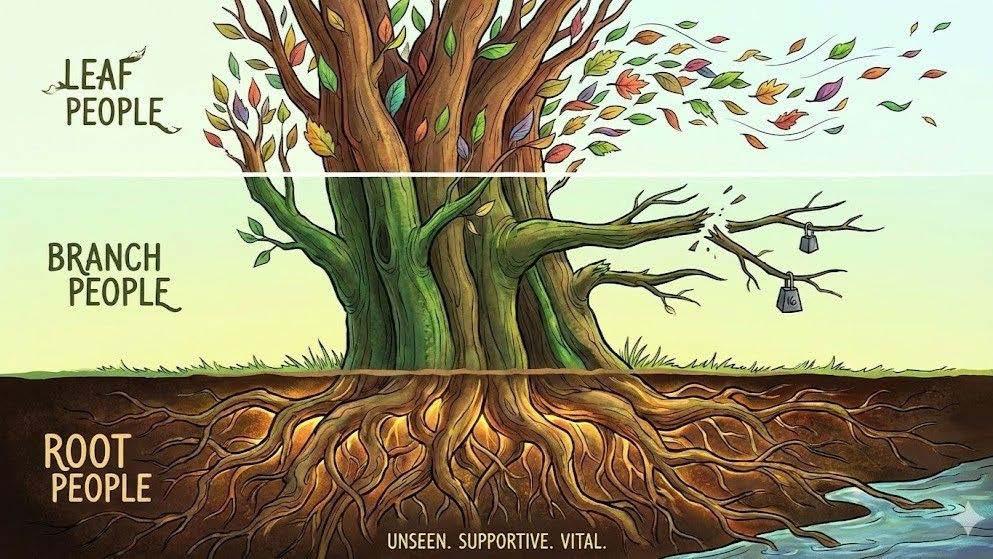
It’s a simple concept, but when I put on my researcher hat and looked at the actual science—both in botany and in organisational psychology—this analogy explains exactly why so many leaders burn out. We are spending all our energy watering the leaves, when we should be feeding the roots.
Here is the breakdown of the anatomy of your network, backed by data.
1. The Leaf People (The Transactional Network)
• The Parable says: They are there for a season. They take what they need, provide some shade, but blow away when the wind picks up.
• The Science: In evolutionary psychology, this aligns with the outer ring of Dunbar’s Number. Anthropologist Robin Dunbar theorized that we can only maintain about 150 stable relationships. Beyond that, people are just acquaintances.
• The Leadership Reality: “Leaf People” aren’t bad. In fact, in biology, leaves are critical for photosynthesis—they bring in energy and new ideas. In your career, these are your networking contacts, the people you meet at conferences, or the consultants you hire for a specific project.
• The Danger: The problem isn’t that they are leaves; the problem is when you think they are roots. If you lean your weight on a leaf, you fall. If you expect deep loyalty from a transactional relationship, you will be disappointed. Enjoy the shade they provide, appreciate their seasonality, but don’t anchor your identity in them.
2. The Branch People (The Structural Risks)
• The Parable says: They look strong. They stay for a while. But when life gets too heavy, or the storm gets too fierce, they snap.
• The Science: This reminds me of the Fairness Theory in organisational behavior. Many employees or partners operate on an output balance. They are strong as long as the deal is good. But materials science teaches us about tensile strength. Every branch has a breaking point. When the load (crisis/ stress) exceeds the structural integrity, it snaps.
• The Leadership Reality: These are often your functional partners or “fair-weather” managers. They are with you when the KPI is green. But when the crisis hits—when you lose a major client or face a PR disaster—their tensile strength fails. They detach to save themselves. But don’t be angry at a branch for breaking. It wasn’t built to hold the whole tree. That’s not its design.
3. The Root People (The Vital Few)
• The Parable says: They are unseen. They don’t do things to be seen. But when things are hard, they water you. They hold you up.
• The Science: This is where the research gets fascinating. Have you heard of the “Wood Wide Web”? Suzanne Simard, a Professor of Forest Ecology, discovered that trees actually talk to each other underground via mycorrhizal networks (fungi on the roots). Through these roots, strong trees literally pump sugar and nutrients to weaker or dying trees to keep them alive. They don’t do it for show (it’s underground). They do it for the survival of the forest.
• The Leadership Reality: In the corporate world, this is Psychological Safety (a concept championed by Amy Edmondson and validated by Google’s Project Aristotle). “Root People” are the ones who provide safety. They are the mentors who tell you the hard truth in private but defend you in public. They are the friends who don’t care about your CEO title; they care about your soul.
This concept is also spiritual. The scriptures describes the ideal leader.
They will be like a tree planted by the water that sends out its roots by the stream. It does not fear when heat comes; its leaves are always green.
(Jeremiah 17:8)
Notice the order? The roots find the water first. The green leaves are just the result of healthy roots.

We often spend 90% of our time trying to keep the “Leaves” happy (impressing strangers on social media) or fixing broken “Branches” (managing office politics).
But when was the last time you thanked a Root?
1. Audit your circle: Who are the 2 or 3 people who feed you when you have nothing to offer them?
2. Stop testing the leaves: Don’t expect “Leaf People” to catch you when you fall. That’s not their job.
3. Be a Root: The world has enough flashy leaves fluttering in the wind. We need more roots—people willing to do the hard, unseen work of nourishing others.
To my “Root People” (you know who you are)—thank you for holding me up.
Who is a “Root Person” in your life? Tag them below and give them some flowers (or maybe some fertilizer?) today.
ROSHAN THIRAN
Roshan is the Founder and “Kuli” of the Leaderonomics Group of companies. He believes that everyone can be a leader and “make a dent in the universe,” in their own special ways. He is featured on TV, radio and numerous publications sharing the Science of Building Leaders and on leadership development. Follow him at www. roshanthiran.com

BY TERRY SMALL
So, how are your New Year’s resolutions going so far? I thought I should give this about a week before checking in…
92% of people don’t make it, according to the University of Bristol. So, what do the 8% do right?
Most of us don’t do well at this. The explosion of studies into how the brain works has scientists attempting to explain the science behind why we make resolutions— and more importantly, how we can keep them. Is there a secret behind those who do succeed? Maybe.
James Clear wisely notes,
New goals don’t deliver new results. New lifestyles do. And a lifestyle is a process, not an outcome. For this reason, all of your energy should go into building better habits, not chasing better results.
When I read this I thought, “This makes sense.”
So, my new year’s resolution this year is going to be to stop saying, “I don’t have enough time”.
We all have exactly the same number of hours given to Albert Einstein, Madame Currie, Michelangelo, Abraham Lincoln, Dr. Seuss, Mother Teresa, Helen Keller, Leonardo Da Vinci. We don’t manage time. We manage ourselves with respect to time.
Self-management is never easy.
Does this remind you of anyone you know?
• Chapter 1: I walk down the street. There is a deep hole in the sidewalk. I fall in. I am lost. I am helpless. It isn’t my fault. It takes forever to find a way out.
• Chapter 2: I walk down the street. There is a deep hole in the sidewalk. I pretend I don’t see it. I fall in again. I can’t believe I am in the same place, but it isn’t my fault. It still takes a long time to get out.
• Chapter 3: I walk down the same street. There is a deep hole in the sidewalk. I see it is there. I still fall in. It’s a habit. My eyes are open. I know where I am. It is my fault. I get out immediately.
• Chapter 4: I walk down the same street. There is a deep hole in the sidewalk. I walk around it.
• Chapter 5: I walk down a different street.
Good news: You are never stuck. Your brain is capable of great change!
Neuroscientist, George Edelman, notes that your cortex alone has 30 billion neurons which can make 1 million billion connections. Edelman states, “If we considered the number of possible neural circuits, we would be dealing with hyper-astronomical numbers: 10 followed by at least a million zeros. There are 10 followed by 79 zeros of particles in the known universe”
These staggering numbers explain why your brain is the most complex, 3 pound lump in the universe.
Your brain can change itself, and a brain changed is a life changed.
Which brings us back to the 8%, There are probably numerous reasons why the 8% succeed with their resolutions. Here’s where it probably starts: these people pay attention. They pay attention to the gap. Between stimulus and response there is a gap. Habits are built in the gap.
What is the gap. Here is my colleague and friend Susan Goldsworthy on “the gap”:
“....neurophysiologist Benjamin Libet was fascinated by the question of whether humans have free will. He led experiments to understand the mental timing involved when someone does a voluntary act. He chose a simple task the lifting of a finger. His research showed that 0.5 seconds before the voluntary movement of the finger there is a brain signal related to the action that is about to occur; it’s called an action potential. Your unconscious brain decides, I will move my finger, 0.3 seconds before you are aware of it. At this point, there is a further 0.2 seconds where you are aware that you are about to move your finger, and you can intervene in the process and

Now this is the exciting part! For every move you make, you have 0.2 of a second where you can actively, consciously intervene in the process and choose a different response. Viktor Frankl, Austrian psychiatrist and concentration camp survivor, was spot on when he wrote, between stimulus and response there is a space. In that space is our power to choose our response. In our response lies our growth and our freedom. Now 0.2 of a second may not sound like much, but in brain terms, with billions of connections every second, it is a decent amount of time. Every time you make a decision, you have 0.2 of a second to choose a different response. Wow! Our right ventro-lateral prefrontal cortex can step right in and intervene in the limbic process.”
- Choosing Change
Perhaps this year a good resolution might be to mind the gap. Pay attention to your attention, be aware of your awareness, be conscious of your consciousness, think about your thinking.
Here is my second resolution for this year. Every time I reach for my phone, I am going to mind the gap, and ask, “What am I doing? What should I be doing? What shouldn’t I be doing?” Who knows what adventures and learning might result?!
Best wishes for a happy, healthy 2026. I hope it is joyful for you, and a year where all of us get one step closer to the people that we want to be.
Thanks for reading. You are a genius!
This article was first published in Terry Small’s Brain Bulletin newsletter.
Terry Small is a brain expert who resides in Canada and believes that anyone can learn how to learn easier, better, and faster; and that learning to learn is the most important skill a person can acquire.
Source: Image by Freepik

BY CHRIS ROEBUCK
Detachment is effectively employee disengagement in a general sense, where employees may be present in the workplace but are not mentally and emotionally focused on their work, and so not giving their best.
This is a fundamental risk to the success of any organisation and employers need to address it. It can lead to many real issues, from employee productivity concerns to increased turnover numbers which can reach record-high turnover in a cooling job market with wider impacts on areas such as delivery of services, customer satisfaction, and even implementation of AI.
The use of the single term “detachment” is, in itself, a risk because it fails to adequately help leaders and companies really understand what is going on beneath the surface in their workforce and how to take the most effective steps to deal with it.
No matter what you call it, employee detachment or disengagement, it needs to be addressed. However, the biggest problem is that detachment is not visible and distinguishing between individuals who are detached and those who are not is not easy. And if you cannot easily identify those who are detached, how can you solve the problem?
Detachment is a significant problem in every workplace, across industries and countries and we need to make changes to beat it. Detachment is essentially not being engaged at work. If you take the significant Gallup research data, and that which others produce on engagement, even taking an optimistic perspective potentially only 30% of employees in a majority of organisations are engaged – giving their best. Having 70% of your employees not giving their best should be something which gives leaders and, in particular C-Suite, nightmares. However, resolving this often doesn’t feature as one of their key priorities.
Gallup defines “actively disengaged” employees as those who are “emotionally disconnected from their workplaces and less likely to be productive”. And that inevitably has an impact on products, services and customers.
Gallup’s latest research, and other studies, have also shown significant impacts both economically and in terms of wider society, potentially a loss of $7.8 trillion revenue globally which is approximately 11% of global GDP.
It’s really important that you understand what is happening today beneath the surface, and that’s much more than the vast majority of articles on detachment tell you. It’s only when you understand this will you be able to identify specific opportunities and actions to solve the problem.
To keep it simple think of employees who are “engaged” as not being detached. Most articles on detachment consider the “detached” to be one single group, they aren’t. The employee engagement perspective digs deeper to enable better understanding.
This employee engagement perspective actually fall into two groups, the “not engaged” and the “disengaged”. As an average in most organisations, if you have 70% of employees who aren’t engaged, then within this group maybe 55 to 60% of total employees will be not engaged and 10 to 15% disengaged. This is a critical distinction.
• “Not Engaged” Employees: These individuals are indifferent but may occasionally perform well.
• “Disengaged” Employees: These individuals are actively avoiding giving their best effort. Their negative influence requires four engaged employees to offset their impact.
If you work out the maths, that means that if you have only 10% disengaged you must have at least 40% engaged to mitigate their impact. That is why having maximum employee engagement is important because statistically, at any time, you will inevitably have a few disengaged people.
On the positive side, if you are a new employer to someone, you will have a honeymoon period of a few weeks to engage them proactively.
It’s interesting that many of the drivers of employee detachment are the same as caused The Great Resignation. That reset expectations amongst workers about their work environment, in general terms to expect more from leaders. Many articles on employee detachment list a number of perceived causes. The reality is that these are symptoms not the underlying problem.
The fundamental cause of employee detachment is ineffective leadership which impacts employee experience. What leaders do day to day, or don’t do, is the main cause of detachment. This then manifests itself in a number of areas which are seen as causes but are just visible symptoms:
1. Too much task focus – leaders unable to spend time to focus on people
This is the classic “too much work” and “not enough time” problem where managers are totally focused on the delivery of the task and so fall into the trap of not keeping time to interact positively with people – to set clear expectations, to engage in two-way communication, to inspire, support and develop their people. This creates an environment where employees have little confidence in their leaders. But this focus on task can also manifest itself in micro management which also has a negative impact.
2. Too much work not enough time – team members
This is not just a problem for leaders but it is also a problem for employees where their team leader is unable to effectively manage team workloads. That also leads to negative effects around work-life balance, employee satisfaction, and meeting employee expectations.
This is not just about the ability of the leader to manage the workloads which the team currently has but also to ensure that the team is not overloaded. This one of the greatest challenges which leaders have. They find it difficult to say “no” when they are asked by their boss to take on more work for the team.
“Too much work” and “not enough time” inevitably leads to cognitive overload. At a low level this will lead to detachment and disengagement but as it builds up can potentially lead to burnout and associated mental health issues. Research published in Work & Stress (2023) found that employees experiencing high levels of job stress, coupled with low autonomy, reported higher levels of disengagement and detachment from their work.
3.
Praise is something we as humans are hard wired to want and enjoy, its a fundamental part of job satisfaction. Employees who don’t feel they are recognised for their good work will disengage. This recognition in most cases is day to day positive feedback where due. But it also needs to be underpinned by good formal performance management practices.
Numerous studies have found employees who feel unappreciated in their roles are more likely to become emotionally detached.
Again, we as humans are hard wired to want to grow and develop so if employees see no clear career path or do not have at least one significant positive growth experience a year they are likely to become detached.
New work opportunities, especially for developing younger employees in new jobs are key to engagement. The 2023 Employee Engagement and Retention survey by Qualtrics found employees who do not see opportunities for long term progression are more likely to become disengaged.

All of the previously mentioned problems when combined will create an overall feeling of a negative company culture, a significant driver of detachment. When employees feel undervalued, disrespected, or overworked, their belief in their boss and the organisation significantly decreases.
Just a few simple small steps within a structured process to improve culture will make a real difference. One good way to improve this is to think about how to grow employee pride in what they do and the organisation.
It’s worth mentioning that younger workers, Gen Z in particular, are more susceptible to detachment due to higher expectations so may exhibit it at the highest rate. Whilst they have a lot of intrinsic motivation they need a clear purpose to apply it to and like social interactions around their work. If those aren’t present they can become detached relatively quickly.
There are also issues that need to be considered for those who are remote working. People like remote work flexibility and the ability to get more done when working on individual work remotely.
However, there is group of about 20% of people who are susceptible to social isolation and need connection. The problem is leaders can’t tell who is in this group. Thus it is essential to ensure that all engaged in hybrid work are supported when working remotely as much, if not more, than when in the office.
Addressing symptoms like workload imbalance or lack of recognition alone won’t solve the problem. The fundamental issue is average leadership, just good enough to get by. Strengthening leadership to good across all levels is the solution.
My proven three-step system was designed to address detachment and disengagement by:
• Building Strong Leadership Skills: Ensuring foundational leadership abilities are in place.
• Enabling Leaders to Bring Out the Best in Teams: where employees are supported, recognised, and motivated.
• Focusing Employee Efforts on Organisational Success: Aligning employees’ best efforts with key business objectives.
This is the only way to minimise employee detachment. Many businesses don’t deliver leadership training to the depth required, assuming they already have effective leaders. Studies suggest 80% of leaders have never been properly trained in critical skills such as delegation. This skill gap directly causes detachment and disengagement.
For example, training leaders in the basics of effective delegation takes less than 10 minutes and has shown to save most managers several hours each week, time they can redirect toward engaging their teams.
While improving leadership benefits all employees, targeting the “not engaged” group offers a key opportunity. Within this group, 10-20% are very close to being engaged. By enhancing leadership skills, this group can shift quickly into being engaged, raising overall engagement to 40% or more, which then helps negate the impact of disengaged employees.
To minimise employee detachment, organisations must ensure strong leadership skills to the depth required are in place. This is the most effective way to improve engagement and optimise performance. By focusing on leadership development, organisations will build a motivated and inspired workforce, which drives productivity, and achieves long-term success.
This was first published on chrisroebuck.live
Chris Roebuck has more than 30 years unique experience as a leader in military, business and government. His insights as one of HRs Most Influential Thinkers (9 times awarded), Hon Visiting Professor of Transformational Leadership at City Business School, London, neuroscience accredited executive coach and member of Newsweeks Expert Forum, a small group of just over 100 leading global experts, has inspired 21,000+ leaders in 186 organisations in 28 countries. As a business and leadership expert he has been interviewed on TV 350 + times, quoted in Wall Street Journal, FT, Forbes, Business Week and others, and written 5 books on leadership.
Source: Image by Freepik

BY GREGG VANOUREK
Who are the people who fuel your passions—the things that consume you with palpable emotion over time? For me, there are so many.
There are five different types of such people:

And read on to the end for one other important type.
Your passion igniters are the people who set your passions ablaze in your life. Here are some examples:
For me, I fell in love with soccer in part due to a fiery and intense coach, John Goetz, who led our “Choppers” youth soccer team with gusto.
As the sweeper, I was the final line of defense before the goalie. If a long pass slipped through at half-field on a counterattack and their forward got behind me on a breakaway, I had a brief window to recover before my mark could take a shot. Sprinting at full speed to catch the opposing striker, I would always hear a booming call from Coach on the sidelines:
You could hear it for miles. He knew I wouldn’t let the forward get a shot off.
That primal roar always sent a jolt coursing through me. I always found another gear when I heard it.
When I started learning to play the guitar, I had a hard time connecting with the lessons from my first music teacher. Eventually, I found a new teacher, Randy. He offered to teach me anything I wanted to learn. I’d bring him tapes and he’d show me how to rock out on all my favorite songs. That made all the difference. I was all in.
When I was in college, I discovered a passion for learning—and asking the big questions in life—thanks to brilliant teachers like Professor Roth and Professor Smith. Those fires are still burning in me, as bright as ever.
Alexandra, our oldest daughter, discovered a love for dancing when she joined a local dance group led by a talented and committed young dancer, Isabel. With her dance troupe, Isabel focused on spreading the joy of dancing and building community. They work with hundreds of dancers, from young children to young adults, and welcome them into Isabel’s giant and growing dance family. All the dancers perform on stage during their shows, with electrifying music, soaring choreography, and marvelous dancing. I’ll never forget when Alex had her breakthrough moment on stage. Isabel is a passion igniter.
Our other daughter, Anya, fell in love with animals, not just because she loves our own pets, but because her Mom grew up on a farm riding horses. Growing up, Anya spent a lot of time on the farm enjoying the countryside and the companionship of animals. Today, she’s considering a career working with animals.
My brother, Scott, loves to travel. If there’s a fun festival somewhere, anywhere, he’s game. He traces this back to all the postcards we got as children from our parents as they traveled around the world for our Dad’s business career. Scott was intrigued by all the foreign and exotic places. He lived in Japan for several years and now travels abroad often.
My friend, Christine, is a passion igniter for the young women rugby players she coaches, helping them not only discover a love of the game but also of strength and physicality.

2
Your passion inspirations are the people who made you feel that you wanted to explore or do something that you care about deeply. They breathed life into your passions through their example. In many cases, they’re famous.
I love to write. For me, Richard Bach, Paulo Coelho, Annie Dillard, Anna Quindlen, Fredrik Backman, Stephen R. Covey, Parker Palmer, Richard Leider, and Brene Brown have been passion inspirations over the years.
On the leadership front, my Dad was deeply inspired early in his career by Robert Greenleaf, a consultant and author who founded the modern servant leadership movement. It transformed my father’s whole approach to leading and sent him on a quest to find better ways to lead than the ones he experienced as an emerging leader.
If you’re committed to public service and social justice, your passion inspirations may be people like Mahatma Gandhi, Rosa Parks, Martin Luther King, Jr., Desmond Tutu, Nelson Mandela, Malala Yousafzai, or Alexei Navalny.
A budding entrepreneur? Maybe Steve Jobs, Richard Branson, Ratan Tata, Jack Ma, Oprah, Arianna Huffington, Lori Greiner, or Sara Blakeley inspire you.
For animals and the natural world, maybe it’s Jane Goodall or Sir David Attenborough.
And for acting and performing arts, maybe it’s Meryl Streep, Denzel Washington, Lin-Manuel Miranda, or Cynthia Erivo.
Who are your passion inspirations?
Passion Pals
Your passion pals are the friends you engage with on your passions, spending time together on the things that light you up.
For me in music, it was my band mates, with countless hours of practice in Patrick’s basement and Rob’s garage. These days, I geek out about books and podcasts with my friend Jamie and my Dad.
Do you have a workout buddy or hiking companion? A movie buff or gaming buddy? How about a foodie who samples new restaurants and dishes with you?
Passion Partners
Your passion partners are the people you collaborate with on passion projects, whether it’s a YouTube channel, photography, genealogy, pottery, or gardening. It can be romantic partners or business partners or both.
My friend Christopher Gergen and I were passion partners in writing a book, LIFE Entrepreneurs, together and building a company around it that helped people live with purpose and passion. In our research for the book, we interviewed 55 people who live intentionally and craft their lives around their passions, strengths, and values. In those interviews, we came across a wonderful surprise: many couples were helping each other do that.
For Paul, that mean supporting his new wife, Simi, as she launched a law firm and started a documentary project. And for Simi, it meant supporting Paul as he launched his new business. As Paul told me:
This is so great. We’re helping each other with our dreams.
For Linda and Roger, it meant co-founding a child-care company and launching and running humanitarian relief organizations in Asia and Africa. “For us it has been great,” recounted Linda. “We are extremely compatible. We have an enormous amount of respect for each other, and it adds this extra dimension to our relationship. It’s just incredibly rich to create an organization together.… Through all the very difficult start-up years, we had each other to lean on and celebrate our successes together.… It has really just worked.”
My Dad and I were passion partners on a book project about the kind of leadership it takes to build an organization that’s excellent, ethical, and enduring— what we called triple crown leadership. That work led to more writing as well as teaching and speaking together—a true joy.
Passion Enablers
Your passion enablers are the ones who give you the means or the opportunity to do the things you love.
For me, it begins with my Mom and Dad. I think back to all the times my Mom drove me to practices, games, lessons, and events. And the times she served as Class Mom or Team Mom or ran the Little League Snack Shack.
It’s also been my wife, Kristina, standing by me as I navigate my unconventional portfolio of work that includes writing, teaching, speaking, and coaching. And I supported her as she went back to school and changed careers, following her heart into work she loves and that she’s great at.
These passion enablers can include not only parents, grandparents, siblings, aunts, and uncles but also managers and colleagues. 4 5
Think about the marketing manager who notices that one of her team members loves designing social media graphics and visually rich campaigns but struggles with drafting content. The manager lines up training and small projects to foster this more specialized work.
Consider the astute boss who sees how passionate his direct report is about sustainability and conservation. The boss sponsors and mentors his employee in launching company service initiatives and sees how he not only lights up but also develops his planning, collaboration, and leadership skills.
Unfortunately, there’s one more type: the passion killers. These are the folks who discourage you from pursuing your passions.
They insist you’re not qualified. That you’re not the sort of person who can lead that big project. They tell you how impractical it is and how you should wise up and play it safe. Often, they’re afraid you’ll struggle and fail if you take risks—or more concerned about how your choices reflect back on them.
The voices of the passion killers tend to spawn the most insidious passion killer of all: self-doubt.
Self-doubt makes you question your capabilities and potential. It feeds on your uncertainty about yourself and your place in the world. It jumps all over you when you make a mistake or don’t reach a goal. It’s that voice in your head:
Don’t be a fool! What if you make a mistake? What will people think?
To some, passion sounds like pie-in-the-sky dreaming. Or unattainable. Part of the problem is due to fuzzy thinking. For instance, “No, you probably don’t have just one passion. And no, everything won’t turn into butterflies and rainbows if you just “follow your passion”.
Passions are potent, especially when you pair them with your strengths. That gets you a big step closer to authentic alignment—when you’re being true to yourself and there’s a good fit between how you live and who you really are.
Passion is a critical component of this equation. Author Sir Ken Robinson calls it “the driver of achievement in all fields.” And Oprah Winfrey views it as energy, noting you can gain power by focusing on what excites you.
So, if you have people who have fueled your passion, be sure to reach out and thank them. If you can play that role for others, I hope you step into it with gusto, realizing what a gift that can be.
If you have passion killers in your life, I hope you separate yourself from them—or at least draw healthy boundaries. Life is too short not to feel this amazing energy and see where it takes you.
Wishing you well with it. Let me know if I can help.
This article was originally published on Gregg Vanourek’s LinkedIn.
GREGG VANOUREK
Gregg Vanourek is an executive, changemaker, and awardwinning author who trains, teaches, and speaks on leadership, entrepreneurship, and life and work design. He runs Gregg Vanourek LLC, a training venture focused on leading self, leading others, and leading change. Gregg is co-author of three books, including Triple Crown Leadership (a winner of the International Book Awards) and LIFE Entrepreneurs (a manifesto for integrating our life and work with purpose and passion).


BY AMIRAH NADIAH
We often admire confident people as if they were born with an effortlessly captivating presence. But confidence is rarely a trait someone simply has. It’s a competency shaped by the experiences we allow ourselves to face, the habits we practise, and the stories we tell ourselves.
In moments that matter, say a presentation or an interview, most of us don’t lack the ability. What we lack is the belief that our ability will hold up under pressure. That gentle belief in ourselves is what confidence really is.
It’s the small everyday actions that strengthen our sense of capability over time. Here are simple practices that can support you along the way:

Our posture has a powerful impact on our emotions.
Try standing tall, pulling your shoulders back, and lifting your chin slightly. This sends a signal to your mind that says, “I’m ready”.
Natural eye contact and a gentle smile also go a long way. When your body reflects confidence, your mind naturally begins to feel it too.
Visualization is a mental rehearsal that goes beyond positive-thinking.
Your brain doesn’t fully distinguish between something you imagine and something you physically experience. That’s why if you rehearse failure in your mind (e.g., “I’ll mess up”, or “Everyone will judge me”), your brain triggers your survival mode even though nothing bad has actually happened.
So before stepping into a situation that makes you nervous, take a few minutes to imagine it going smoothly. Picture yourself speaking calmly, the audience responding positively, and you completing the task successfully.
This subtle shift can make all the difference in how you show up.
Confidence grows from solid preparation. The better you understand your topic, the less anxiety you carry.
Practise your points, prepare clear notes, and anticipate questions you might receive. With thorough preparation, you’re giving your mind something solid to stand on.
Preparation shifts the energy from managing the moment to leading it.
Every leader runs on an internal narrative. While visualisation helps you imagine what could go well, your overall mindset shapes what you believe is possible for you.
Even the best preparation won’t matter if the story you repeat to yourself is built on doubt. When you let doubt take control, you end up living inside its walls. But when you shift to, “I can learn this and be better”, you take on discomfort as a cue to grow.
In the end, the story you choose to believe becomes the one you learn to live.
There’s no hidden formula for confidence. With every intentional step, you strengthen who you’re becoming. Keep practicing, show up for yourself, and allow growth to come at its own pace. You owe yourself that kindness.
AMIRAH NADIAH
Amirah Nadiah holds an academic background in Malay Language and Linguistics. This foundation, combined with her passion for reading and staying current on contemporary issues, enables her to maintain a sharp awareness of diverse topics. As a Content Editor, she specializes in translation and is actively involved in creating engaging and compelling content.

BY PRASHANT GONGA
Cybersecurity in 2025 has reached a critical inflection point. For the past year, I’ve sat down with CEOs, CISOs, and SOC leaders across every major industry to discuss the shifting front lines of digital defense. From the rise of invisible data flows to the persistent embedding of nation-state actors, the threat landscape is maturing faster than most governance can keep up with.
To lead through this shift, we must move beyond the “detect and respond” mindset. True resilience in 2026 will be measured by how effectively we reduce exposure and enforce least privilege by design. If you are accountable for risk and strategy, the following predictions are the roadmap for what comes next.

Threat actors are moving from experimental use/Proof of concept of AI to operational use. AI is now being applied across reconnaissance, social engineering, malware development, and automation of the entire attack lifecycle. Attacks will become cheaper to run, harder to attribute, scalable, and extremely profitable for the hackers.
Prompt injection, in particular, will become a major enterprise risk as organisations rapidly adopt AI systems, enabling attackers to manipulate models for data exfiltration and sabotage. At the same time, AIenabled social engineering, especially voice phishing using realistic voice cloning, will increase in volume and effectiveness by exploiting human trust rather than technical weaknesses. Given the high success rate and low deterrence, these attacks will continue to grow, forcing defenders to implement stronger governance, validation, and multi-layered controls to counter AIdriven deception.
We have infact seen this in action this year when a Salesforce instance used by Google was breached by the hacking collective ShinyHunters (also known as UNC6040/UNC6240). The attackers gained access through sophisticated social engineering, specifically voice phishing (vishing), rather than a technical vulnerability in the Salesforce platform itself.
By 2026, security operations centers will no longer be built around analysts manually triaging alerts. Analysts will move away from drowning in alerts to directing AI agents in what can be described as an “agentic SOC.” Alerts will arrive with AI-generated case summaries, decoded attack activity, and mappings to frameworks like MITRE ATT&CK, enabling analysts to validate decisions and approve containment actions in minutes rather than hours.
The same shift will apply to threat hunting and intelligence, where AI performs large-scale data correlation and report generation, allowing human analysts to focus on judgment, strategy, and final decision-making rather than manual analysis.
Ransomware will focus on maximum business disruption, not just encryption
Ransomware combined with data theft and extortion will remain the most financially disruptive threat. The objective is no longer limited to endpoints. Attackers are increasingly targeting critical enterprise systems and third parties to trigger cascading operational and supply-chain failures. We saw this with the recent breach of Asahi Group Holding.
Infrastructure layers are becoming the new high-value targets
As endpoint defenses mature, attackers are shifting their focus to areas with less visibility and weaker controls, virtualization platforms, control planes, open port vulnerabilities, and shared infrastructure layers. A single compromise at this level can disable hundreds of systems in hours, not days.
This year we saw 4 critical vulnerabilities found in VMware’s ESXi, Workstation, and Fusion, allowing attackers to escape from VMs and gain control of the host.
ICS and OT environments remain highly exposed
Industrial and operational environments continue to suffer from weak remote access hygiene, like insecure RDP, VPN, outdated software, and insufficient segmentation. Business-layer compromises increasingly spill into OT, turning cyber incidents into real-world operational shutdowns.
The growth of AI agents will turn today’s “Shadow AI” issue into a critical “Shadow Agent” risk, as employees deploy powerful agents without formal approval. This creates invisible data flows that increase the risk of data leakage, compliance violations, and IP theft.
Banning AI agents will not work and will only reduce visibility, as employees might run these AI agents off the network. Instead, organisations must establish AI security and governance by design, deploying controls that monitor and manage agent activity while enabling innovation within auditable, secure environments.
State-sponsored cyber activity in 2026 will remain persistent, highly strategic, and closely aligned with geopolitical objectives rather than short-term disruption. Nation-state actors are expected to prioritize stealthy, long-term access for espionage, intelligence gathering, and strategic positioning, often targeting infrastructure layers, edge devices, and trusted third-party providers to maximize scale and impact.
These operations increasingly blur the lines between espionage, cybercrime, and information warfare, with AI amplifying influence campaigns and enabling faster adaptation. For organisations, this means assuming capable adversaries may already be present in the environment and shifting defenses toward layered security, supply-chain risk management, and resilience against long-dwell, well-resourced attackers.
As the global economy increasingly adopts cryptocurrencies and tokenized assets (roughly 10% of the world’s population held cryptocurrency as of early 2025), cybercriminals will exploit the immutability and decentralization of blockchains for financial gain. High-value attacks against DeFi platforms, crypto exchanges, and supply chains will continue to grow, particularly in regions with expanding crypto adoption (US, Southeast Asia, Middle East).
Threat actors are expected to move core parts of their operations on-chain, using blockchain infrastructure for command-and-control, data exfiltration, and asset monetization, making takedowns significantly harder. This shift will require defenders to develop blockchain investigation capabilities, including transaction tracing and smart contract analysis, while recognizing that the same on-chain immutability that benefits attackers also creates permanent, auditable evidence that can be used to disrupt entire criminal ecosystems.
The implication for leadership is clear, in 2026, security strategy cannot rely on detecting attacks after access is gained. The time between intrusion and impact is collapsing. Resilience will depend on reducing exposure by removing open port vulnerabilities, enforcing least privilege by design, and limiting lateral movement, i.e., what attackers can reach even when they succeed.
The organisations that adapt early will not just respond faster. They will give attackers far fewer opportunities to begin with.
As a CTO with a background in customer success, Prashant Gonga leverages 10+ years of expertise in product development and management, technical onboarding, and account management to drive SAAS and E-commerce success.

Authors: Yifei Li & Judith Shapiro
A central theme of the book is the tension between rapid environmental improvements and the suppression of civil society. China’s top-down policies have produced visible results, such as reduced urban smog and expanded renewable energy capacity. Yet these achievements come at the cost of limited public participation, restricted NGO activity, and heavy reliance on surveillance and enforcement. The authors highlight case studies where local communities are displaced or silenced in the name of environmental progress, raising questions about justice and accountability.
In China Goes Green: Coercive Environmentalism for a Troubled Planet, Yifei Li and Judith Shapiro present a critical exploration of China’s environmental policies and their broader implications for governance and global climate action. Published in 2020, the book examines how China’s authoritarian political system shapes its approach to sustainability, arguing that while the country has made significant strides in renewable energy and pollution control, its methods are deeply coercive and often prioritise state power over genuine ecological progress.
The authors begin by situating China within the global climate discourse. As the world’s largest emitter of greenhouse gases, China’s actions are pivotal to the future of the planet. Internationally, the country is sometimes portrayed as a leader in green development, particularly given its investments in solar and wind energy. However, Li and Shapiro caution against equating authoritarian efficiency with environmental success. They argue that China’s environmentalism is less about ecological stewardship and more about consolidating political control, a phenomenon they term “coercive environmentalism.”
Li and Shapiro also extend their analysis to China’s international initiatives, particularly the Belt and Road. While marketed as a vehicle for sustainable development, many projects export environmentally harmful practices abroad, undermining China’s image as a global green leader. This duality of domestic progress paired with external contradictions underscores the complexity of China’s environmental narrative.
The book’s strength lies in its balanced critique. It acknowledges China’s successes in renewable energy and pollution reduction, but it warns against adopting authoritarian environmentalism as a global model. The authors argue that genuine sustainability requires transparency, accountability, and grassroots participation—elements largely absent in China’s approach. By framing environmentalism as both a political and ecological issue, the book challenges readers to consider the broader consequences of governance styles on climate action.
In conclusion, China Goes Green is a timely and thought-provoking work that interrogates the intersection of authoritarianism and environmentalism. It cautions against the allure of coercive efficiency, reminding us that ecological progress cannot be divorced from democratic values and social justice. For policymakers, scholars, and environmental advocates, the book offers a vital perspective on the trade-offs inherent in China’s green agenda and the risks of replicating it elsewhere.

• China’s centralised governance allows rapid implementation of large-scale environmental policies. This capacity enables swift responses to pollution and climate challenges, showing how decisive leadership can drive meaningful ecological change.suppress civil society, limit public participation, and rely heavily on surveillance and state control.
• The book highlights China’s investment in renewable energy, electric vehicles, and eco-cities. These initiatives demonstrate how environmental priorities can align with economic modernisation, positioning China as a global leader in sustainable innovation.
• China’s environmental policies have an international impact, encouraging cooperation and setting examples for other nations. Its efforts illustrate how one country’s commitment can inspire broader global action toward sustainability.
• While Shapiro and Li critically examine the risks of “coercive environmentalism,” their analysis also shows that China’s approach offers opportunities for progress, innovation, and global leadership.

- Mark Zuckerberg -