

Amy Brandt Partner | San Francisco
Hannah Dodge Associate | San Francisco
Jordan Carman Associate | San Francisco
Stephanie J. Lowe Senior Counsel | San Diego


Stuart Reges served as a teaching professor in the University of Washington’s Paul G. Allen School of Computer Science & Engineering, where he taught introductory computer science courses. The Allen School circulated guidance encouraging instructors to include an Indigenous land acknowledgment in course syllabi, describing the practice as a recommended best practice for inclusive teaching. Including a land acknowledgement was not mandatory.
Reges viewed the University’s land acknowledgment and the recommendation that instructors include them syllabi as a political statement. He opposed it as part of broader diversity, equity, and inclusion initiatives and believed it conveyed that the University’s presence on its campus land was illegitimate.
In December 2021, another faculty member circulated an article criticizing land acknowledgments on a faculty mailing list. Reges replied and shared a draft parody land acknowledgment. He said he was considering including it in a future syllabus because the Allen School had identified land acknowledgments as a best practice.
At the start of the Winter 2022 quarter, Reges included a version of the parody statement in the syllabus for an introductory programming course with approximately 500 students. The statement asserted that, under the labor theory of property, the Coast Salish people could claim historical ownership of almost none of the land occupied by the University. Reges briefly mentioned the statement during class.
Later that day, students began submitting complaints. Some stated that the statement made them feel unwelcome or unsafe, and others connected it to Reges’s prior public writings. A student posted a screenshot of the syllabus on Reddit, where it generated significant criticism. Administrators in the Allen School learned of the statement and described it as offensive and harmful to the learning environment.
The Director of the Allen School, Professor Magdalena Balazinska, asked Reges to remove the statement from his syllabus because it was creating a “toxic environment” in a required course for the computer science major. She wrote to him that he was “welcome to voice your opinion and opposition to land acknowledgments, as you have, in other settings.”
When he refused, Balazinska directed IT staff to replace the online syllabus with a version that excluded the statement. The Allen School issued a Twitter statement condemning the “offensive” statement and relaying that the school was “horrified” and working to replace the syllabus on the course website. Balazinska later emailed Computer Science and Engineering students to apologize for Reges’s land acknowledgment and encourage students who felt they had not been “treated fairly and respectfully” to submit complaints. Over the following weeks, the University received multiple written complaints. Some students reported emotional distress, some transferred to a newly created alternative section of the course, and administrators expressed concern about the effect the controversy could have on student morale and recruitment.
The University initiated a formal disciplinary investigation. A faculty committee later concluded that the statement caused significant disruption, particularly affecting Native students. Although the dean declined to impose discipline at the conclusion of the investigation, she issued a letter warning Reges that repeating the statement in future syllabi could result in sanctions under University policy. During the investigation, the University withheld a merit pay increase that Reges later received after the investigation closed.
Reges filed a lawsuit in federal district court against the University’s president, the dean of the College of Engineering, and senior Allen School administrators in their official and individual capacities. He alleged that the University retaliated against him and discriminated against his viewpoint in violation of the First Amendment. He also brought a facial challenge to the University’s nondiscrimination and affirmative action policy, University of Washington’s Executive Order 31, arguing that it was overbroad and vague.
The University asked the court to dismiss the policy challenge on the ground that the complaint failed to state a legally sufficient claim. Both parties filed cross-motions for summary judgment on the First Amendment claims and agreed that no material facts were disputed. The district court concluded that Reges’s syllabus statement addressed a matter of public concern and qualified as protected speech in the public employment context. Applying the Pickering balancing test, however, the court held that the University’s interest in preventing disruption to the learning environment outweighed Reges’s First Amendment interests. On that basis, the court granted summary judgment to the University on the retaliation and viewpoint discrimination claims. Reges appealed to the Ninth Circuit.
The Ninth Circuit analyzed the case under First Amendment principles governing speech by public employees, with special attention to the academic context. The Ninth Circuit explained that when a public employee speaks as part of official job duties, the First Amendment generally does not protect that speech because the government may control its own message. When the employee speaks in a personal capacity on a matter of public concern, however, the speech may receive constitutional protection.
The court rejected the University’s argument that Reges’s syllabus statement constituted government speech or speech made pursuant to official duties. It held that academic speech related to teaching and curriculum does not fall within the category of unprotected government speech. The Ninth Circuit emphasized that faculty control syllabus content, that the University does not preapprove syllabi, and that students would not reasonably understand Reges’s statement as expressing the University’s own views. Because Reges spoke in his capacity as a professor, expressing his own views, the Ninth Circuit treated his statement as protected academic speech rather than government speech.
Having concluded that Reges engaged in protected speech, the Ninth Circuit applied the Pickering balancing test, which governs speech by public employees. Under that test, a court first asks whether the employee spoke on a matter of public concern. If so, the court then balances the employee’s interest in speaking against the government employer’s interest in maintaining effective operations and avoiding disruption.
The Ninth Circuit held that Reges’s parody land acknowledgment addressed a matter of public concern. It described land acknowledgments as the subject
of ongoing political and social debate and treated Reges’s criticism as political speech at the core of First Amendment protection, particularly in a public university setting.
The Ninth Circuit then weighed Reges’s speech interests against the University’s asserted interests in preventing disruption. It acknowledged that students experienced offense, anger, and distress in response to the statement, but explained that disagreement and discomfort are inherent features of higher education. The Ninth Circuit held that student opposition to a professor’s viewpoint cannot justify disciplinary action because allowing emotional reactions to drive enforcement would permit a hostile audience response to suppress protected speech.
The University argued that Reges’s syllabus statement caused concrete operational harm beyond student offense. It pointed to students transferring out of his course, concerns about recruiting Native students, and reports that Native students had taken leaves of absence or withdrawn from the University. The Ninth Circuit examined each of these claimed disruptions and found them inadequately supported by the record. It noted that the evidence did not show why students changed course sections, that recruiting concerns rested largely on speculation, and that claims about students leaving the University were either unsupported or factually incorrect. The Ninth Circuit also observed that the University allowed Reges to express the same views in other settings, including in other syllabi, without similar consequences. This undermined the claim that the Winter 2022 syllabus statement uniquely disrupted University operations.
Because the University failed to show that its interests outweighed Reges’s strong interest in speaking on a matter of public concern, the Ninth Circuit concluded that the Pickering balance favored Reges. The Ninth Circuit also upheld Reges’s viewpoint discrimination claim, explaining that the record showed the University acted specifically because of the views Reges expressed.
The Ninth Circuit reversed and directed the district court to enter summary judgment in Reges’s favor on his First Amendment retaliation and viewpoint discrimination claims. The Ninth Circuit remanded the case for further proceedings consistent with its opinion, including the determination of appropriate relief.
Reges v. Cauce (9th Cir. Dec. 19, 2025, No. 24-3518) 2025 LX 508119.
Randey Thompson served as an assistant principal at Evergreen Middle School in the Central Valley School District in Washington. In August 2020, after watching the Democratic National Convention, Thompson posted a comment on his private Facebook account. He limited the post’s visibility to his Facebook “friends.” The post criticized the Democratic National Convention and included slurs, profanity, and language suggesting violence against politicians. District employees saw the post and forwarded it to District administrators, who brought it to the attention of the superintendent.
Two days later, District administrators contacted Thompson. He confirmed that he authored the post and stated that he made it on his own time, on his personal device, and intended it as political commentary shared only with friends and family. The District immediately placed Thompson on paid administrative leave, barred him from school property, and prohibited him from contacting students, parents, or staff. Thompson deleted the post shortly after the call.
The District retained outside counsel to investigate the post and its potential impact. During the investigation, employees expressed concern that the post used hateful and offensive language that could harm students, families, and the broader school community. Investigators also gathered information about prior comments Thompson allegedly made at school, including derogatory references to students and remarks viewed as insensitive toward students with disabilities and students of color.
The District then conducted interviews with staff, administrators, and parents to assess the impact of Thompson’s conduct. Interviewees reported shock and concern and questioned Thompson’s ability to serve effectively in a leadership role, particularly as a disciplinarian and representative of the District’s commitment to an inclusive school environment.
The school board held multiple notice-and-opportunity hearings. During those proceedings, Thompson initially claimed that his Facebook account had been hacked, a claim the District investigated and rejected after a forensic review. The District concluded that Thompson had not been truthful during the investigation and that his conduct interfered with the investigative process.
Ultimately, the superintendent transferred Thompson from his assistant principal position to a classroom teaching position. The District cited concerns about disruption, loss of trust, interference with job performance, and inconsistency with the District’s mission of fostering a safe and inclusive educational environment. The school board upheld the transfer.
Thompson sued the District and several individual administrators in federal district court under 42 U.S.C. section 1983. He alleged that the District retaliated against him in violation of the First Amendment by placing him on administrative leave and transferring him because of his Facebook post.
The parties filed cross-motions for summary judgment. The district court concluded that Thompson established a prima facie First Amendment retaliation claim but held that the District prevailed under the Pickering balancing test. It granted summary judgment to the District and held that the individual administrators were entitled to qualified immunity.
Thompson appealed to the Ninth Circuit.
The Ninth Circuit analyzed Thompson’s claim under the two-step Pickering framework governing First Amendment retaliation claims by public employees. Under that framework, the employee must first establish a prima facie claim by showing that he spoke on a matter of public concern, suffered an adverse employment action, and that the speech was a substantial or motivating factor in that action. If the employee meets that burden, the employer may still prevail
by showing that its legitimate interests in workplace efficiency and avoiding disruption outweigh the employee’s speech interests, or that it would have taken the same action regardless of the speech.
At the first step of the analysis, the Ninth Circuit agreed that Thompson’s Facebook post addressed a matter of public concern. Although the post included offensive language, slurs, and violent rhetoric, it criticized a major political event and therefore constituted political speech. The Ninth Circuit also assumed, without deciding, that a reasonable jury could find that placing Thompson on paid administrative leave qualified as an adverse employment action and the Facebook post was a substantial or motivating factor in the District’s decision. Thompson, therefore, established a prima facie retaliation claim.
The Ninth Circuit then turned to the second step of Pickering balancing. It explained that not all speech on matters of public concern receives equal weight. Speech grounded in an employee’s professional expertise or directly related to workplace issues typically receives greater protection, while speech that is derogatory, inflammatory, or unrelated to the employee’s job may receive less weight.
The Ninth Circuit gave Thompson’s speech limited weight because it was not based on specialized knowledge or insight gained through his role as an educator and because it used disability-related slurs and violent language. The Ninth Circuit emphasized that such language diminished the value of the speech for purposes of the Pickering balancing test, even though it did not remove the speech entirely from First Amendment protection.
On the other side of the balance, the Ninth Circuit held that the District demonstrated a reasonable prediction of disruption. The Ninth Circuit pointed to evidence that Thompson’s language undermined confidence in his leadership, threatened his ability to discipline students and evaluate staff, impaired working relationships, and conflicted with the District’s stated commitment to equity and inclusion. The Ninth Circuit emphasized Thompson’s role as a public-facing administrator with disciplinary authority, noting that the government’s interest in avoiding disruption is heightened for employees in leadership and supervisory positions.
The Ninth Circuit concluded that the District’s interest in maintaining a safe and inclusive school environment outweighed Thompson’s reduced First Amendment interest in the Facebook post. Because the District prevailed under Pickering, Thompson’s retaliation claim failed. The Ninth Circuit further held that, because no First Amendment violation occurred, the individual administrators were entitled to qualified immunity.
The Ninth Circuit affirmed the district court’s judgment.
Thompson v. Cent. Valley Sch. Dist. No. 365 (9th Cir. Dec. 29, 2025, No. 24-5263) 2025 LX 688930.

To view this article and the most recent LCW attorney-authored articles, please visit: www.lcwlegal.com/news
• We’re excited to share a milestone episode of the Community College League of California Podcast. This recognizes 25 years of the League’s Policy & Procedure Subscription Service. This service has supported California’s community college districts navigate governance, compliance, and the ever-changing educational landscape.
Listen to the episode: https://lnkd.in/gkHyBJr2
As we look to the 2026 Equal Employment Opportunity (EEO) Plan cycle, now is the time for Community College Districts to review and update their existing EEO Plans. The California Community Colleges Chancellor’s Office requires districts to submit updated plans every three years.
Districts should ensure their plans align with the latest regulatory requirements, reflect current hiring practices, and incorporate updated workforce data and analysis. Early preparation will support smoother approvals and demonstrate your district’s ongoing commitment to diversity, equity, and inclusion in employment practices.
Need assistance with your EEO Plan update? LCW is here to help you navigate the legal requirements and develop a plan that meets both state expectations and your institution’s goals!
Court Of Appeal Bars Negligent Supervision Claim Against School District In Abuse Case.
Kristopher Flowers attended a middle school within the Rancho Cucamonga Central School District from sixth through eighth grade between 1999 and 2002. During that time, he participated in a before-and-after-school childcare program located on the school campus. The West End YMCA operated the program. West End YMCA employed Christine Johnson as the program director. Johnson did not work for the District.
Flowers alleged that during the 2001 to 2002 school year, Johnson repeatedly sexually abused him. He alleged that some of the abuse occurred on the school campus during program hours and that other abuse occurred at Johnson’s home. Flowers did not report the alleged abuse to any District employees while he attended the school. No District employee witnessed the alleged abuse nor observed conduct by Johnson that appeared abusive or inappropriate.
In November 2022, Flowers filed a lawsuit against Johnson, West End YMCA, YMCA USA, and the District. He brought claims against the District for negligence, negligent hiring and retention, negligent supervision or failure to warn, and failure to perform mandatory duties.
The District moved for summary judgment or, in the alternative, summary adjudication. The trial court dismissed the negligent hiring and retention claim and the failure-to-perform-mandatory-duties claim. The trial court allowed Flowers to proceed with his negligence claim based on the District’s supervision of students and supervision of Johnson.
The District petitioned the Court of Appeal for a writ of mandate. The Court of Appeal limited its review to the denial of summary adjudication on Flowers’s claim that the District was negligent in its supervision of Johnson. The Court of Appeal did not review the claim alleging negligent supervision of Flores.
The Court of Appeal applied the California Supreme Court’s decision in C.A. v. William S. Hart Union High School District. Under C.A., a school district may be liable for negligent hiring, retention, or supervision of an employee if supervisory personnel knew or should have known of the employee’s dangerous propensities and nevertheless failed to act. Constructive knowledge may suffice, but it requires evidence that reasonably supports an inference that supervisory personnel should have suspected misconduct.
The Court of Appeal concluded that the undisputed facts did not show that the District had actual or constructive knowledge of Johnson’s alleged dangerous propensities. The undisputed facts showed that no District employee, let alone a supervisor, witnessed any of the alleged assaults or inappropriate behavior, and Flowers did not report them to anyone during his time at the middle school. There was also no evidence that any District employee observed anything that reasonably should have triggered suspicion of abuse to justify an inference of constructive knowledge.
The Court of Appeal contrasted the case with Roe v. Hesperia Unified School District, where school administrators observed a janitor engaging in policy-violating physical contact with students and escorting them into empty rooms. Those facts supported an inference of constructive knowledge. No comparable evidence existed in Flowers’s case.
The Court of Appeal rejected Flowers’s attempt to rely on the standard governing negligent supervision of students. That standard concerns whether school personnel exercised ordinary prudence in supervising students and allows liability for inadequate or ineffective supervision. The Court of Appeal explained that this standard did not apply because the only claim at issue on appeal involved alleged negligent supervision of Johnson, not supervision of students.
Because no evidence showed that District employees knew or reasonably should have known of Johnson’s alleged conduct, the Court of Appeal concluded that the District was entitled to summary adjudication on the negligent supervision claim.
The Court of Appeal granted the District’s petition for writ of mandate. It directed the trial court to vacate its prior order denying summary adjudication and to enter a new order granting the District summary adjudication on Flowers’s negligent supervision cause of action. The Court of Appeal awarded the District its costs on appeal.
Rancho Cucamonga Central School Dist. v. Superior Court (2025) 116 Cal.App.5th 718.

The U.S. Equal Employment Opportunity Commission (EEOC) released new and updated educational resources to help workers and employers understand and prevent national origin discrimination, including a new one-page technical assistance sheet titled “Discrimination Against American Workers Is Against the Law” and an expanded national origin discrimination webpage with guidance. These materials, grounded in Title VII and existing EEOC policy, explain what unlawful national origin discrimination can look like in hiring, job assignments, harassment, and retaliation, and offer guidance to workers on how to file a charge if they believe their rights have been violated. The updates focus on protections against “antiAmerican” national origin bias.
The U.S. Department of Health and Human Services (HHS) Office for Civil Rights has proposed revisions to the regulations enforcing Section 504 of the Rehabilitation Act of 1973 (Section 504). Section 504 prohibits disability discrimination in programs and activities that are conducted by HHS or receiving Federal financial assistance from HHS.
The proposed rule clarifies that the definition of “disability” excludes gender dysphoria disorders that do not result from physical impairments. HHS issued a press release about the proposed regulatory change, explaining that “the rule would reassure recipients of HHS funding that policies preventing or limiting sex-rejecting procedures do not violate Section 504’s disability nondiscrimination requirements.”
The proposed rule is available on the Federal Register’s website. Public comments are due on are before January 20, 2026.
The California Community Colleges Board of Governors approved regulatory action entitled “Student Education Plan” was filed with the Office of Administrative Law and the California Secretary of State on January 14, 2026. This regulation becomes effective 30 days from the 1-14-2026 filing date or February 13, 2026.
Pursuant to California Code of Regulations, section 52010, college districts may conform their policies and procedures to the regulatory requirements within one hundred and eighty (180) days of the effective date.
The California Community Colleges Board of Governors approved regulatory action entitled “Certificate of Achievement” was filed with the Office of Administrative Law and the California Secretary of State. This regulation becomes effective on January 11, 2026
Pursuant to California Code of Regulations, section 52010, college districts may conform their policies and procedures to the regulatory requirements within one hundred and eighty (180) days of the effective date.
The California Community Colleges, Chancellor’s Office, posted a notice of proposed rulemaking titled “Awarding Credit for Advanced Placement and Other External Standardized Examinations.” You can review the proposed updates here. Comments must be received by the Regulations Coordinator prior to 4:00 p.m., February 26, 2026. If you have any questions, please contact the regulation coordinator at regcomments@ cccco.edu
Beginning January 1, 2026, the Secure 2.0 Act adds a new mandatory Roth requirement for catch-up contributions to employer-sponsored retirement plans that permit salary-deferral catch-up contributions. This includes governmental 457(b), 401(a), and 403(b) plans. Catch-up contributions are an option for allowing participants to contribute more than the typical annual limit in the years leading up to normal retirement age.
If an employer’s plan allows catch-up contributions, employees age 50 or older who earned more than $145,000 in Social Security wages in the prior year (referred to as high earners) must make any catch-up contributions on a Roth (after-tax) basis, and not as pretax contributions. The FICA wage threshold will be indexed annually. Payroll systems will need to be able to identify which employees are high earners and route their catch-up contributions to Roth. Employers should communicate with employees to explain why their catch-up contributions are now treated as Roth.
This new requirement only applies to high earners who participate in Social Security. For employers that do not participate in Social Security, their high-earner employees’ catch-up contributions will not be subject to this new mandatory Roth rule for catch-up contributions.
For employers that participate in Social Security, high earners can elect a regular deferred amount that remains pretax, and then their catch-up contributions will be treated as Roth. For 401(a) and 403(b) plans, the IRS regulations provide an option allowing employers to use “deemed elections.” Deemed elections automatically treat the catchup contributions as Roth once the high earner reaches the annual elective deferral limit. This provision in the IRS regulations, however, does not extend to 457(b) plans.
Please note that the requirement does not force employer-sponsored retirement plans to offer Roth contributions for regular deferrals. It only requires Roth treatment for catch-up contributions for employees who are high earners.
The new year brings many significant updates to the benefits commonly offered by public agencies to employees. Below is a summary of the key changes Districts should be aware of as you prepare for benefits administration in 2026.
DCAP Contribution Increase: The maximum dependent care flexible spending account (also known as dependent care assistance plans or DCAPs) amount will increase to $7,500 ($3,750 for married filing separately) in 2026. This is up from $5,000 ($2,500 for married filing separately) in prior years.
• Health FSA Contribution Increase: The employee salary reduction contribution limit for health flexible spending accounts (health FSAs) will increase to $3,400 for 2026 (up from $3,300 from 2025).
• Health FSA Carryover Increase: For health FSAs that allow carryovers, employees can carry over up to $660 of unused health FSA funds at the end of a 2025 plan year and will be allowed to carry over up to $680 of unused health FSA funds at the end of a 2026 plan year.
• Educational Assistance Plan (Section 127 Plan) Cap Increase: Starting in 2026, the $5,250 cap for Section 127 educational assistance plans will be indexed for inflation. The IRS will announce what the new amount will be.
• Student Loan Repayments: Employer-provided student loan repayments are now a permanent benefit available through a Section 127 educational assistance plan. Section 127 plans can be updated to permanently include this benefit.
• Continued Telehealth Coverage under HSAs: High-deductible health plans (HDHP) can cover remote telehealth services before the deductible is met without affecting a participant’s HSA eligibility.
• HSA Reimbursements for Direct Primary Care: Beginning in 2026, HSA participants may spend up to $150 per month per individual ($300 per month per family) to pay for direct primary care (DPC) arrangements. DPC arrangements are contracts between patients and doctors where patients pay a recurring fee for a set of primary care services. Under existing HSA rules, HSA/HDHP participants cannot participate in other health plans. Under the One Big Beautiful Bill Act, DPC arrangements are not considered to be “another health plan,” so HSA participants can subscribe to them.
What steps can our District take to prepare a procedure for handling the final paycheck and accrued leave cash out for a deceased employee?
In the unfortunate event that an employee passes away, Districts should already have a plan in place for issuing the final paycheck and any accrued leave cash out. The best way to prepare is to have new hires and active employees fill out a written designation to direct the agency to issue the final paycheck and accrued leave cash out to a designated beneficiary. Government Code section 53245 allows public agency employees to designate a person, corporation, trust, or estate that shall be entitled to all checks that would have been payable to the employee had they survived. The employee is allowed to change the designation at any time. Such designation should be retained in the employee’s personnel file. Without such designation, the final paycheck and leave cash out become an asset of the deceased employee’s estate. In that situation, an employer generally must wait until a court-appointed representative of the estate contacts the employer or until a surviving spouse or registered domestic partner files a valid affidavit to claim the asset.
Each month, LCW presents a monthly benefits timeline of best practices.
• Prepare for the Monday, March 2, 2026, deadline to furnish Form 1095-C to employees. Retain a record of your agency furnishing the forms to employees.
• Prepare for the Tuesday, March 31, 2025, deadline to e-file Forms 1094-C and 1095-C. Retain a record of the forms and proof of the e-filing. To the extent a vendor performs these filings on behalf of the agency, the agency should secure copies of the filings from the vendor. In the event of a potential future assessment, the agency will need to see the details of exactly what was filed.
• If the agency would like an automatic 30-day extension to file Forms 1094-C and 1095-C, the agency must submit Form 8809 on or before the due date of the returns.

Members of Liebert Cassidy Whitmore’s consortiums are able to speak directly to an LCW attorney free of charge to answer direct questions not requiring in-depth research, document review, written opinions or ongoing legal matters. Consortium calls run the full gamut of topics, from leaves of absence to employment applications, student concerns to disability accommodations, construction and facilities issues and more. Each month, we will feature a Consortium Call of the Month in our newsletter, describing an interesting call and how the issue was resolved. All identifiable details will be changed or omitted.
A community college district client reached out to LCW with a question about hiring for a classified administrator position. The finalist could not start until six months later, and the District wanted to know whether they could hold the position for the finalist and have someone else fill the position in the interim.
A LCW attorney advised the client that the Education Code did not prevent them from holding a position for a finalist. However, the attorney flagged for them that section 53021(c) of title 5 of the California Code of Regulations imposes a maximum of two years for interim positions. They would need to consider how long the interim position had been filled and how the additional wait would affect that. The attorney also flagged that there may be temporary upgrade pay concerns for CalPERS, reporting that the District should analyze if applicable.


LCW Train the Trainer sessions will provide you with the necessary training tools to conduct the mandatory AB 1825, SB 1343, AB 2053, and AB 1661 training at your organization.
California Law requires employers to provide harassment prevention training to all employees. Every two years, supervisors must participate in a 2-hour course, and non-supervisors must participate in a 1-hour course.
Trainers will become certified to train both supervisors and non-supervisors at/for their organization.
Attendees receive updated training materials for 2 years.
Pricing: $2,000 per person. ($1,800 for ERC members).
Via
February 25, 2026 9:00 AM - 4:00 PM
To learn more about our program, please visit our website below or contact Anna Sanzone-Ortiz 310.981.2051 or asanzone-ortiz@lcwlegal.com.
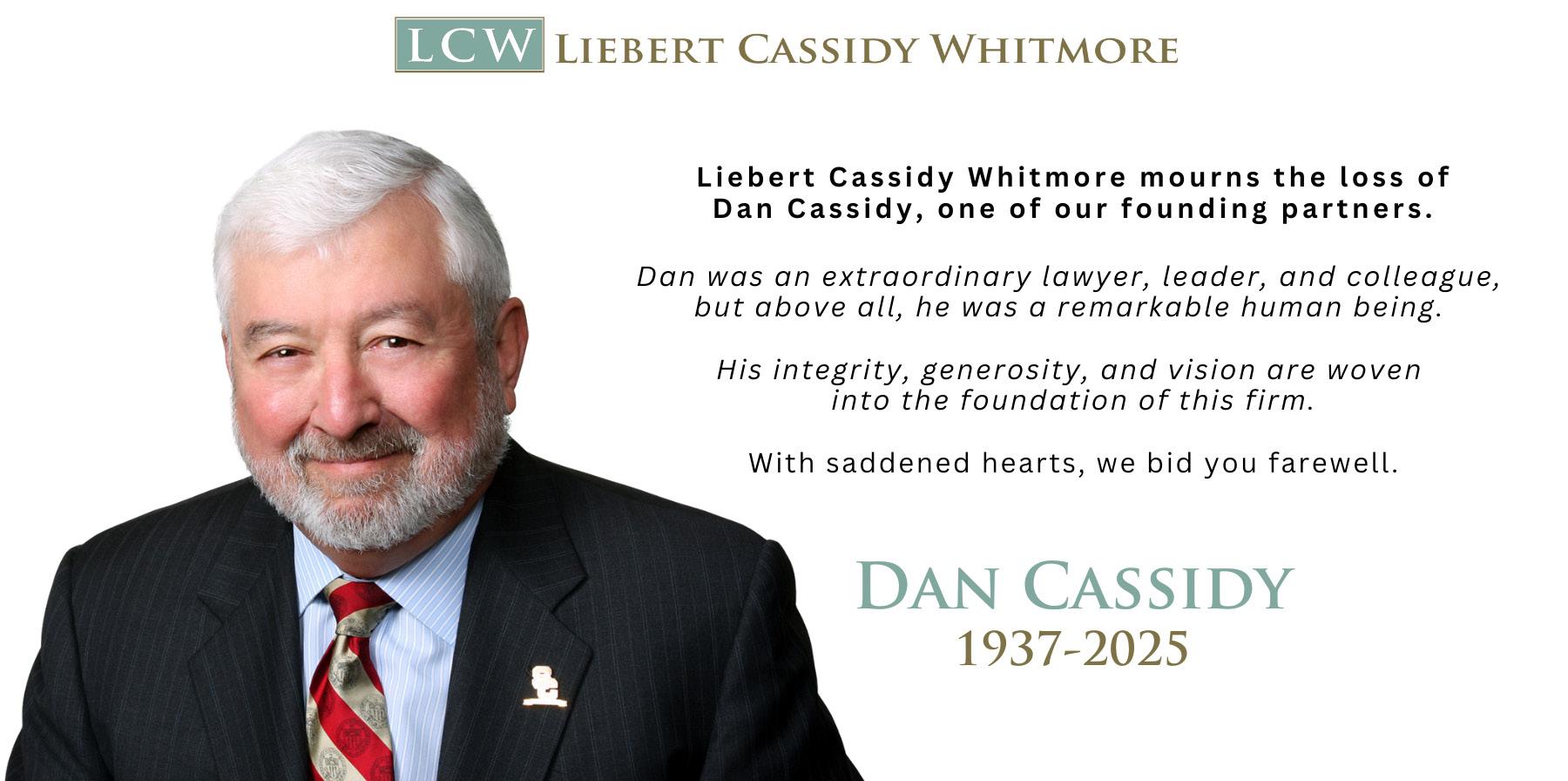
Dan Cassidy, pre-eminent public sector labor relations attorney and founding member of Liebert Cassidy Whitmore passed away on December 19, 2025. He was 88 years old.
Dan Cassidy was among the most experienced and accomplished practitioners in the fields of public sector labor relations and employment law. Over the course of his career, Dan effectively advocated on behalf of counties, cities, special districts, community colleges and school districts in negotiations, arbitrations and civil service commission and other administrative hearings. Dan negotiated hundreds of labor agreements for public agency clients, including various public safety, general, professional, and supervisory units. He also represented public agencies as a presenter and panel member in numerous interest arbitrations and fact-finding proceedings.
During his career, Dan became a well-established and widely respected authority on labor relations. He lectured and trained on labor relations – at the National College of District Attorneys at the University of Houston School of Law, University of Southern California School of Public Administration, California State University at Long Beach and before numerous other professional and educational organizations.
Dan began his legal career at Los Angeles County, eventually serving as Chief of the Labor Relations Division of the Los Angeles County Counsel’s office. He left the County to join Patterson & Taggert, where he met John Liebert. Together the pair, along with 4 other attorneys, formed our firm in 1980 and grew the firm’s practice to become California’s leading public sector, education and nonprofit management law firm which now has more than 120 attorneys in five offices.
Dan was a USC Trojan through and through. He was a longtime university volunteer and served on the Half Century Trojans Board of Directors (including as President) and was honored with the Alumni Service Award in 2017.
Dan also remained active in the firm, providing mentoring to our attorneys as well as serving as a faculty member of our Leadership Academy.
Dan is survived by his beloved wife Terri, sons Tim (Chris), Stephen (Janelle) and Danny (Denise); daughters Kathy (Mike) and Jeanine (Joe), along with 14 grandchildren and 14 great grandchildren (with number 15 on the way).
He is also survived by hundreds of colleagues, friends and mentees whose lives have been changed due to his vision, leadership and presence. Regardless of school affiliation, in his memory we collectively strive to honor his legacy and FIGHT ON.