It’s with great excitement to share my first director’s letter for the JSMA. As a University of Oregon alum (MA, Art History, ‘09) and former JSMA collections intern, I couldn’t be happier to return to the UO and to the very museum that helped shape my career path. Once a Duck, always a Duck!
I’m particularly grateful to succeed the stable leadership of John Weber, who retired on September 30. John left an indelible mark on this institution that can be seen and felt throughout the museum. His initiatives like the Faculty Engagement Working Group, the redesign of the Collections Lab, and various successful fundraising efforts to support key positions and programs have positioned the JSMA for continued success. Thankfully, John is staying in Eugene, so we look forward to seeing him at the museum from time to time.
These past few months I’ve enjoyed soaking in the exhibitions, learning about the collection and the building, getting acquainted with the staff, and meeting with campus colleagues and community supporters. It’s been inspiring to see so many students and faculty from departments across campus engaging with the museum. Having lived for many years in Tucson’s Sonoran Desert, it’s also been a pleasure to reacquaint myself with Eugene and the cooler weather of the Pacific Northwest. I’ve been relishing the fall colors and squeezing in as much outdoor time as I can.
As you’ll see throughout the magazine, the museum hit the ground running this fall term, and there is much to look forward to in the new year. Behind the scenes, but no less important, this year we are steadily working on reaccreditation by the American Alliance of Museums (AAM). The JSMA has been proudly accredited since 1975. We are one of only seven museums in Oregon and only 3% of museums nationwide with this distinction of excellence!
I’m honored to be here and know that above all, it is the people that make the JSMA what it is today. I’m truly in awe of the staff and their expertise, our Leadership Council’s steady support and guidance, the creativity and enthusiasm of our EIs, interns, and graduate fellows, and the steadfast support of our visionary donors. It’s been a great start, and I look forward to this journey with you.
Miller Executive Director
Olivia
Ellen Tykeson enjoys a tour of Gathering: A Photographer’s Collection with Thom Sempere and Christopher Rauschenberg.
Land of Origin curator Danielle Knapp and artist James Lavadour on the opening weekend of his retrospective.
UO President Karl Scholz, John Weber, Melissa Scholz, and Jordan Schnitzer at Weber’s farewell celebration.
Q & A with Olivia Miller
The JSMA’s new executive director has often said graduate school at the University of Oregon was “the best three years of my life.”
Other celebratory life milestones may have since surpassed her 2009 graduation with a master’s degree in the history of art and architecture, but the point remains: Miller found her calling at the UO, thanks in part to her time as an intern with a cultural gem on the Eugene campus, the Jordan Schnitzer Museum of Art
Formerly director of the University of Arizona Museum of Art, Miller returned to the JSMA in September as the new executive director. She brings robust experience—she was curator of exhibitions and curator of education at Arizona—and a dash of prestige: while there, she oversaw the return and restoration of a stolen painting enshrined in the annals of spectacular art theft, Willem de Kooning’s “WomanOchre.”
In an interview with OregonNews, Miller discussed her time as a UO student and the enriching contributions made to society through art, generally, and the JSMA, specifically. She also elaborated on possibilities for the future of a museum that, for nearly 100 years, has fostered global understandings of art and cultural histories.
What’s your vision for the museum?
It’s really important to me to spend the first six months, maybe even the first year, understanding the needs.
The museum is up for reaccreditation by the American Alliance of Museums. That is the highest level of honor that a museum can obtain and it’s a long process. It’s your stamp that you act according to best practices—the public can have the assurance that we are caring for the collection, which is held in the public trust. Many museums will not lend to an unaccredited museum so it’s also important for loans. Connecting with the public is very important. One thing I’m thinking about is a scientist in residence or a poet in residence program.
Can we get folks from the community to come in and create public programs? I would also love to teach an online class for people from all over the state or beyond.
What would you teach?
Art crime. That could include archaeological looting, the effects of war on public collections, theft, forgeries. The goal is to educate people on contemporary issues.
How does art benefit society?
Artists deal with huge concepts. Art is another language to process information, to process emotion. It provides an even playing ground for people to have a conversation about something that can be really challenging. And for university campuses particularly, I want students to remain curious. There’s no way that we can get through life without continuing to ask questions and wanting to learn about our world.
Art is also important as a historic record. There’s so much to learn about societies of the past, particularly societies that didn’t have a written language—to learn how they lived and what they believed in, what their values were.
Museums can also be a place to focus on well-being. We do mindfulness programs and even just being in the galleries and looking at art, it’s a place where you can get away from the constant news cycle or just stop doomscrolling and have a quiet moment.
How does the museum serve these ends?
We have contemporary objects in the same gallery as an object from 2,000 years ago, so we can bridge these geographies, these time periods, and find connections and that sense of shared humanity. That is what we need in this moment where people are not having conversations anymore, it seems.
There are also cross-cultural connections. We have a vast collection of Asian art and we’re continuing to build the Latin American and Caribbean collection. It’s important for students to see all these cultures in one place. For the K-12 tours, the museum is planting a seed in children to grow up with a love and respect for the arts.
You earned a master’s degree from the UO.
What did your education give you?
It’s where I grew to love teaching. The graduate teaching fellowship really built my confidence. It covered my tuition and gave me a stipend that helped with living expenses. That was where I got the experience creating a lesson plan. It also taught me the reciprocal relationship between teachers and students—a student is always going to point out something that you don’t see, or ask a question that you don’t know, and I found that exciting.
During graduate school you worked as a collections intern at the museum. What was that like?
It was the first museum vault I had ever been in and that was incredible. I’m a person who wants to know what’s behind every door, so to be able to go into these areas, I felt so privileged. I was able to
handle artwork. [As an intern] you’re often in front of the computer and working with the database, but it taught me what a museum does behind the scenes to care for the artwork.
The internship gave me lines on my resume: I was able to leave this program not only with a degree, but with work experience. At that time, I was planning to become a professor. Being here gave me a fuller perspective on how big a museum’s mission is. It is the collection, but it’s also the public. It’s the collections care, but it’s also the exhibition and interpretation and the collaboration. I wanted to do it all.
How do you know Jordan Schnitzer?
I was curator at the University of Arizona Museum of Art and Jordan started to come to Tucson regularly because he has properties there, so I gave him a tour. He said come to Portland and curate a show from his collection. I did an exhibition [at the Arizona museum] about food. It was fabulous. It was the first exhibition that we opened after our closure from COVID-19 and we had pre-COVID-19 attendance. It traveled to many other museums and was also the first bilingual catalog done by the Schnitzer Foundation.
Jordan is willing to share his collection and he’s also very generous with education grants to ensure robust educational programming to support the exhibition. He understands college is a key time in someone’s life to be exposed to new things and new ideas, to figure out what they love, what they’re interested in. He wants to support it.
At Arizona you were involved in the recovery and restoration of Willem de Kooning’s “Woman-Ochre,” a spectacular saga of art theft in 1985 that ended with the painting’s return in 2017. What did you take from the experience?
The theft was the worst side of humanity and the recovery was the best side of humanity. Everybody worked together to bring the painting back, and that ranges from the men who found it in New Mexico to the sheriff, the FBI, the university police and the de Kooning Foundation, all the way to the Getty Center in Los Angeles, where it stayed for three years as it underwent conservation treatment.
Museums have to be honest about these things. Had we kept this story hidden, the painting never would have come back. We were starting to lose institutional knowledge and there was no information about it online. We did a public event in 2015 and shared the story and invited press. That got it on the internet, so when the men found the painting, they were able to do a Google search and find an article.
We had to admit the things that we did wrong—the missteps and how this theft happened. Museums have to be comfortable admitting shortcomings to do better and get artwork returned.
You’ve developed a reputation for helping museums thrive in challenging times. Do you have an example from Arizona? We had to close for COVID-19, so we started art trivia on Zoom, which I co-hosted. Five years later, the museum still does it every month
and gets 85 to 100 people at every session. It’s one of the museum’s longest sustained programs and is more accommodating [than other programs]. People who can no longer physically come to the museum can come to art trivia and still feel connected to the museum.
How do you intend to lead at the museum?
First and foremost, I’ve told the staff that their health and well-being, and the health and well-being of their loved ones, comes first. People will not do their best work if they are not well.
At an institution of this size, the director can’t be everywhere at once, so it’s important to understand the role every department plays. We must have communication and collaboration. We’re all here for the same mission so we have to move forward together. Part of my job is helping to navigate that.
Story by Matt Cooper, OregonNews
Willem de Kooning (Dutch-American, 1904-1997). Woman-Ochre , 1954–1955, Oil on canvas, Gift of Edward J. Gallagher, Jr., Collection of the University of Arizona Museum of Art, 1958.002.015, The Willem de Kooning Foundation / Artists Rights Society (ARS), New York.
Gateway to Himalayan Art
Barker & Central Focus Galleries
February 21 – July 5, 2026
Gateway to Himalayan Art is a special exhibition that introduces the main forms, concepts, meanings, and living traditions of Himalayan art. The exhibition features sublime religious art created from the 13th through the 21st centuries in Tibet, Nepal, China, and Mongolia, drawn from the permanent collection of the Rubin Museum of Himalayan Art, which organized the exhibition.
At the start of the exhibition, a multimedia map orients visitors to the greater Himalayan region, which encompasses Indian, Nepalese, Bhutanese, and Tibetan cultures, as well as interrelated Mongolian and Chinese traditions. Gateway to Himalayan Art invites exploration of these diverse cultural spheres through exemplary objects presented in three thematic sections: Symbols and Meanings, Materials and Technologies, and Living Practices. Traditional scroll paintings (thangkas), sculptures in various media, and ritual items comprise the diverse range of objects on view.
Left: Bodhisattva Kshitigarbha (detail), Tibet; 17th century. Gilt copper alloy with pigment. 12 3/8 x 4 7/8 inches. Rubin Museum of Himalayan Art, Gift of the Shelley & Donald Rubin Foundation; F1997.12.4 (HAR 700040)
Adjacent page: Buddha Shakyamuni and Teaching Stories (Avadana). Central Tibet; late 18th-19th century. Pigments on cloth. 34 x 22 ¼ inches. Rubin Museum of Himalayan Art. Gift of the Shelley & Donald Rubin Foundation; F1996.27.1 (HAR 494)
The Symbols and Meanings section juxtaposes paintings and sculptures to introduce the iconography of Buddhas and bodhisattvas; Tantric, female, and wrathful deities; Hindu gods and goddesses; and spiritually accomplished humans such as arhats, Mahasiddhas, and great religious teachers (lamas).
Top left, clockwise
The Fifth Dalai Lama Ngawang Lobzang Gyatso (1617-1682) with Previous Incarnations Central Tibet; 18th century. Pigments on cloth. 25 ¾ x 16 5/8 inches. Rubin Museum of Himalayan Art, Gift of the Shelley & Donald Rubin Foundation; F1996.29.3 (HAR 506)
Mold for an image of Tsongkhapa (1357–1419). Mongolia; 19th century. Copper alloy, H. 13 ¼ inches. Rubin Museum of Himalayan Art; C2006.20.1a-b (HAR 65645)
Handheld Prayer Wheel. Central Tibet; Early 20th century. Silver, wood. 19 5/8 x 5 x 4 ½ inches. Rubin Museum of Himalayan Art, Gift of Shelley and Donald Rubin; SC2012.7.2
The Materials and Technologies section features in-depth displays detailing the making of a Tibetan thangka painting, the process of Nepalese lost-wax metal casting, the creation of clay, wood, and stone sculptures, and the fabrication of manuscripts and printed texts and images. It is augmented with artists’ tools and materials, and videos.
The section on Living Practices uses paintings, sculptures, ritual implements, and medical instruments to explore sacred rituals undertaken by Buddhists to accrue spiritual merit and achieve secular aims. It also introduces traditions of narrative and instructive Buddhist paintings, and concludes with an elaborate wooden shrine housing sacred images, texts, and ritual objects to encourage visitors to consider the original context of the kinds of devotional art featured in the exhibition.
This traveling exhibition is organized and provided by the Rubin Museum of Himalayan Art and curated by Senior Curator of Himalayan Art Elena Pakhoutova. Gateway to Himalayan Art is an integral component of the Rubin Museum’s Project Himalayan Art, a three-part initiative that also includes the publication Himalayan Art in 108 Objects and a digital platform. Together they provide introductory resources for learning about and teaching Himalayan art.
Project Himalayan Art has been made possible in part by a major grant from the National Endowment for the Humanities: Democracy demands wisdom.
This project was made possible in part by the Institute of Museum and Library Services MA-253379-OMS-23.
The publication Himalayan Art in 108 Objects was supported in part by the National Endowment for the Arts.
In addition to introducing an astonishing array of beautiful and meaningful works of art, Gateway to Himalayan Art includes informative videos explaining a variety of religious, cultural, and artistic practices, audio recordings from Himalayan communities that highlight living traditions, and opportunities to dive deeper into the rich contextual material available on the Rubin’s integrated digital platform.
In conjunction with the JSMA’s presentation of Gateway to Himalayan Art, the Rubin is generously lending two additional global contemporary works by Shraddha Shrestha and Tsherin Sherpa that include elements from traditional Himalayan Buddhist art to welcome visitors in the museum lobby. Gateway to Himalayan Art has already been shown at the Lehigh University Art Galleries in Bethlehem, Pennsylvania, and the McMullen Museum of Art at Boston College in 2023; the Harn Museum of Art at the University of Florida in Gainesville and the Frank Museum of Art at Otterbein University in Westerville, Ohio, in 2024; and the Utah Museum of Fine Arts at the University of Utah in Salt Lake City and the Flaten Art Museum at St. Olaf College in Northfield, Minnesota, in 2025. After it closes at the JSMA, the exhibition will travel to the USC Pacific Asia Museum at the University of Southern California in Pasadena.
The Rubin recently transitioned to being a “museum without walls,” sharing its collection and expertise through traveling exhibitions, object loans, grant opportunities, and partnerships with the goal of encouraging understanding and appreciation of Himalayan art worldwide.
Any views, findings, conclusions, or recommendations expressed in this initiative do not necessarily represent those of the National Endowment for the Humanities or the Institute of Museum and Library Services.
Leadership support is provided by the Henry Luce Foundation.
Lead support is provided by the Ellen Bayard Weedon Foundation, Bob and Lois Baylis, Barbara Bowman, the E. Rhodes and Leona B. Carpenter Foundation, Noah P. Dorsky, Fred Eychaner, Christopher J. Fussner, the Estate of Lisina M. Hoch, Matt and Ann Nimetz, The Randleigh Foundation Trust, Shelley and Donald Rubin, and Jesse Smith and Annice Kenan.
Major support is provided by Anne and Albert Chao, Daphne Hoch Cunningham and John Cunningham, Stephen and Sharon Davies, the Edward & Elizabeth Gardner Foundation, Janet Gardner, Mimi Gardner Gates, Hongwei Li, Max Meehan, the Monimos Foundation, Edward O’Neill, The Prospect Hill Foundation, Sarah and Craig Richardson, Rossi & Rossi, the Andrew Sabin Family Foundation, Namita and Arun Saraf, Eric and Alexandra Schoenberg, Eileen Caulfield Schwab, UOVO, Sandy Song Yan, and the Zhiguan Museum of Art.
Frontispiece from The Great Destroyer of the Thousand Foes (Mahasahasrapramardani ) Sutra Manuscript . Tibet; circa 13th-14th century. Pigments on paper. 7 ¼ x 27 inches. Rubin Museum of Himalayan Art; C2004.33.1
vanessa german (b. 1976 Milwaukee, WI). 7 Beautiful Ni$$As Awe-Struck in the Glory of An Appalachian Sunset , 2022. vintage quilt top, Astro turf, old farm picking fruit basket, getting caught up in the moment, foam tar, black pigment, cowrie shells, seeing your own self reflected in the open evening sky and wondering how anything could be so consistently beautiful and amazing as a sunset, love, gold thread, beaded rhinestone cloth, epoxy, boxing gloves, being speechless in wonder and delight and not having the police f*ck with you at all because they are too busy weeping by your side and clutching their own breast bones to wonder at how the rhythm of their own pattering hearts could match so perfectly the sound of light falling golden out of the sky and into their own open, stupefied maws, rhinestones, yes, yes, yes, 7 muscular wonders. 88 x 30 ½ x 20 inches. Collection of the Jordan Schnitzer Family Foundation. Courtesy of Olney Gleason
Love, Desire, and Sorrow: Artworks from the Collections of Jordan D. Schnitzer and His Family Foundation
Harold and Arlene Schnitzer Gallery | On view through May 24, 2026
Love, Desire, and Sorrow: Artworks from the Collections of Jordan D. Schnitzer and His Family Foundation examines the notions of house, home, and the body to explore the factors and social entities that define them. As Gaston Bachelard observes in The Poetics of Space, a house is a site of intimacy and solitude, an ideal space for creativity. Bachelard writes, “If I were asked to name the chief benefit of the house, I should say: the house shelters daydreaming, the house protects the dreamer, the house allows one to dream in peace.” As he envisions, a house can provide shelter and protection for our bodies, and inspiration, thereby becoming a home.
Love, Desire, and Sorrow foregrounds the notion of home, broadly defined, to ponder the economic, social, cultural, and political structures, policies, and events that shape our current existence. Artists in the exhibition investigate colonialism, slavery, and the diaspora, evoking quilts or representing subjects under duress in situations where the home and body exist in a state of threat. Other artists comment on family relationships and their complex nature, such as Louise Bourgeois’s comparison of her mother with a spider or by reclaiming old linens to safeguard memories. As artists consider the nation, or the environment, as a home, they portray bodies as hybrid creatures or stylized motifs. Yet, other artists such as Tracey Emin and Silvia Levenson focus on seduction and intimacy. In sculptures, prints and textiles, artworks in the exhibition contest normative representations of home and body as the artists consider notions of belonging, justice, and healing.
Artists in the exhibition: Artists in the exhibition include vanessa german, Louise Bourgeois, Wangechi Mutu, Rufino Tamayo, Sanford Biggers, Enrique Chagoya, Tracey Emin, Kiki Smith, Alison Saar, Wendy Red Star, Malia Jensen, Edward Kienholz, Nancy Reddin Kienholz, Silvia Levenson, and James Luna. The exhibition is curated by Dr. Adriana Miramontes Olivas, Curator of Academic Programs and Latin American and Caribbean Art.
Wangechi Mutu (b. 1972 Nairobi, Kenya). Homeward Bound , 2009. Archival pigment print with screenprint in colors on archival paper, 25 x 19 3/8 inches. Collection of Jordan D. Schnitzer
Tracey Emin (b. 1963 Croydon, UK). Wanting You , 2015. Embroidered linen handkerchief, edition of 50, 15 ¼ x 16 ¼ inches. Collection of Jordan D. Schnitzer
Power and Performance: Impressions of Chinese Secular and Religious Art and Customs
Soreng Gallery | On view through October 18, 2026
Manchu Man’s Formal Court Coat (Chaofu 朝服) with Five-Clawed Dragon and Wave Design. Chinese; Qing dynasty, late 19th century.
Dark blue silk satin with embroidery in polychrome silk and goldwrapped thread, trim of dark blue silk and metal-wrapped thread Jacquard-woven fabric, silk tassel and brass beads, 533/8 x 83 15/16 inches.
Gift of Mason DeNeffe
This presentation of works from the museum’s Chinese collection explores the issues of power and performance in four sections: politics, textile, religion, and funeral art, along with a recently acquired Twenty-Four Seasons scroll by renowned contemporary artist Qiu Zhijie (born 1969) that draws connections across cultural and historical boundaries. The exhibition presents objects symbolizing political and religious power, such as textiles, bronze vessels, funerary art, and calligraphy from the imperial period, Republican times (1912-1949), and the People’s Republic of China (1949-present). Highlights are a Han-dynasty (206 BCE-220 CE) funerary figurine once adorned with silk clothing, a late Qingdynasty (1644-1912) woman’s court robe, a calligraphic inscription by Emperor Yongzheng (1678-1735, reigned 1722-1735), and a rare ceremonial outfit from the brief revival of imperial power during the early republic. Propaganda posters and woodblock prints celebrate revolutionary performances, contrasted by impressions of people’s reality in the works of Hung Liu (1948-2021), Ma Han (born 1968), and other contemporary artists.
This exhibition was co-curated by Professor Ina Asim (Department of History), Professor Mariachiara Gasparini (Department of the History of Art and Architecture), and Dr. Yan Geng (Curator of Contemporary and Traditional Chinese Art) at the University of Oregon.
Adjacent page: QIU Zhijie 邱志杰 (1969-). Chinese; People’s Republic of China, 2024. Twenty-Four Seasons (Ershisi jieqi 二十四节气). Handscroll, painted, calligraphed and stamped ink on paper, 18 x 198 inches. Purchased with the generous support of Jack and Susy Wadsworth and the Lijin Guohua Foundation
Top, left: Tomb Figure (Mingqi) of Standing Man. Chinese; Han dynasty (206 BCE-220 CE). Unglazed gray earthenware with traces of cold-painted pigments, 23 x 6¼ x 4 inches. Murray Warner Collection
Bottom, left: Stone Print of Hottara (Vajraputra), one of Seventeen Arhats. Chinese; late Ming or early Qing dynasty, 16th-17th century, 9¾ x 63/8 inches. Murray Warner Collection
| April 25, 2026 - March 21, 2027
Navigating through Centuries: From Ancient to Global Contemporary in Korean Art
Navigating through Centuries surveys the complex trajectory of art in Korea, which was significantly impacted by socio-political upheaval and cultural developments from the fifth century to the present. The exhibition is comprised of six chronological thematic sections—from the power and religion of the Three Kingdoms period (57 BCE-668 CE), to the refined aristocratic ideals of the Goryeo (918-1392) and Confucian governance of the Joseon (1392–1910) dynasties, through vestiges of tradition after the Korean War (1950-1953), experimental practices during the modern era, and globalization of contemporary art. Each section examines how aesthetic practices respond to the evolving philosophies, ideologies, critical events, and issues of a specific historical period.
Below: Korean, 10th-11th century. Kundika Ritual Sprinkler (淨甁 , 정병 , Jeongbyeong) Bronze. 12 5/8 x 4 ¾ x 6 1/8 inches. Gift of Mr. and Mrs. Mark R. Sponenburgh
Wan Koo & Young Ja Huh Wing and Jin Joo Gallery April 25, 2026 - March 21, 2027
The exhibition begins with materials from the Three Kingdoms period in which are embedded political/religious authority and communal rituals, laying the foundation for Korean cultural memory. The Goryeo dynasty section highlights the refined aesthetics and Buddhist motifs that reflect aristocratic ideals and literati culture, while also indicating Korea’s participation in East Asian cultural exchange. The Joseon section showcases art that embodies the Confucian literati values that fundamentally shaped the moral order, governance, and cultural life of the period.
The modern and contemporary sections focus on twentieth-century art, which has continually questioned, responded to, and been shaped by the last tumultuous century of Korean history. The first postwar section features art that portrays the remnants of indigenous culture in the aftermath of the Korean War. The next section presents
experimental works by artists who challenged the canon of art by blurring boundaries of cultures, genres, and mediums. The final section showcases global contemporary art by diasporic creators, many of whom have played central roles in integrating Korean art into the international mainstream.
Navigating through Centuries narrates the conflicted yet intertwined relationships between art and culture, individuals and communities, and socio-politics and history, inviting audiences to consider the broad history of Korea through the lens of art. The exhibition was curated by Soojin Jeong, 2023-2026 Post-Graduate Curatorial Fellow in East Asian Art, as well as Heejung Chang, 2025-2026 JSMA/Korea Foundation Global Challengers Museum Intern.
Above: LEE Sangbeom 李象範 이상범 (1897-1972). Korean, Republic of Korea, 1963. Autumn ( 秋景山水 , 추경산수, Chukyeongsansu). Framed painting; ink and light color on paper. 23 x 63 inches. Gift of the Georgia-Pacific Corporation, Portland
Looking Back Diane Arbus, 1958–1970
Focus Central Gallery | December 3, 2025 - July 5, 2026
Photographer Diane Arbus (American, 1923-1971) is recognized for her singular way of seeing—honest, direct, and often disquieting. The works on view span her career, from early 35 mm street photographs to the later square-format portraits that became her hallmark and include both personal projects and editorial assignments. While she photographed primarily in New York, Arbus also traveled for specific stories—beauty pageants, nudist camps, family gatherings, and institutions—seeking people in moments when public display and private being intersect.
Looking Back: Diane Arbus 1958-1970 presents twenty vintage photographs drawn from an extraordinary gift by San Francisco’s Fraenkel Gallery through the generosity of Jeffrey Fraenkel. Part of a larger group of thirty-six prints recently donated to the JSMA, the exhibition offers a focused view of one of the twentieth century’s most debated and influential photographers. Seen together, these prints trace the evolution of Arbus’s vision and the curiosity that defined her practice.
In 2003, art critic Hilton Als observed that “Arbus asked us to look harder and with more honesty than we might have wanted to. In doing so, she made the act of looking itself a kind of moral education.” Her photographs embody the conviction that sustained attention may uncover what often goes unseen. Arbus once said, “I do feel I have some slight corner on something about the quality of things... I really believe there are things which nobody would see unless I photographed them.”
Looking Back invites us to experience Arbus’s photographs as seen at the time of their making, and now in our own. Her subjects—those who once looked back at her—still meet our gaze across decades. Each image holds two moments: the one it records and the one in which we, as viewers, confront them today. Looking Back is curated by Thom Sempere, JSMA Associate Curator of Photography.
Left, top to bottom:
Diane Arbus (American, 1923-1971). Seated transvestite with crossed ankles, N.Y.C., 1966. Gelatin silver print. Image: 14 ½ x 14 3/8 inches; sheet: 20 x 16 inches.
Right: Diane Arbus (American, 1923-1971). His Serene Highness Prince Robert de Rohan Courtenay, N.Y.C., 1961. Gelatin silver print. Image: 8 x 5 3/8 inches; sheet: 14 x 11 inches.
MacKinnon Gallery | On view beginning April 4, 2026
Lapidary refers to the art of cutting and polishing stones for jewelry and other adornments . . . it also refers to a person creating such work. And for those creatives fashioning this artform, an exhibition of such work promises to be an intriguing exploration.
Admittedly, an exhibition of a different sort, Vibrant Embellishments in Stone, Shell & Enamel centers not on a variety of featured stones but rather how they are presented: shell and enamel in jewelry, functional metalwork and hollowware set in silver, copper, and gold. To be admired are the variety of ways in which the ornamentations are carved or cut, polished and set.
Long before the Industrial Revolution, stone was cut, chipped and broken in strategic ways by a lapidary. It was then hand-polished by rubbing the stones together, often with pastes of water, sand or “rotten stone,” a mixture of limestone and silica called tripoli, which is still used today.
The use of glass and enamel also has a rich history as well. While beautiful in their own right, glass and enamel were incorporated into metal designs as a way to imitate various gemstones, a cost-effective enhancement.
The objects in this exhibition were created in the early- to mid-20th century by makers from all over the world, including the United States, the Navajo Nation, Scotland, Denmark, Mexico, Great Britain, Indonesia, Germany, Italy, South Africa, Korea, and China. They come from the museum’s extensive metals collection, including the Murray Warner Collection of Oriental Art, the Margo Grant Walsh Twentieth Century Silver and Metalwork Collection, and the Collection of Hattie Mae Nixon. Other pieces are on loan from an anonymous lender.
This exhibition is curated by Kendra Roberts, an artist, curator, and founder of Common Ground Arts, an arts consultancy based in Portland, OR. She also currently serves as the Director of Public Engagement at Blackfish Gallery, Portland’s longest running artist owned/operated gallery, and the President of the Portland Art Dealers’ Association.
Brooch (German, ca. 1910), Oxidized silver with blister pearl cabochon, 1 × 2 1/8 inches. Margo Grant Walsh Twentieth Century Silver and Metalwork Collection, gift of Margo Grant Walsh
Larry Moses Begay (Diné [Navajo], b. 1969). Brooch. Late 20th century. Sterling silver, turquoise. Diam. 3 inches. Margo Grant Walsh Twentieth Century Silver and Metalwork Collection, gift of Margo Grant Walsh
Hairpin (簪飾; 매죽잠; Maejukjam). Unknown, Korean. Joseon dynasty (1392–1910); Colonial period (1910-1945), early 20th century. Gold, amber, enamel. 9 ½ × 1 ½ × 1 inches. Murray Warner Collection
Black Marat and the Aesthetics of Liberation
Graves Gallery | April 11 – August 2, 2026
Black Marat and the Aesthetics of Liberation challenges art historical discourse and institutionalized racism through diverse strategies of resistance that include dance, music making, and silence. Adopting archival footage and collaborative performance, artists such as Michael Moloi create video art to contend with violence against bodies and residential segregation. René Peña’s photographic lens mines visual archives and academic disciplines that have underrepresented black bodies to question not only issues of representation, but also authoritarian regimes. In Black Marat ,
Peña further evokes Catholic imagery to consider notions of class, race, and gender. Malaquías Montoya and Jaune Quick-to-See Smith adopt printmaking to both celebrate difference and call out the oppression of bodies. Other artists in the exhibition similarly employ artistic means to criticize violence and tyranny and to prompt viewers to consider art and culture as tools for activism and agency. The exhibition is curated by Dr. Adriana Miramontes Olivas, Curator of Academic Programs and Latin American and Caribbean Art.
René Peña (b. 1957 Havana, Cuba). Black Marat , 2009. Color lambda print, 24 x 32 in. General Acquisition Fund purchase made possible with support from Natalie Newlove
Shared Visions
Olga de Amaral Paisaje heredado 4
“Gold is not a color, it is a material of transformation.”
–Olga de Amaral
On view through March 15, 2026
For more than six decades, Olga de Amaral has created distinctive woven works that defy easy categorization by simultaneously evoking the textures of mosaics, tapestries, paintings, and sculpture. An experimental artist, de Amaral has used a variety of techniques and materials over the years, such as horsehair and palladium, to achieve a meticulous and multi-dimensional quality.
Born Olga Ceballos Vélez in Bogotá, Colombia, de Amaral initially studied architectural design before pursuing fiber arts at the Cranbrook Academy of Art in Michigan. Although she returned to Colombia where she continues to live and work, her extensive travels have also informed her work. A watershed moment for her was in the 1980s when she traveled to Japan. There she was inspired by the art of Kinstugi, where lacquer mixed with powdered gold is used to mend the cracks of broken pottery. As de Amaral explained, “Gold became an important material in my work. My search centered on how I could turn textile into golden surfaces of light.” The use of gold also has cultural and historical significance in South America, being a sacred medium for preColumbian artists as well as a target of colonial plunder.
At first glance, Paisaje heredado 4 looks like ceramic beads, strung together creating an ombre transformation from blue to green to gold. The composition is divided into distinct registers, each with its own pattern, texture, and color. As the title suggests, it evokes the varying qualities of a landscape and creates a setting for the viewer to meditate and reflect.
Olga de Amaral (Colombian, b. 1932). Paisaje heredado 4, 2002. Linen, gesso, acrylic, Japanese paper and gold leaf. 86 x 43 inches. Private collection
James Lavadour: Land of Origin’s National Tour
Thanks to a traveling exhibition partnership with the Art Bridges Foundation, the retrospective exhibition James Lavadour: Land of Origin will be presented in five museums over the next three years after it closes at the JSMA on Sunday, January 11, 2026.
Northwest Museum of Arts and Culture
Spokane, WA
January 31 - June 7, 2026
Boise Art Museum
Boise, ID
August 29, 2026 - February 28, 2027
Whatcom Museum
Bellingham, WA
March 20 - September 6, 2027
Heard Museum
Phoenix, AZ
March 31 - September 4, 2028
Missoula Art Museum
Missoula, MT
October 3, 2028 - March 31, 2029
The fully illustrated catalogue includes essays by exhibition curator and JSMA McCosh Curator Danielle Knapp and guest writers
Meagan Atiyeh, Rebecca Dobkins, and Marie Watt; an interview with Lavadour and former JSMA Executive Director John Weber; a fully illustrated checklist with additional images of representative works; and a comprehensive artist’s CV. The James Lavadour: Land of Origin catalogue is made possible thanks to an Exhibition Documentation and Support grant from The Ford Family Foundation and a gift from Bill and Leslie Cornog.
Development News
Member Spotlight: Sarah Oliver-Johnson and Andrew Hroza
How did you first get involved at the JSMA?
Late one night at a fabulous cocktail party, I was sitting next to Leadership Council member Sarah Finlay! At that point I was, but merely, a JSMA fangirl. Andrew and I moved here from Europe (and before that Chicago) where I was entirely spoiled for museum choice so I was VERY excited to find a museum of its caliber in my new hometown. Sarah and I sat long into the evening and talked about the museum and its collection. She and her husband Patrrick savvily hosted Andrew and me at a dinner the following month with Esther Harclerode, JSMA Development Director, and I was hooked!
What does being a JSMA member mean to you?
It means partaking in the preservation of art in our community and beyond. It means supporting my belief that visual beauty is a vital language. It means that this little town we live in—charming, quirky hamlet that it is—has a worldclass art museum whose collection rivals that of other more metropolitan places.
What do you wish others knew about the JSMA?
The Shared Visions Program! The fact that these magnificent, renowned pieces of art come through the JSMA—by contemporary and master artists alike—and that after their time with us, are destined for major museums or private collections (where they might never be seen again) is nothing short of extraordinary! It’s an unfortunate truth that fine art is often inaccessible to the majority. Travel, education and expense are all barriers. The Shared Visions program bridges those disparities. For a jaunt across campus and $5, one can walk into the JSMA and see works of art that would otherwise require a trip to Europe. THAT is something to marvel at! We’ve had a Titian for goodness sake!
What was your favorite exhibition at the JSMA?
Very, very hard to answer given the breadth of exhibits that have come through in the five years we’ve lived in Eugene.
Two that stand out are Remember
This: Hung Liu at Trillium and It’s (Still) A Magical World Hobbes, Ole Buddy featuring the cartoons of Bill Waterson. Mike Bragg and Jenny Jonak got me into a private tour with the everexcellent Ann Rose Kitagawa of Remember This and I’ll never forget the sensation and majesty of standing in the Barker and Soreng galleries in the presence of Hung’s powerful work. I love realism and the dreaminess of her veiled layering is something I’ll always be in awe of.
Andrew and I took our son, Grayson, to the Bill Waterson exhibit, sketchbook and pencil at the ready, and spent literal hours in that world. Getting to see his original work with all its humanness was totally impactful for Grayson. “Look Mommy, you can see where he covered up his mistake! He’s a professional artist and even he made mistakes!” What a valuable observation for a young person!
How has art impacted your lives?
Probably in more ways than it’s possible to say. Andrew and I are both creatives—he’s a chef and I’m an artist— so art is ever in the forefront of most things we do. My grandmother was a major patron of the arts in Washington DC and artistic practice was really encouraged throughout both our childhoods. That early exposure definitely set us on the path we’re on now and shaped our skills. I’ve watched Andrew cook for 20 years and see every day how composition and color guide his work and how much he’s benefitted from having a hyper developed creative muscle. I tend to lean on my creativity for problem solving—how can we make that better, what can we do with this, what’s the creative answer to this puzzle?
I’m also a real sticky-stickler for making things pretty, haha. What correlations exist between the visual arts and the culinary arts?
Golly, so many. Beyond the fact that dining is very much a visual medium—“one eats with their eyes first” and all that—I think they both provide admission to history and culture. Andrew has a rich Bohemian ancestry. His relatives were poor potato farmers under the Soviet regime and had to work really hard at living a life that still had good food and joy and honored those as necessary tools of survival.
Much like Hung Liu’s documentation and study of laborers and refugees, Andrew’s food, in parallel, goes beyond the snapshots we have of them and explores their lives
in depth. Viewing Liu’s “Polly and Her Horses,” for example, one immediately ponders the subject, notes her tenderness, contemplates her origins. For me, Andrew’s food evokes the same thoughtfulness, prompting us to consider how this group of humble, hardworking Bohemians lived.
How has Eugene welcomed you to the community?
What has the response been to your restaurant?
The response to Domek has been nothing short of outstanding! I think we can unequivocally say that Eugene was READY for Eastern European food. We’ve been full to capacity almost every night since our opening and every night has felt like some joyful, elegant party. A little Bohemian, a little PNW, a lot of celebration!
We run the restaurant in keeping with European traditions. We’re only open four days a week. We have one, very tight knit staff who eat dinner together at the start of every shift and enjoy a drink together at the end. There’s a real feeling of happiness and closeness and collaboration that permeates the restaurant and I think Eugene is reacting to that in a way that only makes it stronger!
What book are you reading?
Almost ironically … The Goldfinch by Donna Tart. It’s been on my list forever and I’m finally diving in. Also the Berry Pickers by Amanda Peters. Andrew, a sucker for the classics, is on a Steinbeck kick. He’s just finished Tortilla Flats and is onto The Pearl.
What do you hope for the future?
That future generations continue to value art as a critical part of our existence. That they recognize how utterly bereft we’d be without it. And that the older, more established generations do everything in their power to support the younger generations in this cause. We’re in the restaurant industry and work primarily with younger people. We see firsthand how the world they’re trying to make it in leaves little room for art or their pursuit of it. Ensuring that these upcoming generations of creatives, chefs, artists, connoisseurs, etc have adequate resources is pretty much my ideal for a strong future. Other than that? Sleep. I’d love a future with more of that. Affordable healthcare. That’d be swell! How about a really fabulous Peruvian restaurant in Eugene? We’d totally get behind that!
Ducks Give May 14, 2026
Join Ducks and Duck fans from around the world for a twenty-four-hour giving event to make an impact on the programs of the Jordan Schnitzer Musuem of Art. Stay tuned for reminders and ways to donate on this incredible giving day.
Our photography collection is growing— thanks to
a
gift from Christopher Rauschenberg
Christopher Rauschenberg provided insights to his collection during a tour of Gathering: A Photographer’s Collection.
JSMA’s Fall 2025 exhibition Gathering: A Photographer’s Collection presented over seventy works from the private holdings of Portlandbased photographer and curator Christopher Rauschenberg. Spanning decades of work by international and nationally emerging and established photographers, Gathering provided opportunities to consider the wide range of human experience: personal, familiar, social, cultural, political, and spiritual through photographers’ perspectives . JSMA is delighted to announce that, thanks to Rauschenberg’s generosity and support of the museum’s academic mission, this group of photographs will comprise Rauschenberg’s first installment of new acquisitions to the museum’s collection over a five-year gifting plan. Thom Sempere, JSMA Associate Curator of Photography, will work with Rauschenberg to identify additional groups of gifts from his collection, with an anticipated acquisition of over 5,000 photographs completed by 2030. This incredible gift is further supported by a pledge of $50,000 to support the processing and stewardship of the Rauschenberg Collection. The collection has already seen impressive academic use with 17 classes and 929 students viewing Gathering: A Photographer’s Collection fall term
In case you missed the exhibition, you can still take a virtual tour by visiting http://bit.ly/47jEwag.
Staff Updates
Meet our new staff!
Heejung Chang
Heejung Chang is a visiting scholar at the University of Oregon and a Korea Foundation intern at the Jordan Schnitzer Museum of Art through the Global Challengers program, which offers emerging Korean professionals opportunities to gain field experience at major institutions abroad with dedicated Korean galleries, fostering global perspectives and professional expertise.
Building on her previous museum research experience at the National Museum Complex of Korea, Heejung has been exploring how museums can connect education, research, and public engagement, extending this inquiry toward international cultural exchange and collaboration. At JSMA, she has been inspired by its role as a university and community museum that advances cultural understanding through art, and she is now applying this perspective to her work on the upcoming Korean exhibition, focusing on the premodern section of Korean art.
Haley Davis
Haley Davis is the new Scheduling Coordinator. She has a BA in Art History from the UO and an M.Litt in the History of Decorative Art from the University of Glasgow, where she wrote her dissertation on the impact of exotic and cryptozoological animal materials on European decorative art in the 15th and 16th centuries. Haley lived in the United Kingdom from 2008 to 2021, where she trained as a fine art auctioneer before transitioning to a career as a higher education administrator at the University of Bristol. She has significant professional expertise in complex scheduling, project management, executive assistance, and process development.
Outside of work she enjoys traveling, cooking, outdoor pursuits, and gardening, and she holds seats on a charitable foundation board and a corporate advisory board.
Melissa Dawn
Melissa Dawn is the new Associate Museum Registrar. She was previously the Registrar and Collections Manager at the Museum of the Rockies, Montana State University. At MOR, she oversaw the care of the Cultural History collection, managed loans, and collaborated with the exhibits team on in-house and traveling exhibitions. She led the museum’s reaccreditation with the American Alliance of Museums and served as the institution’s NAGPRA Coordinator. Melissa holds a BFA in Studio Arts with minors in Museum Studies and Art History, a BA in Fine Arts, and a Master’s in Education. A practicing visual and performing artist, she is excited to support JSMA’s mission through her combined expertise in collections stewardship and creative practice.
Katie Loney
Katie Loney is the new Post-Graduate Museum Fellow in European and American Art. She completed her BA in Art History at UO and returns to campus after earning her PhD. in History of Art and Architecture at the University of Pittsburgh. A specialist in nineteenth-century craft, design, and material culture in global and imperial contexts, her research has been supported by several institutions including the Metropolitan Museum of Art, the Smithsonian American Art Museum, and Pitt’s World History Center. At the JSMA, she looks forward to studying its rich, cross-cultural collection, working with UO faculty and students, and conducting research on the materiality of Christian devotional images and the circulation of prints featuring the 1939 New York World’s Fair.
Javi Martínez
Javi Martínez has been with the University of Oregon for six years and is the newest member of the security team. An avid racer, Javi enjoys chasing lap times at different racetracks and dreams about endurance events. Off the grid, he fuels his passion for business development by mentoring startups and scouting the next big idea. Javi and his wife Taylor recently welcomed their first child, Mateo. Together, the young family loves travel, exploring new places, and collecting passport stamps one adventure at a time.
John Rustik
John Rustik is a graduate of the University of Oregon’s School of Journalism and Communication. He was born and raised in the Eugene-Springfield area, allowing him years of interaction with the museum through summer camps and volunteer opportunities. John has worked at the University of Oregon since 2023. In his free time, he enjoys playing soccer with his friends and spending time with his family and two dogs, Winnie and Walter.
Education
Art Heals: Expanding Access to Art for Well-being in Missoula, Montana
Museum educators from the Jordan Schnitzer Museum of Art are working together with the Missoula, Montana, cultural community to broaden the reach of their Art Heals initiatives, programs designed to foster emotional well-being through creative expression.
In June, Gabrielle Miller, Museum Educator, and Rosemarie Oakman, Museum Program Manager for WellBeing and Community Engagement, facilitated Art Heals workshops for 75 K–12 educators at the Montana Museum of Art and Culture. These sessions were part of the IGNITE! Arts Integration Conference hosted by SPARK! Arts.
“SPARK! Arts’ mission is to ensure equitable access to the arts for all P-8 students at Missoula County Public Schools,” according to Executive Director Sienna Clayborn. “SPARK! Arts provides grade-level arts experiences and arts integration residencies to over
5,500 students; as well as support for the district’s arts integration initiative in providing high-quality arts integration professional development to educators.”
Each 90-minute workshop invited K-12 educators to explore artworks from the Montana Museum of Art and Culture and the JSMA through guided visual inquiry. Attendees then engaged in a close reading of Ada Limón’s poem After the Fire, followed by a hands-on collage activity. Using prompts drawn from both the visual and literary materials, educators created mixedmedia responses. At the end of each session, participants were invited to share what they created. This is an essential part of the community building and connection we make in every Art Heals session.
Before the Art Heals workshops, participants described feeling anxious, tired, stuck, worried, and nervous, words reflecting stress and emotional strain. After the workshops, however, they reported feeling calm, inspired, relaxed, connected, joyful, and fulfilled. These words are collected through a simple reflective exercise, where participants share three words that describe how they feel before and after each session. This powerful shift highlights the workshop’s impact in fostering emotional well-being through creative, reflective engagement with art.
In addition to allowing educators time to decompress, the Art Heals workshops also provided Montana-based educators with skills to take back to their classrooms. These included experience in using art for contemplative and reflective time and gaining resources for integrating art making into their daily lives. The train-the-trainer model is an integral goal of our Art Heals initiative.
Image of a work in progress by a participant of an Art Heals workshop at the SPARK! IGNITE! Arts Integration Conference.
Gabrielle Miller (Museum Educator) and Rosemarie Oakman (Museum Program Manager for Well-being and Community Engagement) outside the Montana Museum of Art and Culture, where they led Art Heals workshops for 75 SPARK! IGNITE! Arts Integration Conference participants
In October, Lisa Abia-Smith, Director of Education, joined Rosemarie Oakman in Missoula to lead additional Art Heals workshops. These sessions reached expanded audiences, including K–12 educators, healthcare professionals from St. Patrick’s Providence, cultural leaders from SPARK! and the Zootown Arts Community Center, faculty from the University of Montana, and staff from the Missoula Art Museum. Both workshops used the museum’s Art Heals framework to guide the sessions.
The impact of the workshop on participants was palpable. Reflecting on her participation, Sienna Clayborn shared: “I noticed the shift in my mood and stress level. When I came into the workshop, I was scattered, stressed and overwhelmed. After committing to be present, and participating in the writing and collage activities, my state changed. I felt more grounded, calm and confident in my ability to accomplish upcoming tasks. As I looked around the room, I saw lots of engagement and a general sense of pride and contentment.”
Karin Bartels, an Arts Integration Instructional Coach for Missoula County Public Schools, emphasized the communal aspect: “I took away a deeper sense of community and connection. Even with colleagues I already knew, I learned more about them through the art. It reminded me how important it is for students to have that same sense of belonging in their classrooms.”
For Karen Kauffman, a SPARK! Board Member, the experience was deeply personal. “The poems were highly effective for getting me to go deep fast. As were the pre- and post-words describing my emotional state. I have been grieving the death of my mother for eight weeks and sadness and loss are very present right now, so the experience brought me there quickly. Having all the beautiful rich art supplies felt like such a treat, with plenty of time to dig in. I’m not primarily a visual artist so the collage is not something I do every day nor is it something I have confidence doing but you helped me feel safe and confident and I loved my creations. The more educators can use art to express their emotions the better they will help students do the same. The experience is very important, and I appreciate you sharing it.”
As Art Heals continues to grow, these workshops underscore the profound role that art can play in fostering connection, healing, and resilience for educators, students, healthcare professionals, cultural administrators, and the communities they serve. The momentum built through both the June and October workshops reflects a shared commitment between the Jordan Schnitzer Museum of Art and Missoula’s vibrant cultural partners to expand access to the arts. With each session, new relationships are formed, and existing ones are strengthened, laying the foundation for continued collaboration and deeper integration of arts-based well-being practices throughout the Missoula community.
Reflecting on the growing partnerships and the restorative power of creative engagement, Sienna Clayborn shared this closing thought: “I hope that we remember that art truly does heal. That we can use the resources and expertise that we have in our communities and collaborate with one another to uplift the magical powers of the arts.”
Lisa Abia-Smith (Director of Education) leading an Art Heals workshop with Cultural Administrators and Hospital Staff
Rosemarie Oakman (Museum Program Manager for Well-being and Community Engagement), with members of SPARK! Arts Board and Staff
Collage created by Sienna Clayborn, SPARK! Arts Executive Director, during the October Workshop Series
Learning and Engagement with James Lavadour: Land of Origin
The Jordan Schnitzer Museum of Art’s education department, in collaboration with curator Danielle Knapp, was awarded a Learning and Engagement Grant through the Art Bridges Foundation to support programming around James Lavadour : Land of Origin, a fivedecade retrospective of landscape paintings and prints from the prolific Walla Walla artist. The education department team has drawn from Lavadour’s work in our K-12 programs, teacher professional development, and Art Heals workshops.
In our Art Heals workshops, Lavadour’s painting Torch has been paired with Ada Limon’s poem After the Fire. Participants then create their own landscape paintings inspired by his work. Audiences have included Madres Club, a Spanish-speaking workshop series for mothers and children; Reflections and Connections, a memory loss arts access program; Community and Connections, the museum’s creative aging program; Mindfulness Meditation and Mindful Drawing and Mindful Looking, the museum’s mindfulness programs; as well as the Arts Access program for children with disabilities.
Lavadour’s landscapes have further inspired Art Heals partnerships with Samaritan Hospital’s Esperanza Para la Madres program for postpartum Spanish-speaking mothers, the Pastega Cancer Resource Center’s Transformation Cancer Support and Cancer Survivors groups, and Creative Wellness workshops for medical staff at Oregon Health & Science University.
On Indigenous Peoples’ Day, Museum Educator Gabrielle Miller (Grand Ronde, Pechanga Payómkawichum) and Studio Assistant Feather Miller (Warm Springs) also featured his work for an Art Heals workshop for the Native American and Indigenous communities at UO and beyond. Miller reflected:
Feather Miller, Studio Assistant, leading a discussion in the Land of Origin exhibition with the Reflections and Connections Memory Loss Arts Access Program.
Artist James Lavadour with Gabrielle Miller (Museum Educator), Mari La Mont (Studio Assistant), Rosemarie Oakman (Museum Program Manager for Well-being and Community Engagement), and Grace Douglas (Studio Assistant)
“I reached out to the Northwest Indian Language Institute, Native American Indigenous Studies Program, Native American Student Union Program to develop a program that reflected the desires and needs of the community. It was a collaborative effort between our communities and organizations on campus, resulting in a wonderful workshop that allowed everyone to connect, reflect, and engage with the artwork and each other. There were many people from across the U.S., including Indigenous communities, who connected through similarities and differences, sharing the love and honor they give to the landscapes they painted and were inspired to create. It was a really needed workshop for our community here at UO. It’s something that I want to bring back every year, make sure that we’re continuing that collaboration with our UO Native American and Indigenous communities here, and just making sure that we are being an institution that opens a space to them, gives them space to be present, be loud, and see themselves in a museum, see themselves creating art and see themselves connecting and being a community here.” This workshop exemplified the museum’s commitment to centering Indigenous voices, fostering meaningful collaboration, and creating spaces where Native communities feel seen, heard, and empowered through art.
In addition to Art Heals programming, the education department has led a series of Teacher Professional Development workshops that provide educators with lesson plans and materials for presenting Indigenous histories through a decolonized lens. Lessons integrate social and emotional learning, creative writing, history, geology, and visual arts. The museum has worked with pre-service teachers enrolled in the UO College of Education’s Integrating the Arts in Education course, as well as arts educators across Oregon through the Oregon Art Education Association. A virtual workshop with educators in Missoula, Montana, through our partnership with SPARK! Arts will coincide with the Land of Origin exhibition’s final stop of a national tour ending at the Missoula Museum of Art.
Through K–12 programming, students from across Oregon are invited to engage with Land of Origin through guided visual inquiry using Visual Thinking Strategies (VTS). These interactive tours foster close looking, critical thinking, and meaningful dialogue, while integrating social and emotional learning to support empathy, self-expression, and collaboration. Following their gallery visits, students create landscape collages in the museum’s studio, translating observation into personal and creative expressions.
This October, the education department had the opportunity to share the exciting work we have been doing with the artist, James Lavadour, and other Indigenous stakeholders. Dr. Deana Dart (Coastal Chumash) of Live Oak Consulting remarked,
“The thing that strikes me is the breadth of the outreach that they’re doing and how many facets of the community they’re able to bring into this experience and beauty of James Lavadour’s work, I had no idea that the JSMA was working so much outside the walls of the museum and I’m really inspired and also heartened by the fact that these women are so committed to making art accessible to facets of the community that might not have been reached historically, including the Native American community and that’s so important. I love that the JSMA is making an effort to show more Native American art over the last couple of years and in doing so engaging with the Native American students and the programs on campus that serve those students and that it’s reaching into culture and language and other aspects of what’s important to native people, native young people, native communities, through the lens of art.”
In response to an overview of programming and seeing examples of artworks that have been created in Arts Heals and Teacher Professional Development workshops, James Lavadour responded,
“I’m really impressed by the quality of work that has been done.” He added, “I think of art as an uplifting, healing process. And it just makes me feel very grateful that people are looking at it, responding to it, taking it into their own lives, and doing what they will with it.”
Lavadour’s words remind us of the transformative power of art to heal, connect, and unite communities. The commitment of the education department, curator, artist, and community partners reflects a shared mission to open doors, honor diverse perspectives, and invite all participants to engage in creative expression and meaningful reflection. We look forward to building on this momentum, deepening our collaborations, and expanding our reach as we carry forward the vision of this exhibition and ensure that its impact extends far beyond the gallery walls.
Feather Miller’s painting tíichampa! (detail) Feather is a Studio Assistant with the Education Department
Indigenous Peoples’ Day, Art Heals workshop
Art Seen
Oregon Asian Celebration Art Exhibition
For the fourth year, the JSMA welcomed community to the annual Oregon Asian Celebration Art Exhibit! This incredible partnership continues to grow thanks to our collaborators Liana Leung, Helen Liu, Carrie Matsushita, and David Tam from the Asian American Council of Oregon. Nearly 50 local artists showcased paintings, mixed media, sculptures, and multimedia artwork in the exhibit. The reception featured the culinary delights of 4 plus 3 Korean Barbeque and welcome remarks by Jenny Jonak and John Weber.
Talking Pictures: A Conversation with Christopher Rauschenberg and Thom Sempere
In conjunction with the exhibition Gathering: A Photographer’s Collection, artist and collector Christopher Rauschenberg joined in conversation with Thom Sempere, JSMA Associate Curator of Photography, to reflect on the art of collecting and the stories behind the photographs on view. These photographs— spanning domestic life, public protest, quiet reflection, and communal celebration—offer a compelling exploration of the human condition. Learn more about the Rauschenberg gift on page 23.
4th Annual Emeriti Lunch
Our annual reunion of past and present Leadership Council members took place over the summer. The JSMA is successful because of the contributions of those who have served on our advisory board. The luncheon gave everyone another chance to celebrate the contributions of John Weber before enjoying a tour of Gathering: A Photographer’s Collection.
Enjoy your
After six years at the JSMA and a long career in the museum industry, John Weber celebrated his retirement. Leadership Council President Paul Peppis served as the Master of Ceremonies for a celebration that included highlights of his career from his successor Olivia Miller, President Karl Scholz, Provost Chris Long, Jordan Schnitzer, Irwin Lavenberg, and JSMA staff Kurt Neugebauer, Debbie Williamson, Lisa Abia-Smith, and Anne Rose Kitagawa. Congratulations, John, on a phenomenal career.
retirement!
Fall Receptions
Our fall Patron Circle Reception and Members’ Reception featured two incredible exhibitions, James Lavadour: Land of Origin and Gathering: A Photographer’s Collection. On Sunday, October 19, over 300 people gathered at PLC 180 for an artist talk with Lavadour and art historian Kate Morris, UO Executive Vice Provost for Academic Affairs. They discussed painting, printmaking, Lavadour’s approach to understanding the land, and his place in contemporary American art.
Day of the Dead
MEChA de UO volunteers and board members Diana Rendón-Chávez, María Aldana, Sebastián Flores; Adelante Sí President Armando Morales and Rebeca Urhausen, Executive Director; artist Estela Mendiola Salazar and Mauricio Hernández Colmenero; and musical Group Hermanos Herrera, in partnership with UO Division of Equity and Inclusion, organized Día de los Muertos on November 1st and 2nd at the JSMA. Rose Oakman led workshops in the studio while visitors enjoyed food and dance at the museum and others visited the galleries to see artworks on view.
Jordan Schnitzer Museum of Art
1223 University of Oregon Eugene, OR 97403–1223 Nonprofit Organization
U.S. Postage PAID
Eugene, OR Permit No. 63
The Jordan Schnitzer Museum of Art gratefully acknowledges the sponsor of our Members Magazine.
Shop Local at The Museum Store!
Three local artisans have new items for sale in The Museum Store. Mark Timmerman creates ceramic planter portraits, Tim Roosfoos features handcrafted pewter measuring spoons, and Christina Chapin makes upcycled tin earrings.
Mailing address:
Street address: 1223 University of Oregon 1430 Johnson Lane Eugene, OR 97403–1223 Eugene, OR 97403
In the heart of the University of Oregon campus
Phone: 541-346-3027
Fax: 541-346-0976
Website: http://jsma.uoregon.edu
Hours
Wednesday: 11 a.m. - 8 p.m.
Thursday - Sunday: 11 a.m. - 5 p.m.
Academic visits by appointment
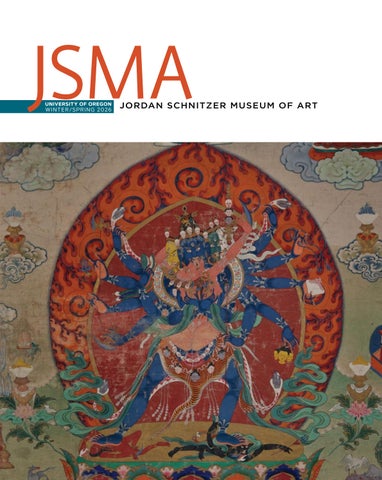
Cover Image: Chakrasamvara with Consort Vajravarahi (detail); Kham region, eastern Tibet; 19th century; Pigments on cloth. 33 x 23 inches. Rubin Museum of Himalayan Art, Gift of the Shelley & Donald Rubin Foundation; F1997.7.2 (HAR 99)