


AT THE SAINT FRANCIS HOSPITAL MUSKOGEE BREAST CENTER
Earlydetectionisyourbest defenseagainst breast cancer, andthat’swhy schedulingyour annual mammogram is so important.
Scheduleyourappointment todayatthe newly renovatedSaint FrancisHospital MuskogeeBreast Center located at 101 South Rockefeller Drive,Suite101. We offer advanced3Ddigitalmammography and ultrasou nd se rvice ssoyou ca ng et thescreeni ngs youneed, closer to home.
To sche duleyourmammogram, call 918-494-6900. Appointments canalsobescheduledonline through your SaintFrancisMyChart account.Safety measures forCOVID-19 areinplace forpatients and staff
saintfrancis.com/breastservices
SAINT FRANCIS HOSPITAL MUSKOGEE BREAST CENTER
Xavier Building 101 Rockefeller Drive, Suite 101 Muskogee, Oklahoma 74401 918-494-6900

Landers' seeks to believe cancer as 'just another thing, it will be
14
Local health facilities utilize variety of technologies to catch cancer early.
16
Learn about the origin and impact of Breast Cancer Awareness Month.
Prevention strategies and lifestyle changes can be used to lower breast cancer risk.
Support meetings are available for anyone touched by cancer, including family.
Research suggests combination of exercise and mindfulness training curbs fatigue.
Photo: By Cathy Spaulding
















Story by Cathy Spaulding
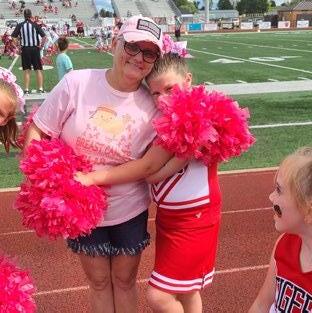
AT-shirt proclaiming "Breast Cancer messed with the wrong chick," shows how Haskell resident Becky Landers remains steadfast in confronting breast cancer.
"I haven't cried over this one time," Landers said. "I will not let this get me down. To me, letting it get me down means letting it beat me."
She said she seeks to believe "this is just another thing, it will be over."
"That's part of the healing to me," she said. "It will pass just as other things do. God will get me through it."
Landers, 56, has made sure others keep positive as well.
"I've determined that from the very beginning," she said. "When I called my dad to tell him, he'd freak out and I said, 'Dad we're not doing this. We're not going to play the game this way. We're gong to start out positive. It's going to be over and it's going to be fine."
Landers traces her story to February.
"I started noticing that my right breast was heavier, bigger, more dense, just kind of different than the


muscle in her
against
by family.
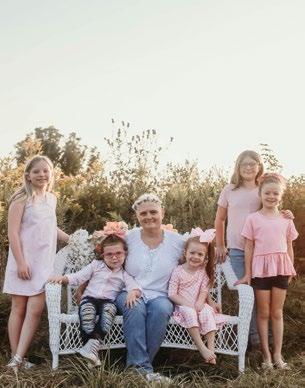
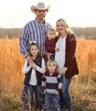
husband Joe Landers. (Red River Photography)
LEFT: Joe Landers says his wife, Becky Landers, has shown a strong will and doesn’t let things get to her. (Red River Photography)

other," she recalled.
A mammogram showed several masses. She was diagnosed with inflammatory breast cancer.
"It affects even your skin," Landers said. "It's always diagnosed as a Stage 3 cancer because of how fast it grows."
On April 9, Landers started a chemotherapy treatment, which involved undergoing eight-hour treatments every three weeks. She recalled sleeping a lot and reading.
"It's bad if you're an internet shopper," she said. "I really did pretty well with the chemo. I feel like, with enough time between the treatments, I kind of recovered. If I had to have them two or three times a week, it would have been different."
She had to return to the treatment center in Broken Arrow a day after each treatment to get a shot. The shot helped create more red blood cells, but also made her bones ache, she said.
Landers said she ended chemo treatments in early August, then had a complete mastectomy of her breast.
"After that, the pathology came back negative," she said.
She still needs treatment, however. Landers said she must remain still while a tube helps drain body fluid.
"They didn't want me to do anything, just be still, and I'm not a 'be still' person," Landers said. "I've watched more TV in the last three weeks than I've

















ever watched in the past 10 years."
During this time, Landers has had to stop playing in a competitive pool league with her husband. She said she hasn't been able to sew garments for American Girl dolls, a money-making hobby of hers.
She also has taken time from her job as a correctional unit assistant at Eddie Warrior Correctional Center in Taft. Several co-workers have donated their sick leave to her.
Landers said her family, her husband's family and her friends have been more than supportive.
"Everybody we know has been bringing over food," she said. "The places where we played pool have had benefits to pay for doctors and driving back and forth. I've had lots and lots of support."
Joe Landers called his wife a strong-willed woman.

"Since I've known her, she doesn't let anything get her," he said. "If she wasn't so strong willed, she wouldn't be as healthy as she is now."
Becky Landers said she begins daily radiation next month at Saint Francis Hospital Muskogee, five days a week.
"What we're doing now is just to make sure there's nothing left and to scare it off if it thinks it wants to come back," she said.
That stubborn, positive attitude has played a huge part in her wellness, she said.
She predicted that one year from today, she'll be talking about doing reconstruction — "back doing what I want to do, back doing things I normally do. There's no reason to let it continue."




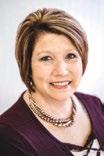

JaquitaGardner
Jaquita is aboardcer tified Advanced PracticeNurse,Clinical Nurse Specialist (APRN-CNS). Her certification is in AcuteCritical Care AdultGerontology.
Her varietyofnursing experience brings awealth of exper tise and knowledge to our practiceand she looks forwardtoser ving the Muskogee communitywith excellentpatient care.

NEW PATIENTS WELCOME




Our long-term care residents receive nursing care while still enjoying daily opportunities to socialize and be active. Our experienced staff supports the daily routine of our residents by assisting with daily living activities and healthcare coordination.

Sometimes asingle event can change your life. Perhaps it is an unexpectedhealth emergency such as astroke or heart attack. When difficulties take place, our clinical staff, including our certified Physical, Occupational and Speech Therapists, are available to help you regain independence, mobility and function at your own pace. Our staff respects your needs every stepofthe way.Skilled therapy can offer ahighly effective follow-on regimen to aqualifying hospital stay for conditionsincludingstrokes, heart attacks, surgery,broken bones, joint replacement, & respiratory illness.


Area health care providers have found ways to make breast screenings more accessible and more thorough.
"The whole reason for screening is to catch it at an early time," said Deborah Travis, Cherokee Nation Chief Director of Radiology.
Travis said six Cherokee Nation facilities, including the Three Rivers Health Center at 1001 S. 41st St. E., offer mammograms.
"There are many women, who, if we didn't offer this service, they couldn't travel," Travis said. "They don't have the resources to travel and get their mammogram done and we might miss their breast cancer if they have symptoms."
Native people with a CDIB (Certificate of Degree of Indian Blood) card can get a mammogram upon referral from their physician, Travis said.
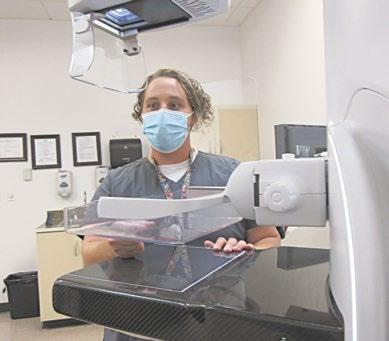
Three Rivers Technologist Michelle Ford said the health center uses a digital GE Senographe Pristina for mammograms.
"The first image is an up and down view of the breast tissue," Ford said. "We want to make sure we have all the tissue from the breast in the image. Then we turn the machine."
Travis said Three Rivers plans to bring 3-D imaging to the health center.
Wagoner Community Hospital has offered 3-D mammograms since 2019. Radiology Director Donielle Burggraf said the technology makes a difference.
"It takes a longer scan rather than just individual images, and it pulls the exact image from multiples," Burggraf said. "It's a full scan around and more detailed image than you get from a plain one view."
Doctors and radiologists get a clearer image than what a 2-D scan provided, she said.
Patients do not need a doctor's order to schedule a screening, she said.
"You're just able to call and get it on the schedule," she said. "Every woman is entitled to it, age 40 and above."
Mammogram results are sent to the patient and to the patient's primary care physician, she said.
Burggraf said women over 40 should get mammograms once a year. That way, doctors and radiologists can compare new images with previous ones and trace any changes.
"That's usually an early clue into things, so if you get it done once a year, you can catch things before it becomes a real issue," she said.
Saint Francis Hospital Muskogee recently acquired a stereotactic breast biopsy unit at its breast health center, 101 Rockefeller Drive.
Dr. Jonathon Kirkland, D.O., a radiologist at

Saint Francis, said the machine is used for biopsies of micro-calcifications, "which are often early signs of breast cancer."
Micro-calcifications can be seen even before a mass is seen, he said.
"Some cancers don't even produce a mass that can be seen on mammograms or ultrasound," Kirkland said. "It really helps guide you to catching these women before they get to where they couldn't get treatment."
The unit has been in Muskogee for about two months.
"We can catch cancers early and biopsy them in a minimally invasive way, as opposed to having to take a patient for a big surgery," Kirkland said. "We can get them an answer and really guide their treatment after that point. So it's really exciting stuff."
The breast health center is a one-stop center, offering mammograms, whole-breast ultrasound and MRI, according to a previous Phoenix article.
People can go online to schedule mammograms at Saint Francis Hospital Muskogee.

1985, October has been recognized as Breast Cancer Awareness Month.
It was initially a collaboration of The American of Family Physicians, AstraZeneca Healthcare Foundation, Cancer Care Inc. and other sponsors.
In more recent years, corporations and sports leagues have banded together to boost awareness during the month. All of which has been a boon to fundraising efforts in bettering treatment with a goal of one day eradicating the scourge.
The early goal of Breast Cancer Awareness Month was to educate women about breast cancer and early detection tests, according to Brevard Health Alliance. One in eight women will be diagnosed in their lifetime. One of chief objectives was to promote mammograms as an important tool to be used in the fight against breast cancer.
During the month of October, breast cancer survivors and those with breast cancer are celebrated and encouraged to share their stories. The month is also dedicated to raising funds for breast cancer research and other related causes.
Since 1985, billions of dollars have been raised for the cause. Since 1990, death rates from breast
cancer have been declining, in part because of better screening and early detection, and improved treatment options.
The first nationwide campaign that utilized the pink ribbon was in 1992 by Estée Lauder cosmetics. They handed out 1.5 million pink ribbons, making them recognizable as the premier visual reminder of Breast Cancer Awareness Month.
The NFL has become one of the largest supporters of breast cancer awareness month, with nearly all players, coaches and referees donning the pink ribbon each October to show their support.
In 2021, the NFL and American Cancer Society will be teaming up for a 13th consecutive season to support the cause through the league’s Crucial Catch: Intercept Cancer. The initiative also promotes early detection and mammogram screenings and risk reduction efforts.
Since 2012, the NFL has funded the American Cancer Society’s Community Health Advocates Implementation Nationwide Grants for Empowerment and Equity (CHANGE) grants, which have contributed to 370,000 screenings in underserved communities and reached more than 1 million individuals with education, screening reminders and patient navigation. This, in turn, brings these life-saving messages and screening services to those who need them most, according to the league.
































Women with certain risk factors are more likely than others to develop breast cancer, according to the National Breast Cancer organization.
Some women have an increased risk based on family heritage. There are other risk factors that can be controlled, according to the Breast Cancer Research Foundation.
Get to know the risk factors
Except for skin cancer, breast cancer is the most common cancer in women in the U.S. It can be treated successfully.
A few risks of getting breast cancer include: Being a woman. Simply being
a woman, is the biggest risk factor for developing breast cancer.
Age. Just like many other diseases, the risk of one getting it increases as one gets older.
Family history. If you’ve had one first-degree female relative (sister, mother, daughter) diagnosed with breast cancer, your risk is doubled. Understanding your history is key to beating breast cancer.
strategies
Lifestyle habits that can help reduce your risk of breast cancer include:
Maintain a healthy weight. According to the National Cancer Institute, being overweight or obese after menopause increases a woman’s risk of breast cancer and can worsen outcomes after a diagnosis. Putting on a lot of extra pounds in the early stages of adulthood can nearly double your chance of developing breast cancer after menopause. But if you’re able to avoid gaining weight, your risk is cut in half.
Eat less red meat. High consumption of red meat is related to a greater risk of developing breast and other cancers. Aim to consume more plantbased sources of protein, such as beans, nuts, and quinoa.
Eat more fruit and vegetables. Lower intake of fruits and vegetables is associated with breast cancer, particularly estrogen receptor (ER)-negative breast cancer. The USDA dietary guidelines recommend consuming two cups of fruit and two-and-a-half cups of vegetables each day.
Limit alcohol. Even moderate alcohol consumption is associated with a higher risk of breast cancer. Women who have between two and three alcoholic drinks per day have a 20% higher risk of the disease compared to those do that do not drink.
Quit smoking. Several studies have demonstrated a link between smoking and an increased risk of developing breast cancer.











LCancer support groups are meetings for people with cancer and anyone touched by the disease, including family members.
The benefits can be many. The top reason people join support groups, even those who have a good family support infrastructure, is to be with others who have had similar cancer experiences. Research shows that joining a support group improves both quality of life and survival, according to the National Cancer Institute.
Some groups focus on all kinds of cancer, while others are focused on one kind, such as a group for women with breast cancer, according to NCI. Some can be open to
everyone or just for people of a certain age, sex, culture or religion.
Children and family members of patients also can benefit from support groups that focus on family concerns, relationship changes, financial worries and how to support the person with cancer. Some groups include both survivors and family members.
Online support groups take place through chat rooms, webinars, social media or moderated discussion groups. Online groups offer flexibility to participants and are a resource for people who live in rural areas where an in-person group might not be available.
Some support groups are conducted by conference call, bringing together people from all over the country who have been touched by cancer.
Here are some benefits of support groups, according to the NCI. They can:
• Help you feel better, more hopeful, and not so alone.
• Give you a chance to talk about your feelings and work through them.
• Help you deal with practi -

cal problems, such as problems at work or school.
• Help you cope with side effects of treatment.


The NCI recommends reaching
out to the following sources in your community and online for support groups:
• Your local hospital.
• Your social worker.
• Other patients who have tried support groups.
• An online search for groups..
combination of exercise and mindfulness training appear to better alleviate fatigue in breast cancer survivors than either technique alone, according to new research.
As many of 90% of breast cancer patients must deal with fatigue, as it is the most common sideeffect of treatment, according to BreastCancer.org. Some doctors estimate that nine out of 10 people have some fatigue during treatment. Even rest can be ineffective in curbing fatigue, and it can last for months after treatment.
Few studies have examined the combination of exercise and mindfulness or relaxation training to ease fatigue. A new study published by the jour -


nal Psycho-Oncology divided women into three groups: aerobic exercise-only, relaxation-only and a combination group.
“Over the course of the week, the groups that took part in a combination of exercise and mindfulness training reported a drop in fatigue levels from moderate to mild. The other groups did not show a comparable degree of improvement,” said Jason Cohen, a former graduate student in the University of Illinois Urbana-Champaign Exercise, Technology, and Cognition Laboratory, in a statement.
If you’re having fatigue from breast cancer treatment, ask your doctor about combining exercise and mindfulness training. Research shows that exercise can reduce the risk of breast cancer recurrence. Ask your doctor how much and how often you can exercise, as well as if there are types of exercise you should avoid, suggests BreastCancer. org.
Check for group exercise classes for cancer patients in your area. Exercising with others can help keep you motivated. Your medical team should be able to refer you to available mindfulness training in your area, or you can look for online videos or courses to get started.


