

![]()


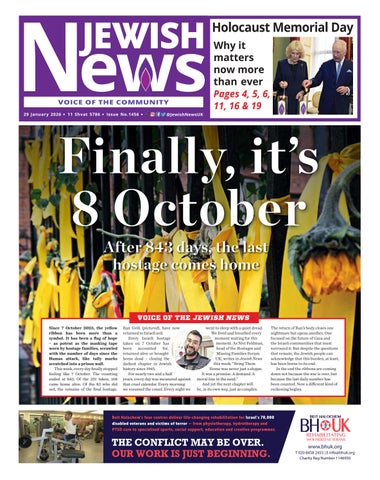
Since 7 October 2023, the yellow ribbon has been more than a symbol. It has been a flag of hope – as potent as the masking tape worn by hostage families, scrawled with the number of days since the Hamas attack, like tally marks scratched into a prison wall.
This week, every day finally stopped feeling like 7 October. The counting ended at 843. Of the 251 taken, 168 came home alive. Of the 83 who did not, the remains of the final hostage,

Ran Gvili (pictured), have now returned to Israeli soil.
Every Israeli hostage taken on 7 October has been accounted for, returned alive or brought home dead – closing the darkest chapter in Jewish history since 1945.

For nearly two and a half years, every day was measured against that cruel calendar. Every morning we resumed the count. Every night we
went to sleep with a quiet dread. We lived and breathed every moment waiting for this moment. As Nivi Feldman, head of the Hostages and Missing Families Forum UK, writes in Jewish News this week: “Bring Them Home was never just a slogan. It was a promise. A demand. A moral line in the sand.”
And yet the next chapter will be, in its own way, just as complex.
The return of Ran’s body closes one nightmare but opens another. One focused on the future of Gaza and the Israeli communities that must surround it. But despite the questions that remain, the Jewish people can acknowledge that this burden, at least, has been borne to its end.
In the end the ribbons are coming down not because the war is over, but because the last daily number has been counted. Now a di erent kind of reckoning begins.
West Midlands Police acting chief Scott Green has said he is focused on repairing the damage the Maccabi Tel Aviv fan-banning row has caused to the Jewish community, writes Lee Harpin.
Green, who was appointed acting chief constable after Craig Guildford stepped down from the top role following mounting pressure for him to quit over the controversy, said he has declared a critical incident as the force looks to recover from the fallout of the controversy.
Maccabi Tel Aviv fans were barred from travelling to the game against Aston Villa at Villa Park on 6 November last year by the local safety advisory group (SAG), which cited safety concerns based on advice from the police force.
The move led to widespread criticism from political figures including prime minister Sir Keir Starmer, who said it was the “wrong decision” and led ultimately to home secretary Shabana Mahmood saying she no longer had confidence in Guildford’s leadership.
Under pressure to resign from the role, Guildford announced he was retiring after facing what he called a “political and media frenzy”.
At a Police and Crime Commissioner’s meeting on Tuesday chaired by PCC Simon Foster, Green acknowledged the damage to the public’s trust in the force.
He said: “More specifically, I know we have damaged our relationship with individuals and the Jewish community, locally, nationally and internationally.”
diced the ongoing Independent O ce for Police Conduct (IOPC) investigation into the incident.
Green said: “It is my intention, throughout this board and our subsequent approach, to answer every question with as much transparency and candour as I can.
“I want to emphasise it was on my first day I made a voluntary referral to the IOPC and I want their investigation to not be prejudiced in any way by the answers I give.”
The Department for Education has announced the renewed launch of a fund designed to support innovative tools, resources, and mechanisms that address modern forms of antisemitism – including online hate, misinformation and the impact of polarising global events.
Backed by £1m in 2026-27, with the potential for up to £3m of further investment in 2027-28, the Tackling Antisemitism in Education Innovation Fund was created as a key part of a broader £7m government commitment to tackling antisemitism in education.
Green said he had met members of the Jewish community and was “personally saddened” to hear the impact the force’s actions had had.
He added: “I have committed to taking immediate action to focus on repairing the damage that has resulted in a loss of confidence in policing. We will work tirelessly to restore that trust.”
Acting deputy chief constable Jennifer Mattinson admitted the force’s engagement with the local Jewish community was “not started early enough” in the planning stages before the match.
She said the force should have liaised with other international police forces who have hosted fans instead of just the Dutch police.
It was “regrettable” the force’s virtual meeting with Dutch police was not recorded, she added.
The home secretary has defended the decision to stop requiring police to record noncrime hate incidents (NCHIs), even when such incidents involve taunts directed at Jews or Muslims, writes Lee Harpin.
NCHIs are those that, while not reaching the threshold for a criminal o ence, are perceived to be motivated by hatred towards characteristics such as race or gender.
Addressing the plans, Shabana Mahmood said: “On non-crime hate incidents, this was a well-intentioned attempt over many years to gather intelligence about people whose troublesome behaviour might lead to violence against ethnic minorities. Essentially, someone might target another person because of hatred whether for being Jewish, Muslim, or otherwise.
“Over time, police leaders themselves recognise they have been drawn into culture wars and political disagreements.”
Senior police figures, along with the Col-


The force has now launched Operation Strive to focus on the response to “recover from these events”.
the response to “recover


All antisemitic hate crime will be investigated by a detective and the force has also committed to antisemitism training for all sta .
WMP’s use of Microsoft’s AI assistant Copilot has also been suspended after details of a nonexistent game between West Ham and Tel Aviv were found to have been an “AI hallucination”.
Green declined to answer several questions from Foster about any known terrorism threats and whether reports local people would arm themselves in preparation for the fixture were correct, stating it would be “unwise and inappropriate” to answer in case it preju-
Green said he accepted the contents of the Inspectorate of a Constabulary and Fire and Rescue Services report
accepted the contents of the Inspecplayed a part in the
“in its entirety”, including confirmation that bias played a part in the way the force reached its preferred tactical option and had “overstated the evidence”.
He said part of Operation Strive would look at “organisational bias”, adding: “What is clear is the link between public order policing and intelligence and our intelligence systems is not where we want it.”
The acting chief also admitted “better local engagement from the outset would have made a real difference” to how the situation had been dealt with.
Foster said at the end of the meeting such incidents “must never happen again” and his team would continue to hold the force to account.

lege of Policing and the National Police Chiefs’ Council (NPCC), have called for an end to the practice, arguing NCHIs are no longer “fit for purpose.”
Mahmood is said to believe recording NCHIs distracts police from tackling everyday crime, emphasising the need for o cers to focus on “catching criminals, cutting crime, making sure people feel safe”.
Speaking to a caller on LBC’s Nick Ferrari
show, Mahmood added: “A review is already under way and will conclude soon because there’s agreement that we need change and can’t continue with the current approach. The key question is what framework should replace it. That’s what will unfold next.”
Asked about e orts to combat antisemitic crime, Mahmood reiterated there was “no doubt” antisemitism had been rising for some years, with a peak following events in the Middle East: “I absolutely recognise the pressure the Jewish community feels.
“After the Heaton Park Synagogue terrorist attack, where we lost two Jewish lives, people told me it was only a matter of time. I don’t want British Jews, citizens like you and me, to live smaller lives in their own country because of this hatred.
“I have zero tolerance for it. I have already announced changes to public order laws to impose conditions on repeat protests, and we will ensure those changes are implemented.”
Applications are now open for projects that will help learners develop critical thinking, media literacy and the skills needed for informed, tolerant debate, ahead of a deadline in March.
An Oxford University student filmed chanting for Gaza to “put the Zios in the ground” at a pro-Palestinian march has denied stirring up racial hatred.
Samuel Williams, 20, from Oxford, is alleged to have used threatening, abusive or insulting words during a pro-Palestine demonstration in central London on 11 October last year.
The charge follows the circulation of a video filmed in Whitehall during a Palestine Coalition protest, in which a man addresses the crowd before leading a chant that includes the words: “Gaza, Gaza make us proud, put the Zios in the ground.” Williams appeared in court this week and was granted conditional bail ahead of a hearing at Southwark Crown Court on 24 February.
Allowing a Palestinian family to leave Gaza and reunite with their father in the UK would be a “step too far” in risking national security, lawyers for the government have told the High Court.
The family of six, aged between 14 and 23, are taking legal action against the Home O ce and Foreign O ce after they were refused onward travel assurances (OTAs), which are necessary for them to leave the war-stricken territory.
Lawyers for the government said it is UK policy not to allow foreign nationals into the country without biometric checks.
As these checks cannot be carried out in Gaza, and the only means of leaving the country is through Jordan, OTAs must be given to the Jordanian authorities that would allow the family to travel to the UK where the biometric tests would be carried out.
The family is challenging government decisions made in September and October which looked at a larger group of Palestinians, and a further one in December, which looked at their individual case.
The hearing is due to conclude on Monday.
Israel this week recovered and identified the body of Ran Gvili, the final Israeli hostage held in Gaza since the Hamas-led attacks of 7 October, bringing the hostage crisis to an end after more than two years, writes Joy Falk.
Gvili, a sergeant first class in the Israeli Police Special Forces, was killed during the 2023 massacres after heading out to confront terrorists despite being on leave with a shoulder injury. His body was abducted to Gaza and remained there throughout the war.
His remains were recovered on Monday from a Muslim cemetery in eastern Gaza City, following new intelligence contradicting Hamas claims his body had been buried under rubble.
Specialist recovery units, forensic experts and dental pathologists have been operating at the site since the weekend. Identification was carried out by Israel’s National Institute of Forensic Medicine in cooperation with Israel Police and the Military Rabbinate.
An IDF spokesperson said: “Following the completion of the identification process by the National Institute of Forensic Medicine, in cooperation with the Israel Police and the Military Rabbinate, IDF representa-

tives informed the family of the deceased hostage Sergeant First Class Ran Gvili, that their loved one has been identified and will be returned for burial.
“The IDF expresses deep condolences to his family. The IDF will continue to support the families and the returnees, and to act to strengthen the security of the citizens of Israel. With this, all hostages have been returned from the Gaza Strip to the State of Israel.”
Three people have been charged over alleged chants calling for an “intifada” at a protest on the day police announced a change in approach to the slogan, writes Adam Decker.
Haya Adam, 21, of Edgware Road, central London, Azza Zaki, 60, of Edgware Road, central London, and Abdallah Alanzi, 24, of Fortunegate Road, Brent, will appear in court next month, the Metropolitan Police said.
The force said the trio were arrested at a protest outside the Ministry of Justice in Petty France, Westminster, on 17 December after they were identified as allegedly being involved in chanting calling for an “intifada”.
Earlier that day, the Met had announced a change in approach to the slogan. The force said

its investigation took into account the “intifada” chant but also other chanting heard during the protest and the charges reflect “the totality of the alleged offending on that evening”.
The defendants will appear at Westminster Magistrates’ Court on 23 February.
The Metropolitan Police has arrested 86 people on suspicion of aggravated trespass after they breached prison grounds while protesting in support of a Palestine Action prisoner on hunger strike, writes Joy Falk.
The force said it had detained a group of protesters outside HMP Wormwood Scrubs in west London.
According to the force, the group refused to leave when ordered, allegedly blocked prison staff from entering and leaving, and threatened police officers. The Met said

a number of them managed to get inside a staff entrance area of a prison building. It is understood the protesters did not get past security.
A Ministry of Justice spokesperson criticised the protesters’ conduct, saying: “While we support the right
to peacefully protest, reports of trespassing and threats being made to staff and police officers are deeply concerning.”
Social media footage shared a group chanting outside the prison. At one point, the group can be seen moving towards a building –and one clip appears to show some demonstrators inside.
It is understood they were holding the demonstration in support of Umer Khalid, the last remaining participant in the Prisoners for Palestine hunger strike campaign.
remains were due to be handed over within 72 hours of the ceasefire that came into force last October but the transfer did not take place.
Nivi Feldman, leader of the Hostages and Missing Families Forum UK, said: “We mourn Ran Gvili, who defended Israel until his last breath. May his memory be a blessing. Our hearts are with his parents, family, and loved ones.
“Our responsibility now continues to honour every victim, to ensure their stories are never forgotten, and to support survivors and families through the long road ahead.”
Phil Rosenberg, president the Board of Deputies for British Jews, said: “After 843 days of pain, we are moved and relieved at the news that Israel has located and identified the body of Ran Gvili.
“We send all our love to Ran’s parents, Talik and Itzik Gvili, and wish them every comfort as they receive their son and lay him to rest in Israel.
“Never again must Israel face an onslaught of the sort it faced on 7 October. And as we move to phase two of the ceasefire we need to see the disarmament and removal of Hamas from Gaza.”
“It is time for us to seize this moment of opportunity and redouble our efforts towards lasting peace and security for Israelis, Palestinians and the wider Middle East.”
For the Jewish community, the confirmation brings a grim sense of closure to one of the most painful chapters since 7 October –marking the return of every hostage taken by Hamas, alive or dead, to Israeli soil.
When everything feels overwhelming, Paperweight is there to steady you. We hold your hand, take the pressure off and help you breathe again.
From money worries to family breakdown, bereavement, painful paperwork and sudden crises, we leave no stone unturned in helping you regain control
With Paperweight in your corner, the emotional weight is shared, clarity replaces chaos and panic turns into a plan to move forward. And our support as always, is completely free.
Survivor Mala Tribich addressed a meeting of cabinet ministers in Downing Street to commemorate Holocaust Memorial Day (HMD), warning the Labour government that in the midst of rising antisemitism, “remembering the past is no longer enough”, writes Lee Harpin.
Jewish News was invited into the meeting as Starmer introduced 95-year-old Tribich to his top team at the weekly meeting at No 10.
Tribich was given a standing ovation as she entered and again at the end of a speech that left several cabinet members including chancellor Rachel Reeves, chief whip Jonathan Reynolds, deputy PM David Lammy and culture secretary Lisa Nandy visibly moved as they listened.
It is the first time a Holocaust survivor has personally addressed a UK cabinet meeting, with the PM understood to have personally committed to ensuring his team were offered the chance to hear Tribich’s testimony.
Starmer told Jewish News:: “As prime minister, I am committed to strengthening Holocaust education across the country and delivering the National Holocaust Memorial and Learning Centre near Parliament so this truth is never forgotten.”
Tribich told the meeting: “I

stand before you as one of the last remaining eyewitnesses to one of the darkest chapters in human history; 81 years after the liberation of the Nazi death and concentration camps, I am here as a representative of the British Holocaust survivor community.
“For decades, we have spoken to people across this country, sharing our most painful memories.
“We have done this out of a deep sense of duty – to ensure that what happened to our families and six million Jewish men, women and chil-
dren is never forgotten. Soon, there will be no eyewitnesses left. That is why I ask you today not just to listen, but to become my witness.”
Recognising “the poison of antisemitism” is dramatically on the rise here and worldwide, she added: “Having endured the Holocaust, we survivors never imagined we would witness antisemitism at the levels we see today.
“What we have seen in Manchester on Yom Kippur, and in Sydney on Chanukah, has shaken me to my core.

How, 81 years after the Holocaust, can Jewish people once again be targeted in this way? Remembering the past is no longer enough.”
Tribich urged further commitment from the government, adding: “I speak to you, leaders of the country I proudly call home, and I plead that you do what needs to be done to tackle this hatred.”
Introducing Tribich, Starmer said: “It is a very special privilege for us as the Cabinet because you are the first Holocaust survivor ever to address the Cabinet in this country. And so it really is quite an incredible occasion.
“It is our duty not just to hear and listen but to act and to deal with anybody who tries to deny or distort what happened in the Holocaust.”
At one point, Tribich paid tribute to her late brother and survivor Ben Helfgott, who died in 2023, and who she said she “missed a lot”.
One of his greatest wishes was to see a Holocaust Memorial and Learning Centre where survivor testimony would be preserved and where future generations could understand where antisemitism and hatred could lead if left unchallenged.
“He did not live to see the Memorial, but he would have been proud to know that Parliament has now passed the Holocaust Memorial Bill and that work will soon begin.”
Ahead of Tuesday’s meeting, senior ministers, including the chancellor, signed HET’s Book of Commitment, pledging to honour those murdered by the Nazis and commit to fighting antisemitism today.
Holocaust Educational Trust chief executive Karen Pollock praised Tribich as “one of a dwindling number of survivors still able to share their most painful memories”.
She added: “Mala, and survivors like her, share their stories in the hope that the next generation will always know what happened during the darkest days in our shared memory.
“Today’s meeting with the prime minister and Cabinet is a poignant reminder of the responsibility to confront anti-Jewish hatred and ensure that the legacies of Holocaust survivors endure.”
A collection of songs composed and sung in Nazi camps and ghettos and collected immediately after the Holocaust is being republished by a UK university, which described it as “a remarkable historical document”, writes Michelle Rosenberg.
Manchester University Press is publishing a new version of Mima’amakim ( Out of the Depths ), compiled in June 1945 when the collection was begun by researchers documenting the experiences of Jewish refugees.
The resulting book was published in a short run of 500 copies subsequently all but forgotten but brought to wider public consciousness after the discovery in 2013 of one of the original copies – thought to be one of only a handful to survive.
The new edition, translated into English from the original Yiddish, is the project of University of two Sydney academics –Jewish music researcher and administrator Joseph Toltz and associate professor of government and international relations Anna Boucher.
The new printing contains the songs’ melodies and lyrics, the latter in a new translation by Toltz, as well as short biographies of the composers, drawn from painstaking

The cover of the original edition
original research. Introductory essays also provide historical and musicological background. The original editor of Mima’akim , Yehuda Eismann, described the work as “a memorial stone for Polish Jewry”.
Toltz said: “It is amazing to think a tiny songbook on poor quality paper could not only survive transit from Bucharest back to Poland and then to Sydney but that it could also provide so much information about Jewish life and suffering during the Holocaust.
“The songs depict a vast array of personal experiences, demonstrating the power of musical activity to maintain dignity.”
A live performance bringing together dance, music and spoken testimony was staged in London on the eve of Holocaust Memorial Day to honour Windermere Child and Holocaust survivor Harry Olmer, who died earlier this month, writes Annabel Sinclair.
The production, Echo Eternal, presented at the Royal Ballet School in Covent Garden, marked 80 years since the arrival of the Windermere Children in Britain. A similar event is held every year.
Presented as the final performance of this year’s programme, it was dedicated entirely to the memory of Olmer, who was 98.
The performance interwove verbatim Holocaust testimony with newly composed music and choreography, performed by students from CORE Education Trust schools, the Royal Ballet School and the National Youth Music Theatre.
Spoken words were drawn directly from survivor interviews and archival material, while songs and movement acted as a contemporary response.
Opening the evening, Echo Eternal cofounder and CEO Adrian Packer told the audience the project was rooted in accuracy and responsibility.
He described Echo Eternal as “grounded
in Holocaust survivor testimony, and we take that really seriously” adding: “Every word you hear has been thought about with care. We want to get it right.”
Packer said the anniversary made this year’s performance particularly significant.
“This is a very special year because we’re commemorating just over 80 years since the story of the Windermere Children,” he said. “And this is for Harry.”
On stage, young performers moved between scenes exploring childhood, loss, survival and rebuilding life in Britain after the Holocaust. One section focused on the Windermere Children, while another centred on Olmer’s experiences using imagery drawn directly from his testimony.

Lady Victoria Starmer has recalled with tears in her eyes last year’s visit with her husband to the Auschwitz-Birkenau Nazi extermination camp, writes Lee Harpin.
The prime minister’s wife was hosting a visiting delegation of young ambassadors from the Holocaust Educational Trust charity.
As the group of young students shared personal accounts of how they became involved with the HET organisation at school, Lady Starmer recalled her own visit in January last year to the death camp with the charity’s chief executive Karen Pollock.
An exhibit featuring poignant images of flourishing Jewish life in Eastern Europe before the Shoah a ected Lady Starmer then in the same way it made her tearful at the HET event.
It is not the first time the prime minister’s wife has been overcome with emotion while discussing the Holocaust. Last September, at another HET event at the Labour party conference, she was again visibly moved, having listened to the extraordinary story of survival told by Annick Lever, whose mother and other family members were deported to Auschwitz in February 1944 and later killed.
Lever was also invited to last week’s Downing Street meeting to greet the ambassadors and
share insight and advice with those who will pass the lessons and story on to the next generation, in the hope they then do the same.
HET regional ambassador Scotland Tom Green said: “This has been a truly unforgettable experience and is definitely a highlight of my time as a regional ambassador.
“We ambassadors are well aware of our responsibility as the next generation to ensure the Holocaust is never forgotten and we could not be more grateful for this opportunity.”
Regional ambassador Wales, Daisy Davies added: “It was a privilege to be invited to speak to Mrs Starmer at No.10 about our role as ambassadors to honour the memory of the victims and survivors of the Holocaust, and defend


those subject to antisemitism today. As we continue to lose survivors, conversations like the one we had today ensure that the lessons from the Holocaust are never forgotten.”
HET chief executive Pollock later said: “We are enormously grateful to Mrs Starmer for taking the time to listen as these inspirational young people shared their determination to keep the legacy of the Holocaust alive.
“Mrs Starmer reuniting with Holocaust survivor Annick Lever BEM was especially moving, as was witnessing the hope that this young generation of ambassadors give survivors like Annick for the future.
“These ambassadors are the generation that will protect the memory of the Holocaust.
“Our ambassadors are that next generation
and Victoria’s encouragement has given them extra confidence to continue this vital work.”:
With Nazism growing in neighbouring Germany, Lady Starmer’s Jewish father’s family were forced to flee Poland before World War II for Britain. A decade later, German tanks were rolling into the family’s home village of Kolo on their way to Warsaw.
At Auschwitz last year, the prime minister recalled feeling “a sickness” and “an air of desolation” as he contemplated “the enormity of this barbarous, planned, industrialised murder”.
Lady Starmer, he said, was equally moved, adding: “It was her second visit, but no less harrowing than the first time she stepped through that gate and witnessed the depravity of what happened here.”


by Annabel Sinclair at Buckingham Palace annabel@jewishnews.com
The King and Queen hosted Holocaust survivors, their families and Jewish communal leaders at Buckingham Palace on Tuesday to mark Holocaust Memorial Day, in a reception underscoring the urgency of remembrance as antisemitism continues to rise.
Held on the anniversary of the liberation of Auschwitz-Birkenau, the event brought together survivors, descendants and representatives from the Holocaust Memorial Day Trust, the Anne Frank Trust UK and the Holocaust Educational Trust.
During the reception, their majesties viewed Seven Portraits: Surviving the Holocaust, a series commissioned by the King in 2022 while Prince of Wales, depicting seven Holocaust survivors recognised for lifelong contributions to education and remembrance. Several of those portrayed have since died, lending particular poignancy to the gathering.
Lily Ebert’s portrait was attended by her great-grandson Dov Forman, who spoke about the absence of his great-grandmother.
“Holocaust Memorial Day is always an incredibly important day for the whole family,” he said. “To be here without her is obviously very sad; she would have been so happy to see her portrait hanging in the Palace.
“But it’s also incredible, because these are the last moments to be with survivors in one room and listen to their stories.”
Reflecting on the wider climate facing British Jewry, he added:
“Jews across Britain feel worried about the state of this country, and people are worried about their future here. So to have the support of His Majesty is very special.”
Others attending included Julia and Pauline, daughters of the late Harry Olmer, a Windermere Child and Holocaust survivor who died just days before the reception.
Speaking to Jewish News, the sisters described what they shared with the King about their father.
“We mentioned that he’d passed away just 12 days ago, and that we are here to represent him,” they said. “We said that dad knew about this, and he was very much looking forward to being here.”
They spoke emotionally about attending without him. “There’s an empty space next to us,” they said. “We’re used to attending so many of these events with dad and making sure that he was okay.”
Despite their grief, they stressed the importance of continuing his legacy. “He spent 30 years of his life educating, travelling around the country,” they said. “We can’t let that education be wasted.”
Holocaust survivor Susan Pollack also spoke to Jewish News about the vital importance of remembrance.
“All of this is very important,” she said. “We have to do all that we can to keep the Holocaust’s memory alive.”
Pollack reflected on the responsibility survivors continue to carry.
“It’s a pleasure meeting people I hadn’t seen for years,” she said.
“I’m honoured in life. We all are.”
Rachel Levy, an AuschwitzBirkenau and Bergen-Belsen survivor whose portrait features in the exhibition, spoke about the impact

of seeing survivors represented in art. “They’re absolutely amazing,” she said of the various portraits.
Levy explained that the works captured trauma honestly. “They haven’t been embellished for portraits,” she said. “They’re showing some of their experiences and the trauma that they went through.”
Former home secretary and chair of the Holocaust Memorial Day Trust Sajid Javid also spoke to Jewish News during the reception, stressing that Holocaust remembrance must be understood as a responsibility for wider society.
“It’s not really designed for the 0.5 percent of the population that are Jewish,” he said. “It’s for the other 99.5 percent to remember what happened.”
He warned of how hatred escalates. “It didn’t just start in the 1930s and 40s. It was centuries of

antisemitism before that,” he said. “It starts with words, it starts with ideas, and then it leads to violence and murder.”
Reflecting on the King’s role, Javid added: “Our King is the most unifying figure in the country. He’s not a politician, he’s not a celebrity – it’s a role you earn over decades.”
Holocaust Educational Trust chief executive Karen Pollock said the reception carried deep national and communal significance.
“On Holocaust Memorial Day, we remember the six million Jewish men, women and children murdered by the Nazis and collaborators and we honour the survivors who endured so much. With antisemitism at record levels, this support could not be more crucial.”
The reception ended with the King and Queen lighting candles as a symbolic act of remembrance.

A Hampshire mayor has been criticised after promoting a Holocaust remembrance event by describing “the 12 million people who lost their lives” without mentioning Jews – with the Holocaust Educational Trust describing it as “an insult to victims and survivors”.
Havant Council’s press release, which described a “short, non-denominational service”, contained no mention of Jews with Labour mayor Munazza Faiz adding: “We must continue to stand up against prejudice, hatred and discrimination of any kind”.
Honorary alderman Leah Turner was quoted as saying: “By marking Holocaust Memorial Day, we reaffirm our commitment to remembering the past and working towards ensuring such atrocities are never repeated.”

No specific reasoning was given for Faiz’s random 12 million figure.
Responding to the omission, Holocaust Educational Trust chief executive Karen Pollock told Jewish News: “The Holocaust was the murder of six million Jewish men, women and children. Ignoring that the victims were Jews, widening the figure to include all victims of the Second World War or attempting to draw in contemporary conflicts is an abuse of the memory of the Holocaust and an insult to victims and survivors.”
A local newspaper in Greater Manchester was forced to delete Facebook posts about the Jewish community after they drew a deluge of antisemitic comments, the editor has said.
Bury Times reports on planning approval for a new mikvah in Prestwich and a Holocaust education programme drew thousands of comment when shared on the Facebook page.
In an open letter to readers, news editor Andrew Topping said the sheer volume and nature of responses to the posts forced his hand. He wrote: “Unfortunately, at least 60 to 70 percent of those comments were antisemitic. Possibly even more.”
Topping said the comments included “outdated religious tropes” and outright Holocaust denial. He warned some members of the com-

munity felt “marginalised at a time of significant international tension”. Bury has one of the largest Jewish populations in the UK.
“Simply, this is not acceptable, and it is not something we, here at the Bury Times, are willing to tolerate,” he added.
The paper has already banned a handful of users from commenting and said it would not hesitate to bar others who continued to use the paper’s pages to spread hate.
An Israeli MK has called for the proposed appointment of Israel’s next ambassador to the UK to be urgently reconsidered, citing an ongoing police investigation and concerns over public trust, writes Annabel Sinclair.
Naama Lazimi, a member of the Knesset, wrote to senior civil service and foreign ministry officials in Israel, following what she described as “grave developments in the ‘Qatargate’ affair”.
Lazimi said the situation “necessitate[s] a re-examination of Mr Tzachi Braverman’s

appointment as Israel’s ambassador in London,”
Lazimi, of Israel's Democrats party, said she asked Israel’s attorney general and military advocate general to open an investigation into Braverman, citing “heavy suspicion of his involvement” in the a air.

Lazimi added it had since been reported Braverman was detained for questioning by Israel Police’s Lahav 433 unit, which investigates major corruption cases, on suspicion of “obstructing an investigation and breach of trust within the framework of the ‘classified documents’ affair”.
“Qatar-gate” has developed into an ongoing scandal in Israel, based on the allegation that senior o cials close to prime minister Benjamin Netanyahu were paid millions by representatives of the Qatari government.
Braverman, Netanyahu’s chief of sta , was arrested earlier this month after being accused of trying to block an investigation into the leak of secret military documents from the prime minister’s o ce.
No indictment has been announced, and the investigation remains ongoing.
A major US multinational pulled plans to create 300 jobs in Northern Ireland amid concerns linked to Sinn Féin’s political positions on Israel, a Stormont committee has heard.

Sinn Féin is a vocal critic of Israel’s actions in Gaza, and last year the party boycotted traditional St Patrick’s Day events at the White House in protest at president Donald Trump’s support for Israel.
Sinn Féin economy minister Caoimhe Archibald declined to be drawn on the claim global financial services firm Cantor Fitzgerald had been preparing to invest in the region, but halted the plan amid concern about her and the party’s stances on certain issues.
DUP MLA Jonathan Buckley made the claim as the minister appeared before members of her assembly scrutiny committee.
believe the Holocaust did not happen, while 17 percent believe the number of Jews killed was greatly exaggerated.
ference
The online survey of 1,000 Irish adults last year also found eight percent
The survey adds to a country-bycountry series by the Claims Conference, which coordinates reparations for Holocaust survivors and sponsors

Holocaust education programmes. The Irish survey also found a quarter of adults believed distortion was common in their country, compared to 49 percent in the US, 44 percent in France and Germany and 47 percent in Hungary.
The country, which has a Jewish
population of approximately 2,700, has drawn allegations of antisemitism for its public criticism of Israel during the Gaza war. In December 2024, Israel closed its embassy in Dublin, citing “antisemitic rhetoric of the Irish government against Israel”.


A woman who racially abused diners sitting outside a kosher restaurant in central London after “binge drinking” has been given a suspended prison sentence after the judge said that she had exhibited “genuine remorse” and had a child for whom she is sole carer, writes Daniel Sugarman.

Clarke
Mary Clarke, of Camden, was filmed during an altercation at Reubens restaurant last July. Footage showed her accosting diners aggressively, shouting at them, throwing food in their direction

and hurling a mobile phone to the pavement.
Clarke admitted two counts of racially aggravated harassment, one count of racially aggravated criminal damage and one count of racially aggravated common assault.
Clarke shouted at the diners
“baby killers”, “free Palestine” and “I’m the only one saving babies these Jews are killing”.
In defence, Clarke was said to have been “binge drinking” and was “under the influence of alcohol”.
Per the Daily Mail, judge Sam Gozee told Clarke: ‘You targeted the café, clearly knowing that it was part of the Jewish community, and making comments of a distressing nature.”
He sentenced Clarke to 25 weeks in prison due to the racist aggravation present, but suspended the sentence as she is sole carer for her child. She will be on probation for 12 months, must follow an alcohol abstinence programme and be fitted with a tag which will monitor whether she drinks alcohol.
The judge also ordered Clarke to pay £100 to each assault victim and £43.50 to the café to cover damaged items.

Israel will make history at next month’s Winter Olympics after its men’s bobsleigh team clinched a first Olympic qualification, boosting the country’s delegation to nine athletes in Milan.
David Berman
Sky News has been criticised over an interview with a Palestinian activist who previously said one Palestinian was more important than 1,000 Israeli[s].
It was posted after the death of Hamas leader Yahya Sinwar in which he said he “didn’t want

a beautiful mourning from you, nor to mention his e ects in written poems. He wanted you in the field.”
Yalda Hakim, lead world news presenter for the UK TV channel, conducted the interview with “Palestinian photo-
journalist Moataz Azaiza”, discussing Donald Trump’s Gaza Executive Board.
The o cial Sky News Twitter account shared a video of the interview, along with the Twitter handle of an account it linked to Azaiza titled Gaza
Flood which was set up in October 2023. “Al Aqsa Flood” was the name Hamas gave its 7 October attack.
The Israeli embassy in the UK described the channel interviewing Azaiza “without disclosing his previous statements” as “a new low”, calling on both the channel and Hakim herself to apologise.
Sky later deleted the tweet promoting the interview but a May 2025 interview again tagging the Gaza Flood is still visible on the Sky News account.


The Roald Dahl Story Company (RDSC) has confirmed it is backing Jewish community initiatives ahead of the launch of the UK’s first British Jewish Culture Month this year, writes Annabel Sinclair.
This support forms part of the company’s ongoing response to author Roald Dahl’s antisemitism, following a public apology issued in 2020 in conjunction with the Dahl family.
Since then, the company says it has focused on education, training and engagement with Jewish organisations.

A spokesperson for the company said since the original apology, made in conjunction with the Dahl family, RDSC had engaged in listening and learning from experts in tackling antisemitism, including the Antisemitism Policy Trust, which had given advice and sta training to help the company better understand it.
“As part of this work, we are supporting organisations within the Jewish community that work to combat antisemitism and educate people about Jewish life and culture.”
The Board of Deputies of British Jews confirmed it is among a number of Jewish charities receiving funding, which will be used to expand
The BBC has apologised after multiple presenters failed to mention in Holocaust Memorial Day reports six million Jews were killed by the Nazis, referring to them merely as “people”.
Presenters leading broadcasts on Radio 4’s Today programme and BBC Breakfast referred to “the six million people murdered by the Nazi regime over 80 years ago”, with a number of other presenters using similar language.
The Campaign for Media Standards watchdog accused the corporation of “having
used the same script all day”, and asking “why is the BBC so squeamish about the Jewish identity of the six million slaughtered?”
Jewish News contacted the BBC asking whether a senior editor approved the script and if there will be an internal review.
Critics of the reports included former BBC director of television and controller of BBC 1, Danny Cohen, who said: “A failure like this on Holocaust Memorial Day marks a new low point for the national broadcaster.”

significantly its Jewish Living Experience Exhibition – a travelling educational project designed to introducing audiences to Jewish life, culture and identity.
A Board of Deputies spokesperson said: “The Roald Dahl Story Company has pioneered a positive model for dealing with the legacy of an undoubtedly talented children’s author whose record was tainted by his antisemitism. By supporting our work in educating the wider public about Jewish life, and the need to tackle antisemitism, they are turning damage into repair.
“As one of a number of Jewish charities in receipt of the RDSC’s support, we will be using the funds to more than double our provision of our travelling Jewish Living Experience exhibition, from eight to 18 copies, to teach the next generation respect over hate.”
A senior lecturer at the University of East London, who is standing on a pro-Palestine ticket in the forthcoming local elections, has suggested Britain should have entered into a “simple deal with Hitler” and “made peace with the Nazis” to prevent the Second World War.
The Board said it hoped to roll out the new copies of the exhibition in time for the first British Jewish Culture Month, which will be held from 16 May to 14 June.
The spokesperson added: “We thank RDSC for helping us to turn our mission of “less ‘Oy’, more joy” into action.”
The month-long cultural event is expected to showcase the breadth of Jewish life in the UK, including culture, food, comedy, music and literature, while encouraging engagement from schools, public bodies and cultural institutions.
The initiative comes at a time of record levels of antisemitism being witnessed in the UK, with prominent Jewish organisations increasingly emphasising education, visibility and positive representation as key tools in tackling hatred and misinformation.

Marwan Elfallah, a lecturer in the university’s department of education, school of childhood and social care, is standing for the
Redbridge Independents in May’s local council elections.
A leading figure in the Redbridge Community Action Group, Elfallah was part of a campaign to unseat Labour’s Wes Streeting at the last general election, accusing him of being under the control of the “Israel lobby”. Jeremy Corbyn is among those endorsing the Redbridge Independents’ local election campaign.
Join Project Lily for a free winter wellbeing webinar with Esther Donoff, registered nutritional therapist, as she explores how the food you eat can help improve your mood, boost your energy, and support your mental wellbeing.

• Wednesday 11th February 2026
• 8:00pm - Online via Zoom – 50 minutes
• Webinar places are limited - booking is required.
Book now at projectlily.org.uk


ESTHER DONOFF BSC (HONS), MSC, MBANT, CNHC REG
Esther is a registered nutritional therapist and NLP coach. She has helped countless clients improve their health, from managing weight, cholesterol and blood sugar levels, to reducing IBS symptoms and improving mood and energy. She believes in a personalised approach to create nutrition and lifestyle plans that are truly bespoke and complement people’s lifestyles. She is also a lecturer, clinic supervisor and module leader on the MSc in Personalised Nutrition at the Middlesex University accredited Centre for Nutrition Education & Lifestyle Management.


Raymond James Golders Green, together with The Jewish Agency, invites you to explore the Aliyah process, including incentives, tax savings and financial opportunities.
Tuesday 24th February 2026 | Zoom Webinar, 4pm GMT

Including special guest speaker: Avichai Kahana
Director General of the Ministry of Aliyah & Integration
Visit our website at GoldersGreen.RaymondJames.uk.com or scan the QR code to register.
For more information, call 020 8202 1944 or email us at GoldersGreen@RaymondJames.com
With investing, your capital is at risk. Tax treatments are subject to individual circumstances and are subject to change.

Yvette Cooper used her speech at the joint Foreign Commonwealth and Development O ce and Embassy of Israel Holocaust Memorial Day commemoration to highlight the urgent need to use the lessons of the Shoah to “relentlessly confront” hatred in today’s society.
At Monday’s annual event, the foreign secretary also spoke of a global e ort to tackle the scourge of antisemitism in the aftermath of terror attacks at Heaton Park and Bondi Beach.
She said: ”I will continue to work with counterparts around the world to tackle the global rise of antisemitism, including close collaboration with Canada and Australia in the wake of recent attacks.”
Cooper also added: “Just as I am committed to preventing atrocities and pushing for accountability wherever they occur – from Sudan to Iran.”
Israeli embassy chargé d'a aires Daniela Grudsky Ekstein also delivered a wellreceived speech at the event, which took place inside the Grand Locarno room at the FCDO.
She noted that while Holocaust Memorial Day served as a reminder of the su ering of

the six million innocent Jews murdered by the Nazis, it also represented a sign of the “strength of the Jewish people not to be beaten”.
Showing remarkable calmness and clarity, survivor Mala Tribich told how she and her brother, Sir Ben Helfgott, were the only members of her family to escape from the Holocaust, following her imprisonment in Ravensbrück and Bergen-Belsen.
She was greeted with a standing ovation after her speech.
Candidates for the vacant Board of Deputies vice-presidential position will include the former chair of Liberal Judaism and a previous senior vice president of the Board itself, with the possibility of an all-female election for the post in six weeks' time, writes Daniel Sugarman.
Karen Newman, who currently serves as cochair of the Board’s plenary meetings, has confirmed she will stand. As well as serving on the organisation’s constitution committee, she has previously served on the Board’s finance and security, resilience and cohesion division.
Newman, the immediate past chair of Liberal Judaism, described this as a moment “that calls for leadership rooted in responsibility, collaboration and service to the community".
She continued: “These are unprecedented times for British Jews; the Board needs to work for a Britain that is safe for all Jews.
“I am committed to building on the work of the security, resilience and cohesion division in areas including fighting antisemitism, working with the BBC, strengthening interfaith initiatives and maximising the contribution that Deputies within and beyond the division already bring to this work".
Meanwhile, Sheila Gewolb, who previously served both as vice-president, chairing the Board’s communities and education division (CED), and subsequently as senior vice-president, chairing the organisation’s international division, announced her intention to run.
Speaking to Jewish News, she commended other “capable candidates” but said “as a former HO [honorary o cer], I know how demanding the job is”, describing “four to five hours a day on [Board-related] e-mails, approving statements


while walking through a Sainsbury’s car park. Somebody coming in would need quite a lot o support getting their feet under the table.”
Describing how even longtime Deputies would be surprised at what the role entails, she added: “It took me a year when running CED to understand how it all works.”
Jewish News understands two other potential candidates – Judith Prinsley and Denise Lester – have decided not to stand.
A by-election was triggered after it was announced Andrew Gilbert, elected as one of three vice-presidents at the Board’s 2024 triennial elections, was standing down.
Candidates must gather 20 nominations from other Deputies. If more than one candidate receives the requisite nominations, an election will be held in early March.
If Newman or Gewolb win, they would be the only female members of the Board’s senior leadership team. The Board faced criticism following the last triennial elections, after none of the senior o cers elected were women. Four women have since been elected vice-chairs of the organisation’s four divisions.
Cooper also said Britain was determined to tackle those who “spread the poison of antisemitism” online and in the streets as she confirmed the appointment of a new UK special envoy for post-Holocaust issues.
Former Labour Friends of Israel parliamentary chair Jon Pearce has been announced as the new envoy, succeeding Lord Pickles.
Pearce, who is also parliamentary private secretary to Keir Starmer, said he would “give advice and push forward UK policy, including promoting Holocaust education, remembrance and research here and around the world”.
Referring to the Heaton Park and Bondi terror attacks, Cooper said: “We mark Holocaust Memorial Day at a time of successive repugnant attacks on Jews here in the UK and overseas –Jews killed for being Jews. In the 21st century.”
She also paid tribute to Holocaust survivor Tribich, now 95, for her “strength and bravery” in sharing her story.
Cooper noted that each year fewer survivors remained to share their first-hand accounts, but insisted that fact does not bring an end to remembrance.
Instead, she said, it “simply places it firmly in our hands, so that we carry and reinforce it through education, dialogue and action”.
Chief Rabbi Sir Ephraim Mirvis has joined Prime Minister Sir Keir Starmer in welcoming the announcement of the Holocaust Memorial Bill receiving royal assent
The development clears a significant hurdle in progressing plans for the Holocaust Memorial and Learning Centre as the Bill overturns historic legislation blocking construction in Victoria Tower Gardens, Westminster.
Mirvis called the granting of assent “a significant and long-awaited moment for our country”, adding: “It reflects a clear commitment to ... ensuring the lessons of the Holocaust are not forgotten."
Starmer added: “We must do everything possible to advance Holocaust education while we still have survivors able to guide us.
“Having met survivors, heard their shattering and inspiring testimonies, and walked through Auschwitz myself, I know how vital it is that every generation has the chance to learn from their wisdom and courage."


Inclusive outdoor activities and on-site accommodation, tailored for Jewish faith groups of all ages and abilities.
•On-site private sole occupancy accommodations
•Inclusive programmes tailored to your group’s needs
•Safe, supportive environments with experienced staff
•Builds connection, wellbeing and shared community


Scan to plan your group visit

Israeli education leaders visited the UK Parliament for a discussion on artificial intelligence, writes Michelle Rosenberg.
Hosted by Leeds South West and Morley MP and Labour Friends of Israel chair Mark Sewards, the delegation brought together 38 secondary school headteachers and heads of innovation from Jewish, Muslim and Arab schools across Israel.
The visit formed part of an ongoing UK–Israel education exchange focused on practical, classroom-led innovation.
The delegation was led by Dr Sharon Greenberg, deputy chief executive for research and development and professional development at ORT Israel, with UK-based consultant to the Israeli Ministry of Education Amos Raban.
ORT is Israel’s largest multi-academy trust, educating more than 100,000 students across Israeli society.
The meeting was organised and chaired by Nivi Feldman, who leads the UK’s Hostages and Missing Families Forum.
A former teacher himself, Sewards said: “At a time of increasing division,

bringing communities together both within and between countries matters more than ever. Exchanges like this help us learn from one another.”
He spoke on the need to understand “how to integrate AI in ways that genuinely reduce workload for teachers, giving them more space to do their jobs well” before reiterating he stands “firmly against antisemitism".
He also pledged to do "all I can to ensure our education system supports students, particularly those from the most disadvantaged backgrounds”.
Feldman said the gathering “showed the real value of bringing the UK and Israel together" in an exchange that was not theoretical but focused on how AI could be introduced responsibly in ways that would genuinely benefit education systems while supporting the most vulnerable children.
"It was an inspiring conversation, and it was clear that both sides were keen for it to continue,” she added.
Greenberg added: “AI gives us the gift of time – to be more present, more human, and more connected to our students.”
Antisemitic language originating in football video games has migrated into mainstream online football culture, helping to normalise hate speech under the guise of humour and fandom, according to new academic research.
The study, published in the journal New Media and Society, analysed 1,364 public posts on X between 2010 and 2020 that used the term “Jew goal” or the hashtag #JewGoal. Researchers found that 1,330 of the posts fell into categories of antisemitism or casual hate.
The phrase refers to a particular type of goal within the FIFA video game franchise and draws on long-standing antisemitic stereotypes. While often framed as a joke or light-hearted football commentary, the researchers say its repeated use embedded racist tropes into everyday online fan discourse.
A children’s YouTube star with millions of young viewers has apologised after liking an Instagram comment that called for America to be “free from the Jews”, prompting anger and concern from Jewish users online. Ms Rachel, whose full name is Rachel Gri n Accurso, said the incident was the result of a mistake while attempting to remove the comment, insisting she is “against all forms of hate, including antisemitism against the Jewish people”. Accurso added: “People are allowed to make mistakes. I am super sorry for any confusion it caused. "


The Palestine Solidarity Campaign (PSC) is facing accusations of attempting to intimidate local councillors into signing a pledge to boycott Israeli businesses, writes Lee Harpin.
The group emailed every local councillor in the UK, urging them to sign a “Pledge for Palestine” committing to divest from Israeli companies and saying it would publish the names of councillors who sign, “so voters know if their representatives have made this commitment to uphold the rights of Palestinian people”.
With local elections approaching in May, Jewish News has also uncovered attempts to smear a Jewish councillor in the London borough of Redbridge with accusations of being “pro-genocide” and “anti-Muslim”.
A persistent social media campaign targeting Redbridge Council Labour Group cabinet member Lloyd Duddridge is being conducted by the same anonymous group that previously targeted Wes Streeting in Ilford North on behalf of pro-Palestine activist Leanne Mohamed, who narrowly lost her parliamentary bid.
Attacks on Duddridge, who is Jewish and works closely with Muslim colleagues on the council, have been posted by the Solutions Not Slogans page on X.
These include false claims that he has “intentionally attacked the Muslim community” and

accusations that he is a “genocide denier”, with Duddridge in response saying those behind the page were attempting to introduce “sectarian nonsense” into the borough.
Health secretary Streeting had faced smears on the same social media page that he was in the pay of “Zionists” and pro-Israel.
Jewish News has been told of other incidents where sectarian foreign policy issues are being pushed to the forefront of local election campaigns in London boroughs.
The US Department of the Treasury’s Office of Foreign Assets Control (OFAC) has put sanctions on Zaher Birawi, a UK-based alleged Hamas operative, who supported the flotilla campaign to Gaza joined by Greta Thunberg.
OFAC said Birawi, who describes himself on X as a journalist and broadcaster, is a senior official of the Popular Conference for Palestinians Abroad (PCPA), which it described as “purport[ing] to broadly represent Palestinians but is clandestinely controlled by Hamas and has been a key backer of several so-called flotillas attempting to access Gaza”.
OFAC added Birawi is a member of PCPA’s general secretariat and one of its founding members, saying “PCPA does not only work with, and in support of, Hamas – it operates at Hamas’s behest. The strategic and tactical aspects of [its] activity are controlled by Hamas through the placement of key Hamas-linked figures in major positions.”
PCPA was further described by OFAC as a main organiser of recent flotillas to Gaza and “a front organisation for Hamas”.
OFAC listed findings such as a 19 April 2018 letter, signed by the late Ismail Haniyeh, then chairman of the Hamas Political Bureau, that outlined guidance for how Hamas should take control over the Palestinian political process: One way was to escalate violence against Israel; another was to boost Hamas’s international outreach, with PCPA a core part of this.
US under-secretary of the Treasury for Terrorism and Financial Intelligence John K. Hurley said: “Hamas continues to show a cal-

lous disregard for the welfare of the Palestinian people. The Trump Administration will not look the other way while Hamas leadership and enablers exploit the financial system to fund terrorist operations.”
On 7 October 2024, OFAC sanctioned another British individual, Majed al-Zeer, who it said was chairman and president of the PCPA, “plays a central role” in Hamas’s fundraising efforts in Europe and was the senior Hamas representative in Germany.
The Telegraph allege last December the UK Treasury’s Office of Financial Sanctions Implementation (OFSI) was assessing whether to designate Birawi under the Counter-Terrorism (Sanctions) Regulations 2019 due to links to Hamas. The newspaper claimed Birawi has been labelled a “serious security risk”.
Birawi was named a Hamas member in 2013 by Israel, which last September revealed official Hamas documents found in Gaza allegedly proving Hamas’s direct involvement in funding via PCPA the “Sumud” flotilla to Gaza.
In Hackney, a local Greens campaign claims Hackney Labour Group, which has long controlled the council, is “complicit” in genocide in Gaza and calls for divestment from pension funds allegedly linked to Israel.
Local councillors have also accused the PSC of using intimidation tactics by pressuring elected officials into signing the pledge.
The PSC email asks councillors to “uphold the inalienable rights of the Palestinian people, support efforts to prevent, and ensure account-
ability for, Israel’s crimes of genocide ... and “ensure my council is not complicit and does not help to normalise Israel’s violations”.
North East Derbyshire District Council (NEDDC) Labour councillor Stuart Fawcett said it was inappropriate for a campaign group to threaten councillors with public shaming for not signing the pledge.
He told The Times: “I have seen firsthand the intimidation by the malign forces of militant PSC activism. The action they advocate does not belong in the legitimate discourse of local government politics. ”
North Durham MP Luke Akehurst added: “It’s disgraceful that at a time of growing communal tensions and dangerous threats to elected representatives, anti-Israel campaigners are seeking to intimidate councillors to further their divisive and dangerous agenda.”
PSC deputy director of campaigns Peter Leary responded: “PSC supporters are asking councillors across Britain to ensure their councils are not complicit in Israel’s serious violations of international law ...
“Taking such action is well within the remit of local government, and polling shows it has strong support from the British public, who rightly expect high ethical and legal standards from their elected representatives.”
Muslims Against Antisemitism chair Ghanem Nuseibeh has called on the Irish government to act against a Muslim Brotherhood-linked group based in the country, asking how they could ban the spiritual leader from entering yet allow an institution promoting his teachings to operate there.
Nuseibeh wrote to Ireland justice, home affairs and migration minister Jim O’Callaghan about the Dublinbased “European Council for Fatwa and Research”.
This was founded by the Muslim Brotherhood’s former spiritual leader Yusuf Qaradawi, who himself was banned in 2011 from entering Ireland, the UK, US and several other countries, due to his extremism, which included significant antisemitism and homophobia.

fronts, including limiting incitement”, adding: “The antisemitism that has sadly become rampant in some ... Muslim communities is a result of extremist teachings and grossly inappropriate interpretations of Islam.”
Nuseibeh wrote: “As Muslims, we believe antisemitism should be challenged on all
Examples of Qaradawi’s antisemitism include comments on a show he hosted on Al Jazeera describing Jews as worthy of “annihilation”.
The Jewish former chair of the University of Cambridge history department has died at the age of 76, with colleagues describing their “shock and sadness” at the news.
Professor David Abulafia CBE, who was emeritus professor of Mediterranean History at the university, is understood to have passed away suddenly on
Saturday evening, with his college, Gonville and Caius, announcing the news.
College master Professor Richard Gilbersonn said: “There is a sense of shock and great sadness to learn of David’s sudden passing.
“We all knew David to be a remarkable colleague and friend. On behalf of the College, we send our deepest con-
dolences to Anna, Bianca, Rosa and family.”
Fellow Jewish historian Simon Sebag Montefiore, who studied at the same college, said he had lost “a friend and mentor”. Abulafia was “an outstanding historian, author of several masterpieces and an academic who campaigned for free speech and against antiJewish racism”.
Guinness World Records confirmed it has lifted its restrictions on recordbreaking submissions from Israel and the Palestinian territories, with Israeli President Isaac Herzog praising the policy reversal during a speech at a record-breaking event celebrating kidney donors in Jerusalem, writes Daniel Sugarman.
About 2,000 voluntary donors came together for an event hosted at the Knesset, organised by Matnat Chaim, an Israeli charity founded in 2009 to help those needing a kidney in order to survive.
As reported by Jewish News in December, the charity approached Guinness World Records for consideration, only to be told at the time that the organisation was not accepting submissions from Israel, as well as Gaza and the West Bank.
As President Herzog said on Sunday, the GWR’s policy, in place since late 2023, has been revised, enabling the submission to be considered.
“Here and now, nearly 2,000 voluntary kidney donors are gathered together

in one place, from every different walk of life in Israel,” said President Herzog. “Thank you, Matnat Chaim –truly a ‘gift of life’.” Herzog added: “I was happy to learn that the flawed decision to reject the submission [by] the Guinness Book of World Records, simply because it came from Israel, was reversed, and now it is officially a world record.”
A spokesperson for Guinness World Records confirmed told Jewish News: “As of our most recent review… GWR is again accepting applications for world records from the Palestinian
Territories and Israel.”
The Matnat Chaim charity described the event on social media, saying that “the beautiful faces of Israel: men and women who chose to perform a noble altruistic act, gathering for a historic meeting of appreciation and gratitude.”
“In the presence of the President of the State, the Mayor of Jerusalem, the President of the organisation, and other esteemed guests: over 2,000 kidney donors today are proving to us more than anything –when we’re together, there’s no record we won’t break.”
It’s no secret that Prue Leith is leaving The Great British Bake Off and this week it was confirmed TV chef and author Nigella Lawson is donning her apron.
Nigella has the “expertise, empathy and humour” that are the “perfect ingredients” for the Bake Off tent, according to Channel 4 and production com pany Love Productions.
Nigella said: “Of course it’s daunting to be following in the footsteps of Prue Leith and Mary Berry before her – great dames both – but I’m also bubbling with excitement.
“The Great British Bake Off is more than a television programme, it’s a national treasure – and it’s a huge honour to be entrusted with it. I’m just thrilled to be joining the team and all the new bakers to come. I wish the marvellous Prue all the best, and am giddily grateful for the opportunity!”
after judging more than 400 challenges. She has been a judge on the popular baking show alongside Paul Hollywood since 2017 when the series moved from the BBC to Channel 4.
Ian Katz, chief content officer at Channel 4, said: “We’re incredibly excited about the marriage of two great British icons: Bake Off and Nigella. With Nigella joining the tent, Love Productions have created the dream team of British telly.

“Nigella brings an incomparable combination of warmth, expertise and sophistication to the tent, and this summer’s series will be as mouth-watering a prospect as her chocolate Guinness cake.”
Ralph Lee, chief executive of Love Productions, said: “We are all so delighted to welcome Nigella
Dame Prue Leith said: “I’m thrilled that Nigella is to experience brilliant Bake Off. She’s sassy, fun and she knows her onions –and her croissants, cake and crumble.”
It was announced last week that Dame Prue will bow out of the show after nine series and
“Nigella is one of the most influential and beloved voices in food, with a tremendous passion for baking and a deep connection with all audiences. Her warmth, wit and expertise make her a perfect fit for the tent, and we feel very fortunate to have her join the Bake Off team.”
The Great British Bake Off will air later this year.


KAREN POLLOCK CHIEF EXECUTIVE, HOLOCAUST EDUCATIONAL TRUST
Last year we marked the 80th anniversary of liberation on Holocaust Memorial Day surrounded by world leaders including King Charles and the prime minister. The Holocaust was on rolling news, survivors’ stories were on the front pages of national newspapers, the world paused and remembered.
This year, we marked Holocaust Memorial Day in the most di cult circumstances, with antisemitism at levels we had hoped never to see again.
This day should stand as a reminder of where antisemitism can lead, and should be a moment where we pledge to take action to stop this most heinous hatred from continuing to spread unabated.
This is a hope that many survivors have publicly wished for as they have shared their testimonies across the country for decades. Among those who shared their story most
passionately were dear friends of the Trust, who are sadly no longer with us.
Eve Kugler was just seven years old when the Nazis ransacked her home during Kristallnacht in Germany. She remembered watching as her father was dragged from their home and taken to Buchenwald. Her mother bravely campaigned, in the end successfully, for his release. Eve and her sister Ruth were eventually able to travel to America, and in a unique set of circumstances were reunited with their parents and youngest sister Lea after the war.
In one of her final interviews, Eve said her hope for her children was never to have to fear being Jewish.
Vera Schaufeld was nine when she was separated from her parents. I cannot help but think of Vera, a young child, completely alone, on a train to England, not speaking a word of English and terrified of what the future held. And of her brave parents, who loved her so much that they would send her away, knowing they might never see her again. Vera spent the war not knowing whether they were alive or dead, but after five years without contact from them, she learnt the horrifying truth that they had both been killed by the Nazis.


Goldberg survived ghettos, camps and a death march. He carried the lifelong pain of losing his younger brother Hermann, who vanished with other children from the Precu labour camp. He would recall hearing his mother’s desperate cry – “Where is my child?” – a sound that never left him. He relived his most painful memories to share with the world, and his kind and thoughtful way of opening up about the horrors he witnessed won him profound respect from everyone he met, from school students to royalty and prime ministers. Harry Olmer witnessed scenes no child should witness. His mother and his sisters were loaded on to a cattle wagon bound for Bełżec extermination camp, where they were murdered on arrival. Harry, his brother and his father were sent to work as forced labourers in the Płaszów labour camp in Kraków. Those unfit for work were murdered on the spot.
Harry was sent on to a number of camps, forced to work and live in desperate and inhumane conditions, and eventually liberated in May 1945 from Terezin. He came to the UK as one of The Boys – a group of child survivors who were orphaned by the Holocaust.
Those children, who arrived with nothing, are an inspiration today. Like Harry, they all learnt English, learnt how to reintegrate into society after enduring years of depravity, and
Thank you for helping to make Jewish News the leading source of news and opinion for the UK Jewish community. Unlike other Jewish media, we do not charge for content. That won’t change. Because we are charity-owned and free, we rely on advertising to cover our costs. This vital lifeline, which has dropped in recent years, has fallen further due to coronavirus.
Today we’re asking for your invaluable help to continue putting our community first in everything we do. For as little as £5 a month you can help sustain the vital work we do in celebrating and standing up for Jewish life in Britain.
Jewish News holds our community together and keeps us connected. Like a synagogue, it’s where people turn to feel part of something bigger. It also proudly shows the rest of Britain the vibrancy and rich culture of modern Jewish life.
You can make a quick and easy one-off or monthly contribution of £5, £10, £20 or any other sum you’re comfortable with. 100% of your donation will help us continue celebrating our community, in all its dynamic diversity.
Support Jewish News by visiting our donor page at jewishnews.co.uk


went on to live good lives and give back to the country that took them in. These Boys took joy in the lives they created.
So as we mark Holocaust Memorial Day, I remember Harry, Manfred, Vera and Eve; their parents, brothers, sisters, aunts and uncles. I remember the thousands of stories of survival, each and every one of them unique; and I remember the six million Jewish men, women and children who do not have a voice.
I hope that as people around the country mark the day and hear these powerful stories, it will be a sobering reminder that anti-Jewish hate has consequences.


JOSH GLANCY ASSOCIATE EDITOR, THE SUNDAY TIMES
Two barristers, both alike in dignity. Alike, in fact, in so many ways it’s almost eerie.
Richard Hermer and David Wolfson were both born in 1968. Both have family roots in south Wales and grew up in provincial Jewish households, Hermer in Cardi and Wolfson in Liverpool.
Both came of age in an Anglo-Jewish generation su used with post-1967 Milk and Honey Zionist idealism, and so perhaps unsurprisingly they both spent a gap year in Israel after leaving school.
After university, they both ended up in London and joined the Bar in the early 1990s. Anglo-Jewry has a long tradition of producing outstanding lawyers and these two were among the best of their generation. They both took silk in the class of 2009 and then established leading practices as QCs.
Both have long felt the pull of politics and so, somewhat inevitably, they both gravitated towards the legal business of government and have both served as ministers in recent years, leading them to both become peers of the realm. Hermer is the Labour government’s attorney general and Wolfson is the Conservative opposition’s shadow attorney general, meaning it is their duty to arm wrestle over the great legal questions of the day, from the fate of the Chagos Islands to the prosecution of British soldiers who served in Northern Ireland.
I’m told they share a mutual respect despite their political opposition.
As they should. These are two exemplary British legal lives lived in almost exact parallel. Both men are patriots and public servants. And yet it is the di erences between this pair of 57-year-olds that interest me even more than the similarities. To the outside eye, some of these di erences are so subtle as to be indistinguishable.
But to those of us versed in the complex taxonomy of our small community, they tell the story not just of two successful lawyer-


politicians, but of the journey Anglo-Jewry is on and the crossroads at which it now finds itself. Jewish life in the UK is shaped by institutions and at every step of the way, Hermer and Wolfson’s institutional choices have led them in di erent directions.
As a boy, Hermer was involved with Reform Synagogue Youth, RSY, known for its liberal Zionism and egalitarianism, while Wolfson, hailing from a more religious background, became a member of Bnei Akiva, a youth movement known for its knitted kipah Zionism and modern orthodoxy.
RSY places great emphasis on the values of Tikkun Olam, teaching how a Jew must heal the world, whereas Bnei Akiva focuses on the primacy of Torah v’Avodah, which involves studying Torah and contributing in a religious way to the great project of Jewish nationhood. This distinction is critical.
For his gap year, Hermer went with RSY and spent time at the “Eco-Jewish” Kibbutz Lotan, embracing the guitar-strumming campfire collectivism of the new Israel, whereas Wolfson went to study at Yeshiva HaKotel, a religious Zionist college overlooking the Western Wall that sits at the heart of the nexus between ancient talmudic study and the modern state.
As barristers, their choice of institutions continued to reflect two distinct, but also distinctly Jewish, world views. The Tory Wolfson ended up at One Essex Court chambers, a high-powered commercial set home to fearsome and well-remunerated pugilists such as Lord Grabiner and Laurie Rabinowitz. There he has represented heavyweight commercial clients including Lehman Brothers and Roman Abramovich.
Labourite Hermer joined Doughty Street and then Matrix Chambers, right at the beating heart of the human-rights project, where his milieu was the likes of Keir Starmer and Philippe Sands, archdeacon of post-Holocaust legal universalism.
There, Hermer had a more progressive mission and took on vested interests by representing clients such as Gerry Adams, Guantanamo Bay detainee Abu Zubaydah and the Grenfell families.
These men are both archetypes of a particular kind of lawyer, but also of a particular kind of Jewishness.
In some ways they embody two parallel responses to the challenges of being a post-Holocaust Jew. Wolfson leans into
particularism and national sovereignty and embraces the idea that Israel, emerging from the ashes of Auschwitz, now represents the destiny of the Jewish people.
Hermer is a universalist. He does still believe in the idea of the Jewish state that once ignited his adolescent imagination, but as part of the broader human-rights project that also emerged from the ashes of Auschwitz. For Hermer, the emergence of Bibi’s Israel is a potentially fatal repudiation of that ideal.
Alyth Synagogue, where Hermer is a member, is barely a mile from Hampstead Garden Suburb Synagogue, known as “Norrice Lea”, where Wolfson says his Shema. Yet again, the proximity of these institutions belies their di erences.
At Alyth, men and women sit together, wearing kipot. It sits under the umbrella of Progressive Judaism, which has fused the progressive threads of Jewish thought with contemporary liberal politics, espousing feminism, environmentalism and equality. Alyth’s Zionism, where it still exists, is increasingly conflicted and ambivalent.
Norrice Lea still sits women in a gallery upstairs, is a guitar-free zone and has a large Israeli flag in front of the ark. Its criticisms of Israel will generally be narrower and more muted.
You may have observed my comparison of these two men is unusually granular. Why? I suppose because I see something of myself in both. I grew up in Norrice Lea shul, but attended youth club at Alyth and was a leader on RSY camp. For much of my life, I have straddled the Wolfson and Hermer world views, particularism and universalism, existing as the consummate mushy centrist. When in Israel I’ve ridden both horses at once.
And yet under the pressure of war and faith, Israel is changing and those two horses are pulling further apart. Sustaining a liberal Zionist world view is still not impossible, but it’s a knotty and painful business.
In Britain, our two broad communities, progressive and orthodox, have always had di erent approaches to faith and ritual, but were at least somewhat united in their commitment to Israel. Since Gaza, it feels they are engaging in di erent conversations. Which way Anglo-Jewry? This schism, this choice, is becoming a defining story of life in the Jewish diaspora. For the Wolfsons of this world, their commitment to Israel remains strong. In response to a rise in hostility and antisemitism, many are making or accelerating plans for aliyah. That is where their arc of Jewish history is bending. But for the Hermers of the world, their a nity for the Jewish state is an embattled ideal that may not survive what unfolds over the next decade or two. Their progressive politics retains primacy and so their arc may be bending away from Israel.
In 1986, there was room in Israel for both these young men to express their di erent sensibilities. In 2026? It’s far less clear.

This is the busiest week of my grandmother Agnes Kaposi’s year. For the best part of a decade, finding time with her during the last week of January has been harder than convincing her that when it’s over, I will come to see her.
With the theme of this week’s Holocaust Memorial Day being “Bridging Generations”, for the first time, the same thing has begun to happen to me. I can’t begin to claim playing catch-up, but as the months have gone on, evenings and afternoons have steadily filled.
My grandmother insists the reason she’s in such high demand is because of what she is (a Holocaust survivor), not who she is (a matriarch, engineer, academic).
I’ve fought back on this. Her story shaped the life that followed survival. It’s part of her, not merely a label. That said, this year I’ve started to understand what she means.
I’m one of thousands of grandchildren of Holocaust survivors. My grandmother was
born in Hungary in 1932. Her family were blacklisted for both their socialist beliefs and their Jewish heritage.
During the war, they survived a brief stint in the Debrecen Ghetto before deportation to a series of forced labour camps. Theirs was the only train to ever be diverted from Auschwitz, saving them from the fate su ered by half a million Hungarian Jews.
My grandfather was born in Ujpest, a Budapest suburb. The son of a decorated war hero, his family were protected for longer than most. When this ‘goodwill’ ran out, they were hidden by his father’s army junior from October 1944 until the city’s liberation. A few months later, my grandmother’s family returned. They met in 1945, married in 1952, and fled to the UK after the 1956 uprising. Both engineers, they built careers and then a family here, things they felt unable to do in communist Hungary.
Because of their survival, I now have the privilege of living a regular life. We, descendants of survivors, live in relative freedom, never having su ered the atrocities of our ancestors. What do I have to add?

It’s certainly not just telling my grandparents’ story. After all, many descendants alive today won’t know their family’s stories at all. Some never lived to recount them, others never told them due to trauma or fear. But recordings of my grandfather’s testimony sit in the Imperial War Museum, and my grandmother’s book recounts hers meticulously. Organisations like the Holocaust Memorial Day Trust help ensure their stories are taught to future generations.
As descendants, our impact is not in retelling them, but in how they have shaped who we are – often in ways so ingrained we barely notice. When I crack an egg, I scrape the inside of the shell with my thumb to get the last bit of white out, not wasting a drop. Dozens of rolls of toilet paper are crammed into my tiny one-bedroom home, just in case I ever have to go without. I hate sudden changes of plan, don’t believe in guaranteed outcomes, but am surprisingly practical when something goes wrong. I grew up knowing that prejudice leads to atrocity and believing this could happen again.
Those instincts I’ve inherited and the knowledge I’ve lived with are a guide. I can turn them into empathy, and use them to make the world slightly fairer, slightly (dare I say), better. It is an honour to inherit their legacies, though not one they would have ever chosen to bestow. The very history that nearly ended their lives is now something I can carry openly, even proudly – a privilege I will never take for granted. I know, from them, how lucky that is, to be able to use their history to stop it repeating itself.

There are moments in life when you realise you are carrying something far heavier than yourself. Not physically. Not visibly. But in the quiet spaces between messages. In the pauses after phone calls. In the weight of other people’s unbearable reality.
For me, this has been the journey of standing alongside hostage families. Holding their pain. Holding their hope. And often, holding both at the same time.
Advocating for families when they are exhausted, with nothing left to give. When every interview, every meeting, every retelling of the story costs them something they cannot a ord to lose. They do it anyway, because their loved one’s life depends on it.
Believing, fiercely and stubbornly, all hostages will return. Even when logic says not, when the world seems to move on. Even
when hope feels naïve. Especially then. Hope is not passive. Hope is an act of resistance.
Some families cling to hope as a lifeline. Others hold it like fragile glass. And some, like the Gvili family, held on to it with every breath, believing until today their beloved might still be alive. Their last thread of hope has now shattered. There are no words big enough for that kind of loss. Only silence, presence, and the knowledge that nothing will ever be the same again.
Walking alongside families means living in a permanent state of “not knowing”. Not knowing how long this nightmare will last. Not knowing if the next call will bring good news or devastating confirmation. Being next to them at times when they get the call. Not knowing if something you are doing today will be the last time you ever do it.
The last time you walk into Parliament with a family member. The last time you arrange a meeting between a hostage’s parent and an MP. The last time you fundraise for a cause meant simply to make life a fraction more bearable. The last time you agree to do an interview on national television. You

never know which moment is a “last”. And yet you show up anyway.
This work was never planned. No one appointed me. No one asked me to do it. It began because I couldn’t look away. Because I met families, heard their stories. Because once you hear them, you cannot unknow them. The same is true for my incredible


team, and for so many others I have met along this journey. People who, like me, simply chose to step forward. Because I can. Because we can. Because we must. If I have the ability to connect people, to open doors, to create platforms, to build bridges, I carry a responsibility to use those skills.
One of the first hostages I knew up close was Ohad Munder Zichri, released in the first deal in November 2023. He had been with my children in camp. He was not a statistic. He was a person, a presence.
Since then, the journey has taken me from grief to action, mourning to mobilisation, standing outside with posters to standing inside where decisions are made. It has shown me the extraordinary power of human connection, what happens when strangers become allies, communities become families and bridges are built between those who would otherwise never meet.
It has also shown me the quiet heroism of ordinary people who refuse to stay silent. Bring Them Home was never just a slogan. It was a promise. And now that promise has finally been fulfilled.


Join them at the Beautiful Caesar Hotel on Lake Kinneret
Included at Our Family-Friendly Pesach Program on the Shores of the Kinneret
Full Board on Chag & Shabbat | Half Board on Chol Hamoed
Scholar-in-Residence, Rabbi Grant Leboff | Guest Lecturers | Daily Live Entertainment
Outdoor Pool Overlooking the Kinneret | Beautiful Lake Terrace Stunning Heated Indoor Pool | State of the Art Gym | Day Spa
Lunch Erev Chag (1 of April) | Afternoon Sweet Hour Daily st Huge Kids Zone for Younger and Older Kids | Supervised Kids Club Free Excursions and Activities in the Region Superb Mehadrin Cuisine | No Kitniyot | Gebrochs
Celebrate Pesach in a beautiful setting of timeless elegance and modern comfort at The Caesar Hotel Consistently the region’s highest rated hotel — TripAdvisor 4.8/5 · Booking.com 9.4/10
Book with confidence with one of Israel’s largest travel companies. 60 years of operation · 27 years of Pesach programs · thousands of satisfied families One trusted name
Also at the Daniel Hotel Herzliya
Contact us today for more details and to book: info@freudmann.travel
+972-(0)54-5607736 (also WhatsApp)
+972-(0)54-7455253 (also WhatsApp)
For more information about Pesach and other luxury kosher holidays and tours �� www.whollykosher.com
THIS YEAR, WORK AVENUE CELEBRATES ITS 20TH ANNIVERSARY AS THE COMMUNITY’S LEADING EMPLOYMENT & BUSINESS SUPPORT ORGANISATION. WITH PEOPLE FACING SO MANY FINANCIAL CHALLENGES, WORK AVENUE HAS REMAINED A CONSTANT, ENSURING THEY CAN EARN A LIVING WITH DIGNITY.
IN ITS FIRST TWO DECADES, WORK AVENUE HAS HELPED MORE THAN 40,000 PEOPLE – SUPPORTING PEOPLE TO FIND JOBS, BUILD CAREERS AND START BUSINESSES, NO MATTER THEIR AGE, BACKGROUND OR CAREER STAGE.
ON 1–2 FEBRUARY, WORK AVENUE WILL RUN A 36 HOUR FUNDRAISING CAMPAIGN TO ENSURE THIS VITAL WORK CONTINUES.


Reconnect with Your Family History this Holocaust Memorial Day


SASHA
“WORK AVENUE TAUGHT ME HOW TO REBUILD MY BUSINESS.THEY TOOK ME FROM SURVIVAL TO STABILITY”.


SAM


“WORK AVENUE HELPED ME WITH MY CV AND INTERVIEW PREP & REALLY HELPED BUILD MY CONFIDENCE”.


I joined World Jewish Relief over a year and a half ago, drawn by the organisation’s deep-rooted Jewish values— Welcoming the Stranger, Tikkun Olam, Tzedakah, and Hesed—which resonate with my own beliefs. Shortly after my first day, I learned about our incredible archives that hold the files of the thousands of individuals the charity supported in escaping Nazi Europe during the 1930s and 1940s. Out of curiosity, I made an inquiry, and what I received left me astonished…It was my own grandmother’s registration slip!
My grandmother, Eva Behar, survived two concentration camps and arrived in the UK in the 1940s. Her indelible influence shaped my life and my Jewish identity. The registration slip I received from World Jewish Relief confirmed and enriched the awe-inspiring stories she had shared. Everything has come full circle. She was aided by World Jewish Relief, formerly the Central British Fund for German Jewry, and now I find myself working with the same organisation to help others in crisis. I take immense pride in being part of an organisation whose values align with mine, as we support vulnerable communities in crisis both within and beyond the Jewish community.
As we approach Holocaust Memorial Day on January 27, 2026, I believe the challenges our community faces now emphasise the importance of preserving the legacy of individuals like my grandmother who endured unimaginable trials.
One way we can honour this legacy is through World Jewish Relief’s Archives. These documents, once lost and forgotten, reveal a treasure trove that details the extraordinary support the organisation provided to thousands of Jews fleeing Nazi persecution. Today, we are returning these documents to families free of charge, helping to unveil fascinating details of your family history.
If you think your family might be among those we’ve helped, we invite you to explore our archives. By making a simple, free request, you may uncover amazing details about your relatives’ pasts, including registration cards, school records, birth certificates, and letters that shed light on their experiences. Whether they were part of the Kindertransport or arrived through various visa programs, their stories form part of a larger narrative that must be honoured and preserved.
To see if your family’s records are in our Archives, please fill out the request form on the Archives section of our website. Scan the QR code. Together, we can preserve the memories of those who came before us and honour their remarkable legacy.
Rachel Geron, Head of Marketing, World Jewish Relief


Working for a charity is much more than a job. In this special supplement, those who work for Jewish charities share their thoughts about their very special roles
There are 2,500 Jewish charities in the UK generating more than £1 billion per year. UK Jews are inherently benevolent, with 93 percent giving to charity compared with a national average of 57 percent.
Jewish charities form a vibrant ecosystem that supports every aspect of Jewish life – from welfare and education to culture, advocacy and international aid. Their work is grounded in enduring Jewish values and continues to evolve in response to domestic and global challenges. Together, these organisations help sustain a resilient, compassionate and engaged community.
Charities rely heavily on donations but the real lifeblood is the people who work for them – a combination of
paid sta and volunteers.
“No two days are the same, and I really enjoy the variety in my work,” says Toni Lewis, Independent Living and Community Services Project Manager at Jewish Blind and Disabled. “I’m encouraged to be creative, to make improvements, and I get to see first-hand the impact my work has on people.”
For some workers it’s about giving back to a charity that has helped them, as in the case of Ivan Rozhanskiy, who is trusts and grants manager at ORT.
Having attended an ORT school in Moscow, he says: “There is something deeply meaningful for working for an organisation whose values you’ve lived, not just read about.”
Kaite Korklin and Emma Forman at Shaare Zedek say what motivates them both most is the people behind


the work. “From patients whose lives have been transformed by Shaare Zedek’s care, to supporters who give because they care deeply about saving lives in Jerusalem, these relationships sit at the heart of everything we do.”
Many of those who work at Paperweight say that doing so gives them a strong sense of purpose and they like having the opportunity to make a genuine di erence for people when life can feel overwhelming for them.
Dov Maisel, director of United Hatzalah Innovation, vice-president of operations and founding member of United Hatzalah of Israel Dov Maisel sums it up beautifully. “We’re just ordinary people doing extraordinary things,” Dov says. “We are driven by a desire to help others in need. It’s just who we are.”


Study from the comfort of your home with Aish UK’s exceptional online courses. With 30 courses to choose from, you’ll have the opportunity to learn from some of the best educators in the world. Join us and become a Maven today!
@becomeamaven

Annette Murphy, JWA Advocacy Services Manager
What motivated you to join Jewish Women’s Aid?
I’ve worked in the Violence Against Women and Girls (VAWG) sector for over 20 years, and throughout my career I’ve consistently made decisions guided by values rather than progression. JWA’s uncompromising commitment to a world without violence against women and girls resonated so deeply with me - it was the only place I wanted to work.
What do you value most about working at JWA? JWA understands the importance of staff wellbeing, it’s an essential pillar in effective service delivery and they are pro-active in facilitating a safe environment. It enables me to work at my best and be a good role model to motivate and inspire my team. All of this echoes in our abilities to provide an excellent service for all those who need JWA.
Can you share one or two key successes you have seen or directly contributed to in your role?
One of the most meaningful successes I’ve been part of was supporting a young woman over several years to safely relocate to Israel. When we first began working together, she was extremely vulnerable and unsure whether a life free from abuse was possible. Through long-term, consistent support, she was eventually able to rebuild her sense of safety and independence. Today, she is living in Israel, thriving, and free from violence - a powerful reminder of what sustained, womancentred support can achieve.
How does JWA’s advocacy work make a real difference for the women and families we support?
JWA’s advocacy work makes a real difference by supporting women and families to live safely and free from violence. We deliver a service of excellence across the Jewish communities, offering proactive, victim-led support that helps women understand risk, plan for safety, and rebuild their lives.
At KKL, the legacy arm of JNF UK, our work is driven by the families we support, and the dedicated staff who choose to build their careers around making a lasting difference. For many of our team, working for this charity is not just a job, it is a calling rooted in purpose, compassion, and the belief that what we do genuinely improves lives.
The legacy team are privileged to work alongside members of the community who wish to shape Israel’s future by leaving a gift in their Will. For over 75 years, KKL have combined professional expertise in Wills and estate administration with something far deeper - humanity, care, and respect. Many choose to work here because of the opportunity to form meaningful relationships, which in turn benefits the State of Israel for generations to come.
One such story is Robert’s that continues to inspire our team and reminds us why this work matters so profoundly. Robert was born in Berlin in 1924 and grew up in a traditional Jewish home. His early life was shaped by upheaval and displacement, escaping Nazi persecution and eventually settling in the UK. Although his Jewish practice became distant over time, his commitment to Israel never wavered. He spent time teaching in a school in the Golan Heights in the 1970s, where his love for the country deepened.


Supporting Robert was far more than an administrative responsibility. Through regular visits and shared moments, genuine relationships were formed. Staff often speak about how meaningful it is to be invited into people’s lives at such significant moments, celebrating milestones, offering comfort, and ensuring that wishes are respected with dignity.
Through engagement with KKL, particularly Carolyn Addleman, Director of Legacies and David Goodman, Director of Community Relations, Robert gradually reconnected with his Jewish roots. Towards the end of his life, Robert wrote a letter expressing his wish to be buried in Israel.
Carolyn and David had the joy of celebrating Robert’s 100th birthday with him and before Chanukah, they visited him in hospital, where they sang Maoz Tzur together. Robert passed away just days later.
Carolyn worked tirelessly under challenging circumstances to honour Robert’s final wish to be buried in the Land of Israel. Through determination and care he was laid to rest in Israel on the final day of Chanukah, with family members and JNF UK colleagues present to say farewell and recite Kaddish. It was a profound moment of closure, respect, and fulfilment, not just for Robert’s loved ones, but for the staff who had walked this journey with him.


Stories like Robert’s reflect the successes our team is proudest of - lives honoured and legacies that continue to build and nurture the Jewish homeland. Through projects created in Robert’s name, his love for Israel will live on, improving lives for future generations.
To find out more about the potential impact of leaving a gift in your Will to JNF UK, please contact our expert Legacy Team:

020 8732 6101 legacies@jnf.co.uk www.jnf.co.uk/legacy

For over 120 years JNF UK has worked tirelessly to develop the Land of Israel.
Much of our work has only been possible thanks to the generosity of our legacy donors like Sheila and John, who had a deep commitment to how the country had shaped their lives.


Leaving a gift in your Will, no matter how small or large, is one of the most valuable ways you can forge an everlasting bond with Israel.

Our expert and caring Legacy Team offer a range of professional services and first-rate pastoral care.
To find out more, please visit

For readers who may only know WIZO by name, how would you describe what WIZO actually does beyond the headlines?
We care for thousands of people of all ages and backgrounds- from child care to teenagers at risk to holocaust survivors to women suffering from domestic abuse –we are continually evolving to meet the needs of those in our care – particularly in light of recent wars and the resulting trauma.
What do you think people in the UK often underestimate about the scale or complexity of WIZO’s work in Israel?
I think that when people visit Israel, they see the exciting high tech side of the country – Tel Aviv, Jerusalem and other cities are thriving buzzy places which are hard to beat on the world stage. When we read about Israel in the press, we see the incredible achievements of Israeli companies and groundbreaking innovation. People generally don’t see the individual trauma of its citizens or the impoverished areas when they are on holiday.
A visit to a WIZO centre can be both hugely inspiring and upsetting.

Why do you believe organisations like WIZO are more important now than ever for Israeli society and for the Jewish community worldwide?
A stronger Israel is vital for not only Israel citizens but also the Jewish Community in the Diaspora. As many of us worry about our future in our own countries a strong Israel is not only reassuring but more and more necessary.
If you could change one misconception about WIZO, what would it be?
I think that there is a misconception that we are run by women for women. We have supporters of all ages – men and women and we support men, women and children of all ages and backgrounds.
What role do UK supporters play in sustaining and strengthening WIZO’s work on the ground?
Without our supporters we simply couldn’t function. Through our committees organising events, to people attending events, to our donors and people leaving us legacies, this is how we can meet our commitment to support our projects in Israel.
I think that there is a misconception that we are run by women for women
How do you personally stay grounded when working with stories of trauma, displacement and long-term social need?
I found the few months after October 7th to be emotionally very upsetting – focusing on the awful news coming out of Israel every day and reporting on and updating our supporters on what WIZO was doing in response was very hard. In January 2025 I attended our annual conference where we met family members of the victims and the hostages which again was a privilege but also extremely disturbing. After a point I had to make a decision to read less of the constant news.
What first drew you to WIZOuk and what made you feel it was an organisation you wanted to commit to professionally and not just support from afar?
My Mum has been very active in Leeds Aviva WIZO for decades. I grew up surrounded by WIZO events and seeing the toys being collected for the Leeds WIZO Blue and White Bazaar. After I moved to London I joined the WD6 WIZO group and later became the WIZO Aviv Chair. Five years ago Maureen asked me if I would join the professional team as her deputy. How could I say no.

Was there a moment early on when you realised WIZO was different from other charities you’d encountered?
WIZO has a huge reach. When I went to Israel on a mission in 2025 and visited a number of projects, including a foster home, our vocational school in Jerusalem and a women’s shelter, it really hit home the breadth and depth of the work which we do.

Have you encountered a story or individual through WIZO’s work that has stayed with you and shaped how you approach your role?
When I was at our vocational school in Jerusalem last January I met a man who had been part of the army division who had moved all the bodies from the Nova site for identification. He had suffered from severe PTSD as a result. The school teaches music production and had run a competition for entrants to have a song which they had written and produced professionally. He had won the competition and performed the song for us. He told me that focusing on this song (which told of his pain) and being able to produce this had helped to save him from severe depression. He was indebted to the school for giving him something positive.
Is there a particular WIZO project or programme that you feel especially proud of, and why does it resonate with you personally?
WIZO Nahalal youth village in the Jezreel Valley. This has a mix of boarders and day schoolers and is a huge site. The teachers there are inspirational. In particular, I spent time with a group of teenagers who are part of the Na’aleh programme for teenagers who have left their home country and travelled to Israel without their parents. Many are from war torn countries. They live at the village and have a counsellor to care for them 24/7. They have learned Hebrew and the way they have adapted to live and study in Israel with the support of the school is inspirational.
What would you say to someone considering getting involved with WIZO for the first time whether as a supporter, volunteer or professional?
Go for it! You will make a huge difference to those at risk in Israel and you can meet likeminded people – whether on our young patrons committee or women’s professional network, volunteering is hugely beneficial to the volunteers as well as those you are supporting.
“Walking in our clients’ shoes is an extraordinary privilege”
At Paperweight, people are at the heart of all we do. Extending far beyond our employed team, our volunteer community is now approaching 200 dedicated individuals. Together, they form a strong and committed Paperweight family that makes our work possible and far reaching. That reach continues to grow, with our new office in Manchester joining our base in Leeds, alongside hubs in Gateshead, Brighton and Bournemouth.
Many are drawn to Paperweight by a strong sense of purpose and the opportunity to make a genuine difference at moments when life feels overwhelming.
Paperweight enables people to use their skills, compassion and lived experience to stand alongside those facing uncertainty, pressure or sudden change, helping them regain control and find a way forward.
When asked about successes, staff and volunteers often describe moments of transformative change. This might include supporting someone through bereavement, when the emotional weight of loss makes decisions difficult, or helping families navigate changes in circumstances, individuals experiencing financial stress, offering reassurance, clarity and practical guidance when everything feels overwhelming.
The impact of Paperweight’s work is deeply human. We help people feel less alone at times of real vulnerability, supporting them to pause, breathe and regain perspective. Through steady, practical support and advocacy, caseworkers often describe their fulfilment as helping clients move from panic to a plan, and from crisis towards stability, confidence and hope.
Paperweight is welcoming, inclusive and deeply supportive. As Nikki Arden, Director of Operations, explains:
“What makes Paperweight special is the people. Our volunteers bring empathy, commitment and heart to everything they do. The collective impact of our Paperweight family is incredible.”
Wherever there is a Jewish community, we invite people to join us as volunteer caseworkers, supporting others when they need it most.
0330 174 4300
paperweight.org.uk
info@paperweight.org.uk
The Paperweight Trust Registered Charity 1146302
“There’s no better feeling than taking a client from the depths of despair to looking forward to the future.”
RW, Paperweight caseworker, Middx


Sunday 22 Feb Rosetrees, N11
Wednesday 25 Feb Kun Mor & George Kiss Home, N11
Sunday


Apply to become a Paperweight Caseworker

Katie and Emma work side by side at Shaare Zedek UK, united by a shared belief in the power of relationships and by a deep commitment to supporting Jerusalem’s Hospital with a Heart. As joint Executive Directors, they lead different areas of the organisation, bringing complementary skills to a shared mission.


atie has been part of the Shaare Zedek UK family for nearly 12 years. What began as a parttime role after the birth of her first child grew into a lasting connection with an organisation to which she feels deeply connected , both professionally and personally. With a background in brand strategy, Katie had long hoped to use her skills in the charity sector and, over time, her role has allowed her to help shape how Shaare Zedek UK tells its story and stays connected to its community.

Emma joined the organisation in October 2023, bringing extensive experience from across the charity sector. She stepped into the role during a period of immense challenge, joining a small team focused on doing everything possible from the UK to support the hospital and its patients in Jerusalem. While her path into Shaare Zedek UK was different, her motivation quickly aligned with the organisation’s values and purpose.
In recent years, through Covid, the events of October 7, and the ongoing challenges faced by Jerusalem’s communities, the work of Shaare Zedek UK has felt more vital than ever. For Katie, these moments have reinforced the importance of clear, compassionate communication and staying connected to supporters. For Emma, they have underlined the responsibility of stewarding trust and ensuring that generosity in the UK translates into meaningful, lifesaving care.
What motivates them both most is the people behind the work. From patients whose lives have been transformed
by Shaare Zedek’s care, to supporters who give because they care deeply about saving lives in Jerusalem, these relationships sit at the heart of everything they do.
Take Avigayil, who spent the first 100 days of her life in an incubator and is now a thriving tween. Or Martin, who fell gravely ill while on holiday in Israel and was rushed to Shaare Zedek for life-saving treatment. And Laura, whose gratitude for the care she received endured even when her life could not be saved. Each story is a powerful reminder of the difference that work in the UK makes.
As they look ahead to 2026, Katie and Emma remain focused on strengthening these relationships, deepening engagement across the UK, and continuing to ensure that compassion, care and commitment translate into lifesaving impact in Jerusalem.
If you’re looking for a Jewish charity, for whatever the reason, the Jewish Charity Guide is a good place to start. Now in its 33rd year, the Guide has become a vital and unique research tool for anyone wishing to donate to, or access the services of, a Jewish charity that is seeking funds to support their work in the UK, Israel or further afield. Initially launched as a printed publication, an online site soon followed, but with steadily increasing mailing costs its creators and joint-editors, Sharon Graham and Alan Gold, decided to forego the printed Guide and have just launched a newly-designed site that is even more accessible and will, as before, be constantly updated.

“My dad was blind, so I’d like to make a donation in his memory. Is there a charity that supports Jewish blind people?”
“I’m making my Will and it’s important to me that my solicitor and executors will know which Jewish charities I would like to benefit.”
The organisations featured on the site cover every aspect of Jewish life, from the arts, culture, sports and education, to health and welfare, disability, religion, Jewish security, human rights, mental health, and much more. Some also support wider communities in need, especially at times of natural or war-related crises. Around 60 charity advertisers are featured with full descriptions, contact details and quick links to their own websites, whilst another 200 or so organisations are listed with phone numbers only
A series of articles offer advice on topics such as donating goods and artefacts to Jewish charities, Jewish helplines, what happens when someone dies without leaving a Will, and how to track down Jewish charities that have closed down or been amalgamated into other organisations

1. Can you tell us about your role as Head of Community Engagement
I’m so fortunate to have this amazing role, building relationships and raising awareness of the specialised support Chai provides to cancer patients and their loved ones. Whether I’m speaking in school assemblies, shuls, youth groups and other organisations, or bringing people into Chai, I help them understand that Chai is here for the whole community.
I joined Chai 10 years ago, beginning in the Services department, which has given me a deep understanding of the challenges our clients face and the impact our support has. That experi-
ence allows me to speak with genuine insight about our 70 specialised services and to introduce people to the huge resource they may not even realise is available to them.
2. What drew you to this role and to Chai Cancer Care specifically?
Like many people who work at Chai, my connection to the charity is very personal. Chai helped my dad z’l, so I have seen first-hand the amazing impact of its support, and I simply wanted to be a part of this very special organisation.
Knowing that Chai is there for people of all ages from 3 to 101 years old, at every stage of the journey, and that so many members of our team share a personal understanding of why this support matters, makes this role incredibly meaningful to me.


The editors believe that by scrolling through the list of charities featured, potential donors will be able to make informed decisions before donating directly that day or leaving bequests in their Wills. By doing so, they will not only be making their wishes known to their family, who may also be their executors but they will also be helping to ensure the future of our vibrant and highly regarded Jewish voluntary organisations for many years to come.
So even when their footsteps leave this earth, their footprints will remain.
The Editors are happy to accept submissions from anyone representing a Jewish charity that is not yet listed on the site, however they do not feature individual synagogues or political organisations. The Editors’ decisions are final.
For enquiries about advertising: sales@jewishcharityguide.co.uk
To suggest a charity for inclusion: editorial@jewishcharityguide.co.uk
3. What do you love most about working at Chai?
My role is so varied - one day I might be involved in organising our Rosh Hashanah Gift Sale and the next I could have 30 students coming into the centre to learn more about what we do. I love the flexibility and creativity that my role allows. It may sound clichéd, but Chai really is like a family.
4. Is there a moment or interaction that really captures why you do what you do?
I feel privileged to see just how Chai changes people’s lives. I can be at a simcha, and inevitably someone will come up to me to tell me how wonderful Chai has been to them and their family.
One of the most wonderful things to witness is seeing the long-lasting impact Chai has. So, when people have finished their cancer treatment and choose to come back and fundraise for us - it speaks volumes. Chai does not charge for any services, and this is a way for them in their words to “give back”. Whether it’s a client running the marathon or a child selling home baked cookies to say thank you for looking after their Papa, these moments really stay with you.
5. In what ways does Chai’s work genuinely improve the lives of the people you support?
It’s hard to know where to begin, because the difference Chai makes is visible every single day. Even spending a short time in our reception shows the difference Chai makes - you can see the shift in people from when they arrive to when they leave.
Seeing the children we support running into the building excited for their music, play or art therapy sessions and leaving with a real sense of achievement, artwork in hand. Those small but powerful moments are a clear reflection of how Chai helps people feel cared for and understood during an incredibly challenging time in their lives.

For more information on our specialised services, please call our Freephone Helpline on 0808 808 4567 or visit chaicancercare.org
The Together Plan is a bold and distinctive charity dedicated to preserving Jewish heritage and supporting vulnerable communities in Belarus. Founded in 2013 by UK-based Debra Brunner and Belarus-based Artur Livshyts, the charity was born out of a shared recognition: not only had Jewish communities been neglected after decades of Soviet repression, but so too had their history, culture and identity.
Over the past 13 years, progress has been remarkable. In 2019, The Together Plan became a member of the European Association for the Preservation of Jewish Heritage (AEPJ), to work on the European Route of Jewish Heritage, a Cultural Route of the Council of Europe. The charity now leads the development of the Jewish Heritage Route in Belarus, to uncover and explore a country whose Jewish history is rich, significant and still largely unknown.


programme for UK teenagers exploring the hidden
In 2023, Artur Livshyts was appointed Chairman of the Jewish Religious Union of Belarus, overseeing 16 communities nationwide, further strengthening The Together Plan’s on-the-ground impact. Alongside its heritage work, the charity offers an international archive search service, helping families worldwide trace their Belarusian Jewish roots. It also collects and distributes humanitarian aid, translates and publishes rare historical texts that might otherwise be lost, and runs a unique education programme for UK teenagers exploring the hidden story of Jewish life and destruction in the Soviet Union during the Holocaust.
What truly sets The Together Plan apart is its people. Built largely by volunteers, the charity is driven by passion, belief and collaboration across borders.
Vasily in Belarus was drawn by the opportunity to work on historically meaningful projects within an international organisation. He speaks of constant learning, language development and unexpected human connections, including working with Carl, a Boston-based volunteer who first approached the charity for help finding his family records and later joined the team himself.

As Camp Simcha marks over 30 years of supporting families with seriously ill children, its retreats co-ordinator and longest-serving team member Hayley Phillips reflects on what has kept her part of the charity for nearly three decades.
“I was just 19 when I started volunteering for Camp Simcha, supporting a family who had a little boy with cancer. I had grown up alongside Rachely Plancey, who just a couple of years before, established the charity with her husband Meir. What they were doing was amazing so I wanted to be part of it.”
In 2001, when Rachely and Meir began to plan Camp Simcha’s first ever family residential retreat, they asked Hayley to take on a role supporting with the programming. By her third retreat in 2005, the entire project had become her responsibility.
From those early days, Hayley’s passion for the role was driven by one thing: “I loved the joy we were bringing into the lives of children living with serious illness.”


Whether a project is small or large-scale, our team approaches every initiative with full dedication and shared responsibility. I value the opportunity to see the gratitude and engagement of people who feel that their history and Jewish life are being revived and honoured. Knowing that our work resonates on such a personal level is incredibly motivating.
One of the proudest contributions for many in the team in Belarus, the UK and beyond, is the creation of Memory Embrace, a striking memorial at the Brest Jewish Cemetery. Once completely erased from public awareness, the site now holds 1,250 salvaged gravestone fragments preserved within the memorial. Today, people of all ages and backgrounds visit, demonstrating how history, when made visible and tangible, can once again live, speak and inspire.


Camp Simcha has grown enormously since those early years, now supporting 1,700 family members annually coping with over 50 serious paediatric conditions. Among its 25 core practical, therapeutic and emotional support services, Camp Simcha runs four residential retreats annually.
But Hayley believes the essence of Camp Simcha and the retreats, parties and outings she organises has never changed. “It’s bigger and better but it still has that personal family feel,” she explains. “The volunteers, the smiles on the children’s faces, that happiness is still there. I see every day how vital Camp Simcha is for parents too but it’s the impact on the ill children and their siblings that has always stayed with me.”


Keeping retreats fresh is a mission for Hayley. “I think about it every day and am on the lookout for inspiration everywhere I go.”
After so many years, her motivation has never changed.
“As a charity, we are changing people’s lives and I see it - that is what drives me. I see families come out on the other side of their ordeal, hopefully in a better place, but however hard it has been they remember the happiness and effect Camp Simcha had on their lives.
“I always compare Camp Simcha to the poem Footprints in the Sand. Families don’t always realise it at the time but when they look back, that’s when we were carrying them.”
When you dial for help in Israel, every heartbeat counts. That is the life mission of Director of United Hatzalah Innovation, Vice President of Operations and founding member of United Hatzalah of Israel Dov Maisel.

“I was in third grade when I saw a young girl killed by a bus right in front of me. Despite being surrounded by a crowd of people, no one was able to help her in time. The feeling of helplessness never left me.”
By the age of 14, Dov already set his life’s career in motion by volunteering with the ambulance corps in Israel and in the late 1980s joined side-by-side with Eli Beer, a year his senior. The two went on to found United Hatzalah, Israel’s all-volunteer emergency medical first response service.
“We saw the need to build something that would deliver care faster. We thought that if we could only embed first-responders in


each of the communities we were working in, wouldn’t that be the best way to reach emergencies as they occur.”
Today, United Hatzalah boasts over 8,000 trained and certified volunteer medics across Israel. These men and women who are teachers, software developers, retirees, medical professionals, students and more, answer over 14,000 calls each week.
“The power of United Hatzalah is that we’re just ordinary people doing extraordinary things,” Dov says. “We are driven by a desire to help others in need. It’s just who we are.”
Dov’s technical prowess has been a driving force behind the organisation’s innovative approach. Its dispatch model is described by Dov as “Uber for emergency response. When you call our central national dispatch centre, our dedicated operators use a system that automatically knows exactly which medics are closest and alerts them immediately. This is just the tip of our innovation.”
Under Dov’s leadership, United Hatzalah Innovation has expanded far beyond reactive care.
“We’re now able to forecast, with up to 90% accuracy in urban areas, where the next emergency is likely to occur,” Dov explains. “That allows us to proactively position medics and equipment before the call even comes in.”
This groundbreaking capability relies on massive data inputs: past emergency patterns, real-time traffic, demographic data and even national trends. The organisation’s AI model analyses all this data to map emergency risk zones in real time.
“If we can pre-position equipment in the area where a medical emergency is likely to happen, we can arrive on the scene faster. Faster means more lives saved.”
Speed is ultimately at the heart of United Hatzalah of Israel and innovation is how the organisation continues to do better and better. Yet, Dov remains clear that the technology is only as powerful as the volunteer medic on the scene. It is a combination of technology, innovative thinking and simple human compassion that makes this lifesaving organisation truly extraordinary.
For20years

UNITED HATZALAH OF ISRAEL has provided emergency medical response throughout Israel


Some are facing anxiety, low mood, bullying, self harm, or a sense of deep loneliness. Others are dealing with family tension, identity questions, or feeling overwhelmed by pressure and expectation. Many look fine on the outside. Some do not even fully understand what they are experiencing themselves. The one thing they often share is silence.
This is where JTeen comes in JTeen is a confidential mental health support service for Jewish teenagers and young adults. It exists to give young people a safe place to talk before problems escalate into crisis, and to make sure that no young person feels they have to cope alone. Support is anonymous, non judgemental, and available when young people need it most, often late at night or in moments of acute distress.

The organisation is led by Yaakov Barr, CEO of JTeen, a practising psychotherapist and the author of Mastering Your Mind, a widely used emotional wellbeing programme for young people. His work is shaped by decades of clinical experience and thousands of real conversations with teenagers across the community.
But how does JTeen actually work?
Young people can message or call JTeen to speak to trained volunteers who know how to listen calmly and take them seriously. Volunteers are not left alone to manage complex situations. Every conversation is supported by clear safeguarding procedures, professional supervision, and access to experienced therapists when needed. This means JTeen can respond both compassionately and responsibly, especially when a young person may be at risk.
Sometimes the work is about saving lives. Supporting a young person who does not want to be alive anymore and staying with them long enough for help to be put in place. Often it is about giving life. Helping a teenager who feels worthless, bullied, or unseen to realise that they matter, that someone cares, and that their future is not over. And increasingly, it is about building life.
So, the question is not whether these problems exist. They do. The real questions are these:-


JTeen works proactively with schools, educators, yeshivas, seminaries, and universities to provide emotional education, early identification, and prevention programmes. These initiatives help adults spot warning signs earlier and give young people tools to understand themselves, their emotions, and their relationships before they reach breaking point.


Who notices when a young person is struggling quietly? Who gives them a safe place to speak? And what kind of community do we want to be for the next generation? JTeen is not about replacing parents, schools, or families. It is about strengthening them. About making sure help is available early, responsibly, and without shame.And most importantly, it is about making sure that when a young person asks, even silently, someone is there to answer.

98% OF JEWISH BLIND & DISABLED STAFF SAY THEY ARE PROUD TO WORK HERE.
Every member of our team brings something unique, but all are united by the impact our work has on transforming lives.
Toni Lewis is JBD’s Independent Living & Community Services Project Manager. She shares a bit about her role and why she enjoys working for the charity.
What attracted you to the role?
“I joined JBD in July 2023 ready for a new challenge. I wanted a people focused role where I could support others, be creative, and help shape services that meet real community needs.”
What do you love about working at JBD?
“No two days are the same, and I really enjoy the variety in my work. I’m encouraged to be creative, make improvements, and I get to see first-hand the impact my work has on people.”
What successes are you proud of?
“I’m proud to have established two sight loss support groups and helped expand our Independent Living Advisory service, allowing more people to stay independent in their own home. We’ve also built strong partnerships with RNIB and Jewish Care. I’m excited to soon launch a new service supporting people with visual impairments to maintain their independence.”
How does JBD’s work improve lives?
“My role genuinely changes lives - whether that’s helping someone stay independent at home with the right aids and adaptations or connecting people who share similar experiences through our support groups.”

Our dedicated staff team is the backbone of our organisation. 2026 marks an exciting chapter of growth for JBD, with a new building opening its doors soon and the expansion of our community services. As we grow, we are recruiting new roles - keep an eye on upcoming opportunities at www.jbd.org/vacancies.


A full house came together on Sunday 18 January 2026 for the Malki Foundation UK Supper Quiz. Run by the Barron Family, the event was a great success both socially and financially, with 13 teams, 131 people and £2,500 raised. Funds will support the Keren Malki (Malki Foundation) in Israel, helping to provide specialised therapies and professional therapists for disabled children.
The London School of Jewish Studies welcomed 150 international teachers to its annual education conference in London. In his opening address, Chief Rabbi Sir Ephraim Mirvis said: “There is no more fulfilling profession than chinuch – educating. It is our ultimate raison d’être. As we seek to raise the level of awareness and achievement of our students, may we reach the stage where they say: I want to stay connected to my Judaism.”
Nearly 20 rabbinic families attended a Sunday afternoon carnival-style event organised by the Rebbetzens Representatives of the United Synagogue. Organised at Bushey Synagogue, it celebrated the role played by children growing up with rabbinic parents and provided entertainment including a magician, slime station, selfie station, popcorn, candyfloss, hair-braiding and face-painting stations. Rebbetzen Rina Schindler, Cockfosters and North Southgate Synagogue, said: “It was a really special event for all our kids.” Rebbetzen Abi Kurzer, Golders Green Synagogue, added: “This was such an important event and sent such a strong message to our kids that we value all their efforts.”
Menorah Synagogue in South Manchester held the induction ceremony for their rabbi, Kath Vardi, on Sunday 18th January. The service was led by Rabbi Josh Levy, co-lead of The Movement for Progressive Judaism, with Rabbi Robyn Ashworth-Steen. Guests included Lord Mayor of Manchester councillor Carmine Grimshaw, principal of Leo Baeck Rabbinic College Rabbi Professor Deborah Kahn-Harris, the chairs and leadership of many Northern Progressive Jewish communities, delegates from the Manchester Jewish Representative Council, the Board of Deputies of British Jews, and some of Menorah’s interfaith friends. Rabbi Vardi said: “I am honoured to be able to serve this amazing community.”
BOD president Phil Rosenberg spent a long weekend as a guest of the Liverpool Jewish community and local deputies. He addressed Jewish pupils at King David High School and met faith leaders and representatives at the King David Campus including the archbishop of Liverpool Rev John Sherrington and rabbi Warren Elf of Liverpool Reform Synagogue. On Friday evening, 80 guests at Allerton Synagogue heard him speak about the work of the Board, whilst after Shabbat, he met Jewish students and members of JSoc at Hillel House and visited the cheders at Liverpool Reform Synagogue and Childwall Synagogue.
6
Synagogues, schools, university JSocs and families marked the 10th Jami Mental Health Shabbat on 23–24 January. The Jewish Care Families Committee hosted a Sephardi cookery demonstration with food writer Jo Nissim at Jewish Care’s Michael Sobell Centre. At Head Room, Jami’s social enterprise café, more than 40 community members, volunteers and staff attended the café’s first Friday night dinner, and at Jewish Care’s Holocaust Survivors Centre, members enjoyed a pre-Shabbat lunch with music and song. In Edinburgh, Scotland chaplain Eliran Shabo held a Friday night dinner for university students and many synagogues hosted speakers.


A book about maps was an unlikely hit among Christmas sales. A nice Jewish boy from Stanmore is behind it. By Darren Richman
YouTuber-turned-author Jay Foreman has always had a “geeky interest in maps” and could “get lost in them for hours – pun very much intended” as a child. These days Jay considers himself fortunate to have been able to parlay such a niche interest into a career.
I first met Jay on an RSY summer camp before either of us had become men in the eyes of God or just about anyone else. Jay was a celebrity during the summer of 1997, since he was never seen without a guitar and could play any song one threw at him – his ability to retain lyrics extraordinary in those heady days before Google.
We remained friends and ultimately ended up doing university comedy gigs together before sharing a flat in Edinburgh a decade after that first meeting, during a month in which we both had shows at the festival.
Jay wrote and performed comedy songs that were, crucially, genuinely funny and before long he was supporting the likes of Dave Gorman on tour as well as other enviable gigs like providing the soundtrack to the prayers at my wedding.
In the late 2000s, Jay worked as a tour guide or at his father’s accountancy firm by day and spent his spare time “juggling standup comedy with a guitar with one hand and
YouTube videos that were half comedy and half educational with the other”. Gradually, without him really noticing, the videos eventually took over to the point that, when he was filling in forms for insurance purposes, he found he had to write that he was a “YouTuber, with a capital Y and a capital T”.


In 2009, in collaboration with Paul Kendler, he made a documentary short, Unfinished London, which examined Northern Line extension plans that never came to pass – catnip for a Stanmore lad with a love of maps.
Jay met Mark Cooper-Jones at a gig around this period – neither man can remember exactly when – and the comics bonded over a shared love of Monty Python and geography; the latter a subject Cooper-Jones actually taught until the comedy took over.
The pair teamed up to create Map Men, a YouTube edutainment series with viewers regularly numbering in the millions. Their debut book, This Way Up, was released in October 2025 and found its way to Christmas


number seven in hardback non-fiction, a relief for Jay since, unlike YouTube, his dad understands the concept of an author. In Jay’s words: “The rest, as they say, is geography.”
In their years of collaboration as geographers, there is one story that has come up in three separate videos and a book chapter.
Jay believes it is the most fascinating thing they’ve unearthed: “It turns out the Soviets produced a whole bunch of impressively detailed and accurate maps that could only be made using spies…
“There are maps of north London with all the text in Cyrillic that were never intended to be used by people living here, they were intended for use by people who might invade one day… They also made deliberately wrong maps in order to trick counterspies.”
His upbringing was fairly typical of the kind of suburban Jewish kids attending RSY Shemesh: “I was sent to cheder every Sunday and I had a barmitzvah and I can still recite rather a lot of my portion. We did Friday nights religiously, as it were… The Jewish upbringing I had sometimes seeps into my work.”
Though an atheist, he still considers himself Jewish: “Even though I’m not a practising Jew at all, it’s still in there. To me
Judaism is all the fun memories of Friday nights and all the songs that are still in my head. I’ve explained to my son that being Jewish is like being part of a very, very, very big family.”
Clearly you can take the boy out of Canons Park but you can’t take Canons Park out of the boy. Jay’s YouTube career began in earnest with a video about north west London and, despite moving to Enfield, he still feels drawn to the environs. He says: “Every time I look at a map, my eyes dart over to Edgware. It still, in my brain, is the centre of the universe.”
The success of the book means it may not be the last but, after a year of work, the pair are happy to return to video content that made their name. Jay has no concerns about running out of content: “One of the wonderful things about the topic we have chosen to bleed dry is that you will never run out of maps. Maps are basically a window into any story that you want to tell… The great thing about that is, as far as I’m aware, I don’t think we’re ever going to run out of stories.”
• This Way Up is published by Mudlark, £8.49

Daniel Rachel’s new book explores the Nazi infatuation of some of the greatest musicians. By Charlotte Henry
Daniel Rachel looks every bit the rock musician he once was. Wearing skinny jeans, he gets a focused, intense look on his face when talking about music of all kinds, showing immediately why he now writes so passionately about artists.
“I was a musician for all of my life and then I became an author,” he explains, as if it’s the most natural thing in the world. Most of us dream of doing just one of these jobs.
Why did he make the transition from making music to writing about it? “I just thought Alex Turner’s around, and if the Arctic Monkeys exist, I don’t need to. So I locked my guitar away, shoved my singing voice down my throat, and decided I was going to write a book, and that’s what I’ve done ever since.”
Since tracks like I Bet You Look Good on the Dancefloor and Mardy Bum put paid to his performing ambitions, Rachel has gone on to author and co-author numerous volumes. His latest work, This Ain’t Rock ‘n’ Roll, looks at pop music’s various flirtations with, and sometimes full-on embrace of, the swastika and other Third Reich imagery.
Rachel’s research spans multiple genres and eras: from John Lennon’s private collection to metal icon Slayer’s ode to Nazi doctor Josef Mengele and Kanye West’s ongoing ‘issues’.
I’ve seen Slayer perform their infamous track live as the climax to their set at the Bloodstock festival in 2016. “Did you sing along?” inquires Rachel. The truth is, I was three days into a music festival, and my memory is somewhat blurred. I probably did
though. Slayer are scheduled to be back there next summer. I suspect I will view the performance in a somewhat di erent light after talking with Rachel and reading his work.
Few, if any, of the artists the author analyses would consider themselves antisemites, let alone Nazis. Yet their interest in the Third Reich is undeniable, and hard to ignore once it has been explicitly pointed out.
Think of David Bowie’s Thin White Duke, or of the late Motörhead frontman Lemmy Kilmister, who had a collection of Nazi paraphernalia. What is it that draws such people towards the murderous regime? Much of it is about imagery, not ideology, Rachel explains: “I think ultimately that rock and roll divorces


theatrical spectacle from atrocity.”
A key point of reference is the work of filmmaker Leni Riefenstahl, who made propaganda movie Triumph of the Will about the Nuremberg rally. Rachel told Jewish News that “within [the film] is the brilliance of Hitler’s architect Albert Speer, and his theatrical ideas and imagination for pageantry are extraordinary”.
Rock stars seem unable to resist creating that same rally-like nature at their concerts, deploying elaborate costumes and lighting. Think too of moments like Queen performing Radio Ga Ga at Live Aid – Freddy Mercury, the crowd in the palm of his hand, getting hundreds of people to clap and sing on command.
It is hard not to feel despondent when talking to Rachel or reading his book. So many of our favourite artists seem to – on some level – embrace a regime that would have had the author, a Jewish man from Birmingham, this writer, and readers of this newspaper wiped out.
Rachel is not prepared to o er the benefit of the doubt: “I’m not aware of anybody doing it unconsciously or subconsciously. They know they’re flirting with imagery. I’m not certain there’s a singular exception to that.”
It is a rather depressing thought that so many great acts could have looked over or even embraced the horrors of the Nazis for their own artistic ends.
How can all the musicians we love be taken, to one degree or another, with something so awful? Worse still, how can they be so unashamed about it in public?
In part, it is about showing o . Rock musicians want to shock, and little is more shocking than the Nazis. The problem is exacerbated by ignorance and a lack of education.
“In the mid-70s a punk band called Dead Boys came to at a studio in New York to record. [They came] with Nazi memorabilia to give to their guests the Ramones, who also talk about Nazism [and] are half Jewish as a band,” recalls Rachel. “They arrived at the studio with cases emblazoned with swastikas.
“The producer, Genya Ravan, a survivor of the Holocaust through her family, said: ‘We don’t record a single note until those go’.”
She then had to explain the significance of the marking because the musicians “had no idea what the swastika is”. This all happened in a studio run by a Jew.
“It seems almost impossible that anyone could not know what a swastika is, but the band needed the explanation. A week later, everyone returned to the studio, and the insignia was gone.”
This Ain’t Rock ’n’ Roll makes it clear that the Nazi infatuation is not confined to some weird musical outposts, highlighting the tendencies of some of the greatest artists of all time.
And Daniel Rachel still clearly adores many of the musicians he writes about. We all do. But we can no longer ignore the more unpleasant bits of iconography they draw on.
This Ain’t Rock ‘n’ Roll: Pop Music, the Swastika and the Third Reich is published by White Rabbit, £12.99


BY RABBI MOISH BLUM UJC CHAPLAIN, OXFORD REGION
The path that leaves no way back
In 2005 the Seoul Municipality made a bold move. It removed the Cheonggyecheon elevated motorway, a major artery carrying tens of thousands of vehicles each day. Everyone expected chaos as the motorway –a fast, familiar route through the city – was thought to be essential.
What actually happened was surprising. Without their usual shortcuts available, drivers were forced to navigate longer, surface-level streets. And with fewer options to change routes mid journey, they had to stick to their chosen path. In tra c jargon, the “exit route” – the ability to constantly change course – had been removed. By blocking the easy way back, Seoul had improved the flow of tra c forward, reducing congestion and
ensuring that drivers were able to reach their destinations more e ciently.
This rather counter-intuitive e ect is known as the Braess Paradox, which shows that adding, or even keeping apparently helpful shortcuts can actually worsen overall tra c flow, while removing them can improve it. Sometimes, making it harder to turn back is what allows real progress.
This idea can be seen in this week’s parasha, Beshalach. God did not lead the Israelites “by the way of the land of the Philistines, though it was closer”. Instead, they were led on a longer route, “lest the people see war and return to Egypt” (Shemot 13:17).
But the longer path was far from safe. The Bnei Yisrael were attacked by other enemies along the route. They find many points at which to complain! Why is the shorter route, which also contains similar challenges, worse than the longer one?
The answer lies in the structure of the

journey itself. The road was close to Egypt. The temptation to retreat would have been real. But on the longer route, once Egypt was behind them, retreat was no longer practical.
With each step of the longer route, Egypt fell further and further behind them. By removing the easy exit, the Israelites had to commit to moving forward. The journey through the wilderness ensured they stayed focused on their ultimate goal: reaching the Land of Israel.
This resonates with me deeply because of conversations I have recently had with
students. Many deliberately study far from home, in cities unfamiliar and challenging. Had they stayed in their home environment, retreat would always be an option – and many, by their own admission, would probably have taken it. By choosing a university from which turning back is di cult, they commit fully to their new environment with its manifold challenges as well as to strengthening their values and the goals they have set for themselves.
Parashat Beshalach teaches that sometimes the path that seems longer and harder is the one that guarantees arrival. When retreat is not practical, commitment sharpens and the goal becomes much more achievable without constant second guessing.
The journey through the wilderness reminds us that the appropriateness of a particular path is not measured by how comfortable it is, but by how e ectively it leads us to the goals we have set, whether that is arrival at the Land of Israel, or our own challenges.


EVERYTHING MUST GO


10 Golders Green Road London NW11 8LL Opposite Cafe Nero


BY RABBI JORDAN HELFMAN OAKS LANE REFORM SYNAGOGUE
they scowled at me like I was quizzing them on their Jewish studies.
Reports of a Jewish wedding with alleged inappropriate mixed dancing have flooded my news stream, as another ‘perfect’ family has fallen into a feud.
Whether it is the Beckhams or the Royals, real-life soap operas are playing out over social media, keeping us entertained. And though we know real people are involved, we can’t avoid soaking in the drama of these broken families.
Who doesn’t love a good family broigus? They have been filling our parchment scrolls since the start of recorded history. When one of my children heard the Beckham story,
“Isn’t that the story of Isaac and Esau? Where he separates from his family and marries someone his parents don’t like after his dad favours the younger Jacob?” It is also the story of Ishmael and Isaac, of King David’s children, and the list goes on.
Many of our families are broken, both in literature and in reality.
From the first funeral I ever conducted, where unbeknownst to me the family didn’t inform one of the siblings that their mother had died, to my own family – there are so many people who are ‘right’ and have been ‘wronged’, where siblings and parents no longer speak.
I wish I could tell you that Progressive Judaism can help resolve this problem as it can for the inherited status of the Beckhams and so many other issues.
progressive voices consider Judaism in the face of 21st-century

What we can do is hold space. I have met one-on-one with many who have wronged and been wronged by those they love. Hopefully my listening has helped.
One of the most powerful and a rming synagogue groups I know of was run out of a Reform synagogue in St. Louis, in the US – a support group of families having
a tough time, where parents could meet and share the burden.
The reason these stories go viral is not because of unkind windowpeeping, but because of the measure of relief that comes from knowing other families are experiencing similar pain.
Our tradition does have one place that gives hope. Eduyot, a

•
•
•
collection of rare testimonies in the Mishnah, concludes with a legend, traced from generation to generation back to Moses on Mount Sinai: what is Eljiah the Prophet’s role? Is it to simply rule on ritual matters, like should we have four glasses of wine at seder or also drink the fifth?
No. It is to bring an era of peace by “turning the hearts of parents towards their children to their parents” (Malachi 3:23-4).
For me, who sometimes struggled with Messianic hope, this legend brings me comfort in two ways: these conflicts are so hard that they need the closest thing the rabbis will allow to Divine intervention, and these flights are not new and not unique.
Broigus is carried by many families, in every generation. Your family, my family and indeed the Beckham family… we are not alone.


