Rabbis’ advice as family feud turns biblical Page 8
One year of
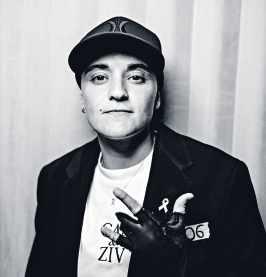
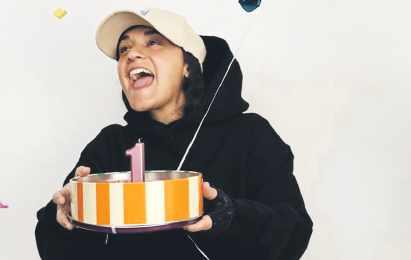
Emily Damari on her captivity and recovery P19
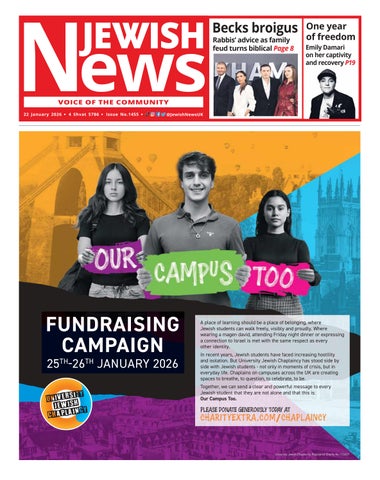
A place of learning should be a place of belonging, where Jewish students can walk freely, visibly and proudly. Where wearing a magen david, attending Friday night dinner or expressing a connection to Israel is met with the same respect as every other identity.
In recent years, Jewish students have faced increasing hostility and isolation. But University Jewish Chaplaincy has stood side by side with Jewish students - not only in moments of crisis, but in everyday life. Chaplains on campuses across the UK are creating spaces to breathe, to question, to celebrate, to be.
Together, we can send a clear and powerful message to every Jewish student that they are not alone and that this is: Our Campus Too.
Rabbis’ advice as family feud turns biblical Page 8
One year
Emily Damari on captivity and recovery Page 19
Holocaust education being silenced by ‘genocide’ slur
Misuse of term since 7 October leaving teachers fearful
by Lee Harpin
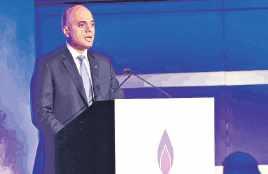
Former Conservative minister Sajid Javid has blamed the “weaponisation” of the word genocide since the 7 October Hamas attacks for a sharp fall in Holocaust education in schools, warning that the misuse of the term has made teachers fearful of engaging with Holocaust Memorial Day.
In his first full interview since becoming chair of the Holocaust Memorial Day Trust, Javid said the trend had contributed to a “worrying decline” in the number of schools signing up to mark the annual commemoration, and pledged to drive participation to levels “higher than ever before”.
The former home secretary, chancellor and communities secretary, who developed a close
relationship with Jewish communal organisations throughout his political career as he regularly spoke out against rising antisemitism, also gave a unique insight into the importance he has placed on teaching his children about the horrors and lessons to be learnt from the Holocaust.
In a wide-ranging interview, Javid disclosed that one of his daughters was left distraught after an online assembly on the Holocaust she hosted at her school was infiltrated by American neo-Nazis, who beamed a swastika onto her projections.
With his first Holocaust Memorial Day events now days away, Javid was both realistic about the challenges ahead but also very driven to achieve new successes for HMDT.
He acknowledged how, since the 7 October Hamas terror attack, there had been a drop in the number of schools participating in memorial day events.
“Sadly, the number [of schools marking Holocaust Memorial Day] has gone down in the last couple of years,” he admitted. “First, I want to have an ambition to get it back up to where it used to be. But then go beyond that. It’s ambitious, but that’s what we’re about.”
A report in The Sunday Times revealed more
than 2,000 secondary schools around the UK signed up to events commemorating Holocaust Memorial Day in 2023, which takes place on 27 January, according to data from the Holocaust Memorial Day Trust.
Until that year, those taking part had increased annually since 2019.
But since the terrorist attacks by Hamas, the number of participating schools fell to fewer than 1,200 in 2024 and 854 in 2025 – a reduction of nearly 60 percent. There are signs that this decline has begun to stabilise this year.
Asked about recent figures, Javid said: “We hope numbers have stabilised, because that’s our intelligence at the moment. Obviously, on the one hand, stabilisation is better than going down, but it’s still not good enough, because we need to go back in the other direction – an upward direction.”
Continued on page 2
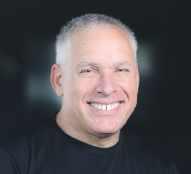
Warning: New HMDT chair, Sajid Javid
Photo by Blake Ezra
Political fallout hitting UK Holocaust education
Continued from page 1
Addressing the impact of the political rhetoric in the aftermath of 7 October, Javid was blunt: “Sadly, the word ‘genocide’ has been weaponised,” he said.
“It’s being massively misused, and has had an impact on Holocaust commemoration and education, but specifically for us, on Holocaust Memorial Day, getting more participation in schools.
“So I would say the number one reason is the use of that word has led to us having fewer schools.”
He continued: “As an organisation, we are absolutely clear anyone who attaches the word genocide to Gaza is a gross misuse. It’s weaponisation, it’s political in many cases. And we’re not going to have any trouble with that, and we’re not part of that in any way.”
Looking ahead, Javid said of his goals in his first three years as HMDT chair: “I’d love to be able to look back in a few years, in the role I’ve played, and feel that I’ve made some difference. And where I’d like to make a difference is in two big areas.
“Number one: schools. I believe passionately the more we can get the younger generation engaged and involved in this, the better.
“So I want to focus on schools. I want to get those school numbers higher than they’ve ever been before, despite what’s happened.
“Number two, help bring about more cooperation in the sector, so we can leverage each other’s limited resources more and collectively impact more people. I hope I’m welltrusted and respected enough that I
can help bring people together.”
Javid was quick to praise his predecessor, Laura Marks, who was HMDT chair for nine years, and credits her for encouraging him to take the role. He shocked Westminster in 2022, quitting Boris Johnson’s government and stepping down as an MP ahead of the last election.
“I’ve always worked really hard to do everything I can to fight antisemitism, to fight racism. In every job I had in government, I tried to do something,” Javid said, recalling his time in politics.
He added: “So part of that meant I wasn’t surprised that the door was
asking, would I be interested?”
But he also acknowledged: “I’m not Jewish and every chair before that at HMDT had been.”
Javid continued: “Laura made a really good point. She said, ‘Listen, honestly, we are not trying to convince the 99.5 percent of the population that are not Jewish in this country about the horrors of the Holocaust. That is not relevant.
“What’s relevant is, you know, will you do a great job for us and make a difference, right?’ And that’s why I was happy to take it.”
With Holocaust Memorial Day approaching, Javid said, “This is my
first Holocaust Memorial Day itself. This stuff next week, I’m very much looking forward to that. We’ve got fantastic plans. We’ve got a brilliant team, led by Olivia, of course, and I think this year’s Holocaust Memorial Day will be both poignant and will make an impact.”
Javid placed a renewed focus on partnership: “A very important part of our job is to support schools, but one of the initiatives that we will have going forward is to really focus a lot more on schools to get those numbers up. I also want to work more closely and cooperate more with other charities, organisations that support our broad aims – HET, the Anne Frank Trust, they are great charities and they work in schools a lot.”
He shared a deeply personal and troubling incident involving his daughter, Rania, who held a Holocaust Memorial Day at her school.
After it ended, his daughter came to him in tears and when asked what had happened said she was doing her presentation live to all the students, and showing her slides and suddenly the screen changed, and a swastika appeared on the screen.
Javid continued: “They called me to explain, and said we called the police, and the police investigated –it was a neo Nazi group in the United States ... they worked out how to get into Zoom and do that. And I said to her, ‘This actually underlines the importance of what you did today. The fact that some antisemites did what they did, yes, it shows you why you need to keep doing this’.”
• City Hall hosts survivors, page 6
Memorial pledges welcomed
Government assurances that the proposed Holocaust Memorial Learning Centre near Westminster will focus exclusively on the Shoah and antisemitism have been welcomed by opposition MPs, after an amendment recommended by the Lords was dismissed in the Commons, writes Lee Harpin.
In a rare display of unity, government and opposition MPs opposed the amendment to the Holocaust Memorial Bill, allowing its progress through Parliament to continue.
Communities minister Miatta Fahnbulleh said the proposal, which would have required the centre’s “sole purpose” to be education about the Holocaust and antisemitism, could instead be addressed through the learning centre’s future governance procedures.
Fahnbulleh described the proposal as outside the Bill’s scope, but reaffirmed the government’s intention for the centre to focus solely on “education about the Holocaust and about antisemitism”.
Conservative shadow communities secretary Sir James Cleverly said: “Conservative and crossbench peers have expressed concern and sought assurance the centre will exist for one purpose only: to provide education about the Holocaust and antisemitism.
“I welcome the government’s assurances and its commitment that the centre will remain exclusively focused on this mission.”
First announced by then-prime min-
ister David Cameron in 2015, the legislation aims to create a commemorative installation and learning centre in Victoria Tower Gardens dedicated to the Holocaust and the murder of six million Jews.
However, controversies over its aims, location, and escalating costs have delayed parliamentary approval.
Father of the House and Conservative MP Sir Edward Leigh reiterated some of the concerns that had arisen about the site, arguing that scrutiny has exposed “serious flaws” with its proximity to Parliament, and noting divisions within the UK’s Jewish community over the project.
Leigh said: “This is not a proper museum. I’ve visited memorials in Israel and Washington – vast, immersive structures.
“You cannot understand the Holocaust without understanding its beginnings and the hatred that enabled it. This is basically just a bunker – totally inappropriate.”
OUR LOSS, BY BONDI GIRL’S DAD
The parents of the youngest victim killed in the Bondi Beach terror attack have spoken of the moment their daughter was shot as she ran back towards them during the shooting at a Chanukah celebration.
Ten-year-old Matilda Britvan was among 15 people murdered on 14 December when two ISISinspired terrorists opened fire during a Chabad-run family event.
Parents Michael and Valentyna told ITV News they attended the annual beach party every year since Matilda was born and initially struggled to understand what was happening when gunshots were heard.
“So the first couple seconds, you kind of think it’s going to end, it’s going to end,” her father said. “And then it just kept on going.”
Matilda and her younger sister had gone to the petting zoo area on their own. As shots rang out, Matilda ran back towards her parents.
“I saw her wounded on the ground,” her father said.
The attack has prompted sweeping political repercussions in Australia, with the federal parliament recalled to pass new hate speech and gun laws.
Britvan however questioned whether rushed legislation would prevent future attacks, saying criminals would still find weapons and warning signs had been missed.
SCHOOL PROBE
The education secretary is launching a formal review of antisemitism in Britain’s schools and colleges and pledged that prejudice will end “on my watch” after rising concern about discrimination against Jewish pupils, teachers and public figures.
Writing in The Sunday Telegraph, Bridget Phillipson said she had deep concerns about the ability of schools and colleges to recognise and tackle antisemitism and harassment, and the Department for Education would now examine its policies to ensure incidents are identified and dealt with effectively.
The pledge follows the cancellation of a visit by Damien Egan, the Jewish Labour MP for Bristol North East, to a secondary school in September.
Bristol Brunel Academy’s decision to cancel amid protests from pro-Palestine activists and National Education Union activists triggered an urgent inspection by Ofsted and condemnation from ministers.
The education secretary has also ordered an independent inquiry into the trust that runs the school, Cabot Learning Federation, to assess governance and safeguarding arrangements.
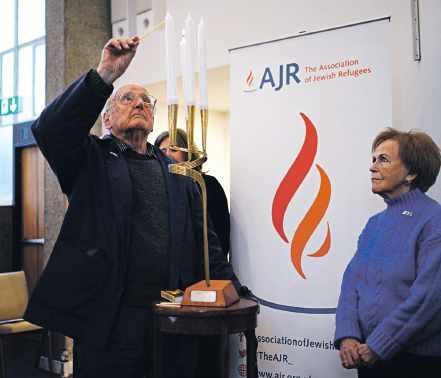
Ivor Perl lights a candle as Mala Tribich looks on during the Association of Jewish Refugees Holocaust Memorial Day Service on Tuesday
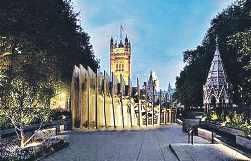
An impression of the Holocaust Memorial
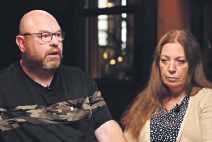
Michael and Valentyna Britvan
New review into impact of conflicts on UK Jews
A national commission has been launched to examine how global conflicts are shaping interfaith relations in Britain, with Jewish leaders among those warning international crises are increasingly reverberating through local communities, writes Annabel Sinclair.
The Commission on Interfaith Relations: UK Faith Groups and Global Conflicts, convened by the Woolf Institute, will investigate how overseas conflicts are “imported”, contributing to tensions between faith groups, and will develop practical guidance for councils, mayors and community leaders.
The inquiry comes with a backdrop of heightened anxiety within the Jewish community following 7 October, rising antisemitic incidents and episodes of unrest linked to faith, identity and geopolitics.
Commission chair and Woolf Institute founder president Dr Ed Kessler said recent disturbances showed faith-linked tensions were worsening rather than easing.
“The 2022 Leicester unrest, the 2024 Southport riots and subsequent national community tensions indicate that faith-tied tensions are intensifying, not easing, and it is vital we understand how current
and emerging conflicts overseas become points of tension within the UK,” he said.
“We will not address every global conflict but will examine the most relevant global conflicts and their direct impact on UK faith relations.”
Movement for Progressive Judaism co-lead Rabbi Charley Baginsky, a speaker at the launch, said interfaith relationships were
now being tested by the emotional weight of global crises.
“Global conflicts now reach our communities not only through politics, but through people’s lives, histories and fears,” she said.
“When this happens, interfaith relationships become a frontline test of whether a diverse society can hold together.”
The commission marked a
shift away from symbolic gestures towards more sustained engagement. “It recognises that faith literacy, trust and long-term relationships are not optional extras, but essential infrastructure for the health of our society.”
The commission brings together 14 confirmed members spanning faith leadership, policing, academia, youth engagement and civil society, with further appointments expected from local government and the media.
They include Humanists UK chief executive Andrew Copson, National Police Chiefs’ Council hate crime adviser Paul Giannasi and Sikh studies professor Jagbir JhuttiJohal with Bishop Lusa NsengaNgoy of Willesden as vice-chair.
Launch speaker Imam Saifullah Nasser said the Muslim community was among many affected and “instead of simply asking people to better get on, the commission will assess the underlying impact of fracturing relations in the UK and test the mechanisms by which overseas conflict gets imported”.
The group will hold six public participation sessions across the UK in 2026, including events in Leicester, Manchester and Cardiff.
HISTORIC SHUL HIT BY DRONE
A 19th-century shul in Ukraine’s third largest city which survived pogroms, two world wars and Communist repression has been damaged by a Russian drone which landed metres away, injuring a security guard in the process.
The Great Choral Synagogue, one of just two shuls surviving in a city that once contained 200,000 Jews, suffered the damage on Sunday night during continued attacks on Ukrainian cities.
The blast blew out doors and windows. The injured guard is receiving medical treatment.
Former Moscow Chief Rabbi Pinchas Goldschmidt said Russia had “targeted” the building.
Tikva, the UK charity that provides aid and support the Odessa’s Jewish community in Odessa, is appealing for funds for repairs.
Chief executive Karen Bodenstein, said: “This synagogue is far more than bricks and mortar. It is a lifeline for elderly members of the community. A place of safety.”
DJ forced Israelis to say ‘Free Palestine’ BIBI JOINS PEACE BOARD
Israeli customers were told to say “Free Palestine” before a DJ would play their song during a karaoke night at a popular London pub, according to PalestinianAmerican activist Ahmed Alkhatib, who witnessed the incident and challenged it at the time, writes Annabel Sinclair.
The exchange took place in the early hours of Sunday at the Munster Tavern, where Alkhatib had arrived with a colleague shortly after midnight.
Alkhatib told Jewish News the song Tel Aviv Ya Habibi was stopped repeatedly within seconds of starting.
At first, he said, it appeared to be a technical issue, but after the song was cut a second and third time it became clear the interruptions were deliberate.
When members of the group questioned what was happening, Alkhatib said he approached the DJ directly to ask why the song kept being halted.
“You know what he tells me?” Alkhatib said. “He said, ‘If one of them comes out on stage and says “Free Palestine” out loud, I’ll play it’.”
Alkhatib said he immediately objected, describing the demand as unnecessary and
targeted. He said the Israeli group had been “not bothering anyone” and that the episode felt discriminatory.
He added the incident was particularly troubling because of its wider impact, saying it risked hardening attitudes rather than encouraging understanding or dialogue between communities.
A receipt seen by Jewish News confirms Alkhatib and his colleague were present at the Munster Tavern event shortly after midnight on Sunday.
The Munster Tavern was contacted for comment but did not respond by the time of publication.
Israel’s prime minister Benjamin Netanyahu has agreed to join US president Donald Trump’s proposed “Board of Peace” for Gaza, marking a clear change in position after Israel publicly criticised the plan. Until now, Netanyahu’s office had objected to the structure of the board, particularly the makeup of the committee that will oversee Gaza.
It said the plan had not been coordinated with Israel and ran “contrary to its policy”, with concerns focused on the inclusion of Turkey, a country that has sharply criticised Israel during the war.
Despite those objections, Netanyahu confirmed on Wednesday that Israel would
take part, although some observers believe the move could create new tensions inside Israel’s government.
Far-right coalition partners, including finance minister Bezalel Smotrich, have argued Israel should control Gaza’s future on its own and have opposed any international body playing a leading role.
Trump first described the Board of Peace as a small group of world leaders helping to oversee the Gaza ceasefire.
Since then, the idea has grown into a much larger initiative with dozens of countries invited and Trump suggesting it could eventually deal with conflicts beyond Gaza.
UNRWA SITE DEMOLISHED
The Israeli government has demolished buildings in the compound formerly occupied by UNRWA, the UN Relief and Works Agency in east Jerusalem, with the country’s ministry of foreign affairs making it clear the organisation was no longer operating at the site.
Israel officially seized the compound in the Sheikh Jarrah neighbourhood after a law was passed last October barring the agency for Palestinian refugees and their descendants from operating in Israel,.
Following the start of the demolition work this week, the Israeli MFA released a statement saying: “UNRWA-Hamas had already
ceased its operations at this site and no longer had any UN personnel or UN activity there.”
The announcement continued: “The compound does not enjoy any immunity and the seizure of this compound by Israeli authorities was carried out in accordance with both Israeli and international law.”
The association between UNRWA and Hamas in the statement follows the accusations from Israel that the agency in Gaza was deeply infiltrated by Hamas, with numerous documents seized in Gaza by the IDF appearing to show that a number of UNRWA employees were Hamas members.
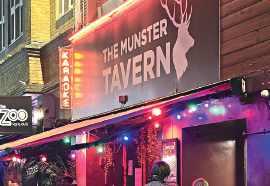
The Munster Tavern in central London
A counter demonstration in London against an anti-Israel rally
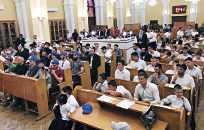
Inside the synagogue
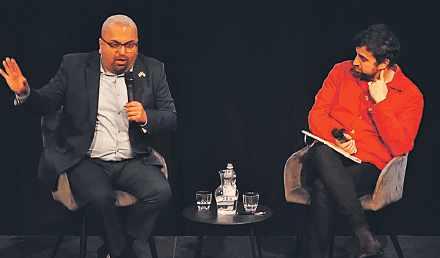
Uncomfortable truths at event on Israel and Gaza
The president of the Board of Deputies told a London audience this week that British Jews wanted to see an Israeli government free of “racists and bigots” such as Itamar Ben-Gvir who were “a stain on the Zionist project”, writes Beatrice Sayers.
Phil Rosenberg said his personal hopes for a two-state solution existed because of, rather than in spite of, his Zionism, and he wanted to see how British Jews could “play our part”.
Loud applause broke out when he continued: “We also need to see things from Israel. We need an immediate end to extremist settler violence we see in the West Bank.”
He also made it clear that for progress change was needed on the Palestinian side, starting with the return of the body of the final Israeli hostage. “Israelis are not wrong to want to see Hamas removed from power, disarmed,” he said. “Also Iran too, and Hezbollah and the Houthis. Israel is not wrong to want security. We also need to see a reformed Palestinian Authority ending incitement and corruption, making it worthy of governing a new state and a true partner for peace with Israel.”
Uncomfortable truths such as those were a theme of the event he addressed on Sunday, whose main
speaker was Ahmed Fouad Alkhatib, the Palestinian–American activist and blogger whose voice since the 7 October attacks has stood out as informed, balanced and articulate. From his US home, he keeps closely in touch with numerous people in Gaza. Under the title How Can We Help Make Peace Possible?, he gave a fluid and engaging description of the internal and external barriers.
Among the internal problems was segregation in Gazan society: the divide between what he termed locals and refugees.
Native Gazans, who make up 70
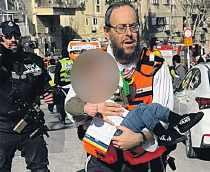
Jerusalem riots over autopsies for babies
Strictly-orthodox protesters clashed with police while opposing a court decision to carry out autopsies on two babies who died at a daycare centre in Jerusalem on Monday.
Leah Goloventzitz, four months old, and Aharon Katz, six months old, were found at an unlicensed nursery, with more than 50 injured children then evacuated. The daycare centre owner and primary caregiver present were arrested.
The autopsy order was approved by a Jerusalem court in response to a request from the Attorney General’s office and the police. The director of the Hadassah Medical Centre, Professor Yaniv Sherer, told Israel’s Maariv newspaper that there appeared to have been “some kind of poisoning, with or without a combination of crowding, fever, or dehydration”, although carbon monoxide poisoning was ruled out. A police theory is linked to a faulty heating system which led to the babies dying of heat exhaustion and dehydration.
While non-invasive autopsies via imaging are generally permitted by strictly-orthodox authorities, they can be inadequate in cases where criminal forensic results are needed.
The families of both dead children are believed to oppose an invasive autopsy, and have been granted leave to appeal the court’s decision.
However, following the court’s initial decision on Monday evening, Charedi protesters blocked roads, set dustbins alight and reportedly threw stones at oncoming cars, leading to the police dispersing the crowds.
percent of people in the territory, live in abject horror, Alkhatib said, and spend most of their day on survival; the other 30 percent inhabit a parallel universe. “They’re going to cafes. They’re eating pretty well.” These people might get paid by Hamas, or might have stolen or extorted aid. Hamas, and what remained of it, were a big beneficiary of the class divide and there was an urgent need to redirect aid and commerce away from it, and to stem the resentment the inequality caused.
More positively, Alkhatib saw a rare window opening up, an opportunity to create a new, young generation of political leaders “who had to be under 40” and who would redefine Palestinian identity in Gaza.
Until now politics in the territories had been binary between Fatah and Hamas. “The PLO, as a representative body of the Palestinians, is moribund. Gaza could be the starting ground for new political parties, not defined by opposition to Israel, but by the nationbuilding agenda.”
Alkhatib did not have a solution for ridding the territory of Hamas, of which he is an outspoken critic, and said there was little appetite among other countries to disarm the group in the red zone it controls. But hope could be found among the citizens:
“The people of Gaza are saying, ‘Can we stop doing this resistance nonsense Hamas has been forcing us into for the last 20 years? Can we not be perpetual [lab] rats on behalf of … political Islam?’ They’re actually talking about peace and progress.”
Among the external problems
were what he called the Quote Community, activists about whom the term “pro-Palestinian” required quotation marks to distinguish them from true supporters. Their main aim, particularly in America, was to co-opt the Palestinian cause with their own social causes, such as Black Lives Matter, abortion rights or the LGBT community.
The Quote Community was trying to simplify the problems in Israel and Palestine, which he said it was important to resist. “When you say, ‘Actually, it is complicated,’ that is so offensive that it triggers people,” Alkhatib said to audience laughter. “They’re like, ‘How dare you? No, it’s simple, white Jews are colonisers, and Jesus was Palestinian.’”
Alkhatib, founder and director of the Realign for Palestine project at the Atlantic Council think tank, for more than two years has spoken with moral clarity for the dignity of all those in the region. On Sunday he thanked his Jewish audience for its allyship, and was met with equal thanks.
The event was organised by groups including WeDemocracy, the Movement for Progressive Judaism and Yachad, and was partnered by Jewish News
MAN ATTEMPTS TO ACCESS SCHOOL
The Metropolitan Police has confirmed it is investigating an incident which took place outside a Jewish school in north-west London on Tuesday, where a man appeared to try and gain access to the site before talking about Israel and chanting in Arabic.
Video footage appeared to show the individual telling a security guard at outside the school that he was from “the council”. Having been refused access and subsequently confronted by a passer-by, the man said: “I’m just asking a friend what’s
going on in Israel”. Told to leave the area, the man then began chanting what appeared to be verses from the Koran. He subsequently referred to “Somaliland”, which Israel recently
AJEX NAMES NEW CHAIR
Jon Tyler has been elected as the new national chair of AJEX, succeeding Dan Fox, who steps down from the post after four years.
Tyler’s father, Lieutenant Commander Alan Tyler, was a career Royal Navy officer who served from 1941 to 1966 and later acted
as parade commander for AJEX Remembrance parades. Jon began attending them in 2000 and was appointed pparade commander himself in 2024
Tyler said: “These are difficult times for the Jewish community in the UK and it is important we continue
to show our loyalty to the Crown and country and how Jews have always stood up to be counted when the country needs them.
“I look forward to continuing the work of AJEX, in particular, remembrance of and strengthening the Jewish contribution to the military.”
recognised, before saying that “Allah asks you for five prayers a day…fewer and he’ll be disappointed in you” and then shouting “Alhamdullilah [praise be to God] for Islam!” Campaign Against Antisemitism shared the video footage on social media.
The Metropolitan Police said: “The identity of the man has been confirmed and statements are being taken from relevant parties. We understand the impact of incidents like this on local communities and an investigation is taking place.”
ON SONG
Singer Noam Bettan has been selected to represent Israel at the 2026 Eurovision Song Contest, securing the role after winning the televised Hakochav Haba (Rising Star) final.
The 27-year-old, from Ra’anana, was born in Israel to French immigrant parents and will perform in Vienna in May Bettan’s selection comes against the backdrop of sustained opposition to Israel’s inclusion.
Ahmed Fouad Alkhatib (left) with Josh Glancy at the event on Sunday. Inset: Phil Rosenberg
An injured child being carried from the daycare centre
Man filmed outside the school
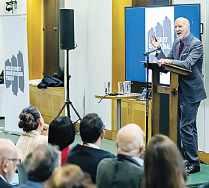
Holocaust memory now ‘under attack’
Acclaimed historian Simon Sebag Montefiore has issued a striking warning about the devaluation of anti-racist language in contemporary discourse, arguing that terms such as “diversity,” “equity,” and “inclusion” are now frequently manipulated to serve agendas running counter to their original intent, writes Lee Harpin.
Delivering the keynote speech at the Holocaust Education Trust’s event in Parliament, Montefiore observed: “The people behind the banning of a Jewish MP from his school because of his Jewishness were a cabal of teaching unions and DEI (Diversity, Equity, and Inclusion) coordinators who constantly repeat the language of anti-racism.
“We exist in a struggle where words have often come to mean their very opposite... diversity came to mean discrimination, equity, injustice, inclusive, exclusion.
“And as it turns out, every bigot is a proud anti-racist to their bones. Every antisemite is against antisem-
itism, and naturally, everybody is against the Holocaust and genocide.”
At Monday evening’s event, the author warned that Holocaust memory is “in peril” and under attack from new forms of antisemitic distortion and ideological abuse.
Also among the speakers were Home Secretary Shabana Mahmood, Holocaust survivor Annick Lever and several of the charity’s young ambassadors.
MPs attending included Damian Egan, the Parliamentarian barred
from a school in his Bristol constituency. HET’s chief executive, Karen Pollock, pointedly addressed recent concerns about the state of Holocaust education, saying: “Despite challenges, our experience is that we’re working with hundreds more schools since 7 October.”
Montefiore warned that Holocaust denial, distortion, and “inversion” have made a “spectacular comeback.”
He cautioned: “Keeping alive the awareness of the Holocaust, the mission of HET, this brilliant organization, is more vital a task than ever, because the last witnesses are passing from the scene,”
In her own speech, the home secretary said: “For centuries, Jewish life has been an indivisible part of our national life, and yet today, shamefully, British Jews are being forced to live a smaller life in this country.”
She recognised words were not enough, and pledged the government would act to counter the rise of Jew-hate.
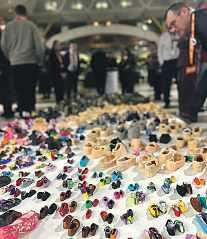
A moving exhibition featuring replicas of shoes belonging to victims of the Holocaust has taken centre stage in the main meeting hall at Westminster, where politicians, sta , and visitors alike are confronted with a powerful reminder of history.
Ceramicist Jenny Stolzenberg began the “In Their Footsteps” exhibition after the death of her Jewish father, Bill Powell, in 1990.
Her father, who arrived in the UK as Wilhelm Pollak — a refugee from Vienna imprisoned in Buchenwald — rarely spoke about his experiences. She created ceramic footwear in his memory, seeking to spark the conversations they never had.
Following Stolzenberg’s death, the Learning from the Righteous charity became the project’s custodian. The charity, which uses stories of Holocaust rescue to broaden children’s knowledge and inspire good deeds, adopted the idea of recreating victims’ shoes to engage pupils.
Now, with the encouragement of Commons Speaker Sir Lindsay Hoyle, “In Their Footsteps” has been displayed in Parliament.
At a parliamentary reception last week, Justice Minister and Finchley and Golders Green MP
Become a Team Leader
Sarah Sackman was joined by Learning from the Righteous CEO Anthony Lishak, schoolchildren from Trinity Catholic School in Leamington Spa, and other guests. Sackman told guests: “Something remarkable has happened in this place over the last few days. Amidst the usual hubbub and chatter, I’ve noticed a stillness.
“As people walk past the ‘In Their Footsteps’ exhibition, they suddenly stop to pause for thought. They stop dead in their tracks, confronted by something very poignant, very moving, and very resonant.”
Simon Sebag Montefiore
‘In their footsteps’ exhibition
City Hall hears the voices of survivors
by Lee Harpin lee@jewishnews.co.uk
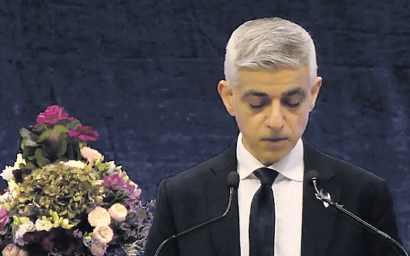
London mayor Sadiq Khan and London Assembly deputy chair Andrew Boff welcomed community leaders and survivors to a commemorative service ahead of Holocaust Memorial Day.
In partnership with the Holocaust Memorial Day Trust (HMDT) and Holocaust Educational Trust (HET), the event at City Hall honoured survivors, victims and all affected by genocide.
This year’s theme, Bridging Generations, highlighted the importance of ensuring the lessons from the past are passed down, as the responsibility of remembrance continues beyond the survivors themselves.
The ceremony featured testimonials from Holocaust survivor Annick Lever, smuggled out of prison by her father before being deported to the Drancy transit camp, and Safet Vukalić, a survivor of the Bosnian genocide.
Speakers with Khan and Boff included HMDT chief executive Olivia Marks-Woldman and interim chief programmes and outreach officer Anna Bradford.
Ambassadors from the HET reflected on their experiences in the Lessons from Auschwitz programme, with regional envoy Amberley Thay delivering the
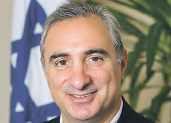
An Israeli ambassador and former deputy head of mission in the UK has died at age 62, with the Israeli embassy in the UK saying it is “deeply saddened” by his death.
Statement of Commitment.
Rabbi Nick Kett of the Radlett United Synagogue led the El Male Rachamim memorial prayer, followed by the lighting of a memorial candle by Lever and Vukalić.
The service opened and closed with musical performances by Lenka Lichtenberg, a Canadian singer of Czech-Jewish descent.
The HMDT exhibition 80 Candles for 80 Years is currently on display at City Hall.
Reflecting on the significance of the day, Khan said: “Holocaust Memorial Day is a solemn reminder of the atrocities of the past and the shared responsibility we all carry to ensure such horrors are never repeated.
“City Hall’s annual service provides an important moment
Eitan Naeh was deputy head of mission and chargé d’affaires in the UK from 2013-2016 and later Israel’s ambassador to Turkey and then Bahrain. He died unexpectedly on Sunday.
A teenage boy accused of plotting a terror attack on local synagogues wrote in his journal how some pupils at his school “should be shot”, a court has heard.
Police found an “arsenal” of weapons, including a crossbow, knives, a gas-powered air pistol and airsoft rifles, when they raided the
16-year-old’s home in Northumberland, Leeds Crown Court was told.
Army bomb disposal experts as well as chemical, biological and radiation specialists were called to the scene after home-made explosives were discovered, the prosecution said.
Jurors were shown images
for us all to hear from survivors and ensure their experiences are passed on to future generations.
“As we continue to battle against the scourge of antisemitism and hatred across the globe, their message is more vital than ever. I will continue to do everything in my power to unite communities and show there is no place for hate in our city.”
Marks-Woldman highlighted the importance of partnership and unity, saying: “We are delighted to be partnering with City Hall to mark Holocaust Memorial Day, helping to ensure remembrance remains visible, meaningful and relevant for people across the City of London.
“At a time when antisemitism and prejudice are rising in the
The embassy said it was “deeply saddened”, while Israel’s current chargé d’affaires in the UK Daniela Grudsky described Naeh as “a dear colleague and friend .
She added: “Eitan’s kindness, wisdom and dedication over 35 years of service touched everyone privileged to have worked with him.”
of the boy’s bedroom, in which counter-terror police found a replica SS-style cap, posters in support of the banned neoNazi organisation The Base and a spent shotgun cartridge filled with a white powder.
The boy, who cannot be named because of his age, denies the charges.
The trial continues.
UK, Holocaust Memorial Day brings communities from all backgrounds, ages and beliefs together to remember the past and stand against hatred in the present.”
HET chief executive Karen Pollock stressed the enduring relevance of Holocaust remembrance as “we remember the six million murdered by the Nazis and their collaborators, and we honour the survivors who rebuilt their lives while coming to terms with unimaginable loss.
“Over 80 years on, the Holocaust is fading further into history and the responsibility of safeguarding the memory of the victims and survivors passes firmly to the next generation.”
She noted this Holocaust Memorial Day sees concern for Jewish communities worldwide growing: “Remembering the persecution and murder of Jewish people in the past is essential, but must be accompanied by an urgency to challenge antisemitism today and confront its causes.”
Boff added: “As the passage of time since the Holocaust widens, the opportunity to hear first-hand accounts from survivors and their descendants diminishes; however, we mustn’t allow time or distance to desensitise us to the devastating consequences of the Holocaust and subsequent genocides in the world.”
Government clauses seeking to address anger and concern raised by the Jewish community on the impact of pro-Palestinian protests staged near synagogues have been introduced in the House of Lords, writes Lee Harpin.
The proposals, promised by Keir Starmer as part of the government’s wider drive to stem the rising tide of antisemitic hatred, were introduced by Jewish Labour peer Lord Mike Katz as part of the Crime and Policing Bill.
Broadly welcomed by Jewish peers across all parties, they will allow police to consider the cumulative impact of protests in an area
PEDAL POWER: LUKAS’ RIDE OF REMEMBRANCE
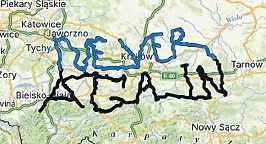
A Czech endurance cyclist has competed a 1,000km ride across Poland to mark Holocaust Memorial Day, tracing the words “Never Again” across the route map in a powerful act of remembrance.
Lukáš Klement began the journey at Auschwitz-Birkenau, departing from the Gate of Death beneath the Nazi slogan Arbeit macht frei (Work makes one free).
The route, which spanned southern Poland, was designed deliberately so the completed trail spells out “Never Again”, the phrase adopted by Holocaust survivors and now widely recognised as a warning against antisemitism, fascism and genocide.
The ride was carried out in cooperation with Israel’s ZAKA Search and Rescue organisation and took around 50hr. Members of the public were invited to accompany Klement for the opening kilometre as the ride began.
Explaining his motivation, Klement said: “After the attack in Sydney and just before Holocaust Remembrance Day, this is my answer to the terrorists: a cross-border, crosscultural project that connects people regardless of race, gender, or religion.
International Holocaust Remembrance Day is on 27 January, marking the liberation of Auschwitz by the Red Army in 1945.
The phrase “Never Again” was first used by liberated prisoners at Buchenwald and is central to Holocaust remembrance and the ongoing fight against antisemitism.
and strengthen police powers to impose conditions on protests near places of worship.
Crossbench peer Lord Walney, who has demanded a tougher approach to pro-Palestine activity, said the government still had “much to do” to prove it had the Jewish community’s back.
The marathon fourhour debate saw some peers attempt to raise concerns about infringements to the democratic right to protest.
Front-bench government whip Lord Katz, who responded for the government, told Jewish News: “As I said in the debate, the fear and intimidation they feel
are real. We can’t, as a society, ignore these concerns and this government is certainly acting on them.”
Conservative peer Lord Leigh, speaking as president of Westminster Synagogue, told peers: “We have had two marches past us recently, both on a Saturday,.
“We negotiated with the police to ensure they did not pass on a Saturday morning, when we had services, but they did pass by us at lunchtime, so we had to abandon our community lunch events. “We were told we had to leave the building before we had the lunch that we had planned.”
London mayor Sadiq Khan gives a reading at City Hall
Cyclist Lukáš Klement’s bike route in Poland, spelling the words ‘Never again’
Eitan Naeh
Lasting Powers of Attorney (LPAs) let the people you trust act on your behalf if you ever can’t. Without LPAs, even your closest family may have no legal authority to make decisions about your health, care, property or finances.
Protect yourself and your family from uncertainty, stress, and difficult decisions. Make sure your voice is heard now, so your choices will be respected later.
It’s never too early. The best time to plan is now.
Set up your Lasting Power of Attorney online: www.gov.uk/power-of-attorney
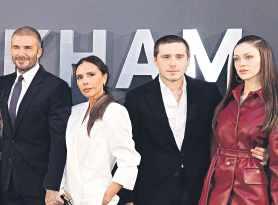
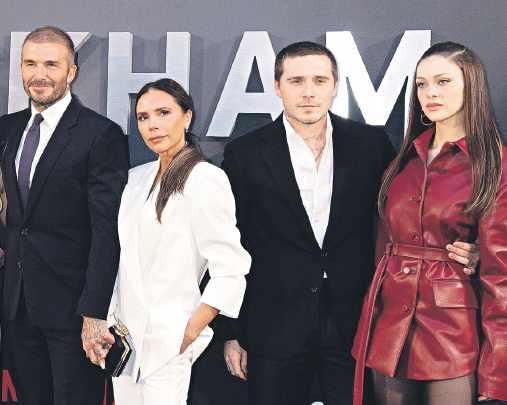
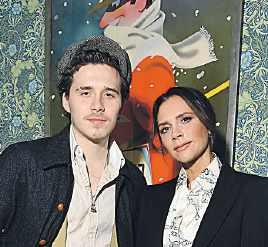
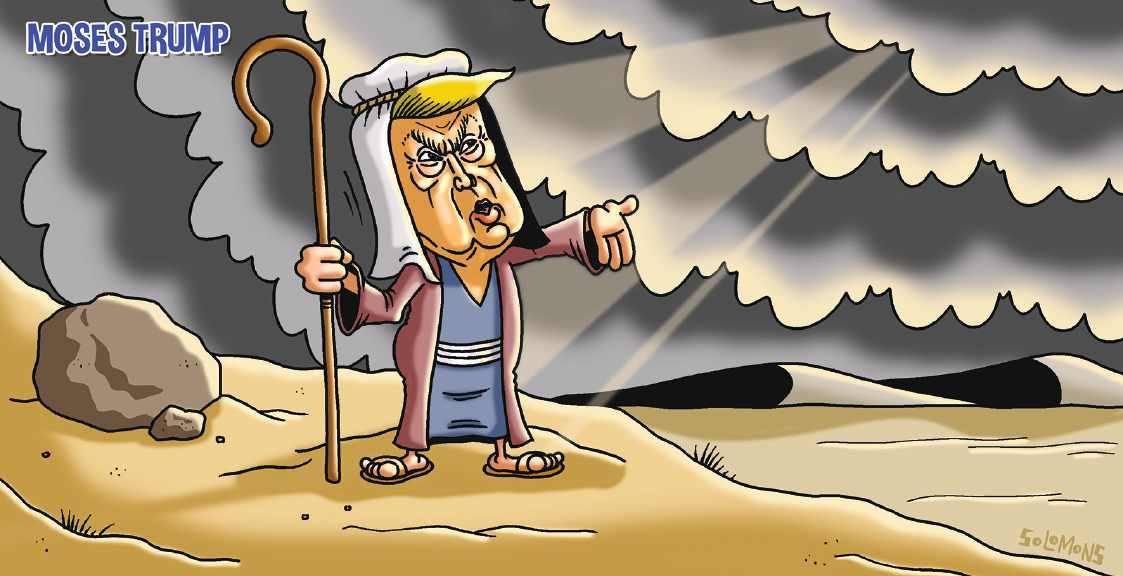
Beckham broigus: our rabbis’ advice...
Whatever you think following Brooklyn Beckham’s statement about his frosty relationhip with his parents, one thing’s for sure – there is a huge family rift and a lot of pain. What should Victoria and David do now? We asked three rabbis for their advice.
Rabbi Alex Chapper at Borehamwood & Elstree Synagogue
When a child says, “I don’t want to reconcile with my family,” the pain is not only in the words themselves, but in the fact that they were spoken publicly. For any parent, famous or not, that moment must feel like a private wound exposed to the world.
Jewish teachings have a great deal to say about family rifts, not because we are immune to them, but because we know how fragile relationships can be. The first book of the Torah contains many columns describing sibling rivalry, parental favouritism and human weakness.
The first piece of advice I would offer is this: keep the door open, even if the child walks away from it. In Jewish tradition, parents are instructed to teach, guide, and discipline but not to coerce. Love that insists on control ceases to be love. Silence, patience, and presence often speak louder than rebuttals or explanations. Second, do not allow this to become a public feud. Disagreements multiply when they acquire an audience.
Judaism places enormous value on dignity – especially when emotions run high. Respect for oneself and others is golden.
Rabbi Brendan Stern at Hendon United Synagogue
Living in the public eye amplifies every move, emotion and disagreement. Life in the limelight is a challenge. But the most important value is to pass over your values to ignite the light for the next generation, ensuring a continuation of your legacy.
You are faced with a difficult choice. Do you want to be a family where the perpetual sword is raised by son to parent, or vice versa? Or do you want to be a family that learn to sit together, to eat together, to communicate together and feel together?
I implore you not to retaliate with the “sword” but to respond with opening your doors, and your hearts.
The Torah does not demand perfection from families, only presence. Freedom, both then and now, begins when parents and children are willing to remain under the same roof –emotionally if not physically – long enough to listen.
Redemption is born when a family closes its doors to chaos and opens its heart to one another.
With blessing and hope.
Rabbi Benjy Morgan at JLE
Separate the public from the personal. Public storms pass quickly; family moments linger. Before responding outwardly, the priority must be inward –creating a space where their son feels safe, heard, and respected, even if his words are difficult or disappointing.
Judaism teaches dan lekaf zechus – to judge another person favourably. Applied within a family, this means assuming good intent before jumping to conclusions. A statement may reflect confusion, immaturity, or a desire to be heard, rather than hostility or rejection. Approaching a child from that place changes the entire conversation.
At the same time, dan lekaf zechus is not the absence of values. Parents are meant to model clarity, integrity, and moral confidence. Honest conversations should happen privately, where nuance and empathy are possible, and where disagreement does not feel like rejection.
There is also wisdom in restraint. Not every statement requires an immediate response, and silence is sometimes the most mature reply. In Jewish thought, strength is not measured by how loudly one reacts, but by how thoughtfully one responds.
Brooklyn Beckham and mum Victoria
Retired police chief referred to watchdog
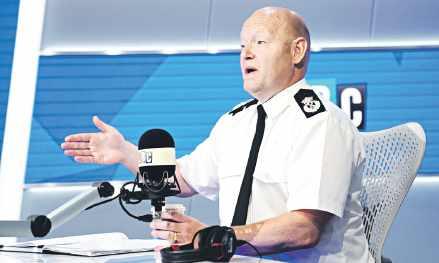
Retired chief constable Craig Guildford has been referred to the police watchdog by West Midlands Police and Crime Commissioner Simon Foster over the decision to ban Maccabi Tel Aviv football fans from attending a match against Aston Villa last November, writes Adam Decker.
Guildford, 52, stepped down as the head of the force last Friday, following mounting pressure for him to quit over the controversy.
Home Secretary Shabana Mahmood said she had lost confidence in the senior police boss after a “damning” watchdog review showed “confirmation bias” and a “failure of leadership” in West Midlands Police on Wednesday.
Speaking on Monday afternoon, Crime Commissioner Simon Foster said: “This morning I met with Acting Chief Constable [Scott] Green and Acting Deputy Chief Constable [Jen] Mattinson. I received assurances that there will be an e ective and e cient operational transition following the
retirement of the former chief constable. The force’s priority will continue to be preventing and tackling crime and keeping the people of the West Midlands safe and secure.
“I welcome today’s statement from West Midlands Police. I want to ensure the force takes comprehensive and immediate action to rebuild the trust and confidence
of all our communities across the West Midlands. These matters have had a significant impact on public confidence, and the confidence of particular communities.
“This is unacceptable. The force know that I expect them to comply with the very highest standards of conduct at all times.
“I will therefore today make
a voluntary referral to the Independent O ce for Police Conduct regarding any conduct matters by the former Chief Constable in relation to these events.
“Continuing to hold the force to account for its actions, arising from the ban on away supporters from attending the football match on 6 November remains a top priority.
“At my accountability and governance board next Tuesday 27 January, I will be considering in public, a report I have requested from West Midlands Police, and putting questions to the force.
“I also await the publication of the Home A airs committee report into these matters.
“I acknowledge the continuing and understandable public interest. I will continue to hold West Midlands Police to account. That is absolute, unconditional, and non-negotiable.”
Guildford first became a police constable in 1994 and has served as the head of West Midlands Police since 2022.
A senior West Midlands police officer was recorded last October telling a private meeting that some Birmingham residents were planning to “arm themselves” in self-defence ahead of a visit from Israeli football fans, “out of fear for what might happen”.
Arguing for a ban on Maccabi Tel Aviv fans attending last year’s match against Aston Villa, leaked audio from the meeting – obtained by Jewish News – reveals Superintendent Jack Hadley depicting Maccabi fans as likely to cause “carnage” in the city.
Hadley’s suggestion that residents in predominantly Muslim areas near Villa Park were preparing to arm themselves in anticipation of Israeli fans’ actions raises concerns about the conduct of police.
Earlier this month, West Midlands Police chiefs faced criticism at a Home A airs Select Committee hearing for failing to disclose intelligence.
Assistant Chief Constable Mike O’Hara later told MPs: “There was a lot of intelligence that people would actively seek out Maccabi fans and seek violence towards them.”
Guildford resisted calls to resign after the decision to ban Maccabi fans
Tributes to survivor and ‘ mensch ’ Harry
by Annabel Sinclair annabel@jewishnews.co.uk
Harry Olmer, a Holocaust survivor who endured years of forced labour in some of the Nazi regime’s most brutal camps before rebuilding his life in Britain and dedicating decades to Holocaust education, has died aged 98.
Born Chaim Olmer in 1927 in Sosnowiec, Poland, he was the fourth of
six children. After Germany invaded in 1939, antisemitic persecution intensified rapidly.
In spring 1940, his family fled to his grandmother’s village of MiechówCharsznica, hoping conditions might be safer. Instead, Jewish residents were subjected to forced labour.
In 1942, Jews from MiechówCharsznica and surrounding villages were held in a field before a selection. Those deemed unfit for labour were shot. Women and children were deported to Bełżec death camp and murdered on arrival. Harry, his brother and father were among those sent to Płaszów labour camp, where he worked on a railway line.
After a year, he was transferred to Skarżysko-Kamienna, a lethal forced labour camp. There, tens of thousands of Jewish prisoners were exploited in chemical factories owned by the German HASAG company. Thousands died from poisoning, epidemics, starvation and exhaustion. The SS carried out periodic selections, shooting weakened prisoners.
In July 1944, as the Germans retreated, Olmer was among approximately 6,000 prisoners sent to Buchenwald concentration camp.
He was later transferred to a subcamp and again forced into dangerous industrial labour. In April 1945, with the Soviets advancing, surviving prisoners were sent to the Terezín ghetto in Czechoslovakia. Olmer was liberated there on 8 May 1945.
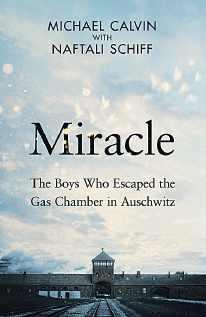
He arrived in Britain later that year as part of the group of child survivors known as “The Boys”, evacuated to the Lake District. Despite speaking no English on arrival, he completed his Highers in 1947, qualified as a dentist, became a British citizen in 1950, and later served in the army as a dentist. He retired in 2013.
Olmer became a tireless advocate for Holocaust education, speaking widely to schools, synagogues and community groups. In 2023, he was appointed MBE for services to Holocaust education, reflecting national recognition of his contribution to remembrance and testimony.
Karen Pollock, chief executive of the Holocaust Educational Trust, said: “Harry was one of the most determined and tenacious men I knew. He believed profoundly in the power of education, sharing his testimony in schools across the country for decades.”
She concluded: “Harry was in the truest sense of the word, a mensch –one of the kindest people I will ever meet. I will miss him deeply. May his memory be a blessing.”
Lauren Libbert, My Voice London project lead, described Olmer as “fiercely intelligent, kind, warm and funny”, adding: “His sparkle and zest for life... was legendary.”
In 2024, through The Fed’s My Voice project, Olmer’s life story was published in the book My revenge on Hitler is my family, documenting his experiences “so it could be used as an educational tool for years to come.”
Speaking about the book, Olmer said: “I’m so pleased that all the details of my life story are now written and recorded. Not everyone knew about my full story – my family, where I came from, what happened to me – and I want future generations to know exactly what happened and to hear it in my words, in my voice.”
Harry Olmer is survived by his four children and eight grandchildren. • Karen Pollock, page 24
Harry’s life story was published in a book published in 2004
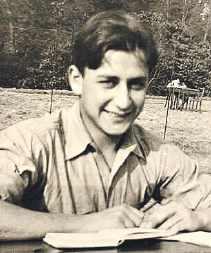
Harry as a young boy
THERE HAS NEVER BEEN A MORE SIGNIFICANT TIME TO SECURE YOUR PIECE OF ISRAEL
ICR brings Israel’s most prestigious addresses to London
SCAN TO RSVP
The experience, reputation, and portfolio of the two leading groups –Israel Canada and Ram Residences – combined with the group’s capabilities, make ICR one of the strongest and most influential real estate groups in Israel.
North Tel Aviv
Tel Aviv
Jerusalem
Minister backs Jewish jobs hub amid concern for young workers
Work and pensions secretary Pat McFadden has praised a Jewish community employment charity during a visit to north London, highlighting its role in helping jobseekers and small business owners navigate an increasingly uncertain labour market, writes Annabel Sinclair.
McFadden visited Work Avenue after an invitation from the Jewish Leadership Council, touring the Wohl Enterprise Hub in Finchley and meeting employment clients, entrepreneurs and sta working across the charity’s job placement and business support programmes.
It follows government concerns about youth unemployment, with McFadden warning against young people leaving education without moving into work, training or apprenticeships:
“The last thing I want to see is people graduating from education on to benefits,” he said
McFadden met Thomas Frey, an employment client who has returned to the UK after travelling abroad. Frey has previous corporate sales experience and is working with Work Avenue advisers on CV development, skills translation and identifying suitable roles.
The minister also spoke with Meir Moller, currently employed in the hospitality sector but seeking clearer direction about his long-term career path.
Sta explained how the charity supports clients not only into work, but in sustaining employment and planning next steps, particularly for those who feel under-utilised or unsure about future progression.
Business owners renting desk space at the hub include planning consultant Jonathan
First interfaith art exhibition set for take-off next month
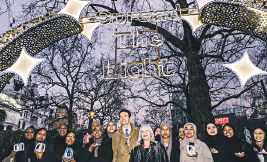
London is hosting its first interfaith art exhibition this year as the Aziz Foundation expands its high-profile Ramadan Lights London programme beyond its West End illuminations and into the visual arts, writes Annabel Sinclair.
Shared Light is a free open-call exhibition forming part of Ramadan Lights London 2026, the annual installation landmark moment in the capital’s cultural calendar, and runs from 13 February-22 March, coinciding with Ramadan.
It is set in the hotel café at Zedwell Piccadilly Circus at the London Trocadero, and is designed as a contemplative space amid the intensity of the West End. Organisers say it will invite visitors of all backgrounds to pause and reflect on shared values that cut across faiths and cultures.
Artists are being invited to submit 2D artworks on themes associated with Ramadan,
including generosity and gratitude. While rooted in the Muslim holy month, the foundation stresses such values are universal.
u Submissions for Shared Light close at 11.59pm on 25 January, with selected artists notified by the end of the month
RABBI MEYER REAPPOINTED TO OFSTED BOARD TILL 2029
Rabbi David Meyer has been reappointed to the Ofsted board for a further three-year term, extending his role at the centre of England’s education inspection system.
Meyer, chief executive of the Partnership for Jewish Schools (PaJeS), has served on the board since 2021 and will now remain in post until January 2029, contributing to oversight of education and children’s social care across England.
His reappointment comes during a period of change for Ofsted, as the inspectorate seeks to rebuild trust with schools and develop a more constructive approach to working with education leaders and social care professionals.
Meyer said: “I’m honoured to continue serving on the Ofsted board. During my first term, we have seen a change in leadership at Ofsted and significant developments in its approach, with a clear determination to be more attuned to the challenges faced by schools and other education providers.”
As head of PaJeS, Meyer supports Jewish schools across the UK, working closely with headteachers, governors and leadership teams on school improvement, governance and professional development.
He was awarded an OBE in 2020 for services to education.
Greenberg and AI specialist Craig Hartzel, whose company advises small and mediumsized enterprises, outlining how accessible digital tools help sole traders and micro businesses on upskilling and marketing.
McFadden said the mix of employment support and enterprise reflected the di erent needs
people bring through the door, noting: “We met people looking for jobs and people running their own businesses,” he said. “The combining of those two things is a really interesting example.”
Work Avenue’ chief executive Debbie Lebrett said the visit underlined the importance of employment in building long-term financial independence within the Jewish community, particularly at a time of economic pressure and rising insecurity, highlighting the charity’s focus on practical skills, sustained employment and business resilience in supporting individuals and families beyond short-term job placement.
McFadden described the organisation as enterprising and community-rooted, noting that part of its sustainability comes from workspace rental alongside charitable activity.
“It’s a community- and faith-based organisation, and that’s a credit to the founders,” he said. “It has an important role alongside what the state does with job centres and other services.”
The minister also outlined new government measures aimed at tackling youth and longterm unemployment, including the Youth Guarantee, which will o er training and work experience opportunities to more than 300,000 young people, as well as subsidised paid roles for those unemployed over the long term.
Members of the Aziz Foundation
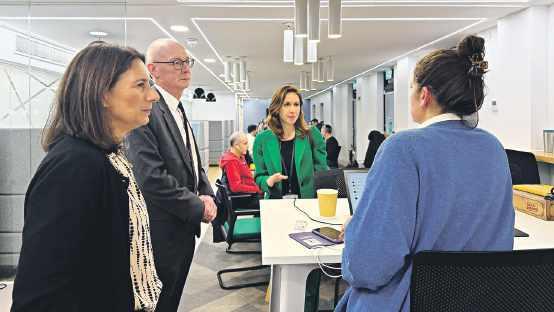
Pat McFadden with staff and clients during a visit to the Wohl Enterprise Hub in Finchley
Open University agrees to drop ‘ancient Palestine’ Brit milah ‘abuse’ row
The Open University is to stop using the term “ancient Palestine” in teaching materials after a student raised concerns the wording was historically inaccurate and risked erasing Jewish history, writes Annabel Sinclair.
The change follows a complaint backed by UK Lawyers for Israel (UKLFI), which warned the university describing the Virgin Mary as being born in “ancient Palestine” could create a hostile learning environment for Jewish and Israeli students. The development was first reported by The Telegraph
The wording appeared in Discovering the Arts and Humanities, an entry-level Open University module that introduces students to myths, religion and cultural history.
Course materials referred to Mary’s birthplace as “ancient Palestine”, described Ara-
maic as “a language widely spoken in ancient Palestine” and included a map labelled “Map of ancient Palestine”.
UKLFI argued the terminology was anachronistic and politically loaded, particularly given the current climate following the
Hamas-led attacks on Israel on 7 October, 2023. The group said the term “Palestine” was not applied to the region of Judea, Samaria and Galilee until after the Bar Kokhba revolt, when the Roman emperor Hadrian renamed the province “Syria Palaestina” around 135 CE – more than a century after Mary’s lifetime.
Mary is widely believed to have been born in the late first century BCE in Galilee, a predominantly Jewish region under Roman rule, with most historical accounts identifying Nazareth as her home village.
The Open University confirmed it would no longer use the term in future materials and would add context to existing content, acknowledged the wording had become “problematic in a way that, perhaps, it was not when the materials were written in 2018”.
ANTISEMITIC APPRENTICE DOC STRUCK OFF
A former contestant on TV show The Apprentice who sent a string of antisemitic, racist and sexist posts on social media has been struck off the medical register.
Dr Asif Munaf posted and reposted “seriously offensive” comments from X account @DrAsifOfficial on 36 occasions between October 2023 and last July. He appeared in the 2024 edition of the BBC series fronted by business tycoon Lord Sugar.
Jewish organisations are seeking “firm guarantees” from the Crown Prosecution Service (CPS) after leaked draft guidance suggested circumcision, if carried out improperly, could amount to “child abuse”.
The guidance, reported by The Guardian, prompted concern across the Jewish community, with Milah UK confirming it will meet CPS officials next week to press for explicit protections for brit milah as a core religious practice.
According to the report, the draft guidance stated circumcision could be “a painful and harmful practice, if carried out incorrectly or in inappropriate circumstances”.
This “may be a form of child abuse or an offence against the person”.
In response, the CPS stressed it recognised the religious significance of male circumcision and no final decisions had been taken, adding: “We absolutely recognise that for many, male circumcision is a safe and celebrated tradition.”
Among the antisemitic posts was one in which he wrote: “You only have to go to North London to see the Jewish love for a bakery. Lots of bagel shops and many of them very nice with great coffee. Does the obsession with baking and ovens explain the uncontested and unproven claims of 6 million Jews and 40 beheaded babies in ovens?”.
Aliyah: building dreams and saving tax
• Tax-efficient investing before and after Aliyah
• Tax-efficient income after 10-year tax-free period
• Receive your entire pension pot tax-free
• Specialist portfolio management for Olim
• No Inheritance Tax (for non-UK-situated assets)
We are seasoned experts in providing long-term financial planning advice for those making Aliyah. Scan the QR code to read more
With investing, your capital is at risk. Tax treatments are subject to individual circumstances and are subject to change.
The doctor also posted: “9/11 wasn’t an inside job. Let’s call it for what it really is. A Jewish job.”
Dr Asif Munaf A strictly-Orthodox brit milah ceremony
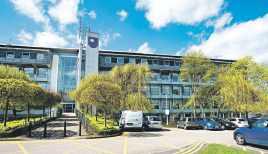
The Open University campus
Israeli AI set to transform diabetes prevention care
by Candice Krieger candicekrieger@googlemail.com
An artificial intelligence model developed by Israeli researchers can identify people at risk of developing diabetes more than 10 years before diagnosis, a new study reveals.
The research, published in science journal Nature, was led by teams at Nvidia Israel, Weizmann Institute of Science and Israeli healthtech firm Pheno.AI, alongside the Mohamed bin Zayed University of Artificial Intelligence.
Researchers say the AI system, known as GluFormer, can forecast the likelihood of Type-2 diabetes up to 12 years in advance using patterns identified in continuous glucose monitoring data, outperforming current indicators and raising the prospect of earlier intervention.
The model was trained using data from Israel’s long-running “10K Project”, one of the most comprehensive health datasets of its kind.
The initiative has tracked more than 14,000 participants over several years, combining continuous glucose measurements with genetic testing, blood and stool analysis, microbiome profiling, sleep studies, movement tests and detailed lifestyle and medical histories.
Professor Eran Segal, a computational biologist at the Weizmann Institute and senior author of the study, said the scale and depth of
The model helps identify those at risk of developing a range of diseases
the data enabled the team to identify patterns that conventional tools fail to detect.
“People classified as pre-diabetic are often treated as a single group,” Segal said. “But existing measures do not reliably predict who will actually go on to develop diabetes. The AI model can.”
According to the findings, around 66 percent
SECRET PROBE EXPOSES
FRENCH ANTISEMITISM
A French journalist who spent a year undercover inside anti-Israel activist networks has warned antisemitism has become a central unifying force on the country’s radical left, posing what she describes as a growing threat to French Jews and democratic society.
In a new book Les Nouveaux Antisémites (The New Antisemites), Nora Bussigny documents her infiltration of far-left, Islamist and pro-Palestinian groups across France, where she says hostility towards Jews and Israel has replaced traditional ideological divides.
Bussigny told The Times of Israel: “I saw with my own eyes to what degree Islamists, far-left so-called ‘progressive’ militants and feminist, LGBT and ecological activists are closely linked in their shared hatred of Jews and Israel.”
The probe followed Hamas’ 7 October 2023 attack on Israel, an event Bussigny says accelerated the convergence of extremist movements and fuelled antisemitism across Europe.
Writing under a false identity, Bussigny attended demos, meetings and online forums adopting the language used by anti-Israel campaigners such as “the Zionist entity” with Israel’s army described as “the genocidal army”.
Her book describes how chants glorifying Hamas and 7 October were heard at protests framed publicly as campaigns for human rights, including women’s and LGBT causes.
Bussigny names several organisations, including Urgence Palestine, Palestine Vaincra
and Samidoun – the latter designated a terrorist organisation by several countries including the US – alleging they have had political support in France, including access to public venues.
Although not Jewish, Bussigny has faced intense backlash since the book’s release, including death threats and online abuse.
She says part of the hostility is because she is Franco-Moroccan. She has been labelled a traitor and accused of being funded by Israel.
She also claims some French bookshops have refused to stock the title, despite it becoming a bestseller and winning the 2025 Prix Edgar Fauré for political book of the year.
Bussigny says she has been particularly struck by the response from France’s Jewish community. “Many say my book has helped them see what’s behind much of the current antisemitism,” she said.
of participants who later developed diabetes were flagged as high-risk by GluFormer years earlier, while only a fraction of those assessed as low-risk later became diabetic. The model also demonstrated ability to predict other diseases, identifying nearly 70 percent of those who later died from heart-related causes as high-risk.
The researchers found the system was able
to anticipate other health outcomes linked to metabolic health, including indicators associated with cardiovascular disease, kidney and liver function, blood lipid levels, visceral fat, and sleep disorders. In each case, the model outperformed other prediction methods based on glucose monitoring alone.
The technology uses a transformer-based architecture similar to that underpinning large language models, enabling it to extrapolate long-term health outcomes from relatively short sequences of data – sometimes as little as one to two weeks of glucose readings.
The findings have significant implications for healthcare providers, insurers and healthtech companies. The global cost of diabetes is projected to reach $2.5trn by 2030, according to estimates cited in the study.
Pheno.AI holds the commercial rights to the model. It plans to work with healthcare organisations to bring it into clinical use.
The study highlights Israel’s growing role at the intersection of artificial intelligence, healthcare and big data, alongside the expanding footprint of Nvidia’s research activity in the country.
For Segal, the goal is prevention. “Only a minority of people defined as pre-diabetic will actually develop diabetes,” he has said. “The challenge is knowing who they are and now we’re much closer to answering that.”
Musk remigration row
Elon Musk has been criticised after again endorsing white-nationalist sentiments on social media, including one which backed the expulsion of Jews from Western countries.
The businessman shared a tweet last week from a user called “Hugh Anthony” which read: “Remigration is a moderate position. Demographic replacement is an extremist position”. Elon Musk’s comment alongside was “100%”.
“Remigration” is a term used by the right as a euphemism for mass deportations. A previous post by “Hugh Anthony” said “Remigration applies to all immigrants, including Jews.”
Another post shared by Musk read: “If white men become a minority, we will be slaughtered. Remember, if non-Whites openly hate White men while White men hold a collective majority,
then they will be 1000x times [sic] more hostile and cruel when they are a majority over whites.
White solidarity is the only way to survive.”
Antisemitism Policy Trust CEO Danny Stone said: “This is not the first time Elon Musk has amplified those with extreme views ... given he’s such a proponent of free expression, one would hope he’d learned to use it responsibly.”
In 2023 Musk shared a post claiming Jewish communities were pushing “hatred against white people”. The ADL, America’s foremost organisation dedicated to fighting antisemitism, condemned his actions. Subsequently, Musk sought to target the ADL directly.
In early 2025, Musk was accused of performing a Nazi salute during an inauguration rally for Donald Trump.
‘World of hate’
Jews worldwide are facing a coordinated and state-backed campaign of antisemitism, World Jewish Congress Israel region president Sylvan Adams has warned, describing the threat as strategic rather than isolated.
The surge in antisemitic incidents since 7 October had exposed hostility long pre-dating the attacks, he noted, revealing “a latent antisemitism that had never disappeared.
“What we are seeing now is not confusion and not coincidence. It is the resurfacing of something old, now dressed in a new language.”
Adams spoke at an event in Florida which
alert
included a wide-ranging on-stage conversation between him, senior Israeli leader Ron Dermer and commentator Dan Señor, focusing on Israel’s security, US-Israel relations and the global implications of rising antisemitism from Jewish communities.
Adams warned antisemitic demonstrations and narratives seen across Western capitals were often the result of long-term influence efforts rather than spontaneous outrage.
“The demonstrations we see around the world are not always spontaneous, and the narratives driving them are not accidental,” he said.
Nora Bussigny speaks at the French Senate after receiving the 2025 Prix Edgar Fauré
Photo courtesy Nora Bussigny/TOI
JWA conference brings empowerment into focus
by Louisa Walters louisa@jewishnews.co.uk
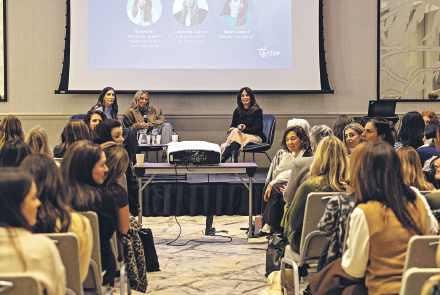
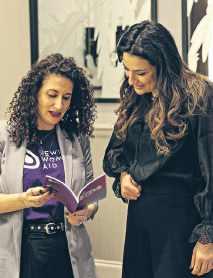
“Coercive control can present as a man who takes his wife’s sheitel to work so she cannot leave the house,” warned journalist Deborah Joseph as she addressed 200 attendees at the Jewish Women’s Aid (JWA) Thrive summit at the Marriott Swiss Cottage on Sunday.
JWA chief executive Sam Clifford said the half-day gathering was designed to “inform, inspire and uplift and ultimately to give women greater agency over their own lives.”
Sessions included workshops, panels and conversations on business, finance, fashion, beauty, wellness, menopause and AI as the event gave JWA the chance to raise awareness of its work supporting those experiencing domestic abuse and sexual violence, and reinforce its wider mission of empowerment and independence.
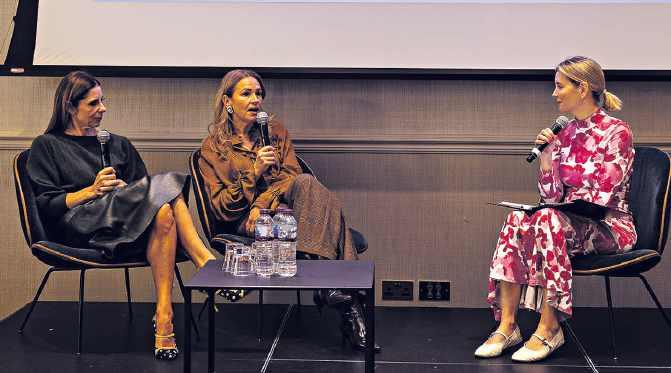
On item on the agenda saw entrepreneur Debbie Wosskow and business owner Lucy Owen in con-
versation with TV presenter and JWA ambassador Rachel Riley.
Wosskow said: “We are taught to be good, to be diligent, to be academically brilliant, to be the person who gets it right. But being an entrepreneur is not about perfection. It is about chutzpah.”
Riley added: “People talk a lot about equality and about supporting women, but in practice women are still second-guessing themselves far more than men.”
Owen, who started her talent agency LOT from her kitchen table – and proudly still runs it from there – told the audience: “My business came from passion, and that passion is what carries you through the difficult times.”
A finance workshop hosted by broadcaster Samantha Simmonds featured lawyer Lauren Clyne,
career and confidence coach Dr Claire Kaye and wealth management adviser Vanessa Lee Taub in a detailed discussion on how women can build their financial confidence and protect their independence in relationships.
The panel also spoke about financial control, abuse and warning signs with Taub saying: “I lived through financial control. The red flags were not being a signatory, not knowing passwords and not getting answers.”
A fascinating AI workshop by Raphael Joseph, co-founder of the AI agency We Are Agentic, demonstrated how artificial intelligence can be used as a practical tool to save time and reduce mental load.
Mental health campaigner Baroness Luciana Berger and Dr Ellie Cannon ran a health and wellbeing
workshop hosted by journalist Amy Abrahams.
Reflecting on the impact of lifestyle, hormones and menopause on women’s mental and physical health, Cannon advised the audience: “I strongly encourage women to become health literate using trusted sources.
“The NHS, professional bodies and patient organisations are far more reliable than social media.”
This Morning presenter and award-winning beauty writer Sarah Jossel joined SheerLuxe editor-inchief Charlotte Collins and fashion journalist Deborah Joseph for a lively discussion around smart styling, wardrobe confidence and make-up, and the panel addressed questions about fillers and weight loss injections.
JWA is the UK’s only specialist service for Jewish women and children affected by domestic abuse and sexual violence, offering support, outreach, education and prevention initiatives.
1,000 BABIES FOR CHANA Rabbinic appointment
Jewish fertility organisation Chana is celebrating the birth of the 1,000th baby born with its support.
The London-based organisation is the only UK charity offering holistic fertility and reproductive health support to the Jewish community.
Chair of trustees Benny Groszman hailed the moment as “a communal celebration”, adding: “We simply could not have reached this amazing milestone without the generous donors who believe in our mission and support our work.”
The cost of a single cycle of IVF, including essential medication, blood tests and scans
frequently reaches between £7,000 and £10,000. Against this backdrop, Chana also provides financial assistance to ensure the life-changing treatments are accessible to those who need them most.
Financial support also goes toward providing professional therapy, ongoing practical support and a helpline.
Chana honorary executive director Carolyn Cohen said: “As overjoyed as we are to reach this milestone, we must keep looking forward, keep building resources and continuing creating lives together. We want to thank the community for their partnership and unwavering support in this miraculous work.”
Rabbi Mendel and Rebbetzen Chai Cohen have been named St John’s Wood and Saatchi Synagogue’s new senior rabbinic couple.
Members voted overwhelmingly in favour after a six-month search.
The Cohens have been part of the rabbinic team since 2018, following eight successful years at the Saatchi shul on the St John’s Wood Synagogue site. They grew Saatchi from a small, emerging minyan into a thriving community, then played a key role in the merger with the St John’s Wood building.
Rabbi Mendel grew up in Leeds, received his rabbinic ordination from the Machon Smicha Lerabanut and has a Master’s degree
in Jewish Education at LSJS. Rebbetzen Chai grew up in Seattle and is also the director of St John’s Wood kindergarten and the Mimi Dwek Hebrew School and runs the St John’s Wood bar- and bat-mitzvah programme.
Synagogue chair Michael Abraham said the appointment represented both continuity and renewal for St John’s Wood Synagogue: “The Cohens are exceptional leaders with a proven ability to build community and to inspire and connect across generations.”
Rabbi Cohen said: “We are deeply grateful to the Saatchi community for believing in us 16 years ago, and thankful to the members of St John’s Wood for placing their trust in us.”
Debbie Wosskow, Lucy Owen and Rachel Riley at the JWA event
JWA CEO Sam Clifford and Baroness Luciana Berger
An audience with Sarah Jossel, Charlotte Collins and Deborah Joseph
Photos by Pomi Ofir Tal
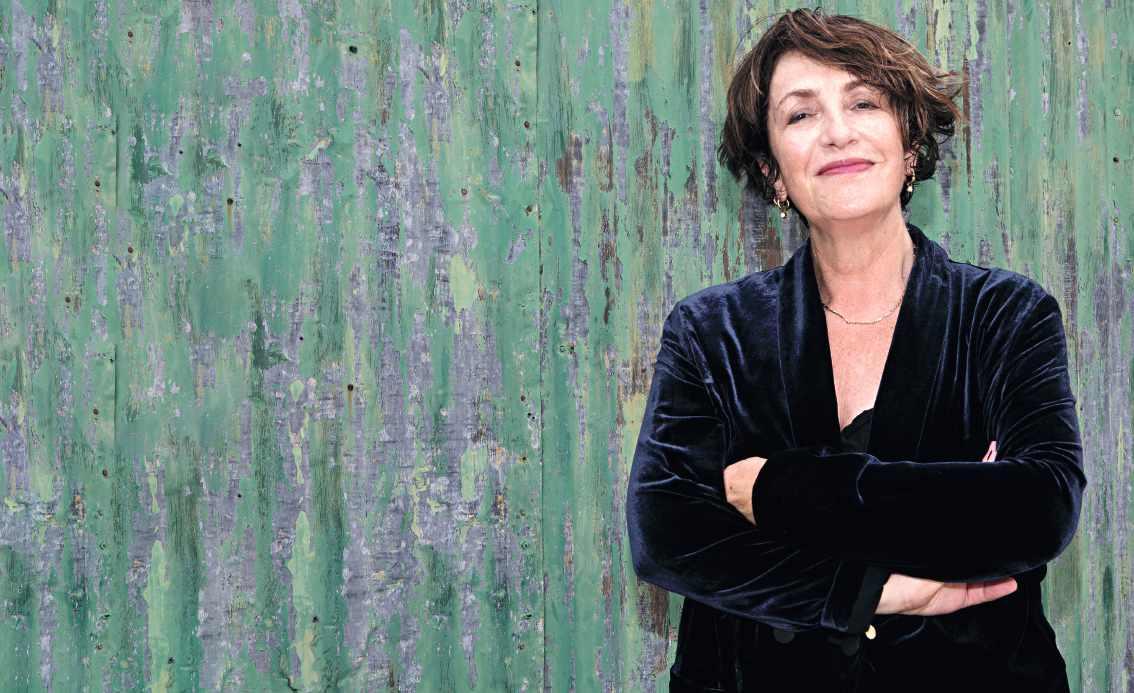
Emily Damari reflects on one year of freedom
Emily Damari has marked one year since her release from Hamas captivity by reflecting on survival, recovery and the enduring absence of those who did not return alive, writes Annabel Sinclair.
Damari, a dual British-Israeli citizen, was kidnapped from her home in Kibbutz Kfar Aza during the Hamas-led attacks of 7 October 2023. She was shot during the abduction, losing two fingers, and held in Gaza for 471 days before being released on 19 January 2025, as part of a negotiated deal.
In a statement issued to mark the anniversary, Damari described the moment of her release as a return from prolonged darkness. “One year ago, after 471 days in the dark – 471 days of pain, of tunnels, of holding on with everything I had – I came back to life,” she said.
She recalled reuniting with her mother and experiencing
ordinary moments once again.
“I hugged my mum, I breathed real air, I saw the sun without fear. That moment, that first real breath of freedom, still hits me every single day.”
Damari spoke openly about the injuries she sustained during her kidnapping, saying they have come to symbolise resilience
rather than victimhood. “My scars tell the story,” she said.
“The hand missing two fingers, the marks on my leg – they aren’t just wounds. To me, they represent freedom, hope, and unbreakable strength.”
Since her return, she has become a prominent voice advocating for hostages taken on 7
October. She said the release of Gali and Ziv was central to her own sense of freedom, while acknowledging that one person she was waiting for will never return alive.
That person is Master Sgt. Ran Gvil, who was killed and whose body remains held in Gaza.
Damari also paid tribute to the support she received from the Jewish community in the UK and internationally, thanking those who campaigned, prayed and rallied for her release. “To everyone who chanted my name, who held signs at Tottenham games and at rallies and vigils, who prayed, who never gave up – thank you,” she said.
She ended her statement with a renewed call to continue pressing for the return of all hostages and the recovery of those who have been killed. “We don’t stop until every hostage is back, every family whole,” she said, concluding, “Am Yisrael Chai.”
Donald Trump’s personal lawyer has described “speaking to the State Department” about the possibility of the US o ering asylum to British Jews, stating that he sees “no future” for Jews in the UK, writes Daniel Sugarman.
Robert Garson, who is originally from England and practised here as a criminal defence barrister before moving to the US almost two decades ago, told The Telegraph that “the UK is no longer a safe place for Jews.
“It is certainly not an unattractive proposition. It is a highly educated community. I have spoken to people in the State Department and I have mentioned it in my role on the Holocaust Museum board.
Garson, 49, originally from the Broughton Park area of Manchester, also said he had raised the subject with Rabbi Yehuda Kaploun, the president’s special envoy to monitor and combat antisemitism, who succeeded Deborah Lipstadt in the role in December. He described Kaploun as “receptive” to the idea.
The Florida-based lawyer, who has become head of armed security at his synagogue, said: “Mark my words, they are coming for the Jews and then they are coming for your pubs.”
Emily marks one year since her release from Hamas captivity
Robert Garson
Editorial comment and letters to the editor
LETTERS TO THE EDITOR
VOICE OF THE JEWISH NEWS
Thanks but no thanks, America
This week, Robert Garson, a lawyer associated with Donald Trump, described asking the US State department to consider granting asylum to British Jews, stating that the UK “was no longer a safe place for us”.
Our answer is that the UK certainly has its issues, but perhaps he, and others like him, might consider looking in their own back yard – because if Britain is no longer safe for Jews, then the US appears to be sprinting to catch up.
For one thing, many of us now see America less as a goldeneh medineh than as the lair of a marants meshuggener (what country will he threaten to invade next week? Narnia?)
But let’s focus on antisemitism.
Our community was deeply shaken by the Islamist terror attack on Heaton Park synagogue which left two congregants dead. But a ten-minute drive from the White House, Yaron Lifshinsky and Sarah Milgrim were murdered by a far-left activist howling “free Palestine”.
Last month there was widespread anger after ‘anti-Zionist’ protests outside a London synagogue, but if any of those protestors had chanted “we support Hamas” – as a loud mob did outside a New York synagogue this month – they would have been arrested.
A mass terror plot was averted here because Islamists had trouble buying assault rifles – gun purchase in America is terrifyingly easy.
At the same time, extreme right-wing podcasters like Tucker Carlson have decided to pivot to deranged ‘anti-Zionism’, sharing a toxic mixture of lies and blatant misrepresentations with their millions of followers.
Yet last week Carlson was pictured having a cosy conversation with Donald Trump in the Oval Office.
Not exactly comforting.
So thanks, but no thanks, Mr Garson.
The way things are going in America, if we finally do make aliyah , we may see you in Ben Gurion airport right alongside us.
THIS WEEKEND'S SHABBAT TIMES... Shabbat comes in
goes out
MP betrayal in Bristol
The sorry episode at Bristol Brunel Academy amounts to a profound misstep by adults entrusted with children’s education and sends a scandalous message to the nation’s youth.
Damien Egan, a sitting Member of Parliament, was deterred from visiting a school in his own constituency because of his identity and views.
be spaces where young people encounter a range of voices and learn to engage critically with disagreement. They are not platforms for exclusion. To retreat from that responsibility betrays both the pupils and the values we claim to uphold. If education is to mean anything it must insist on confronting challenging ideas, not censoring them by bowing to poisonous extremism.
That ought to trouble every parent and citizen who believes in impartial education and the basic dignity of all communities.
The principle at stake is simple. Schools should
That includes the contributions of a local MP whose only offence was to be Jewish and to engage in democratic life.
Ella Sadler, Manchester
PRAISE FOR PRESENTERS
While the home secretary justifiably deserves credit for carrying out the order not to grant a visa for a hateful US Islamist preacher to speak at UK venues, as well as a mention to the Conservative MP who lobbied for that ban, I am disappointed no mention was made of GB News presenters, who persistently brought attention to this matter and urged the home secretary to do the correct thing. Without that, this dangerous man might have been allowed into the UK.
Other mainstream TV programmes neither mentioned it nor condemned it.
Similarly, it was the persistence of a GB News presenter and reporter which led to the government announcing there would be an independent inquiry on grooming gangs.
If only GB News had been established when the Conservative government not only lobbied for but also gave the valuable prize of British citizenship to Egyptian national El Fatah, without considering his hateful social media posts, which has enabled him to come to this country despite his obvious bad character!
B.Brodkin, by email
ISRAELI HOTEL HARMONY
At the Dan Panorama hotel in Eilat during Christmas there were 300 Israeli Arabs staying and coexisting in complete harmony. I am sure all Arab Muslims would be the same if not for their leaders. The rest of the world needs to know this.
Harold Schogger, by email
MORAL FAILURE OF ACADEMIA
Dozens of well-known scholars and writers signed a declaration in solidarity with prisoners in the United Kingdom who are being held on remand over activism linked to Palestine. Among the signatories are Naomi Klein, Angela Davis and Judith Butler, alongside journalists George Monbiot and novelists Sally Rooney and China Miéville.
The statement echoes the slogan Greta Thunberg held on a placard when she was arrested on 23 December. That slogan openly supported the Palestine Action terrorist organisation.
As a history teacher, I cannot say that I am truly
Support your Jewish community. Support your Jewish News
Thank you for helping to make Jewish News the leading source of news and opinion for the UK Jewish community. Unlike other Jewish media, we do not charge for content. That won’t change. Because we are charity-owned and free, we rely on advertising to cover our costs. This vital lifeline, which has dropped in recent years, has fallen further due to coronavirus.
Today we’re asking for your invaluable help to continue putting our community first in everything we do. For as little as £5 a month you can help sustain the vital work we do in celebrating and standing up for Jewish life in Britain.
Jewish News holds our community together and keeps us connected. Like a synagogue, it’s where people turn to feel part of something bigger. It also proudly shows the rest of Britain the vibrancy and rich culture of modern Jewish life.
You can make a quick and easy one-off or monthly contribution of £5, £10, £20 or any other sum you’re comfortable with. 100% of your donation will help us continue celebrating our community, in all its dynamic diversity.
Support Jewish News by visiting our donor page at jewishnews.co.uk
shocked. Education or talent has never guaranteed sound moral judgement.
Philipp Lenard, a Nobel Prize winner in physics, was an outspoken antisemite and an enthusiastic supporter of Hitler. He attacked Einstein and dismissed modern physics as Jewish corruption.
Martin Heidegger, one of the most influential philosophers of the 20th century, joined the Nazi Party in 1933 and publicly aligned his philosophy with the regime. After the war, he said nothing at all about the murder of six million Jews.
David Frencel, Hackney
Damien Egan with his husband
‘Let me have the Promised Land without the wandering in the wilderness for 40 years, or I’ll impose tariffs on importing the 10 Commandments!’
Thanks Donald, but British Jews are safer staying put
DAVID AARONOVITCH
Dear Donald Trump. I’m told by the Daily Telegraph that your “personal lawyer” (you seem to have so many!), Mr Robert Garson, late of Manchester, England, now a Florida resident, has urged you to allow me to come to the US as a refugee, along with all other Britons of Jewish descent.
In the absence of any other decisionmaking body in the US, it seems it’s up to you whether to add British Jews to white South Africans as special beneficiaries of your compassion. Some of us might have a few aesthetic problems with that association, but that’s not the reason for my refusing this kind suggestion in advance. It has been a tough 28 months for Jews in Britain. The deadly attack on a Manchester synagogue in October, the heightened number of recorded antisemitic incidents, “Death to the IDF” chants at Glastonbury and constant agitation over Gaza has left British Jews feeling raw and exposed.
But does that amount, as Mr Garson claims, to Britain being “no longer a safe place for Jews”? I live in an area with a large Jewish population; most Jews here go about their business as usual. Your lawyer gives two kinds of evidence for his contention – one conjectural, the other not really relevant–both based on fear of Muslim dominance.
The first is that sharia will become the law of the land. This is nonsense. No projection puts the UK’s Muslim population by 2050 at above 17 per cent (my guess is it will be less), and as far as we know there are between 30 and 85 sharia councils in Britain. Up to 90 per cent of their clients are women, usually seeking divorces. This mirrors batei din used by Jews to adjudicate such cases in the Orthodox community.
The second is that the UK has not banned the Islamic Revolutionary Guard as a terror group. But the IRGC is sanctioned here.
The next question is whether Jews would be safer in the US. Jews here have suffered nothing on the scale of the 2018 Pittsburgh Tree of Life synagogue massacre, carried out by a far-right extremist who believed – as many white
nationalists do – that Jews encourage nonwhite immigration to promote race-mixing.
The Anti-Defamation League calculates a dramatic rise in antisemitic incidents in the US since 2022, and a 2024 survey of American Jews had significant minorities experiencing overt antisemitic sentiments during the course of their ordinary lives.
Also, it hasn’t escaped people’s notice that some of the most vocal and influential supporters of your administration have either given themselves over to overt, oldstyle antisemitism, or happily tolerate others who have. One wonders what Mr Garson made of the Mar-a-Lago event when you hosted Kanye West and Holocaust denier and Jew-baiter Nick Fuentes? Fuentes has over a million followers on Elon Musk’s X.
Given this, it seems odd that Mr Garson, appointed to the US Holocaust Museum board when you fired the Biden Administration appointees, is not doing more to combat US antisemitism.
But even if none of that were true, British Jews wouldn’t be safer in the US – no one is. In Mr Garson’s domicile, Miami-Dade,
the homicide rate is over 20 times that of London. Whatever risk to us here, we stand a far greater chance of being killed in the US, and not just by criminals or fanatics.
Some British Jews are famous for protesting. I have a possibly anachronistic view that citizens should be able to protest without risking being shot by masked immigration agents and then blamed for their own murder by the government. So no, I’m much safer here. Finally, if we all came I worry you’ll be disappointed. Mr Garson is quoted as saying that British Jews are, from a US perspective, “certainly not an unattractive proposition. It is a highly educated community… It is a populous (sic) that speaks English natively, that is educated and doesn’t have a high proportion of criminals.” Not that are caught, anyway.
But I am afraid that I have to tell you, from experience, that there are some stupid and some venal British Jews. If I were you, I would be worried that these might be disproportionately attracted by any such offer as Mr Garson is pressing upon you.
Zay gezunt, David.
INDEPENDENT ALIYAH CONSULTANT
We know that making such a significant decision can be daunting. That's why we're here to guide you through the process, to make your aliyah stress-free & easy
Marty Supreme and the Jewish art of audacity
RICHMAN
One of my grandfather’s closest friends, a fellow survivor of the camps, was equally passionate about both his adopted country and sport. On the day of the 1966 World Cup final, after a couple of decades in England, he desperately wanted to be in attendance at Wembley but had no ticket. Why should the glory-hunting Queen get to go but not someone who actually cared about the game?
Utilising the kind of audacity that can only be developed through enduring the very worst of humanity as a youth, he rocked up at the ground with an expensive camera he’d just purchased and a homemade laminated press pass. This immaculate forgery allowed our hero to waltz past security and watch England’s greatest footballing moment pitchside.
I know only too well that once these people were out of the camps, they were intent on making every second of the rest
of their lives count.
I thought of this while watching Marty Supreme, Josh Safdie’s exploration of a Jewish hustler-turned-champion table tennis player starring Timothée Chalamet.
The eponymous Marty is chutzpah made flesh, a living embodiment of one of those bespoke Yiddish words we had no choice but to invent and yet was recognisable enough to catch on among the great unsnipped.
Somewhat predictably for 2026, much of the critical reaction to Marty Supreme has focused on dull notions of likability and whether or not we can root for a character who does questionable things (conveniently ignoring large swatches of culturally significant art on screen from film noir to Succession).
Less focus is given to Marty’s Jewishness, perhaps because it is largely toiling away in the background like a referee doing a good enough job that you hardly notice their presence. Indeed, one scene late in the film seemed to have a di erent e ect on my friends depending on if they were Jewish.
The climactic match is notable since Marty is aware that if he loses, he will be
forced to kiss a pig. This is directly linked to Judensau, a folk art image of Jews in obscene contact with pigs that dates back to 13th-century Germany. One does not need a PhD in mediaeval history, however, to be aware that Jews and pigs don’t mix, and the various shots of Marty’s Magen David necklace only serve to underline the point.
The protagonist may well make crass jokes about Auschwitz, but he proudly displays the Star of David when performing in front of a crowd. He is a Jew and could easily have perished in the camps a decade earlier but for the happy accident of an American birth.
In the same scene, there is a moment where the predominantly Japanese spectators fail to recognise Marty, and he points at his cartoon depiction on a poster advertising the event. There he is, but he looks not like one of modern cinema’s great heartthrobs and instead like a Nazi caricature of a Jew. For the crowd, this identifier is enough. I think of my grandfather every day, but 18 January is his day, the date on which he was born and died. It was also impossible not to
Voices of Justice
A Holocaust Memorial Day concert marking the 80th anniversary of the conclusion of the Nuremberg Trial, and the 65th anniversary of The Eichmann Trial, using the words of eyewitnesses whose evidence gave voice to the victims.
Narrated by BBC correspondent Tim Franks and students from The German School of London and the Jewish Community Secondary School.
Music by Ensemble 360.
think of him during the most controversial scene in Marty Supreme, the one in which there is a flashback to Auschwitz.
The sequence, based on a true story, sees Marty’s friend Béla Kletzki come across a honeycomb in the woods, smear himself with honey and return to the camp, where he allows fellow prisoners to lick it o his body. There was laughter at the screening I attended, but not from me.
That scene struck me not as o ensive but rather as the most moving moment in the film. While the protagonist’s behaviour is dictated by ego and therefore consistently selfish, his friend looked to help others even while starving in an extermination camp.
Kletzki might not be as accomplished a table tennis player, but he is a better man, almost certainly because he had the misfortune to be born in a di erent place and time.
My grandfather was similarly unlucky, and he too would have done anything to help his friends and family, the two things synonymous in his view.
Like Marty, he had chutzpah, but unlike Marty, he was unambiguously a hero.
DARREN
NUREMBERG
JERUSALEM
Shoah education must not be allowed to wither
DOV FORMAN AUTHOR & EDUCATOR
This year, Holocaust Memorial Day will pass quietly in hundreds of British schools. Not because the Holocaust is no longer relevant or no longer important but because too many educators now fear the reaction it might provoke, from parents in their communities and even from colleagues.
New figures from the Holocaust Memorial Day Trust show the number of schools marking Holocaust Memorial Day has more than halved since 7 October. That alone should trouble us deeply. It is a stain on this country.
The day exists to remember the six million Jewish men, women and children systematically murdered for no reason other than they were born Jewish. It is not a political gesture. It is not a commentary on today’s conflicts. It is an act of human memory, and a moral one at that.
When we begin to treat remembrance as something that must be justified, balanced or quietly avoided, we reveal how fragile our commitment to it has become.
My great-grandmother, Lily Ebert, survived Auschwitz and for decades devoted herself to speaking all over the world about what she had witnessed and endured in what she called “hell on earth”. She answered questions, listened to fears, and tried to explain, with remarkable strength and gentleness, how ordinary societies slide into extraordinary evil. When she said “never forget”, she did not mean “unless it becomes uncomfortable”.
The Holocaust did not begin with gas chambers and death camps but with words, lies, the spread of conspiracy theories, the slow normalisation of hatred and the othering of Jewish people. With people deciding certain lives mattered less than others. And, crucially, with silence, with decent people looking away because it felt easier than speaking up.
This is why Holocaust education matters. It teaches young people where prejudice leads if unchallenged, how democracies corrode from within and what happens when lies become louder than truth. My greatgrandmother always believed education was the solution, that knowledge could be a shield against hatred.
With antisemitism at its highest level in decades and becoming increasingly violent, we should be strengthening Holocaust education, not retreating from it. But what happens when education itself becomes the problem?
We are seeing that the sharp rise in antisemitism is not happening despite decades of Holocaust education but in part because so much of it was never truly believed in to begin with. For too many academic institutions and teachers, Holocaust remembrance and education about anti-Jewish racism became a tick-box exercise, done because it had to be done, not because it was understood, valued or defended. It was procedural, not principled.
Now, when that education becomes inconvenient, when it carries social cost, risks controversy, when those teachers have an excuse and a reason not to teach it, it is quietly dropped. And that tells us everything.
Too many teachers are forced into silence by pressure from their communities and colleagues. They are being told they must “balance” Holocaust remembrance with unrelated political narratives, as though the murder of six million Jews requires qualification, as though su ering must now come with footnotes.
Soon, there will be no survivors left. No living witnesses. Only last week, we lost Harry Olmer, a Holocaust survivor who endured multiple Nazi forced-labour and concentration camps.
He was a personal hero of mine. I travelled to Poland with him in 2023 and heard his story first-hand. Soon, there will be no one left who can say, simply: “I was there.”
When that moment comes, all that will remain is what we choose to teach.
If we allow Holocaust education to wither now, at precisely the moment antisemitism is rising, distortion is spreading and Jewish students increasingly report feeling unsafe, we are not just failing the past. We are betraying the future. Because history does not repeat itself. People do.
And when we abandon the responsibility to teach our children the past with truth and integrity, we abandon the future too.
If we teach children that history can be set aside when it becomes uncomfortable, we teach them something far more dangerous than any lesson about the past, we teach them that moral clarity is negotiable. That is a lesson no school should ever impart.
It is up to us all to carry Harry’s legacy onwards
Azest for life – that’s what comes to mind when I think of the inspiring Harry (Chaim) Olmer MBE. I’m always astonished by the great age of many of our wonderful Holocaust survivors. The energy they have long into their late 90s is awe-inspiring. But this is true of Harry especially – he attended every event he could, was always one of the last to leave and he worked the room! He loved being among people and we loved having him with us.
Well into his 90s, Harry was on the dance floor at 45 Aid Society reunions and he joined the annual March of the Living –and he did these physical and emotionally challenging trips without question.
While that all sounds surprising, it is in Harry’s case unquestionably characteristic of this brilliant man. Harry was charming, charismatic, thoughtful, kind and so much more.
He was never without a smile and a glint in his eye. Not only this, he had a tenacity, an
inner strength and quiet resolve that fuelled an indefatigable zest for life which kept him going and gave him a spring in his step. His health declined in the past year, but he didn’t slow down, he was harder to convince to rest. This is because he was on a mission – to educate and to make us remember. His stubborn determination always shone through.
Harry’s early years were marked by unimaginable su ering and loss.
In 1942, Harry, his father and brother, were sent to Plaszow labour camp in Krakow. From here, Harry was deported to Skarżysko-Kamienna, where he was one of tens of thousands of Polish Jews forced to work in chemical factories filling shells and land mines with acid.
He was only 16 years old. The work was incredibly dangerous and would often turn the prisoners’ skin yellow.
In July 1944, a final selection took place, and Harry was sent to Schlieben, a subcamp of Buchenwald. In April 1945, the prisoners were moved yet again, this time to Terezin in Czechoslovakia.
Finally, after years of exhausting, dangerous forced labour, starvation, selections, brutality and endless fear, Harry was liberated by the Soviet Army on 8 May 1945.
From his entire family, only Harry and his two siblings, Sarah and Joe, were left remaining at the end of the war.
Harry came to the UK as one of ‘the Boys’, a group of child survivors, many of whom became lifelong friends. Harry said that his three months recuperating in Windermere helped him to learn to live again.
And what a life he lived. He studied to become a dentist, retiring reluctantly at the age of 86. He married Margaret and had four children, followed by several grandchildren and great grandchildren.
He always ended his talks to schools by showing a photo of his family with pride and declaring this as his revenge on Hitler. Living proudly as a devoted Jew was his greatest rebellion and most honoured triumph. And what a lesson for us all – what a legacy.
He did not just learn to live again; he showed us what it means to live a good and joyful life. Harry was, in the truest sense of the word, a mensch
In his sad passing, we have lost a true friend and a guiding voice. It is up to us now to carry his legacy onwards and ensure the horrors he endured are remembered for generations to come.
Whenever Holocaust survivors pass away, we feel their loss deeply and are reminded of the urgency of Holocaust education and just how special these remarkable individuals are.
With Holocaust Memorial Day approaching, Harry’s passing is even more poignant. I will always remember Harry, all he endured and all he achieved, with love, admiration and appreciation.
May his memory be a blessing.
Harry Olmer at an HET gathering
The true story of six boys who escaped certain death at Auschwitz is the subject of a powerful new book. By Anthea Gerrie
If anything could be a harder read than the gruesome testimony of death camp survivors, it is surely a terrifying account of facing extermination head-on from the inside of a gas chamber, stripped naked and watching the doors slamming shut on daylight, fresh air and life itself.
By definition, such a description should be available only from beyond the grave, but 51 teenagers actually lived to tell the tale after a last-minute reprieve that defies belief. And six have shared their memories of what they believed were their final seconds in Auschwitz-Birkenau before a sudden – and banal – demand for strong young bodies to unload a consignment of potatoes saved their lives seconds before those beside them were murdered as intended.
“These survivors shared an amazing life force,” says Holocaust education specialist Rabbi Naftali Schi . He interviewed the six he tracked down of the 51 reprieved for Miracle, a powerful book published today (22 January).
“These were boys who had survived multiple selections after arriving in Auschwitz in 1944 and got one last chance to prove their strength,” he says of the astonishing event which saw three SS officers screeching up on motorbikes as the gas chamber doors were closing. They were seeking just 50 of the fittest of 800 boys aged 13 to 17 who were marched together to their deaths from Block 11, a holding pen for the condemned.
The boys, who had been starved for nearly two days, had to prove they could still run and do knee-bends in order to survive that final, unimaginable selection. But despite the macabre circumstances of their survival, not so unimaginable is what they did when they got back to the barracks.“‘Hakufos’, one told me – Yiddish for ‘we danced,’” says Schi , who has interviewed 200 Holocaust survivors over the past 20 years. “‘It was Simchas Torah,’ he said, ‘so we danced’.”
As ever with Angel of Death Josef Mengele, the sadistic camp doctor who took a perverse pleasure in marking Jewish holidays in Auschwitz with special selections to decide the fate of his victims, it was the day before –“Hoshana Rabbah, the last time of judgment,
when it is decided who will live or die,” says Schi – that these boys were condemned to death. They were locked in their barracks, deprived of even bread or water and listed as gestorben – dead, hours before being marched to their planned extermination.
The boys, some of the last to arrive at Auschwitz, still had unimaginable horrors to face after the camp was liberated, from death marches to internment in other camps and life-changing illness for some, and Schiff says those who believed their survival was down to divine intervention were driven by the power of their faith.
“They included Yaakov Yosef Weiss, whom I had to ask for a blessing on his intercom to get him to see me,” says Schi of the tall, imposing rabbi nicknamed Tarzan who lived in Manchester until he died aged 82. “I knocked on his door two or three days before Yom Kippur to ask, as in Hasidic circles it was decreed by a rebbe that one could go for a blessing to anyone who laid tefillin over a number on their arm.
“When he answered and eventually agreed to be interviewed, he was the one who told me how they danced back in the barracks.”
Many will speculate that good genes and fitness had most to do with survival, leading to the long and full lives enriched by the large families of many known survivors, which propagated new generations of Jewish
life against all the odds: “I’m sure there are at least 1,000 descendants of the six,” says Schi .
Hershel Herskovic, who lives in Stamford Hill, contracted typhus and had gone blind by the time he arrived in the UK as a refugee, yet managed to study law, establish a successful business, marry, have four children and bring them up alone after the death of his wife in 1978. Blindness did not even stop him riding a bike.
It is not only the 51 teenagers who walked out of the gas chambers who experienced a miracle that day – on their way back to the barracks they passed a second group of boys who gazed at their condemned campmates in disbelief before they were also turned back from their own march to the gas chamber. They included 13-year-old Avigdor Neumann, who, following his reprieve, survived into his 90s and went on to have two children, seven grandchildren, 43 great-grandchildren, five great-great-grandchildren and one greatgreat-great-grandchild to date.
“His eyewitness account was really important to the story,” says Schi ’s co-author Michael Calvin, who personally met Herskovic, at 99 one of only two living survivors of the six interviewed by Schi : “His clarity of recall was quite remarkable. There was a joyousness to him, and I have an image in my head of him laughing; you can still see the mischievous little boy he was 90 years ago. He has that
distinctive life force which emanates from all these survivors; in meeting them you’re touching history. It was a huge privilege to meet him.”
The fact the 51 boys were reprieved on Simchat Torah is not a coincidence, believes Schiff, who points out: “Mengele was so depraved he made selections on Rosh Hashanah and Yom Kippur 1944 before declaring these survivors of those previous selections ‘dead’ on the eve of Simchat Torah.”
the life and light to which the herded in with them had just bidden an anguished farewell.
a book launch and film or Manchester from 25 January, visit jfutures.org/
And although, in 1944, 7 October fell three days before that final high holiday, a circle with that now-notorious and tragic date was closed for Schi when he recently discovered a sculpture of women at Yad Vashem commemorating a unique act of resistance. “They had smuggled explosives into the antechamber of a gas chamber in order to blow it up – on 7 October 1944. Learning the story of those brave women reinforced why I wanted to put the book out – because amid all the darkness and despair and tragedy and loss, somehow these 51 boys escaped, and I had the privilege to meet six of them and witness their steely will to survive.” Perhaps none so much as the one who was the greatest miracle of all – the unknown, but universally remembered, boy too tiny to be selected who twigged that some of the bigger boys were about to be released. He sidled up to their line, unseen, hid himself in discarded clothing and walked out behind them into the life and light to which the hundreds less lucky originally herded in with them had just bidden an anguished farewell. u Miracle is published by Bantam, £22. To attend a book launch and film screening in London or Manchester from 25 January, visit jfutures.org/ miracle
Yaakov Yosef Weiss
Michael Calvin
Naftali Schiff
Hershel Herskovic
Avigdor Neumann
As The Apprentice returns for it 20th series, a Jewish man from Watford is hoping to get hired.
By Candice Krieger
At just 27, Lawrence Rosenberg strides into The Apprentice boardroom not as a nervous hopeful, but as one of the PR industry’s brightest rising stars – a Yavneh College alumnus, former Manchester JSoc president and PRWeek 30 Under 30 honouree (in 2024) determined to drag an entire sector into the digital age.
Armed with a bold plan to revolutionise public relations, Rosenberg is determined to convince Lord Sugar he’s not just another candidate, but a partner capable of reshaping an industry by giving public relations a long overdue digital overhaul.
His business plan centres on reinventing public relations for the modern era to “supercharge PR professionals, not replace them” by “delivering smarter, faster, and more transparent PR” through intelligent automation – without losing the human touch that drives meaningful media outcomes.
“PR is one of the only major sectors that hasn’t undergone a meaningful tech-led transformation,” Rosenberg says. “I believe it’s essential the person leading this change focuses on improving people’s jobs, not eliminating them altogether. PR is about people, and I’m passionate about preserving that.
“My business plan isn’t just about building a successful company; it’s about transforming an industry for the better and bringing it properly into the 21st century. If Lord Sugar can see my vision, then I’d love to have him on board.”
Lawrence, who lives in Watford, has held several PR, communications and advisory roles, including stints at Spreckley Partners and Hemington Consultancy.
He is the former director of The Pinsker Centre, where he worked alongside G7 ministers and international leaders.
Today he runs his own agency, Rosenberg Media, which launched at the end of last year.
Alongside his professional career, Rosenberg has a long track record
of leadership within the Jewish community. He was a youth leader with JLGB and, in 2017, ran for the presidency of the Union of Jewish Students while studying politics and history at the University of Manchester. During this time, he also acted as a campus representative for Aish UK.
A Spurs fan – as is Lord Sugar, who was chairman from 1991 to 2001 – Rosenberg is a founding member and captain of Beitar Bushey Football Club, which competes in the Maccabi GB Southern Football League.
Asked how those who know him would best describe him, he said: “The kindest thing anyone has ever said to me was by my wife, who told me ‘nobody’s ever a stranger to you’. She told me that everyone I meet, I treat them like I’ve known them my whole life.
“I do think the world has lost a lot of perspective, and being able to treat everyone like a friend goes a long way. Ultimately, people prefer to do business with friends they trust. Nobody likes a transactional corporate robot, which is why authenticity is the best recipe – not just in business but in general life too.”
The first Jewish contestant on the show was James Max in series one, a chartered surveyor working in investment banking, who reached the semi-final. He went on to have a media career, appearing on LBC and Sky News.
Alexa Tilley and Samuel Judah took part in series two and telesales executive Michael Sophocles in series four, in 2008. He famously described himself as “a good
Jewish boy” but did not appear to know the meaning of kosher when he tried to kosher a chicken by taking it to a halal butcher. There were four Jewish contestants in series six – Jamie Lester, Melissa Cohen, Alex Epstein and Joy Stefanicki. Lester, a property developer, made it to the semi-final. Series 13 had two Jewish contestants – Charles Burns, a management consultant from Manchester, and Londoner Elliot Van Emden, who owns his own law firm. Series 16 in 2022 had New York-born, London-based entrepreneur Amy Anzel, founder of the beauty brand Hollywood Browzer.
Rosenberg will be hoping to make an early impact as he joins the 19 other candidates all vying to secure Lord Sugar’s backing. Also battling it out this year are an East London actress deter-
mined to “sprinkle some fairy dust into the boardroom” and a global account manager from Harrow aiming to transform his mobile cocktail bar business, Boozy Bar, into a national brand.
In a first for the long-running show, the opening episode sees candidates whisked off to Hong Kong – Lord Sugar’s “old hunting ground” – for their debut task. In a surprise twist, Lord Sugar turns up in the boardroom, catching the candidates off-guard.
Reflecting on reaching the 20th series, the Amstrad founder described the milestone as “amazing”, adding that the format remains exciting because he is once again “starting from scratch with these people – I’m teaching them what not to do and going over what it was like when I first started.”
Lord Sugar has promised plenty of drama this time around, teasing strong personalities, early clashes and “excellent” boardroom showdowns, while his adviser Baroness Brady CBE said this series “has everything. We’ve got a task that involves Big Zuu; there are tasks that really reflect what’s happening in the business world right now; and of course there’s all the usual drama, chaos and tension you expect from The Apprentice”.
For Rosenberg, it all adds up to a high-pressure, high-profile test of his confidence, communication skills and ability to think on his feet – qualities he hopes will set him apart as the competition unfolds.
• The Apprentice begins on 29 January on BBC One and iPlayer
Rosenberg wants to ‘reinvent’ the industry by delivering ‘smarter, faster and more transparent PR’
Lawrence Rosenberg, front row, with his Bushey Beitar team mates after a Cyril Anekstein cup match
Tim Campbell, Alan Sugar, Karren Brady celebrate 20 years of the series
DFilling THE STAGE
As Deb Filler’s new musical show opens in Highgate, she tells Anne Joseph what drives her performances
eb Filler was eight when she realised she could entertain people through mimicry. “My grandma was very Teutonic and when she talked to my mother, quite often she would bark at her,” Filler explains, emphasising ‘Teutonic’ in a German accent. “She had come over for dinner, and my job had been to get everyone’s coats afterwards. [In order] to deflect the energy between her and mum, I put on my grandma’s coat and became her. Everybody cracked up.”
Filler’s mother, who wrote shows for every family party, took that moment to tell Filler she wanted her to play her grandmother for her forthcoming 70th birthday celebration. “It brought the house down,” she says, and remembers thinking then that she “had something”.
The Toronto-based, New Zealand-born writer, musician, actor and comedian has spent decades touring across America, Canada, Australia and Europe. Her solo shows include Punch Me in the Stomach, a tragicomic character portrait of 36 members of her extended family, many of whom were murdered by the Nazis, and Filler Up! about food and family, during which she baked her father’s challah recipe – he was a baker – live on stage.
Filler’s latest one-woman show, Cohen, Bernstein, Joni and Me opens in London this week.
“Dare I say that this particular show is my opus,” Filler, 71, says, speaking over Zoom from her Toronto home. Written and performed by Filler and directed by Mitchell Cushman, Cohen, Bernstein, Joni and Me is about young Deb’s quest to find her own kind of music. “She doesn’t want to be moulded by her family’s musical expectations. She wants folk music.”
Peppered with stories of serendipitous meet-
ings with some of the greatest musical artists of our time, it is also a story of love, happiness, seeking stardom and finding acceptance.
Filler had brought an earlier version of the show to JW3 in 2015 for a Jewish Comedy Festival. “At that point, what I had was a bunch of very good stories.” Some of these stories found their way into Cohen, Bernstein, Joni and Me. One is meeting Leonard Bernstein, aged 19, at the Auckland Town Hall, where he played a rendition of Gershwin’s Rhapsody in Blue with the New York Philharmonic just for her.
“[After his performance,] Bernstein said it was a mechaya (pleasure) to play to such a beautiful young lady and blew me a kiss. I’ve kept it in here,” she says, pointing to her heart, “and held onto it ever since.”
Filler is the consummate performer. Enthusiastic, talkative and a little restless, our conversation is part interview, part act. She grew up in Mount Roskill, an Auckland suburb, the daughter of a Holocaust survivor father and a German refugee mother. There were several entertainers within the family: Filler’s maternal grandmother was an opera singer, and both her grandfather and father were storytellers. And then there were her mother’s shows.
“No matter who had a birthday, my mother wrote for my sister and me to perform,” Filler
says, before breaking out into a song about matzah balls to the tune of Edelweiss. “So yeah, I got a genetic dump,” she adds, with a laugh.
But it was not all rosy. Filler recalls very few Jews in Mount Roskill. “It was a bit isolating… a little like being an outsider. Well, quite a lot actually. My father was an unusual man in Mount Roskill as he had a very thick Jewish accent. He was charismatic but there was a lot of rage.”
Although Filler’s father spoke about his experiences during the Holocaust, he was prone to dark moods, and she would use humour to lift him out of them. The essence of her comedy is, she says, a Jewish ability to be able to find light and levity in the darkest of moments.
At home, there was a profound sense of loss for those family members who were missing or dead. “But Dad did tell a lot of stories, and I think that propelled me out of that house. My parents expected me to get married to a Jewish guy and carry on the tradition of being very communityminded, but I had been bitten by the bug.”
Filler studied teaching training at Auckland College of Education, specialising in drama before leaving New Zealand for North America.
In Vancouver, she found a way to meet her idol, Joni Mitchell, determined to become her backup singer. “It didn’t happen.” She went onto New York to study acting, which is where she met Leonard Cohen – a friendship endured until his death in 2016.
Living in 1980s New York as a student was tough, and Filler took whatever jobs she could to make ends meet, one of which was working as a minicab driver. “I was told to pick up a ‘Mr Cohen’ from Columbia Records and take him to the airport. And when he got into the car, I had no idea who he was.”
But it was a great car ride, she says, so much so that he remembered it many years later when Filler contacted him to ask for the rights to one of his songs for the film version of Punch Me in the Stomach.
Much of Filler’s work draws on characters from her family. Were there ever any objections to her portrayal of them? “No. Quite the opposite,” she replies. “I think it made them feel better about themselves because I was telling their story in a way that they objectively couldn’t.” But as well as playing for laughs, is there catharsis in sharing their experiences? “That’s a good question. There must be or I wouldn’t keep doing it. I believe these stories need to be passed on.”
Filler’s father’s experiences a ected her attitude and drive. “I was so influenced by my father’s survival that I’ll do whatever it takes,” she says. “I was a very resourceful young woman, and I found my way through situations. But even today, I don’t think about what the consequences might be, I just go for it.”
That said, Filler has experienced cultural cancellation from theatres, most recently in Dublin. The reason given was that her show was not suitable for their audiences. Her response is upbeat.
“It gives you pause for thought, then let’s go and find another theatre and show them how popular this show is,” she says. “Let’s triumph because that’s what we must do as Jews. We must keep showing the humour and that resilience is our backbone. So I’m not going to be knocked down by some theatre in Dublin.”
• Cohen, Bernstein, Joni and Me runs at Upstairs at The Gatehouse, Highgate, until 1 February
Filler brought an earlier version of the show to JW3
‘This particular show is my opus’: Deb Filler
With Candice Krieger candicekrieger@googlemail.com
EXPERIENCE, NOT SPEED, POWERING ISRAELI TECH
Uri Levine tells Candice Krieger how the country’s ecosystem is maturing as companies stay private for longer, focused on scaling-up into market leaders
or more than a decade, Israel has been known as the Startup Nation, a reflection of its extraordinary ability to produce new companies at speed and at scale. But as the ecosystem matures, a di erent question is starting to surface: could Israel also soon be known as the Scale-Up Nation?
The evidence is compelling. Israel is known for producing more startups per capita than any other country, and also tops the charts for unicorns per capita (privately held startups valued at mmore than $1bn), with roughly four to five unicorns per million people. Founders are hanging on to companies for longer, reaching higher valuations and, in some cases, becoming significant public-market players, pointing to an eco-
system built not just for formation, but for scale.
Few are better placed to reflect on this shift than Uri Levine, the co-founder of Waze, two-time unicorn builder and one of the most influential figures in Israel’s technology ecosystem.
“The Israeli ecosystem is definitely maturing,” says Levine. “People used to focus on the fact that we had more startups per capita than anywhere else. What’s more interesting today is that we have more unicorns per capita, and companies that are staying in the market for longer.”
For Levine, the change is driven by experience. “Entrepreneurs who succeed once are more likely to go again and succeed a second time,” he says. “That changes the overall quality of companies being built. This is significant for the maturity of an ecosystem. Experience takes time. There are no shortcuts.”
The Four Faces of God with Rabbi Dr Raphael Zarum
Jewish Thought, established by the Zandan Family
Monday 9 February at LSJS 8.00pm In Person and Online
Levine co-founded Waze in 2007 to help drivers navigate congestion in Tel Aviv. It grew to become one of Israel’s most successful technology companies and was bought by Google in 2013 for $1.15bn. Then came Moovit, a kind of Waze for public transport, which he sold to Intel in 2020 for around $1bn. Today, Levine leads and invests in multiple companies and works closely with founders as a mentor.
Levine says Israel’s shift towards a scale-up ecosystem has been driven by several forces strengthening at the same time. “The first is the entrepreneurs themselves. Israeli founders have far greater awareness of global markets and a much lower fear of failure.” More people are trying to build companies, Levine says, “because years of building businesses have shown that failure is part of the process”.
The second is investors. While Levine acknowledges that investment has become more challenging amid war and global uncertainty, he says capital has continued to flow into Israeli tech. Government policy has also played a role, with tax incentives and grants helping to support risk-taking and longerterm company building.
The third cornerstone is engineering talent. “Israel’s deep pool of engineers, shaped in part by early exposure to complex technology, remains one of the ecosystem’s defining strengths. We have a very strong engineering ecosystem. That hasn’t changed.”
The fourth is experience – the factor Levine believes now separates Israel from where it was a decade ago. “This is where everything changes,” he says. “Experience comes back into the ecosystem. People help other entrepreneurs become more successful. That’s what makes an ecosystem mature.”
One of the clearest expressions of that maturity is a shift in how Israeli founders think about exits. “Where earlier generations often sold at the first serious o er, today’s founders are increasingly comfortable saying no.” Levine admits that Waze itself received
multiple o ers before ultimately selling to Google. More recently, cloud security firm Wiz made headlines when it initially rejected acquisition interest from Google to continue scaling independently. It has since agreed to a sale to the tech giant.
“If you get to the level where someone wants to acquire you, you’re already becoming significant,” Levine says. “If you keep building, you can become even more significant.”
That mindset has been reinforced by the growing use of secondary share sales, which allow founders to gain liquidity without giving up control or ambition. “When founders can sell secondary shares, it gives them the power and the desire to keep going. We’re seeing this more and more.”
Last year was a record one for the Israeli tech ecosystem, driven in large part by mega cybersecurity deals: the sale of cyber security company Armis to US enterprise software giant ServiceNow for $7.75bn, Google’s $32bn agreement to buy Wiz and Palo Alto Networks’ $25bn acquisition of CyberArk.
Still, Levine is clear that success is not sector-dependent. “If you want to be successful, it really is very simple,” he says. “You need to create value.”
That philosophy underpins Double Down, the investment fund Levine recently launched alongside long-time friends and business partners Ariel Sacerdoti and Pasha Romanovski. The fund is designed to invest in Levine’s own portfolio companies and is targeting a total size of around $30m-$40m, with plans to close its first round this month. Rather than investing broadly, Double Down is designed to back a tight group of Israeli companies where Levine is already closely involved as a founder, chair or coach, businesses that have “found product-market fit” and are now entering the scale phase.
The portfolio comprises WeSki and Oversee, both travel-tech platforms; Clinii, which applies AI to healthcare; Pumba, a parking app; Dynamo, a software business; SeeTree, an AI-driven farming platform, and Pontera, a pension-management platform that Levine believes has the potential to reach unicorn status.
“When you invest at the beginning, you have the passion but not the confirmation,” says Levine, the author of Fall in Love with the Problem, Not the Solution: A Handbook for Entrepreneurs, a book for which Apple cofounder Steve Wozniak wrote the foreword.
“Once you’ve figured out product-market fit and you know you’re creating value, the opportunities become bigger.”
Whether Israel formally trades the “Startup Nation” label remains to be seen. What is clearer is that the ecosystem it describes has changed, with more companies now being built to last.
“If you’re creating real value, you don’t need to rush,” Levine says. “Good companies take time.”
Uri Levine
Levine co-founded Waze in 2007
MAKING SENSE OF THE SEDRA
In our thought-provoking series, rabbis, rebbetzins and educators relate the week’s parsha to the way we live today
RABBI BRENDAN STERN
HENDON UNITED SYNAGOGUE
We can be the conduit to spread light
In the Norwegian town of Rjukan, winter brings a unique challenge: for nearly half the year, the sun never reaches the valley floor. Surrounded by steep mountains, the town is left in deep shadow from September to March, creating long, dark winters that affect both mood and daily life.
For more than a century, residents dreamed of bringing sunlight back for the missing six months of the year. In 2013, that dream became reality with the installation of giant solar mirrors, known as heliostats,
high on the mountainside. These computercontrolled mirrors track the sun’s movement and reflect its light downward into Rjukan’s central town square. For the first time in living memory, natural sunlight touched the heart of the town during winter.
The mirrors do not create light of their own, they simply redirect it. Their impact is profound. People gather in the illuminated square, children play, and the psychological weight of winter darkness is eased.
In this week’s Parshat, Bo, we as a nation are given our first mitzvah: to establish our own calendar based on the lunar cycle. “This month will be for you the head month, the first of the months of the year” (Shemot 12:2).
Not only is it the first mitzvah, but Rashi (Bereishit 1:1) states that this passage would have been the appropriate starting point for the entire Torah if not for a technical side reason.
What is it about this specific mitzvah that
makes it so fundamental to the spiritual foundations of Am Yisrael?
During creation, the moon and the sun are referred to as the “great luminaries” (Bereishit 1:16). The stars are also mentioned, but without granting them any corresponding appellation. This omission is especially surprising given that most stars are larger than the moon.
The Ibn Ezra explains that the reference
here isn’t to size but to the benefit provided. The stars’ vast distance from the Earth – their physical size notwithstanding – severely reduces the amount of light they provide. The moon, by contrast, shines brightly in the night sky. Despite being smaller than the stars, it was deemed a “great luminary” because of the profound positive impact it has on Earth.
Real greatness is measured not by strength, wealth, or intelligence, but by using our abilities to ‘shine’ and impact the world. Providing light where there was previously none is what transforms a person from being merely a star into a great luminary.
Our Sages note (Bereishit Rabbah 6:1) that the light of the moon (like Rjukan’s mirrors) is merely a reflection of the sun rather than an emission of its own light. The mitzvah of sanctifying the new month sets the tone for our nation. It shows us that true greatness is attained when we allow ourselves to become conduits to spread the light of others, and onto others.
The heliostats above Rjukan
LEAP OF FAITH
BY
ZAC BATES FISHER STUDENT ENGAGEMENT OFFICER, MOVEMENT FOR PROGRESSIVE JUDAISM
Inclusion matters at university
Throughout January, Jewish students will be dusting o their laptops and library cards and traipsing back to cold, dark campuses after the winter break. Many will be hoping this term will mark a new chapter in Jewish student life, after all the heat the devastating conflict in the Middle East has imported to British campuses and the increase in antisemitism which has come with it.
It’s important to remember that for most Jewish students, their main concerns on a dayto-day basis will be lectures and essays, social events and romance, cooking and cleaning.
As UJS president Louis Danker said at Limmud a few weeks ago: “Campus is not a war zone for Jews.”
Yes, the level of antisemitism has increased, and UJS and CST undertake vital work every
single day to keep students safe. But for every antisemitic incident I experienced at university, there were a dozen others where a friend asked how I was doing or a classmate remarked hey had never met anyone Jewish before and wanted to ask me about it.
UJS and JSoc have grown over the course of this decade, seeing record engagement since 2023. Turnout in the UJS presidential election nearly doubled from 2023 to 2024, and the most recent annual report shows continued growth since the pandemic.
As president of my university’s JSoc 202425, I saw increased engagement, with record attendance at our Friday night dinners, but these positive stories and numbers can obscure a di erent reality for many Jewish students.
A significant proportion of Jewish students do not engage in Jewish life on campus. In some cases, they have had a very Jewish-led childhood and want to spend three years exploring other things. But all too often they are excluded from Jewish spaces, which can be monolithic and cliquey. When I meet students who “don’t
do JSoc”, they often tell me about the one event they went to in first year.
Maybe they grew up outside the ‘Jewish bubble’ and arrive to a room full of people who already know each other from school or Israel tour. Maybe they arrive at university having led egalitarian musical services on summer camp and are greeted by a JSoc Kabbalat Shabbat that looks and sounds like an Orthodox service. Maybe they don’t identify with Zionism and feel
•
A stimulating series where progressive voices consider Judaism in the face of 21st-century issues
that at JSoc they need either to keep quiet about politics or face backlash.
There is nothing wrong with having Jewish school friends at university, or being an Orthodox Jew, or having Zionist politics. But we can all help to build Jewish spaces on campus which are inclusive and respectful of di erence, so that those students who don’t fall into these groups also find their place in our communities.
If you are a Jewish student and see yourself in this category, then please get in touch with me or with UJS and we can help you to find a Jewish home on campus.
Inclusion matters in Jewish campus life, not just because all Jews deserve to be there and not just because diversity enriches our communities. It matters because Jewish students who don’t go to JSoc still face antisemitism and may not have a Jewish community to support them. It matters because university is the first time in most students’ lives that they independently decide how to practice and celebrate their Judaism, and in a community as small as ours, inclusion is key to Jewish continuity.
Dining Suites, Lounges Suites, Bookcases, Desks, Cabinets, Mirrors, Lights, etc.
House clearances
Single items to complete homes
MARYLEBONE ANTIQUES - 8 CHURCH STREET NW8 8ED 07866 614 744 (ANYTIME) 0207 723 7415 (SHOP)
closed Sunday & Monday
STUART SHUSTER - e-mail - info@maryleboneantiques.co.uk
MAKE SURE YOU CONTACT US BEFORE SELLING
big or too small! Rubbish cleared as part of a full clearance. We have a waste licence. We buy items including furniture bric a brac.
For a free quote please phone Dave on 07913405315 any time.
Confidential Bereavement Counselling for adults and children individually. Support Groups available. We offer in person, online and telephone counselling. Contact Jewish Bereavement Counselling Service in confidence. 0208 951 3881 enquiries@jbcs.org.uk | www.jbcs.org.uk
our Legacy Team on 020
I shouldn’t have to choose between being a student and being Jewish. With the support of my Chaplains, I can be myself, on my own terms, and know I belong.”
130+ meetings held with university leadership to advocate for student safety and rights
10,400 meals served through warm, inclusive hospitality in student homes
740+ students provided with direct support when experiencing antisemitism