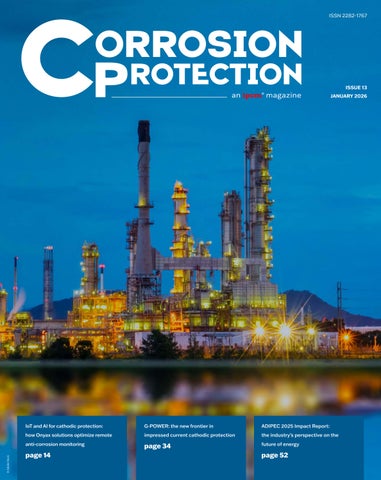
IoT and AI for cathodic protection: how Onyax solutions optimize remote anti-corrosion monitoring page 14
G-POWER: the new frontier in impressed current cathodic protection page 34
ADIPEC 2025 Impact Report: the industry’s perspective on the future of energy page 52
Turn the cost of corrosion into a competitive advantage
Corrosion isn’t just a maintenance issue, it’s a business risk. Globally, it drains over $3 trillion every year, impacting product performance, customer trust, and sustainability goals. Interpon’s new Cost of Corrosion report reveals the reality manufacturers face today: lost customers, product returns, and growing environmental concerns, all driven by inadequate protection.
The opportunity? Up to a third of corrosion-related costs are preventable with the right coating strategy.
Interpon Redox turns that challenge into a solution.
Designed for demanding applications, from playgrounds and ski lifts to swimming pools and infrastructure, Interpon Redox delivers proven, long-term corrosion protection, even in the harshest environments. Developed in line with ISO 12944:2018 guidelines, Interpon Redox delivers reliable protection across C4 to C5 corrosive environments.
Our comprehensive range of primers, intermediates, and topcoats, available in multiple textures and finishes, allows us to work with you to build the exact coating system your products need, no compromises.
With VOC-free formulations, Interpon Redox supports your sustainability targets while helping you reduce waste, cut repair and rework costs, and improve application productivity.
Because protecting your products isn’t enough.
You need a solution that protects your reputation, your customers, and your bottom line.
Interpon Redox – corrosion protection that works as hard as you do.
Interpon. Your Personal Best.
Discover our BLOG
INTEGRITY SOLUTION
Cathodic Protecion Rectifier
AUTOMA develops advanced solutions for the remote monitoring of cathodic protection systems, ensuring the integrity of pipelines and reducing the risks of corrosion. The integrated platform combines field devices designed to adapt to different installation and operating contexts with a software environment that enables continuous supervision, data analysis and reporting. Thanks to 24/7 data collection and processing, operators gain full visibility of the network and the ability to promptly take corrective actions, ensuring reliable performance and maximum infrastructure protection over time. G4C-PRO Remote Monitoring Unit
COMPLETE, ADAPTABLE, INTEGRATED byautoma.com
14 – 17 April 2026
Karlsruhe,
Cool under pressure: winning the war on corrosion in data centre cooling systems
IoT and AI for cathodic protection: how Onyax solutions optimize remote anti-corrosion monitoring
Corrosion failures associated with pinholes and holidays
Hydrogen embrittlement of carbon and low alloy steels for Oil & Gas applications
Jotun announces the latest edition to its fire protection range: JOTACHAR 1709 XT
G-POWER: the new frontier in impressed current
Corrosion protection and energy infrastructure: systems, processes, and industrial organisation at the service of sustainability
ADIPEC 2025 Impact Report: the industry’s perspective on the future of energy
Artificial Intelligence and the Internet of Things are reaching their full potential in our technical sectors. When used in the predictive analysis of corrosion issues or of the status of corrosion protection systems, they enable the dynamic and, above all, continuous collection of real-time data that can be translated into risk models, intervention plans, and data-driven design strategies.
EDITOR FROM THE
Early. Continuous. Effective. Corrosion protection starts with these three adjectives, simple yet semantically complex and full of subtle nuances of meaning.
Preventing corrosion means preserving the integrity and operational continuity of assets. Applied to everyday life, this concept translates into transport and infrastructure safety, stable and consistent energy supply, and continuity of procurement.
In essence, the objective is to ensure that daily life runs smoothly and seamlessly for everyone, even though most of us, except those directly involved, are unaware of it.
However, preventing corrosion is more difficult than one might think because – as we have repeatedly emphasised in the pages of this magazine – it is a natural phenomenon that cannot be eliminated but only mitigated and controlled.
Continuously monitoring the condition of assets, detecting potential problems that could lead to corrosion at an early stage, and taking effective action to restore protective technologies and repair damaged parts or potential failures are the real missions of corrosion specialists.
Until now, many of these operations were entrusted to humans, their skills, their manual dexterity, and their experience.
The digitalisation process that has been transforming the industry over the last decade, however, is also reshaping asset management.
Artificial Intelligence and the Internet of Things are reaching their full potential in these technical sectors.
When used in the predictive analysis of corrosion issues or of the status of corrosion protection systems, they enable the dynamic and, above all, continuous collection of realtime data that can be translated into risk models, intervention plans, and data-driven design strategies. AI can identify phenomena that are invisible to the naked eye but are actually early signs of corrosion. It knows no obstacles: it can monitor structures that are hard to reach, areas that are difficult to supervise, and perform operations that are too dangerous to be done manually. It is not a matter of replacing humans, but instead of enhancing their abilities and senses in order to manage transient events and rapid changes in an early, continuous, and effective way.
The corrosion prevention sector is moving beyond its comfort zone and traditional approaches to pursue paths that ensure greater efficiency, sustainability, and effectiveness. This is demonstrated by the numerous articles contained in this first Corrosion Protection issue of 2026, with interesting innovations and successful examples of the application of new digital technologies that prove it is possible to adapt to changing environmental and operating conditions in assets more quickly and dynamically, thus safeguarding their integrity, reliability, and sustainability.
This topic was also widely explored at ADIPEC, the world’s largest event for the energy industry, held in Abu Dhabi last November and covered in detail in the following pages.
Because Corrosion Protection is right where it matters.
NEW WHAT’S
ICorr AGM 2025: a day of insight, recognition and forward momentum
In November 2025, the Institute of Corrosion held its Annual General Meeting (AGM), hosted by the Henry Royce Institute in Manchester (UK). The North West Branch ensured the day ran seamlessly from start to finish. ICorr extends sincere thanks to the ICorr team and to all members who travelled – some from considerable distance - to contribute to a lively and well-attended event. The venue’s bright spaces and thoughtful catering choices set a warm tone for the day.
After a welcome lunch and time to reconnect, the programme opened with the presentation of two distinguished ICorr awards. Professor Damien Feron received the 2025 Paul McIntyre Award, recognising his longstanding impact on corrosion science, while the 2025 H.G. Cole Award was presented to ICorr Past President Brian Wyatt for his sustained contribution to corrosion engineering practice. ICorr President Dr Yunnan Gao presented to Awards and congratulated both recipients for their work in advancing the field. The technical programme supported the AGM with four talks spanning current research, industry experience, and lessons from challenging case studies.
Fabio Scenini (University of Manchester) introduced attendees to the breadth of facilities and research capabilities at the Henry Royce Institute, offering a glimpse of the tools shaping the next generation of materials development.
Steve Hodges (Johnson Matthey) explored contrasts and shared challenges between oil & gas and chemical process sectors, particularly in materials selection and corrosion control. Dr Beatriz Mingo (University of Manchester) presented research into innovative coating deposition methods with promising applications across medical, aerospace, and other highperformance industries. Andrew Piercy (Intertek CAPCIS) closed the session with an assessment of publicly available findings from the Kashagan oil field failure investigations—an unflinching look at the complexity’s corrosion engineers must navigate, and the critical importance of identifying root causes.
Following the technical sessions, the formal 2025 ICorr AGM kicked off by ICorr President, Dr Yunnan Gao, gave a presentation on ICorr’s successes and achievements in 2025, including national and international growth, developments across the events programme, and the Institute’s newly awarded licence status with the Engineering Council – an important milestone in strengthening ICorr’s professional framework. After that, ICorr Treasurer George Winning updated the members with ICorr’s annual accounts and financial position.
During the 2025 ICorr AGM, members carried out the election of the 2025/2026 ICorr Trustees and Council. The vote was unanimous, confirming that all members serving in the 2024/2025 term have been re-elected to continue in their existing roles for the year ahead.
Before the close out the AGM, ICorr President, Dr Yunnan Gao officially recognised several individuals for exceptional service to ICorr. ICorr Presidents, Stuart Lyon, Brenda Peters, and Paul Lambert were awarded Honorary Life Fellow status for their enduring contributions in 2025. Special thanks were extended to John Fletcher, stepping down from Council, and to David Harvey, Raju Narayan, and Jane Lomas for their considerable work in shaping what has been an energetic and forward-looking year for ICorr. Appreciation is also due to Hempel for supporting the AGM, and to ICorr’s Sustaining and Corporate Members for their continued commitment.
Members can find full minutes – covering proceedings, discussions, and formal votes-within the ICorr Members
The 2025 AGM closed with a sense of momentum, reflecting a community steadily building the future of corrosion science and engineering.
www.icorr.org
Another successful Dörken Days 2025
With a total of 200 participants, this year’s Dörken Days, held on 13 November, was filled to capacity. Representatives from Germany, France, Italy, Spain, Poland, Czechia, Romania, Turkey, Denmark, Sweden, Norway, the Netherlands, as well as the USA, India, South Korea, and China met to discuss current industry topics and network. Tobias Kleyer, Technology & Networking Manager at Dörken, acted as moderator for the day and warmly welcomed the international guests. He handed over to the host, Managing Director Christos Tselebidis, who was visibly delighted and proud of the lively participation.
“Especially in these tough times, it is so important not to bury your head in the sand, but to exchange ideas and work together,” said Tselebidis. This cooperation is a decisive factor for success in a constantly changing industry.
PFAS – a key topic at Dörken Days
Christos Tselebidis and Omar Sawani from Dörken then looked back at the topics covered in last year’s presentations and opened the main section on PFAS. Dörken expert Sabrina Hilbt led this part of the event and gave participants an in-depth overview of PFAS, a topic that continues to be of great concern to the industry. The guest contributions from two leading OEMs received particular attention. Dr. Pellkofer from Daimler Truck AG explained the path to PFAS-free fasteners and held out the prospect of PFAS-free products being introduced. He also presented the new Daimler Truck specification, which clearly separates Mercedes Benz.
Sine Groenne Karlsen from Siemens Gamesa, on the other hand, shed light on the topic from the perspective of the wind industry and focused on the future. She made it clear that wind turbines planned today and built in the future must be regulatory compliant. Siemens Gamesa has therefore decided to use PFAS-free products. Another highlight was the panel discussion, to which Sabrina Hilbt invited the speakers as well as Walter Mauri from AGRATI and Norbert
Lewan from Galfa. Together, they discussed the challenges facing the entire supply chain in dealing with PFAS and what is needed to further advance the issue.
Exciting insights into new technologies
After a short break, there was an exciting presentation by Florian Feldmann, Team Lead Analytical Services at Dörken, and Dr. Clara Linder from the RISE Institute. The two experts presented current projects at the institute, which focuses intensively on corrosion, and provided interesting insights into the results of the Dörken systems. Equally exciting was the presentation of the “LAMA” system – Laser-based preparation of Mass bulk material for subsequent coating (zinc flake coating or galvanized zinc) – by Olav Schulz from SLCR Lasertechnik and Christian Rabe, Team Lead Product and Application Engineering at Dörken. Laser cleaning of bulk materials in preparation for subsequent coatings offered a fascinating glimpse into modern technologies for improving corrosion protection processes.
As in previous years, the event concluded with regional managers from overseas providing exciting insights into their markets. This highlighted how global the challenges facing the corrosion protection industry are and how important it is to stay in touch with each other worldwide.
After an intensive and informative program, there was plenty of time for networking and personal exchanges at the evening event. Christos Tselebidis summed it up: “We were particularly pleased that, in addition to many familiar faces from the industry, new participants also found their way to Dörken Days. It was great to see how enthusiastic both regular guests and new faces were about this now well-established industry gathering.”
www.doerken.com
We supply you with individualized finishing lines for e.g. pipes, monopiles etc.
CorrosionRADAR launches Clarity, a new AI-powered software for CUI monitoring
CorrosionRADAR, the global provider of Corrosion Under Insulation (CUI) risk monitoring solutions, has launched Clarity, an AI-powered software for the predictive analytics of CUI during the CUI Seminar – Houston Chapter hosted at NASA.
Clarity transforms remotely monitored corrosion and moisture data into clear, actionable insight of CUI risks, helping operators improve visibility, optimise maintenance, and extend asset life.
CorrosionRADAR is the industry leader in data and predictive analytics for CUI, enabled by its proprietary remote monitoring solutions and the largest live global dataset, powering smarter integrity decisions. By leveraging this, the Clarity Software ensures operators have CLARITY in every decision they make, advancing the data-driven CUI management across global energy and industrial operations.
Key features of the Clarity software include:
Automated reporting with role-based control & historical insight – automated, compliant, data-driven decisions with role-based reporting and complete audit trails.
3D Isometric Visualisation – 3D asset models map CUI risk, driving intuitive insights.
Continuous corrosivity and moisture monitoring – early warnings and trend analysis to anticipate risk before it escalates
Machine learning Intelligence – transform sensor data into predictive intelligence, enabling you to stay ahead of CUI threats.
Next-generation software – a redesigned interface with faster performance and a clean, intuitive layout.
Clarity can be integrated seamlessly site-wide and is already used by the largest energy operators worldwide, supporting their goals for the digitalisation of industrial assets—a key enabler for Smart Site transformation.
“For the energy sector, Clarity represents a step forward in the journey toward smarter, data-led integrity management, a foundation for transitioning to being a Smart Site and a more intelligent, efficient future.”
At CorrosionRADAR, we designed Clarity with the operator in mind. It utilises Predictive Analytics Models, Machine Learning and AI, delivering insights that enable faster, more confident decisions to transform information into understanding. Making corrosion and moisture risk visible, allowing teams to focus their efforts where they matter most,” said Dr. Prafull Sharma, Chief Technology Officer and Co-Founder of CorrosionRADAR.
With the launch of Clarity, predictive CUI monitoring enters a new era of digitalisation and data-led decision-making.
www.corrosionradar.com
Sherwin-Williams introduces ProGRID™, a next-generation energy-focused coating portfolio
The international paints and coatings supplier Sherwin-Williams has unveiled ProGRID™, an innovative portfolio designed to address the evolving demands of energy infrastructure worldwide. Engineered for performance and resilience, ProGRID™ delivers efficiency, reliability, and ease of use, backed by the company’s extensive experience and global support network.
“We know how essential it is for our customers to keep their infrastructure online — coating performance is a non-negotiable for helping keep their businesses going. ProGRID is an innovative solution that offers premium protection and outstanding durability. When you work with Sherwin-Williams, you get more than an outstanding product, you get our worldclass technical service. We’ll work with you to understand your challenges and provide support, custom solutions and whatever else you need to succeed, helping to reduce your total cost of ownership,” has stated Michael Jaeger, Segment Manager, Energy, Sherwin-Williams.
Hempel has launched its latest addition to the Hempaline Defend family: Hempaline Defend 430, a next-generation tank lining created to help energy operators boost efficiency, minimise downtime and extend maintenance intervals.
The solvent-free epoxy phenolic lining streamlines application, lowers energy use during installation and supports more sustainable operations by reducing VOC emissions and workplace hazards. By combining single-coat efficiency with rapid curing and long-term durability, Hempaline Defend 430 enables asset owners to keep tanks in service longer while lowering lifecycle costs.
“After a trial application with a major tank builder, we received clear feedback that the shorter inspection time, compared to their existing lining, will significantly improve output in their workshop,” has stated Matthew Fletcher, Segment Development Manager, Linings at Hempel A/S explains.
Key technical highlights:
Solvent-free epoxy phenolic lining for energy storage tanks
Single-coat application at 400 µm
Rapid return to service: 3 days at 20°C
Withstands crude oil up to 93°C (200°F)
Approved for potable water and jet fuel
Inspection interval extension up to 5 years
Compatible with Hempaline Prepare 130 primer for immersion up to 90°C.
“With Hempaline Defend 430, asset owners benefit from a solvent-free lining that can be applied in a single coat, returned to service quickly and approved even for the most sensitive cargos. And with a temperature resistance up to 90°C and strong hydrocarbon resistance, Hempaline Defend 430 truly offers a versatile one-product solution for storage tanks,” has added Matthew Fletcher.
www.hempel.com
COOL UNDER PRESSURE: winning the war on corrosion in data centre cooling systems
Ana Juraga, Cortec® Advertising Agency - ana.juraga@ecocortec.hr
In data centre cooling systems, corrosion not only weakens metal surfaces but also produces debris that can clog equipment and alter water chemistry. Cortec® Corporation proposes a proactive corrosion-protection strategy during both system operation and seasonal layup.
With the unprecedented rise in cloud-computing and AI, the need for data centres and supercomputers is booming. This astronomical output of artificial brain activity demands enormous amounts of power that quickly convert to heat as these mega-computers process billions of “thoughts” per second1
The natural consequence is the proliferation of giant cooling towers alongside new data centres, with backup chillers kicking in for hot summer months and going idle during cold weather. Whatever the season, taking proactive steps to fight corrosion is critical to maintaining a healthy system long-term. Cortec® Corporation shares insights on why and how to win the battle.
The problem with corrosion in cooling water systems
Preventing corrosion in data centre cooling water systems is not just for looks. Corrosion weakens the metal walls of piping and equipment, creating holes over time, shortening the service life of the cooling system, and increasing downtime for repairs—not to mention the potential for water damage from leaks. In addition, corrosion debris threatens to clog the system or “poison” the water by raising the levels of iron or other metals in the chemistry profile. By avoiding these problems, corrosion prevention can ultimately save significant time, expense, and the headaches that go with them.
Corrosion protection during operation
Although corrosion inhibitors are a standard part of water treatment programs for active chillers or cooling towers, they are sometimes overlooked due to a lack of communication or awareness. If facilities find that a corrosion inhibitor is missing, they can add M-640 L or a similar additive. This “building block” for water treatment formulations offers comprehensive protection thanks to the presence of both contact and Vapor phase Corrosion Inhibitors, which protect metals below and above the water level. It is also an excellent replacement for silicates,
phosphates, and nitrite-based compounds where disposal restrictions apply.
Corrosion protection during seasonal layup
Whereas the use of a corrosion inhibitor during operation is the normal practice, preservation of chillers or cooling tower systems that sit idle during cool weather is less widespread than it should be. With their normal water treatment program inactive, these components are also at higher risk of corrosion from residual moisture or condensation as temperatures and humidity fluctuate. Where temperatures stay above freezing, data centres may prefer to keep chillers on standby via wet layup with Cortec’s VpCI®-649, a robust corrosion inhibitor package for wet or dry layup. If freezing is a concern, water treatment professionals can drain the water after applying VpCI®-649, or they can apply the Cooling Tower Frog® to an empty chiller. Both treatments include Vapour phase Corrosion Inhibitors that diffuse throughout the void space and form a protective molecular layer on metal surfaces as long as the system remains closed. When temperatures climb high enough to warrant a return to service, the cooling water systems can easily be restarted without having to remove the product first, all while avoiding complications from corrosion during layup.
With cloud-computing and AI only promising to get bigger and place more and more cooling towers and chillers on the horizon, now is the time to equip data centre managers and water treatment service providers with the tools and knowledge they need to minimize corrosion headaches and help data centres “keep their cool” when it comes to corrosion. ‹
ADVANCEMENTS
IoT and AI for Cathodic Protection: how Onyax solutions optimize remote anti-corrosion monitoring
edited by Onyax Srl Vigevano (Pavia), Italy - info@onyax.com
Cathodic protection is a key technique for safeguarding the integrity and durability of pipelines and distribution networks across the Oil & Gas, water, and energy sectors. Onyax, with over 30 years of experience in industrial IoT and electronic design, enables the digital transformation of these systems through advanced IoT devices and the AI-powered ACE platform. Continuous monitoring, predictive analysis, and remote control enhance safety, operational efficiency, and corrosion risk management, demonstrating how digitalization is reshaping infrastructure maintenance in Europe.
Cathodic protection has long been one of the fundamental techniques for ensuring the integrity and, consequently, the structural durability of transportation and distribution networks in the Oil & Gas, water, and energy sectors. As infrastructures evolve and safety requirements increase, driven by increasingly stringent and demanding regulations, digitalization becomes a necessary strategic step.
It is within this context that Onyax operates, an Italian company with over 30 years of experience in electronic design and industrial IoT systems. Its role is to support operators and utilities in achieving a coherent, continuous, and sustainable digital transformation, through devices installed across Italy and Europe and an advanced cloud-based analytics platform powered by AI algorithms.
Digitalization of cathodic protection
Industry operators are well aware of the critical issues associated with traditional cathodic protection monitoring: manually performed measurements at predefined intervals, complex territorial coverage, remote and difficult-to-access infrastructures, costly battery-powered systems, and the inability to capture rapid variations and transient phenomena. All these factors result in increased corrosion risk and operational costs that are difficult to predict.
Digitalization overcomes these limitations by enabling:
Continuous acquisition of electrical parameters;
Centralisation of information via an AI-based platform or thirdparty systems (e.g., SCADA);
Cost reduction and improved safety.
In other words, cathodic protection shifts toward a data-driven, dynamic, and distributed model. Onyax solutions are positioned within this transition, offering tools designed to integrate with existing infrastructures and guide operators toward smarter corrosion risk management.
BLACKBOX: simple and fast low-power devices
To implement this technological evolution, Onyax has developed a range of IoT solutions designed for industrial environments and distribution networks. Within this set, devices from the BLACKBOX family play a particularly significant role in the field of cathodic protection. These are IoT dataloggers designed for continuous, real-time monitoring of key cathodic protection parameters, such as ON/OFF potentials, voltages, currents, power supply status, and set points. Equipped with NB-IoT or LTE-M connectivity and battery power, BLACKBOX devices enable rapid installation even in remote locations or where space is limited. Alongside the standard version, Onyax has developed BLACKBOX-XL, an enhanced version that meets more advanced application requirements through additional technological and structural features. As suggested by its name, the “XL” version extends operational field lifetime while maintaining compact dimensions suitable for installation inside road chambers.
In particular, within the cathodic protection domain, the BLACKBOX-CAT and BLACKBOXXL-CAT versions are of special relevance.
These devices are designed to perform active monitoring and remote control functions for rectifiers and drainage systems. This capability enables greater operational sustainability through reduced energy consumption, as well as compliance with the latest APCE guidelines.
From a technical standpoint, these devices are dataloggers equipped with an internal autonomous battery and an ultralow-power 32-bit microcontroller, with an operational lifetime exceeding 5 years. The NB-IoT communication interface, featuring dual SIM support, enables both remote monitoring and control activities as well as the execution of deep learning functions on the ACE platform. The devices are equipped with 9 analogue channels (AC and DC measurements) for voltage and current monitoring and for detecting Eon and Eoff potentials (mandatory in Italy from 2026, in accordance with UNI EN ISO 15589-1).
The BLACKBOX-XL-CAT version further integrates:
4 optional digital inputs, ideal for alarm and critical event signaling;
RS485 BUS connectivity;
Power supply also via rechargeable battery.
From a construction perspective, the devices are designed for reliable use in cathodic protection applications and outdoor installations. The aluminium (Al) enclosure ensures robustness and safety, with IP68 protection rating (dust-tight, water-tight) and ATEX Zone 2 certification. The added value in remote monitoring lies in the ability to integrate automated data collection with intelligent information analysis.
BLACKBOX-XL and BLACKBOX devices.
Onyax’s ACE platform incorporates deep learning algorithms capable of identifying recurring patterns, operational anomalies, and evolving trends, enabling operators to act promptly and significantly reduce risks associated with undetected corrosion phenomena.
A digital ecosystem: the ACE Platform (Acquisition Control Ecosystem)
The ACE platform is Onyax’s fully cloudbased telemetry solution. It consists of a dual interface: ACEweb, designed for control room use, and ACEmobile, accessible via smartphones and tablets. Within the platform, artificial intelligence algorithms analyse data evolution over time, correlate different parameters, and generate predictive alerts when operational anomalies are detected. ACE offers advanced features such as geographic visualization, SCADA-style synoptic views, and advanced data analysis tools, integrating a configurable alarm system that allows immediate identification of deviations from normal operating parameters, significantly reducing response times.
The platform also enables the generation of specific summary reports on the compliance status of each measurement point, including KT reports, and supports structured coordination of corrective maintenance activities in synergy with routine maintenance operations. The KT report allows evaluation of system protection quality and verification of compliance levels through an interactive simulator. The calculation method is defined by APCE guidelines and the directives of the Italian national regulatory authority ARERA.
The integration between the ACE platform and BLACKBOX-CAT devices is also highly effective for implementing preventive maintenance strategies against corrosion
Digitalization overcomes these limitations by enabling continuous acquisition of electrical parameters, centralisation of information via an AI-based platform or third-party systems, and cost reduction with improved safety.
Synoptic diagram of the BLACKBOX-CAT device on ACE platform.
Synoptic diagram of the BLACKBOX-XL-CAT device on ACE platform.
phenomena. This innovative approach combines advanced algorithms, deep learning, and IoT technology to detect and analyse voltage and current behaviour at relevant measurement points, representing high-risk deterioration areas on a GIS-based platform.
Application cases
A key aspect of digitalization is performance validation in real-world conditions. Onyax solutions have already been adopted by both Italian and European operators.
In Italy, Prealpi Gas, a company specializing in the management and maintenance of the urban natural gas distribution network, headquartered in Busto Arsizio (Varese, Italy), has initiated a digitalization and technological transformation program for its urban network. The project involved the installation of approximately 180 BLACKBOX-CAT devices at characteristic network points, including rectifiers, drainage systems, and passive measurement points. Measurement precision and continuity enable constant monitoring of cathodic protection status, ensuring regulatory compliance and providing a clear snapshot of network conditions. In parallel, the company also integrated TUBE-T3-P devices, installed at 70 Final Reduction Groups (GRF) and 42 endof-line points, for pressure and temperature monitoring. Thanks to NB-IoT communication and the ACE platform, Prealpi Gas manages approximately 600 km of network using a predictive model that improves operational efficiency and reduces corrosionrelated risks.
Another significant case is Teréga, one of the leading players in gas transportation and storage infrastructure in France and across Europe. This operator installed 150 BLACKBOX-CAT devices across various cathodic protection measurement points, achieving continuous potential monitoring and reducing the number of required physical inspections. System adoption improved diagnostic timeliness and the operator’s ability to respond to deviations from optimal parameters. Additionally, Teréga installed 400 BLACKBOX-XL-CAT devices on rectifiers and drainage systems powered by solar panels, at locations involving railway crossings.
Leak Detection and cathodic protection: EVALD Project
The importance of cathodic protection has driven Onyax to undertake research and development activities in collaboration with the Department of Music and Acoustic Engineering at Politecnico di Milano.
Onyax device installation at Prealpi Gas (left) and Onyax device installation at Teréga (right).
This collaboration resulted in the innovative EVALD project (Electro-Vibro-Acoustic-Leakage-Detect), an advanced leak detection system that integrates three analysis methodologies, electrical, vibrational, and acoustic, combined with IoT devices and an artificial intelligence platform. The project aims to identify characteristic signals associated with leaks, improving detection accuracy and significantly reducing false positives through intelligent, combined processing of field-acquired data. It is important to highlight that EVALD, with BLACKBOX-XLEVA and TUBE-T3-EVA specific devices, contributes to remote corrosion monitoring by correlating anomalous parameters with potential coating degradation or pipe deterioration phenomena. When electrical, vibrational, and acoustic signals are interpreted using AI models, it becomes possible to go beyond simple “leak noise” detection and observe phenomena that, in practice, often act as early indicators of corrosive processes. EVALD is therefore capable of recognizing these micro-changes and flagging them as corrosion risk areas.
Thanks to the integration of its three measurement channels, EVALD enables operators to:
Identify points with degraded coatings;
Activate predictive maintenance processes;
Correlate anomalous electrical, vibrational, or acoustic events with future failures;
Build more accurate corrosion risk maps. In practice, leak detection also becomes an advanced corrosion assessment tool, providing operators with a comprehensive technical overview and enabling predictive interventions.
Conclusions
The integration of IoT technologies and advanced digital platforms can transform the management of urban networks, making them more resilient, efficient, and adaptable. This represents a successful example of digitalization applied to the field of cathodic protection.
Onyax solutions demonstrate how technological innovation can be concretely applied to critical infrastructures, improving safety, service continuity, and operational sustainability. ‹
Onyax solutions demonstrate how technological innovation can be concretely applied to critical infrastructures, improving safety, service continuity, and operational sustainability.
EVALD Project: Real-time Leak Detection on the ACE Platform and Onyax Devices.
Corrosion failures associated with pinholes and holidays
Nick Karakasch
Total Corrosion Consultants – Victoria, Australia nkarakasch@gmail.com
The article explores how defects such as pinholes and holidays can compromise the protective function of coatings applied to steel structures. Focusing on zinc-based systems and duplex coatings, it explains how application quality, surface preparation, and environmental exposure influence corrosion performance. The paper highlights the importance of correct specification, inspection, and awareness to prevent premature coating failure.
In the world of atmospheric corrosion, it may be useful to begin with a brief introduction for readers who are not familiar with corrosion principles related to carbon steel. Steel corrosion is a complex electrochemical reaction that, in simple terms, occurs when bare steel is in the presence of an electrolyte (water, oxygen, and chloridecontaining airborne pollutants). The accepted theory of corrosion involves the transport of the electrolyte through a protective coating film to the steel substrate.
Coatings are the principal materials used to protect steel exposed to atmospheric conditions. This is generally the case whether the structure is located in a refinery, chemical plant, shipping environment, offshore platform, or bridge, to name a few. Coating “failure” is best described as the loss of a coating’s ability to withstand exposure conditions and continue to effectively protect the substrate. The term “failure” also covers situations in which a coating has reached the end of its service life. It is important to differentiate between coating “failure” and coating “breakdown”. Identifying whether one is dealing with failure or breakdown is an important factor in ensuring that appropriate remedial measures can be taken. Protective coatings are complex materials made up of many interacting ingredients, all of which have a finite service life. In other words, they gradually degrade during atmospheric exposure, largely due to chalking, and lose their ability to protect steel. Chalking can best be described as the formation of a relatively loose organic powder on the surface of a paint coating after exposure to weathering, and in particular to the ultraviolet rays of the sun.
CORROSION INSIGHTS
Modern coatings are predominantly organic materials; as more of the coating is exposed, the tendency to chalk increases. This is a continuing process, as atmospheric conditions remove the powdery substance, exposing fresh material and allowing the process to continue over time. Chalking has been reported to range from a few microns up to 20 µm per annum.
A coating can only provide protection if it forms a continuous film free of defects and physical stresses caused by handling, transportation, and erection. Two major contributors to the corrosion cycle and coating failure are pinholes and holidays. These aspects are largely dictated by coating type, film thickness, water vapour transmission rates, and UV resistance. The principal reasons for coating failure are often related to improper application techniques that fail to eliminate pinholes and holidays. Pinholes can be defined as the formation of minute or microscopic holes in a coating film that occur during application or curing, largely due to trapped air or solvent gases attempting to escape through a partially cured film, thereby forming small craters and holes.
At this stage, the film has started to “plasticise”, which impedes solvent release, resulting in pinholes that fail to flow out before the film has fully set. Pinholes can range up to a few millimetres in diameter. Quite often, modern coating materials contain high levels of volatile solvents, which accelerate this process, as the solvent endeavours to exit the film through a semi-cured coating that is no longer fully fluid, leaving a pinhole in its wake.
Holidays can be described as any discontinuity or uncoated area where pinholes pass through the coating material, resulting in entrapped air bubbles. In extreme circumstances, air pockets can represent a substantial proportion of the total coating thickness, even if the coating appears to be continuous. Since the accepted theory of corrosion relates to the presence of an electrolyte, it is vital that the correct materials and application procedures are employed.
The quality of application and environmental conditions need to be recognised and controlled to minimise not only pinholes, but
also rough dry spray and overspray, all of which contribute to the pinhole effect.
The role of water, with rare exceptions, is always involved in the corrosion process and is known in the industry as the “universal solvent”. Over time, it is capable of migrating into and through most organic coatings, carrying oxygen and soluble chlorides. This depends on film thickness and coating formulation.
The majority of protective coatings are formulated as what is known in the paint industry as high molecular density materials, meaning they are tightly structured to resist vapour transmission. The best performers overall are two-pack catalysed materials such as polyurethanes and epoxies. Polyurethanes, in particular, also have outstanding UV resistance, which reduces chalking—the formation of loose powder on the paint surface after exposure to weather.
When these defects occur, for the most part they can be resolved by addressing the application process openly, so that the issue of “what the customer expects versus what the customer receives” can be dealt with before: 1) the products are specified, 2) the products are sold, and 3) the products are applied.
Acceptability varies with the client (or individual inspector) and the structure being coated. The vast majority of complaints relate to large steel sections, ship hulls, and tank areas; appearance on smaller steel sections is less noticeable. In some cases, pinholes are barely visible to the untrained eye but can be highly visible under 8× magnification. Larger pinholes may be cause for questioning or rejection and will require correction, as their appearance falls below expected standards.
There is no perfect coating system that will satisfy the demands of every environment or set of application conditions. Usually, a system approach involving a properly selected primer, intermediate, and topcoat provides the best solution for the requirements of a specific coating problem. As a wide variety of paint materials are used, it is inevitable that solvent and air bubbles will be present to some degree in all systems. In extreme circumstances, air pockets (holidays or small missed areas) can
represent a substantial portion of the total film thickness and, as such, constitute a weak point that, if not patched, can become a focal point for corrosion.
Technological advances have led to the development of many specialised coatings with enhanced corrosion resistance properties. These include improved resistance to UV, chemical and marine attack, heat, water penetration, abrasion, and gloss retention. They were largely developed as complete systems, based on a primer, intermediate coat, and finally topcoat. There is no guarantee that a coating system can be considered entirely pinhole- or holiday-free. Factors contributing to this issue include coating type, thickness, application method, and the extent of any contaminants that may remain on the surface after preparation. Coatings also do not completely insulate the steel surface from the environment (electrolyte); over time, all coating materials are vulnerable to some degree of oxygen and vapour transmission. Whilst the creation of pinholes and holidays is not always straightforward, in simple terms it can, for the most part, be attributed to shrinkage of the coating as the solvent permeates out of the film, particularly under hot-air conditions where contaminants or trapped air/solvent are present, which prevents the paint from properly wetting the surface.
Zinc coatings
Metallic zinc coatings, especially inorganic zinc silicate materials, are an area that requires special attention. The occurrence of pinholes is highly predictable and common. In most cases, top coating is not generally recommended unless applied over an intermediate tie coat. The potential for pinholing or blistering depends on both the specific metallic zinc coating and the topcoat system. Pinholes in metallic zinc primers are normally not detrimental to coating system performance, except in environments where rapid zinc attack can occur, such as acidic or alkaline conditions with a pH below 5.5 or above 11.
Inorganic zinc coatings, by nature, contain varying degrees of porosity in the dry film. This porosity decreases on weathering, as zinc corrosion products, if present, fill the voids. The porosity of these materials has a significant influence on both the selection and application of topcoats. Application quality must be controlled to minimise topcoat pinholing, rough dry spray, or overspray, all of which increase the likelihood of topcoat pinholes. These issues can, however, be minimised in a number of ways, the most widely accepted being the mist coat–full application technique, which can be used effectively over recently applied material to prevent craters, intact blisters, and pinholes. When pinholes are present, the finish coat can reflect the same condition and, in most cases, can be corrected by applying an additional spray pass during finish coat application.
Whilst the creation of pinholes and holidays is not always straightforward, in simple terms it can, for the most part, be attributed to shrinkage of the coating as the solvent permeates out of the film, Particularly under hot-air conditions where contaminants or trapped air/solvent are present, which prevents the paint from properly wetting the surface.
The owner, specifier, fabricator, applicator, and inspector, if not familiar with top coating inorganic zinc, should be aware that: 1) some pinholes may occur; 2) application and repair techniques can assist in eliminating pinholes; and 3) these factors must be considered when estimating material and labour requirements. Organic zinc coatings do not experience the same issues as inorganic materials, as they are not porous and incorporate a variety of organic binders such as epoxy or polyurethane.
Hot dip galvanizing
Another serious area of vulnerability involves hot-dip galvanizing, which requires duplex topcoats for architectural or enhanced corrosion resistance. There is no doubt that the performance of duplex systems has developed a poor reputation, largely because those involved in the chain of events have often failed to recognise the corrosion mechanisms associated with duplex coatings.
Pinholing and electrolyte permeability have a marked impact on overall performance.
To achieve mechanical adhesion (surface profile), abrasive sweep blasting is required. When an item leaves the galvanizing kettle, a reaction with oxygen produces a clear, durable carbonate film on the surface, which is then removed by the sweep blasting process, exposing pure solid metallic zinc. When electrolyte diffusion occurs, it activates the protective properties of the zinc. The result is the accumulation of zinc corrosion products (zinc oxide, hydroxide, and carbonate) trapped beneath the duplex material at the interface, with nowhere to go except upwards. These corrosion products form concentrated solutions and are hygroscopic, meaning that, according to the laws of physics, a concentrated solution cannot exist on one side of a “permeable
CORROSION INSIGHTS
membrane”. Consequently, more electrolyte is absorbed, weakening the coating integrity as the solution seeks to equalise on both sides. The protective properties of the zinc continue unabated, increasing the volume of corrosion products, which ultimately leads to adhesion failure of the duplex coating system. While there is no corrosion in the early stages, rapid failure can occur due to accelerated corrosion at the zinc/paint interface. However, failure of the duplex topcoats becomes extremely unsightly and very costly to rectify, with no guarantee it will not recur. A major concern that contributes to pinholing and holidays is the effect of surface contamination. Paint coatings require good wetting properties so that the molecules can flow freely to achieve chemical adhesion. Chemical affinity occurs when surface atoms swap or share electrons to form a bond; needless to say, contact needs to be intimate (at the atomic level). Contamination interferes with electron sharing, and therefore adhesion is compromised. The major source of contamination comes from the galvanizing process, in the form of chromate deposits. The final procedure in the galvanizing process is quenching in a solution of sodium dichromate, which is necessary to avoid early flash rusting that leaves a chromate deposit on the surface. From a duplex coating perspective, this chromate must be completely removed prior to abrasive whip blasting, which is necessary for mechanical adhesion. Chromate solutions are also water-soluble and hygroscopic, which further contributes to increased electrolyte uptake. Note that quenching should be avoided if items are to be duplex coated; this should be reflected in the tender/specification documents and reinforced at the preconstruction meeting. In my experience, degreasing has not been a common practice, largely due to the general perception and misunderstanding that structural members received from the galvanizer have no surface contaminants. Painting contractors need to be informed that degreasing is a necessary requirement.
Inorganic zinc coatings consist of fine particles of metallic zinc held in an inorganic matrix. They do not suffer from the galvanizing issues; degreasing and abrasive whip blasting for adhesion purposes are not necessary. Being somewhat porous, zinc corrosion products are absorbed into the film, which is why topcoating is generally more reliable. In my experience, it is rare for topcoat materials to delaminate. Failure is generally associated with applications well above the recommended thickness requirements, or breakdown caused by atmospheric exposure, mainly due to chalking.
Performance
From a performance perspective, overcoating any zinc-based material provides an important feature: a synergistic effect, meaning a combined action that increases performance. Therefore,
it is vital to anticipate any possible defects in advance, prior to selection and application, to ensure that the extra performance expected is not compromised.
In many cases, most pinholes do not extend completely through the coating, as very few or no holidays are indicated when a 100–250 µm dry film containing visible pinholes is tested with a holiday pinhole detector. Although they are generally considered aesthetically unacceptable, they are repaired as part of the normal coating application process.
As with inorganic zinc, if the owner, specifier, fabricator, applicator, or inspector are not familiar with topcoating galvanized surfaces, they need to be made aware that: 1) some pinholes are likely to occur; 2) application and repair techniques can assist in eliminating pinholes; and 3) these factors must also be considered when estimating material and labour requirements.
Recognising the type of coating failure can feed back into future specification knowledge to avoid repeated failures. Coating systems must operate effectively to ensure that the selected system is capable of delivering the expected lifecycle performance. Coating assessment is important because it helps to understand the cause(s) of failure or breakdown, as the case may be.
Inspection
Inspection and knowledge are key to minimising the possibility of premature failure and ensuring that coatings are applied to the extent and quality required by the contracting/client’s specification. Holiday/pinhole detection equipment is able to locate defects even on sharp edges, where a coating is most likely to be deficient. It is important to understand that a coating can only provide corrosion protection to the underlying steel substrate when it is free of any defects that allow corrosive agents, such as an electrolyte, to contact the steel.
When the integrity of the coating film is damaged or compromised, the rate of any resultant corrosion is a direct consequence of the corrosive potential of the given service environment. From a pinhole perspective, there is no absolute threshold at which a coating can be considered completely pinhole-free.
Testing for these defects is necessary where coating integrity is paramount, as application is highly operator-dependent.
Therefore, a number of inspection measurements taken over a specific area, rather than isolated determinations, is usually more accurate. Electrical testing is essential to ensure that a coating is free from these defects, and is particularly required in situations where in-service inspection is difficult — for example, in immersed conditions for tanks, pipelines, and similar applications, where defects of this nature cannot be tolerated.
Quality control throughout the entire process, from design to final inspection, is essential to ensure that the coating film has been applied with continuity, particularly in conditions where the environment is considered severe. Otherwise, premature failure may occur, resulting in higher maintenance costs and potential production or revenue losses.
The extent of pinholing can largely be categorised into two broad groups: low-build coatings and high-build materials. Low-build materials typically range in thickness from 50–100 µm and are, for
the most part, intended for architectural purposes. In the majority of cases, they are not pinhole-free.
High-build systems range from 100 µm to, in some cases, over 400 µm, depending on environmental conditions. Thicknesses above 300 µm tend to be sufficient to inhibit initial diffusion. Paint systems will not completely insulate the steel substrate from the electrolyte, as there is no guarantee that pinholes will not occur in areas of low film thickness. Defects of this nature can be attributed to shrinkage of the coating as solvent permeates out of the film, air temperature, and any surface contaminants that prevent the coating from properly wetting the surface. In moderate or benign conditions, these defects are of little consequence; however, in marine, industrial, immersed, or highhumidity conditions, they become points of vulnerability. For film thicknesses above 250 µm, the likelihood of these defects is greatly diminished and they will not generally occur in all paint systems. However, they may still arise under the following circumstances: 1) where the paint system has relatively high permeability to the electrolyte (typically materials below 100 µm), including low-film, high-permeability paints such as exterior water-based latex materials or enamel paints, where diffusion is high. These generic types should not be recommended for corrosive or high-humidity environments.
Conclusion
Finally, it is an important reminder that a coating system can only provide protection to the underlying steel substrate when it is free of any defects that allow corrosive agents, such as electrolytes, to contact the steel. When coating integrity is damaged or compromised, the rate of any resultant corrosion is a direct consequence of the corrosive potential of the given service environment. Pinholes and holidays are critical factors when selecting a coating system fit for purpose, in combination with appropriate application techniques, to ensure value for money is well spent.
Recognising the type of coating failure can feed back into future specification knowledge to avoid repeated failures. Coating systems must operate effectively to ensure that the selected system is capable of delivering the expected lifecycle performance. Coating assessment is important because it helps to understand the cause(s) of failure or breakdown, as the case may be.
This article is not all-inclusive; its intent is to provide a general insight into some of the causes of coating failures, particularly in relation to pinholes and holidays. ‹
SCIENCE OUTLOOK
Hydrogen embrittlement of carbon and low alloy steels for Oil & Gas applications
by
Luca Paterlini, Fabio Maria Bolzoni, Marco Ormellese, and Giorgio Re
Dipartimento di Chimica Materiali ed Ingegneria Chimica “Giulio Natta”, Politecnico di Milano luca.paterlini@polimi.it, fabio.bolzoni@polimi.it, marco.ormellese@polimi.it and giorgio.re@polimi.it
Hydrogen embrittlement is a significant concern for steels used in Oil & Gas pipelines and storage. This study investigates electrochemical hydrogen pre-charging as a practical method to introduce hydrogen into steels and assess its effects using conventional mechanical tests in air. Combined with diffusion modelling and fracture analysis, this approach offers an efficient way to understand and quantify hydrogen’s impact on industrially relevant alloys.
The decarbonization of the energy sector has brought hydrogen to the spotlight as a strategic energy carrier. Its versatility as a clean fuel and storage medium positions it as a key element in future energy networks [1,2]. Yet, its chemical and physical properties introduce few challenges for materials engineers. Hydrogen embrittlement, the degradation of mechanical performance due to hydrogen absorption into metallic structures, remains one of the most critical barriers to the safe and widespread distribution of hydrogen [3].
Pipeline steels, predominantly carbon and low-alloy grades standardized under API specifications [4,5], are central to the Oil & Gas industry and are currently being considered for hydrogen transport and storage. Their mechanical strength, cost-effectiveness, and manufacturing scalability make them attractive candidates. However, their susceptibility to hydrogen embrittlement can significantly compromise the reliability of pipelines and storage vessels. The phenomenon has been studied for decades and is known to reduce ductility, toughness, and
resistance to crack propagation. The mechanisms are multiple (Hydrogen Enhanced Local Plasticity “HELP”, Adsorption-induced Dislocation Emission “AIDE” and Hydrogen Enhanced Decohesion Emission “HEDE”) and often interdependent: hydrogen can weaken atomic bonds in the lattice, promote localized plasticity, or trigger dislocation emission at crack tips. In all cases, the final effect is a reduction in the stress or energy required for crack initiation and growth (Figure 1) [3,6,7].
For the industry, the challenge is worsened by the cost and complexity of conventional hydrogen service qualification methods. In-situ testing in high-pressure hydrogen is the standard approach but requires specialized autoclaves, stringent safety measures, and long experimental times [8-11]. These limitations hinder systematic screening of materials and further complicate the design of a new hydrogen-oriented infrastructure. To address this, the current study explores electrochemical hydrogen precharging as a complementary approach. This technique introduces atomic hydrogen into steels in a controlled manner, enabling conventional mechanical tests to be performed in air while still
Figure 1 - Schematic representation of hybrid HE mechanisms. a) AIDE with the contribution of HELP and HEDE ahead of crack-tip. b) AIDE and HEDE alternance [3].
reflecting the influence of absorbed hydrogen on the mechanical performances of the studied alloys. The work couples this testing methodology with finite element method diffusion modelling and fracture analysis, to help in understanding and quantifying hydrogen embrittlement in steels of industrial relevance (Figure 1).
Materials and methods
The steels investigated in the study cover a wide spectrum of Oil & Gas applications. Among them are pipeline steel grades, studied both in the older production ferritic-pearlitic microstructure (from now on FP-P1) and in a modern thermos-mechanically controlled processed variant featuring acicular-ferrite microstructure (AFP2). Moreover, two fittings and flanges steels were also studied, milder ferritic-pearlitic carbon steels (FP-V1 and FP-V2). A standard structural quenched & tempered steel with tempered martensitic microstructure (TM-S1), along with its annealed counterpart (FP-S2), was considered to represent tubing and higher-strength applications. As last, a high strength quenched and tempered casing steel (TM-C1) was selected for its relevance in casing materials for sour service. The alloys therefore span from low-strength ferritic-pearlitic microstructures to high-strength tempered martensite, covering the broad range of steels currently deployed in pipeline and oil well applications.
Hydrogen was introduced in the specimens through electrochemical charging, exploiting the hydrogen evolution reaction, similarly to cathodic overprotection; a schematic representation of the electrochemical hydrogen charging setup employed in the study is reported in Figure 2. Specimens were immersed in acidic electrolytes and polarized cathodically to favour the formation of atomic hydrogen and promote its absorption into the steel lattice. Arsenic trioxide was introduced in the electrolyte as a recombination poison to extend the residence time of hydrogen atoms at the surface, by hindering their recombination to molecular hydrogen, and therefore enhance uptake. By controlling current density and charging duration, the absorbed hydrogen concentration could be tuned to mimic different high pressure or even sour service conditions. To ensure uniform hydrogen distribution, finite element method analyses were conducted using diffusion coefficients obtained from electrochemical permeation tests. These tests, carried out in Devanathan–Stachurski double cells according to ISO 17081 Standard [12], provided a measure of the hydrogen apparent diffusion coefficients in the various alloys, which include the effects of microstructural traps in addition to plain lattice diffusion. A schematic representation of the hydrogen permeation tests setup is reported in Figure 3
Figure 2 - Schematic representation of the electrochemical hydrogen charging setup on the top, zoom on the reactor cell on the bottom.
Figure 3 - Electrical and pneumatic schematization of the employed Devanathan-Stachurski permeation setup.
Mechanical testing on hydrogen-charged specimens highlighted the relevance of hydrogen exposure. Tensile properties confirmed that strength indicators such as yield strength and ultimate tensile strength were essentially unaffected by hydrogen absorption. In contrast, ductility related parameters suffered mild reductions.
Mechanical testing was then performed on hydrogen-charged specimens. Hydrogen concentrations were quantified before testing by hot glycerol extraction. Tensile tests were used to evaluate yield strength, ultimate tensile strength, elongation, and reduction of area, while fracture toughness was measured through J-integral methods on compact tension (CT) and single-edge notched bending (SENB) specimens. Fractographic analysis was performed on of the same specimens. This latter step, carried out by scanning electron microscopy (SEM), offered direct insight into the fracture processes activated by hydrogen.
Results
Mechanical testing on hydrogen-charged specimens highlighted the relevance of hydrogen exposure. Tensile properties confirmed that strength indicators such as yield strength and ultimate tensile strength were essentially unaffected by hydrogen absorption. In contrast, ductility related parameters suffered mild reductions. Both elongation at break and reduction of area decreased once hydrogen was introduced in the alloys. Nevertheless, no clear
trend capable of explaining the data scatter of these parameters was found during this research. On the other hand, the most critical outcome was observed in fracture toughness testing. In air, several of the investigated steels displayed high toughness, with J-integral derived values well above 400 MPa√m. After electrochemical hydrogen-charging, however, the fracture toughness collapsed to a narrow band between 120-150 MPa√m, largely independent of the alloy type or its initial toughness, as highlighted in Figure 4. This convergence suggests, according to the authors, that once hydrogen is absorbed, the differences in initial toughness among the alloys are no longer decisive. For design purposes, this means that steels traditionally considered tougher in natural gas service cannot necessarily be expected to outperform others under hydrogen exposure conditions. Furthermore, a consistent fracture toughness reduction was also observed when lighter hydrogen charging conditions were applied. This suggests that even small concentrations of hydrogen can impact fracture toughness and that no minimal hydrogen content threshold exists under the tested conditions (Figure 4).
Figure 4 - Critical stress intensity factor (KJc) Vs applied electrochemical charging current density (ic). Higher ic identifies increasingly severe hydrogen exposure conditions.
These observations underline the fact that hydrogen embrittlement is not primarily a question of strength loss but of reduced ability to accommodate deformation before failure. The obtained results and trends strongly align with in-situ J-integral tests performed in literature by other authors, suggesting good affinity between electrochemical and gaseous hydrogen testing, despite the difference between the two environments [12-17].
Fractographic analysis provided visual confirmation of these trends. In specimens tested without hydrogen, failure surfaces were characterized by ductile dimple rupture, with clear evidence of micro-void coalescence. By contrast, hydrogen-charged specimens showed mixed morphologies: shallow dimples, quasicleavage facets, and secondary brittle cracks were consistently observed (Table 1).
Tougher alloys, such as AF-P2 and TM-C1 (Table 1, central and right columns) displayed a marked transition from ductile to brittle fracture morphology, demonstrating their sensitivity to hydrogen. On the other hand, despite its initial lower fracture toughness, the FP-P1 mostly conserved its ductile fracture features even when exposed to the harsher electrochemical hydrogen-charging conditions (Table 1, left column).
Discussion and conclusions
The results confirm that hydrogen embrittlement acts primarily through degradation of toughness and ductility, rather than strength. This distinction is crucial for industrial applications. Pipelines and storage vessels are designed not only to sustain Hoop stress, but also to resist crack initiation and propagation. The sharp reduction in fracture toughness under hydrogen
While it cannot fully replicate the dynamics of hydrogen access at an advancing crack tip in gaseous hydrogen, the method provides an effective and scalable tool for screening materials and generating comparative data. This offers
a valuable compromise: reliable insight into hydrogen effects can be obtained without the prohibitive cost and time ssociated with large-scale autoclave campaigns.
Table 1: Microstructure and fracture morphology of FP-P1, AF-P2 and TM-C1. Toughness tests samples, tests performed in increasingly severe hydrogen exposure conditions, from top to bottom.
exposure directly affects defect tolerance and fatigue life, both essential parameters in the integrity management of large-scale infrastructure. The convergence of toughness values across steels suggests that traditional distinctions between grades, based on their air-tested mechanical properties, tends to lose relevance in hydrogen service. For instance, modern TMCP steels with excellent toughness in conventional environments showed similar degraded values as older, less refined materials once exposed to hydrogen. This finding indicates that hydrogen establishes a lower bound of fracture resistance that overrides microstructural improvements designed for conventional service, at least concerning the tested alloys. Electrochemical pre-charging, coupled with hydrogen diffusion modelling, proved capable of reproducing embrittlement levels comparable to those obtained in costly high-pressure autoclave tests. While it cannot fully replicate the dynamics of hydrogen access at an advancing crack tip in gaseous hydrogen, the method provides an effective and scalable tool for screening materials and generating comparative data. This offers a valuable compromise: reliable insight into hydrogen effects can be obtained without the prohibitive cost and time associated with large-scale autoclave campaigns.
Acknowledgements
Thanks to “Fondazione Politecnico” for financing “Joint Research Partnership Hydrogen (JRPH)”, which funded the research. https://www.fondazionepolitecnico.it/ progetti/hydrogen-jrp/
Thanks to “Dipartimento di Meccanica, Politecnico di Milano (DMEC)” for its collaboration, in particular to Laura Vergani, for performing the mechanical characterizations. ‹
Bibliography
[1] European Parliament, “Directive (EU) 2018/2001 of the European Parliament and of the Council of 11 December 2018 on the promotion of the use of energy from renewable sources (recast),” Official Journal of the European Union, vol. 2018, no. L 328, pp. 82 209, 2018.
[2] R. Puertas and L. Marti, “Renewable energy production capacity and consumption in Europe,” Science of the Total Environment, vol. 853, no. August, p. 158592, 2022, doi: 10.1016/j. scitotenv.2022.158592.
[3] S. P. Lynch, “Hydrogen embrittlement (HE) phenomena and mechanisms,” in Stress corrosion cracking: Theory and practice, Elsevier Ltd, 2011, pp. 90–130. doi: 10.1533/9780857093769.1.90.
[4] American Petroleum Institute, “API 5L “Specification for Line Pipe,” 2018.
[5] American Petroleum Institute, “API Spec 5CT “Specification for Casing and Tubing,” 2019.
[6] A. Alvaro, I. Thue Jensen, N. Kheradmand, O. M. Løvvik, and V. Olden, “Hydrogen embrittlement in nickel, visited by first principles modeling, cohesive zone simulation and nanomechanical testing,” in International Journal of Hydrogen Energy, Elsevier Ltd, 2015, pp. 16892–16900. doi: 10.1016/j.ijhydene.2015.06.069.
[7] N. N. Sergeev, A. N. Sergeev, S. N. Kutepov, A. G. Kolmakov, and A. E. Gvozdev, “Mechanism of the Hydrogen Cracking of Metals and Alloys, Part II (Review),” Inorganic Materials: Applied Research, vol. 10, no. 1, pp. 32–41, Jan. 2019, doi: 10.1134/S2075113319010271.
[8] The American Society of Mechanical Engineers, “ASME VIII Div. 3 ‘Rules for Construction of Pressure Vessels’, Article KD10 “Special Requirements for Vessels in Hydrogen Service,” 2023.
[9] The American Society of Mechanical Engineers, “ASME B31.12 - Hydrogen Piping and Pipelines,” 2023.
[10] International Organization for Standardization, “ISO 11114 “Gas Cylinders - Compatibility of Cylinder and Valve Materials with Gas Content - Part 4 “Test methods for selecting steels resistant to hydrogen embrittlement,” 2017.
[11] American National Standards Institute, “ANSI/CSA CHMC 1 - Test methods for evaluating material compatibility in compressed hydrogen applications - Metals,” 2014.
[12] International Organization for Standardization, “ISO 17081 “Method of measurement of hydrogen permeation and determination of hydrogen uptake and transport in metals by an electrochemical technique,” 2014.
[13] L. Briottet, R. Batisse, G. Dinechin, P. Langlois, and L. Thiers, “Recommendations on X80 steel for the design of hydrogen gas transmission pipelines,” vol. 37, pp. 9423 9430, 2012.
[14] M. Martin, M. Connolly, Z. Buck, P. Bradley, and D. Lauria, “Evaluating a natural gas pipeline steel for blended hydrogen service,” J Nat Gas Sci Eng, vol. 101, 2022.
[15] C. San Marchi, R. Shrestha, and J. Ronevich, “Hydrogen compatibility of structural materials in natural gas networks,” 2021. doi: DOI:10.2172/1888399.
[16] DeutscherVerein des Gas und Wasserfaches, “DVGW Project SyWeSt H2 - Investigation of Steel Materials for Gas Pipelines and Plants for Assessment of their Sustainability with Hydrogen,” 2023.
[17] J. Keller, B. Somerday, and C. San Marchi, “Annual progress Report “Enabling Hydrogen Embrittlement Modeling of Structural Steels,” Department of Energy Hydrogen Program, 2008.
Motivated by the toughest of conditions, we constantly seek to solve the problems that lie ahead. As a trusted maintenance partner, we offer innovative products and technologies that deliver exceptional performance for steel assets.
Learn more at jotun.com
JOTUN ANNOUNCES THE LATEST EDITION TO ITS FIRE PROTECTION RANGE:
JOTACHAR 1709 XT
Edited by Jotun A/S - Sandefjord, Norway
JOTUN, A GLOBAL LEADER IN PROTECTIVE COATINGS, ANNOUNCES THE LAUNCH OF JOTACHAR 1709 XT, THE LATEST INNOVATION TO ITS INDUSTRY-LEADING JOTACHAR RANGE OF TRUSTED
INTUMESCENT FIRE PROTECTION COATINGS FOR THE OIL AND GAS INDUSTRY. ENGINEERED FOR FIRE PERFORMANCE IN THE MOST DEMANDING ENVIRONMENTS, DELIVERING COMPETITIVE LOADINGS
AND INSTALLATION
COST,
JOTACHAR
1709 XT IS OPTIMISED FOR UL1709 PROJECTS AND STRENGTHENS THE RECOGNISED JOTACHAR RANGE WITH NOW PRODUCTS SUITED FOR ALL TYPES OF PROJECT SCENARIOS.
Ensuring the safety and integrity of steel assets is critical, especially as the industry faces increasing challenges — from reducing the carbon footprint, to limiting the risks of fires and cryogenic spills. In the face of hazards or the pressure of tight schedules, time is essential and trusted performance is everything. Jotun’s range of passive fire protection coatings through its Jotachar brand, is engineered, tested, and certified to withstand extreme conditions, protecting people and assets, and its latest addition, Jotachar 1709 XT, was presented to the industry for the first time at ADIPEC. “Jotun revolutionised the intumescent fire protection industry when it launched Jotachar JF750 in 2013, as the industry’s first mesh-free application solution for all hydrocarbon fire scenarios. Now Jotun enhances the Jotachar range with its latest edition, Jotachar 1709 XT – developed and optimised for onshore new construction projects requiring UL1709 certification,” said James Irving, Global R&D Manager for Fire Protection in Jotun.
As a patent pending all-climate capable fire protection coating, developed for the most extreme environments, Jotachar 1709 XT enables efficient installation for projects with all levels of complexity.
“Jotachar 1709 XT assures efficiency in projects through lower material consumption, delivering significant cost savings making it a relevant solution for energy projects worldwide. Our Jotachar range will now provide value to the industry whether delivering application efficiency with low applied weight and cost, or enabling fast on-site completion of connections, block-outs and maintenance scopes.”
Jotachar 1709 XT will deliver uncompromised reliability, ensuring consistent application and project efficiency, with its demonstrated first-class application properties:
Consistent and proven application performance across challenging environments in-shop and at site
Excellent and reliably robust application efficiency, regardless of conditions
Fast thickness build-up with an extended workability window of 15–20 minutes, even at high steelwork temperatures up to 50°C.
Jotachar 1709 XT has also undergone comprehensive third-party testing and is fully certified by leading regulatory bodies. Additional extensive testing includes long term durability, adhesion, char stability, and mechanical integrity have been proven through certified testing protocols. Over 1 km steel was coated and more than 35,000 kg coating manufactured as part of the internal R&D testing, prior to launching the product.
“As always, choosing a Jotachar product comes with Jotun’s market-leading support. Our team of more than 1,200 dedicated coating advisors worldwide — the largest team of coatings advisors in the industry — collaborate closely through local teams with contractors to ensure project success. Customers benefit from the Certified Applicator Scheme, inspection and testing guidance, and Jotun Fire Engineering Services offering expert support such as loading calculations and passive fire protection (PFP) weight optimisation”, said James Irving in Jotun.
Explosion, hydrocarbon fire and cryogenic spill represent a significant hazard within oil, gas as well as petrochemical facilities.
“The cost of operational downtime, combined with financial and environmental consequences related to fire incidents at oil and gas facilities, is a serious issue. However, the risks these incidents represent in terms of human life and damage to assets is the most important reason to be investing in prevention and protection measures. Announcing this product today is a milestone for us, ensuring our position as a trusted partner for the industry when it matters the most,” said Gary Bennett, Global Sales Director Energy in Jotun. ‹
G-POWER: the new frontier in impressed current cathodic protection
Ilaria Paolomelo ipcm®
Over the last two centuries, cathodic protection has become a well-established technology for protecting underground metal structures, particularly gas and electricity distribution networks. Today, two hundred years after its invention, techniques and processes are well defined, but technological advances are still enabling further improvements in efficiency, reliability, and energy sustainability. This article illustrates the experiences of Centria and INRETE in implementing and managing impressed current cathodic protection (ICCP) systems on urban networks with advanced and intelligent technologies designed by AUTOMA.
Nowadays, cathodic protection is a widely used technology for protecting underground and submerged metal structures and reinforced concrete structures from corrosion. Its history dates back to the first half of the 19th century, when Sir Humphry Davy’s experiments with methods for protecting metal prompted the transition from copper-clad wooden hulls on warships to more robust and safer metal hulls, as the first cathodic protection systems made it possible to effectively protect these structures from the corrosive action of seawater. In 1824, inspired by the discoveries of Italian scientists Luigi Galvani and Alessandro Volta, Davy demonstrated to the Royal Society that modifying the electrical state of a metal could inhibit its corrosion. This led to the start of using iron, tin, and zinc anodes to protect copper, giving rise to cathodic protection as we know it today and paving the way for the safe use of metals in marine construction. Since then, this technology has spread and become established, turning into a standard for corrosion protection in various sectors, from maritime infrastructure, bridges, and public works to underground and submerged pipelines, boilers, and water heaters. The year 2024 marked the 200th anniversary of the invention of cathodic protection. Although the required processes and methods are now well established and the technological level achieved is high, however, there is still room for improvement in terms of effectiveness, opening up new prospects for progress in the sector.
“The effectiveness of a cathodic protection system is assessed based on standardised measurement procedures and specific regulations, with criteria mainly related to potential measurements. In the case of long pipelines or structures, however, each potential measurement is valid only at the point where it is taken and at the moment of detection. In practice, it is a ‘snapshot’ that does not provide information on what is happening kilometres away or on any future changes at the same point,” says Ivano Magnifico, product manager at AUTOMA, a company that designs, engineers, and manufactures Italian-made technologies for remote monitoring in the oil, gas, and water sectors, and for building automation in the civil sector.
To ensure effective protection on large networks, it is therefore necessary to set up multiple measurement points distributed throughout the structure and identify the most critical points to monitor constantly. “This also means that a cathodic protection system can only be considered effective when all measurement points reach potentials within the established limits, thus ensuring the protection of the entire network,” adds the product manager. Among the most commonly adopted measures is the ‘on’ potential; however, the standards in this field instead refer to the IR-free potential (or potential without ohmic drop), i.e. the actual potential of the structure adjusted for the resistive drops due to the current flow in the ground. Indeed, the ‘on’ potential includes both the IR-free potential and the voltage drops generated by the currents in the ground and at the measurement point, which means a detection based exclusively on this value may overestimate or underestimate the actual polarisation of a structure.
That is why, in impressed current cathodic protection, the determination of rectifiers’ set points is based on accurate potential measurements and site analysis. Knowing the actual potential of a structure allows the rectifiers to be set correctly, ensuring that protection is adequate throughout the network regardless of variations in soil or environmental conditions.
The evolution of rectifiers
Rectifiers convert alternating current from power grids into direct current, which is needed to provide a constant flow of electrons to the metal structure to be protected, thus counteracting corrosion. They can be divided into two main categories: older models, which operate manually with constant output voltage, and modern models, which can operate automatically with constant current, constant potential, or constant potential with base current. With manual regulation, the current supplied by the rectifier is determined by Ohm’s law: the set voltage is combined with the total resistance of the circuit, including the resistance of the
structure to be protected, the ground, and the ICCP anode. Consequently, the actual current varies significantly depending on the season, soil conditions, and weather events, making this method now obsolete compared to automatic regulation.
In automatic rectifiers, these incorporate a measurement circuit that allows, depending on the type of regulation, to receive feedback on the effect of the adjustment, automatically modifying the output to maintain the selected set point constant, whether it is the current value or the potential value of the structure.
What are the limitations of traditional cathodic protection rectifiers?
Constant potential rectifiers’ limitations call for extra consideration when designing and managing cathodic protection systems. When the regulation is based on the ‘on’ potential value, the rectifier output is affected by IR drops, i.e. voltage variations generated by currents circulating in the ground and at the measurement point, which do not necessarily reflect the actual polarisation of the structure. This phenomenon can cause the rectifier to respond excessively, with frequent current variations and a higher-than-necessary current supply. This can lead to:
risks of overprotection, especially near the rectifier;
increased interference with adjacent cathodic protection systems;
higher electricity consumption.
To work at a constant potential, a reference electrode that is always functional and in perfect condition is an essential requirement.
Overcoming challenges with G-POWER
To overcome some of the limitations of traditional rectifiers, AUTOMA has developed G-POWER, a modular and intelligent rectifier designed to optimise cathodic protection. One of its key innovations is constant IR-free potential regulation: the rectifier processes an input from a coupon or probe, integrates the circuit required for instant-off measurements, and thanks to a rapid measurement system, updates the value several times per second (up to 8 times/sec with an alternating frequency of 50 Hz), using this parameter to modulate the output rather than the ‘on’ potential.
Field tests have shown that this regulation method reduces excessive reactions caused by micro-variations in the ‘on’ potential, keeping the actual polarisation of the structure constant. For example, varying the ‘off’ potential from -1.1 V to -1.2 V (corresponding to an ‘on’ potential from -1.38 V to -1.5 V) results in greater stability and avoids unnecessary oscillations in the supplied current.
Example of rectifier regulation: comparison of on- and off-potential values.
The rectifier was initially set at -1.1 V off potential (-1.38 V on potential) and later adjusted to -1.2 V off potential (-1.5 V on potential).
In further tests, it was possible to modulate the ‘off’ potential in consecutive periods to assess the extent to which the system could be protected with the minimum necessary current, highlighting how micro-variations in the ‘on’ potential do not always follow predictable patterns.
“To ensure accurate measurements over time, G-POWER adopts an input impedance of 10 MΩ in the potential measurement circuit, typical of remote monitoring devices, thus preserving the electrodes’ service life. A modular output further ensures current stability: the system can operate with 15 A modules or 15 + 15 A combinations, with 1 A modules designed for regulating current at very low values. This architecture not only allows outputs of up to 30 A to be handled but also optimises efficiency in the conversion from alternating to direct current, balancing the modules to reduce consumption and improve the impressed current protection efficiency,” says Magnifico.
The G-POWER system also integrates a data logger for ‘on’ and ‘off’ potentials, bias current, and the rectifier’s electrical parameters, a solid-state switch compliant with ISO 22426, remote control via a modem or RS485, internal GPS synchronisation, and on/off cycle management. Its internal logic allows suspending regulation during off-cycles, preventing oscillations, whereas the pulse current mode enables the supply of current only for adjustable time intervals (duty cycles), optimising the current distribution, which becomes more uniform along the protected structure, as well as reducing consumption. The results achievable with the G-POWER are also confirmed
by the case studies presented below, which illustrate their implementation on urban distribution systems in real conditions, with different interferences and network configurations, highlighting that IR-free potential regulation and advanced rectifier features can optimise cathodic protection and reduce energy consumption.
To overcome some of the limitations of traditional rectifiers, AUTOMA has developed G-POWER, a modular and intelligent rectifier designed to optimise cathodic protection.
Commissioning an impressed current system under non-stationary interference: the case of INRETE
INRETE Distribuzione Energia is a company within the HERA group, responsible for the distribution of electricity and gas in urban and suburban areas. “This company was founded in 2015 in compliance with the regulatory unbundling requirements imposed on large corporations in the energy sector to separate distribution activities from other sales activities carried out by individual groups. Currently, it operates mainly in Italy’s Emilia Romagna and Tuscany regions, where it manages approximately 15,000 km of gas network and approximately 11,000 km of electricity network,” illustrates Massimo Tassinari, the technical coordinator of INRETE’s cathodic protection structure. As it pays particular attention to service continuity, infrastructure safety, and technological innovation, this company has been investing in the development and optimisation of cathodic protection systems aiming to reduce the impact of corrosion on the distribution network, sometimes addressing direct current electrical interferences. This case study concerns the commissioning of an impressed current cathodic protection system on a gas distribution network located in an urban neighbourhood subject to interference from the nearby electric substation of a direct current traction system. The grid’s architecture is mainly meshed, with a total length of approximately 24 km and an area of just over 10,000 m². The network, laid on mostly sandy soil, was initially protected by two impressed current systems and served by a unidirectional drainage system. Precisely the removal of the latter was the starting point for the analysis and subsequent reconfiguration of the cathodic protection system in use.
The initial project
“The project began in 2019, following the decommissioning of the existing drainage system, whose removal created a gap in the network’s electrical balance and made a complete analysis and redesign project necessary. In the first phase, we assessed the variability of the electric field and subsequently determined the electrical condition of the network. As a result, adjustments and balancing were carried out across the entire system, identifying the changes needed to ensure adequate protection,” explains Tassinari.
“This situation required a radical redesign of the electrical layout, both from an architectural and functional standpoint, as the new configuration revealed that the two existing systems were not optimally positioned relative to the sources of interference, resulting in particularly significant potential attenuation in the urban areas closest to the substation”.
In light of these critical issues, a new impressed current system was designed, taking into account the analysis of the electric field variability and the identification of the most anodic areas considered most suitable for its installation. In October 2022, the system was commissioned, along with the installation of new measurement points equipped with polarization probes distributed across the entire network. In November of the same year, the new electrical layout was completed, positioning the newly designed system close to the sources of interference. Following commissioning and the changes in the monitored electrical parameters, in accordance with UNI 11094, it was necessary to reclassify all measurement points. For this reason, INRETE decided to recommission the entire system, initiating a preliminary investigation that included verifying the integrity of all
This configuration adversely affects the centrally located measurement points, where potential attenuation is more pronounced.
Map showing potential attenuation across the network: central measurement points are most affected.
Measurement
network sections, inspecting the cabling, assessing the variability of the electric field, starting up the systems with functional and safety checklists, checking electrical continuity throughout the network, rebalancing the systems, and measuring current at the joints. The activity was concluded by completely mapping the system, reclassifying the measurement points, updating the related cartography, and drafting a detailed commissioning report recording the system’s reference electrical states.
“Our remote monitoring system allows the set point defined during calibration to be set for each measurement point, guiding the system toward an overall correct balance. As shown in Table 1, when a value exceeds the set point, the monitoring system automatically signals the anomaly, generating a specific alert that initiates an intervention order,” illustrates Tassinari.
This being a particularly dynamic impressed current system, the initial interventions not only eliminated drainage but also significantly improved overall efficiency, with a reduction in current density from 2.7 mA/m² in the first configuration in 2017 to 1.0 mA/ m² in 2023. However, while mitigating the critical issues, they did not completely remove interference on the distribution networks.
A definitive solution to the interference issue
“The adoption of advanced technologies such as the G-POWER rectifiers marked a decisive step forward,” says Tassinari. The ability to directly measure the Eoff potential of the structure, thanks to the instant-off function, made it possible to regulate the system at an IR-free potential, removing the influence of the IR component and making the PID controller less sensitive to potential fluctuations.
The adoption of advanced technologies such as the G-POWER rectifiers, developed by AUTOMA, marked a decisive step forward.
Table 1 – Measurement details.
The effects of this choice are evident in the trend of the supplied current. In the initial configuration, with both rectifiers in variable current mode, the current deviation was subjected to wide fluctuations throughout the day. In the central phase of the test, a configuration was adopted with the rectifier positioned closest to the interference, operating in Eoff potential regulation mode at a characteristic remote measurement point, while the second impressed current system was set to constant current. However, this setup did not lead to significant improvements due to the distance of the Eoff sampling point from the interfering source. “The final configuration, with regulation to the local Eoff value, led to a reduction of approximately 50% in current variability. With this, we were able to halve the quadratic deviation of the current, which is undoubtedly the most striking result. We also reduced noise fluctuations and potential variability, significantly increasing overall stability and effectiveness of the protection. For these reasons, the overall results were extremely satisfactory, as were the technologies adopted and the collaboration of our selected partner. INRETE and AUTOMA share a fundamental value: the spirit of innovation. Collaborating with a company that invests in research and offers advanced solutions, such as the new rectifier used and the G4C-PRO compact device for remote monitoring of cathodic protection, was an added value for us and made it easier to adapt to the different configurations and requirements that emerged over time,” concludes Tassinari.
The evolution of the distribution network: the case of Centria
Centria – a company of the Estra Group responsible for natural gas distribution – is one of Italy’s leading gas DSOs, operating across Tuscany, Marche, Abruzzo, Lazio, Molise, Puglia, and Umbria. The company manages approximately 8,000 km of medium- and low-pressure gas networks and serves over 600,000 customers. Centria is engaged in an ambitious digitalisation and asset efficiency programme aimed at making a concrete contribution to the energy transition and emissions reduction. This commitment involves all operational areas and promotes the adoption of technologies capable of improving service quality while reducing the environmental impact of network infrastructures. At the same time, Centria is actively involved in several research and development projects, in collaboration with ARERA, ENEA, and the University of Florence, including initiatives within the framework of the PNRR, with the goal of accelerating innovation and supporting the transition towards more sustainable energy models.
Within this context, cathodic protection plays a central role as it is an essential activity for the safety and integrity of gas networks, but it is also characterised by high energy consumption. The research and adoption of advanced digital solutions allow Centria to monitor and manage these systems more efficiently, reducing energy consumption while increasing the effectiveness of protection measures.
Rectifiers operating in CV
Overlap with contact detection investigation
PPC3 control based on local Eoff potential
“Cathodic protection represents one of the most energyintensive areas at Centria; our responsibility is not only to comply with regulations, but also to make a concrete contribution to environmental protection by making our work more efficient, safer, and more sustainable. This is why we have decided to rely on AUTOMA’s solutions, which we have installed on two of our impressed current systems, located in Montale (Pistoia) and Sesto Fiorentino (Florence),” explains Leonardo Ferri, head of cathodic protection and electrical systems management and development at Centria.
The challenges facing Centria
“The two systems’ critical aspect lay in their technological limitations, which forced us to operate locally based on the ‘on’ potential detected near the rectifier, without having direct and immediate feedback on the potential at the most remote point of the network. As a result, energy consumption was high, and the potential at the furthest point was higher than actually necessary for long periods of time. This meant that more current was supplied than needed for almost the entire time, as the equipment was regulated based on the most unfavourable value at the remote point. Under these conditions, achieving energy efficiency was clearly impossible,” notes Ferri.
The Montale municipality’s system covers approximately 13 km of gas distribution network, equally divided between medium and low-pressure operation, and extends over an area ranging from the plains to the foothills. Initially, it was equipped with a cathodic protection rectifier operating with a constant potential with base
Cathodic protection plays a central role as it is an
essential activity for the safety and integrity of gas networks, but it is also characterised by high energy consumption.
current, which was regulated to the Eon potential, equal to -2.8 V, as that was its only operating mode. This value corresponded to an Eoff potential of approximately -1.1 V. The base current, set at 1.30 A, had to be maintained constantly, even when the potential was lower than the set value. The system was subject to significant interference, which was reflected in the high variability of the current supplied, which fluctuated between 7 and 12 A, with an average value of approximately 10.5 A. Detailed view of
Historical remote control data prior to the replacement of the rectifier confirmed a current trend of 7 to 12 A, with an average close to 10 A.
Subsequently, the existing rectifier was removed and replaced with an AUTOMA G-POWER rectifier, which was started up by restoring the same system regulation parameters as the previous system, i.e. constant potential regulation with the Eon value set to -2.8 V.
“We made this choice,” says Leonardo Ferri, “to compare the behaviour of the two rectifiers under identical conditions, without modifying the regulation scheme, the system, or any external elements.” From the early stages of operation, the results showed a significant difference: the average current supplied was reduced by about 25%, with values from about 8 A to just over 6 A. “That was surprising,” adds Ferri, “and prompted us to conduct further investigations together with AUTOMA.”
BEFORE AFTER
Measured values before and after the installation of the Automa G-POWER rectifier.
Graph showing the reduction in standard deviation of the regulated value, highlighting increased stability and lower overall current.
Analysis of the remote control data showed that the only significant variation was in the standard deviation of the regulated value, which went from 0.2 to 0.02. This indicates a significantly more stable regulation over time, which translates into less variability in the current supplied and, consequently, a lower and more stable overall current under the same network protection conditions.
The second case study refers to the municipality of Sesto Fiorentino and concerns approximately 11 km of gas distribution network, mainly operating at medium pressure and located in an urban context heavily affected by the presence of a railway line. Originally, the cathodic protection system consisted of two rectifiers operating at a constant potential, both set at -2 V Eon, corresponding to approximately -1.1 V Eoff. The total current supplied was equivalent to 13 A, distributed almost evenly between the two rectifiers.
During the trial phase, one of the two rectifiers was replaced with a G-POWER unit, initially configured to operate at a constant Eoff potential of -1.1 V and subsequently optimised to -0.95 V; the second rectifier was temporarily deactivated because the new configuration proved sufficient to protect the entire connected structure. “The results obtained were particularly significant: the total current required to protect the network was reduced by approximately 50%. This result can be attributed both to the greater stability of Eoff potential regulation and to the possibility of working with a lower potential value than the initial configuration while still maintaining effective protection conditions. In addition to the electricity and energy-related benefits, replacing the
rectifier also brought operational advantages. The architecture of the G-POWER, which integrates data logging, on/off cycle management, remote control, and data transmission within a single device, has significantly reduced installation, cabling, and commissioning times. This translates into increased overall operational efficiency and streamlined system management and maintenance activities,” states Centria’s head of cathodic protection and electrical systems management and development.
Centria views the G-POWER rectifier as a benchmark technological solution, and since last year, it has been progressively replacing traditional rectifiers with AUTOMA devices, aiming to complete the upgrade by the end of 2026.
Detailed view of the area under consideration, Sesto Fiorentino,
Italy.
“For us, the G-POWER rectifier represents a benchmark technological solution for service management. Last year, together with AUTOMA, we started replacing a significant portion of our installed fleet of traditional rectifiers with AUTOMA devices, with the goal of completing the upgrade by the end of 2026. It is clear that replacing this type of equipment involves several technological challenges; however, AUTOMA’s technical team guarantees constant and timely support. We are also working in close synergy with the Ancona-based company to make our systems smarter, leveraging artificial intelligence so that they can self-regulate by continuously monitoring the potential at the most remote point, which is considered the most critical area of the network,” he concludes.
Conclusions
“The evolution towards smart management of impressed current cathodic protection is now key to simultaneously improving the effectiveness, efficiency, and sustainability of protection systems. Integrating advanced technologies and smart optimisation techniques means moving beyond traditional approaches, with solutions that can dynamically adapt to the actual electrical conditions of the protected structures,” says Magnifico. Continued data collection and analysis allow for optimised current distribution to rectifiers, ensuring adequate levels of protection across the entire network while significantly reducing energy consumption. In this context, the shift towards more advanced control algorithms and the application of artificial intelligence open up concrete scenarios for proactive maintenance, from the timely detection of anomalies to the reduction of overprotection conditions and the optimisation of ICCP anodes’ service life. “The first field tests have confirmed the potential of these solutions, showing already significant results in terms of regulation stability and reduction of the supplied currents. Such evidence paves the way for a more informed and sustainable approach to cathodic protection, contributing to the development of more resilient and efficient distribution infrastructures geared towards the future challenges of the energy transition,” concludes AUTOMA’s product manager. ‹
The evolution towards smart management of impressed current cathodic protection is now key to simultaneously improving the effectiveness, efficiency, and sustainability of protection systems.
THE BREAKDOWN
Corrosion protection and energy infrastructure: systems, processes, and industrial organisation at the service of sustainability
In the energy sector, infrastructure durability has become a strategic factor, with corrosion protection playing a central role in plant safety and reliability. The Donelli Group has developed an integrated industrial approach, combining on-site experience, dedicated plants, and patented solutions to manage complex cycles from penstocks to valves, providing consistent performance, controlled quality, and operational continuity throughout the entire life cycle of energy infrastructure.
In recent years, infrastructure durability has become a key parameter in the overall assessment of industrial projects in the energy sector. Hydroelectric plants, oil & gas systems, fluid transport networks, and critical components are required to operate in increasingly harsh conditions, characterised by continuous operating cycles, high mechanical stress, and highly aggressive chemical and atmospheric environments. That is why corrosion protection is no longer a simple operational phase but rather takes on a structural role within an infrastructure’s life cycle. Increased expectations in terms of reliability, safety, and operational continuity have gradually shifted the focus from individual coating operations to the overall capacity to handle process complexity. Surface protection has a direct impact on the service life of assets, as well as on maintenance planning and the reduction of operational risks. As a result, the energy sector now requires a structured industrial approach that integrates application expertise, process organisation, and dedicated systems.
It is in this scenario that the Donelli Group has evolved in the last few years, developing an industrial strategy geared towards building a plant engineering and organisational platform specifically designed for the energy sector. This evolution is the result not of isolated individual investments but of a progressive journey, shaped by direct experience on construction sites and translated over time into targeted plant engineering choices.
Challenges posed by penstocks and large hydroelectric infrastructures
Hydroelectric infrastructure, and in particular penstocks, is one of the most challenging fields when it comes to corrosion
protection. These large structures are often characterised by large diameters, considerable lengths, and significant thicknesses and are designed to operate under high pressure and subject to continuous cyclic stresses. In these contexts, protective coatings not only act as a barrier against environmental factors but also contribute directly to the plants’ safety and long-term reliability. In the case of penstocks, corrosion protection-related challenges are not only linked to the size of structures, but also to the combined mechanical, hydraulic, and environmental factors that characterise their operation. High internal pressures, load variations, cyclic stresses, and the continuous presence of water make them particularly vulnerable to any discontinuity in the applied protection system. Unlike other industrial applications, the protection of penstocks cannot be conceived solely in terms of chemical resistance or nominal thickness but should take into account the system’s ability to absorb micro-deformations, resist erosion, and maintain stability over time in the presence of highspeed flows.
It is precisely the experience gained on large hydroelectric infrastructures that has led the Donelli Group to design specific technical solutions for penstocks, culminating in the filing of patents for specially developed application systems and methods. These solutions are not limited to the formulation of protective systems but cover the entire process, from surface preparation and the application sequence to the control of operating conditions and coating polymerisation.
Corrosion protection to ensure infrastructure safety and durability
The cycle typically adopted for penstocks starts with extremely
THE BREAKDOWN
rigorous surface preparation, aimed at ensuring not only coating adhesion but also long-term stability. The pipe’s internal geometry, often characterised by variations in diameter, curves, and longitudinal and circumferential welds, requires different preparation and application methods compared to flat or easily accessible surfaces. Each geometric discontinuity is a potential critical point that needs to be managed with dedicated solutions.
Coating the internal surfaces of a penstock entails further operational challenges. Confined spaces, the need to ensure controlled environmental conditions, and limited accessibility during inspection call for a highly structured work organisation. In this context, the application sequence, overcoating times, and thickness control methods are of crucial importance. A further element of complexity is the need to ensure absolute continuity of the protective film along the entire length of the pipeline, since any corrective measures after installation would be difficult and costly.
The approach developed by the Donelli Group for penstocks is therefore based on a combination of application expertise, patented solutions, and industrial organisation aimed at minimising uncontrolled variables and ensuring consistent performance over the long term. Corrosion protection thus becomes an integral part of structures’ engineering, contributing directly to their safety and durability. Indeed, working on this type of energy infrastructure means dealing with a large number of variables that cannot be fully controlled. Environmental conditions, site accessibility, safety constraints, and the need to minimise the impact on plant operation make each project unique. That is why, rather than an operational constraint, process standardisation becomes a tool for reducing uncertainty and ensuring consistent quality even in complex application conditions.
It is precisely this experience gained on construction sites that has led the Donelli Group to develop, over time, an industrial approach based on the integration of in-shop and on-site activities, as the need to transfer certain critical phases of the corrosion protection process to a controlled environment has now become clear, be it in the oil or the hydroelectric and energy sectors.
Industrial shops and construction sites
Donelli’s Ravenna plant is a perfect example of this evolution. Over time, the company’s intense activity in onshore and offshore oil and gas construction sites has highlighted the need for a shop capable of supporting field work with greater process control, better planning, and reduced operational variables. The Ravenna site has thus established itself as a reference point for the oil sector, providing industrial support for construction site activities and contributing significantly to the quality and repeatability of operations.
The same approach guided the development of a plant in Albania through company Donelli Sh.p.k., not as an isolated initiative, but as
The approach developed by the Donelli Group for penstocks is based on a combination of application expertise, patented solutions, and industrial organisation aimed at minimising uncontrolled variables and ensuring consistent performance over the long term. Corrosion protection thus becomes an integral part of structures’ engineering, contributing directly to their safety and durability.
Penstocks are large structures often characterised by large diameters, considerable lengths, and significant thicknesses, designed to operate under high pressure and subject to continuous cyclic stresses.
In the case of penstocks, corrosion protection-related challenges are not only linked to the size of the structures, but also to the combined mechanical, hydraulic, and environmental factors that characterise their operation.
The Donelli Group has been devising technical solutions for penstocks, also filing patents for specially developed application systems and methods.
the natural consequence of the experience gained on construction sites in the Balkans, where the Group has been operating for years on energy infrastructures characterised by a high degree of application complexity. The plant is currently under construction and in the commissioning phase, and is expected to be ready for operation in the near future. Ongoing activity in the field highlighted the need to complement construction site work with a shop-type structure capable of supporting processes with greater control and continuity. The Donelli Sh.p.k. plant was thus designed as an industrial extension of the shipyard’s activities to transfer some operations to a controlled environment to avoid exposure to environmental and logistical variables.
This approach improves overall quality, increases result repeatability, and ensures greater consistency among the different stages of the corrosion protection process. Like the Ravenna site for the oil industry, the Albanian plant will not replace shipyard activities but will complement them once operational, strengthening the Group’s ability to operate in complex contexts.
The evolution of Donelli’s sites
Alongside the development of these plants to support construction sites, the Donelli Group has invested significantly in the evolution of its Italian plants to further strengthen its industrial capacity for the energy sector. The CX plant in Cuggiono has been progressively developed as a hub devoted to high-performance applications, geared towards the management of complex protection cycles and the treatment of components that require a high level of process control. Alongside CX, the MXP plant in Ferno has taken on a strategic role in the management of large-sized parts and in the industrial logistics associated with projects in the energy sector. Its layout and geographical location make it particularly suitable for supporting complex production flows, helping minimise logistical issues and improve overall planning.
This plant development path has naturally converged with the strengthening of the Group’s position in the field of valves and actuators, which is currently one of the most critical sectors for the energy industry. Through targeted investments and progressive specialisation of its plants, the Donelli Group has consolidated its role as a leader in the coating and lining of valves with FBE and TSA systems, establishing itself as a benchmark operator
Overview of the new Donelli Sh.p.k. plant in Albania.
The Voghera plant, specifically focused on treating valves and actuators for the energy sector.
for this type of application process in Italy and Southern Europe. The expansion of the Voghera plant, specifically focused on treating valves and actuators for the energy sector, fits into this context and is currently under completion and commissioning. Its new department has been designed to integrate liquid, powder, and FBE coating, allowing for more efficient and controlled management of high-performance cycles. Valves and actuators are critical components within energy infrastructures, and the future in-house management of FBE and TSA technologies will allow the Donelli Group to meet the most stringent specifications effectively, improving the traceability of processes and reducing lead times.
Durability as a result
Taken together, the experience gained on construction sites, the development of shops to support field activities, the evolution of the CX and MXP plants, the long-standing role of the Ravenna one, the ongoing development of the branch in Albania, and the expansion of the Voghera site currently underway outline a coherent industrial strategy geared towards managing the complex challenges posed by the energy sector. This is not a sum of individual initiatives but an integrated model designed to support customers throughout the entire life cycle of their structures. In a context where energy infrastructure is increasingly critical and performance expectations continue to grow, the ability to operate as an integrated industrial platform is a key competitive advantage. Corrosion protection thus becomes a strategic lever for ensuring durability, safety, and operational continuity, contributing in a concrete way to the long-term industrial sustainability of energy infrastructure. ‹
In a context where energy infrastructure is increasingly critical and performance expectations continue to grow, the ability to operate as an integrated industrial platform is a key competitive advantage.
THE BREAKDOWN
ADIPEC 2025 Impact Report: the industry’s perspective on the future of energy
Edited by the Editorial Team
The integrity of energy infrastructure heavily depends on effective corrosion prevention and protective solutions, which is why the corrosion protection sector closely follows events like ADIPEC, a global platform for innovation and networking in the oil & gas industry. From cutting-edge technologies and sustainable solutions to strategic partnerships, the event provides a clear view of the trends shaping the future of energy.
In a geopolitical and economic context marked by increasing volatility, ADIPEC 2025, which took place in Abu Dhabi from 3 to 6 November, reinforced a key message for the future of global energy: the event highlighted how, even amid uncertainty and market fluctuations, clear data-driven strategies, targeted investments, and a focus on innovation are essential to shaping a resilient and sustainable energy landscape. While shortterm challenges exist, long-term demand remains strong across all energy sectors, and meeting it requires balancing efficiency, technology adoption, and strategic planning—and the response to meet this demand should focus on the data, not the drama. These are the data that matter: electricity demand is expected to continue rising strongly in the coming decades, driven by the growing energy needs of data centres, increasing urbanisation, and the expanding use of cooling technologies worldwide.
At the same time, the aviation sector is set to enter a new phase of growth, further contributing to the upward pressure on global energy demand. This growing demand will fuel a significant rise in energy production: renewable energy capacity is set to more than double by 2040, while liquefied natural gas (LNG) will increase by 50%, and jet fuel consumption will grow by over 30%. Oil demand will remain robust, staying above 100 million barrels per day beyond 2040, and its role will extend beyond mobility, increasingly serving as a vital feedstock for materials and industrial applications. The priority is not to replace energy sources, but to pursue a pragmatic, data-driven “energy addition.”
And everywhere you look, the signal could not be clearer: energy means jobs, energy means growth, energy means competitiveness, and energy means intelligence.
Record-breaking ADIPEC 2025 sets a bold agenda for energy
ADIPEC has closed after another record-breaking year, delivering US$46 billion through 35,000 cross-sector deals and bringing together a record 239,709 attendees – 17% up from 2024 – to set the agenda for the future of global energy. The event also delivered significant value to Abu Dhabi’s economy, generating an estimated US$400 million in economic benefits, particularly across the hospitality, tourism and transport sectors.
Building on the call by H.E. Dr. Sultan Ahmed Al Jaber, UAE
ADIPEC 2025 in numbers
239,709 attendees from 172 countries travelled to Abu Dhabi, marking a 17% increase compared to the 2024 edition.
2,250+ companies exhibited their solutions and products across the event.
35,000 deals were signed across sectors, leading to global agreements worth US$46 billion.
45 global ministers participated alongside 1,800+ speakers, including policymakers, C-suite executives, and innovators from energy, technology, finance, and beyond, delivering conference insights throughout the four days.
Minister of Industry and Advanced Technology and ADNOC Managing Director and Group CEO, leaders throughout the week echoed the need for energy addition – adding secure, diversified and lower-carbon supply while harnessing the power of artificial intelligence and investment to turn ambition into real-world progress. That fact-based directive by H.E. Dr. Al Jaber resonated clearly throughout the record-breaking four days of conference and exhibition among executives, experts, and attendees who gathered in Abu Dhabi to redefine the future of energy.
ADIPEC 2025 key takeaways: energy, intelligence and collaboration
Hosted by ADNOC under the theme “Energy. Intelligence. Impact.”, ADIPEC championed the principle of energy addition, delivering more energy, from more sources, with lower-carbon intensity to meet the world’s rising demand responsibly. From soaring AI and urban power demand to the need for trillions of dollars in yearly investment, the path ahead is one of energy addition - not replacement – where renewables, LNG, and collaboration drive a lower-carbon, resilient future.
Energy addition
H.E. Dr. Al Jaber’s message was rooted in an estimated fourfold surge in power demand from data centres, doubling the global airline fleet to 50,000 aircraft, and migration of 1.5 billion people into cities by 2040. This scenario requires an “energy addition” mindset – reinforcement, not replacement. Every energy source will be vital as hundreds of millions of people worldwide still lack consistent access to electricity. While LNG will continue to expand, and oil demand remains strong, renewables will more than double within 15 years. “I’m convinced what we observe is a convergence between the famous world of the molecules and the world of electrons,” said Patrick Pouyanne, CEO of TotalEnergies. “I don’t know why people want to oppose both. The reality is that energy, you can produce it from molecules, and you can produce it from electrons.”
AI’s dual role
The new top driver of energy demand growth is AI, with a dual role as a hungry consumer and a pace optimiser. As the US Secretary of Interior Doug Burgum observed: “We used to say that knowledge is power. Now, for the first time in history, power is knowledge.” The data revolution is now entering a new phase after the digital and the physical ones - with the quantum on the horizon, industry leaders are optimistic on the scope of data and humanoid technologies as catalysts for transformation.
Energy infrastructure
As H.E. Dr. Al Jaber said, more than US$4 trillion in annual investment is needed to meet global energy goals. The consensus is that capital is available. The real test is to take action urgently and adequately, especially in an energy infrastructure sector that, after more than 50 years, requires refurbishment, replacement or new initiatives.
The forecast 23% growth in global energy demand by 20501 and the projected rise in power consumption by global data centres to 1,720 TWh by 2035 - more than twice Japan’s current electricity demand2 - clearly underline the urgency for more efficient, resilient, and sustainable energy solutions.
Lower carbon pathways
Dramatic growth in energy demand also calls for a pragmatic lowercarbon pathway. Talk and new plans for lower carbon and green hydrogen must turn into tangible and practical action, with Gulf countries once again expected to lead by example. Natural gas and LNG remain central to a reliable, lower-carbon energy future, and nuclear energy is poised for a revival as part of this diversification.
Global collaboration
Be it innovation, capital, strategies, or policies, collaboration across the energy sector, as well as partnerships across sectors, remain essential. As was evident during this ADIPEC edition, in an age of continuous innovation where the global energy landscape is evolving rapidly, keeping a focus on human collaboration and intelligence may prove to be the most precious energy of all.
The estimated US$3.3 trillion in global energy investment expected in 20253, combined with a projected 80% surge in electricity demand over the next 25 years4, highlights the scale of the transformation required across the global energy system.
The era of energy addition and strategic diversification
Energy leaders convening at ADIPEC delivered a decisive message: the evolving global energy strategy is defined not by a rapid transition, but by an urgent energy addition. As global demand grows exponentially, the world requires more of every resource – oil, gas, and renewables – and the industry must respond with strategic diversification, expanded global footprints, and international collaboration.
1 Source: OPEC
2 Source: IEA
3 Source:
4 Source:
“What has changed in the last couple of years? A sense of urgency to step-change productivity, the emergence of AI as a tool that we use every day in our life, and the access to digital scale is starting to emerge in every company”
Olivier Le Peuch, CEO at SLB
Focus on all energy resources
Echoing this sentiment, H.E. Suhail Mohamed Al Mazrouei, UAE Minister of Energy and Infrastructure, asserted that achieving a balanced energy market requires allowing an environment conducive to investment in all energy sources. “The world will require more resources,” His Excellency said. “Those resources will definitely be more oil, definitely more gas, definitely more renewable energy. And we need to make sure that environment of investment is allowed to do that.”
This view was strongly supported by Secretary Doug Burgum, US Secretary of the Interior: “There is no energy transition –there is only energy addition and we need to have more power.” Similarly, H.E. Saad bin Sherida Al Kaabi, Qatar Minister of State for Energy Aff airs, emphasised the unchanging need for continued hydrocarbon production.
The multi-pillar strategy
This recognition of persistent demand is driving a sophisticated, multi-pronged strategic approach across the industry.
Global energy mix. Nations are formalising policies that leverage the full spectrum of available energy. H.E. Karim Badawi, Minister of Petroleum and Mineral Resources of Egypt, outlined a national policy built on an “energy mix which leverages renewables, oil and gas, and nuclear.”
Dual investment focus. Leading IECs such as TotalEnergies are now focusing their global strategy on two essential pillars: continued investment in traditional hydrocarbons to ensure global energy security, alongside aggressive expansion in power generation, according to Patrick Pouyanne, CEO of TotalEnergies.
THE BREAKDOWN
Technology as a catalyst. AI and automation are deemed key drivers in meeting rising demand, enhancing efficiency, and bolstering industrial competitiveness.
International collaboration. Against this backdrop, international collaboration is paramount. Energy companies are being urged to “step up their diversification strategy, continue to pursue strategic alliances and expand their global footprint.” According to CNPC Chairman Dai Houliang, it aims to enhance cooperation with ADNOC, reflecting China’s intent to build on strong relations and actively pursue energy sector opportunities in the region.
Energy security. Ultimately, the core challenge remains balancing the energy transition’s three main objectives: security, affordability, and sustainability. This balance is continuously tested by global geopolitical tensions and disrupted supply chains.
Key energy trends driving investment and policy
Industry leaders shared strategies, reviewed global demand and analysed pressing issues across the energy spectrum while assessing potential for collaboration during a series of engaging Leadership Roundtable Sessions.
Navigating volatility
During the roundtable session “Natural gas and LNG: navigating market volatility and supply security risks”, an expert revealed that volatility in the LNG sector remains persistent, with demand shocks, geopolitical tensions, and price fluctuations testing the resilience of global markets. While increased trading activity is offering more certainty and flexibility to buyers, the challenge remains whether supply growth will meet demand growth.
The natural gas revolution
“The natural gas revolution in the US has had a profound effect on the country, with the objective of this administration being to have as many reliable, affordable and secure energy sources as possible,” a senior attendee said. “The US is a trustworthy and reliable partner, and we want to be a trusted partner for as many companies as we can.”
Diversification
A Ministerial Leadership Roundtable on ADIPEC’s opening day highlighted the need to strengthen energy security and resilience through diversification. Speakers warned that growing financial uncertainty is creating a ripple effect, with hesitant lenders forcing companies to choose between investing in capex to expand infrastructure or directing resources into R&D for future innovation.
Energy efficiency and security
Energy efficiency is an untapped area and the private sector is undertaking retrofitting projects that support energy savings. This could translate into 40% of energy saved on average, and in some regions, such as in Africa, it can be as high as 50%. Those numbers represent lost energy that, if saved, will change the landscape of energy security for these countries.
Critical minerals
Minerals have become increasingly important in the electricity supply chain. A senior figure from Africa’s energy industry stressed the importance of beneficiation - the process of improving the value of ore by crushing and separating valuable mineralsadding that the value chain wants to “lead us into job creation”. He concluded: “We don’t want to export jobs; we want to export finished products.”
Infrastructure
African nations are pushing ahead with developing their petroleum resources, with 1,033km of the 1,443km EACOP pipeline now complete. Montenegro has 65 pending projects that could boost production by 600%. In North America, 85% of US facilities are in the EPC phase, while Canada’s Nova Scotia aims to develop and potentially export its 44 trillion cubic feet of gas through upgraded infrastructure.
Powering intelligence: strategies for the AI revolution
Rising energy demand from AI and data centres came into the discussion spotlight during the week. Panellists analysed the architecture and strategies needed for a more efficient system that will have a positive impact on people and the environment. H.E. Dr. Sultan Ahmed Al Jaber, UAE Minister of Industry and Advanced Technology and ADNOC Managing Director and Group CEO, said in his speech at the ADIPEC Opening Ceremony that electricity demand will keep surging through 2040 and that data centres will be one of the main drivers, with a fourfold increase
“We used to say that knowledge is power. Now, for the first time in history, power is knowledge”
Doug Burgum, US Secretary of Interior.
of their power usage projected over the period. The energy world should then “focus on the data, not the drama”, he added.
AI for energy, energy for AI
While AI and generative AI offer unprecedented opportunities to maximise the potential of energy, sessions examined how the industry can deliver the energy the world needs to meet rapidly accelerating demand - notably driven by AI growth. Tech companies are devising new strategies to meet the rising appetite for energy, while the broader ecosystem continues to explore how AI can revolutionise operations and energy to create a win-win situation for all. The energy industry is faced with a genuine need to balance innovation with infrastructure development as unprecedented appetite for power only continues to grow, with demand forecasted to double between 2030 and 2040 to an estimated 1890 Tw/h. “There needs to be some pragmatism associated with energy being supplied at scale. Power is going to be knowledge because it’s going to enable us to fuel it at a faster rate,” said Lorenzo Simonelli, CEO at Baker Hughes.
Faster operations, greater gains
Speed of operations was highlighted as an advantage of AI in the
energy industry. “If we can accelerate drilling decisions by even 5%, that translates to hundreds of millions of dollars,” one expert noted. “While people can work up to 12-hour days, need vacations and take breaks, AI never stops working.“ Additionally, companies reported a 2.5x higher ROI with C-suite-led AI strategy.
Ensuring a secure future
AI’s role in energy security came into focus, with operational AI being identified as a key driver. By analysing anomalies across various levels of process operations, AI can help detect cyberthreats in real time. With today’s agentic AI, the use of Large Object Models (LOMs) within generative AI systems is proving highly effective, and these process vast amounts of data, identify patterns, and flag irregularities that might otherwise go unnoticed - a huge advantage for companies. Elsewhere, AI was described as “The Fourth Industrial Revolution” by Dr. Pratima Rangarajan, CEO of Climate Investment. “We should look back to learn from the other three revolutions - mechanisation, mass production, and the IT revolution. In each revolution, great value was generated,” she concluded.
The perfect mix for blast cleaning
Ervin has been providing customers with the best blasting solutions since 1920. Whatever your needs, we can provide the ideal abrasive and technical support for perfectly clean and prepared surfaces.
Amasteel shot & grit
• High quality martensitic steel abrasives for cleaning, surface preparation and peening
Stainless shot & grit
• Produces high gloss, rust free surfaces
• For cleaning, surface preparation and peening
Amapure
• New mineral degreasing additive
• Improved productivity and coating performance
• Combine with Ervin Amasteel and Stainless abrasive for the ideal blasting solution
Ervin Germany GmbH T +49 30 6780 4940 info@ervin.eu www.ervin.eu
THE BREAKDOWN
Keeping pace with AI and electrification
Global energy systems are confronting an exponential surge in power demand driven by rapid electrification – fuelled by factors including AI adoption, industrial decarbonisation, electric mobility, and cryptocurrency mining. Across the strategic conference sessions, roundtable discussions and show floor conversations during the week, the focus was on how this appetite is reshaping the approach to energy infrastructure (Figure 1). The consensus among policymakers and industry leaders at ADIPEC was clear: current infrastructure is becoming obsolete and incapable of supporting this new, power-intensive reality. H.E. Dr. Sultan Ahmed Al Jaber, UAE Minister of Industry and Advanced Technology and ADNOC Managing Director and Group CEO, summed it up at the Opening Ceremony: “Infrastructure is still way behind where it needs to be. We need at least 6 million km of new transmission lines by 2050. You simply can’t run tomorrow’s economy on yesterday’s grid.”
Building the new capacity dynamic
The magnitude of the investment required to modernise and build new capacity in grids, pipelines, and transmission lines has reached a historic peak. Existing grid infrastructure, often decades old, cannot support the compounding load generated by urbanisation, population growth, and the energy appetite of
AI-driven data centres. Across the planet, “700 million people don’t have access to electricity, and two billion people don’t have reliable electricity,” noted H.E. Mariam AlMheiri, MD of 2PointZero Group and former UAE Minister for Climate Change. “On top of that comes this whole AI power demand,” she told a session audience.
The shift to intelligent resilience
In order to bridge this infrastructure capacity deficit, the industry is pivoting toward intelligent, AI-driven systems to bolster grid resilience and improve asset utilisation. The strategy focuses on embedding intelligence within existing power infrastructure to better manage complexity introduced by intermittent generation sources, rapid data centre growth, and electric transportation. Deploying AI is viewed as a crucial tactic to enhance reliability, security, and affordability, while simultaneously driving significant efficiency gains within power-hungry operations like data centres, thereby relieving pressure on the broader grid. Capital and collaborative eff ort are essential to accelerate the adoption of modern, adaptive solutions.
Unlocking corridors of opportunity
Jiri Waldhauser, Partner & Associate Director at Boston Consulting Group, stated: “Electrification has become the defining force shaping the future of global energy systems.” This requires new and
reliable physical infrastructure to be built around hydrocarbons as well as renewables. And that’s where projects such as the Nigeria–Morocco gas pipeline off er exciting examples of the opportunities ahead. Stretching from the Niger Delta through 13 countries along the Atlantic coast to Morocco – and ultimately into Europe – the project aims to link economies, unlock stranded gas reserves, and supply both African and European markets.
Parallel to the grid evolution, the upstream sector is redefining its long-term resilience through feedstock strategies that will empower modern energy infrastructure. New suppliers are providing alternatives like feedstock converted from waste into viable products such as methanol and hydrogen.
Defined policy and collaboration critical for a lower carbon future
Methane reduction, hydrogen development, and meeting gas demand were identified as primary pillars as the world works towards achieving a lower-carbon future. Over the week, fi nance experts called for coordinated action through partnerships, financing, and innovation, with cross-sector collaboration and integrated energy systems being identified as instrumental (Figure 2).
Balancing security and sustainability
While demand and prospective markets continue to grow, policy, flexibility in contracts and infrastructure were discussed as crucial areas to drive the industry forward and meet unprecedented demand. Additionally, the need for affordability and sustainability to cater to a massive ask led by Asia’s economic expansion and industrialisation came to the fore, as did technological advancements such as improved gas turbines and efficient liquefaction processes.
Methane reduction
Methane mitigation was also a leading area of interest, with core barriers listed and analysed. Zubin Bamji, Manager of the World Bank’s Global Gas Flaring Reduction Partnership, identified funding gaps as a major roadblock, and shared examples of successful pilot projects. This included one in Uzbekistan that cut tens of thousands of tonnes of methane while generating profits from captured gas. “This is about energy security, economic efficiency, and energy access,” he said.
Hydrogen for the future
In the hydrogen sector, industry leaders acknowledged a shift from early optimism to pragmatic realism; while select projects are nearing cost-competitiveness, broad industrial deployment
THE BREAKDOWN
remains years away. Energy experts called for consistent policies, stable regulations, and transparent financing to attract long-term investment.
Nuclear energy
As the world confronts an increasingly urgent energy transition, nuclear power is regaining recognition as a vital pillar of clean, secure, and sustainable energy. At ADIPEC, regulators, industry leaders, and innovators highlighted the technologies, governance, and social shifts shaping its future. Three main pillars were identified for sustainable nuclear use: safety through small-scale modular design, responsible waste management, and strict non-proliferation, while regulatory harmonisation, workforce development, and gender inclusion were deemed critical to nuclear energy’s potential to power lower-carbon visions.
Clear and consistent policies, together with flexibility in contracts and infrastructure, are crucial to advancing a lower-carbon future, while small-scale modular design, responsible waste management and strict non-proliferation will be instrumental in shaping the long-term role of nuclear energy.
Human-guided AI:
the path to breakthrough innovation
As the energy industry undergoes a transformative change driven by AI and digitalisation, global leaders are rethinking how they build, motivate, and retain their teams in the industry – putting the spotlight on human intelligence in the age of AI.
Talent and leadership
Upskilling talent in every organisation is key to progress amid the pace of change prompted by the AI revolution, business leaders agreed. When it comes to evolving technology, existing workforces have to be trained like new employees, with reinforced learning through trusted models. According to Miguel Ángel López Borrego, CEO at Thyssenkrupp, it is about new opportunities opening up for current workforces.
Other senior executives shared key insights on leadership styles, mentorship, inclusion, and technological disruptions. Kent CEO John Gilley has spent 25 years studying and practicing what he calls “progressive leadership”. His guiding philosophy is simple: people no longer want to be managed – they want to be led.
Empowering the community
Tayba Al Hashmi, CEO of ADNOC Onshore, underscored the company’s dual focus of scaling energy solutions and becoming an AI-driven energy enterprise.
“We have already integrated over 200 AI solutions across our value chain – from drilling to logistics and energy efficiency. AI brings immense value, but also challenges, including over cybersecurity, staff development, and reskilling,” she said. ADNOC is investing in community empowerment as part of its transformation strategy. It has trained 20,000-plus employees in AI applications to enhance operational decision-making, she said.
Michel Lutz, Chief Data Officer & Digital Factory Head of Data & AI, TotalEnergies, emphasised the importance of connecting AI to real-world operations. The company has consolidated previous digital initiatives into major AI-driven transformation programmes. These include maximising its potential in industrial operations, advancing sustainability, and deploying integrated AI modelling for production efficiency. “It’s about moving beyond pilots to solving real operational challenges,” he said. Lutz cited a collaborative drilling AI solution that reduces emissions and improves efficiency. Ultimately, the value of human capital can never be underestimated. One business leader added: “There will never be a substitute for expertise, because AI is an assistant, not a replacement.”
ADIPEC 2025 confirms itself not only as an exhibition platform but also as a global strategic hub where industry, finance, and policymakers converge on a realistic and integrated vision of the energy future. In a world where demand continues to grow and innovation accelerates, the challenge is not to choose a single path, but to build resilient and diversified energy systems supported by investment, technology, and international collaboration. ‹
““Ultimately, the value of human capital can never be underestimated. There will never be a substitute for expertise, because AI is an assistant, not a replacement”
The most important industry events at your fingertips
myFAIR is a free web app that can be accessed from both desktop and mobile devices, which allows you to stay up-to-date with the leading events of the surface treatment sector.
Jotun joins EOLMED floating wind project in France
Jotun, a global leader in protective coatings, has successfully secured a significant role in one of France’s first floating offshore wind projects – EOLMED – marking another milestone in Jotun’s mission to protect assets in the renewable energy industry through its technical coatings experience.
Located 18 kilometers off the coast of Gruissan in Southern France, the EOLMED floating offshore wind project is a 30 MW pilot farm owned by Eolmed, with floaters designed by BW Ideol and manufactured / assemblied by MP Archimed. Featuring three Vestas V164-10 MW turbines mounted on floating steel foundations, EOLMED is designed to produce nearly 110 million kWh annually — enough to power 50,000 homes — and paves the way for future large-scale offshore wind farms in Europe.
“This is an exciting project to be a part of. The floaters are massive steel structures measuring approximately 45m x 45m x 17m, including the demanding splash zone, which sets high demands to the coating on the external part,” said Xavier Pianezzi, Sales Manager for Energy and Infrastructure in Jotun.
The EOLMED project was completed in September 2025 at Port-La Nouvelle, Occitanie, and is part of France’s strategy to develop floating offshore wind and reduce carbon emissions. It is expected to operate for 20 years and sets a benchmark for future commercial floating wind farms.
“As EOLMED represents a major step forward for floating offshore wind in France, we are reliant on good partnerships through all steps in the project. The collaboration with Jotun has been instrumental in meeting our technical and sustainability goals, ensuring the long-term success of this pioneering project,” said Thomas Beucler, Floating Foundation Package Manager in EOLMED.
Besides the external coating Jotun also secured the interior, which can be compared to a ballast tank and represents even larger surface areas. Jotun’s solvent-free solutions, in line with the owner’s sustainability requirements, was used and applicated in partnership with steel fabricator Matière and Italian applicator Petrol Lavori.
In addition, Jotun provided coatings for external equipment and transition pieces at the Navacel yard, using the Jotun NORSOK 1 system to meet stringent technical specifications. Across the project, Jotun delivered critical technical support to ensure execution and compliance.
“The scope that included both exterior and interior coatings for all three floaters, consumed nearly 60,000 litres of Jotacote Universal S120, along with Penguard Pro GF and Hardtop AX. We are very proud to have secured this significant project, and I am sure it may serve as a strong reference for Jotacote Universal S120 and our overall capabilities, both within and outside of the European market. To enable the future of energy, assets need long lasting protection even in the harshest environments,” concludes Torgeir Bringeland, Marketing manager in Jotun Europe Sales. ‹
WEG is a global leader in electrical engineering, automation and power technologies. With more than 40 years of experience in industrial finishing of electric motors, WEG Coatings (Jaraguà do Sul, Santa Catarina, Brazil) has progressively evolved from an internal supplier for electric motors into one of the leading manufacturers of industrial and protective coatings in Latin America. Today, corrosion protection represents one of the most strategic pillars of the company’s global expansion, as explained by Davy Mader de Souza, International Sales Supervisor at WEG Coatings. This interview was conducted during ADIPEC – Abu Dhabi International Petroleum Exhibition & Conference, held last November in Abu Dhabi. Recognised as one of the world’s most influential events for the oil & gas, energy, and industrial sectors, ADIPEC represents a key international platform for discussing asset integrity, corrosion protection, sustainability, and lifecycle optimisation in some of the most aggressive operating environments globally.
With thousands of exhibitors and visitors from across the Middle East, Europe, the Americas, and Asia-Pacific, ADIPEC has increasingly become a strategic meeting point for protective coatings manufacturers, engineering companies
and asset owners operating in C5 and CX corrosivity environments, as defined by ISO 12944. Against this backdrop, WEG Coatings presented its expanding portfolio of heavy-duty protective solutions, with particular emphasis on advanced elastomeric technologies.
Protective coatings designed for ISO 12944 C3–CX environments
Originally developed to protect WEG’s own motors and transformers at its manufacturing site in southern Brazil, the coatings division rapidly expanded its portfolio to include epoxy and polyurethane systems, powder coatings, insulating varnishes, and resins. Over the years, this vertically integrated approach – a distinctive trait of the WEG Group –has enabled the company to build strong know-how in high-performance protective coatings for aggressive industrial environments.
Corrosion protection strategies in sectors such as oil & gas, mining, power generation and infrastructure are increasingly structured in accordance with ISO 12944, the international reference standard for protective paint systems for steel structures. WEG Coatings has aligned its protective coatings portfolio to cover the full range of corrosivity categories, from C3 up to C5 and CX, including offshore and highly aggressive atmospheric conditions.
WEG Coatings outlines its global expansion strategy in protective coatings, with a strong focus on ISO 12944-compliant corrosion protection for C3–CX environments. Interviewed at ADIPEC Abu Dhabi, the company highlights its heavy-duty portfolio and the WrapX® epoxy elastomeric technology designed to extend durability, reduce maintenance, and support sustainable asset protection.
SPOTLIGHT
Within this framework, WEG offers complete coating systems engineered according to:
Environmental corrosivity category (ISO 12944-2)
Substrate type (carbon steel, galvanized steel, concrete)
Durability class (ISO 12944-1)
This system-based approach is particularly relevant for assets presented at ADIPEC, where limited accessibility, harsh climates and high safety requirements demand long-lasting corrosion protection solutions. Currently, WEG Coatings is the leading player in Brazil in powder and protective coatings and one of the main suppliers to key industrial sectors such as energy, oil & gas, mining, and infrastructure. Its protective coatings portfolio now includes liquid and powder-based solutions, engineered to meet the most stringent international standards for corrosion resistance.
According to de Souza, the Middle East represents a natural next step for WEG’s protective coatings business, particularly due to the region’s strong focus on oil & gas, petrochemical plants, and offshore structures. In these applications, corrosion protection is closely linked not only to asset durability, but also to safety, operational continuity, and sustainability.
“In markets such as oil & gas, epoxy linings and heavy-duty coating systems are still the backbone of corrosion protection,” he explains. “At the same time, fire protection has become a key requirement. Today, WEG Coatings offers a complete PFP (Passive Fire Protection) range, which allows us to address the needs of this sector in a comprehensive way.”
In addition to conventional epoxy and polyurethane systems, WEG is increasingly differentiating itself through innovative elastomeric technologies, developed to reduce application complexity and extend maintenance intervals in harsh environments.
WrapX®: a new generation of epoxy elastomeric coatings
One of the most significant recent developments in WEG’s protective coatings portfolio is the WrapX® line, a range of highbuild epoxy elastomeric coatings designed for long-term corrosion protection in extremely demanding conditions.
“WrapX® represents a real step change compared to traditional protective coatings,” says de Souza. “It combines the chemical resistance and adhesion of epoxy resins with elastomeric flexibility, allowing the coating to absorb mechanical stress, impacts, and substrate movement without cracking.”
Unlike polyurethane elastomers or polyurea systems, which typically require plural-component equipment, WrapX® coatings can be applied using a standard airless spray system. This makes them particularly suitable for on-site applications, including offshore platforms or hazardous areas where the use of heated or complex application equipment is not possible.
Typical applications include:
Offshore and onshore oil & gas facilities
Steel and concrete structures
Platform decks and floors requiring high thickness and non-slip performance
Mining and infrastructure assets exposed to abrasion, chemicals, and impacts.
Field tests carried out in collaboration with Petrobras in Brazil have shown that WrapX® coatings can achieve a service life up to three times longer than conventional epoxy systems, significantly extending maintenance cycles.
Durability, maintenance reduction, and sustainability
Reducing maintenance frequency is not only a cost issue, but also a key sustainability driver. “Protecting existing assets for longer means reducing material consumption, manpower, and downtime,” de Souza points out. “In offshore environments, for example, every maintenance intervention is extremely expensive and complex. Technologies like WrapX® allow operators to drastically reduce the number of repainting cycles over the asset’s lifetime.”
This approach perfectly aligns with the growing demand for sustainable corrosion protection, where durability, ease of application, and long-term performance are becoming as important as initial coating cost.
Competing at global level
WEG Coatings’ ambition is clear: to replicate in coatings the same global success already achieved by the WEG Group in motors and automation. With new production investments underway – including a liquid coatings plant in Mexico scheduled to start operations in 2026 – the company is preparing to serve North America, Europe, the Middle East, Africa, and Australia more efficiently.
“In Brazil, we already compete on equal terms with global players such as Jotun and Hempel,” concludes de Souza. “We have the same technical level, and in some cases, unique technologies that others do not offer. WrapX® is a perfect example of how we intend to differentiate ourselves in the global protective coatings market.” ‹
Unlike polyurethane elastomers or polyurea systems, which typically require plural-component equipment, WrapX® coatings can be applied using a standard airless spray system. This makes them particularly suitable for on-site applications, including offshore platforms or hazardous areas where the use of heated or complex application equipment is not possible.
THE INDUSTRY MEETING
PaintExpo 2026: the global meeting
point for industrial coating innovation
Industrial coating technology is at a turning point. Sustainability requirements are rising, automation and digitalisation are accelerating, and global supply chains are becoming more complex. In this environment, the need for focused exchange, reliable benchmarks and clear orientation is greater than ever. This is exactly where the world’s leading trade fair PaintExpo comes in. For decades, it has been the place where the international industrial coating community meets to share expertise, evaluate technologies and define future directions. “From my perspective as Project Director, PaintExpo 2026 represents a particularly significant moment for the industry,” says Carmen Bender, Project Director of PaintExpo.
A global platform with a clear focus
PaintExpo, taking place from 14–17 April 2026 in Karlsruhe, Germany, is the world’s leading trade fair dedicated exclusively to industrial coating technology. Every two years, it brings together suppliers, system integrators, coating manufacturers and users from around the world. Its strength lies in its consistent focus on the entire process chain – from surface pre-treatment and coating materials to application systems, automation, curing, testing, quality assurance and environmental technologies. This depth makes PaintExpo a true industry benchmark. It is not a general manufacturing show with a coating segment, but a specialist platform where all participants speak the same technical language.
Strong
momentum going into 2026
Interest in PaintExpo 2026 is already very high. Three months ahead of the event, more than 400 companies have booked around 30,000 square metres of exhibition space – equivalent to 90% of the previous edition’s total area. This early commitment underlines the strong confidence of the global coating community. International participation remains a defining feature: around 53% of registered exhibitors come from outside Germany, including Italy, Turkey, India and China, as well as emerging markets such as Hungary, Latvia and Portugal. This diversity reflects a truly global industry.
A new look – and a new generation
PaintExpo 2026 will feature a refreshed brand appearance with brighter, more vibrant colours, visually highlighting the “Paint” in PaintExpo. This update reflects an industry that is becoming more visible, innovative and closely aligned with sustainability and
efficiency goals. A key new element is the New Talent Day on the final day of the fair. Students and graduates from universities in the Karlsruhe region will gain insights into the coating industry through guided tours, keynote sessions and direct exchange with exhibitors. Attracting young talent is essential for the future of the sector.
PaintExpo as an international trend barometer
PaintExpo has long been a launchpad for innovation, and 2026 will be no exception. Visitors can expect a concentrated overview of new developments in wet and powder coatings, application and automation systems, pre-treatment, quality assurance, digital monitoring, and environmental and recycling solutions. For companies from growth markets such as India, PaintExpo also offers access to a truly international network and insights into export-oriented specifications, regulatory requirements and sustainability standards.
Looking ahead
“My hope for PaintExpo 2026 is that visitors leave Karlsruhe with clear direction: clarity on technologies that improve quality and efficiency, on how automation and digitalisation can future-proof operations, and on their position within a highly competitive global market. PaintExpo has always been a place for industry reflection and orientation. In 2026, this role will be more important than ever,” concludes Bender.
www.paintexpo.de/en
Pipeline & Gas Expo 2026 spotlights Europe’s new energy routes
With Europe’s energy system undergoing its most significant reconfiguration in decades, Pipeline & Gas Expo 2026 will return to Piacenza Expo, Italy, 4-6th February 2026 as a key meeting point for companies involved in the planning, construction, and operation of pipeline infrastructure. This year’s event will focus on the strategic role of pipelines in guaranteeing energy supply to Italy and to northern European markets, following the sharp reduction in gas imports from Russia and the rapid diversification of supply sources. Between 2021 and 2024, Russia’s share of EU pipeline gas imports fell from more than 40% to around 11%, forcing Europe to accelerate investment in new infrastructure. This shift has increased the importance of south–north energy corridors, offshore pipelines linking Europe with Africa and the Middle East, and onshore networks connecting Italy with neighbouring countries. Italy’s growing role as a European gas gateway Italy has become a crucial entry point for gas into Europe, receiving supplies via pipelines from North Africa and Azerbaijan, as well as liquefied natural gas (LNG) from partners including the United States and Qatar. Part of this gas is already flowing onwards to other European countries, reinforcing Italy’s position as a southern energy hub. This role is expected to grow further as Europe invests heavily in cross-border energy infrastructure. In late 2025, the European Commission granted Project of Common Interest (PCI) or Project of Mutual Interest (PMI) status to 235 energy projects. These designations allow projects to benefit from faster permitting and access to EU funding, enabling quicker delivery of critical infrastructure. According to the Commission, total investment needs in European energy infrastructure could reach €1.5 trillion between 2024 and 2040. “Europe’s energy challenge is no longer only about where energy comes from, but about how it moves across the continent,” says Fabio Potestà, director of Mediapoint & Exhibitions, organiser of Pipeline & Gas Expo. “Pipelines remain essential to connect new supply routes with industrial and residential demand. Gas and green gas will continue to play a central role in Europe’s energy system for many years, alongside the growth of renewables.” While renewable energy capacity is expanding, natural gas continues to play a key role in power generation, industry, and residential heating across Europe. At the same time, pipeline networks are being adapted to transport biomethane, hydrogen blends, and other low-carbon gases, supporting emissions reduction while maximising existing infrastructure. These
developments are driving investment across the midstream sector and placing strong emphasis on advanced construction solutions. Trenchless technology will once again be a central theme at Pipeline & Gas Expo 2026, with two dedicated conferences organised by Italian Association for Trenchless Technology (IATT) and Association of Trenchless Network Designers Italy (AssoProReTI), focusing on no-dig solutions for pipeline installation and rehabilitation in complex environments. The conference programme will also explore global pipeline projects, biogas, carbon capture and storage (CCS), and the future of multi-purpose pipeline networks. The event’s international dimension will be further strengthened by the official participation of ProChile, with a delegation of Chilean companies presenting planned pipeline projects.
Pipeline & Gas Expo 2026 is supported by leading industry bodies and benefits from institutional patronage from Italy’s Ministry of the Environment and Energy Security and the Emilia-Romagna Region. “Pipeline & Gas Expo 2026 is more than an exhibition — it’s where the future of Europe’s energy networks comes into focus,” Fabio Potestà concludes. “With new south-to-north corridors, multi-gas networks, and international collaboration shaping the midstream sector, this event will connect the companies, policymakers, and innovators driving Europe’s energy transformation. We look forward to welcoming all participants to Piacenza this February.”
Registrazione al Tribunale di Monza N° 4 del 26 Marzo 2012 Eos Mktg&Communication srl è iscritta nel Registro degli Operatori di Comunicazione con il numero 19244
POSTE ITALIANE S.P.A. – SPEDIZIONE IN ABBONAMENTO
POSTALE D.L. 353/2003 (CONV. IN L. 27/02/2004 N.46) ART. 1, COMMA 1 LOM/MI/4352
EDITED BY
Eos Mktg&Communication srl
Via Pietro Mascagni, 8 - 20811 Cesano Maderno (MB) - Italy Tel. +39.0362.503215 www.eosmarketing.it - info@eosmarketing.it | www.myipcm.com - info@ipcm.it
EDITORIAL DIRECTOR
Marco Ormellese, Politecnico of Milan
EDITORIAL BOARD
Annalisa Acquesta, University of Naples
Francesco Andreatta, University of Udine
Mehdi Attarchi, Senior Materials & Corrosion Specialist
Andrea Balbo, University of Ferrara
Hadi Beirami, Cathodic Protection Certified Specialist