ADEMIC RESEARCH POSTER TEMPLATE
Subtitle for Academic Research Poster (48x36 inches)
Benjamin Izaguirre Cortez
Your names and the names of the people who contributed to this presentation
Department of Geology, Environment, and Sustainability, Research Mentors: Dr. Sasha Pesci
Introduction
• In the digital age, social media has emerged as a powerful platform for shaping public opinion.
• Previous research suggests that framing strategies on social media can influence public sentiment, emotional engagement, and user behavior (Valenzuela et a., 2017; Zuniga, 2022; Guenter et al., 2020)
• Employing a mixed-methods approach, the research analyzes viewer comments collected from a diverse range of YouTube creators to understand how video content, emotional appeal, and audience engagement collectively influence sentiment on sustainability topics
Research questions
• How does emotional framing in environmental videos influence user sentiment?
• How do major events such as natura l disasters or sustainability campaigns affect audience sentiment over time?
• Which framing styles are most influential in shaping viewer sentiment?
Results
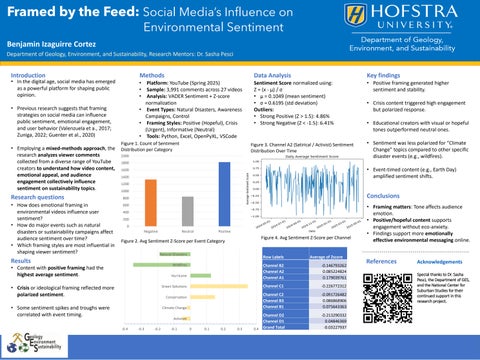
• Content with positive framing had the highest average sentiment
• Crisis or ideological framing reflected more polarized sentiment
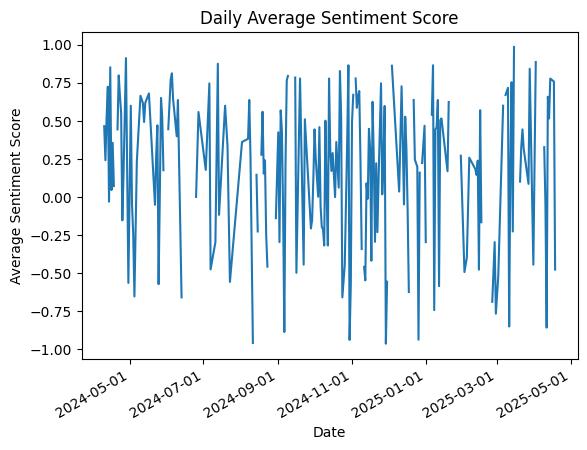
• Some sentiment spikes and troughs were correlated with event timing .

Methods
• Platform: YouTube (Spring 2025)
• Sample: 3,991 comments across 27 videos
• Analysis: VADER Sentiment + Z -score normalization
• Event Types: Natural Disasters, Awareness Campaigns, Control
• Framing Styles: Positive (Hopeful), Crisis (Urgent), Informative (Neutral)
• Tools: Python, Excel, OpenPyXL , VSCode
Data Analysis
Sentiment Score normalized using:
• μ = 0.1049 ( mean sentiment)
• σ = 0.6195 ( std deviation) Outliers:
• Strong Positive (Z > 1.5): 4.86%
• Strong Negative (Z < -1.5): 6.41%

Key findings
• Positive framing generated higher sentiment and stability.
• Crisis content triggered high engagement but polarized response.
• Educational creators with visual or hopeful tones outperformed neutral ones.
• Sentiment was less polarized for “Climate Change” topics compared to other specific disaster events (e.g., wildfires).
• Event -timed content (e.g., Earth Day) amplified sentiment shifts.
Conclusions
• Framing matters : Tone affects audience emotion.
• Positive/hopeful content supports engagement without eco -anxiety
• Findings support more emotionally effective environmental messaging online.
References
Acknowledgements
Special thanks to Dr. Sasha Pesci, the Department of GES, and the National Center for Suburban Studies for their continued support in this research project.
Figure 1. Count of Sentiment Distribution per Category
Figure 2. Avg Sentiment Z-Score per Event Category
Figure 3. Channel A2 (Satirical / Activist) Sentiment Distribution Over Time
Figure 4. Avg Sentiment Z-Score per Channel