Foot and mouth disease



In January 2025, an outbreak of foot-and-mouth disease (FMD) was reported in water buffalo in the state of Brandenburg, Germany. In addition to the measures taken, such as areas with restrictions and a standstill in Germany, this has also had consequences for Dutch livestock farming. Indirect transport of veal calves from Germany may be one cause of spreading. Samples taken from farms with imported calves all tested negative for FMD. There have been no further outbreaks in Germany. In March 2025, FMD was detected for the first time on a dairy cattle farm in Hungary. A few weeks later, it was also reported at three cattle farms in Slovakia. In the end, a total of five FMD outbreaks were reported in Hungary and six in Slovakia. Following culling and disinfection at the affected locations, there have been no new suspected cases, but stricter measures remain in place.
Lameness
Locomotor disorders in pigs can have a significant impact on the welfare of the animals and on the commercial results of a pig farm. There can be a variety of causes that can occur in pigs of all ages, from piglets to sows and finishers. We also see this in the results of the various measuring tools.
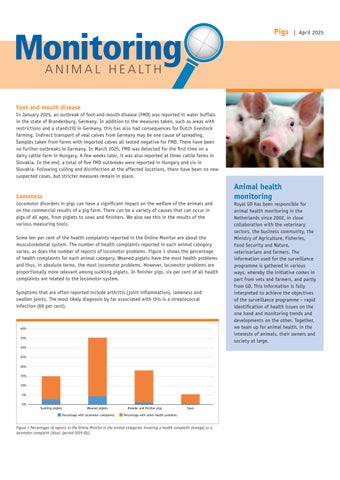
Some ten per cent of the health complaints reported in the Online Monitor are about the musculoskeletal system. The number of health complaints reported in each animal category varies, as does the number of reports of locomotor problems. Figure 1 shows the percentage of health complaints for each animal category. Weaned piglets have the most health problems and thus, in absolute terms, the most locomotor problems. However, locomotor problems are proportionally more relevant among suckling piglets. In finisher pigs, six per cent of all health complaints are related to the locomotor system.
Symptoms that are often reported include arthritis (joint inflammation), lameness and swollen joints. The most likely diagnosis by far associated with this is a streptococcal infection (69 per cent).
Animal health monitoring
Royal GD has been responsible for animal health monitoring in the Netherlands since 2002, in close collaboration with the veterinary sectors, the business community, the Ministry of Agriculture, Fisheries, Food Security and Nature, veterinarians and farmers. The information used for the surveillance programme is gathered in various ways, whereby the initiative comes in part from vets and farmers, and partly from GD. This information is fully interpreted to achieve the objectives of the surveillance programme – rapid identification of health issues on the one hand and monitoring trends and developments on the other. Together, we team up for animal health, in the interests of animals, their owners and society at large.
Specific findings
Bulging eyes and red skin
From the end of 2024 and during the first quarter of 2025, GD received an increasing number of reports from pig farms of a syndrome that had been unknown until recently. The farms have suckling piglets affected by enlarged/bulging eyes (bilaterally). In some piglets, it has been noted combined with a squint (strabismus), thick neck, shortness of breath, as well as in certain cases being combined with mild non-specific skin inflammation characterised by excessively red skin and baldness (alopecia) and/or hair loss (hypotrichosis). Only a few piglets are affected at some farms, whereas this syndrome has been seen at others in multiple piglets in over fifty per cent of litters, although never in all piglets in a litter. Veterinarians report that most piglets recover after weaning, but that farms have to dispose of too many piglets for slaughter due to insufficient growth or because they are unsaleable as finisher pigs because of thoracic deformities.
Initial pathological examinations revealed relatively few clues, although the bones of almost all piglets examined that had the typical clinical symptoms in the eyes show signs of a bone metabolism problem. However, the findings for the bones of piglets from the various farms are inconsistent.
At the end of 2024, the phenomenon had been seen at two farms; during the first few months of 2025, it was reported at approximately thirty. There have also been informal reports from a few farms in neighbouring countries.
The Veekijker veterinarians, in collaboration with pathologists and other researchers at GD, have been working intensively to find a diagnosis and possible causes. Various external experts from the Netherlands and elsewhere were also consulted during the search. All have stated that they do not recognise the syndrome. All the routine examinations, as well as newer methods such as PathoSense analyses, have not yet led to a clear conclusion.
The search has so far generated a fairly consistent clinical picture of a previously unknown syndrome in piglets. The farms that initially reported problems have stated that the issues disappeared after approximately four months. Possible causes are being diligently assessed and the possibility of multiple underlying causes cannot be ruled out. Although a nutritional or toxicological cause was considered initially, partly because of the findings for the bones, the increasing number of farms is a reason for re-examining infectious causes as well.
Proteus species
In March, the GD’s post-mortem diagnostics department received a shipment from a pig farm that was experiencing increased mortality among its piglets. The piglets had also been also more sluggish than the pig farmer was used to from previous litters. The piglets were all less than two weeks old. The animals submitted were all in poor condition and had extensive inflammation in the lungs, as well as fibrin strands in the abdominal cavity, variegated livers, foci of necrosis in the heart and lungs, and oedema in various organs.
Histology revealed atelectasis and necrosis in the lungs, with various bacteria appearing from the cultures. In addition to the familiar E. coli variants and Streptococcus dysgalactiae spp. equisimilis, Proteus spp. were also found in the mixed flora cultured from the piglets. The Proteus spp. were cultivated from samples from the spleen and peritoneum.
Proteus spp. are Gram-negative bacteria that are not commonly encountered in necropsies. P. vulgaris and P. mirabilis occur as commensals in both humans and animals. The urinary tract in particular is susceptible to opportunistic infections by these bacteria; faecal contamination is then usually the cause. In bacteriology, Proteus spp. can easily grow all over a culture plate as contaminant and this is where veterinarians are most familiar with this germ.
In this case, it appeared upon investigation that something had gone wrong with the injection technique and the piglets had been unexpectedly exposed to this pathogen, resulting in their deaths.
T. +31 (0)88 20 25 575
info@gdanimalhealth.com www.gdanimalhealth.com