1
19 New Feds boss sets ambitious course Vol 24 No 2 | January 19, 2026
View online at farmersweekly.co.nz
$4.95 Incl GST
Ewes plant a flag for sheep prices Neal Wallace
MARKETS
U
Livestock
NPRECEDENTED breeding ewe prices have been hailed as a turning of the tide for the sheep industry. This month a line of 2-tooths sold by J and MS Wilson from Onga Onga made $382 at Stortford Lodge while the McNeill family from Puketoro Station in Tairāwhiti sold Coopdale 2-tooth ewes for $302 and 2-tooth Romdale ewes $294. Onga Onga farmer Jim Wilson said several factors have aligned for the sheep industry, among them a shortage of ewes due to forestry conversions and a high lamb schedule due to global demand for meat. “All of these circumstances have come to a head at the same time,” he said. Wilson farms in central Hawke’s Bay, where he sources ewe lambs from Brent Mathews from Ormondville, grows them out and sells to a network of repeat buyers. He said the ewes have exceptional breeding values and production traits. The prime lamb schedule was last week still above $10/kg at a time it traditionally starts to ease, while store lamb prices at sales in the South Island last week were $30-$50/head higher than last year.
AgriHQ senior analyst Suz Bremner said that confidence signals what she called a turning of the tide for the industry, adding that it shows few signs of easing. “There is so much demand for lamb and we are finally seeing that flow through to the market for breeding ewes, which we haven’t seen for a long time.” At North Island ewe fairs, 2-tooths have made $220-$330 compared to $220-$250 a year ago. Most sales have been to regular buyers. Bremner expects South Island markets will be equally strong when they begin later this month. “It’s long overdue for the farmers who have stuck with breeding ewes to finally be rewarded.” Another factor underpinning current ewe prices is the high cost of cattle. At a recent Feilding sale, 15-18 month traditional steers made from $2000, heifers $1600 and yearling bulls more than $1500. Dairy cattle for finishing are also an expensive option. At a recent sale in Taranaki 130kg dairy weaner bulls made $700 and 120kg steers $900. Bremner said those cattle would last year have sold for around $600-$650. Indications are that yearling calf prices this autumn could be even higher than last year. Donald Baines, the livestock Continued page 3
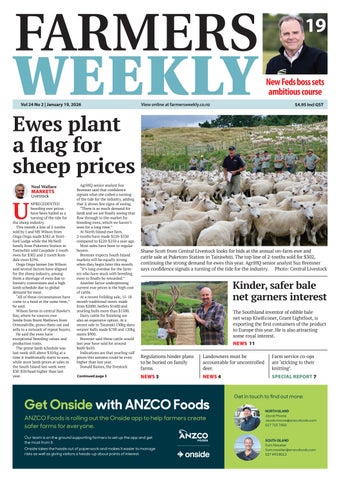
Shane Scott from Central Livestock looks for bids at the annual on-farm ewe and cattle sale at Puketoro Station in Tairāwhiti. The top line of 2-tooths sold for $302, continuing the strong demand for ewes this year. AgriHQ senior analyst Suz Bremner says confidence signals a turning of the tide for the industry. Photo: Central Livestock
Kinder, safer bale net garners interest The Southland inventor of edible bale net wrap KiwiEconet, Grant Lightfoot, is exporting the first containers of the product to Europe this year. He is also attracting some royal interest.
NEWS 11 Regulations hinder plans to be buried on family farms.
Landowners must be accountable for uncontrolled deer.
Farm service co-ops are ‘sticking to their knitting’.
NEWS 3
NEWS 4
SPECIAL REPORT 7
Get Onside with ANZCO Foods ANZCO Foods is rolling out the Onside app to help farmers create safer farms for everyone. Our team is on the ground supporting farmers to set up the app and get the most from it. Onside takes the hassle out of paperwork and makes it easier to manage risks as well as giving visitors a heads-up about points of interest.
Get in touch to find out more: NORTH ISLAND Jacob Moore Jacob.moore@anzcofoods.com 027 715 7450
SOUTH ISLAND Sam Nossiter Sam.nossiter@anzcofoods.com 027 493 8013
2
New Zealand’s most trusted source of agricultural news and information
Get in touch
Advertise
EDITORIAL
SALES CONTACTS
Bryan Gibson | 06 323 1519 Managing Editor bryan.gibson@agrihq.co.nz
Andy Whitson | 027 626 2269 Sales & Marketing Manager andy.whitson@agrihq.co.nz
Craig Page | 03 470 2469 Deputy Editor craig.page@agrihq.co.nz
Janine Aish | 027 300 5990 Auckland/Northland Partnership Manager janine.aish@agrihq.co.nz
Claire Robertson Sub-Editor claire.robertson@agrihq.co.nz Neal Wallace | 03 474 9240 Journalist neal.wallace@agrihq.co.nz Gerald Piddock | 027 486 8346 Journalist gerald.piddock@agrihq.co.nz Annette Scott | 021 908 400 Journalist annette.scott@agrihq.co.nz Hugh Stringleman | 027 474 4003 Journalist hugh.stringleman@agrihq.co.nz Richard Rennie | 027 475 4256 Journalist richard.rennie@agrihq.co.nz Nigel Stirling | 021 136 5570 Journalist nigel.g.stirling@gmail.com Isabella Beale | 027 299 0596 Multimedia Journalist isabella.beale@agrihq.co.nz
PRODUCTION Lana Kieselbach | 027 739 4295 production@agrihq.co.nz
ADVERTISING MATERIAL Supply to: adcopy@agrihq.co.nz
SUBSCRIPTIONS & DELIVERY 0800 85 25 80 subs@agrihq.co.nz
Jody Anderson | 027 474 6094 Waikato/Bay of Plenty Partnership Manager jody.anderson@agrihq.co.nz Palak Arora | 027 474 6095 Lower North Island Partnership Manager palak.arora@agrihq.co.nz Andy Whitson | 027 626 2269 South Island Partnership Manager andy.whitson@agrihq.co.nz Julie Hill | 027 705 7181 Marketplace Partnership Manager classifieds@agrihq.co.nz
News . . . . . . . . . . . . . . . . 1-13 Opinion . . . . . . . . . . . 14-15 Sector Focus . . . . . . . 16-18 Federated Farmers . 19-22 Real Estate . . . . . . . . 23-25 Marketplace . . . . . . . . . . . 26 Livestock . . . . . . . . . . 26-27 Markets . . . . . . . . . . . 28-31 Weather . . . . . . . . . . . . . . . 32
Andrea Mansfield | 027 602 4925 National Livestock Manager livestock@agrihq.co.nz
PUBLISHERS Dean and Cushla Williamson Phone: 027 323 9407 dean.williamson@agrihq.co.nz cushla.williamson@agrihq.co.nz
ISSN 2463-6002 (Print) ISSN 2463-6010 (Online)
Global agriculture’s reliance on China for crop protection products could soon extend to farm machinery. Last year the Chinese government unveiled a plan to accelerate its development of agricultural machinery. Lachlan Monsbourgh, Rabobank’s Australian-based global rural agricultural and environmental lead, said given the sudden emergence of Chinese-made cars on the road, he sees no reason the same won’t happen for agricultural machinery.
Wool interest THE first wool sale of 2026 opened strongly, fuelled by new overseas orders that drove exporters to compete aggressively for supply. PGG Wrightson’s Annabel Busby said spirited bidding across all wool types created a vibrant market, with standout lines of lambs reaching 500 cents clean on the floor. Busby said confidence remains high heading into the year.
Biosecurity New Zealand is urging Aucklanders to keep looking out for yellowlegged hornets, Vespa velutina, and nests as the number of findings of the invasive insect climbs to 42. Twenty-nine of the 42 confirmed queen hornets were found with either developed nests or evidence of nesting. Just before Christmas, Biosecurity NZ had found 38 yellow legged hornets and 25 of those insects were found with nests.
Word Only Advertising | 0800 85 25 80 Marketplace wordads@agrihq.co.nz
Farmers Weekly is Published by AgriHQ PO Box 529, Feilding 4740, New Zealand Phone: 0800 85 25 80 Website: www.farmersweekly.co.nz
China boom
Hornet watch
Real Estate | 0800 85 25 80 realestate@agrihq.co.nz
PRINTER Printed by NZME Delivered by Reach Media Ltd
Contents
News in brief
Awards return SILOED: Farmer and environmentalist John Burke is concerned that the siloed approach between NZ’s primary sector groups is holding the country back from having a truly integrated approach to sustainable farm management and land use. STORY P12
Rural Women New Zealand’s business awards are back on track with applications now open for 2026. The awards, which had been run annually since 2018 – celebrating the best of female entrepreneurship and business achievements in rural communities – were not held in 2025. Entries close on March 27, 2026 with the award winners to be announced on July 23.
Still walking the talk. Still backing farmers. We’re proud to stand with farmers. Being named 2025 Canstar Agri Bank of the Year reflects our commitment to supporting you through every season.
ANZ Bank New Zealand Limited
H261129_ANZ_Agri_Still_FarmersWeekly_W262xH120mm_v3.2FA.indd 1
05/12/2025 9:10 am
3
News
3
FARMERS WEEKLY – farmersweekly.co.nz – January 19, 2026
Red tape buries farm as a resting place Richard Rennie
NEWS
B
Regulation
EING buried on the family farm may appeal to many farmers but regulations are likely to stymie any efforts to seek a final resting place on the land they loved. Bradley Shaw, president of Funeral Directors Association of New Zealand, said requests by family clients for their loved one to be interred on the family farm are few and far between but do arise among the association’s members. Shaw, who is based in Whakatane, said he had fielded few such inquiries over the years. “But speaking to one of our members who went right through the process, they will testify it is very difficult to get it done. The regulations and rules around it are quite stringent and I guess they are like that deliberately,” he said. Burials in NZ are governed by the Burials and Cremation Act of 1964. It requires people to be buried in a public cemetery or Māori burial ground, should one be available within 32km of the place where the death occurred.
Continued from page 1 manager for Carrfields, said current prime lamb values and positive export prospects justify these ewe prices. “It’s a real positive for the industry and renewed confidence we have not seen for some time.” Baines said ram prices and sale clearances are higher than last year on the back of current ewe values. High wool prices have also helped with that confidence, with prices at the opening sale of the season 1% to 2% higher, and some lambs’ wool reaching $5/kg clean.
“Importantly, this is ‘as the crow flies’ and means more often than not, particularly if someone has died in hospital, they will be within that distance and require burial in a cemetery.” He said a number of highcountry properties may fall beyond that distance, should death occur on a station. Some long-established stations may also have family burial sites already in place. Burial is permitted in such sites if it has
The regulations and rules around it are quite stringent and I guess they are like that deliberately. Bradley Shaw NZ Funeral Directors Association existed prior to the Act’s passage. Stations that have cemeteries initially created for families and community members include Mesopotamia, Birch Hill and Mount Peel. For deaths occurring outside the 32km distance, the Act stipulates burial may be allowed on other land described as a Special Place, subject to council and ministerial approval. This is difficult to obtain. Data Steve Wilkinson, PGG Wrightson lower North Island area livestock manager, said the renewed confidence in the sector is welcomed. The confidence is in part driven by a shortage of breeding ewes, with few capital lines being sold due to the reduced number of farms converting to forestry. Paul Kenyon, a professor in Sheep Husbandry at Massey University, said high prices may convince some farmers to breed from ewe hoggets for the first time. He cautioned, though, that “while this can increase the total
reported by the NZ Herald in 2023 found only 0.004% of all the people in NZ who died between 1965 and 2021 were granted Special Place burials. However, a New Plymouth District Council spokesperson said it is misleading to interpret the Burials Act in isolation because of the need to also apply to the Ministry of Health for approval. If it is granted the burial site becomes a Gazetted location. Shaw said a number of the association’s funeral home members have gone right through the process up to this point and stopped. “The Ministry of Health approval is an issue.” Farmers Weekly inquiries with district councils throughout NZ indicate several have received requests over the years for farm burials and all warned about its difficulty. Ian Hyde, group manager of compliance for Ashburton District Council, said they had only received one in recent years. Tasman District Council and South Taranaki have received only a few inquiries over recent years, although South Taranaki District Council has received two queries in recent months. “While there is no set timeframe number of lambs weaned and boost farm revenue, it doesn’t automatically mean greater profitability”. Hoggets need to be close to 70% of their expected mature weight before mating and teaser rams used to encourage cycling, he said. The most common challenge is ensuring sufficient feed as they need to continue growing during pregnancy, gaining at least 130 grams per day to maximise lamb survival and maintain their suitability for rebreeding as 2-tooths, he said.
MORE:
See pages 16 & 28
DIFFICULT: Trying to be buried on the land one loves can prove to be a near impossible task. Photo: Pexels for legal and health approvals, it could take several months to complete, assuming all approvals are granted,” said a South Taranaki council spokesperson. In Southland the district council’s manager for property services, Kevin McNaught, told Farmers Weekly the council has in the past had input, feedback and conditions related to the Act’s “Special Place” section. “While the actual burial details are provided after the interment and recorded by the Ministry and council, the biggest issue in my mind is the ongoing recording of the burial on the record of title, which must be done for future reference of the location and any ongoing access rights etcetera. Especially if the properties are subsequently transferred out of the relevant families.” He said this is a long-term issue that can be overlooked or not prioritised at the time of burial. “If not adequately dealt with and protected it can cause long-term issues for the family if the site is
damaged or current landowners do not allow access to family members in the future.” Shaw said opting to scatter a loved one’s ashes on the land they loved always proves an easier option, and often a realistic compromise.
This week’s poll question:
Should regulations enabling farmers to be buried on their properties be eased?
Have your say at farmersweekly.co.nz/poll
Reduce antibiotic usage by 22% Within 24 hours, Mastatest identifies the bacteria a in ma astitis milk and the most effective drug to cure the infecction “You would struggle to find a better ROI than Mastatest”. Andrew Lord, Waikato Farmer
Scan to watch Andrew’s story
Evidence based vet medicines
080008 821 421821 800 1 421
www.agrihealth.co.nz 22% reduction is based on AgriHealth Technical Bulletin 10.3 AHMASTA-FW120x262-25
4
4
FARMERS WEEKLY – farmersweekly.co.nz – January 19, 2026
News
Landowners in crosshairs over feral deer Gerhard Uys
NEWS
H
Pests
OLDING landowners accountable for the impacts of uncontrolled deer is the next step in controlling deer numbers. So says the founder of Trap and Trigger NZ, Jordan Munn, who does aerial deer control across New Zealand. He told Farmers Weekly there needs to be regulatory reform that holds people accountable for the impact deer from their property have on neighbours. The Department of Conservation has said feral deer numbers are growing by about 30% a year, and Federated Farmers last year called for a national control plan to cover pests such as deer as well as pigs, Canada geese and ducks. In 2022-23, wild animals populated 83% of sites on public conservation land, up from 63% in 2013, DoC said. Munn said his work is split in three, with private landowners, local government and national government giving him equal amounts of culling work. He is not aware of any overarching body managing deer nationally across private and conservation land. There are too many conflicts of interest across forestry, public and private land, he said. When Trap and Trigger wants to sell venison from recovered deer, it often comes up against a conflict of landowner interests. To sell the meat from culled deer he needs landowners in a 2km radius from a culled property to sign a toxin declaration. Often neighbours won’t sign the declaration, in an attempt to protect feral deer, he said. On average deer populations increase 35% annually and a reduction of more than that is required to reduce numbers.
He said his company shoots on average 3000 to 4000 deer per year – and has shot as many as 10,000 deer in a year – but numbers bounce back. “We shot 1200 deer in a week on a 1000 hectare farm. We’ve shot that [farm] every month for the last three years and can still shoot 50 deer a month,” Munn said. One of his forestry clients spends $1 million a year on pest control, but deer repopulate forests from neighbouring land, often farmland. Richard Dawkins, Federated Farmers’ spokesperson on pest issues, said the diverse priorities and values among different stakeholders complicated a national deer management strategy. Some farmers, for example, like having deer on their property, but others want to eradicate them, with forestry protecting young trees by culling deer, but then easing off once trees are established, he said. Hunters alone cannot control deer and a “knock down phase” where high numbers are culled through aerial control is likely needed, he said. Regulations could help councils get deer populations down to sustainable numbers through regional pest management plans, he said. Farmers reluctant to allow hunters onto their property can use accredited hunters from local deerstalkers associations. Roy Sloan, general manager of the Fiordland Wapiti Foundation, said regulatory changes addressing access to properties with large deer populations would make control easier. He echoed Munn, saying accountability is needed when feral deer on one property negatively influence a neighbour’s property. More facilities to process feral deer have to be built, and disease testing requirements to sell feral deer venison need to be simpler, he said. Better marketing of wild venison
as a quality protein is also key, he said. Aerial operations aren’t the only fix, with hunters on the ground playing a role, especially when deer retreat to forests. He said the foundation has shown vegetation monitoring combined with culling means both conservation outcomes and hunter needs can be met. Mike Perry, DoC wild animals manager, told Farmers Weekly his department manages introduced wild animals on around 1.4 million hectares of public conservation land, mostly to reduce goat browsing pressure. Wild Animal Recovery Operations (WARO) operators who apply for commercial concessions that DoC manages recovered 3787 deer from public conservation land between July 2024 and June 2025. DoC contracts aerial and ground shooting, without meat recovery, for wild animal management, he said.
REPOPULATE: The founder of Trap and Trigger NZ, Jordan Munn, says one of his forestry clients spends $1 million a year on pest control, only to have deer repopulate forests from neighbouring land, often farmland.
Cherry season delays track with Chinese New Year dates Gerhard Uys
NEWS
Horticulture A LATE cherry season could be positive for growers, after rain damage hit Cromwell orchards. Richard Cameron, one of the senior management team for 45 South Cherries in Cromwell, told Farmers Weekly the season is running about 10 days to two weeks later than in a normal year, mainly due to a cooler spring. Cameron said because a lot of cherry exports revolve around Chinese New Year sales, which falls on February 16 this year, the late season is an advantage for exporters and growers. Late December and early January rains caused some damage in
Cromwell, but nothing out of the ordinary, he said. Older growing systems don’t stand up well to weather events when compared to newer growing systems, he said. Last season exports hit 6000 tonnes, an industry record. The same cannot be expected this season, he said. Co-owner of Forest Lodge Orchard in Cromwell Mike Casey told Farmers Weekly that, despite having newer vertical growing systems, 22mm of rain over a 24-hour period earlier this year caused significant damage in their orchard. A recent packhouse report from Forest Lodge showed 80% packout for a recent pick, versus a usual packout of mid-90%, Casey said.
Older growing systems don’t stand up well to weather events when compared to newer growing systems. Cherries get water splits, some from trees taking up too much water, which is then pushed to the fruit, firming up skin which cannot expand with growth. Others split from water pooling on the top of cherries, he said. The 36mm cherries fetch orchardgate prices of $50 to $60 per kilogram, but are also the cherries most affected by rain, he said. Much of the fruit of that size had to be discarded or juiced.
DAY FOR IT. BOSS® Triple Combination Mineralised Drench for Sheep offers the best protection for improved productivity.
Purchase a 20L of BOSS® Triple Combination Mineralised Drench for Sheep or MARATHON® SE Oral for Sheep Drench and receive an AGRiFiT® merino blend tee*.
AAH-BTCM-2025-043
www.alleva.co.nz Triple Action Formula.
Long-acting oral drench
PROUDLY
NZ
OWNED
Alleva Animal Health Limited, 1/116a Harris Road, East Tamaki, Auckland. BOSS® and MARATHON® are registered trademarks of Alleva Animal Health Ltd. Registered pursuant to the ACVM Act 1997 Nos. A011614 & A011903. See www. foodsafety.govt.nz for registration conditions. AGRiFiT® is a registered trademark of Alleva Animal Health. *While stocks last.
5
News
5
FARMERS WEEKLY – farmersweekly.co.nz – January 19, 2026
New laws drafted for trees and power lines Neal Wallace
NEWS
N
Power
EW regulations governing the proximity and management of trees near power lines are
imminent. Electricity lines companies said the current law needs updating as trees and branches falling on transmission lines were responsible in some regions for about 90% of power outages affecting about 70,000 South Island customers in recent storms. Energy Minister Simon Watts said he expects an exposure draft of new regulations to be released in the coming weeks. He said the amendments will provide line owners with greater powers to proactively manage the risk of trees falling on their lines. He said it will enable them to issue notices requiring tree owners to remove risky trees and restrict the planting of new trees on
land that is not already forested, excluding shelter belts and urban areas. “I’m confident this process will deliver clear, effective rules that support landowners and strengthen the resilience of our network,” Watts said. Electricity Networks Aotearoa CEO Tracey Kai said about 50,000 PowerNet customers in the southern South Island lost electricity during the October windstorm, some for two weeks. Also impacted were 16,000 Aurora customers in Dunedin, Central Otago, Wānaka and Queenstown Lakes, and 8000 in Canterbury. Kai said managing vegetation, including trees, cost lines companies $71 million last year, up from $67m in 2024 and $58m in 2023. “This cost is making electricity more expensive for consumers,” she said. Lines companies want better access to cut down high-risk
OUTAGE: Trees damaged electricity lines on Southland farms during last October’s windstorm, which cut electricity. trees. They want the cost to be shared with landowners, and a differentiation between public tree owners and forestry tree owners with more of an onus on foresters to maintain trees. Mark Pratt, the manager of customer and commercial services at Aurora Energy, said electricity networks are currently only able to manage vegetation that encroaches within set distances from powerlines, up to 4m depending on the voltage. “In most cases, vegetation faults are caused by trees outside these encroachment zones and that was predominantly the case during the October storm event.” He welcome pending changes to tree regulations that would enable networks to assess the likelihood and potential impact of trees they consider could be a risk to lines. Meanwhile large numbers of
Happy returns as velvet meets new year Annette Scott
MARKETS
Deer
MARKET development has seen velvet take an about turn into the new year with some large sales putting money into farmers’ pockets. PGG Wrightson’s national deer and velvet manager and velvet representative on the Deer Industry New Zealand (DINZ) board, Tony Cochrane, said already 2026 has seen a “comeback for velvet”. “The market has definitely turned from just pre-Christmas to now. [PGW] were not selling in the market before December 20 2025. “There were opportunists looking for cheap velvet, we always knew there would be a wait, and other sellers and farmers also held on, when some of the offers were under the cost of production. “We have sold large volumes already this year and farmers have been paid for that with a second take on the go now.” Indicators are pointing to NZ velvet production dropping by about 200 tonnes based on the numbers of cull stags going to venison plants. “We needed to have this reduction in supply in line with what the market has required. “We are happy we are getting money into farmers’ pockets, not breaking records, but we have had 10 years of good times, a blip, and now coming back strong.” Cochrane said there was no
EMPHASIS: PGG Wrightson’s Tony Cochrane says breeders have frontfooted the change with more emphasis on body weight coupled with good velvet.
The market has definitely turned from just pre-Christmas to now. Tony Cochrane PGG Wrightson blame on the farmers, they had not had the signals based on weight versus quality. DINZ board chair Paddy Boyd acknowledged the frustration and disappointment of many velvet producers in Deer Industry News. “The reality is we produced too much of the wrong type of velvet.” That prompted the need to work out clearly how that happened and make changes. “The market isn’t broken; the future looks to be very strong. “The changes in the pre-season addendum to the guidelines
weren’t guesses, they came from years of buyer and exporter feedback and they clearly point to where velvet’s future lies. “The opportunity now is for culling those older stags producing low-value velvet and to align ourselves with market demand and, fortunately, cull stag values at a premium have allowed many to capture some good returns.” DINZ chief executive Rhys Griffiths said exporters have had to work hard to reclaim some ground following the initial prices offered. “We are also starting to see and hear the numbers of heavier stags passing through the venison processors. “If this trend continues as predicted by many, then we could expect our total volumes of velvet produced for the 2026-2027 season to fall by 150-200 tonnes.”
Southland dairy farmers are buying generators after many were left without electricity following last October’s windstorms. The province’s Federated Farmers president, Jason Herrick, estimated more than 90% of dairy farmers in the province lost electricity during October’s damaging high winds that hit the South Island, disrupting milking and milk collection. “A massive number of generators
have been bought,” he said. “We were caught out and now we’re looking to respond and to become more resilient.” There are about 1000 dairy farms in Southland and about 450 in Otago. The federation’s Otago dairy section chair, Marcus Frost, said some farmers in the region have bought generators but they were not as badly hit by the storm as those in Southland.
Strong wool works around auction sales Bryan Gibson
MARKETS
Wool
INCREASING volumes of strong wool are being sold on contract, rather than through the auction system, according to the NZ Merino Company. NZM has reported 93.6% of its strong wool was sold through contracts and direct partnerships in 2025, a significant rise from 73.1% in the year before. Matt Hand, general manager for global supply at NZM, told the Farmers Weekly Podcast these partnerships are reshaping the sector by developing a pipeline to deliver more secure returns for growers through relationships with nine global brand partners. Hand said it has taken some time to get the supply chain in place, in terms of provable quality assurance here and forming partnerships with international buyers. “But that momentum is very much in place now, and we are seeing opportunities with brands around the world that need to convert to natural fibres. “They need to convert to natural fibres that carry some integrity, in terms of the way they’re grown and their production environment, and that compounding effect of brands converting to wool as their natural fibre of choice is creating opportunities that sit well above the auction market.” While consumers have been signalling a preference for natural fibres where practical, Hand said it takes a long time for businesses to plan a move away from synthetics. “The brand problem is, ‘How do I do that? How do I move to natural fibres? And what natural fiber should I choose? Is it? Is it available? Does it carry the credentials that are needed to
carry? Is its price stable? Can I have surety of supply?’ All of those problems are problems that we solve for brands.” NZM’s strong wool is offered under the internationally recognised ZQ and ZQRX standards, which set benchmarks for animal welfare, environmental sustainability, and social responsibility.
We are seeing opportunities with brands around the world that need to convert to natural fibres. Matt Hand NZ Merino Company “We support our farmers through that to ensure they have all the tools they need to be able to get through that audit phase. But in actual fact, New Zealand farmers are fantastic farmers. They’re the best in the world. “There are very few pieces of the puzzle we need to help populate for the farming teams out there, and essentially, they come on board quite quickly and smoothly.” Given the percentage of wool sold on contract, Hand said there are significant opportunities for growth, and NZM is always looking for more suppliers. “When we convert a brand to wool, one thing they need to know is that they have surety of supply. They’re not going to forecast into the future with a wool range if they’re not sure it’s there. “We have to make sure that we can procure it, certify it, and get it into their supply chain.”
farmersweekly.co.nz/podcasts
6
FUELLING
NEW ZEALAND. This summer, with your Farmlands Card in hand, you’ll save more on every litre with access to one of the most extensive networks of service stations and truck stops across the country, backed by trusted partners like Z, Caltex and Challenge. That means more places to refuel, more ways to save and one simple card that does it all. So, whether you’re staying close to home or getting off-farm for a well-earned break, Farmlands Card is on the journey with you this summer. Farmlands Card – it’s the card for out here.
EVERY LITRE. EVERY DAY.
SERVICE S TAT I O N S
TRUCK STOPS
12c 19c OFF
OFF
DIESEL
FUEL
T&Cs apply.
Card
Special Report
7
Co-ops must flex to stay strong Richard Rennie
NEWS
T
Agribusiness
HE heads of the country’s two big fertiliser cooperatives say theirs is a challenging but ultimately enduring model that ensures farmers have reliability, quality and timeliness when it comes to their largest physical farm input. While they may joust across geographical boundaries, Ballance CEO Kelvin Wickham and Ravensdown head Garry Diack maintain their respective co-op models are underpinned by a common powerful core purpose: to meet the needs of their farmer shareholders. But Wickham cautions there is a need to stay close to customers to understand those needs and adapt where necessary, particularly as a new generation of farmers may be less attached to the co-operative ideal than their parents were. “The real issues come if you do not adapt soon enough. The capital cost may seem to be higher but co-ops do get into trouble when they get too far from their core, and their needs.” He can point to Ballance’s extensive network of remote
urea silos as a typical example of leveraging off the co-op’s buying and capital strength to install a service that smaller, margintrading companies would struggle to do. Offering a full range of farm nutrients on the “last bus stop at the bottom of the world” is a tough gig for commercial operators needing to make a decent return on every one of those nutrients. He acknowledges the risk of losing generational memory when it comes to co-operatives’ value to scattered, price-taking farmers. “It could be a case they will not miss it until it’s not there. You do have to, however, adapt to the differences but the core purpose remains, and it can be successful. “Compared to a full commercial model, you are not so much dealing with quarterly earnings, but generational too.” As a board member of Cooperative Business New Zealand, Diack acknowledges his positive bias towards the model. But he maintains the model fits well for a small, largely pastoral, exportfocused country far from its markets. “It allows for some alignment in how you structure the industry. We only have 12,000 to 18,000 active commercial farms in NZ.
7
FARMERS WEEKLY – farmersweekly.co.nz – January 19, 2026
We have a supply and value chain set for farmers to get together, with longterm durability built in for the system to work. Garry Diack Ravensdown FLYING THE COOP: Ballance CEO Kelvin Wickham says the real threat to co-ops is a failure to adapt to shareholders’ changing needs, rather than the coop model itself.
It’s a small number, but it is an ecosystem in its own right. “You can go to many other countries, and Australian states, where they are all doing their own thing. But we have a supply and value chain set for farmers to get together, with long-term durability built in for the system to work.” In many cases the infrastructure required for shipping, handling and distribution of vast quantities
of bulk fertiliser can only be served by the long-term investment perspectives co-ops can bring. Diack acknowledges the painful shift out of co-ops in the red meat sector as the original co-op models have had to deal with a collapse in sheep numbers over 50 years. “The joy, if you like, in the balance sheet is it is always diversified into the value chain when it has been sold, whether it
is Silver Fern, Synlait or Alliance. There is always the option there to bring it back.” He is confident that even with a new generation of farmers coming forward without a lot of knowledge of co-operatives’ history, they are commercially literate enough to appreciate their value. Wickham said Ballance’s earlier ownership of feed company Seales Winslow highlighted the need to identify and stick to the core business of nutrient provision. “You could earn the right to add something on but need to think carefully about the risk and the value it brings to shareholders they couldn’t otherwise get.” Neither Ravensdown nor Ballance has paid a shareholder rebate since 2022, something both CEOs said they are aiming to put right sooner rather than later. “We have come through quite a downturn in the sector and have had to rely upon retained earnings, and faced costs including those from Cyclone Gabrielle. No rebate payment is not a long-term position we wish to take,” said Diack.
Stick to your knitting for mutual benefit Neal Wallace
NEWS
T
Agribusiness
HERE was no ambiguity in the message shareholders delivered to Tony Aitken when he was appointed chief executive of rural servicing co-operative Ruralco. “Stick to your knitting and we will support you,” he was told. “All co-ops are the same: they lose focus, they lose purpose, they lose money and then we have to bail them out.” Aitken said the secret to a coop’s success is to stay true to its
MANAGEMENT: FMG chief marketing officer Peter Frizzell says FMG shareholders do not receive dividends, with any profits reinvested back in the business. In the 120 years FMG has existed, shareholders have not had to reinvest a cent.
purpose, and for Ruralco that was low input costs for farmers. “If you stay true to your focus and are laser focused on your purpose and what shareholders want and stick to that, then you are fine,” he said. The Ashburton Trading Society, later renamed Ruralco, was formed by farmers in 1963 to supply competitively priced farm products. Aitken said co-ops tread a fine line between staying profitable and returning financial benefits to shareholders. After two successive years of financial losses, Ruralco last year recorded a $1.25 million profit
and Aitken said that was because it listened to shareholders and delivered what they want and need. As a small co-op, accessing products can be challenging but last year along with three other independent NZ rural companies, Ruralco joined the Nutrien Ag Solutions buying group, which gives it access to international farm products. Co-ops are still relevant but given the stiff competition, Aitken said, they have to keep evolving to attract younger generations. Farmlands Co-operative Society chief executive Tanya Houghton said meeting the needs of farmergrowers is a daily challenge and necessary for a co-op to be successful. “That means sharper pricing, reliable supply, practical advice and running a disciplined business that is financially strong and able to support them through the ups and downs of the cycle,” she said. To remain relevant, co-ops also need to evolve alongside farmers and growers. Farmlands’ recent acquisition of Seales Winslow to expand its animal nutrition presence is an example. Farmlands was formed in 2013 but its roots go back to the early 1960s and the creation by farmers of the Economic Trading Society in Hawke’s Bay and the Otago Rural Trading Society in Otago. Today it employs more than 1000 people servicing more than 64,000 shareholders through a national
FOCUS: Ruralco chief executive Tony Aitken says, ‘If you stay true to your focus and are laser focused on your purpose and what shareholders want and stick to that, then you are fine.’
network of 82 stores. FMG chief marketing officer Peter Frizzell said understanding and staying true to the mutual’s purpose is a daily focus. “We constantly talk about our purpose – a better deal for rural NZ – and how we were created by farmers and growers.” FMG has strategically extended its footprint to offer residential and commercial insurance in selected urban areas, which Frizzell said gives it the scale it needs. “Farmers and growers define the mutual, this sustains us through scale.”
Shareholders do not receive dividends, with any profits reinvested back in the business but Frizzell said in the 120 years FMG has existed, shareholders have not had to reinvest a cent. “That is not a fluke. Very careful management has made that happen.” Growth is organic with the addition of a small insurance broker a few years ago the only recent expansion. Frizzell said as a mutual, FMG thinks long term while supporting the rural community, assisting at more than 700 events last year.
8
8
FARMERS WEEKLY – farmersweekly.co.nz – January 19, 2026
News
Tech to trees as forestry drones take off Richard Rennie
TECHNOLOGY
A
Forestry
DECADE into deploying drones for forest research and management, Scion’s scientists have adopted the flying robots to dig deeper into the quality and quantity of forests growing throughout New Zealand. Now part of the Bioeconomy Science Institute, Scion purchased its first drone or Unmanned Aerial Vehicle (UAV) back in 2015, when the technology was starting to expand rapidly beyond military use into commercial and consumer sectors. At the time a key limitation on the tech was the battery life, often offering only 15-20 minutes’ flight time per charge. In 2015 the Scion team acquired a commercially available laser scanner, paired with a drone from NZ-based Aeronavics drone company that worked with the Hollywood film industry. Since then, the machines have found a place capturing aerial data for use in high-definition mapping and forest monitoring. The expanded tech includes 3D
modelling alongside the ability to collect samples, map sub-canopy data, and run multiple functions in single passes. Scientist Robin Harley said the drones are now capturing highdefinition LiDAR (light detection and ranging) images for tree measurement, rendering high-res maps of tree stands and trials. “We are also exploring niche areas such as sub-canopy flying for characterising stem and branch structure and collecting upper canopy samples.”
Drones are now capturing high-definition LiDAR images for tree measurement, rendering high-res maps of tree stands and trials. Robin Harley Scion Work is also being more closely aligned with commercial forestry companies to meet bespoke needs, including UAV spray systems. As drone capacity and power increases, there is an increasing array of mechanical applications
they can be employed for, including planting on difficult country. The use of drones in afforestation more broadly in NZ is becoming more common. In the Hunua ranges, Auckland’s Watercare has employed drones to plant seed pods, using seeds encapsulated in an organic mixture containing five to six native seeds, and spreading 50,000 pods in only half an hour over the steep water catchment area. Overseas, China is preparing for large-scale advances in drone use that have integrated military technology with agricultural and forestry applications. This includes using LiDAR to map that country’s growing tree population and to seed its Great Green Wall, a vast belt of trees in northern China planted to prevent the Gobi and Taklamakan deserts from expanding. It is already the world’s largest seeded forest, of 66 million trees, and completion is due in 2050. By 2020 over 80% of the forestry industry had adopted drones for use in aerial imagery capture. A study done in 2020 of 23
India FTA: Trade for All may be in play
Richard Rennie
MARKETS
Dairy
MARKETS
LABOUR Party parliamentarians will meet for the first time this week to consider their support for the government’s trade deal with India. The government needs Opposition votes after coalition member NZ First said it would not support enabling legislation that must be passed before the agreement can enter into force and tariff reductions commence.
The safeguards needed in trade agreements have altered and we have to make sure they will be part of this agreement. Damien O’Connor Labour Party Speaking to Farmers Weekly shortly after the agreement was announced on December 22, Labour’s trade spokesperson Damien O’Connor declared it a “significant step forward” and said he would be recommending his caucus colleagues support it. He said he had exchanged text messages with Labour leader Chris Hipkins, who O’Connor
companies covering 1.17 million hectares or two-thirds of NZ’s exotic forest estate highlighted the use of tech linked to drones for forest mapping, harvest planning and cutover mapping. LiDAR technology use had surged alongside the drones’ deployment, from 17% to 70%. Most companies were using drones to acquire the images, compared to zero in 2013. The survey indicated a need for
greater training in the use of the mapping technology. An initiative, Tools for Foresters, has been established by Scion to create a platform for connecting researchers and users of the tech to help develop practices and techniques within the industry. Meantime use continues to lift with a 20% increase in some key drone applications, thanks in part to the Tools for Foresters initiative.
Thais still teetering on dairy’s done deal
Nigel Stirling
Trade
CAPTURED: The deployment of drones has provided Scion researchers and commercial operators with a platform to accelerate the use of highresolution imagery and AI tools for better forestry management and forecasting.
SUPPORT: Labour’s trade spokesperson, Damien O’Connor, says the India trade agreement is a ‘positive step forward’ but it is likely his caucus colleagues will need more time to consider their support. said agreed with him that the deal “seems positive” for New Zealand exporters. However, in a press release the next day O’Connor slammed the government for rushing negotiations and failing to deliver meaningful market access for dairy exports. Since then O’Connor and Hipkins have had further briefings from Trade Minister Todd McClay and his officials. O’Connor told Farmers Weekly nothing had changed his initial view that the agreement was a “positive step forward” but it is likely his caucus colleagues will need more time to consider their support. It is likely they either will want to see the text of the agreement or receive assurances from officials about certain aspects. Clauses upholding the rights of women, environmental and labour standards and the Treaty of Waitangi are all likely to come in for scrutiny from Labour MPs. “The world of trade has shifted and the safeguards needed in trade agreements have altered and we
have to make sure they will be part of this agreement ... so it doesn’t just deliver for a few big trading companies but delivers for all New Zealanders,” O’Connor said. O’Connor said the previous Labour government had elevated the importance of these noneconomic objectives under its Trade for All negotiating mandate. Labour’s Trade for All negotiating priorities were strongly criticised by McClay when he was in Opposition as a distraction for NZ’s trade officials from their core job of negotiating improved market access for exporters. It remains to be seen just how far he would have pushed the Indians to make such concessions in what were already fraught negotiations. However, Labour’s support could depend on it. “That is something we have laid out under our Trade for All policy and we would expect this agreement to continue those lines given the minister’s acknowledgment of generally a bipartisan approach to trade,” O’Connor said.
A YEAR after its free trade conditions on dairy sales to Thailand came into effect, the New Zealand sector is still waiting for the Thai government to fall into line on a deal it signed over 20 years ago. The NZ-Thailand Closer Economic Partnership Agreement included a 20-year rolldown of tariffs on NZ dairy products, with them due to be zero-tariff by January 1 2025. But the Thai government backed out of that condition last year, instead replacing them with quota-type limitations on NZ dairy imports. Since then, the sector and trade officials at the highest level have been working to pressure the Thais to comply and ensure their $500 million a year market opens as was intended. Dairy Companies Association of NZ (DCANZ) CEO Kimberly Crewther said NZ processors are coming close to a new year of trading no closer to a resolution, with the real possibility they could face tariffs as high as 216% on skim milk powder product. “This is the amount that would be applied if we do not get the conditions agreed on under the FTA, or under a WTO quota.” Thai Milk Board officials were due to meet just before
Christmas to allocate permits for imports in advance of the new calendar quota year. In March 2025 skim milk powder levels were pared back by two-thirds. The Thai Milk Board is also leaning heavily on local importers and distributors to replace imported product with local. The issue has seen intense to-and-fro of Thai and NZ diplomatic officials in the past year, with Minister for Trade Todd McClay hoping to have resolved it back in August 2025. The Thai dairy trade is a critical one for NZ, with the country using NZ product to reprocess and repackage dairy products for the entire southeast Asia region. “The current situation is not in keeping with the FTA so we are continuing to work and engage with government here who are supporting our efforts,” Crewther said.
UNRESOLVED: DCANZ CEO Kimberly Crewther says there have been significant efforts in the past year to try to get the Thai government back on board with the FTA over dairy products.
9
Your support matters You’ll have noticed - this is a skinny paper. Advertising revenues are traditionally low in January, and a smaller paper with less stories is the result of that. Costs have risen, so other media companies respond to a drop in advertising by cutting staff, and so cutting their capability to do a good job. We’re determined not to do that, with your support. And with that support, we’ll keep delivering Farmers Weekly to you and every other farmer in New Zealand every week in print and online.
We’re committed to playing our part in ensuring the future of strong, independent rural journalism, and we’d be grateful if you did yours by starting a Voluntary Subscription. Thank you to the 1200 of you who have joined the Farmers Weekly family so far. We’re grateful to be doing what we love, and to be sharing it with you as we head into the year ahead. Dean and Charlie Williamson
BECOME A MEMBER Start your voluntary annual subscription and become a Farmers Weekly member today. $120 for 12 months. This is a voluntary subscription for you, a rural letterbox-holder already receiving Farmers Weekly every week, free, and for those who read us online.
1. Scan the QR code or go to www.farmersweekly.co.nz/donate 2. Email your name, postal address and phone number to:
voluntarysub@farmersweekly.co.nz and we’ll send you an invoice.
Scan here
3. Call us on 0800 85 25 80 Note: A GST receipt will be provided for all voluntary subscriptions.
10
10
News
FARMERS WEEKLY – farmersweekly.co.nz – January 19, 2026
Primary industries enjoy fruitful season Hugh Stringleman
MARKETS
A
Horticulture
MAJORITY of primary sector companies performed well on the New Zealand Stock Exchange during 2025 and have good momentum going into the new year. The share prices of eight of the 15 stocks included in the S&P/ NZX Primary Sector Index rose by 40% or more, propelling the index up 49% during the calendar year in NZ dollar terms and 42% in USD. The gainers were larger, longerestablished companies while the losers were smaller entities with industry-specific concerns at present. Unsurprisingly, the biggest gains were made by listed dairy companies a2 Milk (up 70%), Fonterra Shareholders Fund (up 57%), Synlait Milk (up 50%) and the Fonterra Co-operative Group supply shares (up 42%). But the FCG shares are not included in the S&P index because of their trading access being restricted to current and former farmers. During 2025 a2 Milk shares rose in price from $6 to over $10 as the company re-established revenue from China after Covid-19 disruption and began paying dividends. FSF shares went from $5 to over $8 as non-dairy investors anticipated a capital return of $2 sometime in the first half of 2026 and enjoyed a gross dividend yield of 7% from 57c a share fully imputed. The FCG pathway was $4.30 to $6 during the year, the gross yield was 14% and farmers who trade appear to believe the underlying share value is around $4, after
the $2 capital return is paid out. Post-payout, the share market will reset the margin between FSF and FCG, which has historically been $1 to $1.50. A tumultuous year of rescue from threatened liquidation saw Synlait Milk re-capitalise with Bright Dairy of China as a 65% shareholder, and lift its share price from 40c to 65c, up 50%. Synlait shares have been as high as $9 in the past and its recovery has a long way to go.
The bolter for share price improvement was fishing company Sanford, up 77% after posting record results in FY25. The bolter for share price improvement was fishing company Sanford, up 77% from $4.20 to $7.45, after posting record results in FY25. It boosted net profit after tax by more than three times in the financial year to September 31 and paid an imputed full-year dividend of 10c. Fellow fisher NZ King Salmon was a stark contrast, losing 14% to end the year at 20c after declaring a loss in a revised eight-month financial year. Horticulture triplets T&G Global (up 50%), Scales Corporation (up 48%) and Seeka (up 43%) were all drawing from the same wells – kiwifruit and apple exporting – with both growing and packing incomes. Scales is four times the size of the other two, measured by market capitalisation, due to its global proteins division, which produces bulk pet foods in three countries – NZ, Australia and the United States. Scales has already guided a
net profit after tax attributable to shareholders in the high $50 millions in 2025, double that of 2024, and forecast good apple harvesting and selling conditions in 2026. Seeka has guided FY25 beforetax profitability in the high $40m’s compared with $30m in FY24, a record for the company. The rising tide of commodity, farmland and livestock prices produced an operating earnings forecast of $64m from rural service company PGG Wrightson in the current FY26 period, compared with $56m in FY25. In mid-December chair John Nichol said the upward revision reflected the continued strength and resilience of NZ agriculture in 2025. “Beef schedules are at record highs, lamb prices remain
GROWTH: Horticulture triplets T&G Global (up 50%), Scales Corporation (up 48%) and Seeka (up 43%) were all drawing from the same wells – kiwifruit and apple exporting – with both growing and packing incomes. elevated, and wool pricing has also shown positive signs with improved export values. This positivity is flowing through into on-farm and orchard investment decisions. “The rural real estate market is buoyant, driven by strong
commodity returns, record dairy land values, and robust farmer confidence,” Nichol said. Among the share market negatives in 2025 were Comvita (down 35%), Arborgen (down 9%), Rua Bioscience (down 4%) and Delegat (unchanged).
Dairy farms record drop in use of nitrogen fertilisers Neal Wallace
NEWS
Environment THE use of nitrogen fertilisers on dairy farms has fallen 20% in the past few years, partly thanks to regulations limiting application rates to 190kg/ha a year. A report by the Fertiliser Association of New Zealand says it has been three years since mandatory reporting on annual application was introduced, and while price and product returns have been a factor in purchases, the annual cap has also been factor in the reduction in use. “A significant portion of the reduction is likely due to elevated nitrogen prices and reduced
commodity returns during the same period.” The report notes some regional council requirements have also contributed to an emphasis on efficiency, an increased use of urease inhibitors and improved clover management. About 50% of all urea sold is coated with an inhibitor. Farmers have responded to the cap by growing more crop and increasing the use of supplementary feeds. The association estimates these changes will mean only a slight reduction in the volume of nitrogen that enters waterways. The association said implementing the cap gave little consideration to the extensive reporting requirements or how im-
plementation would be supported. “This was exacerbated by limited publicity on the cap requirements to farmers.” Despite that, the report says few reporting regimes have had such rapid uptake, with almost 6000 nitrogen use reports lodged by farmers to regional councils last year. “This outcome is largely attributable to the proactive involvement of the two fertiliser co-operatives and regional councils in developing and implementing the reporting system.” Another reason was companies investing in IT systems and farmers moving to digital mapping of properties to record precise nutrient application.
Support when you need it most. Rural Support is here to help with the unique challenges of rural life. Our local teams have first-hand experience and knowledge to understand what you’re going through, and are here to listen to whatever’s on your mind.
Give us a free, confidential call today.
0800 787 254 | rural-support.org.nz
Tautoko Taiwhenua
11
News
11
FARMERS WEEKLY – farmersweekly.co.nz – January 19, 2026
Kinder, safer bale net garners interest Gerhard Uys
TECHNOLOGY
T
Pollution
HE Southland inventor of edible bale net wrap KiwiEconet, Grant Lightfoot, is exporting the first containers of the product to Europe this year. Not only that, but Lightfoot has been rubbing shoulders with royalty. He told Farmers Weekly that when he exhibited the edible bale net, made from jute, a flaxlike fibre, in England at the Groundswell agriculture show last year, Prince William came by to have a look and hear about the product. Later this year Lightfoot is off to Europe to meet with the royals’ farm managers, who want to use the netting on their farms. The British royals have over 40,000 hectares of farm land. Lightfoot became fed up with seeing animals eat plastic bale nets left behind in paddocks,
BOOMING: Grant Lightfoot says the business is taking off with local and international interest booming. saying animals die with stomachs full of the netting. Traditional netting cannot be recycled like bale wrap, and as such government schemes, such as the newly announced farm plastic recycling scheme, won’t make a dent, he said.
The problem is so big that last year Alliance Group asked farmers to ensure all plastic baleage wrap and twine is removed from paddocks after feeding out. In a newsletter the processor said it was seeing an increasing number of cases where wrap and
twine are making it through to processing after livestock eat it. At its Mataura plant, key equipment was being blocked. Most nets are still burned or buried, or are left in paddocks. When Farmers Weekly spoke to Lightfoot he was at the airport on his way to India to see the manufacturer. He was recently nominated for five categories of the 2026 Earthshot Prize, an environmental award set up by Prince William. There is one container on the way to Switzerland, which will be followed by five more and then 10, he said. He is also off to Diddly Squat Farm, belonging to Jeremy Clarkson of Clarkson’s Farm fame, in June, to showcase his product at an agricultural show the farm hosts. Lightfoot said the product is now taking off locally and internationally, but to fund the business he is working six jobs – which include farming deer, operating a logging business and
ROYAL INTEREST: The Southland inventor of edible bale net wrap KiwiEconet, Grant Lightfoot, with Prince William at the Groundswell agricultural show in England last year. The royals, who own 40,000 hectares of farmland, hope to use the netting on their farms. grazing dairy cattle on a lease block. Local sales will be done through a local distributor.
Dairy Expo catches on with exhibitors Gerald Piddock
NEWS
Dairy
THE New Zealand Dairy Expo has more than doubled its exhibitor size over the past three years. The expo is on this year from February 18-19 at Bedford Park in Matamata, bringing together 185 dairy-focused businesses and thousands of farmers. NZ Dairy Expo event coordinator Amanda Hodgson said the event has grown from 80 exhibitors in its first year to 130 last year, and there are 185 coming this year. It is now at capacity and organisers cannot fit any more without compromising the integrity of the event, she said. That growth has prompted some site reshuffling, with exhibitors now grouped into a dozen
categories. This is designed to keep the event as simple and as straightforward as possible. Hodgson said there is low capital outlay for exhibitors and that, along with it being free for farmers, has created an event where there is an ideal opportunity for these two groups to connect with each other. “Because it’s midweek, you don’t have anyone else coming – it’s purely just dairy farmers and I think the growth and demand have come because it’s such a niche event.” Farmers should allow three to four hours to make the most of what’s on offer during the expo’s operating hours of 8.30am to 3pm, she said. “This expo is about creating value for both farmers and businesses. If it didn’t deliver that,
we’d just be another field days and there’s already enough of them and that’s not who we are or why we want to do this. That would be a waste of time and energy.” To help exhibitors measure engagement, farmers will still need to present a free ticket at the gate. This keeps entry flowing smoothly and allows organisers to report accurate attendance figures. This year the expo will have agricommentator Julia Jones as MC across both days. Each morning she will host a 30-40-minute Q&A session on cow wearables, joined by veterinarian Kirsty Ashcroft from Anexa Veterinary Services, Morrinsville. The session covers collars, ear tags, boluses, system integration, practical tips and what’s coming next in dairy technology. In the afternoons, attention
DRAW CARD: This year’s NZ Dairy Expo will have 185 exhibitors and thousands of visitors across the two-day event in February. shifts to breeding for the modern farming environment, led by Mark Benns from Wingman. He will explore why breeding decisions
need to be made years ahead of infrastructure changes and how strategic planning supports herd efficiency and sustainability.
Study full time, part time, online or on campus
Thinking about studying Sciences?
APPLYNOWFOR2026
Bachelor of Agricultural Science Bachelor of AgriBusiness Bachelor of Animal Science Bachelor of Horticultural and Plant Systems* Bachelor of Earth and Environmental Science Bachelor of Science * New for 2026
massey.ac.nz contact@massey.ac.nz 0800 MASSEY Scan to learn more massey.ac.nz/studysciences
12
12
FARMERS WEEKLY – farmersweekly.co.nz – January 19, 2026
News
Blueprint starts with measuring green mahi Richard Rennie
NEWS
E
Sustainability
QUAL amounts of knowledge and frustration have fuelled John Burke’s blueprint to improve New Zealand’s claims to truly sustainable land use practices. His report, Creating a Sustainability Value Chain for NZ Primary Industry: How to go twice as fast for half the cost, has not come through a scholarship sojourn or funding grant. Rather, it is off his own bat after years of actively improving his own farming environment in the Bay of Plenty. It offers a pathway for how NZ Inc can “walk the walk” when it comes to sustainable land use and reforestation. It includes eight key recommendations, extending from what Burke calls the simple “Planning 101” of having a vision and strategy to begin from. It then moves through the value chain to cover markets, the Emissions Trading Scheme and funding options. Burke’s frustration comes in part from what he describes as the “eye-watering” $3.5 billion the Parliamentary Commissioner
for the Environment estimates the central government will have spent for 2024-25 on land conservation and improvement. “That prompted me to recommend a ‘restoration bank’, a specialist fund and mechanism ensuring more efficient application of investments in environmental restoration, and outcome success.” He is concerned at the ad hoc, siloed approach taken by industry in its well-intentioned restoration efforts, with a distinct lack of key performance indicators, or KPIs, to measure how successful those efforts have been. “Those KPIs should be around the mahi involved. That includes how many hectares were retired, how many seedlings were planted, how much area is under pest control?” His frustration includes a sense there is “too much hui and not enough doey”. Burke agrees the Irish may well have beaten New Zealand to the post for a unified sustainability initiative with the Origin Green programme launched in 2012. It unites farmers, processors and retailers, with measurable goals extending beyond the environment to social and economic outcomes. “We have taken this siloed approach between sectors that has
been holding us back. This is about creating ‘Aotearoa Farm’.” That includes developing landscape plans for all NZ farms and encouraging efficient native restoration methods, a practice many farmers can find expensive to achieve using conventional methods.
We have taken this siloed approach between sectors that has been holding us back. This is about creating ‘Aotearoa Farm’. John Burke Farm environmentalist Burke has proven native restoration costs can be drastically reduced through the Timata method he has overseen; it involves using pioneer species like mānuka planted at a low density on degraded land, with integrated pest and weed control deployed early on. His plan includes recognising the need to fix the ETS, where sequesters and emitters mix like “oil and water”. “To change it meaningfully we need carbon at over $100 per tonne. But as it stands now if we
SILOED: Farmer and environmentalist John Burke is concerned that the siloed approach between NZ’s primary sector groups is holding the country back from having a truly integrated approach to sustainable farm management and land use. did, then the whole country would be in pines. “The cost needs to increase to encourage behavioral change, but sequestration needs to be modified between natives and exotics.” Tying plantings to farm landscape plans would need to include a rejig of the ETS to include natives. Burke’s blueprint comes at a time when the future of farm catchment groups – so instrumental in linking farmers to sustainable practices – hang in the balance.
Fruit IP still ripe for ripoffs Richard Rennie
NEWS
Horticulture WHILE Zespri has enjoyed recent success in having a Chinese grower prosecuted for growing illegal kiwifruit, pathways to protection remain tough as regulations continue to evolve. In October 2025, a court in Wuhan ordered an unauthorised grower to remove over 200 hectares of G3 vines and pay Zespri NZ$1.28 million in damages and costs. China first enacted its Seed Law in 2000 and enacted a major revision in 2021, effective 2022. It was under the amended Seed Law of 2021 that the unauthorised grower of the registered Zespri G3 kiwifruit variety marketed as Zespri SunGold was prosecuted. Chinese authorities have made much of efforts there to ramp up protection of plant variety rights. In late 2025, for example, the China Supreme People’s Court (CSPC) upheld a legal action brought against illegally grown Sweet Sapphire grapes, a variety originally bred and commercialised by International Fruit Genetics (IFG). The CSPC decision also ordered
destruction of the illegally propagated plant material and imposed a large fine on the grower. Elsewhere around the world, breeders of proprietary varieties and owners of those varietal rights are spending more time and money protecting their IP assets. Internationally experienced IP lawyer Darron Saltzman of HortIP Law in Melbourne represented IFG from its inception in 2001 until 2019. He said the protection and commercialisation of any new variety requires a planned strategy and a commitment to follow through by all involved. “Part of this strategy and commitment calls for an awareness and anticipation that unauthorised activities involving the variety will inevitably occur, and even more so where the variety is commercially successful. “It is in the interests of both the rights owner and any other authorised participants investing in the commercialisation of the variety, including growers and marketers, not to stand by and allow unauthorised free-loaders. “Unfortunately, that all takes time and money.” He said some of the problems experienced by rights holders
“Everyone’s funds are drying up and there is a fiscal cliff there.” He sees the North Island east coast and Molesworth station as two “paddocks” of the Aotearoa Farm where revegetation under his plan could kick off. The plan has been well received by National Party MP Barbara Kuriger, who Burke said sees the need for bipartisan support of such a long-term vision. “Unfortunately, some of the other high-ranked politicians are only looking short term.”
Whilst you can never fully protect against infringers, you can take steps to minimise the window of opportunity for infringers. Darron Saltzman IP lawyer
TIMING: Ensuring new proprietary varieties of crops are fully protected from unauthorised plantings in China can come down to the timing of application and commercialisation, says legal expert Darron Saltzman. when dealing with unauthorised activities involving their varieties stem from lack of knowledge of systems available for dealing with issues as they arise. “Variety protection laws vary from one jurisdiction to another and there is never a substitute for having competent legal advice concerning the specific location where the problem exists.” Another equally common cause of problems from unauthorised plantings is the failure by breeders or variety owners to address protection issues before the commercial release of a new variety. “A unique feature of the systems offering legal protection in the form of either plant variety rights or plant breeder’s rights in China
is that protection only starts from the date of grant. “This is fundamentally different from most other forms of registered IP protection, where the date of application for protection is the starting date of the protection ultimately granted.” It means in China activities taking place before the actual granting of rights are critical to the availability of protection, and the ability to address any unauthorised activities occurring in that pregrant period. Saltzman advises strongly against embarking on any commercialisation activities before dealing with the formalities of protection. “Whilst you can never fully protect against infringers, you can
take steps to minimise the window of opportunity for infringers.” The experiences of other companies in China, such as the giant United States berry company Driscoll’s, might be of relevance for Zespri as it determines how to deal with the rising tide of illegally grown G3 Gold kiwifruit there. Driscoll’s set up its first domestic planting base in Yunnan province in 2013 to grow berries. Smaller Chinese growers are provided with standardised seedlings, cultivation training and advice for crops to sell back into the Driscoll’s supply chain. Under its collaborative model farmers retain most of the revenue, up to 70% of profits in some schemes, while having to meet strict Driscoll’s cultivation and post-harvest standards. On a recent Farmers Weekly visit to China, several local growers and post-harvest processors of unauthorised G3 fruit expressed a strong desire to participate under a Zespri label, including seeking advice to improve crop yields and fruit quality.
13
Back-to-study
FARMLANDS CARD
DEALS EA AWLS in! SCORE A
Back to study? Sweet Dream Sutton
Queen Bed $
Leeds 4 Drawer Chest
99
$
499
Lawson Sofa Bed
299
$
Valid until February 28
SCORE A
1.5% REBATE WHEN YOU SHOP IN-STORE OR ONLINE WITH YOUR FARMLANDS CARD T&Cs apply.
T&Cs apply
ow! Start saving fanrm lands_card.html farmlands.co.nz/
GET 2.5% OFF STOREWIDE When you shop in-store or online with your Farmlands Card T&Cs apply.
14 Editorial
14
Opinion
FARMERS WEEKLY – farmersweekly.co.nz – January 19, 2026
This week’s poll question (see page 3):
Should regulations enabling farmers to be buried on their properties be eased? Have your say at farmersweekly.co.nz/poll
LAST WEEK’S POLL RESULT
From the Editor
Let’s focus on the positives Craig Page
Deputy editor
T
HE festive season already seems a distant memory, and it’s back to business for most people. But for sheep and beef farmers, there should be an extra spring in their step as they head into 2026. Last year finished on a high, with lamb farmgate prices at near record levels and beef prices on the rise, pointing to a muchneeded resurgence in the sector. There were fears it could be a short-term fix but the early signs this year are sheep and beef farmers will continue to reap the benefits of the buoyant market for some time to come. All the talk before Christmas was about lamb. But this month it is the prices being paid for breeding ewes that have caught the headlines. Top lines of ewes fetched in excess of $300 a head in early January
sales. At Stortford Lodge, a line of 2-tooths reached $382. AgriHQ senior analyst Suz Bremner says confidence in the sheep sector is being fuelled by high international sheep meat prices and a shortage of breeding ewes. “There is so much demand for lamb and we are finally seeing that flow through to the market for breeding ewes, which we haven’t seen for a long time.” Bremner says those farmers who have stuck with breeding ewes are finally being rewarded. It is also a reward for those who have shown loyalty to the sheep industry, at a time when many were opting to get out and turn farmland into forestry blocks. Lamb prices continue to be strong and this month’s South Island on-farm lamb sales have shown promise, with prices up on last year by an average of $30-$50. Livestock agents report that there is plenty of confidence among buyers, and the future market looks positive. Beef is also in demand with cattle prices continuing to rise at early sales. No one wants to tempt fate, but there is no hiding from the fact 2026 is looking exciting for the sector. Farmers Weekly reports this week that the majority of primary sector companies performed well on the New Zealand
Stock Exchange last year and have good momentum heading into 2026. The share prices of eight of the 15 stocks included in the S&P/ NZX Primary Sector Index rose by 40% or more. The biggest gains were by dairy companies a2 Milk (up 70%), Fonterra Shareholders Fund (up 57%), Synlait Milk (up 50%) and the Fonterra Co-operative Group supply shares (up 42%).
No one wants to tempt fate, but there is no hiding from the fact 2026 is looking exciting for the sector. We all know that a buoyant primary sector spells good news for the entire country, with more money flowing throughout communities and businesses. That spending could increase later this year when Fonterra shareholders receive their sizeable payout from the sale of Fonterra’s global consumer and associated businesses, Mainland Group, to Lactalis. While Farmers Weekly reported last year that plenty of farmers would use the money to repay debt, there is no doubt plenty of that money will find its way into New Zealand’s economy. That can only be a good thing.
Just over half of those who took the poll believe the government did a decent job in negotiating a trade deal with India. “India was never going to give anything away on their dairy industry stance – let’s be grateful with what we did get,” said one voter. Another believed there was no way India would have been pushed into a deal it didn’t want and several voters felt the deal was a “foot in the door” which would provide potential for New Zealand to grow trade with India in the future. “If successful I don’t doubt some expansion will be considered a little further down the road with them.” “It’s a great deal for NZ,” said another. “India have nothing to gain from the FTA, NZ has everything to gain.” Of the 46.2% who felt the government should have pushed for a better deal, one voter said “there needed to be more focus on dairy even if spread over a long period”. Several voters said the deal had been rushed and pointed to the fact there is a general election in New Zealand this year and Prime Minister Christopher Luxon “needed a boost in popularity”.
Last week’s question: Should the government have pushed harder for a better trade deal with India? Chart Title
46.2% 53.8%
Yes
1
2
3
No
Best letter WINS a quality Victorinox Hiker Knife N E W E P I S O D E S W E E K LY
farmersweekly.co.nz/podcasts
Send your letter to the Editor at Farmers Weekly P.0. Box 529, Feilding or email us at farmers.weekly@agrihq.co.nz
Opinion
15 OpEd
15
FARMERS WEEKLY – farmersweekly.co.nz – January 19, 2026
More views from the big paddock Eating the elephant
Phil Weir
Weir is an associate trustee of AGMARDT and a Beef + Lamb New Zealand farmer-elected director
T
HIS week I’m continuing my chat with Jason Cotter, who I met during my Nuffield travels. Jason grows grain on the Mornington Peninsula in Victoria, well outside the Australian wheatbelt, and he doesn’t mind a bit of complexity. At Tuerong Farm, he grows ancient varieties, operates a mill and sourdough bakery, exports to the Middle East, runs a herd of composite cattle for local beef supply and recently released Sea Otter, a beer made with a rare heritage barley. Jason writes and ponders the big questions of life, which makes him the perfect candidate for a twopart series of life lessons this fine summer.
What advice would you give to a young person today? The perfect is the enemy of the good. Have a crack. Make a start. Don’t be afraid of a bit of complexity. I’m all for a wellconsidered plan, but it’s okay to go off half-cocked and explore something new before you get organised and fully commit. Listen to people who have a completely different perspective to your own. Not even to change or reinforce your own perspective, but to have them be heard. You can always disagree, but don’t switch off when someone else is telling you what they know. Challenge their ideas but be generous. Always assume someone else in the room knows far more than you. If you want to get something going but are unsure where to start, make a bunch of calls in the morning when you’re full of enthusiasm and confidence. You can freak out about what you’ve begun in the afternoon, but it’s surprising what grows from a few calls in the morning. There is time to get it ‘right’ later; the important thing is to start. Lining up all your ducks, making sure you’re qualified or otherwise that it’s ‘your turn’, is no way to live. Back yourself. If you’re having trouble choosing between one or two things, it often means both options are good. Just choose one and go for it. But, still, which to choose? Apply the rule of excitement. Which one excites you the most? Do the most exciting one. Make excitement a key to your decision-making (as long as it doesn’t lose you money, sanity or relationships!)
Apply for everything, meet everyone, call anyone. Talk to people in elevators, at the shops, while waiting for the lights to change. Connect. When it comes to bread, only eat properly fermented sourdough made with flour, water and salt. If there’s a long list of ingredients, it may look like bread, but it isn’t. Remember that in France and Germany, anything made with something beyond the basic ingredients cannot be legally sold as bread. Eat real bread. Be wise. Treat yourself with loving kindness. If you’re gentle with yourself, you’ll be gentle with others. What is the best investment that you’ve ever made (time, money, energy, product, etcetera)? Well, if persistence is the secret of all triumphs, I’d say importing through quarantine or accessing via gene banks tiny thimbleful quantities of seed and growing out the best of them for many years through various travails until we had bulked them up enough to mill and sell – these genetics are our key differentiator and what our customers respond to most. Telling the story of that grain to our customers and via social media in some detail has been worthwhile too. Communicating the details of specific wheats and other aspects of agriculture has helped us build our business and connect us with various people around the world. It’s all very well doing something different but if no one knows about it or
understands the difference to commodity wheat and systems, it’s unlikely to realise any greater value for your enterprise. You’ve got to tell people about what you do. What two books changed your life and why? Hard to pin down two to highlight, but to pick a novel and a non-fiction book, perhaps: Any Human Heart by William Boyd. Life is long, various things happen, we are largely not in control and though life might happen in chapters, there isn’t always a through line or story arc that perfects you or somehow resolves things. It also taught me acceptance – of self, others and circumstances – and that you can take your life in lots of directions but you might not have control over where you end up. Barry Lopez’s About this Life. Ostensibly a travelogue on nature and man’s place within it. It fed my sense of adventure and the understanding that the world is beautiful, complex and mysterious, and a place we all belong. What is the biggest thing that makes you optimistic for the future? I marvel at the knowledge my children have and their access to knowledge. In agriculture, whatever your perspective, people are genuinely trying to get things right, to improve what we do and how we do it. There is a great re-diversification in genetics well underway, in
TRUCKING: In this, the second of a two-part conversation with Mornington Peninsula farmer Jason Cotter, he shares some advice for farming and life with Phil Weir. cereals anyway. Diversity of crops is another matter, but diversity within crops is no longer an issue. Over time we have consistently increased yields and improved our ability to get the best out of diverse country. I reckon how we go about growing will be more and more finely tuned as our research is strengthened by data analysis tools and our drive to improve continues. Ideology will not prevail. Perhaps yield will continue to dominate as the key to profit rather than, say, nutrition absorption or ease of digestion, but I expect we will respond more to end-user quality considerations as it becomes cheaper to do so. More of your favourite opinion pieces now online farmersweekly.co.nz/opinion
Tough calls to make on global affairs Alternative view
Alan Emerson
Semi-retired Wairarapa farmer and businessman: dath.emerson@gmail.com
I
TRUST that you all had a good Christmas and entertaining New Year, and that the grass is still growing in your neck of the woods. The year ahead looks a mixed bag with both good news and bad with New Zealand having to make some hard calls on the international stage. On the positive side prices are looking good for 2026. The dairy auction price decline has halted with the future looking bright.
Rabobank is positive about both beef and lamb, as am I. I see 2026 as a watershed year for wool with prices increasing. The industry is going to need to develop a strategy going forward with funding from a grower levy on wool. I wouldn’t have been as positive both would happen 12 months ago but I am now. The economy will improve later in the year, stimulated by the $3.2 billion tax-free payout to Fonterra shareholders as a result of the Fonterra brand sale. With the average shareholder getting around $400,000 that’s a lot of stimulation. The government should be grateful to Fonterra. We’ve had the free trade agreement with India announced at the end of last year, not without controversy. NZ First has refused to back the deal, and knowing its electorate I can understand why. Labour is in a difficult position, damned if it supports the deal and damned if it doesn’t. My view of the deal is that any comparison with our FTA with China is spurious. They’re not remotely in the same league. In addition, giving away an end date for the negotiations as the government did was, in my view, amateurish.
I see a lot of water going under the proverbial bridge before the agreement is ratified. On the international stage, we have some hard calls to make with just one opportunity to get it right. The United States has already invaded Venezuela and kidnapped its president, who claims, rightly in my view, that he’s a prisoner of war. As such he’s protected by the Geneva Convention. It will be fascinating to see how that plays out. Our response to the illegal invasion has been limp-wristed at best. Not to be deterred by just taking over Venezuela, the US has threatened Canada, Cuba, Iran, Colombia, Mexico and Greenland with the same fate. What would the response have been if China or Russia had behaved in the same way? Cacophonic is a word that comes to mind. The harsh reality is that the world is changing, quickly and we need to react at the same pace. For example, I found last week’s news that Canadian Prime Minister Mark Carney is visiting China to discuss trade almost prophetic. China is Canada’s second largest trading partner behind the US with
two-way trade worth US$118.7 billion. By comparison our trade with China sits at around NZ$40 billion. The Canadians want to reduce their trade with the US by 50% “in the next decade”. Any increase in China/Canada trade will, inevitably weaken the US. That weakening of the US is already happening, as when the US imposed large tariffs on China
The harsh reality is that the world is changing, quickly and we need to react at the same pace. it decided to import its soybeans from Brazil and not the US. That caused major pain to US soy farmers, with the administration of US President Donald Trump awarding the affected farmers a US$12 billion handout. Brazil is part of the BRICS trading group that began with Brazil, Russia, India, China and South Africa but now involves many more countries. They’re talking of developing their own currency as a counter to the dominance of the US dollar in international trade deals. That
would inevitably weaken the value of the USD. The European Union on January 9 this year signed a trade agreement with the South American trade bloc Mercusor. The signing, after 25 years of talks, came to a head to counter the effect of the Trump tariffs. Again last week, the Trump administration cancelled a host of foreign aid deals to Africa, Asia and the Pacific. Climate change, the largest threat to the Pacific, has been described by the Trump administration as the greatest hoax ever. My strong position is our bluff and bluster about traditional allies is pure drivel. We should remember Russia was an ally in World War Two along with the US. We are a trading nation that needs to show our independence and maintain a credible position in world affairs. Being “concerned” about the US invasion doesn’t cut it. We need to be far more principled than that. The world is fast changing and we need to move with that change or be left behind. Read weekly articles from Alan Emerson at farmersweekly.co.nz/ author/alan-emerson
16 S&B Focus
Sector Focus
Sheep & Beef
Lamb sales hopping, right out the gate Annette Scott
MARKETS
S
Livestock
OUTH Island on-farm lamb sales have hit the ground running for the new year with prices fetching an average of $30-$50 up on last year. Hazlett livestock agent Geoff Wright said prices are reflecting confidence in the lamb market with good strong demand for the top-end lambs. “There is a lot of confidence in buying, and from here the market looks really positive going forward. “The season has helped. It’s been a good growing season and what we are seeing is some rewards for the breeders, and it’s about time, so that’s really positive for them.” Travelling up through the Mid Canterbury high country, Wright said, “these places and the lambs are looking as good we’ve ever seen here”. At the Mt Somers Station on-farm lamb sale the lambs were well ahead of last year, fetching more than an average $5 a kilogram, up field of $35-$40 ahead of 2025 and about double that of the year before. “There were repeat buyers and
that’s always a good indicator of buyer confidence, people chasing what they know have done well in the past. “Definitely happy vendors around the sales this season to date.” At the round of on-farms in Mid Canterbury last week, the top end of the Romney wether lambs offered at Mt Somers Station fetched $220, with good forward lambs selling at $186. The tops of the short-term store lambs sold from $157 to $164 with the moneymakers, smaller lambs, going under the hammer at $120.
Definitely happy vendors around the sales this season to date. Geoff Wright Hazlett Down the road at the Munro Jaine partnership Down cross black face mixed sex strong-framed lambs topped $192 going down to $144, while Coopworth-Texel male lambs hit $202 with good forward lambs selling at $175. The Okawa Farms sale topped the day with a line of Sufftex mix sex lambs bought for $276, with the majority of the short-term
Training funded after shearing scandal Neal Wallace
NEWS
Animal welfare A NEW animal welfare training module for wool handlers announced this month does not signal a systemic problem in the sector, the head of the NZ Shearing Contractors Association says. Its executive officer, Phil Holden, said the $75,000 funding from the government and industry for a one-year pilot programme was a first for the sector and could be a funding model for future training. The initiative follows allegations of sheep mistreatment during shearing in December 2024. Holden said there is not a sectorwide problem. “The issue being addressed was the isolated actions of an individual, not a systemic problem among wool harvesters,” he said. The training will ensure shearers and woolhandlers have the correct skills to cope when under pressure.
lambs selling from $170-$196 and smaller types $160. Texel cross male lambs made $136-$162. Overall, agents and buyers have been impressed by the quality and offerings with throughput suggesting most farms have also had improved lambings. The great start to the new year was somewhat expected given schedules carried over for last year with a 10/kg at the front indicating strength in the market for medium to forward store lambs as buyers looked to capitalise on a quick turnaround. With no immediate change in the market looming there appears no urgency to buy, prompting thought that the market may come under pressure and prices on heavier type lambs may ease in coming weeks. However, processing plants are back in full action this week with kill sheets still reading $10.65-$10.85. AgriHQ senior analyst Mel Croad said farmgate lamb prices have started the year in similar fashion to how they wrapped up 2025, at near record levels. “Lamb prices have basically held over the holiday period and the outlook over the next couple of weeks looks similar. “Processors are getting STRESSFUL: New training will help shearers ‘make sure sheep are calm and give them the tools to manage themselves when shearing, which can be stressful’, says Phil Holden of the NZ Shearing Contractors Association.
“It will help them make sure sheep are calm and give them the tools to manage themselves when shearing, which can be stressful.” The SPCA’s chief scientific officer, Dr Arnja Dale, said the organisation accepts the importance of shearing for animal welfare reasons but mistreatment is increasing. Holden said he has not seen evidence of increased shearing cuts or injury. Dale said MPI Verification Services and the National Animal Welfare Advisory Committee (NAWAC) have raised concerns about an increase in shearing injuries and cuts evident when sheep arrive at meatworks. NAWAC’s proposed new code of welfare would require shearing cuts or injuries be identified and appropriate treatment applied. Dale said the SPCA supports camera monitoring of animals in stressful areas such as shearing sheds, but it accepts that the
government has no desire to make it compulsory. She advocates the use of pain relief and treatment of cuts, which could include veterinary care, and handling sheep in a low-stress way. Associate Agriculture Minister Andrew Hoggard and Rural Communities Minister Mark Patterson said the training module will use workshops, online modules, practical assessments, and resources for shearers, wool handlers and others in the sector. The MPI will contribute $25,000 to the project. PGG Wrightson, the New Zealand Merino Company and Wool Impact will kick in $15,000 each, and the New Zealand Shearing Contractors Association $5000. The New Zealand Veterinary Association will provide in-kind support. Wool Impact will administer the fund with oversight from a steering committee with the project delivered by Elite Wool Industry Training.
POSITIVE: Hazlett agent Geoff Wright, pictured at the Mt Somers Station on-farm lamb sale, says there is a lot of confidence in buying, and from here the market looks really positive . Photo: Annette Scott underway with chilled production for Easter trade and will be needing the lambs to meet supply obligations.” With the exception of China, which is showing a bit of resistance, export demand remains just as strong as was seen towards
the end of 2025. By all accounts Christmas lamb sales in the northern hemisphere markets performed well. “The settled nature of these markets provides a good platform for prices over the next few months,” Croad said.
Top parasitologist and drenching expert dies Neal Wallace
PEOPLE
Animal health DR DAVID Leathwick, one of the country’s foremost experts in animal parasitology, has died. A former principal scientist with AgResearch, which is now the New Zealand Institute for Bioeconomy Science, Leathwick specialised in nematode parasites in grazing livestock and the development and management of anthelmintic resistance. He was known for engaging with farmers to learn of their issues and provide practical solutions that applied within their existing farm systems. According to a tribute by the NZ Society of Animal Production (NZSAP), Leathwick started his career as a technician with the then Ministry of Agriculture in the mid-1970s. He returned to study, graduating with a Bachelor of Science from the University of Canterbury and then completed a PhD. In 1988 he moved to animal production research, principally the study of parasite control and anthelmintic resistance. The discoveries to slow
drench resistance in which he was involved included using combination drenches and the use of refugia, leaving some stock undrenched to slow resistance by diluting resistant genes. He used modelling data and field research to validate his findings and was willing to share his knowledge with farmers, veterinarians and scientific conferences nationally and overseas. He was a recipient of the NZSAP McMeeken Award in 2010 and in 2023 was named Primary Industries Champion at the Primary Industries New Zealand Awards for his “unwavering commitment to the rural sector”. Wormwise programme manager Ginny Dodunski described Leathwick as one of the few NZ animal production scientists with the ability to listen to farmers, understand their pain points, and find applicable solutions. She said Leathwick’s nononsense approach and entertaining presentation style resonated with farmers, even when it was at odds with current thinking. Leathwick retired in February last year.
17
Thank you for 75 years of impact For 75 years, Beef + Lamb New Zealand’s Sheep and Beef Farm Survey has been the gold standard for understanding farm business performance. Trusted, independent, and rigorous, the Survey provides the insights that matter most, helping farmers make better decisions, strengthening the case for our sector, and shaping policy with real-world evidence. This isn’t just data. It’s impact. Over seven decades, the Survey has: • Enabled farmers to benchmark performance with confidence • Underpinned credible advocacy with central and local government • Delivered early signals on profitability, productivity, and risk • Supported better investment, policy, and industry outcomes And it’s only possible because of our farmers. Each year, more than 500 sheep and beef farmers from across New Zealand contribute their time and information. Over 75 years, that’s more than 3,000 past and present Survey farmers helping build the most respected dataset in the sector. Thank you to every farmer who has volunteered, shared their numbers, and backed the power of evidence over the past 75 years. Your contribution has shaped the future of sheep and beef farming in New Zealand.
We’re always looking for new farms to contribute. If you’re interested in this free, confidential and comprehensive benchmarking service, visit: beeflambnz.com/sheep-beef-farm-survey
18
18
FARMERS WEEKLY – farmersweekly.co.nz – January 19, 2026
Sheep & Beef
Tech and tradition work hand in hand Samantha Taylor
NEWS
T
On Farm
UCKED away in the Taihape hills are Charles and Emma-Lee Bennett with their three-year-old son Harry, a small mob of South Devon cattle and a few thousand Wiltshire sheep. They started leasing the farm from Charles’s parents, Greg and Jocelyn, in mid-2024 and took over the Waitui Wiltshires Taihape stud. “Dad got their first purebred Wiltshires in 2009 and kept every shedding animal he could out of those hoggets and built from there to a shedding flock,” Charles said. “They’re different to manage compared to general wool breeds; we don’t need to handle them as often, and the rest of the time they do what they do best: eat and grow.” Wiltshire sheep have a different temperament from other breeds, he said. “They only come in five times a year roughly, for things like scanning, vaccinating and drenching, but once you know how to handle them they’re really good.” Despite a bit of drench resistance surfacing in the area, the Bennetts have found the Wiltshires have some natural resistance to worm challenges, and they’re working hard to prevent drench resistance issues, too. “We’ve been using a mix of apple cider vinegar, garlic and trace elements between drenching to stretch out the intervals. It seems to keep them healthier so they cope better if they do get worms,” Charles said. He got the idea from a fellow bagpipe player who had been dabbling with apple cider vinegar for a while. Not needing to worry about the usual wool sheep management frees up time for other tasks on the farm. Charles, with a bit of help from his father, keeps as
much in-house as he can, doing their own fencing, repairs and cropping, for example. They do a conventional baling run locally each February, making around 5000 bales. The farm is 344 hectares, ranging from flat (in a Taihape sense) to rolling, and there are some steep hills – roughly a third of each. They have a team of six working dogs for the easier parts and use a drone to move sheep on the steeper areas.
We’ve been using a mix of apple cider vinegar, garlic and trace elements between drenching to stretch out the intervals. Charles Bennett Waitui Wiltshire Taihape “The sheep move really well for the drone, and the dogs don’t get overworked,” Emma-Lee said. “Although the cattle won’t move for the drone, we can get close enough to read tags, so that’s useful for calving heifers. We don’t have to leave the house to check
HANDS ON: With families close by and a strong team approach, Charles and Emma-Lee combine innovative farm management with hands-on care for their sheep, cattle, and growing family.
7,825
www.pppindustries.co.nz sales@pppindustries.co.nz LK0121727©
them and don’t disturb them at all.” Charles and Emma-Lee have bought in more technology since taking over, including a computer system and electronic weighing scales. They use the data to refine their stud and use their rams over their commercial flock too. The farm breeds and finishes its own stock, putting 1600 ewes to the ram each year and producing around 2300 lambs. They also calve about 75 cows and heifers, though the cattle mainly serve to manage the pasture. All male lambs and cattle are finished, and surplus female stock are sold during their annual onfarm sale at the end of January. Greg and Jocelyn have a small block in Marton where they do some of their own breeding and grow some of Charles and EmmaLee’s yearlings. And Emma-Lee’s family are an hour and a half away in Whanganui. Working together as a team works really well for Charles and Emma-Lee. Charles is involved in the local Search and Rescue group, so if he gets a call-out, he might be gone for a day or more helping search for whoever is lost, leaving
0800 901 902
S E R V I N G FA R M E R S S I N C E 1 9 6 2
BALANCE: Charles and Emma-Lee Bennett, here with their son Harry, run a mixed Wiltshire sheep and South Devon cattle farm in the Taihape hills, balancing technology, traditional farming skills and family life. Photos: Supplied Emma-Lee to manage things at home. They’re expecting their second baby in April and enjoy having
both of their families close by. “We cart all our own stock to the works, so we tie in visiting family wherever we can.”
TECH: The Bennetts breed and finish their own stock, using a mix of drones, working dogs and electronic tools to manage pasture and animal health.
FEDERATED Feds 19
FARMERS Vol 4 No 2, January 19, 2026
fedfarm.org.nz
Federated Farmers’ new boss sets ambitious course for organisation
F
ederated Farmers’ new CEO Mike Siermans wants Kiwi farmers to have an edge — and he’s not shy about calling it an “unfair advantage”. Appointed last week, Siermans aims to combine sharp commercial expertise with strong political advocacy to ensure New Zealand’s primary sector delivers for farmers and the country. “I’m completely committed to the work Federated Farmers does in creating an unfair advantage for Kiwi farmers both here at home and on the world stage,” he says. “When farmers are doing well, New Zealand is doing well. That’s why it’s so important for Federated Farmers to be the most successful advocacy organisation in the country. “We need to aim really high and make sure farmers have the freedom to work their land how they see fit, and to create more value and wealth for all Kiwis. “That means removing unnecessary obstacles, opening doors to new opportunities, and creating an environment where rural New Zealand is really set up to succeed.” He contrasts this approach with what he sees as attempts by some to limit farming. “Everything we do should be about creating advantage, not about trying to shut down farming or constrain the growth of our exports and economy,” Siermans says. “Farmers should be empowered
to innovate and make decisions that benefit both their business and the wider economy, without being held back by bureaucracy or outdated rules.” Siermans was acting as interim CEO from September last year, following Terry Copeland’s departure after seven years in the role. Growing up in rural South Auckland, Siermans spent much of his youth working on local chicken farms, market gardens and dairy farms that were owned by friends and family.
Everything we do should be about creating advantage, not about trying to shut down farming or constrain the growth of our exports and economy. Mike Siermans Federated Farmers chief executive “That early exposure has really shaped my lifelong connection to farming and rural communities”, he says. “I’ve always understood its importance to New Zealand as a trading nation, and I want to do all I can to help the country’s farmers and growers go from strength to strength.” Before joining Federated Farmers, Siermans built a commercial career
across fast-moving consumer goods, pharmaceuticals, and technology. He held senior sales and marketing roles at Douglas Pharmaceuticals and Pfizer Animal Health, and most recently was with Taura Natural Ingredients, a large-scale fruit/food manufacturer based in Tauranga. Siermans sees his broad commercial experience as central to his role at Federated Farmers. “My focus is on creating sustainable revenue streams and finding creative ways to grow our products and services. “I want to ensure Federated Farmers has the resources to employ the best advocates, lobbyists and policy experts, so we can give Kiwi farmers that unfair advantage. “Federated Farmers is the voice of New Zealand’s farmers and I want to help make that voice even stronger.” He says his experience in the pharmaceutical industry has shaped his commercial approach. “It’s a hard-nosed, competitive industry — you need sharp messaging, strong marketing and a resultsdriven culture to succeed. “I want to bring that same mindset to Federated Farmers, helping the organisation operate efficiently so we’re delivering maximum benefit for our members.” Another focus is modernising Federated Farmers while honouring its long history. “This organisation has been a pillar of the rural community for 125 years.
NEW ERA: As he takes the reins at Federated Farmers, Mike Siermans brings a commercial lens to farmer advocacy. “My goal is to ensure the next 125 years are successful — modern, resilient and built with the right people, structures and culture.” Siermans brings a solutionsfocused mindset to challenges. “I like to approach problems by presenting opportunities to solve them, rather than just complaining,” he explains. Federated Farmers national president Wayne Langford says Siermans’ combination of commercial expertise and rural experience makes him ideally suited for the r ole. “This is a significant appointment
for Federated Farmers and it’s one we’ve put a lot of thought into,” Langford says. “Mike brings a rare mix of senior commercial leadership and a genuine connection to rural New Zealand. He understands that strong advocacy needs to be backed by commercial nous. “His experience in sales, marketing and corporate management really stood out. We’re confident he’s the right guy to deliver on our ambitious strategy to grow membership.” Siermans and his wife live in Tauranga, and they have three adult children.
Farmers back on the front foot Wayne Langford reflects on a landmark year for Kiwi farmers and what it will take to be genuinely world-leading again in 2026.
EP 67 FFNZ-Farmers Weekly Ads_Jan 2026.indd 1
Listen on Spotify, Apple Podcasts and other platforms. 13/01/2026 4:32 PM
20
20
January 19, 2026 – fedfarm.org.nz
Federated Farmers
Gisborne farmer now driving local govt reform
F
our years ago, Sandra Faulkner faced a fork in the road – stand again for district council or put her hand up for the Federated Farmers board. She chose Federated Farmers, and that decision has now put her in a front-row seat as the country braces for the biggest shake-up of local government in decades. “Having sat around the council table, I know how hard structural change can be,” says Faulkner, who farms 20 minutes south of Gisborne. “But there’s also a growing acceptance – including within councils themselves – that the system is too complex, too slow and too expensive for the outcomes it delivers.” As Federated Farmers’ local government spokesperson, Faulkner is leading the charge for a local government system that works much better for farmers. “Farmers don’t care about council structures for their own sake – they care about decisions being faster, fairer and more practical. “Farming families are tired of dealing with large rate rises and unnecessary red tape. “If reform reins that it, it will have strong support in rural New Zealand.” The Government wants to replace regional councillors elected last October with Combined Transitional Boards (CTBs) made up of each region’s mayors. Each board will need to come up with a council reorganisation that improves efficiency and is fit for the future. “We agree with this direction of change, generally, but we think
we have a model that would be even better. “City and rural areas have different priorities, which is why we’d like to see a single layer of unitary councils – ones that perform both city/district and regional council roles. “If we had unitary councils based around cities, and otherunitary councils for rural and provincial areas, the total number of local authorities could be cut in half.” New Zealand already has six unitary authorities, including in Faulkner’s Gisborne district. “It’s a model that works, and we’re seeing a lot of interest among councils in our idea,” Faulkner says. “Federated Farmers is a respected voice in the local government space because we’ve worked for years with councils on annual and long-term plans, district planning rules, and so on.” Faulkner reckons she’s genetically engineered to be in Federated Farmers. “Both my grandfathers were Feds branch chairs. My dad was on what in his day was called the National Meat and Wool Council; I’ve just gone one step further and made the board. “Based on that pattern, I joke with my boys, ‘which one of you is going to be national president?’.” She grew up on a hill country sheep, beef and deer farm in the Hawke’s Bay, three hours by road from town. “To my mother’s horror, I was pretty much dad’s shadow. “It was a childhood on the
ADVOCACY REINS: From a varied career that has included training polo ponies, Sandra Faulkner now enjoys saddling up for causes that benefit farmers and rural communities. Photo: Gisborne Herald
Farmers don’t care about council structures for their own sake – they care about decisions being faster, fairer and more practical. Sandra Faulkner Federated Farmers NZ board member back of a horse and as close to pioneering as you could get in the last 50 years.” If she wasn’t out riding, Faulkner’s head was in the family’s collection of National Geographic magazines, dreaming of travelling. “I spent most of my twenties coming and going from overseas, in between training polo
Cutting grass? Podcast on blast
Listen on Spotify, Apple Podcasts and other platforms.
ponies and mustering cattle in northern Queensland.” In 2001 she married another fifthgeneration farmer, Rob, and her life since then has been with him and their two sons on Wairakaia, the family farm, running sheep, beef, cropping, citrus and farm forestry. She says she’s incredibly grateful to mentors such as Dame Ingrid Collins, Bruce Wills, John Bayleyy and others. “They’re wonderful people who recognise and foster leadership ability in others, even when those people aren’t aware of it themselves.” Faulkner also says she’s humbled by the privilege of representing others. “I’ll never forget the Duke of Gloucester’s advice to me when I was doing my Nuffield Scholarship researching the potential of natural fibres.
“He said, ‘you need to be able to tell me in 10 words or fewer what you do’. “I said ‘I can get it down to six – I enable farmers to be heard. “So, as much as I enjoyed my term on Gisborne District Council, you can’t sit on both sides of the table – advocate and decision-maker. That’s why I stood for election to the Federated Farmers board.” Faulkner expects MPs will come back from their Christmas break in full election campaign mode. “We are ready with our ideas on local government. “The Government is ushering in a major overhaul of the RMA, which local authorities will quickly need to get to grips with. “Our proposal achieves practical streamlining of councils, without total upheaval.”
21
Federated Farmers
21
fedfarm.org.nz –January 19, 2026
Migrant trends lift dairy workforce
N
ew data shows farm employers are not only retaining their international staff but also helping them move up into skilled dairy farmer or herd manager roles. Karl Dean, Federated Farmers’ immigration spokesperson, says the latest figures from Immigration NZ paint a very positive picture of what’s happening in the dairy sector. “Until 2025, most visa applications were for dairy farm worker roles – essentially farm assistants. “However, the past year has marked a big shift, with more applications being approved for dairy farmers, like herd managers, who typically have greater experience and more responsibility on farm. “What that tells us is farmers are bringing in entry-level workers, training them well, and moving them into more senior positions. “It strongly indicates investment in people entering New Zealand as farm assistants, to the point that they can successfully prove they have the experience to be approved for a further visa.”
Federated Farmers asked Immigration New Zealand late last year for detailed information on recent trends in dairy employment. The largest influx of dairy workers came in 2023 after the border reopened, when employers were urgently rebuilding their workforces, with just over 2000 applications approved.
The most encouraging part is that once these workers arrive, they’re being supported to progress. Karl Dean Federated Farmers immigration spokesperson Numbers eased slightly in 2024, before climbing again to about 1400 approved applications in 2025 (as at 22 October). This year, a much larger proportion of higher-skilled applications – around 40% – came from people already in New Zealand. The remainder included about
NEEDS: Karl Dean says the visa numbers show there’s still a genuine need for international workers to plug labour gaps.
200 people here for the first time, applying to work in a skilled role such as herd manager, suggesting some are gaining experience overseas before seeking a New Zealand role. Dean says the numbers demonstrate two things: there’s still a genuine need for international workers to plug labour gaps, and when employers do recruit from overseas, they treat it as a long-term investment. “Given the market labour requirements that have to be met for entry into these roles, it’s clear the demand is real,” he says. “But the most encouraging part is that once these workers arrive, they’re being supported to progress. “That’s exactly what we want to see in a sustainable, resilient workforce.” He says immigration settings have finally reached a point where employers feel they can operate with more certainty, after several years of upheaval. “Since COVID, there’s been a lot of to and fro with work visa settings,” Dean says. “Changes in April 2024 threw a spanner in the works, but Federated Farmers worked hard with the Minister, who listened to our concerns. “We feel cautiously confident that the immigration settings are now in a workable place.” One strong indicator of this progress is the drop in member queries to Federated Farmers about immigration concerns. “We are hearing far fewer issues from farmers now,” Dean says. “I’m taking that as a huge signal things are more workable than they’ve been at any time in the past five years.” Dean says Federated Farmers has worked closely with DairyNZ in advocating for better immigration settings. “We came to the Government on the same page, asking for the same thing, and that’s definitely made us more successful.”
WIN-WIN: Karl Dean says migrant workers are coming here for a future in dairying, and farm employers are in turn helping them move up the ranks, which is good for everyone. He also credits Immigration NZ for its willingness to listen and adjust. “Immigration NZ has played a positive role in facilitating farm success stories,” he says. “Their collaboration with the sector has meant smoother processing, clearer expectations, and greater stability for both employers and workers.” The figures show most migrant dairy workers still come from the Philippines, and they continue to gravitate to the country’s dairy strongholds. Canterbury takes the greatest share, followed by Waikato and then Southland. While some people arrive in New Zealand initially on visitor visas before shifting to a work visa, the data shows almost a third of incoming farm assistants have not
Affordable, simple and trusted agreements Non members
$725 .00
For members, only *
$145 .00
*
* Plus GST. Shipping & handling may apply
Save on your dairy agreements – join today 0800 327 646
fedfarm.org.nz/contracts
held any New Zealand visa in the previous six months. That means these people are recruited directly from overseas, rather than already being in the country. Another striking trend is how few dairy workers leave the sector once they arrive. Across three years of data, only about 75 people renewing their dairy visas moved into another industry. Dean says this should give both farmers and the public confidence. “These workers are coming here because they want to build a future in dairying,” he says. “Farmers, in turn, are giving them the training, support and opportunity to move up. “It’s a real win–win for rural communities and for the long-term capability of the sector.”
22
22
Federated Farmers
January 19, 2026 – fedfarm.org.nz
Southland leads the way on council merger discussions
D
uplicated councils, rising costs and slow decision-making have left Southland farmers frustrated — and the region is now leading the charge to fix it, Jason Herrick says. The Federated Farmers Southland president says he’s pleased Southland has stepped up early rather than waiting for local government reform to be dictated from Wellington. “We desperately need a more agile, future-fit and cost-efficient local government system, and discussions about how to achieve that are long overdue. “It’s excellent that Southland District Council has already got the ball rolling by proposing a new structure that would merge the region’s councils.” Herrick says what’s needed now is open dialogue, genuine consultation, a thorough analysis of the pros and cons — and farmers sitting at the table. “This reform must be done from the grassroots up, with Southlanders calling the shots. The last thing we want is decisions made out of Wellington and forced on us,” Herrick says. Last November the Government announced a major shake-up of the country’s local government system. Under its proposal, New Zealand’s 11 regional councils would be governed by ‘combined territories boards’ made up of mayors, rather than elected regional councillors. These boards would develop plans for how councils in their region can work together more effectively and efficiently — with council amalgamations a likely outcome. Federated Farmers argues the most
effective way to streamline local government is by separating provincial and rural governance from urban governance. The country already has six unitary authorities, which are councils that perform the functions of both district or city and regional councils. Federated Farmers suggests that model should be expanded across the rest of New Zealand. Under that approach, each council would take on current regional council responsibilities, and regional councils would no longer exist as separate entities. This would cut the number of local authorities from 78 to fewer than half that.
This reform must be done from the grassroots up, with Southlanders calling the shots. The last thing we want is decisions made out of Wellington and forced on us. Jason Herrick Federated Farmers Southland president “Merging Southland’s four councils has the potential to deliver real benefits to Southlanders,” Herrick says. “Southland District Council has already recognised that, and we fully support moving forward with a serious investigation into what a better structure could look like.” In March last year, the district council asked the Local Government Commission to investigate merging the region’s four councils into two. One of the councils would be an urban-focused authority covering Invercargill, while the other a would
be a district-focused authority incorporating Gore and Southland District Councils. Environment Southland would no longer exist. While all options should be on the table, Herrick says there’s a lot going for the two-unitary-council model. “Southlanders are hanging out for streamlined and simplified governance and management structures, ideally leading to reduced costs. “Just as important, though, is a structure that recognises ‘communities of interest’ and preserves strong representation. “When big decisions are being made, people want to know that the people making them actually have some skin in the game, understand the issues, and live in their community. “Two unitary councils — one with a primarily urban focus in Invercargill, and the other focused on rural and provincial town needs and priorities — tick those boxes.” Herrick says it’s not just about getting lower rates, although that’s a major driver. “It’s also about streamlining processes, for example. “At the moment, if a Southland farmer wants to build a cowshed or any structure, they have to apply for consents from two different councils — district and regional. “That doubling up, delay and red tape needs to be chopped.” Herrick wants an informed debate about what’s not working now, and how things could be done better. “We’re just at the starting gates and we’re keeping an open mind, but the option to have two unitary councils separating out urban and rural is definitely the frontrunner for farmers.”
RURAL VOICE: Farmers are interested in lower rates and less council red tape, but it’s also crucial that strong rural representation is maintained in any future council structure, Jason Herrick says. The Local Government Commission agreed to investigate the proposal. It says “deep dive” analysis and community consultation should result in a draft reorganisation plan, if the case for change is proven, being released by September. Formal submissions and hearings would follow.
If any reorganisation or amalgamation proceeds, a poll of Southland electors could happen after March 2027 — a step Herrick deems absolutely essential. “We’re talking about the future of our local government set-up for potentially decades ahead. “Southlanders should be making the final decision.”
Thousands of Kiwi farmers are members. Are you one of them? Become a member today! 0800 327 646
fedfarm.org.nz
Real Estate 23
RURAL | LIFESTYLE | RESIDENTIAL
EXCLUSIVE
OPOTIKI, BAY OF PLENTY 2060 Motu Road
3
TENDER
1694ha Grazing/Wilderness - Toatoa 2060 Motu Road, Toatoa, is a grazing wilderness property comprising a total of 1694.0115 hectares located approximately 40 kilometers from the Opotiki township, and inland to the south east at Toatoa on the Motu Trail Road. The property includes expansive river flats which are fenced serviced by sheep and cattle yards. • Approximately 500 hectares (more or less) grazing with about 150ha regenerating scrub with the balance in native forest • Improvements include a 1960s/1970s build three bedroom home • Four-stand shearing shed with covered and open sheep yards/pens • Three-bay implement shed with lean-to • Stock yards with two holding pens, a drafting race, crush, weigh pad • Load out race and ramp • Dual water supply, stream and spring supply pressure pumped for domestic use This Motu Road holding offers a unique chance to secure a piece of Hinterland New Zealand. There is an opportunity here to farm, conserve, hunt or develop eco-tourism with this setting offering endless opportunities for the right buyer.
2
1
Plus GST (if any) (Unless Sold Prior) Closes 4.00pm, Friday 27 February
VIEW 11.00am-2.00pm Thursday 29 January & 5 February
Phil Goldsmith M 027 494 1844 E pgoldsmith@pggwrightson.co.nz
pggwre.co.nz/WHK42747
OPEN DAY
OPEN DAY
PAENGAROA, BOP 80 Roydon Downs Road 'Roma' – G3 Production Block • • • •
•
5.48can ha G3 at 55-62m elevation Cryptomeria and Casuarina boundary shelter with hail net overhead Fully irrigated and water frost protected 250m² concrete floor shed with workshop and offices with enough space to base your operation Three year average OGR $227,782!!
If you want to own one of the best gold kiwifruit orchards in NZ, then buy Roma.
DEADLINE PRIVATE TREATY
Plus GST (if any) (Unless Sold Prior) Closes 3.00pm, Friday 30 January
VIEW 12.00-2.00pm Tuesday 20 January
'Amalfi' – G3 Production Block • • • • •
8.63can ha G3 at 20-50m elevation 3.6 x 6m bays, double planted strip male Full irrigation and frost protection system Man made internal Cryptomeria and Casuarina boundary shelter Three year average OGR $231,659!!
DEADLINE PRIVATE TREATY
Plus GST (if any) (Unless Sold Prior) Closes 3.00pm, Friday 30 January
VIEW 12.00-2.00pm Tuesday 20 January
If you have been on the hunt for an ultra high performing G3 production block, this is it! Tim Gallagher M 027 801 2888 E tim.gallagher@pggwrightson.co.nz
pggwre.co.nz/TEP42739
Tim Gallagher M 027 801 2888 E tim.gallagher@pggwrightson.co.nz pggwre.co.nz/TEP42741
For more great rural listings, visit pggwre.co.nz www.pggwre.co.nz
PAENGAROA, BOP 80 Roydon Downs Road
PGG Wrightson Real Estate Limited, licensed under the REAA 2008.
NZ’s leading rural real estate company Helping grow the country
24
24
FARMERS WEEKLY – farmersweekly.co.nz – January 19, 2026
Your national team. PGG Wrightson Real Estate are your national team of trusted property experts, connecting people with rural, lifestyle and provincial residential property around the country. Book a personalised appraisal for your rural, lifestyle or provincial residential property during January or February and you will go in the draw to WIN one of five Weber Family-Q barbeques.*
Real Estate
WIN IN one of 5 Weber ly-Q’s F am i
Scan the QR code to book your appraisal and enter the draw. *T&Cs Apply
pggwre.co.nz | PGG Wrightson Real Estate, licensed under the REAA 2008.
RURAL | LIFESTYLE | RESIDENTIAL
NEW LISTING
SELLING YOUR FARM? MOONSHINE VALLEY, UPPER HUTT Moonshine Valley – 64ha farm This small farm is in great heart. Contour around 30% rolling, 60% medium, rest steeper hill country. Access excellent, 21 paddocks, reticulated stock water, good conventional & electric fencing. Set up to go!! The renovated 3 bedroom Lockwood-style home offers peaceful living and expansive views over valley & farm. There’s a sound 2 stand woolshed and cattle yards with load out facility. Two covered bins, 100t, on 450masl airstrip. Located in Moonshine Valley, 9km drive to Upper Hutt and 30km to Ngauranga Gorge, Wellington. Call John for an appointment to view or an Information Memorandum.
3
1
1
PRICE BY NEGOTIATION Plus GST (if any)
VIEW By Appointment Only
John Murray M 027 493 3759 E john.murray@pggwrightson.co.nz
pggwre.co.nz/MAS42772 PGG Wrightson Real Estate Limited, licensed under REAA 2008
Helping grow the country
Your agent may suggest you advertise in their brand publication. We suggest you remind them that this is the publication you, and every other farmer you know, reads.
Call 0800 85 25 80 realestate@agrihq.co.nz
25
ROTORUA, 21 Tauranga Direct Road, Hamurana 4
3
23.28 ha
2
Your Country Escape Above the Lake There’s a unique feeling that comes with a truly special property. From its elevated 23.2 ha position, this estate captures sweeping views over Lake Rotorua, Mokoia Island and Mount Tarawera. Rolling countryside meets deep tranquillity, creating a place to pause and imagine your next chapter. At its heart is a beautifully updated homestead designed for modern family life. Open-plan living links the countrystyle kitchen, dining and family room, all opening to a sun-filled deck with lake views. Caesarstone benchtops, a walk-in pantry and French doors enhance everyday ease. A separate lodge-style lounge with raked ceiling and open fire offers a space to gather or retreat. The master suite includes a walk-through wardrobe and tiled ensuite. Additional bedrooms and bathrooms provide flexibility, while a fourth bedroom serves as an office. Outside, a double garage, tennis court, sweeping lawns and specimen trees complement the setting. Quality infrastructure includes a six-bay shed, outbuildings and a private bore.
FOR SALE: Expressions of Interest VIEW: nzsothebysrealty.com/RORE01710 SHONA DUNCAN: M +64 27 496 8107 shona.duncan@nzsir.com ALAN DUNCAN: M +64 27 478 6393 alan.duncan@nzsir.com
ROTORUA, 248 Lichenstein Road, Okere Falls 4
2
165.3 ha
2
Established Dairy Support Comprising 165.3 hectares, this well-established property was originally developed for dairy conversion and has since operated as an efficient dairy support unit. It comfortably winters 600–800 dairy cows along with 120 young stock, and produces approximately 25 hectares of winter crop annually. The effective farming area totals 145.4 hectares, with the remainder in forestry blocks. The land offers mixed contour with extensive mowable areas. A well-formed metal race system provides excellent access to 51 well-fenced paddocks with strong pasture growth. Fencing is primarily three-wire electric, and water is supplied from a reliable farm bore via a 40mm ring main with storage tanks. Infrastructure includes two substantial calf sheds for up to 280 calves, partly enclosed stock yards, an implement and storage shed, and a new three-bay shed for machinery. The modern family home, built in 2013, features open-plan living, four bedrooms, double garaging, and superb rural vistas just 25 minutes from Rotorua.
FOR SALE: Price By Negotiation, plus GST (if any) VIEW: nzsothebysrealty.com/RORU00163 ALAN DUNCAN: M +64 27 478 6393 alan.duncan@nzsir.com SHONA DUNCAN: M +64 27 496 8107 shona.duncan@nzsir.com
Each office is independently owned and operated. SRLD Limited (licensed under the REAA 2008) MREINZ.
nzsothebysrealty.com
26 MPlace-LStock
Marketplace CLASSIFIEDS LEASE LAND WANTED
FLY OR LICE problem? Electrodip – the magic eye sheepjetter since 1989 with unique self adjusting sides. Incredible chemical and time savings with proven effectiveness. Phone 07 573 8512 w w w. e l e c t ro d i p. c o m
MANAWATU-RANGITIKEIWANGANUI. Young couple wanting to make a start. Phone 021 242 8181.
ATTENTION FARMERS 60c BALES / 50c FADGES per kg for dags. Replacement woolpacks. PV Weber Wools. Kawakawa Road, Feilding. Phone 027 458 2727.
EXCELLENT CONDITION $4200 inc gst
GST invoice available on request
DIRECTORSHIP OPPORTUNITY – WOOL RESEARCH ORGANISATION OF NEW ZEALAND (WRONZ)
WANTED NATIVE FOREST FOR MILLING, also Macrocarpa, Redwood and Western Cedar, NZ wide. We can arrange permits and plans. Also after milled timber to purchase. NEW ZEALAND NATIVE TIMBER SUPPLIES (WGTN) LTD. 027 688 2954 Richard.
GOATS WANTED FERAL GOATS WANTED. Pick-up within 24 hours. Prices based on works schedule. Phone Vicky Le Feuvre 07 893 8916 or 027 363 2932.
WRONZ is seeking an additional Director to help guide the organisation through an exciting phase of commercialisation and sector innovation. As the industry’s research and development body, WRONZ invests in science and technology that grows demand for New Zealand strong wool and lifts returns for farmers.
GOATS WANTED. All weights. All breeds. Prompt service. Payment on pick up. My on farm prices will not be beaten. Phone David Hutchings 07 895 8845 or 0274 519 249. Feral goats mustered on a 50/50 share basis.
They are looking for someone with senior governance experience, strong commercial and financial acumen, and a solid understanding of research, IP, and the commercialisation of science. Strong connections across the wool and rural sectors, and experience with membershipbased organisations, will be valuable.
LIVESTOCK FOR SALE WILTSHIRES-ARVIDSON. Self shearing sheep. No1 for Facial Eczema. David 027 2771 556.
This is a remunerated, one-year appointment (with potential extension). The Board meets around seven times a year in Christchurch, plus an annual strategy day and AGM. Travel expenses are covered, and D&O insurance is in place.
Check out Poll Dorset NZ on Facebook nzsheep.co.nz/poll-dorset-breeders
If you want to contribute to the future of New Zealand’s wool industry and support the growth of new, high-value wool technologies, we’d love to hear from you.
Enquiries and applications to: Tim Lonsdale, General Manager Tim@woolresearch.com
Free call 0800 474 327
Meat Breeds: 23 x Poll Dorset 28 x Suffolk 18 x South Downs 30 x South Suffolk 38 x Texel & Texel X
• Average BW: 243 • Average PW: 495 • Top BW: 408 • Top PW: 933
6 x Shedding Sheep 10 x Charo - Blacks Wool Breeds:
A well-bred line of Friesian, Kiwicross and Jersey cows, calving from 3rd March.
12 x Perendale 2 x Cheviot 4 x Romdale
All cows have been mated to AI Friesian, Charolais or Hereford, offering strong genetic potential for both milk production and beef value.
4 x Border Leicester 2 x Coopworth For more information
These cows represent a proven, high-performing herd with the numbers to back them up — ideal for buyers chasing reliability, production, and future returns.
please contact: Brent Bougen 0272 104 698 NZ Farmers Stud Stock
Don’t miss this Elite offering. Contact: NZFLL Shaun Bicknell 027 221 1977
Cam Heggie 0275 018 182 PGG Wrightson Stud Stock
WANTED TO BUY
NATIONAL HIGH INDEXED ELITE NZ JERSEY GENETICS IN-MILK AUCTION A/C TEAM WRIGHT LTD Monday 23rd March 2026 – 11.30am Start 2244 S/H 30 Rotoma. DN 21713, RD 4 Whakatane This herd is currently ranked No1 Nationally with Indexes for herds above 200 cows and was originally established in 1965 as the Awatui Jersey Stud. Faithfully farmed by the Wright Family for 60 years. COMPRISING
LK0123482©
View in action go to www.handypiece.co.nz
11 am Start
A quality line of 151 elite autumn calving cows offered in one standout draft.
WHAT’S SITTING IN your barn? Ford, Ferguson, Hitachi, Komatsu, JD. Be it an excavator, loader or tractor, wherever it is in NZ. Don’t let it rust. We may trade in and return you a brand new bucket for your digger or cash for your pocket. Email admin@loaderparts.co.nz or phone Colin 0274 426 936.
•
380-400 Cows. Current Indexes BW 331 PW 378. D.T.C 22nd July.
•
120-140 R2yr Heifers. Current Indexes BW 355 PW 312. D.T.C 12th July AI Mated. 100% Recorded G3 Profiled with RKT Participant Code.
t os able ere s m ri h ld va is or l er W rfu pp we cli po ed e sp
n Ideal for shearing sheep, alpacas, goats and cow tails n Variable speed from 2600-3500rpm n Latest brushless motor technology means minimal heat build up n 1400gms means 100-200gms lighter than standard handpiece n At 2800rpm the 12v lithium battery will crutch 300-400 sheep or trim up to 400-500 cows tails n We customise cables for lifestyle shearers
Thursday 22nd January 2026
Morrinsville Sale Yard 3rd February 2026 12 Noon start
Contact Julie 027 705 7181
handypiece
FRANKTON SALEYARDS
Adair Farming Ltd
Advertise your birth, death and family notices with us
Applications close: Monday 16 February 2026.
A Job Description can be found at: https://tinyurl.com/ WRONZDirectorshipOpportunity
FORESTRY
22 Cows and 12 Heifers have had the opportunity to a Contract Mating Spring 2025. NZ Farmers Livestock are privileged to bring our Clients Herd and R2yr Heifers to the market after 60yrs of passoniate Nominated Breeding. This is an exceptionally well bred NZ Genetic Herd with exceptional Dairy Type to match the High Indexes. Jersey Breeders this is a rare opportunity to purchase Genetics of such a high calibre and one not to be missed.
FREE FREIGHT TO YOUR DOOR
Inspection prior to sale is welcome. VENDORS: Phil & Sandra Wright NZ Farmers Agent: Michael Conwell 027 226 1611 LK0123287©
Phone or txt Gavin 027 427 9651
LK0123487©
Selling due to moving – Pick up only.
2ND ANNUAL ELITE HIGH INDEX – AUTUMN CALVING COW SALE
SALE TALK A NEW YOUNG MONK arrives at the monastery. He is assigned to help the other monks in copying the old canons and laws of the church by hand. He notices however, that all the monks are copying from copies and not from the original manuscript. So the new monk goes to the head abbot to question this, pointing out that if someone made even a small error in the first copy, it would never be picked up. In fact, that error would be continued in all of the subsequent copies. The head monk says, “We have been copying from the copies for centuries, but you make a good point my son.” So the abbot goes down into the dark caves underneath the monastery where the original manuscript is held in a locked vault that hasn’t been opened for hundreds of years. Hours go by and nobody sees the old abbot. The young monk gets worried and goes downstairs to look for him. He sees him banging his head against the wall. His forehead is all bloody and bruised and the head abbot is crying uncontrollably. The young monk asks the old abbot, “What’s wrong, father?” With a choking voice the old abbot replies “The word is celebrate.”
WAIKATO PREMIER RAM FAIR
LK0123497©
ANIMAL HANDLING
LK0123503©
TOW BEHIND MOWER
Manawatu area – 20 mins from Feilding, 30 mins from Palmerston North.
Livestock
Email: dave@handypiece.co.nz
The sale will be live-streamed on
LK0123474©
26
Livestock 27
Livestock
27
FARMERS WEEKLY – farmersweekly.co.nz – January 19, 2026
MELROSE RAM SALE TUESDAY 27TH JANUARY
FOR SALE - LOCATION WAIKATO GOOD QUALITY HERD
ANNUAL 15MTH TRADITIONAL BEEF HEIFER SALE
Melrose Partnership-DK, MJ & AJM Rutherford 1193 Virginia Road, Hawarden Viewing from 11am, Sale 1pm
Computer split 130 Frsn/Frsn X Cows from 285. BW 101, PW 120, RA 96% DTC 10/7 to LIC 4 ½ weeks (Nominated) tailed Jersey bulls 390 M/Solids per cow 1100kg MS/ha, SCC 60,000 Old Established herd - Sole Agency $2850 ono Enquiries Allan Jones 027 224 0768
Friday23January,2026 |12.30pm HeldatTuakausaleyards A/C Waipuna Valley Farms Comprising 1250 head: • 850 x 15 month Angus Heifers
> 70 Mid Micron Rams Rams available to purchase via Helmsman auction. Further enquiries: Travis Dalzell (Hazlett) 027 202 0196 Callum Dunnett (Hazlett) 027 462 0126 Dugald Rutherford (Vendor) 03 314 4180 Andrew Rutherford (Vendor) 021 505 806
Livestock
STOCK REQUIRED
Aut or Spring Fries Bulls 130–200kg 15MTH Fries Bulls 330–380kg 15MTH Beef Bulls 340–400 kg 15MTH Here & Ang Bulls 350–450kg (Quiet as for dairy sector) 15MTH Angus Heifers 300–350kg 15MTH Angus Steers 330–400kg 2YR Beef Bulls 450–560kg
FOR SALE
Suftex & Poll Dorset 2TH Rams Priced to sell info@dyerlivestock.co.nz www.dyerlivestock.co.nz
Ross Dyer 0274 333 381
PGG Wrightson Livestock - Waikato
• 220 x 15 month Hereford/Angus Heifers hazlett.nz
Helping grow the country
• 180 x 15 month Exotic Heifers
A Financing Solution For Your Farm www.rdlfinance.co.nz
• 50 x 15 month Hereford Approx 300-370 kg liveweight. Farmed in large mobs on genuine hill country. Heifers guaranteed empty. Cattle renowned for shifting ability.
2025 Ram Sale Results Review
1% buying rebate paid to outside companies by prior arrangement. For more information:
Farmers Weekly February 2 In partnership with FE Gold
David Short (Vendor) 027 472 3441 Stephen Hickey (PGW) 027 444 3570
Contact Andrea to enquire 027 602 4925 | livestock@agrihq.co.nz LK0123508©
NZ’s Virtual Saleyard bidr.co.nz Helping grow the country
NATIONWIDE DAIRY SPECIALISTS
HOPKINS FARMING GROUP
Autumn Calving Listings • DH3820 – 350 x High prod Xbreds DTC 10/3 35yrs, DNA profiled BW219 PW233 RA99% Top 3%, 660ms/cow, Comp splits avail $3600 Mike McKenzie: 027 674 1149 (Waikato) • DAC3902 – 110 x Frsn/FrsnX cows DTC 16/3 Good strong statured cows BW62 PW37 500m/s, Half genuine Autumn, Half C/O $2800 Darrin Holm: 027 242 2905 (Manawatu) • DAC3834 – 150 x Jrsy, JrsyX Cows DTC March/April, BVD tested, Low SCC, BW136 PW184 $2650 Reuben Wright: 027 284 6384 (Northland)
Waitui Wiltshire Annual Stock Sale
• DAC3867 & DAC3863 – 75 x FrsnX & 85 x Frsn 2 Lines C/Os, DTC 10/3 to Simmental bulls 10th Feb Delivery $2700 & $2800 Sam Arends: 027 343 3529 (Hawkes Bay)
Tuesday 27th January
Bidding starts at Noon Viewing from 11am 12 Wairepu East Road, Taihape Bidr will also be available There will be a selection of: • Ewe Lambs • 2th Ewes • MA Ewes • 2th Rams • SIL Recorded Stock
• DAC3830 – 112 x Frsn/FrsnX DTC 15/3 2 x 112 cow computer splits available Johnes tested, February Delivery $2750 Paul Kane: 027 286 9279 (North Waikato)
Contact your local agent or call:
Contact: Charles (farm owner) 027 753 2099
Paul Kane: 027 286 9279 National Dairy Coordinator To view our extensive listings, visit:
Matt (PGG stock agent) 027 242 9479 LK0123297©
www.carrfieldslivestock.co.nz Contact us 0800 141 545 www.carrfields.co.nz
All well presented, capital stock, with excellent health records and breeding! Listing ID: DAC3899 230x Genuine DNA Profiled Xbred Autumn Calving Herd. BW119, PW187, DTC 15/3/25, Top 30% BW in calf to Sexed Semen. $2,950 Listing ID: DR3903 67x Outstanding Frsn/FrsnX R2 Autumn Calving Heifers. DNA profiled, BW232, PW236 465kg on 20/11/25, DTC 1/3/26. $2,800 Listing ID: DR3908 76x Frsn/FrsnX Autumn R1 Heifers. DNA profiled, BW216, PW208, IMM or FWD delivery. $1,800
LK0123486©
• DR3877 – 15 x Xbred Heifers DTC 2/3 Out of a high producing Gen Autumn herd BW122 PW121, DNA tested $2700 Jack Kiernan: 027 823 2373
CURRENT DAIRY LISTINGS
Keep an eye out for further livestock listings, plant, and machinery sale information. We've got your livestock needs sorted! Visit carrfieldslivestock.co.nz For all enquiries, contact Sam Arends: 027 343 3529, or your local Carrfields Livestock Agent!
28 Markets
Markets Sun shines on lamb farm sales Store market picks up where it left off before the Christmas break. Fiona Quarrie
MARKETS
A
Livestock
S THE last sales of the year get ticked off, the question on everyone’s lips is how things will look after three weeks of holiday. A lot can change in that time, and experiences are often very different between regions. For the most part, the store market has simply picked up where it left off. This is a very unusual situation given the time of year. There are some regions that are still leaning dry, Manawatū and much of Hawke’s Bay in particular, and some cautious buying has eased returns there. On the other hand, Canterbury received good amounts of rain over the holiday period and when business started back some sunshine was being well received. This was just the situation vendors in the region had hoped for on the eve of the on-farm lamb sale season. Between the holiday rain, successful forage crops and confidence in the schedule, these sales have so far been put down as a resounding success. “Regular buyers returned for annual lines but were met by
greater competition. In most cases, the return buyers have been successful but at a higher price. Average figures across most sales are up $35 per head on last year,” Rod Sands of PGG Wrightson said. On January 6 buyers flocked to Grampians Station near Tekapo where 3000-head of SuffolkHalfbred ewe and wether lambs sold from $115 to $226 and averaged $150. This was a $34 per head improvement on the previous year. The 1200 Halfbred wether lambs managed $121-169. The Albury/Fairlie on-farm sale was held on January 7, and across four properties 12,300 store lambs were sold as well as 1200 cast-forage ewes.
Between the holiday rain, successful forage crops and confidence in the schedule, these sales have so far been put down as a resounding success. Suffolk mixed-sex lambs from Rustim Holdings, Mt Nessing, traded from $116 to $239. Up the road, Suftex-cross mixed-sex lambs at Landmoore Farming collected $124-$244 while their Romney wethers made $113-$183. Another vendor change had Irving Farming offer Suffolkcross mixed-sex lambs, which realised $159-$251 and their Coopdale wether lambs kept up at $158-$255.
Rodwell Farming, Fairlie, closed the day with Suffolk-cross mixedsex lambs which traded from $126 to $245. Across the day, cast-for-age ewes averaged from $163 to $218 depending on condition. The following day took the action to Mt Somers, and it kicked off at Mt Somers Station itself. Their 3597-head of Romney wether lambs returned $114-$220 and averaged $152. These were followed by Munro Jaine Partnership at Mayfield. Here, Coopworth-Texel cryptorchid collected $140-$202. The day finished down the road at Okawa Farms where Suftex mixed-sex lambs earned $160-$276. January 13 was another busy day as Orari Gorge Station at Geraldine offered just shy of 8000 lambs. The Suftex-cross mixedsex options returned $122-$244 while Romney cryptorchid realised $139-$216. A handful of Romney ewe lambs collected $139-$164. At this property, annual draft Romney ewes averaged $225 and cast-forage options averaged $195. The day was wrapped up at Waimarie Station, Woodbury, where Poll Dorset-Halfbred mixed-sex lambs traded from $131 to $236. That same day, Belmont Station at Cave offered 1650-head of Suffolk and Charolais-cross mixed-sex lambs along with 850 Perendale wether lambs. The sale average was $162.40 per head. These sales are only a sample of
Proudly sponsored by
A GOOD DAY FOR IT: Geraldine put on the sunshine for the Orari Gorge Station on-farm lamb sale on Tuesday, January 13. The bulk of lambs at this sale were Suftex-cross mixed-sex, which averaged $171. Photo: Alex Peacock, Orari Gorge Station the beginning and, for vendors, the hope is that competition will continue to be strong. It will be another busy week with Malvern, Hakataramea Valley and Rakaia
Gorge sales on January 20, 21 and 22 respectively. Across the three days, advertised numbers of lambs collate to 33,500-head.
YARDS BUILT FOR SAFETY & EFFICIENCY Handling Solutions for Dairy Operations Smart designs for AI work & young stock handling Great range of Cattle Crushes & Drafting Systems Built to last in NZ with fully hot-dip galvanised steel On-farm delivery & experienced Install Team
Contact us for a FREE design consultation & quote!
0800 837 274 www.tepari.com
Watch these Cattle Yards in action! Scan the QR code to see these yards on a dairy support block in Canterbury.
29
Markets
29
FARMERS WEEKLY – farmersweekly.co.nz – January 19, 2026
Cattle
Sheep
Deer
Beef
Sheep Meat
Venison
Slaughter price (NZ$/kgCW)
Last week
Last year
North Island P2 steer (300kg)
9.35
6.85
North Island M2 bull (300kg)
9.45
7.20
North Island M cow (190kg)
7.20
5.35
South Island P2 steer (300kg)
9.25
6.90
South Island M2 bull (300kg)
9.00
6.90
South Island M cow (190kg)
7.10
5.10
Slaughter price (NZ$/kgCW)
Last week
Last year
North Island AP stag (60kg)
10.45
9.10
4.15
South Island AP stag (60kg)
10.40
9.10
10.75
7.80
6.20
3.95
Fertiliser Last week
Last year
DAP
1519
1292
Potash (MoP)
922
797
Super
512
452
Urea (Coated)
1006
900
NZ Log Exports (m3)
November
Last year
China
9,734,024
1,490,854
Rest of world
246,795
221,481
Carbon price (NZ$/tonne)
Last week
Last year
36.0
62.5
Last week
Last year
North Island lamb (18kg)
10.85
8.05
North Island mutton (25kg)
6.30
South Island lamb (18kg) South Island mutton (25kg) Export markets (NZ$/kg)
Fertiliser
China lamb flaps
11.36
10.36
Wool
Export markets (NZ$/kg) US imported 95CL bull
14.38
US domestic 90CL cow
12.16
15.67
13.83
NOTE: Slaughter values are weighted average gross operating prices including premiums but excluding breed premiums for cattle.
Steer slaughter price ($/kgCW)
(NZ$/kg clean)
08-Jan
Last year
Crossbred fleece
4.76
3.90
Crossbred second shear
4.51
3.80
Courtesy of www.fusca.co.nz
Lamb slaughter price ($/kgCW)
10.0
10.0
8.0 8.0
7.0 6.0
Forestry
NZU Jan
Mar May North Isla nd
Jul Sep South Island
Nov
6.0
Source: AgriHQ
NZ beef exports (Oct - Dec, thous. tonnes) 50
Jan
Mar May North Isla nd
Jul Sep South Island
Nov
Source: AgriHQ
NZ lamb exports (Oct - Dec, thous. tonnes)
20
8.0
10
10 0
China
Japan
S. Korea Rest of Asia Last year
Dairy
US Other This year
Data provided by
Milk price futures ($/kgMS)
0
China
EU Mid. Ea st Last yea r
UK
US This year
May
Sep-2026
Jul
Sep Sep-2027
Nov
Close
YTD High YTD Low
ArborGen Holdings Limited
0.122
0.132
0.122
The a2 Milk Company Limited
10.85
10.85
10.5
Comvita Limited
0.535
0.54
0.505
Delegat Group Limited
4.66
4.73
4.6
Fonterra Shareholders' Fund (NS)
8.11
8.23
8.01
Foley Wines Limited
0.615
0.63
0.61
Livestock Improvement Corporation Ltd (NS)
1.00
1.00
1.00
NZ King Salmon Investments Limited
0.21
0.215
0.198
PGG Wrightson Limited
2.22
2.23
2.17
Rua Bioscience Limited
0.031
0.031
0.028
Nearest contract Last price*
400
Source: NZX
Jan
Mar May Feed Wheat
Jul
Sep Feed Barley
Nov
Source: NZX
Waikato palm kernel & maize ($/tonne)
Dairy Futures (US$/t)
Data provided by
Company
8.5
Mar
Nov
Source: AgriHQ
Canterbury feed wheat & feed barley ($/tonne)
450
Jan
Jul Sep South Island
Listed Agri shares
500
9.0
Mar May North Isla nd
Grain
10.0 9.5
Jan
Other
550
10.5
11.0
9.0
20
30
Stag Slaughter price ($/kgCW)
10.0
30
40
8.0
NZ average (NZ$/tonne)
Exports
12.0
9.0
Slaughter price (NZ$/kgCW)
Prior week
4 weeks prior
600
Sanford Limited (NS)
7.25
7.85
7.25
550
Scales Corporation Limited
5.88
5.95
5.71
500
Seeka Limited
4.64
4.68
4.61
450
Synlait Milk Limited
0.64
0.65
0.62
400
T&G Global Limited
2.34
2.34
2.23
350
S&P/NZX Primary Sector Equity Index
16171
16276
16132
S&P/NZX 50 Index
13758
13758
13587
S&P/NZX 10 Index
13137
13137
12940
WMP
3365
3240
3225
SMP
2635
2590
2500
AMF
6000
5460
5550
Butter
5270
5000
4900
Milk Price
9.35
9.30
9.23
* price as at close of business on Wednesday
300
Jan
Mar
May PKE
Jul
Sep Maize
Nov
Source: NZX
30
30
FARMERS WEEKLY – farmersweekly.co.nz – January 19, 2026
Markets
Weekly saleyard results These weekly saleyard results are collated by the AgriHQ LivestockEye team. Cattle weights and prices are averages and sheep prices are ranges. For more detailed results and analysis subscribe to your selection of LivestockEye reports. Scan the QR code or visit www.agrihq.co.nz/livestock-reports Tuakau | January 13 | 1061 cattle
Kaikohe | January 14 | 1499 cattle
$/kg or $/hd Mixed-age cows, 513kg
3.48 4.70
1.5-year exotic-beef steers, 385kg
1.5-year bulls, 370kg
4.37
Tuakau | January 14 | 545 cattle
Weaner bulls, 134kg
848
$/kg or $/hd 2.5-year dairy-beef steers, 500kg
4.88
1.5-year dairy-beef steers, 370kg
5.38
1.5-year dairy-beef heifers, 275kg
5.45
Weaner dairy-beef steers, 125kg
990
Weaner Friesian bulls, 110kg
720
Weaner dairy-beef heifers, 105kg
790
Prime dairy-beef steers, 580kg
4.93
Boner crossbred cows, 430kg
3.20
885
$/kg or $/hd
Weaner dairy-beef bulls, 115kg
820
5.27
Weaner Friesian bulls, 145kg
720
5.36
Weaner dairy-beef heifers, 120kg
765
Prime traditional bulls, 635kg
5.16
1.5-year traditional steers, 345kg
2.5-year steers, 490kg
Wellsford | January 12 | 633 cattle
Weaner dairy-beef steers, 130kg
$/kg or $/hd 5.10
Prime dairy-beef steers, 660kg
4.97
1.5-year dairy-beef steers, 400kg
Prime traditional bulls, 730kg
5.43
Te Kuiti | January 9 | 878 cattle
Prime Jersey bulls, 495kg
4.83 4.81
Boner Friesian cows, 545kg
3.23
1.5-year traditional heifers, 370kg
5.29
Boner crossbred cows, 475kg
2.94
1.5-year exotic-beef heifers, 395kg
5.49
Boner Jersey cows, 425kg
2.74
1.5-year dairy-beef heifers, 375kg
5.16
Frankton | January 13 | 429 cattle
$/kg or $/hd 4.87
$/kg or $/hd
Prime traditional bulls, 655kg
5.17
Weaner steers
1000
Boner Friesian cows, 540kg
3.20
Weaner heifers
894
Boner crossbred cows, 495kg
3.00
Prime heifers
4.72
Frankton | January 14 | 1131 cattle
Store lambs, all
100-160
Tuakau | January 8 | 896 cattle
$/kg or $/hd 1.5-year traditional heifers, 310kg
5.37
1.5-year exotic-beef heifers, 350kg
5.16
1.5-year dairy-beef heifers, 375kg
4.96
Tuakau | January 12
$/kg or $/hd
$/kg or $/hd
Prime dairy-beef heifers, 515kg
1.5-year dairy-beef heifers, 305kg
160-246
5.38
Aut-born R2 dairy-beef heifers, 420kg
4.88
Prime lambs, all
$/kg or $/hd
Prime traditional steers, 710kg
2.5-year dairy-beef steers, 545kg
Pukekohe | January 10
Te Kuiti | January 8 | 1145 cattle
$/kg or $/hd
4.90
Matawhero | January 9 | 3130 sheep
$/kg or $/hd 5-year ewes, most
180-240
2-tooth ewes, most
170-311
Store cryptorchid lambs, all
114
Store mixed-sex lambs, all
90-108
Taranaki | January 8 | 1157 cattle
$/kg or $/hd Weaner dairy-beef steers, 120kg
885
Weaner dairy-beef bulls, 115kg
830
Weaner Friesian bulls, 125kg
695
Weaner dairy-beef heifers, 115kg
750
1.5-year dairy-beef steers, 335kg
5.04
Aut-born R1 dairy-beef heifers, 230kg
5.41
Weaner dairy-beef steers, 105kg
810
Weaner dairy-beef bulls, 115kg
850
Weaner Friesian bulls, 120kg
735
1.5-year dairy-beef steers, 375kg
5.12
Weaner dairy-beef heifers, 110kg
695
1.5-year Friesian bulls, 360kg
4.54
Prime dairy-beef steers, 650kg
4.84
1.5-year dairy-beef heifers, 295kg
4.86
Prime Friesian cows, 550kg
3.20
Prime dairy-beef steers, 645kg
4.95
Rangiuru | January 13 | 430 cattle, 112 sheep
Taranaki | January 14 | 347 cattle
$/kg or $/hd
Stortford Lodge | January 12 | 934 sheep
Store lambs, most
60-158
Prime ewes, most
60-171
1.5-year dairy-beef steers, 335kg
5.14
Prime ewes, all
63-213
Prime lambs, most
160-237
1.5-year dairy-beef heifers, 290kg
5.50
Prime mixed-sex lambs, all
111-223.5
$/kg or $/hd
$/kg or $/hd
Get ahead of the market Keep track of saleyard data, key market indicators and livestock news from across the country, with the only reports that have people onsite collecting data daily.
Subscribe from only $35 per month agrihq.co.nz/livestock-reports
31
Markets
31
FARMERS WEEKLY – farmersweekly.co.nz – January 19, 2026
Boner Friesian cows, 540kg
3.68
Prime ewes, all
108-194
Prime 2-tooth ewes, all
180-192
Prime cryptorchid lambs, all
240
Prime mixed-sex lambs, most
143-258
Rongotea | January 13 | 248 cattle, 10 sheep
$/kg or $/hd
3.63
1.5-year traditional heifers, 330kg
5.25
1.5-year dairy-beef heifers, 350kg
5.08
Temuka | January 9 | 2676 cattle
$/kg or $/hd Weaner dairy-beef steers, 145kg
860
Weaner dairy-beef heifers, 120kg
710
Weaner dairy-beef bulls, 115kg
760
Weaner Friesian bulls, 110kg
625
Weaner dairy-beef heifers, 110kg
710
Stortford Lodge | January 14 | 178 cattle, 5580 sheep
Mixed-age shedding ewes, all
165-220
Ewe lambs, all
160-212
5.15
1.5-year Jersey bulls, 345kg
652
311-326
1.5-year dairy-beef heifers, 310kg
4.32
Weaner Friesian bulls, 135kg
2-tooth shedding ewes, all
4.62
1.5-year crossbred bulls, 360kg
4.53
Masterton | January 14 | 1580 sheep
1.5-year dairy-beef steers, 330kg
$/kg or $/hd
1.5-year dairy-beef heifers, 325kg
BACK TO BUSINESS: A large consignment of woolly Romney lambs from Tutira accounted for nearly half of the store lamb yarding at Stortford Lodge on Wednesday, January 14. Pictured are the top cut of males which earned $143.50.
$/kg or $/hd
Temuka | January 8 | 493 cattle
$/kg or $/hd
Coalgate | January 8 | 275 cattle, 3319 sheep
$/kg or $/hd
Temuka | January 12 | 655 cattle, 3175 sheep
$/kg or $/hd Prime dairy-beef steers, 580kg
4.96
Prime traditional bulls, 575kg
5.04
Prime Jersey bulls, 435kg
4.34
Store male lambs, most
109-167.50
1.5-year traditional steers, 350kg
5.01
Prime dairy-beef heifers, 475kg
4.97
Store ewe lambs, all
71-172.50
Prime traditional steers, 575kg
5.08
Boner Friesian cows, 540kg
3.40
Prime traditional bulls, 775kg
4.75
Store mixed-sex lambs, most
145-165
Prime Jersey bulls, 380kg
3.93
Prime ewes, most
130-190
128-266
Prime traditional heifers, 485kg
4.92
Prime mixed-sex lambs, most
180-240
168
Prime dairy-beef heifers, 555kg
4.91
Balclutha | January 14
Dannevirke | January 8 | 3112 sheep
$/kg or $/hd Mixed-age ewes, all Prime ewes, all
Feilding | January 9 | 1489 cattle, 17,061 sheep
$/kg or $/hd
$/kg or $/hd
Store blackface mixed-sex lambs, most
126-146
Store whiteface mixed-sex lambs, all
90-140
Store lambs, all
100-165
2.5-year traditional steers, 610kg
5.10
Store whiteface ewe lambs, all
116-150
Prime ewes, all
90-230
2.5-year exotic-beef steers, 705kg
5.09
Prime ewes, most
140-219
Prime lambs, all
160-250
2.5-year Friesian bulls, 555kg
4.90
Prime lambs, most
180-259
Charlton | January 8 | 279 sheep
1.5-year traditional steers, 410kg
5.05
Canterbury Park | January 13 | 146 cattle, 4618 sheep
1.5-year dairy-beef steers, 380kg
4.86
1.5-year Friesian bulls, 370kg
4.27
1.5-year traditional heifers, 320kg 1.5-year dairy-beef heifers, 350kg
$/kg or $/hd
$/kg or $/hd
Store lambs, all
144
Prime traditional steers, 525kg
5.10
Prime lambs, all
163-265
4.98
Prime dairy-beef steers, 580kg
4.95
Prime ewes, all
150-202
4.86
Prime traditional bulls, 575kg
5.17
Lorneville | January 13
Store whiteface, shorn cryptorchid lambs, most
120.50-176
Prime traditional heifers, 500kg
4.95
Store blackface, shorn mixed-sex lambs, all
118-187
Prime dairy-beef heifers, 495kg
4.89
1.5-year Jersey bulls, 400kg
3.80
Store woolly cryptorchid lambs, all
97-171.50
Store blackface mixed-sex lambs, all
99-165
Weaner dairy-beef bulls, 135kg
775
Store blackface, woolly mixed-sex lambs, most
127-171
Store whiteface wether lambs, most
122-165
Weaner dairy-beef heifers, 105kg
625
Store whiteface ewe lambs, all
114-141
Prime steers, 500kg
4.70
Store Corriedale wether lambs, most
122-166
Store lambs, all
120-160
Feilding | January 12 | 149 cattle, 2551 sheep
$/kg or $/hd
$/kg or $/hd
Prime traditional bulls, 665kg
5.40
Prime ewes, most
121-239
Prime ewes, most
120-254
Prime Jersey bulls, 430kg
4.35
Prime lambs, most
180-240
Prime lambs, all
150-259
32
Weather
In partnership with ruralweather.co.nz
Tropical low may be heading this way Philip Duncan
NEWS
T
Weather
HE headline on my column in a December Farmers Weekly read “Variety adds spice to life and weather”, with the article talking about how summer was likely to see real variety in our weather pattern, usually a good thing for a healthy mix of sun and rain – great for most farmers, not always ideal for those on summer holidays. Well, that pattern is firmly in place with some very hot days in NZ lately – and some not overly warm ones too. Colder air has been affecting the South Island much more in recent days due to more airflows from the sub-Antarctic region. In fact, some might even say it’s been a bit cold in the lower South Island with daytime highs in the teens for many places – a big change from the upper 30s the North Island was getting just a couple weeks ago. Now we have another change to watch for – the tropics. La Niña is with us, but perhaps more importantly we’re just at “that time
of the year” when lows and tropical cyclones become more of a thing to monitor. Long-range discussion about tropical storms hitting NZ is a tough one – because each tropical low that drops southwards is like a bowling ball and NZ is like two pins lined up one behind the other (North Island and South Island). Odds are that the low (the bowling ball in this analogy) will miss us and go into the gutter on either side.
Continue to expect the unexpected as our summer of variety continues. But at the time of writing this there was a moderate chance of a tropical cyclone – or just a tropical area of low pressure – sinking southwards and changing the weather in NZ. The other main feature to NZ’s weather this week is high pressure centred south of the South Island. This placement may “cushion and cradle” that low coming down from the tropics (hence some uncertainty from me about precisely how things will be shaping up) and that could
175+ DAIRY-FOCUSED BUSINESSES ALL IN ONE PLACE! 0% Bull - 100% Dairy-focused
stall that low in the NZ area for many days. Due to that large anticyclone south of NZ, still dredging up some of that air being pulled into our nation as an easterly, some eastern areas may still have lower temperatures – especially noticeable for those regions affected by the hot westerly winds of late. This action does the old switcheroo, making the east cloudier and cooler, and the west drier and milder. The southern high will also keep many regions dry to start with this week. Rain from any low dropping from the tropics looks most likely from about Wednesday onwards in the upper North Island (check your local forecasts to fine-tune this today). Severe weather is possible in the upper North Island later this week due to this low – but at the time of writing this column I couldn’t lock that in place. Longer term, some modelling suggests this low remains around NZ for the rest of January, especially for the North Island. Either way, continue to expect the unexpected as our summer of variety continues.
NEW ZEALAND
DAIRY EXPO
UNCERTAINTY: Expected rainfall accumulation over seven days from 7am, Sunday January 18 through to 7am Sunday January 25. This may still change due to uncertainty about precise tracking of that low, Philip Duncan says.
18 & 19 February 2026 8.30am - 3pm Bedford Park, Matamata www.nzdairyexpo.co.nz
SCAN HERE: for Complimentary Farmer Tickets