Backing the blue economy


The oceans are rich in valuable resources which many companies are keen to exploit, while coastal areas attract large numbers of tourists, yet these activities must be balanced with sustainability concerns. The ADT4Blue project is encouraging the adoption of advanced digital technologies to improve sustainability in the Blue Economy, as Joaquim Brigas explains.
The oceans are rich in valuable resources which humans have long exploited, from fish to oil and gas, while surrounding coastal areas often attract large numbers of tourists. These are just some of the activities that fall within the scope of the Blue Economy, a concept which can be broadly thought of as the sustainable use of ocean resources and local ecosystems. “The Blue Economy refers to the sustainable use of ocean and coastal resources for economic growth, while simultaneously respecting local communities and preserving ecosystem health,” explains Joaquim Brigas, President of Guarda Polytechnic University (IPG) located at the heart of Portugal’s Inland. The two main pillars of the modern Blue Economy are sustainability and coastal communities, as much of what we discard on land ends up in the oceans. “The main source of plastics in the oceans is rivers, which push pollutants out towards the sea,” points out Brigas.
ADT4Blue project
As part of the team behind the EU-backed ADT4Blue project, co-funded by Interreg Atlantic Area, Brigas is helping address some of the major challenges in the Blue Economy. The project aims to encourage the use of advanced digital technologies to improve sustainability and support the Blue Economy, starting from a deep understanding of the challenges it faces. “The first step was to sit down with stakeholders across all the different sectors of the Blue Economy, from tourism, to aquaculture, to renewable energy. We held workshops, where they told us about the problems they face,” outlines Brigas. A wide range of issues have been identified, many with a sustainability dimension; applicants then submit ideas on how these challenges can be tackled using advanced digital technologies, the most promising of which will receive support. “We provide participants with an advanced training programme,” says Brigas.
Researchers can choose from a variety of different training modules, covering not just technical topics, but also business and commercial skills. There are training modules on entrepreneurship, marketing and communication
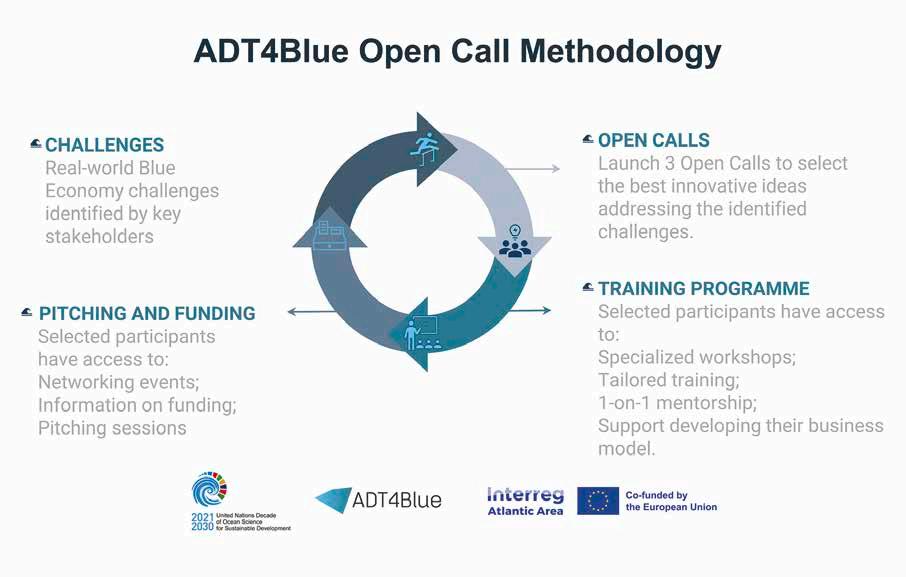
for example, while Brigas says further support is available to help turn innovative ideas into reality. “We have established a 1-1 mentorship programme, where experienced people provide support and guidance to the participants. There are also several networking events, where young researchers can build relationships with potential future clients, and also explore funding opportunities to further develop their ideas,” he continues. To some extent the clients for these solutions are ready and waiting, as researchers are responding to challenges that have already been identified. “Researchers are looking to solve real-world challenges,” says Brigas.
The challenges were identified by Blue Economy stakeholders in four European countries, yet many of these issues are common to other areas of the world, so there is a large potential market for the solutions developed in ADT4Blue.
A good idea is not enough in itself however; an entrepreneurial mindset is also essential when trying to bring a new product to the commercial market, says Brigas. “You need to develop the solution, and bring it up to a stage where you can then pitch it to potential investors,” he outlines. There have been two calls for proposals so far in the project, and Brigas hopes further exciting
ideas will be revealed in the third call, benefitting researchers, stakeholders and the wider blue economy. “Stakeholders can share insights into the challenges they face, and researchers can develop ideas that can then be transformed into potential business models,” he says.
ADT4Blue
Advanced Digital Technologies for the Blue Economy
The ADT4Blue project is cofunded by Interrer Atlantic Area.
Guarda Polytechnic University
Av. Dr. Francisco Sá Carneiro, N. 50 6300-559 Guarda, Portugal
E: ipg@ipg.pt

W: https://adt4blue.eu/

Joaquim Brigas is the President of Guarda Polytechnic University (IPG), since 2018. He is a Coordinating Professor with Habilitation, a Senior Researcher in Communication, and the coordinator of the ADT4Blue project.
Raquel Amaral has been working as a project manager of European Projects since 2022. At ADT4Blue she is the leader coordinator of the open calls, currently managing the project’s second and soon to be launched third open call.