On board the shuttle towards more sustainable transport Public transport services are often inadequate outside peak hours, and if convenient alternatives are lacking then night-time workers may turn to their cars to get to work. The team behind the LIFE Moonset project is developing a new transport solution for night-time workers, designed to reduce the number of cars on the road and promote sustainability, as project lead Mr Vincent Neumayer explains.
Background photograph: Credit Yavor Michev
Many nighttime or shift workers use their own vehicles to get to work, rather than rely on public transport. While many cities’ public transport networks operate at night, including trams, buses and underground trains, services may be intermittent and not match people’s working patterns, in which case they tend to turn to their cars. “If you have to be right on time for your job, and the only bus or tram gets you there 30 minutes early, then people may decide this is too inconvenient. By contrast the car is convenient, available and on-time, at least during night hours,” points out Mr. Vincent Neumayer, Mobility Choice Manager at Wiener Linien, an organisation which runs the public transport network in Vienna. As part of the team behind the EU-backed LIFE Moonset project, Mr. Neumayer is now developing a new transport solution for nighttime workers, which is designed to help get cars off the road, reduce CO2 emissions and boost the attractiveness of Wiener Linien – as well as other project participants – as an employer. “We are looking to develop a high-quality, on-demand pooling transport service in the project,” he says.
This work involves adapting demandresponsive transport (DRT) software to specific target groups in three cities,
at nearby industrial complexes, an extension of the approach in Lisbon and Vienna. “We have different target groups in Ruse, with different communication patterns and survey requirements,” continues Mr. Neumayer. This contributes to the wider goal of demonstrating that the solutions developed in the project are feasible, affordable and acceptable to users, which could encourage other service providers and cities to adopt a similar approach. A knowledge hub will be developed as part of the project, which Mr. Neumayer hopes will prove to be a valuable resource for other cities considering how they can provide more sustainable nighttime transport options. “We will share documents and insights about how to set up a DRT service for employees and shift workers, and how to approach service design,” he says. This will provide a solid foundation for development, and help cities assess likely levels of demand. “Quite a lot of material is already
“We are looking to develop a high-quality, on-demand pooling transport service in the LIFE Moonset project” Replication action The project’s work in Vienna and Lisbon will also hold valuable insights for the public transport authorities in Ruse, who will be able to build on the experience and service design lessons from the Austrian and Portuguese capitals. Ruse is significantly smaller than Lisbon and Vienna, exclusively relying on buses, and the project team is looking to demonstrate that these kinds of solutions can also be applied in smaller urban areas. “Ruse can be thought of as a replication action. We want to show that these transport solutions can also be effective in medium-sized cities,” says Mr. Neumayer. In Ruse, the project team is looking to provide a shuttle service for both transport operator crews and people working
available, so transport organisations can quickly move towards assessing whether this solution would be feasible,” continues Mr. Neumayer. “The project is highly valuable in terms of understanding the behavioural mindset of our target groups.” The project is currently just over a year into its three-year funding term, and good progress is being made in the service design, with Mr. Neumayer and his team planning to start the pilot actions soon. The ultimate aim is to provide realistic, affordable solutions that meet the needs of users, and can then be adopted by other cities, reducing the environmental impact of the transport sector as a whole. “We want our solutions to be picked up by other cities,” says Mr. Neumayer.
LIFE MOONSET
IMplementing a NOcturnal, EcOFrieNdly, and Integrated SharEd Transportation Concept
Project Objectives
The project develops and tests an ondemand passenger pooling service for employees with nighttime shifts in Lisbon (PT),Vienna (AT) and Ruse (BG). It aims to replace private car use with flexible, efficient,and safe shared transport – featuring optimized routes, dynamic scheduling, and extended operating hours tailored to employees’ commuting needs.
Project Funding
Co-funded by the European Union under the LIFE Programme – Grant Agreement No. 101157953.
Project Partners
Consortium: • L ead Partner: Wiener Linien GmbH & Co KG Project Partners: • Via Technologies Europe B.V. (NL) • TML – Transportes Metropolitanos de Lisboa, EMT, S.A. (PT) • Centre for Mobility Change, represented by Universität Innsbruck (AT) • ANA – Aeroportos de Portugal, S.A. (PT) • Obshinski Transport Ruse Ead (BG)
Contact Details
Project Lead,Vincent Neumayer Wiener Linien GmbH & Co KG Erdbergstraße 202, 1030 Wien E: vincent.neumayer@wienerlinien.at W: https://www.lifemoonset.com/ Views and opinions expressed are however those of the author(s) only and do not necessarily reflect those of the European Union or the European Climate, Infrastructure and Environment Executive Agency (CINEA). Neither the European Union nor the granting authority can be held responsible for them.”
Vincent Neumayer
© Perez
LIFE Moonset project
namely Vienna, Lisbon and the Bulgarian city of Ruse. In Vienna, the target group is employees of Wiener Linien, the driver and operator crews who keep the public transport network running at night. “We aim to provide a pooled transport solution, a nighttime shuttle, to get people from lower Austria and under-served districts in the outskirts of Vienna to two main workplaces in the city. One is a tram depot and one is a bus garage, from which hundreds of vehicles operate daily,” outlines Mr. Neumayer. In Lisbon, the project team is looking at transport options to the city’s airport, which is a major local employer. “We’re looking at providing a nighttime shuttle in Lisbon, which will be promoted by ANA (Aeroportos de Portugal) and supported by TML (Transportes Metropolitanos de Lisboa). It will probably not be operated as a door-to-door service, rather as a service from central pick-up points to the airport
itself,” continues Mr. Neumayer. “TML will play a crucial role in identifying demand in certain areas, potentially resulting in the creation of new service lines that meet the identified needs, and permanently strengthening operations.” In Ruse, the municipal transport operator would like to help their employees get to work during nighttime hours. A key issue here is the degree of inconvenience that people are willing to tolerate in getting to their workplace. While many of us claim to be environmentally conscious, in reality we’re not always willing to walk to a pick-up point or wait for a bus when we know we can use a car, an issue that Mr. Neumayer and his colleagues are probing in the project. “We’re asking people questions like; how long are you willing to wait for a shuttle bus? How far are you willing to walk towards a pick-up point? Would you be willing to pay?” he outlines. Most people say they would accept some inconvenience in getting to work at night; the plan now is to dig a bit deeper and see if they will actually behave in the same way. “We will do stated preference and revealed preference surveys with the target group. We will give them some specific journey planning exercises, where they may have to wait or arrive early, and ask; is this still a service you would consider?” says Mr. Neumayer.
The revealed preferences can then guide the development of the transport services in each of the three cities. Providing an efficient, reliable and convenient means of getting to work can help employers retain - and attract - staff without access to a car, which Mr. Neumayer says is a major motivating factor behind Wiener Linien’s work in the project, particularly given high turnover levels in the workforce. “We see today that many drivers work at Wiener Linien for a few years then decide to move on,” he outlines. Various services have been put in place to help nighttime staff get to work from within Vienna; Mr. Neumayer believes the shuttle will provide an attractive option for people coming from further afield. “This service has been tailored for people coming into Vienna from the outskirts and outside the core municipal area,” he says. “In future we could also extend this shuttle service to other garages and depots.”
Vincent Neumayer is a mobility expert with dual degrees and 10+ years in international PM. Since 2017, he contributes to multimodal mobility innovation & strategy at Wiener Linien, shaping Vienna’s future mobility.
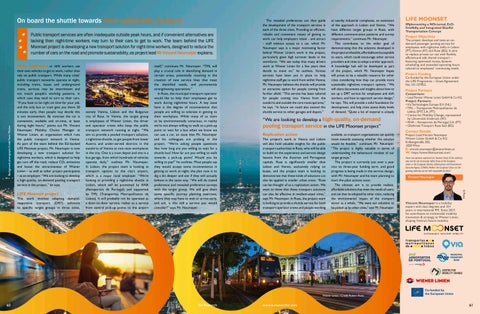
Wiener Linien / Credit: Robert Peres
60
EU Research
www.euresearcher.com
61