A measure of quality for the grain market Current methods of assessing grain quality rely on manual skills and are highly timeconsuming, leading milling companies to look for a faster, more standardised process. We spoke to Ernest van Wijk and Eduard van Wijk about their work in developing a new technology to assess grain quality, and how it can help increase post-harvest productivity. The grain-flour supply chain starts with the production of wheat by farmers, before it is transported to a wholesaler, then a mill, and finally to a bakery. Milling companies typically use long-established protocols to assess the quality of this wheat, as Ernest van Wijk, Business Development Manager at Meluna Research in the Netherlands, explains. “Milling companies use three different protocols to assess the Falling Number, Gluten Index, Gluten Quantity, Protein Content, Moisture Content, and Sedimentation value of wheat”. These assessments are typically performed manually, and the outcome largely depends on the approach of the individual conducting the test. “One staff member may evaluate the wheat differently than another, and assessing wheat quality in this way is very time-consuming,” continues Ernest. “In addition, there may be a shortage of staff available to carry out these assessments, while many trucks are waiting to unload wheat — and as the trucks wait, the quality of the wheat is likely to decrease.”
GRaiNNOVATE project This adds up to a powerful set of reasons for automating the grain assessment process, a topic at the heart of Ernest’s work in the EU-backed GRaiNNOVATE project. Alongside Meluna Research, the project brings together several SMEs and research organisations from across Holland and Germany, with the shared goal of developing a new, faster method of reliably assessing grain quality. “We want to optimise the measurement of grain quality parameters,” explains Ernest. The project team are developing the SMS4Grain technology for this purpose, using photonics, AI and spectroscopic methods. “The solution is based on four well-known optical sensors. We integrate them and use a sensor fusion process, with the use of AI technology,” says Eduard van Wijk, Research Director at Meluna. “We are able to determine the physical features of a grain by combining information from different optical measurements. This combined information improves the reliability of the results.”
50
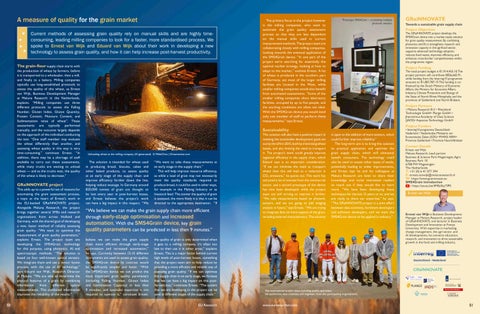
The primary focus in the project however is the milling companies, who want to automate the grain quality assessment process so that they are less dependent on the manual skills used in current measurement methods. The project team are collaborating closely with milling companies, looking towards the eventual application of the SMS4Grain device. “In one part of the project we’re searching for essentially the optimal market strategy, looking at how to adapt to the market,” outlines Ernest. A lot of wheat is produced in the southern part of Germany, yet most of the larger milling facilities are located in the West, while smaller milling companies would also benefit from automated assessments. “Some of the smaller milling companies share laboratory facilities, occupied by up to five people, and the working conditions are often not ideal. With the SMS4Grain device you would need only one member of staff to perform these measurements,” says Ernest.
Prototype SMS4Grain – containing multiple photonic sensors
Unloading wheat at the milling company (AI generated). © MikkiOrso | Dreamstime.com
The solution is intended for wheat used in producing bread, biscuits, cakes and other baked products, to assess quality at an early stage of the supply chain and improve efficiency further down the line, helping reduce wastage. In Germany around 820,000 tonnes of grain are thought to be lost every year in post-harvest losses, and Ernest believes the project’s work can have a big impact in this respect. “We
“We want to take these measurements at an early stage in the supply chain.” This will help improve resource efficiency, as while a load of grain may not necessarily meet the quality standards required to produce bread, it could be used in other ways, for example in the Malting Industry or as livestock feed. The sooner the quality of grain is assessed, the more likely it is that it can be directed to the appropriate destination. “If
“We believe we can make the grain supply chain more efficient through early-stage optimisation and increased automation. With the SMS4Grain device, key grain quality parameters can be predicted in less then 9 minutes.” believe we can make the grain supply chain more efficient through early-stage optimisation and increased automation,” he says. Currently between 12-15 different instruments are used to assess grain quality; the SMS4Grain device by contrast would be significantly simpler and faster. “With the SMS4Grain device we can predict the most important grain quality parameters (including Falling Number, Gluten Index and Germination Capacity) in less than 9 minutes, and specialist expertise is not required to operate it,” continues Ernest.
the quality of grain is only determined when it gets to a milling company, it’s often too late to then use it in other areas,” explains Ernest. This is a major factor behind current high levels of post-harvest losses, something that the project team aim to help reduce by providing a more efficient and reliable way of assessing grain quality. “If we can optimise this supply chain in an early stage, we foresee that we can have a big impact on this postharvest loss,” continues Ernest. “The system that we are developing in the project can be used at different stages of the supply chain.”
EU Research
Towards a sustainable grain supply chain
Project Objectives
The GRaiNNOVATE project develops the SMS4Grain device into a market-ready solution for grain quality measurement. By combining photonics and AI, it strengthens research and innovation capacity in the agrifood sector, supports advanced technology adoption, reduces food waste, improves efficiency, and enhances cross-border competitiveness within the programme region.
Project Funding
The total project budget is €1,914,453.10. The project partners will contribute €826,665.91, while funding from the Interreg VI programme amounts to €1,087,787.19. This funding is cofinanced by the Dutch Ministry of Economic Affairs, the Ministry for Economic Affairs, Industry, Climate Protection and Energy of the State of North Rhine-Westphalia, and the provinces of Gelderland and North Brabant.
Project Partners
• Meluna Research B.V. • Rheinland Technologie GmbH• Plange GmbH • Jheronimus Academy of Data Science (JADS)• Aspectus Technology GmbH
Project Funders
Sustainability This solution will also have a positive impact in meeting the sustainable development goals set out by the UN in 2015, both by minimising wheat losses, and also limiting the need to transport it. The project’s work could greatly improve logistical efficiency in the supply chain, which Eduard says is an important consideration. “If we can minimise the need to transport wheat then this will lead to a reduction in CO2 emissions,” he points out. This work has attracted a lot of interest from the commercial sector, and a second prototype of the device has now been developed, while the project team are still striving to improve it further. “We take measurements based on photonic sensors, and we are going to add imaging analysis in future,” says Ernest. “We are trying to integrate data on more aspects of the grain, including external characteristics. The solution
GRaiNNOVATE
is open to the addition of more sensors, which could further improve reliability.” The long-term aim is to bring this solution to practical application and optimize the grain supply chain, which will ultimately benefit consumers. The technology could also be used to assess other types of seeds, potentially leading to wider improvements, and Ernest says he and his colleagues at Meluna Research are keen to share their knowledge and invite interested readers to reach out if they would like to learn more. “We have been developing these techniques for the last 15 years or so, and we are ready to share our expertise,” he says. “The GRaiNNOVATE project is a joint effort between data scientists, hardware developers and software developers, and we want the SMS4Grain device to be applied in industry.”
• Interreg VI-programma DeutschlandNederland • Nederlandse Ministerie van Economische Zaken (EZK)• MWIKE NRW• Provincie Gelderland • Provincie Noord-Brabant
Contact Details
Ernest van Wijk Meluna Research, Lead partner Business & Science Park Wageningen, Agro Business Park 10 6708 PW Wageningen The Netherlands T: +31 (0) 6 41 077 394 E: ernest.vanwijk@melunaresearch.nl W: https://www.grainnovate.eu SMS4Grain Introduction : https://youtu.be/4M0z5kyTlP0
Ernest van Wijk
Ernest van Wijk is Business Development Manager at Meluna Research, project leader of GRaiNNOVATE, and lecturer in Business Development and Innovation at Fontys University. With expertise in marketing, change management, the agri sector, and AI developments, he connects education, research, and innovation to drive sustainable growth in the food and milling industry.
The international project team, including quality specialists, lab technicians, data scientists, and engineers from the participating organisations.
www.euresearcher.com
51