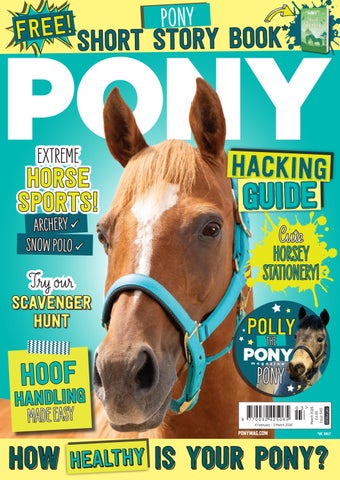
PONY Magazine - March 2026

Page 1


Polework in progress Polework Polework in progress

It’s time to up the challenge and add some jumps!

Ireally hope you’ve enjoyed my polework series and riding through all the different exercises this simple layout has! There are so many skills it can help improve, and I’ve got one final challenge for you to try! Let’s go!

Set it up

Position a triangle in the middle of your arena, then – similar to the last feature – add two poles parallel to two sides of the triangle one canter stride away (approximately 2.7m) then another two poles facing two points of the triangle, one canter stride away, so you have two straight lines to ride through.

remember

You might have to adjust the distances slightly depending on your pony’s stride length, so ask an adult for help if you’re unsure.

OUR EXPERT

Nina Gill is a BHS Senior Coach and owner of Fancy Footwork Equestrian.

part three

TOP TIP

Don’t forget you can add extra poles or blocks to help you and your pony stay straight on the approach.

Problem solver

If you’re not riding a straight line between each turn, it’s likely you’re approaching the corner too fast. Slow right down, almost to a halt, before making the turn. Remember, your pony might find it harder one way compared to the other – if so, they’ll need extra support in that direction.

1

turning triangle

Great for improving suppleness and checking your controls, this line requires you to ride three straight lines around the triangle with a turn in between.

How to ride it

• Enter the triangle in an active, but not fast, walk and ride your first straight line along one side of the triangle, keeping your seat and aids even.

• Prepare to turn by taking a deep breath, half-halting, slowing your seat, looking in the direction you’re going and guiding your pony with your outside aids. The aim is for them to step around with their shoulders, staying close to the triangle, rather than riding a wider curving line.

Next level

As you almost reach the turning point, walk one or two more strides forward so your pony’s hindfeet are in line with the point of the triangle. Then, with your instructor’s guidance, ride a turn-on-the-haunches so your pony is now parallel with the next side of the triangle.

Fabulous

flatwork

flatwork flatwork flatwork

Follow Polly’s pointers for an amazing schooling session!

Ever wondered what ponies need for a fun and fab flatwork session? Polly the PONY mag pony is here to share all her tips and tricks so you can make sure your pony feels their best!

POL POLL POLLY THE

pony

Planned to perfection

Who doesn’t love a good plan!? Us ponies aren’t mind-readers, so if you have a good idea of what you want to achieve, and what movements or exercises you’re going to practice before you get on, we’ll all have a better time! The Team PONY girls are currently obsessed with polework exercises, and they definitely keep me interested and help focus our sessions.

Getting ready

So, I’ve been told that a thorough warm-up before getting started with more intense exercises is really important for my physical health as it can help reduce the risk of injuries – whoa! If I’ve been standing in my stable for a little while before our session, we’ll spend a little longer walking to help wake up my muscles and get me feeling ready for whatever’s been planned.

True connection

Just like you, us ponies can be lacking energy on some days compared to others, where we might feel more keen and positive. Knowing when your pony is having one of those days and being able to read their body language will go a long way towards having a great session because it means you can tailor it to suit how you’re both feeling. Maybe you need to add in some more transitions to keep them focused, or lateral work to supple them up – or even riding a shorter session if they’re not feeling up to it!

TOP TIP

Repeat exercises evenly on both reins to help your pony work evenly!

Break time

Whether I’m coming back into work or feeling at my best in the competition season, having plenty of breathers in schooling sessions helps me do my best! It’s just like your break times at school... or so I’m told!

Short breathers give me the time to process what we’ve been working on and catch my breath, too. Win win!

Less is more

There are so many ways for you, as the rider, to communicate with ponies when you’re in the saddle – from your body position, voice, hand and legs aids… the list goes on! But because of this, sometimes things can get a little complicated and hard for us to understand. So, my advice for top communication is to keep your aids super simple and clear – then we’ll be totally in tune and have so much fun!

Happy herds Happy herds

Follow Meg Elphick’s seven steps to finding your pony’s best field friends

As a fellow pony lover, I’m pretty sure you’ll know by now how important it is for your pony to have friends – along with plenty of forage and freedom, of course! When moving yards or introducing a new pony to a herd, there are certain steps to follow that will help you make sure your pony stays happy during her time in the field. Here’s my plan of action…

Getting to know you

First things first, learn as much as possible about your pony so you can find the best match for her. Is she confident and brave? Or does she prefer to be led by other ponies’ actions? Maybe she gets defensive over food or chooses to graze alone most of the time.

Knowing more about your pony’s personality, as well as her usual field habits, will really help you make this process stress-free!

Finding friends

Depending on your yard set-up, you might not have a choice on who your pony is going to be turned out with – however, it should always revolve around happy, healthy ponies! Speak to your yard manager about who’s likely to become your pony’s new bestie so you can also get to know their owner and the pony in question!

Slow introductions

Once you’ve found out who your pony is going to be spending her field days with, why not ask the pony’s owner if you can go for a ride together? This is a great way to slowly introduce the ponies and get them used to each other in a more controlled environment.

4

neigh-bours

The next step is to put the ponies in fields next door to each other, so they can interact over a fence. If you prefer, you can add an extra line of fencing in between them so there is a little gap to prevent them from touching – you can then reduce this over a few days to bring them closer together.

Ponies are herd animals so should always have friends, but some yards are set up with an individual turnout system. If this is the case, always make sure your pony has company nearby. did you know?did you know?

5 Joining forces

When the ponies have had plenty of interaction over a fence and they seem to be getting along well, it’s time to put them in the field together. If your pony is being introduced to a large herd, it’s a good idea to just stick with one sensible horse first because they can then offer her support and protection when she’s introduced to everyone else.

Turn static files into dynamic content formats.

Create a flipbook
Issuu converts static files into: digital portfolios, online yearbooks, online catalogs, digital photo albums and more. Sign up and create your flipbook.