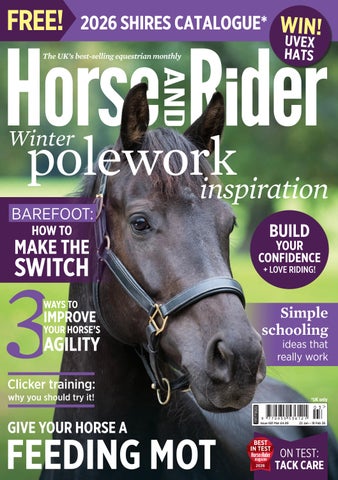
FREE! 2026 SHIRES CATALOGUE* WIN! The UK’s best-selling equestrian monthly
polework inspiration
Winter
BAREFOOT:
BUILD
HOW TO
MAKE THE
YOUR CONFIDENCE
SWITCH
+ LOVE RIDING!
WAYS TO
Simple schooling
IMPROVE
YOUR HORSE’S
AGILITY
ideas that really work
Clicker training: why you should try it!
GIVE YOUR HORSE A
FEEDING MOT
*UK only DJMurphy
Issue number 681 March 2026 n Guide to soaked feeds n Overhaul your management: save time + make life easier! n Great groundwork exercises to try n 10 minute training ideas to boost your winter motivation
UVEX HATS
Issue 681 Mar £4.99
22 Jan – 18 Feb 26
ON TEST: TACK CARE
Athletic and agile Gemma Stevens’ exercise will get your horse quick on his feet in no time EXPERT
Gemma Stevens won the Hickstead Eventer’s Grand Prix and Hong Kong IHS Six Bar in 2025. She has nine top 10 finishes at 5*, plus a win at Bicton 5* in 2021 and the 2024 7yo Champs.
F
or me, training is all about creating a fit, strong and agile horse – one who is confident, capable and set up for success. But over the years, I’ve come to realise that exercises don’t need to be complicated to be challenging. Bounces on a curving line is one of my favourite exercises that is, in theory, straightforward but actually both physically and mentally demanding. It requires the horse to stay co-ordinated while being quick on his feet so it’s brilliant for both fitness and strength. Here’s how to give it a go yourself.
Photos: Jon Stroud
Set it up For the first part of this exercise, you’ll need five poles and five sets of wings. Position the poles a canter stride apart (approximately 3m from middle to middle) on a gentle curving line at one end of your arena. Keep them on the floor to start with and place a pair of wings next to each one.
24 Horse&Rider | March 2026
Through the levels
Progress through this exercise in the following way, only moving onto the next stage when your horse clearly understands the task and is confidently working through it. Level 1: Walk, trot and canter through the poles on the ground. Level 2: Raise the middle pole into a small fence – no more than 70cm. Level 3: Add in fences one and five, keeping poles two and four on the ground. Level 4: Set all the poles at the same height.
Level 1
horseandrideruk.com
GEMMA STEVENS
In this
feature Boost your horse’s agility Challenge him mentally and physically Build confidence progressively
SIMPLE CHANGES Make this exercise as easy or progressive as you need it to be to suit your horse’s level of experience and build his confidence. You can just use three fences in total or add more poles on the end – whatever will set him up for success.
Level 2
horseandrideruk.com
Level 3
Level 4
March 2026 | Horse&Rider 25
On the right
TRACKS From developing balance and paces to building trust, there are several aspects to consider when it comes to educating your horse
E
ach part of your horse’s training is super important and the more you get right early on, the fewer problems you’ll run into later down the line. Whether you own a young or inexperienced horse or simply want to revisit the basics and iron out a few problem areas, our advice will help you get the most out of your training.
Photos: Lucy Merrell
Basic paces
Out of the three paces required in dressage, a naturally good walk and canter are the most important because, with time, you can train the trot to become more expressive. The walk should show a good, four-beat rhythm without any lateral steps. All the way from Prelim to Grand Prix, this pace carries double marks, so be sure to ride the walk and never treat it as a chance for a break during a test. After all, if you have a horse who could walk for a nine but you let him walk for a seven, you’ve lost four marks. The trot needs to show a good rhythm and swing, with the hindleg matching the front one. Of course, 30 Horse&Rider | March 2026
at Grand Prix level, most horses look spectacular in trot, but if you were to watch them in the warmup when they’re stretching, their trot might look quite average. Over time, the trot becomes more expressive as your horse’s balance improves and this is achieved by riding him straight between your rein and leg aids and using plenty of transitions in your schooling sessions. In canter, it’s essential, at first, to allow young or inexperienced horses to move forward on large circles and the long sides. Long term, you’re aiming to create a good rhythm, ‘jump’, ground cover and energy, with the horse’s hindleg pushing him forward into an ‘uphill’ frame. horseandrideruk.com
FLATWORK
Nail transitions
TOP TIP
Try riding direct transitions from halt to trot or walk to canter, as well as transitions within the paces, such as collected to medium trot.
At Prelim and Novice level, the judges want to see smooth transitions, with the horse reacting well to the rider’s aids. Of course, not every horse will perform effortless transitions at first, but they will get better with correct training. During downward transitions, it’s common for inexperienced horses to drop down onto the shoulder and lose balance, and, therefore, it’s essential to teach them to stay on the hindleg, without feeling as if you’re holding the front end up. To do this, think of riding the hindleg towards the front end using your seat and legs, keep your body tall and make little halfhalts to aid the horse’s balance when necessary. If you just pull on the reins during a downward transition, you’ll interrupt your horse’s flow and rhythm. For upward transitions, your horse needs to learn to go forward from a small aid, and training this idea very much depends on how reactive your horse is. Many of the top riders will tell you that ‘you need to ride lazy horses with the leg off and hot horses with the leg on’. Basically, this means lazy horses need to learn to keep going without being nagged and sharper horses must accept your leg aids without overreacting. If you want to be good at dressage, you’ll need to do thousands of transitions to improve your horse’s balance and obedience to your aids, whether you ever intend to ride at the higher levels or not.
QUICK FIX If your horse loses balance and drops down through his poll in the downward transitions, think about keeping the top of the headpiece higher – can you see it between your horse’s ears in front of you?
DID YOU KNOW?
Younger horses don’t need to do lots of schooling – generally 20 minutes four times a week is enough.
horseandrideruk.com
March 2026 | Horse&Rider 31
A long line Photos: Jon Stroud
Meg Elphick shares her simple and effective polework plan
EXPERT
Meg Elphick is an event rider and content creator. She has enjoyed considerable success on her home-produced ponies, including four top 10 placings at Badminton Grassroots 2022–2024.
48 Horse&Rider | March 2026
N
ot a week goes by in my horses’ schedule that doesn’t involve some form of polework, and while there are hundreds of options to choose from, there’s one layout in particular that I come back to time and time again.
DID YOU KNOW?
This exercise effectively mimics a water treadmill – just without the water and the trip to your local facility! When done correctly, it provides a controlled, lowimpact workout with many similar benefits.
horseandrideruk.com
GROUNDWORK
TOP TIP
Make sure the poles are set at a comfortable walk stride for your horse. This will be mentally and physically demanding for him, so don’t ask him to adjust his stride length, too.
Set it up
Grab as many poles as you have, or want to use, and set them out down the long side of your arena approximately 0.8–1.2m apart, depending on the length of your horse’s walk stride. I like to aim for around 20 poles, but you can use more or fewer depending on what your pole collection looks like or the time restraints you have! Using pole raisers or small blocks, raise around half of the poles. Do this randomly, making some slightly higher than others, so your horse really has to stretch down and look where he’s going.
From the ground
While this exercise is ridable, I prefer to work my horses from the ground to reduce the level of interference from me and allow them to move more freely as they navigate the challenge ahead. If you or your horse aren’t confident with long-reining, you can do it in-hand, positioned by their shoulder, but I find that long-reining encourages horses to work straighter – and better highlights weaknesses, too.
This exercise effectively mimics a water treadmill – just without the water!
horseandrideruk.com
The aim
In an ideal world, your horse will be swinging through his back and really stretching his head and neck down as he steps cleanly and calmly over each pole. Not only will this help engage his core, but it will also help set him up for success, as he will be more able to see what’s in front of him.
March 2026 | Horse&Rider 49
Nothing to prove Comparison with others or fear of judgement can really dent your confidence. Sean Roberts explains how to turn this around
Photos: Jon Stroud. For more information, visit silvolutionshypnotherapy.com
EXPERT
Sean Roberts is a psychotherapist and runs Silvolutions, specialising in helping riders achieve their goals.
C
onfidence. It’s that steady, grounded sense that you’re capable, calm and in control. But, as a therapist and equestrian mindset coach, time and again I see riders who tie their self-worth to how well they ride in front of others. The moment something goes wrong, their confidence takes a nosedive – not because they lack skill, but because their self belief was never rooted in the right place to begin with. It doesn’t have to be like this. Confidence can be built from the inside out – and it’s more sustainable (and enjoyable) when it is.
58 Horse&Rider | March 2026
horseandrideruk.com
CONFIDENCE CLINIC
Confidence crisis
It starts with subtle pressure. You’re having a good schooling session at home, but the minute someone walks past the arena, your mind shifts. Suddenly you’re hyper-aware of your position, your horse’s outline, your every move. You tense up – not because anything’s gone wrong, but because someone might be watching. Or maybe it’s the lesson you’ve been dreading all week. You go in determined to impress your trainer, but your horse
horseandrideruk.com
is fresh and your confidence crumbles before the warm-up’s even over. You apologise, make excuses and wonder whether you should be riding at all. These are common, deeply human experiences, and many of us ride with a silent inner critic, which means we’re no longer focused on our partnership with the horse, but, rather, performing in an effort to earn approval – or, at least, to avoid judgement. And the irony? That striving often makes us less confident – and less present.
Confidence can be built from the inside out – and it’s more sustainable when it is
March 2026 | Horse&Rider 59
Photos: Bob Atkins, Jon Stroud, anjajuli, CameraCraft/shutterstock.com. As told to Kiera Boyle.
Stepping out
Thinking of going barefoot? We explore the options for your horse’s foot care
EXPERT
Elliot Scales is a registered farrier and has a BSc in Equine Sports Performance. He’s director of South Performance Shoeing Practice.
EXPERT
Olivia Cresswell holds a Level 5 Diploma in Equine Podiatry and a BSc in Equine Psychology and Sports Science.
98 Horse&Rider | March 2026
O
ne of the biggest hurdles to going barefoot is simply knowing where to turn for professional, reliable support. You might be wondering whether making the switch to barefoot means severing ties with your farrier and, if that’s the case, how do you go about finding someone new? As with most things in horse care, the answer isn’t black and white – it depends on your horse, your goals and the professionals available to you. Fortunately, in the world of farriery and hoof care the landscape is evolving. Many farriers now integrate barefoot principles into their work, supported by ongoing CPD and an expanding evidence base. Alternatively, you may choose to work with a registered equine podiatrist whose training is centred on barefoot trimming.
horseandrideruk.com
GOING BAREFOOT
Barefoot or shoes
TOP TIP
With a range of job titles surrounding shoeing and barefoot management, it’s easy to feel uncertain about who’s best placed to help your horse – but farriers and equine podiatrists are two of the most commonplace hoofcare specialists. One of the key differences between the two professions is that equine podiatrists don’t apply shoes, while farriers are trained to work across a wide range of hoofcare needs, from traditional shoeing to barefoot trimming. While some farriers are more cautious, others are highly supportive and experienced in managing barefoot horses and transitions to barefoot. Both should have a holistic approach, not simply trimming or shoeing, but also looking at the underlying causes of hoof imbalance rather than focusing on managing the symptoms, and working alongside allied professionals to support your horse’s wellbeing.
The more you understand about hooves, the easier it is to assess whether a professional’s philosophy is the right fit for you and your horse.
QUICK FIX
TOP TIP
No matter which type of professional you choose, being on the same page as them about your horse’s hoof care is key.
horseandrideruk.com
Shoes are a practical tool, helping horses cope with the demands we place on them. However, with options such as glue-on shoes and boots readily available – as well as better understanding of the benefits of barefoot – there’s more flexibility than ever in finding a solution that works for both horse and rider.
March 2026 | Horse&Rider 99