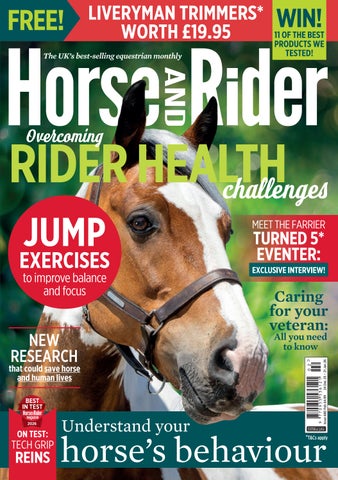
FREE!
LIVERYMAN TRIMMERS* WIN! 11 OF THE BEST WORTH £19.95 PRODUCTS WE TESTED!
Overcoming
RIDER HEALTH challenges EXERCISES to improve balance and focus
NEW RESEARCH
that could save horse and human lives
ON TEST:
TECH GRIP
REINS
Understand your
TURNED 5* EVENTER:
EXCLUSIVE INTERVIEW!
Caring for your veteran: All you need to know 24 Dec 25 – 21 Jan 26
JUMP
MEET THE FARRIER
Issue 680 Feb £4.99
Issue number 680 February 2026 n How horses are changing the lives of people with disabilities – and how you can be involved n Insurance explained n Winter travel tips n Buyer’s guide: long-sleeve baselayers
The UK’s best-selling equestrian monthly
horse’s behaviour DJMurphy
*T&Cs apply
Find your flow
Part three: serpentine jumping
Add style and fluidity to your rounds with Caroline’s training tips
EXPERT
Photos: Jon Stroud
Check out the first two parts of the series here.
Caroline Powell is a Suffolkbased event rider. She’s represented New Zealand in two Olympic Games and two World Games. She won Burghley in 2010 with Lenamore, and Badminton in 2024 with Greenacres Special Cavalier.
24 Horse&Rider | February 2026
horseandrideruk.com
I
n the final part of my series, I’m going to guide you through an exercise that tests your horse’s focus on your aids, your organisation as a rider and your ability to work as a partnership. The core skills you need to succeed are establishing the consistent rhythm, being able to adjust your line and pace to meet the ideal take-off point and changing bend to stay in balance. We’ve covered all these topics in previous parts of the series, so scan the QR code on the left to catch up if needed.
JUMPING SKILLS
Set it up For this exercise, you’ll need at least three fences – but you can add more depending on the size of your arena. You can use any type of fence as it’s less about the jumping effort and more about what’s going on between the fences. Position your jumps down the centre line, allowing for a minimum of 15m between each one.
Warm-up tips
Incorporate the fences into your warm-up. Circle around them and weave in and out, starting to create your serpentine shape, in both walk and trot, focusing on a smooth change of bend each time.
Session plan
A serpentine is made up of straight lines and half circles, so break up the exercise into those specific elements to help you ride it accurately. It should become a fluid line from start to finish and the key to achieving that is preparation. Your horse needs to change canter lead over the fence in order to land in balance and, therefore, have a better chance of maintaining his rhythm and flow.
TOP TIP
Depending on how many fences you have and the subsequent loops in your serpentine, approach on both reins so you don’t end up favouring either the left or right turn.
horseandrideruk.com
February 2026 | Horse&Rider 25
Feel the
power Achieving a good stretch in free walk will boost your test marks and improve the way your horse works generally
EXPERT
Diana Waters is a riding instructor, educator and founder of The Power of Walk. She is a qualified BHS instructor, Enlightened Equitation teacher and equine assisted psychotherapist.
Photos: Belinda Taylor
H
ave you ever wondered why free walk on a long rein in a dressage test has a coefficient of two? The reason is that it’s considered to be an important marker of a horse’s training, but only appears once within a test – therefore double marks help to increase its impact on the overall score. The stretch indicates whether your horse is truly seeking the contact and working correctly, and if there are any issues with tension, they’ll show up here. Away from the competition arena, stretch is an essential part of any session. When a horse stretches his neck, that continues along his entire spine, helping his body stretch and relax, and enabling him to swing through his back and take longer, smoother steps.
30 Horse&Rider | February 2026
GOOD TO KNOW Many horses brace in the neck, jaw and poll, so never fully relax these muscles, which means they can’t be used to their full potential. And if a horse doesn’t fully relax these muscles correctly, he may also not be able to engage them.
horseandrideruk.com
FLATWORK IDEAS
Exercise Picking up and letting out the reins in walk
Set it up Incorporating stretching work into every ridden session will help to improve the contact. Stretching can also help your horse to trust and accept the rein contact, and improve the mobility of his joints, but it comes from how he’s already moving.
horseandrideruk.com
How you first pick up the reins will affect how he carries himself and uses his muscles, which will, in turn, impact his ability to stretch. The quality of stretch then impacts the suppleness, softness and range of movement in collection like a chain reaction.
First make sure you aren’t holding any tension in your body, your posture is good, your seat’s relaxed and your hips are moving softly with the movement of your horse’s back. Your fingers, wrists, elbows, shoulder and jaw should be relaxed and your upper arms should hang softly and vertically by your side with the elbows bent and the hands moving with your horse’s head and neck. 1. Begin to shorten the reins, without reaching forward. Your seat and legs should stay the same and your arms and hands soft. Visualise your horse’s neck lifting in front of you as you shorten, with the poll as the highest point. The angle under his gullet should narrow as he lifts, but his nose should still be in front of the vertical. If he slows down, don’t be tempted to increase the leg aids. 2. Once at the desired length, continue moving with him for a few steps, breathing deeply and without any tension in your body. 3. Lengthen the reins by feeding them out through your fingers but don’t change your hand position in an effort to guide his head down – the feeling should be that the nose draws the reins out through the fingers and the neck telescopes away from you, with the angle under the gullet widening. You should then feel the stride lengthen as the neck lengthens. February 2026 | Horse&Rider 31
A
different
perspective Photos: Jon Stroud. Alison runs The Everyday Equestrian theeverydayequestrian.co.uk
EXPERT
Alison Buttery is a certified mindset and confidence coach, a BHS APC senior coach and an experienced rider, who specialises in helping riders overcome their nerves. She’s also the founder of The Everyday Equestrian.
TOP TIP
Health challenges can take their toll on your riding, but Alison Buttery helps you find a new path to enjoyment
M
ost of us face health changes at some point. You could be coming back from a fall or illness, managing pain, adjusting to menopause, or coping with fatigue or anxiety. These shifts can alter how, when and even if you ride. They can also be a turning point because, with the right approach, you can keep riding in ways that fit this stage of life. But, above all, what matters is working together with your body and mind, not against them. 58 Horse&Rider | February 2026
The mind–body connection
When health shifts, body and mind can feel out of step. You might wake tired but push yourself to ride, or you may be physically healed but then doubt creeps in. That mismatch can be really draining. We know how closely thoughts, emotions and physical reactions are linked. If you climb into the saddle with worry running through your head, your posture changes – shoulders tighten, hands grip, breathing shortens. Your horse notices before you do, often
If you notice tension before mounting, take three steady breaths: in for four, hold for two, out for six, and replace unhelpful thoughts with ones that match your aim for the ride.
becoming tense in response. The cycle feeds itself, so tension in your body confirms the anxious thoughts and these reinforce the tension. However, the same cycle works in your favour, too. A calm, positive ride, even if it’s simply walking around the arena, helps your muscles loosen and your breathing slow. That calmness feeds back into your thoughts and your brain stores the memory as a safe, successful ride. Over time, those experiences add up and confidence grows again. horseandrideruk.com
WELLBEING
TOP TIP
Setbacks are normal but every calm session helps replace fear with trust. Although you might not be as you were before, you’ll become a rider with greater awareness and selfbelief.
SIMPLE CHANGES
Steps to rebuilding trust
Injuries and illnesses can have lasting impact. Even after the body has healed, many riders return to the mounting block with racing hearts and unsteady legs. This isn’t weakness, rather the brain being protective, and it’s why coming back often feels harder mentally than physically. Your logical side says you’re fine, but your alarm system prepares for danger. Pushing through rarely works. Recovery is about proving, step by step, that riding is safe again. horseandrideruk.com
The most effective way to rebuild trust is to start small and progress steadily. Begin with activities that feel secure, such as grooming, groundwork or walking in-hand, before moving into ridden work. Some riders also find it helpful to map out a recovery ladder, with four or five clear rungs leading from the easiest stage – maybe sitting on your horse in walk – to bigger goals, such as hacking alone or jumping. Only move up when the current one feels secure.
Keeping a written record can help prove that progress is happening, even when it feels slow, because noting small wins builds confidence over time. You can also rehearse success mentally before you ride, picturing yourself breathing steadily, riding with balance and finishing on a positive note. Creating a pre-ride routine, such as a tack check and three slow breaths, can also help provide certainty and reassurance.
February 2026 | Horse&Rider 59
Photos: Jon Stroud, arthorse, ChrisVanLennepPhoto, Sebastian Photography/shutterstock.com
Making the
connection Innovative technological research by the University of Surrey is helping horses and humans stay healthy EXPERT
Professor Chris Proudman Professor of Veterinary Clinical Science at the University of Surrey.
EXPERT
Professor Kamalan Jeevaratnam is Head of School of Veterinary Medicine at the University of Surrey.
64 Horse&Rider | February 2026
T
he use of rapidly evolving technology, coupled with exciting advancements in AI, is having a real impact on not only the diagnosis of health issues in horses and humans but also on the predictability of whether specific conditions are likely to develop in the future and, in the case of athletes, their adverse effects on performance. The crossover between human and veterinary medicine means that breakthrough developments in each branch can be of benefit to the other, as work happening at the University of Surrey’s School of Veterinary Medicine demonstrates.
horseandrideruk.com
NEW RESEARCH
Vital information
Post-mortem and medical evidence suggests that some of the sudden deaths and collapses seen in horses during or after exercise may be linked to disturbances in heart rhythm. A healthy heartbeat (known as normal sinus rhythm) depends on the smooth, co-ordinated transmission of electrical signals. However, when this co-ordination falters, it can cause the heart to beat irregularly, especially during intense exercise, and these disturbances can have catastrophic consequences. At the University of Surrey, the veterinary medicine team is working to detect hidden electrical changes before they cause harm. Using advanced computational tools to analyse electrocardiograms, the team has been able to identify subtle changes in rhythm that would otherwise go unnoticed. The goal is to give vets the ability to predict which horses may be vulnerable to heartrelated incidents and, in doing so, help prevent tragedy before it strikes.
Information that could allow for the identification of individuals at risk would be transformative
Knowledge is power
GOOD TO KNOW There appear to be striking parallels between equine and human health, so studying how athletic horses’ hearts cope with extreme performance should reveal new insights into human cardiac conditions.
horseandrideruk.com
Sudden death in both young horses and humans who otherwise appear completely healthy is relatively uncommon. Nevertheless, it does happen from time to time, particularly in the case of athletes – whether human or equine – whose work by its very nature puts heavy
demands on the body. As a result, being able to access information that could allow for the identification of individuals at risk would be transformative, allowing for preventative treatments to be developed, or appropriate pre-emptive action to be taken – an achievement that would undoubtedly save lives.
February 2026 | Horse&Rider 65
Winter travel Our top tips will help you transport your horse safely and comfortably this winter
W
hatever the reason for transporting your horse during the colder months of the year, there are some important things to bear in mind before loading up and setting off, so don’t leave home without reading our top winter travelling tips.
TOP TIP
Keep a hard copy of your emergency contacts in your vehicle’s glove compartment in case anyone else needs access to them when you’re not present.
Photos: Jon Stroud
Vital checks
Whether you own a lorry or a trailer, it’s essential to ensure everything is functioning correctly, especially when road conditions are less favourable. Therefore, make sure your vehicle is up to date with servicing and that the brakes, lights and tyres are all in good working order – check fluid levels, too. Having breakdown cover gives you peace of mind you’ll get help if anything goes wrong, so don’t forget to double check your policy hasn’t expired before you plan your trip.
104 Horse&Rider | February 2026
DID YOU KNOW?
Tyre pressure can drop in winter because air is denser when it’s cold, and therefore has a smaller volume. This makes checking tyre pressure even more essential during winter months.
horseandrideruk.com
ON THE ROAD
TOP TIP
Carefully check the route you’ll be taking before you set off so you don’t end up on flooded roads or any small country lanes where it could be tricky to get through.
horseandrideruk.com
Weather wise
Don’t forget to stay up to date with the forecast for both the region you’re starting from and the area you’re travelling to. If there are any severe weather warnings in place and travelling isn’t essential, it’s sensible to wait for another day.
February 2026 | Horse&Rider 105