Meet Dartmouth students, faculty, and staff who belong to our vibrant community in the New Hampshire woods
Here’s the counterintuitive thing about a college search: it’s not about the college.
It’s about you.
“I advise that you take an ‘existential selfie’ of sorts,” says Lee Coffin, Dartmouth’s Vice President for Enrollment and Dean of Admissions and Financial Aid. “By this, I mean: hold up an imaginary camera or mirror, and take an extended moment to pause and ponder what you see. Students should begin by asking themselves: What animates my personality, talents, interests, and goals? Now, guided by that vivid, ‘high-res’ selfie, assess your higher ed options.”
Ponder your snapshot. If you want to celebrate your identity, carve out your own individual path, immerse yourself in audacious ideas, and perhaps even find deep community in a New England college town hugged by nature, keep reading. In the pages that follow, you’ll hear firsthand from some of the Dartmouth students and faculty who animate our college in the woods. You’ll also learn about the systems in place to support them on their academic and personal journeys.
One last point, and it’s an important one. Dartmouth is one of just a handful of colleges and universities in the United States to adopt universal need-blind admissions and meet 100% of demonstrated financial need for all students, regardless of citizenship, DACA or undocumented status, or home country.
Pictured on the cover, from left to right, are this year’s Senior Fellows in the Office of Admissions: Simon Lamontagne ’24, Syed Hussaini ’24, Eliza Holmes ’24, Sydney Wuu ’24, Kennedy Hamblen ’24, and Anthony Fosu ’24. Together, they serve as lead student ambassadors for Dartmouth to prospective students in the college search process.
At Dartmouth, we’re strengthening a culture in which community members engage in respectful discussion across differences.
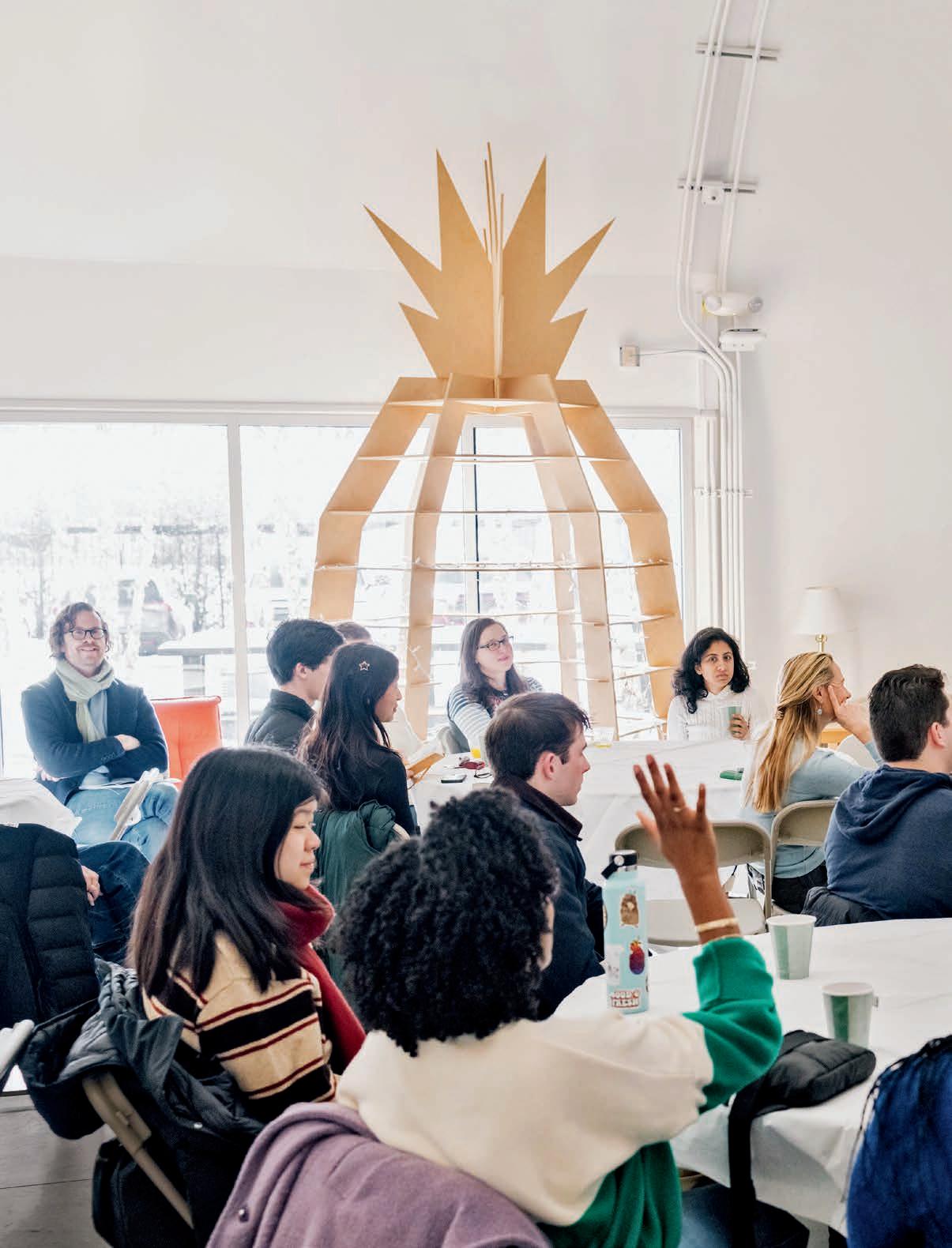
Marc Brackett, a leading expert on emotional intelligence, was the inaugural Dialogue Project speaker. He conducted a workshop for Dartmouth’s residential house communities in January.
Dartmouth Dialogues is our shared commitment to expanding programming across the institution dedicated to facilitating conversations and skills that bridge political and personal divides. Listening to—and including—a diversity of ideological perspectives fosters learning, community, and innovation. Solving the world’s most pressing challenges hinges on our ability to understand and discuss viewpoints different from our own.
The first phase will center on the Dialogue Project, a campus initiative that will offer training in the development of collaborative dialogue skills among students, faculty, and staff. Some examples of this year’s offerings include:
Middle East Dialogues
The Middle East Dialogues represents the Dialogue Project’s first special topic series, encompassing courses and events related to timely topics. Dartmouth’s interdisciplinary programs in Jewish Studies and Middle Eastern Studies have a longstanding commitment to fostering dialogue, community, and joint academic inquiry.
StoryCorps Partnership
This spring, Dartmouth launched the first-ever university partnership with StoryCorps’ One Small Step Program. One Small Step brings people with different perspectives together, two at a time, to record a 50-minute conversation about their lives—with the goal of reducing animosity and dehumanization across political divides by forging new bonds of connection and trust.
Polarization Research Lab
Directed by Dartmouth government professor Sean J. Westwood, the Polarization Research Lab is dedicated to applying science to the study of polarization and democracy. The lab advances the study of partisan animosity by collecting data, testing new ideas through rigorous science, and sharing the data and findings. Its team includes three Dartmouth undergraduates.
Rowan Martey ’26
she/her/hers
HOMETOWN: FORT COLLINS, CO
MAJOR: COGNITIVE SCIENCE
MINOR: FILM AND MEDIA STUDIES
Rowan Martey ’26 credits Dartmouth’s liberal arts curriculum and supportive co-curricular environment with helping her explore a range of interests old and new. A classically trained ballet dancer, Rowan performs with the hip-hop group Ujima, conducts research in the cognitive science department, and is a member of the Alpha Kappa Alpha sorority. She also balances her academics with athletics as a competitor on Dartmouth’s figure skating team, which recently placed third at the National Intercollegiate Final.
How did you decide on your major and minor?
I came to Dartmouth knowing I wanted to explore, and I quickly recognized that Dartmouth’s liberal arts curriculum allowed me to take lots of classes across different departments that all count towards my degree. I took Introduction to Cognitive Science and loved it—and I connected with the fact that the cognitive science major requires you to take classes across departments like psychology, computer science, and linguistics.
How have you found meaningful forms of community at Dartmouth?
I grew up in a predominantly white area and knew I wanted to connect with the Black community at Dartmouth, but I didn’t know where to start. When I learned about the Divine Nine—a group of historically Black fraternities and sororities—I decided to give Greek life a try. Not only is my sorority a group of Black women that feels like family, but it’s an organization with connections to the rest of the Black community at Dartmouth. It’s been great to have that entry point into a part of my identity that I had always wanted to explore.
What advice would you offer to current high school juniors and seniors?
My motto when I first arrived at Dartmouth was to be a “yes person”—to say “yes” to things that were new, different, and maybe outside my comfort zone. My first year, I went to a hypnotist show on a whim and ended up meeting people who have become some of my best friends. Now we do so many things together—playing pool, going to trivia, having sushi nights, even stargazing. My mentality is that college is just as much about finding your identity as it is about academics. It’s about finding your place, your community. I like that Dartmouth embraces that.
A Figure Skater Finds Her Balance—and Her Best Friends
4,447
UNDERGRADUATES
57 COUNTRIES REPRESENTED CLASS OF ’27
77 LANGUAGES SPOKEN AT HOME CLASS OF ’27
23
TRIBAL NATIONS AND INDIGENOUS COMMUNITIES REPRESENTED CLASS OF ’27
17 % OF U.S. CITIZENS AND PERMANENT RESIDENTS ARE PELL GRANT RECIPIENTS CLASS OF ’27
41% OF U.S. CITIZENS AND PERMANENT RESIDENTS ARE STUDENTS OF COLOR CLASS OF ’27
14% FIRST GENERATION TO COLLEGE CLASS OF ’27
57 % FINANCIAL AID RECIPIENTS CLASS OF ’27
Dylan Griffith ’25
he/him/his
HOMETOWN: CAMBRIDGE, MA
MAJOR: GOVERNMENT
Dylan Griffith ’25 is a recipient of a full-tuition scholarship from the Reserve Officers’ Training Corps (ROTC), a program that prepares college students to become officers in the U.S. military. At Dartmouth, he’s pursuing his interests in constitutional law, national security, and socioeconomics while preparing to commission into the U.S. Army and planning a future career in public service.
Take us back to the beginning. How did your interest in public service begin?
Growing up, I found a keen sense of purpose in contributing to a larger collective cause. I was involved in political organizing in high school and concluded that I wanted to do public service of some kind. To me, the military is the most singular form of public service. Given faltering trust in our institutions right now, I’m particularly motivated to uphold the integrity of the units that I will join. Ultimately, it is our individual contributions that drive our collective progress.
You recently served as Vice President of the Dartmouth Political Union, a nonpartisan student organization dedicated to promoting open dialogue on campus.
Yes. In my opinion, if you’re going to live in a democracy, then you shouldn’t be afraid to have someone challenge your ideas—you should want to hear what that challenge is. One of the most important things I’ve learned in college is how to communicate about differences and disagreements, particularly with your friends. That’s a really important aspect of community building. One of the founding ideals of institutions of higher education is the robust exchange of ideas, and in my eyes, Dartmouth is a leader among the Ivy League in terms of advancing dialogue and democratic ideals.
Where have you found your closest community on Dartmouth’s campus?
My home base is my fraternity. I’m now the president, and my fraternity brothers are some of my closest friends. It’s a group of people who thrive off of the idea that “Your success is my success. Having you around makes me a better person.” That’s a special way to form a community, and I feel very fortunate to be a part of it.
Burçin Mutlu-Pakdil
she/her/hers ASSISTANT PROFESSOR OF PHYSICS & ASTRONOMY
On Burçin Mutlu-Pakdil’s first day as a university student in Turkey, a faculty member expressed to her his doubt that she belonged. Today, the astrophysicist has risen to academic fame following her groundbreaking discovery—a rare type of galaxy distinguished by its uncharacteristic double-ringed elliptical structure. Now known as Burçin’s Galaxy, the finding represents an entire category of galaxies that was previously unknown to modern scientists.
You’re already inspiring the next generation of scientists. Your 2018 TED Talk about Burçin’s Galaxy has been viewed more than 2.6 million times. During my journey, I’ve noticed how important it is to have a role model—someone you can look to and think, ‘She did it, so I can do it, too.” Following my TED Talk, I got all these messages from around the world. Young girls were telling me that they, too, want to discover galaxies and name them. They saw something in me and thought, ‘If she did it, I can, too.’ I might not solve the mysteries of the universe, but maybe one of those girls will one day. That’s my dream.
Undergraduate students are integral to your work. How easy is it for them to become involved in your research?
Approaching faculty members can be difficult, particularly for first-generation or underrepresented students. I remember being very shy in my first years as a student. I want my students to feel comfortable approaching me and asking me questions. Science is collaborative work. Solving the mysteries of the universe is a very big quest, and there isn’t just one genius who can solve it. It requires teamwork from multiple people of all backgrounds.
At Dartmouth, faculty members are both teachers and scholars. Why is that academic mission important to you?
We spend so much time fulfilling our curiosity and answering these big questions about the universe. But if you discover something, and nobody knows about it, what’s the point? You need to share the knowledge with everyone. My students ask all sorts of questions that I haven’t thought about before, and sharing knowledge with them motivates me. It’s very intellectually satisfying.
An Astrophysicist Grounds Herself in Her Teaching
Dartmouth can be affordable for you.
Dartmouth’s universal need-blind admissions policy means that your ability to pay for your education has no bearing on the outcome of your admission decision—regardless of your citizenship status. Families with total annual income below $125,000 who possess typical assets will have a $0 expected parent contribution.
Looking for an early estimate of your financial aid award? Visit dartgo.org/quickcost to get help anticipating your college costs.
SUPPLEMENTAL FUNDS
Dartmouth’s 4E Fund supports low-income students with the expenses of essential items, enrichment items, experiences, and emergency costs.
AID TRAVELS WITH YOU
Students receiving need-based financial aid pay the same net price for a term on a Dartmouth off-campus study program as they would for a term in Hanover.
WE MEET FULL NEED
Dartmouth meets 100% of your demonstrated financial need regardless of citizenship. The average need-based grant for a member of the Class of 2027 is $67,791.
NO LOANS
Dartmouth will not include required loans as part of the financial aid award created to meet a student’s demonstrated financial need, regardless of income or citizenship.
NO PARENT CONTRIBUTION
Families with total annual income below $125,000 who possess typical assets have a $0 expected parent contribution.
There are many ways to make a Dartmouth education possible.
A Rural Perspective on the Human Impacts of Severe Weather
Gavin Fry ’25
he/him/his
HOMETOWN: HORNERSVILLE, MO
MAJOR: CLIMATE SYSTEMS SCIENCE
Growing up in rural Arkansas and Missouri, raised by his grandmother in a mobile home, Gavin Fry ’25 came to understand that severe weather affects everyone—but it doesn’t affect everyone equally. Now a third-year student at Dartmouth, he’s won two national scholarships in support of his research on the human impacts of extreme weather.
How did your upbringing in the rural Southeast influence your academic interests?
When I say I’m from a rural town, that’s selling it short by a mile. I grew up in a town of 600 people, fields surrounded my house, and I frequently drove down country backroads. The kinds of settings where I grew up—areas densely populated with mobile homes, locations where there’s a lot of poverty, where English might not be the first language— are places where it’s hard to take the necessary precautions when it comes to severe weather such as tornadoes. That’s why the highest number of deaths in the United States from severe weather occur in the mid-South.
How has Dartmouth’s liberal arts curriculum shaped your understanding of climate science?
I see the liberal arts as a way of thinking critically through different lenses to tackle issues across disciplines. Quantitative sciences are obviously foundational to understanding the physical phenomena of meteorology, but deeper beneath the surface, there are aspects of meteorology that require a well-rounded education in communication, social science, and policy to understand the human impacts of meteorological and climate issues through multiple lenses. Viewing issues through multiple lenses is precisely how leaders are sculpted and how the biggest problems in the world will be solved.
Tell us about your future plans.
My hope is to take a job with the National Weather Service before going on to graduate school with the support of the Truman Scholarship, a federal award that provides up to $30,000 toward graduate study in public service. My longterm goal is to work my way into a policy or leadership position with the National Weather Service.
Your Support System
Starting college is a big transition no matter who you are or where you’re from. Though this is by no means an exhaustive list, here’s a sampling of just a few of the many resources here to support you at Dartmouth.
Academic Skills Center (ASC)
The ASC supports Dartmouth students in their transition from high school to college coursework through peer tutoring and oneon-one academic advising.
Center for Professional Development (CPD)
The CPD helps students explore their career interests, identify strengths and opportunities, apply for jobs and internships, prepare for interviews, and learn about the professional world.
Counseling Center
Dartmouth’s mental health center offers short-term therapy, 24/7/365 crisis services, medication evaluation and management, sport psychology appointments, workshops and discussion groups, ADHD evaluations, and outreach to the Dartmouth community.
E.E.
Just Program
The E.E. Just Program supports underrepresented students at Dartmouth pursuing degrees and careers in STEM disciplines through mentorship and professional growth within a diverse and inclusive community of Dartmouth scientists.
First-Year Student Enrichment Program (FYSEP)
Organized by the First-Generation Office (FGO), FYSEP is a pre-orientation program that transitions into a four-year support network. FYSEP prepares first-generation low-income students to thrive at Dartmouth through mentor-mentee relationships, sample classes taught by Dartmouth faculty, community-building activities, and more.
Living Learning Communities (LLCs)
LLCs are residential communities centered around a common theme—like language, interest, or identity—that offer spaces for students to grow personally and intellectually alongside faculty, staff, and peers.
Native American Program (NAP)
The NAP supports the success of the diverse community of Native and Indigenous students at Dartmouth through programming and initiatives based on the program’s four pillars: academic support, well-being, community engagement, and personal and leadership development.
Office of Financial Aid
Financial aid staff members are ready to answer questions from both prospective and current students and their families. Reach out at financial.aid@dartmouth.edu or (603) 646-2451.
Office of Pluralism and Leadership (OPAL)
OPAL centers the values, needs, strengths, and practices of marginalized communities by approaching leadership, community development, and personal growth through the lens of social justice to foster a campus community where all students can thrive.
Sexual Assault Peer Alliance (SAPA)
SAPA is comprised of current students who are equipped with comprehensive training to provide informed, empathic, and empowerment-based support to Dartmouth peers impacted by sexual and genderbased violence.
Student Accessibility Services
Student Accessibility Services ensures that Dartmouth’s programs, services, and activities are accessible to, and usable by, students with disabilities. SAS facilitates academic accommodations, program modifications, and auxiliary services in support of students’ curricular and co-curricular pursuits.
Student Wellness Center (SWC)
Located in the heart of Baker-Berry Library, the SWC helps Dartmouth community members foster well-being in every aspect of life through wellness check-ins, mindfulness and meditation sessions, self-assessment resources, and more.
The William Jewett Tucker Center
Inclusive and affirming of all beliefs, the Tucker Center helps students cultivate spiritual and ethical lives, build relationships and understanding across identities, and engage in dialogue on meaningful issues on campus and beyond.
Undergraduate Dean’s Office
The Undergraduate Dean’s Office supports undergraduate students on a variety of academic, personal, and social issues. Students can meet individually with their undergraduate dean for consultation on course selection, leave term opportunities, graduate school and fellowship applications, and more.
Within
An LGBTQIA+ advocacy group, Within fosters community through game nights, career networking events, film screenings, family dinners, and more.
Women in Science Program (WISP) WISP creates collaborative learning environments for women in STEM through hands-on research and a community of mentors.
Dartmouth College
Office of Undergraduate Admissions
6016 McNutt Hall
Hanover, NH 03755
We’re excited to share Dartmouth with you virtually or in person. Sign up at dartgo.org/visit.