DARTMOUTH IN ALL ITS DIMENSIONS NO. 19 | SEP 2025
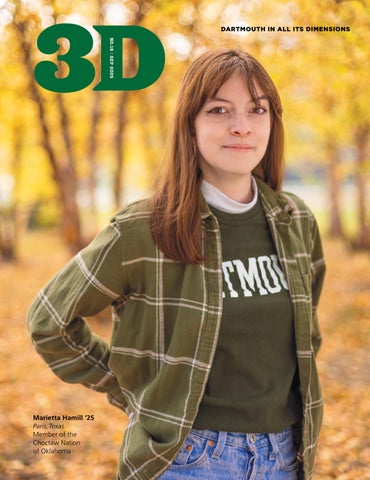
Marietta Hamill ’25 Paris, Texas Member of the Choctaw Nation of Oklahoma
Dartmouth College is defined by its people, and 3D is a magazine that tells their stories. It’s not meant to be comprehensive, but an evolving snapshot as vibrant and prismatic as the school itself. 3D is Dartmouth in all its dimensions.
SEPTEMBER 2025 // ISSUE 19
FEATURES
14
Dartmouth and the Dawn of AI The origins of the field trace back to a seminal conference at Dartmouth in 1956
30
Let’s Get Down to Business Dartmouth graduates leverage the liberal arts to forge paths in business, entrepreneurship, and finance
COLUMNS
Our campus, seen here on a summer evening, is nestled in Hanover, New Hampshire, just across the Connecticut River from Vermont.
2
First Hand A message from Dartmouth admissions leaders
3
It’s a Fact Dartmouth by the numbers
6
Humans of Hanover Meet some of the members of the Class of 2029
10
Financial Aid Learn how a Dartmouth education can be affordable for you
20
My “Why Dartmouth?” Advice for high school seniors from a recent Dartmouth graduate
22
Basecamp to the World An art history major spends an off-campus term in Italy
26
A Hub for the Arts, Reimagined Dartmouth’s Hopkins Center for the Arts reopens following a $123.8-million renovation
36
Goal-Oriented Athletics highlights from Big Green teams
40
Humans of Hanover: Faculty Edition Meet some of the members of the Dartmouth faculty
42
Onward & Upward Mindy Kaling ’01 reflects on her college search and career
46
D-Plan A graduating senior illustrates the flexibility of Dartmouth’s quarter system
48
Courses of Study A history and government major dives into the Dartmouth curriculum
50
Funding Outside the Lines Dartmouth’s financial support extends well beyond financial aid
52
Tapestry A thread from Dartmouth’s history
Dartmouth College is located on traditional, unceded Abenaki homelands. Photograph on the cover by Don Hamerman Photograph at left by Robert Gill
“Stay present but also be open to surprises.” Kathryn Bezella Assistant Vice President and Dean of Undergraduate Admissions
Lee Coffin: Kathryn, you have just navigated your first year as a dean. How are you feeling? Kathryn Bezella: Very proud, enormously proud. This year, more than any other in my career, everyone was my point of focus. You and I read every single file of every student who was ultimately admitted and many, many of those who ultimately weren’t. I think I’ve always had a sense of and respect for the “grandfather clock,” but now I’ve opened the back, and I’ve seen the gears. LC: As you get to the point where your first class is finished and look back, what surprised you the most? KB: I ended up being charmed by and excited about the quality of the applications that we read. I was not so lost in the management of the process or in the details of the days to stop and fully appreciate the voices of the students. I enjoyed the liberal arts nature of what I was reading and the Dartmouth “flavor” of that. The way that students talked about the outdoors or a specific professor, it just felt very personal to me. Even though
2 | admissions.dartmouth.edu
the size of the pool and the selectivity of it is huge, meeting kids one at a time still felt really, really personal. LC: Every year I’ve done this, the most challenging part of the job is trying to figure out, “When can I say yes? When must I say no?” You’re managing a scarce resource, which is a seat in the class versus a very qualified pool. KB: I had my own heartbreak in the college application process, so I know it feels devastating to get that “no” from the place that you envisioned was going to be your perfect haven. I’m so glad I didn’t end up at any of those places because the place that I landed was perfect for the path it put me on, but I didn’t know that when I was 17. LC: What advice do you have to high school seniors and their parents? KB: I would hope people can find a couple of moments to stay present but also be open to surprises. I think we can hold onto an image for ourselves and our future that feels overly certain. At this time, nothing has been decided. Applications are still possible. It’s a great time to still be curious.
This interview is drawn from one of many Admissions Beat episodes students and their supporters can listen to as they seek to inform and gain confidence in their college search process. Follow the QR code for more.
PHOTOGRAPH BY DON HAMERMAN
Kathryn Bezella joined Dartmouth last fall as Assistant Vice President and Dean of Undergraduate Admissions. On the Admissions Beat podcast, she shares insights gleaned from her first year as an admissions dean. Joining her for the conversation is Lee Coffin, Vice President and Dean of Admissions and Financial Aid, who recently completed his 30th year in such a role. As the podcast’s host, Dean Coffin collaborates with a range of guests to offer credible information, insights, and guidance on every step of the college search process.
It’s a fact. IN AND OUT OF CLASS
4,570 UNDERGRADUATE STUDENTS
7:1
student-tofaculty ratio
60%
of students engage in research
20
80%
students or fewer in most classes
of students participate in internships
UNDERGRADUATES BY THE NUMBERS
103 COUNTRIES
50
U.S. States plus D.C., Puerto Rico, Guam, Northern Mariana Islands, and U.S. Virgin Islands
44%
95+
languages spoken Home Countries
17%
Type of School Attended
of U.S. citizens and permanent residents are students of color
15%
international citizens
28%
come from low-income households worldwide
of U.S. students are from rural or small towns
39%
56% 5%
INDEPENDENT
PUBLIC
RELIGIOUS
1003 high schools represented in the 93% graduated top 10% of their class
70+
tribal nations and Indigenous communities represented
15%
first generation to college
admissions.dartmouth.edu | 3
PHOTOGRAPH PHOTOGRAPH BY NAME BY DON HAMERMAN
Pictured: In the stands of the newly dedicated Buddy Teevens Stadium at Memorial Field
MICAH GREEN ’25 he/him/his HOMETOWN: INDIANAPOLIS, INDIANA MAJORS: ENGINEERING SCIENCES AND MECHATRONICS
Leadership Lessons from the Big Green Gridiron
On campus and the football field, starting linebacker Micah Green ’25 has been a leader, helping bring home three Ivy League championships for the Big Green football team while serving as co-president of the Dartmouth Black Student Athlete Alliance and president of Alpha Phi Alpha Fraternity, Inc. Meanwhile, he completed two degrees in four years—both a Bachelor of Arts and a Bachelor of Engineering. Why did you choose Dartmouth? I chose Dartmouth because it was the only school where I could play my sport and major in engineering. Dartmouth’s quarter system is truly unique, and it allows athletes to take a rigorous course schedule without burning out. Before I even got to Dartmouth, Douglas Van Citters, Interim Dean of Dartmouth Engineering, helped me map out my accelerated engineering degree on a Zoom call. I started college with the right mindset, the right plan, and help from the right people. Tell us about your transition from Indianapolis to Dartmouth. I always knew that I wanted to play football in college. Coming to Dartmouth was a completely new experience for me. There’s a big culture here of getting to know your peers and professors. I’ve grown out of my shell into someone who’s not afraid to talk to different people and be in new spaces. I feel particularly fortunate to be at a place where I’m encouraged to learn from people with different perspectives and develop a mindset that helps me foster relationships with my peers as partners. How have your leadership skills evolved on the football field?
PHOTOGRAPH BY NAME
When you’re leading a team of over 100 people, leadership comes in many forms. Some leaders choose to lead by example, avoiding mistakes and demonstrating discipline. I’ve also seen leaders be more vulnerable, allowing themselves to express how they’ve made mistakes. I think teammates respect vulnerable leaders for being able to share their failures and learn from them. I tend to lead by example, but more recently, I’ve been admitting when I’ve failed. I want people to see how I truly feel about a subject instead of just trying to be perfect all the time. On our football team, we have to stand up every time we speak, and that has become second nature to us. I’m not afraid to stand up and speak about what I believe in. What’s next for you? I’ll continue my academic and athletic careers at the University of St. Thomas in Minnesota this fall, where I will pursue a master’s degree in engineering management. My long-term goal is to become chief engineer of an aerospace company.
admissions.dartmouth.edu | 5
Allison Hong ’29 Gilbert, AZ
Gift Christian ’29 Kigamboni, Tanzania
Gabi Green ’29 Chevy Chase, MD
“At Dartmouth, I can be myself. The D-Plan will foster my passion for reducing mental health stigmas. I’ll take Professor Hudenko’s Abnormal Psychology course and improve public access to clinical psychology research. Volunteering at the O-Farm will allow me to make an impact while connecting with the outdoors.”
“Experiencing water scarcity from human-induced droughts ignited my passion for environmental studies. I look forward to working with Professor Nicholas Reo on sustainable land management policies, using my D-Plan to connect his research on environmental stewardship with solutions for drought-causing activities, like deforestation for charcoal, back home.”
“To paraphrase Justice Potter Stewart, ‘I knew it when I saw it.’ At Rocky, I watched Professor Barabas push a student to think deeper about voting patterns, and I knew that was the level of challenge I sought. The faculty-student collaboration and the focus on supporting the broader world meshes with my values.”
Arielle Noussa Fotso ’29 Carmel, IN
Qiuyu Liang ’29 Beijing, China
Theofilos Charalampidis ’29 Thessaloniki, Greece
“At Dartmouth, introspection feels welcome. The Historical Accountability Student Research Program highlights the College’s desire to reflect and make continual improvements. I also see it in Professor Jacqueline Wernimont’s combined passion for history and math. I believe that Dartmouth will help me develop my interests in cognitive science and public policy.”
“As an environmental (studies) enthusiast, I’ve thrived on experiential learning in nature. Dartmouth’s ‘Big Green,’ with the Appalachian Trail running through and Moosilauke as its spiritual heart, calls. With the D-Plan’s flexibility, I’d pursue internships through the Center for Social Impact and Global Dartmouth, tackling sustainability challenges locally and globally.”
“Dartmouth’s immersive approach to language learning excites me to break down barriers in global diplomacy. I aim to enhance my knowledge with Department of Government’s courses like Democratic Theory to develop my initiative for youth voter participation. By engaging with alumni in Washington, D.C., I will immerse myself in the political landscape.”
PHOTOGRAPH PHOTOGRAPH BY NAME BY NAME
HUMANS OF HANOVER
Tucker Sopha ’29 Raymond, NH
McKinlee Williams ’29 Panama City Beach, FL
Kiran Makam ’29 Woodbridge, CT
“Dartmouth’s D-Plan will allow me to deeply explore each course I take and give me the flexibility to access internships that wouldn’t be available on a traditional calendar. You might find me in the MShop, fabricating my ENGS 21 project with my team or inventing something worthy of Dartmouth Engineering’s legendary patent wall.”
“Dartmouth Bound showed me a loving environment that nurtures individuals to reach their fullest potential. Learning more about the school, I was comforted by how much Dartmouth supports its undergraduate students. Excitingly, the Department of Government encourages students to gain firsthand knowledge by participating in their legal research and fellowships.”
“Dartmouth redefines home. Sophomore summers, the Shabazz Center, and professors who know their students by name create the community I value. Interested in the academic opportunity gap and carceral reform, I would embrace Dartmouth’s sociology track and its intersections with public policy and education. This, in the woods, makes home.”
DARTMOUTH IS DEFINED BY ITS PEOPLE, SO WE’RE EXCITED TO CELEBRATE SOME NEW MEMBERS OF OUR COMMUNITY. IN EXCERPTS FROM THEIR “WHY DARTMOUTH?” ESSAYS, STUDENTS FROM THE CLASS OF 2029
PHOTOGRAPH BY NAME
SHARE WHAT DREW THEM TO THE COLLEGE.
Trace Ribble ’29 Marlow, OK
Brody Gifford ’29 North Yarmouth, ME
Alyssa Ortega ’29 Chicago, IL
“One of my most important goals is my mission to eliminate rural mental illness. Dartmouth’s D-Plan would allow me the flexibility I need to simultaneously advance my education and my cause. Collaborating with Professor Elizabeth CarpenterSong, whose expertise in mental illness in marginalized communities matches my advocacy efforts, will help further our shared mission.”
“Growing up in rural Maine, I’ve been surrounded by nature my whole life. Upon researching Dartmouth’s outing club and its contribution to the preservation of their Second College Grant, I knew it was the place for me. Furthermore, the recent introduction of the Dartmouth Dialogues program matches my goals exactly.”
“What’s on my Big Green to-do list? I would start with a quiet walk around Occom Pond. After, I’d be seen exploring neuromarketing under Kimberly Rose Clark and taking her to lunch at PINE. Intersecting my studies in cognitive science with business, I’d participate in career sessions at the Tuck Bridge Program.”
admissions.dartmouth.edu | 7
Drawing on Southern Roots, a Pair of Historians Study Appalachian Energy
Kelby Greene ’25 met Professor Bethany Moreton in the class American Anthropocene: Climate and Power in U.S. History during Kelby’s sophomore fall. The two have since partnered up to study the history of coal mining in Appalachia through the lens of the Tennessee Valley Authority, a federally-owned electric utility corporation. After graduation, Kelby will work in Dartmouth’s history department and freelance as a radio producer before beginning a yearlong fellowship studying energy politics in rural Nepal, funded by Dartmouth’s H. Allen Brooks Traveling Fellowship. How did your Southern origins inspire your interest in history?
What is your favorite part of working together?
Kelby: I grew up on a farm in Tennessee that’s been in my family since the 1920s, so I’ve always been very conscious of history. The history of Tennessee remains very real; it’s still very much a place rooted in the physical. Today, I’m interested in the intersection of history, energy, and economics as a way of understanding the forces that shape our energy system.
Professor Moreton: Whether I’m collaborating with a 19-year-old sophomore or an 80-year-old retired professor, it’s nice to imagine that we’re all having an ongoing conversation in an intergenerational, trans-historical community. We all have relationships with one another, including with people who passed away a long time ago who wrote some of these books we’re reading. It’s an effective lineage. I’ll add, too, that Kelby earned High Honors on her thesis and graduated Phi Beta Kappa!
Tell us more about your research. Kelby: I’m studying the role of the Tennessee Valley Authority in shaping energy consumption patterns and policy in the early 20th century. The TVA is the largest coal-consuming utility corporation in the United States. I used funding from Dartmouth’s Stamps Scholars Program to travel to the TVA’s archives in Atlanta. I even had some money left over to support myself during an unfunded internship with a historical society. The Stamps Scholars Program reduced a lot of financial barriers. Research isn’t just for people who can afford to not work.
Kelby: It’s fantastic to have a working relationship with someone I look up to as a scholar. Professor Moreton takes the work very seriously with me as a peer. I find the relationship so empowering because I feel like my ideas and my work are important; they really matter. It’s not just about my four years at this small liberal arts college in New England; the work I’m doing continues to matter even after graduation.
Pictured right: On Tuck Drive outside the Irving Institute for Energy and Society, with Professor Moreton’s dogs Yvonne and Boudreau (who attend all of their meetings) 8 | admissions.dartmouth.edu
PHOTOGRAPH BY DON HAMERMAN
Professor Moreton: Kelby and I share a background as Southerners who come from places drenched in history. It’s easy to recognize how historicallyproduced our present day is if you come from places that wear their history on their sleeve.
Kelby Greene ’25 she/her/hers Hometown: Knoxville, Tennessee Major: History Bethany Moreton she/her/hers Professor of History
We’re committed to making a Dartmouth education affordable for you. Dartmouth is need-blind and meets 100% of demonstrated financial need for all admitted students, regardless of citizenship.
NEED-BLIND
100% DEMONSTRATED NEED MET
$0 PARENT CONTRIBUTION
NO LOANS
AID TRAVELS WITH YOU
HEALTH INSURANCE COVERAGE
Dartmouth reviews applications without regard for your family’s ability to pay for your education, regardless of citizenship status or income.
Families with total income of $125,000 or less and who possess typical assets will have a $0 expected parent contribution.
Students receiving need-based financial aid pay the same net price for a term on a Dartmouth off-campus study program as they would for a term in Hanover.
10 | admissions.dartmouth.edu
80%
Dartmouth will meet 100% of your demonstrated need for all four years.
Loans will not be included as part of Dartmouth’s financial aid offer created to meet a student’s demonstrated financial need.
Dartmouth will provide financial aid recipients with scholarship assistance toward the cost of Dartmouth’s health care plan.
The average scholarship for the Class of 2028 equals 80% of the cost of attendance.
The Class of 2025 gathered on the Dartmouth Green to celebrate their graduation in June.
HOW MUCH AID COULD I RECEIVE?
WHAT COULD I QUALIFY FOR?
Average Scholarship
$83.7K
PHOTOGRAPH BY JULIA LEVINE
$0
$66.3K
$0–125K*
$125K+
in total income
in total income
100% demonstrated need met
$55.5K $35.0K
No loans
$125K
$175K
$225K+
To get a personalized estimate of your financial aid offer at Dartmouth, visit dartgo.org/3Dcalculator.
Total Income
$0 expected parent contribution
*possessing typical assets
admissions.dartmouth.edu | 11
ISHITA SINGH ’26 she/her/hers HOMETOWN: MUMBAI, INDIA MAJORS: COMPUTER SCIENCE AND BIOLOGY
When she’s not leading tours or hosting radio shows on campus, Ishita Singh ’26 is making new discoveries on white blood cell evolution in the Hoehn Lab. Her lab work, which she found by simply sending an email—a common way of getting involved with research at Dartmouth—has been a source of both intellectual fulfillment and transformative community. Why did you choose Dartmouth? Coming from Mumbai, I never got to visit Dartmouth before applying, but the freedom to study whatever I want while taking advantage of all the opportunities of a research institution was a big pull. People warned me about it being the smallest Ivy and “in the middle of nowhere,” but the size is one of my favorite things—it’s very collaborative, and we don’t have to compete for resources. It quickly felt like home, and the natural surroundings are absolutely beautiful. Can you tell us a bit about your academic interests? I like complicated systems—they’re just really cool to understand, and I found that in both computer science and biology. For me, it was about finding a place where I could combine those interests. A lot of what I do in the Hoehn Lab is coding, but I’m looking at biological data, and you can’t really understand the data without understanding systems and what’s happening on a cellular level. What are you researching in the Hoehn lab? We’re looking at B cells, a type of white blood cell, through a perspective of phylogenetics, which is just a fancy term for evolution. I’m specifically looking at how different B cells have evolved to respond to COVID strains, like Omicron versus Wuhan, for example. We found cells that evolved to bind to Omicron before they were even exposed to it. It’s a preliminary conclusion, but it’s exciting to contribute a new discovery to an academic paper.
Discovering Home—and Blood Cell Evolution— in Hanover
The relationships I have with my professors are something unique that I couldn’t foster anywhere but Dartmouth. I first met one of my major advisers, Professor Olga Zhaxybayeva, in Biology 47: Genomics, and we get ice cream every term at Red Kite Candy in Hanover. Also, getting to know my professors, the wonderful people in my lab, and my talented roommates-turned-friends has helped me thrive in a collaborative work environment. This community has really changed me for the better.
12 | admissions.dartmouth.edu
Pictured: On the former golf course at Dartmouth, near Pine Park in Hanover
PHOTOGRAPH BY NAME
How have the relationships you’ve developed here helped shape your path?
PHOTOGRAPH BY DON HAMERMAN
DARTMOUTH AND THE DAWN OF AI
It came at a time of sweeping societal shifts in popular culture, political representation, and scientific research, as the aftermath of World War II subsided. The gathering was the brainchild of mathematicians and engineers John McCarthy (Dartmouth), Marvin Minsky (MIT), Nathaniel Rochester (IBM), and Claude Shannon (Bell Labs), and its core outcomes set Dartmouth on the path to being a key player in the science and application of AI.
THE CONSTITUTIONAL CONVENTION OF AI The Encyclopedia of Artificial Intelligence refers to that 1956 Dartmouth Summer Research Project on Artificial Intelligence as the “Constitutional Convention of AI” because it laid essential groundwork for the development of AI as we know it today. Dartmouth Professor of Mathematics John McCarthy crafted the initial proposal, and he is credited with coining the name “artificial intelligence” for the emerging field. That summer, a rotating group of scientists gathered on the top floor of Dartmouth’s math department
14 | admissions.dartmouth.edu
to dig into the what and how of AI. Although the group ultimately concluded that achieving true machine intelligence would be far more difficult than initially predicted, the project established essential research and development topics, such as symbolic methods and expert and deductive systems. Dartmouth reinforced its ongoing role in the development of AI at the seminal 2006 Dartmouth Artificial Intelligence Conference: The Next Fifty Years (AI@50). Organized by Dartmouth Professor of Intellectual and Moral Philosophy James H. Moore, the conference focused on analyzing AI’s progress, documenting the key research and development challenges ahead, and identifying developments in related fields that could produce the breakthroughs necessary to AI’s future. Most recently, Dartmouth researchers cofounded the International AI Alliance in 2023, a milestone that deepened the College’s commitment to the ethical development of artificial intelligence and established partnerships to enhance the impact of Dartmouth’s research and discoveries on the global stage.
ILLUSTRATION CHIVERS PHOTOGRAPH BY BYSAM NAME
In the summer of 1956, Dartmouth College made history by hosting the world’s first academic conclave on the emerging field that would come to be known as artificial intelligence.
AN INDISPENSABLE ROLE FOR THE LIBERAL ARTS
“The most likely future is not that these productivityenhanced language models are going to eliminate massive numbers of jobs so much as they will change them.”
ILLUSTRATION BY SAM CHIVERS
— Cal Newport ’04, Montgomery Fellow, visiting faculty member, and computer science professor at Georgetown University
Dartmouth professors and researchers assert that if computational tools such as AI and machine learning are to serve—rather than confound and complicate—human societies and relationships, Dartmouth and other leading liberal arts institutions must remain fully engaged with these rapidly expanding technologies. AI, ML, large language models, and as yet undiscovered tools are not ends unto themselves, and their astonishing capabilities should never be justified solely by the astronomical profits they generate. To ensure Dartmouth remains a leader in the use of computation technologies for societal good, the College created the Susan and James Wright Center for the Study of Computation and Just Communities in 2020. A key objective of the Wright Center is to expose the double-edged sword of computational advances in the public and governmental sphere using tools and methods such as AI, ML, data analytics, and computer simulations. Topics on the Wright Center’s agenda include surveillance and safety, free speech and misinformation, as well as image creation and manipulation. At the frontier where AI and liberal arts curricula intersect, Dartmouth students and faculty are illuminating just how essential the liberal arts are to the development of responsible and productive AI. Speaking to HigherEdDive, Dartmouth Professor of History Cecilia Gaposchkin noted that human reasoning related to ethics, morality, and human dignity is instinctive. “To outsource the higher-level orders [of thinking] to an object that doesn’t have that ethical grounding trained by human reason,” she said, “is a dead end.”
16 | admissions.dartmouth.edu
On Course(s) Dartmouth’s curricular offerings cover a spectrum of AI topics: CRITICAL AI (ENGLISH 54.41)
Analyzes AI as a discourse concerned with the automation of perception (image, sound, text) from the mid-20th century to today, applying cultural critique to the social and cultural significance of AI. POLITICS AND ARTIFICIAL INTELLIGENCE (GOVERNMENT 20.21)
Surveys the algorithms—like ad targeting and AI-planted social media accounts—that are changing political campaigns and governance, as well as new social science research that seeks to understand AI’s impact on contemporary politics. ROBOTS AND AI IN FICTION AND FILM (COMPARATIVE LITERATURE 10.29)
Explores the idea of AI as an invasive force as depicted in fictional and filmic stories about androids and robots, and the implications thereof for real-world AI developments and defining what is human. MUSIC AND ARTIFICIAL INTELLIGENCE (MUSIC 14.05)
Examines issues of digital music representation, generative music, and computational creativity with the goal of generating original AI-based compositions. VIRTUAL MEDICINE AND CYBERCARE (ENGINEERING SCIENCES 13)
Investigates the ongoing revolution in health care technologies and the implications for how health care will be delivered in the future, from robotic surgery ethics to space medicine. PHILOSOPHY AND COMPUTERS (PHILOSOPHY 26)
Could computers ever think or feel? Should we limit computers from making certain decisions? This course contemplates those and other implications of computing. AI DEMYSTIFIED: A ROADMAP TO UNDERSTAND EVOLVING TECHNOLOGIES (ENGINEERING SCIENCES 15.08)
Unfolds the world of AI by spotlighting theoretical concepts and multifaceted applications across diverse sectors such as health care and commerce.
Follow the QR code to read Dartmouth’s guidelines on using Generative Artificial Intelligence (GenAI) for coursework.
Dartmouth alum Cal Newport ’04—a Montgomery Fellow, visiting faculty member, and full professor at Georgetown University—shares a similar perspective. During a recent talk at Dartmouth’s Filene Auditorium, Newport explained that AI systems are unable to reflect and change, and they will not accidentally become self-aware. As a result, he says, “The most likely future is not that these productivity-enhanced language models are going to eliminate massive numbers of jobs so much as they will change them.” Not surprisingly, Dartmouth students are equipping themselves to lead that change. Nearly three quarters of all undergraduates take at least one computer science or engineering class, and the number of students majoring in computer science has quadrupled during the last decade.
THE DARTMOUTH AI DIVIDEND Dartmouth’s robust engagement with computational technologies is also yielding dividends on the entrepreneurial front. In 2024 alone, 10 recent Dartmouth alums and current undergraduate tech founders were accepted into Y Combinator, a renowned Silicon Valley startup accelerator with a 3% acceptance rate. All 10 have ties to Dartmouth’s Digital Applied Learning and Innovation Lab (DALI) or the Department of Computer Science. For DALI Director Tim Tregubov, those successes demonstrate how Dartmouth’s comprehensive integration of technology, entrepreneurship, and the liberal arts is paying off for both students and society. “[We] have students who are starting up their own things to try to change the world,” he said. “It’s awesome.” For Felix Davis ’26, harnessing the power of AI to help others is a matter of life and death. He was studying medicine in his native Ghana when the woman who raised him, Mary Dagadu, died of breast cancer. She might have been saved with better access to diagnostics and care. Soon after her death, Davis left Ghana for Dartmouth and redirected his studies from medicine to computer science and economics with the explicit goal of creating a new model for low-cost, modular microclinics. With support from Dartmouth’s John Sloan Dickey Center for International Understanding and a $3,000 Founder Grant from the Magnuson Center for Entrepreneurship, Davis’ new venture—dubbed Mary Global Health—has already completed several hundred basic health screenings in underserved areas of Ghana. The microclinics combine portable medical devices and AI-powered software to facilitate remote diagnosis and treatment, and the Mary Global Health team uses the encounters to improve its model. “Any AI product is only as good as the diversity of data on which it is trained,” says Davis. “We want to bring the most underprivileged and under-resourced people into the conversation right from the onset.”
ENGAGING WITH THE TECHNOLOGY ARMS RACE Assistant Professor of Quantitative Social Science Herbert Chang ’18 has always considered the merging of liberal arts and computational science an imperative. A native of Taiwan, Chang well understands how tightly intertwined technology and politics have become in the AI era. “Because of its contentious history with China,” he says, “Taiwan receives a ton of misinformation. At the same time, it boasts a high freedom-of-speech index. That makes it a particularly interesting space to study how technology and democratic values come together.” With two groundbreaking research projects during the 2024 U.S. election cycle, Chang and teams of Dartmouth undergraduates and graduate students performed large-scale systematic analyses of the influence of social media AI on political discourse. “My students are incredibly talented and come from diverse backgrounds—from pre-med to computer science to QSS,” says Chang. “They are also perfect collaborators. As frequent users of social media, they have incredible insight into how these platforms work and their strategies for generating visibility.” He stresses that although AI can be used to generate fake content or misinformation, it also can be used as a form of civic engagement that helps identify malicious trends. “It’s a technological arms race I’m excited to continue navigating with my students.” Given the extent of computational engagement all across the campus, it’s clearly a commitment that will continue to be prized by the entire Dartmouth community.
admissions.dartmouth.edu | 17
A Scholar of Latin American Theater Connects Performance to Societal Impact
ANALOLA SANTANA she/her/hers CHAIR, DEPARTMENT OF THEATER AFFILIATED FACULTY IN LATIN AMERICAN, LATINO, AND CARIBBEAN STUDIES
“Theater helps us understand politics, culture, and their place in the world. To me, it is the beauty we need in times of crisis,” says Analola Santana. A professional dramaturg and member of Mexico’s famed Teatro de Ciertos Habitantes (Certain Inhabitants’ Theatre), she teaches courses about Latin American theater and performance. How did your upbringing inform your interest in theater? I’m from Puerto Rico and was raised in Mexico City. In most Latin American countries, theater isn’t as much of a luxury as it is in the United States. People go to the theater two or three times a week. Because of that, the theater produced there is an integral part of understanding what is going on in those parts of the world. When I teach, I show my students what artists have done all throughout Latin America. Can you describe your research in Latin American theater? I work with Latin American theater and performance to understand the effect that it has on political moments and cultural moments. For my first book, I examined the effect of mass media on the way we produce theater in Mexico, Argentina, and Chile. One of the lingering questions I had after finishing that book was about a persona I kept on seeing, a “freak figure.” Why are we obsessed with this notion of the outcast? More specifically, why is it always a woman who is considered a freak? I’ve thought a lot about how we can study this. To me, it is through the arts.
PHOTOGRAPH BY DON HAMERMAN
What is distinct about studying theater at Dartmouth? For one, we have a very close relationship with Northern Stage, a professional theater company in nearby White River Junction, Vermont. Students can spend an experiential term working and learning in that professional theater setting. At Dartmouth, you aren’t competing with graduate students for opportunities in the theater program—that is not always true at other institutions. How do you view your role as a teacher and mentor to undergraduates?
Pictured: In the Chamberlain Room of McNutt Hall, home to Dartmouth's Office of Admissions
I’ve always understood my primary job to be teaching. The relationships we develop with students are truly profound. I always try to be the professor I felt I never had when I was in undergrad. I want my students to understand that anybody can write, anybody can perform, anybody can act. It is our job to teach you, to make you feel comfortable and secure enough to get there.
admissions.dartmouth.edu | 19
PHOTOGRAPH BY DON HAMERMAN
Pictured: In a canoe on the Connecticut River
“Why Dartmouth?”
DANIEL XU ’25 he/him/his Hometown: Westwood, Massachusetts Majors: Geography and Quantitative Social Science with a focus in Anthropogenic Climate Change
In each issue of 3D, we ask a Dartmouth senior to reflect on a question they answered roughly four years prior: “As you seek admission to Dartmouth’s incoming class, what aspects of the College’s academic program, community, and/or campus environment attract your interest? In short, why Dartmouth?” Here, Daniel Xu ’25 revisits that prompt in his final year at the College. Four years ago, my answer to “Why Dartmouth?” was built on instinct and hope: impressions of a snow-covered campus, the hum of students laughing together, and a feeling I couldn’t quite name but trusted all the same. I wrote about warmth on the coldest winter nights—a school where people were individually excellent yet mutually committed to each other. I imagined adventure, exploration, and unyielding tradition. What I didn’t know then was that Dartmouth would become so much more than a school. It would become the bedrock for lifelong friendships and core experiences. I arrived as a wide-eyed first-year, unsure and undecided, but eager. The tall pines and crisp air mirrored my own curiosity: expansive yet grounded, familiar yet filled with unknowns. That warmth I wrote about wasn’t just imagined—it was real. It carried me through winters where the gentle snowfall became playful projectiles aimed at peers or Dartmouth Skiway trails that my skis carved. My Dartmouth springs were alive with laughter on the Green and watching the slow drift of the Connecticut River with my head resting on the shoulders of my best friends. The D-Plan brought summer days at Moosilauke Ravine Lodge and nights staring up into the Milky Way at the Second College Grant. Each year began again with the fall mountains turning into breathtaking masterpieces of red and gold. Dartmouth gave me the freedom to explore everything and anything. I studied gender within Buddhism one term, fell in love with developing film photography the next, and worked through climate models the one after that. I studied perched on a mountain of ginkgo leaves from that one tree guarding
Baker Library and paddled through swamps and oceans with the Ledyard Canoe Club, where the flowing water taught me lessons that lectures couldn’t. Dartmouth let me be many things at once—curious, uncertain, adventurous, and ambitious. I learned that answers aren’t always what matter most; sometimes, it’s the courage to keep asking questions. I discovered problems I am passionate about and was provided the tools and skills necessary to solve them. I went from research meetings with Professor Klaus Keller to scouting trails as director of The Fifty (a 54-mile hike from Mount Moosilauke to Hanover), then to dinner with fellow leaders of First-Year Trips, finishing my day by teaching friends how to stitch leather into a wallet. Along the way, I juggled life as a search and rescue EMT, wedding photographer, and vice president of my Greek house. I led Dartmouth Outing Club trips across the country, rocked my guitar in a student band, and won second place in the annual Winter Carnival chili competition. But my answer to “Why Dartmouth?” today isn’t about these experiences themselves. Dartmouth’s greatest asset is its people—the ones who make every experience possible and who share it with you. At the end of each day, what matters most is coming home to tell my closest friends about my accomplishments and struggles and to hear about theirs. It’s learning from their advice, offering mine in return, and realizing that growth happens together. Dartmouth doesn’t just prepare you to learn in a classroom—it teaches you to live with curiosity, think deeply, connect meaningfully, and work toward positive change for the common good. That’s the Dartmouth I’ll graduate with and the Dartmouth I will leave behind.
admissions.dartmouth.edu | 21
BY EMIL LIDEN ’25 “This is where the cardinals walk to get to the conclave during a papal election,” our guide explained as we navigated the winding tunnels of the Vatican Museums. We approached a door, and I held my breath as it creaked open. Suddenly, I was face to face with Michelangelo’s Sistine Chapel—accompanied by just 15 other Dartmouth students, our professor, a tour guide, and a few security personnel. The ceiling frescoes I had only read about and seen online now stretched above me, vibrant and timeless. Centuries of art and church history felt almost tangible. Yet the Sistine Chapel was just one of the extraordinary highlights of my Art History Foreign Study Program in Rome, Italy. Our first class set the tone for the entire experience. We gathered on a rooftop cafe atop the Capitoline Hill—one of Rome’s legendary seven hills—sipping cappuccinos and eating cornettos (Italian for croissants) as we discussed the concept of a city. Below us, the ancient city of Rome unfurled in a breathtaking panorama. Afterward, we wandered
Pictured: With classmate Justin Lewis ’25 at Castello di Potentino in southern Tuscany
22 | admissions.dartmouth.edu
through the Capitoline Museum, encountering masterpieces like the original Equestrian Statue of Marcus Aurelius and the Lupa Capitolina, or Capitoline Wolf—a sculpture depicting the mythical founders of Rome, Romulus and Remus. Seeing these artworks in person, rather than in a textbook, brought their significance to life. What struck me most about my time in Italy was experiencing firsthand the art and architecture I had studied in Hanover. During my sophomore fall, I took Italian Renaissance Architecture with Professor Nicola Camerlenghi, who later led our program in Rome. In that class, I learned about Michelangelo’s famous staircase in the Laurentian Medici Library in Florence. A year and a half later, I was walking up and down those very steps, appreciating how Michelangelo’s design guided my movement and perspective. As Professor Camerlenghi put it, we were “understanding how Michelangelo would have wanted us to experience these stairs.”
Beyond the classroom, I embraced opportunities to connect with Italian culture and people. One unforgettable experience was the soccer match I attended in Naples with several classmates. The stadium buzzed with energy and the fans’ passion for the game was electric. In Rome, I volunteered at the Missionaries of Charity house next door to the Vatican, serving meals to the homeless and practicing my Italian in conversations with them. These moments grounded my experience, blending art history with the lived reality of contemporary Italy. The 10 weeks I spent in Italy were nothing short of life-changing. I swapped Hanover’s classrooms for Rome’s streets, museums, and churches. I traced the layers of history beneath my feet and felt part of a narrative that spanned millennia. From masterpieces to everyday interactions, this journey deepened my understanding of art, culture, and the world beyond Dartmouth.
PHOTOGRAPH BY JOE DANIEL PRICE VIA GETTY IMAGES/INSET PHOTOGRAPH BY SOPHIA SCULL ’25
basecamp
world to the
IN AND OUT OF THE CLASSROOM, YOUR DARTMOUTH EXPERIENCE CAN CROSS INTELLECTUAL AND INTERNATIONAL BOUNDARIES.
24 | admissions.dartmouth.edu
PHOTOGRAPH PHOTOGRAPH BY NAME BY DON HAMERMAN
An Outdoors Enthusiast Blends Sciences Toward a Sustainable Future
JAKE PATTERSON ’25 he/him/his HOMETOWN: LA VERNE, CALIFORNIA MAJOR: CHEMISTRY MODIFIED WITH ENGINEERING SCIENCES MINOR: MATERIALS SCIENCE
Jake Patterson ’25 credits Dartmouth’s interdisciplinary curriculum with helping him focus his interests in chemistry and engineering. He completed his senior thesis project on energy-efficient hydrogen production and is now working toward his master’s degree in chemical engineering at the University of California, Berkeley. Also an avid outdoorsman, Jake completed The Fifty, a tradition that sees teams of Dartmouth students trek 54 miles of the Appalachian Trail. You grew up on the West Coast. What was your transition to Dartmouth like? I remember how surprised I was by just how green it is here when I first arrived on campus. The weather doesn’t change much in Southern California, so transitioning to Dartmouth’s four seasons was exciting for me. The adjustment was easier than I thought it would be. It also helps that Dartmouth’s access to the outdoors is some of the best in the country. Clubs like the Dartmouth Outing Club and Dartmouth Mountaineering Club make it so easy to go out and explore, even without a car on campus. How did Dartmouth help you refine your academic interests? As a high schooler, I knew I liked science, but I didn’t know much beyond that. I thought I had to choose between being a doctor and being an engineer. My sophomore summer, I took a class with Professor Fiona Li in materials science. The field seeks to better understand materials—their structure, properties, and composition—with the goal of creating new, advanced materials that can be applied to medicine, energy, healthcare, and other industries. I’ve since taken three classes with Professor Li. I’ve learned that I enjoy studying functional materials, like batteries and solar panels, and that I want to work with cutting-edge energy technologies.
PHOTOGRAPH BY NAME
Tell us about your senior thesis in chemistry and materials science.
Pictured: In the Dartmouth Outdoor Rentals space in the basement of Robinson Hall
I decided to focus my senior thesis on the energy transition away from fossil fuels. For my project, I developed a water-splitting electrocatalyst that helps make hydrogen production more energyefficient and sustainable. My electrocatalyst uses materials that are less environmentally costly than the current industry standard platinum. New materials technologies like this one can serve as signposts of progress, like in the Bronze Age or the Iron Age. I see this work as the best way I can make a sustainable and equitable impact on the future.
admissions.dartmouth.edu | 25
Located at the heart of Dartmouth’s campus, The Hopkins Center for the Arts has been a vital hub for creativity and artistic experiences in the region since 1962. The Hop will reopen in 2025 following a $123.8-million renovation and expansion to meet the needs of modern-day artists and communities.
Follow the QR code to learn more about the new space.
Opening weekend is slated for mid-October and will feature a fireside chat with Shonda Rhimes ’91 and Mindy Kaling ’01, a world premiere of a new piece from Yo-Yo Ma and fellow musicians, dance workshops, and community celebrations.
COURTESY OF SNØHETTA AND METHANOIA
If you long for a place to create or experience original art, music, and theater, leverage state-of-the-art technology, and partner with faculty in the arts who are leaders in their fields, look no further than the Hop. Here’s a sneak peek at just a few of the new spaces that students can look forward to.
26 | admissions.dartmouth.edu
A Hub for the Arts Reimagined
HIGHLIGHTS OF THE REFRESHED HOP A Sense of Place The Hop’s new design connects the building to the natural beauty of the surrounding Upper Valley region. In line with the College’s Sustainable Energy Project, the Hop project focuses on strategies to reduce energy use intensity and carbon emissions, reuse existing building materials, and use energy-efficient lighting systems.
A Center of Welcome The new plaza and Forum create a sense of welcome for audiences and artists alike. The renovation includes improvements to accessibility throughout the existing Hop spaces.
Places to Gather The Recital Hall, scaled to accommodate Dartmouth’s biggest ensembles, will feature flexible seating and optimized acoustics. Adjacent to the Recital Hall will be the renovated Top of the Hop, a place to gather for studying, collaborating, and hosting informal performances and arts-infused social events.
Spaces for Creation A state-of-the-art Performance Lab with flexible seating allows for a range of encounters between performers and audiences and is equipped with the latest in sound, lighting, projection, and broadcast technologies.
Dedicated Dance Studio The renovated Hop will have a rehearsal space dedicated exclusively to dance. The Dance Studio is adjoined by a suite of changing rooms to support the growing demand for dance classes.
PHOTOGRAPH BY DON HAMERMAN
Examining Casinos and Health Outcomes in the Choctaw Nation
MARIETTA HAMILL ’25 she/her/hers HOMETOWN: PARIS, TEXAS MAJOR: BIOLOGY
A member of the Choctaw Nation of Oklahoma, Marietta Hamill ’25 completed a Senior Fellowship—an alternative to a traditional major that replaces typical senior year courses with research— studying the impact of casinos on Native American health. In Hanover, she’s found a love for uplifting other students through Dartmouth’s student-run Programming Board and as a cofounder of the Dartmouth Undergraduate Biology Society. How did you decide to study the relationship between Choctaw casinos and health outcomes? Native American nations have a long history of owning and operating casinos as a means of exercising sovereignty and generating revenue. Tribal casinos have paved the way for “casino-adjacent resources”—things that are paid for by consumer revenue like education, infrastructure, and health care. I wanted to understand whether the benefits of casino-adjacent resources outweigh the risk of the casinos themselves. The idea for your project was partially inspired by a Dartmouth class—can you tell us more about that? Yes. At Dartmouth, I took a class called “Neighborhoods and Health” with sociology professor Gregory Sharp. My final project for that class was the foundation of what became my Senior Fellowship, and Professor Sharp was one of my advisers. I also worked with faculty from the Geisel School of Medicine’s epidemiology department and the Native American and Indigenous Studies department. It was important to me to bring together different points of view, especially on a topic as complex and nuanced as Native health. What are the ultimate goals of your research?
PHOTOGRAPH BY NAME
I conducted interviews with Choctaw Nation residents about the health of the Nation and the relationship between the state, federal, and tribal governments. The primary goal of my project was to return that information to my tribe to help implement policies and programs. My hope is that the project will serve as a blueprint for other nations seeking to understand how tribal casinos might affect Native American health. What are your plans after Dartmouth?
Pictured: In the Paul Memorial Room in Baker-Berry Library, where she worked on her Senior Fellowship
I’ve known for a very long time that I wanted to get my PhD and pursue research long term, and the Senior Fellowship has been a great taste of that. This fall, I’m beginning a Master of Public Health program in Public Health Genetics at the University of Washington at Seattle.
admissions.dartmouth.edu | 29
LET’S GET DOWN TO
30 | admissions.dartmouth.edu
Using Dartmouth as their launchpad, students and alumni forge meaningful careers in business, entrepreneurship, and tech. It might be surprising to learn that Dartmouth College does not offer an undergraduate major in business. For decades, its students and alumni have leveraged their liberal arts degrees to found startups, lead Fortune 500 companies, develop cuttingedge technologies, and make a global impact in the realms of finance, business, entrepreneurship, and tech. They’ve done so by leveraging resources across Dartmouth’s wide-ranging curriculum that help students supercharge their career preparedness.
A LEADING BUSINESS SCHOOL IN YOUR BACKYARD
BUSINESS
Perhaps Dartmouth’s crown jewel in this realm is the Tuck School of Business, founded in 1900 as the world’s first graduate school of management. Faculty at the Tuck School—which offers one of the top MBA programs in the country—also teach business courses and host accelerator programs geared specifically toward undergraduates. The long-standing Tuck Business Bridge Program is a three-week intensive that helps liberal arts students gain essential skills in accounting, marketing, finance, and leadership.
A CAMPUS HUB FOR ENTREPRENEURSHIP The Magnuson Center for Entrepreneurship is Dartmouth’s go-to location for resources, advice, and networking opportunities related to innovation, entrepreneurship, and venture capital. It provides funding and advising to student businesses, hosts a biannual Dartmouth Entrepreneurs Forum, and maintains an extensive network of alumni entrepreneurs and investors. Magnuson and Tuck join forces yearly to offer TuckLAB: Entrepreneurship, an intensive program that teaches undergraduates to launch a startup from concept to final pitch. The program has since expanded to include TuckLAB: Energy, an interactive introduction to the complexities of modern energy systems.
ILLUSTRATIONS BY AGATA NOWICKA
DARTMOUTH STUDENTS AND ALUMNI IN ACTION Across all sectors of the liberal arts curriculum—from economics and government to pre-health preparation, music, arts, and beyond—Dartmouth students routinely prove there is no single path to a career in business. Take Kiera Klinsky ’21, a geography and government major from New York, NY, who founded Magnuson’s Women In Student Businesses program to remove barriers to entry for female executives. She also served on the Magnuson Student Leadership Board and participated in the Tuck Business Bridge Program. Today, Kiera is Chief of Staff to Tim Westergren, cofounder of Pandora, at the consumer AI startup HelloCreator.
admissions.dartmouth.edu | 31
Read on to meet six other Dartmouth students and alumni who are leading the way in business, entrepreneurship, and tech.
STEVE HAFNER ’91
AUDREY DJIYA ’17
JULIA HILL ’24
Cofounder and CEO, Kayak Major: Economics
Cofounder and CEO, Zimi Majors: Government and International Studies
Hometown: Denver, CO Major: Psychology on the Pre-Health track
Steve Hafner ’91 developed a love of travel early: born in Lima, Peru, he’d lived in 10 countries by the time he was 12 years old. Following his graduation from Dartmouth with a degree in economics, he cofounded the online travel agency Orbitz, Inc. and served on its executive team until 2003. He later cofounded and became CEO of the travel search company Kayak, which was acquired by Booking Holdings in 2013 for $2.1 billion. He also oversees the leadership team of OpenTable, Inc., a restaurant reservation platform. In 2023, Hafner was an inaugural inductee into the Dartmouth Entrepreneurs Hall of Fame, which honors alumni who have demonstrated unparalleled entrepreneurial achievement. Reflecting on his Dartmouth coursework, he says: “What really helped me was learning how to form an argument, to be articulate, and to identify smart people and communicate with them. All of that developed my ability to define a problem, determine a potential solution, and then execute it.”
Audrey Djiya ’17 is cofounder and CEO of Zimi, a cross-border commerce company working to revolutionize global trade. Recognizing that overseas businesses face challenges like high shipping costs and long delivery times, Djiya and her cofounder saw an opportunity. “By helping companies store inventory across the globe and fulfill orders directly, Zimi is enabling merchants to cut logistics costs by up to 80% and deliver goods to their buyers in record time,” says Djiya, who is currently based in San Francisco, CA. Djiya’s work on Zimi earned her a spot on Forbes 30 Under 30 List in Retail and Ecommerce for 2025. Previously, she worked in financial tech, product management, consulting, and investment banking, including roles at Deloitte, Peloton, and Zola. At Dartmouth, Djiya studied government and international studies and was president of Kappa Kappa Gamma sorority and the a cappella group Dartmouth Decibelles.
Julia Hill ’24 is partnering with Karen Fortuna, Assistant Professor of Psychiatry at Dartmouth’s Geisel School of Medicine, to develop a smartphone app that can flag early symptoms of neurological disorders like Alzheimer’s disease. The app, called RealVision, tracks how users interact with their phones, noting such changes as disoriented eye movement or difficulty with typing. Julia, who is a first-generation college graduate, pitched RealVision at a 2023 competition sponsored by the Dartmouth Innovation Accelerator for Digital Health. She won first place and $30,000 in funding. Julia is also lead author of an article published in the Journal of Technology in Behavioral Science and has plans to apply to medical school. “I chose Dartmouth because students talked about it being a place where it’s easy to collaborate, and that’s what I found when I came here,” she says. “I didn’t think of myself as a businessperson, but it’s not about being a businessperson. It’s about working in a team.”
BY THE NUMBERS
Engineering Faculty Entrepreneurs
Student and Faculty Patents
More than half of Dartmouth Engineering faculty have founded startup companies.
Issued for original work
32 | admissions.dartmouth.edu
in Alumni Startups Dartmouth Engineering’s rank among top universities for venture-backed alumni startups per capita
62
%
of Recent Graduates in Finance, Consulting, or Tech Over half of the Class of 2023 started careers in finance, business management and consulting, or technology
72
%
of Recent Graduates Earn $70,000+ Nearly ¾ of the Class of 2023 has a starting salary of $70,000 or more
ILLUSTRATIONS BY AGATA NOWICKA
54 300+ 4 #
%
CHRIS MELEDANDRI ’81
ALISON FRAGALE ’97
JOSUE GODEME ’26
Founder and CEO, Illumination Majors: English and Film & Media Studies
Behavioral psychologist, business professor, and author Majors: Economics and Mathematics
Hometown: Cotonou, Benin Majors: Computer Science and Applied Mathematics
Upon graduation from Dartmouth, Chris Meledandri ’81 headed west to 20th Century Fox to work as an assistant to producer Daniel Melnick. Working first in live-action movies, he soon made his mark as president of 20th Century Fox Animation, where he oversaw the production of movies such as Anastasia and Ice Age. Illumination, which Meledandri founded in 2007 in partnership with NBC Universal, produces the Despicable Me/Minions series— the most successful animated franchise of all time—as well as the movies Sing, The Secret Life of Pets, The Super Mario Bros. Movie, and adaptations of Dr. Seuss’s How the Grinch Stole Christmas and The Lorax. Illumination’s business also includes the creation of multiple attractions at Universal Studios global theme parks and mobile games such as Minion Rush, which has been downloaded more than one billion times. “The sense of striking out and challenging oneself to build something new—there’s a great deal of fulfillment in that,” Meledandri says.
“I’m on a mission to help others—especially women—work and live better by understanding and applying the science of people,” says Alison Fragale ’97. The business professor translates her academic expertise in status, power, negotiation, and influence into actionable advice in her book Likeable Badass: How Women Get The Success They Deserve. She also teaches courses in leadership and negotiation and has published her research and commentary in news outlets including The Wall Street Journal, The Washington Post, and The Boston Globe. “At Dartmouth, it was the psychological aspects of any course I took outside my majors of math and economics that appealed to me most,” she says. “[Dartmouth economics professor] Andrew Samwick was a huge influence. Once I discovered something I wanted to be an expert in, I wanted to teach it and have the influence on students that he had on me.”
Josue Godeme ’26 is making strides to preserve the endangered language of his home community in West Africa. Together with linguistics professor Rolando Coto Solano, Josue is developing a machine learning-based translation tool and creating a digital archive to safeguard and revitalize the Adja language; he also works with Geisel School of Medicine Professor Karen Fortuna on AI tools for peer mental health supporters. In his first year, Josue participated in TuckLAB, a program at Dartmouth’s Tuck School of Business that empowers undergraduates with business skills via coursework in social entrepreneurship, analytics, financial modeling, product development, and more. “TuckLAB has not only equipped me with the tools necessary for success but has also inspired me to pursue my entrepreneurial dreams with unwavering determination,” Josue says. Josue serves on the executive team of Dartmouth’s chapter of the National Society of Black Engineers. He is also a member of the King Scholars program, which supports low-income students with full scholarships and leadership advising.
Adapted from an article by Lisa Furlong that appeared in the September-October 2024 issue of Dartmouth Alumni Magazine.
admissions.dartmouth.edu | 33
With Faculty Mentorship, a Psychology Major Pursues Research Around the World
During her first term at Dartmouth, Elizabeth Li ’25 met Professor Brad Duchaine in his Introduction to Psychology class. In Professor Duchaine’s lab, Elizabeth studied the brain activity behind face processing with help from Dartmouth’s on-campus fMRI scanner. Elizabeth served as a Women in Science Program intern at Dartmouth and recently graduated as a valedictorian.
Elizabeth, how did you discover your interest in psychology?
What makes research at Dartmouth distinct?
I took AP Psychology in high school and wanted to try it at Dartmouth. My first term, when studying for tests, I got curious about the concepts and looked into them beyond the course content. That’s how I sensed that I was interested in psychology. I also really enjoy the statistical methods that we use—how do you transform the trends in data into a conclusion that people can understand?
Professor Duchaine: Dartmouth is a sweet spot for undergraduate research. You have a lot of opportunities to work with people who are experts in their field. It’s a lot easier to get into a lab here than it is at a lot of places because of the student-to-faculty ratio.
Professor Duchaine: We’re trying to understand how visual recognition works, and our focus is on face processing. We’re interested in processes concerned primarily with the occipital and temporal lobes, the parts of the brain which process visual and auditory information. Specifically, we’re interested in understanding how they work and what happens when they don’t work properly (in the case of prosopagnosia, also called face blindness, for example). Elizabeth: For my senior thesis, I did brain imaging with fMRI, functional magnetic resonance imaging. I recruited participants and sent them into the scanner, which looks like a big donut, showed them images of faces, and then analyzed how their brain activity varied with each face. I learned a whole slew of research skills, from conceptualization to presentation.
34 | admissions.dartmouth.edu
Do you two have any advice for applicants? Professor Duchaine: What’s more important than where you go to college is what you do when you’re there. I’d like to relieve some pressure from prospective students because I think there’s too much emphasis on where you go. Elizabeth: A college education is just so different from high school. You don’t have to stick to one specific path. I’ve had a lot of friends who are switching their majors in their senior year, which is totally possible—Dartmouth can support that. Don’t be afraid to explore.
PHOTOGRAPH BY DON HAMERMAN
What are you two researching?
Elizabeth: Dartmouth has generous support for anyone who needs it. I received $20,000 through Dartmouth’s Stamps Scholarship Program to create my own psychology internship in China. I was on a computational cognitive neuroscience (computer brain modeling) initiative at Tsinghua University in Beijing, where I used large language models—GPTs—to see if they could diagnose depression from children’s sketches. Professors at Dartmouth have connections all over the globe, and my research experience in China was really supported by Professor Duchaine.
PHOTOGRAPH BY NAME
Elizabeth Li ’25 she/her/hers Hometown: Boxborough, Massachusetts Major: Psychology Minor: Education Dr. Brad Duchaine he/him/his Professor of Psychological and Brain Sciences
Pictured: In the Hood Museum of Art’s Russo Atrium
Goal-Oriented
PHOTOGRAPH BY ALEX HO/ISI PHOTOS VIA GETTY IMAGES
Whether you are interested in playing a sport at the varsity or club level—or cheering on those teams—there are plenty of opportunities to do so at Dartmouth. The College offers 35 varsity sports as well as a variety of club and intramural teams, and three of every four Dartmouth undergraduates participate in some form of athletics. They benefit from Dartmouth Peak Performance, a comprehensive program designed to position student athletes to achieve the highest levels of physical, intellectual, and personal growth.
36 | admissions.dartmouth.edu
Recent Big Green Athletics Highlights Ariana Ramsey ’22 Wins Bronze at 2024 Olympic Games Ramsey assisted in the game-winning try against Australia to lead the U.S. to its first-ever Olympic rugby medal. During her five years competing for Dartmouth women’s rugby, she was essential to the team’s two NIRA Division I Championship wins and was the 2022 NIRA Division Championship MVP.
Dartmouth Secures Fourth Ivy League Title in Five Years The Big Green football team clinched the Ivy League Championship with a 56-28 win over Brown University. Helping the team secure the win was Ejike Adele ’25, Ivy League Defensive Player of the Year, and quarterback Jackson Proctor ’25, who scored a record-tying seven touchdowns against the Bears.
Equestrian Earns #1 Ranking With a win over Sacred Heart on Senior Day and a perfect 5-0 fall season, Dartmouth placed first in the National Collegiate Equestrian Association poll for the first time in school history.
Pictured: Ariana Ramsey ’22 competes with the U.S. Women’s Rugby Sevens team at the 2024 Olympic Games.
Pictured: In the Jones Media Center’s Whisper Room, a sound isolation booth designed for audio recording
BRANDON MIODUSZEWSKI ’25 he/him/his HOMETOWN: FRANKLIN PARK, IL MAJORS: ANTHROPOLOGY AND MIDDLE EASTERN STUDIES
Brandon Mioduszewski ’25 is often found behind the camera. Drawing on his filmmaking skills, his double majors and the support of $20,000 in research funding from Dartmouth, he’s produced several documentaries exploring the various forces that shape identity. How did you get started in filmmaking? I’ve long had an interest in filmmaking, but coming from a first-generation, low-income background, equipment costs were a barrier. Dartmouth’s Jones Media Center is a great resource— there, any undergraduate student can rent out film equipment, audio equipment, or gaming consoles for free. I also earned a grant from Dartmouth’s Stamps Scholars Program that enabled me to start making documentaries. How do your double majors connect to film? Both of those disciplines are grounded in telling stories. Documentaries are a window into people’s lives, so I see filmmaking as another medium for anthropology. The critical thinking and analysis skills I picked up in both departments will be helpful in any field—video or otherwise.
PHOTOGRAPH PHOTOGRAPH BY NAME BY DON HAMERMAN
Can you tell us more about the podcast you helped to create about the Middle East?
A Documentary Filmmaker Tells Stories Across Disciplines
I worked with Professor Ezzedine Fishere on a podcast called “Making Sense of the Middle East,” where we interviewed Middle Eastern policymakers and politicians about conflicts in the region. We got thousands of listens. It was funded through multiple sources at Dartmouth, which allowed me to travel to D.C. for a few interviews and is a great example of how you can get support to do cool projects at Dartmouth. Tell us about your experience finding opportunities outside the classroom. I participated in Dartmouth’s First-Year Summer Enrichment Program (FYSEP), a pre-orientation program that supports first-generation, low-income students. Someone sent a link in our group chat about a news internship at Bloomberg and said, “Hey, there’s this internship, and they’re specifically looking for FGLI students!” I wouldn’t have found that opportunity for my junior summer without the FYSEP network and Dartmouth community. Tell us about your future plans. I’ll be attending the University of Missouri to pursue a Master of Arts in Journalism with a concentration in Documentary Journalism. I’m interested in using visual mediums for accessible storytelling. Whatever I do, I know it’ll be storytelling through nonfiction video.
admissions.dartmouth.edu | 39
Chris Sollars Associate Professor of Studio Art
Mary Pena Assistant Professor of Anthropology
Angela Wyse Assistant Professor of Economics
“I am a multidisciplinary artist and musician who collects society’s detritus, trash, and artifacts for sculptures. My process collides dissimilar materials to create unexpected and derisory forms while commenting on larger societal issues, especially global warming. My courses focus on environmentalism, sculpture, performance, and audiovideo installations.”
“My research focuses on the built environment and material cultures of Afro-descendant people in the Caribbean and its diasporas. I also explore questions of race, gender, and the environment through multimodal scholarship, curation, and collaborative digital humanities projects.”
“I study homelessness, poverty, and the causal effects of safety net programs on the health and well-being of disadvantaged and difficult-to-study populations in the United States. My current research examines fundamental questions about people experiencing homelessness, including population size, mortality, income and safety-net participation, housing status transitions, and migration.”
Ao Wang Associate Professor of Asian Societies, Languages, and Cultures
Hung Nguyen Assistant Professor of Engineering
Shelley Warlow Assistant Professor of Psychological and Brain Sciences
“My research focuses primarily on Chinese poetry and its intersections with other literary genres and intellectual fields. I write literary criticism in both my native Chinese and English. I have received awards for my own poetry, and I translate poetry from and into Chinese.”
“My research aims to develop novel platforms and technologies for nanomedicine and drug delivery applications. This is achieved by leveraging advancements in synthetic polymer chemistry, molecular engineering, cancer biology, and precision medicine. Ongoing projects focus on the areas of combination therapy, cancer vaccine, and protein corona.”
“I am a behavioral neuroscientist interested in understanding how the brain generates motivated behavior. My research examines how neural circuits in the brain contribute to reward and aversion. By understanding this, we can better treat disorders of imbalanced motivation such as addiction or bipolar disorder.”
PHOTOGRAPH PHOTOGRAPH BY NAME BY NAME
HUMANS OF HANOVER FACULTY
EDITION
MEET SOME OF THE NEWEST MEMBERS OF THE DARTMOUTH FACULTY.
// FACULTY IN THE NEWS
Siddhartha Jayanti Assistant Professor of Computer Science “I am a computer scientist whose work spans algorithms, distributed systems, verification, economics, security, and machine learning. My research focuses on designing simple, fast, scalable, and reliable solutions to challenging multidisciplinary problems. Prior to joining Dartmouth, I worked as a research scientist at Google Research and AI.”
Dartmouth Engineering Expands Arctic Monitoring Technologies
PHOTOGRAPH PORTRAITSBY BYNAME KATIE LENHART
Lydia Jennings Assistant Professor of Environmental Studies “I am an environmental soil scientist and a citizen of the Pascua Yaqui Tribe (Yoeme) and Huichol (Wixáritari). My interests are in soil health, environmental remediation, Indigenous science, Indigenous data sovereignty, and science communication. Outside of my scholarship, I am passionate about increasing representation in outdoor recreation.”
A team led by Dartmouth Engineering professor Donald Perovich was awarded $296,000 to enhance ocean monitoring technologies that improve understanding of sea ice change. The grant is part of a new $1.8-million investment by the National Oceanic and Atmospheric Administration to expand critical ice and ocean observations in the Arctic. The award will be used to increase the number and capability of seasonal ice mass balance buoys deployed in the region. “Ice mass balance” refers to the comparison between winter ice growth and summer ice melt on both the surface and bottom of the ocean. With this funding, Dartmouth will deploy additional buoys with added sensors for sunlight, water salinity, and snow depth. “We’re going to measure the salinity of the ocean to see if there’s a fresher layer right under the ice, which would have impacts on bottom melting,” said Professor Perovich. “We’re also going to add optical sensors to see how much sunlight is coming in, how much is reflected, and how much is transmitted to the water." To help design and build buoys that are both robust and cheap, Perovich has relied on the efforts and expertise of many engineering students. “It amazes me what these students accomplish. There are things about Dartmouth that are unique, that make things happen. I don’t think I could do this buoy program anywhere else. The support you get is incredible, and the results are really good.” —Catha Mayor
admissions.dartmouth.edu | 41
ALUMNI WHO CARRY DARTMOUTH INTO THE WORLD
upward
onward &
Mindy Kaling ’01 discovered her gift for writing plays at Dartmouth, where she majored in theater and performed with the improv comedy group The Dog Day Players. The high-achieving “comedy nerd” turned Hollywood star recently joined Lee Coffin, Dartmouth’s Vice President and Dean of Admissions and Financial Aid, for the 100th episode of the Admissions Beat podcast. Below is an excerpt from their conversation. LEE COFFIN: Do you remember your college essay? MINDY KALING: I don’t. I think my parents were like, “Okay, don’t write about anything kooky or strange. Just write about something normal and generic, and that’ll be good.” I think fighting my urge to write about things that are funny—that just felt like too much of a gamble in 1998 for me and my parents. LEE: That’s interesting, because you wrote about how comedy was addictive for you as a high school student. Doesn’t sound like you let “funny” be part of your story when you applied. MINDY: No. I don’t think I did because I think, well, comedy is subjective. And I think that is scary as a kid. “Will a college admissions officer think this is funny?” Obviously I’m a lot more funny and successful at figuring that out now than I was at 17.
Listen to the full Admissions Beat episode wherever you get your podcasts.
42 | admissions.dartmouth.edu
LEE: Storytelling is the heart of college admission, and I think people get distracted by all the stats that swirl around this conversation, whether it’s a GPA or testing. They lose the thread that, in the most selective spaces, it’s the story that moves you forward, and being authentic in that storytelling is the goal.
MINDY: The similarities between what your job is and when I’m casting a show are so similar. We had this show called Never Have I Ever, which is about an Indian American family in Southern California. I decided to do an open casting call, and we found this Canadian teenage girl named Maitreyi Ramakrishnan who was not in the Screen Actors Guild—she was a junior at her Toronto high school. She auditioned, and there was a freshness there. She really made me laugh. She didn’t have training, but there was something very authentic about her. That was so much more appealing than a polished product given to us by somebody else. LEE: You gave the commencement address at Dartmouth in 2018, and you said to the graduates, “Why not you? Ask, ‘Why not me?’” Give a pep talk to high-achieving kids in high school who are looking at college admission and saying, “I’m doomed.” Empower them to tackle this topic. MINDY: Spend time figuring out what you want. When I write shows, the best kind of characters are the ones that are comedically obsessive with what they want. They don’t have to be noble things. Just figure out what you actually want and then go for it. That’s the one thing that nobody in the world can tell you. The most interesting version of yourself is someone who knows what they want. The Mindy Kaling Theater Lab is set to open in the newly renovated Hopkins Center for the Arts during the Dartmouth Arts Weekend Celebration in October 2025.
PHOTOGRAPH BY MATT DOYLE PHOTO VIA GETTY IMAGES
SOROUSH VOSOUGHI he/him/his ASSOCIATE PROFESSOR OF COMPUTER SCIENCE
What can artificial intelligence teach us about human cognition? That’s just one of the many research questions that Dartmouth’s Minds, Machine, and Society group is investigating. The group’s principal investigator, Soroush Vosoughi, is an expert in the fields of machine learning and natural language processing. You had been researching large language models—the technology that powers ChatGPT and systems like it— years before OpenAI released its model. Yes. I’m interested in using AI and machine learning to better understand how humans use language. Machine learning allows systems to learn from data, similar to humans. I’m particularly interested in a subset of machine learning called natural language processing, where the data in question is linguistic data. How would you describe the focus of the Minds, Machine, and Society research group?
What is your teaching philosophy? I’m a big believer in doing as a means of learning. All of my classes are assignment- and project-based, and my students can build the systems that they learn about. I actually incorporate AI systems and models into my teaching and assignments, teaching students how to incorporate them into their work so that they’re free to do more interesting, creative thinking. Why study all of this in the liberal arts context? After teaching at Dartmouth for the last several years, I’ve really come to appreciate the value of a liberal arts education, which allows students to think in ways that will help them no matter what career trajectory they take. If you want to be a good engineer, you could learn about a particular field like mechanical engineering—or better yet, you could learn how to become a good problem solver, and then you can apply that skill to any field. You spent most of your early career in Boston. Did anything surprise you about Hanover? When I first came here, I realized that you could see the Milky Way with your naked eye. I never knew that you could do that. I love going hiking, camping, and canoeing, and there’s really no better place for it.
44 | admissions.dartmouth.edu
Exploring Language Use Through the Lens of AI PHOTOGRAPH PHOTOGRAPH BY NAME BY DON HAMERMAN
We’re interested in applying machine learning to understanding societal problems. One thread we’re working on is analyzing large language models for what we call “antisocial tendencies”—a model’s tendency to be stereotypical, biased, or use hate speech, for example. We try to measure those tendencies, understand them, and importantly, mitigate them. We’re also studying the relationship between artificial intelligence and human cognition.
Pictured: In the atrium of the Class of 1982 Engineering and Computer Sciences Center
Tia Walker ’25 she/her/hers Hometown: Valley Stream, New York Major: African and African American Studies Minor: Markets, Management, and the Economy
ILLUSTRATION BY FEDERICA BORDONI
D-Plan
Dartmouth has a distinctive year-round quarter system— the D-Plan—that enables students to customize their individual academic calendars across four years. Dartmouth offers four 10-week academic terms per year that loosely align with the four seasons. Within some guidelines, students choose how—and where—they’ll spend each of those terms, whether taking classes in Hanover, studying away on an off-campus program, or embarking on a “leave term” to pursue an internship, research, creative pursuit, or time off. Here, Tia Walker ’25 shares snapshots drawn from her D-Plan, organized by season.
FALL
WINTER
First-year fall was a rocky and anxious transition into college life for me. Fortunately, I found community in the Afro-American Society and joined the organization’s executive board as a First-Year Representative. I also balanced two part-time jobs as an assistant at Alumni Gymnasium and the Hopkins Center for the Arts. Junior fall brought even more opportunity for connection: I became a member of Delta Sigma Theta sorority, gaining an incredible sisterhood! That same term, I became a building ambassador at the Irving Institute for Energy and Society and served as social media chair for Dartmouth Caribbean Connection. My senior fall, I was hired as a Greek Life Intern and joined the National Pan-Hellenic Council’s executive board. I was also beyond honored to be selected by Dartmouth’s Rockefeller Center for Public Policy and the Social Sciences as a Leadership Fellow, a capstone program for juniors and seniors that culminated in a trip to Washington, D.C. during Winterim (the break in between fall and winter terms).
To heat up and stay active during my first-year winter in Hanover, I played on the club badminton team at Alumni Gymnasium. My sophomore winter marked my first off-campus term. I attended Spelman College, a historically Black liberal arts women’s college in Atlanta, Georgia, as an exchange student. My exchange term was a transformative experience that shaped my academic career and sense of self. At Spelman, I was immersed in a nurturing environment that celebrated Black womanhood and history, which allowed me to affirm my identity on a deeper level. I felt a significant connection to my cultural roots and expanded my appreciation for the cultural narratives that have shaped who I am today.
SPRING
SUMMER
While completing my semester at Spelman my sophomore spring, I joined the student-led nonprofit Next Great American Poet, attended open mics, and explored all that Atlanta had to offer. During junior spring, I started an Undergraduate Research Assistantship at Dartmouth with sociology professor Shaonta’ Allen. With funding from URAD, I assisted Professor Allen with her incredible research on the misconceptions of Black Greek Letter Organizations and how they prepare students for academic success. Professor Allen also supported me at Brown University’s W.E.B. DuBois: Crossing Boundaries for Social Justice Conference, where I was selected to present my research “Decolonization or Declaration of Affluence?” I was also chosen to present the same research at Stonehill College’s World (Un)Making Conference. These conferences were great opportunities to meet like-minded peers and hone my critical thinking and presentation skills.
My summers as a Dartmouth student have always served as opportunities for academic enrichment and exploration. My first-year summer, I created promotional content as a graphic design intern at CityStep, an arts and social impact organization. My sophomore summer was spent on Dartmouth’s Afro/Black Paris Foreign Study Program, which was founded and led by Professor Trica Keaton, an expert in Black French and European studies. The program was life-changing: in Paris, I learned about diverse perspectives on Blackness and global diasporas in my coursework. These new ideas challenged and expanded my views while also encouraging me to appreciate the nuances of my identity. During my junior summer, I offered advice on off-campus study to my peers as a study away mentor and worked remotely as a communications assistant for Dartmouth’s Guarini Institute for International Education. I also interned with the Mayor’s Office in the city of Framingham, Massachusetts, where I interviewed community members, wrote newsletters, and created social media content to engage with the community.
admissions.dartmouth.edu | 47
Courses of Study Curious about the areas of study that Dartmouth has to offer? Dartmouth students can wait until sophomore year to declare a major, leaving plenty of time for exploration. Regardless of what you choose, the classes you take at Dartmouth will span disciplines far outside your chosen concentration. Here, Natalie Keim ’25 highlights the departments she’s taken courses within—and shares the inside scoop on her favorites. How will you explore?
African and African American Studies Ancient History Anthropology Architectural Design m Art History Asian Societies, Cultures, and Languages Astronomy Biological Chemistry M Biological Sciences Biomedical Engineering Sciences M Biophysical Chemistry M Chemistry Classical Archaeology Classical Languages and Literatures Classical Studies Climate Change Science m Cognitive Science M Comparative Literature M Computational Linguistics M Computer Science Digital Arts m Earth Sciences East European, Eurasian, and Russian Studies Economics Education m
she/her/hers Hometown: Oakland, California Majors: History and Government
ECON 27 Labor Economics Labor Economics with Professor Patricia Anderson made me fall in love with the social sciences. She introduced me to the practice of answering complex social questions via simple and understandable theories. How did COVID-19 affect the labor market? How do the economics of free agents in baseball work? How does race affect hiring practices? Why do we marry people with similar educational backgrounds? Economics was a new field to me at Dartmouth, and Professor Anderson made it simple, accessible, and fun!
ENGS 12 Design Thinking Design Thinking is a renowned course at Dartmouth. Before I even started my first year, a student from my hometown advised me to sign up for it. My classmates and I spent 10 weeks creating roller coasters, crafting public service announcements, and prototyping inventions under the guidance of Professor Peter Robbie. True to its reputation, the course transformed my thinking and encouraged me to view the world with a solutionsoriented mindset. The bonds my classmates formed extended far beyond the classroom—they even organized a birthday breakfast for me!
Engineering Physics M
Native American and Indigenous Studies
Engineering Sciences
Neuroscience Philosophy
English Environmental Sciences
Physics
m
Environmental Studies
Portuguese (Lusophone Studies)
Film and Media Studies
Psychology
French Studies
Public Policy m
PBPL 24
Geography
Quantitative Social Science
German Studies
Religion
Global Health m
Romance Languages M
Government
Romance Studies M
The 2024 Election This was a once-in-a-lifetime course specially designed and taught by three of the government department’s best professors: William Wohlforth, Herschel Nachlis, and Russell Muirhead. The class covered every possible aspect of the election from a non-partisan perspective: misinformation, news media, international relations, campaign planning, national security, and domestic policy. The course also featured an incredible slate of guest speakers, including former Vice President Mike Pence; national security policy professional Elbridge Colby; former Deputy National Security Advisor Ben Rhodes; and lawyer, professor, and advocate Anita Hill.
Russian Language and Literature
History Human-Centered Design
Social Inequalities m
m
International Studies m
Sociology
Italian Studies
Spanish (Hispanic Studies)
Jewish Studies
Statistics m
Latin American, Latino, and Caribbean Studies
Studio Art Theater
Linguistics
Translation Studies m
Markets, Management, and the Economy Materials Science
m
m
Urban Studies m Women’s, Gender, and Sexuality Studies
Mathematical Data Science M Mathematics Medieval and Renaissance Studies* Middle Eastern Studies
m = minor only M = major only * = major modification only
PHOTOGRAPH BY DON HAMERMAN PHOTOGRAPH BY NAME
Music
GOVT 50.08
HIST 95.02
Psychology and International Politics My favorite class at Dartmouth! Professor Kathleen Powers is an expert on how human psychology affects decision-making in times of war and peace, and her passion is evident in her well-organized class sessions and energetic lecturing. The assignments in this course asked students to explain a current international relations event through the framework of psychological decision-making theories. I chose to write my final paper on why North Korea may have sent troops to the Russia-Ukraine conflict in November 2024. This section of the class had only nine students, which made the classroom feel like a tight-knit community.
A Walking History of London I took this course as part of my off-campus study program in London, England. Taught by the energetic and funny Dr. Ian Stone, this course met once a week for a classroom lecture followed by a three-hour walking tour of the city. Dr. Stone would teach us as we walked, pointing out remnants of the city’s ancient history and proof of its modernization. The lessons from the walking tours really stuck, and it was an amazing way to familiarize ourselves with the city during our short time living there. At the end of the term, we designed our own walking tours in small groups and taught the rest of our classmates.
admissions.dartmouth.edu | 49
Dartmouth’s financial aid covers 100% of the demonstrated need of all its students, but the funding sources don’t stop there. Dartmouth students have access to resources that make all kinds of experiences possible and ensure that every student can take advantage of the range of opportunities Dartmouth has to offer. We asked current students to share experiences made possible with Dartmouth’s financial support. Explore abroad on Dartmouth’s dime “As part of the music department’s Foreign Study Program in London, my classmates and I studied the extensive history of music and its cultural impact in England. We even traveled on an allexpenses-paid weekend trip to Liverpool, the birthplace of The Beatles. We explored the Liverpool Beatles Museum, had a meal at the iconic Cavern Club (where the Beatles often performed), and toured iconic locations in the Beatles’ story. I’m now more determined to become a better musician and perhaps even a composer.” —’26 from New Mexico
Get your hands dirty with paid research “This summer, I had the chance to serve as a fulltime research assistant to biological sciences professor Caitlin Hicks Pries. I spent my time processing samples, running tests, and performing analyses on local soil samples to learn more about the cycling of soil organic carbon in New Hampshire’s forests. I had access to tons of top-notch equipment and worked alongside lots of faculty in the biological sciences department. I even got paid by the department for the experience!” —’27 from Florida
Tinker with tools in the Makerspace “Located in Dartmouth’s Engineering and Computer Sciences Center, the Makerspace offers a variety of crafting tools and materials that students can use to design, experiment, and create—all free of charge. Technology like sewing machines, laser cutters, and soldering irons are available to create whatever you imagine! I had a great time exploring the creative possibilities the Makerspace offers. You’ll catch me there tinkering with the knitting machine, decorating a t-shirt, or making stickers.” —’28 from New York
ILLUSTRATION BY JAN KALLWEJT
Enjoy fall fun, for free “Thanks to Allen House—one of six residential housing communities at Dartmouth—I had the chance to kick off the fall season with a perfect New England outing to nearby Riverview Farm. Sharing in the fall traditions of picking fruit, enjoying sweet treats, and soaking in the stunning landscape made for such a memorable afternoon. It was the perfect reset, and Allen House covered all the expenses.” —’27 from China
admissions.dartmouth.edu | 51
TAPESTRY :
A THREAD FROM DARTMOUTH’S HISTORY
The Art of the Sunrike
Pictured: Students at the summit of Mount Cardigan in Orange, New Hampshire
52 | admissions.dartmouth.edu
things chilly. The 30-minute drive to Gile Mountain flew by as I admired the bright full moon and chatted with my friends about a midterm. The easy 20-minute hike ends in a looming metal fire tower that has welcomed many early risers over the years. Each step upward was worth it as the sun slowly rose above the horizon, casting warm hues across the sky. The sight of the sun atop an ocean of clouds was the best start to a Saturday morning. After soaking in the views, we decided it was time for breakfast at the nearby King Arthur Baking Company. I treated myself to a vanilla iced latte, an egg sandwich, and a chocolate éclair. That definitely hit the spot after our early morning adventure! —Memo Tangtipongkul ’26
PHOTOGRAPH BY SOPHIA SCULL ’25
Last Friday, I got a text from a friend: “Wake-up call at 5:30 a.m.” It was a reminder of a commitment I had almost forgotten in the midst of juggling two midterms. Honestly, I usually only wake up that early at Dartmouth if I’m catching the Dartmouth Coach to the airport or dealing with serious jet lag. But this Saturday was different—it was my first sunrike (sunrise hike) at nearby Gile Mountain. Dartmouth students really look forward to sunrikes and sunsikes (sunset hikes). Getting to the trailhead can be a bit tricky without a car, but there’s usually a friend with wheels willing to help out! At 5:05 a.m. the next morning, I reluctantly rolled out of bed and layered on three sets of clothes. The weather forecast predicted a warmer day, but the cool mountain air would keep
Admissions Editorial Board Erin Burnett, Editor Isabel Bober ’04 Simon Lamontagne ’24 Sara D. Morin Produced by the Office of Undergraduate Admissions of Dartmouth College Design: Hecht/Horton Partners
Student Contributors Lauren Halsey ’26 Joanna Jou ’26 Natalie Keim ’25 Emil Liden ’25 Tia Walker ’25 Daniel Xu ’25 Caroline York ’25
Note: The officers of the College believe that the information contained herein is accurate as of the date of publication, and they know of no significant changes to be made at the College in the near future. However, Dartmouth reserves the right to make, from time to time, such changes in its operations, programs, and activities as the Trustees, faculty, and officers consider appropriate and in the best interests of the Dartmouth community. Equal Opportunity: Dartmouth is committed to the principle of equal opportunity for all its students, faculty, staff, and applicants for admission and employment. For that reason, Dartmouth prohibits any form of discrimination against any person on the basis of race, color, religion, sex, gender identity or expression, pregnancy, age, sexual orientation, marital or parental status, national origin, citizenship, disability, genetic information, military or veteran status, or any other legally protected status in the administration of and access to the College’s programs and activities, and in conditions of admission and employment. Dartmouth adheres to all applicable state and federal equal opportunity laws and regulations.
3D is printed on 100% post-consumer text paper and 30% post-consumer cover paper.
Dartmouth College Office of Undergraduate Admissions 6016 McNutt Hall Hanover, NH 03755
We’re excited to share Dartmouth with you. Register to visit in person or virtually at dartgo.org/3Dvisit. Student Blog: dartgo.org/blog Instagram: @dartmouthadmissions Facebook: @dartmouthadmissions YouTube: dartgo.org/admissionsYT
Looking for the inside scoop on life in a small college town? On our admissions blog, People Places Pines, Dartmouth students write about their academic journeys, clubs and organizations, campus traditions, and so much more. Follow the QR code to meet them.
NONPROFIT ORG. U.S. Postage PAID Dartmouth College Permit No. 138