Iowa reports decade-low reo ending rate
Fewer incarcerated Iowans returning to prison due to state, local resources.
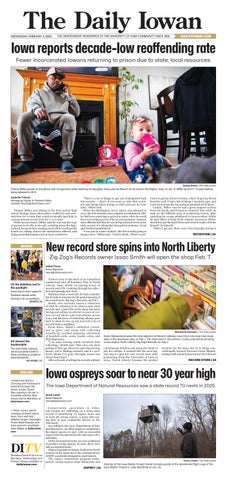
ommy iller was sitting in his first period high school biology class when police walked in and arrested him for a crime that would eventually land him in various prisons across owa for years. hile incarcerated, iller said he was not the type of person to sit idly in his cell, counting down the days. nstead, he spent time reading any book he could get his hands on, taking classes the institutions offered, and doing groundskeeping work at local cemeteries.

not ust being there trying to chill and ust do your time, iller said. hen the urlington, owa, native was released in , his first reaction was complete astonishment. iller had been e pecting to get out in , when he would have served percent of his year sentence. nstead, state officials told him he was being released seven years early as part of a ruling that deemed his sentence cruel and unusual punishment. was ust in a state of shock, like this is really going to happen now, iller said. had to think, hat s ne t
have to get my driver s license, have to get my ocial ecurity card. had a list of things needed to get, and ust went down the list and ust smashed all of them. uckily, iller says he had a great support system from his family and friends to stand by him while he took on the difficult task of reentering society after spending his young adulthood in incarceration. hile he had offers of help from outside resources, iller decided to put his head down and work to make a life for himself, by himself. hen got out, there were a lot of people trying to
New record store spins into North Liberty
Zig Zog’s Records owner Issac Smith will open the shop Feb. 7.
Tucked away in the back of an unmarked commercial unit off anshaw ay in orth iberty, saac mith sat among bo es of records and s, combing through his collection and pricing each item. ith less than a week left, he had a laundry list of tasks to prepare for the grand opening of his record store, ig og s ecords, on eb . mith, who currently boasts a collection of what he estimates to be about , vinyl records and , s in his shop, has been buying and selling records for years at various record shows and conventions across owa, but his story of collecting albums goes back to when he was and received a bo of records from a neighbor.
rom there, mith s collection continued to grow, and along with collecting records, he recalled amassing collections of baseball cards, comic books, coins, and dispensers.
do miss having candy involved with collecting, mith said. ut once you start getting to that age when you start discovering music, you re finding yourself, and it s cool. very phase ve gone through, music has always been there. fter a decade of selling his records without

a permanent location and using the funds to pay for college, it seemed like the ne t logical step to open his own record store after graduating from the niversity of owa in . orth iberty became the perfect
location for his shop due to it being conventionally located between edar apids
Iowa ospreys soar to near 30 year high
The Iowa Department of Natural Resources saw a state record 70 nests in 2025.
onservation specialists in ohnson ounty are reflecting on a state record of identifying osprey nests and at least young osprey, a large fish-eating bird of prey commonly known as the fish hawk. ccording to the owa epartment of atural esources, an effort began to reintroduce the osprey species in , with no successful osprey nests documented in the state since colonial times. f the documented nests, were confirmed to produce young ospreys. n , there were only reported nests. sprey populations largely declined in orth merica in the s due to the widespread use of , a pesticide designed to repel insects. he osprey restoration program transported young ospreys from innesota and
ollector, and the rent being more affordable than both cities.
Oscar Rodriguez, a sales associate at Record Collector, said they were excited for a new record shop to be opening up nearby, espe cially because record stores are becoming more of a rarity as the popularity of music streaming services like Spotify and Apple Music con tinue to grow, accounting for 84 percent of U.S. recorded music revenue in 2024, accord ing to the Recording Industry Association of America.
Alongside competing against music stream ing services, Rodriguez also attributes the lack of music stores in Iowa City to the rising cost of rent for businesses, with current listings on LoopNet, an online listing website for com mercial properties, pricing available units at $8 to $33 per square foot per year. For one listing on South Linn Street, this means paying roughly $74,880 per year for 2,250 square feet of space, or $6,240 per month.
“I’m sure for a lot of other downtown busi nesses, the rising cost of rent and having to maintain a shop like this is getting to be really demanding,” Rodriguez said. “I don’t think landlords or the city realize just how tough it is to make it as a business.”
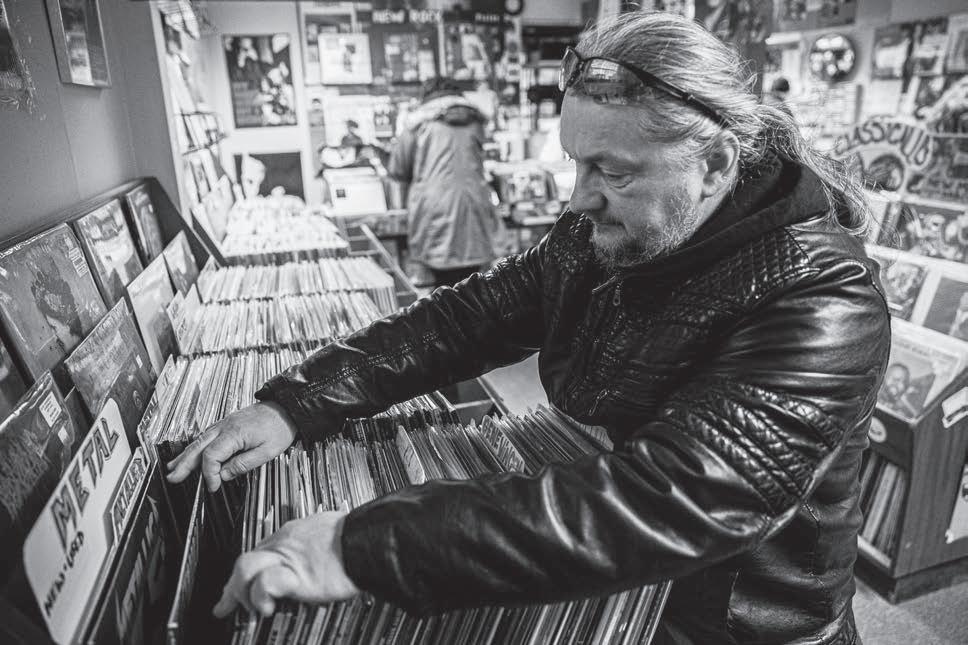
While music streaming services account for a majority of recorded music revenue, the Recording Industry Association of America also noted that revenue from vinyl sales grew 7 percent in 2024, marking its 18th consecutive year of growth, and outsold CDs for the third year in a row.
Gen Z has even decided to return to physical media like vinyl and CDs, sparking a trend on and o ine, with many young people upset about music streaming services not properly paying artists and Spotify previously playing ICE recruitment ads.
While the average cost of music streaming services, which ranges from $10 to 12 a month, is cheaper than the average cost of vinyl, which ranges from $15 to $40 depending on if it’s a standard or deluxe album, Rodriguez points out that many younger people are also searching for a sense of ownership and individuality with their purchases.
“Just because you have an app or Spotify doesn’t mean you actually own the music,” Rodriguez said. “You have no right over that. I think a lot of young people now are looking to build their own individuality and have something to show for it.”
Physical media and the shops that sell them also offer a sense of community to shoppers, something Gen Z seems to be searching for amid conversations around third spaces, a term coined by sociologist Ray Oldenburg to describe public locations where
Wisconsin to locations across Iowa such as the Coralville Reservoir and Saylorville Reservoir.
The last of the birds were released in 2016, and the department’s objective is to actively monitor nests to maintain a steady popula tion, according to the DNR.
According to the Ani mal Diversity Web, an online scientific database run by the University of Michigan, ospreys are an indicator species, a species that reflects the environ mental health of the area they are in, providing a valuable lens into Iowa’s natural land.
David Conrads, the director of the Iowa Rap tor Project, a program within the University of Iowa College of Edu cation dedicated to conserving birds of prey such as hawks and owls, said from the restoration program’s beginning, the university has been a col laborative partner with the department.
one can participate in informal, often free social interactions.
“I didn’t really know anyone in high school who collected or shared that sense of going to concerts or shows, but it’s cool now,” Smith said. “It’s a very personal thing, and that’s great for conversation as someone who has trouble with conversation. It’s a good icebreaker for a lot of people.”
This was one of Smith’s favorite parts of being at Sweet Livin’ Antiques, Art, & Records in Iowa City, where he
don t worry about the streaming stuff because there’s something that you miss in that,” Young said. “When you get an actual record, there’s a visceral interaction — you see the pictures, you see who’s playing, you read the lyrics notes. I meet new people every day, and you don’t do that with streaming.”
Smith started working with Young shortly after moving from the Quad Cities, where he was attending community college, to Iowa ity so he could finish school at the . oung said he’s going to miss working with Smith, whom he often had to remind to take breaks while working.
“I would say, without him, I probably wouldn’t be doing this,” Smith said. “It was a bit of a pipe dream in high school, but as of now, it is a reality.”
In a full circle moment, Smith decided to name his shop after the first short film he ever created during his time in school, Zig Zog’s, closing one era and opening a new one. The shop, whose collection includes records that span across the decades, is set to open Feb. 7 and will be open to all Tuesdays through Saturdays from 11 a.m. to 5 p.m.
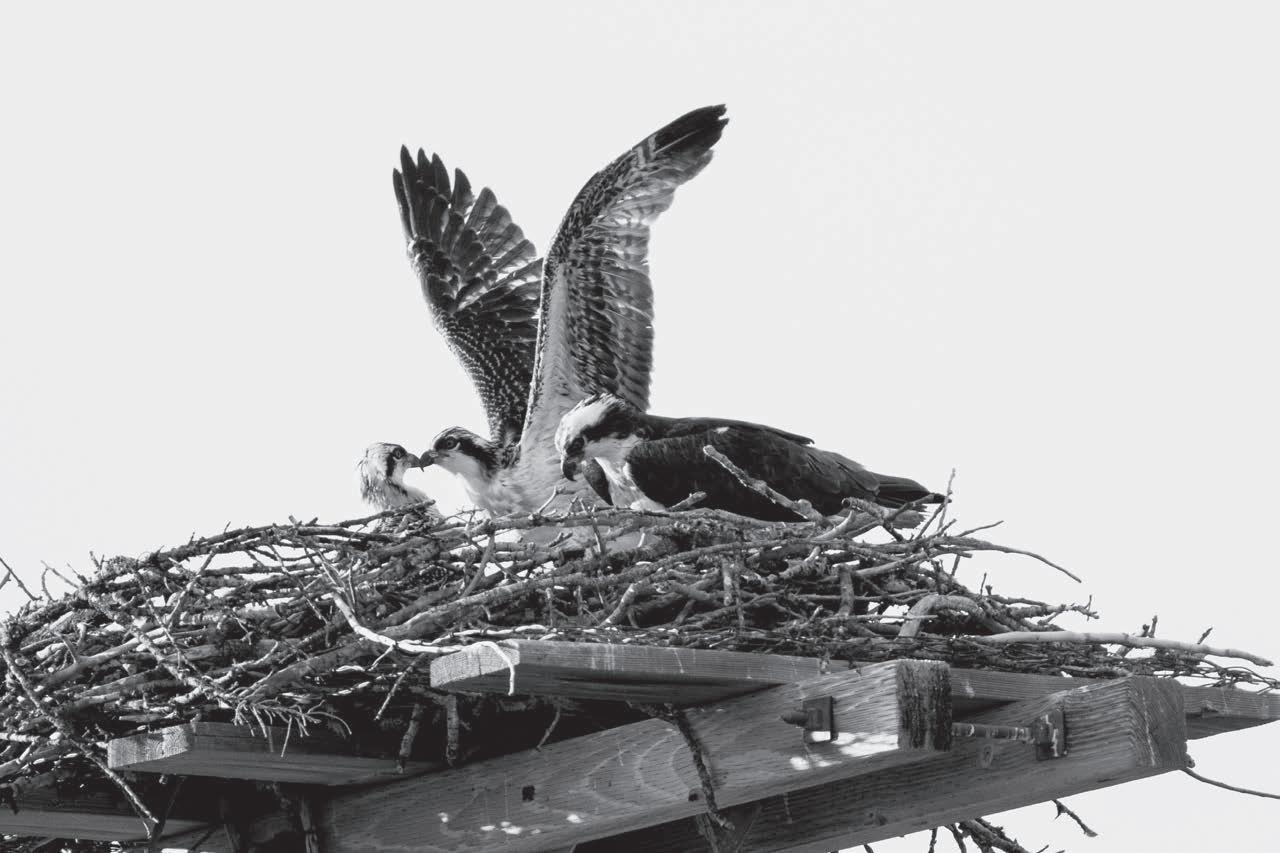
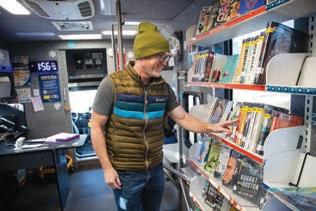
Conrads said the Iowa Raptor Project helped build and operate the Macbride Nature Recreation Area Hack Tower, a tall release structure that provided shelter and food, allowing birds to leave when they were ready for the wild. The department later used the tower in 1997 to release ospreys into the area.
“It’s great news to go from zero to that number in basically 28 years,” Conrads said. “It’s pretty remarkable.”
Conrads said other birds like the peregrine falcon and bald eagles declined throughout Iowa due to DDT. DDT was officially banned in the U.S. in 1972.
“What we are seeing post-DDT and post-establishment of the Endangered Species Act is that a number of these raptor populations have increased tremendously, and that’s good news,” Conrads said.
Riggs Wilson, a DNR wildlife research specialist who contributed to the report, said the record number of nests found is not only a result of an increasing osprey population but also better nest reporting by volunteer numbers within the department members.
The report says ospreys cluster in three main areas:
the Iowa City to Waterloocorridor, the Des Moines metro area, and around Spirit Lake.
“The areas where we see these clusters of nests are areas that have plenty of water resources for foraging,” Wilson said. “Ospreys eat mostly fish, so if there s a lot of water nearby, that’s going to be an area that is very favorable for them to nest in.”
Wilson said ospreys also tend to favor nesting in tall structures, making cellular towers prime candidates for the bird of prey.
Brad Freidhof, the Johnson County Conservation director, said he regularly sees an osprey nest on his drives past a cellular tower near the Costco in Coralville.
Freidhof said he believes climate change could be contributing to birds of prey populations increasing in northern states like Iowa.
“As temperatures warm further north, we see that population growth,” he said. “We’ve seen that with
pelicans expanding northward in the state of Iowa and other wildlife species. So it’s a great opportunity. I hope people enjoy watching them because I surely do.”
Freidhof said Johnson County’s bodies of water make an attractive area for osprey.
“We’re doing a good job in the state of Iowa, looking for habitats to protect and restore for these populations,” he said. “We have great habitats here in Johnson County, with Coralville Lake and the Iowa River, Lake MacBride, and numerous other bodies of water that they can fish from.
Freidhof said the Johnson County Conservation Board will continue to protect properties buffering rivers and streams because the rivers provide wildlife habitats and help recharge aquifers underneath the ground. Freidhof said a great deal of the projects funded by the 2024 Conservation Bond, a $30 million bond to fund
natural resource projects, involve Johnson County protecting habitats along the county’s rivers.
“If we can build corridors along our interior rivers and streams, populations like ospreys hopefully will utilize and enjoy those habitats along those big cottonwood that they historically would have used,” Freidhof said.
Conrads said while 2025 was a historic year for ospreys, there is no guarantee the population will continue to climb.
“It can change overnight with things that we haven’t even dreamed of,” he said. “Is there going to be a new chemical that maybe the testing didn’t reveal that it was going to have a negative effect on populations? Is there going to be a naturally occurring disease to make a big negative impact like HPA? It’s hard to predict.” Wilson said as the department continues to improve nest reporting, he hopes to see the osprey population continue to soar.
“It would be great to continue to see the osprey population do well in the state of Iowa,” he said. “It’s really good to see a successful restoration effort. That’s pretty neat to see everybody’s hard work come to that fruition.”

reach out to me like, ‘We want to help you do this.’ I was like, ‘I appreciate it, but I got it from here,’” Miller said. “I’m not cocky or anything, but I just felt like I have to do this on my own. I have to prove to myself that I can do this.”
Miller said a lot of opportunities fell into his lap, such as getting a job at a fertilizer plant in Wever, Iowa, that opened up two weeks after his release.
Now, Miller works at a manufacturing company in his hometown of Burlington. He owns his own home, his own vehicles, and has three young children and two beloved pets.
Miller’s success story is one of many that has come from those who were formerly incarcerated in one of Iowa’s nine prison facilities.
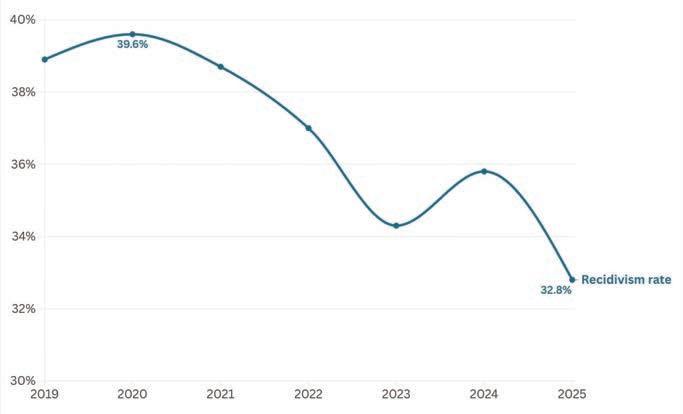
In September 2025, the Iowa Department of Corrections announced the state had reached a recidivism rate of 32.8 percent — the lowest rate seen in a decade.
The state defines recidivism as “the return of an individual to an Iowa prison within three years following a previous term of incarceration.” A lower recidivism rate means fewer formerly incarcerated individuals are reoffending and returning to the prison system following their initial release.
Iowa historically ranks toward the higher end of recidivism rates across the U.S. In a 2022 study by the Virginia Department of Corrections, Iowa ranked 16th out of the 42 states that had data available. At the time of the study, Iowa had a recidivism rate of 38.7 percent.
ecidivism rate data can be difficult to compare across states, or even within the same state, due to the different ways recidivism is defined and recorded. or e ample, the Iowa Department of Corrections uses a three-year scale to measure recidivism rates, while other studies utilize longer or shorter time periods.
Recidivism rates are also typically recorded using a “cohort” of formerly incarcerated individuals, meaning the study or department tracks a select group of people who were released and records if any of them reoffend.
According to the Prison Policy Initiative, a Massachusetts-based American criminal justice policy think tank, this model can skew recidivism rates to be higher than reality because they only e amine a slice of the prison population, which can overrepresent the people who cycle in and out of prison with regularity. When this issue is taken into account, recidivism rates can drop by as much as 50 percent, according to the think tank.
Miller chose his own path after he was released by using the skills he gained while in prison. However, there are also many others who utilize resources available on the outside.
The Iowa Department of Corrections attributes the state’s low recidivism rate to a collaboration of both state and local resources.
In a Sept. 8, 2025, release, the state Department of Corrections credited the low recidivism rate to a variety of factors, including institutional and community-based treatment for high-risk people, using evidence-based practices, improving
reentry strategies, increasing access to edu cation while incarcerated, and improved staff and case management training within the department.
Katrina Carter, the department’s director of programs and reentry, said the state takes a holistic view on reentry.
“We believe that reentry is every one’s business, no matter what role you are in the institution or communitybased corrections,” Carter said. “And we believe that reentry begins the moment a person becomes involved with the criminal justice system.”
owa s nine institutions offer a variety of programs to assist incarcerated individuals in coping with e isting issues and setting themselves up for success after they are released. One core program, Acceptance and Commitment Therapy, helps indi viduals become less impulsive and build stronger decision-making skills, Carter said.
The department also assesses individ uals to determine their own unique needs and reentry plans, Carter said. An indi vidual may also be ordered by the court to participate in other forms of therapy or programs while incarcerated as part of their sentencing order.
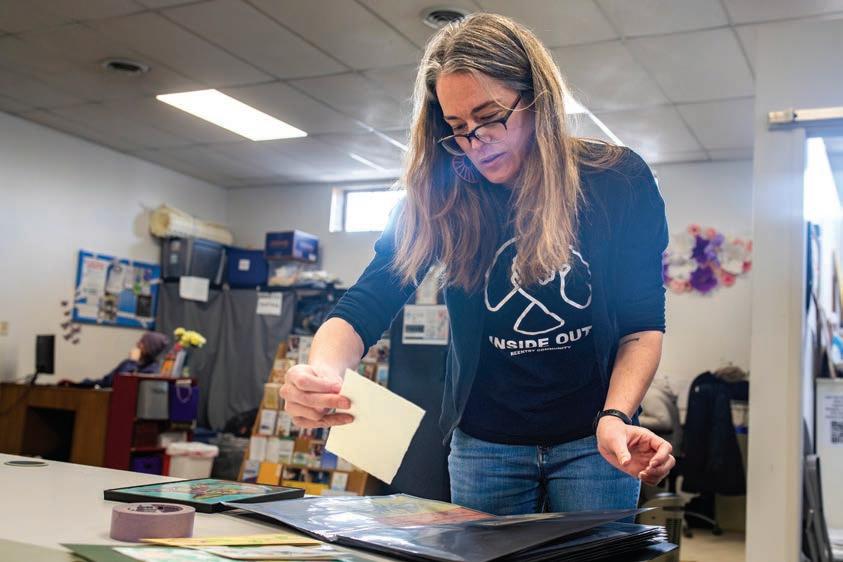
In the last decade, the department created registered apprenticeship programs offered in all of the state s institutions.
Jennifer Seil, the department’s registered apprenticeship coordinator, said there are such programs that offer training in various fields, including welding, , electrical, plumbing, and graphic design.
Since the program’s start in 2015, 588 people have completed apprenticeships, Seil said. According to a 2022 study by the Iowa Department of Human Rights, the recidivism rate for those who completed a registered apprenticeship program was just under 20 percent, while the rate for those who did not was 39 percent.
The apprenticeship program is an “earn and learn” model, where enrollees are on the job and earning money while learning the skills of the trade, Seil said. Upon release, the enrollee then takes an e am to become officially licensed in their chosen field, she said. owever, some trades do not re uire special licensing, so the e am is not necessary in all cases.
In addition to this programming, the state Department of Corrections also has employees on the inside of the institutions that help incarcerated individuals with things like job placement and acquiring a state ID.
The department also works to help make community-based connections with organizations that help formerly incarcerated individuals, especially for those who may not have a support system in the form of family or friends upon release, Carter said.
“Let’s say that maybe because of their behaviors, their family is just tired, and their family is just not interested in supporting them because they might have burned so many bridges,” Carter said. “What can we do to help those people learn how to manage themselves better so that they can receive that support from family, from faith-based community agencies, from nonprofits, from maybe even a whole new support system that they’ve never reached out to before?”
After spending five years incarcerated in Iowa, Josh Gillette said it was the community-based organizations along with the support of his family that got him
Iowa’s recidivism rates
through the arduous process of putting his life back together.
Gillette grew up in California, but his family moved to Iowa City when he was in high school. After that, Gillette said he moved back to California but would return to Iowa to visit. It was during a Christmas visit that Gillette was arrested and sentenced.
Being a former drug addict, Gillette said before his time in prison, he had no real life e periences that would have taught him how to function in society due to his addiction.
“I was living a lifestyle that was not enmeshed with society. had no e perience living in the real world or working a job or dealing with real world problems and issues,” Gillette said. “Then my whole lifestyle changed because I was not using drugs anymore, and then I was in prison. Thankfully, I just put my head down and ust charged at it and ust started doing stuff and keeping busy.”
While incarcerated, Gillette took college courses and apprenticeships to feed his innate desire for learning new things. He completed an associate’s degree from Iowa Central Community College while incarcerated and went on to graduate from the University of Iowa with a degree in health sciences in 2024, just three years after being released.
illette specifically credited owa itybased Inside Out Reentry Community as a great help once outside. he nonprofit organization helps released individuals reintegrate into society through services like housing and workforce placements, support groups, and creative workshops such as writing and painting.
“They’re amazing people,” Gillette said of Inside Out Reentry Community. “I don’t think you ll find a better reentry place in the country.”
The organization began in 2014 and initially served just a few people in the area. Now, the nonprofit serves around 300 people, Michelle Heinz, the organization’s e ecutive director, said.
Heinz said because participation in the reentry program is not mandatory, the people seeking their help do so with an open mind and are able to tailor their involvement to what they need as individuals.
“We may work with somebody one time and another person once a week for three years, so people really utilize our services in a very broad way,” Heinz said. “I think that’s the real power of a community-based reentry services provider.”
Another locally based program that helps people across the state is Living Beyond the ars, a nonprofit that serves those leaving incarceration primarily through a statewide resource called irst top fter rison. This guide provides a list of organizations and resources that people can use to find help after they leave prison.
“We just try to increase the likelihood that a person is going to leave prison with some support, whether it’s a mentor, whether it’s a job lead, or whether it’s recovery support or mental health support, or whether it’s a place to live,” Mike Cervantes, the organization’s reentry organizer, said. “We want to make sure that people, when they leave, have many of those things in place.”
Gillette said he is thankful he had connections and a place to live in the Iowa City area, noting other
parts of the state don’t have the same resources.
“I was very fortunate because with Iowa being so rural and unpopulated, a lot of places these guys are paroling back to don’t have the resources like nside ut and stuff like that,” Gillette said.
Although Iowa’s low recidivism rate is an accomplishment, there are still areas for improvement.
When Gillette was released from prison and was taking classes at the UI, he was not allowed to have a computer. Instead, he would have to take a laptop from his halfway house and work in front of the staff, then return the laptop when he was done. Still, Gillette said he thought he was afforded more leniency than those who came after him. or e ample, the halfway house, located in Coralville, stopped allowing people to do their schoolwork inside the building and told them to use publicly available computers elsewhere.
“ I was like, ‘What? They didn’t make me do that. Why are they making you do that?’ And I’m looking at this kid, and he’s got brown skin, and it’s just like, am I being treated differently illette said. know m being treated differently. don t know why m being treated differently.
Gillette said he was fortunate to have a parole officer who saw how he was trying to improve his life and who afforded him more leniency than others. till, it was difficult to achieve an education with all the additional hoops that were put in front of him and others, he said.
Cervantes, the reentry organizer for Living Beyond the Bars, said Iowa has begun to make strides in improving its parole system, with some judicial districts having shifted the focus of parole from being punitive to collaborative. Instead of only being there to dole out punishments if parole terms are violated, parole staff now work more closely with the person to make progress on what they need and want to accomplish.
t s hard to pinpoint e act reasons why recidivism rates have been dropping in the state, ein , the e ecutive director of nside Out Reentry Community, said, but she said she has been encouraged by the increase in the number of organizations like hers.
“I’ve also seen some incredible community-based reentry programs pop up all across the state that are providing housing services, that are doing these intensive employment programs,” Heinz said. “So I think there’s a lot of groups and a lot of people doing a lot of really great work.”
One of those people is Miller, who said he still keeps in touch with those he served time with to provide them support and advice on their own journeys. A father himself, Miller said he also makes sure to tell youth that being incarcerated isn’t something to strive for.
“I tell these younger kids out here, don’t ever try to glorify that prison stuff. here ain’t nothing cool about someone telling you when you have to get up and take a shower, to use the bathroom, or permission to go outside and enjoy a good day,” Miller said. hat s what ust try to e plain to them just do what you have to do to stay out of there. It’s easy, it’s so easy.”

In fiscal year 2025, Iowa reached its lowest recidivism rate in a decade.
OPINIONS
A guide to salting the ICE on your streets
What’s
going
on
in Minneapolis, and what we can learn to prepare ourselves.

“When I was inside my cell, I heard wailing, screaming, crying, begging, and pleading from women, men, and children. Alongside that visceral anguish was the small talk, banter, and laughter from the federal agents outside our cells.”
These are the words Patty O’Keefe — a protester, a U.S. citizen, and a Minnesota resident who was arrested and brought to a detention center spoke during a field hearing on ICE in Minneapolis on Jan 16. er words are shocking and horrific, but there comes a time when we must face the shock with our eyes open and be horrified. This is that time.
We should be scared because while kindness may fail to carry a cause on its own, fear will always spur us on.
I can only imagine how much the fear we should be feeling has been blunted by the constant conveyor belt of violence we’ve witnessed across the country at the hands of a group of government-funded thugs so drunk on power they’ve forgotten basic morals. The stories coming out of Minneapolis, especially right now, are seemingly without end.
So is the fear.
I spoke with a source in Minneapolis — my hometown — an immigrant, whose family fled from oppression and violence. They have asked to remain anonymous for their safety and that of their family. They described the economic effects on the city as well as the emotional toll the presence of ICE agents has had on locals.
“They don’t care if we’re citizens or not at this point. People are running away from their government in order not to die in their own country,” the source said. “I even noticed they’re making some apartments outside of my work. They’re taking a longer time now because most of the construction workers were Hispanic, and now they’re afraid to show up.”
According to a 2024 case study by the University of Michigan, immigrants make up 20 percent of the construction industry’s workforce. The Hispanic community in Minneapolis makes up more than 10 percent of the population, according to the U.S. Census Bureau. If it was ever about the economy, getting rid of immigrants should have been last on the docket.
So is it about faith?
Kristi Noem, the Secretary of Homeland Security, or DHS, shared a post on Facebook on Dec. 9, 2025, that reads, “Every day, DHS works with the Christian community, engaging in faith-based outreach to confront bias wherever we encounter it. Beyond ending government bias, the Trump administration is working to keep places of worship safe from terrorist threats. In this country, our motto will always be: ‘In God We Trust.”’
I’m personally not religious in any traditional sense, but I think they must have a hell of a lot of trust in God to think they can assault priests with impunity.
In Broadview, Illinois, on Sept. 19, 2025,
because he was white, and it “wouldn’t be fun anyway.”
Innocence is not something these thugs are worried about, neither is “keeping criminals off the streets, as they would claim. According to CNN, ICE gassed a minivan full of children caught between a group of agents and protesters on Jan. 14.
Then there are the images of Renee Good’s blood-stained airbag, with her children s stuffed animals hanging out of the glovebo in her car. ystsanders filmed a video of a woman desperately pleading with the police for help after her fleeing husband was shot in the leg through the door of his home, not even a week after Good’s death. On the morning of Jan. 24, a day after Minnesotans showed up to Minneapolis in droves to protest during -30 degree weather, Alex Pretti was murdered.
With his phone in his hand documenting agents, Pretti, a man with no criminal record and who worked as an ICU nurse serving veterans, was forced to his stomach by several federal agents, pistol-whipped, disarmed, and then executed in the street after shots were fired in about five seconds, the New York Times estimated.

Following the shooting, Minneapolis Chief of Police Brian O’Hara held a press conference and said Pretti was a legal gun owner. He had a permit to carry. Outrage followed, even from sources traditionally aligned with the Republican Party. According to a report by , the ational ifle Association has called for an investigation into the shooting. The two border agents who shot Pretti have since been put on administrative leave — according to a report by CBS news — which means they’re sitting pretty, sipping on tax dollars, when they should be in a cell.
The siege of Minneapolis is not about money, faith, or criminal control. It’s a distraction as our predatory president sacrifices his own country for an image booth. Trump is following a classic dictatorial tactic to try to get the country to rally around the flag against a threat a crisis is often the last foothold of the stumbling despot.
Whether the motivations are real or fabricated, the chaos is a weapon of incredible power and can explain why so many Americans are still standing by while their fellow citizens are killed.
“In the aftermath of 9/11, 55 percent of surveyed Americans said they believed it was necessary to give up some civil liberties to curb terrorism. After Pearl Harbor, more than 60 percent of surveyed Americans supported expelling Japanese Americans from the country,” Steven Levitsky and Daniel Ziblatt wrote in their book, “How Democracies Die.”
These statistics illustrate the power of the crisis as a tool in U.S. politics. Trump, rather than relying on one massive crisis, built several over his two terms. From the recent strikes in Venezuela and so-called immigration and fraud crisis that is fueling the hostility in Minneapolis, to the travel bans and vaccine mess from his previous term, Trump has maintained a constant state of disarray.
In the face of so much turmoil, it can feel insurmountable to take action against the violence we’re witnessing on a daily basis.
Preparation is vital, and so is sticking together. If you can protest, try to stick to and form large groups, and travel to bigger cities. Flynn told me how many of the protesters in Minneapolis were frequently traveling from nearby cities, such as St. Paul.
Another way to help is by donating. Some options for relief funds include the National Immigration Project, a 50-yearold organization that not only defends noncitizens’ rights in court but pushes to advance their rights and protections as well. You can see a list of their achievements in this fight on their website, which includes rapid response infrastructure to ICE raids, training courses, and, as stated before, representing and actually freeing people from the ICE detention centers.
f you want to specifically help in innesota, Stand With Minnesota is an excellent resource that includes a list of mutual aid funds, crowdfunding campaigns, further organizations providing legal support, and organizations in Minnesota that support and empower immigrants.
MN NOICE also provides a similar directory of organizations that support noncitizens across Minnesota.
Remember as well to pressure local officials and vote in the midterms. rump recently warned Republicans they have to win midterms or else he would get impeached — again. Maybe this time we don’t let him frame the mugshot on the wall of the White House and actually keep him in jail.
But in the meantime, it’s time to start preparing for the worst.
If you have a phone on you, start recording the interaction. You have the right to take photos and videos of “government officials carrying out official duties, according to The American Civil Liberties Union of Iowa. You’re not legally allowed to interfere physically when ICE is actively detaining someone. This includes touching the federal agents or their vehicles, pulling down their masks, or blocking them with your body or a vehicle.
Keep yourself and those around you safe to the best of your ability and keep as cool a head as you can. Take the number of agents and vehicles present into account, and if possible, any information about the person being detained. e t, specifically for residents of owa City, call the Escucha Mi Voz hotline to report ICE activity. This is the organization primarily involved in rallying people for González Ochoa. We, the people of the U.S., have been repeatedly slapped by the hand of the higher government while being told we’re being fed. It’s time to bite, with your wallet, with your presence, with your votes, with your preparation, and with your support. Check on your friends and neighbors, start building community around you, and prepare for a general strike if you have the means to participate.

From everyone I’ve spoken to in Minneapolis, their advice on how we can help boiled




























We’ve already witnessed ICE in Iowa City with the abduction of Jorge González Ochoa from Bread Garden on Sept. 25, 2025. Gonzàlez Ochoa was recently released as a federal judge called ICE’s actions “indefensible” according to I spoke to a friend from St. Paul, Michael Flynn, who works as an independent journalist and has been documenting a majority of the protests on YouTube, who described the community support. He spoke about the ways Minneapolis is defending their community.

Start forming connections now within the community and thinking about what you might do if ICE detains one of your neighbors. ne tool has been key to fighting in Minneapolis: whistles. Whistles have been used to quickly form crowds around ICE agents alerting people who could be at danger. They can be bought in bulk for cheap and are easily worn around the neck.
“It’s sort of a shelter in place thing. Neighbors will follow ICE around until they stop someplace, then use their car horns or mainly the whistle to alert potential arrestees to hang tight,” Flynn said. “[The whistles are] 3-D printed and available at like every business around the city.”
If ICE is spotted nearby, three short whistles are blown. If ICE is actively detaining someone, there are three long whistles. It is simple, easier to do than yelling, and above all, hard to mistake for aggression. Get yourself a whistle, and get one for your friends as well.
Then it is important to start forming supportive communities, especially for the economically vulnerable, and preparing to go on strike. There are many people who may not be able to afford to strike it s important to be available for these people and start forming support systems so the real damage is done to the government’s economy and not our stomachs.

U.S. Border Patrol Commander Gregory Bovino has been sacked by Trump and is hanging up his “fascist aesthetic coat”— as reported in an article by The Guardian. This isn’t necessarily going to make things better as he’s been replaced by Tom Homan, who said he was going to “run the biggest deportation operation this country’s ever seen” in 2024, according to an article by AP News. In a CSPAN video taken at a restaurant in Urbandale, Iowa, a reporter asked why Trump “shook up his leadership team.” He responded by saying, “I do that all the time, I shake up teams. Everybody here, these are a lot of owners of farms and places, and you shake up your team. If they can’t do the crops fast enough, they go.” is response suggests ovino was fired not because of the reckless violence but for his lack of results.
Iowa Attorney General Brenna Bird joined 20 other state attorneys general on Jan. 21 to oppose a federal judge’s order that ICE violated Americans’ constitutional rights in Minneapolis, citing that the protesting was not peaceful, according to an article by KCRG. The crackdown still continues.





different areas, lynn said.
“You’d go out, and every business around has a little thing of snacks and some hand warmers, and people have coffee in




Iowa City Mutual Aid is one of the resources that already works independently to feed and house vulnerable members of the community. Forming more organizations and groups that push to do similar work is an essential preparation in the event of a general strike.
But you can’t support your community if you can’t support yourself, so knowing your individual legal rights in the event you see someone being detained is important.
If it should slow down in Minneapolis, it is only so it may pick up somewhere else, and as it does— just as we get a moment to breathe — we remember what values Good and Pretti died standing up for. They stood for their neighbors, their coworkers, their friends, and their foundations. They protested so others could live and travel freely and not be forced to hide in the shadows as if they had less of a right then the so-called “Americans” that stole this land in the first place. If you feel guilty about that fact, you are privileged. Now is the time to use that privilege and protest, fight, and boycott for the people who can’t. But if compassion will not stir you, if fear will not stir you, then maybe shame will.
ister in the head with a pepper ball from a
Education beyond the classroom
The “EDUcation Unscripted and Xplored” Podcast addresses educators’ needs and challenges.
Within the Scanlan Center for School Mental Health, University of Iowa College of Education professors Kari Vogelgesang and Mark McDermott have begun co-hosting their own podcast to discuss topics related to teacher wellness and challenges in education.
Jake Mayer, the student success and engagement coordinator for the School of Journalism and Mass Communication, said podcasts as a media format are accessible for anyone and can provide widespread, direct information about important topics.
“I think podcasts have the potential to be very informational and very approachable for a lot of people,” Mayer said. “Most education podcasts, in particular, are pretty rigid in what they plan to talk about. I think it’s very important to include conversational aspects in educational podcasts if it fits.
The “EDUcation Unscripted and Xplored” podcast aired its first two episodes in January and is available on the Scanlan Center for School Mental Health website, Apple Podcasts, and Spotify.
he first episode, hy e re oing
ff- cript ho e re nd hy his Matters,” was released on Jan. 7, and the second episode, “Literacy as a Wellness redictor ow eading kills hape Lifelong Outcomes,” was released on Jan. 30. Both episodes were around 35 minutes long.
The first episode served as the introduction to the podcast, where the co-hosts discussed the evolving process of education and their perspectives of how
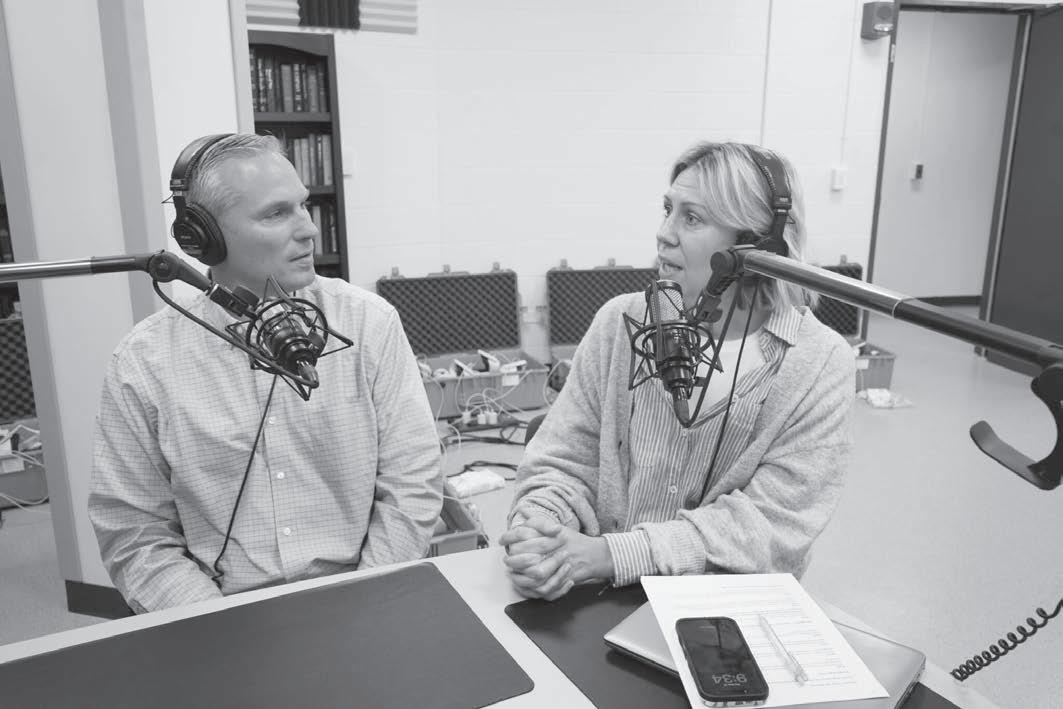
podcasting becoming a popular tool to discuss education topics.
According to December 2025 statistics from Learning Revolution, 533,493 active podcasts were recorded last year.
Education represented 12.7 percent of podcast listens, according to Learning Revolution’s website, alongside genres
Episodes are recorded monthly in the UI’s Lindquist Center and feature educators from across the nation bringing awareness and open productive conversations about solving those different problems.
interested in what we’re talking about.”
their teaching careers changed over time.
The next episode featured Leah Zimmermann, a clinical assistant professor in special education at the UI. Vogelgesang, McDermott, Zimmermann discussed how literacy is integrated beyond classroom performance and into health and wellness.
The episodes are being produced amid
such as Society & Culture at 14 percent and Business at 9.5 percent.
While many education podcasts discuss education models, personali ed learning, and technological impacts, this new podcast focuses on educator wellness, literary instruction, challenges in rural education districts, chronic absenteeism, and other broad topics.
UI sta , students react to vaccine changes
The number of vaccines recommended by the CDC has gone from 17 to 11.
adequately tested.
“A new vaccine would go through extensive clinical trials with thousands of adults or kids, and they make sure that it was safe and that it worked right,” Askelson said.
“We really are going to be inviting people from across the nation onto the podcast,” Vogelgesang, who also works as the director of professional development in the Scanlan Center for School Mental Health, said. “Some of it may be a little controversial, but I think it’s great to get into spaces and chat through some of these topics together and make sure that all sides of the story are told and let people make their own decisions with facts that are delivered.” McDermott, who also works as the associate dean for undergraduate education and educator preparation, said students, educators, administrators, and parents are able to connect to the topics that they will further discuss in the podcast.
“What Kari and I are thinking is this isn’t just for people who teach teachers, or it isn’t just for people who are working as teachers,” McDermott said. “It’s hopefully something that all of those people from different perspectives can connect with education in different ways and can be
The co-hosts gather discussion ideas from surveys sent by the Scanlan Center for Mental Health to teachers and school administrators throughout Iowa to address specific needs and challenges that different districts are trying to address. An intake form from the Baker Teacher Leader Center is provided for people to share their own needs and challenges.
“Once we identify those topics coming from those different sources, we sit down, and we go through a guideline in terms of a script,” Vogelgesang said. “We don’t really stick to that script all the time. We do have an idea about ‘These are the things we really want to make sure that we discuss or talk about at some point in time.’” ogelgesang said she hopes different people who listen to the podcast are able to understand how people are able to address those concerns related to education.
“I think that’s what we’re wanting for this podcast is to really make everybody feel welcome,” Vogelesang said. “Each member of a community, parents, neighbors, are all so important and plays a role in the overall health of the students and everything that happens in and outside of the schools. So this isn’t just for teachers, it’s really for everyone.”
University of Iowa students and public health experts are wary of the Centers for Disease Control and Prevention, or CDC, lowering the number of recommended vaccines for children.
On Jan. 5, the Department of Health and Human Services, or HHS, and the CDC implemented new recommendations for the childhood vaccine schedule, reducing the number of vaccines that are recommended for children from 17 to 11.
The new recommendations state all children should be vaccinated against diphtheria, tetanus, acellular pertussis, or whooping cough, aemophilus influen ae type b, Pneumococcal conjugate, polio, measles, mumps, rubella, human papillomavirus, or HPV, and varicella, or chickenpox.
accines such as influen a, hepatitis A, and rotavirus are no longer broadly recommended, and other vaccines have seen changes in timing and dosage. The HPV vaccine is only recommended for a singular dose, instead of the two doses previously recommended.
University of Iowa third-year student Rose Kelly said she feels the changes to vaccine recommendations are dangerous for young children.
“The childhood vaccines are super important because kids’ immune systems aren’t very strong, and so it’s important that they are getting these vaccines,” Kelly said.
The importance of childhood vaccines is not only something elly emphasi es professionally, but something she can reflect on personally.
“As someone who got all of the vaccines, I’m super grateful that I have them,” Kelly said. “I’m very pro-vaccines, and I think it’s really important to get vaccinations.”
The CDC’s changes alarmed UI public health experts, who say the revisions veer sharply from the evidence-based process that has guided immuni ation policies for decades.According to the CDC, trust in public health declined from 72 percent to 40 percent between 2020 and 2024.
The CDC reported that vaccination rates among kindergarteners decreased for all vaccines between 2020 and 2025 from 94.9 to 92.1 percent.
Natoshia Askelson, a professor at the University of Iowa’s College of Public Health, said she feels as though the new vaccine recommendations have not been
Askelson said after rigorous testing and approval by the U.S. Food and Drug Administration recommendations would be reviewed by the CDC.
The next step in this process is the dvisory ommittee on mmuni ation Practices. The federal advisory committee is composed of medical and public health experts that develop recommendations on the appropriate use of vaccines in the civilian population.
The committee helps guide the CDC on immuni ation schedules, which the publishes annually for the American public. Askelson is concerned about lowering doses for vaccines as well.
“They have not looked at the evidence to understand whether or not going from two doses to one dose makes the vaccine less effective, skelson said. here is some concern that if you only have one dose, you might not be as protected.”
The federal government’s position, according to a CDC press release, is that the updated recommendations are based on the practices of other developed countries and how these countries structure their immuni ation schedules.
Askelson said she feels that before these changes, the U.S. system for recommending vaccines was the gold standard internationally.
Since these new changes are recommendations, Askelson said medical providers are still allowed to administer the vaccinations that are not being recommended anymore.
a or professional organi ations, including the American Academy of Pediatrics and the American Medical ssociation, have publicly affirmed that they will continue to follow the previous vaccine schedule.
olden ukes, a first-year student, also worries about the changes being made.
“I think this is a misinformed change since this will only put more kids at risk for illnesses that we have vaccines for,” Dukes said. “This is only going to cause an increase in preventable diseases that often have lifelong consequences.”
Dukes is concerned about the future impact of this revision.
“I understand their reasoning behind this choice, but I think it will cause more harm than good,” Dukes said.
Fundraising influences Iowa governor’s race
Finance reports depict fundraising deficit between candidates.
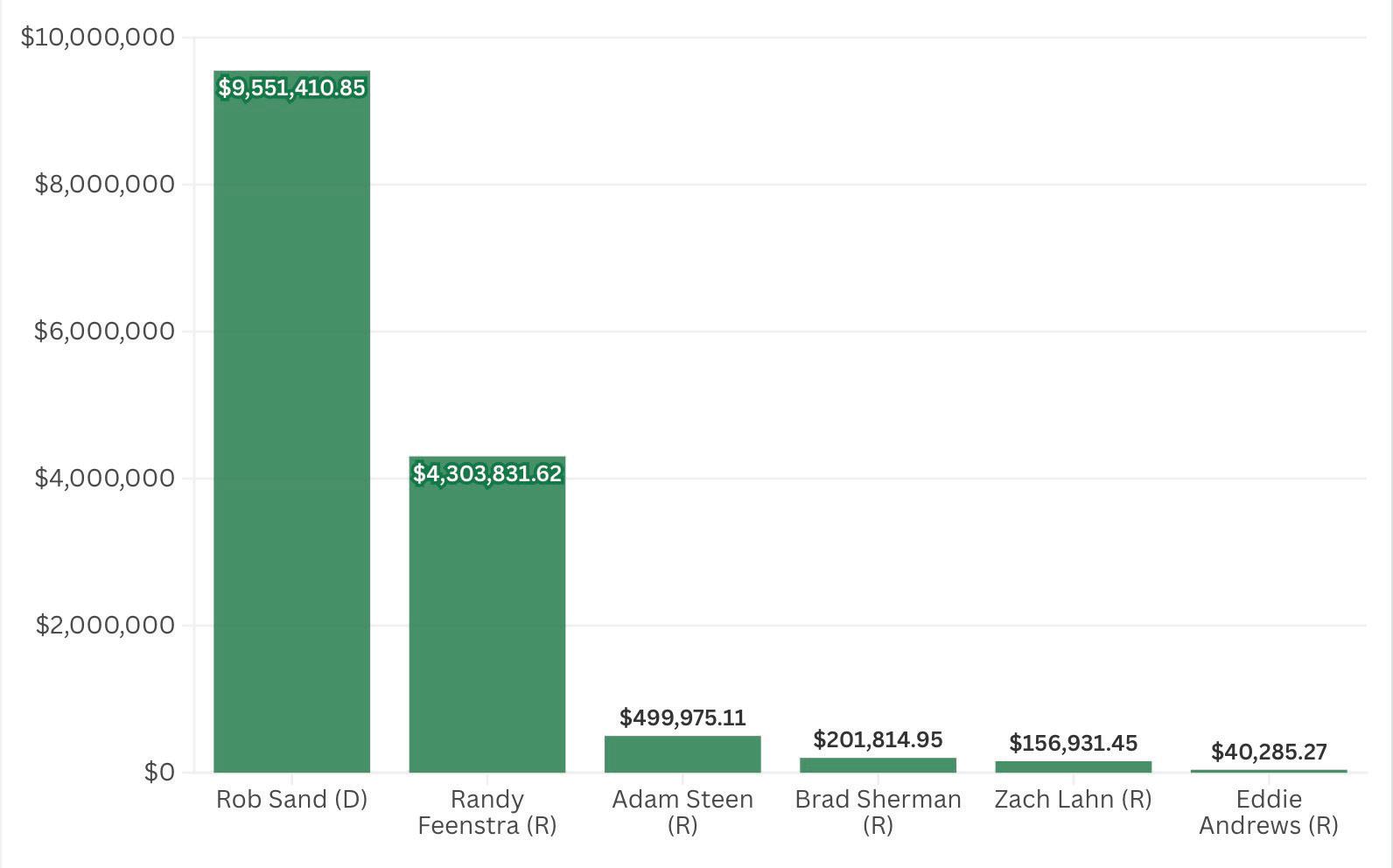
Cash contribution totals for Iowa gubernatorial candidates in 2025
Gubernatorial hopefuls released record-breaking campaign fundraising numbers from the 2025 calendar year, which represent a contentious contest for the open seat. Less than 10 months from Election Day, the pivotal race for Iowa’s next governor is gaining momentum.
After Gov. Kim Reynolds announced in April she would not seek reelection, Republican and Democratic prospects have leaped at the opportunity to fill the open seat.
U.S. Rep. Randy Feenstra, R-Iowa, officially announced his bid for governor in October, though he maintained an exploratory committee for months, seemingly interested in making a run since May.
Adam Steen, former director of the Iowa Department of Administrative Services, Iowa Rep. Eddie Andrews, R-Johnston, former Iowa Rep. Brad Sherman, and Zach Lahn, an Eastern Iowa farmer and businessman, are also vying for the GOP nomination in June.
State Auditor Rob Sand, Iowa’s only statewide elected Democrat, launched his bid for governor in May and quickly cleared the field of most other emocratic hopefuls.
Collectively, the gubernatorial candidate have raised millions of dollars, with Sand, Feenstra, and Lahn, who is primarily selffunded, leading the way.
Frederick Boehmke, a political science professor at the University of Iowa, said money matters in elections but even more so in races without an incumbent.
The 2025 campaign finance reports, released by the Iowa Ethics and Campaigns Disclosure Board the week of Jan. 19, lay out donations and expenditures from the last calendar year.
Finances are essential early in a campaign to increase name recognition and to access a range of voters across the state, said Tim Hagle, a UI political science professor. agle said it can make a difference in how accessible candidates are to voters — a key in building a platform — especially for nonincumbents or candidates who have never held statewide office.
Hagle said campaigns reach donors through a range of methods: phone calls, door knocking, mailers, and, most recently, social media. He said in the primary stage, candidates look for donors who are already a part of their base before looking to broaden their appeal to independent or no-party voters before the general election.
Alex Smith, a UI political science professor, said fundraising is important, but its influence depends on the election, and different offices need varying amounts of money to be competitive.
Smith said the demographics of the region the election is in play an important role. He said if one party has a consistent voter registration or turnout advantage, a challenger from the opposite party will need more money to win.
As of January 2026, there are 503,619 Democrats, 701,173 Republicans, and 584,345 no party voters actively registered in Iowa, according to the Iowa Secretary of State.
Megan Goldberg, associate professor at Cornell College in Mount Vernon, Iowa, said despite fundraising’s importance for campaigns, there is limited research to support the idea of candidates “buying” elections with massive amounts of money. She said candidates can still lose elections, even if they have a large fundraising advantage.
Sand, the presumptive winner of the Democratic primary and sitting state auditor, tops the list of fundraisers in the gubernatorial election.
He raised over $9.5 million in 2025, breaking the state record for most money raised during an off-year in the state’s gubernatorial campaign history by more than double, according to a news release from the campaign. It leaves Sand with $17 million, including his cash-on-hand from the start of the year.
Sand’s donations outraised the entire epublican field combined.
Donations to GOP candidates sit at about $7.2 million, compared to Sand at $9.5 million.
Sand did not accept corporate Political Action Committee, or PAC, money according to his finance report, which points to a grassroots effort.
“This record-breaking haul is proof that Iowans are tired of the status quo in Des Moines that has left them behind over the last decade of one-party rule and are putting their hard-earned dollars behind a campaign that prioritizes people over politics and works to build an Iowa that isn’t redder or bluer, but better and truer,” said Sand’s Deputy Campaign Manager Emma O’Brien in the news release.
In 2024, Sand raised over $8.6 million for a presumptive bid for a second term as auditor before his gubernatorial campaign was announced, according to the 2024 finance report.
Critics of Sand refuted his fundraising efforts because of the striking donations from his in-laws, Nixon and Nancy Laurdisen, who contributed $2 million each, and his wife, Christine Sand, who donated more than $4 million over the course of the 2024 calendar year.
His wife and in-laws did not appear once in the nearly 6,000-page-long 2025 report.
Sand instead emphasized his small-donor contributions, listing in a news release 111,789 donations to the campaign were less than $100 dollars. In addition, he received contributions from 36,609 unique Iowa donors.
The donations, all from 2025, come well in advance of the gubernatorial primary, which Goldberg said is important because early fundraising can signal a campaign’s viability to larger donors or influencers.
“It might send a Bat-Signal to national organizations who have tons of resources, like the Republican Governors Association or the Democratic Governors Association, that they should use some of their resources to focus on you as well,” Goldberg said.
She said early fundraising and the emphasis on small donors from the Sand campaign show his attempt to signal a competitive, winnable race for Democrats. Chet Culver was the last Democrat to win the Iowa governor’s race with his victory against Republican Jim Nussle in 2006.
Hagle said campaigns may emphasize the small-money donations to represent support from the average voter as opposed to being influenced by the ultra-rich or appearing as being “above the average American.”
“He is trying to dispel that sort of aura of being one of the elites and rich and playing politics,” Hagle said.
Similarly, Hagle said out-of-state donors commonly become a criticism of state-level campaigns, and candidates tend to emphasize what donations came from the state and not the percentage that didn’t.
Smith said having more, smaller donors does serve as a decent gauge of potential success. He said from a messaging standpoint, emphasizing small donors is a way to show people are excited about the campaign.
“This large number of people who don’t always give to candidates are now getting off the couch and getting more involved, and that is a good indicator that they are more likely to show up and vote on election day,” Smith said.
Despite the emphasis on small donations, the report also includes major donations from in-state and out-of-state influences.
Major Iowa donors include $500,000 from Kirk and Robin Kirkegaard of Indianola, and $200,000 from Fred Hubbell, Democratic nominee in Iowa’s 2018 gubernatorial race. Illinois Gov. J.B. Pritzker contributed $50,000, and LinkedIn cofounder Reid Hoffman contributed $250,000 across state lines, according to the report.
Smith said Sand’s fundraising totals indicate a competitive governor’s race in November. He said the Democratic campaign will reap the benefits of the funds in the absence of a strong primary challenger.
“Even if you want to consider Feenstra a frontrunner, he still has to campaign against other Republicans for the next few months,” Smith said. “That requires expenditures going towards trying to ensure he wins that election or that primary.”
Hagle said money will not be the biggest indicator of support or success come November. He said earned media, such as giving public speeches and holding rallies or events, is the most essential way to increase reach.
“You don’t have to pay for the news programs to cover it, and you are getting basically free publicity in that sense,” Hagle said. “So, at a certain point, [money] is not as relevant.”
agle said and s funds will not influence the race as much as his high level of name recognition in Iowa.
Hagle said Sand’s fundraising does not necessarily depict support among Iowans across the board. He said it shows Democrats’ readiness for change, but there is not yet enough indication that cross-party voters will support him as a candidate.
“Those voters are not overly unhappy with what the Republicans are doing,” he said. “That is why it’s been giving Republicans control election after election now.”
Hagle said campaign fundraising is more essential in Feenstra’s case, as he is less known than Sand statewide and has more competition in the primary election. He said Feenstra needs at least 35 percent of the primary vote to secure the nomination without a convention.
Feenstra, the leading GOP fundraiser in the gubernatorial race, set a fundraising record for a Republican candidate for owa governor in an off year at . million in 2025.
“Our campaign set this record of $4.3 million raised because Iowans believe in our vision to take our state to new heights and advance President Trump’s America First agenda in Iowa,” Feenstra said in a statement to The Daily Iowan. “I’m grateful to everyone who has supported our campaign, and I look forward to earning the vote of every Iowan who wants to see a stronger Iowa.”
The staunch conservative appears to have collected support from a wide range of major industry leaders, including $250,000 in donations from eff roin, of , the world’s largest biofuel producer, according to the report.
Feenstra also received $96,000 in various donations from the Marquis family, owners of the world’s largest dry-mill ethanol facility, and over $100,000 from Phil Kooima, owner of Kooima Ag, located in Rock Valley — 5 hours northwest of Iowa City.
His fundraising efforts also included corporate PAC donations, such as $50,000 from beverage wholesaler Doll Distributing.
A notable $164,000 came from Delivers PAC, a Republican leadership PAC based in Wisconsin.
Smith said the combination of fundraising dollars, name recognition, and number of donations leaves Feenstra in a strong position for the GOP primary. At 2,000 contributors, Feenstra begins to stand out among his GOP primary opponents. The remaining gubernatorial candidates reported significantly smaller total campaign contributions.
Second to Feenstra, Zach Lahn reported just under $2.2 million. According to the disclosure board, $2 million in funds were loaned from Lahn himself to the campaign, and after launching his campaign in November, he had $157,000 in campaign contributions.
“I’m investing in Iowa, and I’m my own biggest donor,” Lahn said in a statement on his campaign site. “I don’t answer to donors or corporations — only to God, my family, and the people of this state.”
Lahn did not respond to a request for comment from The Daily Iowan by the time of publication.
mith said campaign finances can be misleading in determining potential success in cases when candidates are primarily self-funded. Smith said campaigns that
rely on donor contributions have a higher likelihood of being successful compared to self-funded candidates.
“[Self-funding] doesn’t necessarily show that other people are willing to contribute to help you make a viable candidate,” Smith said.
UI professor Boehmke said self-funding a campaign complicates its viability because it is difficult to tell if a candidate has a sustainable base within the electorate.
Some of the largest contributions to Lahn’s campaign come from out-of-state donors, including Illinois, Texas, Pennsylvania, New York, and Montana.
Steen reported nearly $500,000 in contributions and ended the period with $336,000 cash-on-hand, according to the campaign disclosures.
Sherman ended the year with about $200,000 cash-on-hand listed in the report. He was the only candidate to enter the race prior to Reynolds’ announcement she would not seek reelection.
Sherman and Steen did not respond to a request for comment from the DI by the time of publication.
Boehmke said he anticipates donations to pick up after the primary in June, as most voters tune in after each party’s nominee is decided.
On the other end of the scale, GOP hopeful and Iowa Rep. Eddie Andrews is not discouraged by being out-fundraised or outspent; he has raised less money than any other Republican in the race with only $40,285 in contributions from 2025, according to the fundraising reports. Despite this, he said he will win the gubernatorial election.
“I have always run an unconventional campaign and won every time,” Andrews said.
Andrews said he is not new to the underdog status. He said he has never entered a race — including his three state house campaigns — that experts thought he had a chance at winning because of his low fundraising numbers.
Andrews said he stands out among his Republican opponents because he supports campaign finance reform, a stance more frequently taken by Democrats. He made note of House File 507, a bill he introduced in the 2025 session, which would prohibit Iowa residents from donating more than $100 to state-level campaigns, and limits out-of-state interests from contributing more than $1. have been fighting this battle for two years,” Andrews said. “Money corrupts, and it is quite disgusting that people measure a campaign’s success by how many wealthy people they know from out of state.” Andrews said he is engaging communities across the state, and Iowans on the ground aren’t concerned about the funding difference between campaigns.
“This may be a hard sell for non-politicians to understand,” Andrews said. “But there is too much money in Iowa politics, too much out-of-state influence.

Democrat and State Auditor Rob Sand has out-fundraised all of his Republican counterparts combined.
Johnson County faces redistricting ahead of Board of Supervisors elections
With elections taking place in June, incumbents and newcomers are announcing their plans to run for the five seats.
Following a redistricting of Johnson County Board of Supervisors seats as a result of a change in state law, newcomers and incumbents in the county are facing this election season from a different landscape. rimary elections will take place on an. , where all five seats are up for reelection.
The districts, which were announced in December , are the result of a new law re uiring the three counties that host regent universities to change the way they elect supervisors, electing by district instead of at large. he decision came after legislators called for increased access for rural voting populations in the state.
rior to the law, all supervisor candidates would appear on the ballot and all Johnson County residents would be able to vote on any supervisor. ow residents will vote by district, with district one including most of orth iberty, istrict wo including parts of owa ity and Solon, District Three including parts of Coralville and iffin, istrict our including parts of owa ity, and district fi ve including parts of south and west owa ity.

The new districts placed several sitting board members in the same district, including Rod Sullivan and V FixmerOraiz in District Four, and Mandi emington and on reen in istrict wo. Rather than run against her colleague, Remington chose to move to District Five, where she remains unopposed for the time being.



Remington, who was elected in ovember , will have to run again this year due to the new districts and spoke about her frustrations with the new law. should not have to run for another two years, she said. hat s a huge impact, cutting my term in half.
Remington also said having supervisors running directly against each other for the fi rst time felt diff erent than having candidates running for all five seats. t s deeply frustrating, she said. t s another of many examples of erosion of local control, and it s really taking rights away from ohnson ounty residents. Sullivan and Fixmer-Oraiz remain in the same district and will run against each other in istrict our. i mer- rai said that while they respect Sullivan, the differences in their voting history were important.
“My opponent, Rod Sullivan, has held his office for plus years, and deeply respect the work that he has done for our community, i mer- rai said. e do agree on a lot of things, but not everything, and our differences matter. i mer- rai listed differences in voting

on issues like funding for the Community Violence ntervention rogram, si e and scale of a new county jail, and training for county employees on what to do if approached by mmigration and ustoms nforcement.
Fixmer-Oraiz said the districting was “out of their hands”, and they would carry on supporting and working for the residents of ohnson ounty.
he two other counties aff ected by the lawsuit are tory ounty, which hosts owa tate niversity, and lack awk ounty, which hosts the niversity of
The lawsuit, which names all supervisors in each of the three counties, ov. im eynolds, and ecretary of tate aul ate as defendants, claims the new law violated voters rights and is unconstitutional. ames arew, the owa ity attorney representing the plaintiffs, said the lawsuit s goal is to stop the law from moving forward by asking for a temporary and permanent in unction. enate ile personally affects constitutional rights as voters of those who live in each of the three counties,” arew said. t diminishes the strength of their vote when compared to the strength of the voters in all of the other counties.
Sue Dvorsky, a newcomer candidate in District hree who served as the chair of the owa emocratic arty from to , said that the redistricting was unprecedented.
orthern owa. ohnson ounty drew new districts based on the census and will redraw them in using the results from the census.
Before the law passed, Johnson County residents voted on all five potential supervisors, and the changes in this process prompted a lawsuit from a group of voters from the affected counties.
“There was never a time when you could just make a law for one school district or, you know, one county. o those times, clearly, are in our rear view, she said. Dvorsky said that never again would Johnson County residents vote for all fi ve supervisors at once and said it was important to take this opportunity to e amine the level of county government.
know what they re doing, she said. ut the oke would be on them if here, with this remarkably politically engaged electorate, we could actually turn this into an opportunity to truly e amine this level of government.
JoCo libraries report increase in rural patrons
According to the libraries, the increases are due to outreach programs and visibility.
he owa ity ublic ibrary and the orth iberty ibrary reported increases in the number of rural patrons, which staff attribute to a variety of services and outreach projects done at individual locations and statewide.
Sam Helmick, community and access services coordinator at the owa ity ublic ibrary, said the library has seen a . per year percent increase in library card sign-ups since last year in rural areas like ills and one ree, with populations of around and , , respectively.
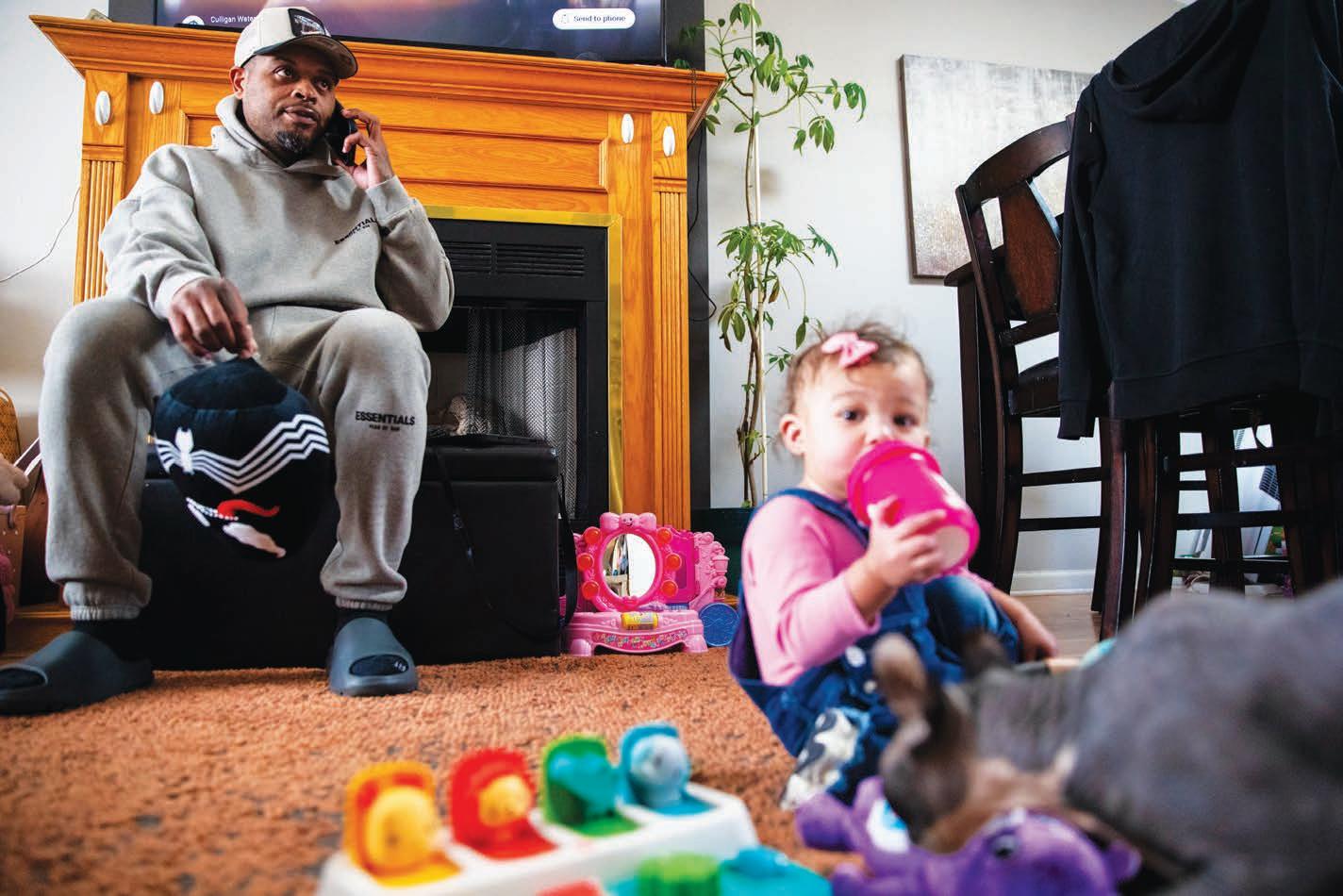
Helmick said the rural services the library provides include book delivery services for those unable to travel to libraries and a bookmobile that travels to locations across ohnson ounty.
ennie arner, who has been director of the orth iberty ibrary for over years and has served as president of the Association for Rural and Small ibraries, said since she started as director in , rural circulation has more than doubled.
Garner attributes the increase largely to visibility of library services within the county, which library staff have worked to accomplish by attending outreach events. ne outreach event the orth iberty ibrary fre uents is ity late in orth iberty, where city staff host a series of community events at which the library can take part and advertise its services.
“The library is almost always at those events in some shape or form. ur staff is there helping make those happen because we think that being in the community is really important, arner said.
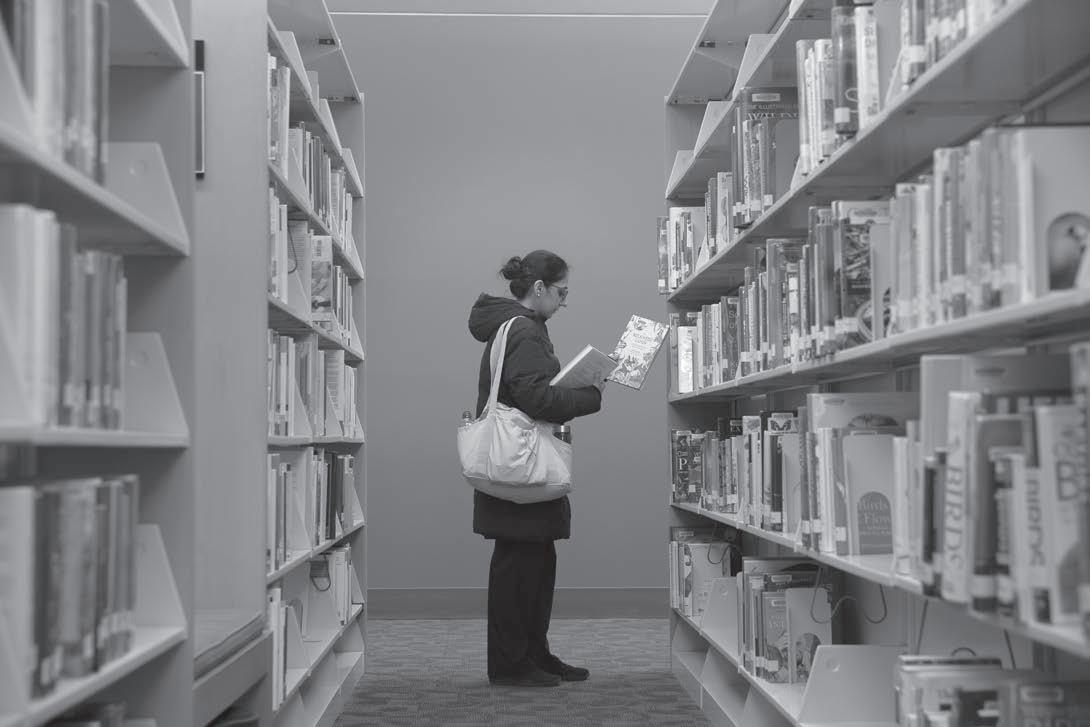
Garner said the “idea of loneliness” was significant in the country, and that it was important the library find ways to listen to what people need.
e want to make sure that we can be a place where people can connect with each other and develop lasting relationships, arner said. e know that there s isolation going on in our communities, but also in the rural communities, that it can be even more prevalent.
ecutive irector of the ssociation for ookmobile and Outreach Services Cathy Zimmerman has
worked in the library system doing outreach services for years and said such services are critical for residents who cannot access traditional libraries. he Bookmobile helps to drop off books to residents who cannot access the library.
“The main function of an outreach vehicle, whether it s a full-si e bookmobile, a van full of books, a car with bags of books and carts, is to bring library access to those people who cannot get to a brick and mortar building, immerman said.
immerman said rural outreach is percent at the heart of outreach services, and had similar thoughts about outreach services seeing an increase in use to arner and elmick.
ibraries are getting more involved with making sure the patrons are getting the kind of materials and help that they want, she said. e re becoming more educated on what our rural population needs and wants.
elmick said the owa ity ublic ibrary has also seen an increase in rural readership. think it s because of how we ve dedicated outreach services, elmick said. t s a very owan thing, right rom that movie ield of reams, f you build it, they will come.
e are seeing that rural support, elmick said. nd it s because we are becoming that third place. owever the library looks, it s that one third place where you and can connect with anybody else in our
community without having to pay to be there, without becoming an algorithm, without becoming a product. ccording to the niversity of hicago, third places are “places outside of the home (the first place) and the workplace (the second place) where people go to converse with others and connect with their community,” but can be hard for people to access due to transportation and different levels of access; both are problems rural outreach works to solve.
Helmick said community can, at times, be scarce in rural owa, and they are glad to continue reaching out a hand to rural owans.
t s really ama ing to me to see outreach services go into rural America because we are that third place, elmick said. nd sometimes that third place is just two human beings, two library workers, on a bookmobile welcoming you inside.
IC rides in rememberance
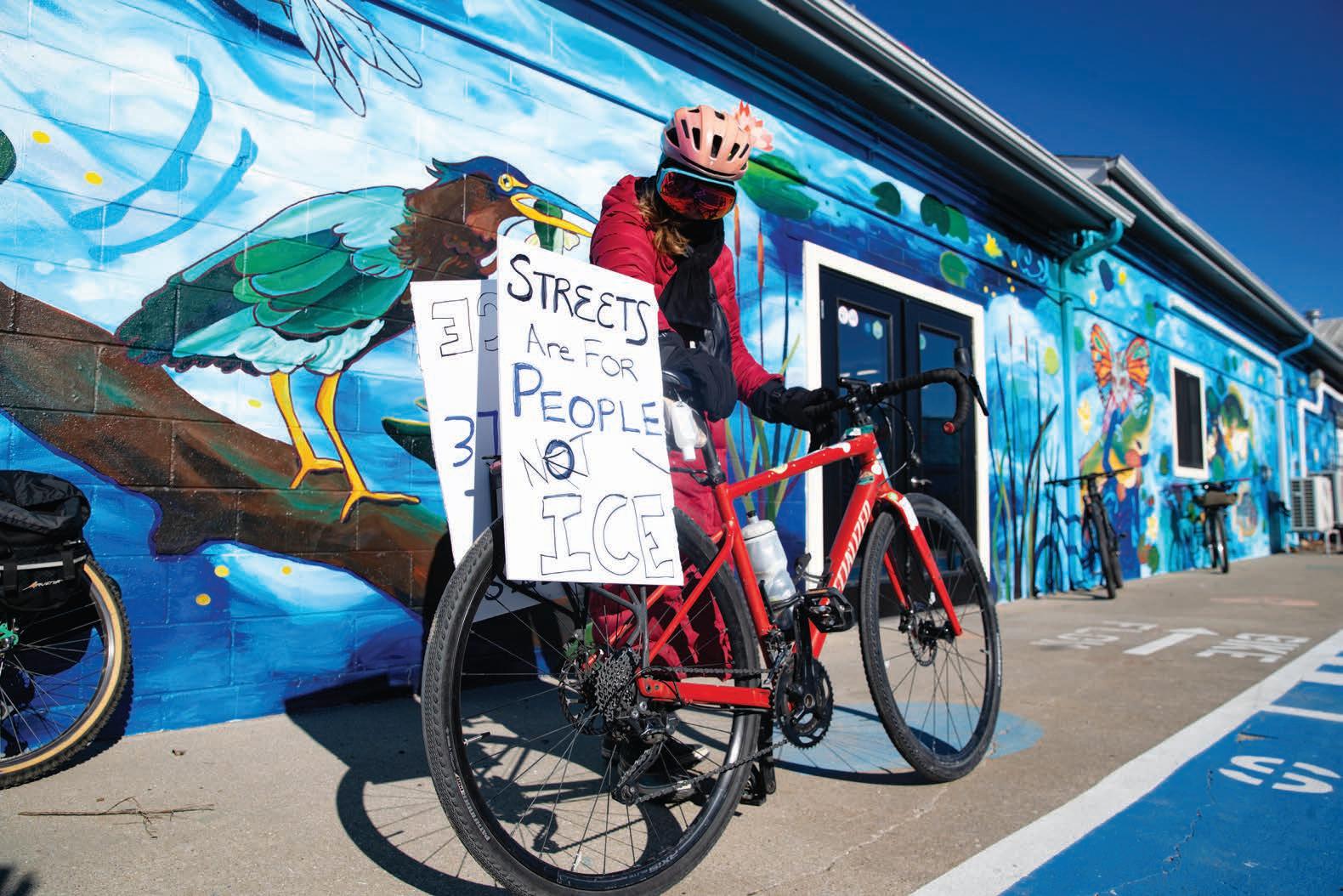
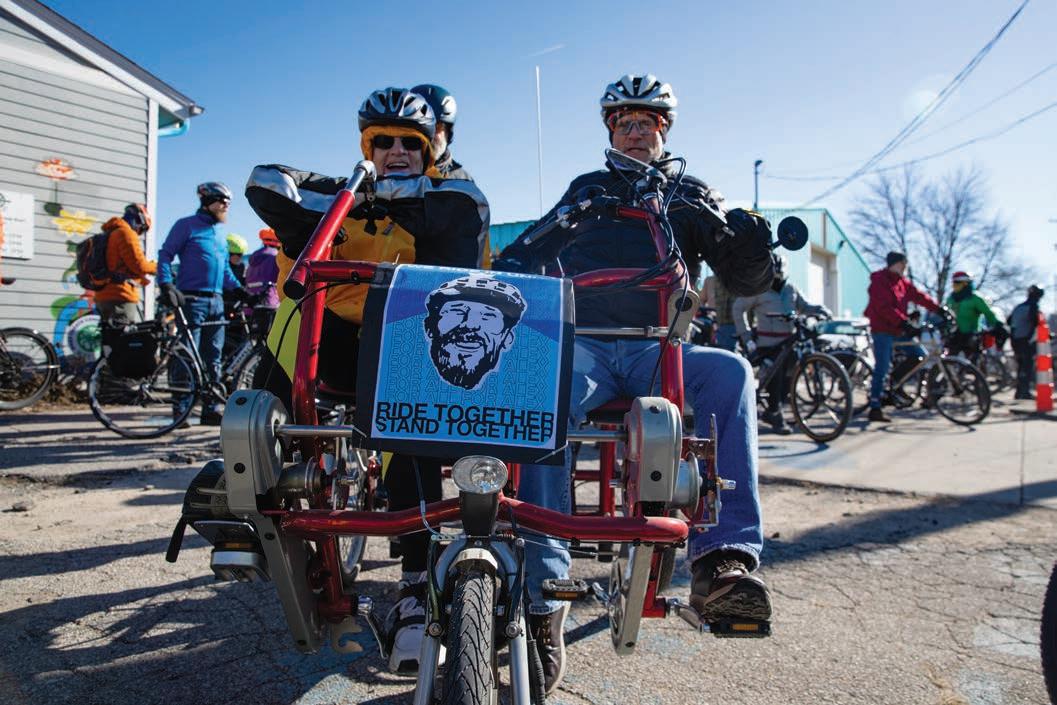
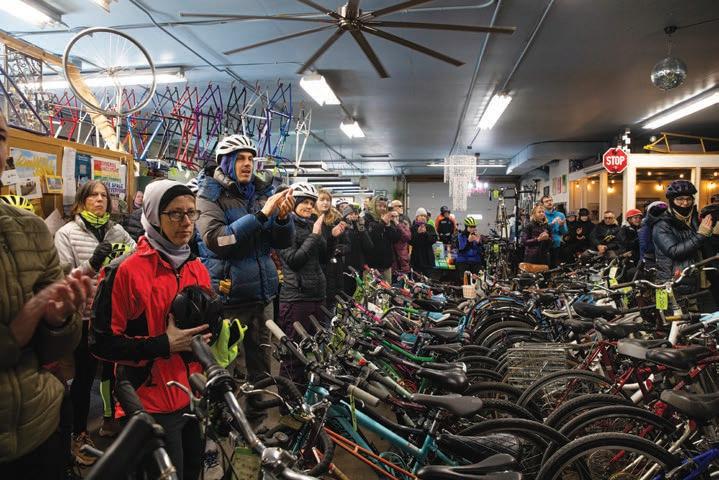
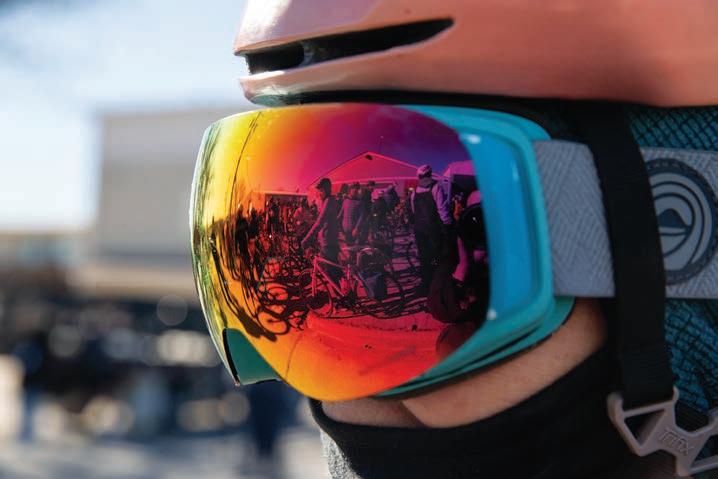
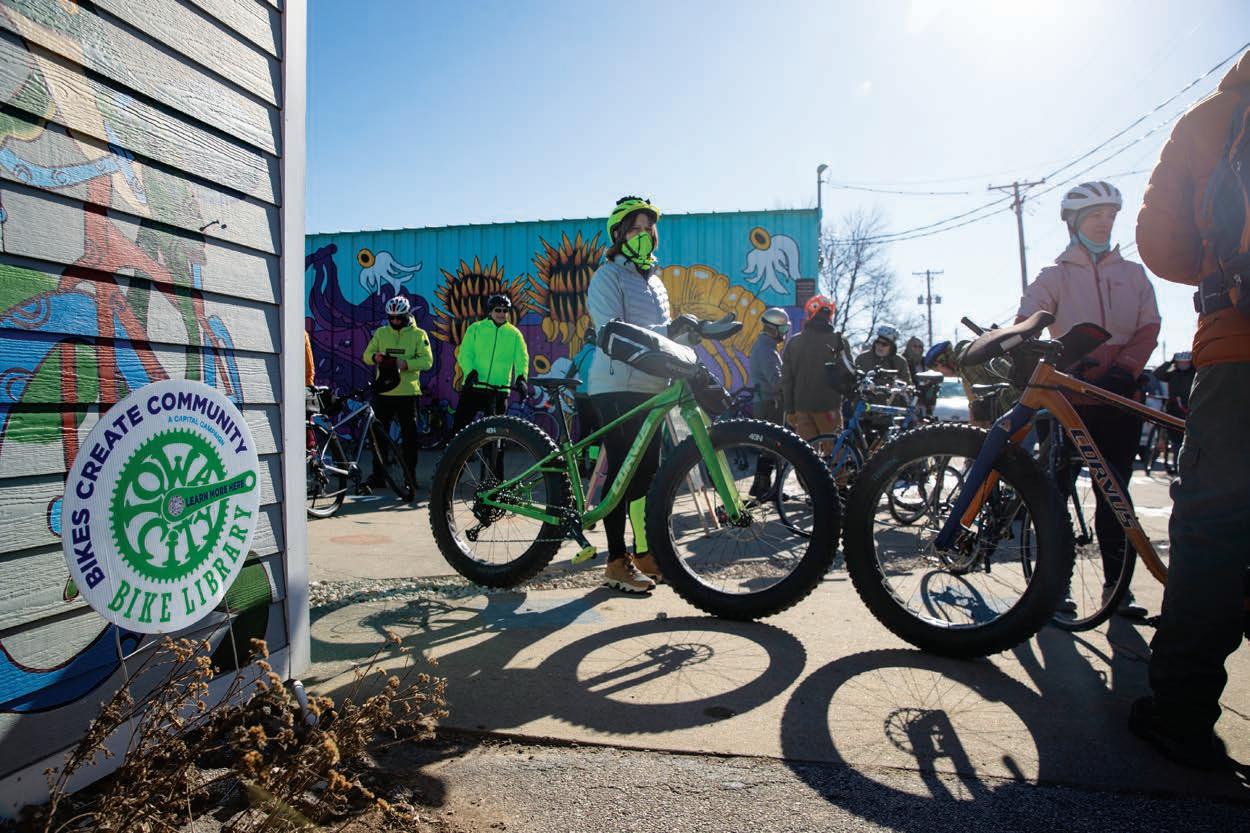
Over 100 cyclists traveled to the Iowa City Bike Library for a solidarity ride through Iowa City in honor of Alex Pretti on Jan. 31. Pretti, an intensive care unit nurse and bicyclist, was shot and killed by ICE agents in Minneapolis on Jan. 24. The Bicycle Fun Club organized the bike ride as a “ride for unity. A ride for all of us.”
SPORTS

On the sidelines and in the spotlight
Iowa’s dance team supports other Hawkeye squads but also shines on its own.
team, the program also has its own national competition, broadcast every year online on Varsity TV.
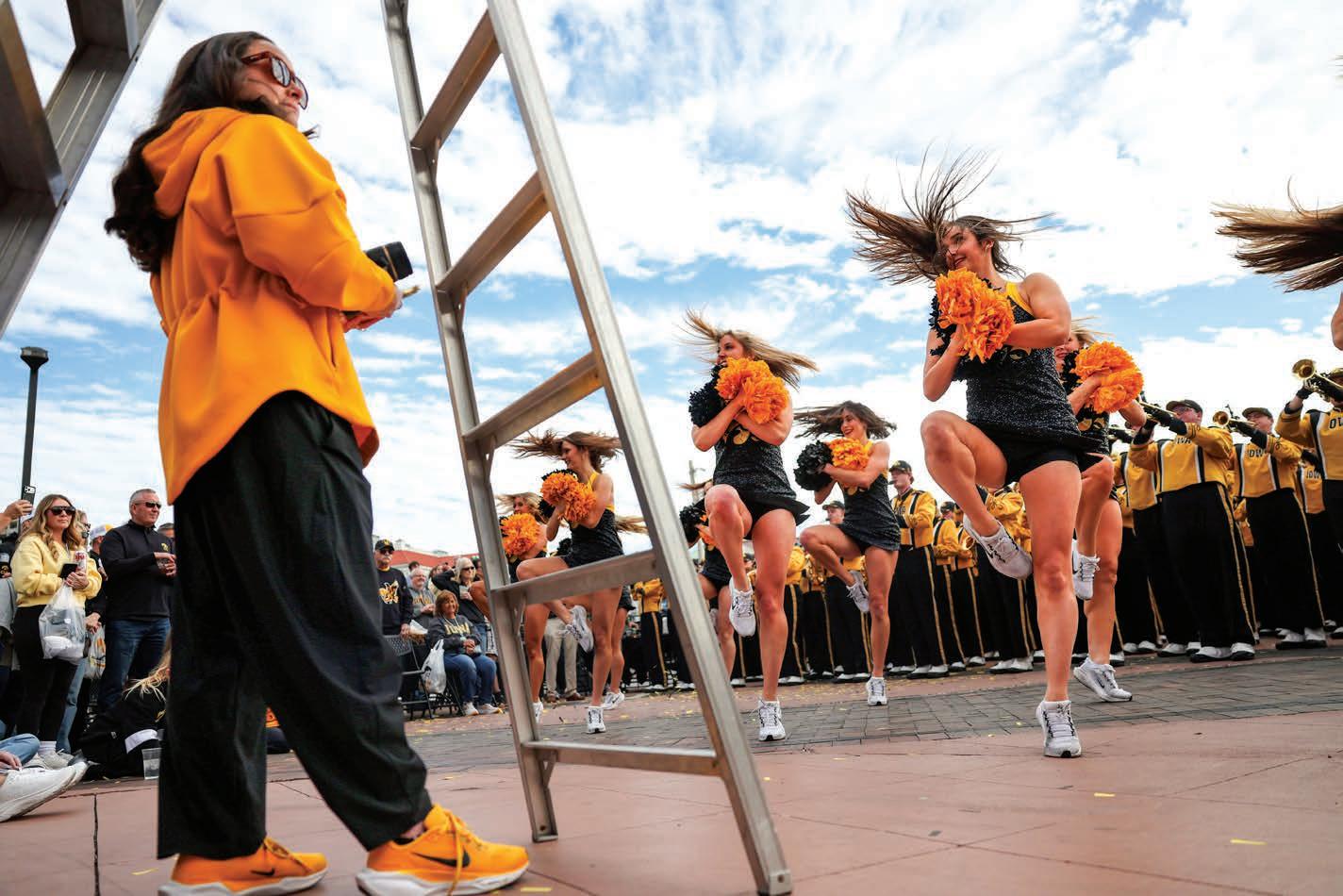
Iowa’s dance team is a frequent sight at marquee events like football and basketball games, keeping the energy high for the Hawkeyes and their supporters. Entertaining up to nearly 70,000 rowdy fans at once, these athletes keep the momentum rolling through every snap, every play, and every score. Even outside of these big-ticket contests, however, when Kinnick Stadium and Carver-Hawkeye Arena lie empty, this group of athletes continues to perform, making a name for themselves in the spotlight of a sport that many equate to the sidelines.
Coach Jenny Eustice, who has been with the program since 2009, noted that while sideline spirit is a major purpose of the dance
he difference in level of technical ability and stamina and drive in order to do those routines is heads and tails above what people normally see on the sideline,” Eustice said. “While I appreciate and love when the Hawkeye fans are like, ‘Oh, you looked so great on game day,’ they might not get the chance to see what we do at the national level.”
The Hawkeyes have collected plenty of accolades on the national stage. The dance team finished third at the niversal ance Association College National Championships and recorded 11 consecutive top-10 finishes.
Eustice is no stranger to such success. She was an assistant coach of the four-time national title-winning dance team at the niversity of innesota, where she served
as a dancer and captain during her college years. In addition to her accolades at the collegiate level, Eustice is also a former cheerleader for the innesota ikings and a innesota warm erformance eam member.
A lifelong fan of her home programs, Eustice splits loyalty with Iowa, appreciating the sincerity of Hawkeye supporters.
“I think the genuine love that the people of Iowa have for the Iowa Hawkeyes, the genuine love that the athletes have for the fans, I think that is very special,” Eustice said. “I do not think that you can find that in many places.”
As the team’s coach, Eustice works closely with the women representing Iowa’s program, such as senior Katelyn Lookingbill.
A dancer since the age of 2, Lookingbill noted that in a sport like competitive dance, support within the team is crucial. he difference with dance, rather than
Hurdling Hawkeye duo excel

to continue to have a very high-end hurdle program, and both those guys are definitely contributing to that, oey oody, owa s track and field and cross country director, said.
Hawkeye hurdlers spent the last few years dominating the mid-major scene. ow, the ig en is theirs for the taking at one of the perennial top hurdle programs in the country. ordan ullen captured the ig Ten crown in the 60 hurdles back in while ulien illum finished atop the conference in the 400 hurdles in . e aughn and yenati look to add to such a legacy.
“That’s the goal here at Iowa, is
t s no surprise e aughn is a track athlete given his family background. His parents were both niversity of aryland track athletes and met on the track team. All of his siblings ran track growing up, and some still do. His own track journey started at 5 years old and carried throughout his
other team sports, is that you try to be as in sync and in unison as possible,” Lookingbill said. “It’s not like you can just have a good quarterback and your team can be decent. You each have to carry the same amount of weight, and I think that really creates that family culture, and that’s something that sets our team apart.”
The senior also described how, in an era dominated by social media like TikTok and Instagram, many don’t realize the sophistication behind collegiate dancing.
“Everyone sees us on the sidelines, shaking our poms, smiling, waving, starting cheers, but people don’t always realize how intense our nationals routines are, all the preparation that goes into that,” Lookingbill said. “We spend a lot of time supporting other Hawkeyes, but it’s really fun to be able to do
Sophie Schriever shines early in first collegiate season
The GymHawk debuted in her hometown in Utah and has excelled this season.

About halfway through her first collegiate season, Iowa gymnastics’ Sophie Schriever is thriving across the board. Across four meets this season, Schriever has averaged . out of on all four events, and on an. against ichigan, she earned her career-high all-around score of 39.275. She is also the only freshman this year to place an all-around score for owa and is making an early case for the ig en reshman of the Year award.
“I’ve been having the best time of my life. I just feel like I’m living my dream and really couldn’t ask for more,” Schriever said.
Even though her scores have been outstanding for a freshman who just came out of high school gymnastics, being put on a collegiate stage immediately can have its effects especially when the first meet is in front of thousands of fans at the season-opening NCAA gymnastics meet in alt ake ity, tah, which is Schriever’s hometown.
Schriever grew up just around 16 miles from the arena where the niversity of tah hosted its gymnastics competitions. It was here, while using her season tickets, that the passion for gymnastics began, and it was here that she made her collegiate debut for Iowa.
“I honestly have never felt so loved in my life,” Schriever said. “I was so excited when I came out, and everyone was cheering my name and getting so loud, I was just so blown away, and that was the coolest thing for me.”
Kylie Welker returns to domination after two-month break
Welker and coaching sta prioritized her health after a tournament-filled o season.
As the smoke cleared at the end of the tunnel connecting the Goschke Family Wrestling Train ing Center to Carver-Hawkeye Arena, the Iowa women’s wrestling team made its way to the mat in front of a bu ing awkeye crowd for the first dual of the 2025-26 season.
Iowa and Central College wrestlers each lined up across from each other for player introductions. The starting lineup for the Hawkeyes was going as anticipated, but confu sion grew among the crowd as two-time national champion Kylie Welker wasn’t named.
Welker remained in the Iowa corner, cheering on her teammates as they rolled to a 44-0 win over Central and a 43-0 win over Cornell. The Hawkeyes moved Kennedy Blades to 180 pounds to replace Welker and slid Cadence Diduch into the 160-pound spot for Blades.
Head coach Clarissa Chun was asked about the decision at the 180-pound weight class follow ing the dual and said the coaching staff simply wanted to give Welker a break after returning from the Under 23 World Championships in Serbia less than a week prior.
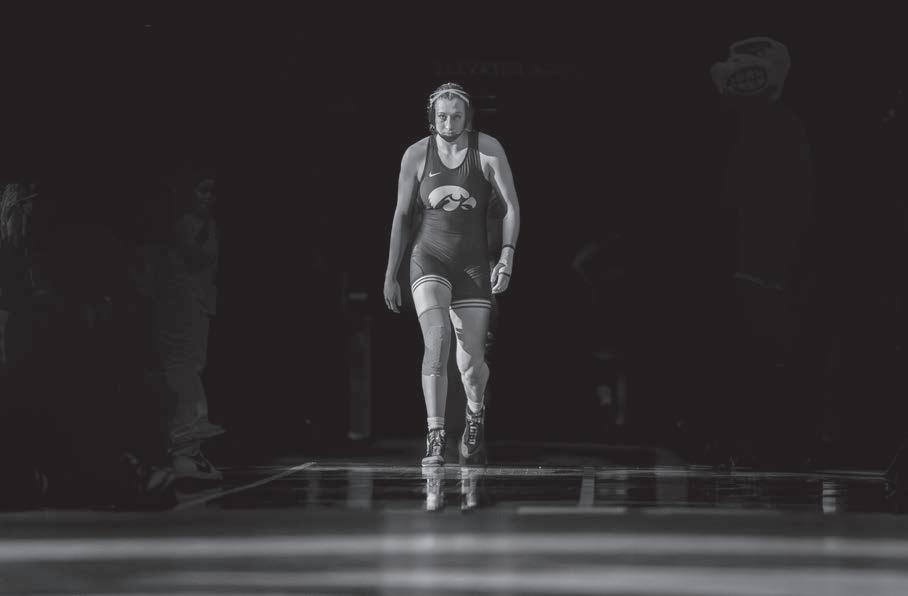
Welker took home gold at 76 kg, rolling through all four opponents by technical fall.
The U23 World Championships weren’t the only tournaments Welker took part in during the offseason. ust one month prior, elker competed at the Senior World Championships in roatia, where she finished third at kg.
Welker also took home gold at the Senior Pan-American Championships in Mexico just two months after earning her second national title with the Hawkeyes.
In June, Welker competed at Final X, a tournament that determines the Senior World Teams for men’s and women’s wrestling. Welker earned a spot at 76 kg with two wins by decision.
“I definitely had a nonstop offseason,” Welker said.
Pair the multitude of tournaments with nearly constant training, Welker has only known competitive wrestling for over two years. The break from competition for the redshirt junior wasn’t just for one dual, as she wouldn’t see the mat for the Hawkeyes until the National Duals on Jan. 9-10.
Chun said the plan was for Welker to sit out until National Duals, so she could get proper rest and have a set timeline for her return.
“That was the plan,” Chun said. “U23 World Championships is at the end of October, and I
think that’s a good amount of time to give a little break and come into the sense of the timing to get back into it.”
While Welker wasn’t competing in duals or tournaments, there was no lack of challenge for her in the Iowa wrestling room. Whether it was racing her teammates in conditioning or facing off in practice, elker never lost her competitive edge. was able to still compete in different ways, Welker said. “Once I was back in the room and training, I kind of hopped right into things, and it was definitely hard because want to be able to compete and help my team, but you can compete in so many different areas of life, too.
The break also allowed Welker to enjoy things outside the wrestling room that she hadn’t been able to do before, such as getting her nails done, visiting family in Wisconsin and Missouri, cooking, and not being on a time crunch at all times.
Welker also said she got to spend quality time with her boyfriend and friends, and attended a few Hawkeye football games in the fall.
Welker returned to the Iowa lineup for the National Duals in January, where she went 3-0 with two 10-0 technical falls and an 8-2 decision
New Heartlanders defenseman’s journey
You were traded here to Iowa alongside your teammate Anthony Firriolo. How did that familiarity help your transition?
victory. The Wisconsin native came back just in time to make an appearance at Carver-Hawkeye rena for the final home dual of the season on Jan. 18.
Welker picked up two victories against No. 9 Lehigh and Otterbein, one by technical fall and one by forfeit, as she now sits at 5-0 on the season.
“I kind of had some tough matches, so that was a little hard,” Welker said about her national duals experience. “But it just felt so good to be back and compete alongside my teammates again.”
The two-time All-American also said nothing beats being able to compete at Carver-Hawkeye Arena in front of the Hawkeye faithful, and she was glad to be back for both the ational uals and the final home dual of the season. he support from the coaching staff was unmatched for Welker, who said their experiences as wrestlers helped her understand the importance of taking care of her body.
“They all have had experiences with the sport and taking care of their bodies,” Welker said. o they definitely helped me in a sense of telling me to take my time and enjoy the other things in life that you don’t get to when you’re so busy.”

opportunity to play consistently. t s definitely a time I’ll cherish forever.
The Daily Iowan: What was the moment you found out you were traded to Iowa like?
Jack Robilotti: It was a Monday morning.
I got called into the coaches’ room in Atlanta, and they let me know I was being traded to Iowa. Obviously, I was in a little bit of shock because that s the first time that had happened to me. ut am happy it happened because it has been a great time in Iowa so far.
t definitely helped because we are both from the same area in ew ork ,and we train in the summers together. He told me what to expect, and it’s been great being able to go to him whenever I need guidance.
How did you end up playing college hockey at Holy Cross?
I knew I wanted to play DI hockey while also getting a good degree. Holy Cross was the best of both worlds, and I knew I would have the
You’ve had stops in Bloomington, Atlanta, and now Iowa. So far, which has been the most unique for you?
Honestly, probably Iowa. I wasn’t too familiar with the Midwest, but it’s been great experiencing what life is like in a Big Ten town. Who is your favorite artist?
John Summit. I was able to go to one of his concerts in ew ork, and it was one of the best experiences of my life.
Who will win Super Bowl LX?
The Sea le Seahawks and New England Patriots will square o in a rematch from 2015.

It still hasn’t even hit me yet that my favorite team is in the Super Bowl. My bias might overshadow this prediction, but you can’t objectively look at this matchup and say Seattle doesn’t have the advantage.
he first thing to start with is the defense. The Seahawks defensive unit, known as he ark ide, finished the regular season giving up just 17.2 points per game, best in the NFL. Seattle backed that up by allowing just 6 points to the San Francisco 49ers in the NFC Divisional round. Sure, the Seahawks gave up 27 points and 479 yards against the Rams in the NFC Championship, but Los Angeles has been the only team to find success against head coach Mike Macdonald’s defense.
The New England Patriots also have a solid defense, finishing fourth in scoring during the regular season and allowing just 29 points through three playoff games.
The most skeptical thing about the Patriots’ playoff run is their
opponents. The six-time Super Bowl champion Patriots went through the Chargers, Texans, and Broncos, and had their struggles in each game. Quarterback Drake Maye committed five turnovers and coughed up two more fumbles that were recovered by the offense in those first two contests. While the Patriots’ defense has dominated through the playoffs, m confident the eahawks can put up points because they’ve done so against good defenses all year. Seattle scored 27 points on the Texans, who were the second-best scoring defense in the league, and 38 points on the Rams in the classic Thursday Night overtime victory in Week 16. Then we get to Sam Darnold and a on mith- igba on the offensive side. arnold is coming off one of the best conference championship performances in NFL history, shutting up all the doubters in the media with 346 yards, three touchdowns, and no turnovers. Smith-Njigba, who deserves the ffensive layer of the ear award, hauled in 10 passes for 153 yards and a touchdown, which is just another day at the office for the former hio State Buckeye. Seattle can win this one convincingly, especially considering the offensive struggles of ew ngland as of late. Give me the Seahawks to hoist the Lombardi trophy on Feb. 8.
The almighty New England Patriots are back to where they belong after six long years: the Super Bowl. And whether you like it or not, they’re winning it. Besides the history New England has against Seattle in the Super Bowl, the Patriots are built to win on the biggest stage.
In his first year at the helm in Foxborough, head coach and former Patriot player Mike Vrabel has completely turned around this roster, starting on the defensive side of the ball. Additions like defensive tackle Milton Williams, linebacker Robert Spillane, and safety Jaylinn Hawkins are all able to make big plays against Seattle quarterback Sam Darnold, who struggled in the postseason last year with the Minnesota Vikings. On offense, the Patriots have an MVP candidate in Drake Maye under center. In
his first postseason run, the second-year quarterback has taken on the mighty Texans defense and the Broncos defense, which is fourth in yards allowed and has managed to keep the ball out of harm’s way and win. Although Maye has been stellar in the postseason, he’s also receiving help from his supporting cast. Running back Rhamondre Stevenson has stopped fumbling, wideout Stefon Diggs has returned to his prime form, and tight end Hunter Henry provides a veteran presence in the red zone. Against a tough Seattle defense, the Patriots offense is going to have to play a near flawless game, which is a tough task, but definitely achievable with offensive coordinator Josh McDaniels. The Patriots have found ways to win football games in every fashion all season long, which is the makeup of a championship team. I don’t want to hear any talk about the weak schedule; this is the Super Bowl, you either show up or you don’t, and the Patriots always show up on Super Bowl Sunday. Look for the New England Patriots to add to their hardware and get the win, 27-24.
something to support ourselves.”
Iowa’s program is one that receives part of its funding from the institution it represents, while other programs like Penn State, following university-wide budget cuts, were forced to fundraise independently. For athletes on the team, this is a source of gratitude.
“We are fortunate that we do get a lot of help from the university and from the athletic department, unlike other teams across the country,” Lookingbill said.
The senior also referenced Penn State’s budget cuts, noting the pressure that was put on the program to pay their own way to Orlando, where the Nittany Lions received placements that included sixth in Division IA Pom and 12th in Division IA Jazz
“Penn State found out that they had gotten all their funding cut this year, so they actually had to fundraise the entirety of their nationals trip and competition fees themselves, which, luckily, they did reach that goal,” Lookingbill said. “We are very fortunate that we don’t really have to worry about that.”
In a correspondence to The Daily Iowan, ustice confirmed that many essentials are financed by the team s budget, while team fundraisers pave the way for much of the competition season.
“Our budget covers camp training costs, uniforms, team gear for the year, team meals, and other things that we need to fulfill our role in supporting Hawkeye athletics,” Eustice said. “We fundraise our way to nationals (travel, costumes, choreography, etc.) by hosting our summer intensives, various clinics throughout the year, and the Iowa Spirit Spectacular, a high school cheer and dance competition.”
After last season where Iowa failed to place, the Hawkeyes rebounded this year with a ninth-place finish in ivision om at the UDA’s College Nationals in Orlando, Florida, back in January. Iowa competed against teams such as Penn State, Texas Tech, and eventual champion Minnesota.
“I would say it was a big accomplishment, and it was a good feeling for sure,” senior Mia Vekich said. “I think every time you come off of a season where you didn t feel like it went the best, you always have a little bit of that e tra fire fueling you.
Vekich, who has been dancing since she was 3 years old, also expressed optimism for the future of the program after she moves on from Iowa.
“I think it will be a good stepping stone for the teams in the future, giving everyone a good basis of, ‘This is how hard we worked, and this is the result we got,’” Vekich said.
Lookingbill, who recently celebrated two decades of dancing, credited the team’s success this season to their

entire childhood — capped off with three-straight high school state titles in 60-meter hurdles, 110-meter hurdles, and 300-meter hurdles, plus a state championship in football. He earned Maryland Male Athlete of the Year honors in 2022.
espite getting offers for both football and track, DeVaughn chose to put his sole focus on track when he committed to HBCU Alabama State in Montgomery. He was recruited as a jumper and hur-
dler, and once he put jumping to the side after his freshman year to combat knee injuries, he excelled as a hurdler.
His accomplishments in the Southwestern Athletic Conference include two-time 400-meter hurdle champion — with a time of 51.55 in 2024 and 50.41 in 2025 — three-time 4x400-meter relay champion, and runner-up in 110-meter and 60-meter. And yet, he believes he didn’t reach his ceiling.
“My body was really fatigued, so I didn’t really get to do what I could
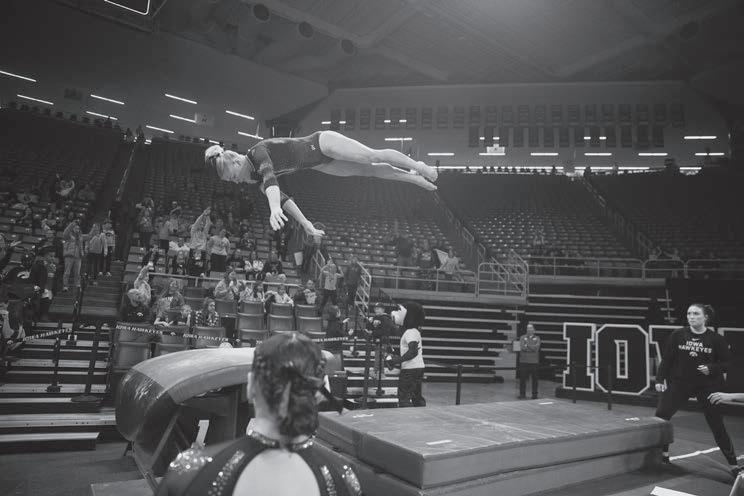
Now a few meets in, and quite a bit of nerves later, Shriever has made it her goal to improve her skills and learn the many differences between high school gymnastics and college gymnastics.
“The best thing for me so far has just been realizing that a meet is just a practice, and having [experience] in both is important,” Schriever said. “Especially with the help of my teammates, now that it’s a team sport rather than an individual one like in high school.” Fortunately for Schriever and many of the other freshmen, Iowa’s gymnastics program has a lengthy roster built on veterans with skills not only at the collegiate level but even on the world stage.
“I have so much help from my older teammates. Everybody is always cheering me on, and they are always making sure that they know what I need when I need it,” Schriever said. “I feel very lucky to have that since this team is all super young, and I never have to ask them for help.”
To her fellow GymHawks, Shriever has been a breath of fresh air and an energy spark at practice and competitions.
“She is such an amazing teammate, she brings the energy every single day and is such a hard worker,” second-year Aurélie Tran said. “She really tries to be herself both in the gym and out of the gym, which is so inspiring.” It has not just been her fellow GymHawks that have seen her
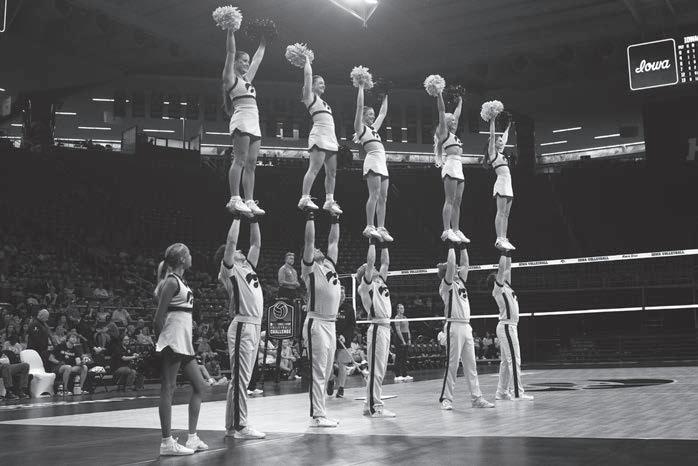
ability to adapt.
“I think we did a really good job of focusing on ourselves and trusting our own process,” Lookingbill said. “Last year, we didn’t have the best year, placement-wise. I think what was in the back of our head this year was, ‘What can we do? How can we change our own process while still staying
when it came down to strictly hurdles,” DeVaughn said. “My times for hurdles in general would have just been way better if I wasn’t so fatigued from my freshman year.”
Nyenati’s track journey began in the eighth grade as a trial run before high school. Sprints looked rough to him, so he decided to give hurdles a shot after seeing two of his friends doing it. Fast forward four years, and he won Minnesota state titles and finished top in the country in the 110-meter hurdles, with a time of 13.83, as well as in the 300-meter hurdles, with a time of 37.38.
ffers came through late into his senior year, including Milwaukee, Minnesota, and North Dakota State, and through prayer with his family, he believed North Dakota State was the place for him.
“I feel like God gave me a sign and told me that he wanted me to go to North Dakota State,” he said. “So I ended up picking that choice, and that’s where I was for three years.”
A few nagging injuries hindered his tenure with the Bison, but Nyenati made the most of it. is first season saw him set
true to ourselves?’”
For her part, Eustice described the team’s collective demeanor as conducive to its success. The squad, which only graduated and added two people each from last season. Eustice believes the team accomplished its goals, primarily through an unselfish approach.
the then-school record for the 60-meter hurdles in 7.90 seconds and place third in the Summit League Championships that same year. He redeemed himself the following year by winning the conference title for the same event in school-record fashion, with a time of 7.75 seconds.
DeVaughn and Nyenati both took their talents to the transfer portal after sweeping the mid-major scene, and Woody and his staff were intrigued with both prospects. Woody’s been with the Iowa track and field program for two decades now and knows talent when he sees it.
So far, they’ve exceeded his expectations. Nyenati’s 6.78 second 60-meter hurdle time at the Jimmy Grant Alumni Invite ranks seventh in program history, while DeVaughn’s 7.82 second runner-up finish to his counterpart in the latest meet ranks 10th in program history.
And the best has yet to come for Iowa’s new hurdling duo.
“I think that’s kind of our bread and butter, is developing athletes that have done some really good things. And both those guys come from great track programs and great coaches,” Woody said. “They really want to excel at this level and kind of prove themselves at the Power Four level.”


grow and push herself, but also her coaching staff . ead coach en Llewellyn noted Schriever’s talented gymnastics skills but also that she can, at times, struggle with self-confidence.
“At the beginning of the year, she was like, ‘I’m really good at gymnastics, I can do this, I can do this,’ and just overthinking it at times,” Llewellyn said. “The biggest thing for her is just calming herself down and settling in, which have been things we have worked on with her over the past few meets.”
As Schriever has worked to build the confi dence she needed, she can now show off the skills and determination that originally intrigued the Iowa coaching staff to recruit chriever in the first place.
“She has such a strong work ethic and passion for gymnastics in life; she is one of the most enthusiastic and energetic people coming into the gym every day,” Llewellyn said. “She just does it in a way that is not cocky, not arrogant, but humble, which really helps the team’s morale and energy.”
With the midpoint of the season on the horizon, Schriever has made it known what she wants to strive to accomplish, goals that seem already in reach and ones that she could already achieve by this time next year.
“I think there is always room for growth, and I just want to do my best for the rest of the team and just continue to have fun living my dream,” Schriever said. “I’m just really blessed, and I’m just really excited to keep going.”






Hawks Sink St. Thomas
The Hawkeyes went out with a splash at the Campus Recreation and Wellness Center in Iowa City on Jan. 30, when they defeated St. Thomas, 182-42. Iowa honored its seven seniors before celebrating their win.
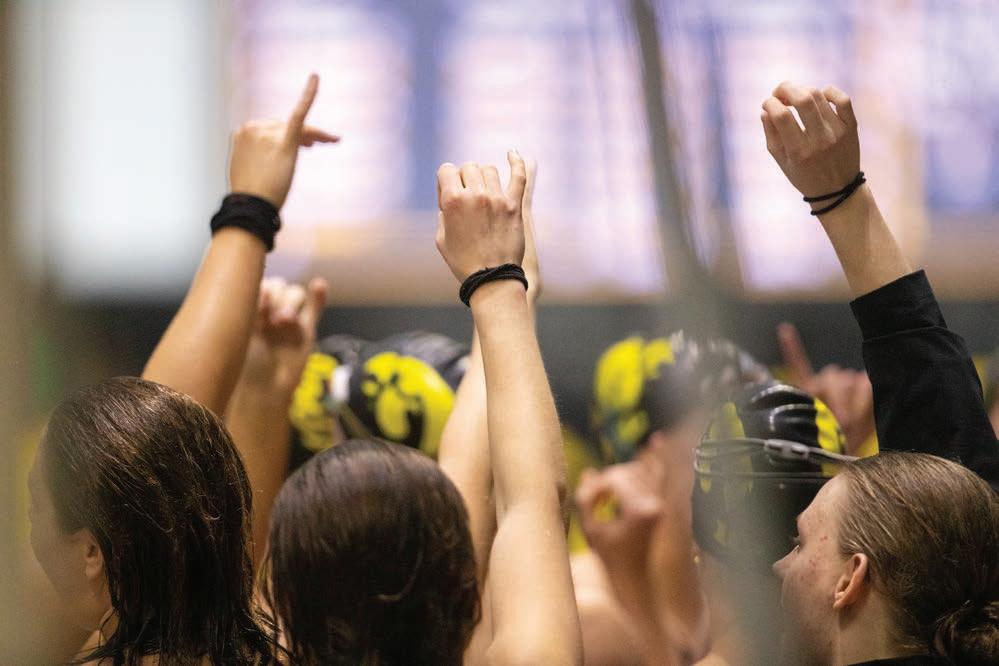
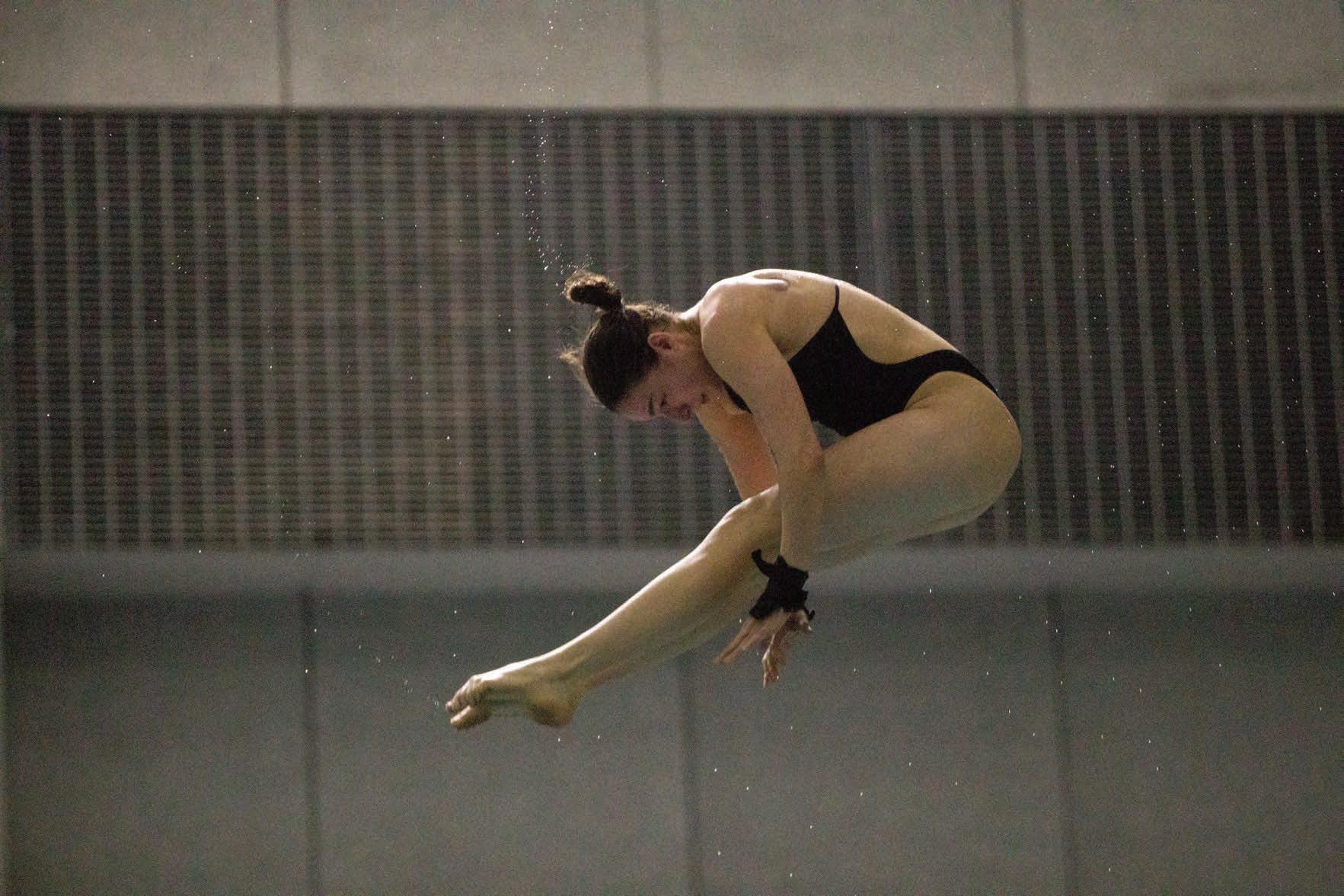


























































Bookmobile provides accessible literature to Iowa City

Hobart said. “But I do love our public library.”
Every day, the Iowa City Public Library’s traveling collection makes stops across Iowa City and the greater Johnson County area to serve a wider community who are less likely to make
These stops range from neighborhood parks, like Hobart’s favorite, to HyVee parking lots, elementary schools, and business parks. At these stops, patrons can pick up holds they’ve placed online. While new, popular books could take weeks or months to pick up at the main
Classes UI students most want to see
Students get an early start on registration to discuss dream classes.
by using the roving collection instead.
“I’ve wanted these books for a while, but while they’re unavailable on the public library shelves, I can find them here,”
Hobart said.
Stepping inside the Bookmobile offers more than just a reprieve from the cold,
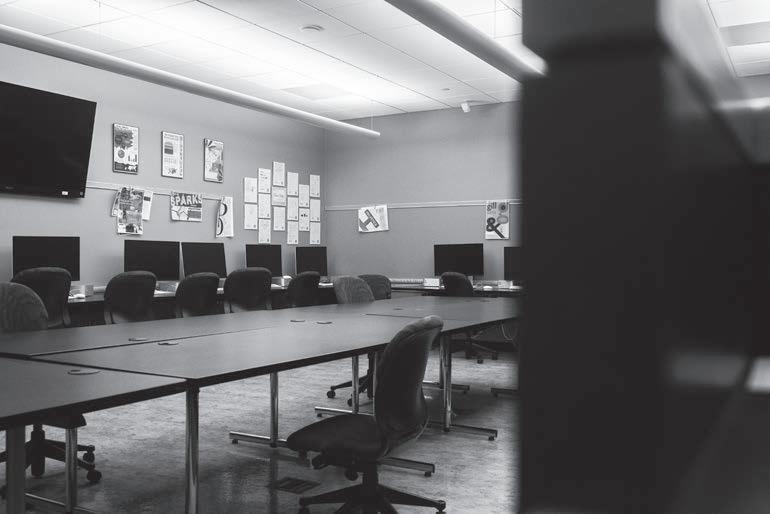
classes offered here. Going even nicher, I like to dream about if they offered a class specifically for the white bark pine tree,”
As Hawkeyes return from winter break, one topic is fresh on many minds: the class registration process. Students put a great deal of thought into the abundant possibilities and can become overwhelmed when picking classes. Finding a balance between classes that work toward a desired degree and entertaining electives can also pose issues.
Despite the University of Iowa offering an extensive course collection, many students still want to explore educational options that are not currently available.
Many students wanted to see classes focused on something they are passionate about on the course list so they could share their enjoyment with friends and peers.
Taking a focus on natural sciences and the outdoors, Joe Goltl, a third-year UI student, said he wants to see a class based on the study of the relationship between humans and plants, known as ethnobotany.
“I personally think an ethnobotany course would be super cool, especially one where students can actually go to natural areas to learn about native plants and their relationship to human culture,” Goltl said.
Goltl, an avid forager, expressed interest in a prospective lifetime leisure skills course as well.
“Even a simple LLS course about foraging would be sweet,” he said. “Something where students have the opportunity to learn outside and start building relationships with what they can find out in nature.
Other students, including Ella Hertz, a fourth-year UI student, echoed the desire for nature-related classes with a focus on things like arboriculture and tree identification.
“They should definitely have arborist
Hertz said. “Just generally, I’d like more classes focusing on conservation skills.”
Offering hands-on courses where students can surround themselves with nature could have many scientifically proven benefits for students’ mental and physical health as well as improving memory and concentration, Hertz said.
Hertz also expressed the importance of teaching fire safety skills in the classroom to benefit students by teaching them about forest fires. A class like this is not currently offered at the UI.
Hertz hopes a class on this topic could help students learn about and work to fight wildland fires, and could even help them work toward a certification in Inci dent Qualification, commonly known as a red card, from the National Park Service.
Emma Manes, a UI first-year student, instead had her eyes fixed on the stars and what they could predict about the future for her class wishlist.
“I think a good number of students would be interested in an astrology class. Even if they don’t believe in the fortune stuff, I feel like most people are at least a little curious about it and would gladly take this fun class,” Manes said.
Manes said a student wouldn’t have to necessarily believe in astrology in order to get enjoyment out of the class. Instead, the class would aim to teach them about it, and it would serve as a good way to meet other interesting people and make new friends.
While no new changes to the course catalog have been made recently, discus sion on ways students can shape their learning is crucial for the UI to become a place for everyone, no matter what they choose to study.
as the welcoming atmosphere mirrors the atmosphere of a traditional library. The long walls of the vehicle are lined top to bottom with shelves of children’s books, topical fiction, genre literature, sought-after DVDs, and everything in between.
Bringing back 2016’s popular trends
Nostalgia for 2016 culture grows a decade later.
Turning decades into aesthetics is nothing new for pop culture. Nostalgia is a powerful reminder of a more comfortable, simpler time, a time when things just seemed familiar and easy to live by. The drug of nostalgia runs deep online with mood boards and baiting posts for Generation Z and millennials.
With the 2016 online trend, this search for nostalgia has turned into a full-blown wish for its revival. Every decade seems to have something of the sort that shapes it into a revival. The Y2K revival of the turn of the century was no different. Still bleeding into our culture today, your local Urban Outfitters has been appealing to decade aesthetics for years, while H&M is just catching up.
To older generations, 2016 seems monumentally less iconic than something like the 2000s. However, someone who lived through the year as a preteen could tell you that the year had quite its own distinguishing markers. abbing, fidget spinners, ikki utorials eyeshadow art, Uggs, and above all, the Starbucks unicorn frappuccino — an incredibly convoluted, saccharine drink making its taste and steps in brewing contribute heavily to its discontinuation — all other items mentioned can be brought back, besides the frappe. But what is 2016 without its drink? Its absence would be obvious, so much so that the internet was demanding its return.
“People have asked for the unicorn frappe,” Norah Thurow, a third-year University of Iowa student who works at the Iowa Memorial Union Starbucks location, said. “They’ve also asked it in
almost a cowardly way — asking for a vanilla frappe with raspberry in it.” Every good revival needs a soundtrack, too. For the 1960s-70s medieval revival, Fleetwood Mac held high. PinkPantheress was hosting Y2K. And now, for this 2016 comeback, we have Zara Larsson. Larsson’s carefree Malibu-Barbie aesthetic was discovered from a well-circulated dolphin meme that uses her 2016 song “Symphony.” This, along with her new 2025 album “Midnight Sun” and her feature on PinkPantheress’s “Stateside,” helped launch her into being the music behind the movement.
While the fishy frutiger aero of the tropics and inky primary colors are more reminiscent of late 2000s airbrush T-shirts, Larsson’s look instantly reminds me of 2016 iconography. Think the overly saturated posts of the pink beaches of Bali, along with the chokehold the Instagram filter “Rio De Janeiro” has on every story. These revivals are influenced by music and pop culture, but they are also influenced by the current political climate of the world. There is a common consensus online that things after the COVID-19 pandemic never felt the same. In 2016, things felt freer from the worries the post-pandemic world has been filled with. For people like me who were too young to fully take advantage of this, the hiraeth for this exhilaration in life is not only fun, but kind of a deeper longing. It’s no wonder that the era of no worries and fun begs to be resurfaced.
Want to know the best way to participate in the trend? Just scroll through your phone and find some defining pictures of you and what you were up to in 2016. Or just ask your parents, they have one somewhere on their Facebook page.

How to fill out your 2026 bucket list
here are a few recommendations to help guide you on the journey to building an effective 2026 bucket list.
According to the Chinese New Year, 2026 marks the Year of the Fire Horse. Commonly associated with transformation, movement, and courage, it’s an invitation for individuals to move forward intentionally.
The Chinese New Year Calendar isn’t embedded into U.S. culture by any means. Many citizens couldn’t care less about what animal the new year represents beyond the mere acknowledgement of a “fun fact.” And while this certainly isn’t an authentic U.S. tradition, the Fire Horse can, and maybe should, be utilized as a symbol of inspiration and guidance while navigating a fresh start.
After all, when creating a bucket list for 2026, a solid foundation of ambition stems from the desire to transform, move forward, and live intentionally. Filling your list with goals that promote growth and experiences is essential in a successful new year. That being said,
I’m aware this is a bit of a drag to start with, but it’s also one of the most important aspirations on the list. Rounding out the 2025-26 school year with grades you can be proud of is an honorable goal, and one that can genuinely only bring positive impacts in the long run. Lock in on your studies; it’s a goal that’ll benefit you both internally and externally.
After you’ve established you’re going to dial in on those grades, it’s time to build some character and make room for something fun. When I say try something new, I’m urging you to go big. Think skydiving, bungee jumping, or traveling out of the country. Do something outside of your comfort zone, something that scares you. Embark on an unforgettable
adventure or experience, one you won’t regret or forget for a long time coming.
Most people, if not everyone, have at least one thing they’ve been putting off learning out of sheer laziness, lack of resources and motivation, or another low-effort excuse. Now is the time to do whatever it is you’ve been meaning to do. It can be as simple as doing your own gel nails, learning to juggle, doing a backflip, or any other achievable skills imaginable. I can guarantee you’ll feel cooler after you master it.
Traveling comes in many forms, though it doesn’t necessarily have to be out of the country, contrary to my previous suggestion with “trying something new.” Road trips, trains, buses, whatever. Go somewhere you’ve never been before, see something you’ve never seen. Even if your journey capabilities are limited, a trip to another town is something worth doing. Exploring the world around you is more important than many people realize in an expedition to personal growth.
Yes, you’ve heard this one before. And yes, it does bring as many positives into your life as you’ve heard. Reading is beginning to become a lost art, even with it being so incredibly beneficial for your brain. From fantasy to nonfiction, there’s a world of literature at your fingertips. If this idea is repulsive to you, I implore you to push past the discomfort and boredom commonly associated with
reading and find the right genre for you. Once you start, you’ll wonder how you ever lived without it. Add or take away anything you want to this guide. This year is yours for the taking, and setting standards or goals is essential to moving forward intentionally. Be like the Fire Horse, set with movement, courage, and transformation, and you’ll find yourself living a more meaningful life.

Digital vs. physical media

I like to consume media. Almost everyone enjoys some form of it. But my childhood of DVD shelves, game cartridges, and hardcover books is being shifted right in front of me to a less ideal media hub: the digital world. With years of subscriptions and websites and watching my favorite things go poof, bringing back physical media saves what is easily lost.
Whenever somebody brings up subscriptions, I think of the great HBO Max purge. During the HBO Max and Discovery merger, several Cartoon Network shows were deleted from the site, either for budgetary reasons or because Discovery saw no value in them.
Shows like Infinity Train — which was not being shown on the Cartoon Network channel and had no DVD copies — were taken from the site and are still missing from the Cartoon Network section. The only way to watch it for months was a random Google Drive link before

it became available through YouTube and Amazon Prime. There were months where the people involved weren’t paid a cent. In the gaming world, threats of subscriptions and erasure for players already own have hit hard. For The Sims 4, its parent company, EA, has been bought out by a Saudi Arabian company. Saudi Arabia banned The Sims 4, so when talks first started for the buyout, Sims 4 players like myself worried that the game would be severely mistreated or broken by a company that seemed to only want EA for their sports games.

Spotify, on the other hand, has a plethora of music to choose from, but without Premium, it is almost unusable unless you only listen on a computer. And who listens to Spotify on their laptop? With the CEO going back and forth discussing a second paid tier higher than Premium as well as paying artists poorly, it has its own unique problems.
With CDs, vinyls, DVDs, and game cartridges, you can actually own what you have. It isn’t like an NFT where you just pay for the receipt — it’s yours.
Your little piece of art. Back home, I display my vinyls, DVDs, and books on shelves to show off to anyone who comes into my room.
The best way to have some autonomy back and be people-first is to have physical things. It’s time the people on top didn’t control our access to art.
Setting aside the feelings of nostalgia I have for my old copy of “Kinect Adventures” on the Xbox 360 and the CDs of old Disney music my sister and I used to belt out on the car ride to school, digital media is much more streamlined, environmentally conscious, and accessible. And it is all available at the touch of a button or the click of a mouse.
The vast cyberscape behind the screen serves as an archive of all the information from years past. There are entire groups of people dedicated to preserving and sharing media in digital form, especially old physical media that never lasted long enough to be digitized by its creators.
I wouldn’t be surprised if the future brought a demand for virtual archaeology as a career. Files on a computer cannot be burned, smashed, or forgotten in the back of a storage unit as physical media can. Imagine how many shows, movies, or songs have never been introduced to the current generation because no one bothered to digitize them.
However, my favorite shows, games, and songs probably won’t last as long as a single piece of plastic dumped in the ocean will, a piece of plastic whose original purpose may have been as a CD case or a VCR tape. The microplastics that remain still pose a major threat to the health of our world. Furthermore, the end of a product’s lifetime is not the start of its negative impact. We still have to factor in manufacturing and transportation. When you ultimately decide to forgo the physical copies and watch a show on the internet, the impact is considerably less severe.
When you cut out all the extra steps of creating physical media, it becomes infinitely more accessible, too. human rights organization campaign, Flash Drives for Freedom, takes hard drives donated by . . citi ens, wipes them, fills them with media from all across the globe, and smuggles them into North Korea to help inspire citizens to stand against their government.
Imagine how much harder it would be to smuggle thousands of books, movies, and informational textbooks across the border instead of a few small hard drives? Digitization can put media in the hands of people who couldn’t get it, for one reason or another.
Whether you like it or not, the complete shift away from physical media has already begun. Having all your entertainment available anywhere at all times is just too convenient.

Arts reporter Madisyn Hunt argues for preserving physical media while Leo Sullivan makes a case for going digital.
At the front of the bus sits Tom Jordan, a member of the Bookmobile team, who handles customer services for the Iowa City Public Library. Whenever a patron chooses a book from the shelves, Jordan checks their holds and library card information.
Since the Bookmobile’s reinstitution in 2017, Jordan has been on board. In his nine years of servicing the community, he has noticed how the variety of stops, regular schedule, and smaller scale collection and staff make an impact on those checking out books.
“People make it a part of their weekly routine, and they get to look forward to it,” Jordan said. “People get to know us, and we get to know them.”
Hobart is one such regular whom Jordan and the Bookmobile team have gotten to know thanks to the smaller confines of the vehicle and regular checkout pattern. Though on this particularly freezing day, the Peninsula spot was quieter than usual.
To Jordan, the busiest the Bookmobile gets is at after-school stops and in retirement communities. At those stops, they park right outside of buildings where they know a large readership is eagerly awaiting. The other stops are designed to triangulate the best positions around the community to be accessible to the most people.
From inside, the Bookmobile feels like a miniature library. But from the outside, it has the body of a bus or RV and the carriage of a semitruck despite not technically being either of those things. It was, in fact, custom-built by Summit Body Works out of Colorado.
To be as delicate as they can, driving with precious literary cargo, Jordan and the team remain cognizant of curbs and bumps. The shelves are slanted downward and have plexiglass barriers to make it more difficult for the books to slide onto the floor.
“Like any long vehicle, when you’re making a turn, you have to go far out before turning in, and sometimes you misjudge your clearance, and the back wheels go over a bump, and a book flies out,” Jordan said. “We do throw books fairly frequently.”
Brianna Todd, a Bookmobile aide, assists the rest of the team in delivering books and keeping the collection updated. Shawna Riggs, the Bookmobile assistant, keeps track of the collection’s engagement level based on how many books are checked out, Todd said.
While the number of books checked out at each stop varies, Todd’s favorite locations, Hills and Lone Tree, have dedicated communities waiting for books since their local libraries closed.
“At our Hills stop, they come together and wait for us when we arrive. So our stop is their one chance to go to a library, and they utilize us to the best of their ability,” Todd said.
Iowa City’s Bookmobile isn’t the only one in the state, and according to Sam Helmick, American Library Association president and Iowa City Public Library community and access services coordinator, mobile library services are a trend that will continue to persevere around Iowa, and, Helmick hopes, the country. The Marion Public Library, Woodbury Public Library, and Cedar Rapids Public Library all use some form of mobile outreach service akin to the Bookmobile.
The gathering of the community, such as what happens at the Hills stop every week for the Bookmobile, is what drives Helmick’s philosophy when it comes to the Iowa City Public Library’s engagement.
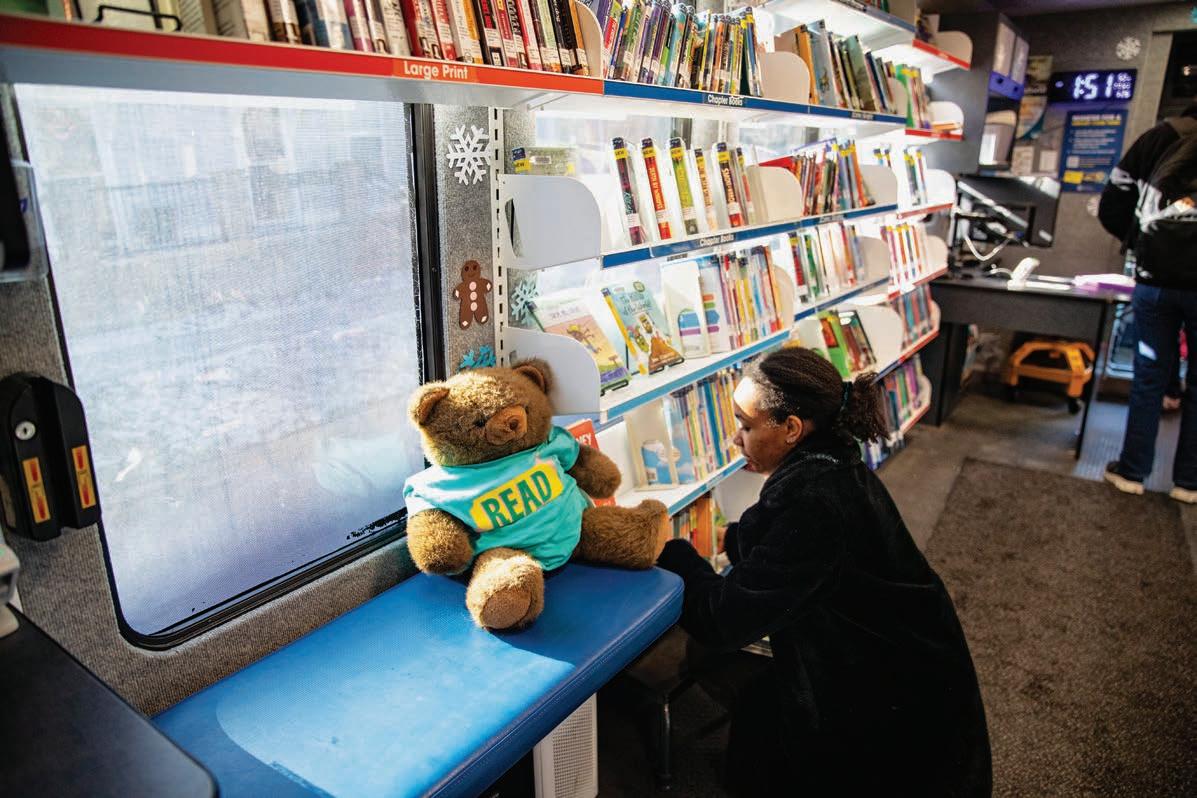
Being experienced with more rural libraries, Helmick is familiar with the necessuty and variety of public services a brick-and-mortar library can provide outside of reading material.
“We think about libraries, we think about books and learning, but often they serve as the place you get shelter during a storm, the place you find community when you are bound to a rural community or a senior center,” Helmick said. “Those are the answers libraries are providing for the biggest questions in society right now.”
While these initiatives, like the Bookmobile, begin with the goal of overcoming economic, accessibility, and geographical barriers, the disruption of funding to libraries after President Donald Trump’s March 2025 executive action to eliminate the Institute of Museum and Library Services, public outreach programs became more important than ever, Helmick said.
A permanent injunction was filed against Trump’s action, and the $266.7 million in cut-off grants was restored, but small and rural communities were still hurt and may face more difficulty as the administration continues to pursue cuts, Helmick said.
The Iowa City Public Library has remained undeterred in its programming, though, and will continue to support the Johnson County community as well as the interconnected system of libraries across Iowa, all of which are collaborative with each other, Helmick said.
Part of what gives the Iowa City Public Library the leeway to expand its services where many rural libraries cannot is thanks to the Iowa City Public Library Friend’s Foundation.
Any time the Iowa City Public Library wants to begin a new initiative, they fi rst calculate how much of its budget can support it, Helmick said. Then, the Friend’s Foundation works with the City of Iowa City and the community to raise any additional funds to make up the difference.
This process is how the Bookmobile came to be in 2017, when the Friend’s
Foundation and the library together funded the nearly quarter-million-dollar cost to custom-build the vehicle, Helmick estimated.
The interconnectivity between community and library is at the center of the Iowa City Public Library’s mission, Helmick said, and the continued
relationship under uncertain times for public libraries through initiatives like the Bookmobile is rewarding.
“Libraries happen because you go to them,” Helmick said. “Thank you for letting us come to you, but thank you for engaging with us also because that is where the magic happens.”









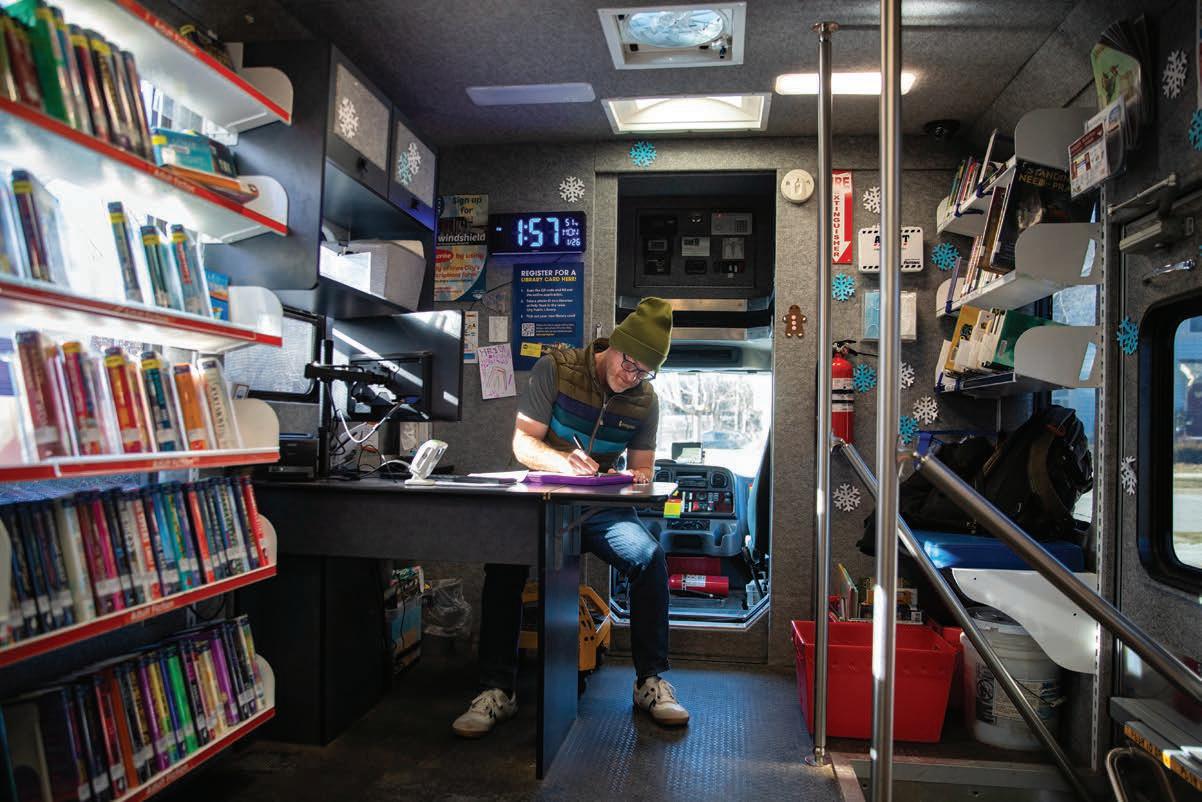

Streetcar Named Desire by Tennessee Williams Turbo directed by David Soren
Top Gear on Amazon Prime









• Quiet Settings
• 24 Hour Maintenance
• Off-Street Parking
• On Bus Lines
• Swimming Pools**
• CentralAir Conditioning
• Laundry Facilities
• Smoke Free
• Water Included
• Security deposit = one month’s rent
One Bedroom: $840-$945
Two Bedroom: $915-$1115
ThreeBedroom:$1225-$1425