The Daily Iowan

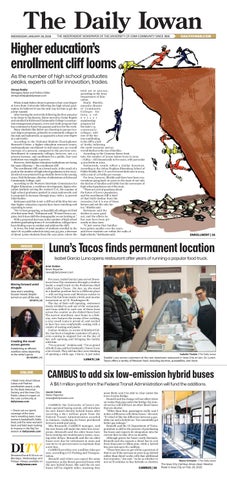

As the number of high school graduates peaks, experts call for innovation, trades.
When Jonah Salow chose to pursue a four-year degree at Iowa State University following his high school graduation, he believed it was the only way for him to get the job he wanted.
After leaving the university following his first semester to be closer to his fiancée, Salow moved to Cedar Rapids and enrolled in Kirkwood Community College’s construction management program, a two-year trade program that has continued to foster his passion and love for the work.
Many students like Salow are choosing to pursue twoyear degree programs, primarily at community colleges in the state and nationwide, as opposed to a four-year degree at a university.
According to the National Student Clearinghouse Research Center, a higher education research center, undergraduate enrollment in fall 2025 saw an overall increase of 2 percent, compared to the previous year. Enrollment in community colleges, however, saw a 4 percent increase, and enrollment for a public, four-year institution was roughly 2 percent.
However, both higher education institutions are facing the same dilemma — the enrollment cliff.
The enrollment cliff, on a broad scale, is the result of a peak in the number of high school graduates in the 202526 school year projected to go steadily down in the coming years, Nick Kettmann, director of admissions at Kirkwood Community College, said.
According to the Western Interstate Commission for Higher Education, a workforce development, higher education institute serving the western U.S., the number of high school graduates peaked in 2025 nationwide and is projected to decrease through 2041, with a 13 percent total decline.
Kettmann said this is not a cliff out of the blue but one that higher education experts have been watching and expecting to come.
“We’ve been preparing, so hopefully all colleges are kind of in that same boat,” Kettmann said. “It hasn’t been a surprise, but it does shift the demographic we are looking at.”
With a projected decrease in the number of high school students graduating from a K-12 institution, colleges have been finding ways to combat and address the shift.

Colleges for Iowa, a volunteer
colleges, said one of the fac-
the 2008 recession and an
For Iowa, however, Shields said there have been conversations going back 20 years on the topic of not only the decline of families and births but the movement of high school graduates out of the state.
and the enrollment cliff is kind
tor,” Shields said.
decline is more gradual, and the effects he has seen have been pri-
In Iowa, the total number of students enrolled in the state’s K-12 public schools in 2025 was 515,221, a decrease of about 5,000 students from the year prior, where the high schools,” Kettmann said.

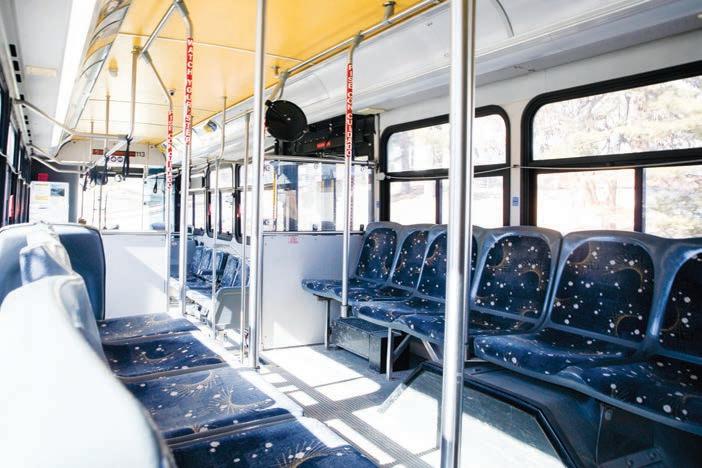
Isabel Garcia Luna opens restaurant after years of running a popular food truck.
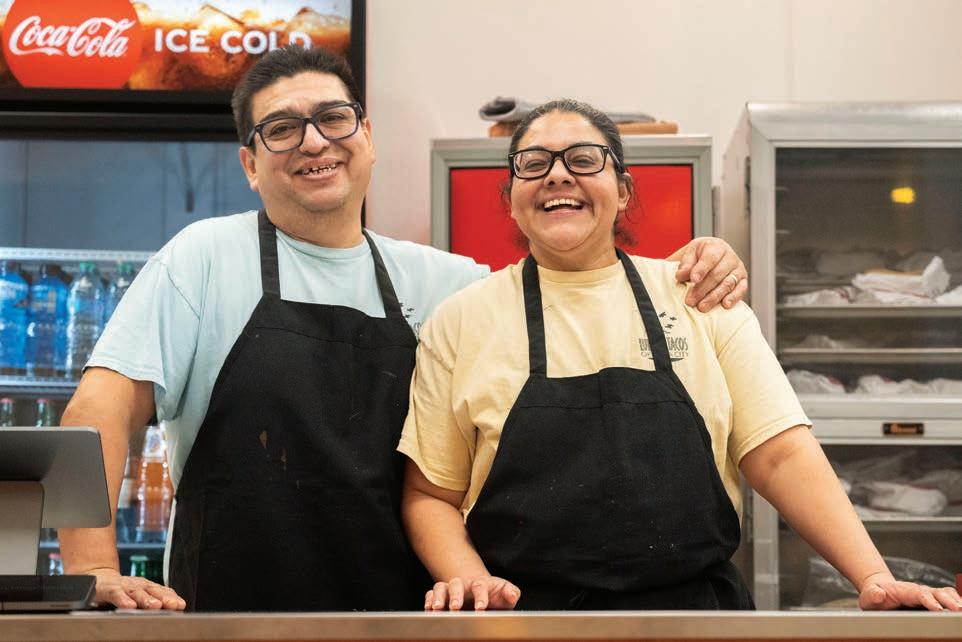
For years, Isabel Garcia Luna served Downtown Iowa City customers through a window inside a small truck in the Pedestrian Mall called Luna’s Tacos. On Jan. 19, she stood in a familiar position but in a different place — still serving tacos and Mexican cuisine in Iowa City but from inside a brick-and-mortar restaurant on 127 E. Washington St.
The day of their soft opening, customers slowly trickled in and out of the restaurant, and Luna talked to each one of them from across the counter as she dished them food.

The narrow storefront, once home to a Subway, now features the aroma of her cooking, a cozy couch Luna is proud of, and excited to have her own comfortable seating with a variety of seating and plants.
Connor Jenkins, co-owner of Kindred Coffee, has been a longtime customer of Luna’s, even coming to support her on the day of her soft opening and bringing his family with him.
“I’m so proud,” Jenkins said. “I’m so proud of both [Luna and her husband]. I know it was a lot of work. They told me they were thinking of opening a while ago. I know, it just takes
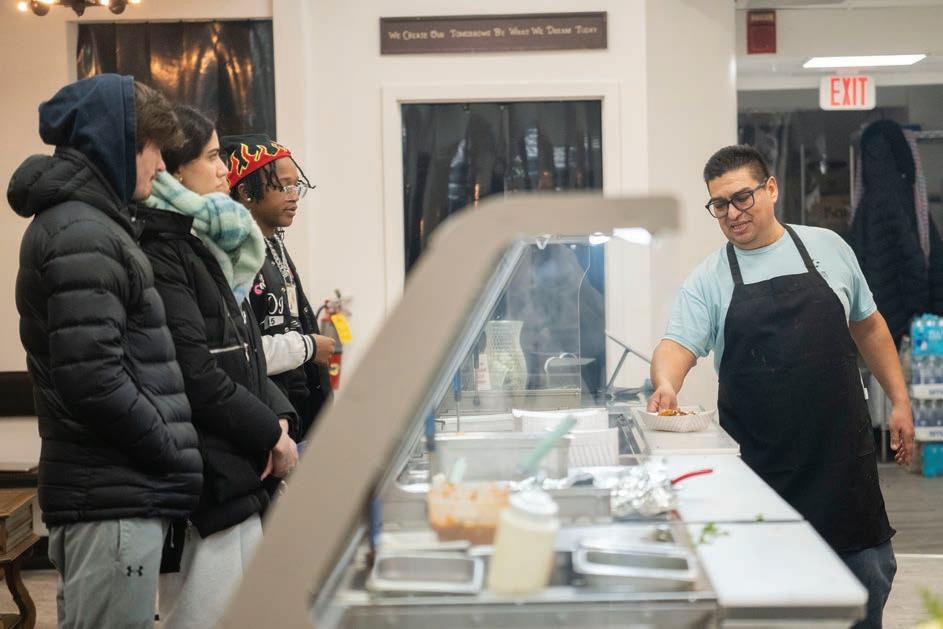
A $6.1 million grant from the Federal Transit Administration will fund the additions.
most likely won’t be able to clear under the Iowa Avenue Bridge.
CAMBUS, the University of Iowa’s student-operated busing system, will introduce six new diesel-electric hybrid buses after receiving a $6.1 million grant from the Federal Transit Administration awarded in January, replacing six buses purchased between 2008 and 2009.
Mia Brunnelli, CAMBUS manager, said the new buses will make the rides less errorprone. Brunnelli said the older buses have been running into maintenance issues, causing rider delays. Brunnelli said the six older buses were due for retirement in 2022 and cost 60 to 70 percent more to maintain than a new bus.
CAMBUS provides over 3 million rides per year, according to UI Parking and Transportation.
Brunelli said riders can expect the same experience as the diesel-powered buses with the new hybrid buses. She said the six new buses will be slightly taller, meaning they
Brunelli said the change will not affect riders on routes that pass under the bridge; the transit service will still have 26 other diesel buses that are shorter.
“Other than that, passengers really won’t notice a difference with these buses,” she said. “It’s kind of like the difference between a gasoline car and a hybrid car. You essentially get better gas mileage.”
Brunelli said the UI Department of Transportation is still in the process of purchasing the buses and expects its integration into the current fleet to take 18 to 24 months.
Although prices for buses vastly fluctuate, Brunelli said she expects a diesel bus to cost from $750,000 to $800,000, while a hybrid bus can cost up to $1.1 million.
“These first ones we get will be a great test of that to see if the increase in price to go hybrid rather than diesel works with that additional fuel economy,” she said. “As far as whether or not we’ll continue to buy hybrids or electrics
Kettmann said as colleges look to recruit high school students, the smaller number of graduates will lead to increased competition, both at the four-year college level and the community college level.
“There will be an increase in competition as community colleges continue to compete based on affordability, the fle ibility of classes, and how we offer those, and really promoting the transfer opportunities as well. Those are going to matter now more than ever,” Kettmann said.
Shields said as institutions are looking to recruit high school graduates who are ready to start college, competition increases.
“I think there is an iety there because, in some ways, we are all competing for the same student,” Shields said.
Concurrent enrollment, or allowing a high school student to take a course for both college and high school credit, could be hit by the enrollment cliff, Shields said, with there being less of a need for concurrent enrollment as a result of low K-12 enrollment.
According to the Iowa Department of Education, fall 2025 saw 42,896 high school students pursuing concurrent enrollment, a roughly 5 percent increase from fall 2024.
If high school enrollment numbers were to decline, concurrent enrollment could take a hit, as fewer students are taking courses for college credit.
Kettmann said many colleges may need to potentially cut programs if there is an inadequate amount of student enrollment.
Justin Hoehn, director of media relations and communications at Kirkwood, said the college has seen 12,765 students enroll in a program in 2024, a number that increased to 13,419 in the fall 2025. For industrial technology students, there was a slight dip in enrollment from fall 2024 to fall 2025, from 694 students to 685.
Though Kirkwood does not foresee cuts to its programs, with 140 programs offered at the community college, each program needs a certain number of students pursuing a degree. Kettmann said a decline in student enrollment may mean limiting the number of class sections offered.
The impact of enrollment declines on both community colleges and four-year institutions often means colleges have tough decisions to make about what programs to offer, Shields said.
“If a program gets to the level where there might not be enough students for it to be sustainable, then we might not be able to continue that program,” Shields said.
Not continuing to offer programs can, as a result, jeopardize faculty careers, causing a shift in the classes they teach, their workload, or their overall job at the college.
Adjunct faculty members, or faculty members who are working at an institution part-time without tenure, are crucial to many college institutions, Shields said.
“A lot of universities rely on adjuncts to some degree to help fill in the gaps where you need to open up another class. If [institutions] see a decline, they would be the first cuts,” Shields said.
Many adjunct faculty members are operating in a variety of different landscapes, with some holding full-time jobs. However, Shields said other faculty members rely on the adjunct position, taking roles at multiple institutions.
“That is absolutely a group of people that could stand to be significantly impacted,” Shields said.
Many community colleges receive a variety of funding mechanisms, such as general aid, state funding, and K-12 concurrent enrollment.
Shields said for state general aid, legislators often look at enrollment numbers as an indicator of how much aid a community college may need.
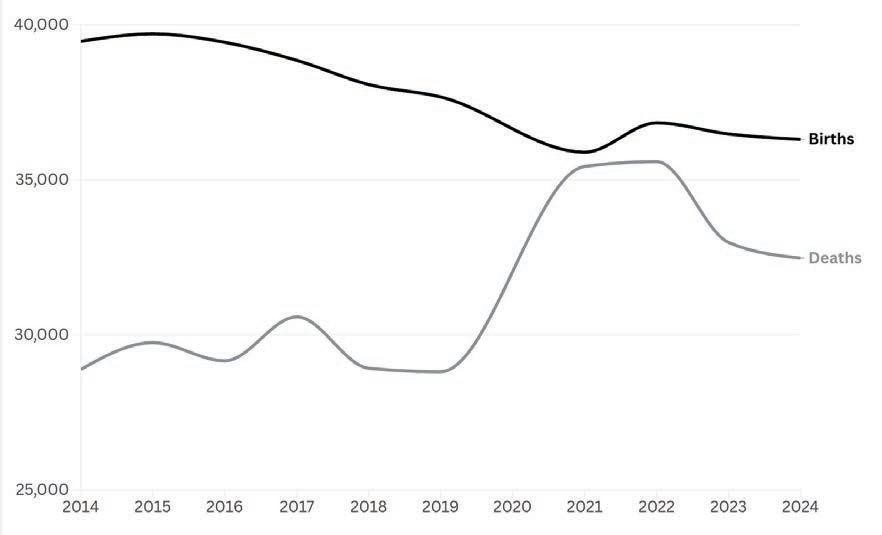
The number of births and deaths in Iowa have grown closer over the last decade, with the closest di erence being 455 more births than deaths in 2021. This has led to a decrease in family sizes and high school graduates.
“There are a myriad of implications,” Shields said. Shields said one of the hardest decisions many community colleges have to make with low enrollment numbers is to raise tuition rates.
According to the Iowa Department of Education, the average cost of in-state tuition for fiscal year 2025, which runs from July 1, 2024 to Jun. 30, 2025, was $219.78 per credit hour, a 3 percent increase from the year before.
“The higher our tuition gets, the less feasible it is for students, so there’s always a delicate balance we are trying to strike,” Shields said.
Tuition dollars not only go toward helping run programs and provide student education but also to other revenue sources to support positions across institutions, such as academic advisors and lunch staff.
“Our colleges are pretty significantly driven by tuition, so a reduction of students will result in cuts to all levels of the institutions, and those are some di cult decisions for any college to make,” Shields said.
from the traditional four-year degree to entering the workforce or pursuing a trade program.
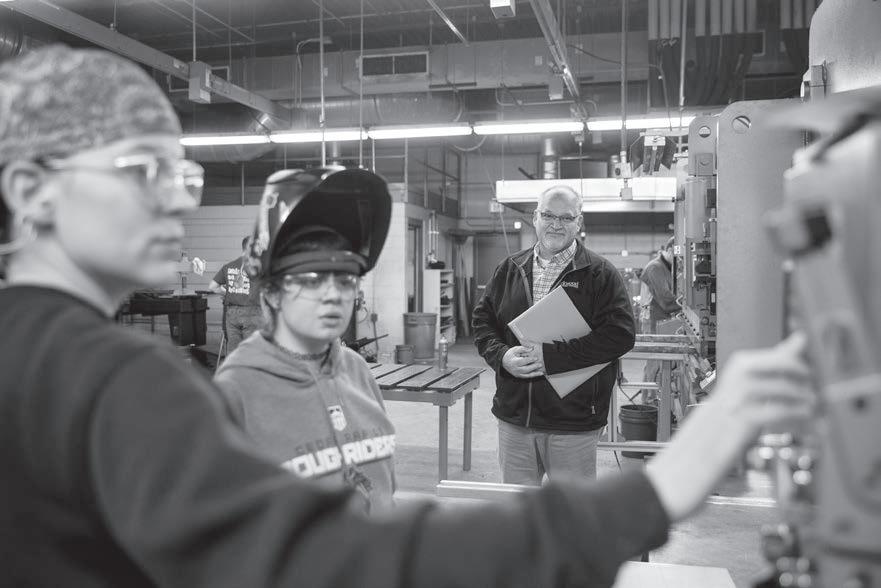
Joe Greathouse, dean of industrial technologies at Kirkwood, sees the trades outpacing four-year degrees, with students looking for educational opportunities more tailored to student need.
“This generation of students is all about return on investment instead of the legacy concept of going to college because mom and dad did it or because it is the socially correct thing to do,” Greathouse said.
Within Greathouse’s line of work — manufacturing, construction, trades, and transportation — there is a growing need for more individuals in the workforce, with many students showing continued interest.
According to the Common Sense Institute, Iowa saw an increase of 1,000 construction jobs from June 2025 to July 2025 as well as an increase of 400 jobs in the trades, transportation, and utilities sector in the same time frame. These sectors were one of the few that saw an increase of jobs rather than a net loss.
tion that most employers would require it,” Salow said.
At the company Salow now works at, he said his employers prefer e perience over education.
Salow said although he could have continued to pursue his four-year degree in business administration at Iowa State, he has always had one goal — working in construction.
With the impending enrollment cliff, there is a major shift in how higher education is being understood. For many, this has led to an iety. or Shields, however, the shift invites e citement.
“There is so much potential for higher education to be for so many more people than it has traditionally been. I think you are going to see a lot less of the traditional model of leaving high school, going to college, going to work, and then you are done,” Shields said. “It is going to be career, technical, and people getting their associates and certificates, going to work, and then coming back for
Kettmann said more than ever, community colleges, including Kirkwood, rely on tuition dollars, impacting the product offered to students.
Often, the appeal of a two-year community college is affordability, with lower costs driving students away from more e pensive fouryear institutions, Kettmann said.
“Students, regardless of educational background, should have a fit at Kirkwood or other community colleges, and we want to be able to navigate that in a way that’s affordable and accessible to students,” Kettmann said.
Though the appeal of four-year institutions and community colleges remains, e perts and laborers in the workforce see a shift away

“Not everyone needs or wants a full one- or two-year program, let alone a four-year program. They just want the skills to be successful in what they want to pursue,” Greathouse said.
Where retirement areas, or areas where more people are choosing to leave their professions, are high within the workforce, Kettman said there is a need to fill jobs.
“It’s going to be a matter of what we need to fill those jobs and catering to student needs. Is it going to be more of the manufacturing and trades side, health care side? What do we need to train?” Kettman said.
With an increase in retirees from the workforce, Salow is seeing many employees retiring out of the trade workforce at a much greater rate than new employees entering the workforce.
According to Common Good Iowa, the Iowa Workforce Development saw the state losing 8,400 jobs in the manufacturing sector, Salow’s trade. This was a 3.7 percent decline from 2024 to 2025.
As someone who chose to pursue a career in construction management while also attending a two-year institution, Salow sees the enrollment cliff as a negative for universities but a benefit for the trades, helping to bolster young generations’ interest in joining the field.
Salow first became interested in construction management when his older brother started running his own construction business. Salow watched as his brother would remodel homes, which piqued his interest and eventually led him to Rinderknecht Associates, Inc., a general contracting company in Cedar Rapids.
“When I was originally pursuing my degree, I was under the assump-
more schooling.” The presence of nontraditional students, she said, will play a large role in combatting the cliff.
“Eighteen-year-olds coming out of high school are not at all our primary demographic. So while there is a decline in that specific population, we still have a lot of working adults and other folks coming back to us all the time,” Shields said. “ The cliff hits in different ways for different sectors of higher education.”
Kettmann said a key way to combat a projected decrease in high school student enrollment is working on recruitment and retention of not only e isting students but nontraditional students who are choosing to pursue degrees later in life.
“We have a big focus on our nontraditional population and part-time students,” Kettmann said.
Over 30 percent of Kirkwood’s student population comes from the nontraditional student demographic, Kettmann said, including adult students coming to college for the first time, individuals switching their careers, or picking up credentialing for e isting jobs.
“We’re able to shift and put a focus on what the community needs, and that really entices adult students to come,” Kettmann said.
Greathouse said attracting nontraditional students can help to fill any potential voids of the enrollment cliff, and that is “a win for everybody.” Delivering quality education and catering to what people need is key to filling gaps that may arise, he said.
“If there is a gap, if enrollment were to drop, we’re prepared to serve different types of students into the future,” Greathouse said.
a long time and a lot of effort, but that food speaks for itself. It’s delicious.”
The restaurant came after complications renewing Luna’s permit to park her food truck on the Pedestrian Mall. Every three years, food trucks are required to renew the permit for their spot, but this time, Luna said it was denied.
Luna said she went to city hall and kept asking for her permit, eventually getting it back but realized the city could change its mind at any time, leaving her without a livelihood.
Luna said her location was essential to her business, with the nighttime crowd being her primary customers, typically operating from 6 p.m. to 2 a.m.
“If you go to park on the east side of the city, it doesn’t have the same people,” Luna said. “My food is at nighttime, after the bars, when the students come out. If I go park at Walmart or Leonard’s, it’s not going to be the same.”
In 2024, her husband Salatiel Luna left his job working at Panda Express to support the business, allowing them to go to more festivals and events to sell food. However, when their permit denied, their family was left vulnerable.
Luna first started working in 2019 at the Iowa City Farmers Market after leaving her job as a medical assistant at the University of Iowa Health Care due to her son’s autism diagnosis.
“All we got is dependent on the food,” Luna said. “Our house, our mortgage, my son’s therapies, my son’s school — everything. We decided we needed something secure. This building is what that is. This is a secure income.”
Luna said it was difficult for her and her husband to take time off work to take their son to his therapy appointments, and it was too hard to find a babysitter who was able to meet her son’s needs, so she quit her position at the hospital.
She began looking for a job that would allow her to attend her son’s therapy meetings while still financially supporting her family, with a friend encouraging her to work at the farmers’ market.
“So I went back home, and I talked to my family about it,” she said. “Then my family goes, ‘What are you gonna do? Because you worked in medical. You don’t know anything.’ So I remember my husband and I, we went to Walmart, and we bought a blue canopy.
And [my] little girls and I took all my spoons and towels from my house, and then we went to the farmer’s market Wednesday.”
That first Wednesday, Luna said almost nothing sold the entire morning from her food truck, and as she waited, she began to give up on the idea. Eventually, one woman came up to her and asked her what she was selling. The woman bought food from her and left. A few minutes later, people started lining up, and Luna said, to this day, she still doesn’t know why.
After that first week, Luna said a line formed every Wednesday, and she quickly became a regular vendor. Over the next four years, Luna and her husband ran the

or other alternative fuels, I think that will really just depend on how these ones pan out.”
Megan Andress, a UI fourth-year student, said she’s never been on a CAMBUS that has had maintenance problems. She said she wishes more funding was concentrated toward opening new routes to prevent overcrowding, especially since Iowa City closed the 4-Downtown Shuttle in August 2025.
“Every single day, [CAMBUS] is crowded to the maximum, no matter what time I ride,” she said. “They’re also turning down people at bus stops, it’s ridiculous. I take the bus four times a week, and I see that happen about twice a week.”
Andress also said the buses have been frequently tardy as she’s ridden them this year, anywhere from five to 1 minutes late.
On top of the late arrival, Andress said using the Transit app to track the route often leads to greater stress for students with the app frequently telling riders they missed the bus because it can’t compute the bus being late.
Although Andress said she’d like to see more fundamental parts of the service, such as routes and the app,
given attention before the buses, she appreciates the lower emissions the new buses will bring.
“I do think it’s good that we’re switching towards electric,” she said. “Public transport is already helping to cut down on car emissions, lower emissions are even more awesome.”
CAMBUS is not the only Iowa City transit system moving toward lower-emission vehicles. Iowa City Transit is looking to purchase four diesel-electric, hybrid buses to replace four diesel-powered buses, said Darian Nagle-Gamm, Iowa City’s director of transportation services.
Nagle-Gamm said the city is currently waiting to hear if the $4.3 million Low or No Emission Grant they received in 2023 will be approved by the federal government to spend on the hybrid buses. Similar to CAMBUS, the purchasing process would take up to two years, Nagle-Gamm said.
According to the Iowa City Climate Action & Adaptation 2025 annual update, Iowa City emitted nearly 700,000 metric tons of C e, short for carbon dio ide e uivalent, combining multiple greenhouse gases into a single unit based on how much heat they trap in the atmosphere. Twenty-two percent of the total emissions came from transportation emissions.
“We do have long-term plans to move towards an all-electric fleet,” agle- amm said. “It’s in the City of
food truck at festivals, markets, and late-night spots downtown, learning how to balance customer demand with long hours and unpredictable weather.
As Luna’s business continues, she hopes to make a space where her son can eventually work.
“We don’t know if he will be able to go to college or do some career,” Luna said. “I learned that a lot of people with this disability don’t really get appreciated, they don’t get paid the same way everybody else gets paid.”
Luna recalled past experiences at restaurants where her son was told to “shut up,” and they faced discrimination from other customers and restaurants.
As Luna grows her business, she said she hopes those with disabilities are able to come to Luna’s Tacos and feel welcomed.
“I don’t want people here unappreciated,” she said. “I want people to feel [at] home. We are all the same. Yeah, we are the same. Doesn’t matter what color you are, what ways you are, how good or bad you are.”
Now, in her first brick-and-mortar location, Luna has expanded her menu; however, she predicts even more change on the horizon, with new offerings weekly. New menu items include her family’s favorite dishes: albondigas, chicken meatballs simmered in chipotle sauce; A La Mexicana, pork salsa verde; chiles rellenos, roasted peppers stuffed with cheese or tofu; and birria, a traditional Mexican stew slow-cooked with chiles and spices.
This summer, Luna hopes to operate both the food truck Thursday to Saturday at night and the restaurant Sunday to Friday, as well as the Iowa City Farmers Market. Even with so much support and planning, she said stepping into a permanent space comes with its own worries.
“I am a little bit scared, but everybody is afraid,” she said. “[Afraid I] don’t make the expectations of the community. I am always a person who likes to go above and beyond. I’m planning to do a lot of stuff, like I’m planning to do the market. But I don’t know if I can do that. And so I don’t feel so comfortable.”
Many customers are excited about the new space. Iowa City resident Fifi Odhiambo said she’s thrilled for the restaurant’s new, more permanent location.
“The service is always great,” Odhiambo said. “They stand out because there’s such friendly people working there. I’m glad they have a building, and I think they can do more with the space, like letting people socialize. It’s exciting to have another long-lasting taco spot downtown.”
Iowa City strategic plan. But it’s probably going to take us some time to get there, and we’re probably going to see a mi of different propulsion types, before we get to an all-electric fleet.” agle- ammsaid 8 percent of Iowa City’s bus fleet uses diesel propulsion, or engines, while 15 percent are electric.
Nagle-Gamm said the current electric buses, purchased in 2021, are out of commission due to maintenance issues. The buses were bought from Proterra Inc., a company that filed for bankruptcy in 2023 and was bought by Phoeni EV in 2024.

Legacy news should work with content creators to adhere to Gen Z’s reading habits.


There’s no denying en consumes news differently than any generation before. here television and newspapers once dominated the industry, people now turn to TikTok, Instagram, and the social platform .
According to data from Pew Research Center, 46 percent of U.S. adults aged 0-64 and 28 percent of adults aged 6 or older said they often or sometimes get news from social media. That same report found that 6 percent of adults aged 18-2 said they often or sometimes used social media as their source for news.
To meet social media users’ demand for news, “news influencers” have taken over digital platforms. According to the Pew Research Center, news influencers are social media users who post about news and events on a personal social media account rather than an organiation’s account.
These news influencers, especially the seemingly independent ones, can be problematic and undermine the integrity of news. To combat social media news’ growing audiences, news outlets need to adapt by treating influencers as messengers and not enemies.
The popularity of news influencers stems from their ability to synthesi e and e plain the news. According to the Pew Research Center, 6 percent of Americans who get their news from news influencers say the online creators help them better understand events and civic issues.
The problem is that, according to Pew Research ata, appro imately 48 percent of news influencers e plicitly identify as left-leaning or right-leaning. Although news personalities e pressing political views may seem normal in the news world nowadays, it isn’t, and when some pass this off as “reporting,” it can be harmful to communities.
ne such news influencer, ick Shirley, has made headlines lately for claims he made against innesota day cares and the violent U.S. Immigration and Customs Enforcement, or ICE, operations that have since plagued innesotan communities. n ec. 26, 202 , Shirley, a conservative content creator and former prank ouTuber, posted a video titled “I Investigated innesota’s Billion ollar raud Scandal.” The video has since garnered over 3.8 million views on ouTube and has been spread across multiple social media platforms.
The video shows Shirley approaching day cares and asking the staff where the kids are, and claiming they are committing fraud with no kids to be seen in the video. In that same video, Shirley also appeared at innesota health care facilities looking for fraud, and he went to the innesota state government to talk with o cials.
Shirley’s video drew the attention of ice President J. . ance, who praised Shirley, saying his reporting was more useful than any journalism coming from the past year’s Pulit er Pri e winners. However, Shirley’s claims have not been verified,
Our institutions need to reflect society’s gender makeup.

ew year, same patriarchal institutions.It’s no wonder it seems like we’re constantly on the brink of war, sinking economically, and behind in education, health care, and human rights. en are in charge.
rom both history and current events, it is difficult to ignore the recurring pattern that men are often subject to rash decisions and to unchecked emotions. They so often lack the same empathy or reason that makes women so e emplary in positions of power.
E aggeration aside, given the ongoing failures of male-dominated governments and authority, we must move beyond patriarchy and toward gender-balanced leadership. In short, women deserve power.
Anatomical, hormonal, behavioral, evolutionary, and social factors have disposed men to be more aggressive and more likely to engage in impulsive, risky behavior — not ideal for most high-level directorial and e ecutive roles, according to a 202 report from ature.com. omen, on the other hand, have been shown to approach leadership with a heightened capacity for empathy, connection-building, and inclusiveness that bolsters their respective fields.
with one day care manager saying Shirley intentionally appeared outside of business hours and thus there were no children in attendance at the day care.
A C interview with Shirley in front of the same day care during business hours showed kids being dropped off at the front door. Shirley then claimed the day care was “showing face.” hile there has been day care fraud happening in innesota dating back to 2013, government agencies and local news have been investigating and uncovering it. Shirley’s video doesn’t come off as an attempt to seek justice, but rather to target communities that the Trump administration and Republican Party have demoni ed.. espite not having evidence of fraud, on ec. 30, 202 , the Trump administration fro e funding to child care funds in innesota. ot even a week later, 2,000 ICE agents were sent to innesota, in what they saw was their largest operation yet, to uncover fraud.
The operation has since led to the killing of U.S. citiens Renee icole ood and Ale Pretti by ICE agents, the arrests of over 2,400 people, and the option of online learning in schools because of safety concerns.
All of this indirectly stemmed from a ouTube video posted by a 23-year-old wannabe reporter.
A simple dive into Shirley’s content and background shows audiences he does not act in good faith and has deep ties to the P. espite the lack of journalistic training and integrity, Shirley continues to receive praise for his content.
The solution to news influencers, like Shirley, who cause more harm than good, isn’t that simple.
University of Iowa School of Journalism and ass Communication professor avid owling has an idea for how news outlets can combat these bad actors.
owling recogni es that content creators have already embedded themselves in journalism.
According to the Associated Press, some have even gained press passes during the Biden and Trump administrations. So instead of fighting against the future, owling believes it is time to embrace the change.
“There is a movement right now to foster collaboration between legacy news and news influencers,” owling said.
rgani ations such as the American Press Institute and Influencer Journalism, started by a orbes 30 under 30 award-winning journalist, Adriana acy, have begun working with influencers to reach a wider audience and adapt to the future of news consumption.
The hope for a collaboration between news organi ations and influencers should be a mutualistic relationship.
ews outlets should work with people with established followings to reach wider audiences.
Influencers would then gain credibility, journalistic training, and access by becoming a liated with legacy news outlets that already have established trust with the public.
Although this wouldn’t eliminate bad faith actors in journalism, it would be a start.
“Those are interlopers on the periphery who are actually hijacking journalism and claiming to be journalists without working from journalistic principles,” owling said, referring to people like Shirley.
owling mentioned famous online figures such as Joe Rogan, Theo on, and Hasan Piker, whom many use as resources for news despite their work being laced with their opinions.
“The bad actors have always been in journalism,” owling said. “If you know anything about the history of journalism, you would know that bad actors and people lying in the press go back to the revolutionary era.” hile it’s easy to reject news influencers, there is no denying en ’s growing reliance on them for information. The best way for legacy news to survive and for influencer news to become credible is for the two to form a mutualistic relationship the reporter and the messenger.
KP ’s 2023 Advancing the uture of omen in Business survey reported that out of 1, 00 e ecutive women, percent said they prioriti e well-being for themselves and their team and e emplified support by demonstrating empathy and authenticity, boundary setting, and taking time off.
The Ready- ow eaders report from the conference board reflected that organi ations with at least 30 percent of leadership roles filled by women are 12 times more likely to be in the top 20 percent for financial performance.
The orld Economic orum acknowledged that countries with more women in government are more prosperous. reater female representation in leadership reduces legal ine ualities between men and women, removing barriers for women in the workforce. As opportunities are e uali ed, female workplace participation rises, benefiting both the women themselves and the country’s gross domestic product.
espite the evidence of e cellent women leadership, the patriarchy continues to reward un ualified men over ualified women. Sophia ernon, a University of Iowa second-year, pointed to recent presidential elections as a prime e ample.
“Both Clinton and Harris were ualified for the job, and yet they were not elected,” she said. “Honestly, the elections were less about ualifications and more about popularity, and the way society is now, a man is always going to be more popular.”
This was apparent with current president onald Trump’s controversial elections in both 2016 and 2024. Although Trump’s proposed policies were not universally praised, he still won both elections, notably against two women.
Society tends to prioriti e tradition over competence, and wrongfully so.
That said, replacing the patriarchy with a matriarchy is neither realistic nor desirable. A matriarchy is simply patriarchy’s mirror image, and neither fully represents our world. So we need a compromise.
e need an institution reflective of our mi ed gender makeup. Just like there are checks and balances between levels of government, so should there be between the different genders and their relative strengths and weaknesses.
The U omen suggests si key steps to bridging the current gender divide. They first recommend support for policies that work to close the digital gender divide, ensuring e ual access and leadership for all women and girls in technology.
They endorse investment in social protection systems, public services, and care services to give women and girls an e ual chance to thrive, as well as the adoption, implementation, and funding of laws and policies that enforce and signal conse uences toward violence against women while supporting local women’s organi ations.
Implementation of laws, policies, and temporary special measures that increase the number of women in decision-making positions brings women closer to full and e ual decision-making power. The adoption of fully financed plans to increase women’s meaningful participation in all aspects of peace and security, and the funding of women’s organi ations in crises and conflict settings, would aid in the reduction of violence against women.
astly, the organi ation promotes the prioriti ation of women and girls in climate action by increasing investment in their leadership and access to green jobs.
“I absolutely see a need for change, and I think the way that the current administration is going has a lot of people frustrated with the vote that happened or regretful about the way they themselves voted,” ernon said.
Especially as the alternative vote could have seen things being so different, it’s easy to get caught up in regret and resignation. But we can still change. hile a girl can only dream of the day when women run the world, greater gender e uality is a reasonable resolution for 2026.
15 percent of graduates in 2025 finished their degree with an additional major.
Over the past decade, the University of Iowa has seen relatively stable participation in the number of students pursuing a secondary area of study, despite four-year institutions nationwide reporting increases in students pursuing more than one major, minor, or certificate.
According to UI data, in fall semester of 2025, 15 percent of undergraduates graduated with multiple majors, a number relatively similar to the fall of 2024.
In fall 2024, 16 percent of undergraduates who listed a major as their primary area of study were also pursuing at least one nonprimary major.
When preparatory programs, such as pre-law, pre-medicine, and predentistry, are included, that number goes up to 30 percent of students pursuing an additional major.
Ten years earlier in fall 2014, the ratios were roughly the same. Fifteen percent of students had a second major, and 30 percent of students in preparatory programs were pursuing an additional area of study.
This pattern is different from a national trend, with many U.S. colleges seeing the number of students who are pursuing a double major or minor grow significantly over the past decade, according to data from the Integrated Postsecondary Data System.

The Hechinger Report, a nonprofit newsroom covering education, calculated 12 percent of college and university graduates left school with more than one degree in 2023-24, a 6 percent increase from 2014.
According to the University of Wisconsin-Madison, the university reported 30 percent of their 2024 graduates completed multiple majors, which is around 15 percent higher than Iowa.
At the UI, academic advisors see multiple reasons for students to choose to double major, including having additional interests and having extra room in their degree plans.
“Having multiple interests that a single major doesn’t really encompass is one of the most common reasons students pursue a second program of study,” Liz Caldwell, assistant director
for UI courses and curriculum, said.
“Many students have room in their degree plans for elective courses, and having a second program of study can be a way to focus those around a particular area.”
Flexibility in electives combined with the university’s wide range of majors and programs allows students to uniquely tailor their academic tracks.
According to the UI, the college offers over 200 areas of study. Caldwell stresses that just because these areas of study are offered does not mean a second major or minor is the right choice for every student.
“Having a second program of study, without knowing the context or intention behind why, doesn’t necessarily do a lot of heavy lifting for a student,” Caldwell said.
Caldwell said some colleges are more
accommodating than others when it comes to students’ abilities to pursue additional majors and minors.
“I think the College of Liberal Arts and Sciences, or CLAS, probably has a lot, since a good number of CLAS majors can accommodate a second program of study,” Caldwell said.
Piper Kearney, a second-year UI student, said she chose to double major in journalism because it paired well with her English major.
“The English major has a lot of room for electives, and I knew I wanted to push myself academically, so the decision to double major was pretty simple for me,” Kearney said. “Journalism was another major I’d considered going into college, so I went with that.”
Kearney said her additional major has helped her discover journalism events and experiences that she wouldn’t have found otherwise.
“Joining another department can also open up a bunch more scholarships that are specific to that major, which is nice,” Kearney said.
UI first-year student Ella Jorgenson is unsure if she wants to pursue a second major in addition to her primary major of chemistry. The potential for extra workload is something that makes her nervous.
“I’m slightly worried about the workload, but I personally think that the pros of having an education outweigh the cons,” Jorgenson said.
Jorgenson said pursuing an additional major or minor could be a way to gain new experiences. “I’ve thought about pursuing a second major, partly because I am unsure of what I want to do after college,” she said. “I also think it can create more opportunities for myself once I enter the workforce.”
The program launches Feb. 2 in Waterloo with plans to expand through five years.
The University of Iowa is opening a new program, the Community Health Assessment and Monitoring in the Pharmacy, or CHAMP, to increase lung cancer screening rates in Iowa to address the state’s high case rate and low survival rate. According to Iowa Health and Human Services, only about 20 percent of eligible Iowans receive a lung cancer screening annually.
In a 2025 report, The American Lung Association indicated that the rate of lung cancer cases in Iowa is 60.3 per 100,000, above the national average of 52.8, with a survival rate of 27.1 percent, below the average national rate of 29.7 percent.
The Iowa Pharmacists Association and Community Pharmacies Enhanced Services Network are using CHAMP as a five-year program to assist patients in scheduling a lung cancer screening at the pharmacy counter.
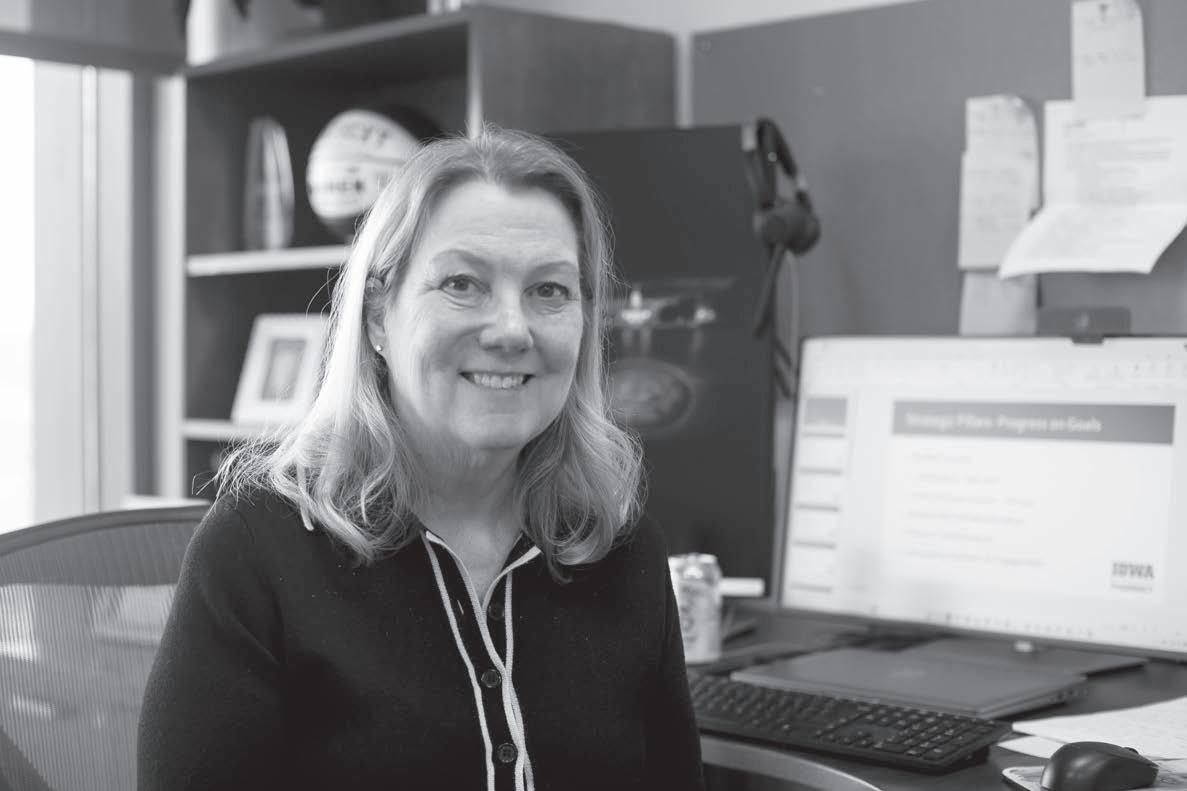
CHA P enters its first phase beginning eb. 2, Jill Kolesar, dean of the UI College of Pharmacy, said. The first phase will allow 00 eligible participants from Greenwood Pharmacy and Cedar Valley Family Medicine in Waterloo to enroll.
Kolesar said patients will enter the pharmacy and be met with questions to determine if they are eligible for lung cancer screening.
If patients are eligible — meaning they are 50 to 80 years old with a history of smoking — they will decide if they would like to undergo a screening in the form of a blood test, a low-dose computed tomography scan, or a less radiation-dense X-ray, which the pharmacist will assist in scheduling.
Kolesar said the program looks to increase the low 20 percent cancer screening turnout number to 75 percent by the program’s end in 2031.
“There’s a number of reasons people don’t want to undergo lung cancer screening, and a lot of them are related to the fact that they don’t know about it,” she said. “So this intervention will take care of that problem. Or they don’t want to schedule a lowdose CT scan, so having a blood test as an option would address that.”
Kolesar said CHAMP will begin as a singular site in Waterloo due to its high rate of lung cancer, but members of the program plan to extend it to 10 additional community pharmacies. Kolesar said the program will last five years in total.
“Our partner, the Iowa Pharmacy Association, is already working with us to conduct the training sessions for pharmacists to start offering this as a service,” she said. “We would hope to be able to roll this out nationwide to any community pharmacy who wants to offer this service.”
Kolesar said if CHAMP is successful, the program could also expand to screen for other forms of cancer.
“What we’re planning on doing next is a cervical cancer screening,” she said. “The FDA just approved a new test to swab for cervical cancer for self- administration in health care settings. That is the next thing that we’d like to pilot.” Kolesar said in Iowa, residents visit their pharmacies
over seven times as often as primary care. Matthew Pitlick, the CEO of the Iowa Pharmacy Association, said the statistic points to the fact that pharmacies are the key to addressing Iowa’s low lung cancer screening rates.
“Particularly in rural Iowa, pharmacies are going to be your main health care hub facility in those counties that don’t have many physicians or nurse practitioners,” he said. “In particular, you get farmers out there who are e posed to different carcinogens and chemicals, so this is a good opportunity for those people in our rural communities to have access.”
Emily Sadecki, an assistant professor in the UI’s
Department of Family and Community Medicine, said a lack of access to primary care providers and barriers in accessing CT scans can play a role in Iowa’s low screening rates.
“The initial screen rates are low, but then the subsequent folks who follow up in subsequent years are also very low,” she said. “The pharmacy is a great place to assist that. [Patients] visit their pharmacy maybe once a month, where they might only be seeing their primary care provider once every six months, depending on the person.”
Sadecki said she sees CHAMP being a model for a future in which pharmacies partner with primary care o ces for administering preventative health screenings.
Sadecki said the CHAMP model will be particularly helpful during Iowa’s primary care shortage. According to the Cicero Institute, Iowa ranks 44th in physician supply and could be short 1,660 doctors by 2030.
“I think using team members to the fullest ability of their training is important and a good way to try to close some of those preventive screening gaps,” she said.
ICCSD is waiting to see how the funding model change will impact budgets.
Iowa has become the first state granted approval by the U.S. epartment of Education for an education funding waiver aimed at “returning education to the states.”
According to the U.S. epartment of Education, Iowa was the first state to apply and receive this block grant, which will allow state education o cials to have more control over their federal education dollars.
Approved by U.S. Education Secretary inda c ahon and ov. Kim Reynolds on Jan. , the waiver will help Iowa save nearly 8 million in compliance costs over the ne t four years, c ahon said. “ oney schools can put directly back into the classroom,” she said in a post on the social platform .
In Reynolds’ Condition of the State address on Jan. 13, she said “this marks an important first step toward fully returning education to the states and ensuring federal resources are aligned with Iowa priorities and Iowa student outcomes.”
Under the waiver, Iowa o cials can consolidate multiple federal funding streams into a single state-level block grant and gain broader fle ibility allowing states to pool their federal dollars toward priorities of their choosing.
This waiver is more versatile than the one proposed in arch 202 , which asked c ahon to combine 10 funding sources into a single block grant for the state’s education agency and the state’s school districts.
Chair of the Iowa House education committee Skyler heeler, R-Hull, said in a statement to thinks the waiver will benefit students throughout the state and is the first step to building a stronger education system for the rest of the country.
“Iowa knows how to educate Iowans better than any federal bureaucrat,” heeler said. “ e are grateful to the Trump Administration for delivering on their promise to return the power in edu cation to the states. This block grant will allow Iowa to stop following one-si e-fitsall mandates and start putting students’ needs first.”
Iowa emocrats still hold some uncer tainties on what the waiver will look like and how money is going to be distributed. ember of the Iowa House education committee Heather atson, -Ankney, said her initial reaction to the block grant was met with some curiosity.
“I think what’s really important for Iowans to be aware of is that we don’t know the details of how it’s actually going to work,” she said.
“So right now, I’m personally wonder ing what accountability is going to be.
ho’s actually going to be making the decisions about where resources go and how the money is being used ” atson said it is important the epartment of Education is directly communicating with Iowa lawmakers.
“I think we just need more details directly from the department,” she said. “And I think the legislature should serve as a guardrail to ensure that federal dol lars still go where they’re needed and as they’re re uired by federal law.”

In his opening remarks to the House
for Iowa emocrats.
“It also means making child care and preschool affordable and accessible for every Iowa family,” he said. “And it means saying clearly that ta payer dollars should be invested in public schools, not siphoned off into reckless private school voucher programs that cost hundreds of millions while leaving too many kids behind.”
c ahon also said the fle ibility could support evidence-based teaching, a research-backed approach to teaching, and teacher training initiatives, helping narrow achievement gaps.
Republican lawmakers have voiced support for the block grant and said it will be beneficial for Iowa schools.
on Jan. 12, House inority eader Brian eyer, - es oines, said public education is among the top agenda items for Iowa House emocrats.
“ irst, we are committed to making Iowa public schools the best in the nation again,” eyer said.
She added that the lowering of class si es, support of teachers and staff, and ensuring all students have needed resources as things to prioriti e. eyer also said affordability and accessibility in public schools is a focus
In Iowa City, school districts are waiting to see how that money will impact budgets, sta ng, and classroom resources. President of Iowa City Community School istrict Ruthina alone said she trusts leadership at the state level yet is uncertain how the grants will
work out in Johnson County schools. “ hat my fear is, is that somehow or another funding gets cut, and so where we would get ’ number of dollars for teacher training, and ’ number of dollars for English anguage earner, all of a sudden you are just getting less money to do the same thing,” she said. alone said after watching Reynolds’ Condition of the State address, which included discussion of the block grant, she believes state leaders are doing what they think is best for Iowa.
“I do believe Iowans know what’s best for Iowans, and we know our public schools are there to educate every single child that comes to us,” she said. “ y hope is that the epartment of Education understands that we cannot turn away any child, and so they will give us the fleibility and the funding in order to serve all the needs of our students that walk through our door.”
Maduro’s
conviction of aduro.
Roughly three weeks after the capture of ene uelan president icol s aduro, Iowa politicians and community members remain divided over the legality of the arrest and what it means for U.S. foreign policy.
n Jan. 3, the U.S. epartment of ar announced aduro had been taken into custody following a U.S.-led operation tied to longstanding federal drug tra cking charges, marking an unprecedented escalation in American involvement in ene uelan affairs.
According to the U.S. epartment of Justice under the Biden Administration, the move capped years of mounting tensions between ashington and Caracas, with U.S. prosecutors first indicting aduro in 2020 on narco-terrorism and cocaine tra cking charges linked to what they described as the “Cartel of the Suns,” and offering millions in rewards for information leading to his arrest.
In January 202 , the epartment of State raised the reward up to 2 million and then to 0 million in August 202 following the epartment of the Treasury’s designation of the Cartel of the Suns as a Specially esignated lobal Terrorist on July 2 , 202 .
In the months before his capture, the U.S. increased economic sanctions, stepped up military pressure in the Caribbean, and carried out actions against vessels tied to ene uelan oil, alleging tra cking networks — all part of the administration’s broader effort to disrupt aduro’s grip on power and counter what U.S. o cials framed as threats to American security.
As of late January, aduro remains in U.S. custody while legal proceedings move forward, though his removal has not resulted in immediate political change in ene uela, where his government and security apparatus continue to maintain control, according to statements from the U.S. epartment of State.
U.S. Sen. Chuck rassley, R-Iowa, issued a statement on his website saying aduro’s arrest was a lawful and necessary step, adding it demonstrates the U.S.’s commitment to holding international criminals accountable.
“ aduro was a fugitive of American justice and is responsible for killing hundreds of thousands of innocent Americans,” he said.
“The epartment of Justice has had a warrant out for aduro’s arrest since 2020 for his role in tra cking deadly drugs to the United States. Today, President Trump used his constitutional authority to arrest aduro and save American lives.”
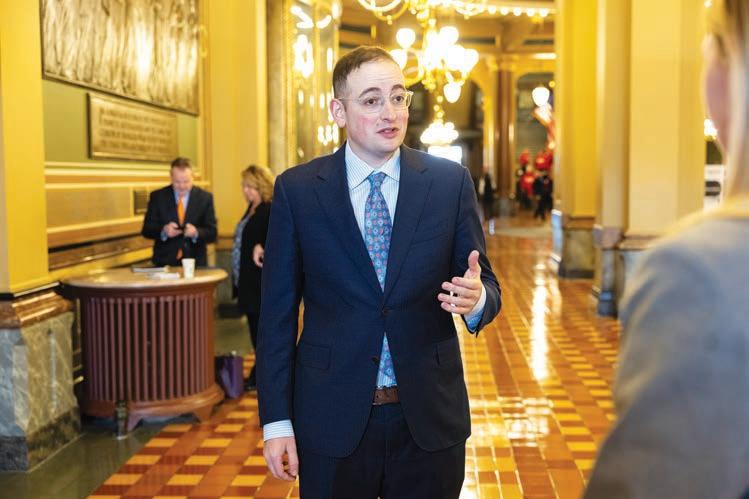
son of ene uelan immigrants, said he was concerned congress wasn’t fully included in the decision “of having a president that can just start foreign wars on any given whim without any kind of oversight.”
The epartment of Justice also reported the epartment of State offered a reward of 1 million in 2020 for information leading to the arrest and
Iowa emocrats opposed rassley, saying aduro’s capture was an abuse of e ecutive power.
Rep. Adam abner, -Iowa City, and
“I don’t think that’s what our ounding athers intended, and I think it’s very dangerous,” he said. “ hat I hear from voters is that they’re tired of foreign entanglements from the United States.” hile news of aduro’s imprisonment has been met with celebration among ene uelans abroad, abner said some remain cautious about what it means for real change in ene uela.
“ embers of the ene uelan diaspora are very glad to see aduro in jail,” he
said. “But I think the jury is out because the murderous regime of icol s aduro is very much still in charge of the country, and I guess we’ll just have to see how that progresses.” Chair of the emocratic Party Rita Hart held similar concerns to abner, saying checks and balances are in the Constitution to ensure that the military is sent on “necessary and wise” missions. “ ur courageous soldiers should not be put at risk or asked to enter long-term wars, occupy countries, and rebuild governments without the consent of the governed,” she said in a statement. “That’s why our Constitution makes the President Commander-in-Chief and gives Congress the power to declare war.”
The team’s first season in new facility brings pom finals, cheer 11th at UDA.
The University of Iowa dance and cheer teams placed 9th and 11th, respectively, at the Universal Dance Association’s Nationals in Orlando, Florida, this year, closing out their first season training in their newly built practice facility.
The $20 million Nagle-Duda Gymnastics & Spirit Squads Training Center opened in early 2025, and the Spirit Squad, which includes the UI dance team, cheer team, and Herky security team, began training there in February 2025.
Head Dance Coach Jennifer Eustice said the new facility brought stability to a usually hectic nationals season.
“I think that having the facility really kept our nationals preparation calm because we weren’t worried about figuring out practice space or working around a million other schedules,” Eustice said.
Before moving into the facility in February 2025, the dance and cheer teams rotated between several campus locations, including Halsey Hall, the UI dance building; the Field House, the university’s west side olympic weightlifting and recreational gym; and Carver-Hawkeye Arena, none of which fully matched their competition conditions, lacking the correct floors or the space they needed, Eustice said.
Their new facility, by contrast, is equipped with competition floors, a built-in sound system, whiteboards, designated locker rooms, video review systems, and more.

Senior dance team member Katelyn Lookingbill said the facility made a huge difference this season, both in how the team trained and how they felt walking into nationals.
“We just really feel appreciated and valued for all that we do, and we are very grateful,” Lookingbill said. “We are the only Division I program in the country that has their own practice space that was built and designed specifically for them, which is really cool.”
Lookingbill said the facility also improved the team’s ability to perfect their performances for nationals in a way they were not able to in the Field House.
“Just like any sport or competition performance, the better you can emulate your performance space right in a practice setting, the more successful you are once you get to the big stage,” Lookingbill said. “I think the facility was a big factor in that.”
Eustice, who has spent 17 years at the university and has been in the dance industry since she was 3 years old, said the change also transformed the team dynamic because for the first time, instead of teams splitting up across campus, the spirit programs trained alongside one another and cheered each other on all season.
“It’s definitely more of a collaborative experience, which I think was really fun and exciting for the athletes
themselves because they know that they have that support system,” she said.
This sense of collaboration extended beyond the dance team. Spirit Squad coordinator and head cheer coach Gregg Niemiec, who has led Iowa cheerleading for 30 years, said the cheer team also saw immediate benefits.
“I think that being in our own facility helped people concentrate, helped people stay focused on what the goal was,” Niemiec said. “I can’t exactly say that volleyballs and pickleballs bouncing on our mats is the safest thing while we’re flying through the air.”
Niemiec said the increase in focus was especially noticeable as the team prepared for their competition season this year.
“I think they really wanted to go out giving the best they possibly could to Iowa cheerleading and Iowa spirit squads,” Niemiec said. “I think that there was a lot of progress made in their skills, and then the mindset of what they’re doing as cheerleaders, to get out there and get the crowd going, too.”
At UDA Nationals, the UI dance team made finals and placed 9th in the country in the pom category, and the UI cheer team placed 11th overall. The dance team competes at nationals every year, and they didn’t make finals in 2024. Lookingbill said that contributed to the motivation they had this year.
“I’m grateful for my teammates and the drive that all 22 of us had because dance is a team sport,” Lookingbill said. “You have to have that fight in you, that you constantly want more, and that you can’t settle. And I think that’s something that we did a really good job of this year.”
Both coaches said their teams went into nationals this year with the hardest routines they had ever done, and said the members and leaders of the UI Spirit Squad gave their performances their all.
“One of the things I told [the dance team] after they came off the floor from pom finals was that now we know what it takes,” Eustice said. “That’s the bar, that’s the standard. Every year from now on, we’re going to continue to grow and level up.”
Though
the
The Iowa City Community School District is navigating changes to the food pyramid by U.S. Secretary of Health Robert F. Kennedy Jr., with an inversion of the pyramid emphasizing protein-filled diets.
The decision comes after the U.S. Department of Health and Human Services announced that after over a decade, the familiar MyPlate model that was recognized by the U.S. Department of Agriculture, or USDA, would be changed.
The new guidelines replace the familiar MyPlate model with a new food pyramid prioritizing protein, dairy, fruits, vegetables, and healthy fats. The new pyramid discourages the consumption of highly processed foods.
Though these guidelines are not law, they serve as a foundation for the standards that govern school meals under the National School Lunch Program and the School Breakfast Program, according to the USDA.
By law, the USDA, which funds these programs, must align child nutrition standards with the most recent federal guidelines. How quickly and to what extent these changes will affect the cafeteria remains unclear.
Alison Demory, the Iowa City Community School District’s nutrition director, said part of her job is to help create districtwide menus, keeping nutrition guidelines in mind.
“I’m not sure how that will ultimately play out for school meals,” Demory said. “We have not received anything specifically yet.”
The district has received guidance on the reintroduction of whole milk as an option allowed in schools. Whole milk had been previously restricted from school meals due to high saturated fat content, but districts may now offer it if they choose.
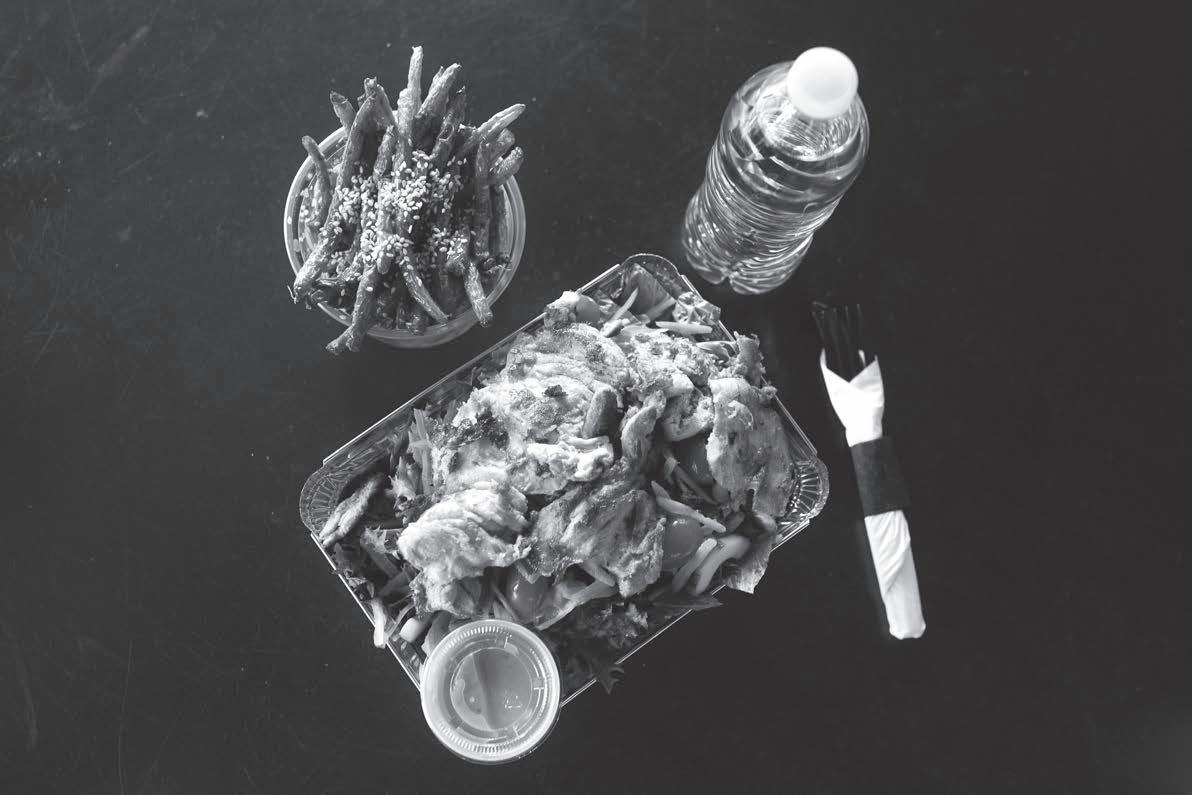
“Whole milk is higher in saturated fat, so we have to track how many calories come from saturated fat in our nutritional analysis,” Demory said. “We don’t have to include whole milk in the saturated fat calculation, but we do have to count the calories.”
Federal guidelines limit the number of calories schools can serve per week, meaning higher-calorie items will offset something else on the menu. These calorie limits are organized into a tiered system, dividing elementary, middle, and high schools.
Kindergarten through fifth grade students are allowed between 550-650 calories per day, according to nutrition standards for school meals created by the USDA. For grades six through eight, that number goes up to 600-700 calories. For grades nine through twelve, that number reaches between 750 and 850.
“If we add whole milk, something else has to come off,” Demory said. “Most directors, including myself, feel like students would rather have more food and not
just a higher-calorie milk.”
Cost is another factor that the district has to consider. The higher the fat in milk, the more expensive the milk will be. At Hyvee, the cost of a half-gallon bottle of whole milk is $3.29. That same brand and size of skim milk is $2.89.
While that doesn’t seem like a huge difference in cost, buying in bulk can make cost differences quickly add up. Demory said budget constraints may stop schools from choosing to serve whole milk.
ICCSD school board member Lisa Williams said the board’s role will be ensuring compliance with federal requirements while still supporting the district’s nutritional department as expectations change.
“It will be the board’s responsibility to make sure that we are following all applicable rules and regulations, which includes allocating funding so that our various departments have the resources they need to meet the updated federal nutrition recommendations,” Williams said. Williams said advocacy beyond the district level will be important as schools adjust to the new standards.
“The best way for the board to advocate for our students and families is by working with the members of the legislature to ensure they are informed about the impact changes will have on our system,” she said.
For University of Iowa first-year student Caroline Benvenuto, the new pyramid aligns with her approach to eating.
“I actually really like the idea of prioritizing real foods instead of eating highly processed foods,” Benvenuto said. “I personally try to get a lot of protein in my diet and eat lots of fruits and vegetables.”
The new guidelines promote higher intakes of protein, saying Americans should be eating 1.2 to 1.6 grams of protein per kilogram of body weight per day.
Beyond protein, the updated guidelines also
emphasize reducing highly processed foods. The guidance from the federal government calls to “avoid highly processed packaged, prepared, ready-to-eat, or other foods that are salty or sweet” and “avoid sugarsweetened beverages, such as soda, fruit drinks, and energy drinks.”
Many school nutrition programs encounter challenges when trying to reduce the use of ultraprocessed foods in school meals. These challenges include limited equipment, staffing, and funding.
According to a national survey of school nutrition directors, 79 percent reported “extreme need” for an increase in funding and resources for their programs.
Many school nutrition programs encounter challenges when trying to reduce the use of ultraprocessed foods in school meals. These challenges include limited equipment, staffing, and funding.
Sara McEleney has three children enrolled in ICCSD, one in elementary school and two at the high school level. She feels that decreasing the amount of processed food in her children’s meals is a step in the right direction.
“I feel like they are making the appropriate choices in regards to trying to improve the quality of food in the schools,” McEleney said. “I hope they can put some tools and processes in place to assist the school districts in making it more accessible to prepare the types of nutritious meals for the students who depend on the food provided by schools.”
McEleney said she is concerned that the vnew guidelines could potentially cause an increase in the cost of school lunch. She said her family wouldn’t be impacted by an increase in the cost of school lunch, but other families may be.
“I think that this could really potentially put families in a bind, especially those who rely heavily on the school provided meals,” McEleney said.












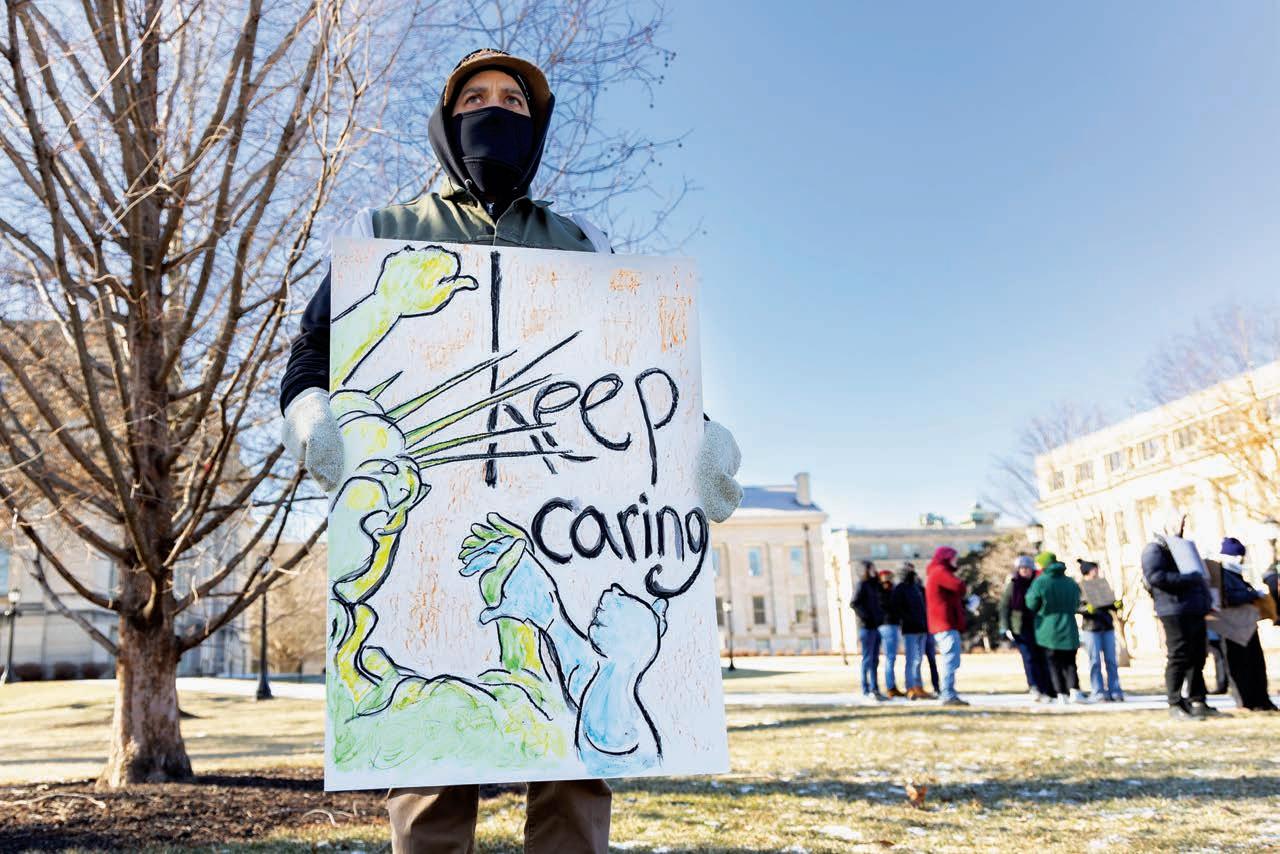
Following Alex Pre i’s death on Jan. 24, hundreds of Iowa City community members a ended a protest downtown. Community members called for accountability and justice in below freezing temperatures at the University of Iowa Pentacrest. This was the second fatal shooting in Minneapolis by an ICE o icer in January.











Iowa men’s wrestling’s turmoil on and o the mat has garnered outside a ention,
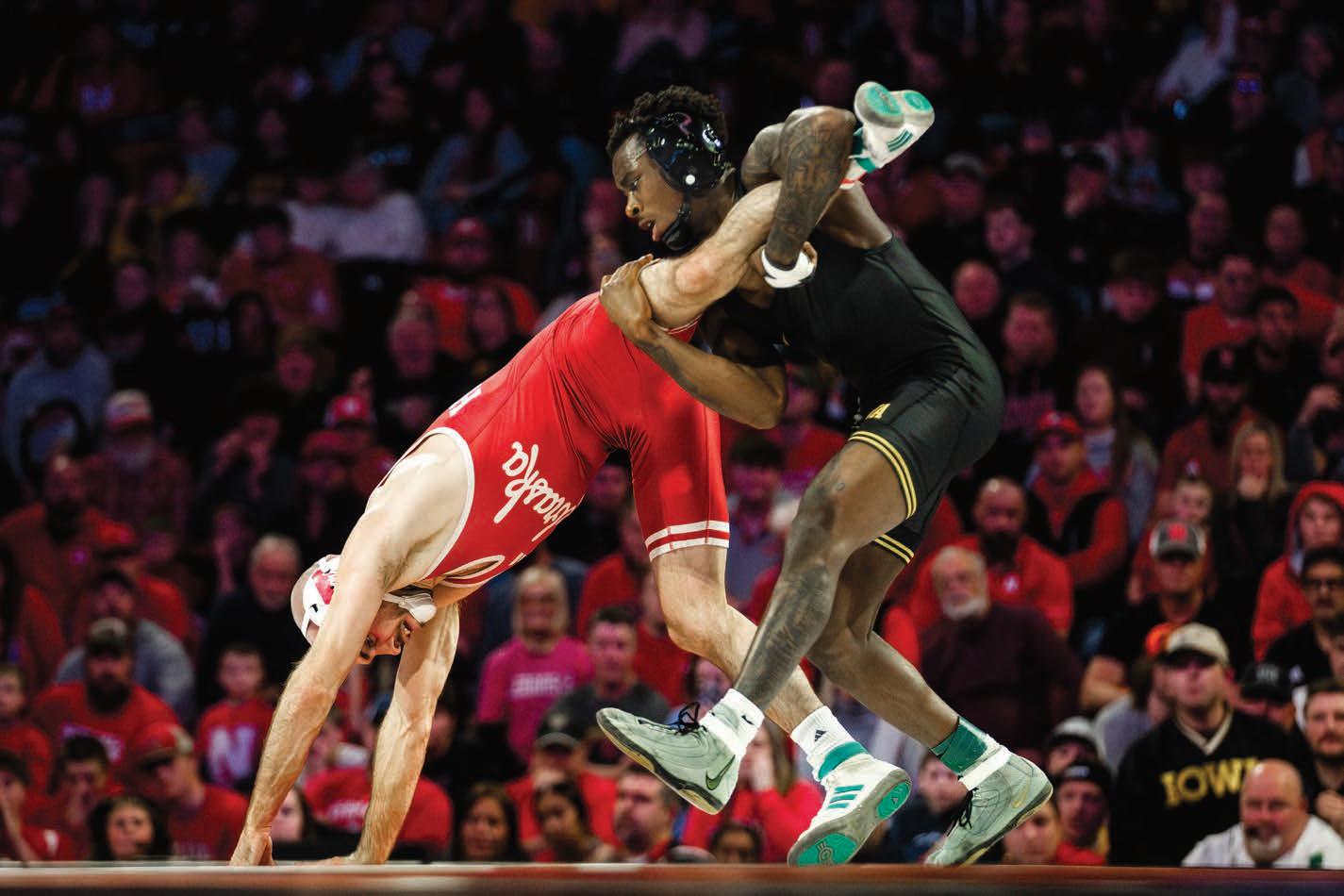
Iowa men’s wrestling made a splash in the transfer portal, adding Massoma Endene to replace 2025 National Champion Stephen Buchanan at 197 pounds. Endene was a three-time national champion at Division III and provided a spark of excitement among Hawkeye fans for the 202526 season.
A little over eight months later, after a 6-1 start to the season and a No. 4 ranking, Endene was removed from the roster. Head coach Tom Brands announced the move on Jan. 13 at media availability.
The sudden change sent shockwaves through the wrestling community, with many fans left wondering what could have been the reason for Endene’s removal. Both Brands and Endene declined to speak on the matter.
“Here’s the thing, everybody here knows how we run our program. We do not air it out,” Brands said at media availability on Jan. 20. “We’re not going to air our side of the story. Sometimes these things work out, and sometimes they don’t. This is one of them where it didn’t work out.”
Current and former wrestlers have shown their support for the Brands brothers, with current freshman Leister Bowling IV saying on Instagram, “Wouldn’t want to be anywhere else. There is not another program in this world that has the coaches that we do. The time and energy they put into us is unmatched. The real ones will always keep it real.”
Former Hawkeye wrestler Alex Merinelli also expressed his support for the Brands brothers on the social platform X and Instagram, saying, “Tom Brands and Co. are the real MVPs.”
The Brands scrambled to find a replacement at the 1pound weight class.
A pair of options revealed themselves in freshman Harvey Ludington and redshirt freshman Brody Sampson. Ludington holds an 8-1 record this season and claimed fifth place at the Soldier Salute tournament.
Sampson currently holds a 7-8 record on the year, including two major decisions, one technical fall, and one pin. The two underclassmen have battled inside the wrestling room, and head coach Tom Brands said he looks forward to seeing who comes out on top for the coaches to decide.
“They battle quite often, and there was a clash of styles
The Hawkeyes aim to improve from a fourth-place finish

From the 60-meter dash to the hammer throw, the athletes of Iowa women’s track and field have their sights set on greatness for the 2026 indoor season. Head coach Joey Woody said the Hawkeyes emphasize team culture and heart.
“We’ve got a tremendous group of young ladies from every event group, a group of girls that are committed to competing at the highest level for their individual events
but also for the team,” Woody said. “They’ve got some big goals this year at the Big Ten and NCAA level.” This group of women includes athletes from six foreign countries, including Sweden, Jamaica, and Ghana. Accompanying the international presence on the team are Hawkeyes from Iowa and 10 other states across the country. Some of the new additions have already etched their name into the record books, such as freshman Caila Lyons, who was named Big Ten Women’s Co-Freshman of the week following a strong showing
at this year’s Hawkeye Invitational on Jan. 10.
Hailing from San Antonio, Texas, Lyons nabbed the 600-meter title in 1 minute, 31.12 seconds, marking the fourth-best freshman performance in the event nationally.
Paired with this rookie talent is the experience of veterans like senior Holly Duax, a sprinter from Sioux City, Iowa, who credits her commitment to Iowa to the familial atmosphere of the program.
“I could tell that it was more than just a track program,” Duax said.
there for a bit,” Tom Brands said. “It’s a very fun, healthy rivalry in the room, and that’s great.”
The coaches plan to continue the battle between Ludington and Sampson at 197 pounds as they move into a highly competitive Big Ten schedule.
Nasir Bailey, a transfer from Little Rock, Arkansas, was the lone winner for the Hawkeyes in their 32-3 loss to No. 1 Penn State on Jan. 16, taking down No. 7 Braeden Davis by a 3-2 decision. Following Bailey’s win, the junior said he felt as though people had written him off after struggling in the 202 NCAA National Championships, where he went 2-2 before his elimination in the consolation bracket. That noise only grew louder as the 2025-26 season started for Bailey, as he dropped a few matches in disappointing style.
Bailey wrestled at 133 pounds last season and bumped up to 141 pounds with the Hawkeyes,
A conversation with her head coach foretold a boost in production from the freshman.
Jan Jensen’s ritual worked well back then. As an assistant coach on the Iowa women’s basketball staff, Jensen always found time to take each one of her players out for a coffee or smoothie and engage in a relaxed, sit-down conversation. Discussion reaches beyond the confines of the court and into the realm of life and its values: progress, patience, and belief.
When Jensen earned a promotion to the head role two years ago, her friends told her she wouldn’t have time for these one-on-one excursions, but the coach persisted. On Jan. 14, her tradition continued with freshman guard Addie Deal. The much-hyped fivestar recruit from Irvine, California, was a thousand miles away from home and 16 games into her first collegiate season.
Deal’s debut was a rather inauspicious start, a seven-turnover performance against Southern University. Over her first five games, she shot 34 percent from the field. Reserve minutes fluctuated, and in Iowa’s first four games against ranked opponents, she averaged a little less than eight. Such is life as a bench player, but for a former McDonald’s All-American, such a change can be jarring.
“Sometimes what you think is going to happen right off the bat, it needs to take time,” Jensen said. “It’s faster, it’s bigger. There’s a lot that’s always happening. We have a lot of depth.”
The crowd at Carver-Hawkeye Arena gave Deal a loud ovation when she first checked in to her debut, and in Jensen’s eyes, appeasing outside expectations is a losing battle. Rather, the head coach wanted Deal to know that those closest to her aren’t disappointed or frustrated, but encouraged. As Jensen puts it, alleviating pressure and elevating joy.
“What is fun about the University of Iowa is celebrating everybody’s accomplishments. It’s working together
Anthony Firriolo enters his second stint in Iowa after six stops in the ECHL.
After wrapping up his collegiate hockey career at Army, Anthony Firriolo lived a life that was in flu . Across three seasons in the ECH , irriolo played for si different teams, starting out in Jacksonville, Florida, before bouncing to Indianapolis, Iowa, and then Tulsa, klahoma.
The defenseman then wound up back in the southeast with the Atlanta Gladiators before arriving on the Heartlanders via trade for his second stint with the team.
Before the 27-year-old moved all over the country playing hockey, Firriolo was introduced to the game by his father, who coached him as a kid.
“My brother was a big soccer guy, so my mom coached him while my dad coached me in hockey,” irriolo said. “I figured out hockey was my thing, so I stuck with it and went from there.”
After playing junior hockey in the New Jersey area, Firriolo made the jump over the border to play for the Kingston oyageurs in Canada. It was there the defenseman e perienced the true love of hockey that Canadians have.
“It was probably one of my most fun years of hockey because I had a great group of guys, and we were in a great city,” Firriolo said. “Hockey is like what football is to Americans in Canada, so it was pretty cool to see that aspect of things.”
After his junior hockey career, Firriolo made the decision to enroll at Army not just for hockey but for something he described as “bigger than himself.”
“I had the opportunity to play ivision I hockey but also set myself up for the rest of my life because hockey will come to an end one day,” irriolo said. “ hen the ne t chapter of

my life opens up, I would love to give back and serve my country.”
Firriolo had to juggle his studies, hockey, and basic training.
“There are a lot of little things to keep you in check, like having your bed made a certain way, showing up to class on time, and managing school work,” irriolo said. “It all came down to time management and figuring out what was most important at the time. It was a humbling e perience, but I definitely learned a lot that I will take with me for the rest of my life.”
irriolo was traded to Iowa from Atlanta with his teammate Jack Robilotti in December. Robilotti also hails from New York but is three years younger than Firriolo. The duo train together over the summers and have developed a close bond.
Savior. And you can also just feel the love and energy from family, and I just like giving. So I love when my family gets to open the presents I give them.
“He is definitely a guy I looked at and relied upon during the transition, and he’s been a great help for me,” Robilotti said.
For Firriolo, the change in scenery boosted his production. He scored two points over his first three games with the Heartlanders and holds 11 on the season, ranking best among Iowa’s defensemen.
Firriolo ventured from north to south and across the Midwest during his ECHL career, and while constant change may appear frustrating, the defenseman finds stability.
“I’ve had a great support system through my family, my wife, and all my past coaches that have helped me along this journey,” Firriolo said. “Not everyone gets to play this game as long as I have, so it just reminds me not to take a day off and enjoy wherever I am at.”
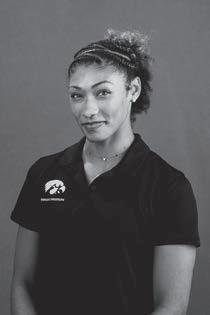
If you could have one superpower, what would it be and why?
The Daily Iowan: What are you most passionate about?
Kennedy Blades: I’m really passionate in fashion. I’ve always liked how you can represent yourself through clothing or certain designs because that’s just a different way to represent yourself without speaking verbally. I’ve always loved fashion, and I do hope to one day be a runway model.
What is your favorite wrestling move?
y favorite wrestling move is the suple for three reasons — my favorite number is five, and it’s worth five points. Second, you’re already halfway done with the match because it’s 10 points for a [technical fall]. Third, it’s a beautiful move, and it’ll definitely go on a highlight reel, which I love.
What is your favorite holiday?
My favorite holiday is Christmas because that’s when Jesus was born, our Lord and
Where is the coolest place you’ve traveled?
Probably Egypt. I saw the pyramids, and I rode a camel in the Sahara Desert. That was pretty iconic; it was insane.
What is your pre-match routine?
I always make sure I have a snack in between my matches because with my e plosiveness and the power I use in my matches, I always need to make sure to recover. After that, I put on my headphones and listen to chill music, a lot of which is Christian rap. Then I pray before, as I’m bouncing around and warming up, and I ask the ord for strength and for protection for me and my opponent. Then I repeat Romans 8 31 a couple of times, which is, “If the ord is for us, who can be against us ” Then I shake hands, and it’s go time.
I would say telekinesis. As much of a wrestler as I am, I’m low-key kind of la y, so if I could just get a cup of water from my kitchen to my room, that’s a win.
What is the greatest challenge or struggle you’ve faced?
This will probably be controversial or interesting, but mentally getting over taking silver at the lympics because I really thought I was going to win. A lot of people don’t talk about the mental side, and that was pretty hard.
Who is someone you look up to the most and why?
The first person I look up to most is Jesus Christ because he was a perfect man, just as he portrayed himself on Earth, as far as forgiving your neighbors, not gossiping, but just being a very good person, relying on our Father who art in Heaven. I just want that as my number one role model, so I’d say Jesus.
Sports reporters Trey Benson and Jack Birmingham argue for UCLA and Iowa, respectively.

Sitting at No. 3 in national rankings from the Associated Press, the UCLA women’s basketball squad aims to build on the program’s firstever Final Four appearance a season ago, when the Bruins won the Big Ten Tournament, earned a No. 1 seed in arch, and finished 34-3.
So far this season, UCLA is on track to repeat such success. The Bruins’ lone loss of the year came to then o. 4-ranked Te as, falling 76-65 to the Longhorns in the Players Era Tournament in Las Vegas back on Nov. 26. Despite the blemish, UCLA boasts a record of 7-1 against ranked programs. Even with this grueling schedule, the Bruins are the fifth-best team in ivision I in point differential, defeating teams on average by 29.7 points per game.
Plus, the Bruins feature balance, with four players averaging double-digit points. Headlining the Los Angeles-based squad on the offensive end is senior center Lauren Betts.
The 6-foot-7 Betts is averaging a team-high 16.1 points per game alongside 8.4 rebounds. Senior
guard Kiki Rice closely trails Betts at 15.2 points per game. Senior guard abriela Ja ue owns a 14.2 game average, with graduate stu dent teammate Gianna Kneepkens at 13.9 points per game.

In addition to the diverse scoring threats, the Bruins are statistically one of the most consistent teams on the floor, ranking third in field goal percentage at 52.1. With one in every two shots finding its way through the net for UCLA, the Bruins are constantly on the prowl offensively, making it very hard for opposing teams to keep up.
The team also boasts a solid defense. On the whole, the Bruins don’t allow their opponents to score much, averaging just under 57 points allowed per game. This stat puts them at around 31st in the nation in opponent points per game. Betts also makes her defensive presence known in the paint, averaging over 2 blocks per game.
The Bruins have relied on their length and scoring ability to own a perfect 9-0 Big Ten record this season and, as of recently, are on an 13-game winning streak.
UCLA also drew a favorable endof-the-season schedule, with five out of its last eight contests being at home in Pauley Pavilion. Combining UCLA’s highpowered and efficient offense, there’s no reason the Bruins can’t capture their first conference regular season title and add another Big Ten Championship trophy.
Is it perhaps a little basic to pick the Iowa women as the best team in the Big Ten?
Yes.
Is it an unpopular or unfounded opinion?
Not in the slightest.
While it may be hard to get a clear picture of which team, Iowa or UCLA, is truly better until their clash on Feb. 1, there are already some clear indicators that the Hawkeyes have what it takes to reign supreme, even on the home turf of their opponents.
Last season, when the Hawkeyes faced the Bruins at CarverHawkeye Arena on Feb. 23, the o. 3 team in the nation met fierce resistance from then-unranked Iowa. UC A committed 14 turnovers, nearly twice as many as Iowa’s eight, and narrowly eked out a 67-65 victory. f Iowa’s four leading scorers in that game, the Hawkeyes return senior Hannah Stuelke’s presence in the paint and senior Taylor McCabe’s sharpshooting to fill out a well-rounded roster this season.
While the departure of veterans like Lucy Olsen, Addison O’Grady, and Sydney Affolter hasn’t necessarily benefited the program much, Iowa’s newer stars have arguably made the Hawkeyes even better this season than last.
Sophomore Chazadi “Chit-Chat” Wright is averaging over 12 points, two rebounds, and three assists per game in her inaugural season with the Hawkeyes, while her field goal and three-point shooting percentages are both higher than those of Olsen last season, according to ESPN. Meanwhile, sophomore Ava Heiden played for the Hawkeyes last season but didn’t have as much of a chance to break out until her crucial postseason performances. The Sherwood, Oregon, native is now averaging over 15 points, seven rebounds, and one assist per game.
Add in a talented freshmen class that includes Addie Deal and ayla Hays, and Iowa has a truly unique roster that has already made a deep impact with big wins over ranked Baylor, Nebraska, and Michigan State squads.
There’s no doubt in my mind that UCLA is a talented team, but if a struggling Iowa program held Lauren Betts and the Bruins to a two-point margin of victory last year, it’s certainly going to be interesting to see how this one plays out. Game on.
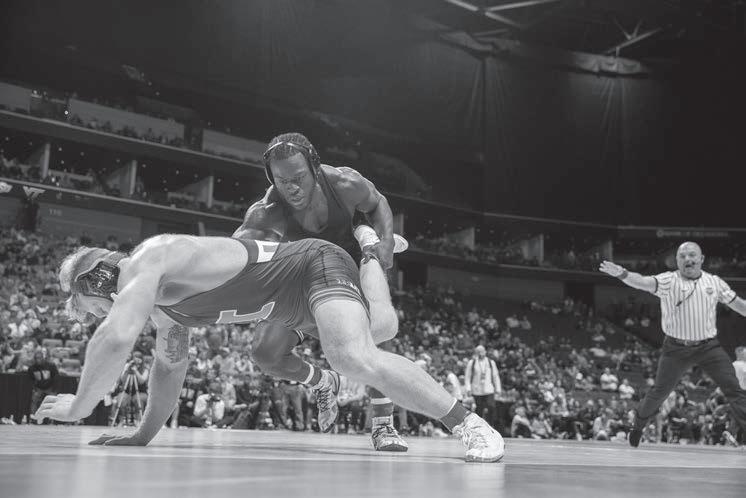
going through.”
One of the characteristics that made Bailey a high-flying transfer recruit was his ability to find success in the top position with tilts, where Bailey would turn an opponent on their back to expose their shoulder blades to the mat. This strategy was a favorite of three-time national champion Spencer Lee, who still trains in the Hawkeyes’ wrestling room.
Brands said Bailey and Lee do gravitate toward each other in the room and have built a strong relationship. Bailey also said he’s been trying to learn as much as he can from ee in hopes of reflecting the success that Lee had while wrestling for Iowa.
“I’ve definitely been trying to take a lot from him, just because he was kind of unstoppable on top,” Bailey said. “I’m not to that point yet, where I feel like I’m unstoppable. So I’m just trying to learn a few new techniques and things he did, and try to implement them into my wrestling.”
Iowa program — moving forward.
“You have to come back, and they’re coming back,” Brands said. “You go back to work, and you keep moving forward.” Brands also said the focus is on the next date, and they analyze wins the same way they analyze losses by picking themselves up and going forward. The head Hawkeye acknowledged the Dan Gable principle that it’s easier to move forward with success. With the struggles of Iowa wrestling early in the season, Brands understands that it’s not going to get easier moving forward. “We didn’t have a lot of success, so it’s going to take a little more resolve and a little more courage, or whatever word you want to use, while they’re moving forward,” Brands said. “And, as I said, they’re doing that. That’s where we’re at.”
as Drake Ayala already held the former weight class.
“It’s definitely been an adjustment period,” Bailey said. “Going from being one of the stronger dudes in the weight class to being a smaller 141, it’s different. But I think I’m getting used to it, I understand what I need to do out there.”
Bailey said he always wrestles with a chip on his shoulder and added that outsiders who don’t know what he’s going through or the work he’s put in just add fuel to the fire of motivation.
The disappointing 202 finish for the
“It was a place where I could build relationships and make friends that I will have for a long time, and I could see that they all respected each other.”
Duax, who has been running for 10 years, also credited Woody for his role in her performance, which has spanned a successful collegiate career on the track and in the classroom.
“I definitely feel, after being here for four years, he knows exactly what works for me, and he knows the cues to give me,” Duax said. “I feel like regardless of how I perform, I can talk with him about my performance and not feel like I need to shy away from anything.”
As a sprinter, Duax represents a leader in one of Iowa’s different event groups. Other athletes represent mid-distance, hurdles, or, in the case of junior Peyton Wilson, throws.
Similar to Duax, Wilson cited the team culture as a key factor in her recruitment decision. Even though Iowa City is an eight-hour drive from her hometown of Lancaster, Ohio, Wilson doesn’t hold any regrets about her choice.
and knowing when your time has come and you’re ready.”
Deal’s time arrived a day later in Iowa’s victory over Oregon, where Deal tied for the team-lead in scoring with a careerhigh 18 points – 12 of which she cashed in on a perfect night from beyond the arc. Three days later in a ranked matchup against Michigan State, Deal still couldn’t miss, connecting on both of her triples to lead the bench scoring for the Hawkeyes.
The guard missed just three shots over the two game span. While the freshman’s hot streak went cold against Maryland on Jan. 22, Deal bounced back with a team-leading 20-point performance against Ohio State three days later.
Echoing her head coach, Deal noted her impressive performance didn’t arrive overnight.
“Just putting in the extra work before practice, during practice, after practice,” Deal said.
Teammate Hannah Stuelke was once a freshman herself, averaging just 6.5 points per game back in the 2022-23 season. A power conference like the Big Ten can be an arduous introduction to college
Park Forest, Illinois, native provides some juice for this season and also opened his eyes to the reality of college wrestling — legacies are created in the postseason.
“My biggest takeaway from last season is that what happens in the season doesn’t matter, it matters what happens in March,” Bailey said. “I think I had a great season last year, but I didn’t have the tournament that I wanted to have, and that still leaves a bad taste in my mouth.”
Brands doesn’t doubt Bailey’s intentions and determination. Yet while the top of the podium is an obvious goal, the journey to such a spot needs clarity.
“And remember, it’s a process,”
Brands said. “This is a process that we’re
“Going far away for school, I wanted somewhere that felt like a home away from home,” Wilson said. “The team atmosphere and the connections, and just having that community already built in before I came, really stuck out to me.”
Wilson, who competed in the hammer throw at last year’s Big Ten Championships and the Drake Relays, also cited higher placement and making it to more finals as a program goal.
“We’re always striving to win those championships, and I think this year, especially, we have a huge chance to do that, just with the passion and the love that our team has,” Wilson said.
The Hawkeyes finished fourth in indoor last season, trailing Illinois and new arrivals Oregon and USC.
Woody expressed the idea of being a top Big Ten contender as a goal, noting the competitiveness of the conference.
“It’s definitely deeper and stronger than it’s ever been, with all the additional teams and the number of talented athletes,” Woody said. “We just [have] to put it all together, and I think we can be a top three or four team [in] the Big Ten. We [have] to make sure everybody’s firing on all cylinders at the right time. I think we can reach those goals.”
Bailey currently holds a 10-6 record on the season and is 3-4 against ranked foes, with his most recent ranked match being a loss to No. 3 Brock Hardy of Nebraska. Bailey nearly secured a late takedown on the edge for the win, but even after a challenge from Iowa, the call was upheld as Bailey fell 1-0.
Iowa’s loss to top-ranked Penn State was the worst home loss in program history, and the worst overall deficit since the 1965-66 season. The Hawkeyes only landed two shots for takedowns throughout the entire dual and scored a dismal 2.6 points per match.
While the historic loss has caused uproar among fans on social media, Brands and Co. are keeping the same mentality they’ve used since they took over the
Iowa, in fact, did move forward with a bounce-back win over No. 6-ranked Nebraska on Jan. 23. The Hawkeyes’ offense was on full display in the dual, as they recorded 11 takedowns, nine more than in the loss to Penn State.
Iowa picked up bonus point victories from Ryder Block, who earned a pin at 149 pounds, and Michael Caliendo, who beat No. 7 AJ Araujo by major decision at 165 pounds.
Sophomore Gabe Arnold, stepping in for Angelo Ferrari at 184 pounds, grabbed his first ranked win of the season to clinch the dual for the Hawkeyes.
The 22-14 victory for Iowa was the 300th win for Brands as the head Hawkeye. Brands brushed off the accomplishment, knowing the goal of building on each result and moving forward remains the same.
“Alright, awesome,” Brands said about earning his 300th win. “Let’s keep it going. That was an important dual meet. [We] wrestled well, and we’ve got to keep building.”
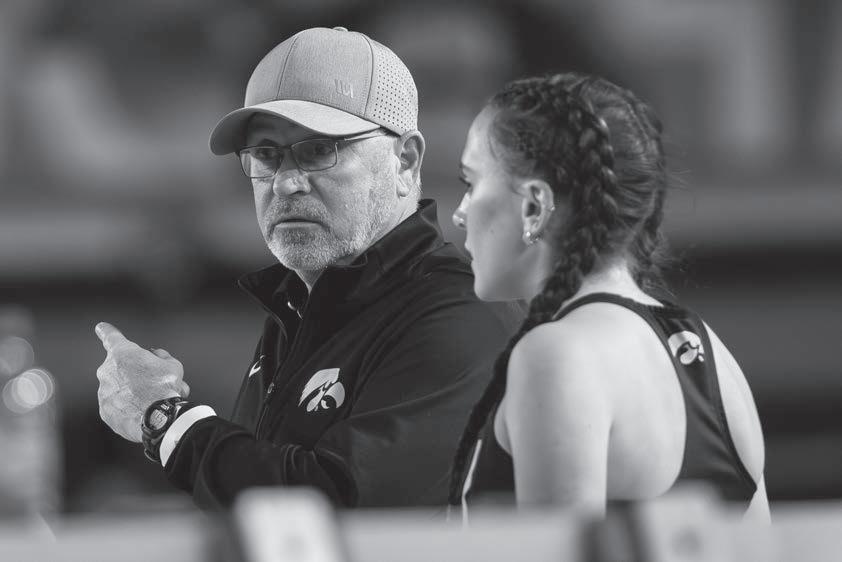
basketball, but the senior said Deal’s focus has kept her on the right path.
“I’m really proud of her, there’s more to come for sure,” Stuelke said.
Deal’s blossoming is somewhat reminiscent of Iowa sophomore Ava Heiden’s first season on campus. The center never tallied double-digit points in a game until the quarterfinals of the Big Ten Tournament against a ranked Michigan State team. That contest marked the start of the three-game run where Heiden averaged 12 points and five rebounds.
While not mitigating Heiden’s past achievements, Jensen articulated the difference between the two players’ growth trajectories.
A post player like Heiden needed to develop proper position in the paint and create angles to score when she received the ball on an entry pass. For a guard like Deal, she must establish position and handle defensive pressure at the top of the key, all while handling the ball.
Jensen never questioned Deal’s confidence. She just hopes the
guard can continue to develop confidence as the Hawkeyes continue their Big Ten schedule, which includes a homecoming with two games in California. Deal can be aware of pressure but not weighed down

by its intensity.
“There’s a lot of season left, and I just want her to continue to keep doing what she’s doing,” Jensen said. “And if she does that, you’ll continue to see that growth.”

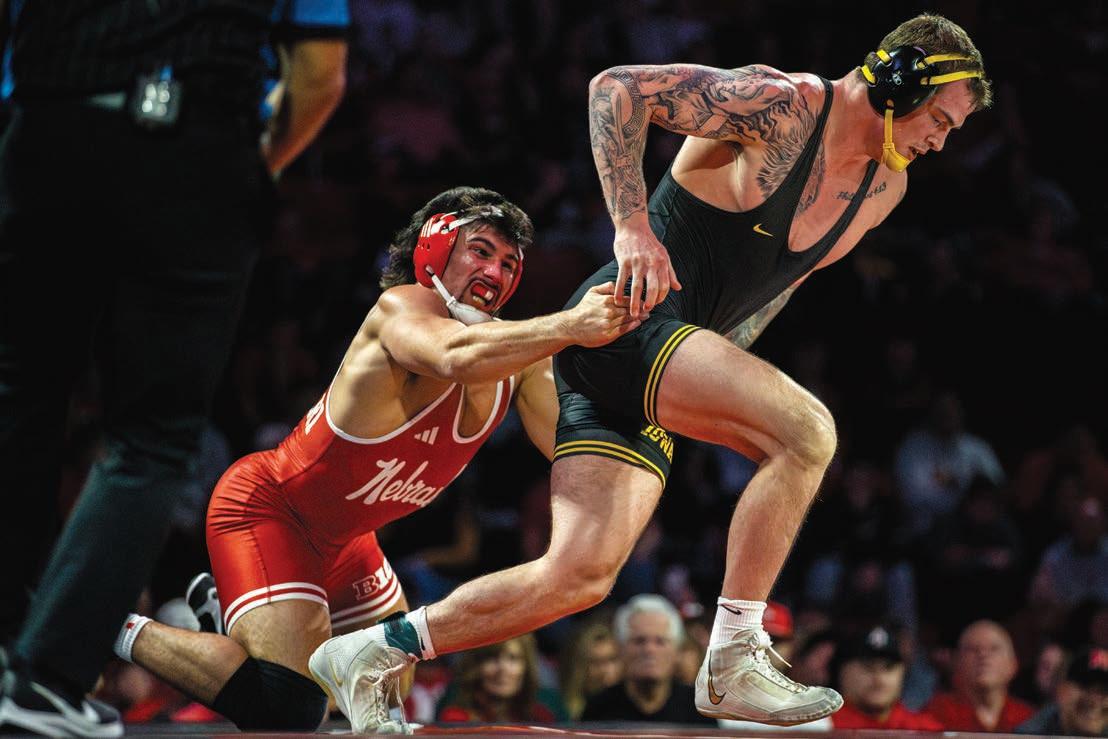
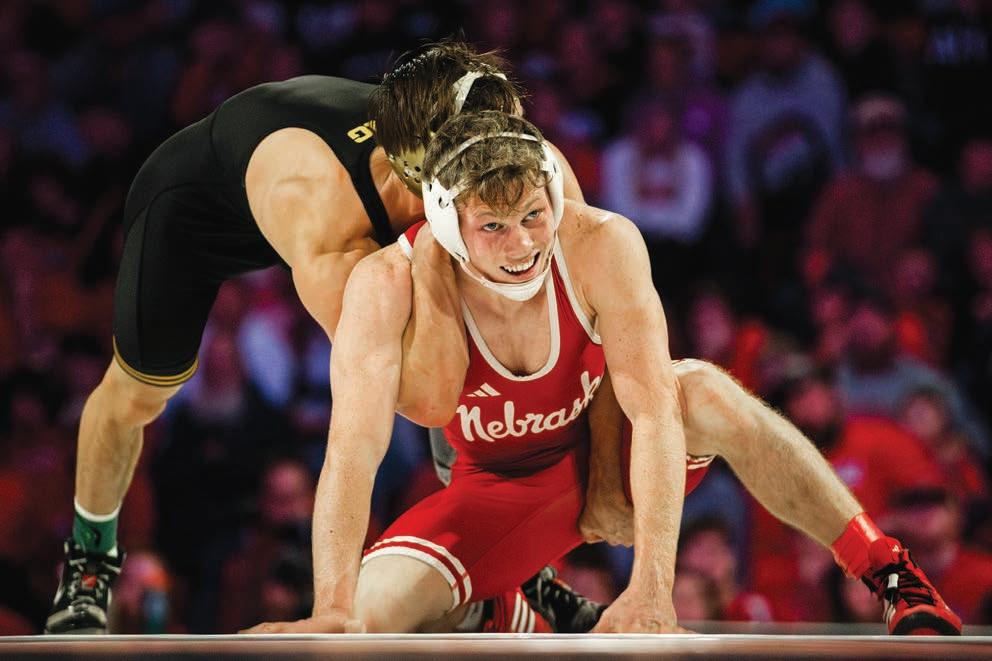

Breaking the Devaney Sport Center a endance record, over 7,900 fans arrived in Lincoln, Nebraska on Friday, Jan. 23, to watch the matchup between the No. 4 Iowa Hawkeyes and the No. 6 Nebraska Cornhuskers in the highly anticipated top-10 matchup. The Hawkeyes defeated the Cornhuskers 2214. Iowa head coach Tom Brands achieved his 300th win at the competition.
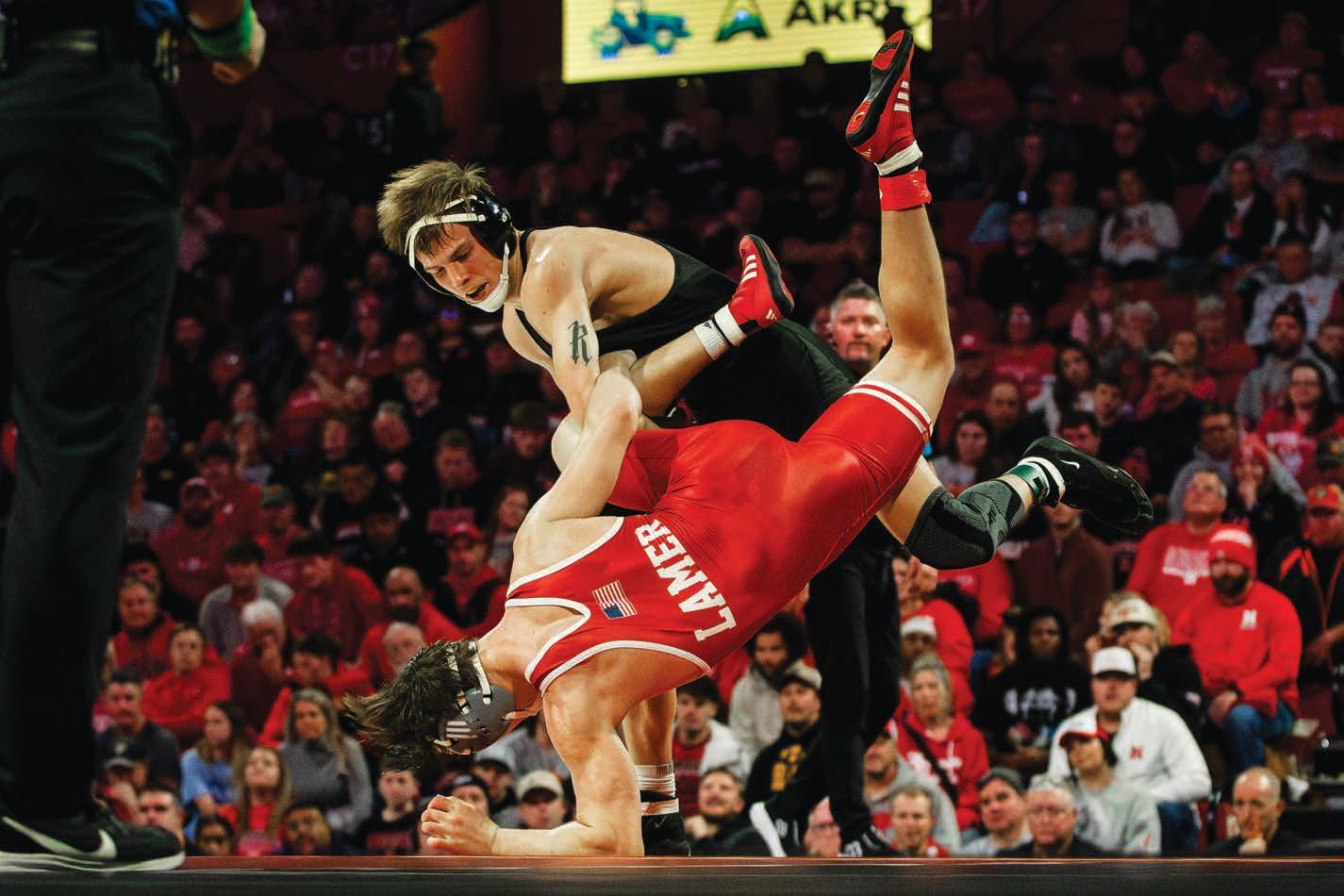










































Establishing an e icient workflow varies depending on the writer’s genre.
Through epic tales of love, sprawling maps of castles, and endless puzzles of mystery, writers can bring fleshed-out worlds to life using different techniques.
While writing, Iowa City area authors follow unique strategies to develop plots, settings, and characters. Some find outlining each detail works best, while others discover the story as it goes along, but each has found lasting techniques.
Sarah Prineas, a fantasy author living in Iowa City, approaches writing organically, allowing her characters and setting to grow as the story comes to her. From there, a plot naturally arises.
“My characters feel like real people to me, and they come along with their own wants and needs,” Prineas said. “I don't outline, and I don't know how my books are going to end when I start them.”
One of the best things she says she has done for her writing is to give her stories space expand. Recording voice memos to herself, writing notes down on scraps of paper, and playing scenes in her head while going on runs are all strategies Prineas uses to completely immerse herself in her writing.
“I’m doing all kinds of other stuff too, but I get in my 1,000 words every day one way or another,” Prineas said.
While some writers, such as Prineas, use a more discovery-based method, others find that having an outline is the best blueprint for success.
Prineas has published 14 books and describes each one as a unique experience. She said the most difficult book was the second of her second trilogy.
“Usually, when I turn in my manuscripts to my editor, she’d write me these editorial notes for how to revise a book and at the end she would always say, ‘but remember it’s your book,’” Prineas said. “Well, for this book, she sent me a long

note and basically it said ‘you have to rewrite the entire book.’”
In the end, Prineas committed to her editor’s vision of the book and worked to explore her world and characters in more depth, resulting in what she said might be the best book she’s ever written.
Prineas primarily works in children’s fantasy. To her, changing the reader’s understanding of the world is one of the great accomplishments of a fantasy story. In kids’ minds, especially, secondary worlds have the power to come to life, because they are willing to believe in dragons and elves, and are willing to
Learn the similarities and di erences between the many literary magazines on campus.
The University of Iowa, being located in literature-rich Iowa City, has amassed many literary maga ines that flourish on its campus. The following list dives into the literary magazines on campus and provides insight into their similarities and differences.
The literary magazine of the Translate Iowa Project, Boundless, is annually published during the spring and features creative pieces written in a diverse array of languages. Accepting poetry, prose, drama, and artwork, Boundless encourages cultural inclusivity and creativity by providing open spaces for all languages.
Cave Writing stands out from other literary magazines on campus by solely accepting standalone chapters from longer fiction works, ranging from 1, 00 to ,000 words. There is no guideline on where the chapter must be located within the longer story, but Cave Writing asks for a brief piece of context for the reader. Previously only published online, Cave Writing is preparing to launch its first print edition in August.
The oldest literary magazine on campus, earthwords showcases select artistic and literary pieces produced by undergraduate UI students. earthwords’ publication varies in both style and length but strives to empower the community and highlight a diverse array of published pieces. In addition to being a literary magazine, earthwords also hosts events throughout the year, including workshops and open mics, that provide students with an outlet to express themselves in front of an audience.
While some literary magazines accept a multitude of genres, Venus Magazine focuses solely on romance, publishing romantic fiction and poetry in an effort to bring more love into the world. Venus Magazine is published semiannually and accepts and amplifies romance stories from authors of all backgrounds, genders, and sexualities.
Ink it aims to educate first-year students in the world of publishing by being the only undergraduate literary magazine on campus that publishes pieces solely from first-year UI students and Iowa riters’ Workshop Living Learning Community alumni as well as being run entirely by firstyear UI students. Published biannually, Ink Lit accepts a variety of creative pieces, including poetry, fiction, and photography.
“The mission of Ink Lit Magazine is to provide experience and support to undergraduate students who are interested in learning about publishing and having their work read by a larger audience,” Jessica Pfeifer, editor in chief for the most recently published 29th edition of Ink Lit, said. “We believe in creativity, in work that advances the possibility of the written word, and we are committed to reading work from all writers, regardless of genre — openly, honestly, and fairly.”
Fools Magazine pushes boundaries and encourages submissions to do the same. Without any parameters on genre — structure, format, or style — interested students can submit literary or artistic works of any kind. Fools Magazine stands out for its design work and emphasis on creativity, and publishes its magazine semiannually.
Formed in 2020, Horizon Magazine is an undergraduate literary magazine that accepts a wide variety of genres and creative media. The mission behind Horizon is to explore new horizons in the creative world and the dichotomy of these new concepts — embracing both positive and negative aspects of the journey and change.
Unlike some other literary magazines that accept a variety of genres, Catharsis exclusively highlights a genre often underrepresented in literary magazines: nonfiction. Catharsis publishes nonfiction pieces that explore the human experience, and the catharsis storytelling brings to authors and audiences alike. Catharsis also collects anonymous confessions, promoting an outlet for exploring emotions in their rawest form and highlighting the fact that even the simplest statement of life is important enough to be published.
“ ur aim is to showcase nonfiction writing that explores the human experience.
subscribe to the idea that one small person can change the world, Prineas said.
Speculative fiction author Tatiana Schlote-Bonne, a graduate of the University of Iowa’s Nonfiction Writing Program, tries to outline every major story beat and why it matters before beginning to write. Her process proved effective and resulted in her published novels, “Such Lovely Skin” and “The Mean Ones” — both of which fall within the horror genre — as well as a third, “What Feeds Below,” to be released in fall 2026. During the revision process, the horror author mainly deals with

polishing her story since the main beats have already been figured out, such as turning up the tension, fleshing out the world-building, and refining dialogue. With each new book, a new process begins again, with new inspiration.
For Schlote-Bonne, films best help her develop her work. For example, she always knew she wanted to write a story inspired by the movie “Stay Alive,” centered around an evil video game.



e encourage the e ploration of nonfiction as a genre of literature and a vessel for interpreting your reality,” Madeline Riske, editor in chief of Catharsis, said. “Anybody can express their honesty through our confessions at any time, and we hope they can find catharsis through this action.”
Unlike other literary magazines that publish once or twice a year, New Moon releases a new edition every month that is always exactly one page long. Focusing on flash fiction and short poetry, ew oon offers a regular outlet for publication for undergraduate students and provides accessible literature for the community.
The Broken Clock is an undergraduate literary magazine on campus with a focus
on time. Whether literally or metaphorically, The Broken Clock accepts a wide array of creative pieces, including poetry, artwork, and fiction, which revolve primarily around the theme of time.
“One writer could have a positive outlook on time and write a story about happy memories and tender moments. Another could take a much darker view and meditate on the inevitability of death and impermanence,” Josh Schrader, fiction editor for The Broken Clock, said.
“The possibilities are endless, and I always enjoy the opportunity to see what people end up creating,” he said.

UI students reflect on past resolutions and prioritize 2026 goals.
A widely embraced and encouraged tradition takes place at the start of every year, stemming from the human desire to change, improve, and succeed.
Whether it involves a simple lifestyle alteration or a complete personal rebrand, New Year’s resolutions serve as an opportunity to reflect on the past and take meaningful steps forward on the road to self-improvement.
For many, resolutions act as a symbol to a fresh start, which is necessary after a year of challenges, growth, and stagnation.
University of Iowa students are not e empt from this tradition. As 2026 takes off, students around campus are taking time to reflect on their resolutions from 202 , how well they followed up on them, and what they hope to achieve in 2026. With a wide range of goals and aspirations, students’ resolutions took on a role representing a true college lifestyle.
Reese Roberts, a first-year UI student, accomplished her 202 resolution to do better in school.
“I definitely did reach [my resolution] because I really focused on applying myself to my goals,” Roberts said.
Academic success, an aspect strived for by many students, makes for a common resolution on campus — and an important one. Between balancing coursework, social lives, and extracurriculars, keeping a focus on academics can be a challenge.
In addition to her studious intentions, Roberts plans to “read more books” in 2026 as a means to blend some enjoyment into her productivity. Laney Eggert, a UI first-year, took a different route to last year’s big goal.
“I focused on my fitness goals and planned to go to the gym more,” Eggert said. “I feel like I definitely achieved it by managing my time better and creating space in my schedule to go to the gym, even if it was just in smaller increments.”
Time management often plays a hefty role in attaining new aspirations. Many students struggle to add activities into an already overwhelming schedule, making realistic goalsetting skills irreplaceable. Figuring out what to prioriti e and learning how to be fle ible can make or break New Year’s resolution. Similar to Roberts, Eggert’s 2026 resolution is to succeed in school and focus more on her academics.
Not all resolutions are intrinsically motivated. For some students, financial growth and stability serve as the main role in the approaching year. With the cost of everyday expenses, tuition, and living situations, many students find themselves concerned about their cash.
“Honestly, I’m just trying to make money this year, which was actually last year’s goal, too,” AJ Jansen, a UI second-year, said, proceeding with a more materialistic approach to 2026. ith financial goals often rooted in the desire for security, independence, and stress relief, Jansen’s practical mindset is echoed

by several working students. While external
success and productivity come to the forefront of many minds, prioritizing mental health and self-care at the top is another important thing to consider when creating a New Year’s resolution, which is e actly what UI first-year student Sara Sjobakken did in 202 .
“I wanted to spend more time alone, just working on myself and building my self-love,” Sjobakken said.
As for 2026, Sjobakken’s goal to read
more finds a home among several other students’ resolutions.
Though there is a wide variety of resolutions among students, they share a common theme: the human desire to advance and grow. rom academics and fitness to finance and personal growth, the resolutions of UI students reflect the vast range of aspirations and pressures that help to provide a sense of direction when navigating a new year of change and opportunity.
Public Space One’s latest exhibit, “DEAD OR AMAZING,” showcases a combination of interactive software and art.
Created by artists Ethan Edvenson and Charles Borowicz, the exhibit features drawings by Edvenson accompanied by audio and video tracks by Borowicz. It utilizes a software program known as Isadora, which tracks the body’s movements to make an interactive display.
Borowicz came up with the idea in 2017 while at a residency in Indianapolis, inspired by a friend who used the same software for a dance performance. Borowic first collaborated with Edvenson two years ago on a video project for artist SUNDANCE MOONHOUND.
Edvenson’s work primarily consists of mixed media drawings, but he has an interest in video work. Borowicz’s work is mostly photography and video work, but he loves to draw as well.
Edvenson makes his drawings with India ink, a drawing ink made from black soot and chalk pastel before cutting and layering them into shaped pieces. Rather than frame his drawings, he explained, he instead installs them on the wall.
“They feel more alive that way, so they don’t really fit in a standard frame, or they can organically weave off in unusual compositions, which is partly why we wanted to use them for this, because they exist in their own space,” Edvenson said. Edvenson’s drawings have a unique shape, which caught Borowicz’s interest and made him want to include them in this project, Borowicz said. After seeing how Edvenson created his drawings by disassembling and layering them, Borowicz thought they would work well for an interactive exhibit.
“I really wanted to create some kind of art piece that was triggered by events, and what you need to do, you need a lot of pieces to make that interesting,” Borowicz said.
The final project was a 4 -second interactive, immersive experience for each participant, aided by the use of blackout

curtains. A room in PS1’s Northside Gallery was converted into a waiting room with chairs and a table with a large computer, which controlled the installation. The curtains separated the two rooms.
Behind the curtains was a room shrouded in darkness.
The only light came from three projector screens, showing a screensaver of shapes resembling bubbles, red streaks of light, and a single word projected on the middle screen, “Welcome.”
The word faded, and the screens came to life with bursts of color, light, and sound. Each interaction with the e hibition is different.
For one viewer, the audio could be a deep, unintelligible voice, the display consisting of bubbles and streaks of color, and the drawings varied and numerous. For another, they could be greeted with a flurry of voices and colors resembling paint splatters.
At the end of the display, participants can move their hands to prompt streaks of color to appear on the screen in time with their movements. For Edvenson, that play aspect of the exhibit was what he liked about it.
“I like it most when you’re able to move around and kind of experiment and see if I move my left hand, what does that do, what sounds does that activate around me, or drawings come up?” Edvenson said.
John Engelbrecht, PS1’s executive director, said before opening the show, a man and his three kids had seen it from outside the PS1 building and had come in to view the installation. He said they stayed inside the installation for 1 minutes, exploring how to make the exhibit work.
“It’s a small delight, I think, for folks to experience an art gallery in that way,” Engelbrecht said.
For Borowicz, that idea of an experience was what he hoped participants would take away from the installation. He hoped they would be engaged with the piece and be interested in how it works.
“I like that it’s kind of open-ended,” Borowic said, “I believe art is always an experience, but for sure this is an experience.”


“I was wondering, well, how do I make it matter? How do I make it unique?” she said. “So I take my e ternal plot, like an evil video game, and build my characters around it.”
While writing, the UI grad constantly asks herself what the “point” of the story is. Her ultimate goal is to cause the reader to feel like the journey they’ve been on has amounted to something and the characters they’ve followed have learned something new about themselves.
While consuming new media for ideas, Schlote-Bonne tends to pursue concepts interesting to her in her personal life, such as gaming, weightlifting, and e ploring caves.
Point slideshow. He used the platform to discover what the best order of events would be and to try and keep himself organi ed.
But all authors are different when organi ing their sprawling creative endeavors. Chloe Angyal, a romance author based in Iowa City, finds herself working in a specific way when drafting her books.
Angyal, a Ph originally from Australia, has written four books in total, three of which are fictional romance stories and one a nonfiction work about ballet.
Angyal spent most of her time researching and reporting before writing her first novel.
Coming from a journalist background, Angyal spent her time creating her nonfiction book in a different way than she did her fiction ones. She dedicated herself to having a fuller outline so she would know what themes she wanted to cover for each chapter and where her sources would be used.
“ hen I write fiction, the chapter just stops when it feels right, and the ne t chapter starts when it feels right,” she said.
espite taking meticulous time to plan out the majority of her nonfiction piece, Angyal found herself not really following that same idea when it came to her first romance novel, “Pas de on’t.”
Daniyal Mueenuddin’s new book delves into class issues in Pakistan through fictional stories.
“Either they scare me, like caving in my third book, or I’m very passionate about them,” Schlote-Bonne said. “I come up with those concepts and then try to get more in the weeds to figure out where the story is going.”
While the three books she’s released stand squarely in the horror genre, Schlote-Bonne has also written nonfiction personal essays, which she uses to help strengthen her fi ction writing by building the vulnerability and feelings of her characters around her own.
“I think writing deeply personal essays and stories in grad school helped me become comfortable being embarrassing or cringey on the page and helped open up my work to the more raw, honest places I’m willing to go through my horror,” Schlote-Bonne said.
There is no one way to create a book, and every author has their own process, or even no set process at all.
After writing almost nine books, Joseph e alley finds himself approaching each one differently.
The Des Moines-based muder mystery author drafted almost every installment of his series uniquely.
“ hen I speak to college classes, or whomever, I often say that what you can learn from my writing is there’s no one way to do it,” e alley said. “ y fi rst novel took 33 years to write.”
hen it came to “Burying the ede,”
e alley’s fi rst novel, he allowed himself to sit with the idea for several years before deciding it was finished and ready. He did the e act opposite with his second book, “Cry from an Unknown Grave,” which took him just over a month to finish.
e alley credits much of this to the change of pace in his life. uring his first novel, he was still working and raising his children, while during his second novel, he was retired and had more time to dedicate himself to its creation.
Having more free time to write, e alley has discovered a cycle for himself when it comes to his writing style.
“ ow that I have eight and a half finished novels, I’ve learned that I write in waves,” e alley said. “ hen I’m in the middle of a project, I write a lot. But I might go four or fi ve months without doing any creative writing.”
Unlike other authors, e alley does not often find himself creating an entire outline for each of his novels. He decided to test it out once, but found he hardly looked at the notes during the writing process.
After creating such a large series, e alley has tested several drafting processes. Since his si th novel, “Three Weeks in Winter,” has a large number of plot points, including his main character interacting with many types of government o cials, e alley e perimented by putting the major details into a Power-
In the writing world, there are two main types of authors plotters, who outline and plan their writing out, and pantsers, who discover their writing as it comes.

“I pantsed my first book, and then I was missing some pretty significant places of plot,” Angyal said. “I have not pantsed a book since then.”
Switching between fiction and nonfiction was not too di cult a task for Angyal, but there were some habits she learned that were di cult to push away. hen writing journalistically, it is required to lay out the details and conte t necessary for the short article’s space.
“That’s not the point of fiction, right The point of fi ction is to convey all the information that’s necessary as beautifully and enjoyably as you can,” Angyal said.
Angyal followed a widely recommended practice during the production of her works and wrote a thousand words a day. No matter what genre a writer works in, this method is popular.
Both Shlote-Bonne and e alley agree with this method, despite not writing the same amount of words as Angyal.
This part of the process is widely adopted amongst authors, each deciding what word count works best for them to continue their flow of writing and get to their end goal quicker.
“I always fall back on writing 100 words a day,” Schlote-Bonne said. “If I can write 100 words a day, then I’m making progress on my book.”
Daniyal Mueenuddin was born and raised in Lahore, Pakistan, until he was 7 years old, then moved to Elroy, Wisconsin. He’s a graduate of Yale Law School and Dartmouth College, with his work appearing in The New Yorker, Granta, and Zoethrope. In 2009, he published “In Other Rooms, Other Wonders,” which was nominated for a Pulitzer Prize. His newest book, “This Is Where the Serpent Lives,” delves into some of his personal experiences in Pakistan, in addition to other stories revolving around class systems.
The Daily Iowan: You’ve lived inside and outside of Pakistan throughout your lifetime. How has that dual perspective changed your writing overall?
Mueenuddin: My family has owned land in Pakistan for a fair amount of time. ne particular story closely tracks my own life, which is a story called “Muscle.” It’s about a guy who was educated abroad in prep school, then goes to college, and tries to rescue his family farm from people who
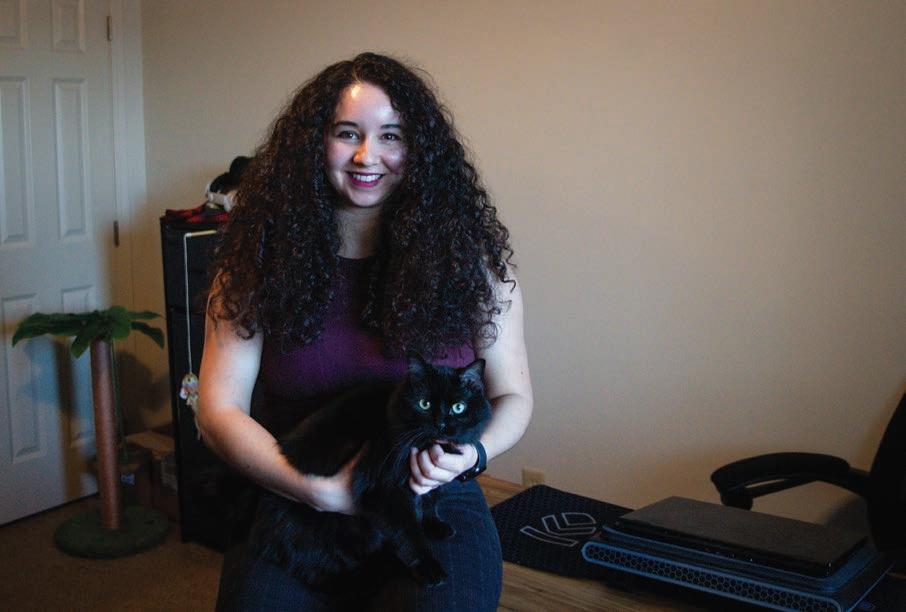
the farm, I knew it would be a great time to write and a great time to read. I knew right from the beginning it was going to be really lonely, but it was bearable. I started out writing poetry. I’m not uite
So I wanted to be at the top rank by writing poetry, and I spent many years doing that. At some point, I reali ed I got too old for that lyric poetry. I actually gave up on writing for a bit and thought I might not ever be really good at poetry because I wanted to be really good. So, I went off to law school and did that for a while. Then I finally reali ed that what I really wanted to do was to write, damn it.
How did you first approach writing this book?
ith poetry, it re uires inspiration. As Randall Jarrell said, if you sit around in rainstorms hoping to get hit by lightning, you’ll only really get struck about five or si times. It can be hard to write on command. But with fiction, you can do it on command. You have to sit down and bust your head against it, but sooner or later, you’ll get somewhere. Therefore, I think that enabled me to pretty uickly speed up as a fiction writer. I put my heart into it and tried like hell, and it seems to have worked out pretty well.
What inspired you to speak about the perspectives present in this piece?
I had an intimate understanding of the place and people. ot just the people, though, but also the farm.
I’m more of a businessman than a farmer. y job is to select good people. I tried to streamline this business, but I made lots and lots of mistakes, got made a fool of, and got cheated plenty of times. Pakistan is famous for its corruption.
I started writing about it because I really knew it well. That’s what I loved writing about. I loved the place. I love the characters. What role models in your life inspired you to become an author?
My mom was a writer. So throughout my childhood, when we lived in ahore, she had this e pectation of me. She had this room up on the roof, and I would come home from school to hear her manual typewriter tapping away with that mechanical sound. She carried it around the world and was very attached to it. She would be hammering away on this thing all the time, and I wanted to do the same.
I loved books, too. I was one of those geeks who spent all his time lying on this orange sofa in my bedroom reading as soon as I came home from school. She subtly created this e pectation in me that I would become a writer. And because I loved reading, it was easier for me to write.
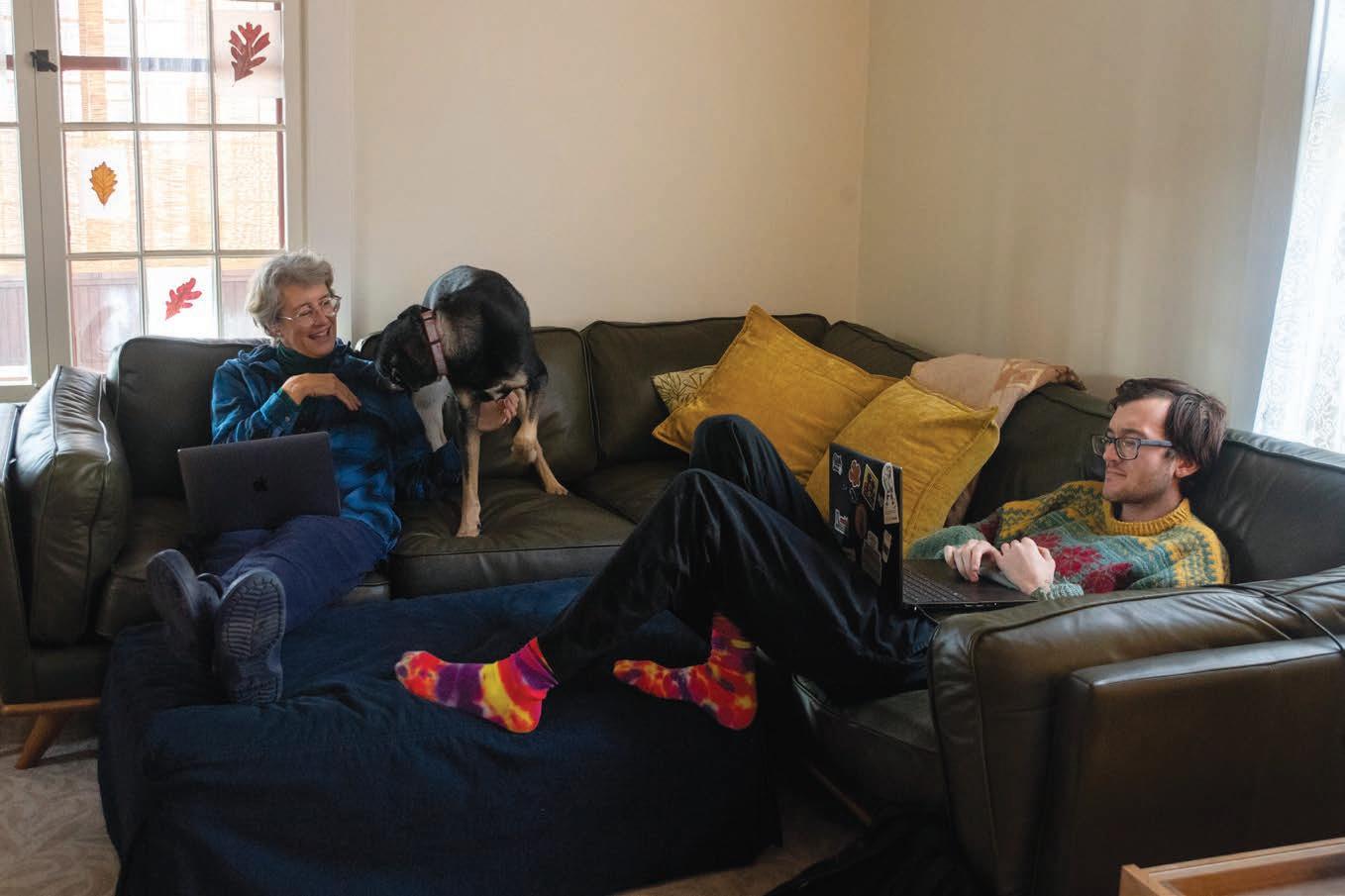
My mom was also really good friends with a reporter in .C., Katherine Anne Porter. She was a really great modernist writer. She became my godmother, and that was really important because she was a very