State Supplement sponsored by:
90 80 6 422
6 80 24
OHIO STATE EDITION
6
4
71
76
199
A Supplement to:
30 30 75
68
30 77
71 23 22 68
4
70 70
70
22 71
75
77
27 22 74
50
50 25
THOUSANDS of units in service
35
52
Shipment in 1-3 days
®
SAME DAY shipping on parts & tools FULLY SUPPORTED by a 75 YEAR FAMILY BUSINESS
November 17 2018
10% off 10,000 ft. lb. hammers
Vol. XVIIII • No. 23
“The Nation’s Best Read Construction Newspaper… Founded in 1957.” Your Ohio Connection: Ed Bryden, Strongsville, OH • 1-800-810-7640
Why pay more?
CALL 800-367-4937 *On approved credit • Financing Available
ODOT’s First SmartLane Aims at Quickening Commutes By Irwin Rapoport CEG CORRESPONDENT
Crews from Complete General Construction (CGC) have been working since June on the Ohio Department of Transportation’s (ODOT) $61 million Interstate 670 SmartLane and resurfacing project in Columbus. The project will not only upgrade road and bridge infrastructure, but also, through new signs and technology, reduce congestion and quicken the drive times of commuters and truckers. The SmartLane is the first to be built by ODOT. The road improvements are expected to be completed by the spring, with the new cameras and overhead signs to be installed in the summer of 2019, and the lane to be opened to traffic in the fall. The 7-mi. work zone covers the area from just east of I-71 to I-270 and John Glenn International Columbus Airport. To have the SmartLane ready for traffic, ODOT is rebuilding the shoulder lane on the left side of eastbound I670 to ensure the pavement is safe and passable. “It’s an extra travel lane that is only open during certain times when drivers need congestion relief most,” states an ODOT press release. “The ‘SmartLane’ is an ODOT pilot project and will be available for eastbound-only I-670 drivers from 3:30 to 6:30 p.m. Monday through Friday.” The speed limit will be 45 miles per hour when the SmartLane is open. Approximately 117,000 vehicles use this section of road daily. “The appeal of the SmartLane is the low cost and low impact that’s
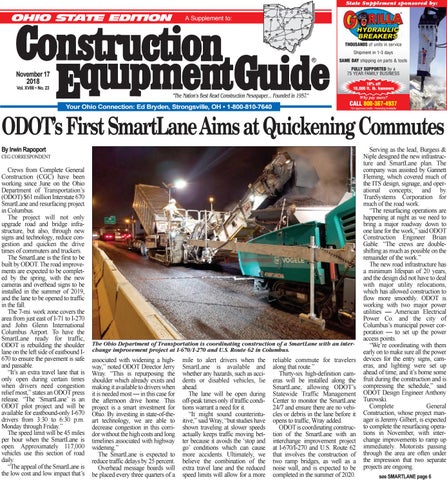
The Ohio Department of Transportation is coordinating construction of a SmartLane with an interchange improvement project at I-670/I-270 and U.S. Route 62 in Columbus.
associated with widening a highway,” noted ODOT Director Jerry Wray. “This is repurposing the shoulder which already exists and making it available to drivers when it is needed most — in this case for the afternoon drive home. This project is a smart investment for Ohio. By investing in state-of-theart technology, we are able to decrease congestion in this corridor without the high costs and long timelines associated with highway widening.” The SmartLane is expected to reduce traffic delays by 25 percent. Overhead message boards will be placed every three quarters of a
mile to alert drivers when the SmartLane is available and whether any hazards, such as accidents or disabled vehicles, lie ahead. The lane will be open during off-peak times only if traffic conditions warrant a need for it. “It might sound counterintuitive,” said Wray, “but studies have shown traveling at slower speeds actually keeps traffic moving better because it avoids the ‘stop and go’ conditions which can cause more accidents. Ultimately, we believe the combination of the extra travel lane and the reduced speed limits will allow for a more
reliable commute for travelers along that route.” Thirty-six high-definition cameras will be installed along the SmartLane, allowing ODOT’s Statewide Traffic Management Center to monitor the SmartLane 24/7 and ensure there are no vehicles or debris in the lane before it opens to traffic, Wray added. ODOT is coordinating construction of the SmartLane with an interchange improvement project at I-670/I-270 and U.S. Route 62 that involves the construction of two ramp bridges, as well as a noise wall, and is expected to be completed in the summer of 2020.
Serving as the lead, Burgess & Niple designed the new infrastructure and SmartLane plan. The company was assisted by Gannett Fleming, which covered much of the ITS design, signage, and operational concepts; and by TranSystems Corporation for much of the road work. “The resurfacing operations are happening at night as we need to bring a major roadway down to one lane for the work,” said ODOT Construction Engineer Brian Gable. “The crews are doubleshifting as much as possible on the remainder of the work.” The new road infrastructure has a minimum lifespan of 20 years, and the design did not have to deal with major utility relocations, which has allowed construction to flow more smoothly. ODOT is working with two major power utilities — American Electrical Power Co. and the city of Columbus’s municipal power corporation — to set up the power access points. “We’re coordinating with them early on to make sure all the power devices for the entry signs, cameras, and lighting were set up ahead of time, and it’s borne some fruit during the construction and is compressing the schedule,” said ODOT Design Engineer Anthony Turowski. Complete General Construction, whose project manager is Jeremy Gilbert, is expected to complete the resurfacing operations in November, with interchange improvements to ramp up immediately. Motorists passing through the area are often under the impression that two separate projects are ongoing. see SMARTLANE page 6
Page 2 • November 17, 2018 • www.constructionequipmentguide.com • Ohio State Supplement • Construction Equipment Guide
Wood • Hamilton • Stark • Henry • Greene • Knox • Franklin • Clermont • Crawford • Union • Cuyahoga • Brown • Licking • Medina •Ohio.. Williams • Harrison • Adams • Mercer • Butler • Clark • Ashtabula • Sandusky • Portage • Athens • Logan • Lake • Erie • Wyandot • Warren • Fairfield • Miami • Paulding • Darke • Muskingum • Ottawa • Holmes • Jefferson • Trumbull • Summit • Washington • Van Vert • Licking • Wood • Hamilton • Stark • Henry • Greene • Knox • Franklin • Clermont • Crawford • Union • Cuyahoga • Brown • Licking • Medina • Williams • Harrison • Adams • Mercer • Butler • Clark • Ashtabula • Sandusky • Portage • Athens • Logan • Lake
‘Buckeye State’ Highway Lettings
The Ohio State Department of Transportation received bids for transportation-related improvement projects. The following is a list of some of the projects let. Project No: 180358 Type: Preventive maintenance. Location: GRE-U.S. 35-07.35. State Estimate: $2,130,000 Contractors and Bid Amounts: • Strawser Construction Inc., Columbus, Ohio — $2,256,901 • American Pavements Inc., Plain City, Ohio — $2,403,386 • Microsurfacing Contractors LLC, Bridgeton, Mo. — $2,824,364 Completion Date: Jan. 15, 2020 Project No: 180361 Type: Bridge repair. Location: GUE-U.S. 22-07.36. State Estimate: $1,319,000 Contractors and Bid Amounts: • Complete General Construction Company, Columbus, Ohio — $1,728,269 • Shelly & Sands Inc., Columbus, Ohio — $1,782,596 Completion Date: April 30, 2019 Project No: 180365 Type: Bridge replacement (1 bridge). Location: PER-CR 98-01.95 (Main Street). State Estimate: $992,000 Contractors and Bid Amounts: • Complete General Construction Company, Columbus, Ohio — $1,070,194 • Armstrong Steel Erectors Inc., Newark, Ohio — $1,224,105 • Shelly & Sands Inc., Columbus, Ohio — $1,320,412 Completion Date: Nov. 30, 2018 Project No: 180370 Type: Bridge repair. Location: SUM-SR 93-09.28. State Estimate: $1,615,000 Contractors and Bid Amounts: • Corrosion Resistance Ltd., Stow, Ohio — $1,895,313 • APBN Inc., Campbell, Ohio — $1,931,495 Completion Date: Aug. 31, 2019 Project No: 180372 Type: Culvert replacement. Location: D10-Culvert FY 2018. State Estimate: $1,716,000 Contractors and Bid Amounts: • Parker Corporation, Tuppers Plains, Ohio — $1,785,687 • Axis Civil Construction LLC, Columbus, Ohio — $2,253,445 • Shelly & Sands Inc., Columbus, Ohio — $2,453,234 Completion Date: Dec. 31, 2018
Project No: 180373 Type: Intersection. Location: WOO-Buck/Lime City Intersection. State Estimate: $3,467,000 Contractors and Bid Amounts: • Miller Bros Construction Inc., Archbold, Ohio — $3,299,826 • Geddis Paving & Excavating Inc., Toledo, Ohio — $3,742,478 • Crestline Paving & Excavating Company Inc., Toledo, Ohio — $3,848,228 • Vernon Nagel Inc., Napoleon, Ohio — $3,973,062 Completion Date: Oct. 31, 2019 Project No: 180381 Type: Major widening. Location: FRA-IR 670-05.03 (Part One and Part Two). State Estimate: $55,047,000 Contractors and Bid Amounts: • Complete General Construction Company, Columbus, Ohio — $60,923,153 • Kokosing Construction Company Inc., Columbus, Ohio — $63,576,286 • Shelly & Sands Inc., Columbus, Ohio — $75,334,829 Completion Date: June 1, 2020 Project No: 181037 Type: Guardrail rebuilding. Location: D06-GR FY19. State Estimate: $1,404,000 Contractors and Bid Amounts: • M P Dory Company, Columbus, Ohio — $1,546,377
• Lake Erie Construction Company, Norwalk, Ohio — $1,645,150 Completion Date: Aug. 31, 2019 Project No: 188012 Type: Major reconstruction. Location: SUM-SR 91-21.65. State Estimate: $4,181,000 Contractors and Bid Amounts: • Marucci & Gaffney Excavating Company, Youngstown, Ohio — $4,137,646 • Karvo Companies Inc., Stow, Ohio — $4,176,993 • Eclipse Company LLC, Chagrin Falls, Ohio — $4,297,640 • Shelly & Sands Inc., Columbus, Ohio — $4,330,482 • Tri-Mor Corporation, Twinsburg, Ohio — $4,385,411 • Catts Construction Inc., Warrensville Hts, Ohio — $4,428,965 • Mr Excavator Inc., Kirtland, Ohio — $4,792,865 Completion Date: Aug. 31, 2019 Project No: 183000 Type: Major reconstruction. Location: HAM-IR 75-03.84. State Estimate: $80,180,000 Contractors and Bid Amounts: • Walsh Construction Company II LLC — $86,878,812 • Kokosing Construction Company Inc., Columbus, Ohio — $90,231,050 • Great Lakes Construction Company, Hinckley, Ohio — $106,991,501 Completion Date: May 30, 2022
Construction Equipment Guide • Ohio State Supplement • www.constructionequipmentguide.com • November 17, 2018 • Page 3
Page 4 • November 17, 2018 • www.constructionequipmentguide.com • Ohio State Supplement • Construction Equipment Guide
Akron-Canton Airport Breaks Ground on $34M Modernization On Aug. 28, the Akron-Canton Airport (CAK) broke ground on a $34 million gate modernization project, the final element of its 10-year, $110 million capital improvement campaign, coined CAK 2018. “As we see Northeast Ohio advancing from an economic and tourism standpoint, we need to be ready,” said Rick McQueen, president and CEO of Akron-Canton Airport. “We intend for the facility to be a warm and welcoming first impression for trav-
elers, just like the region. We also know that projects of this scale take a long time to get off the ground, so despite some air service challenges, this is the right time to move forward with construction.” The current gates for American Airlines and Delta Air Lines originally opened in 1962, and although the airport has worked diligently throughout the years to maintain and improve the gates as they stand, they were not designed for today’s modern aircraft. Akron-Canton Airport photo
On Aug. 28, the Akron-Canton Airport (CAK) broke ground on a $34 million gate modernization project. L EEB O Y 8 5 2 0 A SP H A LT PA V E R
COMMIT TTED TO QUALITY. COMMITTED TO YOU.
We a r e Le e B o y. T h e n a m e b e h i n d t h e w o r l d ’s m o s t d e p e n d a b l e a n d p r o d u c t i v e c o m m e r c i a l a s p h a l t p a v i n g e q u i p m e n t : p a v e r s , g r a d e r s , d i s t r i b u t o r s , m a i n t a i n e r s a n d m o r e . T h e Le e B o y f a m i l y o f p r o d u c t s a r e a m o n g t h e m o s t t r u s t e d a n d r e q u e s t e d a r o u n d t h e w o r l d . B e c a u s e w e u n d e r s t a n d w h a t d r i v e s y o u a n d w e d e l i v e rr. E a c h d a y, l i ke y o u , w e p u t i t a l l o n t h e l i n e . I t ’s h o w w e ’ r e b u i l t . W e ’ r e L e e B o y y. A s d e p e n d a b l e a s y o u r d a y i s l o n g .
LeeBoy, Rossco and LBPerformance brand b equipment available at this reputable Dealer’s locations: o
N OW LING SEL
HUDSON
C COLUMBUS
WEST CHESTER
668 1 C h i t t e n de n Ro ad Hud s o n , O H 4 4 236 P ho n e : 3 3 0- 6 6 5 - 5 9 00 Fax: 3 3 0- 6 5 5 - 5 96 9
31 5 5 E. 1 7th Avenue Co lum mbus , OH 43219 P h o n e: 6 1 4 -4 75-2880 Fax : 6 14 -4 75-0069
8131 Rega l La ne West Chest er, O H 45069 Phone: 513-777-5556 Fa x: 513-777-4494
“While we have done a nice job maintaining these older gates, we realize they are too congested and lack amenities our customers prefer,” said McQueen. “Not only will this help meet our standards for customer service and experience, it also aligns with those of our airline partners. The space has served our community well, but our customers deserve better.” The $34 million gate modification project consists of three main phases: • Phase one will involve utility and drainage work as well as the construction of a 22,900-sq. yd. concrete aircraft parking apron. In some areas this apron will have 15-in. thick concrete sections. • Phase two will involve the actual construction of the new gates. This will include a two-level concourse consisting of 41,600-sq. ft., very similar to our existing second floor gates. • Phase three involves the demolition of the old gate complex, allowing 7,500-sq. yds. of aircraft parking apron. “Phases of this project have been orchestrated to minimize customer impact,” said McQueen. “Most customers won’t realize construction is occurring until they’re taxiing away, as it will be done off the south end of the existing gates. We strive to make CAK a better way to go, even during these times of construction.” Bright, open spaces with ample seating and abundant power outlets will be the first modifications customers will see. New food and beverage options will include a new sitdown restaurant and large bar within the gate area, in addition to grab-and-go choices like Cinnabon and Arby’s. Favorite conveniences like the free business lounge, mother’s room and Kids PlayPort will find new homes in the expanded concourse along with new features, like a pet relief area. The much-anticipated terminal makeover also includes jet bridges on every gate, so no passenger will have to make the quick dash from tarmac to aircraft in the event of inclement weather. “Without the guidance and full support of our board of trustees, this would not have taken off. Their vision has kept us focused on what’s important for the customer and the community,” said McQueen. “We are all ecstatic for the future of CAK, and know we are departing on the correct path.” The new gates are projected to open for customer enjoyment by late fall of 2019 or spring of 2020, contingent upon weather. (This story also can be found on Construction Equipment Guide’s website at www.constructionequipmentguide.com.)
Construction Equipment Guide • Ohio State Supplement • www.constructionequipmentguide.com • November 17, 2018 • Page 5
High Court Limits Coverage for Construction Insurance The Court of Appeals’ opinion addressed the Custom Agri decision and placed Ohio, however temporarily, in alignment with a strong majority of state supreme court decisions on this issue. It fell on deaf ears at the Ohio Supreme Court. For the high court, it all boiled down to whether a subcontractor’s defective work can be considered an “occurrence.” “[P]olicies are not intended to protect owners from ordinary business risks that are normal, frequent or predictable consequences of doing business that the insured can manage. Here we cannot say that the subcontractors’ faulty work was fortuitous.” The contractor had presented compelling evidence that the insurer must have anticipated coverage for post-completion defect claims. Its premiums confirmed that the insurer was paid for completed operations coverage. The court’s analysis ignored this fact. It paid no attention to decisions of the vast majority of other states. Precedent in those jurisdictions clearly indicates that the “occurrence” requirement was satisfied since a subcontractor’s work caused water infiltration that damaged other non-defective work. Among the contractor’s most cogent arguments was that there is only one reason for the exception to the “your work” exclusion. The reason is that the exception intends to bring damages caused by a subcontractor’s work within the policy’s coverage. To this, the Court turned a blind eye. The impact of this decision is significant. Contractors defending post-completion claims by owners are not even owed a defense by the insurer. Anyone with significant industry experience knows that effective settlement of these disputes invariably rests on insurance. This is true even where the contractor and subcontractors are solvent. Where the responsible players are judgment proof, insurance coverage is the general contractor’s and owner’s only recourse. The next question is how general contractors and owners protect themselves from damages caused by construction defects. Industry associations can lobby the General Assembly to change the law and reverse the Court’s decision. That could understandably take some time. (This story also can be found on Construction Equipment Guide’s website at www.constructionequipmentguide.com.)
Designed T To o Drive Class-Leading Productivity r y.. JCB’s new generation compact excavators deliver greater buccket and dipper tearout, added dump height and better lift capacity so that you cann move more material fasterr.. New models are available in conventional and zero tailswing configurations for use across a variety of applications. To learn more visit JCBNA.com todayy.. 4516
The Ohio Supreme Court issued a seminal decision recently further limiting insurance coverage for construction defects in Ohio Northern University v. Charles Construction Services, Inc The decision held that the general contractor was not entitled to a defense or coverage on a claim relating to construction defect, even for resulting damages — contrary to the majority of other states. The case was brought by the university/owner against its general contractor, Charles Construction, after the project’s completion when the university discovered evidence of water intrusion and moisture damage. In the course of remediation, Ohio Northern University found serious structural defects. Charles Construction’s insurer successfully intervened in the case and asserted that it had no duty to defend or indemnify. It relied on the earlier Supreme Court decision in Westfield Ins. Co. v. Custom Agri Systems, Inc. In that earlier case, the Court had held that construction defects are not “occurrences” as defined in the contractor’s commercial general liability policy. While that decision provoked much consternation, closer examination revealed that the damage the insurer was asked to cover related to the insured contractor’s own work, not that of a subcontractor. Such work is typically not covered due to the “your work” exclusion in standard CGL policies. The trial court ruled in favor of the insurer, that the defective work by the subcontractor was not an occurrence and, therefore, the insurer had no duty to defend and no duty to indemnify its insured general contractor. The Third District Court of Appeals reversed that decision. It found that Custom Agri confirmed, “the well-established principles that CGL policies are not intended to protect against a “contractor’s own defective work.” To determine whether coverage applied, it looked to the completed operations provision of the policy. It found coverage for the extensive damages caused by a subcontractor’s defective work under an express exception to the “your work” exclusion. In this circumstance, damages caused to one subcontractor’s work by another subcontractor’s defective work should be covered by the CGL policy. The Court explicitly rejected the insurer’s position that “property damage” cannot constitute an “occurrence” as a matter of law.
5 & 6T |COMPACT E XC AVA VATORS
/JCBNA
@JCBNA
JCBNA | JCBNA.com
Buck and Knobby JCB
Company Wrench JCB
Covering Northwest Ohio 9127 Airport Highway Holland, OH 43528 419-491-2362 www.buckandknobbyjcb.com
Covering Central Ohio 866-262-4181 Toll Free 4805 Scooby Lane Carroll, OH 43112 740-654-5304
Burns JCB Covering Northeast Ohio 8155 Roll & Hold Pkwy. Macedonia, OH 44056 866-459-6713 www.burnsjcb.com
920 Deneen Avenue Monroe, OH 45050 513-649-8105 www.companywrenchjcb.com
Page 6 • November 17, 2018 • www.constructionequipmentguide.com • Ohio State Supplement • Construction Equipment Guide
ODOT I-670 Construction Makes Most of Limited Space
The 7-mi. work zone covers the area from just east of I-71 to I-270 and John Glenn International Columbus Airport. SMARTLANE from page 1
“The limited space for the work and access into the work zone is a challenge,” said ODOT Construction Engineer Zac Amnah. “We’re not taking any extra right of way and are pretty much confined to the median area. Some of the sections of median barrier wall are staying in place, and crews are limited as to where they can cross over, get through, and turn around. This accounts for the night work, but they’re also doing work during the day due to the aggressive schedule to have the resurfacing completed this year and meet the interim completion date.” Working at night is never easy, and to ensure the safety of the crews and motorists, police are on hand for lane closures and specific areas, extra lighting has been brought in, and variable speed limits are enforced. “Hopefully people will pay attention to them and slow down for the guys,” said Amnah, “giving them more time to react while driving.” The resurfacing, which began in July, covers four lanes in each direction and started with the westbound lanes. “There were no major challenges,” said Amnah. “The resur-
facing of the ramps brings in some interesting maintenance of traffic items, but nothing out of the ordinary. They recently started resurfacing the eastbound lanes and that has been more of a challenge because that is where the majority of the other work for the SmartLane and the rebuilding of the inside shoulder, which requires a lot more coordination between CGC and Shelly Company, the asphalt contractor.”
The SmartLane, ODOT’s first, will be open to eastbound drivers on I-670 during peak travel times on weekday afternoons.
Gable noted that cold joints on the pavement were limited to one for three lanes. “That required Shelly to pave two lanes at the same time and they used a 24-foot-wide paver to pave lanes one and two for the length of the job,” he said. “They did it in four nights and came back for lanes three and four. They did an excellent job and the public will appreciate the 19-year-old potholefilled pavement being repaired to
enjoy a smooth ride.” The initial interchange and ramp work started a few months ago, but it will not hit full stride until 2019, most likely at the start of spring. The interchange improvements braid ramps using bridges to allow eastbound traffic on I-670 to go over I-270 and northbound traffic on I-270 to go over I-670, instead of weaving as it does currently. “We’ve already begun some of our excavation and embankment
Nearly 100 construction workers, employed by more than 10 subcontractors, are involved in the Columbus construction project.
for a lot of the offline ramps that we can build without affecting traffic,” said Gable. “We hope to get a lot of the embankment work completed so we can get some of the pavement placed before the turn of winter. The interchange work is planned to be completed the same day that the SmartLane is going to open.” Given the large number of vehicles that travel through the area every day, Amnah said, maintaining traffic flow will be a major challenge during the work on the interchange. “The new ramps at the interchange will provide a huge relief for the traveling public, eliminating an outdated weave design,” he added. The installation of the new signs and cameras will begin next summer and be completed next October. The goal is to install the large signs as close to the opening date as possible to avoid confusing motorists. “Most likely the signs will be installed first and then the cameras which will hang off the trusses over the signs, but it’s a very close timeframe,” Amnah said. “To support all the new devices and ITS equipment, we have to run more fiber-optic cable and power servicSMARTLANE see page 7
Construction Equipment Guide • Ohio State Supplement • www.constructionequipmentguide.com • November 17, 2018 • Page 7
Foundation Equipment
Sales
Rentals
Parts & Service
SERVICE straightforward for complex projects. More than machines…solutions.
1 800 PILE USA / ecanet.com
Pittsburgh 412 264 4480
Jacksonville 904 284 1779
Toronto 800 760 0925
Philadelphia 610 626 2200
Boston 508 821 4450
Greensboro 336 854 1220
Washington, D.C. 301 599 1300
NY/NJ 732 528 5477
Milwaukee 262 345 5715
Authorized Dealer:
Plant Manager Honored Complete General Looks for Decades-Long Career Ahead to SmartLane Finish
Bob Wittibslager received the Chamber of Commerce 2018 Service in Manufacturing Award for his more than 30 years of employment at Elliott Machine Works Inc. of Gallion, Ohio.
Bob Wittibslager, plant superintendent of Elliott Machine Works Inc, Galion, Ohio, was recently awarded the 2018 Service in Manufacturing Award by his local Chamber of Commerce for outstanding service during his 30 plus years with the company. Like the owners of Elliott Machine Works, the Wittibslager family has a history of working for the company. Bob constitutes the second generation of Wittibslagers to work as a plant superintendent, while his daughter, Abbie, works in the Quality Control Department. Elliott Machine Works Inc. is a manufacturer of custom lube trucks, vans, and platforms as well as mobile lube fuel service equipment, mechanics service trucks and water and fuel tanker trucks. For information, visit www.elliottmachine.com. (This story also can be found on Construction Equipment Guide’s website at www.constructionequipmentguide.com.)
SMARTLANE from page 6
es. We have cable out there and we’re expanding on it.” There are nearly 100 construction workers on site. The major subcontractors include Gudenkauf Corporation, Lake Erie Construction Company, Griffin Paving Striping Inc., Shelly Company, Swank Construction Company LLC, Donley Concrete Cutting Company, Ram Construction Services of Cleveland LLC, Strawser Paving Co. Inc., Armstrong Steel Erectors, Inc., CAF Enterprises Inc., ABK Services LLC, Key Cable & Supply Co. Inc. and Twin Rivers Construction Company. Materials to be removed are estimated to include 100,000 sq. yds. of pavement, 413,000 sq. yds. of pavement milling and 62,000 cu. yds. of general excavation. New materials are expected to include 162,000 tons of asphalt, 8,200 tons of concrete and 6,200 tons of steel. “We have a good working relationship with Complete General,” Amnah said. “They do a large amount in central Ohio, and so some of the ODOT staff is familiar with
their staff. We have offices that are in close proximity to one another, so the communications lines are always open, which really helps as far as keeping the project first and on track. “We’re still in the infancy stages of the project, so I’m sure we’ll have a lot of lessons learned as the project progresses. We’ve been lucky in being chosen to be part of the pilot project for SmartLanes.” “The whole project is a learning experience and people are learning on the job figuring out planning and design,” Gable added. “We’re utilizing standard construction practices to construct a new design and innovative concept. We’ve had a few interns on site and taught them a lot of new concepts, as well as the basics — deck pours, pavement installation, and reconstruction.” This also has been a learning experience for district office staff as new technology is being embraced by ODOT. (This story also can be found on Construction Equipment Guide’s website at www.constructionequipmentguide.com.) CEG
Page 8 • November 17, 2018 • www.constructionequipmentguide.com • Ohio State Supplement • Construction Equipment Guide
PIONEER RING PA AST PR ROVIDES FOU UNDATION T FOR B BRIGHT, ENER RGY-EFFICIEN C NT FUTURE
(QWPFGF KP 6CMGWEJK YCU VJG ƂTUV EQORCP[ VQ KPVTQFWEG VJG EQORCEV GZECXCVQTtCPF NCVGT VJG EQORCEV VTCEM NQCFGTtVQ VJG 0QTVJ American market. F Fifty years on, Ta akeuchi co ontinues to employ st state atte-o te of of-the-art of-the technology. With the recent c release of the TB210R, TB B216 and TB235-2 compact excavators—as s a well we l a as the he rugged, ug versatile l TS80R2 and n TS80V2 skid steer loaders and the TL12V2, TL10V2 and TL12R2 track loaders— o r —Ta rs akeuchi e hi delivers euc del elii er the most adva d nced d compact equipment available. l bl Visit or callll one ne off our branches b he today tod y for mor mo o e iinfor nffo mation.
Serv ving Yo ou From Te en Statewide id LLocations t COLUMBUS (614) 443-6541 5
( (419) 872-7101
TOLEDO
CINCINNATI
RICHFIELD
DAYTON
MASSILLON
ZANESVILLE
PAINESVILLE
(937) 93 879-3154 87 79 9 54
(3 (330) 833-2420
(513) 771-3922 (740) 455-4036
(330) 33 30 0 659-6681 5 (440) 352-0452 2 52
www.columbusequipment.com
CADIZ
(740) 942-8871 2-8871 8 71
PIKETON
(740) 289-3757 289-3757 7