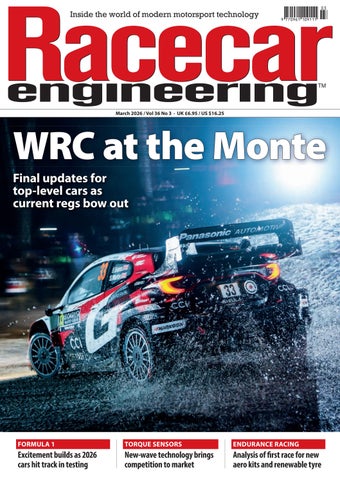
Racecar Engineering March 2026 sample

Page 1


Final furlong

Manufacturers had extra jokers to play with for the nal season of the current Rally1 regulations. Here’s what they spent them on

The 2026 FIA World Rally Championship marks the start of the fth and nal season for the current generation of Rally1 cars. It has been quite the journey to this point, starting with the introduction of hybrid systems in 2022 that created some of the fastest machinery to ever hit the stages. However, after some discussion, the 100kW electric boost was dropped ahead of the 2025 season following battery maintenance issues. That, combined with a turbo restrictor reduction, lowered maximum power outputs from 500+bhp to around 370bhp, while the minimum weight came down by 80kg (around 100kg worth of hybrid system came out, so ballast was needed to make up the shortfall).

were awarded an extra pair of chassis jokers to use. This was a result of Hyundai being given dispensation to use all its jokers for the rule cycle in 2025, in lieu of bringing an all-new car.

It also guaranteed a degree of technical development into the nal season of Rally1, as we currently know it. The FIA, which writes the WRC’s technical rulebook, is introducing a new rule set in 2027, aimed at reducing costs and increasing the number of cars competing for overall wins.

was deliberate. The team was reasonably happy with the package it had and wanted to see how it would fare in non-hybrid trim on new tyres from Hankook, which became the WRC’s exclusive supplier in 2025.

‘We removed the hybrid, so we changed the range of the power unit and how to make it work, but that was the only change we really wanted to do,’ says Kevin Struyf, engineering director at Toyota Gazoo Racing WRT. ‘Our plan was that we wanted to keep the car with the largest window and the most known base to make it work on the tyres.’

That pivot forced teams to re-allocate resources as the hybrid management expertise they had accrued was no longer relevant in WRC. The focus for the last season and the one coming, therefore, shifted to running more conventional rally cars, and lling the gaps in the power band the absence of the hybrid system left, typically through gear ratio adjustments.

In WRC, development for performance reasons is limited to so-called joker updates. For 2026, all three current Rally1 manufacturers – Toyota, Hyundai and M-Sport (which runs Ford’s programme) –

The 2026 season started, as usual, at the Monte Carlo Rally. Held in the mountains between Monaco on the Mediterranean coast and Gap at the base of the Alps, it remains notorious for its attrition on cars and crews, especially when ice and slush encase the twisty tarmac roads.

Toyota package

Reigning champion, Toyota, brought three updates to Monte Carlo, the most comprehensive package of the three manufacturers. This was because the Japanese marque had unused jokers in its pocket, carried over from 2025, in addition to the two extra ones.

Last year, the only joker Toyota spent was on a new set of gear ratios to tune the engine for non-hybrid usage. This lack of development on the GR Yaris Rally1

That turned out to be a good decision, as Toyota romped to the manufacturers’ title by a margin of 224 points over Hyundai. In the process, its evergreen driver, Sébastien Ogier, sealed his record-equalling ninth world title, despite missing three events. The Yaris proved strong on di erent surfaces and across the range of tyre compounds, winning 12 of 14 rallies.

Heading into 2026, the key question was, would Toyota unleash all the jokers it had been harbouring? After crushing its rival, Hyundai, in the rst year without hybrids, how much more performance did it really need to extract? Especially considering it is developing a new rally car for the 2027 rule set.

Toyota drew rst blood in the

season, winning the

with Oliver Solberg at the wheel. The Japanese manufacturer brought three joker updates to the event

Toyota Gazoo Racing
2026 WRC
Monte Carlo Rally

Daytona dreaming

The 24 Hours of Daytona saw Hypercars compete with no active performance balancing and, despite a close finish, Porsche dominated in all conditions. We examine why

Porsche brought multiple updates to Daytona for its 963, including revised front and rear aero packages, but much of the work was out of sight, under the floor, where channelled air helped increase downforce levels with very limited increase in drag

Ground reflect

What will be the legacy of the 2022-’25 generation of Formula 1 cars?

The chequered ag at the end of the 2025 Abu Dhabi Grand Prix represented the full stop on another chapter in the ongoing story that is Formula 1. Like any good novel, the story’s chapters contain many exciting twists and turns, their contents left open to interpretation.

This latest one, running from 2022 to 2025, evolved into a real page turner that concluded with a three-way showdown for the drivers’ title. A reputed ction author would have struggled to write a narrative so engaging.

Austin power

With 5.0-litres of Ford V8 stuffed under its tiny British body, meet one of the most spectacular creations on the UK’s historic Special Saloon scene

Andrew Willis’ Ford V8-powered Austin A30 is the very essence of 10lbs in a 5lb bag
‘It can be terrifying… they say the V8 TVRs of the ’60s are the twitchiest cars in motorsport, and their wheelbase is six inches longer than mine’
Andrew Willis, owner / driver of the A302

James Hunt used a van version as a road car after he retired from Formula 1, while Peter Brock raced one in Australia with a Holden straight six in the 1960s, but otherwise Austin’s A30 / A35 is better remembered as a small, British family runabout. That said, it does have something its more famously raceable rival, the Mini, hasn’t, and that’s rear-wheel drive.

The significance of this? Well, if you want to race within the UK’s vibrant historic Special Saloon scene, then usually – because there have been some exceptions – the drive must remain the same as it is on the road car on which the racecar is based. Likewise, engine position. So, when it comes to putting large engines in unlikely little old cars, the A30 might be just the thing, given the limitations of big power in front-wheel drive vehicles.

So far, only one person has opted to use an A30 as a base for a Special Saloon, and that’s Andrew Willis of Birmingham-based motorsport concern, 25/7 Race and Restoration. Willis has been competing with his pumped A30 over the past three years, with considerable success.

Willis did not choose the A30 just because it was rear-wheel drive, though. It was also because he had already had some experience of competing in one of these cars in the UK’s Classic Hot Rod short oval series.

After campaigning this 185bhp A30 for three years, he switched to circuit racing in 2021, contesting the Ginetta G40 Cup. Willis finished second in his debut season, but says he was looking for more of an engineering challenge than one-make competition, and historic Special Saloons took his fancy.

‘It gave me the freedom to make what I wanted, rather than being restricted,’ he says. ‘But I wanted to keep it close to how a Special Saloon would be in the 1970s, as you need to do to race in the [Scottish Motor Racing Club] Modsports and Special Saloons Championship Which meant using a carburettor, for example.’

Adventure drive

The ‘A302’, as Willis calls his creation, runs with a 5.0-litre Ford V8 (A302 referring to its 302ci capacity), which produces over 400bhp in a car that weighs 950kg. That might sound hairy enough, but there’s also the compact dimensions of the A30 to consider. Suffice to say, the result is a car that offers an adventure every time it goes out on track.

‘It can be terrifying,’ Willis admits. ‘To put it into perspective, they say the V8 TVRs of the ’60s, the Griffith 400, are the twitchiest cars in motorsport – and their wheelbase is six inches longer than mine. This has got an 80.5in [2045mm] wheelbase, but it’s 70in wide [1778mm], so it’s actually close to square.

‘You have to be really, really careful with it,’ Willis adds. ‘When it oversteers and you catch it, it tends to throw itself off the circuit,

Pressure cooking

Part two of our deep dive into Ferrari’s development of turbocharged grand prix cars during the 1980s

Much modi ed during the 1984 season, the Ferrari 126 C4 gained a longer wheelbase and began using a new Supercortemaggiore fuel, similar to that enjoyed by BMW

Well aware that new trends in racecar design and construction were afoot, in late spring of 1981 Enzo Ferrari brought British engineer, Harvey Postlethwaite, aboard. A personal selection by the Commendatore, Postlethwaite had demonstrated an innovative approach to grand prix car design with his stints at the iconoclastic Hesketh team – a winner with James Hunt – the short-lived Walter Wolf e ort, and a brief stint with Fittipaldi before his arrival at Maranello. He would remain with Ferrari until 1987, when he overlapped with the arriving John Barnard and the peripatetic Gustav Brunner.

Unlike Ferrari’s transitional 126 C, the 126 C2 built for 1982 ‘looked superb,’ according to historian Doug Nye. ‘It was neat and tidy compared to its predecessor, and was beautifully made in most details.’

Its sleek, purposeful shape was designed by young aerodynamicist, Gianfranco Poncini, whose previous work, also undertaken in the Pininfarina wind tunnel, was the radical and successful Ferrari 312 T4 of 1979. E ective skirts were supported by Postlethwaite’s structure of aluminium honeycomb sti ened by carbon bre panels. Scoops at the rear of the 126 C2 cooled its brakes, while body surface scoops behind the cockpit brought fresh air to the turbochargers. Side nacelles carried the radiators and intercoolers, the latter sloping steeply forward.

Stable platform

After four years with Michelin, Ferrari was back with Goodyear, bringing stability on the tyre front. As a result, the chassis caught up with the engine, now at a base level of 625bhp, together ‘crushing’ the existing lap record at Fiorano. That led Mauro Forghieri and

colleagues to comment, ‘The 126 C2 had achieved an excellent level in comparison with its opposition… we should have won with our eyes closed.’

The 1982 season did indeed prove to be a strong season, but was deeply undermined by the death of Gilles Villeneuve at Zolder and the career-ending crash of Didier Pironi. Nevertheless, the two drivers, and stand-ins Patrick Tambay and Mario Andretti, scored enough podium points to bring the Constructors’ Championship to Maranello, and a vice championship to Pironi.

Impressively, Ferrari su ered no engine failures in 22 season starts, a tribute to the work of the Gestione Sportiva, as the company’s racing centre was now known.

‘I loved the car,’ said Andretti, who nished third at Monza behind Tambay. ‘It had an incredible amount of power, especially in qualifying. I was in fth gear through the

Turn static files into dynamic content formats.

Create a flipbook
Issuu converts static files into: digital portfolios, online yearbooks, online catalogs, digital photo albums and more. Sign up and create your flipbook.