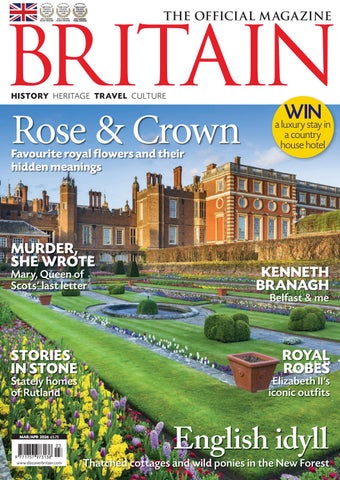
Britain March/April 2026 sample

Page 1


Rose & Crown

Favourite royal flowers and their hidden meanings

MURDER, SHE WROTE

Mary, Queen of Scots' last letter

STORIES IN STONE

Stately homes of Rutland

Land of kings & commoners

With its ancient woodlands, pretty villages and free-roaming ponies, the New Forest offers a timeless escape

WORDS ANTONIA WINDSOR

CROWNS & GOWNS

In Queen Elizabeth II’s centenary year, a landmark exhibition explores her life in fashion, spanning the ten decades of her remarkable life

“Such splendour I had never seen before and may never see again,” wrote Sir Norman Hartnell, favoured fashion designer of the late Queen Elizabeth II, of the 1953 Coronation in his autobiography, Silver and Gold. “The Abbey is wearing Coronation draperies of blue brocade. Along its aisle spreads a seamless carpet of cerulean blue, changing at the Theatre’s steps to a warm shade of pale honey … from my privileged seat in the Queen’s Box I can see every happening and every arrival. Soon I shall be seeing the dress I have made, being worn by Her Majesty Queen Elizabeth the Second for her Crowning.”

And what a dress it was. Sweeping satin and with ornate golden beading, the cloth depicted, at the future Queen’s insistence, every emblem of the dominions around the world over which she would now reign, alongside those of the United Kingdom. “It is an absolute masterpiece of British design, while also acting as a communication

tool that says so much about Great Britain, the Commonwealth, royalty and ceremony,” asserts Caroline de Guitaut, curator of the new exhibition celebrating Elizabeth II’s fashion legacy: Queen Elizabeth II: Her Life in Style. Not only was it the ultimate showcase for Hartnell’s design skills but, according to de Guitaut, “the pinnacle of his couture house’s exceptional craftsmanship”.

The Coronation dress will be just one of approximately 200 pieces of the late Queen’s wardrobe on display when the show opens at The King’s Gallery in Buckingham Palace this April. It is the largest exhibition of her clothing ever mounted, taking us through all ten decades of her life to showcase the full breadth of her fashion choices.

The exhibition opens with a chronological presentation, beginning with childhood dress and the couture garments worn by the future Queen: a subject of endless fascination from her earliest years. This leads into a section devoted to

The cloth of Queen Elizabeth II’s Coronation dress depicted, at her insistence, every emblem of her dominions around the world

From left: Hat worn for the wedding of Princess Margaret, Claude St Cyr, 1960; the late Queen photographed by Cecil Beaton on Princess Margaret’s wedding day, 1960

300 years ago the final curtain came down on the life of the remarkable, career-hopping dramatist, architect and spy Sir John Vanbrugh. We look back at his colourful life, times and legacy

B aroquebravado

WORDS NEIL JONES

Viewing Castle Howard for the first time, the writer and politician Horace Walpole waxed lyrical in 1772: “I have seen gigantic places before, but never a sublime one.” Famous today as a film and TV setting (notably in Brideshead Revisited and Bridgerton), the Howard family home near York is among England’s most iconic country houses, the bravura Baroque creation all the more extraordinary for having been designed by an architectural novice. But then, John Vanbrugh was an extraordinary man.

Throughout this tercentenary year of Vanbrugh’s death, ‘Vanbrugh 300’, presented by The Georgian Group, celebrates his remarkable career, with events and exhibitions taking place at half a dozen of the architect’s most significant buildings (discover more at Vanbrugh300.co.uk).

Baptised on 24 January 1664, John Vanbrugh was the son of Giles Vanbrugh, a successful London cloth merchant of Protestant Flemish descent, and Elizabeth Carleton, the daughter of an aristocratic English family. With their ever-expanding household, the family moved to Chester, where John was raised.

After a brief foray into the wine trade in 1681, and a year in India in the service of the East India Company, the young Vanbrugh got a short-lived regimental army commission through family connections. Later travelling in France, he was arrested in 1688 and imprisoned as an alleged spy (tales allude to his support for France’s Protestant enemy, William of Orange, who invaded England in the Glorious Revolution that deposed Catholic King James II). By 1692 Vanbrugh was in the Bastille, but released on parole he enjoyed sightseeing in Paris before returning to England and more military service.

During the 1690s, Vanbrugh suddenly reinvented himself as a playwright, proving a master of Restoration comedy with The Relapse, or, Virtue in Danger (1696) featuring larger-than-life characters like vain Lord Foppington. A second hit followed with The Provoked Wife (1697), but as theatre-going tastes began to wander away from risqué comedies of manners, Vanbrugh switched career again.

The iconic Castle Howard is all the more extraordinary for having been designed by an architectural novice
Left: Castle Howard, Vanbrugh's Baroque masterpiece

Much in little

With its cobbled market towns, historic churches and grand houses set among rolling countryside, England’s smallest county has an outsized charm

WORDS NATASHA FOGES

Much in little

Left along the River Wye from Symonds Yat
Normanton Church, on the shores of Rutland Water

Finding ELEANOR

By retracing the funeral route of a medieval queen on foot, historian Alice Loxton discovered the transformative power of walking through England’s history at a human pace

WORDS ALICE LOXTON

Turn static files into dynamic content formats.

Create a flipbook
Issuu converts static files into: digital portfolios, online yearbooks, online catalogs, digital photo albums and more. Sign up and create your flipbook.