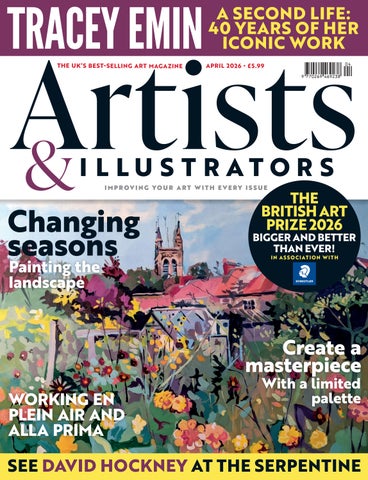
Artists & Illustrators April 2026 sample

Page 1


This month’s spotlight on a British Art Club member

We present...

KAY ASHTON

This artist blends meticulous realism with expressive techniques, creating paintings that engage, delight and inspire viewers

Kay Ashton’s work is rooted in realism: careful observation, technical patience and a steady commitment to getting things right. An award-winning, self-taught artist who has been painting for 16 years, she built her reputation through finely-detailed oil paintings that demanded time, concentration and precision. That grounding still underpins everything she does, even as her practice has expanded in more expressive directions.

Born in Salford and raised largely in Warrington, Cheshire, Kay’s first experience of drawing came early. At seven, she copied Mickey Mouse from an album cover and was startled by her own ability. “I remember thinking ‘Whoa, I can do this’,” she says. Encouraged at school, she continued sketching intermittently, but it wasn’t until her forties that she committed fully to painting, approaching it with the focus and seriousness of someone who knew what they wanted from the medium.

Oil painting classes proved decisive. Kay uncovered she could analyse images instinctively, reducing complex subjects into manageable elements. “I found that I could break down picture elements easily into simple shapes and colours,” she explains. Early commissions followed quickly – portraits, pets, glassware, food – and with them came affirmation. “Seeing the joy on customers’ faces really cemented it for me,” she says. “If I can bring some happiness to people’s lives through my art, then that makes me happy, too.”

Yet realism, for all its rewards, is demanding. Weeks – sometimes months – could be spent on a single piece, and repetition began to dull its edge. Kay became more selective, using her technical confidence as a platform rather than a constraint. Acrylics replaced oils, speeding up the process and allowing room for instinct and experimentation. While flowers emerged as a recurring subject, they functioned less as a motif than as a vehicle; an arena in which to loosen control without abandoning structure.

Spontaneity now plays a greater role for Kay, but realism remains close at hand. “Even though I don’t work with as many details as I used to, I still have these skills to call upon in the future,” she notes. That balance – between accuracy and intuition, discipline and freedom –defines her work today. For Kay, the aim has never shifted. “If you have a passion for it, then get creating,” she laughs. The method may evolve, but the intention – to make work that connects, reassures and brings a measure of joy – remains constant.

britishartclub.co.uk/profile/kayashton

Tapas for the Brits, oil on wood, 41x51cm

Rob Pointon

This artist transforms everyday British scenes through fearless en plein air painting, using wide-angle perspectives to create dynamic, immersive pieces, says Ramsha Vistro ▸

The Platinum Jubilee Trooping the Colour, oil on board, 120x200cm
Fleet Street and the Royal Courts of Justice, 2025, oil on canvas, 63.5x50.8cm

Peter Brown

The chap who earned the nickname ‘Pete the Street’ due to him painting amazing scenes around Bath and Bristol, tells Sarah Edghill about his practice ▸

Morning Light, The Studio, Mediums and Hurricane Lantern, oil on board, 50.8x50.8cm

Happy holiday

LUCY MARKS looks at how we can enjoy painting on holiday; showing you how to make the very best use of oils and gouaches when away from home. Working en plein air and alla prima , she also suggests exercises to practise while away, working from observation whilst keeping your painting loose

At the heart of my own practice lies observation and my wish to capture atmosphere of the place, wherever that may be. To achieve this, I like to work en plein air observing the new scenes and alla prima responding by painting loosely focusing on capturing the mood. The sketches and paintings in this article are from a recent trip to Italy. I focused on capturing the essence of the rolling Italian landscape. The images here are a selection of different views from my holiday where I painted gouache sketches, finished pieces in oil and different stages of works in progress. lucymarks.co.uk ▸

painting

LUCY’S MATERIALS

Paints

Oil paint

Michael Harding: Naples Yellow, Lemon Yellow, Warm Light Yellow, Ultramarine, Kings Blue Light, Moss Green, Yellow Ochre, Burnt Umber, Kings Blue Light

Winsor and Newton: Cadmium Yellow Medium, Cadmium Free Pale Green, Tera Rosa Gouache paint

Winsor and Newton: Naples Yellow, Lemon Yellow, Daniel Smith Extra Fine Gouache, Ultramarine, Yellow Ochre, Sepia Holbein: Shell, Cadmium Yellow Medium, Moss Green, Leaf Green

Daniel Smith: Kings Blue Brushes

Oil Brushes

All Rosemary & Co, Sable Blend range

Rounds: Size 4, Size 6

Flats: Size 18, Size 12, Size 6 Gouache Brushes All Rosemary & Co, Designer Golden Synthetic range

Rounds: Size 4, Size 6

Flats: Size 14, Size 10, Size 8, Size 4 Mop, Size 4

Support

Sketchbook: Seawhite Travel Journal for the Artist 200gsm, A4 Paper: Watercolour paper, St Cuthbert’s Mill, Saunders and Waterford, 300gsm, HP Oil surface: 5mm wooden panel, size 9” x 12” by Jacksons Oil Medium and Solvent Galykd Lite - Gamblin Zest-it

Picture this

In every issue, we ask an artist to tell us about a piece of work that holds meaning for them. This month, we speak to landscape artist PAUL BROWN

A family trip to Venice last year in February created wonderful memories of the stunning winter light of the city and experiencing the city of Venice through my children’s eyes. I saw this view on a gondola ride on a beautiful morning in Venice, so I returned to a nearby bridge to paint it. It made me feel elated as the light, colours and reflections were so vibrant. The still canal water acts as a mirror which adds a different dimension to the painting. These reflections only exist when the canal water is calm, so it’s only temporary. Having been to Venice many many times, the February light was absolutely stunning, and probably the best I’ve experienced. I’ve been painting Venice for over 30 years so I understand how the gondola

poles can be painted and how the reflections are always slightly darker in tone than what is being reflected. I love how the reflections are distorted by subtle ripples in the canal water. This also gives the feeling of movement in the composition. It’s a different reality. I’m drawn to light, colour, atmosphere and architecture. Venice has it all. And I discover something new every time I visit. I made the gondola poles slightly shorter than they actually were as I felt it made the composition more harmonious. Painting can be more than replicating what is in front of you. It’s called artistic licence. I hope this painting evokes the joy and sensation of reflected light and colour that I experienced. sanguine-fine-art.co.uk ▫

Gondola Poles, Venice, 60x50cm, oil on canvas

Turn static files into dynamic content formats.

Create a flipbook
Issuu converts static files into: digital portfolios, online yearbooks, online catalogs, digital photo albums and more. Sign up and create your flipbook.