






An era of significant wealth transfer has begun.
Strategic gifting to family members before you pass can be an effective strategy for providing for your family’s needs while creating your lasting legacy. And if done thoughtfully, it can provide tax efficiency benefits for your estate plan at the same time.
Whether leveraging the annual gift tax exclusion, making accelerated gifts to a 529 plan, or using medical and educational income tax exclusions, your seasoned team of private wealth management professionals at Commerce Trust will collaborate to assess various tax-efficient giving strategies and assist with providing an impactful, thoughtfully timed plan for giving to your family that aligns with your long-term wealth goals.
Through our holistic, team-based approach to servicing private wealth clients, your team of Commerce Trust estate and tax planning, investment management, and trust administration professionals can help turn your success into a lasting legacy that starts today.
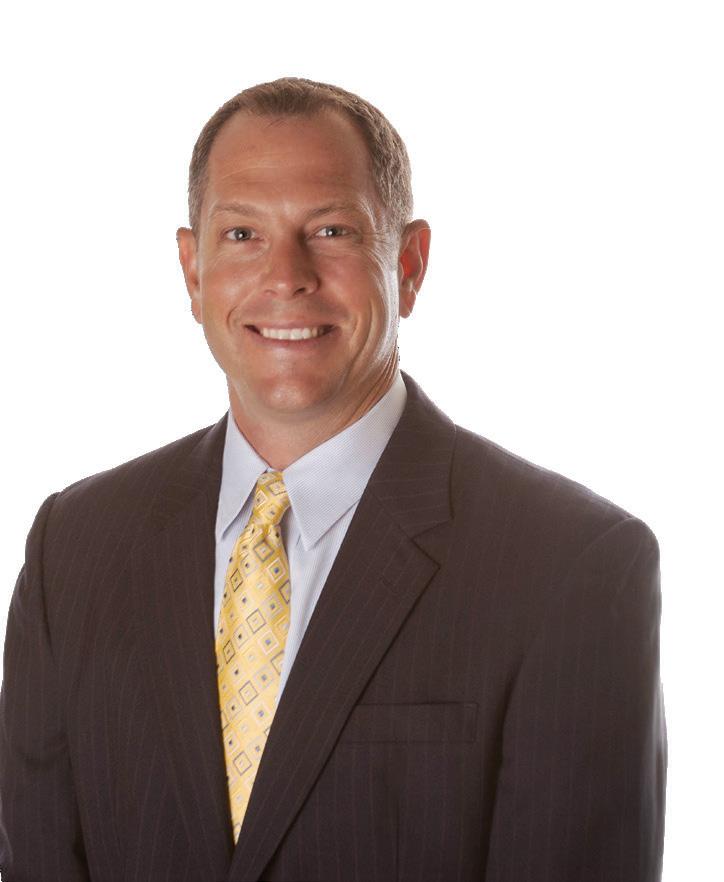
Connect with Lyle Johnson, your dedicated Market Executive for Commerce Trust, at (573) 886-5324 or lyle.johnson@commercebank.com.
Learn more about securing your legacy at www.commercetrustcompany.com/estateplanning.


By Scott LaPresta, CTFA, Senior Vice President, Director of Private Client Advisors, Commerce Trust, and Amy Stiglic, CTFA, Senior Vice President, Market Executive, Kansas City, Commerce Trust
Gifting to family members provides for their needs while advancing your estate plan. In addition to the benefits your relatives receive, strategically gifting may decrease your transfer tax liability by lowering the value of your estate. Below are five methods to maximize the value of family gifts for donors and recipients.
1. Annual gift exclusion
For tax year 2025, the IRS allows you to gift up to $19,000 tax-free to as many people as you want, and married couples can give up to $38,000 to an individual without triggering a taxable gift.
Both recipients and donors can benefit from annual gifts. In contrast to an inheritance, recipients can enjoy the gift immediately without losing any value to pay transfer taxes.
Donors can coordinate annual gifts to achieve estate planning objectives like potentially decreasing their estate tax liability by lowering the value of their estate.
2. 529 accelerated gifting
By making an accelerated gift to a qualified tuition program (QTP) like a 529 plan, you can contribute up to five times the annual exclusion ($95,000 for individuals and $190,000 for married couples in 2025) in a single year tax-free.
This strategy can provide significant value for those aspiring to attend college while lowering the value of the donor’s estate.
3. Lifetime estate and gift tax exemption
The 2025 federal lifetime estate and gift tax exemption amount is $13.99 million for individuals and is effectively doubled to $27.98 million for married couples.
This means the total value of one’s estate plus any taxable gifts can generally be transferred tax-free up to that amount. Using the lifetime exemption now, at its historically high level, may lower your eventual estate tax liability.
4. Medical exclusion
The medical exclusion is another way to give a gift to family members by paying for their medical expenses without triggering a taxable gift.
The payment must be made directly to the care provider and be solely used for qualifying medical expenses as defined by the IRS. Donors can also pay for health insurance under the medical exclusion, but payments for medical care that are reimbursed by the recipient’s insurance company do not qualify.

5. Educational exclusion
Gifts that qualify for the educational exclusion are also not subject to the gift tax. The gift must be paid directly to a qualifying educational institution and exclusively used for tuition.

Gifting to family members may seem straightforward, but care is needed to ensure the value of the gift is not diminished by taxes. If gifting is a priority for you, contact Commerce Trust at www.commercetrustcompany.com/estateplanning to learn how our tax management,* estate planning, and education planning professionals collaborate to execute a customized estate plan that is unique to you.
*Commerce Trust does not provide tax advice to customers unless engaged to do so.
The opinions and other information in the commentary are provided as of January 16, 2025. This summary is intended to provide general information only, and may be of value to the reader and audience.
This material is not a recommendation of any particular investment or insurance strategy, is not based on any particular financial situation or need, and is not intended to replace the advice of a qualified tax advisor or investment professional. While Commerce may provide information or express opinions from time to time, such information or opinions are subject to change, are not offered as professional tax, insurance or legal advice, and may not be relied on as such.
Data contained herein from third-party providers is obtained from what are considered reliable sources. However, its accuracy, completeness or reliability cannot be guaranteed. Commerce Trust is a division of Commerce Bank. Investment


February 2026
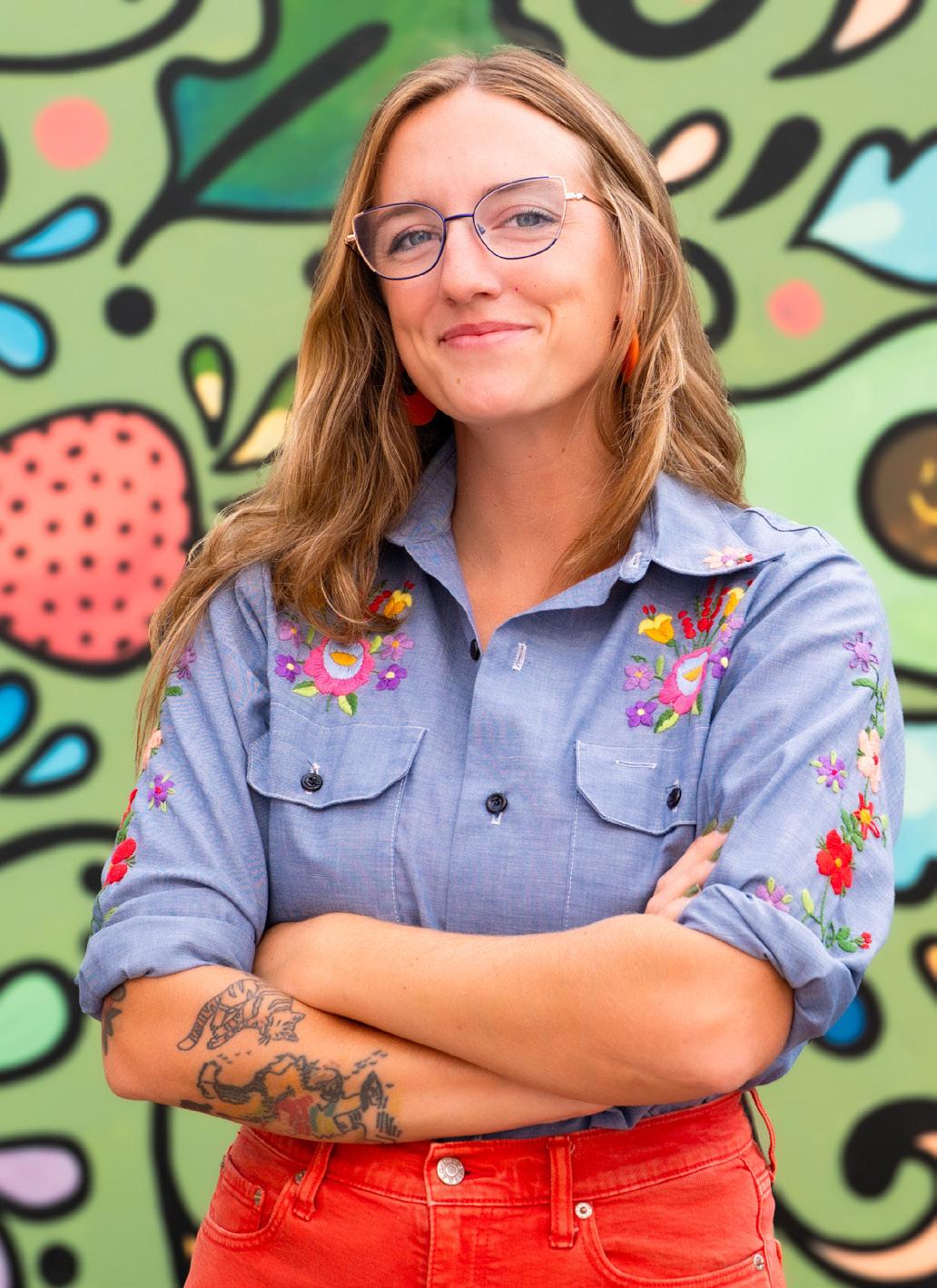
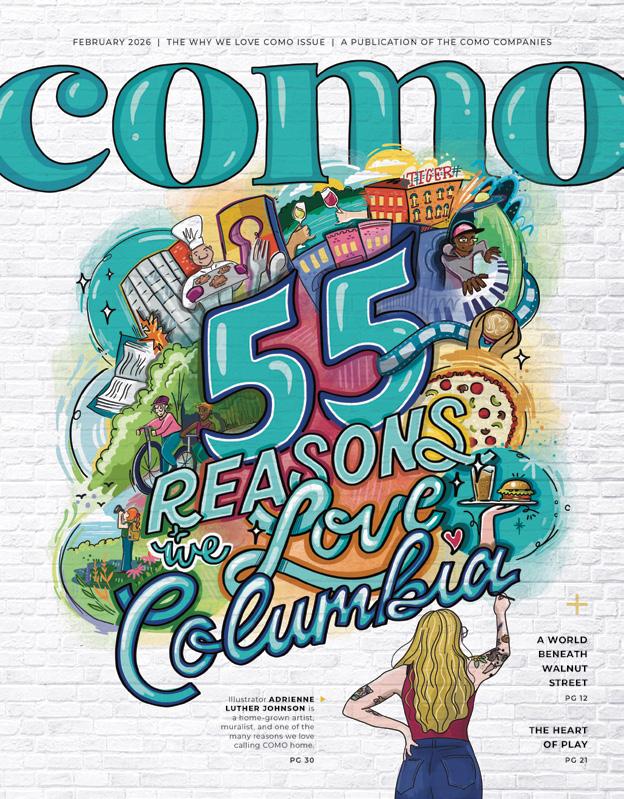
Adrienne Luther Johnson is a freelance illustrator, muralist, and designer. Having moved to Columbia to study journalism in 2014, she fluttered around the Midwest after graduation until settling back in Columbia in spring 2019 for True/False. The rest is history!
Now, you can find her out at Cooper’s Landing hosting kids arts camps in the summertime or painting alongside bustling streets. Her work resides in Clovers, the Arcade District, Flat Branch Park, and hundreds of private residences. Johnson also co-owns Cafe Berlin with her husband. She’s inspired by childlike wonder, the art of “play,” and community.
When Adrienne isn’t painting, she’s running the social media for Cafe B, hiking with her dog (Joni Mitchell), or reading. Her favorite parts of Columbia? Stephens Lake Park (where she got married!), the sculpture art at Broadway and Garth, Local Motion, The Center Project, and “The Heaven Room” at Simmons Bank (if you know, you know!).
Check out her original custom illustration on our cover!
PUBLISHING
David Nivens, Publisher david@comocompanies.com
Chris Harrison, Associate Publisher chris@comocompanies.com
EDITORIAL
Jodie Jackson Jr, Editor jodie@comocompanies.com
Kelsey Winkeljohn, Associate Editor kelsey@comocompanies.com
Karen Pasley, Contributing Copyeditor
DESIGN
Jordan Watts, Senior Designer jordan@comocompanies.com
MARKETING
Charles Bruce, Director of Client Relations charles@comocompanies.com
Kerrie Bloss, Account Executive kerrie@comocompanies.com
CONTRIBUTING ILLUSTRATOR
Adrienne Luther Johnson
CONTRIBUTING PHOTOGRAPHERS
Sunitha Bosecker, Tahlia Heaton, Andy Hill, Jodie Jackson Jr, Adrienne Luther Johnson, Hoss Koetting, Sleep in Heavenly Peace
CONTRIBUTING WRITERS
Sunitha Bosecker, Barbara Bu aloe, Tahlia Heaton, Jodie Jackson Jr, Adrienne Luther Johnson, Hoss Koetting, Brian Neuner, Stephi Smith, Bradley Williams, Kelsey Winkeljohn
SUBSCRIPTIONS
Magazines are $5 an issue. Subscription rate is $54 for 12 issues for one year or $89 for 24 issues for two years. Subscribe at comomag.com or by phone. COMO Magazine is published monthly by e COMO Companies.
OUR MISSION STATEMENT
COMO Magazine and comomag.com strive to inspire, educate, and entertain the citizens of Columbia with quality, relevant content that re ects Columbia’s business environment, lifestyle, and community spirit.
Copyright e COMO Companies, 2026
All rights reserved. Reproduction or use of any editorial or graphic content without the express written permission of the publisher is prohibited.
FEEDBACK
Have a story idea, feedback, or a general inquiry? Email our editor at Jodie@comocompanies.com.
CONTACT
e COMO Companies | 404 Portland, Columbia, MO 65201 573-577-1965 | comomag.com | comobusinesstimes.com
e month of love (and romanticized consumerism!).
Not-so-interesting fact about me: I was actually supposed to be born on Valentine’s Day. I’d like to think that means I’m full of sunshine, rainbows, and confetti hearts — despite arriving almost three weeks late. I still have poor time management skills. Go gure.
In a way, I feel like I was a bit late to the “Why We Love Columbia” party, too. When I moved here for school, I unintentionally became a bit of a recluse. My weeks were spent studying and going to class, and during my freshman year, I often headed back to Kansas City on the weekends, missing friends and family back home. I didn’t make much of an e ort to explore the city I had moved to or engage with the community outside of my little school bubble. en the pandemic hit — and the rest is a blur. e number of times someone asked me if I’d been to [insert extremely popular place in Columbia] only for me to respond with an embarrassed head shake and stare at the oor should honestly be a criminal offense. is still happens occasionally, but I swear I’ve gotten better.

It wasn’t until I joined the COMO Magazine and COMO Business Times team that I really started noticing the little things. I remember my rst assignment as an intern: interviewing Jessica Schlosser, owner of Lizzi & Rocco’s, for our “20 Under 40” issue. I was incredibly nervous, feeling like I was talking to a local star (which Jessica kind of is). And I still feel that sense of honor when speaking with community members who have shaped Columbia by building businesses, volunteering, and sharing their talents to make the city a better place.
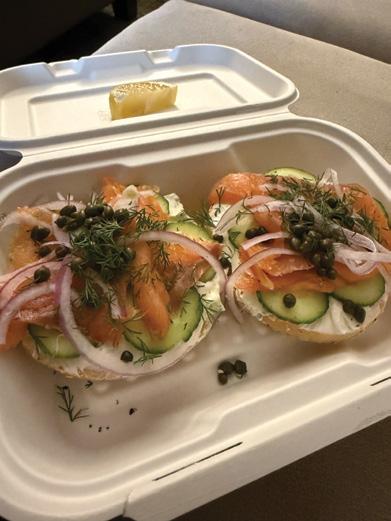
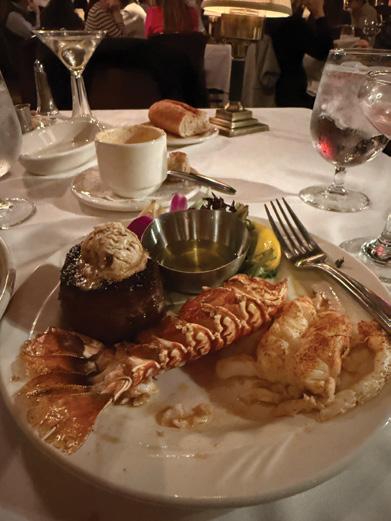
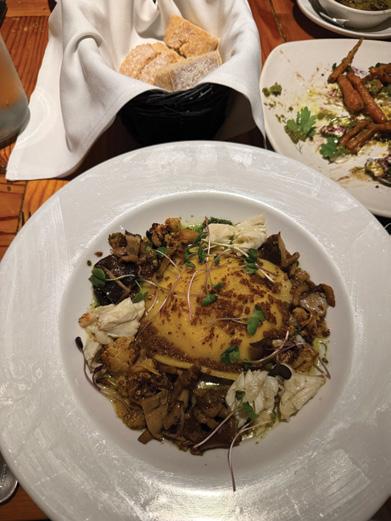
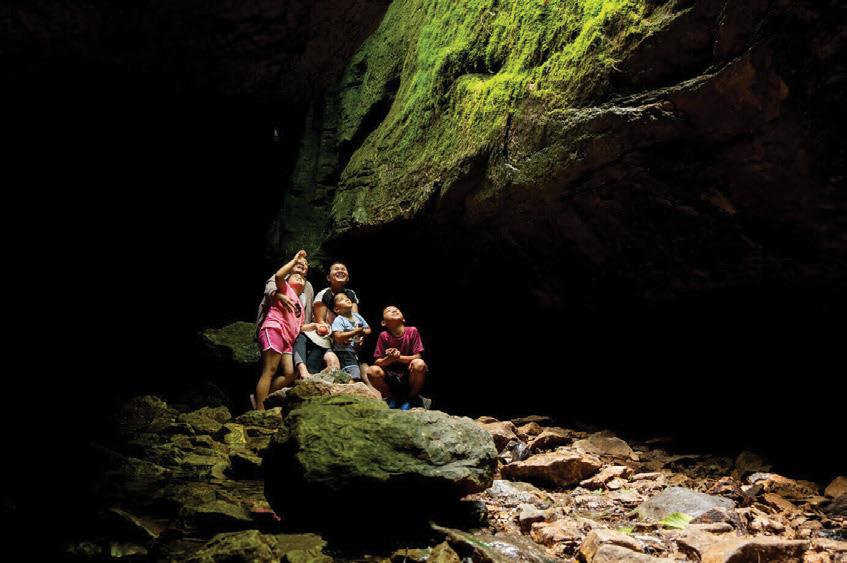
My dad recently visited for a post-holiday trip, and I realized just how much pride I take in showing o where I live. I secretly planned an itinerary lled with some of our favorite restaurants: Cherry Street Wine Cellar, CC’s City Broiler, Endwell Taverna, and Cafe Berlin. He had nothing but positive feedback on the food, service, and ambiance — always a relief, since he’s a bit of a foodie. We also made side-quests to the beautiful Devil’s Icebox and the Farmers Market for some photography opportunities (thanks, Dad, for sparking that creative outlet).
For this issue, I spent a few weeks interviewing Columbia’s “boomerangs” — people who once lived here, moved away, and later returned. Hearing their stories was fascinating. After experiencing bigger, busier cities, many still nd Columbia on par (or even better). It’s a place often overlooked, but those who connect with its people and spaces understand its real value. at makes it all the more special.
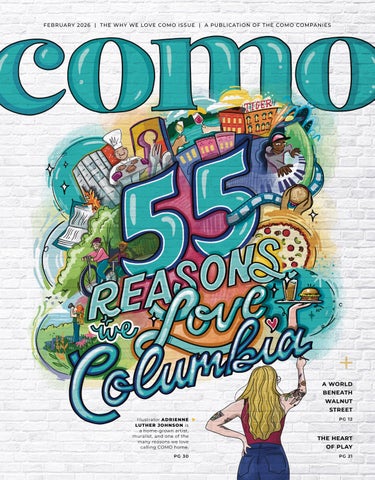
Why do we love Columbia? We narrowed it down to 55 reasons, from Shakespeare’s Pizza to the wildlife escapes that make this place home.
Illustration by Adrienne Luther Johnson
A heartfelt thank you to our local writers, photographers, and artists (shoutout to Adrienne Luther Johnson for this stunning cover) who make our magazine and city diverse and beautiful. And thank YOU, reader, for being part of this ecosystem. We hope you enjoy this issue that, like every issue, we put together with love.

KELSEY WINKELJOHN ASSOCIATE EDITOR kelsey@comocompanies.com

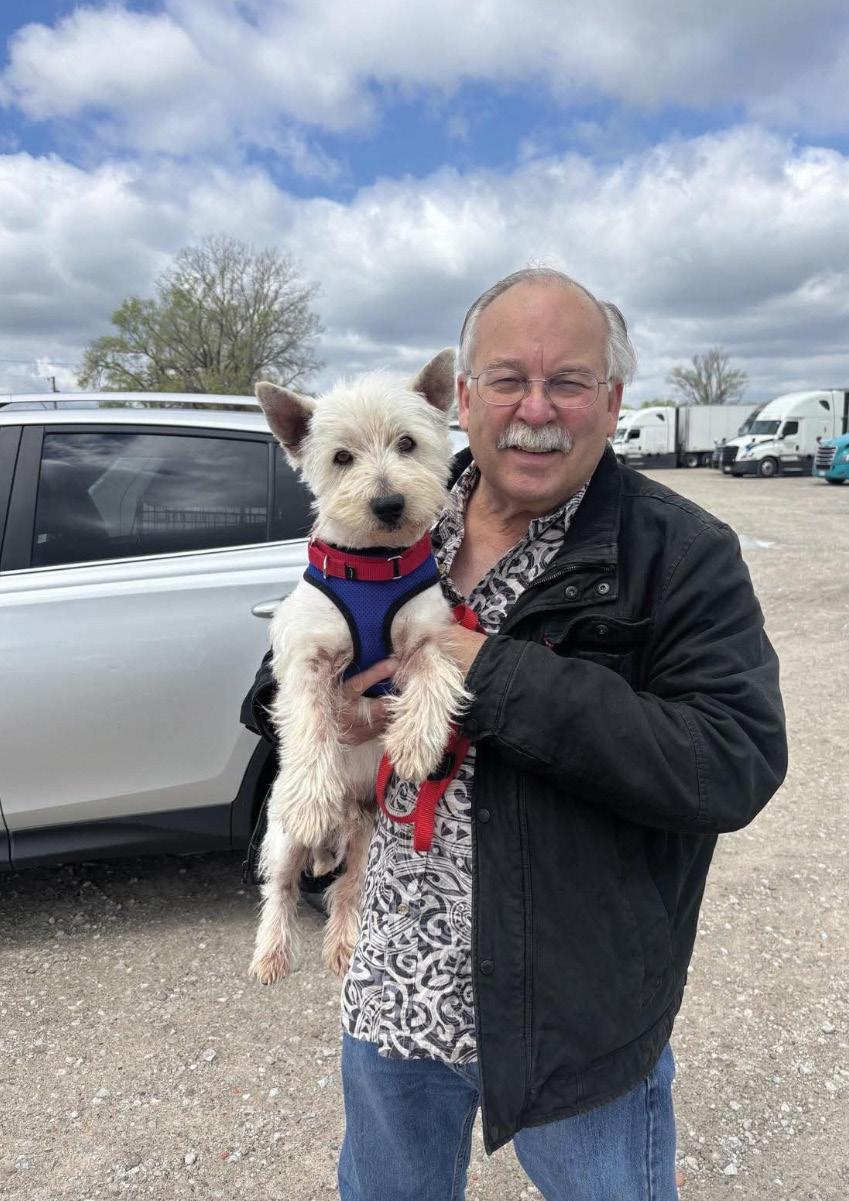
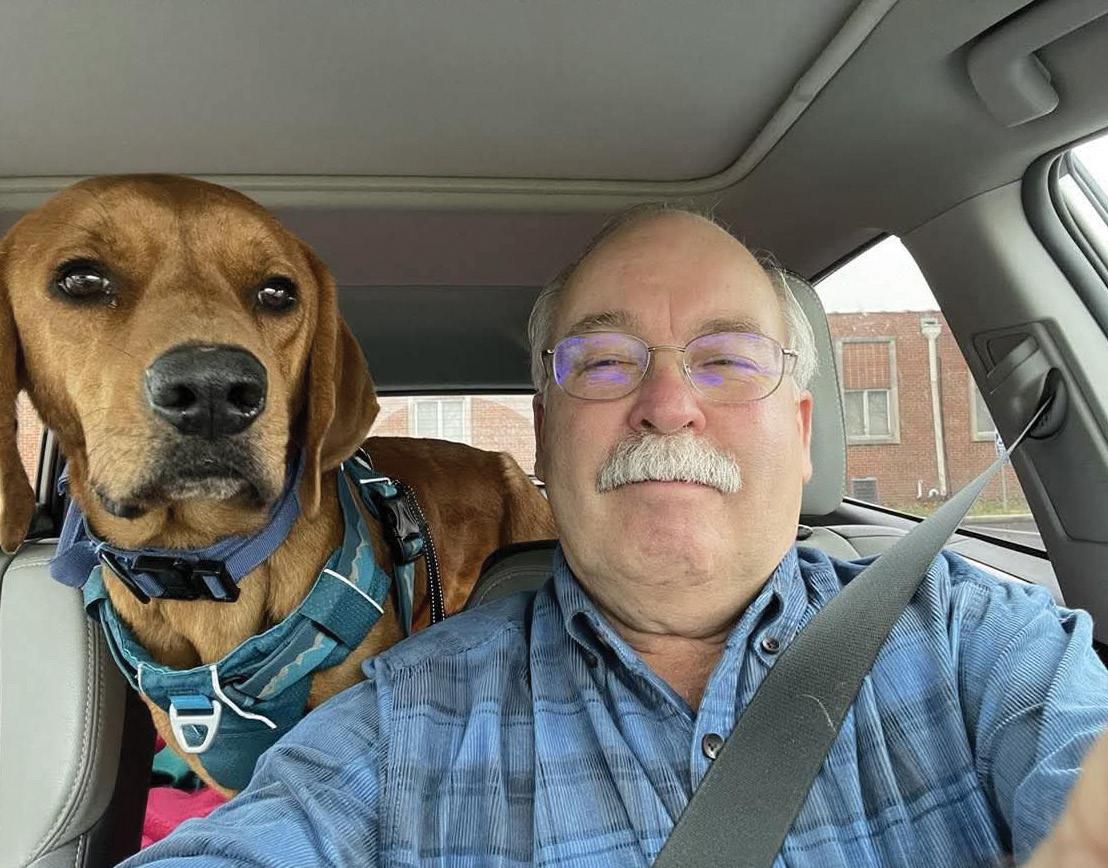
Columbia volunteer logged almost 14,000 miles transporting foster dogs in 2025.
BY JODIE JACKSON JR
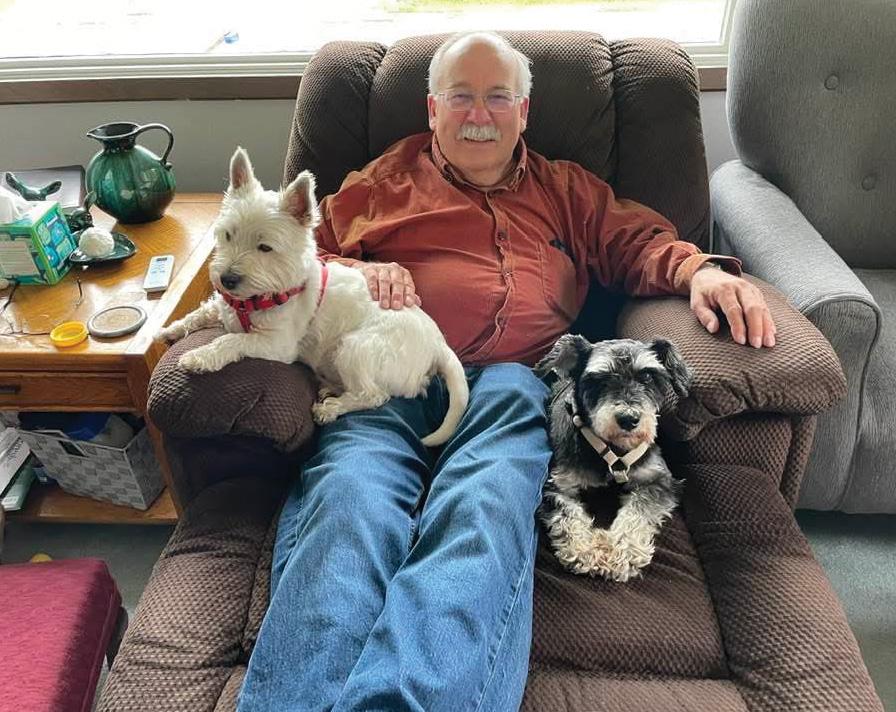
Andy politely snuggles against a visitor’s leg, breathing a satis ed sigh after a reciprocating pat on his cream-colored head. It’s a quiet weekday afternoon, and Andy’s human, Chris Cummins, won’t be driving to transport one or more dogs from a canine rescue organization to their furever homes.
“Andy needs to be touching you. He’s just super a ectionate,” Cummin says. He begins to tell the tale of how Andy, a spunky little Westie, came to live with him and Sally, a black miniature schnauzer who doesn’t seem to mind Andy but probably would be just as content without him. Cummins begins, “Against my better judgment …”
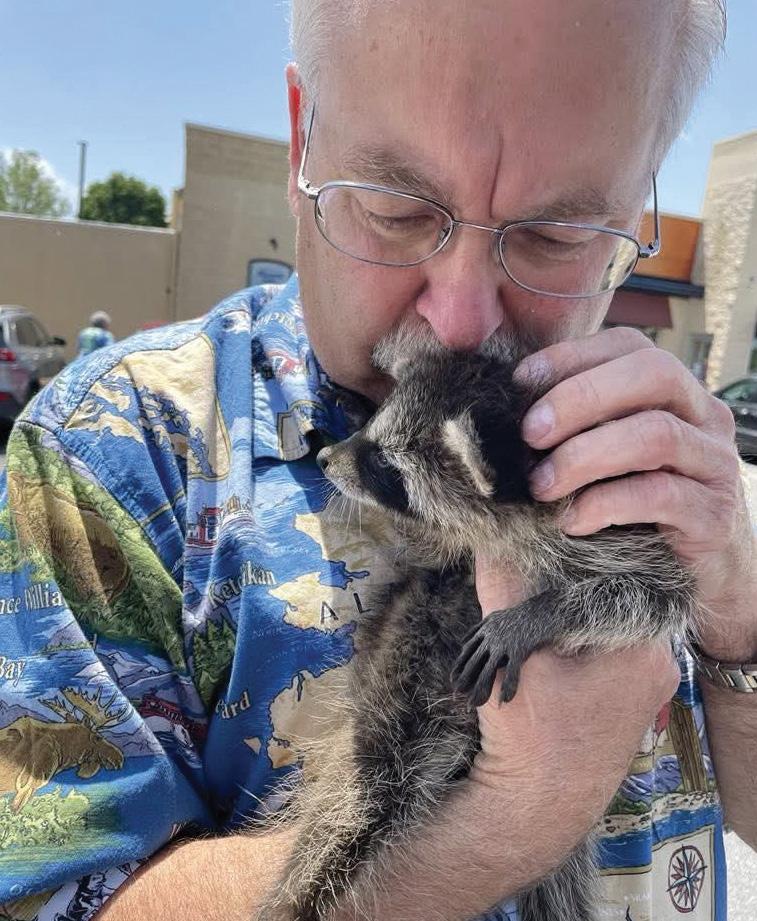
He rolls his eyes, his face slowly forming a friendly, mustachioed smile as he tells the story with a perceptible twinkle in his eye. Cummins became familiar with Andy through volunteer work as a rescue dog driver. In fact, in 2025, Cummins logged 13,808 miles over 70 trips to play a part in the fostering, adoption, or rehabilitation of 133 dogs, 12 cats, six raccoons, and two foxes.
Cummins will continue to play a role in that process, but he vows not to foster any other dogs. Sally, the pup perched in the chair once occupied by his late wife, Karen, seems unfazed by the conversation but also seems to approve. After all, Sally was there before Andy.
He might not foster or adopt another dog, but Cummins has a particular passion for helping dog rescue groups connect their dogs with fosters or their permanent homes. Not long after he began transporting dogs for a variety of rescue organizations, he wound up transporting Andy three times, rst picking Andy up in Boonville after the pup’s owner died and later taking Andy to Blue Springs where — allegedly — Andy peed on his new owner’s boyfriend’s boots. From there it was o to Wichita, and then he was destined to nd a home with an Illinois family that seemed the perfect t, except the family wanted a “perfect” dog. However, Andy has diabetes insipidus, requiring regular medication. ere was also his habit of, ahem, “marking” territory.
e next part of the story involved “some arm-twisting” as Cummins was strongly encouraged to foster Andy, which is when the more practical part of his brain fell victim to his overpowering love of canines, especially pups with such besmirched characters. Against his better judgment …
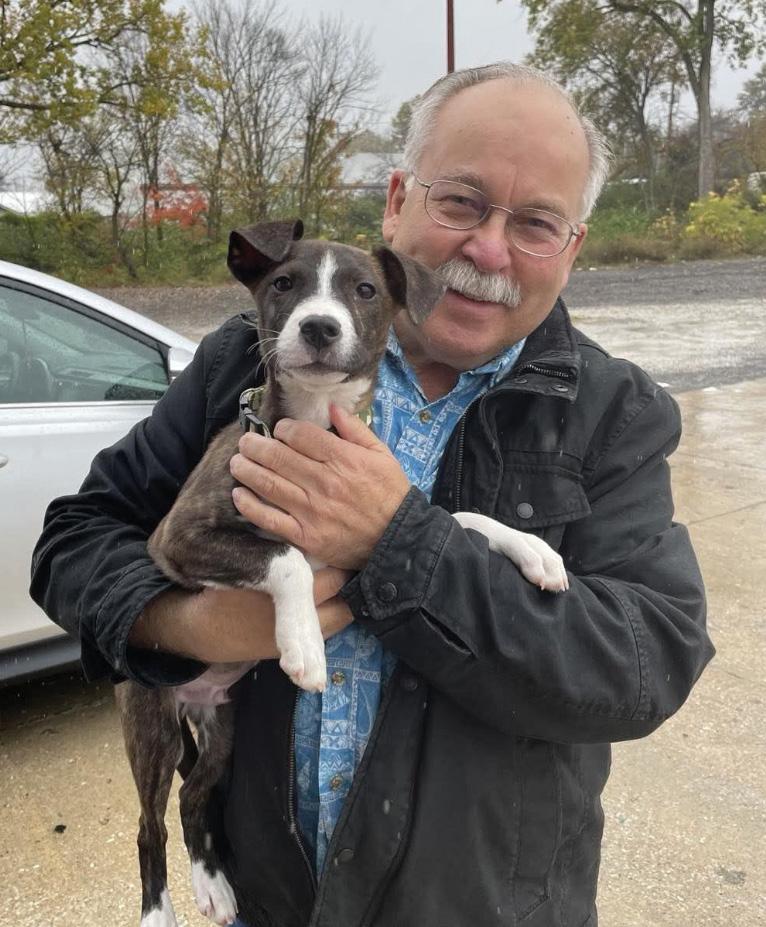
“ en I was talked into adopting him,” he concedes. It also meant his experience became what is known in the dog rescue and foster process as a “foster fail.”
“People foster and then fall in love with the dog and can’t let it go,” he says. But Andy has been good for Sally. Mostly. Cummins adds, “He’s kind of brought her out of her shell a little bit, although I think she would prefer to be the only dog.”
Foster fails are not uncommon in the line of volunteer work that Cummins embraced not long after Karen’s death in April 2023. Most foster experiences go as planned, he guesses.
“I’ve talked to some who talk about taking them to their furever home, then bawling all the way back home,” he says. “I’m totally in awe of people who do that. It’s an amazing ability to be able to know that your heart’s going to be broken at some time when you have to give the dog up, but in the meantime, you’re keeping it from sleeping out on the street or a cold oor in a dog pound.”
Cummins retired from the University of Missouri’s international admissions o ce in December 2022. A former colleague later contacted him to see if he might be interested in playing a role in the dog rescue picture.
“She called me up and said, ‘I do this dog transporting,’” he recalls. “’We’ve got one on Saturday.’”
Cummins went along and was immediately hooked. He now has a special afnity for a dog rescue organization in the Bootheel, which he says is “just a couple
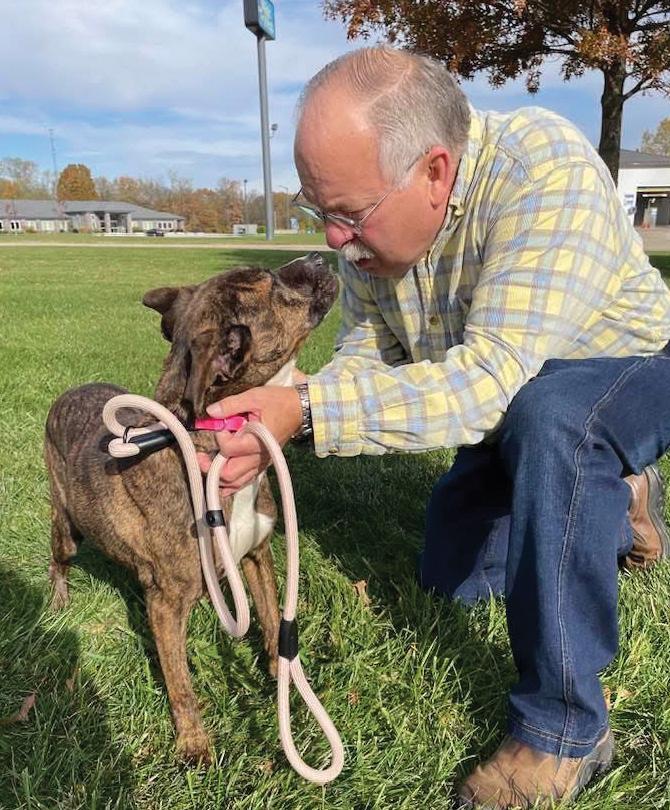
of dogs short of burnout.” He rarely turns down their calls to set up drivers for getting dogs from southeast Missouri to other areas where foster or adoptive pet parents await. Among the myriad rescue groups he has helped with transporting dogs — or cats, raccoons, foxes, and even bobcat kits — are Headed Home in the Heartland, 3 C’s Rescue Ranch, and poodle and rottweiler rescues in Columbia.
He also has a soft spot for Westy Rescue of Missouri — which is responsible for his foster fail with Andy — and there’s a Facebook group that lists dogs that need transportation to a new destination.
Cummins is quick to point out that he’s only one of the many players in the dog rescue and transport scenario. His tone softens even more, adding, “Some of these people have become like my family.”
Here’s how it typically works. e process might include as many as ve or six drivers for a dog’s trek from the Bootheel to points north, perhaps as far as Nebraska or Minnesota, or east from St. Louis into Illinois.
“I get the ones going to Kansas City,” Cummins says. He has made numerous trips to either drop o or pick up dogs in Concordia o I-70. If his canine passenger is destined for the St. Louis area, he’ll take the pup to a meeting point in Kingdom City or a location farther east. For dogs headed north, those that he drops o might have di erent drivers from Concordia to Kansas City, then to St. Joseph, and then to Omaha, Nebraska, or beyond.
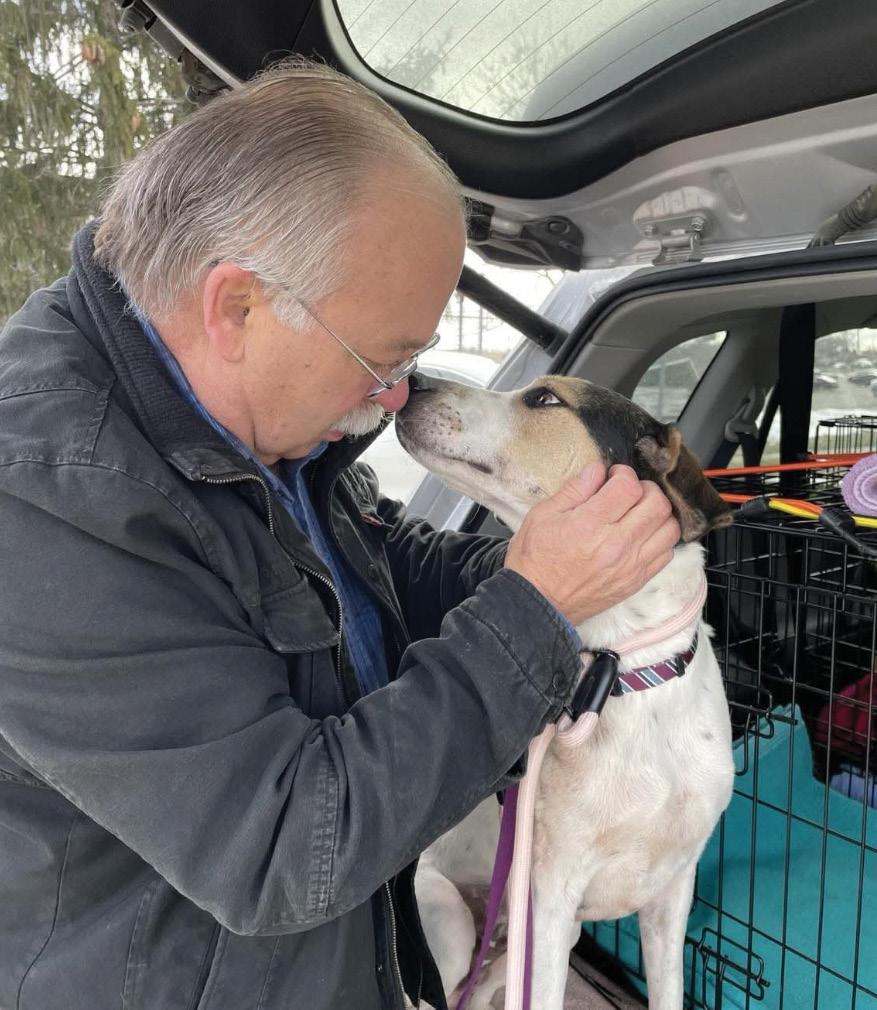
“Everybody volunteers. Nobody’s getting paid,” Cummins says, adding that drivers are sometimes o ered cash to cover fuel costs. “But we want the money to go to the dog’s care.”
Rescue organizations do not ask veterinarians to give them free services, at least in his experience. “But vets will squeeze these dogs in” for impromptu appointments, he says. “ ey will make time for rescue dogs.”
A recent rescue transport involved four dogs headed to St. Louis from Concordia. One of the dogs was exhibiting symptoms of parvovirus, a highly contagious and often deadly disease. Cummins called ahead and had the dog tested in the parking lot. e parvo test was negative, but the extra time to tend to the dog’s health, wait for the test, and then be seen by a vet meant a nearly eight-hour day instead of a two- or threehour trip.
Cummins met Karen in Columbia when he was on his way from Rolla, Missouri, to the World’s Fair in Spokane, Washington, in 1974. It was a case of love at rst sight, and that marked the end of his World’s Fair journey. ey married a year later and moved to Alaska in 1984, spending nearly 30 years in the state where Chris grew up and where his parents still live. He worked for a cable television company and later was a sta member in the state’s payroll and personnel department. When they moved back to Columbia in 2013, Chris and Karen bought their house from a couple that worked and taught as veterinarians.
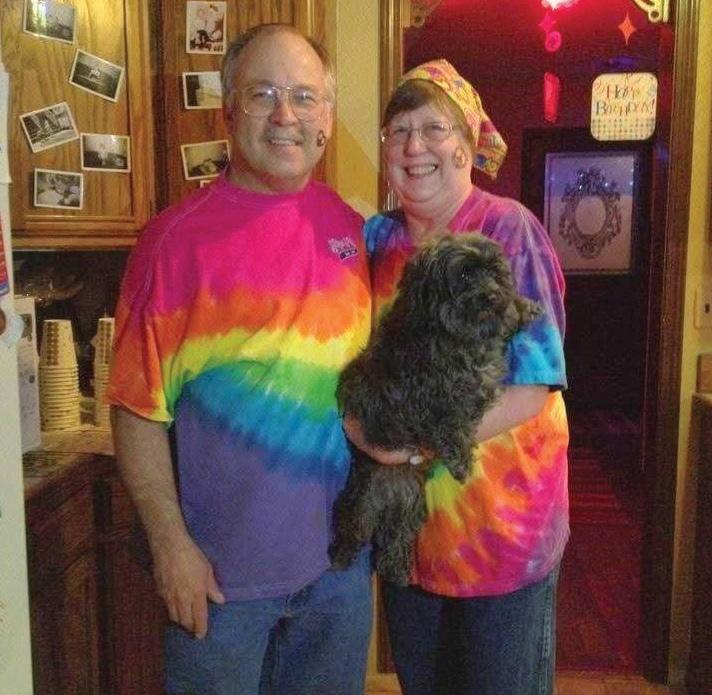
ey were married 48 years. e August before Karen’s death, the couple’s cherished, 13-year-old u ball pup, Kacie, died. e black shih tzu-poodle mix had been Cummins’s shadow after being adopted through the Central Missouri Humane Society, and Kacie loved either ights or drives to visit Alaska. e weekend after Kacie crossed the rainbow bridge, the couple went to a dog adoption event at Rose Music Hall, but none of the dogs seemed like the right t.
“My whole life routine revolves around my dogs,” he says. “I was just lost.” ey heard about Sally, a “breeder rescue,” who had delivered ve litters of puppies in ve years. Sally was not exactly approachable or a ectionate, and she had been adopted and returned at least once. Sally wasn’t a good t for fostering either.
But with patience, his friendly demeanor, multiple daily walks, and a few treats, Cummins became her human, and the two are now inseparable. Well, along with Andy.
Shortly after Sally came on the scene, Karen began chemotherapy treatment for lung cancer, with regular trips to the Missouri Cancer Associates in Columbia for treatments. ey took Sally, who stayed in the car, often pressing her nose
against the back glass to wait for her people to return.
Cummins pauses. He wipes his eyes.
“I’ve never washed those nose prints o the car,” he says softly. “ ey’re still there.” is April will be three years since Karen’s death.
“I’m the eternal optimist,” he says. “I just knew we were going to beat it. Right up until we didn’t.”
Karen’s eyeglasses are still right where she left them on a side table next to the chair that Sally now occupies. e Christmas tree, a standing, permanent homage to Karen, has been up since Christmas 2023. Cummins smiles, condent that Karen would have relished the opportunity that he has to help facilitate connecting discarded dogs with individuals and families who will cherish the pets.
Meanwhile, Andy stretches, happy to get a quick belly rub from the visitor quizzing his human.
“One of the arguments for me to take him,” Cummins says, “was that Karen was sending him to me. My life was too sedentary.”
How do you argue with that?
“You don’t.”
His eyes got misty a few times as he spoke about Karen, then again when he re ected on the sheer number of dogs that do not get rescued and connected
with forever love. He glances at Andy, then at Sally, who is quietly following the conversation.
“ ose eyes …” he said. “ ey look into your soul.”
Cummins admits he doesn’t try to make sense of the glut of unwanted and discarded dogs, and he’s sure that the ones making their way to rescues are “just a fraction of the dogs out there that are not being rescued.” He adds a quick pointer for would-be dog owners:
Don’t buy dogs in a parking lot or o Craigslist. Get them from a rescue.
He shakes his head.
“It’s just never-ending,” he added. “And in Missouri, it’s easier to be a breeder than it is a rescue.”
Ultimately, the dog and cat (and fox, raccoon, and bobcat) rescue business is not unlike the story about the little boy throwing star sh back into the sea from a beach littered with stranded star sh. He knew he couldn’t save them all. But he could save some.
“Like I said, I’m the eternal optimist,” Cummins said. “Sometimes I think, ‘If I don’t drive today, it’s not going to make any di erence.’ But it does. It makes a di erence for one dog or one cat. Or one raccoon.”
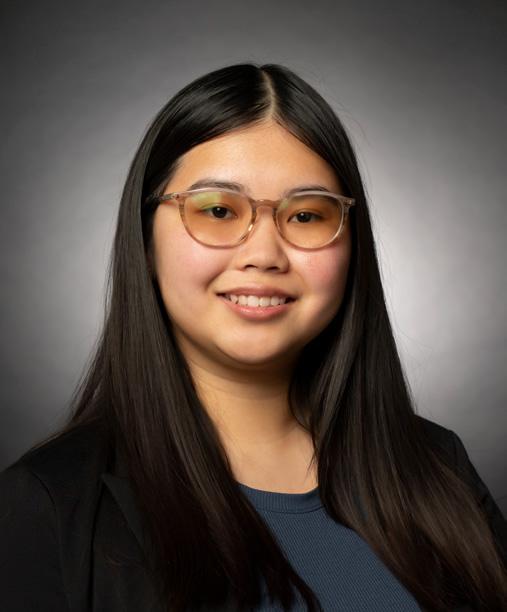
Dalinna is currently a banking associate in our commercial loan department! She gained valuable experience in Credit Administration and Business Banking, showcasing her versatility and dedication to learning and growth. What makes her shine is her curiosity and commitment to fully comprehend whatever she is working on. She asks the right questions to truly understand the process and makes sure the job is done perfectly. 573-874-8100 • centralbank.net/boonebank

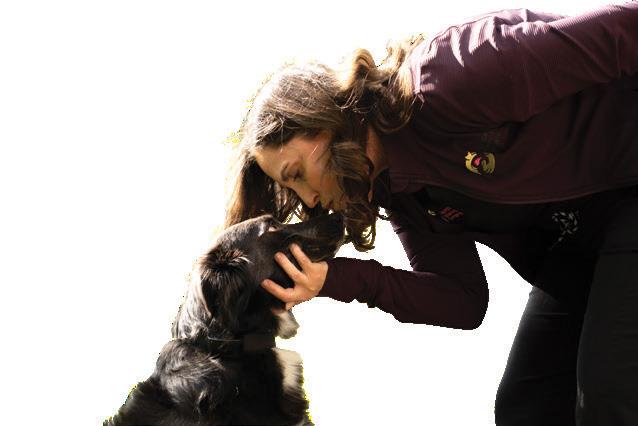
your pet needs advanced surgical care, ask your local vet about Heartland Veterinary Surgery. Dr. Luther brings nearly two decades of surgical expertise into your local veterinary clinic where you and your pet are


A grocery warehouse, a speakeasy, and the accidental birth of an arts district.
STORY AND PHOTOS BY TAHLIA HEATON
Long before the basements beneath Walnut Street picked up the nickname “the Catacombs,” the block was running on groceries. e neighborhood grew up around the old Wabash depot, which made it an ideal place to move food from trains into stores. Poole & Creber’s warehouse complex — part residence, part storage, part worksite — was positioned to unload groceries straight o the trains and keep the region fed.
THE BLOCK THE CREBERS BUILT
e day after Christmas 1924, John Creber ran an ad in the Columbia Daily Tribune:
“FOR QUICK SALE … $7250.00 … MY HOME AT 1607 HINKSON AVE …
Seven-room brick bungalow, two years old — furnace, bath, electricity, gas, replace, concrete basement, radio, ne garden spot, location and neighborhood excellent. I am moving closer in. Give possession in six weeks.”
In 1923, Creber and his wife, Mabel, had moved to Columbia. Both were originally from Streator, Illinois, where Creber was raised in the family business — his father’s grocery store. Along with his partner, L.T. Poole, Creber opened a store at 9 N. Eighth St., Poole & Creber Pay & Carry. (Although Poole and Creber later parted ways, Poole’s name remained on the business.)
After getting their bearings, the Crebers moved from their Benton-Stephens bungalow to a large Victorian house near the corner of 10th and Walnut that backed onto the Wabash Station. ey couldn’t have known when they bought the house how much the family would come to shape this block. By mid-century, it had transformed into a layered logistics hub, leaving behind the irregular rooms, ceiling heights, and passages that would eventually come to be known as the Catacombs
But Walnut Street didn’t just provide the Crebers’ livelihood — it was also a lively social hub for the family, who lived on the block in one place or another for decades.
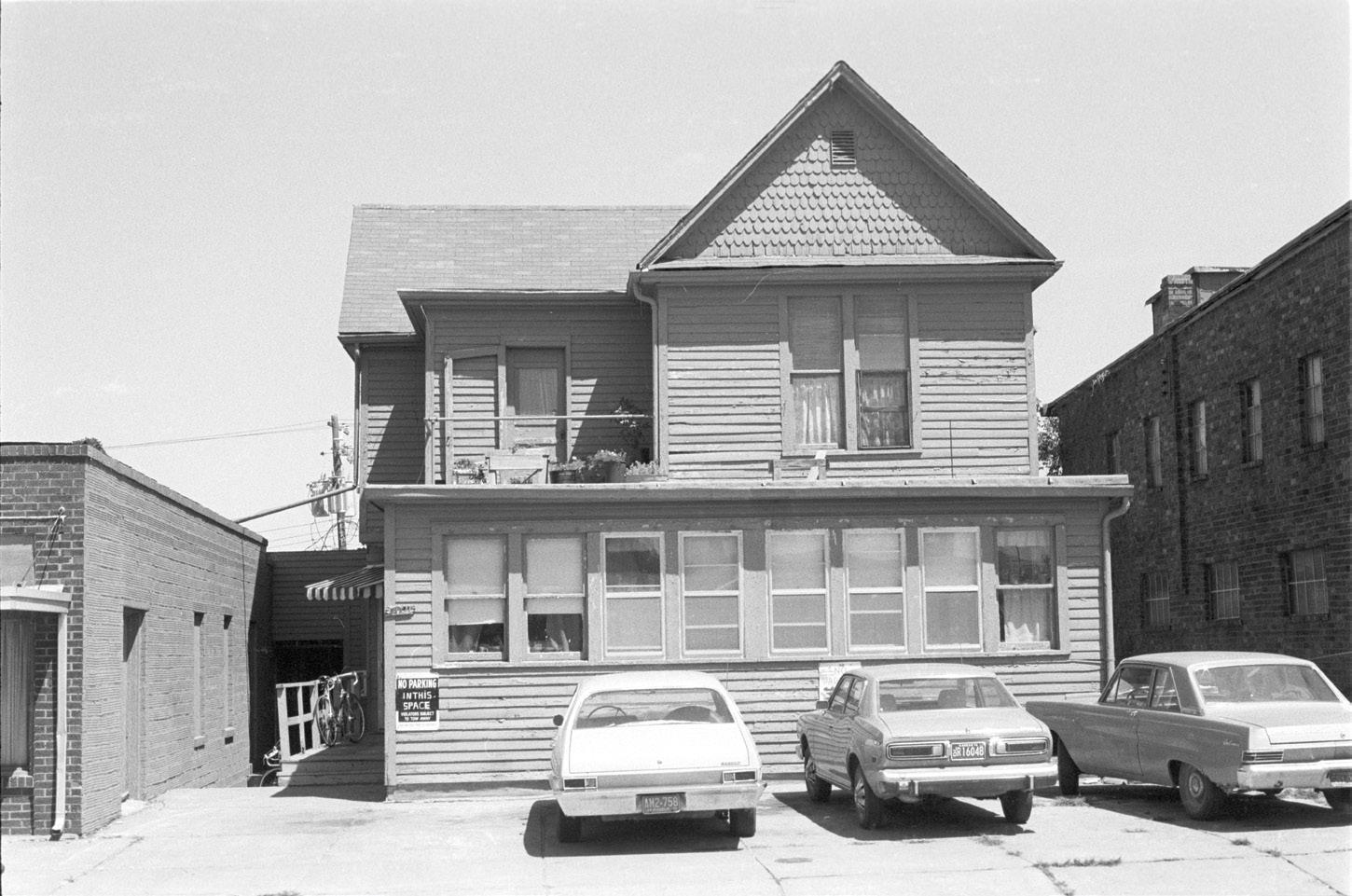
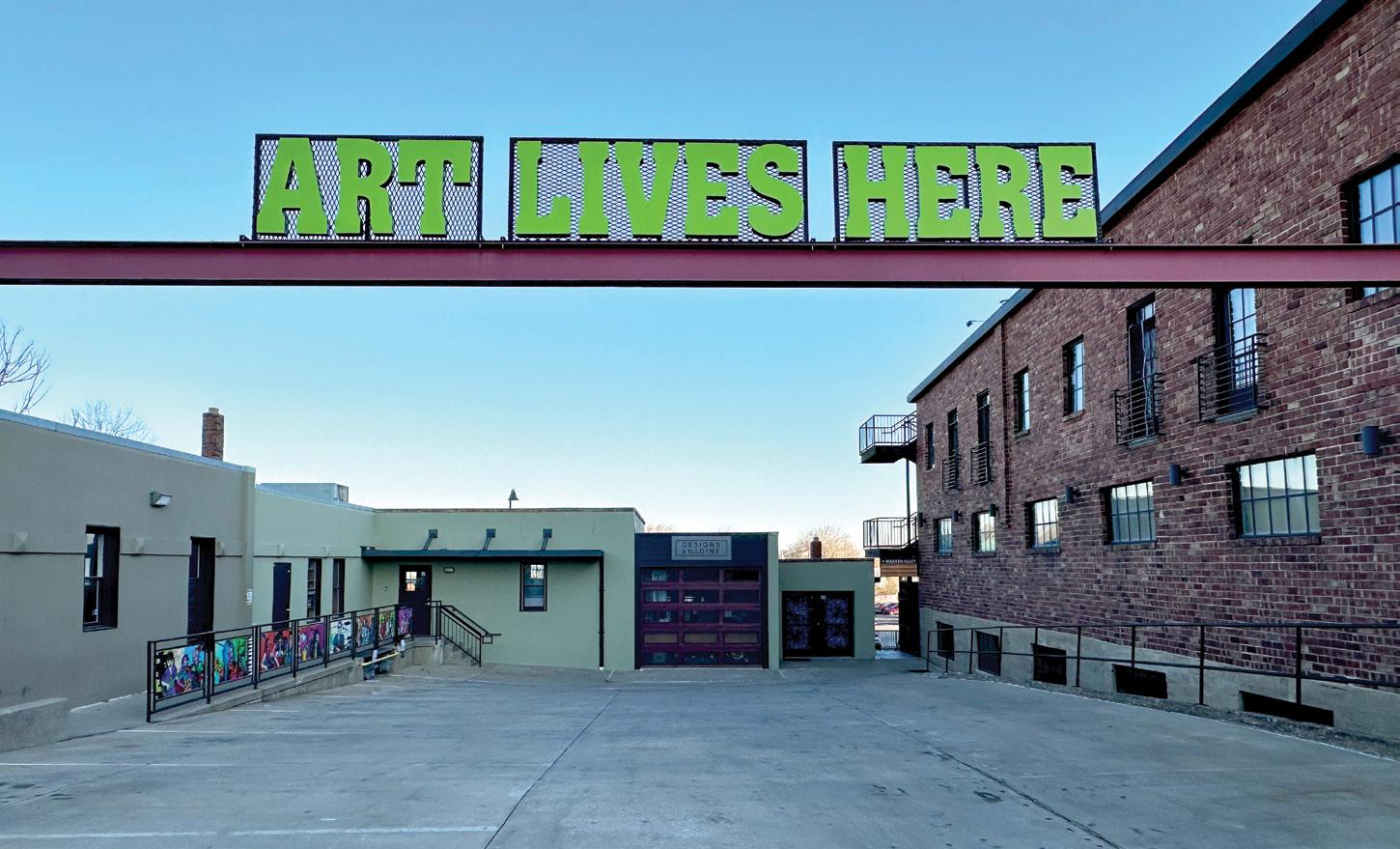
e Crebers entertained frequently at their home, and over the years, their lives unfolded across the warehouse complex itself. Both daughters were married there — Laura at 1021 Walnut in 1929, and Jimmy Rose at 1013 Walnut in 1949. eir son-in-law, Ernest Lewis, opened Ernie’s Steakhouse at 1005 Walnut in 1946, in a brick building John constructed for him; he purchased the building from Creber the following year.
a 19th-century house
Street,
allow
the
from
1978. This shows the building before the space that now houses Rock Bottom Comics was expanded, adding footage and front display windows. Credit: Courtesy
BOTTOM: 1013 E. Walnut St., purchased by the Creber family in 1939 and incorporated into the growing Poole & Creber operation. The porch was added around 1907. The house was built before 1869. The Crebers’ daughter Jimmy Rose was married in the house in 1949. Credit: Tahlia Heaton, December 2025
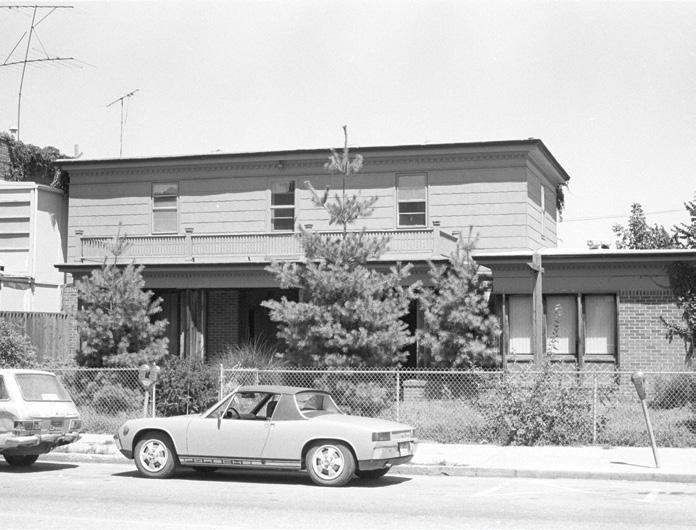
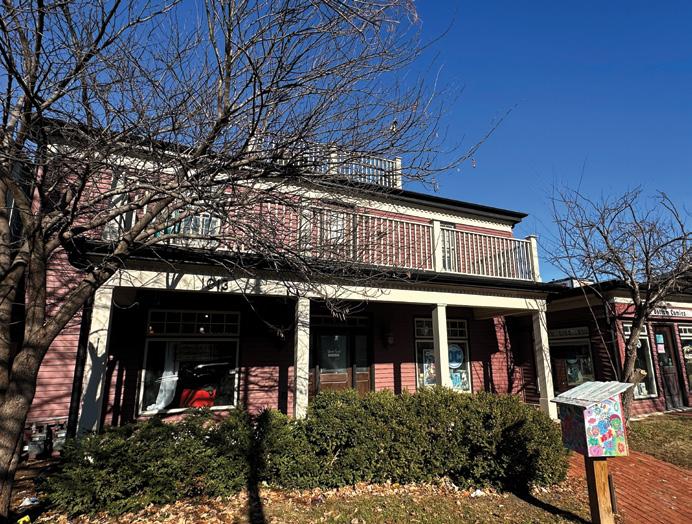
By 1950, their son Dick and his wife, Elizabeth, had moved into the house at 1021 Walnut, where Elizabeth opened a hair salon. e elder Crebers relocated to 1013 Walnut. A decade later, after a newspaper article announced that Dick had moved to Puerto Rico, John and Mabel were back at 1021 Walnut. John died there in 1964. In short, the entire arc of the Crebers’ lives unfolded on this block.
John Creber understood the value of newspaper ads.
“Students & Columbians!” a 1934 Tribune ad read. “We invite you to 1011 Walnut St., and visit what we think is the cleanest and most unique warehouse in the state! at’s Saying a Lot But Come and See for Yourself.”
e complex he built certainly had its charms.
What people now call the Catacombs began as a practical grocery operation shaped by the railroad. e complex, centered on today’s 1013, 1019, and 1023 Walnut Street, grew around the big Victorian house and the small wholesale house Creber built behind it in 1926. Just o the Wabash Station, the site was designed with two faces: On the north, it opened directly onto the railyard, where a spur delivered goods directly to the back; on the south, it presented ofces and living space to Walnut Street.
Over the next two decades, Creber expanded the complex as need dictated. First, he expanded the original wholesale house in the early 1930s, adding a bakery.
e largest renovation came in 1939, when workmen expanded an existing warehouse that sat perpendicular to the street between the two houses to create o ces and a cork-lined cold storage room with troughed oors for melting ice. en they dug a tunnel between the two basements.
Later that year, they constructed a partial second oor to the south of the original wholesale house, adding a cash-and-carry display room on the street side and literally connecting the warehouse to the back of the old house near the building’s loading dock. e nal leg of construction in 1950 added the long, narrow room at the eastern end of 1023 Walnut.
Over time, those additions tightened the block into a continuous working system rather than a collection of separate buildings — not a system of tunnels so much as a layered set of connected workspaces.
“Today, we kind of think the highways are the lifeblood, but the railroads are what made things work,” says architectural historian Debbie Sheals, who wrote the National Register nomination for the buildings at 1019 and 1023 Walnut. “Columbia was growing. … It also was a hub, so everything came in on the railroad and then [went] out on trucks to the surrounding community. It speaks to Columbia’s place as a trade center.”
For decades, rumors of tunnels beneath downtown Columbia have sent wide-eyed students searching — though the consensus now points to just one system: the miles of steam tunnels beneath the University of Missouri campus. Regardless, rumors of tunnels connecting downtown storefronts during some bygone era persist.
Do the Catacombs fuel the myth? Sheals doesn’t think they’re the source — though she says they may have contributed to the mystique. “I don’t know if I’ve ever been in a historic site where somebody’s not talking about a tunnel,” she says.
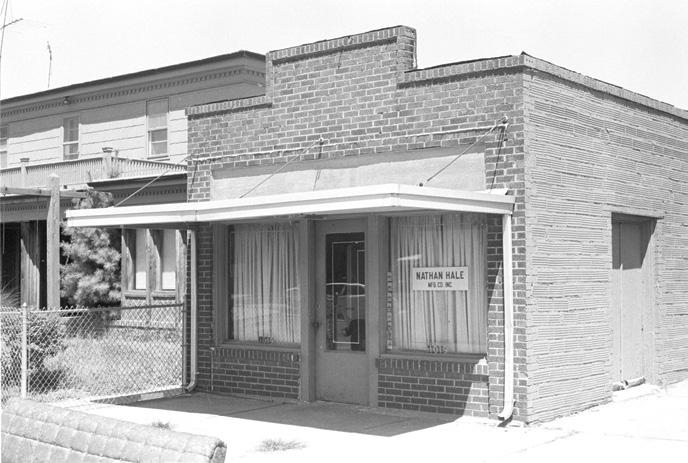
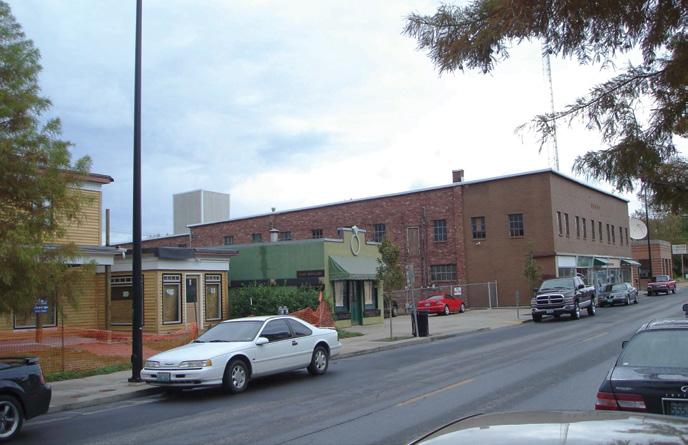
MIDDLE: The echoes of a grocery empire: 1013 E. Walnut, 1019 E. Walnut, the vacant lot where 1021 E. Walnut once stood, and the Berry Building. Credit: Downtown Columbia Historic District (Boundary Increase) 1019-1025 E. Walnut St., Boone County, MO; Debbie Sheals; September, 2007.
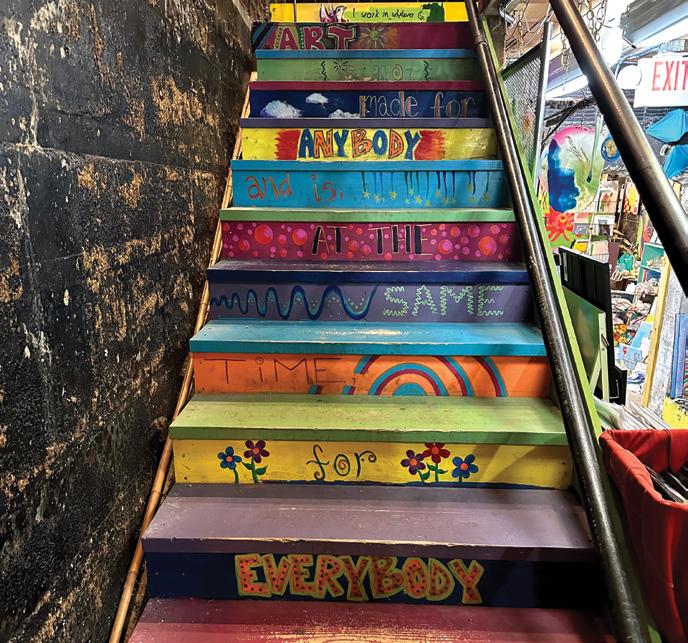
BOTTOM: The stairway inside 1019 E. Walnut St., photographed shortly before Artlandish Gallery vacated the space after more than 15 years of anchoring the Catacombs. The staircase has since been repainted. Credit: Tahlia Heaton, December 2025
Much like the tunnels, the Catacombs speakeasy is a bit of a local legend.
Citing his health, Creber sold his regional chain of grocery stores in 1948, keeping only the warehouse on Walnut. In 1958, he sold that as well, announcing his retirement. Poole & Creber continued with new ownership and built a new warehouse on Paris Road in 1959. e commercial spaces on Walnut Street began operating independently, no longer tied to a single enterprise. After John’s death in 1964, Mabel Creber remained at the Walnut Street address for several more years. By 1970, she no longer appears there in the records.
e basement warehouses slipped into mixed industrial use, while the houses and o ces above continued to cycle through tenants. is is how the complex found its next big adventure.
In the early 1990s, Jim Bradshaw rented space in the former Creber complex to house his moving company, Columbia Quick Moves. Eventually, he started letting one of his employees use part of the space as a rehearsal studio for his band. And in that moment, a speakeasy sprang to life.
ose practice sessions became regular hangouts. Every Wednesday and Sunday for around 10 years, there was a party at the Catacombs. Bradshaw says, by his count, more than 1,000 people came through the doors over the years.
He notes there was a house band as well as a steady rotation of performers of all sorts — and that acts from the Blue Note occasionally stopped by to play an impromptu set at the legendary party spot.
“ ere was just a whole scene down there — really cool people, musicians, poets, artists,” says Lisa Bartlett, the former Columbia College art student who would later open Artlandish Gallery upstairs at 1019 Walnut. “People had these businesses, but also it was kind of a party scene. It was business during the day and speakeasy at night.”
Bradshaw says the space mattered because it o ered something Columbia largely lacked at the time: a place for musicians to gather and play together informally.
“ e thing people responded to most was how comfortable they felt being themselves,” he says. “It kind of provided a venue that wouldn’t have been there for a lot of musicians.”
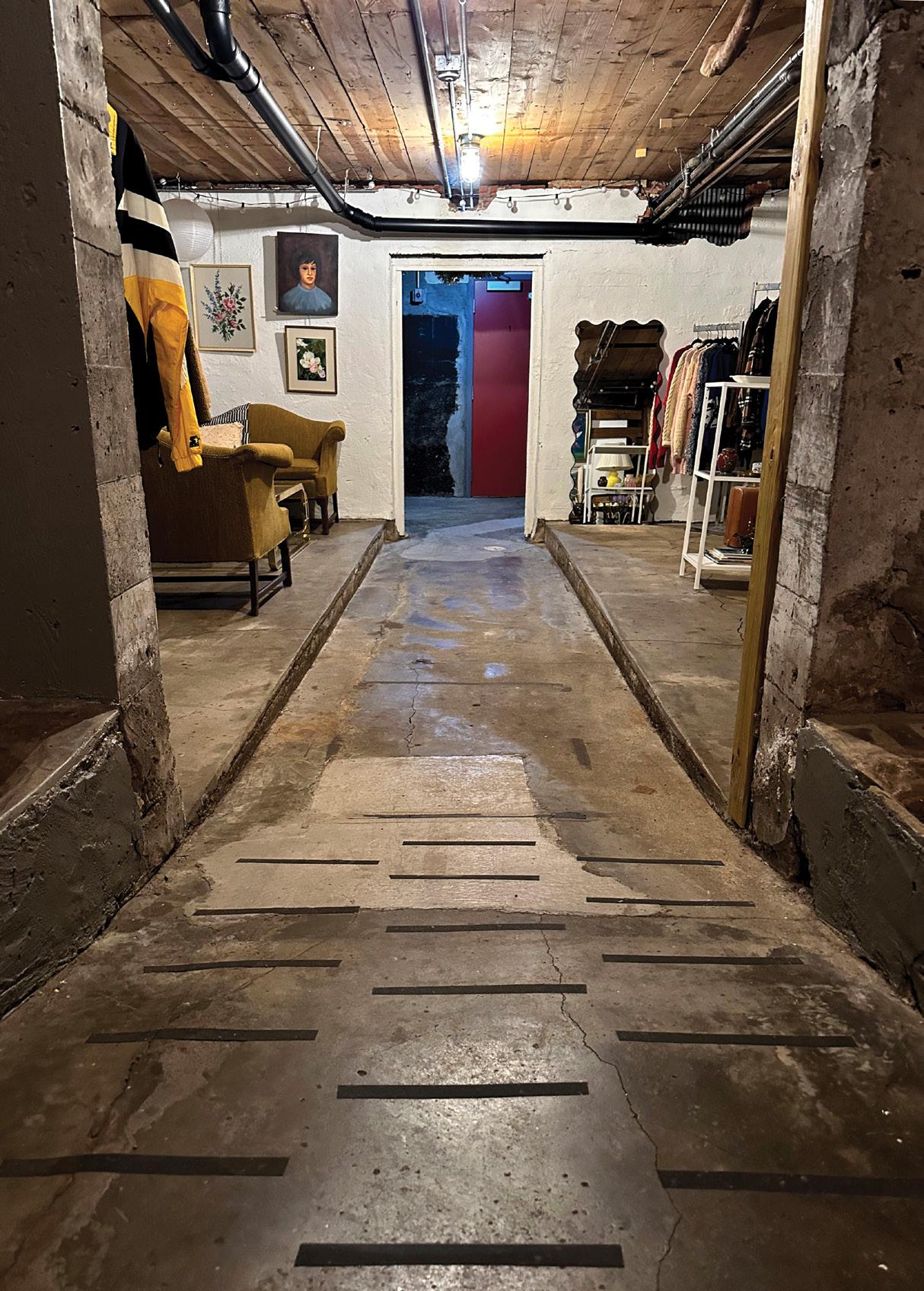
TOP: Sloping, trough-style concrete floors inside Stellar Made & Found, remnants of the complex’s cold-storage era. Former tenant Jim Bradshaw says produce was stored in this room and that melted ice flowed along the center channel and out to a drain in the larger warehouse area. Stellar recently moved from part of the outer warehouse complex to the cold-storage basement. Both sections were built during the warehouse expansion in 1939.
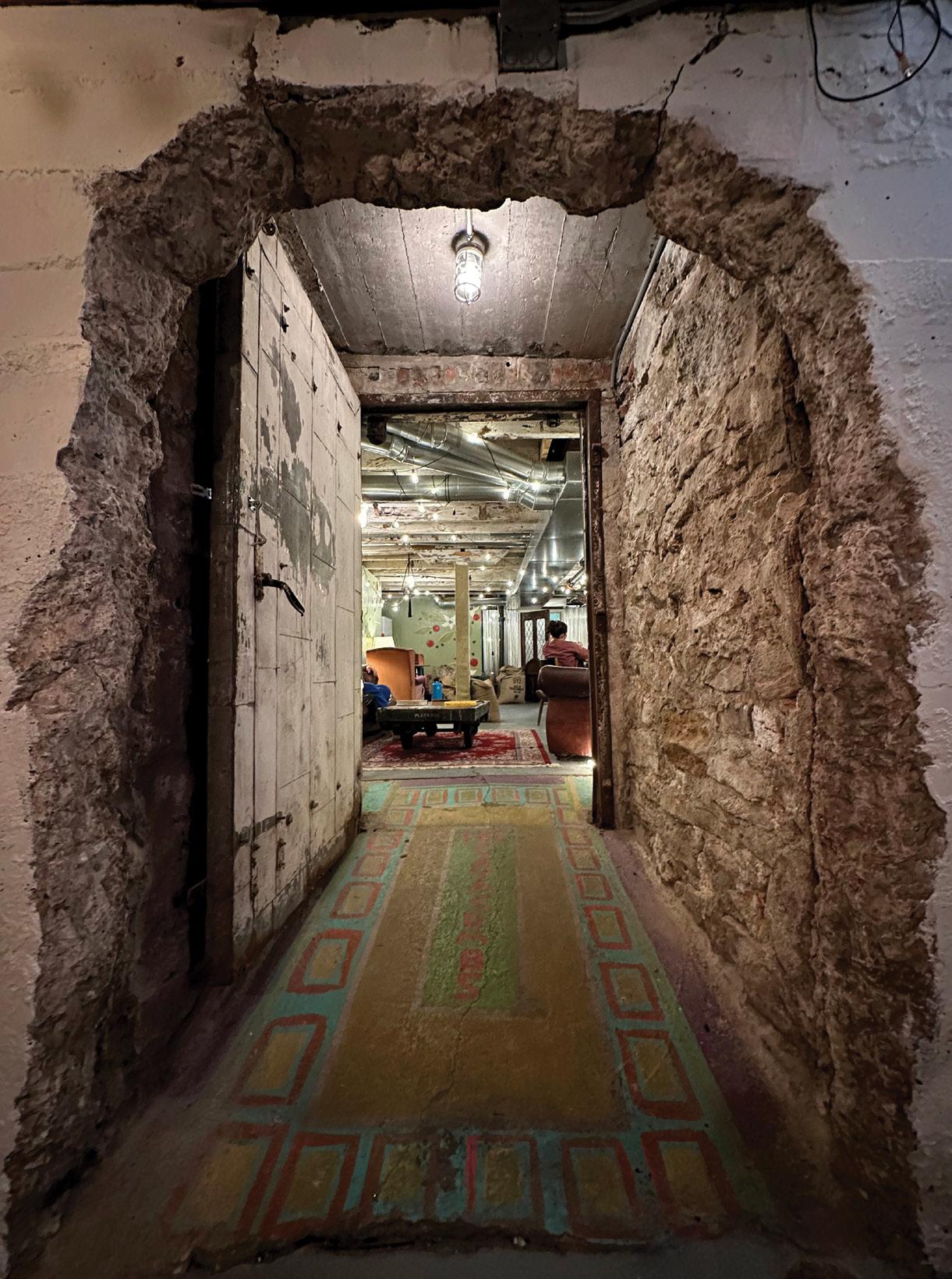
BOTTOM: The tunnel cut between the basement levels at 1021 E. Walnut and 1013 E. Walnut. The cold-storage warehouse Stellar Made & Found occupies was built in 1939, and the tunnel was added at the same time to connect the two buildings’ basements. Fretboard Coffee is visible through the opening.
Credit: Tahlia Heaton, December 2025
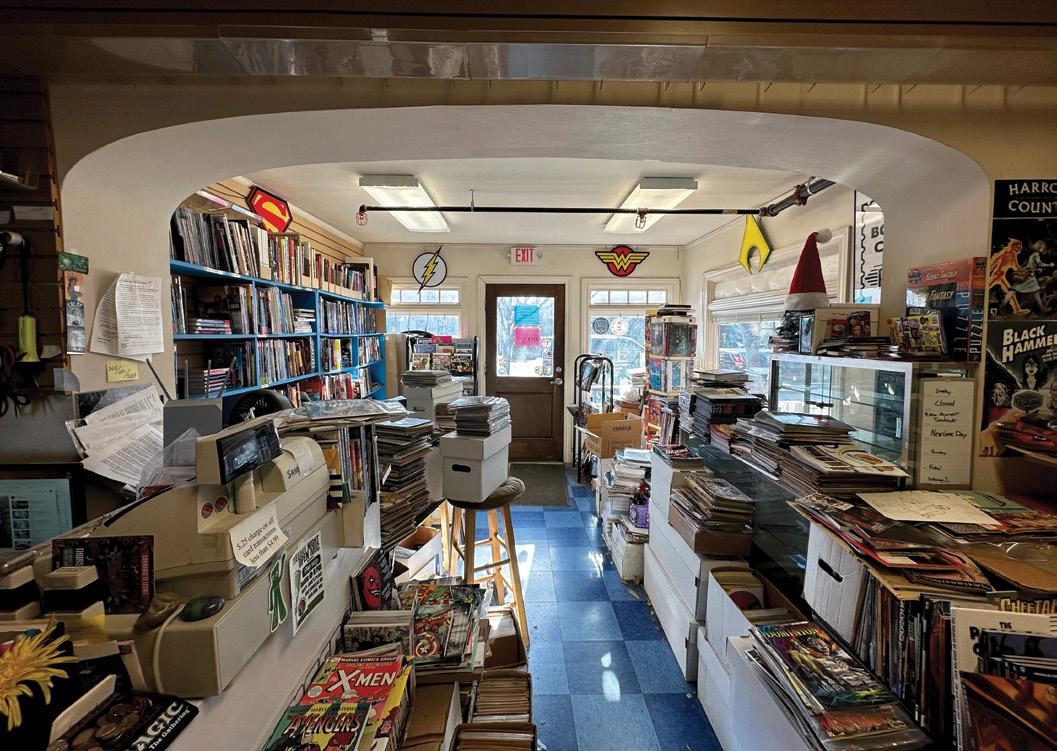
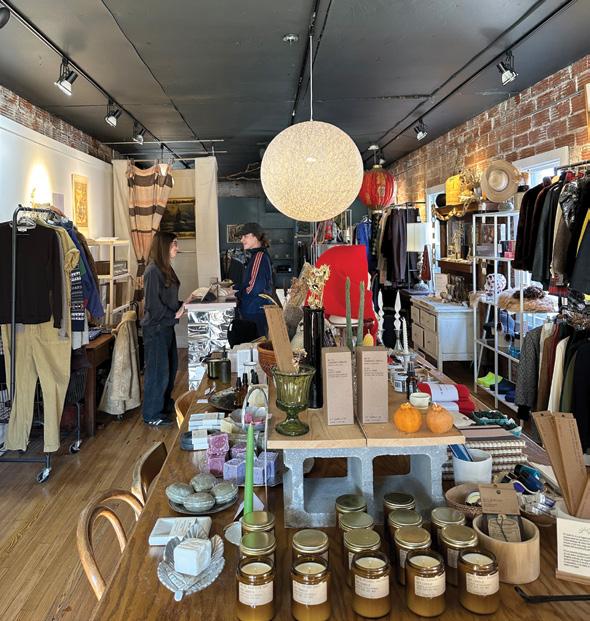
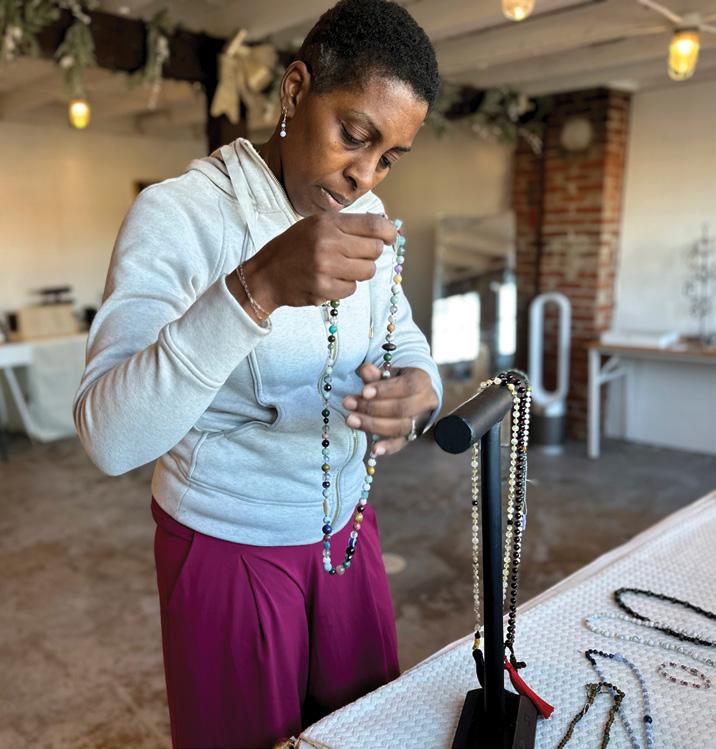
FROM TOP, LEFT TO RIGHT:
The entrance area at Rock Bottom Comics was not part of the original house; based on photographic evidence, it was added in the late 1970s. According to Rock Bottom owner John Evans, the archway was hand-sculpted by the late Kenny Greene, a longtime neighborhood jeweler known by many as “the Mayor of the North Village.” The archway and checkout counter are one unbroken sculptural piece.
Star Cathcart co-owns CoMo Crystal Shop, which recently opened in the Catacombs complex. The shop is located in one of the oldest sections of the warehouse and is likely the site of the 1931 bakery addition. The chimney that served the bakery is visible in the background.
At Hedda, one of the present-day businesses providing access to portions of the Catacombs below, owner Heather Ripcse checks out a customer. Hedda recently relocated from one of the older parts of the warehouse to the office ell added in 1939, which was until recently occupied by Artlandish Gallery.
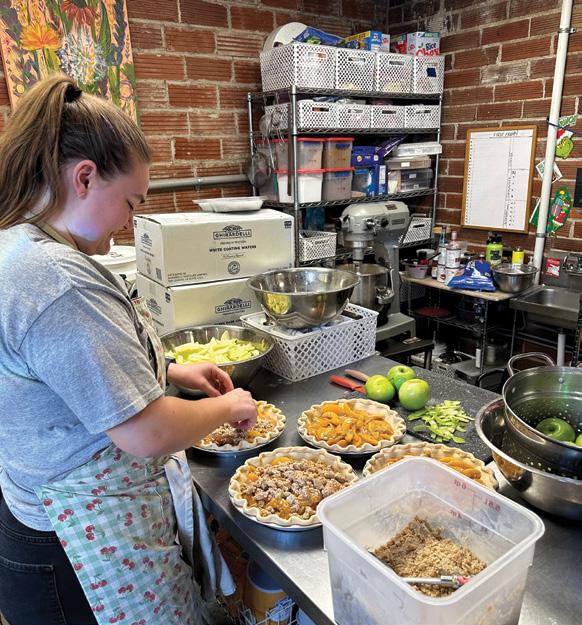
Wishflour Bakery has operated in the Catacombs since 2022. Poole & Creber built the complex’s first bakery in 1933, and Wishflour is at least the fourth bakery to operate in the building. Here, Kathryn Rothermich makes apple pies to meet the shop’s Christmas rush. Wishflour recently leased additional space in the Catacombs and plans to host baking classes, escape room nights, workshops, and more in the coming year.
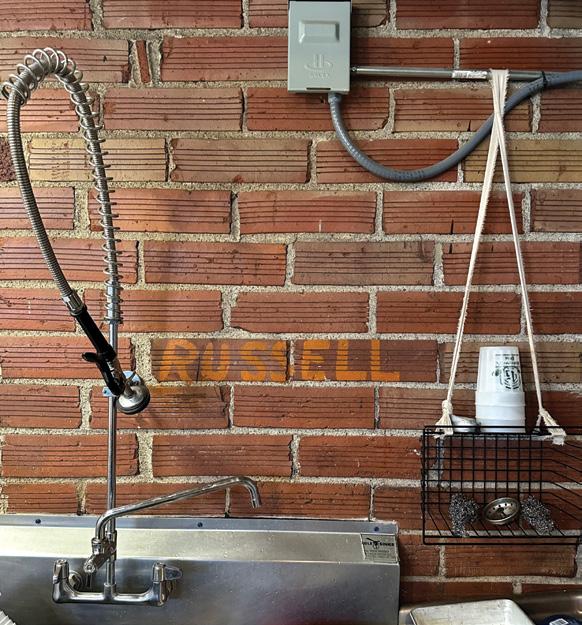
The space where Wishflour Bakery is located was one of the later additions to the complex. In the kitchen, a wall bears remnants of a personalized parking space on what was previously an exterior wall.
Credit: Tahlia Heaton, December 2025
In 2009, Artlandish Gallery opened at 1019 Walnut and reshaped sections of this underground network into a collaborative arts maze — a space that enabled scores of local artists to show and sell their work. After occupying multiple spaces in the neighborhood — rst running an antique store in the Berry Building, then moving into a space at Orr Street Studios — Bartlett had a clear sense of how art might live in the district.
What she didn’t plan on was the entire arts co-op that came with it. But that’s how a dark, cork-covered produce cellar became one of the incubators for the district’s next identity. Concrete oors and low ceilings became part of the appeal rather than obstacles to work around.
“I did a pop-up downstairs called the Catacombs Art Market, and the artists came by the droves,” Bartlett says. “ ey were like, ‘Could you please just keep this permanent?’ It kept growing.
“I didn’t really think people would want to be down there, because it’s a little … you know, it’s a little …” She trails o and laughs. “But the artists loved it, and I loved that ambiance too.”
After the Art Market came First Fridays — an event that would come to de ne the North Village Arts District. What began as a one-o solution for over ow artists became a recurring event
that reshaped how art could be encountered downtown, pulling visitors into basements, back rooms, and other unexpected spaces.
After appearing in the Columbia Daily Tribune as an abandoned property in 2004, the original 19th-century house at 1021 Walnut was ultimately demolished before redevelopment began on the block. Otherwise, the complex remains strangely intact. Its footprint is largely the same, but its use has shifted once again.
e Artlandish chapter ended when the gallery moved to Ninth Street late last year. But the Poole & Creber complex is still fundamentally a massive co-op space. Eleven businesses currently split the footprint, keeping rents relatively low in an increasingly desirable neighborhood.
e North Village has reinvented itself more than once. In the Catacombs, the bones of every era are still there: storage rooms that once fed the city, a speakeasy that held its secrets, a basement maze that helped launch dozens of artists. e uses return in familiar forms, echoing what came before — a bakery, a sewing studio, a jewelry store, a movement studio, an arts space.
ese rooms have been carved up, added onto, and reimagined — and still they keep nding new work to do.
BY BRADLEY WILLIAMS
The glow of the holidays has faded. e lights are packed away, stores are no longer ringing with Christmas songs, routines have settled, and here in Columbia, we’ve stepped into what I often refer to as “ e Gray Gap.”
e Gray Gap is that in-between stretch — after December’s festive warmth but long before spring’s renewal. e skies hang low and heavy, the ground freezes solid, and the quiet in our homes settles deeper than we expect. For many, this is the most challenging part of the year. e busyness that kept loneliness at bay is gone, and what’s left can feel still, empty, and overwhelmingly quiet.
And it’s right here — in this gray, waiting season — that an ancient truth becomes surprisingly alive.
Over 15 years ago, I sat in a Hebrew language class translating the opening lines of Genesis. My professor, usually calm and understated, suddenly grew animated when we reached verse two: “ e earth was formless and empty, and darkness covered the deep waters. And the Spirit of God was hovering over the surface of the waters” (Genesis 1:2 NLT). It was that word “hovering” that brought my otherwise measured professor to life.
He explained that the Hebrew feminine verb for “hovering” evokes the image of a mother bird drawing close over her young. Fierce. Tender. Attentive. Near.
At the time, our oldest son was a newborn, and I was witnessing this hovering every day, as my wife cared for him with a depth and presence I hadn’t known existed. at image helped the Genesis narrative snap into focus. e poetry of Genesis wasn’t merely describing how God created the world — something we often reduce to debates about timelines and mechanics. It was revealing God’s heart. When things are dark, unformed, or uncertain, God doesn’t stand far o , aloof or absent. He hovers. He moves closer. He is present.

And as the library of Scripture unfolds, we see what God’s hovering presence brings. It brings purpose — God forming and shaping life against the backdrop of formlessness. It brings protection — a covering over the chaos before anything takes shape. And it brings partnership — an invitation to work with him to bring ourishing into his world. God’s hovering is not only something he does for us; it becomes a pattern he invites us to imitate.
We talk a lot about the “spirit of the season” in December, but maybe we need this hovering presence far more in the cold quiet of February. is is the time when people are most likely to slip into the background — when seasonal depression creeps in, when loneliness settles like an unwanted guest, and when the lack of sunlight weighs heavily on us all.
As we wait for the leaves to return and the owers to bloom, here’s my invitation: Do for one person what you wish
you could do for everyone. One neighbor, friend, co-worker — someone who’s been unusually quiet, someone you haven’t seen since the snow came, someone who struggles every year during this season.
We’re all carrying more than most realize, so I encourage you: As you navigate the Gray Gap, reach out to someone. Ask for help and consider what your presence might mean to someone also enduring the long winter.
Hover, text, call, sit.
In a season marked by cold distance, your presence might be the very thing God uses to remind someone that even in the Gray Gap, they are seen, loved, and not alone.

Bradley Williams is the lead minister at Forum Christian Church.
BY MAYOR BARBARA BUFFALOE
“Raindrops on roses and whiskers on kittens
Bright copper kettles and warm woolen mittens
Brown paper packages tied up with strings ese are a few of my favorite things.”
— beginning lines of “My Favorite ings” from e Sound of Music
When I learned that the theme for the February issue would be “Why We Love COMO,” I immediately thought of that iconic song from e Sound of Music. Especially when “the dog bites, when the bee stings” — when the federal funding is cut or an incident happens that is outside my control — the way I stay centered and focus on the positive is to think about why I love Columbia and the progress we’ve made to continue to be an awesome place to live, work, learn, and play. Here, then, are some of my favorite things in no particular order. I will spare you imagining my singing voice by not putting them into lyric form.
• Celebrating with community members at ribbon cuttings and proclamation readings, like the 40th anniversary of Columbia Mall or the groundbreaking for the Behavioral Health Crisis Center.
• Being greeted by Melanie at Sycamore when I walk through the front door, making me feel like Norm from Cheers
• Riding with friends and family on the MKT and Katy trails for Pedaler’s Jamboree.
• Attending Fancy Lunch at Parkade Elementary and hearing about the island projects from Grant Elementary fth graders.

• Dressing up with friends and walking in the March March parade at True/False.
• Shopping local on Small Business Saturday (and most days) with my daughter.
• Getting to know the dedicated city leadership who lead the 1,600-plus employees who work for our fullservice city and nding ways to support their hard work.
• Riding my bike with my husband in the Mid-Missouri Pride parade — along with bubbles and balloons!
• Smelling the delicious aromas coming out of the kitchens of Mahi’s Ethiopian Kitchen, Kinkao, Curryosity, and so many of our diverse restaurants.
• Cheering from the sidelines at Cosmo Park at my kids’ recreation soccer games.
• Attending the Community Summit, where more than 300 people came through an open house at City Hall to hear from sta on updates to operations and programs implemented to reach our goals.
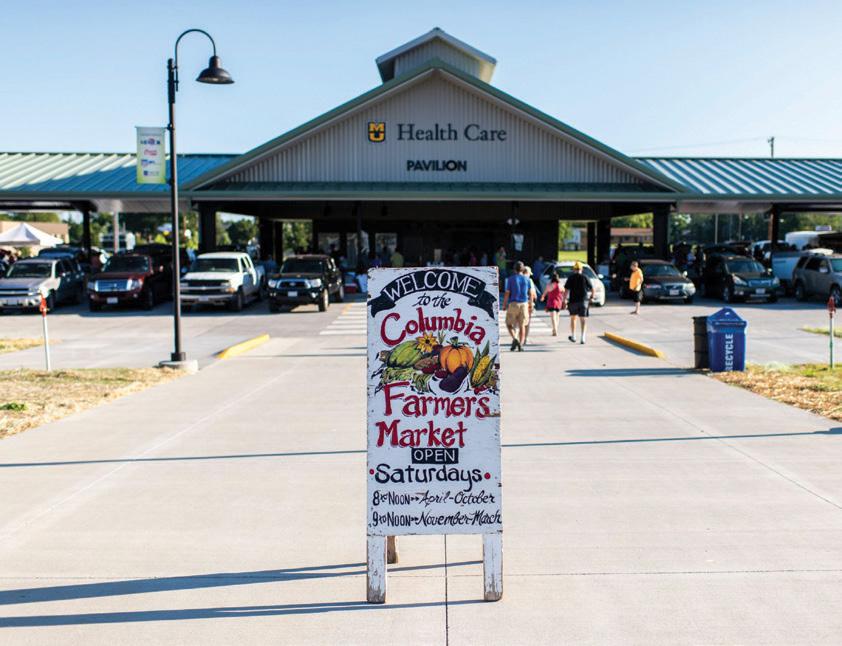
• Picking up nutritious and delicious locally grown and produced foods at the Columbia Farmers Market and shopping for similar items at Clovers Natural Market.
• Taking a New Year’s Day hike at the Pinnacles, Capen Park, ree Creeks, Rock Bridge State Park, etc.
• Seeing the live entertainment inside shops during e District’s annual Living Windows event.
• Savoring the daily fresh food from Kampai; Murry’s tuna, pesto, and feta sandwich; fresh-cut fries at Billiard’s; freshly made pasta from Pasta La Fata; Addison’s sweet potato chips; etc.
• Joining in CPS’s read-a-thon at West Elementary or Superhero Day at Cedar Ridge.
• Collaborating every week with my fellow City Council members as we nd ways to support and invest in our community’s values and make progress together.
• Knowing that new destinations from Columbia Regional Airport open up the world when we want to get away (always with the happiness of ying back into COU).
• Participating in Let’s Talk Locals, the monthly town halls that City Council members host in their wards to talk about issues important to the community.
ere are so many favorite things to list that I could easily surpass the word limit. I am so thankful to live in a city that embraces a diversity of culinary treats, cultural activities, and opportunities for all. All of this, and more, is why I continue to serve with a smile on my face and a heart that is full.
“When I’m feeling sad I simply remember my favorite things
And then I don’t feel so bad.”
— ending verse from “My Favorite ings” from e Sound of Music

Barbara Bu aloe is currently serving her second term in o ce as the mayor of Columbia.
BY HOSS KOETTING
We’re in the midst one of the most notable celebrations worldwide, and many people here in the States aren’t aware of it. I refer, of course, to Carnival.
Carnival is the period between the old feast of the Epiphany, or the twelfth day of Christmas, and Ash Wednesday, which begins the Catholic Lenten season. In many countries, this celebration is in full swing for the duration, whereas in some others it is somewhat more demure. Wherever it is observed, however, there are, in varying degrees, feasting, partying, and parades, some being fairly ribald!
Here in the United States, the season is typically referred to as Mardi Gras, literally translated as Fat Tuesday. e rst Mardi Gras was celebrated near present-day New Orleans by French explorers. Today, New Orleans hosts the most famous celebration in North America, with festivities taking place throughout the season. Other celebrations of note are held throughout the Gulf Coast area as well as St. Louis, although these tend to be less opulent.
e culmination of Carnival season is Fat Tuesday, a day of conspicuous consumption. For Catholics, this was a last chance to splurge before Lent, a season of penance, atonement, and sacri ce leading up to Easter. is is also one of the best examples of enjoying diversity of cultures, because who doesn’t like a party? On Fat Tuesday, everyone celebrates, regardless of race, religion, or ethnicity. And although the cuisine of the celebration generally corresponds with the locale, in the United States, we most often associate Cajun and Creole cuisine with Mardi Gras festivities due to the rich history of the celebration in that area of the country.
So on Fat Tuesday, everyone will be a Cajun, whooping it up with the masses, feasting on red beans and rice, seafood Creole, and craw sh étou ée, oblivious to the history and religious traditions, but ever desirous to attain the coveted plastic beads and the little plastic baby buried in the King Cake (a poor attempt at a pastry, I might add).
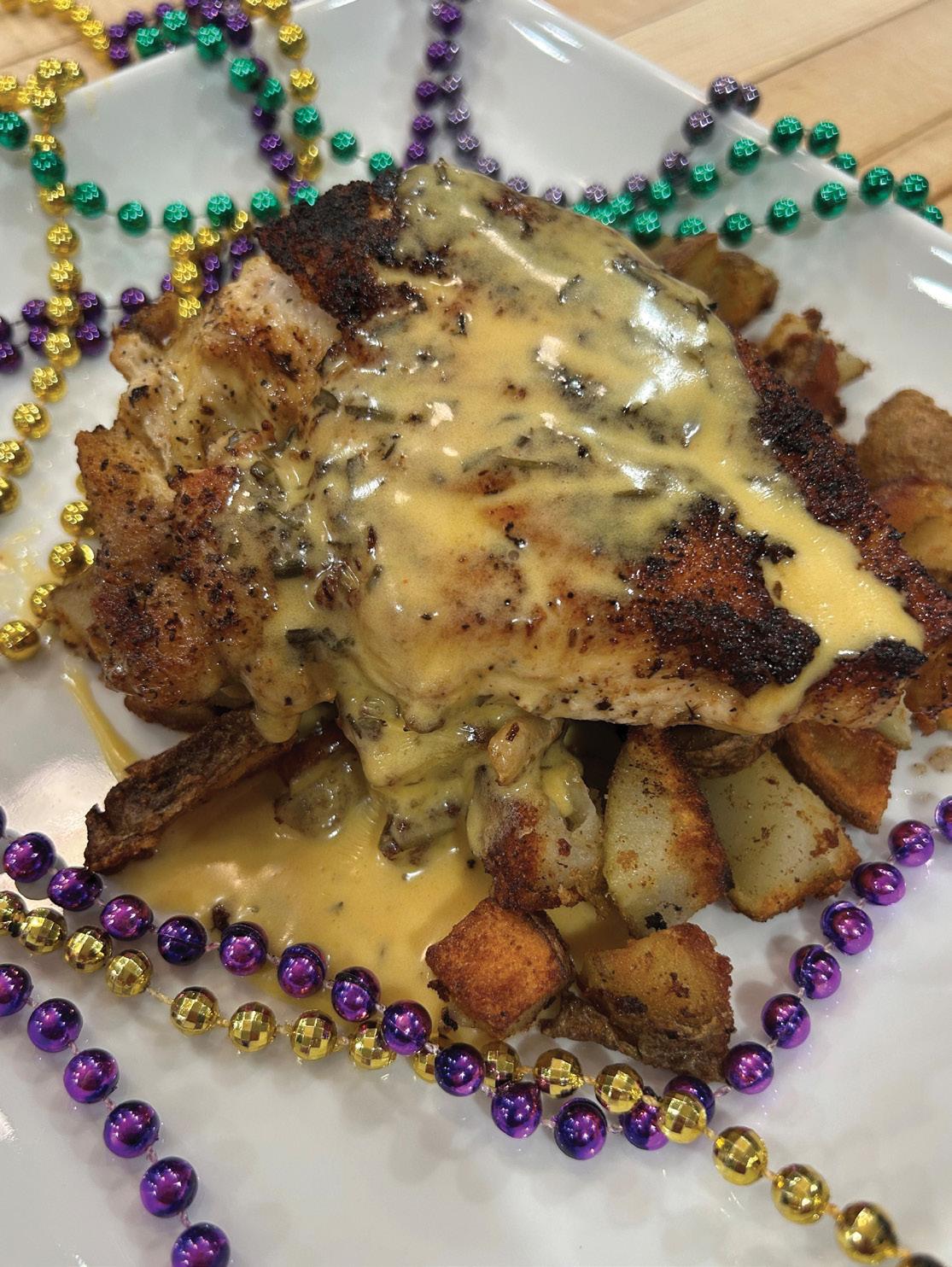
If you aren’t going out and would like to try your hand at a little Cajun cookin’, here’s one of my favorites from Paul Prudhomme’s repertoire, Chicken Tchoupitoulas (pronounced CHOP-uh-TOO-las).

Jim “Hoss” Koetting is a retired restaurateur/chef who enjoys gardening, good food, good bourbon, and good friends.
• 4 cups peeled and diced white potatoes
• 1½ Tbsp. of Hoss’s Cajun Seasoning
• 8 bone-in, skin-on chicken breasts
• 4 Tbsp. unsalted butter
• Vegetable oil for frying
• Béarnaise sauce (See recipe)
• 2 cups of diced smoked ham
• 4 cups of sliced mushrooms
• 1 cup of chopped green onion
1. Boil the diced potatoes until tender. Drain and set aside.
2. Sprinkle Cajun Seasoning generously on both sides of the chicken breast, patting it in with your hands. Preheat a very large ovenproof skillet (preferably cast iron) for about 2 minutes over high heat. Place the chicken breasts skin side down in the skillet, dotting with chunks of butter on top. Bake uncovered at 350 degrees for 3035 minutes, turn meat over, and continue baking until golden brown, about 10 minutes more.
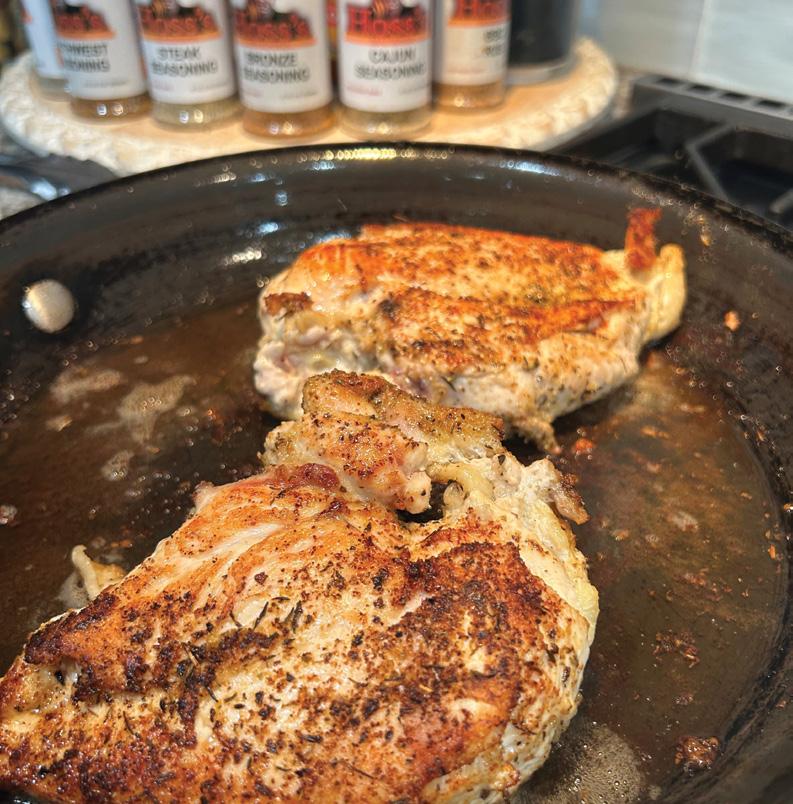
3. Remove chicken and set aside; pour pan drippings into a glass measuring cup and reserve. Set skillet aside without wiping it.
4. Heat ½ inch of oil in another large skillet until oil sizzles. Sprinkle potatoes with Cajun Seasoning and fry the potatoes in oil until golden brown on all sides, about 10-12 minutes, then drain on a paper towel.

5. Make the Béarnaise sauce.
6. In the skillet used to cook the chicken, lightly fry the smoked ham over mediumhigh heat for 3-4 minutes until brown. Add the potatoes, stirring until heated through (adding half the reserved chicken drippings if the pan is dry). Add mushrooms and sauté until tender, and then add the green onion. Stir constantly for 2 minutes, remove from heat, and serve immediately.
7. To plate each serving, place ¾ cup of the drained potato mixture on a plate, arrange chicken breast on top, and spoon a generous portion of Béarnaise sauce over it all.
• 1 Tbsp. chopped shallots
• 1 lemon, juiced
• ¼ cup white wine vinegar
• 2 or 3 stems tarragon
• 2 egg yolks
• 1 tsp. water
• 2 sticks (½ pound) unsalted butter, melted; keep warm
• 2 Tbsp. chopped tarragon
• ¼ tsp. salt
• ⅛ tsp. white pepper
1. In a saucepan, combine shallots, lemon juice, vinegar, and tarragon stems and cook over medium heat until liquid has reduced to 2 tablespoons.
2. Let reduction cool to room temperature; strain into a small bowl to remove solids.
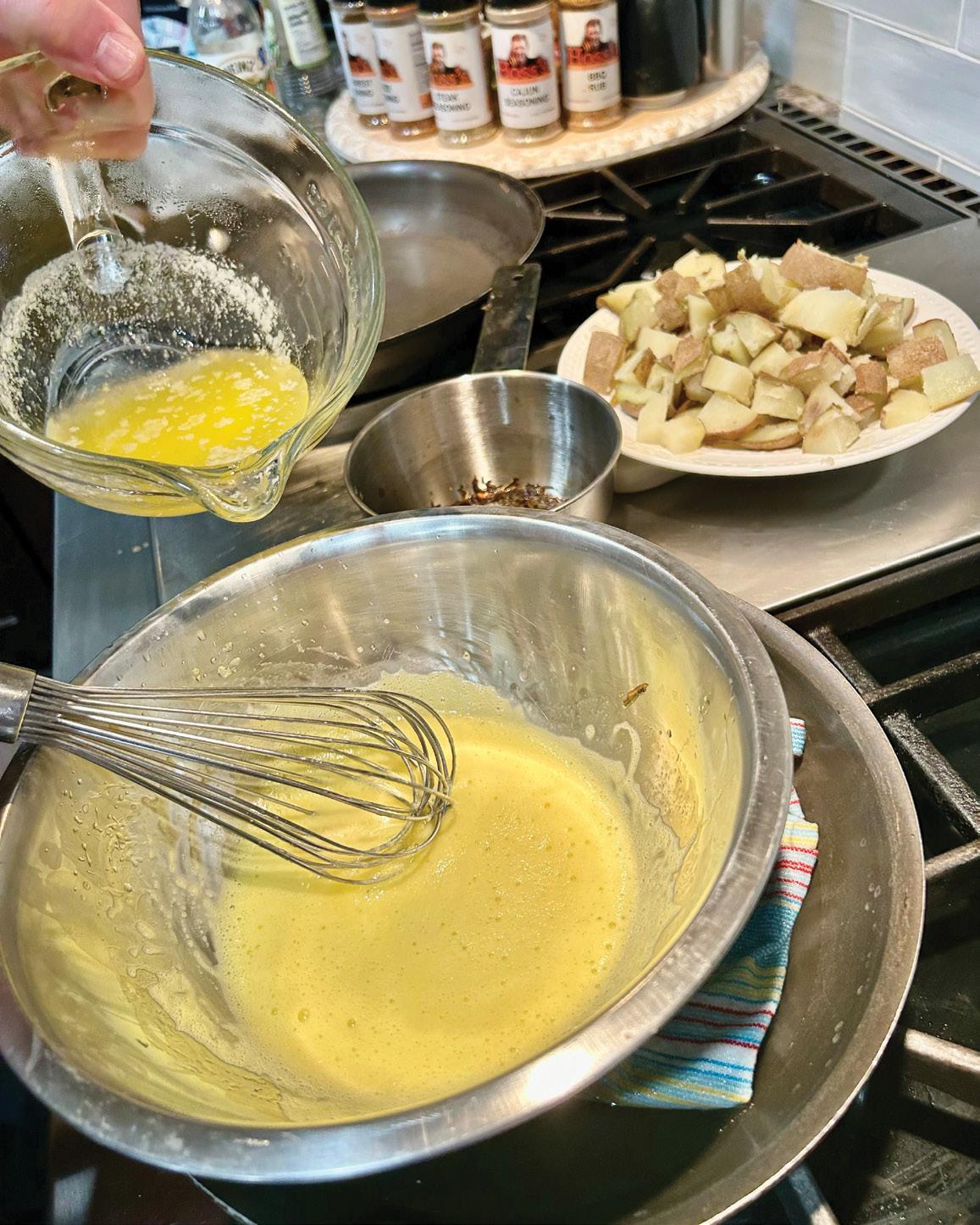
3. In a metal bowl, combine egg yolks, water, and reserved vinegar reduction over a pot of simmering, not boiling, water. Whisk well until egg mixture begins to form ribbons when whisk is lifted out of mixture. While continuing to whisk, drizzle in melted butter little by little until completely incorporated and sauce is thick. Add chopped tarragon, taste, and season with salt and white pepper.














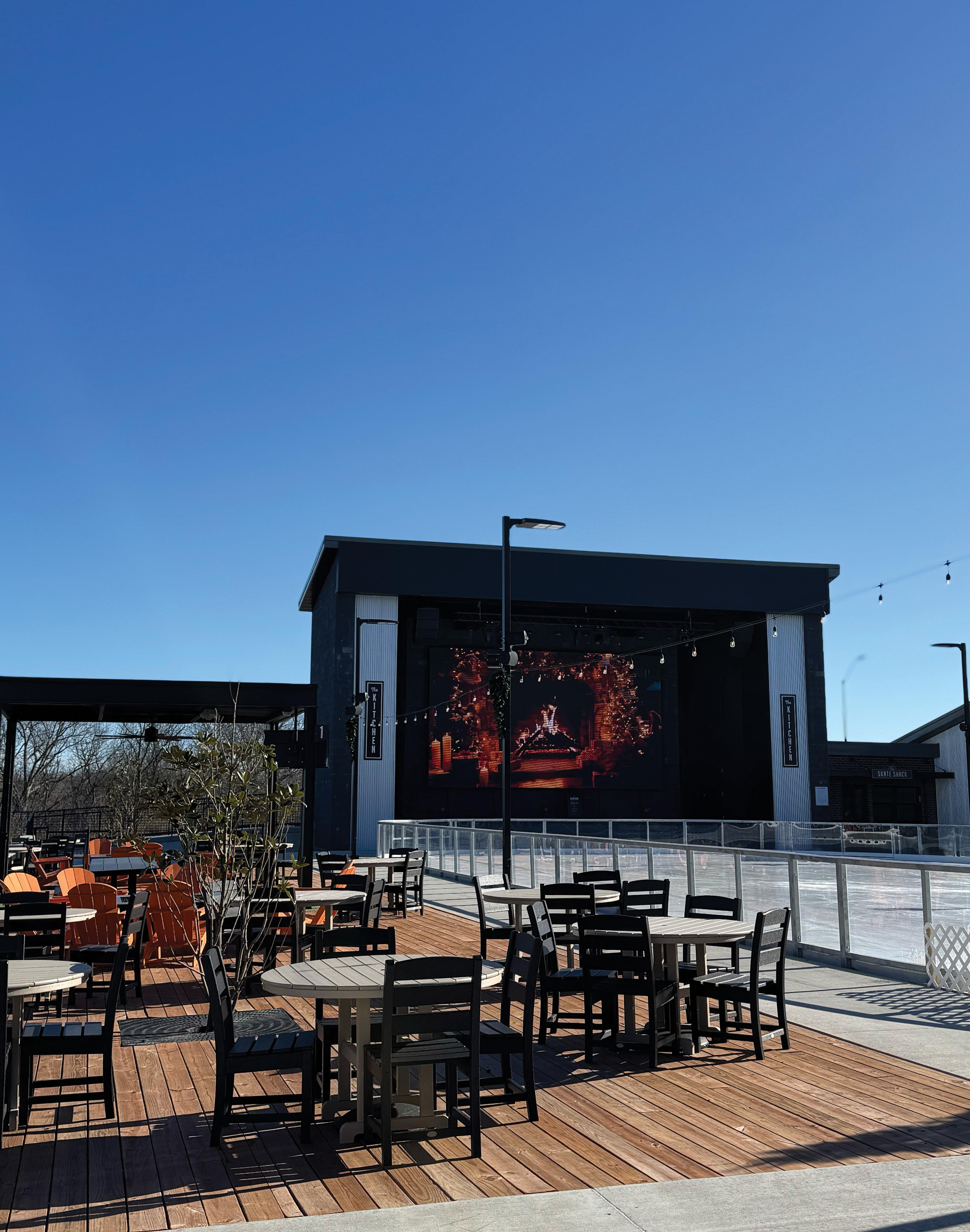
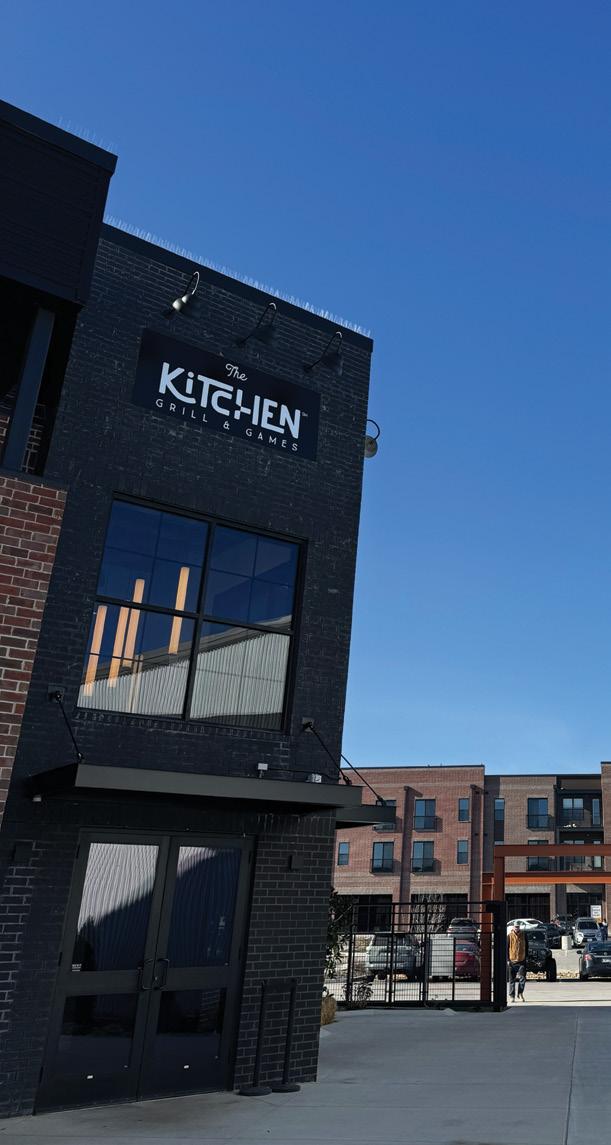
Inside The Kitchen Grill & Games.
STORY AND PHOTOS
BY SUNITHA BOSECKER
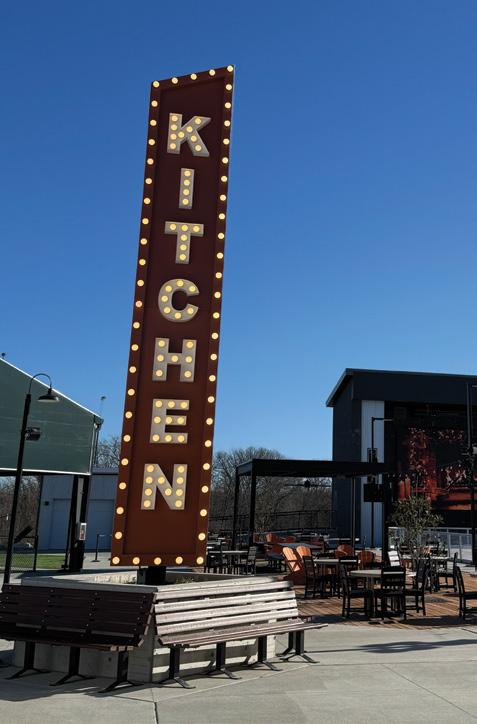
On any given day or evening, e Kitchen Grill & Games feels less like a single business than a destination for many things between Columbia and Ashland. One table hosts a business meeting wrapped up over burgers and beers. Outside, kids race on the green turf while parents linger nearby. Pickleball paddles echo across indoor courts, and somewhere between the stage, the ice rink, and the bars, friends are laughing and debating about who won. It’s a place designed for everyone, and it shows.
e idea for e Kitchen Grill & Games was born not from an individual trend, but from a broader vision of community. According to Caleb Rowden, public relations consultant for Discovery Development, e Kitchen grew naturally out of the Discovery neighborhood, a work/ live/play development already anchored by walkable amenities like a dog park, adjacent tennis courts, and a fty-acre lake and trail. Similar to places you would nd in bigger cities, e Kitchen is a community version of the Chicken N Pickle franchise.
“We knew the next amenity should be focused around pickleball,” Rowden explains. “It’s the fastest-growing activity in the country, and we wanted it to be walkable and accessible year-round.”
From there, the concept expanded. Indoor and outdoor pickleball courts became the backbone. Still, the vision quickly grew to include bocce ball, shufeboard, a massive turf area for cornhole and movies, and, eventually, a restaurant that could anchor it all. e goal was simple: create a place where people actually want to gather.
What sets e Kitchen apart isn’t just the scale of its o erings, but how seamlessly they work together. Food, drinks, games, and open space coexist in a way that feels intentional rather than overwhelming. You can come for a casual lunch and leave having watched a Mizzou game, tried pickleball for the rst time, and caught live local music without ever moving your car.
At the center is a 110-by-55-foot turf area surrounded by a restaurant, indoor
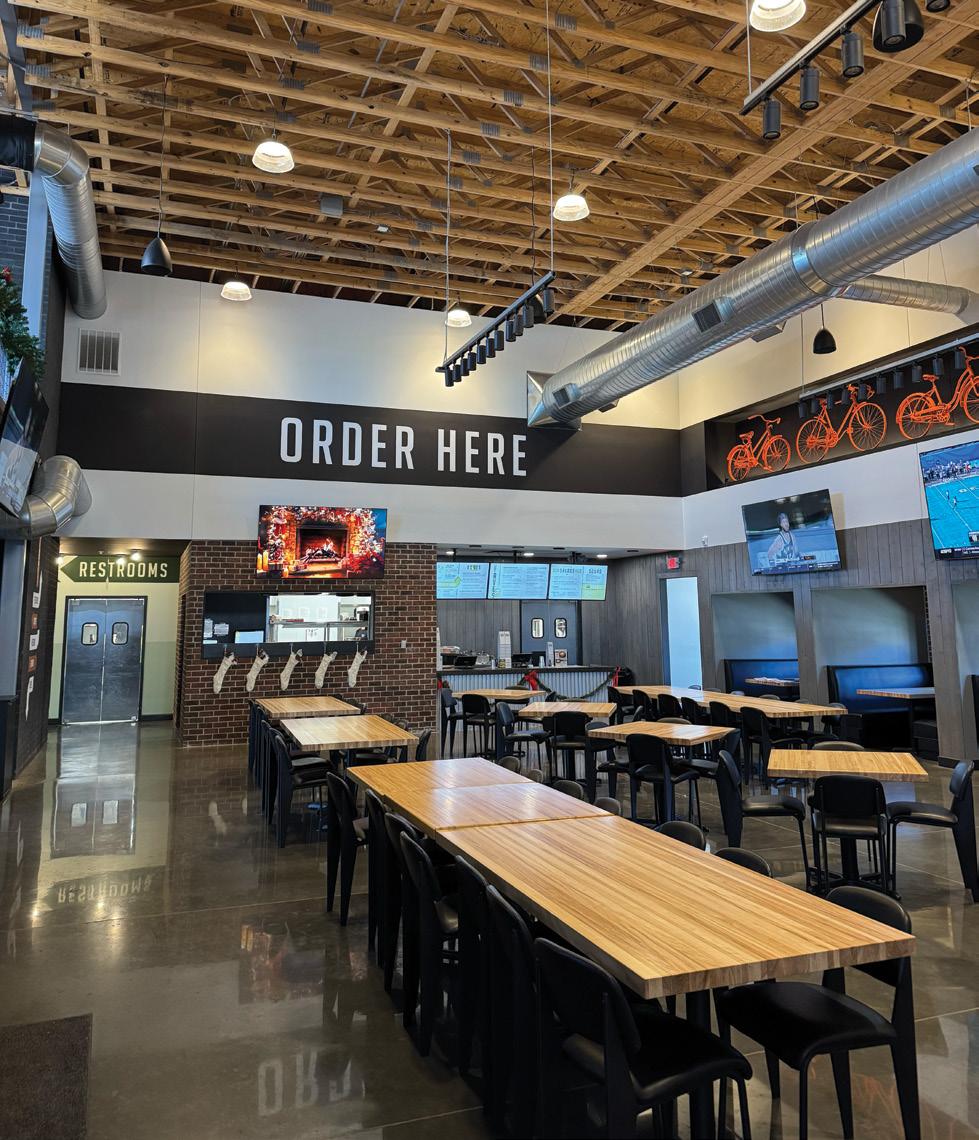
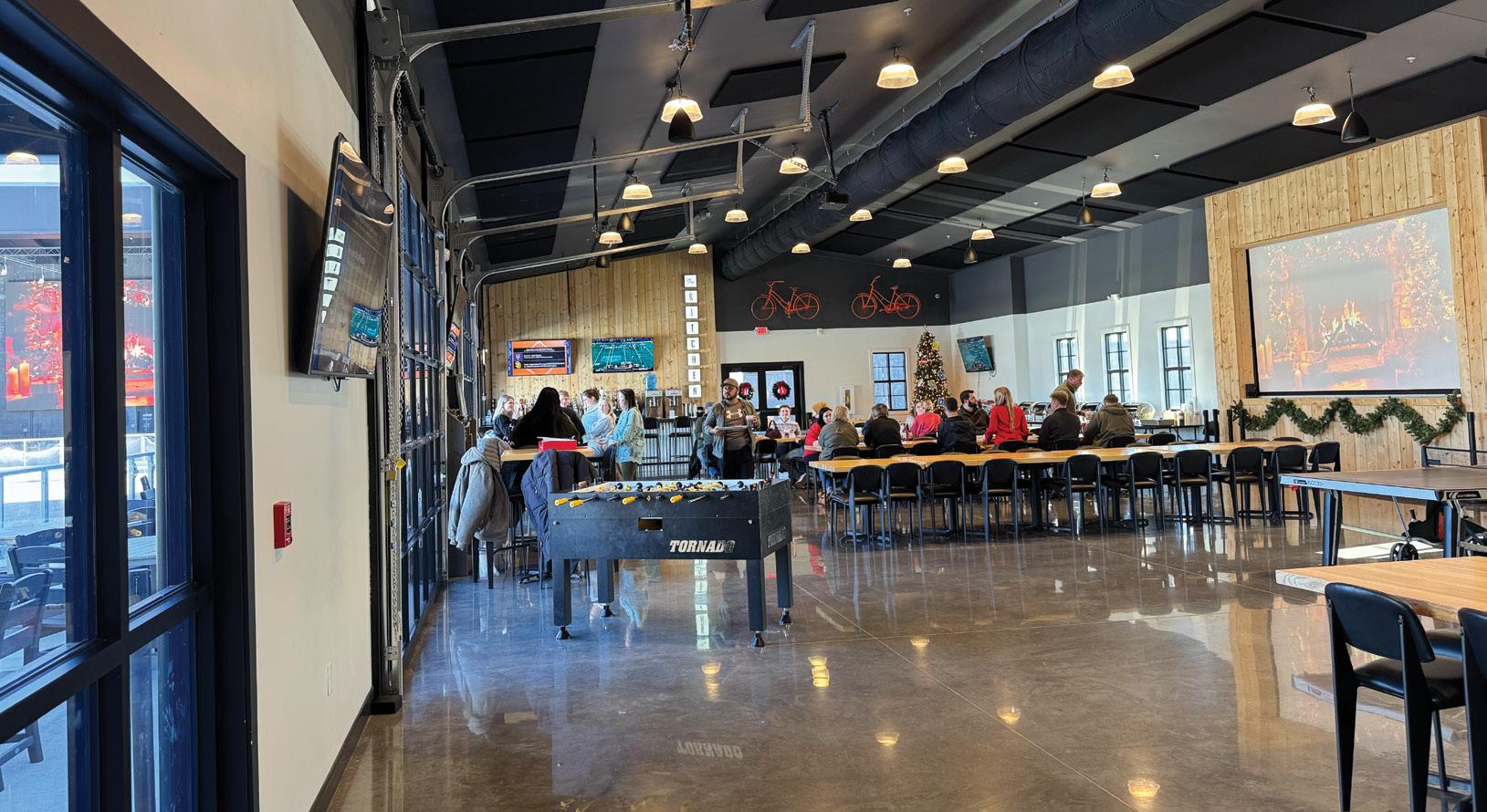
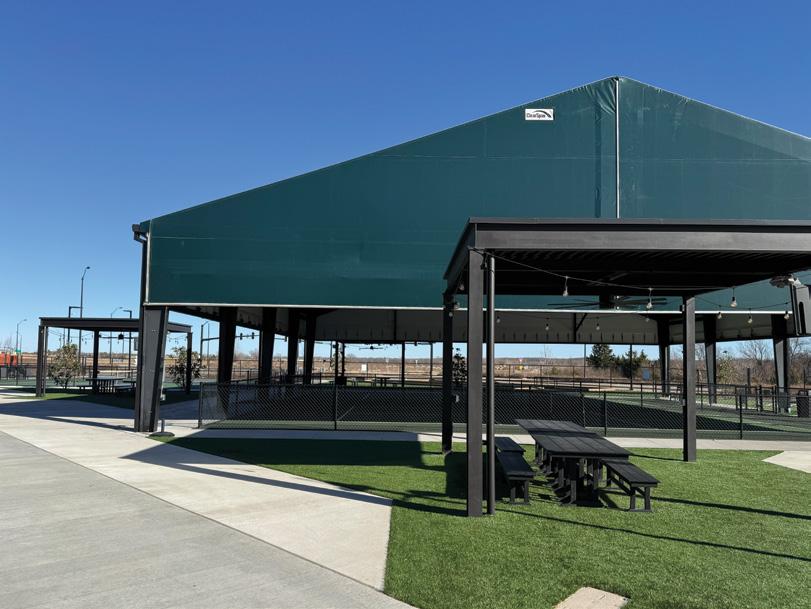
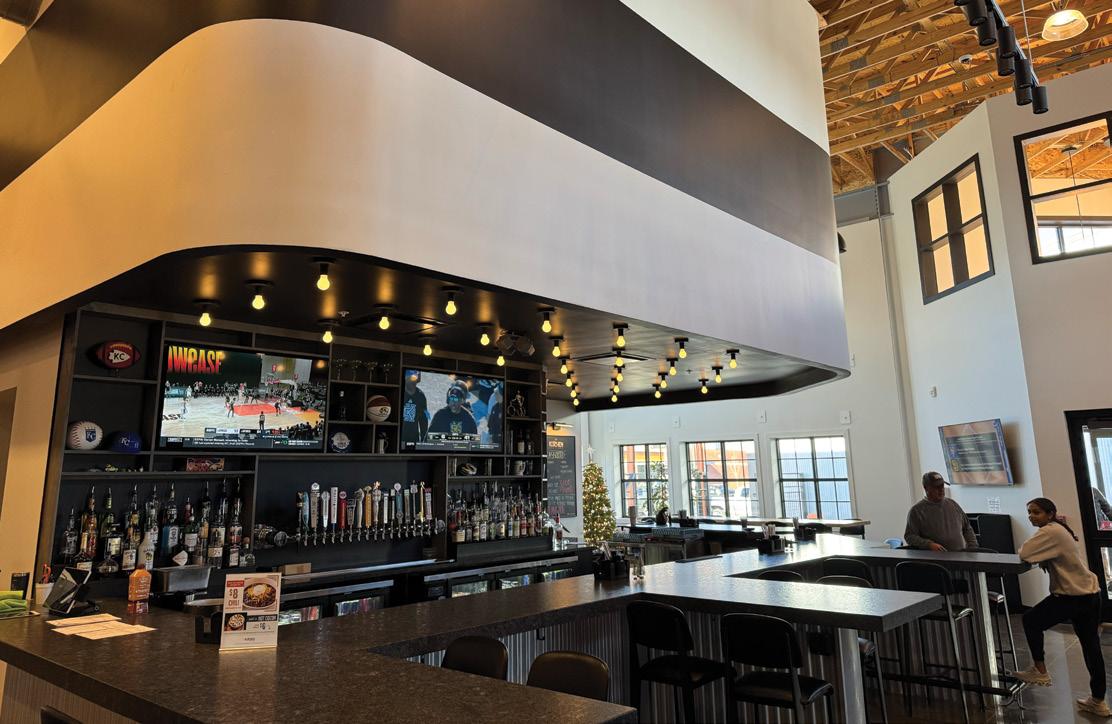
game room, and a large stage with a 30foot screen. Add in multiple outdoor bars, party rooms, and a playground, and it becomes clear why e Kitchen works for everything from date nights to company outings to family reunions.
“ e vision is community,” Rowden says simply. “Lots of activities, but mostly just fun.”
Yes, the name is a nod to pickleball. In the sport, the seven-foot area on each side of the net, where smashing the ball is prohibited, is known as “the kitchen.” It’s a space that encourages nesse over force. at idea translated perfectly to the restaurant. e Kitchen aims to serve high-quality food designed for casual, shared experiences — meals that bring people together rather than rush them out the door.
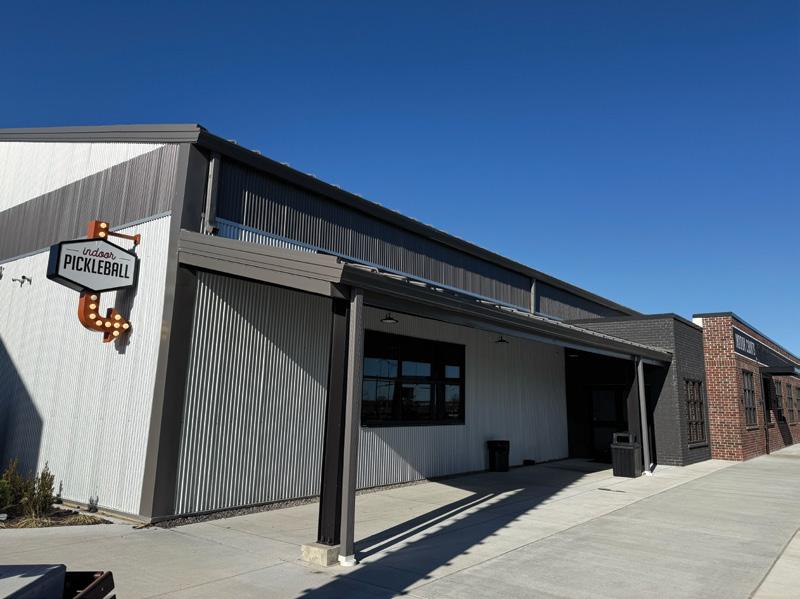
Pickleball is the core of the space, with six indoor courts and four outdoor courts designed to welcome everyone from rst-timers to seasoned players. Participation is intentionally easy: Walk in or book online. Courts range from $20 to $40 per hour, while open play sessions cost just $5 per person per hour. Leagues and tournaments run regularly, and open play has become one of the biggest surprises. People love being able to show up and instantly join a game.
en there’s the ice rink.
In winter, the turf area transforms into an ice rink with sessions priced at $11 for an hour and fteen minutes. It’s not just about skating — it’s about seasonal magic. Skaters warm up with specialty hot chocolate, and the space takes on a festive energy that feels rare in central Missouri.
“ e indoor courts in winter have been incredibly popular,” Rowden says. “And the ice rink has been, too.”
One of the most unexpected successes of e Kitchen has been its ability to draw all ages at once. Kids come to play. Teens hang out on the turf. Parents watch from the sidelines. Grandparents try pickleball — sometimes reluctantly, often joyfully.
ere’s a healthy element baked into the fun. Movement and activity are part the experience, but they never feel forced. e sta embraces the vibe, helping people feel comfortable whether they’re here to exercise, celebrate, or simply relax.
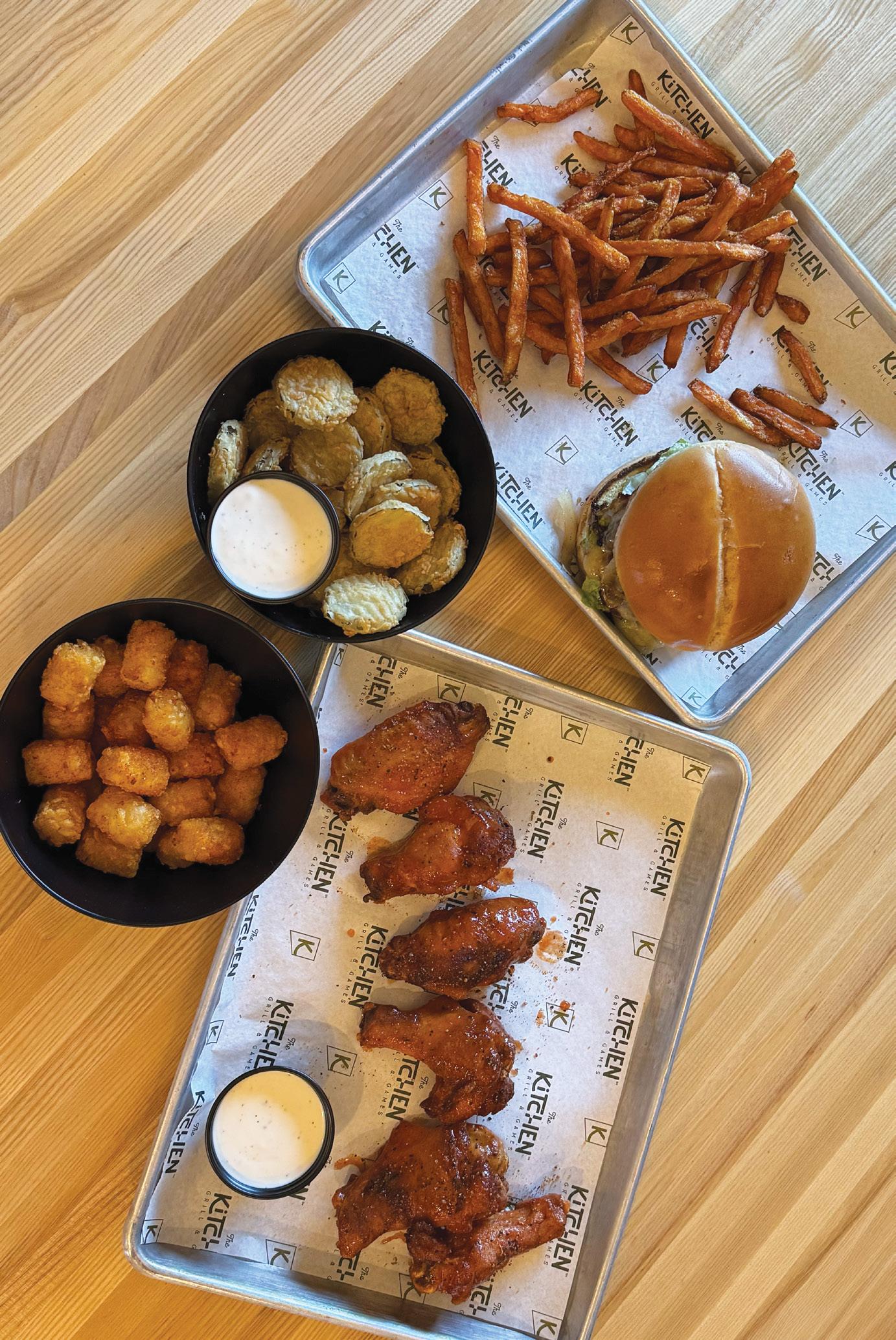
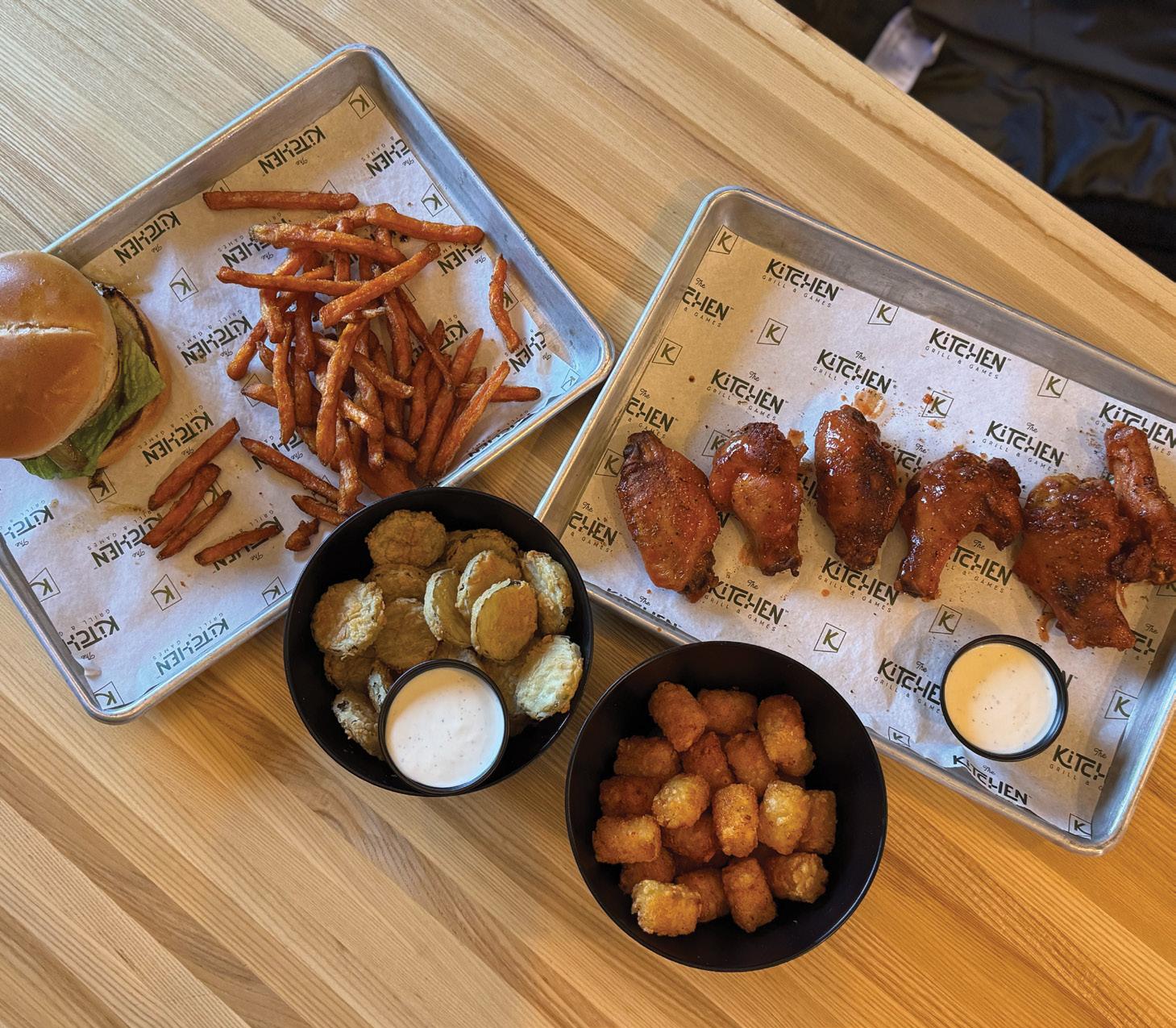
e grill side of e Kitchen is best known for its smash burger, the bestseller. A triple smash burger is slated to join the menu soon, alongside a refreshed lineup rolling out in January.
Sharables are a standout for groups, especially smoked wings and loaded nachos. With four bars on site, including two outdoors, drinks are never far away. In winter, variations of hot chocolate have become a crowd favorite.
Beyond everyday dining and play, e Kitchen has quickly become one of Columbia’s most versatile event spaces. Party rooms host kids’ birthdays, while larger corporate groups take over pickleball courts or the game room. Catering, rentals, and custom events are all part of the o ering, making it easy to scale from intimate gatherings to all-out celebrations.
“ e biggest surprise has been the number of events,” Rowden admits. “From small parties to large company outings — it’s constant.”
MEETING EXPECTATIONS
e indoor pickleball building opened in September 2024, followed by the restaurant and full slate of activities in January 2025. Since then, the response has exceeded expectations.
What surprises the team most isn’t just the popularity of the space, but how naturally people use it. Discovery Development continues to add amenities across the neighborhood, while e Kitchen itself evolves — new turf, additional shufeboard courts, menu updates — always asking the same question: What does the customer want next?
A NEW KIND OF GATHERING PLACE
In a city that values connection, e Kitchen Grill & Games has quickly carved out a unique role. It’s not just a restaurant. It’s not just a sports complex. It’s a place where Columbia shows up as itself — competitive, communal, family-oriented, and ready to play.
aims to keep kids from sleeping on the floor.
BY STEPHI SMITH
Sleep in Heavenly Peace (SHP), a volunteer-led organization that builds and delivers beds to children in need, has been providing new, high-quality beds to Columbia children for almost two years now. Kelley Upham, president of SHP’s Columbia chapter, said Community United Methodist Church started the local group and built its rst bed in March 2024.
Twin-sized beds are available for children ages 3-17 living in Columbia in a house or apartment large enough to accommodate the new furniture. Each client receives not just the bed, but also new bedding, including pillows and comforters.
Sherri Helm, application manager at SHP, said clubs at di erent Columbia-based churches have created and donated new quilts as well. “When we leave, the children are able to sleep in the bed that night,” Helm said.
Upham noted that there are countless reasons a child may not have access to a bed, but it’s often due to nancial diculties. She said a mattress, bed frame, and bedding can cost at least $250. And some people may not have the tools to assemble a bed frame or the ability to transport a mattress, resulting in children sleeping on air mattresses, couches, or in their parents’ bed.
Upham and the SHP team have also been to houses with old and unsafe beds or mattresses that need to be replaced. She noted that everything SHP provides to families is brand new and that, before her role with the nonpro t, she never would have realized how happy a new pillow could make somebody who’s
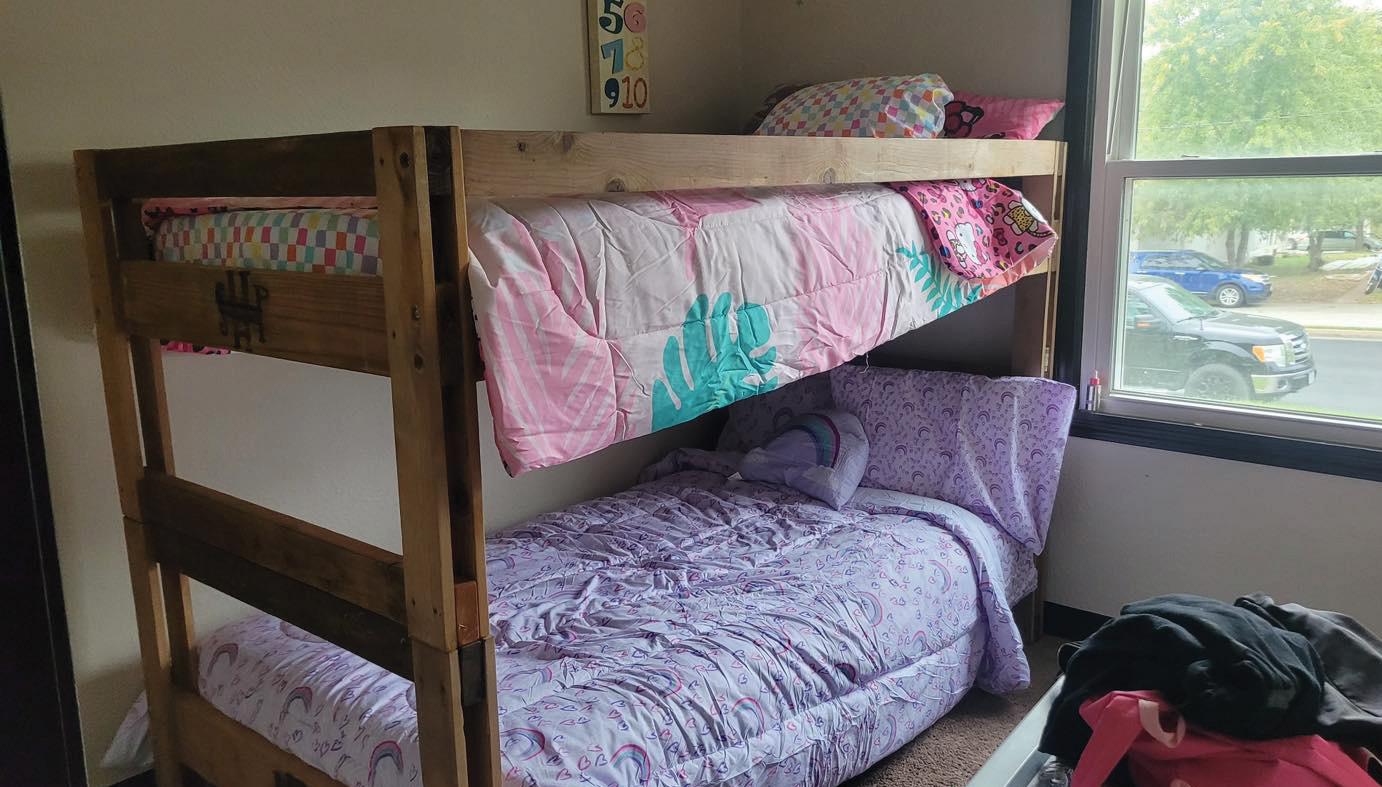
become accustomed to using a couch cushion every night.
“We don’t accept anything used. We get calls all the time saying, ‘Oh, I have this, and it’s barely been used.’ But all these kids deserve brand-new stu ,” Upham said.
Helm said there aren’t restrictions on which families can receive a bed since SHP assumes that any person submitting an application is doing so out of need. She calls each applicant to ask about their living situation in order to provide the best bed for each child. For example, she explained, a bunk bed may better suit a family that is requesting two beds but doesn’t have much space for two separate beds.
Helm admitted that before she joined SHP as a volunteer employee, she was completely unaware of the major need to supply beds to children in mid-Missouri.
She said Community United Methodist Church hosted a panel with Columbia Public Schools sta , who shared the fact that many schoolchildren lack a regular bed to sleep on every night. Helm hadn’t considered that before the presentation, noting that the ability to sleep in a comfortable and safe bed each night is something many people “take for granted.”
SHP’s national organization is based out of Idaho and advertises the nonpro t’s mission as, “No Kid Sleeps on the Floor in Our Town!” e national organization reported delivering 86,328 beds across the United States with 165,747 volunteers in 2025.
Helm said the nonpro t’s Columbia chapter typically delivers beds one month after somebody sends in an application. However, she added, that isn’t often the case at the beginning of the year.
Shortly after the new year started,
• Kelley Upham, president
• Andy Upham, build manager
• Sherri Helm, application manager
• Al Cannaday, team member
• Kimberly Reese, delivery manager
• Jenna Wooten, social media manager
• Tracy Millsap, team member
• Angela Pigg, team member
• Ann Toellner, finance manager
• Annabelle Simmons, team member
• Jen Reese, inventory manager

Helm said there were 55 applicants in Columbia requesting around 120 beds, creating a backlog for SHP since Helm said the nonpro t delivered all but 18 of the beds by the end of 2025.
Since SHP opened up applications to all of Columbia — originally the nonpro t only provided beds to families in certain city ZIP codes — Helm said she’s seen signi cantly more applications each month.
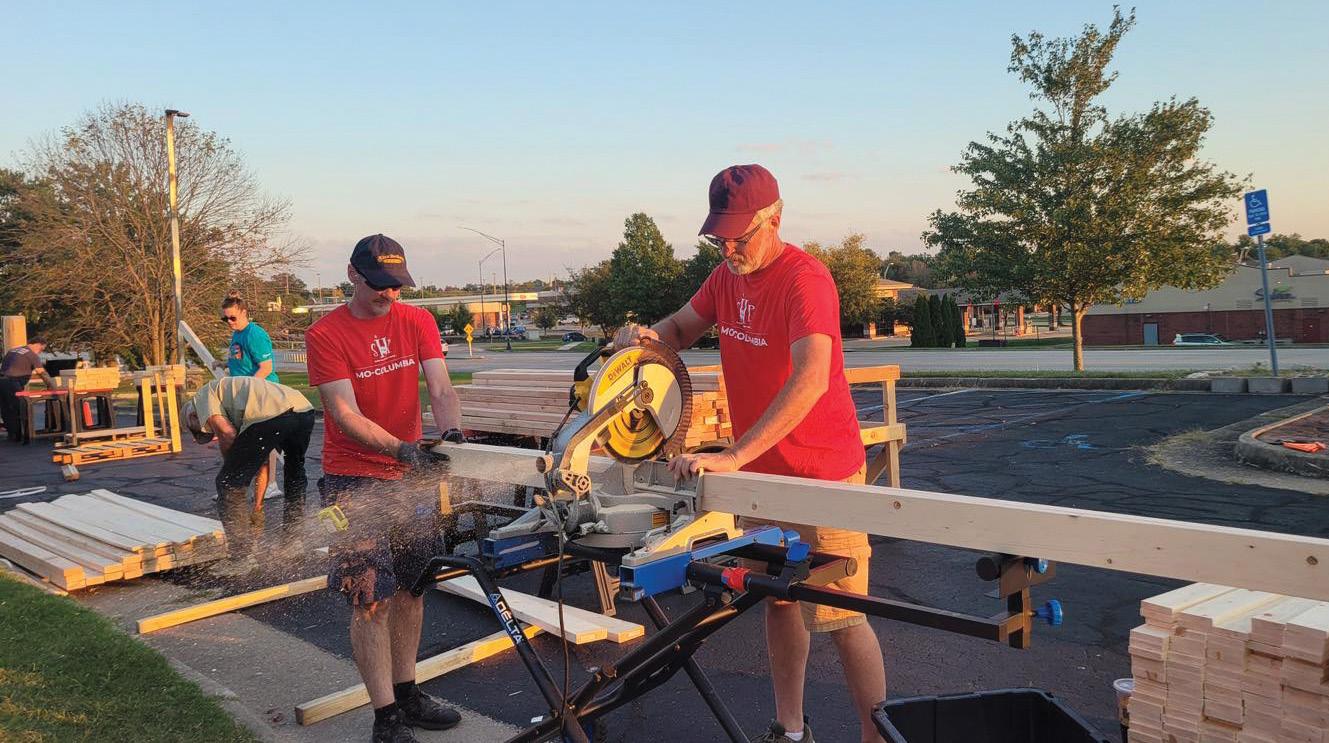
Upham’s husband, Andy, build manager at SHP, said the organization has provided almost 350 beds to Columbia children in two years. SHP hosts seven “bed-building days” annually, with the rst occuring in March. At those events, volunteers arrive early in the morning to cut and sand the wood pieces in order to assemble each bed in the client’s home.
Helm said SHP’s beds are high quality and will last for several years. Each
bed is constructed with sturdy wood, and SHP’s wood stain is created by soaking steel wool in vinegar, yielding a mixture that deters bed bugs but is safe for kids and pets.
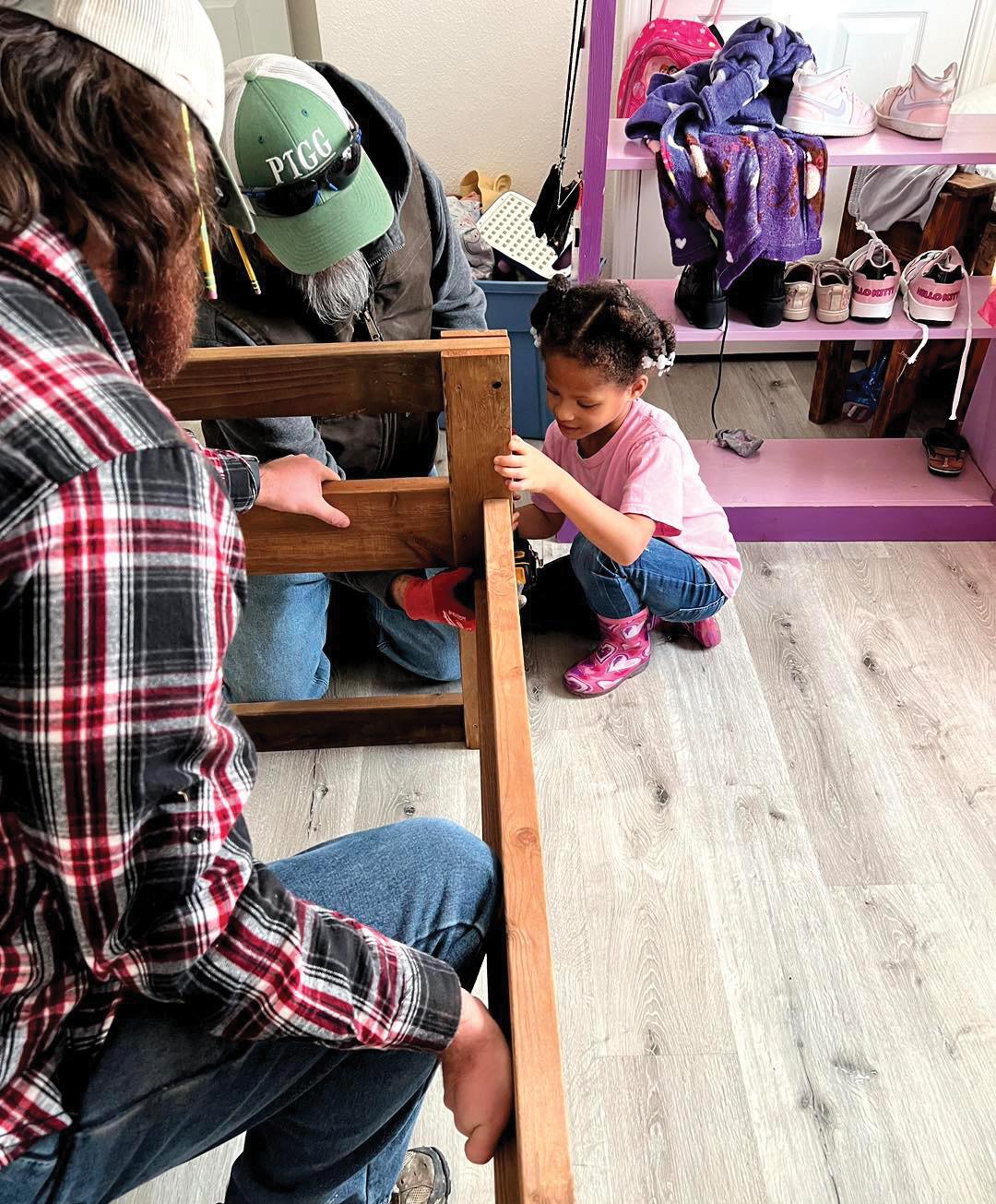
Upham noted that Andy involves the children receiving the beds in building them as well. When SHP initially shows up to deliver a bed, she said some children are shy because there are strangers in their house. But they always get excited when asked to carry wood or learn how to use the power tools.
Upham said Andy will often ask the children who built their new bed, and when the children point to him, he reminds them how much work they put in themselves.
“And he’s like, ‘No, you built your bed. You tell your friends you built your own bed,’” she said. “And they just have so much pride knowing that.”


MIKE MESSER SHELTER INSURANCE
JACOB PORTER ROST LANDSCAPING
By Mike Messer MMesser@ShelterInsurance.com
Columbia is near and dear to my heart because it’s my hometown. I graduated from Rock Bridge High School and went on to graduate from Mizzou and started my career with Shelter Insurance® right here in Columbia.
The early days of my career with Shelter took me to Oklahoma, but I eventually came back to Columbia—the place I’m proud to call home and proud to support in the following ways:
Leadership Columbia
I completed Leadership Columbia in 2012. This program was developed by the Columbia Chamber of Commerce in conjunction with the Fair Missouri Foundation and the University of Missouri’s Trulaske College of Business to identify, cultivate and motivate future community leaders.
Campaign Leadership
I served as the campaign co-chair for the Heart of Missouri United Way in 2016, successfully leading the organization to surpass its $3 million fundraising goal. impacted organizations in Columbia such as The Food Bank for Central & Northeast Missouri, Services for Independent Living, the Columbia Center for Urban Agriculture and the Voluntary Action Center (just to name a few).
Ongoing Sponsorship
My agency continues to support United Way initiatives, including serving as a sponsor for the 2025 "20 Under 40" celebration, which named United Way its official nonprofit partner.
Board and Community Roles
I have been a long-time advocate for the United Way's community impact model
Heart of Missouri United Way's President & CEO, Talia Jackson, on stage with The COMO Companies President, David Nivens, during the 2025 20 Under 40 celebration at The Blue Note.
and I frequently speak on how the organization effectively creates metric systems for funded entities.
My passion for supporting my community is one reason why I’m an agent for Shelter Insurance®. This year Shelter is celebrating their 80th anniversary and they have a long history of community involvement. The Shelter Insurance Foundation has supported the community through donations to local organizations, scholarship programs and the Fred V. Heinkel Award. They also have a committee called Shelter Cares which meets monthly to review volunteer opportunities and share them with their teams.
MIKE MESSER AIC, LUTCFSHELTER INSURANCE ®
With over two decades in the insurance industry, Mike Messer has served as a claims adjuster, supervisor, and underwriter, giving him a well-rounded understanding of how policies work when it matters most — before and after a loss. He prioritizes building relationships based on trust and personalized service, recognizing that every client’s needs are unique. Through annual policy reviews, he helps ensure clients stay informed, confident, and properly covered, providing them with peace of mind and financial security.

Outside of volunteering and making charitable contributions, Shelter is home to Shelter Gardens, which is enjoyed by the entire community and hosts free and fun activities, such as occasional concerts in Shelter Gardens and the Winter Wonderland Garden of Lights during the holidays. All of these events are popular in Columbia and Shelter is glad it’s part of what makes Columbia a great place to live.
By Jacob Porter
Outdoor fire features have become a popular addition to residential landscapes, offering warmth, ambiance, and a focal point for entertaining. From traditional fire pits to sophisticated outdoor fireplaces, understanding the different options available can help homeowners create a safe, functional, and visually appealing outdoor space.
• Fire pits are the most common outdoor fire features. They are typically open on top and can be fueled by wood, propane, or natural gas. Fire pits create a casual, social atmosphere and work well in patios, backyards, and seating areas. They can be constructed of concrete block, stone, and even boulders.
• Outdoor Fireplaces are more structured and vertical, resembling indoor fireplaces. They provide directional heat and a strong visual focal point. Fireplaces are ideal for defined outdoor living rooms and can be fueled by wood or gas.
• Fire tables combine a fire feature with functional tabletop space. Usually gas burning, they are popular for entertaining and work well in smaller spaces where versatility is important.
• Fire bowls and troughs offer a modern, sculptural look. Fire bowls are typically round or oval, while fire troughs are long and linear. These features are commonly gas-fueled and used as design accents rather than primary heat sources.
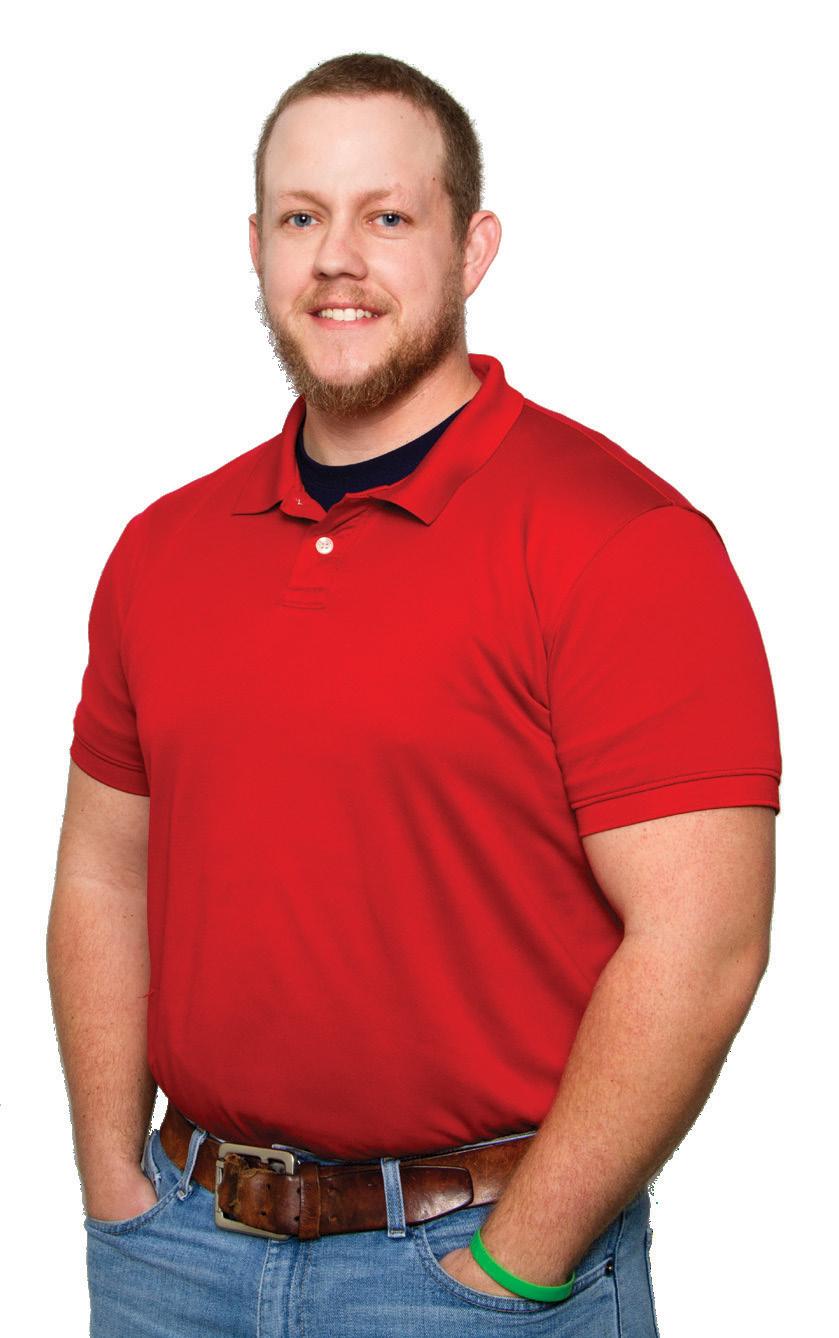
Jacob comes from the small town of California, Missouri. With his plant science degree from MU and six years with Rost, he enjoys creating exciting outdoor spaces for his clients. Watching these creations come to life is only one highlight of being a designer for Rost. When he is not designing, he loves spending time with his wife and kids, tournament bass fishing, and doing a little bit of woodworking.
Outdoor fire features use several ignition systems, each with different levels of convenience and reliability.
• Manual ignition requires the user to light the flame with a match or lighter after turning on the fuel source. This is a simple and costeffective option but requires more user involvement.
• Electronic ignition uses electricity to automatically spark the flame when activated. These systems are more convenient and safer, as the gas only flows when ignition occurs. They typically require a power source.
• Battery-powered ignition offers similar convenience to electronic systems without hardwiring. Batteries need periodic replacement but are useful where electricity is unavailable.
When planning an outdoor fire feature, fuel type is a major decision. Wood provides a traditional experience but requires storage and cleanup. Gas options offer cleaner operation, easier control, and minimal maintenance, but come with a higher cost due to added materials and installation.
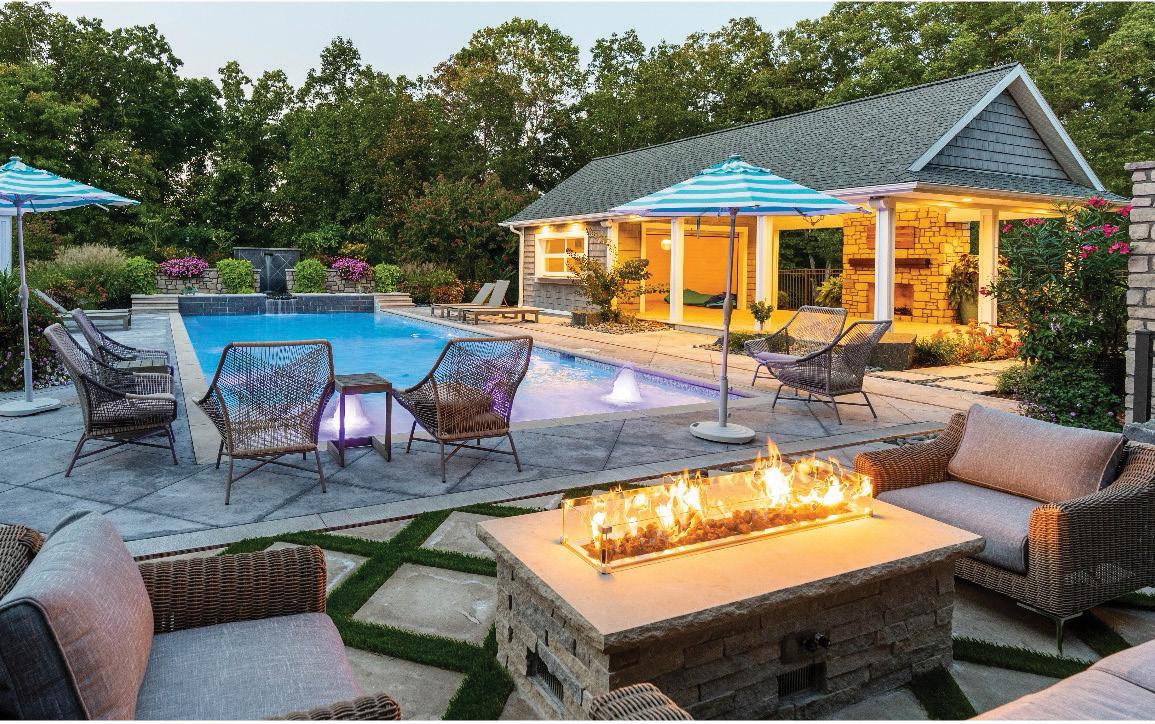
Location and scale matter for both aesthetics and functionality. The fire feature should complement the size of the outdoor space and integrate with seating, walkways, and other landscape elements. At the same time, you want to make sure that you are not placing the feature in a location where smoke can be trapped if you are burning wood.
Maintenance and longevity should be considered as well. Materials like stone, concrete, and stainless steel withstand heat and weather better than lower-grade metals.
By understanding the available fire feature styles, ignition options, and planning considerations, homeowners can confidently choose an outdoor fire feature that enhances comfort, safety, and enjoyment for years to come.

BY SUNITHA BOSECKER
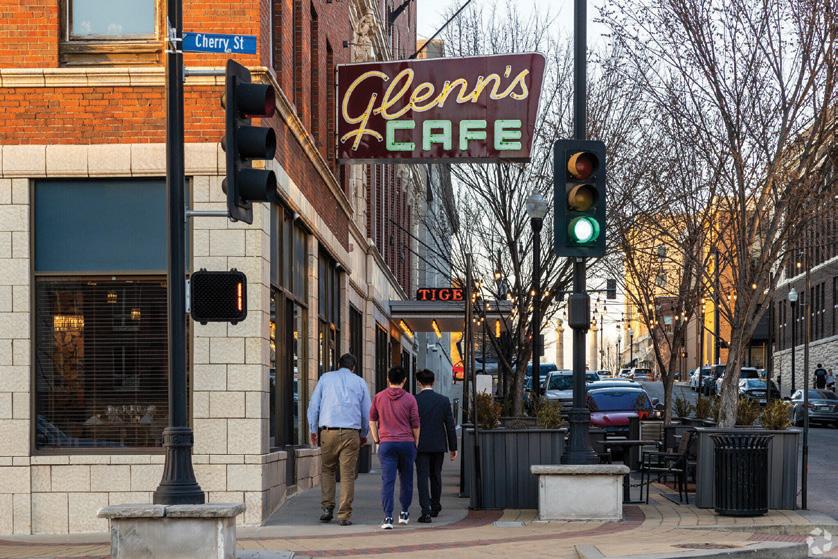
e District is eclectic shops, college kids, longtime locals, late-night food runs, and early-morning co ee. Downtown COMO hums with energy — even when the students leave and locals reclaim it. Going for dinner and drinks? Downtown is the location.
In the North Village Arts District, creativity spills into streets, alleyways, and unexpected corners. With its studios, galleries, music, and makers, NVAD proves that creativity thrives beyond downtown — and that art feels better when it’s a little rough around the edges.
Just east of downtown, this beloved park is sunsets, paddleboards, festivals, and year-round people-watching perfection.
True/False Film Fest transforms Columbia into something magical and slightly surreal. For four days, nearly all of downtown is transformed into screening rooms, strangers become friends, and documentaries feel electric. It’s impossible not to feel cultured after experiencing the stories, music, art, and parties that become indelible memories.
It’s legendary. It’s Shakespeare’s Pizza. No hand-tossed pie in America says “Columbia” louder than a slice at Shake’s. You can also grab some pizza dough while you wait or pick up a frozen pizza.
e MKT Trail, which connects to the state-crossing Katy Trail, o ers movement, nature, and freedom.
A quiet sanctuary tucked o a busy intersection, Shelter Gardens’ seasonal blooms, shaded benches, and winding paths provide a moment of peace right in the middle of the city. One local gushed, “It's the best place for family photos!”
More than a movie theater, Ragtag Cinema is a cultural anchor. Ragtag screens lms that challenge, inspire, and spark conversations long after the credits roll. “Love going to Ragtag for post- lm conversations,” noted one fan.
All kinds of folks go to Rock Bridge Memorial State Park. e treasure that is Devil’s Icebox reminds us how incredible nature is.
From Broadway Brewery to Logboat Brewing Company, craft beer tastes better with local stories.
Part café, part community hub, part fundraiser headquarters, Pierpont General Store — though on the outskirts of town — is peak COMO. And, as of mid-January, the joint was for sale.
From the Candy Cane Crib at Logboat to Living Windows, Magic Trees, and downtown carriage rides, December in Columbia feels handcrafted and genuinely joyful. A unique, community-focused holiday event, Cranktivus is a food drive on two wheels.
Regional Economic Development Inc. (REDI), e Shops at Sharp End, Missouri Women Business Center (MWBC), and One Million Cups (1MC) all demonstrate that COMO roots for aspiring and seasoned businesses.
anks to the University of Missouri, Stephens College, Columbia College, and Moberly Area Community College, intellect and contagious energy are everywhere.
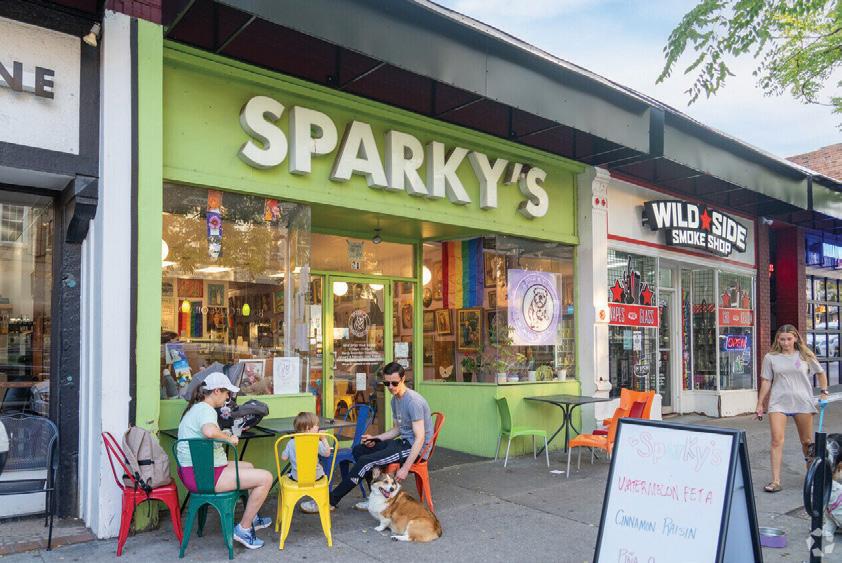
Sparky’s is creative avors, childhood joy, and lines worth standing in. e crowd favorite is Oreo Speedwagon. Feeling like you need extra energy? Order the Red Bull shake with any ice cream avor you want.
Columbia is a city that knows its way around a kitchen — and invites everyone to the table. CoMo Cooks Shared Kitchen is a commercial kitchen and food-business incubator located in e Loop. You don’t want to miss Abbey’s Swahili Delights, Polvorosas Savory Pies, e Biscuit Center, and Tsokolate Confections.
A modern, light- lled gathering space for readers, learners, kids, writers, and anyone needing a place to land for a while, CPL provides free resources, programs for all ages, and One Read, a community-wide reading experience.
CreativeMornings Columbia is a monthly reminder that creativity belongs to everyone. Each gathering o ers big ideas, welcoming space, and the comforting realization that you’re not creating alone.
At Startup Weekend, big ideas are born in fty-four ca einefueled hours. Got a business idea? Some have turned into million-dollar — and billiondollar — enterprises.
Saturday mornings mean local produce, familiar faces, live music, and conversations that stretch longer than planned. Meet me at the Market!
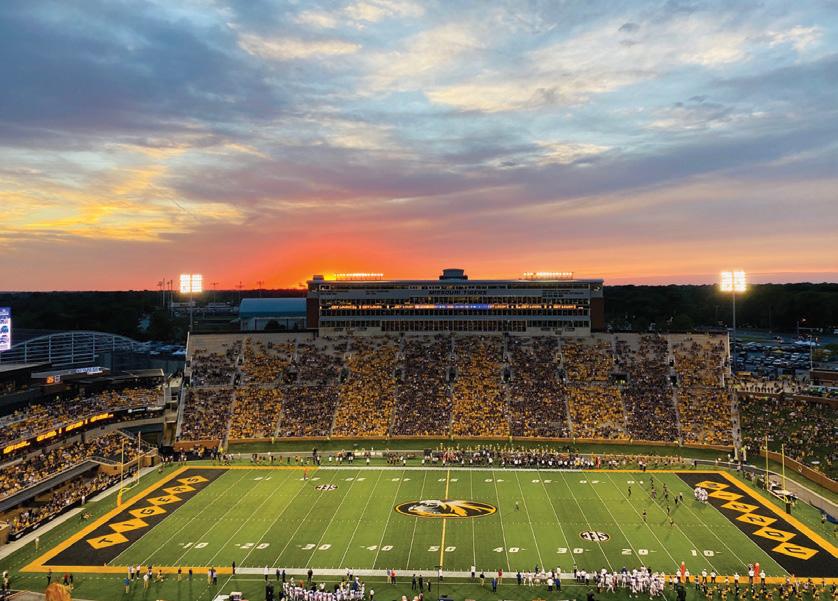
Sports at the University of Missouri mean game days, epic tailgating, black and gold pride, and a city that rallies together. “M-I-Z!” (“Z-O-U!”)
e Missouri Symphony creates world-class music, and the Missouri eatre elevates our nights out. e Symphony’s music festivals enliven our summer nights and remind us how lucky we are.
e six limestone columns standing on MU’s Francis Quadrangle are a postcardperfect symbol of tradition and transition. No matter how the campus evolves, the Columns remain, watching generations come and go. ey’re one of the most snapped photo spots in COMO, in all seasons.
Compass Inc.’s Intergenerational Rock Band Choir proves community has no age limit. Community members ages 8-80 come together and perform twice a year at e Blue Note.
Downtown’s historic hotel supplies old-school elegance with a modern COMO wink.
e blu top A-Frame at Les Bourgeois Vineyards o ers wine, views, and moments worth lingering over. “Love the summer concert series at A-Frame, showcases local artists!” one enthusiast says.
Rose Music Hall and e Blue Note keep COMO loud — in the best way. Live music is good for the soul. e summer concerts on Ninth Street feature everything from sets by artists who just released their rst EP to exuberant dance parties; there’s a range for everyone.
Yellow Dog Bookshop, Speckled Frog Toys & Books, Black Tea Bookshop, Sabu’s Books, and Skylark Bookshop are among the book-loving cozy places where readers belong.
e Big Tree is a nearly 400-year-old bur oak near the Missouri River. It makes for a perfect bike ride or scenic drive on a Sunday. And nearby Eagle Blu s Conservation Area? Take your time checking it out. You’ll probably discover why its name is so tting.
Because ne art feels better in an open eld, you will nd art of all kinds in one big space.
Helmi’s Gardens, Strawberry Hill Farms, and Giving Gardens are where COMO grows beauty. ese spots are visited year-round by all the houseplant and garden lovers.
Boone County’s history museum is where our stories are preserved — and shared.
Come down to the landing for music, sunsets, and river air that feel like the perfect magic combination. You can go glamping or sip drinks by the Missouri River. It’s the place on a Wednesday evening or Sunday afternoon.
COU is compact, e cient, and surprisingly convenient. Plus, it o ers free parking. e way the Columbia Regional Airport has evolved over the decades, with the addition of new airlines and ights, has made COMO more convenient for personal and business travel.
e 76,000-square-foot State Historical Society of Missouri Center for Missouri Studies is where statewide stories live locally.
Murry’s, Flyover, Irene’s BBQ, 44 Canteen, Cafe Berlin, and Pasta La Fata are just a few of Columbia’s restaurants where comfort meets craft. ese and many more are favorites of local diners.
Global avors live in local parking lots. You can nd them at street corners downtown or near the Missouri River. Local favorites include Gina’s Vegan A Go Go, Jamaican Jerk Hut, Mr. Murphy’s Stu ed Potatoes, City of Refuge’s City Cuisine, and Munchi’s Fish & Chick’n.
Grace, discipline, and local talent are on full display at Columbia Ballet Academy, with classes taught by talented local dancers.
41
Booches is burgers, billiards, and history on a griddle. When asked what’s something you get when you are back home, one Columbian responded, “Booches burgers! Nothing like getting a beer, chips, homemade chili, and a cheeseburger delivered on a napkin.”
e MLK Jr. memorial at Battle Gardens features space for re ection on justice and hope. Nearby, you will nd people walking, running, or biking along the MKT Trail system.
42
Howard Meehan’s Keys to the City is a visual reminder that civic life here is accessible.
Stories painted in plain sight, Columbia’s many public murals bring art to the people.
43
Acola, Shortwave, Fretboard, Lakota, and Sage provide fuel for ideas, business meetings, and friendships.
44
Sometimes you just need everything in one place, and for that, our mall delivers.
Because pets deserve camaraderie, too, Columbia’s parks prove that community sometimes starts with a leash and a wagging tail. Local favorites include Garth Nature Area, Grindstone Nature Area, and Capen Park. COMO is a dogloving city.
We’ve already listed a few select parks, but there are so many more. Survey says?
Columbia boasts seventy-nine citymanaged parks and green spaces, encompassing some 3,800 acres of parkland and more than sixty miles of developed trails.
Retro fun and modern energy abound in the Arcade District. Come for an outdoor concert and stay for the indoor arcade games.
e 2026 version of this unique cycling and music jamming event is set for Memorial Day weekend, May 23-24.
Spearheaded by the Sharp End Heritage Committee, Columbia’s African American Heritage Trail honors history that deserves visibility.
CAL’s mission is art for everyone, always. It’s going on sixty-one years now.
A rich diversity of churches and spiritual homes o ers room for all.
Maplewood Barn eatre, Talking Horse Productions, Columbia Entertainment Company, and GreenHouse eatre Project are all about compelling stories, performed live. From improv events at Talking Horse to original plays at GreenHouse, talent and entertainment are ever on display.
KOPN 89.5 FM
Independent, local, and deeply human, KOPN sounds like Columbia. It features diverse voices, passionate volunteers, and playlists you didn’t know you needed.
is local festival brings nationally and internationally recognized authors of worldclass renown to Columbia to discuss their books, work, and lives.
e local Kraft Heinz plant makes one million Oscar Mayer hot dogs every day. Have you seen the Oscar Mayer Wienermobile around town?
BY BRIAN NEUNER
Editor’s note: is is the second part of a two-part story about Andy Hill’s athletic and coaching journey.
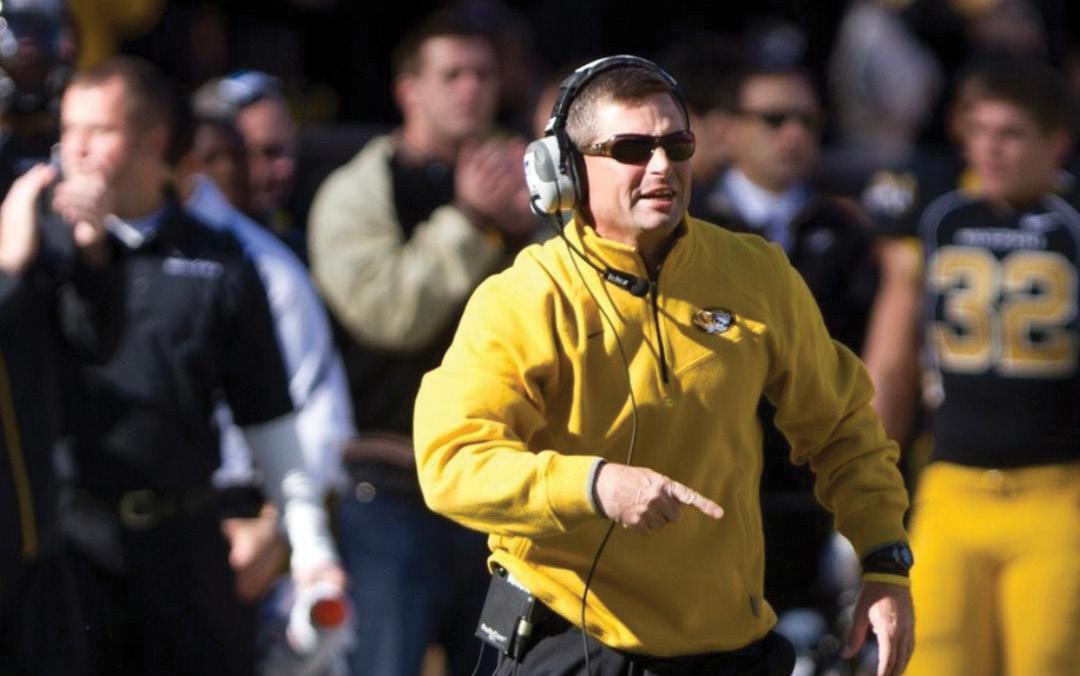
Andy Hill’s impact on the University of Missouri football program was undeniable. His value was so apparent that after Larry Smith rst hired him, both Gary Pinkel and Barry Odom kept him on sta when each of them subsequently became Missouri’s head coach. For twenty-four years, Hill left a lasting impression on countless student-athletes and the university he cherished.
Anyone who’s spent a lot of time with Andy Hill is likely to have an entertaining story or two. Jon Sundvold, an all-American basketball player at Mizzou who later played nine seasons in the NBA, became fast friends with Hill when their athletic paths crossed. During the o season, the pair would travel the state conducting youth basketball clinics, with Sundvold being the headliner and Hill handling the logistics. It was during this stretch that Sundvold became convinced his friend should pursue coaching.
“He was coaching basketball with me. He was just too good at it,” recalled Sundvold. “His ability to relate to kids was so natural. ey just took to him and his personality. He made those one-day camps fun for everyone.”
Having a friend playing in the NBA provided perks for Hill. Sundvold, a scratch golfer, was frequently invited to play in celebrity golf events. When he accepted, Hill would be his caddie.
“I remember one tournament in Lake Tahoe where I was paired with Joe
Namath, the Hall of Fame quarterback with the New York Jets,” Sundvold said. “I’m from Blue Springs, [Andy’s] from Trenton, MO — Joe ‘Willie’ Namath is a big deal to us. Anyway, we tee o on the sixth hole, and I hit my drive to the right side of the fairway, and Namath hits his drive to the left. As I’m walking down the fairway, I start talking to myself about what club I should hit next.”
But as Sundvold spoke, he realized Hill wasn’t paying attention. His caddie had crossed the fairway and had engaged in a conversation with Namath.
“I look over and see Andy just talking it up with Joe Namath,” laughed Sundvold. “He nally comes running over to me and said, ‘You’re not going to believe it, but Joe just shared a story about a fourth-quarter drive when the Jets played the Chiefs in the late 1960s. He described every play.”
Hill was thrilled and urged Sundvold to hurry up and hit his second shot so he could get back to Namath and hear the end of the story. Hill’s ability to connect with anyone, even an NFL legend like Namath, was a rare gift.
Anyone who coaches at a high level will tell you that it feels like having two marriages: one to your spouse and one to the game itself.
“ e biggest challenge was, there is never an o season in football,” explained Sarah Hill, Andy’s wife. “We had very little time to do things as a family. We were raising two children (Tricia and Andrew), and we were apart most of the time.”
When he wasn’t coaching, Hill was on the road recruiting.
“ at was by far was the most di cult part,” he said. “I couldn’t be two places at once.”
Sarah fondly recalled how Hill did his best to make time for his family. “He included us in his work when he could, we would travel to games to be with him, and when he was at home, he would always volunteer at the kids’ schools. When Andrew was playing baseball, Andy would be there when he could. Maybe it was just a few innings, but he made the e ort to be there.”
Hill also had obligations to his football family. Besides coaching
responsibilities, he became a mentor to many Missouri players.
“He can relate to the players since he played himself,” said Jeremy Maclin, an all-American receiver during his time with the Tigers. “He was genuine. When you are 17-18 years old, you are looking for people who are authentic. at was Coach Hill.”
Maclin’s sentiments were echoed by Mitch Morse, a Pro Bowl player who spent ten seasons in the NFL. “He always took time to get to know the players, but also their families and everyone involved around you. Nobody has a negative thing to say about Andy Hill,” Morse said.
Another former Missouri player and Hill fan, now playing in the NFL, is linebacker Nick Bolton of the Kansas City Chiefs. “He helped me get where I am today. He found ways to make football innovative, fun, and exciting. He gave players opportunities to shine and prove themselves,” recalled the two-time Super Bowl champion.
As long as Hill was on sta at the University of Missouri, he and his Columbia-based family were able to balance football life and family life pretty well. But that all changed in late 2019. After Barry Odom was let go as head coach, Eli Drinkwitz took over, and Hill found himself without a spot on the new coaching sta .
FREE AGENCY AND FRIENDSHIP
at December, Hill was in an unfamiliar situation. For the rst time in 24 years, he would not be a member of the Missouri football coaching sta .
“I was a free agent,” Hill said with a chuckle.
As a free agent in the football world, his future was uncertain. But what remained unchanged was his lifelong friendships, particularly with Chiefs special teams coach Dave Toub. Hill’s coaching journey

was far from over, and the bonds he had built over the years were more valuable than ever.
In early 2020, the Kansas City Chiefs had an opening for an assistant special teams coach. Hill reached out to Toub.
“I love the guy,” exclaimed Toub. “But I actually tried to talk him out of applying for the position. e pay wasn’t what he was used to at Missouri, and the working hours in the NFL were much longer. Plus, he had a family back in Columbia. His kids were going to nish high school there. e job was in Kansas City, so I wanted to make sure he knew what he was getting into.”
Despite Toub’s initial hesitation, he ran his old friend through the interview process just like all the other candidates. In the end, Hill was Toub’s top choice.
“I told Andy he was the guy, but he had one more interview to go, and that was with [Head] Coach Andy Reid.
“I usually don’t get nervous,” Hill recalled. “But waiting to get that phone call from Coach Reid was hectic. When he did call, I can remember him asking, ‘Are you sure you want this job?’”
Hill’s genuine enthusiasm came through, though. “I’ve been a lifelong Chiefs fan, and the chance to coach at the professional level and learn from the
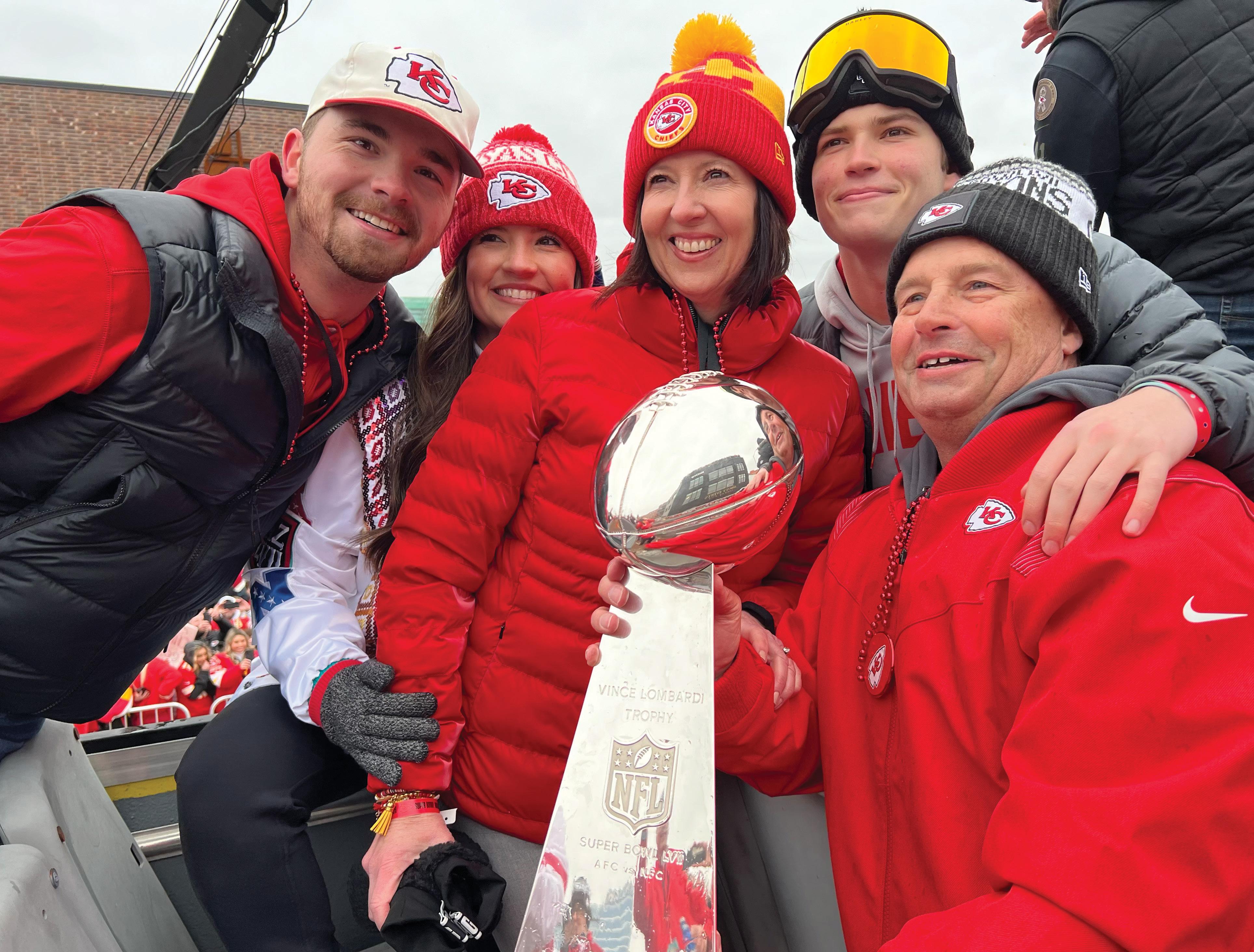
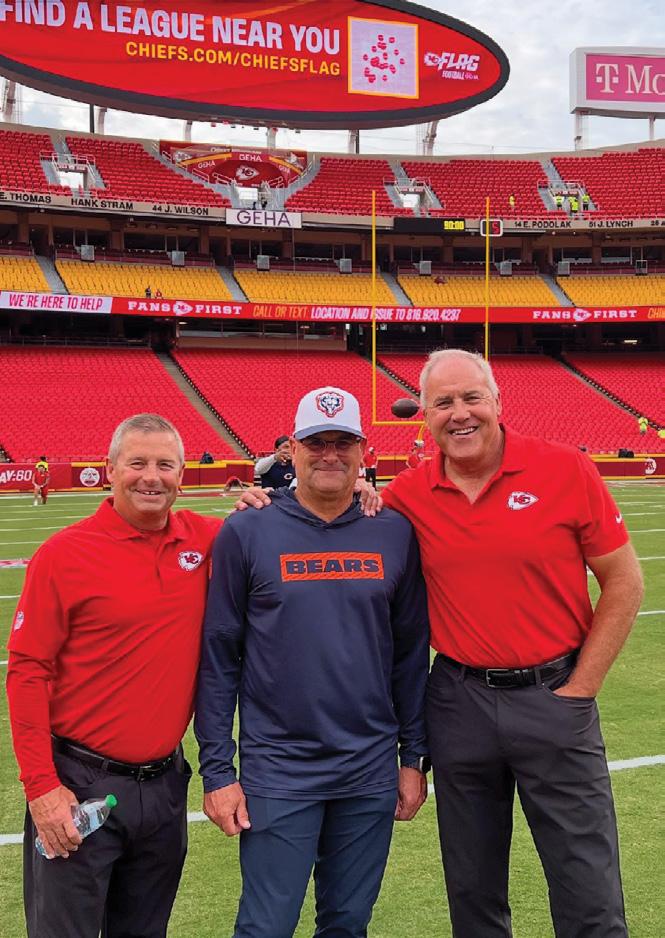
best special teams coach in the NFL is too exciting to pass up.”
Hill got the job, and the news resonated with those closest to him.
Sundvold remembers, “When he called and told me the Chiefs hired him, I just teared up. I couldn’t have been happier for one person than I was that day.”
“We’ve been beyond blessed,” Sarah said. “He might be the only coach who has been able to work for his two favorite teams: the Missouri Tigers and the Kansas City Chiefs.”
“Yep, Coach Toub and Coach Reid pulled me o the scrap heap and made a dream come true,” re ected Hill.
IMMEDIATE IMPACT: THE TRENTON TOUCH
Armed with twenty-four years of coaching knowledge, Hill arrived at the Chiefs headquarters ready to contribute. While there was a learning curve as he adjusted to the NFL coaching style, his experience and personality paid immediate dividends.
“I actually learned from him,” declared Toub. “I am a rough guy, no smooth edges. at doesn’t always work when you’re explaining new assignments to players. I let Andy run some of the meetings, and I watched how he used his personality to connect with the players. Andy Hill made me a better coach.”
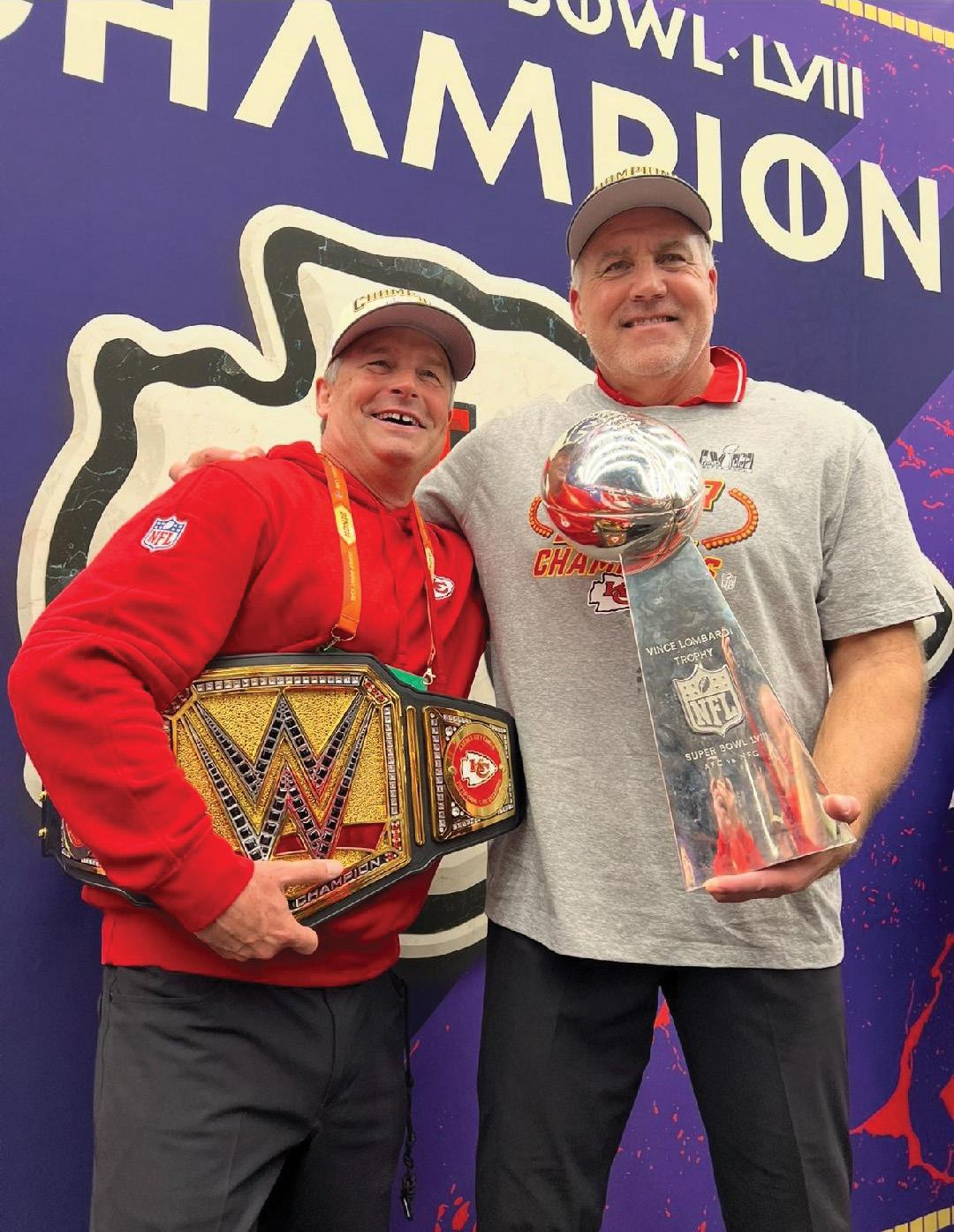
Coach Reid added, “He was very well liked. He had a great attitude and commitment to coaching.”
e Chiefs’ players gravitated to the new assistant coach, and together they made NFL history.
“He always had a smile on his face and was very upbeat,” said long snapper James Winchester. “ ose are some of the qualities that make him a lovable guy. A guy you want to please and impress with your play.”
“He brought a lot of knowledge and experience,” added placekicker Harrison Butker. “We had ve amazing years together.” ose years were certainly remarkable. During Hill’s NFL tenure with the Chiefs,
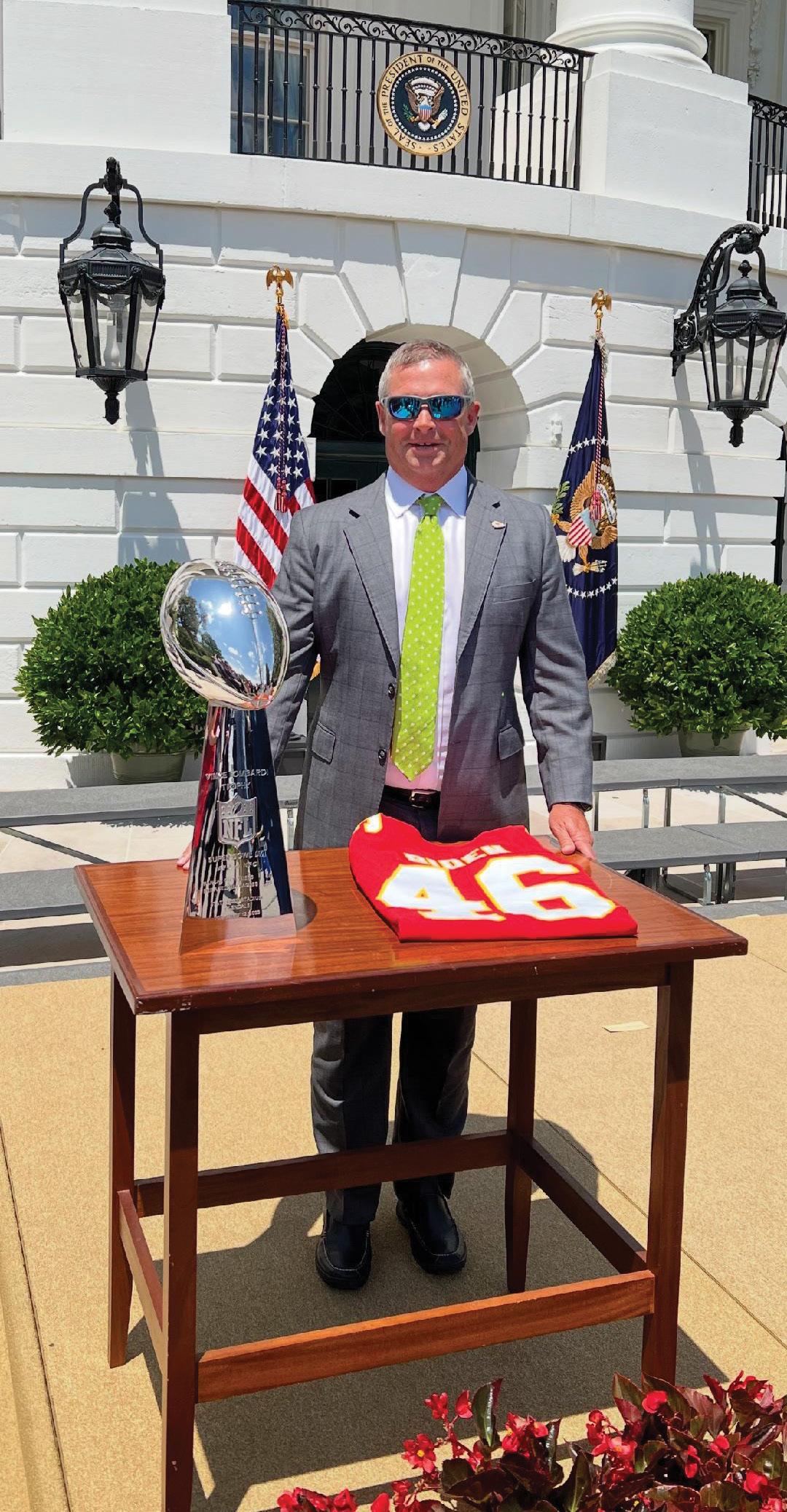
Kansas City went to four Super Bowls and won two of them.
“He was an integral part of our success,” Winchester said. “He’s meant a lot to the Kansas City Chiefs.”
ere are many photos capturing Hill’s joy after those two Super Bowl titles, but three stand out as symbols of his football journey. e rst shows him celebrating with his entire family.
“ at was always a priority for him,” Toub said. “After practice on Fridays, he would drive to Columbia so he could have dinner with his family, see his grandchild, or watch one of his son’s games. He was back in Kansas City the next morning
for team meetings. Whenever he could nd time to be with his family, he made it happen.”
e next picture appropriately shows Hill and Toub holding the Lombardi Trophy: two men with a link to Mizzou football celebrating a friendship and the pinnacle of their coaching careers.
But it’s the third photo that pulls it all together. It’s a shot of Hill standing behind a table with a folded Chiefs jersey and the Lombardi Trophy placed in front of him. Behind him stands the White House. It’s a tting backdrop for a man who started from Trenton, Missouri, and made it all the way to the top of the football world.

Free mental health services for quali ed children and adults in mid-Missouri are now available through Lutheran Family and Children’s Services.
e initiative, which was made possible through funding from the Boone County Children’s Services Fund, is intended to remove barriers to accessing essential mental health support in the community. LFCS is a statewide agency headquartered in St. Louis, with a regional o ce in Columbia and four other Missouri communities.
“Mental well-being is the heartbeat of a thriving community, and it’s our mission at LFCS to protect it,” said Anastasia Wexler, assistant director of behavioral health. In a news release announcing immediate access to the services, she added, “ anks to the Boone County Children’s Fund, we are ready to welcome children and adults looking for a clear path toward healing and resilience.”
e organization emphasized that free services come at a time of rising need across the state. According to a recent Missouri Student Survey, youth mental health challenges in the region remain signi cant, with nearly 17 percent of students in Boone County and 12 percent of students in Cole County reporting they seriously considered suicide in the past year. e survey also found that over 23 percent of mid-Missouri students reported feeling hopeless about the future, highlighting a critical need for early intervention and consistent support.
LFCS o cials said that recognizing the increasing need for accessible mental health care and support led to the nonprofit’s commitment to providing “timely and con dential services to Mid-Missouri residents.” at means quali ed children and adults in mid-Missouri can now access professional counseling and support. LFCS provides various mental health services to meet diverse needs, including individual counseling, group therapy, family counseling, crisis support, and trauma-informed care.
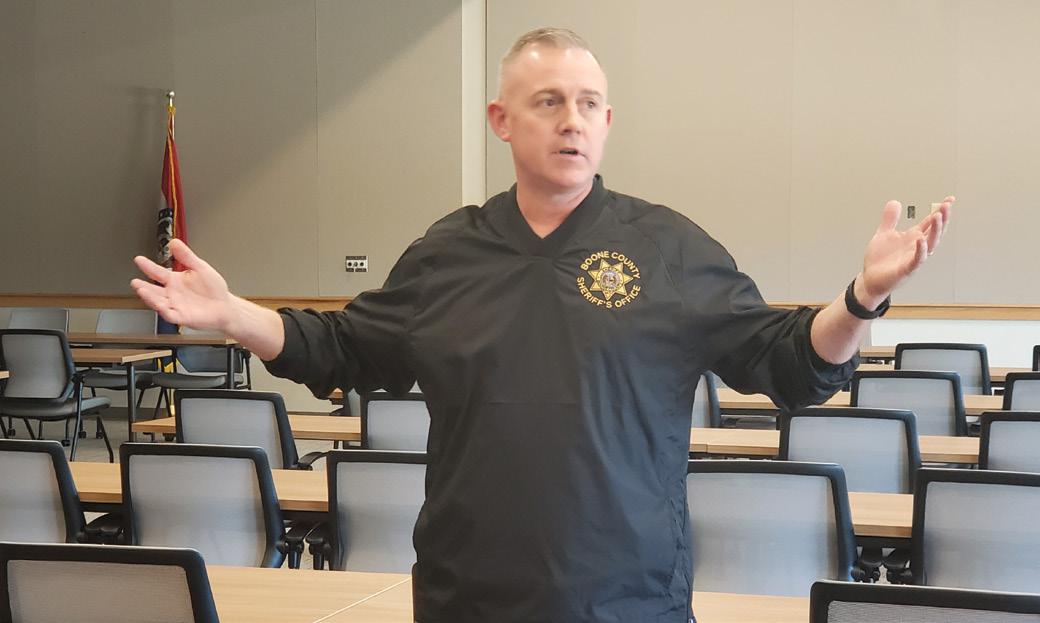
BY JODIE JACKSON JR
Some reporters tried to avoid “crashing” a police vehicle, others checked out the inside of a jail cell, and they witnessed a jiu-jitsu demonstration for subduing an uncooperative suspect, all as part of a media tour of the new, $20 million Regional Training Center at the Boone County Sheri ’s O ce campus.
e tour and demonstrations took place on January 7, three days before hundreds of people showed up for a public tour when Sheri Dwayne Carey, his sta , and Boone County commissioners showed o the new building at 2013 County Drive.
e rst Law Enforcement Training Institute class of the year has already begun training in the sheri ’s annex and will move to the training center in February. e facility will provide training for law enforcement and corrections o cers throughout the state.
During the media and public tours, sheri ’s personnel provided demonstrations throughout the facility and o ered hands-on training using the driving simulators and virtual reality technology. e facility design includes a 160-seat training room, a defense tactics room, an indoor tactical gun range, a large indoor “warehouse” area for tra c stop training, and other training focused on tactical scenarios, building searches, and crisis intervention and domestic violence response training.
e new facility also features a mock joint communication setup, allowing dispatchers to train alongside law enforcement recruits. Training Branch Commander Damon Reynolds, who previously oversaw administration at the Boone County Jail, said he hopes to have monthly cross-training simulations between dispatchers and law enforcement.
Standing in the massive warehouse area, where multiple vehicles can be staged to simulate tra c stops and other scenarios, Capt. Brian Leer said joint communications sta can look out and see what’s going on. Conversely, law enforcement o cers can see what the 911 center sta are handling during their response.
Scan the QR code to learn more about Boone County Sheriff’s Regional Training Center.
I love Columbia because it holds a vast amount of entertainment for anyone. You could spend an entire day hiking every corner of Columbia, from the trails of Devil’s Icebox to the Pinnacles, Eagle Blu s, and the Katy Trail. en, enjoy the live nightlife between constant karaoke at Eastside Tavern, open mics at Cafe Berlin, or jam to your favorite band at e Blue Note. It never ceases to keep you busy!
— KYLE GILLELAND
Multimedia Specialist
My alma mater, Columbia College. is institution changed my life in countless positive ways, nurturing my creative pursuits and love for learning. Whenever I pass by on my way downtown, I’m overwhelmed with positive memories of engaging professors (especially in the English and Communications departments), fascinating courses, and a welcoming community of classmates. I also love how Columbia as a whole fosters creativity and connection among writers: the Unbound Book Festival, poetry readings at Cafe Berlin, Missouri Women Who Write, etc.
— KELSEY WINKELJOHN Associate Editor
Of course, Kelsey stole my thunder, but I’ll be her echo. is city has a love a air with artistic expression, which includes words. We have a wealth of sensational wordsmiths who are writers, reporters,
marketing gurus, and authors — and some who are all of the above. If you also love books and history like I do, you may have spied me browsing the titles at Columbia Regional Library or scanning through the digital les of newspapers at the State Historical Society of Missouri’s Center for Missouri Studies.
— JODIE JACKSON JR Editor-In-Chief
I love that Columbia has so many great restaurants and a nice variety of cuisines. One place on my list to still check out is Myanmar Kitchen.
— AMANDA IMAN
Marketing Manager
I love living in Columbia. e food and bar scene is top-notch. ere’s always a new food spot to try, a patio to post up on, or a place with a great cocktail list. ere’s usually live music somewhere every night of the week. e best part is how e ortless it feels to get plugged in here. You run into familiar faces and make new friends fast. People are warm, genuine, and they actually show up for each other. It has the energy of a bigger city without losing that neighborly vibe.
— CHARLES
BRUCE
III Director of Client Relations
I love Columbia because it isn’t just where I live, it’s where my entire life has unfolded. I was born here, raised
here, went to Mizzou here, and I carry memories in every corner of this city. Even after all these years, I’m still discovering new people, places, and stories, which somehow makes it feel both familiar and new at the same time.
So many people and businesses stay here, and that creates a sense of continuity and connection that’s rare. My parents, siblings, and in-laws are all here. We raised our children here. e schools I attended are still thriving. My church is still growing and active. ere’s comfort in knowing that the places that shaped me are still shaping others.
Columbia has the best of both worlds. We have an airport, great restaurants, shops, arts, and healthcare ... all the perks of a city, but it still feels like a small town where people recognize you and community matters. And when we want more, we’re perfectly placed between St. Louis and Kansas City. We can visit the Clydesdales at Warm Springs Ranch, go to the riverboat casino in Boonville, spend an afternoon in Rocheport or Herman visiting wineries, and be home the same day.
Some of my favorite memories are tied to our outdoor spaces like Rock Bridge State Park, Shelter Gardens, and Stephens Lake Park. My family loves cheering on Mizzou sports together, and so many of our traditions are rooted here. Even the little things feel special to me: the Candy Factory, Strawberry Hill Farms, Peggy Jean’s Pies, and Trops are part of what makes this town feel like home to me.
Columbia is where my past, present, and future connect. It’s a place full of history, heart, and community. at’s why I love it so much.
— NATASHA NIVENS Director of Operations