JA N UA RY 2026 | T HE HEA LT H & WELL N E SS ISSU E | A PU B L ICATION OF TH E COM O COM PAN IES
MISSOURI WOMEN WHO WRITE
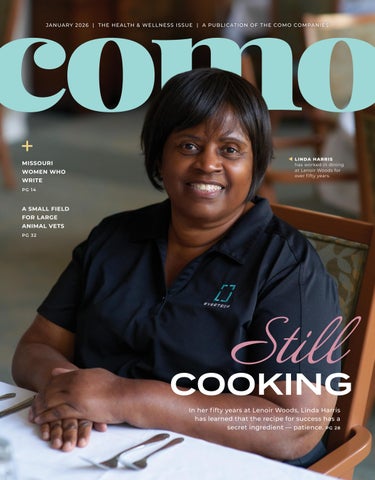
L INDA H A R R IS has worked in dining at Lenoir Woods for over f ifty years.
PG 14
A SMALL FIELD FOR LARGE ANIMAL VETS PG 32
Still
COOKING In her f ifty years at Lenoir Woods, Linda Harris has learned that the recipe for success has a secret ingredient — patience. P G 2 8
BOONE HEALTH CAN HELP YOU MAKE THAT HAPPEN! Come see us for a variety of preventative screenings: ■ Primary Care – Schedule an annual checkup or establish care with a new provider. • Broadway Primary Care: 573.815.8130 • Nifong Primary Care: 573.815.6640 • For other locations, visit Boone.Health ■ Cardiac Calcium Screening – Get your heart health checked. • 573.815.8150 (Note: There is a $100 fee for this screening.) ■ Lung Cancer Prevention Screening – Check with your doctor to see if you qualify for a CT scan to check for lung cancer. • 573.815.2873 for more information. ■ Mammogram/Pap Smear – Schedule your annual mammogram and pap smear. • 573.815.8150 to schedule a mammogram • 573.815.8277 for information about our breast health services. ■ Colonoscopy – Colorectal cancer is the second leading cause of cancer deaths in the U.S. • 573.815.8150 to schedule a colonoscopy. 1600 E. Broadway, Columbia, MO 65203 | 573.815.8000 | www.boone.health
comomarketing.co
/comomarketing
573.577.1965
@comomarketingco
Rooted in Mid-Missouri Growing With Columbia
4601 Stellar Dr Columbia, MO 65201
573-998-8900
midambk.com
IF YOU’RE READING THIS,
PRINT IS NOT DEAD!
COMOMag-HouseAd-PrintIsNotDead.indd 1
10/23/20 9:53 AM
Magazine ads provide higher comprehension and recall than any other media. And best of all, magazines show the highest return on your advertising spend. Advertising in our magazines will yield an increase in your brand awareness, brand COMOMag-HouseAd-PrintIsNotDead.indd 1 10/23/20 9:53 AM favorability, and purchase intent.
PUBLISHING David Nivens, Publisher
david@comocompanies.com Chris Harrison, Associate Publisher
chris@comocompanies.com EDITORIAL Jodie Jackson Jr, Editor
jodie@comocompanies.com Kelsey Winkeljohn, Associate Editor
kelsey@comocompanies.com Karen Pasley, Contributing Copyeditor DESIGN Jordan Watts, Senior Designer
jordan@comocompanies.com MARKETING Charles Bruce, Director of Client Relations
charles@comocompanies.com Kerrie Bloss, Account Executive
kerrie@comocompanies.com CONTRIBUTING PHOTOGRAPHERS
Keith Borgmeyer, Lauren Crosby, First Chance For Children, Andy Hill, Hoss Koetting, Jill Luther, MU School of Veterinary Medicine CONTRIBUTING WRITERS
Casey Barwick, Barbara Buffaloe, Jodie Jackson Jr, Hoss Koetting, Madeleine Leroux, Roger McKinney, Brian Neuner, Karen Pasley, Stephi Smith, Kelsey Winkeljohn SUBSCRIPTIONS
Magazines are $5 an issue. Subscription rate is $54 for 12 issues for one year or $89 for 24 issues for two years. Subscribe at comomag.com or by phone. COMO Magazine is published monthly by The COMO Companies. OUR MISSION STATEMENT
COMO Magazine and comomag.com strive to inspire, educate, and entertain the citizens of Columbia with quality, relevant content that reflects Columbia’s business environment, lifestyle, and community spirit. Copyright The COMO Companies, 2025 All rights reserved. Reproduction or use of any editorial or graphic content without the express written permission of the publisher is prohibited.
CONTACT US TODAY TO BEGIN THE CONVERSATION.
FEEDBACK
Have a story idea, feedback, or a general inquiry? Email our editor at Jodie@comocompanies.com.
5 7 3 - 5 7 7- 1 9 6 5 | c o m o m a g . c o m
CONTACT
COMOMag-HouseAd-PrintIsNotDead.indd 1
4
JANUARY 2026
10/23/20 9:53 AM
The COMO Companies | 404 Portland, Columbia, MO 65201 573-577-1965 | comomag.com | comobusinesstimes.com
Letter from the Associate Editor
The COMO Mojo: Wellness Wake-Up Call
How often did we brush off what our parents told us? Wrote it off as overprotectiveness, outdated thinking, or just plain nonsense? How often did we believe we knew better? One lesson I heard over and over was that life passes quickly. It never felt true when I was a curiosity-driven kid who could stretch a single afternoon into a whole adventure. But now, as I fl ip to January 2026 on my desk calendar, I’m suddenly aware that I graduated nearly three years ago and that I’m not far from the age where people joke about a quarter-life crisis. Turns out, they weren’t lying. Lately, I’ve also been thinking about how fragile life really is. My mom visited over Thanksgiving this year — something we’ve never done before for the holidays. We rented a small “cottage” (that was the word Airbnb used, though I’m not quite sure it really qualified as one) just outside of Columbia and spent a few days watching movies on the projector she brought, crafting, and bingeing on our Thanksgiving leftovers. It was simple, slow, and unexpectedly healing. On one of our drives into town, she mentioned how much can change in just a decade — and we began counting. Two uncles. An aunt. A grandfather. A grandmother. Several cousins of hers. Friends who felt like family. All gone. Many of them were under sixty. And then, just days after this conversation, we learned that another family member had died unexpectedly at fi fty-nine. Only a month earlier, I’d read that an old classmate of mine passed away at just twenty-three due to a medical emergency. When we picture our fi nal years, we like to imagine ourselves as soft and wrinkled, smelling faintly of cookies, carefully handwriting birthday cards, and signing them with a gentle XOXO. It’s sobering to realize how fragile life and health can be, no matter our age. But the truth is that longevity isn’t guaranteed. And as proud as I am of the person I’ve become and the milestones I’ve reached, I also know that I want to be more intentional about my own well-being — not someday, but now. Not everyone is lucky enough to grow old. Not everyone gets the luxury of “later.” And that’s why health and wellness matter, in all their forms. Caring for your body. Caring for your mind. Caring for the relationships that anchor you. Choosing work that doesn’t drain your spirit. Finding movement you enjoy. Eating meals that nourish you — and sometimes meals that simply bring you joy. Paying attention to the habits that make you feel genuinely well, not just “healthy” by someone else’s defi nition. We don’t get to control how long we have, but we can choose how we care for ourselves with the time we’re given. Let’s make the most of it. Cheers to 2026, and please enjoy our “Health & Wellness” issue!
A bright orange sunset paints the midwestern sky — the view f rom our Airbnb.
ON THE COVER Linda Harris marks over f ifty years as a beloved cook at Lenoir Woods. Photo by Keith Borgmeyer
KELSEY WINKELJOHN A S S O C I AT E ED I TO R kelsey@comocompanies.com
COMOMAG.COM
5
COMO
ADVISORY BOARD
COMO ’ S ADVI SORY BOAR D We take pride in representing our community well, and we couldn’t do what we do without our COMO Magazine advisory board. Thank You! Heather Brown Strategic Partnership Officer, Harry S Truman VA Hospital
Emily Dunlap Burnham Principal Investigator and Owner, Missouri Investigative Group
Laura Johnson Writer
Laura Schemel Director of Marketing and Communications, MU Health Care
Art Smith Tootie Burns Artist and Treasurer, North Village Art District
Author & Musician, Retired
Megan Steen
Chris Horn
Chief Operating Officer, Central Region, Burrell Behavioral Health
Principal Treaty Reinsurance Underwriter, American Family Insurance
Nathan Todd
Jeremiah Hunter Assistant Police Chief, Columbia Police Department
Business Services Officer, First State Community Bank
Casey Twidwell Community Engagement Manager, Heart of Missouri CASA
Kris Husted
Wende Wagner
Investigative Editor, NPR Midwest Newsroom
Development Manager, DeafLEAD
Have a story idea, feedback, or a general inquiry? Email Jodie@comocompanies.com. 6
JANUARY 2026
como | THE HEALTH & WEL L N ES S I S S UE
January 2026
IN THIS ISSUE
4 MASTHEAD
5 LETTER FROM THE ASSOCIATE EDITOR
6 ADVISORY BOARD
8 CREATURES Have Scalpel, Will Travel
10 FRIENDS & FAMILY Mid-Mo's Mahjong Moment
13 NONPROFIT SPOTLIGHT The Diaper Dilemma
16 THE GAME PL AN A Football Life
20 THE SCENE Craf t, Creation, Community
FEATURED
32 A SMALL FIELD FOR LARGE ANIMAL VETS Mizzou makes headway in training the next crop of animal doctors.
28 'LIKE A BIG FAMILY' Fifty years later, Linda Harris keeps the meals coming at Lenoir Woods.
23 GUEST VOICES Barbara Buf faloe
24 COOKIN' WITH HOSS Fajita Chicken
38 AS SEEN ONLINE
39 THE L AST WORD
COMO
CREATURES
Have Scalpel, Will Travel Mobile vet surgeon calls Columbia home base. BY JODIE JAC KSO N JR 8
JANUARY 2026
E
ven before the COVID pandemic altered the way businesses do business, Dr. Jill Luther was hatching an idea for the University of Missouri School of Veterinary Medicine to offer mobile animal surgery services. As that concept grew to fruition, the university and the vet school were making budget cuts, and adding mobile vet surgery didn’t make the cut. Instead, Luther evaluated the analysis and plan she fashioned, ended her sevenyear teaching stint at the vet school, and started Heartland Veterinary Surgery in 2021. Now, nearly five full years later, Luther has provided soft-tissue and cancer
COMO
surgeries for scores of dogs and cats, taking her mobile service to area veterinary offices. She often performs surgeries that are beyond the expertise of other veterinarians, which typically means those pets and their people are referred to the MU vet hospital for advanced care. Based in Columbia, Heartland is a mobile service offering advanced vet surgery services to Columbia, Jefferson City, Lake of the Ozarks, Kansas City, St. Louis, and beyond, usually within a two-hour drive. “There needed to be something in the middle, between a spay and neuter clinic and very expensive, often unattainable advanced specialty care,” Luther said. “And that’s the niche that I fill.” “Mobile” does not mean she drives from place to place to perform surgery in a van. Rather, she brings her own equipment to veterinary offices and uses the staff there for support and anesthesia services. The referring vet pays Luther, and the pet parent pays the vet. Luther said her costs are lower than a specialty or advanced care center, which has to cover extensive overhead expenses. She also provides free consultations to veterinary clinics and offers on-site surgical teaching for a fee. “I do feel like I’m an educator at heart, and that’s what I still do with seasoned practitioners who want to learn new techniques,” she explained. “I’m a lifelong learner, too. I learn from them and they learn from things I do. When I was in a brick-and-mortar specialty practice, there was very little contact with the referring practitioner. Now, it’s all about the contact and the communication.” Luther grew up in a home that had cats — no dogs — and, according to her mother, Luther wanted to be a veterinarian. However, Luther, who was a ballet dancer in her formative years, with a continued affinity for musical theater, started college as a pre-med student at Missouri State University in Springfield. An ecology class her junior year sparked an interest in animal health, and she envisioned a career with the United State Department of Agriculture or a similar organization at the intersection of human and animal health. Along the way, she developed a passion for surgery and small animals, leading to enrollment at MU, where she was
a student, vet hospital resident, and then vet school faculty member. Also during that time, she completed a small animal internship at the Animal Medical Center in New York and, after completing her surgical residency at MU, performed orthopedic, soft-tissue, and neurosurgery in private practice in St. Louis. One especially memorable stretch involved working in a cat-only clinic. “I love the environment of a cat clinic,” Luther said. “There’s no chaos. You can’t be chaotic and loud, or the cats will go crazy.” With little prompting, she added with a laugh, “Crazier.” Her pet clientele has ranged from a 2-pound kitten to a 200-pound Great Dane. She also see “a lot of cute Frenchies,” referring to the growing popularity of French bulldogs. “And they all have different attitudes, too. Sometimes they’re sweet as pie,” she said. “Sometimes they are a bit more spicy.”
CREATURES
star of its rescue dog organization. There was also the German shepherd mix that had eleven socks in its stomach. Luther removed the socks. She has also operated on a chinchilla and other “pocket pets,” though that is not her specialty. The experience with the animal clinic in New York gave her exposure to exotic pets like snakes and birds. Luther is also familiar with the difficult and often heart-wrenching decisions that pet parents face when weighing the cost of care versus the animal’s best interests. She is often asked, “What would you do, doc?” “My values might be different than theirs, so when it comes time to advocate for your pet, there is a financial consideration, yes, but it’s also about what is best for the pet,” she said. “It’s a delicate balance. I try to help them. If they haven’t already had those conversations, that’s what I try to guide them to do. That conversation is more valuable than the surgery I do.”
“There needed to be something in the middle, between a spay and neuter clinic and very expensive, often unattainable advanced specialty care. And that’s the niche that I f ill.” That’s a seemingly subtle but important distinction for Luther’s mobile vet surgery service, because taking a cherished pet to its regular veterinary clinic instead of having the pet transported to a specialty hospital means less stress and a more familiar environment for the animal. There have been some memorable surgeries, too. During her time at MU’s veterinary hospital, she operated on a dog to remove a fifth leg. The fifth leg, located near the tail, had part of a pelvis and other leg structures, but it was nonfunctional. Further examination showed the dog had two bladders and two urethras that needed to be reconstructed into one, and the canine had a heart defect. “It was a crazy case,” Luther said, noting that the furry patient was “a super white fluffy Samoyed” that became the
Luther’s website notes that her nonclinical interests have evolved into helping others recognize and combat compassion fatigue and stay committed to veterinary medicine. Her family includes her husband, Wally, a teacher and builder, and kids Walter, 14, Millie, 13, and Oliver, 9. Together, they enjoy fixer-upper homes, traveling, “and a controlled, chaotic life of four cats, a spazzy mixed breed dog named Raspberry, and Scarlett, the Mini Aussie who herds everyone.” As her practice grows and the miles from Columbia and Kansas City or St. Louis continue to add up, Luther is especially eager to establish and nurture more connections with Columbia and central Missouri veterinarians. She added, “I want to serve the community where I live as much as possible.” COMOMAG.COM
9
COMO
FRIENDS & FAMILY
Mid-Mo’s Mahjong Moment A centuries-old game is becoming Columbia’s go-to social outlet. BY MADELEINE L E R O UX | PH OTO S PR OVI DED BY L AU R E N C R O S BY
A
s Columbia’s social calendars shift and families settle into new routines, one activity keeps coming up in conversations among local moms: mahjong. Classes are full, groups are forming, and a weekly league has taken root, all driven by people looking for connection, focus, and a hobby that fits into busy lives. As interest in American mahjong has grown in Columbia, many players have found their way into the game through local lessons or informal groups.
LEARN BY DOING
Lisa Schieber, a former teacher who splits her time between Dallas and Columbia, first began offering lessons after falling in love with the game herself. She completed a certification through Oh My Mahjong and opened her schedule to private lessons, family groups, and classes. “It kind of started big in Dallas, and I always had my Columbia information on the Oh My Mahjong site, and I just kind of waited,” Schieber said. Finally, over the past year, things started picking up locally. After teaching at a shop at Lake of the Ozarks, she received a call from Tin Roof gift shop asking whether she could offer classes there. Those sessions now fill easily, and she’s expanding into beginner strategy lessons and guided play for returning students. Her teaching approach breaks the game into three manageable steps: learning the tiles, learning the annual National Mahjong League card, and then practicing hands. Many students walk in knowing nothing, often nervous after only seeing the computer matching-tile game or videos of fast-paced play online. The turning point usually comes fast. “The best part is when they play a game and they get mahjong,” she said. “Two hours ago, they didn’t even know how to play.” 10
JANUARY 2026
COMO
FRIENDS & FAMILY
A LEAGUE OF THEIR OWN
For Lauren Crosby, her path into mahjong teaching and organization started with an introduction from a friend visiting from Dallas. She didn’t consider herself a “game person,” but after a few rounds, she immediately wanted to keep playing. When she discovered Columbia didn’t yet have a consistent mahjong community, she taught herself through videos and phone calls, then began teaching friends so she’d have more people to play with. “Honestly, it’s just been organic from there,” Crosby said. Interest spread quickly. Small lessons turned into birthday-party requests. Friends asked if she would organize something more formal. She noticed the same barrier popping up repeatedly: People wanted to play, but they didn’t want the responsibility of coordinating four players, managing substitutes, or committing to every session. So she tested the idea of a weekly league. She rented a room through the Country Club of Missouri, posted a simple invitation on Instagram, and assumed it might draw a handful of people. Instead, Crosby had so many signups in less than twenty-four hours that she had to take the post down. Her league now hosts six to seven tables most weeks, with a mix of stayat-home moms, part-time workers, retirees, and full-time professionals who shift their lunch hours to attend. Crosby sets up tables and tiles in advance, sends weekly RSVPs, and handles substitute coordination so players never feel pressure to show up every time. Her goal was to design something she would have been able to participate in when her children were younger: flexible, welcoming, and easy. “It hits this window right when Mother’s Morning Out programs are going on,” she said. By holding the league during that block, stayat-home moms can attend, as can moms who only have child care for a few hours. The timing also works for working moms who can shift their lunch hour. “I just wanted everyone to have the opportunity, but I wanted it to be easy.” COMOMAG.COM
11
COMO
FRIENDS & FAMILY
THE RIGHT MIX OF STRUCTURED AND FLEXIBLE, OLD AND NEW
The simplicity of that format — show up when you can, stay for a couple of hours, learn as you go — may be one of the biggest reasons the trend has grown so quickly. Both Crosby and Schieber noted that new players often feel intimidated until they realize the environment is meant to be social, not formal. Crosby keeps her initial teaching short, then gets people playing right away. She encourages each table to set its own “house rules,” a contrast to tournament-style groups that follow every detail strictly. Schieber teaches practical etiquette and pacing so beginners feel confident, but she also emphasizes that the game becomes enjoyable long before every rule makes sense. For many players, mahjong has become a needed break, structured enough to feel engaging, but relaxed enough to feel restorative. The tiles require focus, which naturally pulls people into the moment. Phones stay down, questions get asked and answered, and conversations unfold naturally at the table. Crosby has seen interest spread well beyond her immediate circle. She taught her own kids, and her friends’ children have joined in at home. Many adults also mentioned remembering a grandmother’s set from childhood, something familiar but never explained, which makes finally learning the game feel both new and nostalgic. Across both lessons and league play, Schieber and Crosby said the same thing: People are looking for something social that doesn’t require a big time commitment or strict structure. Mahjong fits easily into busy routines, offers a clear place to start, and gives people a manageable way to spend time with other adults. For beginners, getting involved is easy. Schieber offers recurring classes at Tin Roof and teaches private groups. Crosby is expanding her Friday league and continues to offer small-group lessons. Both share updates on Instagram and welcome people who have never touched a mahjong tile before. Their message is the same: Don’t overthink it. You learn mahjong by playing it. And in Columbia right now, plenty of people are ready to pull up a chair. Learn more or join a game by following Schieber at @mahjongwithlisa or finding her through ohmymahjong.com, or by following Crosby at @mahjongcomo or emailing her at laurencrosby3505@gmail.com. 12
JANUARY 2026
Your trusted mid-Missouri mobile veterinary surgeon. At Heartland Veterinary Surgery our purpose is to provide the best surgical experience possible. Dr. Luther brings over 15 years of expertise as a boarded surgeon into your trusted local veterinary clinic where you and your pet are known and loved. We offer a variety of advanced soft tissue procedures such as ear canal ablation, surgery of the abdomen and urinary tract, and many types of cancer surgery.
Scan the QR code to visit our website!
www.heartlandvetsurgery.com
A very special thank you, Marc
Marc is known for his kindness and patience with both customers and coworkers. He is always willing to jump in to learn knew tasks and has shared his knowledge with other team members. Marc’s desire to learn and help others is a true asset to the team, and his initiative, reliability, and positive attitude set a high standard for all of us.
A Division of The Central Trust Bank
573-874-8100 • centralbank.net/boonebank
COMO
NONPROFIT SPOTLIGHT
The Diaper Dilemma How First Chance for Children is meeting a growing crisis for Missouri families. BY CA S EY B A R WI C K
F
irst Chance for Children (FC4C) hands out nearly 400 packages of diapers directly to mid-Missouri families each month. In November, that number doubled, as the U.S. government shutdown impacted financial assistance. In just forty-eight hours, FC4C distributed more than a third of its typical monthly supply, with more families calling every day. “What we are witnessing is no longer simply a financial hardship; it has become a mental health crisis for parents who are unable to provide food or diapers for their babies,” FC4C Executive Director Gay Litteken said in a news release. “The stress, fear, and uncertainty our families are experiencing right now is profound.” Litteken said that without support, many families are left overwhelmed and embarrassed over their financial situations. That stress can worsen if children’s needs aren’t met, especially when it comes to diapers, baby formula, and diapering supplies. Diapers are essential goods, yet unlike groceries, they are not covered by the Supplemental Nutrition Assistance Program. SNAP is a government program that allots money to low-income individuals whose household gross monthly income is at or below the poverty line requirement. If approved, applicants are given an electronic benefit transfer (EBT) card, which can be used to purchase groceries. During the government shutdown, many government assistance programs were frozen. That resulted in many families no longer having the extra support SNAP gives them each month, which meant that money had to be cut from other areas of the family budget. COMOMAG.COM
13
COMO
NONPROFIT SPOTLIGHT
One of those areas was child care essentials. A single box of diapers can cost from $30 to $50, which, for the average working-class citizen, can be more than an hourly wage. Across Missouri, the consequences show up quickly. Some parents might try stretch diapers longer than recommended, which can lead to diaper rash, infections, and emergency room visits. But it also affects the adults in the home. Without a reliable diaper supply, parents might be unable to drop children off at day care, since state and private child care facilities require families to supply diapers. This means many parents could lose hours at work or risk losing their jobs entirely. And it’s why FC4C’s Baby Bags Diaper Bank has had an increase in requests for assistance. Litteken said rural areas often see the highest need due to fewer supply resources, longer travel distances, and higher child care barriers. To counter those issues, FC4C partners with several agencies across thirteen counties to make assistance more accessible. FC4C’s Baby Bags program distributes diapers, wipes, formula, and hygiene items to families across Audrain, Boone, Callaway, Cole, Cooper, Howard, Marion, Moniteau, Monroe, Osage, Ralls, Randolph, and Sullivan counties. The organization’s home office is at 1002 Fay St. in Columbia. Working in tandem with local partners, the program provides supplies to families who fall at or below 200 percent of the poverty line and have children aged 0-5. FC4C partners with the following distribution agencies to supply diapers to families in need: • California Parents as Teachers • Chamois Parents as Teachers • Columbia/Boone County Public Health Department • Central Missouri Community Action
• Jefferson City Parents as Teachers • Johnston Early Learning • Lutheran Family and Children’s Services • Prairie Home Parents as Teachers
• City of Refuge
• Refugee & Immigration Services
• Columbia Housing Authority
• Serve Inc
• Columbia Parents as Teachers • Fayette Parents as Teachers • Fulton Parents as Teachers • Great Circle • Harrisburg Parents as Teachers 14
• Healthy Steps
JANUARY 2026
• South Callaway Parents as Teachers • Sturgeon Parents as Teachers • Tipton Parents as Teachers • True North • Voluntary Action Center • Welcome Home
COMO
NONPROFIT SPOTLIGHT
First Chance for Children B OARD OF DI RECTOR S • Shelley Robinson, president • Mike Mouser, treasurer • Kara Amann-Kale, secretary • Alexandria Otis, director • Gena Scott, director • Abby Carpenter, director • Tyler Peasel, director • Jennifer Martin, director • Brandi Schumacher, director B ABY BAGS PROGRA M Qualifying families can get supplies once a month from the Baby Bags diaper bank program by going to the First Chance for Children office during regular drop-in hours or by calling to schedule an appointment. FC4C is located at 1002 Fay St. in Columbia. Items are also available through partner agencies in Audrain, Boone, Callaway, Cole, Cooper, Howard, Marion, Moniteau, Monroe, Osage, Ralls, Randolph, and Sullivan counties. The Baby Bags supplies are intended for children from birth to age 5 who are from families that fall at or below 200 percent of the federal poverty line, or those who otherwise qualify based on need. Call 573-777-1815 for details. Baby Bags may contain: • Diapers: One package of approximately twenty-five diapers and wipes per age-eligible child. • Home and health items: Two items per family. Typical items in stock include baby shampoo, diaper cream, dish soap, and baby lotion. • Smart Start Kit: A kit including diapers, wipes, healthcare kit, home childproofing kit, bathwater thermometer, infant onesie, community resources, and child safety information.
For those interested in joining the cause, FC4C encourages donations. Donations can be made between 9 a.m. and 3:30 p.m., Monday through Friday, at FC4C’s Columbia location. Supply donations could include diapers (sizes 4, 5, and 6), pull-ups (sizes 3T–5T), baby wipes, formula and baby food, baby hygiene essentials, and cleaning supplies. Monetary donations, which can be made online, are especially encouraged since the organization can buy products in bulk. FC4C also has a government connection through the Missouri Diaper Bank Tax Credit Program, which offers a 50 percent state tax credit for donations of $100 or more. A $500 gift results in a $250 tax credit, a $1,000 gift results in a $500 tax credit, and so on. The tax credit is available to corporations, financial institutions, S-corp shareholders, partnerships, and individuals. Apart from its diaper program, FC4C has several other child and family welfare programs, including: • Baby U — a multi-week educational program for expecting and current caregivers that emphasizes bonding, development, and healthy parenting practices. It is available to Boone County residents. • Lend & Learn Play Centers — free play spaces offering toys,
socialization opportunities, and caregiver support. Locations include indoor and outdoor play, events, and supply assistance. • The Safe Cribs program — supplies cribs, sheets, and onesies to infants aged 0-1, alongside safe sleep education. These programs work together to address the overlapping challenges families could face, including child care needs, postpartum stress, developmental delays, financial strain, and social isolation. Litteken emphasized the importance of not just providing aid but building trust and relationships with families. One such relationship-building opportunity was a meal FC4C hosted during the month of November. “We called it Wacky Waffle Wednesday,” she explained. “My amazing team said, ‘What can we do to lift people’s spirits and bring them together?’ We provided them a meal, and they connected.” Litteken added, “There is a lot of fear out there if you are a parent and you cannot afford the basic needs. We want to be able to help them. If they come in for diapers and wipes, there is probably a need for something else. That’s where we establish that relationship and talk about what other resources we could connect them with.” COMOMAG.COM
15
COMO
THE GAME PL AN
A FOOTBALL LIFE The journey of Andy Hill. BY BRIAN NEUNER
Editor’s note: This is part one of a twopart story about former Mizzou football and Kansas City Chiefs assistant coach Andy Hill, now enjoying post-gridiron life in Columbia.
N
estled in the Green Hills region of northern Missouri sits the small town of Trenton. It’s the county seat of Grundy County and was once the world’s largest producer of Vienna sausages. Eventually Trenton lost that title to larger cities. Still a charming community with a population of about 5,600, Trenton may now be best known as the hometown of Missouri Sports Hall of Famer Andy Hill. Born in 1962 to Richard P. and Patsy Hill, Andy grew up in an environment where asphalt playgrounds, basketball courts, baseball diamonds, and football fields were a constant invitation to play. Joined by Rich, his younger brother by three years, Andy quickly connected to almost every sport he could find. “In Trenton, you are outside all the time. Our dad fostered opportunities to fish, hunt, and play sports,” he explained. “Rich and I just jumped in and had fun.” From an early age, Hill’s athletic ability and fierce competitiveness were impossible to miss. “I was undersized my whole life, so I always wanted to show I could compete with anyone,” he said. Whether it was basketball, wrestling, football, golf, track, or American Legion baseball, Hill attacked each challenge with the same relentless drive that offset any size differential. The Hill brothers were extremely close growing up, and the bond became stronger when their mother passed away from 16
JANUARY 2026
cancer. Andy was 15 years old at the time; Rich was just 12. In the years that followed, the Hill trio were almost inseparable. “We just started doing everything together. Our dad was an outdoorsman, and we followed his path.” That path, which was part unpredictable and part inevitable, guided Hill toward three constants in his life: loyalty to his hometown, devotion to Missouri football, and a lifelong passion for the Kansas City Chiefs. “Growing up, I was surrounded by relatives, including my dad, who all attended
the University of Missouri. The Chiefs were our favorite pro football team, and it was natural to follow both,” recalled Hill. “My seventh birthday was the same day the Chiefs won their first Super Bowl in 1969. I had a Chiefs Super Bowl sweatshirt, and I can remember wearing it everywhere” — a possible foreshadowing of what would come later in his career. T R E N TO N TO T IG E R TOWN
By his senior year at Trenton High School, Hill had emerged as a standout running
COMO
THE GAME PL AN
Hill always knew he was playing for more than himself. Trenton was part of his identity. He would compete in three bowl games; the final one came in 1983 when the Tigers faced future NFL Hall of Famer Steve Young and the Brigham Young University Cougars in the Holiday Bowl. The Tigers led 17-14 late in the fourth quarter, but with 23 seconds remaining, BYU called a “flea-flicker” play that saw Young score the game-winning touchdown. It would be Hill’s last bowl game as a Tiger, but far from the end of his journey in college football. CU E S TO COAC H
back. His teammate and close friend, quarterback Brad Perry, was drawing interest from the University of Missouri football staff. “Brad went on an official visit to Mizzou, and I just tagged along,” Hill explained. “Clay Cooper was the Missouri football recruiting coordinator, and his focus was on Brad. I already knew I was going to MU for college, so I asked Coach Cooper if I could walk on. He was familiar with my ability, and he said yes.” Once the pair arrived in Columbia in the fall of 1980, they entered a world of the unknown. “We were wide-eyed, not knowing what to expect. Had it not been for seniors like Phil Bradley, Howard Richards, and Eric Wright making sure we felt like part of the team, I’m not sure when I would have fit in,” Hill said. The 5’9” walk-on wasn’t even sure what position he was going to play. After a rotation of position meetings, he landed with the receivers. As a walk-on, that meant starting at the bottom of the depth chart. “The summer before I went to Mizzou was extremely hot. Back in Trenton, I worked outside all day. A quick round of golf in the early morning, coaching Legion baseball from 9 a.m. until noon. Lunch break, then we had to prepare the baseball fields for the games that night where we would umpire until 10 p.m. We did that every day.”
Those long, exhausting days became an unexpected advantage when Missouri’s grueling two-a- day practices began. “I was used to it. I could do 50 reps and not feel tired.” Hill said with a smile. “I started out at the bottom, seventh string on the depth chart. As the weeks went on, guys couldn’t handle the high temperatures, especially when we practiced in full pads. As they dropped off, I kept climbing and outworking the other receivers. By the time the season started, I was MU’s second-string receiver, and I got to play in the first game my freshman year.” Hill’s rapid rise resonated throughout Trenton. “There’s an underdog mentality baked in at a young age. There is an eagerness to prove that even though you came from a little dot on the map, you can do great things and compete with the best at whatever it is you love to do,” explained Trenton native Joe Walljasper. “So, when one of your own actually does it, like Andy did, everyone in town felt a little pride in that accomplishment.” Head coach Warren Powers took notice, making Hill a key part of the Tigers offense over the next four seasons. Highlights included a 10-0 win in 1983 over powerhouse Oklahoma, a tilt that saw him score the only touchdown of the game. “When I was a kid, just hearing Andy Hill and Trenton, Missouri, on the radio broadcasts was a huge thrill,” Walljasper remembered.
Coaching wasn’t initially on Hill’s radar, though others saw his potential long before he did. During his senior season, Missouri assistant coach Jim Donnan, who would later become the head coach at Georgia, told Hill he should pursue the profession. Other Missouri assistant coaches, including Mike Price, Clay Cooper, and Mike Wade echoed the same encouragement. Even friends outside of football did, too. Missouri basketball great Jon Sundvold once told him, “If I ever have kids, I would want you to coach them.” But Hill hesitated, largely because he had seen firsthand how unstable the profession could be. “Coach Powers was Andy’s head coach,” explained his wife, Sarah. “He led those teams to three bowl games and was named AP National Coach of the Year in 1983.” A year later, after tallying a 3-7-1 record, he was fired. Hill was a senior in that campaign, and Powers’ sacking brought home to him the volatility of the coaching profession. After he and Sarah married in July 1992, career considerations were now joint decisions, and together they decided he should explore other options. He worked at American Bank, Edward D. Jones, and Learfield Communications. He did well, but something was missing. “Money was not a motivator for me,” Hill said. “The ability to compete was the driving factor.” Football still provided that spark, and coaching connections brought him back to the sport he loved. While Hill was running the Edward Jones office in Brookfield, Missouri, he connected with Sam Pittman, COMOMAG.COM
17
COMO
THE GAME PL AN
then the head football coach at Trenton High School. Pittman joined the chorus of people urging Hill toward coaching. He finally took the leap, starting humbly as a volunteer coach at Southern Methodist University under one of his former coaches, Mike Wade. Meanwhile, Pittman was named the head coach at Hutchinson Community College in Kansas. Pittman, who later became the head coach of the Arkansas Razorbacks, hired Hill as the team’s offensive coordinator. Those early years in coaching ignited his passion for the profession. When Pittman moved on, HCC promoted Hill to head coach in 1994. With his outgoing personality, extraordinary ability to relate to people, and deep understanding of the game, Hill took the reins and led the Blue Dragons to success. Over two seasons, Hill’s teams had a combined record of 18-6, including a 10-2 campaign in 1995. The same year he was named the Kansas Jayhawk Community College Conference Coach of the Year. RELENTL E SS R EC R U I T E R
The term “great guy” became synonymous with the name Andy Hill. Kansas City Head Coach Andy Reid once said, “He is Mr. Missouri. He knows everybody, and when I say that, I mean everybody.” By 1994 Larry Smith was the head coach at Missouri. His head coaching experience stretched back to 1976, so he had plenty of connections to build his coaching staff. The first two seasons were shaky, as Smith and his staff tried to build inroads to keep the top in-state talent from going elsewhere. Since his arrival in Columbia, Smith was made aware of the talented young coach at Hutchinson Community College, a 32-yearold with head coaching experience, an appealing personality, and a reputation as a relentless recruiter. In 1996, Smith had an opening on his staff, and he hired Hill to coach Missouri’s wide receivers. Hill was back home, and a statewide enthusiasm followed. It seemed Reid’s assessment was accurate: Hill knew everybody, and he wasted no time engaging his connections. “Every high school coach in Missouri knew him,” said Sundvold. “He could walk into a room full of people, and by the time he left, he would have met everyone and 18
JANUARY 2026
called them by their name as he said goodbye. He has a presence that just draws people in. It’s impossible not to like him.” Hill wasn’t the only young coach Smith offered a career-changing move. Dave Toub, a carryover from the previous staff, was the team’s strength and conditioning coach. When the offensive line coach departed, Smith promoted Toub to that position. Toub and Hill would become fast friends while working together on the offensive side of the ball. “I just love that guy,” exclaimed Toub. “He is such a natural when he works with the players. They love and respond to him, too.” Student-athletes across Missouri found out firsthand that if Andy Hill was recruiting you, odds were, you would be committing to Mizzou. During his 24-year coaching career at Missouri, Hill signed some of the most productive in-state football players ever to wear the black and gold uniform. “Coach Hill was genuine, and you realized it immediately,” said former all-American defensive end Justin Smith. “Once I met him, I knew I was going to Missouri.” Smith would go on to set records at MU before becoming the fourth overall pick in the 2001 NFL draft. He played fourteen seasons in the NFL and still views Hill as one of his all-time favorite coaches. “The dude just outworked everyone,” Smith said. “He recruited back when it was really hard. No cell phones, texting, or instant highlights. He drove everywhere and met with recruits in person at their high
school and in their homes. Coaches, parents, and players just love him. That’s why he was so good.” He also had the ability to spot talent and find a way to connect. Kurtis Gregory is a perfect example. One day, Hill was recruiting in rural areas on the west side of Missouri. He stopped in at Santa Fe High School to say hello to the coach and get some names of possible D-1 caliber players. While looking for the football coach, Hill popped in on a freshman class without realizing it. He spotted an extremely large red-headed student who was folded up in a very uncomfortable position sitting at a tiny desk. “Who is that? Who is the big kid in the little chair?” asked Hill. The student was freshman Kurtis Gregory, who at age 15 was already 6’4’’ and weighed 250 pounds. There was a quick introduction, and three years later, Gregory signed a national letter of intent to play for Missouri. Gregory became a four-year starter and team leader on Missouri’s offensive line from 2005 to 2009. Today, the 39-year-old serves as a Missouri state senator. Gregory was known as a hard worker from a small town who always dreamed of playing football for Missouri. That sounds a lot like the coach who recruited him. It was a playbook Hill continued to follow. Not far from Santa Fe, another off-theradar recruit, Tim Barnes, was attending Northwest High School in Hughesville.
Barnes was another large Missouri farm kid whom Hill found, recruited, and signed. Barnes went on to anchor the offensive line on the Gary Pinkel squad that ranked in the top ten nationally in three categories: total offense, scoring offense, and passing offense. Tough, reliable, and with an attitude that no one could outplay him, Barnes was a larger version of Andy Hill. He would go on to play seven seasons in the National football league. TH E CHASE FO R CHA SE
It’s impossible to name every recruit Hill helped lure to Mizzou, but one of the most challenging gets was 6’5” tight end Chase Coffman from Raymore-Peculiar High School. Coffman was “it” when it came to top talent in the Kansas City area. He even won the Simone Award honoring the best high school athlete in greater Kansas City. Needless to say, Coffman was highly recruited. His father played eleven years in the National Football League after he graduated from Kansas State. And the Wildcats weren’t the only obstacle Hill had to overcome while recruiting the young star. “There was a lot of heat on Mizzou in the KC area. The media wasn’t friendly when reporting about the program,” Coffman explained. Hill found favor with Coffman and slowly diluted the false narrative he was hearing about Mizzou in the media. “He was so relatable. He cared and did a great job recruiting me and convincing
my dad that MU was the best fit for me,” Coffman said. “He would ask how my parents and girlfriend were doing. He got to know my whole family and the important people in my life. Andy never gave up.” The recruitment of Chase Coffman was Hill at his best. “Missouri already had an all-American tight end with Martin Rucker,” Sarah Hill said. “But Andy showed Chase how the two of them could coexist and be standouts at the same time.” It helped that Pinkel’s offensive scheme often featured a two tight-end set. “Being so young, it was one of the most difficult decisions of my life,” said Coffman. “Andy was genuine, aggressive, but not pushy. We connected.” When it came time to announce where he was going to play college football, Coffman’s father asked his son how he wanted to do it. “I’m going to commit to Mizzou, and I want to call Coach Hill and tell him first,” the younger Coffman recalled. Chase Coffman is regarded as one of the best tight ends to play at MU, along with Rucker, Kellen Winslow, Michael Egnew, Albert Okwuegbunam and A.J. Ofodile. All would play in the NFL. A PL AYER ’ S COAC H
Hill’s recruiting record often overshadowed his coaching ability, yet he was an effective and versatile coach. During his twenty-four years on the Missouri staff, he
variously served as assistant head coach, offensive coordinator, receivers coach, special teams coordinator, and quarterbacks coach. Ron “Rhino” Janes, a fullback at MU from 1993 to 1997, remembers Hill for his football knowledge. “His ability to diagnose an opponent’s game plan was unreal. He could pick out the small things … like a sign or some tendency a player showed. Then he would call a play to attack that weakness.” “One of my proudest moments of Andy coaching is his relationship with the players,” Sarah said. “I remember playing seventh-ranked Georgia in 2013. Our starting quarterback (James Franklin) had to leave the game with a shoulder injury. Maty Mauk was the backup, and he was a freshman. When James went out, I watched Andy walk over to Maty, put his hands on his shoulders, and calmly ask him, ‘What are you comfortable doing? We are only going to call plays you feel comfortable running.’” The Tigers simplified the offense to some degree but felt confident enough to call a trick play. On his first drive, Mauk connected with receiver Bud Sasser, who then threw a touchdown pass to fellow receiver L’Damian Washington for the game’s most memorable touchdown. Missouri upset Georgia in Athens that day. “You can never accurately gauge the overall impact Andy Hill has made on Missouri football,” Janes said. “He will always be a part of Mizzou.” COMOMAG.COM
19
COMO
THE SCENE
Craft, Creation, Community Missouri Women Who Write. BY KAREN PASLEY PH OTOS BY KELSEY WI N K EL JO H N 20
JANUARY 2026
A
s the autumn sun streamed through the windows of the Mount Nebo Inn in Rocheport, Sunitha Bosecker and Jessica Vaughn Martin mingled with attendees at Missouri Women Who Write’s fourth and final retreat of the year. It seemed fitting that the setting was a former church, as it was almost a year to the day that these two women, now MWWW’s co-leaders, were asked to take a fairly sizable leap of faith. Back on November 9, 2024, they were simply two of the roughly twenty writing enthusiasts who had gathered to hear Jennifer Gravley discuss the revision process and Anna Grey talk about character development. They expected they’d spend the morning learning from the presenters, working on their own writing, meeting other creative women, and eating some wood-fired pizza. What they did not expect was that, by the end of the day, MWWW’s future would be in their hands.
COMO
THE SCENE
“I think something special does happen when you gather women in a room, and especially women who are passionate about the same thing. And that’s writing for us.” — JES S ICA VAU G H N M A RTIN
Write could be of help as they put their creativity out in the world.” While she could see the value of the workshop model many writing groups adopt, Furstenau had another vision in mind. She conceived of Women Who Write as a series of half-day, presenter-led retreats that would allow women to take time out from their busy lives to indulge their creative pursuits and learn from other women writers about the craft of writing. “Often women don’t … make the space for themselves to do things like this,” Furstenau said, “so it just felt like a good opportunity to offer it.” Martin, who had been Furstenau’s student when she taught in MU’s Science and Agricultural Journalism program, agreed. When Furstenau told her she wanted to start a group for women writers in the area, Martin was all in. “I just thought that was really inspiring. I think something special does happen when you gather women in a room, and especially women who are passionate about the same thing. And that’s writing for us,” she said. THE HANDOFF THE BACKSTORY
Missouri Women Who Write — originally Women Who Write — was the brainchild of Nina Mukerjee Furstenau, a journalist, podcaster, entrepreneur, and author of everything from memoir to cookbooks. After the social disconnection of the COVID years, Furstenau said she “wanted a place where women writers could gather in support of creative work. I hoped the participants would realize in community how amazing their gift of writing is and that Women Who
At the group’s second gathering, Martin would discover how all in she was. It was at that retreat that she first met Bosecker, who had also known Furstenau for years. As Bosecker sat at one of Mount Nebo’s small, round tables drinking her coffee, Martin asked to join her, and the two began talking. At the day’s end, Furstenau approached the pair. “She comes up and says, ‘OK, since you had some time to get to know each other now, I would like to give this to you guys,” Bosecker recalled. “And I was like, ‘Wait, what?’”
Despite the unexpected nature of the request — and the brevity of their acquaintance — the two women soon came around to the idea. “That was our first interaction, but Nina has known that I’ve wanted to do this sort of thing for a while. So I was really grateful that she put it into our hands,” Martin said. One coffee date with the founder later, and Bosecker and Martin were off to the races. Where Women Who Write had been a casual affair, the two decided that the newly renamed Missouri Women Who Write should be more formally organized. They created an Instagram profile, a Facebook group, and a Substack newsletter to open the group up to more women who were interested in writing and seeking a supportive community in which to do it. BUILD IT, AND THEY WILL COME
Part of growing the group entailed increasing the number of retreats from two to four per year. Four seemed like a number that would allow the group to establish a rhythm but wouldn’t become overwhelming. “It just felt really great to know that you have this retreat coming up that’s going to be inspiring, is going to give you that sense of community once a season,” Martin noted. MWWW’s co-leaders have made a conscious effort to engage speakers on a variety of topics to appeal to the group’s diverse membership, which includes poets and novelists, journalists and short story writers, and everything in between. While the two have noticed that each retreat’s topic tends to attract a different mix of attendees, they feel that every speaker has valuable insights to offer any writer. COMOMAG.COM
21
COMO
THE SCENE
“I encourage women to attend regardless of the topic or speaker, because there is always something that you will walk away with, even if it just inspires the feeling of permission,” Bosecker said. If her attendance at three of this year’s retreats is any indication, Candace Robison Hulsizer would agree. She said she’s learned a lot from the mix of speakers and made valuable connections as well. More than that, though, Hulsizer — who is both director of City Preschool and owner of Black Tea Bookshop — treasures the time out to practice her craft among similarly inspired women. “I love the community and the concentrated, focused time to write. That doesn’t come easily in my daily life,” Hulsizer said. “I enjoy hanging out with other women writers who are juggling careers and family and are also committed to carving out time, filling this precious creative part of themselves, as I am.” Her friend Anna Cramer, a first-time attendee, echoed Hulsizer’s point, saying the MWWW retreat offered her the opportunity of “putting something on the calendar to relax and write in a room full of incredibly kind and talented people. Plus, it was a great motivator to get back into that creative space I’ve been missing ... or neglecting.” A WELCOMING SPACE FOR ALL
Providing that creative space for women writers of all genres, ages, and experience levels was exactly what MWWW’s co-conspirators hoped to achieve, and by all accounts, they have. The group’s retreats have attracted writers from as far away as St. Louis and Kansas City, and interest continues to grow. Although the two cap attendance at each event at around twenty to preserve an intimate, small-group vibe, their list of active participants is twice that number. For Bosecker and Martin, it all comes back to providing a welcoming environment for women writers wherever they are on their writing journey. Published or unpublished, seasoned professionals or fledgling self-expressers, all are invited to learn from and be inspired by the speakers, put their own words down on paper or screen, and build friendships over a breakfast Danish or a lunchtime slice of pepperoni. When asked what she would like Columbians to know about Missouri Women Who Write, Rock Bridge art teacher, aspiring novelist, and threetime participant Abbey Gorsage didn’t hesitate. “MWWW is open to all levels of experience, so there is no fear in joining,” she said. “It is a cozy, inviting group of women who want to find fellowship and support while embracing the writer sides of our lives. What a treasure to have it in our community.” 22
JANUARY 2026
COMO
GUEST VOICES
Working Together to Make Columbia the Place We Call ‘Home’ BY M AYOR BARBARA BUF FA LO E
T
he start of a new year always brings a sense of possibility. It is a natural moment to pause, reflect, and set intentions for what we hope to build together. As mayor, my greatest intention for the year ahead is simple and steady: to keep showing up, to keep listening, and to keep leading alongside you — no matter what the months ahead may hold. One of the most important lessons I have learned in public service is that meaningful leadership does not happen only behind a desk, inside council chambers, or at a press conference. It happens face-to-face, in conversations at community events, on neighborhood sidewalks, and in rooms filled with residents who care deeply about this place we call home. That is why continuing our in-person engagement work remains a top priority for me this year. Over the past year, I have been grateful for the honest dialogue that has taken place through our Let’s Talk Local events, budget town halls, and our Community Summit. These gatherings do more than share information — they build trust. They allow residents to ask hard questions, raise real concerns, and help shape the direction of our city. My intention for the coming year is to not only continue these efforts, but to strengthen them. I want to meet even more neighbors where they are, hear from people who may not always feel seen or heard, and make sure your lived experience continues to guide our decisions. Another central intention for this year is to remain grounded in the values that make Columbia, Columbia. We are a community that believes in looking out for one another. We value education, creativity, public service, and fairness. We care about opportunity and about protecting the most vulnerable among us. Those values are not abstract. They show up in how we invest in housing, how we support small businesses, how we care for our parks and public spaces, how we
respond to crises, and how we treat one another — especially when the world feels uncertain. And uncertainty is something we are no strangers to. Decisions made far from Columbia, in Washington, D.C., and Jefferson City, can have real and immediate impacts on our community. From funding shifts to policy changes, we often feel those ripple effects quickly and directly. My intention this year is to continue leading with steadiness and clarity through that storm — advocating for Columbia, protecting our local priorities, and working with partners across the region to ensure our city remains resilient. We cannot control every external force, but we can control how we respond. We can choose collaboration over division. We can choose facts over fear. We can choose to focus on practical solutions that improve daily life for our residents. And we can choose to keep our eyes on the long-term health and well-being of our community, even when short-term pressures feel intense.
As we step into this new year, I am deeply aware that progress is rarely loud or instant. Much of the most important work in local government is steady, patient, and sometimes unseen. But it matters. It matters when a resident feels heard. It matters when a small business finds support to grow. It matters when neighbors come together to solve a problem block by block. These are the building blocks of a strong city. My final intention for the year ahead is one of shared ownership. Columbia’s story is not written by one person or one office. It is written by all of us — by families, students, workers, business owners, volunteers, elders, and young people imagining what comes next. I am honored to serve alongside you in that work.
Barbara Buffaloe is currently serving her second term in office as the mayor of Columbia. COMOMAG.COM
23
COMO
COOKIN’ WITH HOSS
How to Overcome ‘Operator Error’: Fajita Chicken BY HOSS KOET TIN G
T
he new year has arrived, and you have survived another holiday season. The parties, the family get-togethers, the feasts, treats, and evenings of excess. It’s resolution time: time to cleanse and purge and make an attempt to drop those extra pounds that mysteriously appeared last month. But this requires effort, exercise, and eating right. That means denial of all that is tasty in favor of light, low-calorie fare, right? Not necessarily. One way to indulge your taste buds while still watching the calories is to enjoy — yes, I said enjoy — the ubiquitous boneless chicken breast. The chicken breast has been much maligned, and in some cases rightfully so. The No. 1 complaint is that chicken breasts are dry, stringy, and tasteless. If this is the case, the responsibility falls squarely on “operator error”! Just because chicken needs to be cooked to 165 degrees doesn’t mean you can continue to keep cooking it — au contraire. That’s the temperature at which it should be removed from the heat source. If you are diligent about this, your chicken breast will be moist and tender. The other knock on chicken breasts is that they are tasteless, and on this I will agree. To make the breast meat palatable, there are a plethora of marinades, seasoning blends, and sauces to elevate the flavor of the lowly chicken breast and raise its status to star of the dinner plate. Here is an idea to add flavor to your dinner without adding a ton of calories, which, admittedly, do come with the tasty cream sauces. It's a testament to the truth that culinary excellence doesn’t need to be complicated!
Jim “Hoss” Koetting is a retired restaurateur/chef who enjoys gardening, good food, good bourbon, and good friends. 24
JANUARY 2026
For a little different flavor prof ile, before removing the chicken f rom the grill, brush it with Thai sweet chili sauce (mae ploy), which is available in any Asian market and some grocery stores. Serve with f ried rice or Asian noodles.
INGREDIENTS
• Boneless, skinless chicken breasts (allow 6-8 oz. raw weight per person) • ½ cup soy sauce • ¼ cup lime juice • 1 Tbsp. per portion Hoss’s Southwest Seasoning
DIRECTIONS
1. If the breasts are thick, butterfly them first. This will allow the marinade to permeate the meat more thoroughly and allow them to cook evenly on the grill, avoiding the possibility of the breasts getting overdone, dry, and stringy on the exterior. 2. Mix the soy sauce, lime juice, and Southwest Seasoning, then place the chicken breasts and marinade in a ziplock bag large enough to hold the chicken with little space to spare. Let the chicken marinate at room temperature for up to 2 hours or in the refrigerator 2 hours to overnight. 3. Grill over moderate heat until meat in the thickest part is 165 degrees. Let rest, cut into strips, and enjoy with your favorite fajita or taco/burrito toppings.
WHAT THE
HOME
PROS KNOW
MIKE MESSER
SHELTER INSURANCE
BRENDAN ROST
ROST LANDSCAPING
COMOMAG.COM
25
SPONSORED CONTENT
WHAT THE
THE CONNECTION BETWEEN HEALTH AND LIFE INSURANCE By Mike Messer MMesser@ShelterInsurance.com
L
ife insurance helps ensure your loved ones are financially protected if something happens to you. While many factors influence your ability to get coverage and how much you’ll pay, your health is one of the most important. Insurance companies often require a physical exam to determine your rates, the amount of coverage you’re eligible for, and the types of policies you may qualify for.
Why Do Life Insurers Care About Your Health? When an insurance company writes a life insurance policy, they have to consider what type of risk a person is to insure. To help determine that, they need a way to estimate the person’s life expectancy during the coverage period. Since health is a primary indicator of life expectancy, underwriters use it to gauge risk—which is why they may ask you to get a physical. Generally, healthy individuals pose less risk and are offered lower premiums, while those with serious health issues may pay higher rates or may not be offered coverage. Health Factors That Affect Life Insurance Certain conditions can limit your choices and result in higher premiums for life insurance. Some of these are listed below:
AIC, LUTCF SHELTER INSURANCE®
PROS KNOW
With over two decades in the insurance industry, Mike Messer has served as a claims adjuster, supervisor, and underwriter, giving him a well-rounded understanding of how policies work when it matters most — before and after a loss. He prioritizes building relationships based on trust and personalized service, recognizing that every client’s needs are unique. Through annual policy reviews, he helps ensure clients stay informed, confident, and properly covered, providing them with peace of mind and financial security.
908 Rain Forest Pkwy Ste C Columbia, MO 65202 573-442-5291
affordable coverage because these choices can contribute to the chronic conditions listed above. • Current Health Status: Things like your blood pressure, cholesterol, and weight may be taken into consideration when you apply. • Age: Even though age isn’t exactly a health factor, it is tied to how long you’re expected to live, so it also matters.
• Medical History: If you have chronic conditions like diabetes, heart disease or cancer, insurers might see you as a higher risk, which could mean higher premiums. • Lifestyle Choices: Use of tobacco or nicotine substitutes, excessive alcohol consumption, or not exercising much can make it harder for you to get
Pre-Existing Conditions and Life Insurance Options If you have a pre-existing condition,
JANUARY 2026
HOME
®
Improving Your Health for Better Rates Making healthy changes can help you get a better life insurance rate. If you quit smoking, keep your weight in check and stay on top of any health conditions, your premiums may be lower. Sometimes if you make big improvements, you can retake a medical exam later and possibly get your premiums lowered.
26
MIKE MESSER
you can still get life insurance but your choices might be a bit more limited. There are specialized policies for people who don’t qualify for standard coverage. If you can’t get one of those, your agent might recommend a policy that may require more information from you for underwriting. These types of policies often come with higher costs and some coverage restrictions. Your health plays a vital role in qualifying for life insurance. Understanding how insurance companies assess your health when you apply for life insurance and taking proactive steps to improve your health can help you have a better idea of your eligibility and cost. Life insurance not only provides peace of mind, but also rewards healthy living with more affordable and comprehensive coverage. Shelter Life Insurance Company 1817 West Broadway, Columbia, MO 65218 The product information contained in this article is informational only and not a statement of contract. All coverage options are subject to the provisions of the policy purchased and details of the policyholder's situation.
SPONSORED CONTENT
USING SPECIMEN PLANTS TO TRANSFORM A LANDSCAPE
BRENDAN ROST
ROST LANDSCAPING
By Brendan Rost Find more at rostlandscaping.com
A
s designers, we’re often asked how to make a space feel more intentional. Clients often expect the answer to be complex but one of the simplest, most powerful tools in a designer’s kit is the strategic use of specimen plants. Specimens are those standout trees, shrubs, or perennials that anchor a space and instantly give it character. A specimen plant is more than something pretty; it’s a focal point with intention. In professional design, every landscape needs visual hierarchy. Without it, the eye wanders and the space feels unsettled. A specimen provides that immediate organizing force. The right specimen can define a space and provide an anchor point to build the rest of the landscape around. Choosing the Right Specimen The biggest misconception is that a specimen must be exotic or expensive. In truth, the right specimen is simply the one that creates impact. It could be a sculptural Japanese maple, a tasteful topiary evergreen, or even a common viburnum pruned in an eye-catching fashion. The key is distinctiveness: unusual form, striking texture, seasonal interest, or simply a strong emotional connection to the client. When selecting specimens, I consider three questions: 1. Will this plant hold visual weight all year? Great branching or evergreen structure matters. 2. Does it fit the scale of the space? Oversized plants overwhelm; compact forms can be just as dramatic. 3. Does the plant reinforce the design concept? Clean lines call for architectural species; woodland spaces thrive on soft textures.
WHAT THE
HOME
PROS KNOW
Brendan Rost is a Columbia native and son of Rost Landscaping owners Tim and Toby Rost. He grew up playing at the garden center and nursery and has worked in all divisions of Rost Inc. Brendan received his degree in horticulture and design from MU and now works as a designer in the landscaping division. He thrives on building relationships and creating unique landscapes that complement their space.
(573) 445-4465 ROSTLANDSCAPING.COM
Enhancing Architecture Through Planting One of the most effective—yet often overlooked—uses of specimen plants is to highlight architectural features of the home. Pros use plants almost like lighting or framing elements. A sculptural conifer can emphasize a modern home’s angular rooflines, echoing its geometry. A multi-stem tree with an airy canopy can soften a tall façade while drawing attention to beautiful stonework or an entryway. Even a strategically placed evergreen can balance asymmetries in the house’s structure, visually grounding the architecture. I often use specimens to create a living frame around key features: an arching tree near a picture window, or an upright shrub pulling the eye toward an impressive front door. The goal isn’t to hide the house—it’s to harmonize with it, giving the architecture a stronger presence in the landscape. Placement Is Everything Professionals rarely “scatter” specimens. We place them with purpose: • At pivot points where paths turn • As visual destinations
• In negative space, where their form can stand alone • Along architectural sightlines, echoing or enhancing the home’s shape Less Is More Too many statement plants compete with one another. One or two well-chosen specimens, supported by simpler plantings, create clarity and sophistication. The Power of One A single, thoughtfully placed plant can do more to elevate a landscape—and even the home itself—than a dozen impulse buys. That’s the quiet secret the pros rely on: sometimes the entire design hinges on one unforgettable plant. COMOMAG.COM
27
28
JANUARY 2026
‘Like a Big Family’ Fifty years later, Linda Harris keeps the meals coming at Lenoir Woods. BY STEPH I S MI T H | PHOTO S BY K E I T H B O R GM EYE R
L
inda Harris didn’t know how to boil water before she started her job as a cook at EverTrue Lenoir Woods. Lenoir Woods, located at 3710 Lenoir St., offers independent and assisted living care for seniors in Columbia. Dining services at Lenoir Woods include restaurant-style and buffet-style dining as well as quick snacks in a bodega-style market. Harris is a cook at Lenoir Woods, where she’s worked since the mid-1970s. She starts her day at 5:30 a.m. and begins with preparing the food, which she said typically consists of traditional American standards, like meatloaf and hamburgers for lunch and eggs and bacon in the morning. She said her goal is for residents to feel at home and noted most residents grew
up eating classic Midwestern meals. And the small sides Lenoir Woods offers, like fruit or soup, can make a big difference because sometimes, she explained, that’s all anybody has the appetite for at that time. Jake Risk, director of clinical nutrition, said it’s important to have healthy food that people want to eat at a retirement community center. He referred to food as “medicine” and noted that some residents may have special dietary needs, like low sodium, but still deserve to have access to food they enjoy. Harris’ role in the kitchen includes presenting the food, which she said is important because she wants to be sure residents have access to whatever they want and to feel comfortable asking for more.
Harris said she’s noticed residents are especially excited on Sundays, when the kitchen serves fried chicken for lunch, though some just prefer to eat the same thing every day, and Harris is quick to accommodate those residents. The best part of her job is seeing residents happy and comfortable. Harris said the residents at Lenoir Woods and her co-workers throughout the entire facility have been like a second family to her in the last five decades. “It’s just like a big family. I really enjoy working here,” she said. Jason Martin, director of dining services at Lenoir Woods, said Harris has been invaluable due to her personality and ability to work with residents as well as her talents in the kitchen. COMOMAG.COM
29
30
JANUARY 2026
“Me walking out the door, it’s really going to be a challenge. I cry about it every time I talk about it.” Harris said she feels as though she’s a major part of the residents’ lives in bringing them food five days a week. She said it’s crucial to be welcoming every day because the dining area is where some residents hang out for several hours, and she wants them to be comfortable. “They see me every day; we talk and laugh. I’m a familiar face to them,” she said. Her career at Lenoir Woods helped her later take care of her own mother, Harris noted. She highlighted the importance of autonomy for residents: Somebody may want breakfast as late as 11 a.m., and Harris said it’s her job to accommodate them, considering Lenoir Woods is their home. “You understand how to have patience with people,” Harris said. She started working at the retirement community center when she was 17 years old. As she nears retirement at age 69, Harris said she’s grateful for the last 52 years. She started as a weekend receptionist at Lenoir Woods and later became a server, then a cook, a baker, and supervisor for dining services. “Every time a job came open, I took it,” Harris said. Today, she is back as a cook and looking toward retirement, although she knows her last day won’t be easy. Her
co-workers are already telling her they’ll miss her. “Me walking out the door, it’s really going to be a challenge. I cry about it every time I talk about it,” she said. She’s had countless co-workers, some of whom have been alongside her for several years and some of whom didn’t fall in love with the job the way she did more than 50 years ago. Harris said she’s grateful for the other staff at Lenoir Woods, who were very patient in teaching her how to prepare and cook food for the residents she serves each day. “Everything I learned, it was from here. I couldn’t even boil water before. My mother wouldn’t let us in the kitchen,” Harris said. Harris did not expect to be with Lenoir Woods for 50 years when she was 17 years old. But she’s glad she was able to stay and make lasting relationships with her co-workers and the residents. “I tell the young ones now to make sure they get in the (retirement) program because you never know. You say you’re not going to be here, and you are, and then you retire with hardly nothing in your pocket,” she said. Harris’ next adventure will be a trip to South Africa, which she said she’s wanted to visit for most of her life. COMOMAG.COM
31
32
JANUARY 2026
A Small Field for Large Animal Vets Mizzou makes headway in training the next crop of animal doctors. BY R O GE R M C K I NNEY
I
t’s difficult being a large animal veterinarian, and it’s becoming increasingly difficult to find them. Treating large animals is hard, sometimes dangerous work, and what’s more, it’s not as lucrative as caring for small animals in an urban area. Over an entire career, a small animal vet in the Kansas City suburbs is likely to earn much more — and get kicked by cows much less — than a livestock vet in Marshall. It’s hardly surprising, then, that the U.S. supply of large animal and livestock veterinarians has decreased by 90 percent since the end of World War II. This development leaves some regions of the country without access to qualified vets, according to a report from the National Conference of State Legislatures. That’s cause for concern in a state as dependent on agriculture as Missouri is. According to a U.S. Department of Agriculture report, “Missouri agriculture is the economic driving force of the state and ranks third nationally in beef cattle production, fifth in goats, fifth in turkeys, seventh in broiler chickens, seventh in hogs and 10th in horses and ponies.” When there aren’t sufficient veterinarians to care for sick and injured food animals, it’s not just the animals that suffer, but the state’s economy as well. Srinand Sreevatsan, dean of the University of Missouri College of Veterinary Medicine, acknowledges the potential harm to Missouri’s agriculture economy when there are not enough large animal practices in rural areas. It’s just one aspect farmers have to consider when seeking to keep their operations afloat. “We always worry about how the shortages could impact the economy. … Farmers would require not just veterinary care, but also multiple other aspects that need to be fulfilled for them … to be profitable,” Sreevatsan commented. “So veterinary care is just one of the many parameters that need to be met if we want to maintain that economic benefit to the farming communities of rural America.” COMOMAG.COM
33
34
JANUARY 2026
Fortunately for Boone County, the local situation isn’t too dire. In 2025, the USDA designated six areas in Missouri as having a shortage of rural-area, food-animal veterinarians. Central Missouri isn’t included in any of them. The large animal vet picture is more nuanced, according to Sreevatsan. “There’s a national-level debate that … there is a reduction in the number of rural veterinarians available,” Sreevatsan commented. “USDA identifies the state of Missouri as one of the states that’s at risk because of very low numbers of rural practicing veterinarians. The same projection has been made by Johns Hopkins.” But there’s more to the situation, Sreevatsan said. “Talking to our own local Missouri Veterinary Medical Association [officials] and the members of the Missouri Veterinary Medical Association, I have come to realize that while it may look like areas are … not served, actually a veterinarian in one particular county could be serving five surrounding counties that don’t have a veterinarian” of their own. To put it another way, there are fewer veterinarians, but they’re busier. “In reality, it is not a service desert,” Sreevatsan added. Dr. Cliff Miller cares for both large and small animals at Green Hills Veterinary Clinic in Moberly. Miller, who was named CVM’s 2025 Alumnus of the Year, graduated in 2000 and said he has seen many changes since that time. The idea that there’s a shortage of large animal veterinarians in Missouri is a complex one, and in his view, there’s no easy answer. “There does not appear to be a true shortage of large animal veterinarians in Missouri in general; however, there are certain pockets of need,” Miller said via email. “Those areas of need mirror many other professions and the challenge more rural areas … have in attracting young people to the area unless they already have a connection (hometown, spouse/ family, etc.). I think the veterinary profession is actually doing better than some on attracting people to rural areas, as there still remains a good percentage of young vets that aspire to the lifestyle.” Another tool for encouraging vet students to go into large animal practice is the USDA’s Veterinary Medicine Loan Repayment Program. If a new veterinarian agrees to serve for at least three years in a high-priority veterinary shortage COMOMAG.COM
35
region, the VMLP program will reimburse as much as $40,000 of the vet’s student loan debt per year. Alleviating that burden eliminates one substantial barrier to increasing the number of large animal practitioners — and the approach seems to be working. There are always more applications than awards, which is another sign that rural veterinary practice remains appealing, Miller commented. CVM’ S R E SP ONSE
Sreevatsan noted that CVM is doing its part to keep Missouri supplied with veterinarians. “We are very focused on basically making sure that we have robust training of our veterinary students,” Sreevatsan commented. “So they enter the practices ready on day one they graduate.” The veterinary college has 130 slots for students in each year’s class. This year there were about 2,200 applications. Of those, around 500 were Missouri students. About 70 percent of the students admitted were Missouri residents, Sreevatsan said. Since the early 2000s, CVM’s enrollment trend began tipping toward female 36
JANUARY 2026
applicants. Now 85 percent of students in each class are female. While some observers attribute the dearth of large animal vets to this gender imbalance, that’s a mistaken stereotype about female veterinarians, according to the dean. Jen Pederson, a fourth-year CVM student from San Antonio, Texas, offers compelling support for Sreevatsan’s claim. Pederson, whose goal is to become a wildlife veterinarian, spent the month of October in South Africa, treating antelopes, rhinoceroses, and lions. And at Dickerson Park Zoo in Springfield, she was a member of the team that performed a root canal on a tiger. Little wonder that she has, as she put it, “felt no skepticism” about her ability to care for animals. Another CVM student, Rolla native Dan Cook, feels a similar pull toward large animals, albeit from another perspective. Cook said his influence in high school was The Jungle, Upton Sinclair’s 1906 muckraking masterpiece about horrible working conditions faced by an immigrant in a meatpacking plant and the disgusting food-processing conditions there. The book led to the Pure Food and Drug Act of 1906.
“I will most likely pursue the Food Safety Inspection service” of the USDA, Cook said. He has a scholarship through USDA now and will transition to a full-time position with the agency after graduation. “There’s been great opportunities here at the university to be hands-on and also use critical thinking,” Cook noted. While the large animal vet shortage is not a problem that can be solved easily, Miller believes his alma mater is making strides in the right direction. “Due to both some outside pressures and self-recognition, the vet school has really increased the percentage of in-state students (thus more likely to stay closer to home) as well as allowed more emphasis on backgrounds and experience that would lend itself toward going to mixed/ large animal practices,” Miller remarked. “The new dean has also recognized the need for production medicine training and is making a very concentrated effort to add to the curriculum to ensure preparing the future generation of veterinarians to be able to meet rural Missouri’s needs, and I applaud that effort.”
Your heart has supported you through every moment. Now it’s time to give it the care it deserves. Taking care of your heart health has never been easier. With MU Health Care’s Love Your Heart Cardiac Screening, you can catch potential heart issues before they become a problem.
Three Essential Tests — One Easy Appointment — Just $120 • Calcium CT Scan: Detect early signs of heart disease • Full Lipid Panel: Understand cholesterol levels and heart attack risk • A1C Test: Assess diabetes risk, a key factor in heart health
“
My Love Your Heart Cardiac Screening caught early blockages before I had any symptoms. I’m grateful every day for taking that time to get checked. – Mary, 55
”
Schedule today at muhealth.org/COMOheartlove.
COMOMAG.COM
37
COMO
AS SEEN ONLINE
Cheeseburgers, Pizza, and the Healing Power of Food BY L AURA SC HEFFL ER JO H N S O N
I
n October, my dad was hospitalized in his home of Boise, Idaho, for an acute kidney episode. Initially, the doctors expected him to recover, but instead his condition got worse. He suffered from low electrolytes and an acute delirium episode. He couldn’t speak more than a few words, stand or walk, or understand much. Doctors told my sister, Tracy, who also lives in Boise, that given his condition, certain kinds of medical intervention would no longer be appropriate. He entered hospice care back at his retirement home, where he’d been in memory care. My husband, Lyle, and I traveled to Boise shortly after Dad left the hospital and visited him with Tracy and her husband, Jeremy. I had prepared myself, as I had on all recent visits, to accept it if he didn’t remember me. But sitting in a wheelchair in his room, he did remember me and smiled, surprised to see us. He also remembered Lyle and even asked him, “How are things at the bank?” Tracy was standing behind Dad, and her mouth dropped open. It was a special moment. The visit was better than I had expected but also difficult. My dad tried to stand up to greet us but couldn’t and was frail for a normally solid, muscular, well-fed guy. He had lost at least 40 pounds. Tracy said to me, “It’s strange. I can’t remember him ever not having a stomach.” Back in the car, there wasn’t much to say. Though he was in a wheelchair and couldn’t do much for himself, Dad could still smile and make eye contact and even laugh. But knowing that we’d just visited him in hospice care was tough, and heavy. Then, in a rebounding pleasant moment, Tracy and Jeremy asked if there was anything specific we’d like to eat over the next few days. I’d thought about that very topic on the plane, as I think about food and cooking often. To me, cheeseburgers and pizza each offer life-affirming combinations of comfort, relief, and joy. Tracy and Jeremy laughed and said they’d discussed visiting a wood-fired pizza restaurant in downtown Boise and making Jeremy’s homemade cheeseburgers.
What is a simple cheeseburger worth in a moment of grief? Scan the QR code to read how one meal brought comfort and closure. 38
JANUARY 2026
Columbia Culinary Tours: Where Local Flavor Meets Local History BY J O HN L A R O CCA
C
olumbia Culinary Tours (CCT) has quietly become one of Columbia’s most delightful ways to learn the city’s story — not from a textbook, but from a plate. Launched by local food lovers who wanted to highlight downtown Columbia’s evolving dining scene, CCT pairs carefully curated stops at locally owned restaurants and specialty shops with history, behind-the-scenes access, and the kind of small-town hospitality visitors remember. The company’s public face today is the approachable, witty, and deeply knowledgeable Joe Knight, a Columbia native who guides guests through the tastes and stories that make the city feel like home. What sets CCT apart is the combination of two things most travelers prize: authenticity and storytelling. Rather than offering a rushed “eat it and beat it” sampler, tours are walking experiences that thread together food samples with short historical vignettes about the neighborhood, entrepreneurs, and buildings that shaped downtown Columbia. Guests gain a sense of the city’s character as much as its flavors, learning who started a shop and why, where old storefronts once stood, how immigrant families have shaped local palates, and how a small city builds a big culinary scene. That blend of culinary curiosity and civic pride is central to CCT’s appeal. Knight’s path to becoming the company’s owner and lead guide reads like a hometown success story shaped by wanderlust. A graduate of Hallsville High School and the University of Missouri, he spent formative years living in Minneapolis, where he fell in love with an energetic food culture and learned how atmosphere, service, and creativity elevate a meal into an experience. Returning to central Missouri, he brought that appreciation for the full dining experience to Columbia’s streets. In 2023, Knight and his wife, Miriam, took ownership of CCT, committing to expand tour offerings while deepening the company’s community ties.
Food tells the story of a city. Scan the QR code to see how Columbia Culinary Tours brings COMO’s past and present to life.
COMO
THE L AST WORD
WE ASKED OUR EDITOR . . .
What are some of the most memorable quotes from stories published in COMO Magazine and COMO Business Times in 2025? “Sharp End was Black businesses. The [AfricanAmerican] Heritage Trail is the rest of Black Columbia that had some presence that you all didn’t know about.” — BARBRA HORRELL “Cherished Memories & Lingering Wounds,” COMO Business Times, May 2025
“In a male-dominated industry, it’s important to create space for women to ask questions, build financial literacy, and take ownership of their financial future on their terms and without intimidation.”
“Astronomy lends itself to looking at a long view. ... The universe will go along quite well with or without us. It kind of sobers you; it’s a very interesting and beautiful thing.”
“We are already paying for it with the burden on law enforcement, the judicial system, and unreimbursed medical expenses. These are cycles we believe we can interrupt.”
— VAL GERMANN,
— ED STANSBERRY
“Reaching for the Stars,” COMO Magazine, February 2025
“Opportunity Knocks,” COMO Magazine, October 2025
“One of the best things I did for the city was to constantly pound annexation before development.” — RAY BECK “Fingerprints on Columbia,” COMO Magazine, August 2025
— ASHLI EAVES “Class of 2025: 20 Under Forty,” COMO Business Times, September 2025
“We had a lot of patients die without their families. ... We worked really hard in our unit to make sure people didn’t die alone.” — HEIDI BAYBROOK “COVID Reflections,” COMO Magazine, March 2025
“We’re having to change the way we engage with people because they want more return on their investment. They want more than just a concert. They want a true experience.” — TRENT RASH
“[I] read magazines starting from the back. I think I started this habit in the 1980s when Rolling Stone would list the top hits of the day in the back of the magazine. They don’t do that anymore, but the habit has stuck with me.” — ROBIN WESTPHAL “PYSK,” COMO Business Times, November 2025
“And the Orchestra Played On,” COMO Business Times, April 2025
“I needed to show them I loved them enough to get sober. Getting sober was important for me, but they were my reason.” — CASSI CODY “This Modern Temperance,” COMO Magazine, January 2025 COMOMAG.COM
39