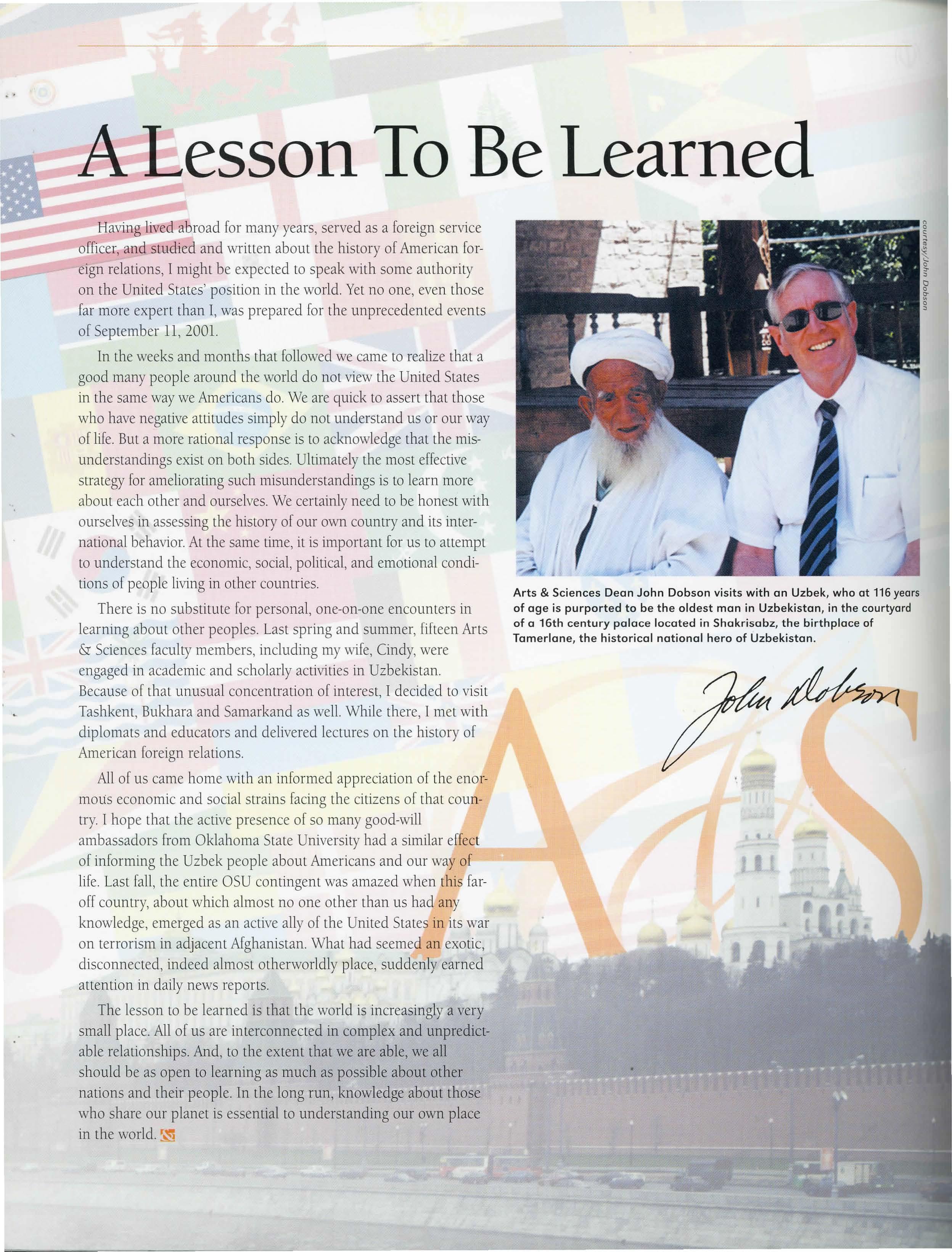
Having lived abroad for many years, served as a foreign service officer, and studied and written about the history of American foreign relations, I might be expected to speak with some authority on the United States' position in the world. Yet no one, even those far more expert than I, was prepared for the unprecedented events of September 11, 2001.
In the weeks and months that followed we came to realize that a good many people around the world do not view the United States in the same way we Americans do. We are quick to assert that those who have negative attitudes simply do not understand us or our way of life. But a more rational response is to acknowledge that the misunderstandings exist on both sides. Ultimately the most effective strategy for ameliorating such misunderstandings is to learn more about each other and ourselves. We certainly need to be honest with ourselves in assessing the history of our own country and its international behavior. At the same time, it is important for us to attempt to understand the economic, social, political, and emotional conditions of people living in other countries.
There is no substitute for personal, one-on-one encounters in learning about other peoples. Last spring and summer, fifteen Arts & Sciences faculty members, including my wife, Cindy, were engaged in academic and scholarly activities in Uzbekistan. Because of that unusual concentration of interest, I decided to visit Tashkent, Bukhara and Samarkand as well. While there, I met with diplomats and educators and delivered lectures on the history of American foreign relations.
All of us came home with an informed appreciation of the enorm01.iseconomic and social strains facing the citizens of that country. I hope that the active presence of so many good-will ambassadors from Oklahoma State University had a similar effect of informing the Uzbek people about Americans and our way of life. Last fall, the entire OSU contingent was amazed when this faroff country, about which almost no one other than us had any knowledge, emerged as an active ally of the United States in its war on terrorism in adjacent Afghanistan. What had seemed an exotic, disconnected, indeed almost otherworldly place, suddenly earned attention in daily news reports.
The lesson to be learned is that the world is increasingly a very small place. All of us are interconnected in complex and unpredictable relationships. And, to the extent that we are able, we all should be as open to learning as much as possible about other nations and their people. In the long run, knowledge about those who share our planet is essential to understanding our own place in the world. r~
StudentsJustin Dean and Alan Netherton starkly portray the inevitable and terrifying consequencesof hatred as exploredin the theatre department's production of God's Country,a StevenDietz fact-baseddrama that centerson the violencecommitted by a white supremacistgroup.
OSUscientistsworking with nano-structured materials in chemistry,physicsand engineering are developingnew kinds of materials that have the potential to solve many problemsin the fields of medicine,computer science,space exploration and the environment.
When the U.S.military and its allies pursuedthe Taliban in Afghanistan tunnels, Dale Lightfoot's study of Middle Eastand Central Asia's ancient irrigation systemsdrew media attention, but the study of these undergroundsystemsalso has peacetimeapplications.
In recognition of the EnglishDepartment'srole in developingOSUscholars,PresidentJim Halligan and his wife, Ann, have given $50,000 to endow a President'sDistinguishedScholarship for Englishmajors.
Fifteenformerstudentsinfluencedby professor emeritusDavidShelleyBerkeleycontributeto a newpublicationin honorof the esteemedscholar and belovedteacherwhotaughtin the OSU EnglishDepartmentfrom 1948 - 1987.
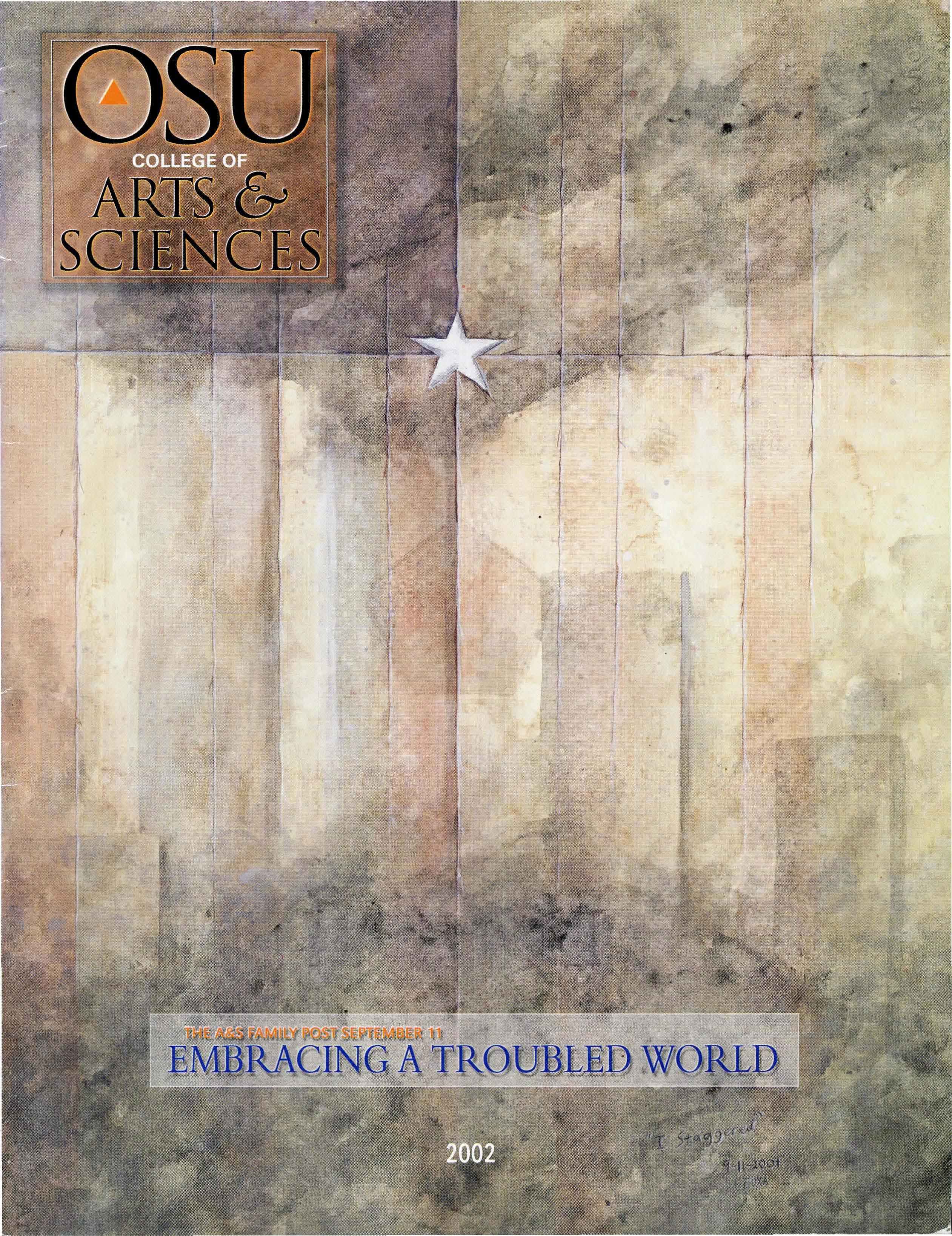
Thecoveran is a reprintof BarryFuxa's/ Staggered, a 19-by 29inchwatercolorhe paintedthe nightof Sept.11,2001.Fuxa,who is a nativeof Enid,Okla.,graduatedfromOSUwitha bachelor's in studioan in 1999and currentlyworksas a recruitingcoordinator withOSUCareerServices.Fuxais sellingartist-qualityprints and postersof/ StaggeredA portionof the proceedswillbe donatedto the Familiesof FreedomScholarshipFund.Tolearn aboutthe fund,visithttp://www.familiesoffreedom.org!.Email print requeststo barryfuxa@hotmail.com or call(580)402-3570. (Pleaseseepage3 far moreinformationaboutFuxa'spainting.)
Sr.Directorof Development Deborah Desjardins Directorof Development Martha Halihan Editor E. Eileen Mustain
Art Director Paul V Fleming
AssociateEditor
Asst.VicePresident, CommunicationsSer\/ices SpecialistCareerServices, AlumniRelations Janet Varnum Natalea Watkins Allison Robinson
ARTS & SCIENCES Magazine is a publicationof the OklahomaStateUniversityCollegeof Ans and Sciencesdesigned to provideinformationon collegeissuesand concernswhile fosteringcommunicationamongOSUalumniand friends.Please contactA&Swith informationand suggestionsfor the magazine.
Collegeof Arts& Sciences
OklahomaStateUniversity Stillwater,Oklahoma74078-3015 (405) 744-2134 email asrobin@okstateedu http:, 'alumni.okstate.edu
OklahomaStateUniversityin compliancewithTitleVI andVil of theCivilRightsActof 1964, ExecutiveOrder 11246as amended,TitleIXof the EducationAmendmentsof 1972,Americans withDisabilitiesActof 1990,and other federallawsand regulations,does not discriminate on the basis of race, color,notionalorigin,sex, age, re!igion,disability,or status as o veteran in any of its policies,practices or procedures.Thisincludesbut is not limitedto admissions,employment,financialaid and educationalservices.Thispublication,issued by OklahomaState Universityas authorizedby the Collegeof Arts & Sciences,was printed by TheAudioVisualCenter, UniversityPri_ntingServicesot no cost to the taxpayersof Oklohomo. •2926 08/02
© 2002 OklahomaStateUniversity
On the morning of Sept. 11, 2001, New York City resident and Arts & Sciences alumnus Robertson Work Jr. was en route to his office at the United Nations, where as director of the Decentralized Governance Team of the United Nations Development Program he coordinates the provision of policy advice and institutional advancement to developing countries around the globe.
Work's long-held attention to social issues and his passion for human development - sparked and fueled, he says, by his liberal arts education at OSU - not only
led to his UN career but uniquely positions him, as an A&S graduate and a humanitarian, to share his response to the events of Sept. 11 from near ground zero.
The passages excerpted for use here and elsewhere in the magazine come from Work's journal entries spanning Sept. 12 - 17 and entitled "Impressions, Reflections, Interpretations and Recommendations." In his individual search for understanding and thoughtful response, Work gives voice to the reflecLiveprocess that typifies the Arts & Sciences' community response.
"WesawbillowingsmokecomingfromsouthernManhattan.Andinthe spacewherethe twintowershadstood,we sawa smoke-filledvoid . An era of worldhistoryhasended.What happensnowdependsonthe responseof eachof us."
- Robats( \\ 1 ,, Robertson Work graduated from OSU in 1966 with a bachelor's degree in English literature. Before joining the United Nations 11 years ago, Work attended graduate school in Chicago and spent 22 years with the Institute of Cultural Affairs working on community ond organizational development. Today he coordinates the provision of policy advice ond institutional development on issues of decentralization, locol governance and community empowerment to developing countries worldwide.
In the days following the devastation of Sept. 11, 2001, OSU's Arts & Sciences family responded to the horror in a manner quite familiar to assistant professor of sociology Gary Webb.
While the events were unprecedented, the A&S community response was similar to the human response nationwide and was predictable, he says. "We quickly rushed to make sense of it, to find out what we could learn and what we already knew."
Webb, a specialist in the sociology of disaster, says that 50 years of systematic study
into how humans respond to disaster uncovers the same pattern - periods of adjustment, organization and problem solving marked by an enhanced solidarity and an intensified, although shortterm, willingness to help others.
The oversupply of donated blood and the outpouring of relief funds typify the effusive altruism that follows a disaster, but the opportunity for conflict and debate increases as we move farther from a catastrophic event, he says, citing as an example the conflicts over the disbursement of relief funds.
"Contrary to commonly believed myths of social collapse, research finds that even in the shock and confusion immediately following a disaster, the social order holds," he says. "In reality, despite our fears of social chaos, of widespread rioting and other crime, every response to a disaster is organized and characterized by pro-social behavior, and we resume normalcy fairly quickly"
Following Sept. 11, theA&S community searched for understanding through artistic expression and thoughtful discourse. Webb notes the college did not cancel classes or
research but continued instead to raise questions and to redouble its efforts to find solutions to mitigate future threats.
"We must be carefulnot to focus on our responses to September 11 and lose sight of our gains," he cautions. "Wellbefore September 11, theA&S community was proactivelyseeking measures to make our community safer through such actions as sensor research and the fire and emergency management program, and we continue to activelysearch for anything we can do to improve our future response capabilities.
"For sociologists this means adding to the strong
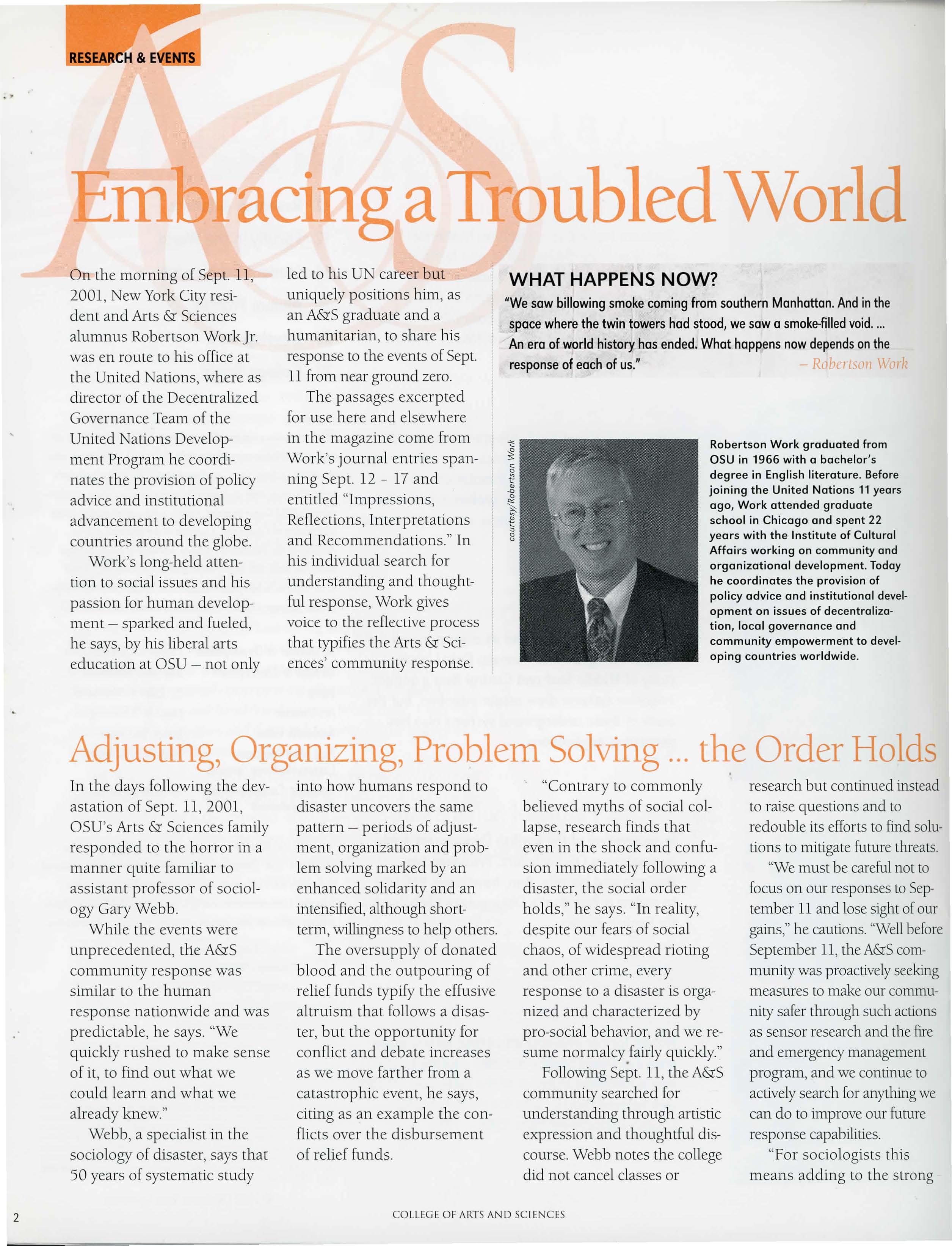
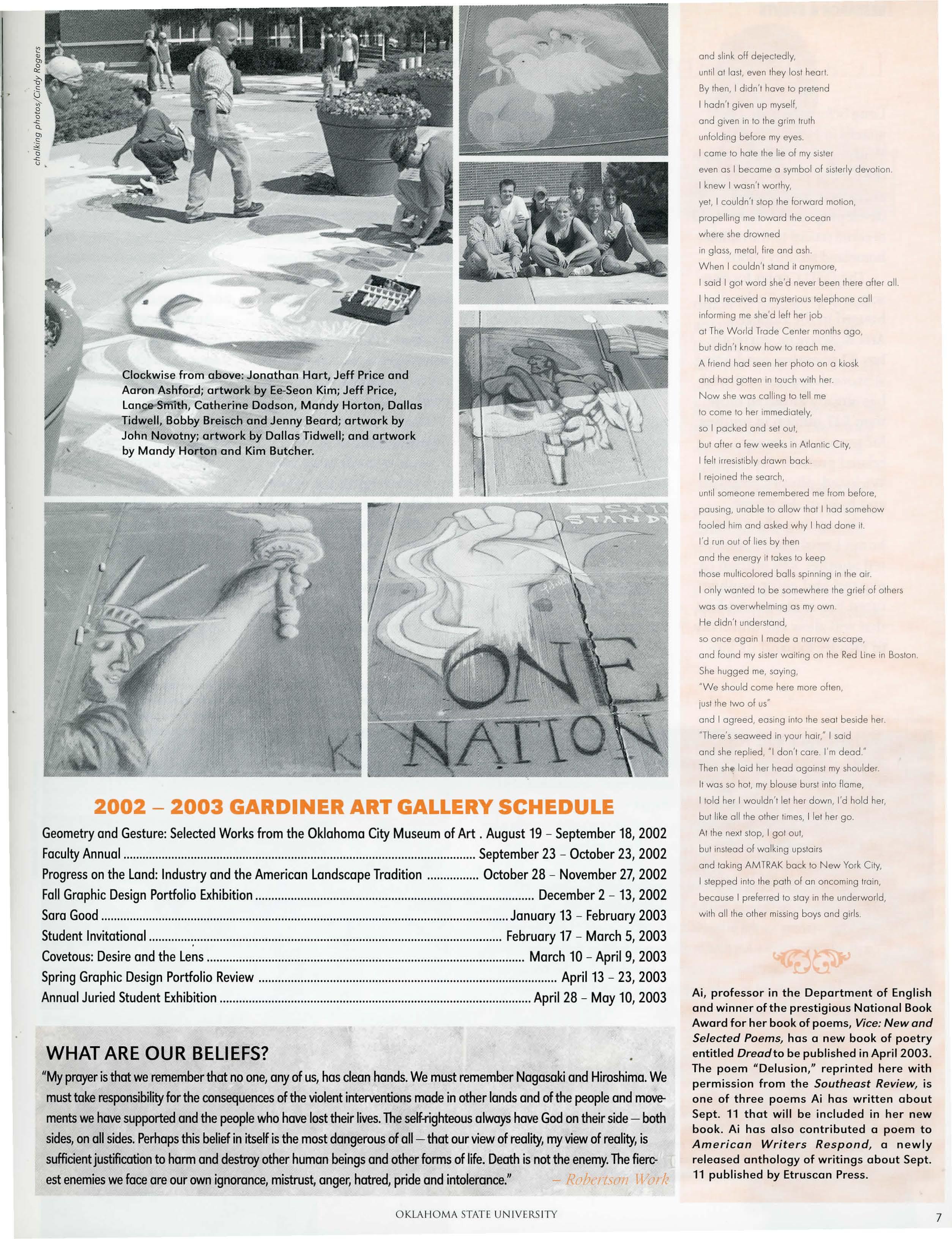
The Department of Art and its graphic design student group, "Students in Design," sponsored a "sidewalk chalking" at the Wes Watkins Center for International Trade Development Sept. 27 to honor those affected by the Sept. 11 attack on the United States and to promote national and international unity.
Jeff Price, assistant art professor and faculty adviser for "Students in Design," says the impermanence of the sidewalk art gave his students an opportunity to respond spontaneously to the events of Sept. 11 with the added bonus of showcasing their talent.
intellectual foundation built over the last 50 years with new research into the social impacts of terrorism," Webb says. "This knowledge is necessary to understand why terrorism occurs, its impact on human societies and how we can prevent terrorisin in the future.
"The object of terrorism is to rip apart the community, but the opposite actually occurs. Our response to September 11 demonstrates the resiliency of our community, and resilience is a strength that ensures our continuity."
EILEENMUSTAIN
group,
I Staggered, the watercolor reprinted on the cover of this magazine, represents in both title and content artist Barry Fuxa's immediate reaction to the terrorist attacks of Sept. 11.
When the first tower fell, he says a part of him c thought, "At least the second j tower still stands." For him, the second tower was a palpable symbol that his country was hurt but not broken.
"When the second tower fell," he says, "I staggered. I just couldn't stand, and I slumped into a nearby chair."
? The act of painting is "" often his way of coping with a recruiting coordinator with OSU
Alumnus Barry Fuxo graduated with a bachelor's in studio art in 1999 and currently works as
0 events, Fuxa says. "That if ..,,.,,,,,,,,.,_ night while my wife was in Career Services.
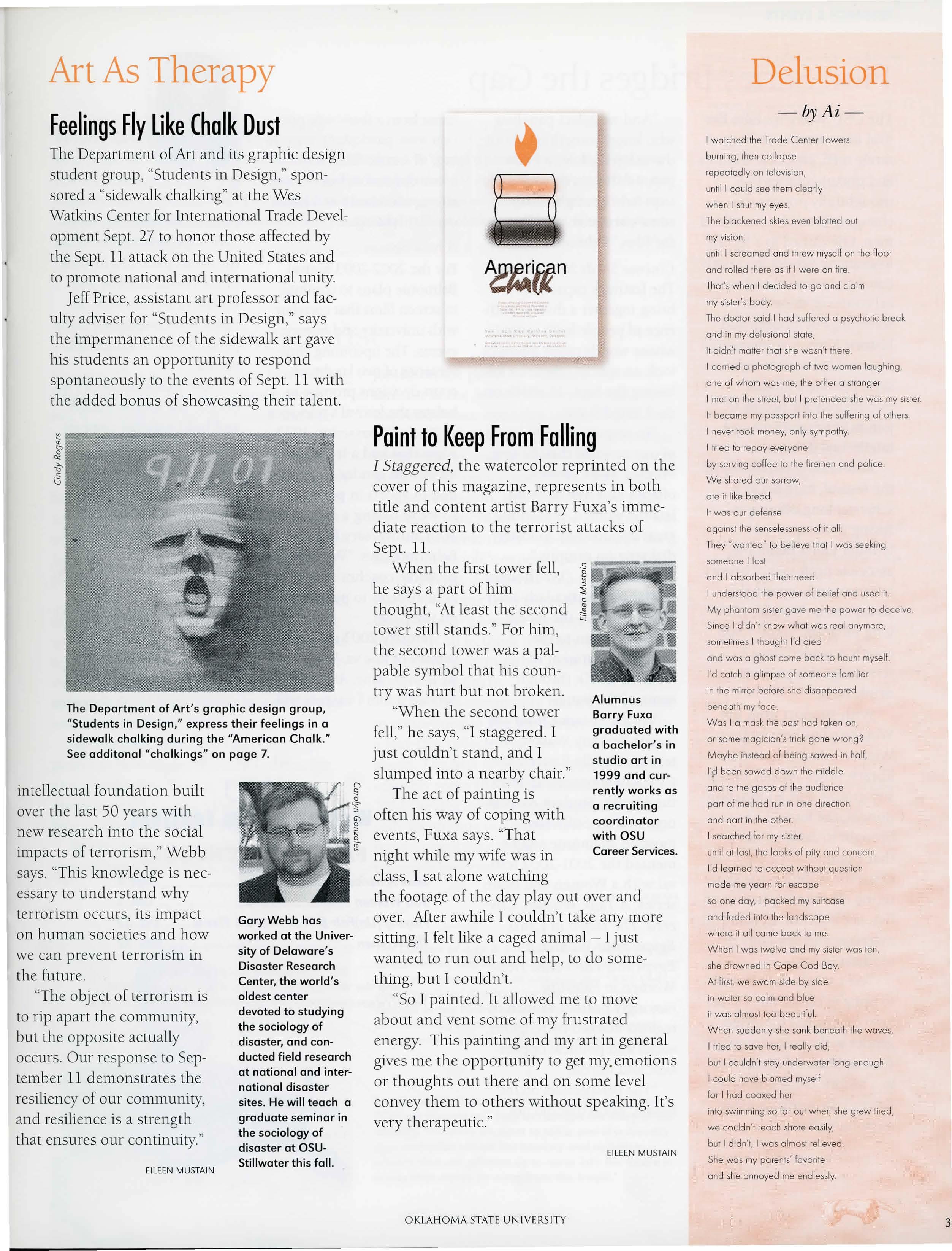
Gory Webb hos worked at the University of Delaware's Disaster Research Center, the world's oldest center devoted to studying the sociology of disaster, and conducted field research at notional and internotional disaster sites. He will teach a graduate seminar in the sociology of disaster at OSUStillwoter this foll.
class, I sat alone watching the footage of the day play out over and over. After awhile I couldn't take any more sitting. I felt like a caged animal - I just wanted to run out and help, to do something, but I couldn't.
"So I painted. It allowed me to move about and vent some of my frustrated energy. This painting and my art in general gives me the opportunity to get my. emotions or thoughts out there and on some level convey them to others without speaking. It's very therapeutic."
EILEENMUSTAIN
l watched the Trade Center Towers burning, then collapse repeatedly on television, until I could see them clearly when I shut my eyes
The blackened skies even bloned out my vision, until I screamed and threw myself on the floor and rolled there as if I were on fire.
Thol's when I decided lo go ond claim my sister's body.
The doctor said I hod suffered a psychotic break and in my delusional state, i! didn't matter that she wasn't there.
I carried a photograph of two women laughing, one of whom was me, the other a stranger I met on the street, but I pretended she was my sis1er It became my passport into the suffering of others. I never took money, only sympolhy.
I tried to repay everyone by serving coffee to the firemen and police.
We shared our sorrow, ale ii like bread.
It was our defense against the senselessnessof ii a!I. They "wanted" to believe that I was seeking someone I lost and I absorbed their need.
I understood the power of belief and used it.
My phantom sister gave me the power to deceive.
Since I didn't know what was real anymore, sometimes I thought I'd died and was a ghost come bock to haunt myself. !'d catch a glimpse of someone familiar in the mirror before she disappeared beneolh my face.
Was I a mask the posl hod token on, or some magician's trick gone wrong? Maybe insleod of being sowed in half, 1·~been sowed down the middle ond lo the gasps of lhe audience part of me hod run in one direction and part in the other.
I searched for my sisler, until at lost, the looks of pity ond concern I'd learned to accept without question mode me yearn for escape so one day, I pocked my suitcase and faded into the landscape where it all came back to me.
When I was twelve and my sister was ten, she drowned in Cope Cod Boy. At first, we swam side by side in water so calm and blue it was almost too beautiful.
When suddenly she sank beneath lhe waves, I tried to save her, I really did, but I couldn't stay underwater long enough.
I could hove blamed myself for I had coaxed her into swimming so for out when she grew tired, we couldn't reach shore eosily, but I didn't, I was almosl relieved.
She was my parents' favorite and she annoyed me endlessly.
The OSU Women's Film Festival touts a robust billing of rarely seen, evocative features and documentaries that thoughtfully portray the changing lives of women and men. Envisioned as a forum to examine gender in various cultural, historical and political contexts, these free screenings of modern and historic films, complemented by panel-led audience discussion, provide a unique opportunity for people to join in entertainment and intellectual debate.
°Resounding popularity of the festival, initiated as a semester-long offering in spring 2001, spurred founder Laura Belmonte, associate professor of history, to renew and expand the series into an annual, yearlong program. Some 1,500 people attended the 12 screenings this past academic term.
With support from the Women's Studies program, Women's Archives at the library, other various university groups and Foundation donors, the festival has brought to campus films that examine such topics as domestic violence, the shattering effects of war on families, the abortion debate and marriage and sex~ality in modern India.
"We try with each festival to bring in classic films to see how cinema has portrayed gender in the past, along with documentaries that address in a historic context how gender and the women's movement have changed.
"And we select panelists who know something about the material, have a background therein or whose life experiences might shed some particular insights on the film," Belmonte says.
Cinema Sheds New Light The festival's capacity to bring together a diverse audience of people from campus whose worlds rarely intersect took on special relevance following the Sept. 11 attack on the United States.
"In response to 9/11, one of our national distributors, Women Make Movies, offered four free films on Islamic women, presenting a great opportunity to foster dialogue on campus," Belmonte says. "We thought it might be particularly interesting, with all the media attention given to the Taliban's treatment of women, to talk through some of the issues."
With assistance from colleague Bethany Walker, who teaches Middle Eastern history, and sponsorship from the Muslim Student Association and the Stillwater mosque, Belmonte supplemented the 2001-2002 festival with a Women and Islam series. A Tajik Woman, Covered: The Hajeb in Cairo, Egypt, Four Women in Egypt and The Veiled Hope: Women in Palestine movingly portray women in regions marked by religious, social and political oppression and unrest.
"The perspectives on the Islamic world that did not
come from a theocratic position were particularly interesting," she says. "That imparted some dissention, but we had strong attendance and heard excellent dialogue."
For the 2002-2003 festival, Belmonte plans to continue to screen films that correlate with university and historic events. The upcoming anniversaries of two landmark court decisions promise to bolster the festival's relevance.
"Title IX passed in 1972, a law that had a tremendous impact on gender equalization in sports in particular, so we're having a special 30th anniversary film," Belmonte says. "We hope to get some coaches and student athletes to participate on the panel.
'January 2003 is the anniversary of Roe vs. Wade, and we'll show Jane, An Abortion Service, a film I suspect will
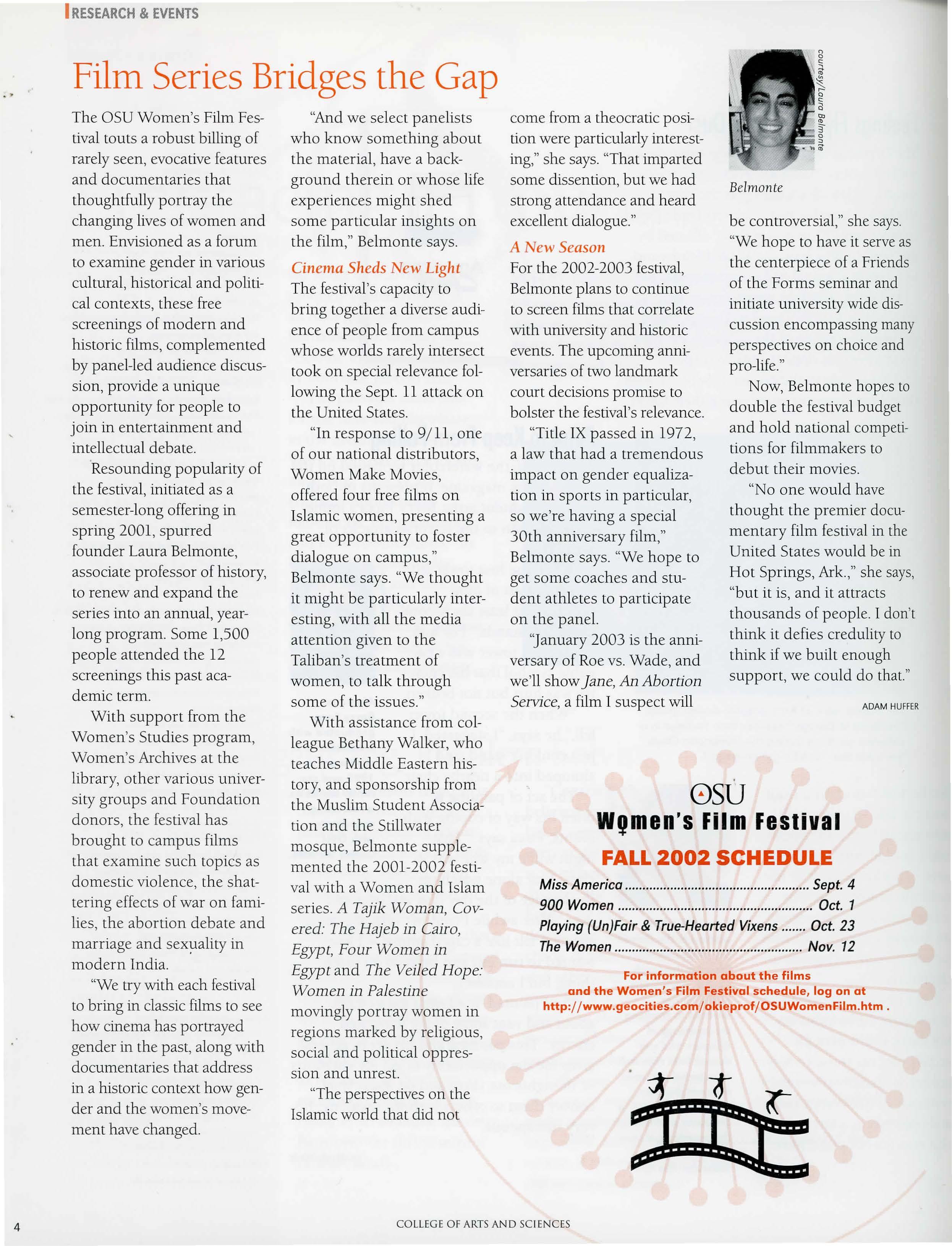
Belmonte be controversial," she says. "We hope to have it serve as the centerpiece of a Friends of the Forms seminar and initiate university wide discussion encompassing many perspectives on choice and pro-life."
Now, Belmonte hopes to double the festival budget and hold national competitions for filmmakers to debut their movies.
"No one would have thought the premier documentary film festival in the United States would be in Hot Springs, Ark.," she says, "but it is, and it attracts thousands of people. I don't think it defies credulity to think if we built enough support, we could do that."
ADAMHUFFER
Miss America Sept. 4
900 Women Oct. 1
Playing (Un)Fair & True-Hearted Vixens Oct. 23
The Wamen Nov. 12
For information about the films and the Women's Film Festival schedule, log on at http://www.geocities.com/okieprof/OSUWomenFilm.htm.
"Whatpeoplethinkandfeeldeterminestheirsenseof whatis real.Tochangea person'simages,ideasandemotionsisto changethat person'sworld-viewand behavior,bothindividualandinstitutional. We musttalk to our neighborsandourenemies.Whatoretheirhopesandfears?What oretheirvaluesand assumptions?What ore theirworld-views?Whatoretheiranalysesof realityand history?Withoutcontinuousdialogue,humanrelations andtrustbreakdown."
- Robertson Worlz
On Sept. 25, 2001, OSU held its first public forum to discuss America's war on terrorism, its Middle East foreign policy and the many other issues and emotions surrounding the attacks of Sept. 11.
"Responding to Terror," a panel discussion hosted by the philosophy department and its student group, Friends of the Forms, came together in a matter of two or three days, says John Shook, assistant professor of philosophy and Friends of the Forms advisor.
"We provided the only public forum held on campus shortly after September 11, and we're proud of that. We felt it was important to offer a venue that would allow the university and the Stillwater communities to approach these tragic events in a thoughtful and disciplined way."
An academic approach can encourage people to be responsive instead of reactive, says panelist Eric Reitan. "We have a tendency to react. I wanted the discussion to help us think about how best to respond."
Reitan, assistant professor of philosophy, specializing in nonviolence theory, was
joined on the panel by Maureen Nemecek, director of the School of International Studies; Nani Pybus, specialist in the Middle East and North Africa with the School of International Studies; and Bethany Walker, assistant professor of history and Middle East expert.
The discussion, which devoted over half the time to questions from the audience, was not so academic that it was emotionally distant from people's experience, Reitan says, and it did not degenerate into a shouting match like some television talk shows. "The discussion heightened our awareness and helped us all to think through our feelings and our responses rather than follow our initial gut instincts.
"The A&S community has a clear interest in connecting to the September 11 events in a way that reflects what the college is all about. The Arts & Sciences approach deliberatively seeks the wisest course," he says, "and the discipline of philosophy, by critically examining our worldview and assumptions, contributes insights and tools to that reflective process."
EILEENMUSTAIN
The College of Arts & Sciences designated Friends af the Forms, one of the oldest and most respected student organizations on campus, the "A&S Outstanding Club" in 2000. For the 2002 - 2003 Friends of the Forms schedule of lectures and discussions, log on to the OSU Philosophy Department website at http://philosophyokstate.edu.
She would hove pulled me under, wouldn't she?
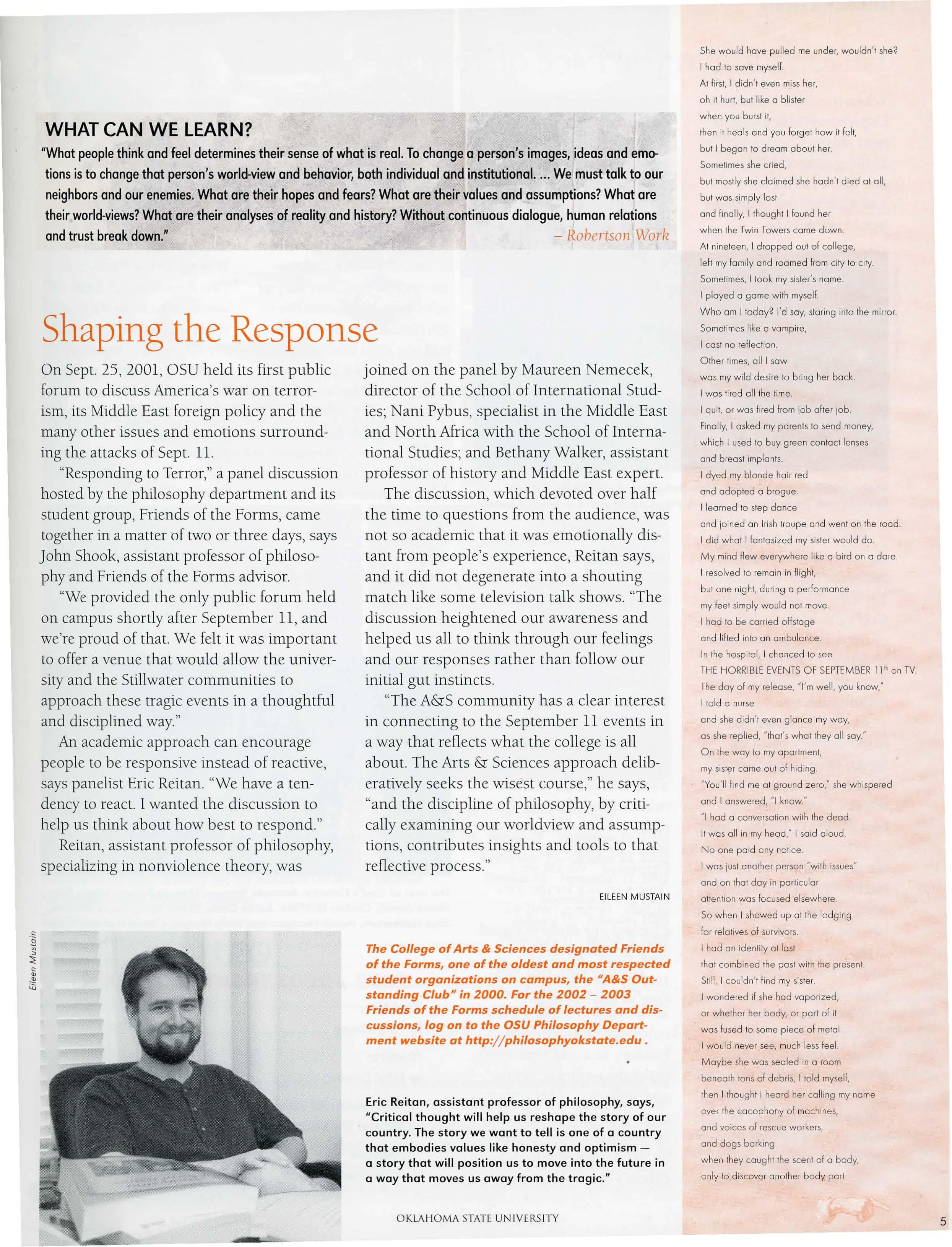
Eric Reitan, assistant professor of philosophy, says, "Critical thought will help us reshape the story of our country. The story we want to tell is one of a country that embodies values like honesty and optimisma story thot will position us to move into the future in a way that moves us away from the tragic." OKLAHOMA STATE UNIVERSITY
I hod to save myself.
At first, I didn't even miss her, oh it hurt, but like o blister when you burst it, then it heals ond you forget how it felt, bul I began to dream about her.
Sometimes she cried, but mostly she claimed she hadn't died at all, but was simply lost and finally, I thought I found her when the Twin Towers came down.
At nineteen, I dropped out of college, left my family ond roamed from city to city. Somelimes, I look my sister's name.
I played a game with myself.
Who om I today? I'd soy, staring into the mirror. Sometimes like a vampire, I cast no reflection.
Other times, all l sow was my wild desire to bring her back.
I was tired all the time.
I quit, or was fired from job after job.
Finally, I asked my parents to send money, which I used to buy green contact lenses and breast implants.
I dyed my blonde hair red and adopted a brogue.
I learned to step dance and joined an Irish troupe and went on the road.
I did what I fantasized my sister would do.
My mind flew everywhere like a bird on a dare.
I resolved to remain in flight, but one night, during a performance my feel simply would not move.
I had to be carried offstage and !ifled into on ambulance.
In the hospital, I chanced to see THEHORRIBLEEVENTSOF SEPTEMBER11• on TV. The day of my release, "I'm well, you know," I told a nurse and she didn't even glance my way, as she replied, "that's what they all say."
On the way to my apartment, my sister came out of hiding.
"You'll find me 01 ground zero.ff she whispered and I answered, "I know.ff
HI hod a conversation with the dead.
It was all in my head," I said aloud. No one paid any notice.
I was just another person with issuesff and on that day in particular attention was focused elsewhere.
So when I showed up at the lodging for relatives of survivors.
I had on identity at last tho! combined the past with the present.
Still, I couldn't find my sister.
I wondered ii she had vaporized, or whether her body, or part of ii was fused to some piece of metal I would never see, much less feel.
Maybe she was sealed in a room beneath tons of debris, I told myself, then I thought I heard her calling my nome over the cacophony of machines, and voices of rescue workers, and dogs barking when they caught the scent of a body, only to discover another body part
When the OSU Theatre Department scheduled its next season's performances in the spring of 2001, no one could have foreseen how difficult the selections would prove to be.
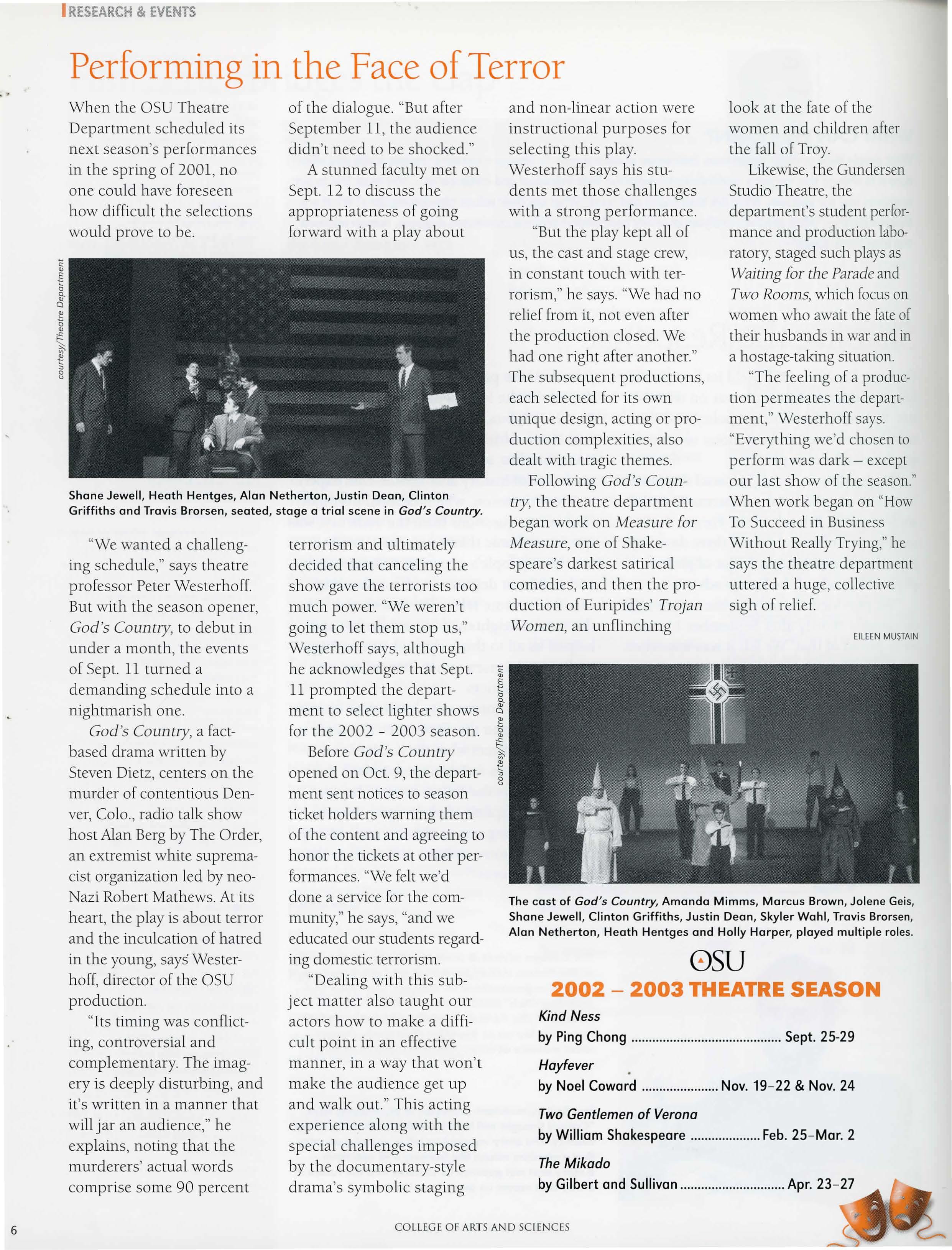
"We wanted a challenging schedule," says theatre professor Peter Westerhoff. But with the season opener, God's Country, to debut in under a month, the events of Sept. 11 turned a demanding schedule into a nightmarish one.
God's Country, a factbased drama written by Steven Dietz, centers on the murder of contentious Denver, Colo., radio talk show host Alan Berg by The Order, an extremist white supremacist organization led by neoNazi Robert Mathews. At its heart, the play is about terror and the inculcation of hatred in the young, says Westerhoff, director of the OSU production.
"Its timing was conflicting, controversial and complementary. The imagery is deeply disturbing, and it's written in a manner that will jar an audience," he explains, noting that the murderers' actual words comprise some 90 percent
of the dialogue. "But after September 11, the audience didn't need to be shocked."
A stunned faculty met on Sept. 12 to discuss the appropriateness of going forward with a play about
and non-linear action were instructional purposes for selecting this play.
Westerhoff says his students met those challenges with a strong performance.
"But the play kept all of us, the cast and stage crew, in constant touch with terrorism," he says. "We had no relief from it, not even after the production closed. We had one right after another."
The subsequent productions, each selected for its own unique design, acting or production complexities, also dealt with tragic themes.
look at the fate of the women and children after the fall of Troy.
Likewise, the Gundersen Studio Theatre, the department's student performance and production laboratory, staged such plays as Waiting for the Paradeand Two Rooms, which focus on women who await the fate of their husbands in war and in a hostage-taking situation.
terrorism and ultimately decided that canceling the show gave the terrorists too much power. "We weren't going to let them stop us," Westerhoff says, although he acknowledges that Sept. 11 prompted the department to select lighter shows
for the 2002 - 2003 season. 0 (
Before God's Counuy opened on Oct. 9, the department sent notices to season ticket holders warning them of the content and agreeing to honor the tickets at other performances. "We felt we'd done a service for the community," he says, "and we educated our students regarding domestic terrorism.
"Dealing with this subject matter also taught our actors how to make a difficult point in an effective manner, in a way that won't make the audience get up and walk out." This acting experience along with the special challenges imposed by the documentary-style drama's symbolic staging
Following God's Countiy, the theatre department began work on Measure for Measure, one of Shakespeare's darkest satirical comedies, and then the production of Euripides' Trojan Women, an unflinching
"The feeling of a production permeates the department," Westerhoff says. "Everything we'd chosen to perform was dark - except our last show of the season." When work began on "How To Succeed in Business Without Really Trying," he says the theatre department uttered a huge, collective sigh of relief.
Kind Ness by Ping Chong Sept. 25-29 Hayfever by Noel Coward Nov. 19-22 & Nov. 24
Two Gentlemen of Verona by William Shakespeare Feb. 25-Mar. 2
TheMikado by Gilbert and Sullivan Apr. 23-27
Clockwise from above: Jonathon Hort, Jeff Price and Aaron Ashford; artwork by Ee-Sean Kim; Jeff Price, Lonce-Srmth, Catherine Dodson, Mondy Horton, Dallas Tidwell, Bobby Breisch and Jenny Beard; artwork by John Novotny; artwork by Dallas Tidwell; and artwork by Mondy
Geometryand Gesture:SelectedWorksfrom the OklahomaCity Museumof Art August 19 - September18,2002
FacultyAnnual September23 - October23, 2002
Progresson the Land:Industryand the AmericanLandscapeTradition October28 - November27,2002
FallGraphicDesignPortfolioExhibition December2 - 13,2002
SaraGood January 13 - February2003
StudentInvitational··············:······························································································ February17 - March 5, 2003
Covetous:Desireand the Lens.................................................................................................. March 10 - April 9, 2003
SpringGraphicDesignPortfolioReview............................................................................................ April 13 - 23, 2003
AnnualJuriedStudentExhibition April 28 - May 10, 2003
"Myprayeristhat werememberthat noone,anyof us,hasdeanhands.WemustrememberNagasakiandHiroshima.We musttakeresponsibilityfor theconsequences of theviolentinterventionsmadein otherlandsandof the peopleandmovementswehavesupportedandthe peoplewhohavelosttheirlives.Theself-righteousalwayshaveGodontheirside- both sides,onall sides.Perhapsthisbeliefin itselfisthe mostdangerousof all - that ourviewof reality,myviewof reality,is sufficientjustificationto hannanddestroyotherhumanbeingsandotherfonnsof life.Deathis nottheenemy.Thefiercestenemieswefaceareourownignorance,mistrust,anger,hatred,prideandintolerance." - I J/ , , 1 I f , , /.
and slink off dejectedly, until at last, even they lost heart. By then, I didn't hove lo pretend I hadn't given up myself, and given in to the grim truth unfolding before my eyes.
I come to hate the lie of my sister even as I become a symbol of sisterly devotion. I knew I wasn't worthy, yet, I couldn't stop the forward motion, propelling me toward the ocean where she drowned in glass, metal, fire and ash.
When I couldn't stand it anymore, I said I got word she'd never been there ofter all. I had received a myslerious telephone call informing me she'd left her job at The World Trade Center monlhs ago, but didn't know how to reach me.
A friend had seen her photo on a kiosk and had gotten in touch with her.
Now she was calling to tell me to come lo her immediately, so I pocked and set oul, but after a few weeks in Atlantic City, I felt irresistibly drown bock.
I rejoined the search, until someone remembered me from before, pausing, unable to allow that I had somehow fooled him and asked why I hod done ii.
I'd run out of lies by then and the energy it tokes lo keep those multicolored balls spinning in the air. I only wanted to be somewhere the grief of others was as overwhelming as my own.
He didn't understand, so once again I mode a narrow escape, and found my sister waiting on the Red Line in Boston. She hugged me, saying, HWe should come here more often, just the two of us• and I agreed, easing into the seat beside her.
HThere's seaweed in your hair,· I said and she replied, "I don't core. I'm dead." Then she laid her head against my shoulder. It was so hot, my blouse burst into flame, I told her I wouldn't let her down, I'd hold her, but like all the other times, I let her go.
At the next stop, I got out, but instead of walking upstairs and toking AMTRAK bock to New York City, I stepped into the path of on oncoming train, because I preferred to stay in the underworld, with all the other missing boys and girls.
Ai, professor in the Deportment of English and winner of the prestigious Notional Book Award for her book of poems, Vice: New and Selected Poems, hos a new book of poetry entitled Dread to be published in April 2003. The poem "Delusion," reprinted here with permission from the Southeast Review, is one of three poems Ai hos written about Sept. 11 that will be included in her new book. Ai hos also contributed a poem to American Writers Respond, a newly released anthology of writings about Sept. 11 published by Etruscan Press.
Long before the Sept. 11 terrorism research in the attacks in New York and areas of food, water and Washington, researchers from air safety. the College of Arts & Sci-
OSU intends to use the ences were hard at work state funds to immediately developing sensors that would retrofit current laboratories become crucial to the nation's to meet federal "Bio-conhomeland security efforts. tainment, Level 3" stan-
The OSU Center for Sen- <lards. The investment sors and Sensor Technology, from the Legislature will housed in the College of attract additional research Arts & Sciences, currently funding to fulfill OSU's has 4 2 scientists conducting commitment of a four-tosensor-related research and one match. has already attracted more
The breakthrough thinkthan $17 million in funding ing from A&S scientists for sensor and sensor- recently drew praise from related projects, says James the head of Okahoma's Task Wicksted, physics professor Force on Homeland Secuand head of the center. rity, Ken Levit. "OSU's long-
This spring, the Okla- range commitment to sensor homa Legislature commit- research was truly farted another $19 million to sighted," he says. "The state expand and equip sophisti- has a real opportunity to be cated bio-containment labs in the forefront of this that will allow the university important research." to rapidly expand its bio-
"Griefis alwaysan occasionfor personaltransformation.Griefbreaksour hearts.Out of thiswounding,we can becomemorecompassionateor morefearful,angryor embittered.Grief-workisveryimportant.We must takethe time needed,payattentionto othersand ourselves,acceptwhat is happeningand be carefulthat we movetowardcompassionrather than angerand hate.
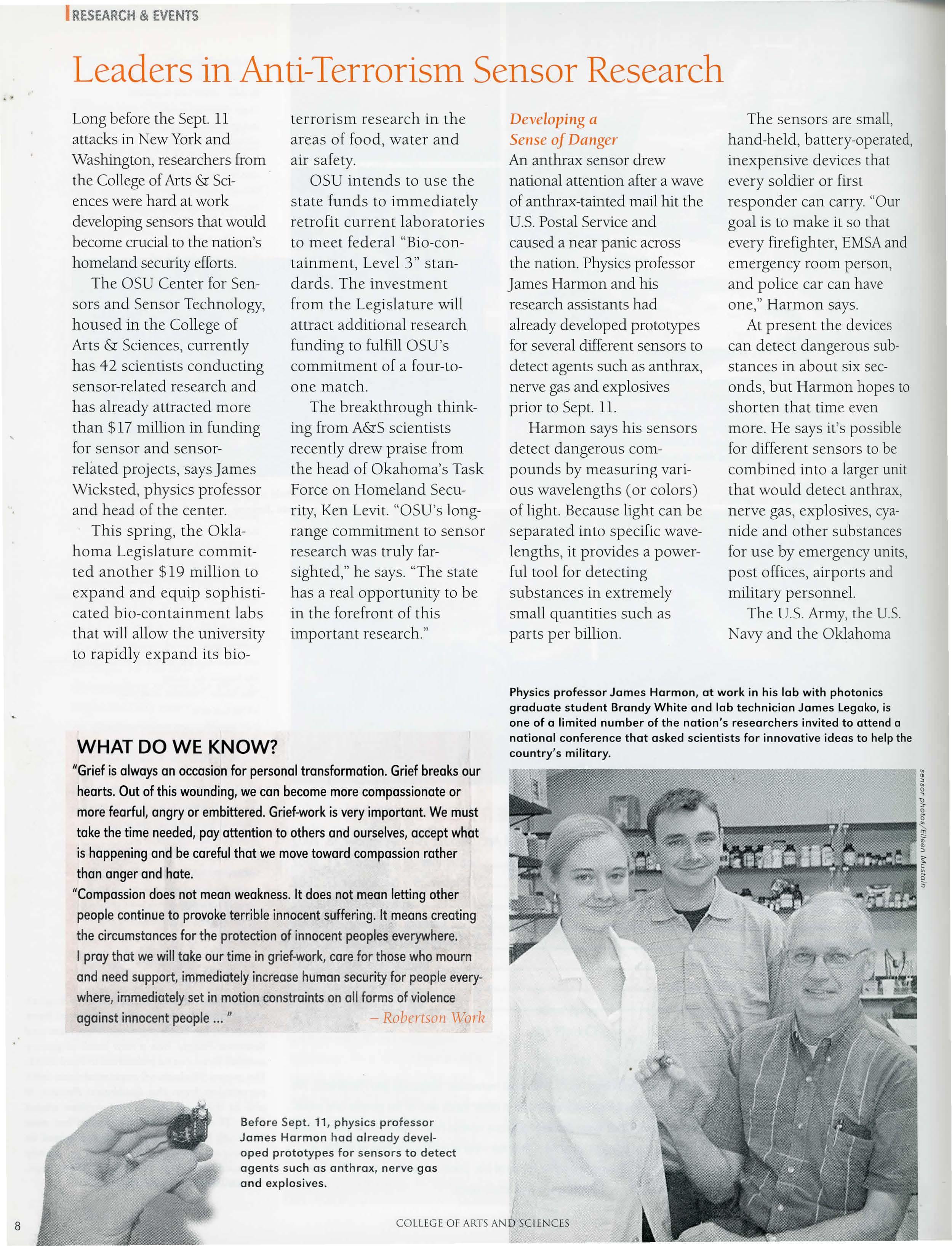
Developing a The sensors are small, Sense of Danger hand-held, battery-operated, An anthrax sensor drew inexpensive devices that national attention after a wave every soldier or first of anthrax-tainted mail hit the responder can carry. "Our U.S. Postal Service and goal is to make it so that caused a near panic across every firefighter, EMSAand the nation. Physics professor emergency room person, James Harmon and his and police car can have research assistants had one," Harmon says. already developed prototypes At present the devices for several different sensors to can detect dangerous subdetect agents such as anthrax, stances in about six secnerve gas and explosives onds, but Harmon hopes to prior to Sept. 11. shorten that time even Harmon says his sensors more. He says it's possible detect dangerous com- for different sensors to be pounds by measuring vari- combined into a larger unit ous wavelengths (or colors) that would detect anthrax, of light. Because light can be nerve gas, explosives, cyaseparated into specific wave- nide and other substances lengths, it provides a power- for use by emergency units, ful tool for detecting post offices, airports and substances in extremely military personnel. small quantities such as The US Army, the US parts per billion. Navy and the Oklahoma
professor James
at
in
"Compassiondoesnot meanweakness.It doesnot meanlettingother peoplecontinueto provoketerribleinnocentsuffering.It meanscreating the circumstancesfor the protectionof innocentpeopleseverywhere. I praythat we willtake ourtime in grief-work,carefor thosewho mourn and needsupport,immediatelyincreasehumansecurityfor peopleeverywhere,immediatelyset in motionconstraintson all formsof violence againstinnocentpeople "
- RobertsonWorh
Before Sept. 11, physics professor Jomes Harmon had already developed prototypes for sensors to detect agents such as anthrax, nerve gas and explosives.
Center for the Advancement of Science and Technology have funded much of Harmon's research, which is recognized nationally and internationally. He is one of only 225 of the nation's researchers invited to attend "Scientists Helping America," a national conference that asked scientists to come up with unique ideas to help America's armed forces. The conference was an opportunity to think "out-of-the-box"and to help the nation and our military by influencing the course of future research, Harmon says.
Mario Rivera,associate professor of chemistry, is on a team of OSU researchers developing a sensor to detect contaminants in water. Unlike current detection systems that test for only one pollutant at a time, the team's sensor will be
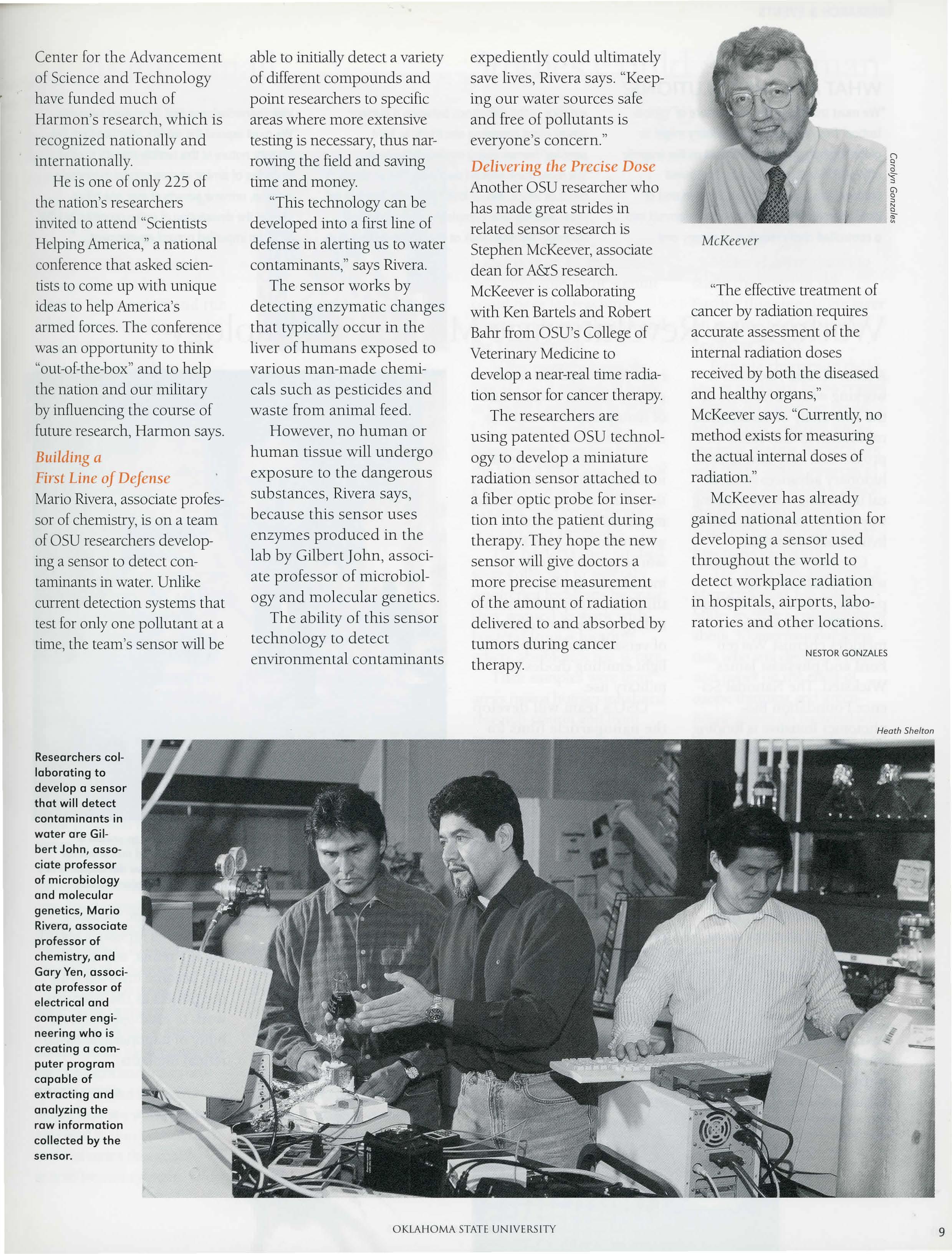
Researchers collaborating to develop o sensor that will detect contaminants in water are Gilbert John, associate professor of microbiology and molecular genetics, Mario Rivera, associate professor of chemistry, and Gary Yen, associate professor of electrical and computer engineering who is creating a computer program capable of extracting and analyzing the raw information collected by the sensor.
able to initially detect a variety of different compounds and point researchers to specific areas where more extensive testing is necessary, thus narrowing the field and saving time and money.
"This technology can be developed into a first line of defense in alerting us to water contaminants," says Rivera.
The sensor works by detecting enzymatic changes that typically occur in the liver of humans exposed to various man-made chemicals such as pesticides and waste from animal feed.
However, no human or human tissue will undergo exposure to the dangerous substances, Rivera says, because this sensor uses enzymes produced in the lab by Gilbertjohn, associate professor of microbiology and molecular genetics.
The ability of this sensor technology to detect environmental contaminants
expediently could ultimately save lives, Rivera says. "Keeping our water sources safe and free of pollutants is everyone's concern."
Another OSU researcher who has made great strides in related sensor research is Stephen McKeever,associate dean for A&S research.
McKeeveris collaborating with Ken Bartels and Robert Bahr from OSU's College of Veterinary Medicine to develop a near-real time radiation sensor for cancer therapy.
The researchers are using patented OSU technology to develop a miniature radiation sensor attached to a fiber optic probe for insertion into the patient during therapy. They hope the new sensor will give doctors a more precise measurement of the amount of radiation delivered to and absorbed by tumors during cancer therapy.
'The effectivetreatment of cancer by radiation requires accurate assessment of the internal radiation doses received by both the diseased and healthy organs," McKeever says. "Currently, no method exists for measuring the actual internal doses of radiation."
McKeever has already gained national attention for developing a sensor used throughout the world to detect workplace radiation in hospitals, airports, laboratories and other locations.
NESTORGONZALES
"Wemusttransformtheverynatureof 'globalization'fromeconomicand militarymightto globalhumandevelopment.Justas the tragedy of WorldWar IIgavebirthto the United Nations,thisunprecedentedeventin and of itselfmustbe interpretedandtransformedinto a controlledchainreactionof energyand
emotion - the differencebetweena nuclear powerplantprovidingelectricityto light peoples'homesanda nuclearholocaust.
"Wemustthinkbeyonddualism - 'usor them, blackor white,winor lose.'We mustlearnto toleratesubtletyandcomplexityof analysisand strategy.We mustlookat the wholesystemin its
interconnectednessand its mutualcausality. "Wemustexpandtheworld'sattentionfromthe singularnatureofthisterribletragedyto other tragediesof similaror evengreatermagnitudemassive,extremepovertyof overonebillion people,thedevastationof entirecountriesbyHIV/ AIDS,an imperilednaturalenvironment11
A team of A&S scientists is working with researchers at the University of Texas Medical Branch in Galveston on a project that may lead to revolutionary advances in medical technology by developing ways to communicate with a living body's neurons.
Chemist Nicholas Kotov, who specializes in nanoparticle technology, will lead the OSU team, which includes chemist Warren Ford and physicistjames Wicksted. The National Science Foundation Biophotonics Initiative is funding the project, which ranked number one among many other submitted proposals.
"The union of physical scientists and medical doctors can lead to revolutionary technologies," Kotov says. "There are absolutely vast opportunities in this area, as well as many technological challenges that can be overcome by a combined effort."
Before nanoparticle technology can be used in a human body, researchers must learn how to communicate with the body's neu-
rons. Kotov and his team plan to develop a thin film of nanoparticles to aid this communication.
"We're aiming to create a machine/human interface that will use nanostructured materials for interaction with neurons," says Kotov, whose previous projects include the application of thin film nanoparticle technology to the development of versatile and inexpensive light-emitting diodes for military use.
OSU's team will develop the nanoparticle films for this project, while the Texas researchers will investigate how to translate the electrical signal generated in nanoparticles into the language of neuron chemical activity.
The expertise of Ford and Wicksted are vital to this project, Kotov says.
This collaboration also will be an important part of the newly created NanoNet, Oklahoma consortium of nanotechnology researchers, headed by Ford, which provides the intellectual resources for multi-
disciplinary teams of scientists like this one.
Prosthetic device applications, including visionrestoring retinal implants, inspired the group's work, Kotov says. He anticipates that Warren Finn, a researcher at OSU's College
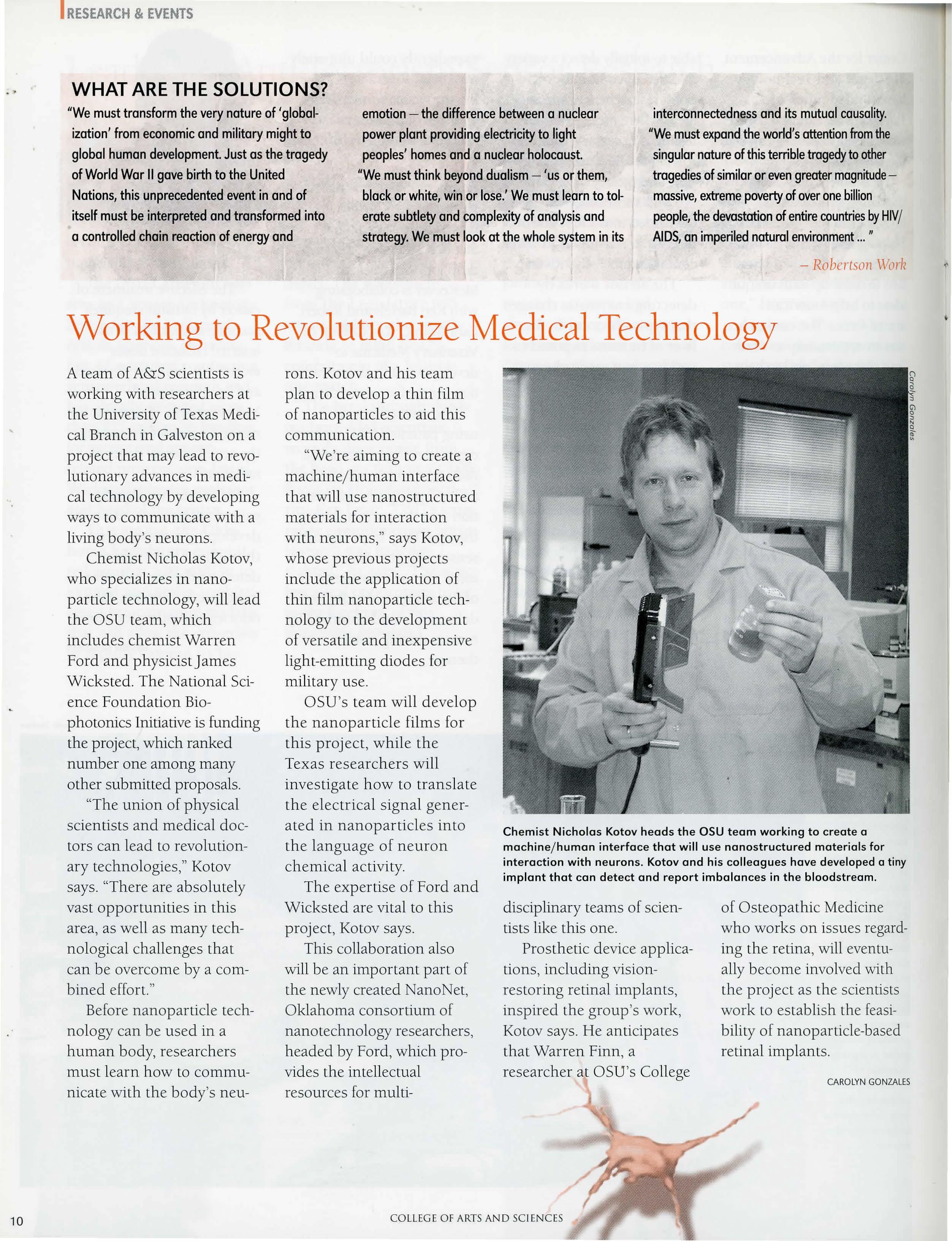
of Osteopathic Medicine who works on issues regarding the retina, will eventually become involved with the project as the scientists work to establish the feasibility of nanoparticle-based retinal implants.
OSU is poised to become a national contender in nanotechnology research, thanks to a recent grant that will provide a portion of $13.5 million in funds awarded by the National Science Foundation and the Oklahoma State Regents for Higher Education for statewide nanotechnology and functional genomics programs.
Warren Ford, regents professor of chemistry, is director of OSU's part of the nanotechnology program and project coordinator of the NanoNet (Oklahoma Network for Nanostructured Materials).The network is made up of scientists working with nano-structured materials in chemistry, physics and engineering at OSU, the University of Oklahoma and the UniversiLyof Tulsa. Fifteen of the 35 people currently in the network are at OSU.
Those conducting research in nanotechnology are developing new kinds of materials using precision tolerances on the scale of a nanometer, which is one billionth of a meter long. A nanometer is equal to the length of 10 atoms placed side-by-side.A human hair is 10,000 times the width of a nano~eter
The research could help solve many problems in the fieldsof medicine, computer science,space exploration, the environment and many others. One project that OSU researchers are working on may lead to the creation of an artificialretina that could restore human eyesight. The
Ford development of this type of tiny device that is capable of communicating with neurons and the brain could have many other medical applications as well, such as helping victims of paralysis and other diseases.
Ford says the main purpose of the nanotechnology initiative is to strengthen the university's nanotechnology infrastructure with the purchase of new imaging equipment, primarily a scanning probe m.icroscope, which is able to image materials on the nanoscale and allow viewing at a much smaller scale than regular optical microscopes. The new equipment will be unique to the OSU campus and should be a valuable resource for NanoNet researchers, he says.
The object of the grant funding is to help develop projects that could lead to bigger concentrated centers of nanotechnology research, Ford says. Once the state's new infrastructure is in place, OSU's and other Oklahoma researchers will be better able to compete at the national level for additional research funding.
} Robert Miller, regents prof fessor of microbiology and molecular genetics, is a renowned scientist and lecturer whose studies of how bacteria react to antibiotics and ultraviolet light stimuli could have far-reaching effects on human health and the environment.
Miller recently spent six months on a sabbatical leave at Cardiff University in Wales, U.K, where he and colleagues, with funding from the United Kingdom National Environmental Research Council, studied bacteria's resistance to antibiotics.
The bacteria they studied were collected in several Antarctica locations because they wanted to work with bacteria from a location where antibiotics use is rare.
Their samples were from areas near a human-inhabited research station and from areas near a penguin colony. To their surprise, bacteria from the penguin-inhabited area were more resistant to antibiotics. They hope their continued research will unravel this mystery and others regarding growing antibiotic resistance in humans.
"The way things are going, we will lose much of our ability to cure infectious diseases with antibiotics," Miller says.
Miller also continues to study the effect of the Earth's thinning ozone layer on marine bacteria in the Antarctic Ocean.
Genetic changes to these bacteria caused by increased ultraviolet radiation could have drastic consequences because marine bacteria are one of the major sources of oxygen in the Earth's atmosphere. Bacteria also are responsible for many other functions in nature.
The American Academy of Microbiologists has asked Miller to chair a colloquium of about 30 international scientists who will develop a position paper on the effect of ozone thinning and greenhouse gasses on bacterial survival and nun·ient cycling.The U.S. Congress will use the paper to help make important environmental decisions. '~
CAROLYNGONZALES
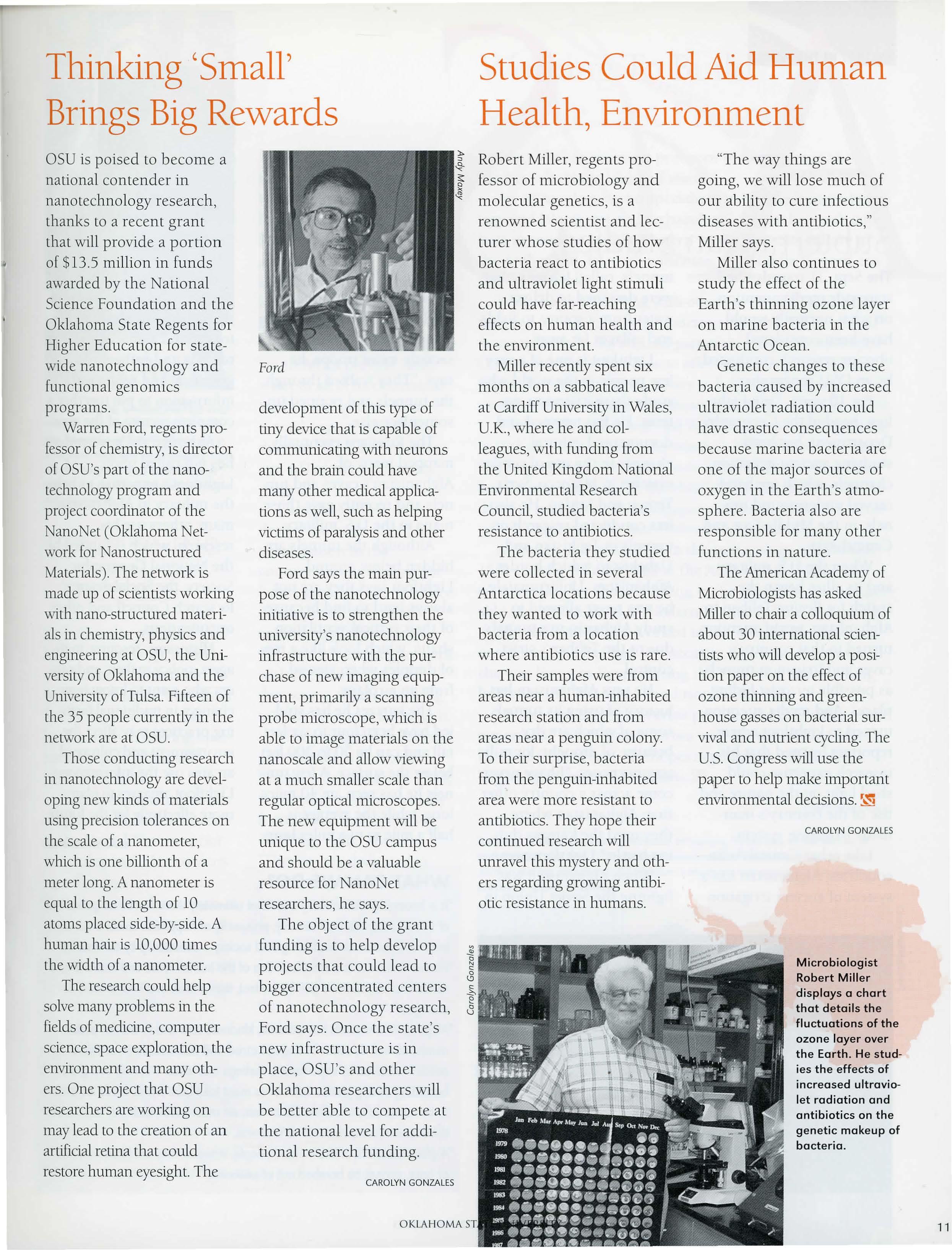
Microbiologist
Robert Miller displays a chart that details the fluctuations of the ozone loyer over the Earth. He studies the effects of increased ultraviolet radiation and antibiotics on the genetic makeup of , bacteria.
The Sept. 11 tragedy shed statewide media attention on what normally would have been considered obscure research conducted by an OSU geographer.
For 10 years, Dale Lightfoot, head of the Geography Department, has been studying ancient irrigation channels, which are handcarved underground tunnels, in the Middle East and Central Asia.
When the U.S. military and its allies began the search for fleeing Taliban in Afghanistan, world attention turned to that country's caves and irrigation tunnels as possible terrorist hiding places. And media attention turned to Lightfoot when reporters learned that his research expertise could shed light on the nature and use of the country's manmade irrigation system.
Like other Central Asian countries, Afghanistan has a system of ancient irrigation
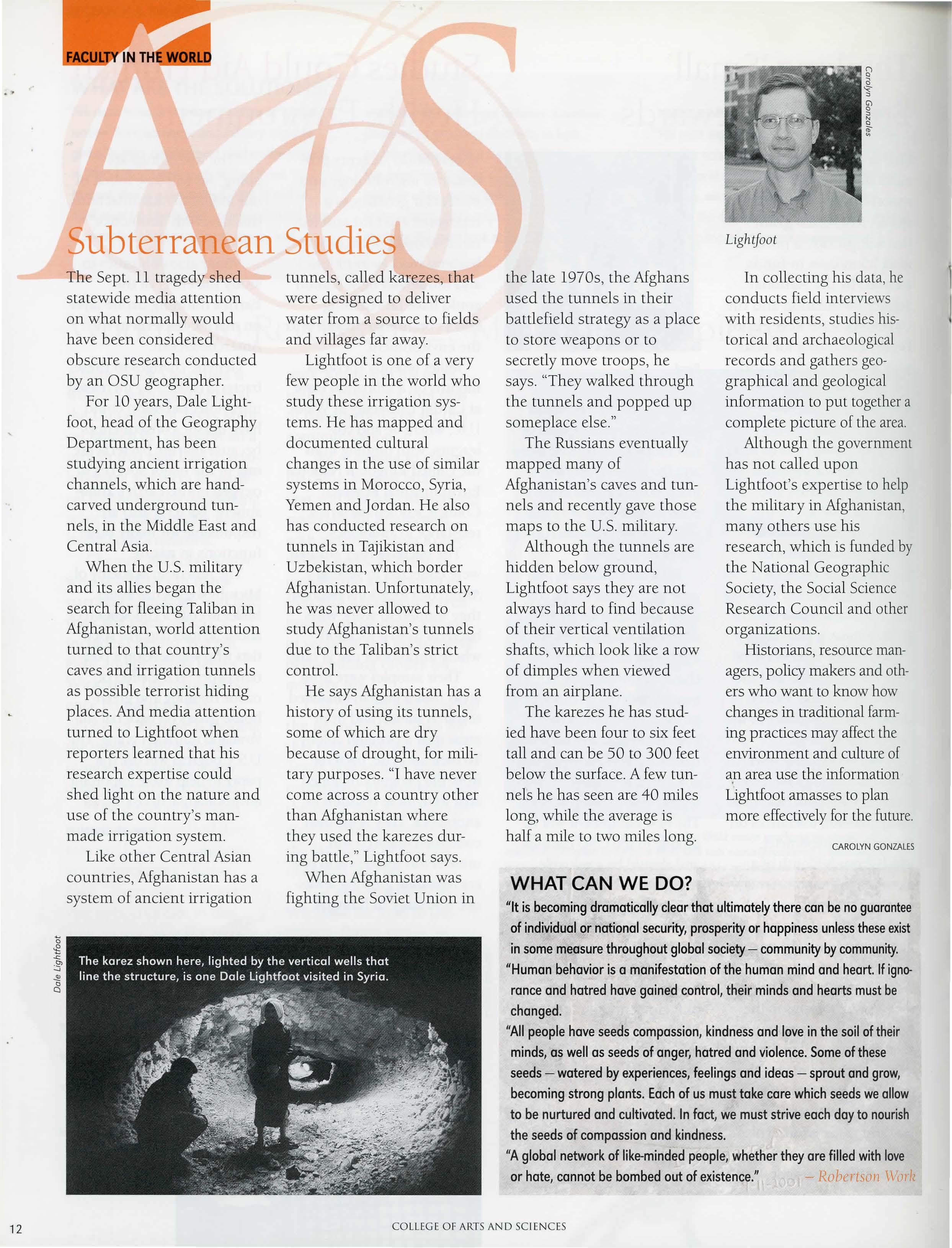
tunnels, called karezes, that were designed to deliver water from a source to fields and villages far away.
Lightfoot is one of a very few people in the world who study these irrigation systems. He has mapped and documented cultural changes in the use of similar systems in Morocco, Syria, Yemen and Jordan. He also has conducted research on tunnels in Tajikistan and Uzbekistan, which border Afghanistan. Unfortunately, he was never allowed to study Afghanistan's tunnels due to the Taliban's strict control.
He says Afghanistan has a history of using its tunnels, some of which are dry because of drought, for military purposes. "I have never come across a country other than Afghanistan where they used the karezes during battle," Lightfoot says.
When Afghanistan was fighting the Soviet Union in
the late 1970s, the Afghans used the tunnels in their battlefield strategy as a place to store weapons or to secretly move troops, he says. "They walked through the tunnels and popped up someplace else."
The Russians eventually mapped many of Afghanistan's caves and tunnels and recently gave those maps to the U.S. military.
Although the tunnels are hidden below ground, Lightfoot says they are not always hard to find because of their vertical ventilation shafts, which look like a row of dimples when viewed from an airplane.
The karezes he has studied have been four to six feet tall and can be 50 to 300 feet below the surface. A few tunnels he has seen are 40 miles long, while the average is half a mile to two miles long.
In collecting his data, he conducts field interviews with residents, studies historical and archaeological records and gathers geographical and geological information to put together a complete picture of the area.
Although the government has not called upon Lightfoot's expertise to help the military in Afghanistan, many others use his research, which is funded by the National Geographic Society, the Social Science Research Council and other organizations.
Historians, resource managers, policy makers and others who want to know how changes in traditional farming practices may affect the environment and culture of an area use the information Lightfoot amasses to plan more effectivelyfor the future.
CAROLYNGONZALES
"It is becomingdramaticallyclearthat ultimatelythereconbe noguarantee of individualor notionalsecurity,prosperityor happinessunlesstheseexist in somemeasurethroughoutglobalsociety- communitybycommunity. "Humanbehavioris a manifestationof the humanmindandheart.If ignoranceand hatredhovegainedcontrol,theirmindsand heartsmustbe changed.
"Allpeoplehoveseedscompassion,kindnessand lovein the soilof their minds,as wellas seedsof anger,hatredandviolence.Someof these seeds - wateredbyexperiences,feelingsand ideas- sproutandgrow, becomingstrongplants.Eachof usmusttokecorewhichseedsweallow to be nurturedand cultivated.In fact,we muststriveeachdayto nourish the seedsof compassionand kindness. "Aglobalnetworkof like-mindedpeople,whethertheyorefilledwithlove or hate,cannotbe bombedoutof existence."
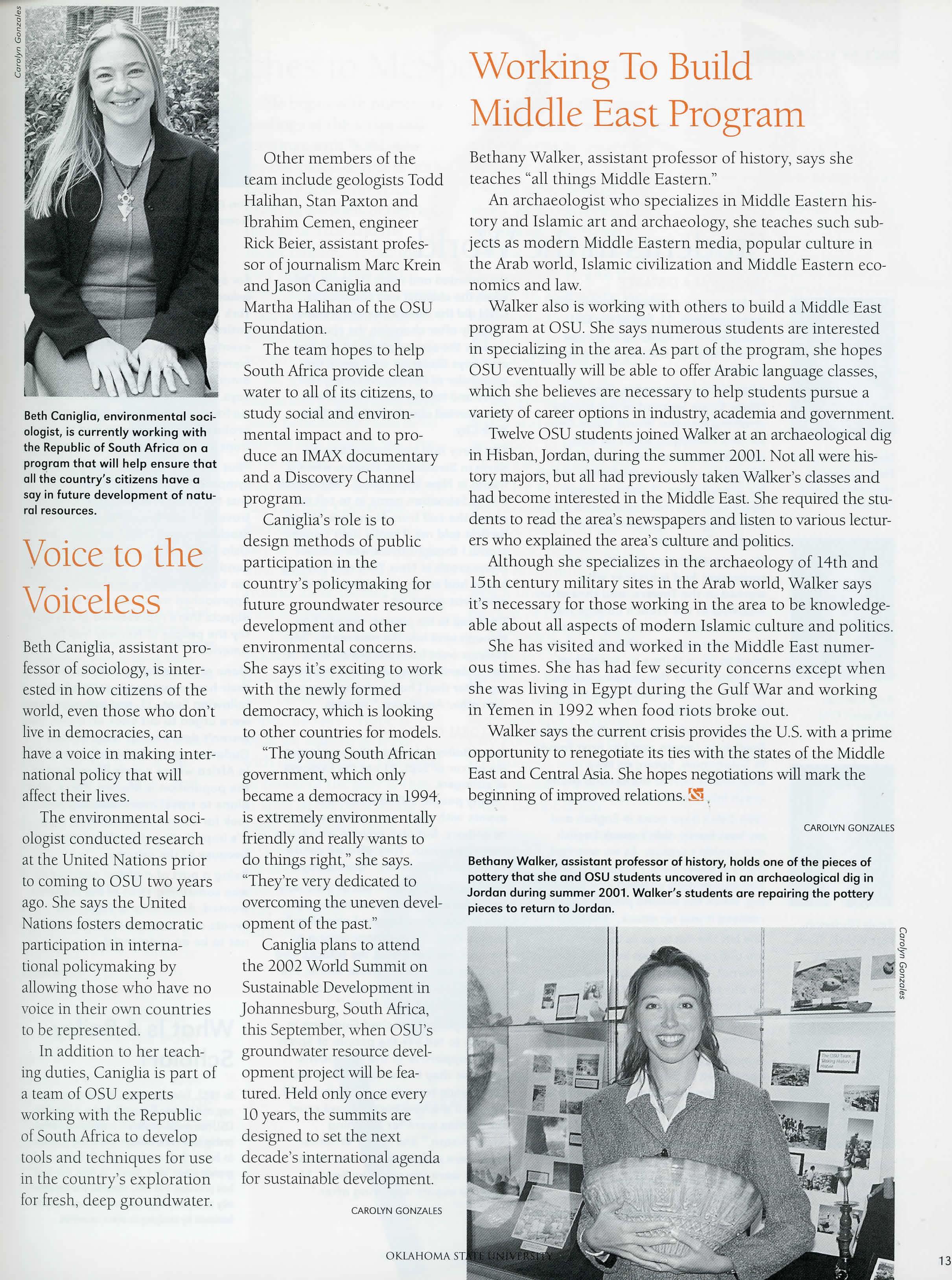
Beth Caniglia, environmental sociologist, is currently working with the Republic of South Africa on a program that will help ensure that all the country's citizens have a say in future development of natural resources.
Beth Caniglia, assistant professor of sociology, is interested in how citizens of the world, even those who don't live in democracies, can have a voice in making international policy that will affect their lives.
The environmental sociologist conducted research at the United Nations prior to coming to OSU two years ago. She says the United Nations fosters democratic participation in international policymaking by allowing those wh~ have no voice in their own countries to be represented.
In addition to her teaching duties, Caniglia is part of a team of OSU experts working with the Republic of South Africa to develop tools and techniques for use in the country's exploration for fresh, deep groundwater.
Other members of the team include geologists Todd Halihan, Stan Paxton and Ibrahim Cemen, engineer Rick Beier, assistant professor of journalism Marc Krein and Jason Caniglia and Martha Halihan of the OSU Foundation.
The team hopes to help South Africa provide clean water to all of its citizens, to study social and environmental impact and to produce an IMAX documentary and a Discovery Channel program.
Caniglia's role is to design methods of public participation in the country's policymaking for future groundwater resource development and other environmental concerns. She says it's exciting to work with the newly formed democracy, which is looking to other countries for models.
"The young South African government, which only became a democracy in 1994, is extremely environmentally friendly and really wants to do things right," she says. 'They're very dedicated to overcoming the uneven development of the past."
Caniglia plans to attend the 2002 World Summit on Sustainable Development in Johannesburg, South Africa, this September, when OSU's groundwater resource development project will be featured. Held only once every 10 years, the summits are designed to set the next decade's international agenda for sustainable development.
Bethany Walker, assistant professor of history, says she teaches "all things Middle Eastern."
An archaeologist who specializes in Middle Eastern history and Islamic art and archaeology, she teaches such subjects as modern Middle Eastern media, popular culture in the Arab world, Islamic civilization and Middle Eastern economics and law.
Walker also is working with others to build a Middle East program at OSU. She says numerous students are interested in specializing in the area. As part of the program, she hopes OSU eventually will be able to offer Arabic language classes, which she believes are necessary to help students pursue a variety of career options in industry, academia and government.
Twelve OSU students joined Walker at an archaeological dig in Hisban,Jordan, during the summer 2001. Not all were history majors, but all had previously taken Walker's classes and had become interested in the Middle East. She required the students to read the area's newspapers and listen to various lecturers who explained the area's culture and politics.
Although she specializes in the archaeology of 14th and 15th century military sites in the Arab world, Walker says it's necessary for those working in the area to be knowledgeable about all aspects of modern Islamic culture and politics.
She has visited and worked in the Middle East numerous times. She has had few security concerns except when she was living in Egypt during the Gulf War and working in Yemen in 1992 when food riots broke out.
Walker says the current crisis provides the U.S. with a prime opportunity to renegotiate its ties with the states of the Middle East and Central Asia. She hopes negotiations will mark the beginning of improved relations. r~
CAROLYNGONZALES
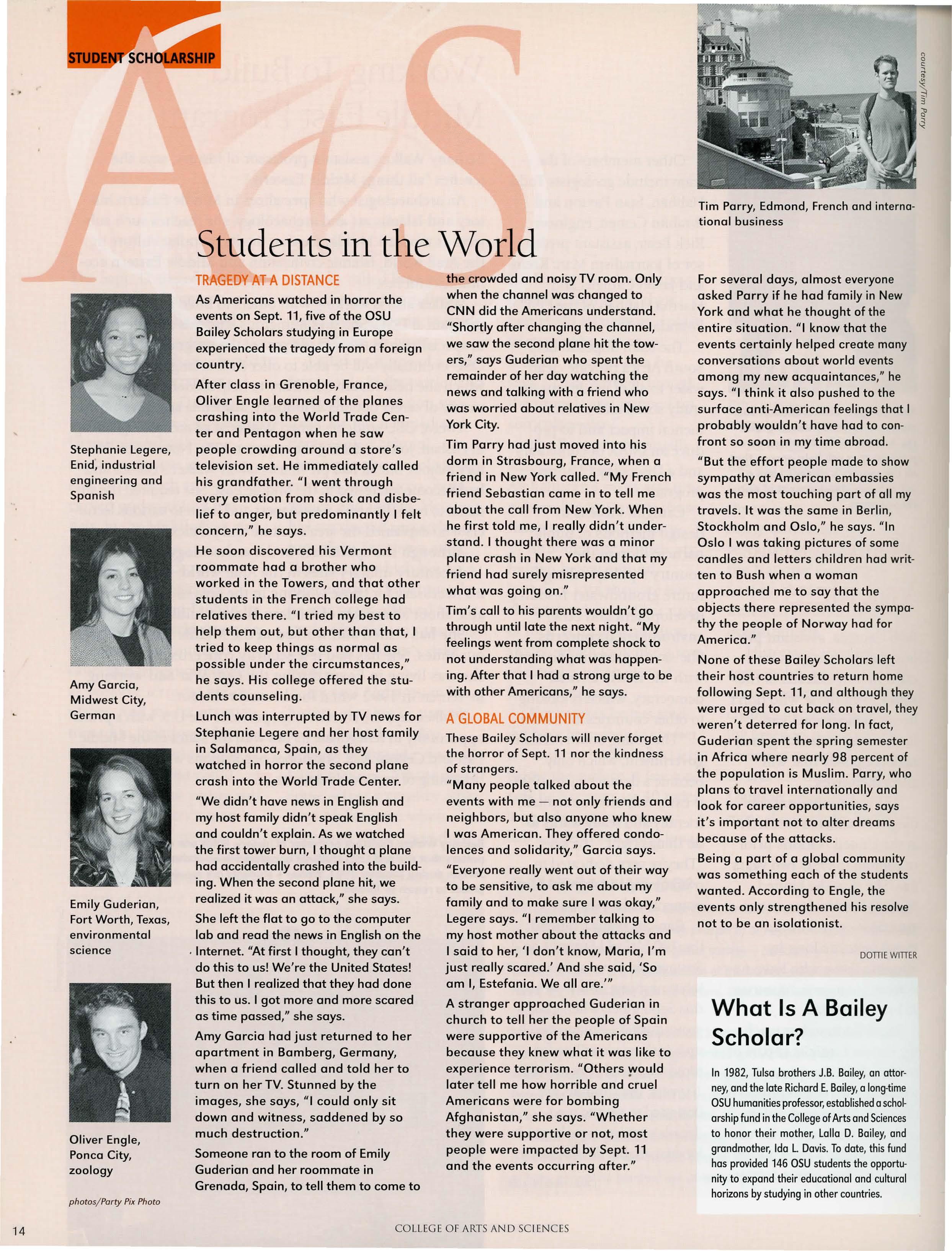
As Americans watched in horror the events on Sept. 11, five of the OSU Bailey Scholars studying in Europe experienced the tragedy from a foreign country.
After class in Grenoble, France, Oliver Engle learned of the planes crashing into the World Trade Center and Pentagon when he saw people crowding around a store's television set. He immediately called his grandfather. "I went through every emotion from shock and disbelief to anger, but predominantly I felt concern," he says.
He soon discovered his Vermont roommate had a brother who worked in the Towers, and that other students in the French college had relatives there. "I tried my best to help them out, but other than that, I tried to keep things as normal as possible under the circumstances," he says. His college offered the students counseling.
Lunch was interrupted by TV news for Stephanie Legere and her host family in Salamanca, Spain, as they watched in horror the second plane crash into the World Trade Center.
"We didn't have news in English and my host family didn't speak English and couldn't explain. As we watched the first tower burn, I thought a plane hod accidentally crashed into the building. When the second plane hit, we realized it was an attack," she says. She left the flat to go to the computer lab and read the news in English on the Internet. "At first I thought, they can't do this to us! We're the United States! But then I realized that they had done this to us. I got more and more scared as time passed," she says.
Amy Garcia had just returned to her apartment in Bamberg, Germany, when a friend called and told her to turn on her TV. Stunned by the images, she says, "I could only sit down and witness, saddened by so much destruction."
Someone ran to the room of Emily Guderian and her roommate in Grenada, Spain, to tell them to come to
the crowded and noisy TV room. Only when the channel was changed to CNN did the Americans understand. "Shortly after changing the channel, we saw the second plane hit the towers," says Guderian who spent the remainder of her day watching the news and talking with a friend who was worried about relatives in New York City.
Tim Parry had just moved into his dorm in Strasbourg, France, when a friend in New York called. "My French friend Sebastian came in to tell me about the call from New York. When he first told me, I really didn't understand. I thought there was a minor plane crash in New York and that my friend had surely misrepresented what was going on."
Tim's call to his parents wouldn't go through until late the next night. "My feelings went from complete shock to not understanding what was happening. After that I had a strong urge to be with other Americans," he says.
These Bailey Scholars will never forget the horror of Sept. 11 nor the kindness of strangers.
"Many people talked about the events with me - not only friends and neighbors, but also anyone who knew I was American. They offered condolences and solidarity," Garcia says. "Everyone really went out of their way to be sensitive, to ask me about my family and to make sure I was okay," Legere says. "I remember talking to my host mother about the attacks and I said to her, 'I don't know, Maria, I'm just really scared.' And she said, 'So am I, Estefonia. We all are."'
A stranger approached Guderian in church to tell her the people of Spain were supportive of the Americans because they knew what it was like to experience terrorism. "Others yvould later tell me how horrible and cruel Americans were for bombing Afghanistan," she says. "Whether they were supportive or not, most people were impacted by Sept. 11 and the events occurring after.''
For several days, almost everyone asked Parry if he had family in New York and what he thought of the entire situation. "I know that the events certainly helped create many conversations about world events among my new acquaintances," he says. "I think it also pushed to the surface anti-American feelings that I probably wouldn't have had to confront so soon in my time abroad. "But the effort people made to show sympathy at American embassies was the most touching part of all my travels. It was the same in Berlin, Stockholm and Oslo," he says. "In Oslo I was taking pictures of some candles and letters children had written to Bush when a woman approached me to say that the objects there represented the sympathy the people of Norway had for America."
None of these Bailey Scholars left their host countries to return home following Sept. 11, and although they were urged to cut back on travel, they weren't deterred for long. In fact, Guderian spent the spring semester in Africa where nearly 98 percent of the population is Muslim. Parry, who plans to travel internationally and look for career opportunities, says it's important not to alter dreams because of the attacks.
Being a part of a global community was something each of the students wanted. According to Engle, the events only strengthened his resolve not to be an isolationist.
In 1982,TulsabrothersJ.B. Bailey,an attorney,andthe late RichardE.Bailey,a long-time 0SUhumanitiesprofessor,established a scholarshipfundin the Collegeof ArtsandSciences to honor their mother,Lalla D. Bailey,and grandmother,Ida L Davis.Todate,this fund has provided1460SU studentsthe opportunity to expandtheir educationaland cultural horizonsbystudyingin othercountries.
When director Kirby Wahl approached Kenn McSperitt about composing an original score for the OSU Theater Department's winter 2002 production of Trojan Women, the music graduate student did not hesitate.
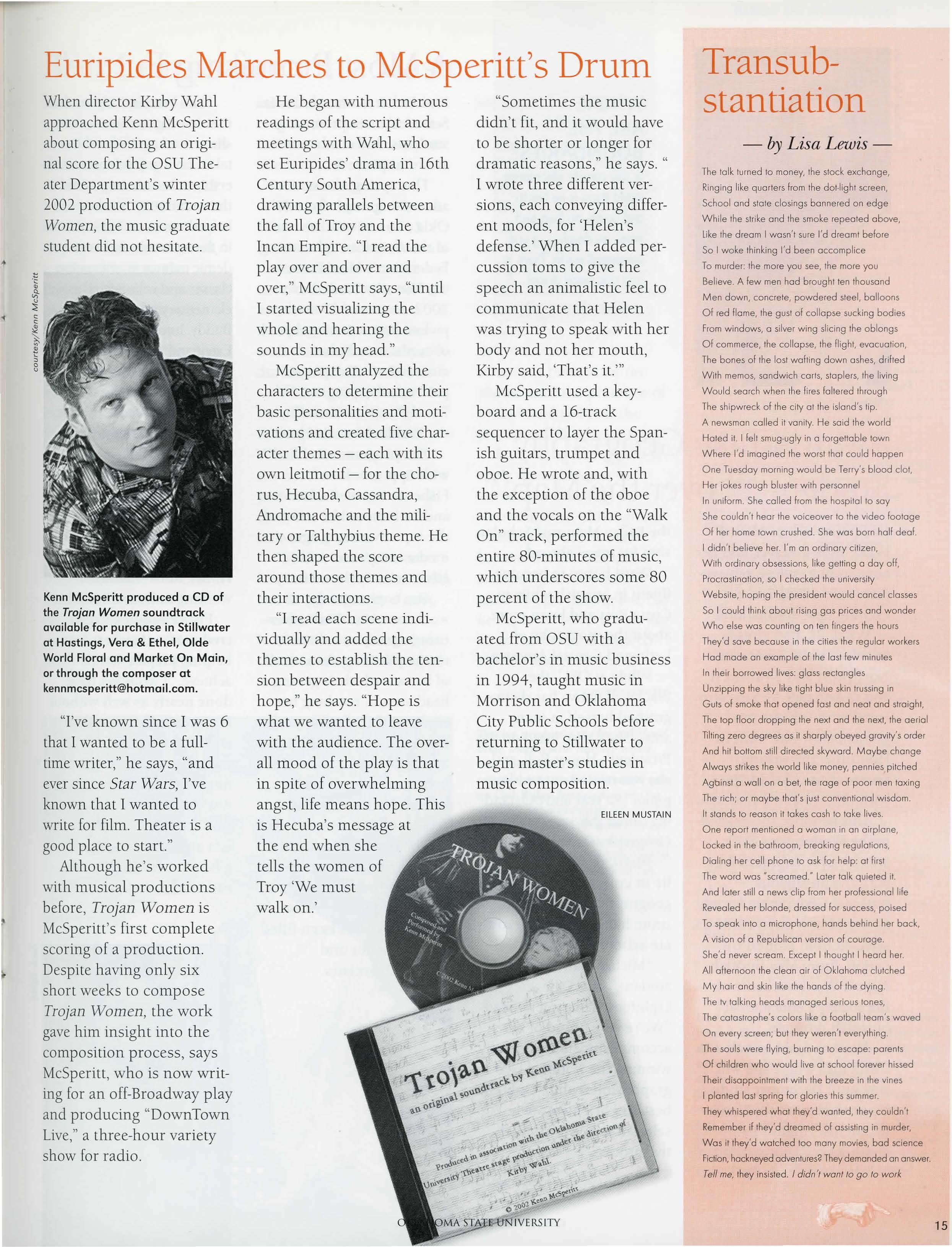
Kenn McSperitt produced a CD of the Trojan Women soundtrack available for purchase in Stillwater at Hastings, Vera & Ethel, Olde World Floral and Market On Main, or through the composer at kennmcsperitt@hotmail.com.
"I've known since I was 6 that I wanted to be a fulltime writer," he says, "and ever since Star Wars, I've known that I wanted to write for film. Theater is a good place to start."
Although he's worked with musical productions before, Trojan Women is McSperitt's first complete scoring of a production. Despite having only six short weeks to compose Trojan Women, the work gave him insight into the composition process, says McSperitt, who is now writing for an off-Broadway play and producing "DownTown Live,"a three-hour variety show for radio.
He began with numerous readings of the script and meetings with Wahl, who set Euripides' drama in 16th Century South America, drawing parallels between the fall of Troy and the Incan Empire. "I read the play over and over and over," McSperitt says, "until I started visualizing the whole and hearing the sounds in my head."
McSperitt analyzed the characters to determine their basic personalities and motivations and created five character themes - each with its own leitmotif - for the chorus, Hecuba, Cassandra, Andromache and the military or Talthybius theme. He then shaped the score around those themes and their interactions.
"I read each scene individually and added the themes to establish the tension between despair and hope," he says. "Hope is what we wanted to leave with the audience. The overall mood of the play is that in spite of overwhelming angst, life means hope. This is Hecuba's message at the end when she tells the women of Troy 'We must walk on.'
"Sometimes the music didn't fit, and it would have to be shorter or longer for dramatic reasons," he says. " I wrote three different versions, each conveying different moods, for 'Helen's defense.' When I added percussion toms to give the speech an animalistic feel to communicate that Helen was trying to speak with her body and not her mouth, Kirby said, 'That's it."'
McSperitt used a keyboard and a 16-track sequencer to layer the Spanish guitars, trumpet and oboe. He wrote and, with the exception of the oboe and the vocals on the "Walk On" track, performed the entire SO-minutes of music, which underscores some 80 percent of the show.
McSperi.tt, who graduated from OSU with a bachelor's in music business in 1994, taught music in Morrison and Oklahoma City Public Schools before returning to Stillwater to begin master's studies in music composition.
- by Lisa Lewis -
The talk turned to money, the stock exchange, Ringing like quarters from the dot-light screen, School ond stole closings bannered on edge While the strike and the smoke repeated above, like the dream I wasn't sure I'd dreamt before So I woke lhinking I'd been accomplice
To murder: the more you see, the more you Believe. A few men hod brought ten thousand Men down, concrete, powdered steel, balloons Of red flome, the gust of collapse sucking bodies From windows, a silver wing slicing the oblongs Of commerce, the collapse, the flight, evocuotion, The bones of the lost wafting down oshes, drifted With memos, sandwich earls, staplers, the living Would search when the fires loitered lhrough
The shipwreck of the city ot the island's tip.
A newsman called ii vanity. He said the world Hated it. I felt smug-ugly in o forgettable town
Where I'd imagined the worst tho! could happen
One Tuesday morning would be Terry's blood clot, Her jokes rough bluster with personnel
In uniform. She called from the hospital to soy She couldn't hear the voiceover to the video footage Of her home town crushed. She was born half deof. I didn't believe her. I'm on ordinary citizen, With ordinary obsessions, like ge!Hng a day off, Procrastination, so I checked the university Website, hoping the president would cancel classes So I could think about rising gas prices and wonder
Who else was counting on ten fingers the hours
They'd save because in the cities the regular workers Hod mode on example of !he lost few minutes
In their borrowed lives: glass rectangles
Unzipping the sky like tight blue skin trussing in Guls of smoke that opened fast and neat and straight,
The top floor dropping the next ond the next, the aerial
Tilting zero degrees as ii sharply obeyed gravity's order
And hit bottom slill directed skyward. Maybe change
Always strikes the world like money, pennies pitched Agoinst a wall on a be!, the rage of poor men taxing
The rich; or maybe that's just conventional wisdom.
It stands to reason it takes cash to lake lives.
One report mentioned o woman in on airplane, locked in the bathroom, breaking regulations, Dialing her cell phone to osk for help: at first
The word was •screamed. 8 later talk quieted ii. And later still a news clip from her professional life
Revealed her blonde, dressed for success, poised
Tospeok into o microphone, honds behind her bock, A vision of a Republican version of courage. She'd never scream. Except I thought I heard her. All afternoon the clean air of Oklahoma clutched
My hair and skin like the honds of the dying.
The Iv talking heads managed serious tones, The cotostrophe's colors like o football team's waved
On every screen; but they weren't everything.
The souls were flying, burning to escape: parents
Of children who would live ot school forever hissed
Their disappointment with the breeze in the vines
I planted lost spring for glories this summer.
They whispered what they'd wonted, they couldn't
Remember if lhey'd dreamed of assisting in murder, Was it they'd watched too many movies, bad science Fiction,hackneyed adventures?Theydemanded an answer. Tell me, they insisted. I didn't won/ lo go to work
"Inthisrapidlyglobalizing worldthereis no North andSouth,no Eastand West,no developingand developedworld.Thereis onlyonesmallplanet "
- Robertson Worh
Geography senior Michal Ward loves to travel, and her outstanding college achievements are taking her to exciting new destinations.
Ward, 21, had already traveled in the American Northwest and Southwest and to Jamaica, Mexico and Israel with various programs before she went to Honduras this spring semester on a field trip with OSU forestry students.
This summer she headed to the Washington, D.C., area to serve an internship with the prestigious National Geographic Society as one of only eight students selected from around the nation. From May through August Ward worked with the society's educational outreach program.
Afterward, she traveled to Costa Rica where she will stay until December studying at the University Veritas in Sanjose, thanks to another prestigious award,
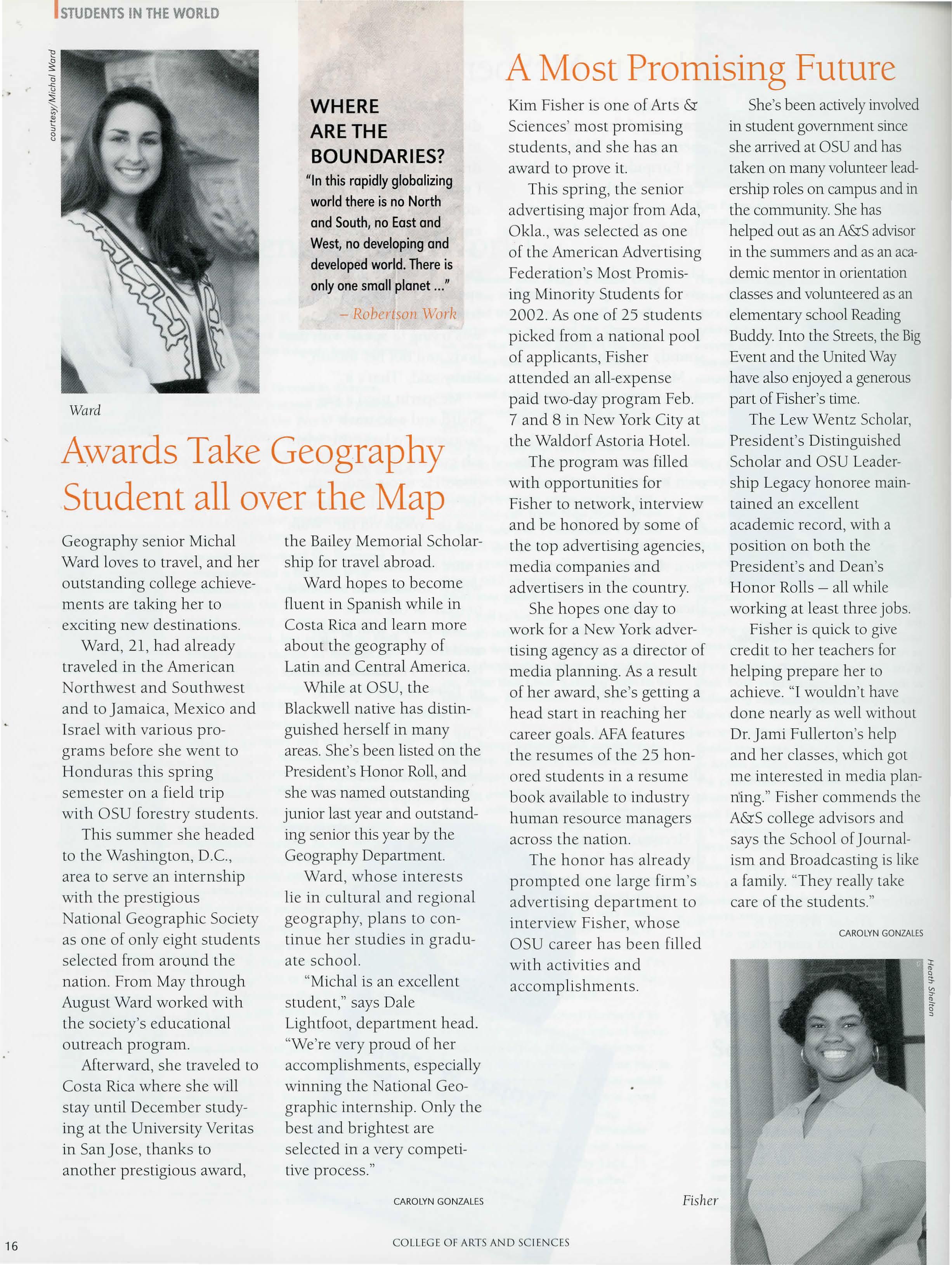
the Bailey Memorial Scholarship for travel abroad.
Ward hopes to become fluent in Spanish while in Costa Rica and learn more about the geography of Latin and Central America.
While at OSU, the Blackwell native has distinguished herself in many areas. She's been listed on the President's Honor Roll, and she was named outstanding junior last year and outstanding senior this year by the Geography Department.
Ward, whose interests lie in cultural and regional geography, plans to continue her studies in graduate school.
"Michal is an excellent student," says Dale Lightfoot, department head. "We're very proud of her accomplishments, especially winning the National Geographic internship. Only the best and brightest are selected in a very competitive process."
Kim Fisher is one of Arts & Sciences' most promising students, and she has an award to prove it.
This spring, the senior advertising major from Ada, Okla., was selected as one of the American Advertising Federation's Most Promising Minority Students for 2002. As one of 25 students picked from a national pool of applicants, Fisher attended an all-expense paid two-day program Feb. 7 and 8 in New York City at the Waldorf Astoria Hotel.
The program was filled with opportunities for Fisher to network, interview and be honored by some of the top advertising agencies, media companies and advertisers in the country.
She hopes one day to work for a New York advertising agency as a director of media planning. As a result of her award, she's getting a head start in reaching her career goals. AFA features the resumes of the 25 honored students in a resume book available to industry human resource managers across the nation.
The honor has already prompted one large firm's advertising department to interview Fisher, whose OSU career has been filled with activities and accomplishments.
She's been activelyinvolved in student government since she arrived at OSU and has taken on many volunteer leadership roles on campus and in the community. She has helped out as an A&S advisor in the smmners and as an academic mentor in orientation classes and volunteered as an elementary school Reading Buddy. lnto the Streets,the Big Event and the United Way have also enjoyed a generous part of Fisher's time.
The Lew Wentz Scholar, President's Distinguished Scholar and OSU Leadership Legacy honoree maintained an excellent academic record, with a position on both the President's and Dean's Honor Rolls - all while working at least three jobs. Fisher is quick to give credit to her teachers for helping prepare her to achieve. "I wouldn't have done nearly as well without Dr.Jami Fullerton's help and her classes, which got me interested in media plann1.ng."Fisher commends the A&S college advisors and says the School of Journalism and Broadcasting is like a family. "They really take care of the students."
CAROLYNGONZALES
Fisher
MichaelBlair,physics doctoralstudent, recently collected two prestigious awards forhis outstanding work.
NASAawarded Blair, 25, a three-year $72,000 Graduate Student Research Fellowship that includes stipend, travel and tuition. His project is the development of an instrument for sediment dating on Mars.
With the fellowship, Blair willwork two summer months each year at the Jet Propulsion Lab in Pasadena, Calif.,and the remainder of eachyear at OSU where he conducts research in physics professor Stephen McKeever'slaboratory.
Blair also received a scholarship from the Oak RidgeAssociation of Universities to attend the 52nd annual Nobel Laureates meeting in Lindau, Germany this summer. The
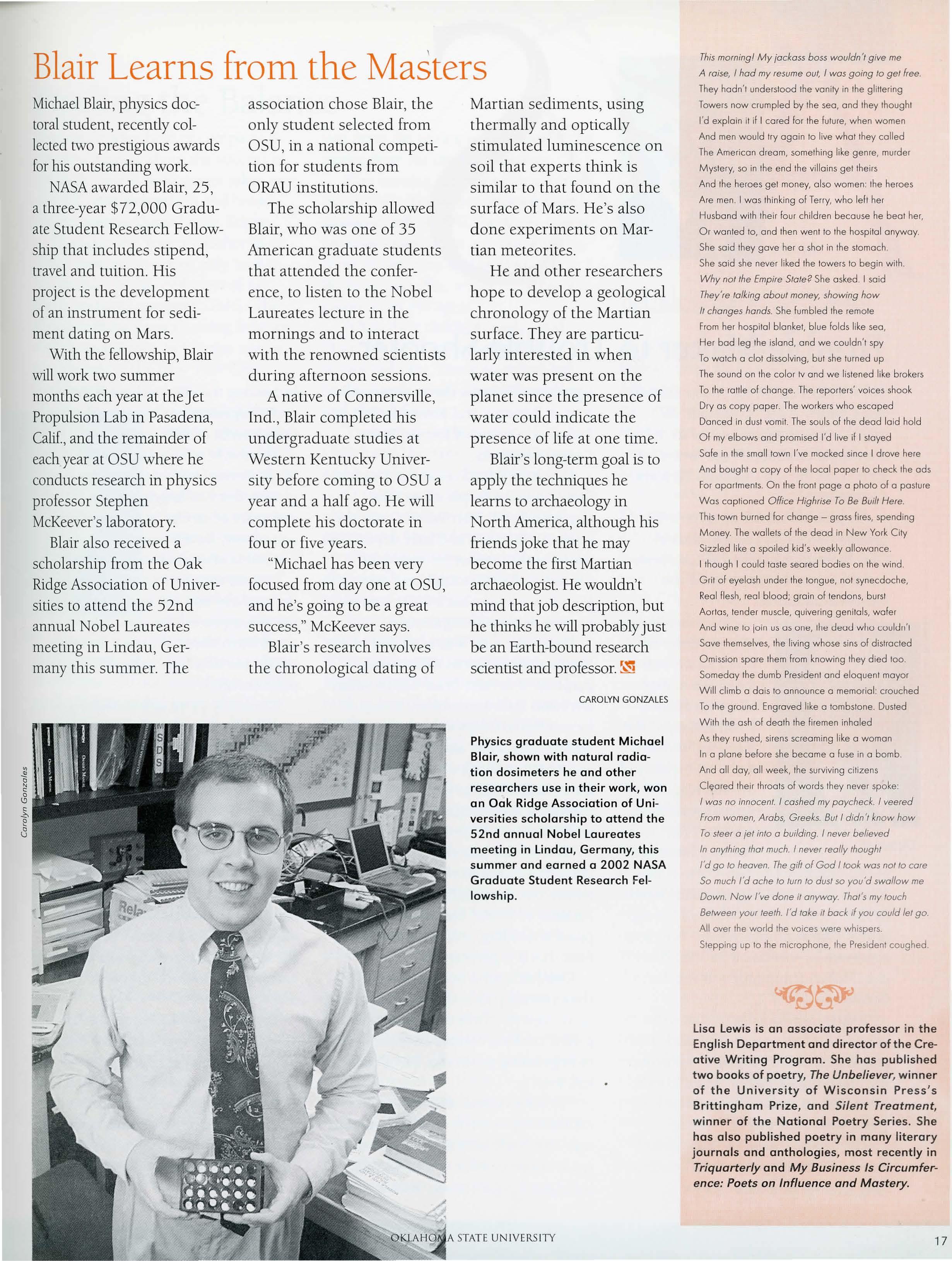
association chose Blair, the only student selected from OSU, in a national competition for students from ORAU institutions.
The scholarship allowed Blair, who was one of 35 American graduate students that attended the conference, to listen to the Nobel Laureates lecture in the mornings and to interact with the renowned scientists during afternoon sessions.
A native of Connersville, Ind., Blair completed his undergraduate studies at Western Kentucky University before coming to OSU a year and a half ago. He will complete his doctorate in four or five years.
"Michael has been very focused from day one at OSU, and he's going to be a great success," McKeever says.
Blair's research involves the chronological dating of
Martian sediments, using thermally and optically stimulated luminescence on soil that experts think is similar to that found on the surface of Mars. He's also done experiments on Martian meteorites.
He and other researchers hope to develop a geological chronology of the Martian surface. They are particularly interested in when water was present on the planet since the presence of water could indicate the presence of life at one time.
Blair's long-term goal is to apply the techniques he learns to archaeology in North America, although his friends joke that he may become the first Martian archaeologist. He wouldn't mind that job description, but he thinks he will probably just be an Earth-bound research scientist and professor. r~
Physics graduate student Michael Blair, shown with natural radiation dosimeters he and other researchers use in their work, wan an Oak Ridge Association of Universities scholarship to attend the 52nd annual Nobel Laureates meeting in Lindau, Germany, this summer and earned a 2002 NASA Graduate Student Research Fellowship.
Thismorning! My ;ackoss boss wouldn't give me
A raise, I had my resume out, I was going to get free. They hodn·t understood the vanity in the glittering Towers now crumpled by the sea, and they thought I'd explain it if I cared for lhe future, when women
And men would try again lo live whot they called
The American dream, something like genre, murder Mystery, so in the end the vil!ains get theirs
And the heroes get money, also women: the heroes Are men. I was thinking of Terry, who left her Husband with their four children because he beat her, Or wanted lo, and then went lo the hospital anyway. She said they gave her a shot in the stomach. She said she never liked !he lowers to begin with. Why no/ the Empire Stole? She asked. I said They're talking about money, showing how II changes honds. She fumbled the remote from her hospital blanket, blue folds like sea, Her bod leg the island. and we couldn't spy To watch a dot dissolving, but she turned up The sound on the color Iv and we listened like brokers
To the rattle of change. The reporters' voices shook Dry as copy paper. The workers who escaped Danced in dust vomit. The souls of the dead laid hold
Of my elbows and promised I'd live if I stayed Safe in the small town I've mocked since I drove here
And bought a copy of the locol paper to check the ads For aparlmenls. On the front page a photo of a posture Was captioned Office Highrise To Be Built Here. This town burned for change~ gross fires, spending Money. The wallets of the dead in New York City Sizzled like a spoiled kid's weekly ollowonce. I though I could taste seared bodies on the wind. Grit of eyelash under the tongue, not synecdoche, Real flesh, real blood; groin of tendons, burst Aortas, tender muscle, quivering genitals, wafer And wine lo loin us as one, the deuJ wl1u cuulUn't Save themselves, the living whose sins of distracted Omission spare them from knowing they died too. Someday the dumb President and eloquent mayor Will climb a dais lo announce a memorial: crouched To the ground. Engraved like a tombstone. Dusted With the ash of death the firemen inhaled As they rushed, sirens screaming like a woman In a plane before she became a fuse in a bomb. And all day, all week, 1hesurviving citizens Cleared their throats of words they never spoke: I was no innocent. I cashed my paycheck. I veered From women, Arabs, Greeks. But I didn't know how To steer o jet into a building. I never believed In anything Iha/ much. I never reolly !hough/ I'd go lo heaven. The gilt of God I look wos no/ lo core So much I'd oche to furn to dust so you'd swallow me Down. Now I've done it anyway. That's my touch Be/ween your leeth. I'd lake ii bock ii you could le! go. All over the world the voices were whispers. Stepping up to the microphone, !he President coughed.
Lisa Lewis is an associate professor in the English Department and director of the Creative Writing Program. She has published two books of poetry, The Unbeliever, winner of the University of Wisconsin Press's Brittingham Prize, and Silent Treatment, winner of the National Poetry Series. She has also published poetry in many literary journals and anthologies, most recently in Triquarterly and My Business Is Circumference: Poets on Influence and Mastery.
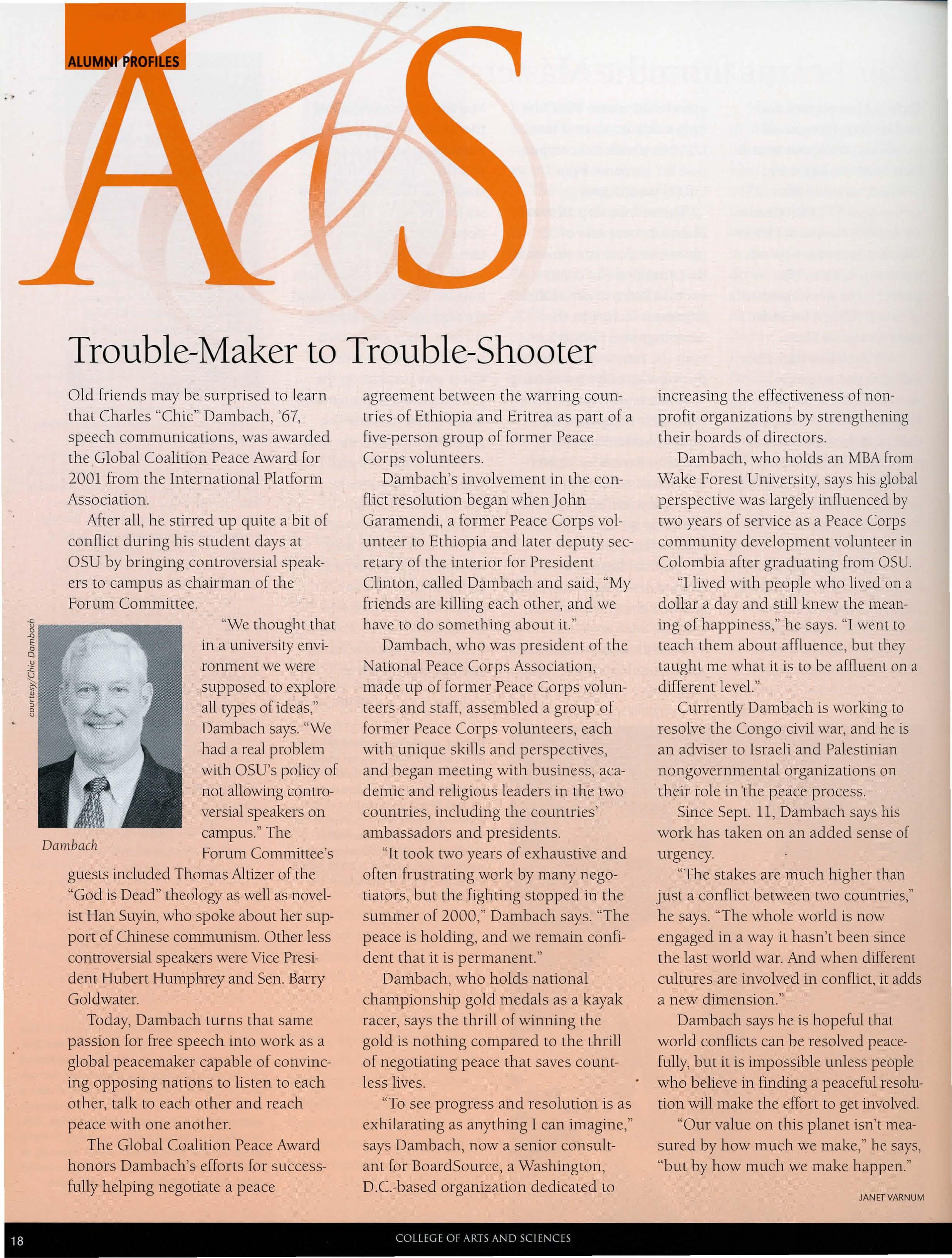
Old friends may be surprised to learn that Charles "Chic" Dambach, '67, speech communications, was awarded the.Global Coalition Peace Award for 2001 from the International Platform Association.
After all, he stirred up quite a bi.t of conflict during hi.s student days at OSU by bringing controversial speakers to campus as chairman of the Forum Committee.
"We thought that in a university enviromnent we were supposed to explore all types of ideas," Dambach says. "We had a real problem with OSU's policy of not allowing controversial speakers on campus." The Dambach Forum Committee's guests included Thomas Altizer of the "God is Dead" theology as well as novelist Han Suyin, who spoke about her support of Chinese communism. Other less controversial speakers were Vice President Hubert Humphrey and Sen. Barry Goldwater.
Today, Dambach turns that same passion for free speech into work as a global peacemaker capable of convincing opposing nations to listen to each other, talk to each other and reach peace with one another.
The Global Coalition Peace Award honors Dambach's efforts for successfully helping negotiate a peace
agreement between the warring countries of Ethiopia and Eritrea as part of a five-person group of former Peace Corps volunteers.
Dambach's involvement in the conflict resolution began whenjohn Garamendi, a former Peace Corps volunteer to Ethiopia and later deputy secretary of the interior for President Clinton, called Dambach and said, "My friends are killing each other, and we have to do something about it."
Dambach, who was president of the National Peace Corps Association, made up of former Peace Corps volunteers and staff, assembled a group of former Peace Corps volunteers, each with unique ski.lls and perspectives, and began meeting with business, academic and religious leaders in the two countries, including the countries' ambassadors and presidents.
"It took two years of exhaustive and often frustrating work by many negotiators, but the fighting stopped in the summer of 2000," Dambach says. "The peace is holding, and we remain confident that it is permanent."
Dambach, who holds national championship gold medals as a kayak racer, says the thrill of winning the gold is nothing compared to the thrill of negotiating peace that saves countless lives.
"To see progress and resolution is as exhilarating as anything I can imagine," says Dambach, now a senior consultant for BoardSource, a Washington, D.C-based organization dedicated to
increasing the effectiveness of nonprofit organizations by strengthening their boards of di.rectors.
Dambach, who holds an MBAfrom Wake Forest University, says his global perspective was largely influenced by two years of service as a Peace Corps community development volunteer in Colombia after graduating from OSU.
"I lived with people who lived on a dollar a day and still knew the meaning of happiness," he says. "I went to teach them about affluence, but they taught me what it is to be affluent on a different level."
Currently Dambach is working to resolve the Congo civil war, and he is an adviser to Israeli and Palestinian nongovernmental organizations on their role in lhe peace process.
Since Sept. 11, Dambach says his work has taken on an added sense of urgency.
"The stakes are much higher than just a conflict between two countries," he says. "The whole world is now engaged in a way i.thasn't been since the last world war. And when different cultures are involved in conflict, it adds a new dimension."
Dambach says he is hopeful that world conflicts can be resolved peacefully, but it is impossible unless people who believe in finding a peaceful resolution will make the effort to get involved.
"Our value on this planet isn't measured by how much we make," he says, "but by how much we make happen."
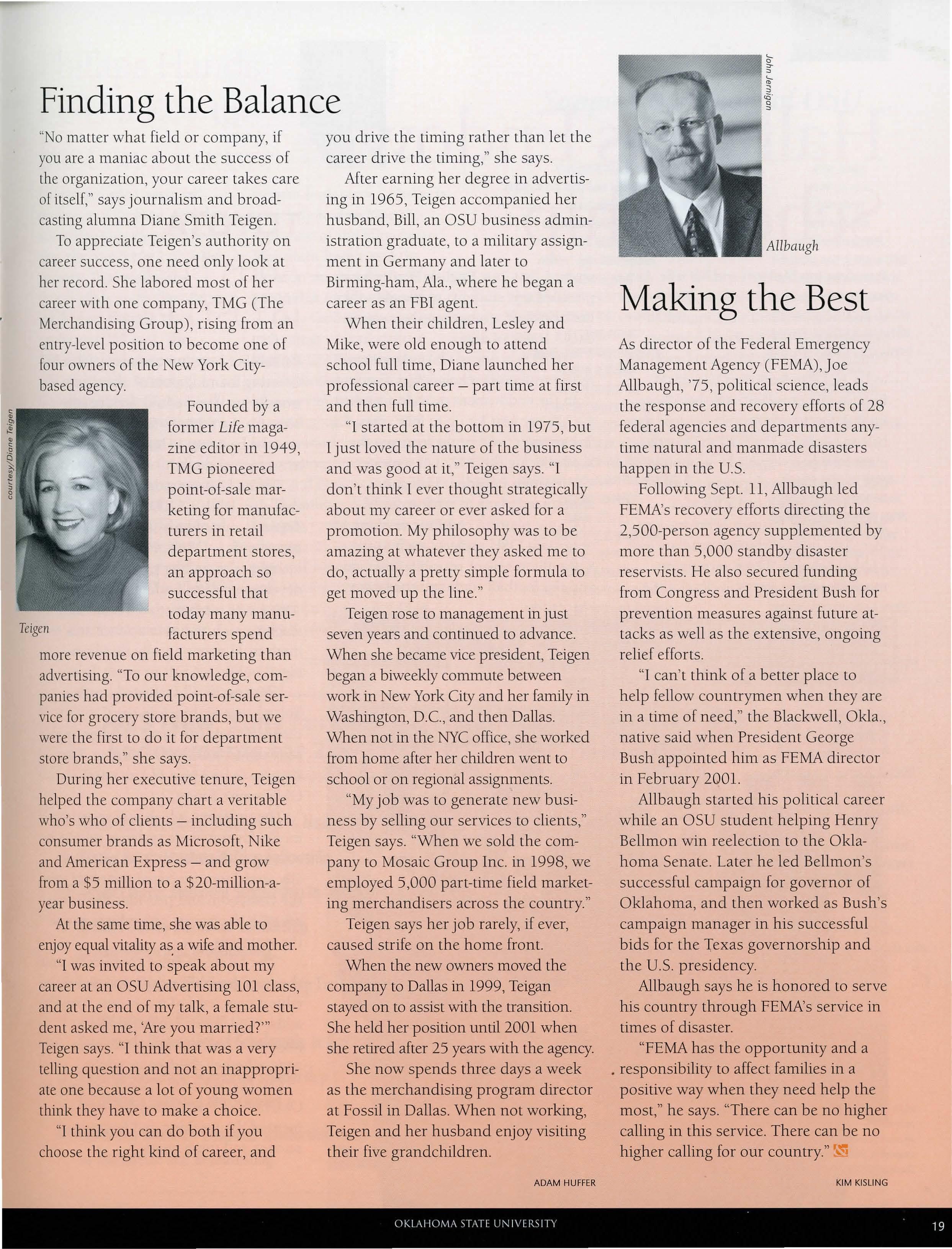
"No matter what field or company, if you are a maniac about the success of the organization, your career takes care of itself," says journalism and broadcasting alumna Diane Smith Teigen.
To appreciate Teigen's authority on career success, one need only look at her record. She labored most of her career with one company, TMG (The Merchandising Group), rising from an entry-levelposition to become one of four owners of the New York Citybased agency.
Founded by a former Life magazine editor in 1949, TMG pioneered point-of-sale marketing for manufacturers in retail department stores, an approach so successful that today many manuTeigen facturers spend more revenue on field marketing than advertising. "To our knowledge, companies had provided point-of-sale service for grocery store brands, but we were the first to do it for department store brands," she says.
During her executive tenure, Teigen helped the company chart a veritable who's who of clients - including such consumer brands as Microsoft, Nike and American Express - and grow from a $5 million to a $20-million-ayear business.
At the same time, she was able to enjoy equal vitality a~ a wife and mother.
"I was invited to speak about my career at an OSU Advertising 101 class, and at the end of my talk, a female student asked me, 'Are you married?"' Teigen says. "I think that was a very telling question and not an inappropriate one because a lot of young women think they have to make a choice.
"I think you can do both if you choose the right kind of career, and
you drive the timing rather than let the career drive the timing," she says.
After earning her degree in advertising in 1965, Teigen accompanied her husband, Bill, an OSU business administration graduate, to a military assignment in Germany and later to Birming-ham, Ala., where he began a career as an FBI agent.
When their children, Lesley and Mike, were old enough to attend school full time, Diane launched her professional career - part time at first and then full time.
"1 started at the bottom in 1975, but I just loved the nature of the business and was good at it," Teigen says. "I don't think I ever thought strategically about my career or ever asked for a promotion. My philosophy was to be amazing at whatever they asked me to do, actually a pretty simple formula to get moved up the line."
Teigen rose to management in just seven years and continued to advance. When she became vice president, Teigen began a biweekly commute between work in New York City and her family in Washington, D.C., and then Dallas. When not in the NYC office, she worked from home after her children went to school or on regional assignments.
"My job was to generate new business by selling our services to clients," Teigen says. "When we sold the company to Mosaic Group Inc. in 1998, we employed 5,000 part-time field marketing merchandisers across the country."
Teigen says her job rarely, if ever, caused strife on the home front.
When the new owners moved the company to Dallas in 1999, Teigan stayed on to assist with the transition. She held her position until 2001 when she retired after 25 years with the agency. She now spends three days a week as the merchandising program director at Fossil in Dallas. When not working, Teigen and her husband enjoy visiting their five grandchildren.
As director of the Federal Emergency Management Agency (FEMA),Joe Allbaugh, '75, political science, leads the response and recovery efforts of 28 federal agencies and departments anytime natural and manmade disasters happen in the U.S.
Following Sept. 11, Allbaugh led FEMA's recovery efforts directing the 2,500-person agency supplemented by more than 5,000 standby disaster reservists. He also secured funding from Congress and President Bush for prevention measures against future attacks as well as the extensive, ongoing relief efforts.
"I can't think of a better place to help fellow countrymen when they are in a time of need," the Blackwell, Okla., native said when President George Bush appointed him as FEMA director in February 2001.
Allbaugh started his political career while an OSU student helping Henry Bellman win reelection to the Oklahoma Senate. Later he led Bellman's successful campaign for governor of Oklahoma, and then worked as Bush's campaign manager in his successful bids for the Texas governorship and the U.S presidency.
Allbaugh says he is honored to serve his country through FEMA's service in times of disaster.
"FEMA has the opportunity and a . responsibility to affect families in a positive way when they need help the most," he says. "There can be no higher calling in this service. There can be no higher calling for our country."
President Jim Halligan and his wife, Ann, have generously donated his 2001 bonus to endow a President's Distinguished Scholarship (PDS) for English majors. Funded by the $50,000 bonus awarded to Dr. Halligan from the OSU/A&M Regents, the president says they chose English for the scholarship because they believe faculty in the English Department have been especially supportive of OSU's scholar development effort.
OSU has produced a Rhodes Scholar, seven Truman Scholars, one Marshall, two Goldwater Scholars and a Udall Scholar. "From serving on mock interview teams to developing i/f
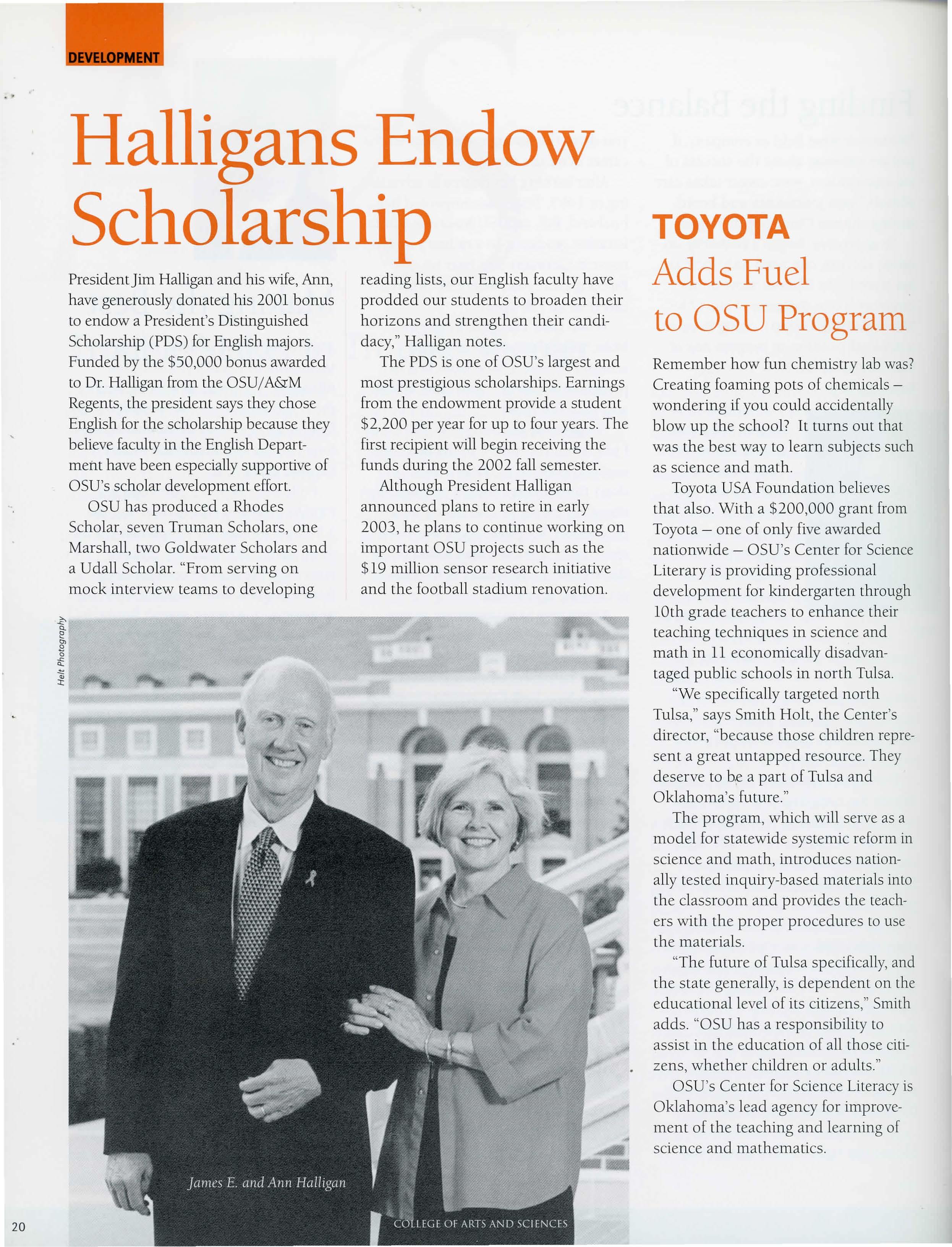
reading lists, our English faculty have prodded our students to broaden their horizons and strengthen their candidacy," Halligan notes.
The PDS is one of OSU's largest and most prestigious scholarships. Earnings from the endowment provide a student $2,200 per year for up to four years. The first recipient will begin receiving the funds during the 2002 fall semester.
Although President Halligan announced plans to retire in early 2003, he plans to continue working on important OSU projects such as the $19 million sensor research initiative and the football stadium renovation.
Remember how fun chemistry lab was7 Creating foaming pots of chemicalswondering if you could accidentally blow up the schooP It turns out that was the best way to learn subjects such as science and math.
Toyota USA Foundation believes that also. With a $200,000 grant from Toyota - one of only five awarded nationwide - OSU's Center for Science Literary is providing professional development for kindergarten through 10th grade teachers to enhance their teaching techniques in science and math in 11 economically disadvantaged public schools in north Tulsa.
"We specifically targeted north Tulsa," says Smith Holt, the Center's director, "because those children represent a great untapped resource. They deserve to b.e a part of Tulsa and Oklahoma's future."
The program, which will serve as a model for statewide systemic reform in science and math, introduces nationally tested inquiry-based materials into the classroom and provides the teachers with the proper procedures to use the materials.
"The future of Tulsa specifically, and the state generally, is dependent on the educational level of its citizens," Smith adds. "OSU has a responsibility to assist in the education of all those citizens, whether children or adults."
OSU's Center for Science Literacy is Oklahoma's lead agency for improvement of the teaching and learning of science and mathematics.
Elizabeth Catlos, assistant professor of geology, says that according to geological theories, the past is the key to the present. That makes the recent gift from Phillips Petroleum of an electron microprobe a prized tool. The $75,000 piece of equipment will enable the School of Geologyto analyze chemical composition of earth samples and to recreate what happens deep inside the earth, allowing study on how mountain ranges were formed.
"Processes that happened before are the same processes happening now," Catlos explains. "This kind of research can help us predict what is happening to
J Catlos
current fault areas." Catlos is currently researching the evolution of the Himalayan Mountain Range and the electron microprobe will be a valuable tool in this effort.
Larry Grillot, manager of technology and services at Phillips, says he is happy to see the impact the gift will have on the university and the geology program. "We look forward to strengthening the relationship between OSU and Phillips Petroleum."
The microprobe lab will be open to the research community for use by faculty and students at OSU and the Arkansas-Oklahoma Center for Space and Planetary Sciences. r~
• HazelBucyMemorialScholarshipinMath
• GladysBurrisCreativeWritingFellowship
• ArthurCleavesMemorialScholarshipinGeology
• KendallDurfeyMemorialScholarship inJournalismandBroadcasting
• LeRoyH.FischerEndowedScholarshipFundinHistory
• JamesandAnnHalligan President'sDistinguishedScholarshipinEnglish
• VirginiaRichmondMemorialScholarship forWomenStudyingtheSciences
• ElmerLeeWoodsonEndowedScholarshipFund inJournalismandBroadcasting
the A&S Associates.
THEODOREAGNEW
DOUGLASAICHELEANDKATHRYNCASnE GRACEBERUN LAWRENCEBERNHARDT
JACKBOBEK
ROBERTANDANNBROWN
GLADYSBURRIS
CHARLESCARNERANDCYNTHIAROUND
SHEN-THENCHANGANDCHUNG-PEICHU
SHU-TSINGCHENG
JAMESANDMARILYNCHOIKE EMERYCLEAVES
JANRIGGSCLOYDE HERBANDSHIRLEYDAVIS
JERRYANDJUDYDAVIS
WILLIAMANDJUDITHDERRICK
JOHNANDCYNTHIADOBSON
JONATHANANDLEANNDRUMMOND
PATRICIADURFEY
DAVIDDUVALL
E.J.ANDJOYCEEISENBRAUN
PETERERDOES
DENISEFARLEIGH
LEROYANDMARTHAFISCHER
RICHARDANDMALINDAFISCHER
RICHARDANDMARYFRITZ
MIKEANDSUSANGASKINS
JIMANDDEBRAGIPSON
EDWINGLOVER
KIMGUYER
MERRILLYNHARTMAN
REBEKAHHERRICK
JAMESANDKATHYHIGGINS : , : JILLHOLMES ' ' J ' WM.ANDCORINfEHUTCHISO~ THOMASISERN • RICHARDAND 1 ARAHJENNINGS THOMASAliiDMARIE-JONES :
JENKJONES
CLINTONKEY TONYKROLL
JEFFKRUMME
MYRONLEDBETTER
THEODOREANDALFREDALEGG
R.N.ANDPAULINEMADDOX
EDANDMARYMAIZAHN
RICHARDANDSANDRAMARLIN
RICHARDANDLINDAMARSTON
KEITHANDSAMMYMCGLAMERY
JUUAMCHALE
IRISMCPHERSON
JOHNMEINDERS
MARCANDRHONDAMEYER
SUSANMITCHELL
LEONEMONROE
JAMESANDKAYMOORE
TRACYANDELLENMORGAN
RAYMONDANDSHIRLEYPAPPE
BRADANDANNEPATTON
DONALDANDJUNEPETERS
CARLANDJANICEPHELPS
BOONEPICKENS
ROBERTANDPRISCILLARIVES
CUTHBERTSALMON
DOROTHYSAVILLE
MERRILLANDWINONASCHNITZER
NEALANDHAZELSEIDLE
M.B.SERETEAN
MILTONSHEDECK
WILLIAM _ JEANNESHORT
RICHARDANDJEANr,JffiESIAS MARYSMITH.
RICHARDANDBETTYSPEAIRS
ROBERTSPRINGMAN
ROB~RTANDMARLENEi'STAWSKI
RHOND~ANDDON.ALOSWEENEY
Fbr'information on becoming 'a member of the A&S Assoeiates, rontact Martha Halihan at (405)744-4035 or at marthah@okstate.edu\
OSU'sOfficeof PlannedGivingis one of the most valuableinvestmentresources- right at your fingertips.Taxsmart strategies can allowfor the efficienttransfer of assets to your lovedones as wellas benefitOklahomaState University,Exploreall youroptionsby writingor callingthe OSUFoundationOfficeof PlannedGiving:P.O.Box1749,Stillwater, OK74076-1749;(405)385-5144or 1-800-622-4678 orvisittheOSUFoundationwebsite at http://www.osuf.organd clickon the "estate planning"button.
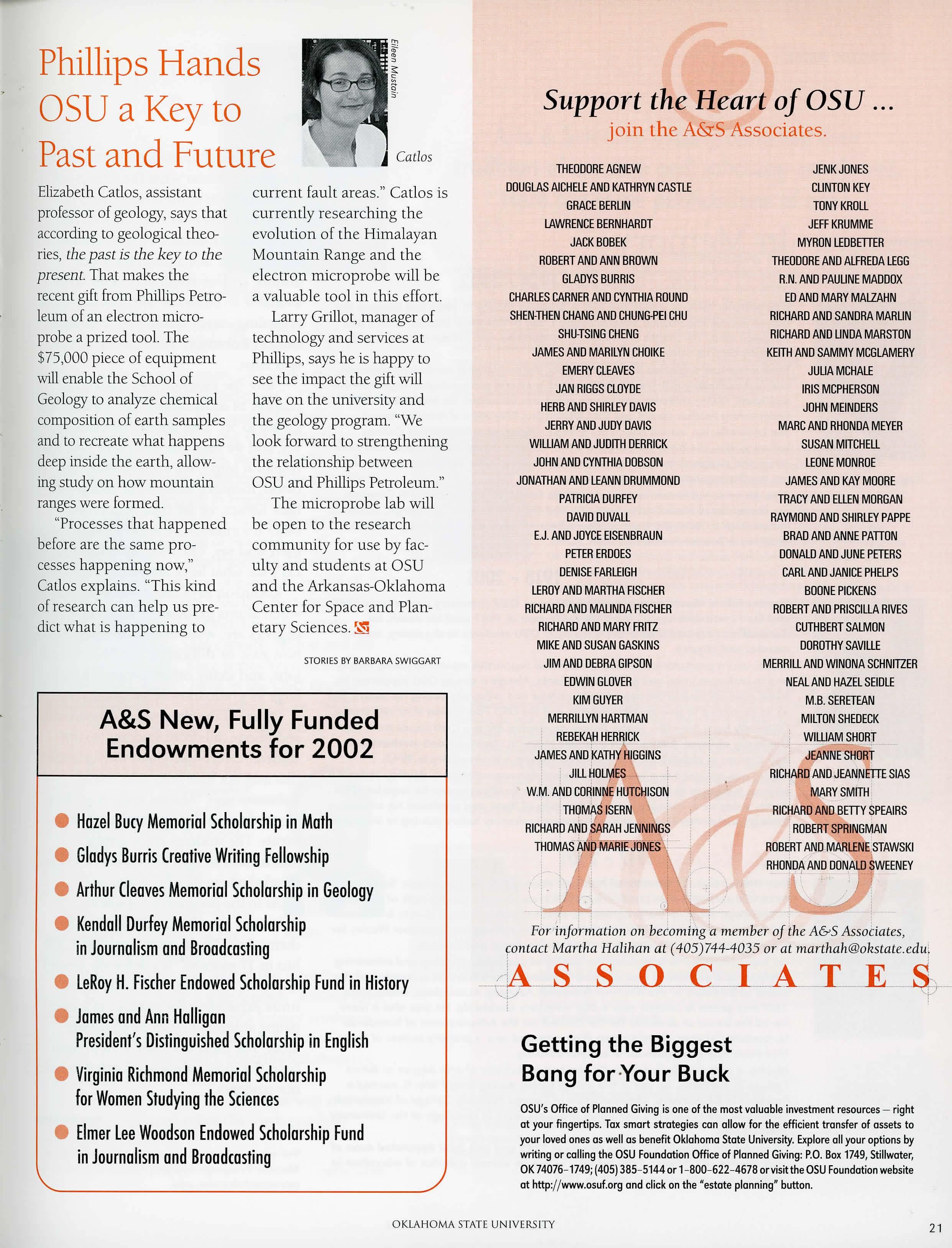
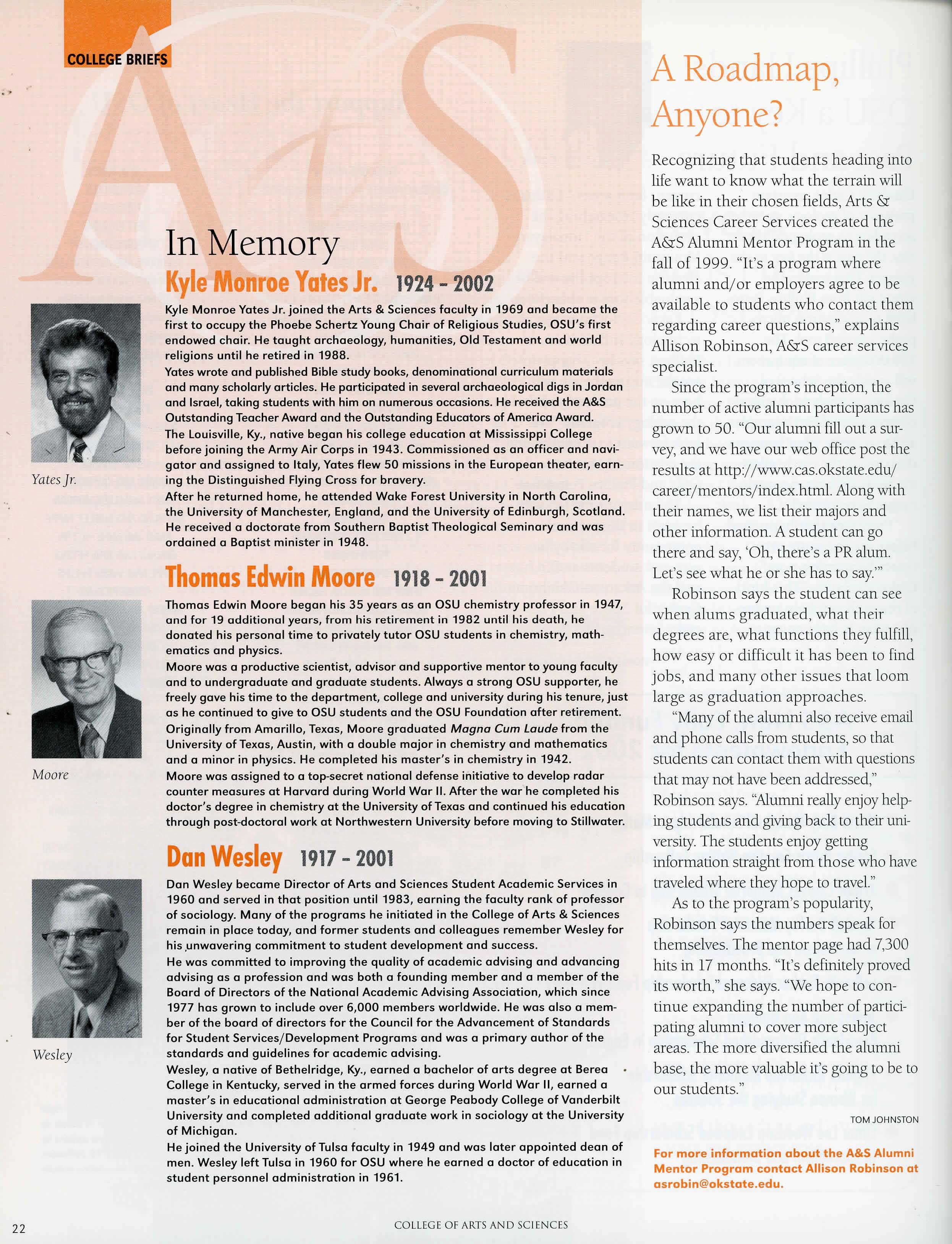
Kyle Monroe Yates Jr. joined the Arts & Sciences faculty in 1969 and became the first ta occupy the Phoebe Schertz Young Chair of Religious Studies, OSU's first endowed chair. He taught archaeology, humanities, Old Testament and world religions until he retired in 1988.
Yates wrote and published Bible study books, denominational curriculum materials and many scholarly articles. He participated in several archaeological digs in Jordon and Israel, toking students with him on numerous occasions. He received the A&S Outstanding Teacher Award and the Outstanding Educators of America Award.
The Louisville, Ky., native began his college education at Mississippi College before joining the Army Air Corps in 1943. Commissioned as on officer and navigator and assigned ta Italy, Yates flew 50 missions in the European theater, earning the Distinguished Flying Cross for bravery.
After he returned home, he attended Woke Forest University in North Carolina, the University of Manchester, England, and the University of Edinburgh, Scotland. He received a doctorate from Southern Baptist Theological Seminary and was ordained a Baptist minister in 1948.
Thomas Edwin Moore began his 35 years as on OSU chemistry professor in 1947, and for 19 additional years, from his retirement in 1982 until his death, he donated his personal time to privately tutor OSU students in chemistry, mathematics and physics.
Moore was a productive scientist, advisor and supportive mentor to young faculty and to undergraduate and graduate students. Always a strong OSU supporter, he freely gave his time to the department, college and university during his tenure, just as he continued ta give ta OSU students and the OSU Foundation ofter retirement. Originally from Amarillo, Texas, Moore graduated Magna Cum Laude from the University of Texas, Austin, with a double major in chemistry and mathematics and a minor in physics. He completed his master's in chemistry in 1942.
Moore was assigned to a top-secret national defense initiative to develop radar counter measures at Harvard during World War II. After the war he completed his doctor's degree in chemistry at the University of Texas and continued his education through post-doctoral work at Northwestern University before moving to Stillwater.
Dan Wesley became Director of Arts and Sciences Student Academic Services in 1960 and served in that position until 1983, earning the faculty rank of professor of sociology. Many of the programs he initiated in the College of Arts & Sciences remain in place today, and former students and colleagues remember Wesley far his ,unwavering commitment to student development and success.
He was committed to improving the quality of academic advising and advancing advising as a profession and was both a founding member and a member of the Board of Directors of the National Academic Advising Association, which since 1977 has grown to include over 6,000 members worldwide. He was also a member of the board of directors far the Council for the Advancement of Standards for Student Services/Development Programs and was a primary author of the standards and guidelines for academic advising.
Wesley, a native of Bethelridge, Ky., earned a bachelor of arts degree at Berea College in Kentucky, served in the armed farces during World War II, earned a master's in educational administration at George Peabody College of Vanderbilt University and completed additional graduate work in sociology at the University of Michigan.
He joined the University of Tulsa faculty in 1949 and was later appointed dean of men. Wesley left Tulsa in 1960 for OSU where he earned a doctor of education in student personnel administration in 1961.
Recognizing that students heading into life want to know what the terrain will be like in their chosen fields, Arts & Sciences Career Services created the A&S Alumni Mentor Program in the fall of 1999. "It's a program where alumni and/ or employers agree to be available to students who contact them regarding career questions," explains Allison Robinson, A&S career services specialist.
Since the program's inception, the number of active alumni participants has grown to 50. "Our alumni fill out a survey, and we have our web office post the results at http://www.cas.okstate.edu/ career/mentors/index.html. Along with their names, we list their majors and other information. A student can go there and say, 'Oh, there's a PR alum. Let's see what he or she has to say."'
Robinson says the student can see when alums graduated, what their degrees are, what functions they fulfill, how easy or difficult it has been to find jobs, and many other issues that loom large as graduation approaches.
"Many of the alunmi also receive email and phone calls from students, so that students can contact them with questions that may not have been addressed," Robinson says. "Alumni really enjoy helping students and giving back to their university. The students enjoy getting information straight from those who have traveled where they hope to travel."
As to the program's popularity, Robinson says the numbers speak for themselves. The mentor page had 7,300 hits in 17 months. "It's definitely proved its worth," she says. "We hope to continue expanding the number of participating alumni to cover more subject areas. The more diversified the alumni base, the more valuable it's going to be to our students."
For more information about the A&S Alumni Mentor Program contact Allison Robinson at osrobin@akstote.edu.
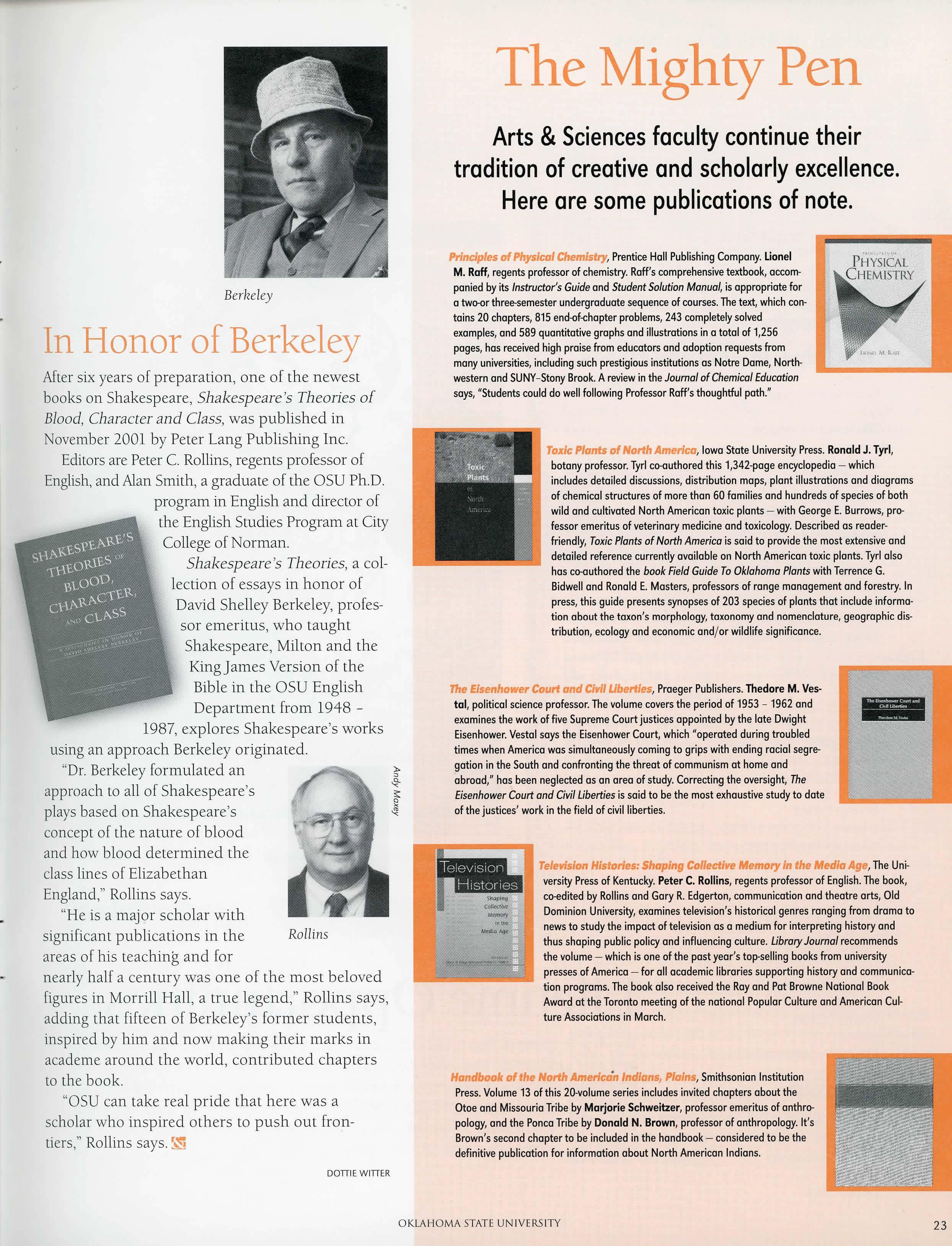
Berkeley
After six years of preparation, one of the newest books on Shakespeare, Shakespeare's Theories of Blood, Character and Class, was published in November 2001 by Peter Lang Publishing Inc.
Editors are Peter C. Rollins, regents professor of English,and Alan Smith, a graduate of the OSU Ph.D. program in English and director of the English Studies Program at City College of Norman.
Shakespeare's Theories, a collection of essays in honor of David Shelley Berkeley, professor emeritus, who taught Shakespeare, Milton and the King James Version of the Bible in the OSU English Department from 19481987, explores Shakespeare's works using an approach Berkeley originated.
"Dr. Berkeley formulated an approach to all of Shakespeare's plays based on Shakespeare's concept of the nature of blood and how blood determined the class lines of Elizabethan England," Rollins says.
"He is a major scholar with significant publications in the Rollins areas of his teaching and for nearly half a century was one of the most beloved figures in Morrill Hall, a true legend," Rollins says, adding that fifteen of Berkeley's former students, inspired by him and now making their marks in academe around the world, contributed chapters to the book.
"OSU can take real pride that here was a scholar who inspired others to push out frontiers," Rollins says.~
DOTTIEWITTER
Arts& Sciencesfacultycontinuetheir traditionof creativeand scholarlyexcellence. Hereare somepublicationsof note.
Principlesof PhysicalChemistry,PrenticeHall PublishingCompany.Liane! M. Raff,regentsprofessorof chemistry.Raff'scomprehensivetextbook,accompanied by its Instructor'sGuideand StudentSolutionManuol,is appropriate for a two-or three-semesterundergraduatesequenceof courses.Thetext, which contains 20 chapters,815 end-of.chapterproblems,243 completelysolved examples,and 589 quantitative graphs and illustrations in a total of 1,256 pages,has receivedhigh praisefrom educatorsand adoption requestsfrom many universities,includingsuch prestigiousinstitutionsas Notre Dame,Northwesternand SUNY-StonyBrook.A reviewin the Journal of ChemicalEducation says,"Studentscould do well following ProfessorRaff'sthoughtful path."
Ta1dcPlantsof NorthAmerica,Iowa State UniversityPress.RanaldJ. Tyrl, botany professor.Tyrl co-authoredthis 1,342-pageencyclopedia- which includesdetailed discussions,distribution maps, plant illustrations and diagrams of chemical structures of more than 60 families and hundredsof speciesof both wild and cultivated North American toxic plants - with George E.Burrows,professor emeritus of veterinary medicineand toxicology.Describedas readerfriendly, ToxicPlantsof North America is said to providethe most extensiveand detailed referencecurrently available on North American toxic plants.Tyrl also has co-authoredthe book FieldGuideToOklahomaPlantswith TerrenceG. Bidwelland RonaldE. Masters, professorsof range managementand forestry. In press,this guide presentssynopsesof 203 speciesof plants that include information about the taxon's morphology,taxonomy and nomenclature,geographic distribution, ecologyand economicand/or wildlife significance.
TheEisenhowerCourtand CivilUbert/es,PraegerPublishers.ThedareM. Vestal, political scienceprofessor.The volume coversthe period of 1953 - 1962 and examinesthe work of five SupremeCourt justices appointed by the late Dwight Eisenhower.Vestal saysthe EisenhowerCourt, which "operated during troubled times when America was simultaneouslycoming to grips with ending racial segregation in the South and confronting the threat of communismat home and abroad," has been neglectedas an area of study. Correcting the oversight, The EisenhowerCourt and Civil Libertiesis said to be the most exhaustivestudy to date of the justices' work in the field of civil liberties.
TelevisionHistories:ShapingCollectiveMemoryIn the MediaAge,The University Pressof Kentucky.PeterC. Rollins,regents professorof English.The book, co-editedby Rollinsand Gary R. Edgerton,communicationand theatre arts, Old Dominion University,examinestelevision'shistorical genresranging from drama to newsto study the impact of televisionas a mediumfor interpreting history and thus shaping public policy and influencing culture. LibraryJournal recommends the volume- which is one of the post year's top-sellingbooksfrom university pressesof America - for all academic libraries supporting history and communication programs.The book also receivedthe Rayand Pat BrowneNational Book Award at the Toronto meeting of the national PopularCulture and American Culture Associationsin Morch.
Handbookol the North AmericanIndians,Plains,SmithsonianInstitution Press.Volume 13 of this 20-volumeseries includesinvited chapters about the Otoe and MissouriaTribe by MarjorieSchweitzer,professoremeritus of anthropology,and the PoncaTribe by DanoldN. Brown,professorof anthropology.It's Brown'ssecondchapter to be included in the handbook- consideredto be the definitive publication for information about North American Indians.
COLLEGE DEAN
John Dobson
ASSOCIATE DEAN FOR INSTRUCTION
Bruce Crauder
ASSOCIATE DEAN FOR RESEARCH
Steve McKeever
ASSOCIATE DEAN FOR PROGRAM DEVELOPMENT
Tom Wikle
DIRECTOR, STUDENT ACADEMIC SERVICES
William Ivy
SR. DIRECTOR, DEVELOPMENT
Deborah Desjardins
DIRECTOR, DEVELOPMENT
Martha Halihan
SPECIALIST CAREER SERVICES, ALUMNI RELATIONS
Allison Robinson
AEROSPACE
John Woodward
ART
Nicholas Bormann
BOTANY
Becky Johnson
CHEMISTRY
Neil Purdie
COMMUNICATION SCIENCES AND DISORDERS
Randy Deal
COMPUTER SCIENCE
George Hedrick
ENGLISH
Carol Moder
FORGEIN LANGUAGES
Perry Gethner
GEOGRAPHY
Dale Lightfoot
GEOLOGY
Ibrahim Cemen
HISTORY
Bill Bryans
JOURNALISM AND BROADCASTING
Paul Smeyak
MATHEMATICS
Benny Evans
MICROBIOLOGY AND MOLECULAR GENETICS
Moses Vijayakumar
MILITARY SCIENCE
Charles Dorsey
MUSIC
William Ballenger
PHILOSOPHY
Doren Recker ·
PHYSICS
John Mintmire
POLITICAL SCIENCE
David Nixon
PSYCHOLOGY
Maureen Sullivan
SOCIOLOGY
Charles Edgley
STATISTICS
William Warde
THEATER
Bruce Brockman
ZOOLOGY
James Shaw
America's greatest homecoming will take place on Saturday, November 2, 2002, as we challenge the Texas A&M Aggies at Lewis Stadium. This year's homecoming theme is "Together We Can!"
All Arts & Sciences alumni and friends are welcome to join the annual A&S reception two hours prior to kickoff on the lawn north of Old Central. We look forward to seeing you there!
FOR MORE INFORMATION ABOUT OSU HOMECOMING, VISIT http:/ /www.orangeconnection.org. And for information about the College of Arts & Sciences and other alumni activities, visit http://www.alumni.okstate.edu.
The Arts & Sciences Extension Office continues to provide learning opportunities well after graduation. Visit A&S Extension at·http://extension.okstate.edu for information about services and activities designed to extend your personal and professional development. While you're online, please complete the short opinion survey that will help the Extension office determine what types of programming would best serve your needs. r~
"WEALTH
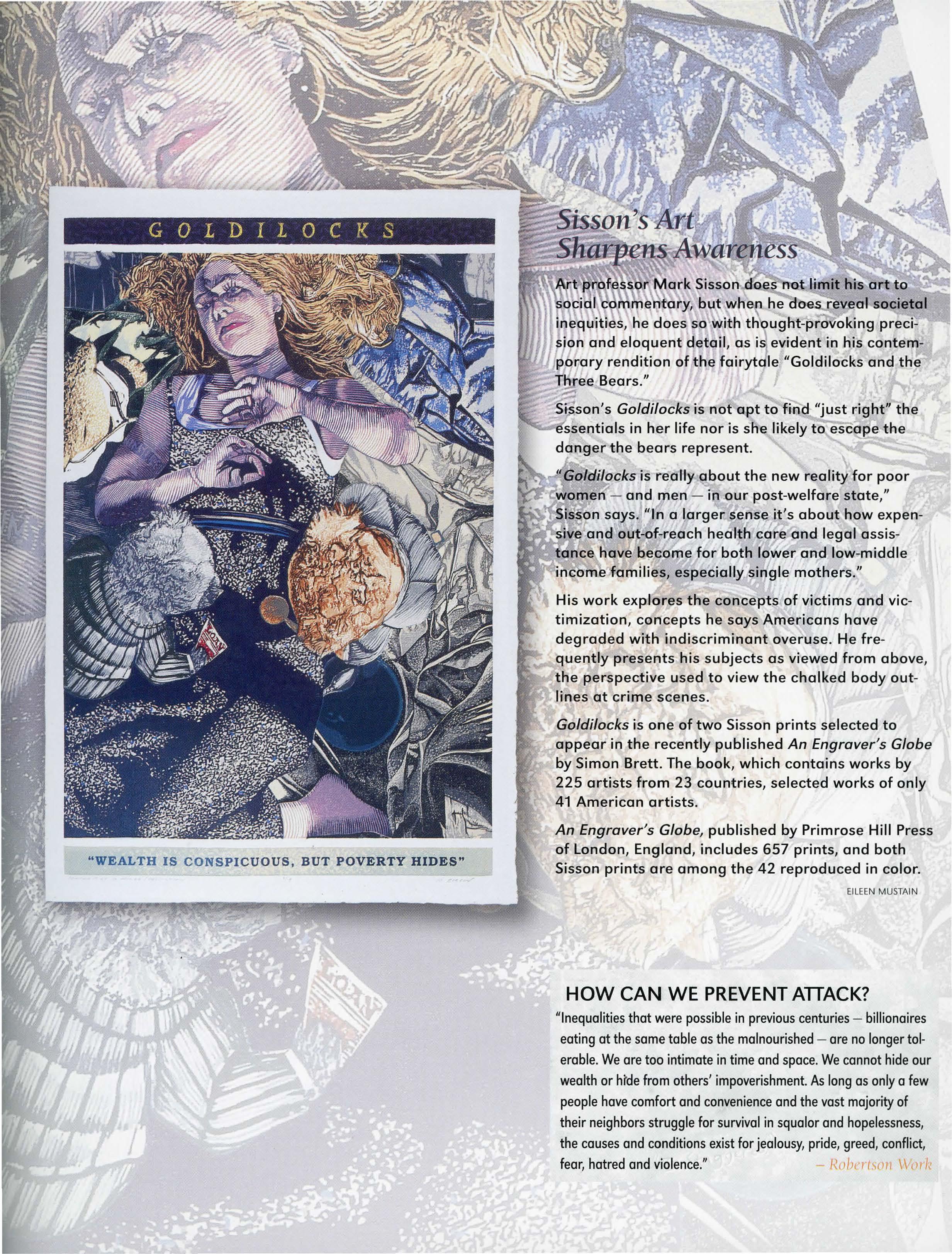
y, but w reveal soci s so with t ught-provoking precieloquent detail, as evident in his contemry rendition of the fairy ale "Goldilocks and the Bears." ,
_srsson's Goldilocks is not apt to firi'd "just right" the ssentials in her life nor is s'he likely to escape the danger the bears represent.
ilocks is really about the new reality for poor - and men - in .our post-welfare state," "In a larger sense it's about how expenf-r,each health cafe and legal assisc.eme for both l~wer and low-middle ilies, especially../single mothers."
His work explores the concept$ of victims and victimization, concepts he says Americans have degraded with indiscriminant overuse. He frequently presents his subjects as viewed from above, the perspective used to view the chalked body outlines at crime scenes.
Goldilocks is one of two Sisson prints selected to appear in the recently published An Engraver's Globe by Simon Brett. The book, which contains works by 225 artists from 23 countries, selected works of only 41 American artists.
An Engraver's Globe, published by Primrose Hill Press of London, England, includes 657 prints, and both Sisson prints are among the 42 reproduced in color.
"Inequalitiesthat were possiblein previouscenturies- billionaires eating at the sametable as the malnourished - are no longertolerable.We are too intimate in time and space.We cannot hide our wealth or hrdefrom others' impoverishment.As long as only a few peoplehavecomfort and convenienceand the vast majorityof their neighborsstruggle for survivalin squalorand hopelessness, the causesand conditionsexistfor jealousy,pride,greed,conflict, fear, hatred and violence." - l~olh, bon \\ o, Ii
"We must channel our rekindled passion and love of life into small and surprising and massive and shocking acts of good will around the planet We can change history. Our decisions and actions created this world. We can invent a different world. May all sentient beings everywhere know compassion and wisdom, peace and happiness and be about the business of building this Earth." - Robertson ll 01-/t
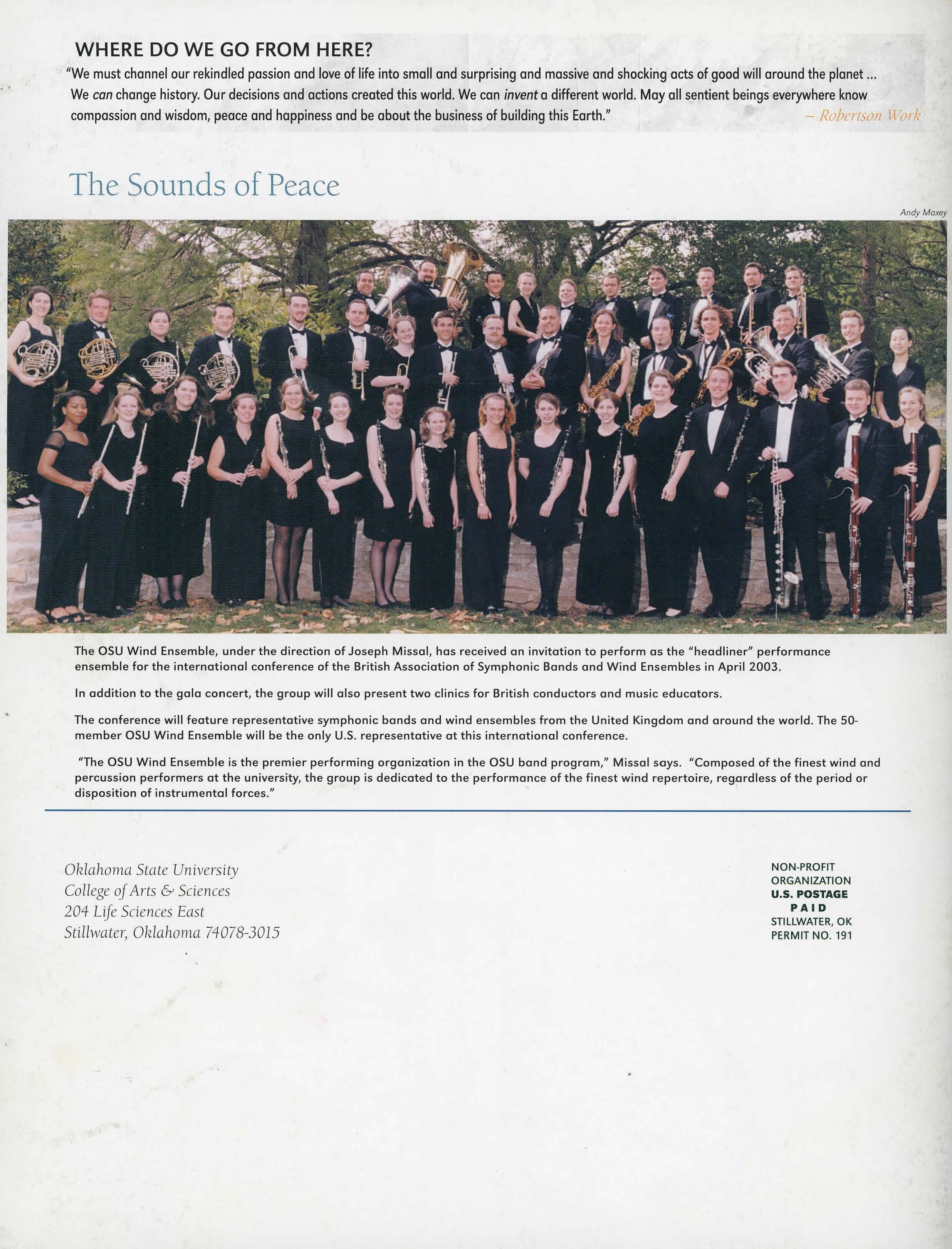
The OSU Wind Ensemble, under the direction of Joseph Missol, hos received an invitation to perform as the "headliner" performance ensemble for the international conference of the British Association of Symphonic Bands and Wind Ensembles in April 2003.
In addition to the gala concert, the group will also present two clinics for British conductors and music educators.
The conference will feature representative symphonic bands and wind ensembles from the United Kingdom and around the world. The SOmember OSU Wind Ensemble will be the only U.S. representative at this international conference.
"The OSU Wind Ensemble is the premier performing organization in the OSU band progrom," Missal says. "Composed of the finest wind and percussion performers at the university, the group is dedicated to the performance of the finest wind repertoire, reg.a rd less of the period or disposition of instrumental forces."
Oklahoma State University Collegeof Arts & Sciences
204 Life SciencesEast Stillwater, Oklahoma 74078-3015
OK PERMIT NO. 191