Education for A Lifetime
A consistent theme crops up in almost eyery conversation I have with a graduate of the College of Arts & Sciences: The breadth of the educational experience our programs provide is a major factor in successful, enjoyable lives. Regardless of the career path one chooses, a broad liberal arts and sciences foundation enriches and strengthens one's effectiveness. That breadth may be even more important for the many alumni who switch from one career path to another throughout a long and productive life.
In the end, however, I believe that the most important influence our college experience has is on life itself. We are all fortunate to be living in an era that offers a stunning array of options for utilizing our "after hours" time. Often electives or general education courses we took as undergraduates lead to an avocation or hobby in later years. As a history teacher, i.ti.s especially gratifying to me to discover that lawyers, businesspeople and many other professionals retain a lifelong fascination with hi.story. Similar interests persist in the arts, the humanities and the sciences.
In that sense, then, the Arts & Sciences College provides an experience that results in education for a lifetimeand for a full and rewarding life. The stories about some of our alumni included in this issue illustrate that point very well. Whatever our graduates do, wherever they live and work, they carry with them from OSU an awareness of the diversity, complexity and beauty of the world around them. We in the College remain dedicated to the mission of continuing to provide those crucial broadening experiences to current and future A&S students.
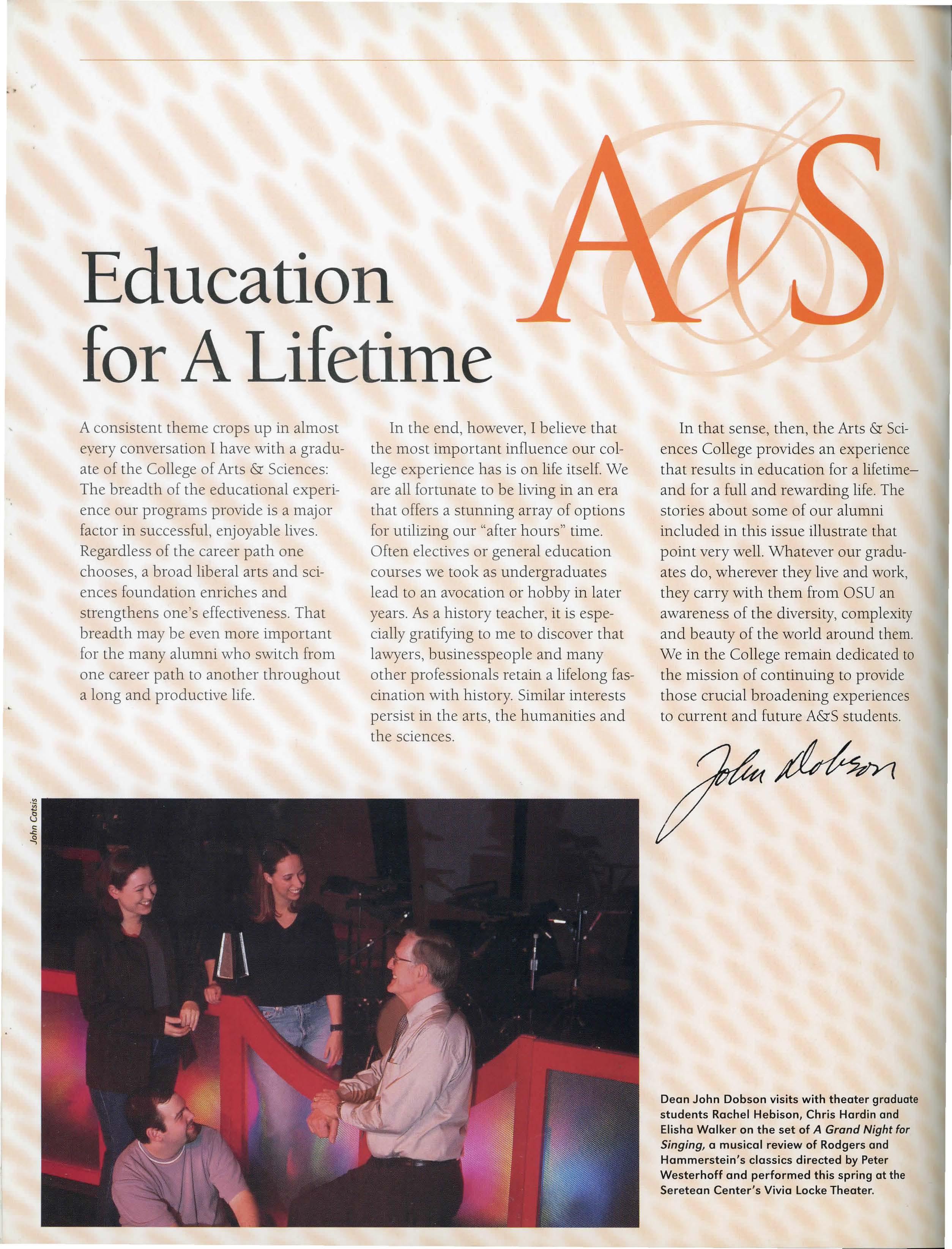
Dean John Dobson visits with theater graduate students Rachel Hebison, Chris Hardin and Elisha Walker on the set of A Grand Night for Singing, a musical review of Rodgers ond Hammerstein's classics directed by Peter Westerhoff ond performed this spring ot the Sereteon Center's Vivie Locke Theater.
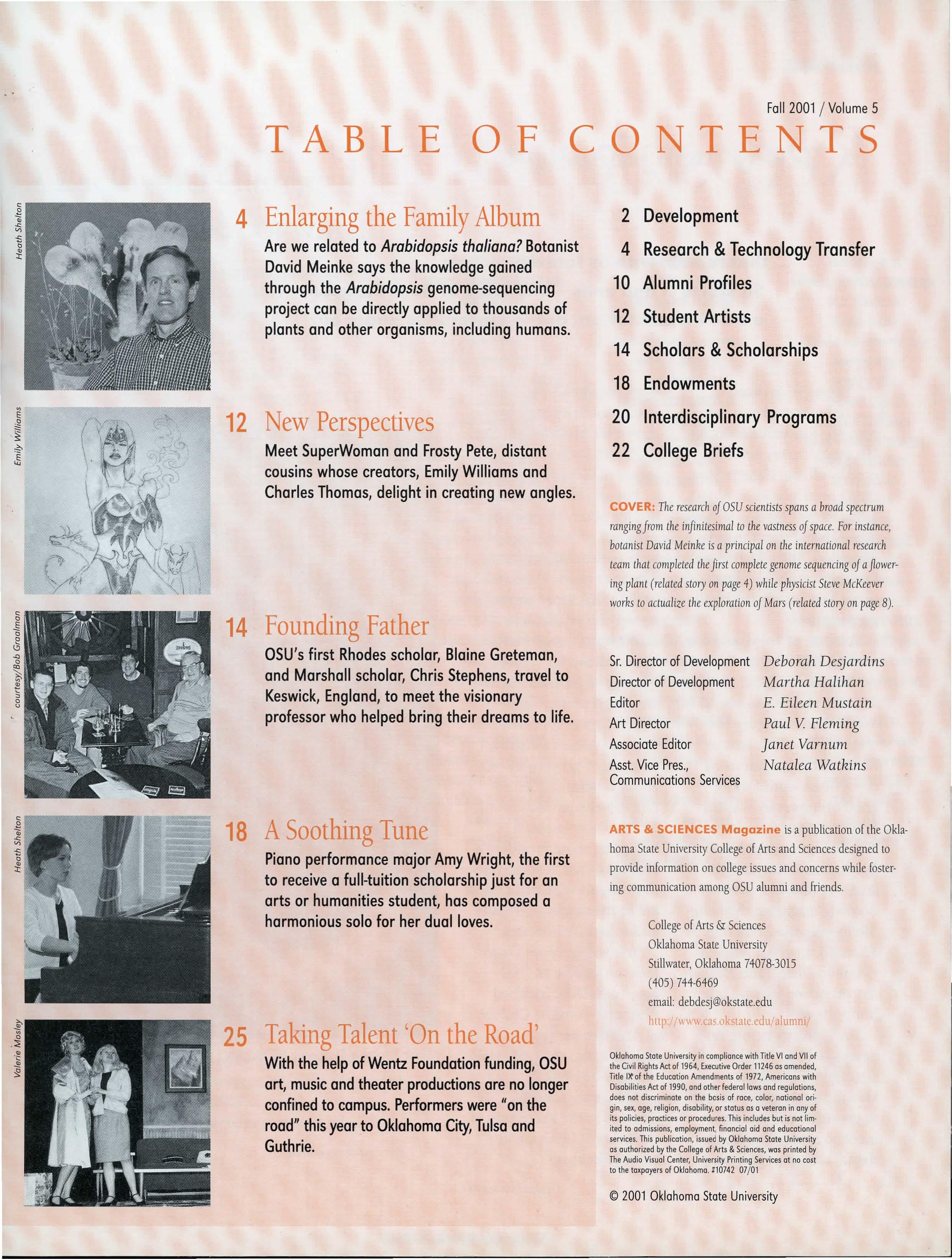
4 Enlargingthe FamilyAlbum
Arewe relatedto Arabidopsisthaliana?Botanist DavidMeinkesaysthe knowledgegained throughthe Arabidopsisgenome-sequencing projectcan be directlyappliedto thousandsof plantsand otherorganisms,includinghumans.
12 NewPerspectives
MeetSuperwomanand FrostyPete,distant cousinswhosecreators,EmilyWilliamsand CharlesThomas,delightin creatingnewangles.
14 FoundingFather
OSU'sfirst Rhodesscholar,BlaineGreteman, and Marshallscholar,ChrisStephens,travelto Keswick,England,to meetthe visionary professorwhohelpedbringtheirdreamsto life.
18 A SoothingTune
Pianoperformancemajor Amy Wright, the first to receivea full-tuition scholarshipjust for an arts or humanitiesstudent, has composeda harmonioussolo for her dual loves.
25 TakingTalent'On the Road'
With the helpof WentzFoundationfunding,OSU art, musicand theaterproductionsare no longer confinedto campus.Performerswere"on the road" this yearto OklahomaCity,Tulsaand Guthrie.
COVER: TheresearchofOSUscientistsspansa broadspectrum mngingJ,-0111 theinfinitesimal to thevastnessofspace.Forinstance, botanistDavidMeinkeisa principalon theinternational,·esearch teamthatcompletedthefirstcompletegenomesequencing of afloweringplant(relatedsto,yonpage4) whilephysicistSteveMcKeever workstoactualizetheexploration of Mars(relatedstory011page8).
Sr.Directorof DevelopmentDeborah Desjardins Directorof Development Martha Halihan
Editor E. Eileen Mustain
Art Director Paul V Fleming
AssociateEditor
Asst.VicePres., CommunicationsServices Janet Varnum Natalea Watkins
ARTS & SCIENCES Magazine is a publicationor the OklahomaStateUniversityCollegeorArtsand Sciencesdesignedto provideinformationon collegeissuesand concernswhilefosteringcommunicationamongOSUalumniand friends.
CollegeorAns& Sciences OklahomaStateUniversity Stillwater,Oklahoma74078-3015 (405) 744-6469
email:debdesj@okstate.edu hllp: \1 w11 .casokstate.edu.alumni
OklahomaStateUniversityincompliancewithTitleVIand VIIof the CivilRightsActof 1964,ExecutiveOrder11246as amended, Titlel:tof the EducationAmendmentsof 1972,Americanswith DisabilitiesActof 1990,and otherfederallowsond regulations, does not discriminateon the bosisof race, color,notionalorigin,sex,age, religion,disability,or status as o veteranin anyof its policies,practicesor procedures.Thisincludesbut is not limited to admissions,employment,financialaid and educational services.Thispublication,issuedbyOklohomoStoteUniversity as authorizedbythe Collegeof Arts& Sciences,was printedby TheAudioVisualCenter,UniversityPrintingServicesat no cost to the toxpoyersof Oklohorno.t10742 07/01 © 2001 OklahomaState University
Keepsakesof the Heart
that remain with us forever.
So starts - and ends - the story of Gene Jackson, a true humanitarian. But the memories linger on.
Eugene W. Jackson is remembered as a man who was a giver his entire life. Bis legacy makes him honored by all. But Gene Jackson didn't need, nor want, accolades. He just wanted to make others' lives better through education. And Oklahoma State University, his alma mater, was among his highest priorities.
A native ofTulsa,Jackson took an OSU degree in natural sciences in 1950. He added a master's in liberal arts and an honorary doctoral degree to his educational portfolio. But using the written word for the good of humanity was the bottom line with Jackson. This led him to establish Springhouse Corporation and, as publisher, produce Nursing magazine, Nursing Skillbook series, Nursing Photobook series, Nurse's Guide to Drugs, and Realities magazine, among other publications.
And, shortly before his death,Jackson and his son Geoff established the Healthlink Medical Center to provide free primary medical care and primary dental care to people who
work but do not have health insurance. It opened twelve days after his death on Dec. 31, 2000.Suchwasthe legacy of Gene Jackson.
For all that Gene Jackson did for others through his personal philanthropy, OSU held a special place in his generous heart. But don't look for his name emblazoned on campus - he didn't want recognition. Look instead for results. Because of Jackson's generous "seed money" gift, OSU's Center for Science Literacy was established. Because of his convictions about scholarship assistance, Jackson established 24 OSU scholarships, including more President's Distinguished Scholarships than anyone else prior. Most are in the names of friends and fraternity brothers.
You will only see Gene Jackson's name at OSU listed as a Distinguished Alumnus from the College of Arts & Sciences and as an inductee into the OSU Hall of Fame in 1990.
But Gene Jackson remains in the keepsakes of the heart of OSU Gene would like that.
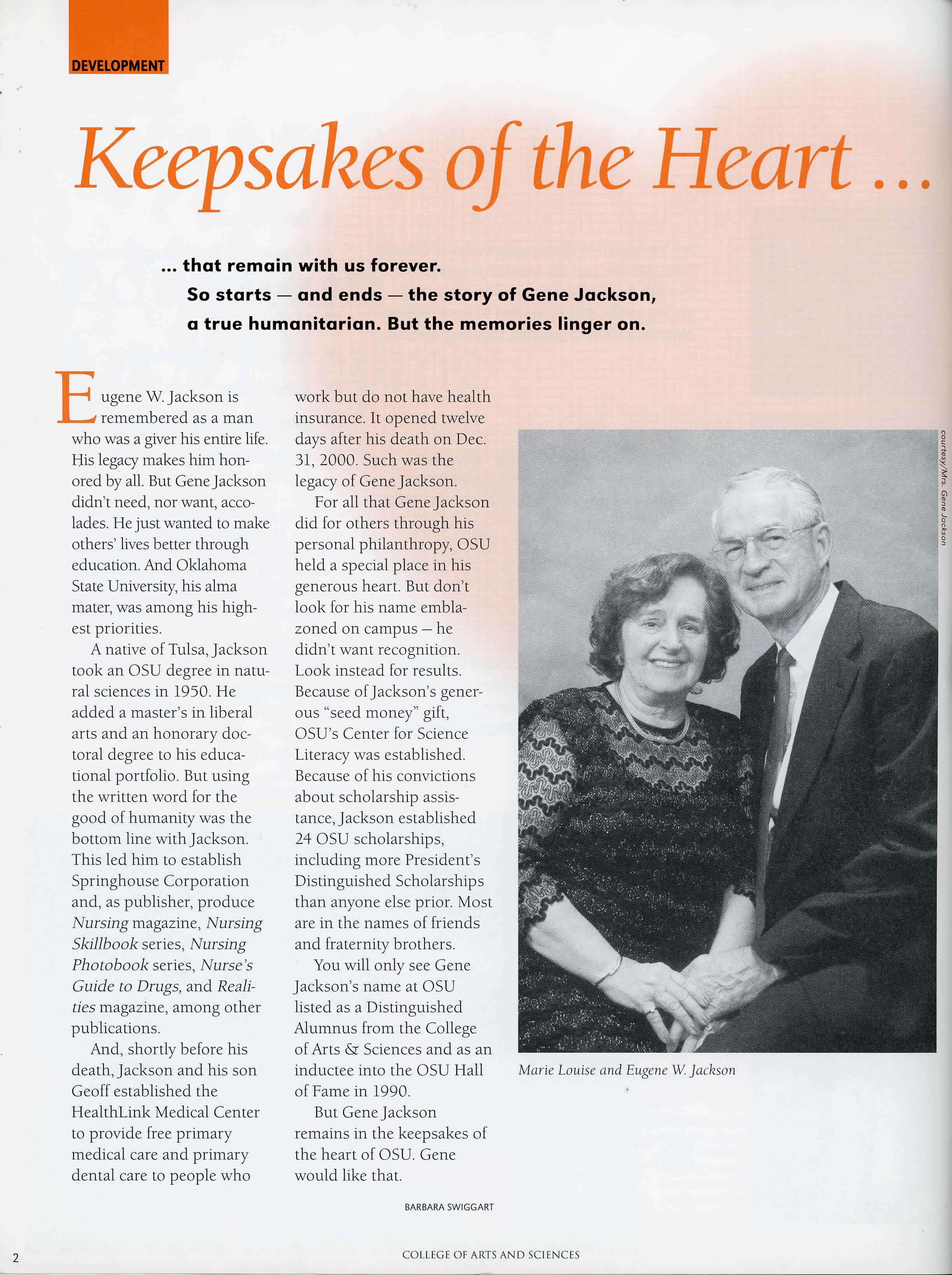
Marie Louise and Eugene W Jackson
A BackwardGlance ...
A Long Look Forward
The past was the beginrung for good things for the College of Arts & Sciences. OSU'S Bringing Dreams to Life campaign, a six-year fundraising effort, came to anendjune30,2000. But the results have left an indelible mark on every element of the College from research to extension. With a goal in 1995 of raising $14.4 million, the university's largest college topped that number by raising $15.3 million.
It was time for celebration ... and for looking to the future, looking beyond the success of the Bringing Dreams to Life campaign - not hard for a College that looks to the "stars," both scientifically and theatrically.
The future holds new stars for the College that promotes lifelong learning. The hope of the future lies in con-· tinuing to broaden private support for the liberal arts through the College's annual fund and the A&S Associates program. General support through the annual fund is the College's greatest need
because it provides flexible assistance for critical areas and helps expand the base of support for the College.
Members of A&S Associates give $1,000 or more annually to the College and play a critical role in maintaining and improving academic progress. This fast-growing group of advocates also serves as an advising constituent to develop growth strategies for the College.
A&S Associates enjoy the satisfaction of helping students and faculty. They know that
Desjardins
their participation goes to work immediately to recruit and retain the College's best faculty, which in turn, enhances student learning.
If you are interested in supporting the heart of OSU by becoming an A&S Associate, contact Deborah Desjardins, senior director of development, at ( 405) 7446469 or email: debdesj@okstate.edu. r~
BARBARASWIGGART
Support the Heart of OSU ...
join the A&:SAssociates along with these founding members.
THEODORELEEAGNEW W.M.& CORINNEHUTCHISON JOHNSADLERJR. JAMES& BARBARAANDERSON THOMASISERN MERRILL & WINONASCHNITZER
MARVINBAYS MARIELOUISEJACKSON M.B.SERETEAN
GRACEBERLIN LEOJARDOT JEANNESHORT
JACKBOBEK RICHARD & SARAHJENNINGS RICHARD & JEANNITTESIAS
JAMES& JIMMIEBOGGSJR. BRENDAJOHNSON MARYSMITH
ROBERT & BITTYBROTHERTON JENKJONESJR. JAMESSTEELE LAWRENCEBROWN OLIVER & JOYKERFOOTJR. THOMASSTEELE
SHU-TSINGCHENG CLINTONKEY MICHELLESTRABALA
EMERYCLEAVES ROBERTKNAPP DEAN& CAROLSTRINGER
JANRIGGSCLDYDE BARBARALAFON RHONDASWEENEY
HERB& SHIRLEYDAVIS MYRONLEDBITTER BITTYSYNAR
JIMMY& JUDYDAVIS KIMLEE& DIAZHANG KEVINTALLEY
JERRY & JUDYDAVIS LOLALEHMAN MARKTICER
JOHN& CYNTHIADOBSON JACDUELINELDCHMILLER RDBERTTIPPECDNNIE
JONATHAN & LEANNDRUMMOND ED& MARYMALZAHN HELENVISHNIAC DAVIDJOHNDUVALL RICHARD & SANDRAMARLIN SERKUANGWANG RAYMONDESTEP RICHARDMARSTON JIM& JILLWEIGELJR. LEROY & MARTHAFISCHER ERIKMASON WILLIAM & PEGGYWELCH
RICHARD & MALINDAFISCHER KEITH & SAMMYMCGLAMERY JIM& CAROLWHITENECK
MIKEGASKINS JULIAMCHALE JERRY & WINONAWILHMJR. TOM& JEANENEGAY IRISMCPHERSON JOE& BARBARAWILLIAMS NITAGILES J. JAYMCVICKER DAVIDWITTE
ROBERT & DIANEGRAALMANJR. MARC& RHONDAMEYER RICHARDWOOD
CURTIS & JANETGRUEL SUSANMITCHELL BENNIE & ARLITAWOOD
JASON& JULIEHAMILTON LEONEMONROE EDWARD & NORMAWOODS ARDOTHHASSLER-SHORT GLEN & MAUREENNEMECEK MICHAELYEAGER
RICHARD & DEBEHAUSCHILD RAYMOND & SHIRLEYPAPPE CLINEYOUNG II
CHARLESHILL DONALD & JUNEPETERS BEiZHU
JOSEPHHU BOONEPICKENS TIMOTHYZWINK ROBERT & PRISCILLARIVES
e Leadi Edge
"Originalresearchisthemostvitalandinclusiveactivityoftheuniversity. It buildsthereputationoftheuniversity, attractsthebeststudentsandfacultyandprovidesourstudents - eventhosewhowon'tbecomeprofessionalscientistsa superiorcomprehensiveeducation.
"Researchtakesplacestepbysmallstumblingstep,untilonedayyousuddenlyrealizeyouhavecome a longwayand thatyouhavesomethingofvalue,somethingthatcanchangeourlives."
- Steve McKeever,Regents
professorof physics and associatedean, Collegeof Arts & Sciences
Meinke Helps Unlock the Genome Mystery
Genetics researchers reached a major milestone this past December when an international research team announced it had completed the first plant genome sequence. Because of this work, scientists will gain important clues into how all sorts of living organisms behave genetically, with potentially widespread applications for agriculture, medicine and energy.
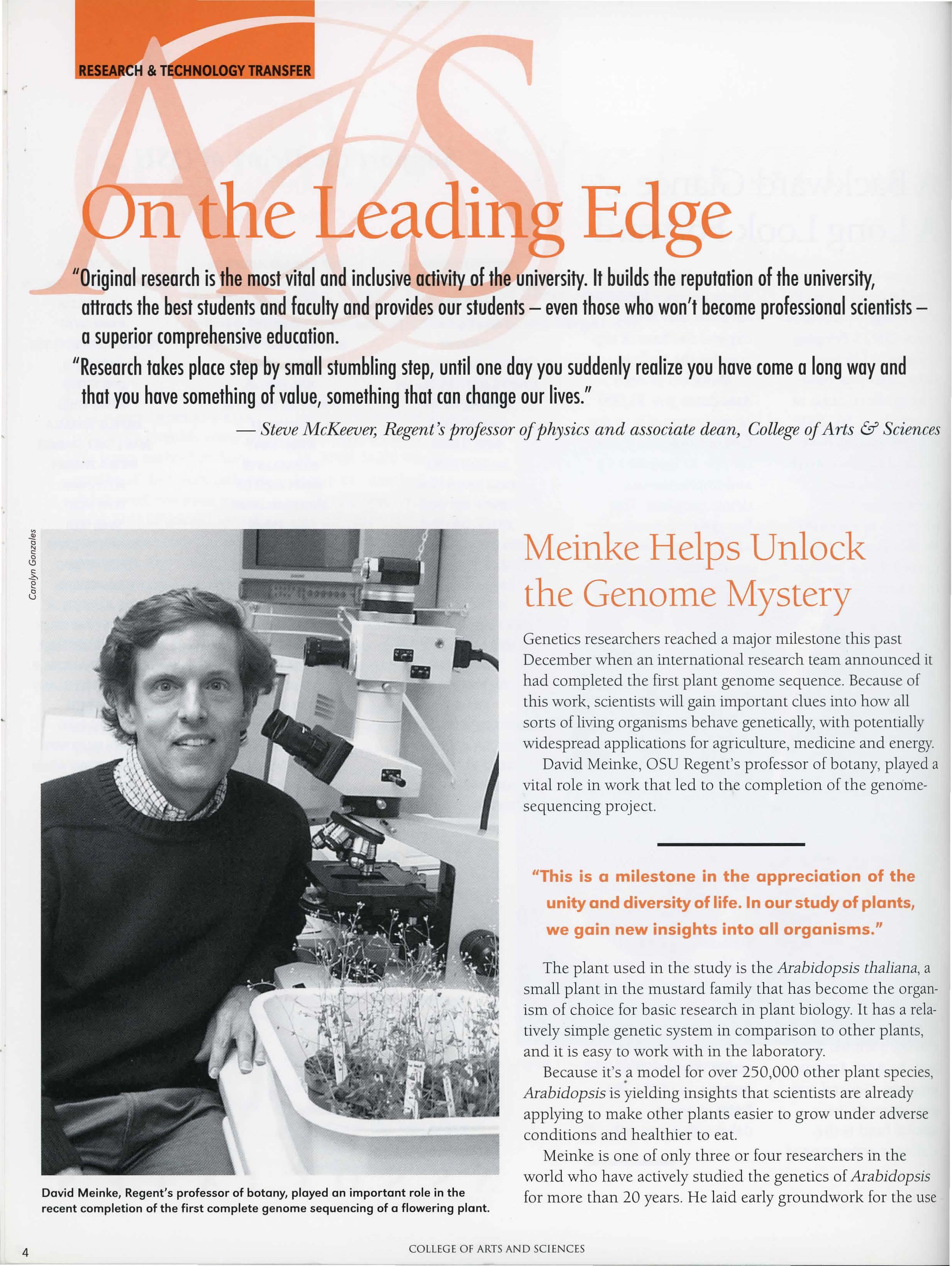
IDavid Meinke, OSU Regent's professor of botany, played a vital role in work that led to the completion of the genomesequencing project.
"This is a milestone in the appreciation of the unity and diversity of life. In our study of plants, we gain new insights into all organisms."
The plant used in the study is the Arabidopsis thaliana, a small plant in the mustard family that has become the organism of choice for basic research in plant biology. It has a relatively simple genetic system in comparison to other plants, and it is easy to work with in the laboratory.
Because it's _amodel for over 250,000 other plant species, Arabidopsis is yielding insights that scientists are already applying to make other plants easier to grow under adverse conditions and healthier to eat.
Meinke is one of only three or four researchers in the world who have actively studied the genetics of Arabidopsis for more than 20 years. He laid early groundwork for the use
David Meinke, Regent's professor of botany, played an important role in the recent completion of the first complete genome sequencing of a flowering plant.
of Arabidopsis in the study of molecular genetics, and he has acted as an official advisor to the international Arabidopsis Genome Initiative during the past several years.
Meinke has been a strong advocate for the use of Arabidopsis as a model to study the role of the plant's genetic system in seed development. He first started working with Arabidopsis when he was a Yale graduate student and continued his work when he came to OSU in 1982.
He has developed an international reputation for his work. Each year, the premier U.S. science journal, Science, publishes a special issue dealing with research in genomics, or the entire genetic complement of an organism. Last year, the publication concentrated on Arabidopsis, and Meinke wrote the featured article.
Meinke says his and other researchers' work will be greatly enhanced by the completion of the sequencing project.
"We had to look at one gene at a time to study its function in the organism," Meinke says. "Now we can look at thousands of genes at a time for a much clearer approach."
ResearchersTeam
Against Biological Warfare
A member of the chemistry faculty in OSU's College of Arts & Sciences and four faculty members from OSU's College of Veterinary Medicine have been awarded a three-year $300,000 grant to work with Nomadics Inc. of Stillwater to develop a monitor that will detect biological warfare agents in water. The Oklahoma Center for the Advancement of Science and Technology (OCAST) is funding the research.
'This is in response to a request by the Joint Services Water Agent Monitor OSWAM)project of the Department of Defense," says principal investigator Ken Clinkenbeard, a veterinary pathobiologist. Working with Clinkenbeard are Ziad El Rassi, a separation chemist and member of the chemistry faculty, and pathobiologists
Knowledge from this project can be directly applied to thousands of plants and other organisms as well.
Although various organisms have unique and specific genes, all organisms, including humans, share many genes, Meinke explains.
"This is a milestone in the appreciation of the unity and diversity of life," he says. "In our study of plants, we gain new insights into all organisms."
"In selected cases, we can take our knowledge from the plant kingdom and apply it to other major groups of organisms."
Meinke says we sometimes first learn the function of a gene from a fruit fly, worm, yeast or plant. "We're all related. You and I have many of the same genes that plants have."
The Arabidopsis genome-sequencing project, which was completed ahead of schedule and within budget, is a model for multinational cooperation, Meinke says. The project was begun in 1996 with a goal of completion by 2004.
and fellow veterinary medicine faculty members Rebecca Morton,Jerry Malayer and Dijang Zhou.
"The research is aimed at developing strategies and technologies for detecting biological agents in water," says El Rassi, "but in addition to uses in bioterrorism, this research can be used for food safety and environmental testing and medical diagnostics."
Nomadics Inc., a technology firm with a highly successful track record in sensor technology, is working in partnership with OSU researchers in several areas.
"Our collaboration is built on the cooperative effort of academic and commercial researchers focused on ensuring the safety of water supplies, whether this terrorism is aimed at military personnel or civilians," El Rassi says. "For success with
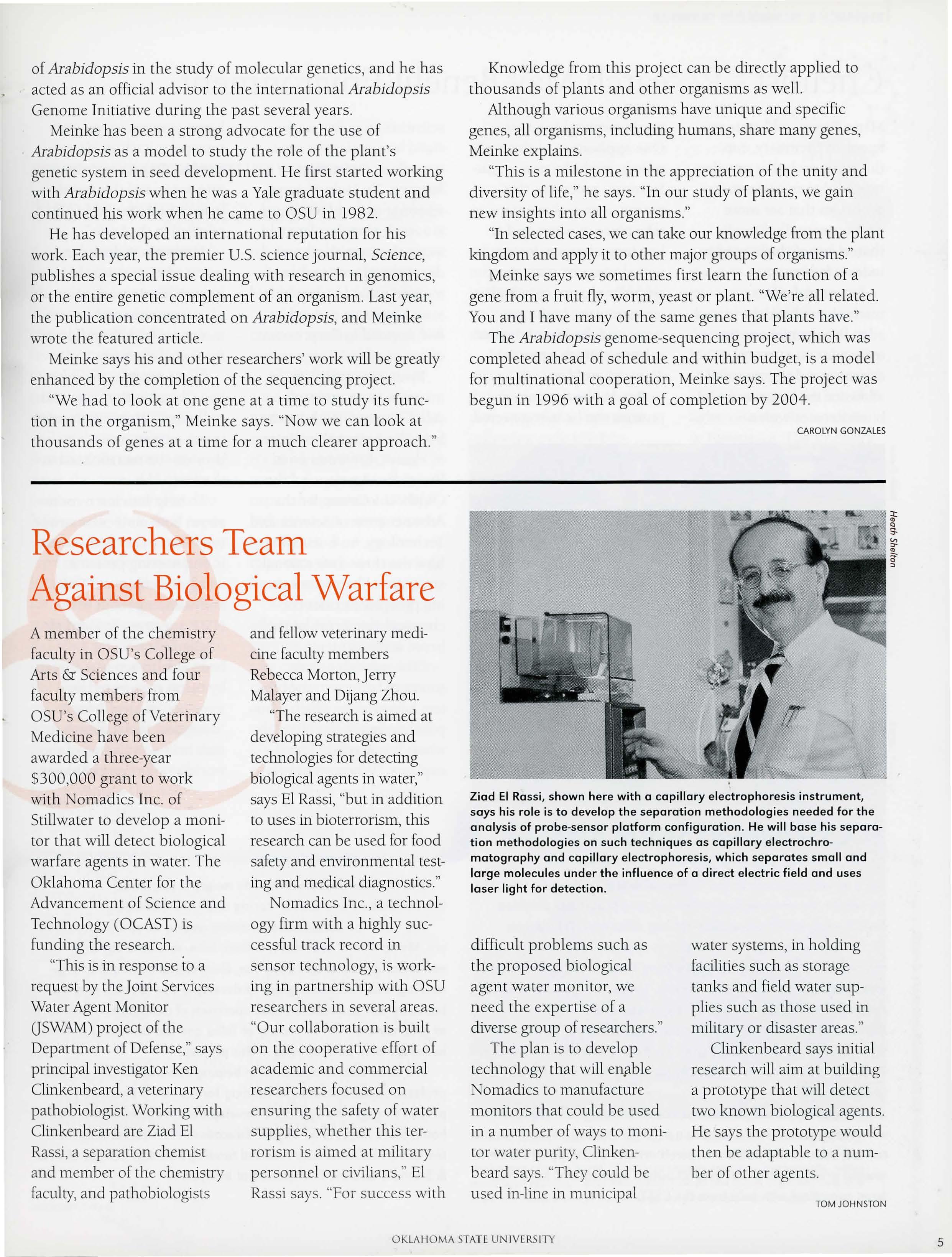
Ziad El Rossi, shown here with a capillary electrophoresis instrument, says his role is to develop the separation methodologies needed for the analysis of probe-sensor platform configuration. He will base his separation methodologies on such techniques as capillary electrochromatography and capillary electrophoresis, which separates small and large molecules under the influence of a direct electric field and uses laser light for detection.
difficult problems such as the proposed biological agent water monitor, we need the expertise of a diverse group of researchers."
The plan is to develop technology that will enp.ble Nomadics to manufacture monitors that could be used in a number of ways to monitor water purity, Clinkenbeard says. "They could be used in-line in municipal
water systems, in holding facilities such as storage tanks and field water supplies such as those used in military or disaster areas."
Clinkenbeard says initial research will aim at building a prototype that will detect two known biological agents. He says the prototype would then be adaptable to a number of other agents.
CAROLYN GONZALES
TOM JOHNSTON
If., t& .~
'Y <"'
s
Research May Benefit Environment
Mario 'Ri¥era, a~'bciate pro'f ssor of themistry, conducts research that one day may lead to manufacturing processes that are more environmentally friendly than many of those used in today's industries.
Rivera and other researchers think the knowledge they gain about the molecular structure of enzymes and proteins will allow for the engineering of biomolecules with a
predetermined function. One application of this technology might be new manufacturing processes that permit chemical reactions to take place in water and at low temperatures, in comparison to processes that typically require very high temperatures, high pressures and the use of organic solvents, which present a disposal problem.
But, before enzymes or proteins can be re-engineered,
scientists must first understand how molecular structure affects molecular function. "In biology, every response or set of responses is a result of molecular architecture because the threedimensional architecture of molecules dictates how they react, recognize each other and respond to the presence of one another," Rivera says.
Rivera is particularly interested in a molecule called "heme." With funding from the National Institute of Health, Environmental Protection Agency and the Oklahoma Center for the Advancement of Science and Technology, he is studying how the three-dimensional structure of heme-containing proteins dictates the chemical properties of the heme active center.
"The most abundant source of heme is in the protein hemoglobin, which transports oxygen in our blood to where it is needed," Rivera explains. "When we breathe,
CSSTBolstersSensorResearch
Sinceits establishmentin the Collegeof Arts & Sciencesin 1997,the Center for Sensorsand SensorTechnologies(CSST)has provided seedfundingfor 17 proposalsfrom four different OSU colleges, The Center'~ major objective is to take the lead in forming multidisciplinary research teams from OSU, other colleges and universitiesand industries; however, because securing external funding from agencies such as the National Science Foundation, National Institutes of Health or the Department of Energy is so intensely competitive, CSSTseed funding is often required, especially for young faculty or faculty pursuing new directions in their research,
Many of the SEEDgrants have enabled faculty to conductsensor-relatedresearchand to obtain external funding, make presentations, submit and publishresearcharticles and support students toward graduate degrees.Severalpatent applicationshave also been submittedwith help from the CSST.
heme captures oxygen and transports it where it's needed. Oxygen transforms into water, and this transformation causes energy to be released in the body."
Heme also is found in many other proteins that perform different functions, such as communication between molecules in cells and detoxification of the body.
"For example, the liver has to deal with toxins and pollutants. Heme molecules insert oxygen into toxins so they can be metabolized in the body," he says.
To help him learn more about how molecular structure affects function, Rivera is engineering proteins using recombinant DNA and studying them with NMR spectroscopy and electrochemistry. So far, he's been able to activate oxygen by using engineered proteins-a first step toward "designer" molecules that may help solve some of the world's pollution problems.
CAROLYNGONZALES
Two of these successesinclude researchrelated to bioremediationand biomonitoringand UV-Bdosimetry.
The CSSTfacilitated collaborationsamong three OSU researchers, Mario Rivera,chemistry,Gilbert John, microbiologyand moleculargenetics,and Gary Yen, electrical and computerengineering, who receiveda grant to developa new metallo-enzymebased sensorto detect a broad spectrumof pollutantsin field tests of groundwater,The Universityof Tulsaand the Universityof Oklahoma are also participating in this project.
The CSSTwa6 instrumentalin helpingSteve McKeever,physics professor,secureadditional funding for his "UV-BDosimetry" project through the EconomicDevelopmentProgramof the Oklahoma State Regentsfor Higher Education.With earlier help from the CSST,McKeeveralso receivedfunding from the College of Arts & Sciencesand the EnvironmentalInstitute.
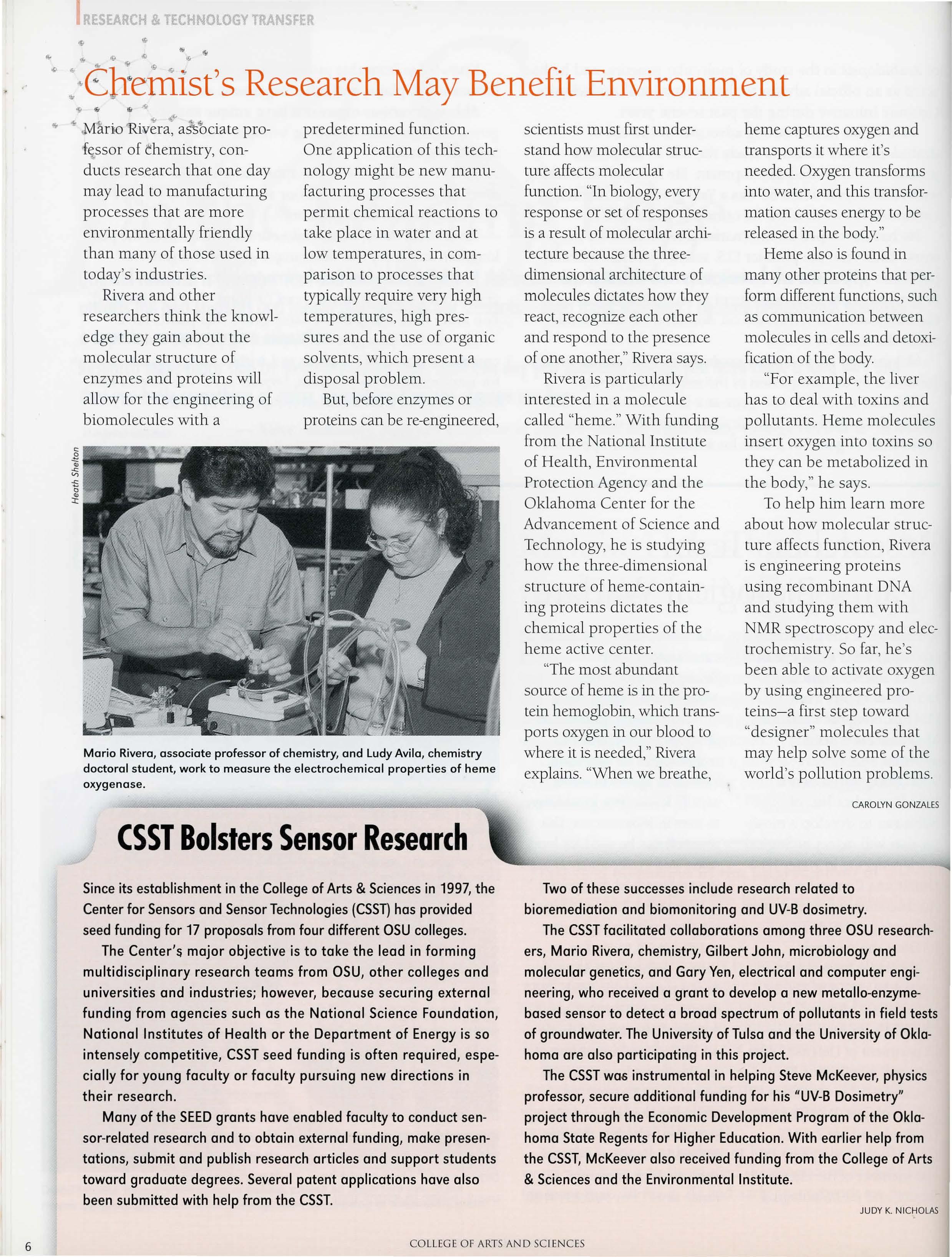
Mario Rivera, associate professor of chemistry, and Ludy Avila, chemistry doctoral student, work to measure the electrochemical properties of heme oxygenase.
JUDY K. NICHOLAS
From Frogs to Coral Reefs
A new invention developed by OSU scientists may revolutionize the way ultraviolet (UV) radiation is measured and will likely find its way into the marketplace to measure UV-B radiation in industrial, medical and environmental settings.
The device, called a dosimeter because it measures the dose of radiation, can be an important tool to help people limit their exposure to UV-B radiation, the type of radiation known to increase the incidents of cataracts and skin cancer.
Steve McKeever, Regent's professor of physics and associate dean of the College of Arts & Sciences, and Les Colyott, who was an OSU physics doctoral student when the project began two years ago, invented the device.
Nextep Technologies Inc. of Stillwater and OSU have signed an agreement that allows Nextep to further develop and market the technology and OSU to receive royalty fees. Nextep representative Art Lucas, who has worked in industry developing and improving radiationmeasuring devices since their inception in the 1940s, says, "The new dosimeter is the finest ever developed.
"The device has application in industrial areas
where employees such as arc welders are exposed to high doses of UV-B radiation," Lucas says, "and in medical settings where UV-B radiation is used."
UV-B radiation is also used in some wastewater treatment facilities and food sanitation processes. Workers in all these areas may someday wear a small in expensive personal UV-B radiation-measuring device to tell them how much exposure they are receiving, Lucas says.
Researchers studying the effects of UV-Bradiation on various environmental factors can also use the dosimeter. Most recently Lucas and Colyott completed a pilot study of the effects of UV-B on coral reefs off the coast of Guam.
McKeever and Colyott initially developed the device to help a colleague, former OSU zoology professor Jack 13antle,solve a problem in his research into the cause of deformities in frogs. He needed a small inexpensive device that could measure UV-B radiation in the frogs' habitat.
Measuring UV-B radiation has been a problem for researchers because of the high cost of equipment.
Even if a scientist wanted to submerge an extremely
expensive piece of equipment in a muddy pond, many instruments would be necessary to get readings throughout the area.
McKeever and Colyott solved the problem by developing a small, inexpensive, watertight, light-tight (allowing only UV-B to enter) dosimeter that can be placed under water next to the amphibians' eggs.
"This dosimeter costs tens of dollars in comparison to others that cost tens of thousands of dollars," McKeever says.
"The detector element is made of sapphire," he explains, "which is first sensitized by irradiating it with
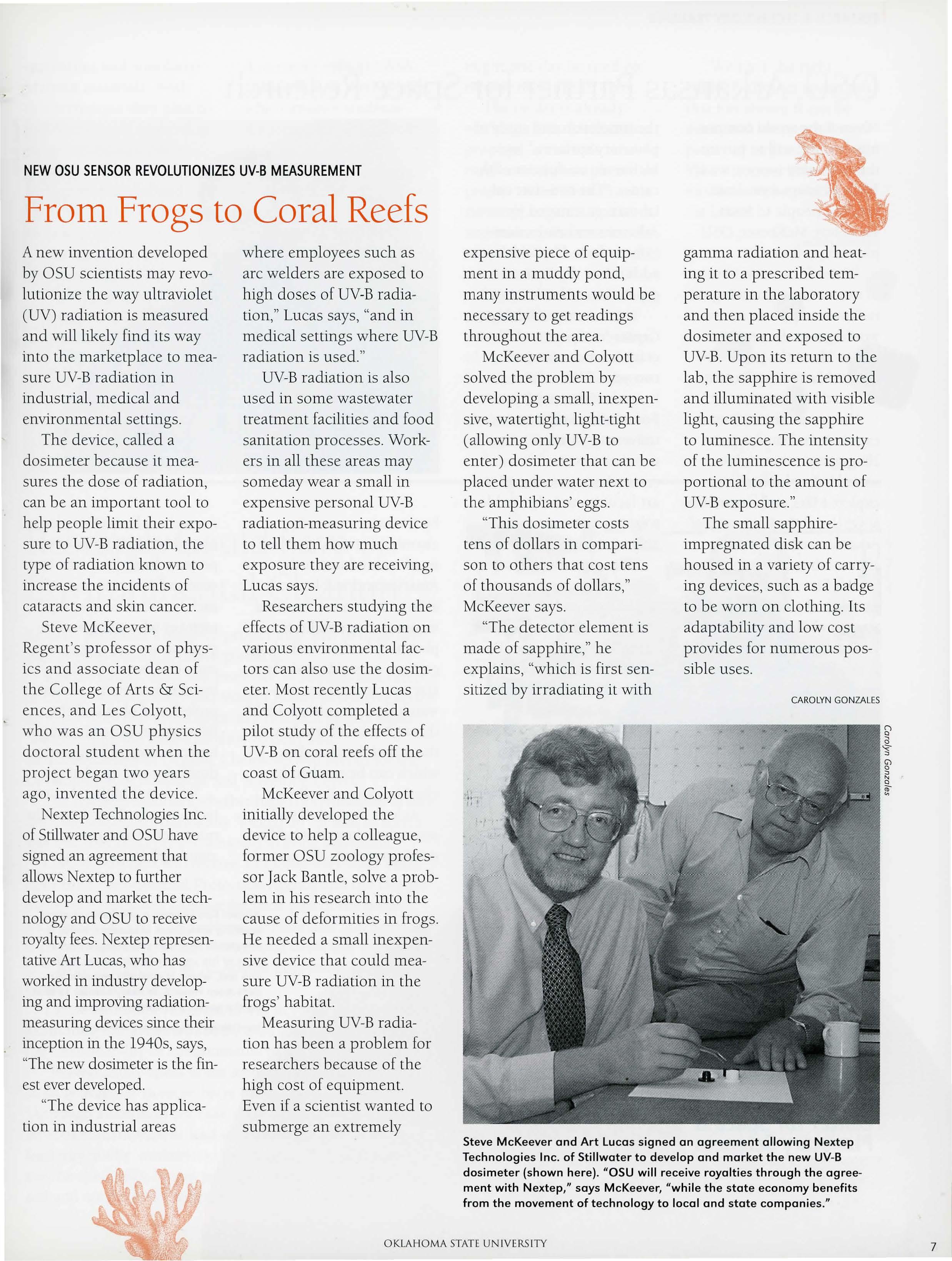
gamma radiation and heating it to a prescribed temperature in the laboratory and then placed inside the dosimeter and exposed to UV-B.Upon its return to the lab, the sapphire is removed and illuminated with visible light, causing the sapphire to luminesce. The intensity of the luminescence is proportional to the amount of UV-B exposure."
The small sapphireimpregnated disk can be housed in a variety of carrying devices, such as a badge to be worn on clothing. Its adaptability and low cost provides for numerous possible uses.
CAROLYNGONZALES
Steve McKeever and Art Lucas signed an agreement allowing Nextep Technologies Inc. of Stillwater to develop and market the new UV-B dosimeter (shown here). "OSU will receive royalties through the agreement with Nextep," says McKeever, "while the state economy benefits from the movement of technology to local and state companies."
OSU, Arkansas Partnerfor Space Research
"Even if the world community had the will to put up the necessary money, we are 10 to 15 years away from sending people to Mars," says Steve McKeever, OSU physics professor.
"One of the main issues to overcome is surviving the radiation exposure a crew would get in the year's journey to Mars, the year's stay on the Martian surface and the year's return journey."
How to survive radiation exposure and similar puzzling questions must be solved before humans explore Mars, and researchers at OSU and the University of Arkansas intend to supply some of those missing pieces.
As a first step they have established a new Center for Space and Planetary Sciences.
The center, jointly located at the University of Arkansas campus in Fayetteville and the OSU campus in Stillwater, will allow both universities to support NASA's space missions through science-based research on the ground.
"The center provides a unique facility in the U.S. for
the simulation and study of planetary surfaces," says McKeever, co-director of the center. "The two-state collaboration, initiated by Arkansas and enthusiastically endorsed by Oklahoma, adds a new dimension to the capabilities of both states."
The Arkansas-Oklahoma Center for Space and Planetary Sciences received a two-year, $1.6 million award from the National Science Foundation and from its two university partners to bring together a critical mass of researchers and state-of-theart facilities to help enable robotic exploration of the solar system.
"The center will be an interface between university researchers and scientists who put together space missions," says co-director Derek Sears, professor of chemistry and biochemistry at the University of Arkansas.
The researchers will primarily direct their work through the University of Arkansas's planetary environmental chamber.
Called Andromeda in honor of the constellation
by the same name, the chamber is the largest facility of its kind in North America and will be available to scientists interested in simulating conditions on planetary bodies, including comets, asteroids and planetary surfaces. Scientists can watch their simulated world through a small window on the top of the chamber, which can be reached by climbing a small staircase.
At least four Arkansas researchers from three different departments and several
researchers from OSU plan to use Andromeda for research projects. In addition, the University of Arkansas and OSU each have one new faculty member who will specialize in planetary and space science. OSU's new faculty member is visiting assistant professor of physics Deba Banerjee, an expert in using luminescence techniques in dosimetry and age dating.
Sears and McKeever use techniques called thermoluminescence and optically simulated luminescence of
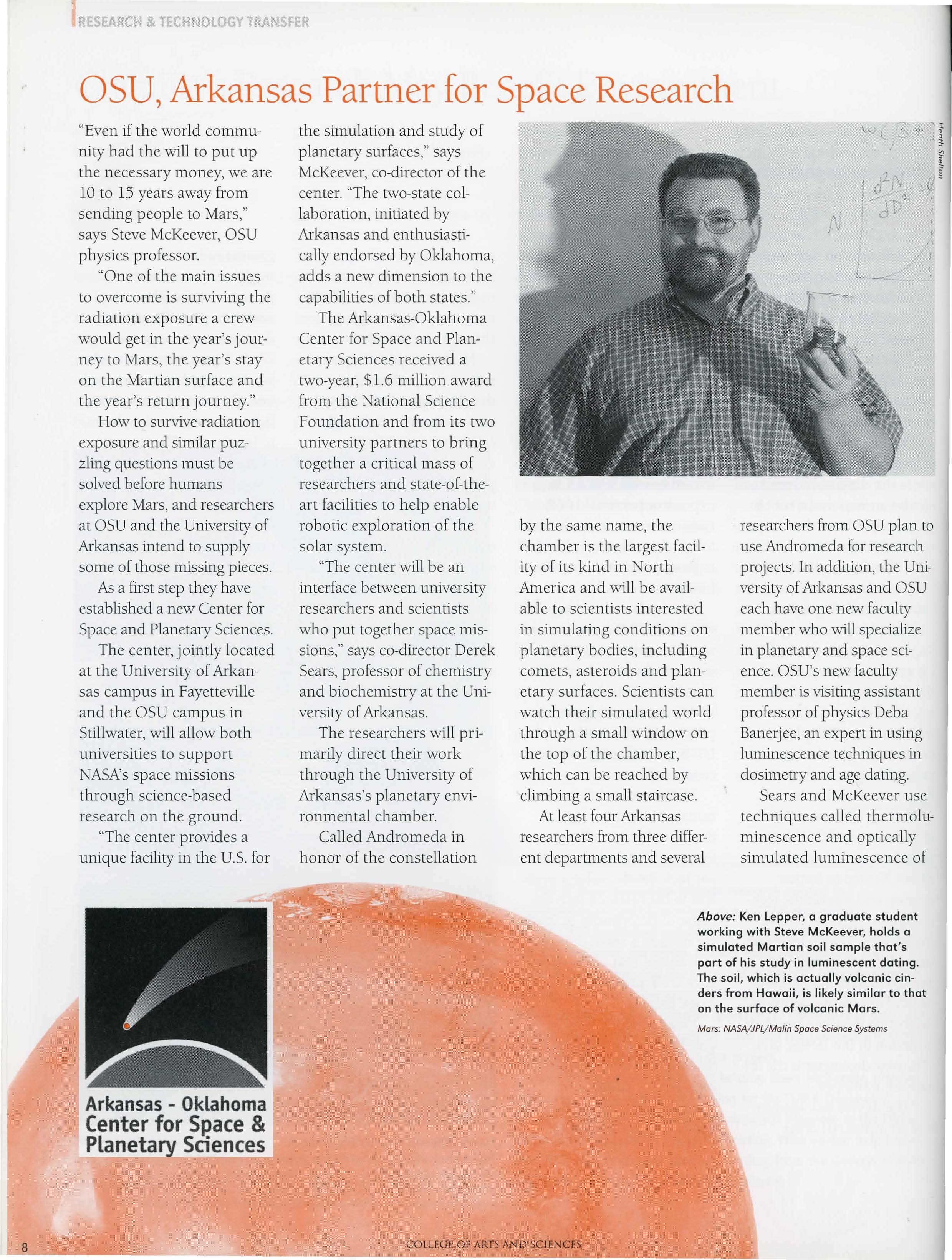
Above: Ken Lepper, a graduate student working with Steve McKeever, holds a simulated Martian soil sample that's part of his study in luminescent dating. The soil, which is actually volcanic cinders from Hawaii, is likely similar to that on the surface of volcanic Mars.
Mars: NASA/JPL/Malin Space Science Systems
Arkansas - Oklahoma Centerfor Space& PlanetarySciences
meteorites and simulated Martian materials. With this technique they plan to use Andromeda to develop miniaturized equipment that can survive Martian surface conditions and bring back data on Martian sediment ages.
The idea to date Martian sediments came from McKeever's student, Ken Lepper. Student Michael Blair and Professor Banerjee are also working on the project. Additional Center projects at OSU include the development of techniques for radiation dosimetry for astronauts.
A recent $1 million NASA grant will fund this research, which involves students Ramona Gaza,Jerirny Polf and postdoctoral fellow Von Whitley. Other Center researchers will be involved in a variety of projects. These include work with anaerobic microorganisms to see if they can survive under some of the conditions found in a Marslike environment; experiments with biological molecules to help determine if Mars ever had life on or below its surface; and work on inflatable structures that
Research Could Save on Environmental Cleanup
An OSU professor's research project may lead to huge savings in environmental cleanup efforts.
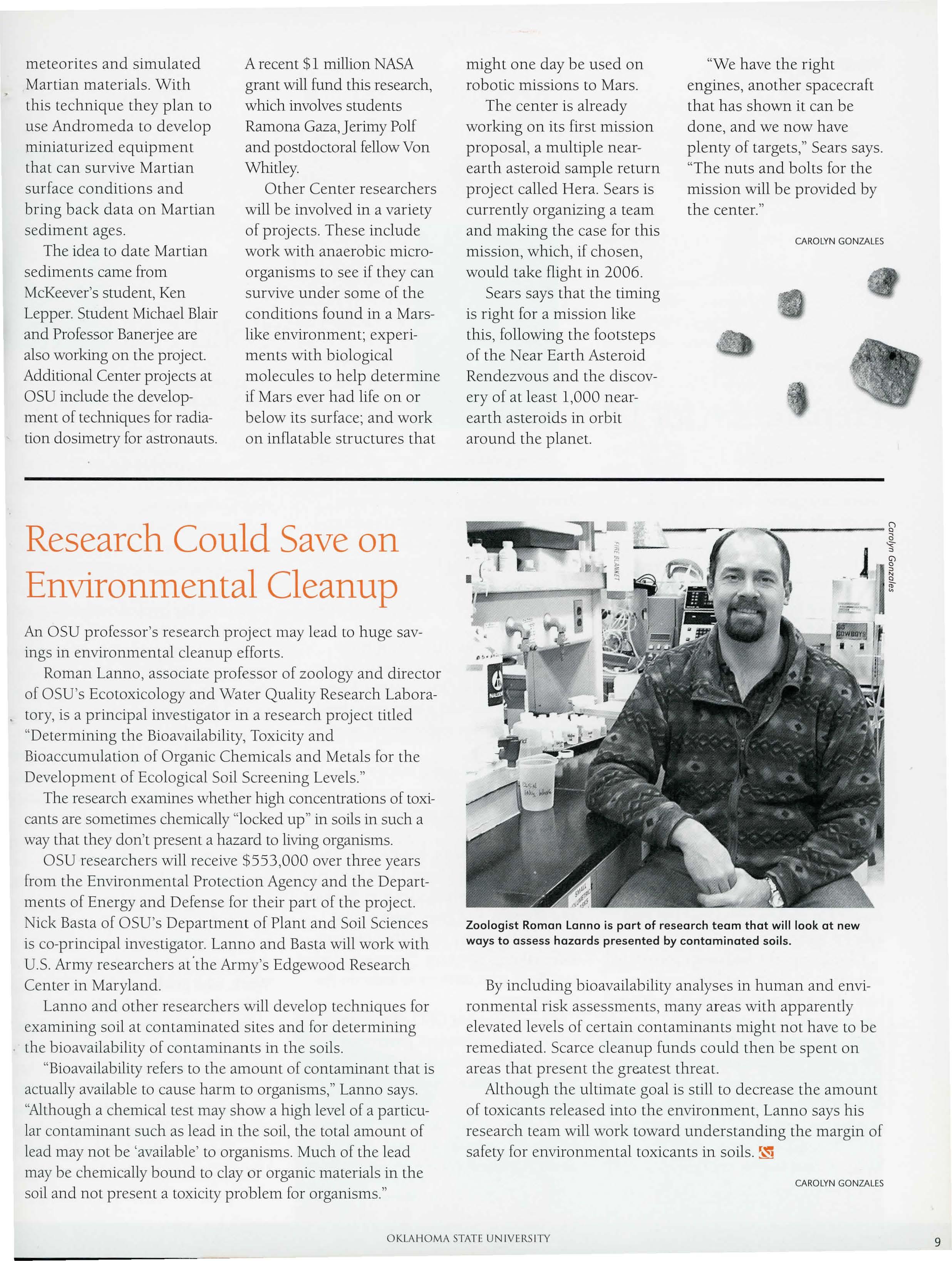
Roman Lanno, associate professor of zoology and director of OSU's Ecotoxicology and Water Quality Research Laboratory, is a principal investigator in a research project titled "Determining the Bioavailability, Toxicity and Bioaccumulation of Organic Chemicals and Metals for the Development of Ecological Soil Screening Levels."
The research examines whether high concentrations of toxicants are sometimes chemically "locked up" in soils in such a way that they don't present a hazard to living organisms.
OSU researchers will receive $553,000 over three years from the Environmental Protection Agency and the Departments of Energy and Defense for their part of the project. Nick Basta of OSU's Department of Plant and Soil Sciences is co-principal investigator. Lanno and Basta will work with U.S. Army researchers at'the Army's Edgewood Research Center in Maryland.
Lanno and other researchers will develop techniques for examining soil at contaminated sites and for determining the bioavailability of contaminants in the soils.
"Bioavailability refers to the amount of contaminant that is actually available to cause harm to organisms," Lanno says. "Although a chemical test may show a high level of a particular contaminant such as lead in the soil, the total amount of lead may not be 'available' to organisms. Much of the lead may be chemically bound to clay or organic materials in the soil and not present a toxicity problem for organisms."
might one day be used on robotic missions to Mars.
The center is already working on its first mission proposal, a multiple nearearth asteroid sample return project called Hera. Sears is currently organizing a team and making the case for this mission, which, if chosen, would take flight in 2006.
Sears says that the timing is right for a mission like this, following the footsteps of the Near Earth Asteroid Rendezvous and the discovery of at least 1,000 nearearth asteroids in orbit around the planet.
"We have the right engines, another spacecraft that has shown it can be done, and we now have plenty of targets," Sears says. 'The nuts and bolts for the mission will be provided by the center."
By including bioavailability analyses in human and environmental risk assessments, many areas with apparently elevated levels of certain contaminants might not have to be remediated. Scarce cleanup funds could then be spent on areas that present the greatest threat.
Although the ultimate goal is still to decrease the amount of toxicants released into the environment, Lanno says his research team will work toward understanding the margin of safety for environmental toxicants in soils.
Zoologist Roman Lanno is part of research team that will look at new ways to assess hazards presented by contaminated soils.
Preparationfor Life
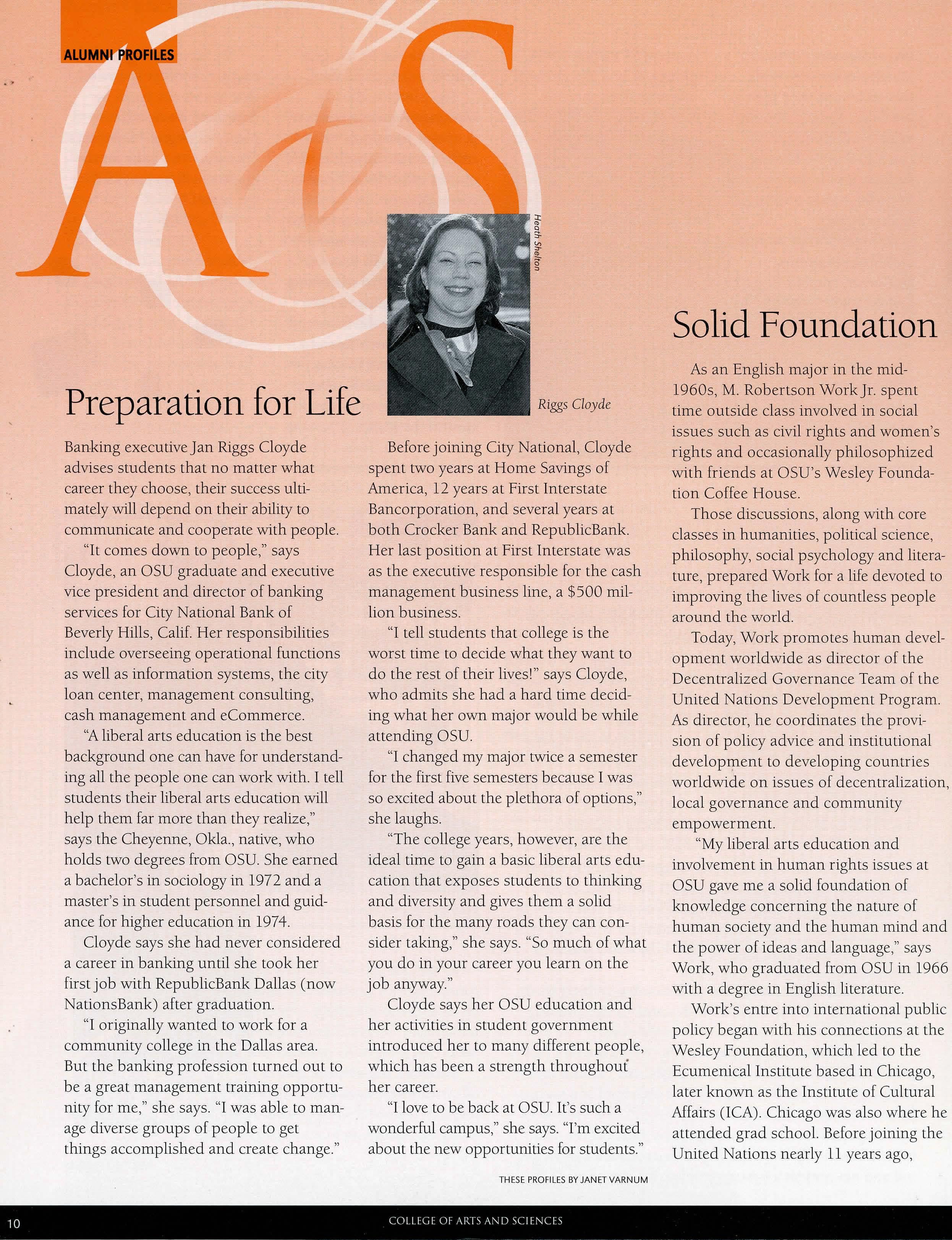
Banking executive Jan Riggs Cloy de advises students that no matter what career they choose, their success ultimately will depend on their ability to communicate and cooperate with people.
"It comes down to people," says Cloyde, an OSU graduate and executive vice president and director of banking services for City National Bank of Beverly Hills, Calif. Her responsibilities include overseeing operational functions as well as information systems, the city loan center, management consulting, cash management and eCommerce.
"Aliberal arts education is the best background one can have for understanding all the people one can work with. I tell students their liberal arts education will help them far more than they realize," says the Cheyenne, Okla., native, who holds two degrees from OSU. She earned a bachelor's in sociology i.n 1972 and a master's in student personnel and guidance for higher education in 1974.
Cloyde says she had never considered a career in banking until she took her first job with RepublicBank Dallas (now NationsBank) after graduation.
"I originally wanted to work for a community college in the Dallas area. But the banking profession turned out to be a great management training opportunity for me," she says. "I was able to manage diverse groups of people to get things accomplished and create change."
Before joining City National, Cloyde spent two years at Home Savings of America, 12 years at First Interstate Bancorporation, and several years at both Crocker Bank and RepublicBank. Her last position at First Interstate was as the executive responsible for the cash management business line, a $500 million business.
"l tell students that college is the worst time to decide what they want to do the rest of their lives!" says Cloyde, who admits she had a hard time deciding what her own major would be while attending OSU.
"I changed my major twice a semester for the first five semesters because I was so excited about the plethora of options," she laughs.
"The college years, however, are the ideal ti.me to gain a basic liberal arts education that exposes students to thinking and diversity and gives them a solid basis for the many roads they can consider taking," she says. "So much of what you do in your career you learn on the job anyway."
Cloyde says her OSU education and her activities in student government introduced her to many different people, which has been a strength throughout her career.
"I love to be back at OSU. It's such a wonderful campus," she says. 'Tm excited about the new opportunities for students."
Solid Foundation
As an English major in the mid1960s, M. Robertson WorkJr. spent time outside class involved in social issues such as civil rights and women's rights and occasionally philosophized with friends at OSU's Wesley Foundation Coffee House.
Those discussions, along with core classes in humanities, political science, philosophy, social psychology and literature, prepared Work for a life devoted to improving the lives of countless people around the world.
Today, Work promotes human development worldwide as director of the Decentralized Governance Team of the United Nations Development Program. As director, he coordinates the provision of policy advice and institutional developrp.ent to developing countries worldwide on issues of decentralization, local governance and community empowerment.
"My liberal arts education and involvement in human rights issues at OSU gave me a solid foundation of knowledge concerning the nature of human society and the human mind and the power of ideas and language," says Work, who graduated from OSU in 1966 with a degree in English literature.
Work's entre into international public policy began with his connections at the Wesley Foundation, which led to the Ecumenical Institute based in Chicago, later known as the Institute of Cultural Affairs (ICA). Chicago was also where he attended grad school. Before joining the United Nations nearly 11 years ago,
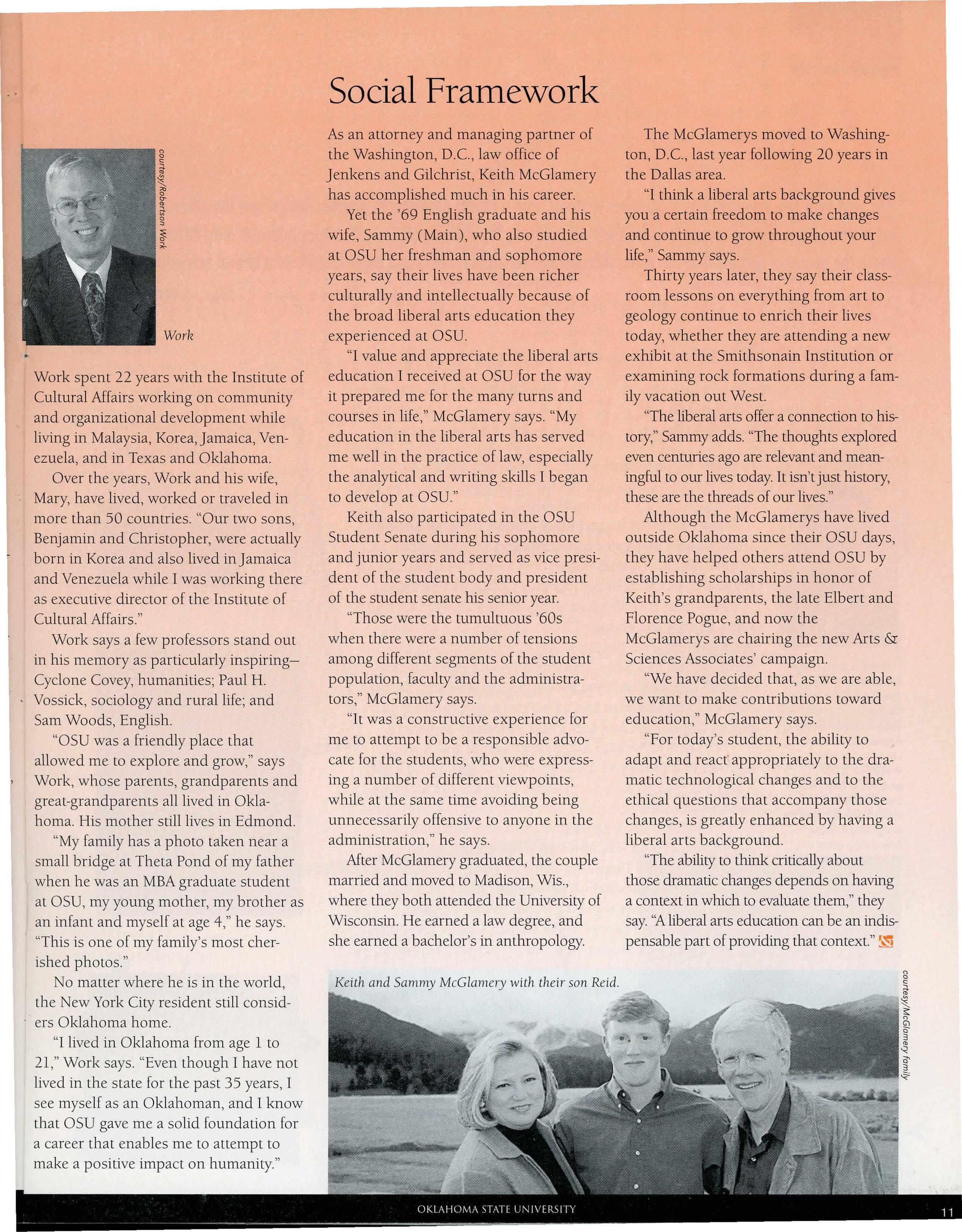
Work spent 22 years with the Institute of Cultural Affairs working on community and organizational development while living in Malaysia, Korea,Jamaica, Venezuela, and in Texas and Oklahoma.
Over the years, Work and his wife, Mary, have lived, worked or n·aveled in more than 50 countries. "Our two sons, Benjamin and Christopher, were actually born in Korea and also lived in Jamaica and Venezuela while I was working there as executive director of the Institute of Cultural Affairs."
Work says a few professors stand out in his memory as particularly inspiringCyclone Covey, humanities; Paul H. Vossick, sociology and rural life; and Sam Woods, English.
"OSU was a friendly place that allowed me to explore and grow," says Work, whose parents, grandparents and great-grandparents all lived in Oklahoma. His mother still lives in Edmond.
"My family has a photo taken near a small bridge at Theta Pond of my father when he was an MBAgraduate student at OSU, my young mother, my brother as an infant and myself at age 4," he says. "This is one of my family's most cherished photos."
No matter where he is in the world, the New York City resident still considers Oklahoma home.
"I lived in Oklahoma from age 1 to 21," Work says. "Even though I have not lived in the state for the past 35 years, I see myself as an Oklahoman, and I know that OSU gave me a solid foundation for a career that enables me to attempt to make a positive impact on humanity."
Social Framework
As an attorney and managing partner of the Washington, D.C., law office of Jenkens and Gilchrist, Keith McGlamery has accomplished much in his career.
Yet the '69 English graduate and his wife, Sammy (Main), who also studied at OSU her freshman and sophomore years, say their lives have been richer culturally and intellectually because of the broad liberal arts education they experienced at OSU.
"I value and appreciate the liberal arts education I received at OSU for the way it prepared me for the many turns and courses in life," McGlamery says. "My education in the liberal arts has served me well in the practice of law, especially the analytical and writing skills I began to develop at OSU."
Keith also participated in the OSU Student Senate during his sophomore and junior years and served as vice president of the student body and president of the student senate his senior year.
"Those were the tumultuous '60s when there were a number of tensions among different segments of the student population, faculty and the administrators," McGlamery says.
"It was a constructive experience for me to attempt to be a responsible advocate for the students, who were expressing a number of different viewpoints, while at the same time avoiding being unnecessarily offensive to anyone in the administration," he says.
After McGlamery graduated, the couple married and moved to Madison, Wis., where they both attended the University of Wisconsin. He earned a law degree, and she earned a bachelor's in anthropology.
The McGlamerys moved to Washington, D.C., last year following 20 years in the Dallas area.
"I think a liberal arts background gives you a certain freedom to make changes and continue to grow throughout your life," Sammy says.
Thirty years later, they say their classroom lessons on everything from art to geology continue to enrich their lives today, whether they are attending a new exhibit at the Smithsonain Institution or examining rock formations during a family vacation out West.
"The liberal arts offer a connection to history," Sammy adds. 'The thoughts explored even centuries ago are relevant and meaningful to our lives today. It isn't just history, these are the threads of our lives."
Although the McGlamerys have lived outside Oklahoma since their OSU days, they have helped others attend OSU by establishing scholarships in honor of Keith's grandparents, the late Elbert and Florence Pogue, and now the McGlamerys are chairing the new Arts & Sciences Associates' campaign.
"We have decided that, as we are able, we want to make contributions toward education," McGlamery says.
"For today's student, the ability to adapt and react"appropriately to the dramatic technological changes and to the ethical questions that accompany those changes, is greatly enhanced by having a liberal arts background.
"The ability to think criticallyabout those dramatic changes depends on having a context in which to evaluate them," they say."Aliberal arts education can be an indispensable part of providing that context." r~
Keith ancl Sammy McGlamery with their son Reid.
"ThispastyeartwotalentedArts& Sciencesstudents,onea recentgraduateingraphicdesignandtheother a student of arthistory,haveearnedrecognitionfortheiroriginalart.Theirartisticstylesandcareerinterestsmaydiffer,butthey sharethepersonalsuccessthatcancomethroughtheversatilityandbroadopportunities ofa liberalartseducation."
-John Dobson, dean, Collegeof Arts & Sciences
Pistol Pete's Frosty Friend Makes A&S Debut
He's one of the boys of winter. "Snow Pete," Pistol Pete's frosty winter friend, made his debut last year on the College of Arts & Sciences' Christmas cards.
Snow Pete is the brainchild of graphic designer Charles Thomas, who graduated in December with a degree in graphic design. Thomas entered his Snow Pete design and a suggested Arts & Sciences logo in a College competition.
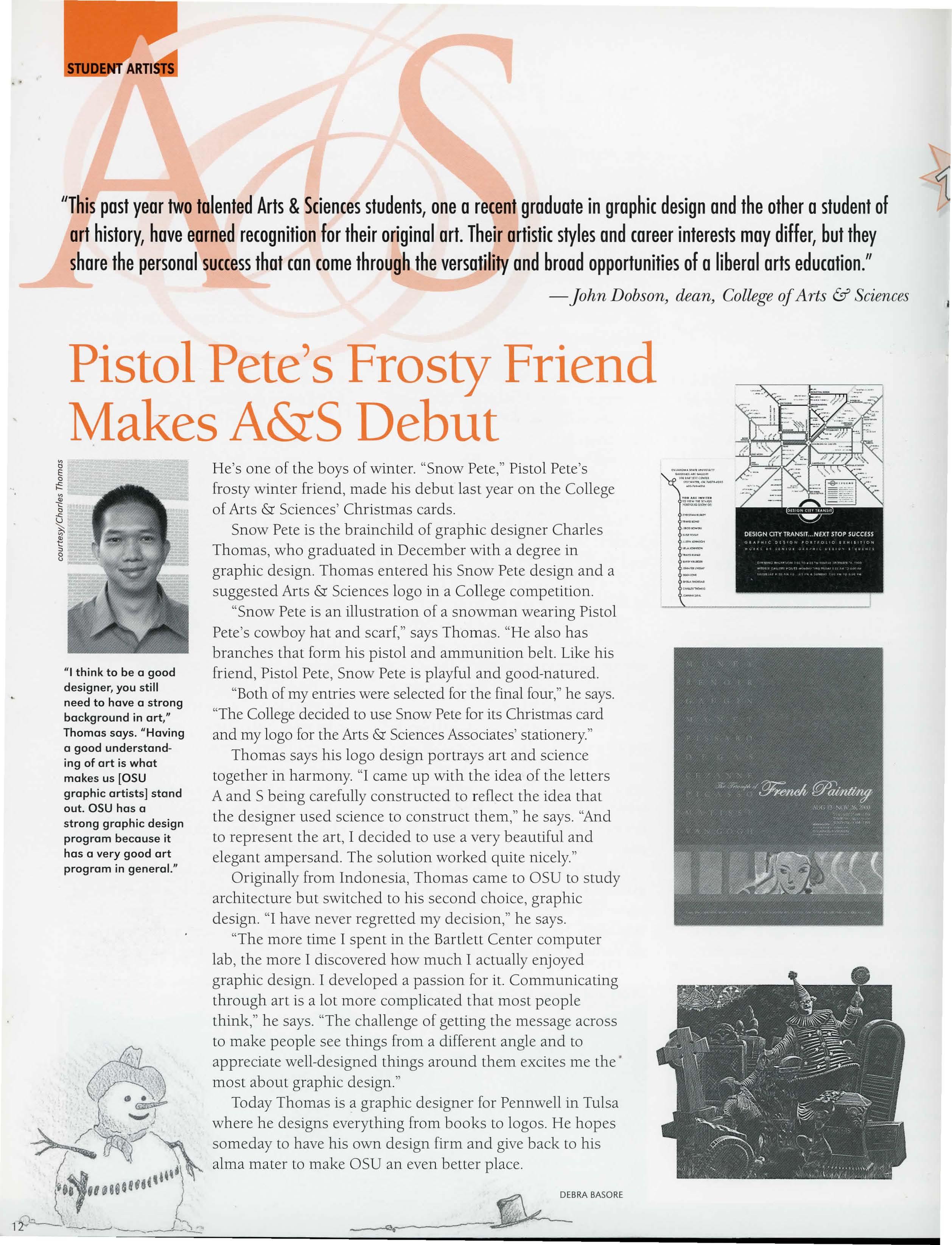
"I think to be o good designer, you still need to have a strong background in art," Thomas says. "Having a good understanding of art is what makes us [OSU graphic artists] stand out. OSU has a strong graphic design program because it has a very good art program in general."
"Snow Pete is an illustration of a snowman wearing Pistol Pete's cowboy hat and scarf," says Thomas. "He also has branches that form his pistol and ammunition belt. Like his friend, Pistol Pete, Snow Pete is playful and good-natured.
"Both of my entries were selected for the final four," he says. "The College decided to use Snow Pete for its Christmas card and my logo for the Arts & Sciences Associates' stationery."
Thomas says his logo design portrays art and science together in harmony. "I came up with the idea of the letters A and S being carefully constructed to reflect the idea that the designer used science to construct them," he says. "And to represent the art, I decided to use a very beautiful and elegant ampersand. The solution worked quite nicely."
Originally from Indonesia, Thomas came to OSU to study architecture but switched to his second choice, graphic design. "I have never regretted my decision," he says.
"The more time I spent in the Bartlett Center computer lab, the more I discovered how much I actually enjoyed graphic design. I developed a passion for it. Communicating through art is a lot more complicated that most people think," he says. "The challenge of getting the message across to make people see things from a different angle and to appreciate well-designed things around them excites me the· most about graphic design."
Today Thomas is a graphic designer for Pennwell in Tulsa where he designs everything from books to logos. He hopes someday to have his own design firm and give back to his alma mater to make OSU an even better place.
Fangirl:Making a Place on the Internetfor Female Comic Characters!
What if Superman and Wonder Woman had a child 1 What kinds of super powers would she have, and what would she wear'
So two years ago Williams got busy and created Fangirl at members.nbci.com/Blackanary/ fangirl.html.
"My site is devoted to people who appreciate the women characters in comics, cartoons and anime," she says. "I really think it is important for comic book fans to recognize and appreciate all the strong, independent and complex female characters that are out there."
It was by studying DC and Marvel comics that Williams eventually began creating her own characters.
"While comics are popular, American culture does not respect them as an art form," Williams says. "One reason is that in the 1950s comic books were thought to be corrupting American youth, so Congress began to regulate comics and, thus, stifled many American artists."
Williams appreciates the art form because it relies on the combination of drawings and words to tell a story. "I also like that the characters' universality doesn't distract the reader with preconceived ideas about backgrounds," she says. "This, I think, is one reason comics are a great medium to communicate ideas."'~
SHERRYFLETCHER
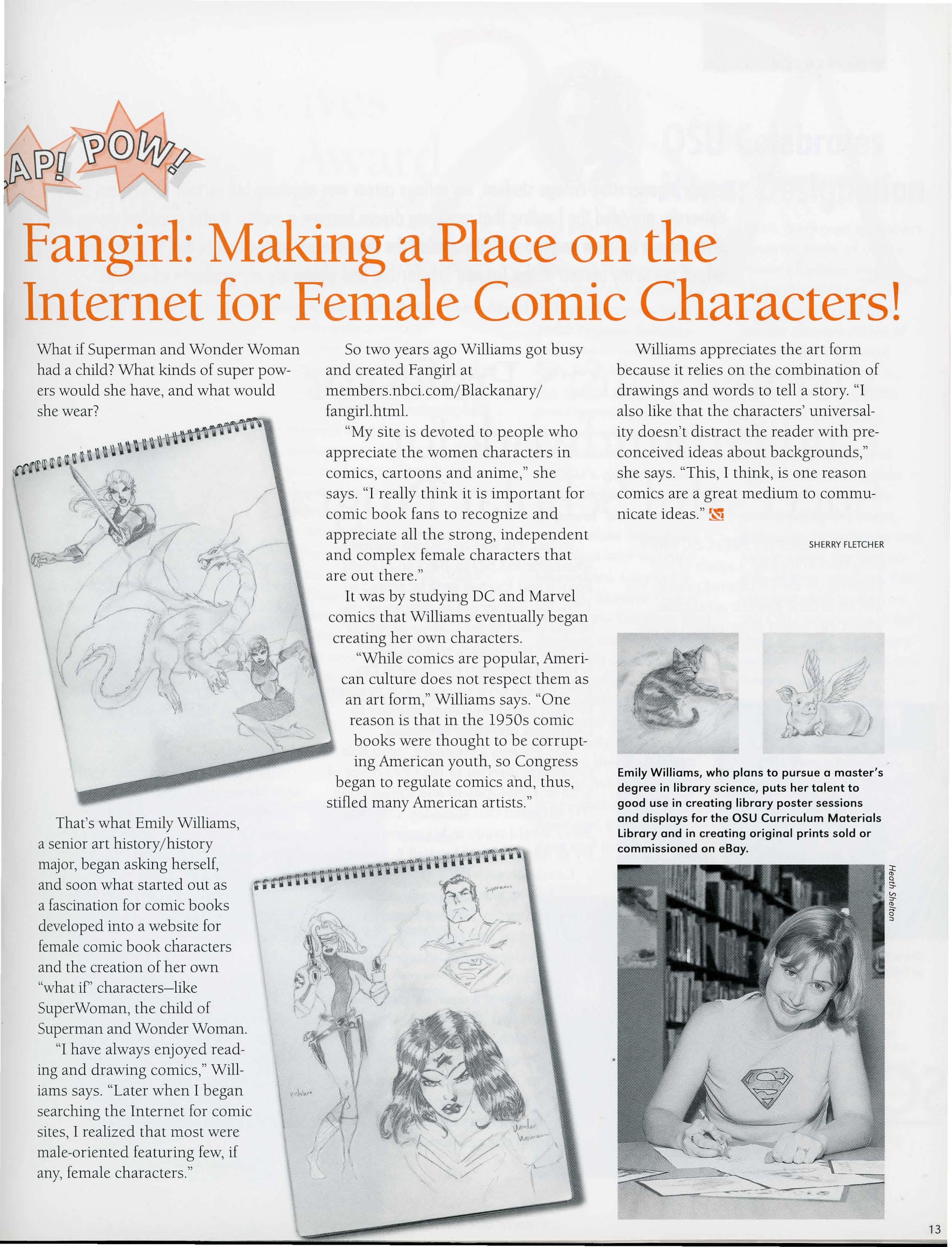
That's what Emily Williams,
a senior art history /history major, began asking herself, and soon what started out as a fascination for comic books developed into a website for female comic book characters and the creation of her own "what if' characters-like Superwoman, the child of Superman and Wonder Woman.
"I have always enjoyed reading and drawing comics," Williams says. "Later when I began searching the Internet for comic sites, I realized that most were male-oriented featuring few, if any, female characters."
and displays for the
Materials Library and in creating original prints sold or commissioned on eBay.
Emily Williams, who plans to pursue a master's degree in library science, puts her talent to good use in creating library poster sessions
OSU Curriculum
"Asa first-generationcollegestudent,mycollegecareerwasanythingbutcertain.OklahomaState Universityprovidedthefundingthatmademydreambecome a reality. It alsoprovidedanexcellent placeformetolearnandgrow.OSUprovidedtheexperiences,opportunitiesandsupportthat helpedmeinmypursuitoftheTrumanScholarshipandultimatelymygraduateeducation."
- Wren E. Hawthorne Jr.,political
science graduate and 1995 Truman Scholar
Visionary A&S Professor Laid Groundworkfor Successful Scholar Program
Visitors to Geoffrey Pill's OSU office delighted in finding a touch of old England on the Oklahoma prairie. Pill was an urbane English gentleman, whom one might more expect to see strolling the great halls of Oxford or Cambridge.
In fact, Pill was an Oxford graduate who came to OSU in 1965 and taught French and English until he retired in 1991. He also served as director of curricular affairs in the College of Arts &. Sciences and helped with the state's Scholar-Leadership Enrichment Program on the OSU campus. The program brought world-renowned scholars to Oklahoma university campuses.
"Dr. Pill was a visionary," says Bob Graalman, director of the OSU office of Scholar Development and Recognition. "He dreamed that someday, OSU students would study in his native country as Rhodes and Marshall Scholars."
Graalman says Pill's most important contribution was as an early organizer of the University Honors Program. The foundation he laid resulted in OSU's current recognition as a leader in honors education.
"He designed a class for exceptional students called 'Windows to the World,' which we still teach today," Graalman says. "The class focuses on discussion of contemporary issues and develops communication skills that OSU's top students use in prestigious scholarship competitions."
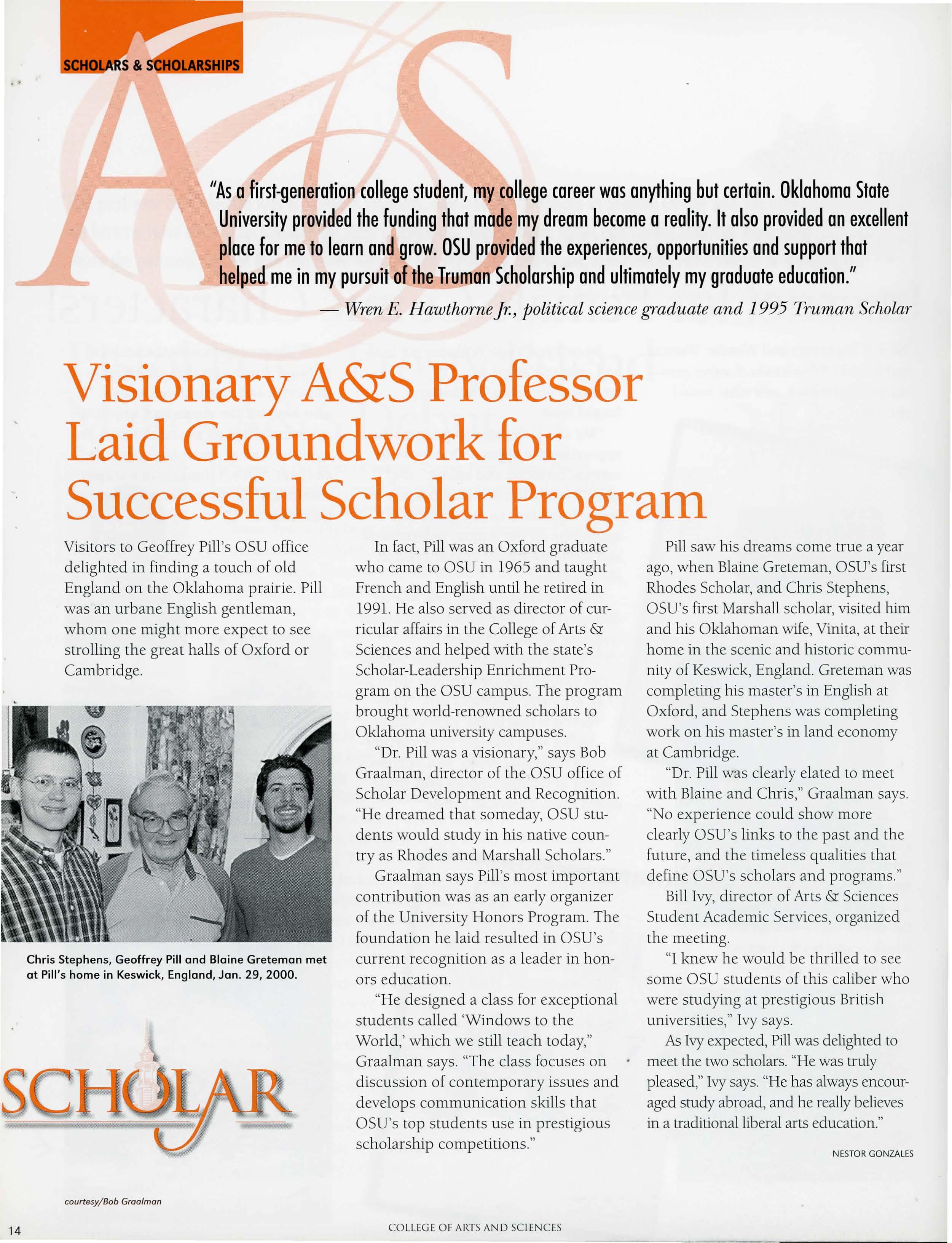
Pill saw his dreams come true a year ago, when Blaine Greteman, OSU's first Rhodes Scholar, and Chris Stephens, OSU's first Marshall scholar, visited him and his Oklahoman wife, Vinita, at their home in the scenic and historic community of Keswick, England. Greteman was completing his master's in English at Oxford, and Stephens was completing work on his master's in land economy at Cambridge.
"Dr. Pill was clearly elated to meet with Blaine and Chris," Graalman says. "No experience could show more clearly OSU's links to the past and the future, and the timeless qualities that define OSU's scholars and programs."
Bill Ivy, director of Arts &. Sciences Student Academic Services, organized the meeting.
"I knew he would be thrilled to see some OSU students of this caliber who were studying at prestigious British universities," Ivy says.
As Ivy expected, Pill was delighted to meet the two scholars. "He was truly pleased," Ivy says. "He has always encouraged study abroad, and he really believes in a traditional liberal arts education." NESTORGONZALES
Chris Stephens, Geoffrey Pill and Blaine Gretemon met ot Pill's home in Keswick, England, Jan. 29, 2000.
courtesy/Bob Graa/man
White Receives GoldwaterAward
Mario White, a senior majoring in mathematics and history, received the prestigious Goldwater Scholarship for 2000.
The scholarship comes from the Goldwater Foundation, a federally endowed agency established in 1986 in honor of Sen. Barry M. Goldwater, and is designed to foster and encourage outstanding students to pursue careers in the fields of mathematics, the natural sciences and engineering.
The award will pay White $7,500 for one or two years of undergraduate study and is based on his overall academic accomplishments and research experience. He is one of a total of 309 students selected nationwide to receive scholarships for the 2000-2001 academic year.
"The Goldwater Scholarship is the premier undergraduate award of its type in these fields," says Bob Graalman, OSU director of
scholar development and recognition. "Mario is a well-deserving recipient. He's an amazing person with multiple interests academically and involvements in a number of extracurricular and community activities."
White says he couldn't have achieved his goals without the help of his professors and mentors, including Graalman; Lisa Mantini, associate professor of mathematics; history professor Neil Hackett; and math professors Robert Donley and Leticia Barchini.
White, who studies Russian along with math and science, wants to earn a doctoral degree and hopes to either teach at the university level or work in industry.
"Mario is an outstanding student," says Mantini, "and he has the potential to make a difference in research or as an educator."
CAROLYNGONZALES
Goldwoter Scholar
Mario White says he couldn't have achieved his goals without the help af his professors and mentors.
OSUCelebrates
HonorDesignation
This past December OSU's Truman Scholars returned to campus to celebrate the university's designation as a Year 2000 Truman Scholarship Honor Institution. Only five universities in the nation received this prestigious honor from the Truman Scholarship Foundation.
OSU's celebration included the dedication of a special "Scholars Wall" to showcase individuals who have won national fellowships. Located in the OSU Student Union atrium, the Scholars Wall displays the photographs of 19 OSU scholars and their mentors.
In addition to six Goldwater Scholars and OSU's only Rhodes Scholar, three of the 10 Truman Scholars are A&S graduates: Angela L. Robinson, political science and public affairs,
1981, mentored by Robert Spurrier, head of OSU's Honors College; Kent L. Major, psychology, 1987, guided by Ronald Beer, former vice-president of Student Services; and Wren E. Hawthorne Jr., political science, 1995, mentored by Mary Mandeville, assistant professor of speech communication. In statements commemorating the event, Robinson, Hawthorne and Major credit the dedication of their mentors, faculty and staff as well as the OSU environment for their achievements. Summarizing their shared sentiments, Major says, "The opportunities and experiences provided at OSU were instrumental in shaping my perspective, expanding my knowledge, honing my skills and qualifying me for the Truman Scholarship."
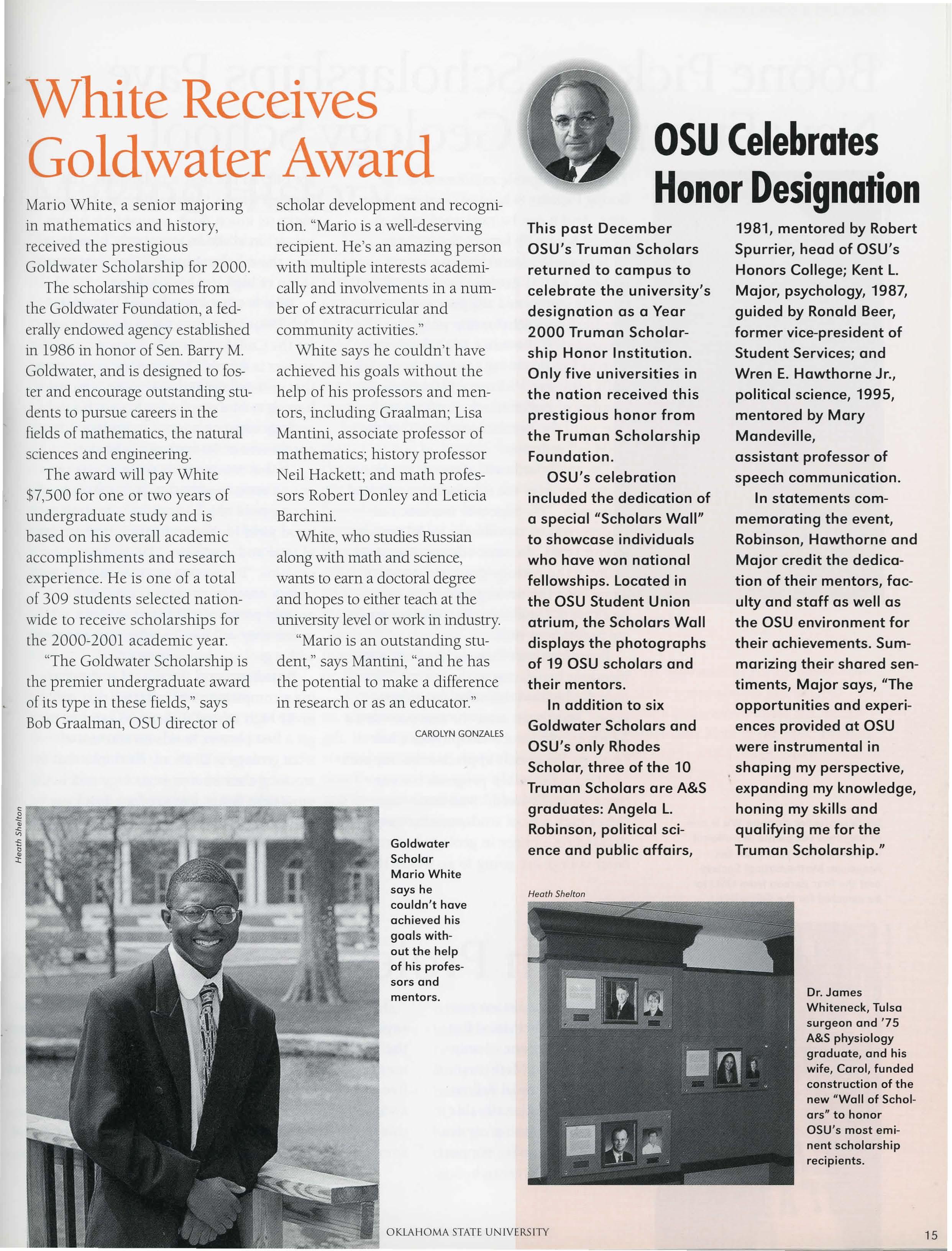
Dr. James Whiteneck, Tulsa surgeon and '7 5 A&S physiology graduate, and his wife, Carol, funded construction of the new "Wall of Scholars" to honor OSU's most eminent scholarship recipients.
Heath Shelton
Boone Pickens Scholarships Pave New Future for Geology School
There i.s a palpable excitement in the Boone Pickens School of Geology these days. And it can be explained in three words: Boone Pickens Scholarships.
Texas oilman and entrepreneur Boone Pickens, a 1951 geology graduate of OSU, recently committed support to an impressive freshman scholarship program. The program will provide a $5,000 scholarship to five incoming students in the fall 2001 semester. Pickens will increase the number of available scholarships each year until the number reaches 20 in the 2004 fall semester.
Darwin Boardman, associate professor of geology, says the scholarships will lead to growth. "We expect to increase our undergraduate enrollment by 50 percent i.n four years," he says, adding that, since many of the geology graduate students come from the undergraduate program, he expects a spillover effect on the graduate program as well.
Boardman says Pickens has been a tremendous benefactor to the school. "Not only did he fund this scholarship program," Boardman says, "he also provided a $250,000 gift for the Geophysics Chair in Geology. We greatly appreciate his support.
are offered the best scholarships. The Boone Pickens Scholarships are going to make us much more competitive in this sense." In addition to growth, Boardman says the scholarships will promote acquisition of high quality students.
Why is school enrollment important?
Deb Desjardins, director of development for the College of Arts & Sciences, says the answer is simple. "Many of the companies that visi.tcollege and university campuses hoping to hire employees from schools of geology expect a minimum undergraduate enrollment of 50 students," she says.
"If that mini.mum i.s not met, the programs are considered to lack a sufficiently strong pool of job candidates to provide a good yield for the company's investment of time and resources," Desjardins explains. "By meeting or exceeding the companies' enrollment expectations, OSU's geology program will attract students who realize they will have excellent job prospects with a geology degree from OSU."
Math professor Jiahang Wu is one of only four recipients of national fellowships this year from the American Mathematical Society and the first person from OSU to be selected far the fellowship.
"This scholarship program is something we really need," Boardman says. "Most high school students who have decided on a major i.n geology before they enter college are going to go where they
Boardman says the school is also starting a complementary program that will invite high school students to campus to get a first-person, hands-on account of what geology i.sall about. He thinks that by arousing their interest in geology and, at the same time, being able to offer a first class scholarship, success is sure to follow ... both for the student and the Boone Pickens School of Geology.
Math Professor Wins Nati
Jiahong Wu, assistant professor of mathematics, has been awarded one of only four American Mathematical Society Centennial Fellowships given nationally this year. The fellowship carries a $40,000 award to support the recipient's research.
"This is great news," says Benny Evans, head of the mathematics department. "There are three to five of these fellowships awarded each year, and this is the first ever won by someone at OSU."
Wu will use the fellowship to spend next year pursuing his research at the Texas Institute of Computational and Applied Mathematics, part of the University of Texas, and at the University of Chicago.
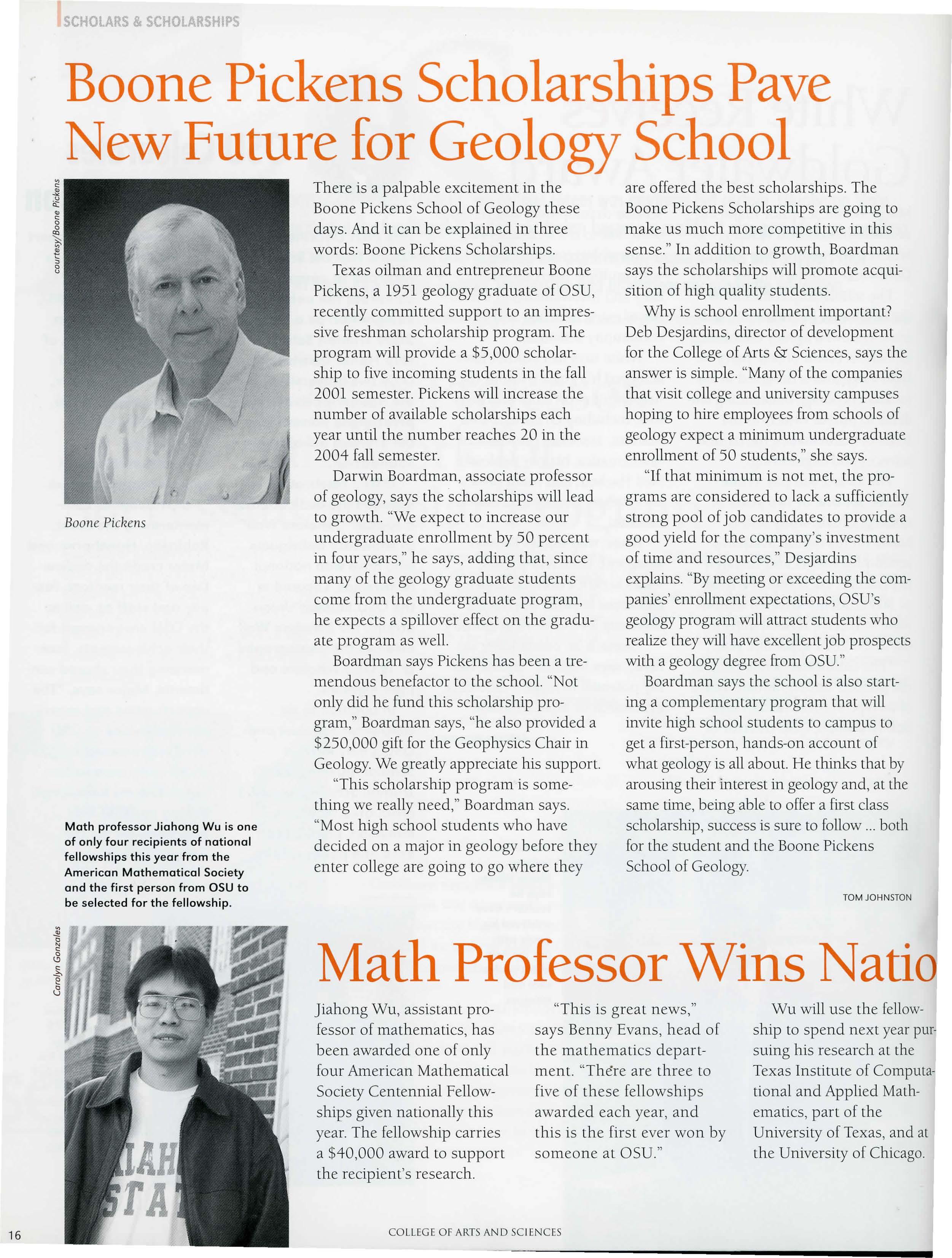
Boone Pickens
TOM JOHNSTON
Making History
"Raymond Estep is one of the history department's very best friends," says Bill Bryans, head of the OSU history department. "This year we were able to award three graduate students $1,000 scholarships each, thanks to Mr. Estep's establishment of the O.A. Hilton Memorial Scholarship fund."
But Estep's contributions don't end there, Bryans says. Estep also established a fund to_help defray graduate students' travel expenses to conduct research and attend professional meetings to present their findings. "Raymond Estep's support has been instrumental in helping master's and doctoral students complete their degrees," Bryans says.
In 1938 Estep, a graduate assistant and summer instructor in history, received his master's degree from Oklahoma Agricultural and Mechanical College.
Following his release from military service, the Purcell, Okla., native returned to OSU in 1946 to serve as an assistant professor. He renewed his relationship with the late Professor O.A. Hilton, an economic historian for whom Estep had worked as a graduate assistant prior to World War 11and under whom he served as an historical officer during the war.
alAward
A native of China, Wu attendedBeijing University beforecoming to America in 1992to earn his Ph.D. at the Universityof Chicago. He cameto OSU last fall.
Wu, who studies mathematicalfluids mechanics, is
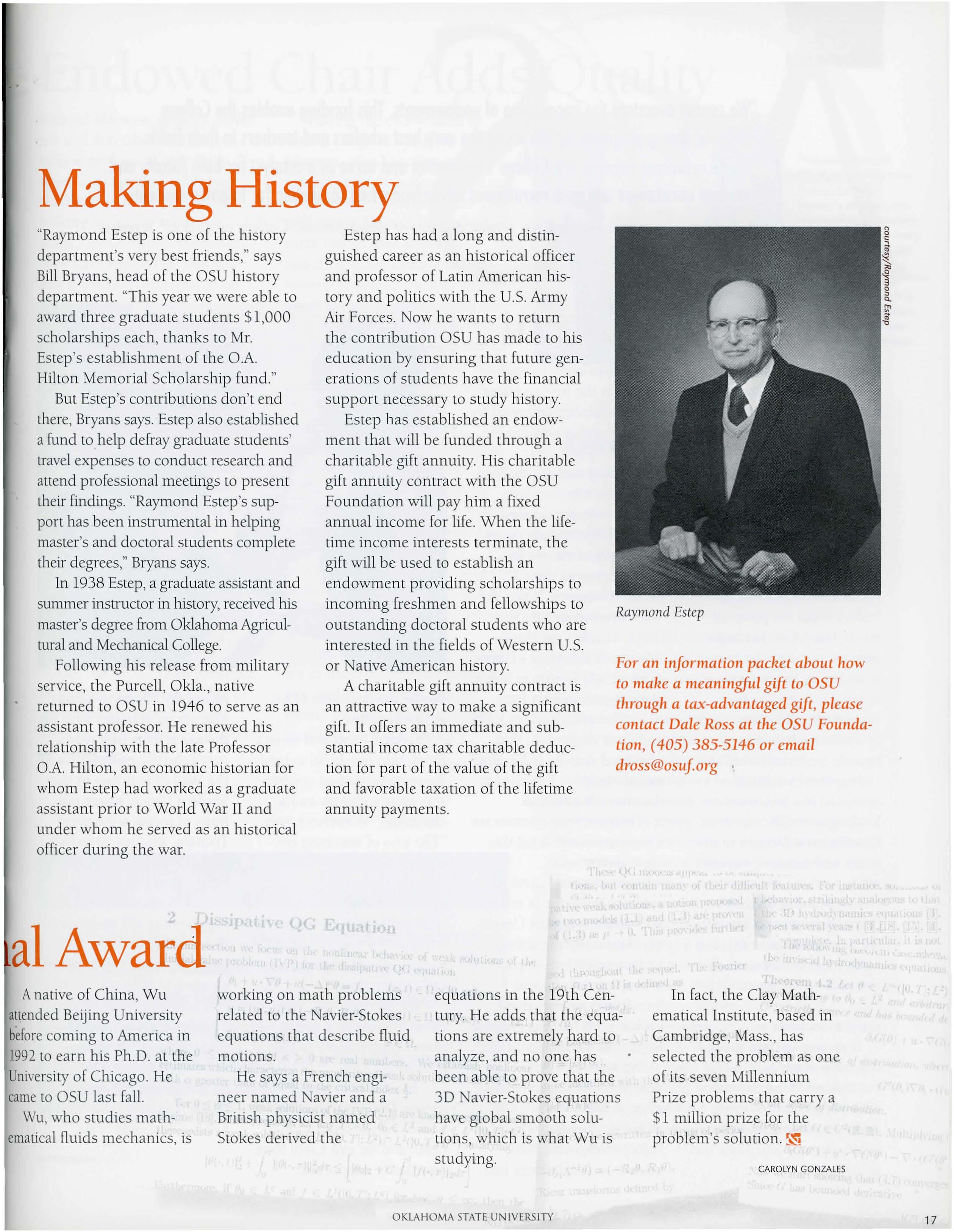
Estep has had a long and distinguished career as an historical officer and professor of Latin American history and politics with the U.S. Army Air Forces. Now he wants to return the contribution OSU has made to his education by ensuring that future generations of students have the financial support necessary to study history.
Estep has established an endowment that will be funded through a charitable gift annuity. His charitable gift annuity contract with the OSU Foundation will pay him a fixed
annual income for life. When the lifetime income interests terminate, the gift will be used to establish an endowment providing scholarships to incoming freshmen and fellowships to outstanding doctoral students who are interested in the fields of Western U.S. or Native American history.
A charitable gift annuity contract is an attractive way to make a significant gift. It offers an immediate and substantial income tax charitable deduction for part of the value of the gift and favorable taxation of the lifetime annuity payments.
For an information packet about how to make a meaningful gift to OSU through a tax-advantaged gift, please contact Dale Ross at the OSU Foundation, (405) 385-5146 or email dross@osuforg ·
working on math problems related to the Navier-Stokes equations that describe fluid motions.
He says a French engineer named avier and a British physicist named Stokes derived the
equations in the 19th Century. He adds that the equations are extremely hard to analyze, and no one has been able to prove that the 3D avier-Stokes equations have global smooth solutions, which is what Wu is studying.
In fact, the Clay Mathematical Institute, based in Cambridge, Mass., has selected the problem as one of its seven Millennium Prize problems that carry a $1 million prize for the problem's solution. r~
Raymond Estep
"Wecannotoverstatetheimportanceofendowments.ThisfundingenablestheCollege tobuildstrongprogramsbyattractingheverybestscholarsandteachersintheirfields. TheseresourcesenhancetheCollege'sreputationandserveasa catalystforbothfacultyand studentenrichmentandasa recruitmentadvantagewhencompetingfortalentedstudents."
- DebDesjardins, senior directorof development, Collegeof Arts & Sciences
AttractingTalent
When Amy Wright speaks of her aspirations to apply a music degree in healthcare, the piano performance major cites the Bible story of a young David playing to soothe an insane King Saul and, more recently, documentation of the speeded recovery of injured World War II soldiers to dulcet tunes.
"I think people have always known about the power of music, but we are just beginning to learn with the growth of alternative medicines how to use it to benefit health, whether in comforting people or teaching rehabilitation," says the freshman from Tulsa.
Inspired by a book authored by the country's leading music therapist, Defaria Lane, Wright interacted with cancer patients while working for a psychologist in high school. "I was there just tQ listen to chemotherapy patients, but I played violin for them," she says. "They seemed to enjoy it, and the experience got me hooked.
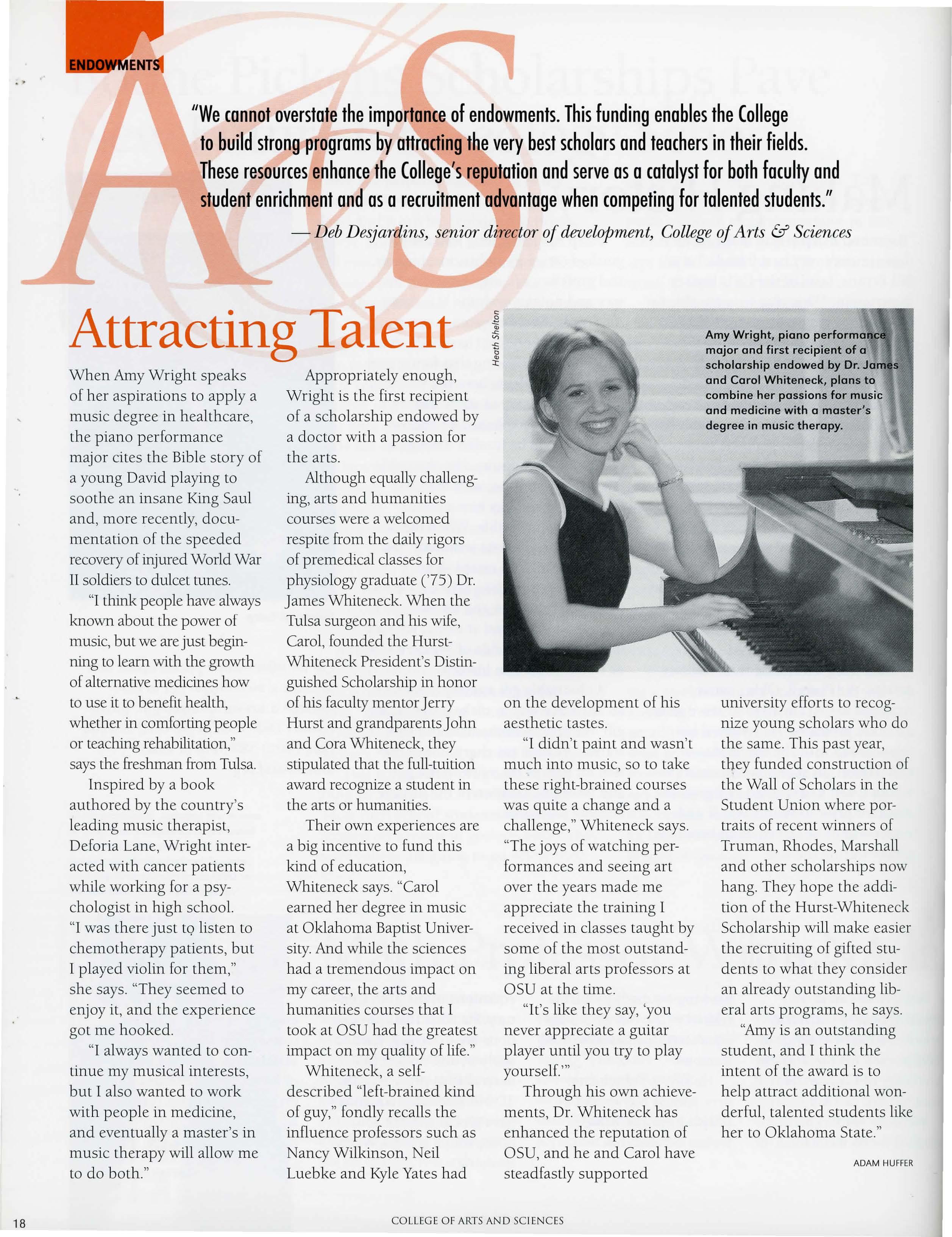
"I always wanted to continue my musical interests, but I also wanted to work with people in medicine, and eventually a master's in music therapy will allow me to do both."
Appropriately enough, Wright is the first recipient of a scholarship endowed by a doctor with a passion for the arts.
Although equally challenging, arts and humanities courses were a welcomed respite from the daily rigors of premedical classes for physiology graduate ('75) Dr. James Whiteneck. When the Tulsa surgeon and his wife, Carol, founded the HurstWhiteneck President's Distinguished Scholarship in honor of his faculty mentor Jerry Hurst and grandparents John and Cora Whiteneck, they stipulated that the full-tuition award recognize a student in the arts or humanities.
Their own experiences are a big incentive to fund this kind of education, Whiteneck says. "Carol earned her degree in music at Oklahoma Baptist University. And while the sciences had a tremendous impact on my career, the arts and humanities courses that I took at OSU had the greatest impact on my quality of life."
Whiteneck, a selfdescribed "left-brained kind of guy," fondly recalls the influence professors such as Nancy Wilkinson, Neil Luebke and Kyle Yates had
on the development of his aesthetic tastes.
"I didn't paint and wasn't much into music, so to take these right-brained courses was quite a change and a challenge," Whiteneck says.
"The joys of watching performances and seeing art over the years made me appreciate the training I received in classes taught by some of the most outstanding liberal arts professors at OSU at the time.
"It's like they say, 'you never appreciate a guitar player until you try to play yourself."'
Through his own achievements, Dr. Whiteneck has enhanced the reputation of OSU, and he and Carol have steadfastly supported
university efforts to recognize young scholars who do the same. This past year, they funded construction of the Wall of Scholars in the Student Union where portraits of recent winners of Truman, Rhodes, Marshall and other scholarships now hang. They hope the addition of the Hurst-Whiteneck Scholarship will make easier the recruiting of gifred students to what they consider an already outstanding liberal arts programs, he says.
"Amy is an outstanding student, and I think the intent of the award is to help attract additional wonderful, talented students like her to Oklahoma State."
ADAM HUFFER
Amy Wright, piano performa major and first recipient of a scholarship endowed by Dr. Jam and Carol Whiteneck, plans to combine her passions for music and medicine with a master's degree in music therapy.
Endowed ChairAdds Quality
Richard Marston, geology professor and Sun Chair in environmental geology, is very clear about his reasons for joining OSU in the fall of 1999. "I was looking for a new academic home," he says, "but I wouldn't even have applied for this job had it not been attached to an endowed chair."
"We used the Sun Chair to recruit Dr. Marston," says Steve McKeever,Arts & Sciences associate dean. "He's a top scholar in the earth sciences with an extensive, award-winning research and teaching-record, and OSU needs the best and brightest professors to teach and guide our students."
McKeever says attracting professors of Marston's caliber depends on being able to offer attractive, competitive positions such as endowed chairs and professorships. "Through such positions we can attract senior professors of international repute," he says. "Their presence here raises the overall profile of the university, which in turn helps us attract other high quality professors."
Having the endowment to build a program appealed to Marston, who has often paid for teaching materials/equipment out of his own pocket during his 21year career. He says the endowment can be used to secure matching grant funds, purchase materials/equipment, hire administrative staff, if needed, fund student research and supplement the typical graduate assistantship.
"For me," Marston says, "the endowed chair means the flexibility to do my job well."
Because of the funding, Marston has been able to engage students in important field research and send students to professional conferences where they can present their findings. By helping fund student research, the endowment also makes OSU more competitive in recruiting and retaining quality students, Marston says.
"Top students, like top faculty, are in demand by other universities, and we're competing for them," he says. "The Sun Chair puts OSU in the running."
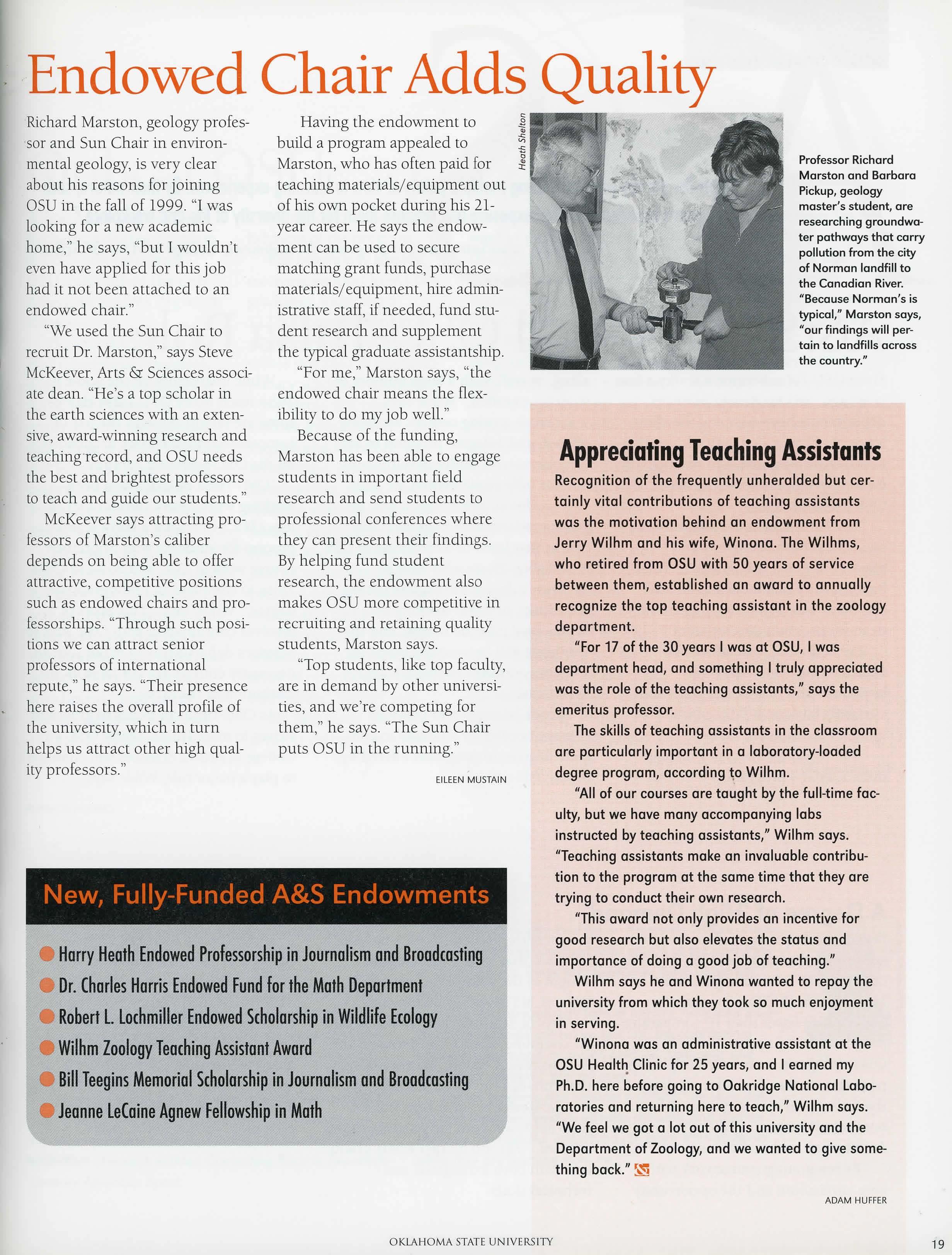
Professor Richard Marston and Barbara Pickup, geology master's student, are researching groundwater pathways that carry pollution from the city of Norman landfill to the Canadian River.
"Because Norman's is typical," Marston says, "our findings will pertain to landfills across the country."
AppreciatingTeachingAssistants
Recognition of the frequently unheralded but certainly vital contributions of teaching assistants was the motivation behind an endowment from Jerry Wilhm and his wife, Winona. The Wilhms, who retired from OSU with 50 years of service between them, established an award to annually recognize the top teaching assistant in the zoology department.
"For 17 of the 30 years I was at OSU, I was department head, and something I truly appreciated was the role of the teaching assistants," says the emeritus professor.
The skills of teaching assistants in the classroom are particularly important in a laboratory-loaded degree program, according ~o Wilhm.
"All of our courses are taught by the full-time faculty, but we have many accompanying labs instructed by teaching assistants," Wilhm says. "Teaching assistants make an invaluable contribution to the program at the same time that they are trying to conduct their own research.
"This award not only provides an incentive for good research but also elevates the status and importance of doing a good job of teaching."
Wilhm says he and Winona wanted to repay the university from which they took so much enjoyment in serving.
"Winona was an administrative assistant at the OSU Healt~ Clinic for 25 years, and I earned my Ph.D. here before going to Oakridge National Laboratories and returning here to teach," Wilhm says. "We feel we got a lot out of this university and the Department of Zoology, and we wanted to give something back." r~
"Interdisciplinaryprogramsbringmultiplepoints
ofviewtolearningexperiences.Bytheirnature,such programsbroadenstudents'exposureandpreparethemforthediversityoflifeandworkplace."
- Tom Wik~ associate deem
for program development, College of Arts & Sciences
A&S Plays Vital OSU-TulsaRole
Since OSU-Tulsa became a reality a few years ago, various Arts & Sciences departments have accepted the challenge of offering vital courses, creating new degree programs and making sure existing programs serve the needs of OSU-Tulsa students.
"The Department of Computer Science offers both bachelor's and master's degrees and has three Tulsabased faculty members and an advisor," says Tom Wikle, A&S associate dean for program development.
The School of Journalism and Broadcasting also offers both bachelor's and master's degrees and currently has one full-time faculty member stationed in Tulsa.
"The fire and emergency management master's program is pretty far
along, as well, with a large number of students enrolled," Wikle says.
Creative writing courses are being offered, and a degree program in art (graphic arts) is under development, but not fully implemented, he adds.
In addition, Wikle says a new geographic information systems (GIS) course that leads to a certificate in GIS is available. Those who have a bachelor's degree are eligible to take the course, or those working on a degree may take the course, and the certificate will be awarded when the student completes bachelor's degree requirements.
Arts & Sciences also provides courses needed for students to complete degrees in programs offered by other OSU colleges.
A Degree of 'High Demand'
Few graduate pr?grams burst on the scene with the impact of OSU's Master of Science in Telecommlglications Management (MSTM) program.
There are fewer than 10 comparable programs in the nation, but only OSU's program is an interdisciplinary powerhouse that draws faculty from the Colleges of Arts & Sciences, Business Administration and Engineering, Architecture and Technology.
"By integfating coursework with a core curriculum and the opportunity
to specialize, students have a unique program that makes them highly sought in the workplace," says Rick Wilson, MSTM program director.
"Arts & Sciences delivers the popular computer science electives and the final technical course, network design,. that enhance the value of the degree for our students," says Tom Wikle, A&S associate dean for program development. "The job market wants graduates with both managerial and technical skills "
While instructors on the scene in Tulsa teach many OSU-Tulsa classes, some are taught through the use of compressed video classes originating on the OSU-Stillwater campus.
"OSU-Tulsa officials have been working with Tulsa Community College (ICC) to ensure a fairly seamless process for students who begin their course work at ICC and move to OSUTulsa to complete an undergraduate degree," Wikle says. "This process involves coordination with OSU Arts&. Sciences departments to make sure all necessary courses are available at one institution or the other."
As OSU-Tulsa continues to grow and strives to meet Tulsa's needs, OSU's College of Arts & Sciences will continue to play a major role, Wikle says.
Today the job market's unprecedented demand for graduates with MSTM degrees has so exceeded expectations that the program now requires enrollment management, Wilson says.
"Student demand for the program is much higher than the number we can serve," Wilson says. "But we're working hard to add faculty so we can serve even more people in the future."
DOTTIEWITTER
CAROLYNGONZALES
OnlyatOSU
A new American Studies a driving force in the estab- sure about what major they need, and American Studies bachelor's degree program lishment of the program. want to pursue, and some will be a nice fit." at OSU-Stillwater and The program is already change majors several times Walker believes that OSU-Tulsa offers the only receiving support from OSU during their college careers. American Studies will American Studies degree in graduates, including a Walker thinks the wide vari- become one of OSU's more the state. $12,500 commitment from ety of subjects students can popular majors in the next
The interdisciplinary and an anonymous donor who take in an American Studies five years. multi-disciplinary program, values this kind of interdisci- program will help them find "The diversity of an which became official in the plinary academic endeavor. their main areas of interests. American Studies degree fall of 1999, draws on Students will take
"We hope students will will give graduates a 'step resources from throughout courses from history, find an area that excites them up' when they enter the job the College of Arts & Sciences, English and literature, art, and that they will want to market," he says. and from the College of Engi- architecture, journalism and focus on," he says. "Some may Graduates of American neering, Architecture and broadcasting, music, phi- even want to get a double Studies programs typically Technology and the College of losophy, anthropology, eco- major-in American Studies obtain careers in business, Business Administration. nomics, geography, political and their other area of interest." communications, govern-
"AnAmerican studies pro- science and sociology to Walker's OSU-Stillwater ment service, law, social sergram is marvelous, especially gain an understanding of students are excited about vice and teaching or use the in a place like Oklahoma, past and present American the new major, and he bachelor's degree as prepawith its diverse cultures and society and culture. thinks those in the Tulsa ration for graduate work in a unique history, that can pro- "The program provides area are as well. "There has wide variety of fields. vide students with numerous students with an incredible been definite interest and Walker says Katie Courie opportunities for cultural array of options they haven't need for a fairly broad-based of "The Today Show" is one enrichment," says Jeffrey had before," Walker says humanities program, espe- of the most famous people to Walker, associate professor He says many students cially in Tulsa," Walker says. use an American Studies of English. Walker has been come to college not really "There has been an unmet degree as career preparation.
WillardJoinsAmericanStudiesProgram
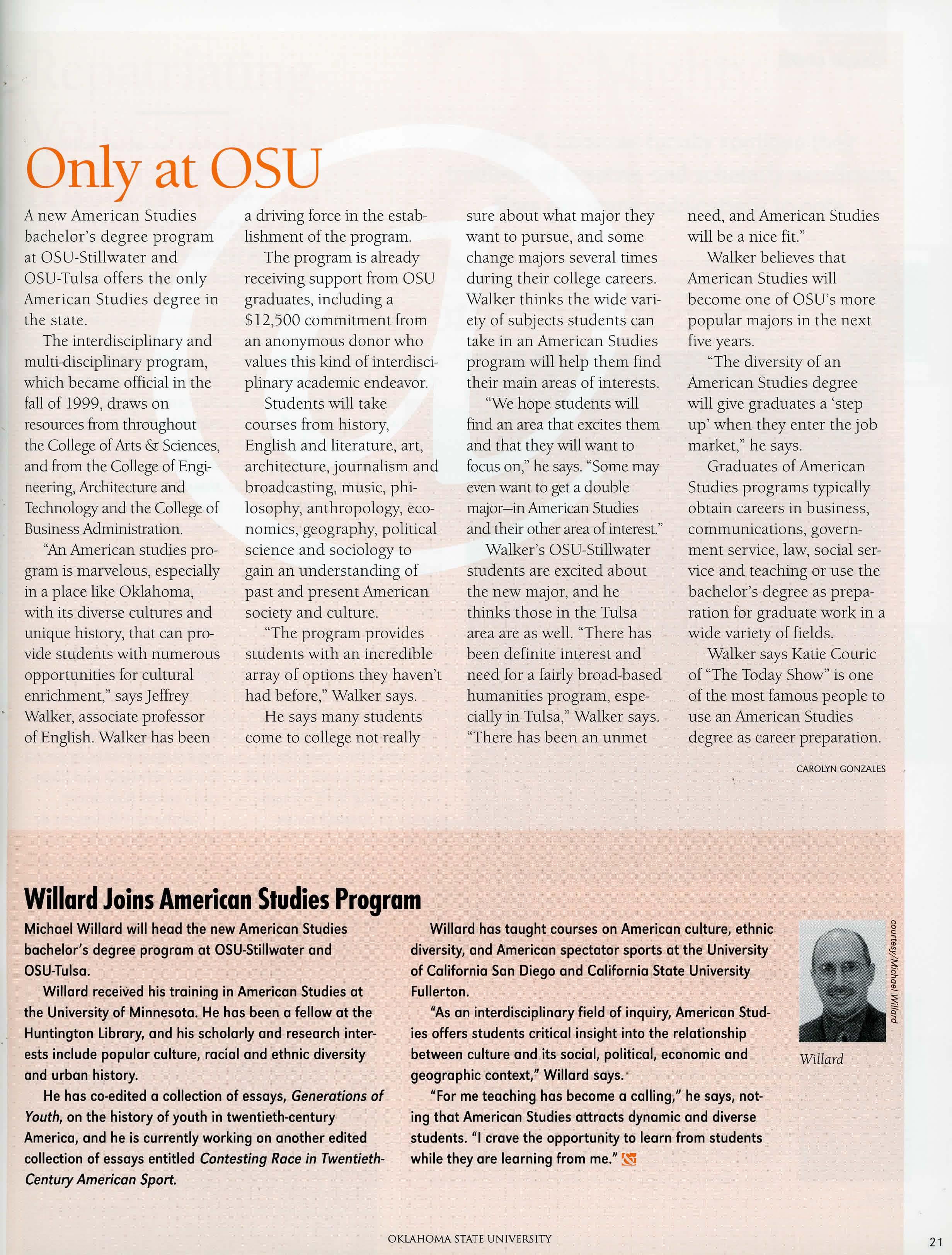
Michael Willard will head the new AmericanStudies bachelor'sdegree program at OSU-Stillwaterand OSU-Tulsa.
Willard receivedhis training in AmericanStudiesat the Universityof Minnesota.He has been a fellow at the HuntingtonLibrary,and his scholarlyand researchinterestsincludepopular culture, racial and ethnic diversity and urban history.
He has co-editeda collectionof essays,Generationsof Youth,on the historyof youth in twentieth-century America,and he is currentlyworkingon another edited collectionof essaysentitled ContestingRace in TwentiethCenturyAmerican Sport.
Willard has taught courseson Americanculture,ethnic diversity,and Americanspectatorsports at the University of CaliforniaSan Diego and California State University Fullerton.
"Asan interdisciplinaryfield of inquiry,AmericanStudies offers studentscritical insightinto the relationship betweencultureand its social, political,economicand geographiccontext,"Willard says.·
"For me teaching has becomea calling," he says,noting that AmericanStudiesattracts dynamicand diverse students."I crave the opportunityto learn from students while they are learningfrom me."'~
Willard
"The stage involves an actor willing to risk everything eight times a week in front of a live audience. It takes a certain kind of actor to generate the emotional stamina necessary to sustain a role on stage."
Off to Visit the Queen
Jeffrey Stephens, professor of theater history, wants above all to instill in his theater students a sense of respect for their craft. And this summer, with a grant for original research from the Oklahoma Humanities Council, he's heading to London for information he believes will deepen their appreciation of theater as a unique art form. Stephens plans to research the professional history of Frances de la Tour, one of the United Kingdom's most critically acclaimed stage actresses whose ongoing career spans over three decades and boasts a body of work ranging from contemporary to classical Shakespearean roles.
in the U.S., Stephens says. "Actresses the caliber of de la Tour are rarely acknowledged in the U.S. for their professional work in the live theater," he says, "because this country tends to regard theater as a springboard to a more prominent and lucrative career in film.Actors who perform solely on the stage are a rarity today."
While in London, Stephens will interview de la Tour, one of her family members and some of her professional colleagues. His questions will focus on de la Tour's reasons for maintaining a stage career as opposed -to a less stringent and financially secure film career.
Yet despite her eminence, when compared to contemporaries Dame Judi Dench or Vanessa Redgrave, de la Tour remains virtually unknown Stephens will deposit de la Tour's oral history in the Jerome Lawrence and Robert E. Lee Theatre Research Institute at Ohio State University in Columbus, Ohio.
'Designer Babies,' Abortion Rights, Euthanasia
"The center won't dictate values," says Scott Gelfand, philosopher and director of OSU's new Ethics Center.
"But it will attempt to provide forums in which everyone from the professional ethicist to teachers, students and the general public can study and discuss relevant topics, such as abortion or euthanasia."
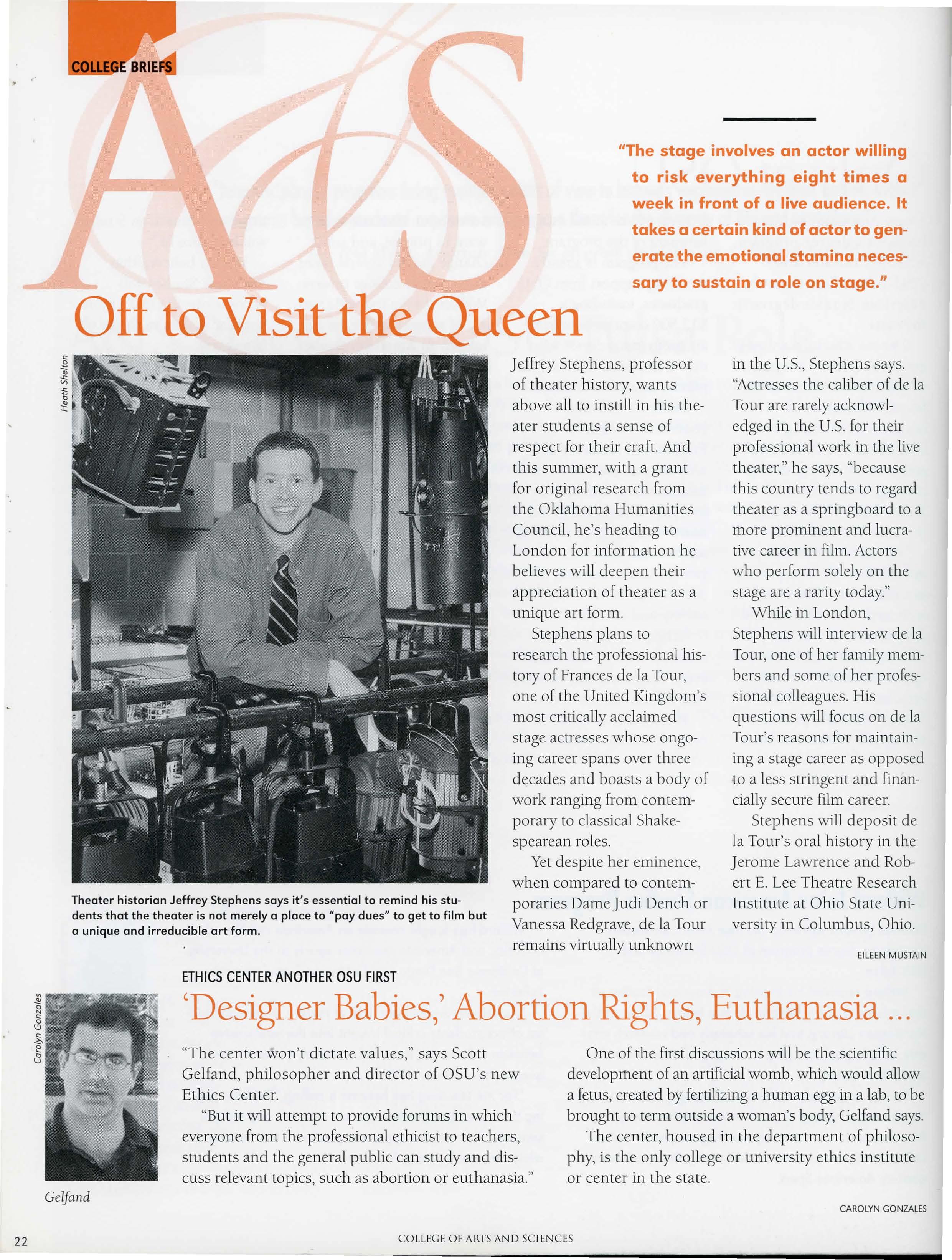
One of the first discussions will be the scientific development of an artificial womb, which would allow a fetus, created by fertilizing a human egg in a lab, to be brought to term outside a woman's body, Gelfand says. The center, housed in the department of philosophy, is the only college or university ethics institute or center in the state.
Theater historian Jeffrey Stephens says it's essential to remind his students that the theater is not merely a place to "pay dues" to get to film but a unique and irreducible art form.
Gelfand
Repatriating Voices From the Past
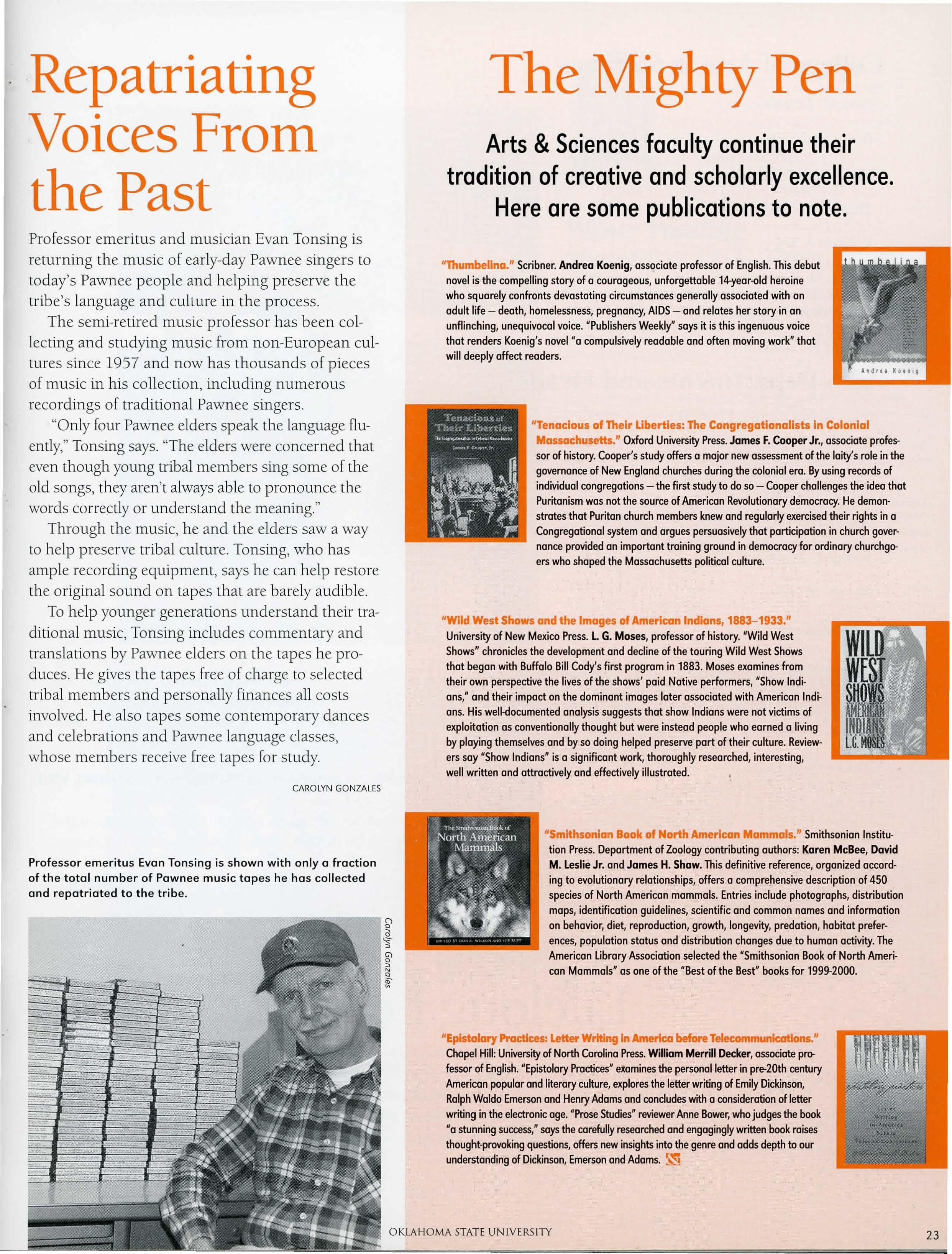
Professor emeritus and musician Evan Tonsing is returning the music of early-day Pawnee singers to today's Pawnee people and helping preserve the tribe's language and culture in the process.
The semi-retired music professor has been collecting and studying music from non-European cultures since 1957 and now has thousands of pieces of music in his collection, including numerous recordings of traditional Pawnee singers.
"Only four Pawnee elders speak the language fluently," Tonsing says. "The elders were concerned that even though young tribal members sing some of the old songs, they aren't always able to pronounce the words correctly or understand the meaning."
Through the music, he and the elders saw a way to help preserve tribal culture. Tonsing, who has ample recording equipment, says he can help restore the original sound on tapes that are barely audible.
To help younger generations understand their traditional music, Tonsing includes commentary and translations by Pawnee elders on the tapes he produces. He gives the tapes free of charge to selected tribal members and personally finances all costs involved. He also tapes some contemporary dances and celebrations and Pawnee language classes, whose members receive free tapes for study.
CAROLYNGONZALES
the total number of Pawnee music tapes he has collected and repatriated to the tribe.
The Mighty Pen Arts
& Sciencesfacultycontinuetheir traditionof creativeand scholarlyexcellence. Hereare somepublicationsto note.
''lhumbelina."Scribner.AndreaKoenig,associate professorof English.Thisdebut novelis the compellingstory of a courageous,unforgettable14-year-oldheroine who squarelyconfrontsdevastatingcircumstancesgenerallyassociated withan adult life- death, homelessness,pregnancy,AIDS- and relates her story in an unflinching,unequivocalvoice."PublishersWeekly"says it is this ingenuousvoice that renders Koenig'snovel•a compulsivelyreadable and often movingwork"that willdeeplyaffect readers.
"Tenaciousof TheirLiberties:The Congregationalists In Colonial Massachusetts."OxfordUniversityPress.James F.CooperJr., associateprofessor of history.Cooper'sstudyoffersa majornewassessmentof the laity'srolein the governanceof NewEnglandchurchesduringthe colonialera. Byusingrecordsof individualcongregations - the first studyto do so - Cooperchallengesthe ideathat Puritanismwas not the sourceof AmericanRevolutionarydemocracy.Hedemonstrates that Puritanchurchmembersknewand regularlyexercisedtheir rightsin a Congregationalsystemand argues persuasivelythat participationin churchgovernance providedan importanttraininggroundin democracyfor ordinarychurchgoers whoshaped the Massachusettspoliticalculture.
"WildWest Shows and the Images of AmericanIndians,1883-1933." Universityof NewMexicoPress.L G. Moses,professorof history."WildWest Shows"chroniclesthe developmentand declineof the touringWildWest Shows that began with BuffaloBillCody'sfirst program in 1883.Mosesexaminesfrom their own perspectivethe livesof the shows' paid Nativeperformers,"ShowIndians,'' and their impacton the dominantimages later associatedwithAmericanIndians. Hiswell-documentedanalysissuggests that show Indianswere not victimsof exploitationas conventionallythought but were instead peoplewho earned a living by playingthemselvesand by so doinghelpedpreservepart of their culture.Reviewers say "ShowIndians•is a significantwork,thoroughlyresearched,interesting, wellwrittenand attractivelyand effectivelyillustrated.
"SmithsonianBook of NorthAmericanMammals."SmithsonianInstitution Press.Departmentof Zoologycontributingauthors: KarenMcBee,David M.LeslieJr.and James H.Show.Thisdefinitivereference,organizedaccording to evolutionaryrelationships,offers a comprehensivedescriptionof 450 speciesof NorthAmericanmammals.Entriesincludephotographs,distribution maps, identificationguidelines,scientificand commonnames and information on behavior,diet, reproduction,growth,longevity,predation,habitat preferences, populationstatus and distributionchanges due to humanactivity.The AmericanLibraryAssociationselectedthe "SmithsonianBookof NorthAmerican Mammals' as one of the "Bestof the Best"booksfor 1999-2000.
"EpistolaryPractices:LetterWritingInAmericabefareTelecornmunlcatlons." ChapelHill:Universityof NorthCarolinaPress.WilliamMerrillDecker,associateprofessorof English."EpistolaryPractices"examinesthe personalletterin pre-20thcentury Americanpopularand literaryculture,exploresthe letterwritingof EmilyDickinson, RalphWaldoEmersonand HenryAdamsand concludeswitha considerationof letter writinginthe electronicage. "ProseStudies"reviewerAnneBower,whojudgesthe book "a stunningsuccess,"saysthe carefullyresearchedand engaginglywrittenbookraises thought-provokingquestions,offersnewinsightsintothe genreand adds depthto our understandingof Dickinson,Emersonand Adams.r~
Professor emeritus Evan Tonsing is shown with only a fraction of
College of Arts & Sciences
DEAN
John M. Dobson
ASSOCIATE DEAN FOR INSTRUCTION
Bruce C. Crauder
ASSOCIATE DEAN FOR RESEARCH
Stephen W. McKeever
ASSOCIATE DEAN FOR PROGRAM DEVELOPMENT
Thomas A. Wikle
DIRECTOR, STUDENT ACADEMIC SERVICES
William A. Ivy
DIRECTOR, EXTENSION
Robert M. Brown
SR. DIRECTOR, DEVELOPMENT
Deborah A. Desjardins
DIRECTOR, DEVELOPMENT
Martha M. Halihan
A&S Departments and Heads
AEROSPACE STUDIES
Gary Jones
ART
Nicholas W. Bormann BOTANY
Becky Johnson
CHEMISTRY
Neil Purdie
COMMUNICATION SCIENCES AND DISORDERS
Arthur L. Pentz,Jr.
COMPUTER SCIENCE
George Hedrick
ENGLISH
Carol Moder
FOREIGN LANGUAGES AND LITERATURES
Perry J. Gethner
GEOGRAPHY
Dale Lightfoot
GEOLOGY
Ibrahim Cemen
HISTORY
William S. Bryans
JOURNALISM AND BROADCASTING
G. Paul Smeyak
MATHEMATICS
Benny D. Evans
MICROBIOLOGY AND MOLECULAR GENETICS
Moses Vijayakumar
MILITARY SCIENCE
Charles Dorsey
MUSIC
William L. Ballenger
PHILOSOPHY
Doren A. Recker
PHYSICS
Satya Nandi
POLITICAL SCIENCE
David Nixon
PSYCHOLOGY
Maureen A. Sullivan
SOCIOLOGY
Charles Edgley
STATISTICS
William D. Warde
THEATRE
Bruce Brockman
ZOOLOGY
James H. Shaw
Corne Home in October
America's greatest homecoming will take place on Saturday, Oct. 27, as we challenge the University of Colorado at Lewis Stadium. This year's homecoming theme is "Visions of Glory." All Arts & Sciences alumni and friends are welcome to join the annual A&S reception two hours prior to kickoff on the lawn south of Old Central.
FORMORE INFORMATIONABOUTOSU HOMECOMING, VISIT http://www.okstoteolumni.org/homecoming.htm For information about the College of Arts & Sciences and other alumni activities, visit http://www.cas.okstate.edu
Lifelong Learning
The Arts & Sciences Extension Office continues to provide learning opportunities well after graduation. Visit A&S Extension at http.//extension.okstate.edu for information about services and activities designed to extend your personal and professional development. While you're online, please complete the short opinion survey that will help the Extension office determine what types of programming would best serve your needs.
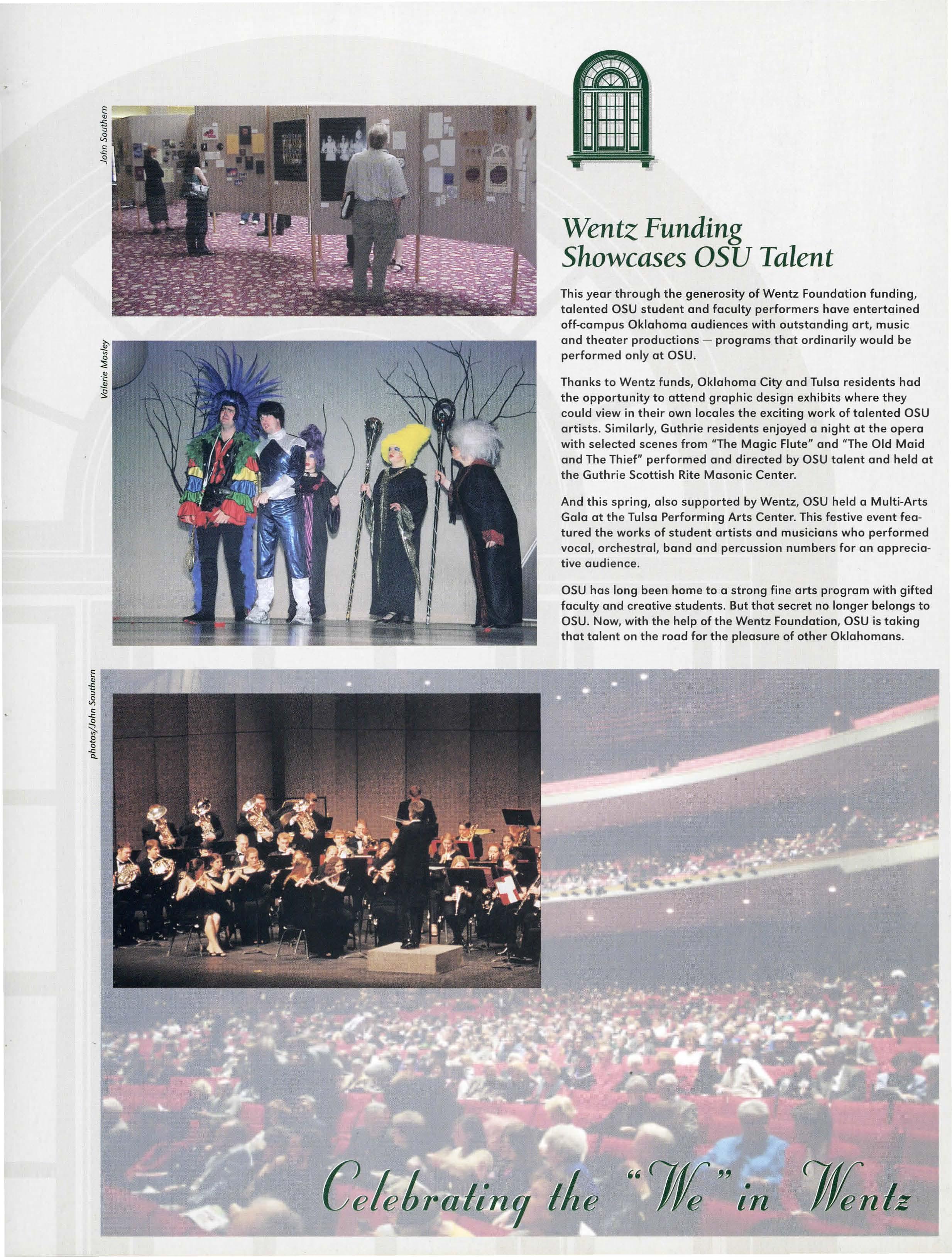
Wentz Funding Showcases OSU Talent
This year through the generosity of Wentz Foundation funding, talented OSU student and faculty performers have entertained off-campus Oklahoma audiences with outstanding art, music and theater productions - programs that ordinarily would be performed only at OSU.
Thanks to Wentz funds, Oklahoma City and Tulsa residents had the opportunity to attend graphic design exhibits where they could view in their own locales the exciting work of talented OSU artists. Similarly, Guthrie residents enjoyed a night at the opera with selected scenes from "The Magic Flute" and "The Old Maid and The Thief" performed and directed by OSU talent and held at the Guthrie Scottish Rite Masonic Center.
And this spring, also supported by Wentz, OSU held a Multi-Arts Gala at the Tulsa Performing Arts Center. This festive event featured the works of student artists and musicians who performed vocal, orchestral, band and percussion numbers for an appreciative audience.
OSU has long been home to a strong fine arts program with gifted faculty and creative students. But that secret no longer belongs to OSU. Now, with the help of the Wentz Foundation, OSU is taking that talent on the road for the pleasure of other Oklahomans
Displaying Excellence
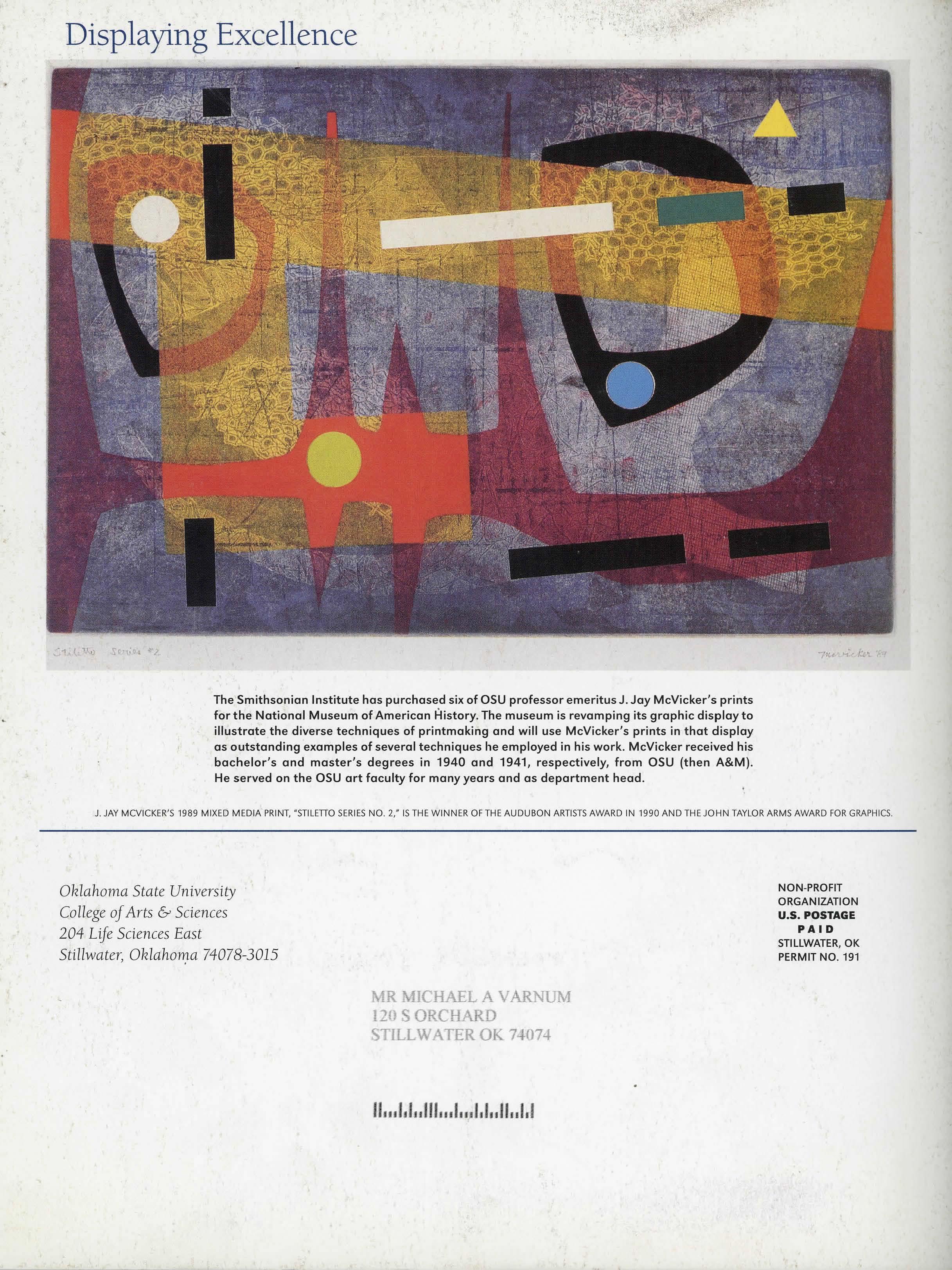
The Smithsonian Institute has purchased six of OSU professor emeritus J. Jay McVicker's prints for the National Museum of American History. The museum is revamping its graphic display to illustrate the diverse techniques of printmaking and will use McVicker's prints in that display as outstanding examples of several techniques he employed in his work. McVicker received his bachelor's and master's degrees in 1940 and 1941, respectively, from OSU (then A&M). He served on the OSU art faculty for many years and as department head.
J. JAY MCVICKER'S1989 MIXED MEDIA PRINT,"STILETTOSERIESNO. 2," ISTHE WINNER OF THE AUDUBON ARTISTSAWARD IN 1990 AND THEJOHN TAYLORARMS AWARD FORGRAPHICS.
Oklahoma State University Collegeof Arts & Sciences 204 Life SciencesEast Stillwater, OkiahoIT}-a74078-3015