

New Leadership, New Opportunities
Throughout the last few months as "the new A&S dean," I have shared many events with OSU students. I've been to the football games, gotten deluged at Orange Peel, and attended student plays and musical performances. Yes, I even sweated through final exams with them on a Thursday night over a hot plate at the Student Union's "Late Night Cafe." Making pancakes was the least I could do for those unfortunate enough to have a Friday final. And like the students, my wardrobe of orange clothing has grown remarkably since coming to Stillwater.
I've also focused attention on the departments, faculty and programs we offer students. One of my roles as dean is to serve as spokesperson for liberal arts education. But how can anyone hope to encompass all that goes on in a college that literally covers everything from art to zoology? While that diversity makes the dean's role challenging, it can also be tremendously rewarding.
The rewards come from seeing people succeed, and the types of success are as varied as the personalities in this
dynamic college. The English Department celebrated one person's success this fall when faculty member Ai won the National Book Award for her poetry. A group effort was recognized when the Chamber Singers led by Dr. Jerry McCoy received an invitation to perform at the Association of British Choral Directors next fall at Chester Cathedral.
Across campus, the Mathematics Department was one of five programs highlighted by the American Mathematical Society. Meanwhile, the Computer Science Department has been developing an extraordinarily popular program delivered at the OSU-Tulsa campus that extends the reach of the university and its faculty well beyond Stillwater.
Faculty in the Political Science Department have targeted a national audience with the introduction of the fire and emergency management program. Psychology faculty are formulating another type of educational program: a new concentration in organizational and industrial psychology. Traditional divisions within the sciences are breaking down as well. Zoologists and botanists working with smaller systems su·ay into territory previously dominated by members of the Microbiology and Molecular Genetics Department. At the same time, some microbiologists are collaborating with engineers and computer experts in developing "bioinformatics," a term applied to a growing number of cross-cutting research strategies. Chemists and physicists are potential partners in this enterprise as well. Faculty members in the Department of Philosophy are increasingly interested in the ethics of some of this scientific work, and sociologists and historians study the impact of rapidly changing technologies on family and social structure.
So the challenge of being an advocate for the liberal arts is not so very awesome after all. The diversity of people and programs blurs along the margins. Cross-disciplinary research and teaching brings together a variety of creative and talented teachers and students. Best of all, students who pursue one of the college's many majors benefit from the breadth of faculty experience and knowledge even as they learn how interrelated its divergent fields can be.
I am very happy to be working with all of the dedicated and creative people in the College of Arts and Sciences. Together we are more than ready to face the challenges of the future.
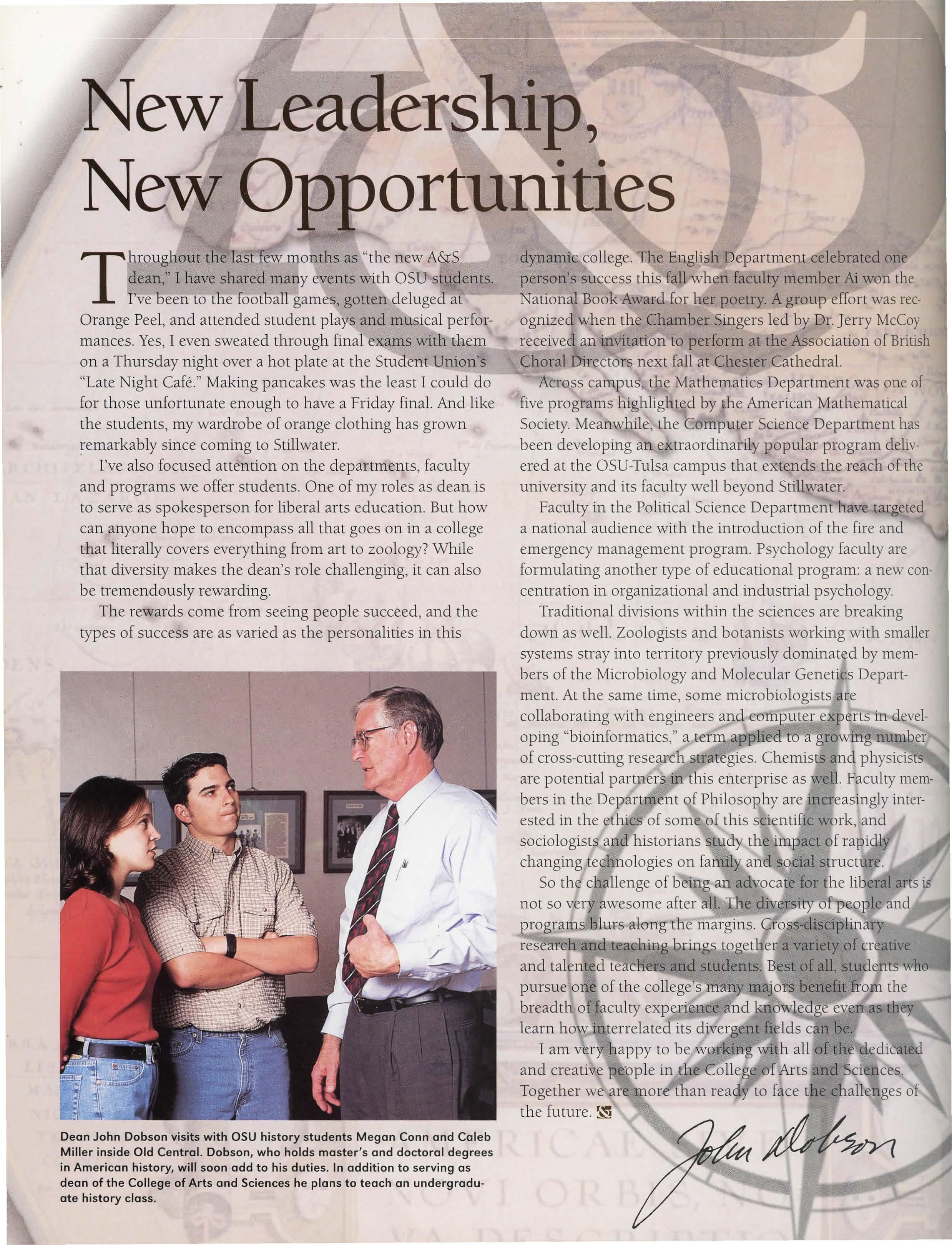
Dean John Dobson visits with OSU history students Megan Conn and Caleb Miller inside Old Central. Dobson, who holds master's and doctoral degrees in American history, will soon add to his duties. In addition to serving as dean of the College of Arts and Sciences he plans to teach an undergraduate history class.
4 NewDeanat the Helm
He's both a scientist and a historian, and that makeshim perfectly suited for the challenges involvedin running a collegethat encompasses everythingfrom art to zoology.Findout more aboutthe manwhoistakingchargeof OSU's largestand mostdiversecollege.
6 A Languageof Opportunity
Graduatesof OSU'sForeignLanguagesand LiteraturesDepartmentare a hot commodity, especiallyin today'sglobalbusinessclimate. Learninga secondor evena third language opensup a worldof opportunitiesfor students.
10 FacultyGoingGlobal
OSUstudentsaren't the onlyonesgoing international.In the pastyear,A&Sfaculty membershavevisiteda numberof countries includingYemen,Israeland Italy.Thesetraveling facultymembersbenefitOSUstudentsby sharingtheir experienceand knowledgegained whilevisitingoverseas.
16 FormerFacultyStillContribute
The Collegeof Arts and Sciencesboastsseveral outstanding former faculty members.But just becausethey're retired does not mean they've sloweddown. Findout what these former OSU teachersand researchersare up to today.
20 Planet-SavingResearch
Frombacteriain the AntarcticOceanto frogsin Argentina - two A&Sprofessorsare researching the effectsof increasedultravioletradiationdue to the Earth'sozonehole.
2
12
25 A&SDepartments & Heads
COVER:TheCollegeofArtsandSciencesisputtingits internationalstamp011studentsbyencouragingthemto bmadrntheireducationalbacligrounds. As tliewo,-/dbecomes smaller,moreandmoreemployersareseekingoutgraduates withglobalexperiences.Fromlearning a secondlanguage tostudyingabroad,thecollege is helpingstudentsexplore a worldof opportunities.
Directorof DevelopmentDeborahDesjardins DevelopmentCoordinatorIlda Hershey
Editor Shelley Brinsfield
Art Director Paul V Fleming
Photography Heath Shelton (unlessmhe,w/se no<e<IJ AssociateEditor
Asst.VicePres., CommunicationsServices Janet Varnum Natalea Watkins
SPECTRUMis a publicationof the OklahomaState UniversityCollegeofArtsand Sciencesdesignedto provide informationon collegeissuesand concernswhilefostering communicationamongOSUalumniand friends.
CollegeofArts& Sciences OklahomaStaleUniversity Stillwater,Oklahoma74078-3015 (405) 744-6469
e-mail:debdesj@okstate.edu http://www.cas.okstate.edu/alumni/
OklahomaStateUniversityin compliancewithTitleVIandVIIof theCivilRightsActof 1964,ExecutiveOrder11246as amended, TitleIXof the EducationAmendmentsof 1972,Americanswith DisabilitiesActaf 1990,and otherfederallawsand regulations, does not discriminateon the basisof race,color,notionalorigin,sex,age, religion,disability,or statusas o veteraninanyof its policies,practicesor procedures.Thisincludesbut is not limited to admissions,employment,financialaid and educational services.Thispublication,issuedbyOklahomaStateUniversity as authorizedbythe CollegeofArts& Sciences,wasprintedby TheAudioVisualCenter,UniversityPrintingServicesot no cost to the taxpayersof Oklohomo.;)099 3/00 © 2000OklahomaStateUniversity
BringingDreamsto Life in the WorldAroundUs
Thanks to art, instead of seeing a single world, our own, we see it multiply until we have before us as many worlds as there are original artists.
- Marcel Proust
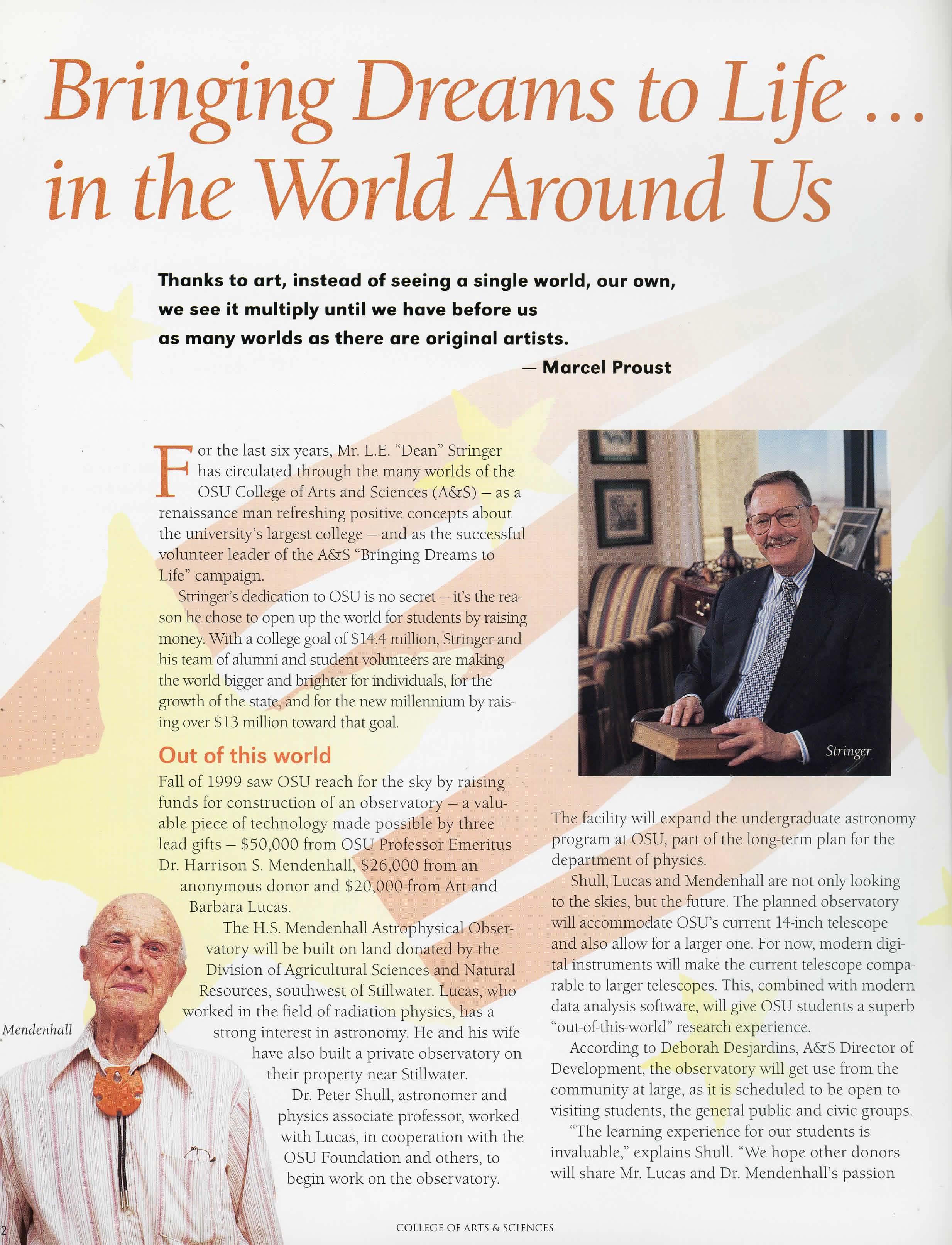
For the last six years, Mr. LE. "Dean" Stringer has circulated through the many worlds of the OSU College of Arts and Sciences (A&S) - as a renaissance man refreshing positive concepts about the university's largest college - and as the successful volunteer leader of the A&S "Bringing Dreams to Life" campaign.
Stringer's dedication to OSU is no secret - it's the reason he chose to open up the world for students by raising money. With a college goal of $14.4 milhon, Stringer and his team of alumni and student volunteers are makmg the world bigger and brighter for individuals, for the growth of the state, and for the new millennium by raising over $13 million toward that goal.
Out of this world
Fall of 1999 saw OSU reach for the sky by raising funds for construction of an observatory- a valuable piece of technology made possible by three lead gifts - $50,000 from OSU Professor Emeritus Dr. Harrison S. Mendenhall, $26,000 from an anonymous donor and $20,000 from Art and Barbara Lucas.
The H.S. Mendenhall Astrophysical Observatory will be built on land donated by the Division of Agricultural Sciences and Natural Resources, southwest of Stillwater. Lucas, who worked in the field of radiation physics, has a strong interest in astronomy. He and his wife have also built a private observatory on their property near Stillwater.
Dr. Peter Shull, astronomer and physics associate professor, worked with Lucas, in cooperation with the OSU Foundation and others, to begin work on the observatory.
The facility will expand the undergraduate astronomy program at OSU, part of the long-term plan for the department of physics.
Shull, Lucas and Mendenhall are not only looking to the skies, but the future. The planned observatory will accommodate OSU's current 14-inch telescope and also allow for a larger one. For now, modern digital instruments will make the current telescope comparable to larger telescopes. This, combined with modern data analysis software, will give OSU students a superb "out-of-this-world" research experience.
According to Deborah Desjardins, A&S Director of Development, the observatory will get use from the community at large, as it is scheduled to be open to visiting students, the general public and civic groups.
"The learning experience for our students is invaluable," explains Shull. "We hope other donors will share Mr. Lucas and Dr. Mendenhall's passion
and generosity for the project. We will need state-of-the-art technology such as computer-controlled equipment for imaging, spectroscopy and photometry at a cost of around $100,000."
Just do it NOW
Bringing dreams to life is philosophically a goal of everyone - for others, for themselves, for the world. "Making a difference" has historically been the role of those who have successfully achieved career, fame or fortune.
However,the so-called "X" generation subscribes to a different call - one of more immediacy."Now" is their byword. Braden McElroy,BS '97, and Cynthia Colhns, BA'94, have both looked back on their OSU experiences and decided to make a difference now.
"Like many other recent OSU graduates, 1have not yet 'made my fortune,"' McElroy explains, "but I do want to tithe to the university." McElroy did just that by establishing the Dostoevsky Award, a foreign language scholarship. Presented to a language student of advanced standing, the scholarship rewards demonstrated academic prowess. Recipients are selected by a committee made up of members of the Department of Foreign Collins Languages and Literatures faculty. Preference is given to students studying Russian to encourage continued study of that language. See relatedst01ypage9Cynthia Collins reflects on her years at OSU. "I remember how hard it was to make ends meet - even a small amount of money would make a difference." Collins, who joined Andersen Consulting in Chicago after graduation, became aware of her company's policy of encouraging educational gifts by matching the amount donated by its employees. With a contribution of $500 from both, Collins was able to
establish an annual scholarship for a student with a Spanish major/minor. "It's a good start," Collins says. "It makes a huge difference to students to have this support. I challenge other alums to do the same. And when my resources increase, so will my contributions to the scholarship." See related story page 7.
Bringing dreams to life sometimes means looking at the big picture and looking at it now. Thanks to people like Mendenhall, the Lucases, Braden McElroy and Cynthia Collins, the dream is a reality ... and the world is a better place.
"And let's make more dreams come to life," says Stringer. "Results from the College of Arts and Sciences - from research to extension and everything in-between - matter to you, to communities, to the world. It's a time to be thankful - we have a new dean on board we have an array of opportunities, some seasoned, some new and we have the momentum. It's a time to embrace as many worlds as possible."
The world of Wentz
The Lew Wentz Foundation recently announced a gift of $75,000 annually for three years to encourage the cultural arts in both Oklahoma City and Tulsa. In both cities, the OSU College of Arts and Sciences has formed committees made up of members of each city's arts organizations to plan the most effective use of the gift. Events
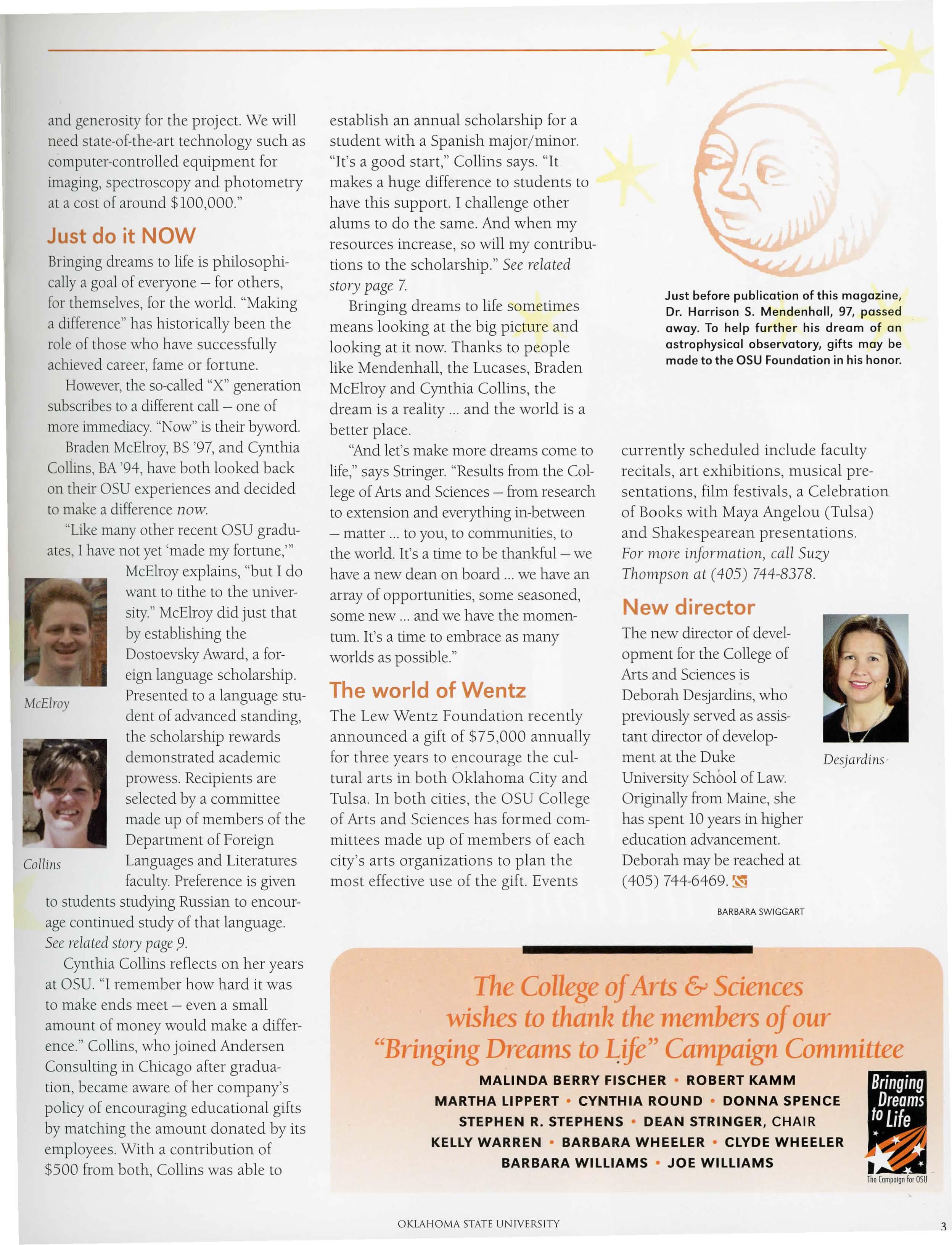
Just before publication of this magazine, Dr. Harrison S. Mendenhall, 97, passed away. To help further his dream of an astrophysical observatory, gifts may be made to the OSU Foundation in his honor.
currently scheduled include faculty recitals, art exhibitions, musical presentations, film festivals, a Celebration of Books with Maya Angelou (Tulsa) and Shakespearean presentations. For more information, call Suzy Thompson at (405) 744-8378.
New director
The new director of development for the College of Arts and Sciences is Deborah Desjardins, who previously served as assistant director of development at the Duke Desjardins· University School of Law. Originally from Maine, she has spent 10 years in higher education advancement. Deborah may be reached at (405) 744-6469. r~
BARBARASWIGGART
he College of Arts and Sciences is as diverse as its departments and schools, which range from art to zoology. Few people have the broad range of education and experience necessary to understand the special needs and concerns of each area and to provide leadership for the college.
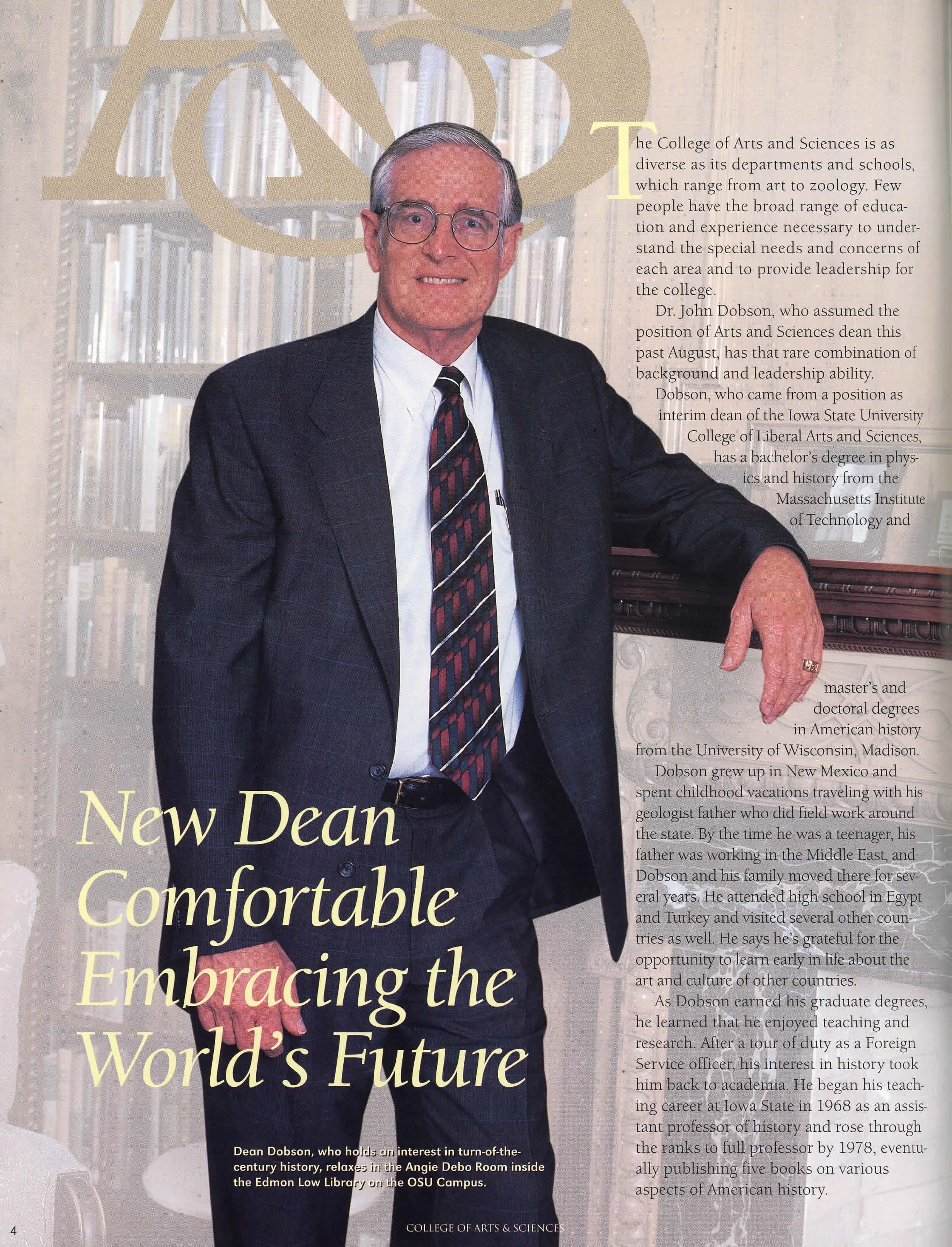
Dr. John Dobson, who assumed the position of Arts and Sciences dean this past August, has that rare combination of background and leadership ability.
Dobson, who came from a position as interim dean of the Iowa State University College of Liberal Arts and Sciences, has a bachelor's degrt;:ein physics and histocy from the Massachusetts Institute of Technology and
.
.r master's and doctoral degrees in American history from the University of Wisconsin, Madison. Dobson gn;w up in New Mexico and spent childhood vacations rraveling with his geologist father who did field work around the. state. By the time he was a teenager, his father was working ~the Middl ast and Dobson and ms family moved tg~e. for s'everal years. He attended high' school in Egypt and Turkey and visited several otner coun tries as well. He says he's grateful for the opportunity to learn garly in life about the art and culture of other countries.
As Dobson earnednis graduate degrees, he learned that he enjoyed! teaching and research. After a tour of duty as a Foreign Service officer, his interes in history took him back to academia. He began his teaching career at Iowa State in 1968 as an assistant professor of l;iistory and rose through the ranks to full i:rwfessOirby 1978, eventually publishing fr e book:s on various aspects of American history.
His academic administrative service began with a one-year internship as assistant dean of ISU's College of Science and Humanities, followed by an assignment as assistant dean of the Graduate College until 1991.
Subsequent administrative appointments included those of assistant vice provost for research and advanced studies, interim vice provost for research, interim graduate dean, associate vice provost for research and associate graduate dean.
Dobson likes administrative work because it offers new challenges every day. "Successfully juggling so many different responsibilities and finding creative ways to solve problems can be very rewarding," Dobson says.
"Successfully juggling so many different responsibilities and finding creative ways to solve problems can be very rewarding."
He believes his education as a scientist helps him both as an administrator and as an historian. "Sometimes I think my scientific training helps me cut through to the heart of an issue more quickly than others can," he says.
When the position at OSU became a possibility, Dobson and his wife, Cindy, decided they were ready for
new challenges. Their two married sons, David and Daniel, were on their own, so the couple was free to make major career moves.
Cindy Dobson has a doctorate in sociology and was a professor at the Library at Iowa State. At OSU she is continuing her professional work as a faculty member of the SociologyDepartment. The new Arts and Sciences dean also plans to get back into the classroom as soon as his other responsibilities permit.
Dobson's creativity and inventiveness will serve him and the college well as it moves into the next century. "There have been enormous changes in higher education in the past 25 years, and we can expect to see many more in the future," he says.
He predicts that the demand for higher education will continue to grow, although funding may not grow proportionally to meet escalating costs. He sees more emphasis in the future on re-education and training and the need for educational institutions to be more flexible. He also anticipates that higher education will experience more ethnic and cultural diversity.
More resources will need to be devoted to conducting applied research in the future, Dobson expects, and to transferring newly-developed technology to the marketplace. To help this occur, he plans to continue fostering interdisciplinary working relationships among researchers in various colleges and between researchers and industry.
Of course, making sure students continue to receive a quality education is Dobson's top priority. He says it's obvious to him in speaking with A&S alumni that they feel they had outstanding educational and cultural experiences at OSU. 'They are extremely loyal and supportive and feel like this is home," he says. "So many believe that their liberal arts experience here was life changing, and we want to ensure that our students continue to have that opportunity."~ CAROLYNGONZALES
Debo Room Houses HistoricalPapers,Books
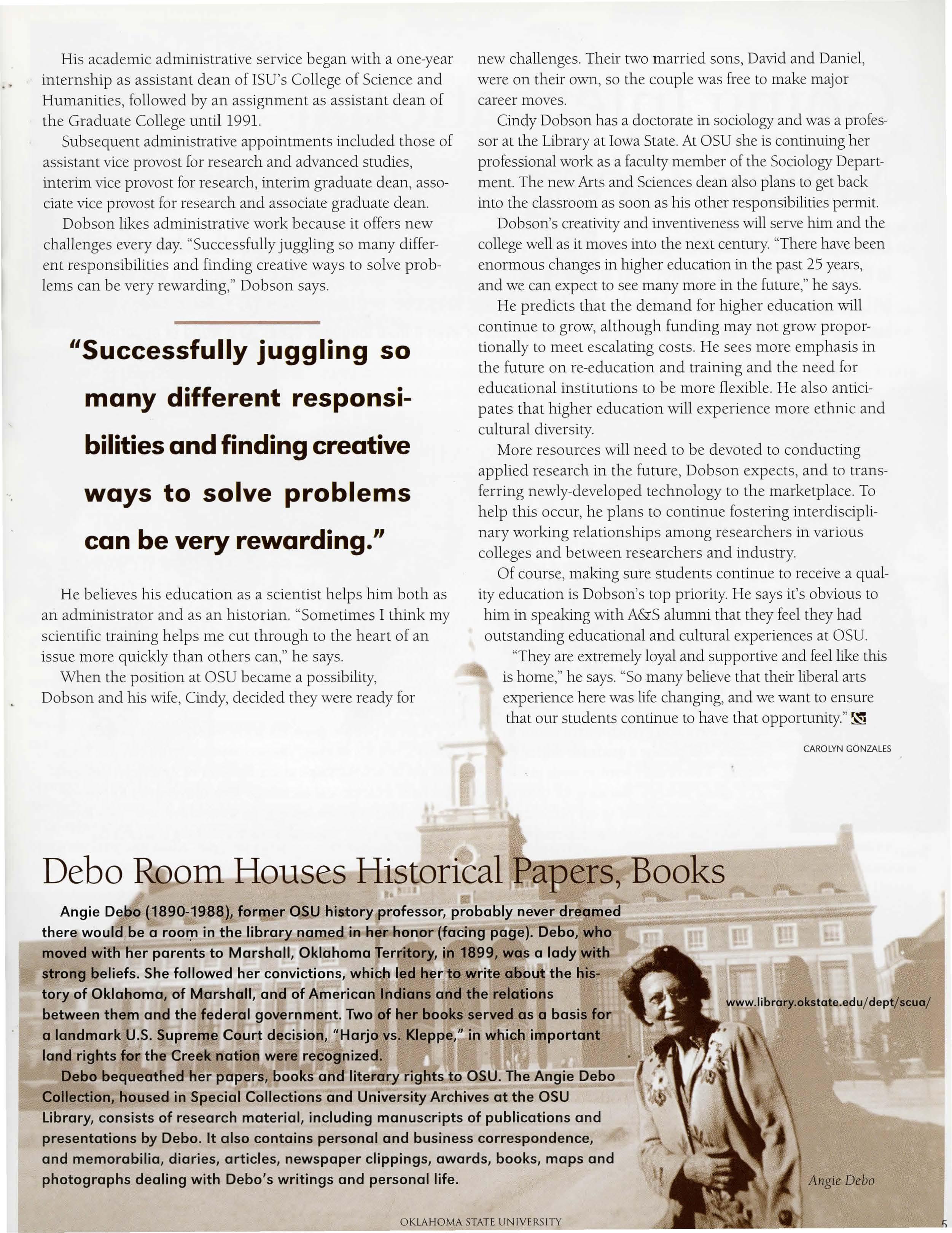
Angie Debo (1890-1988), former OSU history professor, probably never dreamed there would be a rool'!' in the library named in her honor (facing page). Debo, who moved with her parents to Marshall, Oklahoma Territory, in 1899, was a lady with strong beliefs. She followed her convictions, which led her to write about the history of Oklahoma, of Marshall, and of American Indians and the relations between them and the federal government. Two of her books served as a basis for a landmark U.S. Supreme Court decision, "Harjo vs. Kleppe," in which important land rights for the Creek nation were recognized. Debo bequeathed her papers, books and literary rights to OSU. The Angie Debo Collection, housed in Special Collections and University Archives at the OSU Library, consists of research material, including manuscripts of publications and presentations by Debo. It also contains personal and business correspondence, and memorabilia, diaries, articles, newspaper clippings, awards, books, maps and photographs dealing with Debo's writings and personal life.
Going International Makes Good Sense
GraduatesofOSU'sForeignLanguagesandLiteraturesDepartmentarea hotcommodity.Asundergraduatestudents intheCollegeofArtsandSciences,theyembracedotherculturesandlanguages.Theroadtheytraveledwaslonelyjust25studentsgraduatedwithbachelor'sdegreesinforeignlanguagesandliteratures·n1999.Butintoday'sglobal • businessclimate,therewardsaremany.Learning a secondoreven a thirdlanguageopesu a worldof_opportunities. ,,-
--
7 FRENCHSKILLSGI\lt GRADCOMPETITIVEEDGE
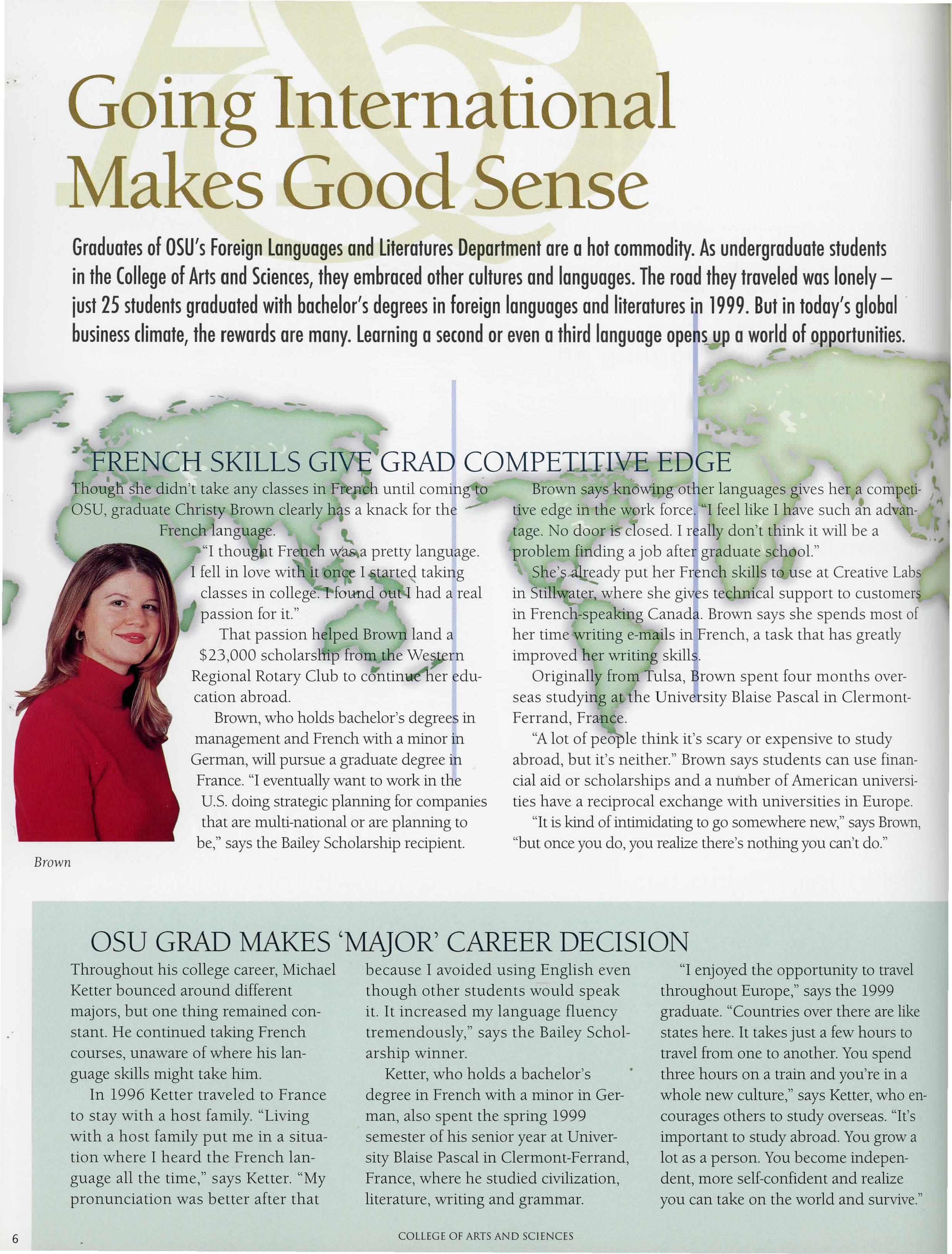
I • Thoug she didn't take any classes in F ch until comin to Brown says knowing other languages gives her a competiOSU, graduate Christy Brown clearly h 1s a knack for the - tive edge in the work force. "I feel like I have such /n advanFrench language. t._ tage. No door is closed. I really don't think it will be a "I thougjl.t French ~a pretty language. problem finding a job after graduate school."
I fell in love wit it on :e I tarte<;!taking She',; ready put her Fnench skills t use at Creative Labs classes in college. fou-nd ou~ had a real in Stillwater, where she giv.estechnical support to customers passion for it." in French-speaking Canada. Brown says she spends most of
That passion helped Brown land a her time writing e-mails inlFrench, a task that has greatly $23,000 scholarship from the We~rn improved her writing skill~. Regional Rotary Club to ccrntin~er edu- Originally from Tulsa, Brown spent four months overcation abroad. seas studying a the Univ~rsity Blaise Pascal in ClermontBrown, who holds bachelor's degrees in Ferrand, France. management and French with a minor in "Alot of peo le think it's scary or expensive to study German, will pursue a graduate degree in abroad, but it's neither." Brown says students can use finanFrance. "I eventually want to work in the cial aid or scholarships and a number of American universiU.S. doing strategic planning for companies ties have a reciprocal exchange with universities in Europe. that are multi-national or are planning to "It is kind of intimidating to go somewhere new," says Brown, be," says the BaileyScholarship recipient. "but once you do, you realize there's nothing you can't do."
OSU GRADMAKES'MAJOR'CAREERDECISION
Throughout his college career, Michael Ketter bounced around different majors, but one thing remained constant. He continued taking French courses, unaware of where his language skills might take him.
In 1996 Ketter traveled to France to stay with a host family. "Living with a host family put me in a situation where I heard the French language all the time," says Ketter. "My pronunciation was better after that
because I avoided using English even though other students would speak it. It increased my language fluency tremendously," says the Bailey Scholarship winner.
Ketter, who holds a bachelor's degree in French with a minor in German, also spent the spring 1999 semester of his senior year at University Blaise Pascal in Clermont-Ferrand, France, where he studied civilization, literature, writing and grammar.
"I enjoyed the opportunity to travel throughout Europe," says the 1999 graduate. "Countries over there are like states here. It takes just a few hours to travel from one to another. You spend three hours on a train and you're in a whole new culture," says Ketter, who encourages others to study overseas. "It's important to study abroad. You grow a lot as a person. You become independent, more self-confident and realize you can take on the world and survive."
Brown
ITING A FOOT IN THE DOOR
Spanish-speaking skills helped 1994 graatate Cynthia Collins secure her first job after college with an international firm - Ander en Consulting in Chicago. "I was originally hired to be a liaison between clients in Argentina and our Chicago technology teams through written '\Pdoral communication," says , Collins, who worked herself right out of a bilingual job and into a promotion as a qual'ty-..management specialist.
hough she no longer uses her Spanish sk_illson the job, she does think .-rfs if.P~rtant to k~p up with the langua~[' "I use it in other situations and to help others," says Collins,ho volunteers in the emergency roo of a Chicago1hospital providing tr slations betwfenSpanish-speakin atients and medical staff who require Collins, who holds dual degrees in Spanish and public relations, studied in Monterrey, Mexico, for a summer semester. "The experience was instrumental in developing my language skills,"says the president of the Chicagoland Chapter of the
OSU Alumni Association. "In the classroom you can't internalize well ferhythms and patterns of your new langu ge; t}:ierefore, it was important for me to a hat interaction with the Hispaiff'ccu turf.'"
Three years ago~he Tulsa, Okla, native created a scho¥.irship for majors or minors of Spanish at OSU. "I know I wa financially strapped in college, and I just to help alleviate the financial buren students might have."
Collins is excited aoout her future career options. "The possibilities are robust, particularly in a bilingual community like Chicago." She says she would eventually like to wor s a director o( a non-profit organizatio that concentrates on Pan-American issues.
And, if that doesn't work out, there's a long list of other things Collins can do that can have a local impact.
"Obviously knowing a second language opens more doors. The more languages you speak, the more people you can interact with and the more opportunities you create for yourself."
Ketter's career options appear limitless. "I think knowing a second language does open more doors. There are jobs available that you might not think require a foreign language degree."
Ketter says he would prefer to stay close to home and use his French skills, but if the opportunity arose to work in France, "I would probably take it."
He has contemplated working as a consul or for an overseas university
that hosts American students. He's also considering working for an international company in inside sales.
"The possibilities are endless," says Ketter. "You don't have to go far from home if you don't want to."
OSUOffersStudents InternationalDegree
More than 30 faculty from the College of Arts and Sciences are teaching classes for the new master of science degree in international studies.
Classes include art, political science, history, geography, foreign languages, sociology and psychology.
Dr. Maureen Nemecek, associate professor.of jou'tnalism ancrhrocniJtastin~asrecently apt!)o·nted M- inte in, director for the graduate degree ii; ternational studies. She wil be responsible for managing the • master of science and cert 1cate programs in j ternational studies for the school.
"I'm absolutely thrilled about working in an interdisciplinary pl'ogram," says Nemecek. "I' already interacting with faculty from all over the unive sity int name of student in erests to enhance the international skills and their cha ~s of working in the lobal arena."
In ad ion to recruiting, counseling and advising the students, Nemecek says she will also be responsible for improving curriculum and making sure students' needs are met.
"This can be in the form of finding international internships or just making the students aware of other international opportunities," she says.
As a Fulbright Scholar with a significant background in international education, Nemecek has taught on several occasions in the former Soviet Union and Eastern Europe.
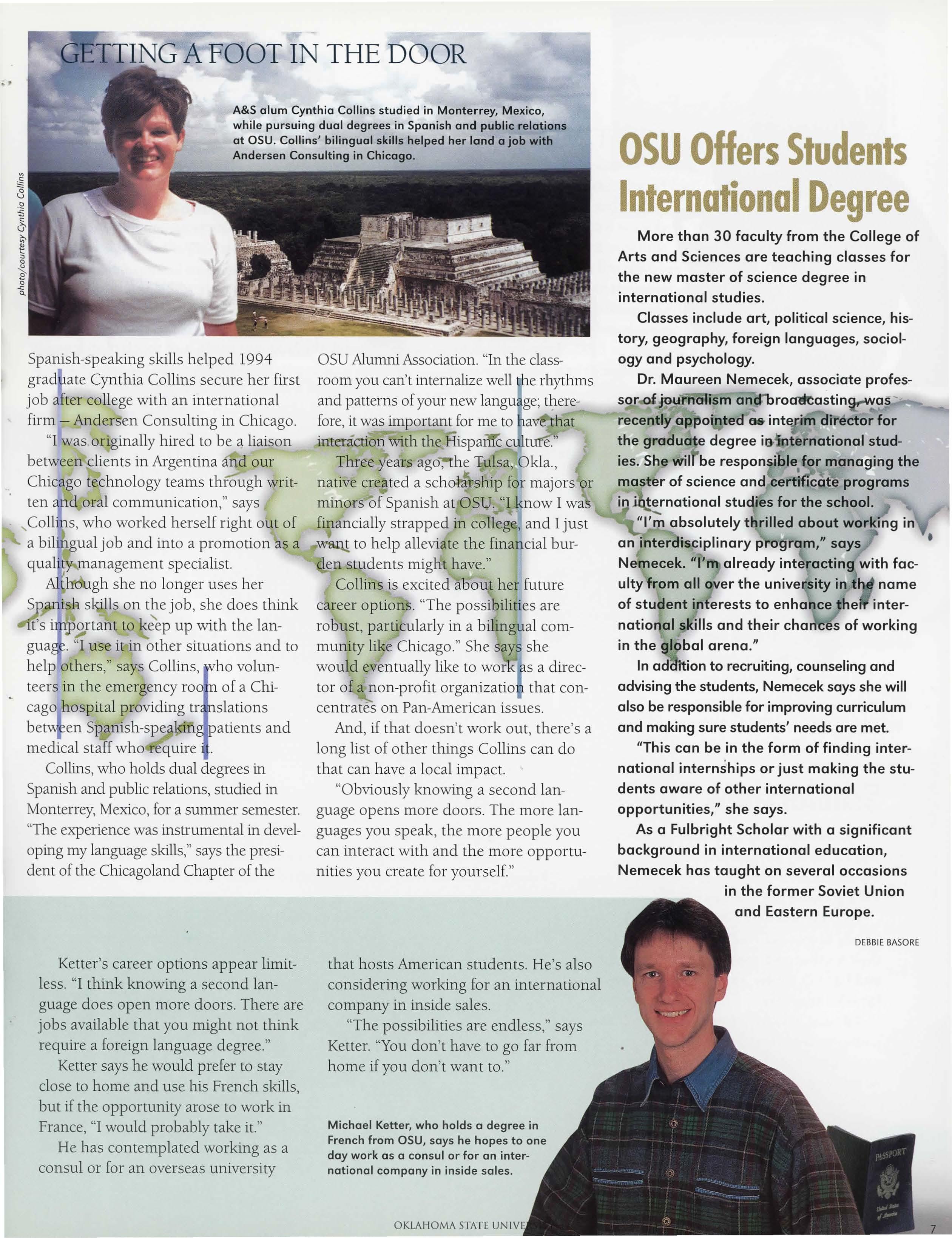
A&S alum Cynthia Collins studied in Monterrey, Mexico, while pursuing dual degrees in Spanish and public relations at OSU. Collins' bilingual skills helped her land a job with Andersen Consulting in Chicago.
Michael Ketter, who holds a degree in French from OSU, says he hopes to one day work as a consul or for an international company in inside sales.
DEBBIEBASORE
'TOOL TIME'
Jennifer Sternberg probably never imagined herself making a living as a tool expert, but that's just what she does as a sales and service representative for Hilti, Inc. in Tulsa.
"We sell demolition and construction tools," says Sternberg, who graduated with a degree in Spanish and minor in international business in 1997. "I use Spanish to communicate primarily over the tele..Jhone with p_eople from Florida and Puerto Rico. They call l€TF0m the job sites to ask questionsli\e hat kinds of nail guns or anchocij't,lts hould be tI~d in the construction process."
" Sternbe g sa,y: he answers an average of~~alls a day as an inside sales representative. Her goaI is to eventually move to outside ales where she1~e able to visit cb struct10n sites and co \ers:.~th,,~ople face-to-face ' ,~
'1love my job," says Sternberg, "becaus~'•rn-a 1 utjlize my language skiltVnd be involved in interna-
Bailey Scholarship. "You learn to work with people and understand them. You become open to people around you. When you're in the work force there are going to be people with differences. Studying abroad makes you more receptive to new ideas and people and more accepting of others."
Sternberg, who volunteers her time teaching first communion and Catholic classes to Hispanic youth, cherishes the time she spent abroad. "The fact that I could speak the language made it so much more enjoyable. I was able t,g_~l\nth pei le oo the ~me and to rnfnost family. I wa ahle te,.bond an have a true understanding of the lture." 7 ,
She admits she knew little about•c0nstruction w Hilti, Inc. ired 11.ernearly two 3/ears ago. "I onl n~ about screwin nail," says the New Jerse native. "1 ent through intensive training. Wi,;tried out tools and learned how to take t ings apart. The toughest Jprt was learning everything in Enghsh ap hen figuring out how to translate it to Spanish. '
Sternberg masteq_d the tools of the trade and has managed to please not only her boss, but her family as well. tional relations while living in the states."
To hone her Spanish skills, Sternberg spent a ., semester studying abroad in Mexico courtesy of a
dad is really impressed. When we go to a hardare store I know that 'Oh, that's a 12-volt battery."'
Foreign Languages and Literatures Department http://www.cas.okstate.edu/FLL_Homepage/
ScholarshipsProvideInternationalExperiences
The foresight and generosity of Richard E. and J.B. Bailey have contributed enormously to the educational experiences and cultural enrichment of numerous talented OSU students.
The late brothers established the Bailey Family MemoriQI Trust in 1982 in memory of their mother and grandmother, Ida L. Davis and Lalla D. Bailey, to finance study abroad for OSU students.
J.B. was a Tulsa attorney, and Richard was a long-time professor of humanities at OSU and founder of the College of Arts and Sciences' first study abroad program.
The trust has provided OSU students with more than $600,000 in scholarships to study liberal arts abroad. In the last 15 years, 94 students have received scholarships to study in 17 countries around the world.
In recognition of the family's significant contribution to OSU students, the College of Arts and Sciences named the Bailey brothers and the Bailey Family Memorial Trust as Distinguished Friends of the College at ceremonies last spring.
Alma Bailey and Robin Maxwell accepted the award on behalf of the family, and several past Bailey recipients shared stories about their life-enriching experiences abroad.
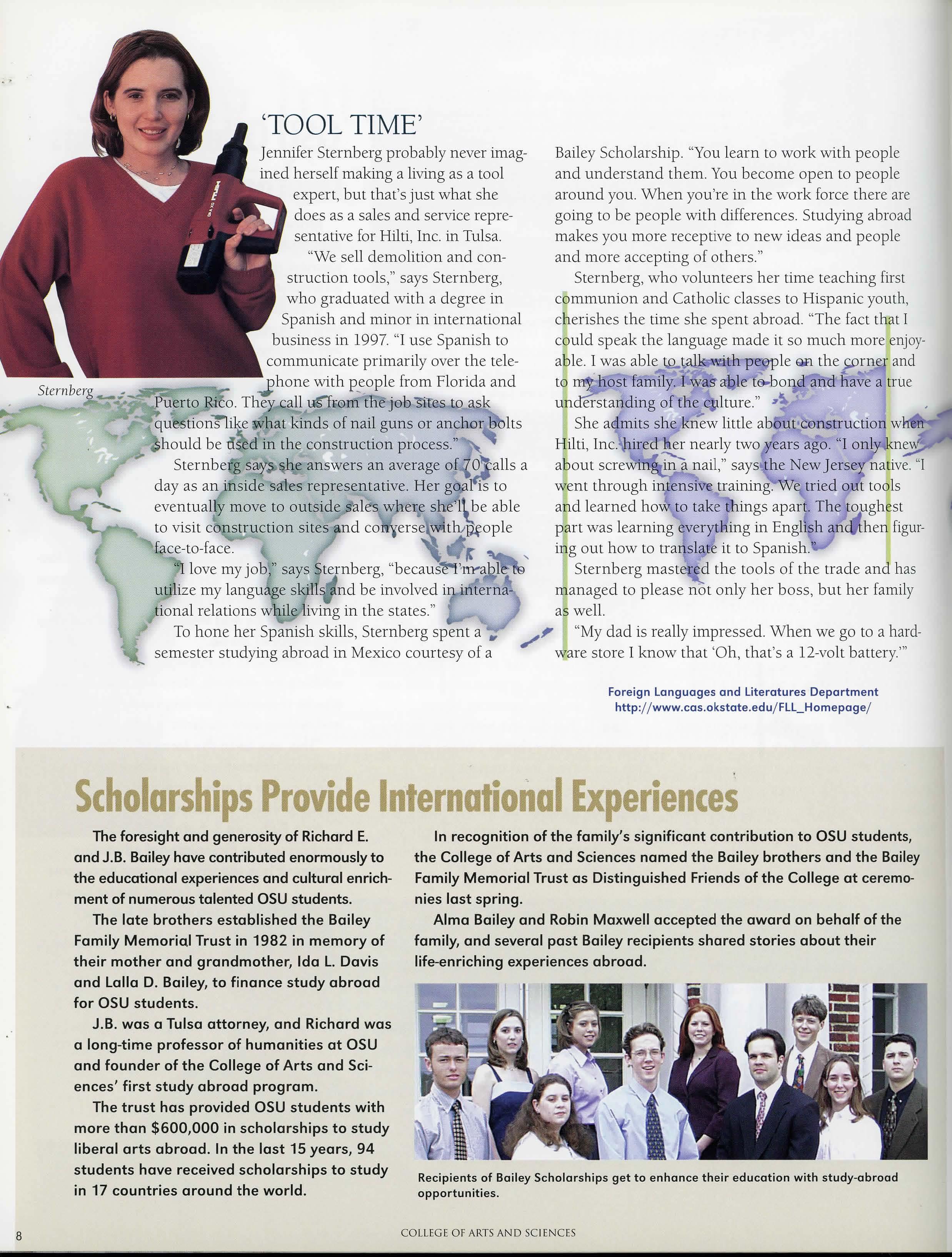
Recipients of Bailey Scholarships get to enhance their education with study-abroad opportunities.
TravelingClassrooms
Educational opportunities at OSU through the wildflowers of England aren't limited to campus classrooms. Stu- where they will visit the world famous dents and others can explore the world Royal Botanic Gardens Kew and through a variety of international courses explore sites in the chalk grasslands offered by Arts and Sciences Extension. of the North Downs. And the best part is you don't have to
Students enrolled in Art Professor know another language to participate! Jack Titus' Museum Tours of European Students enrolled in past international Capitals course will travel to England to courses ha e explored tropical marine biology in t e Bahamas, studied world literature i Japan, and traveled through the tropica forests of Ecuador and the Galapagos slands. Special opportunities this year in lude the following:
Art Pl"i61W sor Marty Avrett will lead a
tour London's museums, cathedrals, architecture and archeological sites.
Students enrolled in Professors John and Barbara DeSanto's International Public Relations course will spend 28 days studying international public relations and advertising with practitioner land cape ainting class in Tu~,9 .,J;t1~-un111 ducators in t~ ~el\ts who --s, course is desi~op sf<i ;o understandin porary concepts in landscape painti Botany Profess Ron Tryl,JNill lead another s~t of stud ts on nine-day " • li>otani d ture m June
i,~~ Greek history c ass ateio1f12-day Classical Greek lu s an Athens sightse uise of
Foreign Languages Professor John Howland will take French students to Paris for daily immersion in the French language.
Geology Professor Darwin Boardman
• I tak-.his stujients t Q.elizejQr a ~urse ~o~cecl Paleontology.--- -. rnational courses are not Ii students, they are open t itiore information call th ences Ex ension office ti• (t.405) 744-5647 ore eek it sit:_ a p~/extensi .okstat~.ed 1 "" interna onalcourses.html ..__, '-'
Iibusiness studies with a solid internaal dimension," says McElroy. pon graduation from OSU, McElroy ked for two years at Koch Industries. He ow pursuing an MBAat Yale University oncentrations in finance and strategy. r, he cr~ated the Dostoevsky Award, rship presented annually to an OSU e student of advanced standing. ough he doesn't currently utilize his n skills in his professional life, oy has found it comes in handy in his life. "Many of my classmates at Yale ussian fluently." He says most of the s of his apartment complex are Rus@rsand not all of them speak . ! it's helpful to know how to say t, I'm studying!' in Russian," s.
~ture plans, open. "I may r o, but I will be regardless of information on ogram or travel oreign t..qpga 44-5658 or e-ma @okstate.edu
OKLAHO
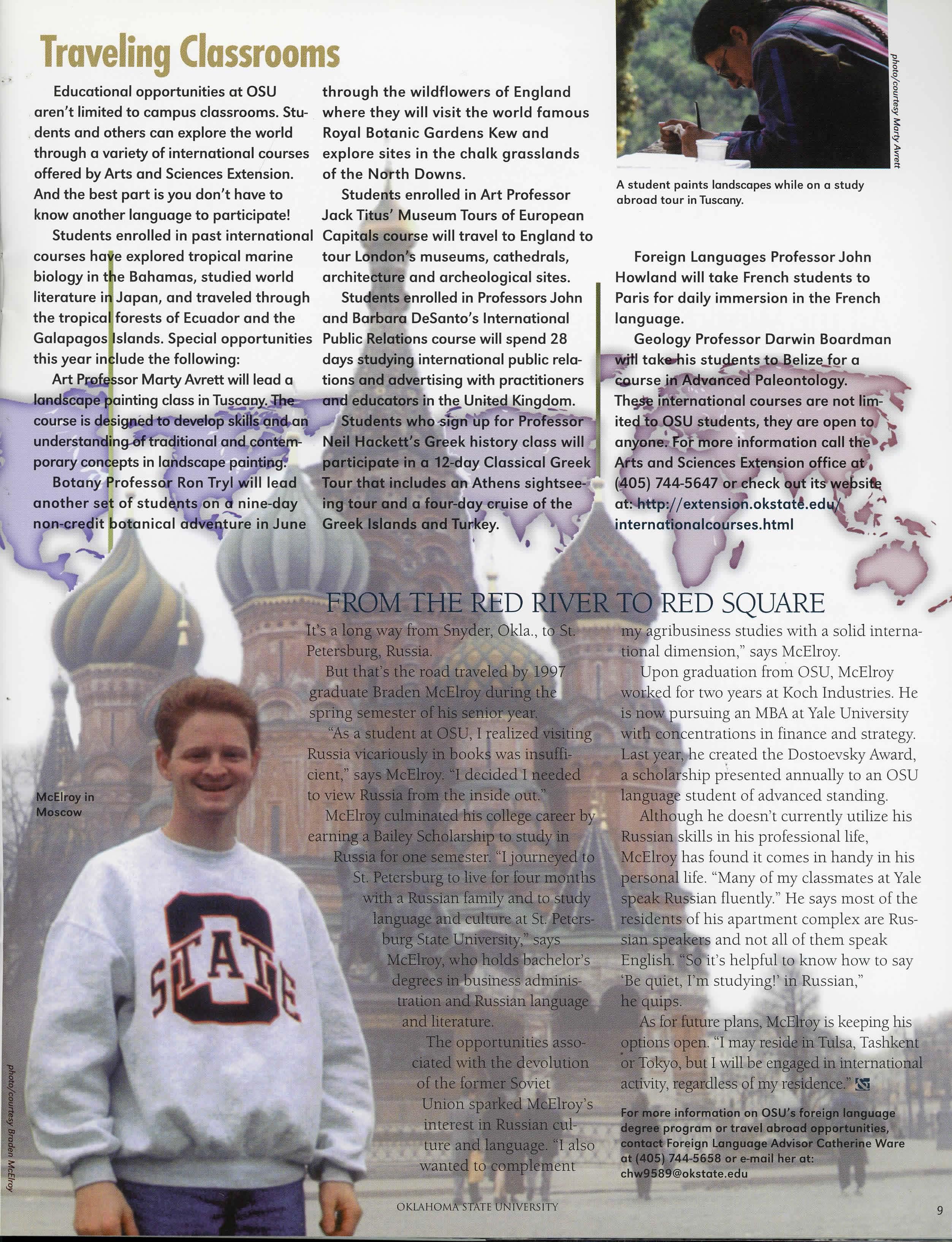
A student paints landscapes while on a study abroad tour in Tuscany.
FacultyTakeTheir Shows on the Road
All the World's a Stage
Three of the OSU Theatre Department's faculty members have recently traveled the globe learning and sharing their knowledge and expertise.
Bruce Brockman, professor and department head, was invited to display his scenery designs for the play "Top Girls" at the Ninth Prague Quadrennial (PQ) International State Design Exhibition held in Prague, Czech Republic, this past summer.
The show is staged every four years and features the best stage design work from around the world in Hoffer national exhibits of scenery, costume and theatre architecture. This year, 53 countries were represented. In addition to exhibiting his own scenery design, Brockman was invited by the U.S. PQ Committee to serve as co-designer of the U.S. national exhibit.
Associate Professor Rena Cook spent a year in England studying at the Central School of Speech and Drama, a highly prestigious and selective academy. She did post-graduate work in voice and diction for actors.
Cook teaches acting, voice and diction at OSU and directs many plays. Prior to going abroad, she spent her summer working for the well-known Illinois Shakespeare Festival in Bloomington, Ill.
Associate Professor Heidi Hoffer spent her summer in Florence, Italy, studying "trompe l'oeil" painting at the Fl'orence Academy of Art. Trompe l'oeil means "trick of the eye," or visual deception.
During her five weeks there, Hoffer and a small group of other students visited 51 museums, painted a mural and studied age-old mural and fresco painting techniques. /
These traveling faculty members benefit OSU stude~by :~::::!stheir experiences and knowledge gained visiting/i
The Sound of Music and Missiles
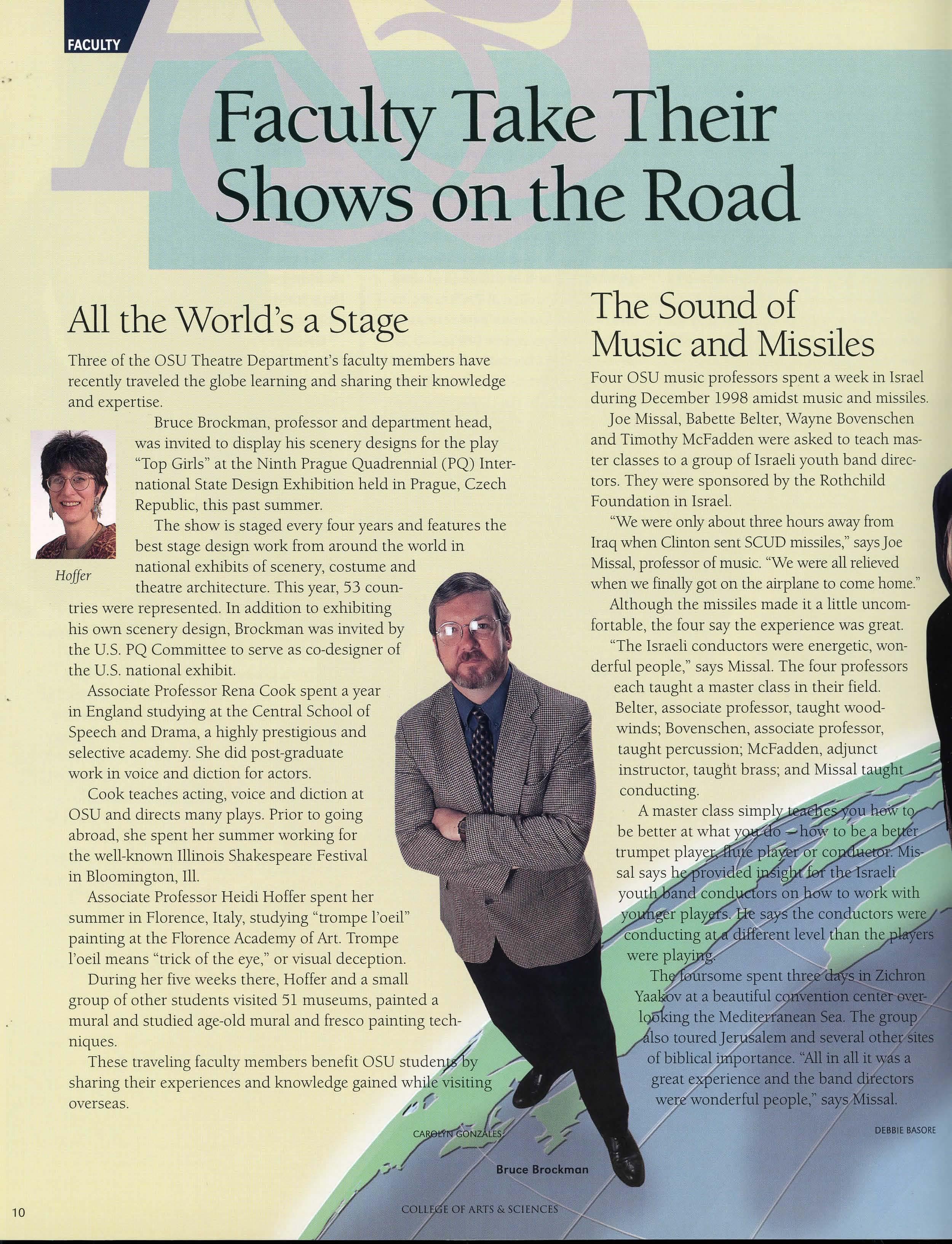
Four OSU music professors spent a week in Israel during December 1998 amidst music and missiles. Joe Missal, Babette Belter, Wayne Bovenschen and Timothy McFadden were asked to teach master classes to a group of Israeli youth band directors. They were sponsored by the Rothchild Foundation in Israel.
"We were only about three hours away from Iraq when Clinton sent SCUD missiles," saysJoe Missal, professor of music. "We were all relieved when we finally got on the airplane to come home."
Although the missiles made it a little uncomfortable, the four say the experience was great. "The Israeli conductors were energetic, wonderful people," says Missal. The four professors each taught a master class in their field. Belter, associate professor, taught woodwinds; Bovenschen, associate professor, taught percussion; McFadden, adjun instructor, taught brass; and • conducting.
A master clas • be better at
tance. "All nee and the b erful people," s
Water World
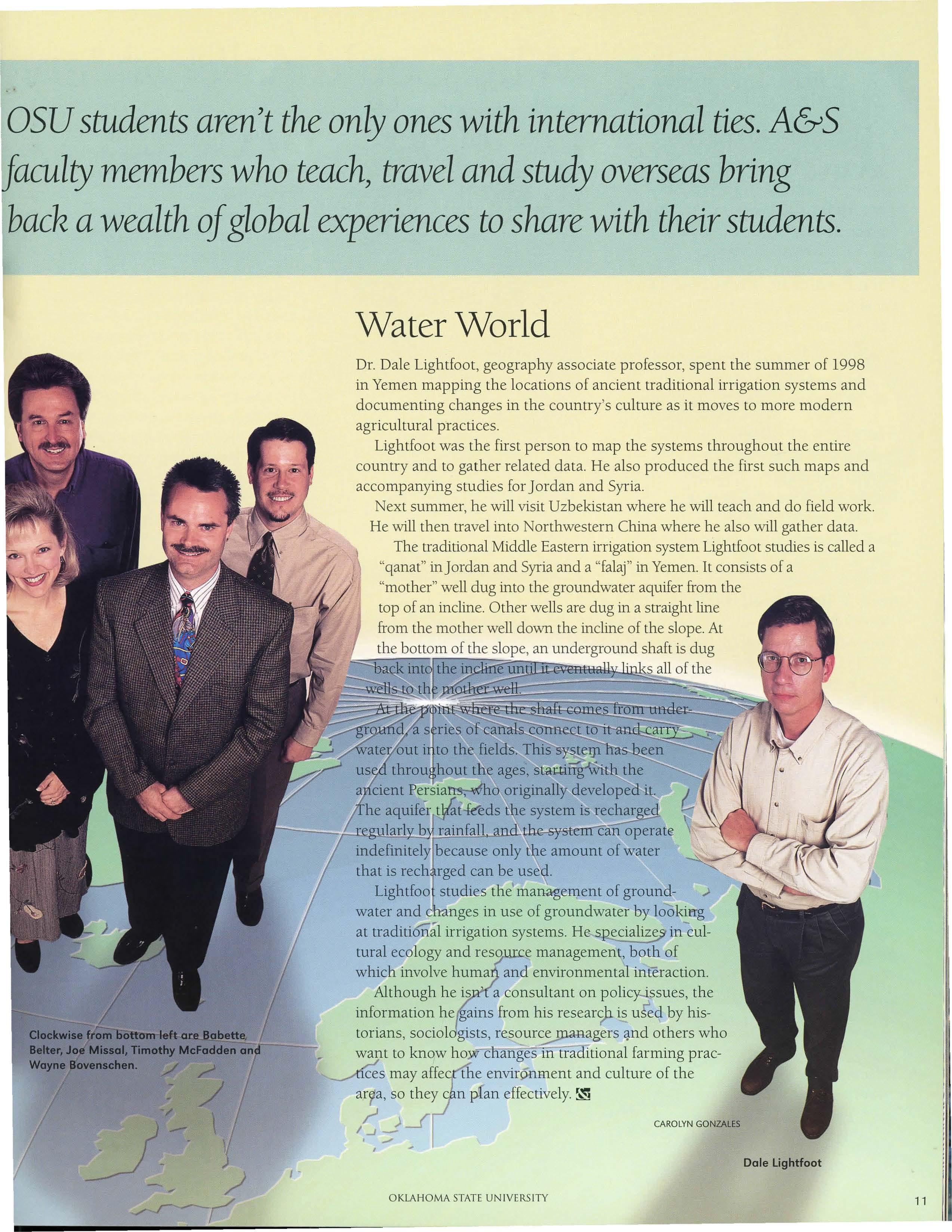
Dr. Dale Lightfoot, geography associate professor, spent the summer of 1998 in Yemen mapping the locations of ancient traditional irrigation systems and documenting changes in the country's culture as it moves to more modern agricultural practices.
Lightfoot was the first person to map the systems throughout the entire country and to gather related data. He also produced the first such maps and accompanying studies for Jordan and Syria.
Next summer, he will visit Uzbekistan where he will teach and do field work. He will then travel into Northwestern China where he also will gather data.
The traditional Middle Eastern irrigation system Lightfoot studies is called a "qanat" in Jordan and Syria and a "falaj"in Yemen. It consists of a "mother" well dug into the groundwater aquifer from the top of an incline. Other wells are dug in a straight line from the mother well down the incline of the slope. At the bottom of the slope, an underground shaft is dug a, int the • s all of the
aunt of water that is rech rged can be
Lightfoo studies the 1 m ement of ground- ,; water and C nges in use of groundwater by lookirrg at traditional irrigation systems. H6 s~ in cultural ecology and r e management, both of which involve h environmental interaction. Although h onsultant on policy.issues, the information he rom his researc)i is ufed by historians, social ts, resour~a-Bagers qnd others who want to kno - n traditional farming pracs may a nvirpnment and culture of the ar?a, so the pfon effectively.r~
Dale Lightfoot
College Alumni
BoardMembers
President
ClaudiaBartlett,Sapulpa BS'80 Journalism/Advertising
Vice President/President-Elect
KarenKaySpeer,OklahomaCity BS'87 Journalism/PublicRelations
National Board Representative
W.JohnLamberton,IV,Stillwater BS'70 Psychology,PhD'81 Sociology
Members at Large
ChristopherGafney,Plano,TX BS'90 Statistics
JonathanDrummond,Stillwater BS1 88 BiologicalScience
DanaK.Glencross,OklahomaCity BA'82 English,MA 186 PoliticalScience
NancyS.Gloriod-Jones,Duncan BA'84 Spanish
Richard(Rick)L Hauschild,Edmond BS'78 Geology
CarolR.Kilpatrick,OklahomaCity BA'86 Spanish& Journalism/News
PaulKnapp,OklahomaCity BS'79, MS'81 ComputerScience
EllenChanceLyons,Edmond BS'82 Math
KristyBakerMclaughlin,Stillwater BS'84 Sociology
SteveNelson,Tulsa BS'83 Geology,MS'88 ComputerScience
AndreaNielsen,Tulsa BA'71 Sociology •
DavidK.Parrack,Tulsa BA'80 History
RobertR.Springer,OklahomaCity MS'77 Geography
Staff Liaisons
WilliamA. Ivy,Stillwater Director,StudentAcademicServices
IldaT. Hershey,Stillwater Coordinator,AlumniActivities & Development
Who Could Ask For Anytl
Aage 18,Jane (Hitch) Willingham ame to OSU from Guymon, Okla., already wearing the crown of Miss Oklahoma.
"I had a great time at the Miss America contest in Atlantic City, New Jersey,"says Willingham, '68, theater. 'Then I came back and started my freshman year at OSU, and every weekend I traveled around the state as Miss Oklahoma."
The extracurricular activity not only gave her firsthand speaking and performing experience, it also counted as a credit hour toward her major.
)ane (Hitch) Willingham, '68 theater, is ~n accomplished actress and an artist. "My grandmother was a rancher's wife rho liked to paint," she says. "And
I am rancher's daughter who likes to paint."
And it deepened Willingham's desire to study theater at OSU. By the time she graduated in 1968 she had been named Most Outstanding Speech Graduate and a Redskin Beauty.
"I've lived in Dallas for the last 31 years, but I definitely have an allegiance to OSU and all that it offers," says Willingham, who met her husband, Clark, a lawyer, after moving to Dallas.
Good 'Chemistry'Creates
Dr.John R. Mattox may not be a household name, but countless household and industry products wouldn't be the same without him.
Because of Mattox, principal scientist for the Research Laboratories of Rohm and Haas Company of Philadelphia, pesky molds and contaminants don't grow in shampoo, fuel, paint and other products containing water.
"The biocides we create are essentially preservatives that go into industrial and consumer products to control the growth of bacteria and fungi," says Mattox, who holds 17 patents, with more pending. "Any product that contains water has the potential to grow tiny organisms unless it contains a biocide."
Rohm and Haas Co., with sales of $6.5 billion annually, produces many of the raw materials used in the production of pulp paper, paint, industrial coolants and shampoo. One biocide created by the company's scientists won the President's Green Challenge Award for making ship paint more environmentally-friendly.
Mattox was awarded the 1997 Otto Haas Award for Technical Excellence for his continuous, unique and broad technical contributions to the industry. He donated the $5,000 prize to OSU's Chemistry Department, from which he earned a master's degree in 1965. Through the years he. has kept in touch through the department's annual newsletter. "That gives me a feeling of connection back to OSU," he says.
"OSU's chemistry department is smaller than the others I attended, and so I felt OSU could make better use of the money," says Mattox, who also holds a bachelor's degree and doctorate in chemistry from Ohio State University and Iowa State University, respectively.
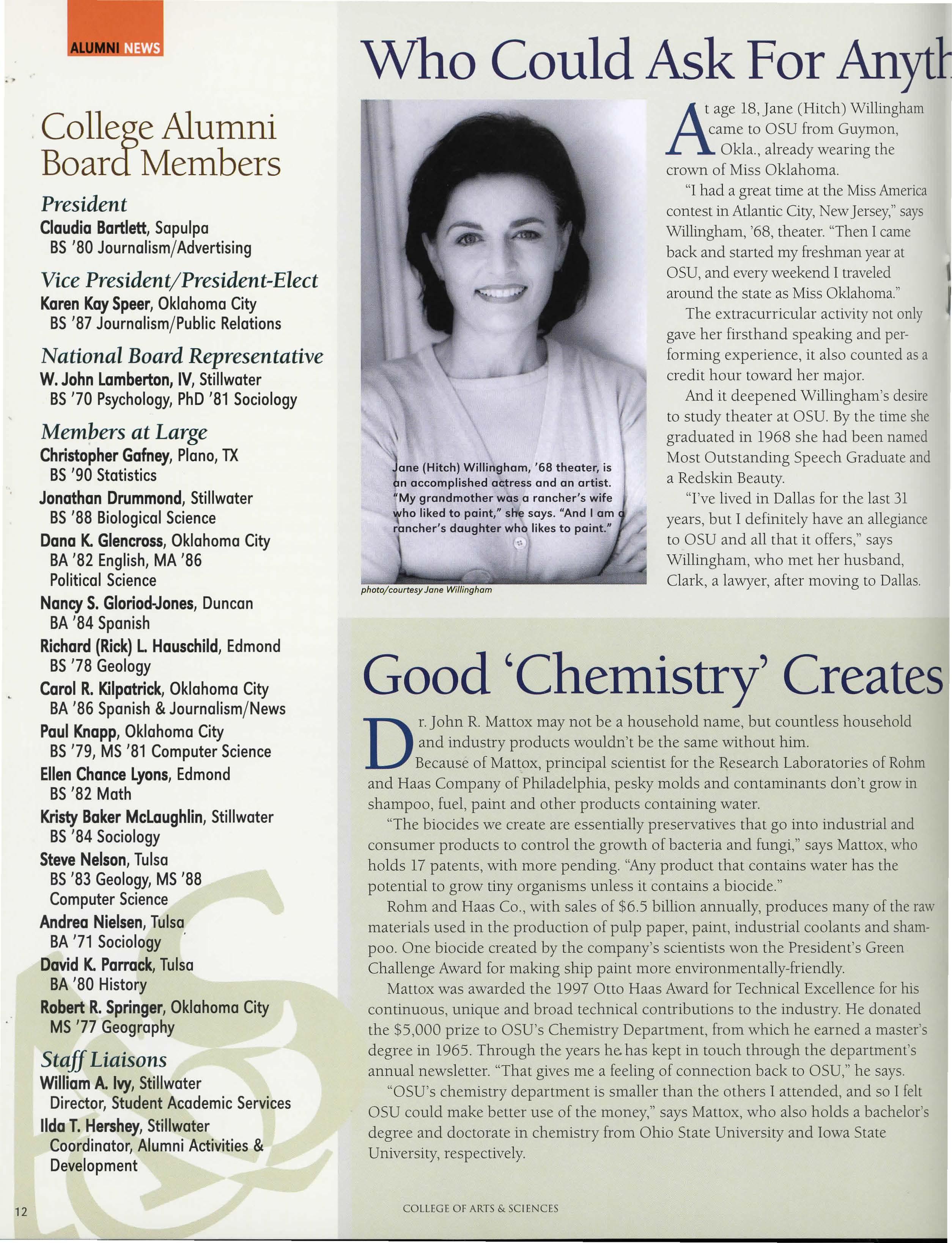
photo/courtesy Jane Willingham
ling More?
Today, the mother of two grown children, Willingham performs regularly in television commercials, film and theater productions in the Dallas/Fort Worth area. She also takes her repertoire of five musical revues and three one-act plays to clubs, conventions and specialty groups across Texas and Oklahoma.
Her commercial credits include spots for TGI Friday's restaurants, Globe Insurance and the American Heart Association. She's made numerous industrial films for companies such as Mary Kay Cosmetics, Clairol,JC Penney and Minute Maid, and has many independent films to her credit.
"OSU gave me a good education, and I'm very proud to be an alum," says Willingham, daughter of Lala (Moores) Hitch, '38, math, and the late Oklahoma A&M Regent H.C. "Ladd" Hitch, '38, agriculture. Her brother, Paul, '65, animal science, carries on the family's ranching tradition in Guymon.
Willingham says being a student during the tumultuous '60s was sometimes difficult because many of her peers were protesting the Vietnam War while her conservative father represented the "establishment."
"I just decided to remain neutral," she says.
At OSU, Willingham participated in Angel Flight, an invitation-only organization for women that supported the Air Force ROTC, and was also a leader in Kappa Alpha Theta, Varsity Revue and theater productions.
"I loved Vivia Locke," Willingham says of the beloved OSU theater instructor for whom the Seretean Center theater is named. "She was wonderful. She was straight-forward and encouraging, but she didn't give anyone an easy A. She was fun to be around.
"I loved OSU when I was student," Willingham says, "and I still do."
STORIESBYJANET VARNUM
asting Impression
"I enjoyed my time at OSU tremendously," says Mattox, who met his wife, Marda (Woods), '64 elementary education, while at OSU. "Those two years were a turning point in my life. I became a serious student, and chemistry became more interesting and fascinating to me. That's when I decided I wanted to become a chemist."
After 27 years as a research scientist, Mattox says each day still holds new challenges. "Finding the exact formulation to produce a chemically- and physically-stable product is tremendously rewarding to me," he says. "Even after all these years." r~
Whatis
Tax-wise, the hands-down winner is a gi,ft of securities that have gone up in value. W'hy? Because you receive a double tax benefit. If you have owned the stock more than one year, you can deduct as a charitable gi,ft the full fair market value of your appreciated _assetand save again by avoiding all capital gains taxes. Mutual fund shares can be donated with similar tax benefits as stock gi,fts.
This gi,ft will benefit your bottom line as well as the College of Arts & Sciences.
Thanks to Dr. John Mattox, pesky molds and contaminants don't grow in shampoo, fuel, paint and other products containing water. Mattox, pictured with his wife, Morda, graduated from OSU in 1965 with a master's degree in chemistry and is principal scientist for the Research Laboratories of Rohm and Haas Company of Philadelphia.
Alums Serving Our Country
At the helm of one of the U.S. Navy's most fearsome warships and at the top of the chain of command in the Defense Logistic Agency's most instrumental activity, Commander (CDR) Terry S. Wichert and Thomas E. Brunk, respectively, work to sustain America's military readiness. In the maintenance of the world's indisputable super-power, these graduates of the College of Arts and Sciences impart leadership that holds the potential to affect every life on the planet.
A Sub-sational Naval Career
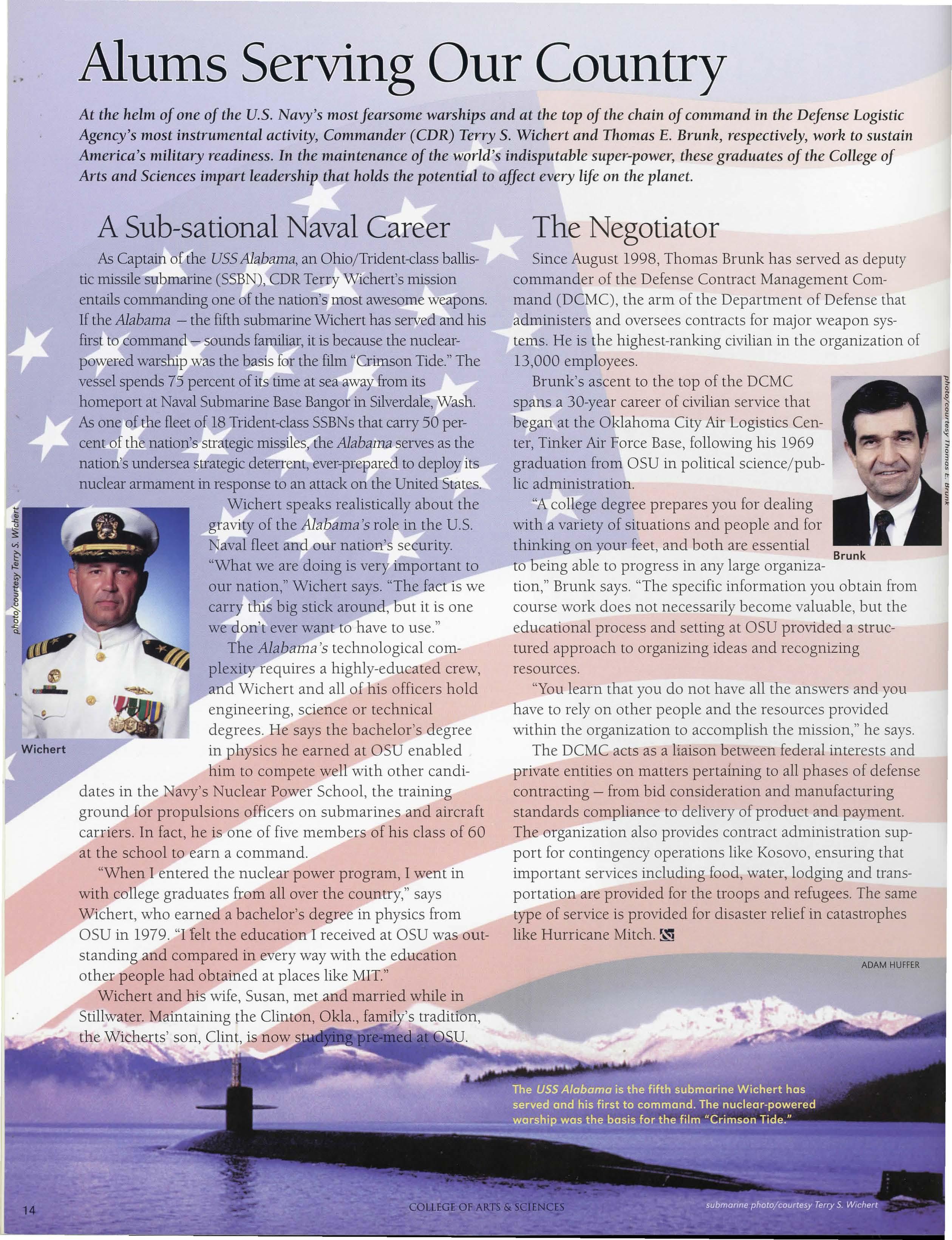
As Captain of the USS Alabama, an Ohio/Trident-class ballistic missile submarine (SSBN),CDR Terry Wichert's mission entails commanding one of the nation's most awesome weapons. If the Alabama - the fifth submarine Wichert has served and his first to command - sounds familiar,it is because the nuclearpowered warship was the basis for the film "Crimson Tide."The vessel spends 75 percent of its time at sea away from its homeport at Naval Submarine Base Bangor in Silverdale,Wash.
As one o the fleet of 18 rident-class SSBNsthat carry 50 percent of th: nation's strategic mis~es, the Alabama serves as the nation's undersea strategic deterrent, ever-prepared to deploy its nuclear armament in response to an attack on the United States.
Wichert speaks realistically about the gravity of the Alabama's role in the U.S. Naval fleet and our nation's security. "What we are doing is very-important to our nation," Wichert says. "The fac is we carr this big stick around, but it is one we don't ever want o have to use."
The Alabama's technological complexity equires a highly-educated crew, and Wichert and all of his officers hold engineering, science or technical degrees. He says the bachelor's degree Wichert in physics he earned at OSU enabled him to compete well with other candidates in the Navy's Nuclear Power School, the training ground for propulsions officers on submarines and aircraft carriers. In fact, he is one of five members of his class of 60 at the school to earn a command.
"When I entered the nuclear power program, I went in with college graduates from all over the country," says Wichert, who earned a bachelor's degree in physics from OSU in 1979. "I felt the education I received at OSU was outstanding and compared in every way with the education other people had obtained at places like MIT."
Wichert and his wife, Susan, met and married while in Stillwater. Maintaining ihe Clinton, Okla., family's tradition, the Wicherts' son, Clint, is now U.
The Negotiator
Since August 1998, Thomas Brunk has served as deputy commander of the Defense Contract Management Command (DCMC), the arm of the Department of Defense that administers and oversees contracts for major weapon systems. He is the highest-ranking civilian in the organization of 13,000 employees.
Brunk's ascent to the top of the DCMC spans a 30-year career of civilian service that began at the Oklahoma City Air Logistics Center, Tinker Air Force Base, following his 1969 graduation from OSU in political science/public administration.
"A college degree prepares you for dealing with a variety of situations and people and for thinking on your feet, and both are essential Brunk to being able to progress in any large organization," Brunk says. "The specific information you obtain from course work does not necessarily become valuable, but the educational process and setting at OSU provided a structured approach to organizing ideas and recognizing resources.
"You learn that you do not have all the answers and you have to rely on other people and the resources provided within the organization to accomplish the mission," he says.
The DCMC acts as a liaison between federal interests and private entities on matters pertaining to all phases of defense contracting - from bid consideration and manufacturing standards compliance to delivery of product and payment. The organization also provides contract administration support for contingency operations like Kosovo, ensuring that important services including food, water, lodging and transportation are provided for the troops and refugees. The same type of service is provided for disaster relief in catastrophes like Hurricane Mitch. r~
ADAMHUFFER
The Tulsa Touch
Tip Toe
The Tulsa Ballet treated the OSU campus to three of the finest contemporary ballets when it presented "AKaleidoscope of 20th-Century Contemporary Classics" last spring at the Seretean Center Concert Hall.
The ballet's varied show included "The Green Table," "Equinoxe" and 'Jardi Tancat." The event marked the first time the Tulsa Ballet has appeared on the OSU campus.
Arts Gala Welcomes OSU-Tulsa
The College of Arts and Sciences helped OSU reveal its cultural side to Tulsa residents with a fine arts celebration to mark the opening of OSU-Tulsa. The OSU-Tulsa Arts Gala debuted last April inside the Tulsa Performing Arts Center (PAC) and featured the departments of music, theater and art with performances by OSU's Concert Chorale and OSU Chamber Choir under the direction of music professor Jerry McCoy.
The OSU Theater Department performed a short excerpt from the musical "Tintypes." The OSU Wind Ensemble, under the direction of Dr. Joseph Missal, presented Gershwin's "Rhapsody in Blue."
Art department students and faculty displayed artwork in the PAC's lobby and gallery with special music provided by OSU's percussion ensemble "Percussion + One Quartet," under the direction of Wayne Bovenschen, associate professor of percussion.
ToweringPresenceofOrange & Black
For years, Williams Companies has raided OSU's Arts and Sciences graduates. "The Williams Tower in downtown Tulsa is often referred to as the largest concentration of OSU graduates in the world," says Director of College Relations Kent Williams.
Staff Analyst Steve Nelson is one of those graduates. "Although my geology degree does not directly relate to the work I do at Williams, my coursework, especially the labs, gave . me experience in scientific methods and deductive reasoning, which I use everyday," says Nelson, who earned a bachelor's degree in geology in 1983 and a master's degree in computing and information sciences in 1988 from OSU.
David Parrack, director of accounting services, agrees. "In my history
classes I learned to analyze by reviewing a lot of material and information and drawing conclusions from it," says Parrack, who graduated from OSU with bachelor's degrees in economics and history in 1980.
Alison Anthony, who works in Williams Companies' Corporate Leadership, Learning and Performance Division, and holds a 1987 bachelor's degree in English and a 1990 master's degree in Englishfrom OSU, says a liberal arts background helps develop students' critical analysis and research skills. "Critically analyzing what you're reading and being able to produce logical written communication is so important to any position," says Anthony. "The rest of most jobs you can learn, but those things you need to know."
Getting Artsy on Video
Oklahoma high school students don't have to travel to Greece to see Greek architecture thanks to two OSU Art Department faculty members.
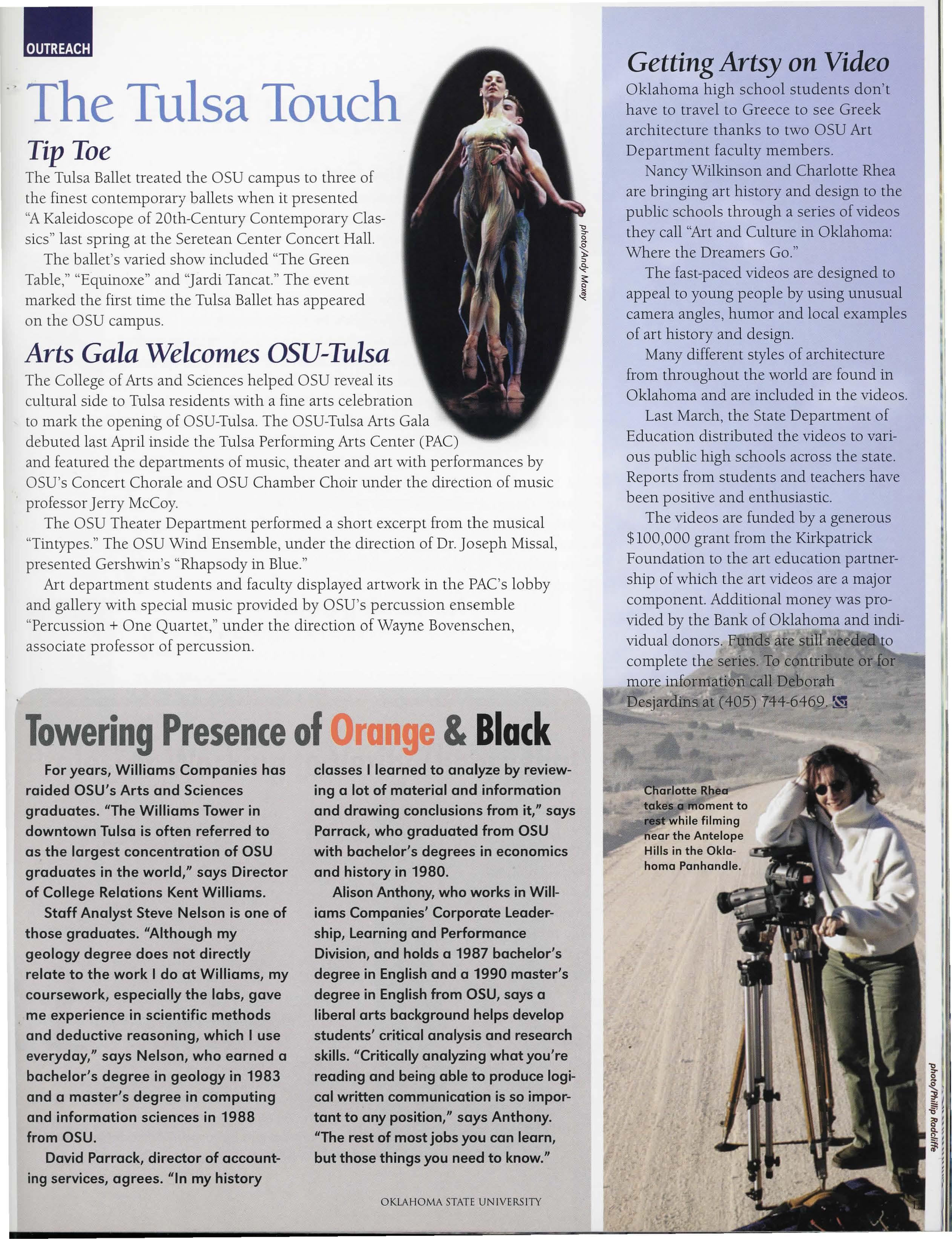
Nancy Wilkinson and Charlotte Rhea are bringing art history and design to the public schools through a series of videos they call "Art and Culture in Oklahoma: Where the Dreamers Go."
The fast-paced videos are designed to appeal to young people by using unusual camera angles, humor and local examples of art history and design.
Many different styles of architecture from throughout the world are found in Oklahoma and are included in the videos.
Last March, the State Department of Education distributed the videos to various public high schools across the state. Reports from students and teachers have been positive and enthusiastic.
The videos are funded by a generous $100,000 grant from the Kirkpatrick Foundation to the art education partnership of which the art videos are a major component. Additional money was provided by the Bank of Oklahoma and individual donors. F\{nds are still nte o complete the series. To contril3ute ot o more information;.call Deborah Desjardins at (405) '721-4-646$.),
Still LeavingTheir A&S Marks
Globe-trotter
For Dr. George J ewsbury, much of life since retirement has been spent the same way as before: teaching and consulting. Only his surroundings are a little different than Stillwater, Okla. He lives in Paris. The one in France.
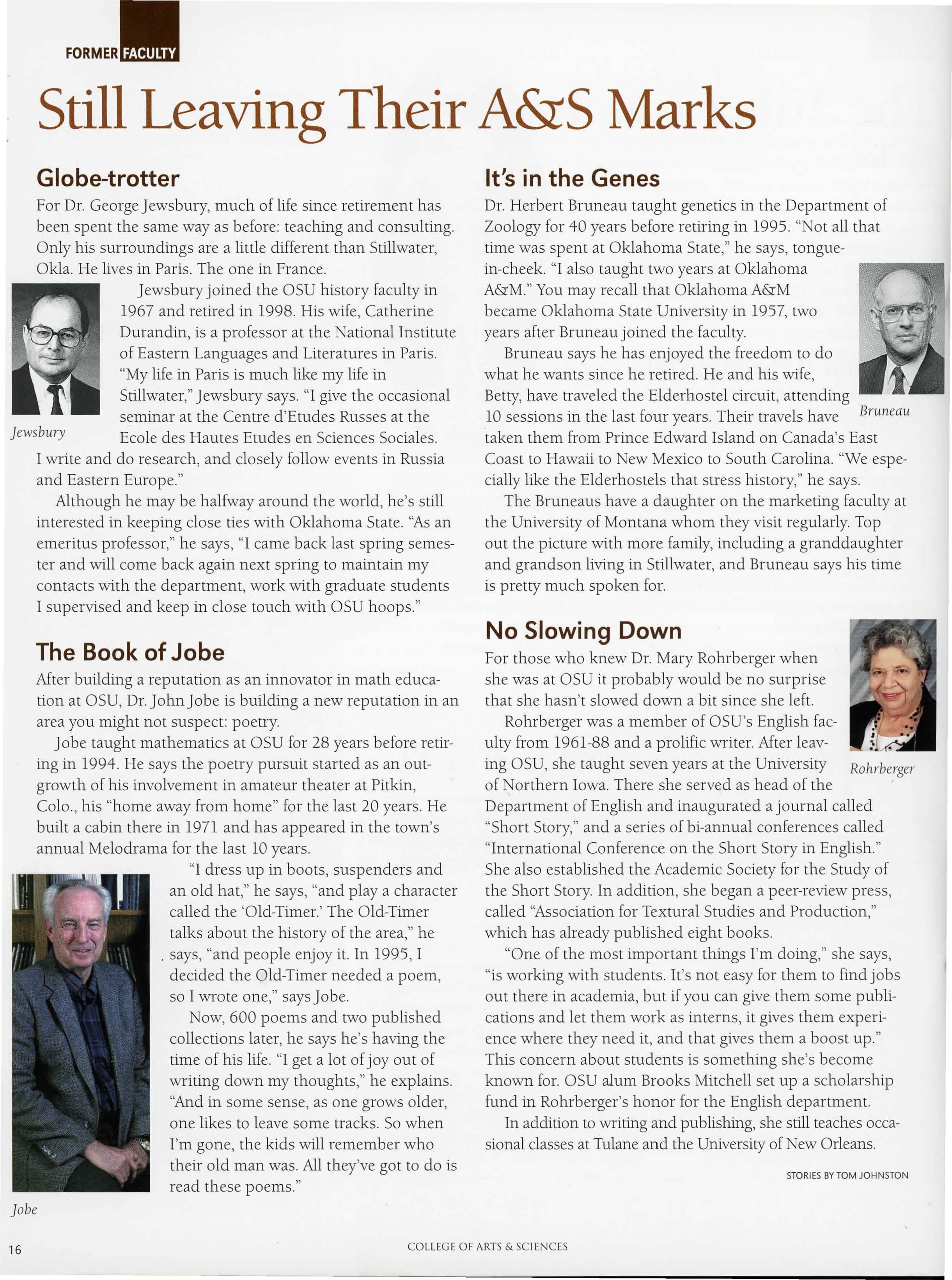
Jewsbury
Jewsbury joined the OSU history faculty in 1967 and retired in 1998. His wife, Catherine Durandin, is a professor at the National Institute of Eastern Languages and Literatures in Paris. "My life in Paris is much like my life in Stillwater,"Jewsbury says. "I give the occasional seminar at the Centre d'Etudes Russes at the Ecole des Hautes Etudes en Sciences Sociales. I write and do research, and closely follow events in Russia and Eastern Europe."
Although he may be halfway around the world, he's still interested in keeping close ties with Oklahoma State. "As an emeritus professor," he says, "I came back last spring semester and will come back again next spring to maintain my contacts with the department, work with graduate students I supervised and keep in close touch with OSU hoops."
The Book of Jobe
After building a reputation as an innovator in math education at OSU, Dr. John Jobe is building a new reputation in an area you might not suspect: poetry.
Jobe taught mathematics at OSU for 28 years before retiring in 1994. He says the poetry pursuit started as an outgrowth of his involvement in amateur theater at Pitkin, Colo., his "home away from home" for the last 20 years. He built a cabin there in 1971 and has appeared in the town's annual Melodrama for the last 10 years.
"I dress up in boots, suspenders and an old hat," he says, "and play a character called the 'Old-Timer.' The Old-Timer talks about the history of the area," he says, "and people enjoy it. In 1995, I decided the Old-Timer needed a poem, so I wrote one," says Jobe.
Now, 600 poems and two published collections later, he says he's having the time of his life. "I get a lot of joy out of writing down my thoughts," he explains. "And in some sense, as one grows older, one likes to leave some tracks. So when I'm gone, the kids will remember who their old man was. All they've got to do is read these poems."
It's in the Genes
Dr. Herbert Bruneau taught genetics in the Department of Zoology for 40 years before retiring in 1995. "Not all that time was spent at Oklahoma State," he says, tonguein-cheek. "I also taught two years at Oklahoma A&M." You may recall that Oklahoma A&M became Oklahoma State University in 1957, two years after Bruneau joined the faculty.
Bruneau says he has enjoyed the freedom to do what he wants since he retired. He and his wife, Betty, have traveled the Elderhostel circuit, attending 10 sessions in the last four years. Their travels have Bruneau taken them from Prince Edward Island on Canada's East Coast to Hawaii to New Mexico to South Carolina. "We especially like the Elderhostels that stress history," he says.
The Bruneaus have a daughter on the marketing faculty at the University of Montana whom they visit regularly. Top out the picture with more family, including a granddaughter and grandson living in Stillwater, and Bruneau says his time is pretty much spoken for.
No Slowing Down
For those who knew Dr. Mary Rohrberger when she was at OSU it probably would be no surprise that she hasn't slowed down a bit since she left.
Rohrberger was a member of OSU's English faculty from 1961-88 and a prolific writer. After leaving OSU, she taught seven years at the University of Northern Iowa. There she served as head of the Department of English and inaugurated a journal called "Short Story," and a series of bi-annual conferences called "International Conference on the Short Story in English." She also established the Academic Society for the Study of the Short Story. In addition, she began a peer-review press, called "Association for Textural Studies and Production," which has already published eight books.
"One of the most important things I'm doing," she says, "is working with students. It's not easy for them to find jobs out there in academia, but if you can give them some publications and let them work as interns, it gives them experience where they need it, and that gives them a boost up." This concern about students is something she's become known for. OSU alum Brooks Mitchell set up a scholarship fund in Rohrberger's honor for the English department.
In addition to writing and publishing, she still teaches occasional classes at Tulane and the University of New Orleans.
Jobe
A Winning Read
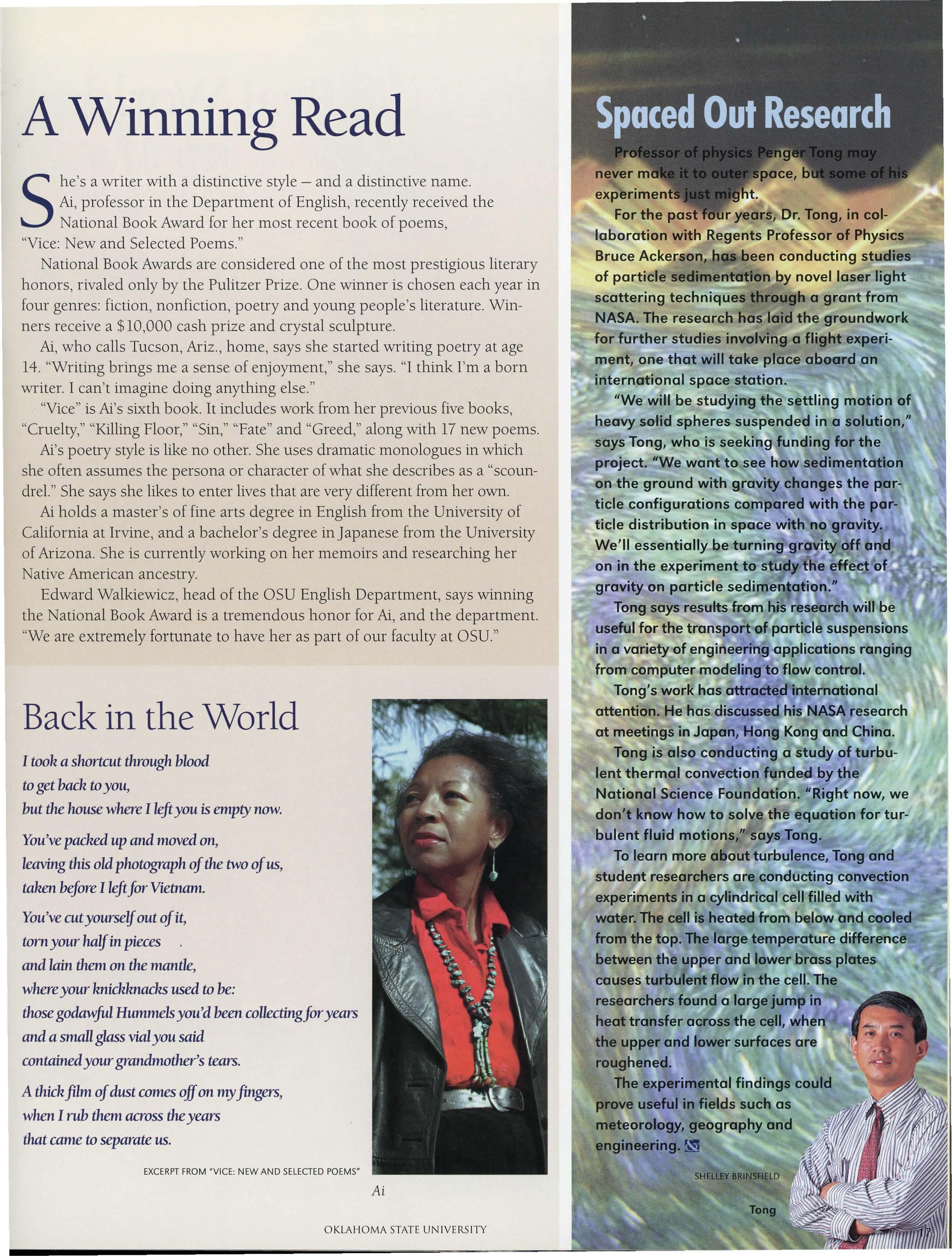
She's a writer with a distinctive style - and a distinctive name. Ai, professor in the Department of English, recently received the National Book Award for her most recent book of poems, "Vice: New and Selected Poems."
National Book Awards are considered one of the most prestigious literary honors, rivaled only by the Pulitzer Prize. One winner is chosen each year in four genres: fiction, nonfiction, poetry and young people's literature. Winners receive a $10,000 cash prize and crystal sculpture.
Ai, who calls Tucson, Ariz., home, says she started writing poetry at age 14. "Writing brings me a sense of enjoyment," she says. "I think I'm a born writer. I can't imagine doing anything else."
"Vice" is Ai's sixth book. It includes work from her previous five books, "Cruelty," "Killing Floor," "Sin," "Fate" and "Greed," along with 17 new poems. Ai's poetry style is like no other. She uses dramatic monologues in which she often assumes the persona or character of what she describes as a "scoundrel." She says she likes to enter lives that are very different from her own.
Ai holds a master's of fine arts degree in English from the University of California at Irvine, and a bachelor's degree in Japanese from the University of Arizona. She is currently working on her memoirs and researching her Native American ancestry.
Edward Walkiewicz, head of the OSU English Department, says winning the National Book Award is a tremendous honor for Ai, and the department. "We are extremely fortunate to have her as part of our faculty at OSU."
Back in the World
I tooka shortcutthroughblood toget backtoyou, but thehousewhereI leftyou is emptynow.
You'vepackedup andmovedon, leavingthisoldphotographof the twoof us, wkenbeforeileftforViemam.
You'vecutyourselfout of it, tornyour halfin pieces and lain themon themantle, whereyour knickknacksusedto be: thosegodawfulHummelsyou'dbeencollectingforyears anda smallglassvialyou said conwinedyourgrandmother'stears.
A thickfilm of dustcomesoffon myfingers, whenI rub themacrosstheyears thatcameto separateus.
never m experimen
For the pas r years, Dr. Tong, in collaboration with Regents Professor of Physics Bruce Ackerson, b een conducting studies of particle sedimentdthm by novel laser light scattering techniques }llr.ougha grant from NASA. The research has laid the groundwork for further studies involving a flight experiment, one that will take place aboard an international space station.
"We will be studying the settling motion of heavy solid spheres suspended in a solution," says Tong, who is seeking funding for the project. "We want to see how sedimentation on the ground with gravity changes the particle configurations compared with the particle distribution in space with no gravity. We'll essentially be turning grgvity off on'd on in the experiment to stu~y the effect of gravity on particle sedime ation."
Tong says results from his research will be useful for the transport of particle suspensions in a variety of engineering applications ranging from computer modeling to flow control.
Tang's work has attractecfintemational attention. He has discu55ed his NASA research at meetings in Japan, Hong Kong and China.
Tong is also conducting a study of turbulent thermal convection funded by the National Science Foundation. "Right now, we don't know how to solve the equation for turbulent fluid motions,: says Tong.
To learn more about turbulence, Tong and student researchers are conducting convection experiments in a cylindrical cell filled with water. The cell is heated from b~low and cooled from the top. The large temperature difference between the upper and lower brass plates causes turbut'ent flow in the cell. The researchers found a large jump in heat transfer across the cell, when' the upper and lower surfaces are roughened.
The experim,ntal findings could f)tove useful in fields such as meteorology, geography and ngineering.
Interns Experience the Real World
Internshipsare helpingA&S students discovera whole New World. The Career Servicesstaff and A&S faculty work closelywith students to help them secure covetedinternship opportunitiesto gain insight intofuture careers.
On a Fast Track
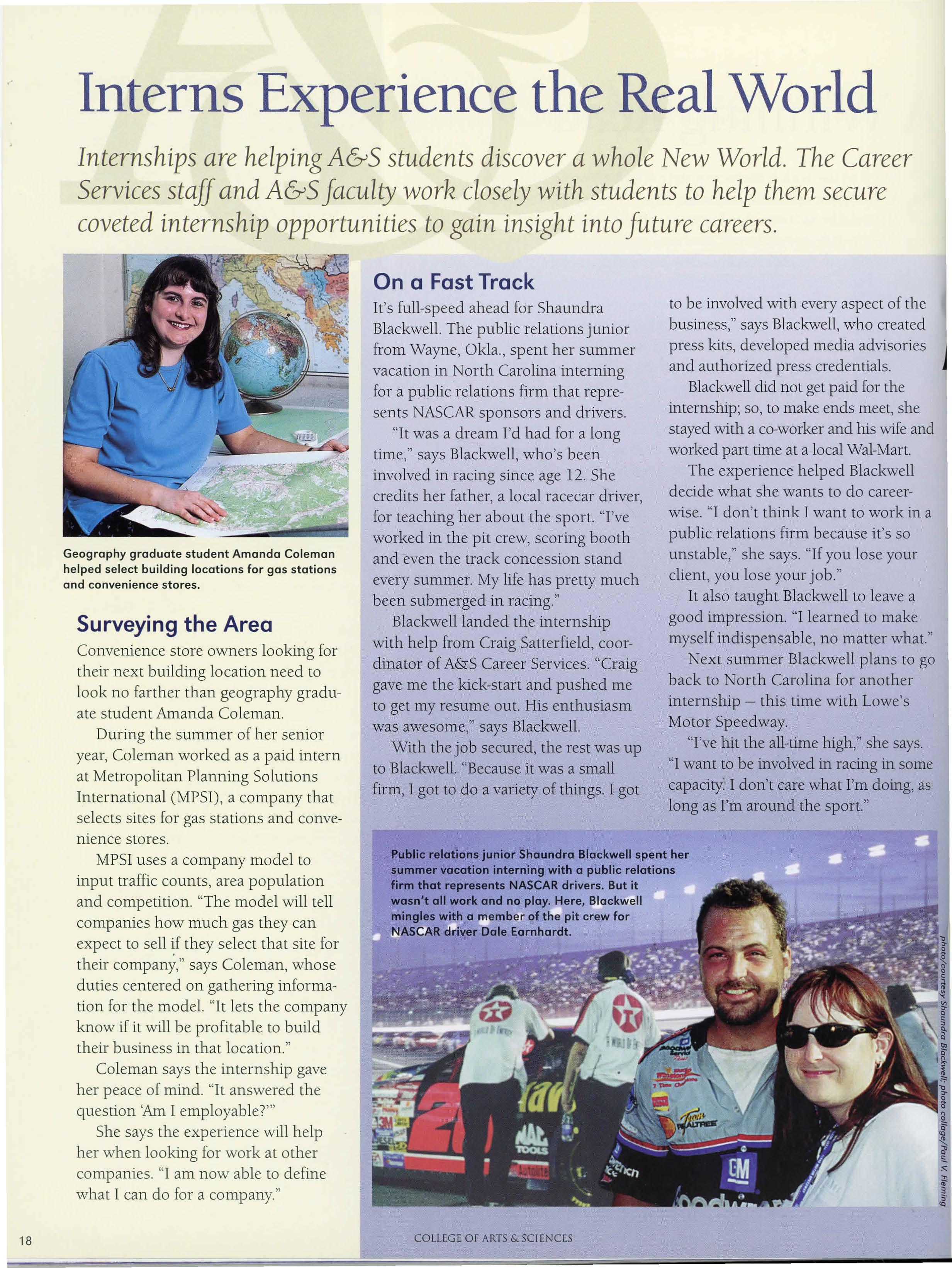
It's full-speed ahead for Shaundra Blackwell. The public relations junior from Wayne, Okla., spent her summer vacation in North Carolina interning for a public relations firm that represents NASCARsponsors and drivers.
"It was a dream I'd had for a long time," says Blackwell, who's been involved in racing since age 12. She credits her father, a local racecar driver, for teaching her about the sport. "I've worked in the pit crew, scoring booth and even the track concession stand every summer. My life has pretty much been submerged in racing."
Surveying the Area
Convenience store owners looking for their next building location need to look no farther than geography graduate student Amanda Coleman.
During the summer of her senior year, Coleman worked as a paid intern at Metropolitan Planning Solutions International (MPSI), a company that selects sites for gas stations and convenience stores.
MPSI uses a company model to input traffic counts, area population and competition. "The model will tell companies how much gas they can expect to sell if they select that site for their company," says Coleman, whose duties centered on gathering information for the model. "It lets the company know if it will be profitable to build their business in that location."
Coleman says the internship gave her peace of mind. "It answered the question 'Am I employable?"'
She says the experience will help her when looking for work at other companies. "I am now able to define what I can do for a company."
Blackwell landed the internship with help from Craig Satterfield, coordinator of A&S Career Services. "Craig gave me the kick-start and pushed me to get my resume out. His enthusiasm was awesome," says Blackwell.
With the job secured, the rest was up to Blackwell. "Because it was a small firm, I got to do a variety of things. I got
to be involved with every aspect of the business," says Blackwell,who created press kits, developed media advisories and authorized press credentials.
Blackwelldid not get paid for the internship; so, to make ends meet, she stayed with a co-worker and his wife and worked part time at a local Wal-Mart.
The experience helped Blackwell decide what she wants to do careerwise. "I don't think I want to work in a public relations firm because it's so unstable," she says. "If you lose your client, you lose your job."
It also taught Blackwell to leave a good impression. "I learned to make myself indispensable, no matter what."
Next summer Blackwell plans to go back to North Carolina for another internship - this time with Lowe's Motor Speedway.
"I've hit the all-time high," she says. "I want to be involved in racing in some capacity: I don't care what I'm doing, as long as I'm around the sport."
Geography graduate student Amanda Coleman helped select building locations for gas stations and convenience stores.
Public relations junior Shaundra Blackwell spent her summer vacation interning with a public relations firm that represents NASCAR drivers. But it wasn't all work and no play. Here, Blackwell mingles with a member of the pit crew for NASCAR driver Dale Earnhardt.
Working for a Cause
Sociology graduate
Natalie Copeland credits an internship with helping her land her "dream job" with Stillwater Domestic Violence Services.
Copeland worked as a paid intern for the agency's battered women's shelter. As an in-take worker, her duties involved answering a 24-hour hotline, assessing women's needs and ensuring them a safe place to stay. Copeland's enthusiasm and dedication paid off. Less than a year later, she was named Victim Services Coordinator. Her role also involves management of the battered women's shelter.
"Learning has been a big challenge," says Copeland. "I knew I would have a lot to learn, but I'm finding that each situation is different. Each case is different and unique in its own way."
Copeland says she enjoys the variety. "With this job you must come up with a new game plan almost every day."
The shelter has the capacity to serve six women and all their dependent children. Copeland says her biggest challenge as shelter manager is finding volunteers. "We're in desperate need of volunteers to provide transportation or babysitting in order to give the moms a break."
Copeland says internships are extremely educational. "I learned more during my internship than I ever did in a classroom. I don't want to de-value or take away from education, but the experience you acquire during an internship is very special."
http://www.cas.okstate.edu/ career/
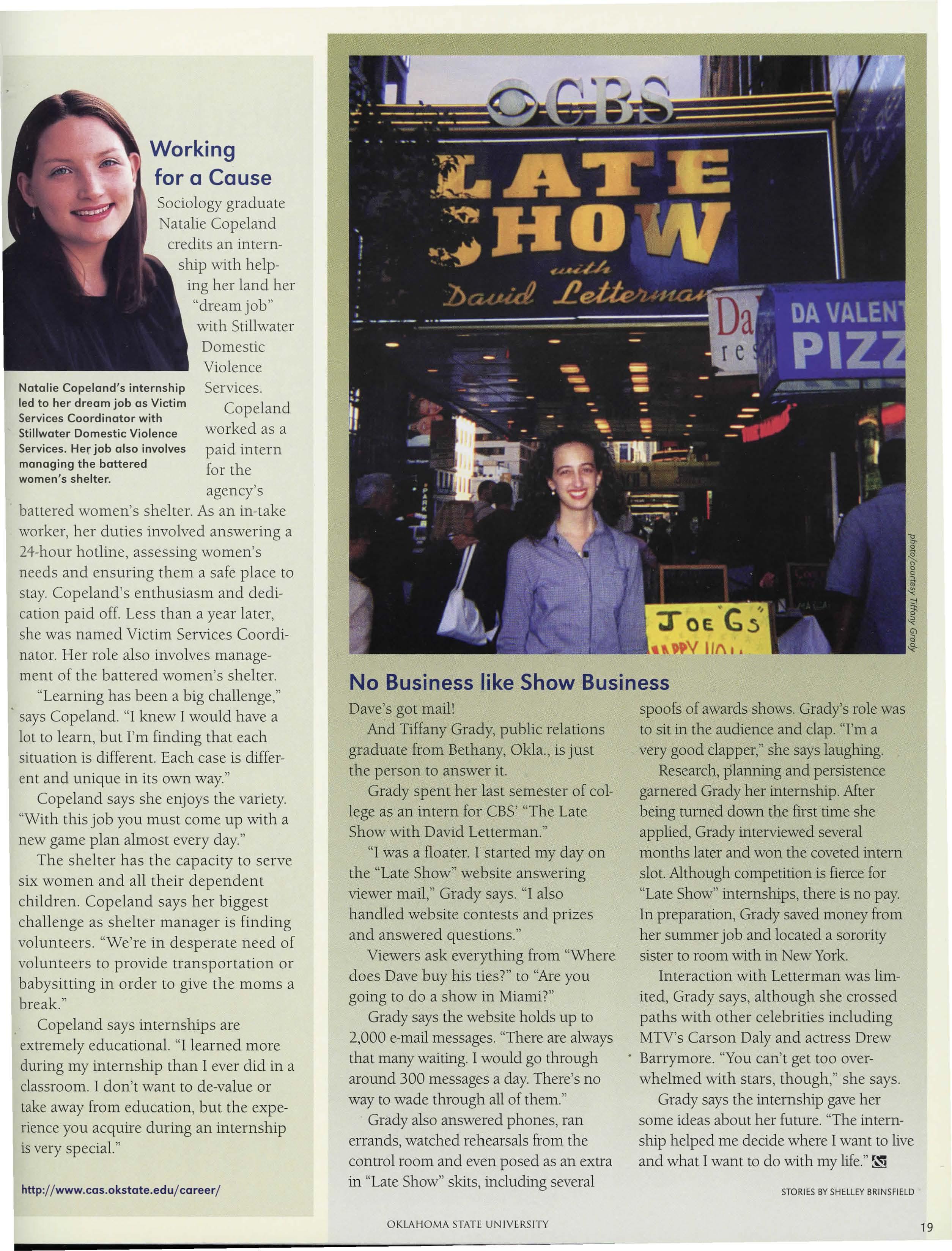
No Business like Show Business
Dave's got mail!
And Tiffany Grady, public relations graduate from Bethany, Okla., is just the person to answer it.
Grady spent her last semester of college as an intern for CBS' "The Late Show with David Letterman."
"I was a floater. I started my day on the "Late Show" website answering viewer mail," Grady says. "I also handled website contests and prizes and answered questions."
Viewers ask everything from "Where does Dave buy his ties?" to "Are you going to do a show in Miami?"
Grady says the website holds up to 2,000 e-mail messages. "There are always that many waiting. I would go through around 300 messages a day. There's no way to wade through all of them."
Grady also answered phones, ran errands, watched rehearsals from the control room and even posed as an extra in "Late Show" skits, including several
spoofs of awards shows. Grady's role was to sit in the audience and clap. 'Tm a very good clapper," she says laughing. Research, planning and persistence garnered Grady her internship. After being turned down the first time she applied, Grady interviewed several months later and won the coveted intern slot. Although competition is fierce for "Late Show" internships, there is no pay.
In preparation, Grady saved money from her summer job and located a sorority sister to room with in New York.
Interaction with Letterman was limited, Grady says, although she crossed paths with other celebrities including MTV's Carson Daly and actress Drew Barrymore. "You can't get too overwhelmed with stars, though," she says.
Grady says the internship gave her some ideas about her future. "The internship helped me decide where I want to live and what I want to do with my life."
Natalie Copeland's internship led ta her dream jab as Victim Services Coordinator with Stillwater Domestic Violence Services. Her jab also involves managing the battered women's shelter.
¥ II/\ I.
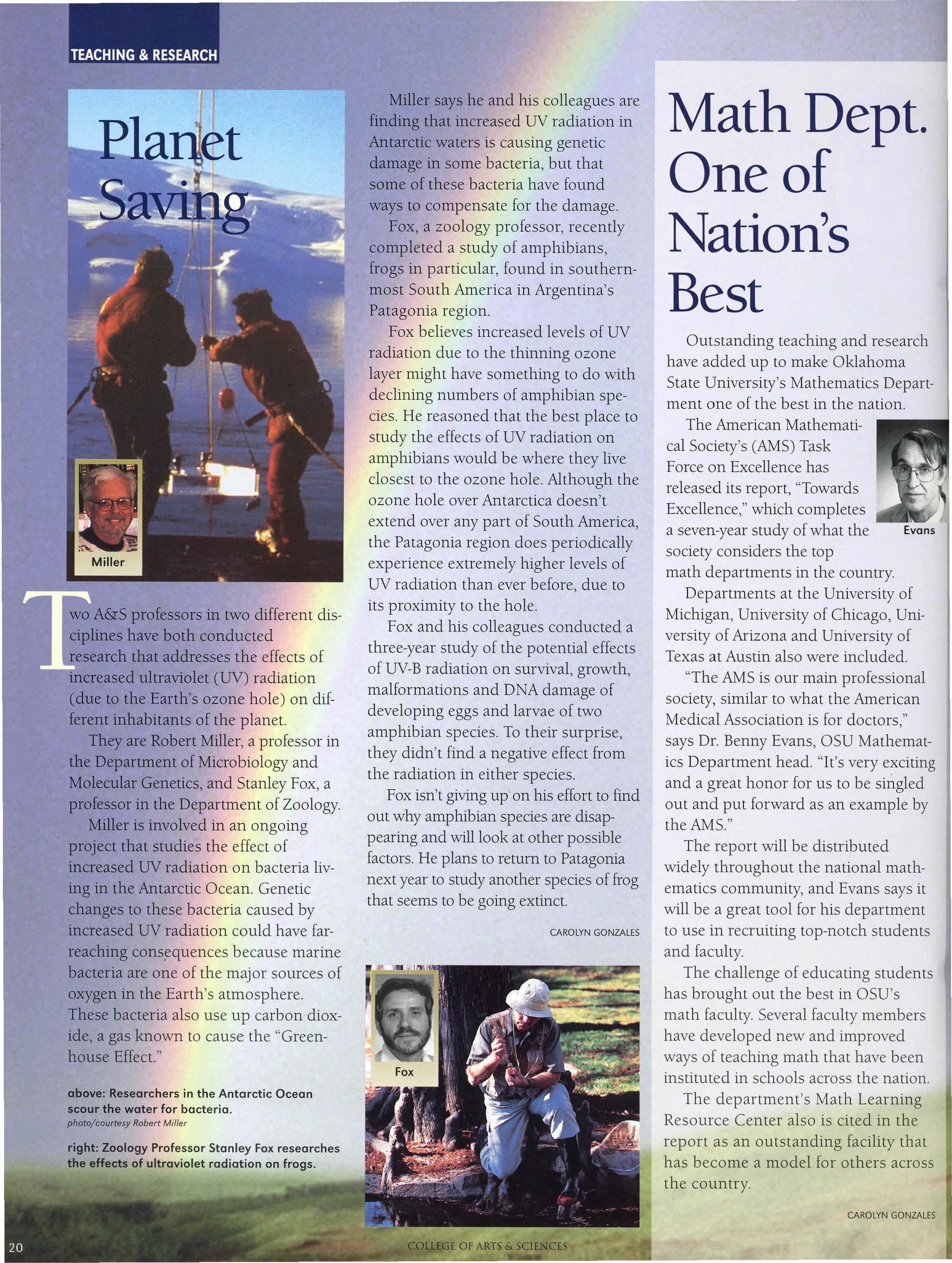
wo A&:Sprofessors in two different disciplines have both conducted research that addresses the effects of increased ultraviolet (UV) radiation (due to the Earth's ozone hole) on different inhabitants of the planet.
They are Robert Miller, a professor in the Department of Microbiology and Molecular Genetics, and Stanley Fox, a professor in the Department of Zoology.
Miller is involved in an ongomg project that studies the effect of . . increased UV radiation on bactena living in the Antarctic Ocean. Genetic changes to these bacteria caused by increased UV radiation could have farreaching cons.equences because marine bacteria are one of the major sources of oxygen in the Earth's atmosphere. These bacteria also use up carbon dioxide, a gas known to cause the "Greenhouse Effect."
Miller says he and his colleagues are finding that increased UV radiation in Antarctic waters is causing genetic damage in some bacteria, but that some of these bacteria have found ways to compensate for the damage.
Fox, a zoology professor, recently completed a study of amphibians, frogs in particular, found in southernmost South America in Argentina's Patagonia region.
Fox believes increased levels of UV radiation due to the thinning ozone layer might have something to do with declining numbers of amphibian species. He reasoned that the best place to study the effects of UV radiation on amphibians would be where they live closest to the ozone hole. Although the ozone hole over Antarctica doesn't extend over any part of South America, the Patagonia region does periodically experience extremely higher levels of UV radiation than ever before, due to its proximity to the hole.
Fox and his colleagues conducted a three-year study of the potential effects of UV-Bradiation on survival, growth, malformations and DNA damage of developing eggs and larvae of two amphibian species. To their surprise, they didn't find a negative effect from the radiation in either species.
Fox isn't giving up on his effort to find out why amphibian species are disappearing and will look at other possible factors. He plans to return to Patagoma next year to study another species of frog that seems to be going extinct.
CAROLYNGONZALES
Math Dept. One of Nation's Best
Outstanding teaching and research have added up to make Oklahoma State University's Mathematics Department one of the best in the nation.
The American Mathematical Society's (AMS) Task Force on Excellence has released its report, "Towards Excellence," which completes a seven-year study of what the society considers the top math departments in the country. Evons Departments at the University of Michigan, University of Chicago, University of Arizona and University of Texas at Austin also were included.
"The AMS is our main professional society, similar to what the American Medical Association is for doctors," says Dr. Benny Evans, OSU Mathematics Department head. "It's very exciting and a great honor for us to be singled out and put forward as an example by the AMS."
The report will be distributed widely throughout the national mathematics community, and Evans says it will be a great tool for his department to use in recruiting top-notch students and faculty.
The challenge of educating students has brought out the best in OSU's math faculty. Several faculty members have developed new and improved ways of teaching math that have been instituted in schools across the nation.
The department's Math Learning Resource Center also is cited in the report as an outstanding facility that has become a model for others across the country.
above: Researchers in the Antarctic Ocean scour the water for bacteria.
photo/courtesy Robert Miller
right: Zoology Professor Stanley Fox researches the effects of ultraviolet radiation on frogs.
'Seeing the Forest'
Like so many of today's new hi-tech products and services, bioinformatics is one of those 21st century opportunities that happened because something else happened. It's also an opportunity that could make Oklahoma State University and Stillwater a world center for a new technology.
Because OSU is known throughout the state and nation for its successes with the stu~y of plant genetics and plant breeding, it was only natural that the university was chosen a year ago to be part of an $8.2 million multi-university, multi-disciplinary grant to study how drought, salinity and cold temperatures affect plant genes. The research will eventually lead to the development of crops that are
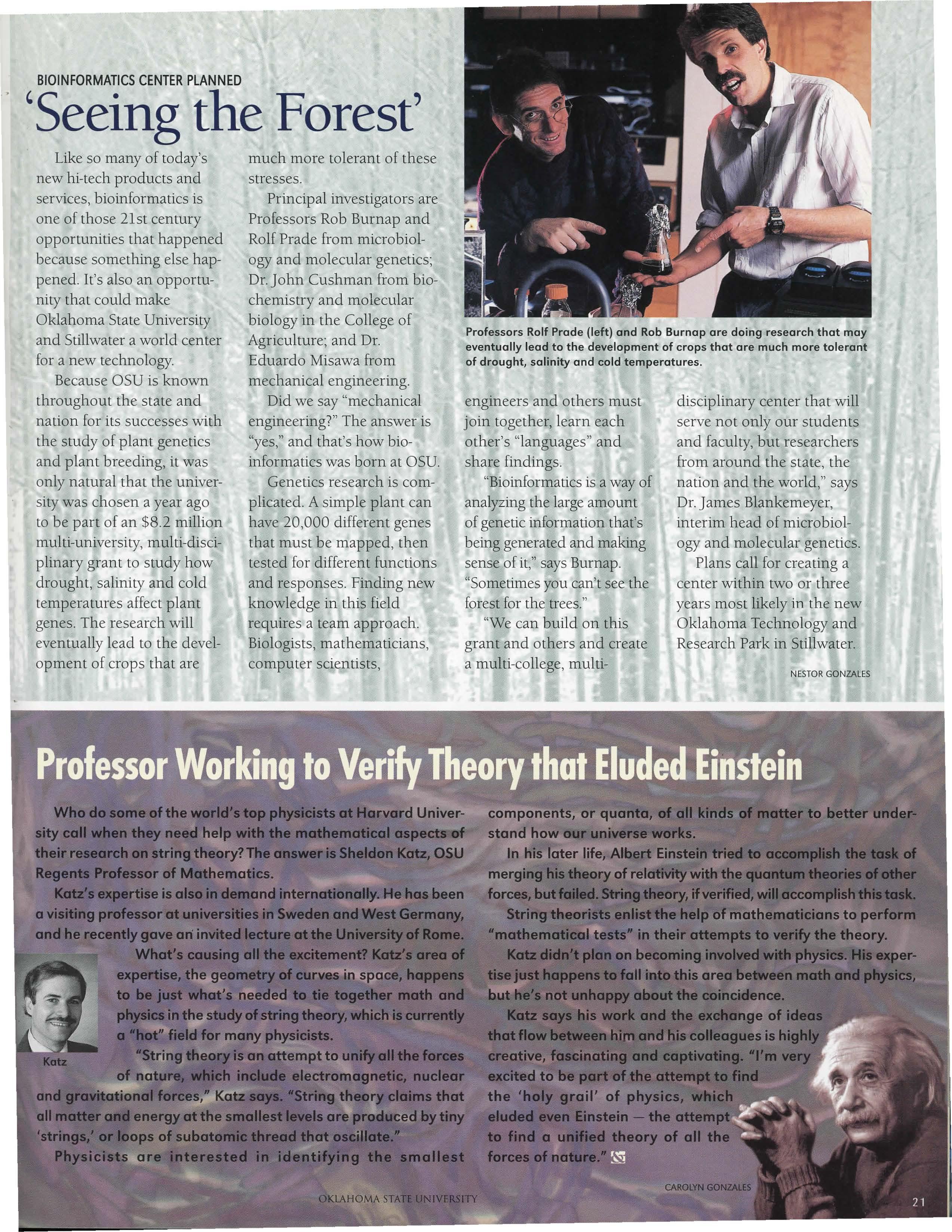
much more tolerant of these stresses.
Principal investigators are Professors Rob Burnap and Rolf Prade from microbiology and molecular genetics; Dr.John Cushman from biochemistry and molecular biology in the College of Agriculture; and Dr. Eduardo Misawa from mechanical engineering.
Did we say "mechanical engineering?" The answer is "yes," and that's how bioinformatics was born at OSU.
Genetics research is complicated. A simple plant can have 20,000 different genes that must be mapped, then tested for different functions and responses. Finding new knowledge in this field requires a team approach. Biologists, mathematicians, computer scientists,
engineers and others must join together, learn each other's "languages" and share findings.
"Bioinformaticsis a way of analyzing the large amount of genetic information that's being generated and making sense of it," says Burnap. "Sometimes you can't see the forest for the trees."
"We can build on this grant and others and create a multi-college, multi-
disciplinary center that will serve not only our students and faculty, but researchers from around the state, the nation and the world," says Dr. James Blankemeyer, interim head of microbiology and molecular genetics. Plans call for creating a center within two or three years most likely in the new Oklahoma Technology and Research Park in Stillwater.
Professors Rolf Prade (left) and Rob Burnap are doing research that may eventually lead to the development of crops that are much more tolerant of drought, salinity and cold temperatures.
Hitting the High
Notes
Elnor Ragan teaches her violin and viola students about more than rhythm and harmony.
"I teach them about socialization, responsibility, cooperation and problem-solving," says Ragan, '35, music performance.
Ford Named Oklahoma Chemist of the Year
Elnor Rogan, who graduated with a degree in music performance from OSU in 1935, teaches her violin students more than harmony and rhythm. She teaches them about responsibility, cooperation and problem-solving.
Ragan taught fifth grade and junior high strings for 11 years in Muskogee, Okla., and also played several years with the OSU Symphony. She says she first picked up the violin as a third-grader. Two years later her family moved to Stillwater where she began taking lessons from Professor Hladky in the OSU Music Department.
Ragan believes today's young people place too much emphasis on athletics and that success can often be traced back to music. "It has been proven that a high percentage of doctors, lawyers and other professionals have a background in music education. That's why I encourage students to stay wi.th it as long as possible."
Ragan not only teaches string instruments, she repairs them as well.."After I was married I traveled around performing, and I had to learn how to take care of my instruments," she says.
Ragan prides herself on her craftsmanship and next-day service; however, she admits that repairing instruments is not difficult. "Anyone with manual dexterity can do it. It's easy."
What isn't easy is keeping up with the active, 85-year-old Ragan. In addition to music instruction and repair, she also volunteers in the community and works out three times a week at the OSU Wellness Center. "I want to keep my energy up and my body working. I figure I can either use it or lose it. Your body is like a car. Either keep it up or put it up on blocks somewhere, and leave it."
Dr. Warren T. Ford, Oklahoma Regents Professor of Chemisn-y, was named 1999 Oklahoma Chemist of the Year by the Oklahoma section of the American Chemical Society. Ford was cited for his outstanding contributions to polymer chemistry. The honor consists of a plaque and $1,000 award that Ford donated to the OSU Foundation for the chemistry department.
Ford earned his AB. degree from Wabash College and his Ph.D. from the University of California at Los Angeles. While at OSU, Ford has been the principal investigator on more than $4 million in research grants, including a recent National Science Foundation grant that provided the majority of funds for OSU's new Oklahoma Statewide Shared Nuclear Magnetic Resonance facility,which he also directs.
Students Not Web-heads
Don't call the college's online courses "web pages."
A state-of-the-art lab, headed by Internet Coordinator David Ulrich, not only leads in online applications and courses, but is gearing up to showcase four full online courses next fall.
Ulrich compares the process of designing online programs for Arts and Sciences faculty to loading a truck. The truck (Netscape or Internet Explorer) is already built, and what Ulrich and his student employees do is load the truck.
"We put the goodies inside the truck, like the tools the student will use to learn the material, the test that will be used to test the student's knowledge and the devices that allow the student to communicate with the professor," Ulrich says.
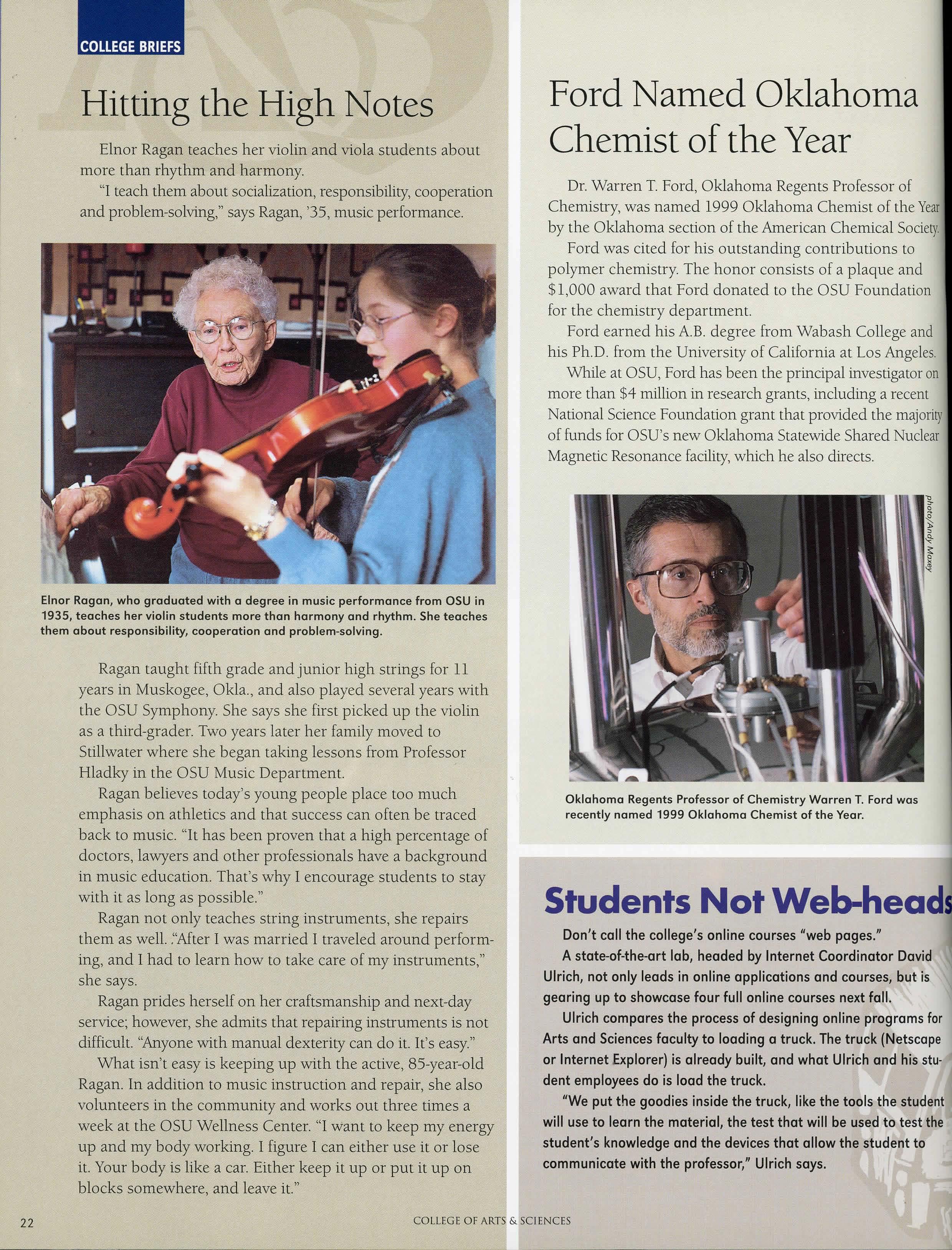
Oklahoma Regents Professor of Chemistry Warren T. Ford was recently named 1999 Oklahoma Chemist of the Year.
Sisson'sArtDefinesPersonalSpace
TElEPHONE fE r
A RoyalLearning~rience
land, in the
e the New W they realize that t n---~_,,.-= later pilgrim ,___ ort would come fro rld to re-esta ships.
That' uidents und hool of Journalis n(nc roa casring's banner did last ay. Under the direc io of Drs. arbara and John DeSamo the students spent two apd one-half weeks studying public r lations, advertisi gr,nd marketing communications •t Regent's College in L npon.
"The nited Kingdom Public Relations Semi was designed t provide tu~nts with a firs - and ands-on learning x erie ce,' says Barb DeSanto.
The advertising fi m of BDDH Partners pm ·<ledthe main course puoj ct that allowed students to apply newfound knowledge to a real-life client. The students, working in teams of three, had o come up with a communic tion plan to boost tloo tep m·lk sales in Engla d.
Not all of the time was spent in t were par a the studio audience for t e 1rst two 'Politically Incorrect" shows taped in London, and they ttiaveled to a broadcast studio for the taping of "JlV's Greatest Hits." During the show's warm-up, students and faculty we e asked to sing " klahoma" for the studio audience.
"This as a wonderful group of studen o crammed as much as they coula, bo(Rin and ou the classroom," says DeSanto. 'Tm thrilled to ~l o offer students this opportunity to interact with my UK colleagues and to experience a taste of what international public relations and advertising practice is all about."
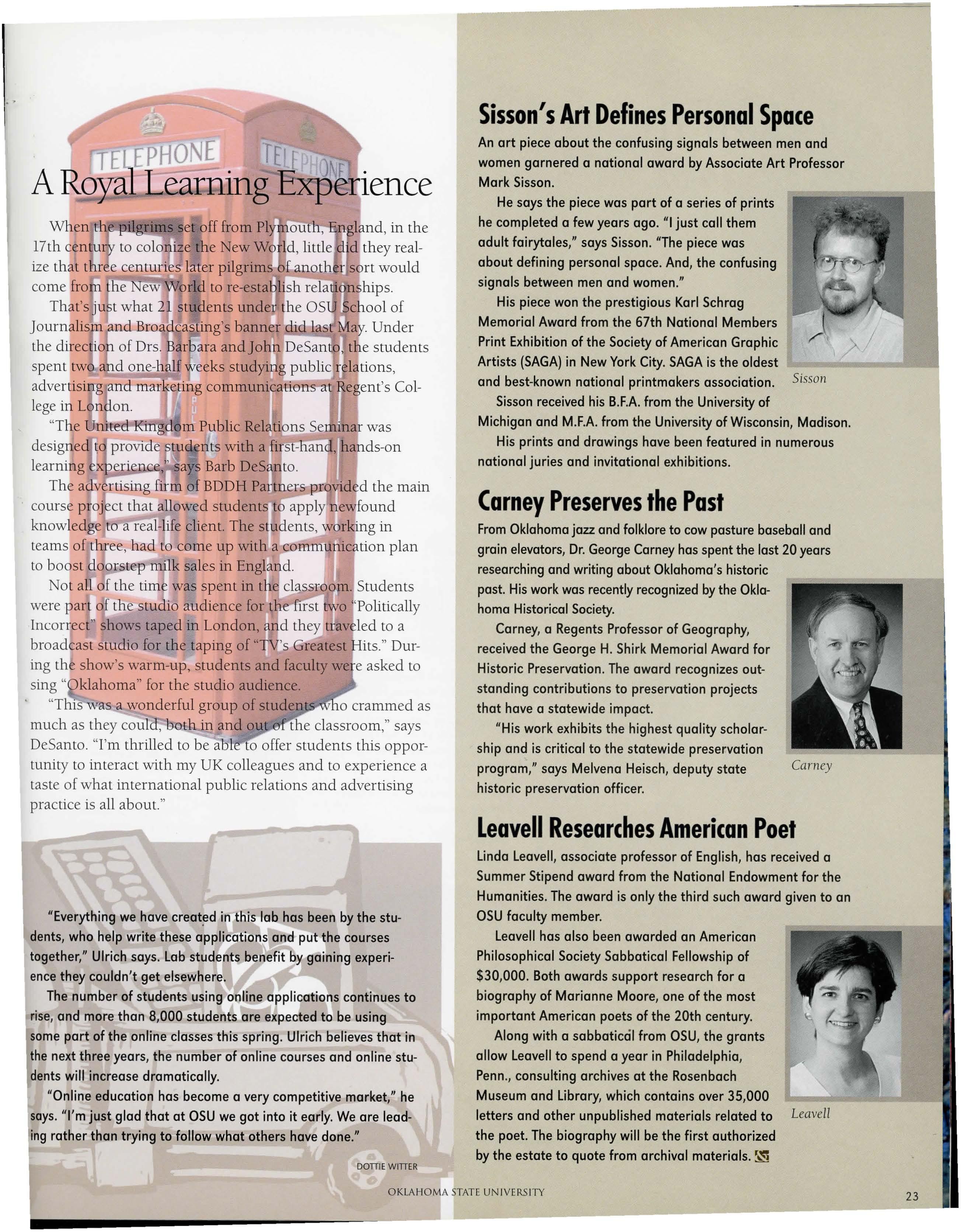
"Everything we hove creot~d in this lob hos been by the students, who help write these applications and put the courses together," Ulrich soys. Lob students benefit by gaining experience they couldn't get elsewhere.
The number of students using online applications continues to rise, and more than 8,000 students ore expected to be using some port of the online classes this spring. Ulrich believes that in the next three years, the number of online courses and online students will increase dramatically.
"Online education hos become a very competitive market," he says. "I'm just glad that at OSU we got into it early. We ore leading rather than trying to follow what others hove done."
An art piece about the confusing signals between men and women garnered a notional award by Associate Art Professor Mork Sisson.
He soys the piece was port of a series of prints he completed a few years ago. "I just coll them adult foirytoles," soys Sisson. "The piece was about defining personal space. And, the confusing signals between men and women."
His piece won the prestigious Kori Schrag Memorial Award from the 67th Notional Members Print Exhibition of the Society of American Graphic Artists (SAGA) in New York City. SAGA is the oldest and best-known notional printmakers association. Sisson Sisson received his B.F.A.from the University of Michigan and M.F.A. from the University of Wisconsin, Madison.
His prints and drawings hove been featured in numerous notional juries and invitational exhibitions.
CarneyPreservesthePast
From Oklahoma jazz and folklore to cow posture baseball and groin elevators, Dr. George Corney hos spent the lost 20 years researching and writing about Oklahoma's historic post. His work was recently recognized by the Oklahoma Historical Society.
Corney, a Regents Professor of Geography, received the George H. Shirk Memorial Award for Historic Preservation. The award recognizes outstanding contributions to preservation projects that hove a statewide impact.
"His work exhibits the highest quality scholarship and is critical to the statewide preservation program," soys Melveno Heisch, deputy state historic preservation officer.
Carney
LeavellResearchesAmericanPoet
Lindo Leavell, associate professor of English, hos received a Summer Stipend award from the Notional Endowment for the Humanities. The award is only the third such award given to on OSU faculty member.
Leavell hos also been awarded on American Philosophical Society Sabbatical Fellowship of $30,000. Both awards support research for a biography of Marianne Moore, one of the most important American poets of the 20th century.
Along with a sabbatical from OSU, the grants allow Leavell to spend a year in Philadelphia, Penn., consulting archives at the Rosenboch Museum and Library, which contains over 35,000 letters and other unpublished materials related to Leavell the poet. The biography will be the first authorized by the estate to quote from archival materials. J~
Hot Off the Press!
Arts & Sciencesfaculty are knownfor gettingtheirnames in print. Here'sa samplingof some of their latestworks.
"Vice:New and Selected Poems."W.W.Norton & Company.Ai,professarof English.Thisbookof poemsreceivedthe NationalBookAward,one of the most prestigiousliteraryhonors,rivaledonly bythe PulitzerPrize.Thepublicationincludes worksfromAi'spreviousfivebooksalongwith17 newpoems.Thedustjacketstates that• InAi's world,desirehas no boundaries.Knownas the foremostpoet of urbanterror Aitakesthe readeron a journeyintothe heart,torn fromthe bared chestsof the livingand sacrificedto the ravenousdead."
•A Post-<:oldWarAfrican State."GreenwoodPublishingGroup.Dr.TheodoreM. Vestal,professorof political science.Accordingto critics, repressionsof the Ethiopian governmentare on a scale equivalentto those of the world'sworstdictatorships. Vestalexaminesthe plightof the Ethiopianpeopleand countersquestionablegovernmentpronouncements. Hecancludeswithsuggestionsfor a revisedU.S.policy towardEthiopiaand for negotiationsbetweenthe governmentand its political oppositionto developa more democraticapproach.
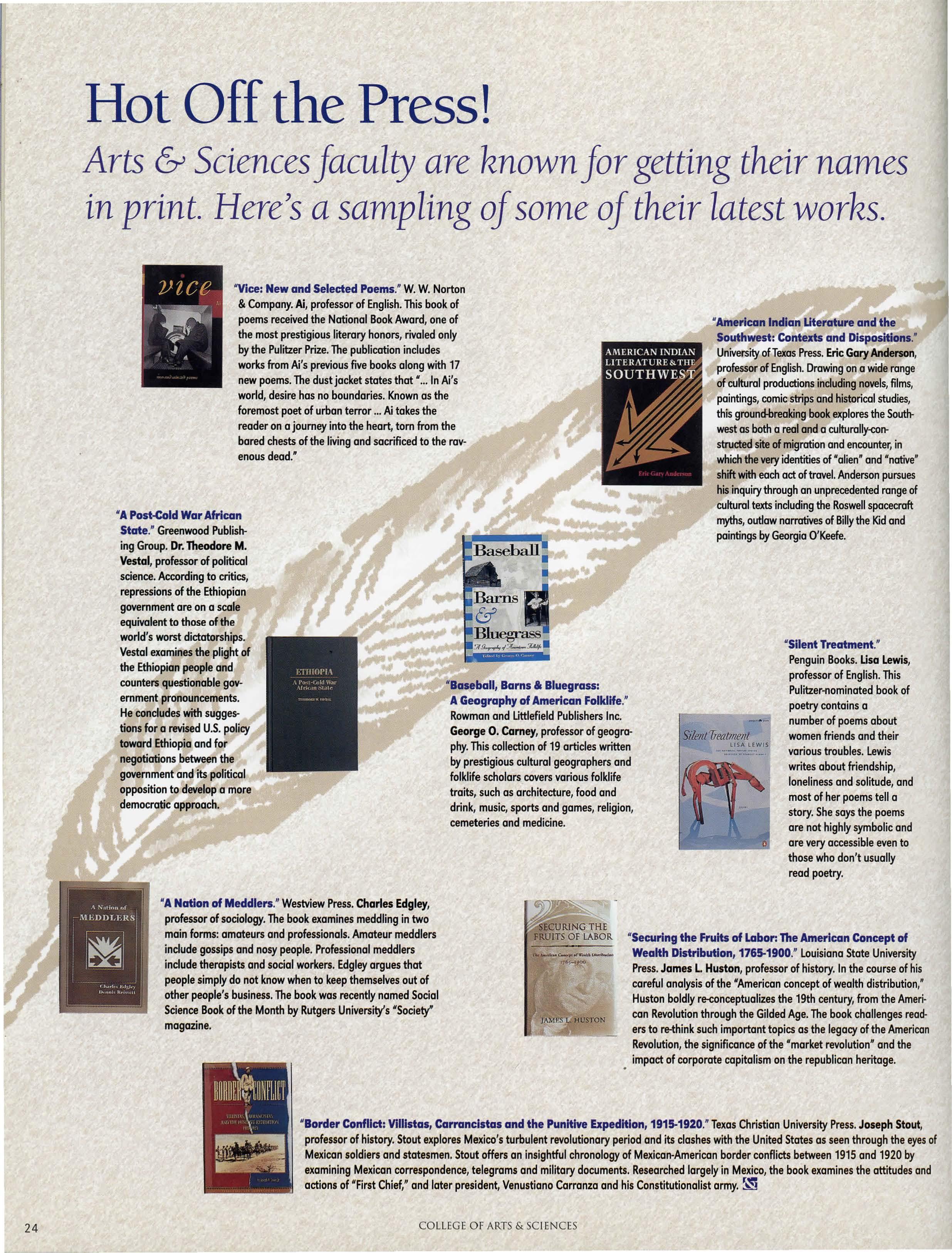
•A Nationof Meddlers."WestviewPress.CharlesEdgley, professorof sociology.Thebookexaminesmeddlingin two mainforms:amateursand professionals.Amateurmeddlers includegossipsand nosypeople.Professionalmeddlers includetherapistsand socialworkers.Edgleyarguesthat peoplesimplydo not knowwhento keepthemselvesout of other people'sbusiness.Thebookwas recentlynamedSocial ScienceBookof the Monthby RutgersUniversity's"Society" magazine.
"Baseball,Barns & Bluegrass:
A Geographyof AmericanFolklHe." Rowmanand LittlefieldPublishersInc. George0. Corney,professorof geography.Thiscollectionof 19 articleswritten byprestigiousculturalgeographersand folklifescholarscoversvariousfolklife traits, such as architecture,foodand drink,music,sports and games,religion, cemeteriesand medicine.
"AmericanIndianUteratureand the Southwest: Contextsand Dispositions.' UniversityofTexasPress.EricGaryAnderson, professorof English.Drawingon a widerange of culturalproductionsincludingnovels,films, paintings,comicstripsand historicalstudies, thisgroundbreakingbookexploresthe Southwestas botha realand a culturally-ronstructedsiteof migrationand encounter,in whichtheveryidentitiesof "alien'and "native' shiftwitheachact oftravel.Andersonpursues hisinquirythroughan unprecedentedrangeof culturaltextsincludingthe Roswellspacecraft myths,outlawnarrativesof Billythe Kidand paintingsbyGeorgiaO'Keefe.
Sile11tTreatJ11eJ1t
"SilentTreatment."
PenguinBooks.LisaLewis, professorof English.This Pulitzer-nominatedbookof poetrycontainsa numberof poemsabout womenfriendsand their varioustroubles.Lewis writesabout friendship, lonelinessand solitude,and mostof her poemstella story.Shesaysthe poems are not highlysymbolicand are veryaccessibleevento thosewhodon't usually read poetry.
JA"MF.S-'rJHUSTON
"Securingthe Fruitsof Labor:TheAmericanConceptof WealthDistribution,1765-1900."LouisianaState University Press.James L Huston,professorof history.Inthe courseof his carefulanalysisof the "Americanconceptof wealthdistribution,' Hustonboldlyr~onceptualizesthe 19thcentury,fromthe American Revolutionthroughthe GildedAge.Thebookchallengesreaders to re-thinksuch importanttopicsas the legacyof the American Revolution,the significanceof the "marketrevolution'and the impactof corporatecapitalismon the republicanheritage.
"BorderConflict:Vllllstas,Carranclstasand the PunitiveExpedition,1915-1920."TexasChristianUniversityPress.Joseph Stout, professorof history.StoutexploresMexico'sturbulentrevolutionaryperiodand its clasheswiththe UnitedStatesas seenthroughthe eyesof Mexicansoldiersand statesmen.Stoutoffersan insightfulchronologyof Mexican-Americanborderconflictsbetween1915and 1920by examiningMexicancorrespondence,telegramsand militarydocuments.Researchedlargelyin Mexico,the bookexaminesthe attitudesand actionsof "FirstChief,•and later president,VenustianoCarranzaand his Constitutionalistarmy.r~
College of Arts & Sciences
DEAN
John M. Dobson
ASSOCIATEDEAN FOR INSTRUCTION
Bruce C. Crauder
ASSOCIATEDEAN FOR RESEARCH
Stephen W. McKeever
DIRECTOR,STUDENTACADEMIC SERVICES
William A. Ivy
DIRECTOR,EXTENSION
Robert M. Brown
DIRECTOR,DEVELOPMENT
Deborah A. Desjardins
A&S
Departments and Heads
AEROSPACESTUDIES
Russell D. Miller
ART
Nicholas W. Bormann BOTANY
James D. Ownby CHEMISTRY
Neil Purdie
COMMUNICATION SCIENCESAND DISORDERS
Arthur L Pentz,Jr. COMPUTERSCIENCE
Blayne E. Mayfield ENGLISH
Edward P. Walkiewicz
FOREIGN LANGUAGESAND LITERATURES
Perry J. Gethner GEOGRAPHY
Thomas A. Wikle
GEOLOGY
Darwin R. Boardman HISTORY
William S. Bryans
JOURNALISM AND BROADCASTING
G. Paul Smeyak MATHEMATICS
Benny D. Evans
MICROBIOLOGYAND MOLECULARGENETICS
James T. Blankemeyer MILITARYSCIENCE
Charles T. Payne
MUSIC
William L Ballenger PHILOSOPHY
Doren A. Recker PHYSICS
Joel]. Martin POLITICALSCIENCE
Mike W. Hidinger PSYCHOLOGY
Maureen A. Sullivan SOCIOLOGY
Patricia A. Bell STATISTICS
William D. Warde THEATRE
Bruce Brockman ZOOLOGY
James H. Shaw
Ohlahoma State University Collegeof Arts & Sciences
204 Life SciencesEast
Stillwater, Ohlahoma 74078-3015
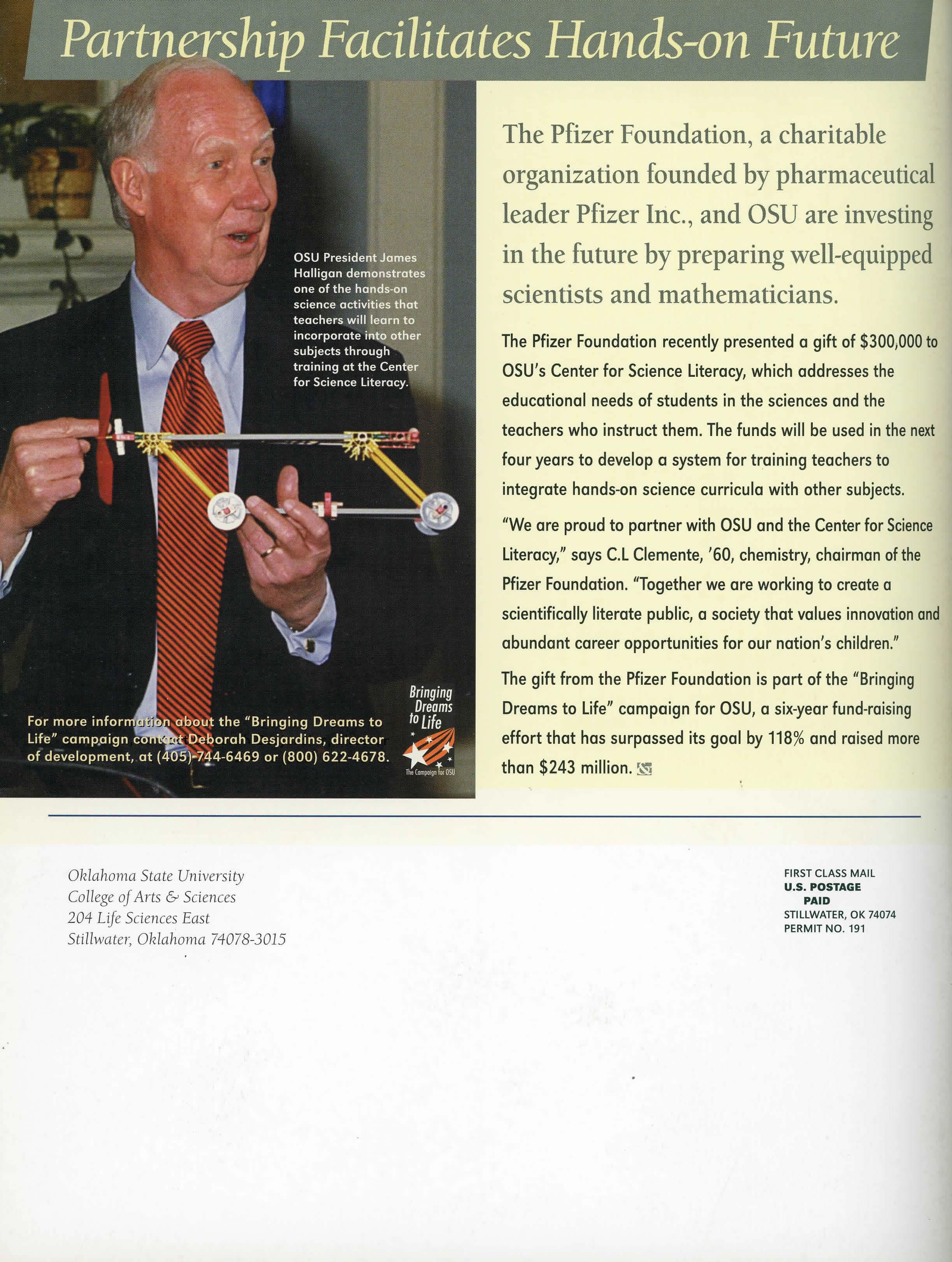
The Pfizer Foundation, a charitable organization founded by pharmaceutical leader Pfizer Inc., and OSU are investing in the future by preparing well-equipped scientists and mathematicians.
The Pfizer Foundation recently presented a gift of $300,000 to OSU's Center for Science Literacy, which addresses the educational needs of students in the sciences and the teachers who instruct them. The funds will be used in the next four years to develop a system for training teachers to integrate hands-on science curricula with other subjects.
"We are proud to partner with OSU and the Center for Science Literacy," says C.L Clemente, '60, chemistry, chairman of the Pfizer Foundation. "Together we are working to create a scientifically literate public, a society that values innovation and abundant career opportunities for our nation's children."
The gift from the Pfizer Foundation is part of the "Bringing Dreams to Life" campaign for OSU, a six-year fund-raising effort that has surpassed its goal by 118% and raised more than $243 million. •~