


Participant Resource Pack (Blended Learners)
Please come to the event having undertaken the following:
1. Familiarisation
Familiarise yourself with the leadership behaviours and principles in the leadership development record cycle 1 or resource 7 in the participant resource pack.
Familiarise yourself with the contents of the participant event resource pack and slide deck, particularly slides 8 to 18.
Listen to the headteacher presentation and take notes on the key messages about ethical principles and behaviours: https://youtu.be/o7r5yp1Jgk0.
2. Prepare
Bring a copy of your completed leadership development record (LDR) induction cycle.
Bring a copy of your leadership development record (LDR) cycle 1.
Bring a school priority area which you are leading or involved in and your school’s vision statement.
Prof. Jonathan Sharples, Jon Eaton and Jamila Boughelaf (2024). A school’s guide to implementation. London: EEF. https://educationendowmentfoundation.org.uk/education-evidence/guidance-reports/ implementation
Principles and behaviours
Committee on Standards in Public Life. (1995). The seven principles of public life. https://www.gov.uk/government/publications/the-7-principles-of-public-life [accessed 19.06.20]
‘Learn that’ ‘Learn how to’
1.7. A culture of mutual trust and respect between colleagues fosters effective relationships and supportive professional environments.
1.8. Building alignment of staff around the intended school culture can create coherence in a school and give direction and purpose to the staff’s work teaching pupils.
1.e. Articulating, modelling and rehearsing practices that contribute to the intended school culture and supporting every member of the school community, particularly middle leaders, to do the same.
1.f. Prioritising the use of intentional and consistent language that promotes challenge, aspiration and high expectations for pupils; and professional development and high professional standards for all colleagues.
7.1. Leaders have a duty of care to pupils and staff.
10.1. High quality effective and ethical governance is key to success in our school system.
10.3. School leaders are accountable for their decisions and actions and must submit themselves to the scrutiny necessary to ensure this.
10.e. Adhering to the Principles of Public Life at all times.
‘Learn that’
8.1. Implementation is an ongoing process that must adapt to context over time, rather than a single event. It involves the application of specific implementation activities and principles over an extended period (e.g. implementation planning, ongoing monitoring).
8.4 Effective implementation begins by accurately diagnosing the problem and making evidenceinformed decisions on what to implement.
8.a. Ensuring that implementation is a structured process, where school leaders actively plan, prepare, deliver and embed changes.
8.d. Identifying a specific area for improvement using a robust diagnostic process, focusing on the problem that needs solving, rather than starting with a solution.
8.k. Specifying the elements of the approach that appear critical to its success (i.e. the ‘active ingredients’) and communicating expectations around these with clarity.
Criteria
Significant facts you would tell your headteacher about the qualification and its assessment?
Advice you may give to support ‘a smooth run’ through the qualification?
Notes
Any questions for clarification?
Use this sheet to capture your thoughts and comments to support your feedback to colleagues.
Your leadership learning
Specify which content areas and ‘learn that’ and/or ‘learn how to’ statements have moved your understanding on.
Which research has had the most impact on your learning and leadership and why?
(Use your understanding identified at the end of the ‘Implementation’ short course.)
How have you applied your understanding and what impact has it had on:
a) your leadership?
b) school practice?
What behaviours have you demonstrated and how have these had an impact on your leadership?
Refer to your leadership development record review, where you have considered two or three behaviours, and Resource 8.
What areas from ‘Implementation’ do you need to continue to work on and develop? How will you address these?
Revisit your leadership development record review of the ‘Implementation’ cycle to support
Recommendation 1 - Adopt the behaviours that drive effective implementation.
Implementation is fundamentally a collaborative and social process driven by how people think, behave, and interact. These behaviours are at the heart of what drives effective implementation so should feature across a school’s implementation actions and interactions.
How can you involve teachers, TAs, parents, and pupils to fully understand the problem(s) and any potential barriers to change?
How can you get everyone on the same page in terms of knowing why you are making these changes, what it will look like, and how you will get there?
How can you implement the changes in such a way that you can keep learning and improving over time?
Recommendation 2 - Attend to the contextual factors that influence implementation
The behaviours that drive implementation are influenced by what is being implemented, the existing systems and structures, and whether there are people in place who can enable change.
Engage- Engage people so they can shape what happens while also providing overall direction. Unite - Unite people around what is being implemented, how it will be implemented, and why it matters.
Reflect - Reflect, monitor, and adapt to improve implementation.
Who is well placed to help with implementation?
How can you protect time for staff to engage in professional development sessions?
How can you use existing data systems to understand whether the programme is being delivered as intended by the developers?
What specific resources, equipment, and
administrative support will be needed?
What is being implemented - Consider whether what is being implemented is evidence-informed, right for the setting, and manageable to implement.
Systems and structures - Develop an infrastructure that supports implementation, for example, time allocation and data systems.
People who enable change - Ensure people who enable change can support, lead, and positively influence implementation.
Recommendation 3 -Use a structured but flexible implementation process
EXPLORE:
Assess needs and setting
Assess the approach
Are we confident that we have identified the right pupil need(s) by drawing
on a range of data and perspectives?
Have we selected an evidence-informed approach that meets pupil needs
and is suitable for our setting?
What is needed to implement this particular programme or practice?
Are we aware of potential barriers and enablers to change in our setting?
Is the approach feasible to implement?
PREPARE:
Plan and design
Practically prepare
Have we conducted implementation planning collaboratively so that it unites understanding?
Is there a shared understanding of why the change is taking place, what it entails, and how it will be implemented?
Have we selected a tailored package of strategies to implement the approach and address implementation barriers?
Have we identified and empowered a range of people across the school who can support the changes?
Are systems and structures in place to enable effective implementation?
DELIVER:
Monitor and improve
Support and encourage
Is delivery of the approach treated as a process of ongoing learning and improvement?
Are systems in place to monitor implementation, identify barriers and enablers, and make improvements?
Do staff feel supported by the actions of
leadership?
Is initial professional development being reinforced by follow-on support
such as feedback, prompts, and reminders?
SUSTAIN:
Maintain the effort Review and act
As new priorities emerge, is sufficient support in place to protect and maintain the implementation effort?
Do leaders continue to acknowledge and support good implementation practices?
Are a range of staff involved so that we aren’t over-relying on individuals?
Before deciding whether to continue, scaleup, or stop an approach, have we reviewed the previous implementation effort and outcomes achieved
so far?
Resource taken from the EEF’s A school’s guide to implementation master checklist
The problem solving team building (PSTB) process has seven steps for the team to work through. This is a 30-minute example.
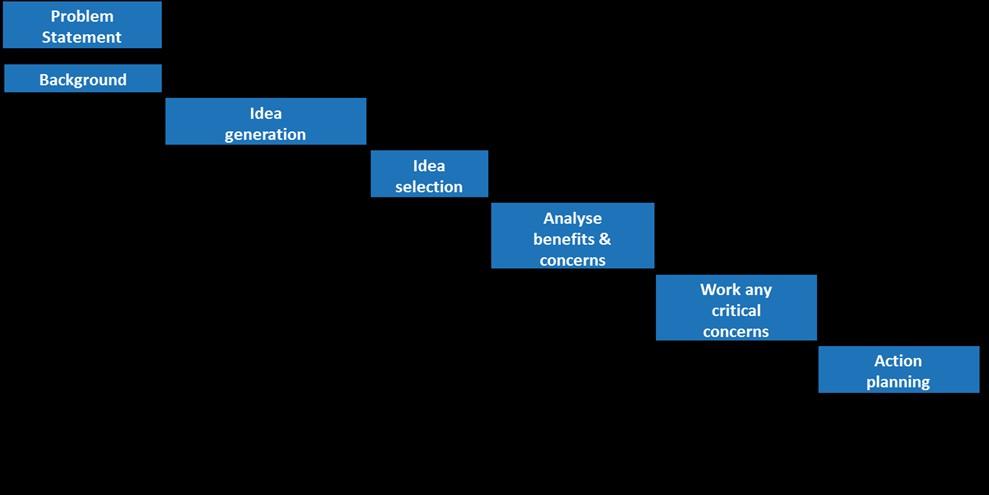
Notes on the PSTB process:
The problem statement is presented by the problem owner as a “How do I …” or similar type question.
Subsequent questions from the resources are for clarification only or for further relevant information or background.
Idea generation should take place as a brainstorm activity to identify approaches or alternatives that might address the problem; quantity over quality; no discussion of suggestions.
Ideas are selected by the problem owner only – identify the most useful 2 or 3 ideas and circle them; the owner does not need to justify his/her choices.
Benefits and concerns are brainstormed quickly for each of the selected ideas.
Identify critical concerns for each idea:
“A concern that, if not resolved, would necessitate modifying or discarding the selected idea/solution…”
If these could be overcome, proceed to action planning.
If they couldn’t be overcome, develop one of the other ideas.
Develop a high-level action plan for each idea – a blueprint for the solution, ensuring actions address the concerns/critical concerns identified.
Work quickly in brainstorm mode; try not to get stuck in discussion.
Ensure that actions are assigned to increase ownership for the solution.

Behaviour
Explanation
Selfawareness
Effective leaders know themselves and their teams, continually reflect on their own and others’ practices, and understand how best to approach difficult or sensitive issues. They are aware of their personal strengths and areas for future growth and understand how their own behaviour affects others.
Comments/Actions
Integrity
Resilience
Effective leaders act with honesty, transparency and always in the interests of the school and its pupils. They are able to gain the respect of others by acting in line with their own values, as well as making decisions and choices with the best interests of education and pupils in mind.
Effective leaders remain courageous and positive in challenging, adverse or uncertain circumstances. They are able to respond appropriately, manage uncertainty and bounce back even in the most trying situations.
Impact and influence
Delivering continuous improvement
Effective leaders have a positive impact on students, colleagues and the wider community through persuading, convincing and bringing others round to their perspective. They understand others’ perspectives and priorities and tailor their communication to suit their audience.
Effective leaders secure and maintain positive improvement through articulating a clear vision, setting high expectations and leading a cycle of research, planning, monitoring, analysis and change. They demonstrate the ability to combine operational action with strategic planning, securing short-term improvements while building sustainable change.
Effective leaders recognise issues and opportunities and take action to resolve these. Leaders need to look ahead to identify and resolve potential issues and capitalise on opportunities as well as manage day-to-day problems.
Holding others to account
Respect
Effective school leaders hold others to account – including creating levels of accountability within the school – ensuring that everyone understands their roles, responsibilities, the standards required and accountabilities. They distribute leadership and delegate effectively, demanding high performance through making expectations clear, with the best interests of pupils and schools in mind.
Effective leaders respect the rights, views, beliefs and faiths of all pupils, colleagues and stakeholders.
Partnership working and collaboration
Leading by example
Effective leaders are able to work with a range of people in schools and the wider community to build a culture of cooperation and achievement. They engage with, and invest responsibility in, those who are best placed to improve outcomes, being open to different perspectives and viewpoints as well as sharing expertise and achieving common objectives.
Effective leaders consistently demonstrate and communicate their vision, passion and commitment. They lead by example, have high levels of professional credibility and demonstrate total commitment to school improvement through their own leadership behaviours.
Critical knowledge and understanding of research techniques and selfmanagement
Critical enquiry, review, analysis and evaluation
The best leaders undertake and use research, drawn from a range of sources, to support decision making and strategy development – using their time effectively within disciplined and well-organised systems and methodologies.
The best leaders use critical thinking, statistical and data analysis tools, techniques and concepts to identify strengths and areas for development. They design effective leadership plans to support intervention, direction and development. They analyse the implications of change, deploying wellevidenced research to frame school self-evaluation and improvement.
Challenge
Dealing systematically and creatively with complex issues
Priority identification
Clear articulation and application of knowledge
The best leaders use challenge effectively and adopt a range of strategies in the best interests of achieving progress – demanding ambitious standards for all pupils and a strong sense of accountability in staff for the impact of their work on pupils’ outcomes.
The best leaders have clear systems and protocols in place that enable them to consider and find solutions to issues, as they arise, in a way which deals most effectively with the barriers and challenge they face. The systems in place do not constrain but create a firm foundation for taking positive action.
The best leaders scan the horizon to anticipate change, taking a long-term view of the implications of change and improvement need to identify short- and long-term priorities and goals with specified milestones to ensure effective leadership and management.
The best leaders take time to reflect and learn from their leadership activity and apply this knowledge to bring about improvements in themselves and their work.
Self-direction and originality
The best leaders have clear and ambitious targets for themselves as leaders, for their pupils and for their schools. They take a unique strategic view of situations and their implications for long-term impact and outcomes – sometimes using unexpected actions to get the best for those concerned.
The best leaders take time to reflect and evaluate their practice and effectiveness in their leadership and as leaders. They are aware of the education landscape, understand the context of their school and its needs and direct professional practice and intervention appropriately.
Ethical leadership and behaviours short course
This module focuses on leadership behaviours for senior leaders.
Introduction to ethical leadership
This section introduces participants to the key ‘learn that’ and ‘learn how to’ statements which will be covered in the module.
Effective leadership
This section looks at what the evidence and research say with a focus on ethical leadership, moral purpose, and the importance of trust. It looks at practitioners’ views on these areas and has a practice scenario that participants can do.
The headteachers’ standards
This is a review of the headteachers’ standards and where they are expected to uphold high standards of ethics and behaviours.
The Nolan principles
This section looks at the Nolan principles and asks participants to consider these in relation to their own practice.
Ethical leadership frameworks
In this section participants will be introduced to the ethical leadership framework created by the Ethical Leadership Commission. There are links to additional reading to support this framework. Participants can opt to do a practice activity on completing an ethical leadership audit.
Your values and behaviours
This section asks participants to consider their own values and behaviours. There are a couple of activities for participants to complete to identify their values and leadership style.
Select one of the following three activities to submit to your leadership development coach.
Choose an activity based on your areas of interest and the results of the diagnostic review undertaken at the start of the course.
Complete the Leading with love, ethical leadership audit.
Reflect on the results.
How could you modify your behaviours and adapt your practice to develop an ethical approach to leadership?
Submit a summary of your reflection to your leadership development coach (maximum 200 words).
Leading with love leadership audit
In lesson one of the self-study pack, Effective leadership, leaders provided examples of how their values and behaviours had impacted on their leadership practice.
How have your own values and behaviours impacted on your practice?
Submit a summary of your reflection to your leadership development coach (maximum 200 words).
Complete the Leadership styles survey to identify your own leadership style.
Reflect on the results.
How could you exploit your self-knowledge and an understanding of your leadership style to increase your effectiveness as a leader?
Submit a summary of your reflection to your leadership development coach (maximum 200 words).
Leadership styles survey