

Introduction Participant Resource Pack
Induction cycle leadership development record (LDR) – participants’ own completed versions
Cycle One leadership development record (LDR) – blank template
Cycle One formative assessment task options

Introduction Participant Resource Pack
Induction cycle leadership development record (LDR) – participants’ own completed versions
Cycle One leadership development record (LDR) – blank template
Cycle One formative assessment task options
Please come to the event having undertaken the following:
Familiarise yourself with the contents of the participant event resource pack and slide deck
Read three of the research summaries in the table below (one from each DfE content area), making notes on the key points and any implications for your leadership practice
Watch/read with one of the four sets of four leader case studies in Resource 4
Please ensure that you bring the slide deck and participant resource pack to the face-to-face event (either electronically or as paper copies)
Have available an up-to-date copy of your completed induction cycle LDR completed, and a blank cycle one LDR ready for completion during the event.
Read one of:
Education Endowment Foundation (2018). Toolkit: Social and emotional learning.
Whole web page
Education Endowment Foundation (2019). Toolkit: Improving behaviour in schools.
Summary of recommendations
https:// educationendowmentfoundation.o rg.uk/education-evidence/ teaching-learning-toolkit/socialand-emotional-learning
https:// d2tic4wvo1iusb.cloudfront.net/ eef-guidance-reports/behaviour/ EEF_Improving_behaviour_in_scho ols_Summary.pdf?v=1668088347
Moore, D., Beham-Clarke, S., Kenchington, R., Boyrle, C., Ford, T., Hayes, R. and Rogers, M. (2019) Improving Behaviour in Schools: Evidence Review.
Institute of Education Sciences (2008). Reducing behaviour problems in the elementary school classroom.
Pages 29-32
Overview: pages 5-10
https:// d2tic4wvo1iusb.cloudfront.net/ documents/guidance/ Improving_Behaviour_in_Schools_ Evidence_Review.pdf? v=1668029759
https://ies.ed.gov/ncee/wwc/ Docs/PracticeGuide/ behavior_pg_092308.pdf
And read one of:
Carroll, J., Bradley, L., Crawford, H., Hannant, P., Johnson, H., & Thompson, A. (2017). SEN support: A rapid evidence assessment.
Moore, D., Beham-Clarke, S., Kenchington, R., Boyrle, C., Ford, T., Hayes, R. and Rogers, M. (2019) Improving Behaviour in Schools: Evidence Review.
Institute of Education Sciences (2008). Reducing behaviour problems in the elementary school classroom.
And read one of:
EEF (2024). A school’s guide to implementation online course.
Sharples, J. M., Albers, B., Fraser, S., and Kime, S. (2018). ‘Putting evidence to work – a school’s guide to implementation’. London: EEF
Albers, B., and Pattuwage, L. (2017). ‘Implementation in education: findings from a scoping review’. Melbourne: Evidence for Learning.
Pages 13-18
Pages 4-9
Pages 37-43
https:// assets.publishing.service.gov.uk/ government/uploads/system/ uploads/attachment_data/file/ 628630/ DfE_SEN_Support_REA_Report.pd f
https:// d2tic4wvo1iusb.cloudfront.net/ documents/guidance/ Improving_Behaviour_in_Schools_ Evidence_Review.pdf? v=1668029759
https://ies.ed.gov/ncee/wwc/ Docs/PracticeGuide/ behavior_pg_092308.pdfpage=43
Module 1: Introduction
Summary of recommendations (pages 6–8)
Recommendation 1 (pages 10-11)
Section 5.3 (pages 21–28)
https:// educationendowmentfoundation. org.uk/courses/a-schools-guideto-implementation-online-course
https://dera.ioe.ac.uk/31088/1/ EEF-Implementation-GuidanceReport.pdf
https://www.researchgate.net/ publication/ 319176978_Implementation_in_E ducation__Findings_from_a_Scoping_Revie w
3.5. Teaching model behaviours will reduce the need to manage misbehaviour.
3.6. Teachers should encourage pupils to be selfreflective of their own behaviour.
3.9. The ability to self-regulate one’s emotions affects pupils’ ability to learn, success in school and future lives.
Support the development of a positive, predictable and safe environment for pupils by:
3.a. Contributing to the creation of a whole school approach to recognition, rules and sanctions that is built on strong relationships between pupils and staff, complements the intended school culture and includes a clear approach to escalation of behaviour incidents.
3.b. Ensuring that this positive, predictable and safe environment is consistently maintained across the whole school including during extra-curricular activities, in communal spaces, on school trips and travelling to and from school.
3.c. Explicitly teaching model behaviours (including self-regulation) to pupils.
4.2. If pupils need more intensive support with their behaviour, the approach may need to be adapted to individual needs.
4.3. Pupil behaviour has multiple influences. Teachers can manage some of these influences directly, some indirectly, and there are some that may be outside the purview of teaching staff.
4.5. Understanding a pupil’s context will inform effective responses to complex behaviour or misbehaviour.
Support pupils who need more intensive support with their behaviour by:
4.b. Liaising with parents, carers and specialist colleagues to better understand pupils’ individual circumstances and how they can be supported to meet high academic and behavioural expectations.
‘Learn that’ ‘Learn how to’
6.1. Implementation is an ongoing process that must adapt to context over time, rather than a single event. It involves the application of specific implementation activities and principles over an extended period (e.g. implementation planning, ongoing monitoring).
6.4. Effective implementation begins by accurately diagnosing the problem and making evidenceinformed decisions on what to implement.
6.5. Thorough preparation is important: time and care spent planning, communicating and resourcing the desired changes provides the foundation for successful delivery. Teachers and leaders should keep checking how ready their colleagues are to make the planned changes.
Plan and execute implementation in stages by:
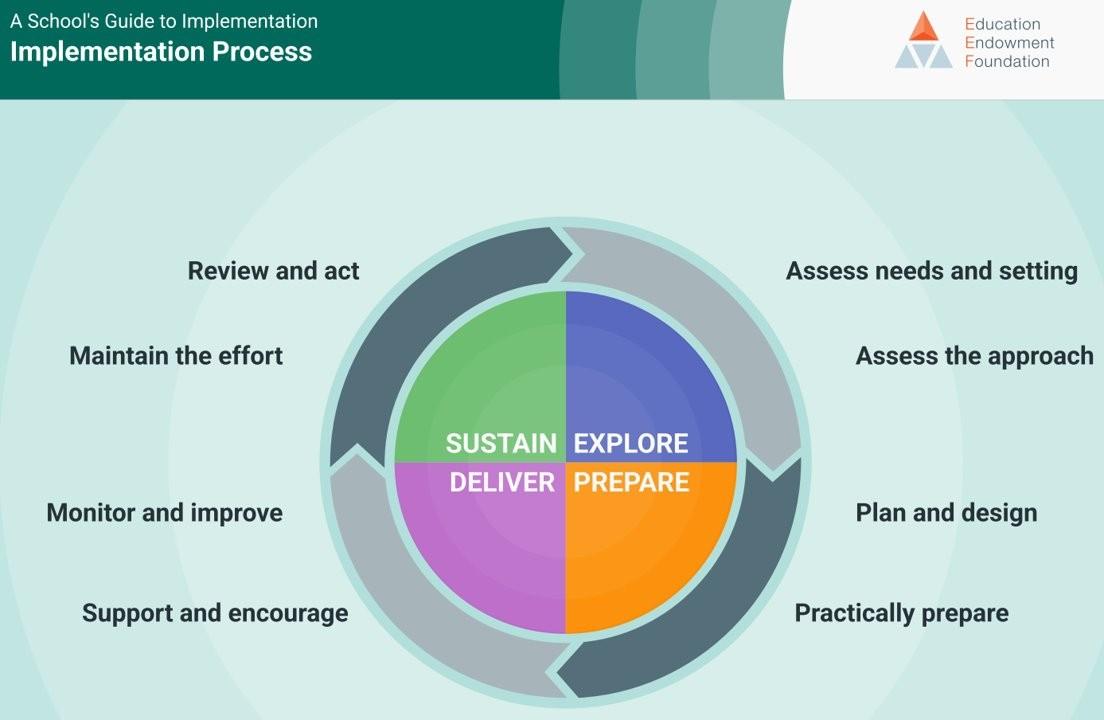
6.a. Ensuring that implementation is a structured process where school leaders actively plan, prepare, deliver and embed changes.
Make the right choices on what to implement by:
6.d. Identifying a specific area for improvement using a robust diagnostic process, focusing on the problem that needs solving, rather than starting with a solution.
Prepare appropriately for the changes to come by:
6.l. Developing a clear, logical and well specified implementation plan, and using this plan to build collective understanding and ownership of the approach.
Sustain changes by:
6.r. Using reliable monitoring and evaluation to review how the implementation activities are meeting the intended objectives and continue to align with school improvement priorities.
Your leadership learning and practice
Use your completed Induction Cycle LDR (leadership development record) and Practice Activity feedback as prompts to focus your individual review.
In which areas and for which statements has your understanding developed the most?
How have you applied your understanding and what impact has it had on:
a) your leadership?
b) school practice?
What leadership behaviours (Resource 8) have you demonstrated?
What areas do you need to continue to work on and develop?
How will you address these?
Highlight here the key points arising from the research and case studies to consolidate your new knowledge, articulate what you have understood about each of the content areas’ key themes and raise any misconceptions for correction.
Content areas Themes
Enabling conditions for good behaviour
(Session three)
(Session four)
Leader case study set
Name of leader and setting Phase
Set 1 Carmen Palmer
St Richard’s CE Primary School
Set 2 Jenny Hindley
Evelyn Street Primary School
Set 3 Liz Healey
Tytherington School
Set 4 James Nichols
The Gillford Centre
Primary
Primary and Behaviour Hub
Case study
Secondary
Alternative setting: PRU with SEND
Enabling conditions for good behaviour
https://youtu.be/gAwU9Bg7o60
Complex behavioural needs
https://youtu.be/yjERZ0i_qZc
Enabling conditions for good behaviour
Complex behavioural needs
Written case study (below this table)
Enabling conditions for good behaviour
https://youtu.be/FDVuBxlxep0
Complex behavioural needs
https://youtu.be/GD03cHtJVL4
Enabling conditions for good behaviour
https://youtu.be/Uu0EGxyX2Pk
Complex behavioural needs
https://youtu.be/qGaooUYD5Ng
Evelyn Street Primary School is in Warrington. The school is:
part of the Warrington Primary Academy Trust
a Behaviour Hub for the North West
the lead school for the Generate Teaching Hub
By Jennifer Hindley, headteacher
Session three (Enabling conditions for good behaviour)
At Evelyn Street, supporting the development of a positive, predictable and safe environment for pupils is vital for our practice because good behaviour is crucial to child development, well-being, educational attainment and future life chances.
We have achieved success in this by encouraging all our team members to contribute to the creation of a wholeschool approach to recognition, rules and sanctions, built on strong relationships between pupils and staff. This complements the school culture of high expectations of every child, improving their lives and their outcomes. Our behaviour strategy starts in nursery and involves modelling and practising behaviour norms (e.g. we practise “silence”). Our teachers and support staff watch for opportunities to make early interventions to avoid escalation occurring, but when these situations happen there is a consistent approach to resolving them, using a clear written set of protocols which are staged and encourage behaviour to be modified. Children complete reflection sheets about their behaviour and teachers record their positive handling plans to assist in future de-escalation.
The need for a happy, settled and safe environment is important for our pupils to be able to learn so we maintain this consistently across the whole school by children learning and practising understood routines. This includes appropriate norms of behaviour in corridors, at lunchtime, in the playground, at after-school clubs, on school trips and travelling to and from school.
Success in behaviour management has also been achieved by:
building in self-regulation and behaviour recognition on the part of the children, supported by positive reinforcement by all staff
visible leadership by staff in modelling their own behaviour so that the children see only work-related behaviour. They certainly would notice other types of behaviour which they could be tempted to copy. Staff are encouraged to challenge each other in a professional way.
praise being given for good pupil behaviour and star rewards for behaviour which goes above and beyond the school’s behaviour standards. Consistently good behaviour by previously disruptive children is also rewarded.
recognition of effort and improvement which builds confidence in children at all ability levels
team reviews of the progress and behaviour of all vulnerable children every two weeks, adopting proactive monitoring, assessment of support needed, learning mentor advice, recording of discussions and using our bank of resources and wider knowledge of these children which the school has built up.
Effective liaison with parents has been essential where there have been serious problems and resolving them has involved parallel solutions to achieve improved behaviour at school and at home.
the involvement of senior leaders in these discussions, especially when nearing the transition points of children between phases and between school years. We build the confidence of children who may not be able to cope in a new class by familiarising them with the school layout, assigning them simple tasks, reading them “social stories” and helping them to develop friendships. Transition to secondary school requires extra input to establish relationships and maintain the capacity to learn.
Our behaviour policy and practice has focused on bullying as something to eradicate by proactive measures and something to confront when instances occur. Staff are adept at watching for signs of bullying to nip in the bud and if a child has a concern it is always looked into rather than being dismissed as inconsequential. Our children know they have a voice and regular “Children’s Voice” surveys reveal some concerns which teachers and learning mentors investigate and resolve. The school’s buddy system has also been valuable in minimising bullying.
At Evelyn Street we don’t always get things right. When significant behaviour issues arise and the solution appears difficult, a team of staff will go into a “huddle” to discuss the best way forward. After that we will ask ourselves, “What could we have done earlier to mitigate the situation? What behaviour triggers have we missed?” We record our discussions and use this to improve.
Part two (Complex behavioural needs)
Everyone in school life is important in supporting all pupils, and especially those who need more intensive support with their behaviour. We are achieving this by liaising with parents, carers and specialist colleagues in order to better understand each child’s individual circumstances and how s/he can be supported to meet high academic and behavioural expectations.
For example, a boy called Simon* moved from London to join us in year one. He had an ASD diagnosis and refused to follow instructions, exhibiting violent behaviour, including throwing things at children and staff. He would hide under a table and refuse to talk to his teacher. Sometimes his behaviour was acceptable but it was hard to find the triggers which prompted his outbursts. His parents had split up and it emerged that each parent took a different approach in trying to manage his behaviour. It was apparent that Simon was confused in that there were different sets of expectations in his home life and a third set of expectations at school.
In starting to build a support plan we invited Simon’s parents to a meeting at school and discussed the adoption of consistency in the process of managing his behaviour at home and at school in terms of rewards and sanctions. Together we listened to Simon telling us what he could cope with regarding the challenge to himself to improve his behaviour. We had observed that he had difficulty recovering from incidents of conflict. We decided to try a visible written timetable for Simon himself to manage, involving built-in breaks during the school day but making up for time lost with assigned tasks of work. These breaks and tasks could be adjusted to align with his teacher’s reasonable expectations of effort required and to allow for interventions to avert a crisis.
Before long we realised that we had built in success in following this strategy and continued monitoring established that Simon’s behaviour at home also improved. As his years in school continued we found that he was gradually able to manage his behaviour more independently. Now in year five, his escalations of poor behaviour are very rare and progress measures indicate that his behaviour history has not impacted adversely on his educational attainment.
A second child, called Ryan,* started in our nursery and was part of a very vulnerable family with complex needs and Social Care involvement. There was a history of child abuse and ongoing child protection plans. Ryan’s older
siblings had exhibited behaviour problems, one being permanently excluded, and Ryan’s mother suffered from depression. Ryan himself displayed gender identity issues as he progressed through school, it being difficult to discern whether this was genuine or attention-seeking. He could be very disruptive in class, shouting and clowning but then resenting the attention that resulted.
His support plan was discussed with his parents and with Social Care specialists. Using consistently applied rules and routines, backed by our de-escalation protocols involving time out of class, together with weekly Learning Mentor support and more proactive parents, have combined to improve Ryan’s behaviour significantly. As in the former example, a key determinant of success is discovering by listening to the child what works for him. This is the route to engagement – along with our teachers understanding that reasonable adjustments need to be made on their part. They have developed the skill to gauge accurately the mood of potentially disruptive pupils at different points in the day.
Ryan is now in year six and we are dedicated to preparing him for life in secondary school – with effective transition arrangements in place. After initial support he will probably not rely too much on adults and gradually work towards his own autonomy in the wider world. As Ryan leaves Evelyn Street we are confident that his academic attainment will exceed age-related expectations across the board.
Resource 5: POP – your vision for behaviour
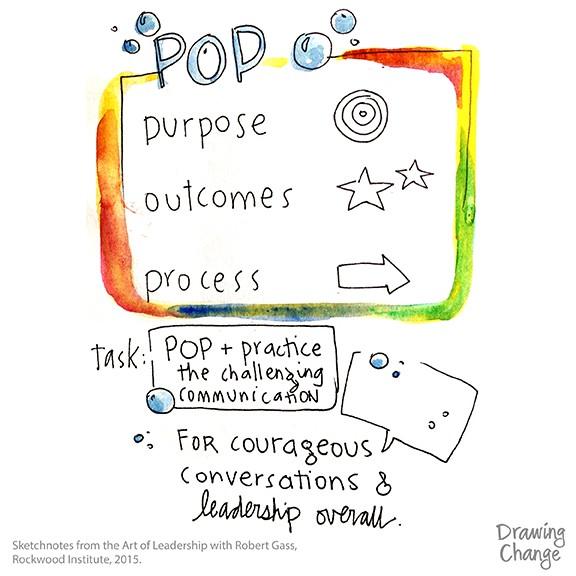
Purpose

Why do we want to improve behaviour and culture?
What is our purpose?
Why do we do what we do?
Are we all agreed on our purpose? How do we know?
What vision do we have to achieve our purpose?

What are the specific outcomes we would like to achieve as a result of improving behaviour and culture?
What do we want to achieve if we successfully implement our vision?
How would these desired outcomes help us with achieving/developing our purpose?
What would I see if my vision was realised (practices)?
What would I hear if my vision was realised (language)?
What would I feel/sense if my vision was realised (culture/norms)?
What steps will we take to achieve these outcomes and fulfil the purpose?
How might the vision be implemented?
What do we need to do to achieve the desired outcomes of the vision?
How will these steps support our purpose?
How will we keep our purpose at the centre of our actions?
What do I know about effective implementation to ensure my aspiration/vision is realised effectively?
Which statements (below) would I need to consider to successfully implement my vision?
How will we ensure that we are explicitly teaching model behaviours consistently throughout school to reduce the need to manage misbehaviour? (3.5, 3c)
How will we support teachers in encouraging pupils to be self-reflective of their own behaviour? (3.6)
How will we promote, build and model a culture of self-regulation of emotions for all, so that all pupils can learn and be successful in school and their future lives? (3.9)
How will we support the development of a positive, predictable and safe environment for pupils through the creation of a whole-school approach to recognition, rules and sanctions, where relationships are strong between pupils and staff, and relationships complement the school culture? (3a)
How will we ensure that we have a clear approach to the escalation of behaviour incidents that is aligned with a school culture of strong relationships? (3a)
How will we ensure our positive, predictable and safe culture is consistently maintained across the whole school (including extra-curricular activities, in communal spaces, on school trips and travelling to and from school)? (3b)
In what ways will this vision enable conditions for good behaviour across my setting?
How will we support pupils who need more intensive support with their behaviour? (4b)
How will we support pupils through liaison with parents, carers and specialist colleagues to better understand pupils’ individual circumstances and how they can be supported to meet high academic and behavioural expectations? (4b)
How do we ensure that our knowledge of complex behavioural needs complement our knowledge of enabling conditions for good behaviour?
In what ways will this vision help pupils with complex behavioural needs?
How will we ensure that implementation in my school is treated as an ongoing and structured process that must adapt to context over time, rather than being treated as a single event? (6.1, 6a)
How will we ensure that all implementation begins with accurately diagnosing the problem and making robust, evidence-informed decisions on our implementation focus? (6.4, 6d)
What will we need to do to ensure preparation is thorough in terms of time, care spent planning, communications, and resourcing? (6.5)
How do we ensure our implementation plan is clear, logical and well-specified in order to build collective understanding and ownership of the approach? (6l)
How will we ensure our monitoring is reliable and clear in order to be able to improve the approach over time whilst still meeting the intended objectives? (6r)
How will I ensure I stay focused on successfully developing behaviour and culture for improving pupil outcomes?
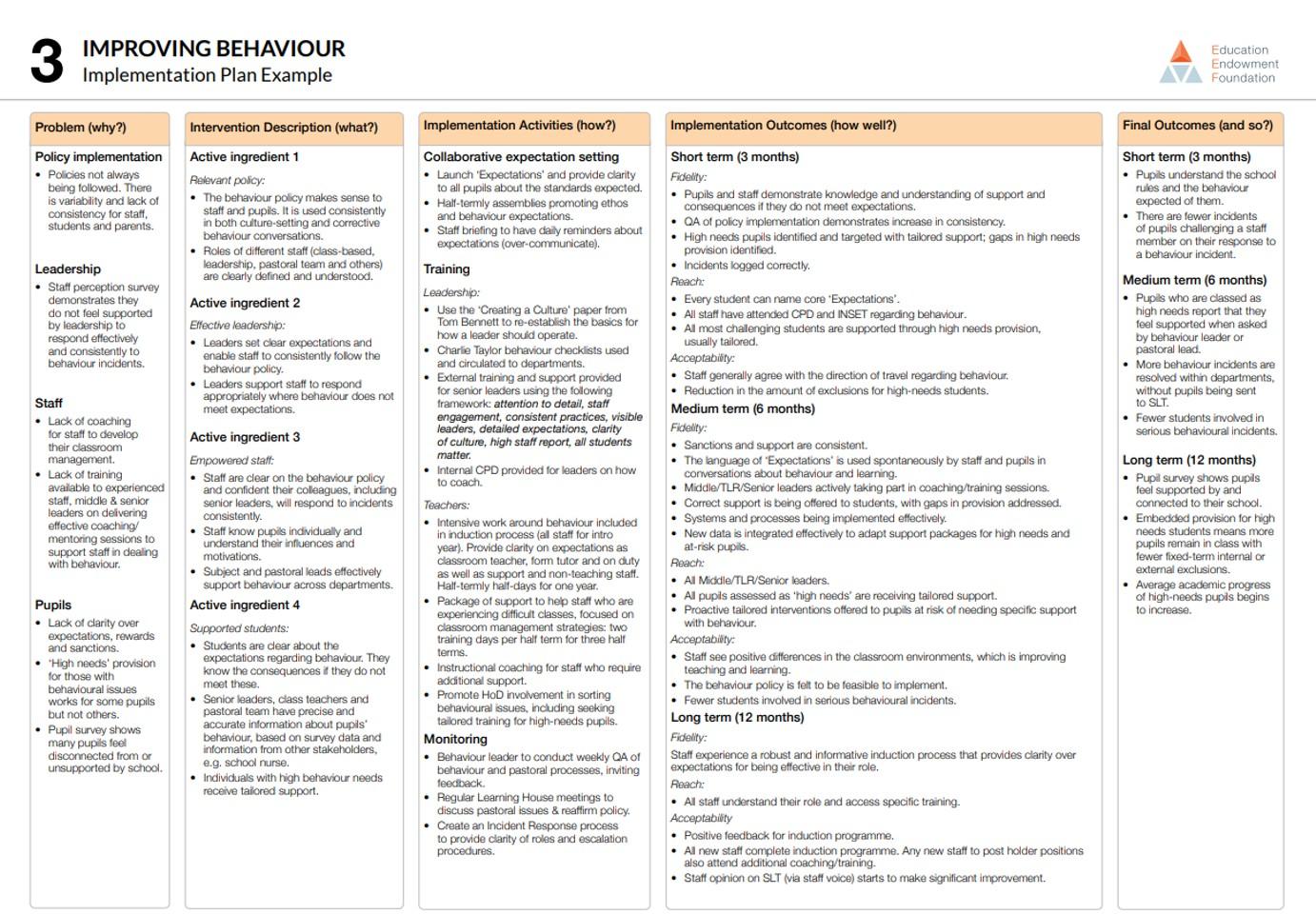
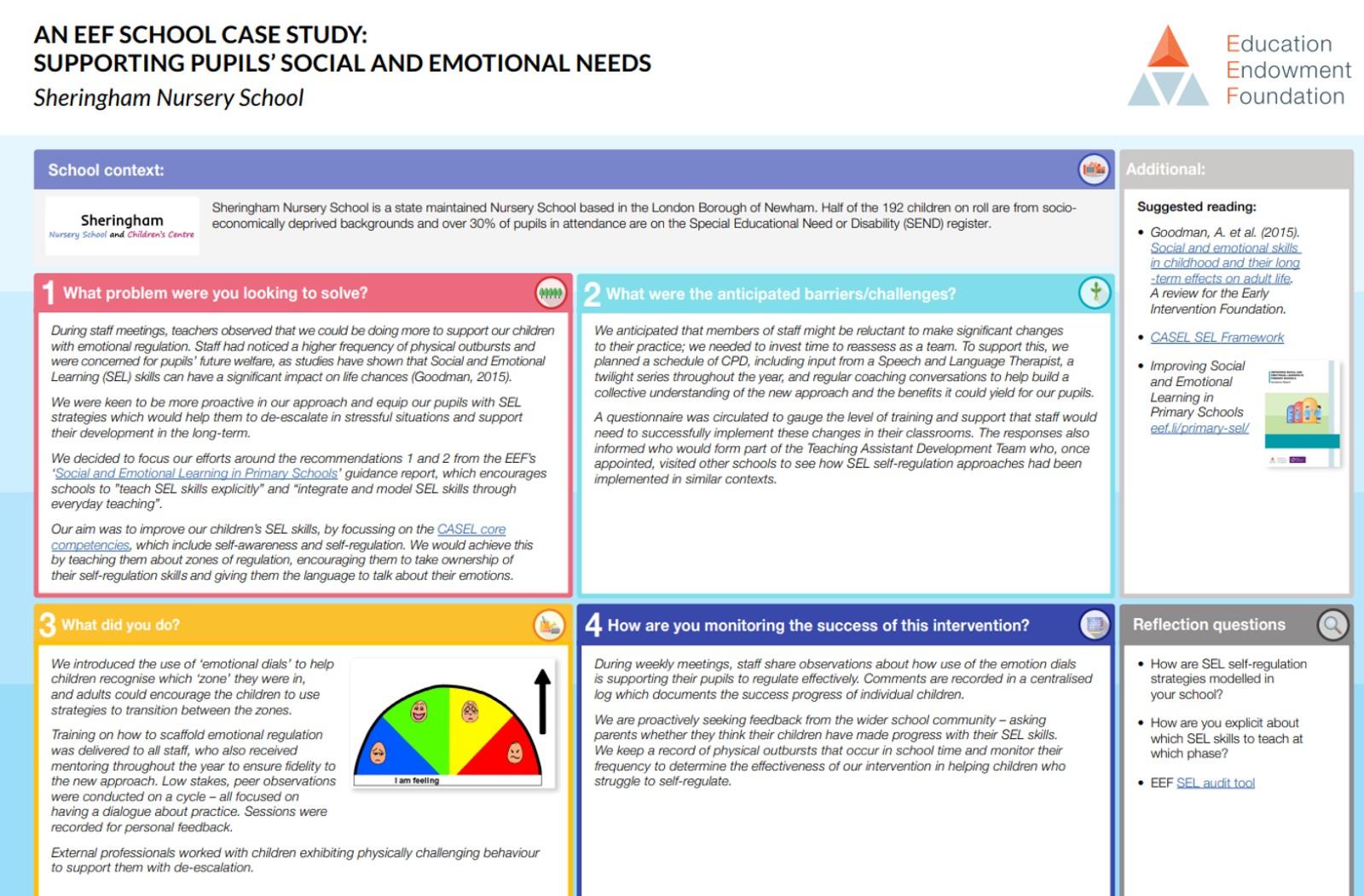
Problem/Issue (why?) Intervention/potential solution description (what?)
Behaviour Explanation
Self-awareness
Integrity
Resilience
Impact and influence
Effective leaders will know themselves and their teams, continually reflect on their own and others’ practices, and understand how best to approach difficult or sensitive issues. They are aware of their personal strengths and areas for future growth and understand how their own behaviour impacts others.
Effective leaders act with honesty, transparency and always in the interests of the school and its pupils. They are able to gain the respect of others by acting in line with their own values, as well as making decisions or choices with the best interests of education and pupils in mind.
Effective leaders remain courageous and positive in challenging, adverse or uncertain circumstances. They are able to respond appropriately, manage uncertainty and bounce back even in the most trying of situations.
Effective leaders have a positive impact on students, colleagues and the wider community through persuading, convincing and bringing others round to their perspective. They understand others’ perspectives and priorities and tailor their communication to suit their audience.
Delivering continuous improvement
Learning focus
Developing others
Respect
Effective leaders secure and maintain positive improvement through articulating a clear vision, setting high expectations and leading a cycle of research, planning, monitoring, analysis and change. They demonstrate the ability to combine operational action with strategic planning, securing short term improvements whilst building sustainable change.
Effective leaders keep learning and pedagogy at the core of the whole-school curriculum and at the heart of their leadership practice. Their strong knowledge and understanding of learning theories (both adult and children) and pedagogies allows them to use their leadership to influence and improve effective teaching and learning. They encourage a culture of dialogue – formal and informal – about pedagogy, learning, curriculum design and development (assessment).
Effective leaders develop and empower colleagues. They proactively look for ways to develop others, seeking opportunities to develop colleagues through activities such as mentoring, supporting, championing and guiding, in order to bring out the very best in them.
Effective leaders respect the rights, views, beliefs and faiths of pupils, colleagues and stakeholders.
Commitment
Effective leaders are committed to their pupils and understand the power of worldclass teaching to improve social mobility, wellbeing and productivity.
Skill Explanation
Critical knowledge and understanding of research techniques and selfmanagement
Critical enquiry, review, analysis and evaluation
The best leaders undertake and use research, drawn from a range of sources, to support decision making and strategy development – using their time effectively within disciplined and well-organised systems and methodologies.
The best leaders use critical thinking, statistical and data analysis tools, techniques and concepts to identify strengths and areas for development. They design effective leadership plans to support intervention, direction and development. They analyse the implications of change, deploying well-evidenced research to frame school selfevaluation and improvement.
Challenge
Dealing systematically and creatively with complex issues
Priority identification
The best leaders use challenge effectively and adopt a range of strategies in the best interests of achieving progress – demanding ambitious standards for all pupils and a strong sense of accountability in staff for the impact of their work on pupils’ outcomes.
The best leaders have clear systems and protocols in place that enable them to consider and find solutions to issues, as they arise, in a way which deals most effectively with the barriers and challenges they face. The systems in place do not constrain but create a firm foundation for taking positive action.
The best leaders scan the horizon to anticipate change, taking a long-term view of the implications of change and improvement needed to identify short- and long-term priorities and goals, with specified milestones to ensure effective leadership and management.
Clear articulation and application of knowledge
Self-direction and originality
The best leaders take time to reflect and learn from their leadership activity and apply this knowledge to bring about improvements in themselves and their work.
The best leaders have clear and ambitious targets for themselves as leaders, for their pupils and for their schools. They take a unique strategic view of situations and their implications for long-term impact and outcomes – sometimes using unexpected actions to get the best for those concerned.
The best leaders take time to reflect and evaluate their practice and effectiveness in their leadership and as leaders. They are aware of the education landscape, understand the context of their school and its needs and direct professional practice and intervention appropriately.
Implementation
Plan and execute implementation in stages
Make the right choices on what to implement
Prepare implementation
Deliver implementation
Sustain implementation
Expert practice
Effective behaviour management
Identifying school behaviour needs
EEF Improving behaviour in schools
DfE Creating a culture: A review of behaviour management in schools
Select three of the following nine activities to submit to your leadership mentor.
Choose an activity based on your areas of interest and the results of the diagnostic review undertaken at the start of the course.
In the scenario in the self-study pack lesson Make the right choices on what to implement, Sophia explained how she worked with SLT and her data manager to collect reliable lateness data.
Read the EEF guidance on Gathering and interpreting data, paying attention to the section on recognising weaknesses in data.
What can you learn from the case study and EEF guidance about collecting relevant, reliable data?
What action can you take to ensure your own data is relevant and reliable?
Submit a summary of your response to your leadership mentor (maximum 200 words).
EEF Gathering and Interpreting Data Summary
The EEF’s ‘School’s guide to implementation’ includes guidance on identifying and prioritising the ‘active ingredients’ of a project. Read the guidance, paying attention to section e. Use the active ingredients to anchor the implementation process.
What key learning can you take away from the guidance?
How will you apply what you have learned to help you identify and prioritise the key ingredients of your own projects to improve behaviour?
Submit a summary of your response to your leadership mentor (maximum 200 words).
EEF Implementation theme - Active Ingredients
One of the recommendations in the ‘prepare’ section of ‘Putting evidence to work: A school’s guide to implementation’ outlines the importance of creating a shared understanding of what will be expected, supported and rewarded during the implementation process. The EEF provided a simple template for users to share what is:
expected
supported
rewarded
Complete the template for a small, recent implementation activity.
How does this increase clarity and support a shared understanding of the project?
Submit a summary of your response to your leadership mentor (maximum 200 words).
https://educationendowmentfoundation.org.uk/education-evidence/guidance-reports/implementation
The EEF’s ‘School’s guide to implementation’ includes guidance on supporting implementation with professional development. Read the guidance, paying attention to the recommendation to reinforce initial training with expert follow-on support. Consider the implications of this for implementation activity in your school.
How will you apply what you have learned to your own activity to improve behaviour?
Submit a summary of your response to your leadership mentor (maximum 200 words).
EEF Implementation theme - professional development
Researchers have found that patterns of attendance become visible well before attendance becomes a serious issue. Identifying the patterns and intervening early is an effective way of addressing issues while there is still time to have a positive impact.
Look at last year’s attendance data for a cohort of pupils (e.g., a class or year group).
Can you see any patterns in the attendance? For example, are there recurring absences for certain pupil profiles, days, times, sessions, time of year?
What could account for this?
What further investigation or action is required to prevent the issue from becoming more serious?
Submit a summary of your response to your leadership mentor (maximum 200 words).
In the self-study pack lesson School behaviour needs, we share Tom Bennett’s guidance on creating a positive school culture. Appendix 2 includes recommendations for the design of an audit of behaviour in schools. Download the audit and read the guidance.
Meet with a colleague to complete the audit for a class or group of pupils in your school and reflect on the results.
What does the evidence reveal about areas for improvement?
What does the evidence reveal about areas where behaviour could be improved?
Submit a summary of your response to your leadership mentor (maximum 200 words).
Bennett, T. (2020) Creating a culture: How school leaders can optimise behaviour, pp. 65–68
Behaviour audit.docx
The section on pastoral data management in Making data work: Teacher workload advisory group report recommends effective approaches to managing data relating to behaviour and attendance without increasing workload.
Reflect on the report’s principles of effective data management and read the section relating to pastoral data.
Review your own management of pastoral data.
How do pastoral data management practices at your school compare with the recommended practices in the report?
How could pastoral data management practices be improved to reduce unnecessary workload?
Submit a summary of your response to your leadership mentor (maximum 200 words).
Effective diagnosis of need starts with the accurate recording of relevant data.
Edit the headings in the Behaviour data record pro forma to suit your own school context, for example, adding relevant locations and pupil groups.
How does the template compare with your own school’s documents for recording and analysing behaviour data?
Are there currently areas where data is not being collected or is difficult to access? For example, does the data you currently collect allow you to pinpoint the days of the week or times of day when incidents occur, or reveal which groups of pupils are most affected?
What action would you need to take to ensure you are able to collect and analyse relevant data?
Submit a summary of your response to your leadership mentor (maximum 200 words).
Behaviour data record pro forma.docx
In the practice scenario in the self-study pack lesson, Using data, Malachy used data to justify expenditure and shared data to initiate discussion, encourage parents as partners in behaviour management and prevent behaviour issues escalating.
Reflect on an occasion when you have acted on data to improve behaviour. What worked and why?
How have you used data to justify action?
How could you make better use of data to encourage support and buy-in for your plans to improve behaviour and culture in your school?
Submit a summary of your reflection to your leadership mentor (maximum 200 words).