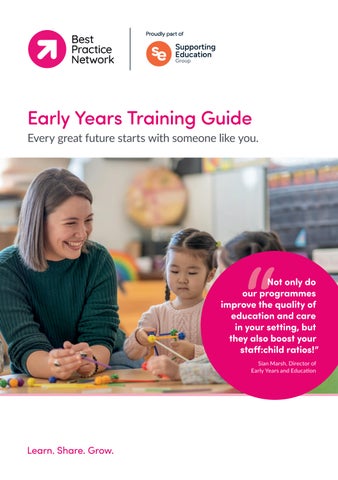
Early Years Training Guide Every great future starts with someone like you.
Not only do our programmes improve the quality of education and care in your setting, but they also boost your staff:child ratios!” Sian Marsh, Director of Early Years and Education
Together, we're helping to build a stronger Early Years workforce for the children who need it most. Every great future starts with someone like you. Every day, you help children discover, imagine and grow.
2 |
You comfort them when they need reassurance, encourage them to try something new and celebrate every milestone, big or small.
At Best Practice Network, we're proud to support the people shaping young lives through qualifications, professional development and training that help them continue making a difference every day.
While these moments may seem ordinary, they help shape confident learners, curious minds and brighter futures.
That's why we work alongside Early Years professionals and settings across England, providing high-quality training and qualifications that build knowledge, strengthen practice and support professional development at every stage.
Best Practice Network
You care for the children. We'll take care of the training.
Supporting your setting every step of the way At Best Practice Network, we work alongside Early Years settings to make professional development simple. Whether you're developing existing staff or recruiting new apprentices, we'll support your team from enrolment through to completion, helping you strengthen practice without disrupting your day.
Why choose Best Practice Network?
Support that fits your setting
Quality you can trust
• Blended learning designed around the working day
• Rated "Exceptional Training Provider" by the Department for Education • Ofsted Outstanding provider • Ofsted-rated "Outstanding" for our Early Career Framework
• Dedicated tutors and workplace mentor support • We manage off-the-job training planning and progress tracking • Learners remain active members of your team throughout their programme
Helping your team grow • Funded apprenticeships and professional development programmes • Free apprentice recruitment support • Qualifications that strengthen practice and support staff:child ratios
From induction to completion, we're here to help your team learn, grow and thrive.
Every great future starts with someone like you
| 3
Your professional development journey Every child deserves the very best start in life. That starts with passionate Early Years professionals who continue to learn, develop and grow throughout their professional journey. Whether you're taking your first step into Early Years, building on your existing experience or developing specialist expertise, every stage of professional development strengthens your knowledge, builds confidence and helps create even better outcomes for children.
At Best Practice Network, we're proud to support Early Years professionals and settings with qualifications and training that meet you where you are today and help you prepare for tomorrow.
Shape your future
A pathway for every Early Years professional Starting out Specialise Early Years Practitioner Level 2 Early Years SENCO Level 3 Early Years Educator Level 3 Early Years Coaching Level 3 Leadership Progression
Early Years Lead Practitioner Level 5
Optional top up degree
Early Years Initial Teacher Training Early Years Teacher
4 |
Best Practice Network
Early Years Speech & Language Support Practitioner Level 5
Training that fits around your setting: Understanding Off-the-Job Training in your setting
Off-the-Job Training - Learning without leaving your setting Off-the-Job training is an essential part of our apprenticeships. The timetable below shows how a full-time Early Years Educator apprentice can complete 6 hours of off-the-job training each week without leaving the setting. Training is embedded into the daily routine, allowing apprentices to stay involved, support ratios and build skills in real time – learning while doing.
Monday
Tuesday
Morning
Midday
Afternoon
• Room set-up
• Lunch prep
• Creative activity
• Free play
• Lunch break
• Outdoor play
• Group activities
• Nap time
• Tidy up
• Room set-up
• Lunch prep
• Creative activity
• Storytelling
• Lunch break
• Outdoor play
• eLearning (1 hr)*
• Weekly reflection
• Room set-up
• Lunch prep
• Creative activity
• Shadowing SENCo
• Lunch break
• Outdoor play
• Nap time
• Tidy up
• Room set-up
• Lunch prep
• Creative activity
• Peer observation
• Lunch break
• Outdoor play
• Nap time
• Tidy up
• Room set-up
• Lunch prep
• Creative activity
• Outdoor play
• Lunch break
• Outdoor play
observation (45 mins)* • Snack time Wednesday
(45 mins)* • Outdoor play Thursday
(30 mins)* • Group activity Friday
• Reflective notes
(30 mins)*
(30 mins)*
• Virtual Classroom
(2 hrs)*
Every great future starts with someone like you
| 5
What is Off-the-Job Training? Off-the-job training is structured learning that takes place outside of an apprentice’s routine duties—but not off-site. It includes activities like observations, eLearning, and reflections, all completed within the setting. Apprentices remain actively engaged in their roles while developing essential skills, ensuring minimal disruption to staffing and daily operations.
Scan here to learn more or visit bestpracticenet. co.uk/EY
Off-the-Job Training activities are highlighted in bold torytelling observation (45 mins): * Sobserve a qualified practitioner leading a group storytelling session.
*
hadowing SENCo (45 mins): S Shadow the SENCo to understand inclusive practices and how additional needs are supported in Early Years settings.
eer observation (30 mins): * PThe apprentice observes an experienced
colleague to reflect on different teaching approaches and interactions with children.
eflective notes (30 mins): * RTime is set aside for the apprentice to
write brief reflections on their practice and learning, linking experience to Early Years frameworks.
6 |
Best Practice Network
Learning (1 hour): * eThe apprentice completes guided learning modules or workbook activities aligned with the apprenticeship standard.
raining video + reflection (1 hour): * TThe apprentice watches a structured
training video and completes a short reflective summary on how it applies to their role.
eekly reflection (30 mins): * W A focused session where the apprentice
considers their learning progress and records evidence towards their portfolio.
entor meeting (30 mins): * M A one-to-one discussion with the mentor to review progress, discuss challenges and plan upcoming development targets.
Funding and upskilling benefits Up to 100% Funded Programmes – Training that makes Financial Sense Our Early Years programmes can be funded through the Growth and Skills Levy, government funding or the Department for Education, helping settings develop their teams while keeping training costs low.
Funding depends on the programme, the apprentice's age and your setting's circumstances. Our dedicated funding team will help you understand the funding available and guide you through the process.
Maintained Nurseries*
Settings with Growth and Skills Levy Funds
Other settings
Apprentices aged 16 to 24
100% funded
100% funded
100% funded
Apprentices aged 25+
100% funded*
100% funded through available levy funds
95% funded
EYITT
100% funded by DfE
100% funded by DfE
100% funded by DfE
EY SENCO
100% funded by DfE
100% funded by DfE
100% funded by DfE
* Funding for Local Authority maintained and community settings is subject to local arrangements and procurement requirements.
Employer incentives Employer incentives for recruiting apprentices The Growth and Skills Levy brings even more support for employers investing in young talent.
Up to £3,000 DfE cash incentive Employers may be eligible for a cash incentive of up to £3,000 when recruiting an apprentice aged 16 to 24 who has been claiming Universal Credit for at least 6 months.
£2,000 incentive for smaller employers From October 2026, eligible non-levy paying employers can receive a £2,000 incentive for recruiting a new apprentice aged 16 to 24, payable after 90 days of employment.
No training contribution for 16 to 24-year-olds Eligible non-levy paying employers pay 0% towards training costs for apprentices aged 16 to 24. For apprentices aged 25 and over, the employer contribution remains 5%. Eligibility and funding rules apply. Speak to our team for the latest guidance.
Please note: Funding is subject to eligibility, available funding and current government funding rules. Please speak to our team for guidance specific to your setting.
Every great future starts with someone like you
| 7
How can your setting care for more children without compromising on quality? Little Daisies Nursery is a great example on growing capacity.
How did they boost their capacity by over 75%?
They boosted their capacity by over 75% – from 40 to 71 children by upskilling their staff and utilising apprenticeships with Best Practice Network.
Ҍ Identified staff who wanted to
progress their career and could benefit from training
Ҍ Hired two new apprentices through
the Best Practice Network free recruitment services
We offer a wide range of courses to boost your staff:child ratios and equip your practitioners with the skills and qualifications they need to thrive.
Ҍ Supported their staff to apply for
EYITT and Level 3 Apprenticeships with Best Practice Network
Ҍ Utilised Growth and Skills Levy and DfE funding
Before training
After training with Best Practice Network
• Total Staff: 9
CIRCLE-RIGHT Total Staff: 11
• 2 Unqualified
CIRCLE-RIGHT 1 Unqualified
• 4 qualified at Level 2
CIRCLE-RIGHT 3 qualified at Level 2
• 3 qualified at Level 3
CIRCLE-RIGHT 6 qualified at Level 3 CIRCLE-RIGHT 1 EYTS qualified CIRCLE-RIGHT Total Children: 71
• Baby room – 3 staff : 9 babies
CIRCLE-RIGHT Baby room – 4 staff : 12 babies
• 2-year-old room – 3 staff : 15 toddlers
CIRCLE-RIGHT 2-year-old room – 4 staff : 20 toddlers
• 3–4-year-old room – 2 staff : 16 children
CIRCLE-RIGHT 3–4-year-old room – 3 staff : 39 children
Ratios
in simple terms
• Total Children: 40
8 |
Age 0–2 staff:child ratio 1:3
Best Practice Network
Age 2 staff:child ratio 1:5
Age 3-4 staff:child ratio 1:13 with EYTS 1:8 without EYTS
Explore our Early Years training programmes
Programme
Page
Early Years Practitioner Apprenticeship Level 2................. 12 Early Years Educator Apprenticeship Level 3...................... 14 Early Years Coaching Learning & Development Practitioner Apprenticeship Level 3....................................... 16 Early Years Lead Practitioner Apprenticeship Level 5....... 18 Early Years Speech & Language Support Practitioner Level 5 Apprenticeship....................................... 20 EY SENCO Level 3....................................................................... 22 Early Years Initial Teacher Training (EYITT).......................... 24
Every great future starts with someone like you
| 9
Navigating success Don’t just take our word for it – hear directly from those who are already charting a course to success with us.
Real stories from our thriving partners
In this section, we’re sharing the real stories of nurseries, just like yours, who have partnered with us to achieve remarkable growth and cultivate dedicated teams. See how they’ve navigated their journeys and discovered the significant benefits of joining our thriving fleet.
I’ve always had really positive feedback from our apprentices doing their training with Best Practice Network, and I found the programme really valuable when I did it myself as an apprentice. Working with Best Practice Network has been great – they respond quickly, the apprentices get brilliant support, it’s been a really positive experience.”
10 |
Liz Fletcher, Early Years Mentor
Watch the video here
Meet the Snapdragons team – Early Years Mentor Liz and Apprentices Emma and Alicia They share how much they value the programme, highlighting its benefits for everyone involved, the positive impact on nursery growth and the outstanding support they’ve received from Best Practice Network.
Jane's journey from apprentice to mentor From apprentice to leader – Jane shares her journey to becoming Head of Toddlers at Snapdragons Nurseries, and how she’s now helping others follow in her footsteps as an apprentice mentor.
Watch Jane’s video here Every great future starts with someone like you
| 11
Early Years Practitioner Apprenticeship Level 2 This apprenticeship is a funded entry-level training programme. Early Years Practitioners work under the guidance and supervision of an Early Years Educator, teacher or other suitably qualified professional, supporting the planning and delivery of educational programmes for children aged 0-5.
Benefits CHECK-CIRCLE Learn how to support children’s early education and development
CHECK-CIRCLE Become more confident in planning
activities in line with the Early Years Foundation Stage (EYFS)
CHECK-CIRCLE Learn how to keep up-to-date records to help track and identify children’s individual needs, abilities and progress
CHECK-CIRCLE P romote health, safety and child
welfare through effective, informed practice and safeguarding
CHECK-CIRCLE S tudy at no cost to the learner. Funded by the Growth and Skills Levy or government co-investment
CHECK-CIRCLE R eceive full support from your
apprenticeship tutor with monthly visits and taught sessions
Programme structure 1:1 taught lessons
Gateway
Tutor visits: Tutor reviews every month
Online Study: Online resources with coursework submitted to an E-portfolio 12 months
12 |
Best Practice Network
End Point Assessment (EPA) Up to 3 months
I was looked after every step of the way by Best Practice Network. The tutor visits were the standout point of the course. I can’t wait to do the L3 course in the future and keep working my way up.”
AT A GLANCE Up to 100% funded Blended Training This Course Awards Early Years Practitioner Level 2, NQual Level 2 Diploma for the Early Years Practitioner Course Duration Up to 15 months
Who is it for? • An entry level Early Years training
programme that allows you to work in a setting under supervision. Ideal for those leaving school at 16 and wanting to enter a career as a nursery practitioner, classroom assistant or pre-school practitioner
Ratios 50% of your nursery staff are required to hold a Level 2 qualification
• Suitable for either someone already working
in or someone looking for a career in an Early Years childcare and education setting
Entry requirements • No age restrictions.
Applicants must have: • Level 1 in maths and English (for 16–18
year-olds only and can be completed during the apprenticeship)
• Support from your employer and levy
account holder
Michelle Evans Apprenticeship Performance Manager Michelle has been working in Early Years since 2011 and joined Best Practice Network in 2021. She has been able to use her vast experience in the sector to support apprentices. “The level 2 will equip Early Years Practitioners with skills they need to succeed.”
• Residency in the UK for the last three years
We can help you recruit apprentices! Contact us for details.
Learn more and apply at bestpracticenet. co.uk/EYP Every great future starts with someone like you
| 13
The way the course was delivered was great. The tutor who was assigned to me supported my development and progression every step of the way and I can’t thank her enough!”
Early Years Educator Apprenticeship Level 3 This apprenticeship is a funded mid-tier level training programme. Developed by Best Practice Network, this industry-leading programme equips apprentices with the knowledge, skills and behaviours needed to excel as an Early Years Educator. Level 3 may be more suitable for practitioners looking to plan, organise and lead learning activities.
Benefits CHECK-CIRCLE L earn how to support and promote
CHECK-CIRCLE S tudy at no cost to the learner. Funded
CHECK-CIRCLE Plan and provide effective care and
CHECK-CIRCLE C ounts towards EYFS Level 3
children’s early education and development
learning to prepare children for school
by the Growth and Skills Levy or government co-investment staff:child ratios
CHECK-CIRCLE Learn how to use assessment to develop informed practice for individual children
Programme structure Webinars: Monthly online taught lessons
Gateway
Tutor visits: Tutor reviews every month
14 |
Online Study: Online resources with coursework submitted to an E-portfolio
End Point Assessment (EPA)
15 months
3 months
Best Practice Network
Who is it for? • Suitable for either someone already working
in, or someone looking for a career in an Early Years childcare setting
• Ideal for someone looking to pursue
a career as an Early Years Educator, nursery teaching assistant, nursery nurse, supervisor or childminder
Entry requirements • No age restrictions.
Applicants must have: • GCSEs in English and maths at Grade C (4)
or above, or able to achieve level 2 English and maths whilst on programme (for 16–18 years olds only)
• Award in Paediatric First Aid OR Emergency
Paediatric First Aid must be achieved while on programme (if not already achieved) and must be in date when they enter gateway
AT A GLANCE Up to 100% funded Blended Training This Course Awards Early Years Educator Level 3 Course Duration Up to 18 months Ratios Count towards staff:child ratios once a Level 3 qualification has been achieved
• Support from your employer and levy
account holder
• Residency in the UK for the last three years
Thrive EYE pathway also available Looking for an additional focus on children’s wellbeing? Our Thrive Early Years Educator Level 3 Apprenticeship combines the EYE qualification with additional learning focused on social and emotional wellbeing, resilience, positive behaviour and learning.
We can help you recruit apprentices! Contact us for details.
Tracy Clement Apprenticeship Director
Tracy is passionate about apprenticeships and the opportunities they bring for new and existing staff to gain knowledge and skills in the workplace.
Learn more and apply at bestpracticenet. co.uk/EYE
Every great future starts with someone like you
| 15
Early Years Coaching Learning & Development Practitioner Apprenticeship Level 3 This apprenticeship is a funded Level 3 training programme. Designed for Early Years practitioners who support the learning and development of others, this apprenticeship develops practical coaching skills to help colleagues build confidence, strengthen practice and improve outcomes for children.
Benefits Ҍ Develop practical coaching and
Ҍ Strengthen communication and leadership
mentoring skills that support colleagues in the workplace
skills to support a positive learning culture
Ҍ Build confidence in giving constructive feedback and guiding professional development
Ҍ Learn coaching techniques that
Ҍ Study at no cost to the learner. Funded by the Growth and Skills Levy or government co-investment
Ҍ Receive personalised support from your apprenticeship tutor throughout the programme.
encourage reflection, problem solving and continuous improvement
Programme structure Introduction and first day of learning
Monthly workshops covering course themes
Individual check-ins
Monthly Progress Reviews
Introduction to BUD
Online Study: Using online platform BUD to complete online assignments and evidence for E-portfolio
14 months
16 |
Best Practice Network
Gateway review meeting
End Point Assessment (EPA)
Up to 3 months
AT A GLANCE Up to 100% funded Blended Training This Course Awards
Who is it for? • Early Years practitioners who support
the development of colleagues through coaching, mentoring or workplace learning.
Coaching Learning & Development Practitioner Level 3 Apprenticeship and ILM Level 5 Certificate in Effective Coaching Course Duration Up to 17 months
• Room Leaders, Senior Practitioners, Deputy
Managers or experienced practitioners who help others build confidence and develop their practice.
• Settings looking to strengthen coaching,
mentoring and professional development across their teams.
Entry requirements
Learn more and apply at bestpracticenet. co.uk/EY_coaching
Applicants must: • Be employed in an Early Years setting
in a role that allows them to coach or support colleagues.
• Have the support of their employer. • Meet the current apprenticeship
funding and residency requirements.
Why choose this programme? Through practical coaching techniques and workplace application, apprentices learn how to support colleagues with confidence, encourage reflective practice and help create a culture of continuous learning across their setting.
Every great future starts with someone like you
| 17
I started the programme because I wanted to develop my knowledge and skills and become more confident and competent in my role within Early Years. I was keen to gain a higher qualification to support my professional development while continuing to work and earn an income. The apprenticeship gave me the opportunity to learn, apply my knowledge in practice and progress in my career at the same time.” – Marie Fleming, Ear ly Years Lead Practitioner Level 5 Graduate
Early Years Lead Practitioner Apprenticeship Level 5 This apprenticeship is a level 5 funded training programme for experienced practitioners caring for children from 0-8 years. Ideal for those who are ready to take the next step into leadership, supporting and inspiring colleagues while driving high-quality learning and development across their setting.
Benefits CHECK-CIRCLE Be responsible for supporting the
CHECK-CIRCLE W ork in partnership with parents,
CHECK-CIRCLE Learn how to lead day-to-day practice
CHECK-CIRCLE S tudy at no cost to the learner. Funded
quality of learning and development in your setting at an operational level
CHECK-CIRCLE Be involved with sector developments
carers and colleagues for each child’s development by the Growth and Skills Levy or government co-investment
in your local area and nationally
Programme structure Introduction and first day of learning
Webinars: Monthly webinars covering course themes
Initial visit and induction
Tutor visits: Tutor reviews every 6 weeks
Intro to BUD
Online Study: Using online platform BUD to complete online assignments and evidence for E-portfolio
18 months
18 |
Best Practice Network
Gateway
End Point Assessment (EPA)
Up to 3 months
AT A GLANCE Up to 100% funded Blended Training This Course Awards Early Years Lead Practitioner Level 5 Apprenticeship
Course Duration
Who is it for?
Up to 21 months
• The Early Years Lead Practitioner Level 5
Ratios
Apprenticeship is designed for experienced Early Years practitioners who are ready to take greater responsibility for practice within their setting.
Counts towards the staff:child ratio
• It is suitable for practitioners who lead
others, support the development of colleagues and play an active role in improving the quality of learning and development for children.
Learn more and apply at bestpracticenet. co.uk/EYLP
Entry requirements Applicants must: • Be working in an Early Years setting in a
suitable role that allows them to meet the requirements of the apprenticeship
• Hold a Level 3 Early Years qualification
or have relevant experience
• Have the support of their employer • Meet the current funding and
residency requirements
Thrive EYLP pathway also available Looking to strengthen wellbeing across your setting? Our Thrive Early Years Lead Practitioner Level 5 Apprenticeship combines the EYLP programme with additional learning focused on social and emotional wellbeing, resilience, positive behaviour and learning.
Every great future starts with someone like you
| 19
Early Years Speech & Language Support Practitioner Level 5 Apprenticeship The Early Years Speech & Language Support Practitioner Level 5 Apprenticeship is a specialist development programme for Early Years practitioners and leaders who want to strengthen their expertise in supporting children with speech, language and communication needs (SLCN). Delivered by Best Practice Network in partnership with Speech and Language Link, the programme combines Best Practice Network’s expertise in designing and delivering high-quality apprenticeships with Speech and Language Link’s specialist knowledge of speech, language and communication. Built on the Early Years Lead Practitioner Level 5 apprenticeship standard, the programme supports staff to identify needs early, adapt setting practice and improve outcomes for children.
Benefits Ҍ Develop specialist expertise in
speech, language and communication needs (SLCN)
Ҍ Learn from both apprenticeship specialists and speech and language experts
Ҍ Benefit from input from qualified speech and language therapists
Ҍ Strengthen safeguarding practice and confidence
20 |
Best Practice Network
Ҍ Apply practical, evidence-informed strategies in your setting
Ҍ Identify and support children with
communication needs more effectively
Ҍ Improve children’s participation, understanding and progress
Ҍ Build a portfolio of evidence demonstrating real meaningful impact in your setting
I am very grateful to my programme tutor for their advice and support throughout the course.” Apprenticeship Graduate
AT A GLANCE Course Duration Up to 21 months This Course Awards
Programme content Ҍ Module 1: What is SLCN (speech,
language and communication needs)?
Ҍ Module 2: Development of speech
and language skills (typical development).
Ҍ Module 3: Creating a communication supportive environment in the Early Years setting.
Speech & Language Link Certification & Early Years Lead Practitioner Level 5 Access to Online learning and training events
Study at no cost to the learner. Funded by the Growth and Skills Levy or government co-investment
Ҍ Module 4: Identifying SLCN and taking action.
Who should apply? This apprenticeship is suitable for Early Years practitioners who want to develop specialist expertise in speech, language and communication, particularly those supporting children with additional needs.
Delivered by Delivered in partnership with Best Practice Network and Speech & Language Link
Example roles include: • Early Years Room Leader • Early Years Educator • Early Years Senior Practitioner • Early Years SENCO
Eligibility
Learn more and apply at bestpracticenet. co.uk/eyslsp
To be eligible, participants must: • Be currently employed in an
Early Years setting
• Have employer support to complete
the programme
• Be able to apply learning in their
role and complete workplace activities
• Have the right to work and study in England
Every great future starts with someone like you
| 21
EY SENCO Level 3 The EY SENCO Level 3 qualification is for Level 3 Early Years practitioners and childminders. It is appropriate for childminders and those registered with a Childminding agency. This is an important role to ensure the best possible educational outcomes are achieved for children with special educational needs and disabilities (SEND).
Benefits Ҍ Learn to actively engage with children
Ҍ Understand what an effective support
Ҍ Accredited and fully-funded by the
Ҍ Gain the techniques to identify
and their families using the Assess, Plan, Do, Review process Department for Education (DfE), limited places available based on DfE eligibility criteria
plan should include and why clear outcomes are important SEND at the earliest point
Programme Structure Weeks 1 - 12
Weeks 13-24
Weeks 24-26
Unit 01
Unit 02
Post-delivery
Roles and responsibilities of the Special Educational Needs Coordinator in the Early Years.
Strategies and techniques for supporting children and families.
Assessment period and submission to NCFE
Online taught sessions Online study units Assignments 1-8
22 |
Best Practice Network
My tutor was amazing, she gave me really good support and I am very grateful for that" EY SENCO Graduate
AT A GLANCE
£
Fully funded by the DfE Online training This course awards
Who is it for? • Level 3 Early Years Educators • Childminders and those registered with a Childminding agency who hold a Level 2 or above Early Years qualification
Entry requirements • PVI settings - You must have a full and relevant Level 3 or above Early Years qualification with experience in Early Years SEND • Childminders - must hold a full and relevant Level 2 Early Years qualification and::
NCFE Level 3 Award for Special Educational Needs Coordinators in Early Years Settings
Course duration 6 months
Upcoming deadlines View our website for the latest information and to register for updates
• have completed at least one Level 3 qualification module • have some experience in Early Years SEND • You must have the support of your employer or be an Ofsted registered Childminder/part of a Childminding Agency
Learn more and apply at bestpracticenet. co.uk/EYSENCO
Anna Watson Head of Early Years SEN
Anna has worked in Early Years for 23 years in a thriving setting and for 7 years with Best Practice Network as part of the EYITT and Apprenticeship programmes. She leads the Early Years SENCO programme and is passionate about improving outcomes for children and their families.
Every great future starts with someone like you
| 23
Early Years Initial Teacher Training (EYITT) The only teacher training focused on babies and children from birth to five. EYITT leads to Early Years Teacher Status (EYTS) through a blend of comprehensive training days, hands-on placements and self-paced learning. It is designed for graduate Early Years practitioners who wish to care for children up to 5 and specialise in early childhood development.
Benefits Ҍ Become a qualified Early Years
Ҍ EYITT trainees count towards staff:child
Ҍ Help close the attainment gap and
Ҍ Receive an employer bonus of £7,000
Ҍ Access the latest research and
Ҍ Train for free – the programme is
ratio for children age 3 and over
Teacher and lead practice of others
to cover training-related costs
improve children’s life chances
fully funded by the DfE
teaching resources
Programme
Programme structure Induction
Term 1
Term 2
Term 3
Recommendation
Pre-induction training session
4 training days in a local venue
3 training days in a local venue
1 training day in a local venue and final interview
Summative assessment against the Teachers’ Standards (Early Years)
Needs analysis and subject knowledge audit
Initial target setting with tutor and mentor
Leadership plan
Reflective account 1 submission
IT induction
Complete 2 learning sequence
Complete 2 learning sequence
Complete 1 learning sequence
Maths diagnostic
End of term review and target setting
End of term review and target setting
End of term review and target setting
Reflective account 1 submission
12 months
Half-termly tutor visits Weekly mentor meetings and observations
24 |
Best Practice Network
Transition plan
I wanted to deepen my understanding of child development and make a positive and lasting impact on the children’s education experience.”
AT A GLANCE Fully funded by the DfE Online or Blended Training and Setting Placements This Course Awards Early Years Teaching Status (EYTS) Course Duration Up to 12 months Training Days
Who is it for? • Graduate Early Years practitioners who
may work in a range of settings across birth to five, including nurseries, schools, home-based settings
• Graduates who want to join the early
8 days Ratios Trainees count towards staff:child ratios at Level 3 from the start of their training; once they achieve EYTS, it’s 1:13 for 3–4 year olds
years sector
• Full-time undergraduates on early
childhood studies degree programmes
Entry requirements Applicants must have:
Helen Markham Head of EYITT
• A degree on entry (from any area of study) • GCSE Grade C or above (or recognised
equivalent) in maths, English and science.
I f a candidate does not have the required GCSEs, then we can advise on completing an equivalency test instead.
Helen has specialised in Early Years for nearly two decades. She worked as an Early Years Teacher across a wide range of provision, including schools and children’s centres. Currently, she uses her expertise to inspire Early Years Teachers of the future.
Learn more and apply at bestpracticenet. co.uk/EYITT
Every great future starts with someone like you
| 25
There are three routes to becoming an Early Years Teacher Funding
Graduate Entry Route (GE) Graduate Employmentbased Route (GEB)
Fully funded by the DfE
Placement
Status
Training
Full-time training
Monthly training days
Typically 25-30 Part-time day school training placement or second placement
1–2 training days a month
120 days of placements
Up to £5,000 bursary Fully funded by the DfE £7,000 employer incentive
You can work towards Early Years Teacher Status whilst being employed in an Early Years setting/school.
Childminders Route
Fully funded by the DfE Employer Incentive may be available (excludes sole traders)
Typically 25-30 Part-time day training school placement or second placement
1–2 training days a month
You can work towards Early Years Teacher Status whilst being employed as a Childminder.
Induction During induction, students are given information about the programme structure and processes involved in the assessment. Each student is allocated a personal tutor who will work closely to monitor and assess progress and support the learning experience. Students complete an Induction module which includes recommended reading and programme handbooks.
Needs Analysis A key component of the induction phase is the Strengths and Needs analysis which outlines the structure for a Personal Learning and Development Plan for each student.
26 |
Best Practice Network
Training Days Students attend eight training days across the programme and then a final interview. Training Days provide the opportunity to meet with fellow learners and experienced facilitators.
• Training Day 1: The Effective Early Years Teacher • Training Day 2: Adapting Teaching for the Unique Child • Training Day 3: Starting Strong
Key stats
100% of our students achieve EYITT
97%
of 2024-25 students said that the support from their personal tutor was at a high standard
• Training Day 4: Foundations for Success • Training Day 5: Leading and Supporting in the Early Years • Training Day 6: Promoting Equality, Diversity and Inclusion • Training Day 7: Unlocking Potential and Widening Opportunities • Training Day 8: The Reflective Early Years Teacher • Final Interview: EYTS recommendation
Assessment Assessment includes gradually building an ePortfolio, developing evidence bundles and action plans, writing assignments and maintaining observation records. (for more details please visit our website).
99%
rated the quality of online study materials and guidance materials good or very good
99%
of students rated their placement experience as good or very good in 2023-24
97%
of students in 2024-25 would recommend EYITT to a friend or colleague
Every great future starts with someone like you
| 27
Apprentices enjoy their studies. They find their coursework and job roles challenging and stimulating. They value greatly the care and support they receive from their tutors."
Ready to strengthen your Early Years team?
Ofsted Report, 2023
Whether you’re looking to develop existing staff or recruit new apprentices, our Early Years team is here to support your setting. We can help you understand programme options, eligibility and funding, or help you find apprentices for vacancies within your setting.
Looking to develop your team?
Looking to recruit?
Our Early Years Advisors can help you identify the right training for your staff and talk you through programme eligibility, funding and next steps.
Our free recruitment service can help match your setting with candidates looking to start an Early Years apprenticeship.
Scan to book a call with our Early Years team
We’ll support you through the recruitment and apprenticeship process, helping you bring new practitioners into your team.
Scan to speak to our recruitment team
+44 (0) 117 920 9428 enquiries@bestpracticenet.co.uk bestpracticenet.co.uk
All information is correct at the time of print. For most up-to-date information, visit our website.