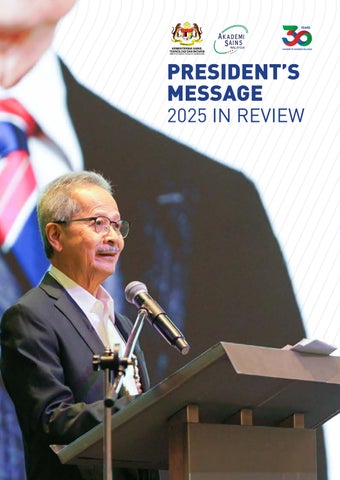
President's Message - 2025 in Review

Page 1


Dear esteemed

Expert Network Members of the Academy of Sciences Malaysia (ASM),

Today’s world is characterised by rapid, often unpredictable change, in which challenges no longer unfold in simple or linear ways. In this postnormal era, complexity, chaos, and contradiction converge in ways that challenge institutions worldwide. In this environment, expectations of institutions such as the Academy of Sciences Malaysia (ASM) have stretched. Beyond conducting analysis, there is an increasing need to sense emerging issues, interpret evolving trends and translate these into timely, practical insights that can meaningfully inform national development planning and shape its trajectory.

This year marks ASM’s 30th anniversary since its inception on 1 February 1995. Over time, the context in which ASM operates has also changed significantly. As Malaysia progressed, ASM’s role expanded accordingly. ASM has contributed evidence-based perspectives, supported the development of scientific talent, and consistently provided scientific input to national decision-making. We took this moment to reflect on how we communicate our purpose and impact to the nation. This included a comprehensive branding exercise that gathered insights from experts, government agencies, international academies, media partners and ASM staff. Their feedback helped us understand how ASM is viewed today and where we need to improve our clarity, visibility, and relevance.

In parallel, we began developing the ASM Strategic Plan 2026-2030 and Return-on-Values (ROV) exercise. The development of the new strategic plan will help us prioritise what truly matters and the outcomes we want to deliver for the nation. This exercise will ensure that ASM’s next phase is purposeful, impact-driven, and well-aligned with national aspirations. Meanwhile, a data-driven ROV approach also allows us to measure real impact on stakeholders, refine our strategies, and design public awareness initiatives that are more inclusive and effective.

In response to these evolving conditions, ASM’s work throughout 2025 focused on navigating complexity, sensing emerging issues and translating insight into timely contributions. The following sections outline selected developments and milestones that reflect ASM’s engagement with these challenges during the year.

ASM 30th Anniversary: Empowering Ideas, Connecting People, Shaping Our Future.

As ASM marks its 30th anniversary, the way we convene, engage, and lead reflects how ASM has evolved over the past three decades. From its early role as a forum for scientific excellence, ASM has grown into a national platform that connects people across disciplines, institutions and generations, recognising that the strength of Malaysia’s scientific enterprise lies not only in ideas, but in how they are shared, challenged and translated into collective action.

This evolution was evident at the 2nd ASM Townhall Meeting held earlier this year. Building on strong interest, participation was expanded beyond Fellows to include Top Research Scientists Malaysia, YSN-ASM members, and Associates, reflecting ASM’s growing, increasingly diverse expert network. The lively session initiated an open exchange of perspectives on national needs, scientific priorities, and the evolving expectations placed upon the scientific community. In my remarks, I emphasised that Malaysia’s progress as an innovation-led nation cannot be measured solely by infrastructure or investment. It must be driven by knowledge creation, collaborative intelligence, and agile, inclusive, and purposeful leadership. I urged our expert community to work more closely across sectors, adopt a hands-on approach and deepen engagement with stakeholders, so that the collective strength built over 30 years can be more effectively aligned with national aspirations.

This theme of shared responsibility and leadership maturity was reinforced during ASM’s 30th Annual General Meeting. I reiterated that leadership development remains a central responsibility of the ASM, but that leadership should not be viewed as an exclusive role reserved for a few. Rather, it must be understood as the cultivation of mindsets and behaviours that enable individuals and organisations to think collectively, rally around shared purpose and respond adaptively to change. In a postnormal landscape marked by uncertainty and complexity, the ability to collaborate, listen and act with clarity has become as important as technical expertise.

Purposeful leadership, therefore, is defined not by authority, but by the capacity to bring people together, understand diverse perspectives, build trust and provide direction where it is most needed. At the AGM, 32 new Fellows were elected, bringing ASM’s total Fellowship to 531, further strengthening the depth and diversity of expertise available to the nation. Yet numbers alone do not define our contribution. As I have often emphasised, ASM’s true national role is to help guide Malaysia through life-changing transitions, moving with confidence from present uncertainties towards a more secure and resilient future.

As we reflect on 30 years of service, the most important work ahead begins with ourselves, re-examining our mindsets, renewing our sense of purpose and preparing to act as changemakers. By empowering ideas, connecting people and shaping collective understanding, ASM continues to build the leadership capacity that Malaysia will need in the decades to come.

Strategic Foresight, Science Diplomacy and Policy Influence

In the 2024 edition of the President’s Message, I shared details of initiatives endorsed by the National Science Council (NSC), the country’s highest body for governing science, technology and innovation (STI), chaired by the Prime Minister. These endorsements reaffirmed the importance of credible science advice, based on long-term perspectives and policy coherence in shaping Malaysia’s national development trajectory.

ASM’S role has been shaped by three decades of accumulated institutional knowledge, sustained policy engagement and trusted science advice. This continuity has strengthened ASM’s capacity to support the government with foresightdriven analysis, cross-sectoral integration and independent perspectives that inform national priorities and long-term decision-making.

This emphasis on forward-looking, evidencebased policymaking was further strengthened through strategic foresight efforts that extend beyond immediate policy horizons. A key milestone in 2025 was the launch of the ASEAN Ahead: ASEAN STI Ecosystem Foresight 2035 and Beyond report on 24 October 2025. The

Developed under the ASEAN Foresight Alliance and spearheaded by ASM through MOSTI, ASEAN Ahead serves as a strategic reference for strengthening ASEAN’s position in the global STI landscape. Endorsed by ASEAN Ministers and Committees, it underpins the ASEAN Plan of Action on Science, Technology and Innovation (APASTI) 2026–2035, equipping Member States with a common foresight framework to navigate global uncertainty and technological disruption. Central to the report is the Triple 10 ASEAN STI Framework, an evolution of Malaysia’s 1010 MySTIE Framework, which aligns socioeconomic priorities and technology domains with ten key Forces of Change shaping ASEAN’s future. The preferred scenario, Collective Prosperity, illustrates a pathway in which economic progress, environmental responsibility, and social cohesion advance in a balanced, mutually reinforcing manner.

ASM’s role in science diplomacy was further strengthened through regional and international engagement. The ASM-Association of Academies and Societies of Sciences in Asia (AASSA) Workshop on Addressing Global Challenges in a Postnormal World, held from 22–23 October 2025, convened more than 100 participants from academies and scientific societies across Asia. Officiated by the Deputy Minister of MOSTI, YB Dato’ Dr Hj Mohammad Yusof Hj Apdal, the workshop provided a platform for dialogue on how science advice, ethical considerations and governance can inform responses to complex global challenges. Discussions highlighted the need for closer regional coordination, shared enablers and sustained collaboration to support resilience and inclusivity across ASEAN’s evolving STIE landscape. The programme concluded with a networking dinner featuring a batik painting activity facilitated by local artist Arif Rafhan, celebrating ASEAN’s diversity and reinforcing informal scientific exchange as an important element of regional cooperation.

At the national level, ASM continued to strengthen policy influence through structured, evidencebased studies. Work continued on Science Outlook 2025, ASM’s flagship study, which provides an integrated view of how Malaysia’s science, technology, innovation and economy (STIE) systems have performed over the past five years. Drawing on data from both federal and state sources, the report synthesises economic trends, societal outcomes and environmental conditions into a coherent picture of national progress, risks and preparedness.

Beyond benchmarking, Science Outlook 2025 identifies structural gaps that constrain Malaysia’s development while also highlighting institutional strengths and capabilities that can be leveraged moving forward. Connecting data across sectors and regions helps policymakers understand what needs to change, why these changes matter, and how national and state-level strategies can be better aligned. The final report is expected to be launched in the 3rd quarter of 2026.

Policy influence was further extended through the National Planetary Health Action Plan (NPHAP). Mandated by the NSC in 2022 and developed by ASM, NPHAP was formally introduced by the Minister of MOSTI, YB Tuan Chang Lih Kang, during the National Planetary Health Forum on 20 November 2025. The Action Plan provides a structured policy framework that integrates environmental integrity, population health and sustainable development enablers across six Key Result Areas, supported by 53 strategies and 222 action plans. It broadens national decision-making beyond conventional economic metrics by embedding societal wellbeing, ecosystem resilience and long-term sustainability into development planning.

Malaysia’s approach to planetary health has also received international recognition. At its 2025 Annual Meeting in Rotterdam, the Planetary Health Alliance recognised Malaysia as one of the early countries to mainstream planetary health factors into national development frameworks. NPHAP reflects Malaysia’s commitment to evidence-based policymaking, cross-sectoral coordination and alignment with international best practices.

Education reform was similarly advanced through structured policy deliberation and evidence-based synthesis. ASM organised the National Education Reform (NER) Advisory Roundtable Session on 14 March 2025, chaired by the former Minister of Economy, Datuk Seri Rafizi Ramli, and led by the Chair of the study, Academician Professor Emerita Datuk Dr Asma Ismail FASc. The session provided a comprehensive overview of Malaysia’s education landscape and facilitated focused discussions on priority reforms across the education continuum.

Insights from the advisory group were consolidated into policy recommendations that were subsequently incorporated into the strategic proposals for the 13th Malaysia Plan (13MP), presented by the Prime Minister on 31 July 2025. Key outcomes include the introduction of compulsory preschool education at age five, the establishment of a national education council to coordinate and monitor reforms, and a strengthened emphasis on STEM and TVET pathways as credible and valued options within the national education system.

Malaysia’s Blue Economy Blueprint (MBEB) continues to advance as a long-term national strategy to unlock sustainable, inclusive growth across our marine, coastal, and inland water ecosystems. The latest analytical updates reaffirm the significant potential of Malaysia’s blue sectors, especially coastal and maritime tourism, shipping and maritime transport services, and fisheries and aquaculture, which together are projected to remain key contributors to Blue Economy GDP, amounting to RM1.07 trillion by 2040. At the same time, emerging opportunity areas such as blue renewable energy, marine biotechnology, waste management and desalination are positioned to shape new value chains aligned with national priorities for green growth, energy transition, and food security.

Recent work has focused on defining transformational shifts necessary for a values-based Blue Economy. These include strengthening governance through a unified National Coordinating Body and National Ocean Policy; developing smart and green infrastructure; mainstreaming sustainability and inclusive values; nurturing STI-savvy talent; and establishing dedicated financing and research consortia to catalyse innovationdriven growth. Priority Blue Economy Hotspots have also been validated through state development plans, providing geographical anchors for investment, industry clustering, and ecosystem protection. These developments reflect Malaysia’s commitment to balancing socioeconomic advancement with the stewardship of marine resources for future generations. Moving forward, the MBEB will emphasise mission-oriented programmes that integrate science, technology, and innovation to meet national needs, supported by data-driven decision tools such as the proposed AI-enabled Blue Economy Digital Dashboard.

On 12 December 2025, ASM formalised a collaboration with the Sarawak Government through a Memorandum of Agreement with the Ministry of Natural Resources and Urban Development (MUDeNR) to develop policy and governance guidelines for the mineral industry in Sarawak. Under this mandate, ASM is developing a science-based policy framework to guide sustainable and responsible mineral resource development, supporting Sarawak’s commitment to value creation, environmental protection, the adoption of appropriate advanced technology, and the well-being of its people. The study covers the full spectrum of mineral resource development and its supporting industries to ensure the sector delivers long-term benefits for Sarawak and its people.

Several NSC-endorsed initiatives progressed from policy direction to implementation in 2025, reflecting stronger alignment between strategy, coordination and execution. Among these are the National Research, Development, Innovation, Commercialisation and Economy (RDICE) Roadmap, officially launched on 6 October 2025 by the Deputy Prime Minister, YAB Dato’ Sri Haji Fadillah Haji Yusof. Mandated by MOSTI to ASM in 2022, the roadmap provides a structured framework to strengthen the competitiveness, inclusivity, and integration of Malaysia’s STIE ecosystem, with particular emphasis on enhancing private sector participation.

The RDICE Roadmap marks a strategic shift by integrating all RDICE activities in our national ecosystem towards delivering impact to the rakyat. This is done through institutionalising the nation’s STIE governance for greater coordination and accountability across the value chain, prioritising mission-oriented initiatives that tackle the nation’s grand challenges, and introducing alternative financing mechanism, such as the MSE, to increase private-led R&D investments as well as foster deeper industry-academia collaboration. It is hoped that this roadmap translates our collective RDICE efforts into value for the nation’s economy, society and the environment.

The RDICE roadmap supports Malaysia’s aspiration to progress towards a high-technology, highincome economy by 2030. It is closely aligned with Malaysia MADANI: Creativity and the National Science, Technology and Innovation Policy (NSTIP) 2021-2030. Its implementation is reinforced by sustained attention to governance, coordination and funding continuity.

Complementing this effort is Malaysia Science Endowment (MSE), a sustainable, missionoriented funding mechanism that supports long-term scientific research and innovation. MSE provides the financial continuity needed to translate strategic priorities such as RDICE into actionable programmes, ensuring that Malaysia’s STIE agenda is not only well-planned but also well-resourced. In line with this, MOSTI will soon introduce the Innovation Readiness Level (IRL) framework, developed by ASM, into its grant evaluation mechanism.

The IRL extends beyond the traditional Technology Readiness Level ranking process by assessing innovation readiness across eleven (11) key dimensions, ranging from technology maturity to customer understanding and market competitiveness. Its wide adoption beyond the MSE will mark an important step towards ensuring that research investments generate tangible outcomes for the economy and the people.

In another related development, in July 2025, the Deputy Prime Minister, YAB Dato’ Sri Haji Fadillah Haji Yusof, announced the launch of the MSE matching fund for the semiconductor sector, amounting to RM90 million, to strengthen Malaysia’s position in advanced packaging technology. The semiconductor matching fund is expected to modernise Outsourced Semiconductor Assembly and Test (OSAT) towards advanced packaging, in line with the vision of the National Semiconductor Strategy. This initiative, supported by MIMOS, USM, and CREST, aims to address the growing global demand for advanced chips such as those powering artificial intelligence (AI) and expand Malaysia’s electrical and electronics (E&E) exports.

In addition to advanced packaging, ASM is currently working on five mission-oriented initiatives (MOIs) designed to bring together government, industry, academia, and communities around clear, measurable national objectives.

Two mission-oriented initiatives have already progressed into early activation, beginning with Food Security & Sovereignty, which tackles Malaysia’s growing reliance on imported food, particularly rice, where domestic yields have long fallen short of national demand due to low agronomic productivity, fragmented field operations and climate-driven disruptions such as erratic rainfall and prolonged droughts. This mission aims to unify all players across the paddy ecosystem to raise productivity and strengthen national resilience.

At the same time, the Value Creation in the Oil Palm Industry initiative addresses the transformative change needed in a sector where Malaysia, despite being a global leader, continues to face declining yields due to inconsistent field management, slow technology adoption and structural inefficiencies. This mission seeks to close the productivity gap by improving planting material quality, advancing mechanisation and digitalisation, and exploring new value opportunities such as intercropping, integrated livestock systems, and rareearth extraction within plantation landscapes.

Bridging Science and Government for National Progress

In February, ASM paid a courtesy visit to the Chief Secretary to the Government (KSN), Tan Sri Dato’ Sri Shamsul Azri Abu Bakar. The discussion centred on strengthening the National Science Council (NSC) as the apex body for STI governance. Established with Cabinet approval on 22 September 2015, the NSC continues to serve as Malaysia’s highest platform for STI governance. During the NSC meeting on 4 November 2024, members endorsed enhancements to the Council’s governance structure, including the establishment of the National Science Coordination and Monitoring Committee (JKPSN) to be chaired by the KSN. The meeting provided an opportunity to brief the KSN on these developments and to receive his guidance on the next steps to further empower the NSC.

In April, ASM continued these engagements with a courtesy visit to the newly appointed Secretary-General of MOSTI, Datuk Seri Hj Hasnol Zam Zam Hj Ahmad. The meeting offered a platform to outline ASM’s ongoing efforts to strengthen NSC governance and ensure coherence across national STI initiatives. In the context of the ASM President also serving as the STI Advisor to the Prime Minister and the Nation, I highlighted the importance of a mission-oriented approach in which science and technology serve as catalysts, bringing together government, industry, academia, and civil society around shared national priorities. MOSTI expressed strong support for these initiatives, reinforcing our collective commitment to advancing Malaysia’s science and technology agenda through stronger national coordination and purposeful, future-focused governance.

Our institutional strengthening continued through federal and state platforms. The Meeting of State Executive Councillors Responsible for Science, Technology and Innovation (MEXCO STI), held on 28 April 2025, served as a key forum for aligning federal state priorities. The session discussed various projects, programmes, and proposed collaborations that could advance the national STIE agenda through coordinated efforts among MOSTI, its agencies, and the State Governments.

During the meeting, ASM CEO Puan Hazami Habib presented the Wireless Bridging System, an alternative technology that extends high-speed internet connectivity using existing infrastructure. The technology offers a cost-effective, rapid deployment model that is particularly useful for unserved and underserved communities. Pilot projects have been successfully implemented in Kampung Kuala Pajam, Selangor, and Kampung Simbuan Tulid, Keningau, Sabah, benefiting students, teachers and rural residents. ASM reiterated its readiness to collaborate with any interested State Government to facilitate technology transfer, capacity building and the sharing of best practices. Recently, Member of Parliament for Batu Pahat, YB Tuan Haji Onn Abu Bakar, expressed his interest in implementing WBS in the constituency. This further demonstrates the technology’s positive reception and growing recognition as a practical solution for bridging digital connectivity gaps.

Through ASM-led activities conducted across states, we gained valuable on-the-ground insights that deepened our understanding of Malaysia’s scientific and societal landscape.

REHABILITATION AND CONSERVATION OF GAMAT EMAS

» Langkawi

• MISSION-ORIENTED INITIATIVE

Advance packaging

» Pulau Pinang

• SCIENCE OUTLOOK 2025

Regional Stakeholder Engagements

» Perak

•ASM WATER COMMITTEE

» Kelantan

• SCIENCE OUTLOOK 2025

Regional Stakeholder Engagements

» Pahang

• THE PRECISION BIODIVERSITY PILOT PROJECT

» Negeri Sembilan

• SCIENCE OUTLOOK 2025 Regional Stakeholder Engagements

» Kuala Lumpur

• SCIENCE OUTLOOK 2025

Regional Stakeholder Engagements

» Johor

• SCIENCE OUTLOOK 2025

Regional Stakeholder Engagements

» Sabah

Memorandum of Agreement with the Ministry of Natural Resources and Urban Development (MUDeNR) Develop policy and governance guidelines for the mineral industry in Sarawak

» Sarawak

• SCIENCE OUTLOOK 2025

Regional Stakeholder Engagements

» Sarawak

Extending ASM’s Influence at the National and Global Level

Malaysia’s role in science diplomacy was further strengthened through our participation in APEC SOM3 in Incheon, South Korea, from 4-13 August 2025. I am proud that ASM contributed meaningfully to the discussions through the leadership of our CEO, Puan Hazami Habib, who chaired the APEC Policy Partnership on Science, Technology and Innovation (PPSTI) Plenary Meetings, attended by representatives from 15 economies. The PPSTI fora discussed matters on the advancement of STI in the region, including the introduction of the APEC Scientist Travel Card to ease the regional exchange of knowledge, the implementation of Mission-Oriented Innovation Policy for pilot projects, the development of APEC Open Science Alliance to enable open innovation, ASPIRE 2025 towards scientific excellence, among many more.

Earlier in February, ASM Secretary-General, Professor Norsaadah Abd Rahman FASc, and CEO, Puan Hazami Habib, attended the 25th APEC PPSTI meeting. Malaysia, through ASM, presented the outcomes of the 2024 APEC Open Science Alliance (APECOSA) workshop series and outlined the alliance’s way forward. Plans were proposed to establish formal contact with open science focal points from each APEC economy to form the alliance by 2026, with a pilot project utilising the alliance set for 2027.

Throughout 2025, ASM was invited to provide perspectives at various national and international platforms, reflecting continued trust in our role as a sciencebased thought partner. I was privileged to represent ASM in these engagements, ranging from leadership development at the Contemporary Leadership International Summit held in Kuching, reflections on missiondriven innovation at the MIMOS Technology Preview, valuesbased scientific discourse at the MAPIM Regional Muslim Scientists Conference, and discussions on sustainable and inclusive collaboration at the Chinese Academy of Sciences International Symposium held in Beijing. Collectively they emphasised the growing demand for ethical, future-oriented and mission-driven approaches to science and innovation. This was further reinforced through conversations with industry at the MOSTA Oil Palm Best Practices Workshop in Sandakan, where emphasis was placed on strengthening technology adoption and collaborative innovation to future-proof Malaysia’s strategic sectors. Together, these platforms highlighted a consistent theme: the importance of scientific leadership that integrates foresight, ethics, technology and collaboration to guide nations and industries through accelerating complexity.

Continuing ASM’s global effort, I also had the opportunity to participate in the 4th edition of the International Science Council’s Global Knowledge Dialogue (GKD) and General Assembly (GA) in Muscat, Oman. I had the opportunity to engage with the Omani Minister of Higher Education, Research and Innovation, as well as leaders from IIASA and the National Academy of Sciences Belarus, during which we explored potential avenues of collaboration, including the Malaysia Science Endowment. The engagement garnered a favourable response from them, each expressing strong interest in gaining further insight into ASM’s studies, including the National RDICE Roadmap and the National Education Reform. The event culminated in the Muscat Declaration on Global Science, a set of actionable commitments advocating for responsible scientific practices to address global challenges. The declaration emphasises the critical role of science in tackling pressing global challenges, such as inequality, climate change, and technological disruption, while advocating for the free, ethical and inclusive practice of science.

The GKD and GA provided a crucial platform for ASM to contribute to global scientific discourse, strengthen international networks and explore collaborative opportunities. ASM’s active participation highlighted its relevance in the global scientific community, as evidenced by interest from counterparts such as the Indonesian Young Academy of Sciences (ALMI) for a sharing session on the Malaysia Open Science Platform (MOSP), as well as an invitation from the International Union of Biological Sciences (IUBS) to join as a member. These engagements highlight the importance of ASM’s participation and presence at the global level.

Developing Talent for Malaysia’s Scientific Future

This year, Malaysia was proudly represented by two young scientists at the 74th Lindau Nobel Laureate Meetings in Germany. They had the rare opportunity to engage directly with Nobel Laureates and leading researchers from around the world. Their week-long immersion, which included Agora discussions, panel sessions, scientific dialogues and networking events, deepened their exposure to frontier research and opened pathways for international collaboration. To date, 89 Malaysians have attended the Lindau Meetings since ASM became the official nominating body in 2004, reflecting Malaysia’s growing visibility on the global scientific stage. Also, this year, two Malaysian students completed the prestigious CERN Summer Student Programme (CSSP) in Geneva, Switzerland. Working alongside international physicists at one of the world’s foremost particle research centres, they gained hands-on research experience, strengthened their technical capabilities and expanded their global scientific networks. Since 2012, 27 Malaysian students have participated in this programme through the cooperation of MOSTI and ASM.

Subsequently, MOSTI convened a session with the returning participants to hear their reflections and the impact of their international exposure. The discussion highlighted how these platforms enrich Malaysia’s scientific talent pipeline and strengthen international research linkages. The session concluded with remarks from Deputy Secretary General (Planning and Science Enculturation), Dato’ Ruziah Shafei, who expressed appreciation for their achievements and reaffirmed MOSTI’s commitment to expanding international opportunities for young scientists.

The importance of nurturing emerging researchers was also reflected in this year’s Dr Ranjeet Bhagwan Singh Medical Research Grant, which recorded a significant increase in proposals. For nearly three decades, this programme has done more than funding projects. It has nurtured a culture of scientific inquiry, supported career independence, and given young researchers the confidence to pursue their ideas. However, the time has come for us to elevate the programme to its next phase. The next chapter should focus less on funding research per se and more on ensuring that research has a meaningful impact. This means moving beyond science for science’s sake, towards science for measurable outcomes for society. Congratulations to Dr Chong Lor Huai, a lecturer in the School of Pharmacy at Monash University Malaysia, who received a RM50,000 grant for her groundbreaking cancer research.

As ASM deepens its commitment to investing in people and nurturing talent, our focus extends beyond strengthening STEM readiness to cultivating a broader spectrum of creative, scientific and societal capabilities. This reflects our belief that Malaysia’s futureready talent must not only be technically competent, but also imaginative, reflective and capable of navigating complexity. In this context, communication becomes more than dissemination; it is about shaping understanding, inspiring engagement and strengthening public trust in science.

The ASM ArtScience™ initiative continues to play an important role in advancing this vision. Since its inception in 2019, the programme has uncovered Malaysians who bring artistic imagination and scientific curiosity together, demonstrating that innovation flourishes when creativity and analytical thinking intersect. By encouraging dialogue between disciplines, ArtScience™ helps develop talent that can think across boundaries and communicate complex ideas in ways that resonate with society.

The initiative expanded its reach through an exhibition of the ArtScience™ Prize 2025 at Pusat Sains Negara, themed “Transforming the Future of Arts: AI Meets Sustainability.” Featuring works by five finalists, the exhibition explored how technology, creativity and sustainability converge, an exploration that aligns closely with Malaysia’s aspiration to nurture thinkers who can move fluidly across disciplines. During the opening, the Secretary-General of MOSTI, Datuk Seri Hj Hasnol Zam Zam Hj Ahmad, emphasised the importance of cultivating individuals who combine artistic empathy with scientific rigour, anchoring innovation in responsibility to both people and the planet.

I am pleased to share that the ArtScience™ Prize 2025 was awarded to Mohd Razif Mohd Rathi and Dr Muhammad Fauzan Abu Bakar from Universiti Teknologi MARA Cawangan Sarawak for their work, “The Unforgettable Tales.” Inspired by real data on marine pollution and species mutation, the artwork imagines a world without human presence yet profoundly shaped by human impact. At its core, the piece embodies the convergence of scientific evidence and artistic expression, illustrating how powerful storytelling can deepen public understanding of complex environmental challenges.

Expert Contribution to National Development

Nurturing the next generation of STIE talent remains one of ASM’s most meaningful responsibilities. This commitment continued through the STI 100³ initiative, led by MOSTI. In 2025, STI 100³ transitioned into its continuity and impact phase, extending its reach to more schools and institutions nationwide. Through STEM talks, career-sharing sessions, and hands-on learning activities led by our expert network, the programme created opportunities for students to explore science in ways that became relevant, inspiring, and connected to their future aspirations. These engagements not only sparked curiosity but also helped students see how STIE skills shape the world around them. The progression from 2024 to 2025 demonstrated the programme’s growing capacity to ignite interest in STEM and foster stronger connections between scientists and school communities.

The 13th Malaysia Plan, tabled on 31 July 2025, weaves in ASM’s contributions across its major thrusts. The research and policy analyses conducted by ASM, together with the quadruple helix, now form part of the 13th MP. This step reflects the Government’s commitment to shaping national development policies anchored in STIE.

Under the pillar of Advancing Economic Complexity, ASM contributed to the development of the High-Growth, High-Value (HGHV) industries and strategic high-impact sectors (ASEAN Ahead report), the strengthening of the Blue Economy (Malaysia Blue Economy Blueprint), and the enhancement of the national R&D&C&I ecosystem (RDICE roadmap). Under the pillar of Enhancing Social Mobility, ASM contributed to the Education Reform agenda (National Education Reform), the balancing of regional economic growth and the strengthening of rural development (Ion-Adsorption Clay Rare Earths Elements). Finally, under the pillar of Enhancing Wellbeing of the Rakyat and Environmental Sustainability, ASM played a role in reinforcing national efforts towards Planetary Health (the National Planetary Health Action Plan). ASM remains committed to advancing the quadruple helix approach to ensure that national policies remain inclusive and deliver high impact.

Scan QR code to view all the posters or click here!

Celebrating Contributions and Achievements

Celebrating ASM’s contributions and achievements is ultimately about recognising the people who sustain Malaysia’s scientific strength, those who have built its foundations, those who advance knowledge today, and those who will carry it forward. As ASM marks three decades of service, this year’s milestones collectively reflect the depth, continuity and diversity of talent that underpin the nation’s science, technology, innovation and economy ecosystem.

At the highest level of recognition, the Conferment of the ASM Fellowship remains central to strengthening Malaysia’s national talent base. In 2024 and 2025, ASM welcomed three Senior Fellows and 63 new Fellows into its community of experts. Over the years, ASM has undertaken 132 strategic studies addressing national challenges, many of which have informed national policies and programmes. Yet the true value of the Fellowship lies not in the volume of studies produced, but in the trusted advice, depth of expertise and long-term impact Fellows bring to national decision-making.

This significance was underscored by reflections from national leaders during the conferment ceremony. The Deputy Prime Minister, YAB Dato’ Sri Haji Fadillah Haji Yusof, highlighted the growth of ASM’s expert network from 50 Founding Fellows to more than 1,070 experts nationwide, a testament to both institutional maturity and the strength of Malaysia’s knowledge base. The Minister of MOSTI, YB Tuan Chang Lih Kang, emphasised the responsibility of ASM Fellows to uphold scientific credibility and guide the next generation of thinkers, ensuring that science continues to serve national well-being and prosperity.

Excellence within the scientific community was further recognised through the Top Research Scientists Malaysia (TRSM) programme. This year, we have 32 outstanding scientists, 25 recognised in 2024 and seven in 2025, for their significant contributions to advancing STIE, bringing the total number of TRSM recipients to 210. Beyond acknowledging individual achievement, the programme positions these scientists as leaders and mentors within their fields, strengthening Malaysia’s research ecosystem and reinforcing a culture of excellence, integrity and aspiration across the scientific pipeline.

Alongside recognising present-day excellence, ASM also took time to honour those whose contributions laid the groundwork for today’s progress. The launch of Khalid Yusoff – The Kampung Boy from Machang: A Biography offered a moment of reflection on the life and legacy of Allahyarham Academician Emeritus Professor Dato’ Dr Khalid Yusoff FASc. His journey, from humble beginnings to pioneering contributions in cardiology, serves as a powerful reminder that national scientific achievement is built on values of service, dedication and compassion. By honouring our own experts and documenting their stories, ASM affirms the importance of remembering where we come from as we shape the future.

Strengthening Malaysia’s scientific future also requires investment in the people who carry out ASM’s mission, often in the backgorund. This was reflected in the Majlis Apresiasi ASM 2024 dan Perhimpunan Akhir Tahun 2025, themed “Celebrating Uniqueness, Honouring Excellence.” The ceremony recognised the dedication and commitment of ASM staff who, behind the scenes, have contributed to the ASM’s 30-year journey as Malaysia’s premier scientific think tank.

In my address, I emphasised the importance of cultivating holistic intelligence, encompassing intellectual, emotional, social and adversity intelligence as essential qualities for a dynamic, valuesdriven and future-oriented organisation. The gathering reaffirmed our shared purpose and sense of community, reminding us that Malaysia’s ability to navigate complexity and uncertainty ultimately depends on the strength, integrity and unity of its people.

Together, these moments of recognition reflect a single, enduring truth: Malaysia’s scientific future is shaped not only by ideas and policies, but by the people who carry them forward. Through honouring excellence, remembering legacy and strengthening community, ASM continues to invest in the human talent that anchors the nation’s resilience and progress.

It is important to recognise the outstanding achievements of the scientists within the ASM network who have elevated the nation’s scientific standing both nationally and internationally. This year, several of our experts have been appointed to prominent positions within government bodies, elected as fellows of distinguished international scientific organisations, and honoured with prestigious awards for excellence. We are also proud that members of our expert network have been listed among the World’s Top 2% Scientists and elected as Fellows of the Royal Society. I extend my heartfelt congratulations to all award recipients for their exemplary contributions and dedication.

Closing Reflections: Stewardship in a Postnormal Era

As we look ahead, ASM must reclaim its rightful position as the nation’s honest broker. This independent, credible and trusted voice brings evidence, clarity and coherence to national decisionmaking. Yet we must also recognise that this aspiration cannot be realised if the public does not fully understand what ASM stands for or how our work contributes to national well-being. For too long, our focus has been on producing robust, evidence-based studies and reports, but not enough effort has been devoted towards ensuring that their value is clearly communicated, in a relatable and accessible manner to the wider society.

To close this gap, we must empower our experts to step forward as spokespersons who articulate ASM’s work with confidence, unity and clarity. Our credibility rests not only on the reports we produce but also on our ability to translate them into narratives that resonate with all Malaysians, showing how science shapes daily life, strengthens resilience, and informs the nation’s future.

Evidence-based insight has always been our strength, but evidence alone is no longer sufficient. We must translate the “how to do the how” so that scientific knowledge can be implemented, thereby demonstrating how it supports national priorities, and how it improves people’s lived experiences. Only then will ASM’s contribution be recognised, understood and valued by both policymakers and the public.

In 2026, ASM will intensify its work in transforming insight into direction, direction into action and action into meaningful, measurable impact. Let us remain humble in our learning yet bold in our vision, and let us commit ourselves to leadership that advances the wellbeing of our people and the planet we share.

Thank you.

Turn static files into dynamic content formats.
Create a flipbook
Issuu converts static files into: digital portfolios, online yearbooks, online catalogs, digital photo albums and more. Sign up and create your flipbook.